blog-hero-background-image
Cyber Security

Risk Assessment Platform: How Cyber Sierra Addresses CISO Needs

backdrop
Table of Contents

Join thousands of professionals and get the latest insight on Compliance & Cybersecurity.


You've spent months implementing state-of-the-art security solutions across your enterprise. Your team has conducted penetration testing, vulnerability assessments, and deployed advanced firewalls. Yet when the board asks about your overall risk posture, you struggle to provide a cohesive answer that goes beyond technical jargon and truly articulates business risk.

"The inquiries they are making appear to be more focused on security assessment and gap analysis pertaining to our infrastructure, firewalls, security solutions, policies, vulnerability assessment, penetration testing, etc," laments one CISO in a recent online discussion. This narrow focus misses the broader risk landscape that keeps security leaders awake at night.

The confusion isn't merely semantic – it represents a fundamental gap in how organizations approach cybersecurity governance. As another security professional notes, "These often get confused but are entirely different." This distinction between security assessments and comprehensive risk assessments isn't just academic – it has profound implications for how organizations protect their critical assets.

In today's evolving threat landscape, CISOs need more than just another security tool. They need a holistic platform that bridges the gap between technical security controls and enterprise risk management – a solution that transforms complex security data into business insights that drive strategic decision-making.

Key Challenges for Modern CISOs

The CISO's Dilemma: Beyond Security Assessments

The modern CISO faces an impossible task: maintain comprehensive visibility across an expanding attack surface while translating technical vulnerabilities into business risk. Traditional approaches fall short in several critical ways:

Fragmented Visibility Creates Blind Spots

Most organizations maintain separate tools for vulnerability management, compliance tracking, and threat intelligence. This fragmentation creates dangerous blind spots where risks go undetected. According to PwC research, only 21% of executives typically allocate their cyber budget to addressing top risks – largely because they lack the consolidated view needed to prioritize effectively.

"Visibility does not equal protection," warns one security leader in an industry forum discussion. Simply collecting data across disparate systems doesn't automatically translate to actionable intelligence or risk reduction.

The Communication Gap with Leadership

Many CISOs struggle to demonstrate the value of risk assessments to upper management. One frustrated security professional shares, "Been doing various types of risk assessment for over 10 years in 3 companies and don't get its importance. Except for box ticking during audits, I don't find it useful in anyway."

This sentiment reveals a critical failure: risk assessments often fail to connect technical vulnerabilities to business outcomes in ways that resonate with C-suite executives. The result? Security initiatives receive inadequate resources, and organizations remain vulnerable to preventable incidents.

Compliance Without Context

Many organizations view risk assessments as merely compliance exercises – checkbox activities required by regulations like Sarbanes-Oxley or industry standards. This perception undermines their potential value as strategic tools.

"If you get those quarterly or annual certifications you have to sign saying that you certify on the strength of the controls in your area and if you are aware of any deficiencies you must let senior management know, it's from the same law," explains one practitioner.

Without connecting compliance requirements to broader risk management strategies, organizations miss opportunities to leverage these assessments for genuine security improvements.

Introducing Cyber Sierra: A Paradigm Shift in Risk Assessment

Cyber Sierra's risk assessment platform addresses these challenges head-on by providing a comprehensive solution that goes beyond traditional security assessments to deliver true risk intelligence.

Bridging the Security-Risk Gap

Cyber Sierra understands the critical distinction between security assessments and risk assessments. While security assessments focus on technical controls and vulnerabilities, Cyber Sierra's platform integrates these insights into a broader risk framework that connects technical findings to business impact.

The platform starts by answering the fundamental questions that security leaders struggle with:

  • "What are the organization's business objectives and processes?"
  • "What are the critical assets, systems, and data that support these business processes?"
  • "What are the legal and regulatory requirements that the organization needs to comply with?"

By framing security findings within this business context, Cyber Sierra transforms technical data into strategic risk intelligence.

Struggling to articulate your security posture?

Unified Risk Visibility

Cyber Sierra's platform eliminates the fragmentation that plagues traditional security approaches. The solution integrates data from vulnerability scanners, compliance frameworks, threat intelligence feeds, and business context to provide a unified view of organizational risk.

This holistic approach ensures that CISOs can identify, assess, and prioritize risks across their entire environment – not just isolated technical vulnerabilities. As noted on Cyber Sierra's blog, the platform "enables identification, assessment, and prioritization of various risks," providing the comprehensive visibility that security leaders desperately need.

Translating Technical Findings into Business Language

One of the most powerful capabilities of Cyber Sierra's platform is its ability to translate complex security data into clear business terms that resonate with executive leadership.

The platform's customizable dashboards and reporting tools enable CISOs to present risk information in formats tailored to different stakeholders – from technical details for security teams to executive summaries for board presentations. This translation capability helps bridge the communication gap that has historically undermined the perceived value of risk assessments.

Key Capabilities That Set Cyber Sierra Apart

1. Dynamic Risk Scoring

Cyber Sierra goes beyond static risk matrices with a dynamic risk scoring system that automatically updates as new vulnerabilities emerge, threats evolve, or business priorities shift. This real-time approach ensures that risk assessments remain relevant in a rapidly changing threat landscape.

2. Contextual Risk Prioritization

Not all vulnerabilities pose equal risk. Cyber Sierra's platform evaluates technical findings against business context, asset criticality, and threat intelligence to prioritize risks based on their potential business impact rather than technical severity alone.

3. Compliance Mapping Automation

Regulatory requirements continue to multiply, creating significant overhead for security teams. Cyber Sierra automatically maps security controls to multiple compliance frameworks simultaneously, dramatically reducing the effort required for audit preparation and compliance reporting.

Benefits of Automated Compliance Mapping

As highlighted on Cyber Sierra's blog, this capability delivers "increased team efficiency through centralized governance, risk, and compliance processes."

4. Collaborative Risk Management

Effective risk management requires input from stakeholders across the organization. Cyber Sierra's platform facilitates this collaboration with workflow tools that engage business leaders in the risk assessment process – from initial risk identification through remediation tracking and risk acceptance.

5. Predictive Risk Intelligence

Leveraging advanced AI algorithms, Cyber Sierra doesn't just report on current risks – it predicts emerging threats based on industry trends, threat intelligence, and your organization's unique risk profile. This forward-looking capability enables proactive risk mitigation rather than reactive security measures.

Real-World Impact: Transforming Security Operations

The benefits of Cyber Sierra's comprehensive approach extend beyond improved risk visibility to deliver tangible operational improvements:

Streamlined Assessment Processes

Traditional risk assessments often involve lengthy questionnaires, manual data collection, and time-consuming analysis. Cyber Sierra's automated data collection and analysis capabilities reduce assessment time from weeks to days, freeing security teams to focus on strategic initiatives rather than administrative tasks.

Enhanced Incident Response

When security incidents occur, Cyber Sierra's platform provides critical context that accelerates response efforts. By understanding which assets are affected, their business criticality, and potential impact, security teams can prioritize response activities to minimize business disruption.

Informed Security Investment

With clear visibility into their most significant risks, organizations can allocate security budgets more effectively – investing in controls that address their highest priorities rather than the latest security trends. This targeted approach maximizes the return on security investments in an era of constrained resources.

Simplified Vendor Risk Management

Third-party risk represents a growing concern for security leaders. Cyber Sierra extends its risk assessment capabilities to vendor relationships, providing a standardized framework for evaluating and monitoring third-party security practices.

Beyond Technology: Building a Risk-Aware Culture

Cyber Sierra recognizes that effective risk management extends beyond technology to encompass people and processes. The platform includes capabilities designed to foster a risk-aware culture across the organization:

Executive Engagement Tools

Customizable executive dashboards and automated board reporting help CISOs communicate risk information in business terms that resonate with leadership. These tools support the critical narrative control that one security leader identified as essential: "Risk assessments if done well support this part."

Risk Awareness Training

Integrated training modules help educate employees about their role in risk management, transforming security from an IT responsibility to an organizational priority. This cultural shift is essential for sustainable security improvements.

Continuous Improvement Framework

Cyber Sierra's platform includes benchmarking tools that compare your organization's security maturity against industry peers and best practices, identifying opportunities for improvement and tracking progress over time.

Conclusion: Elevating Risk Management from Compliance Exercise to Strategic Advantage

In an era of escalating cyber threats and expanding attack surfaces, traditional approaches to security assessment no longer suffice. CISOs need comprehensive risk intelligence that connects technical vulnerabilities to business outcomes and enables strategic decision-making.

Cyber Sierra's risk assessment platform delivers this intelligence by bridging the gap between security assessments and risk management. By integrating diverse data sources, providing contextual analysis, and enabling effective communication with leadership, the platform transforms risk assessments from compliance exercises to strategic tools.

As organizations continue to navigate an increasingly complex threat landscape, those equipped with Cyber Sierra's capabilities will gain a significant advantage – not just in defending against current threats, but in anticipating and mitigating tomorrow's risks before they materialize.

For CISOs struggling to demonstrate the value of risk assessments to leadership, communicate complex security concepts in business terms, or prioritize security investments, Cyber Sierra offers a powerful solution that addresses these challenges while delivering the comprehensive risk intelligence needed for effective security governance.

Ready for comprehensive risk intelligence?

The question is no longer whether your organization can afford a comprehensive risk assessment platform – it's whether you can afford to operate without one.

blog-hero-background-image
Cyber Security

Critical Information Infrastructure (CII): The Digital Lifelines of Modern Society

backdrop
Table of Contents

Join thousands of professionals and get the latest insight on Compliance & Cybersecurity.


You've just received an urgent notification that your organization has been designated as a Critical Information Infrastructure (CII) operator. While your team scrambles to understand what this means, you're faced with a flood of new compliance requirements, heightened security expectations, and potential penalties for non-compliance. The weight of national security suddenly rests partially on your shoulders, and you're not entirely sure where to begin.

This scenario is becoming increasingly common for CISOs and senior leaders across various sectors as governments worldwide recognize the vital importance of protecting digital assets that underpin essential services.

What Exactly is Critical Information Infrastructure (CII)?

Critical Information Infrastructure refers to the computer systems, networks, and information assets that, if compromised, could severely impact national security, public health and safety, or economic stability. These are the digital backbones that enable essential services to function reliably day after day.

According to the Cyber Security Authority of Ghana, CII encompasses "computer systems or physical or virtual computer devices, and computer networks, and computer programs, computer data, traffic data, databases or any other repositories of information that are vital to national security, national economic development, public health and safety."

Simply put, if your systems going down would create a national crisis, you're likely operating CII.

Why CII Matters Now More Than Ever

The increasing digitization of essential services has created new vulnerabilities in our social fabric. When critical systems fail, the consequences can be immediate and severe:

  • Power grid disruptions can leave entire regions without electricity
  • Healthcare system outages can delay life-saving treatments
  • Financial system breaches can trigger economic instability
  • Transportation system failures can strand thousands and disrupt supply chains
  • Telecommunication interruptions can disable emergency services

As one IT professional painfully recounted after a server failure: "Both HDDs failed after probably a few years of suffering... Last backup was 2 days ago. We're attempting to extract the most important files out of it but the backup is probably corrupted... We will have to create a new Active Directory and migrate all the computers to the new AD. That will be expensive labour in the end for the customer."

The moral of their story? "Don't cheap out on your company's main server." When that server supports critical infrastructure, the stakes are exponentially higher.

Identifying Critical Information Infrastructure

How do you determine if your organization operates CII? According to the Protiviti whitepaper on China's Cybersecurity Law, there are several key factors to consider:

1. Business Classification

Does your organization operate in a sector considered critical to national functioning? Common CII sectors include:

  • Energy (power generation, transmission, distribution)
  • Water supply and sanitation
  • Banking and financial services
  • Healthcare and public health
  • Transportation systems (air, rail, road)
  • Information technology and telecommunications
  • Emergency services
  • Government facilities
  • Food and agriculture
  • Critical manufacturing

2. Support Systems Analysis

Even if your core business isn't in these sectors, you might still operate systems that support critical infrastructure. For example, cloud providers hosting healthcare data or payment processors supporting financial transactions.

3. Impact Assessment

Consider the potential consequences if your systems were compromised:

  • Would it threaten human life or public safety?
  • Could it cause major economic damage?
  • Would it significantly impact national security?
  • Could it disrupt essential services for a large population?

As one system administrator at a Fortune 50 company in a highly regulated industry lamented: "My team uses one Excel workbook with 40+ sheets as our central hub for how we store, manage, and interact with our data critical to day-to-day operations... Most of our team uses this Excel file, oftentimes simultaneously, which causes mistaken data entries, conflicting filtering, and so on."

This situation highlights how even seemingly mundane data management practices can pose serious risks when they're supporting critical infrastructure.

Regulatory Frameworks for CII Protection

Governments worldwide are establishing regulatory frameworks to ensure CII protection:

  • Singapore: The Cyber Security Agency of Singapore (CSA) implements the Cybersecurity Act, which provides a framework for CII protection.
  • European Union: The NIS Directive (Network and Information Systems) establishes security requirements for operators of essential services.
  • United States: Various sector-specific regulations and the NIST Cybersecurity Framework provide guidance for critical infrastructure protection.
  • China: The Cybersecurity Law imposes strict requirements on CII operators, including data localization and security assessments.

These regulations typically require CII operators to:

  1. Implement robust cybersecurity measures
  2. Report significant cybersecurity incidents
  3. Conduct regular risk assessments
  4. Establish business continuity plans
  5. Undergo periodic security audits
  6. Meet specific technical and organizational requirements
Typical CII Regulatory Requirements

Key Challenges in CII Protection

Protecting Critical Information Infrastructure comes with unique challenges that extend beyond typical enterprise security concerns:

1. Legacy Systems Persistence

Many critical infrastructure environments run on legacy systems that were designed decades ago without security as a priority. As one IT professional shared after a server failure: "Was running Windows Server 2008. We will have to create a new Active Directory and migrate all the computers to the new AD. That will be expensive labour in the end for the customer."

Outdated systems like Windows Server 2008, which is no longer supported with security updates, create significant vulnerabilities in critical environments. Yet, replacing these systems often involves substantial downtime risks that operators are unwilling to accept.

2. Vendor Risk Management Complexities

Critical infrastructure often relies on complex supply chains with numerous technology vendors. As one frustrated security professional noted: "It's amazing how bad some vendors are - they assume that a crappy SOC2 is all they need, but that's just a tiny part of the work. The hardest part is vendors that ignore your questions."

This highlights a critical pain point in CII protection: the misconception that compliance certifications like SOC2 are sufficient guarantees of security. For CII operators, comprehensive vendor assessment is essential but increasingly difficult.

3. Operational Technology/Information Technology Convergence

The growing interconnection between operational technology (OT) systems that control physical processes and traditional IT systems creates new attack vectors. Industrial control systems that were once air-gapped are now increasingly connected to networks.

4. Human Factors

Technical controls alone cannot protect critical infrastructure. As one security professional emphasized: "TRAIN users, don't just test them. Teach them how to spot and how to report phishing."

The human element remains one of the most exploitable vulnerabilities in CII protection. Social engineering attacks targeting employees with access to critical systems can bypass even the most sophisticated technical controls.

5. Nation-State Threats

Critical infrastructure is increasingly targeted by nation-state actors with sophisticated capabilities and resources. These advanced persistent threats (APTs) can operate undetected for extended periods while mapping systems and establishing persistence mechanisms.

Best Practices for CII Protection

Effectively securing Critical Information Infrastructure requires a comprehensive approach that addresses both technical and organizational aspects:

1. Risk-Based Security Program

Develop a security program tailored to the specific risks facing your critical infrastructure. The Cyber Security Agency of Singapore recommends using a 5-by-5 risk matrix to evaluate and aggregate risks systematically.

2. Defense-in-Depth Strategy

Implement multiple layers of security controls to protect critical systems. No single control is infallible, but layers of defense can significantly reduce the likelihood of successful attacks.

3. Continuous Monitoring and Control Validation

Implement systems for continuous monitoring of security controls and rapid detection of anomalies. As the recommendation from many security professionals goes: "Don't cheap out on your company's main server."

For CII operators, investing in robust monitoring solutions like Cybersierra's Continuous Control Monitoring (CCM) can provide real-time visibility into security control effectiveness. This approach transforms security from periodic compliance checks to continuous, automated monitoring that can detect control failures before they lead to incidents.

Struggling with control monitoring?

4. Robust Third-Party Risk Management

Develop a comprehensive approach to managing vendor risks. As one TPRM professional who experienced burnout noted: "I got burned out at about 1 1/2 years because of the sheer effort my team and I had to put toward every. Single. Interaction."

Automating vendor risk assessment processes can significantly reduce this burden. Solutions like Cybersierra's Third-Party Risk Management (TPRM) platform can help CII operators streamline vendor assessments while maintaining rigorous security standards.

5. Comprehensive Security Training

Develop tailored security awareness training for all personnel with access to critical systems. As recommended by security professionals: "TRAIN users, don't just test them. Teach them how to spot and how to report phishing."

Security training should be ongoing, engaging, and relevant to each employee's specific role and access level. Simulated phishing campaigns can help reinforce training and identify areas needing additional focus.

6. Incident Response and Business Continuity Planning

Develop, test, and regularly update incident response and business continuity plans specific to your critical infrastructure. These plans should address various scenarios, from cyberattacks to natural disasters, ensuring quick recovery and minimal disruption.

Best Practices for CII Protection

7. Information Sharing and Collaboration

Participate in information-sharing communities and public-private partnerships focused on critical infrastructure protection. These collaborations can provide early warnings about emerging threats and best practices for addressing them.

The Future of CII Protection

As digital transformation accelerates, the landscape of Critical Information Infrastructure continues to evolve:

Emerging Technologies

Technologies like artificial intelligence, quantum computing, and 5G networks are creating new opportunities and challenges for CII protection. While these innovations can enhance security capabilities, they also introduce new vulnerabilities and attack vectors.

Evolving Regulatory Landscape

Regulatory requirements for CII protection are becoming increasingly stringent worldwide. Organizations operating critical infrastructure must stay informed about evolving compliance obligations and adapt their security programs accordingly.

Convergence of Physical and Cyber Security

The distinction between physical and cybersecurity is increasingly blurred in critical infrastructure environments. Comprehensive protection requires an integrated approach that addresses both physical and digital threats.

Managing complex CII compliance?

Conclusion: A National Security Imperative

Protecting Critical Information Infrastructure is not merely a corporate responsibility—it's a national security imperative. As digital systems become ever more deeply embedded in our essential services, their security becomes synonymous with societal resilience.

For CISOs and senior leaders responsible for these critical systems, the challenge is multifaceted: balancing operational requirements with security imperatives, navigating complex regulatory landscapes, and defending against increasingly sophisticated threats.

By implementing robust security programs, leveraging appropriate technologies, and fostering a security-conscious culture, organizations can effectively protect the digital lifelines that our modern society depends on. Tools like Cybersierra's integrated cybersecurity platform can play a crucial role in this effort, providing the automation, visibility, and intelligence needed to secure today's complex critical infrastructure environments.

The stakes could not be higher. As one IT professional aptly put it after experiencing a critical system failure: "Moral of the story: don't cheap out on your company's main server." When that server supports Critical Information Infrastructure, the moral extends beyond corporate interests to our collective security and well-being.

blog-hero-background-image
Cyber Security

Cyber Essentials for CMS Vendors Explained

backdrop
Table of Contents

Join thousands of professionals and get the latest insight on Compliance & Cybersecurity.


You've invested in developing your Clinic Management Solution for healthcare providers in Singapore, but now you're facing the Ministry of Health's cybersecurity requirements. The thought of implementing yet another compliance framework with your limited IT resources feels overwhelming. How do you navigate the Cyber Essentials certification without dedicated security expertise or significant budget allocation?

Understanding Cyber Essentials for CMS Vendors

Cyber Essentials is designed specifically for organizations like yours - with limited IT and cybersecurity expertise but a need to protect sensitive healthcare data and systems. Instead of requiring complex security implementations, it focuses on the essential security measures that provide maximum protection against common cyber threats.

As a CMS vendor under Singapore's Ministry of Health CMS tiering framework, achieving Cyber Essentials certification demonstrates your commitment to protecting patient data and maintaining service availability. It's not just a checkbox - it's a practical framework to ensure your systems can withstand common cyberattacks.

The Cyber Security Agency of Singapore (CSA) developed this tiered approach to cybersecurity certification with the understanding that different organizations have varying resources and risk profiles. The Cyber Essentials mark represents the foundational tier, focusing on baseline controls to protect against the most common cyberattacks.

Why Cyber Essentials Matters for CMS Vendors

For Clinic Management Solution providers, the stakes are particularly high. Your systems process and store sensitive patient information, making them attractive targets for cybercriminals. A security breach could result in:

  • Compromised patient data and privacy violations
  • Disruption to healthcare service delivery
  • Damaged reputation and loss of client trust
  • Potential regulatory penalties
  • Financial losses from remediation efforts

The good news? Implementing Cyber Essentials doesn't require specialized security expertise or significant resource investments. The framework is designed around the Pareto principle (the 80/20 rule) - implementing these essential security measures helps you address the majority of common cybersecurity risks.

The Five Categories of Cyber Essentials Security Measures

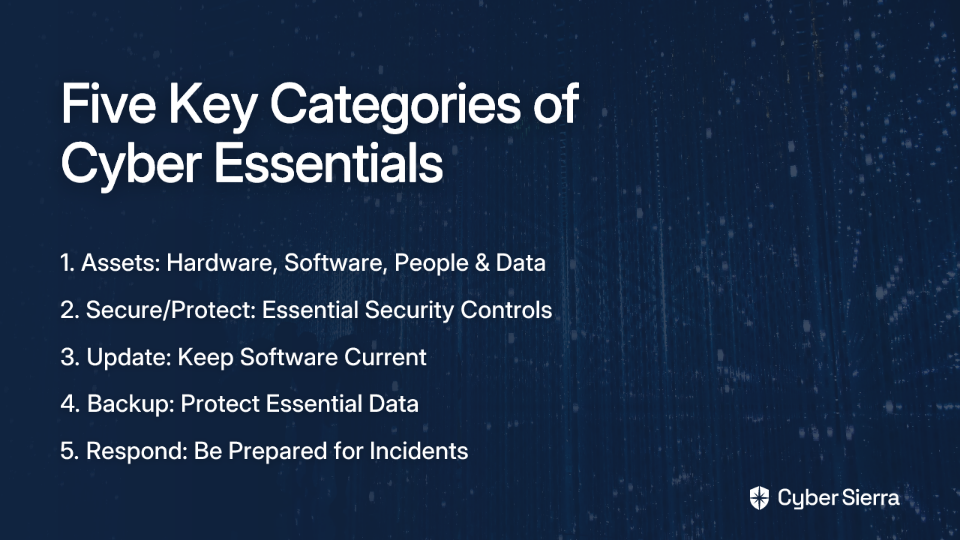
The Cyber Essentials framework organizes security requirements into five key categories:

1. Assets: Know What You Have and Protect It

People: Your employees are both your first line of defense and potentially your weakest security link.

  • Requirement: You must provide cybersecurity awareness training for all employees.
  • Implementation: Develop cyber hygiene practices and guidelines that cover phishing protection, strong passphrases, secure device usage, incident reporting, and data handling.
  • Practical Tip: "We use KnowBe4, it can be as simple or complex as you want it to be," shares one cybersecurity professional. "Eliminate as much technical terminology as possible and use analogies that non-tech employees can understand."

Hardware and Software: You can't protect what you don't know you have.

  • Requirement: Maintain an up-to-date inventory of all hardware and software assets.
  • Implementation: Record details like asset name/model, serial number, location, owner, classification, and end-of-support dates.
  • Automation Option: Many CMS vendors struggle with "the need for scripts to automate cybersecurity compliance tasks for Cyber Essentials." Tools like Microsoft Intune can help manage and enforce configurations across your environment.

Data: Healthcare data requires special protection.

  • Requirement: Identify and maintain an inventory of business-critical data.
  • Implementation: Document data classification, sensitivity, location, and retention periods.
  • Protection Measures: Implement encryption, access controls, and secure disposal methods.

2. Secure/Protect: Deploy Essential Security Controls

Virus and Malware Protection: Malicious software represents a significant threat vector.

  • Requirement: Install anti-malware solutions on all endpoints with automatic updates.
  • Implementation: Configure solutions to scan files upon access and deploy firewalls to protect networks and endpoints.
  • Network Security: Ensure firewall configurations are reviewed annually and protect Internet-facing assets.

Access Control: Unauthorized access is a common attack method.

  • Requirement: Establish account management processes and maintain an inventory of all accounts.
  • Implementation: Implement the principle of least privilege, ensuring employees can only access what they need for their job roles.
  • Authentication: Replace default passwords with strong passphrases and implement multi-factor authentication for administrative access.

Secure Configuration: Default settings often prioritize usability over security.

  • Requirement: Enforce security configurations for all assets based on industry standards.
  • Implementation: Replace weak configurations and protocols, disable unnecessary features, and enable logging.
  • Configuration Baselines: "I use Intune for my Cyber Essential Plus," notes one practitioner who successfully completed three years of audits. "Check out OpenIntuneBaseline for compliance and vulnerability scanning."

3. Update: Keep Software Current

Software Updates: Security patches address newly discovered vulnerabilities.

  • Requirement: Prioritize critical security updates for operating systems and applications.
  • Implementation: Test compatibility before deployment and enable automatic updates where feasible.
  • Cloud Considerations: Understand the shared responsibility model with your Cloud Service Provider regarding updates and patches.

4. Backup: Protect Essential Data

Data Backup: Regular backups are essential for recovery from incidents like ransomware.

  • Requirement: Identify business-critical systems and perform regular backups.
  • Implementation: Store backups securely offline and separate from the operating environment.
  • Verification: Test backups at least bi-annually to ensure they can be effectively restored.

5. Respond: Be Prepared for Incidents

Incident Response: How you respond to a security incident can determine its impact.

  • Requirement: Establish a basic incident response plan for common cybersecurity incidents.
  • Implementation: Define roles, responsibilities, procedures, and communication plans.
  • Continuous Improvement: Review the plan annually and incorporate lessons learned from any incidents.

The Certification Process

Obtaining Cyber Essentials certification involves several key steps:

  1. Define Your Scope: Clearly define what parts of your organization will be covered by the certification. This can include specific business units, systems, software, or locations.
  2. Self-Assessment: Complete the guided self-assessment template provided by CSA. This helps you evaluate your current security posture against the requirements.
  3. Independent Assessment: Engage with a CSA-appointed certification body for independent verification of your compliance.
  4. Certification: Once approved, your Cyber Essentials certification remains valid for two years.

Implementation Challenges and Solutions for CMS Vendors

Many CMS vendors face common challenges when implementing Cyber Essentials:

Limited Technical Resources

Challenge: "We don't have dedicated cybersecurity staff or expertise."

Solution: Leverage automated tools and managed services to implement and maintain security controls. For example, many CMS vendors express a "desire for a comprehensive script to perform a readiness check for Cyber Essentials compliance." Tools like IntuneManagement can help bulk import configurations.

Maintaining Employee Awareness

Challenge: "How do we ensure our team actually follows security practices?"

Solution: Implement engaging training programs that use real-world scenarios relevant to healthcare settings. As one security professional advises, "Incorporate real-world scenarios and use relatable language to enhance engagement."

Balancing Security with Usability

Challenge: "Strict security measures might impact our product's user experience."

Solution: Implement security by design principles that integrate security seamlessly with functionality. Focus on controls that provide maximum protection with minimal disruption.

Managing Third-Party Risks

Challenge: "We rely on multiple third-party services - how do we manage those risks?"

Solution: Include third-party risk assessment in your security program and ensure vendors meet necessary security requirements through contractual obligations.

Beyond Certification: Building a Security Culture

While achieving Cyber Essentials certification is valuable, building an ongoing security culture is equally important:

  1. Continuous Monitoring: Regularly review security configurations, conduct vulnerability assessments, and test controls.
  2. Security Awareness: Make cybersecurity part of your organizational culture through regular training and communications.
  3. Stay Informed: Keep up with emerging threats and evolving best practices in healthcare cybersecurity.

How Automation Can Help

Many CMS vendors struggle with manual compliance processes. Continuous control monitoring solutions like Cyber Sierra's CCM platform can help by:

  • Automating control testing and validation
  • Providing near real-time visibility into your security posture
  • Managing controls across multiple compliance frameworks
  • Detecting exceptions and anomalies in real-time
  • Building a central controls repository with automated updates

This addresses a key pain point expressed by many CMS vendors: the "need for scripts to automate cybersecurity compliance tasks for Cyber Essentials."

Conclusion

For CMS vendors operating under Singapore's Ministry of Health framework, Cyber Essentials certification provides a practical approach to enhancing your cybersecurity posture without requiring extensive resources or expertise. The framework focuses on essential controls that offer the most protection against common threats, following the 80/20 principle to maximize your security investment.

By systematically implementing the five categories of security measures - asset management, security controls, software updates, data backups, and incident response - you can significantly reduce your vulnerability to cyberattacks while demonstrating your commitment to protecting sensitive healthcare data.

Remember that cybersecurity is not a one-time project but an ongoing process. Use your Cyber Essentials certification as a foundation for continuous improvement in your security practices.

Frequently Asked Questions

What is Cyber Essentials for CMS vendors in Singapore?

Cyber Essentials is a cybersecurity certification specifically designed for organizations in Singapore, including Clinic Management Solution (CMS) vendors, that may have limited IT and cybersecurity expertise. It focuses on fundamental security measures to protect against common cyber threats, demonstrating a vendor's commitment to safeguarding sensitive healthcare data and systems as required by the Ministry of Health's CMS tiering framework.

Why is Cyber Essentials crucial for Clinic Management Solution providers?

Cyber Essentials is crucial for CMS providers because their systems handle sensitive patient information, making them prime targets for cyberattacks. Achieving this certification helps protect against data breaches, ensures continuity of healthcare services, preserves reputation and client trust, aids in meeting regulatory requirements, and prevents potential financial losses associated with security incidents.

How does Cyber Essentials accommodate CMS vendors with limited IT resources?

Cyber Essentials is designed with the understanding that many CMS vendors have limited IT resources and may lack dedicated security expertise. It focuses on essential, practical security measures that provide maximum protection (the 80/20 rule) without requiring complex implementations or significant budget allocations, making it an accessible framework for smaller organizations.

What are the five core areas Cyber Essentials focuses on?

Cyber Essentials organizes its security requirements into five key categories:

  1. Assets: Identifying and managing hardware, software, people, and data.
  2. Secure/Protect: Implementing essential security controls like anti-malware, access control, and secure configurations.
  3. Update: Keeping all software, especially operating systems and applications, current with security patches.
  4. Backup: Regularly backing up business-critical data and ensuring it can be restored.
  5. Respond: Having a basic plan in place to deal with common cybersecurity incidents.

What are the steps to get Cyber Essentials certified?

The Cyber Essentials certification process involves four main steps:

  1. Define Your Scope: Clearly determine which parts of your organization (business units, systems, software, locations) will be covered.
  2. Self-Assessment: Complete the CSA-provided self-assessment template to evaluate your current security against the requirements.
  3. Independent Assessment: Engage a CSA-appointed certification body for independent verification of your compliance.
  4. Certification: Upon successful assessment, your Cyber Essentials certification is granted and remains valid for two years.

How can automation assist CMS vendors in achieving Cyber Essentials compliance?

Automation can significantly assist CMS vendors by streamlining compliance tasks that might otherwise be manual and resource-intensive. Tools and platforms can automate control testing, provide real-time security posture visibility, manage controls across frameworks, detect exceptions, and maintain a central controls repository. This is particularly helpful for vendors needing to automate readiness checks and compliance tasks for Cyber Essentials.

Additional Resources

blog-hero-background-image
Cyber Security

How to Get the Cyber Essentials Certification

backdrop
Table of Contents

Join thousands of professionals and get the latest insight on Compliance & Cybersecurity.


In today's digital landscape, cybersecurity threats are growing in complexity and frequency, making robust security measures essential for organizations of all sizes. The Cyber Essentials certification offers a structured framework to help organizations protect themselves against common cyber threats while demonstrating their commitment to cybersecurity.

This article will guide you through the process of obtaining the Cyber Essentials certification, focusing specifically on the requirements and steps outlined in the 2025 Cyber Essentials mark certification document from Singapore's Cyber Security Agency (CSA).

What is Cyber Essentials Certification?

The Cyber Essentials mark is a certification designed for organizations with limited IT and cybersecurity expertise and resources. It focuses on implementing baseline controls to protect against the most common cyberattacks, following the Pareto principle (or 80/20 rule) - implementing the essential 20% of cybersecurity measures that prevent 80% of common attacks.

The certification serves two primary purposes:

  1. It helps prioritize essential cybersecurity measures to protect against common, non-targeted attacks
  2. It acts as a visible badge of recognition that demonstrates an organization's commitment to good cyber hygiene practices

Why Obtain Cyber Essentials Certification?

Organizations choose to pursue Cyber Essentials certification for several compelling reasons:

  • Enhanced Security Posture: Implementing the required controls significantly reduces vulnerability to common cyber threats
  • Competitive Advantage: Certification demonstrates your commitment to cybersecurity to clients and partners
  • Regulatory Compliance: In many sectors, certification helps meet regulatory requirements
  • Cost-Effective Security: The framework prioritizes essential controls, making effective security accessible even for organizations with limited resources
  • Risk Reduction: Addressing fundamental security measures reduces the likelihood of data breaches and system compromises

Understanding the Cyber Essentials Requirements

The Cyber Essentials mark focuses on five key categories of security measures:

  1. Assets: Knowing what you have and protecting it
    • People: Training employees to be the first line of defense
    • Hardware and software: Maintaining an inventory and securing devices
    • Data: Identifying critical data and implementing appropriate protection
  2. Secure/Protect: Implementing protective controls
    • Virus and malware protection: Protecting systems from malicious software
    • Access control: Controlling who can access organizational data and services
    • Secure configuration: Using secure settings for hardware and software
  3. Update: Keeping software current
    • Software updates: Regularly updating software on devices and systems
  4. Backup: Preserving essential data
    • Backing up critical data: Creating and securing backup copies of important information
  5. Respond: Planning for incidents
    • Incident response: Being ready to detect, respond to, and recover from cybersecurity incidents

Each of these categories includes specific requirements that organizations must meet to achieve certification.

Preparing for Cyber Essentials Certification

Step 1: Define Your Scope of Certification

Before beginning the certification process, you must clearly define the boundary of your assessment scope. According to the 2025 Cyber Essentials mark certification document, your scope must include:

  • Business service(s) within scope
  • Business unit(s) involved
  • Network boundary
  • Devices and/or systems within the scope
  • Software and/or services within the scope
  • Physical location(s)

You'll also need to specify which cybersecurity pillars apply to your organization:

  • Classical cybersecurity
  • Cloud security (if applicable)
  • OT security (if applicable)
  • AI security (if applicable)

A complete statement of scope includes both a description of what's being certified and the relevant cybersecurity pillars. For example: "Product development, support and operations for [SaaS product]. Cybersecurity pillar: Classical cybersecurity, cloud security."

Step 2: Complete the Self-Assessment

Before engaging a certification body, you must complete the guided self-assessment template required for Cyber Essentials mark certification. This self-assessment helps you evaluate your current security posture against the Cyber Essentials requirements.

The self-assessment template consists of a comprehensive list of requirements and recommendations that your organization must assess and indicate if these have been implemented. This process allows you to identify any gaps that need to be addressed before formal assessment.

Some key areas to focus on during self-assessment include:

  • Employee Training: Verify that you've established cybersecurity awareness and data protection training for all employees
  • Asset Inventory: Ensure you maintain updated inventories of hardware, software, and data assets
  • Security Controls: Confirm implementation of virus protection, firewalls, access control, and secure configurations
  • Update Processes: Check that software update procedures are documented and followed
  • Backup Procedures: Verify that essential data is regularly backed up and stored securely
  • Incident Response: Ensure you have a basic incident response plan in place

Organizations often encounter challenges during self-assessment related to:

  • Documentation: Many security measures may be in place but not formally documented
  • Consistency: Security controls might be implemented inconsistently across the organization
  • Resource Constraints: Limited IT expertise may make some requirements challenging to implement

Tools like Cyber Sierra's Continuous Control Monitoring can help streamline this assessment process by automating the tracking of security controls and providing a centralized repository for documentation, making it easier to identify gaps in your cybersecurity posture.

Step 3: Address Any Gaps

After completing the self-assessment, you'll need to address any gaps identified before proceeding with formal certification. This might involve:

  • Implementing missing security controls
  • Updating existing policies and procedures
  • Providing additional training to employees
  • Improving documentation of security measures

It's important to approach this step systematically, prioritizing the most critical gaps first. Remember, Cyber Essentials focuses on essential controls, so addressing these gaps will significantly improve your security posture even before certification.

Step 4: Engage a Certification Body

Once you've completed your self-assessment and addressed any gaps, you'll need to engage an accredited certification body appointed by the Cyber Security Agency of Singapore (CSA) for independent assessment and issuance of the Cyber Essentials mark certification.

The certification body will conduct an independent assessment of your organization's cybersecurity measures based on the scope defined earlier. Assessors may apply professional judgment based on your business context when evaluating your application.

During the assessment, the certification body will:

  • Review your self-assessment documentation
  • Evaluate the design and implementation of your cybersecurity measures
  • Inspect supporting documents and artifacts
  • Verify that all requirements have been met

For your organization to be certified, you must meet all the requirements outlined in the Cyber Essentials mark framework.

Maintaining Your Cyber Essentials Certification

Once certified, your Cyber Essentials mark remains valid for two years. However, maintaining good cybersecurity practices should be an ongoing effort rather than a one-time exercise for certification.

Continuous Monitoring and Improvement

Cybersecurity threats evolve constantly, and your security controls need to evolve as well. Consider implementing:

  • Regular security assessments
  • Periodic reviews of security policies and procedures
  • Ongoing employee awareness training
  • Monitoring of security controls effectiveness

Tools like Cyber Sierra's Continuous Control Monitoring (CCM) can be particularly valuable for maintaining your security posture by providing near real-time visibility into your controls' effectiveness and automatically detecting exceptions and anomalies that could compromise your security.

Preparing for Re-certification

As your two-year certification period approaches its end, you should begin preparing for re-certification. This involves:

  1. Conducting a fresh self-assessment
  2. Addressing any new gaps identified
  3. Updating documentation to reflect changes in your environment
  4. Re-engaging with a certification body for assessment

Depending on how your organization has evolved, you might consider upgrading to the more comprehensive Cyber Trust mark if your risk profile has changed.

Common Challenges and Best Practices

Addressing Common Cultural Challenges

Many organizations face cultural challenges when implementing cybersecurity measures required for Cyber Essentials:

  • Compliance vs. Security Mindset: Some view certification as a box-ticking exercise rather than a genuine security improvement. Focus on building a culture that values security for its own sake, not just for certification.
  • Post-Certification Complacency: As one Reddit user noted, clients sometimes request to "undo a change that was put in to comply with the certification (90 day password expiry)" after receiving certification. Document your security recommendations clearly and explain the importance of maintaining security practices.
  • User Resistance: Employees may resist security measures that they perceive as hindering productivity. Regular training and clear communication about the importance of security measures can help overcome this resistance.

Implementation Best Practices

To successfully implement and maintain Cyber Essentials requirements:

  1. Document Everything: Maintain thorough documentation of your security controls, policies, and procedures.
  2. Engage Leadership: Ensure senior management understands and supports your cybersecurity initiatives.
  3. Prioritize User Training: As one cybersecurity professional noted, "You can spend all the money you want on cool tools, pentests, etc, but it'll be someone opening an email for a $500 Amazon gift card that'll mess everything up." Regular security awareness training is essential.
  4. Implement Multi-Factor Authentication (MFA): While not explicitly required for all systems under Cyber Essentials, MFA significantly enhances security and is increasingly becoming an industry standard.
  5. Automate Where Possible: Use tools like Cyber Sierra's Governance, Risk & Compliance (GRC) solution to automate data collection, risk assessments, and control monitoring, making compliance more efficient and less resource-intensive.

Conclusion

The Cyber Essentials mark certification provides a structured approach to implementing essential cybersecurity measures that protect against common cyber threats. By following the steps outlined in this article, organizations can not only achieve certification but also significantly enhance their security posture.

Remember that certification is just one milestone in your cybersecurity journey. True security requires ongoing vigilance, continuous improvement, and a strong security culture throughout your organization.

For organizations looking to streamline their certification process and maintain a robust security posture beyond certification, platforms like Cyber Sierra offer integrated solutions that automate control monitoring, simplify compliance, and provide actionable security insights.

Whether you're just starting your cybersecurity journey or looking to formalize your existing practices through certification, the Cyber Essentials mark provides a valuable framework for building and demonstrating your commitment to cybersecurity.

Frequently Asked Questions (FAQ)

What is the Cyber Essentials certification?

Cyber Essentials is a cybersecurity certification scheme designed to help organizations implement fundamental security controls against common cyber threats. It is particularly aimed at organizations, including small and medium-sized enterprises (SMEs), that may have limited IT and cybersecurity resources. The framework focuses on essential measures that prevent the majority of common attacks, helping organizations prioritize baseline security and demonstrate good cyber hygiene.

Why should my organization get Cyber Essentials certified?

Your organization should get Cyber Essentials certified primarily to enhance its security posture, gain a competitive advantage, and potentially meet regulatory or supply chain requirements. Certification demonstrates a commitment to cybersecurity to clients and partners, reduces the risk of common cyberattacks, and provides a cost-effective way to implement essential security controls, thereby minimizing the likelihood of data breaches and system compromises.

What are the main requirements for Cyber Essentials?

The main requirements for Cyber Essentials are grouped into five key categories: Assets (knowing and protecting your people, hardware, software, and data), Secure/Protect (implementing controls like virus protection, firewalls, and access control), Update (keeping software current), Backup (preserving essential data), and Respond (planning for incidents). Organizations must meet specific criteria within each of these areas.

How long is the Cyber Essentials certification valid?

The Cyber Essentials mark certification is valid for two years from the date of issuance. To maintain certification beyond this period, organizations must undergo a re-certification process, which typically involves a fresh self-assessment and an independent assessment by an accredited certification body.

What happens after I get Cyber Essentials certified?

After achieving Cyber Essentials certification, your organization must focus on maintaining and continuously improving its cybersecurity practices. Cybersecurity is an ongoing effort, not a one-time task. This includes regular monitoring of security controls, periodic reviews of policies, ongoing employee training, and preparing for re-certification as the two-year validity period approaches.

Is Cyber Essentials suitable for small businesses?

Yes, Cyber Essentials is highly suitable for small businesses. The certification is specifically designed for organizations, including those with limited IT expertise and resources, providing a manageable and cost-effective framework to implement baseline cybersecurity controls against the most common threats.

How do I start the Cyber Essentials certification process?

To start the Cyber Essentials certification process, your organization should first clearly define the scope of the certification (i.e., which parts of your business, systems, and services will be covered). Following this, you must complete the guided self-assessment template provided by the Cyber Security Agency (CSA) to evaluate your current security posture against the Cyber Essentials requirements and identify any gaps.

blog-hero-background-image
Cyber Security

The Challenge of Data Aggregation: Prioritizing Security Issues Effectively

backdrop
Table of Contents

Join thousands of professionals and get the latest insight on Compliance & Cybersecurity.


You've implemented multiple security tools across your organization's infrastructure, each generating thousands of alerts daily. But when you check your dashboard, you're overwhelmed by a flood of notifications ranging from critical vulnerabilities to minor misconfigurations - with no clear indication of what truly needs your immediate attention.

These endless alerts are draining your security team's resources without providing actionable intelligence. Seeing your SOC team struggle to differentiate between active threats and routine misconfigurations is frustrating, especially when you've invested heavily in security tools designed to protect your organization. Your team lacks the expertise to effectively manage active security alerts in cloud environments, and extracting meaningful data from your tools feels nearly impossible.

There's a strategic approach to regain control over your security posture and effectively prioritize the threats that matter most to your organization.

By implementing effective data aggregation strategies and establishing clear prioritization frameworks, you can transform overwhelming security data into actionable intelligence that guides your remediation efforts.

What is Data Aggregation in Security?

Data aggregation in the security context refers to the process of collecting, processing, and presenting security-related information from multiple sources into a unified, coherent format. This consolidation of data enables security teams to gain comprehensive visibility into their organization's security posture.

According to TechTarget, "data aggregation is the process of gathering and expressing data in a summary form." In cybersecurity, this means combining threat intelligence, vulnerability scans, configuration assessments, and security logs from various tools into meaningful insights.

Effective data aggregation offers several critical benefits:

  1. Holistic Security Visibility: Provides a complete view of the security landscape across all environments (on-premises, cloud, hybrid)
  2. Improved Decision Making: Enables informed prioritization of security issues based on comprehensive data
  3. Enhanced Response Capabilities: Facilitates faster incident response through consolidated information
  4. Resource Optimization: Helps allocate security resources to the most significant threats

The Data Aggregation Challenge in Modern Security

Organizations today face several significant challenges when attempting to aggregate and prioritize security data:

1. Tool Proliferation and Alert Fatigue

According to recent discussions in the cybersecurity community, organizations are struggling with "excessive reliance on multiple security tools," creating operational inefficiencies. A Reddit thread highlights the ambiguity in defining what constitutes a "single security tool," further complicating management and evaluation.

The consequences of this tool sprawl include:

  • Alert Fatigue: Security teams become overwhelmed by the sheer volume of notifications
  • Operational Complexity: Managing multiple dashboards and interfaces reduces efficiency
  • Integration Difficulties: Tools often don't communicate effectively with each other

2. Skill Gaps in Modern Security Environments

Security Operations Centers (SOCs) increasingly face challenges in cloud security environments. As one security professional noted, "the SOC just didn't have the skill set to handle active alerts on potentially malicious containers and cloud infrastructure." This knowledge gap creates vulnerabilities even when the right tools are in place.

The complexity of modern environments requires expertise across:

  • Cloud Workload Protection Platforms (CWPPs)
  • Cloud Native Application Protection Platforms (CNAPPs)
  • Container security in environments like Google Kubernetes Engine (GKE)

3. Data Integration and Presentation Challenges

Security professionals report significant difficulties in extracting and integrating security data into meaningful dashboards. One practitioner mentioned, "It's hard to get the data out and integrate into dashboards (for us Grafana) in a way that was meaningful and easy enough to understand for developers to act on."

This challenge is particularly acute in environments adopting DevOps philosophies, where security must be integrated into development workflows.

4. Lack of Standardization in Data Formats

Security tools often produce data in proprietary formats that require transformation before aggregation. This creates additional complexity in the data pipeline and can lead to information loss or distortion during the conversion process.

Effective Strategies for Security Data Aggregation

To overcome these challenges, organizations can implement several proven strategies:

1. Implement a Tiered Aggregation Approach

Rather than attempting to aggregate all security data at once, establish a tiered approach:

  • Tier 1: Critical security telemetry (active threats, exploitable vulnerabilities)
  • Tier 2: Important security information (misconfigurations, policy violations)
  • Tier 3: Contextual security data (asset information, compliance status)

This classification helps prioritize which data to process first and ensures critical information receives immediate attention.

2. Establish Clear Data Categories

Security professionals emphasize the importance of categorization: "The most important thing is to strictly separate your misconfiguration alerts, vulnerabilities, and active exploits." This separation allows different teams to address issues according to their expertise.

Create distinct categories for:

  • Active Threats: Immediate response by SOC/MDR teams
  • Vulnerabilities: Prioritized remediation by IT teams
  • Misconfigurations: Resolution by system administrators or DevOps
  • Compliance Issues: Management by governance teams

3. Leverage Modern Data Aggregation Tools

Select appropriate tools to facilitate data aggregation based on organizational needs:

  • PowerBI or Azure Data Factory: For organizations in Microsoft environments
  • SQL Server Integration Services: For database-centric security data
  • Open-source solutions: Grafana, ELK Stack, or Prometheus for telemetry-heavy environments

According to Reddit discussions, "Azure Data Factory has proved to be quite good at [data aggregation], albeit comes at a price." The selection should balance functionality, integration capabilities, and cost.

4. Implement Role-Based Access Control (RBAC)

Security data often contains sensitive information. Implementing RBAC ensures:

  • Only authorized personnel can access specific types of security data
  • Teams receive information relevant to their responsibilities
  • Sensitive vulnerability information remains protected

Prioritizing Security Issues Effectively

Once data is aggregated, the next challenge is prioritizing which issues to address first. Here are proven approaches:

Effective Security Issue Prioritization

1. Risk-Based Prioritization Framework

Develop a framework that considers multiple risk factors:

  • Exploitability: Is there a known exploit? Is it being actively used in the wild?
  • Potential Impact: What systems or data could be compromised?
  • Business Context: How critical is the affected system to business operations?
  • Compliance Requirements: Does this issue affect regulatory compliance (e.g., NIST)?

2. Focus on Active Threats First

According to security practitioners, "The SOC should focus on active threat alerts rather than misconfiguration alerts." Active threats represent immediate danger and should receive priority attention from security teams.

Indicators of active threats include:

  • Unusual authentication patterns
  • Suspicious process execution
  • Network traffic to known malicious destinations
  • Data exfiltration attempts

3. Address Critical Vulnerabilities Next

After active threats, focus on vulnerabilities with:

  • High CVSS scores (particularly 9.0 or above)
  • Public exploit code availability
  • Presence in critical systems
  • Transitive dependencies that could create cascade effects

According to PurpleSec, "Vulnerability prioritization involves identifying and ranking vulnerabilities based on potential impact and exploitability," with the objective of addressing high-risk vulnerabilities first.

4. Tackle Misconfigurations Systematically

Cloud misconfigurations represent a significant risk vector but should be addressed after active threats and critical vulnerabilities. Prioritize misconfigurations based on:

  • Exposure to the internet
  • Sensitivity of affected resources
  • Potential for lateral movement
  • Compliance impacts (e.g., NIST compliance violations)

Implementing Effective Remediation Workflows

Data aggregation and prioritization are only valuable if they lead to effective remediation. Here's how to ensure security issues get resolved:

1. Establish Clear Accountability

One of the biggest challenges in security remediation is accountability. As noted in a Reddit discussion, there's often a "lack of responsibility for timely patch management" which "exacerbates vulnerability risks."

To address this:

  • Assign clear ownership for different types of security issues
  • Implement automated alerts when remediation deadlines approach
  • Create escalation paths for unaddressed high-priority issues
  • Document accountability to ensure proper follow-through

2. Implement Automated Remediation Where Possible

For certain issues, particularly misconfigurations, automated remediation can significantly reduce risk:

  • Use infrastructure-as-code to enforce security configurations
  • Implement auto-remediation workflows for common issues
  • Apply Security-Based Access Control (SBAC) to prevent misconfigurations

3. Manage Cloud Permissions Effectively

Permissions management is a critical aspect of security remediation. Security professionals recommend using "AWS IAM Access Analyzer and Azure AD Privileged Identity Management (PIM) for reviewing excessive permissions and enforcing least-privilege access."

These tools help identify:

  • Excessive permissions that violate least-privilege principles
  • Unused permissions that create unnecessary attack surfaces
  • Cross-account access that might lead to privilege escalation

4. Monitor and Validate Remediation

Verification is essential to ensure that remediation efforts are effective:

  • Implement continuous validation through automated testing
  • Conduct periodic security assessments to verify issue resolution
  • Maintain historical data to identify recurring issues

Case Study: Improving Cloud Security Through Effective Data Aggregation

A large financial services company struggled with managing security across their multi-cloud environment. They were using separate tools for Google Kubernetes Engine (GKE), AWS, and Azure, resulting in fragmented visibility and ineffective prioritization.

By implementing a CNAPP solution with robust data aggregation capabilities, they were able to:

  1. Consolidate security telemetry from all cloud environments
  2. Prioritize vulnerabilities based on actual exploitability and business impact
  3. Reduce mean time to remediation by 62%
  4. Decrease critical security incidents by 45% over six months

The key to their success was implementing a structured approach to data aggregation and prioritization, focusing SOC resources on active threats while routing misconfigurations to appropriate DevOps teams.

Best Practices for Long-Term Success

To maintain effective security data aggregation and prioritization over time:

  1. Log Everything: Comprehensive data logging from various sources provides the foundation for effective security analysis. Use tools like Auditd for UNIX environments and Windows Event Logs for Windows systems.
  2. Regularly Review and Update Prioritization Criteria: Threat landscapes evolve, requiring periodic reassessment of what constitutes a high-priority issue.
  3. Invest in Team Expertise: Address skill gaps in cloud security through training and specialized Managed Detection and Response (MDR) services.
  4. Streamline Tool Portfolio: Regularly evaluate security tools to reduce overlap and improve integration, working toward a "single pane of glass" for security visibility.
  5. Maintain a Robust Configuration Management Database (CMDB): As one security professional noted, "insufficient CMDB data leads to security challenges" by hampering visibility into cloud resources.

Conclusion

Effective data aggregation and prioritization are foundational to modern security operations. By implementing structured approaches to collecting, categorizing, and prioritizing security data, organizations can significantly improve their ability to identify and address the most critical issues first.

The key to success lies in separating different types of security issues, assigning clear ownership, and ensuring that remediation efforts are tracked and validated. With proper data aggregation strategies, security teams can cut through the noise and focus on what truly matters – protecting their organizations from active threats and critical vulnerabilities.

As security environments continue to grow in complexity, particularly with the adoption of cloud and containerized workloads, the ability to effectively aggregate and prioritize security data will become even more crucial to maintaining robust security postures.

blog-hero-background-image
Cyber Security

How to Budget for Risk Management in Your Sector

backdrop
Table of Contents

Join thousands of professionals and get the latest insight on Compliance & Cybersecurity.


You've analyzed the risks, created comprehensive contingency plans, and implemented robust security measures for your organization. But when it comes time to justify your risk management budget to the finance team, you're met with skepticism: "Why do we need to allocate so many resources to something that might never happen?" This is the perennial challenge of risk management budgeting—convincing stakeholders to invest in preventing problems they can't yet see while balancing competing priorities for limited resources.

Understanding the Fundamentals of Risk Management Budgeting

Risk management isn't just about avoiding disasters—it's about making strategic investments to protect your organization's future. A well-structured risk management budget serves multiple purposes:

  • It allocates resources efficiently to address the most pressing threats
  • It demonstrates regulatory compliance and due diligence
  • It provides financial protection against potential losses
  • It creates operational resilience in the face of disruptions

Before diving into specific budgeting strategies, it's essential to clarify key terminology that will frame our discussion:

  • Risk Management Plan (RMP): The overarching document that outlines your organization's approach to identifying, assessing, and responding to risks.
  • Risk Register (RR): A detailed inventory of identified risks, their potential impacts, and mitigation strategies. While related to the RMP, the risk register exists as a separate project document that evolves throughout your risk management process.

As one practitioner clarified in a project management forum: "The Risk Management Plan details how to manage risks overall (how to identify, assess, respond, and monitor)," while the risk register contains the actual documented risks and response strategies.

The ABC Approach to Risk Management Budgeting

When developing your risk management budget, consider following the ABC model—Assessment, Budgeting, and Controls—as outlined by financial risk management experts at CBM CPA:

1. Assessment: Identifying and Quantifying Your Risks

The foundation of effective risk management budgeting begins with a comprehensive assessment:

Identify Sector-Specific Risks: Different industries face unique challenges:

  • Financial services: Credit defaults, market volatility, fraud
  • Healthcare: Patient data breaches, regulatory compliance failures, malpractice
  • Manufacturing: Supply chain disruptions, workplace safety incidents, quality control issues
  • Technology: Data breaches, IP theft, service outages

Quantify Potential Impacts: For each identified risk, estimate:

  • Direct financial losses
  • Operational downtime costs
  • Remediation expenses
  • Regulatory penalties
  • Reputational damage (often the hardest to quantify but potentially most devastating)

Prioritize Based on Likelihood and Impact: Not all risks are created equal. Use a risk matrix to categorize threats based on:

  • Probability of occurrence
  • Severity of potential impact
  • Time horizon (immediate vs. long-term)

Many organizations struggle with this prioritization step. As one risk professional noted in an online forum: "Those small, seemingly insignificant risks that have a 5% chance of occurring might not seem worth addressing, but when they add up to thousands of dollars over time, they can't be ignored."

2. Budgeting: Allocating Resources Strategically

Once you've assessed your risks, it's time to translate that understanding into a financial plan:

Align with Business Objectives: Your risk management budget should support your organization's strategic goals, not compete with them. This alignment makes it easier to justify investments to leadership.Create a Multi-Tiered Budget Structure:

  • Essential/Non-Negotiable Expenditures: Regulatory compliance requirements, critical infrastructure protection, and minimum insurance coverage
  • Risk-Reduction Investments: Preventative measures that significantly decrease the likelihood of common threats
  • Contingency Reserves: Dedicated funds for responding to incidents that occur despite prevention efforts
  • Opportunity Fund: Resources for addressing emerging risks or taking advantage of new risk management technologies

Consider Both Capital and Operational Expenses:

  • One-time investments in security infrastructure or systems
  • Ongoing costs for maintenance, monitoring, training, and personnel
  • Insurance premiums and risk transfer mechanisms

Implement Zero-Based Budgeting: Rather than simply adjusting last year's budget, justify each risk management expenditure based on current assessments. This approach, known as "zero-based budgeting," helps eliminate unnecessary spending while ensuring adequate coverage for evolving threats.

3. Controls: Implementing and Monitoring Your Risk Management Budget

With your budget allocated, the next critical step is establishing controls to ensure effective implementation:

Establish Internal Controls: Implement checks and balances such as:

  • Segregation of duties for financial approvals
  • Regular audits and reconciliations
  • Clear documentation of risk management expenditures

Develop and Enforce Financial Policies: Create clear guidelines for:

  • Spending authorization levels
  • Reimbursement procedures
  • Management of reserve funds
  • Reporting requirements

Regular Monitoring and Adjustment:

  • Conduct ongoing assessment of your financial landscape
  • Track actual spending against budgeted amounts
  • Adjust allocations based on emerging risks or changing conditions

As emphasized in best practices for budgeting success, "Ongoing monitoring and forecasting are essential for making timely budget adjustments."

Sector-Specific Risk Management Budgeting Considerations

While the ABC approach provides a general framework, effective risk management budgeting must be tailored to your specific sector:

Financial Services

Key Budget Considerations:

  • Regulatory compliance costs (GDPR, PCI DSS, SOX, etc.)
  • Fraud prevention and detection systems
  • Business continuity and disaster recovery
  • Cybersecurity infrastructure

Budgeting Approach: Financial institutions typically allocate 5-10% of their IT budget specifically to cybersecurity, with larger percentages for companies handling particularly sensitive data or subject to stringent regulations.

Emerging Trend: With the rise of AI in risk assessment, financial institutions are increasingly budgeting for both AI tools and human expertise to interpret results, creating a hybrid approach that maximizes effectiveness.

Healthcare

Key Budget Considerations:

  • Patient data protection (HIPAA compliance)
  • Clinical risk management
  • Professional liability insurance
  • Disaster and emergency preparedness

Budgeting Approach: Healthcare organizations often implement a "continuum of protection" model, where budgeting for risk management spans multiple departments rather than existing as a standalone function.

Emerging Trend: The increase in ransomware attacks specifically targeting healthcare has led many organizations to increase their cybersecurity budgets by 15-20% year-over-year, with particular emphasis on backup systems and recovery capabilities.

Manufacturing and Supply Chain

Key Budget Considerations:

  • Workplace safety and compliance
  • Supply chain disruption mitigation
  • Product liability and recall reserves
  • Environmental risk management

Budgeting Approach: Manufacturing companies often use a "risk-adjusted return on investment" model, prioritizing investments that provide the greatest risk reduction per dollar spent.

Emerging Trend: Following recent global supply chain disruptions, many manufacturers are increasing budgets for supplier diversification and redundancy, viewing these expenses as essential insurance against future disruptions.

Technology and SaaS

Key Budget Considerations:

  • Data security and privacy compliance
  • Business continuity and service reliability
  • Intellectual property protection
  • Third-party vendor risk management

Budgeting Approach: Technology companies frequently adopt an "agile risk budgeting" approach, allocating smaller amounts to multiple initiatives with regular reassessment rather than large, fixed allocations.

Emerging Trend: With the shift to cloud infrastructure, tech companies are increasingly focused on "cloud sprawl" management—budgeting for tools that optimize cloud resource usage while maintaining security controls.

Tools and Resources for Effective Risk Management Budgeting

Modern risk management budgeting leverages various tools to improve accuracy and efficiency:

Risk Assessment and Management Platforms

Integrated platforms like Cyber Sierra's Continuous Control Monitoring (CCM) module can transform how organizations approach risk budgeting by:

  • Building a central controls repository with near real-time updates
  • Providing clear visibility into security posture through continuous monitoring
  • Delivering actionable risk intelligence for data-driven remediation

This continuous monitoring approach allows for more dynamic budget adjustments based on actual risk conditions rather than periodic assessments.

Financial Management Tools

For tracking risk management expenditures and measuring ROI:

  • Enterprise resource planning (ERP) systems with dedicated risk management modules
  • Specialized GRC (Governance, Risk, and Compliance) platforms
  • Business intelligence tools like Power BI for visualizing risk management spending patterns

Data Analytics and Forecasting

Advanced analytics tools can help predict future risk landscapes and budget needs:

  • Predictive modeling software
  • Scenario analysis tools
  • Monte Carlo simulations for complex risk interdependencies

Many organizations are now using these tools to move from reactive to proactive risk management budgeting. As one finance leader noted, "We've shifted from asking 'How much did we spend on risk management last year?' to 'What risks are on the horizon, and how should we prepare financially?'"

Common Challenges in Risk Management Budgeting and How to Overcome Them

Despite its importance, risk management budgeting faces several persistent challenges:

Challenge 1: Justifying "Insurance" Expenses

The Problem: Risk management investments can be difficult to justify because their success often means "nothing happens"—a non-event that's hard to quantify.

Solution: Frame risk management as business enablement rather than just protection. Demonstrate how proper risk management allows the organization to pursue opportunities with confidence. Use case studies from your industry where inadequate risk management led to significant losses.

Challenge 2: Balancing Competing Priorities

The Problem: Limited resources mean risk management competes with other strategic initiatives for funding.

Solution: Integrate risk considerations into all budgeting discussions rather than treating risk management as a separate, competing priority. Demonstrate how risk management supports other business objectives by preventing disruptions to strategic initiatives.

For organizations struggling with this challenge, Cyber Sierra's Governance, Risk & Compliance (GRC) module can help by automating data collection and risk assessments, allowing teams to focus resources on the most critical areas rather than spreading them too thin.

Challenge 3: Tracking ROI on Risk Management

The Problem: Traditional ROI calculations are challenging to apply to preventative measures.

Solution: Adopt alternative metrics like:

  • Risk reduction per dollar spent
  • Cost of compliance vs. cost of non-compliance
  • Reduction in insurance premiums due to improved controls
  • Comparison to industry benchmarks and peer spending

Challenge 4: Adapting to Emerging Risks

The Problem: Risk landscapes evolve rapidly, making static annual budgets quickly obsolete.

Solution: Implement a rolling budget approach with quarterly reassessments. Maintain a dedicated contingency fund specifically for emerging risks that weren't anticipated during the initial budgeting process.

Best Practices for Risk Management Budgeting

Based on insights from industry experts and successful organizations, here are key best practices to implement:

1. Involve Cross-Functional Stakeholders

Risk management isn't solely the responsibility of a dedicated team. Involve leaders from across the organization in the budgeting process to ensure comprehensive coverage and buy-in.

2. Focus on Cash Flow, Not Just Profitability

As highlighted in budgeting best practices, "A focus on cash flow management ensures that you have enough liquidity to cover potential risks." Even profitable organizations can face cash flow challenges that limit their ability to respond to unexpected risks.

3. Implement a Tiered Approach to Risk Management Budgeting

Categorize risks and associated budgets into tiers:

  • Tier 1: Critical risks requiring immediate attention and substantial resources
  • Tier 2: Significant risks warranting planned mitigation strategies
  • Tier 3: Moderate risks that can be addressed through procedural changes or training
  • Tier 4: Low-level risks that are accepted and monitored

This approach ensures that resources are allocated proportionally to risk severity.

4. Plan for Both Prevention and Response

Allocate budget not just for preventing risks but also for responding to incidents that occur despite preventative measures. This dual approach acknowledges that some level of risk is inevitable and ensures organizational resilience.

5. Leverage Technology for Efficiency

Modern risk management tools can significantly improve the efficiency of your risk management spending. For example, Cyber Sierra's Third-Party Risk Management (TPRM) solution automates vendor assessments and continuously monitors third-party compliance, reducing manual effort while providing more comprehensive coverage.

Conclusion: Building a Mature Risk Management Budgeting Process

Effective risk management budgeting is not a one-time exercise but an evolving process that matures alongside your organization. As you refine your approach:

  • Move from reactive to proactive budgeting
  • Shift from compliance-driven to value-driven risk management
  • Transition from periodic assessments to continuous monitoring
  • Evolve from siloed risk management to an integrated, enterprise-wide approach

By applying the ABC framework—Assessment, Budgeting, and Controls—and tailoring it to your specific sector, you can develop a risk management budget that not only protects your organization from threats but also enables strategic growth and resilience. Remember that in today's rapidly changing business environment, the biggest risk might be inadequate investment in risk management itself. As one CISO aptly put it, "We don't budget for risk management because we can afford to; we budget for it because we can't afford not to."

Frequently Asked Questions

What is risk management budgeting?

Risk management budgeting is the process of allocating financial resources to identify, assess, mitigate, and monitor potential risks to an organization. It involves creating a structured financial plan to support your overall risk management strategy, ensuring funds are available for preventative measures, security controls, contingency plans, and recovery efforts. This strategic investment aims to protect the organization's assets, reputation, and operational continuity.

Why is effective risk management budgeting crucial for businesses?

Effective risk management budgeting is crucial because it helps businesses proactively protect their assets, ensure operational resilience, and maintain financial stability by strategically investing in preventative measures. It allows organizations to allocate resources efficiently to address the most pressing threats, demonstrate regulatory compliance, provide financial protection against potential losses, and ultimately support the achievement of strategic business objectives by minimizing disruptions.

What is the ABC approach to risk management budgeting?

The ABC approach to risk management budgeting involves three key stages: Assessment, Budgeting, and Controls. First, Assessment involves identifying and quantifying potential risks specific to your organization and industry. Next, Budgeting focuses on strategically allocating financial resources based on these assessments, aligning with business objectives, and creating a multi-tiered budget structure. Finally, Controls ensure the effective implementation and monitoring of the budget through internal checks, financial policies, and regular adjustments.

How can organizations justify risk management expenses that prevent "non-events"?

Organizations can justify risk management expenses by framing them as business enablers that allow for confident pursuit of opportunities, rather than solely as "insurance" against unseen events. Demonstrating how robust risk management supports strategic goals, maintains operational continuity, and protects brand reputation can shift the perception from a cost center to a value driver. Using industry-specific case studies where inadequate risk management led to significant losses can also powerfully illustrate the return on investment.

How often should a risk management budget be reviewed and adjusted?

A risk management budget should be reviewed and adjusted regularly, ideally more frequently than a static annual cycle, to adapt to the rapidly evolving risk landscape. Many organizations are adopting a rolling budget approach with quarterly reassessments. Continuous monitoring of the financial landscape, tracking actual spending against budgeted amounts, and maintaining a contingency fund for emerging risks are crucial for ensuring the budget remains relevant and effective.

What are some common challenges in risk management budgeting?

Common challenges include justifying expenses for preventative measures, balancing risk management with other competing priorities, accurately tracking the ROI of risk initiatives, and adapting budgets to new and emerging risks. Overcoming these often involves integrating risk considerations into all budgeting discussions, using alternative ROI metrics like risk reduction per dollar spent, and implementing flexible budgeting approaches with regular reviews to address the dynamic nature of threats.

blog-hero-background-image
Cyber Security

Cyber Security Analyst vs. GRC Analyst: Which Role Delivers Greater Strategic Value?

backdrop
Table of Contents

Join thousands of professionals and get the latest insight on Compliance & Cybersecurity.


You've invested heavily in your cybersecurity program, yet your team still struggles with alert fatigue, compliance headaches, and the constant challenge of translating technical risks into business language your executives understand. Sound familiar?

The disconnect between technical security operations and governance structures is costing organizations millions in inefficiency, compliance penalties, and preventable breaches. As cybersecurity threats grow more sophisticated and regulatory requirements multiply, understanding the distinct roles of Cyber Security Analysts and Governance, Risk, and Compliance (GRC) Analysts has never been more critical.

Cyber Security Analyst vs. GRC Analyst

Cyber Security Analysts and GRC Analysts represent two complementary but fundamentally different approaches to protecting your organization's digital assets. While they share the common goal of safeguarding your business, their day-to-day responsibilities, skill requirements, and strategic impact differ significantly.

Cyber Security Analyst: The Front-Line Defender

Cyber Security Analysts serve as the operational front-line defenders of your digital infrastructure. Their primary focus is identifying, analyzing, and responding to immediate security threats and vulnerabilities.

Key Responsibilities:

  • Monitoring security alerts and investigating potential incidents
  • Implementing and maintaining security tools and technologies
  • Conducting vulnerability scans and penetration testing
  • Responding to and mitigating active security breaches
  • Analyzing security logs and identifying suspicious patterns
  • Implementing security controls and hardening systems

This role is highly technical, requiring deep expertise in specific security tools, threat detection systems, and incident response protocols. While essential to your security operations, many Cyber Security Analysts report significant pain points in their daily work.

As one analyst shared on Reddit: "50% of my time is triaging alerts and performing some info gathering, monitoring mailboxes and a few other bits - basic work anyone could do it. Very boring and repetitive." Another analyst expressed similar frustration: "50% of my time I'm brain dead, the other is looking at shit detections that 99.9% are FP [false positives]."

These testimonials highlight a common challenge: the operational focus of the role can lead to burnout from monotonous tasks and alert fatigue. While the work is absolutely necessary, it often lacks the strategic depth and business alignment that many security professionals crave.

GRC Analyst: The Strategic Risk Navigator

In contrast, GRC Analysts operate at a more strategic level, focusing on governance frameworks, risk management processes, and compliance requirements. They bridge the gap between technical security operations and business objectives, ensuring that security efforts align with regulatory requirements and organizational risk tolerance.

Key Responsibilities:

  • Developing and maintaining governance frameworks and policies
  • Conducting risk assessments and managing the risk register
  • Ensuring compliance with industry regulations (GDPR, HIPAA, PCI DSS, etc.)
  • Managing third-party risk assessments and vendor security
  • Creating and tracking security metrics and KPIs
  • Facilitating communication between security teams and executive leadership

GRC Analysts need a broader skill set that combines technical understanding with business acumen. They must translate complex technical risks into business language that executives can understand and act upon.

However, GRC professionals face their own set of challenges. The lack of standardized career paths creates confusion for aspiring GRC Analysts. As one professional noted on Reddit: "I've read a couple of articles, LinkedIn posts, and twitter posts but I'm still confused. Is there not a straight path is essentially what I'm asking?"

Another pointed out the organizational variance: "We have no 'GRC' department or team nor anyone with that in their title." This inconsistency in how organizations structure their GRC functions creates additional complexity.

The Strategic Value Gap

The fundamental difference between these roles becomes clear when we examine their impact on organizational strategy:

AspectCyber Security AnalystGRC Analyst
Primary FocusTactical security operationsStrategic risk management
Time HorizonImmediate threats and incidentsLong-term risk posture
MetricsTechnical (e.g., incidents detected, vulnerabilities patched)Business-aligned (e.g., risk reduction, compliance status)
Stakeholder EngagementPrimarily technical teamsCross-functional, including executive leadership
Technology vs. ProcessTechnology-centricProcess-oriented with technology enablement

While Cyber Security Analysts deliver critical tactical value in protecting against immediate threats, GRC Analysts often provide greater strategic value by:

  1. Ensuring regulatory compliance - Preventing costly fines and penalties
  2. Optimizing security investments - Directing resources to the highest-risk areas
  3. Providing executive visibility - Translating technical risks into business language
  4. Aligning security with business objectives - Ensuring security enables rather than impedes growth
  5. Managing third-party risks - Addressing the expanding attack surface of vendor relationships

Organizations that recognize and leverage the strategic value of their GRC function tend to achieve better security outcomes while optimizing their security investments.

Bridging the Gap with Cyber Sierra's GRC Platform

The challenges faced by both Cyber Security Analysts and GRC Analysts highlight a critical need for better integration between tactical security operations and strategic risk management. This is precisely where Cyber Sierra's GRC platform delivers transformative value.

Eliminating Alert Fatigue and Repetitive Tasks

Remember the Cyber Security Analyst who complained about spending 50% of their time on "basic work anyone could do"? Cyber Sierra's automation capabilities eliminate this pain point by:

  • Automating routine compliance checks and control validations
  • Streamlining security control testing and evidence collection
  • Providing continuous monitoring of security posture across environments
  • Reducing false positives through intelligent alert correlation and prioritization

This automation frees Cyber Security Analysts to focus on higher-value activities like complex investigations and proactive threat hunting—the aspects of their role they find most engaging and fulfilling.

Creating a Clear GRC Framework and Career Path

For GRC professionals struggling with unclear frameworks and career paths, Cyber Sierra offers:

  • Pre-built compliance frameworks aligned with major regulations (NIST, ISO 27001, HIPAA, PCI DSS)
  • Standardized risk assessment methodologies and scoring
  • Role-based workflows that clarify responsibilities and promote career development
  • Comprehensive training and certification programs

These capabilities provide the structure and clarity that GRC professionals need to develop their expertise and advance their careers.

Delivering Strategic Value Through Third-Party Risk Management

With the significant shift toward cloud services and third-party integrations, managing vendor risk has become a critical challenge. As one security professional noted, "everything is moving to the cloud," creating new risk vectors.

Cyber Sierra's Third-Party Risk Management module addresses this challenge by:

  • Automating vendor security assessments and questionnaires
  • Providing continuous monitoring of vendor security posture
  • Streamlining the vendor onboarding and review process
  • Generating comprehensive vendor risk reports for executive review

This capability is particularly valuable given the 112 search queries related to Third-Party Risk Management identified in our research, showing strong market demand for solutions in this area.

Breaking Down Budget Barriers

For organizations concerned about the cost of GRC tools—like the professional who mentioned "for the size of this company I can't see it being in budget"—Cyber Sierra offers flexible, scalable pricing models that make enterprise-grade GRC capabilities accessible to organizations of all sizes.

The Strategic Choice: From Tactical to Transformational

While both Cyber Security Analysts and GRC Analysts play crucial roles in securing your organization, the strategic impact of a well-implemented GRC function cannot be overstated. By connecting security operations to business objectives and regulatory requirements, GRC professionals help organizations move from a reactive security posture to a proactive, risk-based approach.

Cyber Sierra's platform amplifies this strategic value by:

  1. Eliminating the mundane tasks that plague both security and GRC roles
  2. Providing clear frameworks and methodologies that standardize best practices
  3. Enabling seamless communication between technical and business stakeholders
  4. Delivering actionable insights that drive security investment decisions
  5. Supporting continuous compliance with evolving regulatory requirements

The result? A transformed security organization where:

  • Cyber Security Analysts spend less time on alert triage and more time on meaningful investigations
  • GRC Analysts deliver clear, business-aligned risk insights that drive strategic decisions
  • Executives gain visibility into security posture and compliance status through intuitive dashboards
  • The entire organization aligns around a common understanding of security risks and priorities

Making the Strategic Shift

As cyber threats grow more sophisticated and regulatory requirements multiply, organizations must evolve beyond siloed security operations to integrated risk management. This evolution requires both Cyber Security Analysts and GRC Analysts working in concert, supported by platforms that eliminate manual tasks and enable strategic focus.

Cyber Sierra's GRC platform makes this strategic shift possible, transforming security from a cost center to a business enabler. By bridging the gap between tactical security operations and strategic risk management, Cyber Sierra empowers organizations to protect their digital assets while optimizing their security investments.

Ready to optimize your GRC strategy?

Ready to transform your organization's approach to cybersecurity and compliance? Schedule a demo today to see how Cyber Sierra can help you move from tactical security to strategic risk management.

blog-hero-background-image
Cyber Security

Leveraging LLM for Efficient Log Query Writing in Cybersecurity - with Prompt Examples

backdrop
Table of Contents

Join thousands of professionals and get the latest insight on Compliance & Cybersecurity.


In the high-stakes world of cybersecurity, efficient log management is not just a convenience—it's a critical component of threat detection and incident response. Security analysts spend countless hours sifting through logs, writing complex queries to extract meaningful information from vast oceans of data. Yet for many professionals, these queries are a source of significant frustration.

As one security analyst put it: "Writing log queries sucks, being able to do a plain English ask instead of writing some proprietary or complex logic statement would make that whole aspect significantly quicker and easier."

This is where Large Language Models (LLMs) are changing the game. By transforming natural language requests into sophisticated log queries, these AI tools are streamlining workflows and saving security teams valuable time in their battle against cyber threats.

The Pain Points of Traditional Log Query Writing

If you've worked in cybersecurity, you're likely familiar with the challenges of traditional log query approaches:

1. Complexity of Query Languages

Each log analysis platform comes with its own query language—whether it's Kusto Query Language (KQL) for Azure, Elasticsearch Query DSL, or Splunk's Search Processing Language. Mastering these specialized languages requires significant time and mental bandwidth that could be better spent on actual security analysis.

2. Time-Consuming Process

In the midst of incident response, every minute counts. The manual process of crafting precise queries can be painstakingly slow, delaying critical security actions when they're needed most.

3. Skill Barriers

Not every security professional is equally proficient in query languages. This creates knowledge silos and bottlenecks where less experienced team members must wait for query experts to help them extract needed information.

4. Configuration and Monitoring Gaps

As noted in Dynatrace's analysis, manual tagging and configuration often lead to monitoring blind spots, making it challenging to identify and correlate relevant logs when needed.

The frustration is real and widespread. One cybersecurity professional on Reddit expressed: "When you finally get a working query it feels amazing, other times it's frustrating as hell. I think there's also a limit to the number of results your query can show, so also a little limited IMO."

How LLMs Transform Log Query Writing

Large Language Models offer a solution to these challenges by serving as an intelligent intermediary between human analysts and complex query languages. Security professionals can articulate their needs in plain English, and the LLM translates this into the appropriate query syntax.

As one cybersecurity practitioner noted: "When I need to script something, using LLMs saves me a ridiculous amount of time. I code fairly well so I can sanity check the output and modify when required."

Let's explore how to leverage this powerful capability effectively.

Step-by-Step Guide to Using LLMs for Log Query Generation

1. Understand Your Log Structure

Before you can effectively use an LLM to generate queries, you need a clear understanding of your log environment:

  • Identify key log sources: EDR solutions, network devices, authentication systems, AppSec tools
  • Know your schema: Understand the fields available in your logs (timestamps, user IDs, IP addresses, event types)
  • Understand your query language: Whether it's KQL, Elasticsearch, Splunk SPL, or another language

This foundational knowledge enables you to provide the LLM with the context it needs to generate accurate queries.

2. Define Your Query Objectives

Be specific about what you're trying to accomplish:

  • Are you conducting threat hunting across multiple data sources?
  • Investigating a potential security incident?
  • Running compliance checks for PII exposure?
  • Performing malware analysis or script deobfuscation?

Clear objectives lead to more precise queries.

3. Construct an Effective Prompt

This is where the magic happens. Your prompt should include:

  • The query language being used
  • Log structure information
  • The specific question you're trying to answer

Sample Prompt Template:

I need to write a [QUERY LANGUAGE] query for our [LOG SOURCE/PLATFORM].
Our log schema includes the following fields: [LIST KEY FIELDS AND DATA TYPES].
I want to query for [SPECIFIC SECURITY SCENARIO].
Please generate a query that will [EXPECTED OUTCOME].

Example Prompt:

I need to write a KQL query for our Azure Sentinel instance.
Our SecurityEvent table includes fields like EventID (integer), Account (string),
Computer (string), ActivityType (string), and TimeGenerated (datetime).
I want to query for potential brute force attacks.
Please generate a query that will identify accounts with more than 5 failed
login attempts within a 10-minute window in the last 24 hours.

4. Utilize the LLM

Input your crafted prompt into an LLM like ChatGPT, Claude, or a similar tool. The model will analyze your request and generate a corresponding query based on the information provided.

For the example above, the LLM might generate something like:

SecurityEvent
| where TimeGenerated > ago(24h)
| where EventID == 4625 // Failed login attempt
| summarize FailedAttempts = count() by Account, bin(TimeGenerated, 10m)
| where FailedAttempts > 5
| order by TimeGenerated asc

5. Review and Test the Generated Query

Never blindly trust the output from an LLM. As one security professional cautioned: "LLMs still hallucinate and struggle with complex security logic. They're solid for automating the boring stuff like compliance checks and report summaries, but I wouldn't trust them with critical security decisions."

Always:

  • Validate table and field names
  • Check the logic for accuracy
  • Test the query with a limited dataset first
  • Ensure it meets performance expectations

6. Refine Your Prompt Based on Results

If the generated query doesn't meet your needs, iterate on your prompt by:

  • Providing more context about your log structure
  • Clarifying your objective
  • Including sample log entries
  • Specifying performance requirements

Remember that prompt engineering is an iterative process that improves with practice.

Best Practices for Ensuring Query Accuracy

Provide Comprehensive Context

The quality of your LLM-generated query directly correlates with the context you provide. Include:

  • Database or Log Platform Details: Specify whether you're querying Azure Log Analytics, Elasticsearch, Splunk, etc.
  • Schema Information: Provide table names, field names, and data types
  • Sample Data: When possible, include a few anonymized log entries to help the LLM understand data formats
  • Time Range Requirements: Clarify if you need data from a specific timeframe
  • Performance Considerations: Mention if query efficiency is critical due to large data volumes

Implement Human-in-the-Loop Verification

While LLMs can dramatically accelerate query writing, human oversight remains essential:

  • Syntax Verification: Check for proper syntax before executing queries
  • Logic Validation: Ensure the query logic aligns with your security objectives
  • Efficiency Review: Look for opportunities to optimize resource-intensive operations
  • Security Implications: Consider whether the query might expose sensitive data

As one Reddit user noted: "I code fairly well so I can sanity check the output and modify when required." This approach balances efficiency with security.

Iterate and Learn

Developing expertise in LLM-assisted query writing is an iterative process:

  • Save Successful Prompts: Create a library of effective prompts for common query types
  • Document Patterns: Note which prompt structures yield the best results
  • Share Knowledge: Exchange effective prompts with team members to build collective expertise

Address Common Pitfalls

Be aware of these common challenges when using LLMs for log queries:

  • Hallucinations: LLMs may occasionally invent field names or functions that don't exist in your environment
  • Outdated Knowledge: Models may not be familiar with the latest versions of query languages
  • Complex Join Operations: Multi-table joins and complex correlations may require additional guidance
  • Performance Optimization: LLMs may prioritize readability over query performance

Sample Prompts for Different Security Scenarios

1. Basic Threat Hunting

I need a KQL query for Microsoft Sentinel to identify unusual PowerShell command executions.
Our logs are in the SecurityEvent table with fields including EventID (int),
Account (string), CommandLine (string), and TimeGenerated (datetime).
I want to find PowerShell commands that use encoding or obfuscation techniques
commonly associated with malicious activity.

2. Compliance Monitoring for PII Exposure

Generate a query for Elasticsearch that will help me identify potential PII exposure
in our application logs. Our logs are stored in the 'app-logs' index with fields
including 'message' (text), 'level' (keyword), 'timestamp' (date), and 'service' (keyword).
I need to find instances where credit card numbers, social security numbers,
or email addresses might appear in log messages.

3. Malware Analysis

I need a Splunk query to identify potential lateral movement after a malware infection.
Our logs are in the 'windows_events' index with fields including 'EventCode',
'SourceIP', 'DestinationIP', 'User', and '_time'.
The infected host was 192.168.1.15, and I want to see all network connections
initiated from this host to other internal systems over the past 48 hours.

4. User Behavior Analytics

Create a query for Azure Log Analytics using KQL to establish a baseline of normal
authentication patterns for our executive users. We have the SigninLogs table with
fields including UserPrincipalName, IPAddress, Location, ClientAppUsed, and TimeGenerated.
I want to identify authentication attempts that deviate from each user's normal
patterns based on time of day, location, and device used.

Providing Log Structure Context to LLMs

One of the most critical aspects of generating accurate queries is helping the LLM understand your log structure. Here are effective ways to communicate this information:

1. Table/Index Schema Description

I'm working with our Azure Log Analytics workspace. The SecurityEvent table
has the following schema:
- TimeGenerated (datetime): When the event occurred
- EventID (int): Windows Security Event ID
- Account (string): User account involved
- Computer (string): Host where the event occurred
- Activity (string): Description of the activity
- SourceIP (string): Source IP address if available

2. Sample Log Entries

Here are two sample log entries from our Apache access logs:
192.168.1.105 - - [10/Oct/2023:13:55:36 -0700] "GET /login.php HTTP/1.1" 200 2326
192.168.1.210 - - [10/Oct/2023:13:57:12 -0700] "POST /login.php HTTP/1.1" 401 1842

I need a query that will find all failed login attempts (HTTP status 401)
from the same IP address occurring more than 10 times in a 5-minute window.

3. Query Language Specifications

I'm using Elasticsearch Query DSL for this query. Please include proper
syntax for date ranges, aggregations, and filters. I specifically need to
use the 'terms' aggregation to group results.

4. Previous Query Examples

Here's a similar query I've used before:
SigninLogs
| where TimeGenerated > ago(24h)
| where ResultType == "0"
| summarize count() by UserPrincipalName, bin(TimeGenerated, 1h)

But now I need to modify it to also include the device information and location.

Real-World Examples: From Natural Language to Query

Let's walk through complete examples showing how an LLM transforms a natural language request into a functional query.

Example 1: Detecting Unusual Admin Activity

Prompt:

I need a KQL query for our Azure Sentinel environment to identify unusual administrative
actions. We use the Azure Activity log with fields like Caller, OperationName, ResourceType,
ResultType, and TimeGenerated. I want to find any operations performed by admin users
(role contains 'Admin') on critical resources (ResourceType contains 'Microsoft.Compute/virtualMachines'
or 'Microsoft.Network/networkSecurityGroups') outside of normal business hours (8am-6pm local time)
in the past week.

LLM-Generated Query:

AzureActivity
| where TimeGenerated > ago(7d)
| where isnotempty(Caller)
| where Caller has "Admin" or ResourceProviderValue has "Admin"
| where ResourceProvider contains "Microsoft.Compute/virtualMachines" or
        ResourceProvider contains "Microsoft.Network/networkSecurityGroups"
| extend hour = datetime_part("hour", TimeGenerated)
| where hour < 8 or hour >= 18
| project TimeGenerated, Caller, OperationName, ResourceProvider, Resource, ResultType
| sort by TimeGenerated desc

Example 2: Identifying Data Exfiltration Attempts

Prompt:

Create a Splunk query to detect potential data exfiltration attempts. Our firewall
logs are in the index 'firewall' with fields including src_ip, dest_ip, dest_port,
bytes_out, action, and _time. I want to identify internal hosts (src_ip starts with 10.0.0. or 192.168.)
that are transferring unusually large amounts of data (more than 100MB) to external
destinations (dest_ip doesn't start with 10.0.0. or 192.168.) over a 1-hour period,
specifically looking at HTTPS traffic (dest_port=443).

LLM-Generated Query:

index=firewall (src_ip=10.0.0.* OR src_ip=192.168.*) NOT (dest_ip=10.0.0.* OR dest_ip=192.168.*)
dest_port=443 action=allowed
| bucket _time span=1h
| stats sum(bytes_out) as total_bytes_out by _time, src_ip
| where total_bytes_out > 100000000
| sort -total_bytes_out
| convert timeformat="%Y-%m-%d %H:%M:%S" ctime(_time)

Balancing Automation with Security Concerns

While LLMs offer significant efficiency gains, security professionals must remain vigilant about their limitations:

  1. Data Privacy: Never share sensitive logs containing PII, credentials, or proprietary information with public LLM services
  2. Verification: Always review generated queries before execution in production environments
  3. Governance: Establish clear guidelines for LLM use in security operations
  4. Threat Model: Consider the security implications of your LLM workflow

As one cybersecurity professional cautioned: "You shouldn't give it ANY PII or other sensitive information, but if you give one a specific problem to solve they can save so much time."

Conclusion: The Future of Log Query Writing

Large Language Models are transforming how security professionals approach log analysis. By bridging the gap between plain English and complex query languages, these AI tools help security teams:

  • Accelerate threat hunting and incident response
  • Democratize access to log data across varying skill levels
  • Reduce the cognitive load of writing complex queries
  • Free up analyst time for higher-value security work

While LLMs aren't perfect—they require human oversight and have limitations around complex security logic—they represent a significant advancement in security workflow automation. As one Reddit user summarized: "LLMs can save so much time long-term, but they still need human oversight."

By following the best practices outlined in this article, security professionals can harness the power of generative AI to transform their log analysis workflows while maintaining the human judgment essential to effective cybersecurity.

The next time you find yourself staring at a blank query editor, wondering how to express a complex security question in KQL or another query language, consider leveraging an LLM. With the right prompting techniques and verification processes, you might find yourself saying what many security professionals already have: that using LLMs for query generation "saves me a ridiculous amount of time."


Further Resources

Remember that effective log query writing is both an art and a science—LLMs can accelerate the process, but your expertise and judgment remain the most valuable assets in your security arsenal.

blog-hero-background-image
Governance & Compliance

How to Implement Segregation of Duties (SOD) - A Complete Guide

backdrop
Table of Contents

Join thousands of professionals and get the latest insight on Compliance & Cybersecurity.


You've invested in sophisticated controls and security measures, but your organization still faces a significant risk: what happens when too much power is concentrated in a single person's hands? This is where Segregation of Duties (SOD) becomes not just a compliance checkbox, but a critical safeguard for your organization.

As a CISO or senior security leader, you understand that while external threats dominate headlines, insider risks can be equally devastating. SOD addresses this vulnerability by ensuring no single individual can control an entire critical process from start to finish.

In this comprehensive guide, we'll explore how to implement SOD effectively, address common challenges, and ensure your organization maintains both security and operational efficiency. Let's dive in.

What is Segregation of Duties?

Segregation of Duties (SOD) is a fundamental internal control principle that distributes critical tasks and privileges among multiple people or departments. The core objective is straightforward yet powerful: prevent fraud, errors, and abuse by ensuring no single individual can control all phases of a transaction or process.

At its essence, SOD divides responsibilities into four key functions:

  1. Authorization: Approving transactions and granting permissions
  2. Custody: Physical or electronic control of assets
  3. Recordkeeping: Documenting transactions and maintaining records
  4. Reconciliation: Verifying records against actual outcomes

When properly implemented, these functions remain separate, creating a system of checks and balances that significantly reduces risk. As Eric McGee, a Senior Network Engineer, notes, "SOD is one of the most impactful techniques of minimizing risks internally" (LinkedIn).

Why Segregation of Duties Matters

For CISOs and senior leaders, SOD isn't just about following best practices—it carries significant implications for your organization's security posture, compliance status, and operational integrity.

Risk Mitigation

SOD serves as a critical defense against:

  • Fraud: By requiring collusion between multiple parties to commit fraud, SOD raises the difficulty and risk for potential wrongdoers
  • Errors: Multiple sets of eyes reviewing processes reduce the likelihood of mistakes
  • Abuse of privilege: Limiting individual access prevents abuse of system privileges

Regulatory Compliance

SOD is a core requirement for numerous regulatory frameworks:

  • Sarbanes-Oxley (SOX): Section 404 explicitly requires effective internal controls, with violations potentially resulting in penalties up to $1 million and prison sentences up to 10 years (Hyperproof)
  • PCI DSS: Requirement 6.4.2 mandates separation of duties between development, test, and production environments
  • ISO 27001: Control A.6.1.2 specifically addresses segregation of duties

Operational Integrity

Beyond compliance and security, SOD enhances:

  • Process accuracy: Multiple checkpoints improve quality
  • Operational resilience: Distributing knowledge prevents single points of failure
  • Organizational transparency: Clear role delineation improves visibility

Common SOD Implementation Challenges

Before diving into implementation steps, let's address the key challenges that CISOs and security leaders frequently encounter when establishing SOD controls:

1. Balancing Security with Operational Efficiency

One of the most common challenges is finding the right balance between strong governance controls and operational efficiency. As one security professional noted, "How do you balance the need for strong governance controls with the practicalities of business operations and efficiency?" (Reddit).

This tension becomes particularly acute in:

  • Agile development environments that value speed
  • Small teams with limited headcount
  • Critical operational processes where delays impact business

2. Resource Constraints

Many organizations struggle with:

  • Insufficient personnel to properly segregate duties
  • Limited budget for tools that can automate SOD monitoring
  • Competing priorities for security investments

3. Technology Integration Challenges

Modern enterprise environments include complex systems that may not inherently support SOD:

  • Legacy systems with limited access control capabilities
  • Cloud services with different permission models
  • Workday and other HCM systems that require specialized audit approaches

As one IT professional observed regarding Workday: "Senior leadership might perceive that auditing Workday doesn't require much effort, but my colleagues seem concerned about the workload" (Reddit).

4. CI/CD Pipeline Security

Organizations implementing DevOps practices face unique SOD challenges:

  • Need for controlled CI/CD processes to meet compliance requirements
  • Establishing robust approval workflows for deployments to critical environments
  • Concerns about tool limitations in fulfilling compliance needs

A DevOps engineer expressed this challenge: "We need a controlled CI/CD process to meet compliance requirements, particularly a robust approval process for deployments to critical environments" (Reddit).

Step-by-Step Implementation Guide

Now that we understand the challenges, let's explore a structured approach to implementing SOD in your organization:

Step 1: Identify Critical Processes and Risks

Begin by mapping out processes that require SOD controls:

  1. Inventory critical processes: Focus on financial systems, data management, access control, and development pipelines
  2. Identify high-risk areas: Prioritize processes involving sensitive data, financial transactions, or regulatory requirements
  3. Document current workflows: Map existing processes to understand who performs which functions

Pro tip: Reference authoritative sources like NIST, AICPA, and ISACA for industry-standard guidance on identifying critical processes requiring SOD (Reddit).

Step 2: Define Clear Roles and Responsibilities

With your critical processes identified:

  1. Document key functions: Break down each process into discrete functions (authorization, custody, recordkeeping, reconciliation)
  2. Define roles: Create clear role definitions that align with these functions
  3. Document separation requirements: Specify which roles must remain separate

Example: In a payment process, the person who initiates a payment request (custody) should not be the same person who approves it (authorization), and neither should have the ability to modify accounting records (recordkeeping).

Step 3: Create a SOD Matrix

A SOD matrix provides a visual representation of your control environment:

  1. Build your matrix structure:
    • Y-axis: List key job roles or user groups
    • X-axis: List critical functions or permissions
  2. Identify conflicts: Mark cells where combinations create SOD violations
  3. Document exceptions: Some conflicts may be unavoidable; document these with compensating controls

Sample SOD Matrix Structure:

RoleCreate VendorApprove VendorCreate Purchase OrderApprove Purchase OrderProcess Payment
AP ManagerNoYesNoYesNo
AP ClerkYesNoYesNoYes
ControllerNoYesNoYesNo

Step 4: Implement Technical Controls

With your SOD requirements defined, implement controls in your systems:

  1. Role-Based Access Control (RBAC): Configure system access based on defined roles
  2. Implement approval workflows: Ensure critical actions require multi-party approval
  3. Leverage system capabilities:
    • For CI/CD pipelines: "Implement a CI/CD pipeline that triggers builds from one project to another using GitLab's built-in pipeline triggers feature" (Reddit)
    • For Workday: "Implement regular audits of business processes and security group changes to ensure compliance" (Reddit)
  4. Automate monitoring: Deploy tools that can detect SOD violations in real-time

Modern solutions like Cyber Sierra's Continuous Control Monitoring (CCM) can automate the detection of SOD violations across multiple systems, providing near real-time visibility into your control environment. This automation is particularly valuable for organizations managing complex environments with multiple compliance frameworks.

Step 5: Establish Compensating Controls

In situations where perfect segregation isn't feasible:

  1. Document exceptions: Clearly identify where SOD cannot be fully implemented
  2. Implement detective controls: Add monitoring, logging, and review processes
  3. Establish management oversight: Require additional approvals for exceptional cases
  4. Periodic reviews: Schedule regular reviews of activities where SOD exceptions exist

Step 6: Monitor and Test Controls

SOD implementation isn't a one-time effort:

  1. Continuous monitoring: Regularly review access rights and role assignments
  2. Periodic testing: Test controls to ensure they function as designed
  3. User access reviews: Conduct quarterly reviews of access privileges
  4. Change management: Ensure SOD controls are considered during system changes

As one security professional advised, "Controls only make sense when the risk and costs are understood. Talk to the control owner and ask their thoughts. They know the process and weak spots, we don't" (Reddit).

SOD in Specialized Environments

Different technology environments present unique SOD challenges. Let's look at some specific scenarios:

SOD in Cloud Environments

Cloud services often use different access models than on-premises systems:

  1. Understand cloud-specific roles: Map cloud provider roles to your SOD requirements
  2. Implement cloud security policies: Use cloud-native policy controls
  3. Monitor privileged activities: Deploy CASB or CSPM solutions to monitor cloud activity
  4. Leverage automation: Use infrastructure-as-code to enforce consistent access controls

SOD in DevOps and CI/CD Pipelines

Modern development practices require special consideration:

  1. Separate environments: Maintain strict separation between development, testing, and production
  2. Implement approval gates: Require code reviews and approvals before deployment
  3. Automate pipeline security: "Create a custom bot using Python to manage deployments by checking user roles through the GitLab API" (Reddit)
  4. Control infrastructure access: Separate application development from infrastructure management

SOD in HCM Systems like Workday

Human Capital Management systems contain sensitive employee data and financial processes:

  1. Understand system capabilities: "Maintain clear communication with management about the functionality and controls in Workday" (Reddit)
  2. Implement security groups: Configure security groups to enforce SOD
  3. Regular audits: "Implement regular audits of business processes and security group changes" (Reddit)
  4. Monitor configuration changes: Track changes to security settings and approval workflows

Best Practices for SOD Success

To maximize the effectiveness of your SOD implementation:

1. Focus on Risk-Based Implementation

Not all processes require the same level of segregation:

  • Conduct risk assessments: Prioritize SOD for high-risk processes
  • Consider impact and likelihood: Focus on areas with both high impact and probability
  • Evaluate costs vs. benefits: "Controls only make sense when the risk and costs are understood" (Reddit)

2. Clear Delineation Between Accounts

Address confusion regarding different account types:

  • Separate personal and administrative accounts: "Need for clear delineation between personal and administrative accounts to avoid errors" (Reddit)
  • Document account purpose: Clearly define the purpose and privileges of different account types
  • Implement just-in-time access: Use privileged access management for administrative functions

3. Leverage Technology Solutions

Modern tools can enhance SOD implementation:

  • Identity Governance and Administration (IGA): Automate access reviews and SOD monitoring
  • Continuous Control Monitoring platforms: Solutions like Cyber Sierra's CCM module can continuously monitor controls across multiple systems and frameworks, providing near real-time visibility into SOD violations
  • GRC platforms: Centralize management of governance, risk, and compliance activities

4. Education and Training

Build awareness across your organization:

  • Train employees: Ensure staff understand SOD principles and their role
  • Document procedures: Create clear documentation for processes with SOD controls
  • Regular communication: Reinforce the importance of SOD in security communications

How Cyber Sierra Can Help

For organizations seeking to strengthen their SOD controls, Cyber Sierra offers an integrated approach:

  • Continuous Control Monitoring (CCM): Automatically detect SOD violations across systems in near real-time, with a centralized controls repository that provides actionable risk intelligence
  • Governance, Risk & Compliance (GRC): Streamline compliance with frameworks like SOC2, ISO 27001, and HIPAA that require SOD controls
  • Third-Party Risk Management (TPRM): Extend SOD principles to your vendor ecosystem, ensuring third parties maintain appropriate controls

These capabilities help organizations move from periodic, manual checks to continuous, automated monitoring of SOD controls, significantly reducing the risk of fraud and errors.

Conclusion

Implementing effective Segregation of Duties requires a balanced approach that addresses both security requirements and operational realities. By following the steps outlined in this guide, you can establish SOD controls that protect your organization while maintaining operational efficiency.

Remember that SOD is not a one-time project but an ongoing program that requires regular review and adjustment. As your organization evolves, so too should your approach to segregating duties.

By taking a risk-based approach, leveraging appropriate technology, and maintaining clear documentation, you can implement SOD controls that satisfy regulatory requirements while supporting your organization's mission.

Additional Resources

blog-hero-background-image
Cyber Security

Beyond Checkbox Compliance: Understanding Cybersecurity Risk in the Modern Enterprise

backdrop
Table of Contents

Join thousands of professionals and get the latest insight on Compliance & Cybersecurity.


You're sitting in your quarterly board meeting when a director asks, "What's our actual cybersecurity risk exposure?" Your team has spent months checking compliance boxes, but now you're facing a question that compliance frameworks alone can't answer. With the average cost of a data breach reaching $4.35 million globally, this isn't just a technical question—it's an existential business concern.

As a CISO or senior leader, you know that understanding cybersecurity risk goes far beyond compliance checklists. But translating complex technical vulnerabilities into business impact language that resonates with executives remains a persistent challenge.

What Is Cybersecurity Risk?

Cybersecurity risk represents the potential for loss, damage, or compromise of assets or data resulting from cyber threats exploiting vulnerabilities in your information systems. It's the intersection of three key elements:

  1. Threats: Malicious actors, actions, or events that could potentially harm your systems (ransomware gangs, nation-state hackers, malicious insiders)
  2. Vulnerabilities: Weaknesses in your systems, processes, or people that threats can exploit
  3. Consequences: The business impact when threats successfully exploit vulnerabilities

What makes cybersecurity risk particularly challenging is its dynamic nature. As one CISO on Reddit noted, "There simply is no agreed-upon universal answer" when it comes to measuring and communicating risk. The threat landscape evolves constantly, with attackers continuously developing new techniques to bypass defenses.

The Distinction Between Compliance and Security

"You can HAVE security without compliance, but you cannot HAVE compliance without security," notes a security professional in an online discussion. This distinction is crucial—compliance with regulations like GDPR, HIPAA, or PCI DSS provides a baseline framework, but merely checking boxes doesn't guarantee effective security.

A Reddit discussion highlighted this tension: "Checking boxes isn't the same as actively performing security. But sometimes checking boxes is all that is needed depending on other factors." This perspective underscores that while compliance frameworks provide valuable structure, they don't capture the full spectrum of an organization's unique risk landscape.

Common Cybersecurity Risks Facing Enterprises Today

Understanding the most prevalent risks is essential for developing effective mitigation strategies:

1. Ransomware Attacks

Ransomware continues to be one of the most devastating threats, with attacks increasing by 13% in 2022 alone—more than the previous five years combined. These attacks encrypt critical data and demand payment for decryption keys, often threatening to leak sensitive information if demands aren't met.

Business Impact: Beyond ransom payments, the true cost includes operational downtime, recovery efforts, reputational damage, and potential regulatory penalties. Colonial Pipeline's 2021 ransomware attack resulted in a $4.4 million ransom payment, but the broader economic impact reached into billions.

2. Supply Chain and Third-Party Risks

Your security is only as strong as your weakest vendor. The SolarWinds breach demonstrated how sophisticated attackers can compromise trusted vendors to gain access to thousands of organizations simultaneously.

Business Impact: According to IBM, third-party breaches cost organizations an average of $4.5 million per incident, and these attacks are notoriously difficult to detect early.

As one security professional noted, "You want to lower the priority of dev and UAT assets... but don't discount them entirely as some people leverage production data in tests." This highlights the complexity of managing risk across interconnected systems and partners.

3. Cloud Configuration Errors

As organizations accelerate cloud adoption, misconfigurations have become a leading cause of data breaches. A single incorrectly configured S3 bucket or excessive IAM permissions can expose sensitive data to the internet.

Business Impact: Cloud security failures are projected to cost organizations $9.23 trillion globally between 2022 and 2026, according to Gartner.

4. Social Engineering and Phishing

Despite technological advances in security, humans remain the most exploitable vulnerability. Sophisticated social engineering attacks bypass technical controls by manipulating people into revealing credentials or executing malicious code.

Business Impact: Phishing attacks account for more than 80% of reported security incidents and cost businesses an average of $4.65 million per breach.

The Challenges in Measuring Cybersecurity Risk

"Our cyber team just slap a Low on most issues and wait for audit to argue it up," admitted one security professional in an online discussion, highlighting a common problem with risk assessment methodologies.

Organizations struggle with several key challenges when measuring cybersecurity risk:

1. Inadequate Risk Scoring Methodologies

Many organizations rely on simplistic formulas like Risk = Likelihood × Impact. While intuitive, this approach often fails to capture the nuanced complexity of modern cyber threats.

"The madness is ALE isn't a fundamental part of impact by default.... Have had people saying, yeah this is a 12, ok.... over what period? No, just a 12...... ok so the likelihood is never ending?!?!?" lamented one risk professional, highlighting the confusion surrounding even basic risk metrics like Annual Loss Expectancy (ALE).

2. Difficulty Translating Technical Vulnerabilities to Business Impact

Security teams often struggle to translate technical vulnerability scores (like CVSS) into business-relevant terms that executives can use for decision-making.

"I mean.... this should be the highest answer as opposed to my woffly exec reporting one," noted a security professional, expressing frustration with superficial reporting that fails to capture true risk.

3. Lack of Standardization

The cybersecurity industry lacks standardized risk assessment methodologies, leading to inconsistent evaluations across organizations and even within teams.

"There simply is no agreed-upon universal answer," observed one professional, highlighting the challenge of establishing consistent risk ratings that can be effectively communicated to stakeholders.

A Framework for Effective Cybersecurity Risk Management

Rather than viewing risk management as a compliance exercise, forward-thinking organizations are adopting more comprehensive approaches:

1. Risk Identification and Assessment

Utilize Established Frameworks: Frameworks like NIST SP 800-30 provide structured approaches to risk assessment that ensure consistency and comprehensiveness.

Adopt Multi-Dimensional Risk Scoring: Move beyond simple likelihood × impact calculations to incorporate additional factors:

  • Threat likelihood and sophistication
  • Vulnerability severity (CVSS scores)
  • Data sensitivity
  • Asset criticality and operational importance
  • Control effectiveness

Implement Risk Registers: Maintain centralized documentation of identified risks, their assessments, and mitigation plans.

As one security professional advised, "Factor in risk of exploitation (use EPSS for the temporal base score when calculating CVSS score)," highlighting the importance of nuanced risk scoring that captures multiple dimensions.

2. Risk Mitigation

After assessing risks, organizations must decide how to handle each one:

Accept: Acknowledge the risk exists but determine that the cost of mitigation exceeds the potential impact.

Mitigate: Implement controls to reduce likelihood or impact of the risk.

Transfer: Share risk through mechanisms like cyber insurance or outsourcing.

Avoid: Eliminate the risk by discontinuing the activity that creates it.

"You can TRANSFER risk by outsourcing functions, obtaining insurance, or partnering with a third party," noted one risk management professional, highlighting that mitigation isn't always the most cost-effective approach.

Develop Comprehensive Policies and Procedures: Document security requirements, responsibilities, and processes to ensure consistent risk management across the organization.

"90% of things need to be addressed and implemented like creating policies, procedures, data protection techniques and much more," observed a security analyst, underscoring the foundational importance of documented security policies.

3. Continuous Monitoring and Reassessment

Cybersecurity risk management isn't a one-time exercise but a continuous process:

Implement Continuous Control Monitoring: Deploy tools that provide real-time visibility into control effectiveness and security posture.

"I'm currently working as Information security analyst and I'm searching for a better way to deal with reviewing & monitoring risk assessments," shared one professional, reflecting the challenge of maintaining ongoing visibility into risk.

Regularly Reassess Based on Changing Conditions: Evolve risk assessments as the threat landscape, business operations, and technology environment change.

Leverage Threat Intelligence: Incorporate external threat data to adjust risk assessments based on emerging threats targeting your industry or technology stack.

How Technology Can Enhance Risk Management

Modern GRC platforms are transforming cybersecurity risk management from periodic, manual assessments to continuous, data-driven processes. These platforms:

  • Centralize risk data from across the enterprise
  • Automate risk assessments using real-time security telemetry
  • Provide dashboards that visualize risk in business terms
  • Track remediation progress and control effectiveness

Cyber Sierra's Continuous Control Monitoring (CCM) solution, for example, offers ongoing visibility into security controls, centralizes control repositories, and provides actionable risk intelligence that helps organizations move from point-in-time assessments to continuous risk monitoring.

For third-party risk management—a growing concern for many enterprises—platforms like Cyber Sierra's TPRM module simplify vendor risk assessment, onboarding, and continuous monitoring, helping organizations identify, evaluate, and mitigate risks in their supply chain.

From Compliance to Risk-Based Security: A Strategic Shift

The most mature organizations are moving beyond compliance-driven security to risk-based approaches that align security investments with business priorities:

1. Establish a Risk-Aware Culture

Security isn't just the responsibility of the security team. Effective risk management requires a culture where every employee understands their role in protecting the organization.

"But humans will always be needed for assessing high severity high blast radius vulns," noted one security professional, highlighting that while automation helps, human judgment remains essential in risk management.

2. Align Security Investments with Risk Priorities

Instead of spreading security resources evenly across all assets, focus investments on protecting your most critical assets from your most likely threats:

  • Identify crown jewel assets and data
  • Determine which threat actors are most likely to target your organization
  • Prioritize controls that address the intersection of critical assets and likely threats

3. Communicate Risk in Business Terms

Translate technical vulnerabilities into business impact scenarios that executives can understand and act upon:

  • Revenue impact
  • Operational disruption
  • Regulatory penalties
  • Reputational damage
  • Strategic business implications

4. Leverage Governance, Risk, and Compliance (GRC) Frameworks

While compliance alone doesn't equal security, frameworks like SOC2, ISO 27001, and NIST provide valuable structure for comprehensive risk management programs.

"But it's hard to argue an org of relatively large size is secure without some kind of compliance program to track the implementation and efficiency of controls in place," observed one security professional, acknowledging the value that structured frameworks bring to risk management.

Conclusion: Moving Toward Continuous Risk Management

The future of cybersecurity risk management lies in continuous, data-driven approaches that provide real-time visibility into an organization's security posture. This requires:

  1. Breaking down silos between security, IT, compliance, and business units
  2. Automating data collection to provide continuous visibility into control effectiveness
  3. Contextualizing risks in terms of business impact
  4. Prioritizing remediation based on risk rather than vulnerability severity alone

As cyber threats continue to evolve in sophistication and impact, organizations must move beyond compliance-focused security to truly risk-based approaches. By understanding cybersecurity risk as a business issue rather than just a technical concern, leaders can make informed decisions that balance security investments against business objectives.

For organizations looking to mature their cybersecurity risk management practices, platforms like Cyber Sierra provide integrated solutions that automate data collection, simplify risk assessments, and offer continuous monitoring of both internal controls and third-party risks—helping security leaders move from reactive compliance to proactive risk management.

Remember that effective cybersecurity risk management isn't about eliminating all risk—an impossible goal—but about understanding, prioritizing, and addressing the risks that matter most to your business.


Learn more about how Cyber Sierra can help transform your organization's approach to cybersecurity risk management by visiting cybersierra.co.

toaster icon

Thank you for reaching out to us!

We will get back to you soon.