blog-hero-background-image
Governance & Compliance

5 Core Functions of NIST CSF Explained

backdrop
Table of Contents

Join thousands of professionals and get the latest insight on Compliance & Cybersecurity.


You've been tasked with implementing the NIST Cybersecurity Framework (CSF) in your organization, but you find yourself staring at a document that seems both essential and impenetrable. The controls feel vague—"just 1-2 sentences for each"—and you're questioning whether you've actually understood what you've read. You're not alone in this frustration.

Many security professionals feel overwhelmed when first encountering the NIST CSF. Between "poorly placed subcategories," "overly specific" and "overly generic" controls, there's a lot to navigate. And when leadership asks for a simple "quantified score" of your cybersecurity posture, the pressure only intensifies.

But beneath this complexity lies a powerful framework that can transform your approach to cybersecurity risk management—if you understand how to apply it effectively.

What is the NIST CSF?

The NIST Cybersecurity Framework was developed by the National Institute of Standards and Technology in response to a 2013 executive order. Released in 2014 and updated to version 1.1 in 2018, it was created through collaboration with thousands of security professionals across industries.

The CSF isn't a rigid checklist but a flexible, voluntary framework of standards, guidelines, and best practices designed to be adapted to your organization's specific needs. It's particularly valuable for small and medium-sized businesses that are "often easy targets for cybercriminals because they usually don't have huge security budgets or dedicated IT teams."

What makes the CSF so powerful is that it creates a common language for cybersecurity, bridging the communication gap between technical staff and executives. It integrates a risk-based approach that helps organizations of all sizes build cyber resilience.

The framework revolves around five core functions that form a continuous lifecycle for managing cybersecurity risk. These functions—Identify, Protect, Detect, Respond, and Recover—are "performed concurrently and continuously, forming an operational culture" that strengthens your security posture.

Let's break down each function in detail.

1. Identify: Understand Your Battlefield

The Identify function is about "developing an organizational understanding to manage cybersecurity risk to systems, assets, data, and capabilities." You can't protect what you don't know you have.

This foundational step involves creating a comprehensive inventory and understanding the business context around it. It's essential for performing gap analysis and developing your organizational profile.

Key Categories & Practical Actions:

  • Asset Management: Inventory all assets, including personnel, data, devices, systems, and facilities crucial for business operations. Document system roles, responsibilities, and intended uses.
  • Business Environment: Understand your organization's mission, objectives, stakeholders, and its place in the broader ecosystem.
  • Governance: Establish the policies and procedures that will govern your cybersecurity program.
  • Risk Assessment: Analyze the cyber risks and vulnerabilities associated with your inventoried assets and business environment.
  • Risk Management Strategy: Define your organization's risk tolerance and priorities. This guides all subsequent security decisions.
  • Supply Chain Risk Management: Identify and manage risks associated with external partners, vendors, and suppliers.

The outcome of the Identify function is a clear and comprehensive understanding of your organization's cybersecurity posture, articulated to all stakeholders.

2. Protect: Fortify Your Defenses

The Protect function focuses on "developing and implementing appropriate safeguards to ensure delivery of critical services" and limiting the impact of potential cybersecurity events.

This is your proactive defense layer where you implement controls to stop attackers before they can cause harm. It addresses common threats like phishing and ransomware that often target organizations of all sizes.

Key Categories & Practical Actions:

  • Identity Management and Access Control: Limit access to assets and networks to the minimum necessary privileges; utilize role-based access. Implement multi-factor authentication (MFA) to add an additional layer of security.
  • Awareness and Training: This is critical, especially since "most attacks start with a bad link or a fake email. A little cybersecurity training... goes a long way" in preventing successful attacks. Regular training sessions can dramatically reduce your vulnerability to social engineering attacks.
  • Data Security: Safeguard data at rest and in transit through encryption and integrity checks. Implement robust backup strategies, as "backups are often the only way to recover" from ransomware attacks.
  • Information Protection Processes and Procedures: Implement technical and policy-based defenses against phishing. This includes setting up DMARC, SPF, and DKIM to "prevent attackers from impersonating your domain" and scamming your customers or employees.
  • Protective Technology: Deploy and manage tools like firewalls, endpoint protection solutions (antivirus, EDR), and intrusion prevention systems to create multiple layers of defense.

The outcome of the Protect function is significantly reducing both the likelihood and impact of a potential cybersecurity incident.
3. Detect: Spot Intruders Early

The Detect function involves "developing and implementing the appropriate activities to identify the occurrence of a cybersecurity event."

The sooner you know you have a problem, the smaller the problem will be. Timely discovery is key to effective response and minimizing damage.

Key Categories & Practical Actions:

  • Anomalies and Events: Implement systems to monitor networks and user activity to quickly identify potential threats. This includes establishing baseline behavior and detecting deviations.
  • Security Continuous Monitoring: "Monitor assets in real-time to detect potential cybersecurity events." This isn't a one-time check; it's an ongoing process that requires consistent attention and resources.
  • Detection Processes: Ensure your detection systems (e.g., SIEM, IDS/IPS) are maintained, tested, and updated to remain effective against evolving threats.

The outcome of the Detect function is timely and reliable discovery of cyber events, enabling swift action to mitigate damage before it escalates.

4. Respond: Execute the Plan

The Respond function is about "taking action regarding a detected cybersecurity incident."

This function focuses on containing the impact of an incident and learning from it to improve your defenses for the future.

Key Categories & Practical Actions:

  • Response Planning: "Create processes and procedures for timely response to cybersecurity events." This is the execution of your Incident Response (IR) plan, which should be documented and regularly tested.
  • Communications: Establish and follow clear communication plans for internal teams, executives, legal counsel, and external stakeholders like customers and regulators. Knowing who needs to be informed and when is crucial during an incident.
  • Analysis: Investigate the incident to understand the root cause, vectors, and impact. This helps in both addressing the current incident and preventing similar ones in the future.
  • Mitigation: Take immediate action to contain the incident, eradicate the threat, and prevent it from spreading to other systems or networks.
  • Improvements: "Learn from each response to strengthen future response planning." Each incident is an opportunity to identify gaps in your defenses and response capabilities.

The outcome of the Respond function is an effectively contained incident and improved response capabilities for the future.

5. Recover: Restore and Rebuild

The Recover function aims to "maintain plans for resilience and to restore any capabilities or services that were impaired due to a cybersecurity incident."

This is about getting back to business safely and efficiently, minimizing downtime and financial loss after an incident occurs.

Key Categories & Practical Actions:

  • Recovery Planning: "Organize recovery processes based on priority to quickly restore operations." This is your Disaster Recovery (DR) plan in action, focusing on restoring critical services first.
  • Improvements: Just as with Respond, you must "update recovery plans based on lessons learned from recovery efforts" to continually enhance your organization's resilience.
  • Communications: Coordinate with internal and external parties during the recovery phase to manage expectations and ensure a smooth restoration of services.

The outcome of the Recover function is the timely restoration of services and enhanced organizational resilience against future incidents.

Putting It All Together: From Framework to Action

If you're feeling overwhelmed or insecure about implementing the NIST CSF, you're not alone. Many professionals worry about "writing up a bunch of controls just to find out that what I wrote was completely inaccurate/off point." Here's how to move forward effectively:

1. Start with Gap Analysis

NIST recommends a structured approach:

  • Develop an "Organizational Profile" (or "Current Profile") to document where you are now.
  • Create a "Target Profile" to define where you want to be.
  • "Analyze the gaps and then develop a plan of action to close the gaps."

2. Go Deeper When Needed

When controls feel too vague with "only 1-2 sentences for each," seek more detailed resources. For comprehensive explanations and guidance on each control, refer to NIST Special Publication 800-171A, which provides the depth many practitioners need.

3. Use Scoring as a Tool, Not a Grade

Address the concern about maturity scores and weighting by recognizing that "basing your maturity on the percentage of systems with a control implemented assumes that the risk is equal across all system components—which it rarely is."

Scores are best used to facilitate conversations about risk and resource allocation, not as a definitive measure of security. Intel's case study on creating a risk heat map using NIST CSF illustrates this practical application.

Building Continuous Cyber Resilience

The NIST CSF is not a one-time project but a continuous, iterative cycle of improvement. The five functions—Identify, Protect, Detect, Respond, and Recover—work together to build a resilient security culture that adapts to evolving threats.

Whether you're protecting a small business with limited resources or a large enterprise with complex systems, start with the Identify function to understand your unique environment. From there, you can begin building defenses that are appropriate for your specific risks and resources.

By embracing the CSF, you're not just preparing for today's threats but also positioning your organization for evolving regulations and compliance standards like CMMC, as the framework is "recognized as foundational for various new compliance guidelines."

Remember that cybersecurity is a journey, not a destination. The NIST CSF provides the roadmap, but it's up to you to navigate the path that's right for your organization.

Frequently Asked Questions

What is the NIST Cybersecurity Framework (CSF)?

The NIST Cybersecurity Framework (CSF) is a set of voluntary guidelines, standards, and best practices designed to help organizations of all sizes manage and reduce their cybersecurity risk. It was created to provide a common language and a flexible, risk-based approach to cybersecurity, making it easier for technical staff and business leaders to communicate about and prioritize security efforts.

Why should my business use the NIST CSF?

Your business should use the NIST CSF because it offers a structured yet adaptable roadmap to improve your cybersecurity posture, regardless of your company's size or security budget. The framework helps you identify critical assets, protect them effectively, detect threats early, and ensure you can respond and recover from incidents. This not only enhances your resilience but also helps align security initiatives with business objectives.

What are the five core functions of the NIST CSF?

The five core functions of the NIST CSF are Identify, Protect, Detect, Respond, and Recover. These functions represent the key pillars of a holistic cybersecurity program: Identify your assets and risks; Protect them with safeguards; Detect incidents as they happen; Respond with a clear action plan; and Recover your operations efficiently after an event.

How do I start implementing the NIST CSF?

The best way to start implementing the NIST CSF is to perform a gap analysis. This involves creating a "Current Profile" to document your existing cybersecurity capabilities, followed by a "Target Profile" that defines your desired security posture. By comparing these two profiles, you can identify the gaps and develop a prioritized action plan to close them.

Is the NIST Cybersecurity Framework mandatory?

No, for most private-sector organizations, the NIST CSF is a voluntary framework. However, its principles are widely recognized as a benchmark for cybersecurity best practices. It has been adopted by many federal agencies and is often referenced in regulatory requirements and used as a foundation for other compliance standards, such as the CMMC.

How does the NIST CSF help bridge the gap between technical teams and executives?

The NIST CSF bridges the communication gap by providing a high-level, non-technical structure for discussing cybersecurity. The five core functions (Identify, Protect, Detect, Respond, Recover) allow technical experts to frame complex security activities in a way that business leaders can easily understand. This shared language facilitates more strategic conversations about risk, investment, and resource allocation.

What should I do if the NIST CSF controls seem too vague?

If the NIST CSF controls seem too general, you can turn to more detailed supplemental NIST publications for guidance. The framework is designed to be a high-level guide. For more prescriptive details on implementing specific controls, documents like NIST Special Publication 800-171A offer comprehensive explanations and assessment procedures that can provide the clarity you need.

blog-hero-background-image
Governance & Compliance

What is a SOC 2 Bridge Letter? [with Samples]

backdrop
Table of Contents

Join thousands of professionals and get the latest insight on Compliance & Cybersecurity.


You've gone through the exhaustive process of a SOC 2 audit, but a customer is asking for proof of compliance for the period after your report was issued. They're asking for a 'bridge letter,' but what is it really for if it doesn't extend the audit?

A SOC 2 bridge letter (also known as a "gap letter") is a simple, management-issued document that provides assurance to customers during the time between your last official SOC 2 report and the present. Its main function is to maintain customer trust and satisfy Third-Party Risk Management (TPRM) requirements, especially when annual audits don't align perfectly with customer timelines.

This article provides a clear, practical guide on what a bridge letter is, why you need one, who should write it, what to include, and actionable templates you can use immediately.

What Exactly is a SOC 2 Bridge Letter (and What Isn't It)?

A SOC 2 bridge letter is a formal letter written and signed by an organization's management to assure customers that their internal controls have not materially changed since their last SOC 2 audit was completed. It "bridges" the gap between the end date of a SOC 2 Type 2 report and a more current date.

As one compliance professional aptly put it: "Bridge letters are like a Tommy Boy Guarantee being slapped on the box - basically management making an assertion that 'yup, nothing new here and everything is fine'." This analogy captures the essence perfectly—it's a promise from the company, not a new audit from a CPA firm.

Critical Distinction: Management vs. Auditor

This is perhaps the most important point to understand: the bridge letter is issued and signed by the company's management (e.g., CEO, CTO, CISO). The CPA firm that conducted the audit does not issue or sign the bridge letter. Their attestation is strictly limited to the official audit period.

The primary goal of a bridge letter is to communicate transparency and demonstrate an ongoing commitment to the SOC 2 Trust Services Criteria (Security, Availability, Processing Integrity, Confidentiality, and Privacy) between formal audits.

Why and When Do You Need a Bridge Letter?

Bridge letters are not mandatory but are a common and expected practice in many industries. They are a direct response to customer due diligence requirements and arise in several common scenarios:

  1. Misaligned Reporting Cycles: Your SOC 2 report covers the period ending September 30, 2023. A prospective customer's fiscal year ends on December 31, 2023, and their risk team needs assurance for that 3-month gap.
  2. Delayed Audits: Your next SOC 2 audit is underway but the report won't be ready for another month. An existing customer's annual review is due now, and they request a bridge letter to maintain compliance assurance during the wait.

The Three-Month Rule

It's important to stress that bridge letters are a short-term solution. They are generally intended to cover a period of no more than three months. Beyond three months, customers will typically expect a new, full SOC 2 report.

The Anatomy of a SOC 2 Bridge Letter: Key Components

For those frustrated with the lack of "how-to" guidance around SOC 2 documentation, here's a practical checklist of what must be included in an effective bridge letter:

  1. Dates of the Previous SOC 2 Report: State the full name of the CPA firm that performed the audit and the exact start and end dates of the report period (e.g., "The report issued by [CPA Firm] covered our controls from October 1, 2022, to September 30, 2023.").
  2. Dates Covered by the Bridge Letter: Clearly define the period the letter covers (e.g., "This letter concerns the period from October 1, 2023, to the date of this letter.").
  3. The Assertion on Material Changes: This is the most critical part. It's a statement from management that either:
    • Affirms that no material changes have been made to the system of internal controls that would negatively affect the conclusions of the last SOC 2 report.
    • Or, if changes have occurred, describes them and asserts that they do not diminish the effectiveness of the control environment.
  4. Confirmation of Control Effectiveness: A statement confirming that, to the best of management's knowledge, the controls outlined in the previous report have continued to operate effectively based on the relevant Trust Services Criteria.
  5. A Clear Disclaimer: Include a limitation clause stating the letter is not a substitute for a full SOC 2 report and is intended solely for the use of the specified recipient.
  6. Management Signature: Signed by a C-level executive or senior manager responsible for security and compliance.

SOC 2 Bridge Letter Samples and Templates

Below are two actionable templates that you can adapt for your specific needs:

Template 1: Standard No-Changes Letter (Markdown Format)

Dear [Client Name],

[Your Company Name] retains [CPA Firm Name] to perform a SOC 2 Type II audit for its [Service/System Description]. Our most recent SOC 2 Type II report covered the review period from [Start Date of Last Report] to [End Date of Last Report].

This letter is to confirm that for the period from [End Date of Last Report] to the date of this letter, [Your Company Name] attests that there have been no material changes to our system of internal controls that would adversely affect the conclusions reached in our aforementioned SOC 2 Type II report.

The controls in place continue to meet the Trust Services Criteria for Security, Availability, and Confidentiality.

Please be advised that this letter is not a substitute for our [Year] SOC 2 Type II report, nor does it represent a formal audit opinion. It is provided for your information only and may not be relied upon by any other party.

Sincerely,

[Your Name]
[Your Title]
[Your Company Name]
[Contact Information]

Template 2: Formal Prose Example

On [Date of Report Issuance], the independent firm of [CPA Firm Name] issued its unqualified SOC 2 Type 2 report on its examination of [Your Company Name]'s description of its [Product/Service] system. The report covered the period [Start Date] to [End Date] and opined that our controls were suitably designed and operated effectively to meet the applicable Trust Services Criteria.

To the best of our knowledge and belief, no material changes have been made to [Your Company Name]'s control environment between [End Date] and the date of this letter that would change the conclusions of our SOC 2 report.

This letter is not intended to provide a certification of our system or suggest that we performed a separate evaluation of our internal controls for the purpose of producing this letter. It is provided for your informational purposes only.

Visual Representation

Bridge Letter Illustration Image source: secureframe.com
The Limitations and Real Risks of a Bridge Letter

While useful, a bridge letter is not a silver bullet. It's crucial to understand its limitations:

High-Level and Not Comprehensive

A bridge letter is a summary assertion, not a detailed analysis. It lacks the rigorous, independent testing found in a full SOC report. This means customers receive limited assurance compared to a comprehensive audit.

The Risk of Inaccuracy

The real weight of a bridge letter lies in the liability it places on management. As one compliance professional noted: "They can help in sorting out lawsuit winnings after something goes sideways - if something bad happens and management had a duty to disclose something and then didn't in the bridge letter, it can open up more liability."

Knowingly omitting a material change (like a recent data breach or major system failure) can have serious legal and financial consequences. This is why the accuracy and honesty of a bridge letter should never be compromised.

Conclusion

A SOC 2 bridge letter is a straightforward but essential tool for maintaining transparency and trust with customers. It effectively closes short-term assurance gaps between your official audits.

Remember, it's a management assertion, not an audit. It showcases your ongoing commitment to security but is no substitute for a comprehensive SOC 2 Type 2 report.

For small businesses feeling overwhelmed by compliance, mastering simple tools like the bridge letter is a manageable and impactful step in building a mature security program. Treat it with the seriousness it deserves, ensure its accuracy, and use it to strengthen your customer relationships.

By understanding what a SOC 2 bridge letter is, when to use it, and how to create one effectively, you can navigate this aspect of compliance with confidence and maintain customer trust during those inevitable gaps between formal audits.

Frequently Asked Questions

What is a SOC 2 bridge letter?

A SOC 2 bridge letter is a management-issued document that assures customers that an organization's internal controls have not significantly changed in the period between its last formal SOC 2 audit report and the present. It serves to "bridge the gap" in compliance assurance for a short period, typically up to three months.

Is a bridge letter the same as a gap letter?

Yes, the terms "bridge letter" and "gap letter" are used interchangeably. They both refer to the same document: a letter from management that covers the time between the end of your last SOC 2 reporting period and a more current date.

Who is responsible for writing and signing a SOC 2 bridge letter?

The organization's own management is responsible for writing and signing a bridge letter. This is typically a C-level executive like the CEO, CTO, or CISO. The CPA firm that conducted the audit does not issue or sign the letter, as their attestation is strictly limited to the official audit period.

For how long is a SOC 2 bridge letter typically considered valid?

A bridge letter is generally considered valid for a short-term period of no more than three months. For any period longer than this, customers and prospects will typically expect a new, official SOC 2 audit report to provide adequate assurance.

Why can't my CPA firm issue the bridge letter?

Your CPA firm cannot issue a bridge letter because doing so would violate their independence standards. An auditor's role is to provide an independent, objective opinion based on evidence gathered during a specific audit period. Issuing a letter about a period they have not audited would be an unsubstantiated assertion and compromise their role as an independent attestor.

What should you do if a material change occurred since your last SOC 2 audit?

If a material change has occurred, you must disclose it in the bridge letter. You should describe the change and then assert that it does not negatively impact the overall effectiveness of your control environment. Honesty is critical, as knowingly omitting a material change can create significant legal and financial liability for your company's management.

Is a bridge letter a substitute for a SOC 2 report?

No, a bridge letter is not a substitute for a full SOC 2 report. It is a high-level assertion from management and lacks the rigorous, independent testing and detailed analysis provided in an official audit report. It is intended only as a temporary measure to cover short gaps.

blog-hero-background-image
Governance & Compliance

The Best SSP & POAM Software for NIST 800-53 in 2025

backdrop
Table of Contents

Join thousands of professionals and get the latest insight on Compliance & Cybersecurity.


You've set up a compliance program for NIST 800-53, and the readiness assessment "nearly killed" you. Now, you're staring at hundreds of controls across dozens of requirement families, wondering how you'll ever manage this without "ten more employees." The idea of maintaining your System Security Plan (SSP) and Plan of Action and Milestones (POAM) in Word, Excel, or a repurposed Jira project makes you "want to jump off a cliff."

Sound familiar?

NIST 800-53 compliance doesn't have to be this painful. The right software solution can transform your compliance program from an overwhelming burden into a streamlined, almost automated process. But with so many options on the market, how do you choose?

This guide will cut through the noise, providing clear criteria to evaluate GRC solutions for NIST 800-53 compliance in 2025. We'll help you select a platform that automates the grunt work, provides clarity, and turns compliance from a burden into a strategic advantage.

Understanding SSP and POAM: The Foundation of NIST 800-53 Compliance

Before diving into software solutions, let's clarify what these critical documents actually are:

System Security Plan (SSP)

An SSP is a living document that outlines how your organization implements security controls for specific information systems. According to NIST 800-171, a complete SSP must include:

  • System boundary and authorization scope
  • Operational environment description
  • Detailed implementation of security requirements
  • Relationships and connections to other systems
  • Network diagrams and data flow
  • Administrative roles and responsibilities
  • Company policies and procedures

This is not a "set it and forget it" document. Your SSP must evolve as your systems change, threats evolve, and compliance requirements shift.

Plan of Action and Milestones (POAM)

As industry professionals acknowledge, "Nobody is ever 100% compliant." This is where the POAM comes in. It's essentially your compliance "to-do list" that documents:

  • Security control gaps and deficiencies
  • Specific tasks required to address each gap
  • Resources assigned to remediation activities
  • Timelines for implementation
  • Current status and progress tracking

The FedRAMP POA&M Template provides a standardized format widely accepted for managing these action items.

Why Manual Methods Fail

Using spreadsheets and word processors for SSP and POAM management creates multiple challenges:

  • Version control nightmares: Multiple stakeholders making changes to the same documents
  • No real-time visibility: Static documents that quickly become outdated
  • Siloed information: Difficult collaboration across IT, security, and compliance teams
  • Evidence collection chaos: Endless email chains requesting screenshots and configuration details
  • Audit readiness: Scrambling to gather evidence when auditors arrive

As one compliance professional put it: "You end up on long calls with engineers who may or may not speak GRC and hope they remember where to find a config and take a screenshot with a timestamp. It's painful and sucks up a lot of time."

The solution? Purpose-built software designed specifically for NIST 800-53 compliance management.

Must-Have Features: How to Evaluate SSP & POAM Software

When evaluating software for NIST 800-53 compliance management in 2025, consider these critical capabilities:

1. Automated Documentation Generation

Look for software that can automatically generate and continuously update your SSP and POAM documents. The platform should:

  • Create baseline documentation that aligns with NIST 800-53 controls
  • Generate comprehensive reports for stakeholders and auditors
  • Support proper version control and documentation history
  • Allow customization to meet your organization's specific needs

This addresses the common frustration of needing "software to generate an SSP and POAMs that match CMMC controls" while establishing a solid documentation foundation.

2. Continuous Control Monitoring & Automated Evidence Collection

This is arguably the most crucial feature. According to NIST SP 800-137 on information security continuous monitoring, organizations need "ongoing awareness of information security, vulnerabilities, and threats."

Effective software should:

  • Integrate with your technology stack to automatically collect evidence
  • Provide real-time visibility into control effectiveness
  • Eliminate manual evidence gathering (the "most painful part of an audit")
  • Support the principle that compliance is continuous, not a point-in-time exercise

As one user described the ideal scenario: "Plug into Azure and any Azure evidence instantly pulls." This automation eliminates those "long calls with engineers" just to get timestamped screenshots.

3. Multi-Framework Support

Your compliance software shouldn't be single-purpose. It should support multiple frameworks including:

  • NIST 800-53 (of course)
  • SOC 2 compliance requirements
  • ISO 27001 controls
  • CMMC certification preparation
  • PCI DSS for payment card environments
  • FedRAMP for cloud services

Look for platforms that map controls across frameworks, allowing you to "comply once, satisfy many" and avoid duplicating effort.

4. Integrated Risk Management

Beyond compliance, your software should provide comprehensive risk management capabilities:

  • Risk assessment and scoring
  • Vulnerability management
  • Gap analysis and remediation planning
  • Risk acceptance and exception workflows
  • Integration with threat intelligence sources

This ensures your compliance activities are connected to your broader risk management program, as recommended by AWS's GRC guidelines.

5. Third-Party Risk Management

Supply chain risk is increasingly critical for NIST 800-53 compliance. Your platform should include:

  • Vendor risk assessment capabilities
  • Questionnaire management
  • Continuous monitoring of third-party security postures
  • Integration with vendor risk data sources
  • Documentation of vendor compliance status

6. Clear Pricing and Scalability

Finally, evaluate the pricing model. Many users report that GRC tools can have "steep" prices. Look for:

  • Transparent pricing structures
  • Scalability as your organization grows
  • Appropriate tiers for different organization sizes
  • Value commensurate with features provided
  • Support for multi-tenant solutions if needed

With these criteria in mind, let's examine the top contender for NIST 800-53 compliance management in 2025.

Top Recommendation for 2025: Cyber Sierra

After evaluating numerous solutions against our criteria, Cyber Sierra emerges as the superior choice for NIST 800-53 compliance management in 2025.

Cyber Sierra is an AI-enabled cybersecurity platform designed to simplify and automate security compliance for enterprises. What sets it apart is its ability to transform compliance from periodic, manual checks into a continuous, automated process.

Why Cyber Sierra Excels for SSP & POAM Management

1. Unmatched Continuous Control Monitoring (CCM)

Cyber Sierra's Continuous Control Monitoring module directly addresses the most painful aspect of compliance: evidence gathering. It:
  • Builds a central controls repository with near real-time updates
  • Automates control testing and validation across your cloud and SaaS tools
  • Provides clear visibility into your security posture through continuous monitoring
  • Delivers actionable risk intelligence for data-driven remediation
  • Detects exceptions and anomalies in real-time

This automation eliminates the need for manual screenshots and configuration checks, saving countless hours during audits and providing constant visibility into your compliance status.

2. Intelligent Governance, Risk & Compliance (GRC) Module

The GRC module serves as the brain of Cyber Sierra's operations:

  • Automates data collection, risk assessments, and SSP/POAM report generation
  • Manages multiple compliance frameworks (NIST 800-53, SOC2, ISO 27001, etc.) from a single platform
  • Maintains detailed audit trails to make audit-readiness the default state
  • Provides policy management capabilities
  • Supports incident response documentation

This comprehensive approach prevents "compliance fatigue" by centralizing all your GRC activities in one platform.

3. Third-Party Risk Management (TPRM)

Cyber Sierra's TPRM module simplifies vendor risk assessment and continuous monitoring:

  • Identifies and assesses key risks associated with third-party vendors
  • Prioritizes vendor inventory based on risk levels
  • Automates vendor assessments and risk management processes
  • Provides near real-time visibility into vendor security compliance
  • Streamlines vendor onboarding and due diligence processes

This addresses the growing challenge of supply chain security within your NIST 800-53 program.

4. A Truly Integrated Security Ecosystem

Beyond basic compliance, Cyber Sierra offers a holistic platform including:

How Cyber Sierra Compares to Alternatives

While other solutions offer valuable capabilities, Cyber Sierra stands out in key areas:

  • Scrut Automation/Sprinto: While strong in workflow automation, they lack Cyber Sierra's depth in continuous control monitoring and integrated threat intelligence.
  • AuditBoard/Hyperproof: Excellent for audit management, but Cyber Sierra's proactive, real-time security posture management helps prevent issues before they become audit findings.
  • Eramba: A budget-friendly option mentioned by users, but lacks the AI-driven automation and comprehensive features of Cyber Sierra.
  • CyberStrong: Good for transitioning from NIST to CMMC compliance, but doesn't offer the same breadth of integrated security tools.

The key differentiator is Cyber Sierra's shift from reactive, checklist-based compliance to a proactive, AI-driven, continuous security model that covers the entire risk landscape.

Conclusion: Beyond Compliance Checkboxes

NIST 800-53 compliance is complex, and manual methods are unsustainable. The key to success is a platform built on automation and continuous monitoring.

Cyber Sierra emerges as the top choice for 2025 because it directly addresses the deepest pains of compliance teams—manual evidence gathering, document management, and framework overload. It empowers organizations to move beyond compliance fatigue and operate with confidence in their security posture.

Your goal shouldn't just be to generate an SSP or a POAM; it's to build a resilient, provable security program without the burnout. With Cyber Sierra, you can transform NIST 800-53 compliance from an overwhelming burden into a strategic advantage.

Frequently Asked Questions

What is the main purpose of SSP and POAM software for NIST 800-53?

SSP and POAM software automates the creation, management, and continuous updating of your System Security Plan (SSP) and Plan of Action and Milestones (POAM). It replaces manual, error-prone methods like spreadsheets and word processors, providing a centralized platform to manage compliance documentation, track remediation efforts, and collect evidence for audits, ultimately streamlining the entire NIST 800-53 compliance process.

Why is continuous control monitoring essential for NIST 800-53 compliance?

Continuous control monitoring is essential because it transforms compliance from a periodic, point-in-time activity into an ongoing, automated process. Instead of manually gathering screenshots for audits, a system with continuous monitoring automatically collects evidence from your tech stack in real-time. This provides constant visibility into your security posture, helps you quickly identify and fix gaps, and ensures you are always prepared for an audit, aligning with NIST's own recommendations for ongoing security awareness.

How does compliance software help with more than just NIST 800-53?

Modern compliance software often supports multiple security frameworks, such as SOC 2, ISO 27001, CMMC, and PCI DSS. These platforms achieve this by mapping security controls across the different frameworks. This "comply once, satisfy many" approach allows you to leverage the evidence and work done for one framework to meet the requirements of another, saving significant time and effort and preventing duplicated work across your compliance programs.

What should I look for besides SSP and POAM generation in a compliance tool?

Beyond basic document generation, you should look for critical features like automated evidence collection, multi-framework support, and integrated risk management. A robust tool will also include capabilities for third-party risk management (TPRM) to assess your vendors, clear and scalable pricing, and proactive tools like threat intelligence to provide a holistic view of your security landscape, not just a compliance checklist.

Why is Cyber Sierra recommended as a top solution for 2025?

Cyber Sierra is recommended because it excels in the most critical and painful area of compliance: continuous control monitoring and automated evidence collection. Its AI-enabled platform integrates GRC, TPRM, threat intelligence, and even employee training into a single ecosystem. This moves beyond simple document management to offer a proactive, real-time view of your security posture, directly addressing the manual burdens and compliance fatigue that teams face with NIST 800-53.
How can I transition from manual spreadsheets to a compliance automation platform?

Transitioning from spreadsheets involves a few key steps. First, choose a platform that fits your needs, like Cyber Sierra. Next, work with their team to onboard your existing data, which often includes importing your current control lists, policies, and risk registers. The next step is to connect the platform to your technology stack (e.g., AWS, Azure, Google Cloud) to enable automated evidence collection. Finally, use the platform to generate your baseline SSP and POAM, identify gaps, and begin managing your compliance program from the new, centralized dashboard.

After all, as security professionals recognize, "Nobody is ever 100% compliant." But with the right tools, you can make the journey manageable, efficient, and valuable for your organization.

blog-hero-background-image
Governance & Compliance

GRC vs IAM Careers: Key Differences Explained

backdrop
Table of Contents

Join thousands of professionals and get the latest insight on Compliance & Cybersecurity.


You've seen job postings for both Governance, Risk, and Compliance (GRC) and Identity and Access Management (IAM) roles, and they seem frustratingly similar. "Seems like there's a lot of overlap between the two fields," as one Reddit user put it. You're not alone in your confusion.

Perhaps you've noticed, "I see tons of IAM analyst but not much GRC analyst" positions, making you wonder which path offers better career prospects. Or maybe you've heard conflicting descriptions about what each role actually entails.

This comprehensive guide will demystify these two critical cybersecurity domains, explain their relationship with a clear analogy, and help you decide which career path aligns with your skills and interests.

What is GRC (Governance, Risk, and Compliance)? The Big Picture Strategists

GRC is an organization's integrated strategy for managing three interdependent areas: corporate governance policies, enterprise risk management, and regulatory compliance. The term was coined in 2007 by the Open Compliance & Ethics Group (OCEG) to describe how coordinating these functions enhances efficiency and ethical conduct.

The Three Pillars of GRC

  1. Governance: The framework of rules and ethical practices for managing an organization in line with its business strategy.
  2. Risk Management: The processes for identifying, assessing, categorizing, and mitigating risks that could hinder operations.
  3. Compliance: The act of adhering to all relevant laws (e.g., GDPR, HIPAA, SOX Compliance), regulations, and internal policies.

Organizations invest in GRC to reduce costs by eliminating redundant processes, improve operational efficiency, enhance security visibility, and build stakeholder trust through transparency and accountability.

What is IAM (Identity and Access Management)? The Digital Gatekeepers

IAM is the security discipline and technology framework that "ensures the right individuals have access to the right IT resources, at the right time, for the right reasons." It's a fundamental part of a modern defense-in-depth strategy.

Key IAM Features & Technologies

  • Single Sign-On (SSO): Allows users to access all authorized applications with a single set of credentials, improving user experience and reducing the attack surface.
  • Adaptive Multi-Factor Authentication (MFA): Protects against credential theft by requiring multiple forms of verification (e.g., password + SMS code), often using context to adjust the challenge level.
  • User Provisioning and Lifecycle Management: Automates the processes for onboarding new users, managing their access privileges over time, and revoking access upon departure (offboarding).
  • Identity as a Service (IDaaS): Cloud-based IAM solutions that simplify operations, reduce capital expenses, and accelerate deployment for cloud and on-premise applications.

Related Terminology

  • Privileged Access Management (PAM): A subset of IAM focused on controlling and monitoring access for privileged users (e.g., system administrators).
  • Identity Governance and Administration (IGA): The policy and process layer that governs identity management and access controls.
  • Identity Threat Detection and Response (ITDR): Emerging capabilities that detect and respond to identity-based threats.

The Relationship Explained: City Planners vs. Building Security

To understand how GRC and IAM interact, consider this analogy:

GRC as the City Planner: The GRC team designs the master plan for the "city" (the organization). They establish zoning laws (governance policies), assess risks like floods or earthquakes (risk management), and ensure every structure adheres to building codes (compliance). They don't pour the concrete, but they create the blueprint that ensures the city is safe, functional, and legal. This reflects the observation that GRC is "not as techy, more legal."

IAM as the Building Security Manager: The IAM team is responsible for securing individual buildings within that city. They install locks on doors, issue key cards (access controls), check IDs at the front desk (authentication), and keep a log of who enters and exits (auditing). They are the hands-on implementers of the city planner's rules.

As one practitioner succinctly put it, "IAM are technical controls the GRC folks push down or you'd never get the funding." This top-down relationship shows how GRC provides the mandate and justification for IAM initiatives.

IAM directly supports GRC by:

  • Enforcing governance by ensuring access management aligns with organizational goals
  • Mitigating risk of unauthorized access and data breaches
  • Enabling compliance by providing auditable evidence (access logs) needed to prove adherence to regulations

A Tale of Two Careers: GRC vs. IAM Roles and Responsibilities

The Life of a GRC Professional: Diverse, Strategic, and Collaborative

As one industry professional noted, "GRC duties typically much more diverse compared to some other functions that are laser focused on one piece of the puzzle."

Typical Job Titles: GRC Analyst, GRC Specialist, GRC Manager, Director of GRC, Security Consultant, Auditor

Key Responsibilities:

  • Serve as a subject-matter expert on compliance frameworks like HIPAA, ISO standards, PCI, SOC 2, GDPR, CCPA
  • Conduct internal and external compliance audits and monitor cybersecurity metrics
  • Manage Disaster Recovery (DR) and Business Continuity Planning (BCP)
  • Implement Third-Party Risk Management (TPRM) programs
  • Develop and deliver security awareness training to staff
  • Prepare detailed reports on compliance status and security gaps for leadership
  • Facilitate cross-departmental collaborations to ensure security program effectiveness

Salary Insights: The average salary for a GRC analyst is $112,000 per year, while GRC Managers average $179,000, with top earners exceeding $200,000.

The Life of an IAM Professional: Technical, Focused, and Hands-On

As noted in the research, "IAM is laser-focused technical on IAM tech."

Typical Job Titles: IAM Analyst, IAM Engineer, IAM Architect, Identity Specialist

Key Responsibilities:

  • Deploy, configure, and manage IAM solutions (e.g., CyberArk, Okta, SailPoint, Ping Identity)
  • Implement and maintain SSO and Adaptive MFA systems across the enterprise
  • Automate user lifecycle management through self-service portals and workflows
  • Manage and secure privileged accounts using PAM tools
  • Troubleshoot user access issues and act as an escalation point
  • Work with cloud identity providers and IDaaS platforms to support digital transformation
  • Implement and maintain technical controls for access management

Building Your Career: Essential Skills and Certifications

Skills and Certifications for GRC

Essential Soft Skills:

  • Communication: Must be able to articulate complex technical risks and compliance needs to non-technical audiences like legal and finance
  • Teamwork & Collaboration: Success depends on working effectively with diverse teams across the organization
  • Critical Thinking & Problem-Solving: Required to analyze intricate regulations and develop effective control strategies

Key Certifications:

  • Foundational: CompTIA Security+, ISC2 Certified in Cybersecurity (CC)
  • Core GRC Certs:
    • CISA (Certified Information Systems Auditor): Validates expertise in IT auditing
    • CRISC (Certified in Risk and Information Systems Control): Focuses on managing enterprise IT risk
  • Advanced Certs: CISSP (Certified Information Systems Security Professional), CISM (Certified Information Security Manager)
  • Specialized: CCAK (Certificate of Cloud Auditing Knowledge) for cloud environments

Skills and Certifications for IAM

Essential Technical Skills:

  • Deep knowledge of IAM platforms (Okta, CyberArk, SailPoint)
  • Proficiency with authentication/authorization protocols (SAML, OAuth, OIDC)
  • Experience with directory services (Active Directory, Azure AD)
  • Scripting skills (e.g., PowerShell, Python) for automation

Key Certifications:

  • Vendor-Specific: Okta Certified Professional, CyberArk Certified Delivery Engineer
  • Vendor-Neutral: CIAM (Certified Identity and Access Manager) from the Identity Management Institute
  • Broad Security: CompTIA Security+, CISSP (demonstrates a holistic understanding of security principles)

Which Path Is Right for You?

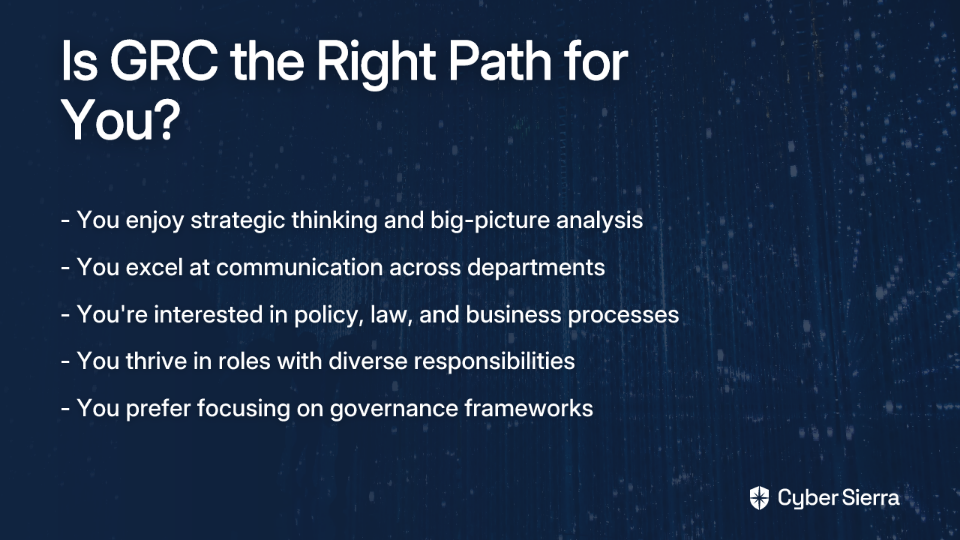
Choose GRC if you...

  • Enjoy strategic thinking and seeing the "big picture"
  • Are a natural communicator and bridge-builder between technical and business units
  • Are interested in policy, law, and business processes
  • Thrive in a role with diverse responsibilities that spans the entire organization
  • Prefer focusing on governance frameworks and risk management approaches

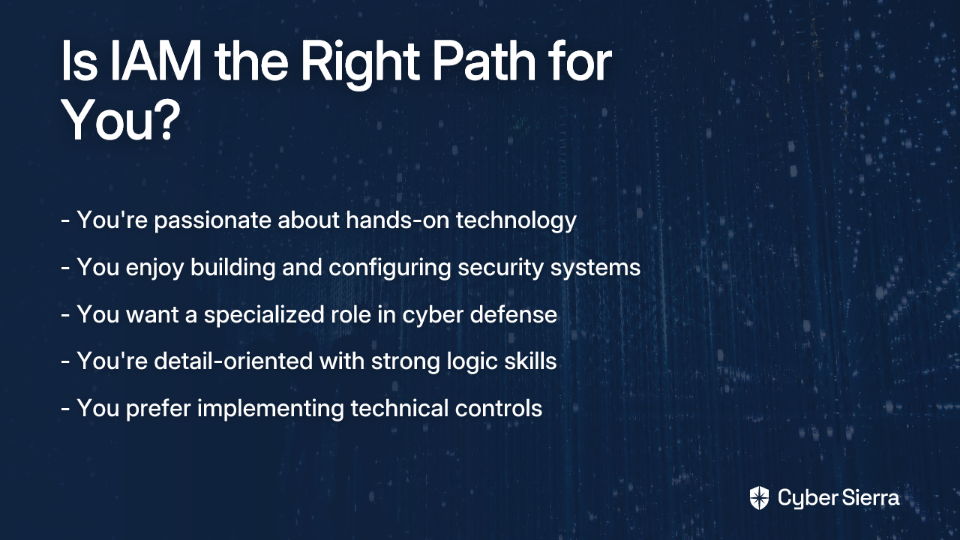
Choose IAM if you...

  • Are passionate about hands-on technology and solving complex technical challenges
  • Enjoy building, configuring, and maintaining security systems
  • Want a deeply specialized role on the front lines of cyber defense
  • Are detail-oriented and enjoy the logic of access control systems
  • Prefer focusing on implementing and maintaining siloed functions like identity management

Conclusion: Two Sides of the Same Security Coin

GRC and IAM are not competitors but partners in an effective security program. GRC is the strategic "why," defining the policies and managing risk, while IAM is the technical "how," implementing the controls that bring those policies to life. As one industry professional put it, "GRC has a much larger scope. Identity is a small subset of a series of controls and control families."

Both career paths offer excellent opportunities for growth, competitive salaries, and the satisfaction of protecting organizations from threats. Your choice should depend on whether you're drawn to the strategic, people-oriented nature of GRC or the deeply technical, specialized focus of IAM.

Getting Started

  1. Educate Yourself: Engage with online courses like the Pluralsight Governance, Risk, and Compliance path
  2. Earn Relevant Certifications: Start with a foundational cert like Security+ and then pursue specialized credentials
  3. Gain Practical Experience: Seek internships or entry-level analyst roles
  4. Network: Join professional associations (e.g., ISACA) and attend industry events

Remember: Both fields need professionals who can bridge the gap between them. Understanding both GRC and IAM, even if you specialize in one, will make you an invaluable asset to any cybersecurity team.

Frequently Asked Questions

What is the primary difference between GRC and IAM?

The primary difference is that GRC is a strategic function focused on setting policies and managing overall organizational risk, while IAM is a technical function focused on implementing and managing who has access to digital resources. Think of GRC as the city planners who design the city's rules and safety codes, and IAM as the building security managers who install the locks and check IDs to enforce those rules. GRC defines the "why," and IAM provides the "how."

Which career path is better for a beginner, GRC or IAM?

Both GRC and IAM offer excellent entry-level opportunities, and the "better" path depends on your skills and interests. IAM can be more accessible for those with a technical background, while GRC may appeal to those with strong communication and analytical skills. If you enjoy hands-on technical work and configuring systems, an IAM Analyst role is a great fit. If you prefer policy, auditing, and solving strategic problems, a GRC Analyst role is more suitable.

Can you have a career in GRC without a deep technical background?

Yes, it is possible to build a successful career in GRC without being a technical expert, as the role heavily emphasizes communication, analysis, and business process skills. While understanding technology concepts is important, GRC professionals often act as translators between technical teams and business leadership. Your ability to understand legal frameworks, conduct audits, and communicate risk effectively is often more critical than hands-on engineering skills.

How do GRC and IAM work together in a real-world scenario?

GRC and IAM work together in a top-down relationship where GRC sets the access control policies, and the IAM team implements the technical solutions to enforce them. For example, a GRC team might create a policy based on the principle of least privilege. The IAM team then uses tools like Okta or SailPoint to configure user roles, set up approval workflows, and automate access removal, providing auditable proof that GRC's policies are being followed.

Which field generally offers a higher salary, GRC or IAM?

Both GRC and IAM offer competitive and often overlapping salary ranges, with high earning potential in senior roles. However, GRC management and director-level positions can sometimes reach higher average salaries due to their broad strategic scope. While an entry-level GRC Analyst and an IAM Analyst may have similar starting salaries, the GRC career path can lead to executive roles like Chief Risk Officer, which are among the highest-paying in the industry.

What are the most important certifications for starting a career in GRC or IAM?

For both fields, a foundational certification like CompTIA Security+ is an excellent starting point. For GRC, key certifications to pursue next include CISA (for auditing) and CRISC (for risk). For IAM, vendor-specific certifications from platforms like Okta or CyberArk, or the vendor-neutral CIAM (Certified Identity and Access Manager), are highly valued for demonstrating practical skills.

blog-hero-background-image
Continuous Control Monitoring

Top 5 CCM Software for Automated Compliance

backdrop
Table of Contents

Join thousands of professionals and get the latest insight on Compliance & Cybersecurity.


Are you drowning in spreadsheets trying to track compliance across your organization? Do you find yourself scrambling to gather evidence just before an audit? If your security team includes server admins, network specialists, and workstation managers all working separately, you know the struggle of ensuring everyone completes their required checks on time.

"What tools are people using to track the security controls that have requirements of 'verify X is done on a Y (frequency)' across a team of multiple disciplines and specializations?" asked one frustrated security professional on Reddit. This common pain point highlights why Continuous Controls Monitoring (CCM) has become essential for modern organizations.

The traditional approach to security compliance—periodic, manual checks with frantic evidence gathering before audits—is no longer sustainable. Today's regulatory landscape demands a more sophisticated solution.

In this article, we'll explore what CCM is, why it matters, key features to look for in a CCM platform, and review the top 5 solutions available today to transform your compliance program from reactive to proactive.

What is Continuous Controls Monitoring and Why Does It Matter Now?

Moving Beyond the Spreadsheet and Periodic Audits

Traditional compliance monitoring relies on exception-based, point-in-time assessments. This approach is fundamentally reactive: auditors periodically check for control gaps, often revealing issues only after they've existed for months. The result? A mad scramble to gather evidence, fix problems, and demonstrate compliance.

Continuous Controls Monitoring (CCM) flips this model. Instead of waiting for annual audits to discover issues, CCM uses automation to constantly verify that security controls are functioning as intended. It's the difference between a yearly doctor's visit and having a health monitor that alerts you the moment something goes wrong.

As one security professional noted, CCM helps "detect deviations, vulnerabilities, or threats in real-time so we can immediately take action." This shift from periodic assessment to continuous validation represents a fundamental evolution in how organizations approach security and compliance.

The Core Benefits of a Modern CCM Strategy

Enhanced Risk Management & Proactive Defense: CCM provides constant awareness of your security posture, enabling you to identify and address vulnerabilities before they become serious issues. This proactive approach helps organizations make informed, risk-based decisions about resource allocation and security investments.

Streamlined Compliance & Audit Readiness: By automating evidence collection for frameworks like SOC2, ISO 27001, NIST, GDPR, and HIPAA, CCM eliminates what one Reddit user described as "the most painful part of an audit." Organizations using CCM remain perpetually audit-ready rather than rushing to prepare as deadlines approach.

Improved Efficiency and Cost Savings: Automation reduces the need for manual control testing, freeing up skilled security professionals to focus on strategic initiatives rather than repetitive compliance tasks. This efficiency translates to lower operational costs and helps prevent expensive security incidents.

Centralized Visibility: CCM creates a single repository for all controls, making it easier to manage overlapping requirements across multiple frameworks. This addresses what one user described as the need for "tools that I can use to map the requirements of various frameworks... to my current network's 'status quo' and evaluate how compliant I am."

Key Features to Look For in a CCM Software

Before diving into specific solutions, it's important to understand what makes a CCM platform effective. Here are the critical features to evaluate when selecting CCM software:

Automation Engine: The platform should connect seamlessly with your tech stack—cloud providers (AWS, Azure, GCP), identity providers (Okta, Auth0), code repositories (GitHub, GitLab), and more—to automatically test controls and collect evidence without manual intervention.

Centralized Control Repository & Framework Mapping: Look for the ability to manage all controls in one place and map them to multiple compliance frameworks. This prevents duplicating work when addressing requirements that overlap across ISO27001, SOC2, NIST, and other frameworks.

Real-time Dashboards and Alerting: Effective CCM solutions provide customizable dashboards that give a clear view of your compliance posture. The best platforms include intelligent alerting that prevents alert fatigue while highlighting critical deviations requiring immediate action.

Task Management & Workflow Automation: As one security professional put it, an ideal solution is "a borderline Jira type application" where you can "assign a frequency-time to security control, and require input from assigned personnel." This feature ensures accountability and streamlines delegation across specialized teams.

Integration Capabilities: The more integrations, the better. A robust CCM tool should connect with hundreds of services across your organization to automatically collect evidence and verify control effectiveness.

Customization and Flexibility: The ability to create custom compliance checks is crucial. As one user noted, this can be "difficult to do with Rapid7 and Tenable," highlighting the need for platforms that allow you to tailor monitoring to your specific environment and requirements.

Top 5 Continuous Controls Monitoring (CCM) Software

1. Secureframe

Overview: Secureframe has established itself as a leader in compliance automation with a platform designed to make security and compliance fast and easy.

Key Features:

  • Robust CCM with over 300 integrations to automatically collect evidence
  • AI-powered remediation suggestions to address control gaps
  • Real-time dashboards providing visibility into compliance posture
  • Strong support for frameworks including SOC 2, ISO 27001, and PCI DSS

Best For: Startups and SMBs looking for a fast path to becoming audit-ready for major compliance frameworks. Secureframe is particularly well-suited for organizations pursuing their first SOC 2 or ISO 27001 certification.

2. Drata

Overview: Drata is frequently recommended in online security communities for its comprehensive capabilities. As one user on Reddit noted, it "looks fairly robust" and makes "staying on top of things a lot easier."

Key Features:

  • Continuous, 24/7 monitoring of controls across your tech stack
  • Extensive library of integrations for automated evidence collection
  • Policy templates and customization options
  • Security awareness training to address the human element of security

Best For: Tech companies, especially in the SaaS space, that need to build and maintain trust with enterprise customers through continuous compliance. Drata excels at helping organizations maintain a strong security posture over time.

3. Vanta

Overview: Often mentioned alongside Drata as a leading compliance automation platform, Vanta has gained popularity for its user-friendly approach to continuous monitoring.

Key Features:

  • Automation for up to 90% of the work required for SOC 2 and ISO 27001
  • Real-time security monitoring with automated alerts
  • Vendor risk management capabilities
  • User-friendly interface with clear guidance through the compliance process

Best For: Organizations that need an efficient, streamlined solution to achieve and maintain compliance certifications to accelerate sales cycles. Vanta is particularly strong for companies with limited compliance expertise on staff.

4. LogicGate (Risk Cloud®)

Overview: LogicGate offers a broader Governance, Risk, and Compliance (GRC) platform with powerful CCM capabilities integrated into its suite.

Key Features:

  • Highly flexible and customizable workflows for complex compliance processes
  • Advanced risk quantification and analysis tools
  • No-code application builder for creating custom compliance applications
  • Comprehensive reporting and analytics capabilities

Best For: Larger enterprises with mature risk programs that need a highly configurable platform to manage a wide array of GRC activities, including CCM. LogicGate is ideal for organizations that want to integrate risk management and compliance into a unified program.

5. Cybersierra

Overview: Cybersierra provides an AI-enabled cybersecurity platform that integrates CCM with other essential security functions like GRC, Third-Party Risk Management (TPRM), and Threat Intelligence.

Key Features:

  • Central controls repository with near real-time updates across multiple frameworks
  • Automated control testing and validation to reduce manual evidence gathering
  • Actionable risk intelligence for data-driven remediation decisions
  • Detection of exceptions and anomalies in real-time

Best For: Organizations looking for a unified platform that not only handles CCM but also provides a holistic view of their entire security posture. Cybersierra stands out for its integrated approach that addresses internal controls alongside vendor risk and employee security training—recognizing that modern security programs must address the human element of risk.

How to Implement a CCM Program: A 5-Step Guide

Regardless of which platform you choose, a successful CCM implementation follows these key steps:

Step 1: Identify and Prioritize Controls

Don't try to monitor everything at once. Start with high-risk areas and critical controls guided by frameworks like the NIST Cybersecurity Framework or COSO. Focus initially on controls with structured data and high-frequency operations that are easiest to automate.

Step 2: Establish a Centralized Control Repository

Use your chosen CCM platform to document all controls in a central location. This moves you beyond the "one spreadsheet" approach and allows for mapping single controls to multiple framework requirements (e.g., a single MFA control satisfying requirements in NIST 800-53, SOC2, and ISO27001).

Step 3: Define Control Objectives and Automated Tests

For each control, clearly define its purpose and success criteria. Create automated tests or metrics to monitor the control continuously (e.g., "Verify that all S3 buckets are encrypted" or "Confirm that all new employees complete security training within 7 days").

Step 4: Manage Alerts and Define Response Workflows

Develop clear processes for handling alerts when controls fail. Define who is responsible for investigating issues, the expected timeframe for remediation, and escalation paths for critical failures. This creates the accountable, "Jira-like" process that many security teams seek.

Step 5: Regularly Review and Update

A CCM program is never "done." Review and adapt your monitoring approach as your business processes evolve, new threats emerge, and regulations change. Regular maturity assessments help identify areas for improvement in your CCM program.

Conclusion

The shift from manual, periodic audits to continuous, automated control monitoring represents a fundamental evolution in how organizations approach security and compliance. CCM platforms transform compliance from a burdensome, point-in-time exercise into a strategic, ongoing process that builds trust and resilience.

The right CCM software not only streamlines compliance work but also provides valuable risk insights that inform security investments and business decisions. Whether you're a startup preparing for your first SOC 2 audit or an enterprise managing multiple compliance frameworks, implementing a CCM solution will help you stay perpetually audit-ready while focusing your security team on strategic initiatives rather than manual evidence collection.

Platforms like Cybersierra that offer an integrated approach to security and compliance provide a single source of truth, enabling organizations to manage risk holistically across internal controls, third-party relationships, and employee security awareness. As regulatory requirements continue to expand and cyber threats evolve, this comprehensive approach to continuous monitoring will become increasingly valuable.

By implementing the right CCM platform and following the five-step implementation guide outlined above, you can transform your compliance program from a reactive, audit-driven exercise into a proactive, continuous assurance process that supports business growth while protecting your most valuable assets.

Frequently Asked Questions (FAQ)

What is Continuous Controls Monitoring (CCM)?

Continuous Controls Monitoring (CCM) is an automated approach to security compliance that continuously verifies your security controls are working correctly, rather than checking them only during periodic audits. It uses technology to connect to your systems (like cloud services, code repositories, and identity providers) to automatically collect evidence and test controls in real-time, shifting your compliance posture from reactive to proactive.

How is CCM different from traditional compliance audits?

The main difference is timing and approach: CCM is a proactive, continuous process, while traditional audits are reactive, point-in-time assessments. Traditional audits often discover issues long after they've occurred. In contrast, CCM provides real-time alerts when a control fails, allowing you to address issues immediately and maintain a state of being "always audit-ready."

What are the main benefits of implementing a CCM solution?

The primary benefits of CCM are enhanced risk management, streamlined audit readiness, improved operational efficiency, and centralized visibility into your security posture. By automating control testing and evidence collection, CCM reduces manual work, provides a constant view of your compliance status, and helps you identify and fix vulnerabilities before they can be exploited.

Which compliance frameworks can a CCM platform support?

CCM platforms are designed to support a wide range of security and privacy frameworks. Most leading solutions offer pre-built mapping and automated evidence collection for major frameworks such as SOC 2, ISO 27001, PCI DSS, HIPAA, GDPR, and various NIST standards. A key feature is mapping a single control to multiple framework requirements, saving significant time and effort.

Is CCM suitable for small businesses or just large enterprises?

Yes, CCM is highly beneficial for businesses of all sizes, including startups and SMBs. While enterprises use it for complex regulatory needs, many modern CCM platforms are specifically designed to help smaller companies achieve certifications like SOC 2 efficiently. These tools automate processes that would otherwise require a large compliance team, helping them build customer trust.

What should I look for when choosing a CCM tool?

When choosing a CCM tool, prioritize a strong automation engine with extensive integrations into your tech stack, a centralized control repository with framework mapping, and real-time dashboards with intelligent alerting. The platform's value comes from its ability to automate evidence collection seamlessly, prevent duplication of work across frameworks, and provide clear, actionable insights into your compliance posture.

blog-hero-background-image
Governance & Compliance

How to Build a GRC Controls Library From Scratch

backdrop
Table of Contents

Join thousands of professionals and get the latest insight on Compliance & Cybersecurity.


You've joined a company where the Governance, Risk, and Compliance (GRC) program is... immature at best. There are policies and standards that vaguely point to NIST CSF controls—and that's where the trail ends. You're left trawling through loads of different standards docs, trying to connect the dots and figure out what problems you're even supposed to be solving.

Sound familiar?

As a GRC professional in this environment, you might also feel the weight of that perception: the "useless pencil pushers department" stigma that suggests your work isn't technical enough or doesn't bring sufficient value to the table.

This guide is for you. We'll provide a practical, no-nonsense approach to building a GRC controls library from scratch using nothing more complex than a spreadsheet. No expensive tools with high learning curves required—just a straightforward method to organize chaos, demonstrate immediate value, and build a common language for risk and compliance across your organization.

Why a Controls Library is Your GRC Foundation

Before diving into the how-to, let's understand why this matters.

Governance, Risk, and Compliance (GRC) isn't just a department—it's "an integrated collection of capabilities that enable organizations to reliably achieve objectives, address uncertainty, and act with integrity." This concept, known as Principled Performance, was defined by the Open Compliance and Ethics Group (OCEG), which created the GRC Capability Model (Red Book) as the authoritative guide for professionals.

Without an integrated approach, departments become siloed, costs increase, risk visibility diminishes, and inefficiencies multiply. The financial impact is staggering—over $1 trillion is lost annually by organizations due to "unprincipled misconduct and errors."

A controls library is your first line of defense against this chaos. It provides:

Without a controls library, you're essentially "blindly throwing darts at a board"—implementing security measures without a structured understanding of your requirements or gaps.

Step-by-Step: Building Your GRC Controls Library in a Spreadsheet

You don't need Archer, ServiceNow, or other complex GRC platforms to get started. A well-structured spreadsheet is a powerful first step that provides immediate value while setting the foundation for more sophisticated approaches later.

Step 1: Define Scope, Purpose, and Applicable Frameworks

Before creating a single control, ask: "What are the organizational goals we need to support?"

Identify the key drivers for your GRC program:

  • Regulatory compliance requirements
  • Contractual obligations
  • Customer expectations
  • Industry standards
  • Risk management objectives

Then, determine which frameworks apply to your organization. Common ones include:

  • NIST CSF (Cybersecurity Framework)
  • NIST 800-53 (Security and Privacy Controls)
  • ISO 27001 (Information Security Management)
  • PCI DSS (Payment Card Industry Data Security Standard)
  • SOC 2 (Service Organization Control)

Pro Tip: Focus on the most critical frameworks first. Don't try to boil the ocean—you can expand your library over time.

Step 2: Establish Your Core Data Points (The Spreadsheet Columns)

Create a simple spreadsheet with these essential columns:

  • Control ID: A unique identifier for every control (e.g., AC-01, PS-01). This must be consistent and intuitive.
  • Control Description: A clear, concise explanation of what the control does and why it matters. Avoid jargon where possible.
  • Framework Mapping: This critical column maps each internal control to specific requirements in external frameworks (e.g., maps to NIST CSF PR.AC-1, ISO 27001 A.9.2.1, PCI DSS 8.1.1).
  • Control Family: Categorizes controls by domain (e.g., Access Control, Incident Response, Business Continuity).
  • Control Owner: The person or team responsible for implementing and maintaining the control.
  • Implementation Status: Tracks progress (e.g., Implemented, Not Implemented, In Progress).
  • Test of Operating Effectiveness (TOE) Date: When the control was last verified.

This structure forms the backbone of your library and provides the necessary organization to make it useful immediately.

Step 3: Populate Your Library (The Smart Way)

Don't reinvent the wheel! Here's the smart approach to populating your library:

  1. Download existing framework controls: As recommended by GRC professionals, "You can download the controls in a spreadsheet from NIST for CSF and 800-53." This provides an immediate head start with authoritative control language.
  2. Assess your current state: Review existing policies, procedures, and standards to identify controls already implicitly or explicitly in place.
  3. Tailor the language: Rewrite framework control descriptions to fit your organization's context and terminology.
  4. Map across frameworks: For each control, identify which requirements it satisfies across multiple frameworks. This is where you create tremendous value—by showing how one control can satisfy requirements from NIST CSF, ISO 27001, PCI, and SOC 2 simultaneously.
  5. Identify low hanging fruit: Mark controls that are already implemented or would be easy to implement. This helps demonstrate quick wins.

Example entry:

Control ID: AC-01
Description: The organization establishes and documents access control policies and procedures.
Framework Mapping: NIST CSF PR.AC-1, ISO 27001 A.9.2.1, PCI DSS 8.1.1, SOC 2 CC6.1
Control Family: Access Control
Control Owner: IT Security Team
Implementation Status: Partially Implemented
TOE Date: N/A

Step 4: Review, Validate, and Involve Stakeholders

This is a crucial step that many GRC professionals skip, but it's essential for success. Do not build your library in a silo!

  1. Engage department heads: Meet with IT managers, system owners, and department leaders to review the controls for accuracy, feasibility, and completeness.
  2. Gather stakeholder input: Use surveys or interviews to collect insights on potential risks and concerns directly from employees who work with these systems daily.
  3. Validate control implementation: Verify that controls marked as "implemented" are actually in place and functioning as expected.
  4. Adjust based on feedback: Refine control descriptions, ownership assignments, and implementation statuses based on stakeholder input.

Incomplete risk identification often stems from limited stakeholder involvement. By engaging diverse perspectives early, you'll build a more accurate and comprehensive library while generating buy-in from across the organization.

Step 5: Document and Maintain Clear Naming Conventions

Establish and document clear, intuitive naming conventions for your Control IDs. This ensures clarity and makes the library easier to navigate as it grows.

For example:

  • AC-XX for Access Control
  • IR-XX for Incident Response
  • BC-XX for Business Continuity

Maintain comprehensive records of your decisions, implementation approaches, and communications. This facilitates knowledge transfer when personnel changes occur and provides an audit trail for compliance purposes.

Putting Your Controls Library to Work: Initial Risk Assessment

Now comes the exciting part—using your new library to conduct an initial risk assessment that delivers immediate value. This transforms your work from perceived "pencil pushing" to strategic risk management.

A GRC risk assessment is a structured approach to identify and assess threats. Your new controls library serves as the inventory of mitigations for those threats.

Here's the process:

  1. Identify Risks: Brainstorm and list potential risks to the organization (e.g., unauthorized access to sensitive data, ransomware attack, data loss).
  2. Map Controls: In a new tab of your spreadsheet or a separate risk register, list each risk. Then, map the relevant Control IDs from your library that mitigate each specific risk.
  3. Identify Gaps: If you find risks that have no corresponding controls from your library, you've identified a gap. This is a tangible, data-driven insight.
  4. Prioritize: Categorize risks by severity and impact to prioritize resource allocation for developing new controls or improving existing ones.

Example of the mapping:

Risk: Unauthorized access to customer data
Potential Impact: High (regulatory fines, reputation damage)
Controls: AC-01, AC-03, AC-17, IA-02
Gaps: No multi-factor authentication requirement (recommended new control)

This process provides immediate, actionable intelligence.

You can now approach leadership with specific insights: "We've identified these critical risks, and here are the controls we have (or don't have) to address them." This elevates the conversation beyond compliance and directly addresses business risk—something the C-suite will understand and value.

Common Pitfalls and Pro Tips for Success

Common Pitfalls:

  • Analysis Paralysis: Don't try to be perfect from day one. Start with a basic framework and refine it over time.
  • Skipping Stakeholder Input: This leads to an incomplete or impractical library that no one uses.
  • Neglecting Updates: Regulations and business needs evolve. Schedule quarterly reviews to keep your library current.

Pro Tips for Success:

  • Automate Where Possible: While starting with a spreadsheet is great, as you mature, consider tools like ServiceNow GRC, Archer, or eramba GRC to automate monitoring and reporting.
  • Foster Collaboration: Continuously work with IT and management to secure resources and support. GRC is a team sport.
  • Embrace Continuous Learning: Stay current on frameworks and threats. As one GRC professional noted, willingness to "read, read, and read some more with the promise to comprehend some or all of it as time goes on" is essential for success in this field.

Conclusion: Your First Step Towards GRC Maturity

Building a controls library from scratch is an achievable and high-impact project for any GRC professional in an immature organization. By using a simple spreadsheet, you can define your control environment, map to critical frameworks like NIST CSF and ISO 27001, and conduct meaningful risk assessments that demonstrate the value of your GRC program.

This is how you transition from being seen as a "pencil pusher" to a strategic partner who provides data-driven insights. It's the foundation for achieving Principled Performance and demonstrating the undeniable value of a well-governed, risk-aware, and compliant organization.

Start today. Download a framework spreadsheet, define your core columns, and begin the conversation with your stakeholders. This library is a living document—the first and most important asset in your GRC toolkit.

Frequently Asked Questions (FAQ)

What is a GRC controls library?

A GRC controls library is a centralized inventory of an organization's internal controls, mapping them to requirements from various standards and regulations like NIST CSF or ISO 27001. It acts as a single source of truth for all security and compliance requirements, providing a structured way to understand what measures are in place to mitigate risks. This library forms the foundation for conducting effective risk assessments and ensures a consistent approach to compliance across the organization.

Why should I build a controls library in a spreadsheet?

Building a controls library in a spreadsheet is the most practical and cost-effective first step for an organization with an immature GRC program. It provides immediate value and structure without the high cost and steep learning curve of specialized GRC software. A well-organized spreadsheet allows you to quickly establish a single source of truth, map controls to frameworks, and conduct initial risk assessments. This approach helps you demonstrate quick wins and build a solid foundation that can later be migrated to a more sophisticated GRC platform as your program matures.

How do I select the right compliance frameworks for my controls library?

To select the right frameworks, start by identifying your organization's key GRC drivers, such as regulatory requirements (like PCI DSS), contractual obligations with clients (like SOC 2), and industry standards (like NIST CSF or ISO 27001). Focus on the most critical frameworks first rather than trying to include everything at once. Prioritizing allows you to build a relevant and manageable library that addresses your most pressing compliance and risk management needs.

What is the difference between a control and a risk?

A risk is a potential event or threat that could harm your organization (e.g., a ransomware attack), while a control is a specific action, policy, or procedure you implement to mitigate that risk (e.g., maintaining regular data backups). In short, risks are the problems, and controls are the solutions. Your controls library is an inventory of your solutions. During a risk assessment, you identify potential risks and then map the relevant controls from your library to see how well you are prepared to handle them.

How does a controls library make risk assessments more effective?

A controls library makes risk assessments more effective by providing a ready-made inventory of all security and compliance measures currently in place. This allows you to systematically map your existing controls against identified risks to uncover gaps in your defenses. Instead of guessing, you can conduct a data-driven analysis. For any given risk, you can see exactly which controls are supposed to mitigate it. If a critical risk has few or no corresponding controls, you have a clear, justifiable reason to request resources for improvement.

How often should a GRC controls library be updated?

A GRC controls library should be treated as a living document and reviewed at least quarterly. Major updates are necessary whenever new regulations are introduced, business objectives change, or new systems are implemented. Regular updates ensure the library remains an accurate reflection of your control environment. Schedule periodic reviews with control owners to validate implementation statuses and adjust for any changes in the threat landscape.

blog-hero-background-image
Governance & Compliance

Understanding Sarbanes-Oxley Title II: Auditor Independence

backdrop
Table of Contents

Join thousands of professionals and get the latest insight on Compliance & Cybersecurity.


You've been tasked with ensuring your firm's compliance with auditor independence requirements, but you're struggling to navigate the complex web of rules and regulations. Perhaps you're wondering if preparing financial statements for an audit client constitutes a self-review threat, or you're unsure how personal relationships might impact your independence status. These concerns are common among accounting professionals, and for good reason – auditor independence is the cornerstone of financial reporting integrity.

The Sarbanes-Oxley Act of 2002 (SOX) revolutionized corporate governance and financial reporting standards in the United States, with Title II specifically addressing auditor independence. This landmark legislation emerged in response to major accounting scandals like Enron and WorldCom that shook investor confidence to its core.

The Foundation of Auditor Independence

Title II of the Sarbanes-Oxley Act establishes stringent standards to ensure external auditors remain independent from their audit clients. This independence is crucial for reducing conflicts of interest that could compromise an audit's integrity and objectivity.

The Public Company Accounting Oversight Board (PCAOB), created under SOX, plays a vital role in enforcing these standards. As a nonprofit corporation established by Congress, the PCAOB essentially "audits the auditors," ensuring they adhere to SOX standards and protecting investors through improved audit oversight.

But why does auditor independence matter so much? It's not just a procedural rule—it's the bedrock of public trust in financial markets. When auditors maintain their independence, financial statements gain credibility, and investors are better protected from fraudulent reporting.

Breaking Down SOX Title II: Key Provisions

Let's examine the critical sections of Title II that define auditor independence requirements:

Section 201: Services Outside the Scope of Practice of Auditors

This section directly addresses one of the most common concerns among accounting professionals: the self-review threat. It explicitly prohibits registered public accounting firms from providing certain non-audit services to the same clients they audit.

The prohibited services include:

  • Bookkeeping or other services related to accounting records or financial statements
  • Financial information systems design and implementation
  • Appraisal or valuation services, fairness opinions, or contribution-in-kind reports
  • Actuarial services
  • Internal audit outsourcing services
  • Management functions or human resources
  • Broker or dealer, investment adviser, or investment banking services
  • Legal services and expert services unrelated to the audit

Services not specifically prohibited may be provided, but only with pre-approval from the client's audit committee, which brings us to the next important provision.

Section 202: Pre-Approval Requirements

All audit and permissible non-audit services must be pre-approved by the issuer's audit committee. This empowers the audit committee to act as a gatekeeper, ensuring that any additional services do not compromise the auditor's objectivity.

There is a de minimis exception for non-audit services that constitute less than 5% of total fees paid to the auditor, but in practice, most firms rarely rely on this exception and seek explicit approval for all services.

Section 203: Audit Partner Rotation

To prevent overly familiar relationships between auditors and clients, SOX mandates rotation of key audit personnel:

  • The lead and concurring (reviewing) audit partners must rotate off the audit after five consecutive years
  • Following rotation, these partners must observe a "cooling-off" period of five years before returning to that client's audit
  • Other significant audit partners must rotate after seven consecutive years with a two-year cooling-off period

This rotation requirement helps maintain a fresh perspective and reduces the risk of compromised independence due to long-standing relationships.

Section 204: Auditor Reports to Audit Committees

Communication is key to maintaining independence. Under this section, registered public accounting firms must report to the audit committee on:

  • All critical accounting policies and practices to be used
  • Alternative treatments of financial information within Generally Accepted Accounting Principles (GAAP) that have been discussed with management
  • Other material written communications between the auditor and management

Section 206: Conflicts of Interest

This section addresses the "revolving door" concern by prohibiting an accounting firm from auditing a public company if one of the company's key executives (CEO, CFO, Controller, etc.) was employed by the audit firm and worked on the company's audit during the one-year period preceding the current audit.

Real-World Impact: SOX at 20 Years

Two decades after its implementation, SOX has significantly transformed the accounting landscape:

  • Increased Audit Quality and Scrutiny: The PCAOB's oversight has led to a significant focus on audit quality. However, violations still occur. The PCAOB noted a sharp increase in independence-related violations during its 2023 audit inspection cycle, with comment forms on independence issues rising from 7% in 2021 to 14% in 2023.
  • Restored Investor Confidence: A Center for Audit Quality survey showed investor confidence in independent auditors rose from 67% to 83% between 2011 and 2019, while confidence in independent audit committees similarly increased from 63% to 81%.
  • Improved Financial Reporting: After SOX implementation, financial restatements initially spiked by 66% in 2005-2006 as companies adjusted to stricter standards. The subsequent decline in restatements indicated that SOX led to more reliable reporting practices.

Navigating Common Independence Scenarios

Let's address some common scenarios that cause confusion about auditor independence under SOX Title II:

The "Self-Review Threat" - Preparing Financials for an Audit Client

A common question is: "If I prepare financial statements for an audit client, doesn't that create a self-review threat that impairs independence?"

The answer lies in understanding the distinction between preparation and decision-making. Preparing financial statements from a client-provided trial balance (TB) is considered a non-attest service and does not inherently impair independence as long as the auditor does not make any managerial decisions. The client's management must:

  • Take responsibility for the financial statements
  • Approve all significant judgments
  • Understand the basis for any accounting treatments

As one CPA noted, "A CPA preparing financial statements from information given to them is a SSAR service. He/she does not need to be independent to prepare, however a CPA is not independent when he/she is making managerial decisions on the client's behalf."

Personal Conflicts of Interest - Relationships and Financial Holdings

Another area of concern involves personal relationships with client personnel. If you're wondering, "What if my significant other is a senior person in the client structure?" - the answer is straightforward: independence is about both fact and appearance.

Even if you believe you can remain objective, the appearance of a conflict of interest can be just as damaging. In such situations, your firm would likely prohibit you from working on that audit engagement. The best practice is to formally notify your manager and the firm's independence office immediately to get the situation on record.

Internal vs. External Auditors' Roles in SOX

There's often confusion about the respective roles of internal and external auditors under SOX. Here's the distinction:

  • Internal Auditors work for the company and help management design, implement, and test Internal Controls for Financial Reporting (ICFR) throughout the year.
  • External Auditors work for the accounting firm and provide an independent opinion on both the financial statements and the effectiveness of the company's internal controls.

Best Practices for Ensuring Auditor Independence

To avoid independence violations, firms should adopt these PCAOB-recommended practices:

  1. Leverage Technology: Use automated systems to cross-check employee financial holdings against restricted entity lists to detect personal independence violations early.
  2. Conduct Frequent Representations: Move from annual to quarterly compliance confirmations to keep independence top-of-mind.
  3. Enhance Disclosure Processes: Mandate training on proper disclosure of financial holdings and verify reported information against account statements.
  4. Implement Clear Disciplinary Actions: Establish and enforce sanctions for non-compliance to signal the seriousness of independence policies.
  5. Use Standardized Templates: Employ global templates for audit engagement letters to prevent prohibited clauses like indemnification.

The Cornerstone of Trust

SOX Title II fundamentally reshaped the accounting profession by codifying the principles of auditor independence. Its rules on prohibited services, partner rotation, and audit committee oversight are not just regulatory hurdles—they are essential safeguards for our financial markets.

For auditors, firms, and corporate boards, understanding and rigorously applying the principles of auditor independence under sarbanes oxley 2 is paramount. It is the foundation upon which investor confidence and the integrity of our capital markets are built. True independence is non-negotiable.

Frequently Asked Questions

What is the main purpose of SOX Title II?

The main purpose of Title II of the Sarbanes-Oxley Act (SOX) is to establish and enforce strict auditor independence standards. This is done to eliminate conflicts of interest, enhance the credibility of financial audits, and restore investor confidence in public financial reporting. The rules outlined in Title II are designed to ensure that external auditors remain objective and skeptical when examining a client's financial statements.

Can an auditor prepare financial statements for a client they audit?

Yes, an auditor can prepare financial statements for an audit client, but only under specific conditions. This service is permissible as long as the auditor does not make any managerial decisions on the client's behalf. The client's management must take full responsibility for the financial statements, approve all significant judgments, and understand the accounting treatments used. This prevents a "self-review threat," where the auditor would essentially be auditing their own work.

How often must audit partners be rotated under SOX?

SOX requires mandatory rotation of key audit partners to maintain a fresh perspective. The lead and concurring (reviewing) audit partners must rotate off an audit after five consecutive years and then observe a five-year "cooling-off" period. Other significant audit partners have a seven-year rotation limit, followed by a two-year cooling-off period.

What are some non-audit services auditors are forbidden from providing to clients?

SOX Title II, Section 201, explicitly prohibits auditors from providing several non-audit services to their audit clients to avoid conflicts of interest. These forbidden services include bookkeeping, financial information systems design, appraisal or valuation services, actuarial services, internal audit outsourcing, management or human resources functions, and legal services unrelated to the audit.

What happens if an auditor has a personal conflict of interest with a client?

If an auditor has a personal conflict of interest, such as a close family member in a key financial role at the client company, their independence is considered impaired. Both the fact and the appearance of a conflict are critical. The auditor must immediately disclose the situation to their firm's independence office. Typically, the firm will remove the auditor from that specific engagement to maintain integrity and objectivity.

Why is auditor independence so important?

Auditor independence is critically important because it is the bedrock of trust in financial markets. When auditors are truly independent, their opinion on financial statements is more credible and reliable. This protects investors from misleading or fraudulent financial reporting, promotes confidence in capital markets, and ensures the integrity of the entire financial ecosystem.

blog-hero-background-image
Governance & Compliance

Complete Guide to NERC CIP Standards & Compliance

backdrop
Table of Contents

Join thousands of professionals and get the latest insight on Compliance & Cybersecurity.


You've been tasked with ensuring your organization meets critical infrastructure protection standards, but finding clear guidance feels like searching for a needle in a haystack. If you're feeling overwhelmed by the complex world of NERC CIP compliance, you're not alone.

As one grid operator described it on Reddit, "It's a complicated subject that is constantly changing." Unlike healthcare's HIPAA or finance's PCI DSS, the electric grid's regulatory landscape can seem fragmented and difficult to navigate.

This comprehensive guide cuts through the complexity to provide you with a clear understanding of NERC CIP standards, whether you're a "lowly Gen Op," a dedicated compliance analyst, or an electrical engineer who needs to bridge knowledge gaps in cybersecurity.

What is NERC CIP? Understanding the Foundation of Grid Security

The North American Electric Reliability Corporation (NERC) is a not-for-profit international regulatory authority whose mission is to ensure the reliability and security of the bulk power system in North America. While NERC was formed in 1968 as a voluntary organization, everything changed after the massive 2003 Northeast blackout.

This watershed event led to the Energy Policy Act of 2005, which authorized the Federal Energy Regulatory Commission (FERC) to designate an Electric Reliability Organization. FERC selected NERC for this role, granting it the authority to develop and enforce reliability standards.

The Critical Infrastructure Protection (CIP) standards were developed in response to growing cybersecurity threats, becoming mandatory in 2008. These standards protect the Bulk Electric System (BES) by establishing security requirements for critical cyber assets.

If you're researching specific documentation, search for RM13-5000 on FERC.gov for detailed information on CIP standards, as recommended by electric grid professionals.

Compliance vs. Security: An Important Distinction

A common source of confusion among professionals is understanding the difference between compliance and security. As one cybersecurity expert explained:

"Compliance is the measurement of controls against a standard. It is pass or fail."

While security is "the management of risk through the implementation of controls. It is measured through control maturity and effective risk mitigation."

In other words, compliance ensures you've met minimum requirements, but it doesn't necessarily mean your systems are secure against all threats. The goal is to use NERC CIP standards as a baseline upon which to build a comprehensive security program.

The NERC CIP Standards: A Detailed Breakdown

Let's examine the key NERC CIP standards that regulated entities must follow:

CIP-002: BES Cyber System Categorization

This foundational standard requires entities to identify and categorize BES Cyber Systems based on their potential impact (high, medium, or low) if compromised.

Key Requirements:

  • Identify all BES Cyber Systems
  • Document and categorize assets including control centers, transmission stations, and generation resources
  • Establish the basis for applying security controls to appropriate systems

CIP-003: Security Management Controls

This standard establishes clear lines of responsibility and accountability for protecting BES Cyber Systems.

Key Requirements:

  • Designate a senior manager responsible for CIP compliance
  • Develop and implement documented security management policies
  • Create and maintain cybersecurity policies specifically for low-impact BES Cyber Systems

CIP-004: Personnel & Training

This standard focuses on minimizing risks from personnel through proper vetting, training, and access management.

Key Requirements:

  • Conduct personnel risk assessments (background checks) before granting access
  • Implement security awareness training upon hire and at least once every 15 calendar months
  • Maintain and regularly review lists of authorized personnel
  • Implement access management procedures for provisioning, revoking, and reviewing access

CIP-005: Electronic Security Perimeters

CIP-005 protects the electronic boundaries around critical cyber assets by establishing Electronic Security Perimeters (ESPs).

Key Requirements:

  • Identify and protect all external access points to the ESP
  • Authenticate and encrypt all remote access
  • Monitor for and alert on suspicious communications
  • Implement secure remote access procedures

CIP-006: Physical Security of BES Cyber Systems

This standard ensures physical protection of critical infrastructure components.

Key Requirements:

  • Implement a documented physical security plan
  • Establish a visitor control program
  • Maintain and test physical access controls
  • Log physical access to controlled areas

CIP-007: Systems Security Management

CIP-007 establishes technical, operational, and procedural requirements for securing systems within the ESP.

Key Requirements:

  • Manage ports and services by disabling unnecessary ones
  • Implement security patch management processes
  • Deploy methods to detect and prevent malicious code
  • Generate alerts for security events
  • Enforce secure authentication methods

CIP-008: Incident Reporting & Response Planning

This standard ensures organizations have formal, tested plans to respond to and report cybersecurity incidents.

Key Requirements:

  • Develop and maintain documented incident response plans
  • Test plans at least once every 15 calendar months
  • Update plans based on lessons learned
  • Report incidents to appropriate agencies

CIP-009: Recovery Plans for BES Cyber Systems

CIP-009 addresses the recovery of essential systems and data following cybersecurity incidents.

Key Requirements:

  • Develop recovery plans for BES Cyber Systems
  • Include backup and restoration procedures
  • Test recovery plans at least once every 15 months
  • Update plans based on testing results

CIP-010: Configuration Change Management & Vulnerability Assessments

This standard prevents unauthorized changes and manages system vulnerabilities.

Key Requirements:

  • Establish baseline configurations for systems
  • Monitor for changes from the baseline
  • Test changes in test environments before implementation
  • Perform vulnerability assessments at least every 15 calendar months

CIP-011: Information Protection

CIP-011 protects sensitive BES Cyber System Information (BCSI) from unauthorized access.

Key Requirements:

  • Develop policies to identify and protect BCSI
  • Implement procedures for secure handling during storage, transit, and disposal
  • Prevent unauthorized access to sensitive information

CIP-012: Communications Between Control Centers

This newer standard protects data transmitted between control centers.

Key Requirements:

  • Implement security measures like encryption for communications links
  • Protect the confidentiality and integrity of real-time assessment data
  • Document and maintain security measures for inter-control center communications

CIP-013: Supply Chain Risk Management

CIP-013 addresses cybersecurity risks associated with the supply chain for BES Cyber Systems.

Key Requirements:

  • Develop and implement a plan to manage vendor risks
  • Address software integrity and authenticity
  • Implement procurement controls for vendors with access to BES Cyber Systems

CIP-014: Physical Security

The final standard focuses on protecting critical transmission stations and substations from physical attacks.

Key Requirements:

  • Perform risk assessments to identify critical facilities
  • Implement and maintain a security plan to mitigate physical threats
  • Have the plan reviewed by unaffiliated third parties

Best Practices for Achieving and Maintaining NERC CIP Compliance

Compliance with NERC CIP standards isn't a one-time effort but an ongoing process. Here are best practices to help your organization succeed:

1. Build a Strong Foundation

Establish a Formal Compliance Program: Create clear policies and procedures that foster a "culture of compliance" throughout your organization.

Designate a Compliance Officer: Appoint a dedicated individual or team responsible for overseeing the NERC CIP program.

Stay Informed: Regulations are constantly evolving. Use resources like NERC announcements and tools like Certrec's RegSource GRC to stay updated on the latest requirements.

2. Implement a Phased Approach

Consider using a maturity model, such as Tripwire's Four Phase Maturity Model, to make compliance more manageable:

  • Phase 1: Monitor assets using Security Configuration Management and File Integrity Monitoring
  • Phase 2: Implement essential controls first to show early progress
  • Phase 3: Address remaining requirements like password policies
  • Phase 4: Automate data collection to continuously monitor configurations

3. Foster a Proactive Security Culture

Develop Robust Training: Regular training for all staff builds accountability and awareness.

Perform Self-Audits: Don't wait for NERC audits. Conduct internal assessments to identify and fix gaps proactively.

Monitor Vendor Compliance: Your security is only as strong as your supply chain. Regularly review third-party vendor compliance.

4. Bridge Knowledge Gaps

For professionals with primarily electrical backgrounds, researching the IEC-62443 standards can help bridge cybersecurity knowledge gaps, as these are the de-facto standards for Operational Technology environments.

The Future of NERC CIP: Evolving Threats and Standards

NERC CIP standards continue to evolve in response to emerging threats. Recent developments include:

  • CIP-003-9, which mandates stricter vendor access security controls for low-impact systems
  • Increasing focus on Internal Network Security Monitoring (INSM) to detect unauthorized activity within trusted zones

Looking ahead, the convergence of IT and OT systems, the rise of smart grid technology, and increasingly sophisticated threats from state-sponsored actors will make compliance both more complex and more critical.

Conclusion: Compliance as a Cornerstone of National Security

NERC CIP compliance is not just a regulatory requirement—it's a vital component of national security. While meeting these standards requires significant resources and ongoing attention, the stakes couldn't be higher.

Remember that compliance represents the minimum requirements, not the ceiling for your security efforts. By adopting the best practices outlined in this guide and investing in a comprehensive compliance program, your organization can build a resilient infrastructure capable of withstanding modern cyber threats.

For those seeking additional support, industry forums like the North American Generator Forum (NAGF) provide valuable opportunities to share knowledge and best practices with peers facing similar challenges.

As one experienced professional noted, compliance may be a "thankless job," but it's essential for protecting the critical infrastructure that powers our nation.

Whether you're just starting your compliance journey or looking to enhance an existing program, the structured approach outlined in this guide will help you navigate the complex world of NERC CIP standards with confidence.

Frequently Asked Questions

What is NERC CIP and why is it important?

NERC CIP (Critical Infrastructure Protection) is a set of mandatory standards designed to protect North America's Bulk Electric System from cybersecurity threats. It is critically important because a secure and reliable power grid is essential for national security, economic stability, and public safety. These standards provide the enforceable framework needed to safeguard our most critical energy infrastructure.

Who must comply with NERC CIP standards?

Any entity that owns, operates, or uses the Bulk Electric System (BES) in North America must comply with NERC CIP standards. This includes transmission owners and operators, generator owners and operators, and other entities whose assets are determined to be critical to the reliable operation of the grid. The specific standards that apply depend on the impact categorization (high, medium, or low) of an entity's cyber assets.

What is the difference between NERC CIP compliance and cybersecurity?

NERC CIP compliance means meeting a specific set of minimum regulatory requirements, which is typically measured on a pass/fail basis during an audit. Cybersecurity, in contrast, is the broader, ongoing practice of managing and mitigating risks to protect systems and data. While compliance is a crucial component, true security requires a more holistic risk management approach that uses the standards as a baseline, not an endpoint.

How can an organization start its NERC CIP compliance journey?

The best way to start a NERC CIP compliance journey is by performing a thorough inventory and categorization of your assets according to the CIP-002 standard. This foundational step determines which other standards apply to which systems. From there, you should establish a formal compliance program, designate a senior manager responsible for accountability (CIP-003), and begin developing the necessary security policies and procedures.

What are the consequences of failing a NERC CIP audit?

Failing a NERC CIP audit can result in significant financial penalties from FERC, which can range from thousands to over a million dollars per day per violation, depending on the severity. Beyond fines, non-compliance can lead to reputational damage, increased regulatory scrutiny, and mandated corrective action plans to fix the identified security gaps.

Why do NERC CIP standards change so often?

NERC CIP standards are updated frequently to adapt to the evolving cybersecurity threat landscape and technological advancements in the energy sector. As new threats emerge (like supply chain vulnerabilities or sophisticated malware) and new technologies (like smart grids or distributed energy resources) are adopted, NERC updates the standards to ensure they provide relevant and effective protection for the Bulk Electric System.

blog-hero-background-image
Governance & Compliance

Your First 90 Days in a New GRC Program

backdrop
Table of Contents

Join thousands of professionals and get the latest insight on Compliance & Cybersecurity.


You've just been tasked with building or revamping a Governance, Risk, and Compliance (GRC) program at an organization with low security maturity. The standards might reference NIST CSF controls, but that's as far as it goes. You're staring at scattered policies, understaffed cybersecurity departments, and a mountain of compliance frameworks that somehow need to come together into a coherent program.

Sound familiar?

As one GRC professional put it, "I'm not sure where to start when it comes to building a whole GRC program." Another lamented, "The company I just joined is very immature when it comes to GRC... the standards refer to specific NIST CSF controls and that's as far as it goes."

The good news? You don't have to boil the ocean. This 90-day roadmap will help you navigate the fog of a new GRC program by focusing on quick wins, building foundations, and creating momentum that will carry your program forward.

What is GRC and Why Does It Matter?

Before diving into the 90-day plan, let's clarify what GRC actually means. Governance, Risk Management, and Compliance (GRC) is a unified strategy for managing these three interdependent areas:

  • Governance: The system of rules, practices, and processes that direct and control your organization
  • Risk Management: The identification, assessment, and mitigation of risks to your organization's objectives
  • Compliance: Adhering to laws, regulations, standards, and internal policies

A robust GRC program isn't just a checkbox exercise. With 817 data breaches reported by US companies in the first half of 2022 alone, and the average breach costing approximately $10 million, the stakes couldn't be higher.

Let's break down what you can accomplish in your first 90 days to set your GRC program up for success.

Phase 1: Days 1-30 - Assess, Understand, and Plan

Your first month is all about discovery and strategy. Don't rush to implement controls or frameworks yet—first, you need to understand the landscape.

Engage Stakeholders and Understand Business Objectives

Your first priority is not to implement controls but to listen. Schedule meetings with key stakeholders across the organization:

  • Board members and senior leadership
  • IT and security teams
  • Legal and HR departments
  • Business unit leaders

Ask these crucial questions:

  • What are our core business objectives?
  • What data is most critical to our operations?
  • What are our customers' and partners' expectations regarding security and compliance?
  • What compliance requirements is the organization subject to?

Assess the Current State (Gap Analysis)

Next, conduct a high-level assessment of existing practices, policies, and tools:

  • Review existing documentation, even if it's scattered or outdated
  • Evaluate current security controls and their effectiveness
  • Identify existing GRC tools (or lack thereof)—are there plans to implement solutions like ServiceNow or Archer in the future?
  • Conduct a preliminary risk assessment to identify the most critical vulnerabilities

Remember, you can't improve what you don't understand. This "discovery phase" gives you the baseline from which to build.

Identify Compliance Drivers and Select a Starting Framework

One common mistake in low-maturity organizations is trying to tackle too many compliance frameworks at once. Instead:

  1. Determine which regulations or standards are mandatory for your business (SOC 2, PCI, HIPAA, GDPR, etc.)
  2. Choose a single, adaptable framework to build upon

The NIST Cybersecurity Framework (NIST CSF) is an excellent starting point because it's comprehensive yet flexible. It provides a common language for security and is widely respected. Other options include ISO 27001, COSO, or COBIT.

Create a Preliminary Controls Library

Address the pain of "trawling through the standards documents" by creating a centralized reference point:

  1. As recommended by GRC professionals, "download the controls in a spreadsheet from NIST for CSF and 800-53" to use as a starting point
  2. Begin mapping controls to your identified risks and compliance requirements
  3. Document gaps where controls should exist but don't

This spreadsheet will be your initial, low-tech version of a GRC tool (like ServiceNow or Archer), helping you organize your approach until more sophisticated solutions are implemented.

By the end of your first 30 days, you should have:

  • A clear understanding of the business context and compliance requirements
  • A high-level gap analysis of current security posture
  • A chosen framework to guide your initial efforts
  • A preliminary controls library to organize your work

Phase 2: Days 31-60 - Build Foundations and Secure Quick Wins

Your second month focuses on demonstrating immediate value by implementing foundational elements and securing "low-hanging fruit" to show quick progress.

Establish Foundational Policies

Draft essential documents that are often missing in low-maturity environments:

  • Information Security Policy
  • Acceptable Use Policy (AUP)
  • Code of Conduct
  • Employee Onboarding/Offboarding Procedures
  • Data Classification Policy
  • Incident Response Plan

These policies will clear obstacles for future compliance efforts and provide the structure needed for a mature GRC program.

Implement High-Impact "Quick Wins"

Focus on low hanging fruit recommended by authorities like CISA to immediately improve your security posture:

  1. Enable Multi-Factor Authentication (MFA): This single control can prevent approximately 99.9% of account compromise attacks, according to Microsoft
  2. Enforce Strong Password Policies: Implement minimum length and complexity requirements
  3. Establish Phishing Awareness: Begin basic employee training to identify and report suspicious emails
  4. Implement Basic Patch Management: Ensure a process is in place for regular software updates to mitigate known vulnerabilities

Understand Your Network and Limit Access

You can't protect what you don't know you have. Begin these critical activities:

  • Conduct an IT asset inventory (hardware, software, cloud resources)
  • Review and limit third-party access to your network
  • Implement basic network segmentation to contain potential breaches
  • Document the data flow between systems, especially for sensitive information

By the end of your second 30 days, you should have:

  • A set of foundational policies in place
  • Several high-impact security controls implemented
  • A better understanding of your IT environment and assets
  • Demonstrated quick wins to build credibility with leadership

Phase 3: Days 61-90 - Implement, Monitor, and Socialize

Your third month is about operationalizing your initial framework, establishing monitoring processes, and gaining organizational buy-in for the long haul.

Pilot Your Framework and Controls

Don't attempt to implement your GRC program company-wide immediately:

  1. Select a single business unit or department to serve as a pilot
  2. Implement your chosen framework (NIST CSF or ISO 27001) within this smaller scope
  3. Test your new policies, standards, and controls in a controlled environment
  4. Gather feedback and refine before wider rollout

This pilot will help you identify adjustments needed and refine processes before a larger implementation.

Define Roles and Responsibilities (Governance)

Clearly outline who is responsible for what in your GRC program:

  • Establish a governance committee with representatives from key departments
  • Define who owns specific policies and controls
  • Document escalation paths for security incidents and compliance issues
  • Create a RACI matrix (Responsible, Accountable, Consulted, Informed) for key GRC processes

This governance structure moves GRC from a theoretical concept to an operational reality.

Establish Monitoring and Evidence Collection

Begin documenting your compliance measures continuously:

  1. Implement a system for collecting and storing evidence of control effectiveness
  2. Set up simple Key Performance Indicators (KPIs) to measure your GRC program
    • Percentage of critical systems with MFA enabled
    • Time-to-patch for critical vulnerabilities
    • Number of policy exceptions granted
    • Percentage of employees who completed security awareness training
  3. Establish a regular cadence for risk assessments and control evaluations

This documentation will be critical for future audits (whether SOC 2, PCI, or ISO 27001) and demonstrates the value of your program.

Secure Executive Buy-in and Communicate Progress

Present your 90-day achievements to senior management:

  1. Prepare a concise presentation highlighting:
    • Initial risk assessment findings
    • Quick wins implemented and their impact
    • Progress on policy development and framework implementation
    • Roadmap for the next 90 days
  2. Use metrics and KPIs to demonstrate progress quantitatively
  3. Connect your GRC efforts to business objectives to show value beyond compliance

By the end of your first 90 days, you should have:

  • A pilot implementation of your chosen framework
  • Clear roles and responsibilities for GRC activities
  • Basic monitoring and evidence collection processes
  • Executive awareness and support for your program

Beyond 90 Days: Building a Mature GRC Culture

Congratulations! In just three months, you've gone from navigating the fog to establishing a foundational GRC program. You've laid the groundwork for a more secure and compliant organization. But this is just the beginning.

Remember that GRC is not a project with an end date but a continuous cycle of improvement. As your program matures, consider these next steps:

Expanding Your Framework Coverage

Once you've successfully implemented your initial framework (like NIST CSF), you can begin to incorporate additional frameworks as needed:

  • Map controls across multiple frameworks to identify overlaps and efficiencies
  • Implement a formal compliance mapping process to track requirements across regulations
  • Consider adopting a GRC tool like ServiceNow, Archer, or other platforms to automate and scale your program

Deepening Your Risk Management Practices

Move beyond basic risk assessments to more sophisticated approaches:

  • Implement quantitative risk analysis methodologies
  • Establish a formal risk register with regular review cycles
  • Develop risk appetite statements with executive input
  • Create a third-party risk management program

Fostering a Security-Conscious Culture

Ultimately, the success of your GRC program depends on people:

  • Expand security awareness training beyond basics like phishing
  • Recognize and reward security-conscious behaviors
  • Integrate security considerations into business processes
  • Empower employees to identify and report potential risks

Final Thoughts: Keeping the Momentum

Building a GRC program in a low-maturity organization is challenging but incredibly rewarding. By focusing on understanding the business context, securing quick wins, and establishing foundational elements in your first 90 days, you've set the stage for a resilient and mature GRC program.

Remember these key principles as you move forward:

  1. Start small and build incrementally - You don't have to solve everything at once
  2. Focus on business value, not just compliance checkboxes
  3. Communicate constantly with stakeholders at all levels
  4. Document your journey - today's decisions will inform tomorrow's improvements
  5. Leverage existing frameworks and best practices rather than reinventing the wheel

The path to GRC maturity is a marathon, not a sprint. But with the right foundation in place, you're well on your way to creating a program that not only meets compliance requirements but fundamentally strengthens your organization's security posture and supports its business objectives.

As you continue this journey, remember that the most successful GRC programs balance rigor with practicality. As one practitioner wisely noted, "simply applying frameworks won't make a business safe and will lead to unreasonable nonsense that pisses everyone off." Your goal is to implement meaningful controls that protect the business while enabling it to thrive.

Good luck on your GRC journey!

Frequently Asked Questions

What is the first thing I should do when building a GRC program?

The first thing you should do is engage with stakeholders to understand core business objectives, not jump straight into implementing controls. Before building any part of the program, schedule meetings with senior leadership, IT, legal, and business unit leaders to ask about critical data, customer expectations, and mandatory compliance requirements. This discovery phase provides the essential context needed to build a GRC strategy that supports the business.

Why is the NIST Cybersecurity Framework (CSF) a good starting point for GRC?

The NIST CSF is an excellent starting point because it is comprehensive yet flexible, providing a common language for security that is widely respected across industries. Unlike more rigid frameworks, its adaptability is ideal for low-maturity organizations. It allows you to build a solid foundation that can later be mapped to other compliance requirements like SOC 2, PCI, or ISO 27001 as your program grows.

What are the most impactful "quick wins" for a new GRC program?

The most impactful quick wins for a new GRC program are implementing Multi-Factor Authentication (MFA), enforcing strong password policies, establishing basic phishing awareness training, and implementing a patch management process. These actions, recommended by authorities like CISA, deliver immediate and significant security improvements with relatively low effort. For example, MFA alone can prevent nearly 99.9% of account compromise attacks, quickly demonstrating the value of your program to leadership.

How do I get executive buy-in for a new GRC program?

To get executive buy-in, you must connect GRC efforts directly to business objectives and demonstrate value beyond simple compliance. Frame your proposals in terms of business risk reduction, not just technical controls. Use metrics from your initial 90-day plan to show concrete progress, such as initial risk assessment findings and the impact of quick wins. A clear roadmap that highlights how GRC supports business goals is crucial for securing long-term support and resources.

What is the difference between Governance, Risk, and Compliance?

GRC integrates three related disciplines: Governance provides the rules and structure, Risk Management identifies and mitigates threats, and Compliance ensures adherence to laws and standards. Governance is the "how" an organization is directed. Risk Management is the process of protecting it from harm. Compliance is the "what" external and internal rules it must follow. A unified GRC strategy ensures these activities are not siloed, leading to a more efficient and effective security posture.

Do I need a GRC tool like ServiceNow or Archer to start?

No, you do not need an expensive GRC tool to start. A simple spreadsheet can be highly effective in the initial stages for creating a preliminary controls library and tracking gaps. In a low-maturity organization, the priority is to understand your landscape and establish foundational processes. Starting with a spreadsheet to map controls from a framework like NIST CSF allows you to organize your work and show progress without a significant upfront investment.

blog-hero-background-image
Governance & Compliance

What's the Encryption Requirements for HIPAA?

backdrop
Table of Contents

Join thousands of professionals and get the latest insight on Compliance & Cybersecurity.


You've just been handed responsibility for HIPAA compliance at your healthcare organization. As you start digging into the regulations, you find yourself confused by seemingly contradictory information. Is encryption actually required for data on your desktops and servers? What about those internal emails with patient information? And what happens if someone accesses work emails on their personal phone?

If you're feeling overwhelmed, you're not alone. Healthcare professionals and IT administrators frequently express uncertainty about HIPAA's encryption requirements, with one practice owner admitting they're "struggling to fully understand what's required for HIPAA compliance management."

The truth is that HIPAA's language on encryption creates significant confusion. The term "addressable" is particularly misleading - making many believe encryption is optional when it's actually far from it.

This guide will demystify HIPAA's encryption standards. We'll explain what "addressable" truly means, detail the specific encryption requirements you need to follow, and offer practical solutions for protecting Protected Health Information (PHI) in all its forms.

The stakes are high: Athens Orthopedic Clinic faced $1.5 million in penalties due to inadequate security measures, including lack of encryption, which compromised the data of over 208,000 individuals. Let's make sure your organization doesn't become another cautionary tale.

The "Addressable" Requirement: What HIPAA Actually Says About Encryption

HIPAA's Security Rule doesn't issue a blanket command to "encrypt everything." Instead, encryption is classified as an "addressable" implementation specification under 45 CFR 164.312.

This classification creates the primary source of confusion. Many incorrectly interpret "addressable" to mean "optional," but this is a dangerous misunderstanding.

"Addressable" actually means an organization must:

  1. Assess: Conduct a formal risk assessment to determine if encryption is a "reasonable and appropriate" safeguard for their specific environment.
  2. Implement (If Necessary): If the risk assessment indicates significant risk of unauthorized access to ePHI (such as through stolen laptops or breached networks), encryption must be implemented.
  3. Document & Justify (If Not Implemented): If the organization decides not to implement encryption, they must formally document why it wasn't reasonable or appropriate and implement an equally effective alternative security measure.

As one healthcare professional aptly noted, "It being 'addressable' means that if you don't encrypt you really need to document what you're doing instead to prevent data theft."

The landscape changed significantly with the HITECH Act amendment (HR 7898) in 2021. This amendment allows the HHS Office for Civil Rights (OCR) to potentially reduce penalties for organizations that can demonstrate "recognized security practices" in place for the preceding 12 months. Implementing strong encryption based on NIST standards qualifies as such a practice, making encryption not just a security measure but a crucial part of legal and financial risk management.

The Two Pillars of HIPAA Encryption: At Rest vs. In Transit

HIPAA requires covered entities to protect electronic PHI (ePHI) in two fundamental states:

Securing Data at Rest

"Data at rest" refers to any ePHI that is stored electronically and not actively moving. This includes:

  • Patient records on server hard drives
  • Medical images on workstation SSDs
  • Billing information on laptops
  • Backup files on external drives or tapes
  • Patient data on mobile devices

The HIPAA Security Rule points to National Institute of Standards and Technology (NIST) Special Publication 800-111, "Guide to Storage Encryption Technologies for End User Devices," as the benchmark standard for securing data at rest.

Recommended encryption methods include:

  • Full Disk Encryption (FDE): Encrypts the entire storage volume, making it the most comprehensive solution for laptops and desktops. BitLocker for Windows is a common tool that helps meet this requirement.
  • Virtual Disk Encryption (VDE): Essential for securing data within virtual machines, crucial for modern cloud and on-premise server environments.
  • File/Folder-Level Encryption: Encrypts specific files or folders containing ePHI, adding a granular layer of security.

Hardware considerations: Many professionals wonder about the necessity of a Trusted Platform Module (TPM) chip. While BitLocker can work without one, using a TPM provides hardware-level protection for encryption keys, making your encryption significantly stronger. For around $20 (as one user noted), it's a highly recommended security enhancement.

One crucial warning: encryption is only as strong as your key management. Avoid storing encryption keys in "an unencrypted location" - a worrying practice some have observed in healthcare settings.

Protecting Data in Transit

"Data in transit" (or data in motion) refers to ePHI that is actively moving from one location to another, typically across a network. Examples include:

  • Sending an email with patient test results
  • Accessing a cloud-based EHR system
  • Transferring billing files to a third-party service
  • Remote providers connecting to your network

For data in transit, HHS points to two key NIST publications:

  1. NIST SP 800-52 Rev. 2: "Guidelines for the Selection, Configuration, and Use of Transport Layer Security (TLS) Implementations"
  2. NIST SP 800-77 Rev. 1: "Guide to IPsec VPNs"

Recommended encryption protocols include:

  • TLS (Transport Layer Security): The modern standard that secures web traffic (HTTPS) and other network communications. It should be enabled for all systems handling ePHI.
  • IPsec VPNs: Used to create secure, encrypted "tunnels" for remote employees or to connect different office locations, ensuring all traffic between them is protected.
  • Secure Email (S/MIME & OpenPGP): Standards for end-to-end email encryption, though they can be complex to manage without a dedicated solution.

Practical Encryption Strategies for Common Challenges

The industry-accepted algorithm for HIPAA-compliant encryption is the Advanced Encryption Standard (AES). While 128-bit keys meet the minimum requirement, AES-256 is recommended for best security practices.

Solving the Email Encryption Dilemma

Many healthcare professionals express being "overwhelmed by the realization of the sheer volume of emails containing PHI" that need securing. Some common questions include:

Do internal emails need encryption? There's a common misconception that emails sent within your organization don't need encryption. While the risk may be lower behind a firewall, an internal breach (due to malware or an insider threat) would expose all unencrypted PHI. Best practice is to encrypt all communications containing PHI, regardless of destination.

How can we make email encryption manageable? Instead of relying on users to remember to encrypt sensitive emails, implement automation. As one IT administrator suggested: "Set an outgoing message rule to use modern encryption with a keyword and train your staff to use the keyword to encrypt."

Systems like Microsoft O365 allow administrators to create DLP (Data Loss Prevention) rules that automatically detect sensitive information (like patient IDs) or keywords (like "#secure") and enforce encryption accordingly.

Securing BYOD (Bring Your Own Device)

A common concern is: "What about when people BYOD and open work emails with PHI?"

Any personal device accessing ePHI falls under the scope of HIPAA's Security Rule. To address this challenge:

  • Implement Mobile Device Management (MDM) solutions that can enforce device-level encryption
  • Require strong passcodes/biometric authentication
  • Create containerized environments that separate work data from personal data
  • Enable remote wiping capabilities for lost or stolen devices

Third-Party Vendors and Business Associate Agreements (BAAs)

Remember that you're responsible for the compliance of your vendors. A signed Business Associate Agreement (BAA) is mandatory for any third-party service that will store, process, or transmit ePHI on your behalf, including:

  • Cloud storage providers
  • Email services
  • EHR systems
  • Billing companies
  • IT support vendors

The BAA is a legal contract that obligates the vendor to protect PHI according to HIPAA rules, including appropriate encryption requirements.

The Payoff: Why Strong Encryption is a "Get Out of Jail Free Card"

Beyond compliance, there's a compelling practical reason to implement strong encryption: it can literally save your organization from disaster.

As one healthcare security expert colorfully put it, encryption is like a "get out of jail free card" for HIPAA breaches. Here's why:

Under the Breach Notification Rule, if unsecured (unencrypted) ePHI is breached, your organization must notify affected individuals, HHS, and potentially the media. This leads to investigations, potential fines, and significant reputational damage.

However, if the breached data was properly encrypted according to NIST standards, it's considered "unreadable, unusable, and indecipherable." This means the incident does not qualify as a notifiable breach, potentially saving your organization from a crisis.

The Cost of Getting It Wrong (Case Study)

The Athens Orthopedic Clinic case mentioned earlier provides a sobering example of the consequences of inadequate encryption. Their $1.5 million settlement was directly related to failing to conduct a proper risk analysis and implement basic security measures, including encryption, after a hacking group stole a database containing the PHI of 208,557 individuals.

Conclusion: Making Encryption the Cornerstone of Your HIPAA Compliance

To summarize what we've covered about encryption requirements for HIPAA:

  • Encryption is an "addressable" but fundamentally essential HIPAA safeguard
  • The decision to use encryption must be driven by a documented risk assessment
  • You must protect ePHI both at rest (NIST SP 800-111) and in transit (NIST SP 800-52)
  • Following best practice means encrypting everything - at rest and in transit
  • Proper encryption implementation provides significant protection against breach notification requirements

While HIPAA compliance can be complex, especially for small practices, encryption represents one of the most straightforward and effective security measures you can implement. As one practice owner advised, if you're struggling with compliance, "work with a professional that knows what they are doing" or consider using "HIPAA compliance software that helps you manage your practice HIPAA compliance."

Remember that encryption is not just about avoiding penalties - it's about protecting your patients' sensitive information and maintaining their trust. In today's digital healthcare environment, robust encryption isn't just good compliance - it's good medicine.

For organizations looking for a streamlined path to compliance, tools like Sprinto can help automate monitoring and evidence collection for HIPAA's technical safeguards, including encryption requirements.

Frequently Asked Questions About HIPAA Encryption

Is encryption mandatory under HIPAA?

No, encryption is not strictly mandatory, but it is an "addressable" safeguard that is almost always required. A formal risk assessment must be conducted, and if you choose not to encrypt, you must document your reasoning and implement an equally effective alternative, which can be difficult to justify in the event of a breach.

What's the difference between encrypting data "at rest" and "in transit"?

Encrypting data "at rest" protects information stored on devices like servers, laptops, and hard drives. Encrypting data "in transit" protects information as it moves across a network, such as in an email or during a transfer to a cloud service. HIPAA requires organizations to address the security risks for both states of data.

How can I ensure emails containing PHI are secure?

To secure emails with PHI, you should use an end-to-end encryption solution. Modern email platforms like Microsoft O365 can automatically encrypt emails containing sensitive data by setting up Data Loss Prevention (DLP) rules. This removes the burden from staff to manually encrypt every sensitive message.

What encryption standard does HIPAA recommend?

HIPAA points to standards set by the National Institute of Standards and Technology (NIST). The recommended encryption algorithm is the Advanced Encryption Standard (AES), specifically AES-256, for both data at rest and in transit to ensure robust security.

Does HIPAA apply to employee-owned devices (BYOD)?

Yes, any personal device that accesses, stores, or transmits ePHI falls under HIPAA's Security Rule. Organizations must have policies and technical controls, such as Mobile Device Management (MDM) solutions, to enforce encryption, require strong passcodes, and enable remote wiping on these devices.

Can encryption prevent me from having to report a data breach?

Yes, in many cases. According to the HIPAA Breach Notification Rule, if stolen or lost data was properly encrypted according to NIST standards, it is considered unusable and indecipherable. Therefore, the incident does not qualify as a notifiable breach, saving your organization from mandatory patient notifications, potential fines, and reputational damage.


Additional Resources:

toaster icon

Thank you for reaching out to us!

We will get back to you soon.