Join thousands of professionals and get the latest insight on Compliance & Cybersecurity.
Thank you for subscribing us!
Please check your email to confirm your email address.
Share via
You've embraced Model Context Protocol (MCP) technology to supercharge your AI capabilities. But now, you're waking up in the middle of the night worried about security risks. MCPs have been found to have serious security holes that malicious actors could exploit to steal or corrupt your data. You feel unprepared to mitigate these inevitable risks, and the standard MCP implementation demands concerning levels of system access.
The reality is even more alarming: according to BytePlus research, there's been a 327% increase in attack vectors targeting these systems in recent years. Without proper governance, your organization's MCPs are essentially an unlocked door to your most sensitive data and systems.
But there's good news. A comprehensive security policy isn't just a document—it's the framework that transforms MCPs from a security liability into a powerful, controlled asset. This article will guide you through creating a robust governance structure with granular permissions and centralized control over all MCPs in your organization.
The Threat Landscape: Why MCP Security is a Ticking Time Bomb
Many security professionals share a common concern: "The key difference with MCP is that it by default wants access to local filesystem and can run commands as root? If true, how is anyone ok with this? How is any enterprise able to use this?"
This question highlights the fundamental security challenge with MCPs. To understand the risks, let's examine the top MCP security threats identified by Prompt.Security:
Prompt Injection: Malicious inputs that manipulate AI behavior, potentially revealing sensitive data or bypassing security controls.
Tool Poisoning: Harmful commands embedded in trusted tool metadata that can compromise your systems.
Privilege Abuse: Excessive permissions leading to unauthorized data access across your infrastructure.
Tool Shadowing: Rogue tools mimicking trusted ones to gain unauthorized access.
Sensitive Data Exposure: Leaking API keys and credentials through improper configuration.
Command Injection: Unvalidated inputs passed to shells that can execute malicious code.
Rug Pull Attacks: Malicious tools changing behavior after gaining trust, leading to severe security breaches.
Denial of Wallet/Service: Tools consuming excessive resources, potentially disrupting operations.
Authentication Bypass: Weak authentication allowing user impersonation and unauthorized access.
The Confused Deputy Problem: A critical authorization risk where an entity with legitimate access is tricked into misusing its authority—particularly dangerous in MCP authentication scenarios.
As one Reddit user pessimistically noted, "Most people will start tackling the question only once we see a panic caused by a couple very public and very devastating examples." Don't wait for your organization to become that example.
Building Your Governance Fortress: A Strategic Roadmap
Creating an effective MCP security policy requires a phased approach that makes the process manageable even for those who don't feel "qualified to enforce, let alone create" such policies.
Phase 1: Assessment and Planning
Start by conducting a comprehensive security audit using specialized tools like the Backslash Open tool to identify security gaps in your existing MCP implementations. This tool is specifically designed to assess vulnerabilities in MCP deployments.
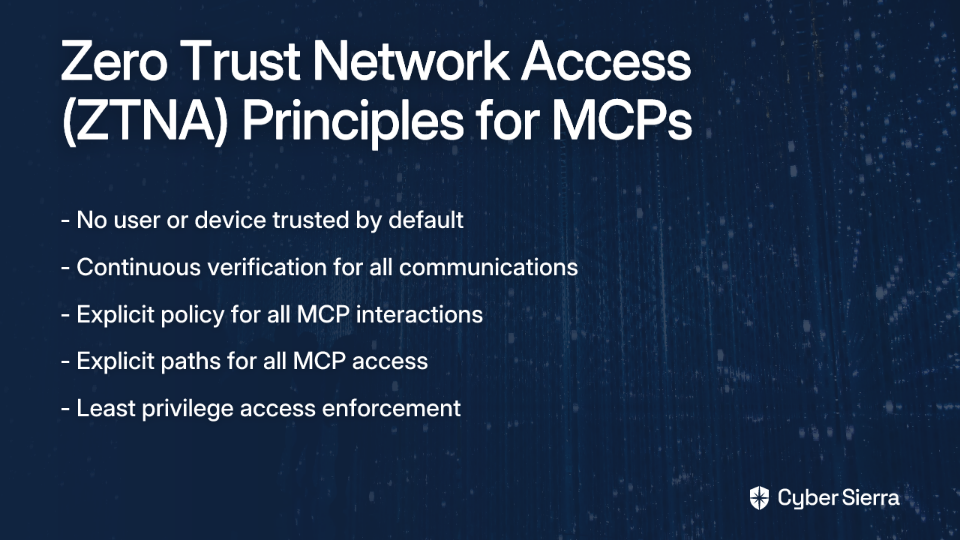
Next, establish a Zero Trust Network Access (ZTNA) foundation. This security model assumes no user or device is trusted by default, requiring continuous verification for all communications. As one security professional recommended, implement "explicit policy, explicit paths" for all MCP interactions.
Finally, define supply chain security standards. Mandate that all MCP servers have their code signed by developers and undergo Static Application Security Testing (SAST) to mitigate vulnerabilities before deployment.
Phase 2: Crafting the Policy with Granular Permissions
One common source of confusion is whether permissions should be role-based (RBAC) or attribute-based (ABAC). The answer depends on your organization's needs:
Role-Based Access Control (RBAC): Simpler to implement, permissions are tied to roles like "admin" or "user."
Attribute-Based Access Control (ABAC): More flexible, using attributes such as department, resource value, or time of day for fine-grained control.
For most organizations, a hybrid approach works best. Here's an example policy structure for an expense approval MCP tool:
# mcp_expenses.yaml policy file
roles:
  - admin: can list, create, approve any expense, and delete expenses
  - manager: can list expenses, approve expenses < $500
  - user: can list and create expenses only
This demonstrates both RBAC (role definitions) and ABAC (conditional approval based on expense amount) principles working together.
Phase 3: Implementing Centralized Control
Effective governance requires centralized monitoring and control. Implement the following:
Centralized Logging: Configure all MCP servers to send logs to a Security Information and Event Management (SIEM) system for monitoring and investigation.
Automated Response: Integrate with Security Orchestration, Automation and Response (SOAR) platforms to automatically detect and respond to suspicious MCP activities.
MCP Manager: Deploy a centralized MCP manager like Syncado that provides visibility and control over all MCP instances across your organization.
Canary Tokens: Place canary tokens within your MCP environment to detect unauthorized access and receive immediate alerts.
Technical Implementation: Bringing Your Policy to Life
Now it's time to put your policy into action with concrete technical measures.
1. Strengthen Authentication
Move beyond basic passwords to multi-factor dynamic authentication. For enterprise integration, address the known conflicts with OAuth in the MCP specification, as detailed by Red Hat.
# Example code for implementing MFA with Claude Desktop-MCP
from mcp_auth import require_mfa

@require_mfa
def access_sensitive_tool(user_id, tool_id):
    # Implementation with MFA protection
2. Isolate Execution Environments
As one developer noted, it took "solid 3 months to get to the point where I have reliable, isolated environments (firecracker VMs)" for MCPs. While implementation can be challenging, sandboxing is essential for high-risk MCPs.
For security-focused apps, consider using containerization with Docker or Podman to isolate MCPs from your main systems:
docker run --rm -it \
  -v "$(pwd)/policies:/policies" \
  --security-opt=no-new-privileges \
  --cap-drop ALL \
  mcp-server:latest
3. Implement Decoupled Authorization
Deploy a separate authorization service that MCPs must consult before executing sensitive operations. This decoupling allows for centralized policy enforcement and easier auditing.
4. Deploy Threat Monitoring
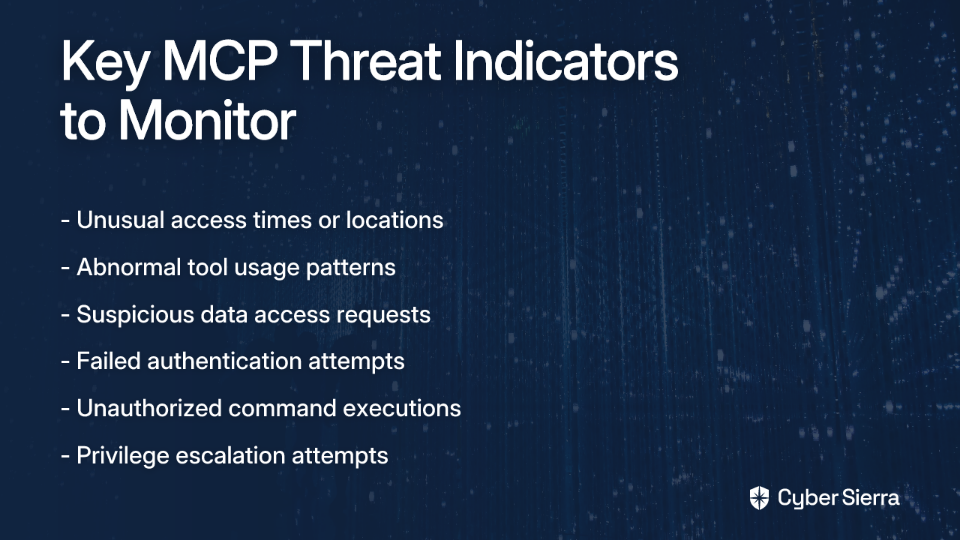
Configure your SIEM system to specifically monitor MCP activities, looking for patterns that might indicate compromise:
Unusual access times or locations
Abnormal tool usage patterns
Suspicious data access requests
Failed authentication attempts
Integrate Claude Code or other AI-powered security tools to analyze MCP logs and identify potential threats that traditional rule-based systems might miss.
Evolving from Reactive Policy to Proactive Governance
MCP governance is not a "set it and forget it" task. It requires continuous vigilance and adaptation as threats evolve. Here's your action plan:
Audit Now: Conduct a comprehensive MCP security audit using tools like Backslash Open to identify security gaps.
Assemble Your Team: Form a cross-functional security task force including security professionals, developers, and business stakeholders.
Invest Wisely: Allocate resources to advanced monitoring (SIEM/SOAR) and dynamic authorization technologies.
Train Continuously: Keep your team updated on emerging MCP security trends and threats.
By implementing a robust security policy with granular permissions and centralized control, you'll transform MCPs from a security liability into a powerful, governed asset. Don't wait for a devastating breach to take action—the time to secure your MCPs is now.
Remember that as BytePlus notes, effective governance is what transforms potential risks into powerful tools. With the right security policy in place, you can confidently leverage MCPs to drive innovation while maintaining data integrity and protecting your organization's most valuable assets.
Error: Contact form not found.
Governance & Compliance
The Art of 'Good Enough': Better GRC Reporting Is Simpler
Join thousands of professionals and get the latest insight on Compliance & Cybersecurity.
Thank you for subscribing us!
Please check your email to confirm your email address.
Share via
You've spent countless hours meticulously documenting every vulnerability, compliance gap, and risk scenario. Your risk register is a masterpiece of thoroughness. The data is impeccable, the analysis robust. And yet, when you present your findings to leadership, you're met with glazed eyes, shallow nods, and that dreaded phrase: "Just send me the deck; I'll review it later."
Sound familiar? You're not alone.
As GRC professionals, we're often caught in a frustrating paradox: the more precise and comprehensive our reports, the less impact they seem to have. We're "tired of people not giving a damn about [our] risk management" despite pouring our expertise and effort into creating technically perfect assessments.
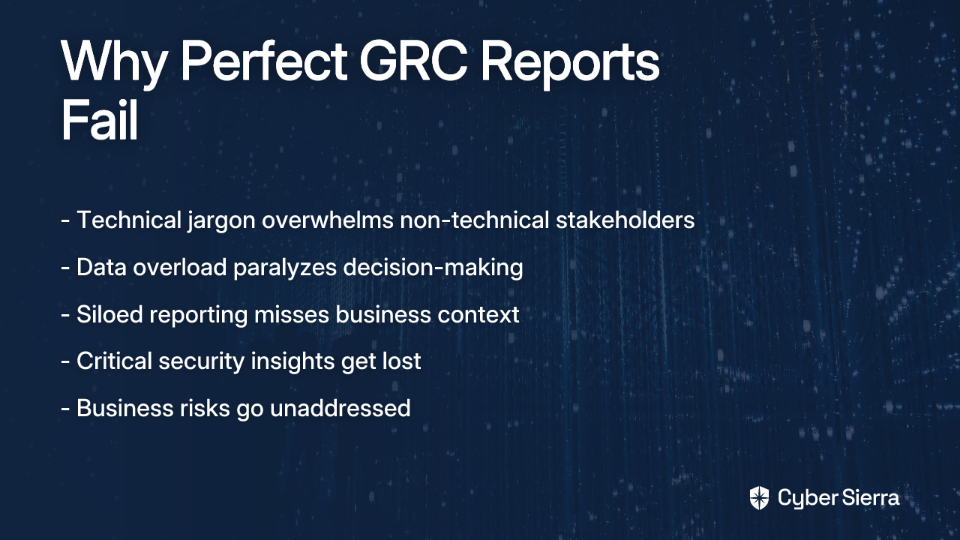
The Tyranny of Precision: Why 'Perfect' GRC Reports Fail
The hard truth is that our obsession with technical precision often works against us. Our meticulously crafted risk assessments, packed with detailed metrics and compliance checkboxes, frequently fall flat for three key reasons:
Technical jargon overwhelms non-technical stakeholders. Board members and executives don't speak the language of CVEs, control frameworks, and compliance citations. When faced with technical terminology, many simply disengage, viewing the GRC team as the "'Department of No'" rather than strategic partners.
Data overload paralyzes decision-making. When stakeholders are bombarded with exhaustive data points and granular metrics, they struggle to extract actionable insights. As one practitioner notes, the "obsession with precision and granularity" often obscures "what exact decision this report needs to influence."
Siloed reporting misses the business context. Technical reports that don't connect to strategic objectives reinforce the perception that GRC operates in isolation from business goals. Many professionals lament not understanding earlier "how cybersecurity, risk and general technology fits into the business."
The result? Critical security insights get lost, business risks go unaddressed, and GRC professionals remain frustrated that their expertise isn't translated into organizational action.
The 'Good Enough' Philosophy: A New Paradigm for GRC
There's a better approach—one that might feel counterintuitive to technically-minded GRC professionals. It's the philosophy of "good enough" reporting.
To be clear, "good enough" doesn't mean sloppy, incomplete, or inaccurate. Rather, it's about creating representations of risk that are sufficient for their primary purpose: driving informed business decisions.
This concept has solid scientific grounding. In cognitive science, researchers have found that our brains naturally create representations that are merely "'good enough' (GE)" for the context, using "simple heuristics" over complex algorithms to process meaning efficiently. In other words, human comprehension doesn't require perfect information—it requires relevant, accessible information that serves the immediate need.
Research from the RAND Corporation on safety assessment further supports this approach. Their studies concluded that "No single best approach exists" for measuring complex systems. Instead, a combination of measurements, processes, and thresholds provides a more thorough and understandable assessment. The parallel to GRC reporting is clear: sometimes a simplified, multi-faceted view is more effective than a single, hyper-precise metric.
The lesson? Effective GRC communication isn't about technical perfection—it's about "sacrificing precision in favor of user-experience and user-alignment."
The Playbook: How to Create 'Good Enough' GRC Reports
Let's explore how to put this philosophy into practice with actionable steps for creating GRC reports that drive real impact:
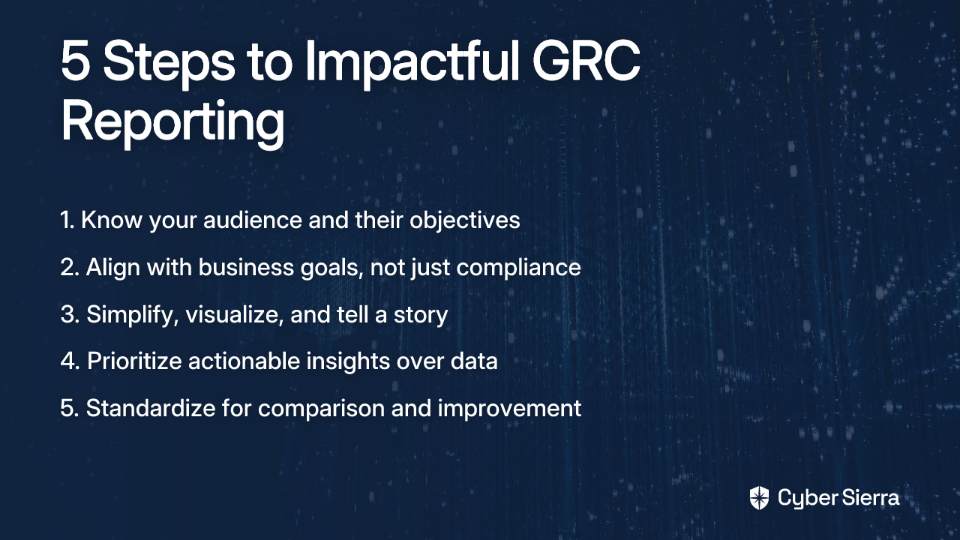
Step 1: Know Your Audience and Their Objectives
Begin by understanding who will consume your report and what decisions they need to make. Different stakeholders have different priorities:
Board members want high-level risk posture and trends
C-suite executives need strategic insights tied to business objectives
Department heads require operational risks relevant to their areas
Don't assume all audiences need the same level of detail. As one GRC professional noted, success comes from recognizing "stakeholder objectives which you might or might not align with" and tailoring your approach accordingly.
Action: Before creating any report, explicitly identify the key decisions it should influence. Meet with stakeholders to understand their specific needs, information preferences, and decision-making processes.
Step 2: Focus Beyond Compliance; Align with Business Goals
Compliance is just one component of an effective risk program. To elevate your reporting, connect GRC insights directly to business outcomes and strategic objectives.
Rather than emphasizing "we're 98% compliant with framework X," highlight how your risk management activities support business growth, protect revenue streams, or enable new initiatives. This transition from compliance bottleneck to business enabler is what transforms GRC from the "Department of No" to a valued strategic partner.
Action: For each risk or compliance issue you report, explicitly connect it to a business goal or objective. Frame security trade-offs in terms of business impact, not just technical risk.
Step 3: Simplify, Visualize, and Tell a Compelling Story
Technical complexity is the enemy of understanding. The most effective GRC reports use simplified language, strong visualizations, and narrative structure to make complex data digestible.
According to Centraleyes, "Using graphs and charts makes data more engaging and easier to interpret" while "contextualizing data in a narrative form helps highlight risks, impacts, and necessary strategic decisions."
Action: Replace technical jargon with business language. Use color-coded dashboards, trend lines, and comparative visuals to illustrate risk posture. Structure reports as narratives with a clear beginning (current state), middle (key risks and opportunities), and end (recommended actions).
Step 4: Prioritize Actionable Insights Over Exhaustive Data
Decision-makers don't need to see every data point—they need the insights that matter most. Modern business intelligence and GRC tools can help by providing high-level, actionable metrics such as:
Financially quantified risk scores that present risk in clear dollar terms
Third-party risk summaries that visualize vendor risk
Budget allocation reports that assess security investment effectiveness
The goal is to extract meaningful signals from the noise of data-quality issues and technical details.
Action: For every data point you include, ask: "Does this help the stakeholder make a better decision?" If not, consider removing it or moving it to an appendix.
Step 5: Standardize for Comparison and Continuous Improvement
Inconsistent reporting makes it difficult to track progress and identify trends. A standardized approach to GRC reporting enables meaningful comparisons over time and demonstrates the value of your risk program.
The RAND Corporation emphasizes the importance of "uniform presentation of evidence" to ensure consistency in assessment. In GRC, this translates to consistent metrics, formats, and evaluation methodologies that allow stakeholders to track changes meaningfully.
Action: Develop report templates with standard metrics that enable quarter-to-quarter and year-to-year comparisons. Maintain audit-ready documentation of your methodology to ensure consistency and defensibility.
The Payoff: The Transformative Impact of 'Good Enough' Reporting
Embracing the "good enough" approach to GRC reporting delivers significant benefits:
Improved & Faster Decision-Making: When stakeholders can quickly grasp risk posture and implications, they make better decisions more efficiently. Streamlined reports provide clarity that facilitates confident action.
Enhanced Stakeholder Engagement: By focusing on "better alignment/aggregation/UX in reports," you win the internal competition for attention. No more reports that sit unread in inboxes—stakeholders actively seek and use your insights because they're valuable and accessible.
Increased Operational Efficiency: This approach "frees up a ton of time and effort" for the GRC team, allowing professionals to focus on high-impact risk management activities instead of endless report refinement. Policy management becomes more effective when policies are clearly tied to business risks.
Stronger Reputation & Trust: When GRC professionals communicate in business terms and deliver actionable insights, they build credibility and trust. The function transforms from a technical necessity to a strategic asset.
From Technical Expert to Strategic Partner
The journey from technical specialist to strategic advisor isn't easy. It requires us to challenge our own assumptions about what makes a "good" GRC report and embrace a new paradigm that values communication as much as technical accuracy.
Yes, deep technical knowledge matters. Understanding quantification engines, risk assessment methodologies, and technical considerations remains essential. But the real game-changer for your GRC career isn't one more certification—it's learning how to navigate business culture, communicate value, and become an indispensable part of the business conversation.
As one experienced professional reflected, "the real impact comes once we can explain security trade-offs to non-technical leadership." That's the art of "good enough"—knowing when precision serves the purpose and when simplicity better serves the stakeholder.
By mastering this balance, you transform GRC reporting from a compliance exercise into a powerful tool for organizational influence. You stop being merely a technical expert and become something far more valuable: a trusted advisor who helps the business navigate risk with confidence.
The irony is striking but true: sometimes, doing less detailed work creates more meaningful impact. In GRC reporting, as in many aspects of business, simplicity isn't just good enough—it's better.
Frequently Asked Questions
What is 'good enough' GRC reporting?
"Good enough" GRC reporting is an approach that prioritizes clear, actionable insights for business leaders over exhaustive technical detail. It involves creating reports that are sufficient to drive informed decisions by focusing on user experience and alignment with business objectives rather than perfect, granular precision.
Why do highly detailed GRC reports often fail to make an impact?
Highly detailed GRC reports often fail because they overwhelm non-technical stakeholders with jargon, cause decision paralysis through data overload, and lack a clear connection to business context. When leadership cannot easily understand the strategic implications, critical security insights get lost, and the report is often ignored.
How can I make my GRC reports more effective for a leadership audience?
To make your reports more effective for leadership, focus on storytelling, visualization, and business relevance. Use simple, color-coded dashboards and charts instead of dense tables. Frame risks in terms of business impact (e.g., financial loss, project delays) and connect your recommendations directly to strategic goals.
Does 'good enough' reporting mean sacrificing accuracy?
No, "good enough" reporting does not mean being inaccurate or sloppy. It means sacrificing unnecessary precision for the sake of clarity and impact. The underlying data and analysis must still be robust and defensible, but the final report presented to stakeholders is simplified to highlight what is most important for their decision-making process.
What's the first step to creating a 'good enough' GRC report?
The first and most critical step is to know your audience and their objectives. Before you begin writing, identify who the report is for and what specific decisions they need to make based on your findings. A brief conversation with key stakeholders can ensure your report is tailored to their needs from the start.
How do I balance simplified executive reports with the need for detailed audit evidence?
The key is to separate the presentation layer from the underlying data. Maintain your detailed, audit-ready documentation and comprehensive risk register internally. For executive reports, create a high-level summary or dashboard that pulls from this detailed data but presents only the most critical, actionable insights. The full data set can be available as an appendix or upon request for deeper dives or audit purposes.
Join thousands of professionals and get the latest insight on Compliance & Cybersecurity.
Thank you for subscribing us!
Please check your email to confirm your email address.
Share via
You've been tasked with implementing a new compliance framework at your organization. As you dig into the requirements, you're overwhelmed by the sheer volume of controls across multiple standards. How do you organize this chaos? How can you possibly track which internal controls satisfy which external requirements without duplicating efforts or missing critical elements?
If this scenario feels painfully familiar, you're not alone. Many GRC professionals describe this exact situation as "super confusing when I first started" and feel "thrust into" compliance initiatives without clear guidance.
Fortunately, there's a powerful solution: the cross-reference map. This critical but often misunderstood tool transforms compliance chaos into strategic clarity - and this comprehensive guide will show you exactly how to master it.
What is a Cross-Reference Map and Why is it Critical?
A cross-reference map (sometimes called a compliance map) is a table that aligns your organization's internal controls with the requirements of multiple external regulations and frameworks. It serves as a single source of truth for your compliance program.
Think of it as the Rosetta Stone of compliance - translating between different "languages" of regulations to show how a single control in your organization can satisfy requirements across NIST governance risk standards, ISO 27001, PCI-DSS, and other frameworks simultaneously.
The Problems it Solves
Without a proper mapping approach, organizations typically face:
The Strategic Benefits
When properly implemented, cross-reference maps deliver:
Optimized Compliance: Streamlined audits and reduced redundant efforts
Enhanced Risk Mitigation: Active identification and remediation of gaps
Efficient Reporting: A centralized repository of mapped controls expedites audits
Resource Optimization: Less time spent on compliance, more on strategic initiatives
The Foundation: Preparing to Build Your Map
Before diving into the mapping process, establish a solid foundation with these three preparatory steps:
1. Assemble Your Compliance Team
Cross-reference mapping isn't a solo task. Involve:
IT security specialists
Compliance experts
Legal representatives
Key department stakeholders (HR, Finance, Operations)
Create a RACI matrix (Responsible, Accountable, Consulted, Informed) to clarify roles and prevent confusion during the mapping process.
2. Define Your Regulatory Universe
Identify all regulations, standards, and frameworks that apply to your organization. This might include:
This step is crucial for professionals who "don't even know what's appropriate to ask for" when beginning compliance work.
3. Inventory Your Existing Controls
Before creating new controls, document what you already have:
Policies, standards, and SOPs (Standard Operating Procedures)
Technical controls implemented in your systems (firewall rules, access controls, SIEM alerts)
Existing documentation from previous audits or assessments
The Step-by-Step Guide to Creating Your Cross-Reference Map
With your foundation in place, it's time to build your cross-reference map. Follow these steps for success:
Step 1: Create Your Central Control Library
Your control library forms the first column of your map—it's your organization's unique set of controls that will be mapped to various frameworks.
Pro-Tip: Start with a widely recognized framework like the NIST Cybersecurity Framework as your foundation. This approach makes it easier to map to other frameworks later.
For each control in your library, include:
Unique Identifier (e.g., AC-01)
Descriptive Name (e.g., Unique User Identification)
Control Objective
Control Owner
Implementation Status (Implemented, Not Implemented, In Progress)
Step 2: Build the Cross-Reference Map Table
This is where the actual mapping happens. Create a spreadsheet or use a GRC tool with the following structure:
Internal Control ID
Control Description & Objective
Control Owner
Implementation Status
Evidence Location
NIST CSF Mapping
ISO 27001 Mapping
PCI DSS Mapping
Notes/Gaps
AC-01
All users are issued a unique ID for identification and accountability
IT Department
Implemented
link-to/access-control-sop.pdf
PR.AC-1
A.9.2.1
8.1.1, 8.2.1
Reviewed Q1 2024
SC-01
Third-party software is monitored for vulnerabilities
Security Ops
In Progress
link-to/trm-policy.pdf
ID.RA-5, PR.IP-12
A.15.2.1
6.1, 6.2
New tool needed for automated scanning. Gap identified.
This table structure transforms abstract requirements into a practical, actionable tool that connects your internal controls to external frameworks.
Step 3: Deep Dive - Mapping to the NIST Cybersecurity Framework (CSF)
Let's explore mapping with the NIST CSF as an example. Many professionals feel NIST CSF is "overkill," but understanding its structure makes mapping straightforward.
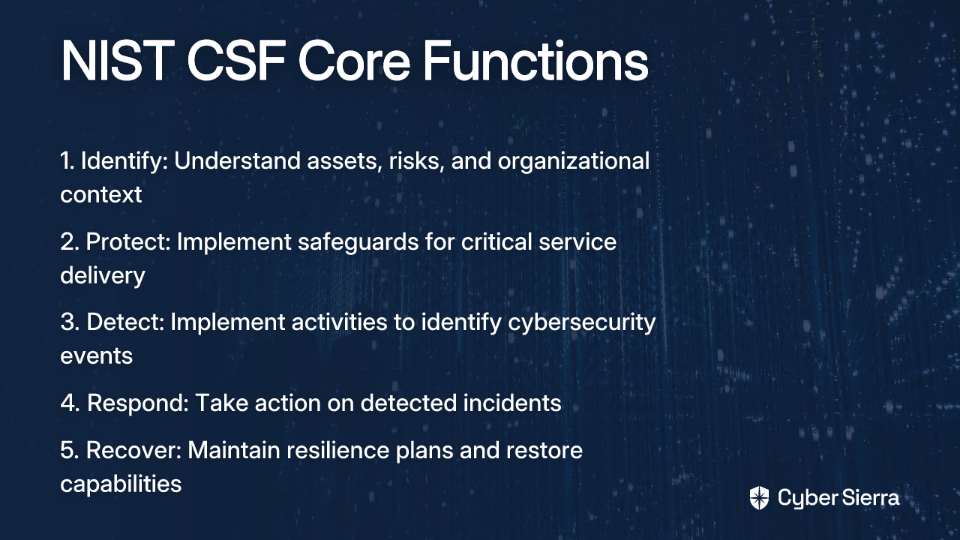
The NIST CSF is built on five core functions:
Mapping Example: Your internal control AC-01 (Unique User IDs) maps to NIST CSF Subcategory PR.AC-1, which stands for "Identities and credentials are managed for authorized devices and users" under the Protect function.
The mapping should be based on the control's intent and implementation details. When mapping, use the official NIST CSF documentation to ensure accuracy.
Step 4: Analyze Gaps and Document Rationale
With your initial mapping complete:
Identify empty cells in your map. These represent potential compliance gaps where a control is needed.
Document your rationale. For every mapping, explain why you believe Control X satisfies Requirement Y. This documentation is critical during audits.
Implement remediation plans for identified gaps, using SMART criteria (Specific, Measurable, Achievable, Relevant, Time-bound) to create actionable tasks.
Tools and Best Practices for Mastery
As you become more proficient with cross-reference mapping, consider these approaches and best practices:
Choosing Your Approach
Manual (Spreadsheets)
Many organizations begin with spreadsheets for mapping. While this approach works for smaller compliance programs, it becomes error-prone and difficult to maintain as your regulatory universe expands.
Leverage Harmonized Frameworks
Tools like the Secure Controls Framework (SCF) and Unified Compliance Framework (UCF) provide pre-built mappings between common frameworks, reducing the manual effort required to create these connections.
GRC Platforms (The Modern Solution)
GRC platforms automate the mapping process and provide powerful capabilities:
ServiceNow GRC and Archer for enterprise environments
Drata, Vanta, and OneTrust for compliance automation
Real-time monitoring of control effectiveness
Centralized dashboards for compliance status
Automated evidence collection
Technical Peek: How GRC Tools Work
Under the hood, GRC platforms store mappings in database tables (conceptually similar to Oracle's XREF_DATA table). These tools use functions to populate, update, and query these relationships at runtime, allowing for dynamic reporting and analysis without manual lookups.
This approach allows for reverse-engineering of compliance requirements—starting with a specific framework requirement and instantly seeing which internal controls satisfy it, along with their implementation status.
Best Practices for Success
Focus on Common Controls First
Target controls that appear across multiple frameworks to maximize efficiency. For example, access control requirements appear in virtually every framework from NIST governance risk standards to ISO 27001.
Document Implementation and Evidence
Don't just map—note how the control is implemented and where to find the evidence. Link to specific CMDB entries, reports, or SOP documents to streamline future audits.
Engage Auditors Early
Share your mapping approach with auditors to get feedback before audit time. This prevents surprises and ensures your mapping methodology meets their expectations.
Define Your Terms
For maximum clarity in your policies and standards, explicitly reference verb meanings. RFC 2119 defines the precise meaning of terms like MUST, SHOULD, and MAY in technical documentation. Using these standardized terms reduces ambiguity in your evergreen documents and simplifies policy maintenance.
Continuous Monitoring and Updates
Treat your cross-reference map as a living document that requires regular review:
Update mappings when regulations change
Revise as internal controls evolve
Review after each audit for improvement opportunities
Conclusion: Achieving Principled Performance
A well-executed cross-reference map is more than a document—it's a strategic asset that transforms compliance from a reactive, fragmented task into a proactive, unified program. By building and maintaining a comprehensive map, you:
Streamline audits and assessments
Enhance your security posture
Create transparency across the organization
Move toward a culture of "principled performance"
For professionals pursuing managerial SANS certification or similar credentials, mastering cross-reference maps demonstrates your ability to translate technical controls into business value.
Remember that compliance is not the end goal—it's a byproduct of good governance. Your cross-reference map helps ensure that every control serves a purpose, every requirement is satisfied, and your organization can navigate the complex world of compliance with confidence and clarity.
By following the steps outlined in this guide, you can transform compliance chaos into strategic alignment, allowing your organization to meet its regulatory obligations while optimizing resources and enhancing security.
Error: Contact form not found.
Governance & Compliance
What's New in NIST RMF Rev. 5? Controls & Baselines
Join thousands of professionals and get the latest insight on Compliance & Cybersecurity.
Thank you for subscribing us!
Please check your email to confirm your email address.
Share via
You've meticulously implemented NIST 800-53 Rev. 4 controls across your systems. Then suddenly, you hear there's a Rev. 5 that changes everything. Your team is already stretched thin with compliance activities, and now you're faced with migrating to a new framework that seems to have moved everything around. Will your organization fall out of compliance? How much work will this transition require?
If you're feeling overwhelmed by this change, you're not alone. The transition from Rev. 4 to Rev. 5 represents the most significant evolution of the NIST Risk Management Framework (RMF) in years, and many security professionals are struggling to understand what's actually changed and how it impacts their compliance programs.
This article cuts through the confusion to explain the most critical changes in NIST SP 800-53 Rev. 5 and the new SP 800-53B baselines document, providing a clear path forward for your transition.
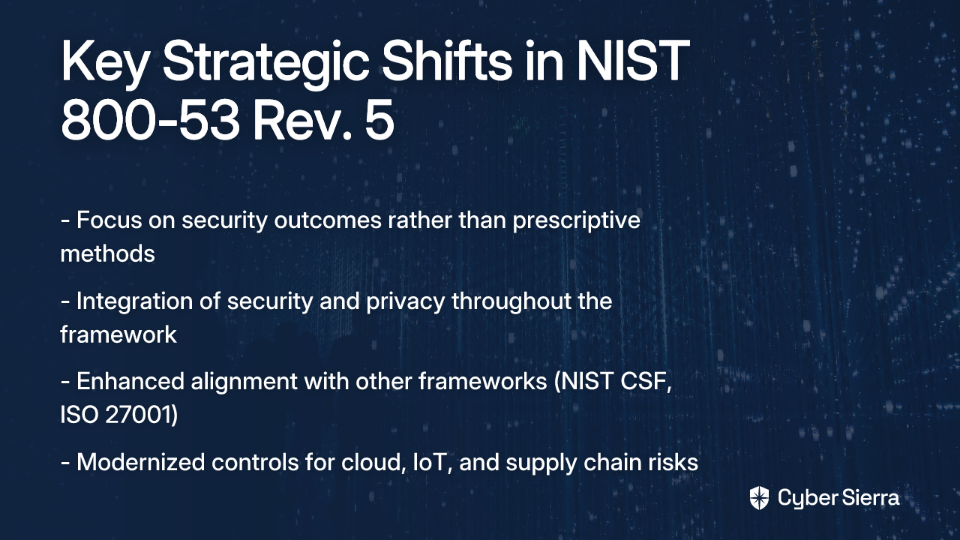
The Strategic Shifts in Rev. 5: Beyond Incremental Changes
NIST SP 800-53 Rev. 5 isn't just another version update—it represents a fundamental philosophical shift in how we approach security and privacy risk management. Understanding these high-level changes provides crucial context for the specific control modifications.
From Compliance to Outcomes
Many security professionals have struggled with "relating the high-level language of controls to specific actions" their organizations need to take. Rev. 5 addresses this by shifting toward outcome-based controls, focusing more on what security and privacy protections should achieve rather than prescribing exactly how to implement them.
This provides greater flexibility for organizations to implement controls in ways that make sense for their specific environments while still achieving the required security outcomes.
Integration of Security and Privacy
One of the most significant changes is the complete integration of security and privacy controls. Previously, privacy controls existed primarily in a separate appendix (Appendix J) with the dedicated "PT" family. This separation often created confusion about the relationship between security and privacy requirements.
In Rev. 5, privacy is no longer treated as a separate consideration but is woven throughout the entire control catalog. This integration acknowledges that effective risk management requires addressing security and privacy together, not as separate domains.
Framework Alignment and Modernization
Rev. 5 enhances alignment with other critical frameworks, including the NIST Cybersecurity Framework (CSF) and ISO/IEC 27001. This alignment reduces the effort required when working with multiple frameworks and provides clearer guidance for organizations navigating complex compliance landscapes.
Additionally, controls have been updated to address modern technologies and threats, including cloud computing, IoT devices, and sophisticated supply chain risks that weren't adequately covered in Rev. 4.
Deep Dive: The New Integrated Control Catalog
The control catalog in NIST SP 800-53 Rev. 5 includes substantial changes that security professionals need to understand to ensure proper implementation and compliance.
Integrated Privacy Controls
The elimination of the separate privacy control appendix (Appendix J) represents one of the most significant structural changes. Privacy controls are now fully integrated throughout the main catalog, ensuring privacy considerations are embedded in all relevant security domains.
For teams transitioning from Rev. 4, NIST provides a mapping of Rev. 4 Appendix J controls to Rev. 5 controls to facilitate this transition. This integration addresses a common pain point expressed by practitioners who were "confused about the distinction between security controls and privacy controls."
New Controls and Updates
Rev. 5 introduces numerous new controls and enhancements to address emerging threats and technologies. The latest update (patched November 7, 2023) added one new control and three supporting enhancements focused on modern authentication challenges:
Identity providers and authorization servers
Protection of cryptographic keys
Verification of identity assertions and access tokens
Token management
These additions reflect the growing importance of identity management, Multi-Factor Authentication (MFA), and secure token handling in modern security architectures.
Control Identifier Changes
A seemingly minor but important change involves the addition of leading zeros to control identifiers (e.g., AC-1 from Rev. 4 is now AC-01 in Rev. 5). While this may appear trivial, it has significant implications for documentation, spreadsheets, and compliance tools like eMASS that rely on these identifiers. It also affects Control Correlation Identifiers (CCIs) that map NIST controls to implementation requirements.
This separation allows the control catalog (Rev. 5) and the baselines (53B) to be updated independently, providing greater flexibility as threats and technologies evolve. It also gives greater prominence to the critical role that baselines play in the risk management process.
Updated Security Baselines
SP 800-53B provides updated high, medium, and low baselines based on the FIPS 199 impact categorization of systems. These baselines serve as starting points for control selection and must be used for Rev. 5 compliance. The changes include:
Addition of new Rev. 5 controls to existing baselines
Removal of certain controls that are no longer considered essential at specific impact levels
Shifting of some controls between impact levels based on updated risk assessments
The New Privacy Baseline
One of the most significant additions in SP 800-53B is the introduction of a dedicated privacy baseline. This addresses the growing importance of privacy in information systems and provides clearer guidance for protecting personally identifiable information (PII).
A crucial clarification about the privacy baseline is that it's not a separate set of controls but rather a selection of controls from the main catalog that are foundational for protecting PII, regardless of a system's security impact level. For example, the privacy baseline highlights controls like AC-01 "Policy and Procedures" and AC-02 "Account Management" as critical for any system processing PII, as noted by Hyperproof's analysis.
Chapter 3 of NIST SP 800-53B provides detailed information on the relationship between the security and privacy baselines, which is essential reading for anyone implementing Rev. 5.
Your Action Plan: Transitioning to Rev. 5
To help make your transition to Rev. 5 as efficient as possible, here's a practical roadmap that addresses the pain point that "RMF processes can be very tedious and time-consuming."
Step 1: Gather Essential Resources
Begin by downloading the key documents you'll need:
Using the comparison workbook, map your organization's currently implemented Rev. 4 controls to their Rev. 5 equivalents. This process will help you identify:
Controls that remain largely unchanged and require minimal updates
Controls that have been significantly modified and need reassessment
Entirely new controls that need to be implemented
Rev. 4 controls that have been deprecated or consolidated
This mapping exercise creates your transition "to-do" list, helping you prioritize efforts where they're most needed.
Step 3: Select New Baselines
Based on your system's impact level (Low, Moderate, High), select the appropriate new baseline from SP 800-53B. Additionally, determine if your system processes PII. If so, apply the new privacy baseline and tailor it according to your specific privacy risks.
Step 4: Implement, Assess, and Document
Implement the new and modified controls identified in your gap analysis. This may involve updating your Security Information and Event Management (SIEM) systems, Endpoint Detection and Response (EDR) solutions, and identity management systems to address new requirements like enhanced MFA.
Update your System Security Plan (SSP) and other RMF artifacts to reflect the new Rev. 5 controls, baselines, and tailoring decisions. This documentation provides evidence-based proof of compliance for assessors and addresses the common issue of "insufficient documentation" often cited during security assessments.
Finally, follow the remaining steps of the RMF process: assess the effectiveness of the new controls, obtain authorization, and establish continuous monitoring procedures.
Conclusion: Embracing a More Resilient Framework
The transition to NIST SP 800-53 Rev. 5 and SP 800-53B represents a significant evolution in how organizations approach security and privacy risk management. While the changes may initially seem overwhelming, they ultimately provide a more flexible, integrated, and effective approach to protecting your organization's critical assets and information.
By understanding the philosophical shifts, control changes, and baseline updates in Rev. 5, you can approach your transition strategically, focusing your efforts where they matter most and ensuring your organization maintains compliance while strengthening its security and privacy posture.
Remember that frameworks like the NIST RMF are not just compliance checkboxes—they're comprehensive methodologies for managing risk. By embracing the improvements in Rev. 5, your organization will be better equipped to address the complex and evolving threat landscape of today's digital environment.
Frequently Asked Questions
What are the main differences between NIST 800-53 Rev. 4 and Rev. 5?
The main differences are a shift to outcome-based controls, the full integration of privacy controls into the main catalog, and the separation of control baselines into a new document, NIST SP 800-53B. Rev. 5 is a significant update designed to be more flexible and address modern threats like supply chain risks, cloud computing, and IoT.
How does Rev. 5 integrate security and privacy controls?
Rev. 5 fully integrates privacy controls throughout the entire control catalog, eliminating the separate privacy appendix (Appendix J) found in Rev. 4. This change ensures that privacy is treated as a fundamental component of security risk management, rather than an afterthought. It requires organizations to consider privacy implications across all relevant security domains.
Why were the control baselines moved to NIST SP 800-53B?
The control baselines were moved to a separate document, NIST SP 800-53B, to allow the control catalog (Rev. 5) and the baselines to be updated independently. This provides greater agility, enabling NIST to update baselines in response to new threats and technologies without having to revise the entire control catalog, and vice versa.
What is the new privacy baseline in SP 800-53B?
The new privacy baseline is a selection of controls from the main catalog that are considered foundational for protecting personally identifiable information (PII). It is not a separate set of controls but rather a starting point for any system that processes PII, regardless of its security impact level (Low, Moderate, or High). Organizations must apply this baseline and tailor it based on their specific privacy risks.
What are the first steps to transition from Rev. 4 to Rev. 5?
The first step is to perform a gap analysis by downloading the key NIST documents, especially the Rev. 4 to Rev. 5 comparison workbook. Use this workbook to map your existing controls to the new framework, which will help you identify changed, new, and deprecated controls. This analysis will form the basis of your transition plan.
Are there completely new controls in NIST 800-53 Rev. 5?
Yes, Rev. 5 introduces several new controls and control enhancements to address modern security challenges. These cover areas like supply chain risk management, cloud services, and IoT devices. Recent updates have also added new controls focused on identity management, such as protecting cryptographic keys and managing authentication tokens, reflecting the evolving threat landscape.
Error: Contact form not found.
Governance & Compliance
8 Practical AI Use Cases for GRC That Actually Work
Join thousands of professionals and get the latest insight on Compliance & Cybersecurity.
Thank you for subscribing us!
Please check your email to confirm your email address.
Share via
The pressure is on to use AI in Governance, Risk, and Compliance. With vendors quietly slipping AI capabilities into their platforms and marketing teams trumpeting AI solutions at every turn, it's hard to separate genuine innovation from hype.
As one GRC professional noted, "There's plenty of AI hype floating around GRC today. Some of it is genuinely useful, some more marketing sparkle." This sentiment echoes throughout the industry, where practitioners are desperate for AI applications that deliver tangible value—not just flashy demos.
This article cuts through the noise to highlight eight proven, practical AI use cases that are already delivering measurable benefits in GRC. From automating tedious compliance documentation to enhancing risk forecasting, these applications address the real pain points GRC professionals face daily.
1. Dynamic and Automated Policy Creation
Many organizations struggle with policies that have "created a patchwork of randomness that is not super cohesive or organized and has confusing syntax." Sound familiar?
AI is transforming this chaotic policy landscape by:
Generating consistent first drafts based on regulatory requirements
Ensuring policies maintain cohesive language and structure
Automatically updating policies when regulations change
Real-world implementation: One GRC team reported success "creating dynamic policies based on company information collected through a Tines form." This automation pulls relevant company data to generate tailored policies that remain consistent with existing documentation.
Tools like ChatGPT can produce solid policy frameworks with well-crafted prompts, while specialized platforms continuously scan regulatory databases to suggest policy updates aligned with evolving standards like GDPR or NIST frameworks.
The endless stream of security questionnaires is a significant drain on resources. As one professional lamented, maintaining a response library is "horrible to maintain. Maybe you can make it work if you have an absolute army of proposal people, but I'm guessing you don't."
AI solutions are revolutionizing this process:
Vanta's Questionnaire Automation accelerates security reviews by an average of 81%
AI can automatically answer up to 80% of security questions using your existing knowledge base
These AI-generated responses achieve a 95% acceptance rate from customers
The process works by building a central knowledge repository that learns from each completed questionnaire, improving accuracy over time. "Shout out to SafeBase!!!!!" noted one Reddit user, highlighting another popular tool in this space that's delivering real value.
3. Reviewing and Managing Third-Party App Risks
The proliferation of third-party apps—from enterprise SaaS to simple Chrome extensions—creates significant security challenges. Manual vetting is time-consuming and often superficial.
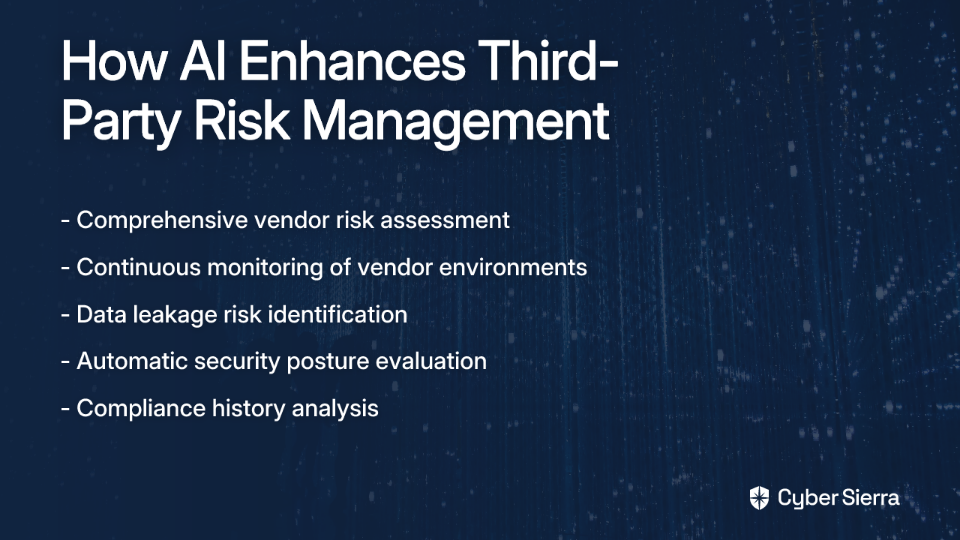
AI tools enhance third-party risk management by:
Analyzing vendors' financial stability, cybersecurity posture, and compliance history
Identifying potential data leakage risks in applications like Chrome extensions
Continuously monitoring third-party environments for new vulnerabilities
Platforms like Black Kite leverage AI to assess and quantify vendor risk by analyzing various data points and providing comprehensive risk profiles, dramatically reducing the manual effort required for thorough assessments.
4. Formatting and Streamlining Compliance Data (POA&Ms)
Frameworks like FedRAMP require extensive documentation and meticulous formatting of security findings. One GRC professional shared a practical solution: "Using AI to write a ton of scripts to handle things like formatting large chunks of scan data for FedRAMP scans into a nice, clean POA&M."
This use case demonstrates how AI can:
Automate the parsing of complex scan data into standardized formats
Ensure consistency in vulnerability documentation across multiple systems
Dramatically reduce the time spent on manual data entry and formatting
For organizations pursuing CMMC or other compliance frameworks, this automation of tedious formatting tasks frees up valuable time for analysis and remediation planning rather than administrative busy work.
5. Continuous Compliance Monitoring and Regulatory Mapping
"Businesses waste thousands of hours manually tracking ever-changing regulations (GDPR, HIPAA) and updating compliance documents," according to one frustrated compliance professional. AI provides a solution to this seemingly endless task.
Modern AI systems can:
Continuously monitor regulatory changes across multiple jurisdictions
Automatically map new requirements to your existing control framework
Flag gaps and recommend necessary updates to maintain compliance
As one Reddit user observed, GRC vendors like "Vanta and Drata will scan your policy text and suggest ISO/CIS/NIST controls," effectively automating the mapping process. This capability is particularly valuable for organizations operating in highly regulated industries or across multiple jurisdictions.
6. Predictive Risk Assessment and Management
Traditional risk management tends to be reactive—addressing issues after they emerge. AI and Machine Learning (ML) enable a shift to proactive risk management.
Advanced AI systems can:
Generate data-driven risk statements based on historical patterns
Identify emerging risk hotspots before they become critical issues
Prioritize risks based on potential impact and likelihood
One user mentioned how "IBM's OpenPages leans on Watson to forecast where new risk hotspots might emerge," showcasing how established GRC platforms are incorporating predictive capabilities. This approach allows organizations to allocate resources more effectively, addressing potential problems before they manifest.
7. Internal Controls Optimization and Gap Analysis
Identifying weaknesses in complex control frameworks like SOX or ISO standards traditionally requires significant manual effort. AI streamlines this process through automated gap analysis.
AI-powered control optimization:
Analyzes control effectiveness across different business units
Identifies redundancies and gaps in control frameworks
Suggests improvements based on industry best practices
"AuditBoard's ML flags gaps across your SOX/ISO workflows," noted one practitioner, highlighting how machine learning is already addressing this challenge in the field. By automating control analysis, organizations can maintain stronger compliance postures with less effort.
8. Enhancing AML/KYC and Fraud Detection
Financial institutions struggle with high volumes of false positives in Anti-Money Laundering (AML) and Know Your Customer (KYC) processes. AI significantly improves detection accuracy while reducing false alerts.
AI enhances compliance processes by:
Analyzing transaction patterns to identify truly suspicious activities
Reducing false positives that drain investigator resources
Automatically screening against sanctions lists and PEP databases
These capabilities are particularly valuable in financial services, where regulatory expectations for compliance are extraordinarily high, and the cost of missing actual fraud or money laundering incidents can be severe.
Critical Considerations: The Human-in-the-Loop Imperative
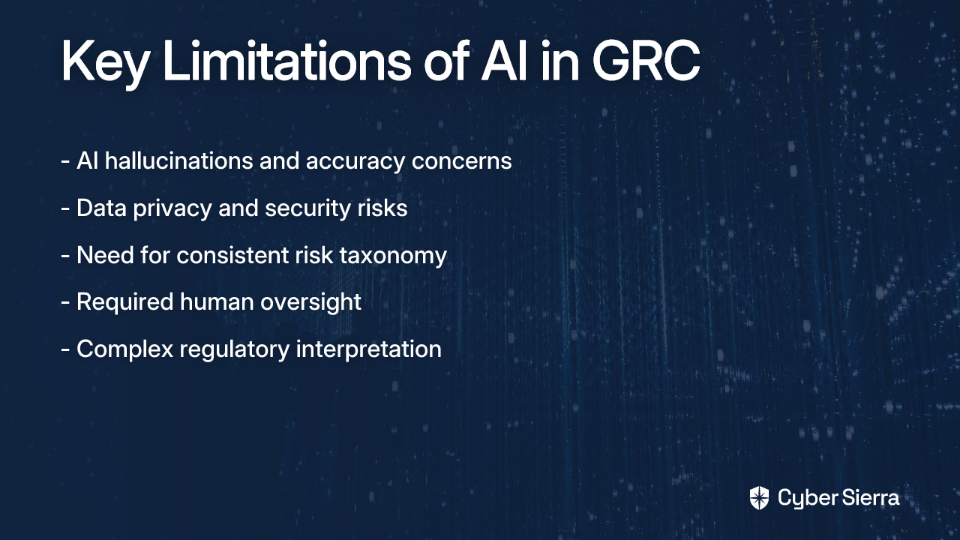
Despite these powerful applications, AI in GRC comes with important limitations that practitioners must recognize:
AI Hallucinations and Accuracy Concerns
LLMs can sometimes generate plausible-sounding but incorrect information. All AI-generated content—from policy drafts to risk statements—must be reviewed by human experts before implementation. As one user cautioned about frameworks like CMMC: "trying to cross-map it from other frameworks, like other GRCs do, can be tedious and erroneous."
Data Privacy and Security Risks
Organizations must establish clear policies about what GRC data can be used with external AI tools. As one practitioner warned, "GRCs should not be storing your data" in public AI systems. Feeding sensitive compliance information into unsecured models creates significant security and privacy risks.
Risk Taxonomy Consistency
For AI to be effective, organizations need a consistent risk taxonomy and structured data approach. Without standardized terminology and data formats, AI systems will struggle to deliver accurate insights across different business functions.
Conclusion: Making AI Work for Your GRC Program
The real promise of AI in GRC isn't about replacing human judgment—it's about augmenting it by handling repetitive, data-intensive tasks that consume too much valuable time.
The most successful implementations target specific pain points rather than attempting sweeping transformation. Start with high-effort, low-judgment tasks like automating vendor questionnaires, formatting POA&Ms, or monitoring regulatory changes.
By focusing AI implementation on these practical use cases with proven ROI, GRC teams can cut through the marketing hype and deliver genuine efficiency gains. The future of GRC isn't about replacing practitioners; it's about empowering them with smart tools that free up their time for the strategic thinking machines can't replicate.
The pressure to adopt AI in GRC is undeniable—but with these eight practical applications as your starting point, you can ensure your AI investments deliver real value rather than just "marketing sparkle."
Frequently Asked Questions
What is a practical first step for implementing AI in GRC?
A practical first step is to target high-effort, low-judgment tasks where AI can provide immediate value. Focus on automating repetitive processes like filling out vendor security questionnaires, formatting compliance data for reports like POA&Ms, or using AI to generate initial drafts of standard policies. This approach delivers a clear return on investment and builds momentum for more advanced AI applications.
How does AI help with continuous compliance monitoring?
AI helps with continuous compliance monitoring by automating the manual process of tracking regulatory changes. AI-powered platforms can continuously scan global regulations (like GDPR, HIPAA, etc.), automatically map new requirements to your organization's existing controls, and alert you to any gaps. This ensures your compliance framework remains up-to-date without requiring thousands of hours of manual work.
What are the biggest risks when using AI for GRC tasks?
The biggest risks include accuracy, data privacy, and data consistency. AI models, particularly LLMs, can "hallucinate" and produce incorrect information. Feeding sensitive GRC data into public AI tools creates significant security risks. Furthermore, without a consistent risk taxonomy across the organization, AI-driven insights can be unreliable and fragmented.
Will AI replace GRC professionals?
No, AI is not expected to replace GRC professionals. Instead, it is a tool designed to augment their capabilities. AI excels at handling repetitive, data-intensive tasks, which frees up GRC experts to focus on strategic activities that require human judgment, critical thinking, and nuanced decision-making—skills that machines cannot replicate.
Why is a "human-in-the-loop" approach crucial for GRC?
A "human-in-the-loop" approach is crucial because AI outputs require expert validation. GRC tasks have significant regulatory and security implications, and AI-generated content—whether a policy clause, a risk assessment, or a control mapping—must be reviewed by a human expert for accuracy, context, and applicability before it is implemented. This oversight mitigates the risk of AI errors and ensures responsible adoption.
How can AI improve the vendor security review process?
AI can dramatically improve the vendor security review process by automating the completion of security questionnaires. AI tools can build a knowledge base from your existing security documentation and past questionnaires to automatically answer a high percentage of incoming questions (often up to 80%). This reduces the manual workload on security teams by an average of 80%, accelerating sales cycles and freeing up resources.
Join thousands of professionals and get the latest insight on Compliance & Cybersecurity.
Thank you for subscribing us!
Please check your email to confirm your email address.
Share via
You've been tasked with evaluating a potential vendor's security posture, and someone mentions you should request their "SOC 2 report." As you search online, you quickly discover that these reports aren't publicly available. Multiple vendors respond to your inquiries with the same frustrating answer: "We'd be happy to share our SOC 2 report after you sign an NDA."
This secretive nature of SOC reports isn't an accident—it's by design. But understanding the differences between SOC report types can save you significant time and help you navigate the complex landscape of vendor security assessments.
What is a SOC Report?
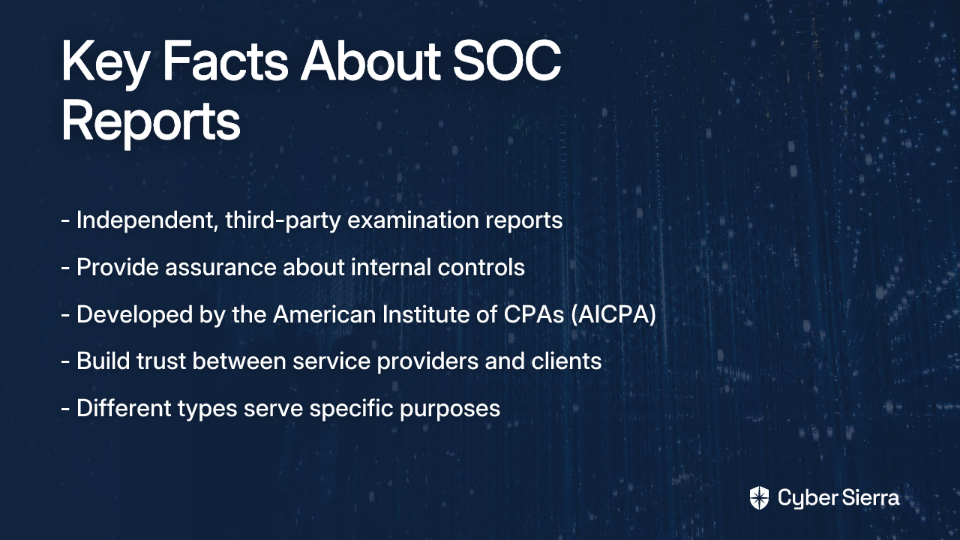
A System and Organization Controls (SOC) report is an official assessment produced by an independent, third-party auditor. These reports verify that an organization follows best practices for protecting client data, managing financials, and maintaining security. SOC reports are governed by standards established by the American Institute of Certified Public Accountants (AICPA), giving them credibility and consistency across industries.
SOC reports matter for several critical reasons:
They provide objective, third-party validation of internal controls
They build trust with customers, partners, and stakeholders
They satisfy due diligence requirements when outsourcing business functions
They demonstrate a commitment to security and regulatory compliance
But not all SOC reports are created equal. Each type serves a specific purpose and audience, which is why understanding their differences is essential.
SOC 1: Financial Controls First
Primary Focus: Internal controls relevant to a client's financial reporting
SOC 1 reports specifically evaluate controls that might impact a customer's financial statements. If your organization provides services that could affect how your clients report their finances, a SOC 1 is designed for you.
Key Characteristics of SOC 1 Reports:
Governed by the Statement on Standards for Attestation Engagements No. 18 (SSAE 18)
Primarily intended for user entities' management and their financial auditors
Distribution is restricted to these specific audiences
Focuses exclusively on financial reporting controls
Common Use Cases:
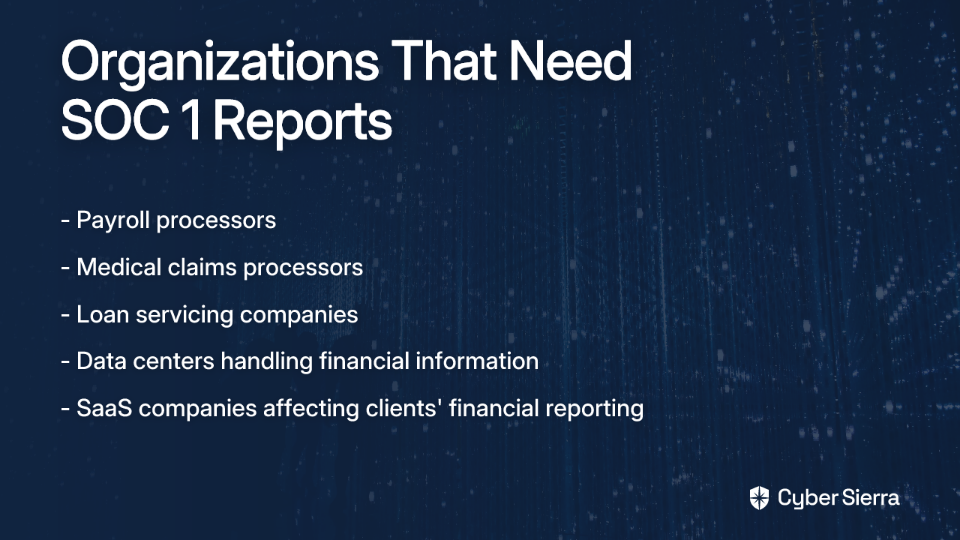
Payroll processing services
Financial data analytics platforms
Investment advisory services
Payment processing systems
SOC 1 comes in two distinct variants:
Type I: A point-in-time assessment evaluating if the design of controls is suitable to meet objectives on a specific date. Think of this as a snapshot of the control environment.
Type II: An evaluation over an extended period (typically 6-12 months) that assesses both the design and operating effectiveness of controls. This provides significantly more assurance because it demonstrates consistent control operation over time, rather than just a momentary assessment.
SOC 2: The Security Gold Standard
Primary Focus: Information security and data protection
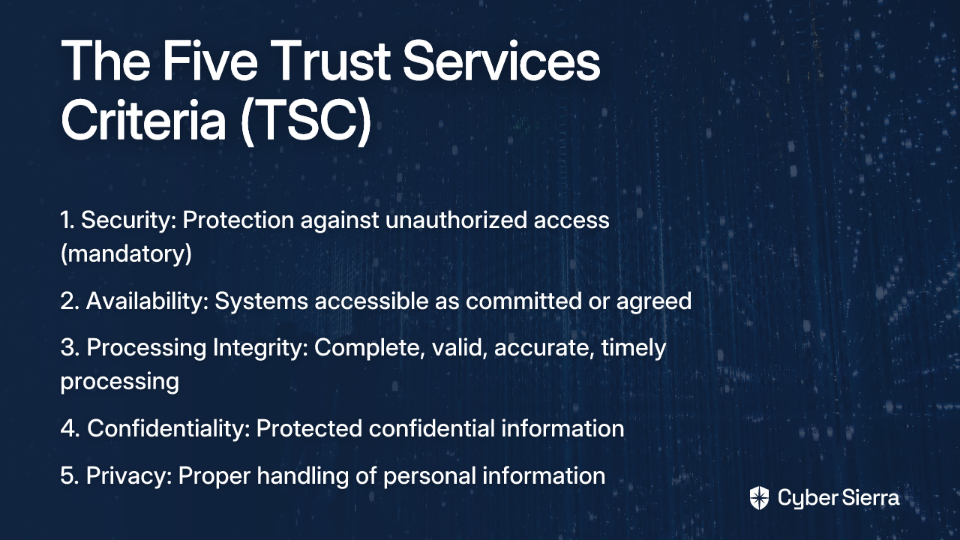
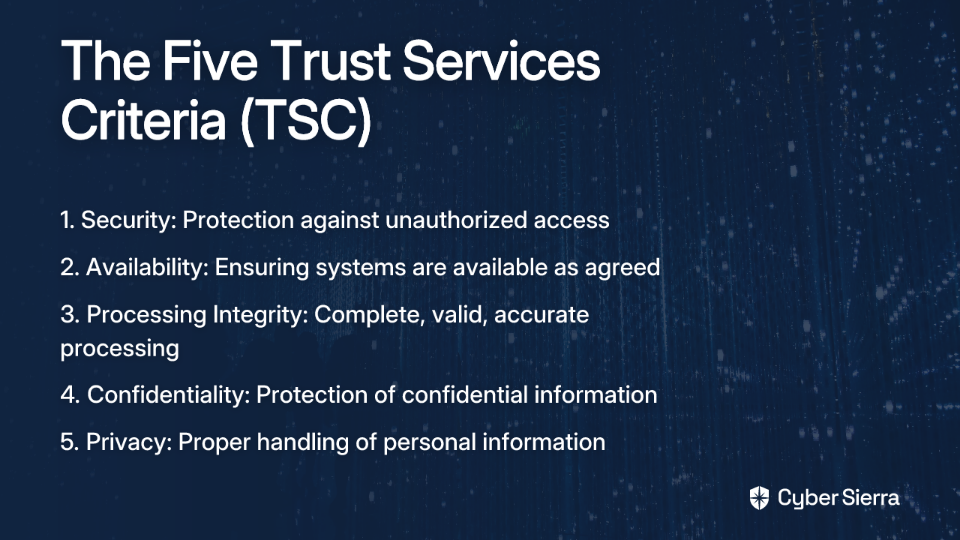
SOC 2 reports have become the de facto standard for assessing a service provider's security posture. Unlike SOC 1's focus on financial controls, SOC 2 reports evaluate controls relevant to one or more of the five Trust Services Criteria (TSC):
Security: Protection of information and systems against unauthorized access and damage (mandatory)
Availability: Systems and information are available for operation and use as committed or agreed
Processing Integrity: System processing is complete, valid, accurate, timely, and authorized
Confidentiality: Information designated as confidential is protected according to policy
Privacy: Personal information is collected, used, retained, disclosed, and disposed of in accordance with the entity's privacy notice
Key Characteristics of SOC 2 Reports:
Governed by the AICPA's Trust Services Criteria
Intended for client management, security teams, compliance officers, and regulators
Distribution is restricted and typically requires an NDA
Contains detailed information about security controls and potential weaknesses
Common Use Cases:
SaaS companies
Cloud computing providers
Data centers and hosting services
Any business that stores, processes, or transmits customer data
Like SOC 1, SOC 2 reports come in two types:
Type I: Assesses the suitability of control designs at a specific moment.
Type II: Evaluates the operating effectiveness of controls over an extended period (6-12 months). This is the report most customers demand and provides the strongest assurance.
The Confidentiality Challenge
As many have discovered through frustrating experience, SOC 2 reports—especially Type II—are almost never publicly available. As one security professional notes, "I've never seen SOC2's published publicly. They are always locked down behind an NDA, as they generally contain non-public information - especially failures of security controls, or details into security that aren't otherwise public."
This confidentiality isn't arbitrary. SOC 2 reports contain sensitive information about an organization's security controls, including:
Detailed descriptions of security infrastructure
Potential vulnerabilities and control gaps
Specific findings and exceptions from auditor testing
Internal security policies and procedures
Access to a SOC 2 report typically requires being a current customer or serious prospect, and almost always requires signing a non-disclosure agreement (NDA).
The Compliance Hurdle
Getting SOC 2 compliant is a significant undertaking that many organizations, particularly smaller companies, find challenging. The process typically takes 6-12 months of preparation, requires cross-functional collaboration, and can be expensive.
As one startup founder lamented, "SOC 2 feels like a big, unnecessary hurdle for small companies like ours." This sentiment is common, but the reality is that many enterprise customers now require SOC 2 compliance from their vendors, making it a business necessity rather than just a nice-to-have certification.
SOC 3: The Public-Facing Summary
Primary Focus: A high-level, general-use summary of SOC 2 compliance
If SOC 2 reports are locked behind NDAs, how can companies publicly demonstrate their security commitment? That's where SOC 3 reports come in.
A SOC 3 report is essentially a simplified, public-friendly version of a SOC 2 report. It confirms that an organization has achieved SOC 2 compliance without revealing the sensitive details that could create security risks.
Key Characteristics of SOC 3 Reports:
Based on the same Trust Services Criteria as SOC 2
Intended for general public consumption
Distribution is unrestricted; can be freely shared
Omits detailed test procedures and results
Often used for marketing purposes on company websites
However, it's important to set proper expectations: "A SOC 3 report may be publicly available but will not have anything cybersecurity-useful in it," notes one security professional. SOC 3 reports provide assurance of compliance but lack the detailed data needed for a deep security assessment.
Organizations that successfully complete a SOC 2 audit can also receive a SOC 3 seal, which can be displayed on marketing materials as a public badge of their commitment to security.
If you're evaluating a vendor's security posture, you can't simply Google their SOC 2 report. As one practitioner puts it, "You'll not get one unless you are using their services or are a partner, and have an NDA in place."
The recommended approach is to engage with your organization's Vendor Assessment Program or procurement team. They can formally request the report from the vendor as part of the due diligence process.
How to Assess a SOC Report
When reviewing a SOC 2 report, focus on these key elements:
Auditor's Opinion: This is the most important section. An "unqualified" opinion means the auditor found no significant issues. A "qualified" report indicates problems were identified.
Exceptions and Control Gaps: As one security professional advises, "Qualified means there are issues and those are the first thing to read." The report will list exceptions where a control failed. Your team must assess if these failures introduce an unacceptable level of risk for your company.
Scope and Coverage: Verify which Trust Services Criteria were included in the assessment. Many SOC 2 reports only cover Security, while others include additional criteria.
For Companies Seeking Compliance
If your organization needs to become SOC 2 compliant:
For smaller companies or those with limited resources, consider compliance automation platforms like Vanta or Thoropass to streamline the process.
For complex environments, "Consider pulling in a consultant who does this routinely to help get you ready." This can significantly de-risk the audit process.
Start early—getting SOC 2 compliant typically takes 6-12 months of preparation.
Conclusion: Choosing the Right Report for Your Needs
Understanding the different SOC report types helps you navigate the complex landscape of security compliance:
SOC 1 is essential when evaluating vendors who impact your financial reporting.
SOC 2 provides detailed assurance about a vendor's security controls but requires an NDA.
SOC 3 offers public verification of compliance without sensitive details.
While the SOC landscape can seem complex, these reports are not just compliance checkboxes but powerful tools for building trust, managing risk, and gaining a competitive edge in today's security-conscious business environment.
By knowing which report to request and how to interpret it, you can make informed decisions about the vendors you trust with your sensitive data and critical business operations.
Frequently Asked Questions
What is the main difference between SOC 1, SOC 2, and SOC 3 reports?
The main difference lies in their focus and audience. SOC 1 focuses on internal controls over financial reporting, SOC 2 focuses on security and data protection controls based on the Trust Services Criteria, and SOC 3 is a high-level, public-facing summary of a SOC 2 report.
Why is a SOC 2 report confidential and requires an NDA?
A SOC 2 report is kept confidential because it contains sensitive, non-public information about a company's security controls, internal processes, and potential weaknesses. Requiring a Non-Disclosure Agreement (NDA) prevents this sensitive data from being exposed publicly, which could create security risks for the organization.
Which is better, a SOC 2 Type I or Type II report?
A SOC 2 Type II report is considered better because it provides significantly more assurance. A Type I report only assesses the design of controls at a single point in time, whereas a Type II report assesses both the design and operating effectiveness of controls over a period (typically 6-12 months), proving they work consistently.
How do I get a SOC 2 report from a vendor?
You must request it directly from the vendor, as these reports are not public. The typical process is to engage with the vendor as a customer or serious prospect and sign a Non-Disclosure Agreement (NDA). Your organization's vendor assessment or procurement team can usually handle this formal request.
What should I look for first when reviewing a SOC 2 report?
The first thing you should look for is the auditor's opinion. An "unqualified" opinion is ideal, as it means the auditor found no significant issues. If the report is "qualified," you should immediately review the exceptions section to understand which controls failed and assess the potential risk to your organization.
Is a SOC 3 report enough for a vendor security assessment?
No, a SOC 3 report is generally not sufficient for a detailed security assessment. While it confirms SOC 2 compliance, it is a high-level summary that omits the detailed test results and control descriptions needed for thorough due diligence. For a proper risk assessment, you need the comprehensive information found in the full SOC 2 report.
Join thousands of professionals and get the latest insight on Compliance & Cybersecurity.
Thank you for subscribing us!
Please check your email to confirm your email address.
Share via
You've been tasked with ensuring your organization complies with multiple regulatory frameworks. Your desk is buried under stacks of documentation for NIST CSF, ISO 27001, PCI, and SOC 2 requirements. Every time an audit approaches, your team scrambles to gather evidence, often duplicating work across different compliance initiatives. Sound familiar?
As one GRC professional puts it: "The company I just joined is very immature when it comes to GRC. They have policies and they have standards. The standards refer to specific NIST CSF controls and that's as far as it goes." This common frustration reflects how many organizations struggle with disconnected compliance efforts that drain resources without providing clear risk visibility.
In this comprehensive guide, we'll show you how to escape this compliance treadmill by creating a unified control framework that maps your internal controls to multiple compliance requirements. The result? Less redundant work, simplified audits, and clear visibility into your compliance gaps.
Why You Need a Unified Control Framework
Before diving into the "how," let's understand the "why." Managing multiple compliance frameworks in silos creates several critical problems:
Redundant Effort: Your team repeatedly documents the same controls for different audits.
Inconsistent Implementation: Controls may be implemented differently across frameworks.
Compliance Gaps: Without a unified view, you might miss requirements that appear in one framework but not another.
Resource Drain: The constant "audit scramble" diverts resources from strategic initiatives.
A unified control framework addresses these challenges by creating a single source of truth for all your compliance requirements. Instead of treating NIST CSF, ISO 27001, PCI, and SOC 2 as separate initiatives, you map them to a common set of internal controls.
As another GRC professional noted, "I want an easier way to find them rather than trawling through loads of different standards docs. Hence was thinking of setting up a controls library of sorts." That's exactly what we're going to build.
The Foundation: Preparing for Control Mapping
Before mapping controls, you need to establish a solid foundation:
1. Assemble Your Compliance Team
Control mapping isn't a solo project. Form a cross-functional team that includes:
IT security specialists
Legal and compliance experts
Business process owners
Representatives from key departments affected by compliance requirements
Establishing clear roles and responsibilities using a RACI matrix (Responsible, Accountable, Consulted, Informed) ensures everyone understands their part in the process.
2. Define Your Regulatory Universe
Identify all regulations and frameworks that apply to your organization:
Industry-specific regulations: HIPAA for healthcare, PCI for payment processing
General security frameworks: NIST CSF, ISO 27001, CIS Controls
Customer/contractual requirements: SOC 2 for service providers
Regional regulations: GDPR for European data, CCPA for California residents
For each framework, document its purpose, scope, and key deadlines to create a master list of your compliance obligations.
3. Inventory Existing Controls
Before creating new controls, take stock of what you already have:
Document existing policies, standards, and procedures
Identify technical controls already implemented in your systems
Catalog documented processes and evidence collection methods
Review previous audit reports to understand how controls were assessed
Remember that compliance is just one part of GRC. As one professional notes, "There are two more letters in that title, Governance and Risk." A truly effective control framework addresses all three elements.
Step-by-Step Guide to Mapping GRC Controls
Now that you've laid the groundwork, let's walk through the practical process of mapping controls across multiple frameworks:
Step 1: Create Your Central Control Library
The first step is establishing your organization's master controls library - the foundation of your unified framework.
Practical Starting Point: "I would recommend starting with downloading the NIST CSF requirements (i.e., controls) spreadsheet and leveraging that as your starting point," advises one GRC professional. The NIST Cybersecurity Framework provides an excellent foundation because it's comprehensive and maps well to other frameworks.
For each control in your library, include:
A unique identifier (e.g., AC-01)
A descriptive name (e.g., Access Control Policy)
The control objective
The control owner (person or department)
Implementation status
Evidence requirements
Pro Tip: Structure your control library to align with the common domains found across most frameworks:
Access Control
Asset Management
Risk Assessment
Security Operations
Incident Response
Business Continuity
Vendor Management
Step 2: Select a Harmonization Approach
There are two main approaches to harmonizing controls across frameworks:
Option A: Build Your Own Mapping This approach involves manually mapping each control in your library to the relevant requirements in your target frameworks. While labor-intensive, it gives you complete control over the process.
Option B: Leverage Existing Tools and Frameworks Several tools can accelerate the mapping process:
The Secure Controls Framework (SCF): An open-source option that provides a comprehensive set of controls mapped to multiple regulatory requirements.
The Unified Compliance Framework (UCF): A commercial solution that harmonizes hundreds of authority documents and provides a common control hub.
GRC platforms: Tools like ServiceNow GRC, Archer, and specialized compliance solutions offer built-in mapping capabilities.
One GRC professional shares, "I have taken to using the NIST framework control mapping to map multiple frameworks to a single control. Very manual process and hope someone else comes along with a better idea." While manual mapping works, using a harmonization framework can significantly reduce effort.
Step 3: Perform the Cross-Mapping
Now comes the core activity - creating the actual mappings between your internal controls and the various framework requirements:
Start with control objectives rather than specifics. Map at the objective level first, then drill down to specific requirements.
Create a mapping matrix with your internal controls on one axis and framework requirements on the other. For example: Internal Control IDDescriptionNIST CSFISO 27001PCI DSSSOC 2 TSCAC-01Access Control PolicyID.AM-6, PR.AC-1A.9.1.17.1.1CC6.1
Document the mapping rationale to explain why certain controls map to specific requirements. This helps during audits and when onboarding new team members.
Identify control gaps where requirements exist in a framework but don't map to any of your internal controls. These represent compliance gaps that need to be addressed.
Step 4: Implement a GRC Technology Solution
While spreadsheets can work for smaller organizations, a dedicated GRC platform becomes essential as complexity increases. These tools help:
Centralize your control library
Automate control assessments
Streamline evidence collection
Generate compliance reports
Provide real-time visibility into compliance status
Popular solutions include ServiceNow GRC, Archer, and specialized compliance platforms. These tools can significantly reduce the manual effort of maintaining mappings and collecting evidence, especially when preparing for risk assessments.
Best Practices for Successful Control Mapping
Focus on the Low Hanging Fruit First
Start with the most common controls that appear across multiple frameworks. Access control, for example, appears in virtually every security framework and often represents 20-30% of all requirements. By mapping these common controls first, you'll make rapid progress.
Document Control Implementation Details
For each control, document:
How it's implemented technically
The policies governing the control
Procedures for testing and validating the control
Evidence collection methods
Key stakeholders
This information is invaluable during audits and helps ensure consistent implementation.
Engage Auditors Early
Collaborate with your auditing firms early in the process. They have extensive experience with control mapping and can provide valuable insights. As one professional advises, "Find [a CPA firm] that will perform a readiness assessment - this will identify any gaps against the framework."
Remember: Compliance is the Floor, Not the Ceiling
A unified control framework helps you achieve compliance more efficiently, but don't stop there. As one security professional wisely noted, "Compliance is the floor, not the ceiling. It is the bare minimum standard of protection."
Use your control mapping exercise as an opportunity to elevate your security posture beyond minimum compliance requirements. Identify areas where implementing stronger controls would provide greater risk reduction, even if not strictly required for compliance.
Conclusion: Beyond Compliance to Principled Performance
A well-executed control mapping program transforms compliance from a reactive, resource-draining exercise into a strategic asset. By establishing a unified control framework that maps to NIST CSF, ISO 27001, PCI, SOC 2, and other requirements, you'll:
Reduce redundant work
Gain clear visibility into your compliance posture
Simplify audits and assessments
Identify and address control gaps proactively
Optimize resource allocation
Start your journey by downloading the NIST CSF requirements spreadsheet and beginning to map your existing controls. With each mapping you create, you'll move one step closer to breaking free from the compliance treadmill and achieving what governance experts call "principled performance" - reliably achieving objectives while addressing uncertainty and acting with integrity.
Remember that while tools and frameworks are important, the most critical element is building a strong risk and compliance culture throughout your organization. When everyone understands their role in maintaining controls, compliance becomes a natural outcome rather than a constant struggle.
Frequently Asked Questions
What is a unified control framework?
A unified control framework is a centralized library of an organization's internal controls that are mapped to multiple compliance regulations and security standards. Instead of managing separate compliance efforts for frameworks like NIST CSF, ISO 27001, and SOC 2, you create a single "source of truth." This common set of controls is then cross-referenced to each specific requirement from the various frameworks, streamlining compliance management.
Why is a unified control framework important?
A unified control framework is important because it eliminates redundant work, reduces compliance gaps, and provides clear visibility into an organization's overall security posture. By harmonizing controls, your teams avoid documenting the same control for different audits. This saves significant time and resources, simplifies the audit process, ensures consistent control implementation, and allows you to proactively identify and address areas where you might be non-compliant.
What is the best framework to start with for a control library?
The NIST Cybersecurity Framework (CSF) is widely recommended as the best starting point for building a control library. The NIST CSF provides a comprehensive and flexible foundation that maps well to many other security and privacy frameworks, including ISO 27001 and SOC 2. Starting with a pre-built, respected framework like NIST CSF saves you from having to create a control structure from scratch.
How does a unified control framework simplify audits?
A unified control framework simplifies audits by creating a single, organized source for all control documentation and evidence. When an audit for a specific framework (like PCI DSS or SOC 2) occurs, you can quickly pull the relevant mapped controls, their implementation details, and the associated evidence from your central library. This eliminates the last-minute scramble to gather information and demonstrates a mature, organized approach to compliance for your auditors.
Can I build a unified control framework without a GRC tool?
Yes, you can begin building a unified control framework using spreadsheets, especially in smaller organizations. A spreadsheet can serve as your initial central control library and mapping matrix. However, as the number of frameworks and controls grows, managing this manually becomes complex. A dedicated GRC (Governance, Risk, and Compliance) platform is recommended for larger organizations to automate assessments, streamline evidence collection, and provide real-time reporting.
Who should be involved in creating a unified control framework?
Creating a unified control framework requires a cross-functional team of stakeholders from across the organization. This is not just an IT or security project. Your team should include IT security specialists, legal and compliance experts, business process owners, and representatives from key departments impacted by regulations. This collaborative approach ensures that controls are practical, effective, and properly implemented throughout the business.
This guide provides a starting point for creating your unified control framework. Each organization's specific needs will vary based on industry, size, and regulatory requirements. Consider consulting with GRC professionals to tailor this approach to your unique circumstances.
Join thousands of professionals and get the latest insight on Compliance & Cybersecurity.
Thank you for subscribing us!
Please check your email to confirm your email address.
Share via
You've set up your GRC program, you're drowning in compliance frameworks like NIST, ISO, and FedRAMP, and now management wants you to "leverage AI" to make it all more efficient. The pressure is mounting, but your team is already understaffed and under-budgeted. Sound familiar?
While there's plenty of AI hype floating around the GRC world today, separating genuine utility from marketing sparkle can be challenging. The truth is, AI won't replace your GRC function, but it can transform how efficiently you operate—especially when it comes to those tedious, repetitive tasks that consume hours of your week.
This guide focuses on a practical, high-impact application: using AI as your personal scripting assistant to automate one of the most time-consuming aspects of compliance work—formatting raw vulnerability scan data into a structured Plan of Action and Milestones (POA&M) for FedRAMP certification.
Why Use an AI Scripting Assistant? The Efficiency Imperative for Modern GRC
As one GRC professional put it on Reddit, "I've been a citizen programmer for like 5 years trying to automate as much of the job as possible." This sentiment resonates across the industry. Even if you "automate 80% of my job," many professionals note they "could still fill another 40 hours in a week."
The reality is that GRC teams are chronically "understaffed and under-budgeted per the amount of work expected out of them." This pressure has created a generation of "citizen programmers"—GRC professionals who aren't software engineers by training but have learned to code out of necessity.
AI-assisted scripting offers three critical advantages for these professionals:
Accelerated Development: Instead of spending weeks crafting a script to process compliance data, AI can help generate functional code in minutes, with you guiding the process.
Enhanced Accuracy: Automated data extraction and formatting minimizes the human error inherent in manual copy-pasting—a critical consideration when dealing with security vulnerabilities.
Democratization of Automation: You no longer need extensive Python experience to create useful scripts. AI lowers the technical barrier, empowering more team members to solve their own automation challenges.
The Hands-On Guide: Automating FedRAMP POA&M Creation with AI
Let's walk through a concrete example: using AI to create a script that transforms raw vulnerability scan data into a properly formatted FedRAMP POA&M—a task that typically requires hours of manual effort.
Part 1: Understanding the FedRAMP POA&M Challenge
The FedRAMP Plan of Action and Milestones (POA&M) is a critical document for Cloud Service Providers (CSPs) working with federal agencies. It serves as a structured approach for tracking and monitoring risk mitigation activities for known security weaknesses.
A compliant POA&M typically includes:
POA&M ID: A unique identifier for each vulnerability
Controls: Mapping to relevant NIST 800-53 controls
Weakness Name and Description: Details about the vulnerability
Risk Mitigation Approach: The plan to address the issue
Tasks and Milestones: Specific actions required
Scheduled Completion Date: Based on risk severity
Status: Current remediation status
FedRAMP mandates specific remediation timelines based on risk severity:
High and Critical Risks: Must be remediated within 30 days
Moderate Risks: Must be remediated within 90 days
Low Risks: Must be remediated within 180 days
The manual process typically involves:
Receiving CSV or XML files from vulnerability scanners
Manually reviewing hundreds or thousands of findings
Copy-pasting data into the rigid Excel POA&M template
Calculating appropriate deadlines based on risk levels
Generating unique identifiers for each finding
This process is tedious, error-prone, and a prime candidate for automation.
Part 2: Your AI Co-pilot - A Step-by-Step Prompting Guide
To solve this problem, we'll use an AI assistant (like GitHub Copilot, ChatGPT, or Claude) to help write a Python script that automates the entire process. The key is using a structured sequence of prompts that guide the AI in creating exactly what we need.
Here's the step-by-step approach:
Prompt 1: Set the Stage
Start by clearly defining the problem and the tools you'll use:
I am a GRC analyst. I need to write a Python script using the pandas library to process a CSV file containing vulnerability scan data and format it into a FedRAMP Plan of Action and Milestones (POA&M). The output should be a new CSV file that matches the official FedRAMP POA&M template structure.
This prompt establishes the context and domain (GRC and FedRAMP compliance), the programming language (Python), the key library (pandas for data manipulation), and the specific task (converting scan data to a POA&M format).
Prompt 2: Define the Input and Output Schemas
Next, specify the exact structure of your data:
My input CSV from the scanner has these headers: 'Plugin ID', 'CVE', 'Risk', 'Host', 'Synopsis', 'Description', 'Solution'. The final POA&M output CSV must have these exact headers: 'POA&M ID', 'Weakness Name', 'Weakness Description', 'Remediation Plan', 'Status', 'Scheduled Completion Date'. Let's start by writing the code to read the input CSV and create a new DataFrame for the POA&M with the correct columns.
This prompt provides crucial details about the data structure, which helps the AI generate accurate code for data transformation.
Prompt 3: Map the Core Data Fields
Now, instruct the AI on how to map fields between the input and output:
Great. Now, let's map the data.
- Populate 'Weakness Name' from the 'Synopsis' column.
- Populate 'Weakness Description' from the 'Description' column.
- Populate 'Remediation Plan' from the 'Solution' column.
- Set the 'Status' for all new items to 'Ongoing'.
This prompt gives clear instructions on the data mapping requirements.
Prompt 4: Implement Business Logic for Timelines
Add the critical compliance logic for setting remediation deadlines:
Now for the critical part. Add logic to calculate the 'Scheduled Completion Date'. Get today's date. Based on the 'Risk' column from the input:
- If 'Risk' is 'Critical' or 'High', set the completion date to 30 days from today.
- If 'Risk' is 'Moderate', set it to 90 days from today.
- If 'Risk' is 'Low', set it to 180 days from today.
This prompt incorporates the FedRAMP-specific remediation timeline requirements.
Prompt 5: Generate Unique Identifiers
Finally, add logic for creating unique identifiers:
Finally, let's create a unique ID for each finding. For the 'POA&M ID' column, generate a unique ID by combining the 'Host' and 'Plugin ID' columns from the input, formatted as 'HOST-PLUGINID'. After this, write the final DataFrame to a new CSV file named 'poam_output.csv'.
The Resulting Python Script
Here's what the AI might produce after this sequence of prompts:
import pandas as pd
from datetime import datetime, timedelta

# Read the input CSV file
def process_vulnerability_data(input_file, output_file):
    # Read the input CSV
    df_input = pd.read_csv(input_file)

    # Create a new DataFrame for the POA&M with the required columns
    df_poam = pd.DataFrame(columns=['POA&M ID', 'Weakness Name', 'Weakness Description',
                                   'Remediation Plan', 'Status', 'Scheduled Completion Date'])

    # Map the data from input to POA&M format
    df_poam['Weakness Name'] = df_input['Synopsis']
    df_poam['Weakness Description'] = df_input['Description']
    df_poam['Remediation Plan'] = df_input['Solution']
    df_poam['Status'] = 'Ongoing'

    # Get today's date
    today = datetime.now()

    # Calculate completion dates based on risk level
    completion_dates = []

    for risk in df_input['Risk']:
        if risk in ['Critical', 'High']:
            completion_date = today + timedelta(days=30)
        elif risk == 'Moderate':
            completion_date = today + timedelta(days=90)
        else:  # Low risk
            completion_date = today + timedelta(days=180)

        completion_dates.append(completion_date.strftime('%Y-%m-%d'))

    df_poam['Scheduled Completion Date'] = completion_dates

    # Generate unique POA&M IDs
    df_poam['POA&M ID'] = df_input['Host'] + '-' + df_input['Plugin ID'].astype(str)

    # Write to output CSV
    df_poam.to_csv(output_file, index=False)

    return f"Successfully processed {len(df_poam)} vulnerabilities and saved to {output_file}"

# Example usage
if __name__ == "__main__":
    result = process_vulnerability_data('vulnerability_scan.csv', 'poam_output.csv')
    print(result)
This script accomplishes several key tasks:
Reads vulnerability scan data from a CSV file
Maps scan data fields to the required POA&M format
Applies FedRAMP-compliant remediation timelines based on risk levels
Generates unique identifiers for each finding
Outputs a properly formatted POA&M file ready for submission
What would have taken hours of manual work or significant programming knowledge can now be accomplished in minutes through this guided conversation with an AI assistant.
Choosing Your AI Toolkit
The market for AI developer tools has exploded, and several options are particularly well-suited to GRC professionals looking to automate compliance tasks:
GitHub Copilot: An AI pair programmer that integrates directly into code editors like Visual Studio Code. It's especially useful for real-time coding assistance and can suggest entire functions based on your comments.
ChatGPT (with Code Interpreter): Offers a conversational approach to coding, allowing you to describe what you need in natural language and iterate on solutions. The Code Interpreter feature can even execute and test code in real-time.
Claude: Similar to ChatGPT but with enhanced capabilities for understanding and generating longer, more complex scripts. Particularly good at following detailed instructions.
Amazon CodeWhisperer: Integrated with AWS environments, making it ideal if your compliance automation needs to interact with AWS services.
For GRC professionals new to scripting, a conversational AI like ChatGPT or Claude may be the most accessible starting point, as they allow you to describe your needs in natural language and guide the development process through conversation.
Beyond POA&Ms: Other High-Impact GRC Scripting Use Cases
The AI-assisted scripting approach isn't limited to POA&M automation. Here are other high-value use cases shared by GRC professionals that you can adapt for your own needs:
Dynamic Policy Generation
Creating and maintaining policies that address the specific needs of different roles in your organization can be time-consuming. One GRC professional described using AI to script:
Creating dynamic policies based on company information collected through a Tines form
You could use a similar prompting approach:
I need to write a Python script that takes a CSV of employee roles and generates a dynamic acceptable use policy. The script should include or exclude specific sections based on the 'Role' column. For example, developers should see sections on code security, while sales staff should see sections on customer data protection.
This approach helps maintain consistent policy standards while tailoring content to specific audiences—essential for complex compliance frameworks like SOX or ISO 27001.
Third-Party Risk Assessment Automation
Another GRC professional shared their approach to automating third-party risk assessments:
Reviewing Chrome Extensions (Downloading extensions from the Chrome Web Store, Extracting the .crx files and Basic manifest analysis). I am also having the script review the Terms and conditions + privacy policy of the company to determine if any potential conflicts.
This is a fascinating example of using AI to script complex vendor risk assessments. You could adapt this approach with a prompt like:
I need a Python script that can download a Chrome extension, extract its manifest.json file, and analyze the permissions it requests. Then, the script should scrape the linked privacy policy and search for keywords related to data sharing. Finally, it should generate a risk report based on both analyses.
This type of automation is invaluable for organizations managing extensive third-party risk profiles and vendor assessments.
Automated Evidence Collection for Audits
Preparing for audits often involves gathering evidence from various systems. You can use AI to help write scripts that query APIs to check for configurations required by frameworks like SOC 2 or ISO 27001:
I need a script that queries the AWS API to verify that all our S3 buckets have encryption enabled and block public access, as required by our SOC 2 compliance program. The script should generate a CSV report showing compliant and non-compliant resources.
Cross-Framework Control Mapping
One of the most time-consuming aspects of GRC is mapping controls between different frameworks. As one professional noted, "CMMC is its own beast, so trying to cross-map it from other frameworks, like other GRCs do, can be tedious and erroneous."
You could use AI to help create a mapping script:
I have a JSON file containing our implemented NIST 800-53 controls. I need a Python script that maps these to the corresponding CMMC Level 2 practices. The script should output a table showing the NIST control, the mapped CMMC practice, and notes on any gaps that need to be addressed.
Machine Learning for Risk Taxonomy
Beyond simple scripts, you can use AI to help develop more advanced Machine Learning applications for your GRC program:
I need help creating a Python script that uses natural language processing to categorize our incident reports into our risk taxonomy categories. The script should analyze incident descriptions and assign them to the appropriate category in our risk framework.
This approach helps standardize risk categorization across your organization and can provide insights into emerging risk patterns.
Best Practices and Pitfalls: Wielding AI Responsibly
As you begin using AI for GRC automation, keep these best practices in mind:
Best Practices
Establish Clear Objectives First: Define exactly what you want your script to accomplish before engaging with the AI. The more specific your goal, the better guidance you can provide.
Iterate and Refine: Build your script in logical chunks. Don't expect to get a perfect script in one go. Test each piece before moving to the next phase.
Provide Quality Context: The more specific your prompts and examples, the better the AI's response will be. Include sample data formats, business rules, and compliance requirements.
Maintain Human Oversight: As one GRC professional noted, "We're a ways off from good AI for auditing." Always review and validate AI-generated scripts before deploying them in production environments, especially for compliance-critical tasks.
Document Your Approach: Create clear documentation explaining how your AI-assisted scripts work, what compliance requirements they address, and how they should be maintained. This is essential for audit trails and knowledge transfer.
Common Pitfalls to Avoid
Over-Reliance on Automation: Never blindly deploy a script that handles critical compliance data without thorough testing and validation. AI can make mistakes or misinterpret requirements.
Garbage In, Garbage Out: The script is only as good as the data you feed it and the instructions you provide. Ensure your source data is clean and your requirements are clear.
Ignoring Security: Scripts with access to sensitive compliance data or APIs need proper security controls. Ensure credentials aren't hardcoded, and implement appropriate access controls.
Failing to Test Edge Cases: Make sure your scripts handle unusual scenarios correctly. What happens if the input data is malformed? What if a service is unavailable?
Neglecting Leadership Buy-In: For larger automation initiatives, ensure you have management support. Help leadership understand how AI-assisted automation aligns with your organization's compliance strategy and risk appetite.
Conclusion: From Analyst to Automator
The pressure to incorporate AI into GRC processes isn't going away. However, rather than viewing this as another burden, forward-thinking GRC professionals can leverage AI as a scripting assistant to transform their effectiveness.
By automating tedious tasks like formatting FedRAMP POA&Ms, generating dynamic policies, or mapping controls between frameworks like NIST and CMMC, you free up valuable time to focus on what truly matters: strategic risk analysis and thoughtful compliance decisions that protect your organization.
The approach outlined in this article—using structured prompting to guide an AI in writing automation scripts—democratizes coding capabilities. You don't need to be a software engineer to create powerful automation tools; you just need to understand your compliance requirements clearly enough to explain them to your AI assistant.
Remember that AI is not replacing GRC professionals—it's augmenting them. As one practitioner noted, even if you "automate 80% of my job," most GRC professionals "could still fill another 40 hours in a week" with valuable strategic work. The goal isn't to eliminate jobs but to eliminate drudgery.
Getting Started Today
Identify Your Pain Points: What manual, repetitive tasks consume the most time in your GRC workflow? POA&M formatting? Control mapping? Evidence collection? These are your prime automation candidates.
Choose Your AI Tool: Start with a conversational AI like ChatGPT or Claude if you're new to scripting, or GitHub Copilot if you already have some coding experience.
Start Small: Begin with a well-defined, non-critical task to build your confidence. As you become more comfortable with the process, you can tackle more complex automation challenges.
Share Your Success: Document and share your automation wins with your team and leadership. This helps build support for broader adoption of AI-assisted automation within your GRC program.
Continuously Improve: As compliance frameworks evolve, so should your automation scripts. Regularly review and update your scripts to ensure they remain aligned with current requirements.
The future of GRC belongs to those who can effectively blend human expertise with technological augmentation. By embracing AI as your scripting assistant, you position yourself at the forefront of this evolution—not as a victim of it, but as its master.
In a field where teams are chronically understaffed and under-budgeted, the ability to automate routine compliance tasks isn't just a nice-to-have skill—it's increasingly becoming essential. The most valuable GRC professionals won't be those who can manually process the most documents or fill out the most templates; they'll be those who can leverage tools like AI to eliminate that work entirely, focusing instead on the strategic insights and risk management decisions that truly protect their organizations.
Start your journey from analyst to automator today. Your future self—with more time for meaningful work and less time spent on tedious formatting—will thank you.
Frequently Asked Questions
What is an AI scripting assistant for GRC?
An AI scripting assistant is a tool, like ChatGPT or GitHub Copilot, that helps GRC professionals write code to automate repetitive compliance tasks, even with minimal programming experience. It works by taking natural language prompts (your instructions) and generating functional scripts (e.g., in Python) to handle tasks like data formatting, evidence collection, and control mapping. This article demonstrates how to use it to automate the creation of a FedRAMP POA&M.
Why should GRC teams use AI for automation?
GRC teams should use AI for automation to significantly increase efficiency, improve accuracy, and empower more team members to solve automation challenges without needing to be expert coders. Many GRC teams are understaffed and face a high volume of repetitive work. AI-assisted scripting accelerates development, reduces human error common in manual tasks, and lowers the technical barrier, allowing GRC analysts to build their own solutions.
How can AI help with FedRAMP POA&M creation?
AI can help by generating a script that automatically transforms raw vulnerability scan data into a compliant FedRAMP Plan of Action and Milestones (POA&M) file. By providing a series of clear prompts, you can guide an AI to write a Python script that reads vulnerability data, maps it to the correct POA&M columns, applies FedRAMP's specific remediation timelines (e.g., 30 days for High risks), and generates unique IDs for each finding. This automates a process that typically takes hours of manual, error-prone work.
Do I need to be a programmer to use AI for GRC automation?
No, you do not need to be an expert programmer. Modern AI assistants are designed to work with natural language, allowing GRC professionals with deep domain knowledge but limited coding skills to generate effective automation scripts. The process relies on your ability to clearly describe the compliance task, the input data, and the desired output. The AI translates these instructions into code, turning you into a "citizen programmer" guided by your GRC expertise.
Will AI replace GRC professionals?
No, AI is not expected to replace GRC professionals. Instead, it will augment their capabilities by automating tedious and repetitive tasks, allowing them to focus on strategic work. AI excels at data processing but lacks the critical thinking, ethical judgment, and strategic decision-making skills core to the GRC function. Professionals who leverage AI will have more time for high-value activities like risk analysis and complex compliance strategy, making them more valuable to their organizations.
What are the best AI tools for GRC scripting?
The best AI tool depends on your needs. For beginners, conversational AIs like ChatGPT or Claude are excellent starting points because they allow you to describe requirements in plain English. For those with some coding experience, an integrated tool like GitHub Copilot is highly effective as it works directly within a code editor. For teams using AWS, Amazon CodeWhisperer is another strong option.
What other GRC tasks can be automated with AI-assisted scripting?
Beyond POA&Ms, AI-assisted scripting can automate a wide range of GRC tasks, including dynamic policy generation, third-party risk assessment, automated audit evidence collection, and cross-framework control mapping. For example, you can create scripts to automatically query APIs to check security configurations for SOC 2 compliance, analyze vendor privacy policies for keywords, or map your implemented NIST controls to the CMMC framework. The key is to identify any manual, rule-based, and repetitive process in your workflow.
Additional Resources
For those looking to dive deeper into AI-assisted GRC automation:
CMMC Model - Official resource for Cybersecurity Maturity Model Certification
Remember, the key to success with AI-assisted automation isn't just technical skill—it's your domain expertise in GRC requirements and processes. The AI is your assistant, but your compliance knowledge is what makes the automation truly valuable.
Error: Contact form not found.
Governance & Compliance
Get Executive Buy-In for ISO 27001 Without a Meeting
Join thousands of professionals and get the latest insight on Compliance & Cybersecurity.
Thank you for subscribing us!
Please check your email to confirm your email address.
Share via
You've identified ISO 27001 certification as a critical next step for your organization, but getting time on your executives' calendar feels impossible. The thought of trying to explain complex information security concepts in a 30-minute meeting is daunting. What if there was a way to secure that crucial buy-in without scheduling a single meeting?
In this guide, I'll show you how to leverage asynchronous communication to get executive approval for your ISO 27001 initiative. You'll learn how to craft the perfect email that speaks directly to leadership priorities, provides all the information they need to make a decision, and positions you as a strategic thinker.
Why Asynchronous Communication Works for ISO 27001 Approval
Asynchronous communication—interactions that don't happen in real-time—has grown increasingly important as remote work becomes more common. According to Robert Half, fully remote job postings increased from 10% to 15% between Q1 2023 and Q4 2024, making async communication skills more valuable than ever.
For complex decisions like implementing an Information Security Management System (ISMS), async communication offers distinct advantages:
Thoughtful, High-Quality Feedback: Executives can digest complex information like risk assessments at their own pace, leading to better decisions than spontaneous responses in meetings.
Creates a Permanent Record: Your detailed email and attached risk report serve as a documented record of the proposal, risks identified, and approval—critical for your ISO 27001 audit trail.
Respects Executive Focus: Many leaders prefer strategic discussions over detailed execution plans. An asynchronous approach lets you provide both—a concise summary for immediate review and detailed attachments for those who want to dive deeper.
Overcomes the "Empty Risk Register" Challenge: If you're struggling with what one Reddit user described as having "very little to go on from a strategic level," a well-structured async communication gives you time to thoroughly research and present your case.
Building Your Business Case: Speak the Language of Leadership
The key to successful executive communication is translating technical requirements into business value. As one information security professional advised, "Stop framing it as 'risks to the company'." Instead, focus on what executives truly care about.
Connect ISO 27001 to Key Business Benefits:
Cost Efficiency: Position ISO 27001 as a framework for proactive risk management that can reduce data breach costs by up to 30%. This makes it a cost-saving measure, not just an expense.
Sales Acceleration: Certification can reduce friction in the sales cycle by pre-qualifying your security posture for potential clients. Less time spent on security questionnaires means faster deal closures.
Client Trust and Competitive Advantage: Certification serves as a powerful signal of your commitment to security, enhancing client confidence and providing a competitive edge, especially in enterprise markets.
Address Common Objections
Anticipate and address the objection that "we already have SOC 2" by acknowledging potential "control fatigue" while clarifying the distinction: SOC 2 reports on the effectiveness of controls at a point in time, while ISO 27001 is a comprehensive management system for continuously identifying and managing risk across the entire organization.
The Core of Your Pitch: The Risk Assessment
A robust risk assessment is the foundation of any successful ISO 27001 pitch. Even if you feel you "don't really have a business strategy to be able to create a decent risk register from," a methodical risk assessment will provide the data you need.
Here's how to conduct a comprehensive risk assessment that will strengthen your case:
1. Choose Your Risk Management Approach
Decide whether you'll use a qualitative approach (high, medium, low) or quantitative method (monetary values). Consider frameworks like NIST SP 800-39 to guide your process and help establish what constitutes acceptable risk levels.
2. Identify Information Assets and Risks
List all critical information assets (hardware, software, data, intellectual property). For each asset, identify threats and vulnerabilities affecting its Confidentiality, Integrity, and Availability.
For example, one common risk might be "failure to prevent successful cyber attacks due to ineffective or untimely patching"—a concern highlighted by security professionals in online discussions.
3. Analyze and Evaluate Risks
Assign likelihood and impact scores for each risk, typically on a 1-10 scale. Plot these on a risk matrix to create a visual heat map that makes it easy for executives to see which risks are most critical. This step transforms vague concerns into strategic risks and operational-level risks that can be prioritized.
4. Develop a Risk Treatment Plan
For each significant risk, outline your recommended approach:
Treat: Implement controls to reduce the risk
Avoid: Change processes to eliminate the risk
Transfer: Outsource the risk (e.g., through insurance)
Accept: Formally accept risks within the organization's risk appetite
Assign a "risk owner" for accountability and ensure your treatment plan aligns with top-level objectives.
5. Produce a Professional Risk Report
Create a formal document summarizing the entire process, findings, and the treatment plan. This report will be the attachment to your executive email and serves as evidence of your systematic approach to risk management.
The Asynchronous Playbook: Crafting the Perfect Email
Now that you have your business case and risk assessment ready, it's time to craft an email that will get results. Follow this template to ensure your message hits all the right notes:
Subject Line:
Request for Validation: ISO 27001 Implementation to Mitigate Key Business Risks & Accelerate Sales
Email Body:
Executive Summary (The Ask)
Situation: Based on a formal risk assessment, we have identified several high-impact information security risks that currently lack a systematic management framework.
Business Impact: These risks pose a direct threat to our revenue goals, operational stability, and client trust. The attached risk report estimates a potential financial impact of [$X] and shows that we are missing opportunities to accelerate sales cycles with enterprise clients by [X]%.
Recommendation: I recommend we pursue ISO 27001 certification to establish a formal Information Security Management System (ISMS) that will systematically mitigate these risks.
Request: I am requesting your review and validation of the attached Risk Assessment Report and your sign-off to proceed with the first phase of ISO 27001 implementation.
Strategic Alignment
Connect ISO 27001 to your company's existing business strategy: "This initiative directly supports our strategic objective of [expanding into the enterprise market/improving operational efficiency/reducing cybersecurity incidents] by hardening our security posture and demonstrating compliance."
Key Risks Identified
Highlight the top 3-5 risks from your SWOT analysis and risk matrix:
Risk 1: [Name of Risk], Impact: [High/Medium/Low], Likelihood: [High/Medium/Low]. Recommended Treatment: [Implement new control]
Risk 2: [Name of Risk], Impact: [High/Medium/Low], Likelihood: [High/Medium/Low]. Recommended Treatment: [Implement new control]
Risk 3: [Name of Risk], Impact: [High/Medium/Low], Likelihood: [High/Medium/Low]. Recommended Treatment: [Implement new control]
Next Steps
"Upon your validation, we will begin a formal gap analysis against the ISO 27001 requirements. Please review the attached Risk Assessment Report by [Date] and reply to this email with your approval to proceed."
Attachment
[Company Name]_Risk_Assessment_Report_[Date].pdf
Tips for Maximum Impact
Keep it Concise: The body of your email should be no more than one screen length. Put all detailed information in the attachment.
Use Visuals: Include a simplified version of your risk matrix in the email body to make the key risks immediately apparent.
Set Clear Expectations: Specify exactly what response you need and by when. Make it easy for the executive to say "yes" with a simple reply.
Follow Up Appropriately: If you don't receive a response within the timeframe specified, send a brief, respectful reminder that references your original email.
From Proposal to Mandate
Effective asynchronous communication for ISO 27001 buy-in is about respect for executives' time and focus. By presenting a clear, data-driven business case grounded in a robust risk assessment, you provide everything they need to make an informed decision.
Remember the advice from seasoned security professionals: "Get the management on your side" and secure a signed mandate from the most senior person possible. This documented approval provides the authority you need to drive the project forward effectively.
A well-crafted asynchronous pitch transforms your ISO 27001 proposal into a clear mandate that aligns information security objectives with business strategy. This approach not only secures executive buy-in but also demonstrates your strategic thinking and respect for leadership priorities—positioning you as a valuable partner in the organization's success.
By following this playbook, you'll be able to get the validation you need to move forward with your ISO 27001 implementation without scheduling a single meeting. The risk register you develop will become a living document that guides your security program and demonstrates your commitment to continuous improvement in line with ISO 27001 requirements.
Remember that this is not just about checking a compliance box—it's about building a resilient security posture that supports your organization's strategic goals and protects its most valuable assets. With executive buy-in secured through effective asynchronous communication, you're well on your way to achieving that vision.
Frequently Asked Questions
What is ISO 27001 and why should executives care?
ISO 27001 is an international standard for managing information security. Executives should care because it provides a systematic framework to protect critical business assets, reduce the financial impact of data breaches, accelerate sales cycles with security-conscious clients, and build significant client trust, turning security from a cost center into a competitive advantage.
How is ISO 27001 different from SOC 2?
ISO 27001 is a comprehensive management system, while SOC 2 is a report on existing controls. ISO 27001 focuses on establishing, implementing, maintaining, and continually improving an Information Security Management System (ISMS) across the entire organization. In contrast, a SOC 2 report attests to the effectiveness of specific security controls at a single point in time, often for a specific service or system.
Why is an email better than a meeting for this proposal?
An email is often better for an initial ISO 27001 proposal because it respects executives' limited time and focus. This asynchronous approach allows leaders to review complex information, like a risk assessment, at their own pace, leading to more thoughtful decisions. It also creates a permanent, documented record of the proposal and approval, which is valuable for the ISO 27001 audit trail itself.
What's the most important document for getting ISO 27001 approval?
The most important document is a comprehensive and professional Risk Assessment Report. This report is the foundation of your business case, as it translates technical vulnerabilities into tangible business risks with potential financial impacts. A well-structured risk assessment provides the data-driven evidence leadership needs to understand the urgency and justify the investment in an ISMS.
How much does ISO 27001 implementation typically cost?
The cost of ISO 27001 implementation varies widely based on the organization's size, complexity, and current security maturity. Key cost factors include consultant fees if you use external help, employee time for implementation, potential technology upgrades (e.g., security software), and the certification audit fees. While it requires an upfront investment, it should be framed as a long-term cost-saving measure that mitigates the much higher costs associated with a data breach.
What are the first steps after getting executive approval?
The immediate next step after securing executive approval is to conduct a formal gap analysis. This process involves comparing your organization's current security controls and processes against the specific requirements of the ISO 27001 standard. The gap analysis will identify exactly what needs to be done to achieve compliance and will form the basis of your project plan.
Error: Contact form not found.
Governance & Compliance
Detailed Comparison of SOC 1, SOC 2 & SOC 3 - And Which Do You Need?
Join thousands of professionals and get the latest insight on Compliance & Cybersecurity.
Thank you for subscribing us!
Please check your email to confirm your email address.
Share via
Are you confused about which SOC report your organization needs? You're not alone. Many professionals find themselves bewildered by the alphabet soup of compliance frameworks, especially when clients or partners start demanding "SOC certification" without specifying which type.
As one overwhelmed professional put it on Reddit: "Can somebody explain in simple words the difference between SOC 1 & 2 Reports and type 1 and 2?" This confusion is compounded when contractual obligations suddenly require compliance, leaving you with "no choice" but to dive into an unfamiliar audit process.
In this comprehensive guide, we'll demystify the world of SOC report types, explain their key differences, and help you determine which one your business actually needs.
What is a SOC Report? A High-Level Overview
System and Organization Controls (SOC) reports are independent, third-party examination reports that provide assurance about a service organization's internal controls. Developed by the American Institute of Certified Public Accountants (AICPA), these reports help build trust between service providers and their clients.
Think of SOC reports as a verified stamp of approval that demonstrates your commitment to maintaining robust controls over your systems and data. However, not all SOC reports are created equal—each serves a specific purpose and audience.
Deep Dive: SOC 1 for Financial Controls
What is a SOC 1 Report?
A SOC 1 report focuses specifically on a service organization's controls that are relevant to a user entity's internal control over financial reporting (ICFR). As succinctly explained by one Reddit user: "SOC 1 covers internal controls over financial reporting, which is why external auditors request them for financial statement purposes."
The Core Focus: Internal Control over Financial Reporting
Unlike other SOC reports, SOC 1 is concerned with how your services might impact your clients' financial statements. If your company processes transactions, manages financial data, or otherwise affects how your clients report their finances, SOC 1 is designed to address those controls.
Understanding Control Objectives
A key distinction of SOC 1 is that it doesn't use a predefined set of criteria. Instead, your organization works with an auditor to define your own control objectives—overarching statements for each audit process area meant to mitigate specific risks.
For example, a typical control objective might be: "Controls provide reasonable assurance that logical and physical access to programs and data relevant to user entities' internal control over financial reporting is restricted to authorized users."
Who Needs a SOC 1 Report?
SOC 1 reports are essential for service organizations whose services can materially impact their clients' financial statements, including:
Payroll processors
Medical claims processors
Loan servicing companies
Data centers handling financial information
SaaS companies whose services are part of their clients' financial reporting process
Deep Dive: SOC 2 for Security and Data Protection
What is a SOC 2 Report?
A SOC 2 report evaluates the effectiveness of an organization's security protocols based on the AICPA's framework. Its core purpose is to establish trust with customers by demonstrating that you can protect their data stored in the cloud.
The Core Focus: The Five Trust Services Criteria (TSC)
SOC 2 audits are performed against one or more of the five Trust Services Criteria (TSC). The Security criterion (also called Common Criteria) is mandatory, while the others are optional depending on your business needs:
Security: Protecting information and systems against unauthorized access
Availability: Ensuring systems are available as committed or agreed
Processing Integrity: Ensuring system processing is complete, valid, accurate, timely, and authorized
Confidentiality: Protecting information designated as confidential
Privacy: Ensuring personal information is properly collected, used, retained, and disposed of
Beyond "Security Theater": The Real Value of SOC 2
Some skeptics view compliance frameworks as mere "security theater," focusing more on documentation than actual security. As one Reddit user pointedly asked: "What's actually important is what goes INSIDE the SOC 2 report, or what are your actual controls?"
This is a valid concern. The true value of SOC 2 isn't just the certificate but the robust security program it helps you build. A well-implemented SOC 2 program forces organizations to establish and maintain strong security practices that protect against data breaches and build customer trust.
Who Needs a SOC 2 Report?
SOC 2 reports are critical for:
SaaS providers
Cloud service providers
Data centers
Managed IT service providers
Any organization that stores, processes, or transmits customer data
Deep Dive: SOC 3 for Public Assurance
What is a SOC 3 Report?
Think of SOC 3 as the "public-friendly" version of SOC 2. It provides the same assurance about a company's security controls but without the detailed descriptions of tests and results found in a SOC 2 report.
The Core Focus: A Public-Facing Summary of Security
SOC 3 reports are designed for marketing purposes and for users who need assurance but don't require the technical details. They contain a high-level summary of the auditor's opinion and can be freely shared with the public without requiring an NDA.
Key Differences: SOC 2 vs. SOC 3
Feature
SOC 2 Report
SOC 3 Report
Use
Restricted-use
General-use (public)
Report Type
Can be Type I or Type II
Based on a Type II audit
Content
Includes detailed descriptions of controls, tests, and results
High-level summary without confidential information
Audience
Customers, partners, and auditors who have signed an NDA
Publicly available on the company's website
Who Needs a SOC 3 Report?
SOC 3 reports are ideal for:
Organizations that have completed a SOC 2 Type II audit and want to publicly demonstrate their security commitment
Companies looking for a marketing tool to enhance brand reputation
Businesses wanting to provide security assurance without sharing sensitive internal details
Key Distinctions: Type I vs. Type II Reports Explained
Another source of confusion is the difference between Type I and Type II reports. This applies to both SOC 1 and SOC 2 reports and refers to the scope of the audit rather than the content areas.
Type I: A Snapshot in Time
A Type I report assesses and reports on the design of controls at a specific point in time. It essentially answers the question: "Are your controls appropriately designed to meet the specified objectives or criteria?"
Type II: A Look Over Time
A Type II report goes deeper by assessing the operating effectiveness of those controls over a period of time, typically 3-12 months. It answers two questions: "Are your controls appropriately designed, AND do they work consistently over time?"
Why Type II Offers Greater Assurance
Type II reports provide a higher level of assurance because they test controls in action over time, not just their design on a single day. Most customers and stakeholders will require a Type II report for meaningful assurance, especially for mature business relationships.
At-a-Glance: SOC 1 vs. SOC 2 vs. SOC 3 Comparison Table
Your services are part of your client's financial reporting chain
Your clients are public companies that must comply with Sarbanes-Oxley (SOX)
You are a payroll processor, loan servicer, or medical claims processor
A client contract specifically requires it
Choose SOC 2 if:
You store, process, or manage client data in the cloud
You are a SaaS company, data center, or managed service provider
Customers are demanding proof of your security posture to sign deals
You want to differentiate your business with a competitive advantage in security
Choose SOC 3 if:
You have already achieved SOC 2 Type II compliance
You want a document to post on your website for marketing purposes
You need to provide assurance to a broad audience without requiring NDAs
Navigating the Audit: Common Challenges and Best Practices
The SOC audit process can be challenging, especially for first-timers. As one Reddit user bluntly put it: "First time, un-prepared, should be excruciating." Another warned: "If they don't have their ducks in a row, they're in for a bad time."
Common Challenges:
Documentation Burden: The feeling of "non-stop documentation, and proving every little thing"
Lack of Formal Processes: Startups may struggle with requirements like formal board meeting minutes
Cross-Department Collaboration: SOC 2 requires input from HR, engineering, legal, and leadership
Best Practices for Success:
Conduct a Readiness Assessment: Perform a self-audit or hire a consultant to identify gaps before the official audit begins
Find the Right Auditor: Choose a reputable CPA firm with deep experience in your industry
Develop a Strong Security Program: Don't just check boxes—build a robust data security program
Leverage Automation: Consider compliance automation tools to streamline evidence collection and monitoring
Conclusion: Making the Right Choice for Trust and Growth
In today's data-driven economy, demonstrating verifiable trust through SOC reports isn't just a compliance exercise—it's a business necessity. The choice between SOC 1, SOC 2, and SOC 3 isn't about which report is "better" but which aligns with your business model, services, and client expectations.
Remember that the ultimate goal isn't just obtaining a report but building a culture of security and trust that supports your business growth. When implemented thoughtfully, SOC compliance can transform from a perceived "security theater" into a genuine competitive advantage that opens doors to new business opportunities.
By understanding the nuances between SOC report types and preparing adequately, you can navigate the compliance landscape with confidence and use your SOC reports as powerful tools for building trust with clients and partners.
Frequently Asked Questions
What is the main difference between a SOC 1 and SOC 2 report?
The main difference is their focus: SOC 1 reports on controls relevant to a client's financial reporting, while SOC 2 reports on controls related to security, availability, and data privacy. Essentially, SOC 1 is for services that impact your client's financials (e.g., payroll processing), whereas SOC 2 is for services that handle client data (e.g., cloud hosting).
How do I choose between a Type I and Type II SOC report?
Choose a Type I report for a point-in-time snapshot of your controls' design, and a Type II report to prove your controls' operating effectiveness over a period (usually 3-12 months). While a Type I can be a good starting point, most customers require a Type II report as it provides much higher assurance that your security practices are consistently working.
Which SOC report does my SaaS company need?
Most SaaS companies need a SOC 2 report. Because SaaS providers store and process customer data, a SOC 2 report is the standard for demonstrating to customers that their data is protected according to criteria like Security, Availability, and Confidentiality. If your SaaS tool directly impacts client financial reporting, you may also need a SOC 1.
What is a SOC 3 report used for?
A SOC 3 report is a general-use, public-facing summary of a SOC 2 audit. It's primarily a marketing tool that can be freely shared on your website. It confirms you have achieved SOC 2 compliance without revealing sensitive details about your internal controls, making it ideal for providing assurance to a broad audience without an NDA.
What is the first step to getting a SOC report?
The best first step is to conduct a SOC readiness assessment. This pre-audit exercise helps you identify and fix gaps in your controls and documentation before the formal audit begins. A readiness assessment significantly increases your chances of a successful audit and can save you time and money.
How long does a SOC audit take and how much does it cost?
The timeline and cost can vary significantly. A Type I audit might take a few months from start to finish, while a Type II requires an observation period of 3-12 months plus the audit time. Costs can range from $15,000 to over $100,000 depending on the report's scope, your company's size and complexity, and the audit firm selected.
Error: Contact form not found.
From Periodic to Continuous
Discover key insights from our latest report on
Continuous Control Monitoring