



7 Risk and Compliance Frameworks for Modern Cybersecurity Programs


Join thousands of professionals and get the latest insight on Compliance & Cybersecurity.
Summary
- Selecting the right cybersecurity framework depends on your organization's specific needs, with options like NIST CSF for flexibility, ISO 27001 for international certification, and SOC 2 for customer trust.
- Regulatory frameworks like HIPAA for U.S. healthcare and GDPR for EU data are mandatory and carry significant penalties for non-compliance.
- The key to success is shifting from periodic, manual "compliance sprints" to a continuous, automated approach for managing controls and staying audit-ready.
- Cybersierra’s GRC platform helps automate the implementation and management of these frameworks, turning compliance from a manual burden into a continuous security program.
Choosing a cybersecurity framework can feel like navigating a maze. One stakeholder says you need the rigor of NIST 800-53, but your team feels it's too complex for your size. A potential client is demanding a SOC 2 report, and you need certification fast. Meanwhile, you might not have a dedicated CISO or a centralized Controls Library, making any formal process seem impossible.
Despite this complexity, frameworks aren't just bureaucratic hurdles—they're essential blueprints for building a mature cybersecurity program that manages risk, protects data, and earns customer trust.
This guide will demystify seven of the most widely adopted risk and compliance frameworks. We'll break down who each is for, what they require, and how you can select the right one to build from basic cyber hygiene to a mature, audit-ready posture.

1. NIST Cybersecurity Framework (CSF)
Overview: The NIST CSF is a voluntary framework developed to help organizations better manage and reduce cybersecurity risk. It's known for being flexible and adaptable. The latest version, NIST Cybersecurity Framework 2.0, expands its scope to all organizations, not just critical infrastructure, and adds a sixth core function: Govern.
Best For: Organizations of all sizes, particularly in the U.S., looking for a flexible, risk-based starting point or a "North Star" to guide their cybersecurity maturity. It's excellent for those who find NIST 800-53 too prescriptive.
Key Structure & Components: Based on six core functions that form a continuous lifecycle:

- Govern: Establishing and monitoring the organization's cybersecurity risk management strategy, expectations, and policy.
- Identify: Understanding organizational context, assets, and existing risks to manage them effectively.
- Protect: Implementing safeguards to ensure the delivery of critical services.
- Detect: Defining activities to identify the occurrence of a cybersecurity event.
- Respond: Taking action once a cybersecurity incident is detected.
- Recover: Implementing plans for resilience and restoring capabilities after an incident.
Implementation Snapshot: Less about strict certification and more about continuous improvement. It provides outcomes to achieve, allowing flexibility in how controls are implemented.
How Cyber Sierra Simplifies NIST CSF:
- Cyber Sierra's GRC platform helps map your existing security activities to the NIST CSF functions, quickly identifying gaps.
- The Continuous Control Monitoring (CCM) module automates the "Detect" and "Protect" functions by providing near real-time visibility into your security posture, turning the framework from a static checklist into a dynamic defense system.
2. ISO/IEC 27001
Overview: The internationally recognized standard for an Information Security Management System (ISMS). Unlike the NIST CSF, ISO 27001 is a certifiable standard, demonstrating a mature approach to risk management to stakeholders worldwide.
Best For: Global organizations, companies that need to provide third-party certification of their security practices to customers, and businesses seeking a comprehensive, holistic approach to information security management.
Key Structure & Components: Structured around mandatory clauses and a flexible set of controls (Annex A).
- Clause 4: Context of the organization (understanding internal/external issues).
- Clause 5: Leadership (ensuring top-down commitment).
- Clause 6: Planning (risk assessment and treatment).
- Clause 7: Support (resources, competence, awareness).
- Clause 8: Operation (implementing risk controls).
- Clause 9: Performance Evaluation (monitoring, internal audits).
- Clause 10: Improvement (nonconformity and corrective action).
- Annex A contains 114 controls that can be implemented for certification.
Implementation Snapshot: Can be time-consuming and resource-intensive, requiring extensive documentation, internal audits, and a formal certification audit.
How Cyber Sierra Simplifies ISO 27001:
- The GRC module automates evidence collection and management for all 114 Annex A controls, drastically reducing the manual effort required for internal and external audits.
- CCM provides ongoing proof that controls are operating effectively, satisfying the "Performance Evaluation" (Clause 9) requirement without periodic, manual spot-checks. This addresses the weakness of point-in-time audits missing evolving risks.
3. SOC 2 (System and Organization Controls)
Overview: Developed by the AICPA, SOC 2 is a reporting framework specifically for service organizations that store and process customer data in the cloud. It's not a certification, but an attestation report from an independent auditor.
Best For: SaaS companies, cloud service providers, data centers, and any B2B service organization where trust and security are key differentiators. It directly addresses the need for a "certification fast for third party contracts."
Key Structure & Components: Based on five Trust Services Criteria (TSCs):
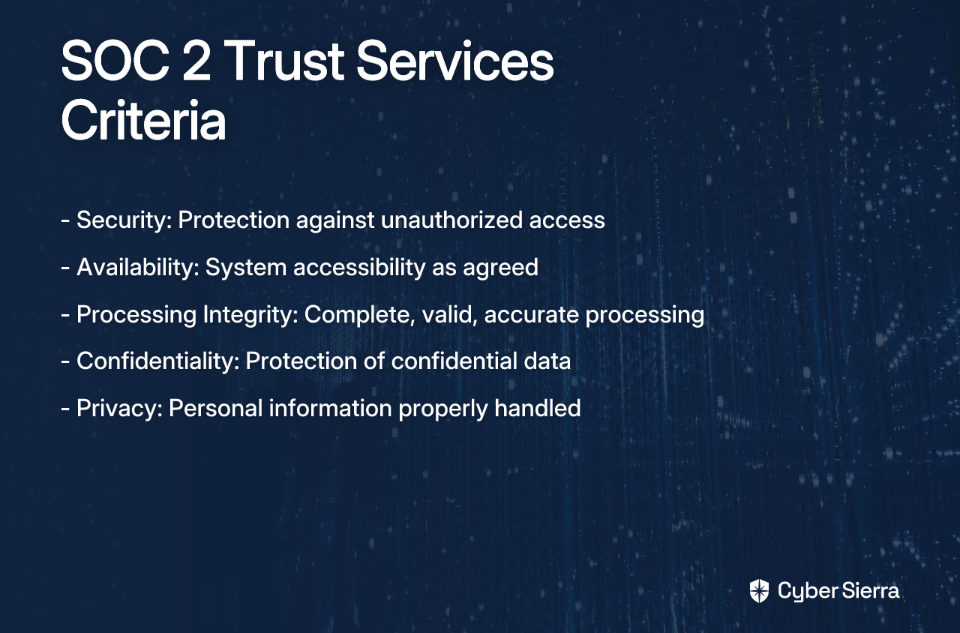
- Security (Common Criteria): The foundational requirement. Protection of information and systems against unauthorized access.
- Availability: Accessibility of the system as stipulated by a contract or service level agreement.
- Processing Integrity: System processing is complete, valid, accurate, timely, and authorized.
- Confidentiality: Data designated as confidential is protected as agreed upon.
- Privacy: Personal information is collected, used, retained, disclosed, and disposed of in conformity with the organization's privacy notice.
Implementation Snapshot: The audit process can take up to a year and requires significant evidence gathering to prove controls are designed (Type I) and operating effectively over time (Type II).
How Cyber Sierra Simplifies SOC 2:
- Cyber Sierra's GRC platform is built to streamline SOC 2 readiness. It provides pre-built policy templates, automates data collection from your cloud environment, and maps it directly to the TSCs.
- The Third-Party Risk Management (TPRM) module helps manage vendor risk, a critical component of the Security TSC, by automating vendor assessments.
4. COBIT (Control Objectives for Information and Related Technologies)
Overview: A framework created by ISACA for IT governance and management. COBIT's unique focus is on aligning IT processes and goals with overall business objectives, not just information security.
Best For: Larger enterprises, heavily regulated industries, and organizations seeking to improve the governance of their IT investments and bridge the gap between technical teams and executive leadership.
Key Structure & Components: Built on six core principles for a governance system:
- Provide Stakeholder Value.
- Holistic Approach.
- Dynamic Governance System.
- Governance Distinct from Management.
- Tailored to Enterprise Needs.
- End-to-End Governance System.
Implementation Snapshot: COBIT is a comprehensive governance framework, not a simple security checklist. Implementation often involves significant process re-engineering and stakeholder buy-in across the business.
How Cyber Sierra Simplifies COBIT:
- While COBIT is broad, its objectives rely on effective controls. Cyber Sierra's CCM platform provides the data-driven evidence needed to validate that IT controls are meeting governance objectives.
- The reporting dashboards in the GRC module help communicate IT risk and control effectiveness to business stakeholders in a language they understand, supporting COBIT's principle of "providing stakeholder value."
5. HIPAA (Health Insurance Portability and Accountability Act)
Overview: A U.S. federal law that mandates national standards to protect sensitive patient health information (PHI) from being disclosed without the patient's consent or knowledge.
Best For: U.S. healthcare organizations ("covered entities") and any business that services them and handles PHI ("business associates"). This includes hospitals, insurers, and HealthTech/SaaS companies.
Key Structure & Components: The HIPAA Security Rule requires appropriate administrative, physical, and technical safeguards. Key requirements include:
- Ensuring the confidentiality, integrity, and availability of all electronic PHI.
- Conducting regular risk assessments.
- Implementing security awareness and training for the workforce.
Implementation Snapshot: Compliance is mandatory and non-compliance can result in severe financial penalties. It requires ongoing risk analysis and management, not a one-time setup.
How Cyber Sierra Simplifies HIPAA:
- Cyber Sierra's GRC module provides specific control mapping for HIPAA requirements, simplifying risk assessments and audit preparation.
- The Employee Security Training module directly addresses the mandatory training requirement with interactive modules and simulated phishing campaigns.
6. GDPR (General Data Protection Regulation)
Overview: A regulation in EU law on data protection and privacy for all individuals within the European Union and the European Economic Area. It has become a global benchmark for data privacy.
Best For: Any organization worldwide that processes the personal data of EU citizens, regardless of where the company is located.
Key Structure & Components: Based on principles of data protection by design and by default. Key requirements include:
- Data processing lawfulness, fairness, and transparency.
- Data subject rights (e.g., right to access, right to be forgotten).
- Mandatory breach notifications within 72 hours.
Implementation Snapshot: Requires a deep understanding of data flows within the organization. Fines for non-compliance are severe, reaching up to 4% of annual global turnover or €20 million.
How Cyber Sierra Simplifies GDPR:
- The GRC module helps manage policies and procedures related to data privacy, track data processing activities, and document compliance for audits.
- Cyber Sierra's Threat Intelligence module helps organizations proactively identify vulnerabilities that could lead to a data breach, supporting the GDPR principle of "data protection by design."
7. NIST SP 800-53
Overview: A comprehensive catalog of security and privacy controls for all U.S. federal information systems. While mandatory for federal agencies, it is widely adopted by large enterprises as a gold standard for control implementation.
Best For: U.S. federal agencies, government contractors, and large, mature organizations in critical infrastructure or finance that require a highly detailed and rigorous set of security controls.
Key Structure & Components: A massive catalog of controls.
- Contains over 300 controls across 20 different domains or "families."
- It's the "menu" of controls that can be used to achieve the outcomes described in the NIST CSF. As one security professional noted, "NIST CSF lists outcomes you want to achieve. Controls in 800-53 help you get there."
Implementation Snapshot: Extremely complex and resource-intensive. As noted by cybersecurity professionals, "If you don't have anything in place, don't start with NIST 800-53 - it is very complex and requires a lot of efforts to implement."
How Cyber Sierra Simplifies NIST 800-53:
- Implementing and managing hundreds of controls manually is nearly impossible. Cyber Sierra's CCM module is essential here, automating the testing and validation of a large percentage of these technical controls on a continuous basis.
- The GRC platform provides a centralized repository to manage, track, and report on the status of every control, making the complexity of 800-53 manageable.
Decision Matrix: Choosing Your Framework
| Framework | Primary Goal | Best For | Complexity | Key Benefit |
|---|---|---|---|---|
| NIST CSF | Flexible Risk Management | All sizes, U.S. focus, those new to frameworks | Low to Medium | Adaptable, comprehensive, and a great starting point for improving security posture. |
| ISO 27001 | International Certification | Global companies, B2B requiring certification | High | Globally recognized standard that demonstrates security maturity to partners and customers. |
| SOC 2 | Customer Trust & Assurance | SaaS, Cloud Providers, Service Orgs | Medium to High | An auditor's attestation that is often a requirement for enterprise sales cycles. |
| COBIT | IT Governance & Business Alignment | Large enterprises, regulated industries | High | Bridges the gap between IT operations and business objectives, improving ROI on IT. |
| HIPAA | Regulatory Compliance | U.S. Healthcare & associated businesses | Medium | Mandatory for protecting patient health information (PHI) and avoiding heavy fines. |
| GDPR | Regulatory Compliance | Orgs processing EU citizen data | Medium | Legally required for protecting EU data privacy, with significant penalties for failure. |
| NIST SP 800-53 | Rigorous Control Implementation | Federal agencies, large enterprises | Very High | A comprehensive catalog of security controls considered the gold standard for implementation. |
From Framework to Foundation: Automating Your Compliance Journey
Choosing a framework is the first step. The real challenge—and where many programs falter—is turning that framework from a document on a shelf into a living, breathing part of your security operations.
The days of "compliance sprints" before an audit, powered by spreadsheets and manual evidence gathering, are over. This approach is stressful, inefficient, and leaves you vulnerable the other 360 days of the year. Modern cybersecurity requires a proactive, continuous approach.
This is where compliance automation platforms become transformative. Instead of just knowing what you need to do (the framework), you gain a system that helps you do it continuously and efficiently.
Cyber Sierra is designed to be that system. Our AI-enabled GRC platform operationalizes frameworks like ISO 27001 and SOC 2, while our Continuous Control Monitoring (CCM) module provides the 24/7 visibility needed to stay secure and audit-ready. We help you move from periodic checks to a state of continuous compliance and proactive defense.
Ready to turn your chosen framework into a powerful, automated security program? Book a demo of Cyber Sierra today to see how we can help you build a foundation of trust and resilience.
Frequently Asked Questions
What is the best cybersecurity framework to start with for a small business?
The NIST Cybersecurity Framework (CSF) is often the best starting point for small businesses. It's flexible, risk-based, and not overly prescriptive, allowing you to build a foundational security program without the heavy overhead of a formal certification like ISO 27001. It helps you understand your risks and prioritize actions effectively.
What is the main difference between NIST CSF and ISO 27001?
The primary difference is that NIST CSF is a voluntary guidance framework, while ISO 27001 is a certifiable international standard. NIST CSF provides a flexible set of best practices and outcomes to help organizations improve their cybersecurity posture, but you cannot get "certified" in it. ISO 27001 specifies the requirements for an Information Security Management System (ISMS) and allows for a formal, independent certification that proves your compliance to customers and partners.
When does my company need a SOC 2 report?
Your company typically needs a SOC 2 report when you are a service organization (like a SaaS provider) and your customers, especially larger enterprises, require assurance that you are securely handling their data. It's often a contractual requirement in B2B sales cycles. A SOC 2 attestation from an independent auditor demonstrates that you have effective controls in place for security, availability, processing integrity, confidentiality, and/or privacy.
Can an organization use more than one cybersecurity framework?
Yes, many organizations use multiple frameworks as they often serve different but complementary purposes. For example, a company might use the NIST CSF as its internal guide for managing risk day-to-day, while pursuing ISO 27001 certification to meet international customer demands and using a SOC 2 report to provide assurance to its B2B clients. Many frameworks have overlapping controls, which can be managed efficiently with a GRC platform.
How does compliance automation help with implementing these frameworks?
Compliance automation platforms streamline the process of implementing and maintaining cybersecurity frameworks by reducing manual effort and providing continuous visibility. Instead of manually collecting evidence and tracking controls in spreadsheets, automation tools connect directly to your systems. They continuously monitor controls, collect evidence automatically, identify gaps in real-time, and simplify audit preparation, turning compliance from a periodic scramble into an ongoing, efficient process.
What is the difference between a certification and an attestation?
A certification (like ISO 27001) confirms that an organization's management system conforms to a specific standard, while an attestation (like a SOC 2 report) is an independent auditor's opinion on whether an organization's controls are designed and operating effectively. With certification, you either pass or fail based on conformity to the standard's requirements. An attestation report provides a detailed opinion and description of the tests performed by the auditor.
