



Archer vs MetricStream vs Cyber Sierra: Enterprise GRC Compared


Join thousands of professionals and get the latest insight on Compliance & Cybersecurity.
Summary
- Legacy GRC tools like Archer and MetricStream often come with a hidden "integration tax" due to their complex, modular architecture, leading to high implementation costs and developer dependency.
- The key differentiator for modern GRC is a unified, AI-native architecture that enables continuous control monitoring, eliminating the pre-audit scramble and keeping you audit-ready 24/7.
- With cyberattacks up 75% and over 170 new regulations in two years, periodic compliance checks are no longer enough to manage strategic risk effectively.
- Organizations seeking to reduce complexity and achieve faster time-to-value should evaluate a unified solution like Cyber Sierra's GRC platform, which automates compliance and provides continuous visibility.
Your board meeting is next week. You've spent three months evaluating enterprise GRC solutions, sat through a dozen demos, and negotiated pricing with vendors. You've narrowed the list down to two legacy giants — Archer and MetricStream — and one modern challenger: Cyber Sierra. Now you need to walk into that boardroom with a defensible recommendation, not a gut feeling.
This is the comparison article you actually need.
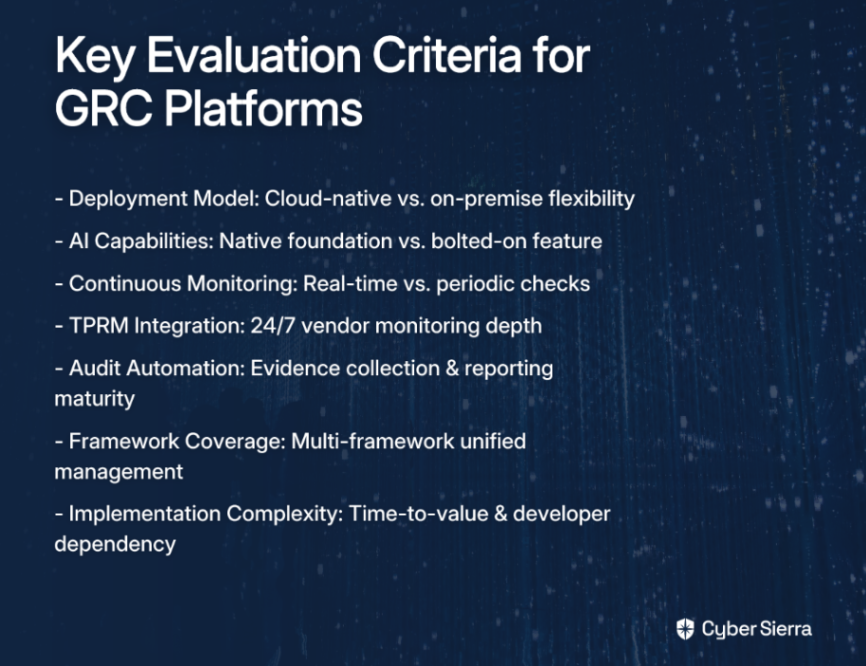
We're not going to pad this out with vendor marketing copy. Instead, we'll break down all three platforms across the exact criteria a real CRO or CISO uses during evaluation: deployment model, AI capabilities, continuous monitoring depth, TPRM integration, audit automation, framework coverage, and implementation complexity. We'll be diplomatically honest about where Archer and MetricStream have genuine strengths — and forthright about where they carry hidden costs that add up fast.
The stakes are real. According to Check Point Research, cyberattacks surged 75% globally in Q3 2024, and the average data breach now costs organizations $4.5 million, per IBM. Choosing the wrong GRC platform doesn't just create operational friction — it creates strategic risk. And as one seasoned practitioner put it on Reddit: "Make sure you really know what you want before buying any of them."
That's exactly what this guide is designed to help you figure out.
The Contenders at a Glance
- Cyber Sierra. An AI-native, unified cybersecurity and GRC platform built to address the limitations of traditional enterprise tooling. Its integrated suite spans Continuous Control Monitoring, Third-Party Risk Management, and automated GRC in a single environment — no stitching required.
- Archer. One of the most recognized names in enterprise risk management, with over 20 years in the market. Its platform covers Audit Management, TPRM, IT & Security Risk Management, and more. The breadth is hard to argue with, and it's a known quantity for procurement committees.
- MetricStream. Positions itself as an "AI-First Connected GRC" platform and carries serious analyst recognition from Chartis and IDC. A Forrester Total Economic Impact study found it delivers a 133% ROI, $8.4M in quantified benefits, and a six-month payback period — figures that resonate with finance teams.
The Core Comparison: Multi-Axis Breakdown
Here's the side-by-side that cuts through the noise:
| Evaluation Criteria | Cyber Sierra | Archer | MetricStream |
|---|---|---|---|
| Deployment Model | Cloud-native architecture built for rapid, scalable deployment | On-premise and cloud options; flexibility at the cost of added complexity | Cloud and on-premises; caters to diverse enterprise IT strategies |
| AI Capabilities | AI-native platform — predictive risk analysis, automated control testing, and proactive insights are built-in from the ground up | Limited AI via "Evolv Risk" module; quantifies risk across domains as an add-on layer | "AI-First Connected GRC" approach; AI integrated for decision support and operational efficiency |
| Continuous Monitoring | Comprehensive CCM with real-time visibility, automated evidence gathering, and anomaly detection | Primarily periodic checks; limited real-time monitoring depth out of the box | Continuous monitoring capabilities present, but integration complexity can limit practical depth |
| TPRM Integration | Advanced continuous TPRM with 24/7 real-time vendor monitoring; moves beyond static questionnaires natively | Automates vendor oversight via Third Party Governance module; solid but less continuous | Extensive TPRM features with real-time intelligence; strong but implementation effort is significant |
| Audit Automation | Full end-to-end audit automation with continuous evidence collection, integrated audit trails, and ready-to-present reporting | Reporting is supported; evidence gathering and process management lean heavily on manual workflows | Automates audit workflows and SOX compliance; reporting tools are mature and comprehensive |
| Framework Coverage | Unified multi-framework support (SOC 2, ISO 27001, NIST, HIPAA, PCI DSS, GDPR) managed from a single centralized control repository | Supports major frameworks; managing multiple simultaneously can become siloed across modules | Broad framework and regulatory change management support; policy enforcement tools are strong |
| Implementation Complexity | Low complexity; designed for rapid time-to-value without developer dependency | High complexity; typically requires significant professional services investment and extended timelines | Moderate complexity; highly customizable, which can extend timelines depending on scope and configuration |
What This Comparison Really Means for Your GRC Program
1. Architecture and the "Integration Tax"
Here's what doesn't show up in vendor demos: the integration tax.
Archer and MetricStream are powerful platforms, but they were architecturally designed in an era when on-premise deployments and modular licensing were the norm. Connecting their audit management module to their TPRM module to their risk reporting layer often requires professional services, custom API work, and ongoing developer involvement. As one practitioner noted in the r/cybersecurity discussion: "Dependence on developers for GRC tools creates bottlenecks in usability."
That technical debt compounds. Every new regulation, every new vendor tier, every new framework you need to add becomes an integration project, not a configuration change. Over a three-to-five year horizon, that's real money and real team bandwidth.
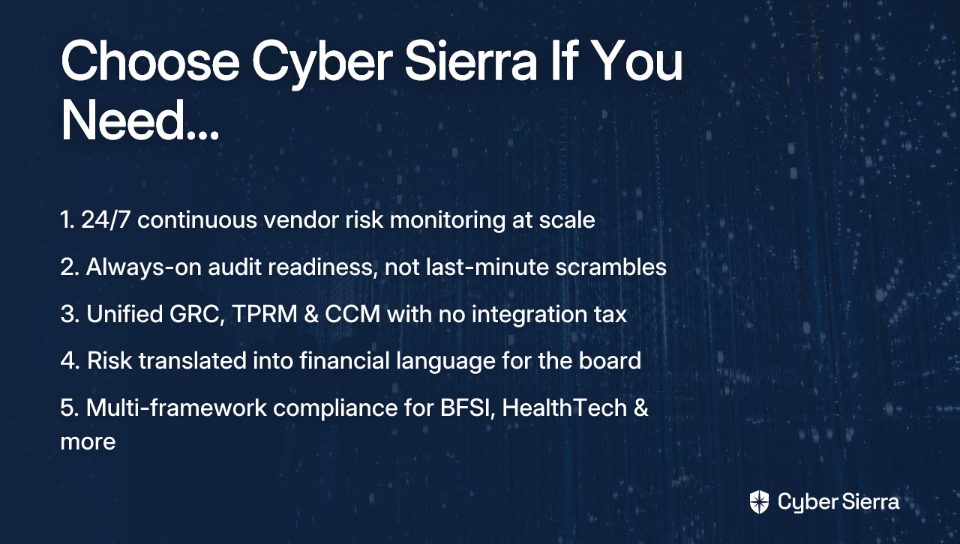
Cyber Sierra's cloud-native, unified architecture eliminates this tax by design. GRC, TPRM, CCM, and Threat Intelligence share the same data layer. When a vendor's compliance status changes, it surfaces immediately in your risk posture dashboard — not after a manual sync or a ticket to IT.
2. AI: Native Foundation vs. Layered Feature
MetricStream's "AI-First" branding reflects genuine investment, and Archer's Evolv Risk functionality adds meaningful risk quantification capability. But there's a meaningful difference between AI as a foundation and AI as a feature.
Cyber Sierra's AI-native architecture means that automation isn't something you switch on — it's how the platform works from day one. Control testing is automated. Anomaly detection runs continuously. Risk scoring is dynamic, not recalculated once a quarter when someone runs a report. And critically, the platform supports Cyber Risk Quantification (CRQ) — translating technical risk into financial language your board and CFO can actually engage with.
A common pattern GRC practitioners observe is that while initial automation capabilities are well-received, they often fail to scale effectively in the long run. That's a signal worth heeding. AI-native systems are architecturally built to scale as organizational complexity grows — bolted-on AI modules often aren't.
3. Continuous Monitoring and Audit Readiness
With over 170 new cybersecurity regulations proposed in the last two years, the idea that you can manage compliance readiness through periodic reviews is becoming untenable. Audit windows have compressed. Regulators expect evidence trails that reflect ongoing controls, not a snapshot assembled the week before an audit.
Legacy platforms, including Archer and MetricStream in their standard configurations, still rely heavily on periodic evidence collection cycles. The result? The familiar pre-audit fire drill — compliance teams scrambling to find evidence, chase down control owners, and manually validate what the platform should already know. As one practitioner described it: "Finding things and searching for things will give you a headache, especially during audits."
Cyber Sierra's Continuous Control Monitoring module is purpose-built to solve this. It maintains a central controls repository with near-real-time updates, automates control testing and validation across frameworks including NIST, ISO 27001, PCI DSS, and HIPAA, and detects exceptions and anomalies the moment they occur — not the next time someone runs a quarterly review. When an auditor asks for evidence, it's already there.

Decision Matrix: The Right Tool for Your Situation
Let's be direct. Not every organization should default to Cyber Sierra. Here's an honest mapping:
You Might Choose Archer or MetricStream If...
- Your organization is heavily embedded in a legacy IT ecosystem and has a dedicated internal team or established SI partner to manage complex implementations.
- Brand recognition is a primary procurement criterion — both carry significant weight in regulated industries like financial services and healthcare.
- You have a specific, non-negotiable requirement for on-premise deployment due to internal data residency policies.
- MetricStream's Forrester-validated 133% ROI makes a compelling pre-built business case for your finance committee.
- You need the broad, mature customizability that enterprise platforms built over decades can offer — and you have the runway and budget to configure it correctly.
You Should Choose Cyber Sierra If...
Making Your Defensible GRC Decision
Choosing a GRC platform isn't just about features; it's about future-proofing your entire risk program. The decision boils down to a core architectural choice: are you buying a collection of siloed modules that demand constant integration, or a unified platform built for continuous readiness from day one?
To make the right call, focus on two practical takeaways from this comparison. First, legacy tools often carry a hidden "integration tax"—the steep cost in professional services and developer hours required just to make them work together. Second, modern compliance isn't a periodic fire drill; it's about being audit-ready 24/7 through automated, continuous control monitoring.
Here’s a clear next step you can take today: calculate the real cost of a modular system. Map out the team hours spent on manual evidence gathering and the budget lost to endless integration projects.
If those numbers are higher than you expected, it’s time to see what a modern, unified architecture can do for your bottom line. The clearest way to understand the difference is to see it in action. Book your personalized demo and we’ll show you how to eliminate the integration tax for good.
Frequently Asked Questions
What is the primary difference between Cyber Sierra and legacy GRC tools?
The primary difference is architectural. Cyber Sierra is an AI-native, unified platform, while legacy tools are often modular and require complex integrations. This eliminates the "integration tax," providing seamless GRC and continuous monitoring without needing developers for basic connections.
Why is continuous control monitoring (CCM) important for modern GRC?
Continuous control monitoring (CCM) provides real-time visibility into your security posture, moving beyond periodic checks. It automates evidence collection and control testing, ensuring you are always audit-ready and can detect compliance gaps or anomalies the moment they occur.
How does an AI-native platform improve risk management over time?
An AI-native GRC platform improves risk management by embedding predictive analysis and automation into its core. This enables dynamic risk scoring, proactive insights, and the ability to quantify cyber risk in financial terms (CRQ), making it easier to communicate with your board.
What does the implementation process look like for Cyber Sierra?
Cyber Sierra is designed for low implementation complexity and rapid time-to-value. Unlike legacy platforms that often require significant professional services and extended timelines, our cloud-native architecture allows for a much faster, smoother rollout without developer dependency.
Can Cyber Sierra handle multiple compliance frameworks simultaneously?
Yes, Cyber Sierra is built to manage multiple frameworks (e.g., SOC 2, ISO 27001, NIST, HIPAA) from a single, centralized control repository. This unified approach avoids data silos and allows you to map controls across various frameworks efficiently without duplicating effort.
When should an organization consider Archer or MetricStream instead?
An organization might choose a legacy platform if they have a non-negotiable requirement for on-premise deployment or have an established team dedicated to managing complex, highly customized implementations. Their brand recognition can also be a key factor in some regulated industries.
