



GRC Solutions Compared: Standalone Tools vs Unified Platforms


Join thousands of professionals and get the latest insight on Compliance & Cybersecurity.
If you've ever dreaded audit season because you knew what was coming—weeks of manually hunting for evidence scattered across a risk tool, a compliance tracker, a shared drive full of policy docs, and a vendor assessment spreadsheet—you're not alone. Many organizations inadvertently create this complexity themselves by stitching together different tools that were never designed to talk to each other, leaving practitioners to deal with the headaches of searching for evidence during an audit.
This article is for the compliance leaders facing a strategic inflection point: should you continue investing in a collection of specialized, best-of-breed GRC tools, or consolidate onto a unified GRC platform? It's not just a software decision—it's an operational one that shapes your team's capacity, your risk visibility, and your long-term cost structure. Let's break it down.
The Two Philosophies of GRC Technology
Standalone "Best-of-Breed" Tools
The best-of-breed approach means selecting the top-performing tool for each specific function—a dedicated risk assessment platform, a separate compliance tracker, a standalone vendor questionnaire tool, and so on. The appeal is real: each tool can go deep on its function, offering highly specialized features that a generalist platform might not match.
But the operational reality often tells a different story. These tools create dangerous information silos, leaving teams with an incomplete—and often dangerously fragmented—picture of their risk posture. Stitching data together for a board report or an audit means excessive manual effort, error-prone exports, and a compliance team perpetually playing catch-up.
Unified GRC Platforms
A unified GRC platform brings risk management, compliance tracking, audit management, and vendor oversight into a single, integrated system. The evolution here is significant: from simple point compliance tools to integrated platforms, and now to AI-powered GRC solutions that enable proactive, near real-time risk management rather than periodic snapshot reviews.
The payoff is a simplified tech stack, seamless data flow between functions, and a correlated risk view that actually supports executive decision-making. The trade-off is that a unified platform may not go as deep on a single niche function as a purpose-built standalone tool—but for most scaling organizations, the operational benefits far outweigh that gap.
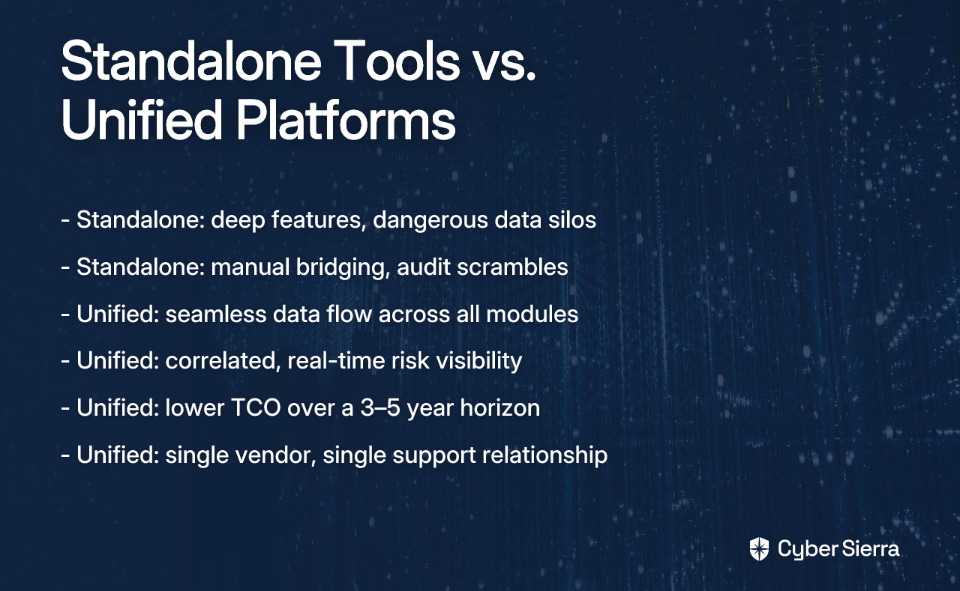
Head-to-Head Comparison: Standalone Tools vs. Unified Platforms
1. Total Cost of Ownership (TCO)
Standalone tools can look attractive on a per-tool basis. But the real costs compound quickly: multiple license agreements, separate support contracts, custom integration development fees, and the hidden cost of human hours spent bridging data gaps manually. For smaller or mid-market organizations, high licensing costs alone can become a barrier to accessing effective GRC capabilities.
Unified platforms typically require a higher upfront investment, but they eliminate the redundant costs that pile up across a fragmented stack. Automated workflows reduce the labor burden, and having a single vendor relationship simplifies procurement, renewal, and negotiation. Over a three-to-five year horizon, unified platforms often deliver lower TCO.
2. Integration Overhead & Complexity
This is where the standalone approach takes its biggest hit. A line often shared among compliance professionals cuts right to the heart of the problem: "No software can fix an overly complex process." Each tool integration requires API configuration, data mapping, and dedicated developer resources to maintain. When one vendor pushes an update that breaks an integration, your compliance team is stuck waiting on a fix, creating real bottlenecks in day-to-day usability.
Unified platforms eliminate this entirely. Natively integrated modules are built to share data from day one—no custom development, no API fragility, no broken pipelines after a version update. As Baker Tilly's analysis highlights, this seamlessness is fundamental to reducing audit fatigue and streamlining control management.
3. Speed to Audit Readiness
With standalone tools, audit season triggers a familiar scramble: evidence is spread across systems, formats differ, and the compliance team manually collates everything under pressure. The result is burned-out teams and, often, evidence gaps that create risk during the audit itself.
Unified platforms enable continuous audit readiness. Centralized control libraries with automated evidence collection mean your documentation is always organized, always current, and accessible in seconds rather than weeks. This can compress review timelines—a significant advantage when enterprise deals depend on passing a security review quickly.
4. Cross-Module Data Sharing & Risk Visibility
In a standalone stack, data lives in silos. A critical finding from your TPRM tool—say, a key vendor failing a security check—has no automatic pathway into your internal risk register or compliance dashboard. Risk teams end up operating with a partial picture, making it harder to prioritize remediation or report accurately to leadership.
Unified platforms correlate data across all functions in a single dashboard. When threat intelligence surfaces a vulnerability, it's immediately contextualized against relevant controls and vendor dependencies. This connected risk view helps teams reduce threat response times by eliminating the cognitive overhead of manually joining the dots across disparate systems.
5. Ongoing Maintenance Burden
Standalone tools multiply your maintenance surface. Each vendor has its own release cycle, its own support queue, and its own way of handling updates. When an integration breaks—and it will—the burden of diagnosing and fixing it falls on your team, often at the worst possible time.
Unified platforms consolidate this down to a single vendor, a single support relationship, and a single update cycle. Modules remain compatible by design, and platform improvements benefit all functions simultaneously. This operational simplicity is one of the most underrated advantages of a unified approach, especially for lean compliance teams.
Bringing the Comparison to Life: Two Real-World Scenarios
Scenario 1: A Mid-Market Fintech Under Multi-Framework Pressure
A 200-person fintech company needs to comply with both SOC 2 and PCI DSS to win enterprise banking clients. They've cobbled together a spreadsheet for compliance tracking, a separate SaaS tool for vendor questionnaires, and a standalone risk register. Sound familiar?
With this standalone approach, the compliance manager spends three to four weeks before every audit manually pulling evidence from three systems, reconciling conflicting data formats, and chasing down control owners. More dangerously, when a critical vendor experiences a breach, the information sits in the TPRM tool with no automatic flag in the risk register—creating an exposure window that goes unnoticed.
After switching to a unified GRC platform, controls are mapped across SOC 2 and PCI DSS simultaneously, eliminating duplicate work. Cloud infrastructure evidence is collected automatically. The vendor breach triggers an immediate alert in the central risk dashboard, enabling the team to act within hours rather than weeks. The compliance manager now spends audit preparation time on strategy, not evidence wrangling. Many companies with early-stage platforms like Vanta or Drata find themselves outgrowing them quickly precisely because they lack this kind of cross-framework depth and native integration.
Scenario 2: A Manufacturing Enterprise Pursuing ISO 27001
A mid-size manufacturer with a global supply chain is pursuing ISO 27001 certification to unlock new markets in Europe. Their current state: risk data in one system, policy documents on a shared drive, and vendor assessments conducted via email and spreadsheets. Three different departments own three different pieces of the compliance puzzle, and none of them are talking to each other.
With standalone tools, the ISO 27001 audit becomes an exercise in controlled chaos. The auditor requests evidence for a specific control. The security team scrambles to find the latest policy version, proof of employee security awareness training, and the related third-party vendor assessment—across three different systems and two email threads. The process is slow, the evidence is fragmented, and it fails to demonstrate the kind of mature, integrated security program that an ISO 27001 certification requires.
With a unified platform, the ISO 27001 control framework is centralized. When the auditor selects a control, the platform instantly surfaces the linked policy document, automated evidence from the IT environment, status of relevant vendor assessments from the TPRM module, and employee training completion records. As Baker Tilly notes, this kind of seamless data sharing is especially critical for complex, evidence-intensive frameworks like ISO 27001, where control interdependencies demand a holistic view.
The Power of a Natively Unified Platform: How Cyber Sierra Eliminates the Silos
The scenarios above illustrate the structural advantage of unified GRC solutions. But the quality of "unification" matters enormously—bolting modules together under one login is not the same as building them to natively share data and intelligence.
Cyber Sierra is an AI-enabled cybersecurity platform designed from the ground up to solve exactly the problems described above: data silos, manual evidence gathering, reactive risk management, and fragmented vendor oversight. Here's how its modules work together as a genuine system—not just a bundled product suite.
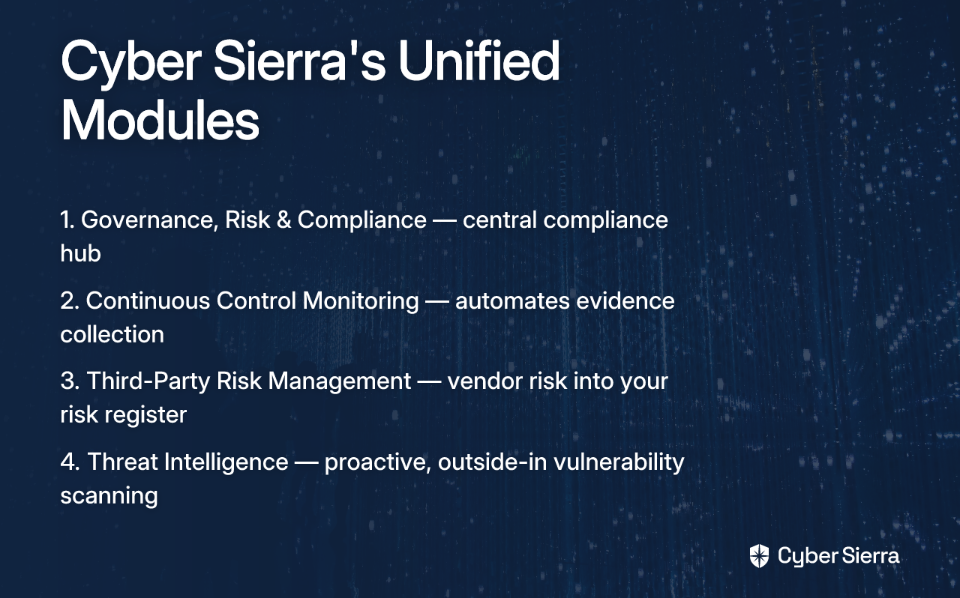
Governance, Risk & Compliance (GRC) serves as the central hub. It automates data collection and risk assessments across frameworks like SOC 2, ISO 27001, HIPAA, PCI DSS, and GDPR—managing custom controls alongside standardized ones. Policy management, audit trails, and incident response documentation all live here, giving compliance managers a single place to demonstrate program maturity to auditors and leadership.
Continuous Control Monitoring (CCM) feeds that hub with automated, near real-time evidence, and is designed to automate a significant portion of audit evidence collection. Rather than running periodic manual checks, CCM continuously validates control effectiveness, detects exceptions and anomalies, and updates the central controls repository automatically. This transforms the compliance posture from a point-in-time snapshot to a living, always-current record—eliminating the audit scramble entirely and providing a genuine single source of truth for controls.
Third-Party Risk Management (TPRM) doesn't operate in isolation. When a vendor fails a security assessment or a new risk is surfaced through continuous monitoring, that finding is automatically propagated into the central GRC risk register. This closes the dangerous gap that standalone TPRM tools leave open—where vendor risk lives in a separate system and never makes it into the organization's holistic risk picture. Vendor onboarding, assessments, and ongoing monitoring are automated, replacing the email-and-spreadsheet workflows that slow down procurement and compliance teams alike.
Threat Intelligence adds the proactive security layer. By performing network and cloud infrastructure scanning from an outside-in perspective, it surfaces vulnerabilities before they're exploited and feeds that real-world threat data directly into the risk management workflow. Instead of reacting to breaches, compliance and security teams can prioritize remediation based on actual exposure—informed by the same platform managing their controls and vendor risk.
The combined effect is what separates a truly unified GRC platform from a collection of integrations dressed up as one: data from CCM, TPRM, and Threat Intelligence all flows natively into the central GRC hub, giving leaders a single, correlated, and continuously updated view of their entire risk and compliance posture. No API fragility. No manual data bridging. No evidence gaps on audit day.
From Tool Sprawl to Strategic Clarity
If your GRC strategy relies on stitching together disparate tools, you're not just dealing with multiple licenses—you're managing the hidden costs of manual work, integration fragility, and fragmented risk visibility. The core takeaway is simple: a collection of best-of-breed tools often creates more complexity and operational drag than it solves. A natively unified platform flips the script, transforming compliance from a reactive, audit-driven scramble into a continuous, automated function.
As a first step today, map out your current GRC stack and the hours your team spends bridging the gaps between each tool. When you see the true cost, you’ll know it’s time for a new approach.
When you're ready to trade that complexity for a single source of truth, book a personalized demo and see how a connected platform can streamline your entire program.
Frequently Asked Questions
What is a unified GRC platform?
A unified GRC platform integrates governance, risk management, and compliance functions into a single system. This contrasts with using separate, "best-of-breed" tools for each task, eliminating data silos and providing a holistic view of your organization's risk and compliance posture.
Why are unified GRC platforms often better than standalone tools?
Unified platforms are often better because they eliminate data silos and reduce manual integration work. By providing a single source of truth for risk, compliance, and vendor data, they lower total cost of ownership (TCO), improve risk visibility, and streamline audit preparation significantly.
How does a unified GRC platform lower the total cost of ownership (TCO)?
A unified GRC platform lowers TCO by consolidating multiple vendor licenses into one and eliminating hidden costs. It reduces the need for expensive custom integrations, minimizes manual labor spent bridging data gaps, and simplifies procurement and support into a single vendor relationship.
When might a standalone GRC tool be a better choice?
A standalone tool might be better for highly specialized, niche functions that require deep features a unified platform may not offer. This approach is most viable for large organizations with dedicated engineering resources to build and maintain the necessary custom integrations between tools.
What makes a GRC platform "natively unified"?
A "natively unified" platform is built from the ground up with modules designed to share data seamlessly, like Cyber Sierra. This differs from platforms that simply bundle acquired tools under one brand, which may still require fragile, bolted-on integrations and not share data effectively.
How does a unified platform improve audit readiness?
A unified platform enables continuous audit readiness by centralizing controls and automating evidence collection. Instead of a last-minute scramble to find documents, your evidence is always organized, up-to-date, and accessible, dramatically reducing preparation time from weeks to days.
