



How to Integrate Internal Controls Software with Your Existing GRC Ecosystem


Join thousands of professionals and get the latest insight on Compliance & Cybersecurity.
Summary
- Fragmented GRC and security tools create dangerous information silos, leading to excessive manual effort for audits and an incomplete view of organizational risk.
- Integrating internal controls software with systems like ERPs, SIEMs, and cloud infrastructure is key to automating compliance and gaining real-time risk visibility.
- Successful integration requires a strategic roadmap focused on clear objectives and prioritizing tools with well-documented APIs to avoid technical pitfalls like data incompatibility and security gaps.
- A unified platform can automate over 80% of audit evidence collection. Cyber Sierra's GRC platform consolidates monitoring and risk management to provide a single, actionable view of your security posture.
You've set up a robust internal controls framework, invested in a governance, risk, and compliance (GRC) platform, and implemented various cybersecurity tools. But when you need a unified view of your organization's risk posture, you're forced to manually pull data from multiple systems, create spreadsheets, and cobble together reports.
"Today we are paying for 4 tools, and we would love to consolidate," laments one security professional on Reddit, echoing a sentiment shared across the industry. The reality for many organizations is a fragmented technology landscape where GRC tools are described as "clunky" and third-party risk management (TPRM) as "questionnaire hell."
This disconnected approach creates dangerous information silos, separating compliance teams (focused on frameworks like SOC 2 and ISO 27001) from security operations (focused on real-time threats). The consequences are severe:

- Delayed detection of compliance violations
- Excessive manual effort for evidence gathering during audits
- A fragmented, incomplete view of organizational risk
- Redundant data entry across multiple platforms
This practical guide provides a roadmap for integrating your internal controls software with your broader GRC ecosystem, cybersecurity tools, and enterprise systems. We'll cover strategic planning, technical integration challenges with actionable solutions, and how a truly integrated platform can transform your risk and compliance posture.
The Strategic Imperative: Planning Your GRC Integration
Before diving into APIs and data mappings, successful integration requires strategic planning. Follow these crucial steps:
Step 1: Assess Your Current IT Landscape
Before integrating, map your existing environment by identifying all key systems that hold risk, control, or compliance data (Source):
- ERP Systems (e.g., SAP, Oracle): Align financial and operational controls with risk management
- CRM Systems (e.g., Salesforce): Manage customer-related risks and data protection compliance
- Cybersecurity Tools: SIEMs, vulnerability scanners, and identity management platforms
- HRMS & SCM Systems: Gain a holistic view of internal and supply chain risks
For each system, document:
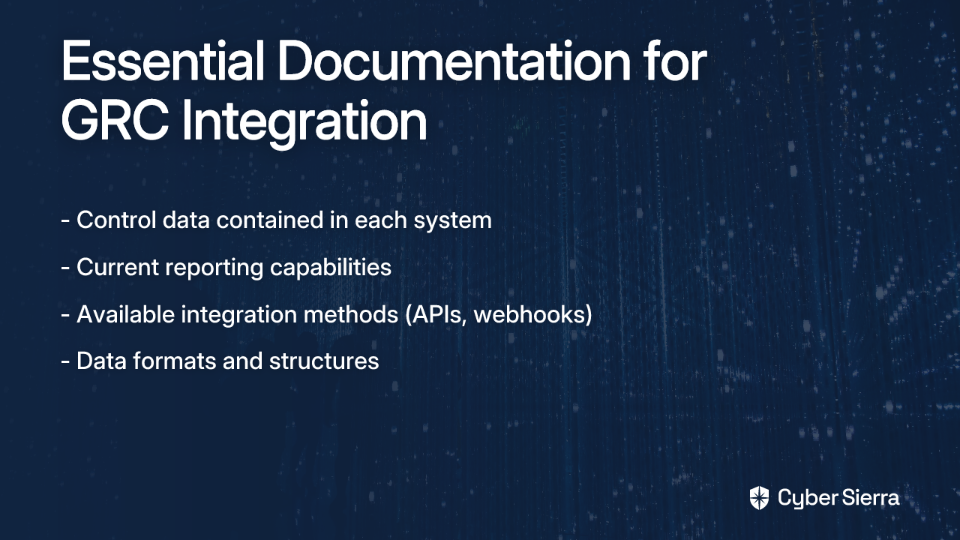
- What control data it contains
- Current reporting capabilities
- Available integration methods (APIs, webhooks, etc.)
- Data formats and structures
Step 2: Define Integration Objectives and Create a Roadmap
Clearly articulate what success looks like. Is your goal:
- Automated evidence collection for audits?
- Real-time dashboarding of control effectiveness?
- Consolidated risk reporting across business units?
Align all key stakeholders (IT, Security, Compliance, Internal Audit) on the goals, timeline, resources, and budget. A clear roadmap prevents scope creep and ensures buy-in.
Step 3: Prioritize "Killer APIs" and Connectivity
As one industry professional advises, "If you're serious about consolidation, skip the Frankenstein platforms and focus on tools with killer APIs and known integrations with your ecosystem."
When evaluating internal controls software or a GRC platform, API capabilities are non-negotiable. Look for:
- Well-documented REST or GraphQL APIs
- Pre-built connectors for common systems (SIEMs, cloud platforms, ERPs)
- A vendor commitment to API stability and versioning
Navigating the Technical Minefield: Common Integration Pitfalls & Solutions
Now let's examine the technical challenges that often derail GRC integration projects and how to overcome them:
Challenge 1: Data Incompatibility and Mapping
Pitfall: Systems speak different languages. Your ERP might use XML while your security tool uses JSON, running on different protocols like SOAP vs. REST. This leads to data silos even after connection.
Solution:
- Data Mapping: Before writing any code, create a detailed data map that defines how fields in one system correspond to fields in another. For example, map how "control objectives" in your internal controls software relate to "policy requirements" in your GRC platform.
- Middleware/Adapters: Use integration platforms or custom middleware to act as a translator, transforming data formats and protocols on the fly.
- Standardized Taxonomies: Implement consistent control frameworks (like NIST CSF or ISO 27001) across systems to ensure common language.
Challenge 2: API Security and Data Privacy
Pitfall: An insecure API is an open door for attackers. A breach can lead to massive fines under regulations like GDPR (up to €20 million or 4% of global turnover) and HIPAA (up to $1.5 million per violation category).
Solution:
- Authentication & Authorization: Use robust standards like OAuth 2.0 for token-based access instead of exposing raw credentials. Securely store and rotate API keys.
- Data Encryption: All data must be encrypted in transit using HTTPS/TLS and at rest using strong algorithms like AES-256 to meet compliance requirements.
- API Gateways: Implement an API gateway to provide a security layer that handles authentication, rate limiting, and logging.
Challenge 3: Performance, Scalability, and Downtime
Pitfall: A poorly optimized integration can slow down critical systems or fail under load as your company grows. Integration projects can also cause disruptive system downtimes.
Solution:
- Performance Optimization: Use caching to store frequently requested data, minimize the number of API calls, and use load balancing to distribute traffic.
- Plan for Downtime: Schedule integration deployments during low-activity periods to minimize business disruption.
- Thorough Testing: Use sandbox environments to simulate various scenarios and stress-test the integration before it goes live.
Challenge 4: Error Handling and Long-Term Maintenance
Pitfall: When an integration fails, a lack of logging makes troubleshooting nearly impossible. Unexpected API version changes from a vendor can also break your connection without warning.
Solution:
- Robust Logging: Implement detailed logging that clearly distinguishes between client-side errors (4xx status codes) and server-side errors (5xx status codes).
- Semantic Versioning: Choose vendors who use clear API versioning strategies and provide detailed changelogs so you can adapt to changes proactively.
- Monitoring and Alerting: Set up automated monitoring to detect integration failures early and alert the right teams.
The Unified View: From Fragmented Data to Actionable Intelligence
Successful integration of your internal controls software with your broader GRC ecosystem delivers transformative benefits:
Benefit 1: Achieve Continuous Control Monitoring (CCM)
Integration transforms compliance from a periodic, point-in-time audit into a continuous, automated process. By connecting your controls framework to live data from your security tools, you get real-time visibility into your security posture.
Cyber Sierra in Action: Cyber Sierra's Continuous Control Monitoring (CCM) platform was designed with integration at its core. It connects with your existing tech stack to:
- Build a central controls repository with near real-time updates
- Automate control testing and validation, eliminating manual evidence gathering
- Detect exceptions and anomalies in real-time, enabling proactive risk management across frameworks like NIST, ISO 27001, and PCI DSS
For example, when an unauthorized change is made to a cloud resource, Cyber Sierra can automatically flag the compliance violation, trigger a workflow for remediation, and document the entire process for your next audit.
Benefit 2: Streamline Audits and Automate Evidence Collection
Connecting your internal controls software to your broader technology ecosystem can automate the collection of 80% or more of audit evidence. This transforms high-stress audit seasons into manageable, routine processes.
Cyber Sierra's GRC platform automates data collection, generates comprehensive reports, and maintains detailed audit trails for SOC2, ISO 27001, GDPR, and HIPAA, making you audit-ready at all times. By integrating with your existing systems, it pulls evidence automatically rather than requiring manual screenshots and documentation.
Benefit 3: Create a Single Pane of Glass for Holistic Risk Management
The ultimate goal is a unified dashboard that breaks down silos. This single view correlates data from internal controls, vendor risks (TPRM), threat intelligence feeds, and security alerts. This integrated approach can reduce the time from threat detection to containment by up to 80%.
Cyber Sierra's AI-enabled platform provides this unified view out-of-the-box. By integrating CCM, TPRM, GRC, Threat Intelligence, and Employee Training into one ecosystem, it eliminates the need for multiple disconnected tools and provides a complete, actionable picture of your risk landscape.
Key Integration Considerations for Different System Types
Different systems require specific integration approaches:
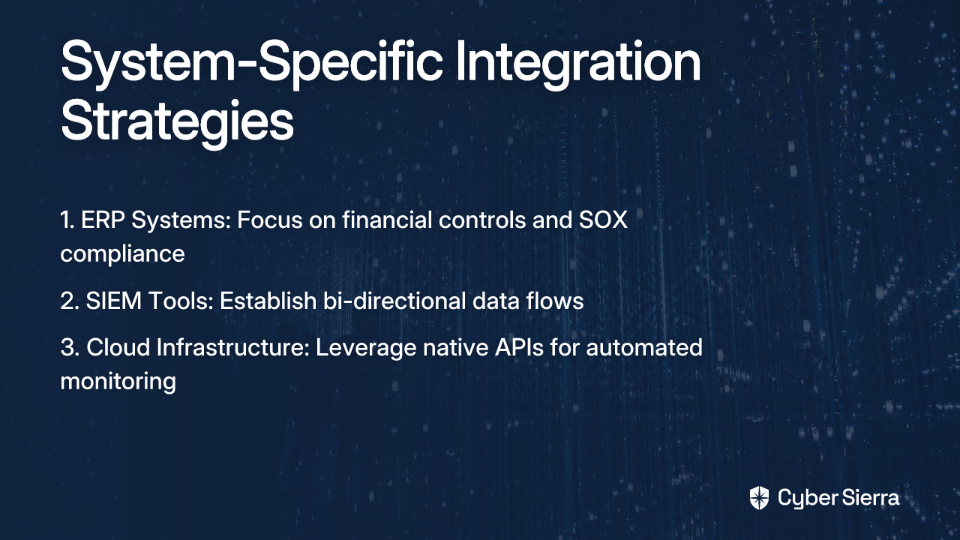
ERP System Integration
When connecting internal controls software with ERP systems like SAP or Oracle:
- Focus on financial controls and segregation of duties
- Ensure real-time monitoring of critical transactions
- Map internal controls to financial reporting requirements (SOX)
SIEM and Security Tool Integration
For cybersecurity tools:
- Establish bi-directional data flow so security incidents can trigger compliance reviews
- Aggregate security findings into control effectiveness metrics
- Ensure security teams can access compliance requirements directly from their tools
Cloud Infrastructure Integration
For AWS, Azure, and Google Cloud:
- Use native APIs to monitor compliance with infrastructure security policies
- Implement automated remediation workflows for common compliance violations
- Leverage cloud service provider security findings to validate control effectiveness
Unify Your Defenses: Move from Silos to Synergy
Integrating internal controls software with your broader GRC ecosystem is no longer a "nice-to-have"—it's a strategic necessity for building a resilient and efficient security program. The key is to move beyond patching together disparate systems and adopt a platform built with integration at its core.
Stop wrestling with clunky tools and manual processes. A unified platform like Cyber Sierra consolidates your security stack, automates compliance, and provides the holistic risk intelligence you need to make informed decisions.
Frequently Asked Questions
What is GRC integration?
GRC integration is the process of connecting your Governance, Risk, and Compliance (GRC) software with other essential business and security systems, such as ERPs, CRMs, and SIEM tools. The primary goal is to create a single, unified source of truth for all risk and compliance data, breaking down information silos and enabling automated, real-time insights into your organization's risk posture.
Why is integrating internal controls software with GRC systems important?
Integrating these systems is crucial for achieving a complete and accurate view of organizational risk. This integration breaks down dangerous information silos between security and compliance teams, automates the tedious process of evidence collection for audits, enables Continuous Control Monitoring (CCM), and ultimately allows for faster detection and remediation of both security threats and compliance violations.
How do you start a GRC integration project?
The best way to start a GRC integration project is with strategic planning before addressing any technical details. The first steps should involve assessing your current IT landscape to identify all systems containing risk data, defining clear integration objectives that align with business goals, and prioritizing tools that offer robust, well-documented APIs and pre-built connectors to streamline the process.
What are the biggest technical challenges in GRC integration?
The most common technical challenges include data incompatibility, API security, and long-term maintenance. Data incompatibility arises when different systems use varying formats (e.g., JSON vs. XML), requiring data mapping and middleware. Securing APIs with standards like OAuth 2.0 is critical to prevent breaches. Finally, a plan for ongoing maintenance is essential to handle vendor API changes and troubleshoot errors effectively through robust logging and monitoring.
What is Continuous Control Monitoring (CCM)?
Continuous Control Monitoring (CCM) is an automated process that continuously tests and validates the effectiveness of your internal controls in near real-time. By integrating your controls framework directly with live data from your tech stack (like cloud platforms and security tools), CCM transforms compliance from a periodic, manual audit into an ongoing, automated activity. This allows for immediate detection of control failures and compliance gaps.
How does GRC integration help with audits?
GRC integration dramatically streamlines the audit process by automating evidence collection. Instead of manually gathering screenshots and reports, an integrated system can automatically pull required evidence from connected platforms like your SIEM, cloud infrastructure, and HR systems. This can automate up to 80% of evidence gathering, significantly reducing the manual effort and stress associated with audit preparation and ensuring you are always audit-ready.
Ready to break down your GRC and security silos?
See how Cyber Sierra's AI-enabled platform creates a single source of truth for your entire risk ecosystem. Request a demo to see our unified dashboards in action and learn how you can become continuously compliant while reducing the burden on your security and compliance teams.
