



How to Build a Third Party Security Risk Framework That Actually Works


Join thousands of professionals and get the latest insight on Compliance & Cybersecurity.
Summary
- Traditional TPRM frameworks fail because they rely on static, point-in-time assessments that quickly become outdated, costing companies an average of $4.55 million per breach.
- An effective TPRM program must be a "living" system that adapts to evolving threats through continuous monitoring rather than just annual questionnaires.
- Key actions include creating a centralized vendor inventory, tiering vendors by risk level, and automating monitoring to gain real-time security visibility.
- Cyber Sierra's TPRM platform helps automate this entire process, from vendor onboarding and risk assessment to continuous compliance monitoring.
You've spent countless hours crafting a third-party risk management program. You've created questionnaires, documented policies, and built assessment workflows. Yet, when the latest vendor breach hits the headlines, you're scrambling to determine your exposure—just like everyone else.
Sound familiar?
For many security professionals, third party security risks remain a persistent challenge. Despite your best efforts, traditional Third-Party Risk Management (TPRM) frameworks often feel like expensive checkbox exercises rather than effective security controls.
"You can't trust the third party didn't just lie," as one security professional put it on Reddit. Another lamented that "the best I feel that can be done is to achieve due diligence"—suggesting TPRM is more about liability protection than actual security improvement.
They're not wrong. A 2021 AuditBoard survey found that 37% of organizations rate their TPRM maturity as either nonexistent or reactive. This widespread problem persists despite the fact that third-party breaches cost organizations an average of $4.55 million—and that doesn't include reputational damage.
So why do most TPRM frameworks fail, and how can you build one that actually works? Let's dive in.

The Anatomy of a Failing Framework: Why Your Current TPRM Is Set Up to Fail
Before we can fix what's broken, we need to understand why traditional TPRM frameworks fail to deliver on their promises:
Problem 1: Static, Point-in-Time Assessments
Most organizations rely on annual questionnaires and point-in-time assessments. The problem? A vendor's security posture is continuously evolving. That SOC 2 report from six months ago? It's already outdated. The detailed questionnaire you sent last year? It only captures a moment in time.
In today's fast-moving threat landscape, static assessments are like trying to secure your house by checking the locks once a year while ignoring what happens the other 364 days.
Problem 2: Overwhelmed by Manual Processes
The average enterprise manages hundreds or thousands of vendors. Yet most TPRM programs still rely on spreadsheets, emails, and manual follow-ups. This approach is:
- Unsustainable: With limited staff and budgets, thorough assessments of every vendor become impossible
- Error-prone: Manual processes introduce inconsistencies and oversights
- Slow: By the time you've assessed all your vendors, it's time to start the cycle again
Problem 3: Disconnected from Business Reality
Many frameworks fail to account for the diverse vendor ecosystem businesses operate in today. As one security professional noted, "you need to do business with a mom and pop setup that cannot obtain certification." Yet rigid frameworks often apply the same standards to:
- Global cloud providers with dedicated security teams and multiple certifications
- Mid-sized vendors with basic security programs but limited resources
- Small specialized providers who may have never heard of SOC 2
This disconnect creates a no-win situation: either reject valuable business partners due to compliance failures or accept significant unmitigated risk.
Problem 4: The High Cost of Failure
The consequences of an ineffective TPRM framework aren't theoretical—they're catastrophic. Consider the infamous 2013 Target breach, where attackers gained entry by exploiting the compromised credentials of a third-party HVAC vendor. This seemingly low-risk vendor became the attack vector that led to 40 million stolen credit cards, $18.5 million in settlements, and incalculable reputational damage.
The Blueprint for a Living TPRM Framework: A 6-Step Guide
So how do we build a framework that actually works? The answer lies in creating a living, adaptive system rather than a static document. Here's the blueprint:
Step 1: Foundational Scoping & Governance

Define Clear Objectives: Before diving into vendor assessments, articulate what you're trying to protect and why. Are you primarily concerned with:
- Safeguarding customer PII?
- Ensuring compliance with GDPR, HIPAA, or other regulations?
- Preventing operational disruptions?
- Protecting intellectual property?
These objectives will guide your entire framework.
Create a Centralized Vendor Inventory: You can't protect what you don't know you have. Build a comprehensive, centralized repository of all third-party relationships, including:
- Vendor name and contact information
- Services provided
- Data accessed
- Integration points with your systems
- Contract renewal dates
Establish Governance: Create a formal governance document outlining roles and responsibilities across departments. TPRM isn't just a security function—it requires collaboration between Legal, Procurement, IT, and business units.
Step 2: Risk-Based Vendor Tiering
Not all vendors pose the same level of risk. Cyber Sierra's TPRM platform helps organizations prioritize vendors based on risk factors, but even a manual approach should include:
Classify Vendors by Risk: Categorize vendors based on:
- Criticality to business operations
- Level of access to sensitive data
- Compliance requirements
- Integration depth with your systems
A simple tiering system helps focus your resources where they matter most:
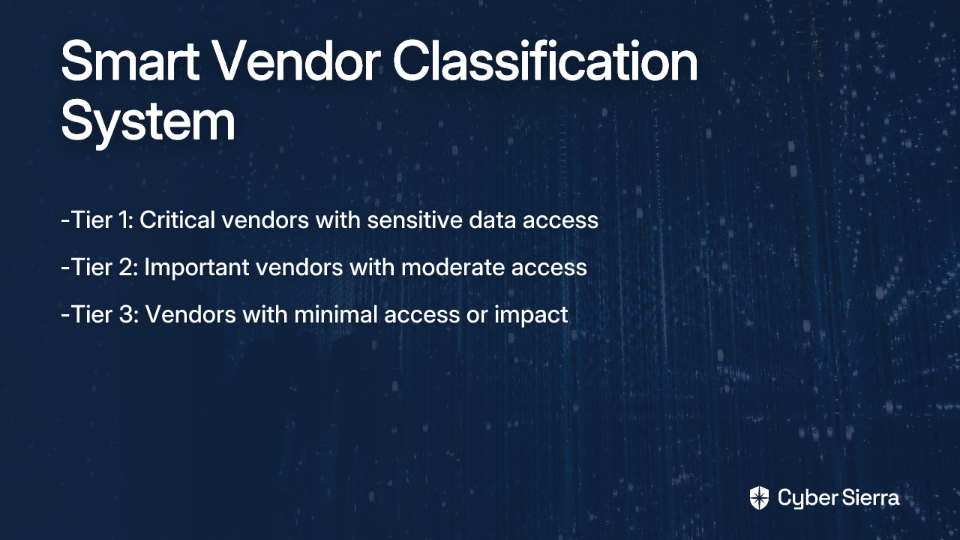
- Tier 1: Critical vendors with access to sensitive data or systems
- Tier 2: Important vendors with moderate access
- Tier 3: Vendors with minimal access or impact
Identify Key Risk Domains: For each vendor, systematically identify the types of risks they introduce:
- Cybersecurity Risks: Exposure to data breaches (over 40% of which originate from third parties)
- Operational Risks: Disruptions to your business operations
- Compliance & Legal Risks: Non-compliance with regulations
- Reputational & Financial Risks: Damage to brand or financial standing
Step 3: Rigorous Due Diligence & Assessment
Standardize Your Approach: Use industry-standard security questionnaires (like SIG, CAIQ, or VSAQ) to create consistent baselines for vendors within each tier.
Go Beyond the Questionnaire: To address the "can't trust they didn't lie" problem, supplement self-assessments with objective evidence:
- Require minimum security certifications like SOC 2 Type II or ISO 27001:2022 for high-risk vendors
- For smaller vendors who can't afford certification, conduct deeper case-by-case reviews and build specific security clauses into their contracts
- Request penetration test results and evidence of security controls
Involve Stakeholders in Integration Reviews: Before onboarding, involve technical and business stakeholders to evaluate the risks of integrating a new vendor's service, as recommended by security professionals in this discussion.
Step 4: Proactive Risk Mitigation & Onboarding
Analyze and Score: Review vendor responses and evidence to assign a formal risk score based on potential impact.
Remediate Before Onboarding: Work with vendors to address unacceptable risks before granting them access to your systems or data. Create clear remediation workflows and track them to completion.
Step 5: From Static to Living: Continuous Monitoring
This is where traditional frameworks fail and effective ones excel. A living framework requires:
Implement Automated Monitoring: Use technology to continuously track vendors' security posture. Cyber Sierra's Continuous Control Monitoring (CCM) provides ongoing, automated visibility into whether vendors' security controls are actually working as intended. This transforms your approach from "trust but verify" to "continuously validate."
Request a Software Bill of Materials (SBOM): For software vendors, an SBOM provides critical visibility into components, allowing you to quickly identify exposure to new vulnerabilities in third-party libraries—exactly what security professionals recommend for maintaining "visibility when the next celebrity vulnerability is announced."
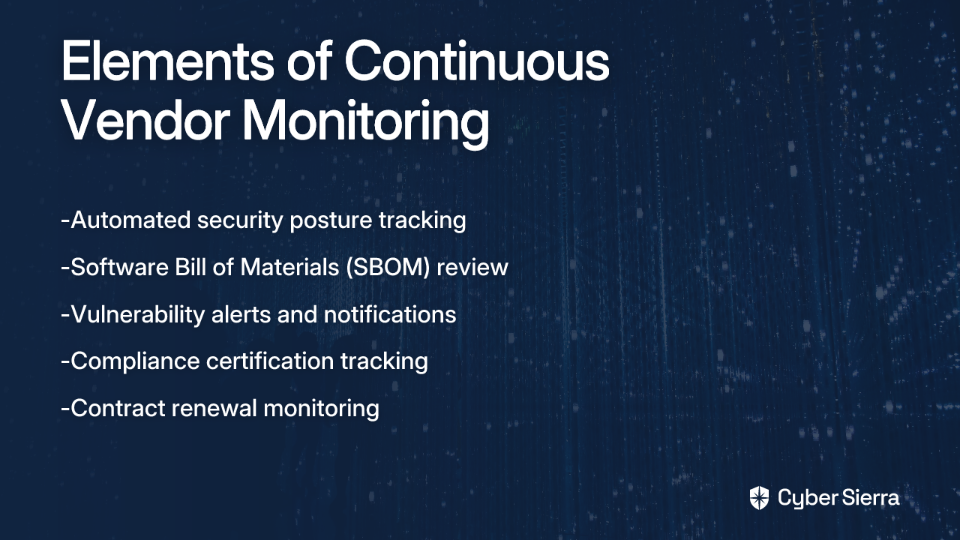
Set Up Automated Alerts: Configure your TPRM system to alert you when:
- A vendor's security posture changes
- New vulnerabilities are discovered in their systems
- Compliance certifications expire
- Contract renewals approach
Step 6: Secure Offboarding
A lifecycle approach requires a secure end. Establish a formal offboarding process to:
- Revoke all access privileges
- Ensure return or destruction of data
- Confirm fulfillment of contractual obligations
- Document lessons learned for future vendor relationships
Powering Your Framework with Automation: Turning Theory into Practice
The blueprint above works in theory, but implementing it manually across hundreds of vendors is virtually impossible. That's where automation becomes not just helpful, but essential:
Why Automation is Non-Negotiable:
- Scalability: Manage assessments across your entire vendor portfolio
- Accuracy & Efficiency: Reduce human error and free up your team for strategic work
- Real-time Visibility: Get instant alerts when vendor risks change
Key Platforms for a Modern TPRM Program:
1. An Integrated Third-Party Risk Management (TPRM) Platform: Cyber Sierra's TPRM solution simplifies the entire vendor lifecycle by:
- Automating vendor assessments
- Streamlining due diligence processes
- Facilitating remediation tracking
- Providing near real-time monitoring of vendor compliance
2. A Centralized Governance, Risk & Compliance (GRC) Solution: Your TPRM program should feed into your overall GRC strategy. Cyber Sierra's GRC module helps manage multiple compliance frameworks and uses data from your TPRM and CCM tools to provide a single source of truth for audits.
Build Your Defensible Perimeter: From Reactive to Proactive TPRM
An effective third-party security risk framework isn't a static document—it's a dynamic, continuous process. By moving from manual, point-in-time checks to an automated, risk-based approach with continuous monitoring, you transform vendor risk management from a compliance chore into a strategic advantage.
Stop the endless cycle of spreadsheets and outdated questionnaires. See how Cyber Sierra's AI-enabled platform automates continuous monitoring and simplifies TPRM to give you real-time visibility and control. Your vendors may represent your biggest attack surface—it's time to defend it with a framework that actually works.
Frequently Asked Questions
What is a Third-Party Risk Management (TPRM) framework?
A Third-Party Risk Management (TPRM) framework is a set of policies, processes, and controls an organization uses to identify, assess, and mitigate risks associated with its external vendors, suppliers, and partners. A comprehensive TPRM framework covers the entire vendor lifecycle, from initial due diligence and onboarding to continuous monitoring and secure offboarding, with the goal of protecting the organization from security, financial, operational, and reputational risks.
Why do most TPRM programs fail?
Most TPRM programs fail because they rely on static, point-in-time assessments like annual questionnaires, are overwhelmed by manual processes, and are often disconnected from the actual business context of vendor relationships. These traditional methods don't account for the continuously evolving security posture of vendors, making them more of a checkbox compliance exercise than an effective security control.
How can you build an effective TPRM framework?
To build an effective TPRM framework, you should adopt a risk-based approach that includes foundational scoping, vendor tiering, rigorous due diligence, proactive risk mitigation, continuous monitoring, and secure offboarding. This "living" framework moves beyond static annual checks, prioritizes resources on high-risk vendors, and uses automated tools to continuously monitor a vendor's security posture for real-time visibility into potential threats.
What is continuous monitoring in the context of TPRM?
Continuous monitoring in TPRM is the ongoing, automated process of tracking a vendor's security posture and controls in near real-time, rather than relying on annual assessments. This involves using technology to continuously validate that a vendor's security controls are working as intended, tracking security ratings, monitoring for new vulnerabilities, and receiving alerts when their risk profile changes.
How should you assess small vendors that lack security certifications?
For small vendors without certifications like SOC 2, you should conduct deeper, case-by-case reviews, request alternative evidence of security controls, and build specific, binding security clauses into their contracts. A rigid, one-size-fits-all approach doesn't work; adapting your due diligence allows you to work with valuable partners while still effectively mitigating risk.
What is the first step to improving a TPRM program?
The first step to improving a TPRM program is to establish a foundational scope and governance by defining clear security objectives and creating a centralized, comprehensive inventory of all third-party relationships. You cannot protect what you don't know you have, and this inventory forms the basis for all subsequent steps, including risk-based tiering and effective governance.
