



How to Measure CCM ROI for CISOs and Compliance Leaders in 2025


Join thousands of professionals and get the latest insight on Compliance & Cybersecurity.
The CISO's $1 Million Question
"What's the ROI on our cybersecurity spend?"
It's the boardroom question that makes every CISO's stomach drop. Traditional ROI calculations work well for revenue-generating departments, but security is different—you're not creating revenue, you're preventing losses.
For compliance leaders, the challenge is even more acute. You're battling "compliance fatigue" while trying to demonstrate that your work isn't just a checkbox exercise but a critical risk management function. As one security professional lamented on r/NISTControls, there's a desperate need for a "structured program for continuous monitoring" that can coordinate compliance checks across different teams.
The good news? In 2025, measuring the ROI of Continuous Control Monitoring (CCM) isn't just possible—it's essential. This article provides a practical framework for quantifying CCM's value and building a compelling business case that speaks the language of your C-suite.
Why Classic ROI Fails (And How to Redefine It for Security)
Traditional ROI calculations focus on profit. Cybersecurity ROI is about something entirely different: cost avoidance and risk reduction.
Security leaders need to embrace a modern definition of ROI, as cited by Balbix:
ROI = Reduction in risk (in monetary terms) due to a security investment.
This leads us to the fundamental formula we'll use throughout this article, adapted from iVision's guide on measuring security value:
ROI = (Risk without mitigation – Risk with mitigation) / Cost of mitigation
This equation reframes the conversation from "How much money did we make?" to "How much money did we save?"—a much more appropriate lens for security investments.

The Foundation of Measurable ROI: Continuous Control Monitoring
Before diving into ROI calculations, let's clarify what makes CCM different from traditional security approaches.
Continuous Control Monitoring is a proactive approach that uses technology for ongoing, automated oversight of security controls. It transforms security from periodic snapshots to a real-time video feed of your security posture.
According to Cybersierra, CCM has three key objectives:
- Confirm the efficacy of controls in mitigating risks
- Maintain a proactive cyber defense posture
- Ensure business continuity and regulatory compliance
Many Reddit users express frustration with tools that claim to be "continuous" but are really just scheduled scans. True CCM provides near real-time insights and alerts, enabling prompt detection and mitigation of risks. This continuous nature is precisely what makes its ROI so impactful and measurable.
The CISO's Playbook: A Step-by-Step Guide to Calculating CCM ROI
Now let's break down the ROI calculation into four manageable steps:
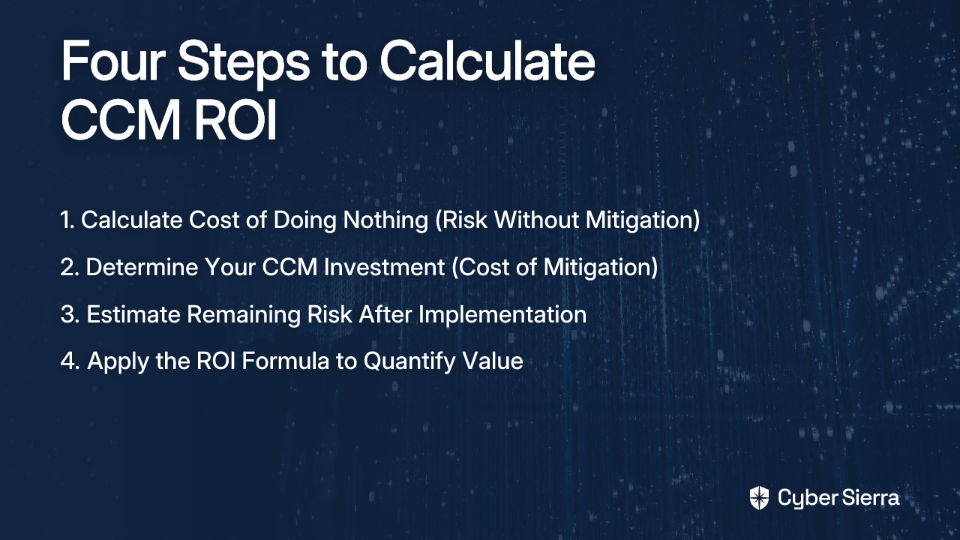
Step 1: Calculate Annualized 'Risk Without Mitigation' (The Cost of Doing Nothing)
This represents your potential financial loss if no CCM solution is implemented. Use this formula, provided by Balbix:
Breach Risk = Breach Likelihood (%) × Breach Impact ($)
To estimate the Breach Impact, include these cost factors, as outlined by iVision:
- Reactive response costs (staff time, resources to contain a breach)
- Analysis costs (forensics, root cause analysis, data loss assessment)
- Preventive measure costs (post-breach training, unplanned security upgrades)
- Legal/regulatory penalties (GDPR, HIPAA fines)
- Reputation damage and customer churn
Example:
- Average cost per major incident (ransomware, data theft): $100,000
- Likelihood: 3 incidents per year
- Annualized Risk Without Mitigation = $300,000
Step 2: Calculate the 'Cost of Mitigation' (Your CCM Investment)
This is the Total Cost of Ownership (TCO) for your CCM solution. Based on Cybersierra's guide, components include:
- Software licensing and subscription fees
- Initial setup and implementation costs
- Employee training costs
- Ongoing operational and maintenance costs
Continuing our example:
- Licensing: $100,000
- Implementation: $100,000
- Training: $50,000
- Operations: $50,000
- Total Year 1 Cost of Mitigation = $300,000
- Ongoing Annual Cost (Years 2+) = $150,000 (licensing + operations)
Step 3: Estimate Annualized 'Risk With Mitigation' (Your Residual Risk)
No solution eliminates 100% of risk. This calculation represents the remaining risk after your CCM solution is deployed:
Continuing our example:
- Assume CCM reduces ransomware and data theft risk by 99%
- Remaining risk: 1% of $200,000 = $2,000
- Assume it reduces service disruption risk by 90%
- Remaining risk: 10% of $100,000 = $10,000
- Add risks not fully mitigated by CCM (e.g., social engineering): $70,000
- Annualized Risk With Mitigation = $82,000
Step 4: Put It All Together - The Final ROI Calculation
Now we can apply our formula with real numbers:
Year 1 ROI:
- ROI = ($300,000 – $82,000) / $300,000
- ROI = 73%
Year 2+ ROI:
- ROI = ($300,000 – $82,000) / $150,000
- ROI = 145%
The key insight: ROI dramatically increases after the first year as implementation costs are sunk, making CCM a highly valuable long-term investment.
Beyond the Formula: Quantifying the "Soft" ROI of CCM
While the financial calculation is powerful, some of CCM's most significant benefits address the operational pains that security teams face daily:
Drastically Reduced Audit Preparation Time & Cost
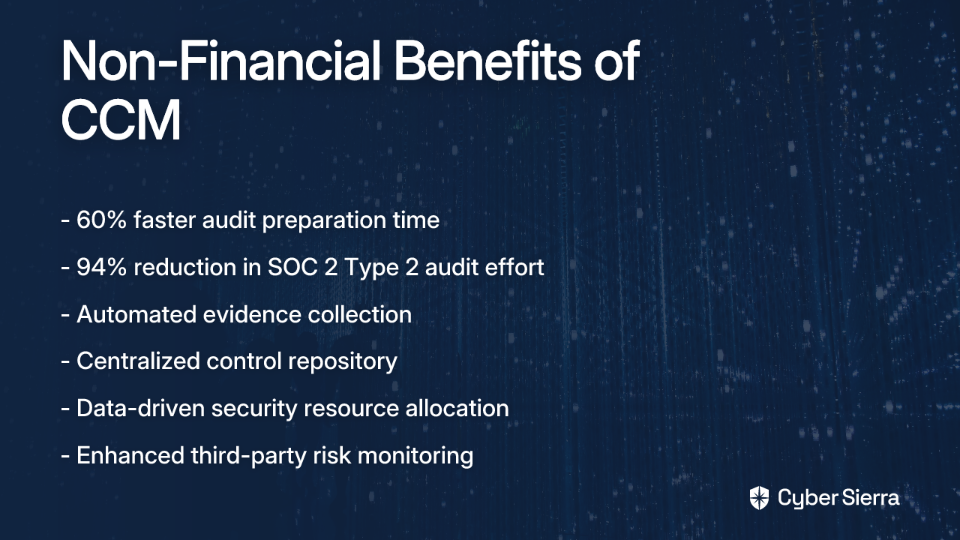
According to research from RegScale, organizations implementing CCM see up to a 60% faster audit preparation and response time and an impressive 94% reduction in effort for SOC 2 Type 2 audits.
This directly translates to thousands of saved man-hours and significantly reduced "audit fatigue"—a pain point frequently mentioned in compliance forums.
Massive Gains in Operational Efficiency
CCM automates manual evidence collection, which is consistently cited as a major pain point in Reddit discussions. This automation frees up skilled security personnel for more strategic tasks rather than spending hours gathering screenshots and documentation.
Moreover, CCM centralizes the control repository, creating a single source of truth. This directly addresses the challenge of "coordinating compliance checks across different roles" mentioned in multiple threads on r/NISTControls.
Enhanced, Data-Driven Decision Making
CCM provides actionable intelligence for strategic resource allocation, helping CISOs answer the board's tough questions identified by Balbix:
- What are our biggest risks?
- Which assets are most at risk?
- Which business units are most exposed?
With this data, security leaders can make evidence-based decisions about where to allocate resources for maximum risk reduction.
Improved Third-Party Risk Management (TPRM)
Many security professionals express skepticism about the honesty of third parties during assessments. CCM can be extended to continuously monitor vendor security posture, moving beyond point-in-time questionnaires to ongoing verification of control effectiveness.
Operationalizing ROI: How an Integrated Platform Makes It a Reality
Now that we've established the "how" and "why" of measuring CCM ROI, let's briefly touch on the "what"—the technology that makes this possible.
A platform like Cybersierra's CCM module provides the real-time visibility and automated control testing needed to collect the data for all the ROI calculations above. It builds the central controls repository and provides dashboards to track key performance indicators.
This integrates with Governance, Risk & Compliance (GRC) capabilities that automate data collection and reporting for frameworks like SOC 2, ISO 27001, HIPAA, and PCI DSS. This integration is what drives the 94% reduction in audit effort mentioned earlier.
When CCM is further connected to Third-Party Risk Management (TPRM), it provides continuous visibility into your supply chain, addressing the concerns about vendor risk that appear frequently in security forums.
From Cost Center to Strategic Business Enabler
Measuring the ROI of Continuous Control Monitoring transforms the conversation about cybersecurity from an abstract cost to a quantifiable business benefit. The framework provided here gives CISOs and compliance leaders the tools to:
- Calculate the financial impact of their security investments
- Demonstrate the efficiency gains from automation
- Quantify the reduction in compliance burden
- Show how security enables broader business objectives
By leveraging CCM, security leaders can not only strengthen their organization's security posture but also clearly articulate its value to the board, securing the budget and buy-in needed to protect the organization in 2025 and beyond.
The days of security as a mysterious cost center are over. With the right approach to measuring CCM ROI, you can demonstrate that your security program is a strategic business enabler that delivers measurable, meaningful value to the organization.
Frequently Asked Questions
What is Continuous Control Monitoring (CCM)?
Continuous Control Monitoring (CCM) is a proactive, technology-driven approach that provides ongoing, automated oversight of a company's security controls. Unlike traditional, periodic audits which are like snapshots in time, CCM acts as a real-time video feed of your security posture. It continuously verifies that security controls are implemented correctly and operating effectively, enabling prompt detection and mitigation of risks.
How do you calculate the ROI of a cybersecurity investment like CCM?
The ROI for a cybersecurity investment is calculated by focusing on cost avoidance and risk reduction, using the formula: ROI = (Risk without mitigation – Risk with mitigation) / Cost of mitigation. This reframes the typical ROI conversation from "How much money did we make?" to "How much money did we save?". It involves quantifying your potential financial loss without the investment (Breach Likelihood × Breach Impact), subtracting the remaining risk after the investment, and dividing that by the total cost of the solution.
Why is CCM so important for compliance and audits?
CCM is crucial for compliance because it automates the manual evidence collection required for audits, drastically reducing preparation time and costs. By providing a centralized, always-up-to-date repository of control evidence, CCM eliminates "audit fatigue." Studies show it can lead to up to a 60% faster audit response time and a 94% reduction in the effort required for demanding audits like SOC 2 Type 2.
What are the main benefits of CCM beyond financial ROI?
Beyond direct financial ROI, the main benefits of CCM include massive gains in operational efficiency, enhanced data-driven decision-making, and improved third-party risk management. It automates tedious tasks, freeing up skilled security professionals for strategic work. It provides CISOs with real-time data to identify the biggest risks and allocate resources effectively. It also allows for continuous verification of vendors' security postures, moving beyond unreliable point-in-time assessments.
How is true CCM different from basic security scanning tools?
True CCM provides near real-time insights and automated alerts about control effectiveness, whereas many basic security tools are simply scheduled scans that offer periodic snapshots. The "continuous" aspect of CCM is key. It's an always-on system that monitors the state and efficacy of controls across your environment. This allows for immediate detection of misconfigurations or failures, unlike a weekly or monthly scan that leaves significant gaps where your organization could be vulnerable.
When can you expect to see a positive ROI from a CCM investment?
While a positive ROI is often achievable in the first year, the financial benefits of a CCM investment typically increase dramatically in the second year and beyond. The first year includes one-time implementation and training costs. After this initial investment, the ongoing costs are significantly lower (often just licensing and maintenance). Since the risk reduction value remains high, the ROI percentage grows substantially, making CCM a powerful long-term strategic investment.
Ready to learn more about implementing Continuous Control Monitoring in your organization? Explore Cybersierra's CCM solution to see how it can help you demonstrate ROI while strengthening your security posture.
