



Regulatory Compliance Management Framework for Multi-Framework Environments

Join thousands of professionals and get the latest insight on Compliance & Cybersecurity.
Summary
- Managing multiple compliance frameworks like ISO 27001 and SOC 2 in silos creates duplicated effort, inconsistent controls, and audit fatigue.
- A unified Regulatory Compliance Management (RCM) framework uses control mapping to "test once, comply with many," saving significant time and resources.
- Start by creating a central control library using a foundational framework like NIST CSF or ISO 27001, then map all other regulatory requirements to it.
- Automate your framework with a GRC platform to enable continuous monitoring and stay perpetually audit-ready. Cyber Sierra automates this process, centralizing evidence collection across all your frameworks.
You've just wrapped up your ISO 27001 audit. The ink is barely dry when your SOC 2 auditor emails asking for the same access control evidence you collected two weeks ago. Sound familiar?
This is the compliance hamster wheel that security and compliance teams across every industry know too well. You're not just managing one framework — you're simultaneously juggling ISO 27001, SOC 2, HIPAA, PCI DSS, and possibly more, with each demanding its own evidence, its own documentation, and often its own dedicated team member.
This isn't just a time drain — it's a business risk. 71% of consumers are willing to abandon companies that mishandle their data, which means fragmented, inconsistent compliance doesn't just hurt your audit outcomes; it erodes stakeholder trust.
The solution is a unified Regulatory Compliance Management (RCM) Framework — one built on a strategy called control mapping that lets you test once and comply with many. This article gives you the practical roadmap to build it.
Section 1: What Is a Regulatory Compliance Management (RCM) Framework?
Before you can unify multiple frameworks, you need a solid foundation to build on.
According to Canada's Office of the Superintendent of Financial Institutions (OSFI), Regulatory Compliance Management (RCM) is defined as "the set of controls through which an organization manages its regulatory compliance risk."
OSFI further defines regulatory compliance risk as "the risk of an organization's potential non-conformance with laws, rules, regulations and prescribed practices in any jurisdiction in which it operates." In plain terms, RCM is your organization's systematic approach to knowing what regulations apply to you, proving you meet their requirements, and catching gaps before they become violations.
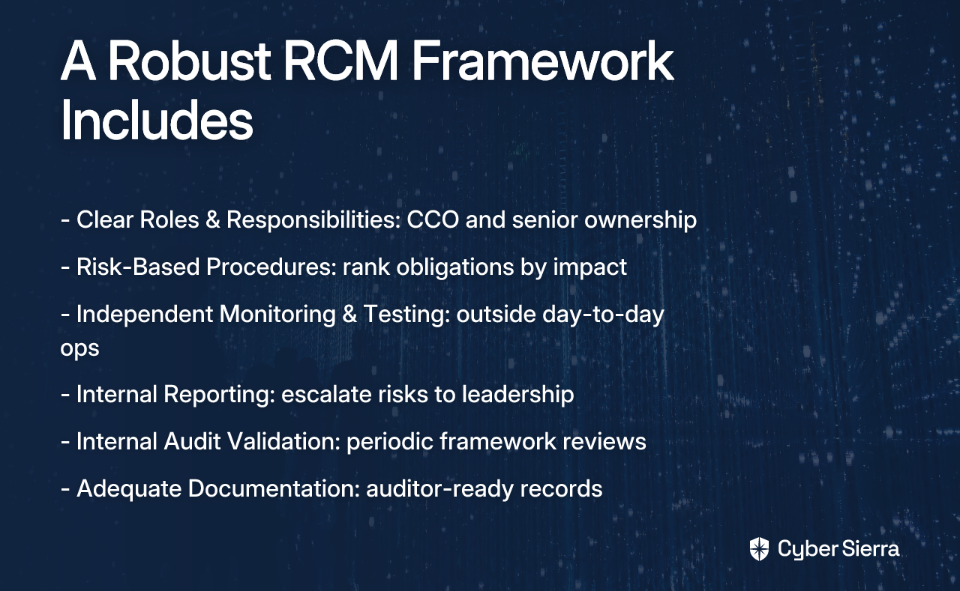
A robust RCM framework, as outlined by OSFI, should include:
- Clear Roles & Responsibilities. Defined accountability, including a Chief Compliance Officer (CCO) and senior management ownership.
- Risk-Based Procedures. A risk-based approach to identify and rank compliance obligations by impact.
- Independent Monitoring & Testing. Controls evaluated by someone outside day-to-day operations.
- Internal Reporting. Timely escalation of compliance risks to senior leadership.
- Internal Audit Validation. Periodic reviews confirming the framework is working as intended.
- Adequate Documentation. Clear, auditor-ready records of every role, process, and control.
These components aren't just regulatory box-ticking — they form the structural backbone that makes multi-framework compliance manageable rather than chaotic.
Section 2: The High Cost of Siloed Compliance
Most organizations don't set out to manage compliance in silos. It just happens. One team handles ISO 27001. Another manages the SOC 2 audit. A third owns HIPAA. Nobody maps the overlap — and everybody pays the price.
Here's what that actually looks like in practice:
Redundant Effort and Resource Drain
This duplication leads to scenarios where, as one CISO noted, three different people own access reviews for three different frameworks. Imagine documenting and testing your access management controls separately for ISO 27001, then repeating the same process for PCI DSS, and doing it a third time for your SOC 2 audit. As highlighted in compliance control challenges, this kind of duplication is exactly what drains security teams of time they could be spending on proactive risk reduction.
Inconsistent Implementation
When different teams interpret and implement similar controls differently, you end up with compliance gaps that none of your individual audits catch. Each team thinks their framework is covered. Nobody's looking at the seams between them.
Audit Fatigue and the Manual Evidence Trap
Audit season shouldn't feel like a fire drill, but for most teams, it does. The process of evidence collection is often described as manual and burdensome — constantly scrambling to pull screenshots, access logs, and policy documents from a dozen different systems across a two-week crunch period. This isn't sustainable, and it leaves organizations perpetually reactive rather than audit-ready.
Section 3: A Step-by-Step Roadmap to a Unified Compliance Framework
Building a unified framework is a deliberate process. Move through these three phases to establish a strong foundation, map your controls, and operationalize your program with automation.
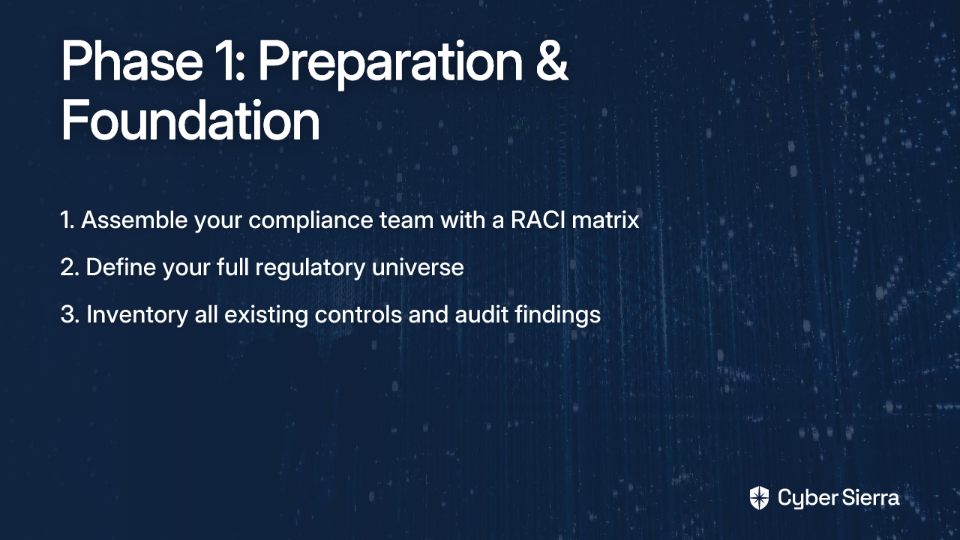
Phase 1: Preparation & Foundation
Step 1: Assemble Your Compliance Team
Effective multi-framework compliance isn't an IT-only problem. Bring together stakeholders from IT security, legal, compliance, and key business units. More importantly, use a RACI matrix (Responsible, Accountable, Consulted, Informed) to assign clear ownership to every control — this directly eliminates the "three different people own the same access review" problem that plagues siloed compliance programs. For a deeper walkthrough, this guide on mapping GRC controls covers team structure in detail.
Step 2: Define Your Regulatory Universe
Document every framework that applies to your organization. Be exhaustive: ISO 27001, NIST CSF, SOC 2, HIPAA, PCI DSS, GDPR, or any industry-specific requirements. This becomes your master list — the full scope of what your unified framework needs to cover.
Step 3: Inventory Existing Controls
Catalog all current policies, procedures, standards, and technical controls already in place. Pull up your last three audit reports. Where did you pass comfortably? Where did you scramble? These insights will tell you which foundations are solid and which gaps need priority attention before you build your unified layer on top.
Phase 2: Mapping & Harmonization
Step 4: Create a Central Control Library
Choose a foundational framework — ISO 27001 or NIST CSF are strong candidates because of their comprehensiveness and broad industry recognition — and use it as your master control set. For each control in your library, capture:
- Unique Control ID (e.g.,
CS-AC-01) - Descriptive Name (e.g., Access Control Policy)
- Control Objective (what risk it mitigates)
- Control Owner (tied to your RACI matrix)
- Implementation Status (implemented, partial, planned)
Step 5: Perform the Cross-Mapping
Now map each central control to its corresponding requirements across every framework in your regulatory universe. Here's a practical example:
| Control ID | Control Name | ISO 27001 | SOC 2 | HIPAA |
|---|---|---|---|---|
| CS-AC-01 | Access Control Policy | Annex A.9.1.1 | CC6.1 | §164.312(a)(1) |
| CS-AC-02 | Privileged Access Review | Annex A.9.2.3 | CC6.3 | §164.308(a)(4) |
The critical best practice here: document the rationale for each mapping. Don't just draw the line between controls — explain why they satisfy the mapped requirement. This is what gives auditors the context they need to trust your framework. Auditors have real concerns about relying solely on software for compliance without context, and this documentation is your answer to that concern.
If you're dealing with multiple frameworks, users find that mapping features save a ton of time — and just as importantly, they remove a lot of the friction with auditors by giving them a single, organized place to find all the necessary evidence.
Phase 3: Automation & Operationalization
Step 6: Implement a GRC Technology Solution
Spreadsheets will get you started, but they will not scale. As your control library grows and your frameworks multiply, manual tracking becomes the very problem you're trying to solve. A dedicated GRC platform is the infrastructure that makes your unified framework operational rather than theoretical.
As practitioners have noted, automated evidence collection genuinely changes the game — it's the difference between a compliance program that's always catching up and one that's always ready.
Section 4: The Right Tools for the Job
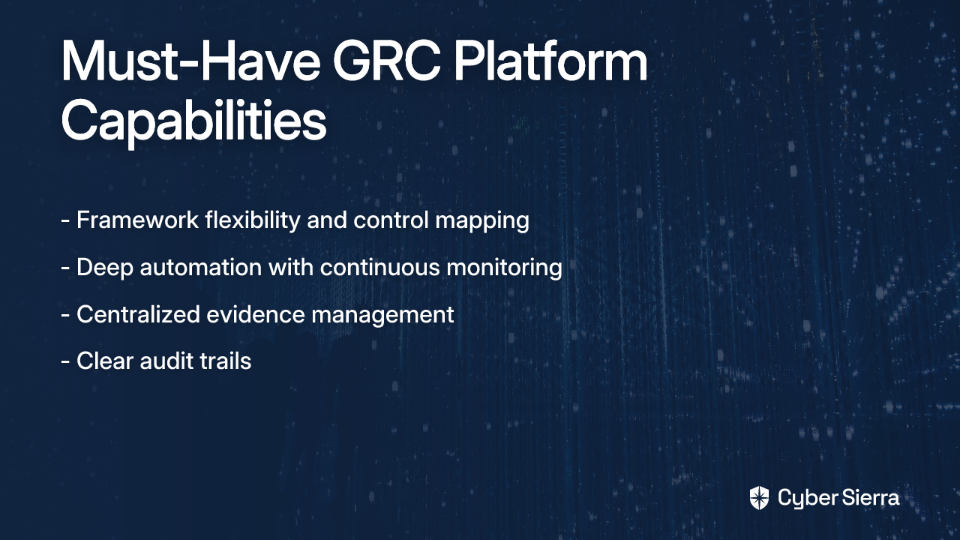
A unified RCM framework is only as strong as the tools powering it. Modern GRC platforms remove the manual burden from evidence collection, control testing, and audit preparation — but not all platforms handle multi-framework environments equally. Look for three non-negotiable capabilities: framework flexibility and control mapping, deep automation with continuous monitoring, and centralized evidence management with clear audit trails.
Here are four platforms worth evaluating:
1. Cyber Sierra
Cyber Sierra is an AI-enabled GRC platform built specifically to simplify and automate compliance across multiple frameworks simultaneously. Its GRC module manages SOC 2, ISO 27001, GDPR, HIPAA, and PCI DSS from a unified dashboard — meaning your cross-mapped control library lives in one place, not scattered across emails and spreadsheets.
What sets it apart for multi-framework environments is its Continuous Control Monitoring (CCM) capability. Rather than waiting for audit season to check control effectiveness, Cyber Sierra provides near real-time visibility into your security controls, automatically collecting evidence from your tech stack — whether that's AWS, Azure, or Google Cloud — and flagging exceptions as they occur. As one user noted, the platform automates checks, catches issues, and "just works without you having to keep an eye on it the whole time." The result is that organizations can become audit-ready faster and often reduce compliance preparation time significantly.
2. Drata
Drata is a popular compliance automation platform supporting over 20 frameworks with extensive integrations across cloud infrastructure, identity providers, and developer tools. It's well-suited for growing SaaS companies that need rapid SOC 2 or ISO 27001 readiness and want pre-built automation workflows.
3. Hyperproof
Hyperproof is designed with audit workflow management at its core. It excels at organizing evidence, tracking control testing status, and collaborating with external auditors through streamlined review portals — a strong choice for teams where auditor collaboration is a frequent pain point.
4. Archer (RSA)
For large enterprises with complex GRC requirements, Archer provides deep audit lifecycle management, enterprise risk aggregation, and highly configurable workflows. It's an enterprise-grade solution built to handle regulatory complexity at scale.
Section 5: Shifting from Reactive Audits to Proactive Compliance
Building the framework is the hard part. Keeping it alive is a matter of culture and habits.
Embrace Continuous Control Monitoring
The old model — scheduling a compliance review once a quarter or scrambling before an annual audit — leaves too many windows where controls can drift out of alignment without anyone noticing. Continuous Control Monitoring (CCM) replaces that model with ongoing, automated testing that surfaces issues in near real-time. Instead of discovering a gap when your auditor does, you find it three months earlier and fix it before it matters.
Engage Auditors Early
Don't present your unified framework to auditors for the first time on day one of the audit. Bring them into the conversation early. Walk them through your control mapping rationale, your evidence trail, and your monitoring approach. Auditors who understand your framework before the audit begins are far more likely to trust its outputs — and far less likely to request duplicative evidence that your mapping already addresses.
Aim Beyond the Audit
The most mature compliance teams understand that passing an audit is a byproduct of a strong security posture — not the goal itself. Your unified RCM framework, when built correctly, doesn't just satisfy auditors. It gives your organization a clear, real-time picture of its actual security posture, enabling smarter decisions, faster remediation, and genuine risk reduction.
Unify Your Framework, Reclaim Your Time
Stepping off the compliance hamster wheel for good means shifting from juggling individual audits to managing a single, unified security posture. It’s not about working harder; it’s about making your effort count multiple times over.
Here’s how to start:
- Stop the duplication. Treat compliance as a unified program, not a series of separate projects. Use control mapping to identify the overlaps between frameworks like SOC 2 and ISO 27001.
- Build your source of truth. Create a central control library based on a comprehensive framework like NIST CSF. This becomes the backbone for all current and future compliance requirements.
When you're ready to automate that process across your entire tech stack, see how Cyber Sierra's continuous monitoring can make compliance a background process, not a fire drill. Book a personalized demo to explore how you can test once and comply everywhere.
Frequently Asked Questions
What is a Regulatory Compliance Management (RCM) framework?
An RCM framework is a systematic approach to managing regulatory compliance risk. It involves identifying applicable regulations, implementing controls to meet them, and continuously monitoring to prevent violations, ensuring your organization remains audit-ready and secure.
Why is control mapping important for managing multiple compliance frameworks?
Control mapping is crucial because it lets you "test once, comply with many." It identifies overlapping requirements across frameworks like ISO 27001 and SOC 2, eliminating redundant work, ensuring consistency, and saving significant time and resources during audits.
How do I start building a unified compliance framework?
Begin by assembling a cross-functional team and defining your "regulatory universe" (all applicable frameworks). Next, choose a foundational framework like ISO 27001 or NIST CSF to create a central control library. This forms the backbone for mapping all other requirements.
What are the biggest risks of managing compliance in silos?
Siloed compliance creates redundant effort, drains resources, and leads to inconsistent control implementation, creating security gaps. It also causes audit fatigue and keeps teams in a reactive state, scrambling for evidence instead of proactively managing risk.
What is the difference between traditional audits and continuous control monitoring?
Traditional audits are a point-in-time check, often done annually. Continuous Control Monitoring (CCM) uses automation to test controls in near real-time. This proactive approach identifies compliance drifts as they happen, ensuring you are always audit-ready.
Can a GRC platform replace our compliance team?
No, a GRC platform is a tool to empower your compliance team, not replace it. It automates repetitive tasks like evidence collection and monitoring, freeing up your team to focus on strategic risk management, control improvements, and auditor collaboration.
