



Top 8 Tools for Real-Time Security Control Break Detection

Join thousands of professionals and get the latest insight on Compliance & Cybersecurity.
Summary
- Periodic security audits create dangerous visibility gaps, leaving your business exposed to undetected vulnerabilities for months between assessments.
- Real-time security control monitoring is critical for instantly detecting control failures, allowing you to proactively fix security gaps and maintain continuous compliance.
- This article explores eight essential tools for real-time detection, including SIEM, EDR/XDR, and specialized Continuous Control Monitoring (CCM) platforms.
- For organizations seeking a unified solution, Cyber Sierra's Continuous Control Monitoring (CCM) platform automates control validation, integrates with GRC, and provides real-time visibility to ensure you're always audit-ready.
You've implemented security controls, passed your audits, and established a robust security program. But there's a nagging worry keeping you up at night: what happens when those controls fail between audits? As one security professional put it, "Not worrying about unnoticed vulnerabilities or compliance risks has been a huge relief." This relief only comes when you have robust monitoring in place.
In today's rapidly evolving threat landscape, the traditional approach of periodic security assessments is dangerously inadequate. Consider this sobering reality shared by a cybersecurity expert: "Just 1 compromise is enough to bring a business to its knees." With threats evolving by the minute, waiting for quarterly audits to identify control failures means potentially devastating vulnerabilities could go undetected for months.
This is where real-time security control break detection becomes critical. By continuously monitoring your security controls, you can identify breakdowns the moment they occur, not weeks or months later during your next assessment.
Let's explore the eight most effective tools for detecting security control breaks in real-time, helping you maintain continuous visibility into your security posture and compliance status.

1. Cyber Sierra: Continuous Control Monitoring (CCM)
Best for: Enterprise organizations seeking a unified, automated CCM program that integrates GRC, third-party risk management, and threat intelligence.
Cyber Sierra's CCM platform transforms security from periodic checks to a continuous, automated monitoring system. It provides ongoing visibility into security controls, tracks digital assets, and assesses risk in near real-time to proactively identify and remediate security gaps.
Key Features:
- Central Controls Repository: Creates a centralized hub for all security controls with near real-time updates, enhancing visibility across your organization
- Automated Control Testing: Continuously tests and validates controls to detect exceptions, anomalies, and compliance gaps as they occur
- Multi-Framework Compliance: Manages controls across multiple frameworks like NIST, ISO 27001, PCI DSS, and GDPR, streamlining audits and reducing manual evidence collection
- Actionable Risk Intelligence: Delivers data-driven insights for informed remediation prioritization
- Real-Time Alerts: Provides immediate notification of control failures for faster incident response
Security and compliance leaders appreciate Cyber Sierra's ability to reduce the manual burden of control validation while providing continuous assurance that critical controls remain operational between audit cycles.

2. SIEM (Security Information and Event Management) - e.g., Splunk
Best for: Organizations needing to centralize and analyze security data from across their entire IT infrastructure.
SIEM platforms like Splunk deliver operational intelligence by collecting, aggregating, and analyzing machine-generated data in real time. They correlate events from diverse sources such as firewalls, servers, and applications to identify suspicious activity and potential threats.
Key Features:
- Real-time log collection, monitoring, and analysis
- Security event correlation to identify complex threats
- Customizable dashboards and alerting mechanisms
- Automated compliance reporting for standards like GDPR, HIPAA, and PCI DSS
While powerful, SIEM solutions require skilled personnel to configure, manage, and respond to the insights they generate, making them better suited for organizations with dedicated security teams.
3. EDR/XDR - e.g., Palo Alto Networks Cortex XDR
Best for: Organizations seeking integrated detection and response across endpoints, networks, and cloud environments.
Extended Detection and Response (XDR) solutions like Palo Alto Networks Cortex XDR enhance security by unifying data analytics across multiple security layers. They use machine learning and behavioral analytics to detect advanced threats that might evade traditional signature-based tools.
Key Features:
- Continuous monitoring of endpoint and network activity
- Advanced analytics and behavioral threat detection
- Automated incident response capabilities
- Machine learning for anomaly detection
- Root cause analysis for faster investigation
XDR platforms excel at reducing the time between detection and response, addressing the concern that "when a big incident affects multiple customers, you may not get the kind of response times you'd like."
4. Vulnerability Management - e.g., Qualys
Best for: Enterprises needing continuous assessment of their security posture and proactive vulnerability management.
Qualys provides a cloud-based platform for continuous security and compliance monitoring. It specializes in identifying, prioritizing, and remediating vulnerabilities across on-premises systems, cloud environments, and web applications.
Key Features:
- Real-time monitoring for vulnerabilities across systems
- Continuous compliance checks against various standards
- Comprehensive asset inventory and management
- Prioritization of vulnerabilities based on threat intelligence
- Automated scanning and reporting capabilities
Effective vulnerability management tools help prevent complacency in security teams, addressing the concern that "you'll get very comfortable with what you have as you continue to do well and get busy with other aspects of the business."
5. Intrusion Detection and Prevention Systems (IDPS)
Best for: Real-time network traffic monitoring to detect and block suspicious activity.
An IDPS monitors network or system activities for malicious activity or policy violations. It serves as a foundational tool for real-time threat detection, addressing the need for "24/7 monitoring" to catch things "early that we would've totally missed."
Key Types and Features:
- Network-based IDS (NIDS): Monitors traffic across the entire network
- Host-based IDS (HIDS): Analyzes logs and activities on individual devices
- Real-time traffic monitoring and alerts for detected intrusions
- Automated actions to mitigate threats (in IPS systems)
As noted by security experts at Clearnetwork, IDPS systems excel at immediate threat detection but often lack historical data for trend analysis, making them most powerful when combined with SIEM technology.
6. AI-Powered Threat Detection - e.g., Darktrace
Best for: Automating threat investigations and identifying novel or sophisticated threats.
Darktrace's Cyber AI Analyst utilizes self-learning AI to understand the "normal" behavior of a network. It can then detect subtle anomalies that indicate a threat in real-time, automating threat investigations and reducing the workload on security teams.
Key Features:
- Machine learning models for threat prioritization
- Deep analysis of alerts to provide context
- Automated threat investigation reports
- Detection of insider threats and novel attack vectors
- Self-learning capabilities that improve over time
AI-powered platforms address the concern that "MSSPs take a fairly generic look at things, and may not understand the specifics of your business processes" by learning your unique environment over time.
7. Continuous Vulnerability Assessment - e.g., Tenable.io
Best for: Gaining complete visibility into cyber exposure across modern attack surfaces.
Tenable.io provides visibility into the security posture of networks and systems. It helps organizations understand and reduce their cyber risk by identifying vulnerabilities before they can be exploited.
Key Features:
- Continuous monitoring and assessment of vulnerabilities
- Comprehensive coverage of IT, cloud, OT, and web applications
- Predictive prioritization of vulnerabilities
- Detailed reporting capabilities to support compliance efforts
- Integration with ticketing and remediation workflows
These tools provide the continuous vigilance necessary when "taking security as one of the most important parts of your systems."
8. Automated Compliance Monitoring - e.g., Hyperproof
Best for: Organizations looking to automate control testing and streamline evidence collection.
Tools like Hyperproof specialize in automating the labor-intensive aspects of compliance. They continuously monitor critical controls, test their effectiveness, and collect evidence automatically, ensuring organizations are always audit-ready.
Key Features:
- Automated testing of technical controls
- Streamlined control assessment processes
- Integration with cloud services to pull evidence
- Reduction of compliance fatigue
- Improved audit readiness and reduced manual effort
How to Choose a Real-Time Detection Tool
When selecting a solution, remember that "it's not just about a tool to monitor threats" - you need a comprehensive strategy. Consider these key factors:
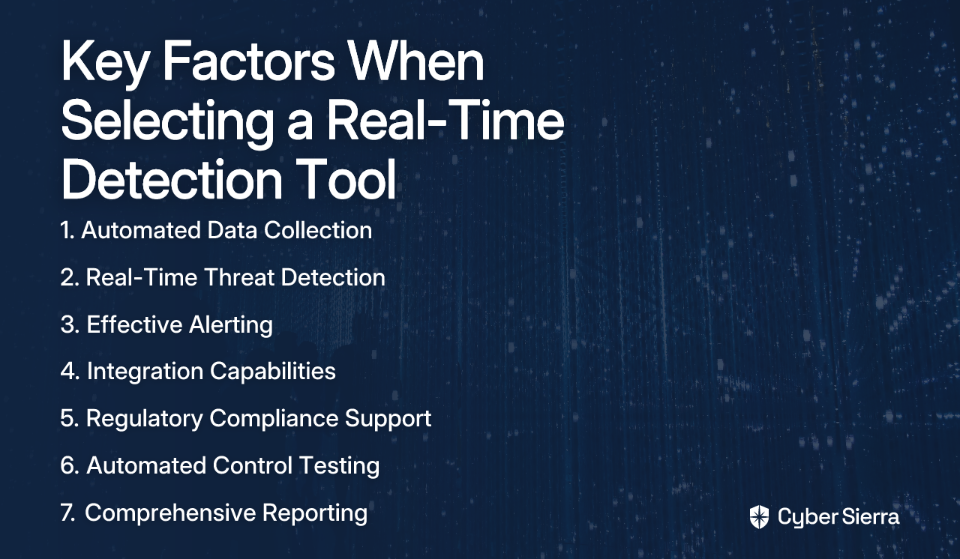
- Automated Data Collection: Does the tool automatically collect data and monitor controls without manual intervention?
- Real-Time Threat Detection: Can it identify and alert on threats as they happen?
- Effective Alerting: Are the alerts actionable and prioritized, or will they lead to alert fatigue?
- Integration Capabilities: Can it integrate with your existing security frameworks and tools?
- Regulatory Compliance Support: Does it support your specific compliance frameworks?
- Automated Control Testing: Does it automate the validation of control effectiveness?
- Comprehensive Reporting: Does it provide detailed reports for stakeholders and auditors?
Conclusion
In today's rapidly evolving threat landscape, static security measures and periodic assessments are dangerously inadequate. Real-time detection tools are no longer a luxury but a necessity for maintaining a strong security posture and meeting compliance requirements.
For organizations seeking to move from periodic security checks to continuous monitoring, platforms like Cyber Sierra offer comprehensive solutions that integrate continuous control monitoring with threat intelligence and compliance automation. This unified approach helps security teams detect control breaks in real-time, respond quickly to threats, and maintain a consistently strong security posture.
As one security professional summarized, "Not worrying about unnoticed vulnerabilities or compliance risks has been a huge relief" - a relief that comes from knowing your security controls are continuously monitored and functioning as intended, even between formal assessments.
Frequently Asked Questions
What is real-time security control monitoring?
Real-time security control monitoring, also known as Continuous Control Monitoring (CCM), is the process of continuously testing and validating your security controls to ensure they are working as intended. Instead of relying on periodic assessments, this approach uses automated tools to provide ongoing visibility into your security posture, allowing you to detect control failures or compliance gaps the moment they occur.
Why are periodic security audits no longer sufficient?
Periodic security audits are no longer sufficient because they only provide a point-in-time snapshot of your security posture, leaving dangerous gaps where vulnerabilities can go undetected for weeks or months. The modern threat landscape evolves rapidly, and a control that was effective during an audit can fail the next day. Continuous monitoring closes these gaps by providing constant vigilance.
How does Continuous Control Monitoring (CCM) improve security posture?
CCM improves security posture by providing immediate, actionable insights into the effectiveness of your security controls. It automates the detection of misconfigurations, vulnerabilities, and compliance deviations, which allows security teams to proactively remediate issues before they can be exploited. This shift from a reactive to a proactive stance significantly reduces overall cyber risk.
What is the difference between a SIEM and a CCM platform?
A SIEM (Security Information and Event Management) platform primarily focuses on collecting, aggregating, and analyzing log data from various sources to detect security threats and suspicious activities. In contrast, a CCM platform is specifically designed to automate the testing and validation of security controls against established policies and frameworks (like NIST or ISO 27001). While a SIEM is great for threat detection, a CCM platform ensures the underlying controls are functioning correctly in the first place.
How do I choose the right real-time security monitoring tool?
To choose the right tool, you should first assess your organization's specific needs, including regulatory requirements, existing infrastructure, and team expertise. Key factors to consider include the tool's ability to automate data collection and control testing, provide effective real-time alerts without causing fatigue, integrate with your existing security stack, and generate comprehensive reports for both technical teams and auditors.
What role does AI play in modern security monitoring?
AI and machine learning play a crucial role by automating the detection of complex and novel threats that traditional signature-based tools might miss. AI-powered platforms can establish a baseline of normal network behavior and then identify subtle anomalies that could indicate a threat. This automates threat investigation, prioritizes alerts, and reduces the manual workload on security analysts, enabling faster and more accurate responses.
By implementing the right real-time detection tools, you can achieve that same peace of mind, knowing that your organization is protected around the clock from evolving cyber threats and compliance lapses.
