



How to Build a Third-Party Risk Management Program From Scratch (A CISO Playbook)

Join thousands of professionals and get the latest insight on Compliance & Cybersecurity.
Summary
- Most TPRM problems stem from a lack of a centralized vendor inventory and clear governance, not the absence of advanced tools.
- This 90-day playbook guides you through building a program from scratch: first establish visibility (inventory and tiers), then standardize assessments, and finally operationalize with continuous monitoring.
- To mature your program, shift from outdated annual assessments to continuous monitoring, which provides real-time visibility into your vendors' changing risk posture.
- Once your foundational processes are defined, a platform like Cyber Sierra's TPRM module can automate manual tasks like vendor assessments and continuous monitoring, allowing your program to scale effectively.
You've just stepped into a new role — or been handed a new mandate — and somewhere in the chaos of your first few weeks, you discover the uncomfortable truth: your organization's third-party risk management program is either a tangled web of spreadsheets, or it doesn't exist at all.
Sound familiar? You're in good company. Many security practitioners find their TPRM programs devolve into a messy collection of spreadsheets, questionnaires, and subjective risk rankings. As many CISOs have learned the hard way, managing vendor risk in Excel is, to put it diplomatically, "a pain."
Here's what's critical to understand before you do anything else: most TPRM problems aren't tool problems — they're inventory and governance problems. Before you evaluate a single vendor risk platform, you need a structured foundation. That's exactly what this 90-day playbook gives you.
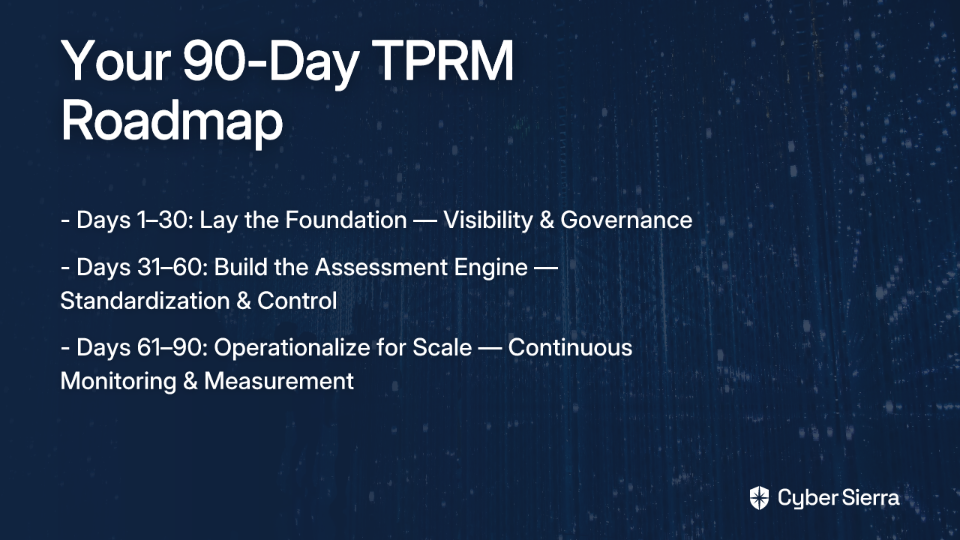
This is a practical, phased guide for the newly appointed TPRM owner or CISO who needs to move fast, build smart, and create a program that can actually scale. Here's your roadmap:
- Days 1–30: Lay the Foundation — Visibility and Governance
- Days 31–60: Build the Assessment Engine — Standardization and Control
- Days 61–90: Operationalize for Scale — Continuous Monitoring and Measurement
Let's get to work.
Phase 1 (Days 1–30): Lay the Foundation — Visibility and Governance
Objective: Move from zero visibility to a clear, risk-prioritized map of your entire vendor ecosystem.
Step 1: Build a Centralized Vendor Inventory
You cannot manage risk you cannot see. Your first task is to create a single, authoritative list of every third-party vendor your organization relies on. As IBM's TPRM guidance highlights, this includes not just direct suppliers but also downstream partners — and ideally, Nth-party vendors (your vendors' vendors) for a complete picture of your supply chain security exposure.
How to start manually:
- Pull contract and payment records from Accounts Payable and Procurement.
- Interview business unit leaders to surface "Shadow IT" tools that never went through a formal procurement process.
- Begin your inventory in a spreadsheet or, better yet, a SharePoint list — a community-recommended option that's more "web native," easier to cross-reference, and far better for multi-user access than a local Excel file.
Where manual hits a ceiling: Spreadsheets go stale the moment you close them. They have no version control, no automated updates, and no way to alert you when a vendor's status changes. At 50+ vendors, the inventory itself becomes a risk.
The automation path: Cyber Sierra's TPRM module gives you a centralized platform to build and maintain your vendor inventory from day one. It helps you identify risks, prioritize your vendor list, and streamline both onboarding and offboarding — so your inventory is always a living, accurate record, not a stale snapshot.
Step 2: Define Risk Tiers
Not every vendor deserves the same level of scrutiny. One of the most important third-party risk management best practices is to categorize vendors into risk tiers so you can direct your limited resources where they matter most.
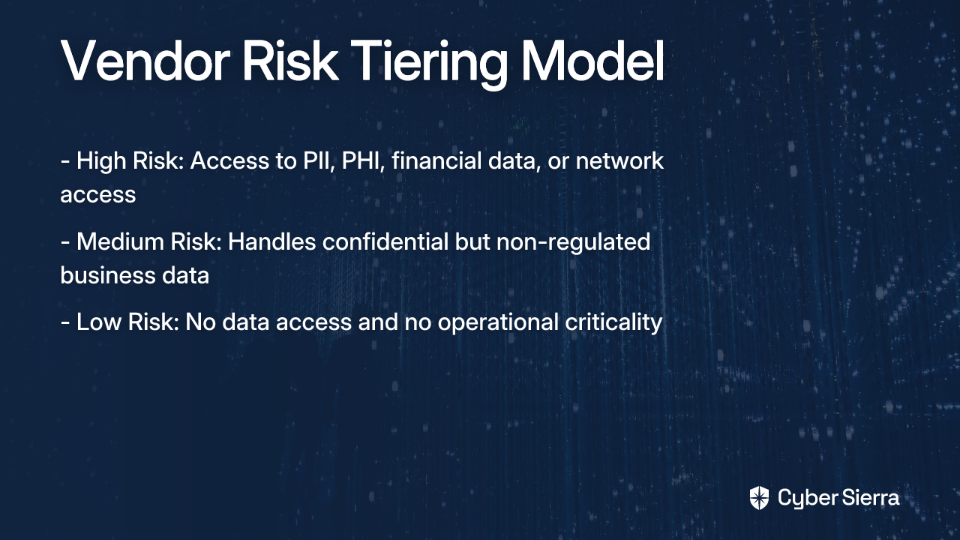
A simple, defensible tiering model:
- High Risk. Vendors with access to PII, PHI, or financial data; those with direct network access; or those critical to business continuity.
- Medium Risk. Vendors handling confidential but non-regulated business data.
- Low Risk. Vendors with no data access and no operational criticality (think office supplies or event catering).
This tiering logic is reinforced by the broader vendor risk management community: "Vendors are then tiered by risk (low, medium, high/critical), which determines how much due diligence is required."
Where manual hits a ceiling: Applying tiering criteria consistently across hundreds of vendors is error-prone and inherently subjective. More importantly, a spreadsheet doesn't dynamically update when a vendor's risk profile changes — but their access to your data certainly does.
Step 3: Assign Program Ownership and Establish Governance
A program without a clear owner is a program destined to fail. Before Day 30, you need to formally designate a TPRM program owner and establish a cross-functional governance structure that includes Legal, Procurement, IT, and business unit representatives.
How to start manually:
- Draft and publish a TPRM policy document outlining roles, responsibilities, and escalation paths.
- Stand up a cross-functional risk committee that meets regularly for risk acceptance decisions and oversight.
The automation path: Cyber Sierra's GRC module centralizes policy management, audit trails, and compliance workflows, giving every stakeholder a unified view and ensuring governance decisions are documented — not buried in an email chain.
Phase 2 (Days 31–60): Build the Assessment Engine — Standardization and Control
Objective: Create a repeatable, defensible process for evaluating vendor risk that scales beyond a handful of vendors.
Step 1: Build Assessment Workflows and Questionnaire Templates
Ad-hoc vendor emails and informal check-ins aren't a process — they're a liability. By Day 31, you need standardized questionnaires and a formal assessment workflow, tailored to the risk tiers you established in Phase 1.
How to start manually:
- Develop a tiered questionnaire library: a comprehensive review for high-risk vendors, a lighter-touch survey for medium-risk, and a simple policy confirmation for low-risk.
- For large, mature providers like AWS or Microsoft, skip the questionnaire entirely and request independent assurance like their SOC 2 report instead — this is both more efficient and more credible.
- Standardize your scoring so you can objectively compare vendor responses and flag gaps.
The problem is familiar to anyone who has tried scaling this manually: "The certs, risk docs, and endless follow-ups became a full-time job." That's not a resource problem — it's a process design problem.
Where manual hits a ceiling: Distributing questionnaires by email, chasing responses, and manually scoring hundreds of submissions is unsustainable. It's the single biggest bottleneck in any manual TPRM program, and it only gets worse as your vendor count grows.
The automation path: Cyber Sierra's TPRM module automates the full assessment lifecycle — distributing tailored questionnaires based on risk tier, sending automated reminders, ingesting vendor responses, and surfacing risks for immediate review — without a single manual follow-up email.
Step 2: Embed Contractual Security Controls
Your contract is your enforcement mechanism. It transforms security expectations into binding legal obligations, and yet this step is often the most overlooked in early-stage TPRM programs.
What to require contractually:
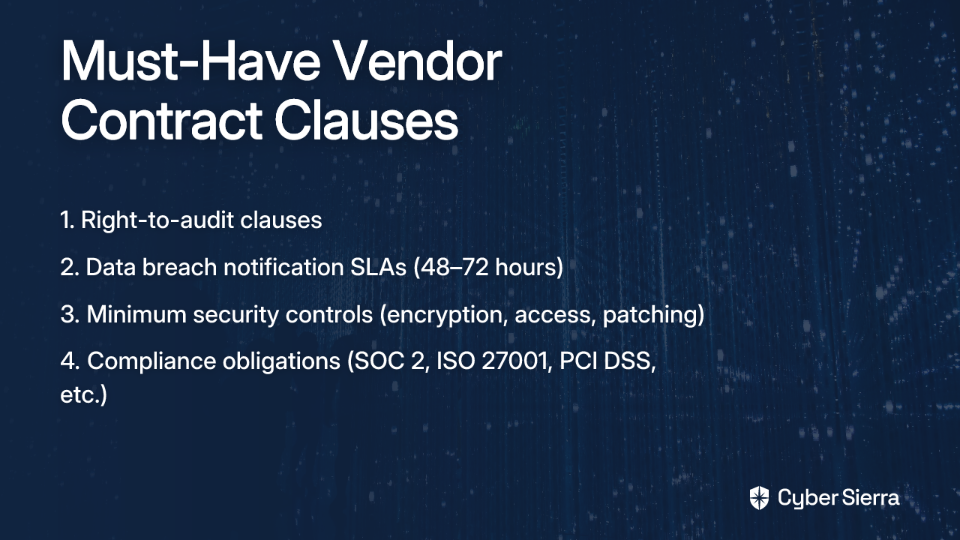
- Right-to-audit clauses that allow you to verify vendor security practices.
- Data breach notification SLAs — industry standard is 48–72 hours, but align this to your regulatory requirements (GDPR, CCPA, HIPAA).
- Minimum security control requirements — encryption at rest and in transit, access controls, and regular patching cadences.
- Compliance obligations tied to the frameworks relevant to your industry (SOC 2, ISO 27001, PCI DSS, etc.).
Work with your legal team to create a reusable "Security Addendum" that attaches to every new vendor contract. For renewals, use the opportunity to retrofit these requirements into existing agreements.
Where manual hits a ceiling: Tracking which contracts include which security clauses across a sprawling vendor base — and managing renewal dates to enforce updates — is a recipe for compliance gaps. And a gap discovered during an audit is far more expensive than the effort to prevent it.
The automation path: Pairing contractual controls with Cyber Sierra's GRC module links your contractual obligations to your control framework, making audits clean, evidence collection automated, and vendor accountability traceable.
Phase 3 (Days 61–90): Operationalize for Scale — Continuous Monitoring and Measurement
Objective: Graduate from point-in-time, reactive risk management to a dynamic, continuously monitored, data-driven TPRM function.
Step 1: Move to Continuous Monitoring
Annual vendor assessments give you a snapshot of risk from twelve months ago. The threat landscape doesn't operate on an annual cycle — and neither should your TPRM program.
A vendor that passed your assessment in January may have suffered a breach in March, introduced a critical unpatched vulnerability in June, or quietly changed their subprocessors in September. As one security practitioner put it: "You still have to manage and monitor the accepted risks. You don't just accept them and move on."
Where manual fails completely: It is physically impossible to manually monitor the external attack surface, compliance status, and breach notifications for your entire vendor ecosystem in real time. This is the point in your TPRM maturity journey where automation stops being a nice-to-have and becomes the only viable path forward.
The automation path: Cyber Sierra's TPRM module combined with its Continuous Control Monitoring (CCM) provides near real-time visibility into vendor security compliance. You get near real-time updates on vendor risk profiles, automated compliance checks, and actionable security scorecards — without waiting for an annual review cycle to surface a problem that's already cost you.
Step 2: Define Clear Escalation Paths
When a vendor's risk score spikes, who acts? By when? Escalation paths are often assumed but rarely documented — and that ambiguity becomes painfully obvious during an incident.
Document your escalation triggers:
- A critical vulnerability is discovered in a vendor's publicly exposed infrastructure.
- A vendor fails to remediate a finding within the agreed timeframe.
- A public data breach notification names your vendor.
For each trigger, define: who owns the response, who needs to be notified (including Legal, executive leadership, and potentially regulators), and what the resolution timeline looks like.
The automation path: Cyber Sierra can automate alerts and workflow triggers the moment a vendor's risk status changes — so your escalation path fires automatically, not after someone happens to check the spreadsheet.
Step 3: Set KPIs and Report to the Board
If you can't measure your TPRM program's effectiveness, you can't defend its budget. You need to track key metrics that demonstrate program health and communicate risk reduction to leadership in business terms.
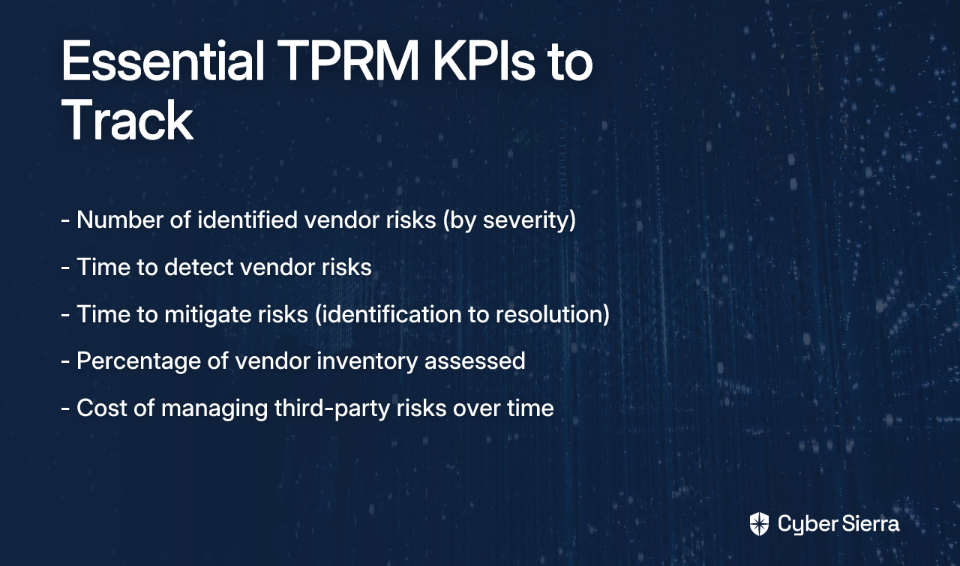
Essential TPRM KPIs to track:
- Number of identified vendor risks (broken down by severity)
- Time to detect vendor risks
- Time to mitigate risks from identification to resolution
- Percentage of vendor inventory assessed (coverage rate)
- Cost of managing third-party risks over time
Even if you start in a spreadsheet, track these numbers consistently. They become the foundation of your board reporting and your strongest argument for continued investment in the program.
The automation path: An integrated platform like Cyber Sierra provides out-of-the-box dashboards that surface these KPIs in real time, transforming board reporting from a manual compilation exercise into a live, credible view of program health.
From Playbook To Protection
Building a TPRM program from scratch isn't about buying a tool—it's about disciplined execution. This 90-day plan gives you the framework, but the real wins come from two foundational shifts: creating a single, authoritative vendor inventory and moving from outdated annual check-ins to continuous, real-time monitoring. These are the pillars of a resilient program.
Your next move is simple: start building that master vendor list. It’s the one action you can take today that unlocks everything else.
Once your processes are defined, you’ll inevitably hit a ceiling where spreadsheets can’t keep up. That's where automation becomes your force multiplier, turning manual check-ups into a scalable, data-driven program that protects your organization and enables growth. When you’re ready to see how a platform can automate your playbook, book your personalized demo and we'll show you how to get there faster.
Frequently Asked Questions
What is third-party risk management (TPRM)?
Third-party risk management (TPRM) is the process of identifying, assessing, and mitigating risks associated with using external vendors. It involves creating a vendor inventory, evaluating their security posture, and continuously monitoring for new threats to protect your organization's data and operations.
What is the first step in building a TPRM program?
The first and most critical step in building a TPRM program is to create a centralized vendor inventory. You cannot manage risks you cannot see. This involves compiling a complete list of all third-party vendors and uncovering any "Shadow IT" to get a full picture of your exposure.
How should I categorize vendor risk levels?
Categorize vendors into risk tiers (e.g., High, Medium, Low) based on their access to sensitive data and their operational criticality. High-risk vendors handle PII or have network access, while low-risk vendors have none. This ensures your resources are focused where they matter most.
When is the right time to move from spreadsheets to a TPRM tool?
You should move from spreadsheets to a TPRM tool when manual tracking becomes unsustainable, typically around 50+ vendors. Spreadsheets lack version control and automated updates. A dedicated tool automates assessments and monitoring, making your program proactive instead of reactive.
What makes a TPRM program effective in the long run?
An effective TPRM program moves beyond annual, point-in-time assessments to a model of continuous monitoring. This provides real-time visibility into vendor security posture, allowing you to respond to emerging threats proactively, rather than waiting for the next assessment cycle.
How do you measure the success of a TPRM program?
Measure success by tracking Key Performance Indicators (KPIs) like the time to detect and mitigate vendor risks, and the percentage of your vendor inventory assessed. These metrics demonstrate risk reduction and program health to leadership, justifying investment in your TPRM function.
