



Top 8 Problems Solved by Unified GRC and CCM Platforms

Join thousands of professionals and get the latest insight on Compliance & Cybersecurity.
Summary
- Nearly 69% of executives doubt their GRC policies will meet future needs, and with around 200 regulatory updates daily, manual tracking is unsustainable.
- Manual compliance processes lead to audit fatigue and security blind spots, which increases costs and the risk of non-compliance.
- Unified Governance, Risk, and Compliance (GRC) platforms with Continuous Control Monitoring (CCM) automate evidence collection and provide real-time security visibility.
- Cyber Sierra’s Governance, Risk & Compliance platform helps organizations automate these workflows to reduce audit fatigue and maintain a continuous, audit-ready posture.
You're drowning in spreadsheets. Your team is frantically chasing down evidence for an upcoming audit. That expensive GRC platform you invested in sits largely unused because it doesn't match how your team actually works. Sound familiar?
If you've ever found yourself buried under compliance documentation or frustrated by clunky security tools, you're not alone. As one security professional recently lamented on Reddit, there's a "mismatch between tool capabilities and actual organizational processes" in most GRC solutions.
The numbers tell an even more concerning story: around 69% of executives believe their current GRC policies may not meet future needs, while 57% feel unprepared for risk and compliance challenges. Meanwhile, an average of 200 regulatory updates occur daily across over 900 regulatory bodies worldwide—making manual tracking practically impossible.
The solution lies in shifting from periodic, manual compliance approaches to continuous, automated ones through unified Governance, Risk, and Compliance (GRC) and Continuous Control Monitoring (CCM) platforms.
Let's explore the top eight operational headaches that these integrated platforms eliminate, transforming compliance from a burden into a strategic advantage.
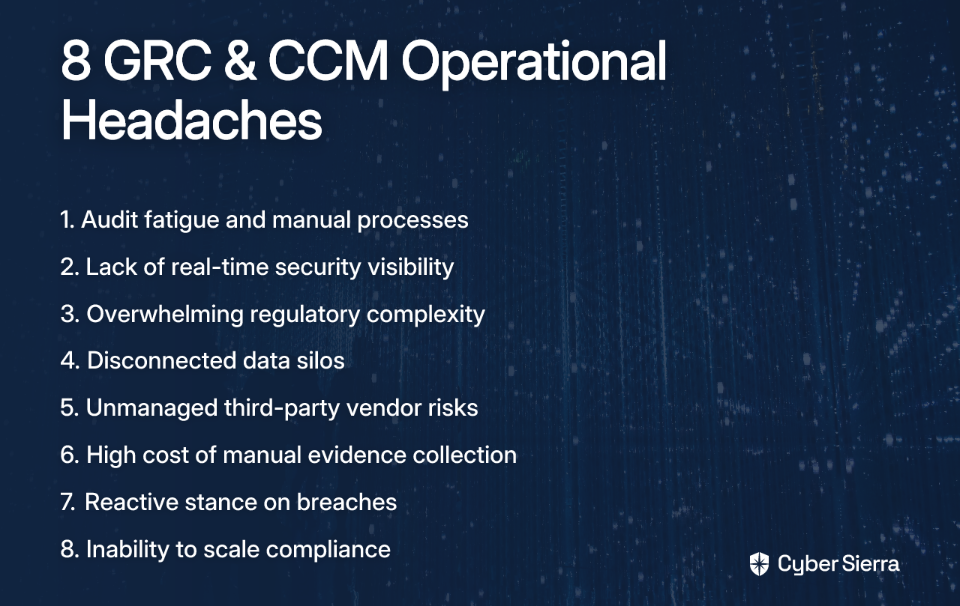
Problem 1: Crippling Audit Fatigue and Inefficient Manual Processes
The Problem: The all-too-familiar "audit fire drill" consumes organizations for weeks or months before assessments. Teams scramble to collect evidence, update spreadsheets, and chase stakeholders via email—all manual processes prone to human error and burnout.
The Solution: A unified platform transforms audit preparation from a periodic crisis into a continuous state of readiness by:
- Automating evidence collection from various systems (cloud, network, identity)
- Creating a centralized repository for all compliance documentation
- Building and maintaining detailed audit trails automatically
Organizations using CCM can reduce audit preparation time by up to 60% through automation. Platforms like Cyber Sierra's Governance, Risk & Compliance module are specifically designed to make enterprises "audit-ready" faster by automating these workflows and reducing compliance fatigue.
Problem 2: Lack of Real-Time Visibility into Security Posture
The Problem: Without continuous monitoring, compliance data becomes obsolete almost immediately after collection. Security decisions based on month-old snapshots create dangerous blind spots where controls may have failed or drifted out of compliance.
The Solution: CCM provides a live, near real-time dashboard of your security posture by:
- Continuously testing and validating security controls against established frameworks
- Detecting exceptions, anomalies, and control gaps as they happen
- Providing actionable alerts for immediate remediation
This shifts the culture from reactive cleanup to proactive risk management. As highlighted by Cyber Sierra, "CCM moves security from periodic point-in-time assessments to continuous assurance, fundamentally changing how organizations approach risk."
Problem 3: Overwhelming Regulatory Complexity and "Compliance Sprawl"
The Problem: Many organizations must simultaneously comply with multiple frameworks (SOC 2, ISO 27001, GDPR, HIPAA, etc.). Managing overlapping and unique requirements across frameworks manually leads to duplicated effort, confusion, and increased non-compliance risk.
The Solution: A unified GRC platform implements a "test once, comply many" strategy by:
- Mapping a single security control to multiple regulatory requirements
- Centralizing the management of multiple frameworks
- Tracking regulatory changes and automating responses
For example, a single access control policy can simultaneously provide evidence for PCI DSS, SOC 2, and ISO 27001 requirements. This unified approach dramatically simplifies navigating the complex regulatory landscape, saving time and ensuring consistency across all compliance initiatives.
Problem 4: Disconnected Data Silos and Fragmented Risk Ownership
The Problem: Risk, security, and compliance teams often operate in silos, using different tools and spreadsheets. This creates inconsistent data, a fragmented view of risk, and no clear line of sight from a specific risk to its business impact.
The Solution: An integrated platform breaks down these silos by creating a single, shared source of truth:
- Centralizing all GRC-related data collection, correlation, and management
- Aligning security, compliance, and risk management functions
- Providing near real-time reporting for transparency across departments
According to Sentrient, "One of the biggest challenges in GRC is the lack of integrated systems and processes." Unified platforms directly address this by ensuring everyone works from the same information, fostering collaboration and improving strategic decision-making.
Problem 5: Unmanaged and Escalating Third-Party Vendor Risks
The Problem: The supply chain represents one of the primary attack vectors, yet managing vendor risk with manual questionnaires and periodic reviews is inefficient and leaves significant security gaps. It's virtually impossible to track the security posture of dozens or hundreds of vendors continuously using traditional methods.
The Solution: A unified platform with a dedicated Third-Party Risk Management (TPRM) module automates and operationalizes vendor oversight by:
- Streamlining vendor onboarding with automated questionnaires and risk assessments
- Providing 24/7, near real-time visibility into vendor security compliance
- Simplifying the entire vendor lifecycle from due diligence to offboarding
Cyber Sierra's Third-Party Risk Management module specifically addresses this challenge by offering continuous vendor monitoring that provides proactive insights beyond what point-in-time questionnaires can reveal.
Problem 6: The High Cost and Error Rate of Manual Evidence Collection
The Problem: Manual evidence collection isn't just slow—it's expensive and error-prone. It consumes countless hours from highly skilled security and IT professionals who could be focused on more strategic initiatives.
The Solution: Deep automation capabilities throughout the GRC and CCM lifecycle:
- Direct integration with cloud environments (AWS, Azure, GCP), security tools, and HR systems to pull evidence automatically
- Automated testing of controls (e.g., checking MFA on critical accounts, validating encryption settings)
- Resource optimization by freeing up valuable human resources to focus on risk mitigation
As noted in the Continuous Control Monitoring overview, "Automation is the key to scaling compliance efforts while reducing costs and human error."
Problem 7: A Reactive Stance on Data Breaches and Vulnerabilities
The Problem: Many organizations only discover vulnerabilities or control failures after a security incident has occurred. This reactive approach is costly, damaging to brand reputation, and increasingly untenable in today's threat landscape.
The Solution: A unified platform fosters a proactive security culture by identifying risks before they can be exploited:
- CCM identifies control gaps and misconfigurations in near real-time
- Integrated threat intelligence provides continuous attack surface monitoring
- AI-powered features enhance incident response by rapidly detecting behavioral anomalies
Cyber Sierra's platform includes a Threat Intelligence module that provides a comprehensive security scorecard and performs network and cloud vulnerability scanning, enabling truly proactive defense rather than after-the-fact remediation.
Problem 8: Inability to Scale Compliance and Adapt to New Threats
The Problem: As businesses grow, their compliance obligations and attack surface expand. Manual processes simply cannot scale. Furthermore, emerging technologies like generative AI introduce entirely new categories of risk that traditional GRC methods are ill-equipped to handle.
The Solution: An AI-enhanced, unified platform provides the scalability and adaptability needed for the modern threat landscape:
- Adding new frameworks, controls, and assets without a linear increase in manual effort
- Using AI and machine learning for predictive risk analytics and tailored risk treatment plans
- Incorporating tools to manage AI governance and compliance with emerging regulations
While 93% of organizations acknowledge generative AI introduces new risks, only 9% are prepared to manage them. Modern GRC platforms are beginning to address this gap by incorporating features to manage compliance with emerging regulations like the EU AI Act.
Choosing the Right Unified Platform
When evaluating unified GRC and CCM platforms to solve these challenges, look for these key features:
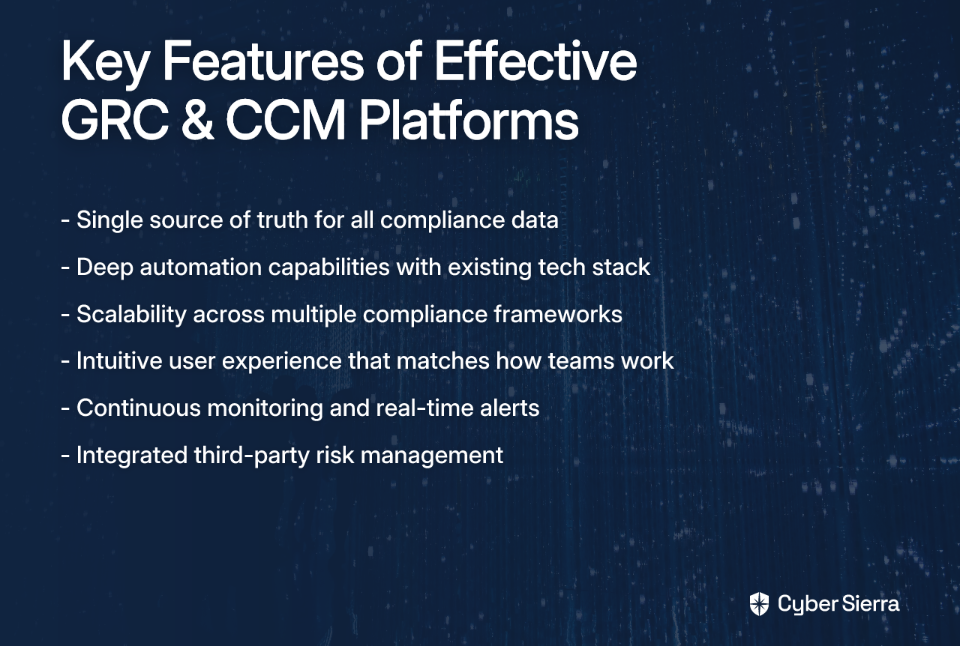
- Single source of truth: A centralized repository for all compliance data, policies, and evidence
- Deep automation capabilities: Direct integrations with your existing tech stack to minimize manual work
- Scalability across frameworks: Ability to map controls across multiple compliance frameworks
- Intuitive user experience: Tools that match how your team actually works, not the other way around
Cyber Sierra's comprehensive suite is designed with these principles in mind, offering an integrated platform that covers GRC, CCM, TPRM, and more with a focus on automation, continuity, and intelligence.
Conclusion: From Burden to Strategic Advantage
The journey from fragmented, manual, and reactive compliance to an integrated, automated, and proactive security posture is no longer optional—it's a business necessity. As regulatory requirements multiply and cyber threats grow more sophisticated, organizations cannot afford to rely on spreadsheets and point solutions.
A unified GRC and CCM platform delivers tangible benefits:
- Continuous audit readiness that eliminates the "fire drill" mentality
- Real-time visibility into your security posture
- Simplified management of regulatory complexity
- Significant cost savings through automation and optimization
- A stronger, more defensible security posture
To see how a modern, AI-enabled platform can solve these challenges for your organization, explore Cyber Sierra's unified cybersecurity platform. Learn more about our approach to Continuous Control Monitoring and Governance, Risk & Compliance that can transform compliance from a burden into a strategic advantage.
Frequently Asked Questions (FAQ)
What is the difference between GRC and CCM?
Governance, Risk, and Compliance (GRC) refers to the overall strategy and processes an organization uses to manage its governance, risk, and regulatory compliance. Continuous Control Monitoring (CCM) is the automated, technology-driven process that continuously tests and validates the security controls within that GRC framework. In short, GRC defines the compliance goals, while CCM provides the real-time proof that those goals are being met.
How does a unified GRC platform automate evidence collection?
A unified GRC platform automates evidence collection by directly integrating with your business's technology stack, including cloud providers (like AWS, Azure, GCP), security tools, and HR systems. Through APIs and pre-built connectors, the platform automatically pulls configuration data, user permissions, and logs, which serve as live, auditable evidence. This eliminates the need for manual screenshots and spreadsheet tracking.
Why is using spreadsheets for compliance management a risk?
Using spreadsheets for compliance management is a major risk because the data is static, manual, and prone to human error. Spreadsheets create information silos, lack version control, and offer no real-time visibility into your security posture. This means a control could fail and you wouldn't know until the next manual check, leaving a critical window of vulnerability.
What does "test once, comply many" mean?
The "test once, comply many" approach means that a single security control is tested once, and the evidence from that test is automatically mapped to satisfy requirements across multiple compliance frameworks. For example, evidence of your encryption policy can be used for SOC 2, ISO 27001, and GDPR simultaneously. This dramatically reduces redundant work and ensures consistency.
How can a GRC platform help manage third-party vendor risk?
A GRC platform with a Third-Party Risk Management (TPRM) module automates the entire vendor risk lifecycle. It streamlines due diligence with automated questionnaires, provides continuous monitoring of a vendor's security posture, and centralizes all vendor-related risk data. This replaces outdated annual reviews with near real-time insights, allowing you to proactively manage supply chain risks.
Is a GRC and CCM platform suitable for small businesses?
Yes, modern GRC and CCM platforms are highly beneficial for small and medium-sized businesses (SMBs). For teams with limited resources, the automation provided by these platforms acts as a force multiplier, enabling them to achieve a strong security and compliance posture without a large, dedicated staff. Many platforms are designed to be scalable and affordable, making enterprise-grade security accessible to businesses of all sizes.
