blog-hero-background-image
Cyber Security

Continuous Control Monitoring Explained for CISOs and Compliance Managers
backdrop
Table of Contents

Join thousands of professionals and get the latest insight on Compliance & Cybersecurity.


Summary

  • Periodic compliance checks create significant risk, with the average data breach costing $4.35 million and taking nearly 300 days to contain.
  • Continuous Control Monitoring (CCM) closes these security gaps by automating control testing in near real-time, providing immediate alerts on failures that would otherwise go undetected between audits.
  • For CISOs, CCM delivers a complete, live view of the attack surface; for Compliance Managers, it eliminates stressful audit fire drills by automating evidence collection.
  • Cyber Sierra's CCM platform unifies security and compliance by automating control monitoring and streamlining GRC processes.

The gap between the marketing promise of continuous compliance and the operational reality is real — and it's costly.

According to an IBM breach cost report, the average breach costs US$4.35 million, and it takes an average of 297 days just to identify and contain it. Every day a control gap goes undetected is a day an attacker could already be inside your environment. Yet most organizations are still relying on periodic, manual checks — essentially flying blind between audit cycles.

That's the problem Continuous Control Monitoring (CCM) is built to solve. This addresses the common frustration captured in a comment from a GRC community thread: "I keep hearing vendors talk about continuous compliance and real-time monitoring, but when I talk to people actually running programs, it still sounds like most teams do a big push before audits and then breathe for a while."

This guide breaks down the value of CCM through two lenses: the CISO dealing with attack surface visibility and board-level pressure, and the Compliance Manager exhausted by audit fire drills and manual evidence pulls. Same platform, same data — two very different (but complementary) ways it transforms daily work.

What Is Continuous Control Monitoring? A Quick Primer

Continuous Control Monitoring (CCM) is an automated process that evaluates internal controls continuously — not quarterly, not annually — in near real-time. Rather than sampling a subset of transactions or controls periodically, CCM assesses full populations on an ongoing basis, catching exceptions the moment they emerge.

Deloitte defines CCM as a transition from traditional, sample-based testing models to a continuous monitoring paradigm that improves accuracy and demonstrates ongoing adherence to expected processes.

Here's what that shift looks like in practice:

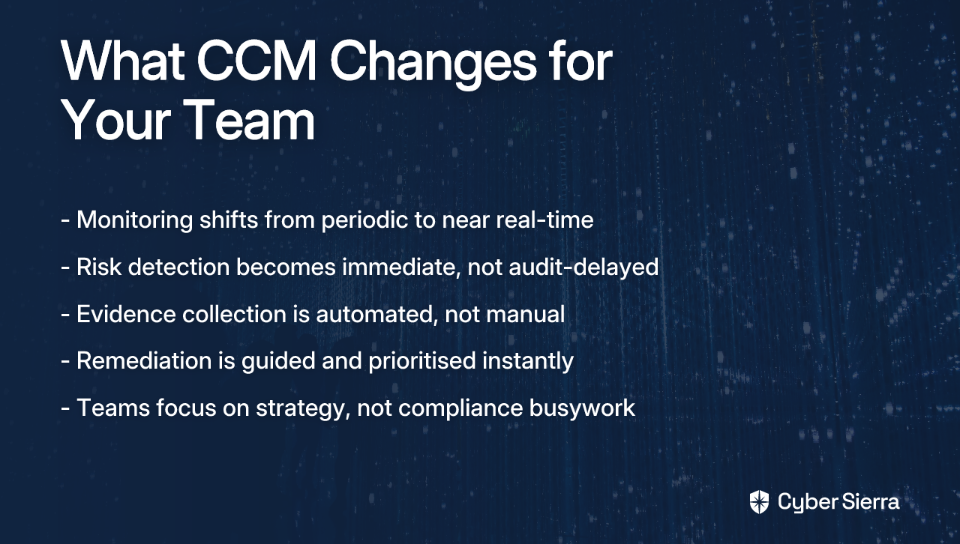
Without CCM (Traditional)With CCM
Monitoring FrequencyPeriodic, manual testingContinuous, near real-time
Risk DetectionDelayed — found during auditsImmediate anomaly detection
Evidence CollectionManual, time-consuming, error-proneAutomated, always current
Response TimeSlow — post-discovery scrambleInstant alerts with remediation guidance
Operational BurdenHigh — audit fatigue is constantLow — teams focus on strategy, not busywork

The difference isn't just operational. It's strategic. With CCM, you stop reacting to compliance gaps after the fact and start managing risk before it becomes a breach — or a failed audit.
Section 1: The CISO's Perspective — From Reactive Defense to Proactive Strategy

CISOs are caught in a widening gap. As one r/CISO contributor put it: "The gap between what boards expect and what security teams can realistically deliver keeps widening." Resource constraints are real. Attack surfaces are expanding. And the pressure to "do more with less" is relentless.

Continuous Control Monitoring gives CISOs a way to close that gap — not by hiring more analysts, but by making the data work harder.

1. Total Attack Surface Visibility

The pain: Security controls are scattered across cloud environments, on-prem infrastructure, third-party vendors, and legacy systems. Without a unified view, blind spots are inevitable. You're managing risk with incomplete information.

How CCM helps: CCM synthesizes control status and risk data across your entire infrastructure into a single, continuously updated view. You're no longer relying on point-in-time snapshots stitched together from different tools and team reports.

In practice with Cyber Sierra: Cyber Sierra's CCM platform provides clear, ongoing visibility into your security posture across all controls. Paired with the Threat Intelligence module — which includes network vulnerability scanning, cloud infrastructure scanning for misconfigurations, and an outside-in security scorecard — CISOs get a comprehensive, real-time picture of their attack surface. No more blind spots, no more guessing.

Before CCM: A CISO manually aggregates reports from five different tools each quarter to get a rough picture of control health — a process that takes days and is already outdated by the time it's done.

After CCM: A single dashboard surfaces real-time control status, active vulnerabilities, and risk scores across the entire environment — always current, always actionable.

2. Reducing Dwell Time on Control Failures

The pain: The average attacker spends nearly 300 days inside an environment before being detected. Manual, periodic checks mean control failures can persist for months — giving attackers an open window.

How CCM helps: When a control drifts or fails, CCM detects the anomaly immediately and triggers an alert. This compresses the remediation timeline from months to hours, directly shrinking the window of opportunity for attackers.

In practice with Cyber Sierra: Cyber Sierra's CCM is built for real-time exception detection, paired with actionable risk intelligence that helps teams prioritize what to fix first. Rather than wading through a backlog of audit findings, security teams get a prioritized remediation queue — closing gaps before they're exploited.

3. Confident, Data-Driven Board-Level Reporting

The pain: Translating technical security posture into business language for the board is one of the most consistently cited CISO challenges. When your data is six months old and manually compiled, you're presenting a story — not evidence.

How CCM helps: Real-time control data enables real-time reporting. Instead of subjective status updates, CISOs can walk into board meetings with dashboards showing current compliance coverage, trend lines on control effectiveness, and evidence-backed risk assessments.

In practice with Cyber Sierra: Cyber Sierra's GRC platform generates comprehensive reports and maintains detailed audit trails fed by live CCM data. This turns board conversations from "we think we're in good shape" into "here's the data proving it" — a meaningful shift when boards are increasingly demanding accountability on cybersecurity investments.
Section 2: The Compliance Manager's Perspective — From Audit Fire Drills to Always-On Readiness

For Compliance Managers, the struggle is different but equally exhausting. Due to the sheer size of many compliance programs, practitioners often find that managing the workload is overwhelming. Multi-framework requirements, constant evidence requests, and audit deadlines that seem to arrive faster every year — it's a cycle designed to produce burnout, not resilience.

CCM doesn't just automate tasks. It restructures the entire compliance operating model.

1. Perpetual Audit Readiness — Not a Pre-Audit Sprint

The pain: The phrase "audit season" shouldn't exist in a mature compliance program — but it does for most organizations. Teams spend months preparing what should have been maintained all year, leading to stress, errors, and gaps that auditors inevitably find.

"Procrastination is a thief of time. You should be audit ready year round," as one r/grc community member noted.

How CCM helps: By continuously collecting and organizing compliance evidence, CCM ensures that audit readiness isn't a seasonal scramble — it's a permanent state. When auditors arrive, you're not pulling evidence; you're presenting it.

Before CCM: The two months before an audit are all hands on deck — chasing down screenshots, log exports, and config files from IT, engineering, and HR. The process consumes dozens of hours of staff time and still produces gaps.

After CCM: Evidence is collected automatically, continuously, and stored in a structured repository. The audit becomes a validation exercise, not a recovery mission.

In practice with Cyber Sierra: Cyber Sierra's GRC platform is engineered to keep organizations audit-ready year-round through automated data collection, continuous control monitoring, and maintained audit trails. The result: faster audits, fewer surprises, and significantly less stress.

2. Streamlining Evidence Collection

The pain: Manually gathering evidence from across the organization is one of the most time-consuming and error-prone aspects of compliance management. Chasing teams for screenshots, configuration exports, and policy sign-offs is a full-time job hidden inside your compliance role.

As one GRC community user observed, the real buy-in moment for compliance tools is simple: "Companies do not buy tools. They buy passed audits and lower audit costs, faster evidence collection."

How CCM helps: CCM creates a continuous, automated digital audit trail. Evidence is pulled from systems automatically, organized by control, and stored in a central repository — eliminating the need for manual collection and reducing the risk of inconsistencies.

In practice with Cyber Sierra: A core capability of Cyber Sierra's CCM platform is building a central controls repository with near real-time updates. Instead of requesting evidence from five different teams before every audit, Compliance Managers have a single source of truth — always populated, always current, and ready for auditor review on demand.

3. Mastering Multi-Framework Management

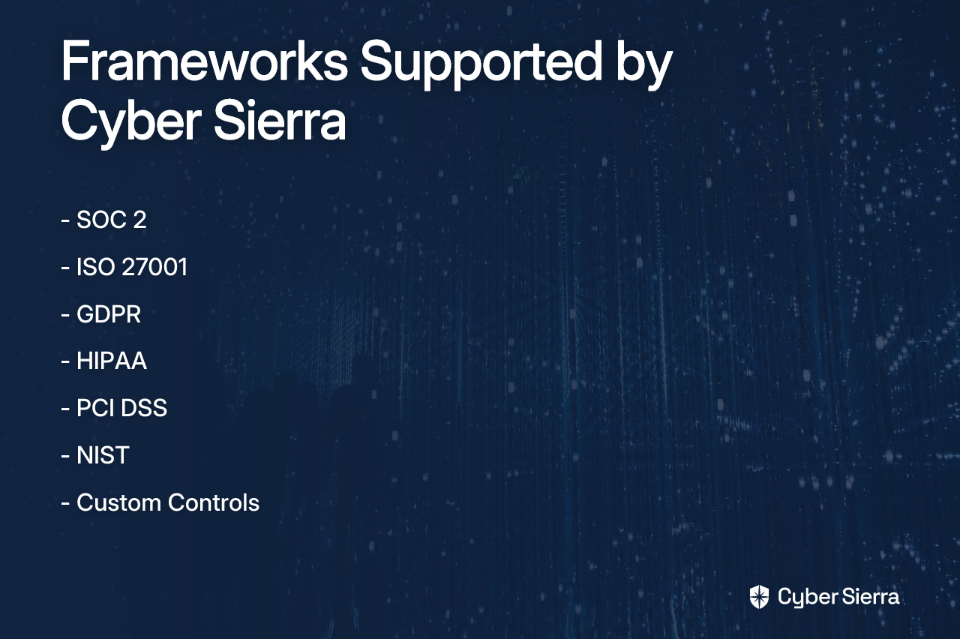
The pain: Most organizations aren't operating under a single framework. Between SOC 2, ISO 27001, GDPR, HIPAA, PCI DSS, and NIST, the same underlying controls are being documented, tested, and reported on multiple times — for multiple audiences. That's compliance fatigue in its most concrete form.

How CCM helps: A well-implemented CCM solution maps controls across frameworks, meaning a single automated test or piece of evidence can satisfy requirements across multiple standards simultaneously. You stop duplicating work and start multiplying output.

In practice with Cyber Sierra: Cyber Sierra explicitly supports multi-compliance framework management — covering SOC 2, ISO 27001, GDPR, HIPAA, PCI DSS, and custom controls — from a single unified dashboard. Map once, satisfy many. This is where organizations dealing with overlapping regulatory requirements see the fastest productivity gains.
Unifying Security and Compliance: CCM Benefits at a Glance

CCM serves both the CISO and the Compliance Manager — but it solves different problems for each. Here's how the value stacks up:

CISO ValueCompliance Manager Value
Real-Time VisibilityUnified view of attack surface and active control gapsInstant insight into which controls are compliant and which aren't
AutomationFaster detection and remediation of failures (lower dwell time)Automated, continuous evidence collection — no more manual pulls
Reporting & DataData-driven security posture reports for board presentationsOn-demand, audit-ready compliance reports for auditors and regulators
Operational EfficiencySecurity team focuses on risk, not manual aggregationCompliance team focuses on governance, not firefighting
Business ImpactReduced breach likelihood; proactive, not reactive defenseLower audit costs; reduced compliance fatigue across teams

Both roles share the same underlying goal: protecting the organization. CCM just makes it possible to pursue that goal with data, automation, and clarity — instead of spreadsheets, screenshots, and overtime.

Go From Reactive Audits to Real-Time Resilience

Moving beyond periodic, manual checks isn't just about passing audits with less stress—it's about fundamentally strengthening your security posture. Continuous Control Monitoring transforms compliance from a seasonal fire drill into a strategic, always-on function.

Here’s what that shift means in practice:

  • Stop chasing evidence. Automate control testing and evidence collection to stay perpetually audit-ready.
  • Gain total visibility. Give your security team a live, unified view of your attack surface to close gaps before they're exploited.

Ready to take the first step? Identify one critical control your team currently spends hours checking manually before an audit. That's your starting point for automation.

When you're ready to see how a unified platform makes this a reality, see the platform live. We’ll show you how Cyber Sierra connects real-time control data to GRC automation, giving both security and compliance teams the clarity they need to move faster and stay ahead of risk.

Frequently Asked Questions

What is Continuous Control Monitoring (CCM)?

Continuous Control Monitoring (CCM) is an automated process that continuously evaluates your internal security and compliance controls in near real-time. Unlike periodic checks, it assesses full populations of data to catch exceptions the moment they happen, ensuring ongoing adherence.

How does CCM differ from traditional compliance monitoring?

CCM is continuous and automated, while traditional monitoring is periodic and manual. Traditional methods create blind spots between audits by using point-in-time samples. CCM provides a constant, real-time view of your control status, eliminating gaps and reducing manual effort.

Why is continuous monitoring important for security?

Continuous monitoring is crucial for security as it drastically reduces the time attackers have to exploit a control failure. By detecting control drifts immediately, CCM shrinks remediation timelines from months to hours, minimizing the window of opportunity for a breach.

How does CCM simplify managing multiple compliance frameworks?

CCM simplifies multi-framework management by mapping a single control to multiple compliance requirements. You can test a control once and use the evidence across frameworks like SOC 2, ISO 27001, and GDPR simultaneously, eliminating redundant work for your teams.

What is the first step to implementing Continuous Control Monitoring?

The first step is to centralize your controls and evidence in a single repository. Before you can automate monitoring, you need a unified view of all security and compliance controls. A platform that consolidates this information is foundational to an effective CCM program.

Can CCM fully replace the need for manual audits?

No, CCM does not fully replace manual audits, but it makes them significantly faster and more efficient. CCM automates evidence collection, turning audits into a validation exercise rather than a discovery mission. Auditors still provide essential third-party validation.
blog-hero-background-image
Cyber Security

5 Best Information Risk Management Software for BFSI and HealthTech

backdrop
Table of Contents

Join thousands of professionals and get the latest insight on Compliance & Cybersecurity.


Summary

  • Manual compliance in regulated industries like BFSI and HealthTech is increasingly unsustainable due to complex, ever-changing rules.
  • Essential software features include multi-framework support (HIPAA, PCI DSS), automated evidence collection, and continuous control monitoring.
  • This guide compares 5 top information risk management tools to help you choose based on your organization's maturity, tech stack, and specific compliance needs.
  • Cyber Sierra's AI-enabled platform unifies GRC, continuous monitoring, and vendor risk management to keep regulated organizations audit-ready.

If you work in Banking, Financial Services and Insurance (BFSI) or HealthTech, you already know that compliance isn't a box-to-check exercise — it's a non-negotiable operational reality. Regulators like the RBI and SEBI set the rules for financial institutions, while HIPAA and PCI DSS govern how sensitive health and payment data must be protected. Fail to comply, and you're not just looking at a slap on the wrist. You're facing regulatory sanctions, reputational damage, and in healthcare, real risks to patient safety.

Yet, despite the stakes, many compliance teams are still fighting this battle with tools that weren't built for it. This leads to a common frustration: that many tools simply can't "do" the work for you. That cynicism is understandable. Too many GRC platforms are glorified spreadsheets with a SaaS subscription attached. They don't integrate cleanly with specialized systems like EHRs, they demand relentless manual evidence gathering, and they buckle under the weight of managing overlapping frameworks like HIPAA, PCI DSS, ISO 27001, and NIST simultaneously.

The regulatory landscape is accelerating, with increased FDA oversight on cybersecurity, expanding AI compliance requirements, and new mandates forcing organizations to overhaul quality systems — making manual compliance tracking not just tedious, but genuinely unsustainable.

This article cuts through the noise. We've evaluated 5 specialized information risk management software platforms against the criteria that actually matter in regulated industries:

1. Cyber Sierra — Best Overall for BFSI & HealthTech

Best for: Organizations that need an integrated, multi-framework GRC platform with continuous monitoring and vendor risk automation.

Cyber Sierra is an AI-enabled cybersecurity platform architected specifically for the complexity of compliance-heavy industries. Rather than treating GRC, TPRM, and control monitoring as separate problems, Cyber Sierra unifies them inside a single platform — giving CISOs, compliance managers, and IT teams a single source of truth for their entire risk posture.

What makes it stand out for regulated industries:

  • GRC Module. Cyber Sierra's GRC module automates data collection, risk assessments, control monitoring, and reporting across multiple frameworks simultaneously — including SOC 2, ISO 27001, GDPR, HIPAA, and PCI DSS. If your organization operates across multiple regulatory jurisdictions (think a HealthTech company handling both patient records and payment data), this cross-framework mapping capability is critical. It maintains detailed audit trails and generates comprehensive reports, dramatically reducing the time your team spends chasing down evidence before an audit.
  • Continuous Control Monitoring (CCM). This module directly addresses the core skepticism around compliance tools — are the controls actually working? Cyber Sierra's CCM builds a centralized controls repository with near real-time updates, automates control testing and validation, and detects exceptions and anomalies as they happen. This transforms your security program from a periodic audit exercise into a continuously operating system.
  • Third-Party Risk Management (TPRM). In both BFSI and HealthTech, your vendors are an extension of your attack surface. Cyber Sierra's TPRM module automates the entire vendor risk lifecycle — from onboarding and due diligence questionnaires to continuous 24/7 monitoring of vendor security compliance. This provides the documented proof of vendor oversight that regulators increasingly expect.

Considerations: Cyber Sierra is best suited for organizations with a meaningful compliance program to operate and automate. Teams at very early stages may need to invest time in initial framework configuration.

2. ComplyAssistant — Best for Healthcare-First Organizations

Best for: Hospitals, health systems, covered entities, and MSPs where HIPAA is the primary and dominant regulatory concern.

ComplyAssistant is built from the ground up for healthcare compliance. Its structured workflows are designed around the specific requirements of HIPAA risk analysis for both covered entities and business associates — not adapted from a general-purpose GRC tool.

Key capabilities:

  • Risk Analysis and Management. Provides guided workflows for conducting HIPAA-required risk assessments, ensuring both technical and administrative safeguards are documented.
  • Centralized Documentation. Creates a single, auditable repository for all policies, procedures, and compliance evidence — solving the problem of fragmented risk data that haunts many HealthTech teams.
  • Task Management. Automates and tracks compliance activities with accountability workflows, ensuring nothing falls through the cracks between departments.

Considerations: ComplyAssistant's depth in HIPAA is its greatest strength and its most notable constraint. It lacks native support for PCI DSS, broader ISO 27001 controls, or financial regulatory frameworks, which limits its usefulness for BFSI organizations or HealthTech companies that also handle payment data.

3. Drata — Best for Cloud-Native HealthTech and FinTech

Best for: Modern, cloud-first companies that need to automate evidence collection across a tech-heavy stack.

Drata has built a strong reputation as an automation engine for compliance. It connects directly to cloud infrastructure, code repositories, and SaaS tools to automatically gather evidence that controls are operating — replacing the manual screenshot-and-spreadsheet routine that compliance teams dread.

Key capabilities:

  • Automated Evidence Collection. Drata pulls proof of control operation directly from connected systems, dramatically reducing manual effort for audit preparation.
  • Real-Time Compliance Monitoring. Provides a continuous, live view of compliance status against HIPAA, SOC 2, ISO 27001, PCI DSS, and other frameworks.
  • Framework Coverage. Broad support for the frameworks most relevant to FinTech and digital health companies.

Considerations: Drata's strength is integration density with cloud tooling. Organizations with legacy infrastructure or complex on-premise environments may find the integration scope more limited than expected — a meaningful consideration for established BFSI institutions.

4. Vanta — Best for Complex, Integration-Heavy Environments

Best for: Organizations with a wide and diverse technology stack that need compliance monitoring woven into every tool they already use.

Vanta differentiates itself through its extensive integration ecosystem. With connections to hundreds of cloud providers, identity platforms, HR systems, and business applications, Vanta excels at eliminating the "integration nightmare" — the painful reality of trying to monitor security controls scattered across a dozen disconnected tools.

Key capabilities:

  • Broad Integration Ecosystem. Vanta automates security checks across a wide range of connected applications, ensuring that compliance monitoring isn't siloed from where work actually happens.
  • Vendor Management. Includes tools to assess third-party vendor risks, which is important for managing supply chain exposure in both HealthTech and BFSI.
  • Framework Coverage. Supports HIPAA, PCI DSS, SOC 2, ISO 27001, and several other frameworks with automated evidence collection tied to each.

Considerations: Vanta's pricing scales with the breadth of integrations and users, which can make it a significant investment for larger organizations. For teams whose primary need is deep TPRM automation or regulatory-specific workflow guidance (rather than integration breadth), other platforms may offer more targeted value.

5. Secureframe — Best for Emerging Companies Building Compliance From Scratch

Best for: Early-stage HealthTech startups or smaller financial services companies establishing their first formal compliance program.

Secureframe lowers the barrier to entry for achieving compliance. It's designed to make frameworks like SOC 2 and HIPAA approachable for teams that don't yet have a large, dedicated GRC function — pairing guided workflows with policy templates and access to compliance experts.

Key capabilities:

  • Guided Compliance Workflows. Step-by-step guidance helps organizations navigate complex audit preparation without needing to be compliance experts from day one.
  • Policy Templates and Expert Access. Pre-built policy libraries and access to compliance professionals help teams move faster without reinventing the wheel.
  • Audit Readiness Tracking. Provides a clear view of readiness status, making it easier to identify and close gaps before an audit window.

Considerations: Secureframe is purpose-built for simplicity and accessibility, which means it may not provide the depth of continuous control monitoring, multi-framework cross-mapping, or TPRM automation that a mature BFSI or enterprise HealthTech organization requires. It's an excellent starting point, but growing organizations often find themselves needing to graduate to a more robust platform.

Compliance Feature Matrix: How the Tools Compare

Use this table as a quick-reference to see how each platform stacks up against the criteria that matter most in regulated industries.

ToolHIPAA CoveragePCI DSS CoverageTPRM AutomationAudit Evidence GenerationReal-Time Monitoring
Cyber Sierra
ComplyAssistant
Drata
Vanta
Secureframe

Based on publicly available feature documentation from each platform at time of writing.

How to Choose the Right Information Risk Management Software

The matrix above is a useful snapshot, but the right choice comes down to your organization's specific compliance program maturity, regulatory mandates, and operational complexity.

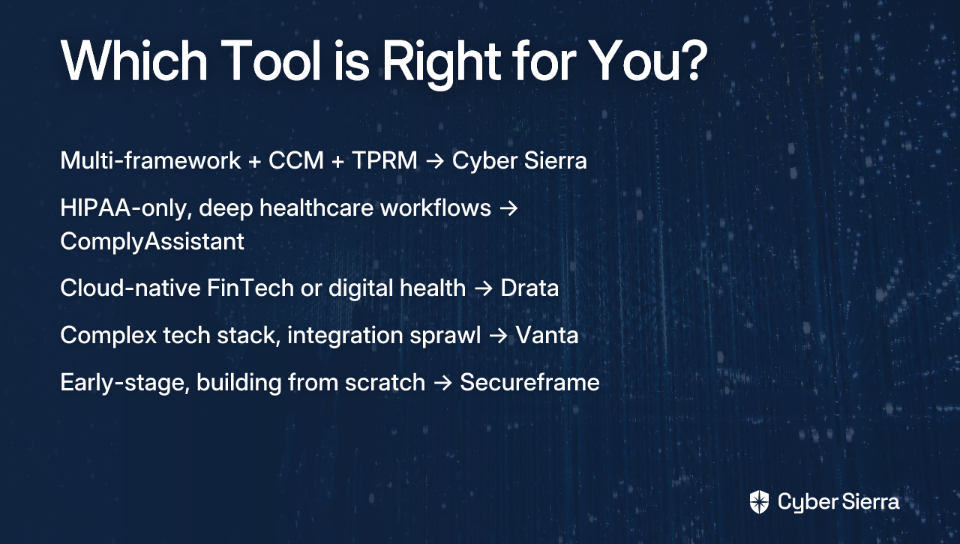
Here's a quick decision lens:

From Audit-Ready to Always-On Compliance

Choosing the right information risk management software is less about passing your next audit and more about building a resilient, always-on compliance posture. Relying on manual processes and disconnected spreadsheets in high-stakes industries like BFSI and HealthTech is no longer a viable strategy. The key is to shift from periodic checks to a system of continuous, evidence-backed assurance.

Here are the two most important takeaways:

  • Automation is non-negotiable. The right platform automates evidence collection, proving your controls are working in near real-time without the manual chase.
  • Integration provides a single source of truth. A unified platform for GRC, continuous monitoring, and vendor risk management (TPRM) eliminates the silos that create risk.

The most practical next step you can take is to identify your single biggest compliance bottleneck. Is it chasing down evidence, vetting vendors, or the last-minute scramble before an audit? Once you know the source of the friction, you can evaluate tools based on their ability to solve that specific problem.

If you're tired of the manual grind, book a personalized demo to see how Cyber Sierra's integrated platform transforms compliance from a stressful event into a continuous, automated process.

Frequently Asked Questions

What is information risk management software?

Information risk management software helps organizations identify, assess, and mitigate risks to their information assets and comply with regulations. It centralizes compliance tasks, automates evidence collection, and provides real-time visibility into your security posture, replacing manual spreadsheets.

Why is specialized software important for BFSI and HealthTech?

Specialized software is crucial for BFSI and HealthTech because these industries face stringent regulations like HIPAA and PCI DSS. Generic tools often lack the specific workflows and multi-framework support needed to handle sensitive financial and health data compliance demands effectively.

How does compliance automation software help with audits?

Compliance automation software streamlines audits by centralizing all necessary evidence. It automates proof collection that security controls are working, generates reports on demand, and maintains a clear audit trail, significantly reducing the manual effort and stress of audit preparation.

What should I look for when choosing information risk management software?

Key features to look for include multi-framework support (e.g., HIPAA, PCI DSS), automated evidence generation, continuous control monitoring, and third-party risk management (TPRM). These capabilities ensure the platform can handle complex regulatory needs and reduce manual work.

Can a single GRC platform manage multiple compliance frameworks?

Yes, modern GRC platforms are designed to manage multiple compliance frameworks like HIPAA, PCI DSS, and ISO 27001 simultaneously. They use control mapping to avoid duplicate work, allowing you to satisfy several regulatory requirements efficiently from a single dashboard.

blog-hero-background-image
Cyber Security

MetricStream vs Bitsight vs Cyber Sierra for Cybersecurity Risk Management

backdrop
Table of Contents

Join thousands of professionals and get the latest insight on Compliance & Cybersecurity.


Summary

  • Enterprise GRC platforms like MetricStream are often too complex and costly for mid-market teams, while security rating tools like Bitsight provide a narrow, external-only view of risk.
  • Effective third-party risk management requires more than just a security score; it needs automated assessments and continuous visibility to actively manage the average 5,800 vendors per enterprise.
  • Prioritize solutions that offer rapid deployment, continuous internal control monitoring, and out-of-the-box support for multiple compliance frameworks to pass audits faster and with less manual effort.
  • Cyber Sierra provides a unified platform that combines GRC, TPRM, and continuous monitoring, offering an accessible, all-in-one solution for mid-market companies.

Risk teams everywhere are outgrowing cobbled-together spreadsheets and hunting for a cybersecurity risk management solution that actually works—without requiring a six-month implementation project and a team of consultants.

Two names that consistently come up in this search are MetricStream and Bitsight. Both are credible, widely-deployed platforms with real customer bases and genuine capabilities. MetricStream is a stalwart of the enterprise GRC world; Bitsight has become synonymous with third-party security ratings. But neither was designed with the mid-market in mind—and that gap matters.

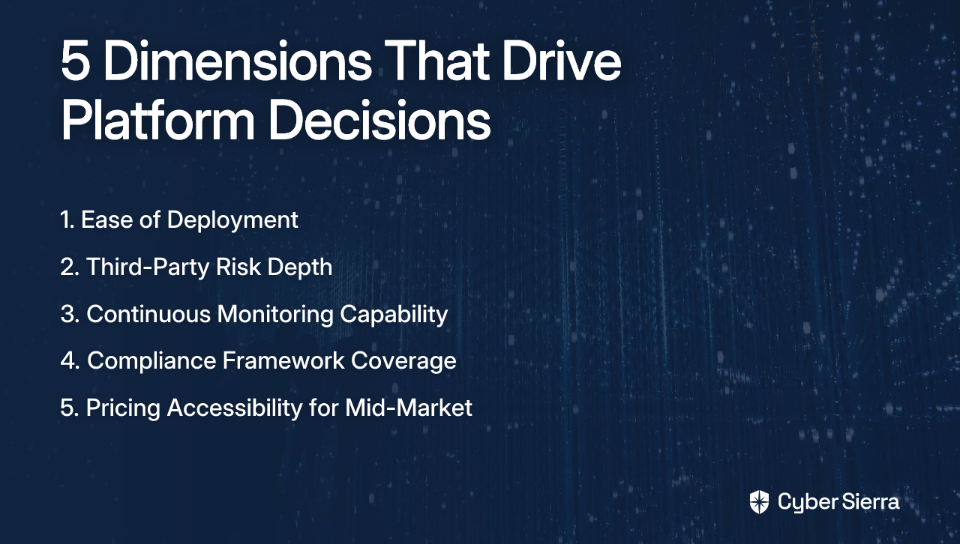
In this comparison, we'll put all three platforms — MetricStream, Bitsight, and Cyber Sierra — side by side across five dimensions that actually move buying decisions:

  1. Ease of Deployment
  2. Third-Party Risk Depth
  3. Continuous Monitoring Capability
  4. Compliance Framework Coverage
  5. Pricing Accessibility for Mid-Market Enterprises

Let's get into it.

A 5-Point Comparison of Cybersecurity Risk Management Platforms

1. Ease of Deployment

MetricStream is powerful, but that power comes with complexity. If you've ever muttered something like "we perform several risk assessments across different products and need a better way than just Excel sheets to track risks and mitigation plans," you know the pain of outgrowing manual systems. Real-world feedback from practitioners, shared on Reddit, is blunt: MetricStream can be a difficult implementation. It supports both web-based and on-premises deployment, but either path demands significant configuration resources and time before you see value.

Bitsight is generally easier to get off the ground, given its web-based delivery and narrower focus. However, its lack of deep customization options can become a friction point when organizations try to fit the platform into specific internal workflows.

Cyber Sierra is purpose-built for rapid deployment and integration into existing workflows with minimal training overhead. This directly addresses what most buyers actually want: not a flexible engine, but—as one CISO noted—passed audits, lower audit costs, faster evidence collection, and less headcount. You shouldn't need an army of consultants to go live with a modern GRC platform.

2. Third-Party Risk Depth

The scale of third-party risk is staggering. A 2020 Ponemon survey found that a typical enterprise manages 5,800 third parties — a number expected to grow 15% annually. High-profile incidents like SolarWinds proved that a supply chain breach can be just as devastating as a direct attack. Manual vendor management simply doesn't scale.

MetricStream offers a comprehensive Third-Party Risk Management (TPRM) module — often integrated directly with Bitsight's security ratings — and holds a strong Gartner rating for IT Vendor Risk Management. The downside? The platform's depth can overwhelm teams without dedicated GRC analysts to configure and maintain it.

Bitsight's core identity is TPRM through its security scoring model. But the security community has real reservations about score-only approaches: practitioners on Reddit describe risk scores as "crap and ineffective" and note that "they can't even tell you anything meaningful." A score tells you something is wrong; it rarely tells you what to do next.

Cyber Sierra's TPRM module goes beyond a risk score. It automates vendor assessments, provides near real-time visibility into vendor security compliance, streamlines onboarding and offboarding, and prioritizes your vendor inventory by actual risk level. This answers the "what now?" question — moving your team from passive observation to active remediation.

3. Continuous Monitoring Capability

MetricStream offers monitoring features, but they tend to skew toward periodic audit cycles rather than live threat detection. For teams that need a truly real-time picture of their control environment, this cadence can feel frustratingly slow.

Bitsight is stronger here — continuous monitoring of external threat exposure is a genuine differentiator. It also addresses a real pain point, as one user noted: breach monitoring can be valuable, especially if a vendor has a breach but doesn't disclose it. That said, some users report that alerts can lag, and the monitoring is externally focused — it won't tell you what's happening inside your own control environment.

Cyber Sierra's Continuous Control Monitoring (CCM) flips the script: it provides ongoing, near real-time visibility into your internal security controls. Key capabilities include a central controls repository with continuous updates, automated control testing and validation, and real-time detection of exceptions and anomalies. This transforms security from a reactive, audit-driven exercise into a proactive, always-on oversight model.

4. Compliance Framework Coverage

MetricStream supports a broad range of compliance frameworks — SOC 2, ISO 27001, PCI DSS, GDPR, and more — making it a capable compliance engine for large organizations. The catch: achieving that breadth typically requires extensive customization, which adds time, cost, and dependency on specialized implementation partners.

Bitsight is largely limited to external cybersecurity metrics. If your auditor is asking for evidence against ISO 27001 controls, Bitsight isn't going to help you gather it. Its value proposition stops at the perimeter.

Cyber Sierra's GRC module automates compliance management across SOC 2, ISO 27001, GDPR, HIPAA, PCI DSS, NIST, and custom controls — out of the box, and without months of configuration. It automates data collection and risk assessments, maintains detailed audit trails, and generates comprehensive reports. For teams that "buy passed audits, not flexible control engines," this is the difference between a tool that works on day one vs. one that requires a consulting engagement to unlock.

5. Pricing Accessibility for Mid-Market Enterprises

MetricStream is a premium enterprise product, and it's priced accordingly. While pricing is not public, real-world users have expressed sticker shock, with one noting: "I can only imagine what the pricing is like." For mid-market companies without a large GRC team or a large budget, this is a real barrier.

Bitsight is generally more accessible than MetricStream, though pricing is also not publicly listed. The trade-off is scope — you're paying for external ratings and TPRM insight, not a full GRC platform. As your needs grow, you'll likely need to bolt on additional tools.

Cyber Sierra is competitively priced with mid-market enterprises specifically in mind. The value proposition: enterprise-grade, unified capabilities without the enterprise implementation timeline or price tag. One platform, one vendor relationship, one bill.

Summary Comparison Table

Here's a quick summary of how the three platforms stack up across the key decision criteria.

FeatureMetricStreamBitsightCyber Sierra
Ease of DeploymentComplex, resource-intensiveStraightforward but lacks deep customizationRapid, seamless integration
Third-Party Risk DepthExtensive but complexity can overwhelmStrong security scoring, limited actionabilityAutomated, continuous, and comprehensive TPRM
Continuous MonitoringAudit-focused, not truly real-timeStrong external monitoring, alerts can lagNear real-time internal control monitoring (CCM)
Compliance CoverageBroad frameworks, heavy customization requiredLimited beyond external security metricsComprehensive and automated out-of-the-box
Mid-Market PricingHigh-end, enterprise-focusedMore affordable, narrower scopeCompetitive, purpose-built for mid-market

Cyber Sierra: The Unified AI-Enabled Alternative

MetricStream and Bitsight each solve a real problem well — but neither solves the whole problem. MetricStream's depth comes with complexity that strains mid-market teams. Bitsight's external ratings are valuable, but they don't answer what's happening internally or translate directly into remediation actions. Most teams don't want more tools to manage; they want, as practitioners put it, "fewer decisions and less risk."

Cyber Sierra was built to close that gap. It's an AI-enabled cybersecurity risk management solution that unifies capabilities across the full stack — without requiring a six-month implementation or a dedicated team of GRC architects.

The AI angle isn't just a buzzword. Organizations increasingly invest in AI-driven compliance tools to achieve significant time and cost savings. Cyber Sierra's automation-first approach to data collection, control testing, and risk assessment is designed to deliver exactly those outcomes.

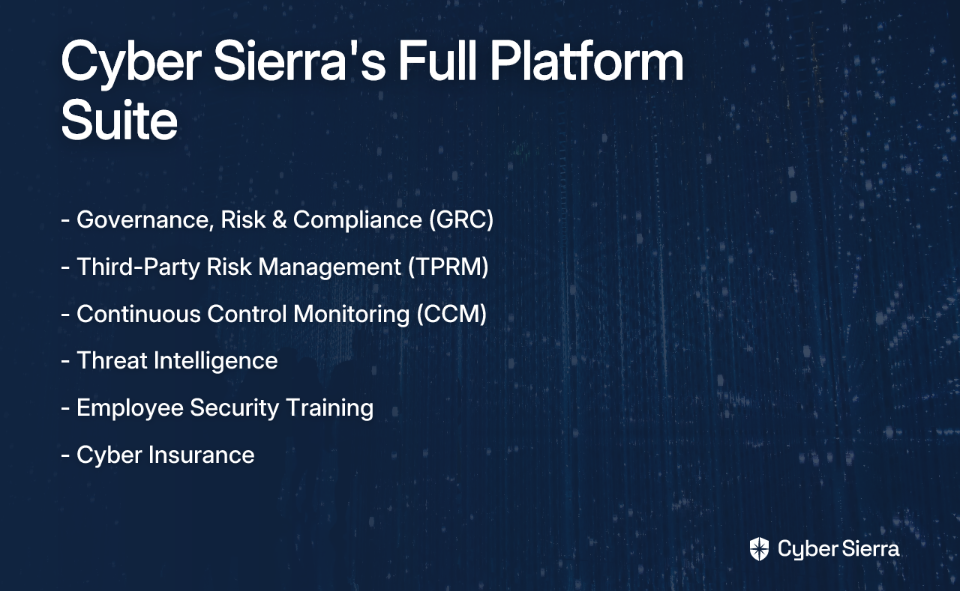
The platform covers the full spectrum of enterprise cybersecurity risk:

The result is a single, unified view of your compliance posture and threat landscape — no more switching between five tools to get a complete picture.

Which Platform Is Right for You?

Every platform in this comparison has a legitimate use case. The key is matching the tool to your actual situation — not the one you wish you had or the one a vendor is selling you.

Choose MetricStream if... You are a large, mature enterprise with a dedicated GRC team, a substantial implementation budget, and highly specific compliance workflows that require deep platform customization. MetricStream rewards organizations that can invest the time and expertise to configure it properly.

Choose Bitsight if... Your most pressing and immediate priority is monitoring the external cybersecurity posture of your third-party vendors through security ratings. If you rely heavily on vendor scoring for due diligence conversations and your internal GRC is already handled elsewhere, Bitsight fills that specific gap well.

Choose Cyber Sierra if... You are a mid-market enterprise—whether in BFSI, HealthTech, Manufacturing, Technology, or Retail—that needs a powerful and accessible solution. You need a platform that automates compliance, delivers deep third-party risk insights, and integrates threat intelligence without lengthy implementation cycles or an enterprise price tag. Cyber Sierra is built for teams that want to achieve faster evidence collection, fewer manual headaches, and a real-time view of both their internal controls and external risk surface from a single platform.

If the goal is passed audits, lower costs, and less headcount rather than a maximally flexible engine that requires a team to run, Cyber Sierra is worth a close look.

From Patchwork Tools to a Unified Strategy

Choosing the right risk management platform isn’t about finding the most complex or the most niche tool—it's about finding the one that gives your team leverage. Instead of getting bogged down by enterprise-grade complexity or relying on a narrow external score, focus on what actually moves the needle:

  • Unified Visibility. You need to see internal controls and third-party risks in one place.
  • Actionable Automation. The goal is to spend less time gathering evidence and more time mitigating risk.

Here’s your next step today: Whiteboard your current vendor onboarding and audit prep processes. Identify the one or two steps that create the most manual work and friction. That’s your starting point for a smarter workflow.

When you’re ready to see how a unified platform can automate those steps and give you back valuable time, we're here to help. Book a personalized demo and see how you can move from siloed data to a clear, comprehensive view of your security posture.

Frequently Asked Questions

What is a cybersecurity risk management solution?

A cybersecurity risk management solution is a platform that helps organizations identify, assess, and mitigate digital threats. It centralizes risk tracking, automates compliance tasks, and monitors security controls, replacing manual tools like spreadsheets with a streamlined, integrated system.

Why is Cyber Sierra a better fit for mid-market companies than MetricStream?

Cyber Sierra is designed for the mid-market with rapid deployment and flexible pricing plans. Unlike MetricStream, which requires extensive customization and a large budget, Cyber Sierra provides a powerful, unified GRC and security suite that works out-of-the-box, delivering value faster.

How does Cyber Sierra's third-party risk management go beyond Bitsight's ratings?

Cyber Sierra provides actionable third-party risk management (TPRM), not just a score. It automates vendor assessments, offers 24/7 visibility into vendor compliance, and streamlines onboarding, helping you actively remediate risks instead of just observing a static rating.

What compliance frameworks can you manage with Cyber Sierra?

Cyber Sierra automates compliance management for major frameworks right out of the box. This includes SOC 2, ISO 27001, GDPR, HIPAA, PCI DSS, and NIST. It also supports custom controls, providing flexibility to meet your specific organizational needs without complex configuration.

How does continuous control monitoring (CCM) improve security posture?

Continuous Control Monitoring (CCM) offers real-time visibility into your internal security controls. It automatically tests and validates your defenses, detecting exceptions as they happen. This proactive approach allows you to fix issues immediately, rather than waiting for a periodic audit to find them.

What are the main advantages of using a unified risk management platform?

A unified platform like Cyber Sierra provides a single source of truth for all risk and compliance activities. It eliminates data silos, reduces the complexity of managing multiple tools, lowers costs, and gives a complete, real-time view of your entire security posture from one dashboard.

blog-hero-background-image
Cyber Security

How to Choose a Cybersecurity Risk Management Solution for Your Risk Maturity Level

backdrop
Table of Contents

Join thousands of professionals and get the latest insight on Compliance & Cybersecurity.


Summary

  • Selecting the right cybersecurity solution requires first understanding your organization's risk maturity level to avoid a mismatch in capabilities.
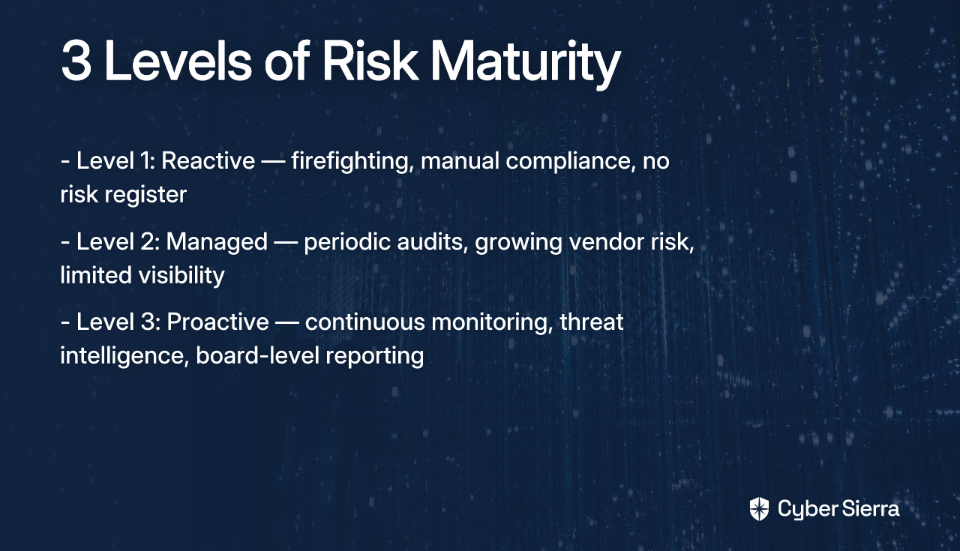
  • Use the 3-level model—Reactive, Managed, and Proactive—to benchmark your current security posture and identify key gaps.
  • Your immediate priority depends on your stage: Reactive teams need GRC automation, Managed teams need continuous monitoring (CCM/TPRM), and Proactive teams need threat intelligence.
  • A modular platform like Cyber Sierra can provide the right tools for your current stage and scale as your program matures.

You've sat through vendor demos, collected proposals, and compared feature lists — and you still can't shake the feeling that something's off. Maybe the platform feels too complex for where your team actually is. Or maybe it's too lightweight and you'll outgrow it within a year.

Here's the uncomfortable truth: the problem usually isn't the tools. It's that most organizations evaluate cybersecurity risk management solutions without first benchmarking their own risk maturity. The result? They either buy an enterprise-grade platform, or they patch together point solutions that leave critical gaps exposed.

Misalignment between business goals, security teams, and engineering is rampant. Issues like risk appetite confusion lead directly to poor decisions about which controls to invest in — and how much to spend.

The fix isn't a bigger budget or a better vendor. It's starting with an honest self-assessment.

This guide introduces a practical 3-level risk maturity model — Reactive, Managed, and Proactive — and maps each stage to the specific capabilities your cybersecurity risk management solution should deliver. Use it to stop shopping blind and start buying smart.

What Is a Cybersecurity Maturity Model and Why Does It Matter?

A cybersecurity maturity model (CMM) is a structured framework for assessing where your organization stands in its security practices — and what it needs to do to improve. Think of it as a GPS for your security program: it tells you where you are, where you need to go, and what roads to take.

According to Flexential, established models like the NIST Cybersecurity Framework (CSF) and the Cybersecurity Maturity Model Certification (CMMC) are designed to be adaptable across organizations of different sizes and industries. The NIST CSF, for example, is built around five core functions: Identify, Protect, Detect, Respond, and Recover — a progression that naturally mirrors maturity levels.

The business case for maturity is also well-supported by data. A McKinsey survey found that higher cybersecurity maturity correlates with better profit margins, and that leading organizations — particularly in banking and healthcare, where regulatory pressures are greatest — consistently maintain more advanced programs. These organizations distinguish themselves by conducting comprehensive vulnerability scanning, keeping asset inventories current, and regularly reporting security posture to the board.

The takeaway: maturity isn't just a technical benchmark. It's a business advantage.

The 3 Levels of Risk Maturity: Find Your Fit

Rather than navigating the full complexity of a 5-tier framework, here's a practical 3-level model you can use to benchmark your organization today and identify the right capabilities for your current stage.

Level 1: The Reactive Organization

What it looks like: Security is mostly firefighting. Incidents are addressed after they occur, policies live in someone's email drafts folder, and compliance prep is a frantic sprint before an audit. The entire process is driven by spreadsheets and manual evidence collection.

There's no formal risk register, and "risk appetite" is a phrase that means different things to different stakeholders—if it's discussed at all. As one security professional put it bluntly: "I feel like most companies are stuck on step 1." This is also the organization where, as other security professionals describe, "misalignment of objectives between the business, security teams, and engineering is common."

What you need at this stage:

The priority at Level 1 is establishing a foundation. Before you can monitor or improve, you need to know what you have, what your obligations are, and how to track both. The core capability here is GRC automation — a system that replaces manual processes with structured workflows for risk assessments, policy management, and audit preparation.
Look for a solution that can:

  • Automate data collection and evidence gathering
  • Manage multiple compliance frameworks (SOC 2, ISO 27001, HIPAA) from a single dashboard
  • Provide policy management and incident response documentation
  • Help you get audit-ready without the last-minute scramble

Where Cyber Sierra fits: Cyber Sierra's GRC module is purpose-built to move organizations off spreadsheets and onto an automated compliance platform. It handles data collection, risk assessments, control monitoring, and reporting across frameworks like SOC 2, ISO 27001, GDPR, and PCI DSS — giving reactive organizations the structured foundation they need to stop operating in crisis mode and start building a real compliance program.

Level 2: The Managed Organization

What it looks like: You have a compliance program in place. Controls are documented, policies exist, and you've passed at least one audit cycle. But your visibility is still largely periodic — you run assessments, gather evidence, report findings, and then... wait until the next scheduled review. Meanwhile, your vendor roster has grown and managing third-party risk has turned into an overwhelming volume of questionnaires, follow-ups, and untracked remediation items.

You're managing known risks, but you lack the real-time visibility to catch emerging ones before they become incidents.

What you need at this stage:

Level 2 organizations need two critical capability upgrades: Continuous Control Monitoring (CCM) and Third-Party Risk Management (TPRM).

Continuous Control Monitoring transforms security from a periodic audit exercise into an ongoing process. Instead of discovering control failures during your annual review, you detect anomalies and exceptions as they happen — giving your team the data to remediate proactively rather than reactively. According to Cyber Sierra's CCM platform, effective CCM builds a central controls repository with near real-time updates and delivers actionable risk intelligence that drives data-driven remediation across frameworks like NIST, ISO 27001, and PCI DSS.

Third-Party Risk Management addresses what has become one of the most significant threat vectors for modern enterprises: your supply chain. Point-in-time vendor questionnaires tell you how a vendor looked on the day they filled out the form — not how they look today. As highlighted by Hyperproof's guidance, organizations need continuous, proactive assessment of third-party risk, not just periodic snapshots.

Look for a solution that can:

  • Provide a centralized, near real-time view of control effectiveness across your entire framework portfolio
  • Automatically detect and alert on control exceptions and anomalies
  • Automate vendor assessments and prioritize vendors by risk level
  • Offer 24/7 continuous monitoring of vendor security compliance

Where Cyber Sierra fits: Cyber Sierra's Continuous Control Monitoring module gives managed organizations a single source of truth for their control posture, automating evidence collection and surfacing risks before they escalate. Paired with the TPRM module, which automates vendor assessments and provides near real-time visibility into third-party security compliance, Level 2 organizations can finally move from reactive management to continuous oversight — withoutadding headcount.

Level 3: The Proactive Organization

What it looks like: You have strong foundational controls, continuous monitoring in place, and a mature vendor risk program. Security is embedded in business processes, not bolted on. Leadership receives regular posture reporting, asset inventories are kept current, and your team is starting to ask a harder question: "What threats are coming that we haven't seen yet?"

According to the McKinsey cyber maturity survey, organizations at this level distinguish themselves with low phishing click rates, frequent updates to cybersecurity priorities, and comprehensive vulnerability scanning programs — hallmarks of a security culture that's been deliberately built over time.

What you need at this stage:

Level 3 organizations need to shift from monitoring known risks to anticipating unknown ones. This requires AI-driven threat intelligence, attack surface visibility, and the ability to translate cyber risk into financial terms so the board can make informed investment decisions.

Look for a solution that can:

  • Conduct network and cloud infrastructure scanning to surface vulnerabilities before attackers find them
  • Provide an "outside-in" view of your attack surface through external scanning
  • Deliver a comprehensive security scorecard for executive-level posture reporting
  • Support financial risk prioritization so remediation resources are allocated for maximum impact
  • Build a "human firewall" through continuous employee training and phishing simulations

Where Cyber Sierra fits: Cyber Sierra's Threat Intelligence module enables proactive defense by scanning network and cloud environments for misconfigurations and vulnerabilities, delivering a security scorecard that gives CISOs a holistic view of their attack surface. For organizations building out a complete program, Cyber Sierra's Employee Security Training module strengthens the human layer with interactive training and simulated phishing campaigns — and the Cyber Insurance module helps organizations demonstrate cyber hygiene to insurers and right-size their coverage as their risk profile evolves.

Your Practical Evaluation Checklist

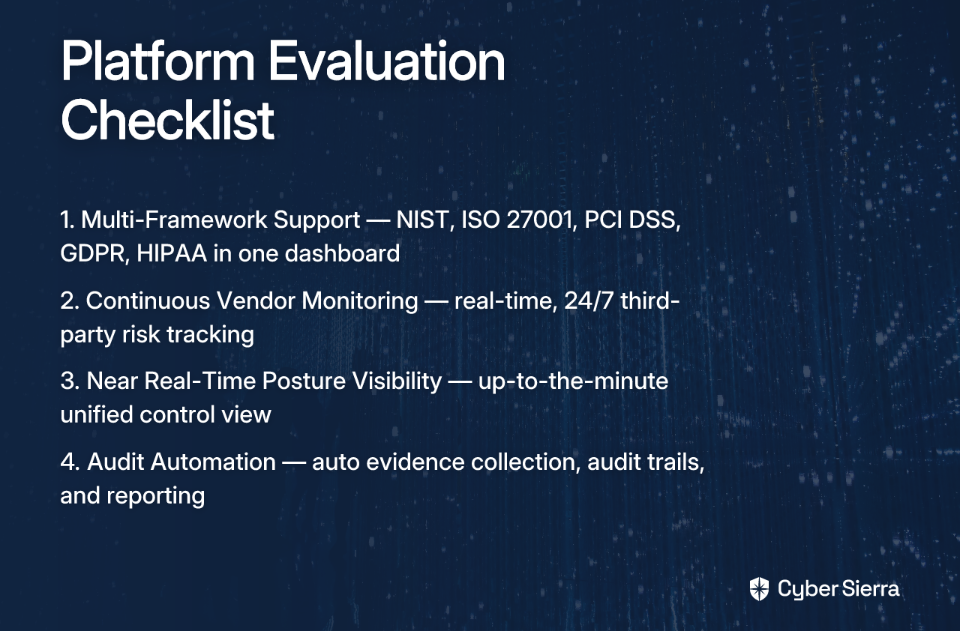
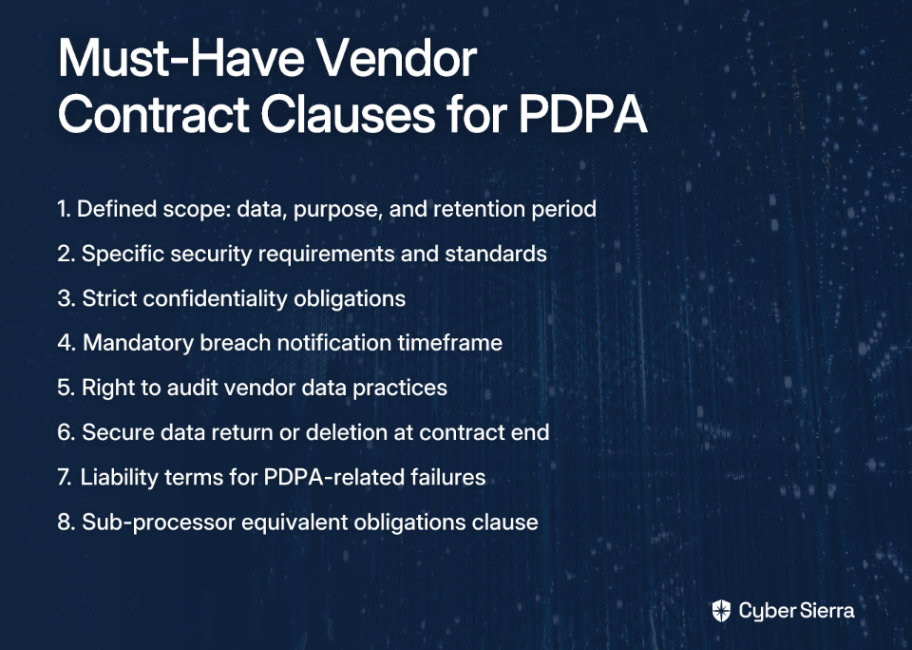
Regardless of your current maturity level, use this checklist when evaluating any cybersecurity risk management solution. These criteria ensure you're choosing a platform that not only fits where you are today, but can scale with you as your program matures.
Map Your Maturity, Master Your Risk

Choosing the right cybersecurity platform feels overwhelming, but it doesn't have to be. The fix isn't another vendor demo—it's clarity. By first understanding your organization's risk maturity, you can cut through the noise and focus on what your team actually needs today.

Here are the key takeaways:

  • Benchmark Your Stage. Use the Reactive, Managed, and Proactive levels to get an honest snapshot of where you are right now.
  • Match Capabilities to Gaps. Don't pay for features you can't use. Reactive teams need GRC automation first. Managed teams need continuous monitoring. Proactive teams need threat intelligence.

Your next step is simple: Block 15 minutes on your calendar to discuss with your team where you fit in this model. This single conversation will give you more direction than a dozen sales calls.

When you're ready to see what a platform designed to grow with you looks like, we're here to help. Book a maturity-matched demo and we’ll show you the specific Cybersierra modules that solve your current challenges.

Frequently Asked Questions

What is a cybersecurity risk maturity model?

A cybersecurity risk maturity model is a framework used to assess an organization's current security practices and outline a path for improvement. It helps you benchmark your capabilities, identify gaps, and make strategic decisions about technology and process investments.

How do I determine my organization's risk maturity level?

You can determine your level by evaluating your current processes. If you primarily react to incidents and manage compliance manually with spreadsheets, you are likely at the "Reactive" level. If you have a formal program but lack continuous visibility, you are "Managed."

Why is it important to match a solution to our maturity level?

Matching a solution to your maturity level prevents over-investing in complex tools your team can't use or under-investing in point solutions that leave you exposed. It ensures you get the right capabilities for your current needs and a clear path to scale as you grow.

What is the first step for a "Reactive" organization?

The first step for a Reactive organization is to establish a foundational GRC (Governance, Risk, and Compliance) program. This involves moving off manual spreadsheets and implementing a system to automate risk assessments, policy management, and audit preparation.
What is the difference between GRC and Continuous Control Monitoring (CCM)?

GRC automation provides the foundational structure for your compliance program, managing policies and audits. CCM builds on this by providing real-time, ongoing visibility into whether your security controls are effective, shifting you from periodic checks to continuous oversight.

What are the key features of a proactive cybersecurity strategy?

A proactive strategy focuses on anticipating threats. Key features include continuous monitoring, AI-driven threat intelligence, attack surface management, and translating cyber risk into financial terms for board-level discussions and strategic investment decisions.

blog-hero-background-image
Cyber Security

9 Best Cybersecurity Compliance Automation Tools for Enterprises

backdrop
Table of Contents

Join thousands of professionals and get the latest insight on Compliance & Cybersecurity.


Summary

  • Manual compliance is unsustainable, with nearly 70% of companies managing six or more frameworks, consuming up to 50% of security team resources.
  • Shifting from point-in-time audits to Continuous Control Monitoring (CCM) provides 24/7 visibility, allowing teams to proactively fix issues before they become audit failures.
  • The most effective compliance automation tools unify Governance, Risk, and Compliance (GRC), CCM, and Third-Party Risk Management (TPRM) into a single platform like Cyber Sierra to eliminate fragmented solutions and reduce audit prep time.

This is the reality for thousands of enterprise security teams today. And it's not just one audit for one framework — it's six, seven, or eight frameworks running simultaneously.

According to Coalfire's 2023 Securealities Report, almost 70% of service organizations needed to demonstrate compliance with at least six different frameworks in 2023. Managing that manually means compliance-related tasks alone can consume 30–50% of a security team's total resources, according to Seceon. A single SOC 2 audit can require 6–12 months of evidence collection before the audit even begins — and the stakes are high. Research shows that 71% of consumers would abandon a business that mishandled their data, making compliance directly tied to customer trust and revenue.
The bottom line? Spreadsheets, quarterly check-ins, and screenshot marathons are no longer viable. Cybersecurity compliance automation has moved from a nice-to-have to an absolute business imperative.

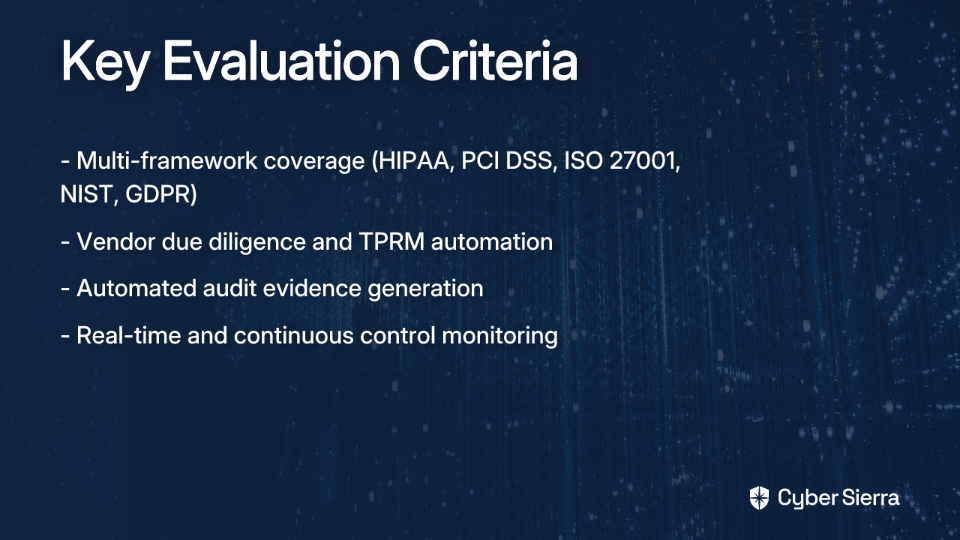
This article breaks down the 9 best compliance automation tools for enterprises, evaluated on the criteria that actually matter to practitioners: multi-framework support, continuous vs. point-in-time monitoring, TPRM integration, and how fast you can get audit-ready.

Why Continuous Control Monitoring Beats Point-in-Time Audits

If you've ever sat on a two-hour call with an engineer, trying to get them to locate a specific configuration file and take a timestamped screenshot for an upcoming audit, you already know the pain. As one seasoned security professional put it on Reddit: "The most painful part of an audit is typically evidence gathering. You end up on long calls with engineers who may or may not speak GRC and hope they remember where to find a config and take a screenshot with a time stamp. It's painful and sucks up a lot of time, especially when you're running lean teams."
Before diving into the tools, it's worth understanding the fundamental divide in compliance monitoring approaches.

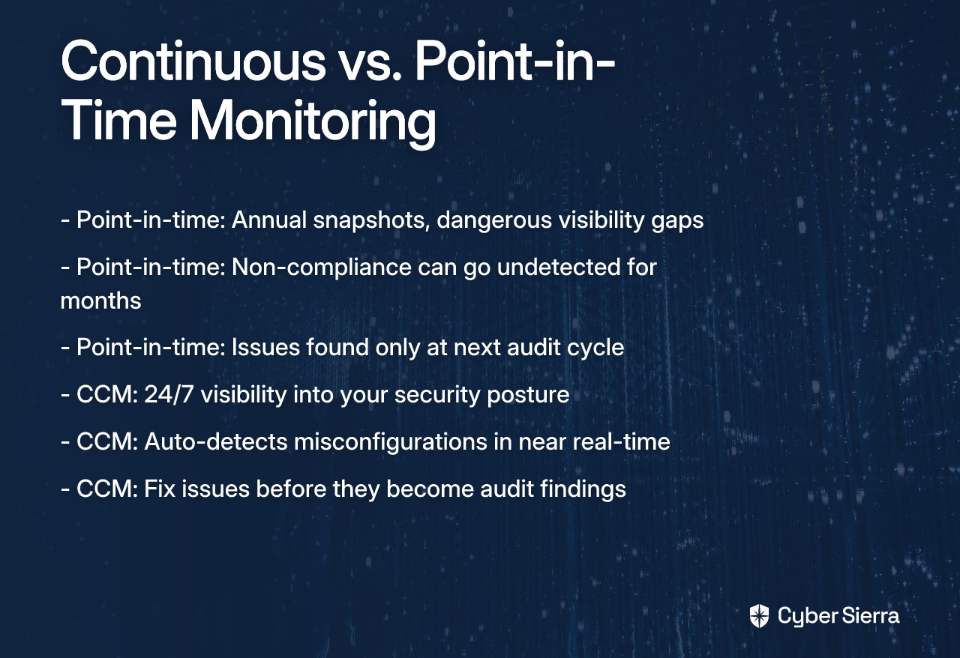
Point-in-time auditing is the traditional model: an annual or quarterly "snapshot" of your compliance posture. While it's lower in initial cost, it creates dangerous visibility gaps. Your organization could be non-compliant for months between checks — and no one would know until the next audit. As Vanta explains, this approach exposes organizations to significant risk during the intervals between assessments.

Continuous Control Monitoring (CCM), by contrast, provides 24/7 visibility into your security posture. It automatically detects misconfigurations, control failures, and compliance deviations in near real-time — so your team can fix issues before they become audit findings or security incidents. For enterprise teams who want "fewer decisions and less risk," as one Reddit user put it, CCM is the only defensible approach.

For any enterprise managing complex regulatory requirements across multiple frameworks, continuous monitoring isn't a premium feature — it's the foundation.

The 9 Best Cybersecurity Compliance Automation Tools for Enterprises

Here are the top platforms that help enterprise teams automate compliance, streamline audit preparation, and build a more defensible security posture.

1. Cyber Sierra

Best For: Enterprises needing a single, unified platform for GRC, Continuous Control Monitoring (CCM), and Third-Party Risk Management (TPRM).

Cyber Sierra's AI-enabled platform stands apart from every other tool on this list because it doesn't ask you to choose between compliance automation, vendor risk management, and continuous monitoring. You get all three — fully integrated — in a single pane of glass.

Feature Snapshot:

  • Continuous Control Monitoring (CCM). Builds a central controls repository with near real-time updates, automates control testing and validation, and detects exceptions and anomalies as they happen — not weeks later.
  • Unified GRC. Manages multiple compliance frameworks — SOC 2, ISO 27001, NIST, HIPAA, PCI DSS, GDPR — plus custom controls, from one dashboard. Automated data collection, risk assessments, and comprehensive audit trails dramatically cut prep time.
  • Integrated TPRM. Automates the full vendor risk lifecycle — onboarding, assessment, and continuous monitoring — providing near real-time, 24/7 visibility into vendor security compliance. No more manual questionnaire pileups.
  • Threat Intelligence. Provides network and cloud vulnerability scanning, a security scorecard, and an outside-in view of your attack surface to support proactive remediation.

Why It's #1: Most tools on this list are excellent point solutions. They do GRC, or they do TPRM, or they do monitoring. Cyber Sierra eliminates the fragmentation by unifying all of these into one platform. This directly addresses a major pain for lean security teams — managing and maintaining multiple, disjointed tools is itself a compliance burden. With Cyber Sierra, there's a single source of truth for:

  • All controls
  • All vendor risks
  • All frameworks

This enables a truly proactive and defensible security program.

2. Drata

Best For: Fast-growing, cloud-native companies seeking deep integrations and rapid audit readiness.

Drata is a strong compliance automation platform with a well-earned reputation for making SOC 2 and ISO 27001 audits significantly less painful. Its continuous monitoring capabilities and broad SaaS integrations make it a popular choice among tech-forward teams.

Feature Snapshot:

  • Automates evidence collection through native integrations with AWS, Azure, GCP, GitHub, and hundreds of SaaS tools.
  • Provides continuous compliance monitoring with automated alerts when controls drift out of compliance.
  • Delivers a polished, user-friendly experience designed for fast adoption.
  • Supports multiple frameworks including SOC 2, ISO 27001, HIPAA, and PCI DSS.

Limitation to Consider: Drata is primarily a GRC and compliance automation tool. Enterprises that also need robust TPRM or integrated threat intelligence will need to layer on additional solutions.

3. Vanta

Best For: SMEs and growth-stage companies looking for streamlined, fast-track compliance automation.

Vanta has built a loyal following by making compliance automation accessible and fast. With over 700 integrations, it automates a large share of the evidence collection process and provides customizable compliance dashboards that keep security teams — and auditors — on the same page.

Feature Snapshot:

  • 400+ integrations to automate security checks across your tech stack.
  • Continuous monitoring with real-time alerts for control failures.
  • Streamlines audit workflows for SOC 2, ISO 27001, HIPAA, and GDPR.
  • Provides a vendor risk management module, though it's less comprehensive than dedicated TPRM platforms.

Limitation to Consider: Vanta shines for smaller, less complex organizations. Larger enterprises with multi-entity structures or deep TPRM requirements may find it less flexible.

4. Secureframe

Best For: Organizations prioritizing rapid implementation and AI-powered cross-framework control mapping.

Secureframe's standout feature is its AI-driven approach to multi-framework compliance. Rather than treating each framework as a separate project, its cross-mapping engine allows a single piece of evidence to satisfy controls across multiple standards — dramatically reducing duplicated work, a major source of compliance fatigue.

Feature Snapshot:

  • AI-powered control mapping across frameworks including SOC 2, ISO 27001, NIST, and HIPAA.
  • Automates documentation and evidence collection for faster audit readiness.
  • Continuous monitoring and real-time compliance alerts.
  • Offers a personnel security module for managing security training requirements.

Limitation to Consider: Like Drata and Vanta, Secureframe is primarily a GRC/compliance automation tool and doesn't offer deep-native TPRM functionality.

5. AuditBoard

Best For: Internal audit teams and large enterprises needing a dedicated, enterprise-grade risk management platform.

AuditBoard takes a different angle — it's purpose-built for internal audit, risk, and compliance teams at large enterprises, with strong emphasis on collaboration and executive-level reporting.

Feature Snapshot:

  • Comprehensive suite covering audit management, risk management, and compliance.
  • Strong reporting and visualization tools for board and executive communication.
  • Streamlines collaboration between internal audit, risk, and compliance functions.
  • Supports SOX compliance and IT audit workflows in addition to cybersecurity frameworks.

Limitation to Consider: AuditBoard is a premium, enterprise-focused solution with pricing to match. It may be more than necessary for organizations primarily looking for cybersecurity compliance automation.

6. OneTrust

Best For: Global organizations with complex data privacy obligations and a focus on governance.

OneTrust is the market leader in privacy management and a serious contender for organizations operating under GDPR, CCPA, and other data privacy regulations. It has expanded significantly into broader GRC, ethics, and ESG management.

Feature Snapshot:

  • Leading privacy management capabilities covering GDPR, CCPA, LGPD, and more.
  • Automates data discovery, mapping, and Privacy Impact Assessments (PIAs).
  • Offers GRC, third-party risk, and ethics/ESG modules.
  • Strong workflow automation for cross-functional compliance processes.

Limitation to Consider: OneTrust's breadth comes with complexity. For teams primarily focused on cybersecurity compliance frameworks rather than data privacy, its feature set may be broader than needed.

7. ServiceNow GRC / TPRM

Best For: Large enterprises already deeply embedded in the ServiceNow ecosystem.

If your organization runs on ServiceNow, its GRC and TPRM modules are a natural extension of infrastructure you already own. ServiceNow's strength is its workflow automation engine and deep enterprise integrations.

Feature Snapshot:

  • Centralized TPRM covering the full vendor lifecycle, from onboarding to retirement.
  • Integrates with external risk intelligence providers for continuous vendor scoring.
  • Powerful workflow automation for assessments, issue tracking, and remediation.
  • Unified visibility across IT risk, operational risk, and compliance.

Limitation to Consider: ServiceNow GRC/TPRM is powerful but costly to implement and maintain. It typically requires dedicated administrators and a significant professional services engagement to configure effectively.

8. Archer (RSA Archer)

Best For: Highly regulated industries and large enterprises requiring deep customization and operational risk coverage.

RSA Archer is a legacy leader in the GRC space and remains a go-to for heavily regulated industries like financial services and healthcare, where compliance requirements go well beyond standard cybersecurity frameworks.

Feature Snapshot:

  • Highly configurable modules covering IT risk, operational risk, and business resiliency.
  • Advanced analytics, risk quantification, and scenario modeling.
  • Supports a wide range of frameworks and regulatory requirements.
  • Strong audit trail and documentation capabilities for defensible reports.

Limitation to Consider: Archer's power comes with significant implementation complexity and cost. For organizations that don't need its depth of configurability, the overhead can outweigh the benefits.

9. LogicGate Risk Cloud

Best For: Teams that need a flexible, no-code platform to build fully custom GRC workflows.

LogicGate takes a platform-first approach, giving teams a no-code environment to design their own risk and compliance workflows. This makes it uniquely adaptable but also requires more internal investment to configure.

Feature Snapshot:

  • No-code workflow builder for creating custom GRC applications and processes.
  • Highly flexible risk assessment and control management capabilities.
  • Enables cross-functional collaboration across risk, compliance, and operations teams.
  • Supports audit management, incident management, and vendor risk use cases.

Limitation to Consider: The flexibility that makes LogicGate powerful also means there's no out-of-the-box experience. Teams without dedicated GRC resources may find the configuration burden significant.

Buyer's Guide: How to Choose the Right Compliance Automation Tool

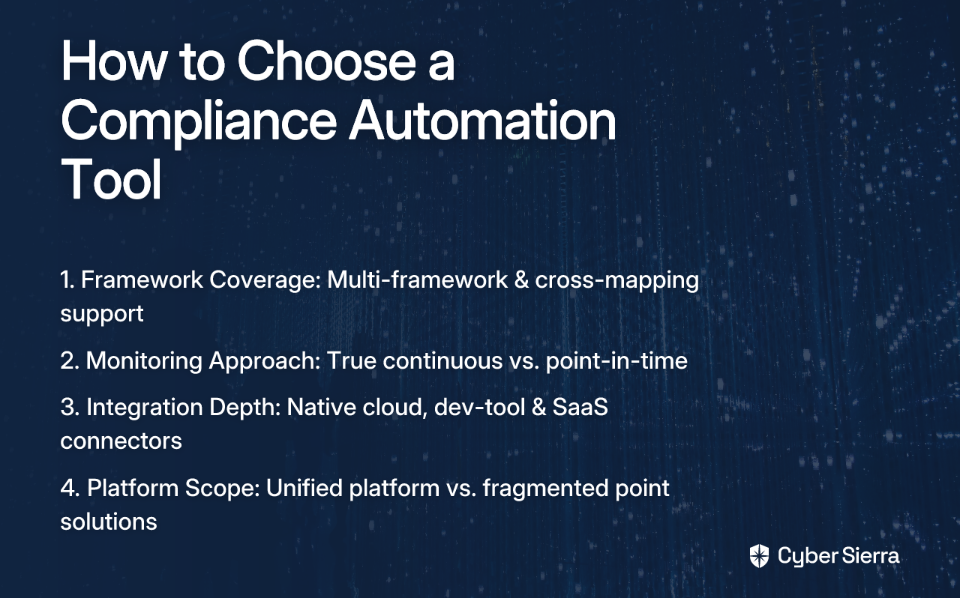
With nine strong options on the table, here's a practical framework to help you evaluate what's right for your enterprise:

Build a Defensible, Automated Compliance Program

The core challenge of enterprise compliance isn’t just passing an audit; it’s the constant, resource-draining effort of managing multiple frameworks with manual processes. Spreadsheet-driven evidence gathering and quarterly check-ins don't just burn out your team—they leave you blind to risks between audit cycles.

To build a truly defensible program, focus on two key shifts:

  • Move from point-in-time snapshots to 24/7 visibility. Continuous Control Monitoring (CCM) lets you find and fix issues as they happen, not months later during an audit.
  • Unify your compliance stack. Managing separate tools for GRC, vendor risk (TPRM), and monitoring creates fragmented data and wasted effort. A single platform provides one source of truth.

As a next step, calculate the engineering hours your team spent on evidence collection for your last audit. That number is your business case for automation.

When you’re ready to reclaim those hours, see how Cyber Sierra's unified platform helps teams get audit-ready faster, without the fatigue. Book your personalized demo and start building a more resilient security posture today.

Frequently Asked Questions

What is cybersecurity compliance automation?

Cybersecurity compliance automation uses software to continuously monitor security controls, collect evidence, and manage tasks for frameworks like SOC 2 and ISO 27001. It replaces manual processes like spreadsheets and screenshots, saving significant time and reducing human error during audits.

Why is continuous control monitoring (CCM) important for compliance?

Continuous control monitoring (CCM) is crucial because it provides 24/7 visibility into your security posture, unlike point-in-time audits that create dangerous visibility gaps. CCM automatically detects misconfigurations in near real-time, allowing you to fix issues before they become audit findings.

How do compliance automation tools handle multiple frameworks?

Compliance automation tools handle multiple frameworks using a central control repository and cross-mapping. A single control test or piece of evidence can be mapped to satisfy requirements across several standards (e.g., SOC 2, ISO 27001, NIST), eliminating redundant work and streamlining audit prep.

What are the key features to look for in a compliance automation tool?

The key features to look for are multi-framework support, true continuous control monitoring, deep integrations with your tech stack, and a unified platform scope. An ideal tool combines Governance, Risk, and Compliance (GRC), CCM, and Third-Party Risk Management (TPRM) to avoid fragmented solutions.

Can compliance be fully automated?

No, compliance cannot be fully automated, but its most tedious components can. Automation excels at evidence collection, control testing, and continuous monitoring. However, human oversight remains essential for risk assessment, strategic decision-making, and addressing complex control exceptions.

blog-hero-background-image
Cyber Security

3 Best PDPA Compliance Software for Singapore Businesses

backdrop
Table of Contents

Join thousands of professionals and get the latest insight on Compliance & Cybersecurity.


Summary

  • Failing to comply with Singapore's PDPA can lead to severe fines of up to S$1 million or 10% of annual turnover.
  • The Act requires businesses to manage consent, protect data, and report significant breaches within three days—obligations that are challenging to meet with manual processes.
  • To stay compliant and avoid penalties, businesses should adopt software to automate tasks like data mapping, vendor risk management, and audit evidence collection.
  • A unified platform like Cyber Sierra simplifies managing PDPA alongside other frameworks like ISO 27001 through automated GRC workflows.

Managing compliance with Singapore's Personal Data Protection Act (PDPA) is one of those obligations that's easy to put off — until it isn't. Between handling day-to-day operations and juggling everything else on your plate, sitting down to map data flows, draft consent policies, and prepare breach notification procedures can feel overwhelming.

That paralysis is costly. Non-compliance with the PDPA carries serious financial penalties — up to 10% of annual turnover for organizations earning more than S$10 million, or up to S$1 million for smaller businesses. The Personal Data Protection Commission (PDPC) has shown it is willing to enforce these rules.

The good news: the right PDPA compliance software removes most of the manual work. Instead of maintaining spreadsheets, chasing evidence, and scrambling before audits, you get automated workflows, centralized documentation, and continuous visibility into your compliance posture. This article covers three solutions worth considering — what they do well, who they're built for, and how they map to PDPA's requirements.

What Is PDPA and Why Does It Matter for Your Business?

The Personal Data Protection Act governs how private organizations in Singapore collect, use, and disclose personal data. It applies to virtually every business that handles information about individuals — which, in practice, means almost all of them.

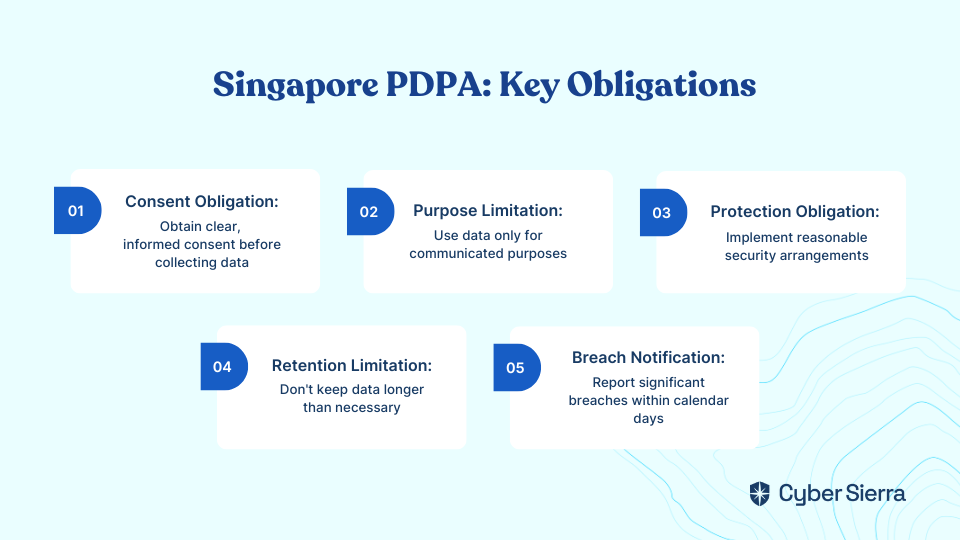
Key obligations under the PDPA include:

  • Consent Obligation. You must obtain clear, informed consent before collecting, using, or disclosing an individual's personal data.
  • Purpose Limitation Obligation. Data can only be used for the specific purposes communicated at the point of collection.
  • Protection Obligation. Organizations must implement reasonable security arrangements to protect personal data from unauthorized access, disclosure, or loss.
  • Retention Limitation Obligation. Personal data should not be kept longer than necessary for the purpose it was collected.
  • Breach Notification Obligation. Data breaches that are likely to result in significant harm must be reported to the PDPC and affected individuals within three calendar days.

Meeting these obligations manually — across multiple systems, vendors, and business units — is where most organizations run into trouble.

Key Features To Look For in PDPA Compliance Software

Before evaluating specific tools, it helps to know what capabilities actually move the needle for PDPA compliance. The right platform should address the full compliance lifecycle, not just one slice of it.

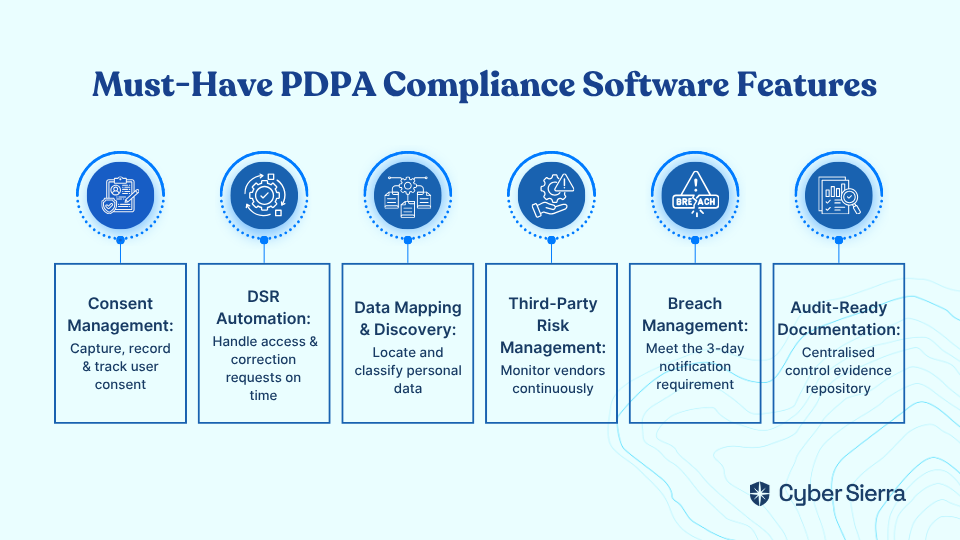
Essential features to look for include:

  • Consent management. Tools to capture, record, and track user consent across all touchpoints, and to process withdrawals promptly.
  • DSR automation. Workflows to handle access, correction, and withdrawal requests within PDPA's required timelines.
  • Data mapping and discovery. AI-assisted scanning to locate and classify personal data across your systems — a prerequisite for understanding your actual risk exposure.
  • Third-Party Risk Management (TPRM). Assessment and monitoring tools to ensure that data intermediaries and vendors also meet PDPA's protection standards.
  • Breach management workflows. Automated detection and guided reporting processes to meet the mandatory three-day notification requirement.
  • Audit-ready documentation. A centralized repository for policies, procedures, and control evidence — so you can demonstrate compliance to the PDPC on demand, not just during a fire drill.

With those criteria in mind, here are three PDPA compliance software solutions that stand out for Singapore businesses.

3 Best PDPA Compliance Software for Singapore Businesses

Each of the tools below takes a different approach to compliance automation. The right fit depends on your organization's size, existing tech stack, and whether PDPA is your only regulatory concern or one of several.

1. Cyber Sierra

Best for: Singapore-based businesses that need PDPA compliance as part of a broader, unified cybersecurity program.

Supported frameworks: PDPA, ISO 27001, SOC 2, PCI DSS, GDPR, HIPAA, NIST CSF.

Deployment: Cloud-based SaaS.

Cyber Sierra is an AI-enabled cybersecurity platform that helps organizations move from periodic, manual compliance checks toward continuous, automated control monitoring. For Singaporean businesses specifically, it carries meaningful local credibility: Cyber Sierra is part of the IMDA Spark Programme, accredited by the Cyber Security Agency of Singapore (CSA), and was recognized as a Sample Vendor in the Gartner® Hype Cycle™ for Cyber-Risk Management, 2024.

What makes it relevant for PDPA compliance is its integrated approach. Rather than addressing privacy in isolation, the platform connects data governance, vendor risk, and security posture monitoring into a single view — which directly supports several of PDPA's core obligations.

Key features:

  • GRC automation. Maps PDPA obligations to internal controls, automates evidence collection, and maintains audit trails — reducing the scramble that typically precedes a PDPC inquiry.
  • Continuous Control Monitoring. Provides near real-time visibility into whether your security controls are operating effectively, directly supporting PDPA's Protection Obligation.
  • Third-Party Risk Management. Automates vendor assessments and monitors data intermediaries on an ongoing basis — well beyond the point-in-time questionnaires that quickly go stale.
  • Employee Security Training. Delivers interactive training modules and simulated phishing campaigns to reduce the human error that causes most data breaches.

For organizations managing compliance across multiple frameworks simultaneously — PDPA alongside ISO 27001 or SOC 2, for example — Cyber Sierra's unified platform helps avoid the compliance fatigue that comes from running separate tools for each requirement.

2. Securiti.ai

Best for: Organizations that need deep, AI-driven data discovery and high-volume Data Subject Request automation.

Supported frameworks: PDPA, GDPR, CCPA/CPRA, HIPAA, and 50+ global privacy regulations.

Deployment: Cloud-based SaaS, with hybrid deployment options.

Securiti's Data Command Center is purpose-built for data-centric security and privacy. Its strength lies in finding personal data across complex, distributed environments and automating the workflows needed to act on it — which maps well to PDPA's consent, access, and correction obligations.

Key features:

  • AI-driven data discovery. Scans structured and unstructured data sources to surface and classify sensitive personal data across your entire environment.
  • DSR automation. Customizable request portals and automated fulfillment workflows help teams respond to access and rectification requests within PDPA's timelines.
  • Consent lifecycle management. Automates consent collection, tracking, and withdrawal processing across web and mobile touchpoints.
  • Vendor risk assessment. Provides tools to manage third-party data handling risks, supporting PDPA's requirement to hold data intermediaries accountable.

Securiti is particularly well-suited to organizations in data-heavy industries — financial services, healthcare, or retail — where the volume of personal data makes manual discovery and DSR handling impractical.

3. OneTrust

Best for: Large enterprises managing PDPA compliance alongside complex global privacy obligations.

Supported frameworks: PDPA, GDPR, CCPA/CPRA, LGPD, PIPEDA, and many others.

Deployment: Cloud-based SaaS.

OneTrust is one of the most established names in privacy management. Its platform is mature, feature-rich, and built to handle the complexity that comes with operating across multiple jurisdictions. For Singapore businesses with regional or global operations, it offers a robust foundation for managing PDPA.

Key features:

  • Privacy and data governance. Comprehensive data mapping, risk assessment workflows, and policy management tools to operationalize PDPA's governance obligations.
  • Cookie consent and preference management. Advanced tools for managing website-level compliance and honoring user preferences across digital properties.
  • Vendor risk management. Structured assessments and data processing agreement management to ensure third parties meet PDPA's protection standards.
  • Incident and breach response. Guided workflows for detecting, assessing, and reporting data breaches in line with PDPA's mandatory notification requirement.

The trade-off with OneTrust is implementation complexity. It is a powerful platform, but smaller organizations may find the setup investment significant. It is best suited to enterprises with dedicated privacy or legal teams to manage it.

How To Choose the Right PDPA Compliance Software

There is no single "best" tool — the right choice depends on your organization's specific situation. Ask yourself these questions before deciding:

  1. What is your compliance scope? If PDPA is your only concern, a privacy-focused tool may suffice. If you're also working toward ISO 27001 certification or managing SOC 2 audits, a unified platform that handles multiple frameworks from a single dashboard will save significant duplication of effort.
  2. How complex is your data environment? Organizations with distributed data across many systems — especially hybrid cloud environments — will benefit more from AI-driven discovery tools like Securiti's.
  3. How large is your team? Smaller teams with no dedicated compliance staff need tools with intuitive interfaces and guided workflows. Enterprise-grade platforms with steep learning curves can create more problems than they solve for lean operations.
  4. What is your vendor footprint? If you rely on many third-party vendors or data intermediaries — common in financial services and healthcare — prioritize platforms with robust TPRM capabilities that go beyond annual questionnaires.
  5. Do you need local credibility? For public sector contracts or regulated industries in Singapore, working with platforms that carry CSA accreditation or IMDA recognition can matter during procurement and audits.

The answers to these questions should narrow the field quickly.

Automate PDPA Compliance and Reclaim Your Focus

Managing PDPA compliance doesn't have to be a cycle of manual evidence-chasing and last-minute audit prep. Shifting from spreadsheets to software isn't just about efficiency—it's about building a sustainable, always-on compliance posture that protects your business from steep fines and reputational damage.

Here are the essentials to remember:

  • Automation is non-negotiable. Manual processes can't keep up with PDPA's demands for continuous vendor monitoring, data mapping, and the tight 3-day breach notification window.
  • Think beyond a single framework. If you handle other regulations like ISO 27001 or SOC 2, a unified platform prevents duplicating work and managing compliance in fragmented silos.

Ready for a practical next step? Take 15 minutes today to manually trace the lifecycle of one piece of customer data. Where is it stored? Who has access? The gaps you find are exactly what a GRC platform is built to solve.

If that exercise reveals more complexity than you thought, see how automation can help. Schedule a quick demo to see how Cyber Sierra consolidates PDPA controls and evidence into a single, audit-ready view.

Frequently Asked Questions

What is PDPA compliance software?

PDPA compliance software helps automate the tasks required to meet Singapore's Personal Data Protection Act. It assists with consent management, data mapping, risk assessments, and generating audit-ready documentation, replacing manual tracking with streamlined, automated workflows.

Why is PDPA compliance important for my business in Singapore?

PDPA compliance is crucial to avoid significant financial penalties, which can be up to 10% of annual turnover for large firms or S$1 million for smaller ones. It also builds trust with customers by demonstrating your commitment to protecting their personal data responsibly.

What are the most critical features of PDPA software?

Key features include consent management, Data Subject Request (DSR) automation, data discovery and mapping, third-party risk management, and breach notification workflows. These tools help address the core obligations of the PDPA, from data collection to incident response.

How do I start my journey towards PDPA compliance?

A good first step is to conduct a data inventory to understand what personal data you collect and where it is stored. Appointing a Data Protection Officer (DPO) and using compliance software to automate policy implementation and monitoring are also crucial early actions.

Is using compliance software enough to be PDPA compliant?

No, software is a tool to facilitate compliance, not a guarantee. Your organization must still establish clear data protection policies, train employees, and foster a culture of privacy. The software automates and monitors the technical controls that support these policies.

How often should I review my PDPA compliance posture?

PDPA compliance should be reviewed continuously, not just annually. The best software provides ongoing monitoring of your controls and vendor risks. This proactive approach ensures you are always prepared for an audit and protected against emerging threats, not just during a fire drill.

blog-hero-background-image
Cyber Security

5 Best Cybersecurity Compliance Platforms for Singapore Enterprises

backdrop
Table of Contents

Join thousands of professionals and get the latest insight on Compliance & Cybersecurity.


Summary

  • Singapore enterprises face a complex web of compliance frameworks like PDPA, MAS TRM, and ISO 27001, making manual audit preparation highly inefficient.
  • The shift towards continuous control monitoring is essential for real-time visibility and to meet evolving regulatory expectations, such as Singapore's proposed MAS TPRM guidelines.
  • Key evaluation criteria for a compliance platform include multi-framework support, deep automation for evidence collection, and integrated Third-Party Risk Management (TPRM).
  • For enterprises juggling multiple frameworks, a unified platform like Cyber Sierra consolidates GRC, TPRM, and continuous monitoring to streamline audits and improve security posture.

Managing cybersecurity compliance in Singapore is not a single-framework problem. Between the Personal Data Protection Act (PDPA), the Monetary Authority of Singapore (MAS) Technology Risk Management (TRM) Guidelines, ISO 27001, and — for organizations with global footprints — SOC 2, GDPR, and PCI DSS, the compliance stack piles up fast. Security teams end up spending hundreds of hours per audit cycle collecting screenshots, chasing control owners, and mapping overlapping requirements across frameworks — time that should be going toward actual security work.

The pressure is intensifying. MAS has proposed new TPRM guidelines that would apply to all financial institutions relying on third-party services — making continuous vendor monitoring a regulatory expectation, not just a best practice. And the honest reality, as practitioners know well, is that a compliant system doesn't strictly mean it's secure. Platforms that reduce compliance to a checkbox exercise miss the point entirely.

This article cuts through the noise. Below are five cybersecurity compliance platforms worth considering for Singapore enterprises — evaluated on multi-framework support, automation depth, TPRM capability, and real-world fit.

What To Look For in a Cybersecurity Compliance Platform

Before jumping into the list, it helps to know what separates a genuinely useful platform from one that just looks good in a demo. Choosing the wrong tool — or choosing the right tool without understanding your requirements — can mean wasted budget and a false sense of security.

Here's what matters:

The Top 5 Cybersecurity Compliance Platforms for Singapore

Each platform below is evaluated within the context of Singapore's regulatory environment and the real operational challenges compliance teams face. Here's how they stack up.

1. Cyber Sierra

Best for: Enterprises managing multiple overlapping compliance frameworks and seeking a unified, AI-enabled platform.

Supported frameworks: ISO 27001, SOC 2, PDPA, GDPR, PCI DSS, NIST, HIPAA.

Deployment: Cloud-based SaaS.

Cyber Sierra is an AI-enabled cybersecurity compliance platform built around the idea that compliance and security should reinforce each other — not operate in silos. It integrates Governance, Risk, and Compliance (GRC), TPRM, Continuous Control Monitoring (CCM), Threat Intelligence, Employee Security Training, and Cyber Insurance into a single platform. For teams tired of stitching together five tools to get one coherent view of their security posture, that consolidation is material.

For Singapore enterprises specifically, Cyber Sierra carries meaningful local credibility. It is accredited by the Cyber Security Agency of Singapore (CSA), selected for the IMDA Spark Programme, and was recognized as a Sample Vendor in the Gartner® Hype Cycle™ for Cyber-Risk Management, 2024. It also holds ISO 27001 certification itself — not just as something it helps customers achieve.

Key features:

  • Continuous Control Monitoring. Builds a central controls repository with near real-time updates, enabling security teams to shift from periodic audit prep to proactive, continuous assurance.
  • Automated GRC. Automates evidence collection, maintains detailed audit trails, and manages multiple compliance frameworks from a unified platform — reducing the manual overhead that drains compliance teams.
  • Third-Party Risk Management. Provides continuous vendor monitoring and automated assessments, addressing the supply chain risks surfaced by MAS's proposed TPRM guidelines and the real-world problem that vendors can misrepresent their security posture on static questionnaires.

2. ResGuard Solutions

Best for: Singapore-based organizations prioritizing local compliance with PDPA and ISO 27001.

Supported frameworks: PDPA, ISO 27001, SOC 2, NIST.

Deployment: Cloud-based SaaS.

ResGuard Solutions is a Singapore-focused compliance platform with deep roots in local regulatory requirements. Its platform is structured around two core frameworks that dominate the compliance agenda for most Singaporean enterprises: PDPA and ISO 27001. For organizations where those two frameworks represent the primary compliance burden, ResGuard offers a well-scoped, purpose-built solution.

The platform claims to reduce manual compliance effort by up to 70% through automated assessments and risk scoring. Its strength lies in local specialization rather than breadth — which is a genuine advantage for companies whose compliance needs map closely to Singapore's regulatory environment.

Key features:

  • Data Protection Manager. A dedicated module built specifically around PDPA requirements, including data inventories and breach notification workflows.
  • ISMS Manager. Provides tools, risk registers, and control tracking to support ISO/IEC 27001:2022 implementation and ongoing maintenance.
  • Vendor Risk Management. Includes capabilities for third-party assessments and ongoing vendor monitoring to address supply chain exposure.

3. Vanta

Best for: Startups and SMEs looking to achieve SOC 2 or ISO 27001 certification efficiently.

Supported frameworks: SOC 2, ISO 27001, HIPAA, GDPR, PCI DSS.

Deployment: Cloud-based SaaS.

Vanta built its reputation on making SOC 2 achievable for high-growth technology companies — and it executes on that promise well. Its integrations span over 300 cloud services, HR platforms, and developer tools, enabling automated evidence collection across a modern tech stack. For cloud-native teams, that breadth is genuinely useful.

Where Vanta shines is in speed to first certification. It is suited for organizations newer to compliance automation that need to get audit-ready without standing up a large compliance function. That said, practitioners note that some compliance platforms oversell rapid timelines — achieving SOC 2 compliance in "days" remains a marketing claim that deserves scrutiny. The platform is a strong fit for smaller organizations; enterprises managing complex, multi-framework environments may find its depth limiting.

Key features:

  • Real-time monitoring. Continuously checks for compliance gaps across an organization's cloud infrastructure and integrated tools.
  • Extensive integrations. Connects to over 300 services to automate evidence gathering, reducing manual collection effort significantly.
  • Trust Center. A public-facing page that allows organizations to share their security posture and compliance certifications with customers and prospects.

4. Drata

Best for: Technology companies prioritizing accurate, automated SOC 2 and ISO 27001 compliance monitoring.

Supported frameworks: SOC 2, ISO 27001, HIPAA, PCI DSS, GDPR.

Deployment: Cloud-based SaaS.

Drata is frequently cited alongside Vanta as one of the leading compliance automation platforms, and it competes strongly on data accuracy. For teams burned by alert fatigue and false positives from shallow integrations, Drata's emphasis on integration depth and precise control monitoring is a meaningful differentiator. Its interface is consistently noted for being intuitive, which reduces the configuration overhead that compliance tool deployments often demand.

Drata is a particularly good fit for organizations where the audit relationship is central — its Audit Hub creates a dedicated, secure space for auditors to access evidence without the back-and-forth of email threads and shared drives.

Key features:

  • Automated compliance monitoring. Provides continuous, automated monitoring of security controls across the tech stack, surfacing exceptions before they become audit findings.
  • Audit Hub. A dedicated auditor-facing workspace where all evidence and reports are securely accessible, streamlining the audit process for both parties.
  • Risk management. Built-in tools for conducting risk assessments and tracking remediation efforts within the platform, keeping risk and compliance workflows unified.

5. OneTrust

Best for: Large enterprises with complex data privacy obligations under GDPR, PDPA, or CCPA/CPRA.

Supported frameworks: GDPR, PDPA, CCPA/CPRA, HIPAA, ISO 27001.

Deployment: Cloud-based SaaS.

OneTrust's roots are in privacy management, and that heritage shows — it remains one of the deepest platforms available for organizations where data privacy is the primary compliance driver. For large enterprises operating across multiple jurisdictions and managing complex consent, data mapping, and processing activities, OneTrust offers a level of privacy-specific capability that GRC-first platforms rarely match.

In the Singapore context, OneTrust is a strong option for organizations that need to satisfy both PDPA and GDPR simultaneously — a common scenario for multinationals with operations in Singapore and the EU. Its GRC functionality has expanded significantly, though enterprises prioritizing continuous security control monitoring alongside privacy may find they need to supplement it with additional tooling.

Key features:

  • Automated data mapping. Visualizes data flows and processing activities across the organization, which is foundational for both PDPA and GDPR compliance documentation.
  • Privacy Impact Assessments (PIAs). Streamlines and automates the process of conducting PIAs and Data Protection Impact Assessments (DPIAs), reducing the manual effort these assessments typically require.
  • Consent and preference management. Provides robust tools to manage user consent across websites and applications — critical for organizations with significant consumer-facing digital properties.

From Audit Chaos to Continuous Compliance

The reality for Singapore enterprises is that juggling PDPA, MAS TRM, and ISO 27001 with manual processes is no longer sustainable. The audit fire drill—chasing screenshots, mapping overlapping controls—drains resources that should be spent on security itself.

The shift to automation isn't just about passing the next audit; it's about building a foundation of continuous compliance. Here’s what that looks like in practice:

  • Unify your frameworks: Instead of treating each regulation as a separate project, manage them from a single source of truth to eliminate redundant work.
  • Automate evidence collection: Replace manual checks with continuous control monitoring that gathers evidence from your tech stack in near real-time.

Your next step doesn't have to be a massive project. Start by mapping the manual effort required for just one control in your upcoming audit. Once you see the hours involved, the value of automation becomes clear.

If consolidating your GRC, TPRM, and compliance monitoring stack into a single, AI-enabled platform is on your roadmap, see Cyber Sierra's platform.

Frequently Asked Questions

What is a cybersecurity compliance platform?

A cybersecurity compliance platform is a software tool that automates the process of meeting regulatory and industry standards like PDPA, MAS TRM, and ISO 27001. It helps organizations by centralizing control management, automating evidence collection, and providing continuous monitoring to simplify audits.

Why is continuous control monitoring important for compliance in Singapore?

Continuous control monitoring (CCM) is crucial because it provides real-time visibility into your security posture, rather than just at audit time. For regulations like MAS TRM, this proactive approach helps identify and fix gaps as they occur, shifting teams from periodic audit sprints to continuous assurance.

How do compliance platforms address MAS TRM guidelines?

Compliance platforms help meet MAS TRM guidelines by automating technology risk assessments and providing robust Third-Party Risk Management (TPRM) features. They offer continuous vendor monitoring and automated assessments, addressing TPRM updates and ensuring third-party services meet regulatory expectations.

Which compliance framework should my Singapore business prioritize?

For most Singapore businesses, the Personal Data Protection Act (PDPA) is the mandatory starting point. Beyond that, ISO 27001 is a common global standard. Financial institutions must adhere to MAS TRM, while companies handling international customer data often need SOC 2 or GDPR.

What is the difference between platforms like Cyber Sierra and Vanta?

The main difference is scope. Vanta excels at helping startups and SMEs achieve specific certifications like SOC 2 quickly. In contrast, Cyber Sierra offers a unified solution for enterprises managing multiple overlapping frameworks (GRC, TPRM, CCM), with a strong focus on the Singapore regulatory landscape.

Can a compliance platform guarantee I will pass an audit?

No platform can guarantee a passed audit, as it also depends on your internal processes. However, these platforms significantly improve your chances by automating evidence collection, providing continuous monitoring to catch issues early, and streamlining the entire audit workflow, making it faster and more reliable.

blog-hero-background-image
Cyber Security

Top 3 Third Party Risk Management Software for Singapore's Financial Sector

backdrop
Table of Contents

Join thousands of professionals and get the latest insight on Compliance & Cybersecurity.


Summary

  • With the Monetary Authority of Singapore (MAS) tightening vendor oversight from December 2024, financial institutions can no longer rely on manual spreadsheets and static questionnaires for Third-Party Risk Management (TPRM).
  • Effective TPRM platforms move beyond periodic checks, offering continuous monitoring and automated assessments to manage cybersecurity, operational, and regulatory risks in near real-time.
  • When choosing a TPRM solution, prioritize platforms that provide a unified view of risk, automate the entire vendor lifecycle, and offer deep assessment capabilities beyond surface-level scores.
  • For a holistic approach, Cyber Sierra's TPRM platform integrates vendor risk with internal GRC and continuous control monitoring, providing a single source of truth for compliance.

You rely on dozens — sometimes hundreds — of third-party vendors to run your financial institution. And if you're honest, you have no idea what their security posture actually looks like right now. A completed questionnaire from six months ago doesn't tell you whether they've patched a critical vulnerability discovered last week. It doesn't tell you if their employee offboarding policy exists, let alone whether it's enforced.

For Chief Information Security Officers (CISOs) and compliance teams in Singapore's financial sector, this is the core tension: your regulatory obligations demand demonstrable vendor oversight, but the tools and processes most teams rely on — spreadsheets, static questionnaires, manual follow-ups — can't keep pace with the scale or speed of real-world vendor risk.

This article reviews three Third-Party Risk Management (TPRM) platforms that are genuinely designed for this challenge, evaluated for their depth of assessment, automation capabilities, and relevance to Singapore's financial regulatory environment.

Why TPRM Is Non-Negotiable for Singapore's Financial Sector

Effective vendor risk management is about more than ticking a regulatory box — it's about operational resilience. A breach at a critical vendor doesn't just affect them; it can disrupt your operations, expose your customers' data, and put your institution directly in the crosshairs of regulators.

The Monetary Authority of Singapore (MAS) has made its expectations clear. The MAS Guidelines on Outsourcing for Banks and the Notice on Management of Outsourced Relevant Services for Banks, both effective from December 11, 2024, establish firm expectations for how financial institutions must govern and manage outsourcing arrangements. The MAS has also published an information paper on third-party risk management outlining supervisory expectations and best practices — a clear signal that regulators are watching.

The risks that a mature TPRM program must address fall into four categories:

  • Cybersecurity risk. Vulnerabilities in a vendor's environment can propagate directly into your own. If they're breached, you may be too.
  • Operational risk. A critical vendor going offline — whether from a cyberattack, outage, or financial failure — can halt your own business continuity.
  • Regulatory risk. Non-compliance by a vendor doesn't shield your institution from regulatory consequences. You are accountable for who you work with.
  • Reputational risk. A vendor incident tied to your institution can erode customer trust faster than almost any other type of event.

Top 3 TPRM Software Solutions for Singapore's Financial Sector

The right TPRM platform transforms vendor oversight from a periodic, manual exercise into a continuous, automated business function. The three tools below were selected based on their ability to provide deep visibility, automate assessment workflows, and meet the rigorous demands of the financial sector.

1. Cyber Sierra

Best for: Singapore-based financial institutions that want a unified, AI-enabled platform integrating TPRM with Governance, Risk, and Compliance (GRC), Continuous Control Monitoring (CCM), and threat intelligence. Deployment: Cloud-based SaaS.

Cyber Sierra addresses a problem that standalone TPRM tools can't: the fragmentation of risk data across your organization. Most institutions manage internal controls in one tool, vendor risk in another, and compliance frameworks in a third — with no way to connect the dots. Cyber Sierra's TPRM platform sits within a unified security platform, meaning vendor risk is assessed and managed in the same environment as your internal controls and compliance posture.

For Singapore-based institutions specifically, Cyber Sierra brings strong local credibility. It is selected for Singapore's IMDA Spark Programme, accredited by the Cyber Security Agency of Singapore (CSA), and won the AI Innovation Awards 2024 — presented by Singapore's Ministry of Communications and Information (MCI), Digital Industry Singapore (DISG), Smart Nation and Digital Government Office (SNDGO), and Google Cloud. Cyber Sierra is also recognized as a Sample Vendor in the Gartner® Hype Cycle™ for Cyber-Risk Management, 2024, and is itself ISO 27001 certified.

Key features:

  • Automated vendor assessments. Eliminates the manual effort of sending, tracking, and evaluating questionnaires — directly addressing the industry-wide pain of overly complex questionnaires leading to analysis paralysis.
  • Near real-time vendor visibility. Provides continuous, 24/7 insight into vendor security compliance, moving beyond point-in-time snapshots that are outdated the moment they're completed.
  • Risk-based vendor prioritization. Helps teams focus limited resources on the highest-risk vendors first, rather than treating all suppliers equally.
  • Streamlined onboarding and offboarding. Manages risk across the entire vendor lifecycle — from initial due diligence through to secure termination of access.

2. UpGuard

Best for: Organizations that prioritize data-driven security ratings and continuous external attack surface monitoring to independently validate vendor security posture. Deployment: Cloud-based SaaS.

UpGuard takes an outside-in approach to vendor risk. Rather than relying solely on what a vendor self-reports, it continuously scans the internet for misconfigurations, unpatched vulnerabilities, exposed data, and other risk signals — then aggregates this into a vendor security score.

This validation capability is a key differentiator. It addresses the common frustration of being unable to independently verify a vendor's claims. When a vendor says they've patched a vulnerability, UpGuard provides an external check to see if that's reflected in their public exposure, meaning your team doesn't have to just take their word for it.

Key features:

  • Security ratings. Assigns a numerical security score to each vendor based on hundreds of externally observable cyber risk factors, giving procurement and risk teams a fast, objective baseline.
  • External attack surface monitoring. Automatically maps and continuously monitors third-party digital assets, flagging new exposures as they appear.
  • AI-powered questionnaire automation. Uses AI to accelerate the process of completing and reviewing vendor questionnaires, reducing the back-and-forth that bogs down assessments.
  • Continuous monitoring. Combines structured assessments with ongoing external scanning to detect emerging risks between formal review cycles.

3. SecurityScorecard

Best for: CISOs and risk teams who need clear, easily communicable metrics for board-level reporting and tracking vendor compliance against regulatory standards. Deployment: Cloud-based SaaS.

SecurityScorecard is built around a deceptively simple idea: translate the complexity of cybersecurity risk into a grading format that anyone can read. Its A–F scoring system gives a fast, at-a-glance view of a vendor's risk profile — a meaningful advantage when you're presenting third-party risk to a board that doesn't live in security data every day.

For institutions managing MAS TRM Guidelines compliance, the ability to map identified vendor risks back to specific frameworks helps answer auditor questions directly, without manual cross-referencing.

Key features:

  • A–F risk scoring. Provides an instant, digestible assessment of each vendor's security posture across ten risk categories, making board reporting far less painful.
  • Automated risk assessments. Generates summary reports with remediation impact suggestions, helping teams prioritize outreach and follow-up with vendors.
  • Compliance tracking. Maps identified vendor risks to frameworks including NIST 800-53, helping compliance managers quickly identify where vendor gaps translate into regulatory exposure.
  • Continuous monitoring. Tracks changes in a vendor's risk score over time, surfacing degradation before it becomes a critical issue.

One practical limitation to factor in: SecurityScorecard refreshes risk assessments on a weekly cycle rather than in real-time. For institutions that need true continuous visibility, this cadence may not be sufficient.

Key Capabilities to Demand from Your TPRM Platform

Choosing the right platform starts with understanding what a mature TPRM program actually requires. Effective vendor risk management isn't a single event — it's a lifecycle that spans the entire vendor relationship.

Any platform worth evaluating should support the following five stages:

  1. Vendor due diligence and onboarding. Establishing a security and compliance baseline before a vendor is integrated into your environment.
  2. Vendor risk assessment. Systematically identifying threats using a combination of customizable questionnaires and external data sources — not questionnaires alone.
  3. Risk remediation and mitigation. Structured workflows for collaborating with vendors to track and resolve identified gaps. Lack of effective tracking for remediated findings is one of the most frequently cited frustrations — your platform should close that loop.
  4. Continuous monitoring. Ongoing, automated evaluation of vendor risk posture so that assessments don't become stale the moment they're completed.
  5. Vendor offboarding. Secure termination of vendor relationships, including access revocation and data handling verification, to eliminate residual risk.

Beyond lifecycle coverage, look for these specific capabilities:

  • Automation and AI. The platform should reduce manual effort on repetitive tasks — questionnaire distribution, document review, evidence collection — so your team can focus on the risks that actually need human judgment.
  • Depth of assessment. Superficial risk scores don't tell you whether a vendor is conducting code reviews or has an employee offboarding policy. Look for tools that surface process-level insights, not just external scanning data.
  • Unified risk view. A TPRM tool that operates in isolation creates another data silo. The most effective solutions integrate vendor risk data with your internal GRC program, giving you a single source of truth for all organizational risk.

From Spreadsheets to Strategic Oversight

With the MAS deadline approaching, relying on spreadsheets for vendor risk isn't just inefficient—it's a compliance liability. The reality is that static questionnaires and manual follow-ups can't give you the real-time visibility you need to satisfy regulators or your board.

Here’s what to focus on now:

  • Move beyond point-in-time checks. Your program needs continuous, automated monitoring to catch risks as they emerge, not months later during an audit.
  • Connect vendor risk to internal controls. A unified platform that links external vendor posture to your internal GRC provides a single source of truth for all risk.

Your next step today? Identify your five most critical vendors. Can you prove their security posture is as strong today as it was on their last questionnaire?

If there's any uncertainty, it’s time to see how automation can provide a clear, audit-ready view of your entire vendor ecosystem. Request a personalized walkthrough to see how Cyber Sierra connects the dots.

Frequently Asked Questions

What does TPRM software do?

TPRM software automates the process of managing and monitoring the risks associated with third-party vendors. It helps organizations conduct due diligence, assess security postures, track remediation, and ensure continuous compliance, replacing manual processes with a centralized platform.

Why is TPRM important for financial institutions in Singapore?

TPRM is crucial for financial institutions in Singapore to comply with Monetary Authority of Singapore (MAS) guidelines on third-party risk. It protects against operational, regulatory, and reputational damage from vendor incidents, ensuring resilience and maintaining customer trust.

How does a TPRM platform help with MAS compliance?

A TPRM platform helps with MAS compliance by providing a clear, auditable trail of vendor due diligence, risk assessments, and ongoing monitoring. It automates evidence collection and maps vendor controls to specific MAS requirements, simplifying audit preparation and demonstrating continuous oversight.

What is the difference between outside-in scanning and vendor questionnaires?

Outside-in scanning assesses a vendor's externally visible security posture, while questionnaires evaluate their internal policies and controls. A comprehensive TPRM approach combines both methods for a complete risk profile, using scanning to validate claims made in questionnaires.

How do I choose the right TPRM tool for my financial institution?

Choose the right TPRM tool by evaluating its ability to automate workflows, provide continuous monitoring, and align with your risk management framework. For Singapore FIs, prioritize platforms that specifically address MAS guidelines and offer a unified view of risk across the organization.

Can TPRM tools monitor vendors in real-time?

Yes, many modern TPRM platforms offer continuous or near real-time monitoring of a vendor's security posture. This moves beyond static assessments, allowing you to detect emerging risks like new vulnerabilities or misconfigurations as they happen, not just during annual reviews.

blog-hero-background-image
Cyber Security

Vendor Risk Management for PDPA: What Singapore Companies Need

backdrop
Table of Contents

Join thousands of professionals and get the latest insight on Compliance & Cybersecurity.


Summary

  • Under Singapore's PDPA, your organization is liable for vendor data breaches and can face fines up to S$1 million or 10% of local turnover.
  • The PDPA's Accountability Obligation means you retain full responsibility for personal data protection even after sharing it with a third-party vendor.
  • A compliant program requires pre-engagement due diligence, strong contractual safeguards, and a shift from point-in-time assessments to continuous monitoring.
  • Automating your Third-Party Risk Management (TPRM) with a platform like Cyber Sierra's can streamline vendor assessments and help you maintain continuous, audit-ready compliance.

Your vendor sent over their security questionnaire responses. Half the controls don't apply to your context. A few contradict each other. And when you ask what standard they're written against, the answer is: "Oh, we wrote our own." Your blood pressure rises. You've been here before.

Managing third-party risk is already painful. Under Singapore's Personal Data Protection Act (PDPA), it's also a legal obligation — one with real financial consequences if you get it wrong. The PDPA doesn't let you offload liability to your vendors. If they mishandle the personal data you've entrusted to them, your organization is still accountable.

This article breaks down what PDPA compliance actually requires from your vendor program, and how to build a Third-Party Risk Management (TPRM) practice that's both legally defensible and operationally sustainable.

Why PDPA Makes Vendor Risk Your Problem

Most organizations understand they need to protect personal data internally. Fewer appreciate that this obligation follows the data wherever it goes — including to every vendor, cloud provider, and subcontractor in their supply chain.

Under the Personal Data Protection Act, your organization retains responsibility for personal data even after it's been shared with a third party for processing. A vendor breach is not a vendor problem — it's your breach notification obligation, your regulatory exposure, and potentially your enforcement action.

The Personal Data Protection Commission (PDPC) can impose financial penalties of up to S$1 million or 10% of annual local turnover, whichever is higher, for serious breaches. Beyond fines, the PDPC can direct organizations to cease data processing or destroy improperly handled data — outcomes that can cripple business operations. Review of PDPC enforcement decisions consistently reveals a pattern: inadequate contractual protections and absent vendor monitoring are among the most cited failures.

Core PDPA Obligations That Shape Vendor Management

Vendor risk management for PDPA isn't a vague best-practice exercise. It maps to specific legal obligations that define what "reasonable" looks like for the PDPC.

The Protection Obligation. Organizations must implement reasonable security arrangements to protect personal data from:

  • Unauthorized access, use, or collection
  • Unauthorized disclosure, copying, or modification
  • Improper disposal

This extends to any vendor handling that data on your behalf.

The Accountability Obligation. You are responsible for ensuring the personal data in your care — including data processed by third parties — is handled in compliance with the PDPA. Vendor negligence does not absolve you.

The Transfer Limitation Obligation. If a vendor store or processes personal data outside Singapore, you must ensure the recipient jurisdiction provides comparable protection to the PDPA. This is especially relevant for cloud vendors, SaaS platforms, and any provider using offshore infrastructure. Section 26 of the PDPA governs cross-border data transfers and requires contractual or other mechanisms to ensure adequate protection.

Data Intermediary Due Diligence. The PDPA specifically addresses "data intermediaries" — organizations that process personal data on your behalf. Section 24 of the PDPA makes due diligence on data intermediaries a direct obligation, not an optional governance measure.

Breach Notification. Your vendors must be contractually required to notify you of a breach promptly. Without this clause, you risk missing your own mandatory notification window under the PDPA's breach notification rules — which can compound your regulatory exposure significantly.

How to Build a PDPA-Compliant Vendor Risk Management Program

A TPRM program that satisfies PDPA expectations covers the full vendor lifecycle: before engagement, during contracting, and throughout the relationship. Here's how to structure it.

Step 1: Build a Vendor Inventory and Classify Risk

You can't protect what you don't know about. Start with a centralized vendor register that captures every third party handling personal data, including:

  • Cloud platforms
  • HR systems
  • Payment processors
  • Any SaaS tools with access to customer or employee data

Not all vendors carry equal risk. Rank vendors on a criticality scale based on the sensitivity of data they handle, the volume of records involved, their access level, and their geographic footprint. A cloud hosting provider storing customer PII warrants significantly tighter oversight than a vendor providing a non-data-adjacent service. Matching your monitoring intensity to actual risk levels keeps your program manageable and defensible.

Step 2: Conduct Pre-Engagement Due Diligence

Before onboarding any vendor, assess their security posture — not just their willingness to fill out a questionnaire. Key areas to evaluate include:

  • Security certifications. Request ISO 27001 certification or SOC 2 reports. These provide independent assurance that a vendor has implemented and tested security controls against recognized standards — not a "DIY solution" invented in-house.
  • Data protection governance. Confirm they have a designated Data Protection Officer (DPO) and documented data handling policies.
  • Past incidents. Investigate any known data breaches, enforcement actions, or regulatory findings.
  • Sub-processor management. Understand who your vendor's own vendors are. These are your fourth-party risks — and per practitioner guidance, your TPRM program should explicitly require vendors to maintain equivalent security standards throughout their own supply chain.

Step 3: Implement Contractual Safeguards

Your Master Service Agreement (MSA) is where PDPA compliance becomes enforceable. A questionnaire without contractual teeth is just paperwork. Essential clauses to include, as outlined by Resguard Solutions:

That last point is critical. Pushing responsibility down the chain — to the fourth party — is one of the most underutilized levers in TPRM. If your vendor's subcontractor causes a breach, your MSA should already account for it.

Step 4: Establish Ongoing Monitoring

Point-in-time assessments are the weakest link in most vendor programs. Signing a contract and filing the questionnaire is not ongoing oversight — it's a snapshot that goes stale the moment the ink dries. As practitioners have noted, periodic assessments miss real-time threats by design.

Ongoing monitoring should include:

  • Scheduled periodic reassessments, with frequency tied to the vendor's risk tier
  • Verification that security certifications (ISO 27001, SOC 2) remain current and haven't lapsed
  • Tracking of any public breach disclosures, CVEs affecting their software stack, or regulatory actions
  • Reviewing vendor responses to new threat intelligence or major vulnerabilities as they emerge

From Manual Checklists to Continuous Assurance

If you're managing a vendor portfolio of any meaningful size using spreadsheets and email threads, the compliance fatigue is real. Chasing questionnaire responses, reconciling contradictory answers, and manually tracking certification renewal dates across 50 or 100 vendors is a full-time job — and it still leaves blind spots.

This is where automation changes the equation. Modern TPRM Singapore platforms move vendor risk management from periodic fire drills to near real-time assurance.

Cyber Sierra's TPRM platform is built specifically for this challenge. It automates vendor assessments, streamlines onboarding and offboarding, and provides continuous visibility into vendor security compliance — not just a snapshot from the last questionnaire cycle. Vendors are prioritized by risk level, so your team's attention goes where it matters most.

For PDPA audit readiness, Cyber Sierra's GRC module centralizes evidence, maintains audit trails, and keeps documentation organized in a format the PDPC expects — without the scramble that typically precedes an inquiry.

Cyber Sierra is accredited by the Cyber Security Agency of Singapore (CSA), ISO 27001 certified, recognized in the Gartner® Hype Cycle™ for Cyber-Risk Management, 2024, and a winner of the AI Innovation Awards 2024 — credibility that matters when you're choosing a platform to sit at the center of your compliance program.

Turn Vendor Compliance From a Liability to a Strength

Managing vendor risk under the PDPA isn’t just about avoiding fines; it’s about building a resilient, defensible supply chain. The old model of sending a spreadsheet and filing it away is no longer enough to meet regulatory expectations.

Ultimately, your TPRM program boils down to two truths:

  • Vendor risk is your risk. The PDPA's Accountability Obligation means you are legally liable for a vendor's data breach.
  • Oversight must be continuous. A one-time questionnaire is a snapshot. Defensible compliance requires strong contracts and ongoing monitoring to prove due diligence.

Here's your next step: Pull up the contract for your most critical vendor. Does it give you the right to audit and mandate immediate breach notification? If not, you've just found your most urgent compliance gap.

If manual tracking is making this process feel impossible, it’s time to see how automation can provide continuous assurance. Cyber Sierra can help streamline your TPRM program and build a vendor ecosystem that’s always audit-ready.

Frequently Asked Questions

What is vendor risk management under Singapore's PDPA?

Vendor risk management under PDPA is the process of ensuring third-party vendors protect personal data according to the Act's requirements. Your organization remains legally accountable for their data handling practices, making robust due diligence, contracts, and monitoring essential.

Why am I responsible for my vendor's data breach under PDPA?

The PDPA's Accountability Obligation states that your organization retains responsibility for personal data entrusted to third parties. A vendor's negligence does not absolve you of your legal duty to protect that data, making vendor selection and oversight a critical compliance function.

How do I ensure vendors outside Singapore comply with PDPA?

To ensure compliance, the PDPA's Transfer Limitation Obligation requires you to verify that the recipient jurisdiction offers comparable data protection. This is typically achieved through legally binding contracts that enforce PDPA-equivalent security standards on the overseas vendor.

What are the essential clauses for a PDPA-compliant vendor contract?

Essential clauses include a defined scope for data processing, specific security requirements, mandatory breach notification timelines, right-to-audit provisions, and clear liability terms. These contractual safeguards make your data protection expectations legally enforceable with your vendors.

How often should I assess my vendors for PDPA compliance?

Vendor assessments should not be a one-time event. High-risk vendors handling sensitive data require continuous monitoring and at least annual reviews. Lower-risk vendors can be assessed less frequently, but a risk-based schedule is crucial for demonstrating ongoing oversight to regulators.

What is the first step in creating a PDPA-compliant TPRM program?

The first step is to create a comprehensive vendor inventory. You must identify every third party that handles personal data on your behalf. This allows you to classify vendors by risk level, which is the foundation for conducting appropriate due diligence and ongoing monitoring.

blog-hero-background-image
Cyber Security

8 TPRM Controls Every Enterprise Needs for GDPR Compliance

backdrop
Table of Contents

Join thousands of professionals and get the latest insight on Compliance & Cybersecurity.


Summary

  • The average organization shares sensitive data with over 1,000 third parties, making manual vendor risk management for GDPR a significant compliance liability.
  • A defensible GDPR compliance strategy requires a structured Third-Party Risk Management (TPRM) program built on eight essential controls covering the entire vendor lifecycle.
  • Key actions include creating a tiered vendor inventory, enforcing Data Processing Agreements (DPAs), and establishing strict breach notification SLAs to meet the 72-hour reporting deadline.
  • Automating these controls with a platform like Cyber Sierra's TPRM is critical to replace error-prone spreadsheets and ensure your program is continuously audit-ready.

If you've ever found yourself chasing down vendor compliance certifications, you're not alone. Managing third-party risk in a GDPR-regulated environment has become one of the most demanding responsibilities in modern compliance programs. Shared drives can't keep up, email threads go cold, and staying audit-ready in that mess is nearly impossible.

Here's the uncomfortable truth: the average organization shares sensitive data with over 1,000 third parties. Every one of those vendors is a potential GDPR liability. And when GDPR regulators come knocking, "we were tracking it in a spreadsheet" is not a defensible answer.

The solution is a structured Third-Party Risk Management (TPRM) program built on eight non-negotiable controls — each one tied directly to a specific GDPR article obligation. Whether you're building a TPRM program from scratch or hardening an existing one, use this as your audit-ready checklist.

The 8 Essential GDPR TPRM Controls

1. Vendor Inventory and Tiering

GDPR Obligation: Article 24

You cannot manage what you haven't mapped. A vendor inventory is the bedrock of any GDPR-compliant TPRM program. Article 24 requires you to demonstrate that appropriate organizational measures are in place — and that starts with knowing exactly who processes personal data on your behalf.

A risk-based tiering model helps you allocate due diligence resources intelligently. A proven 5-tier framework looks like this:

⚖️ Manual vs. Automated

Manual: Weeks spent building and maintaining spreadsheets. Shadow IT goes uncatalogued. Inventory quickly becomes stale and unreliable.

With Cyber Sierra's TPRM: Automates vendor discovery and inventory management in a real-time, centralized dashboard. Automated assessments tier vendors by risk level near-instantly, so your team focuses energy where it matters most.

2. Data Processing Agreements (DPAs)

GDPR Obligation: Article 28

A Data Processing Agreement isn't optional — it's the legal contract that defines exactly what your vendor can and cannot do with personal data. Article 28 explicitly mandates a written agreement between the controller and every processor. No DPA = direct GDPR violation. This applies even for something as straightforward as data storage, a point that often surprises organizations new to compliance.

Every compliant DPA must specify:

⚖️ Manual vs. Automated

Manual: Days to weeks of legal back-and-forth per vendor. Inconsistent terms across contracts create compliance gaps that are difficult to audit.

With Cyber Sierra: Centralize DPA management with standardized, pre-approved templates. Cyber Sierra's GRC module tracks DPA status across your entire vendor portfolio and automates renewal reminders before contracts lapse.

3. Pre-Onboarding Security Questionnaires

GDPR Obligation: Article 32

Before a vendor touches a single record of personal data, you need evidence that their security posture is adequate. Article 32 requires both controllers and processors to implement "appropriate technical and organisational measures" — and a pre-onboarding security questionnaire is your primary mechanism for verifying this.

The key is proportionality. Sending a full SIG questionnaire to a low-risk vendor is overkill, as one user noted when faced with a 1,400-question SIG for a clip art vendor. Tiered questionnaires matched to vendor risk level keep the process efficient and defensible:

  • Tier 1–2 vendors: Full SIG, CAIQ, or equivalent deep-dive framework
  • Tier 3 vendors: Abbreviated questionnaire focused on key security domains
  • Tier 4 vendors: Lightweight onboarding checklist

Review all responses rigorously and require remediation of identified gaps before granting data access.

⚖️ Manual vs. Automated

Manual: Days spent emailing questionnaires, chasing vendors for responses, and manually scoring spreadsheets. The certs, risk docs, and endless follow-ups become what one manager called a massive operational bottleneck.

With Cyber Sierra's TPRM: Automates the entire assessment lifecycle — distributing the right questionnaire by tier, sending automated reminders, and generating risk scores — cutting vendor onboarding time dramatically.

4. Data Flow Mapping

GDPR Obligation: Article 30 & Article 25

You can't protect data you can't see. Data flow mapping creates a visual record of how personal data travels from your organization to, through, and between third-party vendors. This is mandatory under Article 30 (you must maintain records of processing activities) and underpins Article 25's requirement to bake privacy protection into your systems by design.

For each vendor relationship, your data flow map should capture:

These maps are also your first line of defense for identifying risks — unencrypted transfers, storage in non-adequacy countries, or redundant data sharing that has no legitimate basis.

⚖️ Manual vs. Automated

Manual: Incredibly time-consuming using Visio or spreadsheets. Maps become outdated within weeks of a vendor change or system update, creating a false sense of compliance.

With Cyber Sierra: Provides a centralized repository to document and maintain data flow maps, ensuring your Article 30 records stay current and audit-ready without constant manual re-drafting.

5. Sub-Processor Tracking

GDPR Obligation: Article 28

Your vendor uses vendors too. And those sub-processors are your problem. Article 28 requires your primary processor to obtain your prior written authorization before engaging any sub-processor — and the same GDPR obligations must flow down contractually throughout the entire chain.

Sub-processor tracking in practice means:

  • Requiring vendors to maintain and share a current list of their sub-processors in your DPA
  • Mandating advance notice (typically 30 days) of any new or replacement sub-processors
  • Reserving the right to object to sub-processor changes
  • Confirming that GDPR obligations are passed down through each contractual layer

Without active sub-processor tracking, you have blind spots in your data supply chain that auditors — and attackers — will find.

⚖️ Manual vs. Automated

Manual: A logistical nightmare of tracking nested third-party dependencies across separate spreadsheets. Gaps in visibility are virtually guaranteed as vendor tech stacks evolve.

With Cyber Sierra's TPRM: Automates sub-processor tracking and compliance status monitoring, alerting you to changes in your vendor's supply chain before they become compliance failures.

6. Periodic Reassessment Triggers

GDPR Obligation: Article 32

A point-in-time vendor assessment is a snapshot, not a safeguard. Article 32 explicitly requires "a process for regularly testing, assessing and evaluating the effectiveness of technical and organisational measures." Translation: your vendor due diligence must be ongoing, not a one-and-done checkbox.

Build reassessment triggers on two axes:

⚖️ Manual vs. Automated

Manual: Calendar reminders get missed. Reassessments slip. Vendors with expiring certifications stay active for months past their review window.

With Cyber Sierra: The Continuous Control Monitoring and TPRM modules automate reassessment scheduling and trigger ad-hoc reviews in response to risk score changes or new threat intelligence — ensuring your program never goes stale.

7. Breach Notification SLAs

GDPR Obligation: Article 33

You have 72 hours from the moment you become aware of a breach to notify your supervisory authority. That clock starts ticking the moment your vendor experiences an incident — not the moment they get around to telling you about it.

This makes vendor breach notification SLAs one of the most operationally critical TPRM controls for GDPR compliance. Embed these terms directly into every DPA:

  • Notification window: 24–48 hours from the vendor's detection of an incident
  • Required content: Nature of the breach, categories and approximate number of data subjects affected, likely consequences, and measures taken or proposed
  • Escalation path: A named contact and escalation chain on both sides
  • Internal response workflow: Your team's documented process for receiving, triaging, and acting on vendor notifications within the 72-hour window

A breach notification SLA that exists only on paper is useless. Periodically test it through tabletop exercises with your critical vendors.

⚖️ Manual vs. Automated

Manual: Managing a live breach notification via scattered email threads is chaotic, error-prone, and a fast track to missing the 72-hour regulatory deadline.

With Cyber Sierra: Centralizes incident response communications and provides continuous visibility into vendor security posture. The platform helps manage the entire notification and response workflow, keeping your team coordinated and your SLA clock visible.

8. Offboarding Data Deletion Verification

GDPR Obligation: Article 17

Ending a vendor relationship doesn't end your GDPR obligations. Article 17 gives data subjects the right to have their personal data erased — and that right extends to every processor and sub-processor who ever handled it. When a vendor contract terminates, you are responsible for ensuring all personal data is securely and permanently deleted.

A defensible offboarding process includes:

"Zombie data" — personal data lingering in a former vendor's systems — is an invisible liability that regulators increasingly scrutinize during breach investigations.

⚖️ Manual vs. Automated

Manual: Offboarding tasks get deprioritized in the rush to close contracts. Manual follow-up is unreliable and certificates often never arrive, leaving you exposed.

With Cyber Sierra's TPRM: Automates the entire offboarding workflow — triggering tasks, sending deletion verification reminders, and providing a secure, searchable repository for certificates and evidence that keeps your audit trail complete.

Turn Your GDPR Checklist Into a Control Tower

Managing GDPR vendor risk feels like a full-time job because, with manual tools, it is. Spreadsheets and email can't provide the defensible, audit-ready evidence regulators require. But moving from compliance chaos to control is simpler than you think when you focus on the right actions.

The key takeaways are straightforward:

  • Your vendor inventory is your foundation. You can't protect data if you don't know where it's going. Map and tier every third party that touches personal data.
  • Contracts are your first line of defense. A robust Data Processing Agreement (DPA) and a strict breach notification SLA aren't just paperwork—they are your most critical operational controls.

Here’s your next step: Before you do anything else, identify your top 10 most critical vendors. Pull their DPAs and confirm they are signed, current, and explicitly cover GDPR requirements. This one action will immediately clarify your biggest areas of risk.

When you’re ready to automate the entire process—from vendor onboarding to continuous monitoring and offboarding—a dedicated platform is the only scalable solution. See how Cyber Sierra consolidates all eight controls into a single dashboard. Book a personalized demo and transform your TPRM program from a liability into a strength.

Frequently Asked Questions

What is a Third-Party Risk Management (TPRM) program under GDPR?

A TPRM program under GDPR is a structured process for managing risks associated with vendors who process personal data on your behalf. It involves identifying, assessing, and monitoring vendors to ensure they comply with GDPR articles, protecting data and preventing breaches.

Why is a Data Processing Agreement (DPA) mandatory for vendors?

A DPA is a legally required contract under GDPR Article 28 that governs how a vendor (processor) can handle personal data for you (the controller). It sets clear rules on data usage, security measures, and sub-processor engagement, making it a critical tool for compliance.

How often should I reassess my vendors for GDPR compliance?

Vendor reassessment frequency should be based on risk levels. High-risk (Tier 1-2) vendors should be reviewed annually, medium-risk (Tier 3) biennially, and reassessments should also be triggered by events like security incidents or changes in data scope.

What is the difference between a processor and a sub-processor in GDPR?

A processor is a vendor you directly hire to process data. A sub-processor is a vendor that your processor hires to help them process that same data. Under GDPR, you must approve all sub-processors, and the same data protection obligations must be passed down to them contractually.

What should our vendor do when our contract ends?

Upon contract termination, your vendor must securely delete or return all personal data they processed for you, as required by GDPR Article 17. You must verify this action, typically by obtaining a signed Certificate of Data Deletion to maintain a complete audit trail for compliance.

Why are manual TPRM methods like spreadsheets not enough for GDPR?

Manual methods like spreadsheets are inadequate because they are error-prone, difficult to keep updated, and fail to provide a real-time, auditable view of vendor risk. This makes it nearly impossible to demonstrate ongoing compliance with GDPR's strict requirements for vendor oversight.

toaster icon

Thank you for reaching out to us!

We will get back to you soon.