blog-hero-background-image
Cyber Security

How to Visualize Security Control Relationships Across Your Infrastructure
backdrop
Table of Contents

Join thousands of professionals and get the latest insight on Compliance & Cybersecurity.


Summary

  • Fragmented data and overlapping compliance frameworks make it difficult for security teams to visualize their control posture, leading to audit fatigue and compliance gaps.
  • Effective visualization helps eliminate redundant compliance work, accelerates audit readiness, and proactively identifies security gaps before they become issues.
  • A practical approach involves centralizing all security controls and implementing Continuous Control Monitoring (CCM) for near real-time visibility.
  • An integrated platform like Cybersierra's Continuous Control Monitoring automates control mapping and monitoring, providing a single source of truth for security and compliance.

You've implemented a robust set of security controls across your organization. You're tracking compliance requirements in multiple spreadsheets. You've invested in cutting-edge security tools. And yet, when the auditor asks a seemingly simple question—"Show me how your controls map to NIST CSF requirements"—you find yourself scrambling.

If this scenario sounds familiar, you're not alone. Security professionals consistently report that their biggest visualization challenges include "lack of actionable insight" and "difficulty finding specific pieces of critical information in vast datasets." The truth is, in today's complex multi-cloud environments, traditional approaches to security visualization simply can't keep pace.

The Core Challenge: Why is Seeing the "Big Picture" So Hard?

Visualizing security control relationships is difficult for several fundamental reasons:
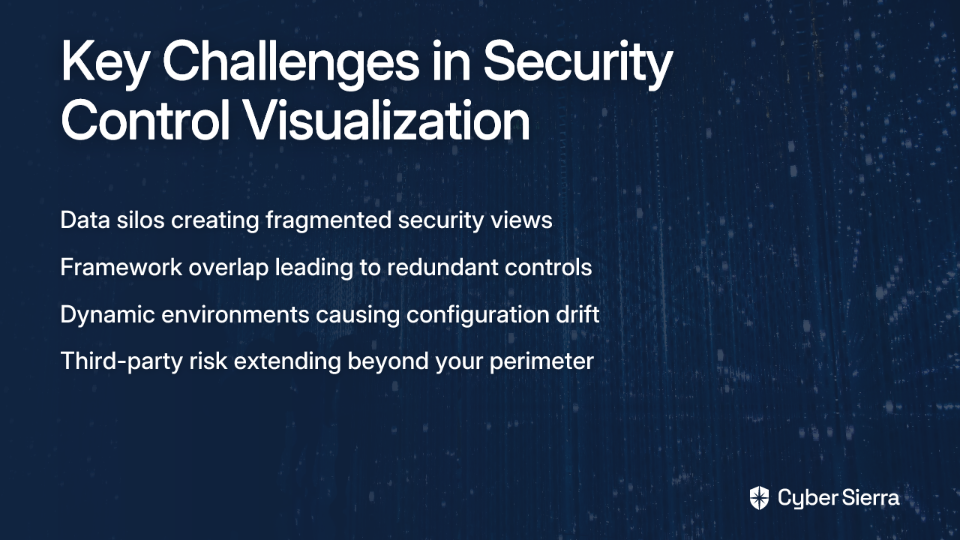
1. Data Silos Create Fragmented Views

Security telemetry is scattered across dozens of tools—SIEM platforms, vulnerability scanners, cloud security posture managers, and more. Each provides its own limited perspective, making a unified view nearly impossible without significant integration work.

2. Framework Overlap Creates Redundancy

Your organization might need to comply with ISO 27001, NIST CSF, GDPR, and PCI DSS simultaneously. Many controls satisfy requirements across multiple frameworks, but proving this overlap is typically a manual, error-prone process involving complex spreadsheet cross-referencing.

3. Dynamic Environments Lead to Configuration Drift

Cloud infrastructure defined by Infrastructure as Code (IaC) can change in minutes. A control that was effective yesterday might be misconfigured today, making point-in-time visualizations quickly obsolete. This creates what many security teams call "audit fatigue"—the exhaustion of constantly chasing compliance status.

4. Third-Party Risk Extends Beyond Your Perimeter

Your security controls don't exist in isolation. A critical vendor's weak security posture can directly impact your own, yet many organizations struggle to visualize these extended relationships. As one security professional noted, "Some of the most sensitive platforms don't even have 2FA on their logins," highlighting the challenge of third-party risk visibility.

From Pretty Pictures to Proactive Defense: The Benefits of Effective Visualization

When done right, visualizing security control relationships delivers tangible business and security outcomes:
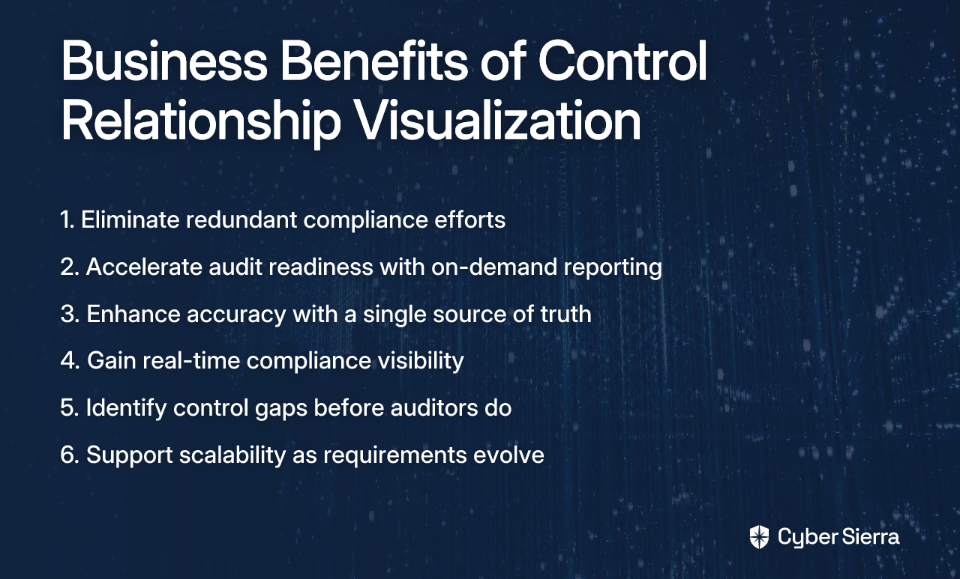
  1. Eliminate Redundant Efforts: Control mapping allows you to identify and reuse shared controls across multiple frameworks, saving hundreds of hours in compliance work.
  2. Accelerate Audit Readiness: Automated visualization enables on-demand reporting generation, addressing the widespread "desire for simplification and ease in audit reporting" expressed by security teams.
  3. Enhance Accuracy and Consistency: A centralized system of record minimizes the manual errors common with spreadsheets and provides a single source of truth.
  4. Improve Visibility and Reporting: Gain a real-time, dashboard-level overview of your entire compliance status instead of point-in-time snapshots.
  5. Identify Gaps and Overlaps: Clearly see where your control coverage is strong and where critical gaps exist before an auditor or attacker finds them.
  6. Support Long-Term Scalability: As you adopt new frameworks or enter new markets, a mapped control system can adapt easily without starting from scratch.

A Visual Toolkit: Key Techniques for Mapping Control Relationships

Different visualization techniques answer different security questions. Here are the most effective methods for understanding control relationships:

Graph Visualization (Node-Link Diagrams)

What it is: The ideal way to show complex, many-to-many relationships. Nodes represent entities (assets, controls, threats) and links represent their relationships.

Use Case: Unveiling densely connected threat intelligence to see how a single vulnerability (e.g., Log4j) impacts dozens of assets across different departments. It can also map how a single control satisfies requirements in multiple frameworks.

The Node-Link Diagram of the Cybersecurity Framework v2.0 is an excellent example of this technique in action. It clearly shows which controls satisfy multiple requirements, helping organizations identify high-value implementation priorities.

Hierarchical Visualization (Sunburst Charts)

What it is: Ideal for showing part-to-whole relationships and hierarchical structures.

Use Case: Breaking down a complex framework like the NIST CSF from its Core Functions (Identify, Protect, Detect, Respond, Recover) down to the individual Sub-Category level.

The Sunburst Visualization of the Cyber Security Framework v2.0 demonstrates this approach perfectly, providing an intuitive overview of framework structure.

Matrix Visualization (Adjacency Matrix)

What it is: A grid that shows the co-occurrence of items.

Use Case: Answering the question, "When Control X is implemented, which other controls are most often implemented alongside it?" This helps identify logical groupings and potential dependencies.

The Adjacency Matrix of Controls in the Cybersecurity Framework showcases this approach, revealing patterns that might otherwise remain hidden.

Timeline Visualization

What it is: Combines with other views to show cause and effect over time.

Use Case: Tracking the sequence of alerts across a network to understand an attack narrative, linking Indicators of Compromise (IoC) to MITRE ATT&CK tactics. This directly addresses the need for "actionable IoC visualizations" that lead to threat blocking.

A Practical Roadmap: From Manual Mapping to Continuous Monitoring

Now let's translate theory into practice with a step-by-step approach:
Step 1: Define Scope & Map Controls

Begin by identifying all relevant regulatory frameworks for your industry and geography (e.g., ISO 27001, NIST CSF, GDPR). Then, perform control mapping—the process of aligning multiple regulatory requirements to a unified set of internal controls, reducing redundancy and complexity.

For instance, a password policy requirement exists in virtually every framework, but with slight variations. Instead of managing separate controls, map them to a single robust password policy that satisfies all requirements.

Step 2: Centralize Your Controls and Evidence

The most critical step is moving away from disparate spreadsheets to a single source of truth or a central controls repository. This forms the foundation for automation.

A central repository stores not just the controls themselves, but links them to:

  • The systems where they're implemented
  • The evidence that proves they're working
  • The compliance requirements they satisfy
  • The risks they mitigate

Step 3: Implement Continuous Control Monitoring (CCM)

This is where visualization becomes truly powerful. Continuous Control Monitoring (CCM) represents the shift "away from point-in-time control testing to ongoing, evidence-driven visibility."

CCM operationalizes compliance by ingesting telemetry from your tools to track control effectiveness in near real-time. This addresses the challenge of "policy violation checks being performed after deployment" by providing continuous feedback on your security posture.

Unifying Your View: The Power of an Integrated Platform

While the steps above are powerful, implementing them manually is challenging. An integrated GRC and security platform can automate this entire process.

Platforms like Cybersierra offer specialized modules that work together to provide a comprehensive view of your security control relationships:

  • Continuous Control Monitoring (CCM): Cybersierra's CCM module builds a central controls repository with near real-time updates from your infrastructure, providing clear visibility into your security posture. It automates control testing and validation, detecting exceptions in real-time—essential for maintaining an accurate visualization of your control effectiveness.
  • Governance, Risk & Compliance (GRC): The GRC module automates data collection, risk assessments, and reporting for frameworks like SOC2, ISO 27001, and HIPAA. This directly addresses the "desire for simplification and ease in audit reporting" by generating comprehensive reports based on your visualized control relationships.
  • Third-Party Risk Management (TPRM): For a truly complete picture, Cybersierra's TPRM module extends your control visualization beyond your own perimeter, providing continuous visibility into vendor security compliance.
Conclusion

Effective visualization of security control relationships isn't about creating pretty pictures—it's about transforming complex security data into actionable insights that drive better decision-making.

By implementing a visualization strategy that encompasses control mapping, centralization, and continuous monitoring, organizations can move from reactive compliance to proactive risk management. The future of security and compliance lies in these integrated approaches that provide a single, actionable view of risk across the entire enterprise.

Whether you're just starting with basic control mapping or ready to implement a comprehensive platform like Cybersierra, the key is to begin the journey toward visualization that delivers not just clarity, but actionable security intelligence.

Frequently Asked Questions

What is security control mapping?

Security control mapping is the process of aligning multiple regulatory and compliance requirements to a single, unified set of internal controls. This practice helps organizations eliminate redundant work by identifying and reusing shared controls across different frameworks like ISO 27001, NIST CSF, and GDPR. For example, instead of managing separate password policies for each framework, you can map them all to a single, robust policy that satisfies every requirement.

Why is visualizing security controls so important?

Visualizing security controls is crucial because it transforms complex, siloed security data into actionable insights that improve decision-making, accelerate audit readiness, and proactively identify security gaps. Without effective visualization, security teams struggle with fragmented views from different tools, leading to redundant compliance efforts and audit fatigue. A clear visual representation provides a single source of truth and allows you to see where control coverage is strong or weak before an auditor finds a problem.

How does Continuous Control Monitoring (CCM) improve security visualization?

Continuous Control Monitoring (CCM) enhances security visualization by providing ongoing, near real-time, evidence-driven visibility into the effectiveness of your security controls. While traditional visualizations are often point-in-time snapshots that quickly become outdated, CCM platforms automate control testing by ingesting live data from your infrastructure. This ensures that your visualizations are always current, allowing you to detect misconfigurations or policy violations as they happen.

What are the biggest challenges when visualizing security control relationships?

The biggest challenges include fragmented data across multiple security tools (data silos), overlapping requirements from different compliance frameworks, configuration drift in dynamic cloud environments, and a lack of visibility into third-party vendor risks. These issues make it difficult to get a unified, "big picture" view of an organization's security posture, as data silos prevent a holistic understanding and dynamic environments make manual assessments instantly obsolete.

Which visualization technique is best for my security data?

The best visualization technique depends on the specific security question you are trying to answer. For understanding complex, many-to-many relationships (like how one control maps to multiple frameworks), use Graph Visualizations. To show hierarchical structures (like breaking down the NIST CSF), use Hierarchical or Sunburst Charts. To identify co-occurrence and dependencies between controls, a Matrix Visualization is most effective.

How can my organization get started with visualizing security controls?

Your organization can start by defining the scope of relevant frameworks, mapping your internal controls to those requirements, and centralizing all controls and evidence into a single source of truth. The first step is to move away from scattered spreadsheets. Create a central repository for all controls, linking them to the systems they protect and the evidence of their effectiveness. This foundational work paves the way for more advanced steps like implementing Continuous Control Monitoring (CCM) for real-time visibility.
blog-hero-background-image
Cyber Security

Top 8 Manufacturing Cybersecurity Risks That Require Real-Time Monitoring

backdrop
Table of Contents

Join thousands of professionals and get the latest insight on Compliance & Cybersecurity.


Summary

  • The manufacturing sector has become the second most targeted industry, experiencing a 300% increase in cyberattacks since 2019, with 69% of all ransomware attacks targeting manufacturing entities in 2024.
  • The convergence of Information Technology (IT) and legacy Operational Technology (OT) systems has created an expanded attack surface where a single breach can halt production lines.
  • To combat modern threats like supply chain attacks, ransomware, and IP theft, manufacturers must shift from periodic audits to a proactive strategy of real-time, continuous monitoring.
  • Automate your proactive defense with a platform like Cyber Sierra's Continuous Control Monitoring, which provides real-time visibility across your entire IT and OT environment.

You've set up your smart factory with the latest IoT sensors. You've connected your production line to gather real-time data. But when you check your network traffic, you notice unusual connections to servers in countries where you have no operations. Is someone inside your network right now?

For today's manufacturers, this scenario is increasingly common. The manufacturing sector has become a prime target, experiencing a 300% increase in cyberattacks since 2019 and becoming the second most targeted industry for threat actors. Even more alarming, in 2024 alone, 1,171 manufacturing organizations experienced ransomware attacks, with 69% of all ransomware attacks specifically targeting manufacturing entities.

As one manufacturing IT specialist puts it, "The more devices on your network, the more attack vectors a hacker has." This reality is particularly concerning because, as another industry professional notes, "network protocols used in industry were not designed with security in mind."

The convergence of Information Technology (IT) and Operational Technology (OT) means a breach is no longer just a data issue—it can halt production lines, sabotage equipment, and cause physical consequences. To combat these evolving threats, manufacturers must abandon sporadic security audits and embrace a strategy of real-time, continuous monitoring across their entire digital ecosystem.

Let's examine the eight critical cybersecurity risks that make continuous monitoring essential for manufacturing operations today:

1. Vulnerable Supply Chains

The Problem: Modern manufacturers rely on a vast network of suppliers and third-party services. An attack on a single vendor can cascade through the entire supply chain, as we've seen in high-profile incidents like the Colonial Pipeline and JBS Foods attacks.

This pain point resonates deeply with manufacturing security professionals dealing with "mom and pop setups that cannot obtain certification" or smaller vendors with limited security resources. The traditional approach of annual vendor assessments leaves dangerous blind spots between evaluations.

Why Real-Time Monitoring is Essential: Point-in-time questionnaires are insufficient when threats evolve daily. Continuous monitoring of supplier connections and access points is required to detect threats originating from third parties before they infiltrate your network. Real-time visibility into vendor security posture allows you to make informed risk management decisions and take immediate action when vulnerabilities emerge.

2. Pervasive Ransomware Attacks

The Problem: Ransomware is uniquely devastating to manufacturers because production downtime can cost millions per hour, creating immense pressure to pay the ransom. These attacks encrypt critical files, disrupt production systems, and can bring operations to a complete standstill.

Why Real-Time Monitoring is Essential: Early detection is your best defense. Real-time threat monitoring can identify the initial signs of ransomware activity—such as unusual file encryption patterns, suspicious network traffic, or unauthorized system changes—allowing security teams to isolate affected systems before the malware can spread across the OT network. Continuous monitoring of backup integrity also ensures you can recover quickly without paying the ransom.

3. Expanded Attack Surface from Smart Factories (IoT/IIoT)

The Problem: Industry 4.0 technologies have introduced thousands of connected sensors, devices, and systems throughout manufacturing facilities. These IoT devices often lack built-in security controls, run outdated firmware, and create an exponentially larger attack surface.

As one manufacturer notes, it's a "poorly standardized area with plenty of different methods to access CNC machine controllers," making consistent security difficult to implement. Many IoT devices also lack proper authentication or encryption capabilities.

Why Real-Time Monitoring is Essential: You can't secure what you can't see. Real-time monitoring establishes complete OT asset visibility, discovering and continuously tracking all connected devices (PLCs, HMIs, SCADA servers, sensors). This allows security teams to detect anomalous behavior, unauthorized connections, and potential compromises across the expanded attack surface. Continuous monitoring also identifies misconfigurations and vulnerabilities in IoT deployments that periodic scanning might miss.

4. Unpatched and Outdated Legacy Systems (OT/ICS)

The Problem: This is perhaps the most significant challenge in manufacturing cybersecurity. As one industry expert bluntly states, "Manufacturing assets run for decades, so it's not uncommon to still see Windows 95... and the cost of upgrading can be huge." These legacy Industrial Control Systems (ICS) are often unpatched, unmonitored, and were never designed with internet connectivity in mind.

Notorious malware like Stuxnet and Triton have already demonstrated how vulnerable industrial control systems can be sabotaged with potentially catastrophic physical consequences. Yet, operational constraints often prevent regular patching or upgrades.

Why Real-Time Monitoring is Essential: Since patching legacy systems can be difficult or impossible without disrupting production, continuous monitoring becomes your primary defense. Proper network segmentation is a crucial first step, but it must be continuously monitored to ensure its integrity. Tools that provide Endpoint Detection and Response (EDR) for OT environments can monitor legacy systems for suspicious activity and isolate them if a threat is detected, even when patching isn't an option.

5. Intellectual Property (IP) Theft

The Problem: A manufacturer's most valuable asset is often its intellectual property—proprietary designs, formulas, manufacturing processes, and trade secrets. Cyberattacks targeting IP can occur quietly, with data being exfiltrated over long periods without detection, causing severe damage to a company's competitive edge.

IP theft is particularly concerning because it may not trigger obvious alarms like ransomware. Instead, attackers might maintain persistent access to slowly siphon valuable data.

Why Real-Time Monitoring is Essential: Real-time monitoring of data flows and user access patterns is crucial for detecting IP theft attempts. Advanced monitoring solutions can flag unusual access to sensitive data repositories, unexpected large data transfers to external locations, and suspicious user behavior that might indicate an IP theft operation in progress. This provides early warning of potential IP theft before significant damage occurs.

6. Insider Threats and Internal Breaches

The Problem: Not all threats come from outside your organization. Industry data shows that nearly 30% of cyberattacks are internal, originating from current or former employees with legitimate access. These individuals already have credentials and knowledge of internal systems, allowing them to bypass perimeter defenses.

As one security professional notes, "If someone has physical access, well then you are kinda screwed." Insiders can intentionally sabotage systems, steal data, or unintentionally create vulnerabilities through careless actions.

Why Real-Time Monitoring is Essential: Continuous monitoring of user behavior can detect deviations from normal activity patterns that might indicate malicious intent or a compromised account. This includes tracking access to sensitive systems, changes in privileges, unusual login times or locations, and atypical data access patterns. Real-time monitoring creates accountability and helps prevent insider threats from developing into serious breaches.

7. Phishing and Social Engineering

The Problem: Even with the best technical defenses, human error remains a primary vulnerability. Sophisticated phishing emails appearing to come from management or trusted vendors can trick employees into revealing credentials or deploying malware, providing attackers with an initial foothold in your network.

Phishing has evolved beyond obvious scams to highly targeted "spear-phishing" attacks crafted specifically for manufacturing environments, sometimes referencing real projects, vendors, or internal terminology.

Why Real-Time Monitoring is Essential: While security awareness training is the first line of defense, real-time monitoring of email gateways, network traffic, and endpoint activity is needed to detect and block phishing attempts that bypass preventive measures. Continuous monitoring can also identify the secondary actions an attacker takes after a successful phish, such as lateral movement or privilege escalation attempts, allowing for rapid response before significant damage occurs.

8. Growing Compliance and Regulatory Burdens

The Problem: Manufacturers face an increasingly complex web of regulations and standards, from ISO 27001 and NIST frameworks to industry-specific requirements and customer security mandates. Manually collecting evidence and proving compliance is time-consuming and prone to error, especially when audit-readiness is required year-round rather than just during assessment periods.

The challenge is compounded when manufacturers must ensure that their suppliers and partners also meet these standards—a task that becomes nearly impossible with traditional, manual assessment methods.

Why Real-Time Monitoring is Essential: Automated, continuous monitoring provides an ongoing audit trail and ensures that security controls are operating as intended at all times. This shifts compliance from a painful, periodic scramble to a continuous, automated process where evidence collection happens in real-time. When auditors request documentation, it's readily available rather than requiring emergency data gathering efforts.

Moving to a Proactive Defense with Real-Time Monitoring

The manufacturing landscape has fundamentally changed. The integration of IT and OT, coupled with a surge in sophisticated cyber threats, has made real-time cybersecurity monitoring a necessity, not a luxury. Here's how manufacturers can implement a more proactive defense against the eight risks outlined above:

For Supply Chain Risks:

Implement a robust Third-Party Risk Management (TPRM) program that goes beyond annual assessments. Move to continuous monitoring of your most critical suppliers and partners to identify security issues as they emerge.

Platforms like Cyber Sierra's TPRM module automate vendor assessments and provide continuous monitoring, helping you prioritize risks and ensure your partners meet your security standards. This reduces the manual effort of managing vendor questionnaires while providing much better visibility into your supply chain security posture.

For IoT, Legacy Systems, and Ransomware:

Deploy Continuous Control Monitoring (CCM) to gain real-time visibility into all assets and security controls across both IT and OT environments. This allows for the detection of anomalies and misconfigurations before they can be exploited.

A CCM solution, such as the one offered by Cyber Sierra, builds a central controls repository with near real-time updates. It automates control testing, detects exceptions, and provides actionable risk intelligence to proactively fix security gaps in your manufacturing environment.

For Insider Threats and Phishing:

Combine technical controls with a strong human firewall through regular, engaging security awareness training and simulated phishing campaigns. This educates employees on recognizing and reporting threats before they become breaches.

Building a security-conscious culture is critical. Training modules that specifically address manufacturing scenarios and risks help employees understand the real-world impacts of security failures in their environment.

For IP Theft and Compliance:

Streamline Governance, Risk, and Compliance (GRC) with an automated platform to manage multiple compliance frameworks (SOC 2, ISO 27001, etc.), collect evidence continuously, and generate audit-ready reports.

Modern GRC platforms automate data collection and risk assessments. Cyber Sierra's GRC module simplifies managing multiple frameworks and ensures ongoing compliance through continuous control monitoring, making enterprises audit-ready faster and reducing compliance fatigue.

Conclusion

The days when manufacturers could rely on air-gapped systems and perimeter security are gone. Today's interconnected manufacturing environments require a new approach to cybersecurity—one based on continuous visibility, real-time threat detection, and automated compliance.

As one industry expert noted during our research, proper "network segmentation, knowing protocols and ports, and protecting them is a good first step"—but it's only the beginning. Real-time monitoring takes this foundation and builds upon it, providing the ongoing vigilance needed to protect against evolving threats.

By implementing continuous monitoring across your manufacturing environment, you can detect threats earlier, respond faster, and prevent the costly downtime, data loss, and reputational damage that comes with successful cyberattacks. Most importantly, you'll gain the confidence that your critical operational technology is protected, even as you embrace the digital transformation that drives manufacturing innovation.

Frequently Asked Questions

What is the biggest cybersecurity risk for manufacturers?

While ransomware causes the most immediate financial and operational disruption, the convergence of IT and Operational Technology (OT) systems represents the most fundamental risk. Legacy OT systems, such as industrial controls and SCADA, were often designed without modern security in mind and are difficult to patch, making them highly vulnerable once connected to IT networks.

Why is continuous monitoring so important for manufacturing?

Continuous monitoring is crucial for manufacturing because threats evolve daily, and production environments are constantly changing. Unlike periodic audits that provide only a snapshot in time, continuous monitoring offers real-time visibility across both IT and OT networks, allowing security teams to detect and respond to anomalies, misconfigurations, and active threats as they happen.

How can manufacturers protect their legacy OT systems?

The most effective way to protect legacy OT systems that cannot be easily patched is through network segmentation and continuous monitoring. Segmentation isolates these vulnerable systems from the broader network, limiting potential attack paths. Continuous monitoring then watches for any suspicious activity or unauthorized connections within these isolated segments, providing a critical layer of defense.

What is the difference between IT and OT security?

IT security primarily focuses on protecting data (confidentiality, integrity, and availability). In contrast, OT security prioritizes the safety, availability, and reliability of physical processes. The consequences of an OT breach can include production shutdowns, equipment damage, and even physical harm to employees, making uptime and operational integrity the highest priorities.

How does a smart factory (Industry 4.0) increase cyber risk?

A smart factory increases cyber risk by dramatically expanding the attack surface. The introduction of thousands of interconnected Industrial IoT (IIoT) sensors and devices creates countless new entry points for attackers. Many of these devices lack robust security controls, run on unpatched firmware, and use insecure communication protocols, making them prime targets for compromise.

What is the first step to improve cybersecurity in a manufacturing plant?

The essential first step is to achieve complete asset visibility. This involves conducting a thorough inventory of all hardware and software assets across both IT and OT environments to understand what is connected to your network. You cannot effectively protect what you don't know you have, and this comprehensive inventory forms the foundation for risk assessment, network segmentation, and monitoring strategies.

The question is no longer whether you can afford to implement real-time monitoring—it's whether you can afford not to.

blog-hero-background-image
Cyber Security

How to Map Your Entire Attack Surface with AI-Powered Asset Discovery

backdrop
Table of Contents

Join thousands of professionals and get the latest insight on Compliance & Cybersecurity.


Summary

  • With 83% of attacks using external vectors and attack surfaces changing by 10% monthly, traditional asset discovery methods create dangerous security blind spots.
  • AI transforms asset discovery from a periodic manual task into a continuous, automated process that uncovers unknown assets and shadow IT before attackers can.
  • Adopt an AI-powered framework for security: automate asset discovery, add business context to prioritize risks, and implement continuous monitoring to maintain a live view of your posture.
  • Unify your security with an integrated platform that combines AI-powered asset discovery with Threat Intelligence and continuous monitoring to eliminate blind spots and reduce manual effort.

You've set up a comprehensive security program with all the right tools—firewalls, EDR solutions, vulnerability scanners—yet you still wake up in a cold sweat wondering: "What am I missing?" In today's sprawling digital landscape, your biggest security threat isn't what you're monitoring—it's what you don't even know exists.

"The trick with attack surface management is nailing asset inventory first, then layering context," as one security professional noted on Reddit. But this is far easier said than done when your organization's digital footprint is constantly expanding through cloud migrations, shadow IT, and third-party integrations.

The harsh reality? According to research, a staggering 83% of cyberattacks manifest through external attack vectors, many of which organizations aren't even aware they have. Your attack surface can change by up to 10% monthly, making manual tracking practically impossible.

Traditional approaches—static spreadsheets, quarterly scans, and manual documentation—simply can't keep up. As one frustrated security analyst put it, "Documentation of assets and their vulnerabilities feels tedious and time-consuming." This tedium creates dangerous blind spots that attackers are eager to exploit.

Fortunately, artificial intelligence is revolutionizing how organizations discover, map, and secure their entire attack surface. In this article, we'll explore how AI-powered asset discovery offers a dynamic, continuous, and context-aware solution to one of security's most fundamental challenges.

Understanding Your Attack Surface: The Three Dimensions

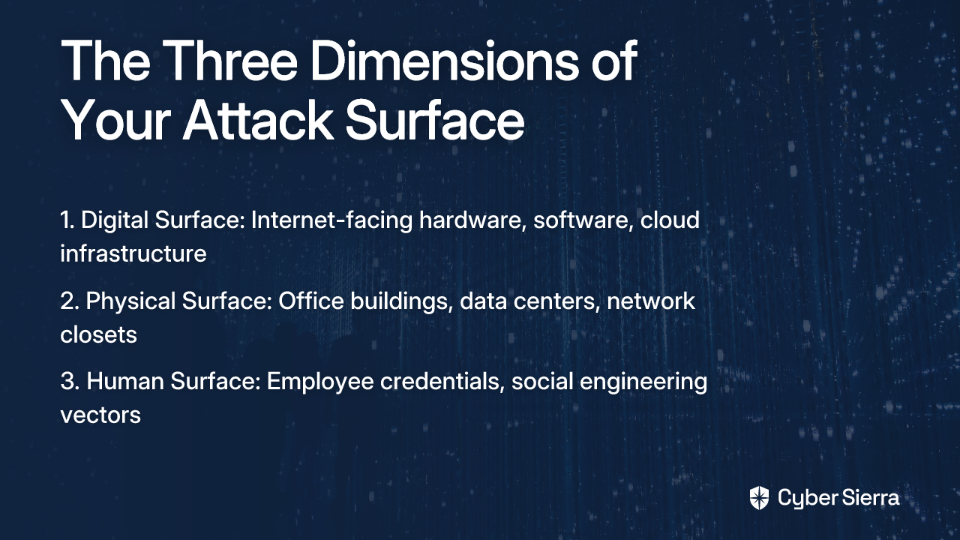
Your attack surface encompasses all potential points where an attacker could gain unauthorized access to your systems or data. It spans three critical dimensions:

  1. Digital Surface: All hardware, software, and networks connected to the internet or internal networks, including servers, endpoints, cloud infrastructure (IaaS/SaaS), and APIs.
  2. Physical Surface: Direct access points like office buildings, data centers, and network closets.
  3. Human Surface: Social engineering vectors, employee credentials, and potential insider threats.

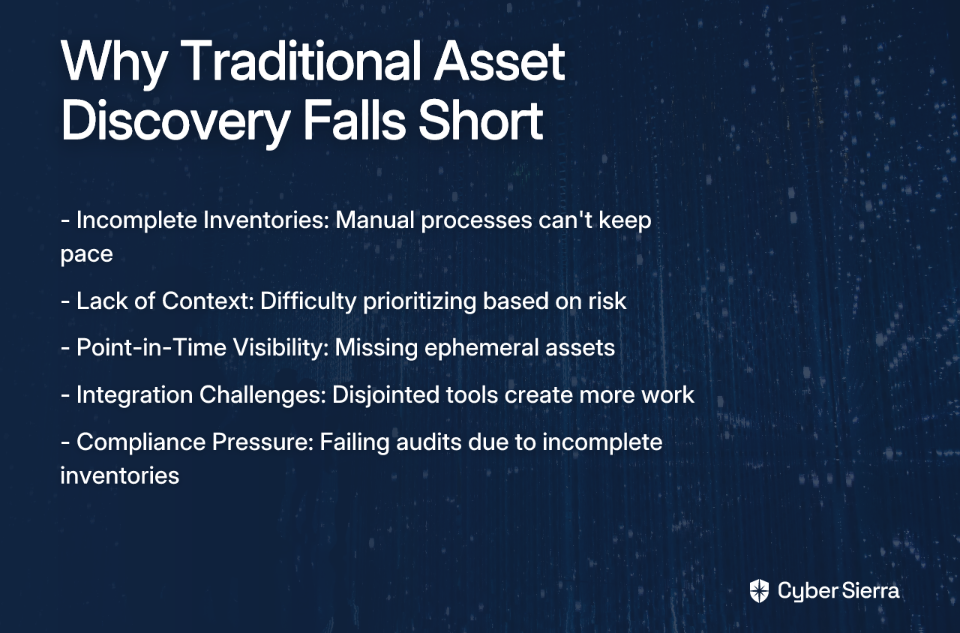
Why Traditional Methods Fall Short

Traditional asset discovery methods are failing modern enterprises for several key reasons:

  • Incomplete Inventories: Manual processes can't keep pace with rapidly evolving infrastructures, leaving dangerous blind spots.
  • Lack of Context: Raw asset lists provide little insight into business criticality or risk exposure, making prioritization nearly impossible. This contributes to the common pain point where "it can be overwhelming to prioritize which vulnerabilities to tackle first."
  • Point-in-Time Visibility: Traditional scanning provides a snapshot rather than continuous visibility, missing ephemeral assets and dynamic changes.
  • Integration Challenges: Many organizations struggle with "difficulty justifying the investment in standalone solutions due to integration challenges," leading to disjointed tools that create more work, not less.
  • Compliance Pressure: Regulations like SOC 2 and ISO 27001 mandate complete asset inventories. Failing to provide one can lead to audit delays and financial penalties.

The AI Revolution in Asset Discovery

AI is transforming asset discovery from a periodic, manual process to an intelligent, continuous capability. Here's how modern AI technologies are revolutionizing this critical security function:

From Static Scans to Dynamic Intelligence

Where traditional tools provide point-in-time snapshots, AI-powered platforms offer continuous discovery and assessment. This shift addresses the critical user need for "real-time updates on asset statuses" that many security professionals identify as essential.

Key AI-Powered Capabilities

Natural Language Processing (NLP) & OSINT

Modern platforms use Natural Language Processing and Open-Source Intelligence (OSINT) to continuously scan the public internet, discovering assets you didn't even know were yours. This outside-in approach finds shadow IT, forgotten systems, and unknown exposures before attackers do.

Plain Language Search

One of the most exciting advancements is the ability to query your attack surface in plain English. For example, a security analyst can simply ask, "show me all of my exploitable e-commerce servers with personally identifiable information" and get an immediate, actionable list.

This capability, powered by Large Language Models (LLMs) and Generative Pre-trained Transformers (GPT), dramatically reduces the expertise required to extract valuable insights from complex security data.

Automated Classification & Context

AI doesn't just find assets; it understands them. Machine learning algorithms automatically classify assets, determine their business criticality, and translate complex signals into human-readable labels and statistics. This reduces the need for manual inspection and provides the context necessary for effective prioritization.

Graph Data Models for Visualization

AI automatically visualizes connections between assets using graph data models, providing an interactive map of your ecosystem. These visualizations help security teams identify shadow IT, complex dependencies, and potential attack paths that might otherwise remain hidden.

A Practical Framework for AI-Powered Attack Surface Mapping

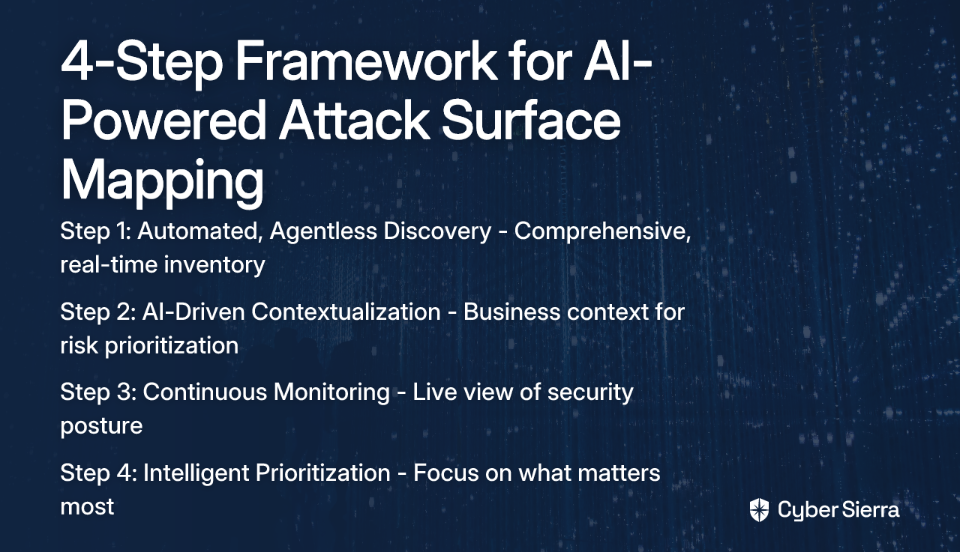
Implementing AI-powered asset discovery requires a structured approach. Here's a four-step framework to help you map your entire attack surface:

Step 1: Automated, Agentless Discovery

Goal: Create a comprehensive, real-time asset inventory.

Method: Leverage modern tools that use an API-based and agentless architecture. This allows for rapid setup (often under 30 minutes) without deploying software on every asset.

The system should continuously poll cloud providers, network infrastructure, and other sources to discover IT assets, cloud resources, shadow IT, and unmanaged devices. This automated approach addresses the pain point that "documentation of assets and their vulnerabilities feels tedious and time-consuming."

Step 2: AI-Driven Contextualization

Goal: Enrich the asset inventory with business context to enable risk-based prioritization.

Method: The AI engine should automatically attribute ownership, identify the business function of each asset, and determine its criticality. For example, it can identify which systems process financial data or PII, automatically flagging them as high-priority.

Step 3: Continuous Monitoring and Vulnerability Assessment

Goal: Move from point-in-time snapshots to a live, continuous view of your security posture.

Method: Implement a Continuous Controls Monitoring (CCM) program. CCM is a "proactive approach for automated oversight of organizational controls" that provides near real-time insights and alerts to detect and mitigate risks quickly.

This involves automated vulnerability scanning for CVEs and misconfiguration checks across the entire discovered asset inventory. The continuous nature of this monitoring ensures you catch new vulnerabilities and misconfigurations as they emerge.

Step 4: Intelligent Prioritization and Remediation

Goal: Focus remediation efforts where they matter most.

Method: Use the AI-generated context to prioritize vulnerabilities. Instead of just looking at the CVE score, prioritization should factor in asset criticality, exposure, and potential business impact.

This approach leads to significant improvements, including a 40% reduction in Mean Time to Detect (MTTD) and a 50% reduction in Mean Time to Response (MTTR), allowing security teams to focus on what really matters.

The Business Case: Beyond Security

AI-powered asset discovery delivers benefits that extend far beyond improved security posture:

Streamlined Compliance and Audits

An AI-maintained inventory provides a single source of truth for auditors. Modern platforms can automate evidence collection, producing verifiable evidence trails that dramatically simplify audits for frameworks like SOC 2, ISO 27001, GDPR, and PCI DSS.

For example, Cyber Sierra's Governance, Risk & Compliance (GRC) module automates data collection and risk assessments for multiple compliance frameworks, making organizations audit-ready at all times.

Drastic Reduction in Manual Workload

Automation eliminates the "tedious and time-consuming" task of manual documentation. Organizations report saving approximately 12 hours per week in manual work and realizing operational savings of around $15,000 per year by implementing AI-powered asset discovery.

From Reactive to Proactive Security

AI-powered discovery expands testing coverage from the typical 30-50% of known assets to over 90% of the true attack surface. This allows teams to find and fix vulnerabilities in unknown and unmanaged assets before they can be exploited.

Unifying Your View: The Power of an Integrated Platform

Many organizations struggle with "anxiety around administrative burdens of managing multiple vendor contracts" and "difficulty justifying the investment in standalone solutions due to integration challenges." This is where an integrated platform approach shows its value.

Instead of managing multiple disconnected tools, an AI-enabled cybersecurity platform like Cyber Sierra provides a unified solution that integrates asset discovery with other critical security functions:

  • Threat Intelligence Module: This core component provides insights into your attack surface, performs network and cloud infrastructure vulnerability scanning, and helps prioritize remediation efforts through an outside-in approach.
  • Continuous Control Monitoring (CCM): Once assets are discovered, Cyber Sierra's CCM module ensures they remain secure by providing ongoing visibility into security controls and assessing risk in near real-time to proactively fix security gaps.
  • GRC Automation: The asset inventory and control data feed directly into the GRC module, which automates data collection and risk assessments for compliance frameworks, making the organization audit-ready at all times.

By combining these capabilities, a platform approach eliminates data silos, reduces administrative overhead, and provides a single, holistic view of risk and compliance.

Conclusion: Map Your Surface, Master Your Security

The modern attack surface is too dynamic and complex for manual oversight. Blind spots created by unknown assets are no longer an acceptable risk in today's threat landscape.

AI-powered asset discovery represents the new standard, providing the comprehensive visibility, rich context, and continuous monitoring needed to stay ahead of attackers. By implementing the four-step framework outlined in this article, you can transform your security posture from reactive to proactive.

Stop chasing shadows and start controlling your attack surface with intelligence and automation. The clarity and control provided by AI-powered asset discovery isn't just a technical advantage—it's a business imperative for any organization serious about security in the digital age.

Frequently Asked Questions

What is AI-powered asset discovery?

AI-powered asset discovery is an advanced cybersecurity approach that uses artificial intelligence, machine learning, and natural language processing to automatically and continuously find, classify, and monitor all digital assets connected to an organization. Unlike traditional methods that rely on periodic scans, AI provides a real-time, comprehensive inventory of your entire attack surface, including known, unknown, and shadow IT assets.

How does AI find assets that traditional scanners miss?

AI finds assets traditional scanners miss by taking an "outside-in" approach, continuously scanning the public internet using techniques like Open-Source Intelligence (OSINT) and Natural Language Processing (NLP). This allows it to discover forgotten subdomains, cloud instances, and third-party services connected to your organization that aren't on internal lists. This proactive discovery process uncovers the blind spots that attackers often exploit first.

Why is a continuous approach to asset discovery so important?

A continuous approach is vital because an organization's attack surface is constantly changing, with research showing it can shift by up to 10% each month due to new cloud deployments, temporary assets, and shadow IT. Traditional point-in-time scans quickly become outdated, leaving security gaps. Continuous, AI-driven monitoring provides a live, up-to-date view of your security posture, ensuring new assets and vulnerabilities are identified and addressed as they emerge.

How does AI help with prioritizing which vulnerabilities to fix first?

AI helps prioritize vulnerabilities by adding business context to the raw data. Instead of just relying on a technical severity score (like a CVE score), AI algorithms automatically classify assets by their business criticality—for example, identifying which servers handle personally identifiable information (PII) or financial data. This allows security teams to focus their efforts on fixing the vulnerabilities that pose the greatest actual risk to the business.

How does AI-powered asset discovery help with compliance and audits?

AI-powered asset discovery streamlines compliance by creating and maintaining a complete, accurate, and real-time inventory of all assets, which is a foundational requirement for frameworks like SOC 2, ISO 27001, and PCI DSS. Modern platforms can automate the collection of evidence for auditors, providing a verifiable "single source of truth" that drastically reduces the manual effort and time required to prepare for and pass audits.

What is the difference between a standalone asset discovery tool and an integrated platform?

A standalone asset discovery tool focuses solely on identifying assets, which can create data silos and integration challenges. An integrated cybersecurity platform, like Cyber Sierra, combines AI-powered asset discovery with other essential functions such as Continuous Controls Monitoring (CCM), Threat Intelligence, and Governance, Risk, and Compliance (GRC) automation. This unified approach provides a holistic view of risk, reduces administrative overhead, and ensures that the insights from asset discovery are directly actionable across your entire security program.

blog-hero-background-image
Cyber Security

Top 5 Healthcare Cybersecurity Challenges in 2025

backdrop
Table of Contents

Join thousands of professionals and get the latest insight on Compliance & Cybersecurity.


Summary

  • Cyberattacks are now a direct threat to patient safety, with 72% of healthcare organizations reporting that breaches have impacted patient care.
  • Key challenges for 2025 include securing an expanding attack surface of connected devices and cloud services, navigating complex compliance frameworks, and managing increasing risks from third-party vendors.
  • Actionable strategies include adopting automated compliance monitoring, implementing continuous third-party risk management, and strengthening the 'human firewall' through ongoing employee training.
  • Platforms like Cyber Sierra help automate GRC processes, continuously monitor vendor risks, and streamline compliance to protect patient data and ensure operational continuity.

In 2024, healthcare data breaches hit a staggering all-time high, with breaches affecting approximately 237 million people in the United States—representing nearly 70% of the population. But these aren't just numbers on a spreadsheet. Behind each statistic are real healthcare professionals struggling with the impossible task of balancing robust security with efficient patient care.

"Current systems inadequately balance security needs with patient care efficiency," notes one healthcare IT professional. "Policies created without practical input can lead to real-world issues."

As we look ahead to 2025, healthcare cybersecurity is evolving beyond mere data theft into a direct threat to patient safety and operational continuity. The stakes have never been higher—72% of healthcare organizations have experienced cyberattacks that directly affected patient care, according to Healthcare IT News.

In this article, we'll examine the five most critical cybersecurity challenges healthcare organizations will face in 2025, followed by actionable strategies to build resilience against these emerging threats.

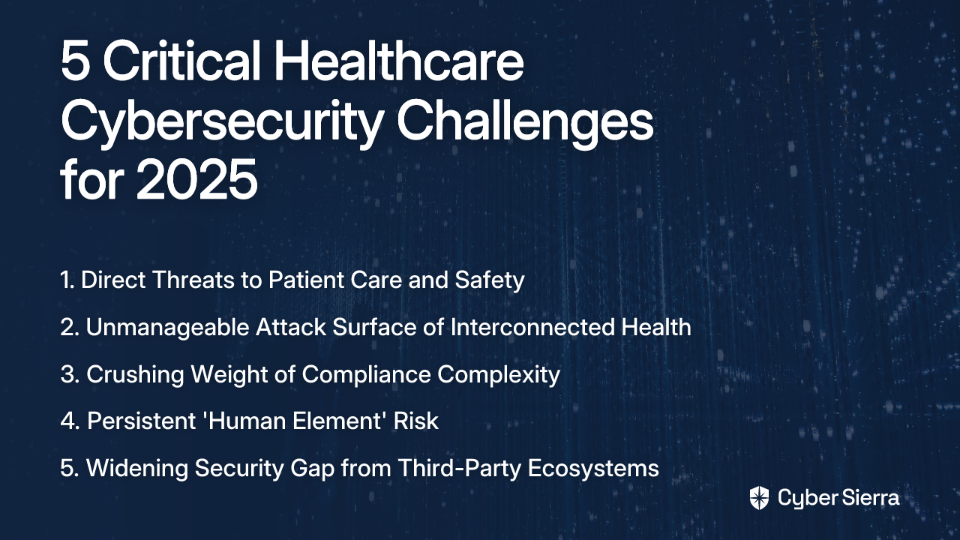
Challenge 1: Direct Threats to Patient Care and Safety

The era when data breaches only resulted in compromised personal information and regulatory fines is over. Today's cyberattacks directly disrupt clinical operations and endanger patient outcomes.

In a sobering statistic, 54% of healthcare organizations reported increased medical procedure complications due to cyber disruptions. Ransomware attacks led to longer patient stays for 67% of victims, according to Healthcare IT News.

While the volume of ransomware incidents has decreased, their severity has intensified. The average ransom payment has risen to $1.2 million, with one notable attack costing a hospital network an estimated $100 million in damages.

The February 2024 Change Healthcare ransomware attack exemplifies this escalation, compromising the data of an estimated 100 million individuals and causing massive, nationwide disruptions to prescriptions and payments, as reported by Scrut.io.

The most concerning development is that supply chain attacks are now the most likely threat vector to disrupt care delivery, with 87% of affected organizations reporting disruptions to patient care.

Challenge 2: The Unmanageable Attack Surface of Interconnected Health

The rapid adoption of telehealth, Internet of Medical Things (IoMT) devices, and cloud services has exponentially expanded potential entry points for attackers, while legacy systems remain a persistent vulnerability.

Cloud account compromises have emerged as the most prevalent threat, affecting 72% of healthcare organizations. Even more troubling, 61% reported increased complications in medical procedures due to these cloud attacks, according to Healthcare IT News.

The proliferation of connected medical devices—from EHRs to infusion pumps and monitors—creates an expanding attack surface. This reflects a common pain point among healthcare professionals: "Critical life-saving devices often lack sufficient security measures," as one practitioner notes.

Legacy systems compound this challenge. Many organizations continue to use outdated technology due to budget constraints, compliance hurdles with new tech, and training costs. These systems often lack modern security features and serve as easy entry points for attackers, according to Maryville University.

Challenge 3: The Crushing Weight of Compliance Complexity and Governance

Healthcare organizations are buried under a complex web of overlapping regulations, making continuous compliance a significant operational and financial burden.

Organizations must simultaneously navigate multiple frameworks, including HIPAA, HITRUST CSF, NIST, ISO 27001, and GDPR, according to Scrut.io. This "framework overload" stretches already thin resources to their breaking point.

The financial stakes are enormous. The average cost of a healthcare data breach rose to $9.77 million—the highest of any industry for the 13th consecutive year, according to the IBM Data Breach Report. Meanwhile, HIPAA penalties for non-compliance can reach up to $12.84 million, as noted by Rubrik.

Perhaps most exhausting is the process of manually gathering evidence, conducting risk assessments, and preparing for audits. This time-consuming and error-prone approach leads to a state of "compliance fatigue" that diverts resources from addressing actual security threats.

Challenge 4: The Persistent "Human Element" Risk

Both malicious insiders and negligent employees continue to be primary causes of data breaches, exacerbated by increasingly sophisticated social engineering attacks.

The scale of this problem is staggering: 96% of healthcare organizations experienced data loss incidents, with 35% caused by an employee's failure to follow company policies, according to Healthcare IT News. In 2020, insider breaches accounted for 48% of incidents, nearly rivaling external attacks, as reported by Maryville University.

Attackers are targeting healthcare professionals with increasingly convincing tactics. Email phishing (used in 63% of attacks), SMS phishing (34%), and spear phishing (34%) remain the preferred methods, according to Rubrik.

Business Email Compromise (BEC) attacks are particularly dangerous, causing significant delays in procedures for 65% of affected organizations and leading to poor patient outcomes.

Challenge 5: The Widening Security Gap from Third-Party Ecosystems

The healthcare supply chain has emerged as a critical vulnerability. Organizations' increasing reliance on third-party vendors for software and services creates a distributed risk that is difficult to manage with traditional methods.

This growing concern is reflected in user feedback: "Security practices of third-party vendors and their role in data breaches" is a top worry, according to discussions among healthcare professionals.

Traditional vendor risk management relies on point-in-time questionnaires and self-assessments, which fail to provide a continuous, real-time view of a vendor's security posture. As supply chain attacks are now the most likely to disrupt patient care, this approach is increasingly inadequate.

Building a Resilient Healthcare Security Posture for 2025

With these challenges in mind, healthcare organizations need a strategic framework to build resilience against emerging threats. Here are four key principles to guide this transformation:

Principle 1: Adopt a Proactive, Automated GRC Strategy

The time has come to shift from periodic, manual audits to Continuous Control Monitoring (CCM). This approach automates the validation of security controls against frameworks like HIPAA, NIST, and ISO 27001 in near real-time.

Platforms like Cyber Sierra's GRC and CCM modules are designed to address this challenge directly. They automate data collection, centralize control repositories, and provide ongoing visibility into security posture, transforming compliance from a periodic scramble into a continuous, managed process. This helps enterprises become audit-ready faster and reduces compliance fatigue.

Principle 2: Secure the Entire Ecosystem (IoMT, Cloud, and Vendors)

Implement a robust Third-Party Risk Management (TPRM) program that goes beyond initial onboarding. Utilize tools for continuous monitoring of your vendors' attack surfaces.

A modern TPRM solution, such as Cyber Sierra's TPRM platform, automates vendor assessments and provides "near real-time, 24/7 visibility into vendor security compliance," allowing organizations to proactively manage supply chain risks.

Additionally, leverage Threat Intelligence to proactively scan your own network and cloud infrastructure for vulnerabilities and misconfigurations. Cyber Sierra's Threat Intelligence module provides this "outside-in" view, helping teams identify and prioritize risks across their entire attack surface before they can be exploited.

Principle 3: Strengthen the Human Firewall

Move beyond annual, check-the-box training. Implement a continuous security awareness program with interactive content and realistic, simulated phishing campaigns.

Purpose-built tools like Cyber Sierra's Employee Security Training help foster a security-conscious culture by educating employees on evolving threats and using simulated attacks to reinforce learning, directly addressing the risks of human error and social engineering.

Principle 4: Bridge the Gap Between Security and Clinical Operations

Foster collaboration between IT security teams and clinical staff when developing security policies. The goal is to create protocols that are both secure and practical in high-stakes clinical environments.

Implement streamlined access controls like Single Sign-On (SSO) combined with risk-based Multi-Factor Authentication (MFA) to reduce login fatigue without compromising security. For critical, life-saving devices, explore alternative, rapid authentication methods to prevent lockouts during emergencies, directly addressing a key pain point from user research.

Conclusion

As we look ahead to 2025, it's clear that healthcare cybersecurity has fundamentally shifted from an IT issue to a patient safety imperative. The five challenges outlined above—direct threats to patient care, expanding attack surfaces, compliance complexity, human risk, and third-party vulnerabilities—require a proactive, integrated approach.

By adopting the four principles of resilience—automated GRC, ecosystem security, human firewall strengthening, and security-clinical collaboration—healthcare organizations can better protect both sensitive Protected Health Information (PHI) and, most importantly, patient lives.

The future of healthcare security lies not in reactive, siloed measures but in proactive, integrated, and automated strategies that balance robust protection with the practical needs of healthcare delivery.

Frequently Asked Questions

What is the biggest cybersecurity threat to healthcare in 2025?

The biggest threat is the direct impact of cyberattacks on patient care and safety. This has evolved beyond simple data breaches to include severe disruptions in clinical operations, which can lead to increased medical complications, longer hospital stays, and poor patient outcomes.

How are cyberattacks on healthcare organizations changing?

Cyberattacks are shifting from data theft to severe operational disruptions that endanger patients. While the volume of ransomware incidents has decreased, their severity has intensified with higher ransom demands. Furthermore, supply chain attacks targeting third-party vendors have become the most likely threat vector to disrupt patient care delivery.

Why is cybersecurity compliance so complex in the healthcare industry?

Healthcare cybersecurity compliance is complex due to the requirement to adhere to multiple, overlapping regulations like HIPAA, HITRUST, NIST, and GDPR. This "framework overload," combined with the industry's highest data breach costs and the manual, time-consuming nature of audit preparation, creates a significant operational and financial burden.

What are the most common entry points for cyberattacks in healthcare?

The most common entry points are compromised cloud accounts, vulnerabilities in the expanding network of Internet of Medical Things (IoMT) devices, and outdated legacy systems. Additionally, the "human element" remains a primary vector, with attackers using social engineering tactics like email phishing to exploit employees and gain initial access.

What is the role of third-party vendors in healthcare security risks?

Third-party vendors are a critical and growing security vulnerability in the healthcare supply chain. Because healthcare organizations rely on numerous vendors for software and services, an attack on a single vendor can disrupt care delivery across multiple organizations. Traditional vendor risk management methods are often inadequate for managing this distributed and continuous threat.

How can healthcare organizations improve their cybersecurity posture?

Healthcare organizations can improve their security posture by adopting a proactive and integrated strategy. Key actions include: implementing an automated Governance, Risk, and Compliance (GRC) program for continuous monitoring; securing the entire ecosystem of cloud services, IoMT, and third-party vendors; strengthening the "human firewall" with ongoing employee training; and fostering close collaboration between security and clinical teams to ensure policies are both secure and practical.

blog-hero-background-image
Cyber Security

Top 10 Financial Data Protection Controls Required by RBI Guidelines

backdrop
Table of Contents

Join thousands of professionals and get the latest insight on Compliance & Cybersecurity.


Summary

  • Financial institutions face significant pressure to comply with RBI data protection guidelines, which demand a shift from periodic audits to continuous security monitoring.
  • Key RBI-mandated controls include Continuous Controls Monitoring (CCM), comprehensive Third-Party Risk Management (TPRM), and robust Identity and Access Management (IAM).
  • A proactive approach is critical, as 95% of CISOs agree that CCM significantly improves both compliance and overall security posture.
  • An integrated GRC platform can streamline these efforts. Cybersierra automates data collection and provides continuous control monitoring to help financial institutions meet RBI requirements and stay perpetually audit-ready.

Financial institutions in India operate under a complex web of regulations, with the Reserve Bank of India (RBI) guidelines forming the backbone of data protection requirements. For compliance and IT managers in the financial sector, the stress of audit preparation, the complexity of maintaining compliance in cloud environments, and the frustration over growing security debt are all too familiar.

This article breaks down the top 10 financial data protection controls mandated by RBI guidelines, helping your institution strengthen its security posture while streamlining compliance efforts. These controls aren't just about avoiding penalties—they're essential for building customer trust and mitigating reputational damage in an increasingly data-conscious market.

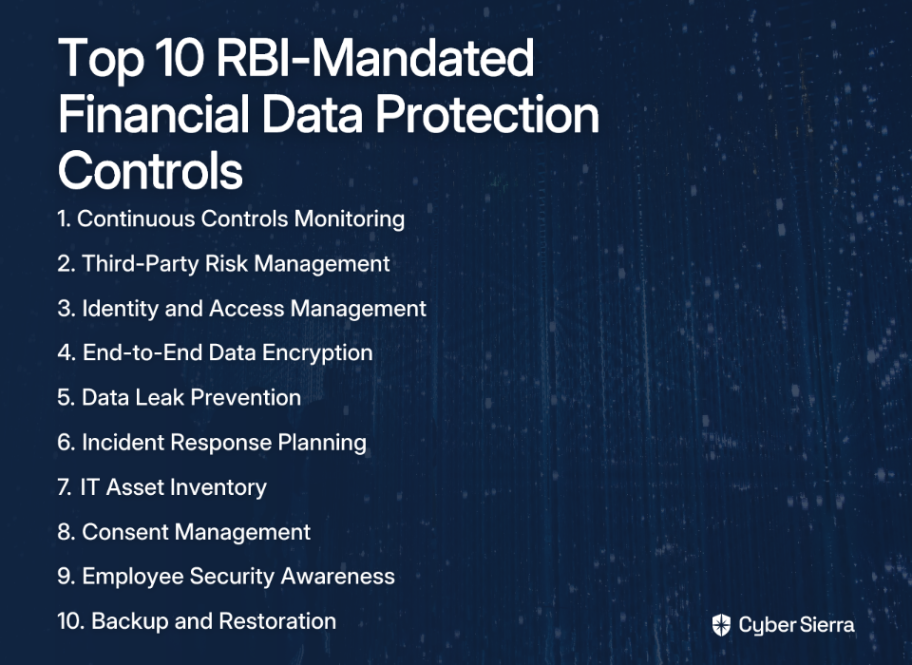
1. Implement Continuous Controls Monitoring (CCM)

The RBI framework requires a shift from periodic, point-in-time audits to a more proactive approach. Continuous Controls Monitoring provides near real-time visibility into your security controls, addressing the pain point of last-minute audit preparation.

Key Actions & Requirements:

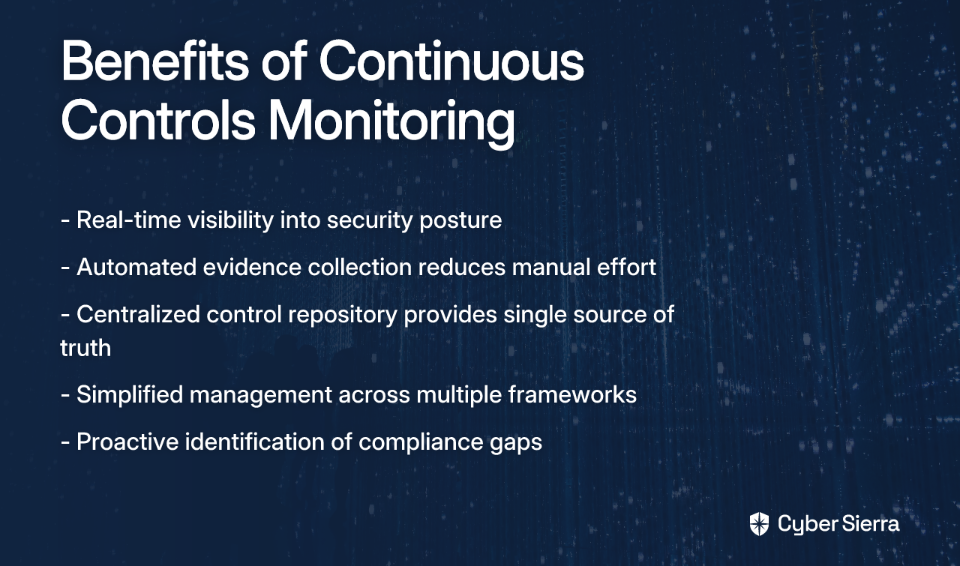
  • Automate Evidence Collection: Reduce manual effort, errors, and audit preparation time by automating the gathering of compliance evidence.
  • Centralize Control Repository: Build a central repository for all security controls with near real-time updates to provide a single source of truth.
  • Manage Multiple Frameworks: Implement a system that can manage controls across multiple compliance frameworks simultaneously (NIST, ISO 27001, PCI DSS, RBI).

According to a RegScale report, 95% of CISOs believe CCM significantly improves both compliance and security posture. Platforms like Cyber Sierra's Continuous Control Monitoring (CCM) module are designed specifically to provide this ongoing visibility and centralize control management, transforming security from periodic checks into a continuous, automated process.

2. Establish Comprehensive Third-Party Risk Management (TPRM)

The RBI places significant emphasis on managing risks from outsourcing and third-party vendors. This is critical as many financial institutions express concern about the risks of partnering with suppliers who do not meet certification standards.

Key Actions & Requirements:

  • Define SLAs: Establish clear responsibilities in service level agreements (SLAs) regarding security and compliance obligations.
  • Conduct Due Diligence: Mandate thorough due diligence on all vendor security measures before onboarding. Ensure contracts allow for data retrieval and deletion upon termination, as emphasized in RBI guidelines for financial data protection.
  • Perform Regular Assessments: Conduct regular assessments of vendors to ensure they adhere to data security protocols. As recommended by security professionals, "[audit] your 3rd Party relationships regularly and on-time to ensure they're doing what they've agreed to."

The complexity of managing hundreds of vendors manually is a common pain point for financial institutions. Automated TPRM platforms can simplify this by automating vendor assessments, providing near real-time visibility into vendor compliance, and streamlining the entire onboarding and monitoring lifecycle.

3. Enforce Robust Identity and Access Management (IAM)

Controlling who can access sensitive financial data is a cornerstone of data protection. The goal is to prevent unauthorized access, whether malicious or accidental.

Key Actions & Requirements:

  • Implement Principle of Least Privilege: Limit user access to sensitive customer data based on their role and legitimate business need, as outlined in the RBI cybersecurity framework.
  • Mandate Multi-Factor Authentication (MFA): Require MFA for all users (employees, vendors, customers) accessing sensitive systems and data.
  • Use Centralized IAM & SSO: Implement a centralized IAM program with proper oversight and utilize Single Sign-On (SSO) for secure, streamlined access.
  • Monitor Privileged Access: Deploy Privileged Access Management (PAM) to closely monitor and control high-risk accounts.

4. Deploy End-to-End Data Encryption

Encryption renders data unreadable to unauthorized parties, acting as a final line of defense in the event of a breach. RBI guidelines mandate strong protection for customer data through encryption.

Key Actions & Requirements:

  • Encrypt Data at Rest and in Transit: Employ strong, industry-standard encryption algorithms like AES or RSA for all sensitive financial data, both when it's stored (at rest) and when it's being transmitted (in transit).
  • Control Encryption Keys: Per regulations, the financial institution must maintain direct control over its encryption keys, not relying solely on third-party providers to manage this critical security element.

5. Develop a Proactive Data Leak Prevention (DLP) Strategy

A DLP strategy involves a set of tools and processes to ensure that sensitive data is not lost, misused, or accessed by unauthorized users. It's about preventing data from leaving the network perimeter without authorization.

Key Actions & Requirements:

  • Implement DLP Measures: Develop and implement measures to prevent data loss across all environments, including endpoint devices (laptops, mobiles), networks, and cloud storage.
  • Monitor Data Flows: Map the flow of customer data throughout the network to ensure it is protected at every stage of its lifecycle, as recommended in digital footprint mapping guidelines.
  • Monitor Vendor Facilities: Extend monitoring to vendor-managed facilities to ensure their compliance with your data protection standards.

6. Maintain a Structured Incident Response & Breach Notification Plan

When a security incident occurs, a well-defined plan is crucial for minimizing damage, recovering quickly, and meeting regulatory notification deadlines.

Key Actions & Requirements:

  • Establish a Cyber Crisis Management Plan: Create a formal plan with established protocols for handling cyber threats and incidents, as required by the RBI cyber security framework.
  • Classify Breaches: Develop policies for classifying security incidents based on severity and impact to determine appropriate response levels.
  • Ensure Prompt Notification: Establish clear procedures for promptly notifying affected individuals, authorities, and the RBI as required by the guidelines.

7. Conduct Systematic IT Asset Inventory & Secure Configuration

You can't protect what you don't know you have. A complete asset inventory is the foundation for effective risk management and security control application. This aligns with the industry recommendation to perform "regular baselining of infrastructure... surfacing all the messed up security debt."

Key Actions & Requirements:

  • Maintain an Updated Asset Register: Keep an updated register of all IT assets, including hardware, software, network devices, and personnel.
  • Assign Criticality Ratings: Assign a criticality rating to each asset based on the sensitivity of the data it stores or processes.
  • Implement Secure Configurations: Enforce secure configuration practices for all network devices, firewalls, and servers. This includes changing all default passwords and disabling unnecessary services.
  • Restrict Unauthorized Software: Maintain an inventory of authorized software and implement controls to restrict the installation of unapproved applications.

8. Uphold Customer-Centric Consent Management & Data Rights

With the Digital Personal Data Protection Act (DPDPA), the focus on individual data rights has intensified. Financial institutions must be transparent about data usage and empower customers with control over their information.

Key Actions & Requirements:

  • Collect Explicit Consent: Obtain explicit, informed, and specific consent from customers before collecting or processing their financial information.
  • Appoint a Consent Manager: Designate a Consent Manager responsible for managing the lifecycle of customer consent.
  • Facilitate Data Principal Rights: Ensure customers can easily exercise their rights to access, correct, and erase their personal data.
  • Provide Grievance Redressal: Establish a clear and accessible mechanism for customers to raise grievances regarding their data.

9. Build a "Human Firewall" with Employee Security Awareness

Many breaches originate from human error. The RBI framework requires banks to conduct regular training. User research confirms this is a pain point, citing a "lack of user education" as a key concern.

Key Actions & Requirements:

  • Conduct Regular Training: Provide continuous security training for all employees on topics like phishing, password hygiene, and social engineering.
  • Run Phishing Simulations: Conduct simulated phishing campaigns to test and enhance employee readiness against real-world threats.
  • Foster a Security-Conscious Culture: Ensure staff understand their roles and responsibilities in protecting customer data and know the incident response protocols.

Building a robust human firewall requires more than an annual presentation. Modern security awareness programs include interactive training, quizzes, and simulated phishing campaigns to measurably improve the organization's security quotient.

10. Ensure a Resilient Backup and Restoration Plan

In the face of ransomware attacks or system failures, a reliable backup and recovery plan is essential for business continuity and data integrity.

Key Actions & Requirements:

  • Schedule Periodic Backups: Schedule and automate periodic backups of all critical systems and customer data.
  • Store Backups Securely: Store backups in a secure, isolated location (e.g., offsite or in a separate cloud environment) to protect them from the same threats affecting the primary systems.
  • Test Restoration: Regularly test the backup and restoration process to ensure data can be easily and quickly retrieved to minimize downtime after an incident.

Conclusion: Moving Beyond Checkbox Compliance

Adhering to RBI guidelines requires a multi-faceted approach, from technical controls like encryption and IAM to procedural mandates like TPRM and incident response. The key to sustainable compliance is moving beyond a "check-the-box" mentality.

Financial institutions must embrace a culture of continuous security and leverage automation to manage the complexities of the regulatory landscape. This addresses the widespread need for a "truly hands-off compliance tool that works effectively."

Implementing these 10 controls can seem daunting, especially for organizations with limited resources facing complex compliance requirements. An integrated Governance, Risk, and Compliance (GRC) platform can unify these efforts. Cyber Sierra's AI-enabled platform simplifies compliance by automating data collection, providing continuous control monitoring, streamlining vendor risk management, and making your organization perpetually audit-ready.

By adopting these controls and leveraging modern compliance automation tools, financial institutions can not only meet RBI requirements but also build a more resilient security posture that protects both their data and their reputation in an increasingly regulated digital landscape.

Frequently Asked Questions

What are the key RBI data protection guidelines for financial institutions?

The key RBI guidelines focus on a proactive and multi-layered security approach. The most critical controls include implementing Continuous Controls Monitoring (CCM), comprehensive Third-Party Risk Management (TPRM), robust Identity and Access Management (IAM), end-to-end data encryption, and maintaining a formal Incident Response Plan. These measures collectively ensure that sensitive financial data is protected throughout its lifecycle, from creation to disposal.

Why is Continuous Controls Monitoring (CCM) essential for RBI compliance?

Continuous Controls Monitoring is essential because it moves financial institutions from periodic, point-in-time audits to a state of continuous, real-time compliance visibility. This proactive approach helps in identifying and remediating security gaps as they occur, rather than discovering them during a stressful audit. It significantly improves security posture, reduces manual effort in evidence collection, and ensures the organization is perpetually audit-ready.
How should financial institutions manage risks from third-party vendors?

Financial institutions should manage third-party risks by implementing a structured Third-Party Risk Management (TPRM) program. This involves conducting thorough due diligence before onboarding a vendor, establishing clear security and compliance obligations in Service Level Agreements (SLAs), and performing regular security assessments. It is also crucial that contracts grant the institution the right to audit and ensure data can be securely retrieved or deleted upon contract termination.

What are the RBI's requirements for data encryption and key management?

The RBI mandates strong, end-to-end encryption for all sensitive customer data, both when it is stored (at rest) and when it is being transmitted over networks (in transit). A critical aspect of this requirement is that the financial institution must retain direct control over its encryption keys. Relying solely on a cloud service provider or other third party to manage keys is not sufficient, as the institution is ultimately responsible for safeguarding the data.

How can GRC automation platforms simplify RBI compliance?

Governance, Risk, and Compliance (GRC) automation platforms simplify RBI compliance by centralizing and automating many of the required security and reporting processes. These platforms can automate evidence collection, provide a single dashboard for continuous control monitoring, streamline vendor risk assessments, and map controls across multiple regulatory frameworks (like RBI, ISO 27001, and PCI DSS). This reduces manual overhead, minimizes human error, and provides leadership with real-time insights into the organization's compliance posture.

What is the role of employee training in preventing data breaches under RBI guidelines?

Employee training plays a vital role in creating a "human firewall," which is the first line of defense against cyber threats like phishing and social engineering. RBI guidelines require financial institutions to conduct regular security awareness training for all staff. This includes education on data protection policies, secure practices like password hygiene, and their specific responsibilities in the incident response plan, ultimately fostering a security-conscious culture and reducing the risk of breaches caused by human error.


Interested in simplifying your RBI compliance journey? Explore Cyber Sierra's GRC Platform designed specifically to automate and streamline financial compliance requirements.

blog-hero-background-image
Cyber Security

How to Implement Cyber Resilience for Financial Services Companies

backdrop
Table of Contents

Join thousands of professionals and get the latest insight on Compliance & Cybersecurity.


Summary

  • Cyber resilience is no longer just a best practice but a regulatory mandate for financial institutions, with frameworks like DORA and CPS230 demanding comprehensive security.
  • A successful resilience strategy involves adopting the NIST Cybersecurity Framework and focusing on five key pillars: integrated GRC, continuous monitoring, a strong 'human firewall', tested incident response, and third-party risk management (TPRM).
  • Financial institutions can significantly strengthen their security posture by shifting from periodic, manual assessments to a proactive defense built on continuous monitoring and real-time risk intelligence.
  • Implementing an integrated platform like Cybersierra's GRC solution helps automate compliance, streamline control monitoring, and centralize risk management to build a robust and audit-ready resilience program.

You've invested millions in cybersecurity tools, implemented every control on the compliance checklist, and hired top security talent. Yet at night, you still wonder: "Are we truly prepared for a sophisticated attack? Would our systems remain operational? Could we recover quickly enough to maintain customer trust?"

These questions haunt financial services CISOs and executives—and for good reason. Your organization doesn't just face garden-variety cyber threats; you're battling sophisticated adversaries targeting the very infrastructure that powers the global economy. Meanwhile, your security team struggles with misalignment between IT and business units, where "the business will often expect IT to simply protect" without understanding the collaborative nature of effective security.

The Unrelenting Threat Landscape & Regulatory Pressure

Cyber resilience—an organization's ability to prevent, withstand, and recover from cybersecurity incidents—has evolved from a best practice to a regulatory requirement for financial institutions worldwide. The regulatory landscape has become increasingly demanding:

  • DORA (Digital Operational Resilience Act) in the EU mandates comprehensive resilience testing and incident reporting
  • CPS230 / CORIE in Australia requires sophisticated cyber simulation exercises
  • MAS TRM guidelines in Singapore establish stringent technology risk requirements
  • FCA/PRA Operational Resilience rules in the UK focus on continuity of critical business services
  • FFIEC IT Handbook in the US provides detailed expectations for financial institutions' technology controls

The Financial Stability Board (FSB), recognizing the systemic risk that cyber threats pose to global financial stability, has taken significant steps to standardize practices across the sector. Their initiatives include harmonizing cyber incident reporting, publishing a standardized Cyber Lexicon to create a common language, and developing the Format for Incident Reporting Exchange (FIRE) to standardize information sharing during crises.

The Blueprint for Resilience: Adopting the NIST Cybersecurity Framework

To navigate this complex landscape, financial institutions need a structured approach. The NIST Cybersecurity Framework provides a comprehensive blueprint that aligns with regulatory expectations and industry best practices. Its six core functions create a continuous cycle of protection:

  1. Govern: Establish organizational cybersecurity policies, roles, and responsibilities. This is where many financial institutions falter, with misalignment between business and IT creating critical gaps in understanding.
  2. Identify: Develop an understanding of systems, assets, and data that support critical business functions. This requires genuine business engagement—not just IT working in isolation—to identify high-value systems.
  3. Protect: Implement appropriate safeguards including:
    • Identity and Access Management (IAM) solutions
    • Zero-Trust Architecture implementation
    • System segmentation, often highlighted as "critically important in cyber resilience" yet challenging to implement due to expertise gaps
  4. Detect: Deploy monitoring solutions to identify cybersecurity events. This includes Security Information and Event Management (SIEM) systems and advanced threat detection tools.
  5. Respond: Develop and implement activities to take action regarding detected incidents, including communication protocols and stakeholder management.
  6. Recover: Implement plans to restore capabilities impaired during incidents, addressing the risk of "monolithic systems that would allow everything to be taken down by an attacker."

Practical Implementation: The Five Pillars of a Resilient Financial Institution

Pillar 1: Integrated Governance, Risk, and Compliance (GRC)

The foundation of cyber resilience is an integrated GRC approach that eliminates silos and creates a single source of truth for your security posture. Many financial institutions struggle with fragmented compliance efforts across multiple frameworks (SOC2, ISO 27001, GDPR, HIPAA, PCI DSS), creating massive inefficiencies and control gaps.

To implement an effective GRC program:

  1. Assess your current state, identifying fragmentation in risk and compliance processes
  2. Define clear objectives and scope for your GRC program
  3. Select a GRC tool that can manage multiple frameworks simultaneously
  4. Implement and integrate with existing security systems
  5. Train personnel on new processes and responsibilities
  6. Continuously improve based on operational feedback and emerging threats

Modern GRC platforms like Cyber Sierra automate data collection and ongoing compliance through continuous control monitoring, making your organization audit-ready while significantly reducing compliance fatigue.

Pillar 2: Continuous Monitoring and Proactive Defense

Financial institutions must shift from point-in-time assessments to continuous security monitoring. This shift addresses a common pain point: the persistent vulnerability of on-premise infrastructure compared to SaaS solutions.

Continuous Control Monitoring (CCM) provides real-time visibility into security control effectiveness, allowing for immediate identification and remediation of gaps. When paired with robust threat intelligence and vulnerability management, this creates a proactive defense posture that helps identify and address risks before they can be exploited.

Components of an effective continuous monitoring program include:

  • Automated control testing and validation
  • Real-time exception and anomaly detection
  • Network and cloud infrastructure vulnerability scanning
  • Comprehensive security dashboards for unified visibility

Platforms like Cyber Sierra's Continuous Control Monitoring build a central controls repository with near real-time updates, providing clear visibility into your security posture and delivering actionable risk intelligence for data-driven remediation.

Pillar 3: Fortifying the 'Human Firewall'

The persistent challenge of user behavior in cybersecurity remains one of the biggest vulnerabilities for financial institutions. Even the most basic security advice—"Don't click on suspicious links"—is difficult to consistently implement across an organization.

Building a robust "human firewall" requires:

  1. Interactive security training that goes beyond compliance checkboxes to create genuine awareness
  2. Simulated phishing campaigns that test and reinforce good security habits
  3. Security champions programs that embed security-conscious individuals throughout the organization
  4. Clear security policies that are accessible and regularly communicated
  5. Positive reinforcement for good security behaviors

Employee Security Training platforms enable organizations to educate staff on security best practices, run simulated phishing campaigns, and measure security awareness across the organization. This directly addresses the critical need for improved education around cybersecurity practices.

Pillar 4: Mastering Incident Response and Recovery

Even with the strongest preventative controls, financial institutions must prepare for successful attacks. Effective incident response goes beyond having a written plan—it requires regular testing, cross-functional coordination, and clear communication channels.

The FSB's toolkit outlines 49 effective practices for cyber incident response and recovery, providing a valuable resource for financial institutions building their capabilities. Key components include:

  • Well-defined incident classification and escalation procedures
  • Regular tabletop exercises that evolve into complex, blended simulations
  • Clearly documented roles and responsibilities during incidents
  • Established communication protocols for stakeholders, regulators, and customers
  • Detailed recovery plans that avoid dependency on monolithic systems
  • Post-incident analysis processes to capture lessons learned

Regulations like DORA are raising the bar for incident response testing, requiring sophisticated exercises that simulate complex attack scenarios and test both technical and organizational response capabilities.

Pillar 5: Securing the Supply Chain with Third-Party Risk Management (TPRM)

Financial institutions rely heavily on third-party vendors, creating significant external risk surfaces. A supply chain compromise can be just as devastating as a direct attack, yet many organizations struggle with manual, point-in-time vendor assessments that provide limited visibility into actual risks.

A mature TPRM program includes:

  • Comprehensive vendor inventory and risk prioritization
  • Standardized assessment questionnaires tailored to vendor risk profiles
  • Continuous monitoring of vendor security posture
  • Clear remediation processes for identified vendor risks
  • Contractual security requirements with enforcement mechanisms

Third-Party Risk Management solutions can automate vendor assessments and provide continuous 24/7 monitoring of third-party security compliance, transforming TPRM from a periodic questionnaire exercise to a proactive risk management function.

The Final Safeguard: Cyber Insurance as a Risk Transfer Strategy

While comprehensive cyber resilience reduces both the likelihood and impact of attacks, residual risk can never be eliminated entirely. Cyber insurance provides a financial backstop for these remaining risks, covering costs related to data breaches, business interruption, and regulatory penalties.

However, the cyber insurance landscape has changed dramatically. Insurers now demand stringent "cyber hygiene" before offering coverage, requiring organizations to demonstrate robust security practices. According to IBM, organizations that leverage AI and automation in their security operations save an average of $1.9 million in breach costs—a powerful statistic to share with insurers during the application process.

A unified security platform that centralizes GRC, control monitoring, and risk data can help organizations demonstrate their cyber hygiene to insurers. This streamlines the application process and helps right-size coverage by providing a clear picture of the company's security posture. Cyber insurance solutions can also help organizations understand coverage needs and meet insurer requirements through demonstrable security practices.

Building Resilience is a Journey, Not a Destination

Implementing cyber resilience for financial services is not a one-time project but a continuous improvement cycle. The journey requires:

  1. Strategic alignment with the NIST Cybersecurity Framework
  2. Integrated governance through comprehensive GRC programs
  3. Proactive defenses powered by continuous monitoring
  4. A strong security culture built through effective training
  5. Tested response capabilities that evolve with the threat landscape
  6. Supply chain security through mature TPRM
  7. Risk transfer mechanisms like appropriate cyber insurance

Each step builds upon the last, creating layers of protection that allow your organization to prevent, withstand, and recover from even the most sophisticated attacks.

For financial institutions, cyber resilience isn't just about security—it's about maintaining customer trust and ensuring the stability of the global financial system. By implementing these strategies, you not only protect your organization but contribute to the resilience of the entire financial ecosystem.

As regulatory pressure continues to mount and threat actors grow more sophisticated, the organizations that thrive will be those that view cyber resilience not as a compliance burden but as a strategic advantage. They will invest in integrated platforms that automate routine security processes, provide continuous visibility into their security posture, and enable them to focus resources on the most critical risks.

Frequently Asked Questions

What is cyber resilience and why is it so important for financial institutions?

Cyber resilience is an organization's ability to prevent, withstand, and recover from cybersecurity incidents while maintaining critical business operations. It is crucial for financial institutions because they are high-value targets for sophisticated cyberattacks that can disrupt not only their own services but also the stability of the global financial system. Beyond just preventing attacks, resilience ensures that institutions can quickly restore services, maintain customer trust, and meet stringent regulatory requirements like DORA and CPS230.

How does the NIST Cybersecurity Framework help financial services build resilience?

The NIST Cybersecurity Framework provides a structured, comprehensive blueprint for financial institutions to manage and reduce cybersecurity risk. It helps by organizing efforts into six core functions: Govern, Identify, Protect, Detect, Respond, and Recover. This framework aligns with global regulatory expectations and offers a common language for discussing security, enabling organizations to build a continuous cycle of protection that addresses policies, asset management, defensive measures, incident handling, and recovery strategies in a holistic way.

What are the first steps to implementing an integrated GRC program?

The first step to implementing an integrated Governance, Risk, and Compliance (GRC) program is to assess your current state to identify fragmented risk and compliance processes across different frameworks. After this assessment, you should define clear objectives for the program, select a GRC tool that can centralize and automate control management, and begin integrating it with your existing security systems. This foundational work eliminates silos and creates a single source of truth for your security posture, making compliance more efficient and effective.

Why is Third-Party Risk Management (TPRM) critical for cyber resilience?

Third-Party Risk Management (TPRM) is critical because financial institutions rely heavily on external vendors, and a compromise in this supply chain can be as damaging as a direct attack. A mature TPRM program moves beyond periodic questionnaires to continuously monitor the security posture of vendors. This proactive approach helps identify and mitigate risks within your supply chain, preventing attackers from using a trusted partner as an entry point and ensuring the resilience of your entire business ecosystem.

How can we strengthen our 'human firewall' against social engineering attacks?

You can strengthen your 'human firewall' by implementing a continuous security awareness program that goes beyond basic compliance training. Key elements include interactive training modules, regular simulated phishing campaigns to test and reinforce good habits, and establishing a security champions program to embed security consciousness throughout the organization. By making security training engaging, practical, and ongoing, you empower employees to become an active line of defense against phishing and other social engineering tactics.

Does having cyber insurance mean we don't need to invest as much in cyber resilience?

No, cyber insurance is a risk transfer mechanism that complements, but does not replace, a strong cyber resilience strategy. In fact, insurers now demand robust "cyber hygiene" and demonstrable security controls before they will even offer coverage. Investing in cyber resilience—through measures like continuous monitoring and integrated GRC—not only reduces the likelihood and impact of an attack but also helps you qualify for better insurance coverage and potentially lower premiums. It's a financial backstop for residual risk, not a substitute for foundational security.

The choice is clear: build resilience now, or face the consequences of disruption later. The financial institutions that embrace this challenge will not only survive in an increasingly hostile digital environment—they will earn the lasting trust of their customers and emerge as leaders in a sector where security has become the ultimate competitive advantage.

blog-hero-background-image
Cyber Security

How to Secure Manufacturing OT Environments with IT-OT Convergence Controls

backdrop
Table of Contents

Join thousands of professionals and get the latest insight on Compliance & Cybersecurity.


Summary

  • Manufacturing is now the most targeted sector for cyberattacks, accounting for 25% of global incidents, as the convergence of IT and Operational Technology (OT) expands the attack surface.
  • The primary challenge lies in bridging the cultural and operational gap between IT teams, who prioritize data security, and OT teams, who prioritize physical safety and continuous production.
  • A successful security strategy must start with unified governance and cross-departmental collaboration before implementing technical controls like network segmentation and Zero Trust.
  • Gain real-time visibility and move beyond periodic audits by using an automated platform for Continuous Control Monitoring (CCM) across both IT and OT environments.

You've deployed a new smart manufacturing system to optimize production, but your IT department wasn't consulted until after implementation. Now they're raising serious security concerns about connecting these operational technologies to your corporate network, causing project delays and budget overruns. Meanwhile, your OT engineers insist the systems need to remain accessible to ensure production continuity, creating a standoff between departments that's putting your business at risk.

This scenario plays out daily across manufacturing facilities worldwide, where the inevitable collision of Information Technology (IT) and Operational Technology (OT) creates significant security challenges that can no longer be ignored.

The Inevitable Collision of IT and OT in Manufacturing

The manufacturing sector is undergoing a digital transformation, with 56% of firms already piloting smart manufacturing initiatives that rely on the integration of traditionally separate systems. This IT-OT convergence brings together two fundamentally different worlds:

  • Information Technology (IT): Data-centric computing systems used for business operations, prioritizing confidentiality and data integrity.
  • Operational Technology (OT): Systems that monitor and control physical devices and industrial processes (PLCs, SCADA systems, DCS), prioritizing safety and continuous availability.

While this integration drives efficiency, predictive maintenance, and data-driven insights, it also creates unprecedented security risks. Manufacturing has become the most targeted sector, accounting for 25% of global cyber incidents in 2024, with ransomware attacks targeting industrial environments nearly doubling in 2022.

The stakes couldn't be higher. As one IT professional lamented in a recent discussion, "Nobody ever involves IT for critical portions of the project... once we have a chance to look at the scope... the project is back on hold because they end up being over budget." This disconnect is no longer just an operational headache—it's a critical security vulnerability.

The New Threat Landscape: Why Convergence Creates the Perfect Storm

The convergence of IT and OT environments creates unique security challenges that go beyond traditional cybersecurity concerns:

Expanded Attack Surface

Previously isolated ("air-gapped") OT networks are now connected to IT systems, allowing attackers to pivot from a compromised email account to the factory floor. This dramatically expands the attack surface and creates new entry points for threat actors.

Disruption of Physical Control Systems

Unlike IT attacks that might compromise data, OT attacks can halt production, damage expensive machinery, or create unsafe conditions. The Global Cybersecurity Alliance warns of "unauthorized modifications to critical system configurations, potentially endangering lives."

Exploitation of Legacy Systems

Many OT devices are decades old and were not designed with security in mind. They often lack modern security features and cannot be easily patched without significant downtime. IT professionals describe these as "network connected horror-shows" that they lack the bandwidth to secure properly.

Targeted Industrial Malware

Sophisticated malware strains like Ekans and TRITON are specifically designed to target Industrial Control Systems (ICS). These threats can manipulate industrial processes or cause equipment failures with potentially catastrophic consequences.

Increased Regulatory Scrutiny

The regulatory landscape is evolving rapidly. The SEC's rules on public company cybersecurity disclosures and the Cyber Incident Reporting for Critical Infrastructure Act of 2022 (CIRCIA) mandate stricter reporting and governance, raising the financial and reputational stakes of an incident.

Bridging the Divide: A Framework for People and Process

Before implementing technical controls, organizations must address the human element of IT-OT convergence. As one professional noted, "A lot of OT folks assume that IT folks are reckless cowboys and just break things all the time."

Establish Unified Governance and "Radical Ownership"

Develop a Unified Security Strategy: Create a single security framework that addresses both IT and OT vulnerabilities. As one industry expert emphasized, "Leadership needs to drive radical ownership" to avoid the "shift the blame" culture that often emerges in siloed organizations.

Define Clear Roles & Responsibilities: Avoid role misalignment by clearly delineating responsibilities. "IT needs to handle what they know, infrastructure. OT needs to handle what they know, PLCs, the OT server software." This clarity prevents both gaps and overlaps in security coverage.

Empower Project Management: Appoint dedicated project managers who can facilitate communication between IT and OT teams. "Good project managers need to be at the center of communicating the project, not as an additional duty but as a job," notes one practitioner. Ensuring IT involvement from day one prevents costly retrofitting of security controls.

Foster Cross-Departmental Collaboration and Training

Close the IT and OT Collaboration Gap: According to PwC research, providing OT teams with cybersecurity training and encouraging collaboration with IT for an integrated risk framework significantly reduces security incidents.

Reimagine Staffing: Cross-train IT and OT cybersecurity teams to enhance skills and foster mutual understanding. Focus on hiring qualified professionals who can bridge both worlds, serving as translators between the teams.

Expand Risk Visibility to Leadership

Regularly update executive leadership on OT security posture and risks, making them tangible through tabletop exercises that simulate cyberattacks on the OT environment. This approach helps secure necessary investment and executive buy-in for comprehensive security measures.

A Technical Blueprint for Securing Converged Environments

With the organizational foundation in place, manufacturers can implement a structured technical approach to securing their converged environments.

Step 1: Adopt a Suitable OT Security Framework

Don't start from scratch. Select and implement a common framework like the NIST Cybersecurity Framework (CSF) for overall program organization, supplemented by OT-specific standards like IEC 62443 or NIST SP 800-82 (Guide to Industrial Control Systems Security).

These frameworks provide structured approaches to identifying, protecting, detecting, responding to, and recovering from security incidents in industrial environments.

Step 2: Implement Network Segmentation and Zero Trust

Isolate Critical Systems: Use network segmentation to create barriers between IT and OT. A common model is the Purdue Model, which separates networks into logical zones based on their function and required security level.

Create a Demilitarized Zone (DMZ): Establish a secure buffer zone between the corporate IT network and the industrial control system (ICS) network. This DMZ should include firewalls, data diodes, or other security controls that limit direct traffic between zones while allowing necessary communication.

Apply Zero Trust Principles: Implement strict identity verification and least-privilege access for every user and device trying to access resources on the OT network. This approach mitigates the risk of lateral movement by attackers if perimeter defenses are breached.

Step 3: Gain Visibility with Continuous Control Monitoring (CCM)

Start with an Asset Inventory: You cannot protect what you cannot see. An updated inventory of all OT assets, their connectivity, and their potential vulnerabilities is crucial for effective security planning.

Move Beyond Periodic Audits: Manual, point-in-time audits are insufficient for dynamic converged environments. Implement Continuous Monitoring for real-time anomaly detection and immediate response to potential threats.

This is where a platform like Cybersierra becomes invaluable. Its Continuous Control Monitoring (CCM) module automates the validation of security controls in near real-time, building a central repository that provides a single source of truth for both IT and OT controls. By automating control testing and detecting exceptions immediately, Cybersierra enables proactive risk management instead of reactive incident response, while streamlining compliance across frameworks like NIST and ISO 27001.

Step 4: Implement a Structured Risk Management Process

Adopt a framework like ISO 31000 for a structured approach to risk management, following these steps:

  1. Establish Context: Define the scope, goals, and risk criteria for your OT environment.
  2. Risk Identification: Identify vulnerabilities, threats, and potential attack vectors.
  3. Risk Analysis: Assess the likelihood and potential impact of each identified risk.
  4. Risk Evaluation: Compare risk levels against your organization's risk tolerance.
  5. Risk Treatment: Implement appropriate controls (technical, process, or people-focused) or transfer risk through mechanisms like cyber insurance.

Cybersierra's GRC platform can automate this entire process, from data collection to reporting, while helping organizations demonstrate the cyber hygiene required by insurers to obtain comprehensive coverage.

Building a Resilient and Future-Ready Manufacturing Operation

Effective OT security is not achieved through a single product but through a continuous program that integrates people (a collaborative culture), process (unified governance and risk management), and technology (segmentation, monitoring, and controls).

The goal is to move from a reactive, siloed security model to a proactive, integrated one that enables innovation while managing risk. Platforms like Cybersierra are designed to be the connective tissue for this modern approach, providing the visibility and control needed to secure converged environments, innovate safely, and stay resilient in the face of evolving threats.

By addressing both the technical and human aspects of IT-OT convergence, manufacturers can transform what has traditionally been a source of friction into a strategic advantage, ensuring that digital transformation enhances rather than compromises operational security and business continuity.

Frequently Asked Questions

What is IT-OT convergence and why is it a security concern?

IT-OT convergence is the integration of Information Technology (IT) systems used for data-centric computing with Operational Technology (OT) systems that control physical industrial processes. This convergence is a major security concern because it connects previously isolated OT networks to IT networks, expanding the attack surface and allowing threats to move from corporate systems to the factory floor, potentially disrupting physical operations and creating safety risks.

What are the primary differences between IT and OT security?

The primary difference lies in their core priorities: IT security prioritizes data confidentiality and integrity, while OT security prioritizes system availability and the physical safety of operations. IT systems can often be patched or taken offline for maintenance, but disrupting OT systems can halt production or create hazardous conditions, requiring a fundamentally different security approach.

How can manufacturing companies start securing their converged IT-OT environment?

The best starting point is to address the human and process elements by establishing a unified governance structure that bridges the gap between IT and OT teams. Before implementing technology, create a single security strategy with clear roles and responsibilities, foster cross-departmental collaboration, and secure executive buy-in. This organizational alignment is critical for the successful implementation of technical security controls.

What role does network segmentation play in OT security?

Network segmentation is a critical security control that isolates OT networks from corporate IT networks to prevent attackers from moving laterally between them. By creating barriers, such as a Demilitarized Zone (DMZ), segmentation contains potential breaches and protects critical industrial control systems. This is a foundational practice for implementing a Zero Trust architecture in a manufacturing environment.

Why are traditional IT security tools often insufficient for OT environments?

Traditional IT security tools are often insufficient because they are not designed for the legacy systems, proprietary protocols, and high-availability requirements of OT environments. Active scanning from standard IT vulnerability scanners can disrupt or damage sensitive OT devices. Therefore, OT security requires specialized tools that can passively monitor industrial networks without interfering with real-time processes.

What is Continuous Control Monitoring (CCM) and why is it important for OT?

Continuous Control Monitoring (CCM) is the automated, real-time validation of security controls to ensure they are working as intended. It is crucial for OT because it shifts security from periodic, manual audits to a proactive, 24/7 posture. CCM provides immediate visibility into control failures or anomalies, allowing for rapid response to potential threats before they can impact production or safety.

As manufacturing continues to evolve, those who master the secure integration of IT and OT will gain a significant competitive edge—producing more efficiently while maintaining the robust security posture necessary in today's threat landscape.

blog-hero-background-image
Cyber Security

How to Identify Security Blindspots Using AI-Based Asset Correlation

backdrop
Table of Contents

Join thousands of professionals and get the latest insight on Compliance & Cybersecurity.


Summary

  • Traditional security methods fail to address critical blindspots across assets, user behavior, and processes, leaving organizations vulnerable to undetected threats.
  • AI-based asset correlation provides a solution by analyzing complex relationships between digital assets to identify hidden risks and anomalous patterns in near real-time.
  • Implement a Continuous Control Monitoring (CCM) framework to automate data collection and gain the visibility needed to prioritize threats based on their actual business impact.
  • Cyber Sierra’s Continuous Control Monitoring automates this process, providing an AI-powered platform to transform security from a reactive to a proactive posture.

You can't protect what you aren't aware of. This simple truth represents the biggest challenge in cybersecurity today. What about the sensitive data that "slips through with an acquisition"? Or the "runtime threats that barely get real visibility"? These security blindspots—unknown and unmonitored areas of your IT ecosystem—are where risks fester undetected until it's too late.

Traditional approaches to security are failing to illuminate these dark corners. But there's a solution: AI-based asset correlation offers a powerful way to connect the dots across your complex environment and proactively identify risks before they're exploited.

The Modern Attack Surface is Riddled with Blindspots

Today's cybersecurity landscape is plagued by three major categories of blindspots that leave organizations vulnerable to attacks:

Asset & Data Visibility Gaps

Non-Traditional & Unmanaged Assets: The explosion of IoT devices, BYOD policies, and cloud services has created a vast attack surface that often flies under the radar of traditional inventory systems. As one security professional noted, "Combo BYOD + Infostealer = token replay." This combination creates a perfect storm where personal devices can become entry points for credential theft.

Shadow IT: Employees frequently adopt unauthorized applications and cloud services to enhance productivity, introducing vulnerabilities outside IT's purview. These solutions may lack proper security controls and often handle sensitive data without adequate protection.

Sensitive Data Sprawl: Perhaps the most critical blindspot is what one security expert described as: "Everyone's watching configs, endpoints, and code, but no one's tracking where the actual data is, how it's moving, or who's touching it." This problem intensifies during corporate acquisitions when sensitive data and access rights can easily slip through the cracks.

The Human Element

Credential Management: Weak, reused, and default passwords remain a major vulnerability. The problem extends to service accounts, where credentials are often handled improperly: "For something that should only be known by a server, it gets set up by some offshore BAU resource, messaged or emailed to the app owner, so it's now in clear text in two places before being set up on the server."

Phishing & Social Engineering: Human error accounts for nearly 90% of cyber attacks, yet organizations consistently underinvest in training. As one security professional lamented, there's simply "not enough training on people as attack vectors."

Process & Policy Gaps

Unpatched Systems: While every security professional knows that patching is essential, the real blindspot isn't identifying what needs patching—it's knowing which unpatched systems pose the greatest risk based on their connections to critical assets and data.

Supply Chain & Third-Party Risk: Your vendors are an extension of your attack surface. Without continuous visibility into their security posture, you're left with significant blindspots that could compromise your entire organization.

Lack of DR Testing: As one Reddit user working in retail noted, there's often "Zero DR testing" in large organizations. A backup you haven't tested is just a guess, and this gap can be devastating when disaster strikes.

Why Traditional Security Fails to See the Full Picture

Traditional security approaches are ill-equipped to handle the complexity of modern environments for several critical reasons:

The Problem with Point-in-Time Assessments: Manual audits and annual penetration tests provide only snapshots of your security posture. They miss dynamic threats like "live session hijacks" and "memory-resident malware" that operate between scans. As one security professional put it, these threats often leave "no EDR alert, no log trail, just persistence in RAM and lateral moves via valid creds."

The Scale & Complexity Challenge: Modern environments have too many assets and data points for human analysts to correlate effectively. Consider this: an average enterprise has thousands of endpoints, hundreds of applications, millions of lines of code, and petabytes of data. Traditional linear models (like Pearson's correlation) miss complex, non-linear relationships between these elements that only AI can detect.

The Consequence: This lack of clear, continuous visibility makes it difficult to build a business case for proactive investment. As one security leader candidly observed, "management is holding off funding for security, and will only act when shit hits the fan."

The Power of AI: Connecting the Dots with Asset Correlation

Redefining "Asset Correlation" for Cybersecurity

In the financial world, asset correlation measures how investments move in relation to one another. In cybersecurity, we can apply this concept to understand the relationships between digital assets—users, devices, data, applications, and vulnerabilities.

Instead of tracking stock prices, we're analyzing how a user's access rights, the vulnerabilities on their endpoint device, the sensitivity of the data they're accessing, and the security configuration of the cloud server hosting that data all relate to each other. This holistic view is what makes AI-based asset correlation so powerful.

How AI Finds Hidden Relationships

AI overcomes the limitations of traditional methods through:

Advanced Data Processing: AI engines can ingest and analyze terabytes of data from logs, scanners, and configuration management databases, creating a comprehensive view that would be impossible for humans to achieve manually.

Sophisticated Algorithms: Different AI models serve unique purposes in security correlation:

  • Clustering (K-Means): Groups similar assets or user behaviors to spot outliers, like a single employee account suddenly accessing systems like a developer would.
  • Regression Models (Random Forest): Predicts risk scores by understanding non-linear relationships between multiple factors.
  • Deep Learning (LSTMs): Analyzes time-series data, like network logs, to detect anomalous sequences of events that might indicate a sophisticated attack.

According to research on AI and cross-asset correlation analysis, these techniques are particularly effective at finding hidden patterns and relationships that traditional statistical methods miss.

A Real-World Scenario

Consider this chain of events that AI could flag but a human would likely miss:

  1. An EDR alert on a developer's laptop is generated (low severity)
  2. That same user establishes a VPN connection from a new country (medium severity)
  3. The user then accesses a sensitive code repository for the first time (high severity)
  4. Finally, large amounts of data are transferred to an external storage service (critical severity)

Individually, each event might not trigger serious concern. But AI correlation analysis would recognize this pattern as a potential account takeover and data exfiltration attempt, prompting immediate investigation and response.

A Practical Framework for Uncovering Blindspots

Implementing AI-based asset correlation requires a structured approach. Here's a practical framework adapted from Secureframe to get you started:

Step 1: Identify and Prioritize Controls & Assets

Begin with a comprehensive inventory. This foundational step directly addresses the user pain of lacking a "comprehensive understanding of your technical landscape." Focus on high-risk areas first:

  • Critical business applications and their dependencies
  • Sensitive data repositories
  • High-privilege user accounts and service accounts
  • Internet-facing systems and APIs

Step 2: Determine Control Objectives & Correlation Goals

Define what you're trying to achieve. Is the goal to prevent data exfiltration? Detect insider threats? Define what "bad" looks like in your environment by answering questions like:

  • What unusual access patterns would indicate account compromise?
  • Which asset relationships are most critical to monitor?
  • What data flows are considered abnormal?

Step 3: Establish Metrics and Automated Tests

Set risk-aligned metrics to trigger alerts. This isn't just about a single vulnerability; it's about the correlated risk score of an asset based on:

  • Its criticality to business operations
  • The sensitivity of data it processes
  • Its connectivity to other assets
  • Known vulnerabilities and their exploitability

Step 4: Create a Process for Managing Alerts

Implement a system for tracking issues, assigning ownership, and confirming remediation. Ensure that:

  • Alert prioritization is based on correlated risk, not just individual severity
  • Clear owners are assigned for different types of issues
  • Remediation timelines align with risk levels
  • Verification processes confirm that fixes are effective

Step 5: Regularly Review and Update

The threat landscape changes constantly, so your monitoring and correlation rules must adapt. Schedule regular reviews to:

  • Reassess asset criticality and data sensitivity
  • Update correlation rules based on new threat intelligence
  • Fine-tune AI models with feedback from security teams
  • Incorporate lessons learned from incidents and near-misses

Operationalizing Insight with Continuous Control Monitoring (CCM)

Continuous Control Monitoring (CCM) is the practice of "ongoing assessment, analysis, and reporting of security controls" that provides the raw, near-real-time data needed for an AI correlation engine to function effectively. According to Secureframe, CCM is essential for modern security programs that need to move beyond periodic assessments.

The Role of an Automated Platform

A manual approach to CCM and asset correlation is impossible at scale. An automated platform is required to:

  • Build a central asset and control repository
  • Automate data collection and evidence gathering
  • Provide continuous visibility into security posture
  • Apply AI to identify correlations and emerging risks

How Cyber Sierra Bridges the Gap

Platforms like Cyber Sierra are designed to solve this exact problem. The Continuous Control Monitoring (CCM) module creates a single source of truth for all your controls and assets, automating the data collection process.

This data then fuels the Threat Intelligence engine, which performs network and cloud vulnerability scanning. By correlating these vulnerabilities with asset criticality and control effectiveness from the CCM module, Cyber Sierra provides an actionable, prioritized view of risk.

This transforms security from periodic, manual checks into a proactive, data-driven program, giving you the actionable intelligence needed to close blindspots before they're exploited.

Conclusion: Illuminate Your Security Landscape

Security blindspots are inevitable in complex environments, but they are not invisible to the right tools. AI-based asset correlation provides the lens needed to see how various elements of your digital ecosystem interact, where hidden risks lie, and which vulnerabilities demand immediate attention.

By implementing a continuous monitoring approach powered by AI, you can shift from reactive firefighting to proactive security management. This not only reduces your risk exposure but also provides the data needed to make compelling business cases for security investments—before "the shit hits the fan."

Stop searching for threats in the dark. It's time to turn on the lights. Begin by assessing your own organization's visibility gaps and explore how an AI-driven, continuous approach can help you see your entire security landscape clearly.

blog-hero-background-image
Cyber Security

How to Build Dependency Maps Between Assets, Controls, and Risks

backdrop
Table of Contents

Join thousands of professionals and get the latest insight on Compliance & Cybersecurity.


Summary

  • Disconnected assets, risks, and controls create dangerous security blind spots, leading to only 21% of executives effectively allocating cyber budgets to top risks.
  • Dependency mapping provides a solution by creating a unified, contextual view of your security posture that connects technical vulnerabilities to business impact.
  • To get started, take a phased approach by building a dependency map for your most critical business assets and applications first.
  • For dynamic environments, automate the process with a Governance, Risk & Compliance (GRC) platform to ensure continuous visibility and accurate control mapping.

Starting a risk assessment can feel overwhelming, especially when you're trying to connect the dots between your company's assets and the endless list of potential threats. The complexity grows when you add security controls into the mix, creating a tangled web of relationships that's difficult to navigate.

But here's the problem: when assets, risks, and controls aren't connected in a meaningful way, organizations suffer from fragmented visibility. This creates dangerous blind spots where threats can hide and "shadow IT" can fester. For CISOs, this presents a significant challenge—research shows that only 21% of executives effectively allocate cyber budgets to address top risks, largely due to this lack of a consolidated view connecting technical vulnerabilities to business impact.
Dependency mapping offers a solution. By creating a visual and logical representation of the relationships between your valuable assets, the risks that threaten them, and the controls protecting them, you gain a unified, contextual view of your security posture.

This article provides a practical, step-by-step guide to building dependency maps, transforming risk management from a compliance checkbox into a strategic business enabler.

The Foundation: Understanding the "Why" and "What" of Dependency Mapping

Before diving into the how-to, let's establish a clear understanding of the core components and their relationships in a dependency map.

The Core Components (The Ontology)

  • Assets: Valuable resources that need protection. These include data, systems, applications, infrastructure, and even business processes. An asset is anything that provides business value.
  • Threats & Vulnerabilities: A threat is a potential event that could harm an asset (like ransomware, data breach, or insider threat). A vulnerability is a weakness in an asset that a threat can exploit (such as unpatched software or weak access controls).
  • Risk: The potential for loss when a threat exploits a vulnerability. Risk connects the asset to the potential negative outcome.
  • Controls (or Mechanisms): The measures, policies, or procedures implemented to mitigate risks by reducing a threat's likelihood or impact. Examples include multi-factor authentication, encryption, or security awareness training.

The Strategic Importance of Mapping

When implemented properly, dependency maps deliver several critical benefits:

  • Enhanced Visibility: Maps uncover hidden connections and insecure configurations that might otherwise go unnoticed. As one security professional noted, "spreadsheets won't tell you where the shadow IT lives."
  • Improved Incident Response: During a security incident, a dependency map allows teams to quickly identify all affected assets and dependencies, significantly speeding up remediation efforts.
  • Proactive Change Management: Before implementing an upgrade or system change, a map highlights potential downstream impacts. This is crucial considering that approximately 75% of dependency vulnerability patches can cause system breakages due to unpredictable application behavior.
  • Streamlined Compliance and Auditing: Maps provide clear evidence for auditors on how controls are implemented to protect critical assets, aiding compliance with frameworks like GDPR, HIPAA, SOC 2, and ISO 27001.

The Blueprint: A 6-Step Guide to Building Your Dependency Map

If you're feeling uncertain about where to start, you're not alone. Many security professionals express this same concern. The good news? You don't have to map everything at once. Take a phased approach, starting with your most critical applications and assets.

Step 1: Identify and Catalog Your Assets

Start by building a comprehensive asset inventory:

  • List all applications, hardware, databases, and other "containers" where data is stored, processed, or transmitted
  • Document key metadata for each asset, including name, description, location, and purpose
  • Crucially, define the owner and custodian for each asset to establish clear responsibility
  • Don't forget to include cloud services, SaaS applications, and third-party systems

Step 2: Establish Security Objectives and Classify Assets

For each asset:

  • Define its required security objectives using the Confidentiality, Integrity, and Availability (CIA) triad
  • Classify assets based on their business value and criticality
  • Consider regulatory requirements that might apply to specific data types
  • Prioritize assets based on their importance to core business operations

This classification helps prioritize your mapping efforts and subsequent risk mitigation activities.

Step 3: Map Dependencies and Identify Risks

Now for the core mapping process:

  • Map Connections: Document how assets interact with each other. Which systems depend on which databases? What applications integrate with your CRM? This is the essence of Application Dependency Mapping (ADM).
  • Assess Threats and Vulnerabilities: For each key asset, identify potential threats and vulnerabilities. Use a vulnerability scanner and conduct employee interviews to uncover risks that might not be immediately obvious.
  • Quantify Risk: Rate the potential impact (severity) and likelihood of each risk occurring. A simple risk matrix can help visualize and prioritize these risks.

Step 4: Analyze Existing Controls and Perform a Gap Analysis

  • Map your existing security controls to the risks you've identified. For example, multi-factor authentication is a control that mitigates the risk of unauthorized access to a critical application.
  • Perform a gap analysis to see which risks are not adequately covered by existing controls. This highlights where you need to invest in new security measures.
  • Document control effectiveness to understand where improvements might be needed.

Step 5: Develop Mitigation Strategies and Implement Controls

Based on your gap analysis, choose appropriate risk mitigation strategies:

  • Reduce/Mitigate: Implement new controls to lower the likelihood or impact
  • Transfer: Shift the risk to a third party (e.g., via cyber insurance)
  • Avoid: Discontinue the activity causing the risk
  • Accept: Formally accept the risk if it falls within your organization's risk appetite

Then implement the selected control measures to address the identified gaps.

Step 6: Integrate, Monitor, and Review Continuously

A dependency map is not a one-time project but a living document:

  • Integrate mapping into your CI/CD pipeline to automatically update it as new dependencies are introduced
  • Regularly monitor controls and review the risk landscape to ensure the map remains accurate
  • Update the map whenever significant changes occur in your IT environment
  • Use the map to inform future technology decisions

From Manual Chaos to Automated Clarity

While the steps above provide a solid foundation, manually creating and maintaining dependency maps has significant limitations. It's time-consuming, error-prone, and quickly becomes outdated. As one practitioner noted, "it's likely that you don't have that capacity yet." Manual methods simply can't keep pace with dynamic cloud environments and evolving application landscapes.

This is where automation becomes essential. Modern GRC platforms can streamline the entire dependency mapping process through risk assessment automation.

Cyber Sierra's Governance, Risk & Compliance (GRC) platform offers an elegant solution to these challenges. It automates data collection and maps controls across multiple frameworks like SOC 2, ISO 27001, and NIST, eliminating manual spreadsheet management. This directly addresses the common uncertainty about which framework to start with.

The Continuous Control Monitoring (CCM) module provides near real-time visibility into your control repository. Instead of periodic manual checks, it automatically validates controls and detects exceptions, ensuring your dependency map always reflects your actual security posture.

Most importantly, platforms like Cyber Sierra provide unified risk visibility by integrating data from vulnerability scanners, cloud configurations, and compliance frameworks. Using dynamic risk scoring, these solutions prioritize vulnerabilities based on business impact rather than just technical severity—solving the CISO's dilemma of connecting technical findings to business risks.

Conclusion

Building dependency maps between assets, controls, and risks transforms your security posture from a fragmented, reactive state to an integrated, proactive one. It allows you to make strategic, data-driven decisions about where to invest your security resources for maximum impact.

The journey starts with the first step. Begin with your most critical assets, celebrate the small wins, and steadily build a comprehensive view of your risk landscape. By doing so, you turn risk management from a necessary chore into your organization's strategic advantage.

Whether you're using manual methods or leveraging advanced automation platforms like Cyber Sierra, the most important thing is to start connecting those dots. Your future security posture—and your peace of mind—depends on it.

Frequently Asked Questions

What is dependency mapping in cybersecurity?

Dependency mapping in cybersecurity is the process of creating a visual and logical representation of the relationships between your organization's assets, the risks that threaten them, and the security controls in place to protect them. This map provides a unified, contextual view of your security posture, connecting technical vulnerabilities to their potential business impact and revealing how different systems, applications, and data interact.

Why is dependency mapping important for risk management?

Dependency mapping is crucial for risk management because it provides enhanced visibility into your security landscape, helping you make informed, data-driven decisions. By visualizing the connections between assets, threats, and controls, you can identify hidden risks, improve incident response times, conduct proactive change management, and streamline compliance audits.

How do I start building a dependency map?

The best way to start building a dependency map is to take a phased approach, beginning with your most critical business assets and applications. You don't need to map everything at once. Begin by creating a comprehensive inventory of your most valuable assets, define their security objectives (Confidentiality, Integrity, Availability), classify their criticality, and then start mapping their connections to other systems.

What are the core components of a dependency map?

The core components of a dependency map are assets, threats and vulnerabilities, risks, and controls. Assets are valuable resources like data and systems. Threats and vulnerabilities are potential harmful events and the weaknesses they exploit. Risk is the potential for loss when a threat exploits a vulnerability. Controls are the measures and policies implemented to mitigate those risks.

How does dependency mapping help with compliance?

Dependency mapping helps with compliance by providing clear, auditable evidence of how security controls are implemented to protect critical assets and data. A map visually demonstrates the link between a specific asset (e.g., customer data), the risks to that asset (e.g., unauthorized access), and the controls in place to mitigate that risk (e.g., encryption), which is invaluable for frameworks like GDPR, HIPAA, SOC 2, and ISO 27001.

Can dependency mapping be automated?

Yes, dependency mapping can and should be automated, especially in dynamic IT environments where manual mapping is time-consuming and quickly becomes outdated. Modern Governance, Risk, and Compliance (GRC) platforms automate the process by collecting data, mapping controls across frameworks, and continuously monitoring your security posture to provide an accurate, real-time view of your risks.

blog-hero-background-image
Cyber Security

Top 5 Asset Inventory Tools That Integrate with CCM Platforms

backdrop
Table of Contents

Join thousands of professionals and get the latest insight on Compliance & Cybersecurity.


Summary

  • The average data breach costs a staggering $4.35 million, highlighting the financial risk of security gaps often caused by unknown or unmanaged IT assets.
  • Effective cybersecurity relies on a complete asset inventory; you cannot protect assets you are unaware of, making manual tracking obsolete in today's hybrid environments.
  • An automated asset inventory provides the foundational "what" (your assets), which must be paired with a Continuous Control Monitoring (CCM) platform to provide the "how" (continuous protection and compliance).
  • Integrate a leading asset inventory tool with a platform like Cyber Sierra's Continuous Control Monitoring to automate security compliance and achieve an audit-ready posture.

In today's increasingly decentralized IT landscape, maintaining a comprehensive asset inventory is no longer just a good practice—it's a critical foundation for effective security and compliance. As organizations face the growing complexity of hybrid environments, security teams are discovering that traditional, manual asset tracking methods simply can't keep pace.

According to IBM, the average data breach costs an organization a staggering $4.35 million. Despite global cybersecurity spending reaching $150 billion in 2021, over 4,100 breaches exposed 22 billion records in 2022, with an average detection time of 297 days.

These sobering statistics highlight a crucial reality: you can't protect what you don't know you have. This is where the powerful combination of asset inventory tools and Continuous Control Monitoring (CCM) platforms comes into play.

The Unbreakable Link: Why Asset Inventory Fuels Continuous Control Monitoring

What is IT Asset Inventory Management?

Modern IT asset inventory goes far beyond simple spreadsheets. It serves as a "Single Source of Truth" that consolidates all asset-related information into one central repository. Effective asset inventory management involves tracking and analyzing every IT asset across your organization: laptops, servers, firewalls, cloud instances (AWS, Azure, GCP), and SaaS subscriptions.

The benefits extend beyond simply knowing what you own:

  • Complete visibility across hybrid environments
  • Optimized hardware and software usage
  • Simplified audit preparation and compliance
  • Enhanced security posture through vulnerability management

What is Continuous Control Monitoring (CCM)?

Continuous Control Monitoring (CCM) is the process of continuously assessing, analyzing, and reporting on an organization's security controls in near real-time, rather than relying on periodic manual checks. As endorsed by both Gartner and NIST (NIST Special Publication 800-137), CCM is essential for ensuring security controls remain effective in a rapidly evolving threat landscape.

The goal is to move from a "point-in-time" audit mindset to a state of continuous compliance and proactive risk management.

The Synergy: Where Inventory Meets Monitoring

You can't monitor what you don't know exists. An asset inventory provides the "what" (the complete list of assets), while CCM provides the "how" (how those assets are being protected and if they are compliant).

According to Cyber Sierra's research on CCM, the first four phases of the CCM lifecycle are fundamentally asset-based:

  1. Analyze Control Objectives
  2. Implement Monitoring Framework
  3. Continuous Assessment
  4. Risk Identification

Without a dynamic asset feed, your CCM platform is flying blind, leading to security gaps and failed audits.

Key Features to Look For in a CCM-Ready Asset Inventory Tool

Before diving into specific tools, it's important to understand what makes an asset inventory solution suitable for integration with a CCM platform:

Automated Discovery & Full Hybrid Coverage

The tool must automatically discover assets across on-premises data centers and cloud environments (AWS, Azure, GCP, VMware). This is especially critical for decentralized organizations where assets may be scattered across various locations and networks.

Strong Integration Capabilities (API-first)

The ability to communicate with and push data to other tools (CMDBs, SIEMs, and especially CCM platforms) is non-negotiable. Look for robust APIs and pre-built integrations.

Agent vs. Agentless Flexibility

One common debate in asset inventory is whether to use agent-based or agentless approaches. As one IT professional noted, "In a fully remote world, I really like agent-based tools." Agents can provide deeper visibility for devices operating "off-net," while agentless approaches are great for initial network discovery and environments where installing agents isn't feasible. The best tools offer both options.

Detailed Data Granularity

The tool must collect comprehensive information, including "make, model, software installed including versions," and configuration details. This level of detail is essential for effective vulnerability management, patching, and software license oversight.

Ownership and Context

Beyond basic identification, effective tools should help define who owns what and map dependencies between assets, providing crucial context for risk assessment and impact analysis.

Top 5 Asset Inventory Tools for Seamless CCM Integration

1. Lansweeper

Why it's on the list: A user favorite for its deep scanning capabilities, Lansweeper consistently receives praise for its comprehensive asset discovery and management features. As one sysadmin noted, they use "Lansweeper with help desk license" to track asset history effectively.

Key Features for CCM Integration:

  • Cred-less Device Recognition (CDR): Discovers and identifies any asset on the network without credentials.
  • Agent & Agentless Scanning: Offers flexibility to scan internal networks (agentless) and remote endpoints (agent-based).
  • Rich Data: Gathers extensive hardware and software data, creating a comprehensive CMDB.

How it Integrates: Lansweeper's detailed inventory data can be exported or pulled via API into a CCM platform, creating a foundational baseline of every device that needs to be monitored for compliance.

Best For: Organizations needing a definitive, ground-up inventory of every connected device, including OT and IoT.

2. Axonius

Why it's on the list: Directly solves a major user pain point: "Problem with asset discovery is that it doesn't correlate anything." Axonius is purpose-built to solve this correlation challenge.

Key Features for CCM Integration:

  • Data Correlation: Acts as a "system of systems" that connects to hundreds of other IT and security tools (endpoint agents, cloud providers, network gear) via adapters.
  • De-duplication: Normalizes and correlates data to create a single, unified view of every asset, user, and vulnerability.
  • Gap Identification: Identifies assets that are missing required security controls (e.g., a laptop without an EDR agent).

How it Integrates: Axonius acts as the ultimate data aggregator, feeding a clean, comprehensive, and correlated asset list into a CCM. This ensures the CCM isn't working with incomplete or conflicting data.

Best For: Mature, complex organizations with dozens of existing tools who are struggling to create a single source of truth for their assets.

3. ServiceNow

Why it's on the list: A dominant force in IT management, ServiceNow's CMDB and discovery capabilities are a natural fit for enterprise-level CCM.

Key Features for CCM Integration:

  • Unified CMDB: Provides a robust Configuration Management Database that serves as the central repository for asset data.
  • Automated Discovery: Uses probes and sensors to discover and map assets and their dependencies across the entire IT landscape.
  • Workflow Automation: Integrates asset management with incident, problem, and change management processes.

How it Integrates: The ServiceNow CMDB can act as the authoritative source of truth for a CCM platform. When the CCM detects a control failure, it can trigger a workflow in ServiceNow to create an incident or change request automatically.

Best For: Large enterprises, especially those already invested in the ServiceNow ecosystem for ITSM and ITOM.

4. Device42

Why it's on the list: Excels at not just discovering assets, but also mapping their intricate relationships, which is vital for advanced risk assessment.

Key Features for CCM Integration:

  • Application Dependency Mapping: Goes beyond simple inventory to visualize how applications, services, and infrastructure are interconnected.
  • Real-time Visualization: Offers powerful visual tools to understand the IT ecosystem.
  • Hybrid Discovery: Discovers assets across on-prem, cloud, and containerized environments.

How it Integrates: Device42 provides crucial context to a CCM. When a control fails on a server, Device42 can tell the CCM platform exactly which critical business applications will be impacted, allowing for more intelligent risk prioritization.

Best For: Organizations that need to understand complex application dependencies to accurately assess the business impact of security risks.

5. Microsoft Defender for Endpoint (MDE) & Intune

Why it's on the list: Addresses the common user desire to "utilize that inventory" from existing tools like Intune. As one IT professional mentioned, "We already use InTune, so thinking maybe we could utilize that inventory."

Key Features for CCM Integration:

  • Built-in Inventory: MDE provides a comprehensive software and hardware inventory for all enrolled devices.
  • Vulnerability Management: Natively identifies software vulnerabilities and misconfigurations on endpoints.
  • Compliance Status: Intune tracks device compliance against company policies (e.g., encryption enabled, OS version up-to-date).

How it Integrates: A CCM platform can pull data directly from the Microsoft Graph API to monitor controls related to endpoint security. For example, it can continuously verify that all laptops have MDE enabled, are compliant in Intune, and have no critical vulnerabilities.

Best For: Organizations heavily invested in the Microsoft 365 and Azure ecosystem looking to maximize their existing licensing.

From Data to Action: Unifying Your Stack with a CCM Platform

Having a great asset inventory tool is only the first step. The next critical move is feeding that data into a platform that can automate monitoring and turn insights into action. This is where a dedicated CCM platform comes into play.

How Cyber Sierra Bridges the Gap

Cyber Sierra's Continuous Control Monitoring platform is designed to centralize and integrate data from the tools listed above to provide a complete picture for monitoring. It serves as the crucial link between your asset inventory and your compliance requirements.

Key capabilities include:

  • Centralized Control Hub: Consolidates data from multiple asset sources into a unified control repository with near real-time updates.
  • Automated Mapping and Monitoring: Takes your asset inventory and automatically maps security controls to each asset based on compliance frameworks like SOC 2, ISO 27001, GDPR, and NIST. The platform then continuously monitors these controls.
  • Unified Risk Register: Provides a consolidated view of your security posture, delivering actionable risk intelligence and automatically flagging control failures for remediation.

The platform extends beyond just asset monitoring to address other critical areas mentioned in user research, such as vendor risk management through its TPRM module, which automates third-party assessments.

Conclusion: Building a Foundation for Continuous Compliance

In today's distributed IT world, manual asset tracking is a recipe for disaster. As we've seen, a dynamic, automated asset inventory is the foundation of modern cybersecurity and compliance.

The true power is unlocked when this inventory is integrated with a CCM platform. This combination allows you to move from being reactive to proactive, continuously ensuring your controls are effective and your organization is always audit-ready.

The five tools we've explored provide the essential data foundation, but platforms like Cyber Sierra provide the intelligence and automation needed to transform that data into a continuously compliant security posture. By implementing this integrated approach, you'll not only improve your security operations but also significantly reduce the time and resources spent on manual compliance activities.

Remember: you can't secure what you can't see, and you can't monitor what you don't know exists. Start by establishing a robust asset inventory with one of the tools above, then leverage a CCM platform to automate your path to continuous compliance.

Frequently Asked Questions

What is the relationship between IT asset inventory and Continuous Control Monitoring (CCM)?

An IT asset inventory provides the essential foundation for Continuous Control Monitoring (CCM) by telling you what assets you have, while CCM tells you how those assets are being protected. You cannot monitor security controls on devices, cloud instances, or software you don't know exist. A real-time asset inventory feeds the CCM platform with a complete list of items that need monitoring, ensuring there are no blind spots in your security posture.

Why can't I just use a spreadsheet for my IT asset inventory?

Spreadsheets are inadequate for modern IT asset inventory because they are manual, static, and cannot keep up with today's dynamic hybrid environments. As cloud servers are spun up, remote devices connect, and SaaS applications are added, a manual spreadsheet quickly becomes outdated, leading to significant security gaps. Automated tools provide the real-time discovery and data granularity that spreadsheets simply cannot match.

How do I choose the right asset inventory tool for CCM?

To choose the right asset inventory tool, look for one with automated discovery across hybrid environments, strong API-first integration capabilities, and detailed data collection. The best tool for your organization will depend on your specific needs, but key features to evaluate include its ability to discover assets on-premise and in the cloud (AWS, Azure, GCP), robust APIs for connecting to your CCM platform, and flexibility in scanning methods (agent vs. agentless).

What is the difference between agent-based and agentless asset discovery?

Agent-based discovery uses software "agents" installed on each device to collect data, while agentless discovery scans the network from a central point to find and identify assets. Agent-based tools provide deep visibility into remote or off-network devices, while agentless scanning is ideal for initial network discovery without needing to install software on every endpoint. The best solutions offer both methods for maximum flexibility.
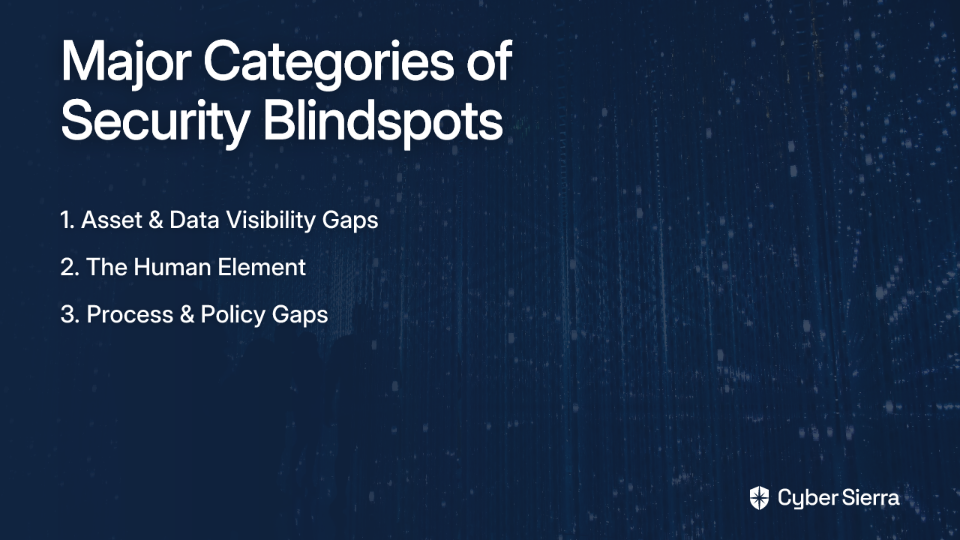
How does a CCM platform use data from an asset inventory tool?

A CCM platform ingests the asset inventory data to create a baseline of all assets that need to be secured. It then automatically maps relevant security controls to each asset and continuously monitors those controls for failures or deviations. For example, the CCM platform uses the asset list to verify that every laptop has an active EDR agent or all servers have the latest security patches, turning raw asset data into actionable security intelligence.
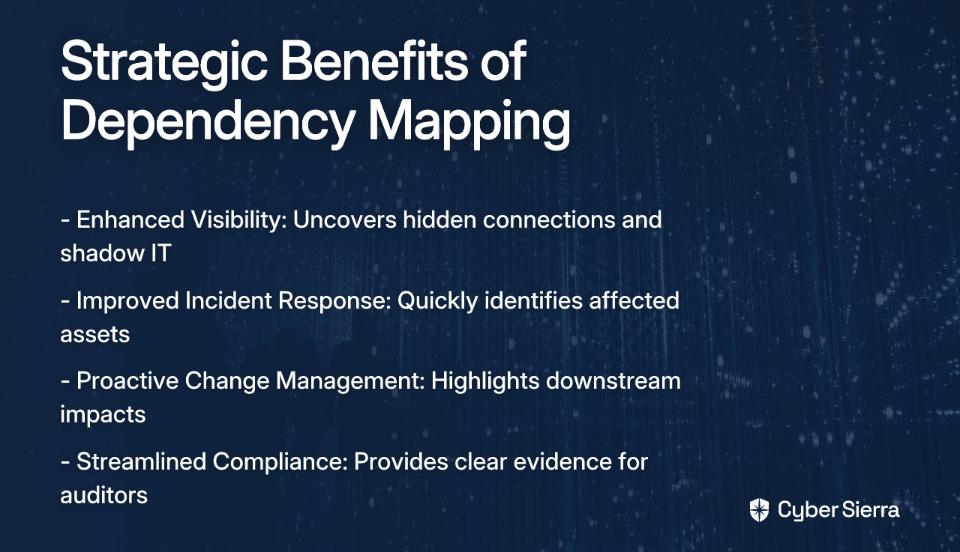
toaster icon

Thank you for reaching out to us!

We will get back to you soon.