blog-hero-background-image
Cyber Security

Top 8 Vendor Risk Assessment Platforms with Continuous Monitoring

backdrop
Table of Contents

Join thousands of professionals and get the latest insight on Compliance & Cybersecurity.


Summary

  • Annual vendor security reviews are obsolete; they create dangerous blind spots as a vendor’s risk profile can change overnight.
  • Effective Third-Party Risk Management (TPRM) now requires continuous monitoring of your vendors' external attack surface and internal compliance.
  • When choosing a TPRM tool, prioritize platforms that offer true automation, seamless integration, and real-time alerts to eliminate manual work and react faster to threats.
  • Integrated platforms like Cyber Sierra's TPRM automate vendor risk assessments and provide 24/7 visibility to help you move from periodic checks to proactive, continuous oversight.

You've set up a third-party risk management program, invested in questionnaires, and established assessment processes. But when a major vendor suffers a breach just weeks after passing your annual review, you're left wondering: "How did we miss this?"

If this scenario sounds familiar, you're experiencing the limitations of traditional point-in-time vendor assessments. In today's dynamic threat landscape, the "set-and-forget" approach to vendor risk management is no longer sufficient.

The End of "Set-and-Forget" Vendor Risk Management

Many security professionals are stuck with TPRM tools that require you to "MANUALLY copy and paste fields to create a vendor record" (as one ZenGRC user complained on Reddit) or platforms that are "absolute garbage except for the questionnaire function" (a critique of OneTrust). Others find themselves with tools that "lack the ability to integrate into a modern company" (a common complaint about Eramba).

The reality is that vendor risk management has evolved significantly in recent years. Supply chains have grown more complex, and regulations like GDPR and NIST frameworks now demand continuous oversight rather than annual check-ins. A once-a-year questionnaire simply doesn't cut it anymore.
This is where continuous monitoring comes in—providing real-time visibility into your vendors' security postures, detecting emerging threats, and adapting to constantly changing risk profiles. True continuous monitoring combines:

  • External Attack Surface Management (EASM): Continuous scanning of vendors' external assets
  • Internal Compliance Monitoring: Ensuring ongoing adherence to policies
  • Automated Alerts: Immediate notifications about vulnerabilities

To help you navigate beyond the "lengthy requirements-gathering and RFP phase" that many security teams find themselves stuck in, we've compiled a guide to the top 8 platforms that truly deliver on continuous monitoring capabilities.

The Top 8 Vendor Risk Assessment Platforms for 2023

1. Cyber Sierra

Overview: Cyber Sierra provides an AI-enabled integrated cybersecurity platform designed to move organizations from periodic, manual checks to proactive, continuous risk management. It addresses the entire GRC ecosystem with a standout TPRM module.

Key Features & Strengths:

  • Comprehensive Third-Party Risk Management: A dedicated module that identifies key third-party risks and prioritizes the vendor inventory based on risk levels.
  • Automated Assessments: Streamlines vendor onboarding and automates risk assessments, reducing manual effort.
  • True Continuous Monitoring: Provides near real-time, 24/7 visibility into vendor security compliance, with automated alerts for remediation.
  • Integrated Continuous Control Monitoring (CCM): A key differentiator that monitors not just vendors but also the effectiveness of your internal controls related to those vendors.
  • Holistic Risk View: Integrates TPRM with other critical functions including GRC automation, threat intelligence, and employee security training.

Why It's a Top Choice: Cyber Sierra provides a unified platform that tackles the root causes of TPRM friction—manual processes, siloed information, and lack of real-time visibility. It's built for organizations looking to mature beyond simple compliance checklists.

2. UpGuard

Overview: A comprehensive third-party risk management platform highly regarded for its user-friendliness and powerful attack surface monitoring capabilities.

Key Features & Strengths:

  • Attack Surface Mapping: Excels at automatically identifying and mapping third-party risks across the external attack surface.
  • Customizable Security Questionnaires: Offers flexible questionnaires aligned with major regulatory standards like GDPR, ISO 27001, and PCI DSS.
  • Real-Time Continuous Monitoring: Combines deep risk insights with ongoing assessments.

Considerations: While a strong contender, organizations should evaluate how its reporting and risk scoring methodologies align with their specific internal requirements.

3. Vanta

Overview: A leading compliance automation platform that has expanded into robust vendor risk management, leveraging AI to speed up security reviews.

Key Features & Strengths:

  • AI-Powered Security Reviews: Uses AI and automation to accelerate the entire vendor risk management lifecycle.
  • Impressive Efficiency Gains: Vanta claims its platform can lead to "62% faster vendor evidence collection time" through automated requests and reminders.
  • Actionable Continuous Monitoring: Tracks vendor attack surfaces and provides alerts with context, severity, and suggested mitigation steps.
  • Automated Vendor Discovery: Helps ensure no shadow IT vendors slip through the cracks by identifying and monitoring all third parties.

Considerations: Primarily known for compliance automation (SOC 2, ISO 27001), its TPRM module is a powerful addition for companies already in or considering the Vanta ecosystem.

4. Prevalent (by Mitratech)

Overview: A specialized TPRM platform that combines point-in-time assessments with continuous monitoring. It's often recommended by users for its focus and optional managed services. As one Reddit user noted, "Their bread and butter is TPRM, it's all they do, and they have in-house managed services that help you run your TPRM program."

Key Features & Strengths:

  • Unified AI-Powered Platform: Offers a centralized solution for assessing, monitoring, and remediating risk across the entire vendor lifecycle.
  • Extensive Assessment Library: Provides a library of over 800 assessment templates for comprehensive analysis.
  • Deep Risk Insights: Monitors for emerging risks across various data leak sources, including dark web monitoring.

Considerations: Some users have noted a potential lack of transparency regarding the number of scanned entities, which could be a point of clarification during demos.

5. SecurityScorecard

Overview: A platform known for its security ratings, providing an easy-to-understand score for a vendor's security posture based on continuous monitoring.

Key Features & Strengths:

  • Security Ratings: Delivers continuous third-party risk monitoring and letter-grade ratings based on various risk factors.
  • Remediation Guidance: Provides suggestions on the potential impact of remediation efforts, helping teams prioritize fixes.

Considerations: Some analyses suggest that refresh rates for ratings could lead to delays in risk evaluation. Additionally, some users find the experience less intuitive than competitors.

6. Bitsight

Overview: A major player in the security ratings space, providing data-driven insights and benchmarks for third-party risk.

Key Features & Strengths:

  • Solid Security Ratings: Delivers reliable performance metrics that benchmark third-party risk levels against industry peers.
  • Comprehensive Reporting: Its "BitSight Security Rating Snapshot" provides detailed reports for risk analysis.

Considerations: Some users have reported challenges where the platform may not quickly acknowledge addressed risks in its reports, which could cause friction with vendors during remediation processes.

7. Panorays

Overview: A TPRM platform that focuses on providing a combination of external attack surface assessments with automated security questionnaires.

Key Features & Strengths:

  • Customizable Workflows: Offers flexible workflows and questionnaire templates to fit different organizational needs.
  • Good User Experience: Generally praised for an intuitive design and ease of use.
  • Continuous Monitoring: Maintains ongoing surveillance of vendors' security postures through its attack surface analysis capabilities.

Considerations: Some analyses suggest it could benefit from improvements in its threat intelligence capabilities compared to other platforms.

8. OneTrust

Overview: A large privacy and security management platform that includes a comprehensive module for vendor risk management.

Key Features & Strengths:

  • Vendor Lifecycle Management: Streamlines the end-to-end vendor lifecycle, with a library of pre-completed questionnaires to speed up the process.
  • Strong on Internal Compliance: The platform excels at managing internal compliance and privacy requirements.
  • Extensive Integration Capabilities: Connects with a wide ecosystem of security and governance tools.

Considerations: While strong on the questionnaire and compliance side, user feedback from Reddit is harsh, calling its TPRM "absolute garbage except for the questionnaire function." It may not effectively monitor external attack surfaces, which is a critical component of continuous monitoring.

How to Choose the Right Platform for Your Needs

When evaluating vendor risk assessment platforms with continuous monitoring capabilities, consider these key factors:

Prioritize Integration: Remember the user pain with Eramba: a cheap tool is expensive if it doesn't integrate with your tech stack. Look for platforms with robust APIs and pre-built integrations with your existing security and IT management systems.

Demand True Automation: Your goal is to eliminate manual work, not just shift it. A good platform should automate evidence collection, risk scoring, and alerting without requiring manual copy-pasting or excessive configuration.

Evaluate the Scope: Do you need a highly specialized, best-of-breed TPRM tool (like Prevalent), or a broader GRC platform that integrates TPRM with compliance and control monitoring (like Cyber Sierra)? Consider your organization's maturity level and existing security infrastructure.

Look Beyond the Questionnaire: The future of VRM is continuous. Ensure the platform has strong External Attack Surface Management (EASM) capabilities and provides real-time alerts. A great questionnaire function alone is not enough in today's dynamic threat landscape.

Conclusion: Moving to Proactive and Continuous Vendor Oversight

Managing third-party risk is no longer a once-a-year activity. The complexity of modern supply chains requires a proactive, continuous approach to security. The vendors on this list are leading the way by providing the automation, continuous monitoring, and integrated insights needed to stay ahead of vendor-related threats.

Platforms like Cyber Sierra, UpGuard, and Vanta are reshaping vendor risk management from a compliance checkbox into a strategic security function. By implementing continuous monitoring, you not only protect your organization more effectively but also free up your security team to focus on strategic initiatives rather than manual follow-ups.

As you evaluate these platforms, remember that the right solution should not only meet your current needs but also scale with your organization's evolving risk management maturity. Take the time to schedule demos, ask tough questions about automation capabilities, and ensure the platform can deliver on the promise of true continuous monitoring.

Your vendors' security is too important to check just once a year. With the right continuous monitoring platform, you'll have the visibility and tools needed to manage third-party risk effectively in an increasingly interconnected digital ecosystem.

Frequently Asked Questions

What is continuous vendor risk monitoring?

Continuous vendor risk monitoring is the process of constantly tracking and evaluating a vendor's security posture in real-time, rather than relying on infrequent, point-in-time assessments. This approach provides ongoing visibility into a vendor's external attack surface, compliance status, and emerging vulnerabilities, allowing organizations to detect and respond to new risks as they appear.

Why are traditional vendor questionnaires no longer enough?

Traditional vendor questionnaires are no longer enough because they only provide a static, point-in-time snapshot of a vendor's security, which quickly becomes outdated. A vendor's security posture can change daily due to new vulnerabilities or system misconfigurations, and annual questionnaires fail to capture these real-time risks, leaving your organization exposed between assessments.

What are the key features of a true continuous monitoring platform?

The key features of a true continuous monitoring platform include External Attack Surface Management (EASM), automated security rating updates, real-time alerting for new vulnerabilities, and integration with GRC workflows. EASM continuously scans a vendor's internet-facing assets for weaknesses, while automated ratings and alerts ensure you are immediately notified of critical issues for prompt remediation.

How does continuous monitoring improve third-party risk management (TPRM)?

Continuous monitoring improves TPRM by replacing manual, periodic checks with automated, real-time oversight, leading to faster risk detection, reduced manual effort, and a more resilient supply chain. This proactive approach eliminates the blind spots between annual reviews and frees up security personnel to focus on strategic risk mitigation rather than manual follow-ups.

Can small and medium-sized businesses (SMBs) implement continuous vendor monitoring?

Yes, small and medium-sized businesses can and should implement continuous vendor monitoring, as many modern SaaS-based platforms are designed to be scalable, affordable, and easy to deploy. These solutions automate much of the process, reducing the need for a large, dedicated security team and making enterprise-grade security accessible to organizations of all sizes.

What is the first step to transition from point-in-time assessments to continuous monitoring?

The first step is to inventory your current vendors and prioritize them based on their criticality and access to sensitive data. Once you have identified your most critical third-party relationships, you can begin a pilot program with a small group of high-risk vendors to demonstrate the value and refine your process before rolling out a continuous monitoring solution across your entire vendor ecosystem.
blog-hero-background-image
Cyber Security

Top 10 Security Orchestration Platforms with Built-in GRC

backdrop
Table of Contents

Join thousands of professionals and get the latest insight on Compliance & Cybersecurity.


Summary

  • Standalone SOAR tools often fail by automating inefficient processes; integrating them with Governance, Risk, and Compliance (GRC) provides essential business context.
  • Combining SOAR with GRC enables risk-informed prioritization, ensuring security teams focus on threats that pose the greatest business risk, not just the loudest alerts.
  • Before adopting a platform, organizations must evaluate internal processes, assess security maturity, and prioritize key integrations to ensure success.
  • A platform with native SOAR and GRC capabilities, like Cybersierra's GRC suite, helps transform security operations into a strategic business enabler.

You've implemented a SOAR (Security Orchestration, Automation, and Response) solution, but your team is still drowning in alerts. The automation is faster, but the number of alerts keeps growing. Your analysts are spending more time managing integrations than actually responding to threats. And when auditors come knocking, you're still scrambling to prove compliance.

Sound familiar?

The hard truth is that traditional SOAR tools often create as many problems as they solve. As one security analyst on Reddit put it: "The SOAR masking the problem, so it never felt like there was an actual difference in analyst workload, but now there were people whose job it was to manage the integration. And that job never quite finished."

The next evolution for mature security programs isn't just SOAR—it's SOAR integrated with Governance, Risk, and Compliance (GRC). This powerful combination bridges the gap between technical security alerts and business-level risk management, transforming your security operations from reactive firefighting to strategic risk mitigation.

Beyond Automation: Why Integrated GRC is a Game-Changer for SOAR

Traditional SOAR platforms excel at automating repetitive security tasks, but they often lack the business context that GRC provides. As another security professional bluntly stated, "Automating a bad process doesn't make it a better process."

When you integrate GRC functionality with SOAR, you gain several critical advantages:

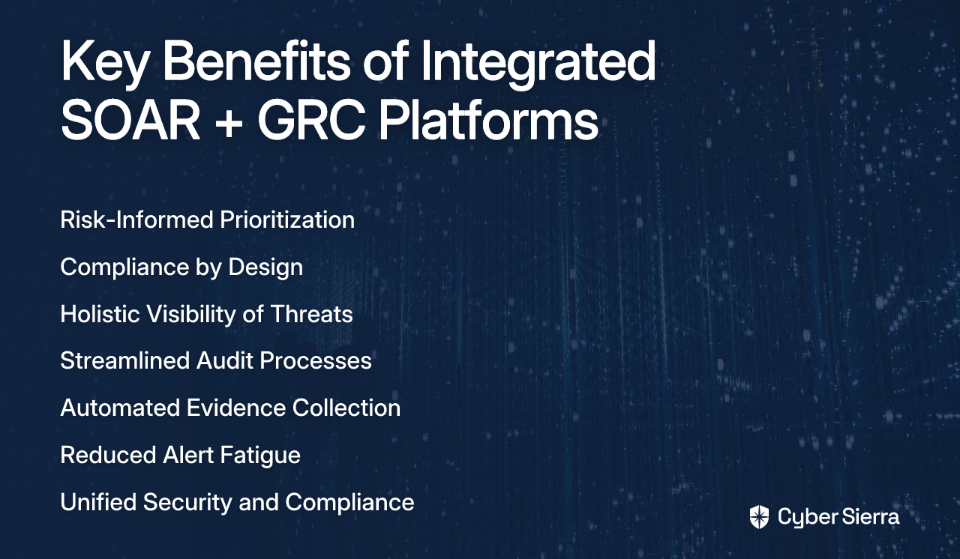
Risk-Informed Prioritization: Your automated actions are no longer based solely on technical severity but are prioritized according to business risk. This means resources are allocated to threats that matter most to your organization.

Compliance by Design: Workflows and playbooks can be built with compliance frameworks (NIST, ISO 27001, PCI DSS) in mind, ensuring automated responses don't inadvertently violate regulatory requirements.

Holistic Visibility: You connect technical incidents to vendor risks (TPRM), internal controls (CCM), and audit evidence, creating a single source of truth. This is especially important considering that 36% of companies still rely on spreadsheets for third-party management, and only 29% track vendors throughout the relationship lifecycle.

Let's look at the top 10 platforms that successfully merge these critical capabilities:

The Top 10 Security Orchestration Platforms with GRC Functionality

1. Cybersierra

Overview: Cybersierra provides an AI-enabled cybersecurity platform designed from the ground up to simplify and automate security compliance for enterprises. Unlike bolt-on solutions, it natively integrates SOAR capabilities with comprehensive GRC functionality.

Key SOAR + GRC Features:

  • Governance, Risk & Compliance (GRC): Automates data collection, risk assessments, and reporting across multiple frameworks (SOC2, ISO 27001, HIPAA, PCI DSS), streamlining audits and reducing compliance fatigue.
  • Continuous Control Monitoring (CCM): Provides near real-time visibility into security controls, building a central repository that detects exceptions and anomalies instantly.
  • Third-Party Risk Management (TPRM): Automates vendor assessments and provides 24/7 visibility into vendor security compliance, addressing the critical gap that only 29% of firms track third parties throughout their relationship lifecycle.

Pros: Native GRC integration, AI-driven automation, user-friendly for compliance-focused teams Cons: Newer player compared to some legacy vendors

2. Swimlane (Turbine)

Overview: A low-code security automation platform focused on high integration capability and scalability for enterprises and MSSPs.

Key SOAR + GRC Features: While primarily a SOAR, its extensive integration capabilities allow it to pull in data from dedicated GRC tools. The platform centralizes data for consistent SOC workflows.

Pros: AI-enabled, low-code automation; claims 50% reduction in Mean Time to Detection and Remediation Cons: GRC features are through integration rather than native, higher licensing costs for advanced features

3. Fortinet (FortiSOAR)

Overview: A security orchestration solution deeply integrated with Fortinet's Security Fabric, providing a cohesive management experience.

Key SOAR + GRC Features: Offers incident and compliance management modules with robust reporting capabilities. Its playbooks can enforce internal policies and track actions for audit purposes.

Pros: Deep integration with Fortinet products; AI-driven recommendations Cons: Can be complex to integrate with third-party tools outside the Fortinet ecosystem

4. Palo Alto Networks (Cortex XSOAR)

Overview: A market-leading platform (formerly Demisto) combining security orchestration, case management, and threat intelligence.

Key SOAR + GRC Features: Features extensive playbook creation capabilities that can be customized for compliance use cases. Its case management functionality serves as an audit trail for all incident response actions.

Pros: Unified case management; strong threat intelligence capabilities Cons: High cost and initial setup complexity can be a barrier for smaller teams

5. IBM Security QRadar SOAR

Overview: A robust platform (formerly Resilient) providing dynamic playbooks and strong incident response management.

Key SOAR + GRC Features: Excels at tracking incident response steps against established procedures, aiding in compliance demonstration. Integrates with various security tools for a centralized view.

Pros: Strong compliance automation; excellent alert correlation Cons: Can have complexity issues with legacy integrations

6. ServiceNow Security Operations

Overview: Integrates security incident response directly into the broader ServiceNow ITSM environment.

Key SOAR + GRC Features: Its core strength is leveraging the native ServiceNow GRC module. Security incidents can be automatically mapped to business risks, controls, and policies within the same platform.

Pros: Unbeatable ITSM and GRC integration for existing ServiceNow users Cons: Requires extensive configuration and is deeply tied to the ServiceNow ecosystem

7. Google Security Operations

Overview: A cloud-native solution (part of Google Chronicle) designed for organizations operating at scale in the cloud.

Key SOAR + GRC Features: Leverages Google's AI and analytics for threat detection and response automation. Integrations with cloud services allow compliance and configuration checks to be part of automated workflows.

Pros: AI-powered analytics; strong support for cloud environments Cons: Best suited for organizations heavily invested in Google Cloud

8. Microsoft Sentinel

Overview: A cloud-native SIEM and SOAR solution for the Microsoft Azure ecosystem.
Key SOAR + GRC Features: Tightly integrated with Microsoft Defender and Azure Policy, allowing security playbooks to enforce compliance configurations and respond to policy violations automatically.

Pros: Fast incident response; seamless integration with Microsoft products Cons: Most effective within a Microsoft-centric infrastructure

9. Splunk SOAR

Overview: A highly customizable platform (formerly Phantom) allowing security teams to automate complex workflows across dozens of tools.

Key SOAR + GRC Features: Its flexibility enables teams to build custom playbooks for GRC tasks, such as evidence gathering for audits or running automated compliance checks.

Pros: Extensive integration library; highly customizable workflows Cons: High licensing costs can be prohibitive for smaller organizations

10. Tines

Overview: A no-code automation platform designed to allow security teams to automate any workflow without needing developers.

Key SOAR + GRC Features: While not a dedicated GRC tool, its ease of use allows compliance managers to build simple automation stories for tasks like user access reviews or evidence collection from other systems.

Pros: Extremely user-friendly no-code interface; flexible and fast to deploy Cons: Lacks the built-in GRC modules of more comprehensive platforms

How to Choose the Right Platform and Avoid Common Pitfalls

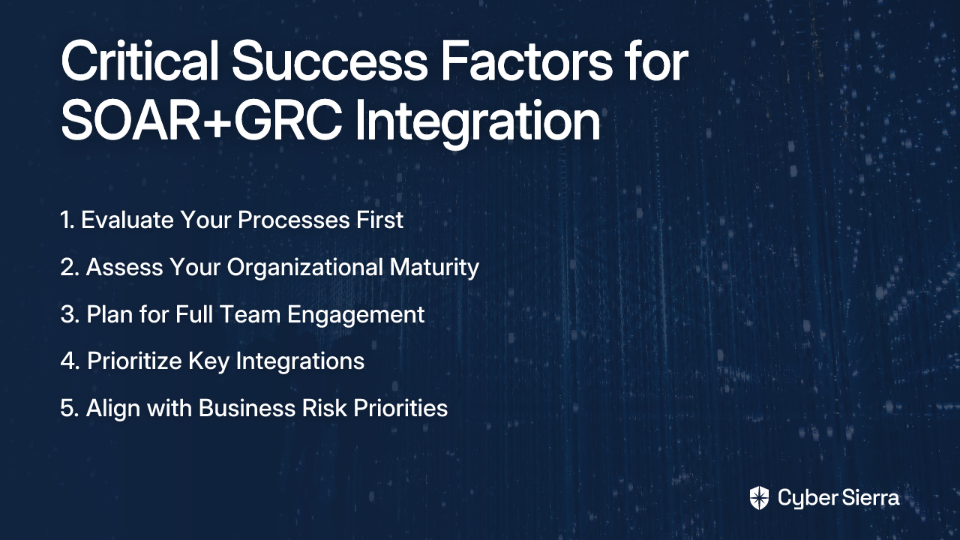
After reviewing countless user experiences and implementation stories, four critical success factors emerged for organizations integrating SOAR and GRC:

1. Evaluate Your Processes First

Before you buy any tool, map your existing incident response and compliance processes. As one security leader noted, "Automating a bad process doesn't make it a better process." Identify bottlenecks and define what success looks like before you automate.

2. Assess Your Organizational Maturity

A critical insight from security practitioners: "The maturity of the security org was key influence factor." A small, understaffed team will struggle with a complex tool requiring dedicated engineers. Be realistic about your resources. Platforms with guided onboarding and native integrations can lower the barrier to entry.

3. Plan for Full Team Engagement

As one Reddit user observed, "If you only have 1 or 2 members engaged in the platform then there is no point to using it." SOAR is a program that requires buy-in from the entire SOC and collaboration with compliance teams. Success relies on continuous training and active use.

4. Prioritize Key Integrations

Avoid the pitfall where "the already high learning curve of SOAR projects was made worse" by complex initial projects. List your critical security tools (SIEM, EDR, threat intel feeds, ticketing systems) and prioritize platforms with robust, out-of-the-box integrations for them.
Conclusion

The convergence of SOAR and GRC is no longer a luxury but a necessity for building a resilient security program. These integrated platforms help security teams move faster, make smarter risk-based decisions, and clearly demonstrate their value to the business through automated compliance and reporting.
By selecting the right platform that aligns with your organizational maturity and security needs, you can transform your security operations from a technical cost center to a strategic business enabler. The key is not just automation for automation's sake, but intelligent orchestration that's informed by business risk and compliance requirements.

As threats continue to evolve and regulatory landscapes become more complex, the organizations that successfully integrate these capabilities will be best positioned to protect their assets while maintaining compliance in an increasingly challenging environment.

Frequently Asked Questions

What is an integrated SOAR and GRC platform?

An integrated SOAR and GRC platform is a security solution that combines the automated threat response capabilities of Security Orchestration, Automation, and Response (SOAR) with the business context and compliance management of Governance, Risk, and Compliance (GRC). This allows security teams to prioritize responses based on business risk, ensure automated actions align with compliance frameworks, and maintain a holistic view of their security posture.

Why is integrating GRC with a SOAR solution important?

Integrating GRC with a SOAR solution is important because it connects technical security actions with business-level risk, ensuring that automation efforts are focused on the most critical threats to the organization. Without GRC context, SOAR can lead to automating inefficient processes or overwhelming analysts. The integration provides risk-informed prioritization and embeds compliance requirements directly into security workflows.

How does a SOAR platform with GRC help with audits and compliance?

A SOAR platform with GRC capabilities helps with audits by automating evidence collection, enforcing compliant workflows, and providing a centralized, auditable trail of all incident response actions. Playbooks can be designed around specific frameworks like PCI DSS or HIPAA, ensuring that the response to an incident is not only automated but also documented in a way that demonstrates adherence to regulatory requirements.

What should I look for when choosing a SOAR platform with GRC features?

When choosing a platform, you should evaluate your organization's internal process maturity, the platform's integration capabilities with your existing tools, and how it aligns with your business risk priorities. It's crucial to assess your current processes before automating them. A complex tool can overwhelm a small team, so be realistic about your resources and prioritize platforms with robust, out-of-the-box integrations for your critical security stack.

What is the difference between a native vs. integrated GRC solution for SOAR?

A native SOAR+GRC platform is built from the ground up with both functions fully intertwined, offering a seamless user experience. An integrated solution involves connecting a dedicated SOAR tool to a separate GRC tool via APIs. Native platforms often simplify data correlation and reporting, while integrated solutions provide flexibility if you already have a preferred tool for one function, though they may require more effort to manage the connection.

blog-hero-background-image
Cyber Security

Top 10 Integrated GRC and CCM Solutions for Financial Services

backdrop
Table of Contents

Join thousands of professionals and get the latest insight on Compliance & Cybersecurity.


Summary

  • The financial services industry faces increasing regulatory complexity and cyber threats, making traditional, manual GRC and compliance management unsustainable.
  • Integrated GRC and Continuous Control Monitoring (CCM) platforms automate evidence collection and provide real-time visibility, transforming compliance into a continuous, data-driven program.
  • Before selecting a tool, define your internal processes and prioritize platforms with strong automation, multi-framework support, and integration capabilities.
  • Cybersierra offers a unified GRC and CCM platform that automates compliance tasks across multiple frameworks, helping enterprises become audit-ready faster.

You've spent countless hours manually gathering evidence for your latest compliance audit. Your team is drowning in spreadsheets tracking vendor risks. And just when you think you're on top of one regulatory framework, another one emerges demanding your attention. If you're nodding along, you're not alone in the financial services industry.

The days of managing governance, risk, and compliance through disconnected tools and manual processes are rapidly becoming untenable. With increasing regulatory scrutiny and evolving cyber threats, financial institutions need a more integrated, automated approach to security and compliance.

Governance, Risk, and Compliance (GRC) platforms help align IT with business objectives while managing risks and meeting regulatory requirements. When paired with Continuous Control Monitoring (CCM) capabilities that provide real-time visibility into control effectiveness, these integrated solutions transform compliance from a periodic, audit-driven exercise into an ongoing, data-driven program.

In this article, we'll explore the top 10 integrated GRC and CCM solutions that are helping financial services organizations streamline compliance, enhance security posture, and reduce the headaches associated with audit preparation.

1. Cybersierra

Overview: Cybersierra offers an AI-enabled cybersecurity platform specifically designed to simplify and automate security compliance for enterprises in highly regulated industries like financial services. Recently recognized as a Sample Vendor in the 2024 Gartner Hype Cycle for Cyber-Risk Management in both Cyber GRC and CCM categories, Cybersierra is pioneering the integration of these critical functions.

Key Features:

  • Governance, Risk & Compliance (GRC): Automates data collection, risk assessments, and reporting for frameworks like SOC 2, ISO 27001, GDPR, and PCI DSS, making enterprises audit-ready faster and reducing compliance fatigue.
  • Continuous Control Monitoring (CCM): Provides a central controls repository with near real-time updates and ongoing visibility into security posture, automating control testing and validation while detecting exceptions proactively.
  • Third-Party Risk Management (TPRM): Simplifies vendor risk assessment, onboarding, and continuous monitoring, moving beyond point-in-time questionnaires to provide 24/7 visibility into vendor security compliance.
  • Threat Intelligence: Offers a comprehensive security scorecard, performs network and cloud vulnerability scanning, and helps prioritize remediation efforts.

What Sets It Apart: Cybersierra stands out for its unified approach that transforms security from periodic checks to continuous, automated monitoring. The platform provides a single source of truth for controls and enables proactive risk management across multiple compliance frameworks simultaneously, addressing a common pain point for financial institutions juggling diverse regulatory requirements.

2. MetricStream

Overview: A well-established leader in the GRC space, MetricStream is recognized by both Gartner and Forrester for its "Connected GRC" solution that enhances organizational agility and resilience, particularly in the financial sector.

Key Features:

  • Strong AI and advanced analytics for enterprise-wide risk visibility
  • Centralized repository for risk, compliance, and policy management
  • Tailored solutions for emerging financial regulations like DORA (Digital Operational Resilience Act)

What Sets It Apart: MetricStream excels in providing solutions specifically designed for the banking, financial services, and insurance (BFSI) sector, with robust capabilities for managing regulatory change and operational resilience.

3. ServiceNow GRC

Overview: An ideal solution for organizations already embedded in the ServiceNow ecosystem for IT service management (ITSM), ServiceNow GRC extends familiar workflows into compliance and risk management.

Key Features:

  • Seamless integration with existing IT workflows for a unified operational view
  • No-code playbooks and automated workflows for customizing risk and compliance processes
  • Real-time monitoring and customizable dashboards

What Sets It Apart: The platform leverages its strong foundation in IT service management to create a seamless experience where compliance activities become an extension of regular operational workflows, reducing friction in adoption.

4. Archer

Overview: Known for its deep customization capabilities, Archer provides a comprehensive, integrated risk management approach that has long been a staple in large financial institutions.

Key Features:

  • Provides a suite of tools for managing risk, compliance obligations, and audit management
  • Dynamic dashboards for real-time risk visibility
  • Extensive content libraries for various regulatory frameworks

What Sets It Apart: Archer offers unparalleled depth in its customization capabilities, allowing financial institutions to tailor the platform to their specific organizational structures and complex regulatory environments, though user feedback suggests this can lead to a more complex setup process.

5. Drata

Overview: A leader in the compliance automation space, Drata is particularly popular with high-growth technology and cloud-native financial services companies.

Key Features:

  • Excels at automated evidence collection across over 20 frameworks
  • Designed for scalability, making it suitable for organizations from startups to enterprises
  • Focuses on making companies "audit-ready" continuously

What Sets It Apart: Drata's user-friendly interface and streamlined evidence collection process directly addresses one of the most painful aspects of compliance work—gathering documentation for audits—making it especially valuable for lean compliance teams.

6. LogicGate

Overview: A flexible platform known for its user-friendly, no-code environment for building and automating risk and compliance programs in financial services.

Key Features:

  • Features a drag-and-drop workflow builder that is highly intuitive
  • Provides a suite of modular applications for different GRC needs
  • Strong analytics capabilities to help tailor compliance efforts

What Sets It Apart: LogicGate's Risk Cloud platform empowers business users to create and modify workflows without technical expertise, addressing the common frustration that "a poorly defined process can make any GRC tool ineffective" by allowing continuous process refinement.

7. AuditBoard

Overview: A cloud-native platform designed to unify audit, risk, compliance, and ESG processes in a single, collaborative workspace, ideal for financial institutions managing multiple audit streams.

Key Features:

  • Strong collaborative features for document management and audit workflows
  • User-friendly design aimed at addressing the confusion that comes from using multiple, disconnected GRC tools
  • Focused on streamlining the audit process and reducing preparation time

What Sets It Apart: AuditBoard was built by former auditors specifically to address the communication challenges between audit teams and business units, creating a more streamlined experience for all stakeholders in the audit process.

8. Vanta

Overview: A compliance automation platform that helps financial companies streamline the process of achieving certifications like SOC 2, ISO 27001, and HIPAA.

Key Features:

  • Automates up to 90% of the work for security and privacy frameworks
  • Provides continuous monitoring and integrates with a wide range of cloud services and tools
  • Strong focus on evidence collection and audit readiness

What Sets It Apart: Vanta excels at continuous control monitoring, with automated testing and validation that detects control failures in near real-time, reducing the risk of audit findings and security breaches.

9. Workiva

Overview: A unified platform that is particularly strong in integrating financial reporting, ESG, and GRC—a crucial capability for public financial institutions.

Key Features:

  • Connects financial data directly to compliance and risk reporting, ensuring consistency
  • Excellent for organizations where GRC is closely tied to financial and SEC reporting
  • Strong document control and version management

What Sets It Apart: Workiva uniquely addresses the intersection of financial reporting and compliance, making it particularly valuable for publicly traded financial institutions that must meet both SEC requirements and industry-specific regulations.

10. Pathlock

Overview: A platform that focuses on identity security and application controls, unifying user access governance with broader GRC functions—critical in financial environments.

Key Features:

  • Automates user access reviews, SoD (Segregation of Duties) analysis, and compliance reporting
  • Integrates deeply with major ERP systems like SAP, Oracle, and Workday for real-time compliance
  • Focuses on transaction monitoring to prevent fraud and financial misstatement risks

What Sets It Apart: Pathlock's strong focus on access governance and transaction monitoring directly addresses key financial control requirements, making it particularly valuable for institutions concerned with fraud prevention and financial integrity.

How to Choose the Right Integrated GRC/CCM Solution

Selecting the right platform for your financial institution requires careful consideration of your specific needs and processes. Based on common industry challenges, here are key factors to evaluate:

1. Define Your Processes Before Your Purchase

As one compliance professional noted on Reddit, "a poorly defined process can make any GRC tool ineffective." No software, no matter how sophisticated, can fix broken or overly complex processes. Before evaluating platforms:

  • Map your current workflows for risk assessment, control testing, and evidence gathering
  • Identify bottlenecks and inefficiencies in your existing approach
  • Define clear objectives for what you want the GRC platform to accomplish

2. Prioritize Automation for Evidence Management

The most painful part of an audit is typically evidence gathering—a tedious, time-consuming process, especially for lean compliance teams. Look for a platform that:

  • Automates evidence collection by integrating with your cloud providers, code repositories, and HR systems
  • Provides robust evidence protection and sharing features to maintain data integrity
  • Supports continuous evidence collection rather than point-in-time snapshots

3. Ensure Comprehensive Framework Support and Customization

Your chosen tool must support the specific frameworks required in financial services (PCI DSS, SOC 2, ISO 27001, etc.) while remaining flexible enough to adapt to your organization's unique needs:

  • Evaluate how well the platform handles framework mapping and control overlap
  • Look for the ability to manage custom controls alongside standard frameworks
  • Consider how the platform will adapt to emerging regulations specific to financial services

4. Evaluate Integration and Scalability

Many financial organizations struggle with "juggling multiple GRC platforms," leading to confusion and inefficiency. A good solution should:

  • Integrate with your existing tech stack to become a single source of truth
  • Scale with your organization's compliance maturity and growing regulatory requirements
  • Support expanding to additional frameworks without significant reconfiguration

5. Focus on User Experience (UX)

A tool is useless if your team won't use it. Ineffective search functionalities and clunky interfaces can create bottlenecks, "especially during audits." Prioritize platforms with:

  • Intuitive dashboards and clear reporting
  • Effective search capabilities to quickly locate evidence and controls
  • Easy navigation and a short learning curve for new users

Conclusion

The financial services landscape demands a proactive, automated, and integrated approach to risk and compliance. Manual, periodic checks are no longer sufficient in an environment of increasing regulatory scrutiny, evolving cyber threats, and customer expectations for data protection.

By adopting an integrated GRC and CCM platform like Cybersierra, financial institutions can transform security from a reactive, audit-driven exercise into a continuous, data-driven program. This not only strengthens security posture but also builds trust with regulators, customers, and partners.

The right platform empowers your organization to move beyond compliance checklists and achieve true cyber resilience—turning what was once a burdensome overhead activity into a strategic advantage that protects your reputation and bottom line.

As you evaluate the options presented in this article, consider how each solution addresses your specific challenges and aligns with your long-term compliance strategy. The goal isn't just to pass the next audit but to build a sustainable approach to governance, risk, and compliance that evolves with your business and the regulatory landscape.

Frequently Asked Questions (FAQ)

What are GRC and CCM, and why are they crucial for financial services?

GRC (Governance, Risk, and Compliance) is a strategy for managing an organization's overall governance, risk management, and compliance with regulations, while CCM (Continuous Control Monitoring) is the technology used to automate the testing and validation of security controls in real-time. For financial services, which face intense regulatory scrutiny and constant cyber threats, integrating GRC and CCM is crucial. This approach transforms compliance from a manual, periodic task into an automated, ongoing program, helping institutions proactively manage risks and prove compliance to auditors.

How does an integrated GRC and CCM platform simplify the audit process?

An integrated GRC and CCM platform dramatically simplifies audits by automating evidence collection and providing a single source of truth for all compliance activities. Instead of manually gathering screenshots and documents, the platform continuously collects evidence from your tech stack (like cloud providers and HR systems). This reduces audit preparation time from weeks to hours and minimizes friction between teams.

What is the main benefit of a unified platform over separate tools?

The main benefit of a unified GRC and CCM platform is that it provides a single, real-time view of your entire security and compliance posture. Juggling separate tools often leads to data silos and inefficiencies. A unified solution connects these functions, allowing you to map a single control to multiple frameworks (e.g., SOC 2, ISO 27001, PCI DSS) simultaneously, which eliminates redundant work and improves accuracy.

Can these platforms help with new and emerging financial regulations?

Yes, a key strength of modern GRC platforms is their ability to adapt to new and emerging regulations. Most top-tier platforms maintain extensive libraries of regulatory frameworks and update them as new rules, like the Digital Operational Resilience Act (DORA), are introduced. Their flexible design allows you to add custom controls and map existing ones to new requirements, ensuring your compliance program can evolve with the regulatory landscape.

What should I do before buying a GRC tool?

Before buying a GRC tool, you must clearly define and document your internal compliance and risk management processes. A GRC platform is a powerful enabler, but it cannot fix a broken or undefined process. Start by mapping your current workflows, identifying bottlenecks, and clarifying roles. Having well-defined processes ensures you can configure the tool effectively and get the maximum return on your investment.

How does Continuous Control Monitoring (CCM) work?

Continuous Control Monitoring (CCM) works by automatically and continuously testing your security controls against your defined policies. CCM platforms integrate directly with your technology stack (e.g., AWS, Azure, GitHub) and run automated tests to verify that controls are implemented correctly. If a control fails, the system generates an alert, allowing you to remediate the issue proactively long before an auditor finds it.

blog-hero-background-image
Cyber Security

Top 5 AI-Based Vulnerability Management Tools for Enterprises

backdrop
Table of Contents

Join thousands of professionals and get the latest insight on Compliance & Cybersecurity.


Summary

  • With 69% of businesses now viewing AI as critical to their security strategy, traditional vulnerability management is no longer sufficient for complex, modern attack surfaces.
  • Effective AI tools go beyond basic scanning by providing intelligent, risk-based prioritization that considers asset criticality, threat intelligence, and business impact.
  • Adopt a 'Human-in-the-Loop' approach where AI proposes remediation, but security experts provide final approval to ensure control and prevent system disruptions.
  • Bridge the gap between security and compliance by choosing a platform that connects vulnerability data directly to your GRC framework, like Cybersierra's Threat Intelligence, to gain a unified view of risk.

In today's rapidly evolving threat landscape, security teams find themselves drowning in vulnerability alerts. You've set up scanning tools, only to be bombarded with endless lists of CVEs, most labeled "critical," with no clear path to remediation. Your team is exhausted from the alert fatigue, and despite all the tools at your disposal, you still worry about what's being missed.

"I want a tool that does more than just flags me constantly," is a sentiment echoed across security forums, as professionals seek solutions that provide actionable insights rather than just another dashboard of problems.

The modern enterprise attack surface has become too vast and complex for traditional vulnerability management approaches. With environments spanning on-premise infrastructure, multi-cloud deployments, containerized applications, and an expanding ecosystem of third-party vendors, manual vulnerability assessment and remediation simply cannot scale.

This is where AI-powered vulnerability management tools are transforming the landscape—not by removing humans from the equation, but by augmenting human expertise with intelligent automation that prioritizes, contextualizes, and proposes solutions.

According to the Cloud Security Alliance, 69% of businesses now believe AI is critical to their security strategy due to rising cyber threats. But not all AI-powered tools are created equal, and many security professionals remain skeptical about the "black box" nature of AI systems, especially when it comes to remediation.

Let's explore what you should look for in an AI-powered vulnerability management tool, and then dive into the top 5 solutions that are getting it right.

What to Look For in an AI-Powered Vulnerability Management Tool

Before jumping into specific solutions, it's important to understand the key criteria that separate truly effective AI-based vulnerability management tools from those that simply add to your alert fatigue:

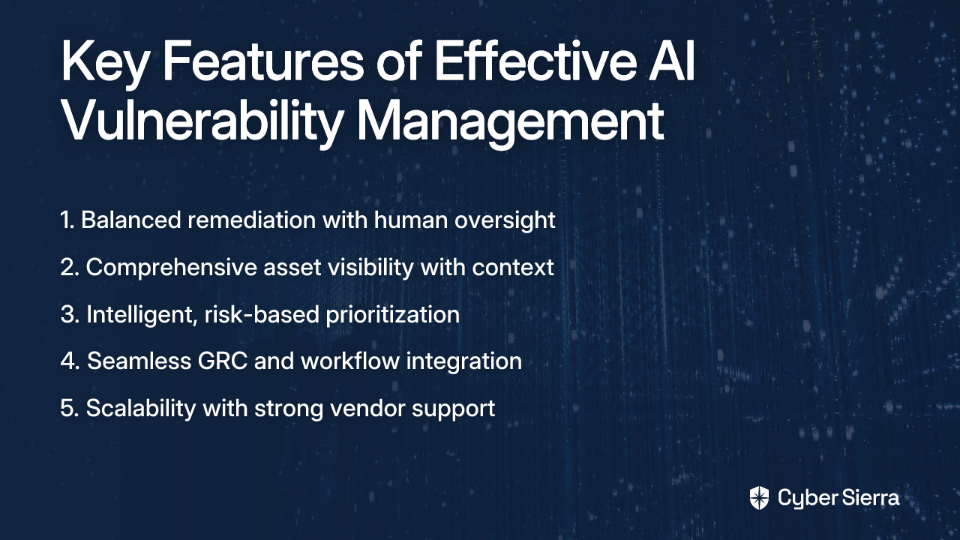
Actionable Remediation with Human Oversight

The most common demand from security professionals is for tools that "actually, accurately remediate." However, there's legitimate concern about AI making autonomous decisions in critical environments. The ideal solution strikes a balance by detecting vulnerabilities, flagging them, and proposing fixes in a dashboard that uses "Human-In-The-Loop" approvals. This ensures control and prevents AI from making potentially catastrophic changes to critical systems.

Comprehensive Asset Visibility & Context

You can't protect what you don't know you have. An effective tool must provide continuous discovery and visibility across your entire digital footprint—including cloud environments, containers, IoT devices, and third-party assets. AI should then enrich this data with context about asset criticality, data sensitivity, and business impact to inform risk calculations.

Intelligent, Risk-Based Prioritization

When everything is critical, nothing is. Advanced AI tools go beyond basic CVSS scores, analyzing threat intelligence feeds, asset context, exploit availability, and attacker behavior to provide truly risk-based prioritization. This ensures your team focuses first on vulnerabilities that pose the greatest immediate threat to your business.

Seamless Integration with GRC and Workflows

Vulnerability management doesn't exist in a vacuum. The best tools integrate with your existing security stack, CI/CD pipeline, and IT service management systems to streamline the entire process from detection to remediation. They also feed data into your broader Governance, Risk, and Compliance (GRC) framework, automating evidence collection for standards like SOC2, ISO 27001, and PCI DSS.

Scalability and Vendor Support

As your enterprise grows, your vulnerability management solution must scale accordingly. Look for vendors with strong support systems, regular updates, and a proven track record of responding to customer needs.

Now that we've established what makes a truly effective AI-powered vulnerability management tool, let's examine the top 5 solutions for enterprises.

The Top 5 AI-Based Vulnerability Management Tools

1. Cybersierra

Description: Cybersierra stands out as an integrated, AI-enabled cybersecurity platform that moves beyond traditional vulnerability scanning. It unifies threat intelligence with continuous compliance monitoring and risk management, providing a holistic view of an organization's security posture. Rather than treating vulnerabilities as isolated technical issues, Cybersierra connects them to their impact on business-critical assets and compliance controls.

Key AI-Powered Features:

  • Threat Intelligence: Provides proactive defense by combining a comprehensive security scorecard with network and cloud infrastructure vulnerability scanning. Its "outside-in" scanning approach identifies vulnerabilities and prioritizes remediation efforts before threats can be exploited. This gives security teams the ability to see their environment through the eyes of an attacker.
  • Continuous Control Monitoring (CCM): A key differentiator that provides near real-time visibility into security controls. This context-aware approach helps teams understand not just that a vulnerability exists, but its relationship to critical business systems and compliance requirements. This transforms security from periodic checks to continuous risk management.
  • Governance, Risk & Compliance (GRC): Automatically links vulnerability data to relevant compliance frameworks (SOC2, ISO 27001, HIPAA, etc.). By automating data collection, risk assessments, and reporting, Cybersierra makes organizations audit-ready while reducing compliance fatigue.

Best For: Enterprises seeking a unified platform that connects vulnerability management with broader risk, compliance, and governance processes. Particularly valuable for organizations managing multiple compliance frameworks or preparing for audits.

2. SentinelOne

Description: SentinelOne offers an AI-driven extended detection and response (XDR) platform that integrates vulnerability management into its broader security operations framework. It focuses on speed and automation to reduce threat dwell times.

Key AI-Powered Features:

  • Real-Time Detection and Analysis: Uses AI to process logs, code repositories, and network data to identify threats and vulnerabilities with minimal latency.
  • Automated Remediation Workflows: Provides capabilities for automated patch management and configuration tasks with appropriate approval workflows, helping to close vulnerability windows faster.
  • XDR Integration: Enhances vulnerability detection by correlating with active threat intelligence and endpoint activity, providing context about which vulnerabilities are being actively exploited.

Best For: Organizations looking for a tightly integrated endpoint protection and vulnerability management solution that prioritizes rapid response within a broader security operations context.

3. Tenable.io

Description: Tenable is a longstanding leader in the vulnerability management space, offering a cloud-based platform that provides comprehensive visibility across IT, cloud, and IoT assets.

Key AI-Powered Features:

  • Predictive Prioritization: Uses machine learning to correlate vulnerability data with threat intelligence and asset criticality, predicting which vulnerabilities are most likely to be exploited.
  • Comprehensive Asset Discovery: Combines scanning and agent-based methods to provide a complete and continuously updated inventory of assets and vulnerabilities.
  • Lumin Exposure View: Provides an AI-driven risk-based view of your entire attack surface, helping to focus remediation efforts where they'll have the most impact.

Best For: Organizations with mature security programs that require deep vulnerability analysis capabilities and advanced, risk-based prioritization across complex environments.

4. Qualys VMDR (Vulnerability Management, Detection, and Response)

Description: Qualys offers a comprehensive, cloud-native platform that integrates vulnerability management with threat detection, response, and compliance in a single application.

Key AI-Powered Features:

  • AI-Powered Risk Prioritization: Leverages machine learning to automatically prioritize vulnerabilities based on threat indicators, exploitability, and asset context.
  • Continuous Monitoring: Provides real-time threat detection across the entire IT environment to identify vulnerabilities and misconfigurations as they appear.
  • Automated Workflows: Streamlines the entire vulnerability management lifecycle from discovery to remediation with built-in orchestration capabilities.

Best For: Large enterprises seeking an all-in-one, highly scalable cloud platform that combines vulnerability management with other essential security and compliance functions.

5. Rapid7 InsightVM

Description: Rapid7's InsightVM is a vulnerability management solution that excels at providing actionable insights through intuitive dashboards and detailed reporting.

Key AI-Powered Features:

  • Real-Time Risk Scoring: Uses a proprietary risk scoring system that is more nuanced than standard CVSS, with live dashboards showing risk trends and remediation progress.
  • Remediation Workflow Integration: Seamlessly connects with IT ticketing systems, patching solutions, and CI/CD pipelines to automate remediation processes.
  • Attacker-Centric Analysis: Analyzes vulnerabilities from an attacker's perspective, helping teams understand potential attack paths and prioritize defenses accordingly.

Best For: Organizations that need powerful visualization and reporting capabilities to effectively communicate risk to stakeholders and drive cross-functional remediation efforts.

Beyond the Tools: Building a Mature, AI-Enhanced Strategy

While selecting the right tool is crucial, implementing a mature vulnerability management strategy requires more than just technology. Here are key considerations for leveraging AI-powered tools effectively:

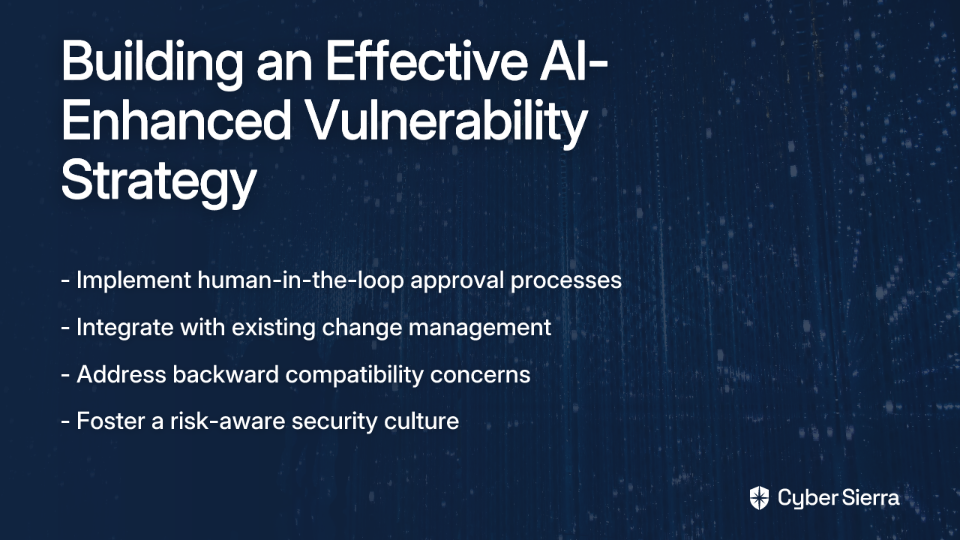
Embrace the Human-in-the-Loop Approach

A common concern in security forums is the question: "Would you actually trust an AI tool to do system administration on your behalf?" For most enterprises, the answer is a resounding no. The most effective approach uses AI to augment human expertise rather than replace it.

Implement a "Human-in-the-Loop" approval process where AI identifies vulnerabilities, proposes remediation steps with supporting data, but human experts make the final call. This builds trust in the system and prevents potentially catastrophic errors, especially in complex environments.

Integrate with Change Management

One of the most significant challenges in vulnerability remediation is expressed by a security professional on Reddit: "If you upgrade the Apache server to get rid of the vulnerability, the web app you depend on that's 12 years old now stops working because it's not compatible with the newest version of Apache."

This highlights why AI-powered vulnerability management must integrate with your existing change management processes. Remediation plans proposed by AI should be routed through established testing frameworks and change control boards before deployment, especially when dealing with legacy systems that may have complex dependencies.

Address Backward Compatibility Concerns

The fear that "just applying the patch may not just remediate it but in many cases could pose backward compatibility issues" is valid. Your vulnerability management strategy should include:

  • Pre-deployment testing environments that mirror production
  • Rollback capabilities for failed patches
  • Staged deployment processes for critical systems
  • Alternative mitigation strategies when patching isn't immediately viable

Foster a Risk-Aware Security Culture

A tool is only one piece of the puzzle. Use the data and insights from your AI platform to drive a broader security culture. Platforms that include modules for employee security training can help strengthen the "human firewall," while clear GRC reporting helps align security efforts with business objectives, fostering organization-wide commitment to proactive defense.

Conclusion

The era of manual vulnerability management is over. With attack surfaces expanding exponentially and threats evolving constantly, AI-powered tools have become essential for enterprises to maintain an effective security posture.

However, the most effective solutions aren't those that promise full, unchecked automation. They are integrated platforms that provide deep visibility, use AI for intelligent, risk-based prioritization, and empower security teams with actionable remediation plans—all within a framework of human oversight and robust governance.

As you evaluate your current vulnerability management processes, consider whether you're simply collecting alerts or proactively managing risk. Look for solutions like Cybersierra that connect technical vulnerabilities to business context and compliance requirements, providing a unified view of your security posture.

By combining cutting-edge AI technology with thoughtful human oversight and established change management processes, you can transform vulnerability management from a reactive, overwhelming task into a strategic, risk-aware function that truly protects your business.

Remember, the goal isn't just to find vulnerabilities faster—it's to build a more resilient organization that can adapt to evolving threats while maintaining business continuity and regulatory compliance.

Frequently Asked Questions

What is AI-powered vulnerability management?

AI-powered vulnerability management is an advanced approach that uses artificial intelligence and machine learning to automate and enhance the process of identifying, prioritizing, and remediating security weaknesses. Unlike traditional scanners that simply generate lists of vulnerabilities, AI-powered tools provide context by analyzing threat intelligence, asset criticality, and potential business impact to help security teams focus on the most significant risks first.

Why is risk-based prioritization better than using CVSS scores alone?

Risk-based prioritization is superior to relying on CVSS scores alone because it provides a more accurate, real-world assessment of threats. While a CVSS score is a static, technical severity rating, an AI-driven risk-based approach is dynamic. It considers factors like the availability of an exploit, evidence of active attacks, the importance of the affected asset to your business, and existing security controls to determine the true risk a vulnerability poses to your organization.

How do AI vulnerability management tools handle remediation?

Modern AI vulnerability management tools handle remediation by suggesting or automating fixes within a "Human-in-the-Loop" framework. The AI identifies a vulnerability and proposes a specific solution, such as a patch, configuration change, or compensating control. This recommendation is then presented to a human expert for review and approval, ensuring that changes are tested and deployed safely without disrupting critical business operations.

Can AI vulnerability management tools help with compliance?

Yes, AI-powered tools significantly streamline compliance and auditing processes. They can automatically map identified vulnerabilities to specific controls required by frameworks like SOC2, ISO 27001, HIPAA, and PCI DSS. By continuously monitoring your environment and automating evidence collection, these platforms make it easier to demonstrate compliance, reduce manual effort, and ensure you are always audit-ready.

What is the first step to implementing an AI-powered vulnerability management tool?

The first step is to achieve comprehensive asset discovery and visibility across your entire digital environment. An effective AI tool cannot protect what it cannot see, so it must begin by creating a complete and continuously updated inventory of all assets, including on-premise servers, cloud instances, containers, and IoT devices. This foundational visibility is essential for the AI to accurately assess context and prioritize risks.

Do AI tools replace the need for a security team?

No, AI tools are designed to augment and empower security teams, not replace them. They automate the time-consuming, data-intensive tasks of scanning, correlation, and initial prioritization, which helps combat alert fatigue. This frees up human analysts to focus on higher-value activities like strategic planning, complex threat hunting, and making critical decisions about remediation and risk acceptance.

blog-hero-background-image
Cyber Security

Top 5 Ways GenAI Outperforms Traditional SIEM Tools for Control Monitoring

backdrop
Table of Contents

Join thousands of professionals and get the latest insight on Compliance & Cybersecurity.


Summary

  • Traditional SIEMs are reactive, creating overwhelming alert fatigue and leaving organizations vulnerable to novel, sophisticated attacks.
  • Generative AI shifts security to a proactive model, using behavioral analytics to detect threats and intelligent prioritization to eliminate false positives.
  • With GenAI, compliance transforms from periodic, stressful audits into a state of continuous, automated audit-readiness through Continuous Control Monitoring (CCM).
  • An AI-powered platform like Cyber Sierra's Continuous Control Monitoring automates compliance, reduces analyst workload, and provides a unified, proactive view of your security posture.

You've invested heavily in your SIEM (Security Information and Event Management) solution. Your team has spent countless hours tuning correlation rules, creating dashboards, and building playbooks. Yet somehow, you still feel like you're drowning in alerts while constantly worried about what you might be missing. Your security analysts are overwhelmed, compliance audits remain a mad scramble, and that unified security view you were promised feels more fragmented than ever.

Sound familiar? You're not alone.

Traditional SIEM tools have been the cornerstone of security operations for decades. They excel at what they were designed to do: aggregate logs from various sources and apply rule-based correlation to identify potential security incidents. But as the threat landscape has evolved and compliance requirements have multiplied, the limitations of these legacy approaches have become increasingly apparent.

Enter Generative AI (GenAI) – not just as a feature bolted onto existing tools, but as a transformative force redefining what's possible in security monitoring. While traditional SIEMs ask "what happened?", GenAI-powered platforms ask "what is happening, why does it matter, and what could happen next?"

This shift is especially critical for control monitoring – the ongoing process of verifying that security safeguards are working as intended across your organization. Let's explore the five crucial ways GenAI is outperforming traditional SIEM tools in this vital security function.

1. From Reactive Rules to Proactive, Predictive Threat Detection

Traditional SIEM Limitation: Traditional SIEMs rely on predefined correlation rules written by humans. This makes them inherently backward-looking – they can only detect threats that match patterns we've seen before. This reactive approach leaves you vulnerable to novel, zero-day, or "low-and-slow" attacks that don't trigger your carefully crafted rules.

GenAI Advantage: GenAI leverages machine learning, specifically behavioral analytics (UEBA), to establish a dynamic baseline of normal activity for every user, device, and entity on your network. It can then detect subtle deviations and anomalies that indicate sophisticated threats without requiring predefined signatures.

According to CrowdStrike's research, AI-powered SIEMs are particularly adept at identifying "stealthy adversary techniques such as credential stuffing and privilege escalation" that often fly under the radar of traditional tools.

Even more importantly, GenAI can analyze historical compliance and security data to identify patterns and forecast potential control failures or security gaps before they lead to a breach. This predictive capability transforms your security posture from reactive to genuinely proactive.

2. Eradicating Alert Fatigue with Intelligent Prioritization

Traditional SIEM Limitation: The infamous "alert fatigue" is perhaps the most well-known limitation of traditional SIEMs. These systems generate massive volumes of low-context alerts, overwhelming security teams. Analysts spend more time validating alerts than investigating real threats, leading to burnout and critical misses.

GenAI Advantage: By learning the unique context of your environment, GenAI models become exceptionally good at distinguishing between benign anomalies and genuine threats, significantly reducing false positives.

Instead of a flat list of alerts, GenAI provides automated risk scoring and prioritization. As CrowdStrike notes, it evaluates alerts based on "risk context and likelihood," asset criticality, and potential business impact. This allows your security team to immediately focus on what matters most.

Perhaps most impressively, GenAI can synthesize complex event data into natural language summaries. An analyst can get a clear narrative of what's happening without manually piecing together dozens of log entries – addressing a key pain point many security professionals experience when trying to "get to the point fast" from lengthy console outputs.

3. Transforming Compliance from a Snapshot to a Real-Time Reality

Traditional SIEM Limitation: While SIEMs can collect logs for compliance purposes, proving control effectiveness has remained a manual, point-in-time effort. Security and compliance teams scramble to gather evidence for periodic audits, leaving significant gaps in visibility between assessments. This approach creates a false sense of security and puts organizations at risk between audit cycles.

GenAI Advantage: GenAI-powered platforms automate the collection, validation, and documentation of control evidence 24/7, making your organization perpetually "audit-ready." They provide continuous visibility into the status of controls against multiple frameworks (NIST, ISO 27001, PCI DSS, GDPR).

According to research from CyberSaint, Gartner notes that Continuous Control Monitoring (CCM) leveraging AI can "continuously audit controls, significantly reducing costs and resource allocation."

GenAI can also help interpret new regulatory requirements and map them to existing controls, simplifying the challenge of staying compliant in a rapidly changing landscape.

This is where solutions like Cyber Sierra shine. Its Continuous Control Monitoring (CCM) and Governance, Risk & Compliance (GRC) modules provide a central controls repository with near real-time updates and automate data collection to eliminate manual audit preparation. By maintaining continuous compliance rather than periodic assessments, organizations can significantly reduce risk exposure and audit costs.

4. Elevating Analysts from Investigators to Strategic Responders

Traditional SIEM Limitation: With traditional SIEMs, an alert is merely a starting point. The subsequent investigation is a manual, time-consuming process that requires deep expertise and navigating multiple tools. This creates bottlenecks, especially for junior analysts who may lack the experience to efficiently investigate complex alerts.

GenAI Advantage: GenAI effectively becomes an AI co-pilot for your security team, automating the initial, tedious steps of an investigation. It correlates events across disparate data sources, builds timelines, and enriches alerts with threat intelligence, presenting a complete incident picture. CrowdStrike highlights this as a key capability for "rapid response."

Beyond investigation automation, GenAI acts as a force multiplier for the security team. It can recommend remediation steps, generate investigation checklists, and explain complex attack chains in simple terms, effectively serving as an AI co-pilot for analysts. This helps upskill junior team members and makes deep expertise more accessible across the board.

Another game-changing capability is natural language querying. Analysts no longer need to be expert query writers. They can ask complex questions in plain English (e.g., "Show me unusual data exfiltration patterns from the finance department's cloud storage this week"), making deep investigation accessible to more team members and reducing the learning curve for new analysts.

5. Breaking Down Data Silos for Holistic Risk Visibility

Traditional SIEM Limitation: Legacy SIEMs often struggle to ingest and make sense of data from diverse modern sources like cloud platforms, SaaS applications, and IoT devices. This creates dangerous blind spots and prevents organizations from achieving a truly unified view of their security posture.

GenAI Advantage: GenAI excels at processing massive, siloed datasets and finding the "weak signals" or hidden correlations that rule-based systems would miss. This provides a truly holistic view of risk across the entire enterprise. As Splunk's overview of SIEM explains, a unified data view is essential in complex IT ecosystems.

Modern GenAI solutions are built for the cloud, allowing them to scale effortlessly with data volume without the performance degradation and high costs associated with scaling traditional on-premise SIEMs.

This is where the true power of an integrated approach becomes clear. A platform like Cyber Sierra doesn't just stop at log analysis; it integrates Threat Intelligence, Third-Party Risk Management (TPRM), and CCM to provide a single, unified view of risk, breaking down the silos that have plagued security and compliance teams for years.

The Future of Control Monitoring is Intelligent and Automated

GenAI is not just enhancing traditional SIEM capabilities – it's fundamentally transforming how organizations approach security and compliance monitoring:

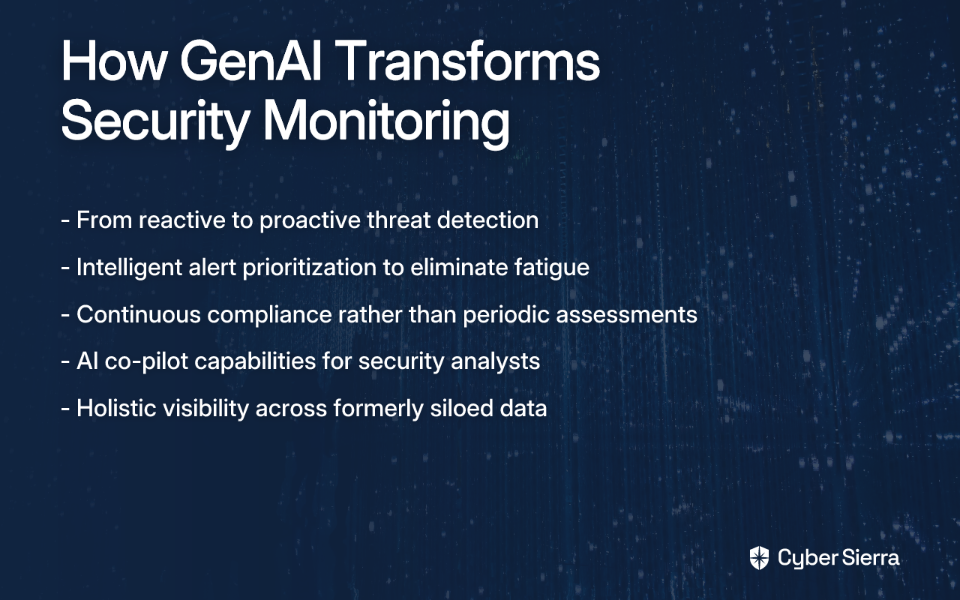
  • Moving from reactive to proactive detection through behavioral analytics and predictive insights
  • Eliminating alert fatigue with intelligent prioritization and natural language summaries
  • Enabling continuous compliance instead of point-in-time assessments
  • Empowering analysts with an AI co-pilot for investigation and response
  • Achieving true holistic visibility by breaking down data silos

The shift is from manual, periodic checks to continuous, automated, and intelligent risk management. Organizations that embrace this transformation are not only strengthening their security posture but also freeing their security teams to focus on strategic initiatives rather than drowning in alerts and manual tasks.

Frequently Asked Questions

What is the primary advantage of using GenAI over a traditional SIEM?

The primary advantage is the shift from a reactive to a proactive security posture. While traditional SIEMs rely on predefined rules to detect known threats, GenAI-powered platforms use behavioral analytics to establish a baseline of normal activity and identify novel or sophisticated attacks by detecting subtle deviations, allowing for predictive threat detection.

How does Generative AI help reduce alert fatigue?

Generative AI significantly reduces alert fatigue by intelligently prioritizing alerts and filtering out false positives. It analyzes the unique context of your environment, assigns risk scores based on asset criticality and potential impact, and synthesizes complex event data into clear, natural language summaries. This allows analysts to immediately focus on the most critical threats.

What is Continuous Control Monitoring (CCM) and how does GenAI enable it?

Continuous Control Monitoring (CCM) is the automated, ongoing process of verifying that security controls are effective, and GenAI is the technology that makes this automation intelligent and scalable. A GenAI-powered CCM platform automates evidence collection 24/7, providing real-time visibility into your compliance status and ensuring you are perpetually "audit-ready."

Will a GenAI-powered security platform replace my security analysts?

No, a GenAI-powered platform is designed to augment and empower security analysts, not replace them. It acts as an AI co-pilot, automating tedious investigation tasks like correlating events and enriching alerts. This frees up analysts to focus on higher-value strategic work like threat hunting, incident response, and risk mitigation.

How does a GenAI solution provide a more holistic view of risk?

GenAI platforms excel at ingesting and analyzing massive, siloed datasets from diverse modern sources like cloud, SaaS, and IoT devices. Unlike many legacy SIEMs, they can find hidden correlations across these different data sources, breaking down silos and eliminating blind spots to provide a truly unified view of an organization's security posture.

Ready to transform your control monitoring from a reactive chore into a proactive, intelligent defense? Discover how an AI-enabled platform can make you audit-ready 24/7 and free your team to focus on strategic security. Learn more about Cyber Sierra's approach to Continuous Control Monitoring.

blog-hero-background-image
Cyber Security

Top 10 Security Tasks AI Agents Can Handle Better Than Humans

backdrop
Table of Contents

Join thousands of professionals and get the latest insight on Compliance & Cybersecurity.


Summary

  • With 69% of enterprises viewing AI as essential for cybersecurity, its adoption is critical for defending against the growing volume and complexity of threats.
  • AI agents outperform humans in tasks requiring speed and scale, such as continuous vulnerability scanning and compliance monitoring, reducing work that takes days into minutes.
  • AI augments, rather than replaces, security professionals by automating repetitive tasks, freeing up human experts for strategic work like complex investigations and threat hunting.
  • Organizations can streamline security compliance and unify risk management by adopting an AI-enabled platform like Cybersierra.

In the rapidly evolving cybersecurity landscape, AI has moved beyond buzzword status to become a critical component of modern defense strategies. Yet skepticism persists—especially when it comes to justifying AI security investments to stakeholders who misunderstand their value, or worries about the return on investment from solutions perceived as immature.

These concerns are valid. But the reality is clear: AI isn't replacing human expertise in cybersecurity—it's augmenting it by handling specific tasks at a scale and speed that's humanly impossible.

The global AI market is projected to grow at a CAGR of 36.6% by 2030, and a Deloitte study found 69% of enterprises now see AI as essential for cybersecurity due to the increasing volume and complexity of threats. With 73% of business leaders feeling pressured to adopt AI, the question isn't if organizations should adopt AI for security—it's how they can integrate it effectively.

Let's examine the top 10 security tasks where AI agents are already outperforming human efforts, from threat detection to compliance automation.

1. Faster Vulnerability Detection and Analysis

Human Limitation: Manual vulnerability scanning and analysis is painfully slow. Security teams can spend weeks sifting through logs, code, and configurations to find exploitable weaknesses.

AI Advantage: AI agents process massive datasets in near real-time. They analyze logs, system configurations, and code to identify previously undetected issues and anomalies that signal a vulnerability.

This shifts vulnerability detection from a periodic, time-consuming task to a continuous, real-time process. According to SentinelOne, AI-powered vulnerability management can reduce detection time from days to minutes.

Platforms like Cybersierra's Threat Intelligence module leverage AI to perform continuous network and cloud infrastructure scanning, giving teams a holistic view of their attack surface and enabling them to find risks before they are exploited.

2. Intelligent, Risk-Based Prioritization

Human Limitation: Security teams are often flooded with vulnerability alerts and struggle to prioritize them effectively. Relying solely on CVSS scores is insufficient, leading to "alert fatigue" and focus on the wrong issues.

AI Advantage: AI enhances risk scoring by incorporating dynamic context. It analyzes factors like dark web chatter, exploit frequency, asset criticality, and existing security controls to create a true risk-based score.

This allows teams to focus on the vulnerabilities that pose the most significant, immediate threat to the business, rather than just the ones with the highest theoretical severity. This addresses a key pain point for SOC analysts who need help "contextualizing alerts and optimizing triage".

3. Phishing and Social Engineering Detection

Human Limitation: Phishing remains a top attack vector precisely because it targets human psychology. Even well-trained employees can be fooled by sophisticated, targeted attacks.

AI Advantage: AI analyzes vast datasets of emails, looking at factors beyond simple keyword matching. It assesses sender reputation, linguistic patterns, URL structures, and even the context of the communication to identify and block phishing attempts with high accuracy.

AI algorithms continuously learn from new phishing campaigns, adapting their defenses in real-time to recognize novel and sophisticated schemes. This helps address the "ongoing difficulty of managing phishing threats" that security teams face.

4. Continuous Control Monitoring (CCM)

Human Limitation: Compliance isn't a point-in-time event, but traditional audits treat it that way. Manually checking that hundreds of security controls are operating correctly across multiple frameworks (NIST, ISO 27001, SOC 2) is tedious, error-prone, and provides zero real-time visibility.

AI Advantage: AI enables true continuous monitoring. It automatically and constantly checks the status of security controls—like MFA enforcement, data encryption, and access permissions—against compliance requirements.

AI detects control drift or failures in real-time, surfacing compliance gaps before they become audit failures or security incidents, according to Secureframe.

Cybersierra's Continuous Control Monitoring (CCM) platform automates this entire process, building a central controls repository with near real-time updates and providing a single source of truth for an organization's security posture.

5. Automated Evidence Collection for Audits

Human Limitation: Preparing for an audit is a nightmare of manual evidence collection—taking screenshots, pulling logs, and chasing down documentation from different teams.

AI Advantage: AI agents automatically ingest data from cloud providers, code repositories, HR systems, and security tools. They collect and organize this data into an audit-ready evidence library, mapping it to specific controls across different frameworks.

This transforms audit preparation from a frantic, months-long fire drill into a state of continuous readiness, dramatically reducing manual effort. Secureframe reports that organizations using AI for compliance can reduce audit preparation time by up to 80%.

Cybersierra's GRC module is built for this, automating data collection and generating comprehensive reports to make enterprises audit-ready faster and reduce compliance fatigue.

6. Automated Third-Party Risk Management (TPRM)

Human Limitation: Managing vendor risk with spreadsheets and manual questionnaires is unsustainable. With supply chains growing, it's impossible for humans to continuously monitor the security posture of hundreds of vendors.

AI Advantage: AI automates the entire TPRM lifecycle. It can parse security questionnaires and audit reports (like SOC 2 reports) to extract key information, continuously monitor vendors for security incidents, and provide real-time risk scores.

The complexity is growing; an EY report found that while 57% of executives now prioritize operational risk when monitoring third parties, only 13% of organizations have fully optimized AI in their TPRM programs, showing a huge opportunity for improvement.

Cybersierra's TPRM platform provides 24/7 visibility into vendor security compliance, moving beyond point-in-time assessments to continuous monitoring and proactive risk management.

7. Advanced Behavioral Analytics and Anomaly Detection

Human Limitation: Traditional security tools rely on known signatures. They can't detect novel or insider threats that don't match a predefined pattern. A human analyst can't possibly watch every user and system action 24/7.

AI Advantage: AI and Machine Learning (ML) excel at pattern recognition. They establish a baseline of normal behavior for users, devices, and networks (UEBA). When activity deviates from this baseline—like a user accessing unusual files at 3 AM from a foreign IP—AI flags it as a potential threat.

This allows for the detection of sophisticated attacks and insider threats that would otherwise fly under the radar, according to Fortinet.

8. Personalized Security Awareness Training

Human Limitation: One-size-fits-all annual security training is boring and ineffective. Employees forget the material, and it doesn't address the specific risks related to their roles.

AI Advantage: AI-driven platforms can tailor training content to individual employees. Based on their role, past performance on phishing simulations, and behavior, AI can deliver personalized, bite-sized training modules that are more engaging and effective.

This fosters a stronger security culture by making training relevant and continuous, rather than a once-a-year compliance checkbox. Secureframe notes that personalized training can improve retention by up to 60%.

Cybersierra's Employee Security Training module does exactly this, using interactive quizzes and simulated phishing campaigns to build a security-conscious workforce, addressing the need for "clear reporting to C-level executives" about training effectiveness.

9. Generative AI-Driven Policy Creation

Human Limitation: Writing comprehensive security policies that align with regulations like NIST, GDPR, or DORA is a time-consuming legal and technical task. Keeping them updated as regulations change is even harder.

AI Advantage: Generative AI can create a first draft of security policies tailored to specific industries and compliance frameworks. It can analyze new regulations and suggest updates to existing policies, ensuring they remain current.

Natural Language Processing (NLP) helps simplify complex legal and regulatory language, making compliance more accessible, according to the Cloud Security Alliance. This is a direct answer to the user need for "good use cases" for AI in compliance frameworks like NIST.

10. Predictive Compliance and Risk Forecasting

Human Limitation: Security and compliance are often reactive. Teams fix issues after they are discovered. It's difficult for humans to predict where the next control failure or breach will occur.

AI Advantage: By analyzing historical data on control performance, vulnerabilities, and threat intelligence, AI models can begin to predict potential compliance drift or security breaches.

This enables organizations to move from a reactive to a proactive security posture, addressing potential weaknesses before they can be exploited or cause an audit failure, as highlighted by Secureframe.

Beyond Automation: The Human-AI Partnership

It's important to address the concern of "job displacement in the cybersecurity field due to the rise of AI agents". The reality is far more nuanced.

AI is best suited for tasks of scale (processing petabytes of data), speed (real-time analysis), and stamina (24/7 monitoring).

This frees up human analysts to focus on tasks requiring creativity (devising novel threat hunting strategies), critical thinking (complex incident investigation), and communication (explaining risk to the C-level).

This aligns with the user desire for "better tools to assist in manual investigations rather than replace them". AI handles the repetitive, high-volume work, allowing security professionals to apply their expertise where it matters most.

Embracing the Inevitable

AI provides the speed, scale, and intelligence necessary to defend against modern threats and navigate complex compliance landscapes. The question is no longer if organizations should adopt AI in cybersecurity, but how they can integrate it effectively to build a more resilient, efficient, and proactive security program.

For teams struggling with manual processes, audit fatigue, and a fragmented view of their security posture, exploring an AI-enabled platform that unifies GRC, threat intelligence, and risk management is the logical next step. Solutions like Cybersierra are designed to instill automation, continuity, and intelligence into cybersecurity programs, moving away from periodic, manual checks towards proactive, near real-time risk management.

By strategically deploying AI for these ten critical security tasks, organizations can not only improve their security posture but also free their human experts to focus on the strategic and creative work that truly requires human intelligence.

Frequently Asked Questions

What are the main benefits of using AI in cybersecurity?

The primary benefits of using AI in cybersecurity are significantly increased speed, scale, and accuracy in handling security tasks. AI systems can process and analyze massive volumes of data in real-time, identifying threats, vulnerabilities, and compliance gaps far faster than human teams. This leads to a more proactive security posture, reduced "alert fatigue" for analysts, and the ability to detect sophisticated attacks that might otherwise go unnoticed.

Will AI replace cybersecurity professionals?

No, AI is not expected to replace cybersecurity professionals. Instead, it serves as a powerful partner that augments human expertise by automating repetitive, data-intensive tasks. This frees up security analysts to focus on higher-value activities that require human ingenuity, such as strategic planning, complex incident investigation, ethical hacking, and communicating risk to leadership. The relationship is a human-AI partnership.

How does AI improve security compliance and audit readiness?

AI dramatically improves compliance by enabling Continuous Control Monitoring (CCM) and automating the collection of audit evidence. Instead of periodic manual checks, AI constantly verifies that security controls are operating correctly against frameworks like SOC 2, ISO 27001, or NIST. It automatically gathers, organizes, and maps evidence to specific controls, transforming audit preparation from a frantic, months-long process into a state of continuous readiness.

How can AI detect new or unknown threats?

AI detects new threats through advanced behavioral analytics and anomaly detection, rather than relying on predefined signatures of known attacks. Machine learning models establish a baseline of normal behavior for users, devices, and networks. When any activity significantly deviates from this baseline—like an employee suddenly accessing sensitive files at 3 AM from a new location—the AI flags it as a potential threat, enabling the detection of zero-day exploits and insider threats.

What is the best way to start implementing AI in a security program?

A great first step is to identify the most manual, repetitive, and time-consuming tasks within your current security operations. Areas like vulnerability prioritization, compliance evidence collection, or initial alert triage are often excellent candidates. By implementing an AI-powered solution to address a specific, high-impact pain point, you can demonstrate immediate value, secure stakeholder buy-in, and build a foundation for broader AI integration.

Why is AI better at phishing detection than traditional email filters?

AI is more effective at phishing detection because it analyzes a much wider range of data points beyond simple sender blacklists or keywords. AI algorithms assess sender reputation, the linguistic patterns of the message, URL structures, and the overall context of the communication. They continuously learn from new global phishing campaigns, allowing them to adapt in real-time and identify sophisticated, targeted social engineering attacks that easily bypass traditional filters.

blog-hero-background-image
Cyber Security

Top 8 Questions to Ask Before Choosing an AI-Based CCM Solution

backdrop
Table of Contents

Join thousands of professionals and get the latest insight on Compliance & Cybersecurity.


Summary

  • Manual compliance is a leading cause of stress for security leaders, with 90% of CISOs reporting work-related stress impacting their personal lives.
  • When evaluating AI-powered Continuous Control Monitoring (CCM) platforms, it's crucial to look beyond marketing hype and ask how the AI provides predictive insights, not just basic automation.
  • Use the 8 critical questions in this article to vet vendors on key capabilities like comprehensive integrations, multi-framework support, and automated audit evidence collection.
  • A unified platform like Cyber Sierra's Continuous Control Monitoring can help automate compliance, reduce audit fatigue, and provide a single source of truth for your security posture.

The pre-audit scramble is a familiar nightmare for many compliance managers. The frantic search for evidence, the last-minute remediation, and the nagging fear that something critical was missed. In today's complex, cloud-centric environment, manual and periodic compliance checks have become obsolete, leading to growing security gaps, mounting technical debt, and constant compliance anxiety.

Research from Nominet found that 90% of CISOs reported work-related stress affecting their personal lives. This isn't surprising when you consider the pressure of managing multiple frameworks, demonstrating continuous compliance, and protecting your organization from evolving threats.

Continuous Control Monitoring (CCM) has emerged as the solution, shifting from point-in-time audits to a proactive, automated approach. The latest evolution? AI-powered CCM platforms that promise to add predictive insights and intelligence to the mix.

But let's be honest – while AI holds tremendous potential, many tools currently underperform or fail to earn user trust. As one compliance professional noted in a recent Reddit discussion, there's significant "frustration over AI tools that cannot accurately handle specific compliance requirements."

To cut through the hype and find a solution that delivers real value, organizations must ask discerning questions. Here are the top 8 questions to ask any vendor before investing in an AI-based CCM platform.

1. How does the AI actually enhance the CCM process beyond basic automation?

Many vendors slap the "AI" label on basic scripting tools. To distinguish true intelligent automation from marketing fluff, dig deeper into how their AI models work.

What to ask:

  • Does the platform use predictive analytics to forecast potential compliance gaps or control failures before they happen? True AI should analyze trends and patterns to provide forward-looking insights, not just reactive alerts.
  • How does the AI reduce false positives? A key benefit of machine learning is its ability to adapt to your environment, learning what's normal to more accurately flag suspicious anomalies.
  • Can the AI interpret new regulatory requirements and automatically adjust monitoring parameters or suggest new controls? This high-value feature can save significant manual effort as compliance landscapes evolve.

Look for concrete examples of how the AI identifies patterns, forecasts issues, and reduces alert fatigue, moving beyond simple "pass/fail" checks. According to Cybersierra's analysis, effective AI in CCM should enable "predictive analytics that identify potential control failures before they occur" and provide "enhanced accuracy through anomaly detection."

2. How comprehensive is the solution's integration and data consolidation capability?

A CCM tool is only as good as the data it can access. In today's complex, multi-cloud environments, a siloed solution creates more problems than it solves.

What to ask:

  • Does the solution integrate with your entire tech stack? This includes cloud infrastructure (AWS, Azure, GCP), security tools (vulnerability scanners, endpoint protection), and business applications.
  • How does the platform consolidate data to create a single source of truth for all controls? This central repository should provide near real-time updates and ensure consistency.

According to experts, the foundational step of any successful CCM program is to "Consolidate and Integrate Data" from various sources into one platform to maintain an updated asset inventory and continuously monitor for misconfigurations.

Platforms like Cyber Sierra are designed with this unified view in mind, offering granular data segmentation and stable integrations to centralize control management and provide actionable risk intelligence.

3. Which compliance frameworks does it support, and how customizable is it for your specific needs?

Most organizations don't operate under a single framework. The ability to manage multiple standards simultaneously is non-negotiable.

What to ask:

  • Does the platform provide out-of-the-box support for major frameworks like NIST, ISO 27001, SOC 2, GDPR, HIPAA, and PCI DSS?
  • How does it handle overlapping controls across different frameworks? A good solution will allow you to "test once, comply many," simplifying evidence gathering and reducing redundant work.
  • Can you create and monitor custom controls tailored to your organization's unique risk appetite and internal policies?

An integrated GRC platform like Cyber Sierra automatically aggregates controls from multiple frameworks, creating a unified view that enhances effectiveness and makes enterprises audit-ready faster.

4. What is the implementation process, and what does the "human-in-the-loop" oversight look like?

A powerful tool with a convoluted implementation will become shelf-ware. Additionally, ensuring proper human oversight to validate AI findings is crucial for building trust and ensuring accuracy.

What to ask:

  • What is your implementation framework? The vendor should walk you through a clear process that includes: Effective CCM Implementation Framework
    1. Identifying and prioritizing key controls based on risk assessments
    2. Integrating with existing tools to pull data
    3. Defining objectives and automated tests
    4. Establishing alert mechanisms and response protocols
    5. Implementing continuous improvement processes
  • How is human oversight incorporated? Effective AI-based CCM is not about replacing human experts but empowering them. The best practice is a "human-in-the-loop" model where AI flags anomalies and provides context, but a compliance or security professional makes the final judgment.

According to MetricStream and verification from industry experts, this combination of automation with human expertise "ensures accuracy and accountability" while maximizing efficiency.

5. How does the solution streamline audit preparation and reporting?

This directly targets one of the biggest pain points for compliance teams: the time-consuming, manual effort of gathering evidence for audits.

What to ask:

  • Does the tool automatically collect, timestamp, and link evidence (e.g., screenshots, logs, configuration files) directly to the relevant controls?
  • Can you generate comprehensive, on-demand reports for specific frameworks? Ask to see sample reports. Are they easy for an auditor to understand and verify?
  • Does the platform maintain an immutable log of all control activities, including tests, failures, remediation actions, and approvals? This is critical for demonstrating due diligence.

The primary ROI of a CCM tool is often measured in reduced audit fatigue. Look for solutions that directly address the core challenge for Compliance Managers: eliminating manual evidence collection and providing real-time posture visibility.

6. How does the platform address Third-Party Risk Management (TPRM)?

Your security posture is only as strong as your weakest vendor. A modern CCM solution must provide visibility into supply chain risk.

What to ask:

  • Does the platform go beyond static, point-in-time questionnaires? Can it continuously monitor your vendors' security posture through external scanning or evidence ingestion?
  • Does it automate vendor risk assessments and help prioritize them based on criticality?

The scale of this challenge is significant. According to IBM's research, it can take organizations an average of 277 days to identify and contain a breach caused by a third party. This highlighting why continuous monitoring of your supply chain is essential.

Cyber Sierra's integrated platform includes a TPRM module that provides 24/7 visibility into vendor compliance, automates assessments, and streamlines due diligence, moving beyond outdated manual processes.

7. What is the Total Cost of Ownership (TCO) and pricing model?

User research reveals deep skepticism towards GRC tools due to "high, variable costs" and a perception that "they are all scams and it's an entire racket." Transparency in pricing is essential for building trust.

What to ask:

  • What is the complete cost breakdown? TCO includes implementation fees, data migration, training, ongoing maintenance, and support costs.
  • What is the pricing model? Is it priced per user, per asset, per vendor, or by module? Ensure the model is predictable and can scale with your business without "offensively expensive" surprises.
  • What is the cost of adding new modules or frameworks in the future? A transparent vendor will provide a clear roadmap without hidden fees.

According to SmartCommunications, understanding the complete financial picture beyond the initial purchase price is essential for long-term planning and avoiding unexpected costs.

8. What kind of support, training, and long-term partnership does the vendor offer?

Implementing a CCM platform is not a one-time purchase; it's an ongoing partnership. The quality of support, training resources, and the vendor's industry reputation are critical for long-term success.

What to ask:

  • What are the support SLAs? Is support provided by experts who understand compliance and security, not just the software?
  • Can you provide case studies and references from companies of similar size and industry? For example, Aditya Anand, CTO of Hybr1d, noted significant improvements in security processes after implementing Cyber Sierra.
  • What resources are available to help build a stronger security culture beyond the platform itself?

Look for vendors that offer valuable add-ons like Employee Security Training modules with simulated phishing campaigns, helping to strengthen the human firewall and fulfill compliance training requirements.

Conclusion

Choosing the right AI-based CCM solution is a strategic decision that impacts risk, efficiency, and your organization's ability to innovate securely. By asking these eight questions, you can move beyond the marketing hype and find a technology partner that helps you stay ahead of threats while remaining perpetually audit-ready.

The goal is to transform from a reactive, stressful compliance cycle to a proactive, continuous, and intelligent security posture. Don't let compliance be a source of stress and technical debt. See how a truly integrated, AI-enabled platform can transform your security program.

Frequently Asked Questions (FAQ)

What is Continuous Control Monitoring (CCM)?

Continuous Control Monitoring (CCM) is an automated approach that continuously tests and validates security and compliance controls in real-time, replacing traditional periodic or manual audits. It provides organizations with a constant, up-to-date view of their compliance posture by integrating with various systems (like cloud infrastructure and security tools) to collect evidence automatically. This proactive method helps identify and remediate gaps as they occur, rather than discovering them during a high-pressure audit.

Why is AI important for modern CCM platforms?

AI enhances Continuous Control Monitoring by moving beyond basic automation to provide predictive insights, reduce false positives, and adapt to new regulatory requirements. True AI-powered CCM uses machine learning and predictive analytics to forecast potential control failures before they happen. It learns the normal patterns of your environment to more accurately detect anomalies, reducing alert fatigue for security teams and enabling a more proactive security posture.

How does a CCM platform help with audit preparation?

A CCM platform streamlines audit preparation by automating the collection, timestamping, and organization of evidence required by auditors. Instead of scrambling to find logs, screenshots, and configuration files, compliance teams can use a CCM tool to generate comprehensive, on-demand reports for specific frameworks like SOC 2, ISO 27001, or NIST. The platform acts as a single source of truth, significantly reducing audit fatigue and ensuring you are always audit-ready.

What are the most important features to look for in an AI-based CCM solution?

The most important features include comprehensive integrations across your tech stack, out-of-the-box support for multiple compliance frameworks, automated evidence collection, third-party risk management (TPRM) capabilities, and a clear "human-in-the-loop" oversight model. A strong solution must provide a unified view of all controls, allow a "test once, comply many" approach, and empower your team with actionable intelligence rather than just data.

Can a single CCM tool manage compliance for multiple frameworks like SOC 2 and GDPR?

Yes, a key benefit of modern CCM platforms is their ability to manage multiple compliance frameworks simultaneously from a single, unified interface. Advanced solutions map overlapping controls across different standards (e.g., NIST, ISO 27001, SOC 2, GDPR). This means you can test a control once and use the evidence to satisfy requirements for multiple frameworks, which drastically reduces redundant work and makes staying compliant more efficient.

Book a demo of Cyber Sierra to see how our Continuous Control Monitoring platform provides a unified view to automate compliance, manage risk, and eliminate audit fatigue.

blog-hero-background-image
Cyber Security

Top 6 Use Cases Where AI Agents Excel in Cybersecurity Compliance

backdrop
Table of Contents

Join thousands of professionals and get the latest insight on Compliance & Cybersecurity.


Summary

  • With 69% of enterprises viewing AI as essential for cybersecurity, traditional manual compliance methods are becoming obsolete.
  • AI agents automate critical, time-consuming tasks such as continuous control monitoring (CCM), evidence collection for audits like SOC 2, and third-party risk management (TPRM).
  • The shift to AI enables a proactive security posture, providing real-time violation alerts and predictive risk insights instead of relying on outdated, periodic snapshots.
  • Implementing an AI-enabled GRC platform like Cyber Sierra unifies these functions, helping you stay continuously compliant and audit-ready.

You've spent countless hours manually collecting evidence for your upcoming SOC 2 audit. Your team is drowning in vendor security questionnaires that provide, at best, a months-old snapshot of your partners' security posture. Meanwhile, the regulatory landscape keeps shifting beneath your feet, with new frameworks like the EU AI Act on the horizon.

If this sounds painfully familiar, you're not alone. Traditional compliance approaches—manual, periodic, and reactive—are crumbling under the weight of today's cybersecurity challenges.

The good news? AI agents are transforming this landscape, shifting cybersecurity compliance from a reactive burden to a proactive, continuous advantage.

The Rise of AI in Cybersecurity Compliance

The numbers tell a compelling story: The Global AI Market is projected to grow with a CAGR of 36.6% by 2030. More tellingly, 69% of enterprises now consider AI essential for cybersecurity.

This isn't just hype—it's a necessary evolution. With data breaches increasing at an alarming rate (Time.com), organizations need more intelligent, scalable approaches to compliance and security.

Let's explore six high-impact use cases where AI agents are revolutionizing cybersecurity compliance today.

1. Automated Continuous Control Monitoring (CCM) and Evidence Collection

Manual evidence gathering for frameworks like SOC 2 or ISO 27001 isn't just tedious—it's dangerously outdated. By the time you've collected screenshots and logs for your quarterly audit, the evidence is already stale, providing only a historical snapshot rather than your current security posture.

AI agents are transforming this process by automating control validation and evidence collection on a continuous, 24/7 basis:

  • Real-Time Validation: AI agents connect directly to cloud environments, code repositories, and SaaS tools to test controls automatically against established frameworks. According to the Cybersierra blog, this ensures you have an always-current view of your compliance posture.
  • Instant Violation Alerts: Instead of waiting for a quarterly audit to discover issues, AI agents generate reports and tickets for violations the moment they occur. This creates an effective feedback loop that drastically reduces the risk of audit surprises.
  • Reduced False Positives: AI-enhanced CCM learns from historical data to provide better contextual understanding, significantly reducing alert fatigue and the noise from false positives over time.

Platforms like Cyber Sierra's Continuous Control Monitoring (CCM) centralize this entire process. They build a unified controls repository that serves as a single source of truth, transforming security from periodic spot-checks into a continuous, automated function that keeps you perpetually audit-ready.

2. Intelligent and Continuous Third-Party Risk Management (TPRM)

Traditional TPRM, based on static, annual questionnaires, is fundamentally broken in an interconnected world where a vendor's breach can quickly become your breach. The complexity of ensuring compliance with vendor security and privacy laws has become overwhelming for many organizations.

AI agents enable a shift from periodic assessments to continuous, real-time monitoring of your entire vendor ecosystem:

  • Beyond Questionnaires: AI agents continuously scan a wide array of external data sources—including public breach data, dark web chatter, and security posture ratings—to provide a live view of vendor risk. According to EY, this approach enables "57% of organizations to now prioritize operational risk over previous metrics like concentration risk when assessing subcontractors."
  • Automated Risk Assessment: AI automates the initial vendor onboarding, due diligence, and risk categorization, allowing your team to focus efforts on high-risk partners rather than treating all vendors with the same level of scrutiny.
  • Proactive Alerts: AI can alert your organization to a vendor's deteriorating security posture before it leads to an incident, enabling proactive engagement and risk mitigation.

Specialized TPRM solutions address these challenges comprehensively. For instance, Cyber Sierra's TPRM platform automates the entire vendor risk lifecycle, from onboarding to continuous monitoring, providing 24/7 visibility into vendor compliance and moving organizations beyond outdated questionnaires to a proactive supply chain security strategy.

3. Proactive Risk Assessment and Predictive Compliance

Traditional risk management is reactive—it identifies problems after they've already occurred. This approach fails to meet the growing need for tools that can "proactively identify and resolve compliance issues" before they impact your business.

AI leverages predictive analytics to forecast potential compliance gaps and security incidents before they materialize:

  • Pattern Recognition: AI models analyze vast amounts of historical compliance and security data to identify subtle patterns and precursors that often lead to control failures or breaches.
  • Behavioral Analysis: AI-powered User and Event Behavior Analytics (UEBA) establish baselines of normal activity for users and systems. They can then flag anomalous behavior—like unusual data access patterns or logins from strange locations—as potential indicators of risk before they escalate to compliance violations.
  • Prioritized Remediation: By predicting high-risk areas, AI helps teams prioritize their remediation efforts, allocating finite resources to the most critical vulnerabilities rather than spreading efforts too thin.

This predictive capability is a core tenet of modern Governance, Risk, and Compliance (GRC). AI-driven platforms like Cyber Sierra integrate threat intelligence and vulnerability scanning to provide a forward-looking view of risk, turning compliance from a reactive chore into a strategic, proactive discipline.

4. Automating Incident Response for Compliance

During a security incident, teams are overwhelmed with technical containment. Critical compliance obligations, such as GDPR's 72-hour breach notification rule, can be missed, leading to heavy fines and reputational damage.

AI agents can automate and streamline incident response workflows to ensure compliance requirements are baked into the process from the start:

  • Automated Containment: Based on predefined playbooks, AI agents can take immediate action to contain a threat, such as isolating an infected machine from the network or forcing a password reset for a compromised account.
  • Automated Documentation: As the AI agent responds, it simultaneously documents every action taken—timestamping events, logging affected systems, and identifying potentially compromised data. This creates a detailed, immutable audit trail required for post-incident reporting and regulatory compliance.
  • Faster Analysis: AI can rapidly analyze incident data, helping to identify the root cause and scope of a breach far faster than human analysts, which is crucial for meeting tight regulatory deadlines.

Integrated GRC platforms are essential for this orchestration. The incident response documentation and audit trail features within Cyber Sierra's GRC module ensure that all evidence is captured automatically, streamlining regulatory reporting and reducing the risk of non-compliance during a crisis.

5. Navigating Regulatory Complexity and Change Management

The regulatory landscape is in constant flux. Manually tracking changes to frameworks like NIST, GDPR, or the upcoming EU AI Act, and then mapping those changes to hundreds of internal controls, is an immense, error-prone burden for compliance teams.

AI, particularly Natural Language Processing (NLP), can automate the interpretation of complex regulatory text and its application to an organization's control framework:

  • Automated Interpretation: AI technologies can "interpret complex legal language, simplifying compliance processes". This means automatically scanning new regulations, identifying key obligations, and extracting the relevant requirements without extensive manual review.
  • Dynamic Control Mapping: Once a new requirement is identified, the AI agent can suggest updates to the organization's existing controls, policies, and procedures, ensuring the compliance posture remains current without requiring compliance teams to manually cross-reference every change.

A unified GRC platform is the engine for this adaptability. When powered by AI, platforms like Cyber Sierra help organizations manage multiple overlapping frameworks simultaneously. They automatically map new regulatory requirements across SOC 2, ISO 27001, and HIPAA, dramatically reducing the manual effort required to stay compliant in a dynamic world.

6. Personalized Employee Security Training and Awareness

One-size-fits-all annual security training is boring, ineffective, and fails to address the "human firewall," which is a mandatory component of many compliance frameworks. As Reddit users note, "phishing scams continue to be a prevalent threat," especially to less tech-savvy individuals.

AI creates dynamic, personalized security awareness programs that demonstrably reduce human-related risk:

  • Adaptive Learning: AI can "tailor employee training based on specific needs and learning progress". For example, if an employee in finance repeatedly clicks on simulated invoice-themed phishing emails, the AI can automatically assign them targeted micro-training modules on that specific threat vector.
  • Realistic Simulations: AI can generate highly realistic and targeted simulated phishing campaigns that mimic the evolving tactics of real-world attackers, providing a much more effective test of employee vigilance.
  • Demonstrable Compliance: This data-driven approach provides compliance managers with clear metrics and reporting to prove to auditors that the organization has an effective, ongoing security awareness program in place.

Building a security-conscious culture is a compliance imperative. Solutions like Cyber Sierra's Employee Security Training leverage this AI-driven approach, using interactive quizzes and hyper-realistic phishing simulations to strengthen the human firewall and give organizations the evidence they need to satisfy audit requirements.

From Reactive to Proactive: The AI Advantage

AI agents are fundamentally shifting cybersecurity compliance from a reactive, periodic, and manual burden to a proactive, continuous, and intelligent business function. By automating tedious tasks, providing predictive insights, and enabling real-time monitoring, AI is helping organizations stay ahead of both auditors and attackers.

It's important to note that AI isn't replacing human expertise but augmenting it. It automates the data-intensive tasks, freeing up compliance and security professionals to focus on high-level strategy, risk management, and critical decision-making.

Frequently Asked Questions

What is AI-powered cybersecurity compliance?

AI-powered cybersecurity compliance uses artificial intelligence to automate, monitor, and manage compliance processes in real-time. Instead of relying on manual, periodic checks, AI agents continuously validate security controls, collect audit evidence, and identify potential risks before they become breaches. This transforms compliance from a reactive, time-consuming task into a proactive, intelligent function that strengthens an organization's overall security posture.

How does AI automate evidence collection for audits like SOC 2?

AI automates evidence collection by directly integrating with your cloud services, code repositories, and SaaS tools to gather proof of compliance 24/7. AI agents are programmed to understand the requirements of frameworks like SOC 2 or ISO 27001. They continuously test controls—such as MFA configurations or data encryption settings—and automatically capture logs, screenshots, and configuration data as evidence. This eliminates the manual, error-prone process of gathering evidence before an audit and ensures you are always prepared.

Why is continuous monitoring better than traditional compliance checks?

Continuous monitoring is better because it provides a real-time, accurate view of your security posture, whereas traditional checks only offer an outdated snapshot. Traditional quarterly or annual audits can miss critical vulnerabilities that appear between checks. AI-powered Continuous Control Monitoring (CCM) identifies and alerts on control failures the moment they happen. This allows for immediate remediation, drastically reducing the window of risk and preventing surprises during an official audit.

Will AI replace the role of a human compliance professional?

No, AI does not replace compliance professionals; it augments their capabilities by handling repetitive, data-intensive tasks. AI automates tasks like evidence collection, control testing, and data analysis, freeing up human experts to focus on strategic initiatives. This includes interpreting complex regulatory nuances, managing high-level risk, making critical decisions during incidents, and communicating with stakeholders—all areas where human judgment is irreplaceable.

How does AI help organizations keep up with new regulations?

AI helps by automatically interpreting new regulatory texts and mapping the new requirements to an organization's existing security controls. Using Natural Language Processing (NLP), AI can scan new laws and standards, identify key obligations, and suggest necessary updates to your policies and procedures. This dramatically reduces the manual effort required for regulatory change management and helps ensure your compliance framework remains current and comprehensive.

Ready to make your compliance program proactive, intelligent, and perpetually audit-ready? Explore how an AI-enabled, unified platform like Cyber Sierra can streamline your GRC, TPRM, and continuous monitoring efforts into a single, cohesive strategy that keeps you secure and compliant in an increasingly complex world.

blog-hero-background-image
Cyber Security

How to Protect Payment Card Data with AI-Powered PCI DSS Monitoring

backdrop
Table of Contents

Join thousands of professionals and get the latest insight on Compliance & Cybersecurity.


Summary

  • Traditional periodic PCI DSS audits are inefficient and fail to provide continuous security insight, a challenge amplified by the upcoming PCI DSS 4.0 deadline.
  • Adopting Continuous Controls Monitoring (CCM) transforms compliance from a quarterly scramble into an automated, real-time process that constantly validates security controls.
  • AI supercharges CCM by automatically assessing configurations and logs and proactively detecting anomalies to prevent security incidents.
  • A platform like Cybersierra's Continuous Control Monitoring automates these processes, providing a centralized view to keep your organization audit-ready and secure.

You've just finished your quarterly PCI DSS compliance audit. After weeks of scrambling to gather evidence, chasing down system owners for documentation, and manually reviewing countless access logs, you finally submit everything to your QSA. You breathe a sigh of relief—until you remember you'll need to do it all over again next quarter.

Meanwhile, your team is already feeling the mounting pressure of PCI DSS 4.0. With new requirements for customized implementation and the 2025 deadline approaching fast, that brief moment of post-audit relief quickly evaporates.

Sound familiar? If you're responsible for payment card security, you know that traditional, periodic compliance checks are no longer sustainable. They're overwhelming, error-prone, and fail to provide real-time visibility into your security posture.

But what if there was a better way? What if you could transform PCI DSS compliance from a quarterly fire drill into a continuous, automated process that actually strengthens your security posture?

The Escalating Challenge of PCI DSS Compliance

The Payment Card Industry Data Security Standard (PCI DSS) establishes the baseline technical and operational requirements to protect payment account data. It applies to all entities that store, process, or transmit cardholder data—from global enterprises to small merchants.

But compliance is becoming increasingly complex for several reasons:

  1. The Evolution to PCI DSS 4.0: The latest version introduces more stringent requirements, customized implementation options, and places greater emphasis on security as a continuous process rather than a point-in-time assessment.
  2. Dynamic Threat Landscape: As payment fraud techniques evolve, compliance standards must keep pace—leaving organizations constantly playing catch-up with new requirements.
  3. Technical Complexity: Many organizations are unprepared for the technical requirements needed to maintain compliance. As one compliance professional noted in a recent discussion: "The required technology for compliance is overlooked by many organizations."
  4. Resource Constraints: Maintaining compliance requires constant monitoring and updates, which quickly becomes overwhelming with limited resources.

Traditional compliance approaches—characterized by periodic, manual assessments—simply can't keep pace with these challenges. That's where Continuous Controls Monitoring (CCM) and AI-powered automation enter the picture.

From Periodic Audits to Continuous Compliance: The Power of CCM

Continuous Controls Monitoring (CCM) represents a fundamental shift in approach—from periodic, point-in-time assessments to automated, real-time monitoring of your security controls.

Instead of scrambling quarterly to gather compliance evidence, CCM platforms continuously validate that your security controls are functioning effectively. This provides several key benefits for PCI DSS compliance:

  1. Real-time Visibility: CCM offers immediate insight into your compliance posture, allowing you to identify and address gaps before they become audit findings or, worse, security incidents.
  2. Automated Compliance Checks: The system automatically tests and validates security controls like access restrictions, network segmentation, and encryption implementation—reducing manual effort and human error.
  3. Centralized Reporting: All compliance data is collected, analyzed, and presented in centralized dashboards, giving stakeholders a unified view of your compliance status at any moment.
  4. Audit-Ready Evidence: When audit time comes, you already have pre-compiled, time-stamped evidence ready to present—no more last-minute scrambling.

Organizations implementing CCM report significant reductions in compliance costs and audit preparation time, while simultaneously improving their overall security posture.

How AI Supercharges PCI DSS Monitoring

While CCM establishes the foundation for continuous compliance, artificial intelligence takes it to the next level. The PCI Security Standards Council (PCI SSC) has recognized this potential, recently releasing official guidance on integrating AI into PCI assessments.

According to this guidance, AI can significantly enhance the efficiency, accuracy, and consistency of PCI DSS compliance efforts. Here's how:

Automated Control Assessment

AI excels at processing vast amounts of data from diverse sources—precisely what's needed to monitor complex PCI DSS environments. AI-powered systems can:

  • Analyze System Configurations: Continuously scan system configurations to ensure they align with PCI DSS requirements, such as secure password parameters, proper network segmentation, and encryption standards.
  • Review Access Logs: Monitor user access patterns in real-time to identify potential violations of least-privilege principles or suspicious behaviors that may indicate a breach.
  • Monitor Data Flows: Track cardholder data movements throughout the environment to ensure they remain within defined boundaries and maintain appropriate security controls.

Proactive Threat Detection

Beyond basic compliance checking, AI enhances security through advanced threat detection:

  • Pattern Recognition: Identify abnormal user behaviors or system activities that may indicate a security incident before it impacts cardholder data.
  • Anomaly Detection: Flag unusual transactions or access patterns that deviate from established baselines, potentially revealing compromise attempts.
  • Predictive Analysis: Forecast potential vulnerabilities based on system changes or emerging threat intelligence, allowing preemptive action.

The Human Element Remains Critical

Despite AI's power, the PCI SSC emphasizes that human oversight remains non-negotiable. AI should assist human assessors, not replace them. As noted in the PCI SSC guidance, AI outputs must be validated by qualified personnel who understand both the technology and compliance requirements.

This addresses common concerns raised by users about "lack of accuracy and potential data alteration when using AI models for cardholder data," as discussed in community forums.

A Practical Guide to Implementing AI-Powered Monitoring

Ready to transform your PCI DSS compliance approach? Here's a step-by-step framework to get started:

Step 1: Conduct a Thorough Gap Analysis

Before implementing any new technology, assess your current state. As one PCI compliance professional advises, "It's a whole process to perform the gap analysis, since you need to know everything (people, process and technology) intimately." This assessment should:

  • Evaluate existing manual processes and identify automation opportunities
  • Document current compliance tools and their limitations
  • Identify skill gaps in your team that may need to be addressed
  • Establish baseline metrics to measure improvement

Step 2: Select an AI-Powered Platform

Look for a solution that offers comprehensive coverage of PCI DSS requirements and integrates smoothly with your existing technology stack. Platforms like Cyber Sierra's Continuous Control Monitoring (CCM) module are designed specifically for this purpose, building a central controls repository with near real-time updates and automated control testing to ensure you are always audit-ready for frameworks like PCI DSS.

When evaluating platforms, prioritize those that:

  • Connect to all critical systems in your cardholder data environment
  • Provide predefined PCI DSS control mappings and automation
  • Offer customizable dashboards and reporting
  • Include workflow capabilities for managing exceptions and remediation

Step 3: Configure Automated Monitoring for Key Controls

Once your platform is in place, prioritize automation of the most critical PCI DSS controls:

  • Vulnerability Management: Implement continuous vulnerability scanning rather than relying solely on quarterly assessments. As one expert notes, "The PCI standard recommends vulnerability scans at least once every three months for compliance purposes. However, they also state that more frequent scans are better for security."
  • Access Control Monitoring: Configure real-time monitoring of user access rights, privileged account usage, and authentication mechanisms.
  • Network Security Checks: Automate testing of firewall rules, network segmentation, and secure configuration standards.
  • Log Management: Establish automated collection and analysis of security logs across all in-scope systems.

Step 4: Establish Human-in-the-Loop Workflows

Remember that AI is a tool, not a replacement for human expertise. Create clear processes for:

  • Validating AI-generated findings before remediation
  • Regularly reviewing and refining AI detection rules
  • Documenting the rationale behind compliance decisions
  • Maintaining proper segregation of duties between automation and oversight

Addressing Key Concerns: AI, Data Security, and Third-Party Risk

As you implement AI-powered monitoring, you'll likely encounter several important concerns:

Protecting Cardholder Data

One of the most common fears about using AI for PCI compliance is the potential exposure of sensitive cardholder data. To address this:

  • Ensure AI systems process data in compliance with PCI DSS requirements
  • Implement strong access controls and encryption for any data used in AI training or analysis
  • Consider tokenization or masking of cardholder data before processing
  • Maintain clear audit trails of all AI interactions with sensitive data

The PCI SSC guidelines are clear: AI tools must adhere to strict data handling protocols and must not be trained on sensitive cardholder data unless appropriate security measures are in place.

Managing Third-Party Risk

The use of third-party AI introduces additional compliance challenges. According to community discussions, there are significant "concerns about the risks of partnering with suppliers who do not meet certification standards."

To mitigate these risks:

  1. Conduct Thorough Due Diligence: Before adopting any AI solution, verify that the provider maintains appropriate security certifications and follows PCI DSS requirements.
  2. Implement Robust Vendor Management: A strong Third-Party Risk Management (TPRM) program is essential. Solutions like Cyber Sierra's TPRM platform can simplify this by automating vendor assessments and providing 24/7 visibility into vendor security compliance.
  3. Maintain Transparency: The PCI SSC mandates that assessors must inform clients about the use of AI and obtain their consent. Apply this principle to your own operations by maintaining clear documentation about where and how AI is used in your compliance processes.

Conclusion: From Compliance Burden to Security Advantage

By implementing AI-powered continuous monitoring for PCI DSS, you transform compliance from a periodic, reactive burden into a strategic security advantage. The benefits extend far beyond just "checking the box" for compliance:

  • Reduced Manual Effort: Automation eliminates much of the tedious evidence gathering and control testing.
  • Enhanced Security Posture: Real-time monitoring catches potential issues before they become security incidents.
  • Continuous Compliance: Stay audit-ready year-round rather than scrambling before assessments.
  • Data-Driven Insights: Gain valuable intelligence about your security operations and risk landscape.

As we move further into the era of PCI DSS 4.0, organizations that embrace AI-powered continuous monitoring will not only achieve compliance more efficiently but will also establish more resilient security programs that truly protect cardholder data. The key is to approach AI as a powerful tool that enhances—rather than replaces—human expertise, ensuring that technology serves your security and compliance goals within a well-defined framework of policies and oversight.

By combining the right technology with appropriate human guidance, you can turn the challenge of PCI DSS compliance into an opportunity to strengthen your overall security posture, protect your customers' data, and safeguard your organization's reputation in an increasingly complex threat landscape.

Frequently Asked Questions

What is the difference between traditional PCI compliance and continuous monitoring?

The primary difference lies in the approach to validation. Traditional compliance relies on periodic, point-in-time audits that are manual and labor-intensive, while continuous monitoring uses automated technology to validate security controls in real-time, providing constant visibility into your compliance posture.

How does AI specifically help with PCI DSS compliance?

AI helps automate and enhance PCI DSS compliance by continuously analyzing vast amounts of data from system configurations, access logs, and data flows. This allows for automated control assessments, real-time identification of policy violations, and proactive threat detection through pattern recognition and anomaly detection, making compliance more efficient and accurate.

Is AI a replacement for human auditors in PCI DSS compliance?

No, AI is not a replacement for human auditors. The PCI Security Standards Council (PCI SSC) guidance emphasizes that AI should be used as a tool to assist human assessors, not replace them. Human oversight is critical to validate AI-generated findings, interpret complex scenarios, and ensure the accuracy of compliance assessments.

What are the first steps to implementing AI-powered PCI DSS monitoring?

The first step is to conduct a thorough gap analysis to understand your current processes, tools, and resources. Following this, you should select a suitable AI-powered platform, configure automated monitoring for critical controls like vulnerability management and access control, and establish clear human-in-the-loop workflows for validation and remediation.

Why is continuous monitoring so important for PCI DSS 4.0?

Continuous monitoring is crucial for PCI DSS 4.0 because the new standard shifts focus from periodic assessments to security as a continuous, ongoing process. It supports the customized implementation options in 4.0 and provides the real-time visibility needed to keep pace with an evolving threat landscape and maintain a strong security posture year-round.

How can I ensure AI tools don't expose sensitive cardholder data?

To protect cardholder data, ensure that any AI tool processes data in full compliance with PCI DSS requirements. This includes implementing strong encryption and access controls, using tokenization or data masking where possible, and verifying that AI models are not trained on sensitive data unless appropriate security measures are in place. Always conduct thorough due diligence on third-party AI providers.

blog-hero-background-image
Cyber Security

How to Automate HIPAA Security Rule Compliance for Healthcare Providers

backdrop
Table of Contents

Join thousands of professionals and get the latest insight on Compliance & Cybersecurity.


Summary

  • Healthcare data breaches rose 8.4% in early 2024, showing that traditional "checkbox" HIPAA compliance fails to provide genuine security against modern threats.
  • Manual compliance processes are resource-intensive, error-prone, and provide only a point-in-time snapshot, leaving patient data vulnerable between audits.
  • To truly protect patient data, healthcare organizations must automate key areas like continuous risk assessments, evidence collection, user access controls, and vendor management.
  • A unified Governance, Risk, and Compliance (GRC) platform can streamline this transition by automating data collection and providing real-time visibility into your HIPAA compliance posture.

In an industry where security breaches can literally cost lives, healthcare providers face unique cybersecurity challenges. As one healthcare security professional bluntly puts it, "Nobody is going to play chicken with bad actors when your risk metric is measured in lives lost or even just disclosure of patient data." With people having "already died in hospitals supposedly due to ransomware," the stakes couldn't be higher.

Yet a dangerous misconception persists across the healthcare landscape: "most hospitals/healthcare networks conflate compliance for security." This checkbox mentality creates a false sense of security while leaving patient data vulnerable. In the first half of 2024 alone, healthcare data breaches rose by 8.4% compared to the same period in 2023, according to CyberArrow.io.

The solution? Automation—transforming HIPAA compliance from a periodic, manual exercise into a continuous, proactive security posture that genuinely protects electronic Protected Health Information (ePHI). This guide will show you how to implement automation that moves beyond "checking boxes" toward meaningful security that safeguards what matters most: patient data and lives.

What is the HIPAA Security Rule? (A Quick Refresher)

The Health Insurance Portability and Accountability Act (HIPAA) Security Rule specifically focuses on protecting electronic Protected Health Information (ePHI). According to Sprinto, the rule breaks down into three core safeguard categories:

  1. Administrative Safeguards: These include risk analysis, workforce security procedures, information access management, security awareness training, and incident response planning.
  2. Physical Safeguards: These involve facility access controls, workstation security, and device and media controls to protect physical systems containing ePHI.
  3. Technical Safeguards: These include access control, audit controls, data integrity measures, and transmission security (encryption) for ePHI.

The rule is designed to be "technology-neutral," meaning it doesn't mandate specific technologies but rather focuses on the outcomes of protecting ePHI, allowing for flexibility in implementation.

The Cracks in Manual Compliance: Why 'Checking Boxes' Isn't Enough

Many healthcare organizations approach HIPAA compliance as a periodic checklist exercise—a dangerous mindset that creates significant security gaps:

Resource Drain

Manual compliance processes consume valuable time and resources. For smaller clinics where staff are "wearing a lot of hats," gathering evidence, maintaining documentation, and preparing for audits can become overwhelming alongside clinical responsibilities.

Prone to Human Error

Manual tracking and documentation inevitably lead to mistakes, oversights, and inconsistencies. One missing document or overlooked control could result in a compliance violation or, worse, a security vulnerability.

Point-in-Time, Not Continuous

Traditional manual audits provide only a snapshot of compliance at a specific moment. As one security professional described it, "Hospitals are like the Titanic chasing after icebergs at night," blindly sailing between periodic assessments while new threats emerge daily.

Complexity at Scale

Managing multiple regulations (HIPAA, GDPR, etc.) across various systems and third-party vendors quickly becomes unmanageable without automation. The complexity multiplies when considering the integration of "new 'old' technologies" like SCADA protocols in hospital environments.

Legacy Systems

Healthcare organizations often rely on outdated systems that were "basically one poorly placed thumb drive away from an infection they had no way of identifying or fixing." These legacy technologies create unique security challenges that manual processes struggle to address effectively.

The Blueprint for Automation: Key Areas to Streamline HIPAA Compliance

Moving beyond manual processes requires a strategic approach to automation across several critical areas:

Continuous Risk Assessments

The SAFE.security blog outlines nine key elements of a comprehensive HIPAA risk analysis:

  1. Scope Definition: Identify all systems, applications, and processes that create, receive, maintain, or transmit ePHI.
  2. Data Collection: Gather and document information about ePHI flows throughout your organization.
  3. Threat Identification: Identify potential threats to ePHI security and privacy.
  4. Current Security Measures: Document existing security controls and their effectiveness.
  5. Likelihood Assessment: Evaluate the probability of potential threat occurrences.
  6. Impact Analysis: Determine the potential effects of threats on operations.
  7. Risk Level Determination: Calculate overall risk based on likelihood and impact.
  8. Documentation: Maintain thorough records of your risk analysis process.
  9. Periodic Review: Regularly reassess risks as systems and threats evolve.

Automation tools can continuously scan systems for vulnerabilities, configuration issues, and emerging threats, providing real-time risk insights rather than point-in-time assessments.

Real-Time Monitoring and Evidence Collection

According to Secureframe, one of the most powerful benefits of automation is eliminating the manual scramble to gather evidence before an audit. Automated systems can:

  • Continuously collect and organize compliance evidence
  • Monitor control effectiveness in real-time
  • Flag control failures immediately for rapid remediation
  • Generate audit-ready documentation on demand

This transforms the audit process from a stressful, resource-intensive event into a streamlined verification of your ongoing compliance posture.

Automated User Access Controls

Protecting ePHI requires strict control over who can access sensitive data. Automation can:

  • Implement role-based access controls that automatically adjust permissions based on job functions
  • Create automated workflows for access requests and approvals
  • Monitor for unusual access patterns that might indicate a breach
  • Automatically provision/de-provision accounts when staff join, change roles, or leave the organization

These automated controls significantly reduce the risk of unauthorized access while maintaining detailed logs for compliance documentation.

Policy and Training Management

Automation can transform how you manage HIPAA-required policies and training:

  • Automatically distribute updated policies to the appropriate staff
  • Track policy acknowledgments and training completion
  • Deliver personalized security training based on job roles
  • Send automatic reminders for required refresher training
  • Generate compliance reports for training requirements

This ensures consistent policy implementation and training completion across your organization.

Third-Party (Business Associate) Risk Management

Healthcare providers rely heavily on vendors who may access ePHI, making Business Associate Agreement (BAA) management crucial. Automation platforms can:

  • Streamline vendor onboarding and risk assessment processes
  • Monitor vendor security posture continuously
  • Track BAA status, renewals, and compliance
  • Provide real-time visibility into your entire supply chain's security posture

This continuous monitoring is vastly superior to periodic vendor questionnaires that provide only limited snapshots of compliance.

Automated Incident Response

When security incidents occur, rapid, compliant response is essential. Automated incident response can:

  • Detect potential security incidents in real-time
  • Trigger predefined response workflows automatically
  • Document all response actions for compliance reporting
  • Generate required breach notifications according to HIPAA timelines
  • Support post-incident analysis to prevent future occurrences

Choosing Your Automation Engine: What to Look for in a GRC Platform

Governance, Risk, and Compliance (GRC) platforms form the backbone of effective HIPAA compliance automation. When evaluating solutions, look for these essential features:

Pre-built Compliance Frameworks

Seek platforms with ready-to-use HIPAA templates and controls. For instance, platforms like Cyber Sierra provide a unified GRC module that automates data collection, manages multiple frameworks like HIPAA, and generates audit-ready reports without requiring deep compliance expertise.

Automated Risk Assessment Tools

Look for solutions that automatically identify, score, and prioritize risks based on their potential impact on ePHI and critical systems.

Centralized Document & Evidence Management

Choose platforms that create a single, secure repository for all compliance documentation and evidence, eliminating scattered spreadsheets and file shares.

Continuous Control Monitoring

To address the need for real-time visibility, solutions with Continuous Control Monitoring (CCM) are essential. They automatically test and validate controls, moving security from periodic checks to an always-on function.

Simplified Reporting & Audit Support

Select tools that generate comprehensive, audit-ready reports with minimal manual effort, demonstrating your compliance posture to regulators, leadership, and business associates.

Vendor Risk Management

For managing vendors, a robust Third-Party Risk Management (TPRM) module automates assessments and provides continuous insight into your supply chain's security, a critical part of HIPAA compliance.

A 5-Step Roadmap to Implementing HIPAA Compliance Automation

Based on the implementation strategy outlined by SAFE.security, here's a practical roadmap for automating your HIPAA compliance:

Step 1: Define Your "Why" and Scope

Clearly articulate your goals for HIPAA compliance automation. Is it reducing audit preparation time? Improving security posture? Reducing human error? Then identify all systems, assets, and processes that create, receive, maintain, or transmit ePHI to establish your automation scope.

Step 2: Assess Your Current Maturity

Use your initial risk analysis to benchmark your current ePHI protection measures. Identify manual processes that are consuming excessive resources or creating compliance gaps. This assessment establishes your baseline for improvement.

Step 3: Define Your Target Maturity

Set clear, measurable goals for each HIPAA requirement. Prioritize automating the highest-risk areas first, such as access controls for ePHI or vulnerability management for critical systems.

Step 4: Empower Owners

Assign clear ownership for specific HIPAA compliance controls and automation initiatives. Ensure these individuals have the authority, resources, and accountability to drive implementation forward.

Step 5: Develop and Execute a Tactical Plan

Create a project plan with clear milestones, timelines, and specific automation tools you'll deploy. Begin with quick wins to build momentum while laying the groundwork for more complex automation initiatives.

Conclusion: Beyond Box-Checking to True Security

Automating HIPAA compliance isn't just about efficiency—it's about fundamentally transforming your approach to security. By implementing continuous monitoring, automated controls, and real-time risk management, healthcare providers can move beyond the dangerous "compliance equals security" mindset that leaves patient data vulnerable.

The benefits extend beyond avoiding HIPAA penalties (though the steep financial penalties for non-compliance certainly justify the investment). Automation delivers enhanced security beyond "checking boxes," significant time and cost savings, reduced risk of breaches, and ultimately, better protection for patient safety.

As one healthcare security professional put it, "It's HIPAA guys. HIPAA not HIPPA." Getting compliance right matters—but getting security right matters even more. Stop chasing compliance and start building a resilient security program. Explore how a unified GRC platform can transform your approach to the HIPAA Security Rule and safeguard what matters most: your patients and their data.

Frequently Asked Questions

What is the main difference between HIPAA compliance and security?

The main difference is that HIPAA compliance is about meeting a set of regulatory requirements, while security is the actual practice of protecting patient data from threats. The article highlights that many organizations mistake "checking the box" for compliance as being secure. True security involves continuous, proactive measures to defend against evolving threats, which goes beyond the periodic nature of traditional compliance audits. Automation helps bridge this gap by making security a continuous process.

Why is manual HIPAA compliance no longer effective?

Manual HIPAA compliance is no longer effective because it is resource-intensive, prone to human error, provides only a point-in-time snapshot of security, and cannot scale to manage modern complexities. Manual processes drain valuable staff time, lead to inconsistencies, and leave organizations vulnerable between audits. As healthcare environments grow more complex, manual tracking becomes unmanageable and fails to provide the real-time visibility needed to counter modern cyber threats.

How does automation improve HIPAA compliance?

Automation improves HIPAA compliance by transforming it from a periodic, manual task into a continuous, proactive process. It enables real-time risk assessment, continuous monitoring of security controls, automated evidence collection, and streamlined management of user access and policies. Instead of scrambling for evidence before an audit, automation tools continuously gather it, flag issues immediately, and manage vendor risks, creating a much stronger, always-on security posture.

What are the first steps to automating HIPAA compliance?

The first step is to define your scope by identifying all systems and processes that handle electronic Protected Health Information (ePHI). Following that, you should assess your current manual processes to find gaps and then prioritize the highest-risk areas for automation, such as access controls and risk assessments. Starting with a clear understanding of where ePHI exists and which processes are weakest is crucial for a successful implementation.

What should I look for in a HIPAA compliance automation tool?

Look for a Governance, Risk, and Compliance (GRC) platform with pre-built HIPAA frameworks, automated risk assessment tools, continuous control monitoring (CCM), and centralized evidence management. An effective tool should simplify your workflow with features like ready-to-use HIPAA templates, real-time dashboards for monitoring security controls, and automated reporting for audits. It should also include modules for managing third-party vendor risk, a critical part of HIPAA compliance.

Who is responsible for HIPAA compliance in a healthcare organization?

While a designated Privacy Officer and Security Officer are typically required to oversee the program, HIPAA compliance is a shared responsibility across the entire organization. Everyone from clinical staff who handle patient data daily to IT professionals who manage the systems and leadership who provide resources plays a role. Automation helps empower these different roles by providing clear ownership of controls and making it easier for everyone to follow security procedures consistently.

toaster icon

Thank you for reaching out to us!

We will get back to you soon.