blog-hero-background-image
Cyber Security

Top Supply Chain Cyber Risk Trends (2026) for Board-Level Briefings

backdrop
Table of Contents

Join thousands of professionals and get the latest insight on Compliance & Cybersecurity.


Summary

  • Supply chain cyberattacks have surged over 400%, and new regulations (SEC, NIS2) are making boards directly accountable for managing third-party risks.
  • Attackers are using AI to exploit vendor relationships, while traditional annual audits fail to keep pace, leaving significant security gaps.
  • Organizations must adopt a proactive strategy by embedding security throughout the vendor lifecycle and shifting from periodic checks to continuous, automated monitoring.
  • Automating vendor oversight with a Third-Party Risk Management (TPRM) platform provides the continuous visibility needed to manage these complex risks effectively.

The Supply Chain is No Longer a Black Box—It's Your Biggest Attack Surface

You've seen the warning signs: odd vendor issues, sudden downtime, weird email patterns, and those random invoices with slightly-off bank details that almost tricked your finance department. This digital supply chain has started to feel like a black hole, and the gravitational pull of potential risks is getting stronger by the day.

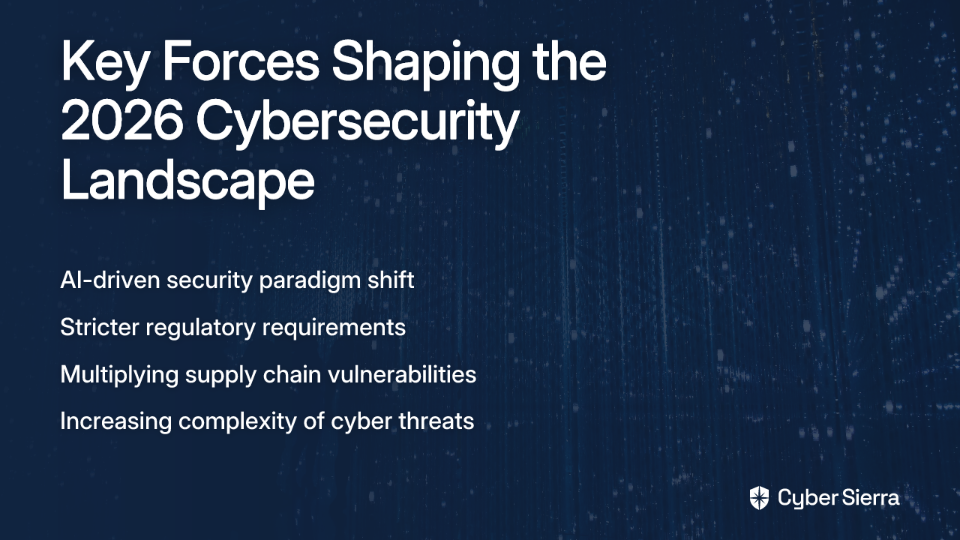
The stakes couldn't be higher. Supply chain-related cyberattacks have surged 431% since 2021, making them one of the most significant threats to modern enterprises. What was once considered an IT department problem has transformed into a fundamental component of business resilience requiring board-level attention.

This is no longer just about compliance checkboxes. New frameworks like the SEC's cyber disclosure rules and the EU's NIS2 directive place responsibility squarely on the board, not just the CISO, to oversee third-party cyber risks. As one supply chain professional put it, "a vendor's breach can halt your entire operation, damage your reputation, and lead to financial losses."

This briefing cuts through the noise to identify the top three supply chain cyber risk trends boards must understand for 2026, and provides a strategic playbook for building resilience in an increasingly interconnected business ecosystem.

The New Reality: Key Statistics Defining the Supply Chain Threat Landscape

Before diving into specific trends, let's establish the scale of the challenge with some sobering statistics:

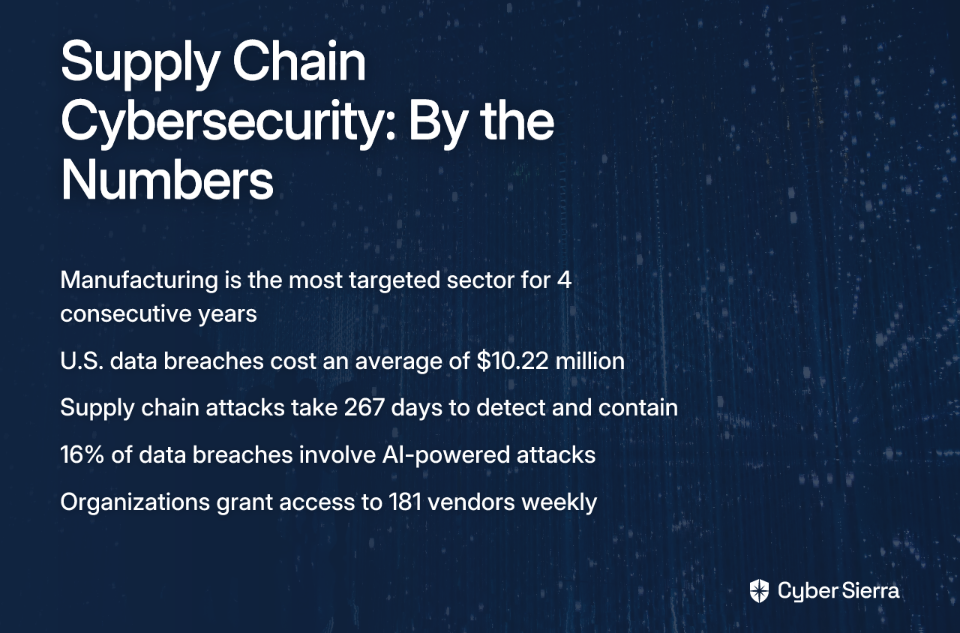
  • Manufacturing has been the most targeted sector for cybercriminals for the fourth consecutive year, highlighting the risk for physical-digital hybrid industries.
  • The average cost of a data breach in the U.S. has reached $10.22 million, with breaches originating in the supply chain often costing significantly more.
  • Supply chain attacks take an average of 267 days to detect and contain. As one operations leader noted, "3 weeks?! Holy crap. That kinda delay would literally cost us a client or two."

These figures represent more than just financial risk—they signal an existential threat to business continuity and customer trust that boards cannot afford to ignore.
Trend 1: AI as a Double-Edged Sword—Sophisticated, AI-Powered Attacks

The rise of artificial intelligence has dramatically changed the cybersecurity landscape, particularly in supply chain contexts. Attackers now deploy AI to craft highly convincing deepfake impersonations and sophisticated phishing scams that even seasoned professionals struggle to detect.

In 2025, 16% of data breaches involved AI to execute these advanced attacks. As one supply chain manager lamented, "it feels like these scammers have a degree in 'how to be slightly off but believable.'"

The most concerning development is how hackers are exploiting trusted relationships within your supply chain. By compromising vendor accounts and systems, they gain the ability to move laterally through interconnected networks, making every partner a potential entry point. This means that traditional perimeter defenses are no longer sufficient—the threat is coming from inside your trusted partner ecosystem.

Trend 2: The Cascading Risk of Vendor Oversight Gaps

Many organizations lack visibility and control over their third- and fourth-party suppliers. This blind spot creates cascading risk that can quickly spiral out of control. "I'm kinda overwhelmed," admitted one supply chain professional. "Not even sure how deep we need to go for supplier risk stuff."

This uncertainty is compounded by what we call the awareness-action gap. A recent Gartner survey revealed a startling disconnect: 95% of organizations noticed red flags with their vendors, but only 50% escalated the issues for remediation. This is akin to "having smoke alarms but nobody knowing where the extinguisher is."

The scale of the challenge is daunting. Traditional, manual risk assessments simply cannot keep pace with modern supply chains. An average organization grants network access to 181 vendors weekly, making comprehensive oversight impossible without automation. When combined with limited visibility into fourth-party suppliers (your vendors' vendors), the risk exposure multiplies exponentially.

Trend 3: The Spotlight on the Board—Increased Accountability & Regulatory Scrutiny

Perhaps the most significant shift for 2026 is the intensifying regulatory focus on board-level accountability for supply chain cyber risks. Cybersecurity is no longer just an operational concern but a critical governance issue where board members are personally accountable.

Several key frameworks and regulations are driving this change:
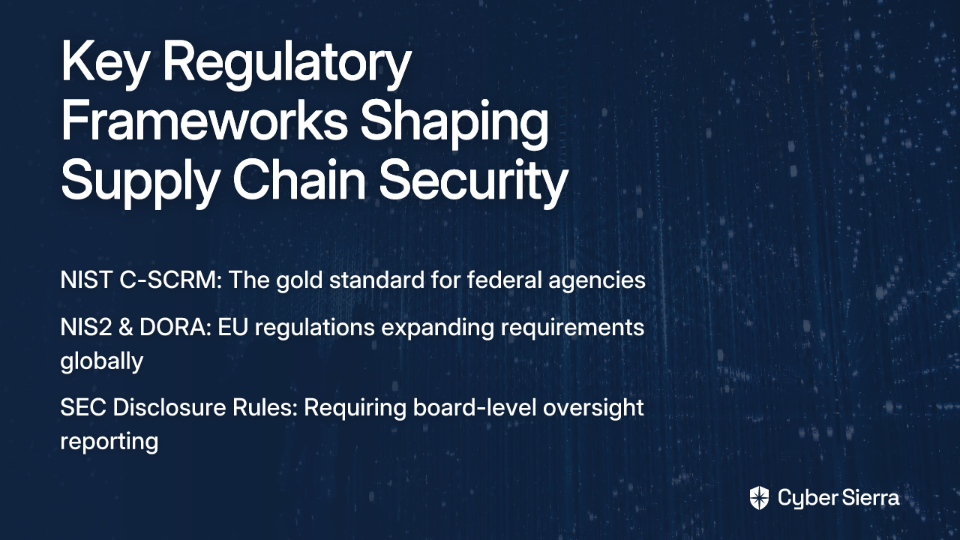
  • NIST C-SCRM: Federal agencies are legally required to use NIST's Cybersecurity Supply Chain Risk Management (C-SCRM) standards, making frameworks like NIST SP 800-161r1 the gold standard. While not mandatory for private organizations, these frameworks are increasingly viewed as the benchmark for due diligence.
  • NIS2 and DORA: The EU's NIS2 Directive and Digital Operational Resilience Act (DORA) are expanding supply chain security requirements globally, affecting any organization doing business in Europe. These regulations explicitly place responsibility on senior management and boards.
  • SEC Disclosure Rules: New SEC rules require public companies to disclose material cybersecurity incidents and risk management oversight at the board level, creating potential shareholder liability for inadequate supply chain cyber governance.

The message is clear: boards that fail to actively oversee supply chain cyber risk may face regulatory penalties, shareholder lawsuits, and personal liability.

A Strategic Playbook for 2026: Fortifying Your Digital Supply Chain

In response to these evolving threats, boards must champion a more sophisticated approach to supply chain cyber resilience. Here's a strategic playbook with actionable recommendations:

Recommendation 1: Shift from Periodic Audits to Continuous, Automated Monitoring

Annual questionnaires and point-in-time assessments are no longer sufficient. A vendor's security posture can change overnight, and waiting months between reviews leaves dangerous blind spots.

Implement continuous risk monitoring and threat intelligence to gain real-time visibility into your entire vendor ecosystem. This approach provides early warning of emerging threats and helps prioritize remediation efforts based on actual risk rather than perceived risk.

Platforms like Cyber Sierra's Third-Party Risk Management (TPRM) can help organizations move beyond static assessments by providing "near real-time, 24/7 visibility into vendor security compliance." This automated approach helps scale oversight across hundreds or thousands of vendors while providing the continuous "vendor cyber health" monitoring that modern supply chains require.
Recommendation 2: Embed Cybersecurity into the Entire Vendor Lifecycle

Cybersecurity considerations must be woven into every stage of the vendor relationship—from selection to offboarding. As one supply chain professional suggested, there's a need for a "first date report card" for vendors that evaluates security posture alongside traditional criteria like cost and quality.

Here are key actions boards should champion:
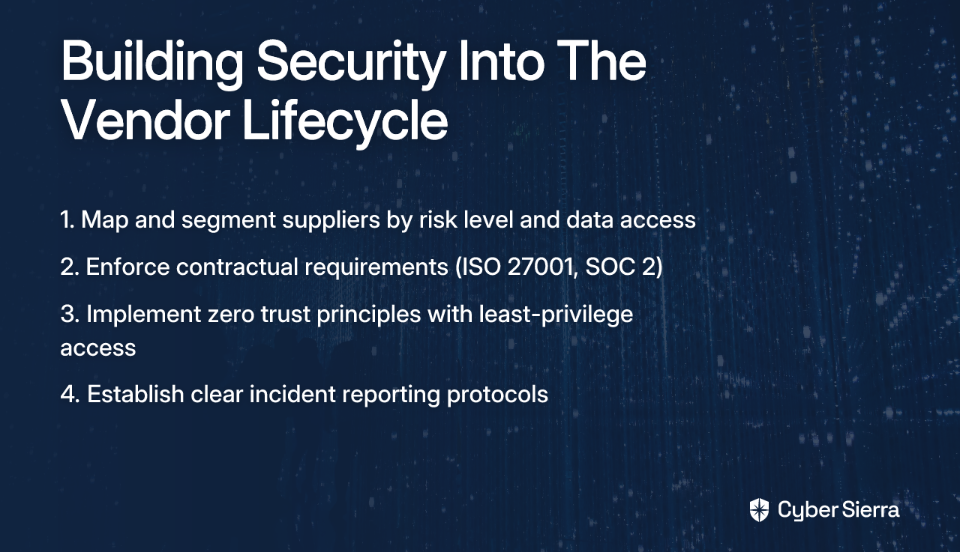
  1. Map and Segment Suppliers: Categorize vendors based on their level of data access and business criticality to focus resources on the highest-risk relationships. This allows for proportionate security requirements based on actual risk exposure.
  2. Enforce Contractual Requirements: Mandate compliance with standards like ISO 27001 or SOC 2 in vendor contracts. Include clauses for timely incident reporting and regular security assessments to establish clear expectations and remediation processes.
  3. Adopt Zero Trust Principles: Ensure vendors are granted least-privilege access, with ongoing verification rather than persistent trust. This minimizes the impact of a compromise by preventing lateral movement across your network.

Managing these complex requirements across hundreds of vendors is a major challenge. Cyber Sierra's GRC platform can help by automating data collection and managing multiple compliance frameworks in a unified dashboard, making it easier to enforce standards consistently and prepare for audits efficiently.

Recommendation 3: Foster a Culture of Cross-Functional Collaboration and Security Awareness

Supply chain security cannot be siloed within IT or security departments. As one professional observed, organizations need to "break those silos somehow—before a breach forces us to." Effective risk management requires collaboration between procurement, legal, operations, finance, and security teams.

Boards should mandate:

  • Regular, cross-functional supply chain risk committees with representation from all stakeholder departments
  • Clear escalation paths for vendor security concerns that empower operational teams to flag issues
  • Comprehensive security awareness training that addresses supply chain-specific threats like vendor email compromise

To build this resilience, organizations can leverage tools like Cyber Sierra's Employee Security Training, which offers simulated phishing campaigns and interactive modules specifically designed to help employees recognize and report supply chain attack vectors.
From Risk Mitigation to Strategic Advantage

The supply chain cyber risk landscape of 2026 will be defined by sophisticated AI-powered threats, growing vendor oversight challenges, and unprecedented board accountability. Organizations that take a proactive approach will not only mitigate risks but gain competitive advantage through enhanced resilience.

As boards confront these challenges, the key to success lies in shifting from reactive to proactive postures:

  • Replace periodic assessments with continuous monitoring
  • Integrate security throughout the vendor lifecycle
  • Break down organizational silos with cross-functional collaboration
  • Leverage automation and AI to scale oversight

By championing these approaches, boards can transform supply chain cybersecurity from a compliance burden into a a strategic enabler of business resilience and trusted partner relationships. In a world where cyber threats increasingly target the weakest links in your supply chain, the organizations that master this discipline will be those that thrive in 2026 and beyond.

Frequently Asked Questions

Why is supply chain cybersecurity a board-level concern?

Supply chain cybersecurity is a board-level concern due to new regulations like the SEC's disclosure rules and the EU's NIS2 directive, which place direct responsibility on boards for overseeing third-party cyber risks. This shift moves cybersecurity from a purely technical issue to a critical component of corporate governance. Failure to demonstrate adequate oversight can lead to regulatory penalties, shareholder lawsuits, and significant reputational damage. The board's role is to ensure that a strategic, enterprise-wide approach to supply chain risk management is in place.

What is a supply chain cyber attack?

A supply chain cyber attack is an attack that targets an organization by exploiting vulnerabilities in its network of suppliers, vendors, or partners. Instead of attacking a well-defended target directly, attackers compromise a less-secure third-party vendor that has trusted access to the target's systems or data. Common examples include injecting malicious code into software updates, using a compromised vendor’s email to send phishing scams, or exploiting a vendor's network access to move laterally into the target's environment.

How can organizations manage risks from their vendors' vendors (fourth-party risk)?

Managing fourth-party risk requires extending visibility beyond your direct suppliers by making third-party security posture a contractual obligation and leveraging automated monitoring tools. Start by including clauses in your vendor contracts that require them to enforce equivalent security standards on their own critical suppliers. Utilize third-party risk management (TPRM) platforms that can help map these dependencies and provide visibility into fourth-party risks, ensuring your entire supply chain ecosystem adheres to a baseline level of resilience.

What is the difference between traditional vendor audits and continuous monitoring?

Traditional vendor audits are periodic, point-in-time assessments like annual questionnaires, while continuous monitoring provides real-time, ongoing visibility into a vendor's security posture. An annual audit can quickly become outdated, as a vendor's security status can change daily. Continuous monitoring tools automatically scan for issues and provide immediate alerts on emerging threats, enabling organizations to move from a reactive, compliance-focused approach to a proactive, risk-based strategy.

How does a Zero Trust architecture apply to supply chain security?

A Zero Trust architecture applies to supply chain security by removing implicit trust for any vendor or partner, instead requiring continuous verification for every access request. This means granting vendors the absolute minimum level of access (least-privilege) needed to perform their function. Every connection and data request from a third party is authenticated and authorized, significantly minimizing the potential damage of a vendor compromise by preventing attackers from moving laterally through your systems.
blog-hero-background-image
Cyber Security

Top Audit Trends for 2026 Every CISO Should Know

backdrop
Table of Contents

Join thousands of professionals and get the latest insight on Compliance & Cybersecurity.


Summary

  • By 2026, security audits will shift from periodic, manual assessments to a continuous, automated process, demanding real-time security validation instead of point-in-time compliance.
  • With nearly half of data breaches linked to third parties, future audits will place hyper-scrutiny on continuous vendor risk monitoring, moving beyond simple questionnaires.
  • CISOs can prepare by implementing continuous control monitoring (CCM), automating compliance tasks, and integrating risk management across departments to build a proactive security posture.
  • Platforms like Cybersierra's GRC suite help automate this transition by integrating continuous monitoring, TPRM, and compliance into a single, audit-ready solution.

For many CISOs, the phrase "audit season" triggers memories of tedious evidence gathering, endless spreadsheet updates, and long nights preparing for auditor questions. It's a process that pulls valuable resources away from critical security operations, leaving teams exhausted and frustrated.

But by 2026, the audit landscape will look dramatically different. The era of point-in-time, sample-based assessments is ending, replaced by a more dynamic, continuous, and intelligent approach to security validation.

This evolution isn't just a technical shift—it's a fundamental reimagining of how organizations demonstrate security effectiveness to auditors, regulators, and stakeholders. Forward-thinking CISOs who anticipate these changes won't just survive audits—they'll leverage them to build more resilient security programs while reducing the resource drain that plagues traditional approaches.

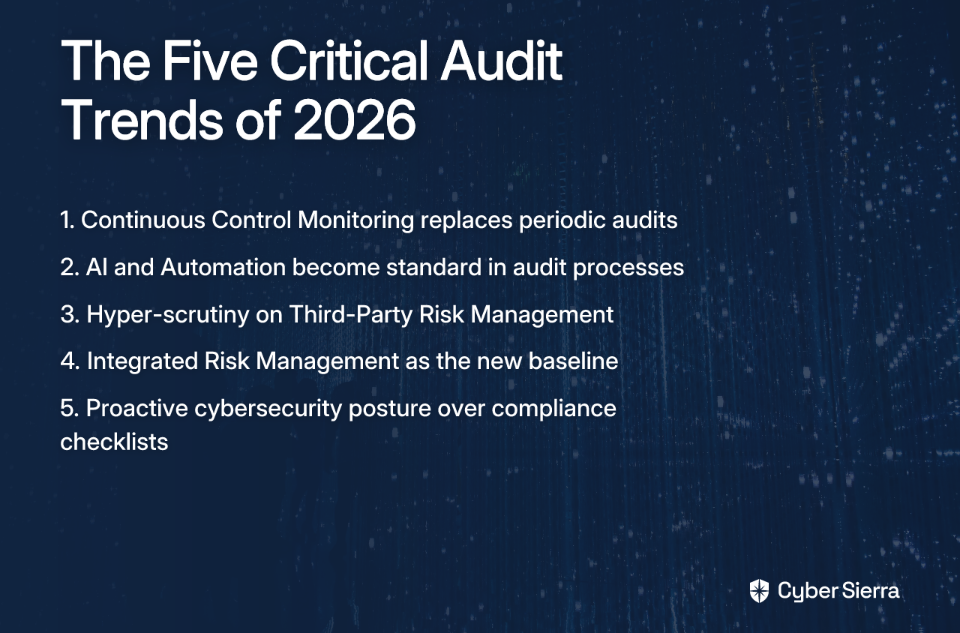
Let's explore the five critical audit trends that will define 2026 and how you can prepare your organization today.

Trend 1: The End of an Era: From Periodic Audits to Continuous Control Monitoring (CCM)

The days of the annual "audit scramble" are numbered. By 2026, continuous control monitoring (CCM) will become the baseline expectation rather than a leading-edge practice.

"For many security teams, the most painful part of an audit is evidence gathering," notes a Reddit user in a discussion on compliance automation. This pain point is precisely what CCM addresses by fundamentally changing how controls are validated.

Unlike traditional point-in-time assessments that evaluate a small sample of data, continuous monitoring analyzes 100% of relevant activity and provides real-time visibility into control effectiveness. This approach offers several advantages:

  • Early Detection of Control Failures: Issues are identified and remediated when they occur, not months later during an audit.
  • Reduced Subjectivity: Full data analysis reduces the reliance on small samples that might not represent actual performance.
  • Audit Fatigue Elimination: Evidence collection becomes an automated, ongoing process rather than a periodic scramble.
  • Cost Reduction: Distributing monitoring throughout the year significantly lowers overall compliance costs.

Real-world applications include monitoring employee data access patterns to prevent intellectual property theft during transitions, scrutinizing payment processes to detect fraud, and validating configuration management to prevent drift from secure baselines.

Platforms like Cyber Sierra's Continuous Control Monitoring module are enabling this transition by automating evidence collection across frameworks like NIST, ISO 27001, and PCI DSS, while maintaining a central repository of controls with near real-time updates.

Trend 2: The New Workforce: AI and Automation Become Standard in Audit Processes

By 2026, artificial intelligence and automation won't just be nice-to-have features in the audit world—they'll be essential components of every mature security program.

The integration of AI in audit processes is already transforming how organizations approach compliance. According to Wolters Kluwer, these technologies are streamlining data collection, analysis, and report generation, drastically reducing audit time while increasing accuracy.

Key developments in this space include:

  • AI-Powered Risk Assessments: Advanced algorithms will analyze vast datasets to identify patterns, detect anomalies, and predict potential risks, allowing security teams to focus on high-risk areas.
  • Robotic Process Automation (RPA): Repetitive, manual tasks like data entry and reconciliation will be fully automated, freeing skilled security professionals for strategic analysis.
  • Natural Language Processing: AI will parse through policies, procedures, and regulatory requirements to identify compliance gaps automatically.

The efficiency gains are substantial. In one case study highlighted by Wolters Kluwer, integrated cloud-based solutions reduced audit review time by 50%. This kind of improvement directly addresses the resource constraints many security teams face.

For CISOs struggling with lean teams and budget limitations, platforms like Cyber Sierra's Governance, Risk & Compliance solution can automate data collection, risk assessments, and reporting across multiple frameworks (SOC2, ISO 27001, GDPR, HIPAA) from a single dashboard, significantly reducing manual effort and compliance fatigue.

Trend 3: The Supply Chain Spotlight: Hyper-Scrutiny on Third-Party Risk Management (TPRM)

If you thought vendor security assessments were demanding now, prepare for even more rigorous scrutiny by 2026. Third-party risk management will move from a peripheral concern to a central focus of security audits.

This shift is driven by sobering statistics: according to UpGuard, nearly half of data breaches are linked to third-party vendors and an average of 181 vendors are granted access to company environments weekly.

The challenges with current TPRM approaches are well-documented in user discussions:

"They don't tell you whether your third parties are doing code review or have an employee offboarding policy," notes one security professional in a Reddit thread on TPRM solutions. Another mentions that "many TPRM tools use the SIG questionnaire... which means your third parties have many questions to answer and you have many answers to evaluate."

By 2026, auditors will expect:

  • Continuous Vendor Monitoring: Point-in-time assessments will be replaced by real-time visibility into vendor security postures.
  • Validation Beyond Questionnaires: Organizations will need to verify vendor security claims with technical evidence.
  • Automated Scaling: As vendor ecosystems grow, manual processes won't be feasible—automation will be essential.

One security professional highlighted the value of verification: "Super helpful to check if a vendor says they've patched X, you can see if that's reflected in their external exposure."

Modern TPRM solutions like Cyber Sierra's Third-Party Risk Management module are addressing these challenges by providing near real-time, 24/7 visibility into vendor security compliance, automatically prioritizing vendors based on risk levels, and streamlining assessment workflows.

Trend 4: Breaking Down Silos: Integrated Risk Management as the New Baseline

By 2026, siloed security functions will be a liability in audits. Regulators and auditors will expect to see integrated risk management practices that connect IT, legal, compliance, and business operations.

According to Becker, effective risk management requires a holistic view across departments. Organizations are shifting toward an integrated approach where audit processes align with broader GRC strategies.

Cloud-based platforms are critical enablers of this trend, supporting collaboration and reducing the risk of miscommunication between teams. This integrated approach addresses a key pain point identified in user research: "Communication with auditors can be a bottleneck in the audit process."

Unified GRC platforms provide a single source of truth across multiple security domains, helping CISOs communicate a consistent risk posture to the board, auditors, and other stakeholders. This capability will be especially valuable as audit requirements continue to expand in scope and complexity.

Trend 5: From Defense to Offense: Audits Demand Proactive Cybersecurity Posture

The final trend reshaping audits by 2026 is the shift from compliance checklists to demonstrated security effectiveness. According to auditing experts, future audits will prioritize evaluating how well security measures actually work in preventing, detecting, and responding to threats—not just whether they exist on paper.

This evolution is driven by increasing regulatory scrutiny around cybersecurity hygiene and a growing recognition that point-in-time compliance doesn't guarantee ongoing security.

Organizations will need to demonstrate:

  • Proactive vulnerability management with continuous scanning
  • Effective attack surface monitoring and management
  • Regular security testing and validation
  • Integrated threat intelligence

Tools like Cyber Sierra's Threat Intelligence module can help organizations stay ahead of this trend by conducting network and cloud infrastructure vulnerability scanning, providing a comprehensive security scorecard, and supporting proactive threat detection.

Preparing for the Future of Audits

The audit landscape of 2026 will be characterized by continuity, automation, integration, and proactive security validation. For CISOs, this evolution offers an opportunity to transform GRC from a periodic burden into a value-driving function that strengthens the organization's security posture.

Forward-thinking security leaders are already:

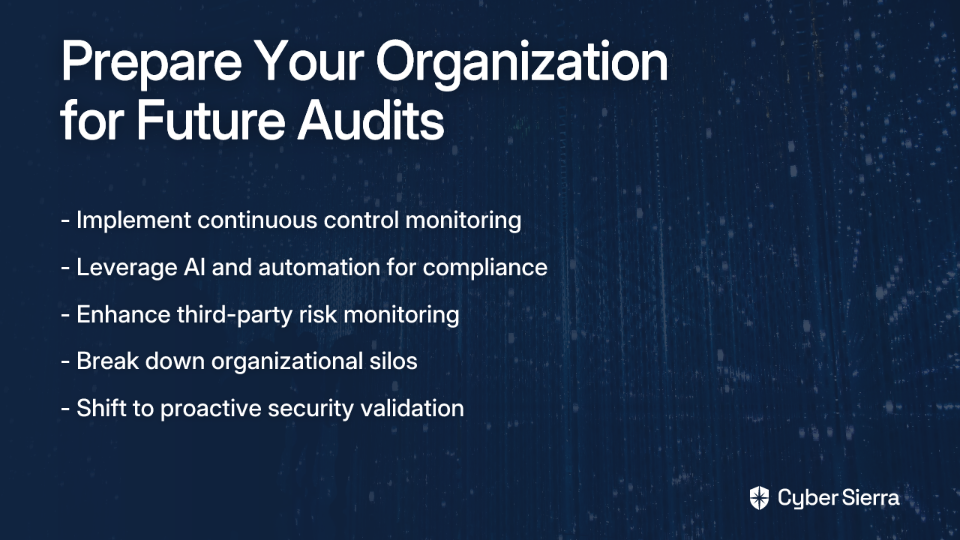
  • Implementing continuous control monitoring to replace point-in-time assessments
  • Leveraging AI and automation to reduce manual effort in compliance tasks
  • Enhancing third-party risk management with continuous monitoring capabilities
  • Breaking down silos between security, IT, and compliance functions
  • Shifting from reactive to proactive security validation

By embracing these trends today, CISOs can not only prepare for the audits of tomorrow but also build more resilient security programs that deliver greater value to the business.

The tools and strategies are now available to transform GRC from a periodic pain into a continuous, value-driving function. Is your organization ready?

Frequently Asked Questions

What is Continuous Control Monitoring (CCM)?

Continuous Control Monitoring (CCM) is an automated approach that validates security controls in real-time, replacing traditional periodic, sample-based audits. Unlike point-in-time assessments that provide a snapshot, CCM analyzes 100% of relevant activity to provide continuous visibility into control effectiveness, enabling early detection of failures and eliminating last-minute evidence gathering.

How will AI and automation impact security audits by 2026?

By 2026, AI and automation will become standard in security audits by streamlining data collection, performing advanced risk analysis, and automating repetitive compliance tasks. These technologies allow audit processes to become more accurate and efficient, freeing skilled security professionals from manual work like data entry to focus on high-level strategic analysis and risk mitigation.

Why is third-party risk management (TPRM) receiving more audit scrutiny?

Third-party risk management is under hyper-scrutiny because a significant number of data breaches originate from third-party vendors, making the supply chain a critical area of organizational vulnerability. Auditors now expect organizations to move beyond simple questionnaires and implement continuous monitoring to actively verify the security posture of their vendors in real-time.

What is the difference between a proactive security posture and a compliance-focused approach?

A proactive security posture focuses on demonstrating real-world security effectiveness through continuous testing and threat detection, whereas a compliance-focused approach often prioritizes meeting the minimum requirements of a checklist at a specific point in time. Future audits will increasingly value verifiable proof that security measures can prevent, detect, and respond to threats, rather than just confirming that a policy or control exists on paper.

How can a CISO prepare their organization for the future of audits?

CISOs can prepare for future audits by creating a strategy that includes adopting Continuous Control Monitoring (CCM), leveraging automation tools for compliance, enhancing third-party risk programs, and shifting focus from periodic checks to proactive, continuous security validation. A practical first step is to automate evidence collection for a single, high-priority framework (like SOC 2 or ISO 27001) to build momentum and demonstrate the value of this modern approach.

blog-hero-background-image
Cyber Security

How to Build a Unified Risk Taxonomy Across Security, Privacy & Operations

backdrop
Table of Contents

Join thousands of professionals and get the latest insight on Compliance & Cybersecurity.


Summary

  • Siloed risk management across security, privacy, and operations creates dangerous blind spots, especially since over 60% of cyber risk involves the human element that often falls between departmental cracks.
  • A unified risk taxonomy provides a common language that breaks down these silos, enabling consistent risk assessment and clear communication across all teams.
  • Build your taxonomy by forming a cross-functional team, defining shared risk categories, mapping them to compliance controls, and embedding them in your core processes.
  • Operationalize your unified risk taxonomy and automate control monitoring with a centralized GRC platform to gain a real-time, enterprise-wide view of your risk posture.

You've just finished a risk review meeting, and the frustration is palpable. Your security team is focused on zero-day vulnerabilities, the privacy office is concerned about GDPR compliance gaps, and operations is tracking supply chain disruptions. Each team is speaking their own language, using different risk scoring methods, and prioritizing different issues—with no clear way to compare or consolidate them.

Sound familiar? This fragmented approach to risk management isn't just inefficient—it's dangerous. When organizations manage risk in silos, critical gaps emerge at the intersection of these domains, creating blind spots that can lead to devastating breaches, compliance violations, and operational failures.

The High Cost of a Divided Language in Risk Management

Most organizations focus heavily on technological and process risks, but research shows that over 60% of all cyber risk involves the human element. When an incident stems from human error, is it a security failure, a privacy violation, or an operational breakdown? Without a common language, it's impossible to classify, measure, and manage effectively.

A unified risk taxonomy serves as a Rosetta Stone for your organization—a common framework that enables security, privacy, and operations teams to identify, assess, and communicate risk consistently. It breaks down silos, eliminates redundancies, and provides leadership with a holistic view of the organization's risk landscape.

This article provides a practical guide for building and implementing such a taxonomy, turning risk management from a fragmented, reactive exercise into a unified, proactive discipline.

Why Today's Siloed Risk Taxonomies Are Failing

When each department uses its own risk lens, several critical problems emerge:

Inconsistent Prioritization

The security team might rate a cloud misconfiguration as "critical" while the privacy team considers a data sharing practice "high risk"—but which deserves immediate attention and resources? Without a common scale, prioritization becomes subjective and political rather than data-driven.

Visibility Gaps

A third-party vendor issue might be logged by the operations team without security or privacy implications being flagged, even though the same vendor handles sensitive customer data. These gaps between domains are where many significant breaches occur.

Duplicated Effort & Compliance Fatigue

Multiple teams often assess the same systems or vendors using different criteria, leading to:

  • Redundant questionnaires sent to already overburdened teams
  • Contradictory findings that create confusion
  • "Audit fatigue" that diminishes the quality of responses
  • Wasted resources that could be directed toward actual risk reduction

Inability to Aggregate Risk

Executive leadership needs a clear, enterprise-wide view of the top risks, but when risks are categorized and measured differently across the business, meaningful aggregation becomes impossible. This prevents strategic, informed decision-making about risk acceptance and mitigation.

The Three Pillars: Defining Security, Privacy, and Operations

Before we can unify these domains, we need to clearly define them and understand their interconnections:

Security

According to the National Institute of Standards and Technology (NIST), security is "freedom from those conditions that can cause loss of assets with unacceptable consequences." It focuses on protecting assets from unauthorized access, use, disclosure, alteration, or destruction.

Privacy

The European Data Protection Supervisor defines privacy as an individual's right to control their personal information. Privacy ensures data is collected, used, and shared appropriately and legally.

Operations

Operational risk management addresses the systematic process of identifying, assessing, and controlling risks arising from operational factors (people, processes, technology, external events) that could disrupt business continuity.

These domains are deeply interconnected: protecting personal data (privacy) requires robust technical safeguards (security), while a failure in a business process (operations) can lead to a data breach (a security and privacy incident). A unified approach acknowledges these interdependencies.

Choosing Your Model: A Look at Different Risk Taxonomy Types

There is no single "correct" taxonomy, but different models suit different organizational needs. Based on research from the Wiley Online Library, here are the main approaches:

Attack-based Taxonomies

  • Focus: Methods and techniques used by adversaries
  • Example: MITRE ATT&CK framework, which categorizes tactics like Phishing and techniques like Drive-by Compromise
  • Best for: Threat intelligence teams, SOCs, and technical risk assessments

Harm-based Taxonomies

  • Focus: Potential business impact or damage from an event
  • Example: Categories like Financial, Reputational, and Legal/Regulatory impacts
  • Best for: Communicating with the board, quantifying risk for cyber insurance, and business impact analysis

Operational Risk Taxonomies

  • Focus: How cyber events align with broader operational risks
  • Example: Frameworks aligned with NIST or ENISA that categorize risks based on disruptions to business operations
  • Best for: Integrating cybersecurity into a mature Enterprise Risk Management (ERM) program

A good taxonomy should be Complete (cover all events), Mutually Exclusive (no overlaps), Clear (easily understood), and Fragmentable (can be broken down into sub-classes).

The Blueprint: A 4-Step Guide to Building Your Unified Taxonomy

Step 1: Establish a Cross-Departmental Governance Structure

Form a committee including your CISO, Chief Privacy Officer (CPO), and key Operations/Risk leaders to ensure buy-in and shared ownership. This cross-functional team will be responsible for developing, maintaining, and promoting the taxonomy.

Step 2: Define High-Level Risk Categories

The Taxonomy of Operational Cyber Security Risks from Carnegie Mellon's Software Engineering Institute provides an excellent starting point. This comprehensive model organizes risks into four main classes:

Class 1: Actions of People (Directly addresses the "human risk" concern)

  • 1.1 Inadvertent: Unintentional errors (e.g., an employee clicking a phishing link)
  • 1.2 Deliberate: Malicious internal actions (e.g., fraud, sabotage)
  • 1.3 Inaction: Failure to perform a required duty (e.g., not applying a critical patch)

Class 2: Systems and Technology Failures

  • 2.1 Hardware: Component failure
  • 2.2 Software: Bugs, vulnerabilities, flaws
  • 2.3 Systems: Failures in integrated systems or networks

Class 3: Failed Internal Processes

  • 3.1 Process Design or Execution: Flawed workflows
  • 3.2 Process Controls: Ineffective or missing controls

Class 4: External Events

  • 4.1 Hazards: Natural disasters, power outages
  • 4.2 Service Dependencies: Risks from third-party vendors and suppliers

Step 3: Map Existing Controls and Frameworks to the Taxonomy

This taxonomy organizes risks, while frameworks like ISO 27001, NIST CSF, GDPR, and SOC 2 provide the controls to mitigate them. Create mappings between your risk categories and these frameworks to achieve multi-framework compliance efficiency.

For example, the risk of "Inadvertent Actions of People" is mitigated by controls like "Security Awareness Training" (from ISO 27001 Annex A.7) and "Privacy by Design" (from GDPR Article 25).

Step 4: Integrate the Taxonomy into Core GRC and Operational Processes

Use these common categories in:

  • Risk assessments
  • Incident response plans
  • Third-party vendor reviews
  • Executive reporting
  • Audit preparation

From Theory to Practice: Automating and Operationalizing Your Taxonomy

A taxonomy on paper is not enough. To be effective, it must be embedded in daily operations and supported by technology that enables continuous monitoring.

Bringing it all together with a GRC Platform

Manually tracking risks across multiple departments using spreadsheets quickly becomes unmanageable. Platforms like Cyber Sierra are designed to centralize and automate these efforts. Its GRC module can help manage multiple compliance frameworks (SOC2, ISO 27001, GDPR, HIPAA) and map their controls back to your unified risk taxonomy, creating a single source of truth.

Automating Control Validation

Moving beyond periodic, manual checks is essential for a truly effective risk management program. Cyber Sierra's Continuous Control Monitoring (CCM) module automates evidence collection and provides near real-time updates on control effectiveness, giving you an ongoing, accurate view of your risk posture as defined by your taxonomy.

Managing Specific Risk Categories with Specialized Tools

For the "Actions of People" category, which accounts for 60% of cyber risk, a comprehensive approach is needed. Cyber Sierra's Employee Security Training platform uses interactive modules and simulated phishing campaigns to build a stronger "human firewall" and provide metrics on your workforce's security quotient.

For "Service Dependencies" risks, Cyber Sierra's Third-Party Risk Management (TPRM) module automates vendor assessments and provides continuous monitoring, giving you the visibility needed to manage risks from your supply chain.

Unifying Your View, Strengthening Your Defense

A unified risk taxonomy is the foundation for a mature, proactive risk management program. It breaks down organizational silos, fosters a shared culture of risk awareness, and enables leadership to make better, more informed decisions.

While the initial setup requires cross-functional collaboration, the long-term benefits—clarity, efficiency, and resilience—are invaluable. Stop managing risk in fragments. Build a common language to build a stronger defense.

By creating this shared understanding across security, privacy, and operations, you'll not only improve your organization's risk posture but also transform how teams collaborate on protecting your most valuable assets.

Frequently Asked Questions

What is a unified risk taxonomy?

A unified risk taxonomy is a common classification system that allows security, privacy, and operations teams to identify, assess, and communicate risk using a shared language and framework. It acts like a Rosetta Stone for an organization, breaking down departmental silos. Instead of each team using its own terminology and scoring methods, the taxonomy provides a consistent structure for categorizing risks, enabling a holistic, enterprise-wide view of the organization's risk landscape.

Why is a siloed approach to risk management a problem?

A siloed approach to risk management is a problem because it creates critical visibility gaps, leads to inconsistent prioritization of risks, duplicates efforts, and makes it impossible for leadership to get a clear, aggregated view of the organization's top threats. When teams operate independently, a risk identified by one department (like a supply chain issue) may not be flagged for its security or privacy implications, leaving the organization vulnerable at the intersection of these domains.

How can an organization start building a unified risk taxonomy?

An organization can start building a unified risk taxonomy by first establishing a cross-departmental governance committee with leaders from security, privacy, and operations to ensure shared ownership. After forming this team, the next steps involve defining high-level risk categories (e.g., Actions of People, Technology Failures), mapping existing controls from frameworks like NIST and ISO 27001 to these categories, and integrating the taxonomy into core processes like risk assessments and incident response.

What are the different types of risk taxonomies?

The main types of risk taxonomies are attack-based, harm-based, and operational, each suited for different organizational needs. Attack-based taxonomies (e.g., MITRE ATT&CK) focus on adversary methods and are ideal for technical teams. Harm-based taxonomies focus on business impact (financial, reputational) and are best for communicating with executives. Operational risk taxonomies align cyber events with broader business disruptions, fitting well into mature Enterprise Risk Management (ERM) programs.

How does a unified risk taxonomy relate to compliance frameworks like ISO 27001 or GDPR?

A unified risk taxonomy organizes the risks an organization faces, while compliance frameworks like ISO 27001 and GDPR provide the controls used to mitigate those risks. The key is to map the controls from these various frameworks back to your standardized risk categories. This creates efficiency, allowing you to manage compliance for multiple frameworks simultaneously and demonstrate how your control environment addresses specific, identified risks.

What is the role of automation in managing a risk taxonomy?

Automation plays a critical role by embedding the risk taxonomy into daily operations and providing continuous, real-time visibility into an organization's risk posture. GRC platforms and Continuous Control Monitoring (CCM) tools can automate the process of tracking risks, mapping them to controls, and collecting evidence of control effectiveness. This ensures the taxonomy is a living part of the risk management program rather than a static document.

blog-hero-background-image
Cyber Security

Top Design Patterns for Compliance Automation Workflows Across Teams in 2025

backdrop
Table of Contents

Join thousands of professionals and get the latest insight on Compliance & Cybersecurity.


Summary

  • With 75% of compliance leaders reporting increased difficulty in managing their programs, manual processes are no longer sustainable.
  • Key compliance automation patterns to adopt include continuous evidence collection, automated user access reviews, streamlined vendor risk management, and simplified policy attestation.
  • Start automating by focusing on repetitive, time-consuming tasks like configuration validation and quarterly access reviews to reduce manual work and prepare for audits more efficiently.
  • Cyber Sierra’s Governance, Risk & Compliance (GRC) platform implements these automation patterns out-of-the-box, transforming compliance from a manual burden into a continuous, streamlined process.

You've set up a robust compliance program at your organization. But now your DevOps engineers are complaining that compliance tasks are the "least enjoyable aspect of their job." Your security team is overwhelmed with simultaneous SOC2 and ISO 27001 requirements. And your auditors keep asking for evidence that takes days to compile manually.

If this sounds familiar, you're not alone. According to PwC's 2023 State of Compliance study, 75% of compliance leaders report their programs are harder to manage than in previous years. The traditional approach of spreadsheets, manual evidence collection, and last-minute audit scrambles is breaking under the weight of modern regulatory requirements.

But there's hope on the horizon. By 2025, forward-thinking organizations will have transformed their compliance approach through automation design patterns that streamline workflows, reduce manual toil, and create a continuously audit-ready environment.

Why Compliance Workflow Automation is No Longer Optional in 2025

The rapid evolution of regulatory requirements, combined with the increasing complexity of modern tech stacks, has made manual compliance processes unsustainable. Here's why automation is becoming mandatory:

Reducing Manual Oversight & Human Error

Manual compliance processes are inherently error-prone. Missing a critical configuration check, forgetting to document evidence, or having incomplete access reviews can lead to failed audits or, worse, actual security incidents.

As one DevOps engineer noted in a recent discussion: "Instead of continuing to suffer through manual compliance, I started building automation scripts - first for evidence collection, then for configuration validation, then for continuous monitoring."

Automation eliminates these human errors while freeing up valuable engineering resources to focus on strategic initiatives rather than tedious documentation.

Enabling Continuous Control Monitoring (CCM)

Traditional compliance operates on a point-in-time basis: you gather evidence during an audit period and hope nothing changes afterward. This approach leaves organizations vulnerable between assessment cycles.

Modern compliance automation enables continuous monitoring of your control environment, alerting you to compliance drift the moment it occurs. This shift from reactive to proactive compliance management is critical as regulatory requirements grow more stringent.

Simplifying the Audit Process

With automated evidence collection and centralized documentation, the audit process transforms from a months-long scramble to a streamlined verification exercise. Instead of hunting down screenshots and configurations from various systems, your evidence is automatically collected, validated, and mapped to the appropriate controls.

Streamlining Cross-Department Collaboration

Compliance touches every part of an organization—from IT and DevOps to HR and Legal. Automation breaks down silos between these departments by creating standardized workflows with clear ownership and accountability.

Foundational Design Pattern: Trigger → Action → Control

Before diving into specific patterns, it's essential to understand the core building block of all compliance automation workflows: the Trigger → Action → Control model.

  • Trigger: An event that initiates the workflow (e.g., a new user is added, a configuration changes, a quarterly review is due)
  • Action: The sequence of steps carried out by the automation (e.g., checking configurations, sending notifications, creating tasks)
  • Control: The rules and guardrails ensuring the process meets compliance requirements (e.g., approvals, time limits, escalation paths)

This simple but powerful pattern forms the backbone of the more complex workflows we'll explore next.

Top 4 Compliance Automation Workflow Patterns for 2025

Pattern 1: Continuous Evidence Collection & Configuration Validation

The Challenge: Manual evidence gathering is time-consuming and captures only point-in-time states, leaving gaps between audits.

The Pattern: Implement "Always-On Auditor" workflows that continuously validate configurations and automatically document compliance evidence.

How It Works:

  1. Trigger: A configuration change occurs in a critical system (e.g., a new S3 bucket is created in AWS)
  2. Action: Automation scripts run API queries against the resource to verify compliance with required controls (e.g., is encryption enabled? is public access blocked?)
  3. Control: Results are documented automatically in your compliance platform and mapped to relevant frameworks. Non-compliant configurations trigger alerts and remediation workflows.

Real-World Example:

When: New S3 bucket created
Then: Check encryption settings
     Check public access blocks
     Check logging configuration
If all checks pass: Document as evidence for SOC2 CC7.1 and ISO 27001 A.8.2.3
If any check fails: Create high-priority Jira ticket and Slack alert

As one engineer put it: "The core insight was that most compliance requirements are really just infrastructure configuration checks that can be queried programmatically." This pattern transforms manual evidence collection into a continuous, automated process.

Pattern 2: Automated User Access Reviews

The Challenge: Regular access reviews are critical for compliance but extremely tedious when performed manually.

The Pattern: Create "Closed Loop Privilege Management" workflows that automate the entire lifecycle of access reviews.

How It Works:

  1. Trigger: Scheduled event (quarterly, bi-annual) or user status change (role change, extended leave)
  2. Action: System generates a list of users and their access privileges, distributes to appropriate reviewers, and tracks responses
  3. Control: Automated reminders for incomplete reviews, escalation for overdue reviews, and automatic implementation of approved changes (provisioning/de-provisioning)

Real-World Example:

When: First day of quarter
Then: Pull current access data from all critical systems
      Send personalized review lists to each manager
      Track completion status
If review not completed by deadline: Send escalation to department head
If access changes approved: Automatically implement via IDP or create IT ticket

This pattern transforms what was once a multi-week project involving spreadsheets and countless emails into a streamlined, automated workflow that ensures continuous compliance.

Pattern 3: Streamlined Third-Party Risk Management (TPRM)

The Challenge: Vendor security assessments are often inconsistent, manual, and point-in-time, creating blind spots in your supply chain security.

The Pattern: Implement "Vendor Lifecycle Automation" workflows that standardize and automate the entire vendor relationship from onboarding to offboarding.

How It Works:

  1. Trigger: New vendor request, annual reassessment date, or vendor status change
  2. Action: System automatically assigns appropriate risk tier, sends tailored questionnaires, collects documentation, and schedules reviews
  3. Control: Automated scoring of responses, integration with continuous monitoring tools, and escalation of high-risk findings

Real-World Example:

When: New vendor added to procurement system
Then: Classify risk tier based on data access and criticality
      Send appropriate questionnaire via secure portal
      Request compliance documentation (SOC2, ISO 27001)
If high-risk vendor: Route for security team review before approval
Once approved: Schedule annual reassessment
            : Begin continuous monitoring via third-party risk scoring

According to discussions on Reddit's cybersecurity community, finding effective TPRM tools remains challenging, but platforms that integrate questionnaire management with continuous monitoring are showing promising results.

Pattern 4: Policy Management & Attestation

The Challenge: Ensuring employees read, understand, and acknowledge policies is crucial for compliance but difficult to track and enforce.

The Pattern: Create "Policy Lifecycle Management" workflows that automate the distribution, attestation, and tracking of policy acknowledgments.

How It Works:

  1. Trigger: New policy published, existing policy updated, or new employee onboarded
  2. Action: System automatically distributes policies to appropriate employees, tracks acknowledgments, and maintains attestation records
  3. Control: Automated reminders for non-compliant employees, escalation to management, and comprehensive audit trails

Real-World Example:

When: Information Security Policy updated
Then: Notify all employees with secure link to review
      Require e-signature acknowledgment
      Record attestation with timestamp
If not completed within 2 weeks: Send reminder
If not completed within 4 weeks: Escalate to manager and HR

This pattern ensures 100% policy coverage across your organization while maintaining detailed records for audit purposes.

Implementing Your Automation Strategy: Tools and Integrations

The effectiveness of these patterns depends on selecting the right tools and ensuring they integrate seamlessly with your existing tech stack. Here's what to consider:

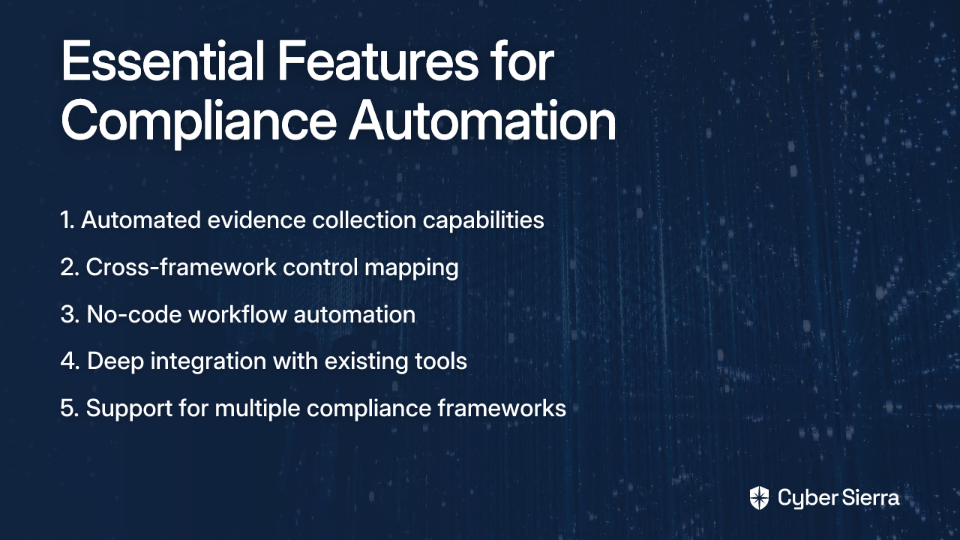
Key Features to Look For in Compliance Automation Platforms

  1. Automated Evidence Collection: The ability to connect directly to your cloud providers, code repositories, and SaaS tools to pull configuration data automatically.
  2. Control Mapping: Tools that can map a single piece of evidence to multiple controls across different frameworks (SOC2, ISO 27001, GDPR) to avoid duplication of effort.
  3. Workflow Automation: Robust capabilities for creating custom workflows based on the patterns above, with visual builders that don't require coding expertise.
  4. Integration Support: Deep integration with tools your teams already use—Jira for task management, Slack for notifications, HRIS systems for user management, and security scanners for vulnerability data.
  5. Multi-Framework Support: The ability to manage multiple compliance frameworks simultaneously without duplicating efforts.

Connecting These Patterns with a Unified Platform

While you can build custom scripts for each pattern, a unified platform like Cyber Sierra can implement these workflows out of the box:

  • For Continuous Evidence Collection, Cyber Sierra's Continuous Control Monitoring (CCM) module provides ongoing visibility into security controls, automating control testing and validation in near real-time. This addresses the pain point many DevOps engineers express about manual evidence collection disrupting their core responsibilities.
  • For Automated User Access Reviews, the GRC module streamlines periodic reviews through integrated workflows that connect with your identity providers and critical systems.
  • For Third-Party Risk Management, the dedicated TPRM module automates vendor assessments and provides 24/7 visibility into vendor security posture, moving beyond point-in-time questionnaires that quickly become outdated.
  • For Policy Management, the GRC module handles policy distribution, attestation tracking, and comprehensive audit trails across multiple frameworks.

Measuring Success: KPIs for Your Automated Workflows

To justify investment in automation and track improvements, monitor these key performance indicators:

  1. Time Savings: Measure the reduction in hours spent on compliance tasks before and after automation. One DevOps engineer reported reducing compliance work from "40+ hours to about 4 hours per month" through automation.
  2. Error Rate: Track the number of compliance findings or exceptions discovered during audits and how they decrease with automation.
  3. Mean Time to Compliance: How quickly can you provide evidence when requested? Automation should reduce this from days/weeks to minutes/hours.
  4. Audit Preparation Time: The total time required to prepare for and complete an audit should decrease significantly with automated evidence collection and documentation.
  5. Team Satisfaction: Measure how automation impacts the satisfaction of technical teams responsible for compliance tasks. Reduced compliance burden often correlates with increased job satisfaction and retention.

Building a Resilient, Audit-Ready Culture

Compliance automation is more than a technology implementation—it's a cultural shift. By adopting these design patterns, you transform compliance from a burdensome checkbox exercise into an integral part of your operational excellence.

In 2025, the most successful organizations will be those that have fully embraced automation to create a continuously compliant environment. They'll spend less time scrambling during audits and more time innovating and delivering value to customers.

The patterns outlined above provide a roadmap for this transformation, enabling your organization to:

  • Reduce the manual burden on technical teams
  • Maintain continuous compliance rather than periodic assessment
  • Break down silos between security, engineering, and compliance
  • Create a culture of proactive risk management

By starting this journey now, you'll be well-positioned to handle whatever new compliance challenges emerge in the years ahead, with a flexible, automated foundation that can adapt to changing requirements.

As one engineer who successfully automated compliance workflows put it: "Compliance doesn't have to be painful. With the right automation, it can fade into the background, letting your teams focus on what they do best."

Frequently Asked Questions

What is compliance workflow automation?

Compliance workflow automation is the use of technology to streamline and automate the tasks required to meet regulatory and security standards. It works by setting up triggers (like a system change), which initiate automated actions (like configuration checks), all governed by controls (like approval rules) to ensure processes are followed correctly and evidence is collected automatically.

Why is automating compliance so important?

Automating compliance is crucial because manual processes are no longer sustainable in the face of complex regulations and modern tech environments. Automation significantly reduces human error, frees up engineering teams from tedious manual work, enables continuous monitoring of security controls, and makes audit preparation faster and more efficient.

What are the main benefits of compliance automation?

The primary benefits of compliance automation include significant time savings, lower operational costs, and a stronger security posture. It eliminates errors common in manual tasks, provides real-time visibility into your compliance status through continuous monitoring, streamlines evidence collection for audits, and improves collaboration between technical and compliance teams.

What are the best compliance tasks to automate first?

The best compliance tasks to automate first are typically repetitive, time-consuming, and critical for audits. Good starting points include continuous evidence collection from cloud environments, automated user access reviews on a quarterly basis, vendor risk assessments, and tracking employee policy attestations. These areas provide a high return on investment by reducing significant manual effort.

How does compliance automation help with audits?

Compliance automation transforms the audit process from a stressful, last-minute scramble to a streamlined verification. It helps by automatically collecting and organizing evidence in a central location, mapping it to specific controls across frameworks like SOC 2 or ISO 27001, and creating a clear audit trail. This means auditors can get the evidence they need almost instantly, drastically reducing audit preparation time.

Can compliance automation manage multiple frameworks like SOC 2 and ISO 27001?

Yes, a key strength of modern compliance automation platforms is their ability to manage multiple frameworks simultaneously. They use a concept called "control mapping," where a single control (e.g., data encryption) can be mapped to requirements across various frameworks. This "test once, apply many" approach prevents teams from duplicating efforts for each separate audit.

blog-hero-background-image
Cyber Security

How to Embed Risk Controls Directly into DevOps and CI/CD Pipelines

backdrop
Table of Contents

Join thousands of professionals and get the latest insight on Compliance & Cybersecurity.


Summary

  • Manual compliance processes create a "compliance tax," often costing engineering teams over 40-60 hours per framework for manual evidence collection.
  • Adopting a "DevRiskOps" mindset that embeds automated controls into the CI/CD pipeline can reduce the cost of fixing issues by up to 40% by catching them earlier.
  • Key actions include implementing Policy as Code (PaC), integrating automated security scanners (SAST, SCA), and securing pipeline access and secrets.
  • Use a Continuous Control Monitoring (CCM) platform to automate evidence collection and ensure compliance posture is maintained in real-time after deployment.

You're a DevOps engineer focused on optimizing deployment frequency when suddenly the sales team promises a client SOC2 compliance. Now you're reading control frameworks at midnight, trying to figure out how to manually screenshot AWS settings for auditors.

Sound familiar?

The core conflict is clear: DevOps culture prizes speed, automation, and frequent delivery, while traditional GRC (Governance, Risk, and Compliance) is often manual, periodic, and seen as a roadblock. This friction creates significant pain, with many engineers noting, "Every time we try to implement compliance checks, it adds friction to our deployment process."

But what if compliance could actually enable speed rather than impede it? Instead of treating risk and compliance as an afterthought, we must embed automated controls directly into the CI/CD pipeline. This isn't about slowing down; it's about building security and compliance in from the start, enabling you to move faster with confidence.

The "Compliance Tax": Why Traditional Risk Management Clashes with DevOps

Traditional compliance processes create what many engineers call a "compliance tax" - a hefty toll paid in engineering hours. One DevOps engineer reported spending over "400+ hours manually documenting infrastructure configurations" and described the process as "antithetical to everything we try to achieve in DevOps - it was manual, error-prone, and didn't scale."

This disconnect creates several critical challenges:

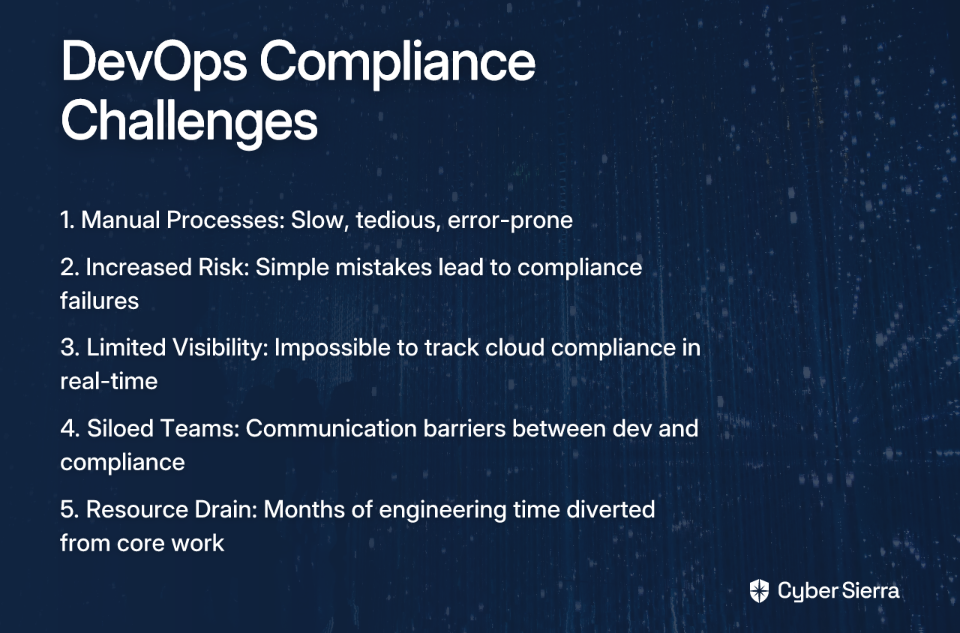
  • Manual Processes: Slow, tedious, and prone to human error
  • Increased Risk of Error: Simple mistakes can lead to significant compliance failures and financial penalties
  • Lack of Visibility: It's nearly impossible to manually track the compliance posture of complex cloud systems in real-time
  • Siloed Teams: A wall between developers, operations, and compliance teams hinders communication and creates bottlenecks

The resource drain is substantial. Another engineer noted that tackling SOC2 and ISO 27001 simultaneously cost "three months of engineering time that could have been spent on infrastructure improvements or reliability work."

The Paradigm Shift: Adopting a DevRiskOps Mindset

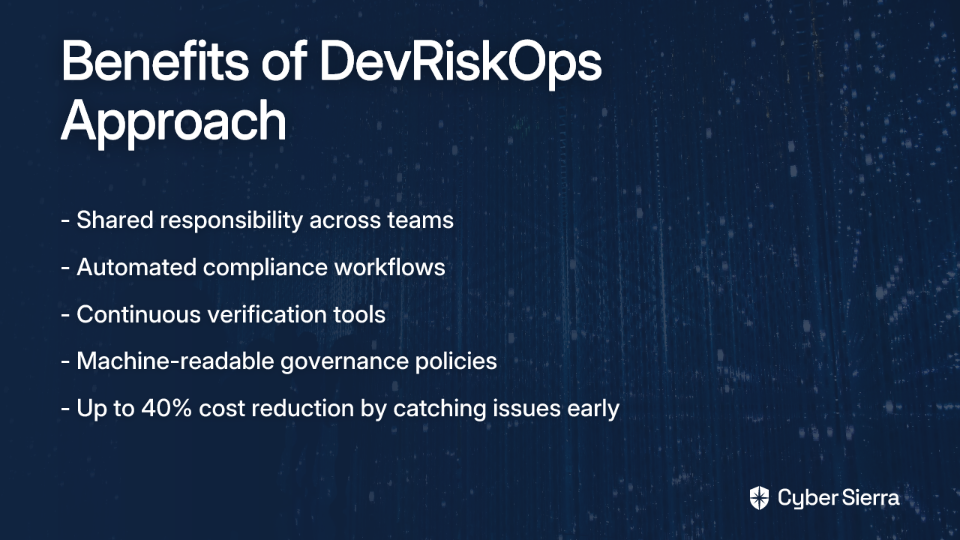
To bridge this gap, we need a fundamental mindset shift toward what Deloitte calls "DevRiskOps" - a structured approach to integrate risk management directly into the DevOps environment. This approach is built on four pillars:

  1. People: Cross-functional teams with shared responsibility for security and compliance
  2. Process: Automated workflows that incorporate compliance checks
  3. Technology: Tools that enable continuous compliance verification
  4. Governance: Clear policies that are machine-readable and automatically enforced

The core of this approach is "Shifting Left" - moving security and compliance checks earlier in the development lifecycle. According to research by ValueX2, shifting left can reduce the cost of fixing issues by up to 40% by catching them before they reach production.

The ultimate goal is to move from periodic, manual audits to continuous compliance, where adherence to standards like GDPR, HIPAA, SOC 2, and ISO 27001 is verified automatically and constantly.

Know Your Enemy: Top 10 Security Risks in Your CI/CD Pipeline

Before embedding controls, you must understand the threats. CI/CD pipelines automate delivery, but they also expand the attack surface. The OWASP CI/CD Security Cheat Sheet provides a clear framework of the top risks you need to protect against:

  1. Insufficient Flow Control Mechanisms: Weak protection of the pipeline workflow
  2. Inadequate Identity and Access Management: Poor access controls for CI/CD components
  3. Dependency Chain Abuse: Compromised third-party components or libraries
  4. Poisoned Pipeline Execution (PPE): Unauthorized code execution within pipelines
  5. Insufficient Pipeline-Based Access Controls: Excessive pipeline privileges to production
  6. Insufficient Credential Hygiene: Improper management of secrets and credentials
  7. Insecure System Configuration: Misconfigurations in pipeline infrastructure
  8. Ungoverned Usage of Third-Party Services: Unvetted external services in the pipeline
  9. Improper Artifact Integrity Validation: Lack of verification for build artifacts
  10. Insufficient Logging and Visibility: Limited monitoring of pipeline activities

A Practical Guide to Embedding Risk Controls in Your Pipeline

Step 1: Define Policies and Map Risks to Controls

Start by collaborating with security, legal, and compliance teams to define clear, machine-readable policies. Map specific risks (like those from the OWASP list) to tangible controls within your CI/CD pipeline. For example, the risk of "Insufficient Credential Hygiene" maps to controls that scan for hardcoded secrets.

This mapping helps everyone understand what risks you're addressing and how they relate to specific compliance requirements like SOC2 or ISO 27001.

Step 2: Implement Policy as Code (PaC) and Infrastructure as Code (IaC)

Codify your compliance rules and infrastructure configurations. This makes compliance repeatable, version-controlled, and auditable - directly addressing the pain of "ensuring a cloud config is compliant at deploy time."

  • Infrastructure as Code: Use tools like Terraform or CloudFormation to define infrastructure
  • Policy as Code: Implement using tools like Open Policy Agent (OPA) or HashiCorp Sentinel to enforce rules automatically

For example, you can write a policy that prevents the creation of public S3 buckets or ensures all EC2 instances have proper encryption. Tools like Checkov and Bridgecrew provide static analysis of IaC files to catch misconfigurations before deployment.

Step 3: Secure Your Pipeline Infrastructure and Access (IAM)

Apply the Principle of Least Privilege to all parts of the CI/CD pipeline, including the SCM, build server, and cloud environments:

  • Source Control: Use protected branches in Git and require reviews before merges. Enforce commit signing to ensure code provenance.
  • Secrets Management: Never store secrets in code. Use dedicated secrets management tools like HashiCorp Vault or AWS Secrets Manager.
  • Pipeline Configuration: Ensure build servers have minimal permissions and are regularly patched.
  • Tooling: Use tools like GitLeaks and Git-Secrets to prevent secrets from being committed.

Step 4: Automate Security and Compliance Scanning

Integrate automated scanners directly into your pipeline stages (build, test, deploy) to provide immediate feedback to developers:

  • Static Application Security Testing (SAST): Scan source code for vulnerabilities with tools like SonarQube
  • Software Composition Analysis (SCA): Check for vulnerabilities in open-source dependencies with tools like Snyk
  • Container Scanning: Examine container images for known vulnerabilities using Prisma Cloud
  • Compliance Scanning: Verify configurations against compliance benchmarks with tools like Chef InSpec

Step 5: Ensure Artifact and Dependency Integrity

Protect your software supply chain by verifying the integrity of all dependencies and build artifacts:

  • Use immutable dependency references (e.g., using hash sums in package manager lock files)
  • Implement code signing to ensure the authenticity of your software artifacts
  • Consider frameworks like in-toto and Sigstore for securing the software supply chain

Beyond Deployment: The Critical Role of Continuous Control Monitoring (CCM)

Pipeline controls are just the beginning. As one DevOps engineer noted, "We need to ensure that our cloud configurations comply with regulations during runtime, not just at deployment time." This is where Continuous Control Monitoring (CCM) becomes essential.

CCM is a proactive approach using technology for ongoing, automated oversight of controls to ensure their effectiveness in real-time. This is critical because misconfigurations or "compliance drift" can happen post-deployment. According to IBM's Cost of a Data Breach Report, the average time to identify and contain a data breach is 277 days, highlighting the danger of periodic, manual checks.

This is where dedicated platforms become essential. Hooking a GRC tool into your pipeline can be a major challenge, as many are not API-friendly. A modern platform like Cyber Sierra is designed for this integration. Its Continuous Control Monitoring (CCM) module provides ongoing visibility into your security controls, automates evidence collection, and detects exceptions in near real-time. Instead of wondering about your compliance posture, you get a single source of truth, turning compliance from a periodic headache into a continuous, automated process.

Key features that address DevOps pain points include:

  • Automated evidence gathering for frameworks like SOC2 and ISO 27001
  • A central controls repository with near real-time updates
  • Integration with your tech stack to continuously monitor cloud configurations and other digital assets

The Payoff: Reclaiming Engineering Time and Building Trust

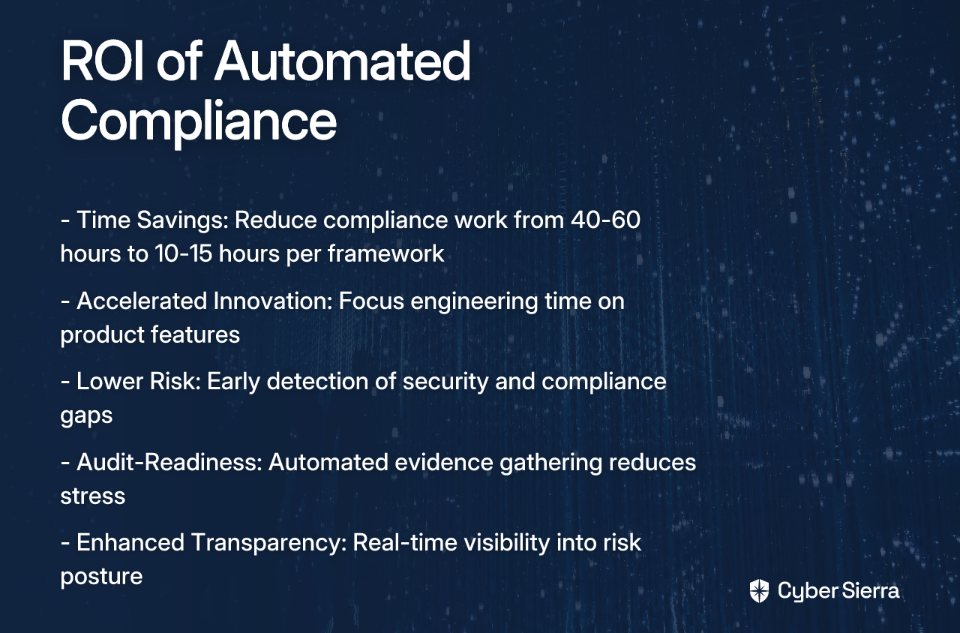
The benefits of embedding risk controls into your CI/CD pipeline are substantial. One engineer reported: "Manual compliance work for a typical startup takes 40-60 hours of engineering time per framework. With proper automation, I managed to drop to 10-15 hours - mostly spent on initial setup and reviewing automated findings."

Other key benefits include:

  • Accelerated Innovation: Frees up valuable engineering time to focus on product features and reliability
  • Reduced Risk: Early and continuous detection of security flaws and compliance gaps
  • Audit-Readiness: Automated evidence gathering makes audits faster and less stressful
  • Enhanced Transparency: Provides all stakeholders with a real-time, data-driven view of the organization's risk posture

Build Resilient Systems at Speed

Embedding risk controls into CI/CD is not a barrier to speed but a fundamental enabler of it. By adopting a DevRiskOps mindset, leveraging automation with Policy as Code, and implementing Continuous Control Monitoring, teams can transform compliance from a manual, feared event into an integrated, continuous part of their workflow.

The ultimate goal is to build a development lifecycle where the secure and compliant way is also the easiest way. When that happens, compliance becomes an accelerator rather than a tax – allowing you to build resilient systems at speed while maintaining the trust of your customers and regulators.

Remember, in the modern development landscape, security and compliance aren't checkboxes – they're competitive advantages that should be woven into the fabric of your delivery pipeline from the very beginning.

Frequently Asked Questions (FAQ)

What is DevRiskOps?

DevRiskOps is an approach that integrates risk management and compliance activities directly into the DevOps lifecycle. Instead of treating compliance as a separate, manual step at the end of the process, DevRiskOps embeds automated controls and shared security responsibility throughout development, from coding to deployment and monitoring.

How can I automate compliance in my CI/CD pipeline?

You can automate compliance by implementing Policy as Code (PaC) and integrating automated security scanning tools. PaC tools like Open Policy Agent (OPA) enforce rules on infrastructure configurations, while scanners for SAST (SonarQube), SCA (Snyk), and IaC (Checkov) automatically check for vulnerabilities and misconfigurations at different pipeline stages.

Why is Continuous Control Monitoring (CCM) important if I have pipeline controls?

Continuous Control Monitoring (CCM) is crucial because it tracks your compliance posture in real-time after deployment, catching configuration drift and runtime issues that pipeline controls miss. While pipeline controls ensure compliance at deployment, CCM provides ongoing assurance that systems remain compliant in a dynamic cloud environment.

What are the first steps to embedding risk controls into a DevOps workflow?

The first step is to define your compliance and security policies as code and map specific risks to automated controls. Start by collaborating with security and compliance teams to codify a critical rule, such as preventing public S3 buckets or scanning for hardcoded secrets, and integrate that check into your CI/CD pipeline to build momentum.

How does automating compliance help with audits like SOC 2?

Automating compliance drastically simplifies SOC 2 audits by continuously and automatically collecting evidence. Instead of manually taking screenshots and gathering logs, an automated system provides auditors with a reliable, version-controlled trail proving that controls are consistently operating, which makes the audit process faster and less error-prone.

What are the biggest security risks in a CI/CD pipeline?

According to OWASP, the biggest security risks include insufficient credential hygiene (leaked secrets), dependency chain abuse (vulnerable third-party libraries), and insecure system configurations. Other major risks are inadequate identity and access management and a lack of proper logging and visibility into pipeline activities.

blog-hero-background-image
Cyber Security

Top Use Cases of Generative AI in Vendor Risk & Control Mapping

backdrop
Table of Contents

Join thousands of professionals and get the latest insight on Compliance & Cybersecurity.


Summary

  • Third-party vendors cause 62% of data breaches, highlighting the failure of slow, manual risk management processes.
  • Generative AI accelerates vendor risk management by automating compliance framework mapping and vendor assessment analysis, saving up to 80% in assessment time.
  • The most effective strategy combines AI for data analysis with human experts for final validation and strategic decision-making.
  • Cyber Sierra's GRC platform operationalizes these AI-driven workflows to streamline vendor risk, automate control monitoring, and ensure continuous compliance.

You've just reviewed the 50-page SOC 2 report from your new cloud service provider, and now you need to map their controls to your ISO 27001 framework—manually, of course. Meanwhile, three more critical vendors are waiting for assessment, regulatory requirements keep evolving, and your CISO wants an updated risk dashboard by Friday. Sound familiar?

For security and compliance professionals, vendor risk management has reached a breaking point. With 62% of data breaches occurring via third-party vendors, and each breach costing an average of $4.45 million, the stakes couldn't be higher.

Enter generative AI—not as a replacement for human judgment, but as a powerful ally that's transforming how organizations manage vendor risk and compliance mapping. Let's explore the most impactful applications that are already delivering tangible results.

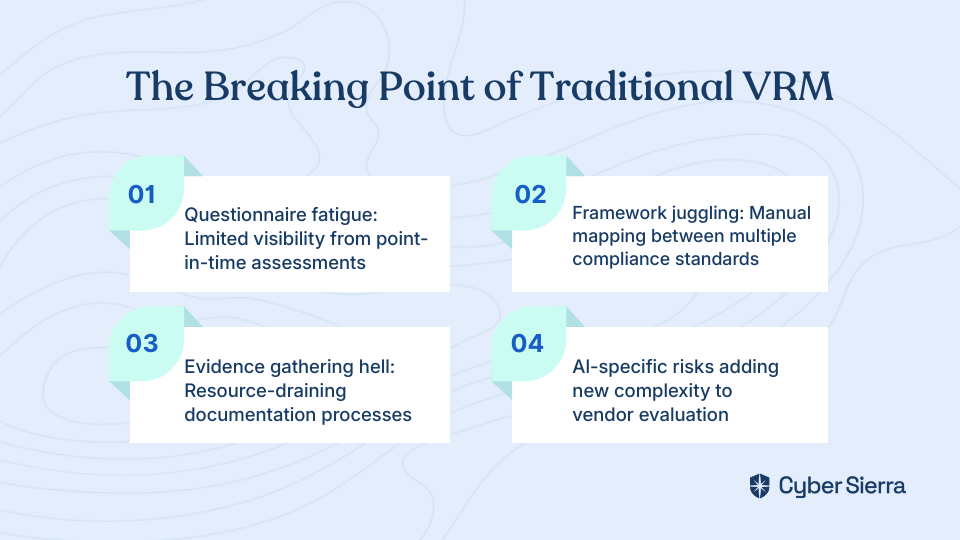
The Breaking Point: Why Traditional VRM Can't Keep Up

Traditional vendor risk management is buckling under its own weight:

  • Questionnaire fatigue: Static, point-in-time assessments provide limited visibility and quickly become outdated.
  • Framework juggling: As one cybersecurity professional on Reddit noted, "GRC is way too complicated to just leave to AI." Manual mapping between NIST CSF, ISO 27001, SOC 2, and other frameworks is painstaking due to terminology differences and constant updates.
  • Evidence gathering hell: "The most painful part of an audit is typically evidence gathering," shared another Reddit user. This tedious process drains resources that could be focused on actual risk mitigation.

With the addition of AI-specific risks ("Where does our data actually go? What guardrails prevent sensitive information from leaking?"), traditional methods simply cannot keep pace.

The Top 5 Use Cases of Generative AI in Vendor Risk & Control Mapping

1. Automated Framework Crosswalking

What it is: The process of mapping security controls across disparate compliance frameworks to identify overlaps and gaps.

How AI does it: Generative AI employs semantic similarity analysis to understand the intent and context of controls, enabling accurate mapping even when terminology differs. For example, what ISO 27001 calls "Access Control" might appear as "Identity and Access Management" in NIST CSF, but AI recognizes they address the same fundamental security concept.

Impact: According to CyberSaint research, organizations using AI for framework mapping achieve up to 80% time savings in compliance assessments and 50% control automation, allowing teams to focus on strategic risk management rather than spreadsheet maintenance.

2. Continuous Control Automation (CCA) & Monitoring

What it is: The shift from periodic, manual checks to real-time compliance monitoring.

How AI does it: By integrating with your security stack (cloud providers, endpoint protection, etc.), AI automatically collects evidence, tests control effectiveness, and provides a near real-time view of compliance status. When controls drift out of compliance, the system alerts stakeholders immediately.

Impact: This directly addresses the "evidence gathering hell" pain point. Instead of scrambling to collect documentation during audits, evidence is continuously captured and organized. The FS-ISAC guide on Generative AI highlights how this transforms security from reactive to proactive, identifying control failures before they lead to breaches.

3. Intelligent Vendor Assessment & Questionnaire Analysis

What it is: Using AI to rapidly analyze vendor-submitted documentation (questionnaires, SOC 2 reports, security policies) to identify risks and validate claims.

How AI does it: AI algorithms can scan hundreds of pages in minutes, flagging inconsistencies, identifying missing controls, and summarizing key risk areas that require human follow-up. The AI can also compare vendor responses against industry benchmarks to detect potential misrepresentations.

Impact: This dramatically accelerates the due diligence process and enhances assessment accuracy. According to ProcessBolt, organizations using AI for vendor assessments report up to 70% faster review cycles and identification of 35% more potential risks than manual methods.

4. Automated Gap Analysis & Prioritized Remediation

What it is: Identifying compliance gaps across all frameworks and helping teams prioritize which issues to address first.

How AI does it: AI analyzes the severity of control gaps, the criticality of associated assets, and relevant threat intelligence to generate a risk-based prioritization score. This approach ensures that limited resources are directed toward the most significant vulnerabilities.

Impact: Instead of treating all gaps equally, security teams can focus on what matters most. For example, the AI might determine that missing multi-factor authentication controls for systems containing PII represent a higher risk than documentation gaps in asset management procedures.

5. Real-Time Risk Reporting & Executive Dashboards

What it is: Consolidating complex risk and compliance data into clear, intuitive dashboards for stakeholders.

How AI does it: AI automatically aggregates data from continuous monitoring and assessments, generating visualizations that provide an at-a-glance view of vendor risk posture. Natural language generation capabilities can also create executive summaries that translate technical findings into business impact.

Impact: Facilitates data-driven decision-making and simplifies communication of risk to leadership. These dashboards can show trends over time, allowing security leaders to demonstrate progress and justify investment in vendor risk management programs.

Putting AI into Practice: Balancing Automation with Human Expertise

Despite these powerful capabilities, implementing AI in vendor risk management requires a thoughtful approach. As one Reddit user candidly stated, "I don't trust AI ENTIRELY, so I still would still need some human input."

This skepticism is healthy. The most effective implementations follow a "human-in-the-loop" approach where AI handles data collection and initial analysis, while human experts perform final validation, strategic assessment, and decision-making—avoiding the common pitfall of over-reliance on AI.

Consider these best practices for responsible AI adoption:

  1. Demand vendor transparency: Ask potential AI vendors tough questions: Where is our data stored? How is it used for training? What security certifications do you have? As one cybersecurity professional advised, "If a vendor can't tell you where your data lives, how it's locked down, what certs they've got, and whether a human still has the final say - you probably shouldn't be signing with them."
  2. Ensure high-quality data: AI insights are only as good as the data they're fed. Poor data quality leads to misleading results and potentially dangerous security blind spots.
  3. Foster cross-functional collaboration: The most successful AI implementations involve close collaboration between security, compliance, legal, and IT teams to ensure a holistic approach to risk management.

How Modern GRC Platforms are Leading the Charge

While these use cases sound powerful in theory, they become truly transformative when integrated into a unified platform. Modern platforms like Cyber Sierra are built to operationalize this AI-driven approach to risk management.

For example, Cyber Sierra's Third-Party Risk Management (TPRM) module automates vendor assessments, prioritizes vendor inventory based on risk levels, and provides 24/7 visibility into vendor compliance status. This directly addresses Use Cases 3 (Intelligent Vendor Assessment) and 5 (Real-Time Risk Reporting).

Similarly, the Continuous Control Monitoring (CCM) module builds a central controls repository with near real-time updates and automates control testing. This implementation of Use Case 2 (Continuous Control Automation) helps organizations move from periodic, manual checks to proactive, continuous monitoring.

The Governance, Risk & Compliance (GRC) module manages multiple compliance frameworks (SOC2, ISO 27001, HIPAA, etc.) simultaneously, making automated framework crosswalking (Use Case 1) a reality. This integration helps organizations maintain compliance across multiple standards without duplicating effort.

What makes these platforms particularly effective is their ability to combine AI automation with human expertise. As one security professional noted on Reddit, "The balance is automating the data gathering and monitoring while keeping humans firmly in charge of risk assessment."

The Future of Vendor Risk Management

As generative AI continues to evolve, we can expect even more sophisticated applications in vendor risk management:

  • Predictive risk analytics that forecast potential vendor issues before they materialize
  • Natural language interfaces that allow security teams to query their compliance data using everyday language
  • Autonomous remediation recommendations that suggest specific actions to address identified risks

However, the foundation will remain the same: using AI to handle the repetitive, data-intensive aspects of vendor risk management while empowering human experts to focus on strategic decision-making.

Conclusion

Generative AI is fundamentally transforming vendor risk and control mapping from a static, labor-intensive discipline to a dynamic, intelligent process. Organizations that embrace these technologies stand to gain significant advantages:

  • Dramatic efficiency improvements through automation of manual tasks
  • Enhanced accuracy in risk identification and prioritization
  • A shift from reactive to proactive risk management

The future of resilient security and compliance programs will be defined by the successful partnership between AI-powered automation and strategic human oversight. As one cybersecurity leader aptly put it, "The best GRC programs come from the right mix of both AI and human expertise."

By focusing on the five key use cases outlined in this article, organizations can begin their journey toward more efficient, effective vendor risk management—turning what was once an overwhelming burden into a strategic advantage.

Frequently Asked Questions

What is AI-powered vendor risk management?

AI-powered vendor risk management uses artificial intelligence, particularly generative AI, to automate and enhance the process of assessing, monitoring, and managing risks associated with third-party vendors. It automates repetitive tasks like analyzing security reports, mapping compliance controls between different frameworks (like SOC 2 and ISO 27001), and continuously monitoring vendor security posture, allowing human experts to focus on strategic decision-making.

How does generative AI help with compliance framework mapping?

Generative AI helps with compliance framework mapping by using semantic analysis to understand the intent and context of security controls, even when the terminology differs across frameworks. This process, known as "framework crosswalking," allows the AI to accurately map controls from one standard (e.g., NIST CSF) to another (e.g., ISO 27001), identifying overlaps and gaps automatically. This saves security teams significant time compared to manual mapping.

Can AI completely replace humans in vendor risk management?

No, AI is not a complete replacement for human expertise in vendor risk management. The most effective approach is a "human-in-the-loop" model where AI handles the data-intensive, repetitive tasks like evidence collection and initial analysis. Human professionals then provide the crucial final validation, strategic risk assessment, and decision-making, ensuring that context and business-specific nuances are considered.

What are the main benefits of using AI for vendor assessments?

The main benefits of using AI for vendor assessments are increased speed and accuracy. AI can scan hundreds of pages of documentation, such as SOC 2 reports and security questionnaires, in minutes to flag inconsistencies, identify missing controls, and summarize key risks. This leads to significantly faster review cycles (up to 70% faster) and helps identify more potential risks than traditional manual methods.

How can I get started with AI in my vendor risk management program?

To get started, begin by identifying the most manual and time-consuming parts of your current VRM process, such as framework mapping or evidence gathering. Then, explore modern GRC platforms that have integrated AI capabilities, like automated vendor assessments or continuous control monitoring. It's crucial to demand transparency from any AI vendor regarding data security and to ensure you maintain human oversight in the process.

What risks should I consider when using an AI vendor for compliance?

When using an AI vendor, you must consider data security and privacy risks. It's essential to ask potential vendors where your data will be stored, how it is secured, and what security certifications they hold. Additionally, be aware of the risk of "garbage in, garbage out"—the AI's insights are only as good as the data it's fed, so ensuring high-quality data inputs is critical to avoid misleading results.

Want to learn more about how AI-enabled platforms can transform your organization's approach to vendor risk management and control mapping? Explore Cyber Sierra's integrated security and compliance platform to see how these capabilities come together in practice.

blog-hero-background-image
Cyber Security

How to Align Cyber Risk Management with Business Strategy in 2026

backdrop
Table of Contents

Join thousands of professionals and get the latest insight on Compliance & Cybersecurity.


Summary

  • Only 27% of business leaders believe their cybersecurity strategy aligns with business goals, creating a critical gap as AI threats, regulations, and supply chain risks intensify.
  • To bridge this gap by 2026, security leaders must shift from a technical, compliance-driven approach to one that quantifies cyber risk in financial terms and demonstrates clear business value.
  • Key strategies include automating risk management, implementing continuous controls monitoring (CCM) for real-time visibility, and maturing third-party risk management (TPRM).
  • An integrated GRC platform can accelerate this alignment by automating evidence collection, streamlining vendor risk, and providing a single source of truth for both security and business leaders.

You've meticulously built what you believe is the perfect cybersecurity program. Your controls are tight, your frameworks are implemented, and your team is firing on all cylinders. Yet somehow, when budget season comes around, you're still fighting for resources and struggling to get buy-in from the C-suite.

Sound familiar?

The hard truth is that it doesn't matter if you have "the best freaking security plan if it's not aligned to the business and you lack trust," as one security leader bluntly put it. This disconnect is shockingly common—according to PwC's Global Digital Trust Insights 2024, only 27% of business leaders strongly agree that their cybersecurity strategy is aligned with their overall business strategy, despite 74% considering it a top priority.

By 2026, this misalignment won't just be inefficient—it will be existentially dangerous. As we face an accelerating "AI arms race," increasingly stringent regulatory requirements, and ever more complex supply chains, cybersecurity can no longer operate in a silo separate from business strategy.

This article provides a practical roadmap for security leaders to bridge this critical gap and transform cybersecurity from a cost center into a strategic business enabler by 2026.

The 2026 Threat & Strategy Landscape: Why Alignment is Now Mission-Critical

Before diving into solutions, let's understand the forces that will shape the cybersecurity landscape in 2026:

The AI Arms Race Intensifies

By 2026, we'll be deep in an AI-driven security paradigm. While 78% of U.S. enterprises have already adopted AI tools, many lack proper governance, creating "Shadow AI" risks. Simultaneously, adversaries are leveraging AI to create more sophisticated, automated attacks. Organizations must deploy defensive AI applications for threat detection and response while managing the inherent risks of their own AI deployments.

Regulatory Requirements Tighten

The regulatory landscape is rapidly shifting from guidance to strict requirements. Frameworks like CMMC 2.0 for defense contractors and the evolving NIST Cybersecurity Framework are becoming more prescriptive. Non-compliance will increasingly carry severe financial and operational penalties.

Supply Chain Vulnerabilities Multiply

Third-party risk has emerged as the new frontier of cyber threats. PwC reports that 35% of directors are concerned about third-party data breaches, reflecting the reality that your security is only as strong as your weakest vendor.

Diagnosing the Disconnect: Why Aren't Security and Business Aligned?

Several factors contribute to the persistent gap between cybersecurity initiatives and business objectives:

  1. Communication Breakdown: Security teams speak in technical controls and vulnerabilities, while the C-suite understands business impacts like operational downtime and reputational damage.
  2. Compliance-Driven Approach: Many security programs are built around meeting compliance requirements rather than supporting business goals, creating a checkbox mentality that misses the bigger strategic picture.
  3. Lack of Shared Metrics: Without KPIs that resonate with both technical and business stakeholders, it's difficult to demonstrate security's value in business terms.

A Practical Framework for Alignment: Four Pillars to Build Your 2026 Strategy

To transform your cybersecurity program into a strategic business enabler by 2026, focus on these four essential pillars:

Pillar 1: Speak the Language of Business - Quantify Risk in Financial Terms

Business leaders respond to financial impact, not technical jargon. By 2026, successful security leaders will have mastered the art of quantifying cyber risk in dollars and cents.

Actionable Steps:

  • Translate cyber risks into economic terms. Instead of discussing "vulnerability to data theft," frame it as "potential for a $5M revenue loss due to operational downtime and regulatory fines."
  • Implement a cyber risk quantification methodology like FAIR (Factor Analysis of Information Risk) to provide consistent financial metrics.
  • Present security budget requests with clear ROI calculations and business impact analysis.

Benefit: This approach aligns cybersecurity budgets with business objectives and positions security as a strategic investment rather than just a cost.

Pillar 2: Drive Efficiency and Foresight with Automation & AI

72% of mature organizations have automated their cyber risk management processes, with 48% using AI. This leads to a reported 41% greater risk reduction and enhanced scalability.

Actionable Steps:

  • Automate repetitive tasks like risk assessments, evidence collection, and control testing.
  • Deploy AI for predictive threat intelligence and anomaly detection.
  • Implement machine learning to prioritize vulnerabilities based on actual exploitation potential.

Benefit: Automation frees your team from mundane tasks, allowing them to focus on strategic initiatives that directly support business objectives.

Pillar 3: Implement Continuous Monitoring for Real-Time Visibility

Annual or quarterly assessments are no longer sufficient in a rapidly evolving threat landscape. By 2026, continuous monitoring will be the standard.

Actionable Steps:

  • Create a centralized dashboard that integrates telemetry, compliance records, and cyber threat intelligence.
  • Establish real-time visibility into control effectiveness across your organization.
  • Develop KPIs that provide actionable insights for both security and business stakeholders.

Benefit: Continuous monitoring transforms security from a reactive to a proactive function, enabling faster decision-making and more agile response to changing business needs.

Pillar 4: Cultivate a Culture of Shared Responsibility

Security can't be effective if it's siloed within the IT department. As one Reddit user succinctly put it, "The most important thing you need as a head of security is the trust from the business."

Actionable Steps:

  • Establish a cross-functional cyber risk committee with representatives from key business units.
  • Develop role-specific security training that emphasizes each department's contribution to the organization's security posture.
  • Create regular "business-friendly" security updates for leadership, highlighting both successes and challenges.

Benefit: A culture of shared responsibility distributes security ownership across the organization, improving compliance and creating security advocates in every department.

Deep Dive: High-Impact Focus Areas for 2026

While the four pillars provide a strategic framework, these two specific areas deserve special attention in your 2026 strategy:

Mastering Third-Party Risk Management (TPRM)

With supply chains becoming increasingly complex, TPRM is evolving from a blind spot to a potential strategic advantage.

Best Practices:

  1. Develop a comprehensive vendor inventory that includes subcontractors and fourth parties.
  2. Implement a risk-based approach by segmenting vendors according to the criticality of the data they access and services they provide.
  3. Establish continuous monitoring capabilities rather than relying on point-in-time assessments.
  4. Integrate TPRM with procurement processes to ensure security is considered before contracts are signed.
  5. Develop clear contingency plans for vendor breaches or service disruptions.

By 2026, mature TPRM programs will leverage automation to move beyond manual questionnaires toward real-time risk visibility across the entire supply chain.

Implementing Continuous Controls Monitoring (CCM)

Continuous Controls Monitoring (CCM) is a technology-driven process that automates the monitoring of internal controls to provide real-time assurance. It represents a paradigm shift from periodic assessments to ongoing visibility.

Key Benefits:

  • Increased Productivity: Automating control testing reduces manual effort by up to 80%.
  • Improved Risk Management: Near real-time visibility into control effectiveness allows for rapid remediation.
  • Cost Reduction: Identifying control failures before they escalate prevents costly incidents.
  • Executive Visibility: Provides leadership with clear, current insights into your security posture.

Implementation Steps: CCM Implementation Roadmap

  1. Define Controls to Monitor: Prioritize based on risk and regulatory requirements.
  2. Gather Transaction Data: Automate data collection from relevant systems.
  3. Define Automated Tests: Develop rules for continuous compliance checks.
  4. Report on Key Risk Indicators (KRIs): Create dashboards that monitor control performance.
Getting Started: Quick Wins to Build Momentum and Trust

If you're new to your role or feeling overwhelmed by the challenge of aligning security with business strategy, these steps will help you gain momentum:

  1. Know Where You Stand: Begin with a gap assessment against a relevant framework like NIST CSF, ISO 27001, or CIS Controls. As one security leader advises, "You have to know where you are at today (even if it's terrible) so that you can align and plan for where you need to go."
  2. Implement Foundational "Quick Wins": Focus on high-visibility, high-impact controls like multi-factor authentication (MFA) and single sign-on (SSO). These security measures provide immediate protection while demonstrating tangible progress to leadership.
  3. Talk to Leadership: Schedule meetings with business leaders to understand their priorities. Ask specifically: "What are your biggest concerns? What assets are most critical to protect?" This demonstrates your commitment to supporting business objectives and builds essential trust.

Accelerating Alignment with an Integrated Platform

While the framework above provides a roadmap, implementing it requires the right tools. An integrated cybersecurity platform can be the engine that powers your strategic alignment by 2026.

Cyber Sierra offers an AI-enabled platform that directly supports the strategic pillars discussed:

  • For Pillars 2 & 3 (Automation and Continuous Monitoring), Cyber Sierra's Continuous Control Monitoring provides a central controls repository with near real-time updates, automating evidence collection and providing actionable risk intelligence.
  • For mastering TPRM, the Cyber Sierra TPRM module automates vendor assessments and provides 24/7 visibility into vendor compliance, moving beyond point-in-time questionnaires.
  • For overall strategy and compliance alignment, the Governance, Risk & Compliance (GRC) module streamlines management of multiple frameworks like SOC2 and ISO 27001, making enterprises audit-ready while reducing compliance fatigue.

Conclusion: From Alignment to Strategic Advantage

By 2026, a fully aligned cyber risk management program will be more than a security necessity—it will be a competitive differentiator. Organizations that master the art of integrating cybersecurity with business strategy will be better positioned to innovate confidently, build stakeholder trust, and drive sustainable growth.

The journey begins with speaking the language of business through financial quantification, leveraging automation and AI for efficiency, implementing continuous monitoring for real-time visibility, and cultivating a culture where security is everyone's responsibility.

Remember, as that security leader candidly observed, "It doesn't matter if you have the best freaking security plan if it's not aligned to the business." The time to bridge that gap is now.

Frequently Asked Questions

Why is aligning cybersecurity with business strategy so important for 2026?

Aligning cybersecurity with business strategy is crucial because it transforms security from a perceived cost center into a strategic enabler that protects revenue, builds stakeholder trust, and supports sustainable growth. By 2026, the intensifying AI arms race, stricter regulations, and complex supply chain risks will make misaligned security programs an existential threat. A business-aligned strategy ensures that security investments are prioritized based on their impact on key business objectives, enabling the organization to innovate safely and gain a competitive edge.

What is the first step to align a security program with business goals?

The first step is to conduct a gap assessment to understand your current security posture and then meet with business leaders to understand their priorities. Start by evaluating your program against a recognized framework like NIST CSF or ISO 27001 to get a clear baseline. Following this, engage directly with the C-suite and department heads to learn what assets and processes they consider most critical. This dual approach of technical assessment and business dialogue builds a foundation of trust and ensures your security roadmap addresses actual business risks.

How can security leaders effectively communicate cyber risk to the C-suite?

Security leaders can effectively communicate with the C-suite by quantifying cyber risk in financial terms rather than using technical jargon. Instead of discussing vulnerabilities, frame the conversation around potential business impacts like "a potential $5M revenue loss due to operational downtime." Using a methodology like FAIR (Factor Analysis of Information Risk) helps create consistent, data-driven financial metrics that resonate with business executives and position security initiatives as strategic investments with a clear ROI.

What is Continuous Controls Monitoring (CCM) and how does it help with alignment?

Continuous Controls Monitoring (CCM) is an automated process that provides real-time visibility into the effectiveness of your security controls. Unlike periodic audits which offer only a snapshot in time, CCM offers ongoing assurance that controls are working as intended. This helps with business alignment by enabling proactive risk management, reducing the manual effort of compliance, and providing leadership with up-to-date dashboards on the organization's security posture, allowing for faster, more informed decision-making.

What is Third-Party Risk Management (TPRM) and why is it a focus for 2026?

Third-Party Risk Management (TPRM) is the process of identifying, assessing, and mitigating risks associated with external vendors, suppliers, and partners. It is a critical focus for 2026 because an organization's security is only as strong as its weakest link in the supply chain. With increasing reliance on third parties for critical functions, a mature TPRM program that includes continuous monitoring is essential for protecting against data breaches and service disruptions originating from the vendor ecosystem.

How does an integrated GRC platform help bridge the gap between security and business?

An integrated Governance, Risk, and Compliance (GRC) platform helps bridge the gap by automating security processes and translating technical data into business-centric insights. These platforms centralize control management, automate evidence collection for audits (CCM), and streamline vendor risk assessments (TPRM). By providing a single source of truth with dashboards and reports tailored for leadership, an integrated GRC platform makes it easier to demonstrate security's value, manage risk strategically, and align security efforts with overall business objectives.

blog-hero-background-image
Cyber Security

How to Transition From Manual Risk Registers to Automated Risk Frameworks

backdrop
Table of Contents

Join thousands of professionals and get the latest insight on Compliance & Cybersecurity.


Summary

  • Manual risk registers in spreadsheets are often static, quickly become outdated, and are prone to human error, creating a false sense of security rather than effective risk management.
  • Transitioning to an automated risk framework provides real-time visibility into your security posture through Continuous Control Monitoring (CCM), transforming risk management from a periodic task to a continuous process.
  • To successfully transition, first define your internal risk management framework, then select a platform that offers deep integration with your existing systems and provides actionable intelligence.
  • Platforms like Cyber Sierra's GRC module automate evidence collection and risk assessment, helping you move beyond manual spreadsheets to achieve continuous security resilience.

You've meticulously built your organization's first risk register in Excel. Each row carefully documents risks, their likelihood, impact scores, and mitigation plans. It felt like a significant achievement—until the spreadsheet became unwieldy, outdated almost immediately, and a nightmare to maintain.

"Excel can solve everything," you might say with a hint of resignation, echoing the sentiment of countless cybersecurity professionals who've been burned by expensive GRC platforms that "didn't deliver as promised."

If you're drowning in "low-level technical stuff" that's "a pain to manually link to higher-level business risks," you're not alone. The traditional risk register—while a necessary starting point—provides only an illusion of control in today's dynamic threat landscape.

The Limits of Manual Risk Registers: More Than Just a Spreadsheet Headache

A traditional risk register serves as a repository for identified risks, typically containing elements like risk IDs, descriptions, impact and probability ratings, and planned responses. But these manual approaches come with significant limitations:

1. Static and Immediately Outdated

Manual registers capture risks at a single point in time. In a world where threat landscapes evolve daily, this static approach means your risk assessment becomes obsolete almost immediately after completion.

2. Prone to Human Error

When you're manually updating hundreds or thousands of risk entries, errors are inevitable. A simple misclassification or forgotten update can lead to significant blind spots in your security posture.

3. Lack of Actionable Insight

As one frustrated risk manager on Reddit noted, flat risk registers "get to drown in low-level technical stuff," making it nearly impossible to connect these granular risks to higher-level business impacts without painstaking manual work.

4. The "Illusion of Control"

Perhaps most dangerously, maintaining a comprehensive spreadsheet can create a false sense of security—what risk management literature calls "ritualistic decision-making," where the process of documentation is mistaken for actual risk management.

5. Resource-Intensive and Time-Consuming

The most painful aspect of manual risk management is often evidence gathering. As one practitioner laments: "You end up on long calls with engineers who may or may not speak GRC and hope they remember where to find a config and take a screenshot with a time stamp." This diverts valuable time from strategic risk management to administrative tasks.

The Power of Automation: Moving to a Dynamic and Intelligent Risk Framework

An automated risk framework leverages technology to streamline the entire risk lifecycle—from identification to reporting. This isn't just about digitizing your spreadsheet; it's about fundamentally transforming how your organization perceives and manages risk.

Shift to Real-Time Visibility with Continuous Control Monitoring (CCM)

Continuous Control Monitoring automates the ongoing evaluation of security controls to ensure they function effectively in real-time. Unlike manual approaches that rely on periodic assessments, CCM constantly evaluates your security posture, quickly detecting anomalies and reducing vulnerabilities.

According to Secureframe, CCM transforms security from periodic checks to continuous, automated monitoring, providing a single source of truth for controls and enabling proactive risk management.

Enhanced Analytics and Prioritization

Automated frameworks offer advanced reporting capabilities that connect technical vulnerabilities to business impact. This allows you to move beyond flat risk registers to a hierarchical view of risk that makes sense to both technical teams and executives.

Streamlined Compliance and Perpetual Audit-Readiness

One of the most significant advantages of automation is the ability to map risks and controls to multiple frameworks (NIST, ISO 27001, SOC2, PCI DSS) simultaneously. This directly addresses the pain of manual evidence collection by integrating with your tech stack to automatically pull proof—eliminating those "long calls with engineers."

Improved Efficiency and Strategic Focus

By automating routine tasks, your risk management professionals can focus on strategic decision-making and proactive mitigation rather than data entry and screenshot collection.

Your Step-by-Step Guide to a Successful Transition

Step 1: Define Your Framework and Processes (First, Know Thyself)

Before evaluating any tools, establish a comprehensive risk management framework detailing your procedures, roles, and goals. As one Reddit user wisely warned: "If you don't know what your process looks like... what types of reporting are needed, how can you tell which tool best fits your process?"

For immature programs, start with a simple impact/likelihood table to build a foundational understanding of key risks. It's not comprehensive, but as another practitioner noted, "you can whip it together in a day or two if you have the right people."

Step 2: Systematically Identify and Assess Risks

Use a combination of methods like surveys, interviews, and data analysis to identify potential risks across your organization. Consider implementing software that uses indirect questionnaires to help asset owners arrive at risk scores without needing to be GRC experts—a solution suggested by risk managers who've faced similar challenges.

Step 3: Choose the Right Automation Platform

When selecting a platform, consider these critical factors:

Integration is King: The platform must integrate with your existing systems (cloud providers, security tools) for seamless data flow and automated evidence gathering.

Actionable Intelligence over "Pretty Dashboards": Avoid tools obsessed with aesthetics over practical risk management. The goal is actionable insight, not just management presentations.

Scalability and User Experience: Choose a flexible tool that can grow with your needs and doesn't require a dedicated developer to configure and manage.

Platforms like Cyber Sierra address these specific needs through their Continuous Control Monitoring (CCM) module, which automates control testing and evidence collection, while the GRC module simplifies managing multiple frameworks like SOC2 and ISO 27001. For supply chain concerns, their TPRM module provides continuous vendor monitoring, moving beyond static assessments.

Step 4: Implement Gradually and Empower Your Team

Start small by focusing on automating high-risk, high-impact areas first. A phased implementation is smoother than a big bang approach. Ensure team members are thoroughly trained on the new tools and understand the "why" behind the transition to foster a risk-aware culture.

Step 5: Establish Continuous Monitoring and Improvement

Set up automated systems for monitoring Key Risk Indicators (KRIs) and generating regular updates. Remember that automation should support and augment human judgment, especially for complex or high-stakes risks, not replace it entirely.

Common Challenges and How to Overcome Them

Challenge: Poor Data Quality

Automation is only as good as the data it receives. Before and during implementation, prioritize data hygiene and ensure data sources are accurate and current.

Challenge: Oversimplifying Complex Risks

Some risks require nuanced human discretion. Use automation to handle the 80% of standardized, repeatable tasks, freeing up human experts to focus on the complex 20%. Maintain human-in-the-loop workflows for critical decisions.

Challenge: The Dynamic Nature of Risks

New threats emerge constantly. Choose a platform that is continuously updated and flexible. Regularly review and improve your automation models and risk triggers.

Moving Beyond Compliance to True Security Resilience

Transitioning from manual risk registers to automated risk frameworks represents more than just a technological upgrade—it's a fundamental shift in mindset and strategy. Instead of being periodically compliant, your organization becomes continuously secure and audit-ready.

The journey may seem daunting, especially for teams starting with "baby's first risk register." But by taking a measured, step-by-step approach, you can transform risk management from a resource-draining obligation into a strategic advantage that strengthens your organization's resilience.

Begin by assessing your current risk management processes and exploring how modern, integrated platforms can bridge the gap between manual effort and automated intelligence. Your future self—freed from the drudgery of spreadsheet management and screenshot hunting—will thank you.

Frequently Asked Questions

What is a risk register and why is my Excel one not enough?

A risk register is a document used to track and manage potential risks to an organization. While an Excel-based register is a common starting point, it is often insufficient because it provides a static, point-in-time view that quickly becomes outdated, is prone to human error, and fails to provide the actionable business insights needed to manage risks in a dynamic threat landscape.

What is an automated risk framework?

An automated risk framework uses technology to continuously identify, assess, monitor, and report on risks in real-time. Unlike a manual spreadsheet, it integrates directly with your technology stack to provide a dynamic and accurate view of your security posture, streamline compliance evidence gathering, and clearly connect technical vulnerabilities to their potential business impact.

How does Continuous Control Monitoring (CCM) improve risk management?

Continuous Control Monitoring (CCM) improves risk management by automatically and perpetually testing the effectiveness of your security controls. This transforms security from a periodic audit activity into a continuous, real-time process, enabling you to detect control failures or misconfigurations instantly and proactively remediate vulnerabilities before they can be exploited.

What are the first steps to move from a manual to an automated system?

The first step is to define your internal risk management framework and processes before evaluating any tools. Clearly document your procedures, roles, and reporting needs. For organizations just starting, creating a simple impact/likelihood matrix helps build a foundational understanding of key risks, ensuring you choose a tool that fits your process rather than forcing your process to fit a tool.

How do I choose the right risk automation tool?

To choose the right tool, prioritize platforms with strong integration capabilities to connect with your existing systems, a focus on actionable intelligence rather than just "pretty dashboards," and a user-friendly interface. Ensure the platform is scalable to grow with your organization and automates evidence collection to save your team from manual, time-consuming tasks.

Will automation replace the need for human risk managers?

No, automation is designed to augment, not replace, human risk managers. By handling the repetitive, data-intensive tasks like control testing and evidence gathering, automation frees up human experts to focus on strategic initiatives, interpret complex risks, and apply nuanced judgment to high-stakes decisions—activities where human expertise is irreplaceable.

blog-hero-background-image
Cyber Security

How to Use Telemetry and Log-Data for Real-Time Control Validation

backdrop
Table of Contents

Join thousands of professionals and get the latest insight on Compliance & Cybersecurity.


Summary

  • Traditional control validation relies on manual, point-in-time checks that are ineffective in modern, dynamic environments, leaving security gaps undetected for weeks or months.
  • Effective validation combines telemetry data (the 'what') with log data (the 'why') to achieve continuous, real-time visibility into control effectiveness.
  • Organizations can start by implementing a five-step framework: define objectives, collect data, centralize it, analyze for failures, and automate remediation.
  • Automating this process with a Continuous Control Monitoring (CCM) platform transforms compliance from periodic audits into a state of continuous assurance.

You've spent months building your security controls framework. Your team has carefully mapped compliance requirements, implemented technical controls, and designed a robust security program. But now you're drowning in the reality: your security controls are only as good as your ability to verify they're working—all the time, not just during quarterly audits.

When you check your systems, you discover firewall rules that mysteriously changed last week, MFA exceptions that were quietly granted to executives, and cloud misconfigurations that have left sensitive data exposed for who knows how long. Sound familiar?

The struggle is real. As one engineering leader put it: "I spent more time fighting our monitoring systems than building features. It just fell apart at scale—brokers kept crashing, lost data everywhere." Their frustration reflects the breaking point many security and compliance teams face with traditional control validation approaches.

There's a better way: using telemetry and log data to enable real-time control validation. This approach transforms security from periodic, manual checks to automated, continuous monitoring—giving you confidence that your controls are working exactly as designed, all the time.

The Breaking Point: Why Traditional Control Validation Fails

Traditional control validation is fundamentally flawed in today's dynamic environments:

  • Point-in-time snapshots become instantly outdated: Manual checks only verify controls at specific moments. A control could fail minutes after your audit and remain broken for weeks or months before detection.
  • Complex environments overwhelm manual processes: As one IT manager lamented about their monitoring system, "management became a full-time job, needed way more hardware than budgeted, and configuration issues between sites meant I spent more time fighting it than building features."
  • Connectivity challenges create blind spots: Particularly in distributed environments, unreliable connectivity means that cloud-dependent validation approaches are inherently fragile. As one factory engineer bluntly put it: "factory internet sucks."
  • Scale breaks conventional approaches: What works for validating 10 controls often collapses when scaled to hundreds or thousands. Tools like Kafka that seem promising initially can become overwhelming as you grow.

These challenges have pushed organizations to seek more reliable approaches, with one engineering team noting they "went way simpler—didn't need maximum speed, just reliable data collection with minimal babysitting that handles network failures."

The Building Blocks: Understanding Telemetry and Log Data

To build an effective real-time control validation system, you need to understand the two essential data streams that power it:

Telemetry Data: The "What" of Your Systems

Telemetry is the automatic collection and transmission of data from remote sources. It tells you what is happening in your environment in near real-time.

Key types of telemetry data include:

  • IT Infrastructure Telemetry: CPU usage, memory utilization, network traffic patterns
  • Security Telemetry: Authentication attempts, access control decisions, configuration changes
  • Application Telemetry: Transaction rates, response times, error rates
  • Cloud Resource Telemetry: Resource provisioning, routing changes, storage access patterns

Log Data: The "Why" Behind System Behaviors

While telemetry tells you what's happening, logs provide the critical context of why something occurred. Logs are chronological, immutable records of discrete events with timestamps and contextual details.

For example, telemetry might show an unusual spike in data leaving your network (the what), while logs reveal that a terminated employee's account accessed sensitive files at 2 AM (the why).

The Synergy: Complete Visibility

The magic happens when you combine these two data sources. Telemetry provides broad, continuous monitoring of your environment, while logs deliver the detailed context needed to understand specific events, investigate incidents, and validate control effectiveness.

Without both elements, you'll have blind spots in your control validation approach.

A Practical Framework for Real-Time Control Validation

Now let's walk through a step-by-step framework for implementing real-time control validation using telemetry and log data:

Step 1: Define Control Objectives and Data Requirements

Start by clearly defining what each control should accomplish and how you'll measure its effectiveness:

  1. Map controls to frameworks: Identify which controls map to specific compliance frameworks (NIST, ISO 27001, PCI DSS, etc.)
  2. Define success metrics: For each control, establish clear metrics that indicate proper functioning
  3. Identify data sources: Determine which systems generate the telemetry and logs needed to validate each control

For example, if validating an access control requiring MFA, you'll need authentication logs showing successful MFA completions and telemetry showing any MFA bypass attempts.

Step 2: Instrument Systems and Map Data Sources

Next, ensure your systems are properly configured to generate and collect the necessary data:

  1. Deploy collectors and agents: Install the necessary tools to gather telemetry and logs from each system
  2. Configure proper logging levels: Ensure systems are set to record the right detail level without excessive noise
  3. Implement local buffering: As one engineer recommended, "devices should work independently and sync when they can, not depend on constant cloud" – this ensures data integrity even during connectivity issues

This phase addresses a common pain point expressed by an IT manager: "we needed something that saves data so we don't lose anything when connections drop."

Step 3: Centralize, Store, and Process Data

Once collected, data needs a central repository where it can be analyzed:

  1. Select appropriate platforms: Choose tools that can handle your data volume and analysis needs
    • For smaller environments: ELK Stack (Elasticsearch, Logstash, Kibana) or Graylog
    • For enterprise scale: Splunk, Datadog, or specialized security platforms
  2. Implement data pipelines: Create reliable data flows from sources to your central platform
  3. Normalize and enrich data: Standardize formats and add context to make analysis more effective

Step 4: Analyze, Visualize, and Alert

This is where validation actually happens:

  1. Create baselines: Establish normal patterns for each control's telemetry
  2. Build dashboards: Develop visualizations showing control health at a glance
  3. Configure alerts: Set up notifications for potential control failures
  4. Correlate data sources: Connect telemetry anomalies with log events for complete context

For example, if your firewall rule telemetry shows an unexpected change, your system should automatically correlate this with change management logs to determine if this was authorized or potentially malicious.

Step 5: Remediate and Optimize

The final step closes the loop:

  1. Automate response workflows: Create predefined playbooks for common control failures
  2. Integrate with ticketing systems: Ensure alerts generate trackable tickets
  3. Document findings: Maintain auditable records of control validation
  4. Continuously improve: Use insights to refine controls and validation processes

The Evolution to Automation: Continuous Control Monitoring (CCM)

The framework above represents the foundation of what's now recognized as Continuous Control Monitoring (CCM) - a formalized approach that uses automation to continuously validate and verify that security controls are operating effectively.

CCM transforms security and compliance from periodic, reactive activities into a continuous, proactive state. It provides several key benefits:

  • Near real-time visibility: Detect control failures as they happen, not weeks or months later
  • Reduced audit fatigue: Automatically collect evidence instead of scrambling before audits
  • Improved risk posture: Continuously verify controls align with frameworks like NIST, ISO 27001, PCI DSS, and HIPAA
  • Enhanced decision-making: Provide stakeholders with accurate, current data about security posture

Implementing effective CCM requires specialized tools designed for this purpose. Platforms like Cyber Sierra's Continuous Control Monitoring module are specifically built to operationalize this approach, offering:

  • A central controls repository with near real-time updates
  • Automated control testing and validation across multiple frameworks
  • Exception and anomaly detection with actionable insights
  • Streamlined evidence collection for audits

As one user who adopted such an approach noted, "it handles 500 machines without drama," a stark contrast to their previous experience where systems "fell apart at scale."

The Future is Intelligent: Leveraging AI for Predictive Compliance

While real-time control validation through telemetry and logs represents a significant advancement, the future lies in predictive compliance powered by artificial intelligence.

How AI Transforms Control Validation

AI and machine learning add powerful capabilities to control validation:

  1. Anomaly Detection: Advanced algorithms establish baselines of normal behavior and automatically identify subtle deviations that might indicate control failures or security incidents.
  2. Predictive Analytics: By analyzing historical patterns, AI can forecast potential control failures before they occur, enabling truly proactive security.
  3. Automated Risk Assessment: Machine learning can automatically map telemetry data to specific controls, assess their effectiveness, and update risk registers in real-time.
  4. Intelligent Adaptation: AI systems can learn from past incidents and automatically adjust monitoring parameters to improve detection.

According to Gartner, "by 2026, over 70% of companies will require vendors to provide transparency regarding the AI they use for compliance." This underscores the growing importance of AI in the compliance landscape.

Considerations for AI Implementation

When incorporating AI into your control validation strategy:

  • Start small: Begin with well-defined use cases before expanding
  • Maintain human oversight: AI should augment, not replace, human judgment
  • Address bias: Ensure training data represents diverse scenarios
  • Secure the AI systems: The tools themselves must be protected from manipulation

Conclusion: From Manual Checks to Continuous Assurance

The era of point-in-time control validation is over. Organizations that continue to rely on manual, periodic checks face increasing risk as the gap between validation points creates dangerous blind spots.

By implementing a comprehensive approach that leverages telemetry and log data, you can transform control validation from a periodic activity into a continuous state of assurance. The key steps we've outlined—defining objectives, instrumenting systems, centralizing data, analyzing results, and remediating issues—provide a practical roadmap for this journey.

For organizations seeking to accelerate this transition, platforms like Cyber Sierra offer integrated solutions that simplify the implementation of Continuous Control Monitoring. These tools help automate the complex work of collecting, analyzing, and responding to control validation data across multiple compliance frameworks.

The ultimate goal is to create a security and compliance program that doesn't just pass audits but continuously ensures your controls are working as designed—protecting your organization every minute of every day, not just when auditors are looking.

By embracing this data-driven approach to control validation, you move from merely checking compliance boxes to creating genuine, ongoing security assurance. And in today's threat landscape, that difference could determine whether your security controls actually protect you when it matters most.

Frequently Asked Questions

What is real-time control validation?

Real-time control validation is the process of using automated systems to continuously monitor telemetry and log data to ensure security controls are functioning correctly at all times, rather than only during periodic audits. This approach transforms security from manual, point-in-time checks into a proactive, ongoing process. By analyzing data streams from IT infrastructure, security tools, and applications, organizations can detect control failures, misconfigurations, or unauthorized changes as they happen, significantly reducing the window of exposure.

Why is traditional control validation failing in modern environments?

Traditional control validation fails because its manual, point-in-time nature cannot keep up with the complexity, scale, and dynamic pace of modern IT environments. These methods provide snapshots that become instantly outdated, are overwhelmed by the sheer number of controls in complex systems, create blind spots due to connectivity issues in distributed environments, and ultimately break down when scaled to hundreds or thousands of controls. This leads to undetected vulnerabilities and a reactive security posture.

What is the difference between telemetry and log data?

Telemetry data tells you what is happening in your systems in near real-time (e.g., CPU usage, network traffic), while log data provides the contextual why behind those events (e.g., a user login record, an error message). For effective control validation, you need both. Telemetry offers a continuous, high-level view of system health and performance, allowing for broad monitoring. Logs provide the detailed, chronological records of specific events needed to investigate anomalies, confirm control actions (like an MFA success), and prove compliance.

How can my organization start with real-time control validation?

Your organization can start by following a structured, five-step framework: define control objectives, instrument systems to collect data, centralize and process that data, analyze it for anomalies, and create workflows to remediate issues. This process begins with mapping controls to compliance frameworks and identifying necessary data sources. Then, you deploy agents to collect telemetry and logs, sending them to a central platform like an ELK stack or Splunk. Finally, you build dashboards and alerts to monitor control health and establish automated responses to failures, closing the loop from detection to remediation.

What is Continuous Control Monitoring (CCM)?

Continuous Control Monitoring (CCM) is the formalized, technology-driven approach that automates the process of real-time control validation to continuously verify that security controls are effective. CCM platforms institutionalize the framework of collecting and analyzing data for control validation. They provide near real-time visibility into your security posture, reduce audit fatigue by automatically gathering evidence, and help align your operations with compliance frameworks like NIST, ISO 27001, and PCI DSS on an ongoing basis.


Looking to implement real-time control validation for your organization? Learn more about Cyber Sierra's Continuous Control Monitoring platform and how it can help automate your control validation process.

blog-hero-background-image
Cyber Security

How to Unify Control Mapping Across ISO 27001, SOC 2, and GDPR

backdrop
Table of Contents

Join thousands of professionals and get the latest insight on Compliance & Cybersecurity.


You've set up your ISO 27001 documentation, compiled everything for SOC 2, and now GDPR compliance is on the horizon. As you look at your sprawling spreadsheets and control documents, a sinking feeling sets in: "I'm documenting everything twice in separate sheets."

If this sounds familiar, you're not alone. Many compliance professionals find themselves drowning in duplicative work, with studies showing that most organizations end up re-documenting the same 60-70% of controls multiple times across different frameworks. One compliance manager reported needing "to supply something like 300 requests for submissions—100 exclusively for SOC 2, 100 exclusively for ISO, and 100 common to both."

This article will show you how to break free from this cycle of redundancy by unifying your control mapping across ISO 27001, SOC 2, and GDPR—saving you time, reducing audit fatigue, and strengthening your overall security posture.

The High Cost of Siloed Compliance: Why You're "Documenting Everything Twice"

The modern regulatory landscape is overwhelming. Financial services firms alone face an average of 234 regulatory alerts per day, making manual tracking virtually impossible. When you treat each compliance framework as a separate project, you're essentially signing up for:

  • Duplicate Documentation: Creating and maintaining multiple versions of essentially the same controls
  • Evidence Collection Overload: Gathering the same evidence multiple times for different audits
  • Increased Risk of Inconsistencies: When controls are managed separately, discrepancies inevitably emerge
  • Compliance Fatigue: Teams become overwhelmed by repetitive tasks, leading to errors and burnout
  • Higher Costs: Both in terms of human resources and audit fees

As one compliance manager noted on Reddit: "SOC 2 and ISO 27001 have significant overlap, and running them as totally separate projects almost always leads to wasted effort."

The traditional approach of managing compliance in siloed spreadsheets simply doesn't scale. It's error-prone, time-consuming, and provides no real-time visibility into your organization's actual security posture.

Finding the Common Ground: Key Overlaps Between ISO 27001, SOC 2, and GDPR

Before diving into the unification process, let's understand what we're working with:

Brief Overview of Each Framework

  • ISO 27001: An internationally recognized standard that provides a framework for establishing, implementing, maintaining, and continually improving an Information Security Management System (ISMS). It focuses on ensuring the confidentiality, integrity, and availability of information through a risk-based approach.
  • SOC 2: Developed by the American Institute of CPAs (AICPA), SOC 2 centers around five Trust Services Criteria (TSC): security, availability, processing integrity, confidentiality, and privacy. It's primarily designed for service organizations that store customer data in the cloud.
  • GDPR: The General Data Protection Regulation is an EU law that regulates how personal data of EU residents can be collected, processed, and stored. It emphasizes individual privacy rights and imposes strict requirements on data controllers and processors.

Key Areas of Overlap

Despite their different origins and specific focuses, these frameworks share significant common ground:

  1. Risk Management: All three frameworks require systematic approaches to identifying, assessing, and mitigating risks.
  2. Access Control: Each standard mandates controls over who can access information and what they can do with it.
  3. Data Protection: While GDPR is most explicit about data protection, all three frameworks include controls to safeguard sensitive information.
  4. Incident Response: Each requires organizations to have plans for detecting, responding to, and recovering from security incidents.
  5. Continuous Improvement: All three frameworks emphasize the need for ongoing monitoring and enhancement of security controls.

According to a comparative analysis by Brain, these frameworks share fundamental principles despite their different terminologies and specific requirements. This overlap creates the perfect opportunity for a unified approach.

A Practical Guide to Unifying Your Control Framework

Now let's move from theory to practice with a step-by-step approach to unifying your control framework across ISO 27001, SOC 2, and GDPR.

Step 1: Choose Your Foundation (The ISO 27001 Advantage)

Start by selecting a foundational framework upon which to build your unified control structure. ISO 27001 is often the ideal choice because:

  • It provides a comprehensive, structured approach to information security
  • Its risk-based methodology aligns well with both SOC 2 and GDPR
  • The Statement of Applicability (SOA) offers a natural framework for mapping controls
  • Its international recognition makes it a solid foundation for global compliance efforts

As noted by Ampcus Cyber, "ISO 27001 offers a powerful, foundational approach to establishing unified security governance." By establishing ISO 27001 as your base, you create a structured ISMS that can be extended to meet the requirements of other frameworks.

Step 2: Assess and Map: Create a Unified Control Matrix

This is where the real work of unification happens. Your goal is to create a single matrix that maps controls across all three frameworks:

  1. Start with a comprehensive inventory of all controls required by ISO 27001, SOC 2, and GDPR.
  2. Identify overlaps and equivalencies between controls. For example, ISO 27001's access control requirements (A.9) align closely with SOC 2's Common Criteria (CC6.1, CC6.2) and GDPR's data access provisions (Articles 25, 32).
  3. Create your unified control matrix listing:
    • The control ID and description
    • The corresponding requirements in each framework (ISO clause, SOC 2 criteria, GDPR article)
    • The evidence required to demonstrate compliance
    • The control owner and testing frequency

For accurate mapping, leverage authoritative resources:

These official mapping documents are invaluable for ensuring your matrix is properly aligned with the standards' requirements.

Step 3: Implement and Centralize: Build Your Single Source of Truth

With your mapping complete, the next step is implementation:

  1. Apply the "Stricter Requirement" Rule: When requirements conflict across frameworks, always default to the stricter standard. As one compliance expert advises, "If ISO requires quarterly IAM reviews and SOC 2 only asks for annual, just do quarterly." This ensures you're compliant with both without duplicating efforts.
  2. Centralize Documentation: Establish a single repository for all compliance documentation. This becomes your "single source of truth" for all frameworks.
  3. Implement Evidence Tagging: This is crucial for reusing evidence across frameworks. When you collect evidence (like vulnerability scan results or access reviews), tag it with all applicable control IDs from your unified matrix. This allows you to collect once but use the evidence for multiple audits.
  4. Harmonize Policies: Draft policies that reference multiple framework requirements simultaneously. For example, your access control policy should explicitly address ISO 27001's Annex A.9 controls, SOC 2's CC6 criteria, and GDPR's Article 32 requirements.

Step 4: Automate and Monitor: Moving Beyond Manual Spreadsheets

A unified control framework is powerful, but managing it manually is still burdensome. Modern compliance demands automation:

  1. Implement Continuous Control Monitoring: Move from periodic, manual checks to automated, continuous monitoring of your controls. This provides real-time visibility into your compliance posture.
  2. Automate Evidence Collection: Use tools that automatically gather and store evidence of control effectiveness (like system configurations, access logs, or vulnerability scan results).
  3. Leverage GRC Platforms: Consider specialized Governance, Risk, and Compliance (GRC) platforms designed to manage unified frameworks.

Platforms like Cyber Sierra offer specialized capabilities that directly address the challenges of unified compliance. Their Governance, Risk & Compliance (GRC) module allows you to manage multiple frameworks simultaneously from a single dashboard, automating data collection and maintaining detailed audit trails.

Additionally, Cyber Sierra's Continuous Control Monitoring (CCM) feature transforms the compliance process by automatically testing controls and gathering evidence in near real-time. This effectively eliminates the manual, periodic scramble for audits and provides a live view of your security posture.

The Strategic Benefits of a Unified Compliance Program

Unifying your control framework isn't just about reducing administrative burden—it delivers substantial strategic advantages:

1. Streamlined Compliance & Reduced Audit Fatigue

A unified approach significantly decreases the time spent preparing for and responding to audits. Rather than scrambling to collect evidence for each separate framework, your organization maintains a continuous state of audit readiness with centralized evidence that serves multiple purposes.

2. Cost Efficiency

The financial benefits are substantial. According to compliance experts, a unified approach can reduce audit and compliance costs by up to 30-40% through:

  • Fewer duplicate controls to implement and maintain
  • Reduced audit preparation time
  • Lower consulting fees
  • More efficient use of staff resources

3. Stronger Security Posture

When compliance is unified, security becomes more consistent and effective across the organization. Rather than focusing on checking boxes for individual frameworks, your team can concentrate on building robust security practices that satisfy all requirements simultaneously.

4. Market Trust and Competitive Advantage

Holding multiple certifications (ISO 27001, SOC 2) and demonstrating GDPR compliance instills confidence in customers, partners, and stakeholders. With a unified framework, you can achieve and maintain these certifications more efficiently, turning compliance into a competitive advantage.

5. Future-Proofing Your Program

A flexible, unified system makes it easier to adapt to new regulations and emerging threats without starting from scratch. As new requirements emerge, they can be mapped to your existing control framework, minimizing disruption and additional work.

Conclusion: From Silos to Strategy

Managing compliance for ISO 27001, SOC 2, and GDPR doesn't have to be the repetitive, soul-crushing task that many organizations experience. By shifting from siloed projects to an integrated strategy, you can transform compliance from a costly obligation into a streamlined strategic advantage.

The key takeaways:

  1. Recognize the overlap: Approximately 60-70% of controls are common across these frameworks.
  2. Build on a strong foundation: Use ISO 27001 as your base and map other requirements to this structure.
  3. Create a unified control matrix: Document once, map to multiple frameworks, and collect evidence efficiently.
  4. Automate where possible: Move beyond spreadsheets to continuous monitoring and automated evidence collection.
  5. Apply the "stricter requirement" rule: When frameworks conflict, default to the more stringent standard.

By following these principles, you'll not only reduce the administrative burden of compliance but also strengthen your overall security posture and create a more resilient organization. The days of "documenting everything twice" can finally be behind you.

Frequently Asked Questions

What is a unified control framework?

A unified control framework is a centralized system where a single set of security controls is mapped to the requirements of multiple compliance standards, such as ISO 27001, SOC 2, and GDPR. This approach eliminates the need to maintain separate documentation for each framework. Instead of "documenting everything twice," you create one control, gather evidence for it once, and then use that single effort to demonstrate compliance across several standards by leveraging the significant overlap between them.

Why is ISO 27001 recommended as the foundation for unified compliance?

ISO 27001 is recommended as the foundation because it provides a comprehensive and internationally recognized Information Security Management System (ISMS) that is risk-based and highly structured. Its organized nature, particularly the Statement of Applicability (SOA), creates a natural and logical framework for mapping controls from other standards like SOC 2 and GDPR. Its global acceptance also makes it a solid base for companies operating internationally.

How do you handle conflicting requirements between different compliance frameworks?

When requirements conflict between frameworks, the best practice is to always implement the stricter or more stringent control. For example, if one framework requires quarterly access reviews while another only requires annual reviews, you should perform quarterly reviews. This "stricter requirement" rule ensures that you satisfy the requirements of all frameworks simultaneously without creating redundant processes.

What is the first step to unifying compliance frameworks like ISO 27001 and SOC 2?

The first step is to create a unified control matrix by conducting a comprehensive assessment and mapping exercise. This involves inventorying all controls required by each framework you adhere to (e.g., ISO 27001, SOC 2, GDPR). You then identify and map the overlapping requirements into a single spreadsheet or GRC tool. This matrix becomes your central reference for managing controls, evidence, and audit activities.

How much overlap is there between ISO 27001, SOC 2, and GDPR?

There is a significant overlap, with studies and compliance experts estimating that 60-70% of the controls and security principles are common across ISO 27001, SOC 2, and GDPR. Key areas of commonality include risk management, access control, incident response, and data protection. This substantial overlap is what makes a unified compliance approach so effective, as it allows organizations to address the majority of requirements with a single set of controls.

What are the main benefits of unifying compliance controls?

The main benefits of unifying compliance controls include significant cost savings, reduced audit fatigue, a stronger overall security posture, and increased operational efficiency. By eliminating redundant documentation and evidence collection, you can reduce compliance costs by up to 40%. It also streamlines audit preparation, frees up your team from repetitive tasks, and fosters a more consistent and robust security environment across the entire organization.


Is your organization struggling with managing multiple compliance frameworks? How have you approached unifying your control environment? Share your experiences in the comments below.

toaster icon

Thank you for reaching out to us!

We will get back to you soon.