blog-hero-background-image
Cyber Security

How to Measure Cyber Resilience Maturity in 2025

backdrop
Table of Contents

Join thousands of professionals and get the latest insight on Compliance & Cybersecurity.


You've implemented security controls, conducted risk assessments, and established incident response plans. Yet, as cyber threats grow increasingly sophisticated, a persistent question remains: "How resilient is my organization, really?" With 72% of organizations reporting increased cyber risks in 2025 and 35% of small businesses admitting their cyber resilience is insufficient, this question has never been more critical.

The challenge? There's no single universal standard for measuring cyber resilience maturity. As one security professional recently lamented, "Is there a standard to assess cyber resilience? Where do I even start?" The maze of frameworks—some prescriptive, some risk-based—can be overwhelming.

This guide will demystify cyber resilience measurement in 2025, breaking down key frameworks, providing a step-by-step assessment process, and explaining how to evolve from periodic checks to continuous resilience monitoring.

Understanding Cyber Maturity: The Core Components

Before diving into measurement frameworks, let's clarify what we're measuring. Cyber resilience isn't just about preventing attacks—it's about an organization's "ability to minimize the impact of significant cyber incidents on its primary goals and objectives," according to the World Economic Forum. The focus is shifting from "stopping every attack" to "surviving any attack."

A cyber maturity assessment is an in-depth evaluation of this ability, yielding a maturity score that indicates where your organization stands. SentinelOne research reveals only 5% of organizations currently achieve the highest maturity level.

Seven core components must be measured in any comprehensive assessment:
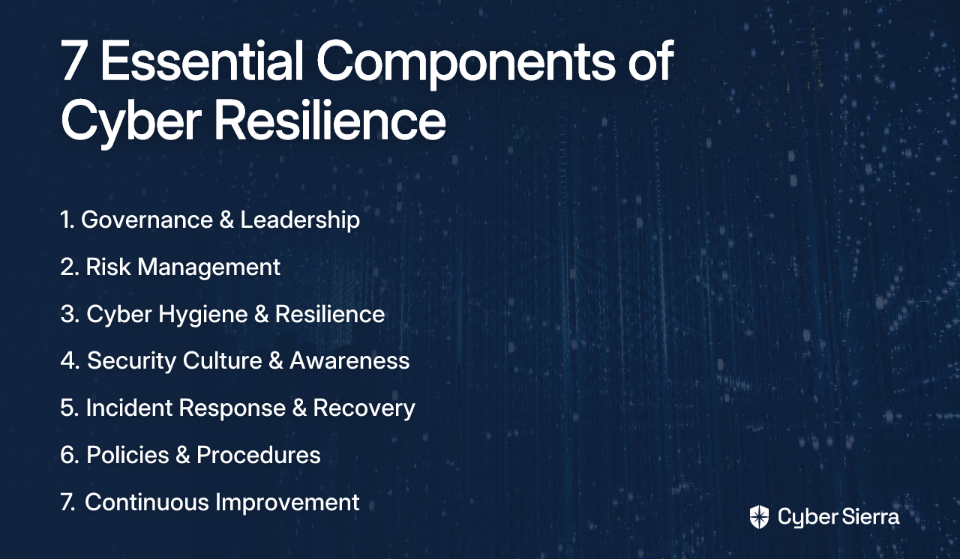
  1. Governance and Leadership: Clear objectives, defined roles, and accountability for cybersecurity at all levels.
  2. Risk Management: Processes to recognize, assess, and prioritize risks.
  3. Cyber Hygiene and Resilience: Fundamental practices like patch management and access controls.
  4. Security Culture and Awareness: Training and education to minimize human error.
  5. Incident Response and Recovery: A clear, tested strategy for detection, containment, and recovery.
  6. Policies and Procedures: Documented security expectations and best practices.
  7. Continuous Improvement: A feedback loop to regularly assess and adapt the cybersecurity posture.

Navigating the Maze of Cyber Resilience Frameworks

"There are a number of standards that can be used," notes a cybersecurity professional in online discussions. This abundance of options creates confusion. To simplify, we can categorize the major frameworks into three types:

Cyber Maturity Models (Focus on Hygiene & Controls)

  1. NIST Cybersecurity Framework: A voluntary, risk-based approach with five core functions: Identify, Protect, Detect, Respond, and Recover. It's an excellent starting point for most organizations due to its comprehensive yet flexible nature. Learn more about NIST CSF.
  2. ISO/IEC 27001: An international standard for managing information security, focusing on a continuous improvement loop through an Information Security Management System (ISMS). Learn more about ISO 27001.
  3. CIS Controls: A prioritized, prescriptive list of security measures categorized as foundational, basic, and organizational. Particularly useful for organizations seeking specific, actionable controls. Explore CIS Controls.

Threat-Led Testing Frameworks (Focus on Adversarial Simulation)

  1. MITRE ATT&CK: A globally-accessible knowledge base of adversary tactics and techniques based on real-world observations. Excellent for organizations wanting to test resilience against specific threat actors. Learn more about MITRE ATT&CK.
  2. CBEST: A framework for delivering controlled, bespoke, intelligence-led cyber security tests for critical infrastructure. Particularly relevant for financial institutions. Learn more about CBEST.

Operational & Quantitative Risk Frameworks (Focus on Recovery & Financial Impact)

  1. Basel Principles: Focus on operational resilience and recovery planning, particularly relevant for financial institutions. Learn more about Basel principles.
  2. FAIR Framework: A quantitative model to measure and manage cyber risks in financial terms, helping organizations understand the ROI of security investments. Learn more about FAIR.

Recommendation: While all frameworks have value, the NIST Cybersecurity Framework provides a flexible and comprehensive foundation for most organizations to begin their maturity assessment journey. It's widely adopted, regularly updated, and integrates well with other frameworks as your program matures.

A 5-Step Guide to Conducting Your Cyber Resilience Assessment

Now that we understand what to measure and which frameworks to consider, let's walk through a practical approach to assessing your organization's cyber resilience maturity:
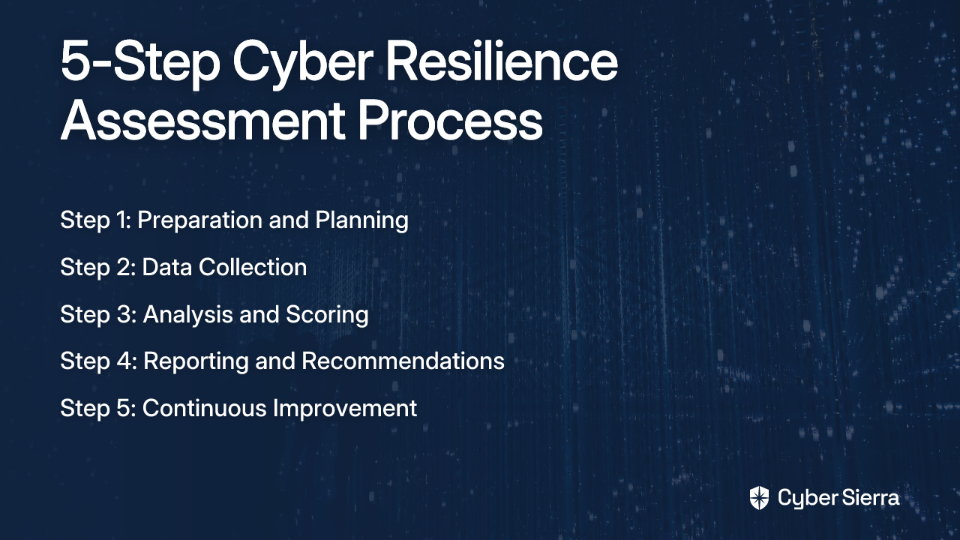
Step 1: Preparation and Planning

Begin by identifying key departments, systems, and assets to include in the assessment. Choose a suitable framework from the options above based on your industry, size, and specific needs. Inform stakeholders and clearly define the assessment's objectives—whether it's meeting regulatory requirements, securing cyber insurance, or identifying improvement opportunities.

Step 2: Data Collection

This critical phase involves gathering evidence through interviews, surveys, document reviews, and infrastructure assessments. The challenge? Manual evidence gathering is time-consuming and prone to gaps.

Modern solutions like Cyber Sierra's Governance, Risk & Compliance (GRC) module can automate data collection, risk assessments, and evidence tracking for frameworks like SOC2 and ISO 27001. This automation significantly reduces manual effort, improves accuracy, and makes enterprises audit-ready faster.

Step 3: Analysis and Scoring - Defining Your Maturity Level

Once data is collected, map it against your chosen framework to determine your current maturity level. According to the Pacific Northwest National Laboratory, most maturity models follow five progressive stages:

  • Level 1: Initial: Ad hoc responses, limited awareness, reactive approach
  • Level 2: Developing: Basic controls and incident response plans being implemented
  • Level 3: Defined: Established processes for risk management; regular training in place
  • Level 4: Managed: Proactive risk management and continuous improvement integrated across the organization
  • Level 5: Optimizing: Advanced threat intelligence and adaptive, fully integrated resilience strategies

Step 4: Reporting and Recommendations

A comprehensive assessment report should go beyond a simple score. It should include your current maturity level, identified strengths and weaknesses, and prioritized, actionable recommendations for improvement. This report becomes the roadmap for your cyber resilience enhancement strategy.

Step 5: Fostering a Culture of Continuous Improvement

Cyber resilience is a continuous process, not a one-time project. The assessment results should feed into a strategic plan for ongoing enhancement, with regular reassessments to track progress and adjust course as needed.

The Future is Continuous: Moving Beyond Point-in-Time Assessments

Traditional cyber resilience assessments face a fundamental flaw: they provide only a snapshot in time, while threats and environments evolve continuously. Organizations aiming for higher maturity levels (Managed and Optimizing) need to move beyond periodic assessments.

Continuous Control Monitoring (CCM) has emerged as the solution. CCM is the process of using technology to continuously test and validate the effectiveness of security controls in near real-time, rather than through annual or quarterly assessments.

Platforms like Cyber Sierra's CCM module transform security from periodic checks to continuous, automated monitoring. Key capabilities include:

  • Central Controls Repository: Building a single source of truth for all controls with near real-time updates
  • Real-time Posture Visibility: Continuously monitoring security controls and detecting exceptions or anomalies as they happen
  • Automated Testing & Validation: Automating control checks, streamlining compliance and freeing up security teams
  • Actionable Risk Intelligence: Delivering data-driven insights to prioritize remediation efforts effectively

This continuous approach allows organizations to detect and respond to control failures before they can be exploited, significantly enhancing resilience.
Overcoming Common Hurdles on Your Maturity Journey

As you work to enhance your cyber resilience maturity, you'll likely encounter several challenges:

  1. The Constantly Evolving Threat Landscape: Threats change faster than traditional assessment cycles can adapt.
  2. Aligning Cybersecurity with Business Objectives: Security must support business goals, not hinder them.
  3. Resource Constraints: Limited budget, staffing, and expertise can impede progress.
  4. Cultural and Organizational Barriers: Resistance to change can slow implementation of new practices.

To overcome these challenges:

  • Make Assessment an Ongoing Program: Treat maturity assessment as a continuous process, not a periodic event.
  • Invest in Employee Training & Awareness: A strong security culture is non-negotiable. Tools like Cyber Sierra's Employee Security Training can build a stronger "human firewall" through interactive training and simulated phishing campaigns.
  • Leverage Automation & AI: Use technology to scale efforts and gain deeper insights, particularly for continuous monitoring and threat detection.

Conclusion

Measuring cyber resilience maturity in 2025 requires a strategic, comprehensive approach. By understanding the core components, selecting appropriate frameworks, following a systematic assessment process, and embracing continuous monitoring, organizations can build genuine resilience against an ever-evolving threat landscape.

The critical shift is from static, periodic assessments to a dynamic, continuous approach powered by automation and real-time monitoring. This is the hallmark of a truly mature and resilient organization in today's threat landscape.

Take the first step by using this guide to initiate your own cyber resilience maturity assessment—your business continuity may depend on it.

Frequently Asked Questions

What is a cyber resilience maturity assessment?

A cyber resilience maturity assessment is a thorough evaluation of an organization's ability to withstand and recover from significant cyber incidents. It measures key components like governance, risk management, incident response, and security culture against a defined framework. The result is a maturity score (typically on a scale of 1 to 5) that helps organizations understand their current capabilities and identify areas for improvement, moving from a reactive to a proactive and adaptive security posture.

Why is it important to measure cyber resilience?

Measuring cyber resilience is important because it provides a clear, objective understanding of your organization's ability to survive a cyber attack, moving beyond simply cataloging security controls. It helps prioritize security investments, meet regulatory and compliance requirements, secure better cyber insurance terms, and build a strategic roadmap for continuous improvement. Without measurement, it's impossible to know if your security efforts are truly effective against sophisticated threats.

How do I choose the best cyber resilience framework for my organization?

The best cyber resilience framework depends on your organization's industry, size, regulatory requirements, and specific goals. For most organizations, the NIST Cybersecurity Framework is an excellent starting point due to its flexibility and comprehensiveness. Financial institutions might lean towards CBEST or Basel Principles. Organizations looking for prescriptive controls can benefit from CIS Controls, while those focused on quantitative risk might use the FAIR framework. The key is to select a framework that aligns with your business context and provides actionable guidance.

What is the difference between a point-in-time assessment and continuous monitoring?

A point-in-time assessment is a periodic snapshot of your security posture, while continuous monitoring provides a real-time, ongoing view of your security controls. Traditional assessments, often done annually or quarterly, can quickly become outdated as threats and systems change. Continuous Control Monitoring (CCM) uses automation to constantly test and validate security controls, allowing you to detect and remediate weaknesses as they arise, rather than waiting for the next scheduled audit.

How can small businesses improve their cyber resilience?

Small businesses can improve their cyber resilience by focusing on foundational security practices and adopting a scalable framework. Start with the basics covered in frameworks like the CIS Controls, which prioritize essential actions like patch management, access control, and employee security training. Leveraging automated tools for GRC and continuous monitoring can help manage security effectively, even with a smaller team.

What are the biggest challenges to improving cyber resilience?

The biggest challenges include the rapidly evolving threat landscape, resource constraints (budget and staff), aligning security with business goals, and overcoming organizational resistance to change. To overcome these hurdles, organizations should treat resilience as an ongoing program, not a one-off project. Investing in automation, fostering a strong security culture through continuous employee training, and demonstrating the business value of resilience are key strategies for success.
blog-hero-background-image
Cyber Security

How to Automate Business Continuity Testing with CCM Data

backdrop
Table of Contents

Join thousands of professionals and get the latest insight on Compliance & Cybersecurity.


You've set up a comprehensive Business Continuity Plan (BCP) with detailed procedures, contact lists, and recovery steps. It's documented, approved, and filed away. But a nagging question remains: Will it actually work when disaster strikes?

"What do you do if ransomware happens while your boss is gone?" asks one IT manager on Reddit. Another wonders, "What is an acceptable RTO for critical scenarios? What is an acceptable RPO?" These aren't just hypothetical concerns—they reflect the real anxiety of professionals responsible for keeping businesses running through disruptions.

The traditional approach to BCP testing is fundamentally flawed. According to Agility Recovery, while 88% of companies test their BCPs to identify gaps, these tests are typically infrequent, manual events that leave long periods where a plan's effectiveness remains untested. As one IT professional bluntly puts it: "You need to do the drill if you want to be prepared." But drills are disruptive, expensive, and only provide point-in-time validation.

What if you could transform BCP testing from periodic drills to continuous validation? This is where Continuous Control Monitoring (CCM) creates a paradigm shift in how we approach business continuity testing—moving from manual, point-in-time verification to automated, ongoing validation.

Why Traditional Business Continuity Testing Falls Short

Before exploring the solution, let's understand the limitations of conventional BCP testing approaches:

The Four Common Types of BCP Testing

  1. Tabletop Testing: Discussion-based review of plans in a conference room setting
  2. Walkthrough Testing: Scenario-based discussions simulating a specific disaster
  3. Semi-functional Testing: Implementing parts of the recovery plan under controlled conditions
  4. Fully functional Testing: A comprehensive simulation where recovery plans are executed completely

These methods have served organizations for decades, but they come with significant drawbacks:

Limitations of Traditional Testing

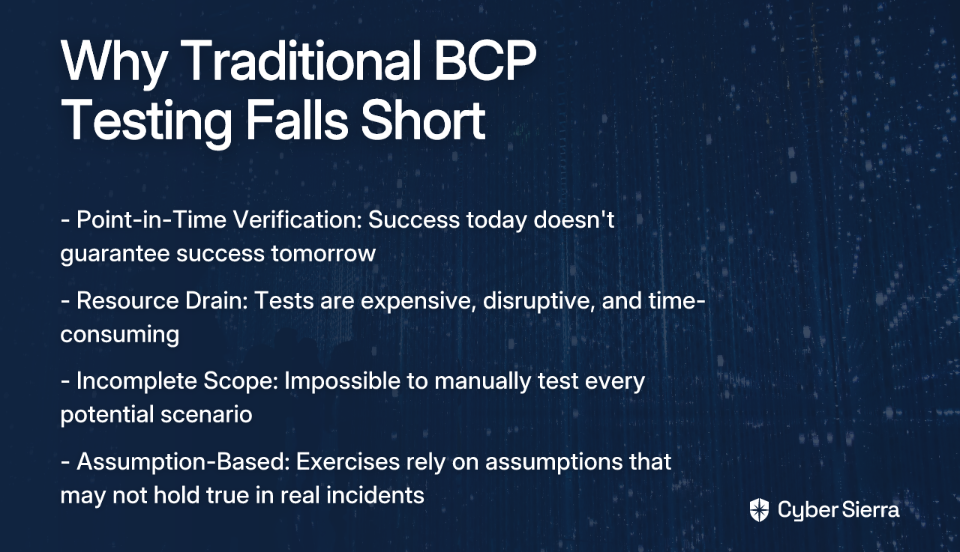
  • Point-in-Time Verification: A successful test in January doesn't guarantee your BCP will work in July. Systems, configurations, and personnel change constantly.
  • Resource Drain: Comprehensive tests are expensive, disruptive, and time-consuming, which explains why they're performed so infrequently.
  • Incomplete Scope: As one IT manager noted: "If you try to plan for literally everything, you'll never finish that document." It's simply impossible to test every scenario manually.
  • Assumption-Based: Without real-time data, tabletop and walkthrough exercises rely on assumptions that may not hold true during an actual incident.

These limitations create a false sense of security. Your BCP might look good on paper, but is your organization truly prepared for a disruption?

Introducing Continuous Control Monitoring (CCM)

According to the Cloud Security Alliance, "Continuous Controls Monitoring (CCM) uses technology to automate the tracking of compliance, risk management, and security controls." This represents a fundamental shift from periodic checks to real-time monitoring.

CCM provides a live, evidence-based view of an organization's security and compliance posture. Key benefits include:

  • Increased Efficiency: Dramatically reduces manual evidence gathering
  • Cost Reduction: Identifies control failures early, before they lead to expensive incidents
  • Better Decision-Making: Gives leaders a comprehensive, data-driven view of risk
  • Proactive Risk Management: Finds vulnerabilities before they can be exploited

The Synergy: Using CCM Data to Power BCP Testing

Here's where the innovation happens: CCM data provides the evidence to continuously test the assumptions within your BCP. Instead of waiting for an annual drill to discover gaps, you can automatically validate your plan's effectiveness daily.

Let's explore four specific use cases where CCM data can transform BCP testing:

Use Case 1: Continuously Validating Backup and Recovery Systems

The BCP Control: "Critical data is backed up daily to an offsite location and is encrypted."

The Traditional Test: A quarterly check where someone manually verifies a backup log or performs a test restore.

The CCM Approach: An automated system continuously queries:

  • Cloud APIs to confirm backup jobs completed successfully within the last 24 hours
  • Configuration settings to ensure data is stored in a geographically separate region
  • Encryption status of the backup data

If any of these conditions fail, an alert is triggered immediately—not months later during your next scheduled test. This directly addresses the best practices for mitigating data loss and corruption outlined by the Cloud Security Alliance.

Use Case 2: Testing Infrastructure Resiliency and Failover Mechanisms

The BCP Control: "Critical applications are deployed in a high-availability configuration with automated failover."

The Traditional Test: A risky and disruptive annual failover drill.

The CCM Approach: Automated checks that continuously monitor:

  • Cloud infrastructure configurations (e.g., are resources spread across multiple availability zones?)
  • Health check statuses for load balancers
  • The presence and correct configuration of automated failover mechanisms

This provides constant assurance without taking systems offline or disrupting business operations.

Use Case 3: Automating Verification of Access Controls for Key Personnel

The BCP Control: "In the event of a disaster, designated secondary personnel have the necessary permissions to execute the recovery plan."

This addresses a common concern about "Key staff loss" during critical incidents, as expressed by IT managers on Reddit.

The Traditional Test: A manual review of user permissions during a tabletop exercise.

The CCM Approach:

  • Continuously monitors IAM (Identity and Access Management) roles
  • Triggers an alert if a key recovery team member's required permissions are altered or revoked
  • Verifies that backup personnel maintain appropriate access levels

This ensures that when a critical person is unavailable, the designated backup personnel can actually execute the recovery procedures.

Use Case 4: Providing Real-Time Data to Validate RTO/RPO Assumptions

The BCP Control: "The RPO for the primary customer database is 15 minutes. The RTO is 4 hours."

This directly addresses the uncertainty around "What is an acceptable RTO? What is an acceptable RPO?" mentioned by IT managers on Reddit.

The Traditional Test: A theoretical discussion or a full DR test.

The CCM Approach:

  • RPO Validation: Continuously monitor database replication lag. If the lag exceeds 15 minutes, an alert is triggered, providing a leading indicator of a potential RPO breach.
  • RTO Validation: While not replacing a full test, CCM can verify the components needed for recovery are in place: Are recovery scripts present and unchanged? Are failover servers patched and ready? Is sufficient capacity available?

A Practical Guide: Implementing Automated BCP Validation with CCM

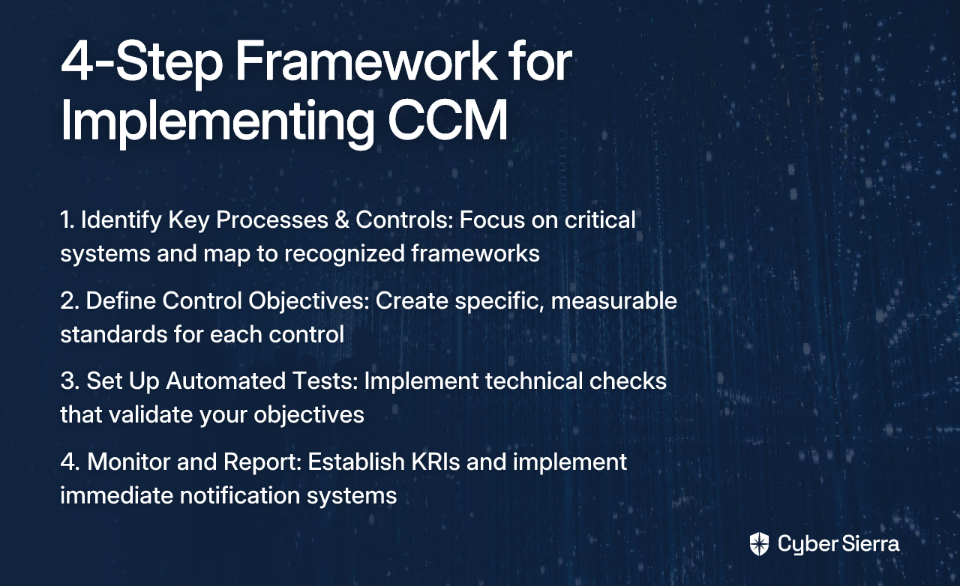
To implement this approach in your organization, follow this four-step framework based on Cloud Security Alliance guidance:

Step 1: Identify Key Processes and Controls

Start with your most critical processes—those categorized as Level 1 ("Must recover within 48 hours") according to BCMMetrics.

Map these processes to specific controls within a recognized framework. The Business Continuity Management and Operational Resilience (BCR) domain of the Cloud Controls Matrix (CCM v4) provides an excellent foundation. Key controls to focus on include:

  • BCR-08: Backup
  • BCR-09: Disaster Response Plan
  • BCR-11: Equipment Redundancy

Step 2: Define Control Objectives

For each control, define clear, measurable objectives. For example:

  • For BCR-08 (Backup): "Production database backups must be completed every 24 hours, encrypted with AES-256, and stored in a separate geographical region."
  • For BCR-11 (Equipment Redundancy): "Critical application servers must maintain N+1 redundancy with automated failover capability."

These specific objectives transform vague BCP requirements into testable conditions.

Step 3: Set Up Automated Tests

Implement technical tests that validate your objectives:

  • A script that queries your cloud provider's API to check backup completion status
  • A configuration check to validate that storage buckets have cross-region replication enabled
  • An IAM role verification to ensure recovery personnel maintain appropriate permissions

Step 4: Monitor and Report

Establish Key Risk Indicators (KRIs) that track control performance over time. A failed automated test becomes an immediate notification for your security or IT team to investigate—long before an annual audit or disaster event.

From Theory to Practice: Unifying BCP and GRC with an Integrated Platform

Building a CCM system from scratch is complex. It requires integrating with dozens of APIs, writing custom scripts, and building a reporting engine—tasks that may be beyond the resources of many organizations.

This is where platforms like Cybersierra simplify the entire process. Cybersierra's Continuous Control Monitoring (CCM) platform provides key capabilities that directly address the challenges discussed:
  • It "builds a central controls repository with near real-time updates" to manage BCP controls alongside other compliance frameworks
  • It "automates control testing and validation," removing the need for manual scripting and checks
  • It "delivers actionable risk intelligence," so you know exactly which BCP control is failing and why

This approach connects seamlessly with broader Governance, Risk & Compliance (GRC) processes. The evidence collected by CCM automatically feeds into Cybersierra's GRC module, making audits and drills more efficient. This provides a single source of truth for both operational resilience and compliance.

Build a BCP You Can Actually Trust

Stop treating business continuity testing as a dreaded annual event. By leveraging automation and CCM data, you can transform it into a continuous process that provides real-time confidence in your ability to recover.

The benefits are clear:

  • Proactive risk identification: Find control failures before they lead to incidents
  • True infrastructure resiliency: Continuously verify your recovery capabilities
  • Always audit-ready: Maintain a real-time repository of evidence
  • Reduced manual effort: Automate the tedious aspects of BCP testing

As business environments grow more complex and threats more sophisticated, the traditional approach to business continuity testing falls short. Continuous Control Monitoring offers a path forward—providing the data-driven insights needed to ensure your organization can weather any storm.

Whether you implement this approach using in-house resources or leverage a platform like Cybersierra, the goal remains the same: a business continuity plan you can trust when disaster strikes.

Frequently Asked Questions (FAQ)

What is Continuous Control Monitoring (CCM) for BCP?

Continuous Control Monitoring (CCM) for Business Continuity Planning (BCP) is an automated approach that uses technology to continuously verify that BCP controls, such as data backups and failover systems, are working correctly in real-time. Unlike traditional BCP tests which are periodic events, CCM provides ongoing validation. It automatically checks system configurations, backup statuses, and access permissions against the requirements defined in your BCP, alerting you immediately if a control fails. This transforms BCP from a static document into a live, evidence-backed plan.

How does CCM improve on traditional BCP testing methods?

CCM improves on traditional BCP testing by replacing infrequent, manual checks with automated, continuous validation, which provides real-time assurance and reduces the risk of undetected control failures. Traditional methods like tabletop exercises or annual drills are point-in-time assessments that are resource-intensive and can't keep up with constant changes in IT environments. CCM addresses these gaps by offering proactive risk identification, reducing manual effort, and ensuring your recovery capabilities are always verified and audit-ready.

Does CCM replace the need for tabletop exercises and other traditional BCP tests?

No, CCM does not completely replace traditional BCP tests like tabletop exercises, but it significantly enhances them. CCM automates the validation of technical controls (e.g., are backups running?), providing a solid foundation of evidence. This allows traditional tests, like tabletop exercises and drills, to focus on the human and procedural aspects of disaster response—such as communication, decision-making, and team coordination—making those exercises more strategic and effective.

What are some practical examples of BCP controls that can be automated with CCM?

Practical examples of BCP controls automated with CCM include verifying daily data backups, confirming high-availability configurations for critical applications, and ensuring designated recovery personnel have the correct access permissions. For instance, a CCM system can automatically query cloud APIs to confirm backup jobs completed successfully, check that servers are deployed across multiple availability zones for redundancy, and continuously monitor IAM roles to alert you if a key team member loses necessary permissions for recovery.

How does CCM help validate Recovery Time Objectives (RTO) and Recovery Point Objectives (RPO)?

CCM helps validate RTO and RPO by continuously monitoring the technical components required to meet them, providing leading indicators of potential breaches. To validate an RPO (e.g., 15-minute data loss tolerance), CCM can monitor database replication lag in real-time and trigger an alert if it exceeds 15 minutes. For RTO (e.g., 4-hour recovery time), CCM can verify that failover servers are patched, recovery scripts are in place, and sufficient cloud capacity is available, ensuring the foundational elements for a swift recovery are always ready.

What is the first step to implementing automated BCP validation with CCM?

The first step to implementing automated BCP validation with CCM is to identify your organization's most critical business processes and map them to a set of specific, testable technical controls. Start by focusing on high-priority systems, as defined in your business impact analysis. Then, for each system, define clear control objectives based on a recognized framework like the Cloud Controls Matrix (CCM v4). For example, for a critical database, a control objective could be: "Backups must complete every 24 hours and be stored in a separate geographical region." This creates a clear target for automation.

blog-hero-background-image
Cyber Security

How Generative AI is Changing Audit Evidence Collection

backdrop
Table of Contents

Join thousands of professionals and get the latest insight on Compliance & Cybersecurity.


You've set up a Google Ads campaign to drive targeted traffic to your website or online store. But when you check your analytics, you're shocked to see a flood of visitors from countries like India, Pakistan, and Bangladesh - places you never intended to target.

"Compliance is blocking our enterprise deals." If you're in the tech or SaaS world, this phrase likely sends shivers down your spine. It's the dreaded bottleneck that prevents growth-stage companies from closing crucial deals that could transform their trajectory. Since the public release of tools like ChatGPT in late 2022, Generative AI (GenAI) has rapidly evolved from a theoretical concept to a practical tool being enthusiastically adopted in finance and auditing.

According to the CAQ Audit Partner Pulse Survey, 1 in 3 audit partners now see companies in their industry already deploying or planning to deploy AI in financial reporting processes. This adoption is driven by a simple truth: traditional compliance processes are crushing organizations under their weight.

The Crushing Weight of Traditional Evidence Collection

Before diving into how AI is transforming audit evidence collection, let's acknowledge the painful reality of traditional compliance processes that many organizations still endure:

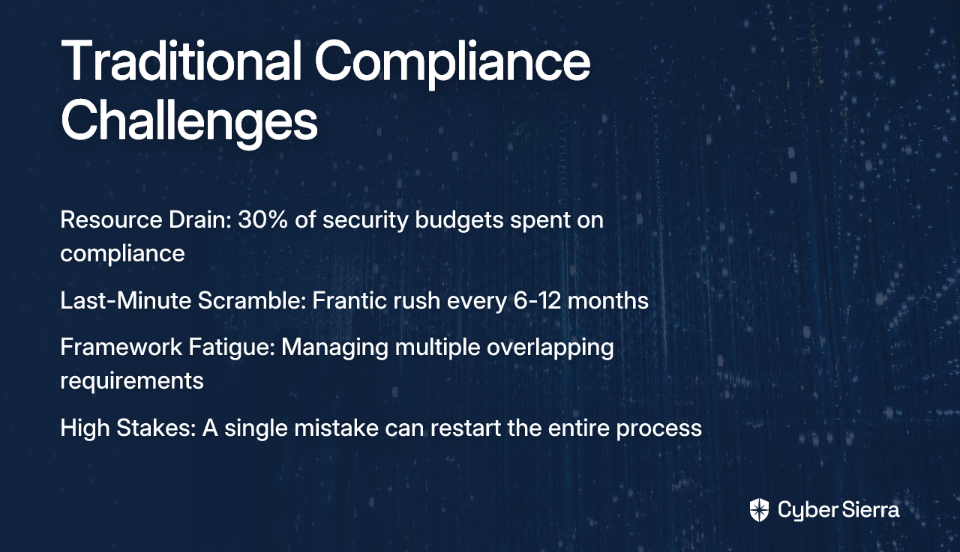
Resource Drain: Organizations often spend upwards of 30% of their security budgets on compliance-related activities alone. This significant financial burden diverts resources from other critical security initiatives.

The "Last-Minute Scramble": The periodic nature of audit preparation creates a frantic rush every 6-12 months. Teams scramble to gather screenshots, logs, and documents from disparate systems, often pulling all-nighters to meet auditor deadlines.

Framework Fatigue & "Regulatory Agility Gaps": Managing multiple, overlapping frameworks (SOC 2, ISO 27001, GDPR, HIPAA, PCI DSS) leads to duplicated efforts and an inability to keep pace with new regulations. Each framework has its own nuanced requirements, creating a compliance maze that's difficult to navigate.

The High Stakes of Failure: The anxiety of the "3-month observation period" is real, especially knowing that a single mistake could mean "having to restart" the entire process, wasting months of effort and delaying deals. For startups and growth-stage companies, this can mean the difference between securing crucial funding or running out of runway.

As one founder lamented on Reddit, "SOC 2-ready in days [is] always needed," highlighting the urgent pressure companies face to accelerate compliance processes that traditionally take months.

Generative AI as the Ultimate Assistant: Automating the Grunt Work

Generative AI is revolutionizing audit evidence collection by automating the most labor-intensive and repetitive tasks:

Automated Document Review & Summarization: GenAI can rapidly review enormous volumes of documents like contracts, financial statements, and policy documents, summarizing key clauses and identifying relevant information. This allows auditors to focus on critical analysis instead of manual reading.

Drafting Policies and Reports: GenAI excels at generating first drafts of necessary documentation, from internal security policies to sections of an audit report. It can effectively produce the "verbose corporate maculature" that is necessary for compliance, which can then be refined by a human expert.

24/7 Evidence Collection: With AI-driven platforms, "evidence collection happens automatically while they sleep," as one compliance solution provider noted. The process is no longer a manual, point-in-time task but a continuous, background operation.

Quantifiable Impact: Automation isn't just a convenience; it delivers massive efficiency gains. Companies using these tools report 70-80% reductions in time spent gathering compliance evidence. This translates to significant cost savings and allows security teams to focus on more strategic initiatives.

Beyond Automation: Achieving Continuous, Intelligent Compliance

The true power of GenAI in audit evidence collection goes beyond simple task automation to enable a strategic advantage through continuous compliance:

Continuous Control Monitoring (CCM): Instead of periodic checks, AI enables ongoing, real-time monitoring of security controls. Platforms integrate with existing systems (cloud providers like AWS, HR software) to constantly pull data, monitor settings, and automatically update evidence. This creates a "single source of truth" for compliance status.

Platforms like Cyber Sierra's Continuous Control Monitoring (CCM) module embody this principle by providing a central controls repository with near real-time updates, offering clear visibility into security posture and delivering actionable risk intelligence. This makes an organization perpetually audit-ready rather than scrambling before audits.

Enhanced Risk Assessment & Anomaly Detection: AI can analyze vast datasets of financial transactions and system logs to identify anomalies and unusual patterns that might indicate risk or fraud. This helps auditors focus their efforts where they matter most, improving the overall quality of the audit process.
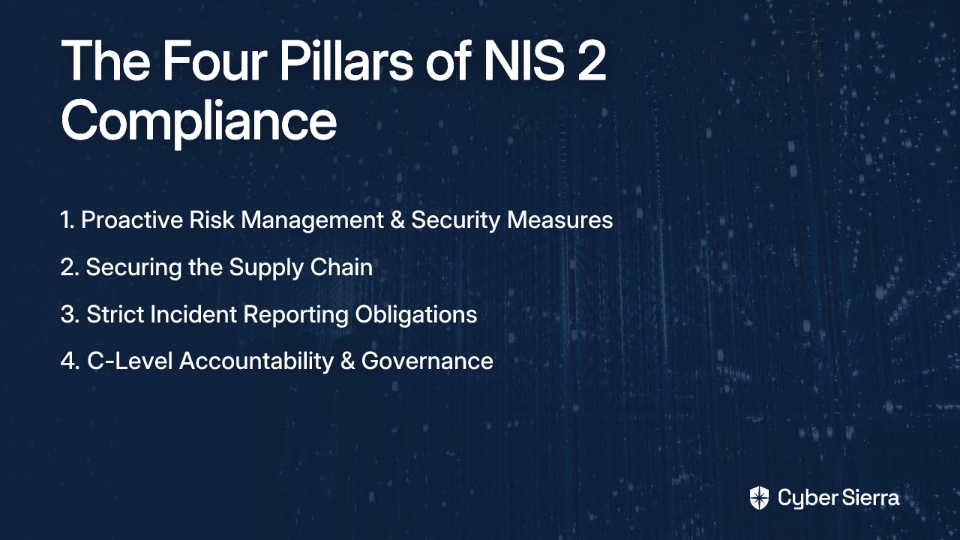
Cross-Framework Control Mapping: One of the most powerful applications of AI is its ability to intelligently identify overlapping requirements across multiple compliance frameworks. For example, access control requirements exist in both SOC 2 and ISO 27001, but with slight variations. AI can map these controls, allowing organizations to "test once, comply many" and eliminate redundant work.

The Human-in-the-Loop: Navigating the Perils of AI Hallucinations

Despite its transformative potential, GenAI comes with significant risks that must be managed, particularly in the high-stakes world of compliance. The biggest concern? AI "hallucinations" – instances where AI generates plausible but false information.

One compliance automation user shared a cautionary tale: "AI confidently stated we had encryption at rest enabled on a database that didn't even exist." In an audit context, this type of error could be catastrophic, potentially invalidating the entire compliance process and forcing organizations to restart their observation period.

The solution is not to abandon AI, but to implement a hybrid approach:

The Hybrid Solution: GenAI + Deterministic Checks: The best practice is "not to have AI interpret anything critical." Instead, rely on deterministic code checks to verify if Multi-Factor Authentication is actually enabled or if specific AWS configurations are correct. These are hard facts that shouldn't be left to probabilistic AI interpretation.

Define the roles clearly:

  • Use GenAI for tasks requiring language understanding (summarizing reports, drafting policies)
  • Use deterministic, code-based automation to verify technical evidence (checking configurations, logs, user access)
  • Keep the human expert as the ultimate arbiter who reviews and validates AI outputs

This balanced approach leverages the strengths of each component while mitigating the risks. It's also important to consider data privacy when feeding sensitive information into AI models and to implement measures to mitigate bias in AI outputs.

The Future of Audit is Strategic, Not Administrative

As we look toward the future, it's clear that the role of compliance professionals is evolving from paper-pushers to strategic advisors. The trend toward AI adoption in compliance is accelerating: the percentage of firms using GenAI has grown from 8% to 21% in just the last year, while those with no plans to adopt have fallen from 49% to 25%, according to Thomson Reuters.

The ultimate goal of this transformation is predictive compliance management, where AI helps organizations anticipate and prepare for regulatory changes before they happen. This proactive approach allows businesses to maintain continuous compliance rather than reactively scrambling to catch up with new requirements.

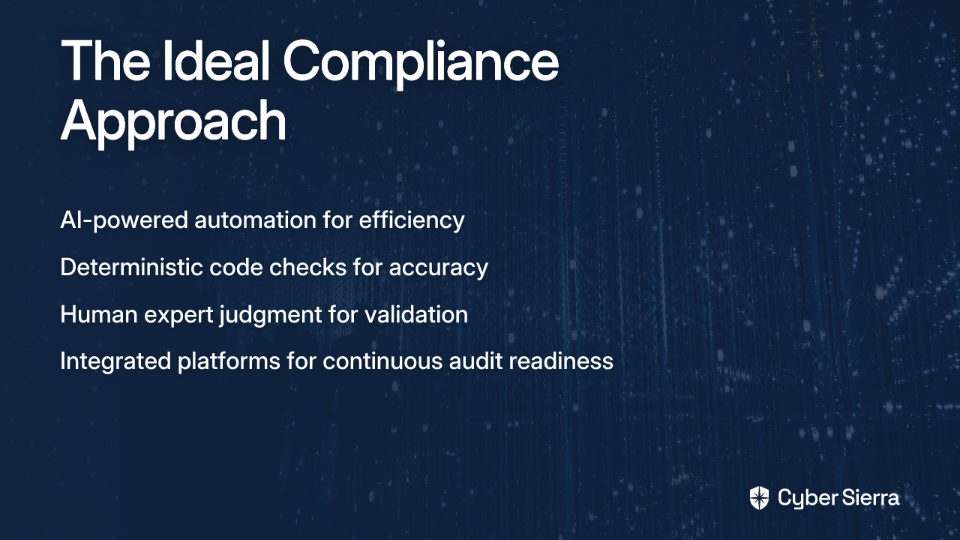
Generative AI is not a silver bullet for compliance challenges, but it is a powerful force multiplier. The most effective path forward combines:

  • The efficiency of AI-powered automation
  • The accuracy of deterministic code checks
  • The invaluable judgment of human experts

By leveraging integrated platforms that provide this balanced approach, organizations can transform compliance from a source of stress and a deal blocker into a demonstrable strategic advantage that builds trust and accelerates growth. For businesses looking to streamline this journey, exploring a unified GRC platform like Cyber Sierra can be the first step toward continuous audit readiness.
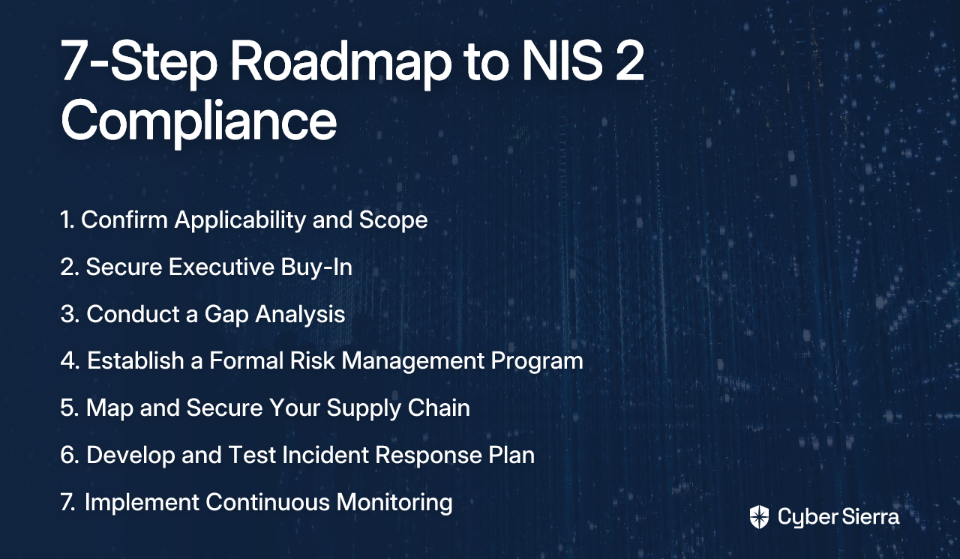
In the end, the goal isn't just to collect evidence more efficiently – it's to fundamentally change how organizations approach compliance, moving from a periodic, painful process to a continuous state of readiness that supports rather than hinders business growth.

Frequently Asked Questions

How does Generative AI streamline audit evidence collection?

Generative AI streamlines audit evidence collection by automating repetitive tasks like reviewing documents, drafting policies, and summarizing information. It can rapidly process vast amounts of text from contracts and policy documents, generate first drafts of required reports, and work 24/7 to gather evidence. This significantly reduces the manual "grunt work," freeing up compliance teams to focus on more strategic analysis and validation.

What are the biggest risks of using AI in compliance audits?

The biggest risk of using AI in compliance audits is the potential for "hallucinations," where the AI generates plausible but factually incorrect information. For example, an AI might incorrectly state that a security control is enabled when it is not. To mitigate this, a hybrid approach is essential, using deterministic code-based checks for verifying technical evidence while reserving GenAI for language-based tasks, all under the supervision of a human expert.

What is Continuous Control Monitoring (CCM)?

Continuous Control Monitoring (CCM) is an automated process that continuously checks and validates a company's security controls in real-time, rather than only during a specific audit period. AI-powered platforms enable CCM by integrating with various systems (like cloud providers and HR software) to constantly pull data and verify that controls are operating correctly. This ensures an organization is always audit-ready and has a "single source of truth" for its compliance posture.

Can AI help with managing multiple compliance frameworks at once?

Yes, AI is highly effective at managing multiple compliance frameworks like SOC 2, ISO 27001, and GDPR simultaneously through a process called cross-framework control mapping. AI can identify and map overlapping requirements between different standards. This allows organizations to "test once, comply many," eliminating redundant work and streamlining the management of their overall compliance program.

Will AI replace the role of human compliance professionals?

No, AI is not expected to replace human compliance professionals but rather to augment their capabilities and evolve their role. AI automates the administrative and repetitive tasks, shifting the human expert's focus from manual evidence gathering to more strategic responsibilities. This includes validating AI outputs, interpreting complex regulatory nuances, making critical judgments, and advising the business on risk and strategy.


This article is brought to you by Cyber Sierra, providing an AI-enabled cybersecurity platform designed to simplify and automate security compliance for enterprises. Learn more about our Continuous Control Monitoring and Governance, Risk & Compliance solutions.

blog-hero-background-image
Cyber Security

How CCM Prevents Cloud Misconfigurations in 2025

backdrop
Table of Contents

Join thousands of professionals and get the latest insight on Compliance & Cybersecurity.


You've set up a complex cloud infrastructure with all the security protocols you thought were necessary. Then, suddenly, you're greeted by the news of a massive data breach. The culprit? A simple storage bucket left publicly accessible—a misconfiguration that went undetected for months.

This isn't just a hypothetical scenario. The 2019 Capital One data breach, caused by a misconfigured web application firewall, exposed approximately 100 million records and resulted in an $80 million fine and a $190 million lawsuit settlement. Similarly, the 2021 Microsoft Power Apps misconfiguration exposed 38 million records due to default public access settings that no one caught in time.

For security and GRC teams managing "a big infrastructure, big compliance requirements, big AWS footprint," as one professional described it, the frustration is palpable. Many teams are desperately searching for a solution that "does checks in real time, catches issues and just works without us having to keep an eye on it the whole time."

By 2025, as cloud environments grow increasingly complex, shifting from reactive, periodic audits to a proactive Continuous Control Monitoring (CCM) strategy isn't just advisable—it's essential for survival.

Why Cloud Misconfigurations Are an Unrelenting Threat

Cloud misconfigurations are security gaps that occur when cloud-based resources are set up incorrectly, creating vulnerabilities that attackers can exploit. Despite being preventable, they remain one of the leading causes of data breaches and security incidents in cloud environments.

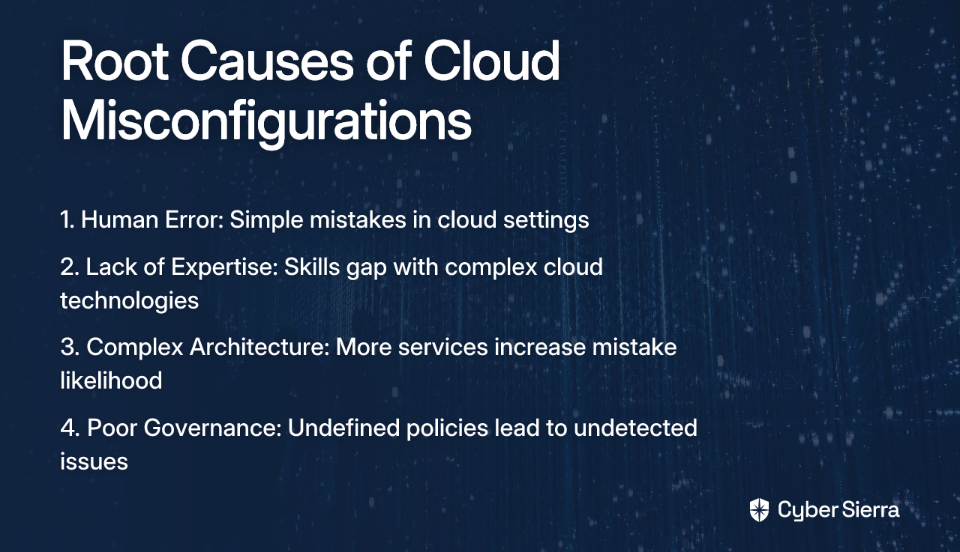
The Core Causes

  1. Human Error: Simple mistakes in settings due to a lack of knowledge or attention to detail
  2. Lack of Expertise: The complexity of cloud technologies often outpaces the skills of many teams
  3. Complex Cloud Architecture: The more services and technologies used, the higher the chance of a mistake
  4. Poor Governance: Without defined policies and regular audits, misconfigurations go undetected

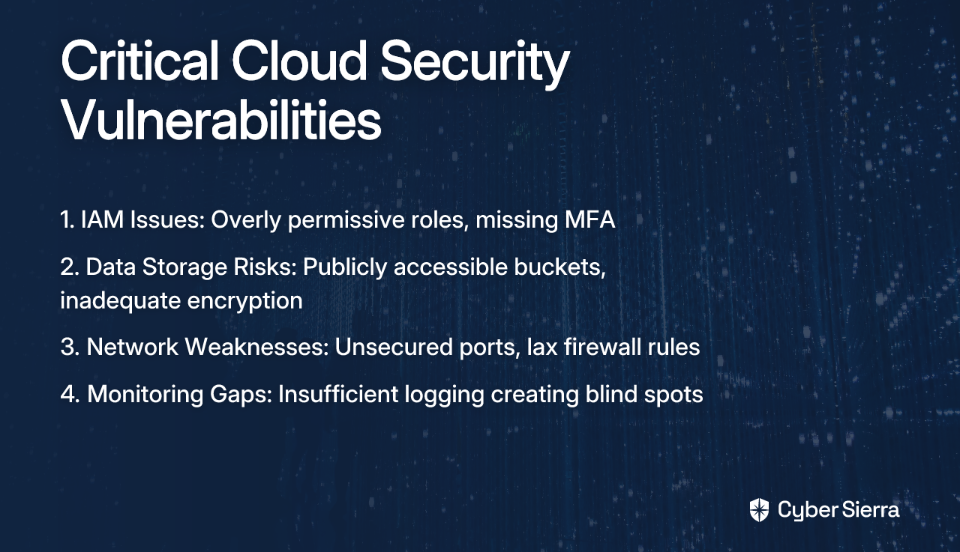
Most Common & Dangerous Misconfiguration Types

  1. Identity and Access Management (IAM): Overly permissive user roles, failure to enforce Multi-Factor Authentication (MFA), and dormant accounts create easy entry points for attackers.
  2. Data Storage Configuration: Publicly accessible storage buckets (like on AWS S3) that expose sensitive data. Without proper encryption at rest and in transit, even protected data can be compromised if accessed.
  3. Networking Configuration: Unsecured ports, lax firewall rules, and insecure APIs act as open doors for attackers looking to gain unauthorized access to your systems.
  4. Misconfigured Logging and Monitoring: Insufficient logging provides zero visibility into user actions, drastically slowing down threat detection and response.

The Severe Impact

The consequences of these misconfigurations can be devastating:

  • Data Breaches: Unauthorized access leading to data theft and exfiltration
  • Financial Losses: Costs from investigations, regulatory fines, and reputational damage
  • Legal and Compliance Issues: Violations of regulations like GDPR, HIPAA, or PCI DSS trigger audits and legal action

The Shift to Proactive Defense: What is Continuous Control Monitoring (CCM)?

Continuous Control Monitoring (CCM) is a proactive approach using technology for ongoing, automated oversight of an organization's security controls. Its purpose is to ensure controls are effective in mitigating risks and maintaining compliance in near real-time.

CCM Process vs. CCM Framework: Clearing the Confusion

There's often confusion between two different concepts that share the CCM acronym:

  • The Process: Continuous Control Monitoring is the act of continuously testing and validating controls.
  • The Framework: The Cloud Security Alliance (CSA) Cloud Controls Matrix (CCM) is a comprehensive framework of 197 control objectives across 17 domains (e.g., IAM, Data Security, Logging & Monitoring).

The framework provides the "what to check," while the CCM process provides the "how to check it continuously."

Core Objectives of a CCM Strategy

  1. Confirm controls are effective in mitigating risks
  2. Maintain a proactive cyber defense posture
  3. Ensure business continuity and regulatory compliance
  4. Create constant audit readiness

The Paradigm Shift

Traditional security approaches rely on point-in-time audits that quickly become outdated:

Traditional AuditsContinuous Control Monitoring
Point-in-timeReal-time
ManualAutomated
PeriodicContinuous
ReactiveProactive
Evidence gathering is labor-intensiveEvidence is automatically collected
Findings discovered months after occurrenceIssues identified immediately

The Mechanics: How CCM Actively Prevents Misconfigurations

Let's examine how CCM directly addresses the most common cloud misconfigurations:

Preventing IAM Misconfigurations

CCM platforms continuously scan for policies that violate the principle of least privilege, identify users without MFA, and flag dormant accounts for removal. This constant vigilance prevents unauthorized access before it occurs.

For example, when a developer accidentally grants public access to a role, a CCM system immediately detects this deviation from security policies, alerts the security team, and may even automatically remediate the issue.

Securing Publicly Exposed Data Storage

CCM automatically detects publicly accessible cloud storage buckets and verifies that encryption-at-rest and in-transit controls are correctly implemented.

When an S3 bucket is misconfigured with public access, the CCM system flags it immediately rather than waiting for the next quarterly audit (or worse, a breach).

Hardening Network Configurations

CCM provides real-time alerts for unauthorized changes to firewall rules, security groups, or newly opened ports, allowing security teams to investigate and remediate before they are exploited.

This continuous verification ensures that no unexpected network paths are created that could give attackers an entry point to sensitive systems.

Ensuring Comprehensive Logging & Monitoring

A CCM system validates that logging is enabled on all critical cloud assets and services. It ensures that logs are being centrally collected and analyzed, preventing the visibility gaps that attackers rely on to hide their activities.

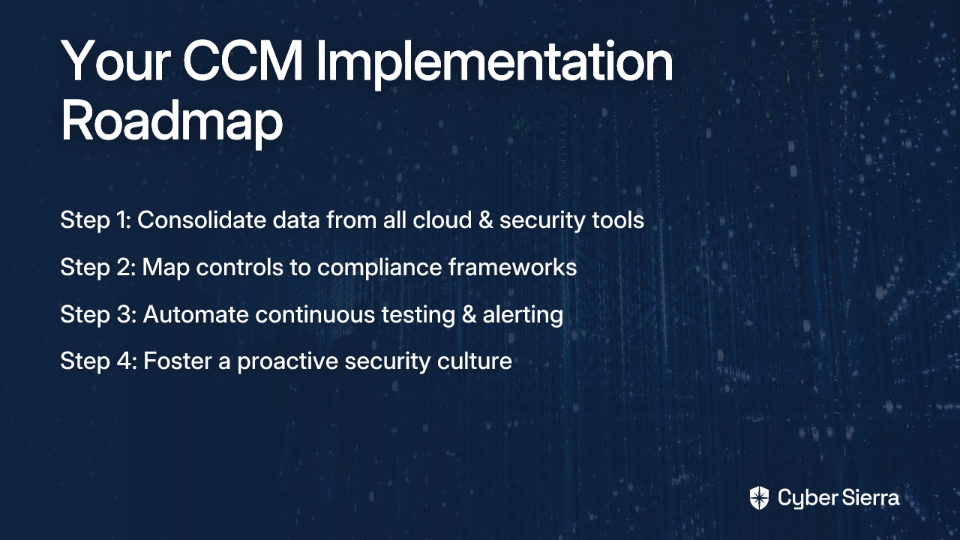
A 4-Step Blueprint for Implementing Your CCM Strategy

For organizations looking to implement a CCM strategy by 2025, here's a practical blueprint:

Step 1: Consolidate and Integrate Data from All Tools

Begin by integrating data from various cloud environments (AWS, Azure, GCP) and security tools into a single platform. This creates a centralized, up-to-date inventory of all cloud assets, which is the foundation for effective monitoring.

For organizations with "a big infrastructure, big compliance requirements, big AWS footprint, Snowflake," as one Reddit user described, this integration is crucial for maintaining visibility across complex environments.

Step 2: Establish Governance and Map Controls to Frameworks

Define and implement security controls based on industry standards like SOC2, ISO 27001, GDPR, and the CSA CCM.

A modern CCM platform like Cybersierra aggregates these controls into one holistic view, providing clear visibility and simplifying governance across multiple compliance requirements. This is especially valuable for small GRC teams handling enterprise-scale compliance needs.

Step 3: Automate Continuous Monitoring and Testing

Leverage automation to continuously test controls against your defined policies. This is the core engine of CCM.

When a control fails or a misconfiguration is detected (e.g., a new public S3 bucket), the system should automatically generate an alert, create a ticket, and provide remediation guidance. This enables seamless risk remediation and addresses the need for tools that "just work without us having to keep an eye on it the whole time."

Step 4: Foster a Culture of Proactive Risk Management

Use the data and insights from your CCM platform to drive continuous improvement. This includes providing targeted security awareness training for teams that frequently create misconfigurations and fostering cross-functional collaboration between security and DevOps to fix issues at their source.

Selecting the Right CCM Platform for 2025

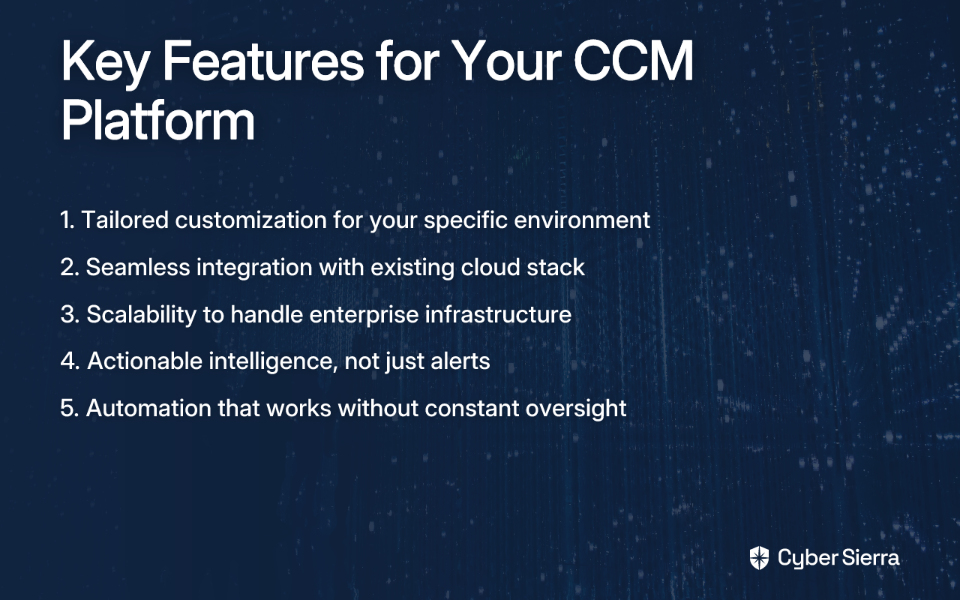
Based on feedback from security professionals, here's what to look for when selecting a CCM platform:

  1. Tailored Features & Customization: The platform must be adaptable to your specific environment and compliance needs, avoiding the "very generic" problem many users face with current tools.
  2. Ease of Integration: It must seamlessly connect with your existing cloud and security stack (e.g., AWS, Snowflake, SIEM tools).
  3. Scalability: The solution must be able to grow with your organization, handling a "big infrastructure" even if you have a "small GRC team."
  4. Actionable Intelligence: It should provide prioritized, data-driven insights for remediation, not just a flood of alerts. The goal is "AI features [that] are not flashy and they're precise."
  5. Ease of Use & Automation: The platform should be "hands-off once it was set up," delivering real-time monitoring and enhancing audit readiness without constant manual oversight.

Cybersierra's CCM platform is designed to address these specific needs. It builds a central controls repository with near real-time updates, provides clear visibility into security posture through continuous monitoring, and delivers actionable risk intelligence for data-driven remediation.

Secure Your Cloud Future with Continuous Monitoring

Cloud misconfigurations are a persistent and costly threat, but they are entirely preventable with the right strategy. As cloud environments become increasingly complex, the traditional approach of periodic compliance checks is no longer sufficient.

By 2025, organizations that haven't adopted a Continuous Control Monitoring strategy will find themselves at a significant disadvantage, constantly playing catch-up with rapidly evolving threats and compliance requirements.

Don't wait for a breach to highlight your security gaps. Start building your proactive defense today by evaluating how a CCM strategy can secure your organization's cloud environment and transform your security from reactive to proactive.

The future of cloud security isn't about fixing problems after they occur—it's about preventing them from happening in the first place. With CCM, that future is within reach.

Frequently Asked Questions

What is Continuous Control Monitoring (CCM)?

Continuous Control Monitoring (CCM) is a proactive security strategy that uses technology to automatically and continuously oversee an organization's security controls in near real-time. Unlike traditional audits that happen periodically, CCM ensures that security controls are always working as intended to mitigate risks and maintain compliance, shifting security from a reactive approach to a continuous, proactive defense.

Why are traditional security audits not enough for cloud environments?

Traditional security audits are not enough for the cloud because they are point-in-time assessments that quickly become outdated in dynamic, constantly changing environments. A manual audit performed quarterly misses misconfigurations that can occur between checks, leaving security gaps open for months. CCM provides the real-time visibility needed to secure these environments effectively.

What are the most common cloud misconfigurations CCM can prevent?

CCM helps prevent the most common and dangerous cloud misconfigurations, including overly permissive Identity and Access Management (IAM) roles, publicly accessible data storage buckets, insecure network configurations, and insufficient logging. By continuously scanning for these issues, a CCM system can immediately detect vulnerabilities and enable rapid remediation before attackers can exploit them.

How do you implement a Continuous Control Monitoring strategy?

Implementing a CCM strategy involves four key steps: first, consolidating data from all cloud and security tools into a single platform. Second, establishing governance by mapping controls to frameworks like SOC2 or ISO 27001. Third, automating the continuous monitoring and testing of those controls. Finally, fostering a culture of proactive risk management using the insights from the CCM system.

What is the difference between the CCM process and the CSA CCM framework?

The CCM process is the action of continuously monitoring security controls, while the CSA Cloud Controls Matrix (CCM) framework is a comprehensive list of security control objectives that guides what should be monitored. In short, the framework provides the "what to check," and the CCM process provides the "how to check it continuously."

How does CCM help with compliance and audit readiness?

CCM significantly improves compliance and audit readiness by automating the collection of evidence and continuously ensuring that controls required by regulations like GDPR, HIPAA, and SOC2 are operating effectively. This creates a state of constant audit readiness, offering an up-to-date view of your compliance posture and simplifying the process of demonstrating adherence to regulatory standards.

blog-hero-background-image
Cyber Security

Top Cloud Misconfigurations to Watch in 2025

backdrop
Table of Contents

Join thousands of professionals and get the latest insight on Compliance & Cybersecurity.


You've spent months hardening your cloud infrastructure, only to discover that a single misconfigured S3 bucket has exposed your customer database to the entire internet. Sound familiar? You're not alone. As security professionals struggle with "constant changes in cloud security protocols" and "lack of centralized visibility across cloud environments," cloud misconfigurations remain the silent killer of even the most sophisticated security programs.

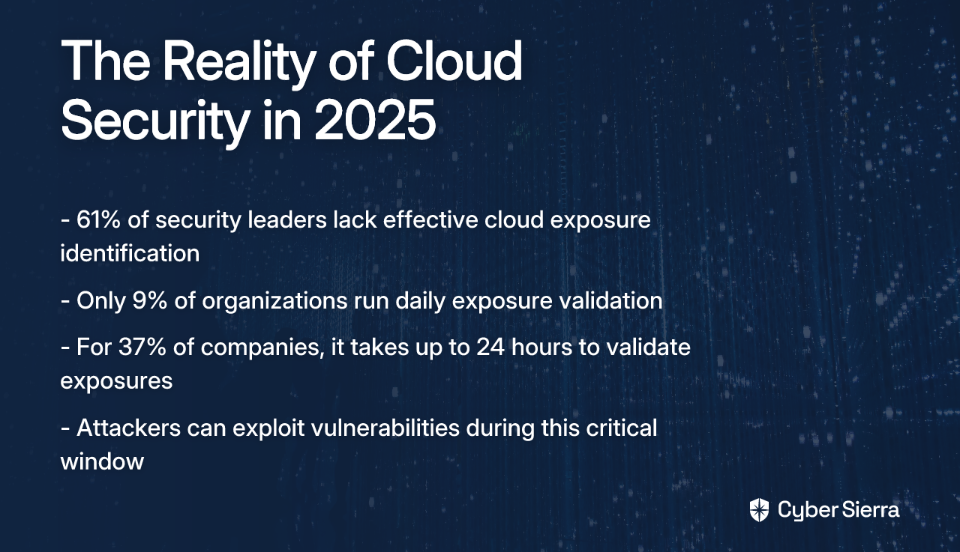
The stakes have never been higher. According to recent research, 61% of security leaders admit their organization lacks the ability to effectively identify and remediate exposures in their cloud environments. Even more concerning, only 9% of organizations run exposure validation daily, and for 37%, it can take up to 24 hours to validate an exposure—a lifetime in which attackers can exploit vulnerabilities.

This article identifies the most critical cloud misconfigurations to watch for in 2025 and provides a proactive roadmap for prevention and remediation, helping you shift from a reactive to a resilient security posture.

The Anatomy of a Breach: When Misconfigurations Go Wrong

To understand the real-world impact of cloud misconfigurations, look no further than the recent data breach at a South Asian automotive giant. In late 2025, the company disclosed that over 70 TB of sensitive customer and infrastructure data had been exposed due to a series of simple, yet critical, cloud misconfigurations.

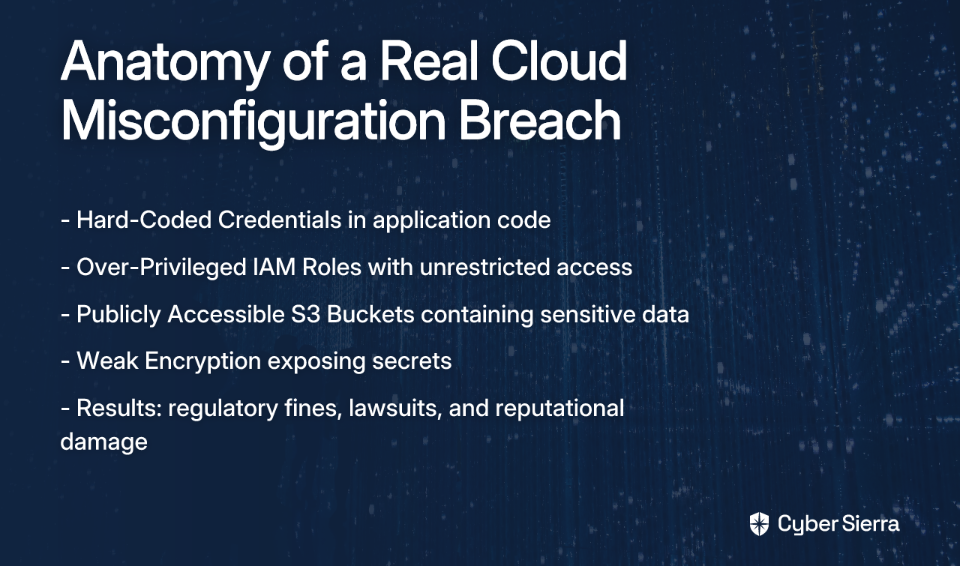
The breach investigation revealed multiple compounding issues:

  1. Hard-Coded Credentials: Plaintext AWS access keys were embedded directly in the company's spare-parts portal code.
  2. Over-Privileged IAM Roles: IAM roles were configured with unrestricted access to S3 buckets, violating the principle of least privilege.
  3. Publicly Accessible Buckets: Multiple S3 buckets containing customer databases, invoices with personal data (PAN numbers), and internal dashboards were left fully accessible to the public.
  4. Weak Encryption: Reversible encryption was used, which could easily expose secrets.

The consequences were severe: regulatory fines, class-action lawsuits, and immeasurable reputational damage. This case highlights a crucial lesson: cloud security maturity depends on strong governance and continuous monitoring, not just the volume of data stored.

The Top 5 Cloud Misconfigurations to Prioritize in 2025

1. Identity and Access Mismanagement (The Over-Privileged Insider Threat)

What it is: The proliferation of overly permissive roles, IAM role sprawl, and poor credential hygiene. This is consistently ranked as a top threat vector in cloud environments.

Why it matters: Creates clear paths for privilege escalation and lateral movement once an attacker gains an initial foothold.

How it happens: Consider an application role with ec2:* permissions when it only needs to read instance tags. This excessive permission could allow an attacker who compromises the application to launch, terminate, or modify instances throughout your environment.

How to fix it:

  • Enforce the principle of least privilege rigorously
  • Utilize resource-based conditions in IAM policies to narrow scope
  • Regularly audit and prune unused or excessive permissions
  • Implement just-in-time access for administrative functions

2. Insecure Data Storage (Public Buckets & Weak Encryption)

What it is: Misconfigured storage buckets (e.g., Amazon S3) left open to the public internet and a failure to enforce encryption. This directly addresses the user pain of "uncertainty... regarding encryption at rest."

Why it matters: Direct exposure of sensitive data (PII, PHI, intellectual property) can lead to massive data breaches and regulatory fines under GDPR, HIPAA, and other frameworks.

How it happens: In the automotive giant case, S3 buckets containing 70 TB of fleet tracking data were left accessible to anyone with an internet connection for months before discovery.

How to fix it:

  • Enable S3 Block Public Access on all accounts by default
  • Enforce Encryption: Mandate server-side encryption for all data at rest
  • Implement both Provider-Managed Keys (PMK) and Customer-Managed Keys (CMK) for enhanced control
  • Deploy S3 lifecycle policies to manage data retention and deletion

3. Unsecured Network Configurations & APIs

What it is: Overly permissive firewall rules (e.g., allowing all traffic from 0.0.0.0/0), exposed management ports (RDP, SSH), and insecure APIs lacking proper authentication or rate limiting.

Why it matters: Provides attackers with a direct, unguarded entry point into your cloud infrastructure.

How it happens: A developer temporarily opening port 22 to the internet on a production server for "easy access" and forgetting to close it. Or an API gateway deployed without proper authentication mechanisms, allowing unauthenticated requests.

How to fix it:

  • Implement micro-segmentation and Zero Trust network principles
  • Use bastion hosts or secure VPNs for all administrative access
  • Secure APIs with OAuth 2.0, API gateways, and strict rate limiting
  • Regularly scan for exposed ports and services using automated tools

4. The Expanding Attack Surface: Shadow IT & Ephemeral Resources

What it is: Employees using unauthorized cloud services (Shadow IT) and the rapid creation and destruction of ephemeral resources (containers, serverless functions) that evade traditional scanning tools.

Why it matters: Creates unmonitored blind spots in your security posture, leading to unpatched vulnerabilities and compliance gaps. This directly addresses the user pain of lacking "centralized visibility."

How it happens: A marketing team using an unvetted SaaS platform to process customer data, creating a third-party risk without oversight. Or developers deploying container workloads with vulnerable dependencies that escape periodic scanning due to their short lifespan.

How to fix it:

  • Deploy a Cloud Security Posture Management (CSPM) tool for continuous discovery and monitoring of all cloud assets
  • Establish clear governance policies for the procurement and use of new cloud services
  • Implement container scanning in your CI/CD pipeline to catch vulnerabilities before deployment
  • Use cloud service discovery tools to identify unauthorized resource usage

5. Third-Party & Supply Chain Misconfigurations

What it is: Risks inherited from third-party vendors, suppliers, and partners who have access to your cloud environment or data.

Why it matters: A vendor's weak security posture can directly lead to a breach of your systems. The attack surface extends beyond your direct control.

How it happens: A managed service provider with privileged access to your AWS account has one of their admin credentials compromised. Or a SaaS platform you integrate with has insufficient security controls, exposing your data through their vulnerability.

How to fix it:

  • Implement a robust Third-Party Risk Management (TPRM) program
  • Conduct thorough security due diligence during vendor selection
  • Mandate security certifications like SOC 2 Type II or ISO 27001
  • Continuously monitor vendor security posture, not just relying on point-in-time questionnaires

Shifting from Reactive to Proactive: A Modern Framework for Cloud Security

As cloud environments grow more complex, a reactive approach to security is no longer viable. Organizations must adopt a proactive framework built on three core pillars:

1. Embrace Continuous Monitoring and Visibility

Challenge: Manual checks and periodic scans are no longer sufficient. Security teams need a unified, real-time view to combat posture drift and address the pain of lacking "centralized visibility."

Solution: Adopt tools that provide continuous, automated monitoring of your entire cloud footprint.

This is where solutions for Continuous Control Monitoring (CCM) become critical. A platform like Cyber Sierra provides ongoing, near real-time visibility into your security controls, centralizes evidence, and detects misconfigurations as they happen, transforming security from a periodic chore into a continuous process.

With Cyber Sierra's CCM module, you can build a central controls repository with near real-time updates, gain clear visibility into your security posture, and receive actionable risk intelligence for data-driven remediation. This helps address the common pain point of "surfacing all the messed up security debt that's been accumulating."

2. Shift Left: Integrate Security into the DevOps Pipeline

Challenge: Fixing misconfigurations in production is 10x more expensive and slower than catching them pre-deployment.

Solution: Integrate security scanning directly into the CI/CD pipeline to catch issues before they reach production environments.

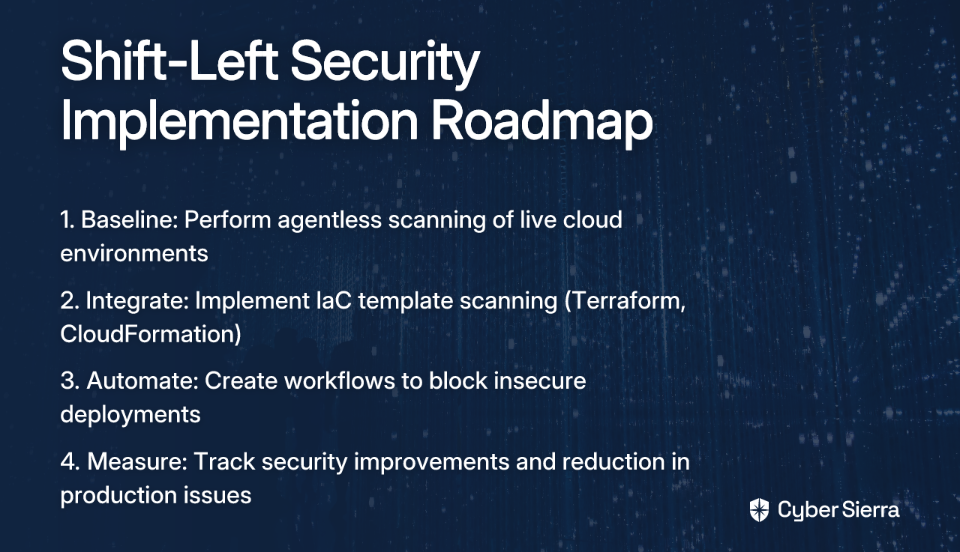
An actionable roadmap for implementation includes:

  1. Baseline: Start with agentless scanning of your live cloud environment to identify existing misconfigurations.
  2. Integrate: Implement scanning of Infrastructure as Code (IaC) templates (e.g., Terraform, CloudFormation) to find flaws before deployment.
  3. Automate: Create automated workflows to block insecure deployments or trigger remediation actions when policy violations are detected.

By shifting security left, you not only prevent misconfigurations from reaching production but also build security awareness into your development culture.

3. Automate Governance, Risk, and Compliance (GRC)

Challenge: The overwhelming burden of manual evidence collection, audit preparation, and managing multiple compliance frameworks (SOC 2, ISO 27001, GDPR, etc.).

Solution: Leverage automation to streamline GRC processes. According to Scytale.ai, automation can help businesses become "90% compliant more quickly."

To combat audit fatigue and simplify complex requirements, organizations are turning to GRC automation. Cyber Sierra's GRC platform automates data collection, control monitoring, and reporting across multiple frameworks. This not only makes you audit-ready faster but also provides a single source of truth for your compliance posture.

The platform helps manage multiple compliance frameworks simultaneously (SOC2, ISO 27001, HIPAA, PCI DSS), generates comprehensive reports, and maintains detailed audit trails—transforming what was once a quarterly scramble into a continuous, manageable process.

Conclusion: From Detection to Prevention

Cloud misconfigurations will continue to be a primary attack vector in 2025 and beyond. The top threats we've discussed—IAM mismanagement, insecure data storage, unsecured network configurations, shadow IT, and third-party risk—require a proactive, continuous approach to security.

The only effective defense is a strategy built on continuous visibility, integrated security (Shift Left), and intelligent automation. This approach addresses the core challenges expressed by security professionals: the struggle to keep up with evolving protocols, the lack of centralized visibility, and the burden of managing accumulating "security debt."

By implementing the recommended strategies and leveraging integrated platforms like Cyber Sierra, you can transform your cloud security from a reactive, compliance-driven exercise into a proactive, resilient security posture that stays ahead of threats.

Ready to move from periodic checks to continuous, automated security? Discover how Cybersierra's AI-enabled cybersecurity platform can help you proactively manage misconfigurations, streamline compliance, and build a resilient security posture for the future.

Frequently Asked Questions

What is a cloud misconfiguration?

A cloud misconfiguration is an error or gap in the security settings of a cloud asset that leaves it vulnerable to attack. These misconfigurations often result from human error, a lack of awareness of security policies, or the complexity of cloud environments. Common examples include leaving a storage bucket publicly accessible, assigning excessive permissions to a user, or failing to properly secure network ports.

What are the most common types of cloud misconfigurations?

The most common cloud misconfigurations involve identity and access mismanagement, insecure data storage, unsecured network settings, unmonitored "shadow IT" resources, and risks from third-party vendors. As highlighted in this article, these five areas represent the most critical vulnerabilities, creating significant entry points for attackers through issues like overly permissive IAM roles or publicly exposed S3 buckets.

Why is Identity and Access Management (IAM) so critical in cloud security?

IAM is critical because it controls who can access what resources and what they can do with them; misconfigured IAM provides a direct path for attackers to escalate privileges and move laterally across a cloud environment. Even with a small initial foothold, an attacker can exploit overly permissive roles to gain access to sensitive data, modify infrastructure, or disrupt services.

How can I prevent my cloud storage buckets from being public?

The most effective way to prevent public cloud storage buckets is to enable features like AWS's "Block Public Access" at the account level by default. This setting provides a centralized safeguard that overrides individual bucket policies. Additionally, you should mandate server-side encryption for all data at rest and use Cloud Security Posture Management (CSPM) tools to continuously scan for any publicly accessible storage.

What does it mean to "shift left" in cloud security?

"Shifting left" means integrating security practices early in the development lifecycle (i.e., further "left" in the DevOps pipeline) rather than applying them only to production environments. This involves scanning Infrastructure as Code (IaC) templates for flaws before infrastructure is deployed and building security checks into the CI/CD pipeline, which reduces risk and lowers the cost of remediation.

What is the first step to improve my organization's cloud security posture?

The first step is to gain complete and continuous visibility into your entire cloud environment. You cannot secure what you cannot see. Implementing a Cloud Security Posture Management (CSPM) or Continuous Control Monitoring (CCM) solution is foundational, as these tools discover all assets, identify misconfigurations, and provide the real-time, centralized view needed for any further security improvements.


blog-hero-background-image
Cyber Security

How to Train Non-Technical Teams on Cyber Governance

backdrop
Table of Contents

Join thousands of professionals and get the latest insight on Compliance & Cybersecurity.


With 60% of organizations experiencing at least one data breach last year, the question is no longer if a cyber incident will occur, but when. Many of these breaches don't originate from sophisticated hacks but from simple human error. Yet non-technical employees often feel disconnected from cybersecurity, struggling with a lack of awareness about data management and feeling overwhelmed by complex policies and risk assessments.

The hard truth is that cyber governance isn't solely an IT problem—it's a company-wide responsibility. When your non-technical teams aren't properly trained, they become your weakest link. But with the right approach, you can transform them from potential liabilities into your organization's "human firewall."

This article provides a practical framework for designing and implementing an effective cyber governance training program for all employees, regardless of their technical expertise.

Demystifying Cyber Governance: What It Is and Why Everyone is a Stakeholder

Before diving into training methodologies, let's break down what cyber governance actually means in simple, accessible terms.

Cyber governance is the comprehensive strategy and set of rules an organization uses to protect itself from cyber threats. According to the Cybersecurity and Infrastructure Security Agency (CISA), it includes accountability frameworks, defined risks related to business objectives, and mitigation plans.

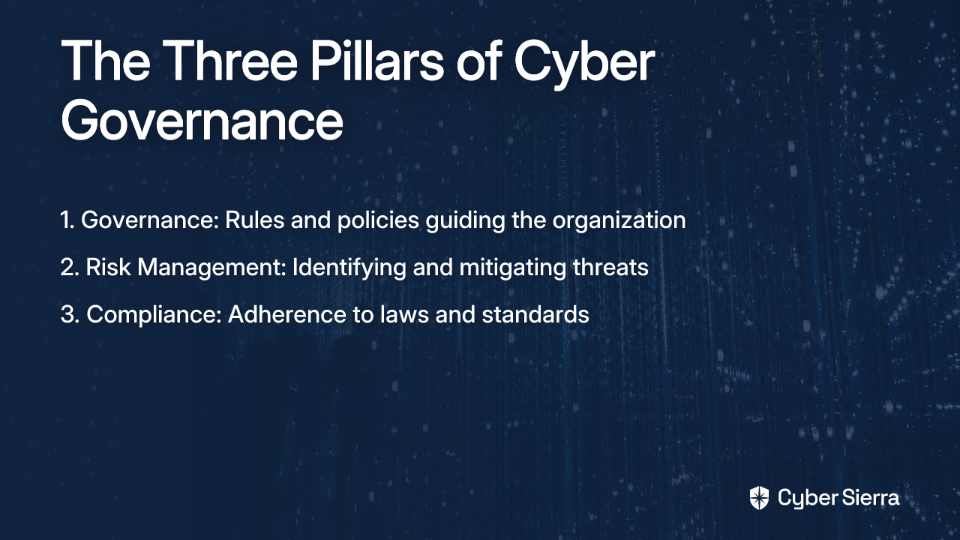
At its core, cyber governance revolves around three key pillars, often referred to as GRC:

  1. Governance: The rules and policies that guide the organization, clarifying roles and responsibilities
  2. Risk Management: The process of identifying, assessing, and mitigating threats
  3. Compliance: Adherence to laws and standards like GDPR, HIPAA, or ISO 27001

The critical mindset shift needed in your organization is understanding that cyber risk is business risk. As emphasized in the MIT Cybersecurity Leadership program for non-technical executives, cybersecurity isn't just a technical challenge—it's a strategic business imperative that requires engagement from all departments.

The Strategic Blueprint: Designing Your Training Program

Before launching into training modules, you need a strategic plan that addresses your organization's specific needs. Here's how to build it:

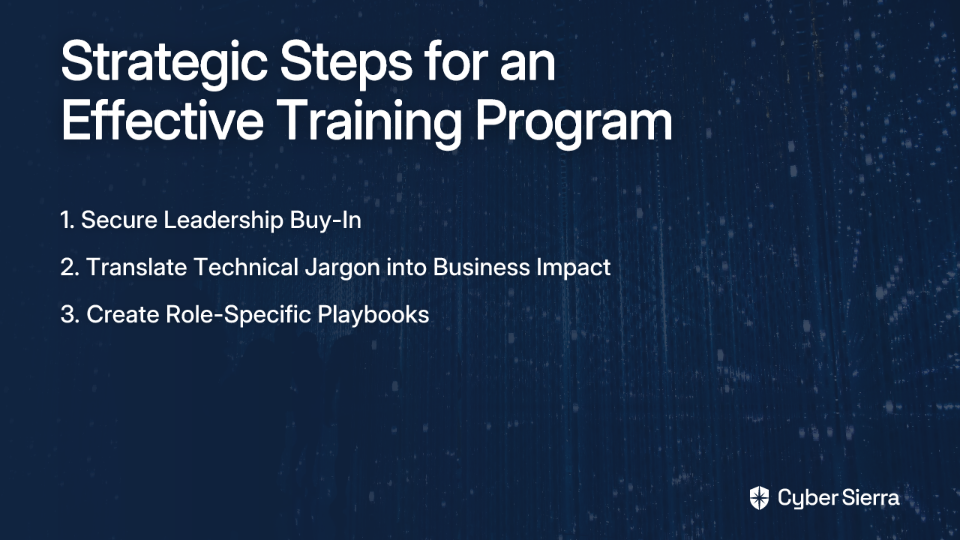
Step 1: Secure Leadership Buy-In

Cybersecurity culture must flow from the top down. When executives visibly prioritize security, employees follow suit. Make sure leadership:

  • Participates in and endorses training initiatives
  • Communicates the importance of security regularly
  • Allocates adequate resources to the training program

Step 2: Translate Technical Jargon into Business Impact

Non-technical teams don't need to understand the intricacies of SQL injection attacks. They need to understand why security matters in terms relevant to their roles.

Instead of saying: "We need to mitigate the risk of a SQL injection vulnerability."

Say: "We need to protect our customer database to prevent a data breach that could cost us millions in fines and destroy customer trust."

Step 3: Create Role-Specific "Playbooks"

Different departments interact with data and systems in unique ways, facing distinct security challenges. Develop tailored guidance for each team:

For Sales Teams:

  • How to safely handle customer data in the CRM
  • Recognizing phishing emails disguised as prospect inquiries
  • Securing devices and using safe Wi-Fi when traveling

For HR Teams:

  • Protecting employee personally identifiable information (PII)
  • Implementing secure onboarding and offboarding processes
  • Vetting third-party providers with access to employee data

For Finance Teams:

  • Identifying fraudulent wire transfer requests (Business Email Compromise)
  • Securing financial data according to relevant regulations
  • Following secure payment processing protocols

Core Curriculum: Essential Training Modules for Every Employee

No matter which department they work in, every employee needs foundational cyber governance knowledge. Here are the essential modules to include:

Module 1: The Threat Landscape (The 'Why')

Start by helping employees understand what they're up against:

  • Phishing & Social Engineering: Show real examples of sophisticated phishing attempts and explain how social engineers manipulate psychology to trick employees.
  • Ransomware: Explain how one wrong click can encrypt an entire organization's files, leading to operational shutdown and potential data loss.
  • Insider Threats: Cover both malicious actions and accidental mistakes from within the organization that can lead to breaches.

This module addresses the common pain point that many employees don't understand why security protocols exist, often finding them inconvenient without appreciating the risks they mitigate.

Module 2: Practical Skills and Best Practices (The 'How')

This is where you equip employees with actionable skills:

  • Data Handling: Establish simple rules for classifying and handling data (e.g., Confidential, Internal, Public). This directly addresses the lack of awareness about data management and flow, a common challenge identified in user research.
  • Password Security: Teach the importance of strong, unique passwords and Multi-Factor Authentication (MFA). Consider demonstrating how quickly simple passwords can be cracked.
  • Secure Remote Work: Cover best practices for home networks, VPN usage, and physical device security in various working environments.
  • Incident Reporting: Create a clear, blame-free process for reporting suspected security incidents immediately. Emphasize that speed of reporting is more important than certainty.

Module 3: Policies and Compliance (The 'Rules')

Finally, cover the formal policies that govern security behaviors:

  • Acceptable Use Policies: What employees can and cannot do with company systems and data.
  • Data Protection Requirements: Legal and organizational requirements for handling sensitive data.
  • Third-Party Risk Management: Guidelines for vetting vendors and sharing data with external parties.

The key is to translate these policies into easily digestible formats like one-page guides or FAQs rather than lengthy documents that never get read. This helps reduce the burden of documentation and record-keeping by ensuring everyone understands their part.

Making It Stick: Effective Training Methods That Drive Real Change

Now that you know what to teach, let's focus on how to deliver training effectively:

Move Beyond Annual Compliance Checkbox

Traditional annual security training has proven largely ineffective. A systematic review of 142 studies found that while most cybersecurity training shows favorable outcomes, continuous reinforcement is critical for lasting behavior change.

Instead, implement:

  • Micro-learning: Brief, focused sessions (5-10 minutes) delivered regularly throughout the year
  • Just-in-time training: Contextual security reminders delivered when employees are about to perform risky actions
  • Spaced repetition: Reinforcing key concepts at strategic intervals to improve retention

Use Engaging, Interactive Approaches

The same research found that game-based approaches are particularly popular and effective. Consider:

  • Simulated Phishing Campaigns: Send fake but realistic phishing emails to test awareness and provide immediate feedback when employees click.
  • Interactive Scenarios: Present employees with realistic security dilemmas and guide them through making the right decisions.
  • Gamification: Add elements like leaderboards, badges, and rewards to motivate participation and healthy competition.

Platforms like Cyber Sierra's Employee Security Training module can facilitate this approach by providing interactive quizzes, continuous learning updates, and running simulated counter-phishing campaigns that directly strengthen your human firewall.

Make Training Relevant Through Real Examples

Generic security training often fails because employees don't see how it applies to their day-to-day work. Personalize your training by:

  • Using examples specific to your industry and organization
  • Sharing anonymized stories of real incidents that affected your company or similar businesses
  • Allowing employees to practice security skills in a safe, simulated environment relevant to their roles

Measuring Success and Cultivating a Lasting Security Culture

How do you know if your training program is working? Here are key metrics to track:

  • Phishing Simulation Performance: Track click rates on simulated phishing emails over time, aiming for a consistent downward trend.
  • Incident Reporting: Monitor increases in security incident reporting (a positive indicator of awareness) and decreases in actual security incidents.
  • Knowledge Assessment Scores: Measure improvement in security knowledge through quizzes and assessments.
  • Behavioral Changes: Observe adoption of security best practices like MFA usage and proper data handling.

A dashboard overview of employees' security quotient, like that offered by Cyber Sierra, can help visualize these metrics and identify areas for improvement.

Fostering a Security-Conscious Culture

Beyond metrics, your ultimate goal is to create a culture where security becomes second nature:

  1. Create Security Champions: Identify and empower security-minded individuals in each department to serve as local resources and advocates.
  2. Recognize and Reward: Publicly acknowledge employees who demonstrate exemplary security behavior or report potential incidents.
  3. Foster Open Communication: Encourage questions and feedback about security policies and practices without judgment.
  4. Lead by Example: Ensure leadership consistently demonstrates commitment to security practices.

For organizations looking to mature their governance program beyond just training, a unified platform can help automate the entire GRC lifecycle. Cyber Sierra's GRC module helps streamline audits, manage policies, and provides Continuous Control Monitoring (CCM) to move away from periodic manual checks. This alleviates the pressure of large-scale assessments and the burden of documentation for compliance frameworks like SOC2 and ISO 27001.

Conclusion: From Liability to Asset

Training non-technical teams on cyber governance is not a cost center; it's a strategic investment in organizational resilience. By making training strategic, role-specific, continuous, and engaging, you transform your entire workforce from a potential security liability into your greatest security asset.

Remember these key principles:

  1. Cyber governance is everyone's responsibility, not just IT's
  2. Training must be relevant to each role and explained in business terms
  3. Effective training is continuous, engaging, and reinforced regularly
  4. Measuring outcomes helps refine your approach and demonstrate value
  5. The goal is a security-conscious culture, not just compliance

Ready to move beyond compliance checklists and build a truly resilient security culture? Start by assessing your current training approach against these principles, identifying gaps, and implementing a more strategic program. For organizations seeking to automate and simplify this process, consider how an AI-enabled platform like Cyber Sierra can help with everything from employee security training to automated GRC and continuous monitoring.

The cybersecurity landscape may be constantly evolving, but with proper training, your non-technical teams can become your strongest defense rather than your weakest link.

Frequently Asked Questions

What is cyber governance and why is it important for non-technical employees?

Cyber governance is the set of rules, policies, and processes an organization uses to manage and reduce cybersecurity risks. It's crucial for non-technical employees because human error is a leading cause of data breaches, and proper governance turns every employee into a part of the company's defense system. It involves understanding responsibilities, recognizing threats like phishing, and knowing how to handle data securely. When all employees, not just the IT department, understand their role, the company's "human firewall" becomes significantly stronger.

How can I make cybersecurity training engaging for employees who find it boring?

You can make cybersecurity training more engaging by using interactive and practical methods like simulated phishing campaigns, gamification, and role-playing. Instead of a single annual lecture, implement continuous micro-learning with short, regular sessions and use real-world examples relevant to employees' specific roles. This approach makes training feel less like a chore and more like practical skill-building.

What is the first step to creating a cyber governance training program?

The first and most critical step to creating a cyber governance training program is securing buy-in from senior leadership. A program without executive support will likely fail due to a lack of resources and perceived importance. Leadership must not only approve the budget but also actively champion the program by participating, communicating its value, and reinforcing that cybersecurity is a core business priority.

How do you measure the effectiveness of a cybersecurity training program?

The effectiveness of a cybersecurity training program is measured by tracking key performance indicators (KPIs) related to behavior and awareness. These include monitoring click-rates on simulated phishing emails, measuring the number of security incidents reported by employees, and using quizzes to assess knowledge retention. A successful program will show a consistent decrease in risky behaviors and an increase in proactive reporting of potential threats.

Why is role-specific training more effective than a one-size-fits-all approach?

Role-specific training is more effective because it provides relevant, actionable guidance that applies directly to an employee's daily tasks. A generic, one-size-fits-all approach is often ignored because employees don't see how it connects to their work. By tailoring content—for instance, teaching finance about wire transfer fraud and HR about protecting employee data—the lessons become practical and are more likely to be remembered and applied.

What is a "human firewall" in cybersecurity?

A "human firewall" is a term for an organization's employees who, through effective training, serve as the first line of defense against cyberattacks. They are conditioned to recognize, question, and report potential security risks like phishing emails or suspicious requests. Unlike a technical firewall that blocks malicious software, a human firewall prevents breaches that exploit human error, turning the workforce from a potential liability into a powerful security asset.

blog-hero-background-image
Cyber Security

Top Privacy Compliance Automation Platforms for Enterprises in 2025

backdrop
Table of Contents

Join thousands of professionals and get the latest insight on Compliance & Cybersecurity.


The constant barrage of privacy regulations has created an exhausting reality for compliance teams. As you prepare for yet another audit, you're likely facing the all-too-familiar dread of tedious evidence gathering, endless documentation, and the stress of meeting ever-changing requirements—all while trying to run your business with a lean team.

"The most painful part of an audit is typically evidence gathering," notes one frustrated compliance professional on Reddit. "You end up on long calls with engineers who may or may not speak GRC and hope they remember where to find a config and take a screenshot with a timestamp. It's painful and sucks up a lot of time."

If this resonates, you're not alone—and the landscape is only becoming more complex as we move through 2025.

The Evolving Privacy Landscape: Why Automation is No Longer Optional

The privacy landscape has fundamentally transformed this year, increasing both the stakes and complexity for enterprises:

  • Stricter AI Controls: The EU's comprehensive AI regulations have set a global precedent, requiring enterprises to implement robust privacy measures for AI systems.
  • Expanding US State Laws: New comprehensive privacy laws in states like New Hampshire and New Jersey have taken effect, adding to the already complex patchwork of state-level regulations.
  • The End of Third-Party Cookies: Google's phase-out of third-party cookies in Chrome has fundamentally altered how businesses track users and manage consent.
  • Mandatory Google Consent Mode: Websites using Google Ads in Europe must now integrate with certified consent management platforms (CMPs).

These shifts have created a perfect storm where manual compliance is not just inefficient—it's practically impossible at enterprise scale.

Why Manual Compliance is No Longer Viable for Enterprises

The numbers tell a compelling story about the necessity of automation:

  • According to OneTrust research, over 60% of organizations struggle with managing and demonstrating accountability for data processing activities due to regulatory complexity.
  • Manual processes leave organizations vulnerable to human error, with studies showing that manual compliance tasks have error rates as high as 40%.
  • The average enterprise must comply with 13+ privacy regulations simultaneously, each with its own nuanced requirements.

Beyond the risks, there's a clear business case for automation:

  • Massive Productivity Gains: Enhance productivity by up to 75% through AI-driven automation of repetitive tasks.
  • Significant Risk Reduction: Reduce regulatory risk by up to 75% by operationalizing privacy use cases in a single platform.
  • Drastic Cost Savings: Cut down on redundant compliance actions by up to 30% by identifying shared requirements across multiple frameworks, as reported by TrustArc.

As one Reddit user aptly put it: "While tools may not shorten audit periods, they significantly reduce the workload." This reduction is critical as compliance teams are increasingly asked to do more with less.

Essential Features of a Top-Tier Privacy Automation Platform

Before diving into specific platforms, let's establish what enterprises should look for in a privacy compliance automation solution in 2025:

1. Comprehensive Framework Support

The ideal platform should support multiple global regulations from a single interface. TrustArc's PrivacyCentral, for example, maps over 20,000+ pre-defined controls across 125+ privacy and security laws, ensuring comprehensive coverage across jurisdictions.

2. Automated Data Discovery & Mapping

Look for platforms that can automatically discover, classify, and maintain records of processing activities (ROPAs). This capability addresses one of the most labor-intensive aspects of compliance: building and maintaining an accurate data map.

3. DSAR Fulfillment Automation

A core privacy function, the platform should automate the entire lifecycle of Data Subject Access Requests—from intake via web forms to data discovery and fulfillment. OneTrust's DSAR Automation solution exemplifies this capability.

4. Continuous Control Monitoring (CCM)

This represents the shift from point-in-time snapshots to near real-time visibility. A robust CCM provides automated evidence collection from your tech stack (e.g., AWS, Azure, Google Cloud) to prove controls are working continuously—directly addressing the pain of manual evidence gathering.

5. Third-Party Risk Management (TPRM)

With vendor-related privacy breaches on the rise, look for features like automated vendor assessments, centralized vendor inventories, and continuous monitoring of third-party security posture.

6. Intuitive UI and Strong Support

Many users report frustration with platforms that have a "steep learning curve," "poor UI," and "difficult onboarding" processes. The right solution should be intuitive and backed by responsive support teams.

Top Privacy Compliance Automation Platforms in 2025

OneTrust

Overview: A market leader known for its comprehensive suite of privacy, security, and ethics tools. OneTrust is an official Europrivacy technology partner with extensive integration capabilities.

Key Strengths:

  • Regulatory Intelligence: Backed by insights from 2,000 trusted experts and the DataGuidance research portal with input from 1,700 legal experts across 300 jurisdictions.
  • End-to-End Automation: Covers everything from readiness assessments and PIAs to data mapping, consent management, and DSAR automation.
  • Vendor Risk Management: Streamlines vendor onboarding and risk assessment with AI-powered assessments and continuous monitoring.

Best For: Large enterprises with significant budgets that require a feature-rich, all-encompassing solution and extensive support.

Potential Drawbacks: Can be high-cost and have a difficult onboarding process, as noted in user reviews.

TrustArc (PrivacyCentral)

Overview: A platform focused on automating privacy compliance and data governance to accelerate time-to-compliance.

Key Strengths:

  • Extensive Control Library: Provides over 20,000+ pre-defined controls mapped across 125+ laws and standards, continuously maintained by privacy experts.
  • Efficiency-Driven: Identifies shared requirements across frameworks to cut down on up to 30% of redundant work.
  • AI-Powered: Uses AI for monitoring regulatory changes, auto-filling responses, and analyzing evidence to close compliance gaps.

Best For: Organizations managing multiple compliance frameworks that need to quickly identify gaps and prioritize tasks efficiently.

DataGrail

Overview: A modern platform designed for advanced users, focusing on deep integrations to streamline compliance.

Key Strengths:

  • Deep Integrations: Connects with over 1,900 enterprise applications (e.g., Salesforce, Marketo, Slack) to automate data mapping and DSARs.
  • Strong Support: Known for comprehensive training and strong customer support.

Best For: Tech-forward companies with a complex and sprawling application ecosystem.

Potential Drawbacks: High cost and long onboarding times.

BigID

Overview: A platform specializing in data intelligence and discovery.

Key Strengths:

  • Data-Centric Security: Excels at discovering, classifying, and managing sensitive and personal data across the entire data landscape (cloud, on-prem, SaaS).
  • Enterprise-Grade Toolsets: Offers powerful features for privacy impact assessments and data governance.

Best For: Data-heavy enterprises whose primary challenge is understanding and controlling their vast and complex data stores.

Potential Drawbacks: User feedback points to issues with usability and high management effort.

Beyond Silos: The Power of an Integrated GRC & Security Platform

While the above platforms offer robust privacy compliance capabilities, there's a growing recognition that privacy doesn't exist in isolation. According to one Reddit user, "a poorly defined process can make any GRC tool ineffective." This insight highlights the need for platforms that support holistic processes, not just discrete tasks.

Cyber Sierra: A Unified Approach to Compliance and Security

Cyber Sierra represents the next evolution in privacy compliance automation by offering an AI-enabled platform that provides a unified view of an enterprise's entire GRC and security landscape. This integration is particularly valuable for enterprises managing multiple compliance frameworks simultaneously.

The platform's key modules work together to create a robust and automated compliance program:

  • Governance, Risk & Compliance (GRC): Automates data collection, risk assessments, and reporting for frameworks like SOC2, ISO 27001, GDPR, and HIPAA. This directly addresses the need for audit readiness and reduces "compliance fatigue" that many organizations experience.
  • Continuous Control Monitoring (CCM): This core engine automates evidence collection, offering "ongoing visibility into security controls" and "centralizing control repositories with near real-time updates," directly solving the most cited user pain point of tedious evidence gathering.
  • Third-Party Risk Management (TPRM): Manages the entire vendor lifecycle with "automated assessments and risk management processes," providing "near real-time, 24/7 visibility into vendor security compliance."

What sets Cyber Sierra apart is its transformation of security from periodic, manual checks to proactive, near real-time risk management, providing a single source of truth for compliance and security posture.

Making the Right Choice for Your Enterprise

As you evaluate privacy compliance automation platforms for your enterprise in 2025, consider these key factors:

  1. Integration Capabilities: How well does the platform integrate with your existing tech stack and workflows?
  2. Scalability: Will the solution grow with your organization and adapt to new regulations?
  3. Support Quality: Is the vendor known for responsive support and comprehensive training?
  4. Total Cost of Ownership: Consider not just license fees but implementation costs and ongoing maintenance.

The landscape of privacy compliance is only becoming more complex, but with the right automation platform, enterprises can turn compliance from a burden into a strategic advantage. The future belongs to organizations that adopt integrated approaches—combining privacy, GRC, and security—to navigate the regulatory challenges of 2025 and beyond.

Remember: The best platform isn't necessarily the one with the most features, but the one that best addresses your specific compliance challenges while integrating seamlessly into your enterprise architecture.

Frequently Asked Questions

What is privacy compliance automation?

Privacy compliance automation refers to using software platforms to manage, streamline, and track the tasks required to adhere to data privacy regulations like GDPR, CCPA, and others. These platforms replace manual, error-prone processes with automated workflows for tasks such as data discovery, managing Data Subject Access Requests (DSARs), evidence collection for audits, and continuous monitoring of controls.

Why is manual compliance no longer sufficient for enterprises?

Manual compliance is no longer sufficient for enterprises due to the increasing complexity of global regulations, the high risk of human error, and the sheer volume of data involved. As mentioned in the article, enterprises often need to comply with over 13 regulations simultaneously. Manual processes are slow, difficult to scale, and can have error rates as high as 40%, making it nearly impossible to keep up with new laws and prove continuous compliance.

How does a privacy automation platform help with DSARs?

A privacy automation platform significantly helps with Data Subject Access Requests (DSARs) by automating the entire lifecycle. It provides a centralized system to receive requests (e.g., via a web form), automatically discovers and collects the requestor's personal data from integrated systems (like Salesforce or Marketo), and helps compile the information for secure delivery, reducing manual effort and ensuring timely fulfillment.

What is the difference between a privacy automation tool and an integrated GRC platform?

A specialized privacy automation tool focuses specifically on privacy-related tasks like consent management and DSARs. In contrast, an integrated Governance, Risk, and Compliance (GRC) platform, like Cyber Sierra, provides a holistic view by combining privacy with broader security and risk management. This unified approach prevents silos, reduces redundant work across frameworks (e.g., SOC2, ISO 27001, GDPR), and creates a single source of truth for an organization's entire compliance posture.

What are the most critical features to look for in a privacy automation platform?

The most critical features to look for in a privacy automation platform are comprehensive framework support to manage multiple regulations, automated data discovery and mapping to maintain an accurate record of processing activities, DSAR fulfillment automation, and Continuous Control Monitoring (CCM) for near real-time evidence collection. Strong third-party risk management is also essential to manage vendor-related privacy risks.

How can enterprises get started with privacy compliance automation?

Enterprises can get started with privacy compliance automation by first assessing their current compliance processes to identify the most significant pain points and risks, such as DSAR fulfillment or audit evidence gathering. From there, they should evaluate platforms based on their ability to integrate with the existing tech stack, scalability for future regulations, and the quality of vendor support. Starting with a pilot program focused on a high-priority area can demonstrate value and ensure a smoother enterprise-wide rollout.

blog-hero-background-image
Cyber Security

How to Prepare for EU NIS 2 Compliance in 2026

backdrop
Table of Contents

Join thousands of professionals and get the latest insight on Compliance & Cybersecurity.


You've heard about the EU's NIS 2 Directive, and it's probably giving you anxiety. Maybe you're a startup founder thinking, "Is this another compliance headache we need to deal with?" Or perhaps you're a security professional trying to convince your executives that this isn't just another checkbox exercise they can ignore.

"NIS2 compliance is definitely overwhelming for small startups, and most underestimate the complexity until it's too late."

"NIS2 is a bit of a mess right now since not everyone's on the same page and the communication around it hasn't been super clear either."

You're not alone in feeling this way. Many organizations are struggling to make sense of NIS 2, and some are learning the hard way—"we lost two deals before getting our shit together on this."

While 2026 might seem far away, the reality is much more urgent. EU Member States have until 17 October 2024 to transpose the directive into national law, and enforcement will begin shortly after. The time to prepare is now.

This guide will demystify NIS 2 compliance, help you determine if you're in scope, and provide a practical roadmap to prepare your organization for the new requirements.

What is the NIS 2 Directive & Am I in Scope?

The NIS 2 Directive (Network and Information Systems Directive 2) is the EU's answer to the growing cybersecurity threats facing critical infrastructure and digital services. It establishes a unified legal framework to enhance cybersecurity resilience across 18 critical sectors in the EU.

Expanded Scope

NIS 2 significantly expands the sectors covered beyond traditional critical infrastructure. The directive now includes:

  • Energy
  • Transport
  • Healthcare
  • Finance
  • Water management
  • Digital infrastructure
  • Public electronic communications
  • Social platforms
  • Waste and wastewater management
  • Critical product manufacturing (e.g., medical devices, computer products)
  • Postal and courier services
  • Public administration
  • Space sector

"Essential Entities" vs. "Important Entities"

NIS 2 categorizes organizations into two groups:

  1. Essential Entities: Organizations in highly critical sectors
  2. Important Entities: Organizations in less critical but still significant sectors

The main differences between these categories lie in the supervisory measures and penalty regimes they face (more on penalties later).

Determining If You're in Scope

The general rule is that NIS 2 primarily applies to medium and large entities—typically companies with 50+ employees and over €10 million in annual revenue.

Crucial Caveat: Some entities are in scope regardless of size if they are considered critical (e.g., sole providers in a member state or providers to critical infrastructure).

Recommendation: "You might need legal guidance even if it's just a consultation to understand if you're actually in scope." This is a critical step to avoid misinterpretation.

The Four Pillars of NIS 2 Compliance

To comply with NIS 2, organizations must address four core areas of cybersecurity:

Pillar 1: Proactive Risk Management & Security Measures

NIS 2 requires organizations to implement a baseline of security measures. As one security professional put it, this is about codifying existing best practices from frameworks like ISO 27001.

Required measures include:

  • Policies on risk analysis and information system security
  • Implementation of multi-factor authentication (MFA) and strong access controls
  • Regular data backups and robust encryption
  • Cybersecurity training for all staff
  • Secure procurement practices and development lifecycles

Pillar 2: Securing the Supply Chain

NIS 2 extends responsibility to your entire supply chain. Organizations are responsible for the cybersecurity posture of their direct suppliers.

Required actions:

  • Assess and manage cybersecurity risks associated with suppliers
  • Incorporate security requirements into contractual agreements
  • Regularly audit and verify vendor compliance

Pillar 3: Strict Incident Reporting Obligations

NIS 2 introduces a multi-stage reporting process for significant incidents:

  1. 24-Hour Early Warning: An initial report must be submitted to the national Computer Security Incident Response Team (CSIRT) within 24 hours of becoming aware of an incident.
  2. 72-Hour Detailed Notification: A more comprehensive incident notification must follow within 72 hours.
  3. Final Report within One Month: A final report detailing the incident's impact and remediation efforts is due within one month. source

As one security professional noted, "Your incident response doesn't need to be some fancy 50-page document, just needs to exist and you should test it at least once." The key is having a clear, tested plan.

Pillar 4: C-Level Accountability & Governance

This is perhaps the most significant change—NIS 2 places direct responsibility and liability on senior management. They must oversee, approve, and be trained on cybersecurity risk management measures.

The stakes are high. As one practitioner bluntly put it: "Brushing this off is not an option. If we remain non-compliant, you could go to prison." And another added, "Making jail a genuine possibility, not just fines, is the wake-up call many leaders need."

This accountability helps address the common problem of executives who think compliance is just an IT checklist they can ignore.

A Practical 7-Step Roadmap to NIS 2 Compliance

Here's a clear, actionable plan to prepare for NIS 2 compliance:

Step 1: Confirm Applicability and Scope

First, definitively determine if you are an "Essential" or "Important" entity. Consider both your organization's size and the criticality of the services you provide. Remember that even smaller organizations can be in scope if they provide critical services or are in the supply chain of critical entities.

Step 2: Secure Executive Buy-In

Use the arguments from Pillar 4 to secure executive support. Frame compliance as a strategic necessity to:

  • Avoid personal liability for executives
  • Prevent severe financial penalties
  • Win and retain enterprise deals

Step 3: Conduct a Gap Analysis against a Known Framework

Assess your current security posture against NIS 2 requirements. A practical tip from the security community: "Start with iso 27001 lite basically. covers 80% of nis2 requirements." Aligning with ISO 27001 or the NIST CSF provides a structured path forward.

Step 4: Establish a Formal Risk Management Program

Move beyond ad-hoc security. Create a central risk register to identify, analyze, and prioritize cybersecurity risks. This is the foundation of a mature security program.

Step 5: Map and Secure Your Supply Chain

Create an inventory of critical third-party vendors and suppliers. Assess their security practices and build security requirements into your procurement process.

Managing this manually with spreadsheets and questionnaires is inefficient and provides only a point-in-time view. Platforms like Cyber Sierra's Third-Party Risk Management (TPRM) can automate vendor assessments, provide near real-time visibility into vendor security, and streamline the entire due diligence process.

Step 6: Develop and Test Your Incident Response Plan

Document clear procedures for identifying, containing, and reporting incidents according to the strict NIS 2 timelines. Conduct tabletop exercises or drills to ensure your team knows what to do "when shit hits the fan."

Step 7: Implement Continuous Monitoring and Automate Evidence Collection

Compliance is not a one-off project. Regulators will require proof that your controls are working continuously.

The challenge of manual evidence collection for audits can be overwhelming. Platforms like Cyber Sierra's Governance, Risk & Compliance (GRC) and Continuous Control Monitoring (CCM) modules can solve this pain by automating data collection from your tech stack, maintaining a central repository of controls and evidence, and providing real-time dashboards on your compliance posture.

The High Stakes: Understanding the Consequences of Non-Compliance

The penalties for non-compliance with NIS 2 are severe and designed to ensure organizations take cybersecurity seriously:

Heavy Financial Penalties:

  • Essential Entities: Fines up to €10 million or 2% of the entity's total worldwide annual turnover, whichever is higher.
  • Important Entities: Fines up to €7 million or 1.4% of the entity's total worldwide annual turnover, whichever is higher. source

Personal Liability for Management:

  • Senior executives can be held personally liable.
  • National authorities have the power to temporarily ban non-compliant managers from discharging managerial functions.

Reputational Damage and Business Impact:

  • Beyond fines, non-compliance can lead to loss of customer trust and significant competitive disadvantage.

Conclusion: Turn Compliance into a Competitive Advantage

NIS 2 compliance may seem daunting, but it's an achievable goal with a structured, proactive approach. It's about building a foundation of cyber resilience.

Frame compliance not as a cost center but as a strategic investment. Good security is good business. As one user noted, "Most of this stuff you should be doing anyway for customer trust."

Don't wait for national laws to be finalized. Start the journey now by assessing your scope and conducting a gap analysis. An integrated platform like Cyber Sierra can simplify and accelerate the entire compliance lifecycle—from GRC and TPRM to Continuous Monitoring and Employee Training—providing a unified view of your security posture.

By taking a proactive approach to NIS 2, you're not just avoiding penalties—you're building a more resilient organization that customers and partners can trust.

Frequently Asked Questions (FAQ)

What is the NIS 2 Directive?

The NIS 2 Directive is a European Union-wide law designed to strengthen cybersecurity resilience for critical infrastructure and digital services across 18 key sectors. It expands on the original NIS directive, introducing stricter security requirements, a broader scope of affected entities, tougher enforcement, and direct accountability for senior management. Its primary goal is to create a unified and high level of cybersecurity across all EU member states.

How do I know if my company is affected by NIS 2?

Your company is likely affected by NIS 2 if it operates in one of the 18 critical sectors within the EU and has more than 50 employees and over €10 million in annual revenue. However, some smaller entities can still be in scope if they are considered critical, such as being the sole provider of a service in a member state. The directive categorizes organizations as either "Essential" or "Important," which affects the level of supervision and potential penalties. It's highly recommended to seek legal consultation to confirm your specific status.

What are the main requirements of NIS 2?

The main requirements of NIS 2 focus on four key areas: proactive risk management, securing the supply chain, strict incident reporting, and C-level accountability. This means organizations must implement baseline security measures like multi-factor authentication and staff training, manage the cybersecurity risks of their suppliers, report significant incidents within 24-72 hours, and ensure senior management directly oversees and approves the cybersecurity strategy.

What is the deadline for NIS 2 compliance?

EU Member States must implement the NIS 2 Directive into their national laws by 17 October 2024, with enforcement beginning shortly after. While the final date for organizations to be fully compliant will depend on national legislation, preparation should begin immediately. Achieving compliance is a significant undertaking that requires time for gap analysis, policy creation, and technical implementation.

What are the penalties for not complying with NIS 2?

Penalties for non-compliance with NIS 2 include severe financial fines, personal liability for management, and potential business disruption. For "Essential Entities," fines can be up to €10 million or 2% of global annual turnover, whichever is higher. For "Important Entities," it's up to €7 million or 1.4% of turnover. Critically, senior executives can be held personally liable and may even be temporarily banned from their managerial roles for failing to comply.

How is NIS 2 different from GDPR?

NIS 2 focuses on the security and resilience of network and information systems for critical sectors, while GDPR focuses on the protection of personal data across all sectors. While there is some overlap—a security incident under NIS 2 could also be a personal data breach under GDPR—their core objectives are distinct. NIS 2 aims to ensure the continuity of essential services, whereas GDPR aims to protect the privacy rights of individuals. Organizations may need to comply with both.

blog-hero-background-image
Cyber Security

How to Stay Ahead of Global Data Protection Laws in 2026

backdrop
Table of Contents

Join thousands of professionals and get the latest insight on Compliance & Cybersecurity.


You've just received an urgent email. A key client is threatening to terminate their contract unless you can prove compliance with the latest data protection standards—standards that didn't even exist six months ago. Your team is already stretched thin managing compliance with three different regional privacy frameworks, and now this.

Sound familiar?

For CISOs, Compliance Managers, and Data Protection Officers worldwide, this scenario is becoming alarmingly common. The global data privacy landscape isn't just evolving—it's rapidly multiplying in complexity.

The Unrelenting Pace of Global Data Privacy

Since the EU's GDPR set the standard in 2018, we've witnessed an unprecedented wave of data protection legislation worldwide. India's Digital Personal Data Protection (DPDP) Act, China's Personal Information Protection Law (PIPL), and California's continuously evolving Consumer Privacy Act (CCPA/CPRA) represent just the tip of the regulatory iceberg.

The scale is staggering: DLA Piper's data protection handbook now covers over 160 jurisdictions, each with its own nuances and requirements. For organizations operating across borders, this creates a compliance nightmare that can't be solved through traditional, manual approaches.

"Cybersecurity and risk management teams are often under-resourced and struggle with compliance," notes a security professional in a recent forum discussion. This sentiment echoes across industries, where teams feel overwhelmed by the sheer volume of regulatory requirements.

But here's the good news: staying ahead in 2026 isn't about memorizing every article of every law. It's about building a proactive, resilient, and technology-enabled compliance framework that can adapt to whatever regulations come next.

The Shifting Landscape: Key Trends Shaping Data Protection in 2026

Before diving into solutions, let's examine the major forces reshaping data protection requirements that compliance leaders must prepare for:

Trend 1: The Convergence of AI and Privacy Regulation

The EU AI Act represents just the beginning of a new frontier in compliance. Organizations deploying AI systems will need to demonstrate not just data protection, but also fairness, transparency, and robustness in their automated systems.

For Data Protection Officers like Anjali Kumar, this means extending privacy impact assessments to include AI ethics considerations and establishing clear governance around algorithmic decision-making.

Trend 2: Stricter Enforcement and Sky-High Penalties

Regulators are moving beyond warnings to imposing penalties that can't be ignored. The GDPR benchmark of fines up to 4% of global annual revenue is increasingly becoming the norm rather than the exception across jurisdictions.

For CFOs and board members, this transforms data privacy from a compliance issue to a significant financial risk requiring executive attention and investment.

Trend 3: Expanded Consumer Rights as a Global Standard

Rights like data portability, the right to be forgotten, and opting out of data collection are no longer just an "EU thing." The California Privacy Rights Act (CPRA) has enhanced these consumer rights, creating a de facto global standard that organizations must prepare for.

This means businesses must have robust processes to handle data subject access requests (DSARs) efficiently and at scale—a process that becomes exponentially more complex across multiple jurisdictions.

Trend 4: The Harmonization vs. Fragmentation Paradox

While core privacy principles are converging globally, local variations continue to increase. DLA Piper's "Data Protection Heatmap" helps visualize how different regions have "Heavy," "Robust," or "Moderate" regulations, creating a complex compliance map that changes constantly.

Building a Resilient Framework: From Strategy to Action

Given these trends, how can organizations build compliance programs that remain effective despite regulatory shifts? Based on recommendations from the International Association of Privacy Professionals (IAPP), here's a strategic framework tailored for security and compliance leaders:

Step 1: Adopt a Risk-Based Approach

Instead of trying to be 100% compliant everywhere simultaneously (an impossible task), prioritize your efforts based on risk:

"Implement a risk-based approach considering the sensitivity and location of data, the impact on data subjects, and regulatory scrutiny," advises the IAPP.

This approach is particularly valuable for under-resourced IT Managers like Michael Rodriguez, who need to focus limited resources on what truly matters first.

Step 2: Unify Your Controls, Map to Local Laws

Rather than creating entirely new processes for every regulation, establish a central, overarching control framework (e.g., NIST CSF, ISO 27001) and map specific requirements back to it:

  1. Identify common requirements across regulations (e.g., breach notification, consent management)
  2. Implement controls that satisfy the strictest version of each requirement
  3. Map how each control satisfies specific articles of various laws

This approach prevents "legal silos" and creates tremendous operational efficiency when new regulations emerge.

Step 3: Audit Audaciously and Continuously

The traditional approach of waiting for the annual audit is increasingly ineffective in a rapidly evolving regulatory environment. As the IAPP recommends, organizations must "conduct regular audits to identify potential noncompliance areas" proactively.

This shift from periodic to continuous auditing is where technology becomes essential.

The Technology Imperative: Automating for Agility and Assurance

While strategy is crucial, technology becomes the enabler that makes compliance manageable at scale. Two technological approaches stand out for organizations preparing for the 2026 data protection landscape:

Embrace Continuous Control Monitoring (CCM)

Continuous Control Monitoring represents a fundamental shift from point-in-time assessments to real-time compliance visibility.

As defined by compliance experts, "CCM is a proactive approach to compliance and risk management that allows organizations to identify, assess, and remediate control failures in real-time" (Qmulos).

This approach addresses the pain felt by many security professionals who spend hours manually pulling logs and screenshots to prove controls are working—only to have those proofs become outdated almost immediately.

Key Benefits of CCM for Data Protection:

  • Real-time Risk Management: Instantly flag irregularities like unauthorized access to sensitive data or configuration changes that could impact compliance
  • Audit Readiness: Provide auditors with reliable, continuous evidence streams rather than scrambling to gather documentation during audit periods
  • Operational Efficiency: Automate repetitive evidence collection, freeing up teams to focus on actual risk reduction

Platforms like Cyber Sierra's CCM solution are designed specifically to solve this challenge. By creating a central controls repository with near real-time updates and providing actionable risk intelligence, CCM gives CISOs the unified compliance view they need for board presentations and compliance managers the evidence they need for auditors—without the manual effort.

Modernize Third-Party Risk Management (TPRM)

A vendor data breach exposing sensitive customer information is every CISO's nightmare scenario. Traditional approaches to vendor risk management—sending lengthy questionnaires and reviewing point-in-time documentation—are insufficient in today's interconnected data ecosystem.

For Third-Party Risk Managers like Ben Carter, who described chasing vendors for "200-question security questionnaires" only to receive slow, vague responses, a modernized approach is crucial.

Key Elements of Modern TPRM:

  • Automated vendor assessments that adjust questionnaire depth based on data sensitivity and access
  • Continuous monitoring of vendor security postures rather than annual reassessments
  • Integration of Data Protection Impact Assessments (DPIAs) and Data Processing Addendums (DPAs) directly into the vendor lifecycle

An integrated Third-Party Risk Management platform helps organizations move beyond static spreadsheets to proactively manage supply chain risk, ensuring vendors with access to your data maintain appropriate controls regardless of which regulations apply in their jurisdictions.

Practical Implementation Guide for 2026 Readiness

To move from theory to practice, here's a step-by-step roadmap for implementing these strategies in your organization:

1. Conduct a Data Protection Maturity Assessment

Before implementing new technologies or processes, assess your current state:

  • Map your organization's data flows across jurisdictions
  • Inventory existing controls and their effectiveness
  • Identify gaps between current capabilities and emerging regulatory requirements
  • Quantify compliance costs, including manual effort and opportunity costs

This baseline helps prioritize investments and measure improvement over time.

2. Implement a Unified Data Governance Framework

Create a single source of truth for data protection policies and controls:

  • Consolidate privacy policies into a centralized, easily accessible repository
  • Define clear roles and responsibilities for data protection (beyond just the DPO)
  • Establish data classification standards that align with regulatory categories
  • Implement consistent data handling procedures across departments

A unified framework reduces duplication of effort when addressing multiple regulations.

3. Leverage Automation Strategically

Not everything can or should be automated, but certain high-volume, repetitive compliance tasks are prime candidates:

  • Control testing and evidence collection for common requirements
  • Data subject access request (DSAR) processing
  • Vendor risk assessments and ongoing monitoring
  • Compliance reporting across multiple frameworks

For CISOs and Compliance Managers struggling with limited resources, automating these processes through an integrated Governance, Risk & Compliance (GRC) platform can transform compliance from a constant struggle to a strategic advantage.

4. Build Cross-Functional Data Protection Teams

Privacy is no longer just Legal's problem, and security is no longer just IT's domain. Create cross-functional teams that include:

  • Legal and compliance
  • Security and IT
  • Data governance specialists
  • Business unit representatives
  • HR and training

This collaborative approach ensures that data protection considerations are built into processes from the beginning, rather than added as an afterthought.

5. Develop a Regulatory Change Management Process

With the pace of regulatory change accelerating, establish a dedicated process for:

  • Monitoring emerging regulations in relevant jurisdictions
  • Assessing their impact on your organization
  • Mapping new requirements to existing controls
  • Implementing and testing any necessary adjustments

This systematic approach prevents the reactive scrambling that often occurs when new regulations are announced.

Looking Ahead: Building Your Future-Proof Privacy Program

The global data protection landscape will continue to evolve, with AI regulation, stricter enforcement, and expanded consumer rights on the horizon. Organizations that thrive in this environment will be those that move beyond checkbox compliance to build adaptive, technology-enabled data protection programs.

A proactive, risk-based strategy—supported by Continuous Control Monitoring and modern Third-Party Risk Management—is no longer a luxury but a necessity for both compliance efficiency and operational resilience.

Don't wait for 2026 to arrive. Begin now by assessing your current compliance processes. Identify your biggest manual bottlenecks—whether it's audit evidence collection, vendor assessments, or tracking controls across frameworks—and explore how automation can help you reduce compliance fatigue while strengthening your data protection posture.

The organizations that stay ahead of global data protection laws won't be those with the largest compliance teams, but those that most effectively leverage technology to transform compliance from a burden into a competitive advantage.

Frequently Asked Questions (FAQ)

What is the biggest challenge in global data privacy compliance today?

The biggest challenge is managing the sheer volume and rapid pace of change in data protection laws across numerous jurisdictions, each with unique requirements. Organizations operating internationally face a complex web of regulations like GDPR, CCPA/CPRA, and PIPL, making traditional, manual compliance methods unsustainable.

Why is a manual approach to data privacy compliance no longer effective?

A manual approach is no longer effective because it is slow, resource-intensive, and cannot keep up with the real-time nature of digital risks and the continuous evolution of global privacy regulations. Manual compliance relies on point-in-time assessments, creating significant gaps in visibility and proving to be a major bottleneck for already-stretched teams.

How can an organization simplify compliance across multiple jurisdictions?

Organizations can simplify cross-jurisdictional compliance by adopting a unified control framework and a risk-based approach. Instead of creating separate processes for each law, establish a central set of controls based on a standard like NIST or ISO 27001. Then, map how these controls satisfy the specific articles of various local laws, creating significant operational efficiency.

What is Continuous Control Monitoring (CCM) and how does it help with data privacy?

Continuous Control Monitoring (CCM) is a technology-driven approach that automates the process of testing and verifying that security and privacy controls are working effectively in real-time. For data privacy, CCM provides constant visibility into your compliance posture, automatically collects evidence, flags control failures instantly, and ensures you are always audit-ready, shifting compliance from a manual scramble to a proactive process.

How will AI impact future data protection requirements?

AI will expand data protection requirements beyond just privacy to include principles of fairness, transparency, and ethical use in automated decision-making. New regulations like the EU AI Act are setting this precedent, requiring organizations to conduct AI-specific impact assessments and establish robust governance for their algorithmic systems.

What is the first step to building a future-proof privacy program?

The first step is to conduct a comprehensive data protection maturity assessment to understand your current state. This involves mapping your data flows, inventorying existing controls, and identifying compliance gaps against emerging regulations. This assessment provides the foundational data needed to create a strategic, risk-based roadmap for improvement.


This article was produced by Cyber Sierra, a provider of AI-enabled cybersecurity compliance solutions. Learn more about our integrated platform for Continuous Control Monitoring, Third-Party Risk Management, and Governance, Risk & Compliance.

blog-hero-background-image
Cyber Security

Top 10 Tools for Continuous Vendor Risk Scoring in 2025

backdrop
Table of Contents

Join thousands of professionals and get the latest insight on Compliance & Cybersecurity.


You've set up a sophisticated third-party risk management program with all the right assessments and questionnaires. But when a critical supplier suffers a breach that impacts your operations, you discover they had claimed robust security controls in their assessment just three months ago. Even worse, your TPRM tool gave them a high security rating.

Sound familiar? You're not alone. With 74% of healthcare breaches involving third-party vendors and similar statistics across industries, the stakes for effective vendor risk management have never been higher.

Beyond Static Scores: The Evolution of Vendor Risk Management

The problem with traditional vendor risk scoring? As one security professional bluntly put it on Reddit: "Risk scores are crap and ineffective... they can't even tell you anything meaningful." Many tools excel at "observing the problem" but fail to "instigate change" or lead to actual risk reduction.

In 2025, the leading tools have evolved beyond point-in-time assessments and superficial scores. They offer continuous validation, actionable intelligence, and remediation tracking that drive genuine risk reduction.

What Makes a Great Vendor Risk Scoring Tool in 2025?

Before diving into our top 10 list, let's establish what capabilities separate the leaders from the laggards:

1. True Continuous Monitoring

It's not enough to conduct annual assessments anymore. Top tools provide near real-time tracking of vendor security postures, including automated alerts on document expiries and security incidents.

2. Validation Over Vouching

The most effective platforms don't blindly accept questionnaire responses. They help "validate technical claims against real-world data where possible," as one TPRM practitioner recommended, correlating assessments with outside-in scanning.

3. Actionable Remediation & Tracking

A major user pain is that tools "do not do a good job at repeat findings that have been remediated." Look for features like Corrective Actions and Preventive Actions (CAPA) workflows to efficiently manage compliance issues.

4. Configurable & Streamlined Assessments

Many users complain about "overly complex questionnaires" like the SIG by SharedAssessments. The best tools offer customizable assessments and AI assistance for faster completion.

5. Scalability & Usability

Your tool should handle your entire supplier base, whether it's 10 or 10,000 vendors, without requiring excessive resources to manage.

The Top 10 Tools for Continuous Vendor Risk Scoring in 2025

Note: This list is presented in no particular order and reflects the evolving landscape of vendor risk management solutions.

1. UpGuard

Core Features: Comprehensive vendor scanning, automated assessments, integrated remediation tracking, regulatory compliance mapping (HIPAA, SOC 2, GDPR).

Ideal Users: Security and GRC teams in mid-to-large organizations needing robust validation capabilities.

Why It Stands Out: UpGuard delivers instant vendor security risk insights and streamlines the remediation process with its intuitive dashboard. Users particularly value its ability to correlate questionnaire responses with technical scanning results to validate vendor claims.

2. SecurityScorecard

Core Features: A-F security grades, dark web threat monitoring, customizable questionnaires, breach notification alerts.

Ideal Users: Tech-forward enterprises needing clear, easy-to-understand vendor ratings that can be shared with non-technical stakeholders.

Why It Stands Out: Strong visualization capabilities and continuous monitoring make SecurityScorecard popular for its ability to provide an outside-in view of vendor security postures without requiring vendor participation.

3. BitSight

Core Features: Daily security ratings, malware intelligence, financial risk quantification, compromised systems detection.

Ideal Users: Enterprises using data-driven KPIs for risk management across large vendor ecosystems.

Why It Stands Out: BitSight excels at providing external cyber risk ratings and has developed sophisticated algorithms to enhance TPRM with outside-in telemetry that helps prioritize vendor risks based on potential business impact.

4. OneTrust

Core Features: Customizable questionnaires, robust mapping to privacy regulations, workflow automation, vendor exchange network.

Ideal Users: Organizations with complex regulatory requirements, particularly around privacy (GDPR, CCPA).

Why It Stands Out: Despite mixed reviews on its overall TPRM capabilities, OneTrust's questionnaire function is considered its strongest feature, with excellent privacy management integration.

5. Prevalent

Core Features: Risk assessments, dark web intelligence, content libraries, unified risk register, inherent risk calculators.

Ideal Users: Organizations preferring a hybrid approach to VRM that combines assessments with continuous monitoring.

Why It Stands Out: Prevalent offers a strong platform that balances traditional assessments with modern continuous monitoring capabilities, making it suitable for organizations transitioning to more mature TPRM processes.

6. Panorays

Core Features: Proprietary "Risk DNA" for custom assessments, AI for faster questionnaire completion, external posture checks, automated validation.

Ideal Users: Businesses focused on detailed, automated risk management with limited resources for manual verification.

Why It Stands Out: Panorays is gaining traction for its ability to automate both security questionnaires and external attack surface checks, addressing the common pain point of verifying vendor claims against observable security practices.

7. RiskRecon (a Mastercard Company)

Core Features: Real-time monitoring of vendor vulnerabilities, tracking across 11 security domains, risk prioritization algorithms.

Ideal Users: Enterprises seeking deep insights into the external security posture of their partners without requiring vendor participation.

Why It Stands Out: RiskRecon focuses heavily on external cyber scanning and risk analytics for third parties, making it particularly valuable for organizations dealing with vendors resistant to completing assessments.

8. ProcessUnity

Core Features: Streamlined due diligence, predictive risk insights, configurable workflows, vendor tiering.

Ideal Users: Businesses wanting to improve efficiency in vendor lifecycle processes from onboarding through ongoing monitoring.

Why It Stands Out: ProcessUnity has developed mature workflows for managing third-party risk assessments and orchestration, with particular strength in automation that reduces manual effort.

9. Kodiak Hub

Core Features: Combined vendor risk, supplier performance, and quality management platform with risk-tiered onboarding and CAPA workflows.

Ideal Users: Organizations seeking a single platform for holistic supplier relationship management that goes beyond security to include performance metrics.

Why It Stands Out: Kodiak Hub stands out by integrating risk with performance and quality management, offering a broader view of supplier relationships that resonates with procurement teams seeking a more complete picture.

10. Censinet (Healthcare Focus)

Core Features: Censinet RiskOps™ cloud-based platform with shared intelligence, Digital Risk Catalog™, breach alerts, and automated reassessments specifically designed for healthcare organizations.

Ideal Users: Healthcare organizations needing to ensure HIPAA compliance across their vendor ecosystem.

Why It Stands Out: Purpose-built for the healthcare ecosystem, Censinet streamlines assessments and compliance with regulations like HIPAA, addressing the unique challenges faced by healthcare providers managing sensitive patient data across complex vendor relationships.

Beyond Scoring: Integrating TPRM into a Unified GRC Strategy

While the tools above excel at vendor risk assessment and scoring, true risk management maturity comes from integrating vendor risk into your broader Governance, Risk, and Compliance (GRC) program. A standalone tool can still leave you with data silos and disconnected processes.

The Problem with Siloed Vendor Risk Management

Vendor risk doesn't exist in a vacuum. A vendor's poor security can directly impact your own compliance with frameworks like SOC 2 or ISO 27001. When these connections aren't visible, you're left with blind spots in your risk management program.

As organizations mature, many are moving toward integrated platforms that connect vendor risk with internal controls, compliance requirements, and threat intelligence.

Integrated Platforms: A More Holistic Approach

This is where platforms like Cyber Sierra are changing the landscape. Its Third-Party Risk Management (TPRM) module provides the core functionality discussed earlier, while addressing the integration challenge:

  • Near real-time visibility into vendors' security compliance
  • Risk-based prioritization of your vendor inventory
  • Streamlined onboarding and offboarding processes that reduce manual effort
  • Automated assessments that validate vendor claims

What sets integrated platforms apart is how they connect vendor risk to your broader security and compliance program. For example, Cyber Sierra's TPRM module works in concert with its Continuous Control Monitoring (CCM) capabilities to link vendor risks directly to your internal controls. This means you can see exactly how a vendor's vulnerability impacts your own compliance posture and audit readiness.

Similarly, when connected to a GRC Automation module, this integrated data streamlines audits for frameworks like SOC 2, ISO 27001, and HIPAA, reducing audit fatigue and manual evidence gathering—a common pain point for security teams.

Making the Right Choice for Actionable Risk Reduction

The paradigm for vendor risk management is shifting. In 2025, it's not enough to just collect scores or run annual assessments. The focus must be on continuous validation, actionable insights, and efficient remediation that actually reduces risk.

As you evaluate tools for your organization, consider:

  1. Your specific pain points: Are you struggling with validating vendor claims? Managing remediation workflows? Scaling your program across thousands of vendors? Choose a tool that directly addresses your biggest challenges.
  2. Integration capabilities: Will the tool connect with your existing security and GRC systems, or create yet another silo?
  3. Maturity level: Does your organization need a point solution for TPRM, or are you ready for an integrated platform that connects vendor risk with internal compliance and controls?
  4. Resource constraints: Many TPRM programs fail due to lack of resources. Tools with automation, AI assistance, and managed services can help overcome this hurdle.

By choosing the right vendor risk scoring tool—one that moves beyond observation to enable actual risk reduction—you can build a more resilient and secure supply chain through intelligent, proactive vendor risk management.

Remember, the most sophisticated risk score is worthless if it doesn't drive meaningful action to reduce risk. In 2025, the best tools are those that help you not just measure risk, but actually manage it.

Frequently Asked Questions

What is continuous vendor risk scoring?

Continuous vendor risk scoring is an ongoing process of monitoring and assessing a vendor's security posture in near real-time, rather than relying on a single, point-in-time assessment. This approach uses automated tools to track various security indicators, such as vulnerability scans, dark web mentions, and compliance document expiry. It provides a dynamic and current view of vendor risk, allowing organizations to respond quickly to emerging threats instead of waiting for an annual review.

Why are traditional vendor risk scores often ineffective?

Traditional vendor risk scores are often considered ineffective because they are based on static, point-in-time assessments that can quickly become outdated. These scores rely heavily on self-reported questionnaires, which may not accurately reflect a vendor's actual security practices. Without continuous monitoring and external validation, these static scores fail to capture emerging vulnerabilities or changes in a vendor's security posture, creating a false sense of security.

How can I validate a vendor's security claims?

You can validate a vendor's security claims by using tools that correlate their questionnaire responses with real-world, externally observable data. This "trust but verify" approach involves using outside-in scanning technologies that check for vulnerabilities, misconfigurations, and other security issues on a vendor's external-facing systems. Modern TPRM platforms automate this process, comparing assessment answers against technical evidence to provide a more accurate risk profile.

What is the difference between a TPRM tool and an integrated GRC platform?

A standalone Third-Party Risk Management (TPRM) tool focuses specifically on managing vendor risk, while an integrated Governance, Risk, and Compliance (GRC) platform connects that risk to your organization's broader internal controls and compliance programs. While a TPRM tool is excellent for assessing and monitoring vendors, an integrated GRC platform provides a more holistic view. It allows you to see how a vendor's risk directly impacts your own compliance with frameworks like SOC 2 or ISO 27001, streamlining auditing and overall risk management.

How do I choose the right vendor risk management tool?

To choose the right vendor risk management tool, start by identifying your organization's specific pain points, maturity level, and integration needs. Evaluate tools based on their ability to provide continuous monitoring, validate vendor claims, and offer actionable remediation workflows. Consider whether you need a specialized point solution or an integrated platform that connects with your broader GRC strategy. Finally, assess the tool's scalability and usability to ensure it can handle your vendor ecosystem without overwhelming your team.

What are Corrective Actions and Preventive Actions (CAPA) in vendor risk management?

CAPA (Corrective Actions and Preventive Actions) is a structured workflow used to identify, address, and prevent the recurrence of issues, such as security findings or compliance gaps, identified during a vendor assessment. A corrective action addresses an existing problem (e.g., patching a vulnerability), while a preventive action aims to stop a potential problem from occurring. TPRM tools with CAPA features help you track remediation efforts to ensure vendors not only fix current issues but also improve their processes to prevent future ones.


This article provides an overview of vendor risk scoring tools but is not an exhaustive evaluation. Organizations should conduct their own assessments based on their specific requirements and risk profiles. The landscape of vendor risk management tools continues to evolve rapidly, and capabilities may change over time.

toaster icon

Thank you for reaching out to us!

We will get back to you soon.