blog-hero-background-image
Cyber Security

The Complete CISO Guide to Data Loss Prevention Strategy for Modern SaaS Teams

backdrop
Table of Contents

Join thousands of professionals and get the latest insight on Compliance & Cybersecurity.


You've set up a robust SaaS ecosystem that allows your team to collaborate at lightning speed. But as many CISOs have painfully discovered, data visibility can get away from you just as quickly. Most concerning of all? The majority of data exposure isn't malicious—it comes from good intentions, like an employee dropping a public Google Drive link into a Slack channel with external guests.

For modern SaaS-first companies, traditional data protection approaches are no longer sufficient. With an estimated 60% of corporate data now stored in cloud environments, the old network perimeter has dissolved, creating urgent new challenges for security leaders.
This guide provides CISOs with a framework to build and implement a Data Loss Prevention (DLP) strategy that works for today's SaaS-powered teams—helping you achieve regulatory compliance, ensure business continuity, and protect your organization's most valuable assets.

Why Traditional DLP Strategies Fall Short in the Cloud

The paradigm shift to cloud-based work has rendered traditional DLP models ineffective. Where security teams once focused on securing the network perimeter and on-premises endpoints, modern work is defined by data flowing freely between cloud apps, third-party services, and unmanaged devices.

Today's SaaS environments introduce unique security challenges:

Shadow IT & Unmanaged Apps

Teams adopt "shadow tools" without security oversight, creating dangerous blind spots in your security posture. These unauthorized applications often handle sensitive data without proper controls or visibility.

Over-Permissive Third-Party Access

"A lot of AI browser extensions and productivity tools can read Drive files or Slack messages if they've been granted broad access" via OAuth permissions, according to security professionals. These permissions often go unaudited, creating significant exposure risks.

Unmanaged Device Access

A key concern is whether "data access is coming from unmanaged devices or unknown sessions." Without proper controls, sensitive information can be accessed from personal devices lacking appropriate security measures.

Common DLP Myths That Hold Organizations Back

Before diving into the solution, let's address some persistent myths that prevent organizations from implementing effective DLP programs:

Myth 1: DLP requires a massive, enterprise-wide effort. Reality: A modern program can start small, focusing on the most critical data first, and expand over time.

Myth 2: DLP only works inside the corporate network. Reality: Modern context-aware DLP can apply protection at the data level, securing it regardless of location, network, or device.

Myth 3: DLP hinders productivity. Reality: Today's solutions are designed to guide users with notifications rather than just blocking actions, preventing disruption to legitimate data use.

With these myths dispelled, let's explore how to build an effective DLP strategy for today's SaaS-centric world.
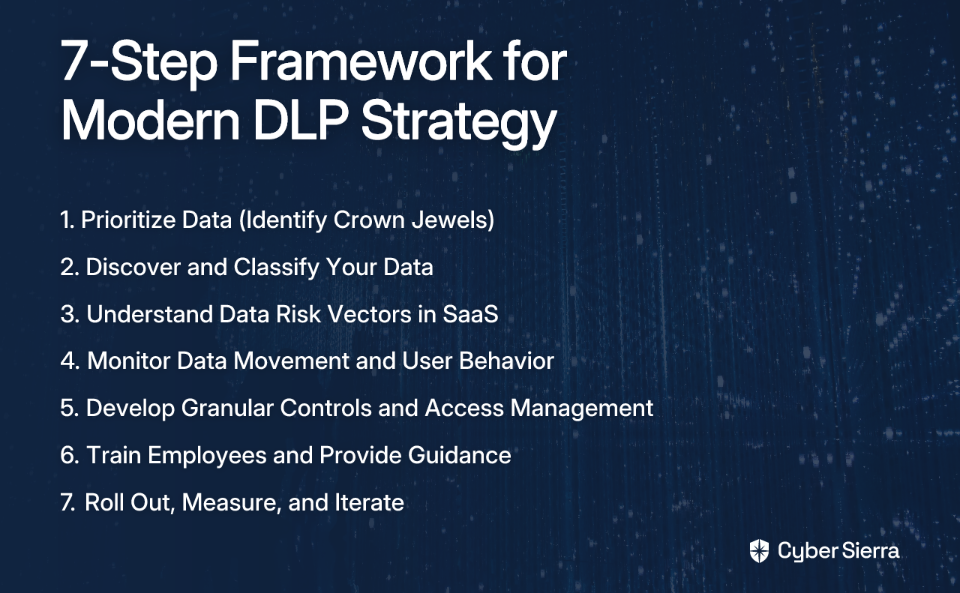
A 7-Step Framework for a Modern, SaaS-Centric DLP Strategy

Step 1: Prioritize Data ("Identify the Crown Jewels")

Begin by determining which data, if lost, would cause the most significant harm to your organization. As one security leader put it, "the first thing would be to understand what the crown jewels (the most sensitive info) are and where they are stored or captured." (Source)

This might include:

  • Intellectual property
  • Customer personally identifiable information (PII)
  • Payment card information (PCI)
  • Protected health information (PHI)
  • Financial data and forecasts

Action: Create an inventory of your most valuable data assets and rank them by sensitivity and business impact.

Step 2: Discover and Classify Your Data

Once you've identified what matters most, you need to find where it actually lives. Systematically scan all data repositories (both on-premises and cloud) to identify where sensitive data resides.

Use a combination of methods for robust classification:

  • Context-based: Classify data based on the source application (e.g., Salesforce), data store, or user who created it.
  • Content inspection: Analyze the data itself for keywords, patterns (like credit card numbers), or persistent classification tags.
  • Automation: Leverage tools to automate data classification to improve accuracy and consistently enforce policies.

Action: Implement automated data classification tools that can scan your SaaS environments and apply appropriate tags based on sensitivity.

Step 3: Understand Data Risk Vectors in SaaS

Analyze risk across the three states of data:

  • Data-at-rest: In cloud storage buckets, databases, and SaaS platforms
  • Data-in-transit: Moving between SaaS apps via APIs or shared externally
  • Data-in-use: Being accessed on endpoints, often within a web browser

Action: Map out how sensitive data flows through your organization and identify the highest-risk transmission vectors.

Step 4: Monitor All Data Movement and User Behavior

Implement "continuous monitoring of data flows in tools like Slack and Google Drive to detect unusual sharing or downloads." (Source)

Leverage technology with AI and machine learning to detect suspicious activities and anomalies that deviate from baseline user behavior. This enables you to spot potential data exfiltration or accidental exposure before it becomes a breach.

Action: Deploy monitoring solutions that can detect anomalous data access, sharing, or download patterns across your SaaS applications.

Step 5: Develop Granular Controls and Access Management

Shift towards a least-privilege model. Implement Role-Based Access Control (RBAC) to ensure users only have access to the data necessary for their jobs.

Key control methods include:

  • Data encryption for data at rest and in transit
  • Regular, automated access reviews for platforms like Slack and Google Drive to find over-provisioned access or lingering guest accounts
  • Auditing OAuth permissions granted to third-party applications to revoke excessive access

Action: Conduct quarterly access reviews across all SaaS platforms and implement just-in-time access for sensitive systems.

Step 6: Train Employees and Provide Continuous Guidance

Educate teams on data handling best practices, social engineering threats, and the specific risks of SaaS collaboration tools. This is critical as 68% of data breaches involve a non-malicious human element, according to research from Island.io.

Use advanced DLP tools that prompt users with guidance in real-time when they attempt a risky action, enabling self-correction rather than simply blocking activities.

Action: Develop role-specific training that addresses the unique data handling requirements for different departments and implement real-time guidance tools.

Step 7: Roll Out, Measure, and Iterate

Implement DLP in phases. Start with a pilot program focused on your most critical data and a small user group. Establish clear metrics to gauge effectiveness and report on the program's success.

Action: Define key metrics for your DLP program (e.g., reduction in public sharing, time to remediate exposure incidents) and continuously monitor and refine policies based on these measurements.
DLP as a Cornerstone of Regulatory Compliance

A staggering 95% of companies fail to meet all regulatory data protection requirements, exposing them to massive risk, according to Strac.io. This makes DLP not just a security best practice but a critical compliance tool.

Here's how a robust DLP strategy directly supports major regulations:

GDPR (General Data Protection Regulation)

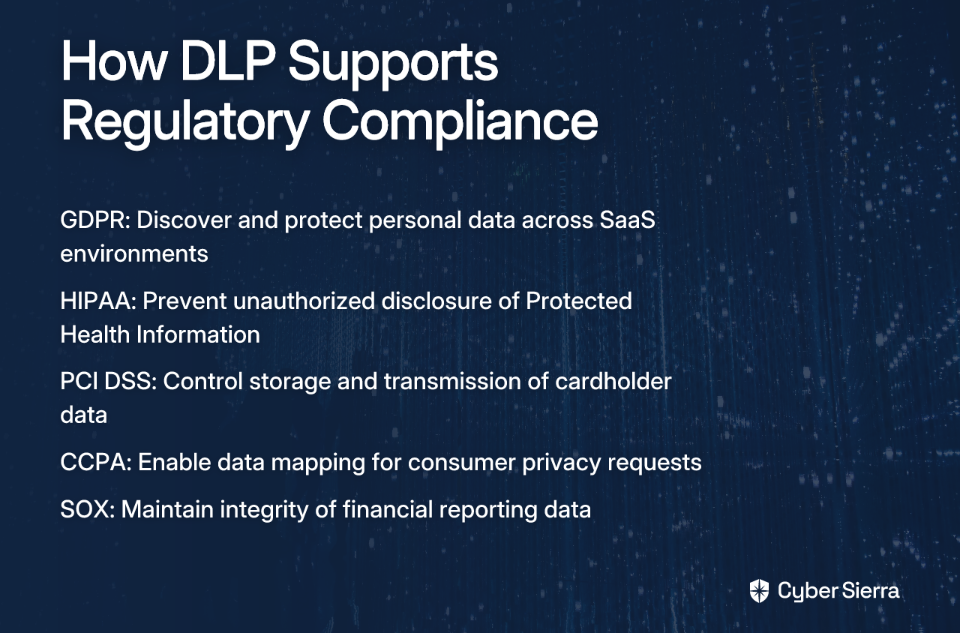
DLP helps discover, classify, and protect EU residents' personal data, a core mandate. Non-compliance can lead to fines of up to 4% of global annual revenue. Your DLP program should include capabilities to identify personal data across SaaS environments and enforce appropriate controls.

HIPAA (Health Insurance Portability and Accountability Act)

DLP solutions are critical for identifying and preventing unauthorized disclosure of Protected Health Information (PHI). Healthcare organizations and their business associates must implement technical safeguards to ensure PHI remains confidential—DLP provides these safeguards.

PCI DSS (Payment Card Industry Data Security Standard)

DLP helps enforce controls around the storage, transmission, and access of cardholder data, making it easier to maintain PCI DSS compliance and avoid costly penalties.

CCPA (California Consumer Privacy Act) and State Privacy Laws

DLP tools facilitate the data mapping and discovery necessary to fulfill consumer data rights requests and ensure proper handling of personal information.

Justifying Your DLP Program to the Board

When presenting your DLP strategy to the board, frame the discussion around mitigating financial and operational risk, not just technical controls.

Use Data to Build Your Case

  • Cost of a Breach: The average data breach costs approximately $4.5 million. (Source)
  • Frequency: Nearly 80% of IT/security leaders experienced one or more data breaches in the past year. (Source)
  • Operational Impact: Data breaches cause an average disruption of 22 days in business operations. (Source)

Connect DLP to Business Enablement and Trust

Position your DLP program as a business enabler that builds customer trust. Just as Apple has turned privacy into a brand differentiator, your organization can leverage strong data protection practices as a competitive advantage.

Conclusion: The Future of DLP is Proactive and Integrated

A modern DLP strategy is not a single tool but an ongoing program that is data-centric, user-aware, and iterative. It moves security from a reactive, blocking function to a proactive, guiding one that supports both compliance and collaboration.

Future trends to watch in the DLP space include:

  • Integration with DSPM: DLP is becoming a cornerstone of broader Data Security Posture Management (DSPM) frameworks.
  • Advances in AI/ML: Expect more sophisticated and automated data classification and anomaly detection.
  • Cloud-Native Focus: DLP solutions will continue to evolve with deeper integrations into cloud and SaaS environments.

The time to move beyond legacy approaches is now. By building a DLP program that secures data wherever it flows, you'll not only protect your organization from costly breaches but also enable the safe, productive collaboration that modern businesses demand.

Remember: In today's SaaS-first world, data loss prevention isn't just about stopping data from leaving—it's about ensuring the right data is available to the right people, in the right contexts, while maintaining compliance and security. Your DLP strategy should reflect this nuanced approach to truly protect your organization's most valuable assets.
blog-hero-background-image
Cyber Security

How to Choose the Right Risk Assessment Framework for Your Organization

backdrop
Table of Contents

Join thousands of professionals and get the latest insight on Compliance & Cybersecurity.


Are you struggling to understand which risk assessment framework fits your organization's needs best? The complexity of options like NIST, ISO, and FAIR can leave teams feeling overwhelmed and unsure where to start, especially when resources seem geared toward large enterprises rather than smaller organizations.

Selecting an appropriate risk assessment framework is a fundamental strategic decision that shapes your entire governance, risk, and compliance program. It's not just about checking a compliance box—it's about establishing a structured approach to identifying, assessing, and mitigating the risks that could impact your business objectives.

This guide will demystify risk assessment frameworks, helping you understand the fundamentals, compare popular options, and select the best-fit framework for your organization's unique needs. No more drowning in technical jargon or conflicting advice—just practical guidance to make an informed decision.

The Groundwork: Understanding Risk Assessment Methodologies Before You Choose

Before diving into specific frameworks, it's essential to understand the underlying methodologies that drive them. This foundational knowledge will simplify your decision-making process and help you avoid common pitfalls.

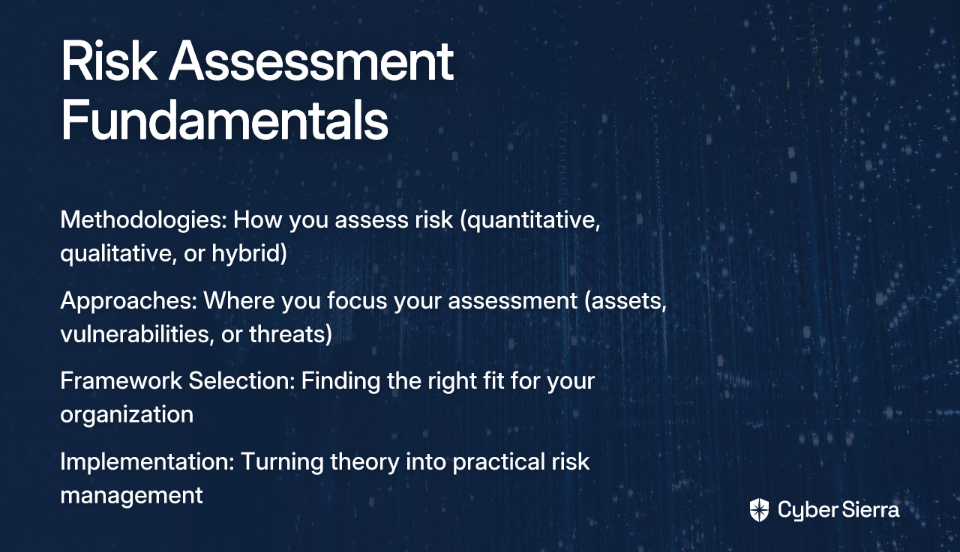
Risk Assessment Methodologies: The "How"

There are three primary approaches to assessing risk:

  1. Quantitative Risk Assessment
    • Uses measurable, numerical data, often expressed in monetary terms
    • Provides objective results that can be easily compared and prioritized
    • Example: A telecommunications firm analyzes potential financial losses from a data breach by examining industry averages and calculating the likelihood of incidents
  2. Qualitative Risk Assessment
    • Relies on subjective judgments and descriptive scales (high, medium, low)
    • More accessible when hard data isn't available
    • Example: A small business gathers expert opinions to evaluate cybersecurity risks, focusing on critical threats first
  3. Semi-Quantitative Risk Assessment
    • A hybrid model combining numerical scales with subjective assessments
    • Useful when complete data is unavailable but more precision than qualitative assessment is desired
    • Example: Using a 1-5 scale for both likelihood and impact, then multiplying them for a risk score

Risk Assessment Approaches: The "Focus"

Different frameworks emphasize different starting points for assessment:

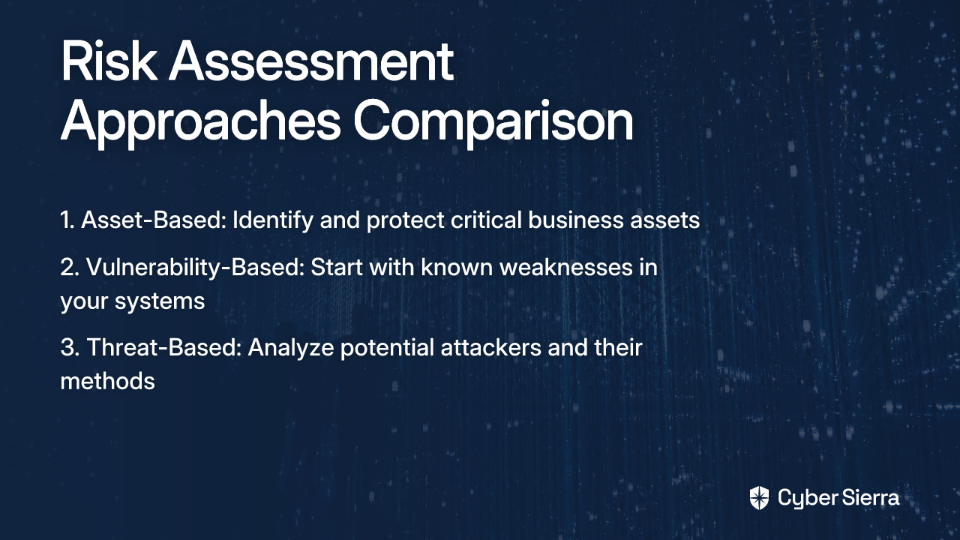
  1. Asset-Based Approach
    • Focuses on identifying and protecting critical assets
    • Process typically involves:
      • Asset identification and classification
      • Threat identification
      • Vulnerability identification
      • Risk determination
  2. Vulnerability-Based Approach
    • Identifies risks by starting with known weaknesses
    • Example: An outdated server OS leads to vulnerability assessments focused on specific cyber threats
  3. Threat-Based Approach
    • Considers the methods and intent of threat actors to proactively address risks
    • Example: A financial institution assesses phishing tactics that cybercriminals may use to target sensitive information

Understanding these fundamental approaches will help you evaluate which frameworks align with your organization's risk management philosophy and capabilities.

Key Factors in Your Decision-Making Process

When evaluating risk assessment frameworks, consider these critical factors to find the best fit:

1. Organizational Goals, Size, and Maturity

Your organization's size, industry, and risk management maturity level significantly influence which framework will work best:

  • Small to Mid-sized Organizations: Consider frameworks with simpler implementation paths like OCTAVE-S, which is specifically designed for smaller teams with limited resources
  • Large Enterprises: More comprehensive frameworks like NIST RMF or ISO 31000 may be appropriate
  • Risk Management Maturity: If you're just starting, begin with qualitative assessments before moving to more complex quantitative approaches

2. Industry and Regulatory Compliance Requirements

Different industries face specific regulatory demands:

  • Healthcare: Organizations must consider HIPAA compliance requirements
  • Federal Contractors: The NIST Risk Management Framework (RMF) is designed to meet the requirements of the Federal Information Security Modernization Act (FISMA)
  • Financial Services: May need to address requirements from regulations like SOX, GLBA, or PCI DSS

Your framework selection should help you meet these compliance obligations while also providing practical risk management benefits.

3. Resource Availability

Be realistic about your available resources:

  • Data Requirements: Quantitative frameworks like FAIR require reliable data to calculate financial impact
  • Expertise: Do you have team members with experience in specific frameworks?
  • Tools: Some frameworks work better with specialized software or assessment tools

If you lack hard data but have access to internal experts, a qualitative approach may be more feasible.

4. Stakeholder Communication Needs

Consider how you will communicate findings to different audiences:

  • Executive Leadership: The FAIR framework's emphasis on financial terms makes it highly effective for communicating with non-technical business leaders
  • Technical Teams: More detailed frameworks like NIST provide comprehensive guidance for implementation teams
  • Regulators: Industry-specific frameworks may provide reporting formats that regulators expect

A Comparative Guide to Popular Risk Assessment Frameworks

Now let's examine the most common frameworks to understand their unique characteristics and best use cases.

NIST Risk Management Framework (RMF)

What it is: A comprehensive seven-step process that integrates security and privacy into the system development life cycle.

Who it's for: U.S. federal agencies, their contractors, and private sector organizations seeking a robust, structured security standard.

Key Features:

  • Detailed, prescriptive approach with seven clearly defined steps:
    1. Prepare: Establish risk management roles and responsibilities
    2. Categorize: Classify information systems and data based on impact
    3. Select: Choose appropriate controls from NIST SP 800-53
    4. Implement: Deploy security controls and document how they're implemented
    5. Assess: Determine if controls are working properly
    6. Authorize: Senior officials make risk-based decision to authorize the system
    7. Monitor: Continuously track control effectiveness and risks

Primary Focus: Compliance with federal standards while ensuring comprehensive risk management.

ISO 31000:2018 / ISO 27005

What it is: ISO 31000 provides international principles and guidelines for risk management, while ISO 27005 is specific to information security risk management.

Who it's for: Organizations of any size or sector, especially those operating internationally or seeking to align with the ISO 27001 standard for an Information Security Management System (ISMS).

Key Features:

  • Focuses on embedding risk management into governance, strategy, and planning
  • Encourages a proactive approach to turn challenges into strategic advantages
  • Provides a common language for risk management across different departments

Important Note: ISO 31000 provides guidelines and is not a certifiable standard itself, though it supports compliance with ISO 27001, which is certifiable.

FAIR (Factor Analysis of Information Risk)

What it is: A quantitative model for understanding, measuring, and analyzing information risk in financial terms.

Who it's for: Organizations that need to prioritize risks based on financial impact and communicate effectively with business executives.

Key Features:

  • Provides a model for measuring cyber and operational risk
  • Helps justify security investments in financial language management understands
  • Focuses on probable frequency and magnitude of future loss

COBIT (Control Objectives for Information and Related Technology)

What it is: A framework focused on IT governance and management.

Who it's for: Enterprises looking to align their IT processes and resources with business objectives.

Key Features:

  • Offers a flexible, holistic approach to enterprise IT governance
  • Helps bridge the gap between technical issues and business risks
  • Focuses on control objectives and management guidelines

OCTAVE (Operationally Critical Threat, Asset, and Vulnerability Evaluation)

What it is: A risk-based strategic assessment and planning technique for cybersecurity.

Who it's for: Organizations that want a self-directed approach. It has multiple variations for different needs.

Key Features:

  • OCTAVE-S: Designed for smaller organizations with limited resources
  • OCTAVE Allegro: A more comprehensive approach for larger organizations
  • Emphasizes operational risk and security practices

A Practical Roadmap to Implementation

Once you've selected a framework, follow these steps to implement it effectively:

Step 1: Establish a Cross-Functional Risk Management Team

Include stakeholders from across your organization:

  • IT and security professionals
  • Business unit representatives
  • Executive sponsors
  • Compliance and legal team members

This diverse team ensures a holistic view of risk and broader organizational buy-in.

Step 2: Define the Scope and Context

Clearly document what is being assessed:

  • Specific applications or systems
  • Business units or processes
  • The entire enterprise
  • External dependencies and third-party relationships

This step prevents scope creep and ensures focused assessment efforts.

Step 3: Conduct the Risk Assessment

Follow a structured process:

  1. Categorize and inventory IT assets: Include hardware, software, data, and processes
  2. Identify threats: Consider both natural disasters and cyber threats
  3. Identify vulnerabilities: Use security testing, penetration test results, and anecdotal evidence
  4. Prioritize risks: Evaluate existing controls, then determine the likelihood and impact of potential breaches

Use a uniform numerical scale (e.g., 1-10) and clearly define what each number represents to reduce ambiguity.

Step 4: Communicate Findings and Develop a Mitigation Plan

Translate technical findings into business impact:

  • Create executive summaries with visualizations
  • Prioritize risks based on their potential impact
  • Develop specific, actionable mitigation strategies
  • Establish clear ownership and deadlines for remediation

Step 5: Implement Continuous Monitoring and Review

Risk assessment is not a one-time project:

  • Regularly review and update your risk register
  • Monitor the effectiveness of implemented controls
  • Reassess when significant changes occur in your environment
  • Keep abreast of emerging threats and vulnerabilities

Conclusion

The goal isn't to find the single "best" framework, but rather the "best fit" for your specific organizational context. Consider your organization's size, industry requirements, available resources, and communication needs when making your selection.

Remember that a framework is a tool to build a proactive risk management culture, not just a one-off compliance exercise. The right framework will help you identify, prioritize, and address risks in a systematic way that aligns with your business objectives and strengthens your security posture.

By taking a thoughtful approach to selecting and implementing a risk assessment framework, you'll build a more resilient organization that can navigate the complex landscape of information security risks with confidence.

Frequently Asked Questions

What is the most important factor when choosing a risk assessment framework?

The most important factor is finding the "best fit" for your organization’s unique context. There is no single "best" framework for everyone. Your decision should be guided by your organization's size, industry, regulatory requirements, and risk management maturity. For example, a federal contractor will lean toward NIST, while a company focused on communicating risk in financial terms might choose FAIR.

Which risk assessment framework is best for small businesses?

For small businesses, frameworks like OCTAVE-S are often recommended because they are specifically designed for teams with limited resources. A qualitative approach, which relies on expert judgment rather than extensive data, is also a practical starting point. The goal for a small business is to choose a framework that is simple to implement and maintain while still providing meaningful insights.

How often should an organization conduct a risk assessment?

A risk assessment should not be a one-time event but a continuous process. While a comprehensive assessment is often conducted annually, it should be reviewed and updated whenever significant changes occur, such as the introduction of new technology, changes in business processes, or the emergence of new threats. Continuous monitoring is key to maintaining an effective risk management program.

What is the difference between a qualitative and quantitative risk assessment?

The key difference is how risk is measured. A qualitative risk assessment uses descriptive, subjective scales (e.g., high, medium, low) to evaluate the likelihood and impact of a risk. In contrast, a quantitative risk assessment uses measurable, objective numerical data, often expressed in monetary terms, to calculate a precise value for risk.

Can an organization use multiple risk frameworks?

Yes, many organizations adopt a hybrid approach by combining elements from different frameworks. For instance, an organization might use ISO 31000 for its overall risk management governance structure while using the quantitative FAIR model to analyze specific high-impact cyber risks and communicate their financial implications to the board.

How does a risk assessment framework help with regulatory compliance?

A risk assessment framework provides a structured, repeatable, and defensible process for identifying and managing risks. This helps organizations demonstrate due diligence to auditors and regulators. Many regulations, like HIPAA, PCI DSS, and FISMA, require formal risk assessments. Using an established framework like NIST RMF or ISO 27005 helps ensure that all necessary components of risk management are covered, simplifying compliance efforts.

blog-hero-background-image
Cyber Security

How to Get Senior Management to Take Cybersecurity Seriously

backdrop
Table of Contents

Join thousands of professionals and get the latest insight on Compliance & Cybersecurity.


You've just discovered a critical vulnerability in your company's infrastructure. After carefully documenting the issue and its potential impact, you schedule a meeting with your executive team. As you present the findings, you notice the blank stares and subtle glances at watches. When you mention the latest "chrome-bug" that could expose customer data, the CFO interrupts to ask about the quarterly budget review instead.

Sound familiar?

For cybersecurity professionals, this scenario repeats with frustrating regularity. You're trying to protect the organization from genuine threats, but senior management seems to view your warnings as technical noise rather than business priorities. As one security professional put it, "Most will see IT as an expense and not as an investment until a disaster happens."

The hard truth is that no cybersecurity program can succeed without executive buy-in. According to McKinsey, "senior-management time and attention is the single biggest driver of cybersecurity maturity" - more than company size or even budget. Yet there's a fundamental disconnect: executives often don't understand cybersecurity, and security professionals often don't speak the language of business.

This article provides a strategic playbook for bridging that gap - transforming technical risks into business imperatives that executives can't afford to ignore.

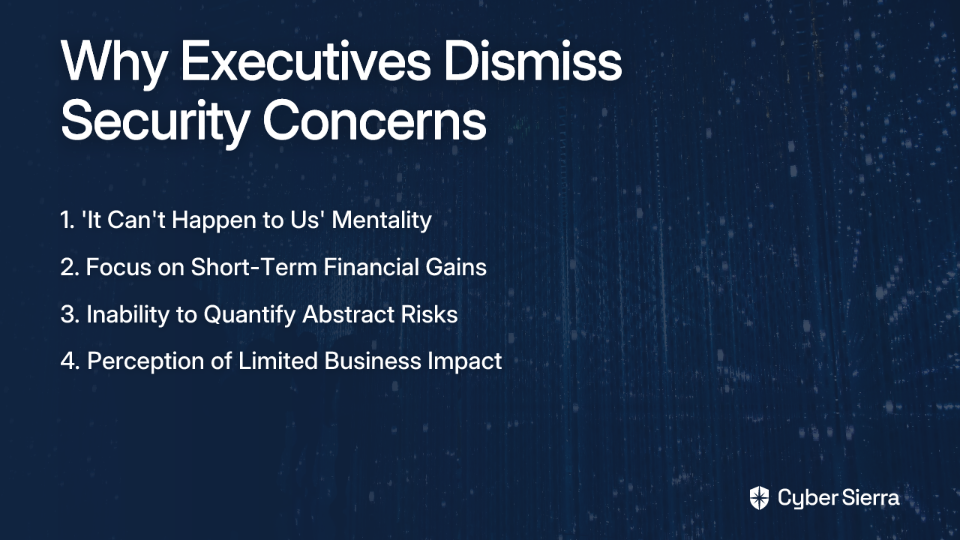
Why Executives Are Apathetic (And What They're Actually Thinking)

Before you can change executives' minds, you need to understand why they appear indifferent to cybersecurity concerns:

The "It Can't Happen to Us" Mentality

Only 32% of executives prioritize cybersecurity, according to research by Apptega. Many operate under the false assumption that their organization isn't a target, despite overwhelming evidence to the contrary. This cognitive bias leads to dangerous complacency.

Financial Short-Sightedness

Executives are under constant pressure to deliver quarterly results. Cybersecurity investments can be substantial without producing immediate, visible returns. As one security professional noted on Reddit, "The management prioritizes short-term financial gains over long-term cybersecurity investments."

Difficulty Quantifying Abstract Risks

Unlike other business risks, cybersecurity threats can seem theoretical until they materialize. McKinsey research found that many executives "can't quantify or qualify a cyber incident until they actually experience one themselves." Without concrete metrics, security concerns remain abstract.

The Perception of Limited Impact

Some executives believe breaches have minimal consequences. As one security professional observed, "Cybersecurity breaches are often overlooked by organizations as they don't significantly affect stock prices," and "Consumers have shown time and time again that breaches have no impact on their purchasing decisions."

Understanding these perspectives is crucial because they shape how executives process (or dismiss) your security recommendations. The key to overcoming them lies in communicating differently.

Speak Their Language: Translating Cyber Risk into Business Impact

The most effective strategy for gaining executive buy-in is translating technical risks into business terms. As one cybersecurity professional bluntly put it: "They only care about money. Show them how improving security can increase revenue or prevent lost revenue and they'll take it more seriously."

Quantify the Financial Risk

Move beyond vague warnings to specific financial impacts:

  • Present hard numbers: The average data breach in the US costs nearly $10 million, according to IBM's Cost of a Data Breach Report. This single statistic often resonates more than technical explanations.
  • Calculate your specific exposure: Use frameworks like FAIR (Factor Analysis of Information Risk) to quantify your organization's particular risk exposure in dollar terms.
  • Compare costs: Show that preventative investments are significantly less expensive than incident response and recovery. For example, implementing proper access controls might cost $50,000, while recovering from a ransomware attack could exceed $5 million.

Personalize the Risk for Each Executive

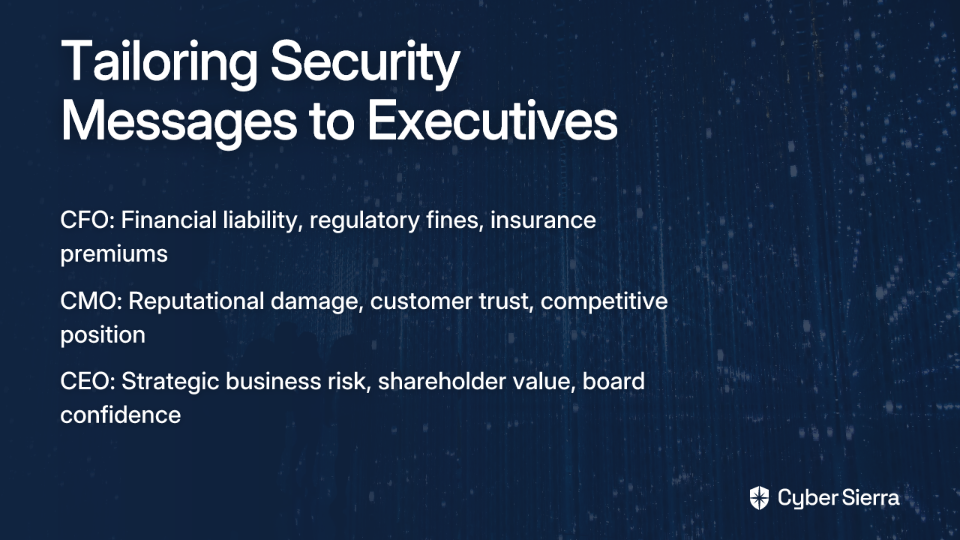
Different executives care about different aspects of cybersecurity risk. Tailor your message accordingly:

  • For CFOs: Focus on financial liability, regulatory fines, cyber liability insurance premium increases, and direct recovery costs.
  • For CMOs: Emphasize reputational damage, customer trust erosion, and competitive disadvantage following a breach.
  • For CEOs: Frame security as a strategic business risk that impacts shareholder value, board confidence, and personal liability.

Use Storytelling to Make Risks Relatable

Abstract technical vulnerabilities don't resonate with executives, but stories do:

  • Share relevant case studies of peer organizations that experienced breaches, detailing both the security failure and business consequences.
  • Create "day in the life" scenarios that walk through how a specific vulnerability could impact normal business operations, from customer-facing systems going offline to sensitive data being exposed.

From Abstract to Urgent: Making Threats Tangible

While financial translation is essential, sometimes you need to make the threats viscerally real for executives. These hands-on approaches can transform theoretical concerns into concrete priorities:

Conduct a Tabletop Exercise

Tabletop exercises simulate a cyber crisis in a controlled environment and are remarkably effective at changing executive perspectives:

  1. Create a custom scenario based on your organization's actual vulnerabilities, not a generic template. CISA offers official tabletop exercise packages to guide this process.
  2. Include all key decision-makers in the exercise, especially C-suite executives.
  3. Define clear objectives, such as identifying gaps in your incident response plan or demonstrating the need for specific security investments.

When executives personally experience the chaos and pressure of even a simulated crisis, their perception of cybersecurity importance often shifts dramatically.

Implement a Risk Register for Accountability

A risk register documents cybersecurity risks and forces formal acknowledgment:

  1. Document each significant risk, including potential impact, likelihood, and mitigation options.
  2. Present the register to senior management with three options for each risk:
    • Accept: Formally acknowledge the risk and its potential consequences
    • Mitigate: Allocate resources to address the risk
    • Transfer: Shift the risk through insurance or third-party services
  3. Require signatures from relevant executives for their decisions.

This approach, recommended by multiple security professionals, creates accountability. As one explained, "A risk register will hold senior management accountable" by requiring them to explicitly accept the consequences of inaction.

Bring in External Validation

Sometimes executives need to hear the message from someone outside the organization:

  • Engage third-party assessments: External vulnerability assessments and penetration tests carry weight with executives who might dismiss internal warnings.
  • Leverage peer influence: Arrange conversations with executives from similar organizations who've prioritized cybersecurity or experienced breaches.
  • Use regulatory pressure: Highlight how regulators in your industry are increasing cybersecurity requirements and enforcement actions.

Building a Top-Down Security Culture: The Long-Term Play

Securing one-time funding for a security project is valuable, but creating sustainable executive engagement requires a broader approach:

Start with the CEO

The CEO bears ultimate responsibility for organizational security and sets the tone for all other executives. As Arctic Wolf notes, "The CEO has the most to lose professionally and personally" in the event of a major breach. Securing their championship is the crucial first step.

Integrate Security into Business Processes

Work with executives to embed security considerations into all business functions:

  • Include security reviews in product development lifecycles
  • Incorporate security metrics in quarterly business reviews
  • Ensure security implications are considered in strategic planning

As one security professional observed, "Cybersecurity is only really successful with a top-down approach where senior management is pushing it."

Implement Business-Centric Reporting

Develop reporting that speaks to business concerns rather than technical metrics:

  • Instead of "patches applied," report on "percentage reduction in critical vulnerabilities on revenue-generating systems"
  • Replace "phishing test click rates" with "estimated financial exposure reduction from improved employee security awareness"

This addresses the executive question: "How does your work directly impact revenue or cash flow?"

From Cost Center to Strategic Partner

The journey from being viewed as a cost center to becoming a strategic business partner isn't easy, but it's essential for effective cybersecurity. By translating technical risks into business terms, making threats tangible through hands-on exercises, and building a top-down security culture, you can transform how executives perceive and prioritize cybersecurity.

Remember that executive buy-in isn't a one-time achievement but an ongoing process of communication and demonstration. As McKinsey emphasizes, "Sustained focus from top management is essential" for creating a truly resilient organization.

By speaking the language of business and framing security as a strategic enabler rather than just a technical function, you can shift your role from constantly justifying security expenditures to partnering with executives on protecting and advancing the organization's most critical interests.

Frequently Asked Questions

What is the most effective way to get executive buy-in for cybersecurity?

The most effective way is to translate technical cybersecurity risks into tangible business and financial impacts that executives can understand and act upon. This means moving beyond technical jargon and focusing on quantifiable metrics like potential revenue loss, regulatory fines, recovery costs, and reputational damage. By framing security as a business issue that affects the bottom line, you align your goals with theirs, making it a strategic priority rather than just an IT expense.

How can I quantify cybersecurity risk in financial terms?

You can quantify cybersecurity risk in financial terms by using frameworks like FAIR (Factor Analysis of Information Risk) to calculate your organization's specific risk exposure in dollar amounts. This process involves identifying potential loss scenarios (e.g., a data breach or ransomware attack), estimating the frequency of such events, and calculating the potential financial magnitude of the impact. Presenting a clear cost-benefit analysis—comparing the cost of a preventative control versus the potential loss—is a powerful tool.

Why do executives often ignore cybersecurity warnings?

Executives often ignore cybersecurity warnings because they perceive them as abstract technical issues rather than concrete business risks, coupled with financial short-sightedness and a belief that a major incident "can't happen to us." They are focused on quarterly results and may not see an immediate return on security investments. Technical risks can seem theoretical until they materialize, and some executives underestimate the real-world business consequences of a breach.

What is a risk register and how does it help with executive accountability?

A risk register is a formal document that lists identified cybersecurity risks, their potential impact, and proposed mitigation strategies. It creates executive accountability by requiring senior leaders to formally sign off on a decision for each risk: accept, mitigate, or transfer. This process forces a conscious, documented decision. If an executive chooses to "accept" a risk, their signature confirms they are accountable for the potential consequences, often leading to more funding for mitigation.

How do I make cybersecurity threats feel real to executives?

Make cybersecurity threats feel real by conducting a hands-on tabletop exercise that simulates a cyber crisis. In a tabletop exercise, you walk the executive team through a realistic breach scenario specific to your organization. This controlled, simulated crisis forces them to make difficult decisions under pressure, revealing gaps in your response plan and demonstrating the real-world chaos a breach can cause. This visceral experience is far more impactful than a slide deck.

Who is the most important executive to convince for cybersecurity buy-in?

The CEO is the most important executive to convince, as they bear the ultimate responsibility for the organization's security and set the tone for the entire leadership team. While the CFO controls the budget and the CMO worries about reputation, the CEO's championship is crucial. Their support signals to the rest of the C-suite that cybersecurity is a top-tier business priority and is the first step toward building a sustainable, top-down security culture.

The most successful security leaders don't just secure systems—they secure their seat at the decision-making table by demonstrating how their work directly contributes to business success.

blog-hero-background-image
Cyber Security

How to Build a Vulnerability Management Program That Actually Works

backdrop
Table of Contents

Join thousands of professionals and get the latest insight on Compliance & Cybersecurity.


You've implemented vulnerability scanning. You've tried to set up a remediation process. You've shared reports with your IT team. But vulnerabilities keep piling up, critical patches remain unimplemented, and you're drowning in a sea of CVEs while your executives wonder what they're paying for.

Sound familiar? You're not alone.

Most vulnerability management programs fail because they're built on theoretical frameworks that don't survive contact with real-world organizational dynamics. They become checkbox exercises that satisfy auditors but do little to reduce actual risk.

The Real-World Challenge of Vulnerability Management

"I've seen a lot of guidance documentation, but what I'm looking for is real-world models and how you actually made it work across multiple teams and technologies," laments one security professional on Reddit. This sentiment echoes across organizations struggling to implement effective vulnerability management.

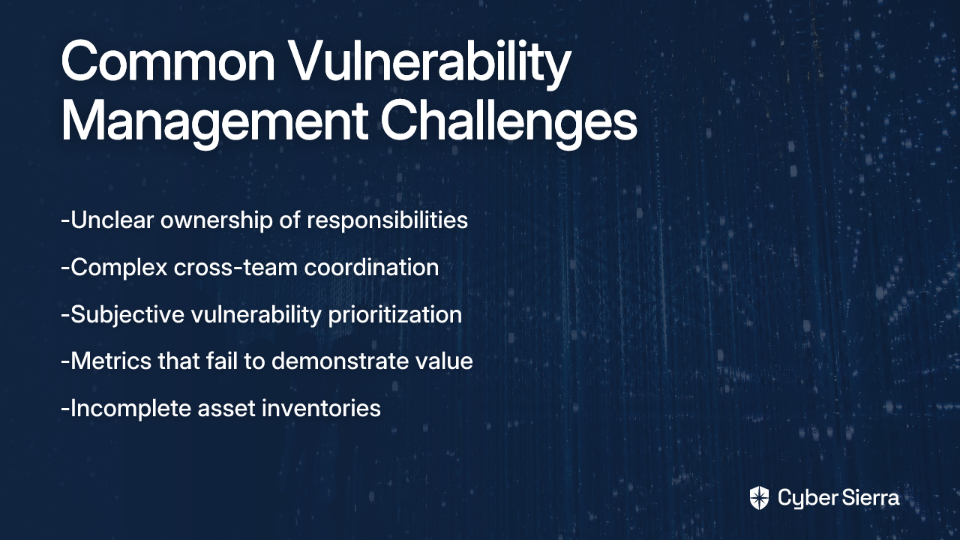
Common frustrations include:

  • Confusion over who owns what parts of the process
  • Heavy coordination efforts between teams
  • Disagreements about vulnerability prioritization
  • Unclear metrics that fail to demonstrate value
  • Difficulty maintaining accurate asset inventories

The good news? A vulnerability management program that actually works isn't mythical. It's achievable when built on practical foundations that acknowledge organizational realities.

1. Laying the Foundation: People, Policy, and Assets

Before implementing processes or buying tools, you need three critical elements in place:

Assemble Your Team & Define Clear Roles

One of the biggest failure points is confusion over responsibility. As one practitioner notes, "Security is responsible for vulnerability management... Asset/Platform/Technology owners are assigned the effort to remediate identified risk." This division often leads to finger-pointing rather than progress.

The solution? A hybrid model with crystal-clear ownership:

  • Central VM Team: Owns the overall process, tools, scanning, triage, and reporting
  • Asset/Platform Owners: Own the actual remediation of vulnerabilities on their systems

This model acknowledges that while security teams can identify issues, they rarely have the access or expertise to fix them across diverse technologies.

Establish a Comprehensive Asset Inventory

"You can't protect what you don't know about" isn't just a security cliché—it's a fundamental truth of vulnerability management. According to Tripwire, a comprehensive inventory is your foundation.

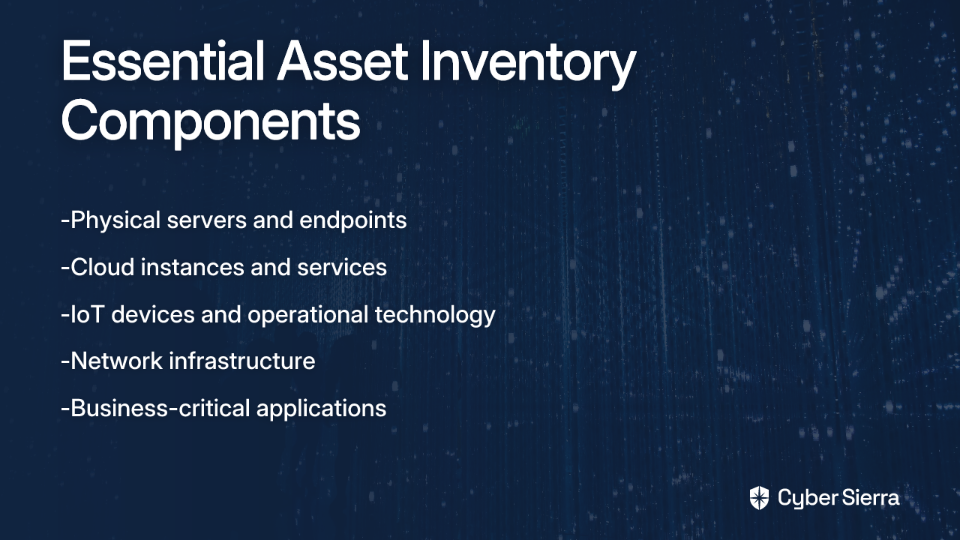
Your inventory should include:

  • Physical servers and endpoints
  • Cloud instances and services
  • IoT devices and operational technology
  • Network infrastructure
  • Business-critical applications

Pro tip: Use both authenticated and unauthenticated scans to establish your baseline. This addresses the common challenge of "maintaining accurate asset inventories" that many security teams struggle with.

Develop a Strong Policy Framework

"The first thing is to get a good solid policy. Otherwise, you are going to waste your time and get ignored," advises a seasoned security professional. Your policy provides the authority needed to enforce remediation.

Key policy components should include:

  • Scope: What assets and networks are covered
  • Roles & Responsibilities: Clearly document duties
  • Service Level Agreements (SLAs): Mandatory timelines for remediation
  • Risk Acceptance Process: Formal procedure for accepting vulnerabilities that cannot be remediated within SLA timeframes

2. The Vulnerability Management Lifecycle: A Continuous Process

With your foundation in place, you can implement the core vulnerability management lifecycle—a continuous process, not a one-time project. Based on frameworks from Microsoft and Tripwire, here's how to make each phase effective:

Discovery: Be Aggressive with Scanning

Implement thorough, continuous scanning across your environment. Many organizations scan too infrequently or with insufficient coverage.

Best Practices:

  • Use authenticated scans whenever possible for deeper visibility
  • Implement multiple scanning technologies for comprehensive coverage
  • Ensure regular scanning cadences (weekly for critical systems)
  • Include application security testing for custom software

Remember that continuous scanning isn't just a best practice—it's a core requirement for frameworks like PCI DSS and NIST 800-53.

Prioritization: Move Beyond CVSS Scores

"Just because a finding is a CVSS 9.5 doesn't mean it's actually critical to your business," notes a security practitioner. Relying solely on CVSS scores leads to wasted effort and missed critical issues.

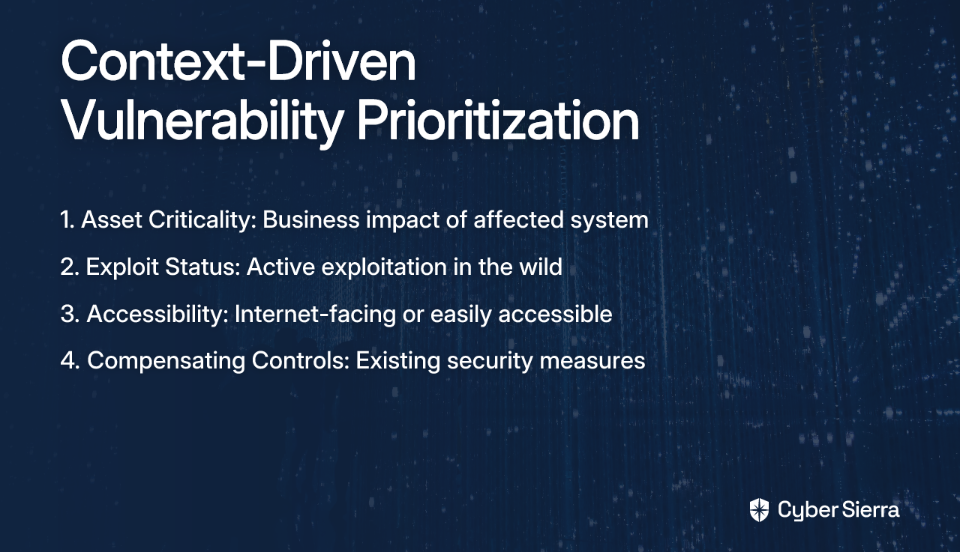
Implement context-driven prioritization by considering:

  1. Asset Criticality: Is the affected system business-critical?
  2. Exploit Status: Is the vulnerability being actively exploited in the wild?
  3. Accessibility: Is the vulnerable system internet-facing or otherwise easily accessible?
  4. Compensating Controls: Are there existing security measures that reduce the risk?

Organizations that have moved to context-driven prioritization report better results. As one security leader shared, "We moved to context-driven prioritization, and that's where Orca has been surprisingly helpful...instead of dumping endless CVSS 9s, I could point at a handful of items that truly mattered."

Remediation: Provide Clear Options

When vulnerabilities are identified, provide asset owners with clear remediation options:

  1. Patch/Update: Apply vendor-provided fixes
  2. Mitigate: Implement compensating controls if patching isn't immediately feasible
  3. Accept: Formally document and accept the risk with executive approval

For each high or critical vulnerability, document specific recommendations rather than simply forwarding scanner output. This addresses the challenge that "there is no easy way to setup rules to route requests to the right teams to remediate."

Verification: Close the Loop

Always verify that remediation efforts actually fixed the issue. This crucial step is often overlooked but is essential for program integrity.

Implement automated rescans after remediation deadlines to verify fixes and update your vulnerability tracking system. This creates accountability and ensures that patches were correctly applied.

3. Making It Work: Driving Action and Measuring Success

With the core elements in place, focus on operational excellence to ensure your program sticks and delivers measurable value.

Develop Documented Workflows & Clear SLAs

Create "documented, deliberate workflows" that outline responsibilities and actions for every step of the process, as recommended by CSO Online. This addresses the common challenge of "heavy coordination effort between teams."

Example SLA Structure:

  • Critical: Remediate within 15 days
  • High: Remediate within 30 days
  • Medium: Remediate within 90 days

These timeframes should be adjusted based on your organization's risk tolerance and capabilities, but having defined SLAs is non-negotiable for program success.

Establish and Track Meaningful KPIs

"What kind of reporting cadence and metrics (KPIs) work best for management buy-in?" This question reflects a common challenge in demonstrating program effectiveness.

Focus on these key metrics:

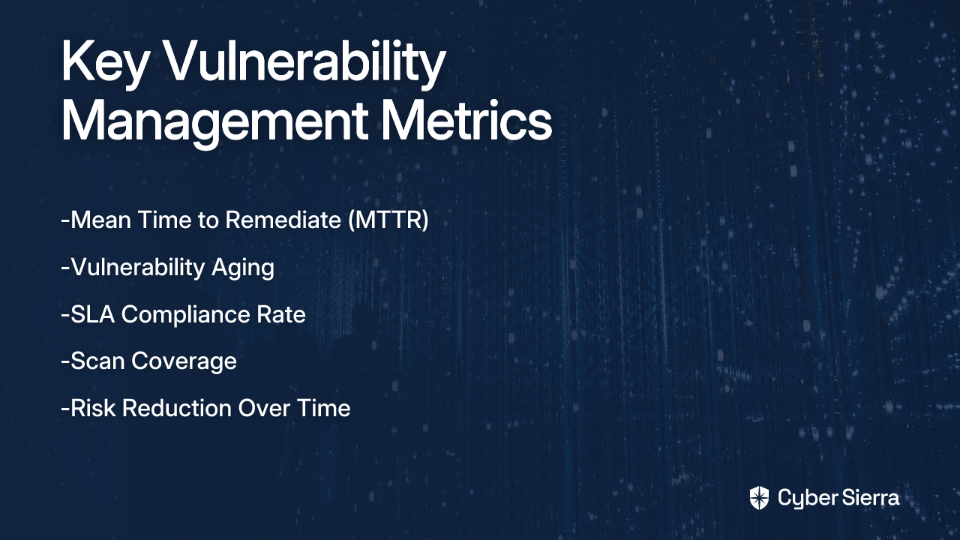
  • Mean Time to Remediate (MTTR): The average time it takes to fix vulnerabilities after discovery
  • Vulnerability Aging: How long have critical and high vulnerabilities been open?
  • SLA Compliance Rate: The percentage of vulnerabilities fixed within their defined SLA
  • Scan Coverage: The percentage of your asset inventory being actively scanned
  • Risk Reduction Over Time: Trending of your overall vulnerability risk score

According to the SANS Institute, you need to "translate VM findings into business impacts to gain executive buy-in." Frame your reporting in business terms, not technical jargon.

Leverage Automation to Reduce Coordination Overhead

The effort to coordinate vulnerability remediation "can be very heavy at first," according to practitioners. Implement automation to reduce this burden:

  • Integrate vulnerability scanners with ticketing systems
  • Automatically route vulnerabilities to appropriate teams
  • Use dashboards for real-time visibility into remediation status
  • Implement automated follow-up notifications for approaching SLA deadlines

Implement a Formal Risk Acceptance Process

Not all vulnerabilities can be remediated within SLA timeframes. Implement a formal risk acceptance process that:

  1. Requires business justification for acceptance
  2. Includes compensating controls when possible
  3. Has a defined expiration date for review
  4. Requires appropriate executive sign-off
  5. Creates documentation for compliance purposes

This addresses the challenge that "the coordination simplifies down to dealing with risk acceptance situation."

Conclusion: From Reactive Firefighting to Proactive Risk Management

A successful vulnerability management program isn't built overnight, but the steps outlined here provide a practical framework that addresses the real-world challenges organizations face.

Remember that compliance should not be the ultimate goal; reducing exposure should be the priority. A robust vulnerability management program naturally leads to better compliance and, more importantly, a stronger, more resilient security posture.

Start by assessing your current program against these steps. Focus on one key area of improvement first, whether it's building a complete asset inventory or defining clear SLAs for remediation. Progress in vulnerability management is iterative—each improvement builds on the last.

With the right foundation, a clear lifecycle, and operational excellence, you can transform vulnerability management from a frustrating checkbox exercise into a program that actually works to reduce organizational risk.

Frequently Asked Questions

What is the first step to building a successful vulnerability management program?

The first step is to lay a solid foundation by establishing clear roles and responsibilities, creating a comprehensive asset inventory, and developing a strong policy framework. Before implementing any tools or processes, you must define who owns what, know what assets you need to protect, and have a policy that grants the authority to enforce remediation.

How should vulnerabilities be prioritized?

Vulnerabilities should be prioritized based on business context, not just CVSS scores. A context-driven approach considers factors like asset criticality (is it a business-critical system?), exploit status (is it being actively exploited?), accessibility (is it internet-facing?), and the presence of any compensating controls that might reduce the immediate risk.

Who is responsible for fixing vulnerabilities?

A hybrid model is most effective: a central Vulnerability Management (VM) team is responsible for the overall process, including scanning, triage, and reporting. However, the actual remediation—the task of patching or fixing the vulnerability—is the responsibility of the respective Asset, Platform, or Technology owners who have the expertise and access to those systems.

What are the most important metrics for a vulnerability management program?

The most important metrics focus on demonstrating risk reduction and operational efficiency. Key Performance Indicators (KPIs) include Mean Time to Remediate (MTTR), vulnerability aging (especially for critical issues), SLA compliance rate, and scan coverage. These metrics help translate technical findings into business impact, which is crucial for executive buy-in.

Why do most vulnerability management programs fail?

Most programs fail because they are theoretical exercises that don't account for real-world organizational challenges. Common failure points include unclear ownership of responsibilities, disagreements on prioritization, ineffective metrics that don't show value, and incomplete asset inventories, leading to a program that satisfies auditors but doesn't actually reduce risk.

What should we do if a vulnerability cannot be patched immediately?

If a vulnerability cannot be patched within the required SLA, you have two primary options: mitigation or risk acceptance. You can implement compensating controls to mitigate the risk (e.g., firewall rules). If mitigation isn't possible, you must follow a formal risk acceptance process that includes business justification, executive sign-off, and a set review date.

blog-hero-background-image
Cyber Security

Building Risk Culture When Nobody Gives a Damn About Security

backdrop
Table of Contents

Join thousands of professionals and get the latest insight on Compliance & Cybersecurity.


You've tried it all. The security awareness training that everyone clicks through while checking their email. The policy documents that nobody reads. The desperate pleas to executives who nod politely before asking you to "make it work" with half the budget you requested.

And despite your best efforts, you're still the lone voice in the wilderness—the security professional in an organization where nobody seems to give a damn about security.

Sound familiar? You're not alone.

In many organizations, there's a fundamental disconnect between security teams and, well, everyone else. As one security professional lamented, "Asset owners often have a simplistic and careless attitude towards risk management," while another pointed out the "overemphasis on compliance and aesthetics over practical usefulness" in their security program.

The hard truth? This isn't a tools problem. It's not even a process problem. It's a people problem.

Why Your Security Program is Stalling: Diagnosing Cultural Apathy

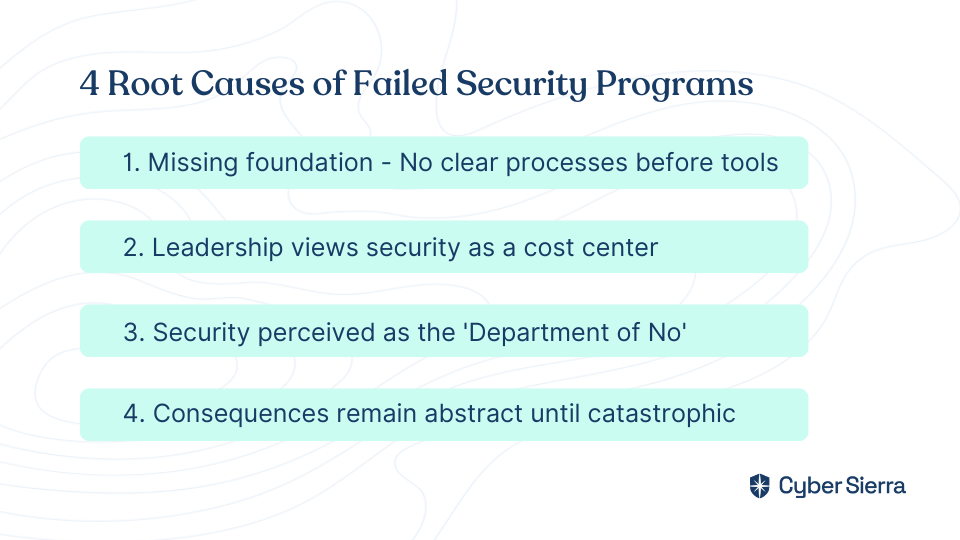
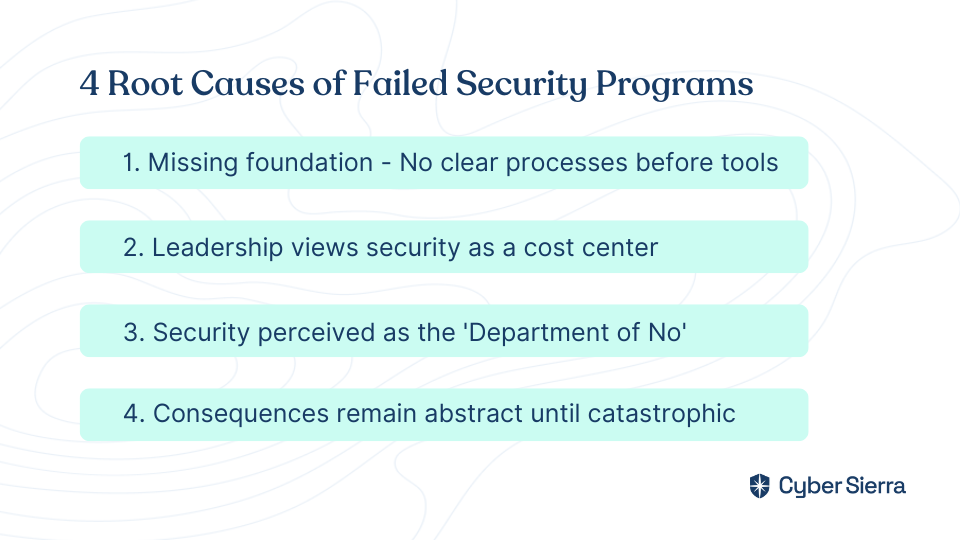
Before we can build a solution, we need to identify what's really going wrong. Most failed security programs suffer from several root causes:

1. The Foundation is Missing

Many organizations dive into purchasing expensive GRC (Governance, Risk, and Compliance) tools without establishing the fundamentals. As one security leader observed, "Organizations lack a solid foundation in risk assessment before utilizing GRC tools," and "starting from scratch in building foundational risk management documents is challenging."

Without clear processes and requirements in place, selecting tools becomes an exercise in futility—like buying an advanced telescope before learning basic astronomy.

2. Leadership Sees Security as a Cost Center

When executives view security as merely a compliance checkbox or a necessary evil, it's nearly impossible to build momentum. Without C-suite involvement prioritizing cybersecurity discussions and allocating sufficient resources (budget, personnel, technology), security initiatives will always be fighting an uphill battle.

3. Security is Perceived as the "Department of No"

Let's be honest: in many organizations, security teams have a reputation problem. They're seen as blockers rather than enablers, the folks who shut down innovative ideas with vague references to "risk." This adversarial relationship creates resistance before you've even started the conversation.

4. The Consequences are Abstract Until They're Catastrophic

Unlike other business functions with clear metrics and immediate feedback loops, security success is often measured by what doesn't happen. This makes it challenging to demonstrate value until after a breach—at which point it's too late.

The result? A perfect storm of apathy that leaves your security program spinning its wheels, compliance-focused but ineffective, and your organization vulnerable to increasingly sophisticated threats.

The Blueprint for a Security-First Culture: What Good Looks Like

Before diving into tactics, let's envision our destination. A strong risk culture isn't characterized by perfect compliance or zero incidents. Rather, according to the Institute of Risk Management, it's defined by shared values, beliefs, and attitudes toward risk that enable and reward individuals for taking the right risks in an informed way.

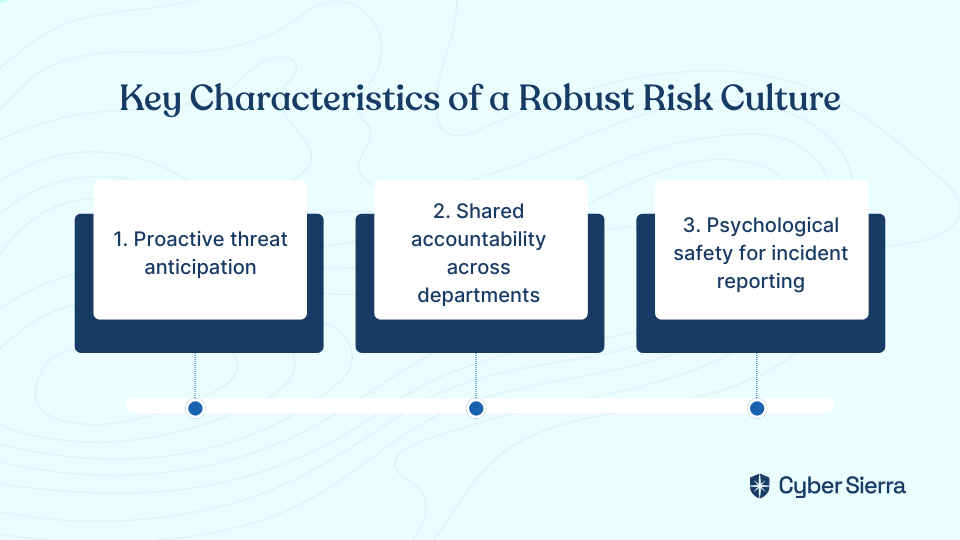
A robust risk culture has several key characteristics:

1. Proactive Mindset

In organizations with healthy risk cultures, teams don't just react to threats—they anticipate them. They view risks as opportunities for growth and innovation rather than merely threats to be avoided. This proactive approach prevents the escalation of minor issues and enhances organizational preparedness, according to TrustCloud's research on risk culture.

2. Shared Accountability

Security isn't just the security team's job—it's everyone's responsibility. Embedding accountability throughout the organization ensures that risk management becomes a shared duty, with clear ownership at all levels.

3. Psychological Safety

Employees must feel safe reporting concerns or mistakes without fear of punishment. When staff members are "scared to report incidents because they don't want to get in trouble," as one security professional noted, your early warning system fails. Creating an environment where errors are treated as learning opportunities cultivates open reporting.

From Apathy to Action: Your Step-by-Step Guide to Shifting the Culture

Now for the practical part—how do you transform security apathy into engagement when nobody seems to care? Here's your roadmap:

Phase 1: Laying the Groundwork

Run a Culture Study: Before making changes, understand your starting point. Use surveys, focus groups, and informal conversations to gauge attitudes toward security. According to Hoxhunt, understanding employees' security attitudes can increase participation in awareness programs by up to 25%.

Cultivate Leadership Relationships: Security needs executive champions. Focus on building relationships with key leaders by:

  • Speaking their language (revenue impact, competitive advantage, risk mitigation)
  • Quantifying security risks in financial terms
  • Highlighting industry peers who've suffered breaches
  • Achieving early wins through quick risk assessments or policy improvements

As Cynomi points out, establishing credibility through early victories builds the trust needed for larger cultural shifts.

Phase 2: Engaging the Masses

Deliver Frequent Microtraining Moments: Abandon the annual, hour-long security training in favor of short, targeted sessions focused on specific threats. Organizations using microlearning improve retention rates by approximately 50%, according to security awareness specialists.

Personalize & Gamify Training: One-size-fits-all approaches fail because they don't address role-specific risks. Instead:

  • Tailor content to departments and roles
  • Use real-life, relatable scenarios
  • Implement leaderboards and rewards
  • Celebrate participation and improvement

Utilize Realistic Simulations: Nothing teaches like experience. Conduct interactive phishing tests and tabletop exercises that mimic real threats. The data from these exercises helps you tailor future training to address specific vulnerabilities.

Phase 3: Empowering Champions

Find Your Security Champions: Identify influential employees in each department who can serve as security advocates. These aren't security professionals—they're respected team members who can translate security concepts into department-specific language.

Provide these champions with additional training, recognition, and access to the security team. Research from Gartner suggests that organizations leveraging peer-led training improve engagement by approximately 25%.

Foster Open Communication: Create channels for reporting concerns without fear of retribution. As one Reddit user recommended, establish an "anonymous reporting system that allows employees to report security issues without fear of repercussions." This psychological safety is crucial for building a culture where risks are identified early.

Phase 4: Rebranding Security

Build Your Security Team's Brand: Transform the perception of security from the "Department of No" to a valuable business partner:

  • Share regular updates on threats and security successes
  • Celebrate teams that integrate security into their processes
  • Highlight how security enables rather than blocks business objectives

According to Deloitte's findings, open communication about cybersecurity increases incident reporting by about 20%.

Integrate into Business Processes: Security should be embedded, not bolted on. This means:

  • Incorporating security into the software development lifecycle (DevSecOps)
  • Practicing Security by Design in new product development
  • Aligning security metrics with business objectives

As outlined in Cultural Shifts in Cybersecurity, this integration helps reframe security as a facilitator of business success rather than a hindrance.

Keeping the Momentum: How to Measure and Sustain Your New Risk Culture

Building a risk culture isn't a one-time project—it's an ongoing journey that requires constant attention and reinforcement.

Establish Metrics and KPIs: Track progress with meaningful metrics:

  • Training completion rates and engagement scores
  • Phishing simulation click-through rates (and reporting rates)
  • Time to resolve reported incidents
  • Results from regular culture surveys

Reinforce Continuous Improvement: Use a cycle of assessment, learning, and adaptation:

  • Conduct regular audits to identify gaps
  • Celebrate improvements and recognize contributors
  • Adjust your approach based on what's working and what isn't

Security is a Team Sport

Remember: building a robust risk culture is a marathon, not a sprint. It demands shifting focus from just tools and processes to people, psychology, and persistent communication.

The good news? You don't need to transform your entire organization overnight. Start by understanding your current culture, find one influential ally, and celebrate one small win. Then build from there.

As you progress, you'll find that security transforms from your solitary burden into a shared mission—even in organizations where nobody initially gave a damn about security.

Because ultimately, security isn't just about protecting systems and data. It's about protecting the organization's mission, its customers, and the livelihoods of every employee. That's something everyone can get behind, once they understand what's truly at stake.

Start small, be persistent, and remember: culture change begins with you, but it doesn't end there. One conversation, one champion, one success story at a time—that's how you build a risk culture that lasts.

Frequently Asked Questions

What is a security-first culture?

A security-first culture is an environment where shared values and behaviors prioritize security in all business decisions, making it everyone's responsibility, not just the security team's. It's characterized by a proactive mindset, where teams anticipate threats instead of just reacting to them. It also involves shared accountability across all departments and psychological safety, which empowers employees to report mistakes or concerns without fear of punishment. This shifts security from being a compliance hurdle to an integral part of how the organization operates and innovates.

Why do security programs fail to change company culture?

Security programs often fail because they address symptoms rather than the root cause: a "people problem." Common failures include a lack of foundational risk management processes, insufficient executive buy-in, and the perception of security as a blocker to business operations. Many organizations invest in expensive tools without first establishing clear processes or getting leadership to see security as a strategic enabler rather than a cost center. When security is seen as the "Department of No," it creates an adversarial relationship that undermines any initiative before it even begins.

How can I get buy-in from leadership for security initiatives?

To get leadership buy-in, you must communicate security in terms of business impact. Frame your requests around revenue, competitive advantage, and quantifiable financial risk rather than technical jargon. Start by building relationships with key executives. Achieve quick, visible wins—like a targeted risk assessment—to establish credibility. Use data to show the potential financial fallout of a breach and highlight examples of competitors who have suffered incidents. When leaders understand that security enables business success, they are more likely to provide the budget and support you need.

What is the most effective way to conduct security awareness training?

The most effective security awareness training moves away from annual, one-size-fits-all sessions and toward frequent, personalized microlearning moments. Focus on short, engaging content tailored to specific roles and departments. Use gamification, leaderboards, and realistic simulations like phishing tests to make the training interactive and memorable. This approach improves knowledge retention and helps employees apply security principles directly to their daily work, making them an active part of your defense.

How do I measure the success of a security culture?

You can measure the success of a security culture by tracking key performance indicators (KPIs) that reflect behavioral change, not just compliance. Key metrics include employee engagement with training modules, phishing simulation click-through and reporting rates, and the time it takes to resolve user-reported incidents. Additionally, running regular culture surveys provides qualitative data on employees' attitudes toward security. Tracking these metrics over time demonstrates progress and helps you refine your strategy.

Where is the best place to start building a security culture from scratch?

The best place to start is by understanding your current cultural landscape and securing one influential ally. Before launching any initiatives, run a culture study using surveys and informal conversations to get a baseline of employee attitudes. At the same time, focus on building a relationship with a single executive or department head who can become your first champion. Achieving a small, early win with their support will build the momentum needed for broader, more ambitious changes.

blog-hero-background-image
Cyber Security

How to Build CISO-Approved AI Coding Guardrails

backdrop
Table of Contents

Join thousands of professionals and get the latest insight on Compliance & Cybersecurity.


You've seen it happening across your organization - developers eagerly adopting AI coding tools, cutting development time in half, and churning out code faster than ever before. The productivity gains are undeniable, but as a CISO, you're watching this "gold rush" with growing unease. Studies show AI-generated code is 4X more prone to security vulnerabilities, and your security team is already seeing the early warning signs.

According to a StackOverflow 2023 survey, 82% of developers are already using AI tools for coding, while Gartner predicts 75% of enterprise software engineers will use AI coding assistants by 2028. This unstoppable wave of adoption is creating a significant security blind spot that could lead to costly breaches, compliance violations, and reputational damage.

The hard truth? You can't rely on a single security control to manage this risk. As one CISO put it, "layers are the only way to keep productivity gains without drowning in risk." This article outlines a practical, multi-layered approach to building CISO-approved guardrails for AI coding tools that balance innovation with security.

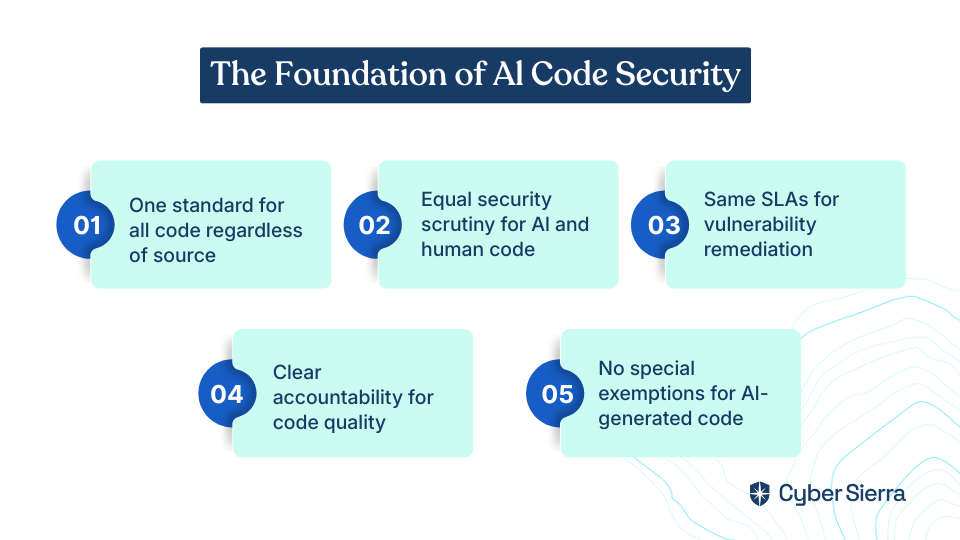
The Guiding Principle: One Security Standard for All Code

Before diving into specific controls, establish this foundational principle across your organization:

"We don't care how exactly you wrote the code - by yourself, through Copilot, copypasting from StackOverflow or you've trained your cat to code - it passes through the same scanners, upheld to the same quality standards, and expected to get fixed within the same SLAs."

This principle addresses the accountability concern head-on. AI-generated code isn't special or exempt - it must meet the same rigorous security, compliance, and quality gates as human-written code. This stance simplifies governance and clarifies risk ownership, preventing the "not my responsibility" gap when vulnerabilities inevitably emerge.

Layer 1: The Governance Foundation

Before implementing any technical controls, establish a robust governance framework:

Establish an AI Governance Committee

Form a cross-functional team with representatives from legal, compliance, IT, security, and engineering to oversee all AI initiatives. This committee will:

  • Define clear policies and standards for AI tool usage
  • Evaluate and approve enterprise AI tools
  • Monitor compliance and risk
  • Adapt governance as AI technologies and regulations evolve

Align with Established Frameworks

Don't reinvent the wheel. Adopt global standards like the NIST AI Risk Management Framework (AI RMF) for a systematic approach to identifying and mitigating risk. Consider alignment with ISO 42001 for a certifiable management system that demonstrates due diligence to stakeholders.

Define Clear Policies

Create comprehensive policies that address:

  • Acceptable Use: Create guidelines that govern proper AI usage instead of blocking it entirely. This addresses the employee tendency to use tools like ChatGPT and Claude without understanding data handling rules.
  • Data Handling & Input Risks: Explicitly forbid entering sensitive data, intellectual property, or PII into public AI tool prompts. This mitigates major input risks like data privacy/confidentiality breaches.
  • Vendor Risk Management: Incorporate AI-specific questions into all third-party risk assessments to manage risks from vendor AI tools.

Layer 2: Automated Technical Guardrails (SAST & DAST)

With a governance framework in place, implement automated security testing directly into your software development lifecycle. This is critical as studies have shown AI-generated code has 25-40% flaw rates.

Shift Left with SAST to Prevent Vulnerabilities

Static Application Security Testing (SAST) should be your first line of defense against common coding flaws:

  • Define Custom Guardrails: Use tools like Semgrep that allow you to create organization-specific secure coding standards. For example, you can enforce that all Flask applications must use secure cookie settings.
  • In-Workflow Guidance: Implement solutions that provide contextual security advice during the coding process. The goal is to make security a guide, not a gatekeeper that slows down development.
  • Practical Example: For a Python Flask app, a guardrail can enforce secure cookie settings by flagging any code that doesn't use the SESSION_COOKIE_SECURE flag, guiding the developer to fix it at the source.

Validate in Motion with DAST

Complement SAST with Dynamic Application Security Testing (DAST) to identify runtime vulnerabilities that static analysis might miss:

  • Early Integration: Integrate DAST early in the SDLC, even at the IDE and unit testing level, not just in production.
  • Developer Empowerment: Use tools like Bright Security's extension for GitHub Copilot that allows developers to run security unit tests without being security experts, catching web, API, and business logic vulnerabilities before they escalate.

Real-World Examples of AI-Generated Flaws

When reviewing AI-generated code, be vigilant for these common security issues:

Java SQL Injection:

public boolean authenticateUser(String username, String password) {
    String query = "SELECT * FROM users WHERE username='" + username +  
                   "' AND password='" + password + "'";
}

JavaScript Insecure Cookies:

document.cookie = `user_${userId}_prefs=${JSON.stringify(preferences)}`;

Python Path Traversal:

@app.route('/upload', methods=['POST'])
def upload_file():
    file = request.files['file']
    filename = file.filename
    file.save(os.path.join('/uploads', filename))

These examples demonstrate how AI can replicate insecure patterns from its training data, highlighting why automated scanning alone isn't sufficient.

Layer 3: The Indispensable Human-in-the-Loop (HITL)

Technology alone cannot address all security risks in AI-generated code. Human oversight is critical for context, accountability, and addressing the nuanced risks that automated tools can miss.

Mandate Human Review for AI-Touched Code

Implement a strict policy that requires review for AI-touched commits so a human owns the decision. This addresses a key concern expressed by many CISOs: the lack of visibility into AI's decision-making process.

Implement AI-Specific Code Review Processes

Go beyond standard reviews by instituting a "comprehension check" where developers must be able to explain:

  • The logic and security implications of the AI-generated code
  • Potential edge cases and failure modes
  • Why certain security decisions were made
  • How the code handles unexpected inputs

This directly addresses the concern that many developers can't articulate their own decision-making process, let alone understand what an AI system has generated.

Train Developers on Secure Prompt Engineering

Teach developers how to interact with AI securely through:

  • Security-Focused Prompts: Instead of asking for a generic file upload function, train developers to be specific: "Write a secure file upload function in Python that prevents path traversal, validates file types, and implements proper error handling."
  • Healthy Skepticism: Encourage teams to treat AI suggestions as proposals from an untrusted junior developer, not as infallible truths. This combats the "false sense of authority" that AI systems often project.

Layer 4: Continuous Monitoring and Access Control

Security is an ongoing process. The final layer focuses on monitoring AI usage and restricting access to prevent misuse and data exfiltration.

Deploy AI Security Platforms (AISP)

Integrate specialized platforms that provide:

  • Real-time threat detection for AI systems
  • Operational transparency into how AI tools are being used
  • Compliance monitoring for AI-related regulations
  • Anomaly detection for unusual AI interaction patterns

Implement Strict Access Controls

Control who can use AI coding tools and how they can be used:

  • Least Privilege: Ensure "citizen developers" like "Dave in Sales" do not have access to production code repositories. Restrict coding and development roles to trained personnel.
  • Isolate Sensitive Workloads: For highly sensitive applications, keep them local or VPC-isolated with a proxy in front to log and filter interactions. This creates an additional layer of protection for your most critical systems.
  • MVP Approach: Start with a minimum viable product (MVP) approach by limiting AI coding tool access to a small group of experienced developers who understand security implications before expanding to wider teams.

Implementation Roadmap for CISOs

To implement these guardrails effectively:

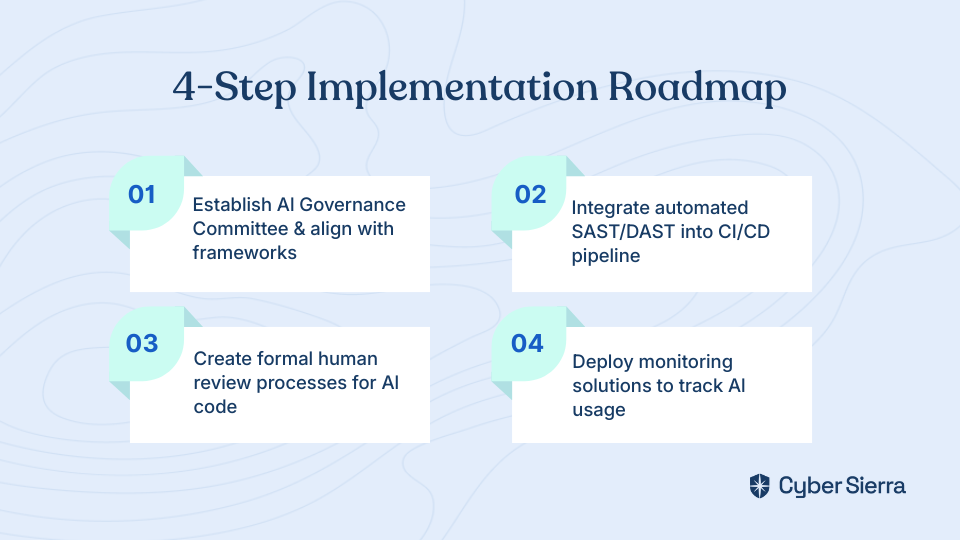
  1. Start with governance: Establish your AI Governance Committee and align with frameworks like NIST AI RMF before deploying any technical controls.
  2. Automate where possible: Integrate SAST and DAST tools into your CI/CD pipeline to catch vulnerabilities early.
  3. Formalize human oversight: Create clear processes for human review of AI-generated code and train reviewers on what to look for.
  4. Monitor and adapt: Deploy monitoring solutions to track AI usage and be prepared to adapt your approach as AI tools and threats evolve.

Conclusion: Enabling Innovation, Securely

The multi-layered approach outlined above—Governance Foundation, Automated Technical Guardrails, Human-in-the-Loop oversight, and Continuous Monitoring—creates a comprehensive security framework for AI coding tools.

By implementing these guardrails, you're not blocking innovation but enabling it to flourish responsibly. Organizations that invest in proactive, multi-layered AI security strategy will be the ones who innovate confidently, maintain stakeholder trust, and avoid the costly "hangover" of insecure AI adoption.

Remember: As AI coding tools and agentic systems become more sophisticated, your security approach must evolve alongside them. The guardrails you build today should be designed for flexibility, allowing you to adapt to tomorrow's challenges while maintaining your security posture.

Your developers get their productivity gains. You get your quality standards. And everyone sleeps better at night.

Frequently Asked Questions

What is the biggest security risk of using AI coding tools?

The primary security risk is that AI-generated code is significantly more likely to contain vulnerabilities. Studies show AI-generated code can be four times more prone to security flaws because these models are often trained on vast amounts of public code, which includes insecure patterns. They lack the context to understand and apply specific security requirements for your application, leading to common issues like SQL injection or insecure cookie handling.

How can we secure AI-generated code without slowing down developers?

The most effective approach is to integrate automated security checks directly into the developer's workflow. By "shifting left" with tools like Static Application Security Testing (SAST) and Dynamic Application Security Testing (DAST), you can provide developers with real-time feedback in their IDE or CI/CD pipeline. This makes security a helpful guide that prevents vulnerabilities early, rather than a gatekeeper that blocks releases, thus maintaining high development velocity.

Why is human review necessary if we already use automated security scanners?

Automated scanners are essential but cannot replace human oversight, which is critical for catching context-specific and business logic flaws. A human reviewer can assess whether the code's logic is sound, handles edge cases correctly, and truly meets business requirements—risks that automated tools often miss. Mandating a "comprehension check," where developers must explain the AI-generated code, ensures accountability and deeper understanding.

What is the first step to building guardrails for AI coding tools?

The first and most crucial step is to establish a strong governance foundation. Before implementing any technical controls, form a cross-functional AI Governance Committee to create clear policies for acceptable use, data handling, and vendor risk. Aligning with established frameworks like the NIST AI Risk Management Framework provides a structured approach to managing risks from the outset.

Should my organization block tools like ChatGPT and GitHub Copilot?

Blocking these tools is often an ineffective strategy that encourages "shadow IT," where employees use them without approval or oversight. A better approach is to enable their use responsibly by establishing clear acceptable use policies and implementing technical guardrails. This allows you to harness the productivity benefits of AI while managing the associated risks through a structured, multi-layered security framework.

How do we prevent developers from leaking sensitive data into public AI models?

Preventing data leaks requires a combination of policy and technical controls. Your organization's acceptable use policy must explicitly forbid entering any sensitive data, intellectual property, or Personally Identifiable Information (PII) into public AI prompts. For highly sensitive work, you can supplement this policy with technical controls like data loss prevention (DLP) tools or by requiring developers to use AI tools within isolated, VPC-based environments.

blog-hero-background-image
Cyber Security

The Citizen Developer Problem: Managing Non-Technical AI Coders

backdrop
Table of Contents

Join thousands of professionals and get the latest insight on Compliance & Cybersecurity.


Meet "Dave in Sales," Your Newest Coder

Your sales representative Dave just proudly announced that he built a customer data processing application using an AI coding tool. He's already rolled it out to the sales team, who are loving how it streamlines their workflow by extracting customer information from emails and automatically updating the CRM.

There's just one problem: Dave has no formal programming training. He's never attended a security awareness session. And his application is now processing sensitive customer data without any oversight from IT or Security.

Welcome to the era of the citizen developer – non-technical employees using technology to build applications without formal programming knowledge. As MIT Sloan reports, this phenomenon has been supercharged by the proliferation of powerful AI coding tools, creating what security professionals now call "Shadow AI" – the unmanaged use of artificial intelligence that significantly increases organizational vulnerabilities.

The urgency of addressing this challenge cannot be overstated:

  • A massive IT talent shortage, predicted to exceed 85 million people globally by 2030 according to Korn Ferry research, is driving organizations to embrace citizen developers
  • 86% of companies are already incorporating AI into their software development lifecycle, according to Built In
  • The gap between development demand and security oversight is widening daily

This article provides a clear framework for CISOs and IT leaders to manage the risks of AI-assisted citizen development by implementing robust governance, secure guardrails, and proactive guidance, enabling innovation without sacrificing security.

The Security Nightmare of Unchecked AI-Generated Code

When "Dave from Sales" starts coding with AI assistance, several critical security vulnerabilities emerge that can put your entire organization at risk.

Vulnerable Application Code

AI tools often replicate insecure coding practices found in their training data. Research published on arxiv.org indicates that up to 32% of code snippets from tools like GitHub Copilot contain vulnerabilities, including SQL injection and hard-coded secrets. Without proper security expertise, citizen developers won't recognize these flaws, letting them slip into production.

A non-technical user might not understand why a seemingly functional piece of code that accepts user input directly into a database query creates an SQL injection vulnerability, or why hardcoding API keys in client-side code is dangerous.

Insecure Infrastructure and Configuration

AI can generate configuration files with weak passwords, overly permissive access controls, or exposed API keys. According to the Cloud Native Computing Foundation (via OpsMx.com), 75% of organizations have faced incidents due to misconfigured environments.

When citizen developers deploy applications without proper infrastructure security knowledge, they often create environments with excessive permissions, inadequate network isolation, or insecure default settings.

Data Privacy and Leakage

AI models can inadvertently expose Personally Identifiable Information (PII) or other sensitive data from their training sets. This is a major concern, with 68% of companies worrying about data leakage risks from AI tools according to Forrester Research (via OpsMx.com).
Citizen developers often lack awareness of data protection requirements, potentially creating applications that process sensitive information without proper encryption, access controls, or compliance with regulations like GDPR or CCPA.

Inadequate Security Testing

AI-generated test cases may lack coverage for critical security scenarios and edge cases. An IEEE study found 30% of AI-generated tests missed critical edge cases (OpsMx.com).

Without security expertise, citizen developers typically focus testing on functionality rather than security, leaving vulnerabilities undiscovered until they're exploited.

A Three-Pillar Framework for Safe Citizen Development

To harness the innovation potential of citizen developers while mitigating security risks, organizations need a structured approach based on the MIT Sloan "Four G's" framework (Genesis, Guidance, Governance, Guardrails). Let's focus on the practical implementation of Governance, Guardrails, and Guidance.

Pillar 1: Governance - Establishing Rules and Workflows

Mandate Formal Approval Workflows

Any application, no matter how small, must go through a formal, automated approval process before deployment. Manual processes are too slow and error-prone to be effective at scale.

According to Solvexia, a robust approval workflow must include:

  • Initiator: The citizen developer starting the request
  • Approvers: Designated IT, security, or business line managers
  • Approval Levels: A clear hierarchy (e.g., manager approval for small tools, IT security for apps handling customer data)
  • Routing Rules & Conditional Logic: Automatically route requests based on data sensitivity, scope, or cost
  • Notifications & Deadlines: Keep the process moving with automated alerts
  • Audit Trail: Create an immutable record of all actions and decisions to address the lack of visibility and improve accountability

Step-by-Step Guide to Designing Your Workflow

  1. Identify Key Processes: Determine which citizen developer activities require approval (e.g., new app creation, connecting to a new data source, deploying an update)
  2. Define Roles and Permissions: Clearly state who can build, who can approve, and what they can access
  3. Implement Automation Tools: Use workflow software to build and enforce the process
  4. Establish Clear Approval Criteria: Define the security and compliance quality standards an app must meet
  5. Implement Logging and Tracking: Ensure full visibility into the status of any request

Enforce a "Human-in-the-Loop" (HITL) Policy

Emphasize that AI is a co-pilot, not the pilot. Mandate human review and approval of all AI-generated code before it moves forward. This HITL approach ensures that experienced developers or security professionals can catch issues that AI might miss, particularly in complex or sensitive applications.

As research from OpsMx.com confirms, human oversight remains essential in AI-assisted coding processes, especially when non-technical users are involved.

Pillar 2: Guardrails - Building a Safe Sandbox Environment

Introduce Sandboxes for Citizen Developers

A sandbox is a secure, isolated environment where non-technical users can experiment without impacting production systems. Skillable frames this as a "Learning Sandbox" designed for all skill levels, providing a safe space for innovation while containing potential security risks.

Why Sandboxes are Effective:

  • Safe Experimentation: They create a risk-free environment for innovation, allowing citizen developers to build their MVP (Minimum Viable Product) without endangering production systems
  • Hands-on Learning: They cater to the 66% of technical professionals who prefer practical, real-world application in their learning according to Skillable research
  • Cost and Security Control: Strict guardrails can be implemented to prevent resource misuse and security breaches

Essential Sandbox Guardrails:

  • Strict Access Control Policies: Limit what data and systems the sandbox environment can connect to. For sensitive workloads, consider complete isolation using a VPC (Virtual Private Cloud), ensuring citizen developers can't accidentally access or expose sensitive information
  • Resource Restrictions: Set limits on compute, storage, and API calls to control costs and prevent resource abuse
  • Integrated Security Scanning: Embed automated security tools directly within the sandbox to provide real-time feedback on potential vulnerabilities

Pillar 3: Guidance - Training and Continuous Improvement

Upskill Your Citizen Developers

Address the challenge that individuals "often have to rely on self-education without organizational support" by providing structured training and resources:

  • Provide mandatory training on secure coding basics, the limitations of AI tools, and data privacy policies
  • Establish a "center of excellence" or "center of influence" to provide ongoing support and share best practices, as recommended by MIT Sloan
  • Create clear documentation and guidelines specifically designed for non-technical users

Automate Security Testing

Don't rely on manual checks alone, especially when working with citizen developers who may lack security expertise:

  • Integrate SAST (Static Application Security Testing) and DAST (Dynamic Application Security Testing) into the citizen developer workflow. Even a simplified CI/CD pipeline can automate these checks upon submission for approval
  • Explore tools like CodeRabbit.ai, which uses AI to review pull requests and run static analysis, as suggested by users in a Reddit discussion
  • Implement automated vulnerability scanning that's accessible to non-technical users, providing clear, actionable feedback

Foster a Culture of Collaboration

Break down silos between business users and IT. The goal is to engage IT early to prevent security and compliance issues down the line, a common pitfall noted by MIT Sloan:

  • Create cross-functional teams that pair citizen developers with IT professionals
  • Establish regular touchpoints between business units and security teams
  • Recognize and reward secure development practices to incentivize proper behavior

From Liability to Asset: Embracing Secure Citizen Development

The rise of the AI-powered citizen developer is an opportunity, not just a threat. The chaos of unmanaged agentic systems and non-technical coders is a real fear, but it's a manageable one with the right approach.

By implementing a framework of robust Governance (approval workflows), secure Guardrails (sandboxes), and proactive Guidance (training and automated tools), organizations can harness the innovative power of their entire workforce while maintaining security standards.

This three-pillar approach addresses the core tension in citizen development: enabling innovation while managing risk. With proper implementation:

  • Business users can quickly create solutions to their immediate problems without lengthy IT backlogs
  • Security teams gain visibility and control over all application development
  • IT departments can focus on complex, enterprise-scale projects while providing guidance to citizen developers
  • The organization benefits from accelerated digital transformation with reduced security exposure

The objective isn't to stop "Dave in Sales"—it's to empower him to innovate safely. By providing the right tools, training, and oversight, you transform a potential security risk into a strategic advantage.

Remember that the most successful citizen developer programs don't just focus on technology but also on people and processes. As MIT Sloan notes, the organizations that thrive are those that view citizen development as a partnership between business and IT rather than a replacement for professional developers.

By building a secure foundation for citizen-led development, you can unlock innovation across your organization while ensuring that security remains a priority—not an afterthought. The power of AI coding tools combined with human creativity and proper security guardrails creates a potent formula for digital transformation that's both rapid and responsible.

The future belongs to organizations that can harness the power of their entire workforce to build solutions, not just their IT department. With the right framework in place, your citizen developers can safely contribute to this future, one AI-assisted application at a time.

Frequently Asked Questions

What is a citizen developer?

A citizen developer is an employee without formal programming training who builds applications using user-friendly tools, such as AI coding assistants or low-code/no-code platforms. They are typically business users who create solutions to solve immediate problems without relying on the IT department, which accelerates innovation but can introduce security risks if not managed properly.

Why is AI-assisted coding by non-technical employees a security risk?

AI-assisted coding by non-technical employees poses a significant security risk because AI tools can generate vulnerable code, and citizen developers often lack the expertise to identify and fix these flaws. Key risks include applications with common vulnerabilities like SQL injection, insecure configurations with weak passwords, and the potential for sensitive data leakage from AI training data or improper handling.

How can an organization safely manage citizen developers?

An organization can safely manage citizen developers by implementing a three-pillar framework of Governance, Guardrails, and Guidance. This involves establishing mandatory approval workflows (Governance), providing secure, isolated sandbox environments for development (Guardrails), and offering structured training on security best practices and automated testing tools (Guidance).

What is a sandbox environment and why is it essential for citizen development?

A sandbox is a secure, isolated testing environment that allows citizen developers to build and experiment with applications without affecting production systems or data. It is essential because it provides a "safe space" for innovation while containing potential security risks, controlling costs, and offering a hands-on learning environment for non-technical users.

Should we stop employees from using AI coding tools?

No, the goal is not to stop employees from using AI coding tools but to empower them to innovate safely. Banning these powerful tools is often impractical and stifles business agility. The recommended approach is to embrace the trend by providing the right oversight, tools, and training, transforming a potential security liability into a strategic advantage.

Can citizen developers replace professional developers?

No, citizen developers are not a replacement for professional developers; instead, they complement them. Citizen developers are best suited for building simpler, business-specific applications that solve immediate needs. This frees up professional IT and development teams to focus on more complex, enterprise-scale projects that require deep technical and security expertise.

blog-hero-background-image
Cyber Security

AI Agent Permissions: The New IAM Nightmare for CISOs

backdrop
Table of Contents

Join thousands of professionals and get the latest insight on Compliance & Cybersecurity.


You've successfully deployed your first AI coding assistants across the enterprise. Developers rave about productivity gains, executives are thrilled with accelerated delivery timelines, and your "citizen developer" program is finally taking off. Then it happens - an AI agent with delegated permissions inadvertently pushes sensitive configuration data to a public GitHub repository, exposing critical infrastructure credentials. Your team scrambles to contain the damage while executives demand answers about how this could happen under your watch.

Welcome to the new frontier of Identity and Access Management nightmares.

The Gold Rush and the Impending Security Hangover

Today's enterprise landscape is experiencing an unprecedented AI tool adoption wave. As one CISO aptly described it: "AI tools look set to follow the same arc. Right now it's the gold rush—Copilot everywhere, 'citizen devs,' quick wins. The hangover will be security holes, compliance misses, and rework costs."

The reality is sobering - while organizations race to deploy AI coding tools and agentic systems, security teams are struggling with a fundamental gap in monitoring and entity management. Traditional Identity and Access Management (IAM) frameworks simply weren't designed to handle autonomous AI agents that traverse multiple systems like Jira, GitHub, and custom platforms.

"There's definitely some gap in monitoring and entity management, particularly as these systems get more autonomous and advanced," notes one security professional. This gap becomes even more pronounced when HITL (Human In The Loop) processes lack visibility: "My main concern with the human in the loop approach is not having visibility into the decision making process these agents follow."

Why Your Current IAM is Buckling Under the Strain of AI Agents

Traditional IAM frameworks were built for a world of predictable human and service account interactions. AI agents introduce several paradigm-breaking challenges:

1. The Blurring of Identities

Your current IAM system relies on clear distinctions between human and machine identities. AI agents create a new category of "hybrid identities" that blur this line, causing failures in static, session-based identity verification. When an AI agent acts on behalf of a user, is it the user's identity or the agent's?

2. The Peril of Delegated Credentials and Over-Privilege

Agentic systems often inherit user credentials, receiving far broader permissions than they require for specific tasks. Consider this real-world scenario: A DevOps AI agent with inherited admin permissions misinterprets a prompt and deletes critical cloud resources, mistakenly believing it's cleaning up development environments.

3. Autonomy, Unpredictability, and Prompt Injection

LLM-powered agents can behave in unexpected ways when given broad access. Prompt injection attacks represent a particularly dangerous vector, where malicious inputs can cause an agent to perform unauthorized actions despite guardrails. Your static permission models aren't designed to adapt to the dynamic, sometimes unpredictable nature of AI agent behaviors.

4. Regulatory and Compliance Risks

In multi-tenant systems, lax AI agent permissions can lead to serious compliance violations. For example, an AI assistant might accidentally aggregate data across multiple tenants, violating data isolation principles and potentially triggering regulatory penalties under GDPR, HIPAA, or financial regulations.

The CISO's New Playbook: A Proactive IAM Framework for AI

Addressing these challenges requires a fundamental shift in how we approach permissions for AI agents. As one security leader noted, "You can't rely on one control—layers are the only way to keep productivity gains without drowning in risk."

Here's a new three-pillar framework for managing AI agent permissions effectively:

Pillar 1: Proxy Agent Access for Centralized Control and Observability

Instead of allowing AI agents to connect directly to systems like Jira, GitHub, or custom tools, route all agent traffic through a controlled proxy or gateway. This approach directly addresses the recommendation to "keep them local or VPC-isolated with a proxy in front to log/filter."

A proxy layer provides several critical benefits:

  • Enforces strict access controls based on roles and contexts
  • Provides centralized API logging and monitoring
  • Creates a single point for permission revocation during incidents
  • Simplifies management of permissions across disparate systems

Agentgateway, an open-source data plane built in Rust, represents an emerging solution designed specifically for this purpose. It provides security, observability, and governance for agent communications across various systems while supporting standard interoperability protocols.

Pillar 2: Redefine Authorization with Granular, Dynamic Permissions

Traditional role-based permissions are too static for the fluid nature of AI agent interactions. Instead:

Embrace the Principle of Least Privilege:

  • Grant agents only the narrowest permissions required for specific tasks
  • Consider starting with read-only permissions and gradually expanding as one organization reported: "One thing that helped us get legal buy-in was starting with read-only permissions and gradually expanding."

Implement Modern Protocols and Models:

  • Utilize OAuth 2.0 with granular scopes like read_calendar or create_ticket to gain explicit consent for specific actions
  • Enforce short-lived tokens that expire quickly and can be easily revoked
  • Move beyond simple RBAC to Relationship-Based Access Control (ReBAC) that enforces context-aware permissions dynamically

For MVPs and early-stage implementations, creating clear permission boundaries helps prevent "permission creep" while still enabling business value.

Pillar 3: Monitor for Behavioral Anomalies

Static rules are insufficient for managing AI agent behaviors. Security teams must implement systems that monitor for deviations from established patterns:

  1. Data Collection: Gather comprehensive data from system logs, API calls, and network traffic
  2. AI Training: Use machine learning to establish a baseline of "normal" behavior for each agent type
  3. Pattern Recognition & Anomaly Detection: Continuously monitor for deviations from the baseline
  4. Expert Validation: Ensure flagged anomalies are investigated by human experts, maintaining HITL processes for security decisions

This approach directly addresses the need for better monitoring as systems become more autonomous. It allows security teams to detect unauthorized access attempts, data exfiltration, and other suspicious activities that might indicate compromise or unintended agent behavior.

Implementing the Playbook: Essential Tools and Methodologies

Turning theory into practice requires specific tools and methodologies. Here's how to implement each pillar of the framework:

Identity and Secrets Management

Start with robust foundations by leveraging:

  • A world-class identity provider (IDP) like Azure AD or Okta
  • A secrets vault like HashiCorp Vault or Azure Key Vault for secure credential storage
  • Clear distinctions between user identities, application identities, and managed identities

As one practitioner advised: "You need a world class IDP like Azure and something like key vault to store secrets. You have a choice of user identity, application identity and managed identity."
Secure VPC and Gateway Implementation

For sensitive AI agent operations:

  1. Deploy agents within a Virtual Private Cloud (VPC) to isolate interaction flows
  2. Implement Agentgateway or similar proxy solutions with:
    • Robust RBAC for all agent protocols
    • Multi-tenant support for enterprise scenarios
    • Comprehensive logging for all agent activities

Quality and Security Guardrails

Regardless of how code is produced (human-written or AI-generated), implement consistent guardrails:

  • Run all code through Static Application Security Testing (SAST) tools to identify vulnerabilities before deployment
  • Implement Dynamic Application Security Testing (DAST) for runtime protection
  • Establish quality standards that apply equally to human and AI-generated code
  • Create automated scanning pipelines that trigger on any code change

As one CISO put it: "We don't care how exactly you wrote the code - by yourself, through cursor, copypasting from SO or you've trained your cat to code - it passes through the same scanners, upheld to the same quality standards, and expected to get fixed within the same SLAs."

Governance and Auditing

Implement comprehensive monitoring and auditing:

  • Log every API call with timestamps, agent ID, action taken, and data accessed
  • Conduct regular permission reviews as organizational needs evolve
  • Implement automated alerts for anomalous agent behaviors
  • Ensure proper HITL oversight for critical agent actions

From Nightmare to Strategic Advantage

The emergence of agentic systems represents both a challenge and an opportunity for security leaders. By recognizing that traditional IAM approaches fall short when dealing with AI agents, CISOs can proactively implement a new framework built on:

  1. Proxy Access: Centralizing control and gaining observability through gateway architecture
  2. Dynamic Permissions: Implementing least privilege with modern authorization models
  3. Behavioral Monitoring: Detecting and responding to threats by understanding normal versus anomalous behaviors

Organizations that master these capabilities will be able to safely unlock the significant productivity gains of AI coding tools and citizen developer initiatives while maintaining robust security postures. Rather than viewing AI agent permissions as just another security headache, forward-thinking CISOs can position themselves as enablers of innovation by establishing these guardrails.

The gold rush of AI adoption doesn't have to end with a security hangover. With the right approach to permissions, monitoring, and governance, security leaders can ensure that agentic systems enhance rather than undermine enterprise security.

Frequently Asked Questions

What is the main security risk of using AI coding agents?

The primary security risk is unauthorized access and data exposure resulting from inadequate Identity and Access Management (IAM). AI agents can blur traditional identity lines, inherit excessive user permissions, and behave unpredictably. This creates openings for prompt injection attacks and accidental data leaks, leading to credential exposure, compliance violations, and other security incidents.
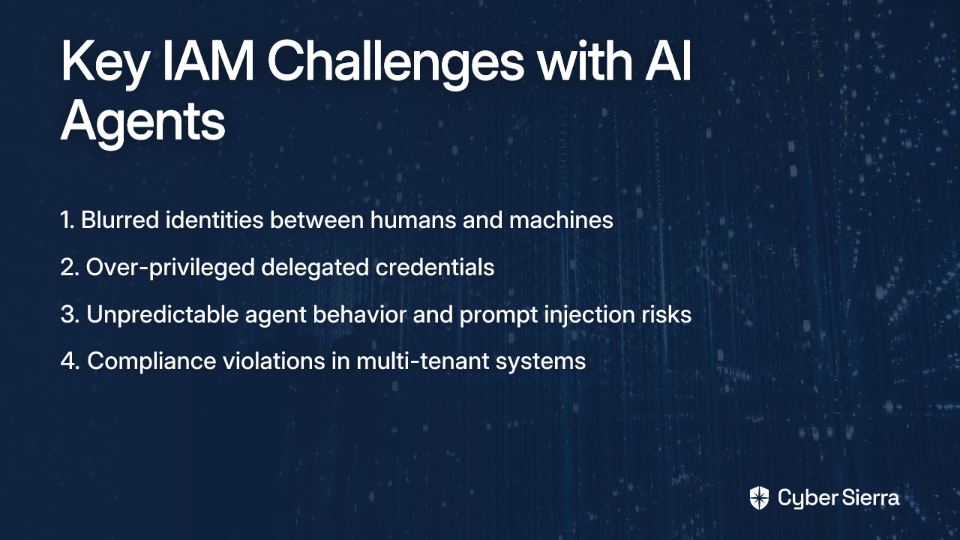
Why can't traditional IAM systems manage AI agents effectively?

Traditional IAM systems are not equipped to manage AI agents because they were designed for predictable human and service account interactions. They fail to handle the hybrid identity of an AI acting on behalf of a user, cannot apply static permissions to dynamic and unpredictable agent behaviors, and lack the context to prevent over-privilege when agents inherit broad user credentials.
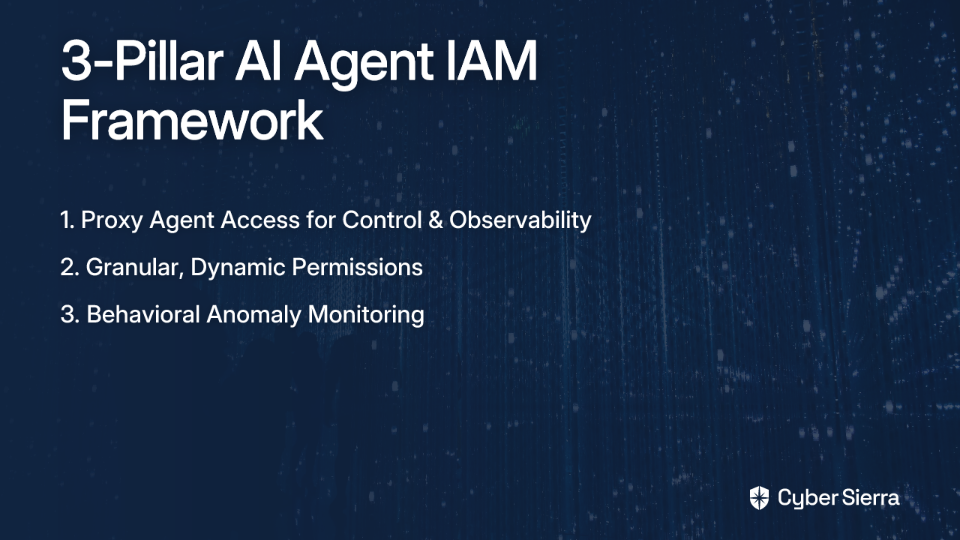

How can an organization secure AI agent access to its systems?

Organizations can secure AI agent access by adopting a modern, three-pillar framework. This involves routing all agent traffic through a proxy gateway for centralized control and observability, implementing granular and dynamic permissions based on the principle of least privilege, and continuously monitoring agent activity for behavioral anomalies that could indicate a compromise.

What is an AI agent proxy or gateway?

An AI agent proxy or gateway is a centralized service that sits between AI agents and the systems they need to access, such as GitHub, Jira, or internal databases. It acts as a single control point to enforce security policies, provide detailed logs for auditing and monitoring, and manage permissions consistently. This prevents agents from having direct, uncontrolled access to critical systems.

What are dynamic permissions and why are they important for AI agents?

Dynamic permissions involve granting an AI agent the minimum level of access required for a specific task, for the shortest possible duration. Unlike static roles, this approach uses modern protocols like OAuth 2.0 with granular scopes and short-lived tokens. This is crucial for limiting the potential damage an agent can cause if compromised or if it misinterprets a prompt, ensuring it operates under the principle of least privilege.

How does monitoring AI agent behavior improve security?

Monitoring AI agent behavior allows security teams to detect threats by identifying actions that deviate from established patterns. By using machine learning to establish a baseline of "normal" behavior for each agent, the system can automatically flag anomalies such as unusual API calls, access from strange locations, or attempts to access unauthorized data. This provides an early warning of a potential compromise or malfunction.


This article is part of our series on emerging security challenges in AI-enabled enterprises. For more insights on managing security in the age of agentic systems, visit our resource center.

blog-hero-background-image
Cyber Security

The CISO Reading List: Leadership Books That Beat Technical Manuals

backdrop
Table of Contents

Join thousands of professionals and get the latest insight on Compliance & Cybersecurity.


You close another RFC document, realizing that for the first time in your career, technical manuals aren't addressing your most pressing challenges. As a CISO, your bookshelf has evolved—fewer network architecture guides, more leadership titles. The realization hits: your success now depends less on technical prowess and more on your ability to influence, communicate, and lead.

"I don't find myself reading many technical books anymore. Most of my reading has to do with the specific industry I'm in, leadership, or more recently, public speaking/storytelling," confessed one CISO in an online forum, echoing what many security leaders experience as they advance in their careers.

This transition makes perfect sense. The modern CISO role has transformed from a purely technical position to a critical business leadership function. While you once measured success by implementing the right security controls, you're now evaluated on how effectively you communicate risk to the board, secure budget in competitive environments, and build a security culture across the enterprise.

The Great Shift: Why Your Reading Habits Must Evolve

The evolution from technical expert to business leader requires a fundamental shift in how CISOs approach professional development—especially their reading habits.

"Being a CISO can be a highly stressful, political, and lonely gig at times," noted one security leader in a Reddit discussion. This reality demands a different knowledge base than what's found in technical documentation. Your technical expertise got you here, but it's your leadership capabilities that will determine how far you'll go.

The modern CISO faces challenges that no firewall manual can solve:

  • How do you convince the board to invest in cybersecurity during budget cuts?
  • What's the best way to build a high-performing security team in a competitive talent market?
  • How do you effectively communicate complex cybersecurity concepts to non-technical stakeholders?
  • When crisis strikes, how do you lead with confidence and clarity?

These questions demand insights from leadership, psychology, communication, and strategy—disciplines far removed from the technical foundations of infosec.

The Essential CISO Bookshelf: A Curated Guide to Leadership Skills

Skill Area 1: Negotiation and Influence

Why it matters: As a CISO, your ability to secure resources, gain buy-in for security initiatives, and influence organizational change directly impacts your program's success.

Book Recommendation: Never Split the Difference by Chris Voss

This masterclass in negotiation from a former FBI hostage negotiator provides tactical approaches that transform how you advocate for security priorities. Voss introduces concepts like "tactical empathy" and "calibrated questions" that can revolutionize your executive interactions.

Cybersecurity Application: When your CFO pushes back on your security budget request, don't just cite compliance requirements. Apply tactical empathy by acknowledging financial constraints, then use calibrated "how" questions: "How can we meet our security obligations while being mindful of our financial situation?" This approach transforms confrontation into collaboration.

Book Recommendation: Influence: The Psychology of Persuasion by Robert Cialdini

Cialdini breaks down six universal principles of influence: reciprocity, commitment/consistency, social proof, authority, liking, and scarcity. Understanding these principles gives CISOs powerful tools for driving security adoption.

Cybersecurity Application: When rolling out a new security awareness program, leverage social proof by highlighting departments with high compliance rates, use commitment by having employees make public pledges to security practices, and apply authority by ensuring executive sponsorship is visible throughout the campaign.

Skill Area 2: Communication and Storytelling

Why it matters: The ability to translate complex technical concepts into business language is perhaps the most critical skill for modern CISOs. Technical details matter less than the story they tell about business risk.

Book Recommendation: Crucial Conversations: Tools for Talking When Stakes Are High by Patterson, Grenny, McMillan, and Switzler

This book provides a framework for handling high-stakes discussions—like explaining a security breach to the board or pushing back on an unsafe product launch—while maintaining relationships and achieving positive outcomes.

Cybersecurity Application: When leading a post-incident review after a significant data breach, emotions typically run high. Using the book's STATE method (Share facts, Tell your story, Ask for others' paths, Talk tentatively, Encourage testing), you can create psychological safety that allows team members to honestly discuss what went wrong without descending into blame and defensiveness.

Book Recommendation: Made to Stick by Chip and Dan Heath

The Heath brothers outline why some ideas survive while others die, providing a framework (Simple, Unexpected, Concrete, Credible, Emotional, Stories) that helps security messages resonate and drive action.

Cybersecurity Application: Instead of presenting abstract phishing statistics to the executive team, create an unexpected, emotional narrative about how a simulated phishing attack could have compromised the CEO's account, with concrete examples of what could have happened next. This approach transforms dry statistics into compelling calls to action.

Skill Area 3: Strategic Thinking

Why it matters: Enterprise security architecture requires more than technical designs—it demands aligning security with business objectives and making strategic trade-offs that balance risk with opportunity.

Book Recommendation: Good Strategy Bad Strategy by Richard Rumelt

Rumelt defines good strategy as having a clear diagnosis of the challenge, a guiding policy to address it, and coherent actions that implement the policy. This framework helps CISOs move beyond tactical security implementations to strategic programs.

Cybersecurity Application: When developing your three-year security roadmap, apply Rumelt's kernel. Diagnosis: "Our rapid cloud adoption has created security blind spots and inconsistent controls." Guiding Policy: "We will implement a zero-trust architecture to secure access regardless of location or platform." Coherent Actions: A sequenced implementation plan that includes identity governance, microsegmentation, and continuous monitoring.

Book Recommendation: How to Measure Anything in Cybersecurity Risk by Douglas W. Hubbard & Richard Seiersen

This book challenges qualitative risk assessment (High/Medium/Low matrices) and provides practical methods for quantifying cybersecurity risk in financial terms—the language of business.

Cybersecurity Application: When the business wants to accelerate the launch of a new product with known security issues, use Hubbard's methods to quantify the risk in dollars: "Based on our analysis, launching without fixing these vulnerabilities creates a 20% probability of a breach within six months, with an expected loss of $4.2 million." This transforms security from a binary yes/no into a business risk conversation.

Skill Area 4: Crisis Management and Resilience

Why it matters: In cybersecurity, it's not if a crisis will happen, but when. How you lead during these critical moments defines your reputation and effectiveness.

Book Recommendation: The Art of War by Sun Tzu

This ancient text provides timeless wisdom on strategy, preparation, and decisive action that applies directly to cybersecurity leadership.

Cybersecurity Application: Sun Tzu's principle that "the supreme art of war is to subdue the enemy without fighting" translates perfectly to proactive security. By investing in threat intelligence and implementing controls that deter attackers before they succeed, you win battles that never have to be fought.

Book Recommendation: Deep Work by Cal Newport

While not specifically about crisis management, Newport's thesis on focused work without distraction is essential for CISOs who must make critical decisions under pressure.

Cybersecurity Application: During a security incident, the constant flow of emails, messages, and alerts can paralyze decision-making. Newport's techniques for creating distraction-free work environments can help you establish an incident response process that preserves mental bandwidth for the most critical decisions.

Beyond the Boardroom: Learning Leadership from Unconventional Fields

The best leadership insights often come from outside your immediate domain. Many CISOs report finding valuable leadership lessons in unexpected places.

"I often read books on sporting/political figures, and I often take mental note on some of their leadership qualities," shared one security leader in an online discussion. This approach recognizes that leadership principles transcend industries and contexts.

Lessons from the Sports Arena

Team Building: Great coaches don't just recruit talented individuals; they build cohesive teams that perform beyond the sum of their parts. Similarly, effective CISOs build security teams with complementary skills and a unified purpose. Phil Jackson's approach to integrating diverse personalities on championship basketball teams offers valuable insights for security leaders building their own teams.

Performance Under Pressure: Athletes compete under intense scrutiny and pressure—much like CISOs during security incidents. Books like "The Inner Game of Tennis" by Timothy Gallwey explore the mental aspects of performance that can help security leaders maintain clarity during crises.

Lessons from Politics and Diplomacy

Coalition Building: Political leaders must build coalitions across diverse interests to achieve goals—just as CISOs must align security initiatives with various business objectives. Books like "Team of Rivals" by Doris Kearns Goodwin illustrate how Lincoln built an effective cabinet from political opponents, offering lessons for CISOs working across organizational silos.

Strategic Communication: Political leaders must communicate complex ideas to diverse audiences—a skill every CISO needs when addressing technical and non-technical stakeholders. Studying how effective political communicators frame messages can enhance a CISO's ability to advocate for security initiatives.

Building Your Personal Leadership Library

The transition from technical expert to security leader doesn't happen overnight, and neither does building your leadership library. Here are practical steps to enhance your leadership reading:

  1. Start with your greatest challenge: Choose books that address your most pressing leadership challenges. Struggling with board presentations? Start with communication books.
  2. Diversify your formats: Audiobooks during commutes, e-books for travel, and physical books for deep focus can help busy CISOs integrate reading into their hectic schedules.
  3. Join a community: Engage with programs like the Cyber Security Canon from Palo Alto Networks, which identifies essential books for cybersecurity professionals, or Deloitte's NextGen CISO Academy for peer discussions.
  4. Apply what you learn: For each leadership book, identify at least one concept to apply in your security program. Real-world application cements learning.

Frequently Asked Questions

Why should a CISO read leadership books instead of technical manuals?

A CISO should prioritize leadership books because the role has fundamentally shifted from a technical manager to a business executive. Success is now measured by the ability to influence the board, secure budgets, and build a security-conscious culture—skills that are developed through studying leadership, communication, and strategy, not just technical guides.

What are the most critical non-technical skills for a CISO?

The most critical non-technical skills for a CISO fall into four key areas: negotiation and influence, communication and storytelling, strategic thinking, and crisis management. Mastering these skills allows a CISO to effectively translate technical risks into business impact, gain buy-in from stakeholders, align security with corporate objectives, and lead confidently during incidents.

How can a book like "Never Split the Difference" be applied to cybersecurity?

Lessons from "Never Split the Difference" can be directly applied to a CISO's daily challenges, especially in negotiations. For example, when negotiating for a larger security budget, a CISO can use "tactical empathy" to acknowledge the CFO's financial constraints and then use "calibrated questions" like, "How can we address these critical risks within the proposed budget?" to foster collaboration instead of confrontation.

As a busy CISO, how can I find time to read?

Busy CISOs can find time to read by integrating it into their existing routines and diversifying formats. Listening to audiobooks during a commute, using e-books while traveling, and scheduling short, 15-20 minute reading blocks for deep focus on physical books are effective strategies. The goal is to make reading a consistent habit rather than waiting for large, uninterrupted blocks of time.

How do I measure the value of developing "soft skills"?

The value of soft skills is measured through tangible business outcomes. For example, improved negotiation skills can lead to approved budgets for critical security tools. Better storytelling can increase employee adherence to security policies, reducing human error. Strategic thinking helps align security investments with business goals, demonstrating that the security program is a business enabler, not just a cost center.

Where should I start if I can only read one book from this list?

If you can only read one book, start with the one that addresses your most immediate and significant challenge. If you struggle to get buy-in from other executives, begin with "Influence: The Psychology of Persuasion." If your primary challenge is communicating risk to the board, start with "Crucial Conversations." Choosing a book with immediate applicability ensures you get the most value from your time.

Conclusion: Lead, Don't Just Manage

The transition from technical expert to security leader requires expanding your knowledge beyond infosec. As one CISO noted, "It can be a highly stressful, political, and lonely gig at times." The right leadership books can be your guides and companions on this journey.

By balancing technical knowledge with leadership wisdom, you'll be equipped to not just secure systems, but to influence people, shape culture, and drive security as a business enabler. The most successful CISOs understand that while technical skills might have gotten them the job, leadership skills will help them excel in it.

Your challenge: Choose one book from this list that addresses your biggest leadership challenge today. Your organization—and your future self—will thank you.

blog-hero-background-image
Cyber Security

Building Your Personal CISO Knowledge Network in 2025

backdrop
Table of Contents

Join thousands of professionals and get the latest insight on Compliance & Cybersecurity.


You stare at the cybersecurity book on your desk—published just three years ago—and realize much of its content is already obsolete. Your team is asking questions about emerging threats you've barely had time to research yourself, and the board meeting where you'll need to explain complex security concepts in plain language is next week. As you scroll through your professional networks searching for answers, you're struck by a familiar feeling: despite being surrounded by information, you feel isolated in your role.

Sound familiar? You're not alone.

The Modern CISO's Learning Dilemma

Today's Chief Information Security Officers face a unique challenge: cybersecurity "evolves EVERY SINGLE DAY," making traditional learning resources quickly outdated. As one CISO on Reddit aptly noted, "Books published in 2018 don't seem to be as relevant anymore." This rapid evolution creates an endless knowledge treadmill that's nearly impossible to keep pace with through conventional means.

Beyond the technical challenges, many security leaders describe the CISO position as "a highly stressful, political, and lonely gig at times." The isolation can be particularly acute when facing novel threats or strategic decisions without a trusted circle of advisors who understand your specific challenges.

The solution isn't simply finding better books—it's building a dynamic learning ecosystem that provides real-time insights, peer validation, and multifaceted perspectives. In 2025, the most successful CISOs will be those who've mastered the art of cultivating a personal knowledge network rather than just consuming information.

The Shift Beyond the Bookshelf: Prioritizing Leadership and Communication

The evolution of the CISO role has profoundly changed what security leaders need to learn. Technical expertise remains essential, but it's no longer sufficient.

"I don't find myself reading many technical books anymore," shared one seasoned CISO. "Most of my reading has to do with the specific industry I'm in, leadership, or more recently, public speaking/storytelling."

This shift reflects a critical reality: today's CISO must translate complex technical concepts into business language that resonates with executives, board members, and non-technical stakeholders. Yet this creates a significant challenge that SANS Institute calls "The Curse of Knowledge"—the cognitive bias that makes it difficult for experts to imagine what it's like not to know something.

To overcome this communication barrier, modern CISOs need to:

  1. Embrace a novice mindset: Regularly approach problems from a beginner's perspective
  2. Eliminate technical jargon: Practice translating complex concepts into accessible language
  3. Gain fresh perspectives: Engage with professionals outside cybersecurity to refresh communication approaches

These skills aren't innate—they're developed through deliberate practice and exposure to diverse viewpoints found within a robust knowledge network.

Pillar 1: The Power of Peer Networks and Professional Associations

The foundation of your CISO knowledge network should be built on high-quality peer relationships. These connections provide validation, shared insights, and the emotional support that's particularly valuable in a role where, as one security leader put it, "Would love to hear if others have found similar resources valuable!"

Exclusive CISO Communities

Several organizations offer structured environments specifically designed for security leadership:

SANS CISO Network: This exclusive community provides a collaborative environment where security leaders share ideas and lessons learned. Members gain access to specialized presentations, case studies, and threat landscape updates. The network hosts regular events like the SANS CISO Network Roundtable in London scheduled for October 2025.

CyberRisk Collaborative (CRC): With over 1,400 CISO members, this community features practitioner-driven curriculum and hosts 130+ member-only events annually. Members can access more than 250 CISO-developed tools and resources. Upcoming events include the 2025 CyberRisk CISO Dinners in Dallas (Oct 15) and Cincinnati (Oct 23).

Accessible Professional Groups

For broader networking, consider these more accessible options:

LinkedIn Groups: Platforms like the CISO Security Information Group (CSIG) and Cyber Security Community offer opportunities to connect with infosec professionals worldwide.

Professional Associations: Organizations like ISACA, (ISC)², and ISSA provide structured professional development, certification programs, and local chapter events that facilitate in-person networking.

Pillar 2: Tapping into the Real-Time Digital Pulse

The rapid evolution of cybersecurity demands information sources that operate at the speed of threats. These digital resources ensure you're receiving insights in real-time, not just retrospectively.

Online Communities & Forums

Reddit's r/ciso: Think of this as the digital water cooler for security leadership. The candid nature of discussions provides unfiltered perspectives you won't find in more formal settings. Topics range from tactical challenges to career advice and resource recommendations.

Leading News & Forum Sites:

Podcasts & Multimedia

Podcasts offer a perfect solution for continuous learning during commutes or exercise:

  • CISO Stories Podcast: Features interviews with CISOs sharing leadership insights
  • Darknet Diaries: Highly recommended by peers for its engaging real-world cybersecurity stories
  • Liquid Matrix: Features industry experts discussing emerging trends
  • Security Weekly: A comprehensive mix of podcasts, webcasts, and articles

Pillar 3: Curated Resources and Structured Learning

With information overload being a constant challenge, CISOs need vetted, high-quality resources to separate signal from noise.

Curated Resource Lists

The Cyber Security Canon: Developed by Palo Alto Networks, this "hall of fame" for cybersecurity literature identifies books that have stood the test of time. As one CISO recommended, "If you're not familiar with, flip through the winners of the Cyber Security Canon." This curated collection ensures you're accessing foundational, peer-reviewed knowledge that remains relevant despite the industry's rapid evolution.

Modern Learning Models

Traditional learning approaches often fail to address the CISO's need for immediately applicable knowledge. Consider these more effective learning models:

Adaptive E-Learning: These platforms customize content based on your knowledge gaps, making learning more efficient—particularly valuable for time-pressed security leaders.

Experiential Learning: The "flipped learning model" combines pre-work via e-learning with collaborative workshops, addressing the common pain point of transitioning from theoretical knowledge to real-world application. This approach also fosters the peer collaboration essential for breaking the "Curse of Knowledge."

Professional eMagazines

For in-depth analysis and industry perspectives, these publications offer valuable insights:

Your 5-Step Action Plan to Build Your CISO Knowledge Network

Synthesizing the concepts above, here's a systematic approach to building your personal CISO knowledge network:

Step 1: Audit & Align Your Learning

Before diving into new communities, assess your knowledge gaps and align learning objectives with your organization's strategic goals. This ensures your network-building efforts deliver business impact, not just interesting information.

Step 2: Join & Engage with Key Communities

Select one exclusive peer group (like the SANS CISO Network) and one open forum (such as r/ciso). Remember that active engagement delivers far more value than passive consumption—schedule time to contribute, not just absorb.

Step 3: Curate Your Daily Content Diet

Structure your information intake by dedicating specific times for news (Dark Reading), podcasts (CISO Stories), and forum discussions. Apply principles from "Deep Work" by Cal Newport to protect focused learning time from endless digital distractions.

Step 4: Practice Collaborative Learning

Apply the "Flipped Learning Model" with your own team. Use insights from your network to create internal case study reviews, which helps break the "Curse of Knowledge" while improving your team's capabilities.

Step 5: Schedule Networking and Deep Dives

Be proactive by blocking time for virtual roundtables and adding key industry events to your calendar, such as those hosted by the CyberRisk Collaborative. Treat these as non-negotiable commitments to your professional development.

From Information Consumer to Network Cultivator

The most effective CISOs in 2025 will be those who transform from passive information consumers into active network cultivators. This approach not only combats the inherent isolation of the CISO role but turns learning from a solitary act into a collaborative advantage.

Your knowledge network becomes a living ecosystem that continuously evolves with the threat landscape, providing real-time insights, leadership development, and the negotiation skills needed to advocate for security priorities at the highest organizational levels.

The journey begins with a single step: take one action from the plan above this week—either audit your current learning habits or explore one new resource mentioned in this article. Your future security strategy depends not just on what you know, but on the strength of the knowledge network you build.

Frequently Asked Questions

Why are traditional learning methods like books becoming less effective for CISOs?

Traditional learning methods like books are becoming less effective because the cybersecurity landscape evolves daily, making published content quickly obsolete. To stay ahead, CISOs need real-time insights from dynamic sources that address emerging threats and strategies not yet captured in static media.

What is a CISO knowledge network and why is it essential?

A CISO knowledge network is a curated ecosystem of peer groups, professional associations, real-time digital forums, and structured learning resources. It is essential because it provides a CISO with timely information, diverse perspectives for problem-solving, peer validation for strategic decisions, and crucial support to combat the isolation often felt in the role.

As a CISO, how can I improve my communication and leadership skills?

You can improve communication and leadership skills by shifting your learning focus beyond technical topics to include public speaking, storytelling, and industry-specific business acumen. Engaging with peers in CISO networks helps you practice translating complex security concepts into accessible business language, overcoming the "Curse of Knowledge" by gaining fresh, non-technical perspectives.

I'm a busy CISO. Where is the best place to start building my knowledge network?

The best place for a busy CISO to start is by selecting and actively engaging with one exclusive peer group and one open online forum. For example, join a structured community like the SANS CISO Network for deep collaboration and follow a real-time forum like Reddit's r/ciso for candid, daily insights. The key is active participation, not just passive consumption.

What are some of the best free resources for CISOs to stay informed?

Some of the best free resources include online communities like Reddit's r/ciso, professional LinkedIn Groups such as the CISO Security Information Group (CSIG), and news sites like Dark Reading and Bleeping Computer. Podcasts like Darknet Diaries and CISO Stories also offer valuable insights at no cost and are convenient for learning on the go.

How does a peer network help with the feeling of isolation in the CISO role?

A peer network directly counteracts the isolation of the CISO role by connecting you with other leaders who face the exact same unique challenges. These communities provide a confidential space for validation, shared problem-solving, and emotional support, transforming learning from a solitary activity into a collaborative and reassuring experience.

toaster icon

Thank you for reaching out to us!

We will get back to you soon.