Stop Overwhelming Your Board with 200 Vulnerabilities


Join thousands of professionals and get the latest insight on Compliance & Cybersecurity.
You've just finished a vulnerability scan across your enterprise systems. The results? A staggering 200+ "critical" findings that need immediate attention. With a board meeting scheduled next week, you diligently compile all these vulnerabilities into a detailed report, complete with CVE numbers, CVSS scores, and technical descriptions.
At the meeting, you present your findings with pride—only to be met with blank stares, disengaged board members, and ultimately, a rejection of your proposed security budget increase.
What went wrong?
The Problem: Vulnerability Overload
Security teams across industries are "drowning in scanner output," struggling to translate technical vulnerabilities and compliance gaps into business terms that executive leadership actually cares about. As one CISO put it, "when you've got 3000 'urgent' findings, where do you even start?"
The answer is not to show everything—it's to show what truly matters to the business.
According to NIST, organizations should focus on the top 3-5 risks to revenue, compliance, and operations rather than overwhelming the board with hundreds of technical findings. This shift from technical reporter to strategic advisor is crucial for gaining board support and securing the necessary resources for your cybersecurity program.
Why Your Current Approach Is Failing
The CVSS Context Trap
Many security professionals rely heavily on the Common Vulnerability Scoring System (CVSS) to prioritize vulnerabilities. However, as one security leader noted, "CVSS scores are basically useless because a 'critical' vulnerability that's not reachable is way less important than a 'medium' one that's actively being hit by traffic."
Technical severity scores alone don't account for your specific business context, making them an inadequate basis for board-level communication.
The Board's Perspective
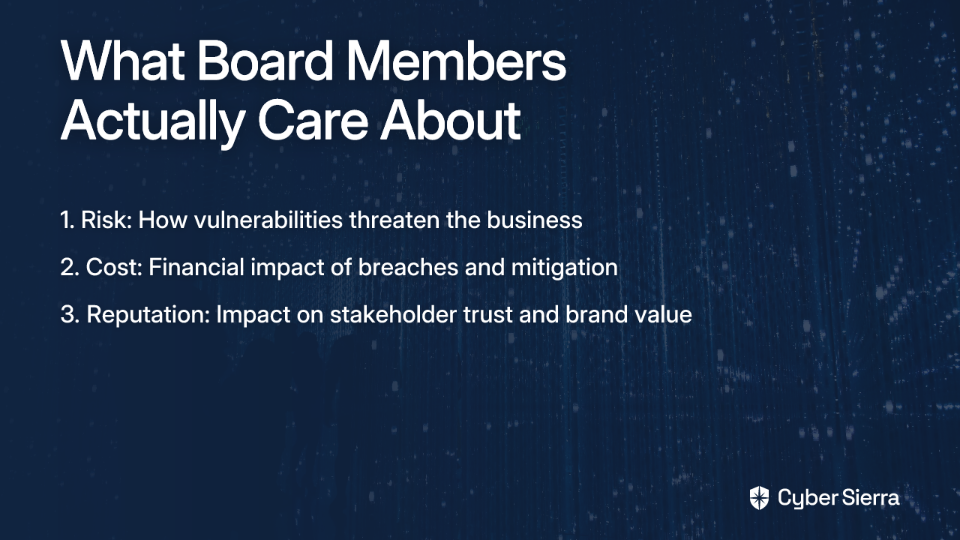
Board members have three primary legal duties: Care, Loyalty, and Obedience. They're focused on:
- Risk: How vulnerabilities threaten the business
- Cost: Financial impact of breaches and mitigation
- Reputation: Impact on stakeholder trust and brand value
They don't care about CVE numbers or technical jargon. As one executive bluntly put it, "if you can't speak in that language, you will be a side show."
The Psychological Impact
Beyond board disengagement, presenting an overwhelming list of vulnerabilities has a "crippling psychological impact" on security and engineering teams. When faced with 3000+ "urgent" findings, teams often become paralyzed, unsure where to start, and the most critical issues may remain unaddressed while resources are scattered across low-impact remediations.
A Framework for Business-Centric Prioritization
To move from overwhelming vulnerability lists to focused business risks, follow this three-step framework:
Step 1: Start with Business Impact Analysis (BIA)
A Business Impact Analysis helps identify and evaluate the potential effects of disruptions on critical business operations. This forms the foundation of your prioritization strategy.
How to perform a BIA:
- Identify Critical Assets: Work with business leaders to identify your organization's "crown jewels" – the systems, data, and processes essential for revenue generation, operations, and regulatory compliance. Consider worst-case scenarios like an attack during peak business periods.
- Assess Impact: Quantify the potential business impact if these assets are compromised, using metrics that resonate with board members:
- "If our customer database is breached, we face up to $X in regulatory fines plus significant costs to rebuild customer trust."
- "This compliance gap could prevent us from bidding on the major contract next quarter."
- "Downtime on our payment processing system costs $X per hour in lost revenue."
Step 2: Go Beyond Technical Scores with Context
Adopt a multi-layered approach to risk assessment that incorporates various contexts:
- Security Context: Start with basic technical information like CVE entries and CVSS scores.
- Asset Context: Consider where the vulnerability exists in your environment:
- Is it on a critical production server or an isolated dev machine?
- Is it internet-facing or in an internal network?
- Is the vulnerability being actively exploited in the wild?
- Business Context: Apply the BIA findings to understand broader business impacts:
- Does this vulnerability affect systems supporting critical business functions?
- What are the potential financial, regulatory, and reputational consequences?
- Does it align with your organization's risk appetite statement?
This contextual approach transforms raw vulnerability data into meaningful business risks. For example, a medium-severity vulnerability in your customer payment system likely presents a higher business risk than a critical vulnerability in an isolated internal tool.
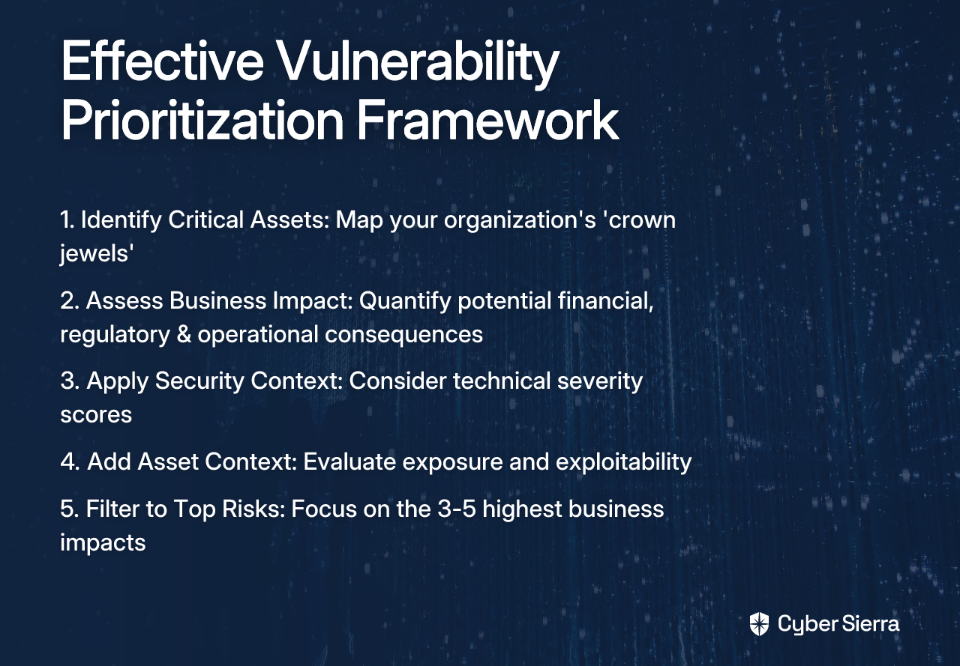
Step 3: Filter Down to the Top 3-5 Risks
Use the contextual data gathered to create a risk matrix or heat map visualizing likelihood versus business impact. This allows you to:
- Prioritize Effectively: Focus on vulnerabilities that pose the highest business risk, not just the highest technical severity.
- Create a Focused Risk Register: Develop a cybersecurity risk register that reflects business-oriented prioritization, enabling effective enterprise risk management.
- Drive Action: As one engineer noted, "once engineers see the list drop from thousands to a dozen, they stop arguing and start patching." Focused prioritization drives efficient remediation.
The result of this process is a transformation from an overwhelming list of technical findings to a manageable set of business risks that board members can understand and act upon.

Crafting the Executive Summary That Gets Results
With your top risks identified, the next challenge is communicating them effectively to the board. The goal is to answer their implicit question: "So what does this mean for the business?"
Structure of an Effective Executive Summary
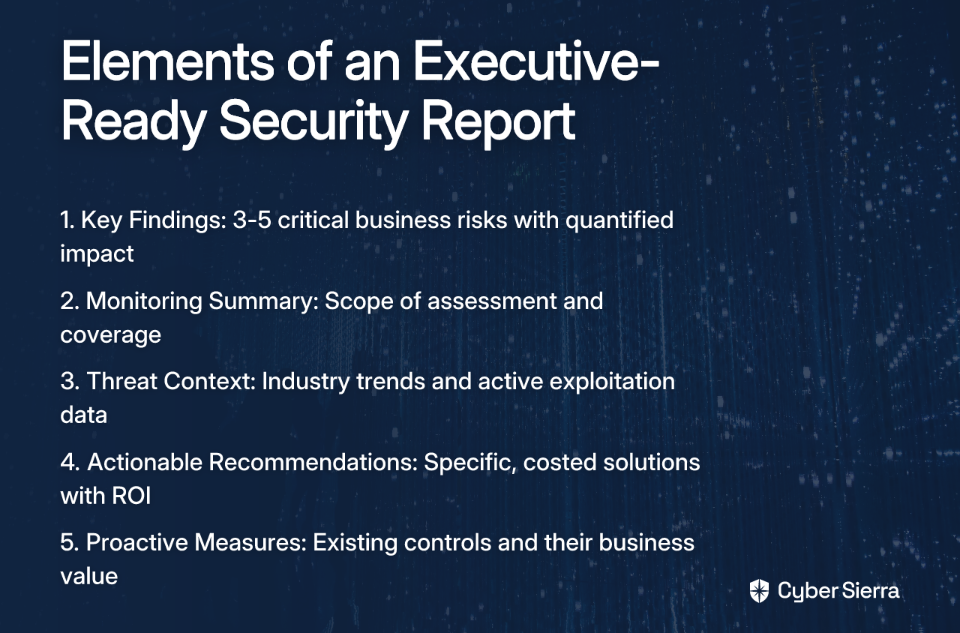
A well-crafted executive summary should include:
1. Key Findings (The "So What?")
Begin with the 3-5 most critical business risks you've identified through your prioritization process.
Poor Example: "We have a critical RCE vulnerability (CVE-2023-XXXX) in our Apache Struts library on server PROD-WEB-01."
Effective Example: "A critical vulnerability in our customer-facing payment system creates a high risk of a data breach that could expose customer financial information. This presents an estimated 65% chance of regulatory fines up to $2.5M and significant brand damage based on similar incidents in our industry."
2. Monitoring Summary
Briefly state what was assessed to establish scope and demonstrate diligence:
"This risk assessment covers our production cloud environment, customer-facing applications, and core business systems based on our comprehensive vulnerability scanning program and penetration testing results."
3. Threat Context
Provide relevant threat information that adds urgency and context:
"Threat actors are actively exploiting this vulnerability in our industry, with three competitors experiencing breaches in the past quarter. Our current cybersecurity posture leaves us vulnerable to similar attacks."
4. Actionable Recommendations
Present clear, specific, and costed recommendations:
"We recommend allocating $350,000 for emergency patching and system upgrades to address these critical risks. The estimated ROI on this investment is 400%, based on the avoidance of potential fines, operational downtime, and remediation costs."
5. Proactive Measures
Highlight existing controls to demonstrate maturity and justify your cyber budget:
"Our current endpoint detection and response solution has already blocked 15 attempted exploits this quarter, preventing an estimated $1.2M in potential breach costs and helping maintain favorable cyber insurance rates."
Communication Tips
- Use Plain Language: Avoid technical jargon and focus on business impact, not technical mechanisms.
- Leverage Visuals: Include a heat map or risk matrix showing your top risks plotted by likelihood and impact.
- Frame Within Enterprise Risk: Connect your cybersecurity risks to your organization's enterprise risk framework to show alignment with broader business objectives.
- Be Specific: Don't present open-ended problems—provide specific asks and recommendations with clear business justifications.
From Technical Reporter to Strategic Advisor
By shifting your focus from comprehensive vulnerability lists to prioritized business risks, you position yourself not just as a security professional but as a crucial business advisor. This approach demonstrates that you understand what truly matters to the board—protecting the organization's ability to achieve its business objectives.
Remember that the goal isn't to showcase every vulnerability your scanners detect but to show "due diligence toward a tighter ship." By translating technical details into business impact and focusing on the critical few risks that matter most, you'll gain board support, secure necessary resources, and ultimately strengthen your organization's security posture.
The next time you present to the board, leave the list of 200 vulnerabilities behind and focus on the 3-5 risks that could actually impact your business. Your board—and your security program—will thank you.

Frequently Asked Questions
Why is reporting all vulnerabilities to the board a bad idea?
Reporting all vulnerabilities overwhelms the board with technical data they cannot act upon, a problem known as "vulnerability overload." Instead of demonstrating diligence, presenting hundreds of "critical" findings can lead to disengagement, decision paralysis, and budget rejection. It is far more effective to focus on the top 3-5 risks that directly threaten revenue, compliance, and operations.
Why isn't a high CVSS score enough to determine business risk?
A high CVSS score is not enough because it only measures technical severity and lacks essential business context. A "critical" vulnerability on an isolated development server may pose a negligible business risk, while a "medium" vulnerability on an internet-facing payment system could be catastrophic. To accurately assess risk, you must layer business context—such as asset criticality, potential financial impact, and regulatory consequences—on top of technical scores.
What is the first step to shifting from technical reporting to business-centric risk communication?
The first step is to conduct a Business Impact Analysis (BIA) to identify your organization's most critical assets and processes. By collaborating with business leaders to pinpoint the "crown jewels" of your organization, you can understand the potential financial, operational, and reputational damage if those assets were compromised. This BIA becomes the foundation for prioritizing vulnerabilities based on what truly matters to the business.
How can I translate a technical vulnerability into something the board understands?
Translate a technical vulnerability by focusing on its potential business impact, using metrics like financial loss, regulatory fines, and brand damage. Instead of saying "We have a critical RCE vulnerability," frame it in business terms: "A vulnerability in our payment system creates a high risk of a data breach, which could lead to $2.5M in fines and significant customer loss." This connects the technical issue directly to the board's primary concerns: risk, cost, and reputation.
What are the essential components of a security report for executives?
An effective security report for executives must include the top 3-5 business risks, a summary of what was assessed, relevant threat context, and clear, costed recommendations. Your executive summary should answer the board's implicit question, "So what does this mean for the business?" It should also highlight proactive measures already in place to demonstrate program maturity and justify your budget.