blog-hero-background-image
Cyber Security

How to Secure Shadow APIs in Multi-Cloud Environments

backdrop
Table of Contents

Join thousands of professionals and get the latest insight on Compliance & Cybersecurity.


You've just discovered an unfamiliar API endpoint sending sensitive data to an external service. Your heart races as you realize this undocumented API wasn't in your security scope—and worse, it's running across multiple cloud environments. You're not alone in this moment of dread.

"API security still feels like a huge blind spot," admits one security professional on Reddit. "We've had a few close calls with shadow APIs and misconfigured endpoints that devs spun up without telling anyone."

This growing problem—shadow APIs operating beyond your security perimeter—represents one of the most dangerous threats in multi-cloud environments today.

The Growing Blind Spot in Your Cloud Security

Shadow APIs are unmanaged, undocumented, and often unapproved interfaces that operate outside standard governance practices. They emerge from rushed development cycles, legacy system integrations, or simply lack of centralized management. In multi-cloud environments, this risk multiplies exponentially.

The disconnect between perception and reality is startling: IT administrators typically estimate their organization uses 30-40 cloud apps, when the actual number often exceeds 1,000. More concerning, research from Microsoft shows that 80% of users engage with non-sanctioned apps, many exposing undocumented APIs.

This article provides a practical framework for security architects to discover, govern, and secure shadow APIs across complex multi-cloud environments—before they become your next security incident.

The Amplified Threat: Why Multi-Cloud Environments Create the Perfect Storm for Shadow APIs

Multi-cloud architectures, while offering resilience and preventing vendor lock-in, create unique challenges that make shadow APIs particularly dangerous:

Visibility Gaps & Inconsistent Tooling

Each cloud provider offers different monitoring and security tools, resulting in fragmented visibility. As one security professional notes, "API visibility isn't its strong suit" when describing even sophisticated security platforms.

Decentralized Management

Multi-cloud deployments require separate API gateway clusters with different configurations, significantly increasing operational overhead and misconfiguration risks. According to research by API7.ai, this decentralization is one of the primary factors enabling shadow APIs to proliferate.

Infrastructure Complexity

Managing APIs across diverse infrastructures (Kubernetes, VMs, serverless functions, and on-premises systems) makes unified policy enforcement exceptionally difficult.

The consequences of unchecked shadow APIs go beyond theoretical security concerns:

  • Security Vulnerabilities: Shadow APIs typically lack proper security controls, making them prime targets for attackers. They often bypass standard penetration testing because testers don't know they exist.
  • Compliance Nightmares: Undocumented APIs may unintentionally process sensitive data, potentially violating regulations like GDPR and HIPAA. These violations can lead to substantial fines and penalties.
  • Operational Inefficiency: Shadow APIs frequently duplicate functionality, creating technical debt and complicating maintenance cycles.
  • Reputational Damage: A security breach originating from an unknown API can severely erode customer trust and damage your organization's reputation.

A Practical Framework for Taming Shadow APIs

Addressing shadow APIs requires a systematic approach. Let's explore a three-step framework specifically designed for multi-cloud environments.

Step 1: Illuminate the Shadows with Comprehensive Discovery

The first challenge is finding what you don't know exists. Many security professionals express frustration with traditional discovery tools, with one noting they're "tired of testing standalone API security tools because most are noisy or need deep traffic hooks, which isn't sustainable."

Traffic Analysis Tools (The Traditional Approach)

Open-source tools like OWASP ZAP, Fiddler, and Mitmproxy can intercept and analyze traffic to identify undocumented endpoints. While effective, these tools often require significant configuration and can be intrusive in production environments.

Automated Cloud-Native Discovery (The Modern Approach)

Cloud Native Application Protection Platforms (CNAPPs) offer less intrusive discovery options:

Google Cloud's Apigee API Observation

This service identifies undocumented APIs within your Google Cloud infrastructure with minimal performance impact. To implement:

  1. Enable the "Advanced API Security" add-on
  2. Navigate to API Observation > Shadow API in the Google Cloud Console
  3. Create an observation job, selecting your traffic sources

Microsoft Defender for Cloud Apps

Microsoft's solution discovers shadow IT resources, including undocumented APIs, across your multi-cloud environment using several methods:

  1. Collect traffic data from devices using Microsoft Defender for Endpoint
  2. Deploy the Defender for Cloud Apps log collector on firewalls and proxies
  3. Integrate with third-party proxies like Zscaler for comprehensive coverage

As one security professional noted about emerging solutions: "Salt Security is doing some interesting stuff these days. They seem to have figured out ways of doing API discovery and inventory without requiring a traffic hook."

Step 2: From Inventory to Insight with Contextual Risk Assessment

Discovery alone creates a list of APIs, but you need context to prioritize your response. Many security professionals seek platforms that "allow you to prioritize based on contextual risk."

Evaluating Discovered APIs:

When assessing shadow APIs, consider:

  • Usage Metrics: How many users access this API? What's the traffic volume?
  • Data Sensitivity: Does the API handle regulated or sensitive information?
  • Endpoint Lifecycle: Is this a deprecated or unversioned endpoint?

This last point is particularly critical. "Our last pen test flagged a deprecated endpoint that [our security tool] didn't catch," noted one security professional, highlighting how unversioned or deprecated APIs frequently slip through automated scans.

Platforms like Microsoft Defender's Cloud App Catalog assess discovered apps against more than 90 risk factors, including encryption practices, audit logging, and compliance certifications like SOC2 and HIPAA.

Step 3: Enforce Control with Unified Multi-Cloud API Governance

Once you've discovered and assessed your shadow APIs, it's time to bring them under governed control.

The Central Role of the API Gateway:

An API gateway provides a unified control point for managing APIs across multi-cloud environments. It enables:

  • Consistent authentication and authorization
  • Traffic monitoring and rate limiting
  • Security policy enforcement

For multi-cloud deployments, consider open-source solutions like Apache APISIX, Kong, or Tyk that work across different cloud providers.

Establishing Governance Policies:

  1. Create a Single Source of Truth: Develop a centralized system for API documentation
  2. Implement Role-Based Access Control: Allow multiple teams to manage gateway clusters securely
  3. Enforce Security Standards: Implement robust measures like mutual TLS (mTLS) to protect data in transit

Beyond Detection: Proactive Mitigation and a "Shift-Left" Culture

While discovery and governance are essential, truly effective security requires preventing shadow APIs from emerging in the first place.

As one security expert aptly noted, "This seems to be a lack of shift-left problem, not APIs security by itself." This insight captures the essence of proactive API security.

Adopting a "Shift-Left" Mentality

Shift-left security integrates security practices early in the development lifecycle rather than treating them as an afterthought. For APIs, this means:

  • Providing developers with self-service API registration tools that maintain security oversight
  • Establishing clear API design standards and governance rules before development begins
  • Conducting regular training on API security best practices to foster an API-aware culture

According to Astra Security, organizations that successfully implement shift-left security discover vulnerabilities earlier when they're less expensive to fix and prevent shadow APIs from forming in the first place.

Advanced Mitigation Strategies

Beyond shift-left practices, consider these advanced strategies:

Zero-Trust Architecture

Treat every API request as untrusted until rigorously authenticated and authorized—regardless of whether it originates from inside or outside your network.

Continuous Monitoring & Anomaly Detection

Deploy automated tools that continuously monitor your API environment for:

  • Suspicious traffic patterns
  • Unusual data access
  • Deviations from expected behavior
  • Compliance violations

However, be cautious about alert fatigue. One security professional tested Prisma Cloud's API module and found it had "solid coverage, but it was way too noisy out of the box." They ultimately "ended up writing a bunch of suppressions just to make it usable." Effective monitoring requires finely-tuned alerts that balance security with practicality.

Proper API Lifecycle Management

Implement strict API versioning and establish clear deprecation policies. This prevents old, potentially vulnerable endpoints from lingering in your environment. As one security professional warned, deprecated endpoints that evade detection during security scans represent a significant risk.

Moving from Reactive Firefighting to Proactive Security
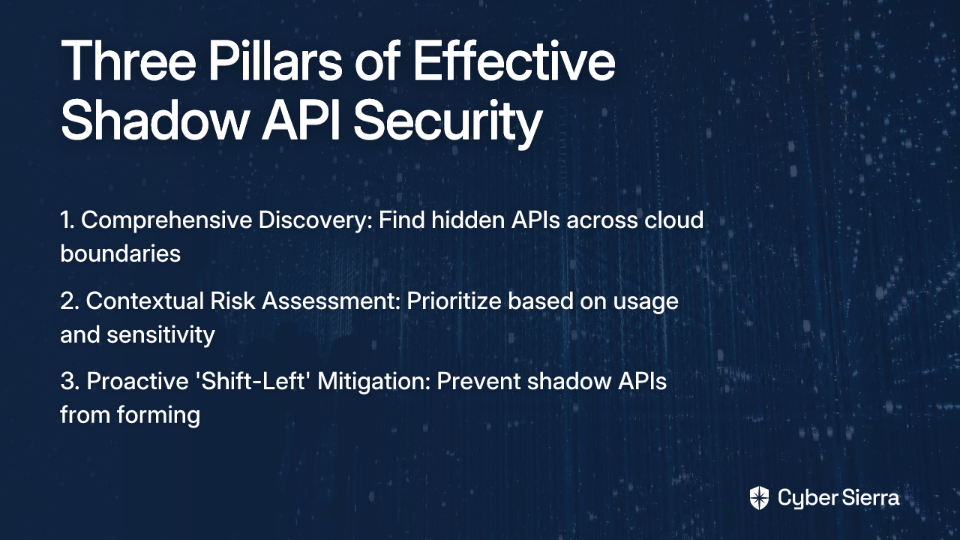
Securing shadow APIs in multi-cloud environments requires more than point solutions—it demands a comprehensive strategy built on three pillars:

  1. Comprehensive Discovery: You can't secure what you don't know exists. Employ modern discovery tools that work across cloud boundaries without disrupting operations.
  2. Contextual Risk Assessment and Governance: Not all shadow APIs pose equal risk. Prioritize based on usage, data sensitivity, and endpoint lifecycle status.
  3. Proactive "Shift-Left" Mitigation: Prevent shadow APIs from forming by integrating security early in the development process and fostering an API-aware culture.

While tools like CNAPPs and API gateways are essential components, they must be supported by an "API-First" mindset where security becomes a shared responsibility across development, operations, and security teams.

The multi-cloud landscape continues to evolve, and with it, the challenges of securing shadow APIs. By adopting this framework, security leaders can move beyond reactive firefighting to proactive security that keeps pace with cloud innovation.

Remember: in the world of shadow APIs, what you don't know can hurt you—but with the right approach, you can shine a light on these hidden risks and secure your multi-cloud environment effectively.
Frequently Asked Questions

What are shadow APIs and why are they a major risk?

Shadow APIs are undocumented and unmanaged application programming interfaces that operate outside of an organization's security and governance controls. They pose a significant risk because they lack proper security measures, making them easy targets for attackers. Since security teams are unaware of their existence, they are often excluded from security testing and monitoring, potentially exposing sensitive data and creating compliance violations with regulations like GDPR and HIPAA.

How can I discover shadow APIs in a multi-cloud environment?

You can discover shadow APIs in a multi-cloud environment by using a combination of traffic analysis tools and modern Cloud Native Application Protection Platforms (CNAPPs). Traditional tools like OWASP ZAP or Mitmproxy analyze network traffic to find undocumented endpoints. However, for a less intrusive and more scalable approach in multi-cloud settings, CNAPPs from providers like Google Cloud (Apigee API Observation) and Microsoft (Defender for Cloud Apps) can automatically discover APIs by analyzing cloud configurations, traffic logs, and endpoint data across different providers.

Why do multi-cloud environments make shadow API security more difficult?

Multi-cloud environments complicate shadow API security due to fragmented visibility, decentralized management, and inconsistent security tooling across different cloud providers. Each cloud platform has its own set of monitoring and security tools, creating visibility gaps. Managing separate API gateways and security policies for AWS, Azure, and Google Cloud increases operational complexity and the risk of misconfiguration, making it easier for shadow APIs to go undetected.

What is the first step to take after discovering a shadow API?

The first step after discovering a shadow API is to conduct a contextual risk assessment to prioritize your response. Not all shadow APIs pose the same level of threat. You should evaluate the API based on factors like the sensitivity of the data it handles, its traffic volume, how many users access it, and whether it's a deprecated or unversioned endpoint. This assessment helps you focus your remediation efforts on the highest-risk APIs first.

How does a "shift-left" approach help prevent shadow APIs?

A "shift-left" approach prevents shadow APIs by integrating security practices early into the software development lifecycle, rather than addressing them after deployment. This proactive strategy involves providing developers with self-service tools for API registration, establishing clear governance rules before development begins, and conducting regular security training. By making security a shared responsibility and part of the development process, organizations can prevent unmanaged APIs from being created in the first place.

What is the role of an API gateway in managing shadow APIs?

An API gateway acts as a unified control point to bring discovered shadow APIs under centralized governance and enforce consistent security policies. Once a shadow API is identified, routing its traffic through an API gateway allows you to apply essential controls like authentication, authorization, rate limiting, and traffic monitoring. In a multi-cloud environment, gateways like Apache APISIX or Kong can provide a consistent management layer across different cloud providers, ensuring all APIs adhere to your organization's security standards.


Have you tackled shadow API challenges in your organization? What strategies worked best for your team? Share your experiences in the comments below.

blog-hero-background-image
Cyber Security

Why bcrypt Will Kill Your API Performance (And What to Use Instead)

backdrop
Table of Contents

Join thousands of professionals and get the latest insight on Compliance & Cybersecurity.


You've set up your API authentication system using bcrypt for your API keys, following security best practices. But as your API traffic grows, you notice alarming performance degradation. Response times are climbing, CPU usage is spiking, and your cloud bill is skyrocketing. What's happening?

The very security measure you implemented to protect your API is now throttling its performance.

While bcrypt is an excellent tool for password hashing, applying it to API key verification is like using a sledgehammer to drive a thumbtack – you're using the wrong tool for the job, and it's going to have serious consequences for your system's performance.

This article will dive deep into why bcrypt is intentionally slow, how that creates a performance bottleneck for APIs, and what high-performance alternatives you should use instead. We'll separate the use cases for password hashing from API key verification and provide specific, actionable recommendations for each.

The Double-Edged Sword: Why bcrypt is Intentionally Slow

Before we dive into performance issues, let's understand an important distinction:

  • Hashing is a one-way function that creates an irretrievable hash
  • Encryption is reversible and requires an encryption key

For password storage, we always use hashing, not encryption. And bcrypt has been a gold standard for password hashing since its introduction in 1999.

The Deliberate Design of bcrypt

Bcrypt was created by Niels Provos and David Mazières specifically to be slow and computationally expensive. This is its core security feature, not a flaw.

The algorithm incorporates a "work factor" (or cost factor) that defines how computationally intensive the hashing process will be. As computing power increases over time, developers can simply increase this work factor to maintain security against increasingly powerful attackers.

Here's the critical insight: according to Auth0's research, "increasing the cost factor in bcrypt from 10 to 20 may significantly increase the time for hashing from 65ms to over 66,000ms per hash." That's a 1,000x increase in processing time!

This exponential slowdown is exactly what you want for password hashing – it makes brute-force attacks computationally infeasible. For context, the OWASP Password Storage Cheat Sheet recommends a minimum work factor of 10 or more for bcrypt.

The Bottleneck: How bcrypt Cripples API Performance

Now let's examine why the intentional slowness of bcrypt becomes problematic for API authentication.

Stateful vs. Stateless Authentication

There's a fundamental difference between user authentication and API key verification:

  • User Login (Stateful): A user logs in infrequently, then receives a session token or JWT. The bcrypt verification happens once, and the cost is amortized across the entire session.
  • API Key Auth (Stateless): Every single API request must be authenticated independently. The verification process runs on every call, making the computational cost of bcrypt a recurring tax on your system.

The Performance Math

Let's do some simple math to demonstrate the impact:

Let's assume a relatively fast bcrypt hash takes 65ms with a work factor of 10 (which is the minimum recommended by OWASP).

  • At 10 requests/second: 650ms of CPU time per second (65% utilization)
  • At 50 requests/second: 3,250ms of CPU time per second (325% utilization - you now need 4 cores)
  • At 100 requests/second: 6,500ms of CPU time per second (650% utilization - you need 7 cores)

As one developer noted on Reddit: "Bcrypt is slow by design, and if you are lucky enough to have a ton of users pounding on your API, just legit requests, your bottleneck will be CPU and memory to verify those passwords."

This performance challenge is particularly acute in languages like Go, where developers have reported significant slowdowns when using bcrypt for high-throughput API authentication.

The consequences are severe:

  • Increased latency for API calls
  • Higher cloud hosting costs
  • Poor user experience
  • Limited API scalability

So what's the solution? It depends on what you're trying to protect.

The Right Tools for the Job: Modern Hashing Alternatives

Let's clarify the two distinct use cases that often get conflated:

For User Passwords (When Slow is Good)

For protecting user passwords, you absolutely want a slow, computationally expensive hashing algorithm. In fact, bcrypt isn't even the most modern option anymore.

The current gold standard is Argon2id, which won the Password Hashing Competition in 2015. It's designed to be memory-hard, making it resistant to both CPU and GPU-based cracking attempts.

According to the OWASP Password Storage Cheat Sheet, Argon2id should be configured with:

  • Memory cost: 19 MiB (minimum)
  • Iterations: 2 (minimum)
  • Parallelism: 1

If Argon2id isn't available in your environment, scrypt is another excellent memory-hard function that improves upon bcrypt.

For API Keys (When Speed is Critical)

API keys represent a fundamentally different security model than passwords:

  1. They are not memorized by humans, so they can (and should) have high entropy
  2. They are typically long and randomly generated (think UUIDs or similar)
  3. The threat model differs - we're not primarily concerned with offline brute-force attacks

Given these characteristics, the recommended approach is to use a fast hash like salted SHA-256:

As one experienced architect advised on Reddit: "You'd better provide enough entropy in the key and it will be unique (think UUIDs) then hash it with sha256."

Why does this work? The security comes from the high entropy of the source key, not the slowness of the hash. A properly generated API key with 256 bits of entropy is computationally impossible to brute-force, regardless of hash speed.

Practical Implementation for API Keys

Here's a secure implementation process for API key hashing:

  1. Generate a high-entropy API key for the user (e.g., sk_live_a1b2c3d4...)
  2. Generate a unique salt for this key and store it with the key record
  3. Hash the API key using SHA-256 with the salt
  4. Store only the salt and the SHA-256 hash in your database
  5. On an incoming request, retrieve the salt, hash the provided key with it, and perform a constant-time comparison against the stored hash

For additional performance improvement, consider this pro tip: Embed a checksum in your API key format that can be validated at the edge (API Gateway/WAF) to cheaply reject malformed keys before they hit your authentication service.

Common Pitfalls to Avoid

Based on OWASP guidelines and real-world experience, here are some common mistakes to avoid:

  1. The Cardinal Sin: Using a fast hash like unsalted MD5 or SHA1 for passwords
  2. The Performance Trap: Using a slow hash like bcrypt for high-throughput, stateless API key verification
  3. Forgetting the Salt: Failing to salt hashes makes them vulnerable to rainbow table attacks
  4. Set-and-Forget: Not periodically reviewing and upgrading your cryptographic tools as computing power increases

Conclusion: Choose Your Algorithm Wisely

Bcrypt is a powerful and essential tool for protecting user passwords, but it's a performance liability when misapplied to API key authentication. Understanding the different threat models is key to making the right choice.

Final recommendations:

  • For user passwords: Use Argon2id (with OWASP-recommended settings)
  • For high-entropy API keys: Use salted SHA-256

Building secure and scalable systems requires using the right cryptographic tools for each specific use case. By following these recommendations, you can maintain both strong security and excellent performance for your APIs.

Remember, in the world of cryptography and authentication, one size definitely does not fit all.

FAQ

Why is using bcrypt for API key authentication a bad idea?

Using bcrypt for API key authentication is a bad idea because its intentionally slow design creates a severe performance bottleneck. Since every API request must be authenticated independently, the computational cost of bcrypt is incurred on every call, leading to high CPU usage, increased latency, and poor scalability as traffic grows.

What is the best hashing algorithm for API keys?

The best hashing algorithm for high-entropy API keys is a fast one like salted SHA-256. The security for API keys comes from their randomness and length (high entropy), not the slowness of the hash function. A fast hash like SHA-256 provides excellent performance for high-throughput systems while remaining secure against pre-computation attacks like rainbow tables, thanks to salting.

If bcrypt is slow, what should I use for user passwords?

You should use a modern, memory-hard hashing algorithm like Argon2id for user passwords. Argon2id is the current industry gold standard, as recommended by OWASP, because it is resistant to both CPU and GPU-based cracking attempts. If Argon2id is not available, scrypt is another strong alternative. The slowness of these algorithms is a critical security feature for protecting user passwords.

How can a fast hash like SHA-256 be secure for API keys?

A fast hash like SHA-256 is secure for API keys because the primary defense is the key's high entropy, not the algorithm's speed. A long, randomly generated API key is computationally infeasible to guess or brute-force. The purpose of hashing the key is to prevent it from being stored in plaintext. By adding a unique salt, you also protect against rainbow table attacks, making it a robust solution for this specific use case.

What's the difference between authenticating a user login and an API key?

The key difference is statefulness. A user login is a stateful, infrequent event; the user authenticates once with a slow hash (like Argon2id) and then uses a temporary session token for subsequent requests. In contrast, API key authentication is stateless; every single request is independent and must be fully authenticated, making the performance of the verification algorithm critical.

How do I properly implement salted SHA-256 for API keys?

To properly implement salted SHA-256 for API keys, follow these steps:

  1. Generate a long, high-entropy API key for the user.
  2. Generate a unique, random salt for each key.
  3. Combine the key and the salt, then hash the result using SHA-256.
  4. Store the salt and the resulting hash in your database, never the plaintext key.
  5. For verification, retrieve the user's salt, hash the incoming API key with that salt, and perform a constant-time comparison against the stored hash.
blog-hero-background-image
Cyber Security

Why Your PAM Implementation Failed (And the People Problem)

backdrop
Table of Contents

Join thousands of professionals and get the latest insight on Compliance & Cybersecurity.


You've invested hundreds of thousands in a new Privileged Access Management (PAM) solution. The vendor promised enhanced security, better compliance, and streamlined access management. Six months later, you're facing a harsh reality: administrators are finding workarounds, access requests are piling up, and your security posture hasn't improved. What went wrong?

You're not alone. Many organizations invest heavily in PAM only to face user friction, slow integration, and a feeling that the tool is more of a "nuisance" than a solution. While the technology itself may be sound, most PAM implementations fail due to a factor that's frequently underestimated: the human element.

The Expensive Failure No One Talks About

The statistics paint a sobering picture:

  • 80% of data breaches stem from stolen or compromised credentials, highlighting the critical need for effective PAM solutions (CrowdStrike).
  • 95% of cybersecurity incidents are primarily due to human error (UpGuard).
  • 74% of data breaches involve the human element, including errors, privilege misuse, and social engineering (UpGuard).

Despite these numbers, organizations continue to approach PAM as a purely technical implementation rather than the people-centric challenge it truly is. Let's examine the four primary human-related factors that doom PAM implementations from the start.

The Four Horsemen of PAM Failure: A Human-Centric Diagnosis

1. The "Nuisance" Factor: Internal Resistance and Poor Adoption

"I've never seen a PAM tool that wasn't a nuisance," laments one system administrator in an online forum. This sentiment reflects a common pain point: users perceive PAM tools as obstacles to productivity rather than essential security measures.

When users find PAM tools difficult to navigate or time-consuming, they develop workarounds—storing credentials in unauthorized locations, sharing passwords, or creating shadow IT solutions. As one IT professional put it, "PAM products are notorious for being an annoying hurdle for non-tech savvy workers."

This resistance isn't merely stubbornness. It often stems from legitimate usability concerns. For instance, users on Reddit frequently criticize interfaces like Delinea's as "the most inherently difficult thing to work with." When security tools create friction, security itself suffers.

2. The Knowledge Gap: "Why Are We Even Using This?"

A surprising number of organizations "don't understand how to use PAM tools and why they should use it," according to discussions in cybersecurity forums. This fundamental knowledge gap leads to critical errors in implementation and usage.

Without proper understanding, organizations:

  • Misconfigure critical access controls
  • Apply inappropriate permission models
  • Fail to leverage key security features
  • Create new security vulnerabilities through improper setup

As Microsoft points out, insufficient training results in misuse or complete non-use of the system, rendering even the most sophisticated PAM solution ineffective (Microsoft).

3. The Culture of Over-Privilege and Complacency

Many organizations operate with a legacy of over-privileged accounts, where users have far more access than they need for their roles. Implementing a PAM solution without first addressing this cultural issue is like putting a new lock on a door with a broken frame—you're simply managing existing risk, not reducing it.

This problem is compounded by a dangerous perception gap. A study found that while 79% of enterprises lack a mature PAM platform, an astounding 93% believe they can manage threats effectively (Solutions Review). This overconfidence prevents organizations from addressing fundamental access control problems.

The Principle of Least Privilege (PoLP) isn't just a technical control—it's a cultural mindset that must be embedded in the organization before a PAM tool can be effective.

4. The Blind Spot: You Can't Protect What You Can't See

Many PAM projects fail before they even begin by not performing a comprehensive discovery of all privileged accounts. This includes interactive user accounts, service accounts, and accounts used in API-driven infrastructure.

Research from Thycotic reveals that nearly 75% of enterprises fail to discover all privileged accounts in their networks (Solutions Review). This problem is growing more acute as organizations adopt cloud services and containerized applications.

As one security professional noted, "The explosion of ephemeral workloads and API-driven infrastructure makes traditional PAM messy." Modern environments include privileged identities that aren't associated with human users but are equally critical to protect—a blind spot in many implementations.

A People-First Framework for Successful PAM

Addressing these human elements requires a strategic approach that puts people at the center of your PAM implementation. Here's a framework to help you succeed where others have failed:

Step 1: Treat PAM as a Cultural Shift, Not a Tech Rollout

Executive Buy-in: Frame PAM as a business initiative, not just an IT project. Cybersecurity is a business problem that requires leadership investment and visibility. When executives understand and support the PAM initiative, they can help address resistance throughout the organization.

Continuous Education: Go beyond one-off training sessions. Host regular "show-me sessions and demos" to reinforce the 'why' and 'how' of your PAM solution. Focus on fostering a security-conscious culture through ongoing employee education (SSH.com).

Remember that awareness training alone is often ineffective; it must be part of a broader Human Risk Management strategy that addresses behaviors and incentives (UpGuard).

Step 2: Start with an Honest Audit, Not a Vendor Demo

The Mandate: Before deploying any technology, conduct an exhaustive audit of all privileged accounts. Assess access levels, identify redundancies, and map out who needs access to what and why.

Integrate for Visibility: To combat account blindness, integrate your PAM solution with existing Identity Access Management (IAM) and Identity Governance and Administration (IGA) systems for a unified view of all identities (Solutions Review).

This preparation work may seem tedious, but it's essential for setting realistic expectations and ensuring your PAM implementation addresses actual needs rather than theoretical ones.

Step 3: Design for the User, Not Just the Auditor

Embrace Zero Standing Access: Move away from the old "trust but verify" model. As one security professional noted, this traditional approach is "no longer enough" in today's threat landscape. The goal should be to remove all standing privileges where possible.

Implement Just-in-Time (JIT) Access: Instead of permanently holding high-level permissions, configure your PAM solution to grant elevated access only when needed, for a limited time, to perform specific tasks (Microsoft). As one PAM specialist put it, "Removing standing permissions and leveraging JIT role/permissions is better" for both security and workflow.

Automate Where Possible: Automation streamlines privilege management, reduces the potential for human error, and can increase productivity for IT teams (CrowdStrike). This is particularly important for managing service accounts and non-interactive identities used in CI/CD pipelines and other automated processes.

Step 4: Make It a Living Program with Continuous Feedback

Solicit User Feedback: Create formal channels to gather feedback on the PAM tool and process. Use this to address pain points and iterate on the implementation, turning users from adversaries into partners.

Monitor and Audit Activity: Continuously monitor and audit all privileged sessions. Use session recording and logs to spot deviations from normal activity and ensure compliance. This is critical for both security and audit readiness.

Adapt to Modern Needs: Acknowledge that PAM isn't static. It must evolve to manage non-interactive privileged identities used by Terraform, CI/CD pipelines, and other API-driven tools. As one Reddit user observed, many PAM solutions "assume use of interactive privileged identities" when modern environments require much more.

Turn Your Biggest Liability into Your Greatest Asset

Successful PAM is not about buying the best tool—it's about building a people-centric security program where the technology serves as an enabler rather than an obstacle. The human element can be either your biggest liability or your greatest asset in securing privileged access.

By addressing user resistance, closing knowledge gaps, and building a culture of least privilege, you can transform your PAM implementation from a failed project into a cornerstone of your cyber defense strategy. Remember that PAM is a journey, not a destination—it requires ongoing attention to the evolving needs of both your people and your technology landscape.

In the words of one security professional, "It's a nuisance if not properly implemented adhering to People, Process, Technology." By putting people first in your PAM strategy, you can ensure that your implementation enhances security withoutbecoming the nuisance that causes it to fail.

Frequently Asked Questions

What is the main reason most PAM implementations fail?

The main reason most Privileged Access Management (PAM) implementations fail is due to the underestimation of the human element. While technology is a key component, failures often stem from internal resistance, poor user adoption, significant knowledge gaps, and a company culture that doesn't prioritize the Principle of Least Privilege.

Why do users often resist using PAM tools?

Users often resist PAM tools because they perceive them as a "nuisance" that hinders productivity. This resistance is frequently caused by poor usability, complicated interfaces, and time-consuming access request processes. When a security tool creates friction in daily workflows, users are more likely to find workarounds, which undermines the tool's security benefits.

How can an organization improve user adoption of a PAM solution?

To improve user adoption, an organization should treat the PAM implementation as a cultural shift rather than just a technology rollout. This involves securing executive buy-in, providing continuous education and training on the "why" behind PAM, and designing the system for the user experience. Implementing features like Just-in-Time (JIT) access and automating processes can also reduce friction and make the tool more user-friendly.

What is the Principle of Least Privilege (PoLP) and why is it important for PAM?

The Principle of Least Privilege (PoLP) is a security concept where a user is given the minimum levels of access—or permissions—needed to perform their job functions. It is critically important for PAM because it addresses the root cause of many security risks: over-privileged accounts. A successful PAM strategy doesn't just manage existing permissions; it first reduces them to the bare minimum, significantly shrinking the organization's attack surface.

What is Just-in-Time (JIT) access and how does it improve security?

Just-in-Time (JIT) access is a feature of modern PAM solutions that grants users elevated permissions for a specific task and for a limited period. This model improves security by eliminating standing privileges, which are permanent, always-on access rights that are a primary target for attackers. With JIT, access is granted temporarily and automatically revoked, ensuring privileges are only available when actively needed.

How does a "people-first" PAM approach differ from a technical rollout?

A "people-first" approach prioritizes the human elements of a PAM implementation, focusing on user experience, cultural change, and continuous education. Unlike a purely technical rollout that centers on the tool's features, a people-first strategy begins with auditing existing privileges, gaining executive support, designing user-friendly workflows, and creating feedback loops to ensure the tool serves the users, not just the auditors.

blog-hero-background-image
Cyber Security

Why Every GRC Platform Sucks (And What CISOs Actually Use Instead)

backdrop
Table of Contents

Join thousands of professionals and get the latest insight on Compliance & Cybersecurity.


You've spent millions on a shiny new GRC platform, promised the board it would streamline compliance, and now you're staring at a dashboard that looks like it was designed in 2003, wondering why your audit evidence is still living in spreadsheets.

Sound familiar? You're not alone.

As one CISO candidly put it: "I know a lot of CISOs (many hundreds) and not one of them wakes up in the morning and says 'OMG, I'm so glad I spent 2 million dollars on Archer' or any other GRC platform for that matter." (source)

The truth is, despite vendors' promises of compliance nirvana, most Governance, Risk, and Compliance (GRC) platforms are fundamentally broken. They're expensive, rigid, and often create more problems than they solve.

This article will dissect why traditional GRC tools fail so spectacularly and reveal what savvy security leaders are actually using to manage their programs. Let's pull back the curtain.

The Anatomy of a Failed GRC Platform

1. The "One-Size-Fits-None" Problem

GRC platforms almost universally suffer from a critical design flaw: they attempt to commoditize compliance with standardized workflows that rarely match how organizations actually operate.

"One big problem is that most of the platforms are inflexible and try really hard to commoditize compliance by pushing for a one-size-fits-all program," notes one security professional. The reality? "Each organization has unique needs, structures, and regulatory requirements that make it challenging to find an actual good GRC solution." (source)

This inflexibility leads to a painful choice: either completely redesign your security and compliance program to fit the tool (a recipe for organizational chaos), or watch your expensive platform gather digital dust as teams revert to spreadsheets.

2. The "C" Overload: Forgetting the "G" and "R"

Ask any security leader about their GRC platform, and you'll likely hear this complaint: "Most of them also focus on compliance and forget about the R and especially the G." (source)

While compliance is important, it's just one component of a mature security program. True GRC should balance:

  • Governance: Aligning security with business objectives
  • Risk Management: Identifying and addressing threats proactively
  • Compliance: Meeting regulatory requirements

Yet most platforms reduce this complex ecosystem to glorified checkbox trackers, leaving the strategic elements of security management unsupported.

3. The Audit Trust Deficit

Perhaps most damning is this revelation: "Most legit auditors don't trust the data from the platforms outright since they don't source their evidence well enough." (source)

Think about that. The primary selling point of most GRC platforms is audit readiness, yet when auditors arrive, they often disregard the platform's data entirely and request evidence directly. This defeats the entire purpose of implementing the tool in the first place.

4. Implementation Nightmares

"None of them work out of the box," laments one practitioner. Even after extensive configuration, many users report that platforms like Archer simply end up "giving people a CSV to work off of" (source).

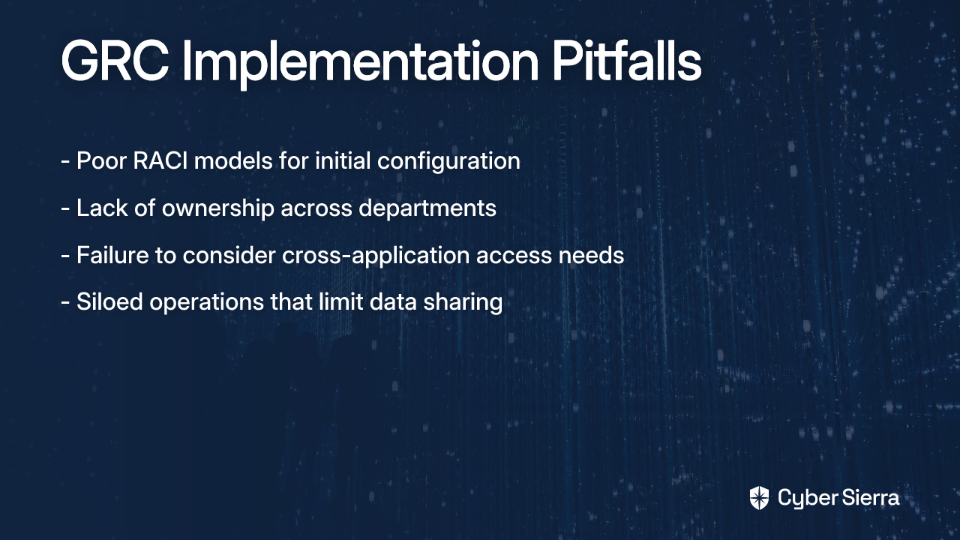
Common implementation pitfalls include:

  • Poor RACI models for initial configuration
  • Lack of ownership across departments
  • Failure to consider cross-application access needs
  • Siloed operations that limit data sharing

The result is a partially implemented system that creates more work than it eliminates, often requiring dedicated headcount just to maintain the platform itself.

What CISOs Actually Do: The Rise of the Disaggregated GRC Stack

Faced with these challenges, pragmatic security leaders aren't waiting for the perfect GRC platform (it doesn't exist). Instead, they're building what we might call a "disaggregated GRC stack" – a collection of purpose-built tools that, when combined, fulfill their governance, risk, and compliance needs.

The Modern CISO's Toolkit

1. Spreadsheets: Still the Reigning Champion

Despite billions invested in GRC technology, Excel remains the most common tool in security programs. Why? Because it's infinitely customizable and everyone knows how to use it.

The challenge, of course, is "trying to create multiple files and synchronize data between them" (source). As organizations mature, the spreadsheet approach becomes increasingly unwieldy.

2. Purpose-Built Compliance Automation

Many CISOs are adopting specialized tools focused on specific compliance frameworks rather than all-encompassing GRC platforms:

  • Drata, Vanta, and SecureFrame for SOC2 and ISO27001 automation
  • OneTrust for privacy compliance
  • Hyperproof for control mapping across frameworks

As one security leader put it: "Just got Drata at my new place. Best so far but still frustrating." (source) While not perfect, these tools excel at automated evidence collection for their specific domains.

3. Custom-Built Solutions

Some organizations take matters into their own hands. One approach mentioned is to "transform their SOPs and controls into a custom Netsuite platform" (source). Others build dashboards with Power BI or Airtable to track their GRC activities.

The downside? "There is a cost to continuously develop your own if you go down that route."

4. Enterprise Platforms with GRC Modules

For organizations already invested in enterprise platforms, GRC modules within those ecosystems can be more effective than standalone GRC tools:

  • Microsoft Purview for Microsoft-centric environments
  • ServiceNow GRC for organizations using ServiceNow for IT service management
  • Salesforce GRC for sales-driven organizations

These solutions benefit from existing data integration and familiarity, though they often require significant customization.

The New Paradigm: From Point-in-Time GRC to Continuous Cyber Risk Management

What's becoming clear is that the fundamental flaw in traditional GRC isn't just the tools themselves—it's the outdated approach they embody. Leading organizations are shifting from periodic, compliance-centric GRC cycles to continuous, integrated cyber risk management.

The Three Pillars of Modern GRC

1. Continuous Control Monitoring (CCM)

Instead of point-in-time assessments, modern security programs require real-time visibility into control effectiveness. This means:

  • Automated testing of security controls
  • Continuous validation of compliance requirements
  • Real-time detection of control failures or drift
  • Trustworthy evidence generation that satisfies auditors

This approach solves the audit trust deficit by providing reliable, current evidence rather than snapshots that may not reflect reality.

2. Deep Automation Beyond Workflows

True GRC automation goes beyond simple task management to include:

  • Automated evidence collection from cloud environments
  • Direct integration with security tools for real-time data
  • Automatic mapping of controls to multiple frameworks
  • Evidence collection that doesn't require manual intervention

This level of automation addresses the implementation nightmare by eliminating manual processes that lead to errors and inconsistencies.

3. Integrated Risk Intelligence

Effective risk management requires connecting compliance data with real threat signals:

  • Correlating vulnerability data with compliance controls
  • Incorporating third-party risk signals into the overall risk picture
  • Linking employee security training performance to risk assessments
  • Prioritizing remediation based on business impact

This integration puts the "R" back in GRC, enabling true risk-based decision making rather than checklist compliance.

Emerging Solutions for the Modern Approach

Platforms designed around these principles are beginning to emerge. For example, Cyber Sierra's approach to GRC is built on continuous monitoring rather than periodic assessments.

Their Continuous Control Monitoring module provides ongoing visibility into security controls, addressing the evidence reliability problem that plagues traditional GRC. By automating control testing and validation, it creates a trusted single source of truth for both internal management and external auditors.

Similarly, the integration of Threat Intelligence with compliance data helps organizations prioritize remediation based on actual risk, not just compliance requirements. This solves the "C-overload" problem by bringing risk management back into focus.

For organizations struggling with third-party risk, platforms like Cyber Sierra's TPRM module automate vendor assessments and provide continuous monitoring, moving beyond the periodic questionnaire approach that provides limited visibility.

The Path Forward: Ditch the Monolith, Embrace the Strategy

The search for the perfect GRC platform is futile because the problem isn't just about finding a better tool—it's about adopting a better strategy.

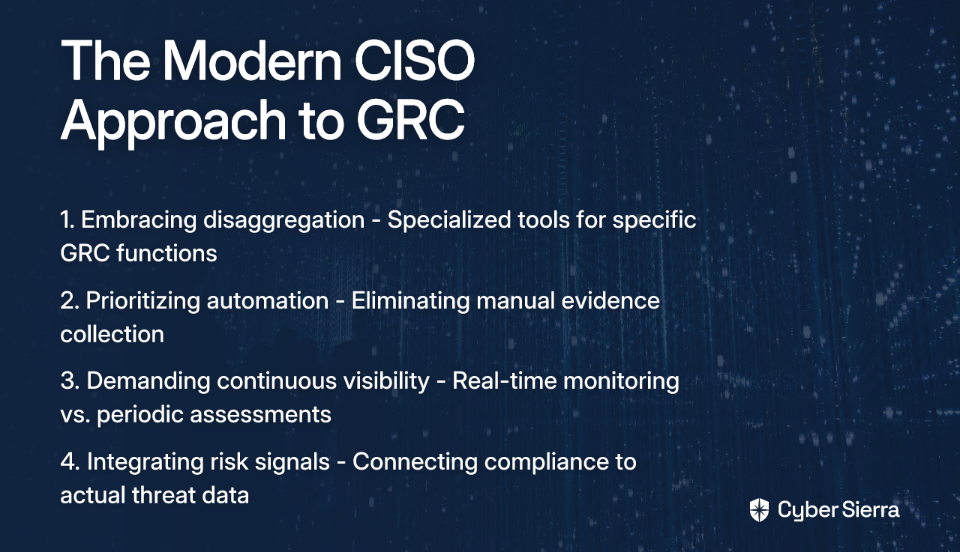
Effective security leaders are:

  1. Embracing disaggregation - Using specialized tools for specific GRC functions rather than forcing everything into one platform
  2. Prioritizing automation - Focusing on tools that eliminate manual evidence collection and control testing
  3. Demanding continuous visibility - Moving from periodic assessments to real-time monitoring
  4. Integrating risk signals - Connecting compliance activities to actual threat data for better prioritization

The GRC platform of the future isn't a platform at all—it's an ecosystem of specialized tools built around continuous monitoring and deep automation. Whether you build this ecosystem yourself or adopt emerging platforms designed with these principles, the key is moving beyond the failed monolithic GRC approach of the past.

Your board may still want a single dashboard, but underneath it should be a modern, integrated approach to security governance that provides real value beyond expensive checkbox tracking. That's what leading CISOs are building today, with or without the legacy GRC vendors.

Frequently Asked Questions

What is the main problem with traditional GRC platforms?

The main problem with traditional GRC platforms is their inflexible, "one-size-fits-none" design. They push standardized workflows that rarely align with an organization's unique structure and processes, leading to a difficult choice between overhauling the entire compliance program to fit the tool or letting the expensive platform go unused while teams revert to spreadsheets.

Why do auditors often distrust data from GRC platforms?

Auditors often distrust data from GRC platforms because the evidence represents a point-in-time snapshot rather than a continuous, real-time view of control effectiveness. The evidence is often manually uploaded and may not be sourced directly from operational systems, leading auditors to question its integrity and request direct evidence instead, which defeats a primary purpose of the GRC tool.

What are CISOs using instead of traditional GRC tools?

Instead of a single, monolithic GRC platform, many CISOs are building a "disaggregated GRC stack." This involves using a combination of specialized, purpose-built tools, which can include highly customizable spreadsheets, compliance automation platforms like Drata or Vanta for specific frameworks, and GRC modules within existing enterprise systems like ServiceNow or Microsoft Purview.

What is a disaggregated GRC stack?

A disaggregated GRC stack is an ecosystem of separate, specialized tools used together to manage governance, risk, and compliance, as opposed to relying on one all-encompassing platform. This approach allows security leaders to select the best tool for each specific function (e.g., privacy, vendor risk, control monitoring), providing greater flexibility and effectiveness than a rigid, monolithic system.

How does continuous control monitoring (CCM) improve GRC?

Continuous Control Monitoring (CCM) improves GRC by shifting from periodic assessments to the real-time, automated validation of security controls. This provides constant visibility into control effectiveness, generates trustworthy and current evidence that satisfies auditors, and enables security teams to proactively identify and remediate control failures or drift as they occur.

What should I look for in a modern GRC solution?

A modern GRC solution should be built on three key pillars: continuous control monitoring, deep automation, and integrated risk intelligence. Look for a platform that automates evidence collection directly from source systems, provides real-time visibility into your security posture, and connects compliance data with threat intelligence to enable true, risk-based decision-making.

blog-hero-background-image
Cyber Security

How to Fix Your Drowning SOC: Detection Quality Over Alert Quantity

backdrop
Table of Contents

Join thousands of professionals and get the latest insight on Compliance & Cybersecurity.


You step into your Security Operations Center (SOC) on Monday morning to find your team already overwhelmed. Analysts frantically triage hundreds of alerts, most of which will ultimately prove harmless. The backlog grows by the hour, and you can see the fatigue in their eyes. They're drowning in a sea of notifications, desperately trying to find the few genuine threats among the noise.

Sound familiar? You're not alone. SOCs everywhere face this uphill battle against alert overload, with teams reporting they're "swamped with alerts regularly" and struggling to keep pace.

The problem isn't that you need more analysts. The real issue? Your SOC has fallen into the quantity trap - prioritizing alert volume over detection quality. As one security professional bluntly put it: "If your SOC is drowning in false alerts, no amount of automation will clean it up."

This article offers a lifeline: a practical blueprint to transform your reactive, overwhelmed SOC into a proactive, efficient security powerhouse by prioritizing detection quality over alert quantity.

The Vicious Cycle of a Noisy SOC

Security Operations Centers serve as the nerve center of an organization's security posture, responsible for continuous monitoring, threat detection, and incident response. According to OpenText, a properly functioning SOC handles everything from asset discovery and behavioral monitoring to incident response and compliance management.

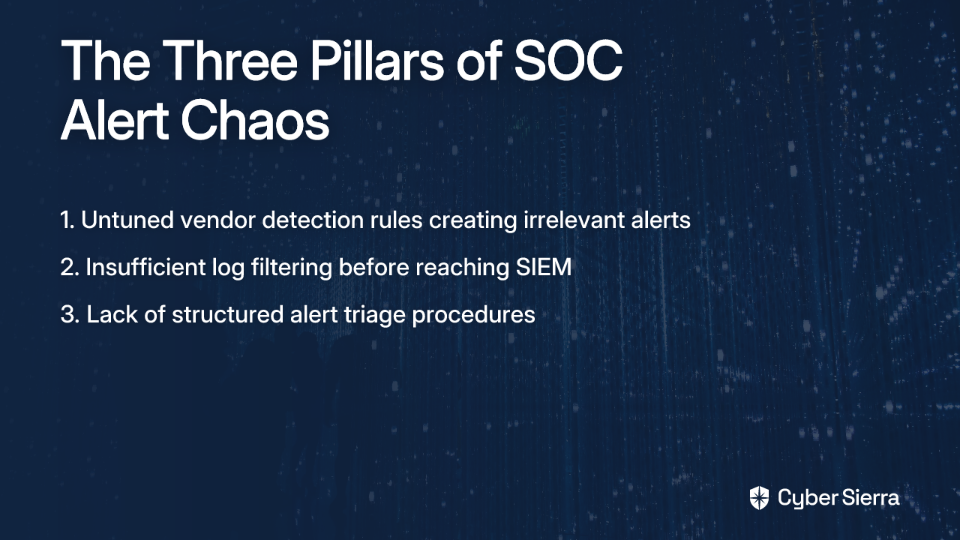
Yet many SOCs find themselves trapped in a vicious cycle of noise that undermines these core functions. Three main factors contribute to this chaos:

  1. Over-reliance on untuned vendor rules: Many teams deploy out-of-the-box detection rules without customizing them to their specific environment. As Securelist's research shows, this creates a flood of alerts that may be irrelevant to your particular threat profile.
  2. Insufficient upstream filtering: Raw logs hitting your SIEM without proper preprocessing generate excessive noise. As one SOC engineer explained: "If you're getting hit constantly, I'd look at what can be filtered or enriched earlier."
  3. Ineffective triage processes: Without structured procedures for handling alerts, analysts waste precious time determining what each alert means and how to respond.

The consequences of this cycle are devastating:

  • Analyst burnout: The constant barrage of false positives demoralizes even your most dedicated team members. As one SOC professional lamented, "It makes zero sense to me especially when the team has skilled engineers" to waste their talents chasing ghosts.
  • Missed threats: When analysts are overwhelmed, genuine threats slip through the cracks. Your detection capability becomes theoretical rather than practical.
  • Eroding trust: When your SOC repeatedly cries wolf, other departments and leadership lose confidence in your security function.

The Foundation: A Disciplined Detection Engineering Program

The path out of alert fatigue begins with Detection Engineering (DE) - the discipline dedicated to building and maintaining high-quality detection logic. As one practitioner aptly put it, you either "keep the noise out or make the signal so strong that it drowns the rest out."

A successful DE program consists of these key elements:

  1. Dedicated ownership: Assign a person or team responsible for the entire detection lifecycle, from creation through testing, deployment, and retirement.
  2. Well-defined processes: Establish consistent workflows for managing detection rules, ensuring each alert has a clear purpose and response plan.
  3. Appropriate tools: Leverage platforms for managing detection code, such as the open-source Sigma repository, which provides vendor-agnostic detection rules that can be adapted to your environment.
  4. Performance measurement: Track metrics from day one to assess your program's effectiveness and drive continuous improvement.

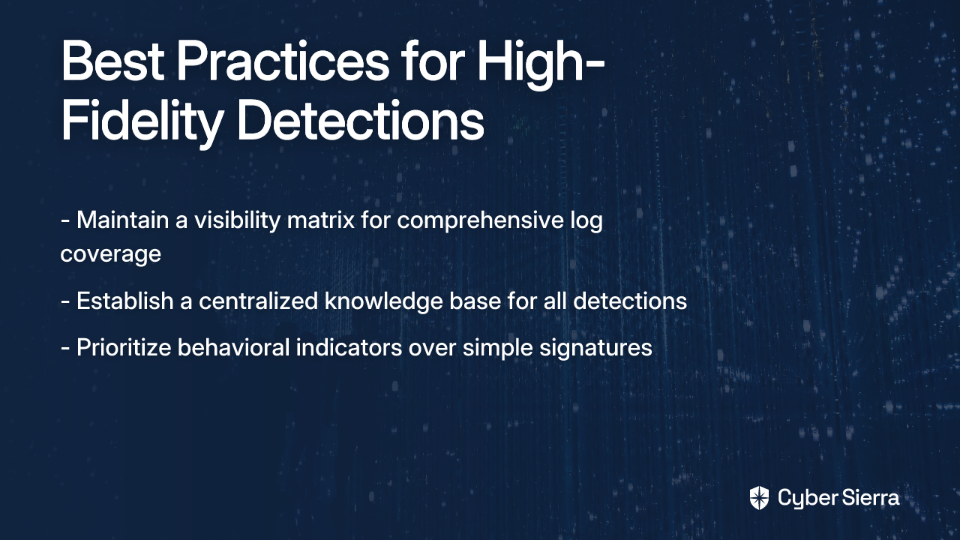
For high-fidelity detections that reduce noise while catching real threats, implement these best practices:

  • Maintain a visibility matrix: Use frameworks like MITRE DETT&CT to map your log sources and ensure you have the data needed for effective detections.
  • Establish a centralized knowledge base: Document rule logic, intended behavior, data sources, and triage steps for every detection. This addresses the common pain point of "lack of standard operating procedures" and ensures consistent handling when "DE teams hand over new rules to SOC teams."
  • Prioritize behavioral indicators: Instead of simple signature matching that attackers can easily evade, focus on detecting suspicious behaviors and tactics that reveal malicious intent.

Practical Alert Tuning: A Step-by-Step Guide to Reducing Noise

With a solid DE foundation in place, the next step is systematically tuning your existing alert environment. Alert tuning is the process of adjusting detection rules and thresholds to reduce false positives and optimize analyst workload.

Follow this four-step framework to transform your alert landscape:

Step 1: Understand Your Alert Universe

Begin by collecting metadata on alerts from the past 90 days. This data should include:

  • Alert name and source
  • Total count (how often does it fire?)
  • Average investigation time per alert
  • Efficacy rate (percentage of true positives)

Step 2: Prioritize Tuning Actions with Visualization

Plot your alerts based on investigation time versus efficacy to identify patterns:

  • Winners: High-efficacy alerts that successfully identify threats
  • Losers: Alerts with high investigation time but low efficacy - these are your top tuning priorities
  • Automation opportunities: Simple, repetitive alerts that can be handled programmatically

Prophet Security offers a useful Python script to help visualize this data and prioritize your efforts.

Step 3: Take Action with Second-Order Questions

For each "loser" alert, ask critical questions to determine its value:

  • "Has there ever been a true positive for this alert?" If not, it's a candidate for removal.
  • "Can we reduce volume with simple logic adjustments?" (e.g., adding exceptions for legitimate service accounts)
  • "Is this detection uniquely capable of identifying a specific threat?" If another rule provides the same coverage, consider consolidation.

Remember the pragmatic advice from experienced SOC practitioners: "Are there any alerts providing no benefit at all? Bin it."

Step 4: Make Decisions at Scale

Establish clear requirements for all detections. Ask systemic questions like:

  • "Are we missing coverage for any critical MITRE tactics?"
  • "Do our active detections meet a minimum efficacy threshold?"
  • "What is the cumulative time our team spends on false positives per week?"

Leveraging Technology to Enhance Quality, Not Quantity

While technology alone can't fix a broken detection strategy, the right tools can significantly amplify a quality-focused approach:

Machine Learning and UEBA: Modern SIEMs use machine learning to improve signal quality. Microsoft's Azure Sentinel Fusion feature correlates billions of low-fidelity signals to detect complex, multistage attacks that traditional rules would miss. User and Entity Behavior Analytics (UEBA) establishes baselines for normal behavior, flagging only truly anomalous activities.

Threat Intelligence Integration: High-quality, integrated threat intelligence provides crucial context to alerts. A suspicious IP address becomes significantly more concerning when threat intelligence identifies it as a known command and control server.

Strategic Automation: Apply automation strategically after an alert has been validated as high-quality. For example:

  • Implement automated responses for user-reported emails that are legitimate system notifications, addressing the pain point where "people would just report every goddamn spam mail as phish without a comment."
  • Use tools like Logic Apps to automate containment actions for confirmed malicious activities.

Measuring What Matters: KPIs for a Healthy SOC

To validate your quality-focused approach, implement these key performance indicators:

Program-Level Metrics:

  • Signal-to-Noise Ratio (SNR): The ratio of true positive detections to false positives - the ultimate measure of detection quality.
  • Threat Profile Alignment: How well your detection rules cover the adversary tactics and techniques most likely to target your organization.

Operational KPIs:

  • Mean Time to Detect (MTTD): How quickly you identify potential security incidents.
  • Mean Time to Respond (MTTR): How rapidly you contain and remediate identified threats.
  • False Positive Rate: The percentage of alerts incorrectly identified as threats - a primary metric to drive down.

Reclaiming Your SOC's Mission

A drowning SOC is a symptom of a detection quality problem, not a personnel shortage. The path to recovery lies in a strategic shift toward creating meaningful alerts that matter, not just more alerts.

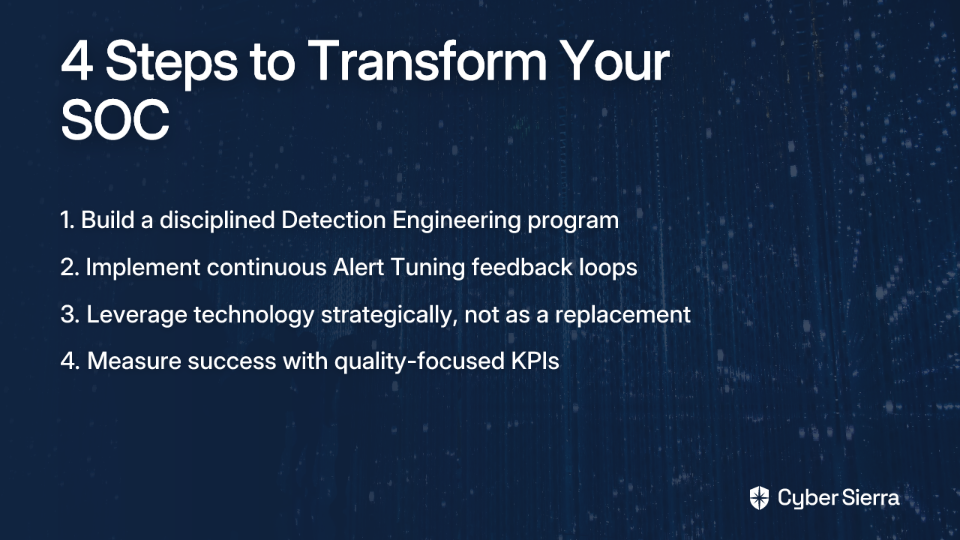
To reclaim your SOC's mission:

  1. Build a disciplined Detection Engineering program to create high-fidelity rules
  2. Implement a continuous Alert Tuning feedback loop to systematically eliminate noise
  3. Leverage technology to augment your strategy, not replace it
  4. Measure success with KPIs like Signal-to-Noise Ratio and Mean Time to Detect

Take the first step today: gather 90 days of alert data and identify your top 10 noisiest alerts. This single action can initiate the journey from a reactive, overwhelmed SOC to the proactive, efficient security center your organization needs.

Frequently Asked Questions

What is the primary cause of SOC alert fatigue?

The primary cause of SOC alert fatigue is prioritizing alert quantity over detection quality. This "quantity trap" occurs when SOCs rely on untuned, out-of-the-box vendor rules, fail to filter logs upstream, and lack effective triage processes, leading to a high volume of low-fidelity alerts and false positives that overwhelm analysts.

What is Detection Engineering and why is it critical for a SOC?

Detection Engineering (DE) is the specialized discipline of creating, managing, and maintaining high-quality security detection logic. It is critical because it shifts a SOC's focus from reacting to a flood of alerts to proactively building high-fidelity detections. A strong DE program ensures that alerts are relevant, actionable, and aligned with the organization's specific threat profile, directly combating alert fatigue.

What's the first practical step to reduce alert noise?

The first practical step is to understand your alert universe by collecting and analyzing metadata on all alerts from the past 90 days. This data should include alert names, total counts, investigation times, and efficacy rates (true positives). Visualizing this data helps you quickly identify the "loser" alerts—those with high investigation times but low efficacy—which should be your top priority for tuning or removal.

What are the most important KPIs to measure SOC effectiveness?

The most important KPIs for a modern, quality-focused SOC are the Signal-to-Noise Ratio (SNR), Mean Time to Detect (MTTD), and Mean Time to Respond (MTTR). Unlike traditional volume-based metrics, these KPIs measure the quality and efficiency of your detections. A high SNR indicates your alerts are meaningful, while low MTTD and MTTR show your team can identify and remediate true threats quickly.

Can automation solve the problem of too many alerts?

No, automation alone cannot solve the problem of too many alerts; it can actually worsen the situation by automatically processing a high volume of false positives. The best practice is to apply automation strategically after an alert has been validated as high-quality through detection engineering and tuning. Automation should be used to enhance a quality-focused strategy, not to compensate for a noisy one.

blog-hero-background-image
Cyber Security

How to Quantify Cybersecurity Risk in Financial Terms for Management

backdrop
Table of Contents

Join thousands of professionals and get the latest insight on Compliance & Cybersecurity.


You've presented a comprehensive security assessment to your executive team highlighting critical vulnerabilities in your organization's infrastructure. Despite the technical clarity of your presentation, you're met with blank stares, minimal questions, and ultimately, no additional budget allocation. As one security professional lamented, "If you can't quantify the risk in terms of lost revenue, you will not get traction."

This scenario plays out in boardrooms worldwide. While security professionals speak the language of threats and vulnerabilities, executives speak the language of dollars and cents. This fundamental communication gap prevents essential security initiatives from receiving the attention and resources they deserve.

The High Cost of Ignoring Cyber Risk

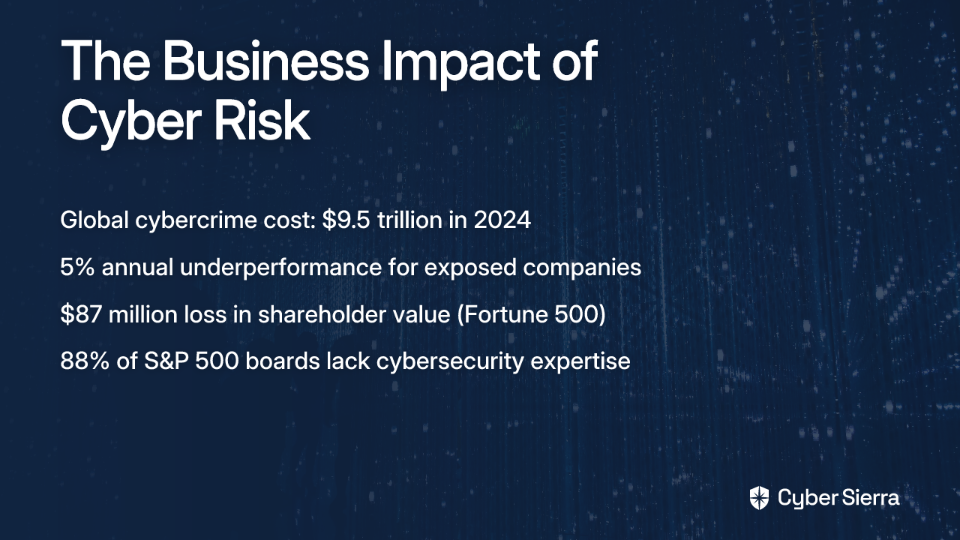
Cybersecurity is not just an "IT problem" – it's a business risk with significant financial implications. The global cost of cybercrime is projected to reach a staggering $9.5 trillion in 2024, according to research from Cybersecurity Ventures. Yet many organizations continue treating security as a technical silo rather than a strategic business function.

This disconnect has measurable consequences. Research published in the SSRN reveals that companies with high cybersecurity exposure underperform their less-exposed peers by 0.42% to 0.59% lower excess returns per month. This translates to approximately 5% annual underperformance, resulting in an estimated $87 million loss in shareholder value for a typical Fortune 500 company.

The expertise gap in leadership compounds this problem. An alarming 88% of S&P 500 boards lack cybersecurity expertise, according to CEPR research. When your audience doesn't understand the technical complexities of cybersecurity, you must translate these risks into the universal language of business: financial impact.

A Practical Framework for Quantification: The FAIR Model

The Factor Analysis of Information Risk (FAIR) model offers a structured approach to quantifying cyber risk in financial terms. Unlike qualitative assessments that rely on subjective "high/medium/low" ratings, FAIR provides a consistent, defensible methodology that executives can understand and trust.

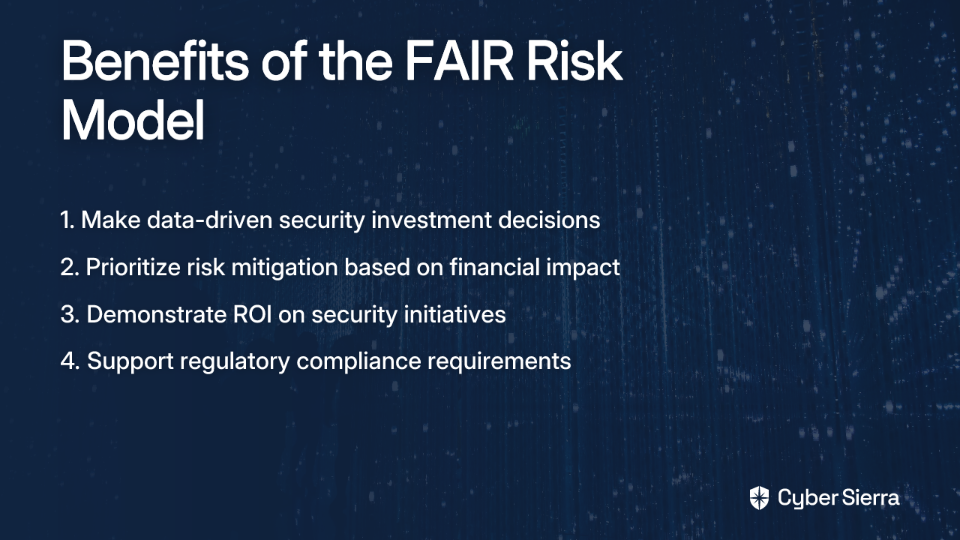
According to Balbix, FAIR has become an international standard for quantitative risk analysis, enabling organizations to:

  1. Make data-driven security investment decisions
  2. Prioritize risk mitigation efforts based on financial impact
  3. Demonstrate ROI on security initiatives
  4. Support regulatory compliance requirements

The Four Stages of a FAIR Risk Assessment

1. Identify Risk Scenarios

Begin by identifying specific assets at risk (such as your customer database or payment processing system) and linking them to potential threats (like a ransomware attack or data breach). For example:

  • Risk Scenario: Ransomware attack on customer database by an external threat actor

2. Evaluate Loss Event Frequency (LEF)

This measures how often a loss event is likely to occur. LEF is not a guess but a calculation derived from:

  • Threat Event Frequency (TEF): How often the threat is expected to occur
  • Vulnerability: The probability that the threat will be successful, which considers:
    • Contact Frequency: How often the threat interacts with the asset
    • Probability of Action: Likelihood the threat will act
    • Threat Capability: The strength of the attacker's methods
    • Resistance Strength: The effectiveness of your controls

3. Evaluate Loss Magnitude (LM)

This quantifies the potential financial impact of a successful attack through:

  • Primary Loss: Direct costs such as incident response, forensic investigation, and systems restoration
  • Secondary Loss: Indirect costs including regulatory fines, legal expenses, customer churn, and reputational damage

4. Derive and Articulate Risk

Finally, combine LEF and LM to calculate your Annualized Loss Expectancy (ALE), which represents the expected yearly financial loss associated with the risk scenario:

ALE = Loss Event Frequency × Loss Magnitude

For example, if a ransomware attack has a 5% probability of occurring annually (LEF = 0.05) with an estimated impact of $2 million (LM), your ALE would be $100,000.

This financial quantification allows you to make compelling risk-based arguments for security investments. If implementing a $50,000 control reduces your ALE from $100,000 to $20,000, you can demonstrate a net benefit of $30,000 and a clear ROI.

Best Practices for Communicating Risk to Leadership

Quantifying risk is only half the battle. The way you communicate this information can make or break your case for security investments. Here are proven strategies for effectively presenting cybersecurity risk to leadership:

1. Build a Narrative Aligned with Business Objectives

Don't just present numbers – tell a story that connects security risks to strategic business goals. As recommended by Kovrr, frame your discussion around:

  • Business continuity and operational resilience
  • Competitive advantage and market positioning
  • Regulatory compliance and legal obligations
  • Customer trust and brand reputation

For example, instead of discussing "vulnerability management deficiencies," talk about "operational disruption risks that could impact our ability to fulfill customer orders during peak season."

2. Use Clear, Concise Financial Language

Avoid technical jargon and cybersecurity terminology that executives may not understand. Instead, use financial metrics they recognize:

  • Potential revenue loss
  • Customer acquisition and retention costs
  • Regulatory fines and legal expenses
  • Impact on earnings per share or market valuation

As one security professional advised in a Reddit discussion, use simple but powerful formulas like:

Expected Loss = Probability of an event × Estimated Financial Loss

3. Visualize the Risk

Complex data becomes more digestible through visual representation. Create:

  • Heat maps showing risk concentration
  • Comparative charts of risk scenarios by financial impact
  • Trend analyses showing risk exposure over time
  • Cost-benefit graphs displaying security investment ROI

The FAIR Institute recommends presenting multiple scenarios (best-case, expected, and worst-case) to demonstrate the range of potential outcomes and the value of your proposed controls.

4. Present Actionable Solutions with a Clear "Ask"

Don't just identify problems – propose specific solutions with measurable outcomes. For each risk scenario:

  1. Present the current risk exposure in financial terms
  2. Outline proposed mitigation strategies with implementation costs
  3. Show the expected risk reduction and ROI
  4. Make a clear, specific request for resources or authority

Be explicit about what you need, whether it's budget approval, policy changes, or strategic prioritization. Ground your "ask" in business benefits rather than technical necessities.

5. Set Realistic Expectations

Communicate that 100% security is impossible and not the goal. The objective is to manage risk to an acceptable level aligned with the organization's risk appetite. Focus on resilience – the ability to detect, respond to, and recover from incidents in ways that minimize financial and operational impact.

From Cost Center to Strategic Partner

By quantifying cybersecurity risk in financial terms, you transform security discussions from technical complaints into strategic business conversations. This approach:

  1. Demonstrates your understanding of business priorities
  2. Enables data-driven security investment decisions
  3. Positions security as a business enabler rather than a cost center
  4. Builds credibility with executive leadership

As one security leader noted, "Until the bosses decide protecting sensitive information is more important than sales being able to share a document via Dropbox," security will remain undervalued. Financial quantification makes this critical connection clear.

Start today by selecting one critical business process, applying the FAIR model to quantify its associated cyber risks, and presenting your findings using these communication best practices. This single, well-articulated conversation in the language of business can be the inflection point that transforms how your organization views and invests in cybersecurity.

Frequently Asked Questions

What is cyber risk quantification?

Cyber risk quantification is the process of evaluating cybersecurity risks and expressing their potential impact in financial terms. Instead of using subjective labels like "high" or "low," this approach uses data-driven models, like the FAIR model, to calculate the probable financial loss a specific risk poses to the organization, often expressed as an Annualized Loss Expectancy (ALE).

Why are qualitative risk assessments (high, medium, low) not effective for executive communication?

Qualitative risk assessments are not effective for executives because they are subjective and lack the financial context necessary for business decision-making. Terms like "high risk" can be interpreted differently by various stakeholders and fail to answer the board's primary question: "How will this affect the bottom line?" Financial quantification provides a clear, defensible, and universally understood metric for prioritizing security investments.

How does the FAIR model help quantify cyber risk?

The FAIR (Factor Analysis of Information Risk) model provides a standardized, structured framework for breaking down complex risks into measurable components. It helps you analyze two key factors: Loss Event Frequency (how often a negative event is likely to happen) and Loss Magnitude (the probable financial cost if it does). By calculating these factors, you can derive the risk in financial terms, making it understandable and actionable for business leaders.

What is Annualized Loss Expectancy (ALE) and why does it matter?

Annualized Loss Expectancy (ALE) is the total expected financial loss from a specific risk over a one-year period. It is calculated with the formula: ALE = Loss Event Frequency × Loss Magnitude. This metric is crucial because it allows executives to compare different risks on an apples-to-apples basis and measure the return on investment (ROI) of proposed security controls by showing how much a control reduces the ALE.

How can I start quantifying cyber risk with limited data?

You can start quantifying risk even with limited data by using calibrated estimates and ranges rather than precise figures. Begin by gathering available internal data (e.g., from incident logs), leveraging industry reports for benchmark statistics, and conducting workshops with internal subject matter experts. The FAIR model is designed to work with uncertainty, allowing you to define a probable range for your variables and refine your analysis as more data becomes available.

What is the most important factor when communicating cyber risk to the board?

The most important factor is to translate technical risks into the language of business impact. Instead of focusing on vulnerabilities or threat actors, frame the discussion around strategic business objectives, such as operational continuity, revenue protection, regulatory compliance, and brand reputation. Presenting risks in financial terms, aligned with what leadership cares about, is the key to securing buy-in and resources.

blog-hero-background-image
Cyber Security

How to Build Security Culture Without Fear-Based Tactics

backdrop
Table of Contents

Join thousands of professionals and get the latest insight on Compliance & Cybersecurity.


You've just rolled out a new cybersecurity training program. The policy states clearly: "Employees who click on phishing emails will be required to take remedial training. Repeated failures may result in disciplinary action." Your intention is to protect the company, but instead, you've created a culture of anxiety where mistakes are hidden, not reported, and security becomes everyone's burden rather than everyone's responsibility.

Sound familiar? You're not alone.

In many organizations, security compliance is mandated rather than motivated, making training feel like a chore. The fear of termination becomes the primary motivator, creating a toxic environment where security is viewed as the enemy rather than a shared goal.

"When you lead with fear, people disengage. Empowerment drives change," explains Dr. Jessica Barker, a human-centered security specialist. This insight cuts to the core of our cybersecurity challenge: the human element.

Consider this sobering statistic: 82% of data breaches involve a human element, according to Verizon's Data Breach Investigations Report. Yet too many organizations respond by doubling down on punitive measures rather than rethinking their approach.

What if we viewed this statistic not as evidence of human liability, but as our greatest opportunity for building resilience? What if we could transform security culture from fear-based compliance to empowered participation?

What is Security Culture (And Why Fear Fails)?

Before we can build a better security culture, we need to understand what it actually is.

Security culture encompasses "the ideas, customs, and social behaviors that influence the security posture of a group," according to KnowBe4. More practically, it's the set of shared values, attitudes, and behaviors that protect organizational assets—your people, data, and systems.

So why do fear-based approaches fail so spectacularly?

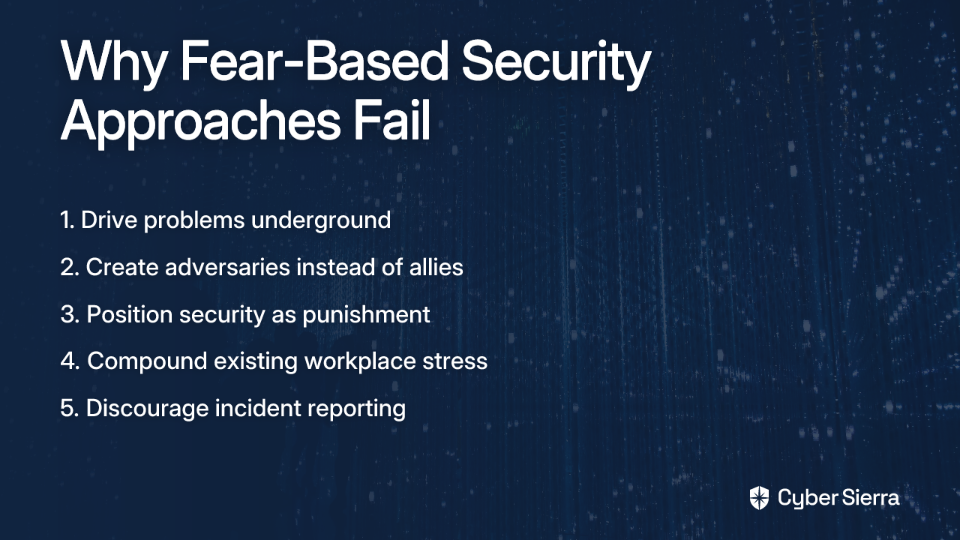
Psychologically, fear-based tactics create several counterproductive outcomes:

  1. They drive problems underground: When employees fear punishment for security mistakes, they're less likely to report incidents promptly. This creates dangerous security blind spots.
  2. They create adversaries, not allies: A punitive approach positions the security team as enforcers rather than enablers, fostering an "us versus them" mentality.
  3. They compound existing stress: Cyber attacks already generate anxiety. Adding internal punishment only makes this worse, potentially leading to burnout or disengagement.

As one security professional on Reddit puts it: "A culture of cooperation and mutual respect goes a hell of a lot further than a culture of fear."

The Foundations of a Positive, People-Centric Security Culture

Building a positive security culture requires understanding both its components and the psychology that drives human behavior.

The Seven Dimensions of Security Culture

To systematically improve your culture, start by understanding its seven dimensions, as identified by KnowBe4:

  1. Attitudes: How employees feel about security measures
  2. Behaviors: The observable security actions employees take
  3. Cognition: Employees' understanding of security issues
  4. Communication: The effectiveness of security discussions
  5. Compliance: Adherence to written security policies
  6. Norms: The unwritten rules of security conduct
  7. Responsibilities: How employees perceive their role in security

This framework provides a comprehensive lens for assessing where your organization stands and where improvement is needed.

Understanding Cognitive Biases in Security

Our security decisions are heavily influenced by cognitive biases that often operate outside conscious awareness:

  • Familiarity Bias: We tend to trust communications that seem familiar, making us vulnerable to well-crafted phishing emails that mimic trusted sources.
  • Optimism Bias: The belief that "it won't happen to me" leads many to take unnecessary risks, thinking they're somehow immune to cyber threats.

These psychological factors help explain why traditional awareness training alone often falls short. Information without behavioral change strategies rarely translates to action.

A Step-by-Step Playbook for Building a Positive Security Culture

Let's move from theory to practice with a concrete playbook for transforming your security culture:

Step 1: Secure Leadership Commitment

The single most crucial factor in culture change is visible leadership commitment. When executives model good security behaviors and champion their importance, they signal that security is a shared organizational value, not just IT's problem.

As research from ISACA shows, organizations with strong leadership support for security initiatives are significantly more successful in developing positive security cultures. Leaders must walk the talk—using MFA, reporting suspicious emails, and openly discussing the importance of security.

Step 2: Assess Your Current Culture

You can't improve what you don't measure. Begin by assessing your current security culture:

  • Conduct anonymous surveys to gauge employee attitudes
  • Review incident reporting rates and patterns
  • Analyze past security incidents for behavioral patterns
  • Use the Security Culture Maturity Model to benchmark your organization

This baseline measurement is essential for tracking progress and targeting improvements.

Step 3: Engineer Training for Behavioral Change, Not Just Awareness

Traditional security training focuses on knowledge transfer, but knowledge alone doesn't change behavior. Instead, apply the BMAP Model for Behavior Change:

  • Motivation: Use gamification (stars, badges, leaderboards) and positive reinforcement
  • Ability: Make secure actions easy with practical tools like one-click reporting buttons
  • Prompt: Implement regular simulated phishing campaigns as practice opportunities, not punitive tests

Replace hour-long compliance videos with micro-learning modules that deliver content in digestible chunks. Make training relatable by using real-world scenarios that connect to employees' everyday experiences.

Step 4: Make Security Human and Approachable

Security often suffers from an image problem—perceived as technical, intimidating, and disconnected from daily work. Counter this by:

  • Branding Your Security Culture: Create a recognizable identity for your security program. This could be a mascot, a catchy slogan, or a visual theme that makes security initiatives more memorable.
  • Using Storytelling: Frame security training with relatable narratives instead of abstract policies. Share anonymized stories about real incidents and how they were handled.

As one Redditor notes, "Poorly explained security measures lead to frustration and non-compliance." When employees understand the "why" behind security rules, compliance becomes more meaningful.

Step 5: Implement Positive Reinforcement & Feedback Loops

Replace punitive measures with positive reinforcement:

  • Create a recognition program with tangible rewards for security-conscious behavior. As one security professional suggests, "Gift cards, pizza parties, recognition for going above and beyond" can be powerful motivators.
  • Celebrate employees who report suspicious activities or potential security incidents.
  • Use tools that provide real-time, constructive feedback when an employee makes a risky click, rather than mandatory remedial training.

Research from Aberdeen Group shows that organizations using positive reinforcement see substantially higher engagement with security initiatives than those relying on punitive approaches.

Step 6: Create a Community of Security Champions

Build a network of security advocates across departments:

  • Recruit volunteers who are passionate about security to serve as departmental champions
  • Provide them with additional training and resources
  • Empower them to be the bridge between the security team and their colleagues
  • Listen to their feedback about how security initiatives are perceived

This approach distributes security ownership throughout the organization rather than centralizing it in IT.

Measuring What Matters: Proving the ROI of a Positive Culture

To demonstrate the value of your cultural initiatives, shift from compliance metrics to behavioral ones:

  • Track increases in voluntary reporting of security incidents
  • Measure reduction in clicks on phishing simulations over time
  • Monitor engagement with security resources and communications
  • Survey changes in attitudes toward security

The business benefits are substantial. Organizations with strong security cultures are:

  • 5.5 times more likely to have well-defined and consistently followed security policies
  • 70% more likely to meet data protection compliance requirements
  • Better positioned to detect and respond to incidents early, reducing potential damage

From Weakest Link to Strongest Defense

Building a positive security culture is not a quick fix but a continuous journey. By replacing fear with empowerment, communication, and positive reinforcement, you transform employees from perceived liabilities into your most valuable security assets.

The human element in cybersecurity is indeed substantial—but that's precisely why it represents our greatest opportunity. When people feel ownership rather than obligation, when they're motivated by purpose rather than punishment, they become active participants in your security program rather than its reluctant subjects.

Begin today by having an open conversation with your leadership team about your current approach. Assess where you stand using the seven dimensions framework, and commit to one small, positive change this quarter. The journey to a stronger security culture starts with recognizing that fear isn't the answer—empowerment is.

Frequently Asked Questions

What is a positive security culture?

A positive security culture is an environment where employees are intrinsically motivated to practice safe security behaviors. It's built on shared values, trust, and empowerment, positioning security as a collective responsibility rather than a compliance-driven chore enforced by fear.

Why do fear-based security policies fail?

Fear-based security policies fail because they drive security issues underground. When employees fear punishment for mistakes, they are less likely to report phishing attempts or accidental clicks, robbing the security team of crucial threat intelligence. This approach creates an "us vs. them" mentality, damaging trust and preventing genuine engagement.

How do you start building a positive security culture?

The most critical first step is to secure visible and active commitment from leadership. When executives champion security, use multi-factor authentication, and openly discuss its importance, they signal that it's a core organizational value. Following this, assessing your current culture with anonymous surveys provides a baseline for targeted improvements.

How should you handle employees who repeatedly fail phishing tests?

Instead of resorting to punishment, a positive approach seeks to understand the root cause. This involves engaging with the employee to see if there are workflow-related pressures, knowledge gaps, or specific types of lures that are particularly deceptive for their role. The goal is to provide personalized coaching and resources, treating failures as learning opportunities, not punishable offenses.

What are some effective alternatives to punitive security training?

Effective alternatives focus on positive reinforcement and engagement. These include gamification (leaderboards, badges), a "Security Champions" program to create advocates across departments, and recognition programs that reward employees for positive actions, such as reporting a suspicious email. These methods foster motivation and a sense of shared ownership.

How can you measure the success of a security culture?

The success of a security culture is best measured through behavioral and engagement metrics, rather than simple compliance checks. Key indicators include an increase in the voluntary reporting of suspicious emails, a decrease in click-rates on phishing simulations over time, higher engagement with training materials, and positive shifts in employee attitudes measured through surveys.

blog-hero-background-image
Cyber Security

Supply Chain Attacks in CI/CD Pipelines: The New Cloud Security Nightmare

backdrop
Table of Contents

Join thousands of professionals and get the latest insight on Compliance & Cybersecurity.


You've built a robust CI/CD pipeline to automate your cloud deployments. Your team is shipping features faster than ever. But behind this efficiency lurks a growing threat that keeps security professionals awake at night: your pipeline has become the perfect target for sophisticated supply chain attacks.

"Supply chain attacks in the cloud are getting wild lately," as one security professional put it in a recent discussion. "Attackers are targeting CI/CD pipelines and dependency chains to slip malicious code into cloud deployments."

This isn't just another security buzzword. A supply chain attack involves injecting malicious code into a trusted component of your software development lifecycle, compromising your final product and potentially affecting thousands of downstream customers. And your CI/CD pipeline—with its privileged access, automation, and trusted position—sits at the heart of this vulnerable chain.

The stakes are enormous. Since 2020, 57% of organizations have encountered security incidents related to their DevOps toolchains. With the average data breach costing a staggering $4.35 million, these aren't risks you can afford to ignore.

As one security auditor bluntly stated, "I have done over 50 Cloud sec audits and you won't believe the amount of cloud resources just hanging out there on the www to be found and attacked." This article cuts through the noise to examine why your CI/CD pipeline is a prime target, how these attacks unfold, and most importantly, how to build a robust defense.

The Ticking Time Bomb: Why Your CI/CD Pipeline is a Prime Target

CI/CD pipelines have become the beating heart of modern development workflows. They automate building, testing, and deploying applications, dramatically accelerating software delivery. But this critical role makes them particularly attractive to attackers for several key reasons:

  1. Privileged Access: CI/CD systems typically operate with elevated permissions to deploy code, access secrets, and modify production environments. According to the OWASP CI/CD Security Cheat Sheet, these pipelines often hold "the keys to the kingdom"—making a successful breach catastrophically damaging.
  2. Trust by Default: Development teams implicitly trust the output of their pipelines. Code that passes through CI/CD checks is assumed to be safe, making it the perfect vehicle for introducing malicious code that flies under the radar.
  3. Automation Amplifies Attacks: The automated nature of CI/CD means that a single compromised component can instantly affect all downstream systems and customers—potentially spreading malware to thousands of targets simultaneously.
  4. Security Takes a Backseat: As one frustrated security professional explained, "Developers are being given priority so if it makes their jobs at all more difficult, my advice gets ignored, so nearly everything is simply set to default settings." This prioritization of convenience over security creates dangerous blind spots.
  5. Complex Dependency Chains: Modern applications rely on hundreds or thousands of dependencies, creating a broad attack surface. The "rise of dependency confusion, malicious code injection, and compromised open-source repositories is alarming," as noted in another discussion thread.

Anatomy of a Pipeline Breach: Learning from Real-World Attacks

To understand the severity of the threat, let's examine some high-profile CI/CD supply chain attacks and their devastating consequences.

The SolarWinds Breach: The Landmark Attack

The 2020 SolarWinds hack remains the textbook example of a catastrophic supply chain attack. Attackers infiltrated SolarWinds' build process and inserted a backdoor (SUNBURST) into the Orion software updates. These compromised updates were then digitally signed and distributed to approximately 18,000 customers, including government agencies and Fortune 500 companies. The attack remained undetected for months, giving attackers persistent access to some of the most sensitive networks in the world.

What made this attack particularly insidious was that it exploited the trust relationship between SolarWinds and its customers. The malicious code came through an officially signed update from a trusted vendor, bypassing most security controls.

The tj-actions and reviewdog GitHub Actions Attack: A Modern Nightmare

A more recent and directly relevant example involves the compromise of popular GitHub Actions. This sophisticated attack, detailed by the OpenSSF, reveals the modern attacker's playbook:

  1. Initial Compromise: Attackers exploited flawed contributor management processes to gain write access to the popular reviewdog repository.
  2. Tag Redirection: In a move that exploits what one developer called "the mutable nature of version tags in GitHub Actions," the attackers redirected the commonly used v1 tag to point to their malicious commit. Users who specified this tag in their workflows were unknowingly executing the attacker's code.
  3. Credential Theft and Propagation: The malicious code extracted secrets and access tokens from CI environments, then used these stolen credentials to compromise additional repositories, including tj-actions.
  4. Log-Based Exfiltration: Instead of making suspicious network connections that might trigger alerts, the attackers cleverly dumped stolen secrets directly into CI logs, making the attack harder to detect.

What's particularly chilling about this attack is how it leveraged the fundamental trust placed in these components and the cascading effect as one compromise led to another. As one security researcher put it, this feels "like something out of a spy movie, but it's all happening in our digital backyard."

The Attacker's Playbook: Top CI/CD Security Risks

Understanding the common attack vectors is essential for building effective defenses. The OWASP Top 10 CI/CD Security Risks provides a framework for identifying the most critical threats:

  1. Dependency Chain Abuse: Attackers inject malicious code into dependencies used by your application or CI/CD tools themselves. This is the "dependency confusion" threat that many developers worry about, where attackers exploit the way package managers resolve dependencies to deliver malicious packages.
  2. Poisoned Pipeline Execution (PPE): This involves modifying the pipeline's execution flow to inject malicious commands, often by manipulating build configuration files like Jenkinsfile or .github/workflows/ci.yml.
  3. Inadequate Identity and Access Management (IAM): As one professional noted, "Also seeing a rise in cloud misconfigurations being exploited - especially around IAM permissions and API security. The whole 'identity is the new perimeter' thing is real." Weak IAM makes CI/CD systems vulnerable to unauthorized access and privilege escalation.
  4. Insufficient Credential Hygiene: Poor management of secrets, tokens, and keys—including hardcoded secrets in pipeline configurations or leaking them in logs—gives attackers easy access to sensitive systems.
  5. Insecure System Configuration: Default or misconfigured SCM platforms, CI/CD servers, or build agents create vulnerabilities. This aligns with the observation that "nearly everything is simply set to default settings" due to development priorities trumping security concerns.
  6. Improper Artifact Integrity Validation: Failure to verify the digital signature or hash of build artifacts allows tampered artifacts to be deployed undetected.

A Defense-in-Depth Blueprint for Securing Your Pipeline

Protecting your CI/CD pipeline requires a comprehensive, defense-in-depth approach. Here's a practical blueprint for hardening your pipeline against supply chain attacks:

1. Lock Down Your Dependencies & Code

Pin Dependencies to Full-Length Commit SHAs: The single most important lesson from the tj-actions attack is to avoid using mutable tags like v1 or latest. Instead, pin dependencies to immutable, full-length commit SHAs. As the OpenSSF recommends, this prevents attackers from redirecting references to malicious code.

Vet and Audit Dependencies:

  • Use tools like Renovate or Dependabot to keep dependencies updated
  • Integrate the OpenSSF Scorecard into CI workflows to assess the security posture of dependencies
  • Consider using Software Bills of Materials (SBOMs) to maintain visibility into your dependency chain

Secure Source Code Management:

  • Require pull request reviews before merging; avoid auto-merge rules
  • Enable branch and tag protection rules in GitHub/GitLab to prevent unauthorized changes
  • Regularly audit repository access permissions and remove stale accounts

2. Harden Identity and Access Management (IAM)

Enforce the Principle of Least Privilege (PoLP): Grant users, services, and build agents only the minimum permissions necessary. As SecureSlate notes, overprivileged CI/CD environments dramatically increase the blast radius of any compromise.

Mandate Multi-Factor Authentication (MFA): Require MFA for all users with access to your SCM and CI/CD platforms. This simple step significantly reduces the risk of credential theft.

Secure Secrets Management:

  • NEVER hardcode secrets in your pipeline configurations or repositories
  • Use dedicated secret management tools like HashiCorp Vault, AWS Secrets Manager, or Azure Key Vault
  • Implement short-lived tokens instead of persistent credentials where possible
  • Regularly rotate secrets and access keys

Isolate Workflows: Use features like GitHub Environments to protect secrets and require manual approvals for deployments to sensitive environments.

3. Achieve End-to-End Integrity and Visibility

Validate Artifact Integrity:

  • Generate cryptographic hashes (e.g., SHA-256) for all build artifacts and verify them at each pipeline stage
  • Consider implementing a framework like in-toto to create a cryptographically verifiable record of your entire supply chain
  • Sign your artifacts and verify signatures before deployment

Implement Runtime Security and Monitoring:

  • Monitor CI/CD runners for unusual behavior using tools like StepSecurity's Harden-Runner
  • Centralize logs from all CI/CD components into a SIEM for analysis and anomaly detection
  • Scan build logs for leaked secrets using tools like GitGuardian
  • Implement comprehensive monitoring of your CI/CD workflows to detect unusual patterns or behaviors

4. Continuous Monitoring and Threat Hunting

Integrate Security Tools into Your Pipeline:

  • Implement Static Application Security Testing (SAST), Dynamic Application Security Testing (DAST), and Software Composition Analysis (SCA) directly in your pipeline
  • Use infrastructure-as-code scanning tools to detect misconfigurations before deployment
  • Regularly audit your cloud configurations with Cloud Security Posture Management (CSPM) tools

Map and Monitor Your Supply Chain:

  • Create a comprehensive map of your dependencies and their sources
  • Establish a vulnerability disclosure process for your own projects
  • Participate in coordinated vulnerability disclosure programs

Conclusion: Shifting Left and Building a Resilient Future

Supply chain attacks targeting CI/CD pipelines represent one of the most significant cloud security challenges organizations face today. As one security professional observed, "Often it's not the cloud that is the problem but a fundamental lack of ability to deploy cloud projects with good security built in."

The most critical defensive actions you can take today include:

  • Pinning dependencies to immutable commit SHAs instead of mutable tags
  • Enforcing least privilege across all CI/CD components
  • Implementing robust secrets management
  • Ensuring end-to-end visibility with comprehensive logging and monitoring
  • Treating your CI/CD pipeline with the same security rigor as your production environment

Remember that technology alone isn't enough. Organizations must cultivate a security-first culture where security is a shared responsibility, not an afterthought or impediment to development. As the Cloud Security Alliance emphasizes, this cultural shift is essential for long-term resilience.

The sophistication of these attacks will only increase. What feels like "something out of a spy movie" today will become commonplace tomorrow. But with a defense-in-depth approach that addresses people, processes, and technology, you can turn your CI/CD pipeline from your greatest vulnerability into a secure foundation for your cloud infrastructure.

Frequently Asked Questions

What is a CI/CD supply chain attack?

A CI/CD supply chain attack is a cyberattack where malicious code is injected into a trusted component of your software development and deployment pipeline. This compromises the final software product. Instead of attacking your production systems directly, attackers target less secure elements like third-party dependencies, build tools, or source code repositories. Once inside, they can use the trusted, automated nature of the CI/CD pipeline to distribute malware, steal data, or gain persistent access to your systems and your customers' systems.

Why is my CI/CD pipeline such a high-value target for attackers?

Your CI/CD pipeline is a high-value target because it has privileged access to your most sensitive systems, is implicitly trusted by your development team, and its automation can rapidly spread a compromise. These pipelines often hold "the keys to the kingdom," including secrets, API keys, and deployment credentials for production environments. Attackers know that a single breach in the pipeline can give them widespread access, allowing them to inject malicious code that will be automatically built, tested, and deployed without raising suspicion.

What is the single most effective way to prevent CI/CD supply chain attacks?

The single most effective defense is to pin your dependencies to full-length, immutable commit SHAs instead of using mutable tags like v1 or latest. This practice directly prevents tag-hijacking attacks, like the one seen with tj-actions, where attackers redirect a common tag to point to their malicious code. By using an immutable commit hash, you ensure your pipeline always pulls the exact, verified version of a dependency, making it impossible for attackers to secretly swap it out. While a multi-layered defense is crucial, this one change significantly reduces a major attack vector.

How does the principle of least privilege (PoLP) apply to CI/CD security?

The principle of least privilege (PoLP) in CI/CD means that every component—from user accounts to build agents and deployment scripts—should only have the absolute minimum permissions required to perform its specific task. For example, a build agent that only needs to build code shouldn't have permissions to modify production infrastructure. By strictly limiting permissions, you contain the "blast radius" of a potential compromise. If an attacker gains control of one part of the pipeline, PoLP ensures they cannot easily move laterally to access more sensitive systems or escalate their privileges.

What are some essential tools for securing a CI/CD pipeline?

Essential tools for securing a CI/CD pipeline include secret management solutions (like HashiCorp Vault), Software Composition Analysis (SCA) scanners (like Dependabot), and static analysis security testing (SAST) tools. A robust security toolkit should be integrated directly into your pipeline:

  • Secret Management: Tools like AWS Secrets Manager or Azure Key Vault prevent hardcoded credentials.
  • SCA & Dependency Management: Dependabot or Renovate automate dependency updates, while the OpenSSF Scorecard helps vet their security posture.
  • Code & IaC Scanning: SAST tools scan your code for vulnerabilities, and tools like Terrascan check your infrastructure-as-code for misconfigurations.
  • Monitoring: StepSecurity's Harden-Runner can monitor CI/CD runner behavior for anomalies.

What is a Software Bill of Materials (SBOM) and how does it improve security?

A Software Bill of Materials (SBOM) is a formal, machine-readable inventory of all software components, dependencies, and libraries included in a piece of software. An SBOM provides complete visibility into your software supply chain. When a new vulnerability is discovered in an open-source library (like Log4j), you can instantly query your SBOMs to see which of your applications are affected. This allows for rapid risk assessment and remediation, turning a days-long manual search into a minutes-long automated query. It's a foundational element for managing dependency risk at scale.

blog-hero-background-image
Cyber Security

How to Prove Cybersecurity Value When Nothing Goes Wrong

backdrop
Table of Contents

Join thousands of professionals and get the latest insight on Compliance & Cybersecurity.


You've invested significant resources in your cybersecurity program. Your team works tirelessly behind the scenes, continuously monitoring threats, patching vulnerabilities, and strengthening your defenses. And the result? Nothing happens. No breaches. No headlines. No crisis.

And then the question inevitably comes: "Do we really need to spend this much on cybersecurity when nothing is going wrong?"

This is the fundamental paradox of cybersecurity success. As one security professional put it, "The better our security services work, the more invisible they feel to clients." It's the equivalent of questioning why you need a janitor when the bathroom is always clean.

In a world where 84% of board directors see cyber risk as a business risk according to Gartner's 2024 Board of Directors Survey, yet only 29% of boards possess significant cybersecurity expertise according to the 2024 Global CISO Survey, security leaders face a critical communication gap.

The solution isn't just working harder at prevention—it's changing the narrative. It's time to shift from positioning cybersecurity as a technical cost center to framing it as a strategic business enabler through business-aligned metrics, financial quantification, and effective communication.

Moving Beyond Fear: From Technical Defense to Business Enablement

The "Invisible Return Paradox" is a fundamental challenge in cybersecurity: the value of your work manifests primarily as the absence of negative events rather than direct revenue generation. When everything runs smoothly, stakeholders may question the necessity of your services—not because they're working poorly, but because they're working exceptionally well.

The Insurance Analogy

One of the most effective ways to reframe this challenge is through the insurance analogy. Nobody questions the value of their home insurance when their house doesn't burn down. Similarly, cybersecurity functions as essential enterprise insurance, protecting your organization's assets, reputation, and operational continuity.

According to Gartner, the cybersecurity conversation must move beyond purely technical aspects to encompass critical business contexts:

  • Business Operations: How security enables rather than hinders operational efficiency
  • Regulatory Compliance: Meeting industry requirements like GDPR, HIPAA, or PCI DSS
  • Stakeholder Expectations: What shareholders and partners require for continued business relationships
  • Cyber Liability Insurance: Meeting increasingly stringent eligibility requirements
  • Market Competitiveness: How security posture affects customer trust and market position

When you reframe security as business enablement rather than merely technical defense, you transform the perception of your function from a cost center to a strategic asset.

Quantifying the Unseen: Metrics That Resonate with the Boardroom

Calculating Return on Security Investment (ROSI)

Traditional ROI calculations work poorly for cybersecurity because they're designed for revenue-generating investments, not loss prevention. Instead, leverage Return on Security Investment (ROSI), which quantifies avoided losses through a straightforward formula.

According to TechTarget, here's how to calculate it:

  1. Determine Single Loss Expectancy (SLE): The monetary impact of a single security incident
  2. Calculate Annual Rate of Occurrence (ARO): How frequently you expect incidents to occur annually
  3. Compute Annual Loss Expectancy (ALE): Multiply SLE by ARO to get your total expected loss for the year
  4. Calculate ROSI: Use the formula ROSI % = ((ALE before - ALE after - Cost of Investment) / Cost of Investment) x 100

For example:

  • Before Investment: Your organization experiences 2 security incidents annually (ARO=2), each costing $5,000 (SLE=$5,000), resulting in an ALE of $10,000
  • Investment: You implement a new security tool for $2,000
  • After Investment: Incidents drop to 1 per year, reducing ALE to $5,000
  • ROSI Calculation: ((10,000 - 5,000 - 2,000) / 2,000) x 100 = 150%

The business translation: "For every dollar invested in this tool, we avoided $1.50 in potential losses."

For more sophisticated risk calculations, consider using the FAIR (Factor Analysis of Information Risk) model, which provides a comprehensive framework for quantifying cyber risk in financial terms.

Implementing Outcome-Driven Metrics (ODMs)

Moving beyond reactive measurements, Gartner recommends implementing Outcome-Driven Metrics (ODMs) that focus on the business value of security. According to Gartner, effective ODMs should:

  1. Define the desired protection outcomes
  2. Illustrate the cost-value relationship of security investments
  3. Measure the impact on business operations

One powerful implementation of ODMs is through Protection Level Agreements (PLAs). Unlike traditional SLAs that focus on uptime, PLAs establish agreed-upon protection levels and their associated costs with leadership. This creates a shared responsibility model where an incident that occurs within these agreed tolerances is viewed as a calculated business decision, not a security failure.

The "Report This, Not That" Framework for Metrics

Not all metrics are created equal when communicating with leadership. Based on research from Abnormal.ai and SecurityScorecard, here's what to focus on:

Metrics That Matter (What to Report)

  • Operational Resilience: Mean Time to Detect (MTTD) and Mean Time to Resolve (MTTR) showcase your team's efficiency and continuous improvement.
  • Vulnerability Management: Rather than raw patching numbers, report on "percentage of critical vulnerabilities remediated within our service-level objective," connecting patching to risk reduction.
  • Human Risk Factor: Use data from security awareness training simulations to demonstrate employee resilience against phishing attacks.
  • Threat Prevention: Number of critical intrusion attempts blocked or malicious emails quarantined. As one professional noted, "Clients don't care about the tech jargon, but show them a phishing attempt blocked before it reached their CFO, and suddenly it clicks."
  • External Posture: Track improvement in security ratings over time to provide a clear, non-technical benchmark.

Metrics to Avoid (What to Reframe)

  • Instead of Raw Alert Volumes: Report on alert triage percentages and the reduction of false positives over time.
  • Instead of Raw Patching Numbers: Focus on the remediation rate for critical vulnerabilities that pose the greatest financial risk.
  • Instead of Technical Vulnerability Discoveries: Frame findings in business terms, detailing the financial exposure eliminated through remediation efforts.

The Art of the Narrative: How to Communicate Value Effectively

Adopt Gartner's CARE Framework

Gartner's CARE Framework provides a structured approach to discussing security investments, ensuring they are:

  • Consistent: Aligned with business goals and strategies
  • Adequate: Meet organizational needs and compliance requirements
  • Reasonable: Adjusted according to risk tolerance and business context
  • Effective: Continuously monitored and measured for efficacy

This framework helps transform technical discussions into strategic business conversations that resonate with leadership.

Structure Your Board Report for Impact

According to Syteca, an effective board report should include:

  1. Current Cybersecurity Risks: Start with the "why." Highlight key vulnerabilities and their potential financial implications (using ALE calculations).
  2. Recent Security Incidents & "Near Misses": Report significant incidents that were successfully prevented. This makes your invisible work visible.
  3. Audit & Penetration Test Results: Present findings in terms of business risk, not technical jargon. Show compliance with frameworks like NIST or industry regulations.
  4. Progress on Cybersecurity Projects: Update on initiatives and explicitly link them to business objectives (e.g., "This project supports our market expansion by meeting GDPR requirements").
  5. Competitors' Cybersecurity Postures: Use security score data to provide external context and benchmark your organization's performance.

Practical Communication Techniques

Beyond metrics and frameworks, consider these practical techniques to make your cybersecurity value visible:

  • Showcase "Near Misses": Document and share examples of attacks that were successfully thwarted. As one security professional put it, "Send proof that it is working (Look at this email that was blocked...)."
  • Translate Technical Jargon: Avoid acronyms and technical terms. Instead of saying "We implemented EDR," say "We deployed technology that automatically stops malicious software before it can steal data or encrypt your files."
  • Use Visual Aids: Create dashboards with simple visualizations that show threat trends, prevention statistics, and security improvements over time.
  • Leverage Third-Party Validation: Use external security ratings and assessments to provide objective validation of your security posture.
  • Connect to Cyber Insurance Requirements: Highlight how your security controls directly enable the organization to obtain cyber liability insurance at favorable rates, which many clients struggle with.

Making the Invisible, Invaluable

Proving cybersecurity value when nothing goes wrong requires a fundamental shift from positioning security as technical defense to framing it as strategic business enablement. This transformation happens through three key strategies:

  1. Quantify Risk in Financial Terms: Use ROSI calculations to translate prevented incidents into tangible financial impact.
  2. Report on Outcome-Driven Metrics: Focus on business-relevant metrics that demonstrate protection effectiveness without technical jargon.
  3. Build a Compelling Narrative: Structure your communications to highlight the business value of security investments and make the invisible work visible.

Remember the janitor analogy: "When you go into the bathroom and it is clean and all the supplies are well stocked, do you ask yourself if you still need a janitor?" The bathroom is clean because of the janitor's work, not despite it. Similarly, your organization remains secure because of your cybersecurity program, not despite it.

By quantifying your impact, speaking the language of business, and making your invisible work visible, you transform the perception of cybersecurity from a mysterious cost center to an essential business enabler that protects and advances your organization's strategic objectives.

The next time someone asks, "Do we really need all this security when nothing is happening?" you'll be equipped to respond: "Nothing is happening precisely because we have all this security—and here's exactly how much value that's providing to our business."


Has your organization struggled with demonstrating cybersecurity value? What metrics have you found most effective in communicating with leadership? Share your experiences in the comments below.
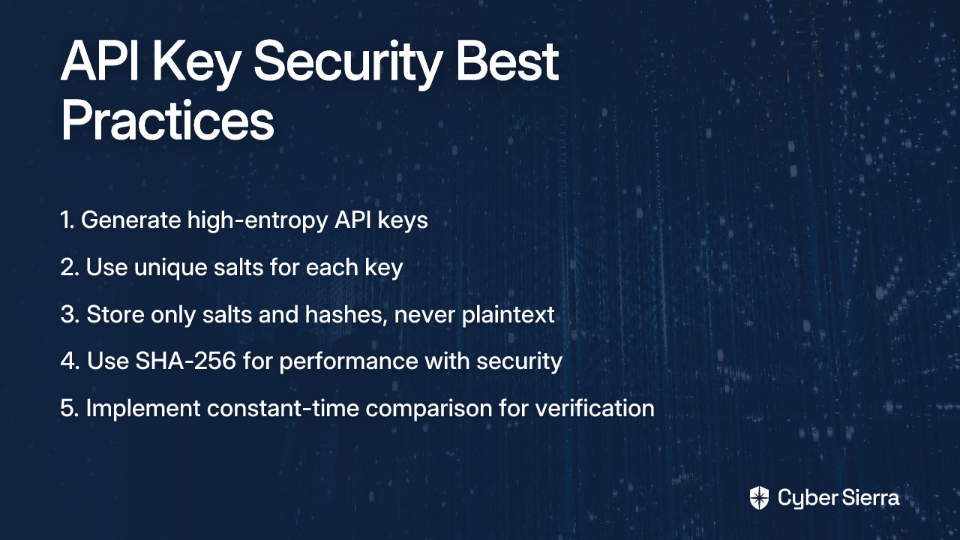
blog-hero-background-image
Cyber Security

How to Get C-Level Buy-In for Your Phishing Simulation Program

backdrop
Table of Contents

Join thousands of professionals and get the latest insight on Compliance & Cybersecurity.

You've carefully planned your organization's first phishing simulation. The technical setup is perfect. Then you hit send, and chaos erupts.

"People went into full panic mode thinking the whole company was hacked," shares one IT professional on Reddit. "They stood up telling everyone to avoid clicking on the link, posted in our company chats... it went like the fire drill episode from The Office."

Hours later, when employees discover it was just a simulation, the backlash begins. "People were angry once they found out it was a simulation saying we should've warned them," and "one director complained he lost time (10 mins) due to responding to this urgent matter."

Sound familiar? For many security professionals, the most formidable hurdle isn't implementing the technical aspects of a phishing program—it's navigating the political landscape and securing executive support. Without proper C-level buy-in, even the best-designed security initiatives can backfire spectacularly.

This guide will walk you through building an undeniable business case for your phishing simulation program, transforming it from a contentious IT task into a strategic business initiative that leadership will champion.

Setting the Stage: The High Cost of Human Error

Before asking for budget approval, you need to establish undeniable urgency. The threat isn't abstract; it has a number.

Consider these sobering statistics:

  • Human error is the root cause of 60-68% of data breaches
  • A staggering 94% of cyberattacks start with an email
  • The average cost of a security breach is $4 million
  • Insider-related incidents cost companies an average of $15 million in damages

These numbers tell a compelling story: your organization's greatest vulnerability isn't its firewall or outdated software—it's human behavior. And that behavior can be improved through structured training and testing.

Phishing simulations aren't about embarrassing employees or playing "gotcha." They're about building a human firewall through practical, measurable training that directly reduces significant financial risk.

Speak the Language of Leadership: From Technical Risk to Business Impact

The first rule of C-level communication: stop talking about "click rates" and start talking about business outcomes. Executives respond to discussions about risk, growth, and efficiency—not technical metrics.

Quantify Financial Exposure

Translate human risk into dollar figures:

"If a critical system like our CRM goes down due to ransomware from a phishing attack, it could cost us $300,000 per day in lost revenue, not counting recovery costs or reputation damage."

Focus on high-risk users. Remember the 80/20 rule: 8% of users cause 80% of security incidents. A targeted program is both more efficient and cost-effective.

Demonstrate Clear ROI

A robust security awareness program is an investment, not just a cost. Cite third-party data: Mimecast's Forrester Total Economic Impact report found that their security awareness platform delivered a 255% ROI and a net present value of $1.53 million over three years.

Highlight operational gains: effective training can lead to a 24% reduction in SOC investigation time, freeing up your technical teams for more strategic work instead of constantly putting out fires.

Align with Business Objectives

Position security as a business enabler. A strong security posture can increase deal velocity, create market differentiation, and support digital transformation initiatives:

  • For sales-driven organizations: "Our enhanced security posture will help close deals faster with security-conscious clients."
  • For heavily regulated industries: "This program reduces our compliance risk exposure by X%."
  • For companies pursuing digital transformation: "A stronger security culture enables us to adopt new technologies more confidently."

Ask questions that link security to the company's strategy: "What are the key business objectives for the next year? Are there new partnerships or technologies that introduce new risks we need to prepare for?"

Building a Bulletproof Business Case: A Step-by-Step Guide

A formal business case demonstrates that you've done your homework and are approaching this as a business initiative, not just an IT project.

1. Define Purpose and Scope

Clearly state what the program is, who it will target (e.g., all employees, high-risk departments like finance), and what it aims to achieve.

Example: "This phishing simulation program will test and train all 500 employees through ongoing simulations, with particular focus on our finance, executive, and customer service teams who have access to sensitive data."

2. Set Defined Goals & Success Criteria

Move beyond compliance. The goal is behavior change, not just checking a box. Establish measurable metrics:

  • Decrease the click rate on simulated phishing emails by 40% over 6 months
  • Increase the employee reporting rate of suspicious emails by 50%
  • Reduce the time to detect and report real phishing attempts to under 10 minutes

3. Outline the Program Structure

Describe the types of simulations you'll run:

  • Credential Compromise: Emails that attempt to steal login information
  • Business Email Compromise: Emails impersonating executives
  • Data Entry: Emails requesting sensitive information or actions

Explain the cadence: regular, ongoing simulations and training, not a one-time event. Detail the use of realistic templates and immediate feedback/e-learning for employees who click.

4. Evaluate Current Stack & Propose Solutions

Review existing tools to show you are being cost-conscious. Present options:

  • Modern platforms: $0.45-$1.25/employee/month
  • Legacy solutions: $0.90-$4/employee/month
  • Open-source tools: Free but require significant internal resources

5. Develop a Risk-Based Budget using the "Three-List Approach"

Structure your budget request into three categories:

  • Security Must-Haves: The core phishing simulation platform and training tied directly to mitigating identified business risks.
  • Like-to-Haves: Enhanced features like AI-driven playbooks or gamification elements.
  • Additional Security Maturity Movers: Longer-term initiatives for continued improvement.

Pro Tip: Include a 10% cushion in your budget request to account for inevitable cuts.

6. Include an Implementation Plan

Detail who will manage the program and the timeline for rollout, from initial baseline testing to full implementation.

Presenting Your Plan & Handling Objections

Know Your Audience (The Executive Buy-In Truth Table)

Tailor your approach based on executive engagement levels:

  • Do Training & Talk About It: The Champion. Keep them involved and leverage their support.
  • Do Training, Don't Talk: The Quiet Supporter. Help them promote the program's success.
  • Talk About It, Don't Do: The Performative Leader. Make training short, relevant, and easy for them to complete.
  • Don't Do or Talk: The Skeptic. This is where your business case is critical. Use statistics, competitor case studies, and consider bringing in a third-party expert.

Conduct Executive Interviews

Before you even present, conduct interviews to understand their perspectives, past experiences, and barriers to supporting security training. This builds rapport and helps you preempt objections.

Ask questions like:

  • "What keeps you up at night regarding our company's security?"
  • "Have you experienced security incidents in previous roles?"
  • "How do you prefer to receive updates on security initiatives?"

Make it Engaging

Frame the training as a challenge, not a chore. Using gamification can increase engagement. Emphasize that this is about empowerment—transforming employees from liabilities into a distributed defense network.

Secure Executive Participation

The single most effective way to drive cultural change is for executives to participate and champion the program. This creates a trickle-down effect of engagement. As one Reddit user advised, "Always get C-level buy-in before doing a phishing test."

Ask the C-suite to be the first to undergo the training and then share their experiences. When a CEO admits they initially fell for a simulation but learned from it, it sends a powerful message about the importance of the program and removes the stigma of "failing" a test.

Transforming Your People into Your Greatest Security Asset

Securing C-level buy-in for a phishing simulation program isn't about fear; it's about presenting a clear, data-backed business plan that aligns with executive priorities.

By quantifying financial exposure, demonstrating ROI, and aligning with business goals, you can reframe security training from a necessary evil into a strategic investment that transforms your greatest vulnerability—your people—into your most vigilant security asset.

Start today by identifying one key business objective and mapping the potential cyber risks to it. That's the first step in building your case and fostering a proactive security culture from the top down.

Frequently Asked Questions

What is a phishing simulation?

A phishing simulation is a security training exercise where fake, but realistic, phishing emails are sent to employees to test their awareness and response to potential cyber threats. The goal is not to trick or punish employees, but to provide a safe, controlled environment where they can learn to identify and report suspicious emails. This hands-on training helps build a "human firewall," turning employees into an active part of the organization's defense strategy.

Why is executive buy-in crucial for a phishing program?

Executive buy-in is crucial because it transforms a phishing program from a simple IT task into a strategic business initiative, ensuring it receives the necessary resources, visibility, and cultural support to be effective. When leadership champions the program, it sends a powerful message that security is everyone's responsibility. Executive participation drives higher employee engagement, helps overcome resistance, and ensures the program is aligned with broader business objectives.

How can I measure the ROI of a phishing simulation program?

You can measure the ROI of a phishing simulation program by tracking key metrics over time, such as a reduction in employee click rates, an increase in the reporting of suspicious messages, and a decrease in the time it takes security teams to investigate incidents. Beyond these direct metrics, ROI can also be demonstrated by quantifying the potential financial loss from a breach that was avoided. Citing third-party industry reports on the financial benefits of security awareness training can also powerfully illustrate the value to leadership.

What should I do if employees react negatively to a phishing simulation?

If employees react negatively, it's important to communicate the program's purpose clearly and positively, emphasizing that it's a training tool for empowerment, not a "gotcha" test to embarrass anyone. Proactively frame the program as a way to build a collective defense. Ensure immediate, non-punitive feedback is provided to those who click, offering just-in-time e-learning. Most importantly, securing executive participation helps normalize the experience and shows that everyone, at every level, is learning together.

How often should our organization conduct phishing simulations?

Phishing simulations should be conducted on a regular and ongoing basis, not as a one-time event. A common best practice is to run campaigns monthly or quarterly. The key is consistency. Regular testing keeps security top-of-mind for employees and allows you to track progress and adapt the training to address new threats or specific departmental weaknesses.

What is the first step to building a business case for a phishing program?

The first step is to connect the need for a phishing program to a specific business risk by quantifying the potential financial impact of a successful phishing attack on your organization. Before diving into program details or vendor selection, establish the urgency by researching the cost of a breach in your industry and calculating the potential cost in terms of lost revenue, recovery expenses, and reputational damage. This frames the discussion around business impact, which is the language executives understand.

Remember, as one security professional put it when responding to a complaining director: "Ask that director how much time they'd be okay with losing when your company gets ransomware'd." Ten minutes of disruption during a simulation is nothing compared to the weeks of recovery from a genuine breach.

toaster icon

Thank you for reaching out to us!

We will get back to you soon.