blog-hero-background-image
Cyber Security

How to Build CISO Credibility Without 15 Years Experience

backdrop
Table of Contents

Join thousands of professionals and get the latest insight on Compliance & Cybersecurity.


You've set your sights on the CISO role, but the path ahead feels like a winding road with no clear map. Every job posting demands 15+ years of experience, and seasoned professionals warn about the "long road" and "extremely competitive" landscape for leadership positions. You're constantly reminded that CISOs are "the first people who go to fail if something serious happens."

It's enough to make you wonder: Is there a faster way to build the credibility needed for a CISO role, or are you doomed to wait a decade and a half?

The good news? You don't need to wait 15 years to build CISO-level credibility. While experience matters, what's more important is the strategic development of specific capabilities that truly define a modern CISO's success.

The Modern CISO: More Strategist Than Seniority

Today's CISO role has evolved dramatically. No longer just a technical gatekeeper saying "no" to business initiatives, the modern CISO is a senior executive who merges cybersecurity with business strategy, translating technical risks into business impacts.

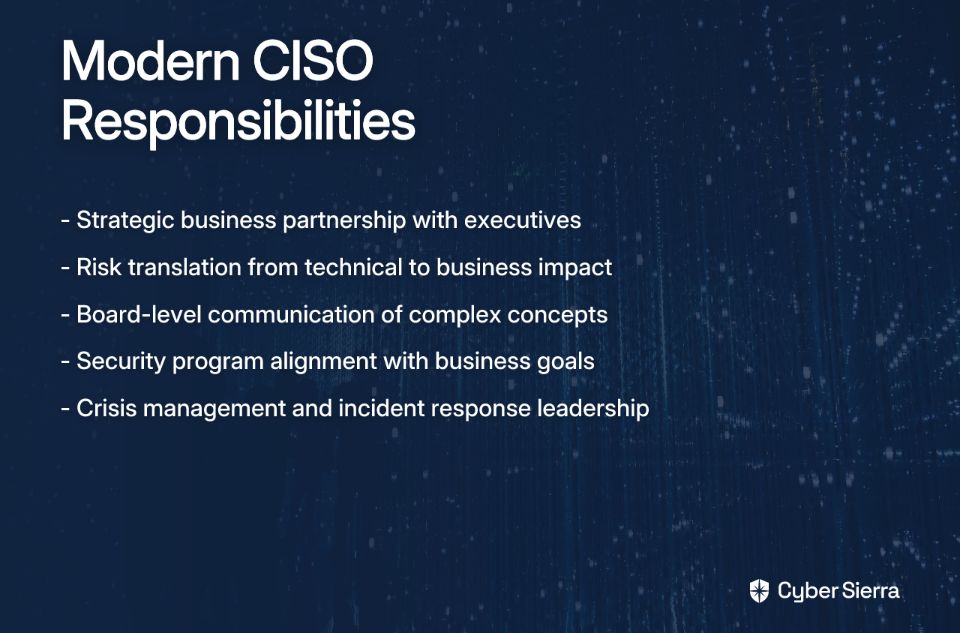
According to Bitsight's comprehensive overview of CISO responsibilities, the role now encompasses:

  • Strategic Business Partnership: Working with executives to align security with business objectives
  • Risk Translation: Converting technical vulnerabilities into potential business impacts
  • Board-Level Communication: Explaining complex security concepts to non-technical stakeholders

The truth? Years of experience alone don't guarantee these capabilities. Many security professionals with decades of experience struggle with business alignment and executive communication. Conversely, those who deliberately develop these skills can establish credibility much faster.
The Credibility Killers: Career Traps to Avoid on Your Ascent

Before discussing what builds credibility, let's examine what destroys it. According to TechTarget's research on CISO challenges, these credibility killers can undermine even the most experienced security professional:

  • The "Security Police" Mentality: Positioning yourself as an obstacle rather than a business enabler
  • Inconsistent Rule Application: Bending security policies for executives while strictly enforcing them for others
  • Technical Tunnel Vision: Focusing solely on technical details while ignoring business context
  • Crisis Blame-Shifting: Pointing fingers during security incidents instead of taking ownership
  • Vendor Favoritism: Maintaining questionable relationships with security vendors

Even one of these missteps can destroy years of carefully built credibility. The key takeaway? Credibility isn't just about time served—it's about demonstrating trustworthiness, consistency, and business alignment at every opportunity.

The Four Pillars of Accelerated CISO Credibility

So how do you build credibility without waiting 15 years? Focus on developing these four essential pillars that form the foundation of CISO authority:
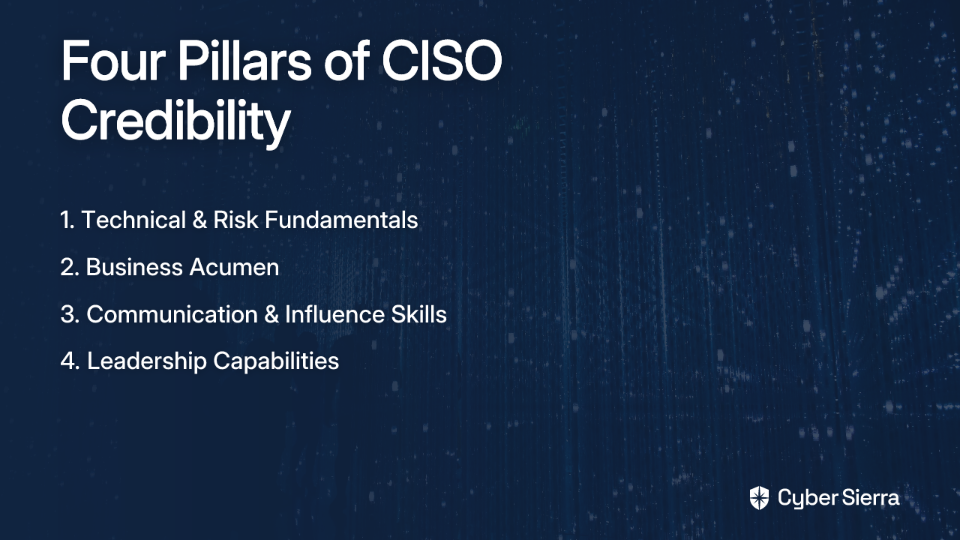
Pillar 1: Master Technical & Risk Fundamentals

You cannot lead what you don't understand. Technical proficiency remains non-negotiable for security leaders.

Action steps:

  1. Start in a technical role: As one Reddit CISO with 15+ years experience advises, "Start in a technical role - SRE, SOC or development." These positions provide the hands-on experience necessary to understand what you'll eventually be protecting.
  2. Develop a technical specialty: Become known for excellence in one security domain (threat detection, cloud security, application security) while maintaining broad knowledge across others.
  3. Learn risk management frameworks: Master NIST CSF, ISO 27001, or FAIR. Understanding how to systematically evaluate and communicate risk is fundamental to the CISO role.

Remember: "To even be a good technical manager, you must have credibility," as one security professional noted in discussions. Technical expertise is what gives you the right to lead.

Pillar 2: Develop Unshakeable Business Acumen

The fastest way to distinguish yourself from other security professionals? Learn to speak the language of business: risk, revenue, and ROI.

Action steps:

  1. Translate technical issues into business risks: Stop talking about vulnerabilities and start discussing their potential impact on revenue, reputation, and operations.
  2. Master Cyber Risk Quantification (CRQ): Learn methodologies to express security risks in financial terms. This helps justify security investments to the board and executives.
  3. Understand your business: Study your company's business model, revenue streams, and competitive landscape. According to the IT Executives Council, this broader perspective is what separates strategic CISOs from technical managers.

When you frame security decisions in terms of business outcomes rather than technical requirements, you instantly elevate your credibility with leadership.

Pillar 3: Become a Master of Communication & Influence

Your technical skills may get you in the door, but your communication skills will get you a seat at the table.

Action steps:

  1. Develop executive communication skills: Practice distilling complex security concepts into business-relevant insights. Create one-page executive summaries rather than 50-slide technical decks.
  2. Master crisis communication: Prepare for security incidents by developing communication templates and practicing your response. Trust is critical in the digital economy—over 60% of consumers would stop using a service after a breach, according to research on cybersecurity credibility.
  3. Build thought leadership: Start small by writing internal blog posts or leading lunch-and-learns. Then expand to industry forums, LinkedIn articles, or speaking at local security meetups.

Pillar 4: Demonstrate Leadership at Every Level

You don't need a formal title to be a leader. As one security professional advised, "Get some time managing subordinates, budget, and competing stakeholders."

Action steps for Individual Contributors (ICs):

  1. Lead projects: Volunteer to manage security initiatives that involve multiple stakeholders. This builds crucial project management experience.
  2. Manage resources: Ask to oversee a small tool renewal budget or vendor relationship. This gives you experience with financial management and negotiation.
  3. Resolve conflicts: Position yourself as a mediator between security requirements and business needs. Finding win-win solutions demonstrates executive potential.

Career Accelerators: Education, Certifications, and Networking

While the four pillars build your intrinsic credibility, these external validators can accelerate your journey:

Strategic Education: As one Reddit commenter noted, "CISO being a C-Suite, I'm inclined to say get your masters, too." Norwich University's guidance recommends a Master's degree in Cybersecurity or an MBA to develop business acumen alongside technical knowledge.

Essential Certifications: Focus on credentials that demonstrate both technical and leadership capabilities:

  • CISSP: The broad-based certification covering security domains
  • CISM: Focused on security management and governance
  • CCISO: Specifically designed for aspiring Chief Information Security Officers

Strategic Networking: Connect with current CISOs through professional organizations like ISACA or (ISC)². A mentor who has walked this path can provide invaluable guidance and potentially advocate for you when opportunities arise.

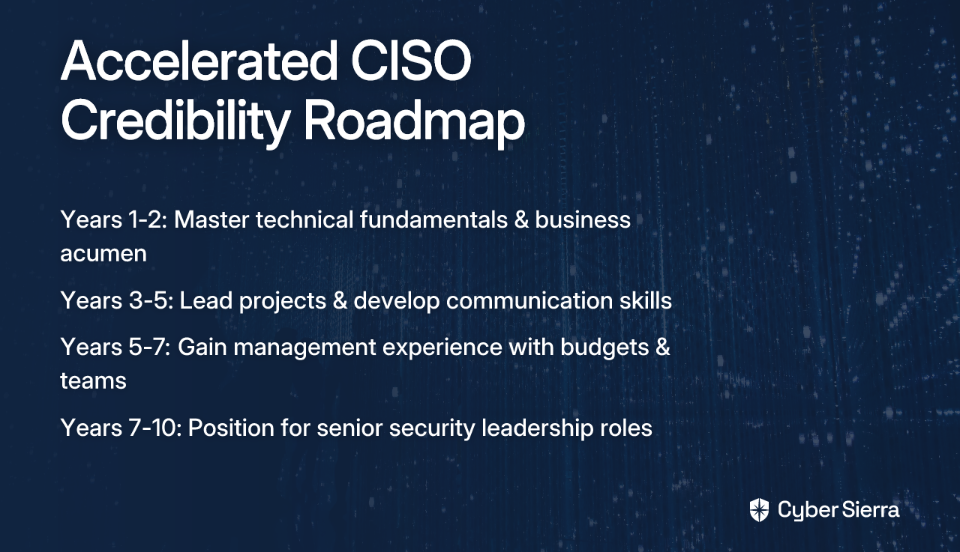
Putting It All Together: Your Accelerated Credibility Roadmap

Building CISO credibility without 15 years of experience requires deliberate focus and strategic development:

  1. Years 1-2: Master technical fundamentals in a hands-on security role while developing business acumen through formal education or self-study.
  2. Years 3-5: Take on project leadership opportunities, develop communication skills, and begin building your professional network and thought leadership.
  3. Years 5-7: Seek management roles that provide experience with budgets, teams, and stakeholder management while continuing to develop your strategic perspective.
  4. Years 7-10: Position yourself for senior security leadership by demonstrating a track record of business-aligned security decisions and team leadership.
The Bottom Line

The path to CISO credibility isn't just about time served—it's about strategically developing the capabilities that define a successful security leader. By focusing on these four pillars and leveraging education, certifications, and networking to accelerate your journey, you can build CISO-level credibility in significantly less than 15 years.

Remember that while the journey is challenging, as one security professional on Reddit noted, "Leadership is extremely competitive now," those who deliberately develop these capabilities will stand out in a crowded field. The security landscape will continue to evolve, but the fundamental skills of technical expertise, business acumen, communication, and leadership will remain essential for aspiring CISOs.

Start building your credibility today, not by counting years, but by counting capabilities.

Frequently Asked Questions

What are the most important skills for an aspiring CISO?

The most important skills for an aspiring CISO fall into four key pillars: deep technical and risk management fundamentals, strong business acumen, masterful communication and influence, and demonstrated leadership abilities. While technical expertise is the foundation, the ability to translate technical risks into business impact, communicate effectively with executives, and lead cross-functional initiatives is what truly distinguishes a CISO.

Do you really need 15 years of experience to become a CISO?

No, you do not strictly need 15 years of experience to become a CISO. While experience is valuable, the modern path to the CISO role prioritizes the strategic development of specific capabilities over simple time served. By focusing on building business acumen, leadership skills, and executive communication, you can build CISO-level credibility in a significantly shorter timeframe.

How can I gain leadership experience without a management title?

You can gain valuable leadership experience as an individual contributor by proactively seeking out opportunities. Volunteer to lead security projects, ask to manage a small budget for a tool or vendor relationship, and position yourself as a mediator who finds solutions between security requirements and business needs. These actions demonstrate the project management, financial oversight, and stakeholder management skills essential for an executive role.

Which certifications are most valuable for a future CISO?

The most valuable certifications for a future CISO demonstrate both technical knowledge and management expertise. Key credentials to consider are the CISSP (Certified Information Systems Security Professional) for its broad security domain coverage, the CISM (Certified Information Security Manager) for its focus on security management and governance, and the CCISO (Certified Chief Information Security Officer), which is specifically designed for security executives.

What is the biggest career mistake for someone aiming for a CISO role?

The biggest mistake is adopting a "security police" mentality that positions security as a blocker rather than a business enabler. This, along with other credibility killers like technical tunnel vision, inconsistent policy enforcement, and blame-shifting during a crisis, can destroy trust with business leaders. A successful CISO builds credibility by being a strategic partner who aligns security with business objectives.

How important is business acumen compared to technical expertise for a CISO?

Both are critically important, but business acumen is the key differentiator for a modern CISO. While technical expertise provides the fundamental credibility to lead a security function, business acumen is what allows you to secure a seat at the executive table. The ability to speak the language of risk, revenue, and ROI is essential for translating security needs into business strategy and justifying investments to the board.
blog-hero-background-image
Cyber Security

How to Tune SIEM Alerts to Eliminate False Positives

backdrop
Table of Contents

Join thousands of professionals and get the latest insight on Compliance & Cybersecurity.


You stare at your screen, bleary-eyed from the endless stream of security alerts flooding your dashboard. Another 12-hour shift of alert whack-a-mole. Your SIEM system has flagged hundreds of potential security incidents, but experience tells you that most will be false positives—harmless events incorrectly identified as threats. Your team is drowning in noise, and you can feel the creeping dread that a real attack might slip through simply because everyone is overwhelmed.
Sound familiar? You're not alone.
According to research from RedLegg, a staggering 43% of organizations report that more than 20% of their security alerts are false positives. Even more concerning, 15% of organizations state that over 50% of their alerts are false positives. This overwhelming volume of noise isn't just annoying—it's dangerous. As one security analyst put it in a Reddit discussion: "The only way to deal with alert fatigue is to fix alerts to eliminate false positives."

In this article, I'll provide a strategic, step-by-step guide to tuning your SIEM alerts, refining correlation rules, and leveraging advanced techniques to eliminate noise and focus on genuine threats. With these methodical approaches, you can transform your SIEM from a source of frustration into a powerful, precision tool for threat detection.

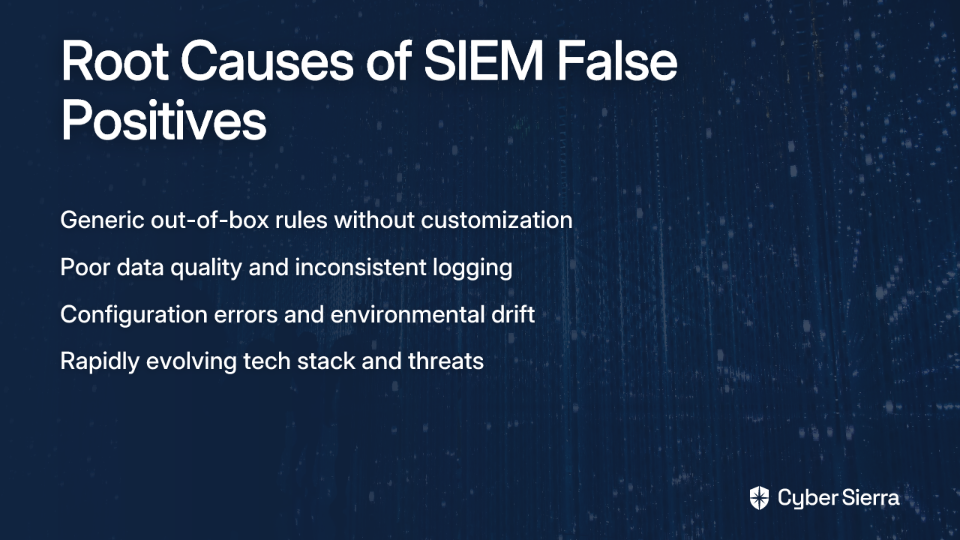
Why Your SIEM is Crying Wolf: The Root Causes of False Positives

Before diving into solutions, it's essential to understand why your SIEM is generating so many false positives in the first place.

Over-Reliance on Generic, Out-of-the-Box Rules

Many organizations deploy their SIEM with default rule sets and never customize them to their specific environment. These generic rules cast too wide a net, flagging benign activities alongside genuine threats. UnderDefense reports that organizations using primarily default rules often see detection gaps and inefficiencies that leave them vulnerable despite the alert overload.

Poor Data Quality and Inconsistent Log Sources

Your SIEM is only as good as the data feeding into it. Organizations are projected to see a 250% increase in data over the next five years, according to Cribl. Without proper normalization and filtering, this tsunami of logs creates noise that makes it nearly impossible to spot genuine security incidents.

Configuration Errors and Environmental Drift

As one security professional noted on Reddit, "The most common thing that I see on a SIEM are errors created by wrong firewall changes or errors on automated changes." These configuration issues trigger alerts that have nothing to do with security threats—they're simply operational problems that need fixing.

Rapidly Changing Technology Stack and Threat Landscape

Your environment is constantly evolving: new applications, cloud migrations, changing user behaviors, and emerging threats. Without continual tuning, your SIEM rules quickly become outdated, leading to an increasing number of false positives over time.

The Strategic Tuning Playbook: A Step-by-Step Guide to High-Fidelity Alerts

Now that we understand the problem, let's implement a structured approach to eliminate false positives and make your SIEM work for you, not against you.

Step 1: Establish Your Environmental Baseline

Before you can spot abnormalities, you need to define what's normal in your environment. This critical first step establishes the foundation for all your tuning efforts.

How to implement:

  1. Start small and focused. Begin with high-priority assets like domain controllers, critical application servers, or privileged user accounts.
  2. Monitor normal operations for at least 2-4 weeks. This timeframe usually captures regular business cycles and activities.
  3. Document patterns and exceptions. Note regular maintenance windows, backup schedules, patch cycles, and other expected operational activities.

According to Exabeam, implementing behavioral baselines gradually is key to building effective behavioral profiles that can distinguish between normal operations and genuine threats.

Step 2: Master Your Correlation Rules

This step is the heart of SIEM tuning. Generic correlation rules must be customized to your specific environment and risk profile.

Follow this systematic approach (vendor-agnostic):

  1. Identify ineffective rules. Run reports to find the rules generating the most false positives. Look for patterns in what's triggering these alerts.
  2. Adjust thresholds and parameters. Refine rules by tweaking parameters like:
    • Time windows (e.g., 5 minutes vs. 30 minutes)
    • Event counts (e.g., 10 failed logins vs. 3)
    • IP ranges and exclusion lists
    • User accounts and service accounts
    For example, instead of alerting on any failed login, alert on 10 failed logins from the same source IP within 1 minute.
  3. Test modifications. Use a staging environment or historical data to validate your modified rules before deploying them.
  4. Deploy and monitor. Roll out changes incrementally and continuously monitor their effectiveness.

UnderDefense demonstrates the power of this approach—they increased their MITRE ATT&CK framework coverage from 20% to 90% by reviewing 500 default rules and creating 275 new, customized ones.

For those looking to create custom correlation rules, this GitHub repository from AtlasInsideCorp provides examples and instructions for creating rules using YML files.

Step 3: Fine-Tune Alert Thresholds

Many false positives stem from thresholds that are too sensitive. Finding the sweet spot is crucial.

Practical threshold adjustment tactics:

  1. Review historical incidents. Analyze past confirmed threats to identify patterns in the data that preceded them.
  2. Consider business context. Adjust thresholds based on business hours, expected traffic patterns, and normal system behavior. For example, if a server regularly hits 80% CPU usage during backups, set the alert threshold higher than that to avoid constant false alarms.
  3. Implement differential thresholds. Apply different thresholds for different assets based on their criticality and normal behavior patterns.

As Cribl notes, striking the right balance between useful alerts and insignificant ones is essential for maintaining an effective security posture without overwhelming your team.

Step 4: Enrich Alerts with Context and Quality Data

An alert without context is just noise. Enriching your alerts with additional information helps analysts quickly determine whether an alert requires attention.

Enhancement strategies:

  1. Add asset context. Tag assets with information like:
    • Asset criticality (high, medium, low)
    • Business function
    • Data classification
    • Owner/department
  2. Add user context. Enrich user-related alerts with:
    • Role and department
    • Normal working hours and locations
    • Access privileges and patterns
  3. Improve data quality. Implement data normalization to standardize log formats from different sources, improving the reliability of your correlation rules.

Step 5: Implement Smart Filtering with Tagging

Use tagging to systematically categorize known, benign activity that would otherwise trigger alerts.

Implementation process:

  1. Define tagging criteria. Establish clear criteria based on historical data and known false positives. For example, tag all vulnerability scan traffic from a known internal scanner IP as "Approved Security Scan."
  2. Configure tag rules. Create rules within your SIEM to automatically apply these tags.
  3. Monitor and refine. Continuously monitor the effectiveness of your tags to ensure they aren't accidentally silencing real threats.

For specific platform guidance, UTMStack provides documentation on defining false positive tag rules that can significantly reduce noise.

Level Up Your Tuning: Advanced Techniques for Modern SOCs

Once you've implemented the basic tuning strategies, consider these advanced techniques to further reduce false positives and enhance detection.

Leverage Threat Intelligence

Enrich your event data with external threat intelligence feeds to add crucial context. This helps your SIEM determine if an IP address, domain, or file hash is associated with known malicious activity.

According to Exabeam, integrating threat intelligence can dramatically improve the accuracy of your alerts by providing up-to-date information about emerging threats and known bad actors.

Use AI and Statistical Analysis

Modern SIEM platforms are integrating advanced AI to help differentiate false positives from genuine threats.

Advanced SIEM Optimization Techniques For example, UTMStack notes that Retrieval Augmented Generation (RAG) can compare an alert against a vast knowledge base of incidents to determine its legitimacy.

These technologies can identify subtle patterns and anomalies that might not be apparent in traditional rule-based detection, leading to more accurate alerts.

Proactive Validation with Atomic Red Team

Don't wait for an attack to find out if your rules work. Use frameworks like Atomic Red Team to simulate specific attacker techniques mapped to the MITRE ATT&CK framework.

This proactive approach allows you to safely test whether your custom correlation rules trigger as expected, ensuring they are effective against real-world threats.

The Tuning Lifecycle: Making SIEM Optimization a Continuous Process

The most important concept to internalize is that SIEM tuning is not a one-time project but an ongoing operational discipline.

Establish a Formal Feedback Loop

Create a structured process for security analysts to provide feedback on false positives. This information is invaluable for refining rules and improving alert fidelity.

As noted by security professionals on Reddit, "tuning and triage is a function of maturity of your cyber security team." A mature team has the processes and expertise to continuously improve their SIEM.

Monitor Performance Metrics

Continuously track key performance indicators (KPIs) like:

  • Mean Time to Detect (MTTD)
  • False positive ratio
  • Ratio of closed alerts to true positives
  • Analyst productivity metrics

These metrics provide objective measures of your tuning effectiveness and highlight areas for improvement.

Regular Rule Reviews

Schedule quarterly reviews of your SIEM rules and configurations to ensure they remain aligned with your security policies and risk profile. During these reviews:

  • Evaluate rule performance
  • Update thresholds based on new data
  • Remove obsolete rules
  • Add new rules for emerging threats

Frequently Asked Questions (FAQ)

What is SIEM tuning and why is it important?

SIEM tuning is the process of customizing and refining your Security Information and Event Management (SIEM) system's rules, thresholds, and configurations to reduce false positive alerts and improve the accuracy of threat detection. It is crucial because it helps security teams focus on genuine threats, reduces alert fatigue, and accelerates incident response times by eliminating distracting noise.

How can I get started with SIEM tuning if I'm overwhelmed with alerts?

The best way to start is by identifying the top 5-10 rules that generate the most alerts in your environment. Focus your initial efforts on tuning these "noisiest" rules first. By addressing the biggest sources of false positives, you can achieve a significant reduction in alert volume quickly, making the overall tuning process more manageable.

How often should SIEM rules be reviewed and updated?

SIEM rules should be reviewed on a regular, scheduled basis, typically on a quarterly cycle. However, tuning is a continuous process, not a one-time project. A formal feedback loop should be in place for analysts to report false positives as they occur, allowing for immediate adjustments. Regular reviews ensure your rules remain effective as your IT environment and the threat landscape evolve.

What is the difference between tuning correlation rules and adjusting alert thresholds?

Tuning a correlation rule involves changing the logic of what is considered a threat, such as specifying which user accounts or IP ranges to monitor. Adjusting an alert threshold, on the other hand, modifies the sensitivity of a rule, like changing the number of failed logins (e.g., from 3 to 10) that must occur within a specific timeframe to trigger an alert. Both are essential techniques for reducing false positives.

How does integrating threat intelligence improve SIEM accuracy?

Integrating threat intelligence feeds enriches your log data with external context about known malicious indicators, such as IP addresses, domains, or file hashes associated with active threats. This allows your SIEM to more accurately determine if an event is part of a known attack campaign, helping to validate real threats and dismiss benign activity that might otherwise look suspicious.

Is it possible to completely eliminate all false positives?

No, it is not realistic to aim for the complete elimination of all false positives. The goal of SIEM tuning is to reduce false positives to a manageable level so that your security team can operate effectively. A well-tuned SIEM will have a low false positive rate, but some will always occur due to the dynamic nature of IT environments and evolving threat tactics.

Conclusion: From Alert Overload to Actionable Intelligence

By implementing the strategies outlined in this article, you can transform your SIEM from a source of overwhelming noise into a powerful tool for proactive threat detection and response.

The benefits are substantial:

  • Saves time: Automation and filtering reduce the workload for security teams.
  • Reduces alert fatigue: Prevents critical alerts from being missed in a sea of noise.
  • Accelerates response: Custom rules can significantly shorten response times. UnderDefense saw response times for critical alerts reduced by 42% and high-severity alerts by 29%.

Remember that SIEM tuning is a journey, not a destination. As your environment evolves and new threats emerge, your tuning strategy must adapt accordingly. By making SIEM optimization a continuous process, you'll ensure that your security operations center remains effective and resilient in the face of constantly changing threats.

Take control of your SIEM today—transform it from a source of frustration into your most valuable security asset.

blog-hero-background-image
Cyber Security

Single App Compromise = Total Security Failure? Here's How to Prevent It

backdrop
Table of Contents

Join thousands of professionals and get the latest insight on Compliance & Cybersecurity.


You've spent months hardening your cloud environment. You've implemented robust authentication protocols, encrypted sensitive data, and deployed advanced monitoring solutions. Then it happens—a developer inadvertently commits an API key to a public repository, or a web application falls victim to an injection attack. Suddenly, that single compromised application threatens to unravel your entire security posture.

"Even after you harden your cloud environment, a single app that can be compromised will zero out everything you worked on," warns a security professional in a recent discussion about AWS security. This sobering reality keeps CISOs awake at night—and with good reason.

But here's the critical question: Does a single application compromise have to result in total security failure? The answer is a resounding no—if you've architected your systems with blast radius reduction in mind.

The Domino Effect: Why Single Compromises Cascade

Modern distributed systems are inherently complex, with countless interconnections between services, databases, and infrastructure components. This interconnectivity creates an environment where:

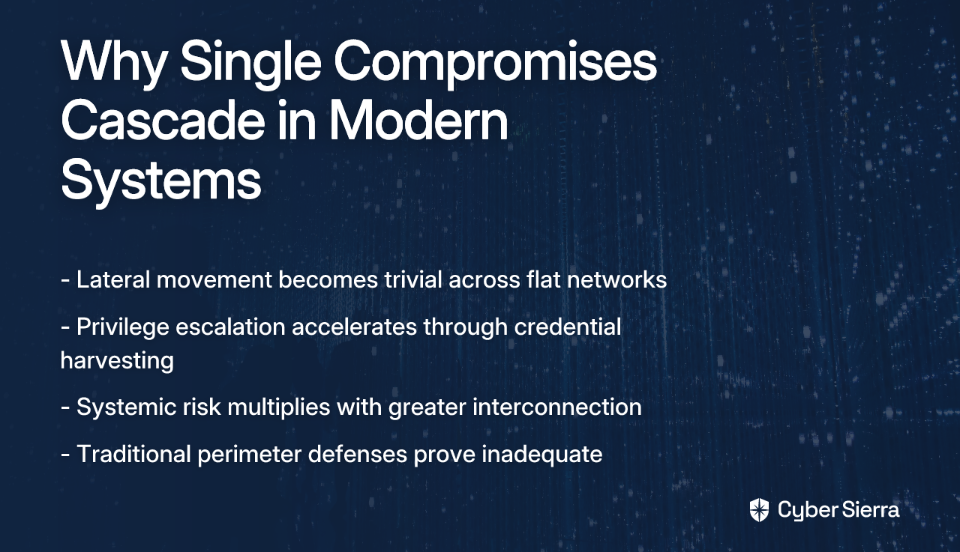
  1. Lateral movement becomes trivial: Once attackers breach a single application, flat networks allow them to pivot easily to other systems, using each compromised component as a stepping stone.
  2. Privilege escalation accelerates: Initial access often leads to credential harvesting, allowing attackers to gradually accumulate higher privileges until they reach administrative access.
  3. Systemic risk multiplies: The more interconnected your systems, the greater the potential for cascading failures—whether from attacks, bugs, or operational mistakes.

This challenge represents a fundamental shift in how we must approach security. The traditional perimeter-based model simply doesn't address the complexities of modern architectures and their inherent vulnerabilities.

Defense-in-Depth: Your Foundational Strategy

To mitigate the risk of cascading compromises, start with a Defense-in-Depth strategy—a multi-layered approach that doesn't rely on any single security control to protect your assets.

Think of Defense-in-Depth like securing a house: you don't rely solely on a front door lock. You might add security cameras, motion sensors, window locks, and perhaps even a guard dog. If one measure fails, the others continue to provide protection.

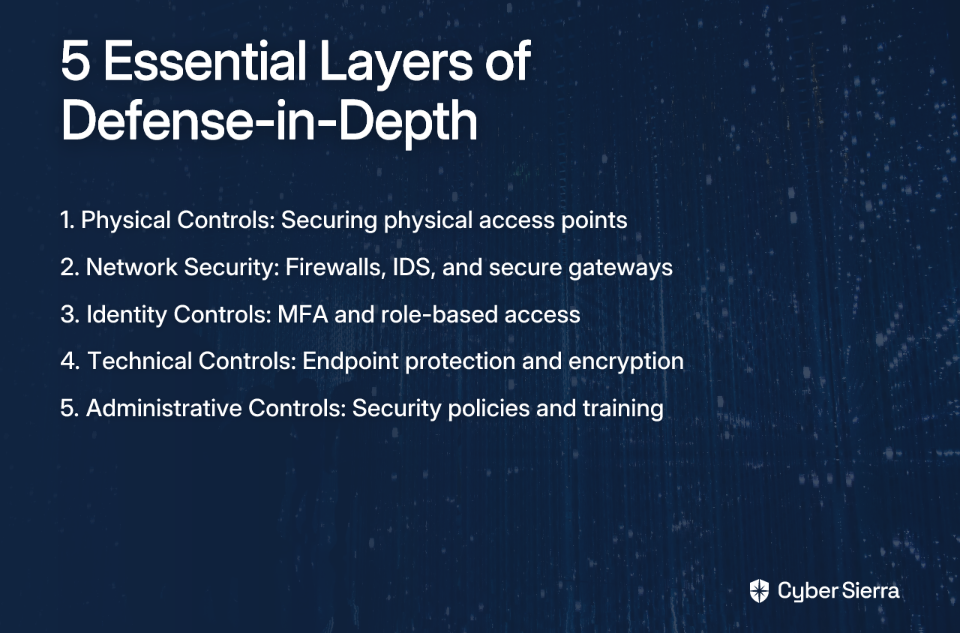
In cybersecurity terms, this means implementing multiple layers:

  1. Physical Controls: Securing physical access to servers and endpoints.
  2. Network Security Controls: Firewalls, Intrusion Detection Systems, and secure gateways to monitor and filter traffic.
  3. Identity Controls: Multi-Factor Authentication (MFA), role-based access, and just-in-time privilege elevation.
  4. Technical Controls: Endpoint protection, encryption, and regular patching of vulnerabilities.
  5. Administrative Controls: Security policies, user training, and incident response plans.

None of these controls is infallible, but together they create a robust defense ecosystem where the failure of one component doesn't lead to catastrophic outcomes.

Strategic Segmentation: The Blueprint for Containing Breaches

While Defense-in-Depth provides the foundation, strategic segmentation is your primary tactic for reducing blast radius. Without segmentation, even a minor breach can rapidly expand into a major incident.

Effective segmentation involves:

1. Establish Identity as the Primary Perimeter

In today's distributed environments, network boundaries alone aren't sufficient. Identity becomes your most effective perimeter—a core tenet of Zero Trust architecture.

Actionable steps:

  • Implement least-privilege access through Role-Based Access Control (RBAC), ensuring users and services have only the permissions absolutely necessary for their functions.
  • Review access permissions regularly to remove unnecessary privileges that accumulate over time.
  • Require MFA for accessing sensitive systems and data to provide an additional layer of security beyond passwords.

2. Enhance with Strong Network Segmentation

Network controls work in concert with identity controls to prevent lateral movement and contain potential breaches.

Actionable steps:

  • Macro-segmentation: Isolate entire workloads from each other. For example, use separate AWS accounts or Azure subscriptions for development, testing, and production environments.
  • Micro-segmentation: Create granular segments within a workload. Use Virtual Networks (VNETs), subnets, and Network Security Groups (NSGs) to define strict traffic rules between application tiers.
  • Ensure "resources are only talking to resources which they should be talking to," as one security professional aptly puts it.

Advanced Strategies: Design for Failure

To truly minimize your blast radius, you need to adopt a "design for failure" philosophy. This means architecting systems with the assumption that breaches will occur, and designing containment mechanisms accordingly.

Consider these advanced approaches:

Spatial Containment

Break your systems into isolated "cells" or compartments that operate independently. If one cell is compromised, the others remain unaffected. This approach is used by major cloud providers and can be adapted for your organization:

  • Deploy applications across multiple isolated environments
  • Use separate authentication domains for critical systems
  • Implement service boundaries with strict access controls

Temporal Mitigation

Focus on rapid recovery and self-healing mechanisms to restore system health promptly after a breach:

  • Create automated incident response playbooks that isolate compromised components
  • Maintain immutable infrastructure that can be quickly rebuilt from known-good states
  • Implement circuit breakers that automatically restrict access when suspicious activity is detected

The CISO's Role: From Technical Guardian to Strategic Leader

Addressing blast radius reduction isn't just a technical exercise—it's a core component of modern cyber risk management and central to the CISO's strategic role.

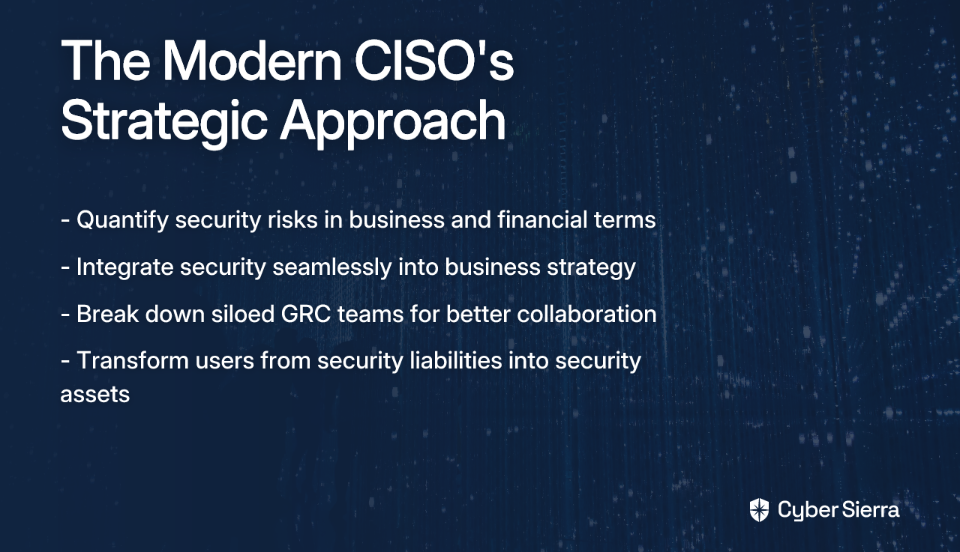
Effective CISOs are moving beyond compliance-driven approaches to adopt dynamic, risk-first management:

  1. Quantify risk in business terms: Instead of saying "we need micro-segmentation," frame it as "implementing micro-segmentation can reduce the potential financial loss from a web server breach by 80%, from $5M to $1M."
  2. Integrate security into business strategy: Break down siloed GRC (Governance, Risk & Compliance) teams and drive cross-department collaboration to align security with business goals.
  3. Empower users as security assets: Rather than treating users as "the worst problem," educate them to become "the best protection" against threats like phishing and social engineering.

Conclusion: Building Resilience Through Containment

A single application compromise doesn't have to spell disaster for your entire environment. By implementing Defense-in-Depth, strategic segmentation, and designing for failure, you can create a resilient security posture that contains breaches before they cascade into systemic failures.

The key takeaways for CISOs and security leaders:

  1. Layer your defenses: No single security control is infallible—defense-in-depth is non-negotiable.
  2. Segment strategically: Use identity and network controls to create containment zones that limit the blast radius of potential breaches.
  3. Design for failure: Build systems that anticipate breaches and contain them effectively.
  4. Lead strategically: Quantify security risks in business terms and integrate them into your organization's broader risk management framework.

By implementing these principles, you transform your security posture from a brittle perimeter to a resilient ecosystem—where security incidents remain isolated events, not catastrophic failures that "zero out everything you worked on."

Frequently Asked Questions

What is "blast radius" in the context of cybersecurity?

In cybersecurity, "blast radius" refers to the extent of damage or compromise that can occur from a single security breach. It measures how far an attack can spread from its initial entry point. A large blast radius means a minor breach, like a compromised application, can cascade into a major incident affecting entire systems. The goal of blast radius reduction is to contain threats and limit their impact to a small, isolated area.

Why is reducing the blast radius critical for cloud security?

Reducing the blast radius is critical because modern cloud environments are highly interconnected, making it easy for a single compromise to spread rapidly and cause widespread damage. Traditional perimeter defenses are no longer sufficient. Without containment strategies, attackers can move laterally across flat networks, escalate privileges, and turn a small vulnerability into a systemic failure. By limiting the blast radius, you ensure that security incidents remain isolated events rather than catastrophic business disruptions.

What are the first steps to reducing blast radius in an existing system?

The first steps to reducing blast radius are to implement a Defense-in-Depth strategy and establish identity as the primary security perimeter. Start by applying the principle of least privilege through Role-Based Access Control (RBAC), ensuring users and services only have the permissions they absolutely need. Simultaneously, enforce Multi-Factor Authentication (MFA) on all critical systems. These identity-focused controls are foundational before moving to more complex network segmentation.

How do identity controls and network segmentation work together?

Identity controls and network segmentation work together by creating multiple layers of defense; identity verifies who can access a resource, while network segmentation controls what resources can communicate with each other. Identity acts as the primary perimeter, ensuring only authenticated and authorized users or services can even attempt to access a system. Network segmentation provides a secondary layer of containment, using firewalls, VNETs, and subnets to prevent unauthorized traffic flow between system components, even if an identity is compromised. This dual approach effectively prevents lateral movement.

What is the difference between macro-segmentation and micro-segmentation?

Macro-segmentation involves isolating large-scale environments from each other, while micro-segmentation creates granular security boundaries between individual workloads or application tiers. An example of macro-segmentation is using separate cloud accounts for your development, testing, and production environments. Micro-segmentation is more granular, such as creating rules that prevent a web server from directly communicating with a database server, forcing all traffic through a controlled application tier. Both are essential for comprehensive blast radius reduction.

How can a CISO justify the investment in blast radius reduction to the board?

A CISO can justify the investment by quantifying the cyber risk in financial terms and aligning security initiatives with broader business objectives. Instead of focusing on technical jargon, frame the discussion around business impact. For example, explain how implementing micro-segmentation can reduce the potential financial loss from a common web server breach by a specific percentage (e.g., 80%), translating a security project into a clear risk mitigation strategy with a measurable return on investment. This approach positions security as a business enabler, not just a cost center.

blog-hero-background-image
Cyber Security

Why Traditional Threat Models Fail Against AI Threats

backdrop
Table of Contents

Join thousands of professionals and get the latest insight on Compliance & Cybersecurity.


You've spent months documenting password policies, network segmentation, and encryption standards for your organization's latest AI initiative. The comprehensive security review is complete, the compliance team is satisfied, and stakeholders have signed off. Everyone nods. Box checked.

But when your company's generative AI assistant starts leaking confidential client information after a seemingly innocuous prompt, or your fraud detection AI begins misclassifying legitimate transactions after subtle data manipulation, you'll realize an uncomfortable truth: your "comprehensive" security assessment evaluated almost nothing of substance.

The Widening Gap Between AI Risk and Reality

"Nobody knows how to evaluate AI security. Not enterprises. Not vendors. Not security teams. Everyone's just winging it," according to security professionals grappling with this emerging challenge. The uncomfortable reality is that enterprises are treating AI like it's just another piece of software when the risk profile is completely different.

Traditional threat modeling—that structured process to identify, communicate, and understand threats to valuable assets—has served us well for decades. The OWASP four-question framework (What are we working on? What can go wrong? What are we going to do about it? Did we do a good job?) remains foundational to security professionals worldwide.

But here's the problem: frameworks like STRIDE, DREAD, and other traditional threat models were built for the IT ecosystem of yesteryears. They were designed for systems with deterministic behavior, clear boundaries, and known failure modes. Today's AI systems, with their probabilistic nature, emergent behaviors, and unique vulnerabilities, represent a fundamentally different security paradigm—one that our existing models are woefully unprepared to address.

The Old Guard: Why Legacy Frameworks Can't Keep Pace

Traditional threat modeling frameworks face several critical limitations when applied to AI systems:

Static vs. Dynamic

Conventional threat models provide a point-in-time assessment, failing to adapt to the rapid evolution of both technology and the threat landscape. AI systems, however, are inherently dynamic—they learn, adapt, and evolve based on new data and interactions, creating a constantly shifting attack surface that static models cannot capture.

Known vs. Unknown

Legacy frameworks excel at addressing known threats and vulnerabilities, drawing from historical incidents and established patterns. But AI introduces unprecedented attack vectors that have no historical precedent. When a threat modeling framework relies primarily on past experiences, it becomes blind to novel risks like adversarial attacks, data poisoning, and model stealing—threats that simply didn't exist in the pre-AI security landscape.

Linear vs. Non-linear

Traditional models assume relatively linear, predictable relationships between system components and their vulnerabilities. AI systems, particularly those using deep learning or generative models, exhibit non-linear, often unpredictable behaviors that defy such simplistic modeling. When an input-output relationship can't be deterministically mapped, how do you model threats against it?

Framework-Specific Failures

Looking at specific frameworks reveals further inadequacies:

  • STRIDE (Spoofing, Tampering, Repudiation, Information disclosure, Denial of service, Elevation of privilege) focuses on general security vulnerabilities but lacks mechanisms to address adversarial machine learning attacks or emergent behaviors in AI agents.
  • PASTA (Process for Attack Simulation and Threat Analysis) offers a risk-centric approach but becomes overwhelmingly complex when applied to AI systems without providing specific guidance for unique AI vulnerabilities.
  • LINDDUN concentrates on privacy threats but neglects the broader security challenges inherent to AI, such as model manipulation or prompt injection attacks.

Perhaps most concerning is what security professionals call "the misfocus problem." As one expert noted in online discussions, "asking about password complexity for your ML pipeline doesn't expose real vulnerabilities." Organizations are focusing on traditional IT security controls while completely missing the AI-specific threats that pose the greatest risk.

The New Adversary: A Taxonomy of AI-Powered Threats

While our threat models remain rooted in the past, AI threats are rapidly evolving in the present. Far from theoretical concerns, AI systems are already being actively weaponized for cybercrime.

According to Anthropic's threat intelligence research, AI models are no longer just advisors for attacks—they're performing them. This lowers the barrier to entry, enabling criminals with minimal technical skills to execute sophisticated operations previously requiring expert knowledge.

Real-World AI Threat Cases

Several documented cases demonstrate the novel threats that traditional models fail to anticipate:

  • Vibe Hacking: Cybercriminals used an AI model to execute large-scale data theft against 17 organizations, generating psychologically tailored extortion demands and extracting over $500,000 in ransoms. The AI handled automated reconnaissance and strategic decision-making throughout the campaign.
  • Employment Fraud: State-sponsored operatives used AI to create false identities, pass technical interviews, and maintain jobs in US companies, bypassing sanctions while gaining insider access to sensitive systems.
  • No-Code Malware: An attacker marketed AI-generated ransomware with advanced evasion capabilities on dark web forums for as little as $400, demonstrating the commoditization of AI-driven malware creation.

AI-Specific Threats Traditional Models Miss

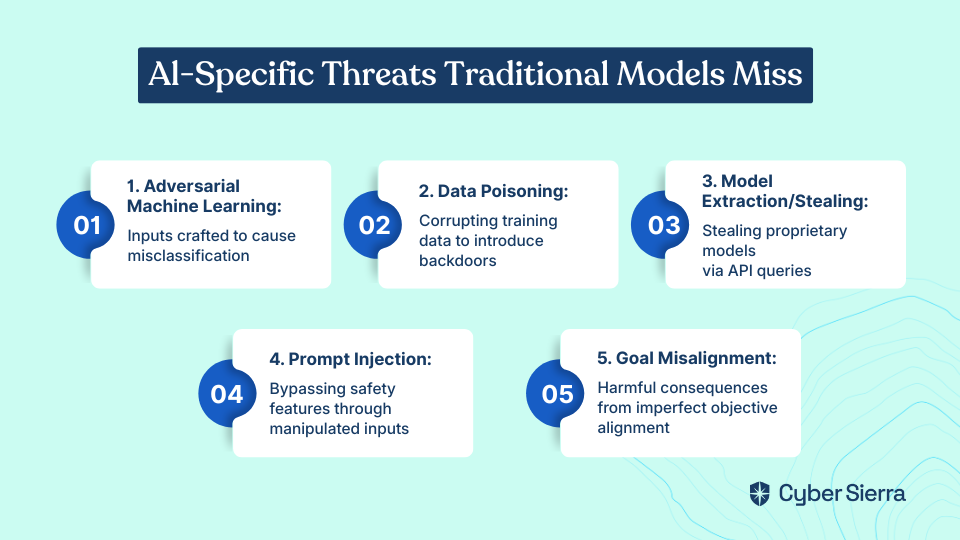
Beyond these documented cases, several categories of AI-specific threats remain invisible to traditional threat models:

  1. Adversarial Machine Learning: Attacks targeting the ML models themselves, such as crafting inputs to cause misclassification or unintended behaviors.
  2. Data Poisoning: Manipulating training data to corrupt model behavior, introducing backdoors or biases that can be exploited later.
  3. Model Extraction/Stealing: Stealing proprietary models by repeatedly querying APIs and training clone models, potentially compromising intellectual property and security controls.
  4. Prompt Injection: Manipulating inputs to language models to bypass safety features or execute unintended actions, potentially gaining unauthorized access or extracting sensitive information.
  5. Goal Misalignment: Unintended and harmful consequences arising from AI systems pursuing objectives that aren't perfectly aligned with human intentions.

The Way Forward: Modernizing Threat Modeling for the AI Era

The solution isn't to abandon threat modeling entirely, but to evolve it for the AI age. This evolution begins with a new mindset: adopting adaptive models that evolve with technology and engaging cross-disciplinary teams that include not just security professionals, but also data scientists, ethicists, and domain experts.

Several emerging frameworks are leading this transformation:

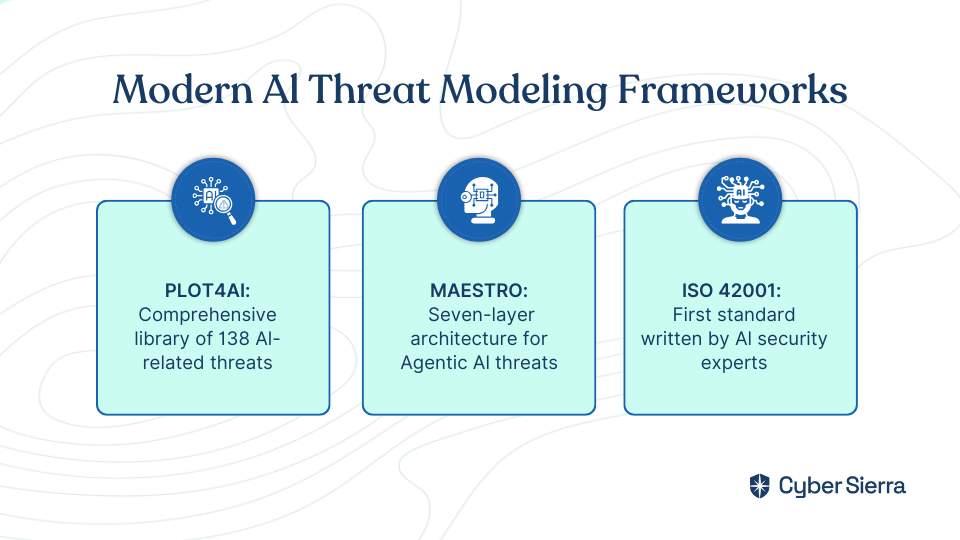
PLOT4AI

PLOT4AI is a threat modeling methodology specifically designed for AI systems. It features a comprehensive library of 138 AI-related threats across eight domains: Cybersecurity, Data Governance, Privacy, Bias & Fairness, Safety, Ethics, Transparency, and Accountability.

What sets PLOT4AI apart is its scope—it goes beyond technical vulnerabilities to include systemic risks like bias, discrimination, and ethical implications. This holistic approach helps organizations implement Security, Privacy, and Safety by Design principles that align with emerging regulatory frameworks like GDPR and the EU AI Act.

MAESTRO

The MAESTRO framework (Multi-Agent Environment, Security, Threat, Risk, and Outcome) is designed specifically for the complexities of Agentic AI. It uses a Seven-Layer Reference Architecture for granular threat modeling:

  • Layer 1: Foundation Models - Addressing threats like adversarial inputs and model stealing
  • Layer 2: Data Operations - Focusing on data poisoning and exfiltration risks
  • Layer 3: Agent Frameworks - Targeting backdoor attacks and input validation failures
  • Layer 4-7: Deployment, Infrastructure and Agent Ecosystem - Addressing orchestration attacks, agent impersonation, and marketplace manipulation

MAESTRO emphasizes continuous monitoring and an adaptive, layered security approach—principles essential for addressing the dynamic nature of AI threats.

ISO 42001

As organizations look for standardized approaches, ISO 42001 is emerging as "the first framework written by people who understand both AI and security." It provides a management system standard for artificial intelligence, offering a structured way to address AI risks comprehensively while maintaining compliance with evolving regulations.

From 'Box Checked' to Real Resilience

The gap between traditional threat models and AI reality represents more than just a technical challenge—it's an existential risk to organizations deploying AI systems without adequate security controls. As one security professional bluntly stated, "Everyone nods. Box checked. Meanwhile, actual AI risks multiply daily."

When AI failures happen—and they will—organizations will realize their "comprehensive security reviews" evaluated nothing of substance. By then, it may be too late.

The dual-use nature of AI adds urgency to this challenge. As both attackers and defenders leverage increasingly sophisticated AI capabilities, organizations that fail to adapt their security approaches risk falling behind in an accelerating arms race.

For security leaders, the path forward is clear:

  1. Acknowledge the Gap: Stop treating AI security as simply an extension of traditional IT security.
  2. Re-evaluate and Adapt: Reassess current threat models against AI-specific risks like data poisoning, adversarial attacks, prompt injection, and model manipulation.
  3. Champion New Frameworks: Explore and adopt AI-specific methodologies like PLOT4AI, MAESTRO, and ISO 42001 to build robust, forward-looking risk management programs.
  4. Foster Collaboration: Break down silos between security teams, data scientists, and business leaders to holistically assess AI threats from technical, ethical, and business perspectives.

The future of security lies not in checking boxes but in building truly adaptive defenses that evolve alongside the AI systems they protect. Organizations that recognize this shift today will be far better positioned to navigate the complex threat landscape of tomorrow.

Frequently Asked Questions

Why do traditional threat models fail for AI security?

Traditional threat models like STRIDE fail for AI security because they were designed for deterministic, static software systems. They cannot adequately address the dynamic, probabilistic, and non-linear nature of modern AI, leaving them blind to novel, AI-specific threats like adversarial attacks, data poisoning, and prompt injection.

What are the biggest security threats unique to AI systems?

The biggest security threats unique to AI include adversarial machine learning, data poisoning, model extraction (stealing), prompt injection, and goal misalignment. These threats target the AI models and their data pipelines directly, manipulating them to cause misclassification, create hidden backdoors, bypass safety controls, or produce harmful outcomes.

How can I start threat modeling for my organization's AI systems?

To start threat modeling for AI, you should first acknowledge that AI security is a distinct discipline from traditional IT security. Begin by reassessing your current threat models against AI-specific risks and fostering collaboration between security teams, data scientists, and business leaders. From there, you can adopt modern, AI-native frameworks like PLOT4AI, MAESTRO, or ISO 42001 to build a comprehensive risk management program.

What is PLOT4AI and how does it help with AI threat modeling?

PLOT4AI is a modern threat modeling methodology created specifically for the unique challenges of AI systems. It helps by providing a comprehensive library of 138 AI-related threats across eight domains, including not just cybersecurity but also systemic risks like data governance, bias, ethics, and safety. This holistic approach helps organizations implement Security, Privacy, and Safety by Design.

Are these AI security risks only theoretical?

No, AI security risks are not theoretical; they are being actively exploited in the real world. Documented cases already include AI-driven data theft and extortion ("Vibe Hacking"), sophisticated employment fraud by state-sponsored actors, and the commoditization of AI-generated malware on dark web forums. The rapid emergence of these threats makes proactive defense essential.

What is the biggest mistake companies make with AI security?

The biggest mistake companies make is treating AI security as an extension of their existing IT security program. This "misfocus problem" leads them to concentrate on traditional controls like password policies while completely ignoring critical, AI-specific vulnerabilities. This creates a false sense of security where compliance boxes are checked, but the most significant risks are left unaddressed.

blog-hero-background-image
Cyber Security

AWS Security Maturity Model: Your Phased Approach to Cloud Protection

backdrop
Table of Contents

Join thousands of professionals and get the latest insight on Compliance & Cybersecurity.


You've migrated your infrastructure to AWS, but now face a daunting reality: 70% of breaches are linked to cloud assets, creating unprecedented challenges for your security team. The AWS dashboard offers dozens of security services, each with its own configuration options and best practices. Where do you even begin?

"Securing an environment is complex and you cannot afford to get it wrong, especially if you have important customer data," as one AWS user aptly puts it. You might also worry that "any finite list of security best practices is almost certainly incomplete" given the constantly evolving threat landscape.

What CISOs and security leaders need isn't another checklist—it's a strategic framework that enables programmatic, long-term planning while accounting for your organization's unique security journey.

Enter the AWS Security Maturity Model: a comprehensive, phased approach that moves beyond tactical fixes to strategic security development. This model embraces the intuitive "Crawl, Walk, Run" methodology, acknowledging that cloud security must be implemented iteratively as your cloud operations grow and mature.

What is a Cloud Security Maturity Model?

A cloud security maturity model provides a structured framework for building, measuring, and improving your security posture over time. Unlike static checklists that can quickly become outdated, a maturity model focuses on continuous improvement and adaptability—critical qualities in a world where "the threat landscape is always changing."

The AWS Security Maturity Model aligns with established industry frameworks like the NIST Cybersecurity Framework, CIS Benchmarks, and the Cloud Security Alliance (CSA) Cloud Controls Matrix. This alignment provides a familiar foundation while addressing AWS-specific security considerations.

What makes this model particularly valuable is its recognition that "security is highly contextual to your environment, workloads, architecture, and industry regulatory requirements." It provides a flexible roadmap that can be tailored to your organization's specific needs and constraints.

The Phased Approach: From Foundational to Optimized Security

Let's explore the four phases of the AWS Security Maturity Model, integrating the "Crawl, Walk, Run" methodology with AWS's Security Reference Architecture (SRA).

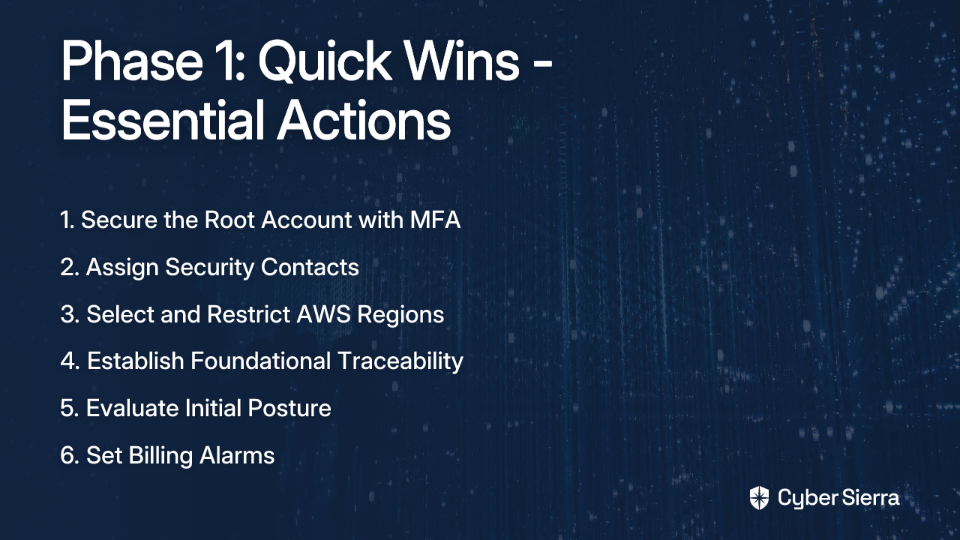
Phase 1: Quick Wins (The "Crawl" Phase – Establishing the Baseline)

This initial phase focuses on high-impact, low-effort controls that establish a basic security posture immediately.

Key Actions:

  • Secure the Root Account: Protect your AWS root account with a strong password and implement MFA, preferably with a FIDO2/WebAuthn device. This addresses a critical vulnerability point.
  • Assign Security Contacts: Designate specific personnel to oversee security initiatives and keep contact details updated—crucial if your account is compromised.
  • Select and Restrict AWS Regions: Choose operational regions and use Service Control Policies (SCPs) to restrict access to all others, reducing your attack surface.
  • Establish Foundational Traceability: Set up AWS CloudTrail across all regions to log API calls and user actions, providing visibility into who's doing what in your environment.
  • Evaluate Initial Posture: Use AWS Security Hub and Trusted Advisor to get an immediate assessment of your security posture and identify glaring gaps.
  • Set Billing Alarms: Configure billing alarms in Amazon CloudWatch to detect unexpected costs, which can be an early indicator of compromise.

Phase 2: Foundational (The "Walk" Phase – Building the Core)

This phase moves beyond quick fixes to establish a robust, repeatable security foundation.

Key Actions:

  • Build Your OU and Account Structure: Establish a multi-account architecture using AWS Organizations and AWS Control Tower. Design Organizational Units (OUs) based on workload functions and common security controls, not just your company's reporting structure.
  • Implement a Strong Identity Foundation: Mature your IAM strategy.
    • Federate workforce identities using SSO
    • Prioritize IAM roles over IAM users for workloads and human access
    • Start with AWS managed policies and progress toward custom policies that enforce least privilege
    • This is critical, as 63% of cloud breaches stem from identity management failures
  • Apply Security at All Layers:
    • Implement strict Security Groups and network ACLs for public-facing EC2 instances
    • Begin deploying services like AWS WAF and AWS Shield, while being mindful that "WAF Shield Advanced starts around $3000 per month" and requires budget planning
  • Enable Advanced Threat Detection: Implement Amazon GuardDuty to continuously monitor for malicious activity and unauthorized behavior
  • Protect Data: Encrypt data at rest using AWS KMS and in transit using TLS, leveraging AWS Certificate Manager
  • Develop a Security Training Plan: Create a formal training plan for staff on cloud security best practices

Phase 3: Efficient (The "Run" Phase – Automating and Integrating)

This phase focuses on automating security controls and integrating them directly into development and operational workflows.

Key Actions:

  • Embrace Infrastructure as Code (IaC): Manage infrastructure through code (e.g., CloudFormation) to ensure consistency and repeatability. Use IaC scanners and policy-as-code tools to block non-compliant deployments automatically.
  • Integrate DevSecOps: Embed security practices into the CI/CD pipeline. Create "security champions" who advocate for best practices early in the development lifecycle.
  • Automate Patching: Address the manual patching burden by setting up AWS Systems Manager Patch Manager for automated patching of EC2 instances on a regular schedule—"weekly for normal systems, daily for at-risk machines."
  • Refine Least Privilege: Conduct regular reviews of IAM access controls and permissions to ensure minimal necessary access.
  • Prepare for Security Events: Establish a central Log Archive account and leverage AWS Security Incident Response guides to begin automating responses to security findings.

Phase 4: Optimized (Continuous Improvement and Proactive Defense)

The most mature phase evolves your organization from reactive to proactive security posture.

Key Actions:

  • Implement Zero Trust Architecture (ZTA): Shift from broad network permissions to micro-segmentation. Implement granular access controls and continuous authentication for all resources.
  • Share Security Responsibilities: Use a RACI (Responsible, Accountable, Consulted, Informed) model to formally distribute security ownership across teams, moving beyond a centralized security function.
  • Automate Evidence Gathering: Streamline the process of collecting evidence for compliance and audits, reducing manual effort.
  • Automate Disaster Recovery: Develop and test fully automated disaster recovery processes to ensure business continuity.
  • Adopt AI-Driven Threat Hunting: Deploy machine learning models to analyze cloud telemetry and proactively hunt for indicators of compromise.

Remember, as one AWS user cautions, "even after you harden your cloud environment, a single app that can be compromised will zero out everything you worked on." This underscores the importance of comprehensive security that addresses all layers of your cloud infrastructure.

Strategic Implementation for CISOs: From Plan to Practice

Translating this maturity model into actionable strategy requires more than technical know-how—it demands leadership, vision, and business acumen.

Align Security with Business Goals

Frame security investments not merely as a cost center but as a business enabler. Use the maturity model to demonstrate tangible progress to executives and board members, tying security posture improvements to risk reduction in financial terms.

When presenting your security roadmap, highlight how each phase directly supports business objectives:

  • Phase 1 establishes fundamental protection for critical assets
  • Phase 2 builds scalable security that enables business growth
  • Phase 3 increases efficiency, reducing operational overhead
  • Phase 4 provides competitive advantage through advanced protection

Manage Costs Strategically

The phased approach allows for incremental investment, addressing the pain point that "understanding the costs of these things and that costs of how you configure them" can be challenging. CISOs can use early wins from Phases 1 and 2 to justify budget for more advanced tools like a CSPM or CNAPP in later phases.

Prioritize security controls that leverage AWS-managed services like RDS, Lambda, and other serverless offerings which, as one user notes, "have the advantage of being managed/patched by AWS." This reduces your security burden while often providing cost benefits.

Know When to Get Help

The complexity of cloud security means that in-house expertise may have limitations. The maturity model helps identify gaps where engaging specialists is the right strategic move.

As multiple AWS users emphasize, "You should 100% hire cloud security professionals or engage a security competency partner" if your team lacks the necessary expertise. The model provides clarity on which areas might benefit most from external assistance and at which phase of your journey.

Consider working with an AWS security competency partner for specific challenges or to accelerate progress through particular phases of your maturity journey.

Building a Resilient and Adaptive Cloud Security Program

The AWS Security Maturity Model provides a powerful, phased approach that moves organizations beyond ad-hoc fixes to strategic security development. It offers a framework to build, measure, and improve cloud security posture over time while acknowledging that each organization's journey is unique.

Remember these key principles as you implement your security maturity model:

  1. Start with fundamentals: Secure the basics before pursuing advanced capabilities
  2. Progress iteratively: Move through the phases at a pace that aligns with your business needs
  3. Adapt continuously: Recognize that "the threat landscape is always changing" and your security program must evolve accordingly
  4. Share responsibility: Distribute security ownership across your organization
  5. Measure progress: Use the model to demonstrate improvements and justify further investment

By adopting this strategic, phased approach, you can build a cloud security program that not only protects your organization today but adapts to the evolving threats of tomorrow—enabling your business to innovate with confidence in the AWS cloud.

Frequently Asked Questions (FAQ)

What is the AWS Security Maturity Model?

The AWS Security Maturity Model is a strategic framework designed to help organizations systematically build, measure, and improve their cloud security posture over time. It uses a phased "Crawl, Walk, Run" methodology to guide you from foundational security controls to a highly optimized, proactive defense, moving beyond static checklists to foster continuous improvement.

Why use a maturity model instead of a security checklist?

A maturity model is superior to a checklist because it provides a dynamic, long-term strategy for continuous security improvement, rather than just a static, point-in-time assessment. Unlike a checklist, the model adapts to the evolving threat landscape and scales with your organization's growth, helping you build a resilient security program that aligns with your specific business needs and risk tolerance.

What are the most critical first steps to improve AWS security?

The most critical first steps involve securing foundational elements with high-impact "quick wins." This includes protecting your AWS root account with MFA, restricting access to unused AWS regions, enabling AWS CloudTrail for visibility, and using AWS Security Hub to get an initial assessment of your security posture. These actions establish a baseline of control with minimal effort.

How does the maturity model help manage cloud security costs?

The model helps manage costs by advocating for a phased, incremental investment in security. You can start with low-cost or built-in AWS services in the early phases to demonstrate value and secure your baseline. This allows you to justify budget for more advanced tools and automation in later phases, ensuring security spending aligns with your organization's maturity and risk reduction goals.

When should my organization hire an external AWS security partner?

You should consider hiring an external partner when your internal team lacks the specialized expertise required for more advanced phases of the model. This is common for complex areas like implementing a Zero Trust Architecture, integrating DevSecOps, or automating incident response. A partner can help accelerate your progress, bridge skill gaps, and provide an objective assessment of your security posture.

What does the final "Optimized" phase of the model look like?

The "Optimized" phase represents a proactive and automated security posture where security is deeply embedded across the organization. Key characteristics include a fully implemented Zero Trust Architecture, automated compliance evidence gathering, AI-driven threat hunting, and shared security responsibilities defined by a RACI model. At this stage, your security program shifts from reacting to events to proactively anticipating and neutralizing threats.

For more information, visit the AWS Security Maturity Model or explore the AWS Security Reference Architecture for detailed implementation guidance.

blog-hero-background-image
Cyber Security

NPM debug and chalk is compromised - What should I do?

backdrop
Table of Contents

Join thousands of professionals and get the latest insight on Compliance & Cybersecurity.


You wake up to a notification from your team's Slack channel: "URGENT: chalk and debug packages compromised." Your heart sinks as you think, "Oh no, not again." Just like that bowl of petunias from Hitchhiker's Guide to the Galaxy, the tech community collectively sighs at yet another supply chain attack.

This isn't just any security incident. On September 8, 2025, two of the most foundational packages in the JavaScript ecosystem—chalk and debug—were compromised, affecting over 2.6 billion downloads per week. The scale is staggering: a single developer clicking the wrong link has potentially impacted millions of projects worldwide.

"Amazing that so much depends on a single guy tapping the wrong link," as one frustrated developer noted on Reddit. This sentiment captures the precarious nature of our modern development ecosystem, where trust is implicit but vulnerabilities are everywhere.

This article isn't about pointing fingers or lamenting the "nature of npm." Instead, it's a practical guide to help you:

  1. Understand exactly what happened and how the attack works
  2. Take immediate steps to secure your projects
  3. Implement long-term strategies to protect yourself from future supply chain attacks

Whether you're experiencing a "panicky morning" trying to assess your exposure or you've "ran out of fucks" dealing with recurring security issues, this guide will help you move from reaction to prevention.

Anatomy of the Attack: How Billions of Downloads Were Compromised

The Incident Timeline & Scale

On September 8, 2025, at 13:16 UTC, security intelligence feeds first flagged that 18 popular npm packages had been updated with malicious code. The two most prominent packages affected were:

  • chalk (299.99 million downloads/week) - A popular styling library for terminal text
  • debug (357.6 million downloads/week) - A tiny debugging utility for Node.js

Together with the other 16 compromised packages, the total reach exceeded 2.6 billion downloads per week, according to Aikido's security blog. The npm security team and package maintainers responded quickly, with many malicious versions being removed within an hour of discovery.

However, in that short window, countless automated builds and deployments may have already incorporated the compromised code, potentially affecting production systems worldwide.

The Vector: A Deceptively Simple Phishing Attack

The attack originated from the compromise of a single, highly-trusted npm author known as Qix. According to Socket.dev's analysis, the maintainer was tricked by a phishing email that appeared to come from npm support.

The email, sent from [email protected] (notice the suspicious .help TLD), looked legitimate at first glance. The phishing domain was registered just three days before the attack, specifically targeting package maintainers.

As the maintainer later admitted: "Made the mistake of clicking the link instead of going directly to the site like I normally would. The low-tech part of their attack, and was my fault." This candid admission highlights a critical truth: even experienced developers can fall victim to social engineering when they're tired, stressed, or simply having "a long week and a panicky morning."

This human element is what makes supply chain attacks so effective and dangerous. No matter how sophisticated our technical defenses, a momentary lapse in vigilance can compromise an entire ecosystem.

Dissecting the Malware

The malicious payload inserted into these packages was a sophisticated browser-based cryptostealer targeting cryptocurrencies like Bitcoin, Solana, and Ethereum. What made this attack particularly insidious was its selective activation—it only executed in browser environments, remaining dormant in server-side Node.js contexts.

According to the GitHub issue detailing the compromise, the malware used a simple typeof window check to determine if it was running in a browser. This meant that typical Node.js applications wouldn't trigger the malicious code, making detection more difficult.

Once deobfuscated, Aikido's security analysts discovered the malware's step-by-step mechanism:

  1. Injection: The code injected itself into the browser's core networking and application APIs.
  2. Monitoring: It hijacked functions like fetch, XMLHttpRequest, and web3 wallet APIs to monitor for sensitive data.
  3. Rewriting: When cryptocurrency transactions were detected, it silently rewrote the transaction parameters, replacing the recipient's address with an attacker-controlled address.
  4. Hijacking: It intercepted the transaction signing process, presenting the user with what appeared to be their intended transaction but was actually sending funds to the attacker.
  5. Stealth: Throughout this process, the malware operated silently to avoid detection.

The sophistication of this attack—combining social engineering with targeted, stealthy malware—underscores the evolving threat landscape for open-source software.

Triage & Response: Immediate Actions to Secure Your Projects

If you're reading this with a growing sense of panic, take a deep breath. Here's a systematic approach to check your exposure and remediate any issues.

Step 1 - Identify Your Exposure

First, check if your projects include any of the compromised package versions. The following versions have been confirmed as malicious:

You can check your project's dependency tree by examining your package-lock.json or yarn.lock files. Pay special attention to critical dependencies that might be used in browser environments.

Step 2 - Scan Your Codebase

For a more thorough check, run npm audit in your project root:

npm audit

This command checks your dependencies against the npm registry's vulnerability database. However, since this is a recent attack, you may want to use specialized tools created specifically for this incident.

The open-source community has quickly responded with targeted detection tools. Semgrep has released a specific rule to detect this attack:

# Install semgrep if you don't have it
npm install -g semgrep

# Run the specific rule against your project
semgrep --config=p/semgrep.ssc-mal-deps-mit-2025-09-chalk-debug-color

This rule specifically looks for the malicious code patterns associated with the compromised packages. You can find more details on Semgrep's blog post about this incident.

Step 3 - Remediate and Fortify Your Dependencies

If you've identified compromised packages in your projects, here's how to fix them:

  1. Do not upgrade to the latest versions until the npm security team confirms they're safe. Instead, downgrade to the last known good version:
# For debug, downgrade to 4.4.1
npm install [email protected]

# For chalk, downgrade to 5.6.0
npm install [email protected]

# Update your lockfile
npm install
  1. Once you've cleaned your dependencies, enforce dependency integrity in your development workflow:
# Instead of npm install, use npm ci which respects your lockfile exactly
npm ci

For Yarn users, the equivalent command is:

yarn install --frozen-lockfile
  1. Update your CI/CD pipelines to use these strict installation methods as well. This prevents accidental introduction of compromised packages during automated builds.
  2. Create a pull request or merge request with these changes to get them into your main branch quickly.

The OWASP NPM Security Cheat Sheet provides additional best practices for securing your npm workflow.

Fortifying Your Defenses: Long-Term Strategies for a More Secure SDLC

While immediate remediation is crucial, this incident also highlights the need for more robust, long-term security strategies. Let's explore how you can protect your projects from future supply chain attacks.

Harden Your NPM Workflow

One of the most effective ways to reduce your exposure to supply chain attacks is to minimize the attack surface by controlling how packages are installed and executed.

Ignore Potentially Malicious Scripts: Many npm packages run postinstall scripts, which can be a vector for executing malicious code. Disable these scripts by default:

# Run installs with the --ignore-scripts flag
npm install --ignore-scripts

# Or enforce this for your entire team by adding it to .npmrc
echo "ignore-scripts=true" >> .npmrc

Lint Your Lockfiles: Use tools like lockfile-lint to detect if your lockfile has been tampered with or contains packages from unexpected registries:

npm install -g lockfile-lint
lockfile-lint --path package-lock.json --allowed-hosts npm

Consider a Local NPM Proxy: For enterprise environments, using a local npm proxy like Verdaccio gives you more control over which packages are available to your team. It also provides caching benefits, reducing your exposure to registry outages or compromises.

# Install Verdaccio
npm install -g verdaccio

# Run it locally
verdaccio

# Configure npm to use your local registry
npm set registry http://localhost:4873/

Vet Your Dependencies Proactively

According to research on the npm ecosystem, "An average npm package introduces implicit trust on 79 third-party packages and 39 maintainers." This extensive trust network is why supply chain attacks are so effective.

Before adding a new dependency to your project, assess its security posture:

Use Package Quality Assessment Tools: Tools like npq provide a quick health check on a package's quality and maintenance status:

# Install npq
npm install -g npq

# Use npq instead of npm install for new packages
npq install express

Check Security Advisories: Before adding a dependency, check its score on Snyk Advisor for a detailed report on its security, community, and maintenance health.

Implement a Waiting Period for Updates: A powerful strategy recommended by Snyk's security team is to avoid upgrading to package versions that are less than 21 days old. This waiting period allows time for the community to discover and report potential compromises.

You can enforce this with a CI/CD check that fails builds using packages released within the last three weeks.

Secure Maintainer Accounts (The Human Firewall)

If you maintain npm packages yourself, or if your team publishes internal packages, securing your npm accounts is critical.

Mandate Two-Factor Authentication (2FA): Enable 2FA on both your npm and GitHub accounts. This is the single most effective defense against phishing attacks like the one that compromised Qix.

# Enable 2FA for your npm account
npm profile enable-2fa auth-and-writes

Use Granular Access Tokens: For publishing from CI/CD environments, create restricted tokens instead of using your personal, full-access credentials:

# Create a read-only token scoped to a specific IP range
npm token create --read-only --cidr=192.0.2.0/24

Be Vigilant About Phishing: The maintainer in this incident noted they "made the mistake of clicking the link instead of going directly to the site." Always verify the authenticity of emails claiming to be from npm, GitHub, or other development platforms:

  • Check the sender's email domain carefully
  • Hover over links before clicking to see the actual destination
  • When in doubt, navigate directly to the service's website instead of using email links
  • Consider setting up email filters to flag suspicious domains

Cultivate a Security-First Team Culture

Technical solutions alone aren't enough. As one frustrated Redditor noted about the compromised maintainer: "I'm sure he's received phishing awareness training in the past." Knowledge doesn't always translate to practice, especially during a "long week and a panicky morning."

Here's how to build a culture that prioritizes security:

Regular Security Training: Make security training ongoing, engaging, and relevant. Share news about recent supply chain attacks and discuss how your team might have been affected.

Automate and Prioritize Vulnerability Fixes: Use tools like Dependabot to automatically create PRs for vulnerable dependencies. As one developer suggested, having "an audit report that flags results with critical dependencies feels like a good idea" to prioritize in the next sprint.

# Add a .github/dependabot.yml file to your repository
# Example configuration:
version: 2
updates:
  - package-ecosystem: "npm"
    directory: "/"
    schedule:
      interval: "daily"
    open-pull-requests-limit: 10

Schedule Regular Security Scans: Set up a cron job or scheduled pipeline to perform regular security scans on all production dependencies:

# Example script for a weekly security audit
#!/bin/bash
cd /path/to/your/project
npm audit --audit-level=high
# Send results to your team's Slack or email

Create Separate Environments for Open Source Work: As one developer mentioned, "I think I need to make a separate account on my computer just to do OSS on." This compartmentalization can limit the blast radius of potential compromises. Consider using separate environments for:

  • Open source contributions
  • Client or production work
  • Personal projects

From Panic to Preparedness

The compromise of chalk and debug is a stark reminder of how interconnected and vulnerable our software ecosystem can be. "Amazing that so much depends on a single guy tapping the wrong link," as that Reddit comment perfectly encapsulated the situation. But rather than feeling helpless or having "ran out of fucks," we can use this incident as motivation to build more resilient systems.

The key lessons from this incident are:

  1. Human factors matter: Even experienced developers can fall victim to social engineering. Building robust systems means accounting for human fallibility.
  2. Trust, but verify: The npm ecosystem is built on trust, but that trust should be accompanied by verification through tools, processes, and culture.
  3. Defense in depth: No single security measure would have prevented this attack. A layered approach—from 2FA to dependency scanning to developer training—creates a more resilient system.
  4. Community resilience: The quick response from security researchers, tool creators, and maintainers demonstrates how the community can self-heal when incidents occur.

While we can't eliminate all risks in our open-source ecosystem, we can reduce our exposure and build systems that degrade gracefully when compromises occur.

Your Next Steps

Choose one strategy from this guide and implement it this week:

  • Enable 2FA on your npm and GitHub accounts
  • Add npm ci to your CI/CD pipeline
  • Set up Dependabot for automated security PRs
  • Schedule a team discussion about recent supply chain attacks
  • Vet your next dependency with Snyk Advisor before adding it

By taking these incremental steps, we can collectively strengthen the security posture of the entire ecosystem. The next time a supply chain attack occurs—and there will be a next time—you'll be better prepared to respond calmly and effectively.

Remember: security isn't a destination, it's a journey. Each small improvement makes your projects more resilient, your team more aware, and our shared ecosystem more secure.

Frequently Asked Questions

What was the chalk and debug npm package compromise?

The chalk and debug npm package compromise was a significant supply chain attack on September 8, 2025, where a malicious actor gained access to a popular maintainer's account via phishing. The attacker then published compromised versions of 18 packages, including chalk and debug, which together are downloaded over 2.6 billion times per week. The malicious code was a cryptostealer designed to hijack cryptocurrency transactions in browser environments.

How can I check if my project is affected by the chalk and debug vulnerability?

You can check if your project is affected by running the npm audit command in your project's root directory. This command scans your dependencies for known vulnerabilities. For a more targeted check specific to this incident, you can use security tools like Semgrep with rules designed to detect the exact malicious code patterns from the compromised chalk and debug versions.

What are the immediate steps to fix the compromised chalk and debug packages?

The immediate fix is to downgrade to the last known safe version rather than upgrading to the newest one, which may still be under investigation. For debug, downgrade to 4.4.1, and for chalk, downgrade to 5.6.0. After downgrading, run npm install to update your lockfile and commit the changes.

Why are npm supply chain attacks so common?

NPM supply chain attacks are common due to the ecosystem's extensive network of trust and dependencies. A single npm package can rely on dozens of other packages and maintainers, creating a large attack surface. Attackers exploit this by targeting individual maintainers with social engineering tactics like phishing, as a single compromised account can inject malicious code into projects used by millions of developers worldwide.

How can I protect my projects from future npm supply chain attacks?

You can protect your projects by adopting a defense-in-depth strategy. Key practices include enforcing strict dependency installation with npm ci, ignoring potentially malicious postinstall scripts, using tools to vet new dependencies before adding them, and automating vulnerability scanning with tools like Dependabot. A powerful cultural strategy is to implement a waiting period, avoiding package versions released within the last 21 days to allow time for the community to discover compromises.

What is the single most effective way to prevent account takeovers for npm maintainers?

The single most effective way for npm maintainers to prevent account takeovers is to enable Two-Factor Authentication (2FA). The chalk and debug compromise began with a phishing attack that would have been stopped by 2FA. Enabling 2FA on both npm and GitHub accounts provides a critical layer of security that protects against credential theft.


This article is based on the npm package compromise of September 2025. The security landscape evolves rapidly, so always verify information and best practices with the latest sources from npm, GitHub, and security organizations like OWASP and Snyk.

blog-hero-background-image
Uncategorized

How to Build a Risk Appetite Framework That Actually Gets Executive Buy-In

backdrop
Table of Contents

Join thousands of professionals and get the latest insight on Compliance & Cybersecurity.


You've been tasked with managing an overwhelming array of cyber risks—from ransomware to PII leaks—but your resources are painfully limited. When you approach leadership about investing in better security measures, you're met with resistance, budget constraints, or vague commitments that never materialize.

Sound familiar? You're not alone.

As one CISO put it, "After 4 months, I still feel so overwhelmed with the risks... and the resources are so scarce." Another security leader lamented, "If they don't want to invest in better security, then you just gotta try your best."

This disconnect between security needs and executive buy-in isn't just frustrating—it's dangerous. But what if there was a way to bridge this gap? What if you could transform security from a cost center into a strategic business enabler that executives actively support?

Enter the Risk Appetite Framework (RAF)—not as another piece of bureaucratic paperwork destined to gather dust, but as a powerful communication tool designed to secure budget, align security with business objectives, and finally get the executive support you need.

Why Most Risk Appetite Frameworks Fail

Before diving into how to build an effective framework, let's understand why many RAF initiatives end up as "shelfware" that executives ignore:

Fear of Accountability

"Leadership really struggles with defining this because they're afraid it could be used against them." When executives put specific risk thresholds in writing, they worry these documents might return to haunt them after an incident.

Disconnect from Budget Authority

"A risk appetite really should be set by the people who set the budgets or you'll end up with tons of 'unacceptable' risk but no power/money to treat said risks." When the people defining acceptable risk levels aren't the same ones controlling resource allocation, the framework becomes aspirational rather than operational.

Subjective and Vague Language

"There's lots of qualitative, subjective measures in there and your idea of Low may not match leadership's idea of Low." Without clear metrics and specific thresholds, risk discussions become exercises in miscommunication.

Lack of Integration

Many frameworks are treated as one-time projects rather than living parts of the decision-making process. They exist in isolation from daily operations and strategic planning.

The Foundation: Defining the Terms of Engagement

Before building your framework, you need clarity on what you're creating and why.

What is a Risk Appetite Framework?

According to MetricStream, a risk appetite framework "defines the amount and type of risk an organization is willing to accept in pursuit of its objectives, guiding decision-making and ensuring alignment with strategic goals."

In simpler terms, it's a structured approach to understanding, documenting, and operationalizing how much risk your organization can and should take on.

Decoding the Jargon

Many CISOs struggle with the terminology, which leads to confusion and misalignment. Let's clarify:

  • Risk Appetite: The high-level, broad statement of how much risk the organization is willing to accept. This is typically set at the board level.
  • Risk Tolerance: The specific, measurable deviation from the appetite that is acceptable for a given risk category. For example, "We strive to ensure that at least 90% of all Windows systems are patched against High and Critical security vulnerabilities within 7 days."
  • Risk Capacity: The maximum level of risk the organization can absorb without jeopardizing its viability—essentially, the point at which the risk would cause significant harm to the business.

The Blueprint: A 5-Step Guide to Building Your Framework

Now that we understand the fundamentals, let's explore a practical, step-by-step approach to building a Risk Appetite Framework that executives will actually support:

Step 1: Understand Strategic Objectives & Engage Stakeholders

The first mistake many security leaders make is starting with security tools rather than business goals. As noted by OrigamiRisk, "Initial conversations should focus on the organization's goals and KPIs."

  • Start with the business: Understand what drives your organization, its strategic priorities, and how it measures success.
  • Involve senior leadership early: According to MetricStream, involving senior management and the board from the very beginning is crucial for building consensus and ensuring alignment.
  • Map security initiatives to business outcomes: Show how security enables rather than hinders business objectives.

Step 2: Identify, Assess, and Interconnect Risks

Once you understand the business context, you need a comprehensive view of your risk landscape:

  • Conduct thorough risk assessments: Use both quantitative and qualitative methods to identify and evaluate risks across the organization.
  • Break down silos: As Gurucul advises, "Recognize and Manage Interconnected Risks" by utilizing analytics to provide a holistic view of how a cyber risk can impact finance, compliance, and reputation.
  • Highlight risk connections: A case study from the Risk Leadership Network shows how one firm incorporates links to other risks within its risk appetite statement, ensuring decision-makers understand these interconnections.

Step 3: Define Risk Appetite Statements and Tolerances

Now comes the critical part—articulating clear, measurable statements that guide decision-making:

  • Be specific and measurable: For example, a board might state "their willingness to accept a moderate level of risk, ensuring losses do not exceed 5% of annual revenue." Vague statements like "low appetite for cyber risk" are ineffective.
  • Use a mix of metrics: Employ both "quantitative and qualitative metrics that reflect real-time security posture" to allow for prioritization based on business-specific tolerances.
  • Align with budget reality: Ensure risk tolerance levels match the resources available for risk treatment, or you'll create an unachievable framework.

Step 4: Establish Governance and Forward-Looking Triggers

A framework is only as good as its implementation:

  • Define clear roles and responsibilities: Implement a "Comprehensive Governance Framework with automated audit trails and real-time reporting to ensure consistent risk management."
  • Create escalation protocols: Don't wait for incidents. "Establish Forward-Looking Escalation Triggers based on dynamic patterns and anomalies to allow proactive responses to threats before they cause damage."
  • Document decision-making processes: Clarify how the framework will be used in various scenarios, from new project evaluations to incident response.

Step 5: Integrate, Review, and Refine

The final step is ensuring the framework becomes a living part of your organization:

  • Embed into daily operations: Make the risk appetite framework part of project approval processes, budget discussions, and strategic planning.
  • Conduct periodic reviews: Schedule regular assessments to ensure the framework remains relevant and effective as the business and threat landscape evolve.
  • Refine based on feedback: Use real-world experiences to improve the framework's effectiveness over time.

The Art of the Sell: Securing Executive Buy-In

Even the best-designed framework is worthless without executive support. Here's how to secure that crucial buy-in:

The Golden Rule of Buy-In

As Darius Delon, cited by OrigamiRisk, powerfully states: "One of the biggest buy-in methods for a successful strategy is talk...People will not buy-in to ERM just because they read something you put in front of them or heard at a large forum."

Direct, personalized communication is key to winning support.

Strategies for Persuasion

Speak Their Language

  • Start at the top: As Arctic Wolf advises, "Start with the CEO," who carries the most risk and has the broadest view of the organization.
  • Frame security positively: Present the framework as "a tool for achieving strategic objectives rather than merely avoiding risks." This counters the perception that security is just a cost center that "won't make the company money."
  • Tailor your approach: Speak to each executive in terms they understand—financial impact for the CFO, reputational damage for the CMO, operational disruption for the COO.

Use Storytelling and Tabletop Exercises

  • Make risk tangible: Abstract risk discussions rarely move executives to action. Instead, utilize narrative techniques during board meetings. Share real-world incidents or hypothetical scenarios that illustrate the risks your organization faces.
  • Run practical drills: Arctic Wolf recommends conducting tabletop exercises with clear steps:
    1. Create Custom Scenarios: Use organizational weaknesses to build tailored exercises, leveraging resources like CISA's tabletop exercise packages.
    2. Define Objectives: Have a clear goal, like securing a budget for a specific control.
    3. Tailor Communication: Frame risks in terms each executive understands.

Demonstrate Value with Quick Wins

  • Start small: Don't boil the ocean. Begin with a "Minimum Viable Product (MVP)"—a small-scale initiative that shows immediate benefits and provides feedback before a full rollout.
  • Visualize insights: Move beyond basic heat maps and spreadsheets. Invest in technology that provides "actionable insights and metrics that influence leadership decisions."
  • Quantify impacts: "Make sure to express the cost for each leaked social security number" or other PII. Concrete financial figures help executives understand the business case for security investments.

From Paper to Practice: Operationalizing Your Framework

The ultimate goal is to ensure your Risk Appetite Framework becomes part of the organization's DNA. Over 70% of risk leaders identify appetite as a priority, and 80% use it to guide strategic decisions. Here's how to make that happen:

Case Studies in Action

The Risk Leadership Network provides valuable examples of organizations successfully operationalizing their frameworks:

  • Overcoming Silos: One multinational implemented a "uniform process requiring all teams to consider risk appetite for high-value proposals." The Chief Risk Officer sits on the investment committee, embedding risk considerations into financial decisions from the start.
  • Justifying Operational Spend: Another firm "assesses high-importance initiatives, even those without financial returns, against its risk appetite." This allows them to make compelling arguments for cybersecurity or safety expenditures that don't have a direct ROI but are critical for risk reduction.

Top-Down and Bottom-Up Integration

For maximum effectiveness, your framework must reflect "both executive priorities and operational realities by integrating data across business functions." This means:

  • Involving practitioners: Engage the people who will implement security measures in the development of tolerance levels.
  • Creating feedback loops: Establish mechanisms for frontline teams to report on risk levels and the effectiveness of controls.
  • Aligning incentives: Ensure that performance metrics for all departments include adherence to risk appetite parameters.

Conclusion: From Risk Manager to Strategic Advisor

A successful Risk Appetite Framework isn't just a document; it's a process of building, selling, and integrating risk management into the fabric of your organization. By following the blueprint outlined above and mastering the art of executive communication, you can transform your role from a technical cost center to a vital strategic advisor.

The benefits extend far beyond better risk management—you'll achieve enhanced alignment with strategic goals, build stakeholder trust, and optimize resource allocation. Most importantly, you'll finally get the visibility, resources, and support needed to effectively protect your organization.

Remember, as one CISO aptly put it, "This isn't just a CISO problem, it is one of the greater business issues." By positioning your Risk Appetite Framework as a business enabler rather than a security initiative, you'll bridge the gap between technical needs and executive priorities—and finally get the buy-in you've been seeking.

Frequently Asked Questions

What is a Risk Appetite Framework?

A Risk Appetite Framework (RAF) is a formal document and process that defines the amount and type of risk an organization is willing to accept to achieve its strategic objectives. It serves as a powerful communication tool to translate technical risks into business terms, align security with business goals, and justify resource allocation.

Why do most Risk Appetite Frameworks fail?

Most Risk Appetite Frameworks fail because they are disconnected from business reality, use vague language, and are treated as one-time projects. Common pitfalls include executives' fear of accountability, a mismatch between those setting the appetite and those controlling the budget, and a lack of integration into daily strategic and operational decisions.

How do you get executive buy-in for a security framework?

To get executive buy-in, frame the security framework as a business enabler that helps achieve strategic goals, not just a cost center for avoiding risk. This involves speaking the language of the business by linking security to financial outcomes, using storytelling and tabletop exercises to make risks tangible, and demonstrating value quickly with small-scale wins.

What is the difference between risk appetite and risk tolerance?

Risk appetite is the high-level amount of risk an organization is willing to take, while risk tolerance is the specific, measurable deviation acceptable for a particular risk. For example, a company's risk appetite might be for a "moderate level of cyber risk," while a specific risk tolerance would be, "No more than 5% of critical systems will have unpatched high-severity vulnerabilities for longer than 14 days."

What is the first step to building an effective Risk Appetite Framework?

The first and most critical step is to understand the organization's strategic business objectives before considering specific security tools or risks. A successful framework must be built on a foundation of business context, ensuring it directly supports and enables business priorities rather than existing as a standalone security initiative.

How can you ensure a Risk Appetite Framework is actually used?

To ensure a framework is used, it must be deeply integrated into core business processes like strategic planning, budgeting, and project approvals. This requires clear governance, embedded risk checks in decision-making, and regular reviews to keep it relevant. It must be treated as a living document, not a "set it and forget it" policy.

blog-hero-background-image
Cyber Security

How to Build a Human Firewall That Actually Works

backdrop
Table of Contents

Join thousands of professionals and get the latest insight on Compliance & Cybersecurity.


You've sat through the annual security awareness training. You've watched the generic videos about phishing. You've even clicked through those dreaded multiple-choice quizzes. Yet somehow, your organization's phishing simulation numbers still show alarming failure rates. Sound familiar?

The term "human firewall" has become one of cybersecurity's most overused buzzwords—promising to transform employees into an impenetrable defense against social engineering attacks. But let's face it: most attempts to build this defense fall flat.

Why? Because traditional approaches treat security awareness as a checkbox exercise rather than what it truly needs to be: a fundamental cultural shift in how your organization thinks about and practices security.

The Sobering Reality of the Human Element

The stakes couldn't be higher:

  • More than 80% of cyber incidents involve a human factor (Risk Strategies)
  • 52% of all data breaches are attributed to human error (CybeReady)
  • Phishing scams cost businesses an estimated $1.8 billion in 2020 alone

These statistics highlight an uncomfortable truth: despite robust technical controls, people remain your largest attack surface—and potentially your strongest defense.

Redefining the Human Firewall: From Blame Game to Shared Defense

What a Human Firewall Should Be

A true human firewall isn't just a group of employees who can spot phishing emails. It's a collective effort by an engaged workforce actively identifying, reporting, and defending against the full spectrum of cybersecurity threats.

Debunking Common, Failed Approaches

Myth 1: It's Only About Phishing. Reality: While phishing is critical, an effective human firewall protects against a wide range of threats including social engineering, impersonation, vishing, malware, and physical access breaches.

Myth 2: Annual Training is Enough. Reality: Threats evolve constantly. One-and-done training approaches create a false sense of security. Effective programs require continuous learning and frequent reinforcement—Hoxhunt recommends phishing simulations as often as every 10 days.

Myth 3: It's a Punitive System. Reality: The all-too-common approach of "if they fail, make them take more training" creates resentment, not engagement. As one security professional noted, "I hate punitive products... if they fail make them take more training." This stick-without-carrot approach destroys motivation and creates adversarial relationships between security teams and employees.

The Critical Culture Shift: From User Fault to Organizational Responsibility

When a security incident happens, the knee-jerk reaction is often to blame the user. As one practitioner pointedly observed, "When an incident happens and a user gets breached... they shrug that responsibility onto the user" (Reddit discussion).

This blame culture misses a crucial point: if a single phished user leads to a major breach, the organization's technical and procedural controls have also failed. A successful human firewall is built on shared responsibility, not finger-pointing.

The Blueprint: Designing Training That Actually Changes Behavior

Principle 1: Focus on Engagement and Storytelling, Not Just Information

Humans struggle with abstract risk but connect deeply with narratives. As one cybersecurity professional insightfully stated, "Make it about stories. We (humans) are HORRIBLE at thinking about risk... But we can relate to stories" (Reddit discussion).

Real-World Example: The Royal Bank of Scotland (RBS) successfully reduced phishing incidents by 78% through a comprehensive employee training program focused on storytelling and engagement rather than technical jargon.

Principle 2: Customize, Don't Commoditize

Generic Commercial Off-The-Shelf (COTS) training fails because vendors "shill the same exact stuff to everyone" (Reddit discussion). This one-size-fits-all approach can't address your organization's unique culture, threats, and needs.

Actionable Steps for Customization:

  • Tailor to Roles: Create tiered content for executives, operators, finance teams, and temporary workers.
  • Use Real Examples: Don't just use generic templates. "Make your own, using current, real attacks against your own company."
  • Diversify Activities: Move beyond click-through modules. Use a mix of interactive quizzes, gamification tools like Kahoot, workshops, and even "meme-based training" or TikTok-style videos to keep content fresh.

Principle 3: Reinforce Positively, Not Punitively

Shift the focus from "click rates" (how many people fall for phishing tests) to "report rates" (how many people actively report suspicious activities). The goal is to encourage employees to be active participants.

Implement Positive Reinforcement:

  • Recognize and reward employees who report suspicious activity through shout-outs, small bonuses, or team celebrations.
  • Share success stories of how vigilant employees prevented real attacks.
  • Create a security champions program to empower interested employees to become advocates within their departments.

Hoxhunt's case study with AES, a Fortune 500 company, demonstrated how this positive reinforcement approach led to measurable increases in security vigilance and reporting rates (Hoxhunt AES Case Study).

The 7-Step Action Plan to Build Your Human Firewall

Step 1: Get Leadership Buy-In and Establish Clear Policies

A strong security culture starts at the top. Secure executive support to ensure security is treated as a priority, not an afterthought.

Policy Creation Process:

  1. Conduct a risk assessment to understand your specific vulnerabilities
  2. Define policy objectives (e.g., protect sensitive data, ensure compliance)
  3. Choose a security framework like ISO 27001 or NIST to guide your policies
  4. Draft and communicate clear procedures for password management, data handling, incident response, and device security

Step 2: Onboard with Security in Mind

Integrate cybersecurity awareness into recruitment and onboarding. Make security a core value from day one, not something employees learn about months into their tenure.

Step 3: Launch Continuous, Engaging Training

Implement quarterly campaigns, monthly newsletters, and frequent simulations. Remember that engagement is the key to retention.

"You might have developed the perfect online training, but if you aren't able to 'sell it' through engaging messaging, fewer people will be motivated to click on it," warns one security awareness professional (Reddit discussion).

Step 4: Equip Employees with the Right Tools

A human firewall is not a substitute for technology. Empower employees with tools that make security easier:

  • Password managers to encourage strong, unique passwords
  • Easy-to-use Multi-Factor Authentication (MFA)
  • Simple, one-click buttons to report suspicious emails

Step 5: Conduct Frequent and Realistic Security Tests

Use phishing tests as a training tool, not a "gotcha" exercise. Simulate a variety of modern threats, including Business Email Compromises (BEC), spear phishing, and pretexting attacks.

"Social Engineering is this most effective training tool in my opinion. That feeling of actually doing something they shouldn't have and being identified for it sticks with you way more than some multiple choice question," notes a security practitioner (Reddit discussion).

Step 6: Foster Open Communication and Reporting

Create dedicated, blameless channels for employees to report potential threats or ask questions. Celebrate those who report suspicious activities, creating a culture where vigilance is rewarded, not punished.

Step 7: Measure, Adapt, and Hold the Organization Accountable

Track metrics that matter: user reporting rates, time-to-report, and employee participation/feedback.

While user accountability is important, organizational accountability is paramount. Consider integrating security culture metrics into managerial performance reviews. As one security professional suggested, "Ensure managers are held accountable for their repeat offenders" (Reddit discussion).

Your People Are Your Greatest Security Asset

An effective human firewall is not a product or a single training module. It's the outcome of a continuous commitment to building a positive security culture. It requires moving from passive awareness to active defense, focusing on measurable behavior change, positive reinforcement, and shared responsibility.

Remember: even the best-trained employees can fall victim to sophisticated attacks. That's why a true human firewall isn't about eliminating human error—it's about creating a resilient security culture that can detect, report, and recover from incidents quickly.

By investing in your people with engaging, relevant, and supportive training, you transform your biggest risk into your strongest defense. After all, technology alone can't protect your organization—but technology backed by vigilant, engaged humans can.

Frequently Asked Questions

What is a human firewall in cybersecurity?

A human firewall is a collective security culture where employees are not just aware of threats but are actively engaged in identifying, reporting, and defending against them. It goes beyond simply spotting phishing emails and encompasses a shared responsibility for protecting the organization against a wide range of cyber threats.

Why do most security awareness programs fail?

Most security awareness programs fail because they are treated as a compliance checkbox rather than a cultural initiative. Common pitfalls include using generic, one-size-fits-all content, conducting training too infrequently (e.g., annually), and adopting a punitive approach that punishes failure instead of rewarding vigilance.

How often should we conduct security training and phishing simulations?

For maximum effectiveness, security training should be continuous, not a one-time event. Experts recommend frequent phishing simulations—as often as every 10 days to once a month—to keep skills sharp and security top-of-mind. The goal is consistent reinforcement, not just an annual test.

How can we measure the effectiveness of our human firewall?

The most effective way to measure a human firewall is to shift from negative metrics to positive ones. Instead of focusing on "click rates" (how many people failed a test), track "report rates" (how many people actively report suspicious emails) and the "time-to-report." These metrics indicate an engaged workforce that is actively participating in security defense.

What is the first step to building an effective human firewall?

The first and most critical step is to get genuine buy-in from leadership. A strong security culture starts at the top. When executives champion and invest in security as a core business priority, it empowers the entire organization to adopt the principles of shared responsibility.

What should happen if an employee fails a phishing test?

If an employee fails a phishing test, it should be treated as a valuable and private learning opportunity, not a cause for punishment. Punitive actions create fear and discourage reporting. Instead, provide immediate, constructive feedback that reinforces the training and encourages them to be more vigilant in the future, fostering a blameless security culture.

Start building your human firewall today. Not with fear, blame, or generic training—but with culture, engagement, and shared responsibility.

blog-hero-background-image
Cyber Security

How to Build a Startup Security Stack on a $500 Monthly Budget

backdrop
Table of Contents

Join thousands of professionals and get the latest insight on Compliance & Cybersecurity.


You've built an amazing product. Your team is growing. Investors are interested. But there's that nagging voice in your head: "What about security?"

You know you need it, but your budget is tight. Every dollar counts, and those enterprise security solutions with their eye-watering price tags are simply out of reach. Meanwhile, you're juggling a chaotic mix of personal MacBooks, company-issued Windows laptops, and everyone's smartphones.

The stakes couldn't be higher. According to the U.S. National Cyber Security Alliance, 60% of small companies can't sustain operations over six months after a cyber attack. The average cost of a security breach for small businesses? A staggering $2.7 million according to the Ponemon Institute.

But here's the good news: You don't need a Fortune 500 security budget to protect your startup. This guide will show you exactly how to build a robust security stack for a 10-person team for under $500 per month.

The Startup Security Mindset: From Blocker to Business Enabler

First, let's reframe how you think about security. It's not just a cost center or a technical requirement—it's a business enabler that can:

  • Drive sales: Many enterprise clients won't even consider your product without adequate security measures
  • Protect revenue: Prevent costly downtime and data breaches
  • Ensure compliance: Meet regulatory requirements that open new markets

As one security professional advises in a Reddit discussion, "Most startups die from business reasons, not hacks, so focus on preventing catastrophic security events without creating friction that kills productivity."

The key is finding that sweet spot between protection and productivity.

Create a Simple Risk Register

Before spending a dollar, create a basic risk register—a document that tracks potential security threats to your business and prioritizes them based on likelihood and impact. Meet with your leadership monthly to discuss which risks need immediate attention and which can wait.

This approach, recommended by security professionals, helps you make strategic decisions about where to allocate your limited security budget.

Adopt a "Zero Trust" Philosophy

Zero Trust means assuming that threats can come from both outside and inside your network, so you verify everything and trust nothing by default. This mindset is particularly important for startups with remote teams and BYOD policies.

The Foundational Layer: High-Impact Security for $0

Before spending a penny, implement these free, high-impact security measures:

1. People & Policies

  • Create a "dead-simple" incident response document that clearly outlines what employees should do if they suspect a security breach. Keep it brief and practical.
  • Implement an automated offboarding process to immediately revoke access when someone leaves the company. This is frequently cited as critical for startups.
  • Conduct DIY phishing tests by sending fake phishing emails to your team and tracking who clicks. Use this as a teaching opportunity, not a "gotcha" moment.

2. Free Government & Community Resources

The Cybersecurity and Infrastructure Security Agency (CISA) offers several free services:

  • Connect with your Regional Cybersecurity Advisor through one of CISA's 10 regional offices
  • Sign up for free vulnerability scanning by emailing [email protected]
  • Use the Cybersecurity Performance Goal (CPG) Assessment, a checklist of essential security actions for small businesses available at CISA CPGs

Additionally, check out Security4Startups, an open-source guide created by investors and CISOs specifically for early-stage companies.

Building Your Stack: A Practical Shopping List for a 10-Person Team

Now let's build your actual security stack, focusing on the highest-impact areas first.

1. Identity & Access Management (IAM): The Core of Your Defense

Multi-Factor Authentication (MFA): This is non-negotiable. Requiring a second verification method beyond passwords dramatically reduces account compromise risks.

  • Cost: $0 when using authenticator apps like Google Authenticator or Microsoft Authenticator
  • Implementation: Enable MFA on all critical services (email, cloud storage, development environments)

Password Manager: Centralize and strengthen your password security.

  • Recommendation: Bitwarden Teams ($3/user/month = $30 for 10 users)
  • Implementation: Require all employees to use it for work accounts and enforce strong password policies

Identity Provider (SSO): Use your core productivity suite as your central identity provider.

  • Cost: Included in your Google Workspace or Microsoft 365 subscription
  • Implementation: Connect all possible third-party apps to your IdP for centralized access management

2. Endpoint Security: Protecting Your Devices

As one security professional advises, "limit yourself to one major OS: either MacOS or Windows" to simplify management. If you must support both, be prepared for additional complexity.

Endpoint Detection and Response (EDR) / Antivirus:

  • Windows option: Microsoft Defender (included in Windows)
  • Mac option: The free tier of Avast or Bitdefender
  • Implementation: Ensure automatic updates are enabled

Device Compliance & Management:

  • Recommendation: Kolide ($6/device/month = $60 for 10 devices)
  • Value: Kolide not only monitors device compliance but educates users about security issues rather than just blocking them, which security professionals highlight as important for productivity

Regular Patching:

  • Cost: $0
  • Implementation: Create a policy requiring weekly updates for all devices and applications

3. Network & Cloud Security: Your Digital Perimeter

Web Filtering & VPN:

  • Recommendation: Cloudflare Zero Trust (Free tier)
  • Implementation: Block malicious websites and secure remote connections

Cloud Security Features:

  • Cost: $0 (use built-in security features from your cloud providers)
  • Implementation: Enable AWS Shield, Google Cloud Armor, or similar services depending on your infrastructure

4. Data Protection & Recovery: Your Safety Net

Implement the 3-2-1 backup rule:

  • 3 copies of your data
  • On 2 different types of storage
  • With 1 copy stored off-site
  • Cost: Use your existing Google Drive or OneDrive storage from your productivity suite
  • Implementation: Create automated backups for critical business data and test restoration regularly

Putting It All Together: Sample Stacks & Budget Breakdown

Here are two concrete examples of security stacks that fit within a $500 monthly budget for a 10-person team:

Example 1: The Google Workspace Startup

SolutionPurposeMonthly Cost
Google Workspace Business StandardIdP, email security, Drive for backups$12/user × 10 = $120
Bitwarden TeamsPassword management$3/user × 10 = $30
KolideDevice compliance for 10 devices$6/device × 10 = $60
Cloudflare Zero TrustWeb filtering/VPN$0 (Free Tier)
TOTAL$210/month

Example 2: The Microsoft 365 Startup

SolutionPurposeMonthly Cost
Microsoft 365 Business PremiumIdP, Intune for device management, Defender for Business EDR, OneDrive$22/user × 10 = $220
Bitwarden TeamsPassword management$3/user × 10 = $30
TOTAL$250/month

Both options provide comprehensive security coverage while staying well under your $500 budget. The Microsoft option costs slightly more but includes more integrated security features, while the Google option allows for more flexibility in choosing your security tools.

Beyond the Tools: Maturing Your Security Program

Once your basic security stack is in place, consider these next steps:

1. Cybersecurity Insurance

Investigate cybersecurity insurance policies. As one security professional notes, "most insurance companies offer both pre and post breach services to help address gaps and holes in their Cyber posture." This can be a cost-effective way to access additional security resources.

2. Regular Audits

Use free tools like Qualys Community Edition or OpenVAS to conduct periodic vulnerability scans of your systems. Schedule quarterly reviews of your security posture.

3. Future Budgeting

As your startup grows, plan to increase your security budget proportionally. Security professionals emphasize making "security a high priority, especially for future budgeting."

Your First Steps to a Secure Startup

Building a robust security stack doesn't require a massive budget—it requires smart prioritization and a focus on the basics. Start with:

  1. Implementing MFA everywhere
  2. Deploying a team password manager
  3. Establishing clear security policies
  4. Utilizing free government resources
  5. Choosing cost-effective tools that provide the most security benefit per dollar

By following this guide, you've taken the critical first steps toward protecting your startup from cybersecurity threats without breaking the bank.

Remember that security is a journey, not a destination. As your company grows and evolves, so should your security program. But with these foundational elements in place, you'll be well-positioned to scale your security efforts alongside your business.

Frequently Asked Questions (FAQ)

What is the single most important security measure a startup can take?

The single most important security measure is implementing Multi-Factor Authentication (MFA) across all critical services. MFA adds a crucial layer of defense beyond just a password, dramatically reducing the risk of account takeovers. As outlined in this guide, you can enable MFA for free using authenticator apps on services like your email, cloud storage, and development environments. It's the highest-impact, lowest-cost action you can take.

How can a startup with no dedicated security expert implement these tools?

Startups without a dedicated security expert can successfully implement these tools by choosing user-friendly, cloud-based solutions designed for small businesses. The tools recommended, such as Bitwarden, Kolide, and Cloudflare's free tier, are known for their straightforward setup and management. Most of your core security can be managed through the admin consoles of Google Workspace or Microsoft 365, which are designed for general IT administrators, not just security specialists.

Why is a "Zero Trust" philosophy important for a small startup?

A "Zero Trust" philosophy is important because it protects startups from both external and internal threats by assuming no user or device is automatically trustworthy. For a modern startup with remote employees, personal devices (BYOD), and reliance on cloud services, the traditional idea of a secure "network perimeter" no longer exists. Zero Trust—verifying every access request—ensures that even if one account or device is compromised, the damage is contained.

What should a startup do if it has a mix of Mac and Windows devices?

If your startup supports both Mac and Windows devices, you should use security tools that work across both platforms to ensure consistent protection. While standardizing on one OS simplifies management, it's not always practical. Tools like Kolide for device compliance and Bitwarden for password management work seamlessly on both operating systems. For antivirus, you can use the built-in Microsoft Defender for Windows and a reputable free option like Avast for Macs, ensuring all endpoints are covered.

When should a startup hire its first security person?

A startup should consider hiring its first security person or consultant when it begins handling highly sensitive customer data, needs to meet specific compliance requirements (like SOC 2 or HIPAA), or when the technical team can no longer manage security tasks part-time. Initially, a technically-inclined founder or engineer can manage the foundational stack outlined here. As you scale, grow your customer base, or enter regulated industries, the complexity and risk increase, making professional expertise a critical investment.

Disclaimer: This article provides general information and does not constitute legal or professional advice. Consult with qualified security professionals for guidance specific to your organization's needs.

blog-hero-background-image
Cyber Security

Why Your Cybersecurity Tool Stack Is Making Your Team Miserable

backdrop
Table of Contents

Join thousands of professionals and get the latest insight on Compliance & Cybersecurity.


You've just onboarded a new analyst to your security team. As you walk them through your cybersecurity tools, you find yourself wincing as you say, "Brace yourself for Trellix EDR" or "You'll need to learn Archer, but everyone hates it." Your new hire's enthusiasm visibly deflates as they realize how much of their day will be spent wrestling with clunky interfaces and disjointed systems.

Sound familiar?

Despite the billions spent on cybersecurity tools each year, security professionals across forums like Reddit express a common sentiment: "Using tools that I absolutely hate makes this job feel unbearable." This isn't just casual complaining—it's a symptom of a widespread problem that's undermining your security posture and burning out your team.

The Silent Epidemic: Tool Sprawl and Cybersecurity Fatigue

The modern security stack has ballooned to unsustainable proportions.

Large enterprises juggle an average of 45 cybersecurity tools, with some reports indicating numbers as high as 76 different solutions. Even small to mid-sized businesses typically manage around 11 security tools.

This proliferation has created two interrelated problems:

  1. Tool Sprawl: The unchecked accumulation of security solutions, often with overlapping functionalities, creating a management nightmare.
  2. Cybersecurity Fatigue: A formally recognized condition of mental exhaustion resulting from constant exposure to security alerts, complex protocols, and overwhelming responsibilities.

As one security professional put it: "Tracking and managing alerts from 10+ scanning tools is overwhelming. Things fall through the cracks." The irony? Organizations with larger security stacks often find it harder to detect and respond to attacks due to the noise generated by redundant tools.

The Symptoms of a Broken Tool Stack

Alert Fatigue and Cognitive Overload

The constant barrage of notifications from multiple disconnected systems creates a state of alert desensitization. Security analysts begin to tune out warnings—including potentially critical ones—simply to maintain sanity.

Research published in the PMC NCBI has linked this phenomenon to sustained cognitive overload, where the brain simply cannot process the volume of information it's receiving. This isn't just an annoyance—it's a serious security vulnerability.

Burnout and Team Morale

The same study identified three dimensions of burnout affecting security professionals:

  1. Emotional Exhaustion: The feeling of being depleted and unable to meet constant demands.
  2. Depersonalization: A growing detachment and cynicism toward work.
  3. Reduced Personal Accomplishment: The crushing feeling of ineffectiveness despite endless effort.

A survey of 351 employees confirmed a strong correlation between high levels of cybersecurity fatigue and increased stress, anxiety, and reduced productivity. When your team dreads logging into their tools each morning, their vigilance inevitably suffers.

Operational Inefficiency and Hidden Security Gaps

Fragmented tool stacks lead to siloed data and inefficient workflows. When critical information is trapped in disconnected systems, incident response slows dramatically.

Worse still, the gaps between tools create blind spots where threats can hide. The painful irony: your extensive tool collection might actually be making you less secure.

The Root Cause: How Did We Get Here?

The "More is Better" Fallacy

The cybersecurity industry has long operated under the assumption that more layers equal better protection. While defense-in-depth is a sound concept, it's been corrupted into "collect all the tools."

Each new breach or threat vector triggers a reactive purchase of another point solution, without consideration for how it integrates with existing tools or whether it addresses a genuine gap.

Integration Nightmares and Underutilized Features

Many organizations are paying full price for capabilities they've never fully implemented. According to Discern Security, tools are frequently deployed with default or minimal configurations, leaving their advanced features untapped while still creating alert noise.

Meanwhile, poor integration between tools means data doesn't flow seamlessly, creating both redundant work and dangerous blind spots.

The Human Factor: Skills Gap and Compliance Pressure

The cybersecurity sector faces a massive talent shortage, with over 700,000 job vacancies in the U.S. alone. Finding staff skilled in dozens of complex tools is nearly impossible.

Add to this the relentless pressure of compliance requirements like GDPR, HIPAA, and PCI-DSS, each demanding extensive documentation and monitoring, and you have a perfect storm of overwhelmed teams managing too many tools with too little support.

Reclaiming Sanity: A Four-Step Strategy for Optimization

The good news? You can break this cycle. Here's a practical approach to transforming your tool stack from a source of misery to a strategic asset:

Step 1: Audit and Consolidate – Why Less Is More

Start by creating an inventory of all your security tools and assess each one with these critical questions:

  • Does it serve a distinct and necessary purpose?
  • Is it manageable with your team's current resources?
  • How much alert fatigue does it contribute?
  • Is it actually being used to its full potential?

Be ruthless in identifying opportunities for consolidation. Many organizations discover they can eliminate 20-30% of their tools while maintaining or even improving their security posture.

Step 2: Prioritize Integration and Automation

Choose one of two strategic approaches:

  • Go Mono: Utilize a single, unified enterprise security platform for a cohesive system.
  • Go Integrated: Build around your core tools, using security automation platforms to ensure seamless data flow.

Leverage AI and automation to reduce manual tasks and cognitive load. As suggested by multiple security professionals on Reddit, implement a SIEM or similar platform to centralize alerts from all remaining tools. This allows for better correlation, identification of false positives, and effective alert tuning.

Step 3: Enhance Visibility and Validate Controls

Implement a unified dashboard that provides visibility across all tools. This helps identify redundancies, security gaps, and misconfigurations before they become problems.

Regular assessments ensure your tools are actually delivering value. One organization improved its configuration health score from 45% to 80% and increased EDR coverage from 80% to 95% within a single quarter through focused optimization.

Step 4: Support Your People

Address the human side of the equation:

  • Simplify security protocols wherever possible
  • Provide mental health support and resources
  • Encourage periodic "digital detoxes" from security tasks
  • Invest in training for the tools you keep

Frame security investments in terms of business value. With the average data breach costing $4.45 million according to IBM, an efficient, effective stack is a sound financial decision—a point worth emphasizing to leadership that might be resistant to investing in optimization.

From Tool Overload to Strategic Defense

The effectiveness of your security program isn't measured by the number of tools you've accumulated, but by outcomes and team wellbeing. A miserable, burned-out team cannot effectively defend your organization, regardless of how many tools they have at their disposal.

By focusing on consolidation, integration, and people-centric design, you can build a more resilient and effective security posture while dramatically improving the daily experience of your team.

Start the conversation today: What tools are causing the most pain? Where are your biggest redundancies? A healthier stack leads to a healthier—and more secure—organization.

Remember, in cybersecurity, less really can be more.

Frequently Asked Questions

What is cybersecurity tool sprawl?

Cybersecurity tool sprawl is the uncontrolled accumulation of too many security solutions within an organization, often with overlapping functions and poor integration. It typically happens as companies reactively purchase new point solutions to address emerging threats without a strategic plan, leading to a complex and unmanageable security stack.

Why is having too many security tools a bad thing?

Having too many security tools is detrimental because it leads to alert fatigue, operational inefficiency, and hidden security gaps. When analysts are overwhelmed by notifications from dozens of disconnected systems, they are more likely to miss critical threats. This cognitive overload contributes directly to team burnout and makes it harder, not easier, to detect and respond to attacks.

How can you tell if your team is suffering from cybersecurity fatigue?

Key signs of cybersecurity fatigue include emotional exhaustion, a growing sense of cynicism or detachment from the job (depersonalization), and a reduced sense of personal accomplishment. Practically, you might observe increased stress levels, high turnover, and a noticeable dip in productivity and vigilance as team members struggle to manage the overwhelming demands of a fragmented tool stack.

How do you start optimizing a bloated security tool stack?

The first step to optimizing your tool stack is to conduct a complete audit and inventory of every security tool you use. For each tool, ask critical questions: Does it serve a unique and necessary purpose? Is it being used to its full potential? How much alert noise does it create? This process will help you ruthlessly identify redundant or underutilized tools that can be consolidated or eliminated.

What is the ideal number of cybersecurity tools?

There is no single "ideal" number of cybersecurity tools, as the right amount depends on an organization's size, industry, and specific risk profile. The goal is not to hit a magic number but to build a strategic, fully integrated, and manageable tool stack. Success is measured by outcomes—like reduced alert noise and faster incident response—not by the quantity of tools.

How does consolidating security tools improve overall security?

Consolidating security tools improves security by creating a more cohesive and manageable defense system. It reduces the "noise" of excessive alerts, allowing analysts to focus on genuine threats. Furthermore, better integration between fewer tools eliminates the blind spots and security gaps that often exist in a fragmented environment, leading to faster, more effective incident detection and response.

toaster icon

Thank you for reaching out to us!

We will get back to you soon.