blog-hero-background-image
Cyber Security

How to Implement Zero Trust Architecture in Multi-Cloud Environments

backdrop
Table of Contents

Join thousands of professionals and get the latest insight on Compliance & Cybersecurity.


You've set up your multi-cloud infrastructure spanning AWS, Azure, and GCP to support your organization's digital transformation. But at night, you lie awake wondering: "With our data scattered across multiple clouds, how can we possibly secure everything? Who has access to what? Are we missing critical vulnerabilities between these environments?"

If you're feeling overwhelmed by the challenges of protecting data across fragmented cloud environments, you're not alone. The complexity of managing security across different platforms with inconsistent controls and configurations has become a significant pain point for security professionals everywhere.

The Multi-Cloud Security Crisis

The stakes couldn't be higher. According to Fortinet, the annual global cost of cybercrime is projected to exceed $23 trillion by 2027. Traditional security models that relied on secure perimeters are fundamentally broken in today's distributed, multi-cloud world.

As one security professional on Reddit put it: "It's hard to navigate the complexities of securing multi-cloud environments." Another admitted, "I often hear about zero trust but find it complicated to implement."

There's a solution to this growing security crisis: Zero Trust Architecture (ZTA). But implementing it across multiple cloud environments requires more than just buying a new security tool—it demands a strategic shift in thinking.

This guide will demystify Zero Trust Architecture and provide you with a practical, step-by-step framework for implementing it across your multi-cloud environments. Whether you're running workloads on AWS, Azure, GCP, or a combination of these, you'll learn how to create a consistent security posture that works across all of them.

Deconstructing Zero Trust: The Foundational Principles

Before diving into implementation, let's understand what Zero Trust Architecture really means.

According to the National Institute of Standards and Technology (NIST) in their authoritative Special Publication 800-207, Zero Trust Architecture is a security model that assumes no implicit trust is granted to assets or user accounts based solely on their physical or network location or asset ownership.

At its core, Zero Trust is built on three fundamental principles:
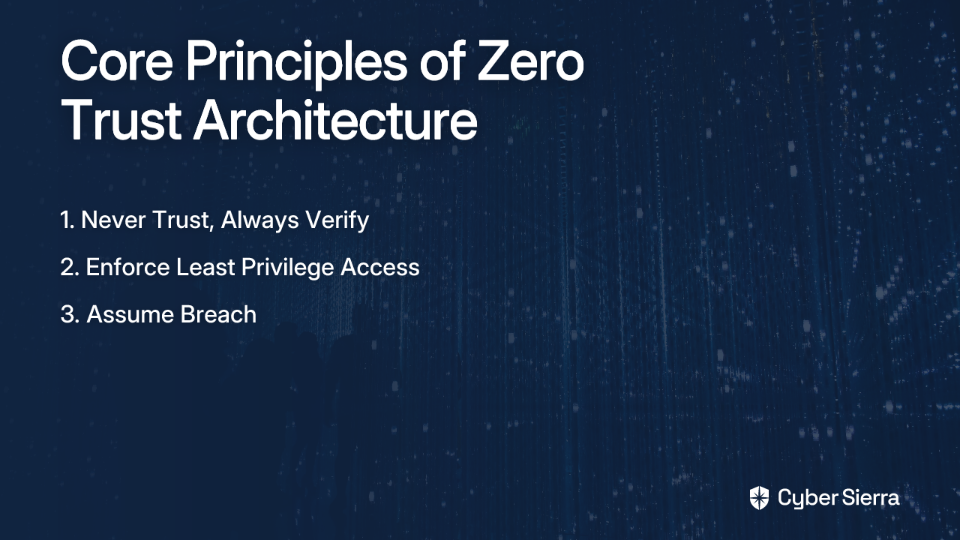
1. Never Trust, Always Verify

The cornerstone of Zero Trust is the elimination of implicit trust. Every connection, user, device, and application must be authenticated and authorized before access is granted—regardless of where the request originates or what resource it's trying to access.

As one security practitioner succinctly put it: "Trust no one, verify everyone."

2. Enforce Least Privilege Access

Users and systems should be granted the bare minimum permissions required to perform their specific tasks—nothing more. This principle directly addresses a common concern voiced by security professionals about "managing access and permissions effectively."

While some organizations find the least privilege principle challenging to implement, its importance cannot be overstated. By limiting what users can access, you dramatically reduce your attack surface.

3. Assume Breach

Zero Trust Architecture operates on the assumption that your environment is already compromised. This shifts focus from prevention alone to a balanced approach that includes detection, response, and containment of lateral movement.

This principle acknowledges the reality that despite best efforts, breaches will occur. The question isn't if, but when—and how well you can contain the damage.

The Multi-Cloud Conundrum: Why Yesterday's Security Fails Today

Multi-cloud environments present unique security challenges that traditional models simply cannot address. Understanding these challenges is crucial for implementing an effective Zero Trust strategy.
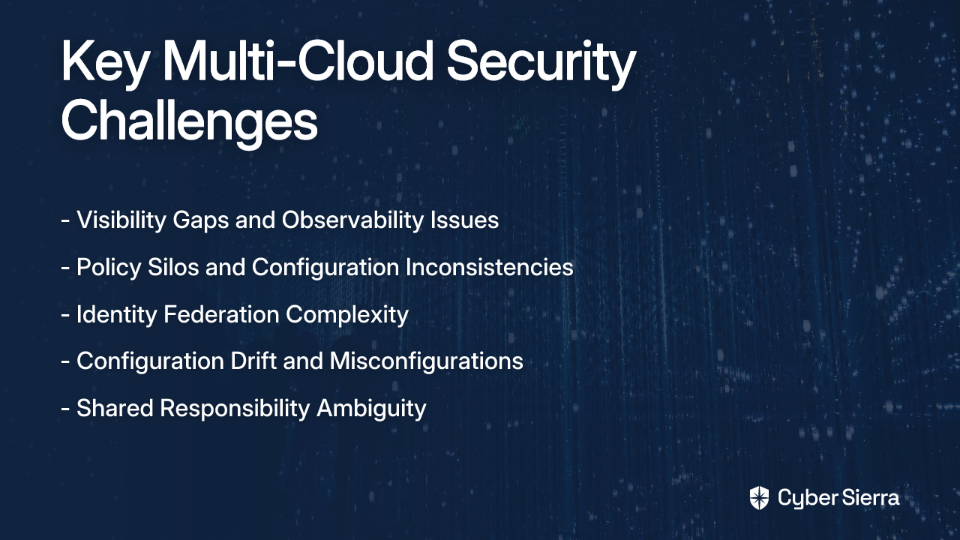
Visibility Gaps and Observability Issues

Each cloud provider has its own logging, monitoring, and alerting capabilities. AWS CloudTrail, Azure Monitor, and Google Cloud's Operations Suite all work differently, making it difficult to maintain a unified view of your security posture.

This fragmentation creates dangerous blind spots. As noted in Fortinet's Multi-Cloud Security Overview, without comprehensive visibility across all environments, threats can move undetected between clouds.

Policy Silos and Configuration Inconsistencies

AWS IAM, Azure RBAC, and GCP IAM all use different models and terminology for access control. This inconsistency makes it nearly impossible to implement unified security policies across clouds without additional tooling.

The Cloud Security Alliance highlights that these policy silos create significant security gaps, as permissions that seem reasonable in isolation may create dangerous privilege escalation paths when combined across clouds.

Identity Federation Complexity

Managing identities across multiple cloud providers is a technical challenge that frustrates many security teams. Without proper federation, you end up with identity sprawl—multiple credentials for the same user across different platforms, increasing both security risks and management overhead.

Configuration Drift and Misconfigurations

Cloud resources are created and modified constantly. Without strict governance, configurations drift from secure baselines over time. According to industry research, misconfigurations remain one of the leading causes of cloud security incidents.

A Reddit user expressed anxiety about this: "I'm concerned about missing crucial practices or insights," referring to the challenge of maintaining secure configurations across complex environments.

Shared Responsibility Ambiguity

Cloud providers operate on a shared responsibility model, but the boundaries aren't always clear. This confusion can lead to critical security controls being overlooked because each party assumes the other is handling them.

As one security professional noted, "Don't forget about physical security aspects of cloud providers. It's part of the shared responsibility model."

Your Step-by-Step Implementation Framework

Now that we understand the challenges, let's explore a practical, seven-step framework for implementing Zero Trust Architecture across multi-cloud environments. This framework is adapted from the official guidance in NIST SP 800-207 and enhanced with multi-cloud-specific considerations.
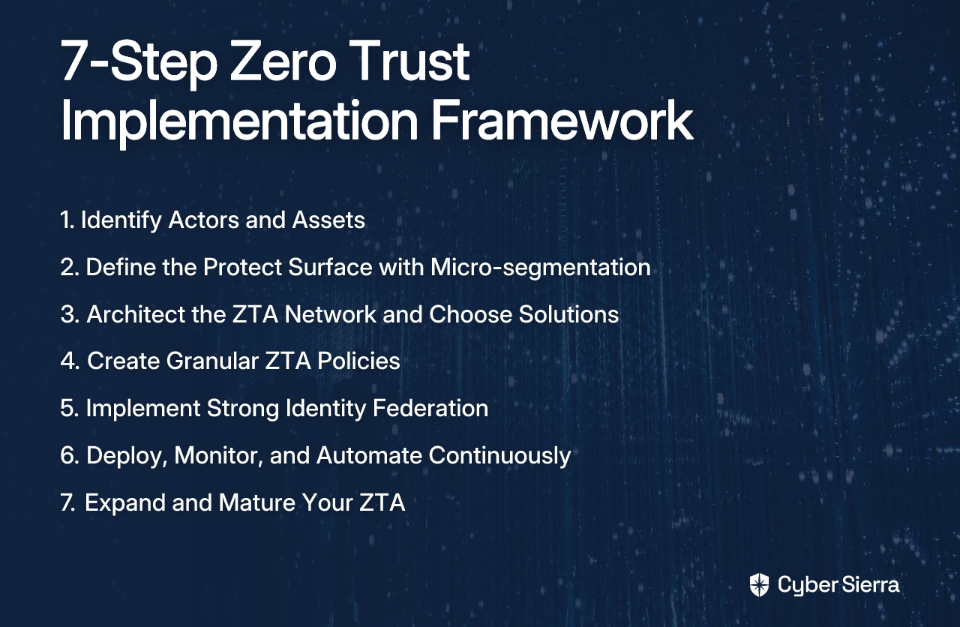
Step 1: Identify Actors and Assets

What to do: Create a comprehensive inventory of all users, service accounts, applications, and data across all cloud environments.

How to do it:

  • Use cloud-native discovery tools like AWS Config, Azure Resource Graph, and GCP Asset Inventory
  • Implement a Cloud Security Posture Management (CSPM) solution with multi-cloud support
  • Document sensitivity levels for data and criticality ratings for applications
  • Identify all user types: employees, contractors, partners, and service accounts

This step addresses the common pain of not knowing what exists across your multi-cloud environment. You can't protect what you don't know you have.

Step 2: Define the Protect Surface with Micro-segmentation

What to do: Break down your network into small, isolated segments to contain threats and limit lateral movement.

How to do it:

  • Implement network segmentation using cloud-native tools like Security Groups, Network Security Groups, and VPC Service Controls
  • Consider a service mesh like Istio or Linkerd for Kubernetes environments
  • Differentiate policy enforcement for North-South (client-to-server) traffic and East-West (server-to-server) traffic
  • Group resources by function, sensitivity, and data types rather than by cloud provider

According to Pomerium, effective micro-segmentation is essential in multi-cloud environments because it ensures that a breach in one area doesn't lead to lateral movement across your entire infrastructure.

Step 3: Architect the ZTA Network and Choose Solutions

What to do: Design your Zero Trust Architecture and select the technologies to implement it.

How to do it:

  • Understand the critical components of ZTA:
    • Policy Engine (PE): Makes access decisions based on all available information
    • Policy Administrator (PA): Executes policy decisions
    • Policy Enforcement Points (PEPs): Enforce access decisions at the resource level
  • Select technologies that work across all your cloud providers
  • Consider the reference architectures in NIST SP 1800-35, which includes implementations from 24 vendors including AWS, Cisco, Google Cloud, and Microsoft

For multi-cloud environments, look for solutions that can:

  • Integrate with all your cloud providers' identity systems
  • Provide consistent policy enforcement across environments
  • Offer unified visibility and centralized management

Step 4: Create Granular ZTA Policies

What to do: Formulate context-aware policies based on identity, device health, location, and other signals.

How to do it:

  • Adopt the principle of least privilege by default
  • Create attribute-based access control (ABAC) policies that consider:
    • User identity and role
    • Device security posture
    • Location and network
    • Time of day and behavioral patterns
    • Sensitivity of the requested resource
  • Ensure policies work consistently across cloud providers
  • Implement continuous authorization where access decisions are made on a per-request basis

As highlighted by Pomerium, in a true Zero Trust Architecture, "every access request is fully authenticated, authorized, and encrypted based on all available data points." This is particularly important in multi-cloud environments where context can vary significantly between platforms.

Step 5: Implement Strong Identity Federation

What to do: Create a unified identity foundation that works across all your cloud environments.

How to do it:

  • Implement a centralized identity provider that supports federation
  • Use standards like OIDC and SAML to create standardized identity brokers
  • Enable single sign-on (SSO) across all cloud platforms
  • Enforce multi-factor authentication (MFA) for all access
  • Consider passwordless authentication methods
  • Implement Just-In-Time (JIT) access provisioning

This step directly addresses user confusion about access management by providing a consistent identity experience regardless of which cloud environment they're accessing.

Step 6: Deploy, Monitor, and Automate Continuously

What to do: Deploy your architecture and implement continuous monitoring and automation.

How to do it:

  • Start with high-value, high-risk assets and gradually expand
  • Implement comprehensive logging across all environments
  • Use Security Information and Event Management (SIEM) solutions that support multi-cloud
  • Set up automated security audits and configuration checks
  • Create automated remediation workflows for common issues
  • Develop cross-cloud incident response playbooks

As one security professional on Reddit advised, "Automate security policies wherever possible. It reduces human error." This is particularly important in multi-cloud environments where the complexity can quickly become overwhelming without automation.

Step 7: Expand and Mature Your ZTA

What to do: Treat Zero Trust as an iterative process, continuously refining policies and expanding coverage.

How to do it:

  • Use frameworks like CISA's Zero Trust Maturity Model to assess your progress
  • Regularly review and update your policies
  • Expand Zero Trust to additional workloads and environments
  • Integrate new security technologies as they emerge
  • Conduct regular tabletop exercises to test your security posture
The Next Frontier: Operationalizing Zero Trust with AI

As multi-cloud environments grow in complexity, artificial intelligence and machine learning are becoming essential tools for operationalizing Zero Trust at scale.

Intelligent Monitoring and Anomaly Detection

AI can continuously analyze user behavior and network traffic across platforms to detect subtle anomalies that might indicate a breach. Unlike traditional rule-based systems, AI can adapt to changing patterns and identify novel threats.

The Cloud Security Alliance notes that AI-powered detection can identify threats that would be impossible to spot with conventional methods, especially in the complex, dynamic nature of multi-cloud environments.

User Behavior Analytics (UBA)

AI models can evaluate user interactions across all your cloud environments to identify deviations from normal behavior. For example, they can detect when a user who typically accesses resources in AWS suddenly attempts to access sensitive data in Azure using unusual access patterns.

This capability directly helps with the need for effective threat detection that many security professionals express anxiety about.

Dynamic Access Policies

Machine learning algorithms can adjust access rights and trust scores in real-time based on user behavior and context. For instance, a user accessing systems from an unusual location might face additional verification requirements or restricted access to sensitive resources.

Common Pitfalls and Pro Tips

Implementing Zero Trust Architecture in multi-cloud environments is challenging. Here are some common pitfalls to avoid and pro tips to increase your chances of success.

Pitfalls to Avoid

1. Continuing to rely on perimeter-based security measures

Many organizations implement Zero Trust components while maintaining their legacy perimeter-focused security. This creates confusion and can undermine your Zero Trust efforts. Instead, plan for a phased transition that eventually replaces perimeter-centric controls.

2. Forgetting to include third-party services and APIs

As NIST SP 800-207 warns, third-party services and APIs are often overlooked in Zero Trust implementations. These external connections can create backdoors into your environment if not properly secured.

3. Implementing Zero Trust in silos

Deploying Zero Trust separately in each cloud environment defeats the purpose of having a unified security approach. Instead, design your architecture to work consistently across all environments.

4. Neglecting the human factor

Zero Trust implementations often focus on technology while neglecting the human aspects. Without proper training and change management, users will find ways around security controls that they perceive as obstacles.

Pro Tips for Success

1. Engage stakeholders early

Zero Trust affects everyone in your organization. Engage stakeholders from different departments early to align security objectives with business goals and ensure buy-in.

2. Unify tools and standardize configurations

As advised by Fortinet, minimizing the number of security tools and standardizing configurations across clouds can significantly reduce complexity and security gaps.

3. Encrypt everything, everywhere

As one security expert emphatically stated on Reddit: "Encryption, encryption, encryption. At rest, in transit, always!" This is non-negotiable in a Zero Trust model, especially across multiple clouds.

4. Leverage proactive threat intelligence

Incorporate threat intelligence feeds into your Zero Trust architecture to stay ahead of emerging attack vectors. This is particularly important in multi-cloud environments where threat surfaces are expanded.

5. Document your architecture and controls

Maintain comprehensive documentation of your Zero Trust architecture, including the rationale behind design decisions. This documentation is invaluable for audits, compliance, and onboarding new team members.

Building a Resilient Future

Implementing Zero Trust Architecture in multi-cloud environments is not a simple task—it's a journey that requires strategic planning, technical expertise, and organizational commitment. But as traditional security models continue to fail against modern threats, this transition has become essential rather than optional.

By following the seven-step framework outlined in this guide and avoiding common pitfalls, you can create a security posture that's resilient, adaptive, and consistent across all your cloud environments. Remember that Zero Trust is not a destination but a continuous process of improvement and refinement.

As you embark on this journey, keep in mind the core principle of Zero Trust: never trust, always verify. Every access request, regardless of its source or destination, must be authenticated, authorized, and continuously validated.

In a world where the annual cost of cybercrime is projected to exceed $23 trillion by 2027, implementing Zero Trust Architecture across your multi-cloud environments isn't just a security best practice—it's a business imperative.

Frequently Asked Questions

What is Zero Trust Architecture in a multi-cloud environment?

Zero Trust Architecture (ZTA) in a multi-cloud environment is a security model that eliminates implicit trust and continuously validates every stage of a digital interaction. Instead of assuming everything behind the corporate firewall is safe, ZTA assumes no user or device is trustworthy by default, regardless of whether they are on AWS, Azure, GCP, or a corporate network. It operates on three core principles: never trust, always verify; enforce least privilege access; and assume breach.

Why are traditional security models ineffective for multi-cloud?

Traditional security models are ineffective for multi-cloud because they rely on a secure perimeter, which no longer exists in a distributed, multi-cloud world. These outdated models struggle with modern challenges such as visibility gaps between different cloud providers, inconsistent security policies (e.g., AWS IAM vs. Azure RBAC), complex identity management, and configuration drift, leaving significant security blind spots that attackers can exploit.

What is the first step to implementing Zero Trust across AWS, Azure, and GCP?

The first and most critical step to implementing Zero Trust across multi-cloud environments is to create a comprehensive inventory of all your actors and assets. This means identifying and cataloging every user, service account, application, and data store across AWS, Azure, and GCP. You cannot protect what you do not know you have, and this foundational visibility is essential for defining your protect surface and creating effective security policies.

How does Zero Trust unify security policies across different cloud IAM systems?

Zero Trust unifies security policies by creating a consistent layer of control that sits above the native Identity and Access Management (IAM) systems of each cloud provider. Instead of managing separate policies in AWS IAM, Azure RBAC, and GCP IAM, you use a central Policy Engine to create granular, attribute-based policies (e.g., based on user identity, device health, location). These policies are then applied consistently by Policy Enforcement Points (PEPs) deployed across all your cloud environments, ensuring uniform security regardless of the underlying platform.

How can you manage different user identities across multiple clouds with Zero Trust?

You can manage user identities across multiple clouds by implementing a strong, centralized identity federation. This involves using a single identity provider (IdP) as the authoritative source for user identities. By leveraging standards like SAML and OIDC, you can enable Single Sign-On (SSO) and enforce universal Multi-Factor Authentication (MFA) for all users, providing a seamless and secure access experience. This approach eliminates identity sprawl and ensures that a single, secure identity is used for each user across all platforms.

Is implementing Zero Trust a one-time project?

No, implementing Zero Trust is not a one-time project but an ongoing strategic journey. It is an iterative process that requires continuous monitoring, refinement, and adaptation. As your multi-cloud environment evolves and new threats emerge, your ZTA policies and controls must be regularly reviewed and updated. Using frameworks like the CISA Zero Trust Maturity Model can help you measure progress and plan for future enhancements.


Ready to start implementing Zero Trust in your multi-cloud environment? Begin by inventorying your assets and users across all clouds, then gradually implement the remaining steps of the framework. Remember that even small improvements in your security posture can significantly reduce your risk exposure.

blog-hero-background-image
Cyber Security

How to Secure Private LLMs Using OWASP Top 10 Framework

backdrop
Table of Contents

Join thousands of professionals and get the latest insight on Compliance & Cybersecurity.


You've deployed a private Large Language Model (LLM) to maintain control over your organization's sensitive data. But at night, you can't help wondering: Is it really secure? The nagging feeling that your LLM implementation might be as vulnerable as "a web app in the early 2000s" keeps you up.

You're not alone. The rapid adoption of LLMs has created a security landscape filled with uncertainty, potential data breaches, and a concerning lack of established security frameworks. Many organizations are frantically asking the same questions:

  • "How do we protect against unauthorized access?"
  • "Have we properly sanitized inputs and outputs?"
  • "What resources can our LLM access, and with what permissions?"
  • "How do we ensure our intellectual property stays protected?"

Fortunately, there's now a systematic approach to addressing these concerns. This article introduces the OWASP Top 10 for Large Language Model Applications – a powerful framework that serves as the foundation for your LLM security strategy.

Why Private LLMs Need Specialized Security

Private LLMs have become essential for enterprises that need to:

  • Maintain complete control over sensitive data
  • Ensure compliance with regulations like GDPR and HIPAA
  • Protect valuable intellectual property
  • Create customized AI solutions based on proprietary data

But these benefits come with significant security challenges. According to discussions in cybersecurity forums, many organizations are struggling with implementing effective controls, conducting proper access reviews, and establishing comprehensive security protocols for their LLM implementations.

The traditional web application security playbook isn't sufficient. LLMs introduce entirely new attack surfaces and vulnerabilities that require specialized security approaches.

Why the OWASP Top 10 for LLMs is Your Essential Threat Model

The original OWASP Top 10 has long served as the gold standard for web application security. It's a globally recognized framework that identifies the most critical security risks, with findings like A03:2021-Injection affecting 94% of tested applications.

Now, the security community has developed a comparable framework specifically for LLM applications: The OWASP Top 10 for Large Language Model Applications. This community-driven framework identifies the unique risks that LLMs face and provides concrete mitigation strategies for each.

As one security professional advised in a recent discussion: "Use the OWASP LLM Top 10 for the basis of a threat model and your controls." This framework is the perfect starting point for anyone asking, "What else can be done to secure LLMs?"

Let's dive into these critical risks and explore how to mitigate them.

The OWASP Top 10 for LLM Applications: Risks and Mitigations

LLM01: Prompt Injection

What it is: Attackers manipulate the LLM through carefully crafted inputs to make it perform unintended actions or reveal sensitive information. This is the number one threat in the OWASP LLM Top 10 framework.

Types of Attacks:

  • Direct Attack: A malicious user inserts harmful commands directly in their prompt
  • Indirect Attack: The LLM processes harmful instructions from an external, compromised source (like a website or document)

Real-World Example: Users discovered they could bypass content restrictions in ChatGPT by asking it to "ignore previous instructions" and then issuing new commands.

Mitigation Strategies:

  • Implement a human-in-the-loop for approval of high-risk actions
  • Constrain the model's behavior with clear, specific instructions in the system prompt
  • Implement input validation and sanitization before prompts reach the model
  • Create a robust permission system to limit what actions the LLM can perform

LLM02: Insecure Output Handling

What it is: Failing to validate and sanitize LLM outputs before they are passed to downstream systems or presented to users.

Why it's dangerous: A malicious output could contain executable code (JavaScript, SQL) that gets processed by another part of your application, leading to cross-site scripting (XSS) or SQL injection in backend systems.

Mitigation Strategies:

  • Treat all LLM outputs as untrusted user input
  • Apply strict output validation and sanitization
  • Encode outputs before passing them to other systems
  • Use sandboxing techniques to isolate potentially dangerous outputs

As one security professional noted: "Have I sanitized input, have I sanitized output" should be fundamental questions in your LLM security checklist.

LLM03: Training Data Poisoning

What it is: Malicious actors tamper with the training data to introduce vulnerabilities, biases, or backdoors into the model.

Why it's dangerous: Can fundamentally compromise the model's security, accuracy, and ethical behavior from the inside out.

Mitigation Strategies:

  • Verify the legitimacy and track the origin of all training data sources
  • Use a mix of trusted and untrusted data sources and compare model performance
  • Implement data sanitization pipelines to detect and remove suspicious patterns
  • Regularly cross-check model output against ground-truth references to detect anomalies

LLM04: Model Denial of Service

What it is: Overloading the LLM with a high volume of complex requests, causing service degradation or failure and incurring high operational costs. Also known as Unbounded Consumption.

Why it's dangerous: Disrupts service availability and can lead to unexpectedly high compute bills.

Mitigation Strategies:

  • Implement strict rate limiting and API gateways
  • Validate request sizes and complexity
  • Cap resource usage per user or request
  • Set up monitoring systems to detect unusual usage patterns

LLM05: Supply Chain Vulnerabilities

What it is: Using compromised or vulnerable third-party components, pre-trained models, or datasets in your LLM pipeline.

Why it's dangerous: A vulnerability in any component can compromise the entire system.

Mitigation Strategies:

  • Carefully vet all external data sources, pre-trained models, and libraries
  • Maintain a Software Bill of Materials (SBOM) for all components
  • Use tools to scan for known vulnerabilities in dependencies
  • Regularly update and patch all components in your LLM infrastructure

LLM06: Sensitive Information Disclosure

What it is: The LLM inadvertently revealing confidential data such as personally identifiable information (PII), trade secrets, or financial information in its responses.

Why it's dangerous: Leads to data breaches, privacy violations, regulatory non-compliance, and loss of competitive advantage.

Mitigation Strategies:

  • Implement robust data sanitization and masking techniques for training data
  • Use strict input/output validation to filter for sensitive information patterns
  • Fine-tune the model to refuse to answer questions that might lead to revealing sensitive information
  • Apply differential privacy techniques to protect individual data points

LLM07: Insecure Plugin Design

What it is: LLM plugins that process untrusted inputs without adequate access controls or validation, potentially allowing attackers to execute unauthorized commands.

Why it's dangerous: A compromised plugin can become a pivot point for an attacker to execute code, access sensitive data, or perform unauthorized actions.

Mitigation Strategies:

  • Enforce the principle of least privilege for all plugins
  • Establish strict access controls and require user authorization for sensitive actions
  • Perform rigorous security vetting of all third-party plugins
  • Validate and sanitize all inputs passed to plugins

This directly addresses the common concern: "What resources can this access and with what permissions?" By implementing proper plugin security, you ensure that LLMs can only access authorized resources with appropriate permissions.

LLM08: Excessive Agency

What it is: Granting an LLM too much autonomy or too many permissions, allowing it to take unintended, potentially harmful actions without sufficient oversight.

Why it's dangerous: An LLM with excessive agency could send unauthorized emails, delete files, or make unauthorized purchases without human oversight.

Mitigation Strategies:

  • Restrict the LLM's functionality and permissions to only what is absolutely necessary
  • Require human confirmation for any significant or irreversible action
  • Implement robust logging and monitoring to track all actions taken by the LLM
  • Create clear boundaries for what the LLM is and is not allowed to do

LLM09: Overreliance & Misinformation

What it is: Users and systems making critical decisions based on inaccurate, misleading, or "hallucinated" LLM outputs without proper verification.

Why it's dangerous: Can lead to poor decision-making, reputational damage, and legal liabilities if incorrect information is acted upon.

Mitigation Strategies:

  • Implement a human review process for all critical decisions based on LLM outputs
  • Use Retrieval-Augmented Generation (RAG) to ground the model's responses in factual, verifiable data sources
  • Clearly communicate to users that LLM outputs may be inaccurate and should be verified
  • Develop systems to detect and flag potential hallucinations or factual inconsistencies

LLM10: Model Theft

What it is: Unauthorized access, copying, or extraction of a proprietary LLM and its weights, potentially through model extraction attacks.

Why it's dangerous: Results in the loss of significant financial investment, competitive advantage, and intellectual property.

Mitigation Strategies:

  • Implement strong access control policies for the model and its infrastructure
  • Use watermarking techniques to trace the origin of the model
  • Employ robust monitoring to detect and alert on unusual access patterns or data exfiltration attempts
  • Consider deploying the model as an API rather than distributing the model itself

Building a Secure Foundation: Architectural & Procedural Controls

Beyond addressing individual vulnerabilities, building a comprehensive security framework for your private LLM requires architectural and procedural controls that create multiple layers of protection.

Secure by Design: A Comprehensive Approach

Following the principles outlined in Google's Secure AI Framework, your LLM deployment should be secure by design from the ground up:

  1. Define Clear Objectives and Threat Models: Begin by clearly defining what your LLM will and won't do, and use the OWASP Top 10 for LLMs to model potential threats.
  2. Implement Secure Data Collection and Preprocessing: Ensure that all training data is properly vetted, cleaned, and protected. As detailed in Airbyte's guide on building private LLMs, proper data collection is fundamental to security.
  3. Establish Robust Security Controls: Implement comprehensive security measures across your entire LLM infrastructure, from training to deployment.
  4. Enable Continuous Monitoring: Set up systems to continuously monitor your LLM's behavior, performance, and security posture.

Architectural Safeguards

Network Isolation: Many security professionals recommend "isolating LLM in a local network" as a primary defense mechanism. By restricting network connectivity, you can significantly reduce the attack surface.

Trusted Execution Environments (TEEs): Consider implementing TEEs to protect data even when it's being processed, ensuring that even administrators cannot access sensitive information.

Federated Learning & Differential Privacy: These techniques allow you to train models collaboratively without exposing raw sensitive data, enhancing privacy while still leveraging diverse data sources.

Robust Access Control & Monitoring

Implement Multi-Factor Authentication (MFA): Require MFA for all access to LLM systems, addressing the classic OWASP risk A07:2021-Identification and Authentication Failures.

Conduct Periodic Access Reviews: As recommended in security forums, establish a formal policy for "periodic access review" to ensure that only authorized personnel maintain access to your LLM systems.

Comprehensive Logging and Monitoring: Implement robust logging of all LLM interactions, addressing A09:2021-Security Logging and Monitoring Failures from the classic OWASP list.

The Human Element: Training and Governance

Security Awareness with Ethical Focus: Directly addressing recommendations from the security community, develop "security awareness with a focus on the ethical usage of private LLMs" for all personnel.

Clear Usage Policies: Establish and communicate clear policies on appropriate use cases, handling of sensitive data, and escalation procedures for security concerns.

Regular Training: Ensure that all developers, administrators, and users receive regular training on the risks outlined in the OWASP LLM Top 10 and your organization's specific security protocols.

Conclusion: From Vulnerability to Vigilance

Securing private LLMs is not a one-time task but an ongoing discipline that requires vigilance, adaptation, and a comprehensive approach. By using the OWASP Top 10 for LLMs as your foundation for threat modeling and control implementation, you can systematically address the unique security challenges that these powerful AI systems present.

The goal is to move from a reactive to a proactive security posture, embedding security into every stage of the LLM lifecycle—from data collection and model training to deployment and ongoing operation.

Remember that as LLM technology evolves, so too will the security landscape. Stay informed about emerging threats and best practices by engaging with the security community and following updates to frameworks like the OWASP Top 10 for LLMs.

By combining technical controls, architectural safeguards, robust policies, and human awareness, you can harness the tremendous power of private LLMs while keeping your organization's data, systems, and reputation secure.

The days of LLM security feeling like "a web app in the early 2000s" are coming to an end. With frameworks like the OWASP Top 10 for LLMs, we now have the tools we need to build a more secure AI future.

Frequently Asked Questions (FAQ)

What is the OWASP Top 10 for Large Language Model Applications?

The OWASP Top 10 for LLMs is a security framework that identifies the ten most critical security risks facing applications that use Large Language Models. It serves as a guide for developers, security professionals, and organizations to understand and mitigate the unique vulnerabilities introduced by LLM technology, such as prompt injection, insecure output handling, and training data poisoning.

Why is prompt injection the number one risk for LLMs?

Prompt injection is the top risk because it allows attackers to bypass an LLM's safety features and instructions by manipulating its input. This can trick the model into performing unintended actions, revealing sensitive information, or executing malicious commands, making it a fundamental threat to the security and integrity of any LLM-powered application.

How can I protect my LLM from training data poisoning?

You can protect your LLM from training data poisoning by implementing a multi-layered data verification strategy. This includes vetting all data sources, using data sanitization pipelines to filter for suspicious content, cross-checking model performance against trusted benchmarks, and maintaining a clear record of data provenance to ensure the integrity of your training set.

What is the difference between securing a traditional web app and an LLM application?

Securing an LLM application differs from a traditional web app because it involves entirely new attack surfaces centered on the model itself. While web apps face risks like SQL injection and XSS (which can still be relevant in LLM apps via insecure output handling), LLMs introduce unique threats like prompt injection, model theft, and training data poisoning that require specialized security controls and threat models.

How do I prevent my private LLM from leaking sensitive data?

To prevent a private LLM from leaking sensitive data, you must implement robust data sanitization and masking on both the training data and user inputs. Additionally, use strict output validation to filter responses for sensitive information patterns, fine-tune the model to refuse requests that could lead to data disclosure, and apply techniques like differential privacy to protect individual data points.

Where should I start when securing my private LLM?

The best place to start securing your private LLM is by using the OWASP Top 10 for LLMs as the basis for a threat model. This framework will help you identify the most significant risks specific to your application. From there, you can prioritize implementing foundational controls like input/output sanitization, strict access controls, network isolation, and continuous monitoring.


This article serves as an introduction to securing private LLMs using the OWASP framework. For a deeper dive into specific implementation details, consult the official OWASP Top 10 for Large Language Model Applications documentation and stay updated on emerging best practices in this rapidly evolving field.

blog-hero-background-image
Cyber Security

The CISO Scapegoat Problem: 3 Ways to Protect Your Career

backdrop
Table of Contents

Join thousands of professionals and get the latest insight on Compliance & Cybersecurity.


You've spent years climbing the cybersecurity ladder, finally earning that coveted CISO title. But instead of feeling accomplished, you're drowning in a sea of unrealistic expectations, constant budget battles, and the looming threat that when (not if) a breach occurs, you'll be the first one shown the door.

It's a thankless job. You're constantly fighting for budget because you're seen as an expense rather than an asset. You struggle with IT initiatives that don't include security up front. And at the end of the day, you hold all the risk.

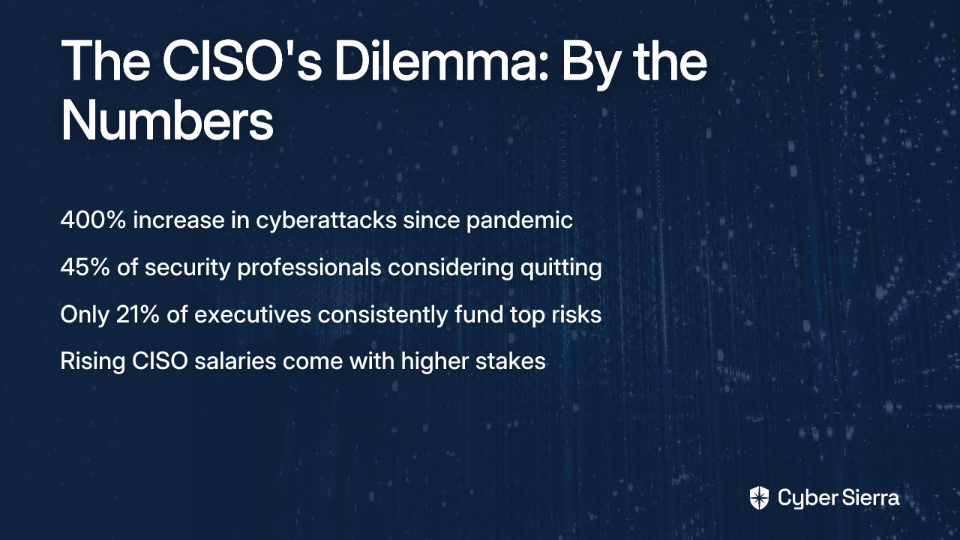
The numbers paint a grim picture of the modern CISO's plight:

  • The FBI reports a 400% increase in cyberattacks since the pandemic began, amplifying the pressure on security leaders
  • 45% of cybersecurity professionals are considering quitting due to stress and burnout
  • Only 21% of executives consistently allocate budget to address top organizational risks
  • While the median CISO salary has risen to around $386,000, so have the personal and professional stakes

As one security leader candidly put it on Reddit: "Your bastard CEO boss doesn't listen to you, only when the company gets in trouble through a breach do they shoot the blame to you and you get f***ed."

There's a term for this phenomenon: the CISO Scapegoat Problem.

But it doesn't have to be this way. This article outlines three proven strategies that won't just help you survive in the CISO role—they'll help you thrive by transforming your position from potential scapegoat to indispensable strategic leader.

Strategy 1: Fortify Your Position with an Ironclad Governance Framework

When things go wrong, the first question that gets asked is: "Did the CISO do everything reasonably possible to prevent this?" Your best defense is a well-documented, compliant, and risk-based security program that shifts the conversation from personal blame to programmatic rigor.

Implement an Integrated GRC Framework

Start by integrating Governance, Risk, and Compliance (GRC) strategies to create a holistic and defensible security posture. This means:

  • Establishing clear, written documentation of all security policies and procedures
  • Conducting and recording regular risk assessments to identify and track vulnerabilities
  • Ensuring and documenting compliance with relevant frameworks like the NIST Cybersecurity Framework or ISO standards

As outlined in the federal CISO Handbook, "Documentation gives the CISO a vehicle for communicating how the program aligns to requirements and addresses agency-specific risks." In other words, documentation isn't just bureaucracy—it's your shield.

Master the Art of Documentation & Reporting

Maintain meticulous records of:

  • Policy compliance and exceptions (with business justifications)
  • Risk assessments and audit results
  • Budget requests and their outcomes (especially rejected security initiatives)
  • Incident response activities and lessons learned

This creates a paper trail that can defend your decisions and demonstrate diligence. For example, the annual federal CISO reporting schedule includes quarterly FISMA reports, annual HVA reporting, and more. While your organization may not require this level of formality, adopting similar disciplined reporting demonstrates rigor and professionalism.

Adopt a Strategic, Risk-Based Approach

Move beyond checkbox compliance to a mature, risk-based program where:

  • Security controls are prioritized based on actual, quantifiable threats to the business
  • Investments are tied directly to risk reduction
  • Decisions about acceptable risk are documented and approved by business leadership

This approach helps focus limited resources on the most critical areas, providing a clear rationale for why certain IT initiatives were prioritized over others. It also shifts risk acceptance decisions to the appropriate business owners, reducing your personal exposure.
Strategy 2: Translate Cyber Risk into Business Value

Many CISOs struggle because they're seen as technical gatekeepers rather than business enablers. One Reddit user observed that "CISOs have to sell security and the benefits thereof to stakeholders, full stop." To avoid being perceived as merely a cost center:

Speak the Language of the C-Suite and Board

Frame cyber risks as business risks. Instead of discussing vulnerabilities and threats, talk about:

  • Potential impact on revenue streams
  • Reputational damage and customer trust
  • Regulatory implications and compliance costs
  • Competitive advantages of strong security posture

This is increasingly important as 61% of CISOs no longer report to the CIO but have direct lines to the CEO or board, according to Splunk's research. With this elevated visibility comes the need for more sophisticated communication.

Use Data and Metrics to Demonstrate ROI

Utilize data to quantify the effectiveness of security measures:

  • Track metrics that matter to the business (not just technical indicators)
  • Develop a security dashboard that shows trends over time
  • Quantify cost avoidance from prevented attacks
  • Demonstrate how security enables new business ventures

As AuditBoard notes, "CISOs who can translate technical risks into business impacts position themselves as strategic leaders rather than operational managers."

Build Strategic Alliances

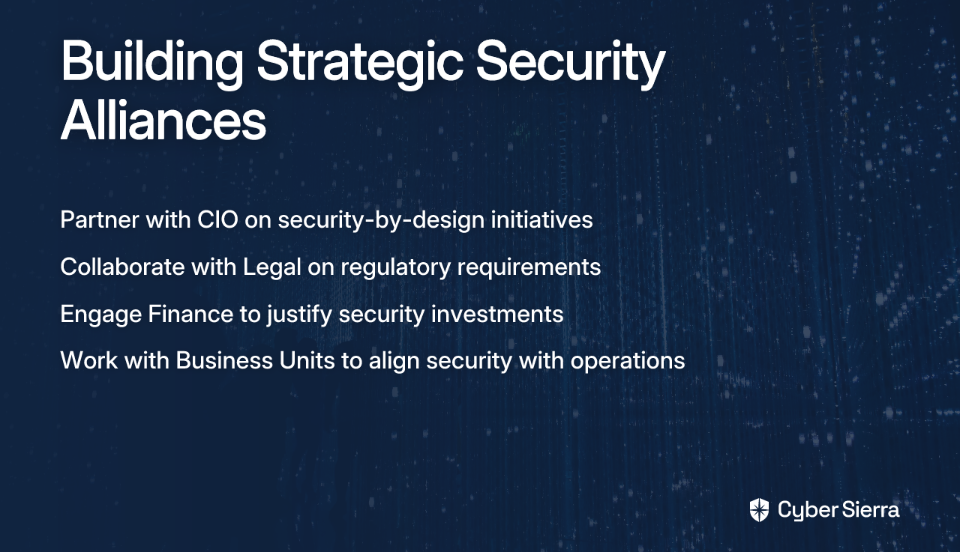
Forge strong relationships with leaders in IT, legal, finance, and operations. This creates a collaborative security culture where responsibility is shared:

  • Partner with the CIO on technology initiatives to ensure security is built in from the start
  • Work with legal counsel to understand regulatory requirements and liability issues
  • Collaborate with finance to develop business cases that justify security investments
  • Engage business units to understand operational needs and tailor security solutions

When security is seen as a shared goal rather than "the CISO's problem," you are less likely to be singled out as the sole point of failure. As one CISO mentioned: "You could be a rock solid CISO, with an org that doesn't value security so everything you try to do is moving uphill." Building these alliances helps change that organizational mindset.
Strategy 3: Insulate Yourself from Personal Liability

The stakes for CISOs have never been higher. The role now comes with significant personal risk, as illustrated by high-profile cases where security leaders faced legal consequences following breaches.

Investigate Directors & Officers (D&O) Liability Insurance

This is a critical, tangible step. Explore options for personal directors and officers (D&O) liability insurance as part of your compensation and employment package. According to Forbes, "The best security leaders know how to protect themselves first—think of it as putting on your own oxygen mask before helping others."

Ask specific questions during contract negotiations:

  • Does the company's D&O policy explicitly cover the CISO role?
  • What are the coverage limits and exclusions?
  • Will the company continue to cover legal expenses even after employment ends?
  • Is there tail coverage for claims that arise after you've left the company?

Learn from Cautionary Tales: The Uber CISO Case

The former Chief Security Officer of Uber was convicted of obstruction of justice for his role in covering up a data breach. This landmark case sets a precedent and underscores the importance of transparent, ethical, and well-documented incident response.

The lesson? Your documentation from Strategy 1 isn't just organizational CYA—it's personal protection.

Recognize the Red Flags and Know When to Walk Away

Be able to identify a toxic or unsustainable environment. Signs include:

  • Consistent lack of leadership support for critical security initiatives
  • Refusal to provide adequate budget despite documented high risks
  • Expectations to certify compliance without proper controls in place
  • A culture that actively resists security measures or transparency

Sometimes the best career move is to recognize when a situation is untenable and be willing to walk away before a catastrophic event occurs.

From Scapegoat to Strategic Leader

The CISO role is undeniably challenging, but it doesn't have to be a fast track to burnout or the unemployment line. By implementing these three core strategies:

  1. Building a Defensible Program with robust governance and documentation
  2. Demonstrating Business Value by aligning with strategy and communicating effectively
  3. Protecting Yourself Personally through insurance and understanding legal risks

...you can shift the narrative from being a potential scapegoat to being an indispensable strategic leader who enables and protects the business.

The best CISOs don't just survive—they thrive by transforming security from a cost center to a business enabler, from a technical function to a strategic advantage, and from a personal liability to a platform for organizational leadership.

Remember: your job isn't just to secure the enterprise—it's to secure your career while doing so.

Frequently Asked Questions

What is the CISO scapegoat problem?

The CISO scapegoat problem refers to the trend where a Chief Information Security Officer is blamed and often fired following a significant security breach, regardless of whether they had the necessary support or resources to prevent it. This situation arises when organizations view the CISO as the sole person responsible for security, rather than treating it as a shared business risk. CISOs often face challenges like inadequate budgets, lack of executive buy-in, and unrealistic expectations, yet they are the first to be held accountable when an incident occurs.

How can a CISO avoid becoming a scapegoat?

A CISO can avoid becoming a scapegoat by implementing three key strategies: building a defensible governance framework, translating cyber risk into tangible business value, and securing personal liability protection. This involves meticulously documenting all security activities, risks, and decisions; communicating with the C-suite in terms of business impact and ROI; and ensuring you are personally protected with measures like Directors & Officers (D&O) insurance. The goal is to shift from being a technical scapegoat to an integrated strategic leader.

Why is a GRC framework crucial for a CISO's success?

A Governance, Risk, and Compliance (GRC) framework is crucial because it provides a documented, defensible, and risk-based structure for the entire security program. This framework helps a CISO prove they took all reasonable measures to protect the organization and shifts the focus from personal blame to programmatic diligence. By establishing clear policies, conducting regular risk assessments, and ensuring compliance, the GRC framework creates a paper trail that justifies security decisions and demonstrates rigor, which is invaluable during a crisis.

How can CISOs demonstrate the business value of cybersecurity?

CISOs can demonstrate business value by framing cybersecurity in the language of the C-suite—focusing on business risks, revenue impact, and competitive advantage, rather than purely technical metrics. This means translating technical vulnerabilities into potential financial losses, reputational damage, or regulatory fines. Use data to show the ROI of security investments, such as cost avoidance from prevented attacks or how a strong security posture enables new business initiatives.

What legal protections should a CISO have?

The most critical legal protection a CISO should have is personal liability coverage through a Directors & Officers (D&O) insurance policy. Given the increasing personal liability placed on security executives, as seen in cases like the Uber CISO conviction, D&O insurance is essential. During contract negotiations, a CISO should confirm that the company's policy explicitly covers their role, understand the coverage limits, and inquire about "tail coverage" for claims that may arise after leaving the company.

What are the warning signs of a toxic environment for a CISO?

Key warning signs include a consistent lack of leadership support, refusal to provide adequate budget for documented risks, a culture that resists security measures, and pressure to certify compliance without the necessary controls in place. If your well-reasoned budget requests are repeatedly denied, if business units actively work around security protocols, or if the executive team is not engaged in security discussions, you are likely in an unsustainable position. Recognizing these red flags is crucial, as sometimes the best strategic move is to leave an organization before a major incident occurs.

blog-hero-background-image
Cyber Security

Why Your CISO Shouldn't Report to Your CIO

backdrop
Table of Contents

Join thousands of professionals and get the latest insight on Compliance & Cybersecurity.


Imagine having your chief watchdog report directly to the person they're supposed to be watching. Sound like a recipe for disaster? That's exactly the scenario playing out in organizations where the Chief Information Security Officer (CISO) reports to the Chief Information Officer (CIO).

"You are the chief watchdog of the tech department. Reporting to the person you are watching almost never works out," notes one cybersecurity professional in a recent online discussion. This sentiment isn't just anecdotal—it's backed by research and real-world experience that consistently shows this reporting structure creates fundamental problems for effective security governance.

Yet despite expert warnings, this flawed model persists. A 2020 Deloitte study found that 62% of CISOs reported to CIOs or CTOs—a significant increase from 38% in 2019 and 20% in 2018. This trend is moving in precisely the wrong direction, creating organizational blind spots that leave companies vulnerable.

The Inherent Conflict of Interest

At its core, this reporting structure creates an unavoidable conflict of interest. The CIO's primary mission centers on system availability, performance, speed of delivery, and cost-effectiveness. Meanwhile, the CISO's mission focuses on risk management, protection, and resilience.

These priorities naturally clash in several critical ways:

Budgetary Battles

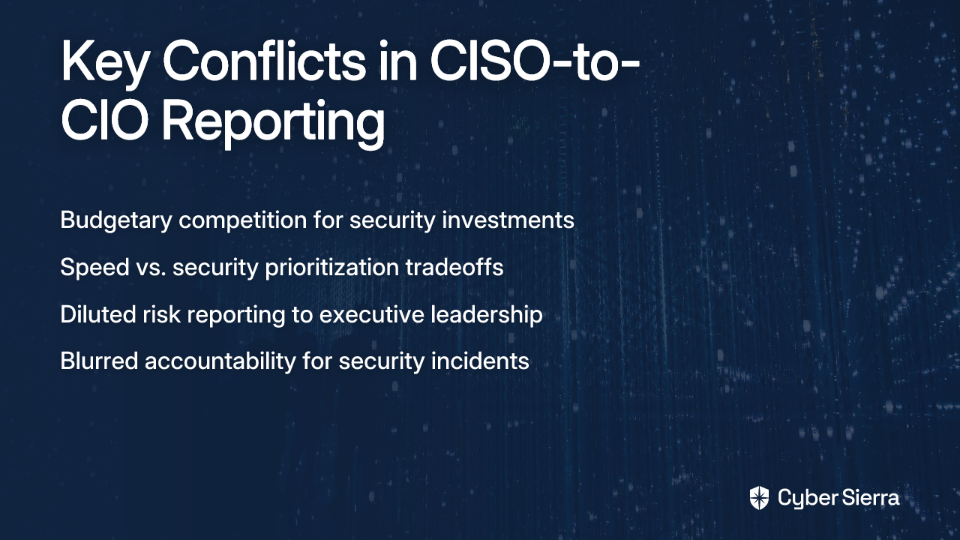
When the CISO's budget exists as a line item in the CIO's financial plan, crucial security investments (like a new endpoint detection and response solution) must compete directly with IT operational needs (such as server upgrades or new software licenses). In this competition, security initiatives often lose out.

Operations vs. Security Prioritization

CIOs face constant pressure to deliver new capabilities quickly and maintain high system uptime. This can lead to scenarios where a CIO might push to delay critical patching to avoid system downtime or fast-track a new application launch without adequate security testing to meet a business deadline.

"The CISO shouldn't be reporting to the CIO in the first place - they have a natural inherent tension already," explains another security professional. This tension isn't necessarily bad—it's actually necessary for proper checks and balances. However, when one reports to the other, that healthy tension becomes imbalanced.

Diluted Risk Reporting

Perhaps most concerning is how this structure can dilute critical security information. A CISO reporting to a CIO may feel pressured to soften or downplay security audit findings to avoid making their boss's department look bad. This prevents unfiltered, objective risk assessments from reaching the CEO and board—exactly the people who need this information most.

The Scapegoat Dilemma

The CISO-to-CIO reporting structure creates another insidious problem: blurred accountability. When a security incident occurs, who's really responsible? Was it the CISO's failure to implement proper controls, or the CIO's failure to approve the budget for those controls?

This ambiguity creates what many security professionals describe as a scapegoat scenario. As one CISO bluntly put it, "Regardless of how good you are at your job as CISO, YOU WILL get blamed for most security-related incidents even if they are the fault of a shitty superior."

Instead of fostering a "no-blame culture" that encourages transparency and proactive risk reporting, this structure can create a culture of fear. Security teams may become hesitant to raise concerns, knowing they could become the fall person if something goes wrong. This directly contradicts best practices in security governance, where open communication about vulnerabilities is essential.

What the Data Shows

The impact of reporting structures isn't just theoretical—it's measurable. Research consistently shows that organizations with independent CISO reporting lines demonstrate better security outcomes.

A study by ISACA found a stark difference in security confidence based on reporting lines. Approximately 40% of respondents whose cybersecurity functions report to a CISO felt confident in their ability to detect and respond to threats, compared to only 31% for those reporting to a CIO.

Additionally, research from Nemertes Research concludes that greater cybersecurity success correlates directly with the CISO reporting to top-level business executives (like the CEO) rather than a technology executive.

Board engagement also plays a crucial role. Companies with a CISO are nearly twice as likely to improve security initiatives through board engagement, according to CSO Online. This engagement becomes diluted when security concerns must filter through the CIO before reaching the board.

The Blueprint for Effective Governance

So what's the alternative? Security experts and researchers point to several more effective reporting structures:

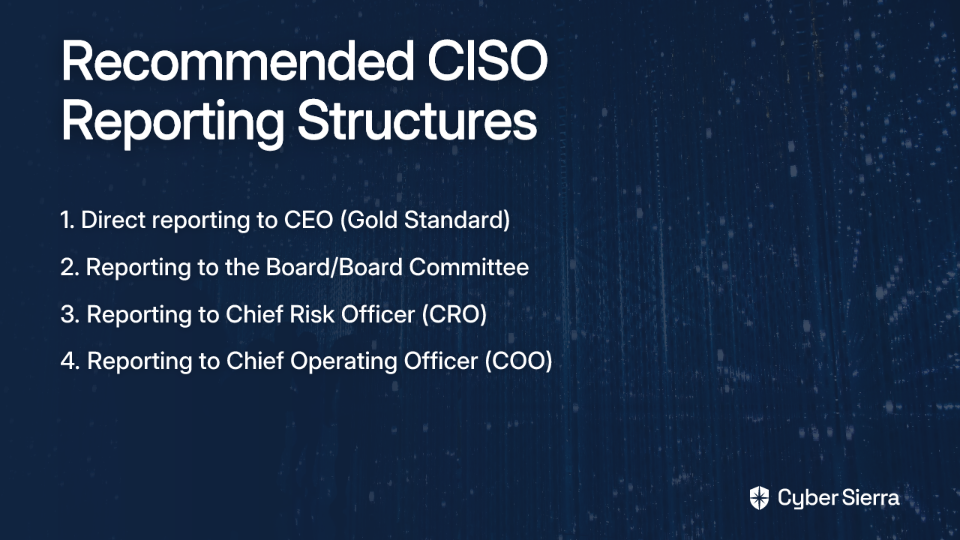
The Gold Standard: CISO Reporting to the CEO

This is widely considered the most effective option. It positions cybersecurity as a core business function and an enterprise-wide risk management issue, not just an IT problem. It gives the CISO the necessary authority and resources, and ensures the CEO receives unfiltered information about the organization's security posture.
"In an ideal world: Always to the CEO and not the CIO/CTO," states one security professional. This structure acknowledges that modern cybersecurity is a business risk that transcends technology.

Alternative Effective Structures

If reporting to the CEO isn't feasible, several other options still maintain the CISO's independence:

CISO to the Board/Board Committee: This provides the highest level of oversight and independence. As one cybersecurity professional warned, "When you see CISO reporting to CIO and not to the board, run. Run as fast as you can."
CISO to the Chief Risk Officer (CRO): This is a strong option for organizations with a mature enterprise risk management program. It correctly frames cyber risk as a component of overall business risk.

CISO to the Chief Operating Officer (COO): This structure recognizes that cybersecurity is a vital operational necessity, essential for business continuity. It gives the CISO independence from IT priorities while maintaining executive visibility.

Foundations of Good Governance

An effective reporting structure is part of a larger governance strategy. According to the Cybersecurity and Infrastructure Security Agency (CISA), strong cybersecurity governance includes defined accountability frameworks, decision-making hierarchies, and a clear understanding of risks related to business objectives.

Case studies from states like Georgia and Michigan demonstrate how to build enterprise-wide governance that properly positions security leadership.

Restructuring for Resilience

The CISO-to-CIO reporting line is an organizational anti-pattern that creates conflicts of interest, stifles accountability, and demonstrably leads to weaker security outcomes. As cyberattacks become more sophisticated and damaging, organizations cannot afford to maintain structures that undermine their security posture.

Elevating the CISO to a peer of the CIO, reporting directly to the CEO, CRO, or the board, is not just a change to the org chart—it's a strategic declaration that the organization takes cybersecurity seriously. It acknowledges that in today's threat landscape, security is a business imperative that deserves its own seat at the executive table.

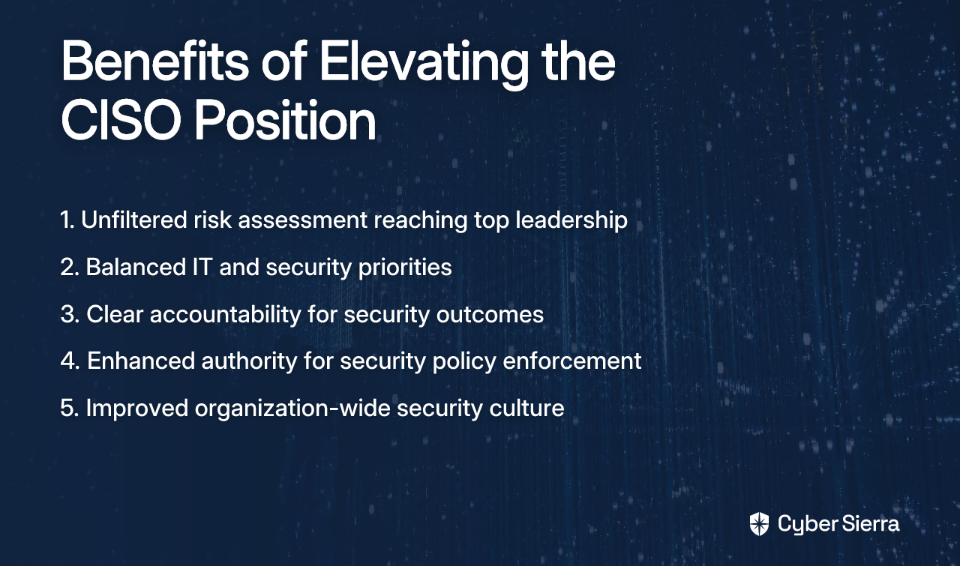
This restructuring provides several immediate benefits:

  1. Unfiltered risk assessment: The board and CEO receive direct, unvarnished information about security posture and risks.
  2. Balanced priorities: Security requirements are evaluated alongside, not subordinate to, IT operational needs.
  3. Clear accountability: Responsibilities for security outcomes are clearly defined.
  4. Enhanced authority: The CISO has the necessary authority to implement and enforce security policies across the organization.
  5. Improved security culture: The elevation signals to the entire organization that security is a top-level concern.

Conclusion

Boards and executive leadership must ask themselves: Is our CISO empowered to protect the organization, or are they constrained by the very department they are meant to oversee?

A healthy tension between the CISO and CIO is necessary; subordination is a liability. In an era where a single security breach can damage reputation, destroy customer trust, and trigger regulatory penalties, proper security governance isn't optional—it's essential.

Restructuring the CISO's reporting line is one of the most impactful decisions a company can make to build true, long-term cyber resilience. It may require overcoming organizational inertia and political challenges, but the alternative—leaving your security watchdog reporting to the person they're watching—is a risk no modern organization should accept.

As one security professional succinctly put it: "The CISO should NOT report to the CIO. There should be some natural tension between them." That tension, properly structured, isn't a problem to solve—it's a feature that keeps your organization secure.

Frequently Asked Questions

Why shouldn't a CISO report to a CIO?

A CISO should not report to a CIO because it creates a fundamental conflict of interest between security priorities and IT operational goals. The CIO's mission is to ensure system availability, performance, and speed of delivery, which can directly clash with the CISO's mission to manage risk and protect the organization. This structure often leads to security budgets being cut, critical risks being downplayed, and a lack of objective security information reaching executive leadership.

Who is the ideal person for a CISO to report to?

The ideal reporting line for a CISO is directly to the Chief Executive Officer (CEO). This structure positions cybersecurity as a core business function and an enterprise-wide risk, not just an IT problem. It grants the CISO the necessary authority and independence and ensures the CEO and board receive unfiltered, direct information about the organization's security posture.

What are the best alternative reporting structures if the CISO can't report to the CEO?

If reporting to the CEO is not feasible, effective alternatives include having the CISO report to the Chief Risk Officer (CRO), the Chief Operating Officer (COO), or directly to the board of directors or a board committee. Each of these options preserves the CISO's independence from the IT department, which is crucial for effective security governance. They frame cyber risk as a component of either overall business risk (CRO) or operational integrity (COO).

How does changing the CISO's reporting structure improve security?

Changing the CISO's reporting structure to be independent of the CIO directly improves security by enabling unfiltered risk assessment, creating balanced priorities, and clarifying accountability. An independent CISO can present unvarnished facts about security vulnerabilities to top leadership without fear of reprisal. This ensures security needs are evaluated on their own merit alongside—not subordinate to—IT goals, which leads to better-informed decisions, appropriate resource allocation, and a stronger security culture.

What is meant by "healthy tension" between a CISO and CIO?

"Healthy tension" refers to the productive, natural opposition that exists when the CISO and CIO operate as peers. The CIO is driven to innovate and deliver services quickly, while the CISO is responsible for ensuring those innovations are secure. This tension forces collaboration and compromise, leading to solutions that balance speed and safety. For example, they might negotiate a project timeline that accommodates both a fast-to-market launch and adequate security testing, a balance that is lost when one role is subordinate to the other.

blog-hero-background-image
Cyber Security

Security RACI Matrix: Who Really Owns What in Your Organization?

backdrop
Table of Contents

Join thousands of professionals and get the latest insight on Compliance & Cybersecurity.


You've been hired as a CISO or security leader with high expectations—protect the organization, prevent breaches, and ensure compliance. But a few months in, you're drowning. Every security issue, from third-party risk assessments to patch management emergencies, lands squarely on your desk. When incidents occur, all eyes turn to you as if you personally own every aspect of the organization's security posture.

Sound familiar? You're not alone.

"Having a single-person security team is seen as unmanageable," according to cybersecurity professionals on Reddit. Many describe feeling "under stress and constant fire" during incidents, with "overwhelming responsibilities" that make work-life balance nearly impossible.

The truth is, the traditional view of CISOs as the sole guardians of cybersecurity is a fundamentally flawed paradigm. This outdated approach creates dangerous "security silos" that isolate cybersecurity from day-to-day operations and place an impossible burden on security leaders.

So what's the solution? A distributed risk ownership model built on a clear governance framework: the Security RACI Matrix.

The Problem with a "Single Point of Failure" Security Model

In many organizations, CISOs become the de facto owners of all security risks. This centralized model creates several critical problems:

1. Operational Disconnect

When security is seen as "the CISO's problem," business units disengage from security responsibilities. This creates friction between security teams and the rest of the organization, with security often viewed as the "department of no."

2. Impossible Workload

As one security professional put it, "It's unlikely to maintain health and quality work as a one-person security team." The expanding threat landscape now encompasses IT systems, operational technology, IoT devices, cloud environments, and third-party ecosystems—far too much for any individual or small team to manage effectively.

3. Regulatory Pressure

New regulations like the EU's NIS 2 Directive and recent US SEC rules are increasing organizational liability for breaches, legally reinforcing the need for security to be a board-level concern, not just a CISO's problem.

4. No Redundancy

"Who covers when you go on vacation?" asked one Reddit user. Without distributed ownership, organizations face significant business continuity risks when key security personnel are unavailable.

This centralized ownership model isn't just unsustainable—it's a significant liability in today's threat landscape.

Introducing the RACI Matrix: A Framework for Clarity and Shared Responsibility

The solution lies in implementing a governance framework that clearly defines who owns what in your security program. The RACI matrix is an ideal tool for this purpose.

RACI stands for:

  • Responsible (R): Those who do the work to complete the task. There can be multiple 'R's.
  • Accountable (A): The person who ultimately answers for the correct completion of the activity. There must be only one 'A' for each task.
  • Consulted (C): Those who provide input on the activity (two-way communication).
  • Informed (I): Those who are kept up-to-date on progress (one-way communication).

A security RACI matrix ensures clarity and accountability, which is critical during high-stress events like security incidents. As noted by N-able, it helps "avoid confusion, streamline decision-making, and prevent delays that could lead to additional costs or greater impact."

Putting It into Practice: A Sample Security RACI Matrix

Let's look at a concrete example. The table below shows a RACI matrix for an ISO 27001 implementation, sourced from Advisera:

ActivitiesTop ManagementProject TeamUnit Heads / Process OwnersEmployees / Users
Identifying ISMS requirementsARCC
Defining ISMS basic framework (scope, policy)ARCI
Development of risk assessment methodologyARCI
Performing risk assessment & defining treatment planARCC
Controls implementationIRAI
Training and awareness of personnelIRAI
Controls operationIRA/RR
Performance monitoring and measurementIRA/RR
Performing internal auditIA/RCC
Performing management reviewARCI
Addressing nonconformities & corrective actionsARRI

What makes this model effective? Notice that for "Controls implementation," the Unit Heads are Accountable because they own the business process where the control is being implemented, while the project team is Responsible for the actual work. Top Management is simply Informed of the progress.

This clarity eliminates confusion about who needs to approve what, who should be doing the work, and who needs to be kept in the loop.

Step-by-Step Guide: How to Build and Implement Your Security RACI Matrix

Ready to implement this in your organization? Follow these steps:

Step 1: Identify Stakeholders and Form a Governance Body

Don't build this in isolation. Form a cross-organizational Cyber Security Oversight Committee with representatives from key departments:

  • IT Operations
  • Finance
  • Legal
  • HR
  • Procurement
  • Development teams
  • Business unit leaders

This diverse group brings multiple perspectives and ensures buy-in across the organization.

Step 2: Define Key Security Activities and Processes

List all major security domains and processes that need clear ownership. Consider using the NIST Cybersecurity Framework's five core functions as a starting point:

  • Identify: Asset management, risk assessment, third-party risk
  • Protect: Access control, awareness training, data protection
  • Detect: Continuous monitoring, anomaly detection
  • Respond: Incident response planning, analysis, mitigation
  • Recover: Recovery planning, communications, improvements

Step 3: Assign RACI Roles for Each Activity

For each activity, methodically assign the R, A, C, and I roles to the stakeholders identified in Step 1. Remember the golden rule: only one 'A' per task.

For example, in vulnerability management:

  • Information Security Team: Responsible (R) for scanning and prioritizing vulnerabilities
  • IT Operations: Responsible (R) for implementing patches
  • System Owners: Accountable (A) for ensuring their systems are secure
  • Development Teams: Consulted (C) on potential impacts of patches
  • Executive Management: Informed (I) of high-risk vulnerabilities

Step 4: Create a Governance Framework and Secure Management Buy-in

Document the RACI matrix within a formal security governance framework that specifies procedures for identifying, assessing, and responding to risks. This formal documentation is essential for securing top management buy-in.

As RiskLedger notes, "Moving away from the traditional risk ownership model requires a change in mindset at the leadership level." Use the RACI matrix to demonstrate how this approach will strengthen the organization's security posture.

Step 5: Train, Educate, and Address Resistance

Roll out regular cybersecurity training for all employees and specialized training for stakeholders with defined RACI roles. Proactively manage resistance by clearly communicating the benefits of shared ownership.

The New CISO: Shifting from Risk Owner to Security Facilitator

With a RACI matrix in place, the CISO role evolves from being the risk owner to a facilitator. The benefits of this distributed ownership model include:

  • Improved Risk Awareness: When business units own their security risks, they become more vigilant.
  • Informed Decision-Making: Decisions are made with better business context, leading to more effective security measures.
  • Enhanced Effectiveness: Diverse perspectives lead to more comprehensive risk assessments and better resource allocation.
  • Cultural Shift: Security transforms from a "necessary burden" into an integral business enabler.

In this new paradigm, the CISO's job is to empower business units to own their risks, provide them with the right tools and knowledge, and offer expert guidance on emerging threats and technologies. This requires strong communication skills and the ability to translate security concepts into business terms.

Conclusion: Making Security Everyone's Responsibility

Moving away from the CISO-centric risk model is not just beneficial; it's necessary for building a resilient modern enterprise. The Security RACI matrix is a powerful, practical tool for defining roles, clarifying expectations, and driving the cultural shift toward shared security ownership.

By distributing security ownership across your organization, you not only reduce the burden on your security team but also build a more secure, risk-aware culture where security is everyone's responsibility.

Start the conversation today. Identify your key security processes and begin mapping out who is Responsible, Accountable, Consulted, and Informed for each. Your organization—and your stress levels—will thank you.

blog-hero-background-image
Cyber Security

Security Theater vs. Real PCI Compliance

backdrop
Table of Contents

Join thousands of professionals and get the latest insight on Compliance & Cybersecurity.


You've just spent months preparing for your PCI compliance assessment. Your team has worked tirelessly to document processes, implement controls, and ready themselves for the QSA's arrival. When the assessment concludes, you receive that coveted Attestation of Compliance (AOC). Mission accomplished, right?

Not so fast.

For many organizations, PCI compliance has devolved into what security expert Bruce Schneier famously termed "security theater" – elaborate performances that provide the illusion of security without delivering actual protection. While you may have checked all the right boxes to satisfy an auditor, the question remains: Are you truly securing cardholder data, or are you just putting on a show?

Defining the Terms: Are You Performing or Protecting?

Security Theater: The Illusion of Compliance

Security theater describes security measures that make people feel safer without meaningfully improving security. In the PCI compliance world, this manifests as what security professionals sometimes call "cargo cult security" – where organizations mimic security practices without understanding the principles that make them effective.

Common examples include:

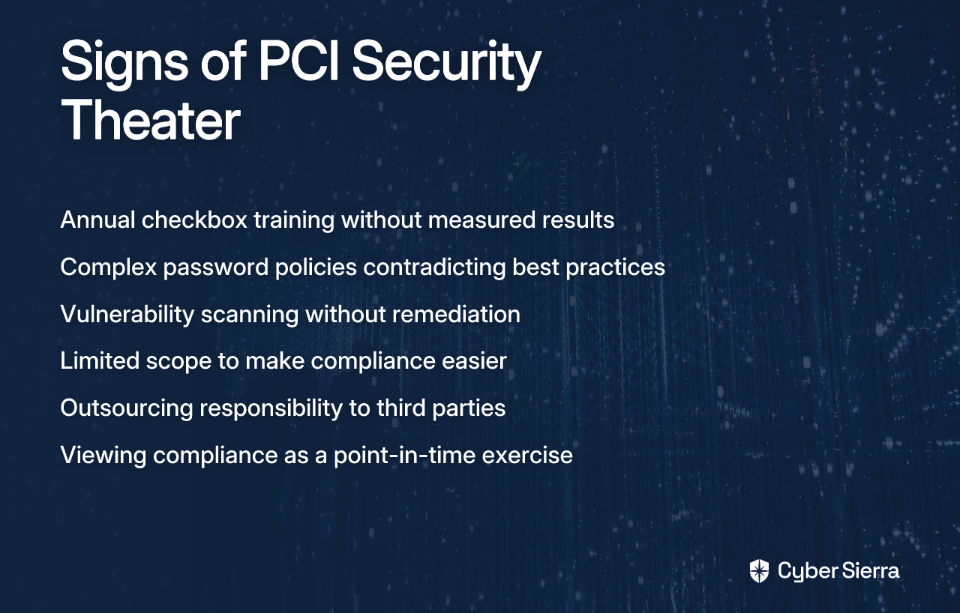
  • Annual Checkbox Training: Requiring employees to click through generic security awareness modules once a year. They complete it just to make it go away, yet 88% of data breaches are still caused by human error.
  • Overly Complex Password Policies: Mandating frequent password changes with complex requirements, which often leads to employees writing passwords down – defeating the original purpose. This contradicts NIST's current recommendations for longer, more memorable passphrases.
  • Superficial Vulnerability Scanning: Running automated scans without meaningful remediation or contextual understanding of the risks identified.

Real PCI Compliance: Beyond the Checklist

Genuine PCI compliance isn't about satisfying 12 requirements for an annual assessment – it's about embracing the intent behind those requirements. It means building a continuous, risk-based security program that genuinely protects cardholder data.

The PCI Data Security Standard (PCI DSS) includes 12 key requirements, 78 base requirements, and over 400 test procedures. But checking these boxes alone doesn't ensure security.

Real compliance means these controls are living, breathing parts of your security operations – not just items on an annual checklist.

The High Cost of Performance: Pitfalls of PCI Security Theater

The Scoping Trap: "They want the connectivity. But don't want the scope."

One of the most common pitfalls is misunderstanding what systems should be in scope for PCI compliance. As one QSA noted in a Reddit discussion, many organizations are "conflating 'in scope' and 'CDE' where more and more systems are wrongly brought into scope though proven to be unable to connect with the CDE."

The reality is more straightforward: if a system can establish a connection to the Cardholder Data Environment (CDE), it's probably in scope. And if it can connect to something that can establish a connection, it's also in scope.

Security theater manifests when organizations arbitrarily limit their scope to make compliance easier, rather than accurately reflecting their actual environment. This leaves dangerous blind spots, as illustrated by a QSA who discovered that "the QSAC before us for sure just passed the client with flying colors, even though... they missed a huge scoping issue -- left out the VoIP and call recording scope."

Effective network segmentation is critical for properly defining and reducing scope, but it must be done with genuine security in mind – not just to make the compliance process easier.

The Third-Party Fallacy: Shifting Risk vs. Managing Risk

Another common form of security theater is assuming that using third-party service providers absolves you of responsibility for PCI compliance. As one Reddit user observed, some clients believe "shifting all associated risk to the third party was acceptable" for services like call recording solutions.

This misunderstanding can be costly. While you can outsource functions, you cannot outsource accountability. The PCI Security Standards Council holds merchants responsible for ensuring all third parties that access, process, store, or transmit cardholder data maintain proper security.

Real compliance involves thorough vendor management programs, including:

  • Rigorous due diligence before engagement
  • Clear contractual requirements for security
  • Regular monitoring and assessment of third-party controls
  • Verification that service providers maintain their own PCI compliance

The Annual Audit Blind Spot

Perhaps the most dangerous form of security theater is viewing PCI compliance as a point-in-time exercise, where the annual QSA assessment is the finish line rather than a checkpoint in an ongoing process.

In reality, PCI DSS requires continuous monitoring and testing. A security program focused on real protection embraces:

  • Regular internal vulnerability scanning (beyond the quarterly requirement)
  • Penetration testing that simulates real-world attacks
  • Continuous monitoring of critical security controls
  • Prompt remediation of identified issues

The Unethical Assessor Problem

An uncomfortable truth in the PCI compliance world is the existence of what one Reddit commenter called "unethical QSAs." With Level 1 merchant assessment contracts worth "$20-30k US per year," there can be financial pressure to cut corners.

Red flags include QSAs who:

  • Issue reports with questionable document dating (one Reddit user reported seeing "an AOC that had a report date six months before the QSA signature, and that signature being an entire year previous to the entity signature date")
  • Act as adversaries rather than collaborators
  • Overlook significant issues that might jeopardize their contract renewal

As the Reddit community bluntly put it: "To all the unethical QSAs, we see you!"

From Checklist to Culture: Building a Framework for Real Security

Embrace PCI DSS v4.0: The Shift to Risk Management

PCI DSS version 4.0 represents a fundamental shift from a purely prescriptive approach to one that incorporates risk-based methodologies. This is a perfect opportunity to move beyond security theater toward real security.

Key changes include:

  • Customized Approach: Organizations can design and implement custom controls as long as they support them with "a documented, targeted risk analysis" that proves the control meets the security objectives.
  • Focus on Outcomes: v4.0 emphasizes security outcomes rather than prescriptive controls, giving organizations more flexibility to implement security that makes sense for their specific environment.

With the compliance deadline of March 31, 2025 approaching, now is the time to prepare for this more mature approach to security.

Implement Practical, High-Impact Controls

Instead of focusing solely on compliance requirements, prioritize controls that deliver genuine security value:

  • Data Minimization: The best way to protect data is not to have it. Avoid storing sensitive data whenever possible, especially CVV codes after authorization.
  • Advanced Encryption: PCI DSS v4.0 requires support for modern, secure protocols like TLS v1.2 or higher. Implement strong encryption not just to check a box but as a fundamental security layer.
  • Real-Time Monitoring & Threat Detection: Move beyond periodic log reviews to implement continuous monitoring with technologies like Intrusion Detection Systems (IDS) and Security Information and Event Management (SIEM) solutions.

Adopt a Zero Trust Mindset

The Zero Trust security model perfectly aligns with the goals of PCI DSS by enforcing the principle of "never trust, always verify." This approach assumes no implicit trust based on network location or asset ownership.

Key Zero Trust principles for PCI compliance include:

  • Strict Access Controls: Enforce the principle of least privilege for all users and systems accessing cardholder data.
  • Multi-Factor Authentication (MFA): PCI DSS v4.0 mandates MFA for all access into the CDE, recognizing that passwords alone are insufficient.
  • Micro-segmentation: Implement more granular network controls beyond traditional segmentation to further reduce the attack surface.

Compliance as a Consequence of Good Security

The fundamental shift organizations need to make is to stop treating compliance as the goal and instead focus on building robust security programs that make compliance a natural byproduct.

When you build a security program focused on genuinely protecting cardholder data based on risk-based principles, PCI compliance becomes less of a burden and more of a validation that you're doing the right things.

This approach offers several advantages:

  1. Reduced Risk: You're protected against threats, not just compliant with requirements.
  2. Lower Compliance Costs: When security is embedded in your operations, preparing for assessments requires less special effort.
  3. Competitive Advantage: Genuine security becomes a business differentiator in a world where data breaches can cost millions and damage customer trust.

The Path Forward: From Theater to Reality

As Bruce Schneier noted, "Security theater provides the feeling of security instead of the reality." For organizations serious about protecting cardholder data, it's time to remove the costumes, exit the stage, and implement security measures that genuinely work.

The new flexibility in PCI DSS v4.0 provides an ideal opportunity to build a defensible security posture that truly protects your customers and your brand. The choice is yours: Will your security program be a shield or just a show?

Ask yourself: Is your organization performing security theater, or are you genuinely protecting cardholder data? Your customers' sensitive information – and ultimately your business – depend on the answer.

Frequently Asked Questions

What is PCI security theater?

PCI security theater refers to implementing security measures that create the illusion of compliance and safety without genuinely protecting cardholder data. It's about "checking the box" on requirements, like having generic annual security training or running vulnerability scans without proper remediation. These actions satisfy an auditor but often fail to address the underlying risks, leaving an organization vulnerable despite having an Attestation of Compliance (AOC).

How is "real" PCI compliance different from just checking boxes?

Real PCI compliance is a continuous process of risk management integrated into daily operations, whereas a checkbox approach treats compliance as a once-a-year event to pass an audit. Genuine compliance means embracing the intent behind the 12 PCI DSS requirements. It involves continuous monitoring, regular testing that simulates real attacks, and building a security culture where protecting data is a priority every day, not just during assessment season.

Why is network scoping so important for PCI DSS?

Proper network scoping is critical because it defines which systems and networks are subject to PCI DSS controls. Incorrect scoping can leave parts of your environment that handle cardholder data unprotected and non-compliant. A common mistake is to arbitrarily limit the scope to make the audit easier, creating dangerous blind spots. Any system that can connect to the Cardholder Data Environment (CDE) is considered in scope.

Who is responsible for PCI compliance when using a third-party provider?

Your organization remains fully responsible and accountable for PCI compliance, even when using a third-party service provider to handle cardholder data. While you can outsource functions, you cannot outsource accountability. Merchants are required to perform thorough due diligence, have clear contractual security requirements, and continuously monitor their providers to ensure they also maintain PCI compliance.

What is the biggest change in PCI DSS v4.0?

The biggest change in PCI DSS v4.0 is the shift from a rigid, prescriptive approach to a more flexible, risk-based model that focuses on security outcomes. Version 4.0 introduces the "Customized Approach," allowing organizations to implement controls best suited for their environment, as long as they can justify them with a targeted risk analysis. This encourages building genuine security programs tailored to specific risks rather than following a universal checklist.

How can an organization move beyond a "checklist" mentality?

An organization can move beyond a checklist mentality by adopting a security-first culture, prioritizing high-impact controls, and implementing a Zero Trust security model. This involves practical steps like data minimization (not storing data you don't need), implementing strong encryption and multi-factor authentication (MFA), and using real-time monitoring. By making security a core business function, compliance becomes a natural byproduct rather than the primary goal.


Note: This article is not intended as legal advice. Organizations should consult with qualified security professionals and QSAs for specific guidance on PCI DSS compliance.

blog-hero-background-image
Cyber Security

Why Microsoft Defender Fails at Email Security

backdrop
Table of Contents

Join thousands of professionals and get the latest insight on Compliance & Cybersecurity.


You've deployed Microsoft 365 across your organization, confident that its built-in Defender security will keep your email safe. Then you check your inbox only to find yet another suspicious email that somehow slipped through. A colleague reports clicking on a link that Defender should have blocked. Your IT team scrambles to respond while you wonder: "Isn't Microsoft supposed to be protecting us from this?"

If this scenario sounds familiar, you're not alone. With over 2 million organizations relying on Microsoft 365 for their daily operations, many businesses default to its built-in security suite, assuming it's sufficient. But security professionals increasingly find this assumption dangerously flawed.

The "Good Enough" Fallacy

Microsoft Defender for Office 365 has become the default email security solution for countless organizations simply because it comes packaged with their Microsoft 365 subscription. This convenience, however, masks critical weaknesses that leave organizations vulnerable to sophisticated email threats.

As one security professional bluntly put it on Reddit: "I would not recommend Microsoft period - they are a software company pretending to be a security company." This sentiment is increasingly common among cybersecurity experts who find themselves constantly battling email threats that Defender failed to catch.

The harsh reality? Defender consistently underperforms against dedicated security solutions, particularly in large enterprise environments where the stakes are highest. As another IT professional noted, "if you're a large enterprise, it's not good enough on its own."

The Illusion of Integrated Security

Part of the problem begins with understanding what "Microsoft Defender" actually includes, as the platform is divided into confusing licensing tiers:

  • Exchange Online Protection (EOP): Basic anti-spam and anti-malware included with most subscriptions
  • Defender for Office 365 Plan 1: Adds protection against more advanced threats
  • Defender for Office 365 Plan 2: Includes advanced reporting, investigation capabilities, and automated response

This tiered approach creates security gaps for organizations that haven't opted for higher-tier plans or don't fully understand what protection they're actually getting.

Beyond licensing confusion, there's a more fundamental issue: Microsoft's ubiquity makes it a predictable target. The standardized nature of Defender means attackers who develop a technique to bypass its filters can reuse that technique across thousands of organizations. This creates a target-rich environment where a single successful evasion tactic can be weaponized at massive scale.

Critical Failures: Why Defender Falls Short

Failure 1: Single-Layered, Predictable Defense

Defender's core architecture operates primarily on traditional detection methods, heavily reliant on signature-based detection. While Microsoft has incorporated some AI capabilities, the system still fundamentally lacks the sophisticated, multi-layered protection necessary for modern threats.

This approach leaves organizations vulnerable to:

  • Zero-day exploits with no existing signatures
  • Polymorphic malware that constantly changes its code
  • Advanced social engineering attacks that don't contain traditional malware indicators

The predictability of Defender's defenses makes it easier for attackers to test their methods against it until they find a successful approach.

Failure 2: Inconsistent and Unreliable Threat Detection

Perhaps the most frustrating aspect of Defender is its erratic performance. One Reddit user reported a particularly alarming example: "Defender detected about 50% [of a phishing campaign] as having malicious content, and the other 50% were delivered to inboxes. This particular thing has happened several times."

This inconsistency creates dangerous blind spots. Other users report "terrible email filtering problems" and "ridiculous failures of the filtering system" that allow obvious threats to reach user inboxes.

The platform particularly struggles with:

  • Business Email Compromise (BEC): Users report that "emails just blatantly spoofing domains" slip through Defender despite having obvious red flags
  • Sophisticated Phishing: While Defender can catch basic phishing attempts, it frequently misses more targeted spear-phishing attacks
  • Malware Detection: "We've seen 2 issues where Microsoft's machine learning had a problem and allowed lots of spam through," reported another IT professional

Failure 3: Slow, Manual Incident Response

In cybersecurity, speed is critical. Once attackers breach your defenses, they can move laterally through a network in an average of just 72 minutes. Yet Defender's incident response capabilities remain largely manual and reactive.

When malicious emails do get through—and they will—Defender lacks the automated remediation capabilities to quickly remove them from all affected inboxes without significant manual intervention. This creates a dangerous time window where threats remain accessible to users.

Failure 4: Operational Complexity and Hidden Gaps

Even organizations that invest in higher-tier Defender plans face significant operational challenges. As one IT professional noted, "the management learning curve is much steeper than other frontrunner solutions."

This complexity leads to:

  • Misconfigured threat policies that create security holes
  • Incomplete Data Loss Prevention (DLP) implementation
  • Insufficient email authentication protocols like DMARC, DKIM, and SPF

The Verdict from the Trenches: Why Experts Look Elsewhere

The consensus among security professionals is remarkably consistent. According to one Reddit user, "Defender for email is probably the only thing I recommend immediately replacing when I talk to people with E5s." This coming from users who have Microsoft's highest-tier licensing should raise serious concerns.

The sentiment is echoed across platforms like Gartner Peer Insights, where competitors consistently receive higher ratings:

  • Proofpoint Threat Protection: 4.6/5
  • Check Point Harmony Email & Collaboration: 4.7/5
  • Mimecast Advanced Email Security: 4.5/5
  • Barracuda Email Protection: 4.6/5

As another security professional candidly put it: "I kinda get it, it's hard for Microsoft to build detections for EVERYONE, but it really feels like they never bothered being good at this."

Building a Resilient Email Security Strategy

If Microsoft Defender isn't sufficient, what should organizations do instead? Security professionals recommend a three-pronged approach:

Principle 1: Adopt a Layered Defense

The consensus among security professionals is that "multiple email security layers are necessary." Consider implementing one of these specialized solutions:

  • Abnormal Security: Praised for high accuracy and low false positives using machine learning to analyze email signals. As one user reported, "We use Abnormal Security! So far so good."
  • Proofpoint or Mimecast: Considered the "main players" with powerful filtering, robust attachment sandboxing, and comprehensive malware blocking.
  • Darktrace for Email (Antigena): Recommended for its AI that monitors email behavior to stop advanced threats. One user reported being "really happy with Antigena from Dark Trace."

These solutions can be deployed either as an MX gateway (filtering mail before it reaches Microsoft) or as an API-based cloud integrated solution that works alongside Microsoft's infrastructure.

Principle 2: Harden Your Existing Environment

For organizations that must rely on Defender, proper configuration is essential:

  • Master Email Authentication: Ensure proper implementation of DMARC, DKIM, and SPF to block spoofed emails. Consider tools like PowerDMARC for better visibility and enforcement.
  • Optimize Defender Policies: Regularly review and tighten anti-phishing, anti-spam, and safe link settings within Defender's threat policies.
  • Enable Advanced Features: If you have access to Plan 2, ensure you've configured automated investigation and response capabilities.

Principle 3: Empower the Human Layer

No technical solution is perfect. As one IT professional noted, "No tool is 100% effective; security training is essential."

Implement regular phishing training programs that teach users to identify and report suspicious emails. This human firewall serves as your last line of defense when technical controls fail.

Conclusion: Moving Beyond Default Security

Microsoft Defender's shortcomings—its predictable single-layer architecture, inconsistent detection capabilities, slow incident response, and operational complexity—make it an inadequate standalone solution for email security.

Organizations serious about protecting their email communications need to look beyond the default option. Whether that means implementing a specialized third-party solution or significantly enhancing your Microsoft configuration, the status quo is simply too risky in today's threat landscape.

The choice is clear: proactively address these security gaps now, or wait until a successful attack forces your hand. In email security, as in most aspects of cybersecurity, prevention is infinitely preferable to remediation.

Frequently Asked Questions

Why isn't Microsoft Defender enough for email security?

Microsoft Defender is often not enough for comprehensive email security because it relies on a predictable, single-layered defense that struggles against modern, sophisticated threats like zero-day exploits and advanced phishing attacks. Its detection performance can be inconsistent, incident response is often slow and manual, and its operational complexity can lead to dangerous misconfigurations. For these reasons, security experts recommend a layered approach that includes specialized security solutions.

What are the biggest security risks when relying solely on Microsoft Defender?

The biggest security risks are its inconsistent detection of phishing and malware, a high vulnerability to novel zero-day attacks due to its reliance on signature-based methods, and slow, manual incident response capabilities. This allows threats like Business Email Compromise (BEC) and targeted spear-phishing to reach user inboxes. When an attack succeeds, the lack of fully automated remediation leaves a critical window open for attackers to do more damage.

What is a layered email security defense?

A layered email security defense is a strategy that uses multiple, distinct security tools and controls to protect against threats, rather than relying on a single solution. For email, this typically involves combining Microsoft 365's built-in security with a specialized third-party solution (like Proofpoint, Abnormal Security, or Mimecast) that provides more advanced threat detection. This approach also includes hardening configurations like DMARC and implementing regular user security training.

How can I improve my email security if I have to use Microsoft Defender?

You can significantly improve your email security by properly configuring and hardening your existing Microsoft 365 environment. Key steps include correctly implementing email authentication protocols like DMARC, DKIM, and SPF to block spoofing; regularly reviewing and tightening Defender's threat policies (e.g., anti-phishing, anti-spam); and enabling advanced features like automated investigation and response if your license includes them.

Is a higher-tier license like Microsoft 365 E5 a good enough solution?

No, even a high-tier license like Microsoft 365 E5, which includes Defender for Office 365 Plan 2, is often not considered a sufficient standalone solution by many security experts. While E5 provides more advanced features like investigation and automated response, it is still built on the same core Defender architecture that struggles with advanced threat detection. Many organizations with E5 licenses still supplement it with a third-party email security solution to cover these critical gaps.

blog-hero-background-image
Cyber Security

How to Handle Vendor Breach Denials in Your IR Process

backdrop
Table of Contents

Join thousands of professionals and get the latest insight on Compliance & Cybersecurity.


You've just received an alert about suspicious activity from one of your critical vendors. Your threat intelligence feeds are lighting up, and you're seeing indicators of compromise that match the patterns associated with this provider. But when you reach out to the vendor for confirmation, their response is immediate and decisive: "We have no evidence of a breach."

Sound familiar?

If you've been in cybersecurity long enough, you've experienced the frustrating dance with vendors who initially deny security incidents only to later acknowledge them with the infamous phrase, "Upon further investigation..." As one security professional put it, "It's always 'no there is no breach' and after a while 'upon further investigation...'"

This denial isn't just annoying—it's dangerous. It creates an information vacuum that paralyzes your incident response process, leaving your organization exposed while your vendor manages their PR and legal concerns.

The Anatomy of a Denial: Why Vendors Say "No"

Before diving into the action steps, it's important to understand why vendors initially deny breaches. This isn't usually malicious—it's business.

It's Not Personal, It's Legal (and PR)

When a vendor first receives notification of a potential breach, their initial communications are typically crafted by legal and PR teams, not security engineers. As one cybersecurity professional noted, "It's always a PR stunt at first... Deny until you are forced or until you have data that can prove you wrong."

Vendors are managing multiple concerns:

  • Legal exposure and potential regulatory fines
  • Stock price and shareholder confidence
  • Competitive positioning
  • Customer retention

The Ripple Effect is Real

The impact of vendor breaches nearly doubled year-over-year, with an average of 4.73 companies affected per vendor breach according to Black Kite's 2022 report. Major incidents illustrate the potential scale:

  • SolarWinds (2020): Malicious code injected into updates affected approximately 18,000 customer networks
  • Hafnium (2021): Exchange server attacks compromised at least 60,000 organizations

This is why you can't afford to wait for a vendor to confirm what your threat intelligence is already telling you.

Your Playbook for the First 24 Hours: Assume Breach, Act Decisively

When facing a potential vendor breach with initial denial, adopt this guiding principle: "Assume a breach until proven otherwise." The first 24 hours are critical for setting the tone of your response. Do not wait for vendor confirmation.

Step 1: Isolate & Contain

Break Connectivity
As one security professional bluntly advised, "If your engagement requires network connectivity, probably worth breaking it until the breach is understood." Immediately:

  • Sever VPN connections to the vendor
  • Disable API integrations
  • Block network traffic to and from the vendor's IP ranges
  • Lock down vendor service accounts

This may cause business disruption, but the alternative—allowing a breach to spread through your network—is far worse.

Isolate Systems
Implement containment strategies tailored to the specific vendor relationship:

  • Apply additional local host restrictions
  • Segment any potentially affected parts of your network
  • Prepare backup systems if the vendor provides critical services

Step 2: Communicate & Gather Intelligence (The Right Way)

Establish Formal Contact
Immediately open a formal line of communication with the vendor's designated security point of contact—not just your account manager. Document all communications.

Conduct a Mini-Assessment
Go beyond asking "Have you been breached?" Ask pointed questions to gather facts:

  • "What is the nature of the potential impact on your environment?"
  • "What specific data or systems of ours could have been accessed?"
  • "What immediate remediation steps have you taken on your end?"
  • "Who is your designated point of contact for this incident, and what is the communication cadence?"
  • "Can you provide logs, IoCs, or any technical data that led you to conclude there was no breach?"

Step 3: Trigger Internal Forensics & Threat Hunting

Don't rely solely on the vendor's investigation. Launch your own:

Check Threat Intelligence
Use threat intelligence feeds to identify internal Indicators of Compromise (IoCs) related to the vendor or the suspected threat actor.

Review Logs
Look for:

  • Unusual activity from vendor accounts
  • Anomalous data flows to vendor IP ranges
  • Signs of unauthorized access or data exfiltration
  • Suspicious authentication events

Monitor Behavior
Actively watch for unusual remote access behavior and check the integrity of systems connected to the vendor.

Step 4: Engage Legal & Review Contracts

This is not just an IT issue. Your legal and compliance teams must be involved immediately.

Alert Your Counsel
Brief your legal team on the situation and potential implications.

Locate the Contract
As one cybersecurity professional wisely advises, "Look at your contract to see what their breach reporting requirements are." This is critical, as it establishes the vendor's obligations to you.

Identify Key Clauses
Scrutinize the contract for specifics on:

  • Breach notification timelines and methods
  • Data security commitments and liability allocation
  • Right-to-audit clauses
  • Cybersecurity insurance requirements

Understand Your Obligations
Remember that state and federal laws may require you to notify affected individuals, regulators, or law enforcement, regardless of the vendor's stance. According to Sands Anderson, the obligation to notify often falls on your organization as the original data collector, not the vendor.

Pushing Past the Denial: How to Force Transparency

If the vendor continues to deny despite your evidence, it's time to shift from informal inquiry to formal demands.

Demand Evidence, Not Assurances
Move the conversation from vague assurances to concrete evidence:

  • Request a formal security attestation, preferably signed by the IR firm they used
  • Ask for redacted copies of forensic reports or relevant SOC reports
  • Insist on seeing logs or other technical evidence that supports their "no breach" conclusion

Leverage Your Contractual Rights
Formally invoke any relevant clauses your legal team identified, such as the right to audit. This escalates the issue from a request to a contractual obligation.

Place the Vendor on a "Watch List"
Document the incident, the vendor's response, and your findings. This places the vendor under closer scrutiny, more frequent reviews, and potential escalation up to contract termination if necessary.

Proactive Defense: Building Resilience Before the Next Denial

While you're dealing with the current situation, take steps to prevent future problems:

Pre-Contract Due Diligence is Non-Negotiable

  • Classify vendors as Critical, Important, or Incidental to determine scrutiny levels
  • Request their incident response and business continuity plans during vetting
  • Negotiate explicit breach notification clauses before signing

Implement Layered Technical Controls

  • Enforce multi-factor authentication on all vendor access points
  • Implement network segmentation for vendor-accessible systems
  • Deploy egress filtering to detect and prevent data exfiltration
  • Maintain robust data backups following the 3-2-1 strategy

Test Your Plan with Realistic Scenarios
Run tabletop exercises that specifically model a critical vendor breach where the vendor is uncooperative or in denial. Validate all contact lists to ensure you have up-to-date technical and legal contact information.

You Can't Outsource Responsibility

Trust is not a control. While vendors are essential partners, your organization retains the ultimate responsibility for protecting its data and complying with regulations.

A vendor's denial should be the starting point of your incident response process, not the end of it. By following this playbook, you can protect your organization even when faced with the all-too-common "no breach" response that later becomes "upon further investigation..."

Frequently Asked Questions

What is the first thing I should do if a vendor denies a security breach?

Your immediate priority is to isolate and contain the potential threat. This means you should sever all network connectivity to the vendor, including VPNs, API integrations, and network traffic, and lock down any vendor-related service accounts. This action, guided by the principle "assume a breach until proven otherwise," is critical to prevent a potential compromise from spreading into your own network while you investigate.

Why do vendors initially deny data breaches?

Vendors often deny data breaches at first to manage business risks, not necessarily to deceive. Their initial responses are typically controlled by legal and public relations teams focused on mitigating legal exposure, protecting their stock price, maintaining shareholder confidence, and preventing customer churn. The confirmation of a breach often comes later, "upon further investigation," once they have a clearer picture of the incident and a communication strategy in place.

How can I force a vendor to be more transparent about a potential breach?

You can force transparency by shifting from informal requests to formal, evidence-based demands rooted in your contract. Start by requesting concrete evidence like forensic reports or security attestations, not just verbal assurances. If the vendor remains uncooperative, formally invoke your contractual rights, such as a "right-to-audit" clause, with the help of your legal team. This elevates the request to a legal obligation.

Who is responsible for notifying customers if a vendor loses our data?

Your organization, as the original collector of the data, is almost always legally responsible for notifying affected customers and regulators. This obligation remains with you even if the breach occurred on a third-party vendor's system. You cannot outsource this responsibility, so it is crucial to engage your legal and compliance teams immediately to understand your specific notification duties under laws like GDPR, CCPA, and others.

What are the most critical clauses to include in a vendor contract for security?

To protect your organization, every critical vendor contract should include explicit clauses covering breach notification timelines and methods, specific data security commitments, clear liability allocation, and right-to-audit provisions. These clauses provide the legal framework to hold your vendors accountable and give you the leverage needed to demand transparency and cooperation during a security incident.

How do I balance business disruption with the need to isolate a vendor?

Balancing business continuity with security requires a risk-based decision. The potential damage from a widespread data breach spreading through your network is almost always far greater than the temporary disruption caused by isolating a vendor. Prioritize containment first. Mitigate the business impact by having pre-planned incident response steps, such as preparing backup systems or activating alternative service providers if the vendor provides a critical function.

Take two immediate actions today:

  1. Update your IR plan to include a specific protocol for "uncooperative vendor breach" scenarios
  2. Schedule a meeting with your legal team to review the breach notification clauses in your top 10 most critical vendor contracts

Remember: When a vendor denies a breach, your response shouldn't be relief—it should be verification.

blog-hero-background-image
Cyber Security

How to Integrate Risk Registers in Scrum Teams Without Resistance

backdrop
Table of Contents

Join thousands of professionals and get the latest insight on Compliance & Cybersecurity.


You've been assigned to lead a Scrum team that's delivering mission-critical software. Your organization requires a risk register, but when you mention it in your first team meeting, you're met with crossed arms and frowns.

"That's waterfall thinking. We're Agile," says one developer. "Risk registers are just bureaucratic overhead," adds another.

This scenario plays out in countless organizations where traditional project management practices meet Agile methodologies. The development team considers the risk register a "predictive process" that contradicts their Scrum mindset. Meanwhile, you're caught between organizational requirements and team resistance.

Sound familiar? You're not alone.

The root of this conflict isn't about tools or processes—it's about perception and knowledge gaps. Your team isn't resistant to managing risks; they're resistant to what they perceive as outdated, bureaucratic documentation that adds no value to their sprint work.

In this guide, you'll discover how to bridge this gap not by forcing compliance, but through coaching your team to see the risk register as what it truly is: a powerful enabler of Agile values that can prevent sprint derailments and enhance predictability. We'll transform the risk register from a source of friction to a catalyst for team success.

Why the Resistance? Unpacking the "Anti-Risk Register" Mindset

Before you can overcome resistance, you need to understand its origins. Why do Scrum teams often push back against risk registers?

The Knowledge Gap

According to discussions in project management communities, the primary reason for resistance is simply that "the team doesn't know this". Many developers have never been properly introduced to risk management concepts or have only seen them implemented poorly.

Cultural Misalignment

Risk registers can feel like artifacts of command-and-control management, clashing with Agile's collaborative values. According to research on Agile transformations, teams fear losing autonomy when faced with what they perceive as top-down processes.

The Bureaucracy Perception

When a team has embraced Agile's principle of "simplicity—the art of maximizing the amount of work not done," a risk register can appear to be unnecessary administrative overhead that distracts from delivering value.

Comfort in Existing Practices

Teams comfortable with their Scrum rituals may see the introduction of a "PMP-style" tool as a threat to their established workflow or even as a sign the organization is retreating from its Agile commitment.

Interestingly, many of the challenges Scrum teams regularly face—such as mid-sprint emergencies, unavailable Product Owners, or stakeholder access issues—are precisely the kinds of risks a well-maintained register could help anticipate and mitigate. The irony is that these common Scrum challenges often derail sprints precisely because they weren't identified as risks early enough.

Reframing the Risk Register as an Agile Enabler

The key to integration lies in reframing how the team perceives the risk register—not as a static document created at project inception and then forgotten, but as a dynamic, living artifact that supports Scrum's core values.

What Exactly Is a Risk Register?

At its simplest, a risk register is "a tool for identifying potential risks in project execution." (Source: ProjectManager.com). Note the word "tool"—not process, not bureaucracy, but a tool that serves the team.

From Predictive to Adaptive

In traditional project management, risk registers might be created upfront and revisited infrequently. In Agile, they become living documents that evolve sprint by sprint. As ISACA notes, "Agile's iterative approach allows for adaptive risk management, where risks are tackled incrementally during sprints."

This aligns perfectly with the Agile principle of responding to change, as risk management is fundamentally about anticipating change. It's worth noting that according to the Standish Group's Chaos Study, "Agile projects are three times more likely to succeed than Waterfall projects," and effective risk management contributes significantly to this success rate.

Lightweight and Value-Focused

An Agile-friendly risk register doesn't need every field from a traditional template. It can be streamlined to include only:

That's it—no complexity, no bureaucracy, just information the team needs to work more effectively.

The Coaching Playbook: Weaving Risk Management into Scrum Events

The most successful integrations of risk management into Scrum don't create new meetings or processes; they weave risk activities into existing Scrum events. Here's how:

1. During Backlog Refinement & Sprint Planning

As the team discusses Product Backlog Items (PBIs), the Scrum Master or Project Manager can ask simple questions:

  • "What might slow us down on this story?"
  • "Are there any external dependencies we're assuming will be ready?"
  • "What technical unknowns could impact our delivery?"

These questions naturally surface risks without ever using "risk management" terminology that might trigger resistance. Add identified risks to your lightweight register.

2. Risk Assessment in Sprint Planning

Once the Sprint Backlog is formed, take 15 minutes to quickly review risks associated with the selected PBIs. Ask the team to rank them based on probability and impact (High/Medium/Low). This tells you where to focus your attention without extensive analysis.

3. Making Risk Responses Actionable

For high-priority risks, convert the response plan into a concrete task in the Sprint Backlog. For example:

Risk: "The new payment API might not handle our expected transaction volume."

Sprint Task: "Create a load-testing script to verify API performance under peak conditions."

This approach transforms risk management from an abstract concept to tangible work that delivers value. Assign an owner to each key risk—someone who'll keep an eye on warning signs.

4. Monitoring Throughout the Sprint

  • Daily Scrum: When appropriate, risks can be mentioned as impediments. "The risk of a delayed server deployment is now high; I'm coordinating with DevOps."
  • Sprint Review: When demonstrating the increment, briefly mention how risks were handled. "We successfully mitigated the performance risk by implementing caching, which allowed us to complete the feature on time."
  • Sprint Retrospective: This is your key feedback loop. Ask: "How did our risk identification help this sprint? Were there surprises we should have anticipated? How can we improve our risk awareness?"

By embedding risk discussions into these existing ceremonies, you make risk management a natural part of the team's rhythm rather than an imposed process.

Practical Strategies for Overcoming Resistance

Even with a thoughtfully designed approach, you may still encounter resistance. Here are strategies for fostering adoption:

1. Co-create the Process

Don't impose a template. Instead, involve the team in designing their own lightweight risk register. Ask what information they think would be valuable to track and what format would be least intrusive. When the team builds the tool, they're more likely to use it.

2. Educate Through Benefits, Not Compliance

Host a short workshop that focuses on the "why" before the "how." Frame the benefits in terms the team values:

  • Fewer sprint disruptions
  • More predictable delivery
  • Reduced technical debt from emergency fixes
  • Greater stakeholder confidence

Use real examples from past sprints where early risk identification could have prevented problems. Listen empathetically to concerns and address them honestly.

3. Start Small and Celebrate Wins

Begin with a simple approach—perhaps just identifying the top three risks for each sprint. When the team successfully mitigates a risk, celebrate it: "Great job identifying that dependency risk early—it saved us from a major delay!" These positive experiences build momentum.

4. Lead by Example

As the project manager or Scrum Master, demonstrate vulnerability by openly discussing risks you see without blame or judgment. When leaders model risk awareness as a positive behavior, teams are more likely to follow suit.

5. Connect to Agile Values

Consistently tie risk management back to Agile principles:

  • Transparency: The risk register makes potential obstacles visible to all.
  • Inspection: Regular risk reviews help the team inspect their assumptions.
  • Adaptation: Early risk identification allows for proactive adaptation.

From Resilient Code to Resilient Teams

Successfully integrating risk registers into Scrum isn't about forcing compliance with organizational requirements. It's about coaching your team to see risk management as an enabler of Agile values that helps them deliver more predictably and with fewer disruptions.

Remember, as the Reddit discussion highlighted, "you have to teach/coach/mentor the team in the purpose of a risk register." This coaching approach transforms resistance into understanding and eventually into ownership.

When implemented thoughtfully, risk management doesn't contradict Scrum—it enhances it. Your team will become not just creators of resilient code, but a more resilient, confident, and successful Scrum team capable of navigating uncertainty with ease.

By bridging the gap between traditional project management wisdom and Agile practices, you create a stronger, more adaptable approach that draws from the best of both worlds.

Frequently Asked Questions

What is an Agile risk register?

An Agile risk register is a simple, dynamic tool used by Scrum teams to identify, track, and manage potential issues that could impact their sprints. Unlike traditional, static registers, an Agile version is a living document that evolves with the project, helping the team adapt to change and prevent disruptions.

Why do Scrum teams often resist using a risk register?

Scrum teams often resist risk registers because they perceive them as bureaucratic, non-Agile "waterfall" tools that contradict their collaborative and autonomous culture. This resistance typically stems from a knowledge gap about modern risk practices, a fear of losing autonomy, or the perception that it is unnecessary administrative overhead that distracts from delivering value.

How can I introduce a risk register without disrupting my team's workflow?

The best way to introduce a risk register is to seamlessly integrate risk discussions into your existing Scrum events. During Sprint Planning, ask what could slow the team down. In the Sprint Retrospective, discuss what surprises could have been anticipated. By weaving these conversations into the team's natural rhythm and co-creating a simple register, you make risk management a supportive tool rather than an imposed process.

What should an Agile-friendly risk register include?

An Agile-friendly risk register should be lightweight and focus only on essential, actionable information. A simple and effective format includes just five key fields: a unique Risk ID, a clear Description of the potential issue, a simple Probability and Impact rating (e.g., High/Medium/Low), a concrete Response Plan, and an Owner responsible for monitoring the risk.

Isn't risk management just waterfall thinking?

No, while traditional risk management can be a rigid, upfront process, Agile risk management is fundamentally different. In a waterfall model, risk registers are often created once and rarely updated. In an Agile context, risk management is an adaptive and continuous activity. The register is a living document that is reviewed and updated iteratively, aligning perfectly with the Agile principle of responding to change.

blog-hero-background-image
Cyber Security

How to Stop Context Switching From Destroying Your Cybersecurity Projects

backdrop
Table of Contents

Join thousands of professionals and get the latest insight on Compliance & Cybersecurity.


You're deep in analyzing a new zero-day vulnerability, finally making progress after hours of focused work. Suddenly, your concentration shatters as Slack notifications flood in, your phone rings with an urgent request, and three new tickets hit your queue—all marked "high priority."

Sound familiar? For cybersecurity professionals, this constant whiplash between tasks isn't just annoying—it's destroying your productivity, compromising your security posture, and driving you toward burnout.

As one security analyst put it: "Things I could finish in 1 or 2 days extend to 2 to 3 weeks because I have to be putting out fires constantly, and getting back into the flow is not easy." This frustrating reality is all too common in our field.

Context switching—the mental shift required when moving between unrelated tasks—has become the silent killer of cybersecurity projects. But it doesn't have to be this way. This article will give you concrete, actionable strategies to reclaim your focus, protect your time, and finally drive those critical security initiatives to completion.

The Hidden Tax on Cybersecurity: Understanding the True Cost of Context Switching

Context switching is the mental process where you stop focusing on one task to engage in another, similar to how a computer's operating system switches between application threads. But unlike computers, humans incur significant overhead during this process.

The statistics are shocking:

  • It takes an average of over 20 minutes to regain deep focus after a single interruption (Reclaim.ai)
  • Shifting between tasks can reduce productivity by as much as 40%, with only 2.5% of people able to multitask effectively (Reclaim.ai)
  • Each context switch consumes up to 20% of your cognitive capacity, leaving behind "attention residue" that impairs performance on subsequent tasks (Reclaim.ai)
  • After just 20 minutes of interruptions, individuals report significantly increased stress and frustration levels (University of California, Irvine study via Asana)

Impact on Cybersecurity Projects

For security professionals, these costs are magnified. Research from Carnegie Mellon University's Software Engineering Institute found that professionals juggling just two projects can only dedicate about 40% of their effort to each. When managing five projects, this plummets to less than 10% per project due to context-switching overhead (SEI @ Carnegie Mellon University).

Imagine trying to conduct a thorough threat hunt while simultaneously being on a support rota. The constant switching doesn't just slow you down—it fundamentally changes what you can accomplish.

This cognitive tax manifests in three critical ways:

  1. Reduced Focus & Effort Allocation: Your attention becomes fragmented across multiple initiatives, with each receiving a fraction of your capability.
  2. Compromised Quality and Increased Risk: Context switching directly correlates with increased bugs, missed tasks, and quality degradation. In cybersecurity, this means misconfigured security controls, overlooked alerts, or improperly patched vulnerabilities—mistakes with potentially catastrophic consequences.
  3. Brain Overload & Professional Burnout: The constant demand for attention is overwhelming. With 56% of workers feeling compelled to respond to notifications immediately, and the average worker switching between nine different apps per day (Asana), it's no wonder burnout rates are skyrocketing in our field.

Why Cybersecurity is a Perfect Storm for Context Switching

The cybersecurity field creates a uniquely challenging environment for maintaining focus, due to several factors:

The Reactive Firefight

The nature of cybersecurity work is inherently reactive. As one professional lamented: "Every day is a new problem. Just finished remediating a big vuln in your environment? Cool here's a new zero-day." (Reddit)

This constant state of "firefighting" makes it nearly impossible to carve out time for proactive, deep work on long-term projects.

The Deluge of Data and Distractions

Cybersecurity professionals face an overwhelming flood of information:

  • Alert fatigue from SIEMs and vulnerability scanners
  • Constant communication across team chats and emails
  • Never-ending ticketing queues requiring attention

This barrage has only intensified, with 42% of workers spending more time on email and 40% more time on video calls than a year ago (Asana).

The "Top Priority" Shuffle

Many security teams suffer from constantly shifting project priorities, where leadership redirects entire teams without acknowledging the cognitive cost of these pivots. This environment makes sustained progress on any initiative nearly impossible.

The Collaboration Paradox

While collaboration is essential in cybersecurity, unstructured collaboration becomes a primary source of interruption. The "quick question" on Slack can completely derail an hour of focused analysis.

Reclaiming Your Focus: Actionable Strategies to Combat Context Switching

Let's break down a comprehensive strategy to combat context switching across three pillars:

Pillar 1: Individual Discipline & Time Mastery

1. Engineer Your Environment for Deep Work

Use 'Do Not Disturb' (DND) Religiously: Don't just activate the feature; communicate it effectively. Set your Slack status to "Deep Work: Please message only if urgent" with a specific time when you'll be available again.

Practice Time Blocking: Block out 90-120 minute chunks of focus time in your calendar with clear labels (e.g., "Focus Time: Q3 Firewall Rule Review"). This makes your unavailability visible and defends your time from meeting requests (Reclaim.ai).

2. Implement the Pomodoro Technique

This technique is specifically recommended by cybersecurity professionals for regaining focus:

  1. Choose a single task to work on
  2. Set a timer for 25 minutes
  3. Work on the task without interruption until the timer rings
  4. Take a short 5-minute break
  5. After four "pomodoros," take a longer break of 15-30 minutes

This method builds focus endurance and helps combat the learned habit of self-interruption (Asana).

3. Prioritize Ruthlessly with the Eisenhower Matrix

Manage incoming requests and "fires" using these four quadrants:

  • Urgent & Important (Do First): Critical vulnerabilities, active security incidents
  • Important, Not Urgent (Schedule): Proactive project work, policy development, strategic planning—this is your focus time
  • Urgent, Not Important (Delegate): Some meeting requests, non-critical alerts that can be handled by others
  • Neither Urgent Nor Important (Delete): Time-wasting activities, unnecessary notifications

(Reclaim.ai)

4. Batch Similar Tasks

Dedicate specific blocks of time for similar, low-concentration tasks. For example, "11:00-11:30 AM: Triage Ticketing Queue & Respond to Non-Urgent Emails." This prevents these small tasks from fragmenting your entire day (Reclaim.ai).

Pillar 2: Optimizing Tools & Team Workflows

5. Consolidate and Integrate Your Tools

The average worker switches between nine apps per day—a recipe for context switching disaster. Work to:

  • Advocate for a centralized work management platform
  • Use integrations to bring notifications and actions into one place (e.g., Jira tickets in Slack)
  • Reduce the number of tools you actively monitor throughout the day

6. Leverage DevOps Practices for Automation

Automation can significantly reduce the manual burden and interruptions:

  • Automate Code Reviews & Security Scanning: Implement tools that automatically check for standards and vulnerabilities in committed code
  • Use Continuous Integration (CI) Monitoring: Set up automated alerts for build failures or security issues
  • Create Runbooks for Common Issues: Document repeatable processes to reduce the cognitive load of handling routine incidents

(SEI @ Carnegie Mellon University)

Pillar 3: Fostering a Culture of Focus

7. Improve Collaboration and Communication

Default to Asynchronous Communication: Encourage the use of email, project comments, or detailed Slack messages for non-urgent matters instead of instant DMs that demand immediate responses (Asana).

Schedule Coworking Sessions: Host virtual coworking sessions where team members work on their individual tasks in a shared video call (mics off). This provides accountability without interruption.

8. Cut Unnecessary Meetings

Before scheduling a meeting, ask: "Can this be a status update report, a shared document, or an email?"

Champion the idea of "No-Meeting Days" (e.g., No-Meeting Wednesdays) to guarantee at least one day of uninterrupted deep work for the entire security team.

9. Limit Concurrent Project Assignments

This point is crucial for team leads and managers:

  • The evidence is clear from the SEI study: assigning an analyst to more than one project drastically reduces their effective output on all of them
  • Track team workload using issue trackers to identify who is overloaded across multiple business-critical projects
  • Rebalance assignments to protect focus and prevent burnout

Taking Back Control of Your Cybersecurity Work

Context switching isn't a personal failing but a systemic problem that's especially rampant in cybersecurity. It's a silent killer of productivity, project success, and team morale.

The antidote is a conscious, multi-layered strategy combining:

  • Individual habits (Pomodoro technique, time blocking)
  • Smarter team workflows (asynchronous communication, tool integration)
  • Strong management support (limiting WIP, cutting meetings)

By deliberately engineering an environment that values and protects deep focus, cybersecurity teams can shift from a constant state of reaction to one of proactive defense. This not only delivers better security outcomes but prevents the burnout that plagues our industry.

Remember what one security professional shared: "The interruptions and constantly shifting what tasks/projects take priority" is at the heart of what makes cybersecurity work frustrating. By implementing these strategies, you can break that cycle and finally make meaningful progress on the projects that matter most.

Start small—even implementing just one or two of these strategies can dramatically reduce your context switching tax and help you reclaim your focus, your productivity, and ultimately, your job satisfaction.

Frequently Asked Questions

What is context switching and why is it a problem in cybersecurity?

Context switching is the mental effort required to shift your focus from one unrelated task to another. It's a significant problem in cybersecurity because the field's reactive nature, constant alerts, and shifting priorities create an environment of perpetual interruption, which degrades focus, increases the risk of errors, and leads to burnout. Every time a security professional is pulled from a deep task like vulnerability analysis to answer a "quick question," they incur a cognitive "tax," and it can take over 20 minutes to regain deep focus.

What are the biggest impacts of context switching on security teams?

The biggest impacts of context switching on security teams are reduced productivity, compromised work quality leading to increased security risks, and high rates of professional burnout. Frequent task switching can cut productivity by up to 40%, causing projects to stall. The "attention residue" left after an interruption makes mistakes more likely, such as misconfiguring a firewall or overlooking a critical alert. Over time, this constant mental strain is a primary driver of burnout.

How can I immediately reduce interruptions during my workday?

You can immediately reduce interruptions by using your communication tools' "Do Not Disturb" (DND) status and practicing time blocking. Set your Slack or Teams status to "Deep Work" or "Focusing" for a set period and communicate when you'll be available again. More importantly, block out 90-120 minute "Focus Time" slots directly in your calendar. This makes your unavailability visible to colleagues and discourages them from scheduling meetings or expecting immediate responses.

What is the Pomodoro Technique and how does it help with focus?

The Pomodoro Technique is a time management method that uses a timer to break work into focused 25-minute intervals separated by short breaks. It helps combat context switching by training your brain to maintain deep focus on a single task and resist the urge for self-interruption. The process is simple: choose a task, work on it for 25 minutes without distraction, take a 5-minute break, and repeat. After four cycles, you take a longer break.

How can managers protect their teams from the negative effects of context switching?

Managers can protect their teams by limiting the number of concurrent projects assigned to each individual, championing asynchronous communication, and actively reducing unnecessary meetings. Research shows an analyst's effectiveness plummets when assigned to more than one or two major projects simultaneously. Managers should use workload tracking tools to prevent overload and foster a culture of focus by implementing "no-meeting days" to guarantee uninterrupted time for deep work.

Isn't constant multitasking just part of the job in cybersecurity?

While responding to urgent threats is a key part of the job, the belief that constant multitasking is effective is a myth. The human brain doesn't truly multitask; instead, it engages in rapid, inefficient context switching. The goal is not to eliminate all interruptions but to control them. By separating reactive "firefighting" roles from proactive project work and protecting focus time, teams can manage urgencies without the massive productivity loss and burnout caused by chaotic multitasking.

toaster icon

Thank you for reaching out to us!

We will get back to you soon.