blog-hero-background-image
Cyber Security

Attack Path Mapping Made Simple: Finding Vulnerabilities

backdrop
Table of Contents

Join thousands of professionals and get the latest insight on Compliance & Cybersecurity.


You've read about threat modeling in security textbooks, but the dense jargon and theoretical frameworks leave you wondering: "How is this actually done in practice?" If you've felt this frustration, you're not alone. Many security professionals struggle to bridge the gap between abstract threat modeling concepts and practical implementation.

Attack path mapping—a critical component of threat modeling—often feels particularly challenging. Yet, when understood properly, it transforms from an abstract exercise into a powerful security tool that helps you see your network through an attacker's eyes.

This guide cuts through the complexity to provide a straightforward, actionable approach to attack path mapping. You'll learn a systematic process for identifying the routes attackers might take to reach your most valuable assets—all explained in clear, practical terms that you can immediately apply to your environment.

What Exactly Is an Attack Path?

Before diving into the mapping process, let's establish a clear understanding of the key concepts:

Attack Path: The sequence of steps an attacker takes after exploiting an initial weakness to move through your network and reach their objective. It's essentially the route they follow from entry point to target.

Attack Path Mapping: The process of creating a visual roadmap of all known and potential attack paths related to your assets. This helps security teams understand the broader picture of potential threats and prioritize defenses.

Attack Path Visualization: A graphical representation of these potential routes, detailing how an adversary could navigate from an entry point to a "crown jewel" asset like a critical database or admin account.

Attack Path Blast Radius: A concept illustrating the potential for lateral movement and the full extent of damage an attacker could cause once they gain entry from a specific compromised asset.

Why Attack Path Mapping Matters

In modern security defense, attack path mapping is essential for several reasons:

  1. Prioritize What Matters: Not all assets are equal. Like a chess game, you must protect the king (your critical data, admin accounts) over the pawns. Attack path mapping helps you focus remediation efforts on the vulnerabilities that pose the most significant risk to your "crown jewels."
  2. Improve Incident Response: By understanding potential attacker routes in advance, security teams can prepare for breaches and take swift, decisive action when an incident occurs.
  3. Validate Security Controls: It allows you to test if your existing security controls are effective against real-world attack scenarios.
  4. Connect Threat Modeling to Risk Management: Mapping paths helps you "identify risk/threat/vulnerabilities, determine business impact, and act accordingly"—bridging the gap between theoretical threat modeling and practical risk management.

As one security professional on Reddit noted, "Most of the time, you'll find that attack paths converge through critical assets and you can harden your environment substantially" by focusing on these convergence points.

Your 5-Step Guide to Practical Attack Path Mapping

Let's break down attack path mapping into a systematic process that anyone can follow:

Step 1: Data Collection & Asset Enumeration ("Know Thy System")

As one security expert puts it, "You need to know the system well, as well as what's out there." This initial step forms the foundation of your entire mapping effort.

What to do:

  • Gather comprehensive security telemetry from all relevant sources: endpoints, networks, cloud environments, and security tools (vulnerability scanners, EDR, SIEM)
  • Identify and enumerate all assets in your environment
  • Categorize assets by criticality (Which are your "crown jewels"?)
  • Document their configurations, connections, and dependencies

Pro tip: Start with a smaller scope if you're new to this. Focus on one critical system—like your "merchandise database and client database" if you're an online retailer—before expanding to your entire infrastructure.

Step 2: Path Mapping & Visualization ("Connect the Dots")

This step involves creating a visual representation of how assets are connected and how an attacker might move between them.

What to do:

  • Use the collected data to map out potential attack paths
  • Create a graph-based visualization where:
    • Nodes represent network components (assets, users)
    • Edges represent potential attack vectors or exploits
  • Identify trust boundaries (the separation between security zones like internet-facing systems versus internal databases)
  • Map how an attacker might move from a less trusted zone to a more trusted one

Tool recommendation: Tools like Tenable Exposure Management can help automate much of this process, generating visual attack path maps based on your environment data.

Step 3: Threat Simulation ("Think Like an Attacker")

Now it's time to put yourself in the attacker's shoes. As one Reddit user noted, "a big part of it is figuring out who your adversary is" and what techniques they might use.

What to do:

  • Simulate realistic attack scenarios to identify security gaps and validate potential paths
  • Leverage frameworks like the MITRE ATT&CK Framework to model adversary behaviors, from initial access to data exfiltration
  • Consider different threat actors who might target your organization (nation-states, criminals, insiders)
  • Document the technical and social exploits these actors might use

Pro tip: This step is the core of exercises like Red Teaming, where a team simulates a real attack to test defenses. If you have the resources, consider running these simulations regularly.

Step 4: Prioritization ("Focus on the Greatest Impact")

Not all attack paths are created equal. This step helps you focus your limited security resources where they'll have the most impact.

What to do:

  • Assess and rank the identified attack paths based on:
    • Exploitability (How easy is it for an attacker to use this path?)
    • Potential business impact (What could an attacker do if they succeed?)
    • Likelihood (Based on your threat intelligence, how probable is this attack?)
  • Focus on the paths that lead to your most valuable assets or could cause the most disruption
  • Identify where multiple attack paths converge through critical assets (these are high-priority protection points)

Real-world example: If five different attack paths all require compromising the same admin account to reach your customer database, that account becomes a critical protection point.

Step 5: Remediation Guidance ("Close the Gaps")

Finally, turn your findings into actionable security improvements.

What to do:

  • Develop clear, actionable recommendations to disrupt the identified attack paths
  • Potential remediation strategies include:
    • Patching vulnerabilities
    • Correcting misconfigurations
    • Improving IAM policies
    • Enhancing network segmentation
    • Implementing additional monitoring
  • Prioritize remediations based on their impact on disrupting critical attack paths

Pro tip: Focus on breaking attack paths at choke points where many paths converge, giving you the most security benefit for your effort.

Attack Paths in the Wild: Real-World Scenarios

Understanding attack paths in theory is helpful, but seeing them in real-world scenarios makes the concept truly tangible. Let's examine some common attack paths that security professionals encounter regularly.

Scenario 1: The Multi-Stage Phishing Attack Chain

Modern attacks are rarely single events but rather complex chains of actions. Here are two examples that demonstrate how attack path mapping helps visualize these threats:

Example A: Malicious QR Code in a PDF

  1. Initial Access: An attacker sends a seemingly legitimate PDF document to an employee
  2. Execution: The PDF contains a QR code that the curious employee scans with their phone
  3. Credential Harvesting: The QR code leads to a convincing phishing site that steals the employee's credentials
  4. Privilege Escalation: Using these credentials, the attacker accesses internal systems and exploits misconfigurations to gain admin rights
  5. Data Exfiltration: The attacker extracts sensitive data from the now-accessible database

You can see this attack path in action through this sandbox session from ANY.RUN, which visualizes the entire attack flow.

Example B: Malicious Email Attachment

  1. Initial Access: A phishing email containing a ZIP file attachment reaches an employee
  2. Execution: When opened, the ZIP file reveals an executable that the employee runs
  3. Payload Delivery: The executable deploys FormBook infostealer malware
  4. Persistence: The malware establishes persistence on the system
  5. Credential Theft: It harvests passwords stored in browsers and other applications
  6. Lateral Movement: Using stolen credentials, the attacker moves to other systems

This attack path is demonstrated in this ANY.RUN sandbox session, showing exactly how the malware executes.

Scenario 2: Lateral Movement within a Corporate Network

Once attackers gain an initial foothold, they often move laterally to reach higher-value targets. Here are common attack paths they follow:

Example A: Exploiting Active Directory (AD) Misconfigurations

  1. Initial Access: Compromise of a regular user workstation through a phishing attack
  2. Local Privilege Escalation: Exploiting a local vulnerability to gain admin rights on the workstation
  3. Credential Harvesting: Using tools like Mimikatz to extract cached credentials from memory
  4. Domain Reconnaissance: Mapping the AD environment to identify high-privilege accounts
  5. Exploitation of Trust Relationships: Leveraging misconfigured AD trust relationships to move between domains
  6. Privilege Escalation: Eventually reaching a Domain Admin account
  7. Domain Compromise: Full control of the AD environment

Example B: Abusing Standard Protocols

What makes lateral movement particularly difficult to detect is that attackers often use legitimate tools and protocols:

  1. Initial Access: Compromise of an employee laptop
  2. Living Off the Land: Using built-in Windows tools (avoiding malware detection)
  3. Protocol Abuse: Exploiting legitimate protocols like WMI (Windows Management Instrumentation) or SMB (Server Message Block) for movement
  4. Service Account Compromise: Gaining access to service accounts with broad network access
  5. Access to Critical Systems: Using these accounts to access database servers or other critical infrastructure

Example C: Credential Theft Techniques

Sophisticated attackers use advanced credential techniques:

  1. Initial Access: Compromise of one machine in the network
  2. Credential Theft: Extracting authentication tickets or hashes
  3. Pass the Ticket/Hash: Using techniques like "Pass the Ticket" or "Over Pass the Hash" to impersonate users without needing their password
  4. Access Expansion: Moving throughout the network while appearing as legitimate users
  5. Data Access: Reaching and exfiltrating sensitive information

Scenario 3: Navigating Cloud Security Challenges

Cloud environments create unique attack paths due to their dynamic nature:

Example A: Weak IAM Configurations

  1. Initial Access: Compromise of developer credentials through phishing
  2. Cloud Environment Access: Using those credentials to access cloud resources
  3. Privilege Escalation: Exploiting overly permissive IAM roles to gain additional privileges
  4. Infrastructure Access: Gaining control of cloud infrastructure components
  5. Data Access: Accessing sensitive data stored in cloud databases or storage

Example B: Data Exfiltration from Misconfigured Storage

  1. Reconnaissance: Scanning for publicly accessible cloud storage (e.g., S3 buckets)
  2. Discovery: Finding a misconfigured bucket with inadequate access controls
  3. Data Exfiltration: Directly downloading sensitive data without needing to breach any other systems

Example C: API Security Threats

  1. API Discovery: Finding poorly documented or forgotten APIs
  2. Authentication Bypass: Exploiting weak authentication in the API
  3. Direct Backend Access: Using the API to directly access backend systems and sensitive data

Tools and Best Practices for Effective Attack Path Management

Now that you understand the concepts and have seen real-world examples, let's look at how to make attack path mapping a sustainable, effective part of your security program.

Automating Attack Path Analysis

Modern environments are simply too complex for manual mapping alone. Here's how automation can help:

AI-Powered Detection Machine learning algorithms can identify novel threats and complex attack paths more efficiently than manual methods alone. These tools analyze vast amounts of security data to spot potential paths that might be missed by human analysts.

Integration with Your Security Stack For maximum effectiveness, your attack path mapping tools should integrate with your existing security infrastructure:

  • SIEM systems provide the event data needed to understand potential entry points
  • Vulnerability management tools identify weaknesses that could be exploited
  • Cloud security posture management (CSPM) helps map potential paths in cloud environments
  • Identity and access management (IAM) systems help identify potential privilege escalation paths

Recommended Tools Several commercial and open-source tools can help automate attack path mapping:

Validating Paths with Attack Simulation

Mapping attack paths is only the first step. You need to validate that these paths truly exist and that your defenses can detect and block them.

Breach and Attack Simulation (BAS) BAS platforms continuously and automatically test your defenses against known attack paths. Unlike penetration testing, which provides a point-in-time assessment, BAS offers ongoing validation as your environment changes.

Team-Based Exercises Different simulation teams can help uncover weaknesses from various perspectives:

  • Red Teams: These teams simulate adversaries to find vulnerabilities. They follow potential attack paths to determine if they can reach critical assets, providing real-world validation of your mapping.
  • Purple Teams: These collaborative exercises foster communication between attackers (Red) and defenders (Blue) to improve detection and response capabilities. They help ensure that your security team can detect and respond to attacks along the identified paths.

Best Practices for a Stronger Posture

To maximize the value of your attack path mapping efforts, follow these best practices:

Establish a Security-First Culture Encourage collaboration between development, IT, and security teams, especially in cloud and DevOps environments. When everyone understands how their actions can create or eliminate attack paths, security improves across the organization.

Continuously Monitor and Update Attack paths are not static. They change as:

  • Your environment evolves (new systems, cloud migrations, etc.)
  • New vulnerabilities are discovered
  • Threat actors develop new techniques

Regularly update your attack path maps as these changes occur to maintain an accurate view of your security posture.

Focus on Critical Choke Points When prioritizing remediation efforts, focus on "choke points" where multiple attack paths converge. By addressing these points first, you can disrupt numerous potential attacks with minimal effort.

Document and Share Knowledge Create clear documentation of identified attack paths and share this knowledge across your security team. This helps build a collective understanding of your environment's vulnerabilities and how they might be exploited.

From Reactive to Proactive Security

Attack path mapping transforms security from a reactive, vulnerability-chasing exercise into a proactive, threat-informed strategy. By understanding how an attacker could compromise your systems, not just where individual vulnerabilities exist, you can build more resilient defenses that truly protect your critical assets.

The process demystifies threats, helps you prioritize remediation efforts, and ultimately reduces your organization's cyber exposure. It connects theoretical threat modeling concepts to practical risk management, bridging the gap that so many security professionals struggle with.

Don't be overwhelmed by the complexity—start small. Pick one critical system, like your "merchandise database and client database," and walk through the 5-step process outlined in this article. As you become more comfortable with the approach, expand to cover more of your environment.

For ongoing discussions and insights about attack path mapping and other security topics, join communities like the Tenable Connect community to learn from peers who are tackling the same challenges.

Remember: The goal isn't to eliminate all possible attack paths (an impossible task in complex environments) but to understand, prioritize, and systematically disrupt the paths that pose the greatest risk to your organization's most valuable assets. By doing so, you transform theoretical threat modeling into practical security improvements that make a real difference in your organization's security posture.
Frequently Asked Questions

What is attack path mapping in simple terms?

Attack path mapping is the process of identifying and visualizing the step-by-step routes an attacker could take to compromise critical assets within your network. It moves beyond looking at individual vulnerabilities to see how they can be chained together. By understanding these paths, you can see your network from an attacker's perspective, from their initial entry point to their final objective, like stealing data from a "crown jewel" database.

Why is attack path mapping more effective than just patching vulnerabilities?

Attack path mapping is more effective because it prioritizes remediation based on actual risk to critical assets, rather than just the severity score of individual vulnerabilities. A low-severity vulnerability on a non-critical system might be a low priority on its own. However, if that vulnerability is a key step in a path leading to your most important data, attack path mapping highlights it as a critical "choke point" that needs immediate attention. This approach helps focus limited security resources on the issues that matter most.

How can I start with attack path mapping if I have limited resources?

To start with limited resources, focus on a single, high-value system or application instead of trying to map your entire network at once. Begin by identifying one of your "crown jewels," such as a customer database or a critical application server. Then, follow the 5-step process outlined in this guide for that specific asset: collect data, map connections, simulate threats, prioritize paths, and recommend remediations. This focused approach makes the process manageable and delivers immediate value.

What is the difference between threat modeling and attack path mapping?

Threat modeling is a broad strategic process of identifying potential threats and security weaknesses, while attack path mapping is a specific, practical technique within threat modeling that focuses on tracing the routes attackers use. Think of threat modeling as the overall strategy ("What are we trying to protect, and who might attack it?"). Attack path mapping is a tactical execution of that strategy ("Given a threat, what are the exact steps an attacker would take to get from point A to point B?"). It makes the abstract concepts of threat modeling concrete and actionable.

How do frameworks like MITRE ATT&CK help in attack path mapping?

The MITRE ATT&CK framework provides a comprehensive knowledge base of adversary tactics and techniques that helps you realistically simulate how an attacker would move through your network. During the "Threat Simulation" step of attack path mapping, you can use the ATT&CK framework to model attacker behaviors. Instead of guessing what an attacker might do, you can reference specific techniques (e.g., "Pass the Hash" for lateral movement) to build more accurate and plausible attack paths.

How often should an organization update its attack path maps?

Attack path maps should be updated continuously or, at a minimum, whenever there are significant changes to your IT environment. Attack paths are not static; they change when you deploy new systems, migrate to the cloud, reconfigure networks, or when new vulnerabilities are discovered. Using automated tools and integrating attack path analysis into your regular security processes ensures your maps remain accurate and relevant.

blog-hero-background-image
Cyber Security

How to Secure Public APIs Without Authentication in 2025

backdrop
Table of Contents

Join thousands of professionals and get the latest insight on Compliance & Cybersecurity.


You've built a sleek, modern API that powers your application – but you've made the deliberate choice to keep it open and accessible without requiring users to create accounts or log in. Then the doubts creep in: "What if someone discovers my API endpoints and bombards them with thousands of requests per minute? What if bots start hammering my service day and night? How do I protect myself without forcing users through a login flow?"

If these thoughts keep you up at night, you're not alone. The dilemma is real and increasingly common: how do you balance accessibility with security when authentication isn't an option?

"Without auth, rate limiting is practically impossible," you might have heard, or perhaps even thought yourself. And while there's some truth to this conventional wisdom, the security landscape of 2025 offers sophisticated solutions that go far beyond the simplistic IP-based rate limiting of yesterday.

This guide will walk you through a robust, defense-in-depth strategy to secure your public APIs without forcing users through authentication flows. We'll explore a practical, multi-layered approach involving Web Application Firewalls (WAFs), serverless custom authorizers, and intelligent, CGNAT-aware rate limiting that acknowledges the realities of the modern internet.

Why Traditional Security Methods Fall Short

Before diving into solutions, it's crucial to understand why the most common first approach – limiting requests per IP address – is fundamentally flawed in today's internet architecture.

The CGNAT Challenge

One of the biggest obstacles to effective IP-based security is Carrier-Grade Network Address Translation (CGNAT). Due to the scarcity of IPv4 addresses, many Internet Service Providers (ISPs) now place multiple subscribers behind a single public IP address.

According to research from NFWare, ISPs typically aim for an optimal density of 128 subscribers per single IPv4 address, allocating approximately 500 ports per subscriber to manage connections. This means that when you block or rate-limit a single IP address, you could be inadvertently affecting hundreds of legitimate users sharing that same public IP.

As one developer aptly noted in a recent discussion: "You can limit based on IP, but most home ISPs use CGNAT and you may have 10,000 people using a single public IP at any given time."

Sophisticated Attack Vectors

Beyond the CGNAT issue, malicious actors have become increasingly sophisticated. Distributed attacks can easily circumvent IP-based limits by:

  • Utilizing botnets that distribute requests across thousands of different IPs
  • Leveraging residential proxy networks that make malicious traffic appear to come from legitimate home connections
  • Employing techniques that rotate through different IP addresses to stay under rate limits

The reality is that "you can't completely stop all abuse of a free/unauthed endpoint," as another developer pointed out. However, this doesn't mean we're powerless. The goal shifts from achieving perfect security to implementing "best effort controls to mitigate the amount of misuse/abuse."

With this mindset, let's explore the first layer of our defense strategy.

Layer 1: Implementing a Web Application Firewall (WAF)

Your first line of defense should be a robust Web Application Firewall (WAF). A WAF sits between the internet and your API server, analyzing incoming requests and blocking malicious traffic before it ever reaches your application logic.

How a WAF Enhances API Security

While an API Gateway provides basic security features, integrating it with a dedicated WAF creates a more robust defense-in-depth strategy that addresses specific API security concerns:

  1. Protection Against OWASP API Security Threats: A WAF can shield your API from the vulnerabilities cataloged in the OWASP API Security Top 10, including Server Side Request Forgery (SSRF), Broken Object Level Authorization, and Security Misconfiguration.
  2. Proactive Threat Detection: Modern WAFs leverage machine learning to identify and block suspicious patterns that signature-based systems might miss.
  3. Real-time Rule Updates: WAFs can receive real-time updates to protect against emerging threats without requiring changes to your application code.

Practical WAF Implementation

Let's look at how to implement a WAF with an API Gateway using Apache APISIX as an example, which allows for seamless integration with WAF solutions like Chaitin SafeLine:

# This command configures the chaitin-waf plugin in APISIX to forward traffic to the WAF node
curl http://127.0.0.1:9180/apisix/admin/plugin_metadata/chaitin-waf -H 'X-API-KEY: YOUR_API_KEY' -X PUT -d '{ 
  "nodes":[ 
    { 
      "host": "192.168.99.11", 
      "port": 8000 
    } 
  ] 
}'

After setting up the WAF node, you can apply the WAF plugin to specific routes:

# Apply the WAF to a specific route
curl http://127.0.0.1:9180/apisix/admin/routes/1 -H 'X-API-KEY: YOUR_API_KEY' -X PUT -d '{
  "uri": "/api/*",
  "plugins": {
    "chaitin-waf": {}
  },
  "upstream": {
    "type": "roundrobin",
    "nodes": {
      "backend-api:8080": 1
    }
  }
}'

WAF Best Practices for Public APIs

To maximize the effectiveness of your WAF:

  1. Implement SSL/TLS Encryption: Ensure all API traffic is encrypted to protect data in transit.
  2. Regularly Update WAF Rules: Keep your rule sets current to protect against newly discovered vulnerabilities.
  3. Set Up Monitoring and Logging: Configure alerts for suspicious activity detected by your WAF. This ties directly into the recommendation to have "alarms on all the scaling metrics in your system."
  4. Whitelist Known-Good Traffic Patterns: Train your WAF to recognize legitimate usage patterns to reduce false positives.

A WAF provides a solid foundation, but it's just the first layer of defense. Next, we'll explore how to implement intelligent access control that can distinguish between legitimate and malicious requests without requiring traditional authentication.

Layer 2: Intelligent Access Control with Lambda Authorizers

While a WAF blocks known attack patterns, we need more nuanced control to validate that API calls are coming from legitimate sources. This is where custom authorizers come in—they allow you to implement fine-grained, custom logic to validate requests without forcing users through traditional authentication flows.

Understanding Lambda Authorizers

If you're using AWS API Gateway, Lambda Authorizers (formerly Custom Authorizers) provide a powerful mechanism to control access to your APIs. According to AWS documentation, the authorization workflow works like this:

  1. A client makes an API call to your endpoint
  2. API Gateway invokes your configured Lambda Authorizer function, passing request details (headers, query strings, etc.)
  3. Your Lambda function executes custom logic to determine if the request is legitimate
  4. The function returns an IAM policy document that either Allows or Denys the request
  5. If allowed, the request proceeds to your API; if denied, the client receives a 403 ACCESS_DENIED response

This powerful mechanism lets you implement security checks that go far beyond simple IP blocking.

The "Web-Only" Token Strategy

One of the most common concerns with public APIs is preventing direct API calls outside your intended application context. As one developer put it: "I'm concerned about someone directly calling my api outside the browser and spamming it for example."

The "Web-Only" token strategy addresses exactly this concern:

  1. Token Generation: When a user loads your web application, your frontend generates a short-lived, single-use token (similar to a CSRF token)
  2. Token Inclusion: Every API call from your frontend includes this token in a custom header (e.g., X-Session-Token)
  3. Token Validation: Your Lambda Authorizer validates this token before allowing the request to proceed

Here's a simplified example of a Lambda Authorizer implementation in Node.js:

exports.handler = async (event) => {
  // Extract the token from the request
  const token = event.headers['x-session-token'];
  
  // Check if token exists and is valid
  if (!token) {
    return generatePolicy('user', 'Deny', event.methodArn);
  }
  
  // Validate token against your database/cache
  // This could be a DynamoDB lookup, Redis check, etc.
  const isValid = await validateTokenInDatabase(token);
  
  if (isValid) {
    // Return an allow policy if token is valid
    return generatePolicy('user', 'Allow', event.methodArn);
  } else {
    // Return a deny policy if token is invalid
    return generatePolicy('user', 'Deny', event.methodArn);
  }
};

// Helper function to generate IAM policy
function generatePolicy(principalId, effect, resource) {
  const authResponse = {
    principalId
  };
  
  if (effect && resource) {
    authResponse.policyDocument = {
      Version: '2012-10-17',
      Statement: [{
        Action: 'execute-api:Invoke',
        Effect: effect,
        Resource: resource
      }]
    };
  }
  
  // Add extra context (optional)
  authResponse.context = {
    tokenId: principalId,
    timestamp: Date.now()
  };
  
  return authResponse;
}

Choosing the Right Authorizer Type

AWS offers two types of Lambda Authorizers:

  1. Token Authorizers: These examine a single token (typically from a header, query string parameter, or stage variable) and are suitable for simple token validation.
  2. Request Authorizers: These can access the complete request context, including headers, query string parameters, path parameters, and more. They provide maximum flexibility for complex authorization logic.

For the "Web-Only" token strategy, a Request Authorizer is recommended as it gives you access to multiple parts of the request, allowing for more sophisticated validation.

Beyond AWS: Implementing Authorizers on Other Platforms

The concept of custom authorizers isn't limited to AWS. Most modern API platforms offer similar capabilities:

  • Azure API Management provides policy expressions for custom authorization logic
  • Google Cloud Endpoints supports Firebase Authentication and custom auth through Cloud Functions
  • Kong API Gateway offers custom plugins for authorization logic
  • NGINX Plus can implement auth_request modules for custom authorization

The key is to implement a mechanism that validates requests before they reach your actual API endpoints, preferably with logic that can distinguish legitimate usage from potential abuse.

Layer 3: Advanced Rate Limiting Beyond IP Addresses

With our WAF blocking known attack patterns and our custom authorizer validating that requests originate from our application, we can now implement truly effective rate limiting that isn't dependent on IP addresses. This is our final layer of defense against abuse.

The Limitations of Traditional Rate Limiting

Traditional rate limiting typically relies on counting requests from a specific IP address over a time period. However, as we've established, this approach falls short in the age of CGNAT where thousands of users may share a single IP address.

As Cloudflare's research on advanced rate limiting points out, modern systems need to move beyond this flawed model to effectively protect APIs without authentication.

Counting What Matters

Modern rate limiting should be based on a variety of HTTP request characteristics, not just the source IP. Here are the key metrics to consider:

1. Session-Based Rate Limiting

Using the tokens generated by your web application and validated by your Lambda Authorizer, you can implement per-session rate limits. This creates a unique identifier for rate limiting that is immune to the CGNAT problem.

For example, with API Gateway and Lambda, you can store request counts in DynamoDB or Redis, keyed by the session token:

async function incrementAndCheckRateLimit(tokenId) {
  const now = Date.now();
  const windowStart = now - (60 * 1000); // 1-minute window
  
  // Remove expired entries and increment counter
  const result = await dynamoDB.update({
    TableName: 'RateLimits',
    Key: { 'tokenId': tokenId },
    UpdateExpression: 'SET requests = list_append(if_not_exists(requests, :empty_list), :new_request)',
    ExpressionAttributeValues: {
      ':empty_list': [],
      ':new_request': [now]
    },
    ReturnValues: 'ALL_NEW'
  }).promise();
  
  // Filter requests within current window
  const recentRequests = result.Attributes.requests.filter(timestamp => timestamp > windowStart);
  
  // Check if rate limit exceeded
  const MAX_REQUESTS_PER_MINUTE = 60;
  return recentRequests.length <= MAX_REQUESTS_PER_MINUTE;
}

2. Endpoint-Specific Rate Limits

Apply different rate limits to different endpoints based on their resource intensity. For example:

  • /api/getStatus - 100 requests per minute (lightweight)
  • /api/convertFile - 10 requests per minute (resource-intensive)

This prevents attackers from targeting your most expensive operations.

3. Content-Based Rate Limiting

For APIs like GraphQL that accept complex queries in the request body, implement complexity-based rate limiting by analyzing the query content. This prevents attackers from crafting resource-intensive queries that could overwhelm your system.

function calculateQueryComplexity(query) {
  // Analyze the query structure to determine complexity
  // Higher complexity = more points against rate limit
  // ...
  
  return complexityScore;
}

4. Adaptive Rate Limiting

Incorporate signals from your WAF and other monitoring systems to dynamically adjust rate limits. For instance, if your system detects unusual traffic patterns, it can temporarily lower rate limits as a precautionary measure.

Monitoring and Alerting

As one developer aptly suggested: "set up traffic alerts in CloudWatch, so if you get 1000 requests per minute an alert to you is sent."

Proactive monitoring is critical for quickly identifying and responding to potential abuse. Implement alerts for:

  • Sudden spikes in API call rates
  • Unusual patterns in request distribution
  • High error rates or latency
  • Approaching or exceeding billing thresholds

If you're using AWS, set up CloudWatch alarms for API Gateway call rates, Lambda concurrency, error rates, and billing alerts. Similar monitoring capabilities exist on other cloud platforms.

Graceful Degradation

Instead of immediately blocking users who exceed rate limits, consider implementing graceful degradation:

  1. Warning Headers: Send HTTP headers indicating approaching rate limits
  2. Progressive Slowdown: Gradually increase response time as limits are approached
  3. Reduced Functionality: Serve simplified responses or lower-quality results

This approach maintains usability for legitimate users while discouraging abuse.

Conclusion: Building a Resilient Public API

While no system is completely immune to abuse, the three-layered defense strategy we've outlined dramatically reduces the attack surface of a public, unauthenticated API:

  1. WAF: Filters out malicious traffic at the edge using known attack signatures and anomaly detection
  2. Lambda Authorizer: Validates that requests originate from your application using a custom token strategy
  3. Advanced Rate Limiting: Prevents abuse from legitimate-looking sources by enforcing limits on a per-session basis rather than per-IP

By moving beyond outdated IP-based controls and adopting this modern security posture, you can confidently offer public services without requiring authentication, all while protecting yourself from spam, abuse, and runaway costs.

Remember the wisdom shared by experienced developers: "You can't completely stop all abuse of a free/unauthed endpoint." But with these layered defenses in place, you can significantly reduce the risk and impact of abuse, making your public API both accessible and secure in 2025 and beyond.

The tools and techniques described here represent the current best practices, but security is always evolving. Stay vigilant, keep your defenses updated, and continue to monitor for new threats and countermeasures as they emerge.

Frequently Asked Questions

Why is IP-based rate limiting ineffective for modern APIs?

IP-based rate limiting is ineffective primarily due to Carrier-Grade Network Address Translation (CGNAT), where multiple users (potentially hundreds or thousands) share a single public IP address. Blocking or limiting an IP address under these conditions can unintentionally block many legitimate users, while sophisticated attackers can easily bypass these limits using botnets or proxy networks.

How can I secure a public API without forcing users to log in?

You can secure a public API without user logins by implementing a multi-layered, defense-in-depth strategy. This approach typically involves three key layers: 1) A Web Application Firewall (WAF) to block known malicious traffic, 2) a custom authorizer (like an AWS Lambda Authorizer) to validate that requests originate from your application using a short-lived token, and 3) advanced, session-based rate limiting that tracks usage per token instead of per IP address.

What is the role of a WAF in protecting an unauthenticated API?

A Web Application Firewall (WAF) acts as the first line of defense by sitting between the internet and your API. It protects against common vulnerabilities outlined in the OWASP API Security Top 10, such as injection attacks and broken object-level authorization. Modern WAFs use machine learning and real-time threat intelligence to detect and block malicious requests before they can reach your application's infrastructure.

How does a "Web-Only" token strategy work with a Lambda Authorizer?

The "Web-Only" token strategy ensures that API calls come from your legitimate frontend application. When a user visits your web app, the frontend generates a unique, short-lived token. This token is included in the header of every subsequent API request. An AWS Lambda Authorizer then intercepts each request, validates the token against a database or cache, and only allows the request to proceed to your API if the token is valid. This effectively prevents direct, unauthorized API access.

How can you implement rate limiting without user accounts or IP addresses?

You can implement effective rate limiting by tying it to a session-specific identifier instead of an IP address. Using the "Web-Only" token generated for each user session, you can track the number of requests made with that specific token within a given time frame. This allows for granular, per-session rate limiting that is not affected by CGNAT and provides a much more accurate way to prevent abuse from a single user session, regardless of their IP.

Is it possible to completely prevent all abuse of a public API?

No, it is not possible to completely stop all potential abuse of a free and unauthenticated endpoint. The goal of a robust security strategy is not absolute prevention but effective mitigation. By implementing layered defenses like a WAF, custom authorizers, and intelligent rate limiting, you can significantly reduce the risk, deter most malicious actors, and minimize the impact of any abuse that does occur.

Additional Resources

For further exploration of API security topics:

blog-hero-background-image
Cyber Security

3-Tier AWS Network Architecture: Your Security Foundation Blueprint

backdrop
Table of Contents

Join thousands of professionals and get the latest insight on Compliance & Cybersecurity.


You've spent weeks building your AWS environment, carefully configuring services and deploying applications. Then it happens – a security breach through a single compromised application, and suddenly your entire infrastructure is at risk. All those hours of work, potentially undermined by one vulnerability.

This scenario keeps AWS engineers awake at night, and for good reason. The potential for a single application compromise to undermine extensive security efforts is real, and the constantly evolving threat landscape means security practices can never feel truly complete.

What if there was a foundational architecture pattern that could drastically reduce this risk?

Enter the 3-tier network architecture – a time-tested blueprint for building secure, scalable, and resilient applications on AWS. This isn't just another architecture pattern; it's a comprehensive security strategy that enforces separation of concerns through network design.

In this highly technical guide, we'll provide a detailed walkthrough of designing and implementing this architecture. You'll learn about VPC design patterns, service placement, security group configurations, and how to automate the entire setup using AWS CloudFormation templates.

The "Why": 3-Tier Architecture as a Security Strategy

At its core, the 3-tier architecture is about separation of concerns – dividing your application into three distinct layers:

  1. Presentation Layer (Web Tier): The user-facing component handling UI and user interaction. In AWS, this typically consists of Amazon EC2 instances in an Auto Scaling Group behind an Application Load Balancer (ALB).
  2. Application Layer (Logic Tier): The brains of the operation containing business logic and data processing. This layer is hosted on EC2 instances, often communicating via an internal load balancer.
  3. Data Layer (Database Tier): The secure storage layer utilizing services like Amazon RDS or DynamoDB, completely isolated from direct public access.

This separation creates inherent security benefits:

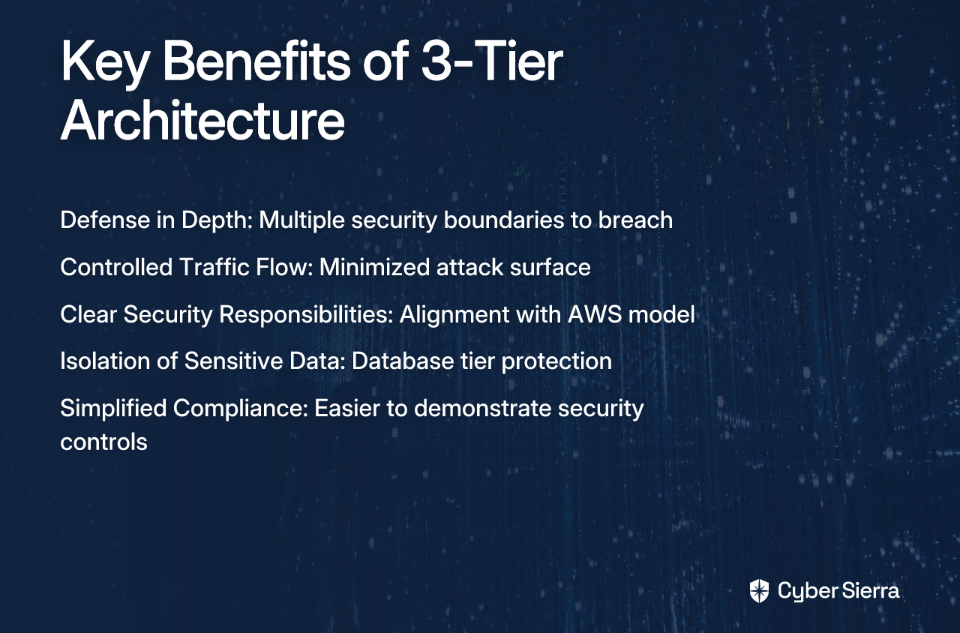
Defense in Depth

By isolating each tier, you implement a defense-in-depth strategy. A breach in the web tier doesn't grant immediate access to your database. The attacker would need to breach multiple security boundaries to reach your most sensitive data.

Controlled Traffic Flow

With a 3-tier design, each layer only communicates with adjacent layers through strictly defined rules. This minimizes your attack surface by ensuring components only talk to what they absolutely need to.

Alignment with AWS Shared Responsibility Model

Remember that AWS operates under a shared responsibility model. While AWS secures the cloud infrastructure, you're responsible for security in the cloud. The 3-tier architecture helps you fulfill your part of this responsibility with a proven, structured approach.

The Foundation: Designing a Secure VPC Blueprint

Your Amazon Virtual Private Cloud (VPC) serves as your private datacenter in the AWS cloud. It's the cornerstone that encapsulates your resources in a controlled, isolated environment.

IP Addressing with CIDR

When designing your VPC, start by choosing an appropriate IP address range using CIDR notation. A typical approach is to use a /16 CIDR block (e.g., 10.0.0.0/16), which provides 65,536 IP addresses. This gives you plenty of room for growth while subnets within the VPC use smaller ranges like /24 (256 IPs) for specific tiers.

The Public and Private Subnet Strategy

This is perhaps the most critical design pattern in your security foundation:

Public Subnets

Purpose: To host resources that need direct internet accessibility, such as your Application Load Balancer.

Configuration: These subnets have a route table with a default route (0.0.0.0/0) pointing to an Internet Gateway (IGW).

Private Subnets

Purpose: To host backend resources that should never be directly exposed to the internet, like application servers and databases.

Configuration: These subnets do not have a route to the IGW.

For resources in private subnets that need to make outbound internet calls (for updates, API calls, etc.), you'll need NAT Gateways. These reside in public subnets and allow outbound traffic while blocking inbound connections. For high availability, deploy at least two NAT Gateways across different Availability Zones.

Security Groups as Stateful Firewalls

Security Groups are your primary tool for controlling traffic between tiers at the instance level. The key principle here is Least Privilege – only allow what is absolutely necessary.

Avoid overly permissive rules like allowing 0.0.0.0/0 for anything other than public web traffic to a load balancer. According to Stratus10, this is one of the most common security misconfigurations in AWS environments.

Building the Tiers: AWS Services and Security Configurations

Now let's get practical with a step-by-step configuration guide for each tier:

Tier 1: Presentation (Web) Layer

Services: Application Load Balancer (ALB), EC2 instances (e.g., Nginx web servers) in an Auto Scaling Group.

Placement: ALB in public subnets, EC2 instances preferably in private subnets (with the ALB as the only public-facing component).

Security Group (Web-SG):

  • Inbound: Allow TCP ports 443 (HTTPS) and 80 (HTTP) only from 0.0.0.0/0.
  • Outbound: Allow all.

ALB Security Group (ALB-SG):

  • Inbound: Allow TCP 443/80 from 0.0.0.0/0.
  • Outbound: Allow traffic to the App-SG on the application port only.

Tier 2: Application (Logic) Layer

Services: Internal Load Balancer, EC2 instances (e.g., Node.js application) in an Auto Scaling Group.

Placement: Private subnets only.

Security Group (App-SG):

  • Inbound: Allow traffic on the application port (e.g., TCP 3000) only from the Web-SG or ALB-SG. This is a critical security rule.
  • Outbound: Allow traffic to the DB-SG on the database port only.

Tier 3: Data Layer

Services: Amazon RDS (e.g., Aurora MySQL) with Multi-AZ deployment for high availability.

Placement: Dedicated private subnets for maximum isolation.

Security Group (DB-SG):

  • Inbound: Allow traffic on the database port (e.g., TCP 3306) only from the App-SG. Deny all other traffic.
  • Outbound: Generally, no outbound rules are needed.

Automating the Blueprint: Infrastructure as Code with CloudFormation

Manually creating this infrastructure would be time-consuming and error-prone. Instead, use AWS CloudFormation to define and provision your entire architecture as code, enabling repeatable, automated, and version-controlled deployments.

CloudFormation Best Practices & Tools

  • Use YAML: It's more human-readable than JSON. Templates should have a .yaml suffix.
  • Validate Before Deploying: Use the CloudFormation Linter (cfn-lint) to validate templates against AWS standards.
    • Installation: pip install cfn-lint
    • Usage: cfn-lint template.yaml
  • Enhance Your Workflow: Consider using CloudFormation Rain, a CLI tool that improves the authoring and deployment experience.
  • Embrace Least Privilege IAM: Any IAM resources defined in your templates must follow the principle of least privilege.

Example CloudFormation Snippet

Here's a conceptual snippet for a 3-tier architecture:

Resources:
  VPC:
    Type: AWS::EC2::VPC
    Properties:
      CidrBlock: 10.0.0.0/16
      EnableDnsSupport: true
      EnableDnsHostnames: true
      Tags:
        - Key: Name
          Value: Three-Tier-VPC
  
  PublicSubnet1:
    Type: AWS::EC2::Subnet
    Properties:
      VpcId: !Ref VPC
      CidrBlock: 10.0.1.0/24
      AvailabilityZone: !Select [0, !GetAZs ""]
      MapPublicIpOnLaunch: true

  PrivateSubnet1:
    Type: AWS::EC2::Subnet
    Properties:
      VpcId: !Ref VPC
      CidrBlock: 10.0.101.0/24
      AvailabilityZone: !Select [0, !GetAZs ""]

  AppServerSecurityGroup:
    Type: AWS::EC2::SecurityGroup
    Properties:
      GroupDescription: "Allow traffic from Web Tier"
      VpcId: !Ref VPC
      SecurityGroupIngress:
        - IpProtocol: tcp
          FromPort: 3000
          ToPort: 3000
          SourceSecurityGroupId: !Ref WebServerSecurityGroup

For a complete, production-ready template, check out the AWS Three-Tier Web Architecture Workshop which provides detailed CloudFormation templates you can adapt for your needs.

From Blueprint to Production-Ready

We've covered the foundational aspects of a 3-tier AWS network architecture:

  • The 3-tier model provides security through isolation
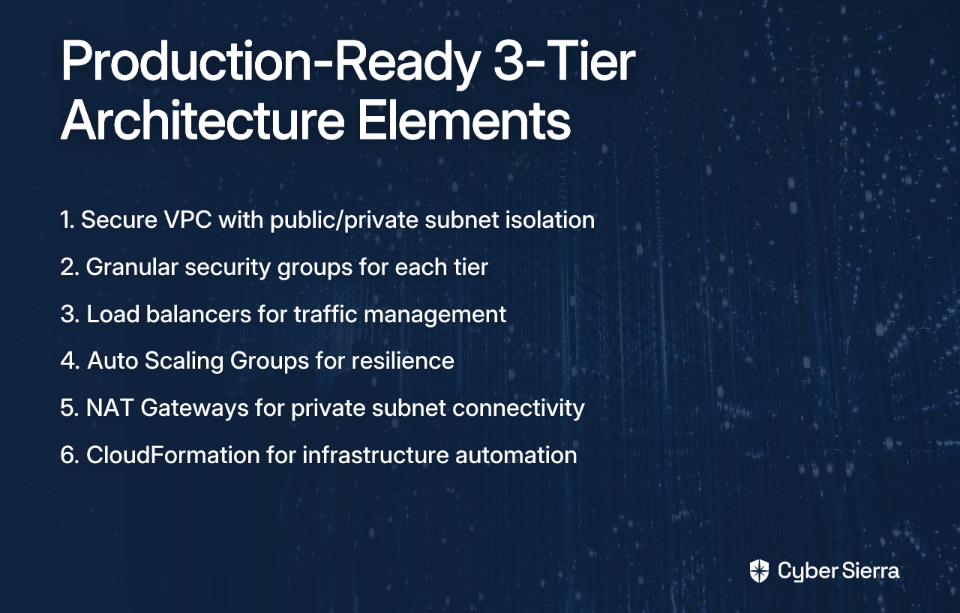
  • A well-designed VPC with public/private subnets is your foundation
  • Granular security groups enforce your security boundaries
  • CloudFormation makes it all manageable and repeatable

Beyond the Blueprint - Next Steps

To address common pain points identified in user discussions on AWS security:

Monitoring & Threat Detection: Implement AWS CloudWatch for performance monitoring, GuardDuty for intelligent threat detection, and Security Hub for a centralized view of security posture.

Patch Management: To address the pain of unpatched instances, use AWS Systems Manager Patch Manager for automated patching of EC2 fleets.

Secure Access: Implement AWS Systems Manager Session Manager for secure, auditable shell access to private instances, eliminating the need for bastion hosts and open SSH ports.

Conclusion

The 3-tier architecture isn't just an application design pattern – it's a security foundation that helps mitigate one of the biggest fears AWS engineers face: the cascading impact of a single compromise.

By implementing these patterns, you're not just following best practices; you're building resilience into your infrastructure from the ground up. The security landscape will continue to evolve, but a solid foundation gives you the best chance to adapt and respond effectively.

For a deeper dive, start with the security pillar of the AWS Well-Architected Framework, and for a hands-on experience building this architecture, follow the official AWS Three-Tier Web Architecture Workshop.

Remember, security is a journey, not a destination – but the 3-tier architecture gives you a solid place to start that journey.

Frequently Asked Questions

What is a 3-tier architecture in AWS?

A 3-tier architecture in AWS is a design pattern that separates an application into three logical and physical computing tiers: the presentation tier (web servers), the application tier (business logic), and the data tier (database). This structure enhances security and scalability by isolating each layer. The presentation tier handles user interaction, the application tier processes data, and the data tier stores information, with strict network rules controlling communication between them.

Why is a 3-tier architecture important for security?

A 3-tier architecture is crucial for security because it implements a "defense-in-depth" strategy, creating multiple security layers that an attacker must breach to access sensitive data. By isolating the web, application, and database layers into separate subnets with strict security group rules, you minimize the attack surface. A compromise in the public-facing web tier does not grant immediate access to the application logic or the database, significantly reducing risk.

How do the different tiers communicate securely in AWS?

Secure communication between tiers is enforced using AWS Security Groups, which act as stateful firewalls at the instance level. Each tier is assigned its own security group, and rules are configured to only allow traffic from the security group of the adjacent tier on specific ports. For example, the database tier's security group (DB-SG) is configured to only accept traffic on the database port (e.g., 3306) from the application tier's security group (App-SG).

What is the difference between a public and private subnet?

The key difference is that a public subnet has a route to an Internet Gateway (IGW), allowing resources within it to be directly accessible from the internet, while a private subnet does not. In a 3-tier design, public-facing resources like load balancers are placed in public subnets. Application servers and databases are placed in private subnets to protect them from direct internet exposure. Private subnets can still access the internet for outbound requests (like software updates) via a NAT Gateway located in a public subnet.

How can I automate the deployment of a 3-tier architecture?

The best way to automate the deployment of a 3-tier architecture is by using Infrastructure as Code (IaC) tools, with AWS CloudFormation being the native and recommended service. CloudFormation allows you to define your entire VPC, subnets, security groups, instances, and other resources in a YAML or JSON template file. This ensures your deployments are repeatable, consistent, and version-controlled, which drastically reduces manual errors and simplifies management.

How do I access EC2 instances in a private subnet for maintenance?

The most secure and modern method for accessing private EC2 instances is through AWS Systems Manager Session Manager, which eliminates the need for bastion hosts or opening SSH ports. Session Manager provides secure, browser-based shell access or CLI access to your instances through an encrypted tunnel. This approach is more secure than traditional methods because it doesn't require inbound ports to be opened in your security groups and all sessions can be logged and audited through AWS CloudTrail.

blog-hero-background-image
Cyber Security

What Does a Security Engineer Actually Do? Breaking Down the Role

backdrop
Table of Contents

Join thousands of professionals and get the latest insight on Compliance & Cybersecurity.


You've seen the job listings. You've heard the title thrown around in tech circles. But when someone says they're a "Security Engineer," do you really know what that means? If you're confused, you're not alone.

"I have no idea what I'm doing," confesses one security professional in an online forum, while another laments feeling "more like a watchman than an engineer." The reality is that the Security Engineer title is notoriously ambiguous, covering a vast landscape of responsibilities that can vary dramatically from one organization to the next.

Whether you're an aspiring security professional trying to understand the career path, a hiring manager looking to fill a position, or simply curious about what these digital guardians actually do all day, this breakdown will bring clarity to one of tech's most vital yet misunderstood roles.

The Guardian of the Digital Realm: What is a Security Engineer?

At its core, a Security Engineer is the architect and builder of an organization's digital defenses. They design, implement, monitor, and maintain security systems to protect data, networks, and infrastructure from cyber-attacks, loss, or unauthorized access.

This critical role goes by many names—Cybersecurity Engineer, Information Systems Security Engineer, Network Security Engineer, Information Security Engineer, or IT Security Engineer—which only adds to the confusion surrounding the position.

The primary mission isn't just about building stronger walls; it's about creating smarter, more resilient systems that can detect, respond to, and recover from inevitable security incidents. In today's landscape of sophisticated threats, Security Engineers are the frontline defenders in an increasingly dangerous digital battlefield.

The Core Responsibilities: From Proactive Defense to Incident Response

The Security Engineer's role can be broken down into four key areas:

Design & Build (Proactive Defense)

  • Engineer comprehensive cybersecurity strategies and architectures
  • Develop technical solutions to mitigate security vulnerabilities
  • Define and document system security requirements
  • Implement the "Shift Left" approach, integrating security early in the development process (a key component of DevSecOps)
  • Configure security tools like firewalls, proxies, and authentication systems

Monitor & Detect (Vigilance)

  • Install, configure, and troubleshoot security software and hardware
  • Perform security assessments, penetration testing (Pentesting), and code audits
  • Hunt for vulnerabilities in company products and systems through Vuln Management programs
  • Research new attack vectors and develop Threat Models
  • Scan for suspicious activities and anomalies in network traffic

Respond & Remediate (Incident Response)

  • Serve as a primary responder to security incidents, coordinating across teams
  • Investigate security breaches and cybersecurity incidents
  • Use SOAR (Security Orchestration, Automation, and Response) platforms to streamline responses
  • Triage alerts from SIEM (Security Information and Event Management) and XDR (Extended Detection and Response) systems

Advise & Educate (Strategic Influence)

  • Advise management on necessary security investments
  • Train employees on security best practices, like recognizing phishing attempts
  • Collaborate with developers to secure applications as a security subject matter expert
  • Advocate for security considerations in business decisions

A major focus for many Security Engineers is application security. With over 60% of data breaches involving software vulnerabilities, engineers often utilize frameworks like the OWASP Top 10 to identify and mitigate critical risks. They employ tools like SAST (Static Application Security Testing) and DAST (Dynamic Application Security Testing) scanners to automate vulnerability checks within CI/CD pipelines.

The Reality on the Ground: A Day in the Life

The job description might sound straightforward, but the day-to-day reality often differs from the ideal. Security Engineers face numerous challenges that aren't listed in the job posting:

The Meeting Overload

"I would love a meeting-free day once a week, but unfortunately I'm double/triple booked most hours during the day," laments one engineer on Reddit. Many security professionals report burnout from endless meetings where teams "talk in circles and sit in awkward silence."

The Battle for Resources

Proposing security improvements often leads to disappointment: "I make proposition to my management about ways to improve the global cybersecurity level of my org, but the usual answer is 'We don't have any budget for this.'" This constant uphill battle for resources can be demoralizing.

The Automation Dream vs. Reality

While many engineers aspire to focus on high-impact work like automation using Python, Ansible, or PowerShell, they frequently get bogged down by reactive tasks. One engineer shares their frustration with integration issues: "Why is this client's defender integration not ingesting logs into our SIEM?"

Imposter Syndrome is Real

"I've been doing specifically security for 6-7 years now and some days I feel like I know my stuff but then I meet a peer and it makes me look like I'm just learning how to walk." This sentiment resonates with many in the field, where the rapid pace of technological change can make even experienced professionals feel like beginners.

The Security Engineer's Toolkit: Essential Skills & Qualifications

Success in this role requires a diverse set of technical and professional skills:

Technical Skills (The "Hard Skills")

  • Programming & Scripting: Proficiency in languages like Python, Golang, Java, C++, Ruby, and shell scripting is crucial for automation and code review.
  • Networking: Deep knowledge of TCP/IP, DNS, routing protocols, subnetting, VoIP, VPNs, and firewalls is non-negotiable.
  • Operating Systems: In-depth understanding of Windows, MacOS, and Linux to diagnose vulnerabilities.
  • Cloud Security: Expertise in major platforms (AWS, Azure, GCP) is increasingly critical as organizations migrate to cloud environments.
  • Security Tools & Practices: Familiarity with Intrusion Detection/Prevention Systems (IDS/IPS), SIEMs, vulnerability scanners, IAM (Identity and Access Management), and GRC (Governance, Risk, and Compliance) frameworks.

Professional Skills (The "Soft Skills")

  • Communication: The ability to distill complex technical concepts for non-technical audiences, from developers to C-level executives.
  • Problem-Solving: Finding creative and effective solutions to complex security challenges under pressure.
  • Collaboration & Leadership: Working with various teams (developers, IT operations, legal) to drive security initiatives.
  • Continuous Learning: The threat landscape is always changing, so a commitment to staying updated is mandatory.

Education and Certifications

While 62% of job listings request a bachelor's degree in a related field, it's not always a strict requirement if you have the right skills and experience. Certifications can validate your skills and enhance your employability, with popular options including:

  • CISSP (Certified Information Systems Security Professional)
  • CISM (Certified Information Security Manager)
  • CompTIA Security+ (Good entry-point)
  • CCNP Security (Cisco Certified Network Professional Security)
  • CEH (Certified Ethical Hacker)

Charting the Course: Career Path, Salary, and Job Outlook

Many Security Engineers begin their careers in adjacent roles like IT support, network engineering, or as Information Security Analysts. With experience, they can advance to positions such as:

  • Senior Security Engineer
  • Security Architect
  • Security Consultant
  • Penetration Tester
  • IT Security Manager
  • Chief Information Security Officer (CISO)

The CyberSeek Career Pathway tool offers a visual guide to these progression options.

Salaries are competitive, reflecting the high demand and specialized skills required:

  • Glassdoor: $138,014
  • PayScale: $152,773
  • Cyberseek: $143,992
  • Indeed: ~$105,934

The job outlook is exceptionally promising. The U.S. Bureau of Labor Statistics projects a 33% job growth for information security analysts from 2023 to 2033, much faster than the average for all occupations. With over 3.5 million cybersecurity positions opened in 2021 according to Cyber Security Ventures, the field offers abundant opportunities across industries including finance, healthcare, government, technology, manufacturing, and retail.

The Guardian's Journey

The Security Engineer role is challenging, dynamic, and multifaceted—extending far beyond simply managing firewalls. These professionals serve as the critical guardians of an organization's most valuable asset: its data.

While the job comes with pressures like burnout and bureaucracy, it offers a rewarding career path with high impact, intellectual stimulation, and excellent compensation. For those passionate about problem-solving and protecting digital systems, few roles are as valuable or in-demand in today's interconnected world.

Whether you're looking to enter the field, hire for this position, or simply understand what these digital defenders actually do, one thing is clear: in an era of increasing cyber threats, Security Engineers aren't just nice to have—they're essential to organizational survival.

blog-hero-background-image
Cyber Security

How to Configure DLP Manager Approval in Microsoft 365

backdrop
Table of Contents

Join thousands of professionals and get the latest insight on Compliance & Cybersecurity.


You've set up a Data Loss Prevention (DLP) policy in Microsoft 365 to secure your organization's sensitive information. But when you look at the available actions, you're frustrated to find only basic options like "restrict access" or "encrypt" - with no sign of the manager approval workflow your executive team is demanding.

You start questioning if this is even possible in Microsoft 365. Did you miss something in the documentation? Is there some obscure setting hidden somewhere? Or will you need to cobble together a complex workaround using mail flow rules and transport rules?

If this sounds familiar, you're not alone. Many IT administrators face this exact challenge when implementing DLP policies in Microsoft 365.

The Hidden Secret: It's All About Policy Scoping

There's a simple but non-obvious solution to this problem: correctly scoping your DLP policy. The reason you don't see the manager approval option is likely because your policy is configured to protect content across multiple locations (SharePoint, OneDrive, Teams, and Exchange).

When a DLP policy spans multiple workloads, Microsoft limits the available actions to those that can work universally across all selected locations. This means you lose access to Exchange-specific actions - including the valuable "Forward for approval to sender's manager" option.

The good news? By creating a dedicated Exchange-only DLP policy, you can unlock this powerful workflow and satisfy your management's requirements for a formal approval process.

Prerequisites: What You Need Before Starting

Before diving into the configuration, ensure you have these prerequisites in place:

  1. Appropriate admin permissions: You must have either Security Administrator or Compliance Administrator role to create and manage DLP policies in the Microsoft Purview portal.
  2. Manager attribute in Azure AD/Entra ID: This is critical and often overlooked. The sender's Manager attribute must be correctly populated in Azure Active Directory. If this isn't defined, the approval rule will fail silently, and messages will be delivered without moderation.
  3. Microsoft 365 E3/E5 or equivalent license: DLP features require appropriate licensing for your organization.

Step-by-Step: Configuring DLP Manager Approval

Now let's walk through the exact process of setting up a DLP policy with manager approval:

Step 1: Access the Microsoft Purview Portal

  1. Navigate to the Microsoft Purview portal
  2. Sign in with your admin credentials
  3. In the left navigation pane, select Data loss prevention
  4. Click on Policies

Step 2: Create a New DLP Policy

  1. Click the + Create policy button
  2. Choose a template based on the type of sensitive information you want to protect (Financial, Medical, Privacy), or select Custom policy for a fully customized experience
  3. Give your policy a descriptive name and add an optional description
  4. Click Next

Step 3: Define Policy Scope (Critical Step)

This is where most admins make the mistake that prevents manager approval from appearing:

  1. In the Choose locations to apply the policy section:
    • Deselect ALL locations except for Exchange email
    • This is the crucial step that unlocks Exchange-specific actions
  2. You can further refine the scope to specific users or groups if needed
  3. Click Next

Step 4: Configure Policy Rules

  1. Click Create or customize advanced DLP rules
  2. Click + Create rule
  3. Give your rule a name
  4. Under Conditions, set up what will trigger the rule:
    • Content contains sensitive info types: Select from predefined types like credit card numbers, social security numbers, etc.
    • You can also create conditions based on document properties, message headers, or other attributes

Step 5: Configure the Manager Approval Action

Now that you've properly scoped the policy to Exchange only, you'll see expanded action options:

  1. In the Actions section, click + Add an action
  2. Select Restrict access or encrypt the content in Microsoft 365 locations
  3. You'll now see the option to Forward the message for approval to sender's manager - check this box
  4. Optionally customize notification text that the manager will receive
  5. Click Save

Step 6: Configure User Notifications

  1. Configure policy tips to inform users before they send an email containing sensitive information
  2. Set up email notifications to alert users when their message is pending approval
  3. Customize these messages to explain your organization's data handling policies

Step 7: Finalize and Test the Policy

  1. Configure incident reports and alert settings if desired
  2. Choose the policy mode:
    • Start with Test it out first (simulation mode) to avoid disrupting business operations
    • This allows you to see what would happen without actually blocking or moderating messages
  3. Review your settings and click Submit

Best Practices for Deployment

Rushing into full enforcement of a DLP manager approval policy can lead to workflow disruptions and frustrated users. Instead, follow this phased approach:

Phase 1: Simulation Mode

Start by running your policy in "Test it out first" mode. This allows you to:

  • See what would trigger the policy without actually moderating messages
  • Identify false positives and refine your conditions
  • Understand the potential volume of approval requests

Use the DLP reports in Microsoft Purview to analyze what's being detected during this phase.

Phase 2: Simulation with Policy Tips

After refining your conditions:

  1. Edit the policy and enable Show policy tips to users while in test mode
  2. Roll this out to a pilot group of users
  3. Gather feedback on the frequency and accuracy of the tips
  4. Further adjust your conditions based on this feedback

This educates users on the upcoming changes and provides valuable real-world validation.

Phase 3: Full Enforcement

Once you're confident the policy is working as intended:

  1. Edit the policy and select Turn it on right away
  2. Monitor DLP alerts and user feedback closely after deployment
  3. Be prepared to make adjustments as needed

Handling Real-World Challenges

What Happens When a Manager Doesn't Respond?

By default, if a manager doesn't respond to an approval request within 2 days, the sender receives an expiration message. However, the backend process that checks for this runs every 7 days, so a message can take between 2 and 9 days to officially expire.

This can be problematic if the manager is on vacation or otherwise unavailable.

Creating a Fallback Approver Chain

To address manager unavailability, you can create a multi-level approval chain:

  1. In the Exchange admin center, go to Mail flow > Rules
  2. Create a secondary mail flow rule that:
    • Triggers on the same conditions as your DLP rule
    • Includes a condition like "A message header includes..."
    • Checks if the first approval was already processed
    • Forwards to a backup approver (e.g., compliance officer or security team)

This creates a safety net for when managers are unavailable. For detailed guidance, see Common message approval scenarios.

Reducing Manager Approval Fatigue

To prevent overwhelming managers with approval requests:

  1. Refine conditions: Make your rules more specific with higher thresholds for sensitive data detection
  2. Use exceptions: Add exceptions for trusted domains or internal workflows
  3. Communicate: Proactively inform managers about the volume of requests they can expect
  4. Train users: Educate employees on handling sensitive data to reduce policy violations

Conclusion

Configuring DLP manager approval in Microsoft 365 is straightforward once you understand the critical role of policy scoping. By creating an Exchange-only policy, you unlock the powerful manager approval workflow that would otherwise remain hidden.

Remember these key takeaways:

  1. Scope your DLP policy to Exchange only to access the manager approval action
  2. Ensure the Manager attribute is populated in Azure AD for all users
  3. Use a phased rollout approach to minimize business disruption
  4. Consider creating a fallback approver chain for manager unavailability
  5. Continuously refine your conditions to reduce false positives and manager fatigue

With these steps, you'll successfully implement a robust DLP manager approval workflow that balances security with productivity - and finally deliver the approval process your executive team has been demanding.

Frequently Asked Questions

Why can't I see the "forward for approval to sender's manager" option in my DLP policy?

The "forward for approval" option is missing because your DLP policy is likely scoped to multiple locations like SharePoint, OneDrive, and Teams in addition to Exchange. This action is specific to Exchange email. To make it visible, you must create a DLP policy that applies only to the Exchange location. When a policy spans multiple services, Microsoft only shows actions that are universally available across all of them.

What happens if a user without a manager defined in Azure AD sends an email that triggers the approval policy?

If a sender's Manager attribute is not populated in Azure Active Directory (Azure AD), the approval rule will fail silently, and the email will be delivered without any moderation. The system has no one to route the approval request to, so it bypasses the block. This makes it critical to ensure the Manager field is correctly maintained for all users covered by the policy.

How long does a manager have to approve or reject a message?

By default, a manager has two days to respond to an approval request before it expires. After this period, the original sender receives a message stating the request has expired. However, the background process that checks for expired messages only runs once every seven days, which means a message can take between two and nine days to officially expire and notify the sender.

Can I set a specific person or group as the approver instead of the sender's manager?

Yes, but not directly within the DLP policy action itself. To route approvals to a specific person or group (like a compliance team), you must configure a mail flow rule (transport rule) in the Exchange admin center. You can create a rule with the same conditions as your DLP policy and set the action to "Forward the message for approval to" a specific mailbox or group instead.

What are the licensing requirements for using DLP with manager approval?

To use Microsoft Purview Data Loss Prevention, including the manager approval workflow, your organization needs a Microsoft 365 E3/A3/G3 or E5/A5/G5 license. This feature is part of the advanced compliance capabilities offered in these enterprise-level plans, and the users subject to the policy must be properly licensed.

How can I reduce the number of approval requests sent to managers?

You can reduce approval requests by making your DLP policy conditions more specific, using exceptions, and educating users. Start by refining your rules to look for higher instance counts of sensitive data (e.g., more than five credit card numbers instead of just one). You can also add exceptions for trusted business workflows or communications with specific domains. Finally, use policy tips to train users on proper data handling, which helps prevent accidental violations.


Have you implemented DLP manager approval in your organization? What challenges did you face? Share your experiences in the comments below.

blog-hero-background-image
Cyber Security

Why Your Healthcare Security Training Is Failing (And How to Fix It)

backdrop
Table of Contents

Join thousands of professionals and get the latest insight on Compliance & Cybersecurity.


Imagine a chemo treatment being delayed because of a 2FA prompt, or a defibrillator locking out during an emergency because of an invalid MFA response. These aren't far-fetched scenarios; they are the dangerous reality when cybersecurity policy clashes with patient care. As one healthcare professional bluntly put it: "theoretical security stands no chance against the day-in and day-out of these clinicians."

In an industry where minutes—even seconds—can mean the difference between life and death, the disconnect between security protocols and clinical workflows is putting both patient data and lives at risk.

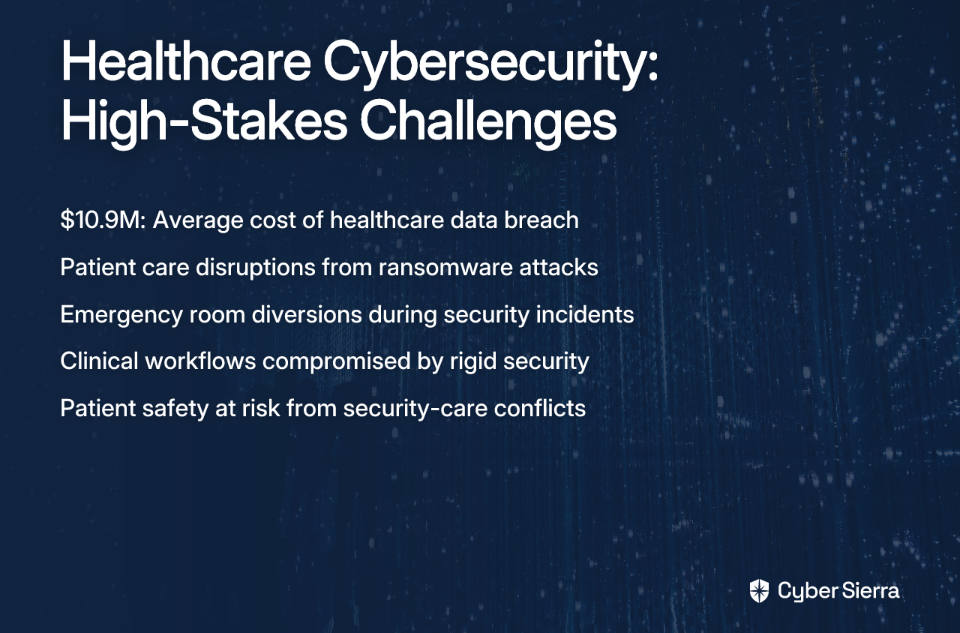
This disconnect is particularly alarming considering that healthcare is a prime target for cybercriminals, with the average cost of a data breach reaching $10.9 million according to Huntress. These aren't just financial costs. Recent ransomware attacks have led to significant operational disruptions, forcing emergency rooms to divert patients, directly impacting patient care.

So why, despite the high stakes, is healthcare security training failing so spectacularly? The answer is simple but troubling: Most healthcare security training is a generic, check-the-box exercise that ignores the unique, high-pressure context of clinical environments. This article will break down why it's failing and provide a practical, step-by-step guide to fix it.

The High Cost of Failure: When Security Clashes with Patient Care

Healthcare organizations face an evolving and relentless threat landscape that goes far beyond basic phishing attempts:

The real problem, however, isn't just these external threats—it's the dangerous disconnect between security policies and clinical reality. As one cybersecurity professional observed in a Reddit discussion: "people that write policies rarely actually have to deal with them in the wild."

This disconnect manifests in dangerous ways:

  1. Workflow Impediments: Poorly designed EMRs and security protocols create such hindrances that staff resort to keeping "literal binders full of webpages, instructions and logins" just to do their jobs.
  2. Unsafe Practices: To save time, clinicians engage in "professional courtesy" by offering their logged-in sessions to colleagues, which has led to physicians ordering medications for the wrong patient.
  3. Hierarchical Pressure: Security protocols are often bypassed when "a Dr doesn't want to do MFA they will escalate until it gets to the c level who in the end will want to please them."

The result? A security culture that exists on paper but crumbles in practice.

Diagnosing the Failure: 5 Reasons Your Training Program Isn't Working

Before we can fix healthcare security training, we need to understand exactly why current approaches are failing:

1. It's Generic and Lacks Context

Many organizations adopt a one-size-fits-all approach, failing to provide role-specific content for nurses, physicians, and administrative staff who have unique responsibilities. According to Accutech Security, this generic approach ignores the specific challenges each role faces.

Research published in ScienceDirect confirms this problem: organizations often lack a comprehensive, contextual understanding of health data breaches. Effective training requires investigations tailored to specific clinical contexts, not generic cybersecurity principles.

2. It's Passive and Unengaging

Standard training often relies on passive methods like videos and quizzes, which are insufficient to build real skills. Without real-world examples, case studies, or personal anecdotes, the training feels theoretical and disconnected from daily work.

One healthcare IT professional noted: "The EMRs are terrible, workflows are bad, and all of it is a hindrance to patient care." When training doesn't acknowledge these real-world challenges, it's quickly dismissed as irrelevant.

3. It's Infrequent and Outdated

Security training is treated as an annual compliance checkbox rather than an ongoing process. This approach fails to combat complacency or address the rapidly evolving threat landscape.

This is especially dangerous when organizations are running on legacy systems. As one Reddit user shared, many healthcare providers are "required to only run legacy AV... Not modern EDR type solutions," creating a perfect storm of outdated systems and outdated training.

4. It Lacks Practical, Hands-On Application

Employees are told what to do but are rarely given the chance to practice in a safe environment. According to Censinet, effective training requires hands-on experience through simulations that mimic real-world events like ransomware attacks, medical device breaches, or EHR outages.

Without this practical application, healthcare staff remain unprepared for actual security incidents, especially when they occur during high-pressure clinical situations.

5. Success Is Measured by Completion, Not Competence

Many programs track completion rates as the sole metric of success. This creates a culture of "checking the box" rather than ensuring actual learning and behavior change.

Effective programs must measure actual behavioral change by tracking metrics like response time, accuracy, and team coordination during drills. There's also often a lack of robust feedback mechanisms to collect input from staff and refine future training content.

The Prescription for Success: A 5-Step Guide to Revamping Your Security Training

Now that we've diagnosed the problems, let's look at how to fix healthcare security training with a practical, step-by-step approach:

Step 1: Map Skills, Gaps, and Context-Specific Risks

Begin by assessing the technical and operational skills of your teams and identifying knowledge gaps. According to Censinet, this foundational step ensures your training addresses actual needs rather than assumed ones.

  • Identify risks specific to your organization, such as PHI breaches, vulnerabilities in medical devices, or EHR outages
  • Conduct surveys with clinical staff to understand their current knowledge, pain points, and daily security challenges
  • Document specific workflows where security and clinical care seem to conflict

Step 2: Create Tailored, Role-Specific Training Plans

Design training around realistic, role-specific scenarios that reflect the actual challenges your staff face:

  • For clinical teams: Focus on scenarios like spotting phishing emails disguised as patient record updates or securing mobile workstations (COWs) between patient visits
  • For IT staff: Focus on technical responses to ransomware attacks, securing legacy systems, and managing medical device vulnerabilities
  • For administrative staff: Focus on protecting PHI during routine administrative tasks and recognizing social engineering attempts

This tailored approach acknowledges that different roles have different security responsibilities and challenges, making training immediately relevant to daily work.

Step 3: Make Training Interactive, Hands-On, and Continuous

Replace passive learning with active engagement:

  • Practice Through Simulations: Conduct realistic drills that mimic real-world events. This provides hands-on experience with security tools, communication protocols, and interdepartmental coordination
  • Incorporate Gamification: Use leaderboards, scenario challenges, and rewards to enhance engagement. Create timed "urgency challenges" to simulate the pressure of a real emergency
  • Schedule Regularly: Implement quarterly refresher sessions and monthly drills to keep skills sharp and adapt to emerging threats

As Huntress points out, continuous training is essential because cyber threats are constantly evolving—your training must evolve too.

Step 4: Use Real-World Examples to Foster a Security Culture

Move beyond theoretical concepts by grounding training in reality:

  • Analyze real incidents and case studies from healthcare organizations to drive home the importance of protocols
  • Create an environment where staff can share their own experiences and near-misses without fear of punishment
  • Highlight the connection between security practices and patient safety to make security personally meaningful

The goal is to create a shared responsibility for cybersecurity among all employees, fostering a proactive culture of security, not just compliance.

Step 5: Track, Measure, and Continuously Improve

Move beyond completion rates to meaningful metrics:

  • Measure Performance: During drills, track response time, accuracy, and team coordination
  • Monitor Behavior: Look for tangible changes in staff behavior, like improved adherence to protocols or quicker identification of phishing attempts
  • Gather Feedback: Use post-training surveys and discussions to identify remaining pain points and refine content
  • Iterate: Regularly update training content based on performance metrics, feedback, and analysis of new threats

From Compliance Checkbox to Clinical Cornerstone

Ineffective security training is not just a compliance risk—it's a direct threat to patient safety and operational stability. The path forward requires moving away from generic, infrequent training toward a continuous, practical, and tailored program built on realistic simulations and role-specific content.

Remember the scenarios we opened with? With proper training, that chemo treatment wouldn't be delayed by an authentication issue because staff would be trained on streamlined emergency protocols. The defibrillator wouldn't lock during a critical moment because the system would be designed with clinical workflows in mind.

Investing in a robust Security Awareness Training program isn't an IT expense—it's a critical investment in protecting patients, ensuring continuity of care, and maintaining trust in your organization. Empower your staff to be your strongest line of defense by giving them training that acknowledges the realities of healthcare and equips them for success.

The question isn't whether you can afford better security training. In today's threat landscape, the question is: can you afford not to?

Frequently Asked Questions

Why is cybersecurity training in healthcare so important?

Cybersecurity training in healthcare is critically important because security failures can directly endanger patient safety, disrupt essential clinical operations, and result in costly data breaches. Poorly implemented security can delay treatments or lock out life-saving medical devices, while successful cyberattacks can force hospitals to divert emergency patients, putting lives at risk.

What are the biggest cybersecurity threats facing healthcare?

Healthcare organizations face a range of severe cybersecurity threats, including ransomware that can shut down hospital systems, data breaches targeting sensitive patient health information (PHI), and advanced phishing attacks that trick staff into revealing credentials. Other major threats include caller ID or email spoofing and business email compromise (BEC), where attackers impersonate executives to authorize fraudulent transactions.

How can healthcare organizations make their security training more effective?

To make security training more effective, healthcare organizations should move beyond generic, check-the-box exercises. A successful program involves creating tailored, role-specific training plans, using interactive and hands-on simulations, grounding lessons in real-world incidents, and continuously measuring behavioral change rather than just completion rates.

What is role-specific security training and why is it essential?

Role-specific security training is an approach that tailors content to the unique responsibilities and workflows of different staff members, such as nurses, physicians, and administrative teams. It's essential because a generic, one-size-fits-all program fails to address the specific security challenges each role faces, making the training feel irrelevant and ineffective in high-pressure clinical environments.

How often should healthcare security training be conducted?

Healthcare security training should be an ongoing and continuous process, not a one-time annual event. To effectively combat evolving threats and prevent complacency, organizations should implement regular training activities, such as quarterly refresher sessions and monthly hands-on security drills.

What are the best metrics to measure security training success?

The best metrics for success move beyond simple completion rates and focus on actual competence and behavioral change. During simulated drills, organizations should track key performance indicators like response time, accuracy, and team coordination. In day-to-day operations, success can be seen through improved adherence to security protocols and a reduction in security incidents.

blog-hero-background-image
Cyber Security

How to Start Threat Modeling When Your Team Has Zero Experience

backdrop
Table of Contents

Join thousands of professionals and get the latest insight on Compliance & Cybersecurity.


You've heard the term "threat modeling" thrown around in security discussions, and perhaps you've nodded along while secretly wondering if it's just another buzzword designed to make simple concepts sound more impressive. Maybe your team has been asked to create a threat model for a new project, and you're not sure where to start—or if it's even worth your time.

As one security professional candidly shared on Reddit, "It sucks because people think it's more than it is... Someone who wanted to look good decided to give it a fancy name 'threat modelling' to make it look like they were doing cool things."

But here's the reality: threat modeling isn't just security theater. When done right, it's a practical exercise that "saves time and gives focus," as another practitioner points out. In fact, without proper threat modeling, your team risks developing systems with "trivially easy security flaws" or, worse, having your project "kicked back and not approved for production" during security reviews.

The good news? You don't need to be a security expert to get started. This guide will show you how to begin threat modeling with zero prior experience, using simple frameworks that any development team can implement in a single afternoon.

What is Threat Modeling (and What It's Not)?

Let's clear up a common confusion first. Many teams mix up "threat modeling" with "risk assessment," which leads to misaligned efforts and frustration.

Threat modeling is a structured process for identifying potential security threats to your system from an attacker's perspective. It focuses on the "how"—the specific ways someone might attempt to compromise your system.

Risk assessment, on the other hand, evaluates the business impact of those threats and the likelihood they'll occur. It's about the "so what?"—the consequences and priorities for your organization.

In simple terms, threat modeling helps you:

  1. Detect problems early in the design phase, when fixes are cheaper and easier
  2. Focus your security efforts where they matter most
  3. Build a security mindset across your development team

As one Reddit user bluntly put it: "If you don't model your threats, then how else do you prioritize your prevention and remediation plans?"

The Easiest Way to Start: The Four-Question Framework

If you're new to threat modeling, forget the complex methodologies for now. The Open Web Application Security Project (OWASP) offers a beautifully simple four-question framework that's perfect for beginners:

1. What are we working on?

This question helps you define your scope and create a visual representation of your system.

Action step: Gather your team around a whiteboard and draw a simple diagram of your application or feature. Include:

  • Key components (APIs, databases, front-end)
  • Data flows (how information moves between components)
  • Trust boundaries (where your system interacts with external elements)

Don't worry about using formal notation—clarity matters more than technical perfection at this stage.

2. What can go wrong?

This is where you brainstorm potential threats by thinking like an attacker.

Action step: Use the STRIDE model as a simple checklist to prompt your thinking, not as a rigid methodology. STRIDE stands for:

  • Spoofing: Can someone pretend to be another user?
  • Tampering: Can data be maliciously modified?
  • Repudiation: Could a user deny performing an action?
  • Information Disclosure: Can sensitive data be exposed?
  • Denial of Service: Can the system be made unavailable?
  • Elevation of Privilege: Can a user gain unauthorized access?

For each component and data flow on your diagram, ask: "Which of these STRIDE categories might apply here?"

3. What are we going to do about it?

Now it's time to identify countermeasures for the threats you've found.

Action step: For each credible threat, brainstorm potential solutions. These might include technical controls (input validation, encryption), policy changes, or user training.

Remember that prioritization is key—you don't have to fix everything at once. Focus on threats with the highest potential impact first.

4. Did we do a good job?

This final question ensures your threat model remains valuable over time.

Action step: Review your diagram and threat list. Test the controls you've implemented. Make threat modeling a continuous part of your development process, not a one-time exercise.

As an OWASP specialist explains, "Threat modeling is a structured representation of all the information that affects the security of an application." This simple four-question approach gives you that structure without overwhelming complexity.

Your First Threat Modeling Session: A 5-Step Practical Guide

Ready to put theory into practice? Here's how to run your very first threat modeling session, even if your team has zero security experience:

Step 1: Assemble Your Team (and Bring Snacks)

Gather a small, diverse group including developers, product managers, and if possible, someone with security knowledge. Keep it interactive—as one security professional notes, "gamified table top exercises work best" for engagement.

Step 2: Whiteboard the System

Draw a simple diagram showing your application's components and how data flows between them. Label trust boundaries where your system interacts with users, external services, or less-trusted elements.

Step 3: Brainstorm Threats

Go through each STRIDE category, applying it to your diagram's components. Encourage creative thinking by asking questions like:

  • "What if someone intercepted this data flow?"
  • "How could a malicious user abuse this feature?"
  • "What would happen if this component went down?"

Step 4: Discuss and Prioritize Mitigations

For each credible threat, brainstorm potential solutions. Rate threats on a simple scale (High, Medium, Low) based on potential impact and ease of exploitation to help focus your efforts.

Step 5: Document and Assign Actions

Record your findings in a shared document or project management tool. Include:

  • The identified threats
  • Their priority levels
  • Proposed mitigations
  • Who's responsible for implementation

This documentation will justify security work and serve as a reference for future development.

Common Pitfalls for Beginners (and How to Avoid Them)

Even with a simple approach, teams new to threat modeling often struggle with these common challenges:

Pitfall 1: Trying to Model Everything at Once

Problem: Teams get overwhelmed trying to analyze their entire system architecture.

Solution: Start small. Focus on one critical feature or component. Success with a manageable scope will build confidence and momentum.

Pitfall 2: Treating it as a One-Time Checkbox

Problem: The team does one session, creates a document, and never looks at it again.

Solution: Make threat modeling part of your development lifecycle. Revisit your model when adding features, changing architecture, or after security incidents.

Pitfall 3: Neglecting Internal Threats

Problem: Teams often focus exclusively on external hackers.

Solution: Consider risks from insiders, both malicious and accidental. Remember that not all threats come from outside your organization.

Pitfall 4: Making it a Siloed Security Task

Problem: A single security person does the modeling alone, leading to an inaccurate model and no developer buy-in.

Solution: Keep it collaborative. The most effective threat modeling involves diverse perspectives from development, operations, and business teams.

From Zero to Proactive in One Afternoon

Threat modeling doesn't have to be complicated or intimidating. At its core, it's structured brainstorming that helps your team think like attackers to build more secure systems.

By starting with the simple four-question framework from OWASP and running a collaborative session using the steps outlined above, any team—regardless of security experience—can begin improving their security posture today.

The most important step? Actually scheduling that first session. Block out 60-90 minutes on your team's calendar, bring some snacks, and start the conversation. You might be surprised by how much value even a basic threat modeling exercise can provide.

Remember the words of that security practitioner: "It's one of the most important things you can do in your security architecture function that most either don't do or they do poorly." With this guide, your team can be among those who do it well.

Ready to get started?

Frequently Asked Questions

What is the main goal of threat modeling?

The main goal of threat modeling is to proactively identify and mitigate potential security vulnerabilities early in the development lifecycle. By thinking like an attacker before and during the design phase, teams can build more secure systems from the ground up, which is far more efficient and cost-effective than fixing flaws after a product has been released.

How is threat modeling different from a penetration test?

Threat modeling is a proactive, collaborative discussion during the design phase to identify potential threats, while a penetration test (pen test) is a reactive, simulated attack on a live or near-production system to find existing vulnerabilities. Threat modeling focuses on what could go wrong in the architecture, whereas a pen test focuses on what is currently wrong in the implementation.

When is the best time to perform threat modeling?

The ideal time to perform threat modeling is during the design phase of a new system or feature, before any code has been written. This allows you to address security concerns when changes are easiest and cheapest to make. It should also be treated as a continuous process, revisited whenever significant architectural changes are introduced.

Who should be involved in a threat modeling session?

A threat modeling session is most effective as a collaborative effort involving a diverse group. This typically includes developers who understand the implementation details, architects who know the system design, and product managers who can speak to the feature's intended use. While a security expert is helpful, their absence shouldn't prevent your team from getting started.

What tools do I need for threat modeling?

For beginners, the most effective tools are often the simplest: a whiteboard and markers for diagramming, and a shared document or project management ticket to record identified threats and mitigations. While specialized threat modeling tools exist, starting with low-fidelity tools encourages discussion and prevents the process from being bogged down by software complexity.

How often should my team conduct threat modeling?

Threat modeling should be an ongoing part of your development lifecycle, not a one-time event. A good practice is to conduct a threat modeling session for every new major feature or significant architectural change. Additionally, it's wise to periodically review existing models, perhaps quarterly or annually, to account for new and evolving threats.

blog-hero-background-image
Cyber Security

Why Your Hand Calculations Are Lying to You (And What FEA Can't Fix)

backdrop
Table of Contents

Join thousands of professionals and get the latest insight on Compliance & Cybersecurity.


You've been there before. Staring at a complex component, deadline looming, and that sinking feeling hits: "accurately estimating actual stresses is quite difficult without the use of detailed FEA." The simple beam theory you learned in school just isn't cutting it anymore, because as one frustrated engineer put it, "oftentimes components don't fit the simplifying assumptions required to use hand calculations."

This is modern engineering's uncomfortable truth: the hand calculations we've relied on for generations are, in many cases, lying to us. Yet the powerful Finite Element Analysis (FEA) tools meant to rescue us come with their own blind spots that software vendors won't advertise.

The Deception of Simplicity: Where Hand Calculations Fall Short

Hand calculations form the bedrock of engineering education for good reason - they teach fundamental principles and build intuition. But in today's world of complex geometries and multidirectional loading, they force us to make simplifications that can border on fiction.

Limitation 1: Complexity Overload

Traditional calculations simply break down when facing:

  • Non-uniform geometries with stress concentrations
  • Non-linear materials (anything in the plastic region)
  • Multiple simultaneous loading conditions
  • Complex boundary conditions

As designs become more optimized and materials more specialized, these simplifications grow increasingly dangerous.

Limitation 2: The High Cost of Conservatism

To compensate for these simplifications, engineers often resort to inflated safety factors. As one engineer noted, "high safety factors on the order of 5+ would be needed to cover analysis using only hand calculations." This approach leads to over-engineered, heavier, and more expensive components, with "some areas being overly conservative where risk does not warrant that level of conservatism."

In competitive industries where every gram and dollar counts, this artificial padding becomes untenable.

Limitation 3: The Hidden Costs of Manual Work

Beyond conservatism, manual methods carry significant hidden costs that rarely appear in project budgets:

  • Time Consumption: Manual calculations drastically slow down design iterations. When a client requests last-minute changes, hours of rework can derail timelines and budgets.
  • Human Error: Even meticulous engineers make mistakes. A misplaced decimal or forgotten conversion factor in manual calculations can lead to costly redesigns or, worse, liability issues.

The Power of the Mesh: How FEA Provides Deeper Insight

Enter Finite Element Analysis—a computational simulation technique that breaks down complex structures into a large but finite number of simple, solvable elements (a "mesh"). FEA has revolutionized engineering by providing a window into stress distributions that hand calculations could never reveal.

The FEA Workflow

  1. Create a detailed CAD model of your component
  2. Discretize the geometry into a mesh of elements
  3. Apply appropriate material properties
  4. Define boundary conditions (loads, constraints)
  5. Let the software solve complex algebraic equations for each element
  6. Visualize results through color maps of Von Mises stress and other parameters

Key Benefits of FEA

Detailed Insights: FEA reveals stress concentrations and performance nuances in complex geometries that hand calculations would miss entirely. It answers not just "will it break?" but "where, how, and why might it fail?"

Design Optimization: By pinpointing exactly where a design is weak or overbuilt, FEA enables engineers to remove material where it's unnecessary and reinforce critical areas. This precision reduces the need for blanket safety factors.

Efficiency and Speed: Modern FEA software can run multiple design scenarios in minutes, not hours, allowing for rapid iteration and comprehensive design exploration.

Industry Validation: The FEA software market is projected to grow from $4 billion to $11 billion by 2030—a testament to its value in modern engineering workflows.

The Black Box Warning: What FEA Can't Fix

Despite its power, FEA harbors dangerous blind spots that have led to spectacular engineering failures. The most critical limitation follows the cardinal rule of computation: "Garbage In, Garbage Out."

Blind Spot 1: Human Error in Setup

An FEA model can be perfectly solved and still be completely wrong if the inputs are flawed:

Consider this scenario: An engineer undersizes steel beams because the FEA software was incorrectly set to assume temporary shoring during construction. The software gives a "correct" answer to the wrong question—a potentially disastrous error that a simple hand check could have caught.

Other common setup errors include:

  • Incorrect boundary conditions (over-constrained or under-constrained models)
  • Inappropriate material properties
  • Misunderstanding the difference between static vs. dynamic or linear vs. nonlinear analysis

Blind Spot 2: The Illusion of Reality

FEA provides an approximation of reality, not a perfect replication. Results depend heavily on mesh quality and convergence studies. Without proper validation, beautiful color gradients can mask fundamental errors in the analysis.

Blind Spot 3: The Erosion of Engineering Judgment

Perhaps most insidious is how over-reliance on FEA as a "black box" can erode engineering judgment. As expert SS Bhavikatti warns, manual calculations remain crucial because they "aid understanding, providing a rough idea of expected results"—the foundation of engineering intuition.

Without this intuitive check, engineers can lose the ability to spot when a software result is nonsensical, leading to a dangerous disconnect between virtual models and physical reality.

The Synthesis: Forging Engineering Judgment in the Digital Age

The solution isn't choosing between old and new methods—it's integrating them. Hand calculations should be reframed as an essential validation tool for FEA outputs, creating a powerful synergy that leverages the strengths of both approaches.

A Practical, Integrated Workflow

  1. Estimate with a Hand Check: Before diving into FEA, simplify the complex structure into a manageable form. For example, treat a multi-column pier cap as a simple beam to estimate primary design forces. This creates a "sanity check" number.
  2. Model with FEA: Build your detailed, complex model in your FEA software and run the analysis.
  3. Compare and Question: Are the FEA results in the same order of magnitude as your hand calculation?
    • If yes, you can have high confidence in both your understanding and your model.
    • If no, investigate. Is a fundamental assumption in your hand calculation wrong? Or is there an error in your FEA setup (e.g., a unit error, a wrong boundary condition)? This is where true learning happens.

The Benefits of the Hybrid Approach

  • Avoids Disasters: Catches major assumption errors that software might hide.
  • Increases Efficiency: Reduces back-and-forth in QA/QC because the designer's and checker's fundamental understanding is aligned.
  • Develops True Engineering Judgment: This constant comparison between simplified estimates and complex results is the single best way to hone engineering intuition.

Conclusion: The Engineer as the Ultimate Check

Hand calculations "lie" by oversimplifying a complex world. FEA can "lie" by giving precise answers to poorly posed questions. Both are fallible tools that require human oversight.

The ultimate responsibility for a safe and efficient design rests not in the calculation method, but in the engineer wielding it. The modern engineer's greatest skill isn't just operating powerful software, but critically questioning its outputs with a foundational understanding built on first principles.

In an age of increasingly powerful computational tools, it's this synthesis of traditional understanding and advanced analysis that distinguishes the exceptional engineer—one who knows when to trust the software, when to question it, and how to validate results across multiple methodologies.

Frequently Asked Questions

Why are hand calculations still important in the age of FEA?

Hand calculations are crucial for validating FEA results and developing engineering intuition. They provide a "sanity check" to ensure the complex FEA model's output is reasonable, helping to catch major errors in setup like incorrect boundary conditions or units. This hybrid approach prevents over-reliance on software and builds a deeper understanding of physical principles.

What is the most common pitfall when using FEA software?

The most common pitfall is the "Garbage In, Garbage Out" principle, where incorrect inputs lead to flawed results. Even if the software solves the model perfectly, errors in setup—such as wrong material properties, flawed boundary conditions, or misunderstanding the analysis type (e.g., static vs. dynamic)—will produce a result that is precisely calculated but dangerously wrong.

How can a simple hand calculation validate a complex FEA model?

You can validate a complex FEA model by simplifying its geometry and loading into a basic problem that can be solved by hand. For example, treat a complex bracket as a simple cantilever beam and calculate the expected stress or deflection. If your FEA results are in the same order of magnitude, you can have confidence in your model. If they differ significantly, it signals a potential error in either your hand calculation's assumptions or your FEA setup.

When is it necessary to use FEA over hand calculations?

FEA is necessary when dealing with complex geometries, non-linear materials, or multiple simultaneous loading conditions that cannot be accurately simplified. Hand calculations break down when faced with non-uniform shapes that have stress concentrations, materials behaving in their plastic region, or complex interactions between loads and constraints. In these scenarios, FEA provides the detailed insight required for a safe and efficient design.

What are the main advantages of FEA for design optimization?

FEA's main advantage for optimization is its ability to precisely identify areas of high and low stress within a component. This detailed insight allows engineers to strategically remove material from low-stress regions (reducing weight and cost) and reinforce critical high-stress areas. This avoids the need for large, inefficient "blanket" safety factors often used with hand calculations, leading to more optimized and competitive designs.

Can relying too much on FEA make you a worse engineer?

Yes, over-reliance on FEA as a "black box" without understanding the underlying principles can erode essential engineering judgment. When engineers blindly trust software outputs without performing sanity checks, they lose the ability to spot when a result is nonsensical. True engineering expertise comes from integrating computational tools with a foundational understanding, using hand calculations to question and validate software results, thereby strengthening intuition rather than replacing it.

Your hand calculations may be lying to you, and FEA isn't a perfect truth-teller either. The real truth emerges when you compare them both, investigate the discrepancies, and forge your own engineering judgment in the crucible of that analysis.

blog-hero-background-image
Cyber Security

How to Build a Secure Next.js BFF with Session Cookies

backdrop
Table of Contents

Join thousands of professionals and get the latest insight on Compliance & Cybersecurity.


You've set up a Next.js application with multiple API endpoints, but now you're facing a tangled web of security concerns, authentication challenges, and complex API interactions. As one developer put it on Reddit, "At work I always had to manage lots of API on the frontend, a BFF could have helped manage that mess."

If you're tired of client-side code making multiple service calls, storing sensitive tokens in localStorage, and trying to navigate the "million ways to skin a cat" when it comes to security, there's a solution: the Backend for Frontend (BFF) pattern.

Why a BFF in Next.js? The Strategic Advantages

The BFF pattern provides a dedicated server-side layer that acts as the single touchpoint for your frontend application. Next.js is uniquely positioned to implement this pattern through its powerful Route Handlers and Middleware features, allowing you to create server-side API logic right within your frontend project.

Simplify Complexity and "Manage the Mess"

When building modern web applications, you often need data from multiple services to render a single view. As one developer noted, "If single UI views are requiring 2 to 3 calls, maybe to the same API maybe to multiple API's, then you can alleviate this with a BFF."

A BFF acts as an aggregator that:

  • Combines data from multiple microservices into a single response
  • Normalizes different data formats for consistent frontend consumption
  • Reduces the number of HTTP requests needed to render UI components

Drastically Enhance Security

Security is perhaps the most compelling reason to adopt the BFF pattern:

  1. Isolate Sensitive Information: Keep API keys, database credentials, and OAuth client secrets on the server, away from client-side code where they could be exposed.
  2. Secure Session Management: Use httpOnly cookies to store session tokens, preventing client-side JavaScript from accessing them and mitigating XSS (Cross-Site Scripting) attacks.
  3. Simplify CORS: Since the frontend only communicates with its own backend (the BFF), complex Cross-Origin Resource Sharing configurations with external services are handled server-side.

Improve Performance and User Experience

The BFF pattern also comes with performance benefits:

  • Reduce Over-fetching: Tailor responses specifically for your frontend's needs, sending only the required data and reducing payload size.
  • Centralize Error Handling: Catch errors from downstream services and return user-friendly, consistent error messages.

Getting Started: Setting Up Your Next.js BFF Project

Let's start by creating a new Next.js project with the App Router, which provides the foundation for our BFF implementation.

npx create-next-app@latest my-nextjs-bff

During setup, answer the prompts according to your preferences, making sure to use the recommended App Router.

Once your project is created, you'll notice the following structure (simplified):

my-nextjs-bff/
├── app/
│   ├── api/        # This is where our BFF endpoints will live
│   └── page.tsx    # Frontend page
├── public/
└── package.json

The /app/api directory is where you'll create your BFF endpoints. Each endpoint is defined by adding a route.ts (or route.js) file inside a folder within this directory.

Building API Routes: The Heart of Your BFF

Now that our project is set up, let's create some API endpoints that will form the core of our BFF.

Creating a Simple GET Endpoint

Let's start with a basic endpoint that returns a JSON response:

// In app/api/hello/route.ts
import { NextResponse } from 'next/server';

export async function GET(request: Request) {
    return NextResponse.json({ message: 'Hello from the BFF!' });
}

This creates an endpoint at /api/hello that responds to GET requests with a simple JSON message.

Handling POST Requests and Payloads

For POST requests that receive data from the client, you can extract the JSON payload using request.json():

// In app/api/data/route.ts
export async function POST(request: Request) {
    const body = await request.json();
    console.log('Received data:', body);
    return Response.json({ status: 'success', data: body });
}

Proxying Requests to External Services

One of the key benefits of a BFF is the ability to proxy requests to external services while keeping sensitive information like API keys secure. Here's how you can do it:

// In app/api/proxy/route.ts
export async function GET(request: Request) {
    const API_KEY = process.env.EXTERNAL_API_KEY;
    if (!API_KEY) {
        return Response.json({ error: 'API key not configured' }, { status: 500 });
    }

    const res = await fetch(`https://api.externalservice.com/data?apiKey=${API_KEY}`);
    const data = await res.json();

    // Transform data if needed before sending to the client
    const transformedData = {
        // Extract only what the frontend needs
        items: data.results.map(item => ({
            id: item.id,
            title: item.title,
            description: item.summary
        }))
    };

    return Response.json(transformedData);
}

Note on axios vs. fetch: While built-in fetch is sufficient for many cases, some developers prefer using axios for its additional features. As one developer mentioned, "Axios has stable releases and offers features such as instances and better TypeScript integration." Choose based on your specific needs.

Implementing Secure Session Management with Cookies

Now, let's address the core security aspect of our BFF: implementing secure session management using httpOnly cookies.

Why httpOnly Session Cookies are the Gold Standard

When it comes to storing authentication tokens, many developers default to using localStorage. However, this approach has a serious vulnerability: any JavaScript running on your page (including malicious scripts injected through XSS) can access tokens stored in localStorage.

httpOnly cookies, on the other hand, are inaccessible to client-side JavaScript, making them the most secure way to store session tokens in a browser. As one developer noted on Reddit, using cookies with JWT "is common practice with a lot of the libraries out now."

Step-by-Step Guide to Implementing Session Cookies

Let's implement a complete authentication flow using secure cookies:

  1. Create a Login Endpoint

First, let's create an endpoint to handle user authentication:

// In app/api/auth/login/route.ts
import { NextResponse } from 'next/server';

export async function POST(request: Request) {
    // Get credentials from request body
    const { username, password } = await request.json();
    
    // In a real app, you would validate credentials against your database
    // This is just a simplified example
    if (username === 'demo' && password === 'password') {
        // Generate a session token (in production use a proper JWT library)
        const sessionToken = 'jwt-token-would-go-here';
        
        // Create the response
        const response = NextResponse.json({ 
            success: true, 
            message: 'Logged in successfully' 
        });
        
        // Set the secure HTTP-only cookie
        response.cookies.set({
            name: 'session-token',
            value: sessionToken,
            httpOnly: true,        // Crucial for security - prevents JavaScript access
            secure: process.env.NODE_ENV === 'production', // Only sent over HTTPS in production
            maxAge: 60 * 60 * 24,  // 1 day in seconds
            path: '/',             // Available on all paths
            sameSite: 'lax',       // Protects against CSRF
        });
        
        return response;
    }
    
    // Return error for invalid credentials
    return NextResponse.json(
        { success: false, message: 'Invalid credentials' },
        { status: 401 }
    );
}
  1. Protect Routes with Middleware

Next, create a middleware.ts file at the root of your project to protect routes that require authentication:

// In middleware.ts at the root of your project
import { NextRequest, NextResponse } from 'next/server';

export function middleware(request: NextRequest) {
    const sessionToken = request.cookies.get('session-token')?.value;

    if (!sessionToken) {
        // For API routes, return 401 Unauthorized
        if (request.nextUrl.pathname.startsWith('/api/protected')) {
            return new NextResponse('Authentication required', { status: 401 });
        }
        // For pages, redirect to login
        return NextResponse.redirect(new URL('/login', request.url));
    }

    // Optional: Add token validation logic here
    // In a real app, you would verify the JWT signature and expiration

    return NextResponse.next();
}

// Define which routes the middleware applies to
export const config = {
    matcher: ['/dashboard/:path*', '/api/protected/:path*'],
};
  1. Create a Protected API Endpoint

Now let's create a protected endpoint that only authenticated users can access:

// In app/api/protected/user-data/route.ts
import { NextResponse } from 'next/server';

export async function GET(request: Request) {
    // The middleware ensures this endpoint is only accessible with a valid session
    // No need to check for authentication here
    
    return NextResponse.json({
        user: {
            name: 'John Doe',
            email: '[email protected]',
            role: 'admin'
        }
    });
}

Advanced Security Best Practices for a Bulletproof BFF

Beyond session cookies, there are several other security measures you should implement:

Input Validation

Always validate data coming from the client before processing it. Consider using a library like zod for schema validation:

import { z } from 'zod';

// Define the schema for valid input
const userSchema = z.object({
    name: z.string().min(2),
    email: z.string().email(),
    age: z.number().min(18).optional()
});

export async function POST(request: Request) {
    const body = await request.json();
    
    // Validate against the schema
    const result = userSchema.safeParse(body);
    
    if (!result.success) {
        return NextResponse.json({ error: result.error }, { status: 400 });
    }
    
    // Process the validated data
    const validatedData = result.data;
    // ...
}

Securing Internal API Routes

For routes intended only for internal use (like cron jobs), implement additional security measures. As one developer mentioned, "if someone were to get access to the route, it might cause problems."

One approach is to use a secret token:

// In app/api/internal/update-data/route.ts
export async function POST(request: Request) {
    const authHeader = request.headers.get('authorization');
    const secretToken = process.env.INTERNAL_API_SECRET;
    
    if (authHeader !== `Bearer ${secretToken}`) {
        return new Response('Unauthorized', { status: 401 });
    }
    
    // Proceed with the internal operation
    // ...
}

If using Vercel, you can also utilize their firewall for IP whitelisting to further restrict access to internal routes.

Conclusion: Your Path to a More Secure and Scalable Frontend

The BFF pattern implemented in Next.js provides a powerful approach to building modern web applications. By centralizing API interactions, enhancing security through httpOnly cookies, and simplifying the frontend, you create a more maintainable and secure architecture.

Key takeaways:

  • Use Next.js Route Handlers to create a tailored API layer for your frontend
  • Implement secure session management with httpOnly cookies instead of localStorage
  • Protect sensitive routes with middleware
  • Apply additional security measures like input validation and rate limiting

By following these practices, you'll avoid the "mess" of managing multiple APIs directly from the frontend while significantly enhancing your application's security posture.

Frequently Asked Questions

What is a Backend for Frontend (BFF) in Next.js?

A Backend for Frontend (BFF) in Next.js is a dedicated server-side layer, built using features like Route Handlers, that acts as an intermediary between your frontend client and downstream microservices. Instead of the frontend making numerous calls to different APIs, it communicates exclusively with the BFF, which then handles the complex interactions, data aggregation, and authentication with other services.

Why should I use a BFF instead of calling APIs directly from my frontend?

You should use a BFF to simplify complexity and enhance security. A BFF centralizes logic by aggregating data from multiple sources into a single, tailored response for the UI. More importantly, it secures your application by keeping sensitive information like API keys and session tokens on the server, preventing their exposure in client-side code.

How does a BFF improve security in a Next.js application?

A BFF drastically improves security by acting as a protective layer. It allows you to store sensitive API keys and credentials on the server, not the client. It also enables the use of httpOnly cookies for session management, which prevents client-side JavaScript from accessing session tokens, thereby mitigating risks like Cross-Site Scripting (XSS) attacks.

Is using localStorage for JWTs a bad practice?

Yes, storing JWTs or other sensitive tokens in localStorage is generally considered a bad practice due to security vulnerabilities. Any JavaScript running on your page, including malicious scripts from a Cross-Site Scripting (XSS) attack, can access and steal tokens from localStorage. Using secure, httpOnly cookies managed by a BFF is the recommended, more secure alternative.

Can I use a BFF to combine data from multiple APIs?

Absolutely. One of the primary functions of a BFF is to act as an aggregator. It can receive a single request from the frontend, make multiple calls to different downstream microservices or external APIs, and then combine and transform their responses into a single, cohesive payload perfectly shaped for the client's needs. This reduces the number of network requests the client has to make.

How do I protect API routes in a Next.js BFF?

You can protect API routes in a Next.js BFF using Middleware. By creating a middleware.ts file, you can intercept incoming requests to specific routes, check for a valid session cookie or token, and either allow the request to proceed or redirect/return an unauthorized response if authentication fails. This provides a centralized way to secure your protected endpoints.

blog-hero-background-image
Cyber Security

How to Negotiate a Six-Figure GRC Salary (Without Getting Stuck in Excel Hell)

backdrop
Table of Contents

Join thousands of professionals and get the latest insight on Compliance & Cybersecurity.


You've invested in your Governance, Risk, and Compliance (GRC) career. You've earned certifications, gained valuable experience, and built expertise that organizations desperately need. Yet, when you check your bank account after each payday, you can't help but wonder: "Is this really what I'm worth? Will I ever break into six-figure territory, or am I destined to spend my career buried in spreadsheets and unproductive meetings?"

You're not alone. Many GRC professionals feel underpaid and underappreciated, especially after earning major certifications like the CISSP. As one professional shared on Reddit: "I feel like I am getting a bit screwed by my employer. I passed the CISSP 2 weeks ago... I feel like I am pretty underpaid as it is."

Some even worry if GRC is lucrative enough to avoid needing a second job, as another professional questioned: "Is it lucrative or will it leave me working a second job at night?"

The good news? GRC absolutely can be a six-figure career path—if you position yourself correctly and negotiate strategically. This guide provides your playbook to not only negotiate a six-figure salary but to fundamentally reposition your GRC career from a tactical, compliance-checking function to a strategic, high-impact role that commands top dollar.

Why GRC is a Six-Figure Career (If You Position Yourself Correctly)

GRC as a Strategic Imperative

GRC isn't just about checking boxes or maintaining spreadsheets. It's an integrated strategy that helps organizations achieve objectives, address uncertainty, and act with integrity. According to TechTarget, GRC roles are crucial in complex business environments where regulatory requirements, risk landscapes, and business processes intersect.

What makes GRC particularly valuable—and increasingly future-proof—is that it requires a blend of technical knowledge, legal understanding, and business acumen that can't be easily automated. As regulations like the NIS2 Directive and GDPR continue to evolve, organizations need professionals who can translate technical and legal language for business leaders and coordinate across functions—skills that command premium compensation.

Decoding the GRC Salary Landscape

For many professionals, the prospect of a six-figure salary feels unattainable. As one Reddit user confessed: "It blows my mind that I should be making minimum 6 figures...that much money just doesn't seem 'real' to me."

Let's ground this conversation in data to combat that imposter syndrome:

Typical Salary Ranges based on CyberArrow.io's guide:

  • Entry-level: $60,000 - $80,000 annually
  • Mid-level: $80,000 - $100,000 annually
  • Senior-level & Specialized Roles: $120,000+

Several key factors affect your market value:

  • Location: Higher salaries in major tech/finance hubs
  • Industry: Finance and healthcare often pay more due to stringent compliance needs (e.g., HIPAA, PCI DSS)
  • Experience & Certifications: Seniority and specialized credentials significantly boost earning potential

Step 1 – Build Your Six-Figure Value Proposition

The difference between a $75,000 GRC analyst and a $120,000+ GRC strategist often comes down to how you position your value. Here's how to escape "Excel Hell" and build a case that justifies a top-tier salary.

Articulate Your Value Beyond the Checklist

Frame your responsibilities in terms of business impact, not just tasks. Instead of simply listing your duties, transform them into value statements:

  • Instead of "Conduct risk assessments," say "I identify and mitigate operational and financial risks that could impact revenue by X%."
  • Instead of "Monitor compliance programs," say "I ensure continuous adherence to standards like ISO 27001, preventing costly fines and reputational damage."
  • Instead of "Implement internal controls," say "I design and deploy security controls that protect critical data and prevent breaches."

Quantify Your Accomplishments

As advised by APN Consulting, prepare a list of notable accomplishments with metrics that demonstrate your impact:

  • "Reduced time spent on audit evidence collection by 30% by implementing a GRC software solution."
  • "Achieved a 15% reduction in critical vulnerabilities by revamping the risk assessment process."
  • "Authored 5 new security policies that closed key compliance gaps identified in our last audit."

Leverage Your Skills and Certifications

Many professionals feel frustrated when certifications don't immediately translate to higher pay. One CISSP holder shared: "I feel that I'm kind of getting screwed with my salary and based on work experience, clearance, and certifications especially upon attaining the CISSP."

Frame certifications as proof of your increased market value, which you can now leverage with a current or new employer. Emphasize in-demand skills that set you apart:

  • Technical Knowledge: Familiarity with risk management frameworks (NIST, ISO 27001), data security principles, and GRC platforms (Archer, ServiceNow).
  • Regulatory Expertise: Deep understanding of relevant standards like PCI DSS, HIPAA, SOX, GDPR.
  • Soft Skills: Communication, critical thinking, and the ability to influence without authority—these are crucial for strategic GRC roles according to Cybersecurity District.

Step 2 – The Six-Figure Negotiation Playbook

Now that you've built your value proposition, it's time to put it to work in a strategic negotiation. Here's your step-by-step playbook:

Phase 1: Preparation is Power

Do Your Homework:

  • Use sites like Glassdoor, Payscale, and LinkedIn Salary to research the market rate for your specific role, experience level, and location.
  • Investigate the company's financial health and salary bands if possible.

Practice Your Pitch:

  • Rehearse your key points to build confidence.
  • Keep it concise. As one negotiation-savvy Redditor advised: "Honestly, say less. You don't need to give a long explanation about why you want more money and what it would mean for you." State your desired range and back it up with market data and your quantified accomplishments.

Phase 2: Executing the Negotiation

Timing is Everything:

  • Do not discuss salary until you have a formal written offer. This gives you maximum leverage.
  • If asked for your expectations early, provide a broad, well-researched range and state that it's flexible based on the full scope of the role and compensation package.

Making the First Move (Your Counter-Offer):

  • Start High: Begin with a number higher than your target to create negotiating room.
  • Express Gratitude, Then Pivot: "Thank you so much for the offer. I'm very excited about this opportunity. Based on my research into the market rate for a candidate with my [X years of experience, CISSP certification, and expertise in ISO 27001 implementation], I was looking for a base salary in the range of $125,000 to $135,000."

Consider the Total Compensation Package:

  • If the company can't meet your base salary, explore other areas as recommended by APN Consulting.
  • Negotiable items include:
  • sign-on bonus, performance bonus structure, stock options/RSUs, remote work flexibility, professional development budget, or additional vacation days.

Phase 3: Closing the Deal

Know When to Walk Away:

  • One of the most powerful insights from negotiation experts is captured in this Reddit comment: "If you don't have the power to walk away, you have zero negotiation power."
  • Your ability to walk away from an offer that doesn't meet your value is your greatest negotiation tool. Having other interviews or offers in the pipeline builds this power.

Get Everything in Writing:

  • Once you reach a verbal agreement, request a revised formal offer letter that documents every detail: base salary, bonus structure, stock options, and any other agreed-upon perks.
  • Do not resign from your current role until you have this signed document.

The "Job Hopping" Dilemma: Loyalty vs. A Six-Figure Leap

Many GRC professionals face an uncomfortable truth captured by this Reddit comment: "You'll always make more money somewhere else. I have seen people refused raises and promotions until they left for another company."

The Strategic Job Hop

Changing jobs is often the fastest way to achieve a significant salary increase, especially for those feeling underpaid and unappreciated. However, there's an art to this approach:

  • Timing Matters: As suggested by users, staying at a job for 6 months to 2 years allows you to gain substantial experience and demonstrate stability before moving on.
  • Build Valuable Skills First: One Redditor advises: "You just have to tailor your skills toward a specific field, get experience, and get higher paying jobs."
  • Frame It as Career Progression: This isn't about disloyalty—it's about finding a role that appropriately values your new skills and market rate.

For those who've recently earned a certification like the CISSP, this can be particularly relevant. If your current employer won't recognize the value of your new credentials, the market likely will.

Own Your Value, Own Your Salary

The path to a six-figure GRC salary isn't about luck; it's about strategically demonstrating your value, backing it up with market data, and confidently negotiating for what you're worth.

You escape "Excel Hell" by becoming a strategic business partner who translates complex regulations and risks into business value. You secure a six-figure salary by proving it. Combat imposter syndrome by remembering that this salary isn't just a number—it's the market rate for the high-impact, future-proof work you do.

Remember: In today's complex regulatory environment, organizations need GRC professionals who can think strategically, communicate effectively, and drive value beyond basic compliance. Position yourself as that professional, negotiate with confidence, and that six-figure salary will be within your reach—without a single Excel hell meeting in sight.

Frequently Asked Questions

How can I justify a six-figure GRC salary?

To justify a six-figure salary, you must frame your GRC contributions in terms of business impact and quantifiable results. Instead of listing tasks, demonstrate how your work protects revenue, prevents costly fines, and mitigates financial and operational risks. For example, quantify your achievements by showing how you reduced audit preparation time by 30% or decreased critical vulnerabilities by 15%. This shifts the conversation from your duties to the tangible value you deliver to the organization.

What are the most important skills for a high-paying GRC role?

The most critical skills for a high-paying GRC role combine technical knowledge, regulatory expertise, and strong soft skills. Top earners possess a deep understanding of frameworks like NIST and ISO 27001, expertise in regulations such as GDPR or HIPAA, and the ability to communicate complex risks to business leaders. These strategic skills are difficult to automate and position you as a high-impact advisor, not just a compliance checker.

Is it necessary to change jobs to get a six-figure salary in GRC?

While not always necessary, changing jobs is often the fastest way to achieve a significant salary increase in GRC. Internal raises are typically incremental, whereas switching companies allows you to reset your market value based on your current skills and certifications. If your current employer is unwilling to recognize your increased market worth after you've gained new experience or credentials, an external move may be the most effective strategy.

What should I do if my company can't meet my base salary request?

If a company cannot meet your base salary request, consider negotiating the total compensation package. You can often gain significant value by asking for a sign-on bonus, a higher performance bonus, stock options/RSUs, a professional development budget, or increased remote work flexibility. A strong total package can often be more valuable than a slightly higher base salary alone.

Why didn't my new certification automatically lead to a raise?

A new certification like the CISSP increases your market value, but it doesn't automatically trigger an internal pay raise. It's your responsibility to leverage that new credential. You must articulate to your current employer how the certification enhances your ability to perform your role and protect the company, using it as a key data point in a formal salary negotiation. If they don't recognize this new value, the external market likely will.


Have you successfully negotiated a significant salary increase in a GRC role? Share your experiences and tips in the comments below!

toaster icon

Thank you for reaching out to us!

We will get back to you soon.