blog-hero-background-image
Cyber Security

How to Actually Secure API Keys in React Applications

backdrop
Table of Contents

Join thousands of professionals and get the latest insight on Compliance & Cybersecurity.


You've set up your React application, integrated with a cool third-party API, and everything seems to be working great. Then you read a security article and panic sets in: "Wait, are my API keys visible to everyone?"

You search for solutions and find contradicting advice. Some tutorials tell you to use environment variables, others mention proxy servers, and now you're thinking, "it's kinda mind boggling right now."

If you're feeling uncertain about how to properly secure your API keys, you're not alone. This confusion is widespread, even among experienced developers.

The Hard Truth About API Keys in React

Let's start with the non-negotiable reality that many tutorials gloss over:

If an API key ends up in your frontend code, it is not a secret.

No amount of cleverness can truly hide a key that's delivered to the browser. Your users—and potentially bad actors—can access anything that your React application can access.

Many developers believe they're securing their keys by using environment variables, but this is a fundamental misunderstanding of how React applications work. Let's clear up this confusion once and for all and explore what professionals actually do to secure their APIs.

Why Your .env File Isn't Actually Securing Anything

The most commonly suggested "solution" for securing API keys in React is to use environment variables through a .env file:

REACT_APP_API_KEY=A1234567890B0987654321C

While this approach keeps your keys out of your source code repository, it provides zero security against users inspecting your application. Here's why:

When you build a React application with tools like Create React App or Vite, any environment variables prefixed with REACT_APP_ or VITE_ are embedded directly into your JavaScript bundle during the build process. These variables become plain text in your production code.

As one developer on Reddit correctly pointed out: "it helps exclude it from the git repo but a build is still going to have the key exposed when the source is inspected."

Let's demonstrate this with a quick setup just to illustrate the process (not because it's secure):

  1. Install dotenv (if using vanilla React): npm install dotenv --save
  2. Create a .env file in your project root: # For Create React App REACT_APP_API_KEY=A1234567890B0987654321C # For Vite VITE_API_KEY=12345GATGAT34562CDRSCEEG3T
  3. Add to .gitignore to keep it out of version control: # .gitignore .env
  4. Access in your React code: // For Create React App const apiKey = process.env.REACT_APP_API_KEY; // For Vite const apiKey = import.meta.env.VITE_API_KEY; // Then use it in a fetch request fetch(`https://api.example.com/data?key=${apiKey}`)

Now, open your browser's developer tools and inspect the network requests or search through the bundled JavaScript. You'll find your API key in plain text. This is why environment variables alone are not a security solution for React applications.

When Environment Variables ARE Useful

Environment variables still have legitimate uses in React development:

  1. Development workflow: Keeping keys out of Git repositories prevents accidental commits of sensitive data.
  2. Managing non-sensitive public keys: Some API keys are designed for client-side use with additional security measures like domain restrictions (e.g., Google Maps API key restricted to your domain).
  3. Managing different environments: Using different values for development, staging, and production.

But for truly sensitive API keys that need to remain secret, we need a different approach.

The Real Solution: The Backend for Frontend (BFF) Pattern

So how do major websites and professional developers actually secure their API keys? The answer lies in a pattern often called "Backend for Frontend" or simply using a proxy server.

How the BFF Pattern Works

The concept is straightforward:

  1. Your React frontend never talks directly to third-party APIs that require secret keys
  2. Instead, it communicates with your own backend server
  3. Your backend server stores the API keys securely and makes the authenticated requests to external services
  4. The backend returns just the necessary data to your frontend

This way, your secret keys never leave your server environment, making them inaccessible to client-side code.

As one Reddit user correctly explained: "The frontend sends the request to the backend, the backend fetches the env var and calls the API, then it forwards the response to the client. The client never sees the key."

Implementing a Simple Backend Proxy

Let's create a basic Express.js server that acts as a secure proxy for your API requests:

  1. Set up a server directory in your project or as a separate repository:
  2. Install dependencies: npm install express cors axios nodemon dotenv
  3. Create a server.js file: const express = require('express'); const axios = require('axios'); const cors = require('cors'); require('dotenv').config(); const app = express(); const PORT = process.env.PORT || 5000; // Use CORS to allow requests from your frontend app.use(cors()); app.get('/api/weather', async (req, res) => { try { const city = req.query.city; if (!city) { return res.status(400).json({ message: 'City parameter is required' }); } // The API key is securely accessed from the server's environment variables const apiKey = process.env.WEATHER_API_KEY; const apiUrl = `https://api.externalweather.com/forecast?q=${city}&appid=${apiKey}`; const response = await axios.get(apiUrl); res.json(response.data); } catch (error) { console.error("Error in proxy server:", error); res.status(500).json({ message: 'Failed to fetch data from external API' }); } }); app.listen(PORT, () => { console.log(`Proxy server running on port ${PORT}`); });
  4. Create a server .env file: WEATHER_API_KEY=your_actual_secret_api_key Unlike the React .env file, these variables remain secure because they only exist on your server.
  5. Update your React code to call your proxy server instead of the external API: // Before (Insecure) // fetch(`https://api.externalweather.com/forecast?q=london&appid=${process.env.REACT_APP_WEATHER_API_KEY}`) // After (Secure) fetch('http://localhost:5000/api/weather?city=london') .then(response => response.json()) .then(data => console.log(data));

When deploying to production, your frontend and backend can be hosted separately (e.g., React frontend on Netlify or Vercel, backend on Heroku, AWS, or Google Cloud). The frontend will make requests to your deployed backend URL instead of localhost.

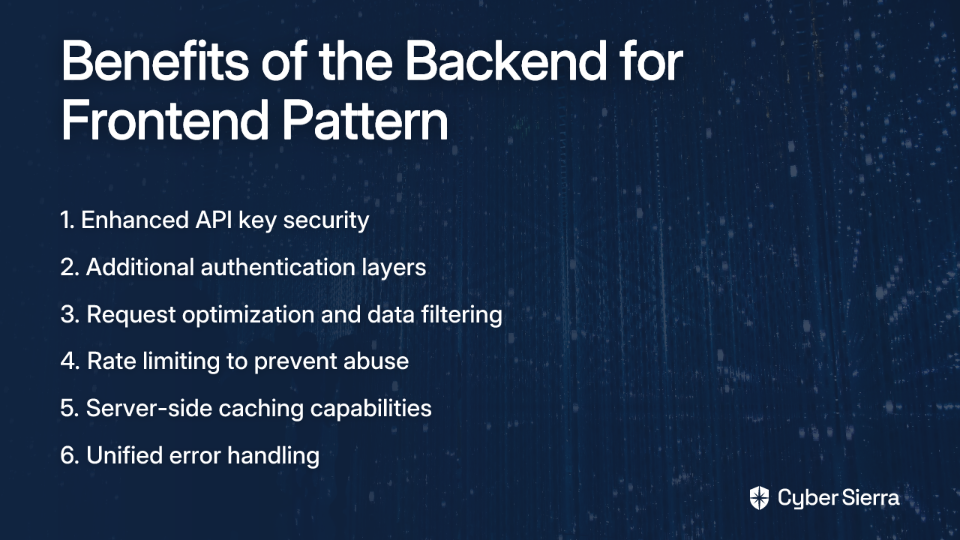
Benefits of the BFF Pattern

Beyond security, this approach offers several advantages:

  1. Additional security layers: You can implement authentication/authorization on your backend to ensure only legitimate users access certain APIs.
  2. Request optimization: Your server can combine multiple API calls, filter unnecessary data, etc., before sending the response to the client.
  3. Rate limiting: Protect your API keys from abuse by implementing rate limiting on your server.
  4. Caching: Implement server-side caching to reduce the number of calls to external APIs.
  5. Unified error handling: Handle API errors consistently on your server.
Advanced Security: Professional API Key Management

Now that we've established the foundational pattern for keeping your API keys secure, let's explore how professional teams handle API keys at scale.

Secrets Management Services

One major pain point with API keys is rotation: "The pain in the ass is when you need to rotate these keys; that's why you should use a key vault provider."

This is where dedicated secrets management services come in. These platforms provide secure storage, access control, and automated rotation for your API keys:

  1. AWS Secrets Manager: Integrated with AWS services, it can automatically rotate credentials for supported AWS services.
  2. Google Cloud Secret Manager: Securely stores API keys, passwords, certificates, and other sensitive data for Google Cloud.
  3. Azure Key Vault: Microsoft's solution for securely storing and accessing secrets.
  4. HashiCorp Vault: A popular open-source solution that works across different environments.

These services solve several key challenges:
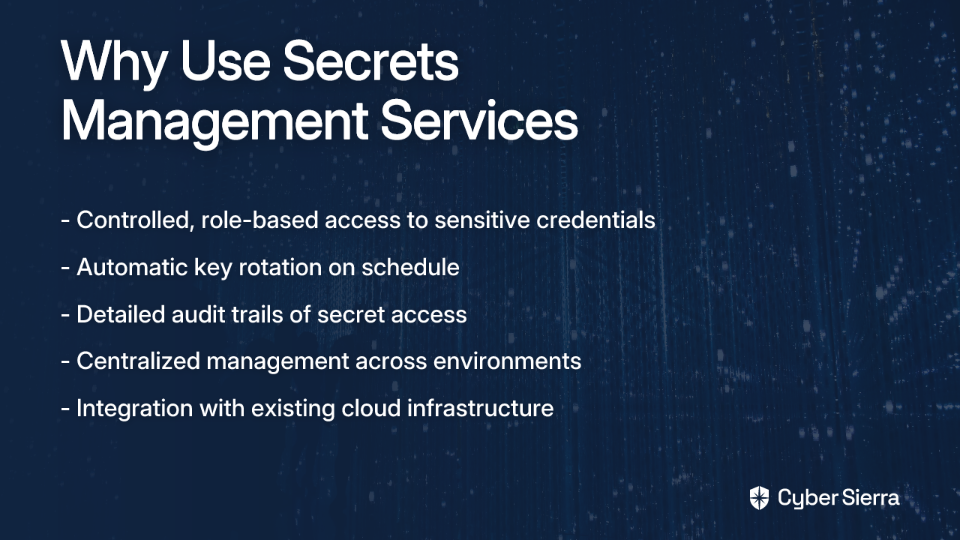
  • Controlled access: "How do you prevent your interns from accessing important API keys?" With these services, you can grant limited, role-based access without exposing the actual keys.
  • Automatic rotation: Set policies to automatically rotate keys on a schedule without manual intervention.
  • Audit trails: Track who accessed which secrets and when.

To use these services with your backend, instead of reading keys from .env files, your server fetches them at runtime from the secrets management service:

// Example using AWS SDK with Secrets Manager
const AWS = require('aws-sdk');
const secretsManager = new AWS.SecretsManager();

async function getApiKey() {
  const data = await secretsManager.getSecretValue({
    SecretId: 'my-api-key'
  }).promise();
  
  const secret = JSON.parse(data.SecretString);
  return secret.apiKey;
}

app.get('/api/weather', async (req, res) => {
  const apiKey = await getApiKey();
  // Now use the apiKey to make the external API request
  // ...
});

Comprehensive API Key Security Best Practices

Beyond the technical implementations, here's a comprehensive checklist for API key security based on industry best practices:

  1. Generate strong keys: Use cryptographically secure random generators for API keys.
  2. Implement the principle of least privilege: Each API key should have only the permissions it needs to function, nothing more.
  3. Use short-lived tokens when possible: For user-specific operations, consider using temporary tokens that expire quickly.
  4. Implement rate limiting: Protect against abuse by limiting the number of requests per key.
  5. Monitor API usage: Set up alerts for unusual API usage patterns that might indicate compromise.
  6. Use HTTPS everywhere: Ensure all API communications are encrypted in transit.
  7. Implement proper error handling: Don't leak information about your API structure in error messages.
  8. Conduct regular security audits: Regularly review your API security posture and access patterns.
  9. Have a response plan: Know what to do when a key is compromised (immediate revocation, investigation, etc.).

Conclusion: No More Exposed Keys

Let's recap the key takeaways:

  1. Environment variables in React are NOT secure - They only keep keys out of your code repository but not your production bundle.
  2. The Backend for Frontend pattern is the professional standard - Keep sensitive keys on your server and never expose them to the client.
  3. For enterprise-scale applications, use dedicated secrets management services - These provide additional security, rotation capabilities, and access controls.

The confusion around API key security in React is understandable, but the solution is clear: sensitive keys belong on the server, not in your frontend code. By implementing the patterns described here, you'll align with industry best practices and significantly improve your application's security posture.

Remember, when it comes to API keys in React applications, there are no clever hacks or shortcuts around this fundamental principle: If it needs to be secret, it doesn't belong in the browser.

Now you know how to actually secure your API keys in React applications, just like the professionals do.
blog-hero-background-image
Cyber Security

What Does a Compliance Officer Actually Do All Day?

backdrop
Table of Contents

Join thousands of professionals and get the latest insight on Compliance & Cybersecurity.


You've heard the job title before. Maybe you've seen it on LinkedIn profiles or corporate websites. Perhaps you've even considered it as a potential career path. But what does a compliance officer actually do on a day-to-day basis?

If you're imagining someone buried in endless paperwork, mechanically checking boxes and sending stern emails about policy violations, you're only seeing a fraction of the picture. The reality is far more dynamic, challenging, and—according to many in the field—surprisingly engaging.

"It's stressful, not going to lie. But I enjoy it. I can say one thing.... I'm never, ever bored (or caught up)," confesses one compliance professional on Reddit, offering a glimpse into the relentless but fulfilling nature of the role.

This article pulls back the curtain on the compliance profession, providing a realistic "day in the life" view that's invaluable for career changers and students alike. We'll explore the core responsibilities, typical daily activities, essential skills, and career pathways for those considering this increasingly critical profession.

The Core Mission: More Than Just a Rule Enforcer

At its heart, a compliance officer's job is to ensure an organization operates legally and ethically within the complex web of regulations governing its industry. But that clinical definition barely scratches the surface of what the role entails.

Rather than being the corporate "police" (as they're sometimes stereotyped), effective compliance officers are strategic partners who help an organization navigate regulatory requirements while still achieving business objectives. Their work broadly falls into three main categories:

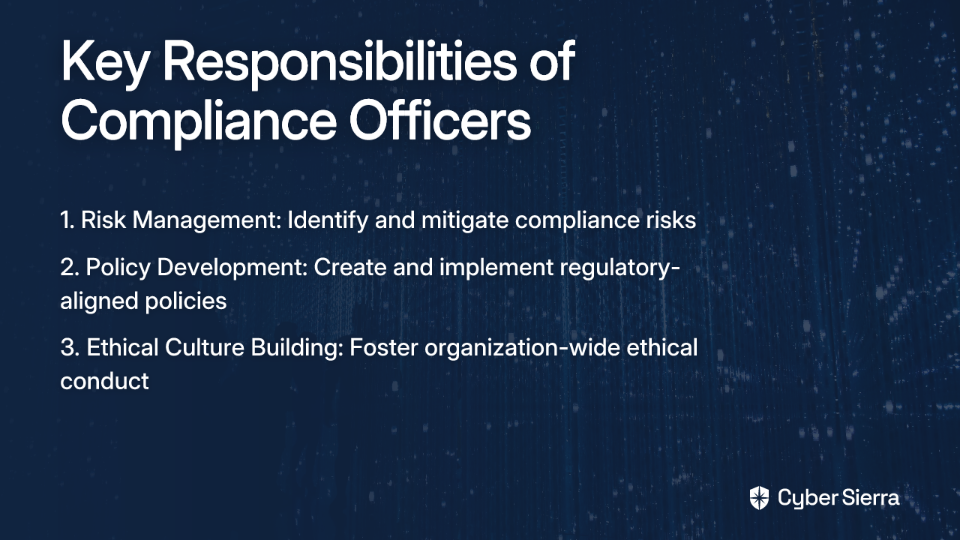
  1. Risk Management: Analyzing operations to identify potential compliance risks and developing improvement plans for any issues discovered. This includes building proactive compliance programs that address risks before they become problems.
  2. Policy Development: Creating and implementing company policies that align with industry laws, ensuring both management and staff understand their compliance obligations through training and clear communication.
  3. Ethical Culture Building: Perhaps most importantly, fostering an environment where ethical conduct is prioritized throughout the organization—making compliance a shared value rather than just a department.

As one industry publication notes, "A strong compliance function doesn't just protect an organization from regulatory penalties; it preserves its reputation, builds customer trust, and creates a foundation for sustainable growth."

A Day in the Life of a Compliance Officer: A Blend of Routine and Reaction

What does a typical day look like for a compliance officer? While no two days are identical (part of what makes the job interesting), most compliance professionals structure their time around a mix of planned activities and responsive tasks.

Morning: Setting Priorities and Staying Informed

8:00 AM - 9:30 AM: Email Triage and Response The day typically begins by addressing the most urgent communications. Compliance officers prioritize messages from management and supervisors, as these often contain time-sensitive requests or important updates that might affect the day's priorities.

9:30 AM - 10:30 AM: Regulatory Monitoring A crucial part of the role is staying current with industry regulations. Many compliance officers dedicate morning time to reviewing regulatory updates, subscribing to notifications from agencies like the Office of the Comptroller of the Currency (OCC) or Federal Reserve Board (FRB) to catch new rules or guidance that might impact their organization.

As one banking compliance officer explains, "The regulatory landscape is constantly shifting. Miss an update, and suddenly your organization is out of compliance without even knowing it."

Mid-day: Collaboration and Implementation

10:30 AM - 12:00 PM: Meetings and Consultations Compliance isn't a solo function. Officers regularly meet with department heads and executives to discuss regulatory changes and their impact on products or services. These meetings might involve:

  • Explaining new compliance requirements to business teams
  • Advising on compliance aspects of new initiatives
  • Addressing questions from staff about policy interpretations

1:00 PM - 3:00 PM: Documentation and Program Development After lunch, many compliance officers turn to more focused work. This often involves reviewing and drafting documents—a significant aspect of the role.

"I am heavily engaged in drafting and designing compliance programs and initiatives. So, a lot of writing. A lot," notes one compliance professional on Reddit.

This documentation work can include:

  • Reviewing financial statements or operational procedures
  • Developing or updating policies to reflect regulatory changes
  • Creating training materials to educate employees
  • Drafting memos to inform staff about policy updates

Afternoon: Investigation and Reporting

3:00 PM - 4:30 PM: Compliance Monitoring and Investigation Later in the day, compliance officers might:

  • Conduct audits to identify potential weaknesses in compliance systems
  • Analyze operational data to spot unusual patterns that could indicate compliance issues
  • Investigate potential violations reported through whistleblower channels or discovered during monitoring

4:30 PM - 5:30 PM: Reporting and Planning The day often concludes with synthesizing information and preparing reports for leadership. This might involve:

  • Creating presentations for the board on compliance status
  • Documenting findings from the day's monitoring activities
  • Planning upcoming compliance initiatives or training sessions
  • Setting priorities for the following day

This schedule represents just one possible arrangement. As compliance professionals are quick to point out, unexpected issues frequently arise that require immediate attention, forcing a reorganization of the day's planned activities.

Navigating the Gauntlet: The Biggest Challenges on the Job

The compliance officer's role comes with significant challenges that make it both demanding and intellectually stimulating:

Tracking Regulatory Changes: Perhaps the most persistent challenge is keeping up with the sheer volume and complexity of changing regulations. Officers use everything from regulatory subscriptions to specialized RegTech tools to stay informed about evolving requirements that could affect their organization.

Gaining Internal Buy-In: Compliance professionals must navigate organizational politics to secure support from the board and senior management. Without executive backing, implementing necessary compliance measures becomes significantly more difficult.

Balancing Compliance and Business Goals: Finding ways to meet regulatory requirements without unnecessarily impeding business operations requires creativity and diplomatic skill. The most effective compliance officers are those who can say "yes, if" rather than just "no."

Maintaining Vigilance: When compliance systems are running smoothly, it's challenging to keep compliance top-of-mind across the organization. As Consumer Compliance Outlook notes, "Celebrating compliance successes can help maintain awareness even when there aren't obvious problems to solve."

The Compliance Officer's Toolkit: Essential Skills for Success

Succeeding in compliance requires a diverse skill set spanning both technical knowledge and interpersonal abilities:

Hard Skills

  • Regulatory Knowledge: Deep understanding of laws applicable to the industry, from Anti-Money Laundering (AML) regulations to environmental standards
  • Data Analysis: Ability to review audit data and operational practices to assess compliance levels
  • Policy Development: Skill in drafting and implementing policies that align with legal requirements
  • Technological Proficiency: Familiarity with compliance software for tracking metrics and conducting audits

Soft Skills

  • Communication: "A strong writing and analytical ability is clutch," says one Reddit user. This includes translating complex regulatory language for non-experts and presenting findings clearly to leadership.
  • Attention to Detail: Essential for spotting nuanced compliance issues that might otherwise be missed
  • Problem-Solving: Developing effective solutions to compliance issues without disrupting core business
  • Integrity and Ethical Judgment: Non-negotiable traits for building and maintaining a culture of compliance

Charting Your Path: How to Become a Compliance Officer

For those intrigued by this career path, here's how to get started:

Education and Experience

Most compliance roles require at least a bachelor's degree in fields like finance, business, law, or a discipline relevant to the industry you're targeting. Typically, employers look for 3-5 years of experience in a related field before considering candidates for compliance positions.

Choosing Your Niche

As one compliance professional advises on Reddit, "I think foremost you need to determine what sector of compliance." Popular specializations include:

  • Financial Compliance: Monitoring adherence to financial regulations in banks and investment firms—a high-demand area with over a third of banks planning to hire more compliance officers, according to Bank Director.
  • Healthcare Compliance: Overseeing adherence to medical laws and privacy standards like HIPAA
  • Corporate Compliance: Focusing on broader business regulations, ethics programs, and anti-corruption measures

Valuable Certifications

Industry-recognized certifications can significantly boost your prospects:

  • Certified Regulatory Compliance Manager (CRCM): Ideal for banking compliance professionals
  • Certified in Healthcare Compliance (CHC): Essential for the healthcare sector
  • Certified Compliance and Ethics Professional (CCEP): A highly recognized generalist certification from the Society of Corporate Compliance and Ethics (SCCE)

Where to Apply

For those just starting out, one Reddit user offers this advice: "If I were just starting out I'd apply to the OCC, FRB, FDIC, CFPB, FinCen, OFAC and FTC." Beginning with regulatory agencies can provide excellent foundation before moving to private sector roles.

Is Compliance a Good Career Choice?

With a mean annual salary of $84,980 according to the Bureau of Labor Statistics (though Indeed reports a different average of $62,693, highlighting the range across industries), and projected job growth of 5% from 2023 to 2033, compliance offers both stability and opportunity.

The role is particularly suited to detail-oriented professionals who enjoy problem-solving, have strong ethical compasses, and thrive in dynamic environments where no two days are quite the same.

Frequently Asked Questions

What is the difference between a compliance officer and an auditor?

A compliance officer proactively builds systems to prevent violations, while an auditor retroactively checks to see if those systems and rules were followed. While both roles focus on adherence to regulations, compliance is forward-looking and preventative, centered on policy development and training. Auditing is backward-looking and detective, focused on testing controls and reporting on past performance.

Do you need a law degree to become a compliance officer?

No, a law degree is not typically required to become a compliance officer, although it can be beneficial. Most roles require a bachelor's degree in a relevant field like business or finance, supplemented by several years of industry experience. Professional certifications like the CRCM or CCEP are often more important than a law degree for career advancement.

What is the most challenging aspect of a compliance officer's job?

The most challenging aspect is often keeping pace with the constantly changing regulatory landscape. Compliance officers must continuously monitor new laws and guidance to ensure their organization remains compliant. Other significant challenges include gaining buy-in from senior management and balancing regulatory requirements with business objectives.

How does a compliance officer contribute to a company's success?

A compliance officer contributes to a company's success by protecting it from legal penalties, reputational damage, and financial loss. By fostering an ethical culture and ensuring the company operates within legal boundaries, they build trust with customers, investors, and regulators, which provides a stable foundation for sustainable growth.

What does career advancement look like for a compliance officer?

Career advancement for a compliance officer often involves moving into senior or management roles with greater responsibility. An officer might progress from a specialist role to a Compliance Manager, then to a Director of Compliance, and ultimately to a Chief Compliance Officer (CCO) who oversees the entire compliance function for an organization.

The Indispensable Role of a Modern Compliance Officer

Far from being mere rule enforcers, today's compliance officers are strategic partners who help organizations navigate complex regulatory environments while maintaining their ethical foundations. The role demands intellectual rigor, adaptability, and excellent communication skills—but offers the satisfaction of protecting organizations and the people they serve.

For the right individuals, compliance provides a career that is challenging, meaningful, and increasingly valued in our highly regulated world. As one professional summed it up: "It's demanding work, but I never question whether what I do matters. It absolutely does."

blog-hero-background-image
Cyber Security

How to Break Your Client's Excel Database Addiction

backdrop
Table of Contents

Join thousands of professionals and get the latest insight on Compliance & Cybersecurity.


You've spent hours crafting the perfect solution for your client's data management nightmare. But when you present your beautifully designed database architecture, their response makes your heart sink: "Can't we just keep using our Excel system? Everyone already knows how to use it."

Sound familiar? A consultant on Reddit laments, "most of my clients still think excel is a database." You're not alone in this frustration. While companies tout ambitious digital transformation initiatives in their annual reports, the reality on the ground is often starkly different. Many Fortune 500 organizations are still running critical business operations on sprawling Excel workbooks and—believe it or not—actual paper.

When you suggest even basic improvements like adding a date to a filename, clients are "positively amazed" by this revolutionary concept. Meanwhile, you're silently screaming inside, knowing their Excel "database" is a ticking time bomb of data integrity issues, security vulnerabilities, and business inefficiencies.

The problem isn't just technical—it's psychological. Excel feels safe. It's familiar. It's been the faithful companion of business professionals for decades. Breaking this dependency requires understanding both the technical limitations and the deeply human reasons behind this addiction.

This guide will equip you with a strategic approach to wean your clients off their spreadsheet dependency and guide them toward robust, scalable solutions that actually fit their needs. You'll learn to address both the technical and human elements of this challenge, creating a roadmap that transforms not just their systems, but their relationship with data itself.

Why Excel as a Database Is a Ticking Time Bomb

Before you can convince your clients to change, you need to understand exactly why their Excel addiction is so problematic. The comfortable familiarity of spreadsheets masks serious risks that many organizations don't recognize until disaster strikes.

The Hidden Costs of Spreadsheet Dependency

Excel was never designed to be a database. When used as one, it creates significant problems:

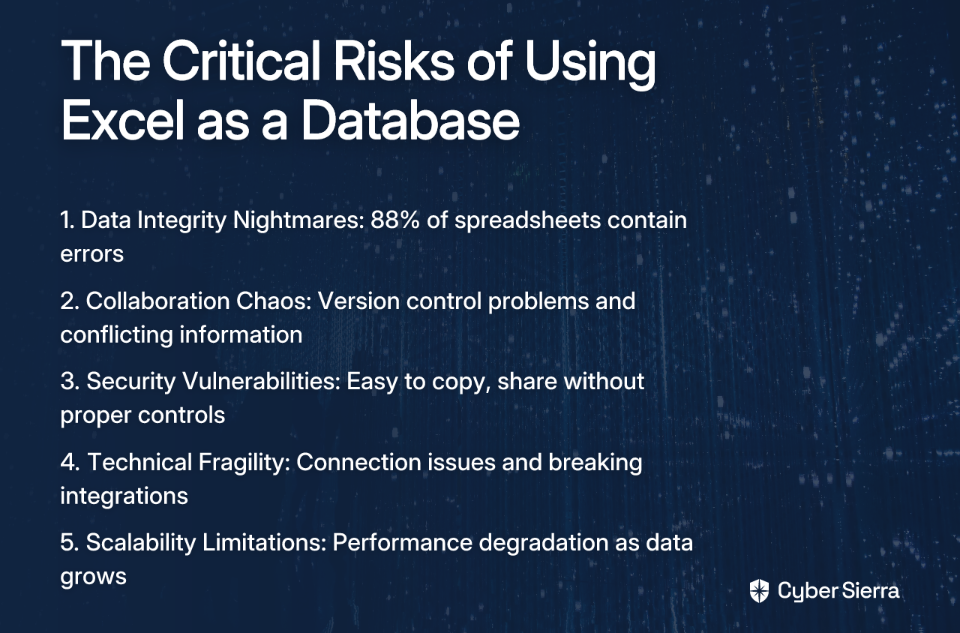
  1. Data Integrity Nightmares: Without proper validation constraints, data entry errors run rampant. One study found that 88% of spreadsheets contain errors, creating a shaky foundation for business decisions.
  2. Collaboration Chaos: As one consultant noted, Excel files often lead to processes "(a) requiring a lot of effort, (b) containing human error and (c) non-reproducible." When multiple users need to work with the same data, you get version control nightmares and conflicting information.
  3. Security Vulnerabilities: Excel files are easily copied, shared, and stored without proper access controls. One Reddit user shared a sobering reality: "Last client, after they were hacked and extorted (paying out $$$MM ransom)..." The financial consequences of poor data security are very real.
  4. Technical Fragility: Anyone who has tried to connect to Excel via code knows the headaches involved. Connection strings like Provider=Microsoft.ACE.OLEDB.12.0;Data Source=\"C:\\Users\\Glen\\Documents\\AA360\\Excel DB.xlsx\";Extended Properties=\"Excel 12.0 Xml;HDR=YES\" frequently break after updates, and users encounter frustrating errors like "External table is not in the expected format."
  5. Scalability Limitations: As data grows, Excel slows to a crawl. Files become corrupted, formulas break, and what was once convenient becomes a daily struggle.

The Psychology Behind Excel Addiction

Understanding why clients cling to Excel is crucial for breaking the cycle:

  • Fear of Change: As one user bluntly put it: "We fear change." New systems require learning, which feels "time expensive for everybody affected."
  • Perceived Control: Excel offers immediate, tangible control. Users can see and manipulate their data directly, creating a false sense of security.
  • Institutional Inertia: "Everyone uses spreadsheets," often as "static exports from other tools (mostly ERP)." These ingrained workflows become organizational habits that resist disruption.

Now that you understand the problem from both technical and psychological perspectives, let's develop a strategic approach to breaking the addiction.

The Consultant's Playbook: A Four-Phase Intervention Strategy

Phase 1: Discovery & Diagnosis

Before proposing solutions, you need to understand the specific Excel usage patterns and pain points within your client's organization.

Key Actions:

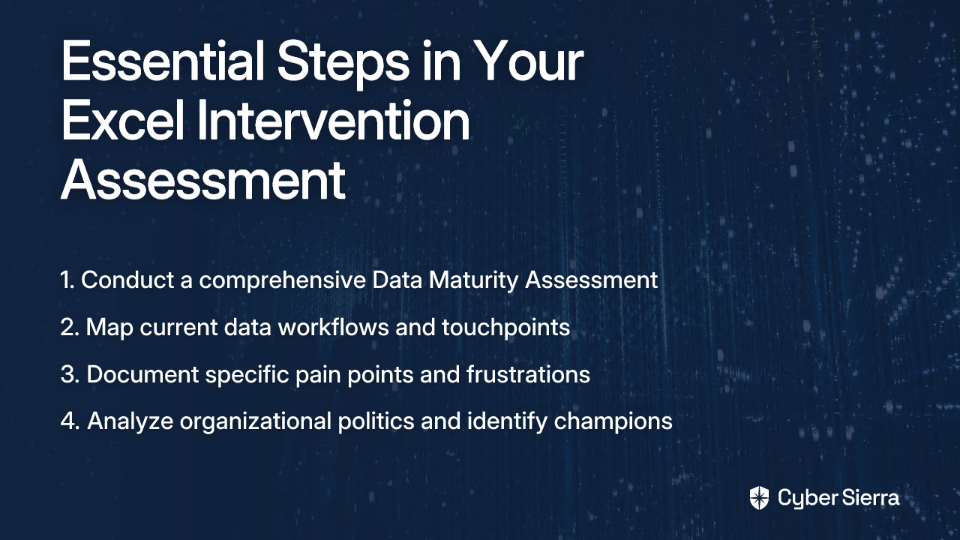
  1. Conduct a Data Maturity Assessment: Evaluate where your client stands in their data management journey. Are they using Excel because they lack better tools, or because "the reporting in the ERP tool is horrible," as one Reddit user suggested?
  2. Map Current Workflows: Document exactly how data moves through the organization. Where does it originate? Who modifies it? How is it ultimately used for decision-making?
  3. Identify Pain Points: Have client teams articulate their frustrations with current processes. Listen for signs of readiness for change, such as complaints about version control issues or calculation errors.
  4. Understand the Politics: Determine who the Excel champions are within the organization and who might become advocates for change. According to ConsultingQuest, 87% of clients consider trust a primary factor in choosing consulting services, so building relationships with key stakeholders is essential.

Phase 2: Planning & Prescription

With a clear understanding of the current state, you can now craft a tailored solution that addresses specific pain points while respecting organizational constraints.

Key Actions:

  1. Dream Big, Start Small: Create a vision of the ideal end state, but break implementation into manageable phases. As one consultant advised, "If you can compellingly argue a short & smooth implementation followed by greater efficiency, most organizations will sign off if they have the capex budget."
  2. Prescribe the Right Alternatives: Match solutions to problems:
    • For data consolidation from multiple sources, recommend a SQL Server or Data Warehouse solution
    • For data validation concerns, introduce formal ETL (Extract, Transform, Load) processes
    • For visualization needs, showcase Power BI or Tableau, which will be "like fucking catnip for them" according to one Reddit user
  3. Create an Excel Off-Ramp: Don't force a cold-turkey approach. Allow users to export data from the new system to Excel when needed, giving them a sense of continuity while gradually shifting core data management to more robust systems.

Phase 3: Implementation & Intervention

This is where theory meets practice—and where resistance often emerges. Your approach here can make or break the project's success.

Key Actions:

  1. Engage Users Early and Often: Involve key stakeholders in design sessions and provide ample opportunity for feedback. This creates ownership and reduces resistance.
  2. Implement in Phases: Start with a pilot that demonstrates clear value. Early wins build momentum and trust for more ambitious changes later.
  3. Provide Extensive Training: Remember that "any change will require learning." Create customized training materials that address specific use cases relevant to your client's business.
  4. Create a Data Governance Framework: Establish clear rules for data management, including who can access what data, how changes are tracked, and how data quality is maintained.

Phase 4: Reporting & Reinforcement

The final phase focuses on solidifying the change and quantifying the benefits.

Key Actions:

  1. Document Improvements: Create before-and-after metrics that demonstrate tangible benefits like time saved, errors reduced, or insights gained.
  2. Celebrate Successes: Publicly recognize teams and individuals who have successfully adapted to the new systems.
  3. Address Ongoing Challenges: Be prepared to adjust your approach based on feedback and emerging issues.

Managing Resistance to Change

Even with the perfect technical solution, human resistance can derail your efforts. Here's how to address the psychological aspects of breaking an Excel addiction:

  1. Create Urgency Through Risk Awareness: Help clients understand the concrete risks of their current approach. Stories of security breaches, costly errors, or missed opportunities can motivate change more effectively than abstract benefits.
  2. Find and Empower Champions: Identify influential individuals within the organization who see the value in change and can help convert others.
  3. Focus on Business Value: Frame the conversation around outcomes, not technology. As noted in this LinkedIn article, the goal is to help clients see how better data management translates to competitive advantage.
  4. Provide an Excel Safety Net: Assure users they can still use Excel for ad-hoc analysis while maintaining a single source of truth in the new system.

Beyond the Spreadsheet

Breaking your client's Excel addiction isn't just about implementing new technology—it's about transforming how they think about, manage, and leverage their data assets. The journey from spreadsheets to sophisticated data management isn't always smooth, but the destination is worth the effort.

Remember that success requires patience and empathy. Your clients aren't clinging to Excel because they're obstinate or technophobic—they're human beings with established habits and legitimate concerns about change. By addressing both the technical and psychological aspects of this transition, you can help them evolve from spreadsheet dependency to data mastery.

The next time a client insists "Excel is our database," you'll be prepared not just to explain why that's problematic, but to guide them through a transformation that turns data from a liability into a strategic asset. And that's the kind of value that builds lasting client relationships and distinguishes truly exceptional consultants.

blog-hero-background-image
Cyber Security

How to Secure API Keys in React Apps Without Backend Knowledge

backdrop
Table of Contents

Join thousands of professionals and get the latest insight on Compliance & Cybersecurity.


You've built an amazing React application that needs to connect to a third-party API. But then you hit that dreaded roadblock: where do you safely put your API key? You've heard horror stories about exposed keys leading to security breaches and unexpected bills, but you don't have backend experience to properly secure them.

"If you make a call from the frontend, then anyone opening the page can see the API key," warns a concerned developer on Reddit. This common frustration leaves many frontend developers feeling stuck between exposing sensitive credentials and venturing into unfamiliar backend territory.

The truth is undeniable: there are no secrets in the UI. Any code, variables, or keys in your frontend build are inherently public and accessible. However, this doesn't mean you're helpless. This guide will walk you through practical, step-by-step solutions that even pure frontend developers can implement to secure their API keys—without becoming backend experts.

Why You Can't Just "Hide" an API Key in React

Before diving into solutions, let's understand why this problem exists in the first place.

An API key is an alphanumeric string that acts as an authentication token, granting your application access to a third-party service. Think of it as a special password that identifies your application and authorizes its requests.

When you build a React application, all of your code—including any embedded API keys—gets compiled into JavaScript files that are sent to the user's browser. This means that anyone can:

  1. Open your website
  2. Press F12 to access developer tools
  3. Check the Network tab to see all API requests (and your key in the URL or headers)
  4. Inspect your JavaScript bundle to find hardcoded keys

The consequences of exposed API keys can be severe:

  • Unauthorized Data Access: Attackers can use your key to access sensitive information through the API.
  • Financial Consequences: Many APIs charge based on usage. If someone steals your key and makes thousands of requests, you'll be footing the bill.
  • API Misuse: Bad actors can use your key for malicious purposes, potentially getting your access revoked.
  • Regulatory Non-Compliance: Exposing keys that access personal data could violate regulations like GDPR or CCPA.

As one Reddit user bluntly puts it: "Everything in the front end should be assumed to be unsecure. You should assume it will be used maliciously. End of story."

The First Line of Defense: Environment Variables (and Their Critical Limits)

The most common first step developers take is using environment variables. While this approach doesn't truly hide your keys, it does offer some important benefits:

  1. It keeps your keys out of your source code
  2. It prevents your keys from being committed to version control
  3. It follows the best practice of configuration separation

Here's how to set it up in a Create React App project:

  1. Create a .env file in the root of your project: REACT_APP_API_KEY=your-secret-api-key
  2. Add it to your .gitignore file to ensure it's never committed: # .gitignore .env
  3. Access the key in your React component: const apiKey = process.env.REACT_APP_API_KEY; fetch(`https://api.example.com/data?key=${apiKey}`) .then(response => response.json()) .then(data => console.log(data));
  4. Restart your development server for the changes to take effect.

CRITICAL WARNING: Environment variables in React are not actually secure! As the Create React App documentation explicitly states: "Do not store any secrets (such as private API keys) in your React app! Environment variables are embedded into the build, meaning anyone can view them by inspecting your app's files."

So when is using environment variables acceptable? Only in these scenarios:

  • For public keys that are more like identifiers (e.g., some Firebase keys)
  • For keys accessing non-sensitive, public data (e.g., a movie database API)
  • When combined with additional protective measures:

Additional Protective Measures

If you must use an environment variable for a public API key, always add these layers of protection:

  1. Domain Restriction (Whitelisting): Many API providers (like Google Maps) allow you to restrict key usage to specific domains. In your API provider's dashboard, whitelist only your website's domain to prevent the key from being used elsewhere.
  2. Quota Limits: Set tight usage quotas to mitigate financial damage if the key is somehow abused. This doesn't prevent theft, but it limits the potential damage.

As one Reddit user cautions: "Once you expose your key to the client, you cannot guarantee its security from malicious use." That's why for truly sensitive APIs, we need a more robust solution.

The "No Backend" Backend: Using Serverless Functions as a Secure Proxy

The gold standard for securing API keys is the proxy pattern: your React app calls your own secure endpoint, which then calls the third-party API using the sensitive key. The key never leaves your server.

But what if you don't have a traditional backend? This is where serverless functions come in—they're perfect for frontend developers because they provide backend-like security without requiring you to manage a traditional server.

Platforms like Netlify and Vercel make this incredibly easy, enabling you to deploy your React app and secure serverless functions together. Here's how to implement this with Netlify Functions:

  1. Setup: Create a netlify/functions directory in your project.
  2. Store the Secret: Go to your Netlify site settings and add your sensitive API key as an environment variable (e.g., THIRD_PARTY_API_KEY). Unlike frontend environment variables, these are genuinely secure and never exposed to the browser.
  3. Create the Function: Create a file like netlify/functions/fetch-data.js: // This code runs in a secure server environment, not the browser. exports.handler = async function(event, context) { const API_SECRET = process.env.THIRD_PARTY_API_KEY; const API_URL = 'https://api.example.com/data'; try { const response = await fetch(`${API_URL}?key=${API_SECRET}`); const data = await response.json(); return { statusCode: 200, body: JSON.stringify(data), }; } catch (error) { return { statusCode: 500, body: JSON.stringify({ error: 'Failed fetching data' }), }; } };
  4. Call from React: Now your React component calls your own endpoint, with no key in sight: // In your React component async function getData() { try { const response = await fetch('/.netlify/functions/fetch-data'); const data = await response.json(); // use the data... return data; } catch (error) { console.error('Error:', error); } }

The magic here is that the THIRD_PARTY_API_KEY is never exposed to the client. The browser only sees the request to /.netlify/functions/fetch-data, while the actual API key is safely used on Netlify's servers.

As recommended in countless developer discussions: "You need to write a simple proxy server (just a backend code) to fetch the api data using the api key and then pass it to the client." Serverless functions make this recommendation accessible to frontend developers without requiring traditional backend knowledge.

The Easiest Route: Third-Party API Gateway Services

For developers who want an even simpler, managed solution, third-party API gateway services can be a game-changer. These services act as a secure proxy between your frontend and third-party APIs, managing all the security concerns for you.

One such example is KOR Connect, which aims to simplify the process:

  1. Register on the service's platform.
  2. Connect Your API: Securely provide your third-party API endpoint and your secret key to the service.
  3. Receive a Secure URL: The service generates a new, public-safe URL for you to use in your frontend application.
  4. Implement in React: Use the new URL in your fetch calls: fetch("https://your-secure-gateway-url.example.com/covid-19/v1/countries", { "method": "GET", "headers": { "x-rapidapi-key": "your-public-api-key" // This is a safe key provided by the service } }) .then(response => { console.log(response); }) .catch(err => { console.error(err); });

The benefits of this approach include:

  • No code to write for the proxy
  • Managed infrastructure (no serverless deployment to configure)
  • Often includes extra security features like bot detection

Choosing the Right Strategy for Your Project

To recap, here are your options from least to most secure:

  1. Environment Variables (with domain restrictions and quotas): Use ONLY for non-sensitive, public keys or when you're just getting started and need a quick solution.
  2. Serverless Functions: The best all-around solution for frontend developers needing to protect sensitive keys. It gives you full control without the overhead of a traditional backend.
  3. Third-Party Services: The fastest and easiest option, ideal for rapid prototyping or for developers who want a fully managed solution.

Regardless of which method you choose, follow these universal API key best practices:

  • Rotate API Keys Regularly: Limit the window of opportunity for attackers if a key is ever compromised.
  • Use Granular Permissions: Only grant keys the minimum permissions they need to function (Principle of Least Privilege).
  • Monitor Usage: Keep an eye on your API dashboards to detect anomalous activity early.

As a frontend developer, you now have the tools to properly secure your API keys without becoming a backend expert. Remember, the fundamental principle remains: "There are no secrets in the UI"—but with these approaches, you can build secure applications that keep your sensitive credentials where they belong: server-side.

Frequently Asked Questions

Why can't I just hide my API key in a .env file in React?

You cannot truly hide an API key in a .env file in a standard React application because environment variables (like REACT_APP_API_KEY) are embedded directly into the final JavaScript build files. This means anyone can find the key by inspecting your website's source code in their browser. While .env files are essential for keeping secrets out of version control (like Git), they offer no protection on the client-side.

What is the most secure way to manage API keys for a frontend application?

The most secure way is to use a server-side proxy. Your frontend application makes a request to your own backend endpoint (the proxy), which then securely adds the API key and forwards the request to the third-party API. This ensures the API key is never exposed to the user's browser. Serverless functions are an excellent, low-maintenance way for frontend developers to implement this pattern.

How do serverless functions help secure API keys?

Serverless functions act as a secure intermediary between your React app and the third-party API. Your secret API key is stored as a secure environment variable on the serverless platform (like Netlify or Vercel), completely inaccessible from the browser. Your React app calls your serverless function endpoint without any key, and the function then adds the secret key on the server before making the final call to the API.

Is it ever safe to expose an API key on the client-side?

It is only safe to expose an API key on the client-side if it is a public, non-sensitive key that is not tied to a billing account and does not grant access to private data. Even in these cases, you should always implement additional security measures offered by the API provider, such as restricting the key's usage to your specific domain (whitelisting) and setting strict usage quotas to prevent abuse.

What is an API proxy and why do I need one?

An API proxy is a server that acts as a go-between for your client application and a third-party API. You need one to protect sensitive credentials like API keys. Instead of your React app calling the third-party API directly and exposing the key, it calls your proxy. The proxy, running in a secure server environment, then adds the secret key to the request and forwards it to the third-party service, keeping the key safe.

How are server-side environment variables different from client-side ones?

Client-side environment variables (used in tools like Create React App) are embedded into the JavaScript code that gets sent to the user's browser, making them public. Server-side environment variables (used in serverless functions or traditional backends) exist only on the server and are never exposed to the browser. This fundamental difference is why you must use a server-side component to protect sensitive keys.

blog-hero-background-image
Cyber Security

How to Build STRIDE Threat Models for Real-World Applications

backdrop
Table of Contents

Join thousands of professionals and get the latest insight on Compliance & Cybersecurity.


You've been tasked with securing your application, and everyone keeps mentioning "threat modeling." You search online and find references to STRIDE, PASTA, and various other methodologies, but you're left wondering: Where do I actually start? How do I translate abstract security concepts into concrete actions that protect my systems?

If this sounds familiar, you're not alone. Many developers and security beginners struggle with the fundamental question of threat modeling: "What could go wrong?" As one security professional noted, "the problem with this is most people have no clue."

This guide will demystify the STRIDE threat modeling methodology—a structured, beginner-friendly approach developed by Microsoft that transforms the abstract question of "what could go wrong?" into a concrete security roadmap. By the end, you'll have the practical knowledge to implement threat modeling in your own projects.

What is STRIDE? Unpacking the Six Categories of Threats

If you've wondered "What's STRIDE? Is it some sort of acronym?"—you're right. STRIDE is a mnemonic created by Microsoft engineers Loren Kohnfelder and Praerit Garg in 1999 to help systematically identify and classify security threats. Each letter represents a different category of security threat:

  • Spoofing identity
  • Tampering with data
  • Repudiation
  • Information disclosure
  • Denial of service (DoS)
  • Elevation of privilege

STRIDE helps ensure your application meets core security properties beyond the classic CIA triad (Confidentiality, Integrity, Availability), adding Authentication, Non-repudiation, and Authorization to the mix.

The following table maps each STRIDE threat to the security property it violates:

ThreatProperty ViolatedDefinition
SpoofingAuthenticationImpersonating something or someone else
TamperingIntegrityModifying data or code
RepudiationNon-repudiationClaiming to have not performed an action
Information DisclosureConfidentialityExposing information to unauthorized individuals
Denial of Service (DoS)AvailabilityDenying or degrading service to users
Elevation of PrivilegeAuthorizationGaining capabilities without proper authorization

The Strategic Value: Why Real-World Applications Need STRIDE

Beyond just methodology, STRIDE offers significant strategic advantages:

  1. Reduces Costs: Finding and fixing security issues early in development is dramatically cheaper than remediating vulnerabilities in production. By shifting security left, STRIDE helps you identify design flaws before they become costly problems.
  2. Fosters Security Culture: STRIDE brings together developers, architects, security experts, and business stakeholders, enhancing overall security awareness and collaboration.
  3. Provides Quantifiable Evidence of Risk: STRIDE helps you identify concrete threats backed by real-world data:
    • Modern DoS attacks have reached staggering scales—the 2017 Google attack peaked at 167 million packets-per-second (Mpps)
    • AI-automated phishing emails achieve click-through rates 3-5 times higher than traditional phishing, making spoofing an increasingly potent threat
    • Minor access control oversights that lead to privilege escalation remain among the top causes of security breaches

A Practical Guide: Implementing STRIDE in 5 Steps

Now, let's break down the STRIDE threat modeling process into five actionable steps:

Step 1: Decompose the System

Start by breaking your application down into its core components—APIs, databases, microservices, frontends, and more. This step answers the critical question: "What are we building?"

Key technique: Create a Data Flow Diagram (DFD) to visualize your architecture. DFDs map out:

  • Processes (application components)
  • Data stores (databases, caches)
  • External entities (users, third-party systems)
  • Data flows (how information moves between components)
  • Trust boundaries (where different security contexts meet)

This visual representation provides a shared understanding of the system and establishes the foundation for threat identification.

Step 2: Analyze Each Component with STRIDE

With your system decomposed, it's time to systematically analyze each component by asking: "What could go wrong?" For each element in your DFD, work through all six STRIDE categories:

Spoofing

Threat Scenario: An attacker impersonates a legitimate user by stealing their session cookie or credentials.

Mitigation Strategies:

  • Implement Multi-Factor Authentication (MFA)
  • Enforce strong password policies
  • Use secure session management with HTTPOnly and Secure flags
  • Implement proper certificate validation

Tampering

Threat Scenario: An attacker intercepts unencrypted API traffic in a Man-in-the-Middle attack and alters financial transaction amounts.

Mitigation Strategies:

  • Use HTTPS/TLS for all data in transit
  • Implement cryptographic controls like digital signatures and checksums
  • Use File Integrity Monitoring (FIM) for critical system files
  • Apply input validation to prevent injection attacks

Repudiation

Threat Scenario: A privileged user deletes critical audit logs to cover their tracks, then denies performing the action.

Mitigation Strategies:

  • Implement comprehensive and tamper-evident audit logs
  • Use immutable logging systems (separate, append-only log servers)
  • Require digital signatures for critical transactions
  • Establish clear separation of duties

Information Disclosure

Threat Scenario: A misconfigured server returns verbose error messages that expose internal database schemas and software versions.

Mitigation Strategies:

  • Encrypt sensitive data both at rest and in transit
  • Implement strict access controls and least privilege
  • Use secure error handling to avoid leaking internal details
  • Apply proper configuration management and security hardening

Denial of Service (DoS)

Threat Scenario: An attacker floods a web application's login endpoint with millions of requests, overwhelming the server and making it unavailable.

Mitigation Strategies:

  • Implement rate limiting on APIs
  • Use CAPTCHAs to prevent automated attacks
  • Deploy a Web Application Firewall (WAF)
  • Design for scalability with cloud infrastructure to absorb traffic spikes

Elevation of Privilege

Threat Scenario: A low-privilege user discovers an input validation flaw that allows them to execute commands with administrative rights.

Mitigation Strategies:

  • Enforce the principle of least privilege
  • Implement Role-Based Access Control (RBAC)
  • Sanitize and validate all user inputs
  • Conduct regular privilege audits

Step 3: Assess and Prioritize Risks

After identifying threats, you need to determine which ones to address first. Not all threats carry equal risk, and you likely won't have resources to mitigate everything simultaneously.

A common approach is to use the DREAD risk assessment model:

  • Damage: How severe would an exploit be?
  • Reproducibility: How easy is it to reproduce the attack?
  • Exploitability: How much effort is required to exploit?
  • Affected users: How many users would be impacted?
  • Discoverability: How easy is it to discover the vulnerability?

Score each threat on these factors (typically 1-10) and calculate an average to prioritize your remediation efforts.

Step 4: Develop Mitigation Strategies

This step addresses the crucial question: "What can we do to resolve or mitigate?" For each high-priority threat, develop specific, actionable mitigation strategies.

Your mitigations should:

  • Directly address the identified threat
  • Have clear ownership (who will implement it?)
  • Include measurable success criteria
  • Balance security with usability and performance

Document these strategies clearly so they can be implemented as part of your development workflow.

Step 5: Document and Iterate

Threat modeling is not a one-time task but a continuous process. Document your threat model thoroughly, including:

  • System architecture and data flows
  • Identified threats
  • Risk assessments
  • Mitigation strategies
  • Implementation status

Review and update your threat model whenever:

  • New features are added
  • The architecture changes
  • New threats emerge
  • After security incidents

Best Practices and Common Pitfalls

To maximize the effectiveness of your STRIDE threat modeling:

Best Practices:

  • Start Early: Incorporate threat modeling from the beginning of your development lifecycle
  • Involve Diverse Stakeholders: Include developers, architects, and business representatives
  • Integrate into Development: Embed threat modeling into your CI/CD pipeline
  • Use Real-World Examples: Base your threat scenarios on actual incidents
  • Automate Where Possible: Use threat modeling tools to streamline the process

Common Pitfalls to Avoid:

  • Treating it as a One-Time Task: Threat landscapes evolve, and so should your models
  • Focusing Only on Technical Threats: Consider business logic flaws and social engineering
  • Inadequate Communication: Ensure findings are clearly communicated to developers
  • Analysis Paralysis: Don't get stuck in endless modeling—identify key risks and act

Understanding STRIDE's Limitations

While STRIDE is powerful, it's important to acknowledge its limitations:

  • Resource Intensive: Can be time-consuming for complex systems
  • Static Analysis Focus: Primarily addresses design-time threats
  • Subjective Elements: Quality depends on the team's experience
  • Software-Centric: May not cover organizational or physical security threats

These limitations explain why some practitioners prefer other methodologies like PASTA (Process for Attack Simulation and Threat Analysis) for a more risk-centric approach. However, STRIDE remains one of the most comprehensive and accessible frameworks for beginners.

Conclusion: Making Threat Modeling a Continuous Practice

STRIDE provides a structured framework for answering the critical question: "What could go wrong?" By systematically working through each threat category, you transform vague security concerns into concrete, actionable plans.

Remember that effective threat modeling is an iterative process that must adapt to an evolving threat landscape. As one security professional noted, threat models need to be "revisited on a regular basis as the landscape always evolves."

Start implementing STRIDE in your projects today—even a basic threat model is better than none. By proactively identifying and addressing security threats early in development, you'll build more resilient systems and save significant remediation costs down the line.

For those looking to deepen their expertise, consider formal training like the Certified Threat Modeling Professional (CTMP) course or explore resources from OWASP's Threat Modeling community.

Frequently Asked Questions

What is the STRIDE threat modeling methodology?

The STRIDE methodology is a structured framework developed by Microsoft to systematically identify and categorize security threats. It is a mnemonic for the six primary threat categories: Spoofing, Tampering, Repudiation, Information Disclosure, Denial of Service, and Elevation of Privilege. Using STRIDE helps teams proactively discover potential vulnerabilities during the design phase of a project.

When is the best time to apply STRIDE in the development lifecycle?

The best time to apply STRIDE is as early as possible in the development lifecycle, ideally during the design and architecture phase. This "shift-left" approach allows you to identify and fix potential security flaws before any code is written, which is significantly cheaper and more effective than addressing vulnerabilities in a production environment. However, it is never too late to start, and threat modeling can provide value at any stage.

How does STRIDE relate to the CIA triad?

STRIDE extends the classic CIA triad (Confidentiality, Integrity, Availability) by adding three additional security properties: Authentication, Non-repudiation, and Authorization. Each category in STRIDE maps directly to one of these properties, providing a more comprehensive security model. For example, Spoofing violates Authentication, Tampering violates Integrity, and Information Disclosure violates Confidentiality.

What is the difference between threat modeling and penetration testing?

Threat modeling is a proactive, design-phase activity, whereas penetration testing is a reactive, implementation-phase activity. Threat modeling focuses on identifying what could go wrong with a system's design by analyzing its architecture. Penetration testing, on the other hand, is an ethical hacking exercise that attempts to find and exploit vulnerabilities that did go wrong in the finished application.

Do you need special tools to perform STRIDE threat modeling?

No, you do not need special tools to start with STRIDE threat modeling. The process can be done effectively using simple tools like a whiteboard, diagramming software to create Data Flow Diagrams (DFDs), and a spreadsheet to track threats. While specialized threat modeling tools exist to automate and streamline the process for larger systems, they are not a prerequisite for getting started.

How often should a threat model be updated?

A threat model should be treated as a living document and updated regularly, not as a one-time task. It is crucial to revisit and update your threat model whenever there are significant changes to the application, such as adding new features, altering the architecture, or integrating new third-party services. It should also be reviewed periodically as new security threats and vulnerabilities emerge in the wider technology landscape.

blog-hero-background-image
Cyber Security

How to Choose a Thorough PCI DSS QSA (Red Flags to Avoid)

backdrop
Table of Contents

Join thousands of professionals and get the latest insight on Compliance & Cybersecurity.


You've invested heavily in your payment security infrastructure. Your team has worked tirelessly to implement PCI DSS requirements. Now it's time for the formal assessment—but how do you ensure your Qualified Security Assessor (QSA) will conduct a genuinely thorough audit rather than just checking boxes?

The stark reality is that despite being certified, many companies have substantial security gaps. As one industry professional laments, "On every single audit, since the first one, it boggles my mind how the auditors don't catch simple mistakes of critical nature." This troubling observation is not isolated—it represents a widespread frustration with superficial PCI compliance audits.

A QSA is an independent security organization qualified by the PCI Security Standards Council (PCI SSC) to validate an entity's adherence to PCI DSS. But not all QSAs approach this responsibility with the same rigor. Choosing the right one is not merely a procurement decision—it's a critical security choice that directly impacts your organization's risk posture.

The Root of the Problem: Why Superficial Audits Happen

The fundamental issue lies in a misaligned relationship structure. As one expert candidly states, "I firmly believe that QSAs half-ass the audit intentionally because the client is the one that hires the audit company." This inherent conflict of interest creates a dynamic where thoroughness may be sacrificed to maintain client satisfaction.

The pressure to minimize costs further exacerbates the problem. Comprehensive assessments of large environments take significant time and resources. As another industry professional points out, "Assessing large scope environments thoroughly takes months. You don't want to pay for that." This creates a race to the bottom, where the lowest-priced QSAs often win contracts but deliver superficial results.

The consequences of checkbox compliance are severe. A company might receive a clean Report on Compliance (RoC) or Attestation of Compliance (AoC), creating a false sense of security while significant vulnerabilities remain unaddressed. When a data breach occurs, the organization faces not only financial penalties but also reputational damage—despite being "certified compliant."

Hallmarks of a High-Quality QSA: What to Look For

Deep Technical Expertise & Credentials

A truly valuable QSA brings more than just the basic PCI SSC certification. Look for professionals who hold respected security certifications like CISSP (Certified Information Systems Security Professional) or CISA (Certified Information Systems Auditor). These credentials demonstrate a broader understanding of information security principles beyond mere compliance requirements.

This expertise is essential because, as industry insiders acknowledge, "It is rare for a QSA to have vast knowledge of all technologies in an environment." A QSA with a strong technical background can better evaluate security controls across your complex infrastructure.

Proven Industry-Specific Experience

Different industries face unique security challenges. A QSA with experience in your specific sector will understand the nuances of your business environment. They'll recognize common vulnerabilities and compliance pitfalls particular to your industry, providing more relevant guidance.

HALOCK emphasizes that industry-specific experience enables QSAs to offer practical recommendations tailored to your business context rather than generic compliance advice.

A Consultative Partnership Approach

The best QSAs don't simply identify compliance vs. non-compliance issues. They explain the security concepts behind each requirement, helping your team understand not just what to do, but why it matters. This educational approach fosters a culture of security awareness rather than just technical compliance.

As ERMProtect notes, top-tier QSAs work as partners, helping integrate PCI DSS into your daily operations. This transforms compliance from a yearly headache into an ongoing security practice that adds genuine value to your organization.

Comprehensive Service Offerings

A high-quality QSA firm typically offers a full spectrum of services beyond the final audit, including:

  • Pre-assessment gap analysis to identify issues early
  • Policy and procedure development assistance
  • Security architecture and design reviews
  • Ongoing compliance support
  • Incident response consultation

These additional services indicate a QSA committed to your security success, not just ticking boxes to complete an assessment.

Your Vetting Playbook: A Step-by-Step Guide to Choosing the Right QSA

Step 1: Official Verification

Begin by verifying a potential QSA's certification status on the official PCI SSC website. Pay particular attention to any QSA listed as "In Remediation," which indicates they have violated QSA Validation Requirements—a major red flag.

Step 2: The Interview - Critical Questions to Ask

When interviewing potential QSAs, ask these probing questions:

  1. "Has your firm ever been in remediation with the PCI Council? If so, why?"
  2. "Can you describe your process for determining the assessment scope for our specific environment?"
  3. "Who precisely from your team will be performing the assessment? What are their specific technical backgrounds and certifications?"
  4. "How do you handle situations where you discover potential non-compliance issues during the assessment?"
  5. "Can you provide references from clients in our industry with similarly complex environments?"
  6. "What is your approach to explaining complex security concepts to non-technical stakeholders?"
  7. "How do you ensure your independence and avoid pushing proprietary products over our best interests?"

The depth and confidence of their responses will reveal much about their expertise and approach.

Step 3: Check References and Reputation

Don't just ask for references—actually call them. Ask specific questions about the QSA's communication style, thoroughness, and ability to work as a partner rather than just an auditor. Inquire about any surprises that emerged during the audit process and how the QSA handled challenging situations.

Additionally, research their reputation through industry forums, LinkedIn discussions, and peer networks. A pattern of complaints about superficial assessments should be an immediate disqualifier.

Major Red Flags: Warning Signs to Avoid at All Costs

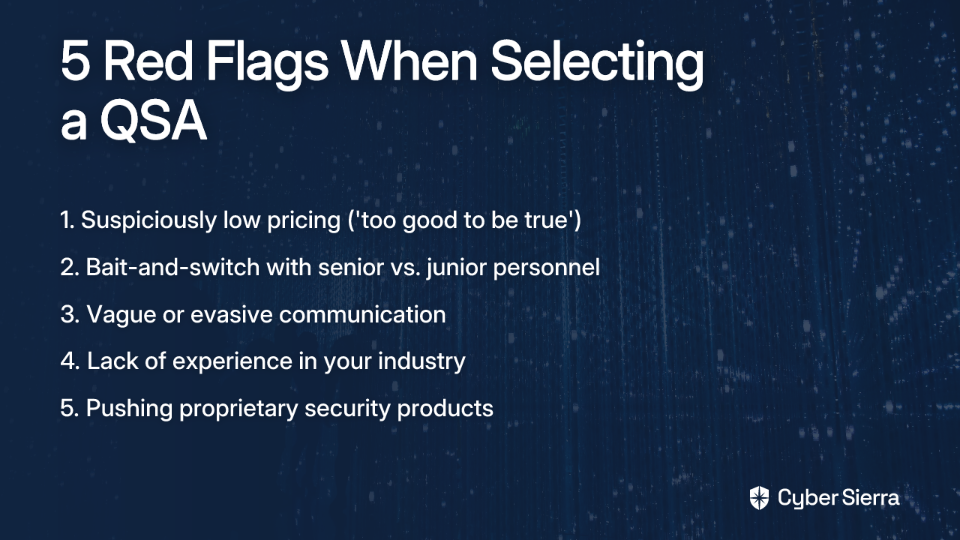
Red Flag 1: The "Too Good to Be True" Price

Beware of significantly lower-priced options. As ERMProtect warns, unusually low pricing often indicates a superficial approach that will miss critical security issues. Remember that you're investing in a thorough security assessment, not just purchasing a compliance certificate.

Quality assessments require appropriate time and expertise, which come at a reasonable cost. If a QSA's price is substantially below others, question what corners they're planning to cut.

Red Flag 2: The "Bait and Switch"

A common complaint in the industry is that senior, experienced QSAs sell the engagement, but as one professional notes, "Sometimes, the QSAs won't even audit himself, they'll send someone to gather evidence/do interviews." This bait-and-switch tactic often results in less experienced personnel conducting critical aspects of your assessment.

Always get contractual clarity on exactly which individuals will be performing your assessment and their specific qualifications. Request that any personnel changes be approved by your organization before proceeding.

Red Flag 3: Vague Communication & Hesitation

If a QSA struggles to clearly explain their assessment methodology or seems evasive when answering your vetting questions, this indicates potential knowledge gaps or a lack of transparency. A quality QSA should communicate their process with confidence and clarity, demonstrating deep understanding of both the technical and procedural aspects of PCI DSS.

HALOCK emphasizes that clear, consistent communication is essential throughout the assessment process.

Red Flag 4: Lack of Industry-Specific Experience

A QSA without proven experience in your specific industry may miss critical context, applying generic standards that don't address your unique risks. When reviewing a QSA's qualifications, specifically ask for case studies or references from organizations similar to yours in size, complexity, and industry sector.

Red Flag 5: The Hard Sell on Proprietary Products

If a QSA seems more focused on selling their company's security products than on providing an independent assessment, their objectivity is compromised. A true security partner may recommend solutions when appropriate, but never in a way that undermines their assessment independence.

Investing in a Partner, Not Just an Audit

Selecting a QSA is one of the most important security decisions your organization will make. The goal isn't simply to obtain a compliance certificate—it's to find a long-term partner who strengthens your security posture through meaningful assessment and guidance.

A thorough QSA helps you build a sustainable security culture with continuous compliance, rather than treating PCI DSS as an annual hurdle to overcome. As the PCI SSC Blog emphasizes, integrating compliance into daily business operations is essential for maintaining effective security.

By following this guide to select a QSA who prioritizes security over mere checkbox compliance, you're making an investment in your organization's true security posture. And remember—you can help improve the entire QSA program by providing feedback on your experiences through the official PCI SSC feedback channel.

The difference between a thorough assessment and superficial compliance isn't just academic—it could be the difference between preventing a breach and explaining to your customers why their data was compromised despite your "compliant" status.

Frequently Asked Questions

What is a Qualified Security Assessor (QSA) and why is their role critical?

A Qualified Security Assessor (QSA) is an independent security organization certified by the PCI Security Standards Council (PCI SSC) to validate a company's adherence to the Payment Card Industry Data Security Standard (PCI DSS). Their role is critical because a thorough QSA provides an objective, expert assessment of your security controls, helping to identify and remediate vulnerabilities that could lead to a data breach. Choosing a high-quality QSA is a crucial security decision that impacts your organization's risk posture.

How can I verify a QSA's official certification?

You can verify a QSA's official certification status by searching for their company name on the official PCI Security Standards Council (PCI SSC) website. The PCI SSC maintains a public list of all certified QSAs. When checking this list, it is important to pay attention to any QSA listed with an "In Remediation" status, as this is a major red flag indicating they have recently violated QSA validation requirements.

Why do some QSAs perform superficial "checkbox" audits?

Superficial PCI audits often happen due to a conflict of interest, where the QSA is hired and paid directly by the client they are auditing, creating pressure to ensure client satisfaction over conducting a rigorous assessment. This dynamic can be worsened by pressure to keep costs low. Thorough assessments are time-consuming and expensive, leading some companies to opt for lower-priced QSAs who may cut corners, resulting in "checkbox compliance" that provides a false sense of security.

What are the most important qualities of a high-quality QSA?

A high-quality QSA possesses deep technical expertise, proven industry-specific experience, a consultative partnership approach, and offers comprehensive services beyond the final audit. Look for QSAs with advanced security certifications (like CISSP or CISA), a track record in your industry, and a willingness to explain the 'why' behind security requirements. They should act as a partner, helping to integrate security into your daily operations.

What are the biggest red flags to watch for when selecting a QSA?

The biggest red flags include unusually low pricing, a "bait-and-switch" tactic where junior staff perform the audit after a senior member sells the engagement, vague communication, a lack of industry-specific experience, and a hard sell on their own proprietary products. A price that seems "too good to be true" often indicates a superficial assessment that will miss critical issues.

What should happen if a QSA discovers a non-compliance issue during an audit?

If a QSA discovers a non-compliance issue, you should view it as an opportunity to strengthen your security posture. A good QSA will work with you as a partner to address it. They will not simply fail you, but will explain the finding, discuss the associated risks, and provide guidance on remediation options. Their goal is to help you become genuinely secure and compliant, not just to check a box.

blog-hero-background-image
Cyber Security

What Is Alert Fatigue and How to Combat It in Your SOC

backdrop
Table of Contents

Join thousands of professionals and get the latest insight on Compliance & Cybersecurity.


You're a SOC analyst staring at your dashboard for the tenth hour of your shift. The alert counter ticks up relentlessly: 3,832 and counting. You sigh and click "dismiss" on yet another false positive—the same OneLaunch.exe that's been flagged as malicious a hundred times before. As you mechanically clear alerts, you can't help but wonder: is there something critical buried in this avalanche of noise that you're missing?

If this scenario feels painfully familiar, you're experiencing alert fatigue—a pervasive problem threatening the effectiveness and mental health of security teams worldwide.

What is Alert Fatigue? A Numbers Game You Can't Win

Alert fatigue is the state of cognitive desensitization caused by chronic overstimulation from excessive security alerts. This mental and operational exhaustion occurs when analysts are bombarded with an overwhelming number of notifications, many of which are low-priority or false positives.

The problem is staggering in scale:

  • 70% of SOC teams report feeling emotionally overwhelmed by the sheer volume of security alerts they face daily
  • A typical SOC processes an average of 3,832 alerts per day—an impossible number for human analysis
  • 55% of teams admit to regularly missing alerts they would classify as critical
  • Even more concerning, 62% of alerts are simply ignored altogether
  • Studies show that up to 90% of alerts can be false positives, creating a devastating signal-to-noise ratio

The psychological impact is profound. Constant exposure to alert overload leads to a form of cognitive fatigue where analysts become progressively desensitized. Real threats begin to look identical to benign anomalies, and the analyst's ability to make thoughtful judgments deteriorates with each passing hour.

The Vicious Cycle: What Causes Alert Fatigue?

Understanding the root causes of alert fatigue is essential to addressing it effectively. The problem stems from three interconnected areas:

1. Technology & Infrastructure Overload

Large enterprises maintain an average of 70 security products from 35 different vendors, each generating its own stream of notifications. This tool sprawl creates an unmanageable alert environment where:

  • Disparate systems lack meaningful integration
  • Redundant alerts appear for the same security event ("alert chaining")
  • Analysts must constantly switch contexts between tools

2. Poor Alert Quality & Configuration

Many alerts lack the quality and context needed for efficient analysis:

  • Overly sensitive detection rules trigger constant false positives
  • Alerts arrive without sufficient context, forcing analysts to manually gather information from multiple sources
  • Default configurations remain untouched, with no tuning to filter out known benign activities

As one frustrated SOC analyst put it: "I have yet to find a single potential true-positive. All of the alerts are repeated false-positives that just haven't been tuned at all."

3. Flawed Processes & Human Factors

The human elements of SOC operations often exacerbate alert fatigue:

  • Manual triage processes can't scale to handle thousands of daily alerts
  • Fear of missing critical attacks leads teams to avoid disabling any alerts
  • Unclear ownership of alerts results in a diffusion of responsibility
  • Toxic work environments add unnecessary psychological pressure

One analyst described their SOC as "a dog-and-pony show with a collection of fake ass people that never matured past high-school"—highlighting how workplace culture can compound the technical challenges.

The High Cost of Inaction: The True Dangers of Alert Fatigue

The consequences of unaddressed alert fatigue extend far beyond annoyed analysts. Left unchecked, alert fatigue poses serious risks to organizations:

Critical Missed Threats

When analysts become desensitized to alerts, they inevitably miss important signals. This creates dangerous security gaps where actual threats slip through undetected. With 44% of all alerts going uninvestigated due to a combination of talent scarcity and alert overload, organizations face significantly increased breach risk.

Delayed Response Times

Even when threats are eventually detected, fatigue-induced delays increase the "dwell time" of attackers in your network. Every minute counts during an active breach, and alert fatigue directly increases metrics like Mean Time to Detect (MTTD) and Mean Time to Respond (MTTR).

Analyst Burnout and Turnover

The human toll of alert fatigue is substantial. One-third of cybersecurity professionals are considering leaving their jobs due to stress and burnout. This creates a vicious cycle: as experienced analysts leave, teams become further understaffed, increasing the burden on remaining team members.

Erosion of Trust in Security Tools

When analysts view their SIEM and other security tools as primarily generators of noise rather than valuable detection mechanisms, they may develop workarounds or shortcuts that undermine the entire security program. As one analyst complained, "I hate touching the SIEM because I feel like I don't know how to do any meaningful work in there."

A Multi-Pronged Attack: 6 Actionable Strategies to Combat Alert Fatigue

Fortunately, organizations can implement practical solutions to reduce alert fatigue and create a more effective SOC. Here are six proven strategies:

1. Triage and Prioritize Intelligently

Not all alerts are created equal. Implementing a tiered alerting system ensures analysts focus on what matters most:

  • Create a strict, three-tier priority system (Critical, Priority, Informational)
  • Use watchlists in your SIEM to automatically elevate alerts related to high-value assets or known threats
  • Implement dynamic prioritization based on asset criticality and threat context

2. Reduce the Noise at the Source

Aggressive alert tuning is essential to improve signal quality:

  • Make alert tuning a continuous process, not a one-time task
  • Regularly analyze and refine detection rules to eliminate known false positives
  • Leverage User and Entity Behavior Analytics (UEBA) to establish behavior baselines and reduce anomaly detection noise

3. Empower Analysts with Context

Alerts without context force analysts to waste valuable time piecing together information:

  • Implement automated alert enrichment using threat intelligence feeds
  • Centralize security data in a modern SIEM or XDR platform to provide a unified view
  • Ensure alerts contain actionable information like affected assets, potential impact, and recommended response

4. Automate Everything You Can with SOAR

Security Orchestration, Automation, and Response (SOAR) platforms can dramatically reduce manual workload:

  • Automate repetitive triage and investigation tasks
  • Create playbooks for common alert types that gather context and perform initial analysis
  • Use automation to handle routine, low-risk responses while escalating complex scenarios to analysts

5. Leverage AI and Machine Learning

Artificial intelligence can serve as a powerful force multiplier for SOC teams:

  • Deploy AI as a first-level analyst to automatically investigate and dismiss benign alerts
  • Use machine learning-based correlation (like Microsoft Sentinel's Fusion technology) to connect disparate low-fidelity signals into meaningful incidents
  • Implement AI-driven anomaly detection to reduce false positives while improving threat detection

6. Invest in People and Process

Technology alone can't solve alert fatigue. The human element requires equal attention:

  • Provide continuous training to keep analysts' skills sharp and maintain engagement
  • Establish clear escalation paths and ownership for different alert types
  • Create a blameless culture where analysts can report mistakes or ask questions without fear

As one SOC analyst advised: "It feels immature to criticize people like that for their mistakes (like to the point where you're calling them stupid losers for it, grow the fuck up)." A supportive environment is essential for combating the psychological aspects of alert fatigue.

Conclusion: Beyond Alert Whack-a-Mole

Alert fatigue represents a critical threat to security operations, stemming from tool overload, poor data quality, and unsustainable manual processes. The consequences are severe: missed threats, burnout, and erosion of trust in security systems.

Effective mitigation requires a holistic approach that combines:

  • Intelligent alert prioritization and noise reduction
  • Context-rich data presentation
  • Pervasive automation through SOAR and AI
  • A supportive culture that values analyst well-being

While technology provides powerful solutions, ultimately combating alert fatigue means empowering your human analysts—with better tools, streamlined processes, and a culture that recognizes their expertise and supports their mental health.

The SOC teams that successfully tackle alert fatigue will not only improve their security posture but also create an environment where talented analysts want to stay and contribute. In a field facing critical talent shortages, that competitive advantage cannot be overstated.

As security threats continue to evolve in complexity and volume, the organizations that thrive will be those that solve the alert fatigue crisis—moving from reactive alert whack-a-mole to proactive, intelligent threat management powered by both advanced technology and empowered human analysts.

Frequently Asked Questions (FAQ)

What is alert fatigue in cybersecurity?

Alert fatigue is the mental and operational exhaustion experienced by security analysts from being overwhelmed by a constant stream of security alerts, many of which are false positives. This desensitization leads to slower response times, missed critical threats, and analyst burnout. It's caused by an excessive volume of notifications from numerous security tools, which makes it difficult for analysts to distinguish real threats from background noise.

Why is alert fatigue a serious problem for organizations?

Alert fatigue is a serious problem because it directly increases the risk of a security breach by causing critical threats to be missed or ignored. Beyond missed threats, it also leads to slower incident response times, high analyst burnout and turnover rates, and a general loss of trust in the security tools designed to protect the organization. This creates a vicious cycle where security posture weakens as experienced staff leave.

How can a SOC reduce the number of false positive alerts?

A Security Operations Center (SOC) can reduce false positives by implementing a continuous process of alert tuning, which involves regularly refining detection rules to filter out known benign activities and improve the signal-to-noise ratio. This includes creating specific allow-lists for known safe applications, adjusting the sensitivity of detection rules, and leveraging User and Entity Behavior Analytics (UEBA) to establish normal behavior baselines, which helps in identifying true anomalies more accurately.

What is the role of automation (SOAR) in fighting alert fatigue?

Security Orchestration, Automation, and Response (SOAR) platforms fight alert fatigue by automating the repetitive, manual tasks associated with triaging and investigating alerts. For example, a SOAR playbook can automatically enrich an alert with threat intelligence, check for indicators of compromise in other systems, and even resolve low-risk, high-volume alerts without human intervention. This frees up analysts to focus their expertise on complex, high-priority threats.

How does improving alert context help reduce alert fatigue?

Improving alert context helps reduce fatigue by providing analysts with the necessary information to make quick and accurate decisions directly within the alert, eliminating the need to manually hunt for data across multiple tools. An enriched alert might include details about the affected asset's criticality, user role, recent activity, and relevant threat intelligence. This allows the analyst to immediately understand the potential impact and scope of an alert, drastically speeding up triage and reducing the cognitive load.

Is hiring more analysts a viable solution for alert fatigue?

No, simply hiring more analysts is not a sustainable solution for alert fatigue because it doesn't address the root causes: excessive alert volume and poor alert quality. Without fixing the underlying issues of tool sprawl, untuned detection rules, and a lack of automation, more analysts will just burn out faster. The key is to make the existing team more effective by improving processes and technology, rather than trying to solve a signal-to-noise problem with more people.


References:

blog-hero-background-image
Cyber Security

How to Secure AWS API Gateway for Mobile Apps: Beyond API Keys

backdrop
Table of Contents

Join thousands of professionals and get the latest insight on Compliance & Cybersecurity.


You've built an amazing mobile app with a powerful backend on AWS API Gateway. You're using API keys to secure your endpoints, just as the documentation suggests. But something doesn't feel right. If someone decompiles your app, won't they find that API key? And if they do, what's stopping them from making unlimited API calls, impersonating your legitimate users, or worse?

If you're lying awake at night worrying about these scenarios, you're not alone. The truth is, API keys alone provide a false sense of security for mobile applications.

As one developer noted on Reddit: "This is impossible. Anything your mobile app can do can be done without the mobile app, by ripping the credentials out of your app."

In this guide, we'll explore why API keys fall short and how to implement truly robust security for your AWS API Gateway using modern, user-centric authentication methods.

The Illusion of Security: Why API Keys Aren't Enough

API keys serve a purpose in API Gateway, but that purpose isn't comprehensive security. Here's why:

Easy Extraction from Mobile Apps

Mobile applications can be decompiled with readily available tools. Any hardcoded API key can be extracted in minutes by a determined attacker. For Android apps, tools like APKTool can easily extract resources and reverse-engineer code, while iOS apps can be examined with tools like Frida.

No User Context

API keys authenticate the application, not the user. This means you have no way to know who is making the request – only that they possess your API key. Without user context, implementing permissions based on user roles or identities becomes impossible.

Vulnerable to Replay Attacks

Once an API key is compromised, it can be used repeatedly from anywhere. This vulnerability enables credential stuffing attacks, where attackers use your API key to test stolen credentials against your backend.

Difficult to Rotate or Revoke

If you discover your API key has been compromised, revoking it means forcing all users to update their app. This process is slow and disruptive to your legitimate users.

For these reasons, API keys should be considered primarily as a mechanism for usage plans and throttling, not authentication.

The Modern Approach: User-Centric Authentication with Amazon Cognito

The solution is to shift from authenticating the app to authenticating the individual user. Amazon Cognito provides a managed, scalable service for this exact purpose.

Here's how to implement it:

Step 1: Create an Amazon Cognito User Pool

  1. In the AWS Console, navigate to the Cognito service.
  2. Click "Create user pool."
  3. Configure sign-in options (email, phone, username).
  4. Set up strong password policies and enable Multi-Factor Authentication (MFA) for enhanced security.
  5. Create an app client for your mobile application (disable client secret for public clients).

Step 2: Integrate AWS Amplify into Your Mobile App

AWS Amplify dramatically simplifies Cognito integration in mobile apps:

For iOS (Swift):

// Add dependencies via Swift Package Manager
// github.com/aws-amplify/amplify-swift

import Amplify
import AWSCognitoAuthPlugin

// Initialize Amplify in your AppDelegate
func application(_ application: UIApplication, didFinishLaunchingWithOptions launchOptions: [UIApplication.LaunchOptionsKey: Any]?) -> Bool {
    do {
        try Amplify.add(plugin: AWSCognitoAuthPlugin())
        try Amplify.configure()
        print("Amplify configured with auth plugin")
    } catch {
        print("Failed to initialize Amplify: \(error)")
    }
    return true
}

// Sign in a user
func signIn(username: String, password: String) {
    Amplify.Auth.signIn(username: username, password: password) { result in
        switch result {
        case .success:
            print("Sign in succeeded")
        case .failure(let error):
            print("Sign in failed \(error)")
        }
    }
}

// Include token in API requests
func callApi() {
    Amplify.Auth.fetchAuthSession { result in
        switch result {
        case .success(let session):
            if let cognitoSession = session as? AuthCognitoTokensProvider {
                do {
                    let tokens = try cognitoSession.getTokens().get()
                    let idToken = tokens.idToken
                    // Now use this token in your API request header
                    var request = URLRequest(url: URL(string: "https://your-api.execute-api.region.amazonaws.com/stage/path")!)
                    request.httpMethod = "GET"
                    request.setValue("Bearer \(idToken)", forHTTPHeaderField: "Authorization")
                    // Continue with the request...
                } catch {
                    print("Error getting token: \(error)")
                }
            }
        case .failure(let error):
            print("Failed to get auth session: \(error)")
        }
    }
}

For Android (Kotlin):

// Add dependencies in build.gradle
// implementation 'com.amplifyframework:aws-auth-cognito:2.x.x'

import com.amplifyframework.auth.cognito.AWSCognitoAuthPlugin
import com.amplifyframework.core.Amplify

// Initialize in your Application class
override fun onCreate() {
    super.onCreate()
    try {
        Amplify.addPlugin(AWSCognitoAuthPlugin())
        Amplify.configure(applicationContext)
        Log.i("MyApp", "Initialized Amplify")
    } catch (e: Exception) {
        Log.e("MyApp", "Could not initialize Amplify", e)
    }
}

// Sign in a user
fun signIn(username: String, password: String) {
    Amplify.Auth.signIn(
        username,
        password,
        { result ->
            if (result.isSignedIn) {
                Log.i("AuthQuickstart", "Sign in succeeded")
            } else {
                Log.i("AuthQuickstart", "Sign in not complete")
            }
        },
        { error -> Log.e("AuthQuickstart", "Sign in failed", error) }
    )
}

// Include token in API requests
fun callApi() {
    Amplify.Auth.fetchAuthSession(
        { result ->
            val cognitoAuthSession = result as AWSCognitoAuthSession
            val token = cognitoAuthSession.userPoolTokens.value?.idToken
            if (token != null) {
                // Use this token in your API request header
                val url = URL("https://your-api.execute-api.region.amazonaws.com/stage/path")
                val connection = url.openConnection() as HttpURLConnection
                connection.requestMethod = "GET"
                connection.setRequestProperty("Authorization", "Bearer $token")
                // Continue with the request...
            }
        },
        { error -> Log.e("AuthQuickstart", "Failed to fetch auth session", error) }
    )
}

After authenticating, Amplify provides your app with ID and access tokens (JWTs) that can be included in API requests.

Step 3: Configure an API Gateway Cognito Authorizer

  1. In API Gateway, select your API and go to "Authorizers."
  2. Click "Create New Authorizer."
  3. Select "JWT" as the authorizer type.
  4. Configure:
    • Name: A descriptive name like CognitoUserPoolAuthorizer
    • Identity Source: Authorization header
    • Issuer URL: Your Cognito user pool URL (format: https://cognito-idp.{region}.amazonaws.com/{userPoolId})
    • Audience: The app client ID from your Cognito User Pool

Now, attach this authorizer to your API routes. API Gateway will automatically reject any request without a valid JWT from your Cognito User Pool.

For Ultimate Flexibility: Custom Authentication with Lambda Authorizers

When you need more complex authentication logic or want to integrate with non-AWS identity providers, Lambda Authorizers offer the flexibility you need.

A Lambda Authorizer is a Lambda function that validates tokens or request parameters and returns an IAM policy that allows or denies access to your API.

Here's a simplified implementation of a JWT-validating Lambda Authorizer:

import jwt
import os
import requests
from jwt.algorithms import RSAAlgorithm

# Cache the public key
jwks_url = os.environ['JWKS_URL']  # e.g., https://your-auth-provider/.well-known/jwks.json
jwks = requests.get(jwks_url).json()
public_keys = {}
for jwk in jwks['keys']:
    kid = jwk['kid']
    public_keys[kid] = RSAAlgorithm.from_jwk(jwk)

def lambda_handler(event, context):
    try:
        # Extract token from the Authorization header
        token = event['authorizationToken'].replace('Bearer ', '')
        
        # Get the Key ID from the token header
        header = jwt.get_unverified_header(token)
        kid = header['kid']
        
        # Verify the token
        payload = jwt.decode(
            token,
            public_keys[kid],
            algorithms=['RS256'],
            audience=os.environ['AUDIENCE'],
            issuer=os.environ['ISSUER']
        )
        
        # Generate policy document for API Gateway
        return {
            'principalId': payload['sub'],  # User ID
            'policyDocument': {
                'Version': '2012-10-17',
                'Statement': [{
                    'Action': 'execute-api:Invoke',
                    'Effect': 'Allow',
                    'Resource': event['methodArn']
                }]
            },
            'context': {
                'userId': payload['sub'],
                'scope': payload.get('scope', '')
            }
        }
    except Exception as e:
        print(f"Unauthorized: {str(e)}")
        raise Exception('Unauthorized')

This authorizer validates JWTs from any OAuth 2.0 compliant provider like Auth0, Okta, or your custom identity solution.

Layering Your Defenses: Essential Security Best Practices

Authentication is just one piece of the security puzzle. For comprehensive protection, implement these additional measures:

1. Enable AWS WAF (Web Application Firewall)

AWS WAF protects your API from common web exploits and can be easily enabled for API Gateway:

  1. In the AWS Console, navigate to the WAF & Shield service.
  2. Create a new Web ACL.
  3. Add AWS managed rule groups like "Core rule set" and "Known bad inputs."
  4. Associate the Web ACL with your API Gateway stage.

This provides immediate protection against SQL injection, XSS, and other OWASP Top 10 vulnerabilities.

2. Implement Rate Limiting and Throttling

Even with authentication in place, you should limit the rate of requests to prevent abuse:

  1. In API Gateway, create a Usage Plan.
  2. Define throttling limits (e.g., 10 requests per second) and quotas (e.g., 10,000 requests per day).
  3. Associate the plan with your API stages.

This mitigates brute force attacks and denial-of-service attempts.

3. Enforce Certificate Pinning in Your Mobile App

Certificate pinning prevents man-in-the-middle attacks by hardcoding your API's SSL certificate fingerprint in your app:

For iOS (Swift):

class PinningURLSessionDelegate: NSObject, URLSessionDelegate {
    func urlSession(_ session: URLSession, didReceive challenge: URLAuthenticationChallenge, completionHandler: @escaping (URLSession.AuthChallengeDisposition, URLCredential?) -> Void) {
        if challenge.protectionSpace.authenticationMethod == NSURLAuthenticationMethodServerTrust {
            // The certificate's public key hash you expect
            let expectedPublicKeyHash = "sha256/AAAAAAAAAAAAAAAAAAAAAAAAAAAAAAAAAAAAAAAAAAA="
            
            if let serverTrust = challenge.protectionSpace.serverTrust,
               let certificate = SecTrustGetCertificateAtIndex(serverTrust, 0),
               let publicKey = SecCertificateCopyKey(certificate),
               let publicKeyData = SecKeyCopyExternalRepresentation(publicKey, nil) as? Data {
                let keyHash = publicKeyData.base64EncodedString()
                if keyHash == expectedPublicKeyHash {
                    completionHandler(.useCredential, URLCredential(trust: serverTrust))
                    return
                }
            }
        }
        completionHandler(.cancelAuthenticationChallenge, nil)
    }
}

For Android (Kotlin):

val certificatePinner = CertificatePinner.Builder()
    .add("your-api.execute-api.region.amazonaws.com", "sha256/AAAAAAAAAAAAAAAAAAAAAAAAAAAAAAAAAAAAAAAAAAA=")
    .build()

val client = OkHttpClient.Builder()
    .certificatePinner(certificatePinner)
    .build()

4. Implement Comprehensive Logging and Monitoring

Set up logging for every layer of your architecture:

  1. Enable CloudWatch access logging for API Gateway.
  2. Configure CloudTrail to track management operations.
  3. Set up AWS X-Ray for request tracing.
  4. Create CloudWatch alarms for suspicious activity, like high rates of 401/403 errors.

Conclusion

Moving beyond API keys to implement user-centric authentication is essential for securing mobile API backends. By using Amazon Cognito or custom Lambda Authorizers, you authenticate the person making the request, not just the application they're using.

Remember that robust security requires multiple layers of defense. Combine strong authentication with AWS WAF protection, rate limiting, certificate pinning, and diligent monitoring to create a truly secure system.

By focusing on who is making the call—not just what is making it—you'll build a mobile backend that can withstand modern security threats and protect your users' data with confidence.

Frequently Asked Questions

Why are API keys not secure for mobile apps?

API keys are not secure for mobile apps because they can be easily extracted from the application's code through reverse engineering. Since the key authenticates the app itself, not the user, anyone who finds the key can impersonate the application and make unauthorized API calls.

What is the best way to secure an AWS API Gateway for a mobile app?

The best way to secure an AWS API Gateway for a mobile app is to implement user-centric authentication using a service like Amazon Cognito. This approach ensures that every API request is authenticated on behalf of a specific user, using short-lived tokens (JWTs) instead of a static, hardcoded API key.

How does Amazon Cognito improve API security compared to an API key?

Amazon Cognito improves security by shifting authentication from the application to the individual user. Instead of a single, long-lived API key, Cognito issues temporary, cryptographically signed JSON Web Tokens (JWTs) to authenticated users. API Gateway can then verify these tokens for every request, ensuring you know exactly who is making the call and granting access based on their identity.

When should I use a Lambda Authorizer instead of the built-in Cognito authorizer?

You should use a Lambda Authorizer when you need more complex or custom authentication logic. While the built-in Cognito authorizer is perfect for standard user pool authentication, a Lambda Authorizer provides the flexibility to integrate with third-party identity providers (like Auth0 or Okta), validate tokens with custom claims, or enrich the request context with additional user data from other sources.

What is AWS WAF and why do I need it if I already have authentication?

AWS WAF (Web Application Firewall) is a service that protects your API from common web exploits like SQL injection and cross-site scripting (XSS). You need it in addition to authentication because it provides a different layer of security. Authentication verifies who can access your API, while WAF inspects what they are sending to block malicious requests before they reach your backend logic.

Is certificate pinning still necessary with modern authentication?

Yes, certificate pinning is still a valuable security measure, even with modern authentication. Authentication protects your API endpoint, while certificate pinning protects your mobile app's communication channel. It prevents man-in-the-middle (MITM) attacks where an attacker intercepts traffic between your app and API Gateway, ensuring your app only communicates with your legitimate, trusted server.

Note: The code examples in this article are simplified for clarity. In production systems, implement proper error handling, logging, and follow security best practices for your specific language and framework.

blog-hero-background-image
Cyber Security

How to Build Your First Threat Model Without the Corporate Complexity

backdrop
Table of Contents

Join thousands of professionals and get the latest insight on Compliance & Cybersecurity.


You've heard about threat modeling. Maybe your tech-savvy friend mentioned it, or you stumbled across the term while reading about yet another data breach. Now you're curious but also intimidated. After all, isn't threat modeling something that security professionals do with fancy diagrams and corporate jargon?

"I don't know how to put the pieces together and come up with something coherent," you might be thinking. Or perhaps you're wondering if it's even worth the effort when you could just follow a checklist of security best practices instead.

The good news? You don't need a 50-page document or a security certification to create an effective threat model. In fact, you're probably already doing some informal threat modeling without realizing it.

What is Threat Modeling (and Why You Actually Need It)?

At its core, threat modeling is simply a structured way to think about what could go wrong with your digital life or project, and what you can do about it. According to OWASP, it's "a process to identify, communicate, and understand potential threats and mitigations related to something of value."

In everyday terms? It's like checking the locks on your doors and windows before bed, but for your digital life.

"I think you're better off focusing on best practices instead of threat model," is a common sentiment. Many people believe that following generic security advice—using a password manager, enabling two-factor authentication (2FA), keeping software updated—is sufficient.

These practices are absolutely important, but they're tools, not a strategy. Threat modeling helps you decide which tools to use, where to use them, and why they matter for your specific situation.

Think of it this way: A password manager is like a hammer. It's a useful tool, but knowing where and when to use it requires a blueprint—that's your threat model.

The Simple Framework: Answer Three Questions to Build Your Model

Let's strip away the complexity. Based on insights from security discussions on Reddit, answering just three questions will get you most of the way to a functional threat model:

Question 1: What Are You Protecting? (Your Assets)

Start by identifying what's valuable to you. These are your "assets"—the things worth protecting.

Don't feel overwhelmed by the need to catalog every file on your computer. As one privacy advocate puts it, "No need to list out all my data." Instead, think in categories:

For a small project or business, your assets might include:

  • Customer or user data
  • Source code
  • API keys and access credentials
  • Intellectual property

Question 2: Who Are You Protecting It From? (Your Threat Actors)

This is where many people get stuck. "It leaves out who is threatening you and what are their capabilities," noted one Reddit user.

You don't need to imagine specific individuals targeting you. Instead, think about categories of potential attackers, based on their motivations and capabilities:

Question 3: How Could They Attack? (Your Vulnerabilities)

This is where you start connecting the dots between your assets and potential attackers. For each combination, ask: "How might this type of attacker try to access this asset?"

For example:

  • Automated bots might try to guess your email password using common combinations
  • Scammers might try to trick you into revealing your banking information through fake emails
  • An ex-partner might know your security questions or have old passwords you've reused

A Practical 4-Step Guide to Your First Threat Model

Now that we've established the foundational questions, let's walk through a simple, practical approach based on the widely-recognized OWASP Four Question Framework. I'll use a personal blog with a contact form as our example throughout.

Step 1: What are we working on? (Map It Out Simply)

First, create a basic visual representation of your system. This doesn't require special software—a piece of paper or a digital whiteboard will do.

Action: Draw boxes for key components and arrows showing how data flows between them.
For our personal blog example:

  1. Visitors (Users) access your blog through their browsers
  2. Their requests go to your Web Server
  3. The Web Server retrieves content from your Database
  4. Visitors can submit comments through a form, which are stored in your Database
Simple Data Flow Diagram example with User, Web Server, and Database components

Don't worry about making it perfect. As Martin Fowler suggests, starting from your data flows is the most important part.

Step 2: What can go wrong? (Brainstorm Threats with STRIDE)

Now, look at each component and connection in your diagram and ask, "What could go wrong here?" To make this systematic, use the STRIDE framework from OWASP's Threat Modeling Cheat Sheet:

Spoofing (pretending to be someone else)

  • What if someone posts comments pretending to be you, the blog owner?
  • What if a fake version of your blog tricks users into entering their information?

Tampering (modifying data)

  • What if someone modifies the content of your blog posts during transmission?
  • What if an attacker alters the comments in your database?

Repudiation (denying an action)

  • What if a user posts harmful comments and later denies doing so?
  • What if you need to prove who did what on your site?

Information Disclosure (exposing sensitive data)

  • What if your database backup containing user emails is accidentally made public?
  • What if error messages reveal too much about your server setup?

Denial of Service (making the system unavailable)

  • What if your site gets flooded with so much traffic that legitimate users can't access it?
  • What if your hosting provider has an outage?

Elevation of Privilege (gaining unauthorized permissions)

  • What if a regular visitor finds a way to access your admin dashboard?
  • What if a plugin vulnerability gives attackers control of your server?

Don't try to identify every possible threat—focus on what seems most relevant to your situation. Remember, as one security professional put it, "You don't need a fancy document the likes of which we see in the corporate world."

Step 3: What are we going to do about it? (Choose Your Defenses)

For each significant threat you've identified, decide on a course of action:

  1. Mitigate: Reduce the risk by implementing controls.
    • For Spoofing: Implement user authentication for comments
    • For Information Disclosure: Use HTTPS to encrypt data in transit
  2. Eliminate: Remove the vulnerable component.
    • If comment spam is a major issue, you might decide to disable comments entirely
  3. Transfer: Shift the risk to a third party.
    • Use a trusted service like Disqus to handle comments instead of building your own system
  4. Accept: Acknowledge the risk and decide it's acceptable.
    • You might accept the risk of brief downtime from your hosting provider

This is where standard security practices come into play—but now you're applying them with purpose, based on your specific risks, rather than following a generic checklist.

Step 4: Did we do a good job? (Review and Repeat)

Threat modeling isn't a one-time activity. As OWASP notes, you should revisit your model when:

  • You add new features (like a newsletter signup to your blog)
  • A security incident occurs (you discover someone has been spamming your comment section)
  • You make architectural changes (moving from shared hosting to a cloud provider)

The goal isn't perfection—it's continuous improvement of your security posture.

Making Threat Modeling a Habit, Not a Project

One of the most valuable insights from modern security thinking is that threat modeling works best when integrated into your regular routine, not treated as a massive one-off project.

As Martin Fowler explains, "Conducting short sessions (15-30 mins) linked to current work is more effective than lengthy workshops."

Here's how to make threat modeling a habit:

For Personal Security

  • When signing up for a new service, take 5 minutes to consider:
    • What information am I giving them?
    • What could go wrong if this service is breached?
    • How can I limit my exposure? (Using a unique password, limiting shared data, enabling 2FA)
  • When setting up a new device:
    • What sensitive information will live on this device?
    • What's the worst that could happen if I lose it or it's stolen?
    • What protections should I prioritize? (Encryption, remote wipe capabilities, automatic backup)

For Small Teams and Projects

  • Before starting a new feature, have a quick "what could go wrong?" conversation
  • After any security incident (even a minor one), review what happened and update your threat model
  • Schedule a quarterly "security check-in" to revisit your most critical assets and threats

The beauty of this approach is that it makes security an ongoing conversation rather than an intimidating hurdle. As one Reddit commenter reassured, "It sounds like you have answers to the questions, so you have a basic threat model."

You Now Have a Threat Model

If you've followed along, congratulations! You now have a basic threat model. It might not be elaborate, but it's yours, and it addresses your specific situation better than any generic security checklist could.

Let's recap what you've accomplished:

Remember the common pain point: "I don't know how to put the pieces together and come up with something coherent." You've now done exactly that, without getting bogged down in corporate complexity.

The most important security insight isn't about using the fanciest tools or following every best practice blindly. It's about understanding your unique risks and making informed decisions about how to address them.

As you continue your security journey, remember that perfect security doesn't exist. The goal is to make reasonable trade-offs based on your specific situation. As one security-minded Reddit user put it, "If the answers are ordinary answers, just do a good job and you'll be fine."

Start simple—hold a 30-minute session to sketch a diagram and articulate threats. The most important step is the first one, and you've already taken it.

Frequently Asked Questions

What is the simplest way to start threat modeling?

The simplest way to start threat modeling is by answering three fundamental questions: What are you trying to protect (your assets)? Who are you protecting it from (your threat actors)? And how could they attack (your vulnerabilities)? This simple framework helps you focus on what's most important without getting lost in complex methodologies.

Why is threat modeling better than just using a security checklist?

Threat modeling is better than a security checklist because it provides context and strategy. While checklists offer valuable tactics (like using 2FA), a threat model helps you understand why and where those tactics are most needed for your specific situation. It shifts you from blindly following rules to making informed decisions based on your unique risks.

How often should I do threat modeling?

Threat modeling should be an ongoing activity, not a one-time project. You should revisit your threat model whenever you add new features, make significant architectural changes to your system, or after a security incident occurs. For personal security, it's useful to do a quick mental threat model when signing up for a new service or setting up a new device.

What is the STRIDE framework in threat modeling?

STRIDE is a mnemonic that helps you brainstorm different categories of threats. It stands for Spoofing, Tampering, Repudiation, Information Disclosure, Denial of Service, and Elevation of Privilege. By considering each category, you can systematically identify a wider range of potential security weaknesses in your system.

Who needs to do threat modeling? Is it only for big companies?

Everyone can benefit from threat modeling, not just big companies. Individuals can use it to protect their personal digital lives, while small teams and project owners can use it to build more secure products from the start. The process can be scaled down to be as simple as a 15-minute conversation, making it accessible for any situation.


Want to learn more about threat modeling? Check out these resources:

blog-hero-background-image
Cyber Security

How to Build Your CISO Brand Without Playing Politics

backdrop
Table of Contents

Join thousands of professionals and get the latest insight on Compliance & Cybersecurity.


You've probably heard it before: "Everything is political." As a CISO, you're stuck in a thankless position where "when everything's smooth, we're 'not doing anything.' When there's a hiccup, it's 'why aren't you doing anything?'" It's exhausting to constantly fight for resources and respect while simultaneously being right all the time.

The perception of security as the "Department of No" or "business prevention department" doesn't help either. And yet, you're expected to build influence and establish yourself as a respected leader without engaging in the very political games that seem baked into the corporate environment.

But what if there's another way? What if you could build an influential CISO brand not through political maneuvering, but through authentic relationships, demonstrating tangible value, and strategic communication?

Why Your CISO Brand is Being Built, With or Without You

Whether you realize it or not, your professional brand is forming every day through each interaction. As David McNally and Karl Speak define it, "Your brand is a perception or emotion maintained by somebody other than you." This means even if you're not actively managing your brand, others are forming impressions that will influence your ability to lead.

Many CISOs fall victim to what can be called "random branding" – allowing perceptions to form organically without intention or direction. This happens when security leaders focus exclusively on technical competence while neglecting the equally important emotional aspects of establishing a brand.

Your CISO brand consists of two critical components:

  1. Functional Needs: Your technical knowledge, understanding of security regulations, and ability to execute core responsibilities. This is the baseline expectation.
  2. Emotional Needs: Your ability to connect, communicate, and demonstrate understanding of business priorities. This is the differentiator that truly builds influence.

When security leaders focus only on the functional component, they become known as technically competent but difficult to work with – the stereotypical "business prevention department." This creates an uphill battle for influence that many try to solve through political maneuvering.

The Mindset Shift: From Political Games to Strategic Influence

The first step to building your CISO brand without politics is to reframe how you think about influence. Corporate politics are simply the "informal structures and hierarchies affecting organizations." Rather than viewing politics as manipulation, consider it a system you can navigate through authentic relationship-building.

Instead of political gamesmanship, focus on building what can be called "relationship currency" – the trust and connections that give you natural influence without manipulation. This approach includes:

  • Networking: Proactively building connections across departments before you need them
  • Communication: Clearly articulating your team's mission and value in business terms
  • Influence: Developing negotiation skills to align security with business goals

Your brand's mission should center around three key actions: to Influence, Empower, and Transform. You aim to influence the organization's security posture, empower business units to operate securely, and transform the company's culture around cybersecurity.

This approach shifts the focus from defending your turf (politics) to creating shared value (influence).

The Non-Political Playbook: Four Pillars of an Authentic CISO Brand

Pillar 1: Become a Master Translator of Risk to Business Value

The most influential CISOs don't talk primarily about threats – they talk about business objectives. As one CISO noted in a Reddit AMA on Security's Value: "Engage with leadership to show how cyber risk impacts revenue generation, M&A activities, and operational efficiency."

Stop presenting security in technical terms and start connecting it to metrics that executives care about:

  • How security initiatives impact EBITDA
  • The ROI of security investments
  • How security enables new business opportunities

When clients ask, "why do we need cybersecurity when nothing has happened?" – a common frustration reported by security professionals – you need relatable examples, not technical jargon. For instance, explain how a security investment is similar to insurance, but also delivers additional business benefits like improved customer trust and operational efficiency.

By translating risk into business terms, you build a brand as someone who understands and supports the organization's goals rather than someone playing political games to protect their security kingdom.

Pillar 2: Build a Network of Allies, Not a Political Machine

Political operators build factions. Respected leaders build alliances based on mutual value. Your goal is to integrate security into the business rather than standing apart from it.

According to Roshdi A. Osman's insights on building a CISO personal brand, successful CISOs foster relationships across departments to be seen as partners, not hurdles. Consider this real-world example:

A newly appointed CISO in a highly politicized organization immediately established strong relationships with the CEO and CIO. Rather than engaging in existing political battles, they focused on understanding business objectives and demonstrating how security could enable those goals. This approach allowed them to secure resources without getting dragged into political games.

Expanding your network should include:

  • Regular one-on-one meetings with business leaders to understand their goals
  • Participation in cross-functional initiatives beyond security
  • Engagement with peer CISOs at industry events like the Detroit CISO Executive Summit to share experiences and solutions

As one CISO put it: "It's all about community." Building genuine relationships creates the foundation for influence without politics.

Pillar 3: Create Transparent Feedback Loops with Leadership

Politics thrives in ambiguity. Transparency kills it. Establish clear, regular communication channels with leadership to keep security visible and valuable.

Here's a step-by-step process:

  1. Conduct quarterly reporting to a security governance council
  2. Schedule additional one-on-one meetings with C-suite executives
  3. Actively solicit feedback on the content and metrics presented
  4. Use this feedback to adjust your security program roadmap

This approach replaces political maneuvering with objective reporting and collaborative decision-making. When everyone has access to the same information and a voice in the process, the need for back-channel politics diminishes significantly.

Pillar 4: Lead with Integrity and Foster Team Autonomy

Your brand is also defined by how you lead your team. According to Marcel Velica's leadership strategies for CISOs, exhibiting integrity and honesty sets a standard that strengthens your personal brand throughout the organization.

As one CISO explained in a Reddit discussion: "You need to grow your team members and support their autonomy and give your work away to them without getting upset when they 'do it wrong'." This approach builds trust and loyalty, turning your team into your strongest brand advocates.

When you focus on developing your team rather than controlling them, you create a reputation as a leader who builds capability rather than hoards power – the antithesis of political behavior.

Measuring Your Brand's Impact Objectively

Politics often flourishes when success is subjective. By establishing clear metrics and objective reporting mechanisms, you create accountability that reduces the need for political positioning.

Automate Reporting for Credibility

Use automation to generate security metrics wherever possible. This minimizes human bias and builds trust in your data. Pull information from various sources (identity, assets, changes) to effectively tell the cyber risk story with credibility.

Use Objective Triggers for Action

Establish clear, predefined escalation triggers based on risk tolerance thresholds. When a threshold is crossed, action is triggered automatically. This makes responses to cyber incidents a matter of policy, not political debate.

For example: "If more than X% of critical systems are missing patches for over 30 days, the issue is automatically escalated to the executive committee." This approach removes the political dimension from security decisions.

Speak a Common Language with Risk Taxonomies

Adopt established risk frameworks like FAIR or NIST to ensure alignment across various risk functions in the organization. This creates a shared understanding of risk that helps frame discussions around objective criteria rather than subjective opinions or political positioning.

Your Brand is Your Legacy

Building an influential CISO brand isn't about avoiding politics—it's about replacing political tactics with authentic influence through relationships, transparency, and value demonstration.

By intentionally shaping your brand around these principles, you:

  • Shift from being seen as a technical blocker to a business enabler
  • Build relationship currency through genuine networking
  • Communicate risk in the language of business outcomes
  • Lead with integrity and empower your team

This approach not only helps you navigate the corporate landscape with integrity but also earns you the trust and recognition needed to lead effectively. Your brand becomes your legacy—not as someone who played the political game well, but as someone who transformed how security creates value for the organization.

The most respected CISOs aren't the most political; they're the ones who demonstrate genuine value, build authentic relationships, and communicate effectively. Start building your brand intentionally today by focusing on these principles, and you'll find that true influence makes political games unnecessary.

Frequently Asked Questions

What is a CISO brand and why is it important?

A CISO brand is the professional perception and emotion that others in the organization hold about you as a security leader. It's crucial because this perception, whether managed intentionally or not, directly impacts your ability to gain influence, secure resources, and lead effectively. Your brand is built on both functional competence (technical skills) and emotional connection (communication and business alignment). Without intentionally building a positive brand, you risk being labeled as the "Department of No," which creates an uphill battle for influence.

How can a CISO build influence without engaging in corporate politics?

A CISO can build influence without politics by focusing on authentic relationship-building, demonstrating tangible business value, and maintaining transparent communication. This approach replaces manipulative political tactics with "relationship currency" built on trust and mutual respect. Key strategies include translating technical risk into business impact, building a network of allies across departments, establishing clear reporting loops with leadership, and leading your own team with integrity.

What is the most effective way to communicate cybersecurity risk to executives?

The most effective way to communicate cybersecurity risk to executives is to translate it into business terms they understand and care about. Instead of focusing on technical jargon and threats, connect security initiatives to business objectives like revenue generation, operational efficiency, and ROI. Frame security investments in a language that resonates with the C-suite, such as how a program impacts EBITDA or enables new business opportunities.

Why is building a network of allies better than creating a political faction?

Building a network of allies is better because it is based on mutual value and shared goals, fostering genuine collaboration and integration of security into the business. In contrast, a political faction is based on self-interest and defensiveness, which often isolates the security department and creates conflict. Allies see you as a partner who helps them achieve their objectives securely, creating a foundation of trust that grants natural influence.

How does transparent reporting help a CISO navigate politics?

Transparent reporting helps a CISO navigate politics by replacing ambiguity and subjectivity with clear, objective data and collaborative decision-making. When everyone has access to the same information, there is less room for back-channel maneuvering and political positioning. By using automated metrics and predefined triggers for action, you make security decisions a matter of policy, not personal opinion, shifting conversations from political debates to strategic discussions.

What are the first steps a CISO should take to intentionally build their brand?

The first steps are to shift your mindset from a purely technical focus to a business-enabler focus and begin building relationships proactively. Start by scheduling one-on-one meetings with other business leaders to understand their goals and challenges before you need their support. Following this, focus on mastering the translation of risk into business value in all your communications and creating transparent feedback loops with leadership.

As one security leader put it: "It's tiring and you have to be right all the time." But by building a strong, authentic brand, you create the support system and influence needed to make the job not just manageable, but genuinely impactful—without getting dragged into exhausting political battles.

toaster icon

Thank you for reaching out to us!

We will get back to you soon.