blog-hero-background-image
Cyber Security

How to Write Acceptance Criteria That Engineers Actually Follow

backdrop
Table of Contents

Join thousands of professionals and get the latest insight on Compliance & Cybersecurity.


You've spent hours crafting what you think are clear requirements. You've outlined every detail that matters to users. Yet somehow, when the feature lands in QA, it's missing half the functionality you specified. Sound familiar?

"I've got a number of devs that literally just up and don't do the things I ask in the requirements," laments one frustrated product manager on Reddit. Meanwhile, engineers complain about "indecisive PMs that bring vague descriptions" and then "alter the acceptance criteria to add more requirements after the story had already been implemented."

This isn't a case of difficult engineers or micromanaging product managers. It's a communication breakdown—and poorly written acceptance criteria are often the culprit.

In this guide, you'll learn how to create acceptance criteria that serve as a clear contract between product and engineering teams—criteria that engineers will not just understand, but actually want to follow.

What Are Acceptance Criteria (And What They're Not)

Before diving into best practices, let's clarify what we're talking about:

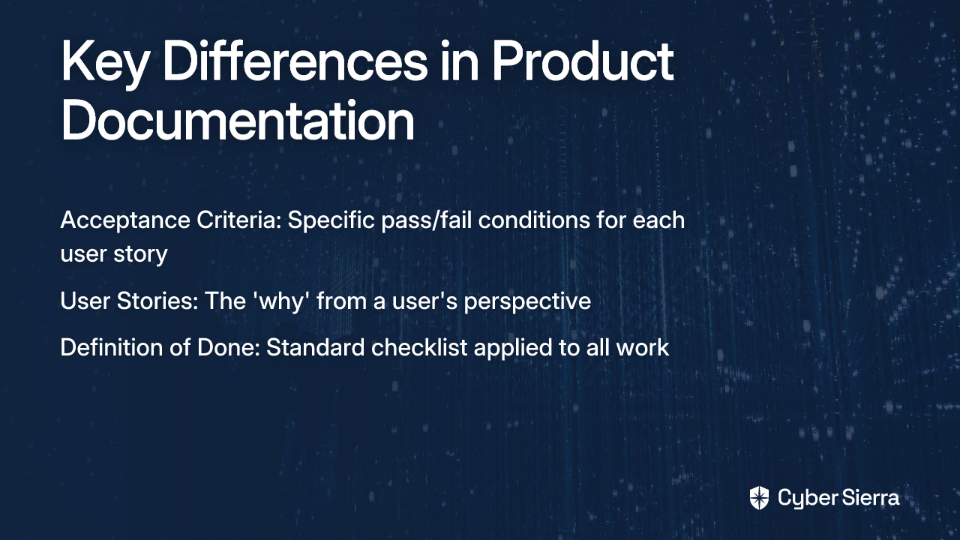
Acceptance Criteria (AC) are the conditions that a product must satisfy to be accepted by a user, customer, or system. They're essentially a pass/fail checklist that defines when a specific user story is complete.

However, acceptance criteria are often confused with other product artifacts:

  • User Stories vs. AC: A user story describes the why from a user's perspective ("As a user, I want to reset my password so I can regain access to my account"). Acceptance criteria define the what and specific conditions that must be met.
  • Definition of Done (DoD) vs. AC: Your team's Definition of Done is a standard checklist applied to all work (code reviewed, tests written, documentation updated). Acceptance criteria are unique to each individual user story.
Why Most Acceptance Criteria Fail (Common Pitfalls)

When QA professionals watch colleagues "patting themselves on the back for delivering value at breakneck speeds" while the product is an "epic mess", something has gone terribly wrong with your acceptance criteria. Here's why this happens:

Mistake #1: They're Too Vague or Too Broad

Broad statements like "The user should be able to search for products" leave too much room for interpretation. Engineers are forced to make assumptions, leading to gaps between expectations and implementation.

Mistake #2: They're Too Prescriptive

The opposite problem occurs when product managers dictate exactly how to implement a feature. This strips engineers of their autonomy and expertise in finding the best technical solution.

Mistake #3: They're Written in Isolation

When a Product Owner writes AC alone (without developer or QA input), they miss crucial technical context and edge cases. This leads to incomplete criteria that don't account for real-world scenarios.

Mistake #4: They're a Moving Target

Nothing frustrates engineers more than a PM who changes requirements after development has begun. This "scope creep" destroys trust and planning.

One product manager reported that their "product was an epic mess until I started reigning that in with very defined acceptance criteria." Let's see how to write those well-defined criteria.

The Blueprint for Effective Acceptance Criteria

Principle 1: Make it a Team Sport

Effective AC emerge from collaboration, not isolation. While the Product Owner typically drafts initial criteria, the entire team should refine them together:

  • Who writes them? The Product Owner drafts, but developers and QA must review, question, and refine them.
  • When to write them? Define AC during backlog refinement or sprint planning—never during active development. As one PM notes, "Acceptance Criteria should be written on the story before it is started."

Principle 2: Choose the Right Format for the Job

Different types of features call for different formats:

Scenario-Oriented Format (Given/When/Then)

Best for user-facing interactions and the foundation of Behavior-Driven Development (BDD):

Given [the initial context]
When [an action occurs]
Then [this outcome should happen]

Example (Password Reset):

Given I am on the login page
When I click "Forgot Password" and enter a valid email
Then I should receive a confirmation message
And I should receive a password reset email within 1 minute

Rule-Oriented Format (Checklist)

Best for non-functional requirements or when a specific user flow isn't applicable:

Example (Search Functionality):

  • The search field appears in the top navigation bar
  • Search is not case-sensitive
  • Search results display within 2 seconds
  • Results are sorted by relevance by default
  • Each result displays the product image, name, and price

Principle 3: Ensure They're Clear, Concise, and Testable

Each criterion must be a pass/fail statement with no ambiguity:

  • Bad (Not Testable): The dashboard should load quickly.
  • Good (Testable): The dashboard should load in under 3 seconds on a standard broadband connection.

If your QA team can't write a test case for a criterion, it's not well-defined.

Principle 4: Focus on Outcomes, Not Implementation

Describe what the user will experience, not how to build it. According to Scrum Alliance, effective AC should focus on the "what," not the "how."

  • Bad (Implementation-focused): Use a PostgreSQL database to store user preferences.
  • Good (Outcome-focused): User preferences should persist between sessions.
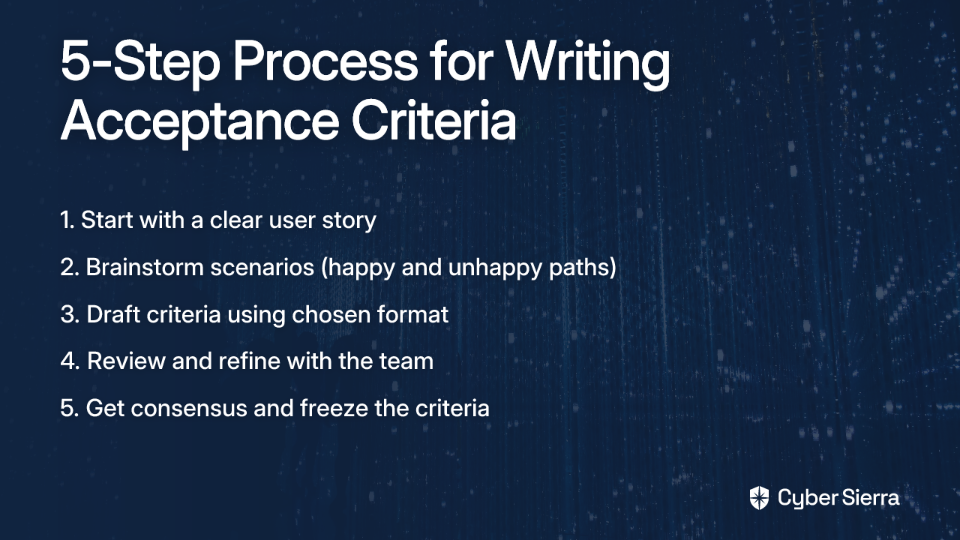
A Step-by-Step Guide to Writing AC (with Examples)

Let's walk through creating acceptance criteria for a real feature:

Step 1: Start with a Clear User Story

As a shopper, I want to filter products by price range so I can find items within my budget.

Step 2: Brainstorm Scenarios (Happy and Unhappy Paths)

Consider both ideal flows and edge cases:

  • What happens when a user sets only a minimum price?
  • What if no products match the filter?
  • What if a user enters invalid values?

Step 3: Draft the AC Using the Chosen Format

For this feature, the scenario-oriented format works well:

Scenario 1: User filters products by price range

Given I am on the product listing page
When I set minimum price to $20 and maximum price to $50
And I click "Apply Filters"
Then only products with prices between $20-$50 should display
And the number of results should be visible

Scenario 2: No products match the filter criteria

Given I am on the product listing page
When I set a price range that no products match
And I click "Apply Filters"
Then I should see a message "No products match your criteria"
And I should see an option to "Clear filters"

Scenario 3: User enters invalid values

Given I am on the product listing page
When I enter a negative number in the minimum price field
Then I should see an error message "Please enter a valid price"
And the filter should not be applied

Step 4: Review and Refine with the Team

Present your draft AC during refinement and ask specific questions:

  • "Is anything unclear?"
  • "Are we missing any edge cases?"
  • "Can we test all of these criteria?"

This collaborative discussion builds shared ownership and prevents misunderstandings. As noted by one developer, teams function best when "everyone has a sharp eye, a sense of how the business works, empathy for our users, and a high bar for quality."

Step 5: Get Consensus and Freeze the AC

Once the team agrees, the AC should be considered final for the upcoming sprint. This prevents the frustrating problem of "PM altering the AC to add more requirements after the story had already been implemented."
Tools and Workflow Integration

Your carefully crafted acceptance criteria need a home. Here's how to manage them in Jira:

  • Description Field: Simple but can get messy with complex AC
  • Custom Field: Create a dedicated "Acceptance Criteria" field
  • Checklist Plugins: Use add-ons like "Checklist for Jira" to create interactive AC lists

Whatever tool you choose, make sure your AC are visible, easily accessible, and clearly formatted for the entire team.

Finding the Right Balance

One product manager described their challenge as "finding the right balance of 'how strict do acceptance criteria need to be?'" There's no one-size-fits-all answer, but consider this guideline: the more complex the feature and the less familiar the team is with the domain, the more detailed your AC should be.

Some teams find it helpful to categorize AC as "must-have" versus "nice-to-have" to help prioritize the essential requirements while allowing room for interpretation on less critical aspects.
Conclusion: From Friction to Flow

Acceptance criteria aren't just another box to check in your development process—they're the bridge that connects product vision to technical implementation.

When crafted collaboratively, written clearly, and finalized before development, AC transform from a source of friction to a powerful communication tool that aligns the entire team. They provide engineers with the clarity they need while preserving the autonomy they deserve.

Remember: the goal isn't to create perfect documentation. The goal is to build the right product, right. Well-written acceptance criteria are your best tool to make that happen.

By investing time upfront to create excellent AC, you'll prevent the frustration of incomplete features, reduce rework, stop scope creep, and ultimately ship better products that truly meet user needs. And that's something both product managers and engineers can get behind.

Frequently Asked Questions

What is the main difference between Acceptance Criteria and a User Story?

Acceptance Criteria define the specific pass/fail conditions a feature must meet, while a User Story describes the user's goal and motivation. Think of it this way: the User Story provides the "why" from a user's perspective (e.g., "As a user, I want to reset my password..."), while the AC provides the "what" that makes the story complete (e.g., "Given I enter a valid email, Then I receive a reset link.").

Who is responsible for writing Acceptance Criteria?

The Product Owner or Product Manager typically drafts the Acceptance Criteria, but the entire team—including developers and QA—is responsible for collaboratively refining and agreeing upon them. This team-based approach is crucial because developers can identify technical constraints and edge cases, while QA can ensure each criterion is testable.

When should Acceptance Criteria be written?

Acceptance Criteria should be written and finalized before a user story is scheduled for development. The best time for this is during backlog refinement or sprint planning meetings. Finalizing AC before the sprint starts prevents scope creep and ensures the engineering team has a clear, stable target to work towards.

How do you write good Acceptance Criteria?

Good Acceptance Criteria are written collaboratively, focus on outcomes rather than implementation, are clear and testable, and use a consistent format. The best AC are unambiguous pass/fail statements. Using formats like the scenario-oriented (Given/When/Then) approach for user interactions or a rule-oriented checklist for system requirements helps maintain clarity and ensures everyone understands what needs to be delivered.

Why are Acceptance Criteria important in Agile development?

Acceptance Criteria are important because they create a shared understanding of what "done" means for a specific feature, serving as a contract between the product and engineering teams. They prevent ambiguity and miscommunication, reduce rework, empower QA with clear test cases, and ultimately ensure that the final product aligns with both business requirements and user needs.

What is the difference between Acceptance Criteria and the Definition of Done (DoD)?

Acceptance Criteria are unique rules for an individual user story, while the Definition of Done (DoD) is a general checklist that applies to all work items. For example, an AC for a login feature might be "User sees an error on invalid password entry." The DoD, in contrast, would include team-wide standards like "Code is peer-reviewed," "Automated tests are passing," and "Documentation is updated," which are required for any story to be considered complete.

blog-hero-background-image
Cyber Security

AWS Security Specialty Certification Guide for Cloud Engineers

backdrop
Table of Contents

Join thousands of professionals and get the latest insight on Compliance & Cybersecurity.


You've been working with AWS for a while now, and you're looking to take your career to the next level. But as you browse through job listings, it's clear that cloud security expertise is no longer optional—it's essential. You feel overwhelmed by the sheer volume of security concepts to master, and the thought of transitioning from your general IT role to a specialized security position seems daunting.

If this resonates with you, you're not alone. As one professional put it, "The knowledge required to pass any of these exams is so diverse and granular..." making it easy to feel lost before you even begin.

The good news? The AWS Certified Security - Specialty certification is your pathway to becoming the cloud security expert organizations desperately need—and this guide will provide you with a clear, actionable roadmap to get there.

Why the AWS Security Specialty Certification Matters Now More Than Ever

Cloud adoption is accelerating at an unprecedented rate, creating an urgent demand for security professionals who can navigate the complex AWS ecosystem. According to AWS, job listings requiring this certification increased by an impressive 73% between October 2021 and September 2022 alone.

More importantly, this certification isn't just another credential to add to your LinkedIn profile. It's recognized as one of the highest-paying technical certifications in the US and ranks among the top 10 most popular cybersecurity certifications globally.

As one Reddit user aptly described, "Cloud security is the 'newest' domain to information security, and thus in need of security professionals." Organizations are struggling with proper cloud architecture, leading to misconfigurations that can have serious security implications.

By earning this certification, you'll be positioned to fill this critical gap and command premium compensation in the process.

Deconstructing the AWS Certified Security - Specialty (SCS-C02) Exam

Before diving into preparation strategies, let's understand exactly what you're up against.

Exam Overview

  • Purpose: This certification validates your ability to effectively use AWS security services to secure the AWS platform.
  • Target Audience: Professionals with at least 5 years of IT security experience and 2 years of hands-on experience securing AWS workloads.
  • Format: 65 questions (50 scored, 15 unscored) in multiple-choice or multiple-response format.
  • Duration: 170 minutes (approximately 2.5 minutes per question).
  • Passing Score: 750 out of 1000.
  • Cost: $300 USD (Pro tip: After earning your first AWS certification, you receive a 50% discount voucher for your next exam).

While there are no mandatory prerequisites, having the AWS Certified Solutions Architect - Associate certification provides a solid foundation for tackling this more specialized exam.

The Six Domains: Your Technical Blueprint for Success

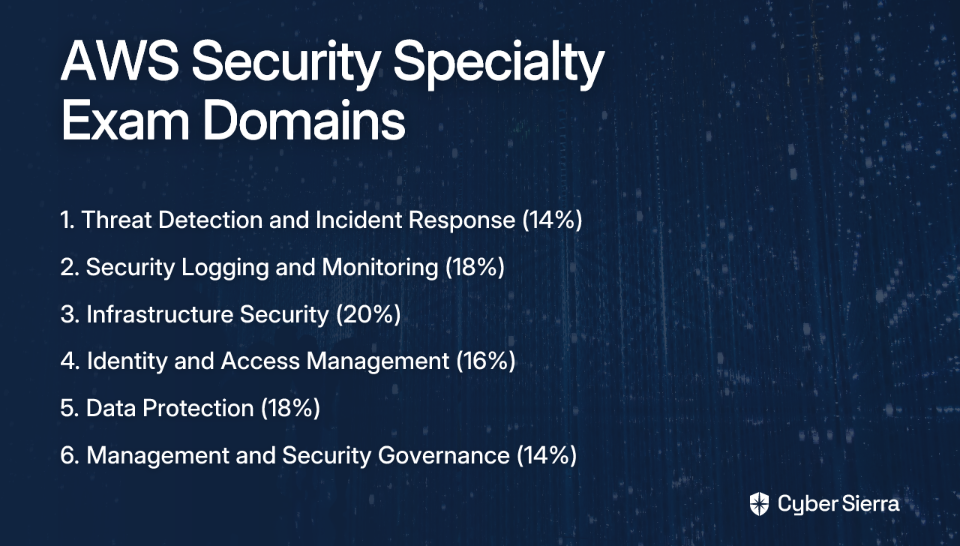
One of the biggest challenges when preparing for this exam is the vast range of topics covered. Let's break down the six domains that form the core of the exam, along with their relative weightings:

Domain 1: Threat Detection and Incident Response (14%)

This domain focuses on your ability to identify and respond to security incidents in AWS environments.

Key Services: AWS GuardDuty, Amazon Inspector, AWS Security Hub, AWS Config, CloudTrail, and CloudWatch Events.

Core Concepts: Setting up automated responses to security events, investigating potential compromises, and configuring threat detection services for proactive security.

Domain 2: Security Logging and Monitoring (18%)

This domain tests your ability to implement comprehensive logging solutions and monitor AWS environments for security issues.

Key Services: AWS CloudTrail, Amazon CloudWatch, VPC Flow Logs, and S3 Access Logs.

Core Concepts: Setting up centralized logging, troubleshooting logging configurations, and analyzing logs for security anomalies. The AWS Logging and Monitoring Guide is an essential resource for this section.

Domain 3: Infrastructure Security (20%)

As the most heavily weighted domain, this area examines your ability to secure AWS infrastructure components.

Key Services: VPC (Security Groups, NACLs, Endpoints), AWS WAF, AWS Shield, AWS Systems Manager (for Patch Management), and AWS Network Firewall.

Core Concepts: Designing secure network architectures, implementing edge security, and automating infrastructure security tasks using IaC (Infrastructure as Code) principles.

Domain 4: Identity and Access Management (16%)

This domain assesses your understanding of AWS IAM and related services for controlling access to AWS resources.

Key Services: AWS IAM (Users, Groups, Roles, Policies, MFA), AWS Organizations (Service Control Policies - SCPs), AWS SSO, and Amazon Cognito.

Core Concepts: Mastering IAM policy evaluation logic, understanding the differences between IAM Users and Roles, and applying Zero Trust principles and least privilege access.

Domain 5: Data Protection (18%)

This domain tests your knowledge of encrypting data and managing encryption keys in AWS.

Key Services: AWS KMS (Key Management Service), AWS Certificate Manager, Amazon S3 encryption, Amazon RDS encryption, and Amazon Macie.

Core Concepts: Implementing key rotation strategies, understanding the difference between a key policy and grants, and encrypting data both at rest and in transit.

Domain 6: Management and Security Governance (14%)

This domain focuses on managing security across AWS accounts and ensuring compliance with regulatory requirements.

Key Services: AWS Organizations, AWS Config, AWS Artifact, and AWS Security Hub.

Core Concepts: Understanding the AWS Shared Responsibility Model, managing security across multiple accounts, and aligning with compliance frameworks.

A Practical 4-Week Study Plan: From Preparation to Certification

Many candidates struggle with exam preparation due to "limited practical experience with AWS," as one Reddit user mentioned. The following structured study plan addresses this challenge by combining theoretical knowledge with hands-on practice:

Week 1: Foundations and Familiarization

  1. Set a Deadline: Book your exam now for 4 weeks from today. This creates urgency and commitment.
  2. Review Official Materials: Download the official exam guide and familiarize yourself with the exam domains.
  3. Take the Free AWS Training: Enroll in the free Exam Readiness course to get a high-level overview of the exam.

Weeks 2-3: Deep Dive and Hands-On Practice

  1. Domain-by-Domain Study: Systematically work through each domain, focusing on the AWS documentation and service FAQs.
  2. Apply What You Learn: This is critical for addressing the "limited practical experience" pain point. Use AWS Free Tier or AWS Builder Labs to implement what you're learning. Create a small project for each domain to reinforce concepts.
  3. Avoid Brain Dumps: Focus on understanding rather than memorization. As one successful candidate advised, "brain dumps can be confusing and outdated."

Week 4: Assess, Refine, and Review

  1. Take Practice Exams: Use the AWS Official Practice Exam and third-party practice tests from reputable providers like TutorialsDojo.
  2. Perform Gap Analysis: For each question you get wrong, understand why the correct answer is right. This targeted approach helps close knowledge gaps efficiently.
  3. Rest: The day before the exam, do only a light review and prioritize rest for optimal performance.

Exam Day Strategy: Passing with Confidence

With the exam costing $300, you want to make sure you pass on the first attempt. Here are proven strategies:

Time Management

  • You have approximately 2.5 minutes per question. Use it wisely.
  • If a question is taking too long, flag it for review and move on. Return to it later if time permits.

Question Approach

  • Read Carefully: Pay special attention to keywords like "most secure," "cost-effective," or "automated" that can guide you to the correct answer.
  • Eliminate Wrong Answers: Often, you can immediately eliminate two obviously incorrect options, improving your odds on the remaining choices.
  • Trust Your Preparation: Answer the questions you're confident about first to build momentum.

Launch Your Career as an AWS Security Specialist

As cloud adoption continues to accelerate, organizations are facing an increasingly complex security landscape. The AWS Certified Security - Specialty certification demonstrates that you have the expertise to navigate these challenges effectively.

Remember that this certification isn't just about technical knowledge—it's about applying that knowledge to real-world scenarios. By following the structured approach outlined in this guide, you'll not only pass the exam but also develop practical skills that make you invaluable in the job market.

The journey may seem daunting, especially if you're transitioning from a general IT role, but the reward is substantial: entry into one of the fastest-growing and highest-paying fields in technology.

Frequently Asked Questions

What is the AWS Certified Security - Specialty exam?

The AWS Certified Security - Specialty (SCS-C02) exam is a professional-level certification that validates your expertise in securing AWS environments using AWS security services. It is designed for individuals with hands-on experience in AWS and a strong background in IT security, covering topics from incident response and logging to infrastructure security and data protection.

Why should I get the AWS Security Specialty certification?

You should get the AWS Security Specialty certification to validate your cloud security skills, meet the high demand for security professionals, and command a higher salary. The certification is recognized as one of the top-paying IT certifications and addresses a critical skills gap in the industry, making you a highly valuable candidate for advanced security roles.

Who is the ideal candidate for the AWS Security Specialty certification?

The ideal candidate is an IT security professional with at least two years of hands-on experience securing AWS workloads and a minimum of five years of general IT security experience. While there are no strict prerequisites, a strong foundation in AWS services, often demonstrated by holding the AWS Certified Solutions Architect - Associate certification, is highly recommended for success.

How difficult is the AWS Certified Security - Specialty exam?

The AWS Certified Security - Specialty exam is considered challenging due to its breadth and depth, requiring both theoretical knowledge and practical, hands-on experience with AWS security services. The difficulty lies in the scenario-based questions that test your ability to apply concepts across multiple domains. Success typically requires a structured study plan and significant hands-on practice to bridge the gap between theory and real-world application.

What are the most important topics to study for the SCS-C02 exam?

The most important topics are concentrated in the heavily weighted domains: Infrastructure Security (20%), Security Logging and Monitoring (18%), and Data Protection (18%). You should focus heavily on services like VPC (Security Groups, NACLs), AWS WAF, AWS Shield, CloudTrail, CloudWatch, and AWS KMS. Mastering IAM policy evaluation logic is also critical, as it is a foundational element across all domains.

How long does it take to prepare for the AWS Security Specialty exam?

Preparation time can vary, but a dedicated study plan of 4 to 8 weeks is common for individuals with prior AWS experience. This timeframe allows for a systematic review of all six domains, hands-on practice labs to reinforce concepts, and multiple practice exams to identify and close knowledge gaps. Your personal timeline will depend on your existing familiarity with AWS and daily study commitment.

Ready to take the first step? Visit the AWS Certification page today to download the exam guide and schedule your exam. Your future as a cloud security expert awaits.

blog-hero-background-image
Cyber Security

How to Transition from SOC Analyst to Security Engineer

backdrop
Table of Contents

Join thousands of professionals and get the latest insight on Compliance & Cybersecurity.


You've been grinding away in the SOC for months—maybe years. The constant alert triage, the draining shift rotations, the feeling that you're stuck in an endless loop of reactive firefighting. Your body clock is in shambles, and despite positive feedback, that promotion seems like a distant mirage.

"The health impact of our shift pattern is really making it hard to progress in my spare time," as one SOC analyst put it on Reddit. "I'm pretty much desperate to move to a new role that is 9-5, as with some consistency in life I feel I can accelerate my learning so much."

If this resonates with you, you're not alone. Many SOC analysts reach a point where they see "the knowledge ceiling approach for on-the-job learning" and yearn for more. The good news? Your experience as a SOC analyst has equipped you with invaluable skills that make you an excellent candidate for one of the most in-demand roles in cybersecurity: Security Engineer.

This article provides a clear, actionable roadmap to help you leverage your existing experience, build the necessary skills, and successfully navigate this critical career transition—one that not only promises better work-life balance but also future-proofs your career in an increasingly automated industry.

The Leap: From SOC Analyst to Security Engineer

Your Foundation: The SOC Analyst Role

As a SOC analyst, your day revolves around monitoring security events, investigating alerts, and responding to incidents. Whether you're a Tier 1 SOC analyst handling initial triage or have progressed to more complex investigations as a T3 analyst, you've developed critical skills in threat detection, log analysis, and incident response.

These responsibilities have given you a front-row seat to the security challenges organizations face daily—a perspective that's incredibly valuable for a security engineer.

Your Destination: The Security Engineer Role

While SOC analysts are the defenders on the front lines, security engineers are the architects who design and build the fortress. According to Coursera, security engineers "design and build security systems to protect an organization's data from cyber attacks."

Your core responsibilities will shift from monitoring and responding to:

  • Designing and implementing security infrastructure
  • Developing and deploying security tools and automation
  • Conducting security assessments and penetration testing
  • Building scalable security solutions that prevent attacks before they happen

The Critical Distinction: Reactive Monitoring vs. Proactive Building

The fundamental difference lies in your approach to security. As a SOC analyst, you're primarily reactive—responding to threats after they've been detected. As a security engineer, you'll be proactive—building systems that prevent threats from materializing in the first place.

This shift aligns with where the industry is heading. As Malcomvetter on Medium argues, the future of security operations involves "eliminating the role of SOC analyst" through automation. This doesn't mean SOC analysts will become obsolete—it means they must evolve into engineers who build the automated systems that handle the alerts they once processed manually.

Why Make the Move? The Compelling Case for Transitioning

Career Trajectory and Stability

One of the most common frustrations among SOC analysts is the unclear promotion path. "I doubt a promotion is awaiting despite the good feedback," shared one analyst on Reddit. Security Engineering offers a defined career ladder: from Junior Security Engineer to Senior, then to Staff Engineer, and potentially to Security Architect or even CISO.

More importantly, it typically means an escape from the draining shift work. While you might still have occasional on-call rotations (as one Reddit user noted, "I will have to do on call once every 6 weeks on top of my 9-5"), you'll gain the consistency and stability needed to accelerate your learning and maintain better work-life balance.

Financial Rewards

Let's be honest: money matters. Many SOC analysts feel underpaid for the critical work they do, and as one Reddit user bluntly put it, "Job hopping is sweet, and the only real way to make more money these days."

The numbers speak for themselves. According to Coursera, security engineers earn significantly more than SOC analysts, with average salaries ranging from $138,014 (Glassdoor) to $152,773 (PayScale).

Future-Proofing Your Career in an Automated World

Perhaps the most compelling reason to make this transition is the direction of the industry itself. As Malcomvetter explains, there's a fundamental shift happening from "analyst-centric processes to engineering-centric processes."

Why? Simple scalability. "Adversaries are becoming faster, and alert telemetry volumes are increasing exponentially," making manual analysis increasingly inefficient. The future belongs to those who can build automated systems that scale to handle the growing volume and sophistication of threats.

By transitioning to a Security Engineer role now, you're positioning yourself ahead of this industry shift, ensuring your skills remain relevant and in-demand for years to come.

The Roadmap: Your Step-by-Step Transition Plan

Step 1: Leverage Your SOC Experience (Your Secret Weapon)

Your time in the SOC isn't just relevant—it's a competitive advantage. As one Reddit user reassured an aspiring engineer, "Your SOC experience will be perfect for this."

Here's why: your experience with active threat hunting informs how to build better detection logic. Your DFIR knowledge helps you design systems that are resilient and easy to investigate. Your understanding of attacker techniques is invaluable for threat modeling and preventative architecture.

Actionable Tip: Start thinking like an engineer in your current role. For each incident you handle, ask yourself: "How could we have prevented this at the architecture level? How can I write a script to automate this response next time?" This mindset shift not only improves your SOC but also builds your engineering portfolio.

Step 2: Bridge the Technical Skill Gap

This is where the rubber meets the road. To transition successfully, you need to develop several key technical skills:

Learn to Code: This is non-negotiable. As one Reddit user advised, "If you haven't already, learn to code. Python is the perfect language to start with." According to InterviewKickstart, proficiency in Python, Golang, Java, C++, and Shell Scripting is essential for security engineers.

Start with Python due to its wide usage in security tools and automation. Create scripts to automate repetitive SOC tasks as practice.

Master Cloud and Infrastructure: Security Engineering is increasingly cloud-focused. As noted in AWS Plain English, modern security engineering is about "working on infrastructure and securing cloud environments."

Learn the fundamentals of at least one major cloud platform (AWS, Azure, or GCP) and get hands-on with Infrastructure as Code tools like Terraform.

Deepen Foundational Knowledge: Go beyond the basics in networking (subnetting, routing protocols, VPNs), operating systems (Windows, Linux, macOS), and databases. These foundational skills are critical for identifying and remediating vulnerabilities at the architectural level.

Step 3: Get Certified Strategically

Certifications aren't a silver bullet, but they do validate your new skills and help you get past HR filters. Shift your focus from analyst-centric certifications to engineer-focused ones:

  • CISSP (Certified Information Systems Security Professional): A key credential for security engineers that demonstrates broad knowledge across multiple security domains.
  • Cloud-Specific: AWS Certified Security - Specialty or equivalent certifications for Azure/GCP demonstrate your ability to secure cloud environments.
  • Technical/Vendor: GIAC certifications, CCNP Security, or CEH v10 can validate specific technical skills relevant to engineering roles.

Step 4: Build Hands-On Experience (The Deal-Maker)

Employers want proof that you can apply your knowledge in real-world scenarios. Many SOC analysts struggle with "limited hands-on experience with cloud and detection tools." Here's how to change that:

Build a Homelab Setup: This is essential. Install a PFSense firewall, set up a SIEM, configure a honeypot, and practice both attacking and defending your environment. Document everything in a blog or GitHub repository.

Contribute at Work: Volunteer for projects involving tool configuration, rule tuning, or script creation. As one Reddit user advised, "Talk to your managers about what you need to do to make this transition." Many managers will support your growth if they understand your goals.

Open Source & Personal Projects: Contribute to open-source security tools or build your own scripts. Host them on GitHub to create a portfolio that demonstrates your engineering capabilities.

Step 5: Network and Find Mentorship

Networking isn't just about finding job opportunities—it's about learning from those who've already made the transition you're aiming for.

Join professional organizations like SANS, ISACA, CompTIA, and (ISC)² to connect with peers and mentors. Use LinkedIn to connect with Security Engineers at companies you admire, and ask for 15-minute informational interviews to learn about their roles and get advice.

Nailing the Job Hunt: Resume and Interviews

"Beefing Up" Your Resume for an Engineering Role

Reframe your SOC duties with an engineering mindset:

Instead of: "Monitored SIEM for security alerts." Write: "Developed and tuned custom SIEM detection rules to identify anomalous behavior, reducing false positives by 30%."

Include a link to your GitHub profile and list key projects from your homelab or work, detailing the technologies used.

Preparing for the Technical Interview

Expect a shift in interview style from scenario-based questions to system design and coding challenges. Be prepared for questions about:

  • How you would secure a specific cloud architecture
  • Writing a Python script to automate a security task
  • Deep dives into networking, authentication, and encryption concepts

Practice with mock interviews to build confidence in these areas.

Engineer Your Future

The path from SOC Analyst to Security Engineer is challenging but tremendously rewarding. You're moving from a reactive role to a proactive, creative, and highly impactful position in cybersecurity—one that offers better work-life balance, significantly higher earning potential, and alignment with the future of the industry.

As one Reddit community member urgently advised: "Start building those engineering skills NOW!" The transition is a marathon, not a sprint, but every script you write and every lab you build is a step toward a more fulfilling career.

Your SOC experience isn't just relevant—it's your secret weapon. Now it's time to build on that foundation and engineer your future in cybersecurity.

Frequently Asked Questions

What is the main difference between a SOC Analyst and a Security Engineer?

The primary difference is their approach to security: SOC Analysts are primarily reactive, responding to threats as they are detected, while Security Engineers are proactive, designing and building systems to prevent threats from occurring in the first place. A SOC analyst's role revolves around monitoring, investigation, and incident response. In contrast, a security engineer focuses on architecting security infrastructure, developing automation, and implementing preventative security controls.

Why should a SOC Analyst consider becoming a Security Engineer?

A SOC Analyst should consider becoming a Security Engineer for improved career trajectory, higher earning potential, better work-life balance, and to future-proof their skills in an increasingly automated industry. The security engineering path offers a clearer promotion ladder away from draining shift work. Financially, security engineers earn significantly more on average. Most importantly, as the industry moves from manual analysis to automated, engineering-centric processes, these skills ensure long-term relevance and job security.

How can a SOC Analyst start learning to code for a security engineer role?

The best way for a SOC Analyst to start learning to code is by picking a language like Python and applying it to automate repetitive tasks in their current job. Start by identifying manual, daily tasks—like parsing logs, enriching data, or generating reports—and write simple Python scripts to automate them. This practical approach not only builds your coding skills but also creates a portfolio of real-world projects you can showcase on a platform like GitHub.

What are the most important technical skills for a Security Engineer besides coding?

Besides coding, the most important technical skills for a Security Engineer are expertise in cloud platforms (like AWS, Azure, or GCP) and a deep understanding of core infrastructure, including networking, operating systems, and databases. Modern security engineering is heavily cloud-focused, so proficiency with Infrastructure as Code (IaC) tools like Terraform is crucial for building and securing scalable cloud environments.

How can I get hands-on experience while still working as a SOC Analyst?

You can gain hands-on engineering experience by building a personal homelab, volunteering for technical projects at your current job, and contributing to open-source security tools. A homelab allows you to practice building and defending your own network environment. At work, express interest in helping with tasks like SIEM rule tuning, tool configuration, or scripting. Contributing to projects on GitHub also provides practical experience and creates a public portfolio of your capabilities.

How do I reframe my SOC experience on my resume for a Security Engineer position?

Reframe your SOC experience by focusing on engineering-oriented achievements and metrics rather than just listing reactive duties. For example, instead of stating you "monitored alerts," describe how you "developed and tuned custom SIEM detection rules to reduce false positives by 30%." Highlight any scripting, automation, or tool configuration you performed to shift the narrative from passive monitoring to proactive building.

blog-hero-background-image
Cyber Security

Database Proxies: Your Key to Accessor-Level Security

backdrop
Table of Contents

Join thousands of professionals and get the latest insight on Compliance & Cybersecurity.


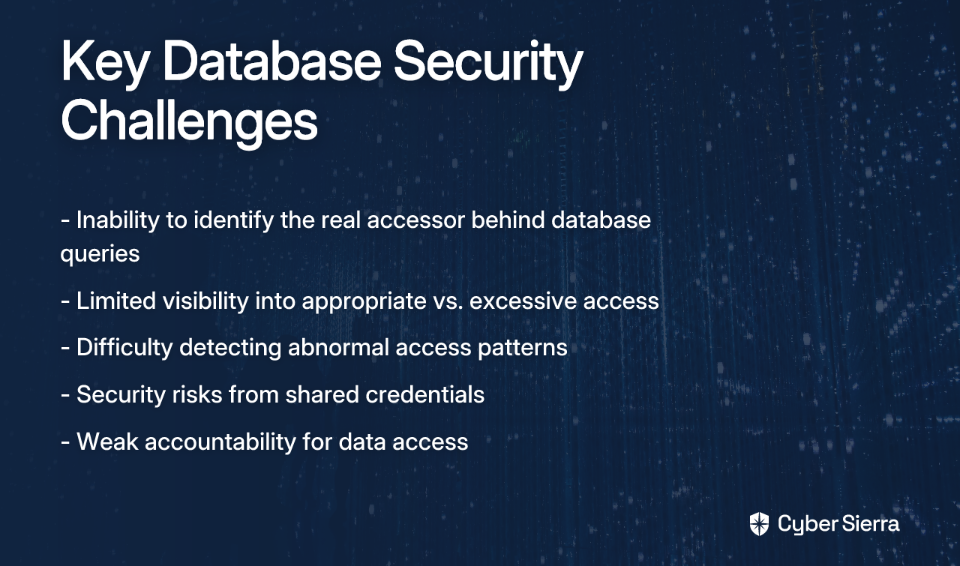
You've spent countless hours designing your database security, diligently setting up users, roles, and permissions. But when you look at your database logs, all you see is generic service account activity—no indication of which specific application, microservice, or human actually triggered each query. When your security team asks, "Who accessed this sensitive customer data last Tuesday at 3 PM?" you're left scrambling through disconnected logs with no clear answers.

This frustrating gap in visibility exists because, as one security professional put it, "90% of the time, it's just DB user-level info" in your logs. The moment your architecture includes shared database users or service accounts reused across multiple applications, you've created an "identity abstraction" that makes it nearly impossible to trace actions back to actual accessors.

But what if you could know with certainty which application component or team member executed each query? What if you could detect excessive or out-of-pattern access before it becomes a security incident? What if you could implement true accessor-level security rather than just coarse DB user-level controls?

Database proxies are the missing architectural component that makes this level of visibility and control possible.

What is a Database Proxy?

A database proxy is a specialized intermediary that sits between your applications and your database servers. Rather than connecting directly to the database, your applications connect to the proxy, which then manages the connection to the actual database on their behalf.

Database Proxy Architecture

This seemingly simple architectural shift creates a powerful control point that transforms your database security capabilities. The proxy intercepts all traffic flowing between applications and databases, allowing it to:

  1. Add rich context to each connection
  2. Enforce security policies in real-time
  3. Log detailed information about queries and results
  4. Manage connections efficiently
  5. Provide seamless failover capabilities

Unlike simple connection forwarders, modern database proxies are sophisticated security and performance tools that can dramatically improve your database operations while solving the critical problem of accessor-level visibility.

Restoring Context: How Proxies Enable Accessor-Level Security

The fundamental problem with traditional database access is that the identity abstraction at the DB layer makes it impossible to tie runtime behavior back to actual accessors. Database proxies solve this by creating a secure bridge that preserves identity context across the application-to-database boundary.

Mapping Queries to Specific Accessors

When an application connects to a database through a proxy, it can pass additional metadata about the actual accessor—whether that's an end user, a specific microservice, or a serverless Lambda function. The proxy then:

  1. Captures this metadata along with the query
  2. Establishes the database connection using appropriate credentials
  3. Forwards the query to the database
  4. Logs the complete transaction with full accessor context
  5. Returns results to the application

This process restores the critical context that's lost when applications share database users. Instead of seeing "ServiceAccount123 accessed customer data," you can now see "Order Processing Microservice accessed customer data on behalf of Customer Support Agent Jane Doe."

Enforcing Granular Security Policies

Once the proxy has established the true identity of the accessor, it can enforce sophisticated security policies that go far beyond traditional database permissions:

  • Row Level Security: Restrict data access based on the actual end-user or service identity, not just the database user
  • Threshold-Based Controls: Detect and block excessive access patterns, such as an application suddenly requesting 1000x its normal data volume
  • Out-of-Pattern Access: Identify and alert on unusual access, like a payroll service accessing customer credit card data

Security teams can define these policies declaratively, without modifying application code or database schemas. The proxy enforces them in real-time, blocking unauthorized access before it reaches the database.

Real-Time Inputs/Outputs Logging

Beyond just logging connections, sophisticated database proxies can capture:

  • Full query text with parameter values
  • Result sizes and execution times
  • Error messages and exception details
  • Accessor identity information

This comprehensive logging is invaluable for security investigations, compliance audits, and performance troubleshooting. When combined with accessor-level context, it provides the complete picture of database activity that security teams need.

Beyond Security: Performance and Availability Benefits

While security is a compelling reason to implement database proxies, they deliver significant additional advantages:

Connection Pooling for Dynamic Environments

Modern architectures with serverless functions and microservices can create connection management challenges. As one developer noted, "Lambdas come and go, I'm scaling hundreds of them up and down," which can quickly max out database connection limits.

Proxies solve this problem through intelligent connection pooling:

  • Maintain a set of pre-established connections to the database
  • Reuse these connections across multiple application requests
  • Efficiently manage connection lifecycles
  • Prevent connection leaks and exhaustion

This capability is particularly valuable in serverless environments where establishing new database connections for each function invocation would be prohibitively expensive.

Seamless Failover and High Availability

Database proxies also enhance application resilience by providing seamless failover capabilities:

  • Monitor database health continuously
  • Detect failures instantly
  • Redirect traffic to healthy replicas automatically
  • Preserve connection state during transitions

According to AWS, their RDS Proxy can reduce failover times for Amazon Aurora and RDS databases by up to 66%, dramatically improving application availability during database maintenance or failures.

Build vs. Buy: Choosing the Right Proxy Strategy

Organizations looking to implement a database proxy solution have two primary options: building a custom proxy or adopting a commercial solution. Each approach has distinct advantages and challenges.

The DIY Approach

Building your own database proxy gives you complete control over its functionality and integration with your systems. This approach can be particularly appealing if you have unique requirements or cost constraints.

Advantages:

  • Complete customization for your specific environment
  • No licensing costs for commercial products
  • Integration with your existing authentication systems
  • Tailored logging and monitoring capabilities

Challenges:

  • Requires significant engineering resources to build and maintain
  • Security vulnerabilities if not properly implemented
  • Ongoing maintenance burden as database protocols evolve
  • Potential for becoming a single point of failure

As one developer noted, "If you just want basic logging and context tracking, I would suggest building the proxy yourself." Open-source tools like PgBouncer (for PostgreSQL) and HAProxy can provide a solid foundation for a custom solution.

Commercial Solutions

For organizations seeking faster time-to-value or more comprehensive features, commercial database proxy solutions offer robust capabilities without the development overhead.

Advantages:

  • Pre-built security features like advanced threat detection
  • Professional support and regular security updates
  • Extensive compliance capabilities and certifications
  • Reduced implementation and maintenance burden

Challenges:

  • Licensing costs can be significant at scale
  • Some solutions may be "obscenely overpriced," as one user described
  • Less flexibility for unique requirements
  • Potential vendor lock-in

Popular commercial options include:

  • Cloud Provider Solutions: Amazon RDS Proxy, Google Cloud SQL proxy
  • Security-Focused Proxies: DataSunrise Database Security Suite, Imperva
  • Performance-Oriented Proxies: ProxySQL, MaxScale

Reclaiming Control Over Your Database Access

In today's complex application environments, traditional DB user-level security is no longer sufficient. The widespread use of shared service accounts creates dangerous visibility gaps that database proxies are uniquely positioned to address.

By implementing a database proxy, you gain:

  • True accessor-level visibility into who's actually accessing your data
  • Granular policy enforcement based on the actual identity making requests
  • Comprehensive audit trails connecting specific accessors to database activities
  • Enhanced performance and availability for your applications

Whether you build your own solution or invest in a commercial product, a well-implemented database proxy transforms your database security posture from basic user-level controls to sophisticated accessor-level security.

The next time someone asks, "Who accessed this data?" you'll have a clear, complete answer—not just the name of a generic service account, but the specific application, service, or person who triggered the activity. That level of visibility isn't just good security practice—it's essential for modern data governance and compliance.

Frequently Asked Questions

What is a database proxy and why do I need one?

A database proxy is an intermediary server that sits between your applications and your database to manage connections and provide enhanced security, performance, and visibility. You need one to solve the common "identity abstraction" problem, where shared service accounts hide the true identity of who or what is accessing your data, making security audits and threat detection difficult.

How does a database proxy improve database security?

A database proxy improves security by enabling true accessor-level visibility and enforcing granular, real-time access policies. It identifies the specific application or user making a request, allowing you to implement rules like row-level security, block excessive data requests with threshold-based controls, and create comprehensive audit trails that link every query to its original source.

What is the difference between a database proxy and a connection pooler?

While both manage database connections, a connection pooler's primary function is performance, whereas a database proxy is a more sophisticated tool focused on security and control, which often includes connection pooling as one of its features. A modern proxy actively inspects traffic, enriches it with identity context, enforces security policies, and provides detailed logging, acting as a critical control point for security and operations.

When should I build my own database proxy versus using a commercial one?

You should consider building your own database proxy if you have unique requirements and the engineering resources to develop and maintain it securely. A commercial solution is generally better for organizations seeking comprehensive, pre-built security features, professional support, and faster time-to-value without the long-term maintenance burden.

Can a database proxy add performance overhead?

Yes, a database proxy introduces an extra network hop which can add a small amount of latency. However, for most applications, this is more than offset by significant performance gains from features like intelligent connection pooling. In environments with many short-lived connections (like serverless functions), a proxy's ability to reuse connections dramatically reduces latency and prevents the database from being overwhelmed.

Are you still relying solely on DB user-level info for your security controls? If so, it's time to consider how database proxies can help you close the identity gap and implement true accessor-level security for your critical data assets.

blog-hero-background-image
Cyber Security

4 Ways to Get Accessor-Level Control Over Your Database

backdrop
Table of Contents

Join thousands of professionals and get the latest insight on Compliance & Cybersecurity.


You think your database is secure because users need credentials to access it. But when you dive into your logs, all you see is generic "DB user-level info" — roles, grants, maybe some basic audit trails. This common scenario leaves critical questions unanswered:

  • Which app or human actually triggered that sensitive query?
  • Is the access being used appropriately or excessively?
  • Are these access patterns normal or potentially malicious?

As one frustrated security professional on Reddit put it, "90% of the time, it's just DB user-level info... the identity abstraction at the DB layer makes it really hard to tie runtime behavior back to an actual accessor." This visibility gap creates significant security risks, especially when shared database users or service accounts are reused across services.

The hard truth? There's no magic tool that solves this problem completely. However, four powerful approaches can dramatically improve your database access visibility when implemented correctly. Let's explore each method, examining their pros, cons, and ideal use cases.

1. Database Proxies: The Centralized Gatekeeper

A database proxy acts as an intermediary between users/applications and your database. As one Reddit user succinctly described it: "Users connect to the proxy, proxy connects to the DB." This approach creates a centralized checkpoint where all queries can be monitored, filtered, and controlled before reaching your database.

Pros:

  • Enhanced DB Access Visibility: Captures detailed information about the accessor (human or app/service) and their queries
  • Real-time Enforcement: Can implement policy controls like query blocking, rerouting, or data redaction on-the-fly
  • Inputs/Outputs Logging: Records both the queries submitted and the data returned, creating comprehensive audit trails

Cons:

  • Performance Impact: Adds latency to database communications
  • Deployment Complexity: Requires configuration changes to applications and connection strings
  • Maintenance Overhead: Becomes another critical infrastructure component to manage

Ideal Use Case:

Database proxies shine in environments requiring detailed monitoring and real-time policy enforcement. They're particularly valuable for organizations with strict compliance requirements or those needing to detect out-of-pattern access immediately.

In Practice:

MariaDB's MaxScale is frequently cited as a powerful proxy solution. As one security professional noted, "MaxScale does some great real-time enforcement (routing, redaction, query blocking)." For organizations with simpler needs, building a custom proxy is often straightforward enough to be a viable alternative to paid solutions.

2. Row-Level Security (RLS): Granular Data Segregation

Row-Level Security implements access controls directly within the database, restricting which rows a user can see or modify based on their identity or role. Unlike traditional database permissions that operate at the table level, RLS filters data at the row level, ensuring users only see what they're authorized to access.

Pros:

  • Fine-Grained Control: Allows data segregation within the same table based on user attributes
  • Simplified Application Logic: Moves security enforcement from application code to the database layer
  • Consistent Policy Application: Enforces access controls regardless of how data is accessed (app, reporting tool, direct query)
  • Reduced Over-Privileging: Minimizes excessive access by implementing precise data boundaries

Cons:

  • Performance Considerations: Poorly designed RLS policies can impact query performance
  • Implementation Complexity: Requires careful design of security predicates and policies
  • Database Specificity: Implementation details vary across database platforms

Ideal Use Case:

Row-Level Security is perfect for multi-tenant applications where different users or organizations share the same database but should only see their own data. It's also valuable in regulated industries like healthcare, where a nurse should only access records for assigned patients, or financial services, where advisors should only see their clients' information.

In Practice:

Microsoft SQL Server implements RLS using security predicates (inline table-valued functions) and security policies. These come in two forms:

  • Filter Predicates: Silently filter rows for SELECT, UPDATE, and DELETE operations
  • Block Predicates: Explicitly block INSERT, UPDATE, and DELETE operations that violate security rules

For PostgreSQL users, Supabase offers a streamlined implementation of RLS that many security professionals recommend for its ease of use and effectiveness.

3. Secrets Management: Securing Application & Service Access

One of the most challenging aspects of database security is managing access for non-human identities like applications and services. As one security expert noted, "The messy part is app/service access." Secrets management systems address this by securely storing, managing, and automatically rotating database credentials.

Pros:

  • Eliminates Hardcoded Credentials: Removes sensitive information from code repositories
  • Centralizes Access Control: Provides a single place to manage all non-human identity access
  • Enables Credential Rotation: Automatically updates credentials without application downtime
  • Creates Accessor-Level Audit Trail: Logs exactly which service or application requested database access

Cons:

  • Initial Integration Effort: Requires modifying applications to retrieve credentials dynamically
  • Potential Single Point of Failure: If the secrets management system is unavailable, applications may lose database access
  • Additional Infrastructure Component: Requires secure setup and ongoing maintenance

Ideal Use Case:

Secrets management is essential for modern application architectures, particularly in dynamic environments with containerized workloads, CI/CD pipelines, and Infrastructure as Code. It addresses the critical security gap created when applications need to access databases without exposing credentials.

In Practice:

HashiCorp Vault stands out as a leading solution in this space. As one Reddit user highlighted, "It is able to manage secrets to the DB, then you can log who requested those secrets!" This capability directly addresses the accessor-level visibility problem by creating an audit trail that identifies which specific service or application is accessing the database, even when they share the same database user.

4. Privileged Access Management (PAM): Controlling the Keys to the Kingdom

While the previous methods focus on application access, Privileged Access Management (PAM) specifically targets human users with elevated database privileges, such as DBAs and system administrators. PAM solutions control, monitor, and audit these high-risk accounts.

Pros:

  • Prevents Privileged Credential Abuse: Controls and monitors access to sensitive database accounts
  • Enforces Least Privilege: Ensures users have only the permissions they need for specific tasks
  • Implements Just-in-Time Access: Grants temporary elevated privileges only when needed
  • Creates Comprehensive Audit Trails: Records all actions performed during privileged sessions
  • Detects Thresholds and Anomalies: Identifies excessive or out-of-pattern access by human users

Cons:

  • Cost and Complexity: Enterprise PAM solutions can be expensive and complex to implement
  • User Experience Friction: Additional authentication steps can frustrate legitimate users
  • Incomplete Coverage: Typically focused on human access rather than service accounts

Ideal Use Case:

PAM is considered "table stakes" for human access to critical databases, especially in regulated industries and enterprises with strict compliance requirements. It's essential when you need to prove who did what, when, and why with privileged database accounts.

In Practice:

Modern PAM solutions implement various controls to enhance security, including password vaulting, session recording, and split password mechanisms where multiple approvers are required for critical access. They're particularly effective at preventing the scenario one security professional described: "Some days I count my lucky stars when I don't see a vendor granting DBA role to a db user meant for application level access."

Building a Layered Defense for True DB Access Visibility

The reality is that no single approach provides complete database access visibility. The most effective strategy combines multiple methods in a layered defense:

  1. Use PAM for human access: Control and monitor privileged users accessing your databases directly
  2. Implement secrets management for applications: Ensure application access is secure and traceable
  3. Deploy database proxies for real-time monitoring: Gain visibility into queries and enforce policies on-the-fly
  4. Apply row-level security for data segregation: Ensure users and applications only see the data they should

This combined approach addresses the fundamental challenges of database access control by minimizing identity abstraction and creating clear accountability for every database interaction, whether from human users or application services.

By implementing these four methods strategically, you can finally move beyond basic "DB user-level info" to achieve true accessor-level control, allowing you to confidently answer those critical security questions: who accessed what data, was their access appropriate, and does it represent a security risk?

Frequently Asked Questions

What is the best way to improve database access visibility?

The best way to achieve true database access visibility is by implementing a layered defense strategy that combines multiple security methods. No single tool solves the problem completely. A comprehensive approach involves using Privileged Access Management (PAM) for human users, secrets management for applications, database proxies for real-time monitoring, and Row-Level Security (RLS) for granular data segregation. This combination ensures all access is controlled, monitored, and traceable.

How do database proxies and Row-Level Security (RLS) differ?

A database proxy acts as an external gatekeeper that monitors all traffic before it reaches the database, while Row-Level Security (RLS) is an internal control within the database that filters which data rows a user can see. Proxies are ideal for real-time monitoring and query blocking, while RLS is designed for fine-grained data segregation in multi-tenant environments. They solve different problems but can be used together effectively.

Why is secrets management crucial for application database access?

Secrets management is crucial because it eliminates hardcoded credentials and provides a clear audit trail for non-human access, linking database activity directly back to a specific application or service. When applications share a generic database user, it's impossible to know which service made a query. A secrets management system dynamically issues credentials and logs requests, solving the "identity abstraction" problem for services.

When should I use Privileged Access Management (PAM)?

You should use a Privileged Access Management (PAM) solution to control, monitor, and audit all human access to critical databases, especially for users with elevated permissions like Database Administrators (DBAs). PAM is essential in regulated environments to enforce the principle of least privilege and just-in-time access, preventing credential abuse and creating a clear audit trail of all actions performed by privileged users.

Can I achieve database security with just one of these methods?

While any single method improves security, relying on just one creates significant visibility gaps and is not a complete solution. For example, using only PAM secures human access but leaves application access vulnerable, while using only RLS segregates data but doesn't track privileged user actions. A layered approach is necessary because human and application access create different risks that require distinct controls.

Remember, as one security expert noted, there's "no magic tool" that solves this problem completely. But with these four approaches working together, you can dramatically improve your database security posture and close the visibility gaps that plague so many organizations.

blog-hero-background-image
Cyber Security

What Counts as a HIPAA Violation?

backdrop
Table of Contents

Join thousands of professionals and get the latest insight on Compliance & Cybersecurity.


Imagine discovering that your mother-in-law, who works at a medical facility, accessed your child's confidential medical records without permission, photographed them, and shared them with your ex-partner during a heated custody battle. This isn't a hypothetical scenario—it's a real privacy breach that happens more often than you might think, and it represents a serious violation of federal law.

The Health Insurance Portability and Accountability Act of 1996 (HIPAA) stands as the cornerstone of patient privacy protection in the United States. But what exactly counts as a HIPAA violation? This article breaks down the definition of HIPAA violations, provides real-world examples with actual consequences, and outlines specific steps you can take if you believe your privacy rights have been violated.

Understanding the Basics of HIPAA

Before diving into what constitutes a violation, it's important to understand what HIPAA protects and who must comply with its regulations.

Protected Health Information (PHI)

HIPAA safeguards what's known as Protected Health Information (PHI)—any individually identifiable health information that is created, received, maintained, or transmitted by covered entities and their business associates. This includes:

  • Names, addresses, and birth dates
  • Social Security numbers
  • Medical record numbers
  • Health plan beneficiary numbers
  • Full-face photographs
  • Any other unique identifying characteristic
  • Diagnoses, treatment information, and medication history
  • Billing and payment information

PHI can exist in any form—electronic, paper, or verbal—and HIPAA rules apply to all of them.

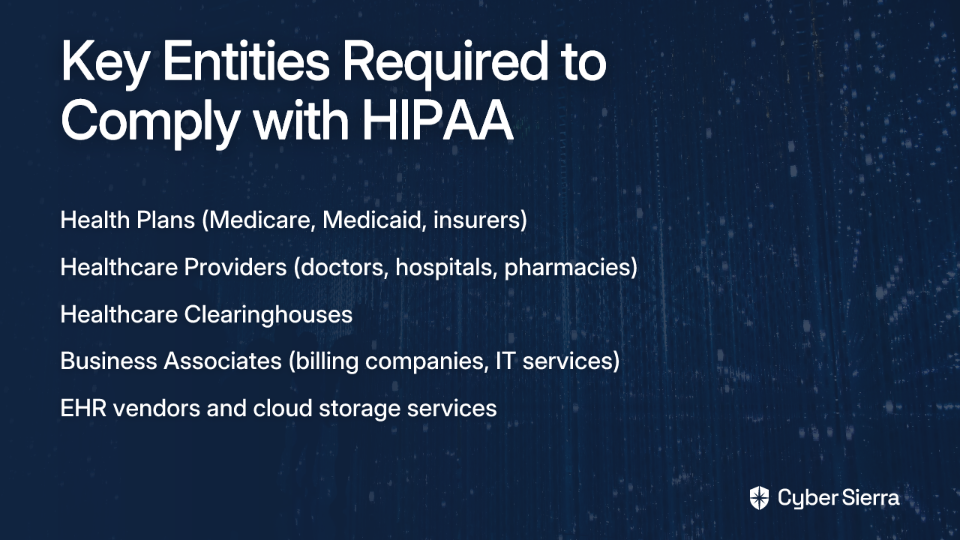
Who Must Comply with HIPAA?

Not everyone who handles health information is bound by HIPAA regulations. The law specifically applies to:

Covered Entities:

  • Health Plans (Medicare, Medicaid, private insurers)
  • Healthcare Providers (doctors, clinics, hospitals, pharmacies) who transmit health information electronically
  • Healthcare Clearinghouses (entities that process nonstandard health information)

Business Associates: Individuals or organizations that perform functions involving PHI on behalf of a covered entity, such as:

  • Billing companies
  • IT service providers
  • Cloud storage services
  • Electronic Health Record (EHR) vendors
  • Attorneys handling healthcare matters

One of the core principles of HIPAA is the Minimum Necessary Standard, which requires covered entities to make reasonable efforts to limit the use or disclosure of PHI to the minimum necessary to accomplish the intended purpose.

What Exactly Is a HIPAA Violation?

A HIPAA violation is any failure to comply with any aspect of HIPAA regulations, including the Privacy Rule, Security Rule, and Breach Notification Rule. Violations can range from seemingly minor infractions like sending an email to the wrong patient to major breaches like selling patient information for profit.

The scale of this issue is significant. According to the U.S. Department of Health and Human Services (HHS) Office for Civil Rights (OCR), which enforces HIPAA, over 374,321 HIPAA complaints have been received since April 2003. Of these, OCR has settled or imposed civil money penalties in 152 cases, totaling more than $144.8 million.

Common categories of HIPAA violations include:

  • Unauthorized access, use, or disclosure of PHI
  • Failure to perform an organization-wide risk analysis
  • Lack of safeguards to protect health information
  • Improperly disposing of PHI
  • Denying or delaying patient access to their own records
  • Insufficient employee training on privacy procedures

Top 10 Common HIPAA Violations and Real-World Examples

Understanding what counts as a HIPAA violation becomes clearer when examining specific examples. Here are the ten most common violations, along with real cases that resulted in substantial penalties:

1. Snooping on Healthcare Records

One of the most frequent violations occurs when healthcare employees access patient records without a legitimate work reason—often out of curiosity or personal interest.

Real-world example: University of California Los Angeles Health System was fined $865,000 after employees repeatedly accessed celebrity patients' medical records without authorization. In similar cases, employees have been fired for checking records of family members, neighbors, or co-workers out of curiosity.

2. Failure to Perform an Organization-Wide Risk Analysis

HIPAA requires covered entities to conduct thorough assessments of potential risks to electronic PHI.

Real-world example: Premera Blue Cross paid a $6,850,000 settlement for systemic noncompliance, including failures in risk analysis that left the PHI of over 10.4 million people vulnerable to a cyberattack.

3. Failure to Manage Security Risks

Even when organizations identify risks, they sometimes fail to address them properly.

Real-world example: The Alaska Department of Health and Social Services paid $1.7 million for failing to manage risks after a portable hard drive containing ePHI was stolen.

4. Denying Patients Access to Their Health Records

HIPAA grants patients the right to access their medical records within 30 days of a request.

Real-world example: Cignet Health of Prince George's County was fined $4.3 million for denying 41 patients access to their medical records and then failing to cooperate with the OCR's investigation.

5. Failure to Use Encryption (or an Equivalent Measure)

While HIPAA doesn't explicitly require encryption, it is an "addressable" requirement, meaning organizations must implement it or an equivalent alternative.

Real-world example: Children's Medical Center of Dallas paid a $3.2 million settlement after the unencrypted PHI of over 3,800 individuals was lost on mobile devices.

6. Exceeding the 60-Day Breach Notification Deadline

Covered entities must notify affected individuals within 60 days of discovering a breach.

Real-world example: Oklahoma State University – Center for Health Sciences paid $875,000 for multiple HIPAA violations, including delayed breach notifications.

7. Impermissible Disclosures of PHI

This occurs when patient information is shared without proper authorization.

Real-world example: A physician at New York's Mount Sinai Hospital was fired after posting a photo of a patient on Facebook without consent. In another case, a nurse was terminated for discussing a patient's condition on social media.

8. Improper Disposal of PHI

Organizations must properly destroy PHI when it's no longer needed.

Real-world example: New England Dermatology and Laser Center was fined $300,640 for improperly disposing of specimen containers with PHI labels in a public dumpster.

9. Insufficient ePHI Access Controls

This involves failing to limit who can access electronic health records.

Real-world example: Anthem Inc. paid a record $16 million penalty following a massive data breach affecting 79 million people, partly due to failures in access controls.

10. Failure to Enter into a HIPAA-Compliant Business Associate Agreement

Covered entities must have written agreements with their business associates before sharing PHI.

Real-world example: MedEvolve, Inc. paid $350,000 for lacking a business associate agreement with a subcontractor who had access to PHI.

The Consequences of Breaking HIPAA Rules

The penalties for HIPAA violations can be severe, both for organizations and individuals.

For Organizations (Covered Entities & Business Associates)

The OCR can impose civil monetary penalties based on four tiers of culpability:

  • Tier 1 (Unaware): $141 to $70,698 per violation when the entity didn't know and couldn't reasonably have known about the violation
  • Tier 2 (Reasonable Cause): $1,414 to $70,698 per violation
  • Tier 3 (Willful Neglect - Corrected): $14,140 to $70,698 per violation
  • Tier 4 (Willful Neglect - Not Corrected): At least $70,698 per violation

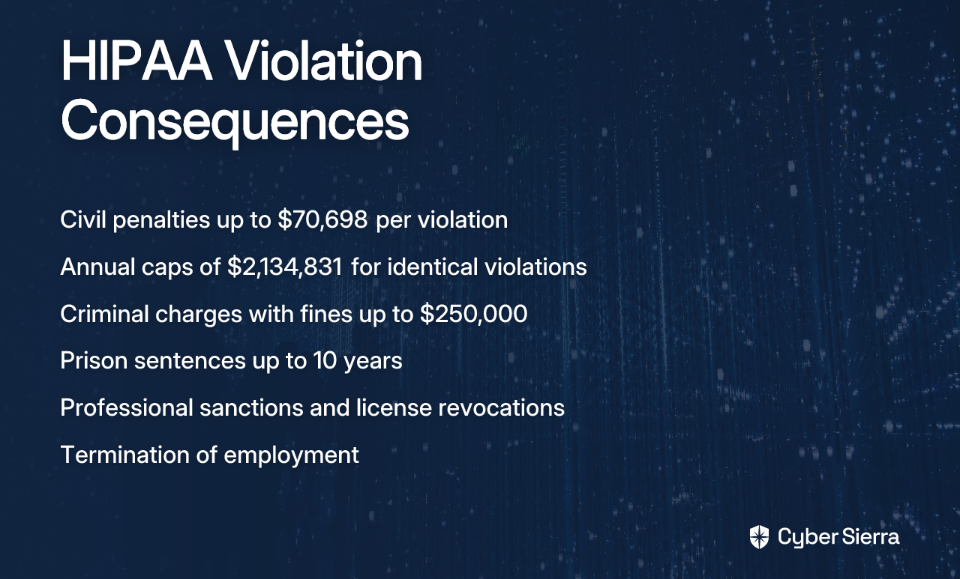
These penalties are capped at $2,134,831 annually for identical violations, but multiple types of violations can exceed this cap.

For Individuals (Workforce Members)

Individual employees who violate HIPAA may face:

  • Termination of employment
  • Professional sanctions from licensing boards
  • Criminal charges prosecuted by the Department of Justice

Criminal penalties for individuals can include:

  • Up to $50,000 fine and 1 year in prison for knowingly violating HIPAA
  • Up to $100,000 fine and 5 years in prison for violations under false pretenses
  • Up to $250,000 fine and 10 years in prison for violations with intent to sell, transfer, or use PHI for personal gain or malicious harm

What to Do If You Suspect Your Privacy Has Been Violated

If you believe your health information privacy has been breached, take these steps:

  1. Contact the Provider's Compliance Department Call the healthcare organization and ask to speak with their Compliance Department or Privacy Officer. Clearly explain your concerns and request an investigation.
  2. Request an Audit of Your Records Systems like Epic (used by many healthcare providers) log every access to patient charts. Formally request a detailed audit showing who has accessed your medical records, when, and why.
  3. Ask for Enhanced Security on Your Records Request a "Break the Glass" protocol be placed on your chart. This security feature requires users to provide justification before accessing your information and often triggers automatic notifications of access attempts.
  4. File an Official HIPAA Complaint You can submit a complaint directly to the HHS Office for Civil Rights through their online portal. Complaints must be filed within 180 days of when you knew or should have known about the violation.
  5. Consult a Lawyer While HIPAA doesn't allow individuals to sue directly for violations, you may have recourse under state privacy laws. An attorney specializing in privacy law can help determine if you can pursue damages for emotional distress or other harms if your provider was negligent in securing your information.

Understanding Your Rights Protects Your Privacy

HIPAA violations range from careless mistakes to malicious breaches of trust, and the consequences can be severe for those who fail to safeguard patient information. By understanding what constitutes a violation and knowing the steps to report one, you can take control of your health information and hold organizations accountable for protecting your privacy.

Remember that healthcare providers have a legal and ethical obligation to maintain the confidentiality of your medical information. When they fail to meet this standard, you have the right—and the means—to seek redress.

Frequently Asked Questions (FAQ)

What is considered a HIPAA violation?

A HIPAA violation is any failure by a covered entity or its business associates to comply with the Health Insurance Portability and Accountability Act's rules for protecting patient privacy and data security. This can range from an employee snooping on medical records without authorization and improper disposal of documents to large-scale data breaches caused by inadequate security. Essentially, if your protected health information (PHI) is used or disclosed in a way not permitted by the HIPAA Privacy Rule, it's a violation.

Who is required to follow HIPAA rules?

HIPAA rules must be followed by "covered entities" and their "business associates." Covered entities are health plans, healthcare clearinghouses, and most healthcare providers (like doctors, hospitals, and pharmacies). Business associates are individuals or companies that perform services for covered entities involving patient data, such as billing companies, IT providers, and cloud storage services.

How can I find out if someone illegally accessed my medical records?

You can find out if someone illegally accessed your medical records by formally requesting an audit trail or access report from the healthcare provider's Privacy Officer or Compliance Department. This report logs every instance of access to your electronic health record, showing who viewed your information and when. If you suspect unauthorized access, this audit is crucial evidence.

Can I sue a hospital or individual for a HIPAA violation?

No, you cannot directly sue an individual or organization for a HIPAA violation, as the law does not grant a "private right of action." However, you can file an official complaint with the U.S. Department of Health and Human Services (HHS), which can lead to investigations and significant fines. You may also be able to sue under state laws for related issues like negligence or invasion of privacy.

What should I do if my healthcare privacy is violated?

If you believe your healthcare privacy has been violated, you should first contact the provider's Privacy Officer, request an audit of your records, and then file an official complaint with the HHS Office for Civil Rights (OCR) within 180 days of the incident. Clearly document the violation, including dates, names, and any evidence you have.

What are the penalties for violating HIPAA?

Penalties for HIPAA violations include substantial civil fines for organizations, ranging from about $141 to over $70,000 per violation, and criminal charges for individuals, which can lead to prison time and fines up to $250,000. The severity depends on the level of negligence. Organizations face tiered fines, while individuals who knowingly misuse health information can face termination, professional sanctions, and federal prosecution.

blog-hero-background-image
Cyber Security

3 Types of CIS Implementation Groups

backdrop
Table of Contents

Join thousands of professionals and get the latest insight on Compliance & Cybersecurity.


You've decided to strengthen your organization's cybersecurity posture by implementing the CIS Controls. But as you begin researching, you're immediately overwhelmed by the 153 different safeguards and 18 control categories. Where do you even start? How do you prioritize what matters most for your organization's specific needs and resources?

This is exactly why the Center for Internet Security created Implementation Groups (IGs) - to solve the "one-size-fits-all" problem that frustrates so many security professionals.

As one cybersecurity professional noted on Reddit: "No one solution will be right for everyone." The CIS Implementation Groups provide a systematic, prioritized approach to implementing cybersecurity controls based on your organization's risk profile and available resources.

In this article, we'll explore the three CIS Implementation Groups, help you determine which one is right for your organization, and provide a clear path forward for strengthening your security posture.

What Are CIS Implementation Groups?

CIS Implementation Groups are categories that organize the 153 safeguards found in CIS Controls v8.1 into three distinct tiers. These groups help organizations prioritize their security implementation efforts based on their specific risk profiles and available resources.

Think of the Implementation Groups as a roadmap that provides:

  • A clear starting point for organizations of any size
  • A logical progression for security maturity
  • Risk-based prioritization of security controls
  • A realistic approach to resource allocation

Each Implementation Group builds upon the previous one, creating a natural maturity model for cybersecurity implementation:

Deep Dive: The 3 CIS Implementation Groups Explained

Implementation Group 1 (IG1): Essential Cyber Hygiene

IG1 is officially defined by the Center for Internet Security as "essential cyber hygiene" - the foundational set of cybersecurity safeguards that every enterprise should implement to protect against the most common attacks.

This group is specifically designed for:

  • Small to medium-sized organizations
  • Environments with limited IT and cybersecurity staff
  • Organizations where cybersecurity isn't a full-time job for anyone
  • Teams that need to focus on the highest-impact controls first

IG1 prioritizes controls that:

  • Protect against general, non-targeted attacks
  • Require minimal specialized cybersecurity knowledge to implement
  • Provide the greatest risk reduction for the least resource investment
  • Serve as the essential starting point for any organization

As one security professional shared from their experience: "I would think the best place to start would be to assess where the client is in their current environment and then just work my way through the list at step 1 and just prioritize along the way based on their timeline/needs."

This perfectly describes the IG1 approach - it is literally "step 1" in the CIS implementation process. No matter your organization's size or complexity, starting with IG1 is always the recommended approach.

An important note about IG1: While it represents the minimum viable set of controls, don't underestimate its power. Implementing the IG1 safeguards alone can protect against approximately 78% of the attack techniques found in the MITRE ATT&CK framework.

Implementation Group 2 (IG2): For Organizations with Greater Risk

IG2 builds upon the foundation established in IG1 and is designed for organizations that face more sophisticated threats and manage more sensitive data.

This implementation group is ideal for:

  • Medium-sized organizations with dedicated IT resources
  • Organizations handling sensitive client or enterprise data
  • Environments with more complex operational needs
  • Teams with dedicated cybersecurity staff or specialized knowledge

IG2 focuses on safeguards that:

  • Defend against targeted attacks that could significantly harm operations
  • Address risks to public confidence or organizational reputation
  • Protect sensitive data that requires additional security measures
  • Implement more complex technical controls that build upon IG1 foundations

IG2 is the logical next step once you've successfully implemented the IG1 safeguards. It's important to note that attempting to implement IG2 safeguards without first establishing the IG1 baseline is generally not recommended, as you'd be building advanced security measures on an unstable foundation.

As one practitioner noted in a Reddit discussion on CIS implementation: "CIS frameworks has many components, but mostly you need to learn how to operate it, meaning: implement (duh), monitor and improvement." This perspective emphasizes that moving to IG2 isn't just about implementing more controls—it's about maturing your overall security operations and monitoring capabilities.

Implementation Group 3 (IG3): Comprehensive Security for Mature Organizations

IG3 encompasses all 153 safeguards from the CIS Controls and represents the most comprehensive level of security implementation.

This implementation group is appropriate for:

  • Large, mature organizations with significant resources
  • Environments with sophisticated cybersecurity teams
  • Organizations in highly regulated industries
  • Critical infrastructure or organizations handling extremely sensitive data

IG3 includes safeguards that:

  • Protect against sophisticated, targeted attacks
  • Defend critical systems and sensitive data
  • Require advanced cybersecurity expertise to implement
  • Involve complex technical controls and detailed security monitoring

It's worth addressing a common concern expressed by many security professionals. As one noted: "It's also important to know you will most likely never be 'fully' compliant to any of these policies as that usually breaks something." This is especially true with IG3, which represents an ideal security state rather than a realistic goal for most organizations.

IG3 implementation should be viewed as a continuous maturity process, not a checkbox exercise. Organizations should implement these controls with an understanding that some may require adaptation to their specific environment, and 100% compliance may not be practical or necessary for every safeguard.

How to Choose the Right Implementation Group for Your Organization

Selecting the appropriate Implementation Group requires an honest assessment of your organization's:

  1. Risk profile: What types of threats do you face? How valuable are your data assets?
  2. Resources: What level of cybersecurity expertise and budget do you have available?
  3. Regulatory requirements: What compliance frameworks apply to your industry?

Here's a practical approach to determining your appropriate Implementation Group:

Step 1: Start with IG1

Every organization should begin with IG1, regardless of size or complexity. These foundational controls are essential for everyone and provide the basis for more advanced security measures.

Step 2: Assess Your Risk

To determine if you should move beyond IG1, assess your organization using the CIS Risk Assessment Method (CIS RAM). This free resource helps organizations conduct a proper risk assessment and determine their appropriate IG level.

Key questions to consider:

  • Does your organization handle sensitive data that would be valuable to attackers?
  • Would a breach significantly impact your operations or reputation?
  • Do you have regulatory requirements that mandate specific security controls?

Step 3: Evaluate Your Resources

Be realistic about your organization's capabilities:

  • Do you have dedicated cybersecurity staff?
  • Is there budget allocated for security tools and training?
  • Does your team have the technical expertise to implement and maintain advanced controls?

If your risk assessment indicates the need for IG2 or IG3 controls, but your resources are limited, consider prioritizing the highest-impact controls first and developing a phased implementation plan.

Beyond the IGs: Understanding the Broader CIS Ecosystem

The CIS Implementation Groups are just one part of the broader CIS ecosystem. Understanding how they relate to other CIS components can help clarify your implementation strategy.

CIS Controls vs. CIS Benchmarks

Many practitioners express confusion about the relationship between different CIS components. As one Reddit user asked: "Is it possible to apply different versions of CIS benchmarks configs using InsightVM or any other third-party tool?"

To clarify:

  • CIS Controls define what security measures should be implemented (the 18 control categories and 153 safeguards)
  • CIS Benchmarks explain how to implement many of these controls through specific technical configurations for over 25 vendor product families

The Implementation Groups organize these controls based on priority and risk, but the actual implementation often relies on following the CIS Benchmarks for specific systems.

Implementation Tools

There are several tools available to help with CIS implementation:

  • CIS SecureSuite® Membership provides tools like CIS-CAT Pro for automated configuration assessment against the CIS Benchmarks
  • Third-party vulnerability management tools like Rapid7's InsightVM include CIS policy scanning capabilities using agent-based policies
  • GRC platforms often include mappings between CIS Controls and other frameworks like NIST CSF 2.0, ISO27001, and 800-53

It's worth noting that while these tools are helpful, integration isn't always straightforward. As one practitioner mentioned: "they have a few products that supposedly do that automated but definitely not easy to integrate, like CIS SecureSuite."

Conclusion: A Clear Path Forward

The CIS Implementation Groups provide organizations of all sizes with a structured, prioritized approach to cybersecurity implementation:

  • IG1 offers essential cyber hygiene for all organizations
  • IG2 builds on that foundation for organizations with greater risk
  • IG3 provides comprehensive protection for organizations with sophisticated security needs

By understanding these three CIS groups, you can develop a realistic, risk-based approach to implementing cybersecurity controls that aligns with your organization's specific needs and resources.

Remember that cybersecurity implementation is a journey, not a destination. As one practitioner wisely noted: "you will most likely never be 'fully' compliant to any of these policies." The goal isn't perfect compliance - it's continuous improvement of your security posture through thoughtful, prioritized implementation of the CIS controls.

Frequently Asked Questions

What are CIS Implementation Groups?

CIS Implementation Groups (IGs) are three prioritized tiers of the CIS Controls that help organizations phase their cybersecurity implementation based on their risk profile and resources. They provide a roadmap, starting with IG1 (essential cyber hygiene), moving to IG2 for organizations with greater risk, and culminating in IG3 for mature organizations requiring comprehensive security. This tiered approach solves the "one-size-fits-all" problem by offering a scalable path to improving security posture.

Which CIS Implementation Group should I start with?

Every organization should start with Implementation Group 1 (IG1), regardless of its size, industry, or risk level. IG1 represents "essential cyber hygiene" and includes a foundational set of safeguards designed to protect against the most common cyberattacks. It provides the greatest risk reduction for the least investment and forms the necessary baseline before progressing to more advanced controls.

How do I know when to move from IG1 to IG2?

You should consider moving from IG1 to IG2 after you have fully implemented the IG1 controls and if your organization's risk profile justifies it. This typically applies to organizations that handle sensitive data, have dedicated IT security staff, and face more targeted threats. A formal risk assessment using a methodology like the CIS Risk Assessment Method (CIS RAM) can help determine if the additional controls in IG2 are necessary for your organization.

What is the difference between CIS Controls and CIS Benchmarks?

CIS Controls define what security actions an organization should take (e.g., "maintain an inventory of hardware"), while CIS Benchmarks provide prescriptive guidance on how to securely configure specific systems and software to achieve those controls. The Controls are the strategic goals, and the Benchmarks are the detailed, technical instructions for implementation on over 25 different vendor product families.

Is it necessary to be 100% compliant with a CIS Implementation Group?

No, it is not necessary, and often not practical, to be 100% compliant with all safeguards in a CIS Implementation Group. The goal is continuous risk reduction, not perfect adherence to a checklist. Organizations should use the IGs as a guide for prioritization, implementing controls that are relevant and technically feasible for their specific environment.

How effective is implementing only CIS IG1 controls?

Implementing only the CIS Implementation Group 1 (IG1) safeguards is highly effective. According to the Center for Internet Security, IG1 is designed to protect an organization against approximately 78% of common attack techniques found in the MITRE ATT&CK framework. It provides the maximum defensive value for the minimum investment, making it the most critical starting point for any security program.

For a detailed breakdown of which safeguards fall into each Implementation Group, download the official Guide for Implementation Groups from the Center for Internet Security.

Start with IG1, assess your specific needs, and build your security program methodically using the CIS Implementation Groups as your roadmap.

blog-hero-background-image
Cyber Security

Examples of Role Based Access Control (RBAC) - Pseudocode Included

backdrop
Table of Contents

Join thousands of professionals and get the latest insight on Compliance & Cybersecurity.


You've spent countless hours trying to implement access control from scratch. Hardcoding every case feels tedious, generalizing it with ORMs seems tricky, and you're still not sure how to handle users with multiple roles. Sound familiar?

"I have spent too much time trying to implement this on my own. I'm fairly new to SQL and Supabase so that's why it was hard for me," laments one developer on Reddit.

Another developer struggles with more complex scenarios: "RBAC will not work with the demands my tool has. It can be seen similarly on how in one drive you can share a sub folder or an individual file but leave the root folder untouched."

This guide will demystify Role-Based Access Control (RBAC) with concrete examples and practical pseudocode to help you bridge the gap from theory to implementation.

What is RBAC and Why Does It Matter?

Role-Based Access Control (RBAC) is a security model that restricts system access to authorized users based on their roles within an organization. Instead of assigning permissions directly to individual users, permissions are grouped into roles that align with job functions.

RBAC matters for three key reasons:

  1. Simplifies Administration: It eliminates the need to manage permissions for each user individually, reducing administrative workload and the chance of errors.
  2. Enforces Principle of Least Privilege (PoLP): Employees get access only to the information and tools needed for their jobs, minimizing data breach risks.
  3. Enhances Security & Compliance: Helps organizations comply with data protection regulations by providing transparency on who can access sensitive information.

Core Concepts: How RBAC Works

According to the NIST (National Institute of Standards and Technology) model, RBAC operates on three primary rules:

  1. Role Assignment: A user can exercise a permission only if they have been assigned a role.
  2. Role Authorization: A user's active role must be authorized for that user.
  3. Permission Authorization: A user can exercise a permission only if it's authorized for their active role.

The basic flow works like this:

  1. An administrator defines a role (e.g., "Editor").
  2. The admin assigns specific permissions to that role (e.g., "edit_content", "upload_content").
  3. Users are assigned to the "Editor" role.
  4. When a user tries to perform an action, the system checks their assigned role(s) and grants access only to the permitted actions.

Key components in an RBAC system include:

  • User: An individual or system entity.
  • Role: A collection of permissions based on job responsibilities.
  • Permission: The ability to perform a specific action on a resource.
  • Resource: The asset being protected (e.g., a database table, an API endpoint).

Real-World Examples of RBAC Across Industries

Let's examine how RBAC works in various contexts:

Healthcare Management System

  • Doctor: Can access and modify all patient records, prescribe medication, order tests.
  • Nurse: Can view and update patient vitals and notes. Cannot prescribe medication.
  • Billing Staff: Can only access patient demographic and billing information. Cannot view clinical notes.
  • Pharmacist: Can view and update prescription details.

Corporate IT System / SaaS Application

  • Administrator: Full access to create/configure/delete resources, manage user permissions, and configure security settings.
  • Developer: Can write, edit, and deploy code to staging environments. Read-only access to production logs. Cannot manage user accounts.
  • Data Analyst: Read-only access to query specific databases. Cannot modify data or manage database structure.
  • Marketing Manager: Access to marketing tools like HubSpot and Google Analytics. No access to source code or financial systems.

E-commerce Platform

  • Customer: Can view products, place orders, and view their own order history.
  • Merchant/Vendor: Can upload/edit their own product listings and view orders for their products. Cannot see other merchants' data.
  • Customer Support: Can view customer account info and order details to assist with issues. Cannot initiate transactions.
  • Platform Admin: Can manage all platform settings, view all orders and products, and update policies.

IoT Network (e.g., Smart Home)

A recent research paper on RBAC in IoT highlights its effectiveness, reporting a 99% security effectiveness rate.

  • Admin: Can add/remove devices, manage users, and view all data from all devices.
  • User (Homeowner): Can view data and control their own registered devices (e.g., adjust thermostat, turn on lights).
  • Guest: Read-only access to specific, non-sensitive data (e.g., view current temperature but not change it).

Implementing RBAC: A Step-by-Step Guide with Pseudocode

Now let's bridge the gap from theory to implementation with practical pseudocode examples.

Step 1: Defining Roles and Permissions

// Define permissions
const permissions = [
  'view_content',
  'edit_content',
  'delete_content',
  'upload_content',
  'manage_users',
  'manage_roles',
  'manage_settings'
];

// Define roles and their associated permissions
const roles = {
  'admin': ['view_content', 'edit_content', 'delete_content', 'upload_content', 'manage_users', 'manage_roles', 'manage_settings'],
  'editor': ['view_content', 'edit_content', 'upload_content'],
  'viewer': ['view_content']
};

Step 2: Defining User Roles

// Example user objects from your database
const users = [
  {
    id: 123,
    username: 'jane.doe',
    roles: ['editor', 'viewer'] // User has multiple roles
  },
  {
    id: 456,
    username: 'john.smith',
    roles: ['admin']
  },
  {
    id: 789,
    username: 'guest.user',
    roles: ['viewer']
  }
];

Step 3: Creating an Access Control Function

function hasPermission(user, requiredPermission) {
  // Iterate through each role the user has
  for (const role of user.roles) {
    // Get the permissions for the current role
    const permissionsForRole = roles[role];

    // If the role exists and includes the required permission, return true
    if (permissionsForRole && permissionsForRole.includes(requiredPermission)) {
      return true;
    }
  }
  // If no role grants the required permission, return false
  return false;
}

Step 4: Using the Function in Your Application

// Example of protecting an API endpoint in a server-side application
function editContentAPI(request, response) {
  const user = request.user; // Assume user is attached from auth middleware
  
  // Check for permission before proceeding
  if (!hasPermission(user, 'edit_content')) {
    return response.status(403).send('Forbidden: You do not have permission to edit content.');
  }
  
  // ... proceed with edit logic ...
  return response.status(200).send('Content edited successfully.');
}

// Example of conditional UI rendering in a client application
function RenderEditButton({ user, contentId }) {
  // Only show edit button if user has permission
  if (hasPermission(user, 'edit_content')) {
    return <button onClick={() => editContent(contentId)}>Edit</button>;
  }
  return null; // Don't render anything if user lacks permission
}

Step 5: Implementing Row Level Security (RLS) in a Database

For database-level access control, such as in Supabase or PostgreSQL:

-- Create a function to check if the current user has a specific permission
CREATE OR REPLACE FUNCTION has_permission(required_permission TEXT)
RETURNS BOOLEAN AS $$
DECLARE
  user_roles TEXT[];
  role_permissions TEXT[];
  r TEXT;
BEGIN
  -- Get the current user's roles from the JWT
  user_roles := current_setting('request.jwt.claims')::json->'roles';
  
  -- For each role, check if it has the required permission
  FOREACH r IN ARRAY user_roles LOOP
    -- Get permissions for this role from the roles table
    SELECT permissions INTO role_permissions FROM roles WHERE name = r;
    
    -- If the role has the required permission, return true
    IF required_permission = ANY(role_permissions) THEN
      RETURN TRUE;
    END IF;
  END LOOP;
  
  -- If no role has the permission, return false
  RETURN FALSE;
END;
$$ LANGUAGE plpgsql SECURITY DEFINER;

-- Apply RLS policy to a table
CREATE POLICY "Users can view content" ON content
  FOR SELECT
  USING (has_permission('view_content'));

CREATE POLICY "Editors can edit content" ON content
  FOR UPDATE
  USING (has_permission('edit_content'));

Beyond Basic RBAC: Addressing Complexity

While RBAC works well for many scenarios, it can be too rigid for certain use cases. As one developer noted, "RBAC will not work with the demands my tool has. It can be seen similarly on how in one drive you can share a sub folder or an individual file but leave the root folder untouched."

When RBAC isn't enough, consider these alternatives:

  • Attribute-Based Access Control (ABAC): More granular and context-aware. Grants access based on attributes of the user (e.g., department, location), the resource (e.g., data sensitivity), and the environment (e.g., time of day).
  • Relationship-Based Access Control (ReBAC): Controls access based on the relationships between users and resources (e.g., "User A can edit documents they own"). This directly addresses the file-sharing example.

RBAC Best Practices

  1. Principle of Least Privilege: Grant only the minimum permissions necessary for a role to function.
  2. Role Granularity: Define roles carefully. Avoid creating roles that are too broad (granting excessive permissions) or too narrow (leading to "role explosion").
  3. Separation of Duties: Differentiate roles to ensure no single user has conflicting permissions (e.g., the person who submits an expense report cannot also be the one to approve it).
  4. Periodic Reviews: Regularly audit user access rights and roles to remove unnecessary permissions, especially when employees change roles or leave the organization.
  5. Automate Provisioning: Use automated tools for access rights management to reduce manual errors and ensure consistency.

By implementing these rbac examples and best practices, you can create a robust access control system that balances security with usability and scales with your organization's needs.

Frequently Asked Questions (FAQ)

What is the main difference between RBAC and ABAC?

The main difference is that Role-Based Access Control (RBAC) grants permissions based on a user's job function or role, while Attribute-Based Access Control (ABAC) uses dynamic attributes of the user, resource, and environment to make more granular decisions. RBAC is simpler and assigns static permissions to roles like "Editor" or "Admin." In contrast, ABAC is more flexible and can enforce rules like "Allow marketing managers to access documents tagged 'marketing' only during business hours." Choose RBAC for straightforward, role-driven systems and ABAC for complex scenarios requiring context-aware logic.

How do you handle a user with multiple roles in RBAC?

To handle a user with multiple roles, you assign all relevant roles to the user's profile and aggregate the permissions from each role. The user effectively gains the combined access of all their assigned roles. For example, if a user has both "Editor" and "Viewer" roles, they can perform actions permitted by either role. When checking for access, your system should iterate through all of the user's roles and grant access if any of them contain the required permission. This approach provides flexibility without creating hyper-specific roles for every possible combination of duties.

What are permissions in the context of RBAC?

In RBAC, a permission is the authorization to perform a specific action on a particular resource. It is the most granular level of access control in the model. For instance, edit_content is a permission that allows a user to modify a piece of content. Permissions are grouped together to form a role. A role like "Editor" might contain permissions such as edit_content, view_content, and upload_content. Users are assigned roles, not individual permissions, which simplifies administration.

When is it better to use RBAC instead of other access control models?

It is better to use RBAC when your organization's access needs can be clearly defined by job functions or user roles. RBAC excels in environments with stable, hierarchical structures where simplicity and ease of administration are priorities. For most standard applications like corporate IT systems or content management systems, RBAC provides a robust and manageable solution. However, if your application requires highly dynamic rules (e.g., access based on location or time of day), a more granular model like ABAC or ReBAC might be a better fit.

How does Row Level Security (RLS) relate to RBAC?

Row Level Security (RLS) is a database feature that can be used to implement the data access policies defined by your RBAC model. It allows you to enforce RBAC rules directly within the database layer. With RLS, you create policies that check a user's role (often passed via a JWT) before allowing them to read, update, or delete specific rows in a table. This provides a powerful, low-level enforcement of your RBAC strategy.

What is the principle of least privilege in RBAC?

The principle of least privilege in RBAC means that a user should only be granted the minimum set of permissions necessary to perform their job duties. This is a core security concept that RBAC helps enforce. Instead of granting broad access, you define roles with only the essential permissions. For example, a "Billing Staff" role would have permission to view billing information but not clinical notes. This minimizes the potential damage from a compromised account and is a key best practice for building secure systems.

Remember, the right approach depends on your specific use case. For simpler applications, RBAC provides an excellent balance of security and simplicity. For more complex scenarios requiring contextual or relationship-based decisions, consider supplementing RBAC with ABAC or ReBAC principles.

blog-hero-background-image
Cyber Security

How to Calculate Risk Scores for Internal & External Risks

backdrop
Table of Contents

Join thousands of professionals and get the latest insight on Compliance & Cybersecurity.


You've been there before—some teams "just slap a Low on most issues and wait for audit to argue it up," while your Internal Audit and Risk Management departments struggle to collaborate effectively. This chaotic approach to risk assessment not only creates inconsistency but leaves your organization vulnerable to threats that could have been anticipated and managed.

At the heart of effective risk management lies a critical tool: the risk score. But what exactly is it?

What is a Risk Score?

A risk score is a quantifiable measure—either qualitative (low, medium, high) or quantitative (a numerical or monetary value)—that helps organizations assess and prioritize threats based on their likelihood and potential impact. Think of it as your organization's early warning system for potential problems.

These scores aren't just bureaucratic exercises—they're critical indicators in any Enterprise Risk Management (ERM) system. They support strategic growth, enhance proactive security measures, aid in regulatory compliance (like SOC 2, HIPAA, or CMMC), and provide a common language for discussing risk with stakeholders, from the CISO to the board.

In this guide, we'll demystify the process of calculating risk scores for both internal and external threats, offering clear starting points for organizations of any size.

Understanding the Landscape: Internal vs. External Risks

Before diving into calculation methods, we need to understand the two main categories of risk that make up a comprehensive risk inventory.

Internal Risks

Internal risks originate from within your organization and can be surprisingly difficult to identify. These risks often depend on your company's culture of risk awareness and can include:

  • Human error (unintentional data leaks, ineffective management)
  • Inadequate organizational structure or processes
  • Asset loss (equipment damage, unforeseen project costs)
  • Hidden vulnerabilities like shadow IT, which, as one security professional noted, "spreadsheets won't tell you where [they] live"

Don't overlook non-technical risks like lack of training or unclear responsibilities. These internal factors can significantly impact your security posture but are often neglected in traditional risk assessments that focus primarily on technical vulnerabilities.

External Risks

External risks come from outside your organization, often with little to no warning. These include:

  • Natural disasters (hurricanes, floods)
  • Economic changes (recessions, industry disruptions)
  • Political factors (new government regulations)
  • Cyber attacks (data theft, ransomware)

Understanding both types of risk is essential for developing a comprehensive risk management strategy. LogicGate provides a detailed explanation of the distinctions between these two categories.

Choosing Your Approach: Qualitative vs. Quantitative Assessment

When it comes to calculating risk scores, organizations often struggle with choosing the right methodology. This confusion is compounded by limited resources for implementing advanced models. Let's explore your options:

Qualitative Risk Assessment

This is where most organizations begin their risk scoring journey. Qualitative assessment uses descriptive scales (Low, Medium, High) to categorize risks based on subjective evaluation.

Why use it?

  • It's an excellent starting point for preliminary risk identification
  • Works well when numerical data is lacking
  • Provides valuable direction without complex calculations
  • Perfect for organizations that feel they "don't have that capacity yet" for statistical models

MetricStream explains that qualitative scoring is accessible and helps establish a foundation for more advanced methods later.

Quantitative Risk Assessment

Quantitative assessment takes a more objective approach, using numerical and statistical data to assign specific values (often monetary) to risks.

Why use it?

  • Provides concrete financial estimates of potential losses
  • Offers precise metrics for comparing dissimilar risks
  • Helps secure organizational buy-in for mitigation efforts
  • Addresses situations where "Risk Management expects us to determine the monetary value of the risks"

A common quantitative measurement is Annual Loss Expectancy (ALE), which estimates the yearly financial impact of a risk event.

The Hybrid Approach (Recommended)

Most successful organizations combine both methods for a comprehensive understanding:

  1. Start with qualitative assessment to identify and categorize all risks
  2. Apply more resource-intensive quantitative assessment to the most critical threats

According to Quantivate, this blended approach maximizes the benefits of both methodologies while minimizing their respective limitations.

The Step-by-Step Guide to Calculating Risk Scores

Now let's break down the actual process of calculating risk scores in a systematic, actionable way:

Step 1: Risk Identification

The first step is systematically detecting potential threats across all departments and assets. Many professionals wonder "where to start," and as one expert advises, "you can't go wrong starting with NIST SP 800-30 if you're new to risk assessments." This framework provides a detailed guide for conducting risk assessments, while the CIS Controls offer a more prescriptive approach for SMBs.

For effective risk identification:

  • Conduct risk identification at the project's onset and reassess throughout its lifecycle
  • Involve various departments to gain a holistic view
  • Implement threat modeling to anticipate potential attack vectors
  • Review historical data and industry threat intelligence
  • Document all identified risks in a centralized inventory

Step 2: Risk Analysis (Assigning Likelihood and Impact)

Once you've identified your risks, the next step is analyzing them according to two key dimensions:

Likelihood (Probability): How likely is it that the risk event will occur?

  • High (80% - 100%)
  • Medium-High (60% - 80%)
  • Medium-Low (30% - 60%)
  • Low (0% - 30%)

Impact (Magnitude of Loss): How severe would the consequences be?

  • High to Catastrophic: Rating A (100)
  • Medium to Critical: Rating B (50)
  • Low to Marginal: Rating C (10)

When assessing impact, remember this valuable advice from risk management professionals: "don't ever concentrate on aspects of impact you can't assess - let legal and PR teams care about legal and reputational impact, it's their job to provide analysis on request." Focus on the areas where your expertise lies and collaborate with specialists for other domains.

Step 3: Calculating the Risk Score

With likelihood and impact ratings in hand, you can now calculate risk scores using one of several formulas:

Classic Formula: Risk Score = Likelihood × Impact

This is the most common formula, used for general assessments. The output is often plotted on a risk matrix for visual representation and prioritization.

Financial Formula: Risk Score = Probability of Event × Magnitude of Loss

For quantitative assessments to determine financial exposure:

Example: A potential data breach at a financial institution

  • Likelihood: High (0.8 or 80%)
  • Impact: Severe ($1,000,000)
  • Calculation: Risk Score = 0.8 × $1,000,000 = $800,000

This indicates the organization faces a potential loss of $800,000 due to this risk.

Advanced Formula (FMEA): Risk Score = Likelihood × Severity × Detection

Used in engineering and healthcare, this formula adds a third variable for how easily a risk can be detected before it causes harm.

Scrut.io offers additional examples and formulas for calculating risk scores in various contexts.

From Score to Action: Prioritization and Response

A risk score is useless without a corresponding action plan. Here's how to translate scores into decisions:

Risk Prioritization

Use the calculated scores to rank risks, ensuring that resources are focused on the threats that pose the greatest danger. A risk matrix helps visualize this prioritization by plotting risks according to their likelihood and impact.

Risk Treatment

Based on prioritization, choose the appropriate risk treatment strategy:

  1. Mitigation: Implement controls to reduce the likelihood or impact (most common for medium to high risks)
  2. Transfer: Shift financial impact to a third party through insurance or contracts
  3. Acceptance: For low-scoring risks where mitigation costs outweigh potential losses
  4. Avoidance: Change processes or activities to eliminate the risk entirely

Integrate Business Continuity Planning

As one security professional reminds us, "make sure recovery and continuity planning are part of the risk discussion." Response plans for high-impact risks must include steps for recovery and maintaining operations during incidents.

Best Practices for Maintaining Accurate Risk Scores

Risk management is an ongoing process, not a one-time project. To maintain the accuracy and relevance of your risk scores:

  1. Regularly Update & Continuously Monitor: Review risk scores at least quarterly and after significant changes to your environment
  2. Engage the Entire Organization: Break down silos between departments like Internal Audit and Risk Management
  3. Document and Communicate: Create formal risk assessment reports to establish a common language for discussing risk with all stakeholders

Conclusion

Calculating risk scores transforms risk management from a subjective guessing game into a strategic, data-driven process. By following the steps outlined above—identify, analyze, score, prioritize, respond, and monitor—you can move from reactive to proactive risk management.

Remember that the best risk assessment approach is tailored to your organization's specific context, resources, and risk appetite. Start simple, be consistent, and gradually enhance your methodology as your risk management maturity grows.

With proper risk scoring, you'll no longer be "slapping a Low on most issues" but instead making informed, strategic decisions that protect your organization's most valuable assets.

Frequently Asked Questions

What is the first step in calculating a risk score?

The first step in calculating a risk score is risk identification. This foundational process involves systematically detecting potential threats across all departments, assets, and projects within your organization before they can be analyzed or scored. For a thorough identification process, you should involve various departments, implement threat modeling, review historical data, and document all findings in a centralized risk inventory.

How do you calculate a basic risk score?

A basic risk score is calculated using the formula: Risk Score = Likelihood × Impact. In this formula, "Likelihood" represents the probability of the risk event occurring, and "Impact" represents the severity of the consequences if it does. This simple yet effective calculation helps organizations prioritize threats by assigning a numerical value to each risk.

What is the difference between qualitative and quantitative risk assessment?

The main difference is how risk is measured. Qualitative risk assessment uses descriptive scales (e.g., Low, Medium, High) to categorize risks based on subjective evaluation, making it ideal for preliminary identification. Quantitative risk assessment uses numerical and statistical data to assign specific values, often monetary, to risks, providing concrete financial estimates of potential losses. Most organizations benefit from a hybrid approach, using qualitative methods first and then applying quantitative analysis to the most critical risks.

How often should risk scores be reviewed and updated?

Risk scores should be reviewed and updated at least quarterly or whenever there is a significant change to your organization's environment. Risk management is a continuous process, not a one-time project. Regular reviews ensure that your risk assessments remain accurate, relevant, and aligned with your current operational landscape, new technologies, or emerging threats.

What is a risk matrix and how is it used?

A risk matrix is a visual tool used to prioritize risks by plotting them based on their likelihood and impact scores. Typically, the matrix is a grid with likelihood on one axis and impact on the other, divided into color-coded zones (e.g., red for high-risk, yellow for medium, green for low). This visualization helps stakeholders quickly understand which threats require immediate attention and resources for mitigation.

Why is it important to calculate risk scores?

Calculating risk scores is important because it transforms risk management from a subjective exercise into a strategic, data-driven process. It provides a common language for discussing threats, helps prioritize resource allocation to the most significant vulnerabilities, supports regulatory compliance, and enables proactive security measures. Ultimately, it allows organizations to make informed decisions to protect their most valuable assets.

blog-hero-background-image
Cyber Security

How to Become a SOC Analyst in 2025 - Essential Skills & Career Path

backdrop
Table of Contents

Join thousands of professionals and get the latest insight on Compliance & Cybersecurity.


You've heard the cybersecurity industry is booming. You've seen the job listings for "SOC Analyst" positions. But what does the role actually entail beyond "staring at your screen for 12hrs a day" or just "looking for anything suspicious to escalate"?

If you're considering this career path, you need a realistic picture of what it means to be on the frontlines of cybersecurity defense in 2025 and beyond.

The Modern SOC Analyst: Beyond the "Eyes on Glass" Myth

The perception that SOC analysts merely sit around waiting for alerts couldn't be further from reality. While monitoring is part of the job, today's SOC (Security Operations Center) analysts are digital detectives, investigating and responding to the most pressing security threats facing organizations.

The demand speaks for itself:

  • The cybersecurity job market is projected to grow at 18% over the next 5 years (Sprinto)
  • Some projections show a 35% employment growth for information security analysts through 2031 (Dropzone.ai)
  • A projected 4.8 million talent shortage in cybersecurity by 2024 highlights immense demand

With salaries ranging from $65,000 to over $145,000 depending on experience and specialization, it's clear why this role has become a popular entry point into the cybersecurity field.

What Does a SOC Analyst Really Do?

A SOC analyst serves as a frontline defender in an organization's cybersecurity strategy. They work within a centralized team that monitors, detects, analyzes, and responds to security threats in real-time.

While the role does involve continuous monitoring, it's fundamentally an investigative position. SOC analysts manage an average of 10,000 alerts daily, making the ability to quickly triage and identify real threats from false positives a critical skill.

Core responsibilities include:

  • Continuous Monitoring & Threat Detection: Using tools like SIEM, Intrusion Detection Systems (IDS), and Endpoint Detection and Response (EDR) to oversee security systems and network traffic for irregularities.
  • Alert Investigation & Triage: Evaluating thousands of alerts, differentiating between false alarms and genuine threats, and escalating critical incidents to higher-tier analysts.
  • Incident Response: Participating in the containment and mitigation of threats while collaborating with other teams.
  • Forensic Analysis & Log Management: Analyzing logs and data post-incident to understand attack vectors, often working with platforms like Splunk.
  • Documentation: Maintaining detailed records of incidents and responses in tickets, crucial for compliance and improving security controls.

The SOC Analyst Career Path: From Triage to Threat Hunter

One of the most appealing aspects of starting as a SOC analyst is the clear career progression that follows. Far from being a dead-end position, it's the foundation for multiple advanced cybersecurity roles.

The standard tiered structure looks like this:

Tier 1: Triage Specialist (0-2 years)

Responsibilities: Initial alert monitoring, triage, collecting data for incidents, and escalating verified threats. This is your entry-level or "level 1 position." Salary: $60K - $80K (Dropzone.ai)

Tier 2: Incident Responder (2-4 years)

Responsibilities: Deeper investigation of escalated incidents, performing forensic analysis, and determining the scope and impact of a breach. Salary: $75K - $110K (Dropzone.ai)

Tier 3: Threat Hunter (4-6+ years)

Responsibilities: Proactively searching for hidden threats (threat hunting) that have bypassed existing security controls. Involves deep expertise in attacker tactics, techniques, and procedures. Salary: $100K - $140K (Dropzone.ai)

Tier 4: SOC Manager / Engineer

Responsibilities: Overseeing the entire SOC operation, managing the team, designing SOC infrastructure, and setting security strategy. Salary: $120K - $180K+ (Dropzone.ai)

The Essential 2025 SOC Analyst Skillset

Success as a SOC analyst requires a blend of technical knowledge and interpersonal abilities. Let's break down the must-have skills for 2025:

Technical Skills

  • Programming/Scripting: Essential for automation and data analysis. Key languages include Python, PowerShell, Bash, and SQL.
  • Log Analysis: The ability to review and interpret system and security logs to identify threats.
  • Network Traffic Analysis: Monitoring network activity with tools to detect malware and anomalies.
  • Digital Forensics & Incident Response (DFIR): The combined skill of investigating and remediating cyber threats. 46% of incident responders rate this as a top skill.
  • Cloud Security: Understanding how to detect vulnerabilities in cloud infrastructures (AWS, Azure, GCP) as organizations increasingly migrate.
  • SIEM Operations: Proficiency with Security Information and Event Management tools like Splunk is non-negotiable for log management and threat detection.

Key Tools to Know

  • SIEM: Security Information and Event Management (e.g., Splunk, LogRhythm)
  • EDR: Endpoint Detection and Response
  • NDR: Network Detection and Response
  • SOAR: Security Orchestration, Automation, and Response
  • UEBA: User and Entity Behavior Analytics

Soft Skills

While technical capabilities are essential, don't underestimate the importance of these interpersonal skills:

  • Critical Thinking & Problem-Solving: The core of an analyst's job—analyzing data and solving complex security puzzles.
  • Communication & Collaboration: Vital for explaining technical incidents to non-technical stakeholders and working effectively within the SOC team.
  • Ability to Work Under Pressure: Maintaining composure and making clear decisions during a security crisis.
  • Attention to Detail: Spotting subtle anomalies in vast amounts of data that could indicate a major breach.
  • Thinking Outside the Box: Adopting a "hacker mindset" to anticipate threats and devise creative solutions.

Your Step-by-Step Roadmap to Becoming a SOC Analyst

Step 1: Build Your Foundation (Education & Alternatives)

A degree in Computer Science or a related field is beneficial, but not strictly necessary. Many successful analysts come from cybersecurity bootcamps or are self-taught. What matters most is demonstrating your knowledge and capabilities.

Step 2: Navigate Certifications (A Strategic Approach)

The certification landscape can be overwhelming. Here's a clear, tiered approach:

Foundational (Start Here):

  • CompTIA Security+: Covers essential security concepts. A must-have starting point.
  • ISC2 Certified in Cybersecurity: An excellent entry-level cert for those new to the field.

Role-Specific (Next Level):

  • CompTIA Cybersecurity Analyst (CySA+): Focuses on threat detection and response.
  • EC-Council Certified SOC Analyst (CSA): Specifically designed for SOC operations.
  • Hack The Box Certified Defensive Security Analyst (CDSA): Highly regarded for its practical, hands-on assessment.

Advanced (For Career Growth):

  • GIAC Certified Intrusion Analyst (GCIA): For deeper expertise in intrusion detection.

Step 3: Gain Hands-On Experience (The Ultimate Differentiator)

Many in the field believe practical experience outweighs certifications. Here's how to get it:

  • Use Online Platforms: Leverage sites like TryHackMe and Udemy for interactive learning and practical exercises.
  • Explore SOC Simulators: Use platforms like letsdefend.io, which provides an introduction to the SOC role with practical exercises.
  • Build a Portfolio: Gain experience through freelance or volunteer projects.
  • Seek Internships: The most direct way to get real-world experience.

Step 4: Network and Find a Mentor

Connect with professionals on platforms like LinkedIn and find a mentor who can provide guidance on both technical and soft skills.

The Future of the SOC: AI, Automation, and Your Role In It

If you're concerned about automation and AI making SOC analyst roles obsolete, here's the reality: these technologies are transforming the role, not eliminating it.

Current challenges in the SOC include:

  • Alert Fatigue: High volumes of alerts lead to burnout and missed threats.
  • Skills Gap: 70% of SOC leaders report being understaffed, creating a need for efficiency.

AI tools can reduce alert investigation time from 40 minutes to about 3 minutes, but they can't replace human judgment and creativity. As AI handles routine tasks, human SOC analysts focus on:

  • Complex threat hunting
  • Strategic security planning
  • Deep forensic investigations
  • Cross-departmental collaboration

The future SOC analyst role will be more strategic, investigative, and impactful—not obsolete.
Launching Your SOC Analyst Career

The SOC analyst role is challenging, rewarding, and highly in-demand. It serves as the perfect entry point into the broader world of cybersecurity.

Success hinges on a blend of technical skills, strong soft skills, and a commitment to continuous learning in this rapidly evolving field. Take the first step today by exploring the foundational certifications and hands-on platforms mentioned in this article.

Your journey to becoming a SOC analyst in 2025 starts now.
Frequently Asked Questions

What does a SOC analyst do on a daily basis?

A SOC analyst's primary role is to monitor, detect, analyze, and respond to cybersecurity threats in real-time. This involves using tools like SIEM and EDR to oversee network traffic, investigating thousands of daily alerts to distinguish real threats from false positives, participating in incident response to contain breaches, and documenting all activities for compliance and future security improvements.

How much can I earn as a SOC analyst?

SOC analyst salaries typically range from $65,000 for entry-level positions to over $145,000 for experienced professionals and managers. Your exact salary depends on your experience level, certifications, and location. A Tier 1 analyst might start around $60K-$80K, while a Tier 3 Threat Hunter can earn between $100K and $140K. SOC Managers can command salaries of $120K and higher.

What are the most critical skills for a new SOC analyst?

The most critical skills for a new SOC analyst are a blend of technical knowledge like log analysis and network traffic analysis, and soft skills like critical thinking and the ability to work under pressure. Technically, you should focus on understanding SIEM tools, scripting with Python or PowerShell, and the basics of digital forensics. Equally important are soft skills such as clear communication for reporting incidents, attention to detail for spotting anomalies, and strong problem-solving abilities.

Do I need a college degree to become a SOC analyst?

No, a college degree is not strictly required to become a SOC analyst, although it can be beneficial. Many successful analysts enter the field through alternative paths like cybersecurity bootcamps, self-study, and gaining hands-on experience via online platforms. Demonstrable skills and foundational certifications like CompTIA Security+ are often more important to employers than a specific degree.

What does the career path for a SOC analyst look like?

The SOC analyst role is an excellent starting point with a clear career path leading to more advanced cybersecurity positions. Typically, you begin as a Tier 1 analyst handling initial alert triage. With experience, you can advance to a Tier 2 Incident Responder, then to a Tier 3 Threat Hunter who proactively seeks out hidden threats. Further progression can lead to roles like SOC Manager or specialized security engineering positions.

Will AI and automation make the SOC analyst role obsolete?

No, AI and automation are transforming the SOC analyst role by handling repetitive tasks, not eliminating the need for human expertise. While AI is effective at reducing alert fatigue and speeding up initial investigations, it cannot replace the critical thinking, creativity, and strategic planning of a human analyst. The future SOC analyst will focus more on high-impact activities like complex threat hunting, deep forensic analysis, and security strategy.

toaster icon

Thank you for reaching out to us!

We will get back to you soon.