blog-hero-background-image
Cyber Security

A Day in the Life: SOC Analyst vs. Engineer vs. CISO

backdrop
Table of Contents

Join thousands of professionals and get the latest insight on Compliance & Cybersecurity.


You pull into the parking lot, coffee in hand, ready to face another day of cyber threats. But what exactly does that day look like? It depends entirely on where you sit in the cybersecurity hierarchy.

"Me click scary alert. Me click tools until scary alert normally no longer scary."

While this Reddit user's tongue-in-cheek description of a SOC Analyst's job might make you chuckle, it barely scratches the surface of what these cybersecurity professionals actually do. And it certainly doesn't capture the vastly different experiences of Security Engineers or CISOs.

Let's peek behind the digital curtain and explore what a typical day looks like across these three critical cybersecurity roles—from the frontline defenders to the strategic leaders—to help you decide which path might be right for you.

The Frontline Defender: A Day in the Life of a SOC Analyst

As the first line of defense against cyber attacks, SOC (Security Operations Center) Analysts are the vigilant sentinels monitoring the organization's security posture around the clock.

Morning (8:00 AM - 12:00 PM)

Your day begins with a shift handover meeting where the night team briefs you on any suspicious activities they detected overnight. You immediately log into your SIEM (Security Information and Event Management) dashboard to review a backlog of alerts that need triage.

You notice several alerts flagging unusual login activity from an executive's account. Your instincts kick in—this could be a potential account compromise. You quickly pivot to your EDR (Endpoint Detection and Response) solution to investigate the affected workstation, checking for signs of malware or unauthorized access.

After confirming the legitimacy of the activity (the executive was traveling internationally), you document your findings and close the alert. One down, dozens more to go.

Afternoon (1:00 PM - 5:00 PM)

Post-lunch, your team receives an urgent escalation from the help desk—multiple users are reporting suspicious emails with invoice attachments. This could be a phishing campaign targeting your organization.

You collaborate with your teammates to:

  • Collect email samples
  • Analyze the malicious attachments in your sandbox environment
  • Check if any users have already clicked the links using your DLP (Data Loss Prevention) tools
  • Search your SIEM using KQL (Kusto Query Language) to identify potentially compromised systems

When you confirm that several users have indeed fallen victim to the attack, you initiate the incident response protocol, isolating affected machines and notifying the Security Engineer team for remediation support.

The Reality: Alert Fatigue

"Our team is developing alert fatigue because of the pure volume of alerts. We are only generating actionable tickets from around 20 of the machine learning detections."

This candid admission from a SOC professional highlights one of the role's biggest challenges. With hundreds or even thousands of alerts generated daily, distinguishing genuine threats from false positives becomes increasingly difficult. Critical events are starting to get overlooked as analysts become desensitized to the constant bombardment of notifications.

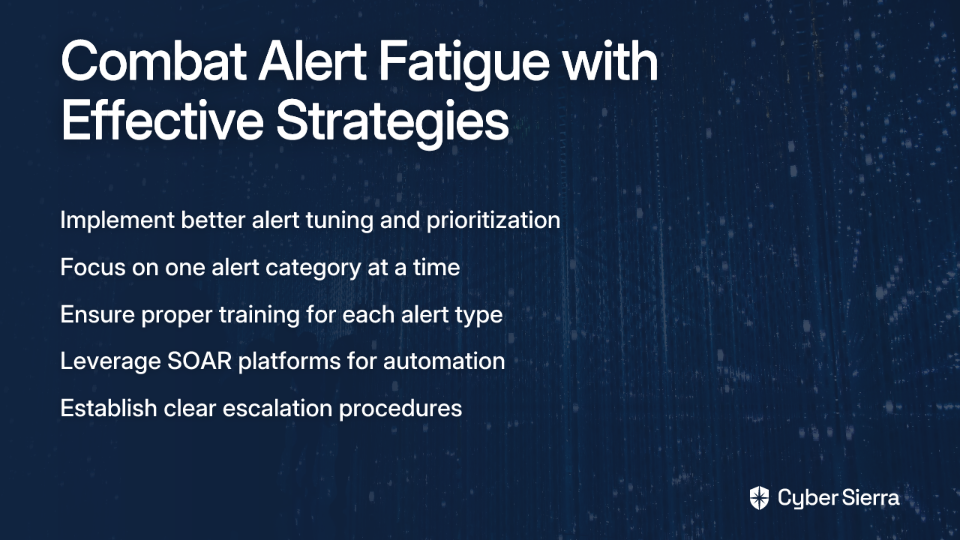
The most effective SOC teams combat this by:

  • Implementing better alert tuning and prioritization
  • Focusing on one alert category at a time
  • Ensuring proper training for each alert type
  • Leveraging SOAR (Security Orchestration, Automation, and Response) platforms to automate routine tasks
Career Path and Compensation

SOC Analysts typically progress through three tiers:

  • Tier 1: Entry-level position focused on initial alert triage ($65,000-$85,000)
  • Tier 2: Deeper investigation and incident handling ($80,000-$100,000)
  • Tier 3: Advanced threat hunting and team leadership ($95,000-$120,000)

Many analysts eventually move into specialized roles in threat intelligence, advanced incident response, or purple teaming.

"It's a busy job, often not 8h/day, rotating shifts, work weekends and holidays," notes one Reddit user, highlighting the demanding schedule that comes with the territory.

The Architect and Builder: A Day in the Life of a Security Engineer

While SOC Analysts focus on detecting and responding to immediate threats, Security Engineers design and build the very systems that protect an organization from attacks in the first place.

Morning (9:00 AM - 12:00 PM)

Your day begins by checking emails and addressing any urgent security matters that arose overnight. You review the latest vulnerability management reports and prioritize which systems need immediate patching due to critical EOL (End of Life) issues.

Next, you attend a stand-up meeting with the DevOps team to discuss the implementation of security gates in the CI/CD (Continuous Integration/Continuous Delivery) pipeline. There's some pushback—"Argue with IT. Bang my head on steering wheel during lunch while questioning my life decisions," as one security professional put it—but you're used to this dance of balancing security with operational efficiency.

After the meeting, you spend time working on a Python script to automate the detection of misconfigured cloud resources. As one Security Engineer noted, "automated solutions written in Python are required" in today's complex environments.

Afternoon (1:00 PM - 5:00 PM)

The afternoon is dedicated to a project implementing a new Zero Trust architecture for your organization's cloud infrastructure. You're configuring network segmentation rules and identity verification protocols when an urgent message arrives from the SOC team.

They've detected a potentially compromised server and need your expertise to investigate further. You put your project on hold to assist with the incident, reviewing logs and helping isolate the affected system to prevent lateral movement.

Once the immediate threat is contained, you return to your Zero Trust implementation, making adjustments to your design based on lessons learned from the recent incident.

Before ending the day, you review pull requests from junior engineers who are implementing security controls in a new application, offering guidance on best practices for secure coding.

The Challenge: Finding Focus Time

While SOC Analysts struggle with alert fatigue, Security Engineers battle a different demon: finding uninterrupted time for deep technical work amid constant collaboration requests.

"If you try to work during the day then you'll just get burnt out," shares one Security Engineer. The solution? "I book off all my afternoons, no meetings unless I book them. That's my work time."

This strategy of deliberately blocking calendar time for focused work is essential for Engineers who need to concentrate on complex security architectures, code review, or automation development.

Specializations and Career Path

Security Engineers often specialize in areas like:

  • Cloud Security: Securing AWS, Azure, or GCP environments
  • Application Security: Securing software development processes
  • Network Security: Designing secure network architectures
  • Identity and Access Management: Implementing robust authentication systems

Compensation typically ranges from $90,000 for junior positions to $150,000+ for senior specialists, with further advancement opportunities leading to roles like Security Architect or Director of Security Engineering.

The Strategic Leader: A Day in the Life of a Chief Information Security Officer (CISO)

At the executive level, the CISO (Chief Information Security Officer) balances technical understanding with business acumen, translating security needs into language that resonates with the board and other C-suite executives.

Morning (8:30 AM - 12:00 PM)

Your day begins with reviewing overnight security reports and preparing for a packed schedule of meetings. First up is a briefing with your security leadership team, where you get updates on ongoing projects, current incidents, and emerging threats.

At 10:00 AM, you meet with the CFO to discuss budget allocations for next quarter's security initiatives. You've prepared a detailed presentation justifying investments in a new TIP (Threat Intelligence Platform) and expanding the organization's GRC (Governance, Risk, and Compliance) program to meet upcoming ISO standards requirements.

Before lunch, you squeeze in a quick call with the CISO of a partner organization to share intelligence about a new ransomware campaign targeting your industry.

Afternoon (1:00 PM - 6:00 PM)

Your afternoon begins with a board presentation where you summarize the organization's current security posture, recent threats, and mitigation strategies. The board is particularly concerned about a recent high-profile breach at a competitor, and you need to reassure them about your company's preparedness.

Following this, you review and sign off on a new security policy document that your team has prepared to address mobile device management concerns. You then meet with the legal department to discuss potential regulatory implications of a new data-sharing initiative.

Your day ends with an executive committee meeting where you advocate for embedding security professionals into key business units to better align security with business objectives—a strategy you believe will reduce friction and improve overall security posture.

The Challenge: Meeting Overload and High Stakes

The CISO role comes with unique pressures. As one security professional bluntly put it, their job involves "finding fires, putting out fires, governance, telling the CISO all ways I think he is going to get fired."

This highlights the precarious position many CISOs find themselves in—ultimately responsible for security yet often lacking direct control over many of the systems and processes they need to secure.

The meeting burden is particularly challenging. "I would love a meeting-free day once a week, but unfortunately I'm double/triple booked most hours during the day," shares one executive. This constant demand for the CISO's attention can make it difficult to focus on strategic initiatives.

Career Path and Compensation

The road to becoming a CISO typically involves:

  • Starting in technical security roles
  • Moving into security management
  • Developing business and communication skills
  • Gaining experience across multiple security domains

CISO compensation varies widely based on company size and industry, ranging from $150,000 at smaller organizations to $500,000+ at major enterprises, often with significant bonus potential tied to security performance metrics.

Choosing Your Position on the Battlefield

AspectSOC AnalystSecurity EngineerCISO
Primary FocusDetect & RespondBuild & SecureStrategize & Govern
Daily KeywordsSIEM, EDR, AlertsAutomation, Zero Trust, CI/CDGRC, Risk, Budget
Core ChallengeAlert FatigueFocus Time vs. CollaborationMeeting Overload
Key ToolsSIEM, SOAR, EDRPython, Cloud Platforms, IAMDashboards, Presentations, Budgets
Career GrowthTier 1 → Tier 3 → Specialized RolesJunior → Senior → ArchitectManager → Director → CISO

When considering which cybersecurity path to pursue, reflect on:

  1. Your technical inclination: SOC Analysts need investigative skills and pattern recognition, Engineers require deep technical knowledge and building ability, while CISOs need a blend of technical understanding and business acumen.
  2. Your work style preference: Do you thrive on the adrenaline of incident response, the satisfaction of building secure systems, or the strategic challenge of aligning security with business objectives?
  3. Your desired work-life balance: Consider the SOC Analyst's potential for shift work, the Engineer's need for focus time, and the CISO's meeting-heavy calendar.

Each role is crucial to an organization's security posture. The SOC Analyst defends the front lines, the Security Engineer builds the defenses, and the CISO charts the overall strategy. Together, they form the backbone of modern cybersecurity—a field where, regardless of your position, you'll never be bored and will always be learning.

Whether you're clicking on alerts, architecting solutions, or presenting to the board, your work in cybersecurity directly contributes to protecting your organization's most valuable assets. And in a world of ever-evolving threats, that's something to be proud of—even on days when you find yourself questioning your life decisions during lunch.

Frequently Asked Questions

What is the best entry-level cybersecurity role to start with?

For most newcomers, the SOC Analyst role is the best entry-level position in cybersecurity. It provides a foundational understanding of threat detection, security tools like SIEM and EDR, and incident response processes. Starting as a Tier 1 SOC Analyst allows you to gain hands-on experience by triaging alerts and learning the fundamentals before advancing to more specialized or senior roles.

How do I choose between a SOC Analyst and a Security Engineer career?

The choice depends on your preferred work style: SOC Analysts are frontline responders who detect and react to active threats, a role that is investigative and fast-paced. Security Engineers are builders who design and implement the systems that prevent attacks, a role that is more project-based and requires deep technical knowledge for creating long-term solutions. If you enjoy solving immediate puzzles and threat hunting, consider the SOC Analyst path. If you prefer architecting and building robust defenses, a Security Engineer role is a better fit.

What are the most critical skills needed for a successful cybersecurity career?

Success in cybersecurity requires a blend of technical and soft skills. Technical skills are role-specific: SOC Analysts need expertise in tools like SIEM and EDR, while Security Engineers need scripting (e.g., Python), cloud platform knowledge, and an understanding of secure architecture. However, universal soft skills are just as vital. These include strong analytical and problem-solving abilities, clear communication (especially for CISOs who must translate technical risk into business impact), and an unwavering attention to detail.

Why is alert fatigue such a big challenge in a Security Operations Center (SOC)?

Alert fatigue is a major challenge because of the sheer volume of notifications generated by security tools. A SOC Analyst may face hundreds or thousands of alerts daily, many of which are false positives. This constant flood of information makes it difficult to distinguish real threats from noise, leading to desensitization where critical alerts can be overlooked. Effective SOCs combat this by fine-tuning alert rules, automating routine tasks with SOAR platforms, and providing continuous training to help analysts prioritize effectively.

What does a CISO do beyond attending meetings and managing budgets?

While meetings and budget management are significant parts of the role, a CISO's primary function is to provide strategic leadership for the entire security program. This involves translating technical risks into business-relevant terms for the board, developing and enforcing security policies, ensuring regulatory compliance (GRC), and shaping the organization's security culture. They are the ultimate decision-maker on security strategy, responsible for aligning security initiatives with business objectives to protect the organization from an ever-evolving threat landscape.

How can I advance my career from a technical role to a CISO?

The path from a technical role to a CISO involves a deliberate shift from hands-on implementation to strategic leadership. Key steps include moving into security management to gain experience leading teams and projects, actively developing business acumen to understand how security impacts the bottom line, and honing communication and presentation skills to effectively influence C-suite executives and the board. Gaining broad experience across multiple security domains—like risk management, compliance, and incident response—is also crucial for becoming a well-rounded candidate for a CISO position.
blog-hero-background-image
Cyber Security

CVSS Is Yesterday's News. Say Hello to KEV & EPSS.

backdrop
Table of Contents

Join thousands of professionals and get the latest insight on Compliance & Cybersecurity.


You've been there. Your latest vulnerability scan just finished, and you're staring at a dashboard showing 3,000 "critical" findings. Your Tenable or ServiceNow instance is screaming red alerts at you. That sinking feeling sets in – "When you've got 3000 'urgent' findings, where do you even start?"

If this sounds familiar, you're not alone. The truth is, modern vulnerability management has a serious problem: too much noise, not enough signal.

The Problem with CVSS: All Severity, No Context

For years, the Common Vulnerability Scoring System (CVSS) has been the de facto standard for rating vulnerabilities. On a scale from 0-10, it attempts to quantify how severe a vulnerability is:

CVSS ScoreQualitative Rating
0.0None
0.1 – 3.9Low
4.0 – 6.9Medium
7.0 – 8.9High
9.0 – 10.0Critical

But as many security professionals have painfully discovered, CVSS has fundamental limitations that make it increasingly problematic in today's threat landscape:

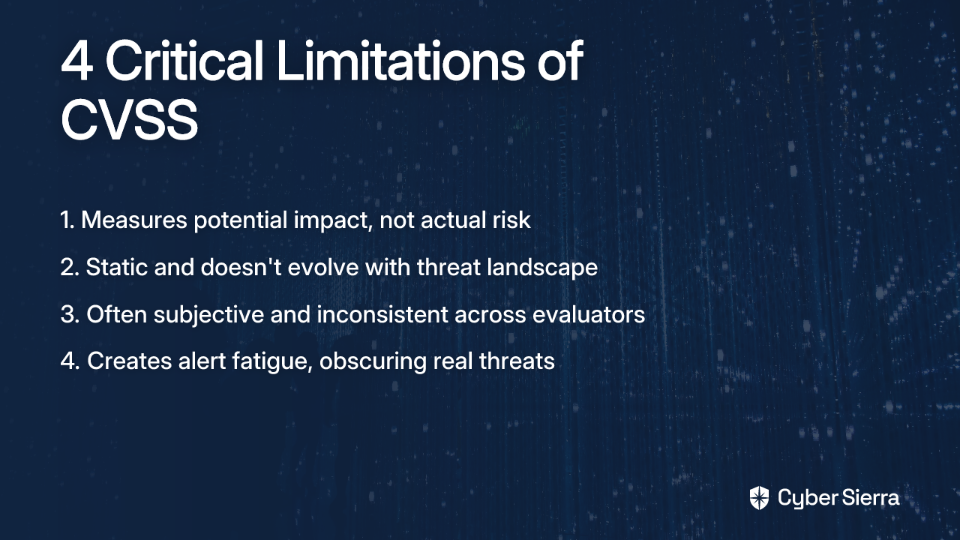
  1. It measures potential impact, not actual risk. As one seasoned practitioner put it, "CVSS base is not a risk score, it's impact. That's why we don't use it without more context."
  2. It's static and doesn't evolve. Once assigned, a CVSS score rarely changes, even as the threat landscape shifts dramatically.
  3. It's often subjective and inconsistent. Remember when the curl team rated their own vulnerability as low risk, only to have CISA initially slap a 9.5 CVSS score on it? This kind of inconsistency erodes trust in the system.
  4. It creates alert fatigue. When everything is "critical," nothing is critical. The result? Real threats hide in plain sight while teams waste resources on vulnerabilities that may never be exploited.

As one frustrated security engineer noted, "a 'critical' vuln that's not reachable is way less important than a 'medium' one that's actively being hit by traffic." This disconnect between CVSS severity and real-world risk is the core problem that modern approaches aim to solve.

Enter the Dynamic Duo: KEV and EPSS

While CVSS isn't going away, two newer frameworks are rapidly changing how forward-thinking security teams prioritize vulnerabilities:

CISA's Known Exploited Vulnerabilities (KEV) Catalog

The KEV catalog is refreshingly straightforward: it's a curated list of CVEs that are actively being exploited in the wild. No hypotheticals, no potential impact scores – just real-world intelligence about what attackers are actually using right now.

Each KEV entry includes:

  • CVE ID
  • Product name
  • Vulnerability description
  • Required remediation action
  • Due date (for federal agencies, but a strong guideline for everyone)

Why is this so powerful? Because it answers the single most important question in vulnerability management: "Is this vulnerability currently being used by attackers?" If a CVE is on the KEV list, it moves to the top of your priority list – period.

For smaller organizations or those without mature vulnerability management practices, the KEV list is what one practitioner called "a rock solid resource" for prioritization guidance.

Exploit Prediction Scoring System (EPSS)

While the KEV catalog tells you what's being exploited now, EPSS looks into the future. Developed by the Forum of Incident Response and Security Teams (FIRST), EPSS uses machine learning to predict the likelihood that a vulnerability will be exploited within the next 30 days.

EPSS provides a probability score from 0 to 1 (or 0% to 100%). Unlike CVSS, which remains largely static, EPSS scores update daily based on new data about how threats are evolving in the real world.

What makes EPSS so effective is its data-driven approach:

  1. It ingests massive amounts of data from diverse sources, including exploit databases, threat intelligence feeds, government catalogs (including the KEV), and observations from security tools.
  2. It applies sophisticated machine learning models to identify patterns and predict which vulnerabilities attackers are likely to target next.
  3. It's dynamic, constantly learning and updating as the threat landscape changes.

The Proof Is in the Pudding: CVSS vs. KEV/EPSS in Action

Let's look at some real-world examples that show why relying solely on CVSS can lead to misallocated resources:

CVE-2021-44228 (Log4j)

  • CVSS: 10.0 (Critical)
  • EPSS: 0.974 (97.4% likelihood of exploitation)
  • KEV Status: Included
  • Verdict: All systems agree - this Remote Code Execution (RCE) vulnerability demands immediate attention.
CVE-2023-48795 (OpenSSH Terrapin Attack)

  • CVSS: 5.9 (Medium)
  • EPSS: 0.95 (95% likelihood of exploitation)
  • KEV Status: Included
  • Verdict: CVSS says "medium" while EPSS and KEV scream "fix this now!" A CVSS-only approach would have missed this critical threat.

CVE-2024-3094 (XZ Utils Backdoor)

  • CVSS: 10.0 (Critical)
  • EPSS: 0.30 (30% likelihood of exploitation)
  • KEV Status: Not included (at time of writing)
  • Verdict: While potentially severe, the exploitation risk is lower than other vulnerabilities. This helps teams prioritize their immediate focus.

These examples highlight why modern vulnerability management needs to move beyond CVSS. As one security engineer noted, "The problem isn't finding bugs anymore, it's figuring out which ones actually matter vs which ones are just noise."

A Practical Framework: Beyond CVSS

So how do you actually implement this knowledge? Here's a practical framework for integrating KEV and EPSS into your vulnerability management workflow:

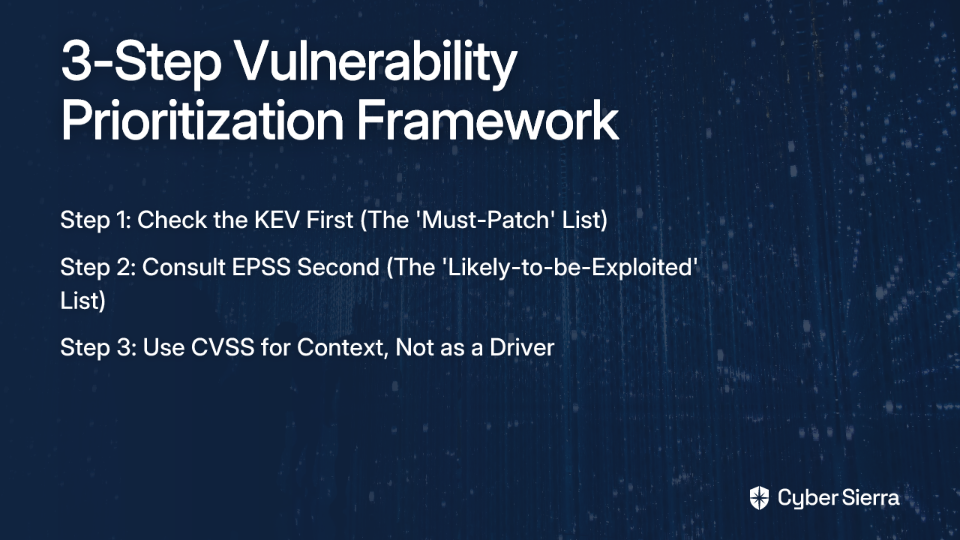
Step 1: Check the KEV First (The "Must-Patch" List)

Is the vulnerability on CISA's KEV catalog? If yes, this is your highest priority, regardless of any other score. These vulnerabilities are being actively exploited right now and pose an immediate threat.

You can access the KEV catalog in various formats:

Many modern scanning tools, including Tenable and other vulnerability scanners, now integrate KEV data directly into their reporting.

Step 2: Consult EPSS Second (The "Likely-to-be-Exploited" List)

If a vulnerability isn't on the KEV yet, check its EPSS score. This tells you the probability that it will be exploited in the wild within the next 30 days:

  • High EPSS Score (>0.75 or 75%): These vulnerabilities should be your next priority after KEV items. There's a high probability they'll be exploited soon.
  • Moderate EPSS Score (0.3-0.75): Monitor these closely and patch based on your organization's risk tolerance and resource availability.
  • Low EPSS Score (<0.3): These can generally be addressed during regular maintenance cycles unless they affect critical assets.

Pro Tip: Don't just look at the EPSS score once. Track it over time. A sudden jump in the score is a strong indicator that the threat landscape for that vulnerability is changing, and it requires immediate attention.

Step 3: Use CVSS for Context, Not as a Driver

CVSS still has value, but as context rather than a driver. It helps you understand the potential impact if a vulnerability were exploited. A high CVSS score on a vulnerability with a very low EPSS score can likely be deprioritized in favor of KEV and high-EPSS items.

This approach is especially valuable in CI/CD environments, where prioritizing what to fix before deployment can prevent bottlenecks while maintaining security.

Overcoming Alert Fatigue: A New Paradigm

The shift to KEV and EPSS represents a fundamental change in vulnerability management philosophy. Instead of trying to patch everything (an impossible task), you focus on what matters most based on real-world exploitation data.

This approach addresses the core complaint many security teams have: "The alert fatigue is real, and I'm tired of the vulnerability management treadmill."

By focusing first on KEV vulnerabilities (those actively being exploited) and then on high-EPSS vulnerabilities (those likely to be exploited soon), you can:

  1. Dramatically reduce noise by focusing on vulnerabilities that pose actual risk
  2. Allocate resources more effectively based on real-world exploitation data
  3. Communicate risk more clearly to stakeholders and management
  4. Improve security posture by addressing the vulnerabilities attackers actually use

The Future is Contextual

While KEV and EPSS represent a significant improvement over CVSS alone, the future of vulnerability management will be even more contextual. We're already seeing the emergence of cloud-specific frameworks that account for dynamic attack surfaces and asset criticality.

The key takeaway is that effective vulnerability management isn't about patching everything with a high CVSS score. It's about using intelligence from multiple sources to focus your efforts where they'll have the greatest impact.

As one security practitioner wisely noted, "You cannot patch everything, so you should be working to refine how you prioritize vulnerabilities to remediate the ones that can truly harm your organization."

By embracing KEV and EPSS alongside traditional metrics like CVSS, you can move from reactive patching to proactive defense, focusing your limited resources on the vulnerabilities that matter most in the real world.

So the next time your scanning tool bombards you with thousands of "critical" findings, remember: CVSS is yesterday's news. Say hello to KEV and EPSS – your new allies in the fight against alert fatigue and the key to a more effective vulnerability management program.

Frequently Asked Questions (FAQ)

What is the main problem with using only CVSS for vulnerability management?

The main problem with relying solely on CVSS is that it measures potential severity, not actual, real-world risk. This leads to "alert fatigue," where security teams are overwhelmed by thousands of "critical" vulnerabilities that may never be exploited, causing real threats to be lost in the noise.

How do KEV and EPSS improve upon CVSS?

KEV and EPSS improve upon CVSS by providing crucial, real-world context. CISA's KEV (Known Exploited Vulnerabilities) catalog tells you which vulnerabilities are being actively exploited right now, while EPSS (Exploit Prediction Scoring System) predicts the likelihood of a vulnerability being exploited in the near future. They shift the focus from a vulnerability's theoretical potential to its actual or probable threat level.

What is the recommended framework for prioritizing vulnerabilities?

The most effective framework is to prioritize in three steps:

  1. KEV First: Remediate all vulnerabilities on CISA's KEV catalog immediately. These are proven threats.
  2. EPSS Second: Address vulnerabilities with a high EPSS score (e.g., above 75%), as they are likely to be exploited soon.
  3. CVSS for Context: Use the CVSS score to understand the potential impact of the remaining vulnerabilities and inform patching schedules during regular maintenance cycles.

Should my organization stop using CVSS completely?

No, you shouldn't stop using CVSS entirely. Instead, its role should evolve. Use it as a secondary data point for context after prioritizing with KEV and EPSS. The CVSS score is still useful for understanding the potential impact (e.g., remote code execution, data exposure) of a vulnerability if it were to be exploited, which helps in comprehensive risk assessment.

Does a low CVSS score mean a vulnerability is not a threat?

Absolutely not. A low or medium CVSS score does not guarantee a vulnerability is low-risk. Many vulnerabilities with medium CVSS scores have been added to the KEV catalog because they are actively exploited. The OpenSSH Terrapin Attack (CVSS 5.9), for example, was a widely exploited vulnerability that a CVSS-only approach would have deprioritized.

Where can I access KEV and EPSS data?

Both resources are publicly available. The CISA KEV catalog can be accessed directly from the CISA website in various formats (HTML, CSV, JSON). EPSS scores are available from FIRST.org via a public API. Furthermore, many modern vulnerability management platforms and security scanners now integrate both KEV and EPSS data directly into their reporting dashboards.

blog-hero-background-image
Cyber Security

Overcoming Skepticism: Deploying AI in Enterprise Context

backdrop
Table of Contents

Join thousands of professionals and get the latest insight on Compliance & Cybersecurity.


Overcoming Skepticism: Deploying AI in Enterprise Contexts

You've sat through another excruciating meeting where executives rave about the transformative power of Generative AI after attending a tech conference. They're convinced that Copilot will replace your entire Helpdesk by next week because they saw one demo in a controlled environment. Meanwhile, your team has already tested multiple generic AI solutions for everything from FASB implementation to documentation workflows, and most were "absolutely awful."

Sound familiar? You're not alone in this frustration.
The reality of enterprise AI deployment has become something of a "cringefest," with many employees immediately put off by yet another hyped tech tool that fails to deliver on its promises. The disconnect between executive expectations and operational reality has created a wall of skepticism that threatens to derail even the most well-intentioned AI initiatives.

The AI Paradox: Unprecedented Adoption Meets Deep-Seated Skepticism

The numbers tell a fascinating story of contradiction. On one hand, AI adoption has surged to 72% among surveyed organizations, a significant jump from around 50% in previous years, with half of these companies using AI in two or more business functions, according to McKinsey's research. Furthermore, 79% of corporate strategists view AI as critical to their success within the next two years, according to Gartner.

Yet alongside this adoption surge, there's a wall of skepticism. A KPMG survey found over 61% of respondents showed either ambivalence or distrust towards AI. As one IT professional bluntly put it in a Reddit discussion: "The biggest hurdle is always adoption. People think AI agents will mess things up or take their job."

This skepticism isn't unfounded. A Salesforce survey revealed 56% of knowledge workers find it difficult to effectively use AI tools integrated into their workflows. The frustration is real and measurable.

Decoding the Skepticism: The Top Hurdles to Enterprise AI Implementation

Understanding the roots of AI skepticism is the first step toward overcoming it. Based on both research and frontline experiences, here are the key obstacles companies face:

Key Obstacles to Enterprise AI Adoption

1. Lack of In-House Expertise & Foundational Focus

While the hype centers on Generative AILarge Language Models (LLMs), and Retrieval-Augmented Generation (RAG), many data professionals would "rather focus on foundational machine learning technologies and their lifecycle than performing operations like dot products of vectors without understanding their origins," according to a data engineering discussion.

The reality is that "plenty of companies still struggle with fundamental tasks like running effective predictive models and addressing customer classification issues" – basics that need mastering before moving to advanced generative capabilities.

2. Unrealistic Executive Expectations

"Upper Management and C-Suite Execs have no idea what's really going on. They hear the buzzwords and are told the stories by news/other business people," laments one IT professional in a Reddit discussion. This gap between executive vision and technical reality creates friction and disappointment when AI initiatives fail to deliver immediate, dramatic results.

3. Data Privacy, Security, and IP Concerns

Adoption is particularly slow in sensitive industries like Compliance and Healthcare due to "data privacy concerns, low error tolerance," according to industry professionals. The risks associated with AI hallucinations or inaccuracies can be existential in regulated environments.

4. Integration with Outdated Infrastructure

Many enterprises still operate on legacy systems that aren't designed to handle the data volumes and processing requirements of modern AI solutions. This technical debt becomes a significant barrier to effective implementation.

5. Failure of Generic, "One-Size-Fits-All" Solutions

Users consistently report that from "auditing FASB implementation to documentation workflows... multiple generic AI solutions... are absolutely awful." Generic solutions fail to address the specific contexts and workflows of individual organizations, leading to frustration and abandonment.

From Skepticism to Success: A Practical Playbook for AI Deployment

Overcoming these hurdles requires a strategic approach that addresses both technical challenges and human concerns. Here's a practical playbook:

Step 1: Start with a Business-First AI Strategy

Before selecting any tool or technology, clearly identify business goals and define what success looks like. This helps avoid trivial Proofs of Concept (PoCs) that don't address real organizational needs.

TechTarget research emphasizes that successful AI implementation begins with aligning technology to specific business objectives rather than adopting AI for its own sake. This means identifying concrete pain points where AI can deliver measurable value.

Step 2: Evaluate and Build Internal Capabilities

Assess your organization's current AI readiness, including skills gaps, data quality, and infrastructure requirements. Invest in training and development to build a foundational understanding of Machine Learning (ML) and AI principles among key stakeholders.

The goal isn't to make everyone a data scientist, but to establish enough common knowledge that teams can realistically evaluate AI proposals and capabilities without falling victim to hype or unfounded skepticism.

Step 3: Implement Pragmatically with Pilot Projects

Start small to build internal expertise and confidence. A successful pilot project addressing a specific business problem is the most effective antidote to skepticism.

Struggling with AI implementation?

Focus on augmenting tasks rather than wholesale replacement to gain employee buy-in. As one user noted, "if done right, [AI agents] make life easier" rather than threatening jobs.

Step 4: Prioritize Transparency, Ethics, and Communication

Be transparent about how AI is being used and how data is handled. Proactively address fears of job displacement by demonstrating how AI makes jobs more strategic and less tedious. TechTarget's research on AI ethics emphasizes that building trust requires clear communication about AI's role and limitations.

The Proof is in the Production: Real-World AI Success Stories

While skepticism abounds, the evidence of AI's transformative potential is compelling when properly implemented. Consider these real-world examples:

Real-World AI Success Stories

Finance (JPMorgan Chase): AI-powered Document Parsing reviewed legal documents in seconds, a task that previously took 360,000 hours of manual work, according to Capella Solutions case studies.

Manufacturing (Siemens)Predictive Maintenance AI reduced unplanned factory downtime by up to 50% and boosted production efficiency by 20%. This represents not just cost savings but a fundamental improvement in operational reliability.

Retail (Amazon): Amazon's Recommendation Systems use collaborative filtering to drive 35% of its revenue, demonstrating AI's power to directly impact the bottom line, as noted in HBS Online research.

Healthcare (IBM Watson Health): Using Natural Language Processing (NLP) to analyze unstructured patient data, AI has cut diagnosis times from weeks to hours for complex cases, potentially saving lives through earlier interventions.

Energy (Shell): Shell employs AI for predictive analytics in oil drilling to optimize resource allocation and improve safety, demonstrating AI's versatility across traditional industries.

These examples share a common thread: they address specific business problems with targeted AI solutions rather than implementing generic AI for its own sake.

Moving Beyond the Hype to Real Enterprise Value

The path to successful AI deployment lies not in chasing the latest buzzwords—whether that's Generative AILLMs, or RAG—but in addressing foundational business challenges with appropriate AI tools.

As enterprises navigate the complex AI landscape, the most successful will be those that cut through the hype, acknowledge the legitimate skepticism, and build trust through transparent, pragmatic implementation strategies that deliver measurable value.

The reality is that some AI solutions are indeed "fake and suck," while others deliver transformative business value. The difference lies not in the technology itself, but in how strategically it's deployed and how effectively it's integrated into existing workflows and organizational culture.

By focusing on business outcomes rather than technological novelty, building foundational capabilities, starting with targeted pilot projects, and maintaining transparent communication, enterprises can overcome skepticism and harness AI's genuine potential to solve real-world problems.

In the end, successful AI deployment isn't about replacing humans with algorithms—it's about augmenting human capabilities, eliminating drudgery, and enabling people to focus on the creative, strategic work that drives genuine innovation and competitive advantage.

Need secure AI governance?

Frequently Asked Questions

What is the main reason enterprise AI projects fail?

Enterprise AI projects often fail due to a disconnect between executive hype and operational reality. The primary reasons include deploying generic, one-size-fits-all solutions that don't address specific business needs, and setting unrealistic expectations that AI will deliver dramatic, immediate results without addressing foundational challenges like data quality and system integration.

Why is there so much skepticism around AI in the workplace?

Deep-seated skepticism towards AI in the workplace stems from several factors. Employees are often wary due to past negative experiences with overhyped technology, fears that AI will replace their jobs, and significant concerns about data privacy and security. A Salesforce survey highlighted this, finding that 56% of knowledge workers struggle to use AI tools effectively within their current workflows.

How can a company successfully implement AI and overcome employee skepticism?

A company can successfully implement AI by adopting a strategic, human-centric approach. Key steps include: 1) Starting with a business-first strategy focused on solving a real problem, 2) Building internal capabilities through training, 3) Implementing pragmatically with small, targeted pilot projects to build confidence, and 4) Prioritizing transparency and clear communication about AI's role and limitations.

What should be the first step in starting an AI initiative?

The most critical first step is to establish a business-first AI strategy. Instead of adopting technology for its own sake, the focus should be on clearly identifying a specific business goal or pain point. Defining what success looks like and how it will be measured ensures that the AI initiative is aligned with real organizational needs and is more likely to deliver tangible value.

Are advanced tools like Generative AI always the best solution for a business?

No, advanced tools like Generative AI or RAG are not always the best initial solution. Many organizations achieve greater value by first focusing on foundational machine learning technologies to solve core problems like predictive modeling or customer classification. The most appropriate tool always depends on the specific business challenge, and mastering the basics is crucial before moving to more complex AI.

Can you provide real examples of successful AI implementation?

Yes, there are many examples of successful, targeted AI implementation. JPMorgan Chase used AI to review legal documents in seconds instead of the 360,000 hours it took manually. Siemens implemented predictive maintenance AI to cut factory downtime by up to 50%. These successes demonstrate that when AI is applied to a specific, well-defined problem, it can deliver transformative results.

blog-hero-background-image
Cyber Security

Stop Reporting, Start Storytelling: A New Approach for CISOs

backdrop
Table of Contents

Join thousands of professionals and get the latest insight on Compliance & Cybersecurity.


Stop Reporting, Start Storytelling: A New Approach for CISOs

You've spent weeks preparing your quarterly security update for the board. Your slides are packed with comprehensive metrics—vulnerability trends, patch compliance rates, and security incidents neatly plotted on colorful graphs. You've included the latest NIST CSF maturity scores and updates to the risk register. This is solid data that clearly demonstrates how hard your team has been working.

Yet, as you finish your presentation, you're met with blank stares and polite nods. One executive checks their phone, another asks a basic question that shows they've missed your key points entirely. The CFO wants to know why you need more budget when "nothing bad happened this quarter." Despite your thorough reporting, your message has fallen flat—again.

If this scenario sounds painfully familiar, you're not alone. Many Chief Information Security Officers (CISOs) and governance, risk, and compliance (GRC) leaders find themselves trapped in a cycle of data-dumping that fails to engage, persuade, or drive action from executive leadership.

Why Your Security Reports Are Falling Flat

The fundamental issue is a communication gap between technical security professionals and business-focused executives. According to recent discussions among security leaders, CISOs often struggle to articulate fundamental security concepts in relatable terms for non-technical audiences. This disconnect isn't just frustrating—it has real consequences.

Common Executive Perceptions When Security Reporting Fails

When you overwhelm executives with technical jargon, KPIs, and KRIs without context, you're essentially speaking a foreign language. As security expert Tom August aptly puts it, "a confused mind always says no." This confusion leads to:

  • Delayed or denied funding for critical security initiatives
  • Security being viewed as a cost center rather than a business enabler
  • The perception of CISOs as mere project managers rather than strategic leaders
  • High turnover among security executives (the average CISO tenure is just 2-4 years)

Many CISOs face challenges distinguishing between program maturity and risk register outcomes when reporting. They struggle to present their team's progress in ways that resonate with decision-makers who care primarily about business outcomes, not technical achievements.

The CISO as Chief Storytelling Officer

The solution isn't more data—it's better storytelling. The most effective CISOs are those who can transform from technical reporters into compelling narrators of their organization's security journey.

Storytelling isn't just a soft skill—it's a strategic necessity that:

  • Humanizes abstract security concepts, making them relatable to non-technical stakeholders
  • Enhances retention (studies show information delivered as stories is 22 times more memorable than facts alone)
  • Builds emotional connections that foster trust and credibility
  • Moves the conversation from a one-way report to a collaborative dialogue
Benefits of Security Storytelling

When you embrace the role of "Chief Storytelling Officer," you make abstract risks tangible and relatable. Instead of bombarding executives with static reporting about vulnerability metrics, you're painting a picture of how these vulnerabilities could impact business objectives—and how your team is proactively addressing them to protect the organization.

A Practical Framework for Cybersecurity Storytelling

Let's examine a step-by-step framework that will transform your security presentations from forgettable data dumps into compelling narratives that drive action and support.

Step 1: Know Your Audience and Start with "Why"

Before crafting your story, understand who you're talking to and what motivates them:

  • For the CEO: Focus on reputation, competitive advantage, and strategic growth
  • For the CFO: Emphasize financial risk, cost avoidance, and ROI
  • For the COO: Highlight operational stability and business continuity

Always begin with the "why" behind your security initiatives. Instead of starting with technical details about your latest vulnerability management system, explain how it directly supports the company's Q4 product launch by preventing disruptions that could delay market entry.

Tailoring Your Security Message by Executive Role

Step 2: Craft a Compelling Narrative with a "Throughline"

Develop what storytelling experts call a "throughline"—a single, memorable core message that connects all parts of your story. For example: "Our cybersecurity maturity journey is enabling faster, safer innovation."

Structure your narrative with:

  • A hook that captures attention (perhaps a recent breach at a competitor)
  • Key challenges your organization faces (such as gaps in your COBIT2019 compliance)
  • Successes and lessons learned (how your SOC team detected and contained a potential incident)
  • A clear roadmap ahead (outlining how your desired OUTCOMES align with business goals)

Move beyond dry statistics by using relatable scenarios and emotional narratives:

Step 3: Humanize Risk and Paint a Vivid Picture

Instead of: "We blocked 10,000 phishing attempts this quarter." Try: "Last month, our finance director almost fell victim to a sophisticated phishing attack that mimicked our CEO's writing style perfectly. If successful, attackers could have diverted our quarterly partner payments to fraudulent accounts. Our email security investments prevented this, protecting over $2 million in outgoing payments."

This approach transforms abstract threats into tangible risks with real business consequences.

Step 4: Use Data Wisely to Support, Not Drown

Data should serve your narrative, not overwhelm it. When presenting your security maturity model:

  • Select 3-5 key metrics that directly support your main points
  • Use visuals that highlight trends rather than individual data points
  • Frame metrics in terms of business outcomes and capabilities, not technical compliance

For example, when discussing your Pulse Buckets showing security posture over time, explain how improvements in specific capabilities correlate with reduced business disruptions.

Step 5: Unleash the Power of Contrast

Contrast creates dramatic tension that engages your audience. Compare:

  • Current state vs. desired future state
  • Before vs. after implementation of a security initiative
  • Your organization's capabilities vs. industry benchmark averages from third-party assessments

For instance: "Six months ago, our crosswalk engine showed we met only 65% of NIST CSF requirements for identity management. Today, we're at 82%, ahead of the financial services industry average of 75%. By Q3, with the planned IAM implementation, we'll reach 90%, putting us among the top performers in our sector."

Step 6: Make a Clear Proposal and Call to Action

End with a specific request that flows naturally from your narrative. Don't leave executives guessing what you need from them. Be explicit about:

  • Resources required
  • Decisions needed
  • Timeline for action
  • Expected outcomes

For example: "To continue our progress, I'm requesting approval for the $450,000 cloud security initiative outlined in next year's budget. This investment will reduce our third-party risk exposure by 40% according to our KRIs and strengthen our position with auditors during next year's assessment."

Struggling to communicate security value?

Nailing the Narrative: Best Practices & Pitfalls

Pro-Tips for Success:

  1. Engage in dialogue: Encourage questions throughout your presentation rather than saving them for the end.
  2. Practice delivery: Rehearse with non-technical colleagues to ensure your story resonates.
  3. Involve your team: Let technical leads share their experiences to create richer narratives and combat burnout by showing them their work is part of a larger, exciting story.
  4. Use frameworks for alignment: Implement OKRs (Objectives and Key Results) to align cybersecurity initiatives with broader company goals, making it easier to demonstrate contributions to business objectives.

Common Pitfalls to Avoid:

  1. Overwhelming with technical jargon: Terms like CVE, Zero Trust, and ETL might be everyday language for you, but they create barriers for non-technical stakeholders.
  2. Neglecting the audience's perspective: Always frame security issues in terms of what matters to them—business impact, not technical details.
  3. Failing to connect security to business objectives: Every security story should clearly link to strategic priorities.
  4. Relying on fear alone: While risks are important to highlight, balance them with opportunities and successes.
Security Communication Pitfalls to Avoid

Reshaping Your Influence

By transforming from a reporter of metrics to a storyteller of your security journey, you'll fundamentally change how executives perceive and value your role. This isn't just about making prettier slides or using simpler language—it's about bridging the gap between technical details and business value.

When you master the art of cybersecurity storytelling, you'll find executives leaning forward in their chairs instead of checking their phones. You'll hear thoughtful questions instead of confused silence. Most importantly, you'll secure the resources and support needed to protect your organization effectively.

The next time you prepare for that board meeting, remember: you're not just presenting data—you're telling your organization's security story. Make it one worth listening to.

Ready to transform your security reporting?

Frequently Asked Questions

What is cybersecurity storytelling?

Cybersecurity storytelling is the strategic practice of framing security data, risks, and initiatives within a narrative structure. This approach makes complex technical information relatable, memorable, and persuasive for non-technical audiences like executive leadership. Instead of just presenting metrics, storytelling connects security activities to business outcomes, transforming abstract threats into tangible scenarios and helping stakeholders understand the value of security investments.

Why is storytelling more effective than data-driven reports for executives?

Storytelling is more effective because it engages audiences on an emotional level, making information significantly more memorable and persuasive than raw data alone. A story provides context that helps a business-focused executive understand the "why" behind the numbers. Information delivered as a story is up to 22 times more memorable than isolated facts, cutting through the noise of data-heavy reports and building the trust needed to secure support for critical initiatives.

How can I start implementing storytelling in my security reports?

You can start by following a simple framework: know your audience, define a core message (a "throughline"), humanize risks with relatable examples, use data to support (not dominate) your narrative, and end with a clear call to action. Begin by understanding what motivates your specific audience (e.g., the CFO cares about ROI, the CEO about reputation). Then, craft a narrative with a hook, challenges, and successes, and always conclude with a specific request for the resources or decisions you need.

How do I tell a security story without relying on fear or FUD?

Focus on a balanced narrative that highlights not just risks, but also successes, progress, and opportunities. A good security story should empower the leadership team with a sense of control and a clear path forward, rather than just alarming them. Frame your story around the journey of improving security maturity and showcase how your team’s proactive efforts have neutralized threats. This positions security as a business enabler that builds resilience, not just a cost center that reacts to fear.

What if I'm not a natural storyteller?

Storytelling is a skill that can be learned and practiced, not just an innate talent. You can start by using simple narrative structures and focusing on clarity, relevance, and authenticity rather than trying to be a dramatic performer. Leverage the expertise within your team by letting technical leads share their frontline experiences. Practice with non-technical colleagues to get feedback. Authenticity is more important than polish; a genuine, clear story will always be more effective.

How can I measure the success of my storytelling approach?

The success of your storytelling can be measured by the actions and responses of your audience. Key indicators include increased engagement during presentations (more questions, less phone-checking), higher approval rates for budget requests, and a shift in how executives talk about security. Ultimately, successful storytelling leads to securing the resources and strategic alignment needed to protect the organization, which is the most important metric of all.

blog-hero-background-image
Cyber Security

MCP Security Risks: A CISO's Guide to Mitigation

backdrop
Table of Contents

Join thousands of professionals and get the latest insight on Compliance & Cybersecurity.


MCP Security Risks: A CISO's Guide to Mitigation

Introduction

As a CISO, you've likely witnessed your organization's rush to implement AI capabilities through Model Context Protocol (MCP) integrations. If the thought of this keeps you up at night, you're not alone. The deployment of MCPs without proper security frameworks is, as one security leader put it, "honestly terrifying from an enterprise perspective."

Launched by Anthropic in November 2024, Model Context Protocol (MCP) serves as the connective tissue between Large Language Models (LLMs) like Claude and external tools, data, and services. While MCP promises unprecedented automation and integration, it fundamentally expands your enterprise attack surface, introducing new vectors for data leakage, Remote Code Execution (RCE), and supply chain attacks.

The most alarming aspect? Many developers are bypassing security review altogether, implementing tools with dangerously permissive defaults. As one CISO candidly admitted: "I feel unprepared to mitigate the inevitable risks of using MCPs."

This guide will provide you with a foundational understanding of MCP's architecture, dissect the most critical security vulnerabilities with real-world examples, and present a strategic, multi-layered framework to effectively mitigate these risks.

What You'll Learn in This Guide

The MCP Landscape: A New Attack Surface

To understand the security challenges posed by MCP, we must first understand its architecture.

The Components

  1. MCP Clients: Applications accessing LLMs (like Claude Desktop-MCP)
  2. MCP Servers: Services exposing tools and data to LLMs
  3. MCP Manager: Coordinates communication between clients and servers
  4. Local Data Sources: Files, databases, and applications on the local system
  5. Remote Services: External APIs and cloud services

At its core, MCP follows a client-server model with RESTful design principles, WebSocket support, and JSON for serialization. It enables AI assistants to access everything from file systems to development tools.

The Foundational Flaw

According to research from Equixly, MCP has no authentication by default. This critical design flaw means that MCP servers are essentially web servers accessible by any actor, not just the LLM. Other security gaps include session IDs in URLs and a lack of message integrity controls.

As one security researcher bluntly asked: "The key difference with MCP is that it by default wants access to local filesystem and can run commands as root? If true, how is anyone ok with this?"

A Catalogue of Nightmares: Top MCP Security Risks

Let's examine the most critical MCP security vulnerabilities that should be on every CISO's radar:

1. Prompt Injection (Direct & Indirect)

Malicious inputs can trick LLMs into performing unauthorized actions, from ignoring security policies to leaking sensitive data. Research published in arXiv demonstrated how seemingly innocuous prompts could be crafted to bypass AI guardrails and manipulate connected tools.

2. Tool Poisoning & Shadow MCP

Malicious or compromised MCP servers can deceive users by modifying tool functionality or impersonating trusted services. In a concerning real-world example documented by Invariant Labs, a rogue WhatsApp MCP server was able to reroute messages to an attacker's infrastructure.

3. Remote Code Execution (RCE) via Command Injection

This is perhaps the most devastating risk. When MCP servers execute commands based on LLM-generated code, they create a perfect storm for RCE attacks. A study by Equixly found that 43% of tested MCP implementations had command injection flaws, many using dangerous patterns like eval() on user input.

As one security expert noted: "Eval on user input is among the most basic of security design flaws. Running it though an LLM doesn't change the fact that it's user input."

4. Path Traversal & Arbitrary File Access

The same Equixly study revealed that 22% of implementations allowed attackers to access files outside of intended directories, potentially exposing sensitive data and configurations.

5. Server-Side Request Forgery (SSRF)

With 30% of implementations vulnerable to SSRF, attackers can leverage MCP servers to make unauthorized requests to internal networks or external services, often bypassing network controls.

6. Authentication Bypass & Privilege Abuse

MCP's lack of standardized authentication and flawed OAuth specifications can lead to the "confused deputy" problem, where the AI acts with excessive privileges. Christian Posta's analysis suggests the "MCP Authorization Spec Is... a Mess for Enterprise," particularly for handling multi-tenant environments.

7. Sensitive Data Exposure & Token Theft

Stolen OAuth tokens can lead to complete account takeovers, allowing attackers to access and manipulate sensitive data like email histories, as documented by Pillar Security.

8. Supply Chain Risks

The MCP ecosystem relies heavily on third-party servers, many of which are themselves AI-generated. This creates an unprecedented supply chain risk, as one security researcher observed: "The whole MCP ecosystem is a big POC as it stands where most of the MCP servers are themselves AI generated."

Key MCP Supply Chain Risks

9. Rug Pull Attacks

Tools that initially appear legitimate can gain user trust before being updated with malicious functionality. Prompt Security has documented several instances where popular MCP tools suddenly changed behavior after achieving widespread adoption.

10. Denial of Wallet/Service

Compromised or malicious tools can be instructed to perform resource-intensive tasks, leading to excessive API costs and service disruption—a particularly insidious attack when using pay-per-call LLM services.

Overwhelmed by new security threats?

The CISO's Playbook: A Strategic Framework for MCP Mitigation

Now that we understand the threat landscape, let's build a comprehensive defense strategy organized into four pillars: Governance, Technical Controls, Monitoring & Response, and The Human Layer.

Pillar 1: Governance & Policy

Establish Centralized Control: Create explicit policies for using MCP-enabled tools like Claude Desktop-MCP. As security professionals have noted, there's a pressing need for "overarching policies, permissions, and centralized control over MCPs."

Implement a Verified Tool Registry: Combat Shadow MCP by creating and enforcing an allow-list of vetted MCP servers. This addresses the concern that "some of these tools can just be enabled by any developer, completely bypassing security review."

Treat AI as a User: Incorporate AI agents into your threat model and apply Zero Trust Network Access (ZTNA) principles. Ensure MCP usage complies with data protection regulations, as recommended by Writer.com.

Pillar 2: Technical Controls

Enforce Strong Authentication: Mandate the use of API keys, OAuth tokens, and mutual TLS certificates for all MCP communication. Integration with your existing identity infrastructure is essential.

Implement Least-Privilege Authorization: Use fine-grained access control lists (ACLs) to ensure AI agents can only perform necessary actions within well-defined boundaries.

Sandbox Everything: Treat any MCP server as untrusted external code. As one security team reported: "We've started implementing a few layers of protection - first is treating any MCP server as essentially untrusted external code, so we're sandboxing them heavily." Consider WebAssembly (Wasm) for secure containment.

Input Validation and Output Sanitization: Rigorously validate all inputs to prevent injection attacks and sanitize all outputs to prevent feedback-loop attacks that could manipulate your AI systems.

Secure the Supply Chain: Mandate that all MCP components are cryptographically signed by developers and built on secure pipelines that include static analysis scanning. Pin server versions to prevent rug pulls, following Red Hat's security guidance.

Essential MCP Technical Controls

Pillar 3: Monitoring & Response

Log Everything: Implement comprehensive logging for all actions taken by AI via MCP. This creates essential audit trails for incident response and compliance requirements.

Integrate with SIEM/SOAR: Funnel MCP logs into your Security Information and Event Management (SIEM) and Security Orchestration, Automation and Response (SOAR) systems for real-time alerting and automated response to suspicious activity patterns.

Deploy Canary Tokens: As one security expert suggested, "consider throwing a canary in the config file to monitor for unexpected behaviors." These tripwires can provide early warning of unauthorized access attempts.

Continuous Vulnerability Assessment: Regularly audit your MCP implementations using tools like Backslash Security's open tool to identify security gaps before attackers do.

Pillar 4: The Human Layer

Implement Human-in-the-Loop Controls: For sensitive, high-impact, or destructive actions, always require explicit user confirmation before allowing the AI to proceed.

Educate Users & Developers: Train users on the risks of granting permissions to AI tools and train developers on secure coding practices specific to MCP implementations.

Build Security-Focused Apps: When developing internal MCP applications, prioritize security by design rather than adding it as an afterthought. Integrate with Syncado or similar platforms to provide centralized threat monitoring capabilities.

Conclusion

The rush to implement MCP integrations has created an unprecedented expansion of the enterprise attack surface. Without proper security controls, the potential for data integrity breaches, system compromises, and other security incidents is significant.

However, by adopting a layered defense approach—combining governance, technical controls, continuous monitoring, and human oversight—CISOs can harness MCP's power while mitigating its inherent risks.

The time to act is now. Begin by assessing your organization's current MCP exposure, developing comprehensive policies, and implementing technical controls outlined in this framework. Remember that security is not a destination but a journey—and with MCP, we're venturing into largely uncharted territory.

Your organization's security posture in this new landscape depends on proactive planning rather than reactive response. As one CISO aptly put it: "The rush to implement MCP integrations without proper security frameworks is honestly terrifying from an enterprise perspective." Let's change that narrative by building robust, defensible MCP security programs that enable innovation while protecting our most valuable assets.

Frequently Asked Questions

What is Model Context Protocol (MCP) and why is it a security concern?

Model Context Protocol (MCP) is a technology that connects Large Language Models (LLMs) to external tools, data, and services, acting as a bridge for AI to interact with the digital world. It becomes a major security concern because it dramatically expands the enterprise attack surface. By default, MCP lacks critical security controls like authentication, meaning it can expose internal systems, local files, and sensitive data to unauthorized access, command injection, and other severe vulnerabilities.

What are the most critical security risks associated with MCP?

The most critical security risks of MCP include Remote Code Execution (RCE) through command injection, sensitive data leakage via path traversal, and supply chain attacks from compromised third-party tools. Other significant threats are prompt injection, which tricks the AI into performing malicious actions; tool poisoning, where fake tools deceive users; and Server-Side Request Forgery (SSRF), which can bypass network security. The lack of default authentication exacerbates all of these risks.

How can an organization secure its MCP integrations?

An organization can secure MCP integrations by implementing a multi-layered strategy that combines governance, strong technical controls, continuous monitoring, and user education. This strategy, often called a "CISO's Playbook," involves creating a verified tool registry, enforcing strong authentication (like OAuth and mTLS), sandboxing all MCP servers, validating inputs, and requiring human-in-the-loop confirmation for sensitive actions.

Why is MCP's default configuration so dangerous for enterprises?

MCP's default configuration is dangerous because it has no authentication enabled by default. This fundamental design flaw means any MCP server is essentially an open web server accessible to any actor on the network, not just the intended LLM. This allows attackers to directly probe for vulnerabilities like command injection or path traversal, completely bypassing the AI model and interacting directly with the exposed tool or data source.

Where should a CISO begin when building an MCP security strategy?

A CISO should begin by establishing governance and visibility over MCP usage within the organization. The first steps are to discover where and how MCPs are being used, a process that often reveals "Shadow MCP" implementations. Following discovery, you should create a formal policy for MCP use and establish a centralized, vetted registry of approved MCP tools and servers. This provides a foundation of control before implementing more granular technical measures.

Can developers use MCPs without a security review?

Yes, a significant risk is that developers can often enable and integrate third-party MCP tools without any formal security review. This phenomenon, known as "Shadow MCP," happens because many tools are easy to implement with dangerously permissive defaults. To combat this, organizations must enforce policies that mandate all MCP integrations go through a security vetting process and are sourced from an approved, internal tool registry.

Need a proactive security approach?
blog-hero-background-image
Cyber Security

Best Practices for AI Deployment in Enterprise Environments

backdrop
Table of Contents

Join thousands of professionals and get the latest insight on Compliance & Cybersecurity.


You've invested significant resources in developing sophisticated AI models that promise transformative results for your business. But when it comes time to move from development to deployment, your team hits a wall. The models that performed brilliantly in controlled environments falter in production, stakeholders grow skeptical about promised ROI, and the gap between AI potential and real-world impact widens.

You're not alone. Over 80% of AI projects fail to reach deployment, leaving organizations with expensive experiments rather than valuable business tools.

The journey from a functioning model to an enterprise-grade AI system that delivers consistent value is fraught with technical, organizational, and ethical challenges. Without a strategic approach to deployment, even the most advanced AI initiatives can join the majority that never make it past the proof-of-concept stage.

This guide provides field-tested insights and actionable implementation strategies—not buzzwords or marketing fluff—to help you navigate the complexities of enterprise AI deployment and transform AI from a promising technology into a reliable business asset.

Start with Strategy: Aligning AI with Real Business Goals

Before writing a single line of code or selecting a model architecture, successful AI implementations begin with a clear strategic foundation. This critical first step addresses the common skepticism: "Is AI really helping businesses in a big way, or is it sometimes just for show?"

Align AI Strategy with Organizational Goals

The most successful AI deployments start by identifying specific business problems where AI can deliver measurable value. This prevents creating AI applications that are technically impressive but fail to address actual business needs.

To build this alignment:

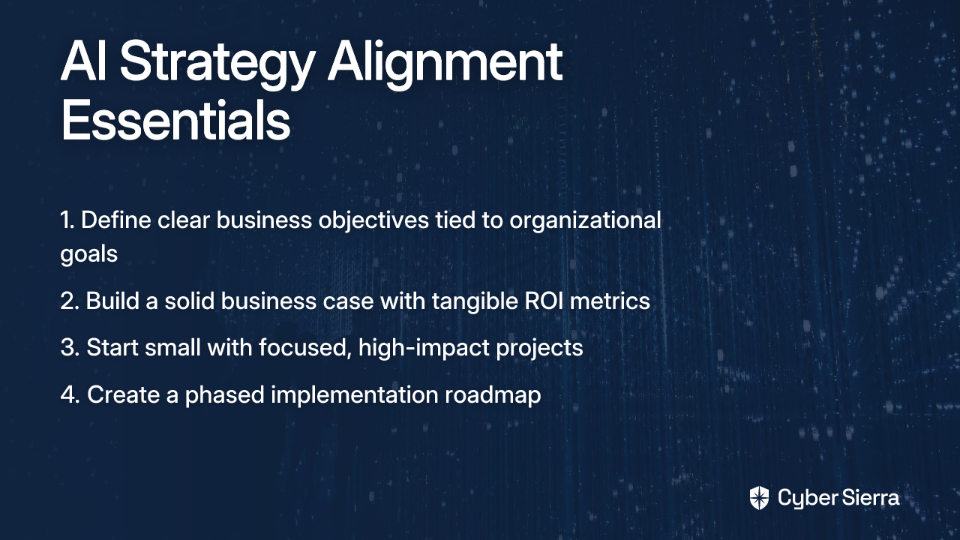
  1. Define clear business objectives: Articulate how AI will support specific organizational goals, whether that's improving operational efficiency, enhancing customer experience, or enabling new product capabilities.
  2. Build a solid business case: Focus on tangible ROI metrics that matter to stakeholders. For example, a chatbot implementation should be measured not just by technical accuracy but by metrics like reduced support ticket volume, improved customer satisfaction scores, or decreased resolution time.
  3. Start small, scale strategically: Begin with focused, high-impact projects that can demonstrate value quickly. This approach builds organizational confidence and provides learnings that can inform larger implementations. As New Horizons recommends, a phased implementation roadmap helps build momentum and prove value.

Bridge the Gap Between Business, IT, and Data Science

One of the primary reasons AI projects stall is the disconnection between technical teams and business stakeholders. Successful deployments actively work to bridge this gap.

To foster effective collaboration:

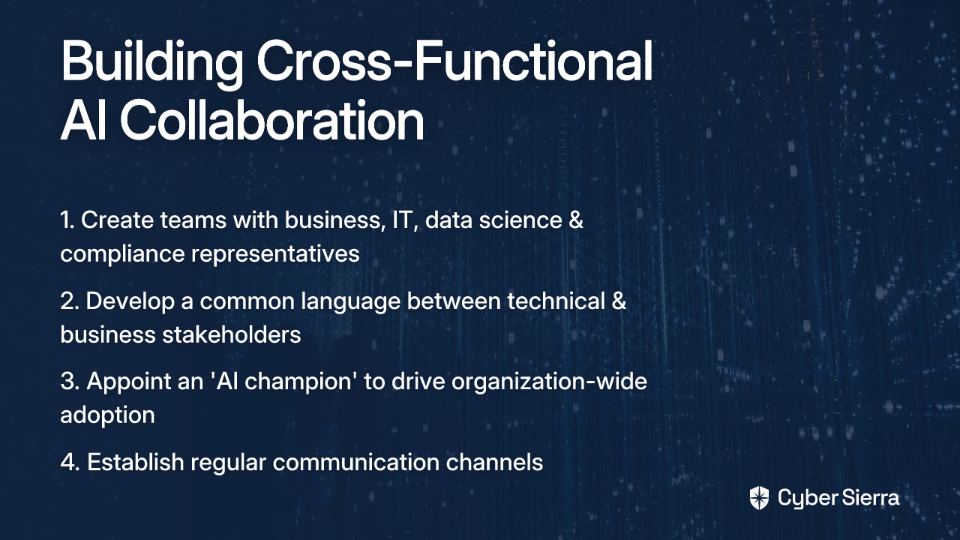
  1. Create cross-functional teams: Include representatives from business units, IT operations, data science, and compliance from the beginning. This ensures all perspectives are considered and potential roadblocks are identified early.
  2. Develop a common language: Ensure business stakeholders understand AI capabilities and limitations, while technical teams grasp the business context and requirements.
  3. Appoint an "AI champion": Designate a leader who can advocate for AI initiatives across departments and drive organization-wide adoption, as suggested by New Horizons.

By establishing this strategic foundation, you create the organizational alignment necessary for successful AI deployment and avoid the pitfall of developing sophisticated models that never deliver business value.

From Data to Deployment: A Practical Lifecycle

With strategic alignment established, let's address the technical process of moving from data to deployed AI systems. This section directly responds to the need for practical guidance on how to effectively deploy ML models for consumption.

It Starts with High-Quality Data

The adage "garbage in, garbage out" is especially true for AI. No matter how sophisticated your algorithms, poor data quality will inevitably lead to poor model performance.

To ensure robust data foundations:

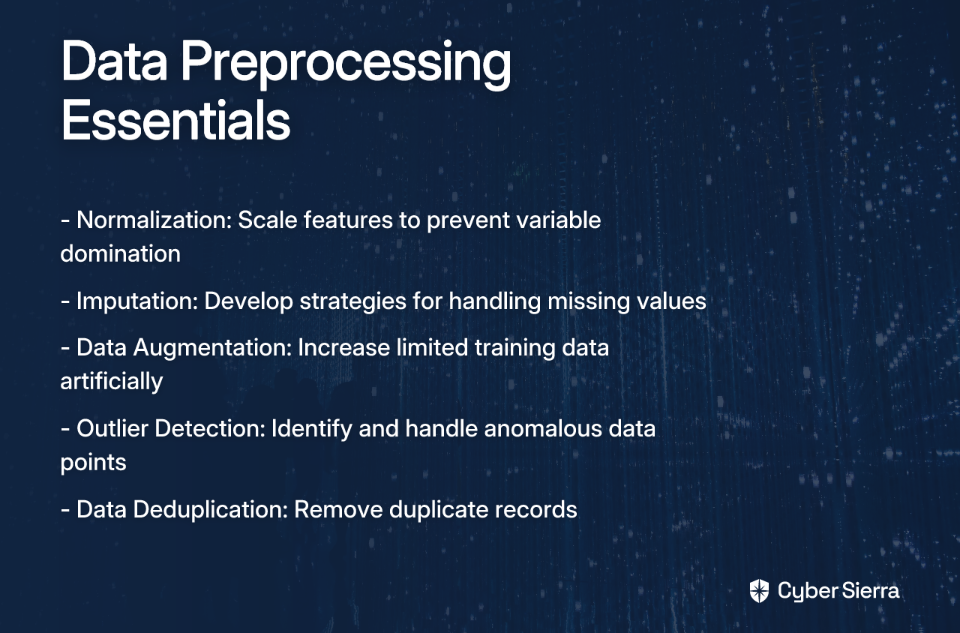
  1. Implement rigorous data preprocessing: Apply these essential techniques to create high-quality training datasets:
    • Normalization: Scale features to a common range to prevent certain variables from dominating the model.
    • Imputation: Develop strategies for handling missing values rather than simply discarding incomplete records.
    • Data Augmentation: For limited datasets, artificially increase training data size using techniques like rotation, scaling, or synthetic data generation.
    • Outlier Detection: Identify and appropriately handle anomalous data points that could skew model training.
    • Data Deduplication: Remove duplicate records that could bias model learning.
  2. Address data fragmentation: Many enterprises struggle with data siloed across different systems and departments. Create a unified data strategy that enables AI systems to access relevant information across organizational boundaries.

The Key Components of Deployment

Deployment is the critical process of integrating a model into a production environment where it can make real-time decisions on live data. A successful deployment architecture includes:

  1. Model Configuration: Define input parameters, output formats, and resource requirements. Ensure the model is configured to handle the volume, velocity, and variety of production data it will encounter.
  2. Data Integration: Establish reliable connections to live data sources, whether databases, APIs, or event streams. This tackles the common challenge of data fragmentation by creating pipelines that bring necessary information to your models.
  3. User Interface Development: Create intuitive dashboards or integrate model outputs into existing systems to make AI insights accessible to end users. Remember that even the most accurate model provides little value if its results aren't easily consumable.
  4. Infrastructure Selection: Choose appropriate deployment infrastructure (cloud, on-premises, or hybrid) based on requirements for latency, security, and scalability. According to Bainsight, this decision significantly impacts both performance and operational costs.

Evaluation and Testing

Before going live, implement rigorous testing protocols to catch issues before they impact users:

  1. Baseline Performance: Establish key metrics that define success for your model, such as accuracy, precision, recall, or business-specific KPIs.
  2. A/B Testing: Compare the AI solution against existing systems or alternative approaches to validate improvements.
  3. Load Testing: Ensure the system can handle expected traffic volumes and peak demands without performance degradation.
  4. Shadow Deployment: Run the model in parallel with existing systems to compare outputs without affecting users or business operations.

By following these practical steps, you create a robust technical foundation for deploying AI systems that can reliably deliver value in production environments.

Building Trust: Why AI Governance is Non-Negotiable

As AI systems take on more consequential roles in enterprise environments, ensuring they're reliable, transparent, and ethically sound isn't just good practice—it's essential for sustainable deployment. This section addresses the critical concerns around bias, reliability, and regulatory compliance that can derail even technically sound AI implementations.

The Imperative for Governance

According to IBM, 80% of business leaders identify AI explainability, ethics, and bias as major roadblocks to adoption. Without addressing these concerns, organizations risk developing AI systems that lose stakeholder trust or create legal and reputational risks.

AI Governance provides a formal framework of processes, standards, and practices to ensure AI systems are used in a reliable, trustworthy, and responsible way. This framework becomes increasingly critical as AI applications impact people's lives and businesses in profound ways.

Core Principles of a Responsible AI Framework

To build AI systems worthy of trust, integrate these principles into your deployment process:

  1. Transparency & Explainability: Users need to understand how and why AI systems reach specific conclusions. Implement explainable AI approaches that provide insights into model decision-making, especially for high-stakes applications. For complex models like deep neural networks, consider tools like SHAP (SHapley Additive exPlanations) or LIME (Local Interpretable Model-agnostic Explanations) that can help explain individual predictions.
  2. Fairness & Bias Control: AI systems can inadvertently perpetuate or amplify existing biases in training data. Implement rigorous testing for bias across protected attributes like race, gender, and age. Tools like Fairlearn can help identify and mitigate unfair outcomes before deployment.
  3. Accountability & Privacy: Establish clear lines of responsibility for AI system outputs and robust data protection measures. Document design choices, training data sources, and testing procedures to create an audit trail that supports accountability.
  4. Compliance: Stay ahead of evolving regulations like the EU AI Act and industry standards such as the US SR-11-7 for banking. Building compliance considerations into your deployment process from the beginning prevents costly retrofitting later.

Involve Diverse Stakeholders

Effective governance requires input from across the organization:

  1. Cross-functional oversight: Include Chief Data Officers, legal and compliance teams, business leaders, data scientists, and IT personnel in governance discussions.
  2. Diverse perspectives: Ensure teams designing and evaluating AI systems reflect diverse backgrounds and viewpoints to identify potential issues that homogeneous groups might miss.
  3. Regular reviews: Establish governance committees that meet regularly to review AI initiatives, address emerging ethical concerns, and ensure alignment with organizational values.

As Informatica emphasizes, governance should be viewed not as a constraint but as an enabler that builds trust and reduces risk, ultimately allowing for more ambitious and impactful AI deployments.

The Journey Doesn't End at Deployment: Monitoring and Iteration

Successful AI implementations recognize that deployment is not the finish line but the beginning of a continuous improvement process. This section addresses the challenges of maintaining AI systems in dynamic real-world environments.

Combatting Data Drift and Model Degradation

One of the most common causes of AI failure in production is data drift—the phenomenon where the statistical properties of input data change over time, causing model performance to degrade. To address this challenge:

  1. Implement continuous monitoring: Track performance metrics, data distributions, and model outputs to detect shifts that could indicate drift.
  2. Establish performance thresholds: Define acceptable boundaries for model performance and set up alerts when metrics fall outside these ranges.
  3. Create automated retraining pipelines: Develop systems that can automatically retrain models when significant drift is detected or on regular schedules.

Practical AI Observability Strategies

AI observability goes beyond basic monitoring to provide deep insights into model behavior and performance. Implement these practical strategies:

  1. Visual dashboards: Create intuitive visualizations of key performance indicators that allow both technical and non-technical stakeholders to understand model health at a glance.
  2. Automated alerts: Configure notifications for anomalous behavior, performance degradation, or data quality issues that require immediate attention.
  3. Audit trails: Maintain comprehensive logs of model inputs, outputs, and decisions to support debugging and compliance requirements.

For those exploring AI observability tools, community recommendations include WandB Weave for visualizing experiments, Evidently AI for monitoring data drift and model quality, and Fiddler.ai for explainability and performance management.

By implementing robust monitoring and iteration processes, organizations can ensure their AI systems continue to deliver value even as business conditions, data patterns, and user needs evolve over time.

Turning AI Potential into Business Reality

Successful enterprise AI deployment rests on four pillars: strategic alignment with business goals, a disciplined technical lifecycle, robust AI governance, and a commitment to continuous monitoring and iteration.

Moving beyond the hype requires a cultural and operational shift that embraces these best practices. By doing so, organizations can navigate the complexities of AI deployment, mitigate risks, and transform AI from a buzzword into a powerful engine for innovation and growth.

The goal isn't just to deploy models but to build reliable, trustworthy, and value-driven AI systems that earn the confidence of users and customers alike. With the right approach, your organization can join the 20% of AI initiatives that successfully bridge the gap between promise and production, delivering tangible business value in an increasingly AI-driven world.

Frequently Asked Questions

What is the most common reason enterprise AI projects fail?

The most common reason enterprise AI projects fail is a lack of alignment with clear business goals. Many technically successful models are never deployed because they don't solve a specific business problem, leading to a lack of stakeholder buy-in and a clear return on investment (ROI).

How can I ensure my AI project delivers real business value?

To ensure your AI project delivers business value, you must start with a strategy that directly connects the AI initiative to specific organizational goals. This involves defining clear objectives, building a business case with tangible ROI metrics (like reduced costs or improved customer satisfaction), and starting with smaller, high-impact projects to prove value and build momentum.

Why is AI governance so important for deployment?

AI governance is critical because it builds the trust necessary for widespread adoption and mitigates significant business risks. A strong governance framework ensures that AI systems are fair, transparent, accountable, and compliant with regulations, addressing key stakeholder concerns about bias, ethics, and reliability that could otherwise halt a project.

What is data drift and how can I prevent it?

Data drift is the phenomenon where the statistical properties of live production data change over time, causing a once-accurate AI model's performance to degrade. You can combat data drift by implementing continuous monitoring systems, setting up alerts for performance degradation, and creating automated pipelines to retrain the model on new data.

What are the essential steps in a practical AI deployment lifecycle?

A practical AI deployment lifecycle includes several essential steps: starting with high-quality data through rigorous preprocessing; configuring the model for a production environment; integrating it with live data sources; developing a user-friendly interface; and conducting thorough testing (like A/B testing and shadow deployment) before going live.

How do you build trust in an AI system?

You build trust in an AI system by making it transparent, fair, and accountable through a robust AI governance framework. This involves implementing explainable AI (XAI) techniques so users understand why a model makes a certain decision, actively testing for and mitigating bias, protecting user privacy, and ensuring there are clear lines of responsibility for the system's outputs.

blog-hero-background-image
Cyber Security

Safe AI: How Enterprises Can Safely Deploy AI

backdrop
Table of Contents

Join thousands of professionals and get the latest insight on Compliance & Cybersecurity.


You've heard the buzz about enterprise AI adoption—it's not just a trend, it's a revolution. With 36% of IT service management professionals already using corporate AI capabilities and an astonishing 66% using free tools like ChatGPT at work, the AI wave is impossible to ignore. But beneath this enthusiasm lurks a troubling reality: as one IT professional bluntly put it, "none of these tools are secure."

Perhaps you've experienced the anxiety yourself. You want to leverage AI's transformative potential, but concerns about data privacy keep you awake at night. What if, as many fear, your vendor is "happily sending whatever data you give them to OpenAI for analysis"? What if your confidential data "could be read by humans at OpenAI, used for AI training purposes, or even show up in a chat conversation with another user"?

The stakes couldn't be higher. For enterprises handling sensitive information, these aren't abstract concerns—they're existential threats to customer trust and regulatory compliance. And standard certifications offer little comfort; as one cybersecurity expert noted, "SOC2 is table stakes, but doesn't really cover model behavior."

Yet despite these legitimate concerns, enterprises can't afford to sit on the sidelines of the AI revolution. The competitive advantages are too significant to ignore. What's needed is not fear-based paralysis, but a structured, proactive approach to deploying AI safely.

This article provides exactly that: a comprehensive playbook for enterprises to deploy AI with confidence, moving beyond vendor promises to establish true, verifiable security and responsibility. We'll explore:

  1. The full landscape of enterprise AI risks
  2. A foundational framework for AI safety
  3. A practical, step-by-step deployment lifecycle
  4. Real-world examples of safe AI implementation

The Landscape of Enterprise AI Risks: Beyond the Hype

Before building a safety strategy, it's crucial to understand the full spectrum of risks enterprises face when deploying AI. These fall into three main categories:

Data, Security, and Compliance Challenges

Data Confidentiality and Privacy concerns top the list for most organizations. The risk that sensitive information could be exposed is real—as one legal professional warned, "you have ZERO promise that those records are kept confidential." This becomes especially problematic for organizations subject to regulations like GDPR and HIPAA, where "They are not HIPAA compliant, even if they say they are" is a common sentiment.

Equally important is the challenge of Data Quality. Poor data quality inevitably leads to inaccurate AI models. Incomplete datasets, inconsistent formats, and biased information are common sources of AI failure, undermining the very value these systems are meant to provide.

Technical & Model-Specific Vulnerabilities

AI systems, particularly Large Language Models (LLMs), present unique security challenges. Unlike traditional software, "the data channel and command channel for LLM are the same, so prompt injection can't be treated like you treat SQL injection." This fundamental architectural difference requires new security approaches.

The "Black Box" problem adds another layer of complexity. Modern AI models, especially deep learning systems, can be difficult to interpret, making it challenging to understand why they make specific decisions. This lack of interpretability undermines trust and creates potential liability issues, particularly in regulated industries.

Organizational and Ethical Challenges

AI Bias represents a significant ethical risk. Biased training data can lead to discriminatory outcomes, potentially exposing organizations to legal liability and reputational damage. This requires fairness-aware algorithms and diverse training data.

Concerns about Impact on the Workforce are also prevalent. However, contrary to popular fears about job displacement, an OECD study of nearly 100 case studies found that job reorganization is more prevalent than job replacement. AI often improves job quality by reducing tedium and increasing worker engagement and physical safety.

Finally, many organizations operate in a Governance Vacuum, lacking the frameworks needed to ensure responsible AI use. Effective governance requires input from AI ethicists, legal experts, and affected communities—a multidisciplinary approach many enterprises have yet to implement.

A Foundational Framework for AI Safety: Robustness, Assurance, and Specification

To address these complex challenges, enterprises need more than a simple checklist—they need a comprehensive framework. The Georgetown Center for Security and Emerging Technology (CSET) offers a powerful structure organized around three core pillars.

At its heart, AI safety research aims to identify the causes of unintended behaviors in machine learning systems and develop tools for safe operation. Unlike traditional software engineering, modern ML systems lack inherent safety guarantees, making this research critical for enterprise adoption.

Pillar 1: Robustness

Robustness ensures systems operate safely and reliably, especially when facing unfamiliar conditions or malicious inputs. This pillar focuses on building models that don't fail unexpectedly when encountering new scenarios or deliberate attacks.

For enterprises, robustness means implementing:

  • Adversarial testing to identify potential vulnerabilities
  • Formal verification of model properties where possible
  • Enhanced monitoring for unusual inputs or behaviors

Robustness is particularly important for mission-critical AI applications where failure could have severe consequences. Without it, your AI systems remain vulnerable to unexpected edge cases and deliberate manipulation.

Pillar 2: Assurance

Assurance ensures that systems are analyzable and understandable by human operators. This addresses the "black box" problem that undermines trust in AI systems.

Key assurance techniques include:

  • Interpretability: Using tools like SHAP (SHapley Additive exPlanations) and LIME (Local Interpretable Model-agnostic Explanations) to understand how models make decisions
  • Explainability: Creating systems that can articulate their reasoning in human-understandable terms
  • Transparency in training data and methodology

For regulated industries like finance and healthcare, assurance isn't just good practice—it's increasingly becoming a regulatory requirement.

Pillar 3: Specification

Specification focuses on aligning a system's behavior with the designer's true intentions, not just its literal programming. This addresses the risk of an AI achieving a goal in an unintended, harmful way.

Specification challenges include:

  • Ensuring AI systems understand implied constraints
  • Preventing reward hacking (optimizing for metrics in ways that violate the spirit of the goal)
  • Balancing multiple, sometimes competing objectives

This pillar is crucial for ensuring AI systems act as true partners in achieving business objectives rather than following instructions in technically correct but practically harmful ways.

The Enterprise Playbook: A Step-by-Step Guide to Safe AI Deployment

With our framework established, let's translate these principles into practical steps through a comprehensive AI deployment lifecycle.

Step 1: Robust Development and Validation

Data quality is paramount for safe AI deployment. Ensure your training data is representative to avoid biased predictions, implement automated data profiling, and conduct regular data audits to identify and address quality issues.

Implement a multi-stage testing approach that goes beyond basic accuracy checks:

  • Unit Testing: Verify individual components function correctly
  • Integration Testing: Ensure different components work together seamlessly
  • Performance Testing: Validate model behavior under various load conditions
  • A/B Testing: Compare model performance against existing solutions with real users

One critical practice often overlooked is establishing clear performance thresholds before deployment. Define in advance what constitutes acceptable performance and what triggers a rollback.

Step 2: Secure Packaging with Containerization and Versioning

Containerization is essential for consistent, secure deployment of AI models. Use lightweight base images to reduce size and attack surface, and implement multi-stage builds to separate the build environment from the runtime environment.

Implement strict versioning for all components:

  • The model itself
  • Training and validation data
  • Code and dependencies
  • Configuration parameters

This comprehensive versioning ensures full reproducibility and traceability—critical capabilities when troubleshooting issues or addressing security concerns.

Step 3: Designing Scalable and Secure Infrastructure

Cloud-native architectures offer significant advantages for AI deployment, including elastic scaling and reduced operational overhead. These architectures have proven their value in real-world scenarios—one retail company handled a 10x traffic increase during a sales event using cloud-native design without service degradation.

Kubernetes has emerged as the industry standard for containerized application orchestration, offering:

  • Automated scaling based on demand
  • Self-healing capabilities that replace failed containers
  • Support for safe deployment strategies like rolling updates and canary deployments

When designing your infrastructure, incorporate security by design:

  • Implement network segmentation to limit the blast radius of potential breaches
  • Use the principle of least privilege for all service accounts
  • Enable encryption for data at rest and in transit

Step 4: Implementing Robust Monitoring and Observability

Effective AI monitoring goes beyond traditional IT metrics to include:

  • Model Performance Metrics: Track accuracy, precision, recall, and other domain-specific metrics
  • Inference Latency & Resource Utilization: Monitor response times and system resource consumption
  • Data Drift: Detect when input data changes significantly from the training data
  • Concept Drift: Identify when the underlying relationships the model learned have changed

For your monitoring stack, tools like Prometheus for metrics collection and Grafana for visualization and alerting have become industry standards, offering robust capabilities for AI-specific monitoring needs.

Step 5: Governance, Continuous Learning, and Ethical Safeguards

Establish automated retraining pipelines for data collection, preprocessing, model retraining, evaluation, and deployment to keep models current and performing optimally.

Implement bias detection and mitigation through regular audits, fairness constraints in model training, and promoting diverse representation in development teams.

Deploy comprehensive data privacy and security controls, including:

  • Data encryption at rest and in transit
  • Granular access controls limiting data visibility
  • Regular security audits to ensure ongoing compliance with regulations like GDPR and HIPAA

One particularly valuable practice, suggested by enterprise users themselves: "Create clear customer data usage policies that allow customers an opt-in choice for their data to be used in AI learning processes, ensuring transparency and trust." This simple step can significantly enhance customer confidence in your AI initiatives.

Learning from the Leaders: Real-World Examples of Safe AI Implementation

Theory becomes more tangible when viewed through the lens of successful real-world implementations. These case studies demonstrate how the principles we've discussed translate into practice.

Finance: JPMorgan Chase's COiN Platform

Application: JPMorgan deployed an AI platform using Document Parsing and Anomaly Detection to analyze complex legal documents and financial agreements.

Safety Approach: The system incorporates multiple validation checks, human-in-the-loop oversight for critical decisions, and strict data access controls to meet financial compliance requirements.

Impact: This approach slashed document review time from 360,000 hours to mere seconds while significantly reducing losses from fraud, all without compromising data security.

Healthcare: IBM Watson & Memorial Sloan Kettering

Application: Their collaboration employs Natural Language Processing (NLP) and Machine Learning to interpret clinical notes and patient data for cancer diagnosis and treatment recommendations.

Safety Approach: The system was designed with robust data de-identification protocols, strict access controls, and continuous validation against established medical guidelines to ensure HIPAA compliance and clinical safety.

Impact: This implementation reduced cancer diagnosis time from weeks to hours while increasing accuracy, demonstrating how safe AI can transform even highly regulated industries.

Manufacturing: Siemens' Smart Factories

Application: Siemens leverages Predictive Maintenance AI systems to foresee equipment failures before they happen across its manufacturing facilities.

Safety Approach: Their implementation includes isolated networks for industrial systems, extensive adversarial testing to ensure reliability, and model interpretability features that allow engineers to understand and validate AI recommendations.

Impact: This approach achieved a 50% reduction in unplanned downtime and a 20% increase in production efficiency while maintaining strict safety standards for critical industrial systems.

Retail: Amazon's Recommendation Engine

Application: Amazon uses Collaborative Filtering and Deep Learning to personalize customer experiences across its vast product catalog.

Safety Approach: Their system incorporates strict data anonymization, granular privacy controls, and continuous monitoring for bias or problematic recommendations.

Impact: This implementation generates an estimated 35% of revenue from personalized recommendations while maintaining customer trust through responsible data practices.

Conclusion: Fostering a Culture of Responsible AI Innovation

Safe AI deployment is not a one-time checklist but a continuous, disciplined process. It requires a holistic commitment to the principles of robustness, assurance, and specification, implemented through a rigorous ML Ops lifecycle.

Success demands more than just technical excellence; it requires fostering "a culture of innovation and openness to change" balanced with a deep commitment to ethical considerations and responsible use. This cultural shift is often the most challenging aspect of safe AI deployment, but also the most important for long-term success.

For organizations just beginning their AI journey, here's perhaps the most valuable advice: Start with small, pilot projects to test AI applications and build expertise before attempting full-scale deployment. These controlled experiments allow you to develop the technical capabilities and governance structures needed for larger initiatives while limiting potential risks.

Enterprises that master this disciplined approach to safe AI deployment will not only avoid the pitfalls that concern so many—data breaches, compliance violations, and ethical missteps—but will also build profound customer trust and unlock a sustainable competitive advantage in the age of AI.

The path to safe AI isn't about limiting innovation; it's about enabling innovation that lasts—creating systems that deliver value while earning the trust of customers, employees, and regulators alike. By embracing the frameworks and practices outlined in this guide, your organization can confidently navigate the AI revolution, harnessing its transformative potential while maintaining the highest standards of security, ethics, and responsibility.

Frequently Asked Questions (FAQ)

What are the biggest risks of deploying AI in an enterprise?

The biggest risks of deploying AI in an enterprise setting fall into three main categories: data confidentiality, security vulnerabilities, and ethical challenges like AI bias. Sensitive company or customer data can be inadvertently exposed, violating regulations like GDPR or HIPAA. AI systems, especially LLMs, also present unique security challenges like prompt injection that differ from traditional software vulnerabilities. Finally, if an AI is trained on biased data, it can produce discriminatory outcomes, leading to legal liability and reputational harm.

How can I ensure my company's data remains private when using AI tools?

You can ensure data privacy by implementing a multi-layered strategy that includes strong data governance, technical controls, and transparent policies. This involves encrypting data both at rest and in transit, using data de-identification or anonymization techniques, and enforcing strict access controls. It's also crucial to choose AI vendors with clear data handling policies or, as the article suggests, create your own policy that gives customers an explicit opt-in choice for how their data is used.

What is a foundational framework for safe AI deployment?

A strong foundational framework for safe AI deployment is built on the three core pillars of Robustness, Assurance, and Specification. Robustness ensures the AI operates reliably, even with unexpected inputs. Assurance makes the AI's decision-making process understandable to human operators, addressing the "black box" problem. Specification ensures the AI's actions align with the true intent behind its goals, preventing it from taking harmful or unintended shortcuts to achieve a programmed objective.

How do I get started with safe AI deployment in my organization?

The best way to start is with small, controlled pilot projects that test specific AI applications in a low-risk environment. This approach allows your organization to build internal expertise, develop the necessary technical skills, and establish governance structures before attempting a full-scale, mission-critical deployment. Starting small helps demonstrate value incrementally, builds confidence, and allows you to learn and adapt your safety practices with limited exposure.

Why is monitoring AI models so important after deployment?

Monitoring is crucial because AI models can degrade in performance over time as the real-world data they encounter changes. This phenomenon, known as "data drift" or "concept drift," can make a once-accurate model unreliable or biased. Continuous monitoring tracks key performance metrics, fairness, and data consistency, alerting you to potential issues so you can retrain or update the model to ensure it remains effective, accurate, and aligned with business goals.

What is the "black box" problem in AI and how can it be addressed?

The "black box" problem refers to the difficulty of understanding how or why complex AI models, like deep learning systems, arrive at a specific decision or prediction. This lack of transparency can undermine trust and make it difficult to troubleshoot errors or biases. It can be addressed through the pillar of Assurance, which uses interpretability techniques and tools (like LIME and SHAP) to explain model behavior, making the AI's reasoning understandable to human experts.

blog-hero-background-image
Cyber Security

How to Track & Report Monthly Cybersecurity Progress

backdrop
Table of Contents

Join thousands of professionals and get the latest insight on Compliance & Cybersecurity.


You've set up a solid cybersecurity program based on the NIST CSF framework. Your team invested countless hours documenting policies, implementing controls, and completing the annual security assessment. But when your CISO asks, "How are we improving month-over-month?" you freeze. Your beautiful annual assessment suddenly feels painfully static and outdated.

Sound familiar? You're not alone.

"The problem we want to solve for is how to show month over month that we're making tangible movement forward in improving our maturity against CSF," lamented one security leader on Reddit. Another admitted, "It's too 'static' for monthly reporting."

This disconnect between annual assessments and the need to demonstrate continuous progress isn't just frustrating—it's a significant blind spot that can impact your organization's security posture and executive confidence in your program.

The Problem with Static Annual Assessments

Traditional cybersecurity maturity assessments provide a valuable snapshot of your security posture at a specific moment in time. However, they come with significant limitations:

  • They quickly become outdated in today's rapidly evolving threat landscape
  • They fail to capture incremental improvements made throughout the year
  • They don't provide the visibility executives need for ongoing decision-making
  • They make it difficult to demonstrate ROI on security investments

A PWC report found that only 22% of CEOs feel their risk exposure data is comprehensive enough for informed decision-making. Similarly, an EY Global Information Security Survey revealed that just 15% of organizations are confident their InfoSec reporting meets board expectations.

The solution? Transform your approach from static annual assessments to dynamic, month-over-month maturity tracking that demonstrates continuous progress against the NIST CSF.

Laying the Foundation with NIST CSF 2.0

Before diving into monthly tracking methodologies, it's essential to establish a solid foundation based on the NIST Cybersecurity Framework (CSF). Some practitioners worry that frameworks like NIST CSF are "overwhelming" or "overkill," but they provide the common language and structure necessary for consistent measurement.

The recent release of NIST CSF 2.0 introduces a comprehensive approach with six core functions:

  1. Govern (GV): The new function focusing on establishing organizational strategy, expectations, and policy
  2. Identify (ID): Understanding and prioritizing cybersecurity risks
  3. Protect (PR): Implementing safeguards to manage identified risks
  4. Detect (DE): Identifying and analyzing cybersecurity incidents
  5. Respond (RS): Containing and managing incidents effectively
  6. Recover (RC): Restoring assets and operations

Remember that CSF is not a rigid set of auditable controls but a flexible framework to "align" with. As one security professional noted on Reddit, "it is a 'framework' that you 'align' with... no one is going to audit you for CSF."

Actionable Step: Define Your Current and Target Profiles

The critical first step in implementing the NIST CSF is defining your Current and Target Profiles:

  • Current Profile: An objective assessment of your existing capabilities against the CSF Functions and Categories. This documents "where you are now" across the NIST CSF maturity tiers.
  • Target Profile: Your desired state of cybersecurity maturity. This defines "where you want to go" and helps prioritize actions to close the gap.

These profiles create the foundation for your monthly tracking by establishing clear start and end points for your maturity journey. They directly address the challenge of receiving unclear direction from management by creating documented goals aligned with business objectives.

Decomposing Epics into Monthly Milestones

With your Current and Target Profiles defined, the next challenge is breaking down your cybersecurity roadmap into trackable monthly milestones. This approach transforms abstract maturity goals into concrete, demonstrable progress that resonates with leadership.

The power of milestones lies in their ability to:

  • Break down daunting annual goals into achievable monthly chunks
  • Provide clarity and direction for security teams
  • Improve efficiency by focusing efforts on specific objectives
  • Foster accountability through clear deadlines
  • Create natural reporting opportunities that showcase progress

How to Break Down a Large Initiative

Let's walk through a practical example of decomposing a strategic cybersecurity initiative into monthly milestones:

Step 1: Identify a Strategic Initiative
Example: "Improve Incident Response CAPABILITIES" to mature the Respond (RS) function from Tier 2 to Tier 3.

Step 2: Decompose into Trackable Milestones

  • Month 1: Finalize and approve the updated Incident Response Plan
  • Month 2: Conduct a tabletop exercise with the IT and security teams based on the new plan
  • Month 3: Procure and implement a new EDR tool for faster threat detection
  • Month 4: Integrate the EDR with the SIEM and train SOC analysts
  • Month 5: Conduct a full-scale breach simulation involving business stakeholders

Step 3: Tie Milestones to Maturity Improvement
Explicitly connect each milestone to specific improvements in your maturity assessment. For example:

  • Completing the tabletop exercise (Month 2) will move our maturity for RS.AN-1 (Incidents are analyzed) from Tier 2 to Tier 3
  • Implementing EDR (Month 3) improves RS.RP-1 (Response plan is executed during or after incidents) from Tier 2 to Tier 3

This granular approach transforms vague aspirations into concrete, measurable progress that can be tracked and reported monthly.

Avoiding Common Pitfalls

When establishing your monthly milestones, be mindful of these common challenges:

Unrealistic Projections: As one security practitioner advised, "be conservative with the projections since the auditors don't always agree on the scoring value of your initiatives." It's better to under-promise and over-deliver, especially when reporting to executives.

Lack of Flexibility: Cybersecurity is dynamic, and priorities may shift in response to emerging threats. Your milestone plan should be adaptable while still maintaining focus on your Target Profile.

Missing the "Why": Each milestone should clearly connect to desired OUTCOMES and business value. As one CISO noted, "highlight why an improvement to a process reduces risk or saves on resources."

Measuring What Matters with Leading Indicators (KPIs)

With your milestones defined, you need meaningful metrics to demonstrate progress. This addresses a common pain point expressed by many security leaders: the "difficulty in separating risk management from maturity metrics."

Effective tracking requires understanding two complementary measurement types:

Maturity Milestones: These track progress on building CAPABILITIES (e.g., "We deployed the EDR tool").

Key Performance Indicators (KPIs) and Key Risk Indicators (KRIs): These measure the effectiveness of those capabilities (e.g., "Our Mean Time to Detect has decreased by 40% since deploying the EDR").

Essential Cybersecurity KPIs to Track Monthly

Based on industry research and practitioner feedback, here are the most valuable metrics to include in your monthly reporting, organized by category:

Incident Response Efficiency

  • Mean Time to Detect (MTTD): Average time between an incident occurring and its discovery
  • Mean Time to Respond (MTTR): Average time between detection and containment
  • Mean Time to Contain (MTTC): Average time between incident identification and containment

Vulnerability Management

  • Patching Cadence: Percentage of critical patches applied within policy timeframes
  • Number of Open Critical Vulnerabilities: Count of unresolved high and critical vulnerabilities
  • Average Age of Vulnerabilities: How long known vulnerabilities remain unresolved

Asset & Access Management

  • Unidentified Devices on Network: Percentage of devices not under management
  • Access Management Metrics: Percentage of privileged accounts with MFA enabled
  • Dormant Account Percentage: Accounts with privileges but no recent activity

Threat Landscape

  • Intrusion Attempts: Number of blocked unauthorized access attempts
  • Phishing Simulation Results: Employee susceptibility to social engineering tests
  • Third-Party Risk Indicators: Security ratings of critical vendors

These metrics provide a balanced view of your security program's effectiveness and can be used to demonstrate improvement over time. Remember that the goal isn't to track every possible metric but to select KPIs that align with your strategic initiatives and resonate with stakeholders.

Crafting a Monthly Report That Resonates with the C-Suite

Now comes the critical challenge: transforming your maturity milestones and KPIs into a compelling monthly report that drives action and demonstrates value. Many security leaders struggle with the question, "How do you tell a story with the data?"

The answer lies in moving beyond a technical data dump to create a narrative that connects security improvements to business outcomes. As one CISO put it, you need to "take them on a journey month to month."

Anatomy of an Effective Monthly Report

1. Executive Summary (One Page)

Start with a concise, visually appealing dashboard that includes:

  • Overall Maturity Score: A spider chart showing Current vs. Target maturity across the 6 CSF functions, with arrows indicating month-over-month change
  • Key Wins This Month: Bullet points listing completed milestones and their impact
  • Top 3 KPIs (Trendlines): Show 3-6 month trends for your most critical metrics
  • Top Risks & Roadblocks: Be transparent about challenges that require leadership attention

The executive summary should answer two questions at a glance: "Are we improving?" and "What does it mean for the business?"

2. Initiative Deep Dive

For each major initiative, include:

  • Current status (On Track, At Risk, Delayed)
  • Milestones completed this month
  • Upcoming milestones
  • Resources required or constraints
  • Maturity impact (current vs. projected)

Use a simple table format that enables quick scanning while providing sufficient detail for interested stakeholders.

3. The "Why It Matters" Section

This crucial section translates technical achievements into business impact. For each completed milestone or significant metric improvement, articulate:

  • Risk reduction quantified when possible
  • Resource savings or efficiencies gained
  • Compliance requirements addressed
  • Competitive advantages created

For example:

"By completing the Incident Response tabletop exercise, we identified a communication gap that could have cost an estimated $250,000 in downtime during a real incident. We have since implemented a new communication protocol at no additional cost, directly reducing financial risk."

This translation of technical wins into business value is what makes security reporting resonate with executive leaders who must allocate limited resources across competing priorities.

Benchmarking for Credibility

While monthly internal reporting provides valuable tracking, complement it with an annual third-party assessment against the NIST CSF or COBIT2019 framework. This independent validation adds credibility through industry benchmarking.

As one security leader shared, "The deliverable was a full report on our maturity in each domain and requirement, and they provided benchmarked averages of the results of their other clients in our line of business. The execs ate it up."

Using a crosswalk engine to map your controls to multiple frameworks can further enhance this approach, demonstrating how your progress translates across NIST CSF, ISO 27001, COBIT2019, and other relevant standards.

Building a Culture of Continuous Improvement

The transformation from static annual assessments to dynamic monthly tracking isn't just a reporting change—it's a cultural shift in how your organization approaches cybersecurity maturity.

By implementing the strategies outlined in this guide, you'll create a framework that:

  1. Aligns security efforts with business objectives through clear Current and Target Profiles
  2. Breaks down overwhelming initiatives into achievable monthly milestones
  3. Measures what matters with both capability-focused and outcome-focused metrics
  4. Communicates progress effectively through compelling, business-focused reporting

This approach transforms cybersecurity from a cost center into a visible business enabler by providing transparent, continuous visibility into your security program's evolution and value.

Remember that cybersecurity maturity is a journey, not a destination. The goal of monthly tracking isn't perfection but continuous improvement that reduces risk while optimizing resources.

Start small by selecting one critical initiative from your risk register, breaking it into monthly milestones with the framework provided, selecting 2-3 relevant KPIs, and building your first dynamic report. As your process matures, expand to cover more initiatives and metrics while maintaining focus on the metrics that matter most to your business.

By implementing this dynamic tracking approach, you'll not only satisfy the executive demand to "show month-over-month that we're making tangible movement forward" but also create a more resilient, responsive security program that evolves alongside your business and the threat landscape.

The days of static, outdated security assessments are over. With these strategies, you'll build a security program that demonstrates continuous progress, adapts to emerging threats, and clearly communicates its value to the business—one month at a time.

Frequently Asked Questions

What is the main problem with only doing annual cybersecurity assessments?

The main problem with annual cybersecurity assessments is that they provide only a static, point-in-time snapshot of your security posture, which quickly becomes outdated and fails to show continuous improvement. In today's fast-evolving threat landscape, an annual assessment doesn't capture the incremental progress your team makes throughout the year. This makes it difficult to demonstrate the ROI of security investments and provide the timely data executives need for ongoing decision-making.

How can I start tracking monthly security progress if my program is new or immature?

The best way to start tracking monthly progress, even with an immature program, is to begin small by focusing on one critical area and establishing clear goals using the NIST CSF. Start by defining a "Current Profile" (where you are now) and a "Target Profile" (where you want to be) for a single high-priority function, like Incident Response. Then, break down the work needed to close that gap into small, achievable monthly milestones. This creates a focused plan and demonstrates tangible progress from the very beginning.

What is the difference between a maturity milestone and a KPI?

A maturity milestone tracks the completion of a specific project or capability, while a Key Performance Indicator (KPI) measures the operational effectiveness or outcome of that capability. For example, completing the implementation of a new EDR tool is a maturity milestone. The resulting 40% decrease in your "Mean Time to Detect" (MTTD) is the KPI. You need both: milestones show you are building the program, and KPIs prove the program is working effectively to reduce risk.

How do I make my monthly security report engaging for executives?

To make your monthly report engaging for executives, you must translate technical data into clear business outcomes and tell a compelling story about risk reduction and value. Start with a one-page executive summary featuring visual aids like spider charts for maturity scores and trendlines for key KPIs. Focus on "Key Wins" and connect every achievement to its business impact—for instance, how a completed milestone reduced financial risk or improved operational efficiency. This shifts the narrative from technical jargon to business value, which is what the C-suite cares about.

Why is NIST CSF a good framework for continuous maturity tracking?

The NIST CSF is an excellent framework for continuous tracking because it is flexible, widely recognized, and provides a common language for defining and measuring cybersecurity maturity across different business functions. Unlike a rigid audit checklist, the CSF allows you to "align" your program based on your organization's specific risks and goals. The framework's structure, especially with the new "Govern" function in CSF 2.0, helps you set a clear strategy, define your Current and Target profiles, and communicate progress consistently.

What if our priorities shift due to a new threat or business need?

A key benefit of a dynamic monthly tracking system is its adaptability; it is designed to accommodate shifts in priorities without derailing your entire security strategy. While your overarching Target Profile provides long-term direction, your monthly milestones can and should be flexible. If a new, urgent threat emerges, you can adjust your upcoming milestones to address it. This agility allows you to be responsive while still tracking progress against your foundational goals, demonstrating to leadership that the security program can pivot effectively when needed.

blog-hero-background-image
Cyber Security

Prioritizing Security Fundamentals Over New Tools

backdrop
Table of Contents

Join thousands of professionals and get the latest insight on Compliance & Cybersecurity.


You've just been handed a generous security budget after months of lobbying. Cybersecurity vendors are flooding your inbox with demos of their latest AI-powered, cloud-native, zero-trust security platforms. Meanwhile, half your Windows servers are running unpatched, default credentials exist on production systems, and your developers still hardcode passwords in scripts. Sound familiar?

In the cybersecurity world, there's an overwhelming pressure to adopt the newest, shiniest tools—each promising to be the silver bullet for your security woes. Yet time and again, major breaches make headlines not because organizations lacked sophisticated tools, but because they overlooked basic security hygiene.

As one security practitioner bluntly put it in a recent forum discussion: "Getting Windows Server 2003 out of production will do more for your security posture than any expensive widget ever could."

What Are Security Fundamentals (And Why They Matter)

Security fundamentals aren't just abstract concepts—they're the bedrock principles and everyday practices that prevent the vast majority of breaches. While they may not sound as exciting as the latest threat hunting platform, they're what actually keeps your organization secure.

The Core Principles (The CIA Triad & Beyond)

At the heart of information security lies a set of timeless principles that have guided the field since its inception:

  • Confidentiality: Ensuring that sensitive data is accessible only to authorized individuals
  • Integrity: Guaranteeing that information remains accurate and unaltered without proper authorization
  • Availability: Making certain that systems and data are accessible when needed by legitimate users
  • Non-repudiation: Preventing anyone from denying actions they've taken (like sending a malicious email)

These principles, often abbreviated as the "CIA Triad" (plus non-repudiation), serve as the north star for any security program, according to EC-Council University. They transcend specific technologies and remain relevant regardless of whether you're securing mainframes or cloud infrastructure.

The Daily Practices (Cyber Hygiene)

The Cybersecurity and Infrastructure Security Agency (CISA) emphasizes that basic cyber hygiene practices prevent the vast majority of security incidents. These practices include:

  • Implementing strong, unique passwords for all accounts
  • Enabling Multi-Factor Authentication (MFA) wherever possible
  • Keeping software and systems updated with security patches
  • Training users to recognize and avoid phishing attempts
  • Maintaining current backups of critical systems and data

These may sound simple, but they're consistently cited in post-breach analyses as the missing controls that could have prevented catastrophic compromises.

The Strategic Mindset (Secure by Design)

Beyond tactical practices, security fundamentals include a strategic approach known as "Secure by Design." This philosophy, championed by CISA, advocates for embedding security into products and systems from their inception, rather than bolting it on afterward.

This mindset shift is crucial because:

  • Security issues identified early in design cost significantly less to fix
  • Systems designed with security in mind have fewer inherent vulnerabilities
  • A secure foundation makes it easier to maintain and enhance security over time

Layering Your Defense (Security Controls)

Effective security requires implementing defense in depth through various control types:

  • Administrative Controls: Policies, procedures, training, and guidelines
  • Physical Controls: Locks, surveillance systems, and access barriers
  • Technical Controls: Firewalls, encryption, access management, and monitoring systems

When properly implemented, these fundamental controls work together to create multiple barriers that attackers must overcome—making security breaches significantly more difficult and time-consuming.

The Shiny Tool Trap: Real-World Limitations

Let's be clear: modern security tools aren't inherently bad. Many offer valuable capabilities for detection, prevention, and response. However, they come with significant limitations that are rarely mentioned in vendor pitches.

The Allure of Automation

Automated security tools promise several compelling benefits:

  • Speed and Efficiency: They can scan thousands of systems in the time it would take a human to examine just a few.
  • Comprehensive Coverage: They can systematically check for a wide range of known vulnerabilities.
  • Cost-Effectiveness: They reduce the need for manual labor on repetitive tasks.

These advantages are real, but they only tell half the story. Let's look at two specific examples that highlight why tools alone aren't enough.

Case Study 1: The Blind Spots of Automated Penetration Testing

Penetration testing tools have become increasingly sophisticated, but they still suffer from critical limitations that only human expertise can overcome.

According to security experts at eMazzanti, automated pentesting tools struggle with:

  • Limited Context Awareness: They can't understand your business logic or the specific ways your applications are used, leading them to miss complex vulnerabilities.
  • Inability to Find Zero-Day Exploits: They're designed to find known vulnerabilities, not novel ones that require creative ethical hacking techniques.
  • High False Positive/Negative Rates: They often flag benign issues as critical while missing genuine vulnerabilities that don't fit their detection patterns.
  • Social Engineering Blindness: They can't assess human-centered risks like an employee's susceptibility to phishing or social engineering attacks.

One security practitioner shared, "I've seen organizations with perfect vulnerability scanner results get completely compromised during a manual pentest because the attacker chained together several 'low-risk' findings that the automated tools deemed insignificant."

Case Study 2: The Gaps in Data Security Posture Management (DSPM)

DSPM tools represent a newer category of security solutions designed to help organizations manage their data security across complex environments. While valuable, they illustrate the classic "shiny tool" problem.

An analysis by Fortanix points out several fundamental limitations:

  • Superficial Encryption Analysis: A DSPM tool might report that data is encrypted, but it often fails to evaluate whether that encryption is actually strong enough or properly implemented.
  • Key Management Blindness: These tools rarely assess whether encryption keys themselves are properly secured. If your keys are compromised, your encryption is worthless—a fundamental security principle these tools often overlook.
  • Environment Complexity: They struggle to maintain consistent visibility across hybrid cloud environments, creating dangerous security blind spots.

The Synergy: Using Fundamentals to Supercharge Your Tools

The solution isn't to abandon modern tools but to approach them with a foundation of security fundamentals. This combination creates a powerful synergy that maximizes the value of both.

The Hybrid Approach to Security Testing

Security experts recommend a hybrid approach that leverages both automated tools and fundamental expertise:

  1. Start with automated tools to quickly identify known vulnerabilities and establish a baseline
  2. Follow with manual testing by professionals who understand fundamental security principles and can identify complex vulnerabilities that tools miss
  3. Use the findings to improve both your tools (through better configuration) and your fundamental practices

This approach, recommended by security practitioners, maximizes the strengths of each method while compensating for their weaknesses.

Escaping the Tool Sprawl Cycle

Many security programs fall into a dangerous pattern:

  1. Buy a tool to solve a problem
  2. Realize the tool doesn't fully solve the problem
  3. Buy another tool to solve the gaps left by the first tool
  4. Repeat until you have too many tools and not enough people to use them effectively

Breaking this cycle requires returning to fundamentals:

  • Prioritize fixing basic security hygiene issues before purchasing new tools
  • Evaluate tools based on how well they support your fundamental security objectives, not on flashy features
  • Invest in staff training on security fundamentals alongside tool implementation
  • Document and standardize basic security processes before automating them

Your Blueprint: A Practical Path to Mastering Security Fundamentals

Many entering the cybersecurity field express frustration over the lack of structured guidance. As one Reddit user lamented, "courses are either expensive or give very little direction," highlighting a common pain point in the industry.

Based on community recommendations, here's a practical learning path to build your security fundamentals:

  1. Master networking (CompTIA Network+ or equivalent): You cannot secure a network you don't understand. Knowing how systems communicate is essential for identifying and addressing security issues.
  2. Build core security knowledge (CompTIA Security+): This certification covers the fundamental security concepts that apply across all environments and technologies.
  3. Learn to script (Python and bash): Scripting skills enable you to automate security tasks, analyze data, and understand how attacks and defenses work at a practical level.
  4. Specialize with this foundation: With these fundamentals in place, you can effectively pursue specialized areas like penetration testing, cloud security, or forensics—and you'll be equipped to evaluate and use any tool you encounter.

Conclusion: Building on Bedrock, Not Sand

In the ever-evolving cybersecurity landscape, tools will come and go, but the fundamental principles of confidentiality, integrity, and availability remain constant. Building your security program on these fundamentals creates a solid foundation that can adapt to new threats and technologies.

As the saying goes in security circles: "A million-dollar security tool deployed on an unpatched system is like installing a state-of-the-art alarm system in a house with the doors left wide open."

The next time a vendor pitches you their revolutionary new security platform, remember to ask yourself: Have we mastered the fundamentals first? Often, the most significant security improvements come not from adding another tool to your arsenal, but from consistently executing the basics well.

After all, as CISA reminds us, every risk we mitigate through fundamental practices contributes to our collective security. In cybersecurity, mastering the basics isn't just cheaper and more effective—it's the difference between security that's real and security that's merely an illusion.

Frequently Asked Questions

What are cybersecurity fundamentals?

Cybersecurity fundamentals are the core principles and practices that form the foundation of a strong security posture. They include timeless principles like the CIA Triad (Confidentiality, Integrity, Availability), essential daily practices known as cyber hygiene (e.g., patching, using MFA, strong passwords), and strategic mindsets like "Secure by Design."

Why focus on security basics instead of advanced AI tools?

Focusing on security basics is more effective because they prevent the vast majority of common cyberattacks. Advanced tools are often ineffective when deployed on a weak foundation; for example, an AI-powered platform cannot protect an unpatched server with default credentials. Mastering the fundamentals ensures your security investments are built on solid ground.

What is the "shiny tool trap" in cybersecurity?

The "shiny tool trap" refers to the tendency for organizations to invest in new, sophisticated security tools in the hope of a quick fix, while neglecting basic security hygiene. This often leads to a cycle of purchasing more tools to cover the gaps left by previous ones, resulting in wasted budget, tool sprawl, and an ineffective security posture.

How can I use security fundamentals to make my existing tools more effective?

You can make tools more effective by using fundamentals to guide their implementation and interpret their results. For example, use automated scanners to find known vulnerabilities (the tool), then apply fundamental principles in manual penetration testing to discover complex, business-logic flaws that tools miss. This hybrid approach maximizes the strengths of both automation and human expertise.

What is the best first step for an organization to improve its security fundamentals?

The best first step is to master basic cyber hygiene. This involves consistently implementing a few high-impact practices across the organization: keeping all software and systems patched, enforcing multi-factor authentication (MFA) wherever possible, eliminating default credentials, and training employees to spot phishing attempts.

blog-hero-background-image
Cyber Security

Secure API Keys in React: A Comprehensive Guide

backdrop
Table of Contents

Join thousands of professionals and get the latest insight on Compliance & Cybersecurity.


You've just finished building a slick React application that needs to connect to a third-party API. You've got your API key and you're ready to integrate it. But then, doubt creeps in: "Wait, how do I actually store this API key securely?"

If you're feeling confused or overwhelmed by contradictory advice online, you're not alone. This topic is genuinely "mind-boggling" for many developers, especially those without experience working alongside security professionals.

Let me clear something up right away: Any code, data, or variable in your React application is downloaded and executed in the user's browser, making it publicly accessible. This fundamental truth is the key to understanding why securing API keys in React requires a specific approach.

The Common Misconception: Why .env Files Are Not a Secret Vault

One of the most widespread misunderstandings in React development is the belief that storing API keys in .env files keeps them secure. Let's address this head-on:

// .env file
REACT_APP_API_KEY=your_very_secret_key

// Your React component
const apiKey = process.env.REACT_APP_API_KEY;
console.log("Making API call with key:", apiKey);

Many developers think that because:

  1. The .env file is included in .gitignore (keeping it out of version control)
  2. The key is accessed through process.env
  3. The original .env file isn't deployed

...that somehow the API key remains hidden from users. This is incorrect.

Here's what actually happens during the build process:

When you run npm run build, your bundler (like Webpack) processes your code and replaces process.env.REACT_APP_API_KEY with the literal string value "your_very_secret_key". This string ends up directly in your JavaScript bundle, which is then downloaded and executed in every user's browser.

Don't believe me? Try building your React app and then examining the minified JavaScript in your build folder. Search for your API key string—you'll find it right there in plain text.

Even the official Create React App documentation warns about this explicitly:

"Warning: Do not store any secrets (like API keys) in your React app! Environment variables are embedded into the build, meaning anyone can view them by inspecting your app's files."

This isn't just a theoretical risk. In 2017, researchers found over 300 Android apps containing hardcoded API keys for services like Dropbox and Twitter, leading to significant security vulnerabilities.

The Professional Solution: The Backend-for-Frontend (BFF) Pattern

So how do "big websites" really secure their API keys? The answer is simple in concept but requires a fundamental architectural change: They never let secret API keys reach the frontend in the first place.

The industry-standard approach is called the Backend-for-Frontend (BFF) pattern, sometimes also referred to as an API Proxy. Here's how it works:

  1. Your React app makes requests to your own backend server, not directly to third-party APIs
  2. Your backend server stores the API keys securely and uses them to make requests to external services
  3. Your backend processes the responses and sends only the necessary data back to your React app

This creates a secure intermediary that shields your sensitive credentials from exposure.

The Secure Data Flow

Let's visualize how data flows in this architecture:

React App                Your Backend Server                 External API
    |                            |                                |
    | Request data               |                                |
    |--------------------------->|                                |
    |                            | Add API key & make request     |
    |                            |------------------------------->|
    |                            |                                |
    |                            |        Return response         |
    |                            |<-------------------------------|
    |                            |                                |
    |    Return processed data   |                                |
    |<---------------------------|                                |

This pattern solves the fundamental security problem by keeping secrets where they belong—on the server, away from curious eyes.

Practical Guide: Building a Simple API Proxy with Node.js & Express

Let's build a basic implementation of this pattern using Node.js and Express for the backend, and a standard React app for the frontend.

1. Setting Up the Backend Server

First, create a new directory for your backend server:

mkdir api-proxy-server
cd api-proxy-server
npm init -y
npm install express axios dotenv cors

Create a .env file in the server directory (and make sure to add it to .gitignore):

# .env (in your server directory)
THIRD_PARTY_API_KEY=your_actual_secret_key_here

Now, create a server.js file:

require('dotenv').config();
const express = require('express');
const axios = require('axios');
const cors = require('cors');

const app = express();
const PORT = process.env.PORT || 3001;

// Use CORS middleware
// In production, restrict this to your frontend's domain:
// app.use(cors({ origin: 'https://your-react-app-domain.com' }));
app.use(cors());

app.get('/api/external-data', async (req, res) => {
  try {
    const apiKey = process.env.THIRD_PARTY_API_KEY;
    const apiURL = `https://api.someexternalprovider.com/data?apiKey=${apiKey}`;
    
    const response = await axios.get(apiURL);
    res.json(response.data);
  } catch (error) {
    console.error('Error proxying API request:', error);
    res.status(500).json({ error: 'Failed to fetch data' });
  }
});

app.listen(PORT, () => console.log(`Proxy server running on port ${PORT}`));

2. Updating the React Frontend

Now, your React components can fetch data without any API keys:

// src/components/DataFetcher.js
import React, { useState, useEffect } from 'react';

function DataFetcher() {
  const [data, setData] = useState(null);
  const [loading, setLoading] = useState(true);
  const [error, setError] = useState(null);

  useEffect(() => {
    // Fetch data from our own backend proxy, not the external API
    fetch('http://localhost:3001/api/external-data')
      .then(response => {
        if (!response.ok) throw new Error('Network response was not ok');
        return response.json();
      })
      .then(data => {
        setData(data);
        setLoading(false);
      })
      .catch(error => {
        console.error('Error fetching data:', error);
        setError(error.message);
        setLoading(false);
      });
  }, []);

  if (loading) return <p>Loading...</p>;
  if (error) return <p>Error: {error}</p>;
  
  return (
    <div>
      <h2>Data from API:</h2>
      <pre>{JSON.stringify(data, null, 2)}</pre>
    </div>
  );
}

export default DataFetcher;

Hardening Your Security: Advanced Best Practices

A basic API proxy is a good start, but for production applications, you'll want to implement additional security measures:

1. User Authentication with JWT

An open proxy endpoint can be abused by anyone who discovers it. Protect your backend by implementing user authentication, typically using JSON Web Tokens (JWT):

// Example of a protected endpoint
app.get('/api/external-data', authenticateToken, async (req, res) => {
  // Only authenticated requests get through
  // ...rest of the code
});

function authenticateToken(req, res, next) {
  const authHeader = req.headers['authorization'];
  const token = authHeader && authHeader.split(' ')[1];
  
  if (token == null) return res.sendStatus(401);
  
  jwt.verify(token, process.env.JWT_SECRET, (err, user) => {
    if (err) return res.sendStatus(403);
    req.user = user;
    next();
  });
}

2. Implementing Strict CORS Policy

In production, always restrict your API to accept requests only from your frontend's domain:

// Strict CORS configuration
app.use(cors({
  origin: 'https://your-frontend-domain.com',
  methods: ['GET', 'POST'],
  allowedHeaders: ['Content-Type', 'Authorization']
}));

This prevents other websites from making requests to your backend. Learn more about CORS on MDN.

3. Adding Rate Limiting

Protect your backend (and your budget) from abuse by implementing rate limiting:

const rateLimit = require('express-rate-limit');

const apiLimiter = rateLimit({
  windowMs: 15 * 60 * 1000, // 15 minutes
  max: 100, // Limit each IP to 100 requests per windowMs
  message: 'Too many requests from this IP, please try again later'
});

// Apply rate limiting to API routes
app.use('/api/', apiLimiter);

4. Managing Secrets in Team Environments

For teams, especially when working with interns or contractors, managing API key access becomes critical. As one developer noted, "The pain in the ass is when you need to rotate these keys," which is why professional teams use dedicated secrets management solutions.

Consider implementing a Secrets Vault like HashiCorp Vault or cloud provider solutions like AWS Secrets Manager or Azure Key Vault. These tools provide:

  • Centralized storage for all your secrets
  • Fine-grained access control (who can access which secrets)
  • Automated key rotation
  • Detailed audit logs

For example, with AWS Secrets Manager, your backend can retrieve secrets programmatically:

const AWS = require('aws-sdk');
const secretsManager = new AWS.SecretsManager();

async function getApiKey() {
  const data = await secretsManager.getSecretValue({ 
    SecretId: 'my-api-key' 
  }).promise();
  
  const secret = JSON.parse(data.SecretString);
  return secret.apiKey;
}

Conclusion: From Confused to Confident

The journey from confusion to confidence in API key security comes down to one fundamental principle: Secret API keys belong on the server, never in the client.

By implementing the Backend-for-Frontend pattern, you're adopting the same approach used by professional development teams worldwide. While it requires setting up and maintaining a backend server, the security benefits are well worth the additional complexity.

To recap:

  1. Never store sensitive API keys in React's environment variables or anywhere in your frontend code
  2. Use a backend server to proxy requests to external APIs, keeping your keys secure
  3. Implement additional security measures like authentication, CORS, and rate limiting
  4. For team environments, consider a dedicated secrets management solution

With these practices in place, you can confidently build React applications that integrate with external APIs without compromising security. The initial learning curve may be steep, but mastering this architectural pattern is a fundamental step toward becoming a security-conscious professional developer.

Remember: in the world of frontend security, the only truly secure secret is one that never reaches the browser in the first place.

For more advanced use cases, consider exploring full-stack frameworks like Next.js that make implementing the BFF pattern more straightforward with their API routes feature.

Frequently Asked Questions (FAQ)

Why can't I just use a .env file to store my API key in React?

You cannot use a .env file for secret API keys in React because environment variables starting with REACT_APP_ are embedded directly into the JavaScript build files. This means the key becomes plain text in the code sent to the user's browser, making it publicly visible to anyone who inspects your app's files. The .env file is only a development convenience; it does not create a secure server-side environment for a client-side application.

What is the most secure way to manage API keys in a React application?

The most secure way to manage API keys is to never expose them to the frontend. Instead, use a backend server that acts as a proxy, often called the Backend-for-Frontend (BFF) pattern. Your React app communicates with your own backend, and your backend securely stores the API key and makes the actual call to the third-party service. This ensures the secret key never leaves your server environment.

Are there any types of API keys that are safe to expose in a React app?

Yes, API keys that are explicitly designated as "public" or "publishable" by the service provider are safe to use in your frontend code. These keys are typically used for services like Google Maps or Stripe.js and are designed to be public. They are often restricted by domain (so they only work on your website) and have limited permissions, preventing them from being used for sensitive operations. Always check the service's documentation to see if a key is publishable.

How does a Backend-for-Frontend (BFF) or API proxy improve security?

A Backend-for-Frontend (BFF) improves security by creating a protective layer between your React application and the third-party API. It prevents secret API keys from ever being sent to the user's browser. Your backend server holds the keys and manages the API calls, so all sensitive credentials remain on the server. Additionally, a BFF allows you to implement other security measures like rate limiting, authentication, and caching before forwarding requests.

What if I don't want to build a whole backend server just for this?

If you don't want to build a full server, you can use serverless functions (like AWS Lambda, Google Cloud Functions, or Vercel/Netlify Functions) as a lightweight API proxy. Serverless functions are small, single-purpose pieces of code that run on-demand in the cloud. They are an excellent, often cost-effective way to implement the BFF pattern without managing a traditional server. Frameworks like Next.js also have built-in API routes that make this process much simpler.

Does this security principle apply to other frontend frameworks like Vue or Angular?

Yes, this principle applies to all client-side JavaScript frameworks, including Vue, Angular, Svelte, and others. The core issue is not specific to React. Any secret, API key, or sensitive data included in the code for a client-side application will be downloaded to the user's browser and can be discovered. The Backend-for-Frontend (BFF) pattern is the standard security solution regardless of the frontend framework you use.

toaster icon

Thank you for reaching out to us!

We will get back to you soon.