blog-hero-background-image
Cyber Security

Cybersecurity for Startups: Avoid Over-Engineering

backdrop
Table of Contents

Join thousands of professionals and get the latest insight on Compliance & Cybersecurity.


You've poured everything into building your startup. Late nights coding, pitch decks, investor meetings—and suddenly, your team discovers sensitive customer data scattered across personal laptops, unencrypted hard drives, and random cloud storage accounts. Your CTO mentions HIPAA compliance and SOC2 certification in passing, and just like that, a wave of panic sets in.

"The lack of cybersecurity measures taken at the beginning is propagating the more we grow and it becomes harder and harder to implement new measure," as one founder recently lamented on Reddit.

This scenario plays out daily in startups worldwide. While you're racing to achieve product-market fit and extend your runway, cybersecurity lurks as a shadowy threat—important but perpetually pushed to "we'll deal with it later."

But here's the sobering reality: 43% of all cyberattacks target small businesses, and a staggering 60% of them shut down within 6 months after an attack, according to research from Sprinto.

The Nuclear Safety Paradox

Think about nuclear power plants. They operate under the most rigorous safety standards imaginable—complex, expensive, and rigid protocols that leave zero room for error. This makes perfect sense when the cost of failure could be catastrophic.

But here's the paradox for startups: applying this same "nuclear-grade" rigidity to your cybersecurity approach can be counterproductive, potentially crippling your ability to innovate rapidly while draining precious resources.

The OECD Nuclear Energy Agency emphasizes that safety and security features must be designed so they "do not adversely affect one another." For a startup, this translates to a critical insight: security must enable business goals, not hinder them.

The solution isn't buying the most expensive security tools or ignoring security altogether. It's about adopting a mindset of "right-sized" security—building a resilient and scalable posture from day one by focusing on foundational principles and practical, high-impact actions.

The Reality for Startups: A Culture of "We'll Fix It Later"

"Our computers don't have an administrator so we can do whatever we want with it."

"I was able at home to work on my personal computer with the code from Gitlab and download the data from Azure."

"The data are all over the place (and not always anonymized)... people have downloaded them on their computer, they are on external hard drive (not encrypted), on local servers, etc..."

These candid admissions from a recent Reddit thread reveal the uncomfortable truth about cybersecurity in many early-stage companies. Most concerning is perhaps this sentiment: "The true situation is that management doesn't care and I didn't manage to make them implement measures."

Why does this happen? According to Black Hat MEA insights, startups must focus on keeping costs low and validating product-market fit. In this high-pressure environment, cybersecurity is often viewed as a non-essential cost center—something to be addressed after achieving stable growth.

The consequence is a mounting "security debt" that compounds over time. Similar to technical debt, security shortcuts taken early become exponentially more difficult and expensive to fix as your company scales. What begins as a simple "we'll encrypt our databases later" decision evolves into a complex web of vulnerabilities entangled with your growing infrastructure.

The "Nuclear Option" vs. Pragmatic, Principled Protection

When startups finally decide to address security, they often swing to one of two extremes:

The "Nuclear Option" (The Over-Engineering Trap)

This approach involves implementing fortress-like security from day one—purchasing expensive, enterprise-grade tools without the expertise to use them effectively, and pursuing complex compliance certifications like ISO27001 or SOC2 type II without understanding the underlying requirements. This path drains cash and slows development to a crawl.

The Pragmatic Approach (Right-Sized Security)

A more intelligent strategy bases security on principles like "Secure by Design" and "Secure by Default," as outlined in the Australian Government's Cybersecurity Principles. This approach prioritizes high-impact, foundational measures that scale with your business.
Case Study in "Good" Over-Engineering: Ben Balter's Home Network

To understand what right-sized security looks like in practice, consider Ben Balter's home network project. While seemingly over-engineered for a home, it demonstrates a principle-driven approach to security that startups can learn from.

Balter had clear goals: enhance privacy, security, block ads, and ensure ease of use. His solution wasn't about buying the most expensive gear but implementing smart architecture using tools like a UniFi Dream Machine, Pi-Hole for ad-blocking, and Cloudflared for DNS over HTTPS.

His use of VLANs for network segmentation is particularly instructive:

NetworkTrustCapabilities
PrimaryFullInternet access and device connection
IoTMinimalInternet access; responds to requests from primary
GuestZeroInternet access only

The key takeaway: This level of detail may seem like overkill for a home network, but it demonstrates a thoughtful, proactive security posture that balances protection with usability—precisely what startups need.

A Scalable Cybersecurity Blueprint for Startups

Foundation 1: Adopt a Framework, Don't Reinvent the Wheel

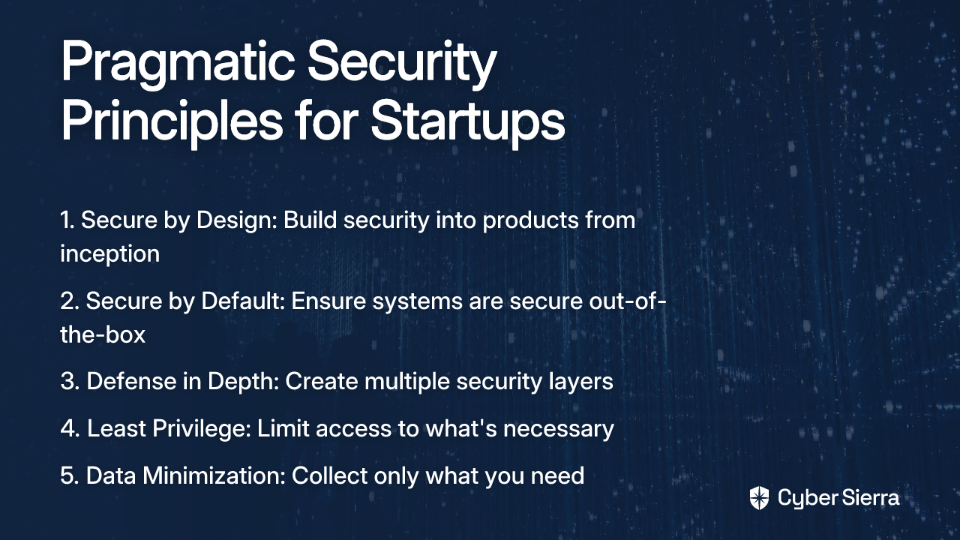
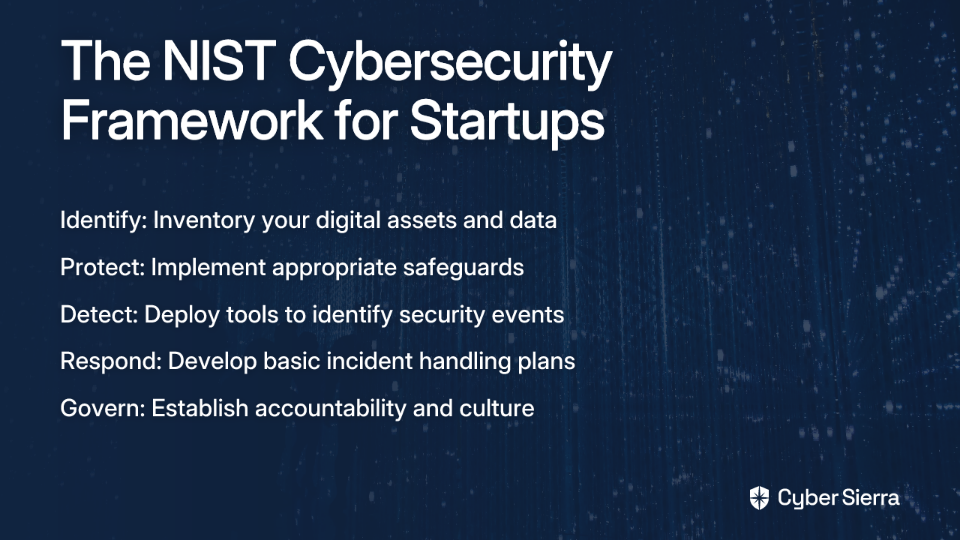
Many startups feel overwhelmed because they're trying to build security from scratch. Instead, adopt an established framework like the NIST Cybersecurity Framework (CSF), which provides a structured approach with five core functions:

  1. Identify: Know what you need to protect
  2. Protect: Implement safeguards
  3. Detect: Identify cybersecurity events
  4. Respond: Take action regarding incidents
  5. Govern: Ensure accountability and a security culture
Foundation 2: Prioritize with the 80/20 Rule - High-Impact First Steps

Start with these high-impact actions that address the majority of common threats:

  1. Start with a Mindset Shift: As one Reddit user advised, treat Personally Identifiable Information (PII) and Protected Health Information (PHI) "like toxic waste." This begins with leadership accountability.
  2. Implement Strong Access Controls: The "quickest fix" recommended by users. Enforce Single Sign-On (SSO) for all applications and make Two-Factor Authentication (2FA) mandatory.
  3. Secure Your Endpoints: Solve the "no administrator" problem. Implement basic endpoint protection software and create policies that enforce device encryption and prevent unauthorized software installation.
  4. Encrypt Sensitive Data: Enforce encryption for data at rest (databases, cloud storage) and in transit (over networks).
  5. Establish a Basic Incident Response Plan: You don't need a 100-page document. Start with a one-pager that answers: Who do you call? What are the first three steps to contain a breach?
  6. Educate Your Team: Acknowledge that employees are a critical part of your defense. Implement basic training on identifying phishing attacks, using strong passwords, and proper data handling.
  7. Patch and Update Religiously: One of the simplest yet most effective measures is keeping all software, servers, and dependencies updated.

Getting Buy-In and Navigating Compliance

Frame Compliance as a Sales Enabler, Not a Burden

Many startups view HIPAA, GDPR, and SOC2 compliance as bureaucratic hurdles. Instead, position them as competitive advantages that unlock enterprise sales and build customer trust.

As one startup employee noted, for clients handling sensitive data, "many orgs are even going to want to see something like SOC2 type II or ISO27001 certification." Getting ahead of these requirements can accelerate your sales cycle.

Making the Business Case to Apathetic Management

To address the "blindness of the management" pain point:

  • Speak in Dollars, Not Jargon: Don't talk about CVEs; talk about business impact. Remind them that almost 60% of small businesses shut down within 6 months after a cyberattack.
  • Quantify the Investment vs. the Risk: Implementing foundational security typically costs between $5,000 to $25,000—a fraction of the potential fines, legal fees, and reputational damage from a breach.
  • Get Help When Needed: If expertise is lacking internally, consider working with a Managed Security Service Provider (MSSP) to handle policy, compliance, and risk assessment.

Build a Resilient, Not a Brittle, Startup

The goal isn't a brittle, over-engineered security system that shatters under the pressure of startup growth. It's a resilient, adaptable security posture where protection and business operations work in harmony.

Start with principles (Secure by Design), adopt a framework (NIST CSF), implement foundational controls (SSO, 2FA, encryption), and foster a security-aware culture from the top down.

Remember what one Reddit user shared after describing their security struggles: "It feels really good to not feel alone in this boat..." The journey of building a secure company is a marathon, not a sprint, and avoiding the over-engineering trap is the first step to finishing the race.

Frequently Asked Questions

Why is cybersecurity so important for startups?

Cybersecurity is crucial for startups because they are prime targets for cyberattacks. A staggering 43% of all cyberattacks target small businesses, and 60% of those businesses fail within six months of an attack. Ignoring security early on creates "security debt," making it exponentially harder and more expensive to fix vulnerabilities as the company grows, risking data breaches, financial loss, and reputational ruin.

What are the first cybersecurity steps a startup should take?

The most effective first steps involve implementing high-impact, foundational controls. Start by enforcing Single Sign-On (SSO) and Two-Factor Authentication (2FA) for all applications, securing endpoints with encryption and management software, encrypting all sensitive data both at rest and in transit, and establishing a basic incident response plan.

How can I convince my leadership to invest in security?

You can convince leadership by framing cybersecurity as a business enabler, not a cost center. Instead of using technical jargon, speak in terms of business impact and financial risk, reminding them that the cost of a data breach far exceeds the investment in foundational security. Highlighting how compliance certifications like SOC2 can unlock enterprise sales deals also helps make a compelling business case.

What is the difference between "right-sized" security and over-engineering?

"Right-sized" security focuses on implementing practical, principle-based protections that scale with your startup, like the NIST Cybersecurity Framework. In contrast, over-engineering involves adopting expensive, complex enterprise-grade tools and certifications prematurely, which can drain resources and slow down innovation without providing proportional benefits. The goal is to be resilient and adaptable, not rigid.

When should a startup start thinking about compliance like SOC2?

A startup should begin thinking about compliance as soon as they start handling sensitive customer data, especially if they plan to sell to enterprise clients. While you may not need to achieve full certification immediately, building your systems with compliance frameworks like SOC2 or HIPAA in mind from the beginning will make the eventual audit process much smoother and can serve as a significant competitive advantage.

What is security debt?

Security debt is the implied cost of rework caused by choosing easy, limited security solutions now instead of using a better approach that would take longer. Much like technical debt, every security shortcut taken in the early stages—such as not encrypting databases or allowing weak access controls—compounds over time, becoming exponentially more complex and expensive to fix as your startup scales.

blog-hero-background-image
Cyber Security

Startup Data Classification for DLP Success

backdrop
Table of Contents

Join thousands of professionals and get the latest insight on Compliance & Cybersecurity.


You've set up your startup, built an impressive product, and are starting to handle significant amounts of data. Now, your CTO or CISO is pushing to implement a Data Loss Prevention (DLP) solution to protect that valuable information. The problem? Your data is "impossible to track," scattered across various cloud services, with "little if any permissions on it." Sound familiar?

As one frustrated tech leader put it on Reddit, "My senior management thinks it is [easy to implement DLP]," but the reality is far more complex when you've never classified your data before. What you're facing isn't just a technical challenge—it's a foundational gap in your security strategy.

What is Data Classification (And Why Should Your Startup Care?)

Data classification is the process of organizing your information into relevant categories based on sensitivity, business value, and compliance requirements. Think of it as creating a digital hierarchy for your data assets, with clear labels that determine how they should be handled, shared, and protected.

Why is this critical for your DLP strategy? Because you can't protect what you don't understand. A DLP solution without proper classification is like a security guard with no instructions on what to protect—it either lets everything through or blocks everything indiscriminately.

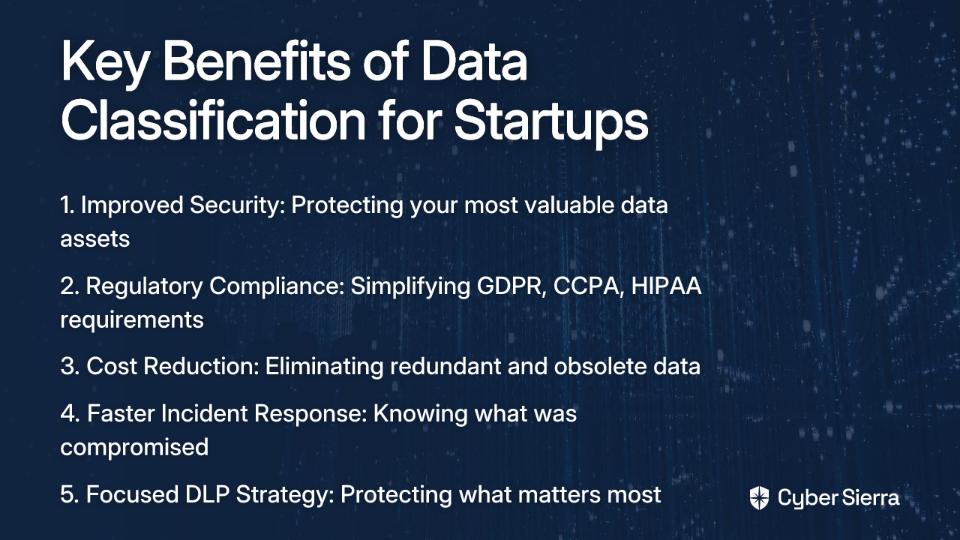
This fundamental connection between classification and DLP delivers several essential benefits for startups:

  • Improved Data Security: By identifying your "crown jewels"—intellectual property, customer PII, financial records—you can focus your limited security resources on what truly matters.
  • Regulatory Compliance: With laws like GDPR, CCPA, HIPAA, and PCI DSS affecting even early-stage startups, knowing exactly where your regulated data resides makes compliance manageable rather than overwhelming.
  • Reduced Costs: Proper classification helps identify redundant, obsolete, and trivial (ROT) data, reducing unnecessary storage and backup costs—a crucial consideration for budget-conscious startups.
  • Efficient Incident Response: If a breach occurs, knowing immediately what data was potentially compromised allows for faster, more targeted remediation.

Before Lines of Code: Getting the People and Policy Right

As one cybersecurity professional wisely observed, "I see everyone jumping to technical solutions but this is not how you should start." Data classification is fundamentally a data governance challenge before it's an IT issue.

Step Zero: Get Stakeholder Buy-In

The biggest hurdle isn't technical—it's "getting buy-in from senior management." To overcome this:

  • Don't frame data classification as a security cost center. Frame it as risk management.
  • Ask leadership the pointed question: "What will data spillage actually cost you?" Quantify the potential impact in terms of regulatory fines, reputation damage, and competitive disadvantage.
  • Involve key stakeholders from various departments (legal, HR, operations, finance) from the very beginning. This creates shared ownership and provides the business context needed for effective classification.

The Cornerstone: Your Information Classification Policy

This is the single most important starting point. As recommended by experienced practitioners, your policy must be "endorsed and signed off by the board" and should clearly define:

  • Classification Levels: Start simple with 3-4 tiers (e.g., Public, Internal, Confidential, Restricted)
  • Data Handling Rules: Specify what you can and can't do with each level (sharing restrictions, encryption requirements)
  • Roles and Responsibilities: Assign a data owner or data steward for key data sets (e.g., the head of HR owns employee data)
  • Consequences: Outline what happens when policy isn't followed

A Practical 4-Step Framework for Classifying Your Data

Now that you understand the importance of classification and have laid the groundwork with stakeholders, let's move to a practical framework for implementation.

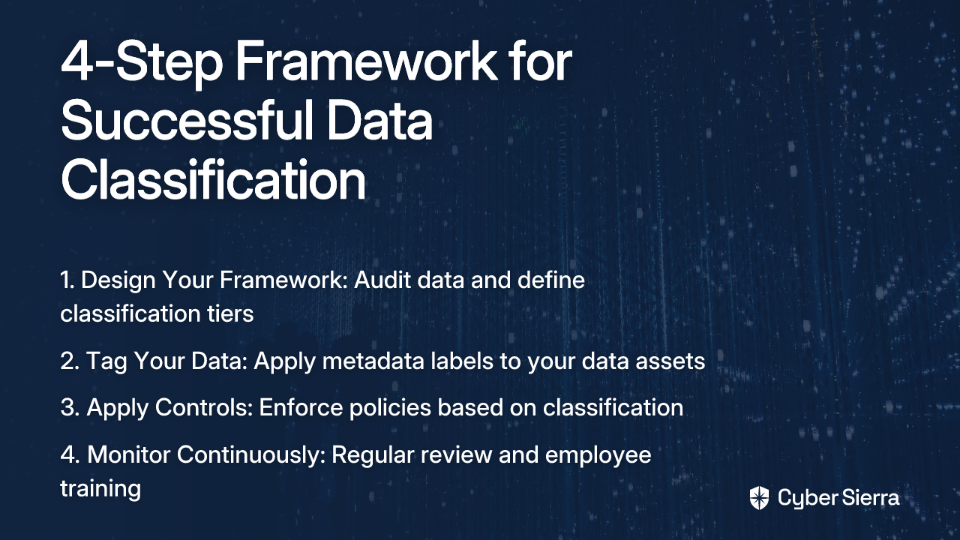
Step 1: Design Your Data Classification Framework

Before classifying anything, you need to know what you have and how to categorize it:

  1. Conduct a Data Audit: Identify your data assets, where they live, and whether they are structured data (in databases) or unstructured data (in documents, emails).
  2. Define Your Classification Tiers: For most startups, a simple three-tier model works well:
    • Public: Information intended for public consumption (marketing materials, public website content)
    • Internal: Data for company use only, where unauthorized disclosure would cause minimal harm (internal memos, operational documents)
    • Confidential: Sensitive data requiring strict controls (financial records, employee PII, source code, business strategy)
  3. Define Protection Controls: For each tier, specify the required security controls. For example, Confidential data must be encrypted and access restricted via RBAC (Role-Based Access Control).

As AWS recommends for cloud-native startups, this could mean using separate AWS accounts per sensitivity level or implementing strict IAM policies for different data classifications.

Step 2: Tag Your Data

Tagging is the process of applying metadata labels to your data assets according to your classification framework. You have several approaches:

  • User-based Classification: Employees manually apply tags. This requires training but leverages their business context.
  • Content-based Classification: Automated tools inspect file contents for sensitive patterns like credit card numbers or social security numbers.
  • Context-based Classification: Uses metadata like creation date, storage location, or creator's role as indicators of sensitivity.

For startups with limited resources, start with manual classification of your most critical data repositories. As you grow, consider tools like Microsoft Purview for Microsoft 365 environments or AWS Macie for AWS users, which use machine learning to automate the process.

Step 3: Apply Controls and Manage Your Data Lifecycle

Once your data is tagged, it's time to make those classifications actionable:

  1. Enforce Policies: Use your tags to automate security. For example, create DLP rules that block any document tagged as Confidential from being sent to external email addresses.
  2. Redact Sensitive Data: When possible, don't just protect sensitive data—remove it where it's not needed. Use tools to automatically find and redact PII from documents or datasets.
  3. Tackle the "Mountain of Old Data": This is a major pain point for many organizations. Establish a formal data lifecycle management policy with clear retention procedures. As one cybersecurity professional bluntly put it: "Anything over three years old should get torched unless the document owner provides a decent business justification for its existence."

Step 4: Monitor, Review, and Train Continuously

Data classification is not a one-time project—it's an ongoing program:

  1. Monitor for Compliance: Use tools to continuously check that your policies are being enforced. Cloud users can leverage services like AWS Config to automatically verify that sensitive data repositories maintain proper encryption and access controls.
  2. Validate and Review: Regularly audit your classification outcomes. Is data being tagged correctly? Are your policies still aligned with business needs?
  3. Train Your Team: User awareness is crucial. Conduct regular training sessions on the data classification policy and proper data handling. As noted by Securiti.ai, this training is essential for fostering a security-conscious culture.

From Classification Chaos to Confident Data Protection

Implementing data classification might feel like a "herculean task" when you're starting from scratch, but remember that perfect is the enemy of good. For startups, the key is to:

  1. Start with a clear, board-approved Information Classification policy
  2. Focus first on your most sensitive and valuable data
  3. Begin with manual classification if needed, then gradually introduce automation
  4. Make data classification part of your company culture from day one

By taking these practical first steps, you'll build the essential foundation for an effective DLP strategy. More importantly, you'll foster a data-aware culture that scales with your startup's growth, preventing the accumulation of unmanaged, unclassified data that plagues more established companies.

Remember: A successful DLP strategy isn't about having the most sophisticated technical solution—it's about having a clear understanding of what data matters most to your business and ensuring it's properly identified, classified, and protected. Start with classification, and the rest will follow.

Frequently Asked Questions

What is the very first step to implementing data classification?

The very first step is not technical; it's creating an Information Classification Policy and securing buy-in from senior management. Before any data is tagged or tools are purchased, your organization must agree on what constitutes sensitive data, define clear classification levels (e.g., Public, Internal, Confidential), and assign ownership, ensuring the policy is endorsed by leadership.

How does data classification directly improve a Data Loss Prevention (DLP) solution?

Data classification directly improves a DLP solution by providing the necessary context to make intelligent decisions. An effective DLP tool relies on classification tags to understand which data is sensitive and requires protection. Without classification, a DLP system is essentially blind, leading to either missed threats (false negatives) or blocking legitimate business activities (false positives).

What is the best way for a startup to handle a massive amount of old, unclassified data?

The best way is to prioritize and not attempt to classify everything at once. Start by identifying your most critical data assets—your "crown jewels"—such as intellectual property, customer PII, and financial records. For the rest, establish a data retention policy to systematically and defensibly delete redundant, obsolete, and trivial (ROT) data that no longer has business value.

What are the most common data classification levels for a startup?

Most startups can begin with a simple and effective three-tier classification model:

  • Public: Information cleared for public release (e.g., marketing content).
  • Internal: Data for company-wide use where unauthorized access would cause minimal harm (e.g., internal memos).
  • Confidential/Restricted: Highly sensitive data that requires strict access controls and could cause significant damage if disclosed (e.g., source code, financial data, customer PII).

What tools can help with data classification?

While policy and process come first, several tools can automate classification once your framework is established. For cloud-native startups, common choices include AWS Macie for data in AWS and Microsoft Purview for Microsoft 365 environments. These tools use machine learning to identify and tag sensitive information, but they are most effective when guided by a well-defined classification policy.

Who is ultimately responsible for classifying data in a company?

Data classification is a shared responsibility, but it is typically led by designated "data owners" or "data stewards." While senior leadership is responsible for endorsing the policy and providing resources, data owners—usually department heads or senior managers—are responsible for the data within their domain (e.g., the Head of HR owns employee data). All employees are responsible for handling data according to the established policy.

blog-hero-background-image
Cyber Security

How Digital Transformation Impacts Cybersecurity and Risk Postures in Organizations

backdrop
Table of Contents

Join thousands of professionals and get the latest insight on Compliance & Cybersecurity.


You've implemented cutting-edge cloud solutions, deployed AI across business units, and proudly announced your digital transformation initiative. Yet, when examining your operations closely, you discover employees still hand-keying values into Excel spreadsheets, using Word documents to track client interactions, and creating unorganized folders with inconsistent naming conventions. Meanwhile, your cybersecurity team is raising alarming concerns about expanded vulnerabilities that nobody anticipated.

If this scenario feels familiar, you're not alone. While approximately 90% of organizations are engaged in some form of digital transformation, many are discovering that the journey is far more complex—and potentially hazardous—than the buzzword suggests.

The Double-Edged Sword: Innovation vs. Exposure

Digital transformation isn't merely about "going paperless" or implementing new software. It represents a fundamental rewiring of an organization aimed at creating value through the continuous deployment of technology at scale. When executed properly, this transformation delivers remarkable results.

Consider Freeport-McMoRan, which leveraged AI in operational processes to enhance copper output, or Montgomery County's transition from physical products to scalable digital services with its "Monty Chatbot," empowering employees with real-time data. These success stories demonstrate how digital transformation can break down organizational silos, foster cross-functional collaboration, and create entirely new value streams.

However, there's a darker side to this innovation. The same technologies that drive business advancement also dramatically expand an organization's attack surface and reshape its risk profile.

A sobering Ponemon study found that 82% of IT security and C-level executives experienced at least one data breach while implementing new technologies, particularly during supply chain expansions. This statistic validates the fears expressed by many who've witnessed organizations paying "millions in ransom" after security incidents.

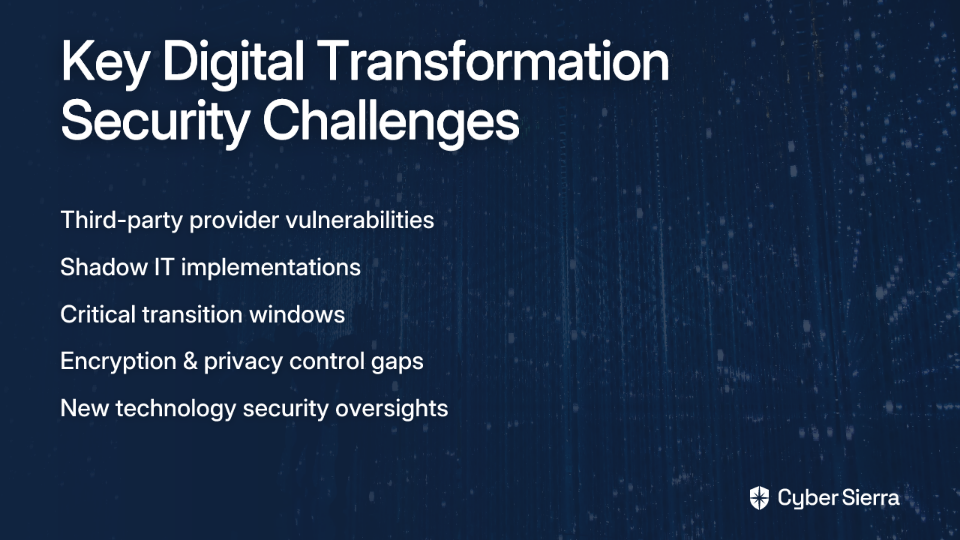
This expanded vulnerability landscape stems from several key factors:

Third-Party Risks

Organizations increasingly rely on third-party providers for cloud services, IoT devices, and other critical infrastructure components. Each new partner introduces potential vulnerabilities through heightened data exposure. The rise of Shadow IT, where departments adopt services without IT approval, further complicates risk assessments.

Technology Transitions

Simple-sounding changes like migrating applications, converting database formats, or moving to the cloud create critical windows of vulnerability. During these transitions, careful attention must be paid to encryption methods, privacy controls, and identity management choices.

New Technology Adoption

While AI, IoT, and 5G offer tremendous business value, they must be implemented with security as a primary consideration, not an afterthought. This includes fundamentals like changing default passwords and ensuring timely patching—basics that are often overlooked in the rush to deploy innovative technologies.

As one frustrated consultant noted on an online forum, "After they were hacked and extorted, paying out millions in ransom... they still questioned why developers shouldn't have workstations on the production network." This anecdote illustrates how security fundamentals can be sacrificed at the altar of rapid transformation.

Recalibrating Your Defense: Understanding the New Risk Posture

To navigate the complexities of digital transformation securely, organizations must first understand their evolving "risk posture"—the status of the overall cybersecurity program and strategy for managing cyber risk. This involves identifying, evaluating, and mitigating threats across the entire infrastructure.

A strong, well-understood risk posture helps organizations allocate resources efficiently, prioritize security tasks, and build confidence among stakeholders. But in the context of digital transformation, traditional approaches to risk assessment often fall short.

Essential Components of a Modern Risk Assessment

Looking Beyond Your Four Walls

Legacy security approaches focused primarily on perimeter defense. Today's interconnected business models require organizations to assess vendors' security practices and establish contracts that align with their own security standards. When third-party providers have access to your systems and data, their security weaknesses become yours.

Acknowledging Residual Risk

Risk can never be eliminated entirely. The goal is to understand and manage the level of risk that remains after all mitigation measures have been applied. This requires continuous monitoring rather than point-in-time assessments.

Making Assessment Continuous

Risk posture assessments must evolve from annual compliance exercises to regular, ongoing evaluations that identify new vulnerabilities as they emerge. This allows for the implementation of controls that fit the organization's evolving risk appetite.

A Strategic Framework for Secure Digital Transformation

To balance innovation with security, organizations need a comprehensive approach that addresses people, process, and technology dimensions. Here's a strategic framework for embedding security into digital transformation:

Pillar 1: Integrate Security from the Start (Strategy & Leadership)

CEO-Led Initiative

Successful transformations must be prioritized by the CEO to ensure alignment and progress. The Chief Risk Officer (CRO) must also be involved from the beginning to integrate risk management practices into the transformation roadmap.

Bridge the C-Suite/IT Divide

Acknowledge the tension between security-focused IT leaders and growth-focused executives. CISOs must transform their roles from "blockers" to "enablers" who communicate risk in business terms and promote a risk-aware culture across the enterprise.

The value of this strategic alignment is backed by research. A study found a statistically significant impact of digital transformation on cybersecurity effectiveness. Improvements in telecommunications infrastructure (t = 3.314, p = 0.045) and access to online services (t = 5.266, p = 0.013) directly enhance an organization's ability to manage a cyber crisis. This demonstrates that strategic tech investment pays off in resilience.

Pillar 2: Fortify Your People and Processes (Culture & Training)

Focus on the Human Element

Digital transformation affects people, processes, and technology. While technology is often the easiest to change, people and processes require a concerted effort. As one consultant lamented, getting "everyone on board and having a clear roadmap" remains a significant challenge.

Foster a Security-First Mindset

Cultivate a culture of security awareness through continuous employee training, ensuring everyone understands their role in maintaining cybersecurity. When staff members understand the "why" behind security protocols, they're less likely to view them as unnecessary obstacles.
Integrate Security into Core Processes

Cybersecurity processes must be woven into operational changes. This includes adapting and training staff on:

  • Access controls
  • Incident response plans
  • Backup and recovery strategies
  • Vulnerability management
  • Change management

Pillar 3: Implement Robust and Modern Technical Controls (Technology)

Establish Foundational Controls

Implement robust security measures like firewalls, encryption, and strict access controls that correspond to identified vulnerabilities. When one consultant suggested basic file naming conventions, clients were "positively amazed"—showing how even fundamental practices can make a difference.
Leverage AI for Defense

Use AI and machine learning not just for business innovation, but also for security. These tools can identify anomalies in data or network traffic that could indicate a breach, automating threat detection and response.

Secure the Cloud

With the increase in remote work and cloud computing, protecting cloud applications and infrastructure must be a top priority. This includes addressing misconfigurations, improper access controls, and data protection challenges unique to cloud environments.

Embracing a Future of Continuous, Secure Transformation

Digital transformation is not a destination but a journey that executives will likely be on throughout their careers as technology evolves. The most successful organizations recognize that security and transformation are not opposing forces but two sides of the same coin.

Success requires a resilient, innovative, and cooperative approach to counter cyber threats. Organizations must adopt a systematic approach to managing cybersecurity risks that includes collaboration at all levels, from the board room to the front lines.

To truly succeed, companies must move beyond the ad-hoc, outdated processes that cause so much frustration and risk. By embedding security into the fabric of transformation, organizations can not only deepen their resilience against emerging threats but also fully capitalize on the immense potential of a digital-first world.

The path forward may be challenging, but the rewards—enhanced operational efficiency, improved customer experiences, and sustainable competitive advantage—make it a journey worth taking, securely.

Frequently Asked Questions

What is digital transformation?

Digital transformation is the fundamental rewiring of an organization's people, processes, and technology to create new value and improve business outcomes. It goes beyond simply adopting new software; it involves continuously deploying technology at scale to break down silos, foster collaboration, and innovate.

Why does digital transformation increase cybersecurity risks?

Digital transformation increases cybersecurity risks primarily by expanding an organization's attack surface. This happens through greater reliance on third-party providers, vulnerabilities created during technology transitions (like cloud migration), and the rapid adoption of new technologies like AI and IoT without first addressing security fundamentals.

How can a business implement digital transformation securely?

A business can implement digital transformation securely by integrating security into its strategy from the very beginning. This involves a three-pronged approach: 1) Gaining CEO-led support and bridging the gap between IT and executive leadership. 2) Cultivating a security-first culture through employee training and embedding security into core processes. 3) Implementing robust technical controls, such as securing the cloud and using AI for defense.

What is a risk posture in cybersecurity?

A risk posture refers to the overall status of an organization's cybersecurity program and its strategy for managing cyber threats. In the context of digital transformation, a strong risk posture requires a modern approach that looks beyond internal defenses to include third-party vendor security and involves continuous, ongoing risk assessments rather than infrequent checks.

Who is responsible for ensuring security during digital transformation?

Security during digital transformation is a shared responsibility led from the top, not just an IT department task. The CEO must champion the initiative to ensure alignment across the organization. The Chief Risk Officer (CRO) and CISO are critical for integrating risk management, but a security-first mindset must be fostered across all employees to be truly effective.

Can all cybersecurity risks be eliminated during digital transformation?

No, it is impossible to eliminate all cybersecurity risks. The goal of a secure transformation is to manage risk down to an acceptable level, known as residual risk. This involves understanding the threats that remain after all security controls are in place and using continuous monitoring to identify and mitigate new vulnerabilities as they emerge.

blog-hero-background-image
Cyber Security

A CISO's Guide to Country-Level Access Policies

backdrop
Table of Contents

Join thousands of professionals and get the latest insight on Compliance & Cybersecurity.


You've carefully set up geolocation blocking to protect your organization's data, using conditional access policies to restrict access from high-risk countries. Then suddenly, your CEO calls from an overseas business trip, unable to access critical systems, and you're scrambling to create an exception while balancing security and business continuity.

This scenario plays out in organizations worldwide, creating friction between security teams and users, while potentially introducing dangerous security gaps. Managing country-level access effectively requires more than just blocking a list of "problematic countries" – it demands a comprehensive strategy that balances compliance, security, and business needs.

The Strategic Foundation: Default-Deny or Default-Allow?

Before implementing any country-level access policy, CISOs must make a fundamental philosophical choice that will shape their entire approach: default-deny (whitelisting) or default-allow (blacklisting).

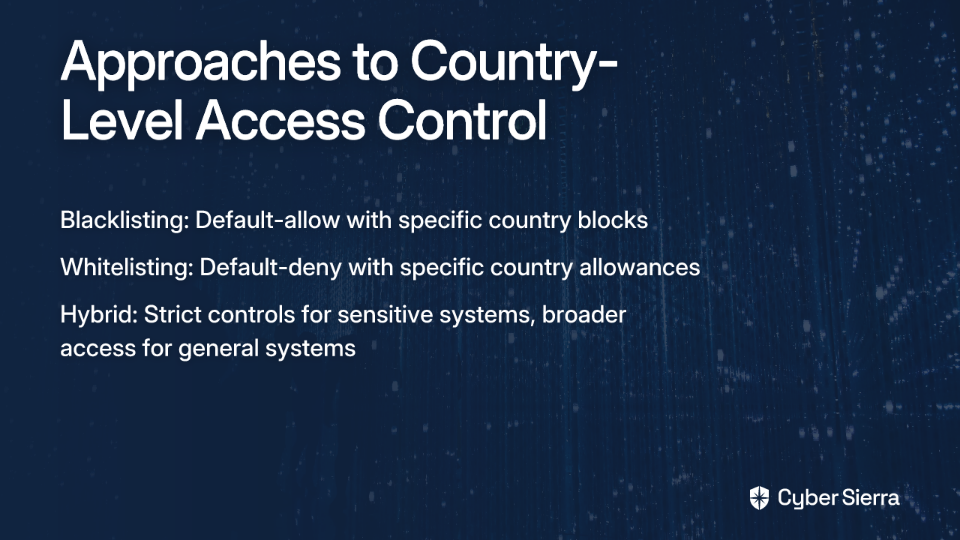
Blacklisting (Default-Allow)

With blacklisting, you deny access to a specific list of countries deemed high-risk, while allowing access from all others by default. This approach:

  • Is relatively easy to implement and causes minimal business disruption
  • Requires less upfront planning and coordination
  • Places the burden on security teams to identify and block all potential threats

However, this approach inherently leaves your organization vulnerable to threats originating from countries not yet on your blocklist, creating a perpetual game of catch-up against evolving threats.

Whitelisting (Default-Deny)

The alternative is whitelisting, or a default-deny strategy, where access is blocked from all countries except those explicitly approved. This approach:

  • Drastically reduces your attack surface by limiting access to only necessary regions
  • Aligns with Zero Trust principles where access is denied by default
  • Provides stronger protection against emerging threats from unexpected locations

The tradeoff is increased operational complexity and potential business disruption if not carefully planned and communicated.

Recommendation: A Layered Approach

For most organizations, a hybrid approach works best:

  1. Apply a strict whitelisting strategy to your most sensitive systems and privileged accounts
  2. Use a robust blacklisting approach for less sensitive, generally accessible systems
  3. Ensure both layers are informed by compliance requirements and threat intelligence

The Compliance Layer: OFAC and Beyond

A solid country-level access policy must start with regulatory compliance as its foundation. For US organizations (and many international companies with US connections), this means integrating the Office of Foreign Assets Control (OFAC) sanctions list.

Understanding OFAC's Role in Your Access Policies

Many security professionals express frustration over maintaining updated OFAC country lists for their access policies. The reality is that OFAC doesn't maintain a simple static "list of embargoed countries" – it's more complex than that.

OFAC administers various sanctions programs, some comprehensive (blocking an entire country) and others selective (targeting specific individuals, entities, or activities). For your country-level access policy to be compliant, you need to:

  1. Use the OFAC Sanctions List Service (SLS) as your authoritative source
  2. Focus on comprehensively sanctioned jurisdictions including Cuba, Iran, North Korea, Syria, and specific regions of Ukraine
  3. Automate the integration of these lists rather than maintaining them manually

Beyond OFAC: Additional Compliance Considerations

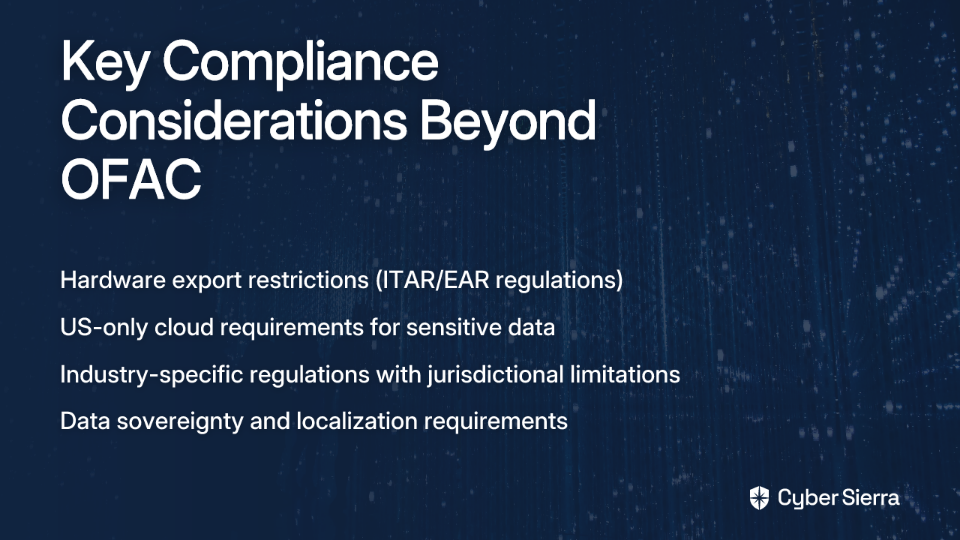
While OFAC provides a baseline, a comprehensive policy should also incorporate:

  • Hardware export restrictions: Certain devices with sensitive technologies may be subject to additional controls under ITAR or EAR regulations
  • US only cloud requirements for certain data types or government contracts
  • Industry-specific regulations that may restrict data processing in certain jurisdictions

The Intelligence Layer: Beyond Static Lists

Compliance alone is insufficient. Sophisticated attacks often originate from trusted countries using compromised infrastructure. To build a robust country-level access policy, integrate threat intelligence to identify:

  • Countries with disproportionate sources of automatic attacks
  • IP ranges associated with state-sponsored threat actors
  • Regions showing unusual login patterns for your specific organization

Modern security platforms like Microsoft Entra ID and similar solutions use machine learning to identify suspicious logins based on location anomalies, even when they come from allowed countries. This adds a dynamic layer to your static country-level policies.

From Geo-Blocking to Geo-Fencing

Rather than simply blocking "bad" countries, create a comprehensive geo-fencing strategy that combines:

  1. Location-based access controls (denying or allowing access based on country)
  2. Behavioral analytics (identifying suspicious patterns regardless of location)
  3. Risk-based conditional access (requiring additional authentication for unusual locations)

This multi-layered approach provides defense in depth against both known and emerging threats.

Practical Implementation: Building Your Policy

Let's translate these principles into actionable steps using Microsoft Entra ID (formerly Azure AD) as an example platform, though similar concepts apply across other security solutions.

Step 1: Create Named Locations for Access Control

  1. Sign in to the Microsoft Entra admin center with appropriate privileges
  2. Navigate to Conditional Access > Named locations
  3. Create locations for both allowed and blocked countries based on your strategy
  4. Consider creating separate location groups for different risk levels (e.g., "High Risk Countries," "Business Operations Countries")

Step 2: Implement Your Conditional Access Policy

  1. Navigate to Conditional Access > Policies
  2. Create a new policy with a clear name (e.g., "Block Access from Unauthorized Countries")
  3. Target appropriate users and cloud apps
  4. Configure location conditions based on your named locations
  5. Set the access control to block non-compliant attempts
  6. Always test in "Report-only" mode before enforcing

Step 3: Establish Exception Processes

One of the most common pain points in country-level access policies is managing legitimate business exceptions, particularly for international travel. Address this with a formal process:

  1. Require formal travel requests: Users must submit international travel request forms with destination and exact dates before departure
  2. Implement time-bound exceptions: Configure exceptions to automatically expire based on the return date
  3. Enforce enhanced security for exceptions: Require phishing-resistant MFA and compliant devices for users accessing from exception countries
  4. Automate revocation: Use your ticketing system to automatically create tasks to revoke exceptions on the stated return date

Step 4: Hardware and Device Considerations

Country-level access isn't just about cloud services. Consider:

  1. Export compliant devices: Provide Chromebooks or other export-compliant devices for travel to certain regions
  2. Device attestation: Ensure only trusted, compliant devices can access systems from foreign countries
  3. Data minimization: Limit the data accessible from high-risk locations, even for authorized users

Managing the Human Element

Technology alone can't solve all country-level access challenges. The most robust policies still need human processes:

  1. Clear communication: Ensure all employees understand the policy and exception process
  2. Business justification: Require legitimate business reasons for any exceptions
  3. Case-by-case review: Evaluate each international travel request individually
  4. Security operations integration: Ensure your SOC monitors for unusual access patterns even from allowed countries
  5. User account exceptions: Create a formal process for handling VIP or special-case users

Conclusion: Beyond the Blocklist

An effective country-level access policy goes far beyond simply blocking a list of high-risk countries. It requires:

  1. A strategic foundation (default-deny or default-allow)
  2. A compliance baseline (OFAC and other regulatory requirements)
  3. Dynamic threat intelligence integration
  4. Practical implementation with clear exception processes
  5. Consideration of both human and technical factors

By building a comprehensive, multi-layered approach to country-level access, CISOs can better protect their organizations while enabling legitimate business activities – even in our increasingly global and mobile business environment.

Frequently Asked Questions

What is the difference between blacklisting and whitelisting for country-level access?

Blacklisting (a default-allow strategy) denies access from a specific list of known high-risk countries, while whitelisting (a default-deny strategy) blocks access from all countries except for those you explicitly approve. While blacklisting is easier to implement, whitelisting provides superior security by drastically reducing your attack surface and aligning with Zero Trust principles, making it the recommended approach for sensitive systems.

How can I ensure my country blocking policy is OFAC compliant?

To ensure OFAC compliance, you must use the official, dynamic OFAC Sanctions List Service (SLS) as your authoritative source, not a static, manually maintained list. Your policy should focus on blocking access from comprehensively sanctioned jurisdictions like Cuba, Iran, North Korea, and Syria. The key is to automate the integration of these lists to keep your policy current with regulatory changes.

Why is simply blocking high-risk countries not enough for security?

Blocking a static list of countries is insufficient because sophisticated attackers often operate from compromised infrastructure located in "trusted" or allowed countries. A truly robust policy must be dynamic, incorporating threat intelligence to identify suspicious IP ranges and behavioral analytics to detect unusual login patterns, regardless of their country of origin. This creates a multi-layered defense that is much harder to bypass.

What is the best way to handle exceptions for employees traveling internationally?

The best way to handle travel exceptions is through a formal, time-bound process that balances security with business needs. This involves requiring users to submit formal travel requests with specific dates, implementing temporary access that automatically expires, and enforcing stronger security controls—like phishing-resistant MFA and device compliance checks—for any access granted from an exception location.

How does a country-level access policy fit into a Zero Trust strategy?

A country-level access policy is a foundational component of a Zero Trust architecture, directly supporting the core principle of "Verify Explicitly." By implementing a default-deny (whitelisting) approach, you treat every access request as potentially hostile until it is proven legitimate. This enforces the idea that trust is never assumed based on network location, including the country of origin, and every request must be authenticated and authorized.

Remember that country-level access is just one component of a comprehensive data security strategy. It works best when integrated with other security controls as part of a defense-in-depth approach grounded in Zero Trust principles.

blog-hero-background-image
Cyber Security

Cyber Security Goals Beyond CIA

backdrop
Table of Contents

Join thousands of professionals and get the latest insight on Compliance & Cybersecurity.


You've meticulously implemented security controls based on the CIA triad—Confidentiality, Integrity, and Availability. Your systems are locked down, data is protected from tampering, and your uptime is impressive. Yet, you still wake up at night thinking: "What am I missing?" As one security professional confessed on Reddit, "I'm new to my position (1yr) and think that overall our company is in pretty good shape security-wise but fear I don't know enough to see what we may be missing."

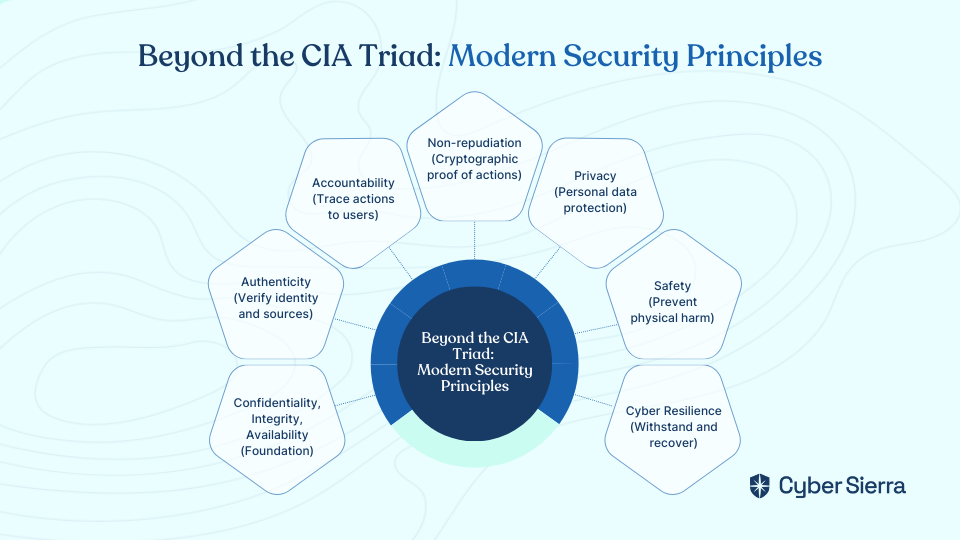
If this sounds familiar, you're not alone. The CIA triad has been the cornerstone of information security for decades, providing a crucial foundation for protecting digital assets. But in today's complex threat landscape—with advanced persistent threats, sophisticated supply chain attacks, and the blurring lines between physical and digital systems—this traditional model is necessary but no longer sufficient.

This article explores why modern cyber security objectives must expand beyond the classic CIA triad, introducing additional security principles and practical frameworks like CISA's Cybersecurity Performance Goals (CPGs) that can help build a more comprehensive and resilient security program.

The CIA Triad: A Necessary Foundation

Before exploring its limitations, let's review what makes the CIA triad so fundamental to information security:

  • Confidentiality: Ensuring that sensitive data is accessible only to authorized individuals. This prevents unauthorized access, such as password theft or data breaches where customer information is exposed.
  • Integrity: Guaranteeing that data remains accurate and unaltered by unauthorized means. When integrity is compromised—for example, if an attacker modifies financial records—it can lead to incorrect or potentially catastrophic decisions based on tampered data.
  • Availability: Making sure systems and data are accessible when needed by legitimate users. A classic example of an availability attack is a Denial of Service (DoS), where attackers overwhelm systems to make them inaccessible.

These principles remain essential, but as cybersecurity has evolved, practitioners have discovered significant gaps in this model.

The Cracks in the Foundation: Why the CIA Triad Isn't Enough

It's a Shifting Spectrum, Not a Balanced Stool

One fundamental misconception is that the three elements of the CIA triad should be equally balanced. In reality, as one cybersecurity professional noted, "It's a spectrum between the three, and depending on the needs, the point moves around between them."

This becomes clear when comparing different operational contexts:

  • In OT/ICS Environments: For industrial control systems that manage physical processes, "In an OT environment, 'A' is king," as one practitioner put it. When a system controls critical infrastructure like power grids or manufacturing lines, downtime can result in massive financial losses or even safety hazards.
  • In Healthcare Settings: The priority can shift dramatically depending on the specific system. As one security expert vividly explained, "Imagine you're operating a LINAC to treat a tumor. You'd probably prefer an inoperative system over sending 10x the dose." In this life-critical scenario, integrity trumps availability.

The CIA triad provides no inherent guidance on how to balance these priorities across different systems and contexts.

It Lacks Business Context

Another significant limitation is that the CIA triad "fails to prioritize information based on its criticality to business processes." It treats all data equally, without helping security teams identify what is most vital to protect based on business impact.

As organizations struggle with the question, "How do we ensure we're spending our resources wisely?" this lack of business alignment becomes critical. A security program disconnected from business priorities can't effectively justify its expenditures or demonstrate its value to leadership.

It's Blind to Modern Adversary Tactics

The CIA model doesn't inherently guide an understanding of adversarial Tactics, Techniques, and Procedures (TTPs) or intrusion kill chains. To be effective in today's threat landscape, security must be built to counter how attackers actually operate, not just protect static assets.

Modern threats like Business Email Compromise, supply chain attacks, and advanced persistent threats require security approaches that go beyond the traditional focus on information disclosure, alteration, and denial.

Expanding the Security Lexicon: Goals for the Modern Era

To address these limitations, security professionals have expanded the classic triad with additional principles that address modern cyber security objectives:

Authenticity

Ensuring that users are who they claim to be and that data comes from legitimate sources. This principle has become increasingly critical as phishing and identity theft have become primary attack vectors.

Accountability

The ability to trace actions to specific entities or users. This is crucial not only for forensic analysis after security incidents but also for establishing responsibility and appropriate access controls.

Non-repudiation

Providing cryptographic proof that a specific action was taken by a specific party, preventing later denial. This is vital for legal and transactional systems where proof of actions is required.

Privacy

Protecting personal data and ensuring individuals maintain rights and control over their information. With regulations like GDPR and CCPA, privacy has become a legal obligation as well as a security concern.

Safety

Ensuring cybersecurity measures don't create unsafe conditions, especially in operational technology (OT) and physical system contexts. This brings us back to the LINAC example—where integrity issues could create life-threatening situations.

Cyber Resilience

The ability to anticipate, withstand, recover from, and adapt to adverse conditions, stresses, attacks, or compromises. This goes beyond simple availability to encompass business continuity and disaster recovery capabilities.

These expanded principles create a more comprehensive security framework. But how do you translate these abstract concepts into practical actions?

A Practical Blueprint: CISA's Cross-Sector Cybersecurity Performance Goals (CPGs)

For organizations looking to implement these expanded security principles, the U.S. Cybersecurity and Infrastructure Security Agency's (CISA) Cybersecurity Performance Goals (CPGs) offer a concrete, actionable framework.

The CPGs are a voluntary set of baseline cybersecurity practices developed to protect critical infrastructure. While designed primarily for critical infrastructure, they provide invaluable guidance for organizations of all types looking for a "baseline set of protections" against common threats.

What makes the CPGs particularly valuable is their:

  • Action-Orientation: Rather than abstract principles, they provide a concise list of impactful actions to prioritize.
  • IT and OT Inclusivity: They uniquely incorporate practices for both information technology and operational technology environments.
  • Benchmarking Capability: They help organizations measure and improve their security maturity.

The CPGs align with the NIST Cybersecurity Framework (CSF) and map to six key functions:

  1. Govern: Establish strategy and policy
  2. Identify: Understand current risks
  3. Protect: Implement safeguards
  4. Detect: Identify incidents
  5. Respond: Take action on incidents
  6. Recover: Restore operations

For organizations with specific operational contexts, CISA has also developed Sector-Specific Goals (SSGs) for areas including Chemical, Energy, Healthcare, and Information Technology, with Financial Services coming soon.

These resources are freely available at CISA's CPG website and in their comprehensive CPG report.

From Goals to Action: Risk Management and Future-Proofing

Ultimately, expanding beyond the CIA triad isn't just about adding more principles—it's about connecting security to business risk in monetary terms. As one practitioner noted, the challenge is "measuring the ROI on existing controls and proposed improvements—specifically, their risk reduction value relative to their cost."

For organizations struggling with this ROI problem, cyber risk quantification (CRQ) methodologies like the FAIR model can help translate security improvements into financial terms that leadership understands. While some express skepticism that these models are "black boxes," they provide a starting point for having meaningful conversations about security investments.

Looking ahead, new cybersecurity initiatives are already focusing on emerging threats:

  • Quantum Computing and AI Security: Preparing for both the threats and opportunities presented by these transformative technologies.
  • Supply Chain Security: Fortifying security across third-party suppliers, from hardware components to software dependencies.
  • Public-Private Collaboration: Emphasizing the importance of information sharing and coordinated response to sophisticated threats.

Conclusion

While the CIA triad remains a useful concept, modern cybersecurity demands a more comprehensive approach. By incorporating additional principles like accountability and resilience, and leveraging frameworks like CISA's Cybersecurity Performance Goals, organizations can build security programs that address today's complex threat landscape.

As you evaluate your own cybersecurity program, consider moving beyond the limitations of the CIA triad. Use CISA's CPGs as a practical starting point to assess your current posture, identify gaps, and make impactful, data-driven security investments that align with your business objectives.

The fears that keep you up at night—"What am I missing?"—may never completely disappear. But by expanding your security goals beyond the traditional CIA model, you'll be better equipped to protect your organization against both current and emerging threats.

Frequently Asked Questions

What is the CIA triad and why is it important?

The CIA triad is a foundational model in information security that stands for Confidentiality, Integrity, and Availability. It is important because it provides a simple, fundamental framework for protecting digital assets: Confidentiality ensures data is accessible only to authorized users, Integrity ensures data is accurate and untampered, and Availability ensures systems and data are accessible when needed.

Why is the CIA triad no longer sufficient for modern cybersecurity?

The CIA triad is no longer sufficient on its own because it lacks business context, struggles to adapt to different operational environments like OT, and doesn't adequately address the sophisticated tactics, techniques, and procedures (TTPs) of modern adversaries. While still necessary, it must be supplemented with other principles to handle threats like supply chain attacks and advanced persistent threats.

What security principles should be considered beyond the CIA triad?

Beyond the CIA triad, organizations should consider several additional principles to build a comprehensive security program. These include Authenticity (verifying user and data origin), Accountability (tracing actions to users), Non-repudiation (providing proof of action), Privacy (protecting personal data), Safety (ensuring no physical harm), and Cyber Resilience (the ability to withstand and recover from attacks).

How can my organization practically implement a more modern security framework?

A practical way to implement a modern security framework is by using CISA's Cross-Sector Cybersecurity Performance Goals (CPGs). The CPGs offer a concrete, actionable set of baseline cybersecurity practices for both IT and OT environments. They provide a checklist of impactful actions that align with the NIST Cybersecurity Framework, helping organizations measure and improve their security posture against common threats.

How do security priorities in the CIA triad differ between IT and OT environments?

Security priorities shift dramatically between Information Technology (IT) and Operational Technology (OT) environments. In typical IT environments, Confidentiality is often the top priority. In OT environments, which control physical processes like manufacturing or power grids, Availability is king, as downtime can cause significant financial loss or safety hazards. In some critical systems, like medical devices, Integrity may be the highest priority to prevent catastrophic failures.

How can I justify security investments that go beyond the CIA triad?

You can justify security investments by connecting them directly to business risk and demonstrating their return on investment (ROI). Instead of focusing only on technical principles, use cyber risk quantification (CRQ) methodologies like the FAIR model to translate security improvements into financial terms. This helps leadership understand the value of security initiatives by showing how they reduce the financial risk of potential cyber incidents.

blog-hero-background-image
Cyber Security

Beyond Blocking: A Modern Approach to Data Loss Prevention

backdrop
Table of Contents

Join thousands of professionals and get the latest insight on Compliance & Cybersecurity.


Your cybersecurity team is drowning in ticket requests for whitelisting business-critical domains. Users are increasingly frustrated, taking out their anger on your service desk staff. Your CISO is under pressure from the CIO to show results, while your analysts are burning out from the constant firefighting. If this sounds familiar, you're experiencing the tell-tale signs of an outdated Data Loss Prevention (DLP) strategy built on blanket blocking.

"We are getting hammered with ticket requests for whitelisting with no real way to manage this long term," laments one security professional on Reddit. Another admits, "I have this constant feeling in this role that I'm being set up for failure."

The truth is, traditional DLP approaches that rely primarily on blocking domains and content filtering are failing modern organizations. They create operational chaos rather than security, and it's time for a fundamental shift in how we think about protecting sensitive information.

Why Blanket Blocking is a Losing Strategy

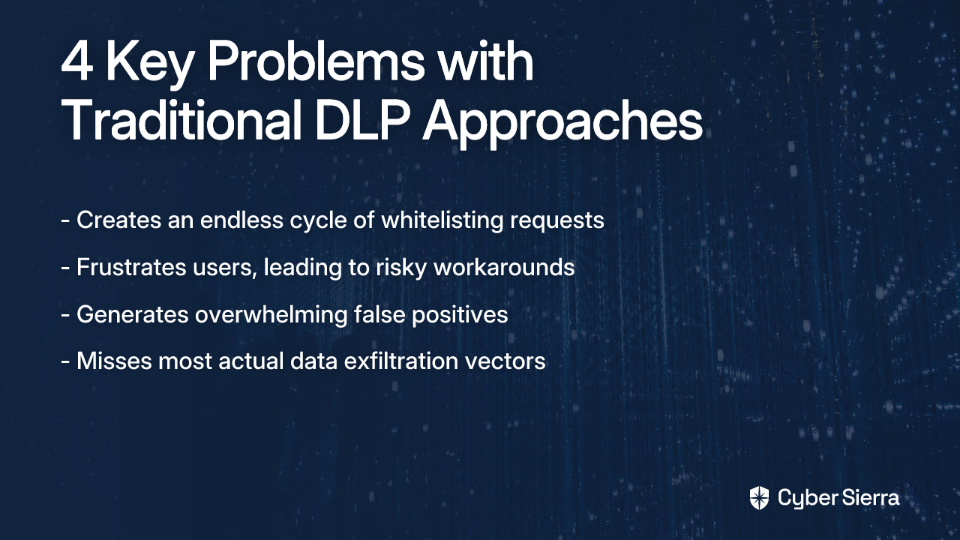
Traditional DLP strategies centered around blanket blocking external domains create more problems than they solve:

It Creates Operational Chaos, Not Security

When security teams implement broad blocking policies, they inadvertently create an endless cycle of whitelisting requests. Each exception requires manual review, approval workflows, and technical implementation—creating a backlog that overwhelms the service desk and cybersecurity staff.

According to cybersecurity professionals on the frontlines, "You will be in constant firefighting mode unblocking domains to allow for communications." This reactive approach diverts resources away from addressing genuine security risks.

It Alienates Users and Breeds Risky Workarounds

When legitimate business communications are blocked, employees experience significant friction in completing their work. This frustration often leads to "malicious compliance" or, worse, employees finding creative workarounds that completely bypass security controls.

One CISO notes, "The users are extremely frustrated and taking it out on my team and myself." When security becomes an obstacle rather than an enabler, users will find ways around it, ultimately increasing organizational risk rather than reducing it.

It Drowns Analysts in False Positives

Traditional DLP tools lack the context needed to make intelligent decisions about data movement. They generate overwhelming volumes of false positive alerts, leading to "alarm fatigue" among security analysts.

"Make sure the analysis of the alerts is as efficient as it can be. To be candid, if you don't, analysts will get tired of it quickly and leave," warns one security expert.

It Misses How Data Actually Leaves

Perhaps most critically, a focus on blocking email domains misses the vast majority of data exfiltration vectors. Modern work happens across cloud services, collaboration platforms, endpoints, and remote connections. According to Proofpoint research, email accounts for only a small percentage of actual data loss incidents, with insider threats and cloud applications representing far greater risks.

The Pillars of a Modern DLP Program

Instead of relying on simplistic blocking, a modern DLP program is built on three foundational pillars that work together to create an intelligent, adaptive security posture.

Pillar 1: Foundational Data Classification

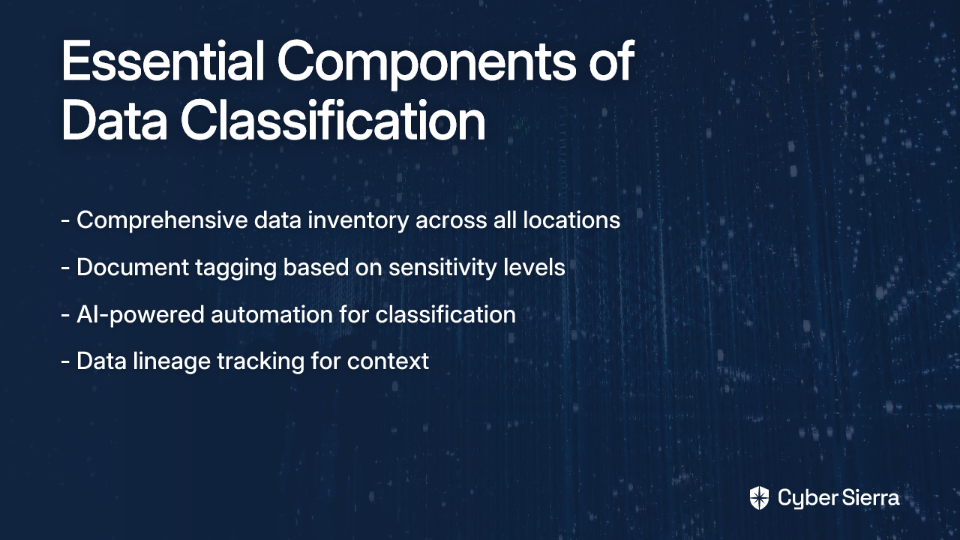
You cannot protect what you don't know you have. Effective DLP starts with understanding and classifying your data.

"If you don't have any sort of data classification policies or tools, it will be difficult to effectively implement DLP for proprietary information," notes a cybersecurity professional.

A robust data classification framework should:

  1. Inventory Data Locations: Conduct a comprehensive inventory of where your data lives—on-premises servers, cloud storage, SaaS applications, and endpoints.
  2. Classify & Tag Documents: Implement document classification systems that categorize data based on sensitivity (e.g., Public, Internal, Confidential, Restricted).
  3. Automate Classification: Leverage AI-powered tools to automate the classification process, ensuring it adapts to new data types and evolving business needs.
  4. Track Data Lineage: Implement Data Detection and Response (DDR) capabilities that track data's origin and handling history to provide deeper context, even when content doesn't match predefined patterns.

With proper classification in place, you can implement granular policies based on data sensitivity rather than applying one-size-fits-all blocking rules.

Pillar 2: User Behavior Analytics

Modern DLP shifts focus from what the data is to how it's being used. User Behavior Analytics (UBA) provides the critical context that legacy DLP lacks by establishing normal user activity patterns and flagging anomalies.

Consider this scenario:

  • A relationship owner downloads a protected spreadsheet containing customer information
  • They compress it into a ZIP file
  • They rename it to "vacation_photos.zip"
  • They upload it to a personal cloud drive

Legacy DLP sees: A file download and a separate, unrelated upload of a non-sensitive file. No alert is triggered.

Modern DLP with behavior analytics sees: A pattern of obfuscation and potential data exfiltration, triggering a high-priority alert for investigation.

By connecting user activity across different accounts, devices, and IP addresses over time, UBA builds a complete picture of behavior that helps distinguish between legitimate business activities and potential data theft.

Pillar 3: Contextual Policy Enforcement

Policies should not be binary (block/allow). They should be dynamic and enforced based on the full context of an event.

Modern DLP evaluates actions based on multiple factors:

  • Who: User role and risk score
  • What: The classification of the data
  • Where: Source/destination (e.g., corporate vs. personal cloud)
  • When: Time of day and whether it aligns with normal working patterns
  • How: The application being used

This contextual approach enables a range of responses beyond simple blocking:

  • Log the event for future analysis
  • Alert a manager or the security team
  • Require business justification from the user
  • Apply automatic encryption
  • Block only as a last resort

By implementing policies that adapt to different contexts, security teams can focus on high-risk activities while allowing legitimate business operations to continue unimpeded.

Pillar 4: Employee Education and Governance

Technology alone cannot solve data protection challenges. A strong security culture built on education and governance is essential.

"You NEED data custodians and business unit reps to help you decide what is important to the business and what actions to take when there are detections," emphasizes one security expert.

Establish a governance working group with representatives from various business units to guide DLP policy decisions and incident response. This collaborative approach ensures that security measures align with business needs and that risk is properly assigned and managed across the organization.

A Practical Roadmap to Modern DLP

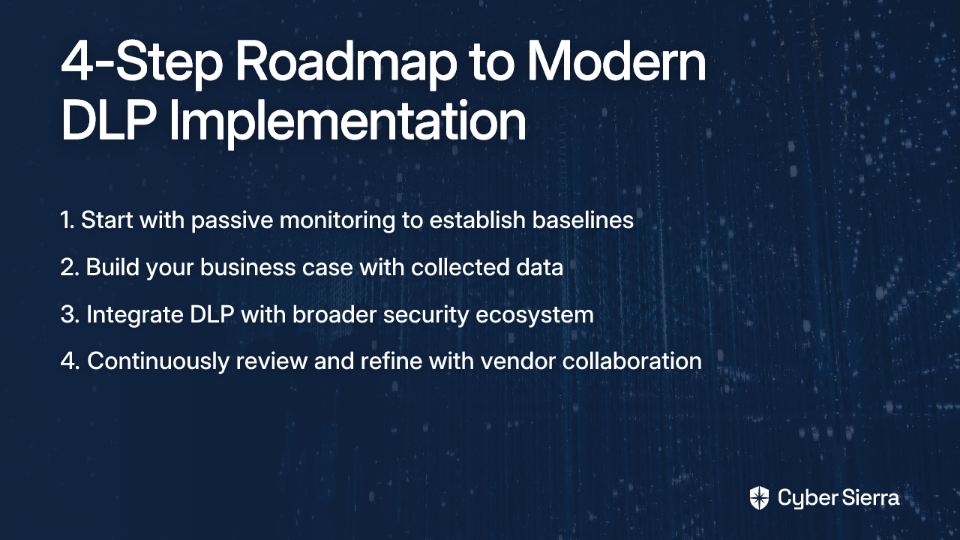
Transitioning from a traditional blocking-focused approach to a modern DLP program requires a thoughtful, phased approach:

Step 1: Start with Passive Monitoring

Do not start by blocking. Implement your new policies in an audit-only mode first. This phase allows you to:

  • Establish a baseline of normal data flows
  • Identify false positives in your rule sets
  • Understand legitimate business communications that would be disrupted by blocking
  • Gather data to make informed decisions about what truly represents risk

Step 2: Build Your Business Case with Data

Use the insights from your monitoring phase to build a compelling case for change. Present metrics to leadership that illustrate the ineffectiveness of blanket blocking and the potential benefits of a modern approach.

"Show them your metrics (number of blocked emails, number of open requests to update the allowlist) and any lost revenue and/or impact to clients," advises one security professional.

Step 3: Integrate and Automate

A modern DLP solution should not operate in isolation. Integrate it with your broader security ecosystem through APIs and automated workflows:

  • Connect DLP with identity and access management systems
  • Automate allowlisting requests by requiring business justification and manager approval
  • Implement escalation paths for high-risk events
  • Create self-service options for common user needs

Step 4: Review, Refine, and Collaborate with Vendors

DLP is a continuous process, not a one-time project. Conduct regular audits to ensure effectiveness and engage with your DLP vendor to optimize configurations and rules.

"Can you have a sit down with said DLP vendor to perform an assessment of the configs, rules, and any shortcomings?" suggests one security leader. Use their expertise to continually improve your implementation.

From Blocker to Business Enabler

Transitioning from blanket blocking to a modern DLP program transforms security from a roadblock into a strategic business enabler. This approach:

  • Reduces analyst burnout by decreasing false positives and focusing attention on genuine risks
  • Improves user experience by minimizing disruption to legitimate work
  • Provides better protection by addressing the full spectrum of data exfiltration vectors
  • Supports compliance with regulations like GDPR, HIPAA, and PCI DSS
  • Enables business agility by allowing necessary data sharing while maintaining appropriate controls

The CISO and CIO who embrace this modern approach will find themselves aligned with business objectives rather than at odds with them. Security becomes a partner in innovation rather than the "department of no."

By building a DLP program on data classification, user behavior analytics, and contextual policy enforcement, you create a security posture that adapts to your organization's unique needs and evolving threat landscape. The result is not just better security, but better business.

Frequently Asked Questions (FAQ)

Why is a traditional, block-first DLP strategy ineffective?

A traditional, block-first DLP strategy is ineffective because it creates significant operational chaos, frustrates users into finding risky workarounds, and fails to address most modern data exfiltration methods. This approach leads to an overwhelming number of whitelisting requests that burn out security teams. When legitimate work is blocked, employees often bypass security controls entirely, increasing organizational risk.

What are the core components of a modern DLP program?

A modern DLP program is built on four key pillars: foundational data classification, User Behavior Analytics (UBA), contextual policy enforcement, and strong employee education and governance. These components work together to understand what data is sensitive, analyze how it's being used, apply flexible security rules, and build a security-conscious culture.

How can you implement modern DLP without disrupting business operations?

You can start implementing modern DLP without disruption by first running it in a passive, audit-only mode. This initial monitoring phase allows you to gather data on normal data flows, identify legitimate business processes that might trigger alerts, and fine-tune policies to reduce false positives. This data-driven approach ensures you understand the impact before enforcing any blocking rules.

Why is User Behavior Analytics (UBA) so important for modern DLP?

User Behavior Analytics is crucial because it adds essential context to data movements, allowing security systems to distinguish between legitimate work and potential data theft. While legacy tools see isolated events, UBA connects user activity across different systems over time. It can detect suspicious patterns, like a user renaming and zipping a sensitive file before uploading it to a personal account, which would otherwise go unnoticed.

How does data classification improve a DLP strategy?

Data classification improves a DLP strategy by enabling you to apply granular security policies based on data sensitivity, rather than using ineffective one-size-fits-all rules. By identifying and tagging your most critical information (e.g., Confidential, Restricted), you can focus your strongest security controls where they are needed most, without impeding the flow of less sensitive data required for daily operations.

Who should be involved in creating and managing a DLP program?

A successful DLP program requires a collaborative effort that includes the cybersecurity team, data custodians, representatives from various business units, and executive leadership. Establishing a governance working group with these stakeholders ensures that DLP policies are practical, align with business objectives, and create a shared sense of responsibility for protecting company data.

blog-hero-background-image
Cyber Security

Types of Computer Security Models - What You Need to Know?

backdrop
Table of Contents

Join thousands of professionals and get the latest insight on Compliance & Cybersecurity.


Are you studying for the CISSP exam and finding yourself confused about the difference between a security model and a security framework? Do terms like Bell-LaPadula and Biba feel abstract and difficult to remember? You're not alone. The world of computer security models can seem unnecessarily complex and theoretical, especially when you're trying to apply these concepts to real-world cybersecurity challenges.

Demystifying Security Models

Security models are formal systems or theoretical blueprints that specify and enforce security policies. They provide a mathematical mapping of theoretical goals that reinforce how security is implemented in information systems. At their core, these models aim to maintain the Confidentiality, Integrity, and Availability (CIA triad) of data.

Understanding these models isn't just important for passing certification exams—it's essential for building robust security frameworks, ensuring compliance, and protecting sensitive information in today's increasingly complex threat landscape.

Security Models vs. Security Frameworks: Clearing the Confusion

One of the most common points of confusion is the difference between security models and security frameworks. Let's clear this up once and for all:

Security models are abstract concepts. They're not tangible things you can touch or directly implement. They represent the 'what' and 'why' of security—describing a desired state of security.

Security frameworks are concrete instructions. They are tangible, defined, and measurable. They represent the 'how'—providing a set of instructions, controls, and best practices to achieve the security goals established by models.

To make this distinction clearer, consider these analogies:

Blueprint vs. Manual: Think of security models as the blueprints for a car's security features, outlining concepts like preventing unauthorized entry. A security control framework, like the NIST Cybersecurity Framework, is the instruction manual that tells engineers exactly which locks to use and how to install them.

Game Moves vs. Rules: Another helpful way to think about it: security models are like strategic moves in chess, while frameworks are the official rules of the game. This distinction helps clarify why you can be compliant with a framework (like NIST or ISO 27000), but you implement a model.

The Foundation: The CIA Triad

Most security models are built around three core tenets collectively known as the CIA Triad:

  1. Confidentiality: Preventing unauthorized disclosure of information
  2. Integrity: Ensuring data isn't altered in an unauthorized or undetected manner
  3. Availability: Ensuring systems and data are accessible to authorized users when needed

Different security models place varying emphasis on these principles, as we'll see when we explore them in detail.

Core Security Models: A Deep Dive

Now let's examine the most important computer security models that you need to understand, particularly if you're studying for certifications like the CISSP.

1. The Bell-LaPadula Model (Focus: Confidentiality)

Developed in the 1970s for multilevel security systems, the Bell-LaPadula model is primarily focused on maintaining confidentiality. It's commonly used in military and government settings where protecting classified information is paramount.

This state-machine model enforces access control based on security levels (e.g., Top Secret, Secret, Confidential) and implements the following key rules under Mandatory Access Control (MAC):

  • Simple Confidentiality Rule (No Read-Up): A subject at a given security level cannot read data at a higher security level.
  • * (Star) Confidentiality Rule (No Write-Down): A subject at a given security level cannot write information to a lower security level. This prevents sensitive data from leaking to less secure levels.
  • Strong Star Confidentiality Rule: A subject can only read and write to objects at their same security level.

Remember it this way: Bell-LaPadula = Confidentiality (it protects information from flowing down to unauthorized levels).

2. The Biba Model (Focus: Integrity)

The Biba model, developed by Kenneth J. Biba, is essentially the mathematical inverse of Bell-LaPadula. Its primary goal is to protect data integrity by ensuring that unauthorized or untrusted subjects cannot modify data.

This model uses integrity levels to prevent data at a higher integrity level from being corrupted by data from a lower integrity level:

  • Simple Integrity Rule (No Read-Down): A subject cannot read data at a lower integrity level. This prevents a subject from being influenced by less trustworthy data.
  • * (Star) Integrity Rule (No Write-Up): A subject cannot write or modify data at a higher integrity level. This prevents a less trusted subject from corrupting more trusted data.

Remember it this way: Biba = Integrity (it prevents information from flowing up to corrupt higher integrity levels).

3. The Clark-Wilson Model (Focus: High-Integrity Systems)

The Clark-Wilson model emphasizes information integrity against unauthorized alterations through well-formed transactions and separation of duties. Unlike Bell-LaPadula and Biba, it restricts access to objects via trusted programs or procedures, not direct access.

Key components of this model include:

  • Constrained Data Items (CDIs): High-integrity data that can only be modified by trusted Transformation Processes.
  • Unconstrained Data Items (UDIs): Data not subject to the same integrity controls.
  • Transformation Process (TP): The only mechanism that can modify a CDI. These are well-formed transactions.
  • Integration Verification Process (IVP): A process that verifies the integrity of CDIs.

This model is particularly valuable for commercial applications where transactional integrity is critical, such as banking systems.

4. The Brewer and Nash Model (Chinese Wall Model)

The Brewer and Nash Model, also known as the Chinese Wall Model, was designed to prevent conflicts of interest. It's a dynamic model where access permissions change based on a user's previous actions.

The model creates a "wall" around data belonging to a competitor once a user has accessed information from one company. For example, a consultant who accesses data for Company A is automatically blocked from accessing data for its competitor, Company B.

This model is ideal for legal, financial, and consulting firms where handling sensitive client data without conflict is both a legal and ethical requirement.

5. The Harrison-Ruzzo-Ullman (HRU) Model

The HRU model addresses security concerns about information flow and how access rights can change over time. It is an extension of earlier models that provides more flexibility in managing access controls.

This model uses an access matrix of subjects, objects, and their access rights. It defines a finite set of commands that can modify the access matrix, such as creating or deleting subjects/objects or changing rights. The key feature of this model is its focus on "safety"—determining whether it's possible for a subject to leak a right to an unauthorized entity.

How Security Models Relate to Access Control

Many students struggle with understanding how security models like Bell-LaPadula relate to access control models like MAC, DAC, and RBAC. Here's the relationship clarified:

Each security model follows an access control model. Security models are the high-level theoretical rules, while access control models are the mechanisms used to enforce those rules:

  • Mandatory Access Control (MAC): Used by models like Bell-LaPadula and Biba. The system (not the owner) enforces access rules based on security labels.
  • Discretionary Access Control (DAC): The owner of a resource determines who has access. The HRU model can be used to analyze DAC systems.
  • Role-Based Access Control (RBAC): Access is assigned based on a user's role within an organization. This simplifies administration and is widely used in commercial settings. Learn more about RBAC on Wikipedia.

Practical Application: Choosing the Right Security Model

Understanding these computer security models is valuable, but how do you apply them in real-world scenarios? Here's a practical guide:

  1. Evaluate Requirements: Understand your data sensitivity and regulatory obligations (e.g., GDPR, HIPAA).
  2. Conduct Threat Analysis: Identify potential threats based on past incidents and trends.
  3. Recognize Each Model's Strengths: Match models to your unique needs (e.g., Bell-LaPadula for confidentiality, Biba for integrity).
  4. Examine Industry Standards: Research frameworks like the NIST Cybersecurity Framework and ISO/IEC 27001 for implementation guidance.
  5. Run Pilot Experiments: Test the model's effectiveness on a small scale before full deployment.

Benefits and Applications of Using Security Models

Implementing appropriate security models provides several key advantages:

  • Better Protection: Multi-layered security reduces overall risk.
  • Regulatory Compliance: Helps meet legal and industry standards.
  • Proactive Risk Management: Enables identification of vulnerabilities before they are exploited.
  • Operational Efficiency: Streamlines security processes and reduces errors.

These models find applications across various domains:

  • Operating Systems: Managing access to system resources.
  • Network Security: Guiding the configuration of firewalls and intrusion detection systems.
  • Cloud Computing: Ensuring data safety in cloud environments with strict privacy rules.
  • Application Security: Helping developers incorporate security during design to safeguard user data.

From Theory to Practice

While security models like Bell-LaPadula, Biba, Clark-Wilson, and the Chinese Wall model may seem theoretical and abstract, they form the indispensable foundation upon which practical, secure systems are built.

Understanding these computer security models is not just about passing certification exams—it's about developing the conceptual framework necessary to build truly secure systems in an increasingly complex and dangerous digital world. By grasping these models, security professionals can move beyond checkbox compliance to designing holistic security architectures that protect what matters most.

Remember that security models provide the "what" and "why" of security, while frameworks and controls provide the "how." This distinction is crucial for anyone serious about mastering the field of information security.

Frequently Asked Questions

What is the main difference between a security model and a security framework?

A security model is a theoretical blueprint that defines the "what" and "why" of security policies, while a security framework provides the concrete instructions and best practices on "how" to implement those policies. Think of a security model as the architectural design for a secure system and a framework as the step-by-step construction manual.

How do the Bell-LaPadula and Biba models differ?

The Bell-LaPadula and Biba models are essentially opposites. The Bell-LaPadula model focuses on confidentiality by preventing subjects from reading data at a higher security level (no read-up) and writing to a lower level (no write-down). In contrast, the Biba model focuses on integrity by preventing subjects from reading data at a lower integrity level (no read-down) and writing to a higher level (no write-up).

Which security model is best for preventing conflicts of interest?

The Brewer and Nash model, also known as the Chinese Wall model, is specifically designed to prevent conflicts of interest. It dynamically adjusts a user's access rights based on their previous actions. For example, once a user accesses data for one company, the model creates a "wall" to block them from accessing a competitor's data, making it ideal for legal and financial firms.

What is the relationship between security models and access control?

Security models provide the high-level rules for security, and access control models are the mechanisms used to enforce them. For instance, the Bell-LaPadula and Biba models are enforced using Mandatory Access Control (MAC), where the system dictates access. Other models might be analyzed using Discretionary Access Control (DAC) or implemented via Role-Based Access Control (RBAC).

Why are security models important in cybersecurity?

Security models are important because they provide a formal, foundational basis for building secure systems. They help organizations maintain the confidentiality, integrity, and availability of data (the CIA triad). Understanding these models is crucial for designing robust security architectures, ensuring regulatory compliance, and proactively managing risks rather than just following a checklist.

How do I choose the right security model for my organization?

To choose the right security model, you should start by evaluating your organization's specific security requirements, data sensitivity, and regulatory obligations. Then, conduct a threat analysis to understand potential risks. Match the strengths of each model to your needs—for example, use Bell-LaPadula for high-confidentiality needs or Clark-Wilson for transactional integrity. Finally, consult industry frameworks like NIST for implementation guidance.

blog-hero-background-image
Governance & Compliance

What's the Job of a Deputy CISO?

backdrop
Table of Contents

Join thousands of professionals and get the latest insight on Compliance & Cybersecurity.


You've climbed the cybersecurity ladder to a senior leadership position, but find yourself in that curious middle ground: the Deputy Chief Information Security Officer. You're doing "all the heavy lifting" for the security department while watching the CISO get "all the credit" with the board. Sound familiar?

The Deputy CISO role is often misunderstood and underestimated, positioned as merely "second-in-command" rather than a strategic leadership role with distinct value. In reality, it's the operational engine that makes the CISO's vision possible.

Let's explore what this critical position actually entails, why it matters, and how to thrive in it despite the unique challenges.

The Strategic Imperative: Why Organizations Need a Deputy CISO

The Deputy CISO isn't just an organizational chart requirement - it's a strategic necessity for maturing security programs. Here's why:

Enabling Strategic Focus for the CISO: As security programs grow in complexity, the CISO's attention gets pulled toward board reporting, executive leadership engagement, and business alignment. The Deputy CISO creates the operational freedom for CISOs to handle these critical responsibilities by managing core security functions.

As one cybersecurity leader noted in a Reddit discussion: "The CISO focuses on strategy, vision and executive management, while the deputy handles the operational aspects of implementing that vision."

Scalability: Security teams grow rapidly as organizations expand, and it becomes impossible for one leader to effectively manage all operations. The Deputy CISO provides necessary leadership bandwidth, typically overseeing specific domains like incident response or governance, risk and compliance (GRC).

Succession Planning: The Deputy CISO serves as a natural successor, ensuring leadership continuity if the CISO departs. This mitigates the risk of a security leadership vacuum and knowledge loss during transitions. According to CyberSaint, this is one of the most valuable aspects of the role for organizational resilience.

Redundancy: The role ensures that critical cybersecurity functions continue uninterrupted when the CISO is unavailable, providing necessary operational resilience.

Enhanced Decision-Making: By providing another senior perspective, the Deputy CISO improves the quality of decisions regarding cybersecurity risks, investments, and strategies.

A Day in the Life: Core Responsibilities of a Deputy CISO

What does a Deputy CISO actually do? The responsibilities span both strategic and tactical domains:

Strategy and Collaboration: The Deputy CISO works closely with the CISO to develop and implement the organization's cybersecurity strategy, translating vision into executable programs.

Cybersecurity Operations Management: This includes overseeing day-to-day security operations such as threat intelligence, incident response, and vulnerability management. As one cybersecurity manager shared on Reddit: "Some of the day-to-day responsibilities include firefighting on escalations, strategy & planning, and endless meetings for projects." This often involves managing SIEM implementations, EDR deployments, and addressing alert fatigue among SOC analysts.

Risk Management and Compliance: A significant portion of a Deputy CISO's time involves assessing and managing cybersecurity risks while ensuring compliance with relevant regulations and frameworks. One practitioner described spending "most of my day examining and mitigating cyber risk, making NIST-derived policy and operational decisions" and lamented that "Customer Due Diligence Questionnaires are the bane of my existence."

Team Leadership: Leading, managing, and mentoring cybersecurity professionals is central to the role. As one security manager put it, "the technical bits are easy, the hard part is getting people to do their jobs" while "trying to keep the administrative overhead to a minimum so my team can actually do work."

Bridge Building: The Deputy CISO serves as a critical liaison between the technical security team and other business departments, stakeholders, and third-party vendors like MSSPs.

Technology Implementation: Evaluating, selecting, and overseeing the implementation of security tools and technologies that support the overall security program.

CISO Representation: Acting on behalf of the CISO in their absence, making crucial decisions to maintain security posture.

CISO vs. Deputy CISO: A Tale of Two Roles

Understanding the distinction between these roles helps clarify expectations and career paths:

AspectCISODeputy CISO
ScopeOverall security vision and strategy for the entire organizationTypically more focused on specific operational domains or programs
ReportingReports to CEO, CIO, or Board; primary security voice in C-suiteReports to CISO; leads teams within the security organization
AuthorityFinal decision-making authority on security strategy and budgetProvides input and makes operational decisions but doesn't have final say on enterprise-wide strategy
External CommunicationPrimary public face for security to external stakeholdersCommunication more often internal or with technical partners
Experience RequiredMore extensive experience in both technical and business leadershipStrong technical background with growing business acumen

This distinction directly addresses the common frustration that as a Deputy CISO, "you don't get the full CISO title, so you can't say you were a true CISO; you can't claim you yourself led the entire Information Security department."

The Future is Specialized: Lessons from Microsoft's Deputy CISO Structure

Large enterprises like Microsoft are evolving the Deputy CISO concept into specialized leadership roles that shape cybersecurity strategy across distinct domains. In 2024, Microsoft launched its Cybersecurity Governance Council, including multiple Deputy CISOs, to enhance accountability.

Microsoft's model includes specialized Deputy CISOs such as:

  • Igor Sakhnov (Deputy CISO for Identity): Leads engineering for IAM, focusing on enterprise identity systems and adopting an 'assume breach' mindset.
  • Mark Russinovich (Deputy CISO for Azure): Works on security risk management for Azure, emphasizing minimizing impact and enhancing detection capabilities.
  • Yonatan Zunger (Deputy CISO for AI): Focuses specifically on AI-related security risks.

This specialized approach is becoming more common in large organizations that need deep expertise across multiple security domains. It also provides clear career trajectories for Deputy CISOs who can develop domain-specific authority.

Navigating the Trenches: Overcoming the Challenges of the Deputy CISO Role

The Deputy CISO position comes with unique challenges that must be addressed for professional satisfaction:

The Recognition Gap: Many Deputy CISOs feel their contributions go unrecognized while "the CISO will get all the credit." The key is to advocate for clear distinctions in roles and responsibilities to ensure your contributions are visible to executive leadership. Document your wins and build relationships with stakeholders who can advocate for your value.

Battling Burnout: Deputy CISOs are often "bent over backwards at all times of the day and night" handling operational fires. According to a discussion on burnout in cybersecurity leadership, it's essential to implement clear work-life boundaries and establish mental health support systems. This includes designated backup for on-call rotations and scheduled time completely away from work.

Politics and Promotion: There's a perception that advancement beyond the Deputy CISO role is "more of a culture fit/who-you-know type deal at that level." While relationships matter, you can increase your chances by developing business acumen alongside technical expertise and finding mentors who can sponsor your advancement.

Segregation of Duties Conflicts: As noted in user discussions, "If you are truly going to split responsibilities between GRC and devops... that creates a SoD conflict." Organizations must structure the Deputy CISO role to avoid having the same person both implement and assess controls, which creates governance challenges.

The Deputy CISO's Toolkit: Essential Qualifications and Skills

To thrive as a Deputy CISO, you need both technical foundations and leadership competencies:

Education and Certifications: A Bachelor's or Master's degree in cybersecurity or related field is standard, along with certifications like CISSP, CISM, or CRISC. According to Snyk's analysis of the Deputy CISO role, these credentials establish baseline credibility.

Technical Skills (The Foundation):

  • Deep knowledge of security technologies, network security, cloud security, and application security
  • Expertise in risk assessment methodologies and incident response procedures
  • Hands-on experience with SIEM, EDR, vulnerability scanning, and other security tools

Leadership Skills (The Differentiators):

  • Team leadership that allows you to "lead without toxicity" in an environment where that's "hard to come by"
  • Business acumen to translate technical risks into business impact for budget discussions
  • Communication skills to convey complex technical concepts to non-technical stakeholders
  • Change management abilities to drive security adoption across the organization

The Linchpin of the Security Organization

The Deputy CISO is far more than just a "number two." It's a multifaceted leadership position that serves as the operational engine enabling the CISO's strategic vision. While challenging, it provides a powerful platform for driving organizational change and developing the leadership skills necessary for future advancement.

As security programs grow in complexity, the Deputy CISO becomes the critical link between strategic vision and tactical execution - a linchpin that holds the entire security organization together. By understanding both the challenges and opportunities of this role, you can transform it from "the worst job in cybersecurity" into a rewarding leadership position that delivers tremendous value to your organization and your career.

Frequently Asked Questions

What is the main difference between a CISO and a Deputy CISO?

The primary difference lies in their focus: a CISO is responsible for the overall cybersecurity vision and strategy, while a Deputy CISO concentrates on implementing that vision through operational management. The CISO typically engages with the C-suite and the board, while the Deputy CISO leads the day-to-day security functions, manages technical teams, and ensures security programs are executed effectively.

Why is the Deputy CISO role important for an organization?

The Deputy CISO role is crucial because it provides the operational leadership necessary to execute a CISO's strategic vision, ensuring security program scalability, continuity, and resilience. By handling core security functions, the Deputy frees up the CISO to focus on high-level strategy. The role is also vital for succession planning and adds redundancy to ensure critical operations continue if the CISO is unavailable.

What are the biggest challenges of being a Deputy CISO?

The most significant challenges for a Deputy CISO include a lack of recognition for their operational work, a high risk of burnout from managing constant security fires, and navigating internal politics for career advancement. Deputy CISOs often perform the operational "heavy lifting" but may see the CISO receive the public credit, which can be a source of frustration.

How can a Deputy CISO gain more recognition?

A Deputy CISO can gain more recognition by clearly documenting their achievements, building strong relationships with key business stakeholders, and proactively communicating the value of their team's operational contributions. It is essential to advocate for a clear definition of roles between the CISO and Deputy and to translate technical wins into measurable business impact.

What skills are most important for a Deputy CISO to succeed?

The most important skills for a Deputy CISO are a blend of deep technical expertise in security domains and strong leadership competencies, including team management, business acumen, and communication. While a foundation in risk assessment and security technology is essential, the ability to lead a team, translate technical risks into business impact, and communicate with non-technical audiences truly sets a Deputy CISO up for success.

blog-hero-background-image
Cyber Security

How Enterprises Can Address AI Skepticism: Scalability, Reliability, and Privacy Concerns

backdrop
Table of Contents

Join thousands of professionals and get the latest insight on Compliance & Cybersecurity.


You've sat through countless AI strategy presentations that promise revolutionary transformation but deliver little beyond marketing hype. You've watched tech giants pour billions into AI infrastructure with unclear ROI. Your team is torn between embracing AI innovation and legitimate concerns about its implementation. And you're far from alone.

Today's enterprise leaders find themselves caught between two vocal camps of AI criticism: those who believe "AI is real and dangerous" and those who claim "AI is fake and it sucks." This polarization creates a paralyzing environment where meaningful progress stalls amid confusion and skepticism.

This isn't just another fluffy guide filled with platitudes. Instead, we're offering a strategic, no-nonsense framework addressing the three fundamental pillars enterprises must strengthen to move beyond AI skepticism: Scalability, Reliability, and Privacy.

Before diving in, let's acknowledge AI's tangible impact: ChatGPT serves 300 million weekly users, and the tech industry plans to invest over a quarter-trillion dollars in AI infrastructure next year. These aren't signs of a passing fad but of a transformative technology that demands thoughtful enterprise implementation.

Deconstructing AI Skepticism: From Hype to Reality

To address skepticism effectively, we must first understand its different forms. According to research from Cognitive Resonance, AI skepticism comes in several varieties:

  • Scientific Skeptics: Argue that LLMs have fundamental cognitive limitations compared to humans
  • Sociocultural Scholarly Skeptics: Focus on preventable harms and the need for diverse perspectives
  • AI in Education Skeptics: Warn against overhyped promises and threats to cognitive development
  • Technical AI Skeptics: Aim to demystify tools by exposing their deficiencies for more informed use

These concerns aren't without merit. AI systems often operate as "black boxes," making decisions through processes that even their creators struggle to explain. The potential for generating misinformation at scale presents legitimate risks. And experts like Gary Marcus have raised important questions about diminishing returns on further AI development.

Yet alongside these valid concerns, AI is delivering remarkable real-world value:

The challenge for enterprises isn't whether to adopt AI, but how to do so in a way that addresses legitimate concerns while unlocking tangible benefits.

The Scalability Challenge: Building an Adaptable AI Platform

One of the most common enterprise pain points is the "difficulty of creating a scalable and adaptable AI platform for diverse regional and departmental complexities." A rigid, one-size-fits-all approach simply won't work when different branches face varying regulatory environments, cultural contexts, and operational challenges.

McKinsey has identified four technical enablers that form a blueprint for building a scalable AI platform capable of accommodating these diverse needs:

Enabler 1: Data Products and Feature Stores

A Feature Store functions as a centralized marketplace for storing, managing, and sharing features—the key data signals used by models. This approach:

  • Optimizes feature engineering
  • Creates consistency across models
  • Enhances collaboration between teams
  • Reduces redundant work
  • Maintains version control and tracks data lineage

These capabilities are crucial for enterprises operating across regions with different data governance requirements, as they ensure models remain accurate and trustworthy even as underlying data evolves.

Enabler 2: Reusable Code Assets

Think of reusable code assets as prefabricated components in construction. This modular approach:

  • Expedites development of new AI use cases
  • Cuts costs significantly
  • Makes AI/ML projects leaner and easier to maintain
  • Enables quick modifications to accommodate regional variations

A large Brazilian bank implemented these best practices and cut its ML use case impact time from 20 weeks to just 14 weeks—a 30% efficiency gain that allowed faster adaptation to changing conditions.

Enabler 3: Enterprise-Wide Standards and Protocols

Rather than imposing rigid uniformity, well-designed standards create a flexible platform that departmental teams can adapt to their specific needs. These standards encompass:

  1. Engineering Standards: Implementing CI/CD (Continuous Integration/Continuous Deployment) and automated testing to reduce errors and accelerate time-to-market.
  2. Data & ML Best Practices: Establishing clear protocols for analytics processes and standards for monitoring models after deployment to ensure they remain effective.
  3. Ethical and Legal Considerations: Building compliance and ethical reviews into the workflow to mitigate risks and build stakeholder trust—particularly important when operating under different regulatory regimes like GDPR in Europe.

Enabler 4: MLOps Technology Capabilities

MLOps combines technology and best practices to move models from experimentation to robust, live operations. It serves three critical functions:

  • Automating key tasks to reduce manual errors
  • Facilitating collaboration between data scientists and IT teams
  • Providing continuous monitoring to detect and prevent model degradation

Leading insurance companies in Europe, the Middle East, and Africa have identified MLOps as essential for scaling their AI/ML products and ensuring adaptability across diverse markets.

The Reliability Imperative: Making AI Trustworthy

The "black box" problem—where AI decision-making processes remain opaque—is a primary driver of skepticism. Enterprises can tackle this challenge by focusing on the six core principles of reliable AI applications identified by msg.group:

  1. Fairness: The system must ensure equal treatment and avoid discriminatory outcomes, particularly important for global enterprises serving diverse populations.
  2. Autonomy & Control: Users must have control over AI decisions and the ability to intervene or override them when necessary.
  3. Explainability: The system must be able to provide understandable justifications for its results, moving beyond the black box paradigm.
  4. Robustness: The AI must perform consistently and stably under real-world, unpredictable conditions—not just in controlled lab environments.
  5. Security: The system must be protected against unauthorized access and malicious manipulation such as prompt injection attacks.
  6. Data Protection: Personal and sensitive data must be rigorously safeguarded throughout the AI lifecycle.

To operationalize these principles, enterprises should conduct comprehensive AI System Audits. These audits must go beyond laboratory conditions to ensure training data is unbiased and performance holds up in real-world scenarios. Organizations can use detailed questionnaires to assess each reliability dimension, identify risks, and develop clear action plans.

This approach aligns with the broader regulatory push, such as the European AI Act, which aims to enforce many of these principles for high-risk AI systems. By proactively implementing these reliability measures, enterprises not only mitigate legal risks but also build the trust necessary for widespread AI adoption.

The Privacy Mandate: Rebuilding User Trust in the Age of AI

Online discussions reveal deep-seated concerns about "diminishing privacy," a "feeling of hopelessness regarding privacy rights," and the "perception that AI technology is being misused." These fears directly impact business outcomes—research shows that AI usage negatively impacts consumer purchasing intentions, especially when products are perceived as risky.

AI Privacy involves protecting personal or sensitive information that is collected, used, shared, or stored by AI systems. As IBM explains, enterprises must manage several specific privacy risks:

  • Collection of Sensitive Data: AI models are trained on massive datasets (terabytes/petabytes) that can include health, biometric, or financial information.
  • Collection Without Consent: User data can be used to train AI without explicit consent or awareness, as happened in past controversies at major tech companies.
  • Use Beyond Permission: Data collected for one purpose (e.g., medical imaging) can be repurposed for unrelated AI training without user knowledge.
  • Unchecked Surveillance: AI can amplify surveillance capabilities, leading to biases and severe consequences like wrongful arrests.
  • Data Exfiltration: AI systems are targets for cyberattacks like prompt injection, which can trick the model into revealing sensitive data.
  • Data Leakage: Even well-designed systems can experience accidental exposures, as when ChatGPT showed users the conversation titles of other users.

To address these risks, enterprises should implement these AI Privacy Best Practices:

  • Conduct Risk Assessments: Evaluate privacy risks at every stage of the AI development lifecycle.
  • Limit Data Collection: Adhere to the principle of data minimization—collect only what is essential and set strict data retention policies.
  • Seek Explicit Consent: Ensure users have clear control over their data. If the purpose of data use changes, reacquire consent.
  • Follow Security Best Practices: Implement strong security measures like cryptography, access controls, and data anonymization or federated learning where possible.
  • Protect Sensitive Data: Apply even stricter protection measures for data related to health, finance, and children.
  • Maintain Transparency: Provide individuals with access to their data and clear reports on how it is used. Report security incidents promptly.

The global regulatory landscape—including GDPR, the EU AI Act, and CCPA—increasingly mandates these practices, making privacy not just an ethical imperative but a legal requirement.

From Skepticism to Strategic Advantage

AI skepticism is a valid and complex response to a transformative technology. By addressing it head-on through a three-pillar approach, enterprises can not only mitigate risks but transform skepticism into a strategic advantage:

  • Scalability: Build flexible AI platforms using MLOps, feature stores, and adaptable standards that accommodate diverse regional and departmental needs.
  • Reliability: Design AI systems around core principles of fairness, control, explainability, robustness, security, and data protection, validated through rigorous audits.
  • Privacy: Implement best practices that respect user data and rebuild trust through transparency and accountability.

For C-suite leaders, the path forward is clear: Move beyond the tech hype cycle. Engage directly with skeptics, embrace transparency, and commit to building robust, trustworthy AI systems. This is the only sustainable path to unlocking the profound value of AI and turning today's skepticism into tomorrow's competitive edge.

Frequently Asked Questions

Why is addressing AI skepticism crucial for businesses today?

Addressing AI skepticism is crucial because it allows businesses to move past implementation paralysis and unlock AI's strategic value. Unchecked skepticism, fueled by valid concerns over reliability and privacy, stalls innovation and prevents companies from realizing tangible benefits. By proactively building scalable, reliable, and private AI systems, enterprises can build stakeholder trust, mitigate risks, and turn a potential obstacle into a significant competitive advantage.

How can a large enterprise build a scalable AI platform for different departments?

A large enterprise can build a scalable AI platform by focusing on four key technical enablers: creating centralized data products and feature stores, developing reusable code assets, establishing enterprise-wide standards and protocols, and implementing robust MLOps capabilities. This modular and standardized approach allows for both consistency and flexibility, enabling different departments to adapt the platform to their specific needs while accelerating development and reducing costs.

What does it mean to make AI "reliable" and how can a company achieve it?

Making AI "reliable" means ensuring it is trustworthy, transparent, and performs consistently under real-world conditions. A company can achieve this by designing its AI systems around six core principles: fairness, user autonomy and control, explainability, robustness, security, and data protection. Conducting comprehensive audits that test for these principles in real-world scenarios, not just lab environments, is essential for building and maintaining AI reliability.

What are the biggest AI privacy risks for a company?

The biggest AI privacy risks include collecting sensitive data without explicit consent, using data for purposes beyond what was originally permitted, potential for unchecked surveillance, and data exfiltration or leakage from the AI system. To manage these risks, companies must implement strong privacy best practices, such as conducting risk assessments, minimizing data collection, obtaining explicit user consent, and maintaining transparency about how data is used.

What is MLOps and why is it essential for scaling AI?

MLOps (Machine Learning Operations) is a set of practices and technologies that automates and streamlines the process of moving AI models from development to production. It is essential for scaling AI because it facilitates collaboration between data and IT teams, automates key tasks to reduce errors, and provides continuous monitoring to ensure models remain effective over time. This operational discipline is the foundation for managing a large portfolio of AI applications efficiently and reliably across an enterprise.

blog-hero-background-image
Cyber Security

Beyond CVSS: A Guide to Vulnerability Prioritization

backdrop
Table of Contents

Join thousands of professionals and get the latest insight on Compliance & Cybersecurity.


You've just run your weekly vulnerability scan, and your heart sinks. The report shows 3,000 critical and high vulnerabilities requiring immediate attention. Your Tenable dashboard is a sea of red, your ServiceNow queue is overflowing with tickets, and your team is already stretched thin. Where do you even start?

If this scenario sounds familiar, you're experiencing what security professionals call alert fatigue – and you're not alone.

"When you've got 3000 'urgent' findings, where do you even start? We're drowning in scanner output while the stuff that could actually pwn us is probably hiding in plain sight." - Security Professional, Reddit

The truth is, the problem isn't finding vulnerabilities anymore; it's figuring out which ones actually matter versus which ones are just noise. And while the Common Vulnerability Scoring System (CVSS) has been the industry standard for years, relying on it alone is a fundamentally flawed approach to vulnerability management.

The Limitations of CVSS Scores

CVSS provides a standardized framework for rating security vulnerabilities with a score from 0 to 10. In theory, this helps teams prioritize their remediation efforts. In practice, it's creating more problems than it solves.

The "Critical" Overload Problem

According to Tenable research, 56% of all vulnerabilities are scored as High (7.0–8.9) or Critical (9.0–10.0) by CVSS. In 2024 alone, over 41,000 new CVEs were published, with 61% labeled as "high" or "critical".

When everything is critical, nothing is critical.

Static Scores in a Dynamic Landscape

A critical flaw in CVSS is that scores are assigned early in a vulnerability's lifecycle and typically don't change, even if the vulnerability becomes widely exploited later. A CVE with a CVSS 6.0 (medium) remains a 6.0, regardless of whether attackers start actively exploiting it in the wild.

Missing Context

Perhaps most importantly, CVSS scores lack essential context:

"CVSS scores are basically useless because a 'critical' vuln that's not reachable is way less important than a 'medium' one that's actively being hit by traffic." - Security Engineer, Reddit

A Remote Code Execution (RCE) vulnerability might score 9.8 on CVSS, but if it affects a non-production system behind multiple firewalls, it likely poses less immediate risk than a 7.2 CVSS vulnerability on your public-facing e-commerce platform that processes credit card data.

A Better Approach: The Risk-Based Prioritization Model

What's needed is a more nuanced, risk-based approach that moves beyond raw CVSS scores to consider:

  1. Real-world exploitability: Is the vulnerability actually being exploited in the wild?
  2. Asset criticality: What would a successful exploit impact?
  3. Business context: How would this impact affect your organization specifically?

This approach transforms vulnerability management from a chaotic, reactive process into a strategic, risk-driven function. Let's explore each component.

Real-World Exploitability: CISA KEV and EPSS

Two powerful resources have emerged that can help security teams gauge real-world exploitability:

CISA's Known Exploited Vulnerabilities (KEV) Catalog

The CISA KEV catalog is a curated list of vulnerabilities confirmed to be actively exploited in the wild. Think of it as the "smoking gun" of vulnerability prioritization – these vulnerabilities are being weaponized right now.

Each KEV entry includes:

  • The CVE ID
  • Affected product and vendor
  • Vulnerability description
  • Date added to the catalog
  • Required remediation date (for federal agencies)

"For organizations without mature vulnerability management, the KEV in particular is a rock solid resource that can help guide your prioritization efforts." - Cybersecurity Analyst, Reddit

While the KEV catalog is invaluable, it's retrospective – vulnerabilities only appear after exploitation has been confirmed.

Exploit Prediction Scoring System (EPSS)

EPSS complements KEV by looking forward. It provides a probability score (from 0 to 100%) that a CVE will be exploited in the next 30 days, using machine learning to analyze data from various sources.

EPSS helps identify vulnerabilities that might soon land on the KEV list, giving teams a chance to remediate before widespread exploitation begins.

Consider this example: CVE-2023-48795 has a "medium" CVSS score of 5.9 but an EPSS score in the 90th percentile. The CVSS score might lead you to deprioritize it, but the high EPSS score warns that attackers are likely to exploit this vulnerability soon – making it a much higher priority than its CVSS score suggests.

Asset Criticality and Business Context

The final pieces of the risk puzzle involve understanding what's being affected and how much it matters to your organization.

Key questions to ask:

  • Is the vulnerable system internet-facing?
  • Does it process sensitive data?
  • Is it part of your CI/CD pipeline?
  • What business functions depend on it?
  • Are there compensating controls that mitigate the risk?

"Many vulns sound scary in isolation but just don't matter when you look at the environment and controls in totality." - Security Architect, Reddit

A Practical 4-Step Workflow for Vulnerability Prioritization

Here's how to implement this risk-based approach in practice:

Step 1: Identification & Aggregation

Use scanning tools like Tenable, Qualys, or similar platforms to identify vulnerabilities across your environment.

Pro Tip: Sort by vulnerability ID instead of IP address to identify widespread issues that can be remediated at scale using automation tools.

Step 2: Contextual Evaluation (The Triage Step)

This is where the magic happens. For each vulnerability, cross-reference it against multiple data points:

  1. Is it in the CISA KEV catalog? If yes, this is a TOP PRIORITY.
  2. What is its EPSS score? Vulnerabilities with scores above 30% deserve immediate attention.
  3. What is the asset criticality? Prioritize vulnerabilities that allow initial access (especially RCEs) or provide administrative privileges on critical systems.
  4. Are there mitigating controls? Is the affected port blocked by a firewall? Is the vulnerable component in an isolated network segment?

Step 3: Prioritized Remediation

Develop a clear remediation policy with timeframes based on your contextualized risk assessment:

  • KEV vulnerabilities on critical assets: 7 days
  • High EPSS score (>50%) on critical assets: 14 days
  • Critical CVSS on non-critical assets: 30 days

Remember, most organizations can only remediate 10-15% of vulnerabilities monthly, so ensuring the right ones get fixed first is essential.

Step 4: Reassessment & Continuous Improvement

Vulnerability management isn't a one-and-done activity. Continuously monitor your environment, validate remediation effectiveness, and refine your prioritization model based on results.

Conclusion: From Alert Fatigue to Focused Remediation

Stop chasing CVSS scores. A risk-based approach that combines CVSS, CISA KEV, EPSS, and asset criticality provides a more realistic view of which vulnerabilities truly threaten your organization.

This model isn't just better for security; it's "real-world, practical, and completely defensible to management, auditors, boards, and other non-techie stakeholders." It transforms your vulnerability management from an overwhelming flood of alerts into a strategic function that focuses precious resources where they'll have the greatest impact.

By prioritizing what actually matters – vulnerabilities that are being actively exploited (or soon will be) on your most critical assets – you can finally break free from alert fatigue and build a vulnerability management program that genuinely reduces risk, not just checks compliance boxes.

Frequently Asked Questions

What is risk-based vulnerability prioritization?

Risk-based vulnerability prioritization is a strategic approach that assesses vulnerabilities based on real-world threat intelligence and business context, rather than relying solely on static scores like CVSS. It combines data points such as active exploitation (from sources like the CISA KEV catalog), the probability of future exploitation (using EPSS), and the criticality of the affected asset. This method helps teams focus on fixing the vulnerabilities that pose the most genuine and immediate danger to the organization.

Why is relying only on CVSS scores ineffective for prioritization?

Relying solely on CVSS scores is ineffective because it leads to "critical overload," where a majority of vulnerabilities are rated as high or critical, making it impossible to prioritize. CVSS scores are also static and lack crucial context. A high-scoring vulnerability on an isolated, non-critical system may pose less risk than a medium-scoring one on a public-facing server that is actively being exploited.

How can my team start with risk-based prioritization today?

A practical first step is to cross-reference your vulnerability scan results with the CISA Known Exploited Vulnerabilities (KEV) catalog. Any vulnerability on your systems that appears in the KEV catalog should become your top priority for remediation, as these are confirmed to be actively exploited by attackers. From there, you can begin incorporating EPSS scores and asset criticality data to further refine your process.

What is the difference between CISA KEV and EPSS?

The key difference is that the CISA KEV catalog is retrospective, while EPSS is predictive. The KEV catalog lists vulnerabilities that are already confirmed to be exploited in the wild. EPSS provides a probability score (from 0 to 100%) that a vulnerability will be exploited in the next 30 days. Using them together allows you to address both current and emerging threats.

What makes a vulnerability a top priority for remediation?

A vulnerability becomes a top priority when it combines evidence of real-world exploitation with significant business impact. The highest-risk vulnerabilities are typically those listed in the CISA KEV catalog that affect your critical, internet-facing assets. A high EPSS score on a critical asset would also signal a top priority, as it indicates a high likelihood of future exploitation.

How does asset criticality affect vulnerability priority?

Asset criticality provides essential business context that can dramatically change a vulnerability's priority. A vulnerability's risk increases significantly if it affects a system crucial to your operations, such as a public-facing application, a domain controller, or a database containing sensitive data. A medium-level vulnerability on your e-commerce platform is likely a higher priority than a critical-level one on an isolated development server.

toaster icon

Thank you for reaching out to us!

We will get back to you soon.