blog-hero-background-image
Cyber Security

Why Your Board Hates Your Security Reports (And How to Fix It)

backdrop
Table of Contents

Join thousands of professionals and get the latest insight on Compliance & Cybersecurity.


You and your team work tirelessly, preventing breaches and stopping threats in their tracks. You can think of several instances just this last week where users would have fallen victim to malware installations or credential theft if your security controls weren't in place.

But when it's time to report to the board, you're met with blank stares, confused questions, or worse—silence followed by that vague feedback to make your reports more "aesthetically pleasing."

The fundamental issue isn't your security work; it's the communication gap. Your reports are failing because they don't speak the language of business, risk, and value that resonates in the boardroom.

This article breaks down the four most common reasons your security reports fall flat and provides a clear, actionable framework to transform them from a dreaded obligation into a powerful tool for strategic alignment and investment.

The Diagnosis: Four Reasons Your Security Report is Failing
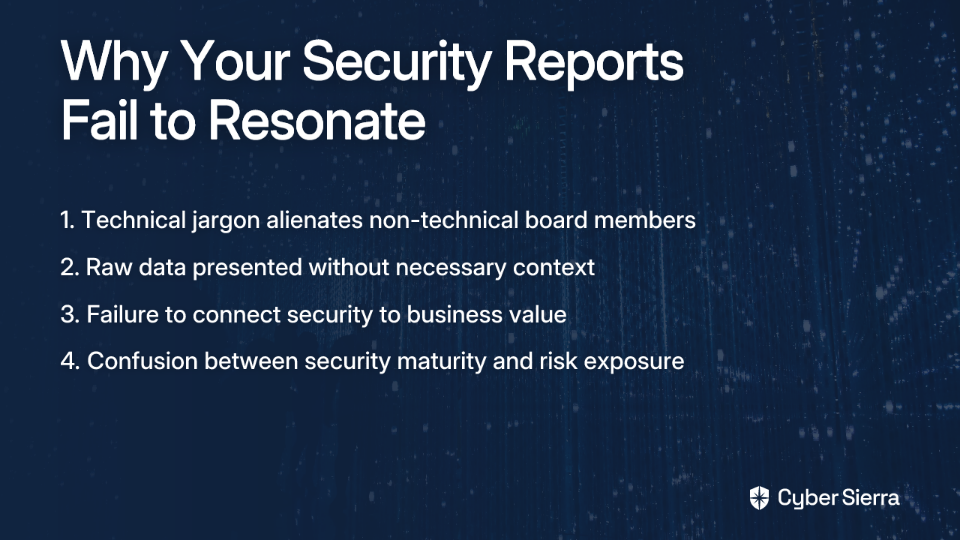
1. Drowning in Jargon and Technical Acronyms

When you fill your reports with technical terms like NIST CSF, COBIT2019, third-party assessment, and antimalware tool statistics, you're essentially speaking a foreign language to your board. Most board members lack the technical background to interpret these terms, leaving them feeling alienated and unable to engage meaningfully with your content.

Impact: When the board doesn't understand the language, they can't grasp the risks or the value of the solutions you're proposing. Your critical messages get lost in translation.

2. Presenting Data Without a Story (The Context Deficit)

Raw data points—like the number of blocked attacks or patched vulnerabilities—are meaningless without context. Static reporting that simply lists metrics leaves board members wondering:

  • Is this number good or bad?
  • Are we improving?
  • How do we compare to our peers?
  • What does this mean for the business?

Without this crucial context, your data becomes noise rather than signal. This is particularly challenging when trying to "show month over month that we're making tangible movement forward in improving our maturity against CSF."

3. The Failure to Connect Security to Business Value

This is the most critical failure. Reports that focus on technical activities rather than business outcomes position security as a cost center rather than a business enabler.

Many security professionals hold the worldview that "cybersecurity doesn't add value to the bottom line. It allows there to continue to be a bottom line." While this is fundamentally true, failing to articulate how security enables business continuity, protects revenue, and supports growth opportunities means your work will be viewed as a necessary evil rather than a strategic investment.
4. The "Maturity vs. Risk" Muddle

A nuanced but critical failure point occurs when leadership conflates security maturity (your capabilities) with the risk register (your actual risk exposure and outcomes). As one security professional lamented, "I cannot get them to decouple the two (our 'risks' and our 'maturity')."

This confusion leads to misaligned expectations and priorities. The distinction is crucial: program maturity measures CAPABILITIES while the risk register is focused on desired OUTCOMES. Without this clarity, boards cannot make informed decisions about resource allocation and risk acceptance.

The Prescription: How to Craft Reports That Drive Action
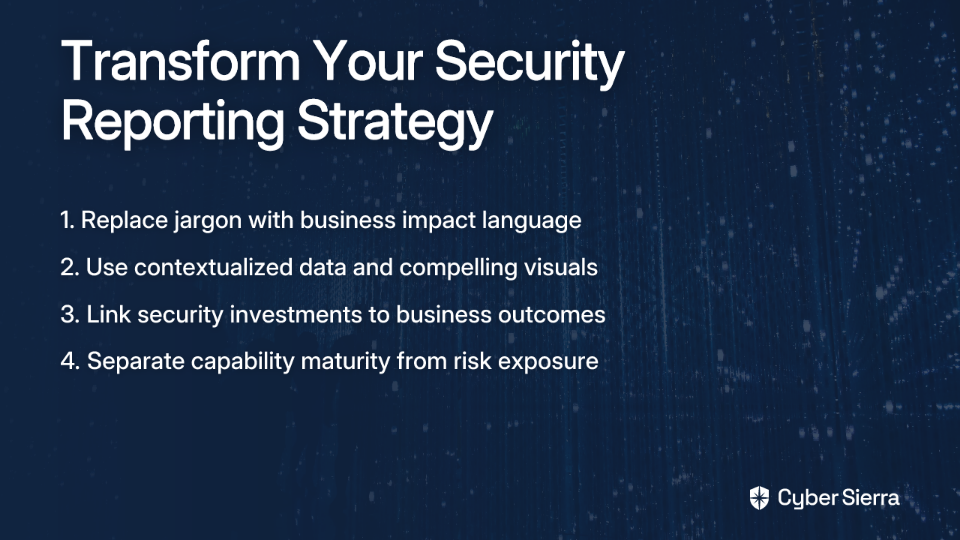
1. Translate Security into the Language of Business

Action: Eliminate jargon. Frame everything in terms of business impact: financial loss, reputational damage, operational disruption, and regulatory fines.

How-to:

  • Learn their language: Study business concepts like financial statements and metrics to engage more effectively.
  • Focus on Business Alignment: Understand your organization's commercial agenda and show how security is an enabler, not a roadblock.
  • Use Business-Focused KPIs and KRIs: Replace technical metrics with Key Performance Indicators and Key Risk Indicators that directly relate to business objectives and OKRs (Objectives and Key Results).

Example: Instead of reporting "implemented multi-factor authentication across 85% of critical systems," say "reduced the risk of credential-based attacks by 60%, protecting $X million in annual revenue from potential disruption."

2. Build a Narrative with Contextualized Data and Visuals

Action: Transform raw data into business intelligence through dynamic reporting that tells a story.

How-to:

  • Use Comparisons: Provide context with historical trends, industry benchmark averages, and progress against goals.
  • Leverage Visuals: Use simple graphs and charts (e.g., trend lines, heat maps) to make complex data digestible. This directly addresses the need for "aesthetically pleasing" reports that are also substantive.
  • Tell Success Stories: Instead of just reporting failures, highlight successful initiatives and averted incidents to build confidence.

Example: Don't just report "blocked 10,000 malicious connection attempts." Instead, show a trend line of attacks over 12 months, compare it to industry averages, and highlight a specific campaign that was thwarted, explaining the potential business impact had it succeeded.

3. Connect Security Investments to Business Outcomes

Action: Explicitly link security initiatives to business priorities and risk reduction.

How-to:

  • Quantify Risk Reduction: Use a quantification model to translate security improvements into risk reduction metrics.
  • Highlight Business Enablement: Show how security initiatives have supported business objectives (e.g., enabling a faster time-to-market for a new product by building security into the development process).
  • Focus on Protection: Frame security investments as protection of revenue and enablement of growth rather than just cost avoidance.

Example: "Our implementation of the NIST CSF supply chain security controls enabled us to meet FedRAMP requirements, unlocking $2M in new government contracts while reducing third-party risk exposure by 40%."

4. Clearly Separate Maturity from Risk in Your Reporting

Action: Create distinct sections in your reports for capability maturity and actual risk exposure.

How-to:

  • Use a Crosswalk Engine: Develop a mapping that shows how maturity improvements in specific capabilities impact particular risks, but present them separately.
  • Create "Pulse Buckets": Organize your reporting into clear categories that separate capabilities from outcomes.
  • Be Explicit: Clearly label which metrics measure capabilities (what we can do) versus outcomes (the risks we face).

Example: "Our maturity assessment shows we've improved our detection capabilities from 2.1 to 3.4 on our maturity model. Separately, our risk register shows that our most significant business risk remains ransomware attacks on manufacturing systems, with a current residual risk rating of 'High'."

Beyond the Document: Fostering a Security-Aware Culture

Build Credibility Through Relationships and Proactive Communication

Communication shouldn't be limited to formal board meetings. Meet with board members outside of formal settings to build rapport and establish a regular, informal information flow. Be a collaborative partner rather than just a reporter of technical information.

As Matthew K. Sharp notes in a TechTarget article, "Negotiation is about being a collaborative partner to pursue mutual benefit..." This mindset transforms the CISO role from a technical expert to a strategic business leader.

Establish a Consistent and Predictable Cadence

Regular, consistent reporting builds trust and keeps cybersecurity on the agenda. Establish a rhythm of updates that aligns with the board's meeting schedule and business cycle. Use these regular check-ins to encourage questions and facilitate dialogue.

For most organizations, this means quarterly comprehensive reports with monthly updates on key metrics or significant changes. The consistency itself becomes valuable, as it demonstrates reliability and ongoing attention to security concerns.
From Technical Reporter to Strategic Partner

The path to board-level impact lies in translating technical data into business intelligence:

  • Simplify: Ditch the jargon that auditors might understand but board members won't.
  • Contextualize: Tell a story with your data through dynamic reporting rather than static numbers.
  • Align: Connect every security effort back to business value and risk reduction.
  • Relate: Build relationships that extend beyond the boardroom.

An effective security report does more than just inform; it empowers the board to make strategic decisions. By mastering this communication, you evolve from a CISO who reports on security to a strategic leader who guides the business through a complex digital world.

This is how you demonstrate the immense value of your team's work—not just in preventing bad things from happening, but in enabling the business to thrive securely in a digital economy.
blog-hero-background-image
Cyber Security

Your Security Emails Suck. Here's How to Fix Them.

backdrop
Table of Contents

Join thousands of professionals and get the latest insight on Compliance & Cybersecurity.

You spent hours crafting that security awareness email. You included all the technical details about the latest phishing campaign, explained the importance of MFA, and even added that scary statistic about data breaches.
And yet... silence. No one implements the security measures. No one seems to care. Your carefully crafted message has joined the graveyard of ignored emails in your colleagues' inboxes.

Let's be honest: your security emails suck. But they don't have to.

Why Nobody Reads Your Security Emails

Your employees see cybersecurity as a burden, not a shared responsibility. When another security email arrives, it's met with an eye-roll and a swift click of the delete button. Many feel that standard training is just "canned" content designed to "check the compliance box" for your next SOC 2 audit and is often "more detrimental than helpful."

The stakes couldn't be higher:

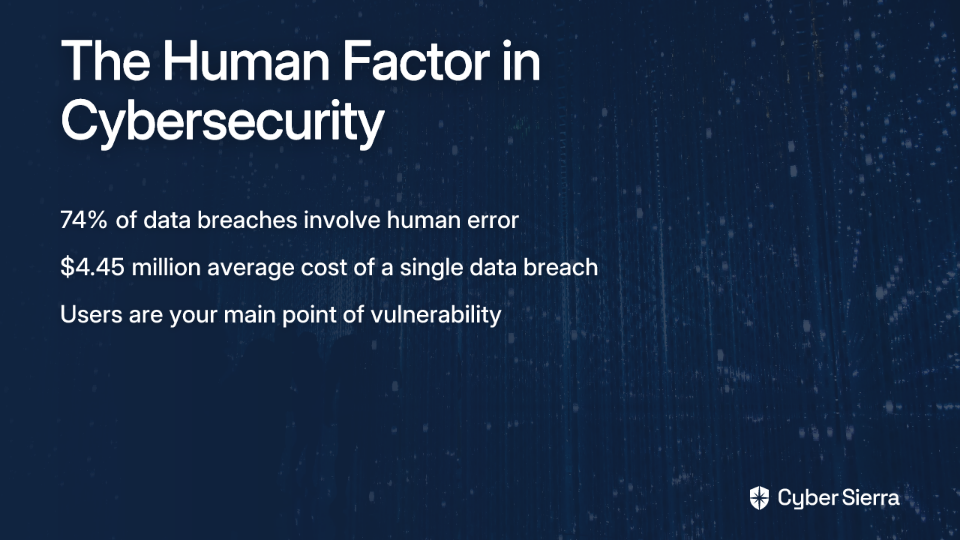
  • Humans were involved in 74% of all data breaches, according to Verizon's 2023 Data Breach Investigations Report.
  • The average cost of a single data breach has risen to $4.45 million, as reported by IBM in 2023.

Yet your organization remains vulnerable because your security communications fail to engage the very people they need to protect. The hard truth? As one cybersecurity professional put it, "users are your main point of vulnerability."

Why Traditional Security Awareness Fails

Before we fix your emails, let's understand why they're failing:

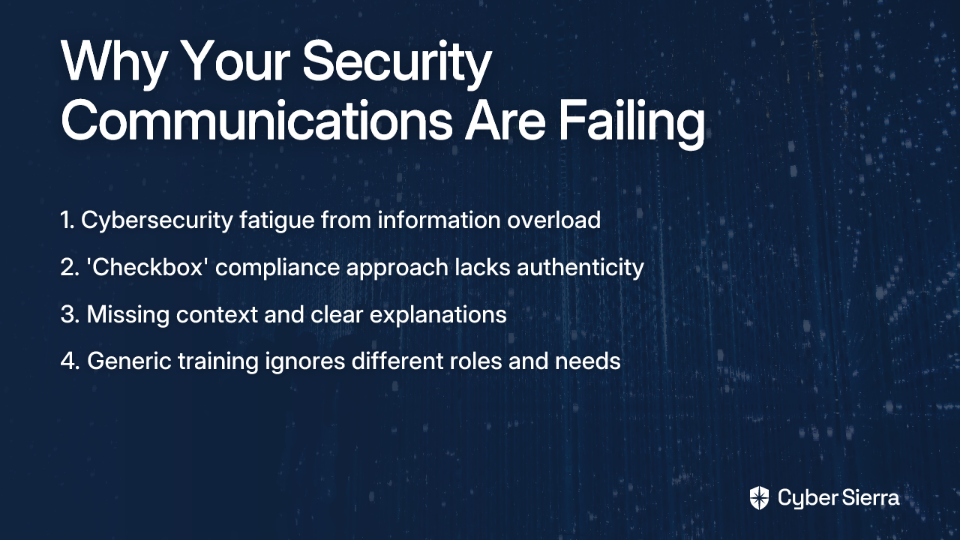
Cybersecurity Fatigue Is Real

Employees are bombarded with information all day. Dry, technical security warnings get lost in the noise. People see security as "an additional burden rather than a standard process."

The "Compliance-Only" Mindset

Many organizations use generic security awareness training that fails to resonate. This approach feels like a checkbox exercise for compliance rather than a genuine effort to improve the company's security posture.

Lack of Relatability and Clarity

Security teams often fail to explain the "why." Without context, security measures feel arbitrary and intrusive. As one CISO explained, "Whenever I roll out a new sec feature or requirement, I put out comms with a summary of the threat/implications along with my reasoning."

One-Size-Fits-None Approach

A single, annual, cookie-cutter training session is inadequate. It fails to account for different roles, technical knowledge, and learning styles within your organization.

The Fix: Creating Security Content People Actually Want to Consume

It's time to transform your security communications with these practical strategies:

1. Inject Humor: Your Secret Weapon for Engagement

Humor makes content engaging, memorable, and shareable. It breaks down the anxiety associated with cybersecurity and makes the topic less intimidating.

Why it works: A study in the Journal of Statistics Education confirmed that humor alleviates anxiety and improves learning outcomes. Using humor acknowledges that some security reminders are repetitive and shows respect for employees' time.

Practical humor ideas:

  • Memes & Cartoons: Use workplace-appropriate memes to convey key messages. For example, a "Distracted Boyfriend" meme where the boyfriend is "Your Colleague" looking at "Suspicious Email with Gift Card Offer" while "Legitimate Work Email" looks on disapprovingly.
  • Recurring Characters: Create a simple comic character duo like "Secure Sam and Risky Rachel" to illustrate right and wrong security behaviors. Every cybernut loves a good character they can relate to!
  • Pop Culture References: "Winter is coming... and so are phishing attempts. Here's how to spot them before they breach your wall."
  • Funny Anecdotes: "Last month, someone almost fell for a phishing email promising free concert tickets. Plot twist: the band broke up in 2010."

Important caveat: Keep humor appropriate for your workplace. When in doubt, have someone else review your content before sending.

2. Go Beyond the Wall of Text: Vlogs & Infographics

Many users are looking for shareable content like infographics on phishing and social engineering. Visuals are processed 60,000 times faster than text.

Creating short, engaging vlogs:

  • Keep videos under 3 minutes
  • Use storytelling to illustrate threats
  • Example: "A Day in the Life of a Phishing Email" - follow the journey of a malicious email from creation to detection
  • Interview your threat intelligence team about recent threats they've observed

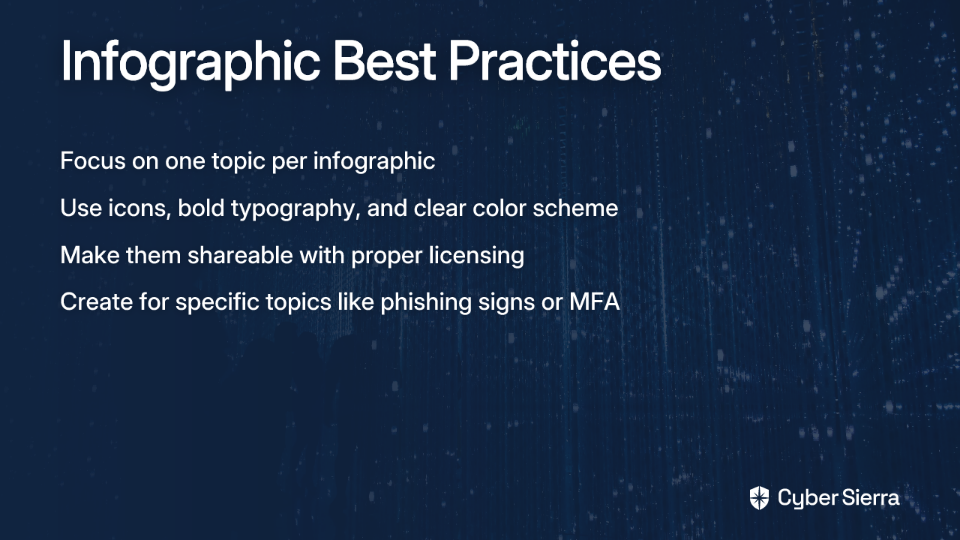
Designing powerful infographics:

  • Focus on one topic per infographic
  • Use icons, bold typography, and a clear color scheme
  • Make them shareable with proper open license permissions
  • Example topics: "5 Signs of a Phishing Email," "How to Secure Your Home Wi-Fi," "MFA: Your Digital Bodyguard"

3. Structure Your Emails for Maximum Impact

Even with humor and visuals, the email itself needs to be well-structured:

Subject Line: Be direct and create appropriate urgency

  • ✅ "Action Required: Enable MFA by Friday"
  • ❌ "URGENT SECURITY NOTIFICATION!!!"

Introduction: Get straight to the point

  • "We're introducing Single Sign-On (SSO) to make logging in more secure and convenient."

Action Steps: Use numbered lists or bold text

  • "1. Go to your security settings 2. Click 'Enable Two-Factor Authentication' 3. Follow the on-screen prompts"

Reassurance: Explain how this helps them

  • "This small step dramatically reduces the chance of account compromise, protecting both your work and personal information."

Provide Help: Always offer support

Closing: End on a positive note

  • "Thank you for helping keep our company secure!"

Tailoring Your Security Message for Different Audiences

A "cookie-cutter" approach is a primary reason security training fails. Effective communication requires personalization.

Segment Your Audience

Don't send the same email to everyone. Tailor content based on department, role, and technical knowledge:

  • Executives: Focus on business risk, financial impact, and reputational damage. Use metrics and ROI language that resonates with leadership.
  • Sales/Marketing: Highlight risks associated with CRM data, social media scams, and mobile device security. Frame security as a competitive advantage and customer trust builder.
  • Finance/HR: Emphasize threats like business email compromise, payroll fraud, and protecting sensitive employee data. Focus on compliance requirements and potential legal implications.
  • Developers/IT: Provide more technical guidance on secure coding practices and infrastructure vulnerabilities. These teams appreciate deeper technical explanations and context.

Appoint "Security Ambassadors"

Form a committee of security liaisons from different departments. These ambassadors can:

  • Help promote best practices within their teams
  • Provide feedback on what resonates with their colleagues
  • Create department-specific examples that feel relevant

Beyond Emails: Building a Lasting Security Culture

Engaging emails are just the beginning. They should be part of a broader, continuous program to foster a security-centric culture.

Make It Interactive and Gamified

Simulated Phishing Campaigns: Run regular, unannounced phishing tests to measure vigilance. Tools like Knowbe4 or Cofense can automate this process and provide valuable metrics.

Gamification: Implement security challenges with leaderboards and small prizes. For example:

  • "Phish Spotters Club" for employees who report suspicious emails
  • Monthly security quizzes with small gift card rewards
  • Security-themed escape rooms for team-building (yes, really!)

One company created a "Security Superhero" program where employees earned digital badges for completing different security actions—from enabling MFA to reporting suspicious activities.

Create a Feedback Loop

Conduct regular surveys to understand:

  • What security topics employees want to learn about
  • Which communication methods they prefer
  • How confident they feel about handling specific security situations

This makes employees feel like stakeholders and helps you refine your approach.

Recognize and Reward

Publicly acknowledge employees who demonstrate good security practices. This could be as simple as a shout-out in a company meeting or featuring them in your security newsletter as "Security Champion of the Month."

Stop Sucking, Start Securing

Your security emails don't have to suck. By ditching the dry, technical jargon and embracing humor, engaging visuals, and tailored messaging, you can transform security awareness from a chore into a shared mission.

Remember, the goal isn't to make security less of a chore; it's to make it "a series of expectations they will meet" as part of their job. Effective communication is key to this cultural shift.

Start small. Pick one tip from this article—try a humorous meme in your next newsletter, create a short vlog explaining MFA, or design a simple infographic on password security. Stop sending emails that get ignored and start building a stronger, more resilient security culture today.

After all, as any good CISO knows, your security is only as strong as your least engaged employee. Make sure they're not just reading your emails—they're acting on them.

Frequently Asked Questions

What is the best way to make security emails more engaging?

The best way to make security emails more engaging is to move beyond dry, technical text and incorporate humor, compelling visuals like infographics, and relatable storytelling. This approach helps combat cybersecurity fatigue by making complex topics more memorable and less intimidating. Using memes, short vlogs, or funny anecdotes can capture attention, while structuring emails clearly with actionable steps ensures the message is easy to understand and follow.

Why do most employees ignore security awareness training?

Most employees ignore security awareness training due to "cybersecurity fatigue," where they are overwhelmed by constant, dry information. They often perceive it as a mere compliance exercise rather than a genuine effort to protect them and the company. This "compliance-only" mindset is reinforced by generic, one-size-fits-all content that isn't relevant to their specific roles.

How can I create engaging security content on a limited budget?

You can create engaging security content on a limited budget by leveraging free or low-cost tools and creative strategies. Focus on using humor, creating simple infographics with tools like Canva, and personalizing your messages for different departments. Instead of expensive video production, record short, informal vlogs with your smartphone. Appointing volunteer "Security Ambassadors" in different teams is also a no-cost way to make content more relevant.

How do I tailor security messages for different audiences like executives or sales teams?

To tailor security messages, you must segment your audience and focus on what matters most to each group. For executives, frame security in terms of business risk and ROI. For sales teams, highlight how security protects customer data and builds trust. By personalizing the context and the "why," you make the security requirements feel relevant and crucial to their specific roles.

What are the key elements of a well-structured security email?

A well-structured security email includes a clear and direct subject line, an introduction that gets straight to the point, easy-to-follow action steps (using lists or bold text), reassurance about the benefits, and clear information on where to get help. For example, use a subject like "Action Required: Enable MFA by Friday" instead of a generic "Security Update."

How can I measure the success of my security communications?

You can measure the success of your security communications through both quantitative and qualitative metrics. Key methods include running simulated phishing campaigns to track click and reporting rates, and using surveys to gather feedback on employee confidence and preferences. A decrease in security incidents or an increase in employees proactively reporting suspicious emails are strong indicators of success.

blog-hero-background-image
Cyber Security

Scaling Detection as Code: Taming 10+ SIEM Platforms

backdrop
Table of Contents

Join thousands of professionals and get the latest insight on Compliance & Cybersecurity.


You've just been asked to manage security detections across a sprawling enterprise with multiple SIEM platforms. Your first thought? "This is going to be a nightmare."

Looking at your new reality—dozens of detection rules, each requiring translation and maintenance across Splunk, Microsoft Sentinel, Elastic, and a half-dozen other platforms—you can already envision the chaos: inconsistent detections, deployment failures, and the dreaded "messy merges" that will inevitably plague your main branch.

The spreadsheets alone might drive you insane. As one security professional lamented, "the sheer amount of spreadsheets I have to deal with on a daily basis... feels like it melts my brain." Sound familiar?

Why Detection as Code Is Your Salvation

Detection as Code (DaC) applies software engineering principles to security rule management. Instead of manually updating rules across platforms, you define them programmatically, manage them in version control, test them automatically, and deploy them through automated pipelines.

This approach helps tame the complexity that plagues modern security environments. As one industry observation notes, "Complexity is the enemy of security; yet the average organization works with 10 to 15 security vendors and 60 to 70 security tools."

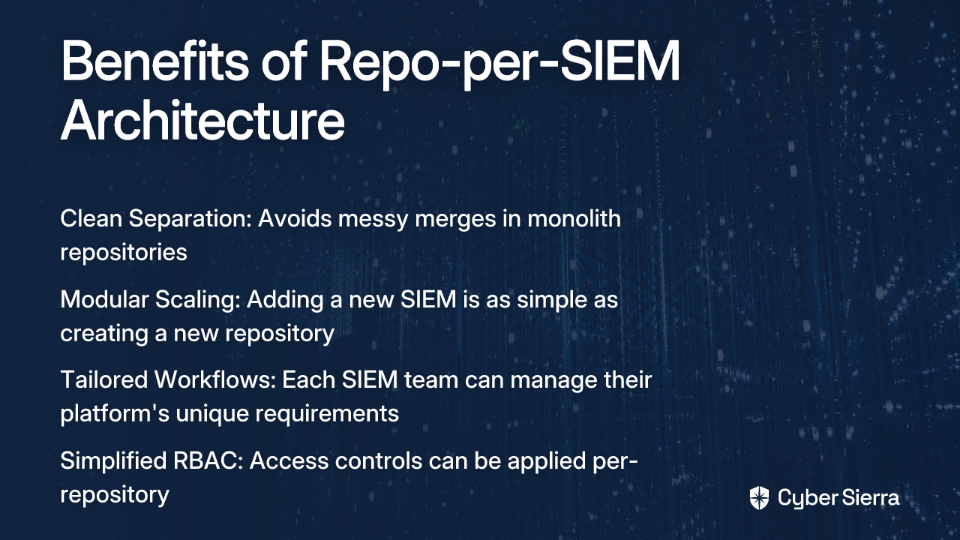
DaC offers critical benefits for multi-platform environments:

The Multi-SIEM Reality: Why One-Size-Fits-None

Managing multiple SIEMs creates unique challenges that simple solutions can't address:

  • Divergent Query Languages: A rule written for Splunk's SPL won't work in Microsoft Sentinel (KQL) without translation
  • Inconsistent Data Models: Field names vary wildly across platforms (user vs. username vs. sAMAccountName)
  • Deployment Fragmentation: Each SIEM has unique APIs and deployment requirements
  • Endpoint Differences: Detection capabilities vary between platforms

This complexity increases exponentially as you add more platforms. A Fortune 500 retailer who attempted a single-database architecture for multiple tenants saw a 400% spike in support tickets and performance degradation when one client ran intensive queries—a cautionary tale for any shared security architecture.

Architecting for Scale: The "Repo-per-SIEM" Strategy

When working across multiple SIEMs, you'll inevitably face the architectural question that plagues many security teams: "Branch per SIEM vs. multiple repos?" as one security engineer put it.

After evaluating numerous approaches, the most effective architecture for scaling across 10+ platforms is the "repo-per-SIEM" strategy with a shared library:

The Recommended Structure:

  1. Central "Library" Repository: This is your single source of truth for detection logic, containing platform-agnostic rules written in a universal format like Sigma.
  2. Platform-Specific Repositories: Create dedicated repositories for each SIEM (e.g., detections-splunk, detections-sentinel).

This approach directly addresses the concern that "each SIEM platform definitely needs at least its own repo, but then managing each individual SIEM instance with its own set of requirements, use-cases, etc." can become unwieldy.

One security engineer endorsed this approach saying, "I would personally do a repo per SIEM, this will help keep things logically separated."

Building the Automation Engine: CI/CD Workflow

The heart of any Detection as Code implementation is the CI/CD pipeline that automates testing and deployment. Here's how to build one that scales:

1. Developer Workflow

  • An engineer creates a detection in a feature branch within the central library
  • Detection is written in a generic format (like Sigma)
  • PR request is submitted for review

2. Automated Testing

When the PR is created, the CI/CD pipeline springs into action:

  • Syntax Validation: Ensures the detection follows proper format
  • Unit Tests: Verifies the rule correctly identifies known-good and known-bad patterns
  • Integration Tests: Checks for conflicts with existing rules

3. Cross-Platform Deployment

After approval and merging to the main branch:

  • Central pipeline validates the merge
  • Triggers downstream pipelines in each SIEM-specific repository
  • Each SIEM pipeline:
    • Pulls the generic rule
    • Translates it to the platform's native query language
    • Applies platform-specific templates
    • Manages secrets securely
    • Deploys to the appropriate environment

Practical Implementation Tips

Use Submodules to Share Common Logic

Git submodules allow you to include the central library in each SIEM-specific repository while maintaining separation:

# Adding the central library as a submodule
git submodule add https://github.com/your-org/detection-library.git lib

This approach keeps generic content centralized while allowing platform-specific customizations.

Embrace Test-Driven Development

Before writing any detection rule, create a test case first:

  1. Generate or find a log sample representing the malicious activity
  2. Write a test that validates your rule will catch this activity
  3. Develop the detection rule until it passes the test

This ensures your detections are actually effective before deployment.

Standardize Metadata

Develop a consistent schema for rule metadata across all platforms:

metadata:
  name: "Suspicious PowerShell Command Line"
  description: "Detects suspicious PowerShell commands"
  severity: "high"
  mitre_attack:
    - "T1059.001"
  author: "Security Team"
  date_created: "2023-10-15"

This enables cross-platform reporting and management.

Proving Value and Gaining Buy-In

Many security teams struggle with "getting funds for security tools, and getting people's buy-in for implementing the processes needed." To overcome this hurdle, focus on demonstrating tangible value:

Start Small with a Proof of Concept

As one practitioner advised, if you're "starting out and want to build a POC to prove value," select one SIEM and a handful of high-value rules to automate. This shows immediate benefits without requiring a complete infrastructure overhaul.

Track Metrics That Matter

Measure and report on:

  • Time Saved: Compare manual vs. automated deployment time
  • Error Reduction: Track deployment failures before/after automation
  • Detection Coverage: Map all rules to MITRE ATT&CK to visualize gaps
  • Alert Quality: Monitor false positive rates across platforms

Common Pitfalls to Avoid

  • Over-Engineering: Start simple and iteratively improve
  • Neglecting Testing: Without automated tests, you'll lose confidence in deployments
  • Ignoring Platform Differences: Each SIEM has unique quirks that generic approaches may miss
  • Failing to Document: Clear documentation is essential for team adoption

Conclusion

Scaling Detection as Code across 10+ SIEM platforms is challenging but achievable with the right architecture and automation. The repo-per-SIEM approach with a central library provides the flexibility needed to handle platform-specific requirements while maintaining consistency in your detection logic.

For security engineers with "unconventional backgrounds" or those "panicking" about new automation responsibilities, take heart. Detection as Code provides a structured framework that makes managing complex security environments more approachable and reliable.

By implementing proper CI/CD pipelines, embracing test-driven development, and focusing on proving value through metrics, you can transform a chaotic, multi-platform security environment into a well-orchestrated detection program that scales with your organization's needs.

Remember, as your detection program grows, complexity will inevitably increase. The key is developing systems that manage this complexity rather than being overwhelmed by it.

Frequently Asked Questions

What is Detection as Code (DaC)?

Detection as Code (DaC) is the practice of managing security detection rules using principles from software development, such as version control, automated testing, and CI/CD pipelines. Instead of manually creating and updating rules in each security platform's UI, you define them as code in a central repository. This allows for consistent, high-quality detections that can be automatically deployed across multiple systems, significantly reducing manual effort and errors.

Why is managing security rules across multiple SIEMs so challenging?

Managing security rules across multiple SIEMs is challenging due to fundamental differences between the platforms, including divergent query languages (e.g., SPL vs. KQL), inconsistent data models and field names, and unique deployment processes for each system. These inconsistencies mean a rule written for one platform cannot be simply copied to another. It requires manual translation and testing, which becomes exponentially more complex and error-prone as the number of platforms and rules grows.

What is the best repository structure for multi-SIEM Detection as Code?

The most effective and scalable structure is the "repo-per-SIEM" strategy, which uses a central "library" repository for platform-agnostic logic and separate, dedicated repositories for each specific SIEM platform (e.g., Splunk, Sentinel). The central library acts as a single source of truth for all detection logic, often using a universal format like Sigma. Each platform-specific repository then pulls from this library, translating and tailoring the rules for its unique environment. This modular approach avoids complex branching strategies, simplifies access control, and makes it easy to add or remove platforms.

How does a CI/CD pipeline improve Detection as Code?

A CI/CD (Continuous Integration/Continuous Deployment) pipeline automates the entire lifecycle of a detection rule, from validation and testing to deployment across multiple platforms. When a new rule is proposed, the pipeline automatically runs syntax checks, unit tests, and integration tests to ensure its quality and prevent conflicts. Once approved, the pipeline manages the translation of the generic rule into platform-specific formats and deploys it, ensuring that security detections are rolled out quickly, consistently, and reliably.

What is a good first step to implement Detection as Code?

The best way to start is with a small, focused Proof of Concept (POC). Instead of attempting a full-scale overhaul, select one SIEM platform and a few high-value detection rules to automate. By successfully automating this small set, you can demonstrate tangible value—such as time saved and reduced errors—to gain buy-in and funding for a broader implementation.

How can I measure the value of a Detection as Code program?

You can measure the value of a DaC program by tracking key metrics that demonstrate improvements in efficiency, quality, and security coverage. Focus on metrics that resonate with leadership, such as a reduction in the time required to deploy new detections, a decrease in deployment errors and rollbacks, an increase in detection coverage mapped to frameworks like MITRE ATT&CK, and an improvement in alert quality measured by a lower false positive rate.

blog-hero-background-image
Cyber Security

How to Automate Email Whitelisting and Escape Ticket Hell

backdrop
Table of Contents

Join thousands of professionals and get the latest insight on Compliance & Cybersecurity.


You've set up robust email security controls to protect your organization, only to find yourself drowning in an endless flood of whitelisting requests. Your inbox is bursting at the seams, your team is stressed, and users are increasingly frustrated as legitimate business communications get caught in security filters. What began as a smart security measure has devolved into a nightmare of manual processes and angry stakeholders.

"We are getting hammered with ticket requests for whitelisting with no really way to manage this long term. Additionally, the users are extremely frustrated and taking it out on my team and myself," reports one cybersecurity professional on Reddit.

This "ticket hell" isn't just exhausting—it's dangerous. The manual process of reviewing and approving domain whitelisting requests is "a mammoth task that's prone to inefficiency and human error," according to administrators struggling with the workload. These inefficiencies create security vulnerabilities and consume valuable time that cybersecurity staff could spend on strategic initiatives.

But there's good news: you can implement an automated workflow for domain whitelisting that balances security requirements with operational efficiency. This article provides a step-by-step guide to escaping ticket hell while maintaining robust Data Loss Prevention (DLP) controls.

What is Email Whitelisting (and Why It's a Double-Edged Sword)

Email whitelisting (increasingly referred to as "allowlisting" in the industry) is the practice of creating a list of approved email addresses or domains that are considered safe by your email security systems. When implemented correctly, allowlisting ensures that legitimate communications from trusted partners bypass spam filters and security controls, landing directly in recipients' inboxes.

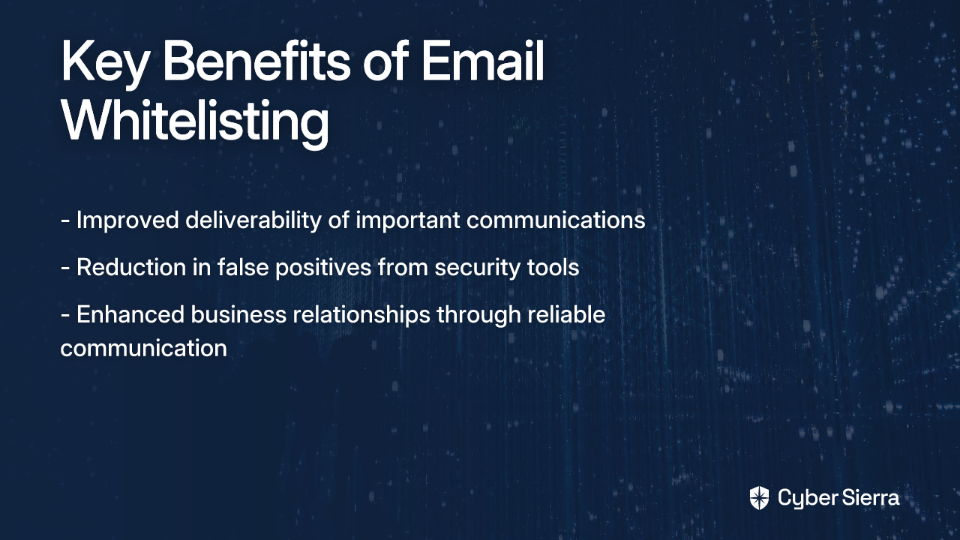
The benefits are clear:

  • Improved deliverability of important communications
  • Reduction in false positives from security tools
  • Enhanced business relationships through reliable communication

However, whitelisting comes with significant security risks. Many organizations find themselves asking, "Our vendor wants us to whitelist their emails... but what are the cons? Can this be spoofed by someone else?" as seen in another Reddit thread.

The short answer? Yes, there are serious risks. Email spoofing, compromised vendor accounts, and sophisticated phishing campaigns can all exploit overly permissive whitelisting. In 2020 alone, 37 billion data records were leaked, with email addresses comprising 32% of those breaches. This massive pool of compromised credentials makes whitelisting based solely on email domains a potential security liability.

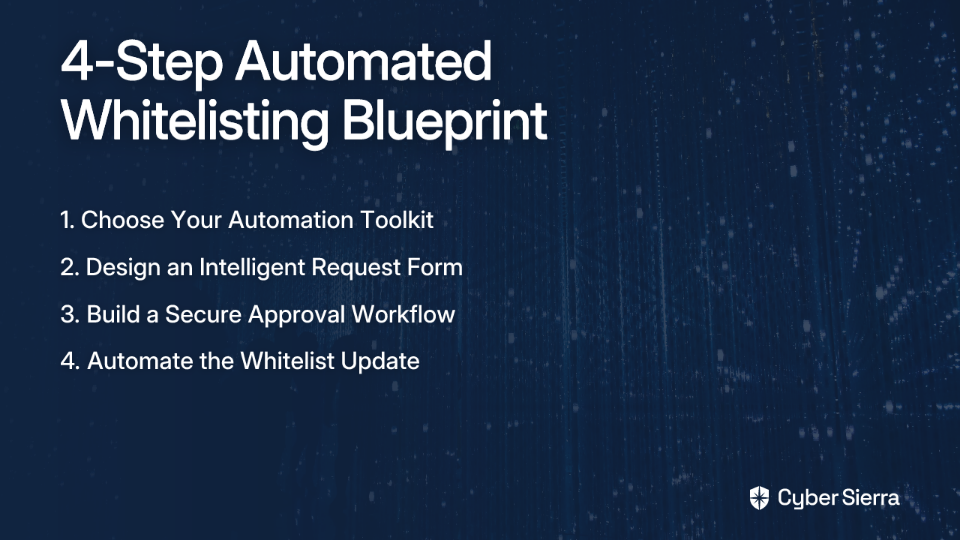
The 4-Step Blueprint for Automated Whitelisting

Rather than abandoning whitelisting altogether, the solution is to implement a secure, automated workflow that maintains security controls while reducing manual overhead. Here's how to build it:

Step 1: Choose Your Automation Toolkit

The foundation of your automated workflow will be a combination of:

A Ticketing System (The Foundation): Select a robust ticketing system to manage requests and track approvals. Jira Service Management is an excellent choice due to its flexible workflows, automation capabilities, and integration options. ServiceNow and Zendesk are also strong contenders, especially for organizations already using these platforms.

A Low-Code Platform (The Automation Engine): To bridge gaps in your ticketing system and create custom forms and actions, consider implementing a low-code platform such as:

  • UI Bakery: Excellent for building user-friendly internal tools and forms
  • Appsmith: Great for rapid development and connecting to various data sources
  • Nintex: Powerful workflow management capabilities for establishing approval chains

This combination provides the flexibility to create a customized solution without extensive coding requirements.

Step 2: Design an Intelligent Request Form

Using your chosen low-code platform, create a user-facing form that captures all the information needed to evaluate whitelisting requests. The form should be intuitive enough for non-technical users while gathering sufficient information for security decision-making.

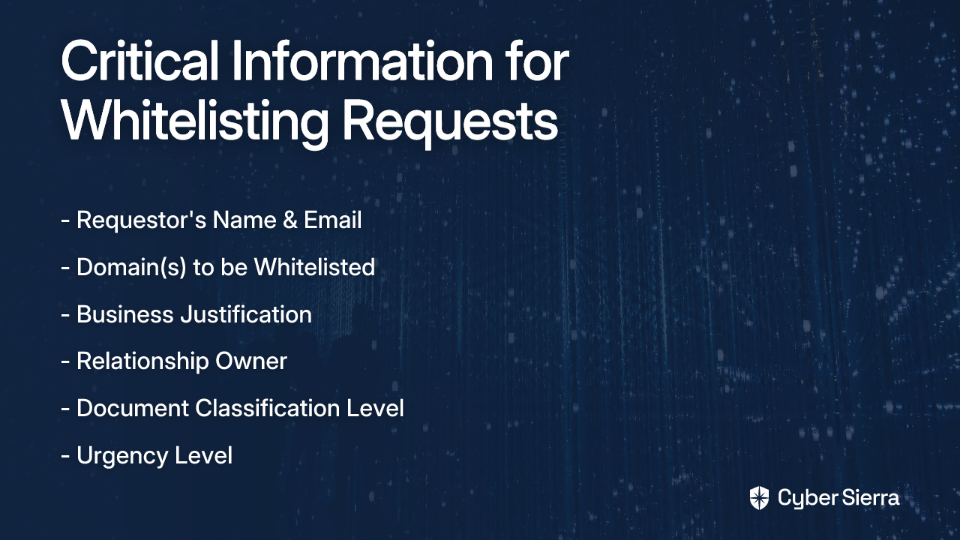
Essential Form Fields:

  • Requestor's Name & Email
  • Domain(s) to be Whitelisted (instruct users to enter the domain only, e.g., example.com)
  • Business Justification (Why is this necessary?)
  • Relationship Owner (Who manages this vendor/partner relationship?)
  • Document Classification Level (What types of information will be exchanged?)
  • Urgency Level (Low, Medium, High)

The business justification field is particularly important as it forces requestors to articulate legitimate business needs rather than submitting requests out of convenience. This helps prevent what some security professionals call "malicious compliance" – where users follow security protocols to the letter while undermining their intent.

Step 3: Build a Secure Approval Workflow

With your request form in place, map out a multi-stage approval workflow in your ticketing system:

1. Submission: User submits the form, which automatically creates a ticket in your service desk system.

2. Initial Triage (Automated): Use automation rules to route the ticket to the appropriate queue based on classification level and urgency.

3. Risk Assessment: The system calculates a preliminary risk score based on form inputs, using predefined criteria established by your security team.

4. Manager Approval: The workflow automatically routes the request to the requestor's direct manager for initial sign-off, ensuring departmental accountability.

5. Security Review: If manager-approved, the ticket is assigned to a cybersecurity staff member who verifies the domain's legitimacy by:

  • Checking the domain against threat intelligence feeds
  • Verifying the business relationship with the relationship owner
  • Evaluating the risk assigned to this request against security policies

6. CISO/CIO Approval: For high-risk requests or those involving sensitive information, include an additional approval step from the CISO or delegated authority.

7. Final Implementation: Once fully approved, the ticket moves to "Ready for Implementation" status.

A common pitfall with automation is creating processes that feel "magical" to end-users. As one Reddit user notes, "I've found automations to be counter-intuitive to end-users. If you do something, and one or two things 'magically' occur, this usually isn't a good experience." Source

To prevent confusion, ensure your workflow includes clear status updates and notifications at each stage, maintaining transparency throughout the process.

Step 4: Automate the Whitelist Update

The final step is connecting your approval workflow to your email security infrastructure. This can be accomplished through API integration between your ticketing system and email security platform.

For Jira Service Management Users:

  1. From your project, navigate to Channels & self service > Email
  2. Select More (•••) > Manage allowlist
  3. Select + Add domain name
  4. Enter the approved domain name (e.g., example.com)
  5. Select Save

For other email security platforms, you'll need to leverage their specific APIs. Here's a generic approach:

  1. Create an API Connection: Set up secure API credentials for your email security platform.
  2. Build the Integration: Use your low-code platform to create a webhook or scheduled task that:
    • Queries your ticketing system for newly approved requests
    • Extracts the domain information
    • Submits the domain to your email security platform's API
    • Updates the ticket status to "Implemented"
  3. Implement Verification: Add a verification step that confirms the whitelisting was successful before closing the ticket.

Important Security Caveats:

  • Most allowlist systems support exact domain matching only (e.g., example.com will not match mail.example.com)
  • Messages that fail DMARC verification should still be filtered, even if from an allowlisted domain
  • Consider implementing timeout periods for whitelisted domains to prevent security drift

Best Practices for Long-Term Success

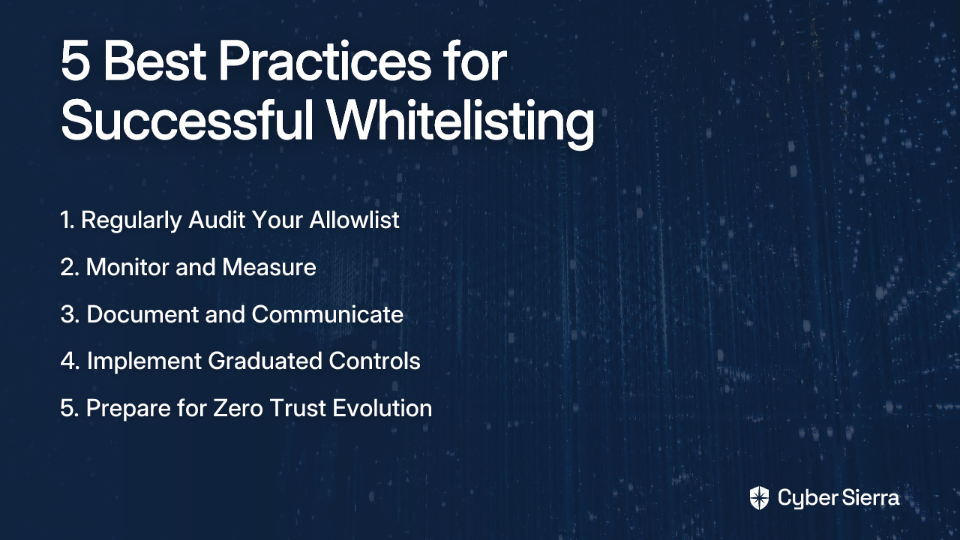
Implementing the automation is just the beginning. To ensure your whitelisting process remains secure and efficient over time, follow these best practices:

1. Regularly Audit Your Allowlist

Don't let your allowlist become a security liability through neglect. Schedule quarterly reviews to:

  • Remove domains that are no longer needed
  • Verify that business relationships are still active
  • Check whitelisted domains against updated threat intelligence

Automation can help here too—set up scheduled reports that flag domains with no recent email traffic or those associated with expired contracts.

2. Monitor and Measure

Implement metrics to track the effectiveness of your whitelisting process:

  • Average time from request to implementation
  • Number of requests by department/business unit
  • Percentage of requests approved/denied
  • Security incidents related to whitelisted domains

These metrics can help identify process bottlenecks and justify resource investments to the CISO or CIO.

3. Document and Communicate

Clear documentation is essential for both users and security teams:

  • Create a knowledge base article explaining the process and requirements
  • Provide examples of valid business justifications
  • Explain the security implications of whitelisting in user-friendly terms
  • Offer alternatives for low-risk communications

4. Implement Graduated Controls

Not all whitelisting requests carry the same risk. Implement graduated controls based on the sensitivity of information being exchanged:

  • Low risk: Standard whitelisting with DMARC enforcement
  • Medium risk: Whitelisting with additional content scanning
  • High risk: Secure email gateway with enhanced DLP controls

This approach allows security teams to focus attention on high-risk requests while streamlining approval for lower-risk communications.

5. Prepare for Zero Trust Evolution

The security landscape is evolving toward Zero Trust architectures, which operate on the principle of "never trust, always verify." As you automate your whitelisting process, consider how it will integrate with future Zero Trust initiatives:

  • Implement strong authentication for senders, even from trusted domains
  • Apply continuous validation rather than permanent trust
  • Maintain granular access controls based on content classification

Conclusion: From Ticket Hell to Strategic Control

By implementing an automated workflow for domain whitelisting, you transform a chaotic, manual process into a structured system that balances security with operational efficiency. This approach addresses the core problems faced by many security teams:

  • Reduced Manual Overhead: Automation handles the repetitive aspects of whitelisting, freeing cybersecurity staff for more strategic work.
  • Improved User Experience: Clear processes and expectations reduce frustration for both requestors and security teams.
  • Enhanced Security: Structured evaluation and approval workflows ensure proper risk assessment before domains are whitelisted.
  • Better Governance: Comprehensive documentation and audit trails satisfy compliance requirements and demonstrate due diligence.

Remember that automation isn't about removing human judgment from security decisions—it's about focusing that judgment where it matters most. The security review remains a vital human checkpoint in an otherwise automated process, embodying the balance between efficiency and security that defines modern cybersecurity practices.

By escaping ticket hell through thoughtful automation, you're not just saving time—you're building a more secure, more responsive security operation that can adapt to evolving threats while supporting legitimate business needs.

Frequently Asked Questions (FAQ)

What is email whitelisting?

Email whitelisting, also known as allowlisting, is the practice of creating a list of approved email addresses or domains that are trusted to bypass security filters. This ensures that important communications from known partners, vendors, and clients are delivered directly to user inboxes without being flagged as spam. However, it must be managed carefully to avoid creating security vulnerabilities.

Why is manual email whitelisting a problem?

Manual email whitelisting is a significant problem because it is highly inefficient, prone to human error, and creates security risks. This manual process often leads to "ticket hell," where security teams are overwhelmed with requests, causing delays and frustrating users. The lack of a standardized evaluation process can lead to mistakes where risky domains are approved, consuming valuable time and resources.

How can I automate the email whitelisting process?

You can automate the email whitelisting process by building a structured workflow using a ticketing system combined with a low-code automation platform. The process involves four key steps: 1) Select your tools (like Jira and UI Bakery), 2) design an intelligent request form to capture business justifications, 3) build a multi-stage approval workflow with automated routing, and 4) use API integrations to automatically update your email security platform once a request is approved.

What are the security risks of whitelisting an email domain?

The primary security risks of whitelisting an email domain include exposure to email spoofing, business email compromise (BEC), and sophisticated phishing attacks. If a trusted vendor's email account is compromised, attackers can use it to send malicious emails that bypass your security controls because the domain is on your allowlist. Overly permissive whitelisting creates a false sense of security and can be exploited to deliver malware or trick employees.

What tools are needed to build an automated whitelisting workflow?

To build an automated whitelisting workflow, you typically need a ticketing system to manage requests and a low-code platform to create custom forms and connect systems. The article recommends using a robust ticketing system like Jira Service Management or ServiceNow as the foundation. To enhance its capabilities, a low-code platform such as UI Bakery or Appsmith can be used to build user-friendly forms and automate actions via API integrations with your email security infrastructure.

Is automated whitelisting more secure than a manual process?

Yes, a well-designed automated whitelisting system is generally more secure than a manual process because it enforces consistent, auditable security checks for every request. Automation ensures that no steps are skipped, mandates manager sign-offs, incorporates risk assessments based on predefined criteria, and creates a clear audit trail. This structured approach reduces the human error and oversight common in manual processes, ensuring approvals are based on policy, not expediency.

Ready to implement this solution? Start by mapping your current whitelisting process, identifying pain points, and selecting the right tools for your environment. With careful planning and a phased implementation approach, you can transform one of your most frustrating security processes into a showcase of efficiency and effectiveness.

blog-hero-background-image
Cyber Security

How to Build a DIY Database Proxy for Better Security

backdrop
Table of Contents

Join thousands of professionals and get the latest insight on Compliance & Cybersecurity.


You've set up proper user roles and permissions for your database. You even have audit logs enabled. Yet when you try to trace who actually executed that suspicious query, all you see is "user: app_service" - the same shared service account used by dozens of microservices. Who actually triggered that sensitive data access? Your expensive database logs have no idea.

This visibility gap isn't just frustrating - it's dangerous. As one database administrator put it, "90% of the time, it's just DB user-level info (roles, grants, maybe audit logs)." But the moment you have shared DB users or service accounts reused across services, "you lose context" about who or what is actually accessing your data.

Enterprise-grade database security solutions promise to solve this problem, but their price tags can be astronomical. The good news? You can build your own database proxy that provides accessor-level visibility without breaking the bank.

What is a Database Proxy? The Gatekeeper Your Database Needs

A database proxy is an intermediary server that sits between your applications and your database. Think of it like a restaurant manager (the proxy) coordinating orders (database requests) between waiters (applications) and the chef (database).

As a specific type of reverse proxy designed for databases, it provides several critical security benefits:

  1. Acts as a Security Gatekeeper: It enforces security policies and blocks unauthorized access before requests ever reach your database, creating a crucial choke point for monitoring.
  2. Provides Accessor-Level Visibility: Unlike basic database logs that only show which database user executed a query, a properly configured proxy can track which specific application, service, or human accessor initiated the request.
  3. Monitors for Suspicious Patterns: By logging all database traffic, the proxy can detect out-of-pattern access, excessive queries, or potential data exfiltration attempts.
  4. Enhances Authentication: It can integrate with your existing Privileged Access Management (PAM) systems and secrets management tools for better authorization controls.

Beyond security, a database proxy offers performance advantages through connection pooling (reducing database overhead), query caching (improving response times), and load balancing (distributing queries across replicas).

The DIY Advantage: Why Open-Source Beats Pricey Alternatives

Commercial solutions like AWS RDS Proxy provide robust features but can be "obscenely overpriced" according to many users. They also may not work with external databases outside your cloud environment.

Building your own proxy using open-source tools offers several advantages:

  1. Cost-Effectiveness: Open-source proxies like ProxySQL, HAProxy with PGBouncer, or NGINX can be deployed at a fraction of the cost of commercial solutions.
  2. Flexibility: DIY proxies work with any database, regardless of where it's hosted – on-premises, in multiple clouds, or hybrid environments.
  3. Customization: You can tailor logging, alerting, and security rules to your specific requirements rather than being constrained by a vendor's implementation.
  4. Transparency: With full visibility into the proxy's code and configuration, you know exactly how your security controls are implemented.

Planning Your Proxy: An Essential Pre-Build Checklist

Before diving into implementation, assess your environment against these criteria:

  • Traffic Patterns: Do you have high-volume applications or many short-lived connections (like serverless functions)?
  • Security Requirements: What level of monitoring do you need? Are you handling sensitive data requiring strict access controls?
  • Performance Needs: Is connection pooling important for your workload?
  • Scalability Considerations: Will you need to distribute traffic across multiple database instances?
  • Compliance Requirements: Do you need to maintain detailed audit trails for regulatory purposes?

With these questions answered, let's build a basic database proxy using ProxySQL for MySQL databases. This approach can be adapted for PostgreSQL using PGBouncer or other database types.

Step-by-Step Guide: Building a Secure Proxy with ProxySQL and AWS

Step 1: Set Up Your Infrastructure

  1. Launch an EC2 Instance: Select an Ubuntu instance in the same VPC as your database for low-latency communication.
  2. Configure Security Groups:
    • Allow inbound MySQL traffic (port 3306) from your application servers
    • Allow outbound MySQL traffic to your database
    • Restrict SSH access to admin IPs only
  3. Install ProxySQL: # Update package list sudo apt-get update # Install ProxySQL sudo apt-get install -y proxysql # Start and enable ProxySQL service sudo systemctl start proxysql sudo systemctl enable proxysql

Step 2: Configure ProxySQL

  1. Connect to ProxySQL Admin Interface: mysql -u admin -padmin -h 127.0.0.1 -P 6032
  2. Add Your Database Backend: # Replace with your actual database endpoint INSERT INTO mysql_servers (hostgroup_id, hostname, port, weight) VALUES (0, 'your-db-endpoint.rds.amazonaws.com', 3306, 100); # Apply changes LOAD MYSQL SERVERS TO RUNTIME; SAVE MYSQL SERVERS TO DISK;
  3. Configure User Authentication: # Create proxy users that applications will use to connect INSERT INTO mysql_users (username, password, default_hostgroup) VALUES ('app_service', 'secure_password', 0); # Apply changes LOAD MYSQL USERS TO RUNTIME; SAVE MYSQL USERS TO DISK;
  4. Set Up Basic Query Rules: # Create a rule that logs all queries INSERT INTO mysql_query_rules (rule_id, active, match_digest, apply, log) VALUES (1, 1, '.', 1, 1); # Apply changes LOAD MYSQL QUERY RULES TO RUNTIME; SAVE MYSQL QUERY RULES TO DISK;

Step 3: Configure Advanced Logging for Accessor-Level Visibility

The key to solving the "who actually triggered what" problem is capturing and correlating the right metadata. ProxySQL allows us to log detailed information about each connection:

  1. Enable Verbose Query Logging: # Set log level to debug for more detailed information UPDATE global_variables SET variable_value='debug' WHERE variable_name='mysql-log_level'; # Configure the log file location UPDATE global_variables SET variable_value='/var/log/proxysql.log' WHERE variable_name='mysql-log_file'; # Apply changes LOAD MYSQL VARIABLES TO RUNTIME; SAVE MYSQL VARIABLES TO DISK;
  2. Capture App/Service Identifiers: Modify your application connection strings to include identifiers in comments: # Example Java connection with metadata String url = "jdbc:mysql://proxy:6033/mydb?useSSL=true&connectionComment=service:inventory-api;team:fulfillment;env:prod";
  3. Create a Rule to Parse Service Info: INSERT INTO mysql_query_rules (rule_id, active, match_digest, replace_pattern, apply) VALUES (2, 1, '\/\*.*service:(.*?);.*\*\/', '\1', 1); LOAD MYSQL QUERY RULES TO RUNTIME; SAVE MYSQL QUERY RULES TO DISK;

Hardening Your Proxy: Advanced Security and Management

Now that your proxy is operational, let's enhance its security posture:

Implement Encryption with SSL/TLS

  1. Enable SSL Between Applications and Proxy: UPDATE global_variables SET variable_value='/path/to/cert.pem' WHERE variable_name='mysql-ssl_cert'; UPDATE global_variables SET variable_value='/path/to/key.pem' WHERE variable_name='mysql-ssl_key'; UPDATE global_variables SET variable_value='true' WHERE variable_name='mysql-ssl'; LOAD MYSQL VARIABLES TO RUNTIME; SAVE MYSQL VARIABLES TO DISK;
  2. Enable SSL Between Proxy and Backend Database: UPDATE mysql_servers SET use_ssl=1 WHERE hostgroup_id=0; LOAD MYSQL SERVERS TO RUNTIME; SAVE MYSQL SERVERS TO DISK;

Implement Row-Level Security for Granular Control

While the proxy controls who can connect, row-level security (RLS) determines what specific data rows each user can access once connected. This creates a powerful multi-layered security model:

  1. Implement RLS in Your Database: For MySQL, this typically involves using stored procedures with user-specific logic.
  2. Configure the Proxy to Route Queries to Appropriate Procedures: INSERT INTO mysql_query_rules (rule_id, active, match_pattern, replace_pattern, apply) VALUES (3, 1, '^SELECT .* FROM sensitive_data', 'CALL get_filtered_data(\'$service_name\')', 1); LOAD MYSQL QUERY RULES TO RUNTIME; SAVE MYSQL QUERY RULES TO DISK;

Set Up Monitoring and Alerting for Security Threats

  1. Configure Thresholds for Suspicious Activity: # Alert on excessive query volume INSERT INTO mysql_query_rules (rule_id, active, match_digest, apply, flagOUT) VALUES (4, 1, '^DELETE', 1, 1); # Create an alert if more than 10 deletes in 5 minutes # (Implementation depends on your monitoring system)
  2. Monitor for Over-Privileging and Out-of-Pattern Access: Regularly review the proxy logs to identify:
    • Unexpected query patterns from specific services
    • Attempts to access tables not normally used by a service
    • Failed authentication attempts that might indicate brute force attacks
  3. Integrate with Security Tools: Forward logs to your SIEM or security monitoring platform to correlate database access with other security events.

Practical Security Enhancements

Here are additional steps to further strengthen your database security posture:

  1. Implement Precise Authorization Controls: Create specific query rules for different application services, limiting each to only the SQL operations they legitimately need.
  2. Add Circuit Breakers for Abuse Prevention: Configure the proxy to temporarily block connections that exceed normal query volume thresholds.
  3. Implement Inputs/Outputs Logging: For particularly sensitive operations, log both the query inputs and the data returned to spot potential data exfiltration.
  4. Rotate Credentials Regularly: Update the mysql_users table with new passwords on a schedule, coordinating with your secrets management system.

Conclusion: Taking Control of Your Database Security

A DIY database proxy provides the accessor-level visibility that standard database logs lack. By tracking which specific application, service, or human accessor initiated each database request, you gain crucial context for security monitoring and incident response.

The approach outlined here costs a fraction of commercial solutions while providing similar security benefits. It works across any database environment, giving you flexibility that vendor-locked solutions can't match.

Start small by implementing a proxy in a development environment, then expand to production once you're comfortable with the configuration. The enhanced security and performance benefits make this a worthwhile investment for any organization dealing with sensitive data.

For ongoing management, regularly review your proxy logs and query patterns, updating rules as your application evolves. This proactive approach to database security will help you stay ahead of threats while maintaining the granular visibility needed for effective security monitoring.

Remember: When it comes to database security, knowing who actually triggered what isn't just a nice-to-have—it's essential for protecting your most valuable data assets.

Frequently Asked Questions

What is a database proxy?

A database proxy is an intermediary server that sits between your applications and your database, managing all incoming database requests. Think of it as a security gatekeeper that intercepts queries, allowing it to enforce security policies, log detailed information about the request's origin, and even improve performance through connection pooling and caching before the request ever reaches the database.

Why use a database proxy if my database already has audit logs?

Standard database audit logs often can't identify the true origin of a query when shared service accounts are used; they only show the generic database user (e.g., app_service). A database proxy solves this critical visibility gap. It captures metadata from the application's connection—like the specific microservice name—and logs it with the query, allowing you to trace every action back to the specific service that initiated it.

How does a DIY proxy provide more visibility than standard logs?

A DIY proxy achieves greater visibility by capturing application-level metadata passed in the database connection string and logging it with the corresponding query. You can modify your application's connection string to include unique identifiers in comments (e.g., service:inventory-api). The proxy is then configured with rules to parse this information and record it in its logs, linking every database action to a specific, identifiable application.

What are the main advantages of a DIY database proxy over a commercial solution?

The primary advantages of a DIY database proxy are cost-effectiveness, flexibility, and full customization. Commercial solutions can be very expensive and may lock you into a specific cloud ecosystem. Building your own with open-source tools like ProxySQL or PGBouncer significantly reduces costs, works with on-premise or multi-cloud databases, and allows you to tailor security rules and logging precisely to your organization's needs.

What tools can I use for a PostgreSQL database proxy?

For PostgreSQL databases, a popular and effective open-source tool for creating a database proxy is PGBouncer, which is excellent for connection pooling. You can also use general-purpose proxies like HAProxy or NGINX, often in combination with PGBouncer, to build a robust and secure proxy solution for a PostgreSQL environment using the same principles outlined in this article.

Can a database proxy also improve performance?

Yes, a database proxy can significantly improve performance in addition to enhancing security. Key features like connection pooling reduce the overhead of opening and closing database connections, query caching serves frequent requests instantly, and load balancing distributes traffic across multiple database replicas to prevent bottlenecks.

Is setting up a database proxy a complex project?

Setting up a basic database proxy can be a straightforward project, especially when starting in a non-production environment. While advanced configurations with high availability and complex routing rules require more expertise, the steps for a basic setup are achievable for teams with DBA or DevOps skills. The key is to start small, test thoroughly, and roll out the proxy incrementally.

blog-hero-background-image
Cyber Security

When Your CIO Won't Back You: A CISO's Guide to Influence

backdrop
Table of Contents

Join thousands of professionals and get the latest insight on Compliance & Cybersecurity.


You're drowning in ticket requests from frustrated users demanding whitelisting exceptions. Your cybersecurity staff is bearing the brunt of user complaints about security controls. You feel all the responsibility with none of the authority—getting blamed when incidents occur but lacking a true seat at the executive table.

Sound familiar?

If you're a Chief Information Security Officer (CISO) reporting to a risk-averse or passive Chief Information Officer (CIO), you're experiencing a common structural challenge. One role focuses on enabling business through technology, while yours centers on mitigating risk—creating an inherent tension that isn't simply a personality conflict, but a systemic one.

Organizations where the CISO reports to the CIO often "lack adequate security controls in practice," according to many security leaders. This reality creates a frustrating dynamic where you're accountable for security outcomes without the authority to drive necessary changes.

But there's a path forward. This guide provides actionable strategies to transform your relationship with your CIO from one of resistance to one of strategic alliance—moving you from what IANS Research categorizes as a "Tactical CISO" (22% of security leaders) to a "Strategic CISO" (28%), with true executive influence.

Understanding Your CIO's World: The First Step to Influence

You cannot influence a world you don't understand. Before seeking buy-in, you must comprehend your CIO's pressures, priorities, and language.

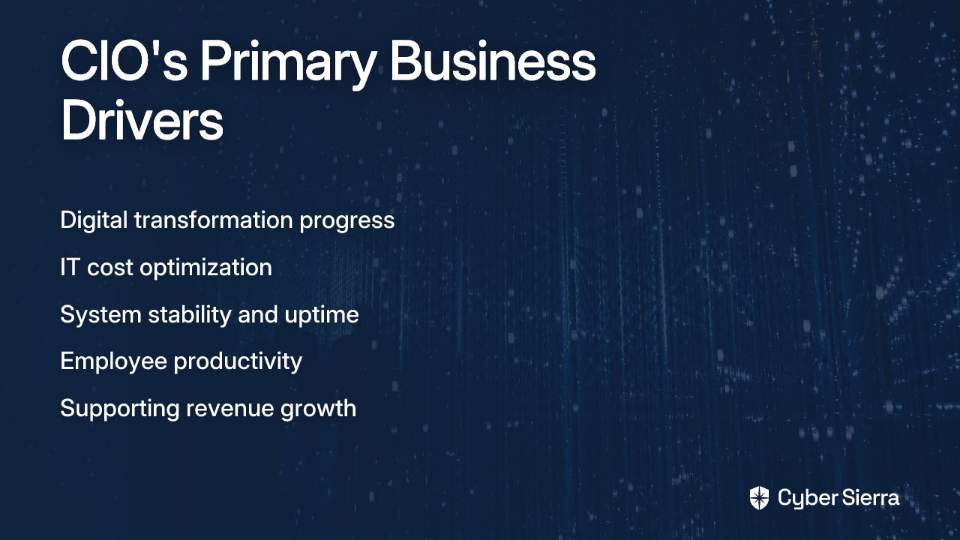
What Drives Your CIO?

CIOs are typically measured on business-enabling metrics:

  • Digital transformation progress
  • IT cost optimization
  • System stability and uptime
  • Employee productivity
  • Supporting revenue growth

Security is a component, but often viewed through the lens of how it impacts these primary goals. When you propose implementing new Data Loss Prevention (DLP) tools, your CIO may primarily be thinking about:

  1. How much will it cost?
  2. Will it slow down our systems?
  3. Will users complain about workflow disruptions?
  4. How will this impact our current projects?

Assess Your Current Influence Position

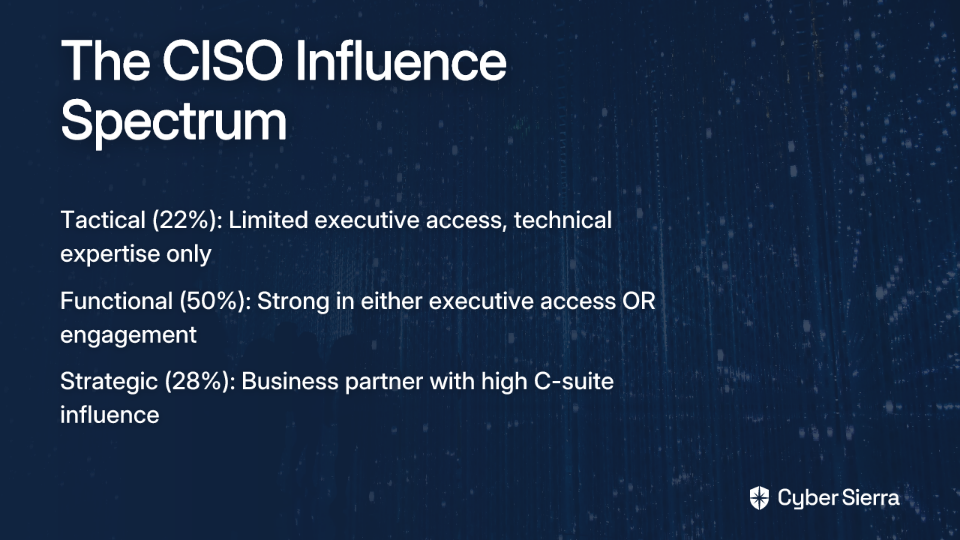
Where do you fall on the CISO spectrum?

  • Tactical (22%): Viewed as a technical expert with limited executive access
  • Functional (50%): Strong in either executive access OR engagement, but not both
  • Strategic (28%): A business partner with high C-suite access and influence

This self-assessment is the first step to plotting your course toward greater influence.

Mind the Business Acumen Gap

Many CISOs come up through technical roles and find themselves lacking the business acumen and interpersonal skills needed for executive influence. As one CISO noted, "When you come up through the technical side of IT, what you are generally missing is business acumen, and sometimes interpersonal skills. The role of a CISO is about influencing others."

Your technical expertise is your foundation, not your ceiling. The ability to translate that expertise into business terms is your bridge to influence.

Framing Security as a Business Enabler, Not a Roadblock

Stop selling "security." Start selling business outcomes: resilience, trust, and competitive advantage. Your CIO needs a business justification, not just a risk assessment.

Translate Technical Risk into Business Impact

Instead of discussing vulnerabilities, discuss business disruption. Link security initiatives directly to the CIO's goals.

Instead of saying: "We have a critical vulnerability in our customer data platform."

Try saying: "I've identified a risk that could expose customer data, potentially resulting in regulatory fines and a 15% customer churn rate based on industry benchmarks. I have a three-phase plan to address this with minimal operational impact."

Tell a Compelling Story, Not Just a Status Report

The most powerful security narratives focus on how the simplest threats are often the most dangerous because they're easily exploited at scale. This reframes basic security hygiene from a mundane chore to a strategic imperative.

When discussing the need for blocking domains or implementing allowlisting procedures, tell the story from an attacker's perspective. Make the risk feel real and relevant to executives who don't live in the technical details of cybersecurity.

Example narrative: "Last month, 62% of our security incidents started with a user clicking a malicious link. If we implement this domain filtering solution, we can prevent these attacks at the source, reducing our incident response workload by an estimated 40% and allowing the team to focus on more strategic initiatives."

Focus on Foundational Strength

Advocate for a balanced approach between strengthening foundational controls (which prevent common breaches) and pursuing advanced capabilities. This cost-effective strategy resonates with a CIO's focus on efficiency.

When proposing security controls like stricter document classification or enhanced API security measures, highlight how these foundational elements deliver substantial risk reduction at relatively low cost compared to more advanced solutions.

Your Influence Playbook: Actionable Strategies to Win Support

Influence is a skill that can be learned and deployed systematically. Here's how to make it easy for your CIO to say "yes."

Adopt Proven Influence Tactics

These strategies, often used by CIOs themselves, can be adapted for your security initiatives:

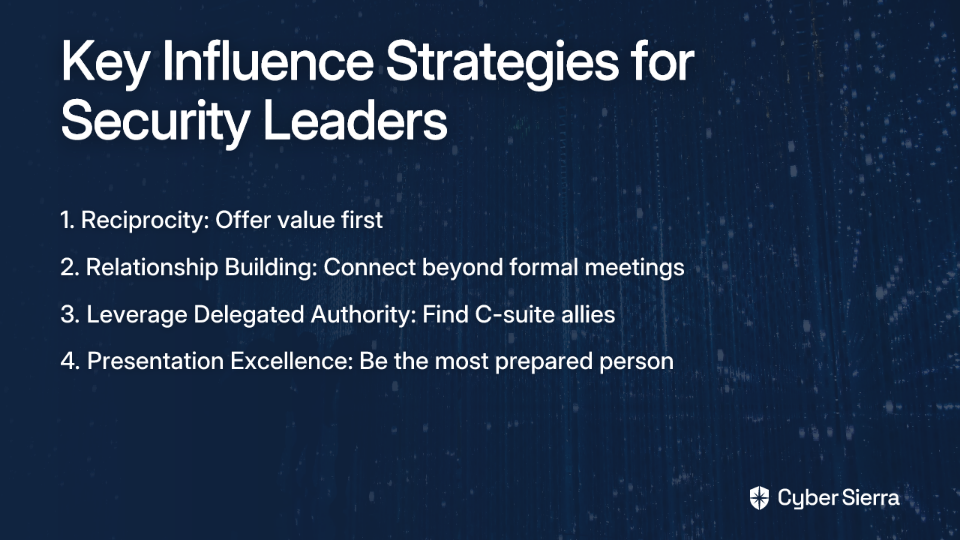
1. Reciprocity

Do your CIO a favor before asking for support. Find ways your security team can accelerate one of their key projects.

Example: If your CIO is focused on improving the digital employee experience, offer to streamline security processes that currently create friction, such as moving from password resets to passwordless authentication.

2. Relationship Building

Establish genuine connections beyond formal meetings. Regular, informal check-ins can build trust far more effectively than scheduled meetings alone.

As the relationship owner for security within the organization, you need to invest time in understanding your CIO's personal and professional priorities. What keeps them up at night? What metrics are they measured on? What's their communication style preference?

3. Leverage Delegated Authority

If you lack direct access to the boardroom, find allies in other C-suite executives. Presenting a risk in terms of its financial or operational impact can get their endorsement, which gives your request weight.

Example: When the CFO supports your proposal because you've framed it in terms of financial risk reduction, your CIO is more likely to approve it.

4. Presentation Excellence

Be the most prepared person in the room. Know your audience and tailor your message accordingly. As one IT manager noted, "The first rule of reporting to a CIO is learning what is relevant to them."

Make "Yes" the Easy Answer

Present Solutions, Not Problems

Never walk into your CIO's office with just a problem. Bring a fully-vetted solution with options.

When facing challenges like an overwhelming number of ticket requests for exceptions to security policies, don't just complain about the workload. Present a sustainable solution, such as a tiered approval process where risk is assigned based on clear criteria.

Provide a Clear Implementation Plan

Include owners, timelines, resource requirements, and expected outcomes. A simple visual roadmap can significantly increase your chances of approval.

Offer Tiered Options

Give your CIO choices that align with different levels of risk appetite and budget constraints:

Example:

  • Option A (Good): Addresses 80% of the risk for $50k
  • Option B (Better): Addresses 95% of the risk for $100k
  • Option C (Best): Addresses 99% of the risk for $200k

Then add: "I recommend we start with Option A, as it delivers the most value for the investment and we can reassess Option B next fiscal year."

Avoid "Malicious Compliance" Traps

When faced with CIO decisions that seem to undermine security efforts, resist the urge to engage in malicious compliance—following directives to the letter while knowing they'll create problems. This approach might feel satisfying in the moment but ultimately damages trust and reinforces the perception of security as obstructionist.

Instead, document your concerns professionally, propose alternatives, and if overruled, implement the decision while establishing clear metrics to evaluate outcomes. This positions you as a team player who prioritizes organizational success.

From Influence to Alliance: Building a Collaborative Framework

The ultimate goal is to move beyond one-off influences to an ongoing strategic alliance. This requires a formal structure for collaboration.

Implement a Shared Governance Model

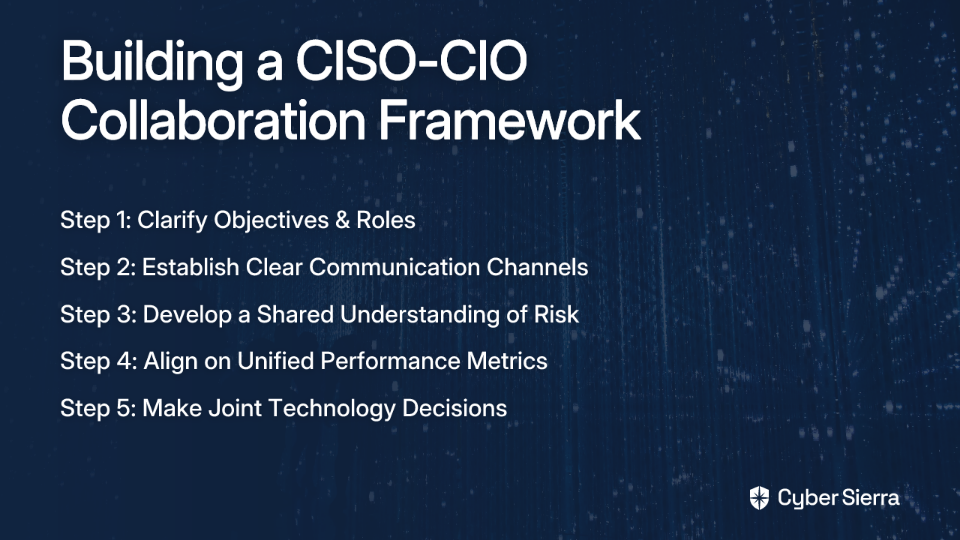
Step 1: Clarify Objectives & Roles

Jointly define responsibilities to eliminate gaps and overlaps in your strategies. Who owns which security decisions? Who serves as the escalation point when service desk teams receive security exception requests?

Step 2: Establish Clear Communication Channels

Institute a rhythm of communication: weekly tactical discussions, monthly strategic reviews, and a clear protocol for emergencies.

Step 3: Develop a Shared Understanding of Risk

Use regular meetings to discuss security posture and prioritize initiatives together. This helps ensure that when you're making the case for tighter controls around DLP or allowlisting, you're speaking the same language.

Step 4: Align on Unified Performance Metrics

Create shared KPIs that measure both IT performance and security posture. When you succeed or fail together, you're truly aligned.

Example metrics might include:

  • Mean time to detect and respond to incidents
  • Percentage of systems with current patches
  • User satisfaction with security processes
  • Security exceptions handled within SLA

Step 5: Make Joint Technology Decisions

Ensure security is integrated into technology adoption from the start, not bolted on at the end. This prevents situations where business-critical applications can't meet security requirements, forcing difficult compromises.

Prioritize the Digital Employee Experience

Acknowledge that security measures can't come at the cost of productivity. This is a major pitfall in CISO-CIO relationships.

When implementing controls like DLP or blocking domains, always consider the user impact. Frame security upgrades as improvements to the user experience whenever possible.

Be the Partner Your CIO Needs

Influencing a CIO isn't about office politics or manipulation—it's about translation, alignment, and partnership. It's about understanding their world and showing how you can help them succeed.

This collaboration is no longer optional. With global security spending projected to hit $215 billion in 2024 and cyber threats continuously evolving, the cost of siloed operations is too high for any organization to bear.

Your journey to becoming a strategic partner starts with a single step: This week, schedule a 30-minute meeting with your CIO. Don't go to ask for something. Go with a single question: "What are your top three priorities right now, and how can my team and I help you achieve them?"

By shifting your approach from security advocate to business enabler, you can transform your relationship with your CIO and elevate your influence within the organization. When security becomes a competitive advantage rather than a cost center, everyone wins—especially you.

Frequently Asked Questions

Why do CISOs and CIOs often have conflicting priorities?

CISOs and CIOs often have conflicting priorities because their core functions are different. A CIO is typically focused on enabling business growth, digital transformation, and IT efficiency, while a CISO is focused on mitigating risk and protecting the organization's assets. This can create natural tension between the drive for innovation and the need for security controls.

How can a CISO effectively communicate security risks to a business-focused CIO?

A CISO can effectively communicate security risks by translating technical jargon into tangible business impact. Instead of discussing vulnerabilities, frame the conversation around potential financial losses, regulatory fines, customer churn, or operational downtime. Presenting risks in the context of the CIO's primary goals—like revenue growth and system stability—makes them more compelling and easier to understand.

What does it mean to frame security as a "business enabler"?

Framing security as a "business enabler" means shifting the perception of security from a cost center to a strategic asset. It involves demonstrating how strong security practices can support business objectives. For example, robust data protection can become a competitive advantage, and streamlined security processes can improve employee productivity, directly contributing to the business's success.

What is the best way to present a security proposal to a CIO?

The best way to present a security proposal is to offer a solution, not just a problem. Your proposal should be fully vetted and include tiered options (e.g., good, better, best) that align with different budgets and risk appetites. Always include a clear implementation plan with timelines, costs, and expected outcomes, and clearly state your recommended option to make the decision as easy as possible for the CIO.

What are some practical first steps for a CISO to build a better relationship with their CIO?

A practical first step is to schedule a meeting with your CIO with the sole purpose of understanding their priorities. Ask, "How can my team help you achieve your goals?" This non-demanding approach builds goodwill. Other strategies include practicing reciprocity by helping them with one of their projects and establishing regular, informal check-ins to build trust outside of formal meetings.

What should a CISO do if their CIO rejects a critical security recommendation?

If a CIO rejects a critical recommendation, the CISO should professionally document their concerns and the potential risks in writing, ensuring there is a clear record. Avoid "malicious compliance" (implementing a poor decision to prove a point), as it erodes trust. Instead, continue to monitor the risk, gather data, and look for a future opportunity to revisit the conversation with new evidence, positioning yourself as a resilient and strategic partner.


Remember: The path to influence doesn't begin with technical knowledge—it starts with understanding people, politics, and priorities. Master these elements, and you'll find your security initiatives receiving the support they deserve.

blog-hero-background-image
Cyber Security

Overcoming CYA Culture in Cybersecurity Risk Assessments

backdrop
Table of Contents

Join thousands of professionals and get the latest insight on Compliance & Cybersecurity.


You've set up a comprehensive risk assessment framework. You've meticulously followed NIST 800-53 guidelines. Your documentation aligns perfectly with ISO 27001 requirements. Yet somehow, despite all this preparation, your organization still gets blindsided by security incidents that "nobody saw coming."

The culprit? It's not your technical approach or your chosen framework. It's the unspoken elephant in the room: a culture where team members are more focused on covering their own backs than providing accurate risk information.

The Unspoken Hurdle in Cybersecurity

In cybersecurity forums across the internet, professionals repeatedly cite one particularly frustrating obstacle: "Lying liars that lie to play CYA games." This colorful but pointed assessment highlights a painful truth – the biggest hurdles in effective risk management aren't technical, but human.

When risk assessments devolve into meaningless checkbox exercises rather than substantive security improvements, the entire organization becomes vulnerable. The global average cost of a data breach has reached a staggering $4.88 million in 2024 according to IBM research. A culture that prioritizes self-preservation over genuine data security makes such breaches more likely, not less.

The antidote isn't more process or stricter frameworks. It's building a culture of psychological safety and transparency that enables accurate information to flow freely throughout your organization. Only then can your risk assessments evolve from bureaucratic exercises into powerful tools for organizational resilience.

What is the "CYA Trap" and Why is it So Costly?

"Cover Your Ass" (CYA) behavior manifests in several recognizable patterns:

  • Excessively documenting every interaction and decision to create an audit trail
  • Including unnecessary colleagues in communications solely to display diligence
  • Maintaining secret files of discussions as insurance against future disputes
  • Adhering to the mantra: "If it's not in writing, it doesn't exist"

At its core, CYA is a symptom of deep-seated organizational distrust. According to Stephen M.R. Covey's work in The Speed of Trust, low trust environments dramatically increase costs and reduce speed in all business processes. When individuals feel vulnerable due to distrust, they incur significant costs to mitigate that vulnerability, leading to massive organizational inefficiency.

The impact on your security posture is profound:

Compromised Risk Profile: CYA culture leads directly to dishonest reporting as individuals prioritize self-preservation over transparency. This means your organization's understanding of its own risk is fundamentally flawed.

Productivity Drain: Valuable time is wasted on defensive documentation, excessive meetings, and navigating internal politics instead of productive security work.

"Checkbox Security": Teams focus on acquiring certifications as shields rather than meaningful security improvements. As one security professional bluntly put it, "They do the bare minimum to get a certification... If they get breached, they can point to the certification." This undermines the entire purpose of your Governance, Risk, and Compliance (GRC) program.

How a CYA Culture Sabotages Your Risk Assessment Process

Let's examine how this culture undermines each step of a standard risk assessment:

  1. Determine the scope and identify assets: System owners may deliberately downplay the importance of their systems or hide known vulnerabilities to avoid responsibility or budget allocation for fixes. This creates blind spots in your assessment before you've even started.
  2. Identify cyber threats and vulnerabilities: Teams become reluctant to report vulnerabilities, fearing they'll be blamed for their existence. As one project manager noted, employees become "constantly faced with their instinct to show me why it isn't their fault" rather than focusing on solutions.
  3. Assess and analyze risks: When evaluating the likelihood and impact of threats, fear of repercussions causes teams to understate risks. The goal becomes minimizing personal or departmental exposure, not accurately assessing organizational exposure.
  4. Implement security controls: Controls are selected based on ease of documentation or alignment with frameworks like NIST 800-53 or ISO 27001, rather than actual effectiveness against identified threats.
  5. Monitor and document results: Instead of fostering continuous monitoring, a CYA culture encourages "point in time" assessments. As one security professional observed, "Many companies only conduct one-time assessments" because continuous scrutiny is threatening. Reporting to the CISO or board becomes an exercise in presenting a sanitized, overly optimistic view.

The result is a perfectly documented but fundamentally dishonest risk assessment that provides a false sense of security while leaving your organization vulnerable to the very threats you're trying to mitigate.

The Antidote: Building Psychological Safety and Radical Transparency

Psychological safety – the shared belief that the team is safe for interpersonal risk-taking – forms the foundation of effective risk management. As one risk professional succinctly put it, "If your teams don't feel safe to speak up, your risk strategy is already compromised."

However, psychological safety is often misunderstood. It's not just "being nice" – it's about enabling constructive conflict and honest feedback. It's not a trade-off with performance – high psychological safety and high performance standards are complementary, not contradictory. And it's not just a policy or top-down mandate – it must be cultivated through daily interactions at all levels.

When combined with transparency in risk management, psychological safety creates an environment where accurate information can flow freely. Just as clients may hesitate to share data with insurers for fear of negative consequences, internal teams hesitate to share risk data for similar reasons. Overcoming this requires deliberately building trust across organizational boundaries.

Actionable Strategies to Dismantle the CYA Trap

Strategy 1: Secure Leadership Alignment and Model Honesty

Without leadership buy-in, "the whole structure collapses," as one risk professional noted. Leaders must model the behavior they want to see:

  • Admit mistakes publicly and describe what they learned
  • Respond to bad news with curiosity rather than blame
  • Focus on blameless post-mortems after incidents, identifying process failures rather than scapegoats
  • Ensure consistent messaging about valuing honesty over appearances

Strategy 2: Reframe Risk Communication and Reporting

Risk professionals must actively educate stakeholders across the organization:

  • Tailor risk reports to be meaningful for each audience – the board needs to understand risk in monetary terms, while engineering teams need technical details
  • Identify and address CYA signs, such as teams scheduling excessive meetings or copying too many people on emails
  • Reframe the purpose of risk assessments from "finding fault" to "improving resilience"
  • Establish clear communication channels that encourage cross-team collaboration

Strategy 3: Institute Structures for Transparency and Accountability

  • Define accountability clearly before incidents occur to prevent the "it's not my fault" game
  • Implement tools and platforms that foster transparency, ensuring everyone works from the same data
  • Institute regular rituals for reflection like after-action reviews to promote learning from both successes and failures
  • Create dynamic update mechanisms that allow risk profiles to be adjusted as new information emerges

Strategy 4: Champion a Culture of Continuous Assessment

Move beyond static, one-time assessments to true continuous monitoring:

  • "Preach continuous monitoring daily" as recommended by experienced security professionals
  • Implement regular reporting on key risk metrics to normalize the discussion of risk
  • Develop systematic processes for updating risk assessments when changes occur in the environment
  • Celebrate when teams proactively identify and report new risks, reinforcing that honesty is valued

From Covering Your Ass to Protecting Your Assets

The CYA trap is a cultural failure driven by fear and a lack of trust that silently sabotages even the most well-designed cybersecurity risk assessment frameworks. Checkbox exercises may satisfy auditors, but they won't protect your organization from determined adversaries.

Escaping this trap requires a deliberate, organization-wide commitment to building psychological safety. Leaders must model honesty, communication must be reframed around education rather than blame, and processes must be designed for transparency and continuous learning.

The goal isn't to eliminate documentation or reduce accountability. Rather, it's to create an environment where every employee feels responsible not for covering their tracks, but for contributing to collective data security.

When organizational buy-in becomes the norm and leadership alignment is achieved, risk assessments transform from bureaucratic exercises into powerful tools for organizational resilience. Because when recognition and ownership break down, even good frameworks like NIST 800-53 and ISO 27001 fall short.

Ultimately, fostering this culture isn't a "soft" skill—it's a hard requirement for survival in a world where the cost of a data breach is measured in millions. By dismantling the CYA trap, you'll not only improve your risk assessments but also build a more resilient, honest, and effective security organization.

The question isn't whether you can afford to address the CYA culture in your organization. It's whether you can afford not to.

Frequently Asked Questions

What is the CYA trap in cybersecurity?

The "CYA (Cover Your Ass) trap" in cybersecurity is a cultural pattern where employees prioritize protecting themselves from blame over reporting risks accurately. This behavior stems from organizational distrust and manifests as excessive documentation, including unnecessary people in communications, and focusing on paperwork over genuine security improvements. It ultimately sabotages the effectiveness of any risk assessment framework by fostering dishonest reporting.

Why do risk assessments fail even with frameworks like NIST or ISO?

Risk assessments often fail despite using robust frameworks like NIST 800-53 or ISO 27001 because a "CYA" culture of fear prevents the honest and transparent flow of information needed for the assessment to be accurate. When employees are afraid of being blamed, they may hide vulnerabilities, downplay the importance of their systems, or understate risks. The framework becomes a "checkbox" exercise for compliance rather than a tool for genuine security improvement, creating a false sense of security.

How does a CYA culture increase the risk of a data breach?

A CYA culture directly increases the risk of a data breach by creating a flawed and incomplete understanding of an organization's actual security weaknesses. By prioritizing self-preservation, team members hide or underreport vulnerabilities, leading to critical blind spots. This means security controls are not implemented where they are most needed, leaving the organization vulnerable to attacks that "nobody saw coming," which can lead to costly breaches.

What is psychological safety and how does it improve risk management?

Psychological safety is the shared belief that a team is safe for interpersonal risk-taking, which is crucial for effective risk management because it empowers people to report bad news and potential vulnerabilities without fear of blame. It's not about avoiding accountability, but about creating an environment where honest feedback and constructive conflict can thrive. In a psychologically safe environment, risk assessments become collaborative efforts to improve resilience, rather than exercises in assigning fault, leading to more accurate and effective outcomes.

How can leadership help dismantle a CYA culture?

Leadership can dismantle a CYA culture by actively modeling honesty, responding to bad news with curiosity instead of blame, and consistently communicating that transparency is valued more than appearances. Key actions include admitting their own mistakes, conducting blameless post-mortems after incidents to focus on process failures, and ensuring accountability is clearly defined before a problem occurs. This executive buy-in is fundamental to building the trust required to escape the CYA trap.

What are the first steps to move from 'checkbox security' to real risk management?

The first step is to shift the focus from static, one-time assessments to a culture of continuous monitoring and open communication about risk. This involves reframing risk assessments as a tool for "improving resilience" rather than "finding fault." Practically, this means implementing regular reporting on key risk metrics, creating channels for cross-team collaboration, and celebrating teams that proactively identify and report new risks, thereby reinforcing a culture of transparency.

blog-hero-background-image
Cyber Security

Cure Alert Fatigue: How to Tame Your Security Scanner

backdrop
Table of Contents

Join thousands of professionals and get the latest insight on Compliance & Cybersecurity.


You've been there: staring blankly at your screen as notification #487 pops up from your security scanner. "Critical vulnerability detected!" it screams, joining the chorus of hundreds of other "critical" alerts that have bombarded you this week. You feel your shoulders tense as you wonder: Is this one actually important, or just another false alarm? And where do I even start when there are 3,000 more waiting in the queue?

"The alert fatigue is real and I'm tired of the vulnerability," as one security professional put it. You're not alone in this struggle.

The High Cost of Noise: Why Alert Fatigue is More Than Just an Annoyance

Alert fatigue occurs when security teams become desensitized to an overwhelming flood of alerts, many of which are low-priority or false positives. This isn't just annoying—it's dangerous. According to recent studies, 62% of organizations report that alert fatigue contributes directly to employee turnover, while 60% experience internal team conflicts due to alert overload.

The consequences extend far beyond workplace friction:

  • Missed Critical Threats: When everything is "critical," nothing is. Security teams become numb to alerts, increasing the risk of overlooking genuine threats like RCE vulnerabilities that could be catastrophic.
  • Delayed Response Times: Teams struggling with alert overload show significantly higher mean time to respond (MTTR), leaving systems vulnerable longer.
  • Burnout and Attrition: The constant pressure to triage endless CVE notifications leads to mental exhaustion and high turnover rates among security professionals.

In one sobering healthcare example, alert fatigue led clinicians to ignore system warnings, resulting in a patient receiving a 39-fold medication overdose. While the stakes might differ in cybersecurity, the pattern is the same: when humans are overwhelmed with alerts, they begin to ignore them all—even the ones that truly matter.

Drowning in Data: The Root Causes of Scanner Overload

As one astute security engineer observed, "People are looking at the output side, but there is still the input side to look at." To truly solve alert fatigue, we need to understand what's causing it:

  1. Overreliance on CVSS Scores: CVSS scores can be misleading indicators of actual risk. As one professional noted, "a 'critical' vulnerability that's not reachable is way less important than a 'medium' one that's actively being hit by traffic."
  2. Context-Free Scanning: Modern scanners like Tenable excel at finding vulnerabilities but often lack critical context. "Congrats scanner, you found a critical CVE in some random dependency that's been sitting there for 6 months, but is anything even calling that code? Your guess is as good as mine."
  3. Tool Sprawl and Siloed Data: Multiple security tools generating alerts independently create redundant noise without correlation. Your vulnerability management system, SIEM, and CI/CD security gates all scream about the same issues from different perspectives.
  4. Shift-Left Limitations: While "the whole shift-left thing helps catch stuff in CI/CD," it "doesn't solve the core issue of having way too many alerts and zero context about what's actually dangerous in prod. Half these CVEs are in code paths that never even execute."

A Practical Guide to Taming Your Security Scanner

Triage with Intelligence - Achieve Quick Wins by Focusing on What Matters

Stop treating all alerts as equal. A smarter approach to prioritization can immediately reduce noise and stress:

  1. Move Beyond Basic CVSS Scores: While CVSS provides a starting point, it's insufficient alone. A critical RCE vulnerability with a high CVSS score might pose minimal risk if it's in an isolated test environment.
  2. Adopt a Context-Driven Framework: For each alert, ask: Smart Alert Prioritization Framework
    • Exploitability: Is there a known exploitation method? Is it actively being exploited in the wild?
    • Exposure: Is the vulnerable component externally accessible or protected by multiple security layers?
    • Business Impact: What data or systems would be compromised if exploited?
    • Remediation Complexity: Is there a simple patch, or does it require major refactoring?
  3. Embrace Bulk Fixes for Quick Wins: Look for patterns across vulnerabilities. Often, hundreds of alerts stem from a single root cause:
    • Updating one outdated library can resolve dozens of CVEs at once
    • Applying a configuration standard across multiple servers can eliminate whole categories of findings
    • Implementing a WAF rule might mitigate exploitation risk while you plan permanent fixes

As one security practitioner advised: "When you've got 3,000 'urgent' findings, where do you even start? It's not like I can just rm -rf vulnerabilities and call it a day." The key is to identify those high-impact, low-effort fixes that can rapidly reduce your vulnerability count.

Tune the Engine - Fine-Tuning Your Tools and Processes

Your security scanners should work for you, not against you. Here's how to optimize them:

  1. Customize Scanner Configurations:
    • Configure Tenable or similar tools to filter out false positives based on your environment
    • Set appropriate severity thresholds based on asset criticality
    • Exclude test environments or air-gapped systems from production reporting
  2. Implement Smart Grouping and Deduplication:
    • Configure your vulnerability management system to group related findings
    • Integrate with ServiceNow to consolidate multiple occurrences of the same CVE into a single ticket
    • Implement auto-closing for false positives once verified
  3. Validate Findings with Additional Context:
    • Use authenticated scans to improve accuracy and eliminate surface-level false positives
    • Correlate vulnerability data with network traffic analysis to identify truly exposed weaknesses
    • Implement runtime application monitoring to confirm if vulnerable code paths are actually executed

As one security engineer put it, "If an alert is not actionable then it should not be created." Your goal should be high-fidelity alerts that represent genuine, fixable problems.

Automate the Grunt Work - Your AI and SOAR Co-pilots

Automation is your strongest ally in the battle against alert fatigue. Here's how to leverage it effectively:

  1. Implement SOAR for Routine Tasks:
    • Use Security Orchestration, Automation, and Response (SOAR) platforms to handle repetitive investigation steps
    • Create playbooks that automatically enrich alerts with additional context before they reach your team
    • Automate common remediation workflows for known vulnerability types
  2. Leverage AI for Intelligent Triage:
    • Use machine learning to identify patterns in alerts that have historically been false positives
    • Implement predictive analytics to prioritize vulnerabilities based on exploitation likelihood
    • Deploy natural language processing to extract relevant context from vulnerability descriptions
  3. Build Custom Integration Scripts:
    • Develop Python scripts to bridge gaps between your security tools
    • Automate the correlation of data from multiple sources (e.g., combining Tenable findings with traffic logs)
    • Create custom filtering rules based on your organization's unique environment

One security team reduced their daily alert volume by 87% by implementing an automated triage system that enriched each finding with exploitation context and actual system exposure data before routing it to analysts.

Build Bridges, Not Silos - The Power of SecOps and Collaboration

Alert fatigue isn't just a technical problem—it's an organizational one. Breaking down silos between security and operations teams is crucial:

  1. Establish Clear Response Protocols:
    • Define what actions must be taken for each alert category
    • Document who is responsible for different types of vulnerabilities
    • Set realistic SLAs based on severity and business impact

As one practitioner wisely observed: "A lot of people create alerts, but have no written process on what to do when one goes off. So no one acts." The solution is to "define what level of alerts you want, where you want them, what the expectations are (e.g., PagerDuty = immediate response; an alert sent to a specific Slack channel should be checked daily or 2x daily, etc.)"

  1. Create Collaborative Workflows:
    • Integrate vulnerability management into DevOps processes
    • Establish joint security and operations teams responsible for vulnerability remediation
    • Implement shared dashboards that give visibility to both security and IT operations
  2. Foster Feedback Loops:
    • Regularly review alert effectiveness with both security and operations teams
    • Track false positive rates and adjust scanner configurations accordingly
    • Celebrate successful vulnerability remediations to build positive reinforcement

Reclaiming Control and Sanity

Taming your security scanner isn't a one-time project—it's an ongoing process of refinement. By implementing these strategies, you can transform your vulnerability management from an overwhelming flood of alerts to a streamlined, prioritized workflow focused on what truly matters.

Remember these key principles:

  • Prioritize intelligently based on real-world risk, not just CVSS scores
  • Fine-tune your tools to improve signal-to-noise ratio
  • Automate relentlessly to handle the routine work
  • Collaborate effectively across security and operations teams

With this approach, you'll not only reduce alert fatigue and prevent burnout, but you'll also build a more effective security program that focuses human expertise where it matters most—addressing the vulnerabilities that pose genuine risk to your organization.

The next time your scanner flags a critical CVE, instead of feeling overwhelmed, you'll know exactly how to assess its importance, who should address it, and whether it requires immediate action or can be prioritized within your established workflow. That's what it means to truly tame your security scanner.

Frequently Asked Questions (FAQ)

What is alert fatigue in cybersecurity?

Alert fatigue in cybersecurity is a state of desensitization experienced by security teams when they are overwhelmed by a high volume of security alerts, many of which are false positives or low-priority. This constant flood of notifications can lead to serious consequences, including missed critical threats, delayed response times, and professional burnout. It happens when everything is flagged as "critical," making it impossible for teams to distinguish genuine dangers from background noise.

Why is relying only on CVSS scores a bad idea for prioritizing vulnerabilities?

Relying solely on CVSS (Common Vulnerability Scoring System) scores is a bad idea because they often lack the business and environmental context needed to determine a vulnerability's true risk. A "critical" CVSS score might be assigned to a vulnerability in an isolated, internal-only test system, posing little to no actual threat. Conversely, a "medium" vulnerability on a public-facing, mission-critical server could be far more dangerous. Effective prioritization requires looking beyond the score to consider factors like exploitability, exposure, and business impact.

How can I reduce the number of false positives from my security scanner?

You can reduce false positives by fine-tuning your scanner's configuration, validating findings with additional context, and implementing smart grouping. Start by customizing scanner settings to align with your specific environment, such as excluding test servers from production reports. Use authenticated scans for greater accuracy and correlate vulnerability data with network traffic or runtime analysis to confirm if a vulnerability is truly exploitable. Finally, configure your tools to group related findings and automatically close known false positives to clean up your queue.

What are the first steps to take when facing thousands of "critical" alerts?

The first step is to stop treating all alerts as equal and begin triaging them intelligently based on real-world risk, not just their labels. Instead of tackling them one by one, look for patterns. Focus on "bulk fixes," like updating a single shared library that may resolve hundreds of alerts at once. Then, prioritize the remaining alerts using a context-driven framework: assess the actual exploitability, the exposure of the affected system, and the potential business impact. This helps you focus your efforts on the vulnerabilities that pose the greatest immediate threat.

How does automation help with vulnerability management?

Automation helps by handling the repetitive, low-level tasks involved in vulnerability management, allowing security professionals to focus on high-impact strategic work. Tools like SOAR (Security Orchestration, Automation, and Response) can automatically enrich alerts with context, run initial investigation steps, and even handle common remediation workflows. AI and machine learning can further enhance this by predicting which vulnerabilities are most likely to be exploited and identifying patterns that indicate false positives, significantly reducing manual triage efforts and speeding up response times.

Who is responsible for fixing vulnerabilities found by a scanner?

The responsibility for fixing vulnerabilities is typically shared between security and IT/operations teams, often within a collaborative framework known as SecOps. While the security team is responsible for identifying, validating, and prioritizing vulnerabilities, the operations or development teams are usually responsible for applying the patches or code fixes. To make this process work, it is crucial to establish clear response protocols, define ownership for different types of assets, and set realistic Service Level Agreements (SLAs). This collaborative approach breaks down silos and ensures vulnerabilities are remediated efficiently.

blog-hero-background-image
Cyber Security

Tips for a Successful Phishing Derby

backdrop
Table of Contents

Join thousands of professionals and get the latest insight on Compliance & Cybersecurity.


You've seen it before: another company-wide phishing simulation that causes panic, frustration, and a flood of angry emails to your security team. Traditional phishing tests often feel like gotcha moments that leave employees resentful rather than educated. But what if you could transform this dreaded exercise into something your team actually looks forward to?

Enter the Phishing Derby – a gamified approach to security awareness that turns the mundane into engaging, the punitive into rewarding, and the feared into fun.

Why Traditional Phishing Simulations Fail

Let's face it: standard phishing campaigns often miss the mark. They can:

  • Create a culture of fear instead of learning
  • Generate resentment when employees feel tricked
  • Cause company-wide panic when poorly communicated
  • Result in minimal long-term behavior change

As one frustrated IT professional shared on Reddit, "People went into full panic mode thinking the whole company was hacked... then were angry once they found out it was a simulation saying we should've warned them."

Meanwhile, the stakes couldn't be higher. With an estimated 3.4 billion phishing emails sent daily and 91% of successful cyber-attacks beginning with a phishing attempt, organizations can't afford to have disengaged employees. A successful attack costs companies an average of $4.91 million – a devastating blow that proper training could prevent.

What Makes a Phishing Derby Different?

A Phishing Derby transforms security awareness from a top-down mandate into a collaborative, skill-building competition. Instead of punishing those who fail, it celebrates those who succeed at spotting and reporting threats.

This approach leverages gamification to create positive engagement, focusing on:

  • Voluntary participation rather than forced compliance
  • Competitive elements with meaningful rewards
  • Public recognition of security champions
  • Building a community of cybernuts (security enthusiasts)

Step 1: Planning Your Phishing Derby

Define Clear Goals and Metrics

Before launching, establish what success looks like:

  • Baseline metrics: Current click rates, reporting rates
  • Target improvements: 20% reduction in clicks, 30% increase in reporting
  • Specific focus areas: High-risk departments or specific types of attacks

Get Leadership Buy-In

Nothing derails a security initiative faster than surprised executives. Before launching:

  • Brief your CISO and other C-level executives on the concept
  • Explain how this supports compliance requirements and SOC 2 audit preparations
  • Demonstrate the ROI through projected reduction in successful phishing attempts

Create a Communication Plan

Announce the derby with clarity and enthusiasm:

  • Send a company-wide announcement explaining the concept
  • Host kick-off meetings to explain rules and demonstrate proper reporting
  • Create posters, digital signage, or intranet banners promoting the event

Step 2: Designing an Effective Competition Structure

Set Clear Rules

Based on successful implementations, establish these foundational rules:

  • Duration: One month is ideal – long enough to collect meaningful data but short enough to maintain enthusiasm
  • Participation: Emphasize that involvement is voluntary and performance won't negatively impact job evaluations
  • Reporting Method: Define a single, clear channel (like using a Phish Alert button in your email client)
  • Fair Play: No technical tools or scripts to identify phishes – this tests human detection skills

Create an Enticing Prize Structure

The right incentives drive participation:

  • Individual Awards:
    • Top Reporter: $100 gift card for most phishes correctly reported
    • Fastest Finger: Prize for best average response time
    • Eagle Eye: Recognition for catching the most difficult phishes
  • Team Awards:
    • Department Champions: Team lunch or outing for highest departmental reporting rate
    • Most Improved: Recognition for departments showing greatest improvement

Craft Realistic Phishing Scenarios

This is where many simulations fall short. To create effective tests:

  • Use a proper simulation platform like KnowBe4 or similar services to manage the campaign
  • Vary difficulty levels from obvious red flags to sophisticated spear-phishing attempts
  • Include current threat intelligence by mimicking real-world attacks targeting your industry
  • Customize scenarios relevant to specific departments (finance-focused scams for accounting, etc.)

A well-designed phishing campaign should include emails that test for awareness of:

  • Credential harvesting attempts
  • Fake password reset notifications (especially for SSO accounts)
  • Impersonation of executives or partners
  • Invoice or payment scams
  • MFA bypass attempts

Step 3: Managing Reports and False Positives

Prepare for the Flood

A successful derby will dramatically increase reporting – both of your simulated phishes and legitimate emails mistakenly flagged as suspicious. This is a good problem to have!

Implement an Efficient Triage System

To handle the increased volume without alert fatigue:

  • Establish a dedicated reporting channel – ideally a specialized mailbox or ticketing system
  • Automate initial processing – tools like PhishER can automatically categorize simulated phishes vs. real threats
  • Consider open-source SOAR platforms like "shuffle" which can automate 80-90% of report handling
  • Create templates for common responses to quickly acknowledge and close out false positives

Close the Feedback Loop

Immediate feedback reinforces positive behavior:

  • Send automated confirmations for every report ("Thanks for your vigilance!")
  • Provide quick classification ("This was a simulation – great catch!" or "This appears to be legitimate marketing.")
  • Share regular updates on overall derby progress to maintain momentum

Step 4: Measuring Success Beyond Click Rates

Traditional phishing campaigns often fixate on click rates alone, but a comprehensive derby should track multiple dimensions:

Essential Metrics to Track

  • Click Rates: Baseline vulnerability (industry average is around 24%)
  • Credential Entry Rates: How many users not only clicked but entered sensitive information (industry average is 21%)
  • Report Rates: The percentage of simulated phishes that were properly reported
  • Time to Report: Average duration between email delivery and employee reporting
  • Departmental Variations: Identify high-risk groups needing additional training
  • False Positive Rates: Track legitimate emails reported as phishing to refine training

Beyond the Numbers

Quantitative metrics tell only part of the story. Also measure:

  • Engagement Levels: Percentage of eligible employees participating
  • Sentiment: Post-derby surveys on employee attitudes toward security
  • Knowledge Retention: Follow-up quizzes to assess learning
  • Behavioral Change: Reduction in real security incidents over time

Step 5: Turning Results Into Action

The derby isn't just a game – it's a diagnostic tool to strengthen your security posture.

Celebrate Success

  • Host an awards ceremony announcing winners
  • Share overall company improvement metrics (but not individual failures)
  • Recognize security champions publicly with certificates or trophies

Implement Targeted Training

Use derby results to:

  • Deliver just-in-time learning when users click on simulated phishes
  • Develop customized training modules for departments with higher vulnerability
  • Create role-specific guidance based on the types of attacks different teams fall for

Sustain Momentum

A one-time derby won't create lasting change:

  • Schedule quarterly or bi-annual derbies with fresh themes
  • Maintain lower-intensity simulations between major events
  • Evolve scenarios based on emerging threats and user feedback

The Secret Ingredients for Derby Success

After analyzing dozens of successful implementations, these factors consistently distinguish effective phishing derbies:

  1. Positive Framing: Focus on recognition rather than punishment
  2. Executive Sponsorship: Visible C-suite participation and support
  3. Realistic Scenarios: Phishing templates that mirror actual threats
  4. Immediate Feedback: Real-time responses to reported emails
  5. Multiple Paths to Win: Various categories and ways to earn recognition
  6. Appropriate Difficulty Curve: A mix of obvious and challenging phishes

By transforming your phishing simulations into engaging competitions, you'll build a stronger human firewall – one that's alert, enthusiastic, and equipped to be your organization's first line of defense against the ever-evolving threat of phishing attacks.

Remember: Security awareness isn't about catching employees doing something wrong – it's about empowering them to do something right. A well-designed Phishing Derby does exactly that.

Now it's your turn. Start planning your derby, and watch as compliance transforms into commitment, and security awareness becomes a source of pride rather than a burden for your team.

Frequently Asked Questions

What is a Phishing Derby?

A Phishing Derby is a gamified security awareness program that transforms standard phishing tests into a positive and competitive event. Instead of penalizing employees for clicking on simulated phishing links, it actively rewards them for correctly identifying and reporting threats, fostering a more collaborative and proactive security culture.

How is a Phishing Derby more effective than traditional phishing simulations?

A Phishing Derby is more effective because it leverages positive reinforcement and gamification to build skills, rather than creating the fear and resentment often associated with traditional tests. By encouraging voluntary participation and celebrating security-conscious behavior with rewards, it turns security awareness from a mandatory chore into an engaging, team-building competition, leading to better knowledge retention and a stronger human firewall.

What are the first steps to starting a Phishing Derby?

The first steps to launching a Phishing Derby are to define clear goals, secure leadership buy-in, and create a robust communication plan. Before you begin, establish what success looks like (e.g., a 30% increase in reporting rates), get your executives on board by explaining the ROI, and announce the event clearly to build excitement and ensure everyone understands the rules.

What kinds of prizes are effective for a Phishing Derby?

Effective prizes for a Phishing Derby typically include a mix of both individual and team-based awards to motivate a wide range of participants. For individuals, consider gift cards for the "Top Reporter" or fun tech gadgets. For teams, a sponsored lunch or a trophy can foster healthy competition. The key is to offer incentives that are meaningful to your company culture.

Will running a Phishing Derby overwhelm my security team with false positives?

A successful derby will likely increase the number of reported emails, but this can be managed efficiently with the right systems in place. This increase is a positive sign of employee vigilance. To handle the volume, establish a dedicated reporting channel and use automation tools or SOAR platforms to help triage simulated phishes from potential real threats, turning a potential burden into a valuable data stream.

How do you measure the success of a Phishing Derby?

The success of a Phishing Derby is measured by tracking both quantitative metrics and qualitative shifts in security culture. Key metrics include improvements in click rates, credential entry rates, and—most importantly—the rate of reporting simulated phishes. Beyond the numbers, you should also measure qualitative factors like employee engagement, sentiment via surveys, and long-term behavioral change demonstrated by a reduction in real-world security incidents.

blog-hero-background-image
Cyber Security

7 Steps to Secure Your Organization's MCPs

backdrop
Table of Contents

Join thousands of professionals and get the latest insight on Compliance & Cybersecurity.


You've implemented Model Context Protocol (MCP) solutions to enhance your organization's capabilities, but now you're facing a disturbing reality: MCPs have been found to contain serious security vulnerabilities that malicious actors could exploit to steal or corrupt your data. Even more concerning, many MCPs by default request access to local filesystems and can run commands as root, leaving you wondering, "How is any enterprise able to use this safely?"

If you're uncertain about your preparedness to mitigate these inevitable risks, you're not alone. Security teams across industries are grappling with the same challenge: leveraging the power of MCPs while ensuring they don't become the weak link in your security posture.

This guide provides a practical, seven-step approach to securing your organization's MCPs, addressing everything from initial risk assessment to ongoing monitoring. By implementing these measures, you'll transform MCPs from potential security nightmares into properly managed, secure assets.

Step 1: Conduct a Comprehensive Risk Assessment

Before implementing any security controls, you need to thoroughly understand your organization's specific risk landscape. Creating an Information Security Program from scratch can feel daunting, but a structured assessment provides the perfect starting point.

Begin by categorizing the different types of risks associated with MCPs:

  • Malicious MCPs: Intentionally designed to exploit systems through hidden data exfiltration instructions
  • Suspicious MCPs: Request broader permissions than necessary for their stated function
  • Vulnerable MCPs: Contain design weaknesses such as lack of input validation or unpatched dependencies

To conduct your assessment:

  1. Create a complete inventory of all MCPs in your environment, documenting their configurations, permissions, and use cases
  2. Use the Backslash open tool for initial security gap analysis to determine if specific MCPs should even be considered for use
  3. Implement code-level inspection to uncover hidden vulnerabilities and misconfigurations in MCP servers
  4. Establish dynamic risk scoring for continuous assessment of vulnerabilities and compliance signals over time

Remember, according to Microsoft's Digital Defense Report, 98% of reported breaches can be prevented with robust security hygiene—starting with proper risk assessment.

Step 2: Develop and Enforce Effective Policies

Transform your risk assessment findings into clear, enforceable governance policies. These should cover:

  • Which MCPs are permitted and under what conditions
  • Access rights and permissions, adhering to the principle of least privilege
  • Expected behaviors and data handling procedures
  • Oversight requirements for sensitive operations, especially those involving database access or command execution

Creating comprehensive policies can be overwhelming, but you don't need to start from scratch. Leverage established frameworks like the NIST Cybersecurity Framework and SANS Security Policy templates to create a solid foundation tailored to your organization's specific needs.

To ensure ongoing compliance, implement automated checks using tools like Open Policy Agent (OPA) or custom scripts that monitor your security posture on a centralized dashboard. This creates visibility and accountability across the organization.

Step 3: Implement Zero Trust Network Access (ZTNA)

The traditional "trust but verify" security model is inadequate for protecting MCPs. Instead, adopt a Zero Trust Architecture (ZTA) where no user or service is trusted by default. While some worry that ZTNA might hinder productivity, when implemented correctly, it actually enhances it by providing secure, seamless access.

Focus on these core pillars of ZTNA for your MCPs:

Identity-Centric Security

  • Implement Single Sign-On (SSO) and Multi-Factor Authentication (MFA) to rigorously verify all user and service identities
  • Ensure only authenticated and authorized identities can interact with your MCPs
  • Use a centralized identity provider to manage access across all systems

Continuous Validation

  • Require MFA for all access requests to MCP resources
  • Verify device health and compliance with security standards before and during each session
  • Implement continuous authentication that regularly revalidates sessions

Least Privilege Access

  • Grant users and services the absolute minimum level of access required to perform their functions
  • Implement Role-Based Access Control (RBAC) to define and assign permissions granularly
  • Regularly audit and revise permission sets to prevent privilege creep

Network Segmentation

  • Prevent public access to MCP servers
  • Limit lateral (east/west traffic) movement in the event of a breach
  • Utilize reverse proxies, Web Application Firewalls (WAFs), and VPNs to control access to trusted IPs only

Step 4: Harden MCP Access and Encrypt Data

Implementing technical controls to secure MCP authentication, authorization, and data is essential for preventing unauthorized access.

Access Control Checklist

  • Eliminate default credentials: Immediately remove all default accounts and credentials from MCP systems
  • Implement strong authentication: Use modern standards like OAuth 2.0 and enforce strict rotation policies for API keys
  • Review authorization logic: Misconfigurations in authorization can lead to sensitive data exposure; use solutions like Syncado for robust authentication management
  • Secure tokens: Follow best practices for token validation, lifetime, and encrypted storage

Data Encryption Requirements

  • Enforce TLS/SSL: Mandate TLS/SSL on all API endpoints and disable outdated protocols and weak ciphers
  • Encrypt sensitive data: Ensure all pipeline logs and sensitive data are encrypted at rest
  • Implement secrets management: Use tools like HashiCorp Vault to prevent secrets from being exposed in logs or code

Step 5: Automate Patch and Vulnerability Management

Establish a proactive and automated process to manage vulnerabilities in MCPs and their underlying infrastructure. This helps address security gaps before they can be exploited.

Key Processes

  • Track CVEs: Regularly monitor Common Vulnerabilities and Exposures (CVEs) relevant to your MCPs and their dependencies
  • Automate patching: Integrate patch management directly into your CI/CD pipelines to ensure updates are deployed consistently and quickly
  • Conduct routine scans: Use vulnerability scanners like Trivy to regularly scan container images and other artifacts
  • Use immutable infrastructure: Deploy MCPs using immutable images, which simplifies patching and improves security posture
  • Implement secure coding practices: Adhere to secure coding guidelines, including regular checks against the OWASP Top 10 vulnerabilities

For organizations using Claude Code or Claude Desktop-MCP, ensure you're following the vendor's security recommendations and applying updates promptly. Many users express preference for MCPs published as WebAssembly (WASM) for secure sandboxed execution, which provides an additional layer of isolation.

Step 6: Deploy Continuous Monitoring and Threat Detection

To detect and respond to threats in real-time, you need complete visibility into MCP activity. This requires a comprehensive monitoring stack:

Monitoring Components

  • Implement an MCP gateway: Deploy an MCP manager for endpoint-level monitoring and control, providing visibility into both approved and shadow MCP usage while maintaining a detailed audit trail of all interactions
  • Use canaries: Deploy canary tokens as tripwires in files, databases, or configurations to generate immediate alerts if unauthorized processes access them
  • Integrate SIEM/SOAR: Funnel all activity logs into a Security Information and Event Management (SIEM) system to correlate events and detect anomalies, then use Security Orchestration, Automation, and Response (SOAR) platforms to automate threat responses
  • Enable runtime monitoring: Utilize runtime security tools to monitor MCP behavior in real-time and identify deviations from expected patterns
  • Prevent prompt injection: Implement AI prompt shields to defend against Indirect Prompt Injection attacks that could compromise your MCPs

Effective monitoring ensures you'll detect suspicious activities before they escalate into serious security incidents. Look for unusual access patterns, configuration changes, or unexpected data transfers that could indicate compromise.

Step 7: Foster a Culture of Security and Collaboration

Technology alone cannot secure your MCPs—the human element is critical. Create a security-aware culture throughout your organization:

Actionable Steps

  • Educate and train: Conduct regular training sessions for all teams on secure MCP practices, potential risks (like social engineering), and incident response procedures
  • Strengthen collaboration: Foster close collaboration between security, development, and operations teams to ensure security-focused apps and practices
  • Create feedback loops: Ensure developers understand the risks of certain MCPs, while security teams understand development workflows to avoid overly restrictive policies that hinder productivity
  • Document and share knowledge: Maintain clear documentation about approved MCPs, security configurations, and incident response procedures

Conclusion

Securing your organization's MCPs requires a proactive, multi-layered strategy that addresses both technical and human factors. By following this seven-step approach—from comprehensive risk assessment using the Backslash open tool to implementing ZTNA and deploying monitoring with canaries and SIEM/SOAR solutions—you can effectively close security gaps, maintain data integrity through centralized control, and build a resilient security posture.

Remember that MCP security is not a one-time effort but an ongoing process that requires continuous assessment, improvement, and vigilance. With these measures in place, you can confidently leverage MCPs to drive innovation while keeping your organization's data and systems secure.

Frequently Asked Questions

What is an MCP security vulnerability?

An MCP security vulnerability is a weakness that can be exploited by malicious actors to steal data, corrupt systems, or execute unauthorized commands. These vulnerabilities can range from MCPs intentionally designed with hidden malicious instructions to those with design flaws like unpatched dependencies or excessive permissions, such as default access to local filesystems.

Why is a Zero Trust Architecture (ZTA) important for securing MCPs?

A Zero Trust Architecture is crucial because it eliminates implicit trust, requiring strict verification for every user and service trying to access an MCP, thereby minimizing the risk of unauthorized access. Unlike traditional security models, ZTA operates on a "never trust, always verify" principle. This involves implementing identity-centric controls like Multi-Factor Authentication (MFA), enforcing the principle of least privilege, and segmenting networks to prevent lateral movement if a breach occurs.

How can I start assessing the security risks of my organization's MCPs?

You can start by creating a complete inventory of all MCPs in your environment and using a security gap analysis tool to identify initial vulnerabilities. A comprehensive risk assessment involves documenting each MCP's configuration and permissions, using tools like the Backslash open tool for an initial scan, and conducting code-level inspections to uncover hidden issues. This foundational step helps you understand your specific risk landscape before implementing controls.

What are the most critical first steps to harden MCP access?

The most critical first steps are to eliminate all default credentials, enforce strong authentication using standards like OAuth 2.0, and encrypt all data in transit and at rest. Hardening access requires a multi-faceted approach. Beyond removing default accounts, you must implement strong API key rotation policies, review authorization logic to prevent misconfigurations, and use secrets management tools like HashiCorp Vault.

How do I protect against prompt injection attacks on my MCPs?

You can protect against prompt injection attacks by implementing specialized AI prompt shields and runtime monitoring tools. Indirect Prompt Injection is a significant threat where attackers embed malicious instructions in data that an MCP processes, tricking it into performing unintended actions. AI prompt shields are designed to filter and sanitize inputs to neutralize these threats, providing a robust defense.

What is the role of continuous monitoring in MCP security?

Continuous monitoring provides real-time visibility into all MCP activity, enabling you to detect and respond to threats before they escalate into serious security incidents. An effective monitoring strategy includes deploying an MCP gateway to track usage, using canary tokens as tripwires to detect unauthorized access, and integrating logs with a SIEM/SOAR system to correlate events and identify suspicious patterns.

toaster icon

Thank you for reaching out to us!

We will get back to you soon.