5 TPRM Platforms That Meet MAS Outsourcing and Vendor Risk Guidelines

Join thousands of professionals and get the latest insight on Compliance & Cybersecurity.
Summary
- The Monetary Authority of Singapore (MAS) requires financial institutions to continuously monitor vendor risk, rendering traditional methods like annual questionnaires insufficient for compliance.
- Relying on point-in-time assessments creates significant compliance gaps and leaves organizations unprepared for MAS audits.
- To meet regulatory expectations, firms must adopt modern TPRM platforms that automate due diligence and provide continuous visibility into their third-party ecosystem.
- Integrated platforms like Cyber Sierra's TPRM module help automate MAS compliance by unifying vendor risk management with broader GRC functions.
Managing vendor risk under Monetary Authority of Singapore (MAS) scrutiny is no small task. Singapore's financial institutions are expected to maintain continuous oversight of their third-party ecosystem — yet most teams are still relying on annual questionnaires, spreadsheets, and periodic reviews that go stale the moment they're completed.
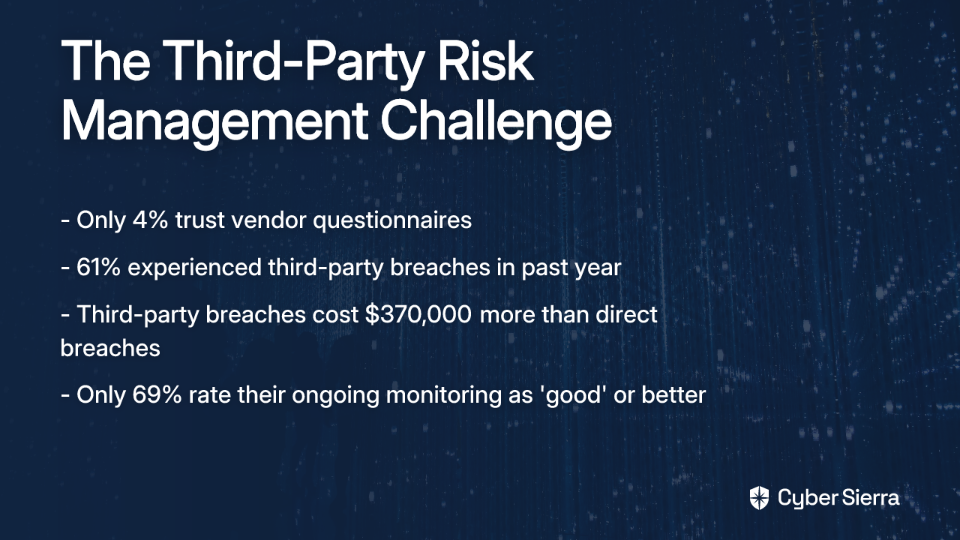
The uncomfortable truth is that a checked box on a Shared Assessments questionnaire (SIG) tells you very little. It doesn't tell you whether your third parties are actually conducting code reviews, enforcing employee offboarding policies, or patching known vulnerabilities. This kind of validation — matching vendor claims against real-world data — is exactly what MAS now expects, and what most legacy processes cannot deliver.
This article breaks down the core MAS requirements for Third-Party Risk Management (TPRM) and highlights five platforms built to help automate due diligence, provide continuous visibility, and keep your vendor program audit-ready.
What MAS Expects From Your Vendor Risk Program
Before evaluating any platform, it helps to understand the specific regulatory bar you're trying to clear.
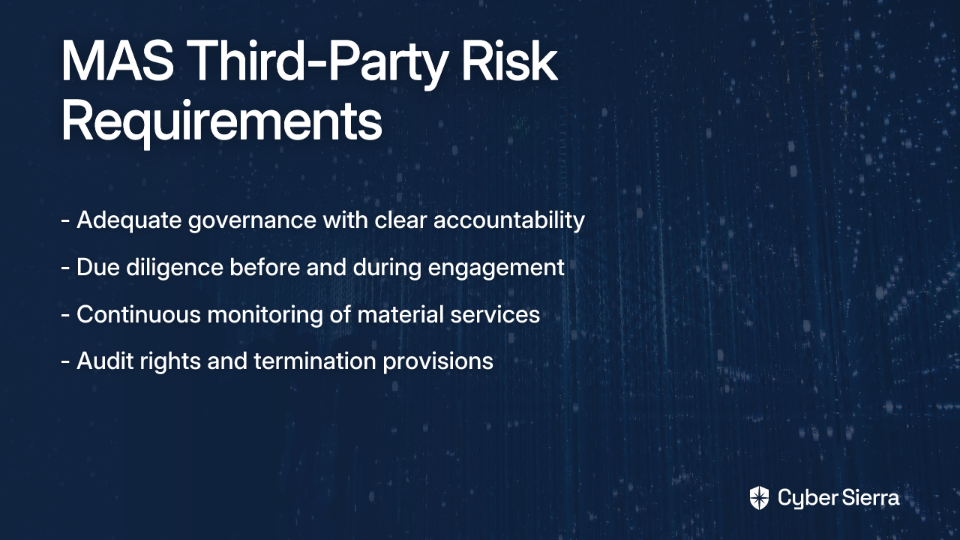
MAS has published guidelines on outsourcing that set clear expectations for how financial institutions must govern their third-party arrangements. The framework calls for:
- Adequate governance structures. Institutions must establish clear accountability for managing outsourced services, including ownership of risk assessments and escalation paths.
- Due diligence before and during engagement. Risk assessments cannot be a one-time exercise at onboarding. MAS expects ongoing evaluation of vendor security and resilience.
- Continuous monitoring of material services. Institutions must track vendor performance and compliance on an ongoing basis — not just at contract renewal.
- Audit rights and termination provisions. Contracts with critical vendors must include audit clauses and the ability to exit arrangements if risk thresholds are breached.
MAS has also published dedicated MAS TPRM guidance that reinforces these expectations across the broader financial sector. Financial institutions that rely on manual, periodic processes to satisfy these requirements are operating on borrowed time.
Why Traditional TPRM Falls Short
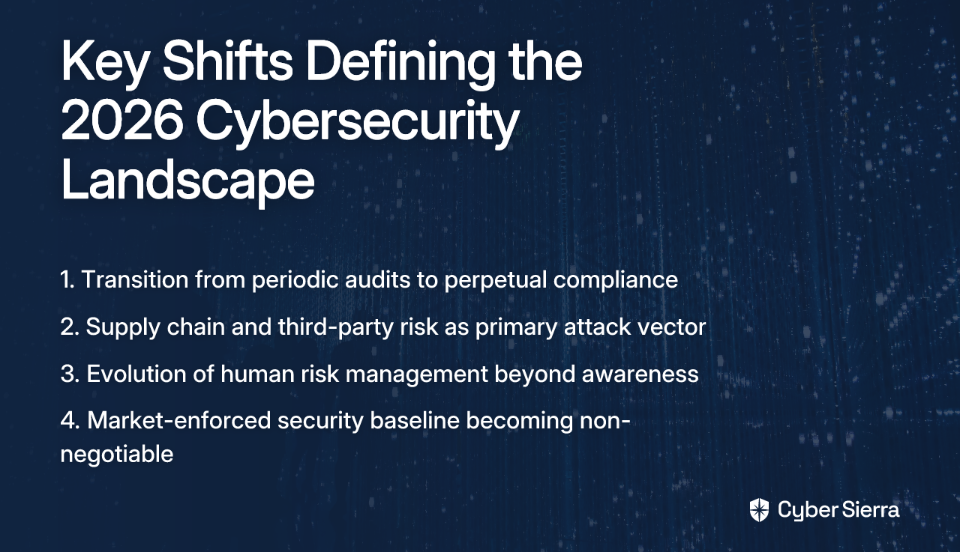
Point-in-time assessments have a fundamental flaw: they capture a snapshot of vendor posture at a single moment, then immediately begin aging. A vendor can pass a questionnaire in Q1 and suffer a significant control failure by Q2 — and you'd have no visibility until the next review cycle.
Practitioners in the field have named this problem directly. Overly complex questionnaires like the SIG create analysis paralysis for both the assessing organization and the vendors being assessed. Teams waste cycles chasing responses, only to end up with self-attestations that can't be independently verified. And when findings are eventually remediated, many tools don't even track repeat issues effectively.
The result is a program that looks rigorous on paper but leaves real blind spots — precisely the kind that MAS examiners are trained to find.
5 TPRM Platforms To Automate MAS Compliance
The platforms below address these gaps through automation, continuous monitoring, and deeper vendor validation. Each has been selected for its relevance to Singapore TPRM requirements and its ability to operationalize the kind of ongoing oversight MAS demands.
Here's a closer look at each option.
1. Cyber Sierra
Best for: CISOs and compliance teams in regulated industries seeking an integrated TPRM, Governance, Risk, and Compliance (GRC), and continuous monitoring platform. Supported frameworks: MAS TRM, SOC 2, ISO 27001, GDPR, PCI DSS. Deployment: Cloud-based SaaS.
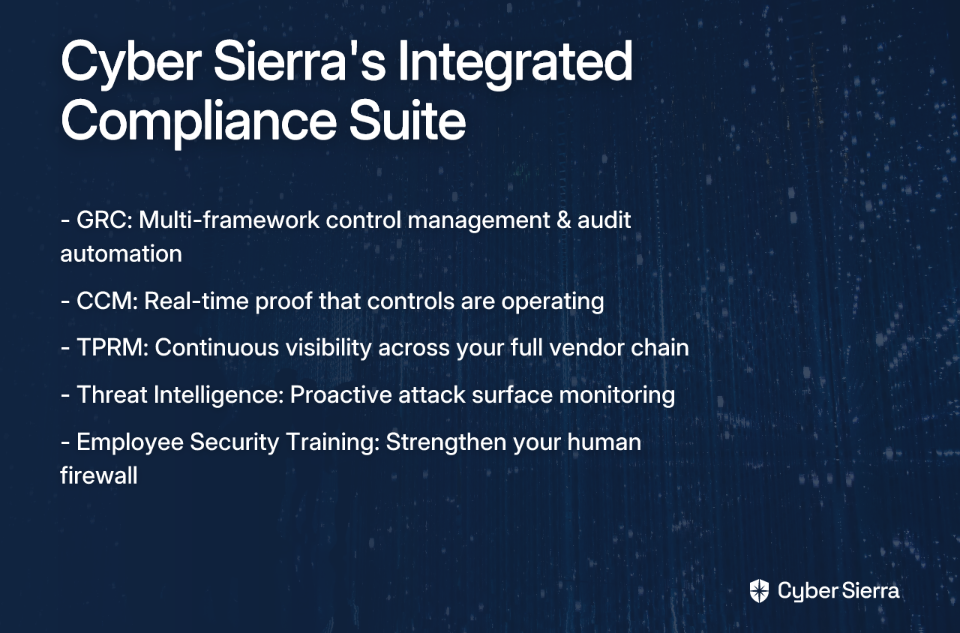
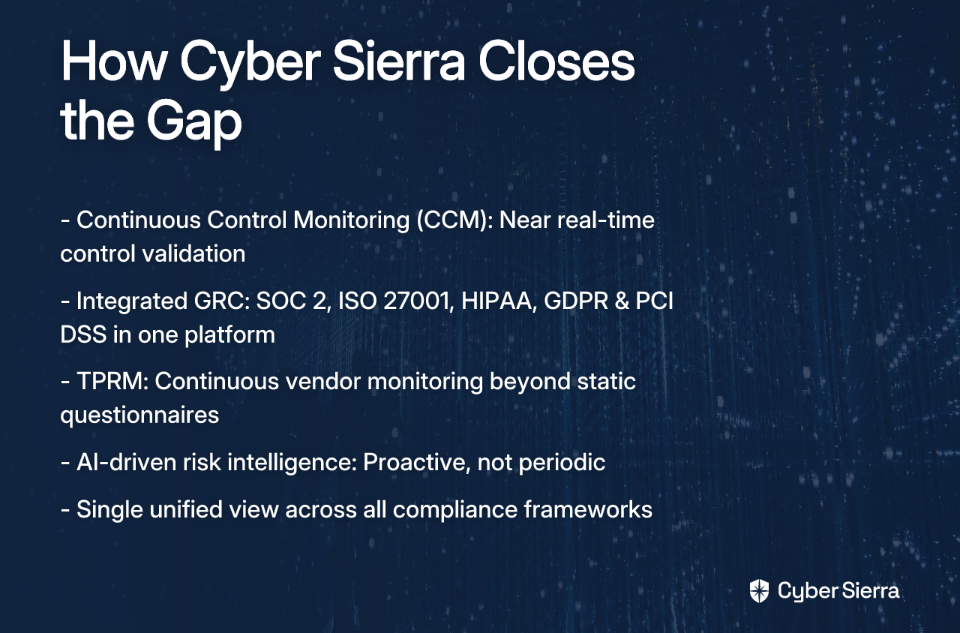
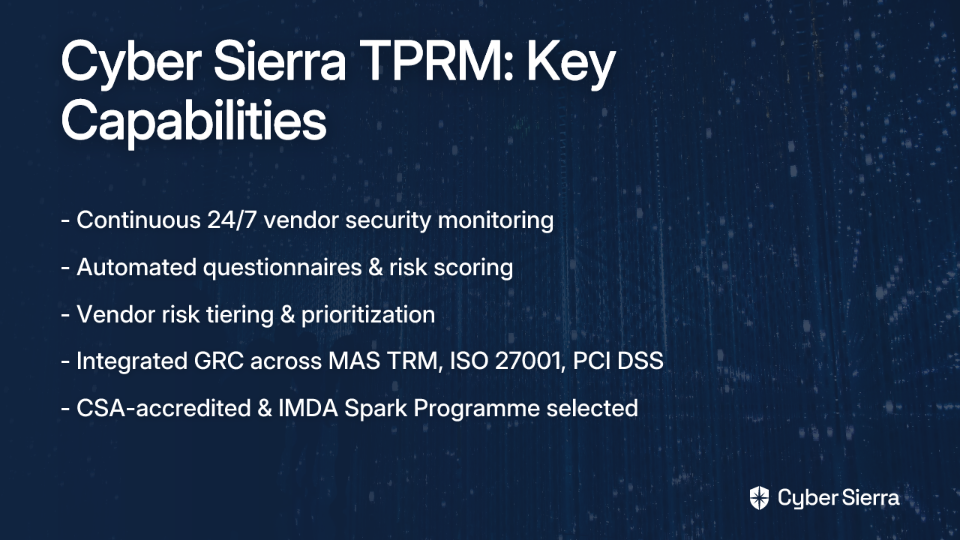
Cyber Sierra's TPRM module is built to move organizations beyond static assessments by providing near real-time, 24/7 visibility into vendor security compliance — directly addressing MAS's requirement for continuous monitoring of third-party arrangements. The platform automates vendor onboarding, questionnaire workflows, risk scoring, and offboarding, reducing the manual burden that causes so many teams to underinvest in vendor oversight.
What sets Cyber Sierra apart in the Singapore context is its integration of TPRM with a broader compliance automation ecosystem. Vendor risk data feeds directly into GRC workflows, enabling teams to manage MAS TRM alongside ISO 27001, PCI DSS, and other frameworks from a single platform. Cyber Sierra is recognized in the Gartner® Hype Cycle™ as a Sample Vendor, selected for Singapore's IMDA Spark Programme, and accredited by the Cyber Security Agency of Singapore (CSA).
Key features:
- Continuous vendor monitoring. Provides near real-time visibility into vendor security posture, with alerts triggered when vendor compliance status changes — enabling proactive remediation rather than reactive discovery.
- Automated vendor assessments. Streamlines the full vendor lifecycle with automated questionnaires, risk scoring, and structured onboarding and offboarding workflows.
- Vendor risk prioritization. Classifies vendors by risk tier, helping resource-constrained teams focus their oversight on the highest-impact relationships first.
- Integrated GRC automation. Connects vendor risk data to broader compliance functions, supporting multi-framework management and reducing duplicated effort across audit cycles.
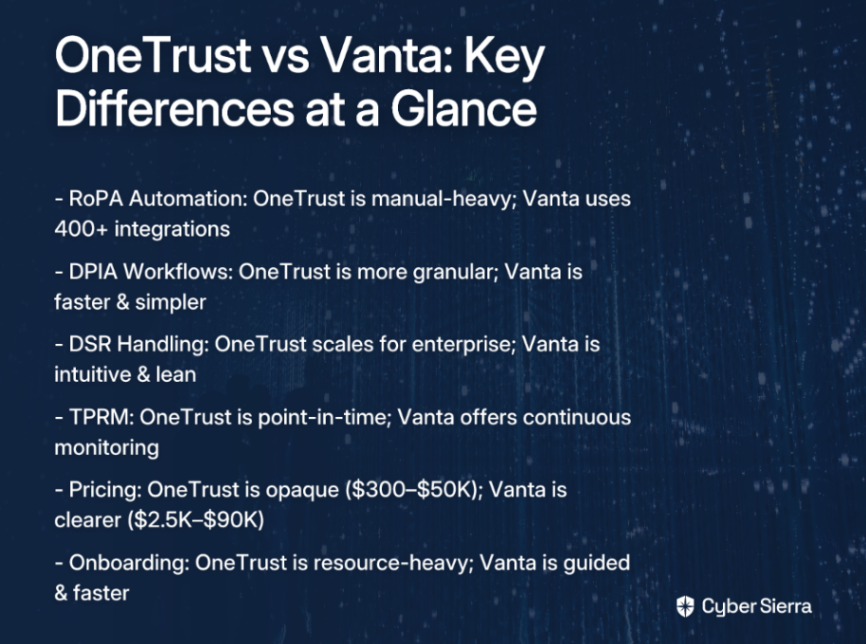
2. OneTrust
Best for: Enterprises managing vendor risk alongside privacy, data governance, and multi-framework GRC requirements. Supported frameworks: GDPR, MAS TRM, ISO 27001, CCPA/CPRA. Deployment: Cloud-based SaaS.
OneTrust is a well-established platform that centralizes third-party information management and automates risk assessments at scale. Its breadth is genuine — organizations that need to manage vendor risk in conjunction with data privacy obligations (particularly GDPR and Singapore's Personal Data Protection Act) will find meaningful overlap in OneTrust's coverage. Gartner's TPRM technology reviews consistently recognize it as one of the more comprehensive options in the market.
One practical caveat worth noting: OneTrust's breadth can also be a constraint. Teams with limited internal resources have found that deploying it effectively across a large vendor base requires significant configuration effort upfront.
Key features:
- Centralized third-party management. Provides a single repository for all vendor information, contracts, risk assessments, and compliance documentation.
- AI-powered risk analysis. Applies AI to automate scoring of vendor risk based on assessment responses and external data signals.
- Automated due diligence workflows. Supports structured onboarding, ongoing evaluation, and offboarding with workflow automation across the vendor lifecycle.
3. ProcessUnity
Best for: Organizations that need a dedicated, focused TPRM platform with strong vendor inventory and due diligence automation. Supported frameworks: MAS TRM, NIST CSF, ISO standards. Deployment: Cloud-based SaaS.
ProcessUnity is a purpose-built TPRM solution designed to serve as a single source of truth for vendor risk. Rather than bundling TPRM into a broader GRC suite, ProcessUnity keeps its focus narrow — which can be an advantage for teams that want deep functionality in vendor tracking, due diligence automation, and ongoing compliance monitoring without the overhead of a larger platform.
Its risk tiering capabilities are particularly relevant for MAS compliance, where institutions must demonstrate they have classified vendors by criticality and applied proportionate oversight to each tier.
Key features:
- Centralized vendor platform. A comprehensive system for tracking vendor data, performance metrics, due diligence status, and risk assessments across the full vendor inventory.
- Automated due diligence. Automates workflows for vendor onboarding, contract reviews, and periodic assessments — reducing manual effort and ensuring consistent evaluation standards.
- Risk tiering and escalation. Classifies vendors based on criticality and automates escalation rules when risk thresholds are breached, supporting MAS's expectation of tiered governance.
4. RSA Archer
Best for: Large financial institutions with mature risk programs that require a highly customizable and deeply integrated GRC framework. Supported frameworks: MAS TRM, NIST 800-53, ISO 27001, COBIT. Deployment: Cloud-based or on-premises.
RSA Archer has been a fixture in enterprise GRC for over two decades. Its strength lies in configurability — institutions with complex internal risk taxonomies, bespoke policy frameworks, or on-premises deployment requirements will find capabilities that purpose-built SaaS tools often can't match. For large banks operating under MAS oversight with intricate governance structures, that flexibility has real value.
The trade-off is implementation complexity. RSA Archer typically requires significant professional services investment to deploy and maintain, making it a better fit for organizations with dedicated GRC teams and the budget to support a longer-horizon rollout.
Key features:
- Customizable risk assessments. Enables organizations to build tailored assessment frameworks that align precisely with internal policies and MAS TRM requirements.
- Integrated reporting and dashboards. Delivers automated compliance reports and executive dashboards for auditors, regulators, and senior stakeholders.
- Third-party governance lifecycle management. Manages the complete lifecycle of third-party relationships from sourcing and due diligence through contract management and termination.
5. Aravo
Best for: Global enterprises managing large, complex vendor ecosystems that require scalable TPRM with configurable workflows. Supported frameworks: MAS TRM, ISO 27001, NIST CSF, GDPR. Deployment: Cloud-based SaaS.
Aravo is recognized by Gartner as a leading TPRM technology solution and is built for scale — it's designed to handle large vendor populations without sacrificing assessment depth or process consistency. For MAS-regulated institutions managing hundreds of third-party relationships across different risk tiers, Aravo's ability to automate proportionate oversight at scale addresses a genuine operational constraint.
It also provides strong support for continuous monitoring through integration with external risk intelligence feeds, addressing the practitioner pain of relying solely on self-attested questionnaire responses. Rather than taking a vendor's word that a control is in place, Aravo enables teams to cross-reference claims against external data.
Key features:
- Scalable vendor management. Designed to manage large vendor populations with consistent assessment standards, making it viable for institutions with complex supplier bases.
- Continuous monitoring with external intelligence. Integrates external risk data feeds to validate vendor claims and flag changes in vendor security posture between formal assessment cycles.
- Configurable workflow automation. Supports tailored onboarding, risk assessment, and remediation workflows that can be adapted to match internal governance frameworks and MAS requirements.
From Audit-Ready to Always-On
Meeting MAS requirements for third-party risk isn't about passing a single audit; it's about building a program that operates with continuous trust. Relying on annual questionnaires leaves critical compliance gaps, as vendor environments change daily. The only way to keep pace is with automation.
Here's what that means in practice:
- Move beyond snapshots: Static assessments are obsolete. MAS expects real-time visibility into your vendors' security posture.
- Automate due diligence: Replace manual spreadsheet tracking with a system that automates vendor onboarding, monitoring, and risk scoring.
Your first step today? Identify your five most critical vendors. Pinpoint exactly where your visibility into their security controls is weakest. This is the gap that auditors find and attackers exploit.
When you're ready to close that gap for good, see our TPRM platform in action. We'll show you how to unify vendor risk, GRC, and continuous monitoring to build a program that's always audit-ready.
Frequently Asked Questions
What are the key MAS requirements for third-party risk management?
MAS requires financial institutions to establish strong governance, conduct initial and ongoing due diligence, continuously monitor material services, and include audit and termination rights in contracts. This ensures risks from outsourced services are managed proactively throughout the vendor lifecycle.
Why are spreadsheets and manual questionnaires not enough for MAS compliance?
Spreadsheets and manual questionnaires fail to provide the continuous visibility MAS requires. They offer a point-in-time snapshot that quickly becomes outdated, leaving significant gaps in risk oversight and making it difficult to prove ongoing due diligence to auditors.
How does a TPRM platform help with MAS compliance?
A TPRM platform automates vendor assessments, provides continuous monitoring of their security posture, and centralizes documentation. This directly addresses MAS's expectations for ongoing due diligence and provides a clear, audit-ready trail of risk management activities.
What is continuous vendor monitoring?
Continuous vendor monitoring is the practice of using automated tools to track a vendor's security and compliance status in near real-time. Instead of relying on annual reviews, it provides alerts on new risks, such as vulnerabilities or compliance changes, as they happen.
How do I choose the right TPRM platform for my business?
Choose a TPRM platform by evaluating your organization's specific needs. Consider factors like your size, the complexity of your vendor ecosystem, existing GRC tools, and the need for specific framework support like MAS TRM, ISO 27001, or PCI DSS.
What is the difference between GRC and TPRM?
TPRM (Third-Party Risk Management) specifically focuses on risks from external vendors. GRC (Governance, Risk, and Compliance) is a broader strategy for managing an organization's overall governance and risk, of which TPRM is one critical component.
How often should vendor risk assessments be conducted under MAS guidelines?
MAS guidelines require ongoing due diligence and continuous monitoring, not just periodic reviews. While formal assessments may occur annually for high-risk vendors, your program must be able to detect and respond to changes in a vendor's risk posture at any time.