blog-hero-background-image
Governance & Compliance

Top 7 Tools to Automate ISO 27001 Compliance in 2025
backdrop
Table of Contents

Join thousands of professionals and get the latest insight on Compliance & Cybersecurity.


Summary

  • Manual ISO 27001 tracking with spreadsheets is increasingly failing audits due to version control issues and a lack of real-time visibility.
  • Automation is now essential for transforming compliance from a periodic, pre-audit scramble into a continuous, proactive security process.
  • Key factors for selecting an automation tool include its scalability, integration capabilities, and support for continuous control monitoring.
  • A unified platform like Cyber Sierra can automate data collection and monitoring, making your organization audit-ready at all times.

You've set up a Google Sheet to track your ISO 27001 controls. But as your latest audit approaches, you're drowning in version control issues, struggling to locate evidence, and realizing your spreadsheets aren't giving you real-time visibility into your security posture. Even worse, your auditor is hinting that manual tracking isn't going to cut it anymore.

"Is it becoming standard for auditors to expect even small companies to use automation tools for ISO 27001?" This question, increasingly common among compliance teams, reflects a shifting landscape where manual tracking is becoming obsolete.

The truth is, while spreadsheets might work for very small operations, they quickly become unmanageable as your organization grows. As one IT manager put it, "There are just too many variables to deal with to do it manually. Spreadsheets falter with version control, evidence gaps, and real-time monitoring."

In 2025, automation isn't just about satisfying auditor expectations—it's about transforming compliance from a periodic headache into a continuous, value-adding process for your security program.

Why Bother with ISO 27001 Automation? (The Shift from Spreadsheets to Software)

Before diving into specific tools, let's address why automation has become essential rather than optional for ISO 27001 compliance:

Eliminate Manual Chaos & Human Error

Managing an Information Security Management System (ISMS) manually introduces significant risks. With 114 Annex A controls to track, evidence to collect, and policies to maintain, the complexity quickly becomes overwhelming.

Manual processes are particularly prone to:

  • Documents being saved in the wrong locations
  • Outdated evidence being presented during audits
  • Missed control implementations due to human oversight
  • Inconsistent control monitoring

Automation centralizes documentation, eliminates version control nightmares, and ensures evidence is always up-to-date and accessible. This doesn't just satisfy auditors—it gives your team peace of mind.

Future-Proof Your Compliance Program

As companies grow, compliance challenges grow exponentially. As one security professional noted, "it gets harder to set up automation the larger you get. So the spreadsheet works now, but it's a bigger pain at 100 or 150 employees, and it's also harder to implement automation at that time."

Implementing automation early creates a scalable foundation that grows with your business, preventing the need for a massive compliance overhaul when you've already outgrown your manual processes.
Achieve Continuous, Proactive Compliance

Traditional compliance has been reactive: prepare frantically before an audit, pass it, then breathe a sigh of relief until next year. Modern compliance is continuous and proactive.

Continuous Control Monitoring (CCM) gives you a real-time view of your security posture, automatically detecting exceptions and control failures before they become audit findings. This shift transforms ISO 27001 from a checkbox exercise into a meaningful security program that provides ongoing protection.

The Top 7 Tools for ISO 27001 Automation in 2025

1. Cyber Sierra

Cyber Sierra provides an AI-enabled cybersecurity platform that unifies governance, risk, and compliance into a single, intelligent ecosystem. Unlike tools that focus solely on documentation, Cyber Sierra emphasizes continuous monitoring and automation.

Key Features for ISO 27001:

  • Continuous Control Monitoring (CCM): Automates control testing and validation across multiple frameworks including ISO 27001. This builds a central controls repository with near real-time updates, providing clear visibility into your security posture and detecting anomalies as they occur.
  • Automated GRC Module: Streamlines the entire audit lifecycle by automating data collection for risk assessments, ensuring ongoing compliance through continuous monitoring, and generating audit-ready reports with detailed trails.
  • Integrated Third-Party Risk Management: Simplifies vendor risk assessment and continuous monitoring, crucial for managing supply chain risks under ISO 27001's Annex A controls.

Best for: Organizations looking for a comprehensive, proactive security platform that unifies GRC, TPRM, and threat intelligence, aiming to reduce compliance fatigue and build a resilient security posture.

Considerations: Its broad suite of features makes it ideal for companies wanting to manage their entire security ecosystem, not just ISO 27001 compliance in isolation.

2. Vanta

Vanta has established itself as a leading compliance automation platform, particularly popular among tech companies and startups for its deep integrations and user-friendly approach.

Key Features for ISO 27001:

  • Extensive Automation: Integrates with over 400 tools and runs more than 1,200 automated tests to continuously collect compliance evidence. Vanta claims this can lead to a 50% reduction in time to achieve ISO 27001 compliance.
  • AI-Powered Templates: Provides pre-built ISMS templates for policies, roles, and risks to accelerate the setup process.
  • Automated Statement of Applicability (SoA): Automatically generates and updates the SoA document, mapping your environment to the required ISO controls.

Best for: Fast-growing tech companies that need to get audit-ready quickly and have a modern, cloud-native tech stack.

Considerations: While powerful for cloud-based infrastructure, organizations with significant on-premises legacy systems may find some gaps in automated evidence collection.

3. Drata

Drata emphasizes continuous monitoring and a seamless user experience, making it easy to manage multiple frameworks simultaneously.

Key Features for ISO 27001:

  • Continuous Evidence Collection: Integrates with your cloud services, identity providers, and other systems to automatically gather evidence 24/7.
  • Control Mapping: Helps map controls across different frameworks (ISO 27001, SOC 2, GDPR), reducing redundant work and streamlining compliance efforts.
  • Risk Management: Offers a centralized platform for managing risks, executing assessments, and implementing treatment plans.

Best for: Businesses that need to comply with multiple security frameworks simultaneously and want a clean, intuitive dashboard to manage everything.

Considerations: While strong on automation, some users report the need for additional customization to fully align with their organization's specific needs.

4. Scytale

Scytale is designed specifically for SaaS companies, featuring an AI GRC agent named "Scy" to simplify the compliance process.

Key Features for ISO 27001:

  • 24/7 Continuous Monitoring: Scans systems around the clock to track compliance status and alert on non-compliant issues.
  • AI-Powered Risk Management: The AI agent offers clear mitigation steps and helps customize risk management workflows.
  • Expert Guidance: Offers personalized expert support throughout the compliance journey, a key differentiator.

Best for: SaaS companies looking for a combination of powerful automation and hands-on expert support.

Considerations: The platform's AI capabilities are impressive but may require some initial training to maximize effectiveness.

5. Secureframe

Secureframe provides a comprehensive compliance platform that automates the process of getting and staying compliant with standards like ISO 27001, SOC 2, and HIPAA.

Key Features for ISO 27001:

  • Automated Workflows: Provides clear, step-by-step guidance and automated workflows for managing security compliance requirements.
  • Simplified Document Management: Streamlines the collection and organization of policies, procedures, and other evidence required for audits.
  • Real-time Monitoring & Analytics: Offers a dashboard with real-time insights into your security posture to ensure you remain audit-ready.

Best for: Organizations seeking a workflow-driven platform that simplifies the entire audit preparation process from start to finish.

Considerations: Some users note that the platform is strongest for companies starting their compliance journey rather than those with mature programs looking to optimize.

6. AuditBoard

AuditBoard is an enterprise-grade, cloud-based platform focused on audit, risk, and compliance management, designed for larger, more complex organizations.

Key Features for ISO 27001:

  • Strong Audit Management: Excels at automating the end-to-end audit process, from planning to reporting.
  • Comprehensive Reporting & Analytics: Provides powerful tools for risk assessments, creating insightful reports, and tracking remediation.
  • Cross-Framework Management: Effectively handles multiple compliance frameworks from a single platform.

Best for: Internal audit teams and larger enterprises with mature risk and compliance programs.

Considerations: The platform's higher pricing and complexity may be a barrier for smaller organizations, though its enterprise capabilities are unmatched for large companies.

7. ISMS.online

ISMS.online provides a dedicated platform with a pre-configured Information Security Management System (ISMS) to streamline ISO 27001 certification.

Key Features for ISO 27001:

  • Pre-configured Tools & Documentation: Comes with a set of pre-built policies, risk assessments, and project management tools tailored for ISO 27001.
  • Centralized Platform: Offers a single place to manage all compliance activities, from risk treatment plans to incident management.
  • Guided Implementation: Provides structured guidance through the entire certification process.

Best for: Companies new to ISO 27001 that would benefit from a highly structured, out-of-the-box solution to build their ISMS.

Considerations: The platform has limited pricing transparency and may have fewer third-party integration capabilities compared to competitors.

How to Choose the Right ISO 27001 Automation Tool

When evaluating automation tools for your ISO 27001 compliance program, consider these critical factors:
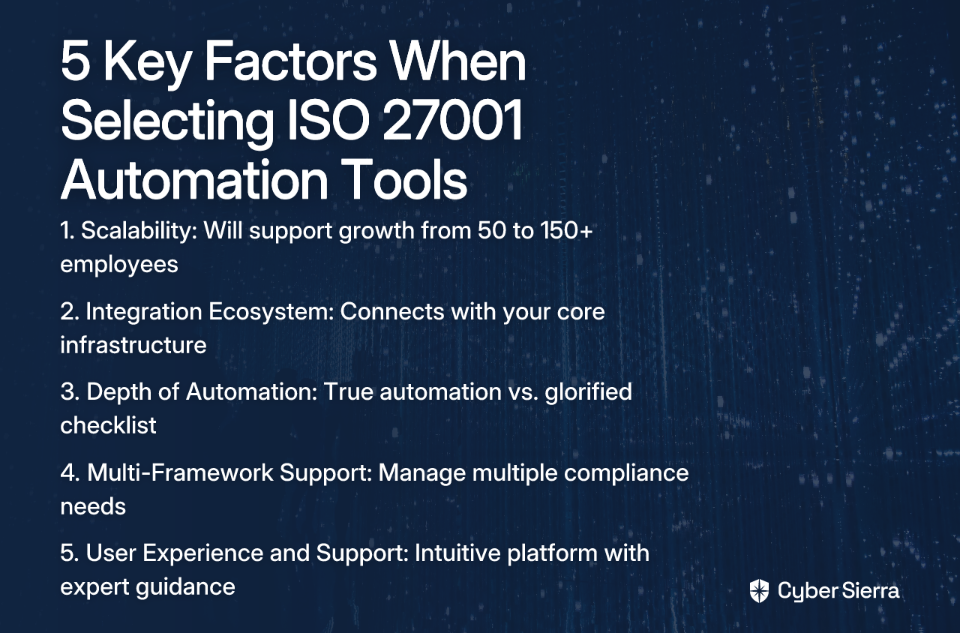
1. Scalability

Will this tool support you as you grow from 50 to 150 employees? As one security professional wisely noted, "it gets harder to set up automation the larger you get." Implementing automation when you're small prevents massive overhauls later.

2. Integration Ecosystem

Does the tool connect seamlessly with your core infrastructure (AWS, GCP, Azure), HR systems, and ticketing platforms? Look for a wide range of pre-built integrations to minimize manual work.

3. Depth of Automation

Is it a true automation platform or a "glorified checklist"? Ask vendors to demonstrate how they automate evidence collection, perform continuous control testing, and provide real-time alerts.

4. Multi-Framework Support

If you need to comply with SOC 2, GDPR, or HIPAA in the future, can the tool manage these from the same platform? This prevents tool sprawl and redundant effort.

5. User Experience and Support

Is the platform intuitive? What level of expert support is included? A steep learning curve can negate the time-saving benefits of automation.

Conclusion

In 2025, moving from manual spreadsheets to an automated compliance platform is no longer a "nice-to-have" for ISO 27001—it's a strategic necessity. The growing complexity of information security requirements, coupled with rising auditor expectations, makes manual tracking increasingly impractical.

Automation saves countless hours, reduces human error, provides an always-on view of your security posture, and transforms audits from a dreaded event into a simple review. Perhaps most importantly, it shifts ISO 27001 compliance from a checkbox exercise to a continuous, value-adding process that genuinely improves your security posture.

Ready to build a proactive, audit-ready compliance program that satisfies auditors and adds real value to your business? Explore how Cyber Sierra's unified security platform transforms compliance from a periodic chore into a continuous, automated process that gives you confidence in your security posture every day, not just during audit season.

Frequently Asked Questions

What is ISO 27001 automation?

ISO 27001 automation involves using specialized software to manage your Information Security Management System (ISMS), replacing manual processes like spreadsheets. This technology streamlines tasks such as evidence collection, control monitoring, risk assessment, and audit preparation, connecting directly to your tech stack to provide real-time visibility into your compliance posture.

Why is automation necessary for ISO 27001 compliance?

Automation is necessary for ISO 27001 because manual methods, like spreadsheets, do not scale and are prone to human error, version control issues, and evidence gaps. As organizations grow, automation provides a centralized, up-to-date view of your security controls, transforming compliance from a periodic, reactive task into a continuous, proactive process that satisfies auditors and genuinely improves security.

How do I choose the right ISO 27001 automation tool?

To choose the right ISO 27001 automation tool, you should evaluate its scalability to support your company's growth, its integration capabilities with your existing tech stack, and the depth of its automation beyond simple checklists. Additionally, consider whether it supports multiple compliance frameworks and offers an intuitive user experience with reliable expert support.

What is Continuous Control Monitoring (CCM) for ISO 27001?

Continuous Control Monitoring (CCM) is an automated process that continuously tests and validates your security controls against ISO 27001 requirements. Instead of checking controls only before an audit, CCM provides a real-time view of your security posture, automatically detecting and alerting you to control failures or compliance gaps as they happen.

Can small businesses use automation for ISO 27001?

Yes, small businesses can and should use automation for ISO 27001. Implementing an automation platform early establishes a scalable foundation for compliance that grows with the business. This prevents the significant pain and cost of overhauling a manual system later on and allows smaller teams to manage compliance efficiently without hiring dedicated staff.

How much time can I save with an ISO 27001 automation tool?

The amount of time saved can be significant, with some platforms claiming to reduce the time to achieve ISO 27001 compliance by up to 50%. Automation eliminates countless hours of manual evidence collection, report generation, and status tracking, freeing up your team to focus on improving security rather than managing spreadsheets.
blog-hero-background-image
Governance & Compliance

Top 10 GRC Platforms That Support Multi-Framework Compliance

backdrop
Table of Contents

Join thousands of professionals and get the latest insight on Compliance & Cybersecurity.


Summary

  • With 71% of consumers willing to leave businesses that mishandle data, effective multi-framework compliance is a business imperative, not just a checkbox exercise.
  • Manually managing frameworks like SOC 2 and ISO 27001 is inefficient; the key is using a GRC platform with control mapping to consolidate overlapping requirements.
  • To choose the right platform, start by defining your internal processes and goals before evaluating tools to ensure you solve your specific compliance challenges.
  • Cybersierra's GRC platform helps organizations automate evidence collection and uses continuous monitoring to stay audit-ready across multiple frameworks.

You've been tasked with implementing multiple compliance frameworks simultaneously. SOC 2, ISO 27001, GDPR, HIPAA—the acronyms keep piling up, along with the mountain of evidence you need to collect. Your team is drowning in spreadsheets, struggling to track overlapping controls, and dreading the next audit cycle. Sound familiar?

The regulatory landscape is exploding, with businesses often needing to comply with multiple frameworks at once. According to Secureframe, 71% of consumers may stop doing business with companies that mishandle their data, making compliance not just a checkbox exercise but a business imperative.

This article will guide you through the essential features of a multi-framework GRC platform and present the top 10 solutions that can transform your compliance program from a reactive burden into a strategic advantage.

The Challenge of "Compliance Sprawl" and Why Multi-Framework Matters

Governance, Risk, and Compliance (GRC) is a structured approach to aligning IT with business goals, managing risks, and adhering to regulations. As AWS explains, it consists of:

  • Governance: The framework of policies and rules guiding the organization towards its objectives
  • Risk Management: The process of identifying, assessing, and mitigating organizational risks
  • Compliance: Ensuring adherence to laws, regulations, standards, and internal policies

Organizations today rarely need just one compliance framework. SaaS companies might need SOC 2, ISO 27001, GDPR, and CCPA/CPRA simultaneously. Healthcare providers juggle HIPAA and HITRUST, while fintech companies balance PCI DSS and SOX requirements.

The business benefits of mastering multi-framework compliance include:

  1. Building Trust & Expanding Markets: Meeting various compliance requirements unlocks global markets and diverse customer segments
  2. Gaining Competitive Edge: A strong compliance posture differentiates you from competitors
  3. Creating a Comprehensive Security Posture: Controls from multiple frameworks identify a broader spectrum of risks
  4. Enhancing Cybersecurity: Protection of customer data and meeting stringent privacy regulations

However, managing multiple frameworks manually leads to inefficiency, duplication of effort, and increased risk of non-compliance. This is where purpose-built GRC platforms come in.

Key Features to Look for in a Multi-Framework GRC Platform

Based on extensive user research and industry best practices, here are the critical capabilities your GRC platform should offer:

Framework Flexibility & Control Mapping

The platform must support multiple frameworks out-of-the-box (SOC 2, ISO 27001, GDPR, HIPAA, PCI DSS) and allow for custom controls. Crucially, it should offer cross-mapping to "consolidate overlapping controls" and avoid redundant work, as highlighted by Secureframe.

Deep Automation

Go beyond simple checklists. The tool should automate:

  • Evidence collection from cloud environments, HR systems, and other tools
  • Continuous control testing and validation
  • Workflows for risk assessments and remediation tracking

According to LegitSecurity, this addresses the common pain point of manual tasks and increases efficiency substantially.

Robust Integrations

The platform must connect seamlessly with your existing tech stack (AWS, Jira, Okta, Slack, etc.). This provides "centralized visibility" and a single source of truth for your compliance program.

Continuous Monitoring

A major shift from traditional compliance is moving from periodic, point-in-time checks to continuous, real-time monitoring. This helps with "proactive identification of compliance breaches" and maintains an audit-ready posture year-round.

Scalability

As noted in Reddit discussions about GRC tools, many platforms are quickly outgrown. Your chosen solution should scale with your organization without requiring a painful migration in 1-2 years.

Usability & Customization

A complex interface frustrates users and hinders adoption. Look for an intuitive UI, no-code/low-code customization for workflows, and powerful reporting dashboards. User research consistently shows that "usability and customization are critical factors influencing the effectiveness of GRC tools."

Advanced Evidence Management

A key missing feature according to users is "rights management around evidence sharing." The platform must provide a secure, centralized repository for evidence with proper access controls to protect sensitive data and ensure data integrity.

The Top 10 GRC Platforms for Multi-Framework Compliance

1. Cyber Sierra

Overview: An AI-enabled cybersecurity platform designed to simplify and automate security compliance. It provides an integrated suite for GRC, continuous monitoring, vendor risk, and more.

Strengths:

  • Continuous Control Monitoring (CCM): Provides near real-time visibility into security controls across multiple frameworks (NIST, ISO 27001, PCI DSS, GDPR), automating control testing and evidence gathering with advanced monitoring capabilities.
  • Unified Platform: Combines GRC with Third-Party Risk Management (TPRM), Threat Intelligence, Employee Training, and Cyber Insurance readiness, offering a holistic view of risk.
  • AI-Driven Automation: Leverages AI to streamline data collection, risk assessments, and reporting, reducing audit preparation time by up to 70%.
  • User-Centric: Designed for CISOs, Compliance Managers, and IT leaders struggling with manual processes and audit stress.

Ideal for: Organizations of all sizes seeking a modern, AI-powered platform to unify their security and compliance programs and move from periodic checks to proactive, continuous management.

2. Drata

Overview: An AI-native platform specializing in continuous compliance automation for cloud-native companies.

Strengths: Supports over 20 frameworks (SOC 2, ISO 27001, HIPAA, etc.), features extensive integrations, automated evidence collection, and a user-friendly Trust Center.

Ideal for: Fast-growing tech companies wanting to leverage compliance to accelerate growth.

3. Archer

Overview: A highly established and mature enterprise GRC solution known for its deep customizability and modularity.

Strengths: Offers configurable risk data management, audit management, and third-party risk capabilities. Provides visual heatmaps for risk modeling.

Ideal for: Large, mature organizations with dedicated GRC teams that require a powerful, highly configurable platform.

4. MetricStream

Overview: A unified GRC platform that uses AI for predictive insights and risk management.

Strengths: Features a regulatory intelligence engine, comprehensive audit automation, and low-code customization.

Ideal for: Enterprises seeking an AI-powered GRC solution with a focus on enterprise-grade architecture.

5. AuditBoard

Overview: A user-friendly platform that started with a focus on audit management and has expanded into risk and compliance.

Strengths: Known for its ease of use, streamlining audits, evidence collection, and enabling cross-team collaboration.

Ideal for: Internal audit and compliance teams looking for an intuitive, audit-centric GRC solution.

6. LogicGate Risk Cloud

Overview: A flexible, no-code GRC platform that allows users to build custom workflows.

Strengths: Features a drag-and-drop workflow builder, strong capabilities in third-party risk and cyber risk, and risk quantification.

Ideal for: Organizations that need a highly flexible and customizable solution without relying on developers.

7. Hyperproof

Overview: A cloud-based GRC solution designed for continuous compliance and ease of use.

Strengths: Offers real-time compliance tracking and a task automation engine to manage ongoing compliance activities efficiently.

Ideal for: Teams prioritizing continuous compliance visibility and straightforward implementation.

8. IBM OpenPages

Overview: An AI-enhanced GRC platform from IBM, built for large-scale, complex enterprises.

Strengths: Provides data-heavy risk modeling, automated workflows, and AI-backed monitoring.

Ideal for: Large organizations with significant IT resources that need advanced risk intelligence and analytics.

9. OneTrust

Overview: A comprehensive GRC platform with very strong roots in privacy and data protection.

Strengths: Excels in privacy compliance (GDPR, CCPA), has an extensive assessment library, and robust vendor risk management features. Mentioned positively in Reddit user discussions for its maturity.

Ideal for: Organizations where data privacy is a primary driver for their GRC program.

10. SAI360

Overview: An integrated GRC platform with a focus on mapping risks to controls and providing industry-specific solutions.

Strengths: Offers relationship mapping capabilities, integrates GRC with ethics and learning management, and has strong operational risk features.

Ideal for: Companies in regulated industries looking for tailored risk oversight and integrated employee training.

How to Choose the Right GRC Platform for Your Organization

As one Reddit user aptly pointed out, "a poorly defined process can make any GRC tool ineffective." The tool is only as good as the process behind it. Follow this structured approach to select the right platform:

  1. Start with Your Process, Not the Tool: Before demoing, map out your current GRC processes. Where are the bottlenecks? What takes the most manual effort?
  2. Define Clear Goals: What do you want to achieve? Is it to reduce audit prep time, gain real-time risk visibility, or automate vendor assessments?
  3. Assess Existing Procedures & Tech Stack: What frameworks must you comply with? What tools (cloud providers, identity providers, ticketing systems) does the GRC platform need to integrate with?
  4. Get Executive Buy-in: Frame GRC as a business enabler, not just a cost. Use a top-down approach to promote a risk-aware culture.
  5. Demo and Pilot: Shortlist 2-3 vendors based on the features outlined earlier. Run a pilot test with a specific use case (e.g., SOC 2 evidence collection for one system) before a full rollout.

Conclusion

The modern threat and regulatory landscape demands a move away from spreadsheets and siloed tools. The future of GRC is automated, integrated, and continuous.

A powerful multi-framework GRC platform helps organizations build trust, enter new markets, and create a resilient security posture. When evaluating options, look for a partner, not just a product.

Solutions like Cyber Sierra provide not just technology but an integrated approach that ties GRC to the broader cybersecurity program, from threat intelligence to employee training, setting organizations up for long-term success.

By selecting the right GRC platform that supports multi-framework compliance, you can transform compliance from a cost center into a strategic advantage that drives business growth and builds customer trust.

Frequently Asked Questions

What is a multi-framework GRC platform?

A multi-framework GRC platform is a centralized software solution that helps organizations manage compliance with multiple regulations and standards (like SOC 2, ISO 27001, and GDPR) simultaneously. It automates evidence collection, maps overlapping controls between frameworks to reduce redundant work, and provides continuous monitoring to ensure an ongoing audit-ready posture. This consolidates governance, risk management, and compliance activities into a single source of truth.

Why is control mapping essential for multi-framework compliance?

Control mapping is essential because it identifies and consolidates overlapping requirements across different compliance frameworks, saving significant time and effort. For example, a single control for access management might satisfy requirements for SOC 2, ISO 27001, and PCI DSS. A GRC platform with control mapping allows you to collect evidence once and apply it to all relevant frameworks, eliminating redundant tasks and ensuring consistency.

How does a GRC platform automate compliance?

A GRC platform automates compliance by integrating directly with your tech stack (like AWS, Azure, Jira, and Okta) to continuously collect evidence, monitor controls, and flag misconfigurations in real-time. Instead of manually taking screenshots or running reports, the platform automatically gathers proof that controls are operating effectively. It can also automate workflows for risk assessments, policy attestations, and remediation tracking.

Can a GRC platform be used by small and medium-sized businesses?

Yes, many modern GRC platforms are specifically designed for small and medium-sized businesses (SMBs), offering scalable and affordable solutions. While traditional GRC tools were often complex and built for large enterprises, today's cloud-based platforms are user-friendly and cater to the needs of fast-growing tech companies, helping smaller teams achieve compliance without a large, dedicated GRC department.

What is the first step in choosing a GRC platform?

The first step in choosing a GRC platform is to map out your existing compliance processes and identify your specific goals, rather than jumping straight into product demos. Before evaluating tools, understand your current pain points, such as manual evidence collection or lack of risk visibility. This process-first approach ensures you select a tool that solves your actual problems and aligns with your organizational needs.

Does a GRC tool guarantee I will pass an audit?

No, a GRC platform does not guarantee you will pass an audit, but it significantly improves your chances by streamlining and organizing the entire process. The platform provides the framework, automation, and evidence repository to make you audit-ready. However, your organization is still responsible for implementing effective controls and remediating issues. A GRC tool is an enabler for a strong compliance program, not a replacement for it.

blog-hero-background-image
Governance & Compliance

How to Automate Evidence Collection for Compliance Audits

backdrop
Table of Contents

Join thousands of professionals and get the latest insight on Compliance & Cybersecurity.


Summary

  • Manual audit evidence collection is a significant pain point, with 65% of CISOs reporting compliance stress and single audits taking up to 9 months to prepare for.
  • Automating evidence collection can reduce preparation time by up to 90%, improve accuracy, and provide continuous, real-time visibility into your security posture.
  • To get started, map your assets to control frameworks (like SOC 2 or ISO 27001), configure automated checks, and set up real-time alerts for any failures.
  • Cybersierra's GRC and Continuous Control Monitoring platforms automate this process, making you permanently audit-ready.

You've set up a Google Ads campaign to drive targeted traffic to your website or online store. But when you check your analytics, you're shocked to see a flood of visitors from countries like India, Pakistan, and Bangladesh - places you never intended to target.

Sound familiar? You're not alone.

In 2023, almost 70% of service organizations needed to comply with at least six frameworks like SOC 2, ISO 27001, and GDPR. Preparing for just one SOC 2 audit can take up to 9 months, and 65% of CISOs report significant stress related to compliance outcomes.

The most painful part? Evidence collection.

"The most painful part of an audit is typically evidence gathering," as one security professional aptly described on Reddit. It's a sentiment echoed across boardrooms and IT departments: "Manual collection of artifacts for yearly control assessments is time-consuming and drains productivity."

But what if there was a better way? What if you could transform compliance from a periodic scramble into a continuous, automated process that kept you perpetually audit-ready?

The High Cost of Manual Evidence Collection

Traditional evidence collection involves a laundry list of tedious tasks:

  • Reviewing countless documents across various systems
  • Manually entering data into spreadsheets or compliance tools
  • Conducting interviews and surveys with team members
  • Endless emails to asset owners requesting screenshots and configurations
  • Manual testing of controls
  • Tracking and documenting all communication with stakeholders

This approach creates several critical challenges:

Labor-intensive and time-consuming: Your engineers and administrators lose valuable productivity hours manually gathering evidence that could be automated.

Prone to human error: From incorrectly mapped controls to inconsistent evidence formats, manual processes introduce risks that can lead to audit findings.

Difficult to scale: As your compliance requirements grow (from 2 frameworks to 6), the manual burden increases exponentially.

Lack of real-time visibility: Manual checks only provide point-in-time assurance, leaving you in the dark about your compliance posture between audits. As one IT manager noted, teams end up "scrambling before audits" because they lack continuous monitoring capabilities.

The Solution: Embracing Automated Evidence Collection

Automated evidence collection uses technology to gather, organize, and store compliance documentation by integrating with your existing tech stack – including cloud platforms, HR software, and security systems.

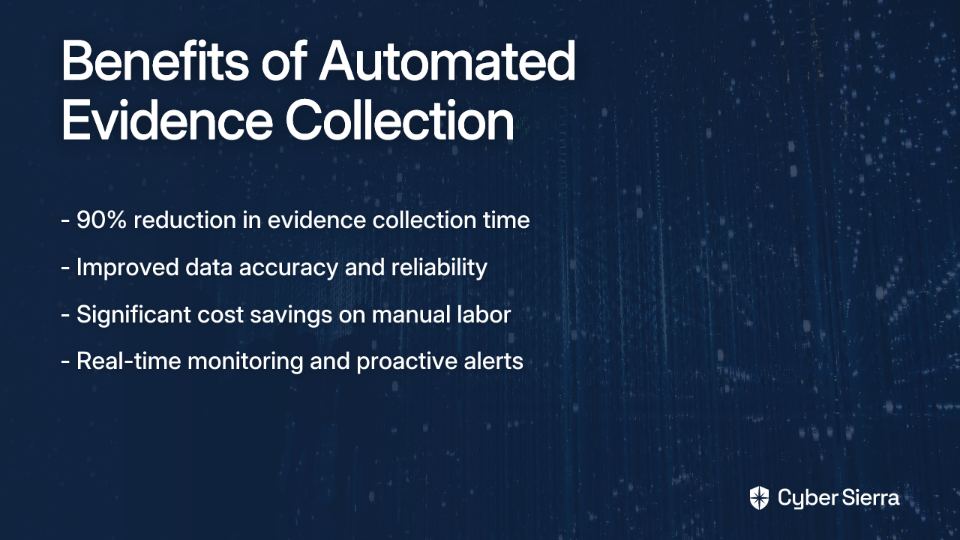
The benefits of automation are substantial and measurable:

  • Enhanced Efficiency: Automation can reduce time spent coordinating evidence collection by up to 90%.
  • Improved Accuracy: By pulling evidence directly from source systems, automation minimizes human error and ensures data reliability.
  • Cost Savings: Reduced manual labor hours translate to direct cost savings, while proactive detection prevents costly remediation.
  • Real-time Monitoring & Proactive Alerts: Continuous control monitoring allows you to identify and fix issues long before an auditor finds them.

A Step-by-Step Guide to Automating Evidence Collection

Ready to transform your compliance process? Follow these steps to implement automated evidence collection:

Step 1: Identify Key Processes and Map Your Asset Inventory

Begin by focusing on critical processes identified from historical audits and established frameworks like ISO 27001 and the NIST Cybersecurity Framework. Use automation tools to build and maintain an up-to-date inventory of all assets (servers, databases, applications) that fall within your compliance scope.

This foundation is crucial because you can't protect what you don't know you have. An automated discovery process ensures nothing falls through the cracks.

Step 2: Implement and Map Framework Controls

Leverage a platform with a pre-built library of controls to accurately map policies to your assets. This eliminates the manual, error-prone guesswork of mapping controls to criteria.
For example, rather than manually tracking which systems require password policies, an automated solution can identify all in-scope systems and continually verify that password requirements are properly configured.

Step 3: Set Up Automated Checks and Workflows

Configure automated, pass/fail tests based on your control objectives. For instance, a test could verify that:

  • Multi-factor authentication is enabled for all admin accounts
  • All cloud storage buckets have proper access controls
  • System patches are applied within the required timeframe

Modern platforms can automate up to 99% of these compliance checks. Ideally, these tests should run frequently—even hourly—to provide a near real-time view of your compliance posture.

Step 4: Enable Real-Time Tracking, Alerts, and Reporting

Implement dashboards to get a centralized view of all control statuses. Set up automated alerts when controls fail, allowing for immediate remediation rather than discovering issues during an audit.

Establish Key Risk Indicators (KRIs) to track control performance over time, giving you visibility into your compliance trends and potential problem areas.

Step 5: Consolidate and Gather Time-Stamped Evidence

The automation system should collect and store auditor-grade, time-stamped evidence in a centralized repository. This creates a clear audit trail and makes evidence readily available on-demand.

A key efficiency gain comes from applying evidence from a single test across multiple frameworks. For example, the same password policy evidence can satisfy requirements in SOC 2, ISO 27001, and NIST simultaneously, eliminating redundant work.

Choosing the Right Tools: Key Features of an Automated Solution

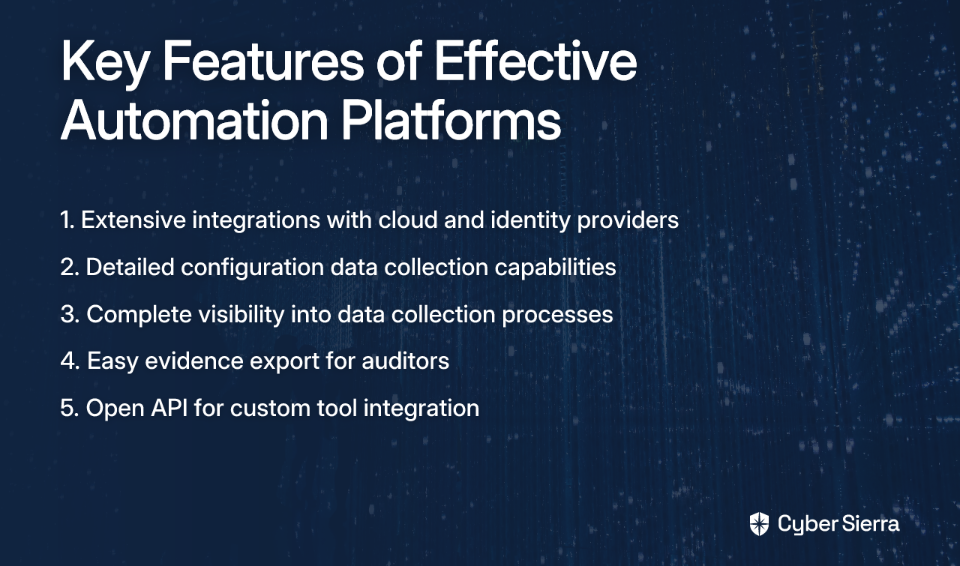
When evaluating potential automation platforms, look for these essential capabilities:

  • Breadth of Integrations: Does it have extensive out-of-the-box integrations with your cloud providers (AWS, Azure, GCP), identity providers (Okta, Azure AD), code repositories (GitHub), and HR systems?
  • Depth of Integrations: Does it just pull user lists, or can it collect detailed configuration data and logs to prove a control is working correctly?
  • Visibility and Transparency: Can you easily see what data is being pulled and what permissions are required?
  • Export Capabilities: Is it easy to export evidence for auditors or internal teams for remediation?
  • Open API: Does it offer an API to integrate with custom or in-house tools, ensuring future scalability?

Going Deeper: The Role of Continuous Controls Monitoring (CCM)

Underlying effective automation is Continuous Controls Monitoring (CCM) – the process that converts point-in-time compliance checks into a continuous, real-time view of your security posture.

CCM addresses three critical compliance challenges:

  1. Delayed detection of control failures
  2. Manual, resource-intensive processes
  3. Managing the complexity of modern IT environments

Common CCM use cases include:

  • Access Management: Automatically testing and flagging if an employee who left the company still has active access
  • Change Management: Ensuring all code changes go through a documented approval process
  • Risk Quantification: Automatically collecting data to continuously monitor and quantify risks

According to the Cloud Security Alliance, "CCM automates the ongoing tracking of compliance and security controls," transforming traditional audit preparation from a stressful event into a continuous, manageable process.

Streamlining Your Audits with Cybersierra

For organizations looking to implement these best practices, Cybersierra offers an AI-enabled cybersecurity platform that operationalizes automated evidence collection through two key modules:

Cybersierra's Governance, Risk & Compliance (GRC) module automates data collection, risk assessments, and reporting for various frameworks including SOC2, ISO 27001, and HIPAA. This streamlines audits and reduces compliance fatigue for teams struggling with manual setup and managing multiple frameworks.

For teams needing to move from periodic checks to real-time visibility, Cybersierra's Continuous Control Monitoring (CCM) module provides a central controls repository with near real-time updates. It automates control testing, delivers actionable risk intelligence, and manages controls across multiple compliance frameworks, transforming security from periodic checks to continuous, automated monitoring.

From Audit Anxiety to Audit-Ready

The shift from manual, point-in-time evidence collection to automated, continuous monitoring is no longer a luxury but a necessity for modern, secure, and efficient organizations.

By implementing automated evidence collection, you can:

  • Free your technical teams to focus on value-adding work
  • Improve the accuracy and reliability of your compliance data
  • Gain continuous visibility into your security posture
  • Transform audit preparation from a stressful scramble to a confident demonstration of your mature security program

The days of audit anxiety are over. With the right automation strategy and tools, you can achieve a state of permanent audit readiness – where compliance becomes a natural outcome of well-managed security operations rather than a periodic fire drill.

Are you ready to move beyond the cycle of audit anxiety? Explore how a unified platform can help you become permanently audit-ready and transform compliance from a burden into a competitive advantage.

blog-hero-background-image
Governance & Compliance

How to Transition from Manual to Automated Compliance Monitoring

backdrop
Table of Contents

Join thousands of professionals and get the latest insight on Compliance & Cybersecurity.


Summary

  • Manual compliance drains 40-60 hours of engineering time per framework and introduces significant security risks due to human error and outdated, point-in-time checks.
  • Automating compliance with Continuous Control Monitoring (CCM) significantly cuts workloads, with 76% of organizations reducing compliance tasks by at least half while improving security.
  • Begin the transition to automation by assessing risks, mapping manual workflows, and selecting an integrated platform to automate evidence gathering.
  • Cyber Sierra's integrated GRC platform automates this process with continuous monitoring and evidence collection, making your organization perpetually audit-ready.

You just got assigned to yet another compliance task that wasn't on your roadmap. As a DevOps engineer, you now have to spend the next few weeks gathering screenshots of AWS console settings, documenting infrastructure configurations, and updating compliance policies—all while your actual engineering work piles up.

"Compliance work used to be the worst part of being a DevOps engineer," confessed one Reddit user. "It was so bad that some engineers said it made them 'want to find a different job.'" If this sounds familiar, you're not alone.

The truth is, manual compliance monitoring is a burden that drains resources, introduces risk, and frustrates your best talent. But there's good news: what was once an administrative nightmare is now an automation opportunity.

The High Cost of Sticking to Spreadsheets and Screenshots

Before diving into solutions, let's understand why manual compliance monitoring is increasingly untenable in today's business environment:

Time & Resource Drain

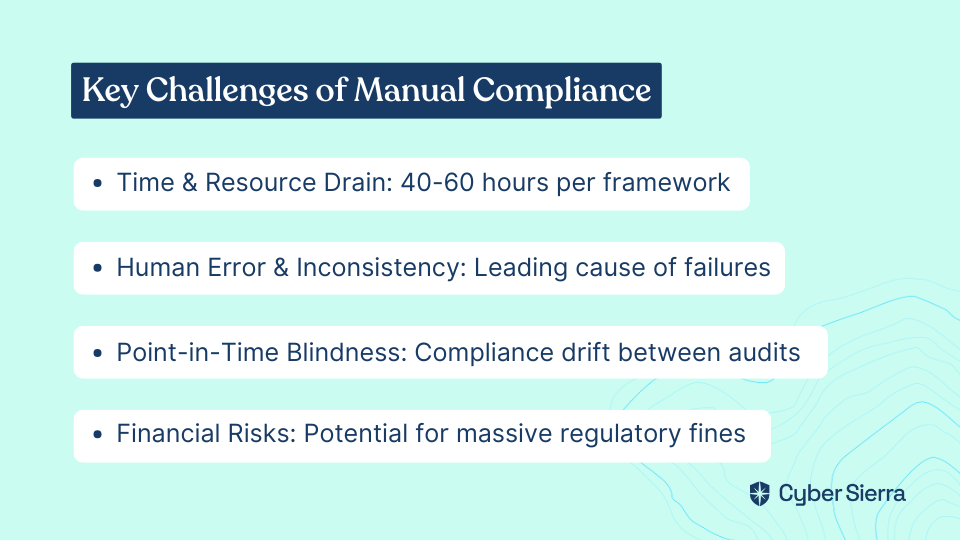
Manual compliance is a significant time sink. For a typical startup, compliance work can take 40-60 hours of engineering time per framework. That's valuable talent diverted from innovation and revenue-generating activities to tedious audit preparation.

Human Error & Inconsistency

With heavy reliance on manual checks and data entry, errors are inevitable. A misplaced checkbox, an overlooked setting, or an outdated screenshot can lead to compliance gaps that expose your organization to risk. According to IBM, these human errors are among the leading causes of compliance failures.

Point-in-Time Blindness

Manual audits provide only a snapshot of compliance at a specific moment. The minute the audit is complete, your compliance posture begins to drift as configurations change, new systems are deployed, and security settings are modified. This reactive approach leaves you vulnerable between audits.
Financial & Reputational Risks

The consequences of non-compliance are severe. Meta was fined USD 1.3 billion for GDPR violations, demonstrating the scale of financial risk. Beyond financial penalties, non-compliance can lead to business disruptions, lost customer trust, and increased vulnerability to data breaches.
What is Automated Compliance? A Shift to Continuous Monitoring

Automated compliance monitoring represents a fundamental shift in approach. Instead of periodic, manual checks, it enables continuous validation of your security controls through software.
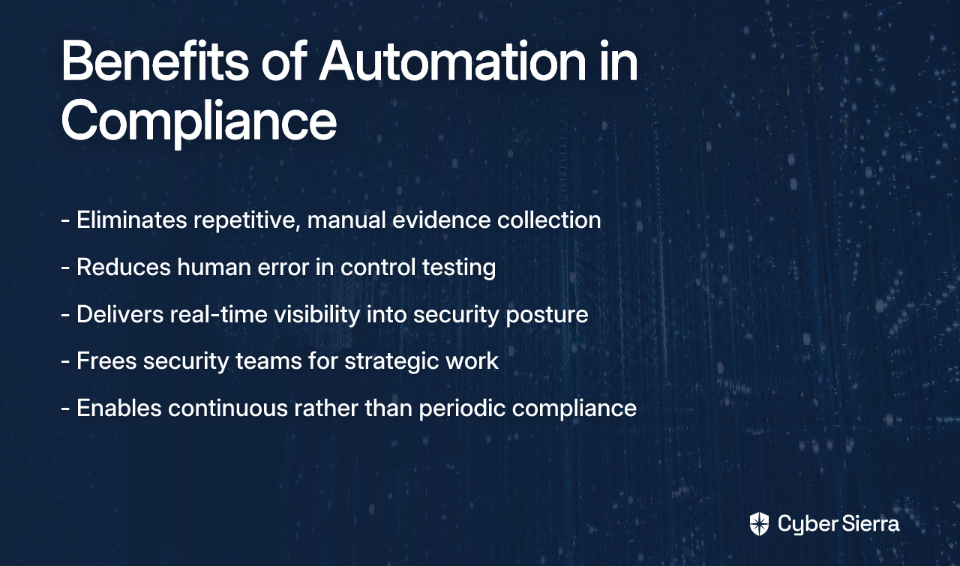
At its core, automated compliance is about:

  1. Programmatic Verification: Replacing manual "show me" processes (screenshots) with automated "prove it" validation through API queries.
  2. Continuous Control Monitoring (CCM): Implementing systems that constantly assess security controls to identify and fix compliance gaps in near real-time.
  3. Centralized Control Repository: Building a single source of truth for all compliance controls, with automatic updates as your environment changes.

The key insight from practitioners who have made this transition is that "most compliance requirements are really just infrastructure configuration checks that can be queried programmatically." This perspective transforms compliance from an administrative burden to a technical challenge that can be solved with code and automation.

The Tangible ROI of Automating Compliance

The benefits of switching from manual to automated compliance monitoring are substantial and measurable:

Drastic Time and Cost Savings

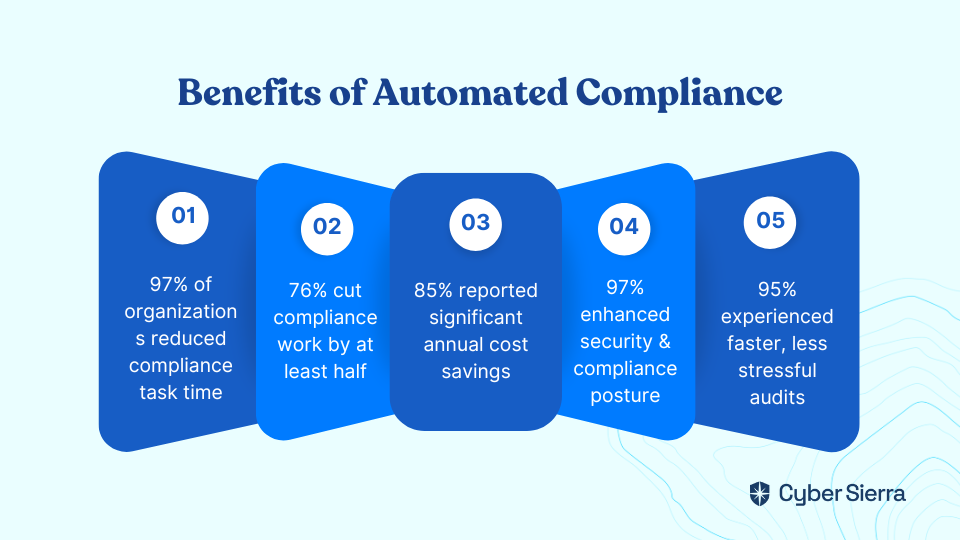
A 2024 UserEvidence survey found that 97% of organizations reduced time spent on compliance tasks after implementing automation, with 76% cutting it by at least half. In real-world terms, automated compliance can reduce work from 40-60 hours down to 10-15 hours per framework.

This efficiency translates directly to cost savings, with 85% of organizations reporting significant annual savings after implementing automation solutions.

Stronger Security & Continuous Compliance

Automation strengthens your security posture by providing continuous visibility into your compliance status. According to the same survey, 97% of users reported enhanced security and compliance posture after adopting automation tools.

With 24/7 risk scanning, teams can proactively resolve issues before they escalate into breaches or audit findings, moving from reactive damage control to proactive risk management.

Streamlined Audits & Audit Readiness

One of the most immediate benefits is the transformation of the audit process. Automation simplifies evidence gathering, leading to faster, less stressful audits for 95% of users. This eliminates the last-minute scramble that typically precedes an audit, making your organization perpetually audit-ready.

Simplified Multi-Framework Management

For organizations juggling SOC2, ISO 27001, PCI DSS, and other frameworks, automation platforms can map overlapping controls, allowing you to test once and apply evidence across multiple frameworks. This control mapping eliminates redundant work and provides a unified compliance view.

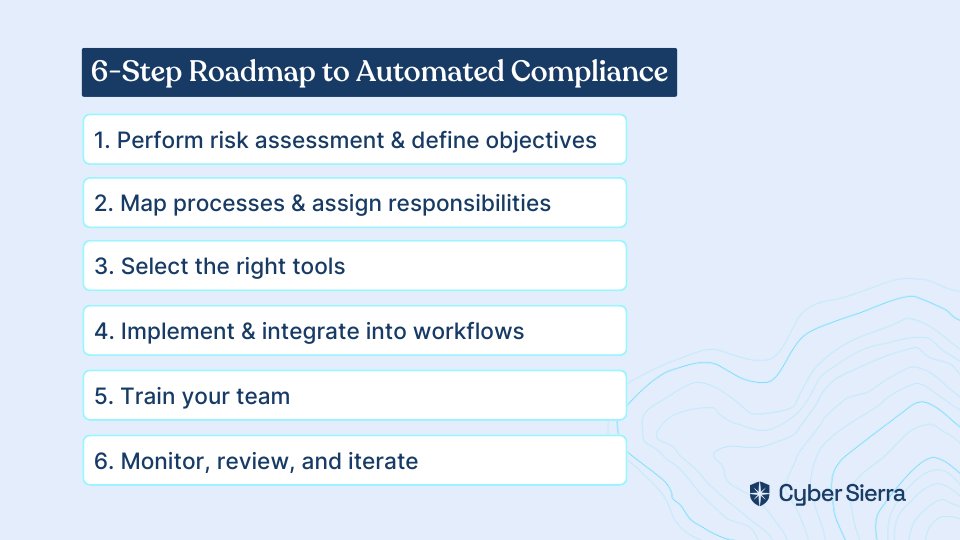
Your Roadmap: A 6-Step Plan to Transition from Manual to Automated Compliance

Making the shift from manual to automated compliance monitoring requires a strategic approach. Here's a practical roadmap to guide your transition:

Step 1: Perform a Compliance Risk Assessment & Define Objectives

  • Identify all applicable regulations (GDPR, HIPAA, etc.) and internal policies
  • Assess and prioritize non-compliance risks based on impact
  • Establish clear goals for your automation program, such as reducing compliance work by 50% or achieving continuous monitoring of critical controls

Step 2: Map Processes, Develop Policies & Assign Responsibilities

  • Document your current manual workflows to identify the biggest time sinks and best opportunities for automation
  • Establish a clear compliance policy that outlines the shift to automated monitoring
  • Define roles and responsibilities for managing the new automated processes
  • Determine which compliance tasks to automate first based on risk and effort required

Step 3: Select the Right Tools

  • Choose a platform that integrates with your existing tech stack (AWS, Azure, GitHub, Jira, etc.)
  • Ensure it supports the compliance frameworks you need now and in the future
  • Request demos to test the user interface and functionality
  • Consider both short-term implementation costs and long-term maintenance requirements

Step 4: Implement and Integrate into Workflows

  • Deploy the chosen tool and connect it to your systems
  • Integrate compliance checks and alerts directly into your DevOps CI/CD pipelines
  • Make compliance an embedded part of daily operations rather than a separate activity
  • Start with a pilot project to demonstrate value before scaling across the organization

Step 5: Train Your Team

  • Ensure all relevant employees understand how to use the new tools and their role in maintaining compliance
  • Foster a culture where compliance is a shared, automated responsibility, not a siloed function
  • Emphasize that automation frees up time for more valuable work, helping to overcome resistance

Step 6: Monitor, Review, and Iterate

  • Regularly review your compliance posture via the platform's dashboard
  • Stay current with new and evolving regulations
  • Continuously improve your automated processes based on feedback and effectiveness
  • Expand automation to additional compliance areas as your program matures

Choosing Your Automation Platform: Key Features to Look For

When evaluating compliance automation platforms, these essential features will ensure you get maximum value:

Continuous Monitoring

The platform must provide 24/7 monitoring of your tech stack, with real-time alerts for misconfigurations or compliance drifts. This ensures you're always aware of your compliance posture, not just during audit season.

Automated Evidence Collection

Look for deep integrations with cloud providers, version control, identity providers, and other systems to automatically gather evidence via API queries. This eliminates the need for manual screenshots and documentation.

Broad Framework Support & Control Mapping

It should support common frameworks (SOC2, ISO 27001, HIPAA, PCI DSS, GDPR) and offer policy templates to get started quickly. More importantly, it should map controls across frameworks to reduce redundant testing.

Comprehensive GRC & Risk Management

The tool should go beyond control testing to include risk assessment, tracking, and management capabilities. This provides a more holistic view of your security posture and compliance status.

Vendor Risk Management (TPRM)

A key source of risk is the supply chain. The ability to centralize vendor documentation, assessments, and risk levels is critical for efficient vendor onboarding and monitoring.

User-Friendly Dashboards and Reporting

The platform must provide clear, customizable reports that simplify audits and give stakeholders an at-a-glance view of the company's compliance posture for audit readiness.

How Comprehensive Platforms Help

Platforms like Cyber Sierra are designed to address these needs through an integrated approach. For example, its Continuous Control Monitoring (CCM) module centralizes controls and automates testing, while its GRC platform simplifies managing multiple frameworks from a single dashboard.

This integrated approach directly addresses the challenges of using disparate tools and manual processes, providing a unified solution for compliance automation.

Reclaim Your Time, Fortify Your Defenses

The transition from manual to automated compliance monitoring represents more than just a technological upgrade—it's a strategic shift that strengthens your security posture while freeing your team from administrative drudgery.

By implementing automation, you're not just checking boxes more efficiently; you're transforming compliance from a periodic, reactive exercise into a continuous, proactive security function that adds real value to your organization.

As one DevOps engineer who made this transition put it, "For those still stuck doing manual compliance work, I'd encourage thinking about it as an automation challenge rather than an administrative burden." This mindset shift is the first step toward a more efficient, secure, and audit-ready organization.

The future of compliance isn't in spreadsheets and screenshots—it's in automation, continuous monitoring, and integrated risk management. Make the switch now, and you'll not only strengthen your security posture but also reclaim countless hours for the innovative work that truly drives your business forward.

Frequently Asked Questions

What is automated compliance monitoring?

Automated compliance monitoring is the use of software to continuously verify that a company's security controls and infrastructure configurations meet regulatory standards, replacing periodic manual checks with real-time, programmatic validation. It involves implementing Continuous Control Monitoring (CCM) systems that query your tech stack (like AWS, Azure, etc.) via APIs to automatically collect evidence and identify compliance gaps. This transforms compliance from a manual, "show me" process of taking screenshots into an automated, "prove it" process driven by code.

Why is manual compliance monitoring a problem?

Manual compliance monitoring is a significant problem because it is time-consuming, prone to human error, provides only a point-in-time snapshot of compliance, and exposes organizations to severe financial and reputational risks. It can drain 40-60 hours of engineering time per framework, and human errors during these checks are a leading cause of compliance failures. Furthermore, manual audits leave companies vulnerable to "compliance drift" as systems change between audits.

How does automated compliance improve security?

Automated compliance improves security by providing continuous, 24/7 visibility into your security posture, allowing teams to proactively identify and remediate risks in near real-time before they can be exploited. Instead of waiting for a periodic audit to find vulnerabilities, continuous monitoring tools constantly scan for misconfigurations and compliance deviations. This shifts the security approach from reactive damage control to proactive risk management, with 97% of organizations reporting enhanced security after adopting automation.

What are the first steps to automate compliance?

The first steps to automate compliance are to perform a risk assessment to identify applicable regulations, define clear objectives for your automation program, and map your current manual processes to find the best opportunities for improvement. A successful transition begins with this strategic plan, allowing you to prioritize which compliance tasks to automate first based on risk and potential time savings before selecting a tool.

How much time can be saved by automating compliance?

Organizations can save a significant amount of time, with studies showing that 76% of companies cut their compliance workload by at least half after implementing automation. In real-world terms, this can reduce the engineering time required for a single compliance framework from a burdensome 40-60 hours down to a more manageable 10-15 hours.

What should I look for in a compliance automation tool?

When choosing a compliance automation tool, look for key features like continuous 24/7 monitoring, automated evidence collection via API integrations, broad support for multiple frameworks (like SOC2, ISO 27001), and user-friendly dashboards for reporting. A strong platform should integrate with your entire tech stack, offer control mapping to avoid redundant work across frameworks, and include comprehensive GRC and vendor risk management features.

blog-hero-background-image
Governance & Compliance

How to Integrate GRC with Your Existing Security Tools

backdrop
Table of Contents

Join thousands of professionals and get the latest insight on Compliance & Cybersecurity.


Summary

  • Disconnected GRC and security tools lead to significant inefficiency, with teams spending 90% of audit preparation time on manual evidence collection instead of addressing actual risks.
  • Integrating security tools like cloud platforms, vulnerability scanners, and SIEMs with a GRC platform automates evidence collection and provides a real-time, unified view of your risk posture.
  • To achieve automation, map your key security systems to compliance controls and use an API-first GRC platform to create a closed-loop remediation process.
  • Platforms like Cyber Sierra's Continuous Controls Monitoring (CCM) can help automate this entire process, transforming compliance from a manual burden into a strategic advantage.

You've set up a robust array of security tools to protect your organization. Your vulnerability scanner is running, your SIEM is collecting logs, and your cloud security posture management tool is monitoring your infrastructure. Yet when audit time comes around, your team still scrambles to manually collect evidence, match findings to compliance requirements, and prepare the dreaded spreadsheets for auditors.

Sound familiar? You're not alone.

"It seems like every GRC solution is either riddled with bugs, lacks basic features and integrations, or is built around nickel and dime-ing their customers for frameworks," laments one security professional on Reddit. Others express frustration with "automating policy exception creation" and the "struggle to link control objectives to compliance requirements."

The disconnect between your security tools and your Governance, Risk, and Compliance (GRC) processes isn't just annoying—it's costly, inefficient, and potentially dangerous. But it doesn't have to be this way.

The High Cost of Disconnected Systems

Before diving into how to integrate GRC with your existing security toolkit, let's understand why this integration matters in the first place.

Disconnected Risk Data

When security tools operate in silos, separated from your GRC platform, you end up with misaligned risk perspectives across your organization. Your vulnerability scanner might flag critical issues in your infrastructure, but your compliance dashboard shows all controls as "satisfied." This disconnect creates a dangerous blind spot and undermines the accuracy of your risk reporting.

The 90/10 Audit Preparation Rule

According to compliance experts, organizations typically spend 90% of audit preparation time simply proving known facts rather than discovering new insights or addressing actual risks. This inefficiency stems directly from manual evidence collection—a problem that proper integration can solve.

Increased Risk Exposure

Without real-time data flowing from security tools to your GRC platform, you're operating on outdated information. This delay in identifying control failures or compliance gaps increases your risk exposure and extends the time vulnerabilities remain unaddressed.

Compliance Fatigue

Manual processes aren't just inefficient—they're exhausting for your team. Constantly switching between tools, copying data, and creating manual reports leads to burnout and increases the likelihood of human error, potentially resulting in failed audits or regulatory penalties.

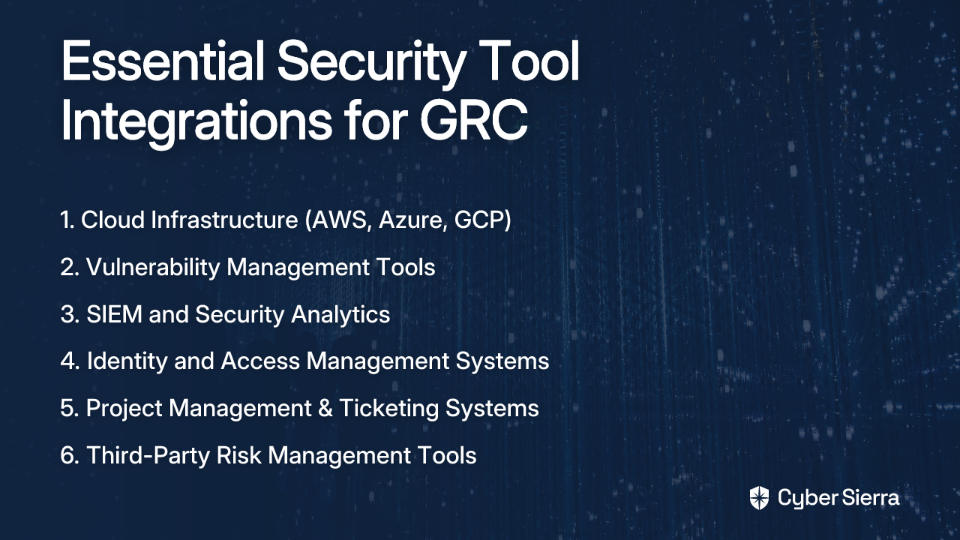
The Integration Blueprint: Key Security Tools to Connect with Your GRC Platform

Successfully integrating GRC with your security ecosystem requires a strategic approach. Here's a blueprint of the essential connections you should establish:

1. Cloud Infrastructure (AWS, Azure, GCP)

Purpose: To automatically monitor cloud compliance and configuration.

Compliance Value: Real-time visibility into cloud security posture, automated evidence for cloud controls, and immediate alerting on misconfigurations.

Integration Focus: Connect your cloud environments directly to your GRC platform to continuously validate that cloud resources adhere to compliance frameworks like ISO 27001, SOC 2, or internal policies.

2. Vulnerability Management Tools (Qualys, Tenable, Rapid7)

Purpose: To feed vulnerability data directly into your compliance program.

Compliance Value: Automated evidence for vulnerability management controls, real-time risk scoring, and streamlined remediation tracking.

Integration Focus: Configure your scanner to send results directly to your GRC platform, where vulnerabilities can be mapped to specific compliance controls and framework requirements.

3. SIEM and Security Analytics (Splunk, QRadar, Microsoft Sentinel)

Purpose: To provide automated evidence for monitoring and incident response controls.

Compliance Value: Proof of continuous monitoring, automated alerting on security events, and documentation of incident response activities.

Integration Focus: Set up your SIEM to forward relevant security events and metrics to your GRC platform for control validation and evidence collection.

4. Identity and Access Management (IAM) Systems (Okta, Azure AD)

Purpose: To enforce and validate access control policies.

Compliance Value: Automated evidence for access management controls, real-time monitoring of user privileges, and documentation of access reviews.

Integration Focus: Connect your IAM solution to automatically verify that access controls are operating effectively and to create an audit trail of user activity.

5. Project Management & Ticketing Systems (Jira, ServiceNow)

Purpose: To create a closed-loop remediation process.

Compliance Value: Clear documentation of remediation activities, tracking of exceptions, and evidence of timely issue resolution.

Integration Focus: When control failures or policy violations are detected, automatically create tickets and track them to completion, providing a clear audit trail.

6. Third-Party Risk Management (TPRM) Tools

Purpose: To centralize vendor risk assessments and monitoring.

Compliance Value: Comprehensive view of supply chain risks, automated vendor assessment tracking, and continuous monitoring of third-party security posture.

Integration Focus: Address the pain of "overly complex questionnaires leading to analysis paralysis" by streamlining the assessment process and maintaining a central repository of vendor risk data.

Platforms like Cyber Sierra's TPRM module can simplify this by automating assessments and providing continuous visibility into vendor security posture, moving beyond point-in-time questionnaires.

A Practical, Step-by-Step Guide to Integration

Now let's walk through the concrete steps to successfully integrate your GRC platform with your existing security tools:

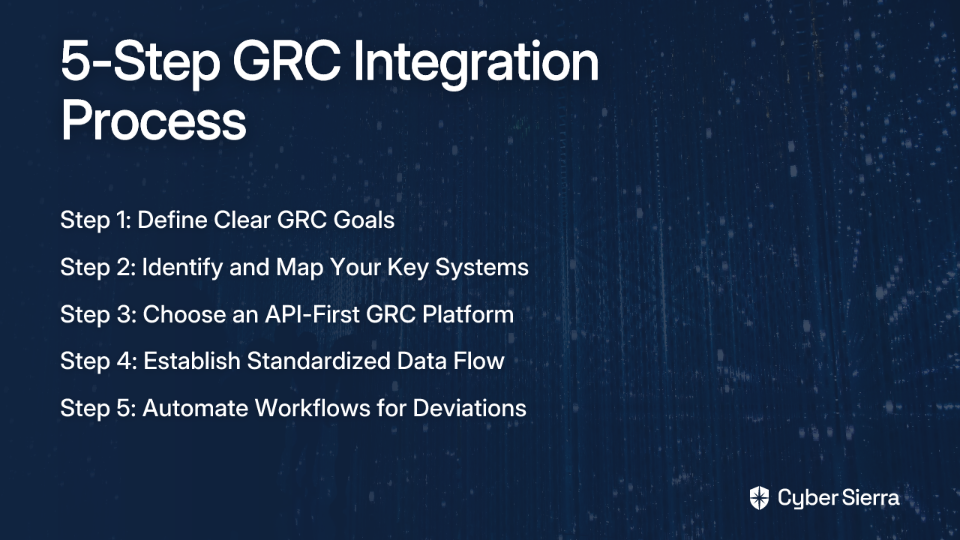
Step 1: Define Clear GRC Goals

Before diving into technical integrations, determine your objectives. Are you preparing for ISO 27001 certification? Streamlining SOC 2 audits? Addressing internal policy requirements? Start with a clear end state in mind to guide your integration strategy.

AWS recommends that organizations align their GRC strategy with business objectives to ensure the integration efforts deliver meaningful value.

Step 2: Identify and Map Your Key Systems

Inventory your existing security tools and map them to the compliance controls they can provide evidence for. For example:

  • Vulnerability scanner → Vulnerability management controls
  • SIEM → Incident detection and response controls
  • Cloud security tools → Infrastructure security controls
  • IAM solutions → Access management controls

This mapping exercise helps prioritize which integrations will deliver the most compliance value.

Step 3: Choose an API-First GRC Platform

Select a GRC solution built for integration. This directly addresses the common complaint about tools that "lack basic features and integrations." Look for platforms with:

  • Robust API capabilities
  • Pre-built connectors for common security tools
  • Flexible data mapping options
  • Customizable dashboards and reports

A unified GRC automation platform is essential to act as the central hub. For example, Cyber Sierra's GRC platform is designed to automate data collection and control monitoring across multiple frameworks by integrating with your existing tech stack.

Step 4: Establish Standardized Data Flow

Implement and test the integrations to ensure data is flowing accurately. Standardize data formats and protocols to avoid discrepancies and address user concerns about "data reliability." This step includes:

  • Defining data taxonomies for consistent mapping across tools
  • Setting up authentication between systems
  • Testing data flows to ensure accuracy and completeness
  • Validating that evidence is correctly associated with controls

Step 5: Automate Workflows for Deviations and Exceptions

This step directly addresses the pain point many security professionals experience around "automating policy exception creation."

Configure rules to automatically trigger actions when controls fail or exceptions are needed. For example:

  • A new high-severity finding from your cloud scanner automatically creates a remediation task in Jira
  • Access control violations trigger workflow approvals for policy exceptions
  • Failed controls generate notifications to control owners

While final approval for exceptions might remain a manual step to ensure accountability, automating the process of requesting, routing, and documenting exceptions creates a clear audit trail and streamlines the entire workflow.

Level Up Your GRC with Continuous Controls Monitoring (CCM)

Once you've established basic integrations between your security tools and GRC platform, it's time to evolve to the next level: Continuous Controls Monitoring (CCM).

CCM is an automated approach that functions as a "digital watchdog," monitoring controls in real-time using AI and analytics. It moves compliance from periodic spot-checks to ongoing assurance, addressing one of the core challenges in traditional GRC approaches.

According to the Cloud Security Alliance, organizations implementing CCM see substantial benefits:

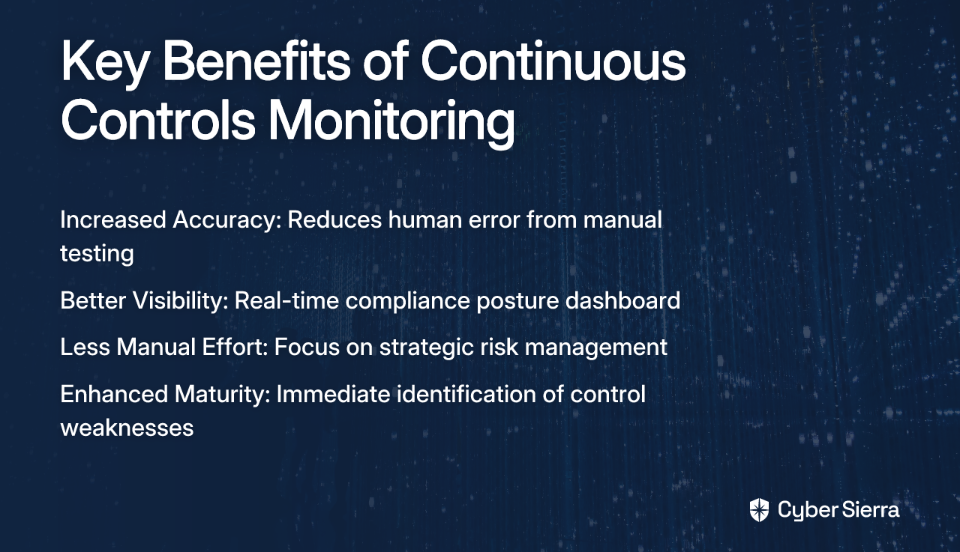
Benefits of CCM:

  1. Increased Accuracy: Reduces human error from manual testing.
  2. Better Visibility: Offers a comprehensive, real-time dashboard of your compliance posture.
  3. Less Manual Effort: Frees up your GRC team to focus on strategic risk management instead of data gathering.
  4. Enhanced Maturity: Provides ongoing assurance and allows for immediate identification of control weaknesses.

How CCM Works in Practice:

Rather than periodically checking if controls are operating effectively, CCM automatically validates them in near real-time. For example:

  • Continuously verifying that MFA is enabled for all privileged accounts
  • Automatically checking that data backup jobs complete successfully
  • Monitoring for unauthorized changes to security configurations
  • Validating that all cloud resources comply with hardening standards

Implementing CCM is no longer a futuristic concept. Platforms like Cyber Sierra offer a dedicated CCM module that builds a central controls repository with near real-time updates, automates control testing, and detects exceptions as they happen.

From Compliance Burden to Strategic Advantage

By integrating your security tools with your GRC platform and embracing continuous monitoring, you transform compliance from a periodic, manual burden into a continuous, automated, and strategic function.

The benefits are substantial:

  • Streamlined audit readiness, with evidence automatically collected and mapped to controls
  • Real-time risk visibility, allowing for proactive remediation rather than reactive firefighting
  • Significant time and cost savings through automation of manual processes
  • Improved security posture through faster identification and resolution of control failures

Most importantly, an integrated GRC strategy empowers your team to move beyond "proving known facts" and focus on strategically managing risk, turning a cost center into a business enabler.

Take a critical look at your current GRC processes. Are you still relying on spreadsheets and manual evidence collection? Is your team spending more time gathering documentation than addressing actual risks? If so, it's time to explore how a unified GRC platform integrated with your security tools can help you achieve continuous compliance and elevate your security program.

Remember, effective GRC integration isn't just about technology—it's about creating a strategic approach that aligns security operations with governance requirements, ultimately making your organization both more secure and more efficient.

Frequently Asked Questions

What is GRC integration?

GRC integration is the process of connecting your Governance, Risk, and Compliance (GRC) platform with other security and IT tools in your organization. This connection allows for the automated collection of data and evidence, which helps in continuously monitoring security controls, streamlining compliance reporting, and providing a real-time view of your risk posture.

Why is integrating security tools with a GRC platform important?

Integrating security tools with a GRC platform is important because it replaces manual, error-prone compliance processes with an automated, efficient system. Key benefits include eliminating data silos, reducing audit preparation time from weeks to days, gaining real-time visibility into risk exposure, and reducing compliance fatigue for your team.

Which security tools should I integrate with my GRC platform first?

You should prioritize integrating tools that provide the most critical evidence for your compliance requirements. Start with essential systems like your cloud infrastructure (AWS, Azure, GCP), vulnerability management tools (Qualys, Tenable), SIEM platforms (Splunk, Sentinel), and Identity and Access Management (IAM) systems (Okta, Azure AD).

How does GRC integration help with audits?

GRC integration significantly simplifies and speeds up the audit process by automating evidence collection. Instead of manually gathering screenshots and reports, the integrated GRC platform continuously collects data from your security tools, maps it to the relevant compliance controls, and keeps it in an audit-ready state, dramatically reducing preparation time and effort.

What is Continuous Controls Monitoring (CCM) and how does it relate to GRC integration?

Continuous Controls Monitoring (CCM) is an advanced, automated approach that uses GRC integrations to monitor security controls in near real-time, rather than through periodic checks. It is the evolution of GRC integration, moving beyond simple data collection to provide ongoing assurance that controls are operating effectively, instantly flagging deviations and weaknesses.

What should I look for in a GRC platform to ensure it supports integration?

To ensure a GRC platform supports integration, look for one that is "API-first." Key features to look for include a robust API, pre-built connectors for common security tools like SIEMs and vulnerability scanners, flexible data mapping capabilities, and customizable workflows to automate tasks based on the integrated data.

blog-hero-background-image
Governance & Compliance

How to Build a Cyber GRC Program from Scratch in 90 Days

backdrop
Table of Contents

Join thousands of professionals and get the latest insight on Compliance & Cybersecurity.


Summary

  • Build a robust cyber GRC program in 90 days using the "Crawl, Walk, Run" methodology to overcome common challenges like spreadsheet chaos and stakeholder politics.
  • Start by assessing your current state, securing leadership buy-in, and choosing a standard framework like NIST CSF.
  • The key to success is moving from manual processes to automation by implementing a GRC platform for core tasks like policy management, risk registers, and Continuous Control Monitoring (CCM).
  • Cybersierra’s GRC platform streamlines this entire process, automating compliance workflows and providing a single source of truth for risk management.

You've just been tasked with establishing a governance, risk, and compliance (GRC) program for your organization. The spreadsheets are piling up, stakeholders are skeptical, and you're already feeling the weight of being perceived as the "bad guy" who's about to enforce a bunch of new rules. Sound familiar?

GRC professionals often find themselves in this unenviable position—caught between regulatory requirements, organizational politics, and technical teams who think "you are an idiot and you will work up from there," as one frustrated practitioner candidly put it.

But here's the good news: building an effective cyber GRC program doesn't have to be a drawn-out, painful process that leaves you working a second job at night just to maintain your sanity. With a structured approach, you can transform from compliance firefighter to strategic risk advisor in just 90 days.

This guide will walk you through a practical, phased approach to building a robust cyber GRC program from the ground up—transforming the "obscene amount of politics" into productive collaboration and those endless Excel forms into streamlined, automated workflows.

The "Crawl, Walk, Run" Approach to GRC

Before diving in, let's clarify what we mean by GRC. According to AWS, Governance, Risk, and Compliance is a structured approach that aligns IT with business goals while managing risks and meeting industry and government regulations. It combines governance (leadership and organizational structure), risk management (identifying and addressing threats), and compliance (adhering to laws and standards) into a unified framework.

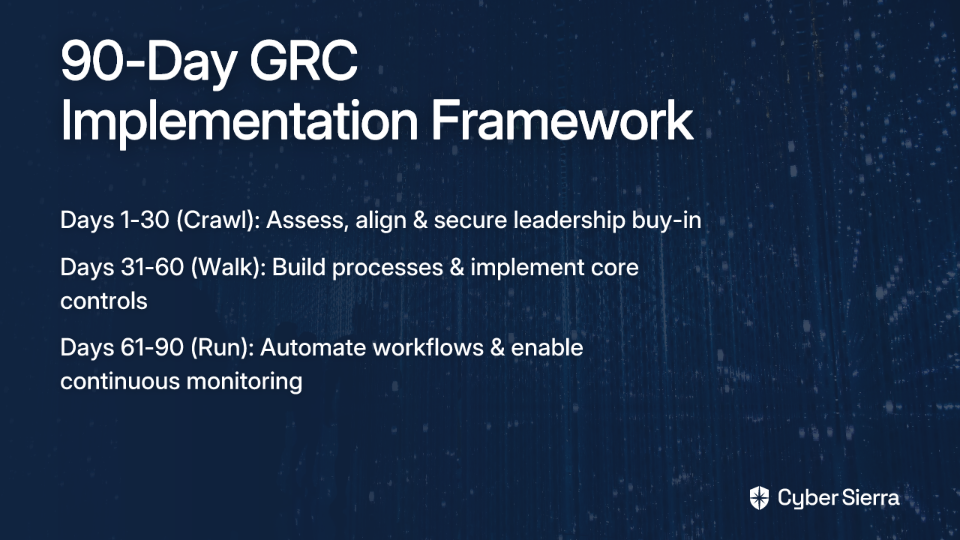
To build an effective program quickly, we'll use the "Crawl, Walk, Run" methodology—a proven approach to bringing order to chaos in just 90 days:

  • Days 1-30 (Crawl): Lay the foundation and gain organizational alignment
  • Days 31-60 (Walk): Build essential processes and implement controls
  • Days 61-90 (Run): Automate, monitor, and optimize

Let's break down each phase into actionable steps.

Phase 1: Days 1-30 (Crawl) – Laying the Foundation

The first 30 days are critical for setting the right tone and direction. Your goal is to move from ad-hoc, reactive decision-making to a structured, policy-based approach.

Week 1-2: Assess Your Current State

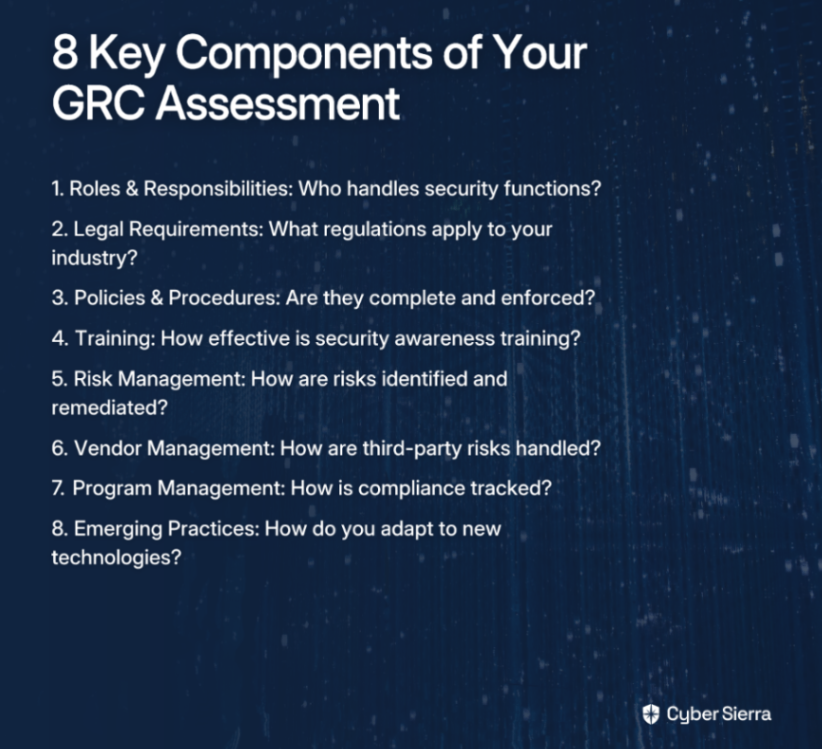
Before building anything new, understand what you're working with. As recommended by IANS Research, evaluate these eight primary components:

  1. Roles and Responsibilities: Who currently handles data security, privacy, and cybersecurity functions? Are responsibilities clearly defined or overlapping?
  2. Legal and Compliance Requirements: Document all applicable regulations (GDPR, HIPAA, etc.) and compliance obligations specific to your industry.
  3. Policies and Procedures: Review existing policies for relevance, completeness, and enforcement.
  4. Training: Assess the current state of security awareness training and its effectiveness.
  5. Risk Management: Understand how risks are currently identified, assessed, and remediated.
  6. Vendor Risk Management: Evaluate how third-party vendor risks are managed, if at all.
  7. Program Management: Determine how GRC components are updated and compliance is tracked.
  8. Emerging Practices and Technology: Analyze how the organization adapts to new technologies and operational changes like remote work.

This assessment will reveal gaps and help you prioritize your efforts. Document everything—this becomes your baseline.

Week 3: Secure Leadership Support & Engage Stakeholders

A GRC program without executive endorsement is doomed to fail. This is especially true when you need to overcome the "company politics and corporate culture" that so often "gets in the way" of implementing necessary changes.

  1. Prepare an Executive Briefing: Summarize your assessment findings and present a clear business case for a formalized GRC program. Focus on risk reduction, operational efficiency, and competitive advantages.
  2. Form a GRC Steering Committee: Include representatives from key departments (IT, Legal, Finance, HR, Operations) to ensure alignment and shared accountability. This committee will help you navigate political obstacles and drive adoption.
  3. Define Success Metrics: Establish clear KPIs that demonstrate the value of your GRC program. These might include reduced audit findings, faster remediation times, or lower incident costs.

Week 4: Choose a Standard Framework

Don't reinvent the wheel. Leverage established frameworks to provide structure and credibility to your program.

The NIST Cybersecurity Framework (CSF) is highly recommended for a comprehensive approach. It provides a common language and systematic methodology for managing cybersecurity risk. Alternative frameworks include COBIT from ISACA and ISO 27001.

Your choice should align with your organization's industry, size, and specific compliance requirements. Many organizations adopt a hybrid approach, drawing elements from multiple frameworks to create a customized program that meets their unique needs.

By the end of this first phase, you should have a comprehensive current-state assessment, an engaged stakeholder committee, and a selected framework to guide all future GRC activities. You've effectively laid the foundation for a successful program.

Phase 2: Days 31-60 (Walk) – Building Processes and Controls

In this phase, we'll evolve from theoretical frameworks to practical implementation. Your goal is to move from paper to practice, establishing risk model-based and systems-driven decision-making processes.

Weeks 5-7: Develop Core Policies and a Risk Register

Using your chosen framework (e.g., NIST CSF), begin drafting or refining critical policies:

  1. Information Security Policy: The foundational document that establishes your organization's approach to protecting information assets.
  2. Acceptable Use Policy: Defines appropriate use of company systems and data.
  3. Incident Response Policy: Outlines procedures for detecting, reporting, and responding to security incidents.
  4. Data Classification Policy: Establishes categories of data sensitivity and handling requirements.
  5. Vendor Management Policy: Sets standards for assessing, onboarding, and monitoring third-party risks.

Simultaneously, start building your Risk Register—the cornerstone of your GRC program. This living document identifies and assesses key risks across your organization. An effective risk register should:

  • Identify financial, legal, strategic, and security risks
  • Assess each risk's impact and likelihood
  • Prioritize risks based on their overall score
  • Document existing controls and their effectiveness
  • Assign risk owners and mitigation strategies
  • Track remediation progress and deadlines

Remember, this is an iterative process. Start with your most critical risks and expand over time.

Weeks 8-9: Move from Spreadsheets to a GRC Platform

The reliance on spreadsheets is a major pain point that leads to errors and inefficiency. Now is the time to introduce a centralized system.

A GRC platform helps automate the oversight of policies, risk management, and compliance workflows. When selecting a platform, consider these factors:

  • Scalability: Can it grow with your organization?
  • Integration capabilities: Does it connect with your existing security tools?
  • Reporting features: Does it provide the insights stakeholders need?
  • Usability: Will your team actually use it?

This is where a solution like Cybersierra's GRC module can be particularly valuable. It automates data collection, manages multiple compliance frameworks (SOC2, ISO 27001, HIPAA, etc.), and maintains detailed audit trails—significantly reducing the manual effort that often leads to frustration and burnout among GRC professionals.

Week 9: Pilot Your Program

Before rolling out your GRC program organization-wide, test it in a specific business unit or department. This allows you to:

  • Evaluate the effectiveness of your policies and procedures
  • Identify gaps or challenges in your approach
  • Gather feedback from users and stakeholders
  • Make necessary adjustments before full implementation

Choose a department that's relatively mature in terms of security awareness and willing to provide constructive feedback. Document lessons learned and refine your approach accordingly.

By the end of Phase 2, you should have a set of core GRC policies, an initial risk register, and a GRC platform implemented and piloted in a controlled environment. You've moved from planning to action, establishing the essential processes and controls that will drive your program forward.

Phase 3: Days 61-90 (Run) – Automating, Monitoring, and Optimizing

In the final 30 days, your focus shifts to maturing the program through automation, continuous monitoring, and expansion to additional risk domains. The goal is to move to fully risk-driven decision-making, powered by automation and continuous improvement.

The global GRC market size was valued at USD 32.2 billion in 2021 and continues to grow, highlighting the industry-wide shift towards robust, technology-driven GRC programs. This phase is where you'll leverage that technology to transform your program from manual to automated, from periodic to continuous, and from reactive to proactive.

Weeks 10-11: Implement Continuous Control Monitoring (CCM)

Continuous Control Monitoring (CCM) is an ongoing, automated oversight of your security controls, ensuring they remain effective at mitigating risk. According to Cybersierra, CCM provides several key benefits:

  • Improved compliance: Maintain a state of continuous compliance rather than point-in-time readiness for audits.
  • Early threat detection: Identify control failures before they lead to security incidents.
  • Lower regulatory penalties: Reduce the risk of non-compliance findings and associated fines.
  • Enhanced transparency: Provide stakeholders with real-time visibility into control effectiveness.

To implement CCM effectively:

  1. Map your controls to risks: Ensure each control addresses specific risks in your register.
  2. Define key metrics: Establish what success looks like for each control.
  3. Configure automated testing: Set up continuous monitoring capabilities for your critical controls.
  4. Establish alert thresholds: Determine when control deviations require attention.
  5. Document remediation workflows: Define how control failures will be addressed.

Week 12: Automate Key GRC Workflows

Expand beyond control monitoring to automate other critical GRC functions. Cybersierra's blog outlines a 7-step approach to automate GRC processes:

  1. Establish Business Rationale: Define clear objectives for your automation efforts, such as reducing manual effort, improving accuracy, or accelerating compliance activities.
  2. Assess Current Processes: Identify bottlenecks and inefficiencies in your existing workflows. Which processes consume the most time? Where do errors commonly occur?
  3. Select the Right Tools: Choose a scalable platform that addresses your specific needs and integrates with your existing technology stack.
  4. Implement Change Management: Prepare your organization for new ways of working. Communicate benefits, provide training, and address concerns proactively.
  5. Configure the Automation Solution: Customize the software to match your specific policies, controls, and workflows.
  6. Train Stakeholders: Ensure users understand how to leverage the new capabilities effectively.
  7. Continuous Monitoring and Optimization: Track KPIs and adapt your approach based on feedback and results.

Focus on automating high-volume, repetitive tasks first—such as evidence collection, control testing, and compliance reporting. These quick wins will demonstrate value and build momentum for broader automation initiatives.

Week 13: Launch Supporting Programs

A mature GRC program addresses risk holistically, beyond just cybersecurity controls. In this final week, begin expanding your program to include:

Third-Party Risk Management (TPRM): Your security is only as strong as your weakest vendor. Formalize your approach to managing supply chain risk by:

  • Developing a vendor tiering system based on data access and criticality
  • Implementing standardized assessment questionnaires
  • Establishing ongoing monitoring protocols for critical vendors

This is another area where automation can significantly reduce manual effort. Cybersierra's TPRM module, for example, automates vendor assessments and provides continuous visibility into vendor security compliance—addressing the frustration of managing numerous questionnaires manually.

Employee Security Training: The human element is often the weakest link in security. Develop a comprehensive awareness program that:

  • Covers essential security topics (phishing, password management, data handling)
  • Tailors content to different roles and risk levels
  • Includes regular testing and reinforcement
  • Measures effectiveness through behavior changes, not just completion rates

Interactive training and simulated phishing campaigns, like those offered through Cybersierra's Employee Security Training module, can transform security awareness from a compliance checkbox to a genuine security control.

By the end of Phase 3, you'll have an automated, continuously monitored GRC program that's expanding to address third-party risk and employee awareness. You've successfully transformed from a reactive, spreadsheet-driven approach to a proactive, technology-enabled program that delivers ongoing value to the business.

The Transformed GRC Function: From Cost Center to Strategic Advisor

Congratulations! In just 90 days, you've built a robust cyber GRC program from scratch. By following the "Crawl, Walk, Run" methodology, you've established a foundation, developed essential processes, and implemented automation that will continue to deliver value long-term.

More importantly, you've transformed the perception of GRC within your organization. No longer seen as just "the bad guy" enforcing rules, you're now positioned as a strategic risk advisor who enables the business to operate securely and efficiently. You've moved from being "treated pretty shitty like auditors" to being recognized as an essential partner in achieving business objectives.

The journey doesn't end here, of course. Your GRC program should continue to evolve as your organization grows, regulations change, and new threats emerge. But with the framework you've established, you're well-positioned to adapt to these changes while maintaining a strong security and compliance posture.

Building a modern GRC program requires both a solid plan and the right tools. If you're looking to accelerate your journey from crawl to run, consider how an integrated platform like Cybersierra can help streamline your efforts. With modules for continuous control monitoring, automated compliance, third-party risk management, and employee training, Cybersierra provides the technological foundation for a mature, efficient GRC program.

Frequently Asked Questions

What is a GRC program and why is it important?

A Governance, Risk, and Compliance (GRC) program is a structured approach to align an organization's IT with its business goals while managing risks and meeting regulatory requirements. It is important because it integrates governance, risk management, and compliance into a single, coordinated framework, which helps reduce risks, improve decision-making, lower costs, and prevent the organization from operating in silos.

How can I build a GRC program quickly?

You can build a GRC program quickly by adopting a phased approach like the "Crawl, Walk, Run" methodology outlined in this guide. This 90-day framework allows you to establish a solid foundation in the first 30 days (Crawl), develop core processes and controls in the next 30 days (Walk), and then automate and optimize your program in the final 30 days (Run), ensuring rapid and sustainable progress.

Why should I switch from spreadsheets to a GRC platform?

You should switch from spreadsheets to a GRC platform to automate workflows, reduce manual errors, and create a centralized source of truth for your risk and compliance data. While spreadsheets are a common starting point, they are prone to errors, difficult to scale, and inefficient for managing complex tasks like evidence collection, control testing, and stakeholder reporting. A dedicated platform saves hundreds of hours and provides real-time visibility into your GRC posture.

What is the first step in starting a GRC program?

The first step in starting a GRC program is to conduct a comprehensive current-state assessment. This involves evaluating your organization's existing roles and responsibilities, legal requirements, policies, risk management practices, and vendor management processes. This assessment provides a clear baseline, helps you identify critical gaps, and allows you to prioritize your efforts effectively.

How do I get leadership buy-in for a new GRC program?

To get leadership buy-in, you must present a clear business case that ties the GRC program to strategic objectives. Instead of focusing only on compliance, highlight how GRC reduces business risk, improves operational efficiency, and can provide a competitive advantage. Use the findings from your initial assessment to create an executive briefing that outlines the current risks and demonstrates how a structured GRC program will deliver tangible value.

Which GRC framework should I choose?

The right GRC framework depends on your organization's industry, size, and specific regulatory obligations. The NIST Cybersecurity Framework (CSF) is a highly recommended and versatile starting point for many organizations due to its comprehensive and flexible nature. Other common frameworks include ISO 27001 and COBIT. Often, the most effective approach is a hybrid model that combines elements from multiple frameworks to meet your unique needs.

Learn more about Cyber Sierra's unified cybersecurity platform or schedule a demo today to see how it can support your GRC journey.

blog-hero-background-image
Governance & Compliance

Top 5 Reasons CISOs Are Integrating GRC with Continuous Monitoring

backdrop
Table of Contents

Join thousands of professionals and get the latest insight on Compliance & Cybersecurity.


Summary

  • Traditional GRC is failing, with 95% of organizations admitting their compliance programs aren't optimized and 55% of CISOs prioritizing the reduction of manual work.
  • Relying on periodic, point-in-time assessments creates data silos and security blind spots, leaving organizations vulnerable between audits.
  • Integrating Continuous Controls Monitoring (CCM) automates evidence collection and provides real-time visibility, transforming compliance from a periodic event into an ongoing state of assurance.
  • Cyber Sierra offers an integrated GRC and CCM platform to automate compliance, eliminate manual work, and provide a single source of truth for your security posture.

You've set up your GRC program. You've invested in tools, frameworks, and processes. But instead of feeling more secure, you're drowning in spreadsheets, fighting with buggy platforms that "forget about the R and especially the G," and scrambling to prepare for audits where "most legit auditors don't trust the data from the platforms outright."

Sound familiar?

If you're like most security leaders, your traditional GRC approach is reaching a breaking point. You're tired of point-in-time assessments that don't reflect your current security posture, and you're frustrated by the growing technical debt as "new issues are found" but never properly addressed.

According to the State of Continuous Controls Monitoring Report, organizations are at a "critical inflection point" where they must evolve from manual processes to automated ones to meet ever-growing regulatory demands. The numbers are stark:

  • 55% of CISOs prioritize reducing manual processing
  • 42% cite data silos as a key barrier to maturing their compliance programs
  • An overwhelming 95% don't consider their compliance programs optimized for continuous improvement

The solution? Integrating Continuous Controls Monitoring (CCM) with traditional GRC approaches. This strategic shift is rapidly becoming the gold standard for forward-thinking CISOs who understand that "compliance without security is pure ignorance" and "security without compliance is overconfidence."

What is Continuous Controls Monitoring?

Before diving into the reasons CISOs are making this shift, let's clarify what we mean by Continuous Controls Monitoring.

CCM is an automated approach that provides real-time, ongoing validation of security controls instead of relying on periodic, point-in-time assessments. Unlike traditional GRC methods that might check compliance quarterly or annually, CCM functions as a digital watchdog, constantly evaluating your security controls and compliance posture.

Modern CCM solutions leverage advanced analytics, AI/ML, and automation to continuously collect evidence, test controls, and generate actionable insights. The result is a dynamic, always-current view of your organization's security and compliance status.

Reason #1: Overcoming Crippling Manual Processes and Eliminating Redundancy

The single biggest driver for CCM adoption? Automation that eliminates soul-crushing manual work.

Nearly 80% of CISOs see automation as a critical capability to reduce manual processing, according to a recent survey. And it's easy to see why—effective automation can eliminate up to 90% of manual compliance efforts.

"Each organization has unique needs, structures, and regulatory requirements," notes one security professional on Reddit, highlighting the challenge of finding GRC solutions that work for specific organizations. CCM addresses this by automating:

  • Data collection across disparate systems
  • Evidence gathering for audits
  • Control testing and validation
  • Compliance reporting and dashboard updates
  • Audit trail maintenance

This automation doesn't just save time—it fundamentally changes how your team works. Instead of security professionals spending their days updating spreadsheets and chasing evidence, they can focus on analyzing results, remediating issues, and improving your overall security posture.

Perhaps most importantly, CCM eliminates the redundancy that plagues traditional compliance efforts. According to research, 80% of CISOs admit to unnecessary duplication in compliance activities. CCM streamlines this by allowing organizations to leverage a single control system for multiple frameworks (e.g., ISO27001, SOC2, PCI DSS), dramatically reducing duplicate work.

Reason #2: Breaking Down Data Silos and Achieving True Visibility

One of the most frustrating aspects of traditional GRC approaches is the fragmentation of data across different systems, departments, and tools.

According to the State of CCM Report, 42% of CISOs identify data silos as a major challenge to maturing their compliance programs, while 40.4% point to the lack of a centralized system. This fragmentation leads to:

  • Incomplete risk assessments
  • Blind spots in security coverage
  • Contradictory compliance findings
  • Inability to see the relationship between different security controls
  • Challenges in demonstrating compliance to auditors

CCM solutions address this by integrating with your existing systems and creating a unified, holistic view of your security and compliance posture. They pull data from security tools, cloud platforms, identity systems, and more to create what many CISOs describe as a "single pane of glass" for risk and compliance.

"Some of the integrations into inventory management & Jira can be cool," notes one security professional on Reddit, highlighting the value of connecting GRC with everyday operational tools. This integration is especially critical in complex, cloud-centric environments where controls are numerous, dynamic, and distributed across multiple systems.

Reason #3: Evolving from Point-in-Time Audits to Continuous Assurance

Traditional compliance audits have always had a fundamental flaw: they represent a snapshot in time, not ongoing security.

As one Reddit user bluntly put it, "Being compliant doesn't prevent you from getting popped." This gap between point-in-time compliance and actual security is why so many organizations pass audits but still suffer breaches.

CCM transforms compliance from a periodic, stressful event into a continuous, predictable state of being. It provides what the Cloud Security Alliance calls "continuous assurance" by:

  • Immediately identifying control weaknesses, rather than discovering them months later during an audit
  • Providing real-time evidence of control effectiveness
  • Allowing for immediate remediation of issues
  • Building trust with auditors through well-sourced, real-time evidence

This shift addresses a critical pain point expressed by many security leaders: "Most legit auditors don't trust the data from the platforms outright since they don't source their evidence well enough." CCM solutions are designed specifically to provide the comprehensive, well-documented evidence that auditors require.

The statistics are compelling: 95% of CISOs do not consider their compliance programs to be optimized for continuous improvement, and 51.6% report struggling to mature their programs beyond basic requirements. CCM provides the foundation for this evolution.

Reason #4: Enhancing Proactive Risk Management and Adapting to Regulatory Change

In today's rapidly evolving threat and regulatory landscape, agility is no longer optional. Organizations face a constant stream of new regulations, updated frameworks, and emerging threats that traditional, static GRC approaches struggle to address.

CCM provides the foundation for a more dynamic and resilient GRC program in three key ways:

Managing Regulatory Change: CCM solutions can quickly adapt to new regulations, ensuring continuous compliance without extensive manual updates to frameworks. Automated crosswalks help streamline control documentation across different standards, addressing the frustration many feel when GRC tools "nickel and dime" customers for access to new frameworks.

Vendor Risk Management: Third-party risk continues to be a major concern for CISOs. CCM automates risk assessments for vendors, providing more credible risk scoring and minimizing supply chain risks. This is particularly valuable as organizations increasingly rely on cloud services and other third-party solutions.

Digital Risk Management: Modern frameworks like NIST's IoT digital standards require compliance across a rapidly expanding attack surface. CCM enables organizations to maintain an expansive view of risks across all assets, including emerging technologies and environments.

Reason #5: Driving Cost-Efficiency and Reframing GRC as a Business Enabler

CISOs are under constant pressure to justify budgets and demonstrate the value of security investments. CCM helps transform GRC from a cost center to a business enabler by:

  • Lowering operational costs through automation and efficiency
  • Minimizing hours spent on low-value testing and evidence collection
  • Helping avoid the massive fines and reputational damage associated with compliance failures
  • Improving the ROI on existing security tools by integrating them into a cohesive framework

The financial pressures are real: 71.8% of CISOs prioritize cost when selecting solutions, and 46.2% cite insufficient budgets as a barrier to adoption. At the same time, over half of CISOs (55.8%) feel security and compliance are viewed as cost centers within their organizations.

CCM helps change this perception by providing real-time insights that enable better business decisions and help demonstrate the value of security programs to the board and executive leadership.

How to Get Started with GRC and CCM Integration

Ready to evolve your GRC program with Continuous Controls Monitoring? Here's a roadmap to get started:

1. Ensure you have control frameworks in place: CCM builds upon established frameworks like NIST, PCI DSS, or ISO27001—it doesn't create them. Before implementing CCM, make sure your baseline controls are well-defined.

2. Choose the right CCM solution: Look for platforms that provide:

  • Real-time visibility through comprehensive dashboards
  • Robust integration capabilities with your existing systems
  • Automated alerting features to prioritize issues based on risk level
  • Support for your specific regulatory requirements

3. Plan for integration and holistic monitoring: Your CCM solution must integrate with existing systems for a truly holistic view. Ensure it can pull data from various sources to provide a complete picture of your control environment.

4. Develop a change management strategy: Adopting CCM represents a significant shift. Create a plan that includes stakeholder buy-in, training, and a clear RACI chart for roles and responsibilities.

The Future of GRC is Continuous

The integration of CCM with traditional GRC approaches represents a fundamental shift in how organizations approach security and compliance. By overcoming manual processes, breaking down data silos, enabling continuous assurance, enhancing risk management, and driving cost efficiency, CCM transforms GRC from a reactive, compliance-driven function into a proactive, data-driven business enabler.

The evidence is overwhelming: 94% of CISOs believe that Continuous Controls Monitoring can positively impact their compliance and security programs. As regulatory pressures increase and the threat landscape evolves, this integration is no longer a "nice-to-have" but a strategic imperative for forward-thinking security leaders.

The future of GRC isn't found in more spreadsheets or point-in-time assessments—it's in continuous, automated, and integrated monitoring that builds resilience and trust while enabling the business to move forward with confidence.

Frequently Asked Questions

What is the difference between GRC and Continuous Controls Monitoring (CCM)?

The main difference is that traditional GRC relies on periodic, manual assessments, while CCM provides automated, real-time validation of security controls. GRC defines the overall strategy, policies, and frameworks for managing risk and compliance. CCM is the technology that automates the collection of evidence and testing of controls within that framework, transforming compliance from a point-in-time snapshot to a continuous process.

Why are traditional GRC methods failing modern organizations?

Traditional GRC methods are failing because they cannot keep pace with the speed and complexity of modern business, technology, and threats. They rely heavily on manual processes, spreadsheets, and point-in-time audits, which lead to data silos, security blind spots, and an outdated view of an organization's actual security posture. This reactive approach is inefficient and often leaves businesses vulnerable between audit cycles.

What are the main benefits of integrating CCM with GRC?

The primary benefits are automation, visibility, and continuous assurance. Integrating CCM into your GRC program automates tedious manual work like evidence collection, breaks down data silos by creating a single source of truth for your control environment, and shifts your compliance posture from periodic audits to a state of continuous, real-time assurance. This leads to reduced costs, more effective risk management, and a stronger overall security posture.

How does Continuous Controls Monitoring make audits easier?

CCM makes audits easier by providing auditors with a continuous stream of well-documented, real-time evidence of control effectiveness. Instead of scrambling to gather screenshots and documents before an audit, your team can present a complete, always-on audit trail. This builds trust with auditors, reduces the time and cost associated with audits, and transforms them from a stressful event into a predictable validation of your ongoing compliance.

Can CCM replace our existing GRC program?

Not necessarily. CCM is best viewed as a powerful enhancement to a GRC program, not always a complete replacement. While some modern platforms are starting to blend these functionalities, GRC tools often manage broader strategic functions like policy management and enterprise risk assessment. CCM's core strength is automating the technical validation of controls. The most effective approach is to integrate a CCM solution with your existing GRC framework to automate and validate the controls you have in place.

What is the first step to get started with CCM?

The first and most crucial step is to ensure you have well-defined control frameworks (e.g., NIST, ISO27001, SOC2, PCI DSS) in place. CCM technology works by automating the testing and monitoring of these pre-defined controls. Without a solid foundation of what your controls are and what they are supposed to do, a CCM tool cannot be effective. Once your frameworks are established, you can begin evaluating CCM solutions that integrate with your existing technology stack.

blog-hero-background-image
Governance & Compliance

Top 6 Methods to Reduce Compliance Fatigue in Your Security Team

backdrop
Table of Contents

Join thousands of professionals and get the latest insight on Compliance & Cybersecurity.


Summary

  • Compliance fatigue, driven by manual processes, increases security risks and contributes to long breach detection times, which averaged 204 days in 2023.
  • Reduce redundant work by unifying compliance frameworks like ISO 27001 and NIST, mapping overlapping controls to create a "test once, comply many" system.
  • Overcome internal resistance by securing executive buy-in to formalize security policies and fostering a culture of shared responsibility.
  • Transition from periodic audits to proactive risk management using automation and continuous monitoring. Cybersierra's GRC platform automates evidence collection and control monitoring to streamline this process.

Are you tired of being the "compliance police," struggling to enforce rules without alienating colleagues? Do you face constant pushback when implementing security measures, or feel the emotional toll of lacking support from leadership? If so, you're experiencing what security professionals know all too well: compliance fatigue.

Compliance fatigue is more than just being busy. It's the exhaustion and cynicism that builds from the repetitive, often manual, and seemingly endless cycle of audits, evidence collection, and chasing down stakeholders. This fatigue doesn't just affect team morale—it creates serious security vulnerabilities.

Consider this: The average time to identify and contain a data breach was 204 days in 2023, a gap that fatigue-driven errors can significantly widen. Meanwhile, non-compliance can lead to substantial financial penalties and reputation damage.

This article outlines six proven methods to break this cycle, reduce fatigue, and build a more effective and resilient security program.

1. Embrace Automation and Continuous Monitoring

Manual processes are the bedrock of compliance fatigue. Repetitive tasks like evidence gathering, control testing, and reporting consume valuable time and are prone to human error.

The Solution: Automation

Leveraging technology to automate repetitive compliance tasks frees your team for more strategic work like risk analysis and mitigation. The benefits of automation include:

  • Reduction of human errors
  • Time savings and resource optimization
  • Enhanced real-time monitoring of compliance activities
  • Improved accuracy in documentation and reporting

Implement Continuous Control Monitoring (CCM)

Shift from periodic, snapshot-in-time audits to ongoing, real-time visibility into your security controls. CCM helps you proactively fix security gaps instead of discovering them during an audit.

Platforms like Cyber Sierra's Continuous Control Monitoring (CCM) module are designed specifically for this purpose. They provide a central controls repository with near real-time updates, automate control testing, and offer actionable risk intelligence, transforming security from a periodic chore into a continuous, automated process.

Use an Integrated GRC Platform

A Governance, Risk, and Compliance (GRC) platform centralizes compliance efforts by automating data collection, risk assessments, control monitoring, and reporting across multiple frameworks, significantly reducing the manual burden on your team.

2. Unify and Rationalize Compliance Frameworks

Many organizations must comply with multiple frameworks (NIST, ISO 27001, PCI DSS, GDPR, etc.), each with its own set of controls, leading to duplicated effort and increased fatigue.

The Solution: Map and Identify Framework Overlap

Gain an in-depth understanding of the core elements of each framework you adhere to:

  • COBIT: Bridges the gap between control requirements, technical issues, and business risks
  • NIST Cybersecurity Framework: Enhances security and resilience for organizations of all sizes
  • ISO 27000 series: Implements processes and controls to support information security

Step-by-step process:

  1. Identify Uniform Requirements: Review all relevant frameworks to find common or overlapping controls.
  2. Produce a Control Mapping Matrix: Create a unified control set in a structured document that aligns controls from different frameworks. This ensures you can "test once, comply many."

Control Mapping Example

ISO 27001 ControlNIST ControlControl Objective
A.9.1.1 Access Control PolicyAC-1 Access Control PolicyDocument access controls formally.
A.9.2 User Access ManagementAC-2 Account ManagementEnsure access is aligned to job requirements and follows least privilege.
A.9.4 System/Application Access ControlAC-3 Access EnforcementSet authentication and role-based security requirements.

By mapping controls across frameworks, you eliminate redundant work and create a more efficient compliance process, as recommended by ISACA.

3. Foster a Culture of Shared Responsibility, Not Blame

Security teams often feel isolated, fighting an uphill battle against resistant colleagues. A key pain is "the difficulty of fostering a culture of compliance without cooperation from others," as noted by security professionals.

The Solution: Build a Positive Compliance Culture

Promote Compliance as a Shared Responsibility

Frame compliance as a shared goal that protects the entire organization, not a set of rules imposed by the security team. It's about "winning hearts and minds" rather than enforcing regulations.

Ensure Leadership Support and Involvement

Visible commitment from leadership is non-negotiable. When leaders champion compliance, it becomes integral to the company's success. According to the Risk and Resilience Hub, leadership engagement is critical to embedding compliance within organizational culture.

Encourage Open Communication

Create channels for feedback on compliance challenges. When people feel heard, they become part of the solution rather than contributing to the problem.

Celebrate Compliance Achievements

Recognize teams and individuals who demonstrate strong compliance practices. Positive reinforcement is more effective than constant criticism in building a culture of compliance.

Provide Continuous Training and Education

An undertrained workforce is a major source of compliance failures and frustration. Move beyond boring annual training to implement engaging, continuous learning opportunities.

Tools like Cyber Sierra's Employee Security Training module can help build this human firewall. By using interactive quizzes and simulated counter-phishing campaigns, it makes security education an ongoing, engaging process rather than a one-time chore, fostering a company-wide security-conscious culture.

4. Secure Executive Buy-In and Formalize Governance

Security teams feel powerless without formal authority. A common pain is "struggling with the lack of genuine commitment from management regarding compliance enforcement," as highlighted in discussions among security professionals.

The Solution: Formalize Your Mandate

Create Enforceable Policies

  1. Draft clear, detailed policies outlining what is and isn't permissible.
  2. These policies must be signed by top management—the executive team or even the Board of Directors—to give them legitimacy and make them enforceable.

Without formal policies that have executive backing, security teams are left trying to enforce best practices without any real authority, leading to frustration and ineffectiveness.

Communicate Risk in Business Terms

Stop talking about vulnerabilities and start talking about business impact. Frame non-compliance in terms of:

  • Financial loss (fines, lost contracts)
  • Reputational damage
  • Operational disruption

Present a clear picture: "Here are the consequences of noncompliance. Here is the cost of compliance/partial compliance." This helps leaders make informed, risk-based decisions and understand why compliance measures are necessary business investments, not just technical requirements.

5. Streamline Documentation and Simplify Processes

Cumbersome, bureaucratic documentation and complex processes add unnecessary friction and contribute significantly to compliance fatigue.

The Solution: Simplify and Integrate

Streamline Documentation

Avoid overly long and complex documents. Procedures should be concise, clear, and easily accessible to those who need them. According to ISACA, simplifying documentation is a key strategy for reducing compliance fatigue.

Integrate Compliance into Daily Operations

Don't treat compliance as a separate activity. Embed checks and controls into standard workflows. When compliance is part of the normal process, it becomes second nature instead of an interruption. The Risk and Resilience Hub emphasizes that this integration is essential for sustainable compliance practices.

Develop a Consistent Process

Define a clear, consistent process for managing compliance, from risk assessment to issue remediation. This creates predictability and reduces chaos, as noted by Crowe.

6. Shift to Proactive Risk Management

A reactive compliance model means you're always putting out fires. This is stressful, inefficient, and contributes significantly to team burnout.

The Solution: Get Ahead of the Issues

Proactive Threat Intelligence

Don't wait for an audit to find your weaknesses. Use tools to continuously scan your network and cloud infrastructure for vulnerabilities and misconfigurations.

A proactive stance requires a clear view of your attack surface. Cyber Sierra's Threat Intelligence module provides this through comprehensive security scorecards and vulnerability scanning, enabling teams to identify and remediate risks before they are exploited.

Third-Party Risk Management (TPRM)

Your vendors are part of your attack surface. Manually managing vendor questionnaires and tracking their compliance is a major source of fatigue.

Automated TPRM solutions can dramatically reduce this burden. By simplifying vendor assessments and providing continuous monitoring of third-party security posture, they allow your team to manage supply chain risk efficiently and proactively.

Validate Controls with Independent Consultants

Engage qualified external experts to review the design and effectiveness of your controls. They can provide a fresh perspective and help identify redundancies or gaps you may have missed, further reducing the burden on your internal team.

Conclusion: Moving Toward Continuous Compliance

Combating compliance fatigue isn't just about making your security team's life easier—it's a strategic imperative for building a stronger, more resilient organization. By implementing these six methods:

  1. Automating with CCM and GRC platforms
  2. Unifying frameworks through control mapping
  3. Building a positive, shared-responsibility culture
  4. Formalizing governance with executive buy-in
  5. Simplifying documentation and processes
  6. Shifting to proactive risk management

You can transform compliance from a dreaded, exhausting cycle into a continuous, integrated part of your business operations.

The result? A more engaged security team, fewer compliance gaps, faster response to threats, and an organization that's always audit-ready. The goal is to achieve a state of continuous compliance, where security is an integrated and sustainable part of your business—not a burden that leads to fatigue and vulnerability.

Remember, compliance isn't just about checking boxes; it's about building a security-conscious organization that can confidently face tomorrow's challenges.

Frequently Asked Questions

What is compliance fatigue?

Compliance fatigue is the exhaustion and cynicism experienced by security professionals due to the repetitive, manual, and endless cycle of compliance tasks. It stems from activities like manual evidence collection, chasing stakeholders, and preparing for audits, leading to decreased morale, human error, and increased security vulnerabilities.

How can automation reduce compliance fatigue?

Automation reduces compliance fatigue by eliminating repetitive manual tasks such as evidence gathering, control testing, and reporting. This frees up security teams to focus on more strategic initiatives like risk analysis and mitigation, while also reducing human error, improving accuracy, and providing real-time visibility into the organization's compliance posture.

What is the best way to manage multiple compliance frameworks?

The best way to manage multiple compliance frameworks is to unify them by identifying and mapping overlapping controls. This "test once, comply many" approach involves creating a unified control set that aligns requirements from different frameworks (like ISO 27001, NIST, and PCI DSS), which eliminates redundant work, saves time, and creates a more efficient and streamlined compliance process.

Why is executive buy-in crucial for overcoming compliance fatigue?

Executive buy-in is crucial because it gives the security team the formal authority and resources needed to enforce compliance policies effectively. When leaders champion compliance, it transforms from a siloed security task into a shared organizational priority, making it easier to secure cooperation from other departments, formalize governance, and build a sustainable culture of security.

How do you shift from a reactive to a proactive compliance strategy?

Shifting from a reactive to a proactive compliance strategy involves moving from periodic audits to continuous risk management. This can be achieved by implementing continuous control monitoring (CCM) to get real-time visibility into security controls, using threat intelligence to identify vulnerabilities before they are exploited, and automating third-party risk management (TPRM) to manage supply chain risks proactively.

What is the difference between continuous control monitoring (CCM) and traditional audits?

The key difference is that traditional audits provide a periodic, point-in-time snapshot of compliance, whereas Continuous Control Monitoring (CCM) offers ongoing, real-time visibility into your security controls. CCM automates the testing and validation of controls, allowing you to identify and remediate security gaps as they occur, rather than discovering them months later during an audit.

blog-hero-background-image
Governance & Compliance

Top 8 Ways to Streamline Compliance Across Multiple Frameworks (ISO, NIST, SOC 2)

backdrop
Table of Contents

Join thousands of professionals and get the latest insight on Compliance & Cybersecurity.


Summary

  • With 70% of organizations now managing multiple compliance frameworks, static checklists create redundant work and fail to address evolving threats.
  • An effective security program requires shifting from point-in-time "checklist compliance" to a continuous, risk-first approach that mitigates real-world vulnerabilities.
  • Key strategies include mapping overlapping controls ("test once, comply many"), automating evidence collection, and implementing continuous monitoring to maintain constant readiness.
  • A unified Governance, Risk & Compliance (GRC) platform streamlines these efforts, simplifying audits and making your organization perpetually audit-ready.

You've implemented the necessary controls. You've checked all the boxes. Your organization is technically "compliant" with ISO 27001, NIST, and SOC 2. Yet, that gnawing feeling of vulnerability persists.

As one security professional candidly shared, "I've seen friends' companies go down due to data breach—and yet they checked all the boxes..." This sentiment echoes across boardrooms and security teams worldwide: checklist compliance isn't enough.

The challenge is clear: every day, new vulnerabilities emerge, yet frameworks remain static. Managing multiple compliance frameworks has become increasingly burdensome, with 70% of service organizations in 2023 indicating they must comply with multiple frameworks. This creates redundant work, "audit fatigue," and stretches already limited resources thin.

The solution isn't more checkboxes—it's transforming compliance from a series of disconnected, manual tasks into an integrated, automated, and continuous process. Here are eight actionable strategies to streamline multi-framework compliance while actually strengthening your security posture.

1. Unify Your Approach with Control Mapping

Instead of tackling each framework in isolation, identify and map overlapping controls. Many requirements across ISO 27001, SOC 2, and NIST are conceptually identical.

How it works:

  • Create a master set of controls for your organization
  • Map each control to the specific requirements of each framework
  • Implement a "test once, comply many" approach

For example, a single access control policy can simultaneously satisfy requirements in ISO 27001 (A.9.4.1), SOC 2 (CC6.1), and the NIST Cybersecurity Framework (PR.AC-4). This approach drastically reduces redundant evidence collection and testing efforts.

Modern GRC platforms now offer AI-assisted control mapping features that can automate this process, significantly reducing the manual effort involved in creating and maintaining these mappings.

2. Lead with a Risk-First Mentality

Move beyond the checklist. A robust compliance program should be a byproduct of a strong risk management strategy, not the other way around.

As one security professional noted, "Compliance is driven by checklists that were created with no knowledge of your environment." This disconnect is at the heart of why many compliant organizations still suffer breaches.

How to implement:

  • Begin with a comprehensive risk assessment tailored to your specific operations, technology stack, and threat landscape
  • Link every security control directly to identified risks
  • Prioritize compliance efforts based on your highest-risk areas

This approach ensures your security investments actually mitigate real threats, transforming compliance from a costly obligation into a value-driven security initiative.

3. Implement Continuous Control Monitoring (CCM)

Replace periodic, manual checks with automated, real-time monitoring of your security controls. This addresses the point-in-time nature of traditional audits that leaves gaps between assessment periods.

Continuous Control Monitoring (CCM) is a proactive approach that uses technology for ongoing, automated oversight of controls to ensure they remain effective. Instead of scrambling before an audit, you maintain constant compliance readiness.

Key benefits include:

  • Early threat detection through near real-time identification of irregular activities
  • Improved compliance through ongoing reviews rather than point-in-time assessments
  • Reduced risk of regulatory penalties through proactive risk mitigation

Platforms like Cyber Sierra's Continuous Control Monitoring (CCM) module provide this capability, building a central controls repository with near real-time updates and delivering actionable risk intelligence to transform security from a periodic chore to a continuous, automated process.

4. Embrace Intelligent Automation for Repetitive Tasks

Free your team from the manual drudgery of compliance tasks. According to industry research, companies that leverage automation report a 70% reduction in time spent on routine compliance tasks.

Areas prime for automation:

  • Evidence collection: Automate gathering screenshots, logs, and configuration files required for audits
  • Reporting: Implement tools with dynamic dashboards for real-time visibility into compliance status
  • Workflows: Streamline internal approvals for policies and procedures

Automation doesn't replace human judgment—it enhances it by freeing your skilled personnel to focus on strategic security initiatives rather than repetitive documentation.

5. Centralize Policy, Procedure, and Evidence Management

Establish a single source of truth for all compliance-related documentation. Disorganized documentation leads to confusion, version control issues, and audit panic.

Implementation approach:

  • Utilize a centralized document management system or GRC platform
  • Ensure all teams access the most current, approved documentation
  • Simplify audit preparation with readily accessible evidence

This centralization is particularly valuable for regulatory change management. When a framework gets updated (which happens frequently), you can quickly identify and update all affected policies and controls from one central location instead of hunting through disparate systems.

6. Integrate and Automate Third-Party Risk Management (TPRM)

Your compliance posture is only as strong as your weakest vendor. Managing this risk with spreadsheets and annual questionnaires is no longer sufficient in today's interconnected business environment.

Effective TPRM requires:

  • Automated vendor assessment and onboarding processes
  • Continuous monitoring of vendor security posture
  • Integration of vendor risks into your overall security program

Your supply chain is part of your compliance boundary. A dedicated Third-Party Risk Management (TPRM) solution is essential. Cyber Sierra's platform, for example, provides 24/7 visibility into vendor compliance, automates risk assessments, and streamlines the entire vendor lifecycle, ensuring your partners don't become your biggest liability.

7. Foster a Proactive Security Culture

Technology is only part of the solution. As highlighted in security forums, "people are probably the better investment" than an over-reliance on tools. A security-aware workforce is your first line of defense against emerging threats that frameworks haven't yet addressed.

Actionable culture-building steps:

  • Implement continuous training: Move beyond annual, check-the-box training to engaging, scenario-based learning
  • Run phishing simulations: Regularly test employee awareness with realistic scenarios
  • Encourage stakeholder collaboration: Involve IT, security, legal, and business leaders in compliance processes

This cultural approach addresses a fundamental gap in traditional compliance: the human element. When combined with technical controls, a security-conscious workforce creates a more resilient organization capable of adapting to threats faster than frameworks can evolve.

8. Consolidate Efforts with a Unified GRC Platform

The most effective way to implement the previous seven strategies is to bring them together under a single, integrated platform. A modern Governance, Risk, and Compliance (GRC) platform serves as the central nervous system for your compliance program.

A unified GRC platform connects:

  • Control mapping and risk registers
  • Continuous monitoring and evidence automation
  • Policy management and vendor assessments
  • Real-time reporting and audit trails

An AI-enabled platform like Cyber Sierra's Governance, Risk & Compliance (GRC) suite is designed to unify these disparate functions. By automating data collection, providing a single source of truth for controls across frameworks like SOC 2 and ISO 27001, and integrating with modules for threat intelligence and TPRM, it simplifies the entire compliance lifecycle, reduces audit fatigue, and makes your organization audit-ready, always.

Moving Beyond Checklist Compliance

Streamlining compliance across multiple frameworks isn't just about efficiency—it's about building a more resilient and trustworthy organization. By implementing these eight strategies, you can:

  1. Reduce redundant work through unified control mapping
  2. Minimize security gaps with a risk-first approach
  3. Maintain continuous compliance through automated monitoring
  4. Free up valuable resources by automating repetitive tasks
  5. Simplify documentation with centralized management
  6. Strengthen your supply chain through integrated TPRM
  7. Build resilience with a security-conscious culture
  8. Unify your approach with an integrated GRC platform

The stakes couldn't be higher. With 89% of consumers prioritizing data privacy and expecting robust security programs from companies they do business with, compliance has become a competitive advantage, not just a regulatory requirement.

By moving beyond "checklist compliance," you create a robust security program that protects your data, builds customer confidence, and supports business growth—all while streamlining the complex demands of multiple frameworks.

Ready to transform your compliance program from a burden into a strategic advantage? Book a demo of Cyber Sierra to see how an AI-enabled, unified platform can streamline your efforts across ISO, NIST, SOC 2, and more.

Frequently Asked Questions

What is multi-framework compliance?

Multi-framework compliance refers to the process of adhering to the requirements of multiple security and privacy standards simultaneously, such as ISO 27001, SOC 2, NIST, and GDPR. This is often necessary for organizations that operate in different regions, serve diverse industries, or want to demonstrate a comprehensive security posture to various stakeholders.

Why is "checklist compliance" considered insufficient for security?

Checklist compliance is often insufficient because it represents a static, point-in-time assessment against a generic set of rules, which may not address an organization's specific risks or the latest evolving threats. A truly effective security program goes beyond checking boxes by adopting a risk-first mentality, enabling continuous monitoring, and fostering a proactive security culture to build genuine resilience.

How can I start simplifying compliance across multiple frameworks like ISO 27001 and SOC 2?

The best way to start simplifying multi-framework compliance is by performing control mapping. This process involves identifying overlapping requirements across different frameworks (e.g., access control policies required by both ISO 27001 and SOC 2) and creating a unified set of controls. This "test once, comply many" approach eliminates redundant work, saves time, and reduces audit fatigue.

What is the role of a GRC platform in managing multi-framework compliance?

A Governance, Risk, and Compliance (GRC) platform acts as a central system to unify and automate the management of multiple frameworks. It helps by centralizing control mapping, automating evidence collection, enabling continuous control monitoring, managing policies, and providing real-time dashboards for a consolidated view of your compliance posture, which streamlines audits and reduces manual effort.

What is the difference between continuous compliance and traditional audits?

The primary difference is their timing and scope. Traditional audits are periodic, point-in-time assessments (e.g., annually) that provide a snapshot of compliance. Continuous compliance, often enabled by Continuous Control Monitoring (CCM), involves automated, ongoing checks of security controls in near real-time. This proactive approach helps maintain compliance readiness at all times and allows for immediate remediation of issues as they arise, rather than discovering them during an audit.

How does a risk-first approach improve multi-framework compliance?

A risk-first approach improves compliance by ensuring that security efforts are prioritized based on the actual threats and vulnerabilities specific to your organization, rather than just following a generic checklist. By linking every control to an identified risk, you can allocate resources more effectively, address your most critical security gaps first, and build a more resilient security program where compliance becomes a natural outcome of strong risk management.


Note: This article focuses on streamlining compliance processes, but it's important to remember that compliance alone doesn't guarantee security. A truly effective security program combines compliance with active threat monitoring, skilled personnel, and a culture of continuous improvement.

blog-hero-background-image
Governance & Compliance

Top 10 Compliance Frameworks Every CISO Should Know in 2025

backdrop
Table of Contents

Join thousands of professionals and get the latest insight on Compliance & Cybersecurity.


Summary

  • While compliance is mandatory, it doesn't guarantee security; frameworks like NIST CSF and ISO 27001 should be used as strategic tools to build a truly resilient security posture.
  • Key frameworks for 2025 include NIST CSF 2.0, ISO 27001, SOC 2, and GDPR, with NIST's new "Govern" function emphasizing cybersecurity as a board-level enterprise risk.
  • To move beyond periodic audits, organizations must shift to Continuous Control Monitoring (CCM) to automate evidence collection and gain real-time visibility into their security posture.
  • Automating compliance across multiple frameworks is crucial for efficiency, and platforms like Cyber Sierra's GRC module can simplify this by automating data collection and enabling continuous monitoring.

You've checked all the compliance boxes, yet your organization still suffered a data breach. Sound familiar?

"Security does not equal compliance" has become a mantra among seasoned CISOs for good reason. As many security leaders have painfully discovered, being compliant doesn't guarantee you're secure - and with the expanding threat landscape of 2025, this distinction has never been more critical.

Beyond "Checklist Compliance"

The frustration is real. Organizations continue to increase their security investments without seeing a proportionate reduction in breaches. Small and mid-sized businesses struggle to afford fancy compliance tools yet face the same regulatory pressures as enterprises. And too often, security teams find themselves treating compliance as a mere checkbox exercise rather than integrating it into their overall security strategy.

But here's the paradigm shift: compliance frameworks aren't just bureaucratic hurdles to overcome. When approached strategically, they provide the foundation for building a resilient security posture – one that can withstand the sophisticated threats of 2025 and beyond.

The Strategic Value of Compliance: More Than Just a Mandate

Before diving into specific frameworks, it's important to understand why compliance matters beyond avoiding regulatory penalties:

  • Business Enabler: Strong compliance postures accelerate sales cycles, especially in B2B contexts where SOC 2 or ISO 27001 certification is often a prerequisite for partnerships.
  • Risk Reduction: Frameworks provide a structured approach to identifying and addressing vulnerabilities before they're exploited.
  • Insurance Advantage: Organizations with robust compliance programs often secure better cyber insurance terms and lower premiums.
  • Stakeholder Confidence: Board members, investors, and customers all gain confidence from knowing your organization adheres to recognized standards.

For CISOs, frameworks also provide a common language to communicate risks to the board and justify security investments. They help transform security from a cost center to a strategic business enabler.

The Top 10 Compliance Frameworks for 2025

1. NIST Cybersecurity Framework (CSF) 2.0

What it is: A voluntary framework developed by the U.S. National Institute of Standards and Technology that has evolved into the de facto global standard for cybersecurity risk management.

Who it applies to: Organizations across all sectors, though particularly relevant for critical infrastructure and government contractors.

Key updates for 2025: The CSF 2.0 introduces a crucial sixth core function - Govern - to complement the original five (Identify, Protect, Detect, Respond, Recover). This new function emphasizes that cybersecurity is a major source of enterprise risk that requires board-level attention and integration with broader risk management processes.

Why it matters: The NIST CSF provides a comprehensive, flexible framework that organizations of any size can adapt to their specific needs. It's often the starting point for building a security program and serves as the foundation for many other frameworks.

2. ISO/IEC 27001

What it is: The international standard for information security management systems (ISMS), providing a systematic approach to managing sensitive information.

Who it applies to: Any organization seeking international recognition for its information security practices, particularly those operating globally or in regulated industries.

Key principles: ISO 27001 requires organizations to identify information assets, assess risks systematically, and implement appropriate controls from Annex A (which aligns with ISO 27002). It follows the Plan-Do-Check-Act cycle to ensure continuous improvement.

Why it matters: ISO 27001 certification demonstrates to partners and customers worldwide that your organization takes information security seriously and has implemented internationally recognized best practices.

3. SOC 2 (System and Organization Controls 2)

What it is: An auditing standard developed by the American Institute of CPAs (AICPA) specifically for service organizations that store customer data in the cloud.

Who it applies to: SaaS providers, cloud computing services, data centers, and any B2B company handling customer data.

Key principles: SOC 2 is built on five "Trust Services Criteria": Security, Availability, Processing Integrity, Confidentiality, and Privacy. Organizations can choose which criteria are relevant to their services, making it a flexible framework.

Why it matters: A SOC 2 report has become a non-negotiable requirement in vendor security assessments. Without it, B2B technology companies often find themselves locked out of enterprise sales opportunities.

4. GDPR (General Data Protection Regulation)

What it is: The European Union's comprehensive data protection and privacy regulation.

Who it applies to: Any organization worldwide that processes the personal data of EU residents, regardless of where the organization is based.

Key principles: GDPR enforces strict rules on data subject rights (including the right to be forgotten), requires explicit consent for data processing, mandates breach notifications within 72 hours, and requires data protection impact assessments for high-risk processing.

Why it matters: With fines of up to €20 million or 4% of global annual turnover (whichever is higher), GDPR has teeth. Beyond financial penalties, non-compliance can result in reputational damage and loss of customer trust.

5. PCI DSS (Payment Card Industry Data Security Standard)

What it is: A set of security standards created to ensure that all companies that accept, process, store, or transmit credit card information maintain a secure environment.

Who it applies to: Any organization handling branded credit cards from major card schemes (Visa, Mastercard, American Express, Discover, JCB).

Key principles: PCI DSS mandates technical controls like network segmentation, encryption of cardholder data, regular vulnerability scanning, and strong access control measures. Version 4.0 (the latest) places greater emphasis on authentication, encryption, and security testing.

Why it matters: Beyond contractual obligations with payment processors, PCI DSS compliance helps protect your organization from data breaches and the resulting financial and reputational damage. Non-compliance can result in monthly fines, increased transaction fees, or loss of card processing privileges.

6. HIPAA (Health Insurance Portability and Accountability Act)

What it is: U.S. legislation that provides data privacy and security provisions for safeguarding protected health information (PHI).

Who it applies to: Healthcare providers, health plans, healthcare clearinghouses ("covered entities"), and their business associates who handle PHI.

Key principles: HIPAA comprises Privacy, Security, and Breach Notification Rules that govern the use and disclosure of PHI, require appropriate administrative, physical, and technical safeguards, and mandate notification procedures for breaches.

Why it matters: HIPAA violations can result in penalties ranging from $100 to $50,000 per violation (with an annual cap of $1.5 million), making compliance essential for organizations in the healthcare ecosystem.

7. CMMC (Cybersecurity Maturity Model Certification)

What it is: A framework designed to protect Federal Contract Information (FCI) and Controlled Unclassified Information (CUI) within the U.S. Department of Defense (DoD) supply chain.

Who it applies to: Defense contractors and subcontractors seeking to work with the DoD.

Key principles: CMMC 2.0 has streamlined the model to three levels (Foundational, Advanced, and Expert) based on the sensitivity of information handled. It incorporates all requirements from NIST SP 800-171 and introduces additional practices for higher levels.

Why it matters: CMMC certification is becoming a mandatory requirement for winning and maintaining DoD contracts, making it essential for defense suppliers and adjacent industries.

8. FISMA (Federal Information Security Modernization Act)

What it is: U.S. legislation requiring federal agencies to develop, document, and implement agency-wide programs to provide information security.

Who it applies to: U.S. federal agencies and organizations that support federal information systems.

Key principles: FISMA requires agencies to inventory their information systems, categorize them by risk level, implement security controls (typically based on NIST SP 800-53), conduct regular assessments, and report on security posture.

Why it matters: For vendors serving federal agencies, FISMA compliance opens doors to government contracts. The framework also provides a comprehensive approach to security that organizations outside the federal sphere can adapt to their needs.

9. COBIT (Control Objectives for Information and Related Technologies)

What it is: A framework created by ISACA for IT governance and management practices.

Who it applies to: Enterprises seeking to align their IT strategies with business objectives and improve IT governance.

Key principles: COBIT 5/2019 focuses on five key principles: meeting stakeholder needs, covering the enterprise end-to-end, applying a single integrated framework, enabling a holistic approach, and separating governance from management.

Why it matters: COBIT helps organizations bridge the gap between technical issues, business risks, and control requirements. It's particularly valuable for CISOs seeking to demonstrate the business value of security investments to their boards.

10. Emerging AI Governance Frameworks

What it is: A new category of regulations and standards focused on the ethical use, transparency, and accountability of AI systems.

Who it applies to: Any organization developing or deploying artificial intelligence, especially in high-stakes sectors like finance, healthcare, and government.

Key principles: While still evolving, these frameworks typically focus on explainability (how AI models make decisions), fairness (preventing algorithmic bias), and privacy (protecting data used to train and operate AI systems).

Why it matters: As organizations increasingly deploy AI for security operations and business functions, CISOs must collaborate with legal and data science teams to establish governance policies that ensure these systems operate ethically and securely. Regulatory bodies worldwide are rapidly developing AI-specific requirements that will impact how organizations deploy these technologies.

From Compliance to Resilience: Automating Your Program

The challenge for many CISOs isn't understanding these frameworks—it's operationalizing them efficiently. Manual evidence collection is time-consuming, prone to error, and only provides a "snapshot" for an audit, while the real security posture can drift immediately after.

The solution is Continuous Control Monitoring (CCM), which transforms compliance from periodic checks to ongoing, automated verification of security controls.

Platforms like Cyber Sierra's Governance, Risk & Compliance (GRC) module are designed to tackle this complexity head-on by automating data collection and risk assessments across multiple frameworks like SOC 2, ISO 27001, and HIPAA. Their Continuous Control Monitoring (CCM) platform provides ongoing visibility into security controls, building a central repository that updates in near real-time and detects exceptions and anomalies as they happen.

Emerging Compliance Trends CISOs Must Watch

Beyond the established frameworks, CISOs should monitor two critical trends in the compliance landscape:

AI Governance: As AI systems become integral to business operations, regulatory bodies are developing specific requirements for their ethical use. CISOs must work with legal and data science teams to establish governance policies for AI use, particularly for technologies like Retrieval-Augmented Generation (RAG).

Third-Party Risk Management (TPRM): Compliance doesn't stop at your organization's boundaries. Regulators are putting increased pressure on managing supply chain risk, and modern solutions like Cyber Sierra's TPRM platform can help automate vendor assessments and provide continuous monitoring of third-party security postures.

Building a Future-Proof Compliance Strategy

The frameworks discussed provide essential blueprints, but as many security leaders have learned the hard way, a framework is ineffective without skilled personnel and a deep understanding of your organization's unique threat model.

The goal for CISOs in 2025 isn't just to "check the box" but to build a culture of security. This means using frameworks to establish a strong baseline, then layering on proactive measures, employee training, and continuous monitoring.

By embracing automation and a continuous compliance mindset, CISOs can free their teams from manual tasks to focus on what truly matters: reducing risk and building a resilient enterprise ready to face tomorrow's threats.

Frequently Asked Questions

What is the difference between being compliant and being secure?

Being compliant means you meet the specific requirements of a standard or regulation, while being secure means your organization has robust defenses against actual cyber threats. Compliance provides a strong foundation, but true security requires a proactive, risk-based strategy that goes beyond "checking the box" to address your unique threat landscape.

How do I choose the right compliance framework for my organization?

The right framework depends on your industry, geography, and customer requirements. A good starting point is to identify mandatory regulations (like HIPAA for healthcare or GDPR for EU data). For B2B technology companies, SOC 2 is often a key sales enabler. The NIST CSF is an excellent, flexible framework for any organization looking to establish a comprehensive security program.

Why is NIST CSF 2.0 a significant update for 2025?

The most significant update in NIST CSF 2.0 is the addition of the "Govern" function. This new function formally establishes that cybersecurity is a primary source of enterprise risk that requires board-level oversight and strategic decision-making. It elevates cybersecurity from a purely technical issue to a core component of business governance.

How can small businesses manage cybersecurity compliance?

Small businesses can manage compliance effectively by prioritizing frameworks based on business risk, starting with a flexible standard like NIST CSF, and leveraging automation. GRC and Continuous Control Monitoring (CCM) platforms can level the playing field by automating evidence collection and monitoring, reducing the manual workload on smaller teams.

What is Continuous Control Monitoring (CCM)?

Continuous Control Monitoring (CCM) is an automated process that continuously verifies the effectiveness of your security controls in near real-time. It is important because it transforms compliance from a periodic audit into an ongoing, dynamic process, providing an accurate, up-to-date view of your security posture and helping you detect gaps as they emerge.

How can I manage multiple overlapping compliance frameworks efficiently?

Managing overlapping frameworks is best done by mapping controls from different standards to a single, unified control set. Many frameworks (like ISO 27001 and SOC 2) share common requirements for areas like access control and encryption. By implementing a control once and mapping it to multiple frameworks, you can "comply once, report many," which is a core feature of modern GRC platforms.

toaster icon

Thank you for reaching out to us!

We will get back to you soon.