blog-hero-background-image
Governance & Compliance

Why Modern GRC Must Support Multi-Framework Compliance
backdrop
Table of Contents

Join thousands of professionals and get the latest insight on Compliance & Cybersecurity.


Summary

  • With 70% of organizations needing to comply with six or more frameworks, managing each separately leads to duplicated work, audit fatigue, and increased risk.
  • Adopt a unified strategy by mapping controls across frameworks like SOC 2, ISO 27001, and PCI DSS to eliminate redundant efforts.
  • Leverage Continuous Control Monitoring (CCM) to automate evidence gathering and maintain a constant state of audit readiness, rather than scrambling periodically.
  • Unified GRC platforms like Cyber Sierra automate these processes, simplifying multi-framework compliance and turning it into a business enabler.

You've created solid security policies. You've implemented strong controls. You're ready for your next audit. Then the reality hits: your US clients want SOC 2 certification, European partners require ISO 27001, your healthcare division needs HIPAA compliance, and the finance team is asking about PCI DSS.

Sound familiar? If you're in a regulated industry, you've likely felt the pressure of managing multiple frameworks simultaneously, wondering how to put all these requirements together efficiently without drowning in documentation and duplicative work.

The truth is, traditional, siloed Governance, Risk, and Compliance (GRC) approaches are no longer viable in today's complex regulatory landscape. Modern organizations need a unified, multi-framework strategy powered by automation and continuous monitoring.

Why One Framework Is Never Enough
The Reality of Today's Compliance Landscape

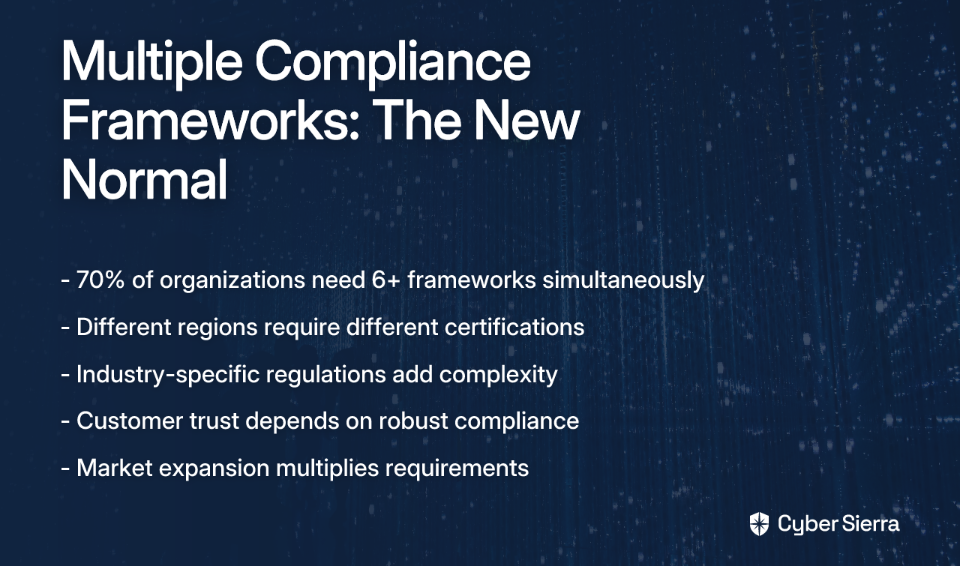
According to industry research, 70% of service organizations need to demonstrate compliance with at least six frameworks simultaneously. This isn't just about regulatory checkbox-ticking—it's about business growth and customer trust.

When expanding into new markets or targeting new customer segments, compliance requirements multiply. For example:

  • SaaS & Technology companies typically need SOC 2 for US clients, ISO 27001 for international operations, plus GDPR and CCPA/CPRA for data privacy.
  • Healthcare organizations must navigate HIPAA for protected health information, while potentially also requiring HITRUST certification.
  • Financial services need to balance PCI DSS for payment data with SOC 2 for financial information security.
  • Government contractors face FISMA, NIST 800-53, FedRAMP, and CMMC requirements.

This multi-framework reality is driven by two powerful forces:
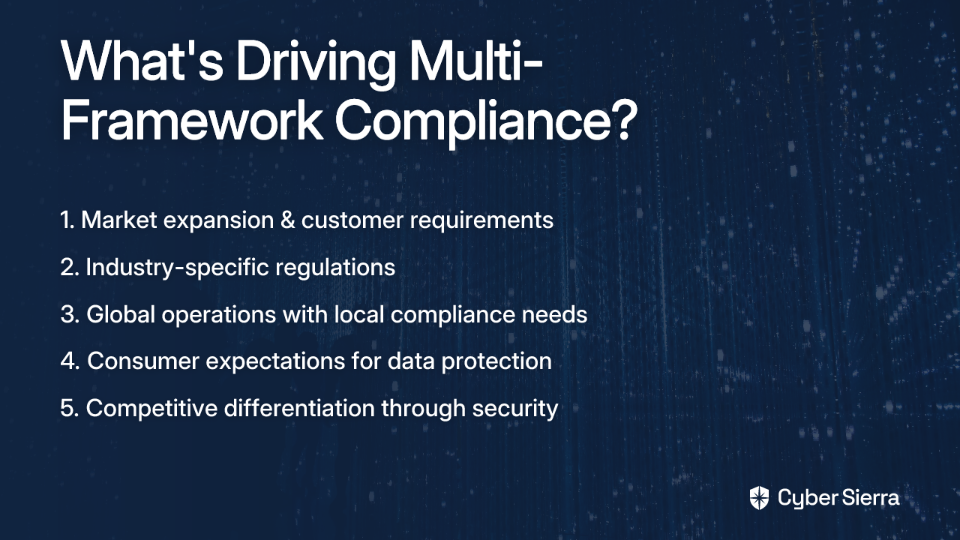
  1. Market expansion and customer requirements - To operate globally, you must comply locally. When 71% of consumers report they would stop doing business with a company that mishandles sensitive data, robust compliance becomes a competitive necessity.
  2. Industry-specific regulations - Different sectors have their own specialized frameworks, often requiring organizations to address overlapping yet distinct requirements simultaneously.

The High Cost of the Siloed "Spreadsheet" Approach

Many organizations attempt to manage multiple frameworks using disconnected spreadsheets, documents, and manual processes. This approach creates significant problems:

Audit Fatigue and Duplication of Effort

When each framework is managed separately, teams end up testing the same control multiple times for different audits. For example, your access control requirements might be validated once for SOC 2, again for ISO 27001, and yet again for PCI DSS.

As one compliance professional on Reddit noted: "The certs, risk docs, and endless follow-ups became a full-time job." This duplicative effort drains resources and creates audit fatigue across the organization.

Operational Bottlenecks

Managing security questionnaires, compliance certifications, and risk assessments for each framework separately creates what many practitioners describe as a "massive operational bottleneck."

This challenge is particularly acute in vendor management, where the same security controls might need to be verified repeatedly through different lenses for different frameworks—a process that quickly becomes unsustainable without the right tools.

Documentation Chaos and "Tribal Knowledge"

Perhaps most concerning is the fragmentation of compliance documentation. Without a centralized approach, critical information often exists only as "tribal knowledge" held by individual team members. As one security professional explained: "Not everything is documented and mostly tribal knowledge, so in my first year it was getting documentation down."

This reliance on undocumented knowledge creates significant risk when team members leave and makes passing audits unnecessarily difficult.

The Solution: A Unified Strategy with Continuous Monitoring

To effectively manage multi-framework compliance, organizations need a unified approach built on three key pillars:
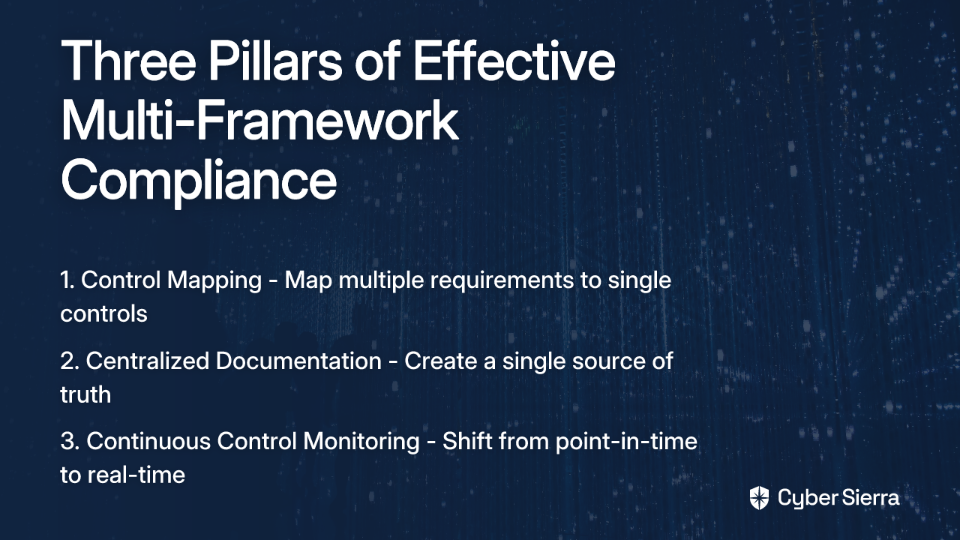
1. Control Mapping: The Foundation of Efficiency

Control mapping is the process of identifying overlaps between different frameworks and mapping them to a common set of internal controls. This "write once, comply many" approach drastically reduces redundant work.

As one practitioner recommended: "I've taken to using the NIST framework control mapping to map multiple frameworks to a single control."

For example, a password policy might satisfy requirements across SOC 2 (CC6.1), ISO 27001 (A.9.4.3), and NIST CSF (PR.AC-1) simultaneously. By understanding these relationships, you can implement one robust control that satisfies multiple requirements.

2. Centralized Documentation

To overcome "tribal knowledge" problems, organizations need a central repository for all policies, procedures, and evidence. This ensures consistency across frameworks and provides a single source of truth for auditors.

3. Continuous Control Monitoring (CCM)

Continuous Control Monitoring represents a fundamental shift from point-in-time compliance to ongoing assurance. According to the Cloud Security Alliance, CCM is a proactive approach that provides automated, near real-time oversight of an organization's controls to ensure they effectively mitigate risks and maintain compliance.

Unlike traditional methods that check controls periodically, CCM acts as a "digital watchdog" that constantly evaluates your security posture. This brings several critical benefits:

  • Early Detection of Risks: Near real-time monitoring allows for immediate identification of control failures or degradation, transforming risk management from reactive to proactive.
  • Reduced Manual Work: By automating data collection and reporting across frameworks, CCM frees up compliance professionals for more strategic tasks.
  • Improved Compliance Maturity: Organizations move from scrambling before audits to maintaining continuous compliance readiness.

Supercharging GRC: The Role of AI and Automation

While CCM represents a significant advancement, artificial intelligence takes multi-framework compliance to the next level. Traditional GRC methods are becoming obsolete as the volume and complexity of compliance requirements grow.

Organizations using AI for security automation report up to a 62% improvement in compliance efficiency, making it increasingly essential for modern GRC programs.
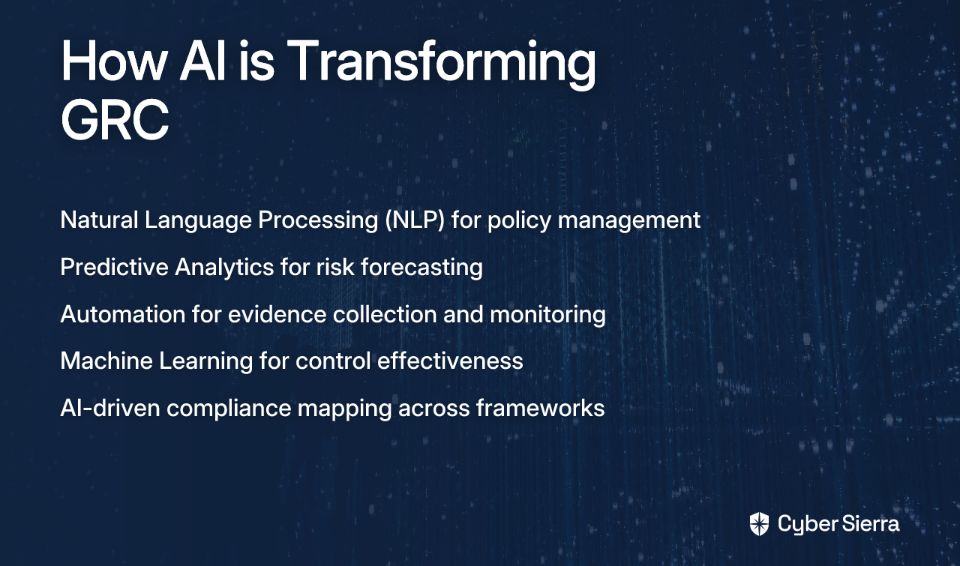
AI-powered capabilities enhance multi-framework compliance through:

  • Predictive Risk Intelligence: Forecasting compliance issues before they lead to audit failures or breaches.
  • Automated Evidence Collection: Gathering, validating, and mapping compliance evidence across multiple frameworks like NIST, ISO 27001, and PCI DSS.
  • Natural Language Processing: Analyzing unstructured data like policy documents to identify gaps and map them to controls.

Modern GRC Platforms: Bringing it All Together

To implement this advanced approach, organizations need modern GRC platforms that support multi-framework compliance through automation and continuous monitoring.

Platforms like Cyber Sierra exemplify this approach through:

These capabilities transform what would be overwhelming manual effort into a streamlined, automated process that scales with your compliance needs.

Transforming Compliance from a Burden to a Business Enabler

The modern business environment demands a multi-framework approach to compliance. Trying to manage this with manual, siloed processes leads to inefficiency, increased risk, and burnout among security and compliance teams.

A unified GRC strategy, built on the principles of control mapping and enabled by Continuous Control Monitoring and AI, transforms compliance from a reactive cost center into a proactive, strategic asset that:

  • Builds customer trust through demonstrable security practices
  • Accelerates market entry by streamlining certification processes
  • Strengthens overall security posture through continuous visibility

Is your GRC program ready for the complexities of modern compliance? It's time to move beyond spreadsheets and embrace a unified platform that turns multi-framework compliance into a competitive advantage.
Frequently Asked Questions

What is multi-framework compliance?

Multi-framework compliance is the process of adhering to the requirements of multiple security and privacy frameworks simultaneously. This is necessary for organizations that operate in different regions, serve various industries, or need to meet diverse customer demands, such as complying with SOC 2, ISO 27001, and HIPAA all at once.

Why is managing multiple compliance frameworks so challenging?

Managing multiple compliance frameworks is challenging due to the significant overlap in requirements, which leads to duplicated efforts and audit fatigue when handled in silos. This traditional "spreadsheet" approach often results in documentation chaos, operational bottlenecks, and a reliance on inconsistent "tribal knowledge," making audits inefficient and increasing compliance risk.

What is control mapping and how does it simplify compliance?

Control mapping is the practice of identifying overlapping requirements across different frameworks and linking them to a single, unified internal control. This "write once, comply many" approach drastically simplifies compliance by eliminating redundant work. For example, a single access control policy can be mapped to satisfy requirements in SOC 2, ISO 27001, and PCI DSS, saving significant time and resources.

How does Continuous Control Monitoring (CCM) improve multi-framework compliance?

Continuous Control Monitoring (CCM) improves compliance by automating the process of testing and verifying security controls in near real-time, rather than just before an audit. This provides ongoing assurance that controls are effective across all applicable frameworks. It transforms compliance from a periodic, reactive task into a proactive, continuous process, enabling early risk detection and reducing manual audit preparation.

How can AI and automation streamline GRC processes?

AI and automation streamline Governance, Risk, and Compliance (GRC) processes by automating evidence collection, performing predictive risk analysis, and mapping controls across multiple frameworks automatically. This reduces manual effort, improves accuracy, and provides teams with the intelligence to foresee compliance gaps before they become issues, leading to significant improvements in efficiency and a stronger security posture.

What are the benefits of using a unified GRC platform for multi-framework compliance?

A unified GRC platform centralizes all compliance activities, providing a single source of truth for policies, controls, and evidence across multiple frameworks. Key benefits include reduced audit fatigue through control mapping, improved efficiency via automation and continuous monitoring, and enhanced visibility into the organization's overall compliance posture. This transforms compliance from a business burden into a strategic enabler for growth and customer trust.
blog-hero-background-image
Governance & Compliance

Governance Risk & Compliance (GRC) Assessments: Best Practices & Pitfalls

backdrop
Table of Contents

Join thousands of professionals and get the latest insight on Compliance & Cybersecurity.


Summary

  • A strong GRC program helps prevent the over $1 trillion lost annually to corporate misconduct and mistakes by providing an integrated approach to risk management.
  • Moving from manual, point-in-time assessments to continuous controls monitoring (CCM) can reduce audit preparation time by up to 60% and provide real-time risk visibility.
  • To transform GRC into a strategic function, focus on measurable risk reduction, manage third-party risks proactively, and align compliance efforts with business objectives.
  • Automate data collection and reporting across multiple frameworks with an integrated GRC platform to make your organization continuously audit-ready.

Are you tired of being cast as the "bad guy" forcing changes nobody wants? Do you spend more time navigating company politics and Excel spreadsheets than actually reducing risk? You're not alone. Many GRC professionals feel they are fighting an uphill battle, where "the issues are easy to solve, but company politics and corporate culture gets in the way."

This comprehensive guide will help transform your GRC program from a reactive burden into a strategic advantage that gains respect across your organization.

Why Modern GRC Assessments Are More Than Just a Checklist

Governance, Risk, and Compliance (GRC) is far more than a collection of checklists and audits. According to the Open Compliance Ethics Group (OCEG), GRC is an "integrated collection of capabilities enabling organizations to achieve objectives, address uncertainty, and act with integrity"—a concept known as "Principled Performance."

The stakes are high. Over $1 trillion is lost annually due to misconduct, mistakes, and miscalculations that a strong GRC program can help prevent. But when GRC functions exist in silos, organizations face:

  • Increased costs from duplicate activities
  • Lack of visibility into enterprise-wide risks
  • Ineffective management of third-party risks
  • Difficulty measuring performance

Modern GRC has evolved from a simple compliance function to a strategic enabler that supports broader business goals like digital trust and resilience. When properly implemented, it breaks down silos between departments and creates a unified approach to managing risk.

Actionable Best Practices for Effective GRC Assessments

1. Establish Clear Objectives and a Solid Framework

A successful GRC strategy starts with clear objectives aligned with business goals and regulatory requirements. Here's how to set them up:

  1. Assess Risks: Identify potential risk factors across all business areas.
  2. Determine Compliance Requirements: Stay current with regulations like GDPR, HIPAA, PCI DSS, etc.
  3. Create Policies and Procedures: Develop clear guidelines that address identified risks and compliance needs.
  4. Prioritize Initiatives: Allocate resources to high-impact projects that provide measurable risk reduction.

(Source)

2. Master the Risk Management Lifecycle

Effective risk management is the cornerstone of any GRC program. This process builds your authority and provides practical value:

Risk Identification: Use methods like stakeholder interviews, brainstorming sessions, historical data analysis, and industry benchmarking to identify potential risks.

Risk Assessment: Evaluate each identified risk based on:

  • Likelihood of occurrence
  • Potential impact (financial, reputational, operational)
  • Existing controls and their effectiveness

This creates a data-driven foundation for your Risk Register that helps prioritize your efforts.

Risk Mitigation: Develop clear action plans with strategies including:

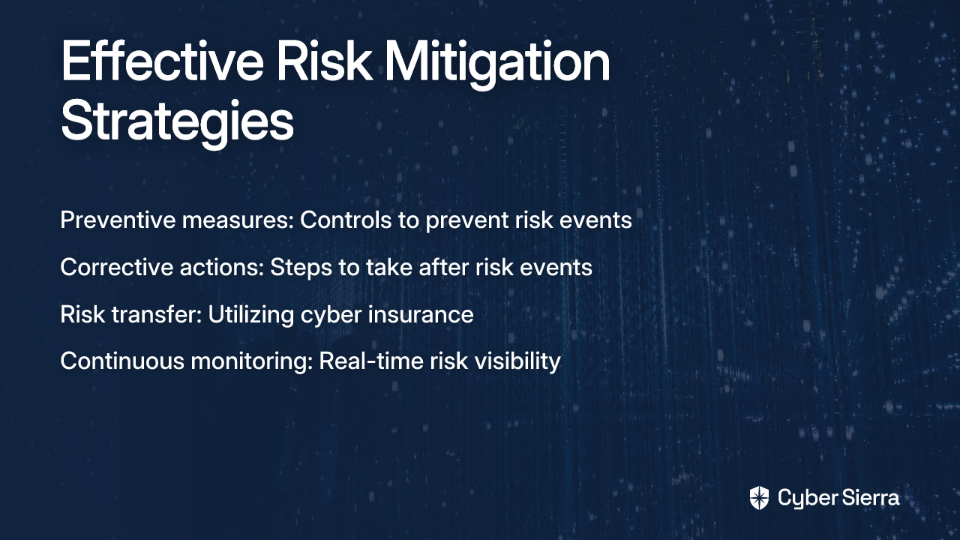
  • Preventive measures: Controls to stop risk events from occurring
  • Corrective actions: Steps to take after a risk event has occurred
  • Risk transfer: Using measures like cyber insurance

(Source)

3. Embrace Automation and Continuous Monitoring

If you're tired of being "boring as shit" spreadsheet jockeys drowning in Excel forms, there's good news. Traditional, periodic point-in-time assessments are being replaced by continuous controls monitoring (CCM).

RegScale reports that CCM can reduce audit preparation time by up to 60% while eliminating time-consuming manual evidence collection. Key benefits include:

  • Efficiency: Automate data collection and control validation
  • Accuracy: Reduce human errors that lead to compliance gaps
  • Proactive Posture: Identify control gaps as they happen, not months later

Platforms like Cyber Sierra's GRC module are designed to embed this modern approach. They automate data collection across multiple frameworks (SOC2, ISO 27001, etc.) and leverage Continuous Control Monitoring (CCM) to provide a near real-time, unified view of your security posture, turning audit-readiness into an always-on state rather than a frantic quarterly exercise.

4. Enhance Governance and Foster Collaboration

When "engineers by default think you are an idiot," building bridges becomes essential. Effective governance requires:

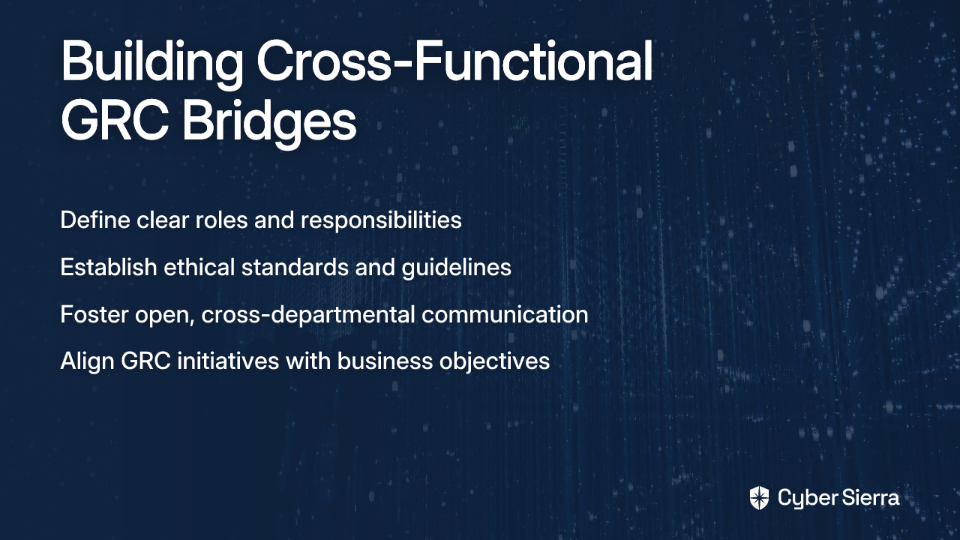
  • Defining Clear Roles and Responsibilities: Ensure every stakeholder understands their part in risk management and compliance.
  • Establishing Ethical Standards: Create a clear code of ethics that guides decision-making.
  • Fostering Effective Communication: Promote open, cross-functional collaboration that breaks down silos.

The Minefield: Common GRC Pitfalls and How to Sidestep Them

Pitfall 1: Over-Relying on Manual, Point-in-Time Assessments

The Problem: Manual processes are inefficient, error-prone, and create security blind spots between periodic checks. This is the source of much audit fatigue and frustration.

The Solution: Implement tools that enable continuous monitoring. CCM offers ongoing visibility and helps you respond to threats and vulnerabilities in near real-time, not months later.

Pitfall 2: Focusing on Reporting Instead of Measurable Risk Reduction

The Problem: GRC teams can get stuck in a cycle of creating reports that don't lead to action. According to IANS Research, the focus must shift from reporting to treatment.

The Solution: Use your GRC platform to create actionable outcomes. Integrate risk data from various functions (IAM, incident response) to create a holistic view and track mitigation efforts to completion.

Pitfall 3: Neglecting Third-Party and Supply Chain Risk

The Problem: An increasing number of breaches originate from the supply chain. Managing vendor risk with spreadsheets and manual questionnaires is unsustainable and ineffective.

The Solution: Implement a dedicated Third-Party Risk Management (TPRM) program.

Automated TPRM solutions, like the one offered by Cyber Sierra, streamline the entire vendor lifecycle—from onboarding and due diligence to continuous monitoring of their security posture. This replaces static, point-in-time assessments with a dynamic, 24/7 view of your supply chain risk.

Pitfall 4: Underinvesting in the 'Human Firewall'

The Problem: Failing to provide adequate and ongoing security training for employees leaves a major vulnerability open, regardless of your technical controls.

The Solution: Implement a continuous employee security training program.

Building a security-conscious culture is a critical compliance control. Tools like Cyber Sierra's Employee Security Training help by offering interactive modules and simulated phishing campaigns to make employees an active part of the defense, strengthening your overall GRC posture.

Pitfall 5: Fighting Organizational Politics Instead of Working With Them

The Problem: Many GRC professionals lament that "there is an obscene amount of politics that happens before they agree to fix/improve something."

The Solution: Instead of fighting the political current, learn to navigate it:

  • Document regulatory requirements clearly to demonstrate when changes aren't optional
  • Build relationships with key stakeholders before you need their buy-in
  • Frame compliance in terms of business benefits, not just risk avoidance

The Future is Now: Key GRC Trends for 2025 and Beyond

Trend 1: AI-Powered GRC

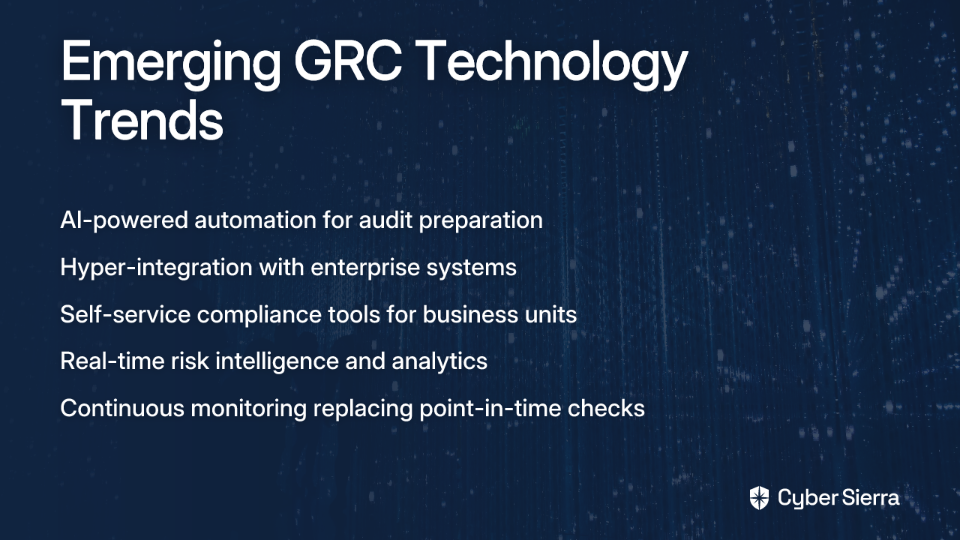
Automation and AI are being adopted for real-time governance that adapts to changing conditions. IANS Research highlights that generative AI is emerging as a tool to reduce the manual burden of audit preparation, evidence collection, and control testing.

Trend 2: Hyper-Integration

GRC platforms are becoming central hubs, integrating with other enterprise tools (like SIEMs, vulnerability scanners, and HR systems) to provide true real-time oversight. This integration eliminates the "confusion at what the hell is going on in the org" by creating a single source of truth for risk and compliance data.

Trend 3: Empowering the First Line

There's a move towards providing business units with self-service compliance tools, making them active participants in GRC rather than passive subjects. This shift helps address the perception that GRC professionals are "the bad guy forcing a change" by distributing responsibility across the organization.

Conclusion: From Compliance Enforcer to Strategic Partner

Modern GRC is no longer a siloed, manual function but a strategic, integrated, and automated discipline. The path to success lies in moving away from periodic checks and embracing a culture of continuous monitoring and improvement.

By implementing these best practices and avoiding common pitfalls, GRC professionals can elevate their role from compliance enforcers to strategic business partners who drive tangible value and resilience. This transformation not only makes your job more fulfilling but also increases your value to the organization.

Frequently Asked Questions

What is GRC in cybersecurity?

GRC in cybersecurity is an integrated strategy for managing an organization's governance, risk management, and compliance with regulations and standards. It moves beyond simple checklists to provide a unified approach to achieving business objectives, addressing security threats, and acting with integrity. A modern GRC program breaks down silos between departments, creating a holistic view of risk that supports overall business resilience and digital trust.
Why is continuous monitoring important for GRC?

Continuous monitoring is crucial for GRC because it replaces outdated, periodic assessments with real-time visibility into an organization's security posture and control effectiveness. This proactive approach allows teams to identify and remediate control gaps and vulnerabilities as they occur, not months later during a formal audit. By automating evidence collection, it significantly reduces manual effort, minimizes human error, and keeps the organization in a constant state of audit-readiness.
How can a GRC program move from a cost center to a strategic partner?

A GRC program becomes a strategic partner by aligning its objectives with core business goals, providing actionable risk intelligence, and demonstrating measurable risk reduction. Instead of focusing solely on compliance reporting, a strategic GRC function uses data to inform business decisions, improves operational efficiency through automation, and helps build digital trust with customers. By framing GRC in terms of business benefits—like enabling faster sales cycles through compliance certifications or protecting brand reputation—it proves its value beyond just a cost of doing business.

What are the biggest mistakes to avoid in GRC?

The biggest mistakes in GRC include over-relying on manual, point-in-time assessments, neglecting third-party and supply chain risk, and failing to secure buy-in by communicating GRC's business value. Many programs get bogged down in manual spreadsheet management, which is inefficient and creates blind spots. Another common pitfall is ignoring the risks posed by vendors and suppliers. Finally, failing to build relationships and demonstrate how GRC supports business objectives often leads to political roadblocks and a lack of resources.

How does GRC automation help with compliance audits?

GRC automation drastically simplifies compliance audits by centralizing evidence, automating data collection, and providing a continuous, up-to-date view of your compliance posture. Platforms with Continuous Controls Monitoring (CCM) can reduce audit preparation time significantly. They eliminate the frantic, last-minute scramble for evidence by linking controls directly to live data sources. This ensures you are always prepared for an audit and can easily demonstrate compliance with frameworks like SOC 2, ISO 27001, and others.

Ready to transform your GRC program from a manual burden to a strategic advantage? Discover how Cyber Sierra's integrated platform automates compliance, provides real-time risk intelligence, and makes you audit-ready, continuously.

blog-hero-background-image
Governance & Compliance

How to Effectively Track and Mitigate Compliance Risk Across Your Organisation

backdrop
Table of Contents

Join thousands of professionals and get the latest insight on Compliance & Cybersecurity.


Summary

  • Compliance failures can lead to massive penalties, such as Meta's €1.2 billion GDPR fine, alongside severe reputational damage and operational disruption.
  • Effective compliance risk management requires shifting from outdated, manual "box-ticking" to a proactive and continuous approach.
  • A practical framework involves identifying all compliance obligations, conducting thorough risk assessments, implementing strong controls, and establishing continuous monitoring.
  • Automating these processes with a unified platform for Governance, Risk & Compliance (GRC), Continuous Control Monitoring, and TPRM can streamline audits and provide real-time risk visibility.

You've spent weeks preparing for an audit, frantically collecting evidence and documentation. Your team is overwhelmed with spreadsheets tracking various compliance frameworks. Meanwhile, vendor security questionnaires pile up unanswered, and senior leadership views your compliance efforts as merely a "cost sink" rather than a strategic necessity.

If this scenario sounds painfully familiar, you're not alone. Organizations across industries struggle with the growing complexity of compliance risk management in today's rapidly evolving regulatory landscape.

Understanding the Compliance Risk Landscape

Compliance risk encompasses an organization's potential legal, financial, and criminal exposure from failing to adhere to laws, regulations, and internal policies. The stakes have never been higher—Meta was fined €1.2 billion in 2023 for GDPR violations, while British Airways faced a £20 million penalty for data protection failures.

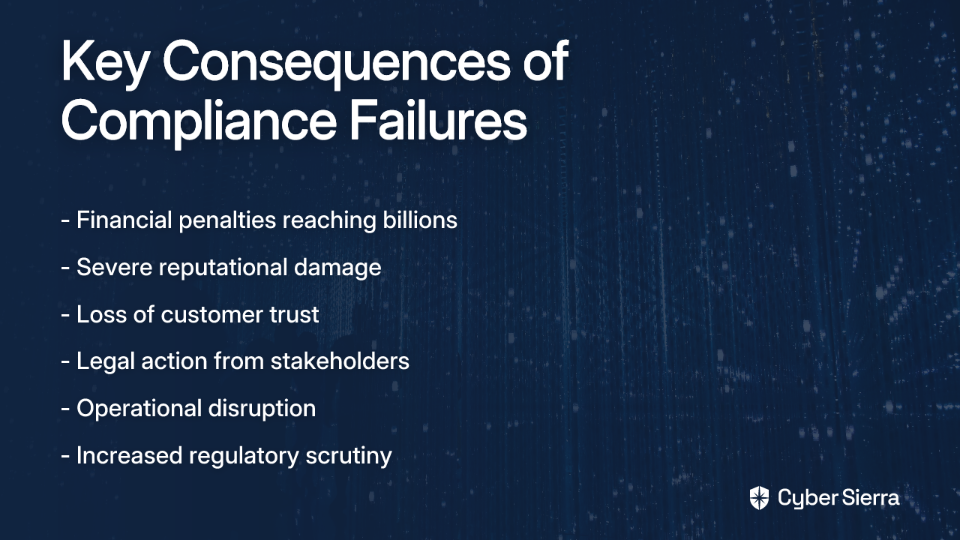
But the consequences extend well beyond financial penalties to include:

  • Severe reputational damage
  • Loss of customer trust
  • Legal action from stakeholders
  • Operational disruption
  • Increased regulatory scrutiny

To effectively track and mitigate these risks, organizations must shift from periodic, manual "box-ticking" exercises to a continuous, technology-driven approach. Here's how to make that transformation.

A Practical Framework for Assessing and Tracking Risk

Step 1: Identify and Map Your Compliance Obligations

Compliance requirements aren't one-size-fits-all—they vary significantly by industry, geography, and organization type. Begin by creating a comprehensive inventory of all applicable regulations and frameworks relevant to your organization, such as:

  • NIST Cybersecurity Framework
  • ISO 27001
  • PCI DSS
  • GDPR
  • SOC 2
  • Industry-specific regulations (HIPAA for healthcare, etc.)

For each framework, document the specific requirements, controls, and evidence needed to demonstrate compliance. This creates a clear roadmap for your compliance program.

Step 2: Conduct a Comprehensive Risk Assessment

With your compliance obligations mapped, conduct a formal risk assessment to identify vulnerabilities across your organization. According to the Protecht Group, effective risk assessment should:

  • Identify potential compliance risks and their sources
  • Analyze the likelihood and impact of each risk
  • Prioritize risks based on their potential consequences
  • Document findings in a structured compliance risk matrix

Focus your assessment on high-risk areas including:

  • Access control systems: Proofpoint highlights that lack of proper access auditing significantly hinders breach investigations.
  • Data encryption practices: Ensure sensitive data is encrypted both at rest and in transit.
  • Configuration management: Many serious breaches, including the infamous Equifax breach, stem from misconfigurations.
  • Third-party relationships: As reflected in Reddit discussions, vendor risk assessment is frequently overlooked.

Step 3: Implement and Document Strong Internal Controls

Based on your risk assessment, establish robust controls to mitigate identified risks:

  • Define clear policies and procedures: Address the common pain point of "complex approval processes" by standardizing your policy lifecycle with clear ownership and review timelines.
  • Implement technical safeguards: Apply the principle of least privilege, ensure proper encryption, and deploy network segmentation.
  • Establish monitoring mechanisms: Create processes to regularly validate that controls are functioning as intended.
  • Document everything: Maintain comprehensive records of all controls, including their purpose, implementation details, and responsible parties.

Step 4: Establish Continuous Monitoring and Measurement

Point-in-time audits are no longer sufficient in today's dynamic threat landscape. Organizations need real-time visibility into their compliance posture:

  • Implement continuous control monitoring: Move from periodic checks to automated, ongoing verification of control effectiveness.
  • Track key performance indicators: Measure metrics like control violation frequency, audit findings, and remediation timeframes.
  • Establish clear reporting channels: Ensure compliance issues are promptly escalated to appropriate stakeholders.
  • Schedule regular reviews: Periodically reassess your compliance program to identify improvement opportunities.

Leveraging Technology for Proactive Compliance Management

Many organizations still rely on spreadsheets and manual processes for tracking compliance, creating what one Reddit user described as "heavy reliance on manual paperwork" leading to significant inefficiencies. Modern compliance demands modern tools.

Centralizing Compliance with GRC Platforms

Governance, Risk, and Compliance (GRC) platforms provide a centralized system for managing compliance activities. These solutions offer:

  • A single repository for all compliance documentation
  • Automated workflow management
  • Real-time compliance dashboards
  • Streamlined audit preparation

Platforms like Cyber Sierra's GRC module automate data collection across multiple frameworks like SOC 2 and ISO 27001, significantly reducing the "overwhelming workload from managing audits" that compliance professionals frequently cite as a pain point.

The Power of Continuous Control Monitoring (CCM)

Continuous Control Monitoring represents a transformative approach to compliance:

  • Instead of point-in-time assessments, CCM provides near real-time visibility into control effectiveness
  • Anomalies and exceptions are detected as they occur, not weeks later during an audit
  • Remediation can be prioritized based on risk level and impact

Cyber Sierra's CCM solution, for example, builds a central controls repository with near real-time updates, transforming security from periodic checks to continuous, automated monitoring.

Managing Third-Party Risk Effectively

Your compliance posture is only as strong as your weakest vendor link. Modern Third-Party Risk Management (TPRM) requires:

  • Automated vendor assessments: Moving beyond manual questionnaires that create "massive operational bottlenecks" as noted by IT managers on Reddit
  • Risk-based vendor prioritization: Not all vendors pose equal risk—focus on those with access to sensitive data or critical systems
  • Continuous monitoring: Point-in-time assessments fail to capture evolving risks

TPRM solutions like Cyber Sierra's simplify this process by automating assessments, prioritizing vendors based on risk, and providing continuous visibility into their security posture.

Building a Resilient Compliance Culture

Technology alone isn't enough—a strong compliance program requires organizational commitment:

  • Secure leadership buy-in: Frame compliance not as a cost center but as a business enabler that builds trust and resilience
  • Establish clear accountability: Define compliance roles and responsibilities across the organization
  • Train your people: Human error remains one of the most common compliance risks, making regular training essential
  • Foster a speak-up culture: Encourage employees to report potential compliance issues without fear of retaliation

Conclusion

Effectively tracking and mitigating compliance risk requires a strategic shift from reactive, manual processes to a proactive, continuous, and technology-driven approach. By implementing a structured framework for assessment, leveraging modern compliance tools, and fostering a strong compliance culture, organizations can not only avoid penalties but build trust with customers and stakeholders.

The most successful organizations view compliance not as a burden but as a competitive advantage that demonstrates their commitment to security, privacy, and responsible business practices. In today's high-stakes regulatory environment, that's an advantage worth investing in.

Ready to transform your compliance program from reactive to proactive? See how Cyber Sierra's AI-enabled cybersecurity platform unifies GRC, Continuous Control Monitoring, and TPRM to simplify compliance and provide a real-time view of your risk posture.

Frequently Asked Questions

What is compliance risk?

Compliance risk is the potential for an organization to face legal penalties, financial loss, and reputational damage from failing to adhere to laws, regulations, standards, and internal policies. It goes beyond just fines and can lead to loss of customer trust, operational disruptions, and increased regulatory oversight.

What are the first steps to manage compliance risk?

The first steps to effectively manage compliance risk are to identify and map all your relevant compliance obligations and then conduct a comprehensive risk assessment. This involves creating an inventory of applicable frameworks (like GDPR, ISO 27001, SOC 2) and then systematically identifying, analyzing, and prioritizing potential risks across your organization.

How can technology help track compliance risk more effectively?

Technology streamlines and automates compliance risk tracking by replacing manual spreadsheets with centralized platforms. Modern Governance, Risk, and Compliance (GRC) tools provide a single source of truth for documentation, automate workflows, and offer real-time dashboards. Solutions for Continuous Control Monitoring (CCM) and Third-Party Risk Management (TPRM) further enhance this by providing ongoing visibility into your security controls and vendor ecosystem.

What is the difference between a traditional audit and continuous compliance monitoring?

A traditional audit is a point-in-time assessment that provides a snapshot of your compliance posture at a specific moment, often happening periodically. Continuous compliance monitoring, on the other hand, is an ongoing, automated process that provides near real-time visibility into the effectiveness of your security controls, allowing you to detect and remediate issues as they happen rather than waiting for an audit.

How do you manage compliance across multiple frameworks like SOC 2 and ISO 27001?

The most efficient way to manage compliance across multiple frameworks is by using a GRC platform to centralize your efforts. These platforms allow you to map common controls to multiple frameworks, so you don't have to duplicate evidence collection and testing. This "test once, apply many" approach saves significant time and reduces the overwhelming workload associated with managing audits for different standards.

Why is building a compliance culture important?

Building a strong compliance culture is crucial because technology and policies alone are not enough to prevent failures. A positive culture ensures that compliance becomes a shared responsibility across the entire organization, not just the GRC team's job. It fosters accountability, encourages employees to report issues without fear, and reduces human error through continuous training, making your entire compliance program more resilient.

blog-hero-background-image
Governance & Compliance

How to Connect Your GRC Platform to Cloud Security Posture Management (CSPM)

backdrop
Table of Contents

Join thousands of professionals and get the latest insight on Compliance & Cybersecurity.


Summary

  • Operating GRC and CSPM tools in silos leads to manual, point-in-time audits that are inefficient and leave security gaps between assessments.
  • Integrating GRC and CSPM platforms transforms compliance from a periodic, manual task into an automated, continuous process, providing a real-time view of your security posture.
  • To connect these systems, use APIs or pre-built connectors to automate evidence collection and map cloud security findings directly to compliance controls.
  • Platforms like Cybersierra's GRC suite simplify this by natively combining continuous control monitoring with automated compliance workflows, eliminating complex custom integrations.

You've set up a robust Governance, Risk, and Compliance (GRC) platform for your organization. You're also using Cloud Security Posture Management (CSPM) tools to monitor your cloud environments. But they're operating in silos, creating a frustrating disconnect between your compliance requirements and your actual cloud security posture.

Every time an audit approaches, your team scrambles to manually collect evidence from your CSPM tools, map it to compliance controls, and prepare documentation—a process that's not only time-consuming but also gives you only a point-in-time snapshot that's outdated almost immediately.

This manual approach leaves you vulnerable between audits, unable to demonstrate continuous compliance, and constantly playing catch-up with evolving cloud risks. You're drowning in alerts from your CSPM tool with no clear way to prioritize them based on compliance impact or business risk.

What if instead, your GRC platform and CSPM tools worked together seamlessly, automatically sharing data and insights to provide a real-time view of your compliance posture across all cloud environments?

By connecting these powerful systems, you can transform your compliance program from a reactive, manual process into a proactive, automated, and continuous one—saving countless hours, reducing risk, and providing executives with the confidence that cloud security is being managed effectively.

The Twin Pillars of Modern Security: Understanding GRC and CSPM

Before diving into integration strategies, let's clarify what these platforms do and why they're both essential components of modern security programs.

What is Governance, Risk, and Compliance (GRC)?

GRC is an organizational strategy to manage governance, enterprise risk, and compliance with industry and government regulations. A GRC platform centralizes and automates these functions, serving as the system of record for:

  • Governance: The rules, policies, and processes ensuring activities align with business goals
  • Risk Management: The identification, assessment, and control of various risks (financial, legal, strategic, security)
  • Compliance: Adherence to rules and regulations governing organizational operations, such as SOC 2, ISO 27001, GDPR, NIS2, and HIPAA

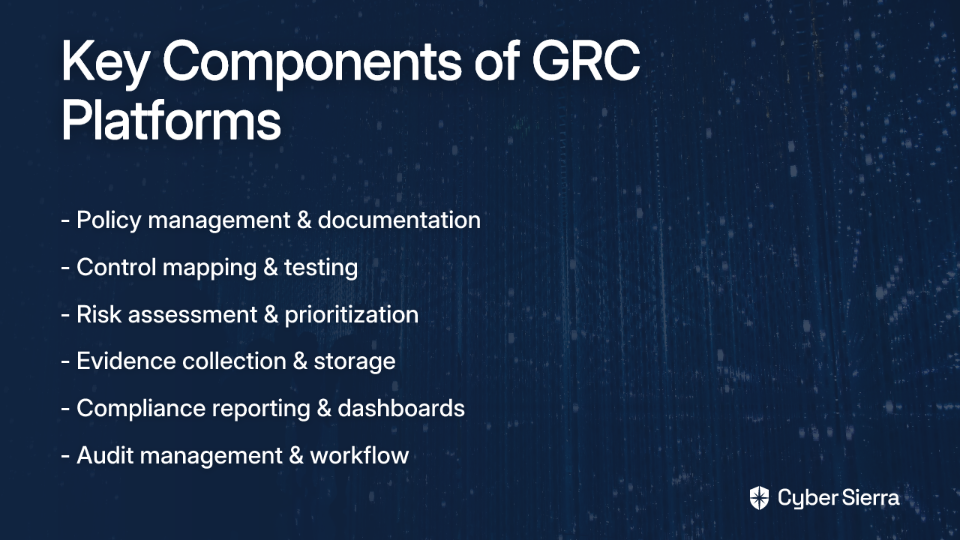
In practice, GRC platforms help organizations document policies, map them to controls, test those controls, collect evidence, and generate reports for audits and board meetings. They're primarily used by CISOs, compliance managers, risk owners, IT/DevOps teams, and internal auditors.

What is Cloud Security Posture Management (CSPM)?

CSPM tools continuously scan cloud environments (AWS, Azure, GCP, etc.) to identify misconfigurations, compliance violations, and security risks. They're designed to help organizations:

  • Detect and remediate cloud misconfigurations before they can be exploited
  • Ensure cloud resources comply with industry frameworks and internal policies
  • Maintain visibility across multi-cloud environments
  • Integrate security earlier in the development lifecycle ("shift left")

According to industry research, CSPM tools can mitigate cloud security risks by up to 80%, primarily addressing issues caused by misconfigurations, lack of visibility, and poor understanding of cloud resources.

Why Integrate? The Synergy of GRC and CSPM

While GRC platforms and CSPM tools are powerful on their own, connecting them creates a multiplier effect that transforms how organizations approach security and compliance.

Moving Beyond Point-in-Time Audits to Continuous Monitoring

Traditional compliance approaches rely on periodic, point-in-time assessments that quickly become outdated in dynamic cloud environments. Many security professionals express frustration with this approach, noting that "unaddressed security issues lead to growing technical debt" between assessments.

By integrating GRC with CSPM, you enable continuous control monitoring (ConMon), where:

  • Security controls are verified automatically and continuously
  • Evidence is collected in real-time rather than manually during audit season
  • Compliance posture is always current, not just during annual reviews
  • Issues are identified and remediated promptly, reducing the risk window

The Power of a Single Source of Truth for Compliance and Risk

Integration creates a unified view that allows for "seamless management and monitoring of security and compliance across multiple frameworks" like SOC 2, ISO 27001, NIST, and more. This addresses a common pain point where security and compliance teams operate with different datasets and priorities.

With a connected approach, all stakeholders work from the same information, enabling:

  • Consistent reporting across security, risk, and compliance functions
  • Clear visualization of how cloud security issues impact compliance status
  • Better decision-making with comprehensive visibility across frameworks
  • Reduced confusion and conflicting priorities between teams

Key Benefits of Integration

Efficiency & Automation

Integrating GRC and CSPM dramatically reduces manual effort by automating evidence collection and control testing. This directly addresses the desire for "automated compliance evaluation" expressed by many security professionals.

Rather than manually gathering screenshots and configuration data for audits, the system continuously collects and organizes this information, making it readily available when needed.

Enhanced Visibility

A connected system provides live dashboards displaying risk status and control health across cloud environments. This helps address the "need for visibility in security debt" that many organizations struggle with.

Stakeholders can instantly see how cloud misconfigurations affect compliance posture and overall risk, enabling more informed decisions about resource allocation and remediation priorities.

Proactive Risk Management

Integration enables a shift from reactive to proactive security management. Instead of discovering issues during audits or after incidents, organizations can identify and address problems as they emerge.

This approach allows for "immediate action on identified risks," enabling faster remediation and minimizing exposure windows.

The Practical Guide: How to Connect Your GRC Platform with CSPM Tools

Now that we understand the benefits, let's explore a step-by-step approach to successfully connecting your GRC platform with your CSPM tools.

Step 1: Define Your Goals and Identify Compliance Frameworks

Before beginning any integration, clearly define what you want to achieve and which compliance frameworks you need to support.

  1. Identify relevant frameworks: Ensure your CSPM can support multiple compliance frameworks relevant to your organization, such as SOC 2, ISO 27001, GDPR, NIS2, HIPAA, or PCI DSS.
  2. Structure your GRC framework: Organize your GRC approach around key business and security risks, not just compliance checkboxes.
  3. Set clear objectives: Define specific goals like reducing manual evidence collection time by 80% or achieving a real-time compliance dashboard for executives.

Step 2: Evaluate Your Platforms' Integration Capabilities

Not all GRC and CSPM platforms offer the same integration capabilities. Evaluate your current tools to determine:

  1. API availability: Check if your GRC platform has APIs that can consume data from CSPM tools, and vice versa.
  2. Pre-built connectors: Look for native integrations between your specific platforms. Many modern GRC tools offer pre-built connectors for popular CSPM solutions.
  3. Integration with other systems: Verify integration capabilities with identity management systems (e.g., Okta, Azure AD) and ticketing systems (e.g., Jira, ServiceNow) to create a comprehensive workflow.

Step 3: Execute the Technical Integration

With goals defined and capabilities assessed, it's time to implement the technical connection between your GRC platform and CSPM tools.

  1. Use pre-built connectors: If available, leverage existing integrations between your platforms. These typically offer the easiest setup and most reliable data flow.
  2. Implement API integration: For platforms without native connectors, develop custom integrations using their respective APIs. This creates a data pipeline where CSPM findings are automatically sent to the GRC platform.
  3. Map findings to controls: Configure the system to map cloud security findings (e.g., a misconfigured S3 bucket) to specific controls within your compliance frameworks (e.g., mapping the S3 issue to a data protection control in your ISO 27001 or SOC 2 framework).

Step 4: Configure Automated Control Tests and Evidence Collection

Once connected, set up automated processes for testing controls and collecting evidence:

  1. Define control tests: Create scheduled control tests that run regularly to verify compliance with specific requirements.
  2. Automate evidence collection: Configure the system to automatically gather evidence (screenshots, configuration files, logs) from the CSPM and attach it to the relevant control in the GRC platform, creating a centralized evidence repository.
  3. Set up exception workflows: Establish processes for handling control failures, including automated ticket creation, notification workflows, and remediation tracking.

Step 5: Establish Continuous Monitoring and Real-time Reporting

The final step is implementing continuous monitoring and meaningful reporting:

  1. Create dashboards: Develop executive dashboards showing compliance status across frameworks, with drill-down capabilities for deeper analysis.
  2. Set up alerts: Configure notifications for critical control failures or significant changes in compliance status.
  3. Implement trend analysis: Track compliance posture over time to identify patterns and demonstrate continuous improvement to auditors and executives.

Selecting the Right Integrated GRC and CSPM Solution

The success of your integration depends heavily on choosing the right tools. Here are some options to consider:

1. Cybersierra

Cybersierra provides an AI-enabled cybersecurity platform that natively integrates GRC and continuous monitoring capabilities, simplifying the entire integration process.

Their Continuous Control Monitoring (CCM) module offers ongoing visibility into security controls, builds a central controls repository with near real-time updates, and automates control testing and validation. This functions as the engine that feeds live data into the GRC system.

Meanwhile, their Governance, Risk & Compliance (GRC) module automates data collection, risk assessments, and reporting for multiple frameworks like SOC2, ISO 27001, and HIPAA. It directly consumes data from the CCM module to make enterprises audit-ready faster while reducing manual effort.

What sets Cybersierra apart is its integrated approach that transforms security from periodic checks to continuous, automated monitoring, providing a single source of truth for controls and enabling proactive risk management.

2. Standalone GRC Platforms with Strong API Support

Some organizations prefer to use dedicated GRC tools and connect them to third-party CSPMs. When taking this approach, look for robust API documentation and pre-built connectors for popular CSPM tools. Ensure the platform can handle the volume and variety of data from your CSPM solution.

3. Cloud-Native Security Platforms (CNAPP)

Modern cloud-native application protection platforms (CNAPPs) often combine CSPM with other capabilities like cloud workload protection (CWPP) and cloud infrastructure entitlement management (CIEM). Many include modules or integrations for GRC functions, offering a different integration path.

Overcoming Common Integration Challenges

While connecting GRC and CSPM offers tremendous benefits, organizations often face several challenges during implementation:

Alert Fatigue

CSPMs can generate thousands of alerts, overwhelming security teams. Address this by using your GRC platform to prioritize alerts based on risk scores and asset criticality. Focus on the misconfigurations that directly impact your compliance posture and present the highest risk.

Tool Complexity & Training

Integration requires expertise in both GRC and CSPM domains. Train your teams on both functionalities to ensure they understand how to use the integrated platform effectively. Consider bringing in external expertise if needed to establish the initial integration.

Mapping Controls

The initial setup of mapping CSPM findings to specific GRC controls can be labor-intensive but is critical for automation. Invest time upfront to create comprehensive mappings between cloud configurations and compliance requirements to enable true automation.

Conclusion

Connecting your GRC platform to your Cloud Security Posture Management tools is no longer a luxury but a necessity for modern cloud security. This integration transforms risk management from a static, spreadsheet-driven exercise into a dynamic, data-driven process.

The result is a clear, defensible audit trail, simplified compliance, reduced risk, and security teams that can focus on strategic initiatives rather than manual evidence gathering.

If you're still managing compliance with spreadsheets and periodic scans, it's time to explore an integrated GRC and CSPM solution like Cybersierra to automate your security posture management and create a continuous, real-time view of your compliance status across all cloud environments.

By making this transition, you'll not only satisfy auditors but also provide meaningful security insights to your organization—turning compliance from a burden into a business enabler.

Frequently Asked Questions

What is the main difference between GRC and CSPM?

GRC platforms manage overall organizational strategy for governance, risk, and compliance policies, while CSPM tools specifically focus on continuously monitoring cloud environments for security misconfigurations and technical compliance violations. Think of GRC as the system of record for your compliance policies and controls (the "what" and "why"), whereas CSPM is the technical engine that continuously checks your cloud infrastructure against those rules (the "how").

Why should you integrate GRC and CSPM tools?

Integrating GRC and CSPM tools automates compliance monitoring by connecting your high-level compliance policies (in GRC) with real-time cloud security data (from CSPM), creating a single source of truth and eliminating manual evidence collection. This integration transforms compliance from a periodic activity into a continuous, automated process, enabling proactive risk management and significant time savings during audits.

How does integrating GRC and CSPM simplify the audit process?

An integrated GRC and CSPM system simplifies audits by automatically and continuously collecting evidence, mapping it to specific compliance controls, and maintaining an always-up-to-date audit trail. Instead of scrambling to gather screenshots and logs before an audit, the system provides a central repository of evidence and live dashboards, offering auditors a more accurate and defensible picture of your security posture.

What is the first step to connect a GRC platform with a CSPM tool?

The first step is to clearly define your goals by identifying the specific compliance frameworks you need to adhere to (e.g., SOC 2, ISO 27001, HIPAA) and setting clear objectives for the integration. This strategic foundation ensures the technical integration aligns with business needs, such as reducing manual audit preparation time or achieving a real-time compliance dashboard for executives.

Can I just use my CSPM tool for cloud compliance?

While a CSPM tool is excellent for identifying technical compliance violations in the cloud, it lacks the broader context of a GRC platform, which manages overall risk, policy documentation, and audit workflows across the entire organization. A GRC platform links technical findings to specific business risks and compliance controls, serving as the central hub for managing the entire compliance lifecycle.

What are the biggest challenges when integrating GRC and CSPM?

The most common challenges include dealing with a high volume of alerts from the CSPM (alert fatigue), the technical complexity of mapping findings to GRC controls, and ensuring teams are adequately trained on both platforms. To overcome these, prioritize alerts based on business risk, invest time upfront in mapping controls, and provide comprehensive training to ensure your team can effectively manage the integrated system.

blog-hero-background-image
Governance & Compliance

Top 10 GRC Platforms for Organizations with Distributed Security Teams

backdrop
Table of Contents

Join thousands of professionals and get the latest insight on Compliance & Cybersecurity.


Summary

  • Distributed security teams struggle with fragmented visibility and inconsistent processes, making manual GRC management ineffective.
  • When selecting a GRC platform, prioritize features like a centralized dashboard, continuous monitoring, and automation to create a single source of truth.
  • Your GRC tool's success depends on a well-defined process; map your workflows, secure buy-in, and run a pilot program before a full rollout.
  • A unified platform like Cyber Sierra's GRC module can help automate compliance and provide real-time visibility for distributed teams.

You've set up a robust security program with teams spread across different locations. But when you check in on compliance efforts, you're shocked to see fragmented processes, inconsistent control implementations, and a nightmare of spreadsheets being passed around for evidence collection. Your distributed security teams are struggling to maintain a unified risk posture, and audit season feels like herding cats.

In an era of increasing cyber threats, complex regulatory demands, and distributed workforces, managing Governance, Risk, and Compliance (GRC) through manual processes is no longer viable. The right GRC platform can transform this chaos into clarity by providing a central source of truth, automating tedious tasks, and enabling real-time collaboration regardless of where your teams are located.

This guide will help you navigate the top GRC platforms specifically suited for organizations with distributed security teams and provide a framework for selecting the right one for your unique needs.

The Unique GRC Challenges of a Distributed Workforce

Before diving into solutions, let's examine the specific challenges that distributed security teams face:

Fragmented Visibility: Without a central hub, CISOs and compliance managers struggle to get a clear, real-time view of the organization's security posture across different locations and teams.

Inefficient Evidence Management: As one security professional noted on Reddit, "A key feature missing in all of these platforms is rights management around evidence sharing." Coordinating evidence generation and sharing for audits becomes a logistical nightmare when teams are geographically dispersed.

Inconsistent Processes: Different teams might follow slightly different procedures for risk assessments or control implementations, leading to compliance gaps and security vulnerabilities.

Third-Party Risk Complexity: Managing vendor relationships becomes harder when different regional teams handle different vendors. A centralized platform is crucial for standardized onboarding and continuous monitoring.

How to Choose the Right GRC Platform for Your Distributed Team

Before examining specific platforms, let's establish a framework for evaluation. A Reddit user wisely advised, "Make sure you really know what you want before buying any of them," highlighting that "inadequate understanding of organizational needs can lead to poor GRC platform selection."

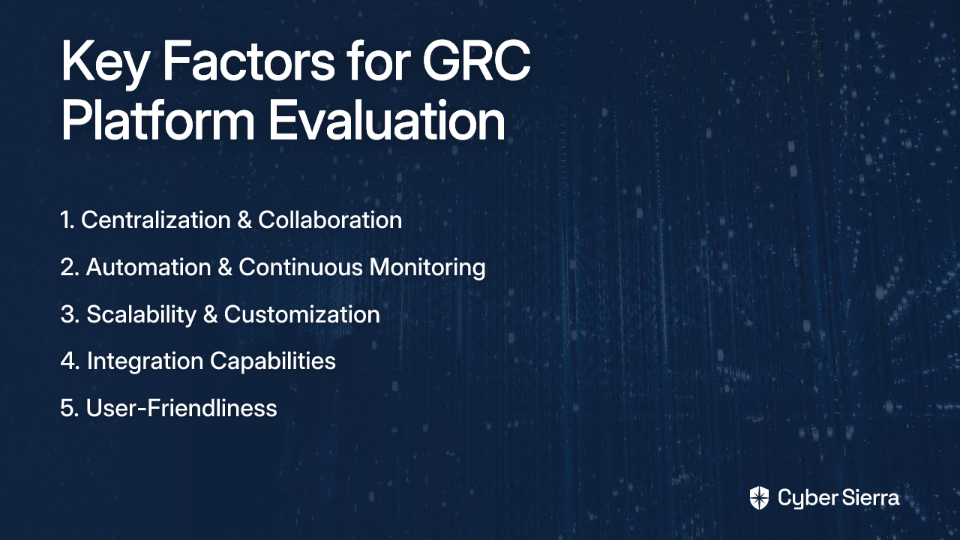
Consider these key factors when evaluating GRC platforms for your distributed team:

Centralization & Collaboration: Does the platform offer a unified dashboard and central repository for all controls, risks, and evidence? This eliminates data silos and provides a single source of truth.

Automation & Continuous Monitoring: Look for platforms that automate data collection, control testing, and reporting. This is critical for moving from periodic checks to proactive, near real-time risk management.

Scalability & Customization: The platform should grow with your company and be flexible enough to adapt to your unique workflow and processes. As one user noted, "GRC platforms may not scale well for growing organizations," so look for low-code/no-code customization options.

Integration Capabilities: Ensure the tool can integrate with your existing tech stack (cloud providers, security tools, HR systems) to streamline operations and avoid duplicate data entry.

User-Friendliness: An intuitive interface is key for user adoption across different teams and technical skill levels. Poor UX with "ineffective search functionalities" can create headaches during audits.

Top 10 GRC Platforms for Distributed Security Teams

1. Cyber Sierra

Best for: AI-driven automation and a unified platform for holistic risk management

Key Features: Cyber Sierra provides an AI-enabled cybersecurity platform that simplifies and automates security compliance for enterprises with distributed teams. Its integrated suite is designed for continuity and intelligence:

  • Continuous Control Monitoring (CCM): Builds a central controls repository with near real-time updates and automates control testing across multiple frameworks (NIST, ISO 27001, PCI DSS, GDPR).
  • Third-Party Risk Management (TPRM): Automates vendor assessments, provides 24/7 visibility into vendor compliance, and streamlines onboarding.
  • Governance, Risk & Compliance (GRC): Automates data collection, risk assessments, and reporting for audits (SOC2, ISO 27001, HIPAA), reducing compliance fatigue.
  • Threat Intelligence: Offers network and cloud vulnerability scanning for proactive defense.
  • Employee Security Training: Includes interactive training and simulated phishing campaigns to build a security-conscious culture.
  • Cyber Insurance: Helps organizations meet insurer requirements and streamline the application process.

Why it's good for Distributed Teams: The unified platform provides a single source of truth, crucial for teams spread across different locations. The high degree of automation in CCM and TPRM reduces the manual coordination required for evidence collection and vendor management, allowing distributed teams to operate efficiently and consistently.

2. MetricStream

Best for: Large enterprises seeking a comprehensive and highly configurable GRC suite

Key Features: A market leader recognized by Forrester and Gartner, MetricStream integrates risk, compliance, audit, and cybersecurity.

  • AI-based capabilities (AiSPIRE) for regulatory change management and continuous control monitoring
  • Low-code/no-code platform for easy customization
  • Supports ESG compliance and risk quantification

Why it's good for Distributed Teams: Its centralized platform provides a holistic governance view necessary for large, complex organizations with disparate teams. The AI-driven alerts on regulatory changes ensure all global teams stay aligned.

3. AuditBoard

Best for: Audit, risk, and compliance teams looking for a user-friendly and collaborative platform

Key Features: Designed by former auditors, it features an intuitive interface for managing audits, risk assessments, and compliance.

  • Centralized communication and collaboration tools for different lines of defense
  • Automated workflows and reporting capabilities
  • Strong document management for evidence collection

Why it's good for Distributed Teams: The strong emphasis on collaboration and centralized communication directly addresses the challenges of coordinating audit and compliance activities across a distributed workforce.

4. LogicGate Risk Cloud

Best for: Organizations needing a flexible, no-code platform to build custom GRC applications

Key Features: A user-centric design with a drag-and-drop interface for creating tailored workflows.

  • Modular approach for managing third-party risk, cyber risk, and compliance
  • Advanced analytics and compliance automation
  • Highly customizable with no coding required

Why it's good for Distributed Teams: Its extreme flexibility allows organizations to build processes that fit their unique distributed structure, rather than forcing teams into a rigid template—a common user complaint.

5. ServiceNow GRC

Best for: Companies already invested in the ServiceNow ecosystem looking to integrate GRC with IT service management

Key Features: Integrates GRC functions with existing IT and incident response workflows.

  • No-code playbooks for workflow management
  • Real-time monitoring and continuous control validation
  • Seamless integration with other ServiceNow modules

Why it's good for Distributed Teams: By connecting GRC to a single data source used by IT, it eliminates silos and ensures that risk and compliance data is consistent and accessible across the entire organization.

6. Archer (formerly RSA Archer)

Best for: Mature organizations focused on integrated risk management and proactive monitoring

Key Features: An integrated risk management solution focusing on proactive risk monitoring across all business functions.

  • Intuitive dashboards for data interpretation
  • Flexible assessment modules that are easy to integrate
  • Streamlined onboarding processes for third parties

Why it's good for Distributed Teams: Provides a unified view of risk across the enterprise, enabling leadership to make informed strategic decisions based on data aggregated from various business units and locations.

7. Drata

Best for: Startups and cloud-native companies needing rapid compliance automation for frameworks like SOC 2 and ISO 27001

Key Features: Purpose-built for compliance automation, Drata automates evidence gathering and control checks.

  • Seamless integration with cloud infrastructure
  • Continuous monitoring and audit readiness
  • Pre-built compliance templates for common frameworks

Why it's good for Distributed Teams: Its deep integrations with cloud services automate much of the evidence collection process, which is ideal for remote-first companies with a distributed, cloud-based infrastructure.

8. IBM OpenPages

Best for: Large, highly regulated enterprises requiring a flexible, AI-powered GRC solution

Key Features: A flexible solution with AI-backed features for monitoring and issue detection.

  • Flexible data model to support various compliance regulations
  • Robust reporting and analytics tools
  • Advanced AI capabilities for risk prediction

Why it's good for Distributed Teams: The AI capabilities can help large, distributed organizations sift through vast amounts of data to identify potential risks and compliance issues that might otherwise be missed.

9. Diligent HighBond

Best for: Organizations looking to connect board-level governance with operational risk and compliance

Key Features: Integrates governance, audit, and risk with strong data-driven decision-making capabilities.

  • Boardroom dashboards for real-time insights
  • Strong data analytics and visualization
  • Comprehensive risk management framework

Why it's good for Distributed Teams: Provides leadership with a clear, consolidated view of risk and compliance status, rolling up data from distributed teams into actionable insights for strategic planning.

10. OneTrust

Best for: Companies with a strong focus on privacy management alongside broader GRC needs

Key Features: A mature platform with a strong focus on privacy, security, and operational compliance.

  • Integrates well for privacy management (e.g., GDPR, CCPA)
  • User-recommended for being a mature, easy-to-use platform
  • Comprehensive suite covering privacy, security, ESG, and ethics

Why it's good for Distributed Teams: Its strong framework for privacy regulations is essential for global companies operating across different legal jurisdictions, helping ensure consistent compliance everywhere.

Beyond the Tool: Why Your Process Matters Most

As the cybersecurity community wisely notes, "A poorly defined process can make any GRC tool ineffective." No matter how sophisticated your GRC platform is, its success depends on the processes you build around it.

Here are actionable steps for successful implementation:

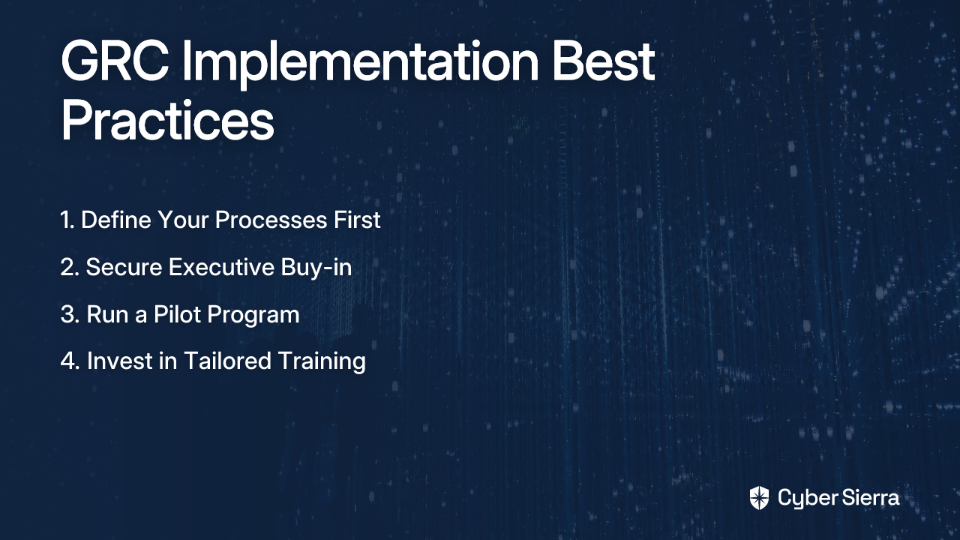
1. Define Your Processes First: Before you shop for a tool, map out your current GRC workflows. Identify bottlenecks and clarify roles and responsibilities. The tool should support your process, not the other way around. This reflects good process maturity.

2. Secure Executive Buy-in: Ensure management understands the value and supports the adoption of the GRC platform. Without leadership support, even the best platform will struggle to gain traction.

3. Run a Pilot Program: Start with a small, focused implementation to test the platform and refine your processes before a full-scale rollout. This allows you to identify and address issues before they affect the entire organization.

4. Invest in Tailored Training: Develop training programs specific to your organization's use cases and workflows to ensure effective adoption. As one Reddit user noted, there's often a "lack of standardized training" for GRC platforms, so creating custom training is essential.

Conclusion

For distributed security teams, the right GRC platform is a force multiplier. It breaks down silos, automates manual work, and provides a unified view of risk and compliance across the entire organization.

The platforms listed here offer a powerful starting point. The best choice will be the one that not only has the right features but also aligns perfectly with your organization's unique processes, culture, and scale.

By prioritizing centralization, automation, and a strong process foundation, organizations can transform their GRC program from a reactive chore into a strategic advantage. Platforms like Cyber Sierra are built from the ground up to provide this unified, intelligent approach to modern cybersecurity management, particularly valuable for organizations with distributed security teams navigating today's complex risk landscape.

blog-hero-background-image
Governance & Compliance

Top 7 GRC Platforms Built Specifically for APAC Compliance Requirements

backdrop
Table of Contents

Join thousands of professionals and get the latest insight on Compliance & Cybersecurity.


Summary

  • Managing compliance across the diverse APAC region with spreadsheets is inefficient and risky due to the complex, ever-changing regulatory landscape.
  • Specialized GRC platforms automate critical tasks like data collection, control monitoring, and third-party risk management, transforming compliance into a strategic advantage.
  • To choose the right platform, evaluate its APAC-specific features, integration capabilities, user-friendliness, and vendor support within the region.
  • Cyber Sierra’s GRC platform uses AI to automate compliance and help organizations proactively manage risk across multiple jurisdictions.

Are you drowning in spreadsheets while trying to manage compliance across multiple APAC jurisdictions? You're not alone. Many compliance professionals find themselves trapped in a cycle of "Excel + ServiceNow or Sheets + JIRA, with emails containing 'APPROVED' sprinkled throughout" — creating a fragmented, inefficient approach to governance, risk, and compliance.

The Asia-Pacific region presents unique compliance challenges with its diverse regulatory landscape, varying data privacy laws, and industry-specific requirements. Manual approaches simply cannot keep up with this complexity, especially when your team is struggling with collaboration issues like "needing to add updates but Joe has it open."

Fortunately, specialized GRC platforms can transform your compliance efforts from reactive checkbox exercises into strategic, automated processes. These platforms are built specifically to address the nuanced requirements of operating in the APAC region while eliminating the frustration of tools that "didn't deliver as promised."

Let's explore the top seven GRC platforms that are specifically designed to meet APAC compliance requirements, helping you move beyond spreadsheet chaos to achieve true compliance excellence.

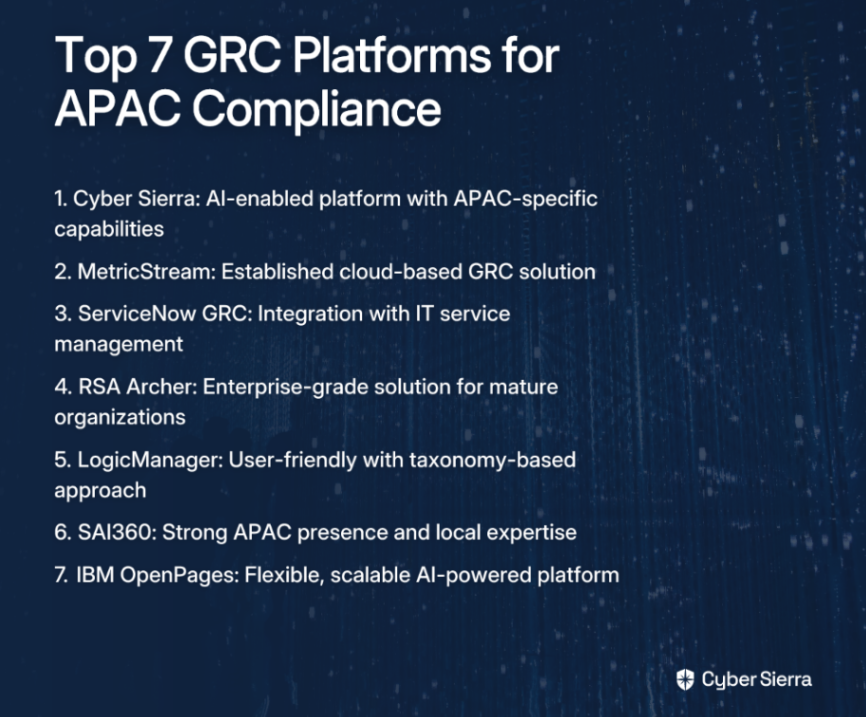
1. Cyber Sierra

Overview: Cyber Sierra offers an AI-enabled cybersecurity platform that simplifies and automates security compliance for enterprises operating in APAC. Unlike generic GRC tools, Cyber Sierra's platform is designed to address the specific challenges of managing complex regulatory requirements across different Asian jurisdictions.

Key APAC-Relevant Features:

  • Governance, Risk & Compliance (GRC) Module: Automates data collection, risk assessments, and reporting for multiple frameworks including SOC2, ISO 27001, and region-specific regulations. This automation significantly reduces the manual effort that often leads to "compliance fatigue."
  • Continuous Control Monitoring (CCM): Provides ongoing visibility into security controls, eliminating the need for periodic, manual evidence gathering that plagues many compliance programs in the region.
  • Third-Party Risk Management (TPRM): Particularly valuable in APAC's interconnected supply chains, this module simplifies vendor risk assessment and provides near real-time monitoring beyond point-in-time questionnaires.
  • Cyber Insurance Integration: Helps organizations demonstrate cyber hygiene to insurers, potentially leading to better premiums — a significant advantage in APAC's emerging cyber insurance market.

Target Audience: CISOs, Compliance Managers, and Risk professionals in APAC's key industries like BFSI, HealthTech, Manufacturing, and Technology.

2. MetricStream

Overview: A well-established, cloud-based GRC platform recognized for its integrated approach to risk, compliance, audit, and cybersecurity. MetricStream has made significant investments in understanding APAC's regulatory landscape.

Key APAC-Relevant Features:

  • AI-Powered Regulatory Change Management: Helps organizations stay on top of regulatory changes across multiple APAC jurisdictions.
  • ESG Compliance Capabilities: Strong features for managing Environmental, Social, and Governance (ESG) compliance, which is becoming increasingly important for corporations operating in Singapore, Australia, and other APAC markets.
  • Low-Code/No-Code Platform: Allows for customization to meet specific regional regulations without extensive development resources.

Target Audience: Large enterprises looking for a comprehensive, all-in-one GRC solution with advanced analytics capabilities and a strong understanding of APAC regulations.

3. ServiceNow GRC

Overview: Leveraging its powerful IT Service Management foundation, ServiceNow offers a comprehensive GRC solution that excels at integrating risk and compliance into daily operational workflows.

Key APAC-Relevant Features:

  • Integrated Risk Management: Connects risk management with incident response and business continuity planning, providing a unified view across APAC operations.
  • Real-time Monitoring: Offers continuous monitoring of controls and policies, automating compliance evidence collection across different jurisdictions.
  • No-Code Playbooks: Enables teams to quickly adapt processes to new regulations or internal policies without extensive development, crucial in APAC's dynamic regulatory environment.

Target Audience: Organizations already invested in the ServiceNow ecosystem that want to extend its capabilities to manage governance, risk, and compliance across APAC operations.

4. RSA Archer

Overview: An established, enterprise-grade GRC solution known for its depth and scalability. Often described as the "SAP of GRC tools," Archer is "a beast of a tool that is only realistic for a more mature GRC org with dedicated staff."

Key APAC-Relevant Features:

  • Integrated Risk Management: Focuses heavily on operational risk, vendor risk, and IT security risk management across multiple jurisdictions.
  • Customizable Reporting: Features intuitive dashboards and highly flexible reporting tools to meet varied stakeholder needs across different APAC countries.
  • Automated Regulatory Mapping: Maps new regulatory requirements to existing controls to proactively identify gaps - particularly valuable as APAC regulations continue to evolve.

Target Audience: Large, mature multinational corporations with complex risk environments and dedicated GRC teams operating across multiple APAC countries.

5. LogicManager

Overview: A risk management platform focused on usability and helping organizations build a sustainable, risk-based GRC program. Its taxonomy-based approach helps connect risks across the organization.

Key APAC-Relevant Features:

  • Customizable Dashboards: Allows organizations to tailor reporting to specific APAC regulations and internal policies.
  • Intelligent Risk Assessment: Uses historical data to suggest risk ratings, improving consistency and efficiency across regional operations.
  • Predictive Control Effectiveness: AI-driven features predict potential control failures, enabling proactive remediation before compliance issues arise.

Target Audience: Mid-to-large enterprises seeking a user-friendly platform that can be adapted to their specific risk and compliance maturity level while operating in APAC markets.

6. SAI360

Overview: A GRC software provider with a strong presence in the APAC region, recognized for its excellence in risk and compliance management specifically tailored to local requirements.

Key APAC-Relevant Features:

  • Local Expertise: Represented by partners like GRC Partners Asia, indicating a deep focus and understanding of the local regulatory landscape.
  • Integrated Solutions: Covers a wide range of GRC areas, including ethics and compliance learning, Environment, Health, Safety & Sustainability (EHS&S), and risk management with specific APAC considerations.
  • Regional Support: Offers support in local time zones with professionals who understand the nuances of APAC compliance requirements.

Target Audience: Organizations in APAC looking for a GRC vendor with a dedicated regional focus and a broad portfolio of solutions.

7. IBM OpenPages

Overview: A highly flexible and scalable AI-powered GRC solution providing a unified platform for managing risk and compliance across the enterprise, with specific capabilities for APAC regulatory frameworks.

Key APAC-Relevant Features:

  • Flexible Architecture: Can be adapted to the complex and evolving regulatory landscapes found across different APAC countries, from Australia's privacy laws to Singapore's cybersecurity requirements.
  • AI-Driven Insights: Uses AI to provide predictive insights, automate workflows, and enhance decision-making with region-specific intelligence.
  • Integrated Data and Workflow: Centralizes all GRC activities, breaking down data silos between departments like internal audit, compliance, and risk across regional operations.

Target Audience: Large enterprises, particularly in regulated industries like finance and healthcare, that require a powerful, configurable, and AI-driven GRC platform across APAC operations.

How to Choose the Right GRC Platform for Your APAC Business

Selecting the appropriate GRC platform for your organization's APAC operations is critical. Here's a practical guide to making an informed decision:

1. Define Your Core Needs and Objectives

Start by asking: "What problem are you trying to solve? What are the goals of the company?" Are you focused on achieving a specific certification like ISO 27001 or SOC 2? Is Third-Party Risk Management your biggest pain point in the region? Or do you need a comprehensive enterprise risk management framework that spans multiple APAC jurisdictions?

Clearly defining your goals is the first step to avoid investing in a platform that "didn't deliver as promised."

2. Assess Functionality and Integration

Look for platforms that offer modules that match your specific APAC compliance needs. Crucially, evaluate the platform's ability to integrate with your existing systems - cloud providers like AWS/Azure, security tools, and HR systems used across your regional operations. Poor integration capability is a common challenge that leads to the continued reliance on spreadsheets.

3. Prioritize User-Friendliness and Configurability

A powerful tool is useless if your team avoids using it. Look for an intuitive interface, customizable dashboards, and no-code/low-code workflows to avoid the feeling that "they are basically all GRC SaaS and you are just paying to use it." The right platform should adapt to your organization's workflows, not force you to change them.

4. Scrutinize the Pricing Model

Many users are wary of GRC tools because they "all cost absurd amounts" and have complex pricing structures. Ask for transparency in pricing. Is it based on the number of users, vendors, or controls? Look for flat-rate models where possible to avoid "paying extra for every little thing," especially when scaling across multiple APAC countries.

5. Evaluate Vendor Support and Regional Presence

For APAC operations, having support in your time zone and a vendor that understands local regulations is a significant advantage. Check for local partners or direct presence in the region to ensure you'll receive the support you need when navigating complex compliance challenges.

Conclusion

The APAC compliance landscape presents unique challenges with its diverse regulatory environment, varying data privacy laws, and industry-specific requirements. Moving away from "so many spreadsheets" to a specialized GRC platform is essential for organizations serious about effective governance, risk management, and compliance in the region.

Modern GRC platforms help organizations transition from reactive, spreadsheet-driven compliance to proactive, automated, and intelligent risk management. By centralizing data, automating control monitoring, and providing real-time insights specific to APAC regulations, these platforms not only ensure compliance but also build more secure and resilient organizations.

Among the options available, Cyber Sierra stands out for its AI-enabled approach specifically designed with APAC compliance in mind. Its comprehensive suite of modules addresses the full spectrum of GRC needs while eliminating the frustrations of manual processes and disjointed tools. By leveraging automation and continuous monitoring, Cyber Sierra helps organizations stay ahead of the complex and evolving APAC regulatory landscape.

Whether you choose Cyber Sierra or another platform from this list, the key is to select a solution that aligns with your specific needs, integrates with your existing systems, and provides the right level of support for your APAC operations. With the right GRC platform, you can transform compliance from a burdensome cost center into a strategic enabler that protects your organization while supporting business growth across the Asia-Pacific region.

Frequently Asked Questions

What is a GRC platform and why is it important for APAC businesses?

A GRC (Governance, Risk, and Compliance) platform is a centralized software solution that helps organizations manage risk and compliance obligations. It is particularly important for businesses operating in the Asia-Pacific region due to the diverse and complex regulatory landscape, which makes manual tracking with spreadsheets inefficient and prone to error.

Why are spreadsheets not suitable for managing compliance in the APAC region?

Spreadsheets are unsuitable for managing APAC compliance because they lack the ability to scale, offer poor collaboration features, and cannot provide real-time visibility into compliance posture. For companies operating across multiple jurisdictions, spreadsheets create data silos, are prone to human error, and make it difficult to automate evidence collection, which is crucial for staying on top of the region's ever-changing regulations.

What are the key features to look for in a GRC platform for APAC compliance?

When selecting a GRC platform for APAC, look for key features such as a library of pre-built templates for regional regulations (e.g., Singapore's PDPA, Australia's Privacy Act), continuous control monitoring to automate evidence collection, and robust third-party risk management capabilities to handle complex supply chains. Additionally, customizable dashboards and reporting are essential for communicating compliance status to stakeholders across different countries.

How does a GRC platform help with specific APAC regulations?

A GRC platform helps with specific APAC regulations by mapping its controls to your organization's internal policies and processes. For example, it can automate the process of gathering evidence for ISO 27001 certification or provide real-time alerts if a control related to a specific data privacy law fails. This simplifies audit preparation and ensures you remain compliant with local requirements.

What is the benefit of an AI-enabled GRC platform?

An AI-enabled GRC platform uses artificial intelligence to automate repetitive tasks, provide predictive insights into potential risks, and streamline decision-making. For instance, AI can help automatically map new regulatory requirements to existing controls, identify potential compliance gaps before they become issues, and significantly reduce the manual effort required from your compliance team, allowing them to focus on more strategic initiatives.

How can my organization start the process of choosing and implementing a GRC platform?

To begin, clearly define your core compliance objectives, such as achieving a specific certification or improving vendor risk management. Next, identify key stakeholders to involve in the selection process. Evaluate potential vendors based on their APAC-specific functionality, integration capabilities with your existing tools, and user-friendliness. Finally, request a demo or pilot program to ensure the platform meets your specific needs before making a final decision.

If you're ready to leave behind the inefficiencies of manual GRC processes and embrace a smarter approach to compliance, explore how Cyber Sierra's AI-enabled platform can help you navigate the complex APAC market with confidence.

blog-hero-background-image
Governance & Compliance

How to Calculate the True Cost of Manual Compliance Processes

backdrop
Table of Contents

Join thousands of professionals and get the latest insight on Compliance & Cybersecurity.


Summary

  • Manual compliance has significant hidden costs, including wasted labor and diverted engineering resources; the average cost of non-compliance ($15 million) is nearly triple the cost of being compliant ($5.5 million).
  • Manual evidence gathering for audits consumes significant resources, with engineers often spending 40-60 hours per framework, diverting them from critical growth and innovation projects.
  • Calculate your organization's "Manual Compliance Tax" by quantifying the costs of labor drain, lost opportunities, and risk exposure to build a strong business case for automation.
  • Automating compliance with a platform like Cyber Sierra's GRC module can reduce manual effort by up to 75%, eliminate audit fire drills, and provide continuous, real-time visibility into your security posture.

You've been there before. It's audit season, and suddenly your entire organization is thrown into chaos. Engineers are pulled off critical projects to take screenshots of AWS configurations. Your inbox is flooded with requests for policy documentation that's scattered across shared drives. Teams are spending hours in meetings trying to track down evidence that should be readily available.

This "audit fire drill" isn't just frustrating—it's costing your organization far more than you realize.

"Over several years, I probably spent 400+ hours manually documenting infrastructure configurations, taking screenshots of AWS console settings, and writing policies that felt disconnected from actual operational work," shares one DevOps engineer on Reddit. "The entire process felt antithetical to everything we try to achieve in DevOps - it was manual, error-prone, and didn't scale."

The visible costs of compliance—spreadsheets, documentation tools, and even compliance platforms—are merely the tip of the iceberg. Beneath the surface lies a massive structure of hidden costs that drain resources, stifle growth, and expose your organization to significant risk.

This article will provide a framework for calculating the true, all-in cost of manual compliance processes, helping you build the business case for a more efficient approach.

Beyond the Obvious: Unpacking the Hidden Costs of Manual Compliance

To fully understand what manual compliance is costing your organization, we need to categorize expenses into four distinct buckets:

Direct Costs (The Tip of the Iceberg)

These are the most visible expenses:

  • Salaries and time allocation for compliance personnel, IT managers, and engineers dedicated to manual compliance tasks
  • Tools and subscriptions for spreadsheets, document storage, and project management tools used for compliance tracking
  • External audits and consultants whose fees are often inflated due to disorganized evidence and inefficient preparation

While these expenses show up clearly in your budget, they represent only a fraction of what manual compliance is really costing you.

Indirect Costs (The Labor Drain)

This is where the expenses start to multiply:

  • Time spent on manual tasks: Manual compliance consumes an estimated 10-20+ hours per administrator per month across departments, according to Compliancy Group. For a typical startup, manual compliance work can take 40-60 hours of engineering time per framework.
  • Disjointed workflows: Siloed functions and disconnected systems lead to duplicated efforts where different teams gather the same information, wasting valuable time and resources.
  • Audit preparation chaos: The frantic, last-minute rush to gather evidence—what many call the "fire drill factor"—leads to immense stress and wasted hours. As one security professional notes, "The most painful part of an audit is typically evidence gathering. You end up on long calls with engineers who may or may not speak GRC and hope they remember where to find a config and take a screenshot with a time stamp."

Opportunity Costs (The Growth Bottleneck)

These costs represent what your business could be achieving but isn't:

  • Diverted engineering resources: "The breaking point came when I had to implement both SOC2 and ISO 27001 simultaneously," shares another engineer. "Three months of engineering time that could have been spent on infrastructure improvements or reliability work."
  • Inability to scale: As organizations grow, manual systems become unmanageable, leading to lost efficiency, increased headcount needs, and inconsistent compliance. This acts as a significant growth bottleneck for many businesses.

Risk-Associated Costs (The Ticking Time Bomb)

These potentially devastating expenses often go uncalculated:

  • Cost of human error: Manual tracking leads to missed deadlines, incomplete training, and documentation gaps, resulting in compliance failures and increased liability.
  • Fines and penalties: Disorganized documentation during an audit can risk fines of up to $60,000+ per violation according to Compliancy Group. A directory of HIPAA fines shows just how costly these violations can become.
  • The cost of non-compliance vs. compliance: According to Investopedia, the average cost of non-compliance is approximately $15 million, compared to $5.5 million for compliance costs. That's a potential $9.5 million difference—the ultimate financial argument for getting compliance right.
  • Reputational damage: Perhaps the most difficult to quantify but potentially the most severe is the loss of customer trust, negative press, and lost business opportunities that can result from compliance failures.

Your Calculator: A Step-by-Step Framework to Quantify the Damage

Now that we've identified the categories of costs, let's build a practical framework to calculate your organization's true cost of manual compliance:

True Cost = Direct Costs + Labor Drain Cost + Opportunity Cost + Risk Exposure

Step 1: Calculate the Annual Labor Drain Cost

Labor Cost = (Number of Employees) × (Avg. Hours Spent on Compliance/Month) × (Avg. Blended Hourly Rate) × 12

Example: If 5 employees spend 15 hours/month each on compliance tasks at an average rate of $75/hour, your annual labor drain is:

5 × 15 × $75 × 12 = $67,500 per year

That's nearly $70,000 in productivity lost to manual compliance processes every year.

Step 2: Calculate the Annual Opportunity Cost

Opportunity Cost = (Total Engineering Hours Spent on Compliance) × (Value of Engineering Hour)

Example: If your engineering team spends 3 months (approximately 480 hours) implementing SOC2 and ISO 27001 requirements, and an engineering hour generates $300 in value through new features or improvements, your opportunity cost is:

480 × $300 = $144,000

That's $144,000 in potential revenue or improvements that never materialized because your engineers were busy with manual compliance tasks.

Step 3: Quantify Your Risk Exposure

Risk Exposure = (Potential Fine per Violation) × (Number of Potential Violations) × (Likelihood %)

Example: If your industry faces potential fines of $50,000 per violation, you identify 10 areas where manual processes could lead to violations, and you estimate a 5% likelihood of occurrence, your risk exposure is:

$50,000 × 10 × 5% = $25,000

This conservative estimate doesn't account for reputational damage or loss of business, which could multiply this figure significantly.

Step 4: Put It All Together

Adding up our example calculations:

$67,500 (Labor) + $144,000 (Opportunity) + $25,000 (Risk) + Direct Costs = Total "Manual Compliance Tax"

Even before accounting for direct costs like tools and external auditors, we're already looking at over $236,500 in hidden expenses annually for a relatively small team.

Breaking the Cycle: How Automation Transforms Compliance

Compliance automation uses technology to streamline and standardize the process of meeting regulatory requirements like SOC2, ISO 27001, HIPAA, and PCI DSS. It minimizes human error, saves time, and reduces compliance risks by transforming manual processes into automated workflows.

Here's how automation directly addresses the cost categories we've identified:

Reduces Labor Drain

Automation dramatically cuts the time spent on evidence collection and documentation. One engineer who implemented automation reported that their workload dropped from 40-60 hours per framework to just 10-15 hours—a 75% reduction.

Eliminates the "Fire Drill Factor"

With centralized, always-on documentation and continuous monitoring, your organization is audit-ready at any moment. No more last-minute scrambles to gather evidence or pull engineers away from critical projects.

Unlocks Growth

Scalable automated systems adapt to organizational changes and new regulations without needing to add headcount. This allows your business to grow without a proportional increase in compliance overhead.

Mitigates Risk

Continuous monitoring identifies gaps in real-time, preventing failures before they happen. This proactive approach significantly reduces the likelihood of fines, penalties, and reputational damage.

How Cyber Sierra Addresses These Challenges

Platforms like Cyber Sierra offer an integrated approach to tackling these compliance challenges. Instead of periodic, manual checks, Cyber Sierra enables proactive, near real-time risk management through several key modules:

For Evidence Gathering & Audit Readiness

The Governance, Risk & Compliance (GRC) module automates data collection, maintains detailed audit trails, and manages multiple compliance frameworks (SOC2, ISO 27001, HIPAA, etc.) from a single dashboard. This directly addresses what many professionals call "the most painful part of an audit"—evidence gathering.

For Real-time Visibility

The Continuous Control Monitoring (CCM) feature provides ongoing visibility into security controls, eliminating siloes and blind spots. It builds a central controls repository with near real-time updates, transforming security from periodic checks to continuous, automated monitoring.

For Vendor Risk

The Third-Party Risk Management (TPRM) module simplifies vendor risk assessment and continuous monitoring, helping enterprises evaluate and mitigate risks associated with their supply chain. This addresses the challenges in managing numerous vendor questionnaires and tracking remediation efforts.

How to Automate a Compliance Process

If you're ready to move away from manual processes, here's a high-level approach:

  1. Evaluate Existing Policies: Understand your current processes and map regulatory requirements to your specific context.
  2. Integrate with Automation Tools: Choose tools that connect to your tech stack for automated evidence collection, reducing the manual burden of screenshot-taking and configuration documentation.
  3. Create a Strategic Plan: Define objectives and timelines for your compliance automation journey.
  4. Train Employees: Ensure everyone understands the new, streamlined process and how it benefits both them and the organization.
  5. Enable Continuous Monitoring: Shift from point-in-time checks to real-time surveillance, allowing for proactive risk management.

Conclusion: Stop Paying the Manual Compliance Tax

The true cost of manual compliance is a combination of direct expenses, massive labor drain, lost opportunities, and significant unmanaged risk. As we've seen through our calculation framework, this "Manual Compliance Tax" can easily reach hundreds of thousands of dollars annually, even for relatively small organizations.

The cost of inaction—sticking with manual processes—is demonstrably higher than investing in an automation platform. With non-compliance costs averaging $15 million compared to $5.5 million for compliance costs according to Investopedia, the financial argument for modernizing your approach is clear.

By automating your compliance processes, you not only save significant costs but also transform compliance from a burdensome obligation into a strategic advantage. Your engineers can focus on innovation rather than screenshots, your security team can proactively manage risk rather than react to crises, and your compliance professionals can provide strategic guidance rather than chase documentation.

Take the first step today: Use the framework in this article to calculate your own organization's Manual Compliance Tax. Then explore how a platform like Cyber Sierra can deliver significant ROI by automating these burdensome processes and freeing your team to focus on what matters most—growing your business securely.

Frequently Asked Questions

What is compliance automation?

Compliance automation is the use of technology to streamline, standardize, and continuously monitor the processes required to meet regulatory and security standards. It transforms manual, time-consuming tasks like evidence collection, policy management, and risk assessments into automated workflows, minimizing human error and providing real-time visibility into your compliance posture.

Why is manual compliance so costly?

Manual compliance is costly because its true price extends far beyond salaries and tools. The major expenses are hidden and fall into four categories: direct costs (tools, auditors), indirect costs (wasted employee time on repetitive tasks), opportunity costs (engineers spending months on compliance instead of product innovation), and risk-associated costs (potential fines, reputational damage from human error).

How do you calculate the true cost of compliance?

You can calculate the true cost of compliance by using the "Manual Compliance Tax" formula: True Cost = Direct Costs + Labor Drain Cost + Opportunity Cost + Risk Exposure. This involves quantifying the hours your team spends on manual tasks, the value of projects delayed due to compliance work, and your financial exposure to potential fines from compliance gaps.

What are the main benefits of automating compliance?

The main benefits of automating compliance are drastic cost savings, improved operational efficiency, and reduced risk. Automation cuts the labor required for compliance by up to 75%, eliminates the last-minute "fire drill" before an audit, allows your business to scale without a proportional increase in compliance overhead, and provides continuous monitoring to prevent violations before they occur.

How can a small business start with compliance automation?

A small business can start with compliance automation by following a structured approach. Begin by evaluating your current policies and identifying the most burdensome manual tasks. Next, integrate with an automation platform that connects to your tech stack, create a strategic implementation plan, train your team on the new workflows, and enable continuous monitoring to stay audit-ready.

What types of compliance frameworks can be automated?

Compliance automation platforms can manage a wide variety of security and privacy frameworks. The most common frameworks that businesses automate include SOC 2, ISO 27001, HIPAA, PCI DSS, GDPR, and CCPA. Advanced platforms like Cyber Sierra allow you to manage controls across multiple frameworks from a single, centralized dashboard, saving significant effort.

Book a demo with Cyber Sierra to see how automation can be tailored to your specific compliance needs and start reducing your Manual Compliance Tax today.

blog-hero-background-image
Governance & Compliance

How to Benchmark Your GRC Maturity Against Industry Standards

backdrop
Table of Contents

Join thousands of professionals and get the latest insight on Compliance & Cybersecurity.


Summary

  • Fewer than 15% of organizations have mature Governance, Risk, and Compliance (GRC) programs, yet those that do can achieve over 200% ROI.
  • A mature GRC program transforms your role from a tactical enforcer into a strategic advisor by providing data-driven insights that cut through organizational politics.
  • Benchmark your GRC maturity by conducting a self-assessment, defining key metrics (KPIs & KRIs), and performing a gap analysis to create an actionable improvement roadmap.
  • Accelerate your GRC maturity by leveraging automation; platforms like Cybersierra's GRC solution can automate evidence collection, streamline audits, and provide real-time visibility.

You've spent countless hours setting up policies, documenting controls, and chasing stakeholders for evidence—all while being cast as the organizational "bad guy" enforcing rules nobody seems to appreciate. The politics are exhausting, technical teams question your expertise, and sometimes you wonder if all this manual effort is actually moving the needle on your organization's security posture.

If this sounds familiar, you're not alone. The reality is that fewer than 15% of organizations worldwide have developed mature governance, risk, and compliance (GRC) capabilities. The good news? A mature GRC program can transform your role from compliance enforcer to strategic advisor—and benchmarking your current maturity is the first step toward getting there.

This guide will walk you through a practical, step-by-step approach to benchmarking your GRC maturity against industry standards, helping you understand where your organization stands and how to create a roadmap for improvement.

Why GRC Maturity is More Than Just a Buzzword

Before diving into benchmarking methodologies, let's be clear about why GRC maturity matters in tangible terms:

From Enforcer to Influencer

A mature GRC program shifts the conversation from enforcing rules to providing data-driven risk insights. Instead of being the person who always says "no," you become the strategic advisor who helps the organization make informed decisions based on risk data.

As one cybersecurity professional noted in a Reddit discussion, "Engineers by default think you are an idiot and you will work up from there." Mature GRC programs help bridge this gap by providing objective data rather than subjective opinions.

Cutting Through the Politics

The same discussion highlighted that "there is an obscene amount of politics that happens before they agree to fix/improve something." A mature GRC program provides objective benchmarks and metrics that can dismantle political roadblocks by clearly demonstrating risk exposure and compliance gaps.

When your recommendations are backed by standardized frameworks and quantifiable metrics, they become harder to dismiss as merely opinions or preferences.

The Financial Case for Maturity

The ROI of mature GRC is substantial:

  • Integrated GRC strategies can yield over 200% ROI over five years
  • Organizations lose approximately $1 trillion annually to errors and misconduct that could be prevented through mature GRC programs
  • Companies adopting compliance technology save an average of $1.02 million in costs

These figures, reported by Cycore Secure, make a compelling business case for investing in GRC maturity.

Decoding GRC Maturity Models: Finding Your Place on the Map

GRC maturity models provide standardized frameworks for assessing capabilities and planning improvements. While several models exist, one widely adopted framework is the OCEG GRC Capability Model (also known as the "Red Book").

The OCEG model typically outlines five maturity levels:

  1. Initial (Ad hoc): GRC activities are reactive, siloed, and lack standardization
  2. Repeatable (Fragmented): Some processes are documented and repeatable, but remain disconnected
  3. Defined (Integrated): GRC processes are documented and standardized across the organization
  4. Managed (Aligned): GRC activities are measured, controlled, and aligned with business objectives
  5. Optimizing (Intelligent): Continuous improvement is embedded, with proactive risk management and real-time monitoring

Other relevant frameworks that can inform your maturity assessment include:

  • NIST Cybersecurity Framework (CSF): A risk-based approach for managing cybersecurity risk that can be used to assess security program maturity (NIST)
  • ISO 31000: A principles-based model for integrating risk management across the organization (ISO)

Understanding these models helps establish a common language and framework for assessing your current state and planning your maturity journey.

Your 3-Step Guide to Benchmarking GRC Maturity

Step 1: Conduct a Thorough Self-Assessment

Begin with a comprehensive evaluation of your current GRC capabilities:

Examine governance structures:

  • Who are the key stakeholders in your GRC program?
  • Are roles and responsibilities clearly defined and understood?
  • How effective are your communication processes for risk and compliance issues?

Assess risk management processes:

  • How are risks identified, categorized, and prioritized?
  • Is your risk management process aligned with the organization's risk appetite?
  • Do you have a formal risk register with clear ownership and remediation timelines?

Evaluate compliance management:

  • Which regulations are applicable to your organization?
  • Are internal policies current and aligned with external requirements?
  • Are your reporting capabilities sufficient for both internal and external audits?

This assessment should involve key stakeholders from across the organization to ensure a comprehensive view of your current state.

Step 2: Utilize Metrics to Measure What Matters (KPIs & KRIs)

Effective benchmarking requires objective measurements. The key is distinguishing between Key Performance Indicators (KPIs) that measure program effectiveness and Key Risk Indicators (KRIs) that measure risk exposure.

When defining metrics, apply SMART principles (Specific, Measurable, Actionable, Relevant, Timely) and consider these examples:

KPI examples:

  • Time to close audit findings
  • Percentage of employees completing security training
  • Number of policy exceptions granted
  • Average time to respond to compliance requests

KRI examples:

  • Number of high-risk vulnerabilities unpatched after 30 days
  • Rate of phishing simulation failures
  • Number of third parties with access to sensitive data
  • Frequency of control testing failures

These metrics provide quantifiable data points for tracking progress and comparing against industry benchmarks.

Step 3: Perform a Gap Analysis

With your assessment complete and metrics established, the next step is identifying gaps between your current state and desired maturity level:

Define the scope: Focus on specific regulations (e.g., GDPR, SOC2) or processes (e.g., vendor onboarding) rather than trying to tackle everything at once.

Collect documentation: Gather policies, procedures, risk registers, and control evidence to support your analysis.

Identify gaps: Compare your current state (from the self-assessment) against the desired future state or industry standard (from the maturity models).

Create a focused action plan: Prioritize high-risk areas first to deliver the most impact. Break down the plan into manageable phases with clear ownership and timelines.

Accelerating Maturity with Automation and AI

One of the most significant pain points in GRC is the manual nature of many processes. As one professional put it in a Reddit thread, "Some people really like excel forms"—but most don't.

Modern GRC maturity increasingly depends on leveraging automation and AI to move beyond periodic, manual checks to continuous, real-time monitoring. 62% of organizations report improved compliance efficiency with AI-enhanced GRC processes.

Key technologies driving GRC maturity include:

Continuous Control Monitoring (CCM)

CCM provides real-time visibility into security controls, detecting gaps automatically instead of relying on point-in-time assessments. Gartner predicts that by 2025, over 50% of major enterprises will use AI for this purpose.

Platforms like Cyber Sierra's Continuous Control Monitoring (CCM) module centralize controls, automate testing, and provide a single source of truth, drastically reducing manual evidence gathering for audits. This moves security from periodic, manual checks to continuous, automated verification—a hallmark of mature GRC programs.

Integrated GRC Platforms

Managing multiple compliance frameworks (SOC2, ISO 27001, HIPAA, etc.) manually is inefficient and error-prone. Modern GRC platforms automate data collection, risk assessments, and reporting across frameworks.

An integrated solution, such as Cyber Sierra's GRC platform, can streamline these complex requirements, making your organization audit-ready and reducing compliance fatigue. The platform automatically maps controls across frameworks, eliminating redundant work and providing a unified view of your compliance posture.

Intelligent Third-Party Risk Management (TPRM)

Third-party risk is a significant concern for many organizations. As one cybersecurity professional noted, "you can't trust the third party didn't just lie" during assessments. AI-driven TPRM automates vendor assessments and provides continuous monitoring of vendor security posture.

Cyber Sierra's TPRM module simplifies this entire lifecycle, from onboarding to continuous monitoring, ensuring your supply chain doesn't become your biggest vulnerability. The platform automates questionnaire processes, prioritizes vendors based on risk, and provides near real-time visibility into vendor compliance.

From Assessment to Action: Building Your GRC Improvement Roadmap

Benchmarking is only valuable if it leads to actionable improvements. Here's how to translate your gap analysis into a concrete plan:

Set Actionable Goals

Use your assessment results to define clear, prioritized objectives. For example:

  • Implement automated control testing for critical systems within six months
  • Establish a centralized policy management system by Q3
  • Reduce the time to close high-risk audit findings by 50%

Foster Cross-Functional Buy-In

GRC is a team sport. Share your data and plan with leadership and other departments to align resources and priorities. This directly tackles the "politics" that often delay improvements.

Present your benchmark findings to executives in terms of business risk and opportunity, not just technical compliance requirements. When stakeholders understand how mature GRC supports their objectives, resistance decreases.

Prioritize High-Impact Projects

Focus on quick wins that address critical risks or deliver immediate efficiency gains. This builds momentum and demonstrates value early in your maturity journey.

For example, automating evidence collection for your most time-consuming compliance activities can quickly demonstrate ROI while building support for more extensive improvements.

Conclusion: From Benchmark to Business Advantage

Benchmarking your GRC maturity is not a one-time project but a continuous cycle of assessment, action, and improvement. By following the three-step process outlined here—self-assessment, metrics definition, and gap analysis—you can create a clear roadmap for advancing your program.

As you progress in your maturity journey, your role will transform from a tactical function to a strategic business enabler. Instead of being seen as the "bad guy" enforcing rules, you'll become a trusted advisor helping the organization navigate complex risk landscapes.

The most mature GRC programs leverage the right frameworks, processes, and technology to transform GRC from a burden into a competitive advantage. By benchmarking your current state and systematically closing gaps, you can join the elite 15% of organizations with truly mature GRC capabilities—and deliver significant value to your organization in the process.

Frequently Asked Questions

What is a GRC maturity model?

A GRC maturity model is a standardized framework used to assess an organization's Governance, Risk, and Compliance capabilities against a defined set of levels, from ad-hoc and reactive to fully optimized and proactive. These models, such as the OCEG GRC Capability Model, provide a clear roadmap for improvement by outlining specific characteristics for each stage of maturity. This allows organizations to benchmark their current state, identify gaps, and plan strategic enhancements to their GRC programs.

Why is improving GRC maturity important?

Improving GRC maturity is important because it transforms GRC from a cost center into a strategic business advantage, leading to better decision-making, reduced risk, and significant financial ROI. A mature GRC program helps professionals shift from being rule enforcers to strategic advisors who provide data-driven insights. It cuts through organizational politics with objective data, reduces losses from errors and misconduct, and can yield an ROI of over 200% by integrating risk management with business objectives.

How do you measure GRC maturity?

You can measure GRC maturity by conducting a three-step benchmarking process: perform a thorough self-assessment of current capabilities, define relevant metrics (KPIs and KRIs) to track performance and risk, and conduct a gap analysis against a chosen maturity model. The self-assessment involves evaluating governance structures, risk management processes, and compliance activities. Metrics should be SMART (Specific, Measurable, Actionable, Relevant, Timely) to provide objective data. The final gap analysis compares your current state to your desired future state, forming the basis of your improvement roadmap.

What are the typical levels in a GRC maturity model?

GRC maturity models typically feature five levels: Initial (ad-hoc and reactive), Repeatable (some processes are documented but siloed), Defined (standardized processes across the organization), Managed (activities are measured and aligned with business goals), and Optimizing (proactive, continuous improvement). As an organization matures, processes become more standardized, integrated, and data-driven. The highest level, Optimizing, is characterized by the use of real-time monitoring and predictive analytics to manage risk proactively.

What is the role of automation in GRC?

Automation plays a critical role in advancing GRC maturity by replacing manual, error-prone tasks with continuous, real-time monitoring and streamlined workflows, which significantly improves efficiency and provides more accurate risk insights. Technologies like Continuous Control Monitoring (CCM) automate evidence collection for audits, integrated GRC platforms centralize compliance management across multiple frameworks, and AI-driven tools enhance third-party risk management. This frees up GRC professionals to focus on strategic risk analysis rather than manual data gathering.

What is the first step to creating a GRC improvement roadmap?

The first step to creating a GRC improvement roadmap is to conduct a comprehensive self-assessment and gap analysis to clearly understand your current state and identify the specific areas that require improvement. Before you can plan your journey, you need to know your starting point. This initial analysis provides the foundational data needed to define actionable goals, prioritize high-impact projects, and secure cross-functional buy-in by presenting a clear, data-backed case for change.

blog-hero-background-image
Governance & Compliance

Top 5 AI-Powered GRC Platforms for Enterprise Security in 2025

backdrop
Table of Contents

Join thousands of professionals and get the latest insight on Compliance & Cybersecurity.


Summary

  • Traditional GRC methods are inefficient, but AI can improve compliance efficiency by up to 62% by automating manual tasks like evidence collection.
  • AI transforms GRC from a reactive, periodic process into a proactive, continuous one using predictive analytics for risk forecasting and real-time control monitoring.
  • When choosing a platform, evaluate its core strengths and integration capabilities. For a unified solution that automates compliance, vendor risk, and continuous monitoring, explore Cyber Sierra's GRC platform.

You've just been asked to prepare 20 new security policies. Your inbox is flooded with vendor security questionnaires. Your team is drowning in manual evidence collection for the upcoming audit. And now leadership wants you to align everything with both ISO 27001 and NIST frameworks.

Sound familiar?

Traditional Governance, Risk, and Compliance (GRC) approaches are no longer sustainable in today's complex regulatory landscape. Manual, periodic, and reactive methods leave security teams perpetually behind—struggling with spreadsheets, drowning in documentation, and constantly playing catch-up.

The good news? Artificial intelligence is revolutionizing GRC, transforming it from a necessary burden into a strategic advantage. According to organizations implementing AI-assisted security automation, AI can improve compliance efficiency by up to 62%, dramatically reducing the time spent on manual tasks.

In this article, we'll explore the top 5 AI-powered GRC platforms of 2025, helping CISOs, Compliance Managers, and IT leaders make informed decisions about tools that can transform their security posture from reactive to predictive.

The Evolution of GRC: Why AI is Now Essential

Traditional GRC approaches face significant limitations:

  • Manual Evidence Collection: Teams spend countless hours gathering screenshots and documentation for audits
  • Point-in-Time Assessments: Security posture is evaluated periodically rather than continuously
  • Reactive Risk Management: Issues are addressed after they emerge rather than being prevented
  • Siloed Approaches: Separate tools for policy management, vendor risk, and compliance create disconnected views

AI is addressing these challenges through several key capabilities:

Natural Language Processing (NLP) is revolutionizing policy management by drafting, analyzing, and optimizing policies—addressing the overwhelming volume of documentation many teams face. As one GRC professional on Reddit noted, "I have a task to prepare a set of around 20 policies," highlighting the burden of high-volume policy creation.

Predictive Analytics enables organizations to forecast potential risks and compliance gaps before they materialize, shifting from reactive to proactive security posture management.

Automation streamlines evidence collection, control monitoring, and vendor assessments—dramatically reducing the "time-consuming nature of preparing security documentation" cited by many GRC professionals.

Let's explore the platforms leading this transformation.

The Top 5 AI-Powered GRC Platforms for 2025

1. Cyber Sierra: Leading the GRC Revolution

Overview: Cyber Sierra stands at the forefront of AI-enabled GRC, offering a comprehensive platform that simplifies and automates security compliance for enterprises. Recently recognized in the Gartner® Hype Cycle™ for Cyber-Risk Management 2024, Cyber Sierra's integrated approach addresses the fragmentation that plagues traditional GRC programs.

Key AI-Powered Capabilities:

  • Continuous Control Monitoring (CCM): Leverages AI to build a central controls repository with near real-time updates, automating control testing and validation to detect exceptions instantly. Gone are the days of manual evidence collection for audits—Cyber Sierra continuously monitors controls across multiple frameworks (NIST, ISO 27001, PCI DSS, GDPR).
  • Intelligent Policy Management: Utilizes natural language processing to draft, analyze, and manage policies, addressing the pain of being "overwhelmed by the high volume of policy creation" that many GRC professionals experience.
  • Automated Vendor Risk Management: Goes beyond point-in-time questionnaires with 24/7 visibility into third-party security compliance, automatically assessing vendors and prioritizing them based on risk levels.
  • Predictive Risk Intelligence: Combines vulnerability scanning (network and cloud) with AI analysis to forecast potential security issues before they impact the business.

Best For: Enterprises and SMBs in regulated industries (BFSI, HealthTech, Technology) seeking a unified platform to automate compliance, manage vendor risk, and gain continuous visibility into their security posture.

Client Testimonial: "Cyber Sierra's AI capabilities have transformed our approach to risk management, moving us from reactive firefighting to predictive, proactive security. What used to take weeks of manual work now happens automatically in the background." - CISO at a mid-sized fintech company

Learn More: Cyber Sierra Governance, Risk & Compliance

2. RiskLens: Precision in Cyber Risk Quantification

Overview: RiskLens focuses on translating complex cyber risks into financial terms, enabling business leaders to make data-driven decisions about security investments.

Key AI-Powered Capabilities:

  • Financial Impact Modeling: Uses AI to quantify potential financial losses from cyber risk scenarios, translating technical vulnerabilities into business impact.
  • Predictive Analytics: Leverages historical data to forecast the likelihood and cost of future risk events, helping prioritize mitigation efforts based on potential financial impact.
  • Automated Risk Scenario Generation: Employs machine learning to model unique risk scenarios tailored to an organization's specific profile and industry.

Best For: Organizations that need to justify security investments to boards and C-suites by communicating cyber risk in clear, financial language.

Learn More: RiskLens

3. OneTrust: The Privacy Management Leader

Overview: A specialized platform focusing on privacy, security, and data governance, OneTrust helps organizations navigate the increasingly complex landscape of data protection regulations.

Key AI-Powered Capabilities:

  • Automated Data Discovery: Employs AI-driven scanning and classification to identify sensitive data across the enterprise ecosystem, addressing the challenge of maintaining comprehensive data inventories.
  • Regulatory Change Management: Continuously monitors global regulations and uses AI to determine how regulatory changes impact organizational compliance requirements.
  • Smart Assessment Automation: Streamlines vendor and internal privacy assessments based on risk profiles, reducing the manual effort of questionnaire management.

Best For: Global organizations with a strong focus on data privacy and compliance with regulations like GDPR, CCPA, and other privacy frameworks.

Learn More: OneTrust

4. RSA Archer: The Flexible Enterprise-Grade GRC Suite

Overview: A highly established and configurable GRC platform known for its ability to manage a wide range of risks across large, complex enterprise environments.

Key AI-Powered Capabilities:

  • Intelligent Control Testing: Automatically identifies potential control gaps across multiple regulatory frameworks, simplifying compliance with overlapping requirements.
  • Risk-Based Prioritization: Analyzes vast datasets to help security teams focus on the most critical risks, improving resource allocation.
  • Automated Regulatory Mapping: Maps new and updated regulations to the organization's existing control library, reducing the manual effort of compliance management.

Best For: Large enterprises in highly regulated industries that require a deeply customizable, scalable, and powerful GRC solution with robust reporting capabilities.

Learn More: RSA Archer

5. LogicManager: Usability Meets Practical AI

Overview: A user-friendly GRC platform that emphasizes usability and practical application of AI to solve common risk management challenges. Praised for its no-code approach that makes advanced capabilities accessible without technical expertise.

Key AI-Powered Capabilities:

  • Intelligent Risk Assessment: Analyzes historical data to suggest risk ratings and recommend appropriate controls, making risk assessment more consistent and evidence-based.
  • Automated Report Generation: Creates customized, stakeholder-ready reports and dashboards, addressing the challenge of communicating complex risk information to different audiences.
  • Predictive Control Effectiveness: Uses AI to forecast potential control failures before they occur, enabling proactive intervention.

Best For: Mid-sized organizations or teams looking for an intuitive, easy-to-implement risk management solution with practical AI features that don't require data science expertise.

Learn More: LogicManager

How to Choose the Right AI-GRC Platform for Your Enterprise

With multiple platforms offering AI capabilities, how do you select the right one for your organization? Consider these key factors:

1. Distinguish Genuine AI from Marketing Hype

Not all "AI-powered" platforms deliver meaningful value. Look for solutions that demonstrate tangible benefits:

  • Automation of routine tasks: Does it actually reduce manual effort in evidence collection, questionnaire management, and reporting?
  • Predictive, actionable insights: Can it forecast potential issues and recommend specific actions, or does it just produce fancy visualizations?
  • Continuous monitoring capabilities: Does it provide real-time visibility into your security posture, or just periodic snapshots?
  • Adaptive capabilities: Does it learn from your environment and adjust to evolving regulations?

2. Align with Your Primary Goal

Different platforms excel in different areas:

  • For financial quantification of cyber risk, consider RiskLens
  • For privacy-focused compliance, OneTrust may be ideal
  • For enterprise-scale customization, RSA Archer offers extensive flexibility
  • For usability and quick implementation, LogicManager provides a streamlined approach
  • For a comprehensive, unified security approach, Cyber Sierra integrates GRC, vendor risk, and continuous monitoring

3. Verify Integration Capabilities

The platform must integrate seamlessly with your existing tech stack to provide value. Check for pre-built connectors to:

  • Cloud environments (AWS, Azure, GCP)
  • Security tools (SIEM, endpoint protection, etc.)
  • Identity management systems
  • Ticketing and workflow platforms

4. Prioritize User Experience

Even the most powerful AI capabilities are worthless if your team won't use the platform. Evaluate:

  • Intuitive interfaces that reduce training requirements
  • Customizable dashboards for different stakeholders
  • Clear visualization of complex risk data
  • Mobile accessibility for on-the-go insights

Conclusion: The Future of AI-Powered GRC

As regulatory requirements grow more complex and cyber threats become more sophisticated, AI is transforming GRC from a cost center into a strategic business enabler. The right platform doesn't just ensure compliance—it provides a proactive, intelligent, and resilient security posture.

Among the leading options, Cyber Sierra stands out for its comprehensive and integrated approach, combining continuous monitoring, automated compliance, and vendor risk management in a single AI-driven platform. Its focus on automation, continuity, and intelligence aligns perfectly with the future direction of enterprise security.

Frequently Asked Questions about AI-Powered GRC

What is an AI-powered GRC platform?

An AI-powered GRC platform is a software solution that uses artificial intelligence to automate and enhance governance, risk management, and compliance processes. It goes beyond traditional GRC tools by leveraging technologies like machine learning and natural language processing to provide continuous monitoring, predictive risk insights, automated evidence collection, and intelligent policy management, transforming GRC from a periodic, manual effort into a continuous, automated function.

How does AI improve compliance and evidence collection?

AI improves compliance by automating the continuous collection and validation of evidence from your tech stack. Instead of manually taking screenshots or running reports for an audit, an AI-GRC platform integrates directly with your cloud environments (like AWS, Azure) and security tools to automatically gather proof that controls are operating effectively. This provides near real-time visibility into your compliance posture and drastically reduces the manual labor required for audits.

Why is traditional GRC no longer sufficient?

Traditional GRC is no longer sufficient because it relies on manual, point-in-time assessments that cannot keep up with today's complex regulatory landscapes and dynamic cyber threats. This reactive approach leads to siloed data, massive administrative overhead from spreadsheet-based tracking, and a security posture that is only validated periodically. AI-powered GRC provides the continuous, predictive, and integrated approach needed to manage risk proactively.

What are the key features to look for in an AI-GRC tool?

The key features to look for in an AI-GRC tool include Continuous Control Monitoring (CCM), automated evidence collection, intelligent policy management using NLP, predictive risk analytics, and automated vendor risk management. It's also critical to ensure the platform has strong integration capabilities with your existing security and IT systems to enable seamless data collection and workflow automation.

How can an AI-GRC platform manage multiple compliance frameworks at once?

An AI-GRC platform manages multiple frameworks by mapping a single piece of evidence to multiple overlapping controls across different standards. For example, a control for access management can satisfy requirements in ISO 27001, SOC 2, and NIST simultaneously. The platform automates this mapping, allowing you to "assess once, comply many," which saves significant time and effort compared to managing each framework in a separate silo.

Ready to move from reactive to predictive risk management? Request a demo of Cyber Sierra to see how our AI-powered platform can simplify your GRC and strengthen your enterprise security.

Or explore any of the other leading platforms we've discussed to find the solution that best matches your organization's specific needs and challenges. The future of GRC is intelligent, continuous, and integrated—and the right platform can help you get there faster than you might think.

blog-hero-background-image
Governance & Compliance

Top 7 Cyber GRC Tools Recognized in Gartner Hype Cycle

backdrop
Table of Contents

Join thousands of professionals and get the latest insight on Compliance & Cybersecurity.


Summary

  • Legacy GRC tools are failing due to manual processes and disconnected data, making them unable to keep up with today's evolving cyber threats.
  • Modern Cyber GRC platforms, as highlighted in Gartner's Hype Cycle, are moving towards continuous, automated risk management instead of periodic, check-the-box compliance.
  • When selecting a tool, prioritize key features like automation, integration with your existing tech stack, and a user-friendly interface to ensure team adoption and reduce audit fatigue.
  • Platforms like Cyber Sierra unify GRC, Continuous Controls Monitoring (CCM), and third-party risk into one AI-enabled system, transforming compliance into a proactive security program.

Are you drowning in spreadsheets trying to manage your governance, risk, and compliance efforts? Perhaps you've had a painful experience with clunky GRC tools that promised the world but delivered little more than frustration and manual workarounds. Or maybe you're starting from scratch, overwhelmed by the maze of compliance frameworks and the seemingly laughable costs of enterprise solutions.

You're not alone. As cyber risks continue to evolve at breakneck speed, traditional GRC approaches simply can't keep pace. The days of point-in-time assessments, manual evidence collection, and disconnected risk management are rapidly becoming obsolete.

This is where modern Cyber GRC platforms come in—tools recognized by Gartner's prestigious Hype Cycle for their ability to transform reactive compliance exercises into proactive, continuous security programs. These next-generation platforms are shifting the paradigm from "check-the-box" compliance to intelligent, automated risk management.

Let's explore why legacy GRC tools fall short before diving into the top solutions recognized for their innovation in the Cyber GRC space.

Why Legacy GRC Tools No Longer Cut It

Traditional GRC platforms were designed for a different era—one with less complex threat landscapes and more predictable regulatory environments. Today's security leaders face numerous challenges with these outdated solutions, including:

  • Manual bottlenecks: Critical security personnel waste countless hours on repetitive tasks like evidence collection and documentation.
  • Rigid frameworks: Static compliance requirements fail to adapt to evolving threats and business needs.
  • Disconnected data: Siloed information makes it nearly impossible to gain real-time, actionable risk insights.
  • Scaling limitations: As your business grows, legacy tools often buckle under the pressure of additional business units, vendors, and threats.
  • Generic reporting: Executive teams need cyber risk translated into business impact terms—something most legacy tools fail to deliver.

As one frustrated security professional put it: "We found the support to be poor and had to prop it up with Excel processes." When your expensive GRC tool requires Excel workarounds, it's time for a change.

The Top 7 Cyber GRC Tools for Modern Security Programs

Here are the seven standout Cyber GRC tools recognized in Gartner's Hype Cycle for their innovative approaches to modernizing security and compliance:

1. Cyber Sierra

Best for: AI-Enabled Unified Security & Compliance Automation

Explicitly recognized in the Gartner® Hype Cycle™ for Cyber-Risk Management, 2024 for both Cyber GRC and Continuous Controls Monitoring (CCM), Cyber Sierra represents the future of integrated security and compliance management.

Key Features:

  • Governance, Risk & Compliance (GRC): Automates data collection and risk assessments across multiple frameworks (SOC2, ISO 27001, HIPAA, etc.) without making you "pay for each framework" separately.
  • Continuous Control Monitoring (CCM): Provides a central controls repository with near real-time updates, shifting security from periodic assessments to continuous monitoring.
  • Third-Party Risk Management (TPRM): Simplifies vendor risk assessment and continuous monitoring—crucial for managing supply chain vulnerabilities.
  • Threat Intelligence: Integrates vulnerability scanning with your GRC program for a unified security view.

Why it stands out: Cyber Sierra's AI-enabled platform transforms compliance from a reactive checkbox exercise into a proactive, continuous security program. By unifying traditionally separate security functions into a single platform, it eliminates the need to "prop up" your GRC program with Excel processes or juggle multiple disconnected tools.

2. ServiceNow GRC

Best for: Automation within an Existing ServiceNow Ecosystem

Key Features:

  • Leverages the Now Platform for powerful workflow automation
  • Provides real-time insights through integrated risk management
  • Offers strong integration with IT service management and operations

Pros: As one Reddit user noted, "If you have ServiceNow as ticketing tool, ServiceNow GRC Module is a good option." This integration advantage makes it particularly valuable for organizations already invested in the ServiceNow ecosystem.

Cons: Often described as "laughably expensive" with a steep learning curve, potentially putting it out of reach for smaller organizations.

3. MetricStream

Best for: Flexibility & Customization in Large Enterprises

Key Features:

  • Offers an integrated approach to risk, compliance, and audit management
  • Features mobile apps for on-the-go risk monitoring
  • Provides AI-driven remediation suggestions

Pros: Highly flexible and customizable to fit complex enterprise requirements.

Cons: Reporting capabilities could be improved, and the substantial cost (approximately $180,000 for 36 months) places it firmly in the enterprise category.

4. Drata

Best for: Startups and Scale-ups Focused on Compliance Automation

Key Features:

  • Specializes in automating evidence collection for frameworks like SOC 2 and ISO 27001
  • Offers continuous monitoring capabilities
  • Provides pre-built integrations with common cloud services

Why it's on the list: As one Reddit user pointed out, "Drata, Vanta, and Secureframe are probably the biggest players in the startup space." While some users expressed concerns that it "felt like smoke and mirrors," its popularity and focus on automation for startups make it a significant player.

5. Hyperproof

Best for: Real-time Compliance Tracking with an Easy-to-Use Interface

Key Features:

  • Supports multiple compliance frameworks
  • Known for its user-friendly dashboard
  • Offers strong document management capabilities

Pros: The easy-to-use interface is a significant advantage for teams without deep compliance backgrounds—addressing a common pain point expressed by GRC tool users.

Cons: Limited customization options may not suit organizations with complex compliance needs.

6. IBM OpenPages

Best for: AI-driven Insights and Predictive Analytics in the Enterprise

Key Features:

  • Offers comprehensive risk management with predictive analytics
  • Provides strong regulatory compliance capabilities
  • Includes advanced reporting for executive stakeholders

Pros: Powerful analytics capabilities can help organizations proactively manage risk and anticipate emerging threats.

Cons: High implementation costs make it better suited for large enterprises, reinforcing the sentiment that some tools are "built for enterprise orgs" and are too complex for smaller businesses.

7. CyberSaint

Best for: A Risk-First Approach at an Affordable Price Point

Key Features:

  • Emphasizes "risk-first thinking"
  • Uses AI for control mapping
  • Translates cyber risk into financial terms

Why it's on the list: Explicitly recommended in user discussions as an affordable alternative: "We use CyberSaint. It allows full governance risk and compliance capabilities for a fraction of what the bigger players are charging for."

Pros: Provides comprehensive GRC capabilities without the enterprise price tag. Its business-centric language helps communicate risk to executives effectively.

How to Choose the Right Cyber GRC Tool for Your Business

With so many options available, selecting the right GRC platform can feel overwhelming. Here's a practical checklist to guide your decision:

  1. Assess Your Core Compliance Needs: Identify the specific regulations and frameworks you must adhere to (e.g., GDPR, PCI-DSS, ISO 27001, NIST CSF). Ensure the tool supports these frameworks without charging separately for each version.
  2. Evaluate Risk Management Capabilities: Look beyond compliance checkboxes. Does the tool help you host a comprehensive Risk Register, quantify risks, and track remediation efforts? A modern tool should support a proactive, not reactive, risk posture.
  3. Prioritize Automation & Integration: Can the tool integrate with your existing tech stack (e.g., cloud providers, ticketing systems)? Strong automation capabilities are essential for reducing manual work and "audit fatigue."
  4. Demand a User-Friendly Interface: A tool is useless if your team won't adopt it. An intuitive UI is critical, especially for users without a deep "compliance background."
  5. Scrutinize the Pricing Model: Be wary of hidden costs. As one frustrated buyer noted, some vendors "make you pay for each framework," such as charging separately for ISO 27001 v2013 and v2022. Ask vendors directly about their pricing structure.
  6. Look for a True Partner, Not Just a Vendor: Find a provider with deep domain expertise. As one satisfied customer shared, "I met the CEO and his depth of knowledge blew me away. We felt really comfortable with them helping us." This level of trust is crucial for long-term success.

The Future of Cyber GRC is Unified and Automated

The era of managing compliance in spreadsheets or with clunky, siloed software is over. Modern organizations are recognizing that effective security requires a shift from periodic assessments to continuous assurance—a transformation that demands intelligent, integrated platforms.

The future of Cyber GRC lies in unification. Leading platforms like Cyber Sierra are bringing together traditionally separate security functions—continuous control monitoring, third-party risk management, threat intelligence, and compliance automation—into cohesive ecosystems that provide a single source of truth for security and risk.

This unified approach offers several key advantages:

  • Reduced manual effort: Automation eliminates the tedious tasks of evidence collection, control validation, and report generation.
  • Enhanced visibility: Real-time dashboards provide a clear picture of security posture across the organization.
  • Better business alignment: Risk quantification helps translate technical issues into business impact, facilitating more informed decision-making.
  • Continuous compliance: Rather than point-in-time assessments, controls are monitored continuously, ensuring ongoing adherence to regulatory requirements.

As cyber threats continue to evolve and regulatory requirements grow more complex, the distinction between security operations and compliance will continue to blur. Organizations that embrace this convergence through unified platforms will be better positioned to navigate the challenges ahead.

Conclusion

Selecting the right Cyber GRC tool is a crucial decision that can dramatically impact your organization's security posture and compliance burden. The tools highlighted in this article—recognized by Gartner for their innovative approaches—represent the forefront of the shift from traditional GRC to modern, integrated Cyber GRC.

Platforms like Cyber Sierra, with its AI-enabled automation and unified approach to security and compliance, exemplify this new generation of solutions designed to eliminate manual bottlenecks, provide continuous visibility, and translate technical risks into business terms.

Whether you're starting from scratch with "zero tooling" or looking to replace a legacy system that "wasn't great," these modern Cyber GRC platforms offer a path forward that aligns with the realities of today's threat landscape and regulatory environment.

To see how an AI-enabled platform can transform your GRC program from a reactive compliance exercise into a proactive security advantage, book a demo with Cyber Sierra today.

Frequently Asked Questions

What is a Cyber GRC tool?

A Cyber GRC tool is a software platform that helps organizations manage their cybersecurity governance, risk, and compliance activities in a unified and automated way. It centralizes control management, automates evidence collection for audits (like SOC 2 or ISO 27001), tracks risks in a central register, and provides real-time visibility into an organization's security posture.

Why are legacy GRC tools no longer effective?

Legacy GRC tools are no longer effective because they were designed for a less complex threat landscape and cannot keep pace with modern cyber risks and rapidly changing regulations. They often create manual bottlenecks, lack the flexibility to adapt to new threats, and operate on disconnected data, which prevents real-time risk insights and proactive security management.

What are the key benefits of a modern Cyber GRC platform?

The primary benefits of a modern Cyber GRC platform are increased efficiency through automation, continuous compliance, and enhanced risk visibility. By automating repetitive tasks, these platforms free up security teams to focus on strategic initiatives. They shift compliance from a periodic, point-in-time event to a continuous process and provide clear, real-time dashboards that help translate technical risks into business impact for better decision-making.

How do I choose the right Cyber GRC tool for my business?

To choose the right Cyber GRC tool, you should start by assessing your specific compliance needs and risk management goals. Key factors to consider include the tool's ability to automate evidence collection, integrate with your existing technology stack, provide a user-friendly interface for team adoption, and offer a transparent pricing model. It's also crucial to select a vendor that acts as a knowledgeable partner.

What is Continuous Controls Monitoring (CCM) and why is it important?

Continuous Controls Monitoring (CCM) is an automated process that continuously tests and validates the effectiveness of security controls in near real-time. It is important because it replaces manual, periodic assessments with ongoing assurance, providing immediate visibility into control failures or compliance gaps. This proactive approach allows organizations to identify and remediate issues before they become significant risks or audit findings.

Can a Cyber GRC tool help with third-party risk management (TPRM)?

Yes, many modern Cyber GRC platforms include integrated Third-Party Risk Management (TPRM) capabilities. These features help organizations streamline vendor security assessments, monitor vendor compliance continuously, and manage supply chain vulnerabilities. By integrating TPRM into the GRC ecosystem, businesses can get a holistic view of both internal and external risks from a single platform.


This article is based on Gartner's Hype Cycle for Cyber-Risk Management, 2024, and reflects the current state of the Cyber GRC market. Tool selection should always be based on your organization's specific requirements and objectives.

toaster icon

Thank you for reaching out to us!

We will get back to you soon.