blog-hero-background-image
Governance & Compliance

Are You Still Managing Compliance with Spreadsheets in 2025?

backdrop
Table of Contents

Join thousands of professionals and get the latest insight on Compliance & Cybersecurity.


Another Tuesday morning, another gallon of coffee, and another VLOOKUP formula that's breaking down as you try to track compliance evidence across multiple frameworks. If this sounds like your compliance management routine, you're not alone.

"At least the coffee gets me through the days messing with Excel," confessed one CISO in a recent Reddit thread, capturing the caffeine-fueled reality many security leaders face when managing GRC (Governance, Risk, and Compliance) programs.

While spreadsheets seem like a free, flexible solution, the reality is far more expensive. The GRC automation market was valued at $48.7 billion in 2023 and is projected to hit $179.5 billion by 2032 — a clear indicator that organizations are recognizing the limitations of manual approaches and embracing automation.

This article will dissect the true cost of managing compliance with spreadsheets, provide a pragmatic roadmap for moving to automated GRC platforms, and help you avoid common pitfalls along the way.

The Hidden Price Tag of "Free": Exposing the True Cost of Manual Compliance
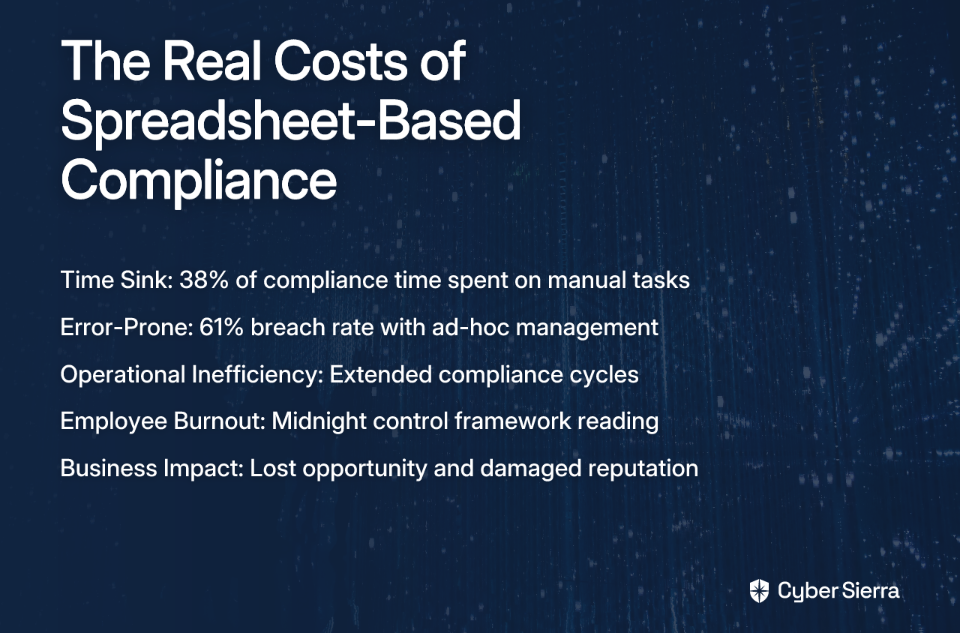
That Excel workbook might not require a license fee, but the hidden costs make it one of the most expensive tools in your security arsenal.

Time Sink & Productivity Loss

Compliance professionals spend an average of 38% of their time on manual tasks. For an 8-person team, this equates to approximately $379,392 annually in salary costs alone. One DevOps engineer reported spending "400+ hours manually documenting infrastructure configurations, taking screenshots of AWS console settings, and writing policies" — valuable time that could have been directed toward infrastructure improvements.

The breaking point? "Implementing both SOC 2 and ISO 27001 simultaneously. That's roughly 160 controls across both frameworks... Three months of engineering time that could have been spent on infrastructure improvements or reliability work."

Error-Proneness & Increased Risk

Manual compliance is inherently "error-prone, and doesn't scale," according to practitioners in the field. Organizations with ad-hoc, spreadsheet-based risk management suffer a 61% breach rate, compared to 30% for those using integrated, automated tools.

When errors lead to non-compliance, the costs become catastrophic. Consider Equifax's $575 million settlement for data breaches stemming from inadequate security controls. Your spreadsheet suddenly doesn't seem so "free" anymore.
Operational Inefficiencies & Alert Fatigue

Manual reviews and siloed tools stretch compliance cycles from minutes to days. When dealing with frameworks like FedRAMP (Federal Risk and Authorization Management Program) or CMMC (Cybersecurity Maturity Model Certification), these inefficiencies compound.

False positives consume tremendous resources. One global bank reported analysts spent an average of 4 hours investigating each alert, most of which were false hits. Multiply this across your SSP (System Security Plan) and POA&M (Plan of Action and Milestones) reports, and you're looking at significant wasted effort.

Human Cost: Audit Stress & Burnout

"You're reading control frameworks at midnight trying to understand what 'logical access controls' actually means in practice," shared one DevOps engineer who was unexpectedly assigned compliance tasks.

The demand is increasing: Financial institutions increased employee hours dedicated to compliance by 61% between 2016 and 2023. This leads to employee burnout and high turnover, creating a cycle of hiring and training costs that drains your budget and team morale.

Opportunity & Reputational Cost

Poor compliance processes directly impact business. Up to 70% of customers abandon applications if onboarding takes longer than 20 minutes. Public compliance failures damage reputation, as seen when TD Bank received a negative outlook from Fitch due to AML issues.

The Automation Advantage: What a Modern GRC Platform Actually Delivers
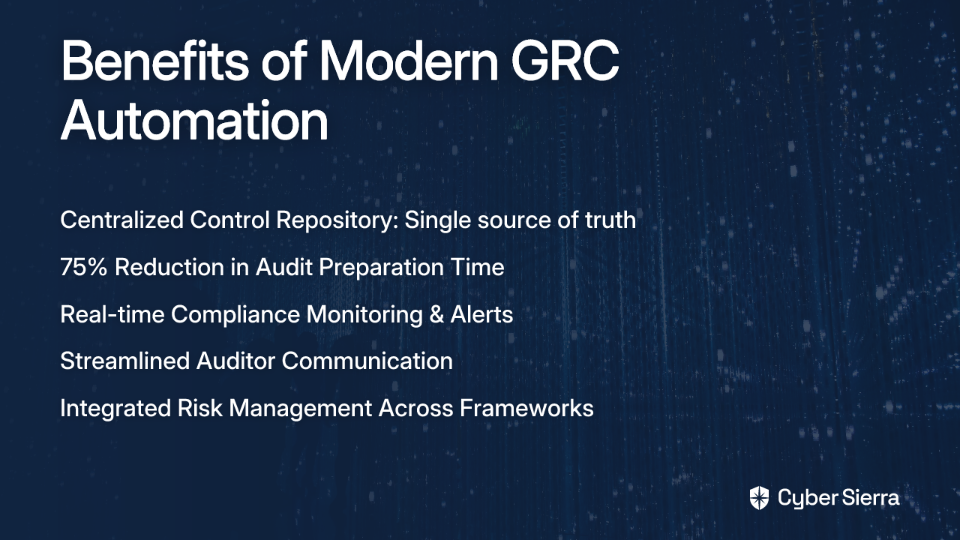
Moving beyond the problems, let's explore how modern GRC platforms transform compliance from a burden into a strategic asset.

Centralized Control & a Single Source of Truth

Modern GRC platforms create a centralized controls library, linking controls to frameworks like NIST CSF 2.0, ISO 27001, SOC 2, and GDPR. Instead of juggling multiple spreadsheets, you maintain a single source of truth that connects your internal controls to compliance requirements.

This centralization is particularly valuable for complex frameworks like RMF (Risk Management Framework), where tracking control implementation across systems becomes unmanageable in spreadsheets.

Reduced Manual Work & Audit Fatigue

Automation of key areas like evidence collection, risk assessment, and policy management dramatically cuts down on manual labor. The results can be transformative:

  • Outreach achieved a 75% reduction in audit preparation time and a 50% reduction in time spent on evidence collection using Hyperproof.
  • Highspot automated responses for 150 vendor questionnaires and managed 300 controls with a continuous compliance program.

For organizations dealing with FedRAMP or CMMC requirements, this automation is not just convenient—it's essential for maintaining sanity and accuracy.

Real-time Visibility & Proactive Monitoring

GRC tools provide continuous monitoring of compliance status and regulatory changes, sending real-time alerts for control failures. This shifts your posture from reactive to proactive.

Automated dashboards give executives real-time insights for informed decision-making, allowing for TPRM (Third Party Risk Management) and vulnerability intelligence to be integrated with compliance data.

Streamlined Audits & Reporting

One CISO noted that "Making the SSP and POA&M reports for FedRAMP works great in Paramify. We've been able to map our controls, associate evidence and manage a lot of the manual parts of RMF which is nice. I would've hated doing our FR High audit without it."

Modern platforms centralize evidence collection and auditor communication, directly addressing the common pain point of "ineffective communication with auditors" during evaluations.

Your Migration Plan: From Spreadsheet Chaos to GRC Clarity
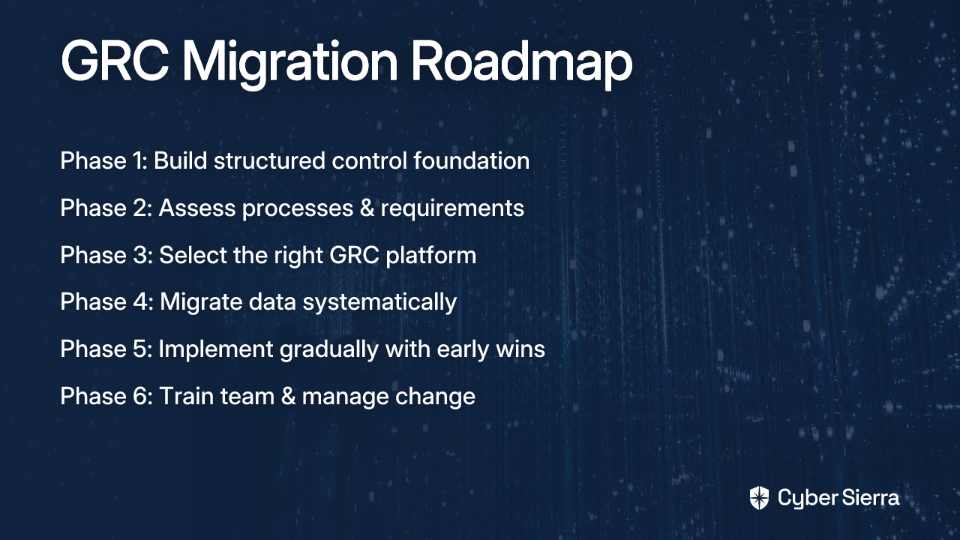
Ready to make the move? Here's your roadmap to migration success:

Phase 1: Build Your Foundation (In a Spreadsheet!)

Surprisingly, a well-structured spreadsheet is a strategic first step, not a weakness. It forms the basis for a smooth migration.

  1. Define Your Objective: Prepare for a specific audit (SOC 2) or implement a framework (NIST CSF 2.0).
  2. Gather Source Materials: Collect existing policies, procedures, and framework documentation.
  3. Structure Your Spreadsheet: Create essential columns: Control ID, Control Description, Framework Mapping, and Evidence Link.
  4. Populate Your Library: Start with baseline controls and map them to relevant frameworks.

Phase 2: The Move to an Automated GRC Platform

  1. Assess Current Processes & Requirements: Identify the most resource-intensive manual tasks and list all applicable regulations (e.g., PCI DSS, HIPAA, GDPR).
  2. Choose the Right GRC Tool:
    • Evaluate vendors (IBM, Check Point, Hyperproof, AuditBoard) on features, scalability, and integrations.
    • Avoid the complexity and cost of legacy tools like Archer if they don't fit your needs.
    • Pro Tip: Ask potential vendors about their relationships with auditing partners to ensure streamlined communication.
  3. Migrate Your Data: Use the structured controls library from Phase 1 as your blueprint to safely transfer data into the new system.
  4. Implement Gradually: Start automation in a high-impact area like evidence collection to score an early win. Integrate with your CI/CD (Continuous Integration/Continuous Deployment) pipelines for real-time security scanning and compliance verification.
  5. Train Your Team & Manage Change: Provide comprehensive training to ensure everyone understands the new processes and tools for successful adoption.
  6. Establish Monitoring & Optimization: Set up automated alerts for attack surface findings and continuously review your processes, leveraging external risk monitoring and SaaS (Software as a Service) audit services for comprehensive coverage.

Common Pitfalls to Avoid on Your GRC Journey

  • Over-automating Without a Strategy: Don't automate for the sake of it. Focus on processes that add clear value and solve real problems.
  • Ignoring Change Management: Automation is not a "set it and forget it" solution. Human oversight is crucial to avoid misconfigurations.
  • Working in Silos: Don't create theoretical controls or implement a tool without input from IT, DevOps, legal, and other relevant departments.
  • Falling for "RegTech Bloat": Many institutions suffer from using too many disconnected tools. Audit your tech stack to eliminate redundancies and consolidate vendors.

Ditch the VLOOKUPs, Embrace the Future

In 2025, managing compliance with spreadsheets is no longer a viable option; it's a significant business risk. The spreadsheet approach turns compliance into a reactive, administrative burden rather than the proactive, strategic business function it should be.

The migration from rows and columns to a modern GRC platform isn't just about efficiency—it's about transforming how your organization approaches risk and compliance. When you can automate routine tasks, your team can focus on strategic initiatives that drive business value.

It's time to close the spreadsheet for good. Stop managing risk in rows and columns, and start building a resilient, automated compliance program built for the future. Your team (and your coffee budget) will thank you.
Frequently Asked Questions

What is the true cost of using spreadsheets for compliance management?

The true cost of using spreadsheets for compliance extends far beyond license fees, encompassing significant hidden expenses in lost productivity, increased risk of errors, operational inefficiencies, and employee burnout. While seemingly free, spreadsheets lead to immense time sinks, with compliance teams spending nearly 40% of their time on manual tasks. This manual approach is also error-prone, increasing the risk of costly data breaches and non-compliance penalties.

Why should a company switch from spreadsheets to a GRC platform?

A company should switch to a GRC platform to centralize control management, automate repetitive tasks, gain real-time visibility into its compliance posture, and streamline the entire audit process. A modern GRC platform acts as a single source of truth, mapping controls to multiple frameworks like SOC 2 or ISO 27001. It automates evidence collection, which can reduce audit preparation time by as much as 75%, allowing your team to focus on strategic security initiatives.

How do you start migrating from spreadsheets to a GRC tool?

The best way to start migrating is by first building a well-structured spreadsheet that defines your objectives, gathers source materials, and maps your existing controls to relevant frameworks. This foundational spreadsheet becomes your blueprint for a smooth transition. Once your data is organized, you can assess your specific needs, choose a GRC tool that fits your requirements, and then migrate your structured data.

What are the key features to look for in a modern GRC platform?

Key features to look for in a GRC platform include a centralized controls library, automated evidence collection, continuous monitoring with real-time alerts, and integrated reporting and audit management capabilities. Look for a platform that can map a single control to multiple frameworks to avoid duplicate work. Strong integration capabilities with your existing tech stack (like cloud providers and CI/CD pipelines) are also crucial for effective automation.

Is GRC automation suitable for small businesses?

Yes, GRC automation is highly suitable and increasingly necessary for small to medium-sized businesses (SMBs), not just large enterprises. SMBs often have smaller security teams that are stretched thin. Automation helps these teams scale their efforts effectively, allowing them to achieve and maintain compliance with frameworks like SOC 2 or HIPAA, which are often required to win enterprise customers. Many modern GRC tools offer scalable pricing models, making them accessible and cost-effective.
blog-hero-background-image
Governance & Compliance

Why Your Compliance Tool Controls Don't Match Auditor Expectations

backdrop
Table of Contents

Join thousands of professionals and get the latest insight on Compliance & Cybersecurity.


You've invested in a top-rated compliance platform. Your dashboard shows a sea of green checkmarks. According to your tool, you're 100% compliant with SOC 2, ISO 27001, or whatever framework you're targeting.

Then the auditors arrive.

Suddenly, those reassuring green checkmarks seem meaningless as auditors bombard you with questions about controls that your platform supposedly verified. They request evidence that doesn't match what your tool collected. They probe areas your platform never flagged as concerning.

"But the dashboard says we're compliant," you protest, pointing to your screen.

The auditor smiles politely and continues asking questions.

If this scenario sounds painfully familiar, you're not alone. As one frustrated compliance professional put it: "Vanta's standard package promises manual support and help with implementing technical controls, but it doesn't resolve the major issue of misalignment between Vanta's controls and auditors' checklists." (Source)

This disconnect isn't just frustrating—it's costly, time-consuming, and potentially damaging to your compliance efforts. Let's explore why this happens and, more importantly, how to fix it.

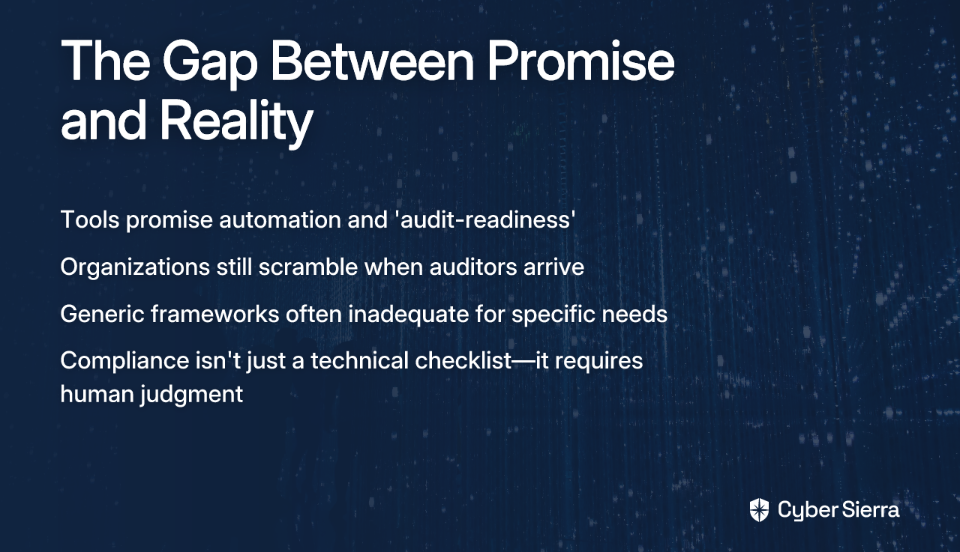
The Promise vs. The Reality of Compliance Automation

The GRC (Governance, Risk, and Compliance) automation market is booming—valued at $48.7 billion in 2023 and projected to reach $179.5 billion by 2032 (Source). This explosive growth reflects the real pain points organizations face in managing increasingly complex compliance requirements.

The promise is enticing: platforms that automatically collect evidence, map controls to frameworks, and make your organization "audit-ready" in weeks instead of months. Dashboards that give you real-time visibility into your compliance posture. Automated integrations that eliminate manual evidence gathering.

But the reality? Many organizations find themselves still scrambling when auditors arrive, despite their significant investments in these tools.

"The generic framework provided by Vanta is wholly inadequate. They don't take the time to understand your company, market, customers, or team," notes one user (Source). Another observed that despite automation tools, many stakeholders remain "inundated with manual processes, such as hunting for evidence and managing workflows through spreadsheets" (Source).

The fundamental issue is a misunderstanding of what an audit truly is. A compliance audit isn't just a technical checklist—it's a formal evaluation of adherence to frameworks, involving in-depth assessment and human judgment (Source).

So why exactly does this gap exist between your tool's green checkmarks and your auditor's expectations? Let's break down the four primary reasons.

Four Reasons Your Tool's Controls Don't Impress Your Auditor

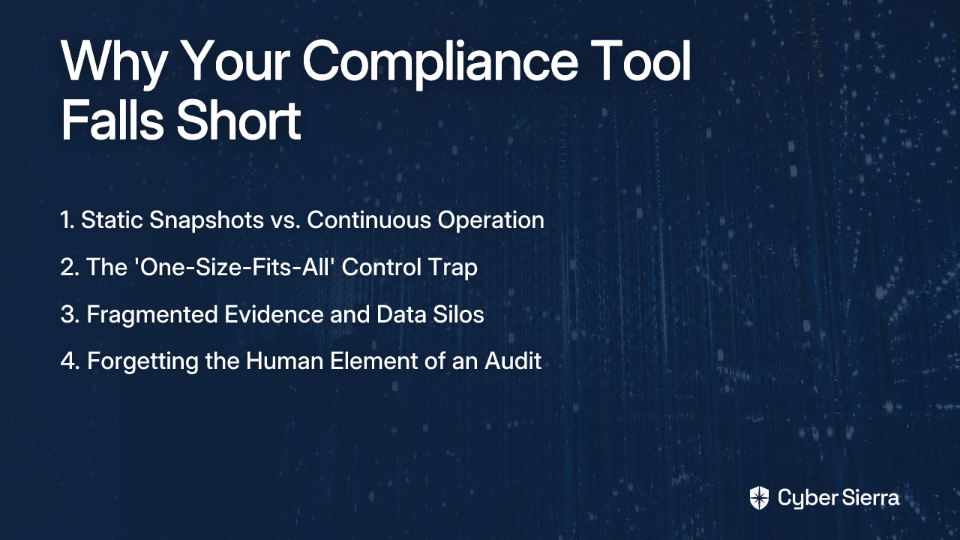
1. Static Snapshots vs. Continuous Operation

Most compliance tools provide point-in-time evidence—a configuration screenshot, a vulnerability scan from last week, or an access review from last quarter. This approach creates a fundamental disconnect with what auditors are actually seeking.

Auditors aren't just interested in whether a control existed at some point in the past. They need assurance of continuous effectiveness. The industry is moving away from "manual testing and sample-based methods that lead to limited coverage" and toward continuous monitoring (Source).

When an auditor asks about your vulnerability management process, they're not just checking if you ran a scan once. They want to know if vulnerabilities have been consistently identified, prioritized, and remediated throughout the entire audit period.

2. The "One-Size-Fits-All" Control Trap

"It's really a shame that while the framework is so flexible the current solutions are hardcoded and inflexible," laments one compliance professional (Source).

This cuts to the heart of another major disconnect. Frameworks like SOC 2 and ISO 27001 are principles-based, not prescriptive. They outline what you need to achieve, not precisely how you should achieve it.

Auditors expect controls to be tailored to your organization's specific risks, environment, and operations. But many compliance tools offer generic, pre-packaged controls that don't reflect your organization's unique context.

When your auditor sees a generic control description that doesn't align with how your organization actually operates, they'll naturally dig deeper—and that's when the trouble begins.

3. Fragmented Evidence and Data Silos

Most compliance automation today is "fragmented," and "data silos impede clear visibility" into the true state of controls (Source). Your security tools may pass their checks, but auditors need to see the full story.

For example, a passing infrastructure configuration scan is good. But auditors also need to see:

  • The related change management ticket
  • The policy that governs the change
  • The HR record confirming the person who made the change was authorized
  • Training records showing they knew what they were doing

A simple dashboard check doesn't connect these dots. This fragmentation also applies to vendor risk management, where organizations often have a "patchwork" approach instead of a unified framework (Source).

4. Forgetting the Human Element of an Audit

Perhaps most fundamentally, many organizations forget that an audit is a human-led process, not just a technical verification.

A compliance audit follows multiple steps (Source):

  1. Research and Readiness
  2. Documentation Review (where tools help)
  3. Conducting Interviews (where tools can't talk)
  4. Process Assessment (testing effectiveness and asking "why")
  5. Report Compilation

Compliance tools can help with documentation, but they can't explain your rationale or demonstrate your understanding. Auditors are trained to ask probing questions to understand intent and culture, which no dashboard can convey.

As one professional noted, "Their tech is cool and works just fine, but if you're looking for a smooth audit process I'd recommend looking at compliance vendors who set you up for success from the very start" (Source).

Bridging the Gap: From Audit-Stressed to Audit-Ready

Now that we understand the problems, let's explore the solutions that can transform your compliance efforts from a source of stress to a strategic advantage.

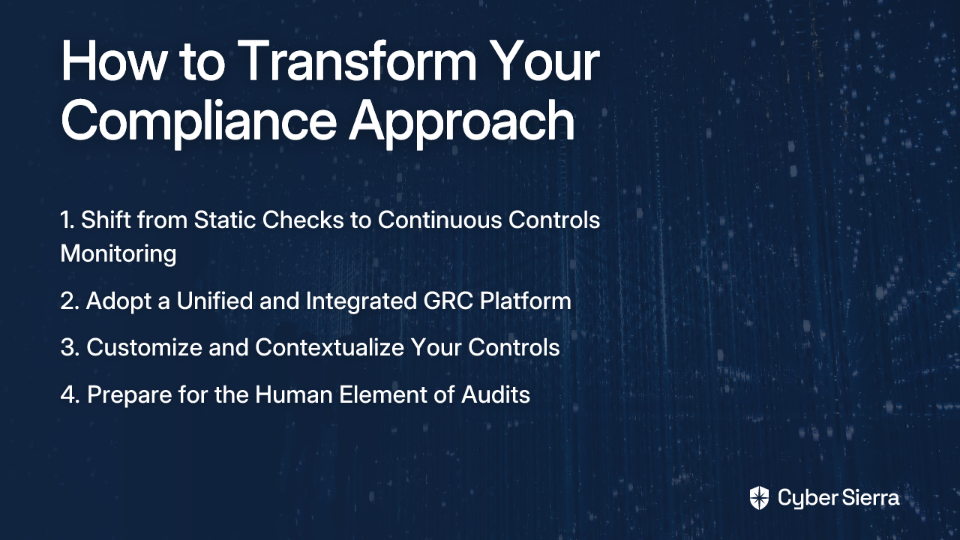
1. Shift from Static Checks to Continuous Controls Monitoring (CCM)

Continuous Controls Monitoring is an automated process that "frequently tracks compliance, risk management, and security controls, providing organizations with a real-time view of their security posture" (Source).

Unlike point-in-time assessments, CCM provides:

  • Enhanced Accuracy & Cost Reduction: By minimizing errors, reducing manpower for low-value tests, and focusing on anomalies (Source)
  • Proactive Risk Mitigation: By identifying and remedying vulnerabilities before they become breaches
  • Audit-Ready Evidence: By moving away from sample-based testing to comprehensive monitoring across entire data populations

This is where modern platforms make a difference. Cyber Sierra's Continuous Control Monitoring (CCM) module addresses this gap by providing a central controls repository with near real-time updates, automating testing, and detecting exceptions as they happen. This transforms security from periodic checks into a continuous, automated process that provides auditors with a single source of truth (Source).

2. Adopt a Unified and Integrated GRC Platform

To combat fragmentation, "use connected platforms that share information across GRC areas to avoid duplicated efforts and mistakes" (Source).

A unified platform connects controls to policies, risks, vendors, assets, and employee training, creating a complete evidence trail that auditors can follow.

A holistic approach requires a platform that does more than just technical checks. Cyber Sierra's Governance, Risk & Compliance (GRC) platform automates data collection across multiple frameworks (SOC 2, ISO 27001, etc.), integrates third-party risk management, and links evidence to policies and incidents, eliminating the data silos that cause chaos during an audit (Source).

3. Customize and Contextualize Your Controls

Don't just accept your tool's default control descriptions. Take the time to map the generic controls to your specific environment.

Document why a control is implemented a certain way and be prepared to explain any compensating controls that address the same risk differently.

This turns your compliance tool from a rigid checklist into a dynamic, contextualized record of your security program that will impress even the most thorough auditor.

4. Prepare for the Conversation

Use your GRC platform as your command center for the audit, not as a shield to hide behind.

Designate Accountability: Assign a single point of contact to manage communication with the auditor (Source). This person should be prepared to walk the auditor through your dashboards, explain the data, and provide the narrative that connects the dots between different pieces of evidence.

Remember that auditors are looking for not just compliance, but understanding. Be ready to demonstrate that your team knows why controls are important, not just that they exist.

Beyond the Checkbox: The Path Forward

True audit readiness isn't about achieving 100% green checkmarks on a compliance tool's dashboard. It's about building a resilient, continuously monitored security program that can stand up to the scrutiny of a human auditor.

As the cybersecurity landscape evolves, compliance should not be treated as a "mere checkbox but an integral part of security strategy" (Source).

The key to bridging the gap between your compliance tool and your auditor's expectations lies in:

  1. Moving from static snapshots to continuous monitoring
  2. Breaking down data silos with unified platforms
  3. Contextualizing controls for your specific environment
  4. Preparing for the human element of the audit process

By addressing these four areas, you can transform compliance from a painful exercise in documentation to a strategic advantage that demonstrates your organization's maturity and commitment to security.

Evaluate your current tools and processes: Do they provide static snapshots or continuous assurance? Are they fragmented or unified? Shifting to an integrated platform with strong CCM capabilities is the key to closing the gap and turning audits from a stressful ordeal into a smooth validation of a strong security posture.

The future of compliance isn't just about passing audits—it's about using those audits as an opportunity to strengthen your security program and build trust with customers, partners, and regulators.

Frequently Asked Questions

Why does my compliance tool show 100% compliance, but my auditor still has questions?

Your compliance tool shows 100% compliance because it has successfully verified specific, pre-defined technical checks at a single point in time. However, auditors are concerned with the continuous effectiveness of controls, their specific implementation within your unique business context, and the human processes that support them, which a dashboard of green checkmarks cannot fully represent.

What is the biggest limitation of most compliance automation platforms?

The biggest limitation is that they often provide static, point-in-time evidence rather than proof of continuous operation. Auditors need assurance that controls are consistently effective throughout the entire audit period, not just that a setting was correct on the day of a scan. This creates a disconnect between the tool's "snapshot" evidence and the auditor's need for a complete operational history.

What is Continuous Controls Monitoring (CCM) and why is it important for audits?

Continuous Controls Monitoring (CCM) is an automated process that continuously tracks and tests your security and compliance controls in near real-time. It is crucial for audits because it provides a comprehensive and ongoing record of a control's effectiveness, moving beyond periodic, sample-based evidence. This gives auditors the assurance they need that your security posture is consistently maintained, not just temporarily fixed for the audit.

How can our organization bridge the gap between our compliance tool and our auditor's expectations?

To bridge the gap, you should shift from static checks to Continuous Controls Monitoring (CCM), adopt a unified GRC platform to break down data silos, customize your tool's generic controls to reflect your specific operational context, and prepare for the human-led conversations of an audit by being ready to explain the "why" behind your controls.

Are compliance frameworks like SOC 2 and ISO 27001 just a set of prescriptive rules?

No, frameworks like SOC 2 and ISO 27001 are principles-based, not prescriptive checklists. They define what security objectives you need to achieve, but not precisely how you must achieve them. This flexibility means auditors expect you to implement controls that are tailored to your company's specific risks, technology, and business processes, rather than relying on a generic, one-size-fits-all approach.

blog-hero-background-image
Governance & Compliance

The Hidden Costs of GRC Platform Vendor Lock-in

backdrop
Table of Contents

Join thousands of professionals and get the latest insight on Compliance & Cybersecurity.


You've invested in a Governance, Risk, and Compliance (GRC) platform to streamline your security operations and prepare for audits. Year one was great—low price, responsive service, and the promise of simplified compliance. But in year two, everything changed. The price suddenly jumped 40%, service quality plummeted, and you realized you're trapped in a relationship that's increasingly one-sided.

Sound familiar? You're experiencing the painful reality of GRC vendor lock-in.

The Siren Song of the All-in-One GRC Solution

The appeal of comprehensive GRC platforms is undeniable. With rising regulations like GDPR and CCPA, escalating cyber threats (the FBI reports over 4,000 ransomware attacks daily), and increasing stakeholder demands for transparency, the pressure to implement robust compliance measures has never been greater.

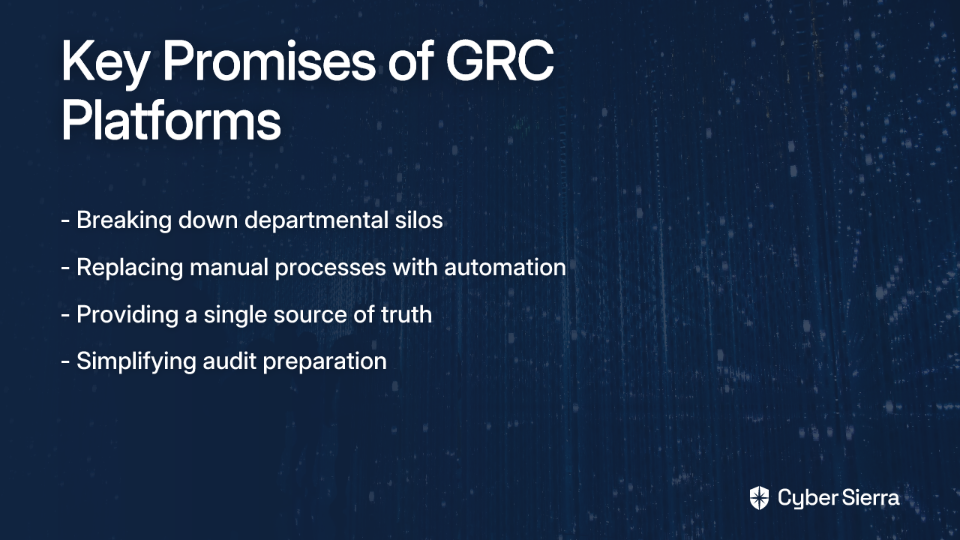
GRC platforms promise to solve your most pressing challenges:

  • Breaking down departmental silos that hamper effective risk management
  • Replacing manual, spreadsheet-based processes with automated workflows
  • Providing a "single source of truth" for your compliance efforts
  • Simplifying preparation for audits like SOC 2 and ISO 27001

But beneath these promises lies a dangerous reality. Once implemented, these platforms can create dependencies that are difficult and costly to escape—a phenomenon known as vendor lock-in.

Unpacking the Hidden Costs of GRC Vendor Lock-in

Vendor lock-in occurs when clients become dependent on a single vendor for products and services, unable to switch without substantial costs. For GRC platforms, these costs extend far beyond the subscription fee you see on your invoice.

1. Escalating Financial Burdens

The most obvious hidden cost is the financial burden that grows over time. As one user on Reddit described their experience: "Year one was great. Low price, great service. In year two it went downhill immediately. Price went up 40% and service all but disappeared."

This bait-and-switch pricing model is common. Once vendors know you've invested time and resources in implementation, they leverage your dependency to increase fees, knowing the cost of switching is prohibitively high. These costs include:

  • Data migration expenses
  • Staff retraining on new systems
  • Lost productivity during transition
  • Rebuilding custom integrations and workflows
  • Potential compliance gaps during the changeover

2. The Service Cliff and Support Vacuum

Perhaps the most frustrating hidden cost is the dramatic drop in service quality after the honeymoon period ends. Users frequently report that "the customer service felt like their company just 'streamlined' things, which was code for cutting it off."

This service vacuum creates a dangerous situation: you're paying premium prices for a mission-critical compliance tool, but when issues arise, you're left to fend for yourself. As one user noted, "Their limited support often results in clients being referred to a guide or asking an auditor for help, which is counterintuitive."

When your compliance platform provider abandons you during crucial audit periods, the resulting stress and scramble for solutions can derail your entire compliance program.

3. Strategic Rigidity and Stagnation

GRC platforms are often marketed as adaptable, but the reality is quite different. Many users report that these systems are "static and inflexible," making it difficult to respond to evolving threats or regulatory requirements.

As one frustrated user put it: "It's really a shame that while the framework is so flexible the current solutions are hardcoded and inflexible."

This rigidity creates strategic limitations:

  • Your security and compliance approach becomes tethered to the vendor's technology roadmap
  • Innovative approaches to risk management are stifled by the platform's constraints
  • The organization develops a reactive rather than proactive mindset toward compliance
  • New business initiatives may be delayed or abandoned due to platform limitations

4. The "One-Size-Fits-None" Compliance Trap

Perhaps the most insidious cost is the fundamental misalignment between generic GRC tools and your specific business needs. Users consistently report that platforms like Vanta "apply a one-size-fits-all SOC 2 program to all companies, which is inappropriate."

As another user bluntly stated: "The generic framework provided by Vanta is wholly inadequate. They don't take the time to understand your company, market, customers, or team."

This leads to confusion and frustration during audit preparation, as the controls implemented through your GRC platform may not align with your auditor's expectations. The result? More work, more uncertainty, and potentially failed audits—despite significant investment in your compliance platform.

5. Amplified Security and Data Risks

Ironically, relying on a single GRC vendor can increase your security risk profile. When you depend entirely on one platform, you create a single point of failure in your security strategy. If that vendor experiences security issues, your sensitive compliance data could be compromised.

This isn't just theoretical. As one industry professional revealed: "Several clients who have been hacked under Vanta's watch have come to us for help." When your GRC platform—the very system meant to strengthen your security posture—becomes a liability, you've entered a dangerous territory indeed.

Breaking Free: A Strategic Guide to GRC Agility

Whether you're considering your first GRC platform or already feeling trapped by your current vendor, there are strategies to mitigate the risks of lock-in and regain control of your compliance destiny.

Before You Buy: Proactive Mitigation

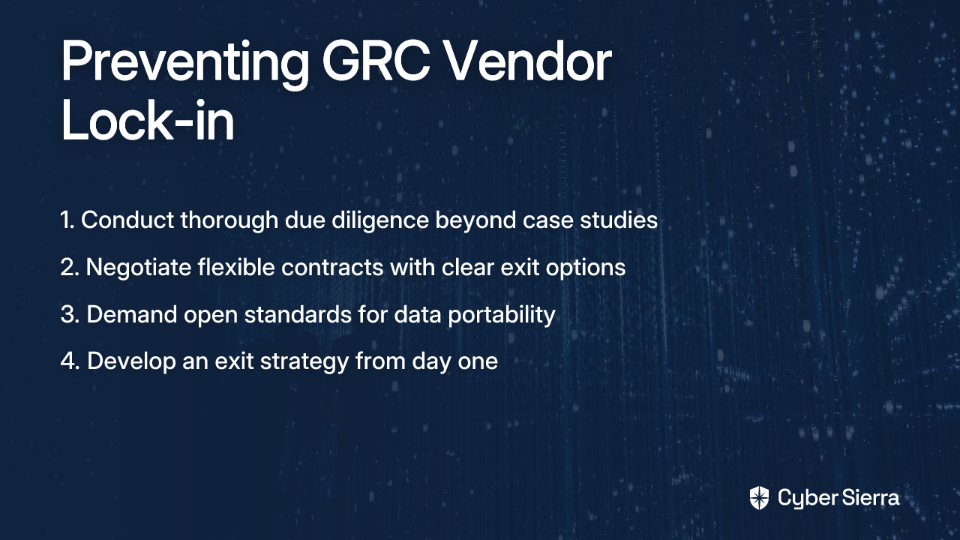
  1. Conduct Thorough Due Diligence Evaluate potential vendors not just on features but on their contract terms, exit clauses, and customer reviews beyond the first year of service. Check forums like Reddit for unfiltered user experiences beyond the curated case studies on vendor websites.
  2. Negotiate Contracts for Flexibility Ensure contracts offer reasonable exit options and clearly defined service levels. As one savvy user advised: "Definitely pressure them on price, you can get steep discounts from Drata and Vanta since they're in fierce competition."
  3. Demand Open Standards Insist on the ability to export your data in standard formats. Your compliance data belongs to you, not your vendor, and should be portable if you decide to switch platforms.
  4. Develop an Exit Strategy From Day One Before signing with any GRC vendor, document how you would transition away if necessary. Include this planning in your vendor risk management process.

If You're Already Locked In: Reclaiming Control

  1. Assess and Diversify Consider a multi-vendor strategy where appropriate. Not every aspect of your GRC program needs to live within a single platform. For example, you might use different solutions for vendor risk management versus compliance documentation.
  2. Build Internal Expertise Invest in training your team on fundamental compliance frameworks like NIST RMF. This reduces your dependency on vendor guidance and builds institutional knowledge that transcends any particular platform.
  3. Leverage Modern Alternatives The GRC landscape is evolving. Solutions like Cyber Sierra are challenging the traditional lock-in model by offering modular compliance automation with continuous control monitoring that works alongside your existing tools rather than replacing them entirely. This approach provides flexibility while still delivering the automation benefits of modern GRC platforms.

The Path Forward: Compliance Without Compromise

The most effective GRC strategy balances the efficiency of automation with the flexibility to adapt as your business and the regulatory landscape evolve. Rather than surrendering control to a single vendor, forward-thinking organizations are adopting more agile approaches.

Modern solutions like Cyber Sierra's Continuous Control Monitoring (CCM) represent this new philosophy. By automating evidence collection and providing real-time visibility into your security posture while maintaining your control over the process, such platforms help you achieve compliance without the hidden costs of vendor lock-in.

This doesn't mean abandoning GRC platforms entirely—they still offer valuable capabilities. Instead, it means approaching vendor relationships strategically, maintaining leverage through contractual terms, open standards, and diversified solutions.

Remember that your GRC platform should serve your compliance program, not the other way around. By understanding the hidden costs of vendor lock-in and taking proactive steps to maintain flexibility, you can build a sustainable compliance approach that evolves with your business and truly delivers on the promise of simplified, effective risk management.

The next time a GRC vendor promises you the world, look beyond the features and ask the difficult questions about what happens after that first year. Your future self—and your budget—will thank you.

Frequently Asked Questions

What is GRC vendor lock-in?

GRC vendor lock-in occurs when a company becomes excessively dependent on a single GRC platform, making it difficult and expensive to switch to another provider. This dependency often stems from high switching costs, proprietary data formats, and deep integration into business processes, allowing vendors to increase prices and reduce service quality over time.

Why do companies fall into the GRC vendor lock-in trap?

Companies often fall into the GRC lock-in trap because of the allure of all-in-one platforms that promise to simplify compliance, combined with attractive introductory pricing. The initial benefits of automation and having a "single source of truth" can overshadow long-term risks, leading to deep operational dependency that is hard to undo.

How can I identify the hidden costs of a GRC platform?

You can identify hidden costs by looking beyond the initial subscription fee for signs of price hikes after the first year, declining customer support, inflexible systems that cannot adapt to new regulations, and difficulty exporting your compliance data in a standard, usable format.

What are the biggest risks of being locked into a single GRC vendor?

The biggest risks include escalating financial burdens from price increases, a "support vacuum" where service quality disappears, strategic stagnation due to inflexible technology, and increased security risks from having a single point of failure in your compliance strategy.

How can my organization avoid GRC vendor lock-in?

To avoid GRC vendor lock-in, you should conduct thorough due diligence beyond vendor-provided case studies, negotiate flexible contracts with clear exit clauses, prioritize platforms that use open standards for data export, and develop a potential exit strategy before you commit to a provider.

What should I do if I'm already stuck with a GRC vendor?

If you are already locked in, you can reclaim control by building internal compliance expertise to reduce dependency on the vendor, diversifying your toolset with specialized solutions where possible, and exploring modern, modular alternatives that can work alongside your existing platform to increase flexibility.


Cyber Sierra provides an AI-enabled cybersecurity platform designed to simplify and automate security compliance without the traditional vendor lock-in challenges. Learn more about our flexible approach to GRC at cybersierra.co.

blog-hero-background-image
Governance & Compliance

Why Everyone Hates GRC Teams (And How to Fix It)

backdrop
Table of Contents

Join thousands of professionals and get the latest insight on Compliance & Cybersecurity.


You've been there. That moment when you walk into a room and the conversation suddenly stops. The awkward silence as people exchange glances. The forced smiles and the subtle eye-rolling. As a GRC (Governance, Risk, and Compliance) professional, you're pretty sure you star in the IT team's nightmares.

"Best perk of being an auditor/in GRC is that everyone hates you and is afraid of you, even when you are on the same boat..." confesses one GRC professional in an online forum discussion. Another laments spending "countless hours setting meetings with technical people who hate me."

This isn't just paranoia—it's an uncomfortable reality for many in the GRC space. The antagonism is so pervasive it's become an inside joke in the industry. But behind the gallows humor lies a serious problem that undermines organizational security, efficiency, and morale.

The good news? This friction isn't inevitable. By understanding why GRC teams often find themselves cast as the corporate villains and implementing targeted solutions, you can transform from organizational antagonist to valued strategic partner.

The Core of the Conflict: Why GRC Gets a Bad Rap

The "Department of No": Misunderstanding GRC's Scope and Purpose

At its core, GRC encompasses a strategic approach to aligning IT with business objectives while managing risks and meeting regulatory requirements. It's a framework that should enhance decision-making and operational effectiveness.

Yet in practice, GRC is widely misperceived as "lots of Excel sheets. Tickets, exceptions, pushing papers, in a digital sense," according to one professional. Another bluntly describes their job as "telling people they are idiots in not so many words."

The reality is far more nuanced. GRC professionals aren't just policy police—they're risk navigators helping organizations balance innovation with necessary guardrails. As one practitioner points out, "Writing policy is only one very small aspect of GRC work."

This fundamental misunderstanding of GRC's purpose creates a disconnect between expectations and reality, setting the stage for conflict from the start.

Death by a Thousand Meetings: Inefficient Processes and Manual Overload

One GRC professional reports a staggering statistic: "for each system that I drive a complete risk assessment for, you should count about 8 meetings of 2-3 hours each." That's potentially 24 hours of meetings—nearly three full workdays—per system.

This process inefficiency creates frustration on both sides. Technical teams resent the time drain, while GRC professionals struggle with the manual burden of evidence collection, documentation, and audit management.

The problem is compounded by siloed operations. According to research by Inry, departments often operate in isolation, each with its own data and processes, leading to ineffective risk management and duplication of efforts.

For smaller organizations, the burden can be especially heavy. As one professional notes, "Unless you are at a Fortune 500 company, chances are if you are in GRC you are responsible for making sure controls are documented, evidence is collected, audit requirements are being met, and managing external auditors."

"Us vs. Them": The Cultural and Communication Breakdown

Perhaps the most insidious problem is the cultural divide that positions GRC as the adversary. When GRC professionals have to "defend assessment from the system's stakeholders," it creates an adversarial dynamic rather than a collaborative one.

This divide is often exacerbated by inadequate leadership support. According to Diligent, lack of executive buy-in is a common pitfall in GRC implementation. Without clear direction from the top, GRC initiatives can be perceived as bureaucratic impositions rather than strategic necessities.

The result is a cultural standoff that benefits no one and leaves organizations vulnerable.

From Antagonist to Ally: A Blueprint for Fixing GRC's Reputation

To transform GRC from a necessary evil to a strategic partner, we need a structured approach. The GRPI Model—which stands for Goals, Roles, Processes, and Interpersonal relationships—offers an effective framework for diagnosing and resolving team dysfunction.

Developed by organizational theorist Richard Beckhard, the GRPI model provides a hierarchical approach to addressing team challenges, starting with the most concrete elements (goals) and moving to the most complex (interpersonal dynamics).

Let's apply this framework to fix the GRC reputation problem.

Putting the Fix into Action: A Step-by-Step Guide

Step 1: Clarifying Goals — What Are We Actually Trying to Achieve?

When goals are misaligned, conflict is inevitable. Start by ensuring that GRC objectives support broader business goals rather than appearing to hinder them.

Questions to ask: What's the team's purpose? What are the expected outcomes of our GRC program?

Implementation:

  1. Learn: Understand your organization's context, industry-specific challenges, and risk tolerance.
  2. Align: Ensure GRC strategies directly support business objectives. According to AWS, effective GRC encourages data-driven decision-making, enhances cybersecurity, and streamlines operations.
  3. Document and communicate: Create clear, specific goals and share them widely—not just within the GRC team but across all departments.

By orienting GRC activities around enabling business rather than just preventing problems, you begin to shift the perception from obstacle to enabler.

Step 2: Defining Roles — Who Owns What?

Role confusion creates friction and inefficiency. Many GRC professionals report being stretched thin across multiple responsibilities: "I do assist in policy revisions, risk assessments, and gap assessments... unfortunately when I am also doing those tasks I am leading the quarterly UAR process."

Questions to ask: Who is responsible for what? Where are there overlaps or gaps? Who has decision-making authority?

Implementation:

  1. Define clear responsibilities for GRC tasks across the organization, not just within the GRC team.
  2. Establish ownership for different aspects of risk and compliance.
  3. Create accountability by documenting these roles and making them visible to all stakeholders.

Clear roles minimize confusion and set appropriate expectations, improving the experience for both GRC teams and their internal customers.

Step 3: Streamlining Processes — Escaping the Spreadsheet Labyrinth

Manual processes and inefficient workflows are major sources of GRC friction. When compliance activities become burdensome, resistance naturally follows.

Questions to ask: Are our procedures for tasks documented? Are they efficient? How will conflicts be resolved?

Implementation:

  1. Assess current state: Identify manual bottlenecks and process pain points.
  2. Adopt technology: Utilize GRC software to facilitate real-time visibility, automate repetitive tasks like evidence collection, and centralize documentation.
  3. Select appropriate frameworks: Leverage established standards like NIST, ISO 31000, or CIS Controls to provide structure without reinventing the wheel.
  4. Streamline meetings: Implement structured agendas, clear objectives, and pre-reads to make meetings more efficient and reduce their frequency.

By making GRC processes less burdensome, you remove a major source of organizational friction.

Step 4: Building Bridges — Improving Interpersonal Dynamics

At the heart of the "everyone hates GRC" problem are strained interpersonal relationships. Addressing this requires intentional effort to build trust and collaboration.

Questions to ask: Do team members trust and respect each other? Is communication open and effective?

Implementation:

  1. Engage stakeholders early: Involve technical teams in the risk assessment and policy creation process to gain buy-in and valuable insights.
  2. Foster open communication: Establish clear channels across all levels to ensure everyone understands GRC objectives.
  3. Cultivate a risk-aware culture: Shift the mindset from policing to partnership by engaging all employees in risk management practices.
  4. Provide support: Frame GRC's role as enabling teams to achieve their goals securely and compliantly.

The Future of GRC: Proactive, Integrated, and Respected

The GRC function is evolving. Modern approaches are shifting from reactive compliance checking to proactive risk management, aided by new technologies.

AI integration is transforming GRC from a backward-looking function to a forward-thinking one, helping teams identify risks faster and automate compliance documentation. According to Diligent, AI-powered GRC tools can provide real-time insights and scenario modeling that were previously impossible.

The future of GRC is less about annual assessments and more about continuous adaptation—becoming an agile, responsive function that adapts to changing business and threat landscapes.

Becoming a Strategic Partner

The negative perception of GRC teams isn't inevitable—it stems from a predictable mix of misunderstood scope, inefficient processes, and cultural divides.

By applying a structured approach like the GRPI model to clarify goals, define roles, streamline processes, and build interpersonal trust, you can fundamentally change your relationship with the rest of the organization.

The ultimate goal isn't just to be tolerated but to be valued as a strategic partner that contributes directly to business resilience and success. When GRC shifts from perceived bureaucracy to genuine enablement, everyone wins—especially the organization's security posture and bottom line.

Remember: Good GRC isn't about saying "no"—it's about finding secure ways to say "yes."

Frequently Asked Questions

What is GRC and why is it often misunderstood?

GRC (Governance, Risk, and Compliance) is a strategic framework for aligning IT with business objectives, managing risks, and meeting regulatory requirements. It is often misunderstood as a bureaucratic function focused only on enforcing rules and paperwork because its core purpose—enabling the business to operate securely and effectively—is not always clearly communicated. This leads to the perception of GRC as an obstacle rather than a strategic partner.

How can GRC teams build better relationships with technical teams?

GRC teams can build better relationships by shifting from an adversarial stance to a collaborative partnership. This is achieved by engaging technical teams early in the process, communicating shared goals that support business objectives, streamlining processes to reduce the administrative burden on everyone, and fostering a culture where GRC is seen as a supportive enabler for achieving goals securely.

What is the GRPI model and how does it apply to GRC?

The GRPI model is an organizational tool used to diagnose and improve team effectiveness by examining Goals, Roles, Processes, and Interpersonal relationships. It provides a structured approach for GRC teams to fix their reputation by first clarifying and aligning their Goals with the business, then defining Roles and responsibilities, followed by streamlining inefficient Processes, and finally improving Interpersonal dynamics to build trust.

Why are GRC processes often so inefficient and time-consuming?

GRC processes often become inefficient due to a heavy reliance on manual tasks, such as evidence collection in spreadsheets, and a lack of integrated systems. This is compounded by siloed operations where departments don't share information, leading to duplicated efforts and excessive meetings. Without modern GRC tools to automate tasks and centralize information, these manual processes create a significant and frustrating time drain for all involved.

What is the main goal of an effective GRC program?

The main goal of an effective GRC program is to help the organization achieve its business objectives reliably while managing uncertainty and maintaining integrity. Rather than simply blocking initiatives, a strong GRC function acts as a strategic partner that finds secure and compliant ways to enable innovation and say "yes" to business goals, ultimately contributing to organizational resilience and success.

blog-hero-background-image
Governance & Compliance

The Reality of CIS Compliance: Why 'Full Compliance' Breaks Everything

backdrop
Table of Contents

Join thousands of professionals and get the latest insight on Compliance & Cybersecurity.


You've just been tasked with implementing CIS (Center for Internet Security) benchmarks across your organization. Your leadership wants "full compliance" by the end of the quarter. As you dig into the hundreds of technical controls and configuration recommendations, a sinking feeling sets in—implementing every single recommendation would break critical applications, disrupt workflows, and potentially grind operations to a halt.

Sound familiar? You're not alone.

"You will most likely never be 'fully' compliant to any of these policies as that usually breaks something," notes one cybersecurity professional in a Reddit discussion about CIS implementation challenges.

This reality exposes the fundamental paradox of cybersecurity compliance: the pursuit of perfect security often conflicts with the need for functioning business operations. While CIS benchmarks provide invaluable security guidance, treating them as inflexible mandates that must be followed to the letter can be counterproductive and even dangerous.

Understanding the CIS Framework: The Gold Standard Guide

The Center for Internet Security provides two principal resources that form the backbone of what we call "CIS compliance":

  1. CIS Benchmarks: Over 100 configuration guidelines for various technologies, from operating systems to cloud platforms. Each benchmark includes detailed recommendations with descriptions, rationales, potential impacts, and implementation steps.
  2. CIS Controls: A prioritized set of 18 actions designed to mitigate the most common cyberattacks, organized into Implementation Groups (IG1, IG2, IG3) based on an organization's size and resources.

These standards align with other major regulatory frameworks like NIST and HIPAA, making them an attractive foundation for organizations seeking to strengthen their security posture while meeting compliance requirements.

The Trap of 100% Compliance: Where Good Intentions Go Wrong

Operational Breakage: The "Breaks Everything" Problem

When security professionals attempt to implement every CIS benchmark recommendation without considering context, critical business functions often suffer. For example, certain hardening recommendations can disable features required by legacy applications, prevent necessary system communications, or conflict with specialized software requirements.

As one practitioner put it, "depending on industry or regulatory requirements, compliance needs change... No one solution will be right for everyone." This highlights the inherent tension between standardized security controls and diverse operational environments.

The Compliance-Security Gap: A False Sense of Security

Perhaps more dangerous than operational breakage is the false sense of security that comes with achieving a "100% compliant" status. History is littered with organizations that suffered major breaches despite being compliant with various security frameworks:

  • Equifax (2017): Despite being compliant with multiple regulations, Equifax suffered a catastrophic breach affecting 147 million people due to a single unpatched vulnerability in Apache Struts. Their compliance status did nothing to prevent one of the largest data breaches in history.
  • MOVEit (2023): This breach affected over 2,500 organizations, many of which were likely compliant with security frameworks but fell victim to a zero-day vulnerability that no compliance checklist could have anticipated.

These examples expose a critical truth: compliance frameworks are inherently backward-looking and static. They represent consensus best practices based on known threats, but they cannot protect against novel attacks or zero-day vulnerabilities that emerge daily.

Resource Misallocation: The Hidden Cost

Attempting to address all benchmark findings equally leads to massive resource waste. Security teams spend countless hours addressing low-impact "informational" findings instead of prioritizing critical vulnerabilities that pose genuine threats.

As McKinsey research found, a risk-based approach could increase projected risk reduction by 7.5 times without additional cost simply by reordering security initiatives based on their actual impact rather than compliance requirements.

A Smarter Path Forward: Adopting a Risk-Based Approach

Instead of asking "Are we compliant?" organizations should ask "Are we secure?" This subtle shift transforms security from a checkbox exercise to a strategic business function focused on identifying, prioritizing, and mitigating threats based on their potential impact.

CIS's Own Solution: CIS RAM

Interestingly, CIS itself recognizes the limitations of a pure compliance approach. The organization developed the CIS Risk Assessment Method (CIS RAM) specifically to help organizations assess their risk posture and tailor the implementation of controls according to their unique threat environment.

According to the CIS RAM White Paper, this methodology provides "a formal, documented approach to help organizations... implement and assess their security posture against the CIS Critical Security Controls." It moves beyond a generic checklist to a sophisticated risk management framework.

Quantifying Risk with FAIR-CAM

While CIS Controls tell you what to implement, they don't quantify the effect on risk reduction. This is where the FAIR Controls Analytics Model (FAIR-CAM) becomes valuable. It maps controls to the Factor Analysis of Information Risk (FAIR) model to measure their performance and impact quantitatively.

As noted by a Federal Aviation Administration representative after using this approach: "Now, when we get that audit finding we can answer if it is really a big deal or something we can work on in the next fiscal year." This demonstrates the practical value of quantifying risk rather than simply checking compliance boxes.

Navigating the Real-World Challenges of CIS Implementation

Legacy Systems and Technical Debt

Many organizations struggle with legacy systems that cannot be configured to meet modern security standards. In these cases, pursuing "full compliance" is not just impractical—it's impossible.

A risk-based approach acknowledges these limitations and focuses on compensating controls like network segmentation, enhanced monitoring, and access restrictions to mitigate risk without breaking critical systems.

Tooling and Automation Challenges

Users frequently report challenges with tools like CIS SecureSuite and the complexity of automating compliance checks. As one Reddit user mentioned, these products are "definitely not easy to integrate," highlighting the practical hurdles in operationalizing compliance programs.

Community resources can help address these challenges. Free tools like the CIS Workbench and CSAT (CIS Configuration Assessment Tool) are praised by practitioners as invaluable resources for implementation guidance.

Integrating Modern Security Concepts

Many organizations struggle to understand how emerging security paradigms like Zero Trust (ZT) fit within compliance frameworks. This creates confusion and unnecessary complexity.

In reality, CIS Controls provide a foundation for Zero Trust architecture. For example, CIS Control 1 (Inventory of Enterprise Assets) and Control 2 (Inventory of Software Assets) are prerequisites for any Zero Trust implementation. The key is understanding that Zero Trust is a strategy, while CIS provides tactical controls to help achieve it.

A Practical, Risk-Based Approach to CIS Compliance

So how do you balance the valuable guidance of CIS benchmarks with the realities of your operational environment? Here's a structured approach that prioritizes security outcomes over compliance checkboxes:

  1. Assess and Inventory: Begin by understanding your current environment and maintaining a comprehensive inventory of hardware and software assets. This is the foundation of both CIS Controls and effective risk management.
  2. Apply Baselines, Then Tailor: Use the relevant CIS Benchmark as a starting baseline, but evaluate each recommendation in the context of your specific environment and risk profile.
  3. Conduct a Risk Assessment: Identify threats and vulnerabilities specific to your organization. Prioritize CIS Controls and Benchmark recommendations that mitigate your highest risks first.
  4. Document Deviations: For any recommendation you choose not to implement, document the reason, the accepted risk, and any compensating controls you've put in place. This documentation is crucial for audits and provides transparency in your decision-making process.
  5. Continuously Monitor & Improve: Security is not a one-time project but an ongoing process. Implement continuous vulnerability scanning and integrate threat intelligence to adapt your defenses as the threat landscape evolves.

Conclusion: From Compliance Burden to Security Enabler

The goal of any security program should not be a perfect score on a compliance report but effective, resilient security that protects what matters most to your organization. Chasing 100% CIS compliance is a flawed strategy that can harm your business more than it helps.

Instead, view CIS Benchmarks not as a rigid checklist but as a flexible, expert-backed guide to inform a dynamic, risk-based security program. Use them alongside risk assessment frameworks like CIS RAM and FAIR-CAM to build a security posture that is both strong and sustainable.

Remember the words of the cybersecurity professional quoted earlier: "You will most likely never be 'fully' compliant to any of these policies as that usually breaks something." Accept this reality and focus on what truly matters—reducing your most significant risks and protecting your most critical assets.

By shifting your organizational culture from "checking boxes" to "managing risk," you'll not only improve your security posture but also align security with business objectives—turning compliance from a burden into a strategic enabler.

After all, the most important compliance question isn't "Did we check all the boxes?" but rather "Are we actually secure?"

Frequently Asked Questions (FAQ)

What is the difference between CIS Benchmarks and CIS Controls?

CIS Benchmarks are detailed configuration guides for specific technologies (like operating systems or cloud services), while CIS Controls are a prioritized set of 18 high-level actions to defend against common cyberattacks. Benchmarks tell you how to harden a specific system with hundreds of technical settings, whereas Controls provide a strategic framework of what actions to prioritize across your entire organization.

Why is aiming for 100% CIS compliance often a bad strategy?

Aiming for 100% CIS compliance is a flawed strategy because it often leads to breaking critical business applications, creates a false sense of security, and misallocates valuable resources to low-impact issues. Rigidly applying every recommendation can disrupt operations, and as history shows, compliance does not guarantee security against novel or zero-day threats.

How can I implement CIS recommendations without breaking critical systems?

To implement CIS recommendations safely, adopt a risk-based approach. Start by applying a relevant CIS Benchmark as a baseline in a test environment, then evaluate each recommendation's impact on your specific applications. For systems that cannot be hardened directly, use compensating controls like network segmentation or enhanced monitoring to mitigate risk without causing disruption.

What should I do if a CIS recommendation conflicts with my business needs?

If a CIS recommendation conflicts with a business need, you should formally document the exception. This process involves identifying the associated risk, getting formal acceptance from business stakeholders, and implementing compensating controls to mitigate the threat. This documentation is crucial for demonstrating a mature, risk-informed security program to auditors.

How do I start a risk-based approach to CIS compliance?

To start a risk-based approach, begin by creating a comprehensive inventory of your hardware and software assets (CIS Control 1 and 2). Next, use a framework like the CIS Risk Assessment Method (CIS RAM) to identify and prioritize vulnerabilities specific to your organization. Focus on implementing the controls that mitigate your highest risks first.

Are CIS Controls compatible with a Zero Trust security model?

Yes, CIS Controls provide an essential foundation for implementing a Zero Trust security model. Zero Trust is a strategic approach, and the CIS Controls offer the tactical, practical steps needed to achieve it. For example, foundational controls like asset and software inventories are prerequisites for any successful Zero Trust architecture.

blog-hero-background-image
Governance & Compliance

Why Your Auditor Hates Your GRC Tool Evidence

backdrop
Table of Contents

Join thousands of professionals and get the latest insight on Compliance & Cybersecurity.


You're a month away from the annual audit. The emails have started - polite but increasingly urgent requests from your auditor for evidence that demonstrates compliance with a seemingly endless list of controls. Despite investing in an expensive Governance, Risk, and Compliance (GRC) tool, you find yourself in a familiar, painful scramble.

Screenshots are being captured manually. Spreadsheets are being compiled from various departments. Your GRC platform's automated reports are being supplemented with additional documentation because, as your auditor tersely noted last year, "These exports don't provide sufficient context."

Sound familiar? You're not alone.

The irony is striking: GRC tools are designed specifically to streamline compliance and make audits smoother. Yet they often become a source of friction between compliance teams and auditors. As one frustrated compliance professional put it, "Most auditors I've talked to will not accept .csv files, they want screenshots." This disconnect creates extra work, delays, and tension during what's already a stressful process.

In this article, we'll explore why auditors often reject evidence from your GRC tool, the underlying issues (both technological and organizational), and provide actionable strategies to bridge this gap, turning your next audit from a dreaded ordeal into a strategic advantage.

The Great Evidence Disconnect: 3 Reasons Your GRC Tool Is Failing the Audit Test

1. The Integrity Gap: When "Evidence" Lacks Verifiability

Auditors aren't being difficult when they question your GRC tool's outputs—they're doing their job. At its core, an audit is about verification, and many GRC tools fall short in producing evidence that meets the fundamental requirement of verifiability.

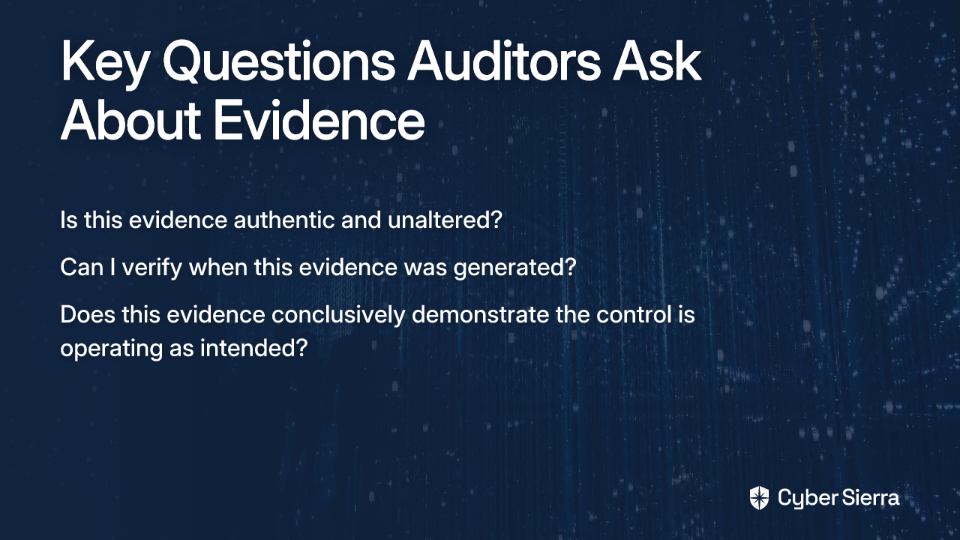
When an auditor reviews evidence, they're asking:

  • Is this evidence authentic and unaltered?
  • Can I verify when this evidence was generated?
  • Does this evidence conclusively demonstrate the control is operating as intended?

The problem arises when GRC tools pull data from disparate systems without preserving the chain of custody or contextual information that validates the evidence's integrity. This creates what security experts call the "Four Layers of Security for GRC Evidence" problem, where failures in data, communication, application, or physical security can compromise evidence before an auditor ever sees it.

For example, a simple compliance status report showing "Compliant" for password policies doesn't prove the policy is actually enforced or when the assessment was performed. Without timestamps, system identification, and configuration details, the evidence lacks the integrity auditors require.

2. The Format Fiasco: Why Auditors Demand Screenshots Over Spreadsheets

"Most auditors I've talked to will not accept .csv files, they want screenshots."

This common complaint highlights a fundamental misalignment between what GRC tools produce and what auditors need. But why are auditors so insistent on screenshots?

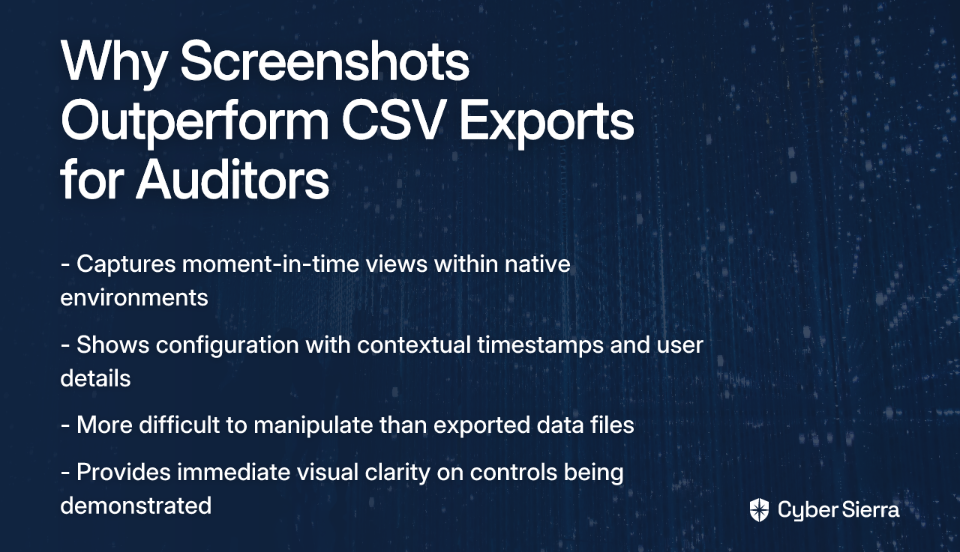
The answer isn't arbitrary preference—it's about context and immutability:

  • A screenshot captures a moment-in-time view of a control within its native environment
  • It shows the configuration in context, often including timestamps, user information, and system details
  • Screenshots are harder to manipulate than exported data files
  • Visual evidence provides immediate clarity on what's being demonstrated

By contrast, a CSV export is just data—rows and columns extracted from their original context. It raises questions: Where did this data come from? When was it generated? Has it been filtered or modified? Without answers to these questions, auditors cannot fulfill their responsibility to verify.

This disconnect reveals a design flaw in many GRC tools: they're built for data aggregation and reporting but not for capturing and preserving the contextual evidence that auditors require to do their jobs effectively.

3. The "Black Box" of Automation: When Automated Checks Raise More Questions Than Answers

Automation is a core selling point of modern GRC tools. The promise is compelling: connect to your systems, run automated checks, and generate compliance status reports without manual effort.

However, this automation often becomes a "black box" that auditors can't trust. As one security professional noted, "If yours is anything other than cookie cutter, their automations won't work." This highlights two critical problems:

  1. The transparency problem: Auditors need to understand what's being checked, how it's being assessed, and what the results mean. Many GRC tools provide only the outcome ("Pass" or "Fail") without exposing the underlying logic or raw data.
  2. The customization problem: Organizations rarely implement controls in exactly the same way. When automated checks can't adapt to your specific environment, they produce unreliable results that auditors rightfully question.

For example, an automated check might verify that multi-factor authentication (MFA) is enabled at the system level, but fail to detect that it's not properly enforced for privileged accounts—a nuance that would be obvious during a manual inspection.

It's Not Just the Tool: Organizational Gaps That Sabotage Your Audit

While technology issues contribute significantly to auditor frustration, the full picture includes organizational factors that amplify these problems.

1. The "Silver Bullet" Fallacy: A Tool Is Not a Strategy

Many organizations fall into the trap of believing they can "throw money into a tool and fix the problem." This misconception leads to implementing sophisticated GRC platforms without the foundational processes needed to support them.

As one experienced practitioner wisely observed: "You have to make sure your house is in order and you're doing the work with getting those processes in place."

The hard truth is that over two-thirds of organizations report higher risk volume and complexity but lack mature risk management processes. A GRC tool, no matter how advanced, cannot automate what doesn't exist. It can't magically create a control framework if you haven't defined one, and it can't monitor controls that haven't been implemented.

2. The Silo Effect: How Fragmented Ownership Creates Inconsistent Evidence

In many organizations, control ownership is distributed across multiple departments with minimal coordination. IT manages technical controls, HR owns personnel security, Facilities handles physical security, and so on.

This fragmentation creates a nightmare scenario during audits:

  • Evidence is collected and formatted differently across teams
  • Control interpretations vary, leading to inconsistent implementation
  • Documentation quality ranges from meticulous to barely adequate

When this siloed evidence is aggregated in your GRC tool, the result is a disjointed collection that frustrates auditors who need to see a coherent, consistent compliance story.

3. The Maturity Mismatch: When Your Tool Outpaces Your Processes

"It requires a level of Security maturity in the org that we simply didn't have."

This candid admission from a security professional highlights a common problem: organizations implement complex GRC tools before they're ready for them. Many sophisticated platforms assume you already have:

  • Well-defined control frameworks
  • Documented policies and procedures
  • Clear roles and responsibilities
  • Established risk assessment methodologies

Without this foundation, teams struggle to effectively use the tool, resulting in incomplete or inaccurate evidence that fails to satisfy auditors' requirements.

Bridging the Gap: A Practical Guide to Auditor-Friendly Evidence

The good news is that the disconnect between GRC tools and auditor expectations can be bridged. Here's how to transform your approach and create evidence that satisfies even the most demanding auditors.

1. Proactive Preparation: The Pre-Audit Game Plan

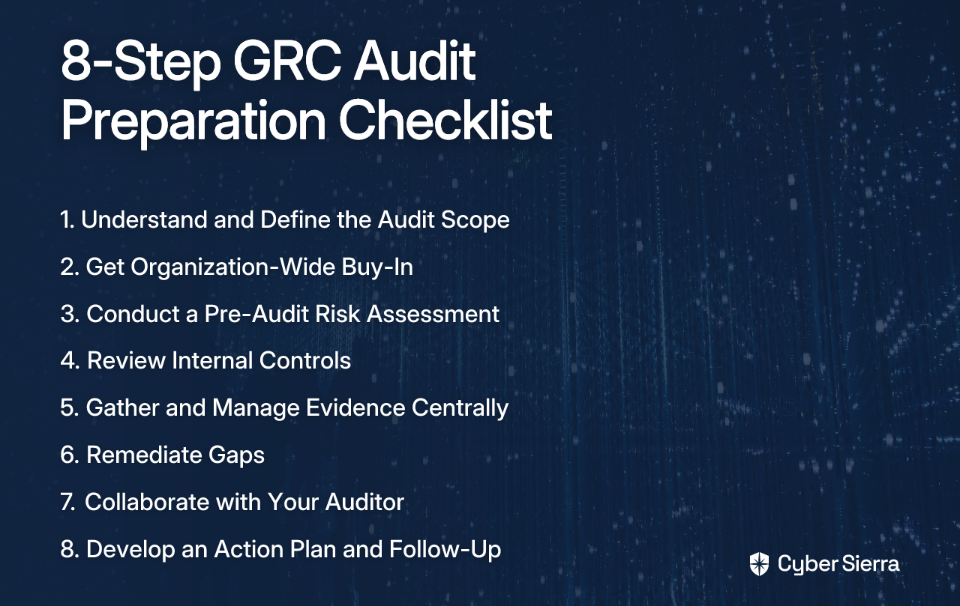
The key to successful audits is shifting from reactive scrambling to proactive preparation. Follow this 8-Step GRC Audit Preparation Checklist to set yourself up for success:

  1. Understand and Define the Audit Scope: Before jumping into evidence collection, clarify exactly what's being audited and which frameworks apply. This prevents over-collection and focuses your efforts.
  2. Get Organization-Wide Buy-In: Secure executive sponsorship and educate control owners about their responsibilities. Compliance is everyone's job, not just the GRC team's.
  3. Conduct a Pre-Audit Risk Assessment: Identify potential gaps early so you can address them before the auditor does.
  4. Review Internal Controls: Ensure controls are properly designed and operating effectively before collecting evidence.
  5. Gather and Manage Evidence Centrally: Use a centralized repository with consistent naming conventions and organization. This is where a well-implemented GRC tool adds tremendous value.
  6. Remediate Gaps: Address identified weaknesses promptly and document your remediation actions.
  7. Collaborate with Your Auditor: This is crucial—ask your auditor upfront what evidence format they prefer and what level of detail they require. Most will appreciate your proactivity.
  8. Develop an Action Plan and Follow-Up: Document lessons learned for continuous improvement.

2. From Snapshots to Cinema: Embracing Continuous Control Monitoring (CCM)

The ultimate solution to point-in-time evidence problems is to eliminate them entirely through Continuous Control Monitoring (CCM). Unlike traditional periodic assessments, CCM provides real-time visibility into control effectiveness.

With CCM:

  • Controls are continuously evaluated, not just during audit preparation
  • Exceptions are detected and addressed immediately
  • Historical data creates a complete timeline of compliance
  • Auditors can see not just that controls are effective now, but that they've been consistently effective

This is where platforms like Cyber Sierra's Continuous Control Monitoring module excel. By building a central controls repository with near real-time updates and automating control testing, CCM transforms security from periodic checks to an ongoing state of audit-readiness. When an auditor requests evidence, you can provide a comprehensive view of control effectiveness over time, not just a point-in-time snapshot.

3. Choosing the Right Partner: What to Look for in a Modern GRC Platform

Not all GRC tools are created equal, and many are simply adding "AI" to their marketing without addressing fundamental evidence issues. When evaluating platforms, look for these essential features:

  • Unified Data & Centralized Repository: A single source of truth that breaks down silos and ensures consistency.
  • True, Configurable Automation: Automation that works for your specific environment, not just a "cookie cutter" setup. The system should allow you to customize checks while maintaining transparency into the testing logic.
  • Native Integrations: Seamless connections to your existing security tools and IT systems to minimize manual data collection.
  • An Auditor Interface: A dedicated, secure portal where auditors can directly access properly formatted evidence, reducing back-and-forth and ensuring they get exactly what they need.

Cyber Sierra's Governance, Risk & Compliance solution is designed around these principles, automating data collection across multiple frameworks (like SOC 2, ISO 27001) while maintaining the context and integrity auditors demand. This makes enterprises audit-ready faster while reducing the manual burden that frustrates both GRC teams and auditors.

Transforming Audits from an Obligation to an Opportunity

The tension between GRC teams and auditors isn't inevitable. By understanding why auditors reject certain types of evidence and addressing both the technological and organizational gaps, you can transform your audit experience.

Remember: A smooth audit is not the goal—it's a byproduct of a strong, continuous compliance program. When you implement the right technology, mature your processes, and facilitate open communication with auditors, you don't just pass audits—you build trust with customers, partners, and stakeholders.

This strategic approach to compliance doesn't just satisfy auditors; it becomes a competitive advantage in a world where security and trust are increasingly differentiators.

Frequently Asked Questions

Why do auditors often reject evidence from GRC tools?

Auditors often reject evidence from GRC tools because it lacks the necessary verifiability, context, and integrity. Standard GRC exports, like CSV files, are typically just raw data removed from their original environment. Auditors need to confirm that the evidence is authentic, unaltered, and provides a complete picture of a control's operation, including timestamps and system details, which are often missing from simple data exports.

Why do auditors prefer screenshots over CSV files?

Auditors prefer screenshots because they provide immutable, contextual evidence of a control operating within its native environment. A screenshot captures a moment-in-time view that includes crucial details like system timestamps, user interfaces, and specific configuration settings. This visual proof is harder to alter than a CSV file and gives the auditor confidence that they are seeing an authentic representation of the control's status.

Is buying a GRC tool enough to ensure a smooth audit?

No, a GRC tool by itself is not enough to ensure a smooth audit. A GRC platform is a powerful asset, but it cannot replace a solid compliance strategy and mature internal processes. Organizations must first establish well-defined control frameworks and clear policies. The tool automates and streamlines these existing processes; it cannot create them from scratch.

What is Continuous Control Monitoring (CCM) and how does it help with audits?

Continuous Control Monitoring (CCM) is an automated process that provides real-time visibility into the effectiveness of your security controls, moving beyond periodic checks to ongoing evaluation. CCM helps with audits by creating a historical record of compliance, proving that controls have been consistently effective over time, not just at the moment a sample was taken. This ensures you are always audit-ready with comprehensive evidence that auditors trust.

How can I improve communication with my auditor about evidence requirements?

The most effective way to improve communication is to collaborate with your auditor proactively before the audit begins. Schedule a pre-audit meeting to discuss the scope and ask them directly what evidence formats they prefer and what level of detail they need to see. This simple step builds a collaborative relationship and ensures your team spends time collecting evidence that will actually be accepted.

Ready to make your next audit your smoothest one yet? Discover how Cyber Sierra's AI-enabled cybersecurity platform simplifies and automates security compliance while producing the high-quality, contextual evidence auditors actually want to see.

blog-hero-background-image
Governance & Compliance

How to Streamline Security Questionnaires with AI Automation

backdrop
Table of Contents

Join thousands of professionals and get the latest insight on Compliance & Cybersecurity.


You've just received your tenth security questionnaire this month. Two hundred questions, many redundant, all requiring detailed responses. Your heart sinks as you forward it to your already overworked security team, knowing this will bottleneck deals and drain valuable resources.

Sound familiar? You're not alone.

Security questionnaires represent what many professionals call the "peak of Security Theater" – a necessary evil that consumes time, creates cross-departmental chaos, and generates genuine frustration across organizations of all sizes.

The Anatomy of Questionnaire Burnout: Why the Manual Process is Broken

The traditional approach to handling security questionnaires is fundamentally flawed:

Resource Drain: Organizations often find themselves "assigning headcount" specifically to manage the questionnaire influx. As companies grow, entire teams form just to handle this administrative overhead – a seemingly "crazy thing to assign headcount to," yet increasingly necessary.

Cross-Departmental Chaos: Responding accurately requires a "collaborative effort" across multiple departments. Questions bounce between GRC teams, Sales Engineers, Product teams, and even Legal departments, creating coordination nightmares and bottlenecks.

Repetitive & Inefficient: Without proper systems, teams answer the same questions repeatedly. The lack of a "centralized knowledge library" forces manual lookups and rewrites for every new questionnaire, multiplying the inefficiency.

Despite these frustrations, security questionnaires serve critical business functions:

  • Vendor Due Diligence: Evaluating the security practices of prospective vendors before onboarding them
  • Building Trust: Demonstrating your own secure practices to close deals with potential clients
  • Compliance: Proving adherence to frameworks like SOC 2, ISO 27001, NIST CSF, HIPAA, and GDPR

The question isn't whether security questionnaires are necessary – they absolutely are. The question is: how can we transform this tedious necessity into a streamlined, efficient process?

The AI Revolution in GRC: How Automation Changes the Game

Artificial intelligence is fundamentally transforming how organizations handle security questionnaires. Here's how:

Creating a Centralized, Living Knowledge Base

AI platforms don't simply store static answers – they create dynamic knowledge repositories by ingesting and learning from:

  • Existing security documentation and policies
  • Previously completed questionnaires
  • Compliance framework documentation
  • Company wikis and knowledge bases

This directly addresses the pain point expressed by many security professionals who recognize the need to "create a knowledge library" but struggle to maintain it as answers evolve.

Achieving Near-Instant, Accurate Responses

The most tangible benefit is speed and accuracy. Modern AI solutions can generate instant, contextually accurate answers with high confidence:

  • Conveyor's platform reports over 95% accuracy on first attempts and a 91% reduction in time spent on questionnaires. The average response time per question drops from 4 minutes to just 22 seconds.
  • Safebase's AI has processed over 1,000,000 questions, saving an estimated 28,000 hours of manual work—equivalent to 13 years of full-time effort.

Automating Evidence Collection and Control Mapping

Advanced AI solutions go beyond text answers to enable continuous monitoring of security controls:

  • AI can automatically collect and map evidence (logs, system configurations, asset inventories) to specific controls required by frameworks like SOC 2 or ISO 27001
  • This creates a continuously updated evidence library, ensuring answers are not just fast but also accurate and audit-ready
  • Control mapping allows for consistent responses across different questionnaire formats and frameworks

Enhancing Collaboration and Streamlining Workflows

AI tools centralize the entire process, allowing teams to:

  • Assign specific questions to subject matter experts when human review is needed
  • Track statuses and deadlines in real-time
  • Auto-complete questionnaires directly in third-party portals through browser extensions
  • Integrate with tools like Slack and Salesforce to maintain workflow continuity

A Practical Guide: Implementing AI for Questionnaire Automation in 5 Steps

Ready to transform your questionnaire process? Here's how to get started:

Step 1: Assess Your Current Process

Map your existing workflow. Identify who's involved, where the bottlenecks occur, and how much time is being spent. Understand the specific pain points before applying a solution.

Step 2: Consolidate Your Knowledge

Gather all existing security documentation:

  • Past questionnaires and responses
  • Security policies and procedures
  • Architecture diagrams
  • Compliance reports (SOC 2, ISO 27001, etc.)

This collection will form the initial knowledge base for your AI engine.

Step 3: Choose the Right AI-Powered Tool

Evaluate solutions based on key features:

  • AI Quality: Does it generate accurate, context-aware answers?
  • Knowledge Management: How easily can it ingest and learn from your documents?
  • Workflow & Collaboration: Does it support assignments, tracking, and approvals?
  • Integrations: Does it work with your existing tools (CRM, TPRM portals)?
  • Reporting & Analytics: Can you track time saved and calculate ROI?

Step 4: Train, Test, and Refine

Upload your documents and let the AI build its knowledge base. Run several test questionnaires through the system and review the AI-generated answers, providing feedback to improve accuracy. This training period is crucial for fine-tuning the system to your specific needs.

Step 5: Integrate and Empower Your Team

Roll out the tool to relevant teams (GRC, Sales Engineering, etc.). Provide training and establish a new, streamlined workflow where AI handles the first pass, and humans review and approve only when necessary.

Beyond Questionnaires: The Broader Impact of an AI-Enabled GRC Platform

While questionnaire automation delivers immediate relief, the real value comes from integrating this capability into a comprehensive security and compliance program.

Proactive Third-Party Risk Management (TPRM)

Answering questionnaires is just one side of the coin; managing your own vendors' risk is equally important.

An integrated platform like Cyber Sierra's TPRM module uses AI automation not just to respond to inquiries but to manage vendor risk proactively by:

  • Automating vendor assessments and streamlining onboarding
  • Providing near real-time, 24/7 visibility into vendor security posture
  • Prioritizing vendors by risk level to focus resources where they matter most

Continuous Control Monitoring (CCM)

The knowledge base powering your questionnaire responses should reflect your actual security posture, not just documented policies.

Cyber Sierra's CCM module delivers ongoing, automated visibility into your security controls by:

  • Centralizing your control repository with near real-time updates
  • Automating control testing and validation
  • Detecting exceptions and anomalies in real-time

This ensures that your questionnaire responses are always backed by verifiable evidence of your security practices.

Streamlined Audits and Unified Compliance

When your questionnaire responses, control monitoring, and evidence collection are unified, audit preparation becomes dramatically simpler.

Cyber Sierra's GRC module automates data collection and reporting for multiple frameworks (SOC2, ISO 27001, GDPR, HIPAA, PCI DSS), ensuring you're always audit-ready and can demonstrate compliance with minimal effort.

Conclusion: From Security Theater to Strategic Advantage

Security questionnaires don't have to be the dreaded "Security Theater" that professionals lament. With AI automation, you can transform this process from a resource-draining necessity into a streamlined, efficient function that accelerates sales cycles and strengthens trust.

By implementing AI-powered automation, you can:

  • Slash response times by over 90%
  • Free your security team to focus on strategic initiatives
  • Ensure consistent, accurate responses across all questionnaires
  • Build a continuously updated knowledge base that improves over time
  • Integrate questionnaire responses with your broader security program

The ultimate goal is to leverage technology to handle the repetitive work, freeing up skilled security professionals to focus on what matters most: strategic risk management and building a stronger security posture.

Security questionnaires will always be part of doing business. But with the right AI automation, they no longer need to be the bane of your security team's existence.

Frequently Asked Questions

What is security questionnaire automation?

Security questionnaire automation is the use of Artificial Intelligence (AI) to automatically generate accurate answers to security and compliance questionnaires. It works by creating a centralized knowledge base from your existing security documents, policies, and past questionnaires. When a new questionnaire arrives, the AI instantly finds and populates the best answers, dramatically reducing the manual effort required from your security and GRC teams.

How does AI improve the security questionnaire process?

AI improves the security questionnaire process primarily by increasing speed, accuracy, and consistency while significantly reducing manual work. Instead of teams manually searching for answers and writing them from scratch, AI can generate responses in seconds. It centralizes all your security knowledge, ensuring answers are consistent and up-to-date. This frees up your security experts to focus on strategic tasks rather than repetitive administrative work.

How accurate are AI-generated answers?

Modern AI platforms for questionnaire automation are highly accurate, often achieving over 95% accuracy on the first pass. The accuracy comes from the AI's ability to learn from your specific company documentation, including past questionnaires, security policies, and compliance reports. The system can be trained and refined over time; users can review and correct answers, which helps the AI learn and improve its confidence for future responses.

What is a centralized knowledge base and why is it important?

A centralized knowledge base is a single, searchable repository that stores all your company's security information and previously answered questionnaire responses. It is critically important because it eliminates the need to reinvent the wheel for every new questionnaire. Without it, teams waste countless hours searching for the same information in different documents or asking colleagues for answers they've provided before.

What are the first steps to implementing AI for questionnaire automation?

The first steps are to assess your current process and consolidate all your existing security documentation into one place. Before choosing a tool, you need to understand your current bottlenecks. After that, gather past questionnaires, security policies, compliance reports, and any other relevant documents. This collection will serve as the initial training data for the AI engine.

Does AI automation replace the need for human oversight?

No, AI automation does not replace human oversight; it enhances it by handling the repetitive, time-consuming tasks. The best practice is to use AI as a powerful first-pass tool. It generates the initial draft of answers, which subject matter experts can then quickly review, edit, and approve. This collaborative workflow ensures accuracy and accountability while still saving the vast majority of manual effort.

blog-hero-background-image
Governance & Compliance

How to Structure Your Risk Register Without Losing Control Visibility

backdrop
Table of Contents

Join thousands of professionals and get the latest insight on Compliance & Cybersecurity.


You've inherited a risk register that's bursting at the seams—filled with control deficiencies, vulnerabilities, and general bugbears rather than actual risks. Every time you open it, you're hit with an overwhelming mix of "weak passwords," unpatched servers, and vague concerns that don't quite fit together. The mess is undeniable, yet you're hesitant to clean it up for fear of losing visibility into those legitimate control concerns.

If this sounds familiar, you're not alone. Risk registers are essential GRC tools, but they frequently become dumping grounds for every security concern in the organization, regardless of whether it's truly a risk.

The good news? You can transform this chaos into clarity without sacrificing visibility into your control environment. This article provides a practical framework for restructuring your risk register while enhancing—not reducing—your oversight of the factors that contribute to risk.

The Root of the Problem: Confusing Risks with Their Ingredients

The primary reason risk registers become unmanageable is a fundamental confusion about what belongs in them. Many organizations struggle to differentiate between three key concepts:

  • Risk: The potential for loss when a threat exploits a vulnerability. A proper risk statement describes a scenario with a cause and effect (e.g., "Unauthorized access to sensitive data due to inadequate authentication controls").
  • Vulnerability: A weakness in an asset or control that can be exploited by a threat actor (e.g., an unpatched server or misconfigured firewall).
  • Control Deficiency: A weakness or failure in the design or operation of a control meant to mitigate risk (e.g., "poorly configured password policy" or "multiple reports of poor passwords in use").

As one security professional noted, control deficiencies "simply increase risk, but are not risks themselves." Yet these items frequently dominate risk registers, creating a cluttered document that's difficult to prioritize and ineffective for decision-making.

When your register contains a mix of all three elements without clear distinction, you end up with a tool that's:

  • Too detailed for executive decision-making
  • Too cluttered for effective prioritization
  • Too confusing for clear ownership and accountability
  • Too overwhelming to maintain consistently

Part 1: Building a Clean and Strategic Risk Register

The first step toward clarity is building (or rebuilding) a "pure" risk register focused solely on actual risks. This becomes your strategic view of what could go wrong and how you're addressing it.

Essential Components of an Effective Risk Register

According to best practices from organizations like Hyperproof and LogicManager, every entry in your risk register should include:

  1. Risk ID: A unique identifier for tracking purposes.
  2. Risk Description: A clear, concise scenario explaining the potential event. This should follow a cause-effect format (e.g., "Due to [cause], there is a risk that [event] may occur, resulting in [consequence]").
  3. Risk Category: Group similar risks for analysis (e.g., Technical, External, Organizational, Project Management).
  4. Likelihood & Impact Assessment: Use a consistent scoring system (e.g., 1-5 scale) to quantify both the probability of occurrence and the potential business impact.
  5. Risk Exposure Rating: A calculated score (typically Likelihood × Impact) to help with prioritization.
  6. Risk Response Plan: The defined strategy (Accept, Transfer, Mitigate, Avoid, or Escalate).
  7. Risk Owner: The single individual accountable for managing the risk.
  8. Status: The current state of the risk (e.g., 'Open', 'In Progress', 'Closed').

Step-by-Step Process for Populating the Register

  1. Identify the Risk: Use techniques like brainstorming, SWOT analysis, and stakeholder interviews to identify potential risks.
  2. Assess the Risk: Evaluate likelihood and impact based on your organization's risk assessment methodology. Context is critical here—as one security professional pointed out, "Having a poorly configured password is going to be a lower risk if it's on an account only accessible internally vs an externally accessible account."
  3. Categorize the Risk: Implement a risk breakdown structure for a hierarchical view of your risk landscape.
  4. Develop a Risk Response: Outline actionable steps, timelines, and resources needed to address the risk.
  5. Assign Ownership: Ensure clear accountability by designating a specific individual as the risk owner.
  6. Monitor and Review: Remember that the risk register is a living document requiring regular updates as risks evolve and controls mature.

Part 2: The Solution - A Hub-and-Spoke Model for Total Visibility

Now for the critical question: How do you maintain visibility into vulnerabilities and control deficiencies without cluttering your risk register?

The answer is a hub-and-spoke model where your risk register serves as the strategic "hub," linked to tactical "spokes" that provide detailed operational information.

Spoke 1: The Vulnerability Management Log

Instead of tracking individual vulnerabilities as risks, maintain a separate vulnerability management database. As one practitioner noted, "We don't track individual vulnerabilities as risks in the risk register."

This vulnerability log should track:

  • Vulnerability ID
  • Description
  • Affected assets
  • CVSS scoring
  • Remediation status
  • Assigned teams/individuals

Connecting to the Hub: The aggregation of vulnerabilities informs strategic risks in your register. For example, a high number of critical, unpatched vulnerabilities on internet-facing servers creates a risk of "External compromise of critical systems due to delayed patch management." The vulnerability log provides the tactical evidence and feeds into the inherent risk assessment in the main register.

Spoke 2: The Control Deficiency & Issues Log

This is the proper home for items like "weak passwords" or other audit findings. It tracks deviations from your established control framework, including:

  • Issue ID
  • Description
  • Related control
  • Root cause analysis
  • Remediation plan
  • Owner
  • Due date

Connecting to the Hub: The industry recommendation is valuable here: "Would suggest you think about pulling out thematic/repeating issues - if you have multiple reports of poor passwords in use, this is clearly a systemic issue that should be dealt with." These systemic patterns become risks in the main register: "Increased likelihood of unauthorized access due to systemic password control failures."

By implementing this structure, you maintain complete visibility while creating a clearer, more strategic risk register. The hub-and-spoke model allows you to:

  1. Keep your risk register focused on true risks
  2. Maintain detailed tracking of vulnerabilities and control deficiencies
  3. Establish clear relationships between operational issues and strategic risks
  4. Provide appropriate levels of detail for different audiences

Maintaining Control: Advanced Practices and Tools

Standardize Your Methodology

A common pain point in the GRC community is that "How risk are recorded, assessed, managed is probably the one thing that varies the most from a GRC group to another." To combat this inconsistency:

  • Document a clear, standardized process for risk assessment
  • Establish common scales for likelihood and impact
  • Create templates for risk descriptions to ensure consistency
  • Define thresholds for when vulnerabilities or control deficiencies should escalate to risk register entries

Effective Reporting and Communication

It's important to differentiate between a risk register (the detailed log) and a risk report (a summary for stakeholders), as explained by LogicManager. Your reporting should:

  • Provide different levels of detail for different audiences
  • Incorporate visual aids or dashboards to summarize risk data
  • Highlight trends and patterns in your vulnerability and control deficiency logs
  • Demonstrate the connections between operational issues and strategic risks

Move Beyond Spreadsheets

While spreadsheets are a common starting point, they have significant limitations for managing complex risk data. Consider purpose-built GRC software that can provide:

  • Better data integrity
  • Automated workflows
  • Relationship mapping between risks, controls, and vulnerabilities
  • Real-time reporting and dashboards
  • Role-based access for different stakeholders

Conclusion: From a Cluttered Log to a Strategic GRC Tool

A well-structured risk register, supported by separate but linked logs for vulnerabilities and control deficiencies, is the key to clarity without sacrificing control visibility. This approach transforms your risk register from a tactical dumping ground into a powerful strategic asset.

The benefits are substantial:

  • Proactive risk management: Clear visibility into what matters most
  • Improved decision-making: Focused information at the appropriate level of detail
  • Enhanced communication: Consistent language and structure across the organization
  • Clear accountability: Proper ownership at both the strategic and tactical levels

By implementing this structured approach, you'll not only clean up your risk register but also enhance your overall risk management capabilities. You'll maintain complete visibility into your control environment while providing leadership with the strategic view they need to make informed decisions.

Remember that effective risk management isn't about tracking every possible issue—it's about understanding the relationships between vulnerabilities, control deficiencies, and the risks they create. With the right structure in place, your risk register becomes the cornerstone of a mature, effective GRC program that drives value for your organization.

Frequently Asked Questions

What is the difference between a risk, a vulnerability, and a control deficiency?

A risk is the potential for loss, a vulnerability is a weakness that can be exploited, and a control deficiency is a flaw in a safeguard designed to mitigate risk. Essentially, vulnerabilities and control deficiencies are the ingredients of risk. An unpatched server is a vulnerability, and a poorly configured password policy is a control deficiency. The risk is the potential event that could happen because of them, such as "unauthorized access to sensitive data."

Why shouldn't I track all vulnerabilities in my risk register?

Tracking every vulnerability in a risk register makes it cluttered, tactical, and difficult for leadership to use for strategic decision-making. A register filled with individual vulnerabilities becomes an overwhelming operational log rather than a strategic tool, making it hard to prioritize the most significant threats. It's better to track vulnerabilities in a dedicated log and use their aggregate impact to inform true, strategic risks.

How do I know when a control issue becomes a risk?

A control issue or vulnerability becomes a risk worthy of the register when it is systemic or creates a significant potential for business impact. For example, a single weak password is a control deficiency. However, widespread, repeated instances of weak passwords become a systemic failure that should be captured as a strategic risk, such as "Increased likelihood of account compromise due to systemic password control failures."

What is the hub-and-spoke model for risk management?

The hub-and-spoke model is a structure where a strategic risk register (the hub) is linked to detailed operational logs for vulnerabilities and control deficiencies (the spokes). This model keeps the main risk register clean and focused on high-level risks for executives, while the spokes provide the detailed, tactical evidence and tracking needed by operational teams.

How often should a risk register be reviewed?

A risk register should be formally reviewed at least quarterly or semi-annually, with more frequent updates for high-priority or rapidly changing risks. The register is a living document, not a static one. Regular reviews ensure that risk assessments remain accurate, response plans are on track, and new risks are identified promptly.

What is the first step to clean up a cluttered risk register?

The first step is to create separate logs for vulnerabilities and control deficiencies, then migrate non-risk items out of your main register and into these new logs. Begin by establishing a clear definition of what constitutes a "risk." Then, go through your existing register item by item and re-categorize each one. This initial triage is crucial for transforming the register into a strategic tool.

For additional resources, consider exploring NIST's guide on integrating cybersecurity and enterprise risk management and Hyperproof's risk register template as practical starting points.

blog-hero-background-image
Governance & Compliance

Learn by Example: Reverse-Engineer GRC Policies

backdrop
Table of Contents

Join thousands of professionals and get the latest insight on Compliance & Cybersecurity.


You stare at a blank document, cursor blinking impatiently. You've been tasked with creating a new security policy for your organization, but where do you even start? Templates feel too generic, online courses are prohibitively expensive, and the pressure is mounting.

"I could just use a walk-through demonstration on how to efficiently do this," you think to yourself, echoing the frustration of countless GRC professionals.

If this scenario feels familiar, you're not alone. Many professionals in Governance, Risk, and Compliance (GRC) struggle with the seemingly arcane art of policy creation. But there's a powerful technique used by seasoned practitioners that can transform this daunting task into a manageable process: reverse-engineering existing high-quality policies.

Understanding the GRC Documentation Hierarchy

Before we dive into reverse-engineering, let's clarify the different types of documents in the GRC universe. This confusion is common—as one professional noted, "I saw policies, not standards and my need was a bit different."

According to ComplianceForge, the hierarchy works like this:

  • Policy: High-level statement of management intent that addresses what should be achieved. Policies provide the guiding framework.
  • Standard: Specific, measurable requirements that must be met. Standards define how policies will be implemented.
  • Control: Mechanisms that enforce policies and standards, often technical or organizational measures.
  • Procedure: Detailed, step-by-step instructions on implementing controls and standards.

Understanding this hierarchy is crucial because it determines the language, specificity, and format you'll need to use in your document. You can't write an effective standard if you're using policy-level language, and vice versa.

Finding Your Blueprints: Where to Source High-Quality GRC Documents

The first step in reverse-engineering is finding excellent examples to learn from. Here's where to look:

1. NIST Governance Risk Standards

The National Institute of Standards and Technology (NIST) provides comprehensive frameworks that are widely respected:

  • NIST Special Publication 800-53, Revision 5: This document contains security and privacy controls for federal information systems and is the gold standard for many organizations. It's freely available here.

Many template providers, including KnowBe4's KCM GRC Policy Templates, base their documents on NIST standards, making them excellent resources for understanding how to implement these controls in real-world settings.

2. Government & Regulatory Agencies

Government bodies often publish detailed guidelines that demonstrate excellent document structure:

3. Industry-Specific Frameworks

  • Center for Internet Security (CIS): Offers policy templates specifically tailored to its widely-respected CIS Controls, providing industry-specific guidance and structures.

The Reverse-Engineering Playbook: A Step-by-Step Walk-Through

Now, let's break down the process of reverse-engineering these documents to extract their wisdom:

Step 1: Define the Scope of Your Analysis

Before diving in, be clear about what you're looking for:

  • What type of document do you need to create? (Acceptable Use Policy, Change Management Policy, etc.)
  • What regulatory requirements must it satisfy?
  • Who is the intended audience?

This clarity will focus your analysis on relevant aspects of the example documents.

Step 2: Break Down the Policy Structure and Key Provisions

Examine how the document is organized:

  1. Header Elements: Look at how they present policy title, version, effective date, and document owner.
  2. Core Structure: Most policies follow this pattern:
    • Purpose statement (why the policy exists)
    • Scope (who and what it applies to)
    • Policy statements (the actual requirements)
    • References (links to related frameworks or regulations)
    • Definitions (terminology clarification)
    • Policy history (version tracking)
  3. Summarize Each Section: Write a one-sentence description of what each section accomplishes to ensure you understand its function.

Step 3: Analyze the Language, Tone, and Key Terms

This addresses the common question: "How to use the right language?"

  1. Study the Use of Modal Verbs:
    • "Must" and "shall" indicate mandatory requirements
    • "Should" suggests recommended practices
    • "May" indicates optional elements
  2. RFC 2119 Compliance: Many professional policies follow RFC 2119, which standardizes these key words. Incorporating this reference into your own policies adds clarity and removes ambiguity.
  3. Examine Definitions: Note how potentially ambiguous terms are clearly defined upfront to prevent misinterpretation.

Step 4: Identify Stakeholders and Map Responsibilities

Look for sections that define who does what:

  • Who owns the policy?
  • Who enforces it?
  • Who must comply with it?

This mapping of responsibilities is vital for effective governance and accountability.

Step 5: Create a Cross-Reference Map

One of the most valuable elements in professional GRC documentation is the cross-reference map table. This table shows how your policy statements align with external regulations or frameworks.

For example, a security policy might include a table showing:

  • Policy Statement #1 → NIST SP 800-53 control AC-1
  • Policy Statement #2 → ISO 27001 control A.9.2.3
  • Policy Statement #3 → CIS Control 5.1

These maps demonstrate compliance, simplify audits, and show how individual controls support broader security objectives. As one professional noted, "Cross reference tables make more sense once you see a few done right."

From Deconstruction to Creation: Building Your Own GRC Documents

Now that you've reverse-engineered several examples, it's time to apply what you've learned:

  1. Synthesize a Master Template: Combine the best structural elements from your examples to create a customized template that fits your organization's culture and needs.
  2. Apply the SMART Criteria: For each policy statement, ensure it is: SMART Criteria for Effective Policy Statements
    • Specific: Clearly states what is required
    • Measurable: Can be objectively assessed
    • Achievable: Realistic for your organization
    • Relevant: Addresses actual risks
    • Time-bound: Includes deadlines or review periods
  3. Focus on Process Support: Remember that "policy is just a tool, and it is defined by the processes it needs to support and the people who need to use it." Your document must be practical and aligned with business operations.
  4. Make it Evergreen: Establish a documentation maintenance schedule to keep your policies current. Without this, you'll be "stuck in an eternal paperwork maintenance limbo."

The Professional's Edge: Additional Considerations

As you master the reverse-engineering approach, keep these professional tips in mind:

  1. Leverage Managerial SANS Certification Knowledge: If you've completed or are considering SANS training, apply those principles to your document analysis and creation.
  2. Remember the Purpose of Formality: The structured language in GRC documents isn't about bureaucracy—it's about clarity. Using terms like "shall" and "must" removes ambiguity in audits and enforcement.
  3. Version Control as Communication: The policy history section isn't just for record-keeping; it communicates to stakeholders how the document evolves in response to changing requirements.

Conclusion: Mastering the Craft Through Practice

By reverse-engineering existing high-quality GRC documents, you're learning "by hand" as many professionals prefer. This approach builds a deeper, more intuitive understanding than templates alone can provide.

Remember that mastery comes through practice. Choose one policy you need to create, find a strong example from the sources provided, and begin the walk-through process today. With each document you analyze and each policy you create, you'll develop a stronger grasp of the structure, language, and formatting that makes GRC documentation effective.
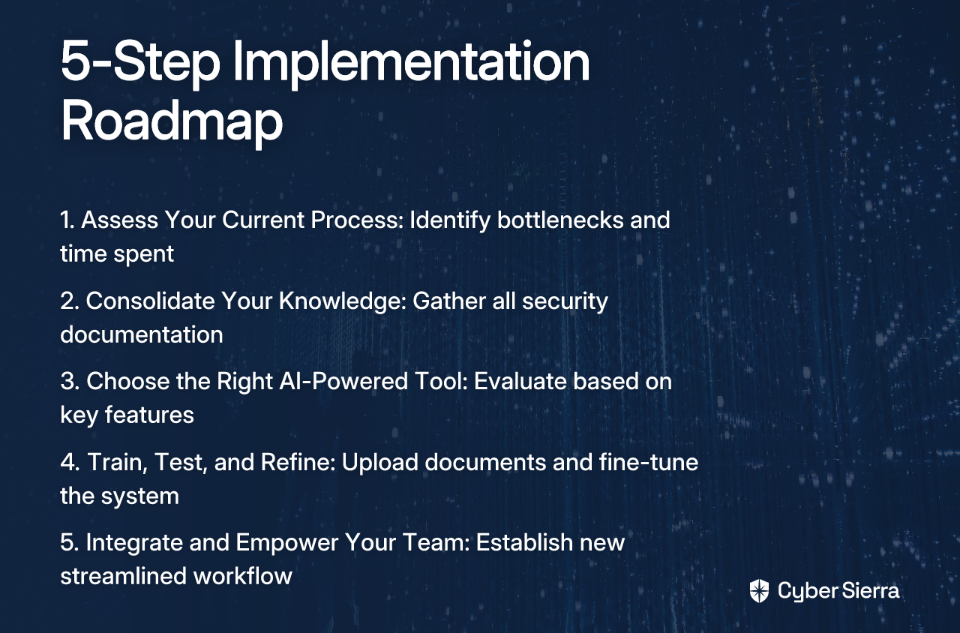
The art of GRC documentation isn't mystical—it's methodical. And through reverse-engineering, that methodology is now yours to master.

Frequently Asked Questions

What is the reverse-engineering approach to creating GRC policies?

Reverse-engineering GRC policies is the process of deconstructing high-quality, existing documents to understand their structure, language, and logic. Instead of starting from a blank page or a generic template, you analyze proven examples from sources like NIST or industry leaders to learn the principles behind effective policy writing and then apply those principles to create your own custom document.

Why is understanding the GRC documentation hierarchy so important?

Understanding the GRC hierarchy (Policy, Standard, Control, Procedure) is crucial because it ensures you create a document with the appropriate level of detail and authority. A high-level policy sets management's intent, while a standard provides measurable requirements, and a procedure gives step-by-step instructions. Confusing them leads to documents that are either too vague to be enforceable or too detailed to be a guiding policy, causing confusion and implementation failure.
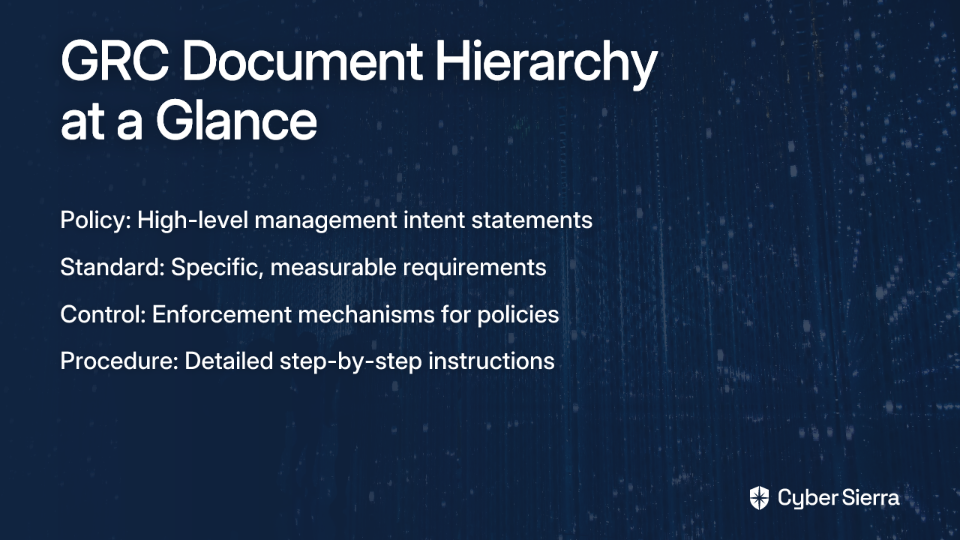
Where can I find high-quality GRC policies to use as examples?

You can find excellent GRC document examples from several reputable sources. The National Institute of Standards and Technology (NIST), particularly SP 800-53, is considered a gold standard. Government and regulatory agencies, such as the IRS, often publish detailed guidelines with clear structures. Additionally, industry-specific bodies like the Center for Internet Security (CIS) provide frameworks and templates tailored to specific controls.
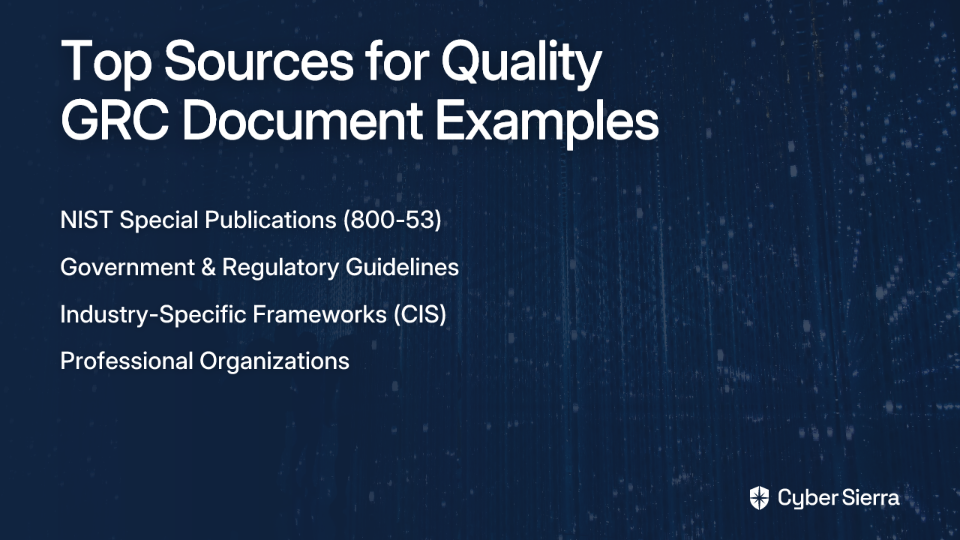
How is reverse-engineering different from just using a GRC policy template?

Reverse-engineering is an active learning method, whereas using a template can be a passive, "fill-in-the-blank" exercise. By deconstructing a policy, you learn why it is structured a certain way and how its language ensures clarity and compliance. This deep understanding allows you to create a more effective, customized policy that truly fits your organization, rather than simply adopting a generic document that may not align with your specific processes or risks.

What is the most common mistake when writing a new security policy?

One of the most common mistakes is creating a policy that is disconnected from the organization's actual processes, culture, and operational realities. A policy is ineffective if it is not practical, achievable, or enforceable. Another frequent error is using ambiguous language (e.g., "should" when "must" is required), which creates loopholes and makes the policy difficult to audit and enforce.

How often should security policies be reviewed and updated?

As a best practice, security policies should be reviewed at least annually. However, they should also be updated whenever there is a significant change that impacts their relevance or effectiveness. Such changes can include the adoption of new technologies, shifts in business objectives, new or updated regulatory requirements, or lessons learned from a recent security incident.

blog-hero-background-image
Governance & Compliance

Compliance Report Examples & Templates

backdrop
Table of Contents

Join thousands of professionals and get the latest insight on Compliance & Cybersecurity.


You've just received another urgent request from leadership for an updated compliance status. You sigh, knowing what's ahead: wrestling with clunky reporting tools that produce data you can't fully trust. Whether it's trying to extract a simple Windows patch compliance report from SCCM or struggling to generate meaningful regulatory documentation, the frustration is real.

"SCCM reporting should be considered anecdotal at best and absolutely not relied on as the source of truth for something as crucial as CVE mitigation," warns one IT professional. Sound familiar?

The good news? You're not alone, and there are better approaches to compliance reporting than what you're currently enduring.

What is a Compliance Report and Why is it Crucial?

A compliance report is a formal document that demonstrates an organization's adherence to internal policies, industry standards, and regulatory requirements. These reports serve as evidence that you're following the rules that govern your industry or operation.

Beyond merely checking boxes, effective compliance reports deliver several critical benefits:

  • Risk Mitigation: Identify vulnerabilities and non-compliance issues before they result in penalties, breaches, or operational failures
  • Stakeholder Trust: Build confidence with customers, partners, and investors by demonstrating accountability and responsibility
  • Operational Excellence: Provide clear insights into how internal processes align with established standards
  • Strategic Decision-Making: Offer actionable data to guide resource allocation and improvement initiatives

As regulatory landscapes grow increasingly complex, the ability to produce accurate, comprehensive compliance reports has never been more important.

A Spectrum of Compliance: Common Report Types & Real-World Examples

Compliance reports come in various forms depending on the requirement they address. Here are the main categories with practical examples:

Regulatory Compliance Reports

These reports focus on adherence to external laws and regulations imposed by government bodies or industry associations.

Examples include:

  • SOX Compliance Reports (Sarbanes-Oxley Act)
  • HIPAA Compliance Documentation (Healthcare)
  • GDPR Data Protection Reports (Privacy)

Deep Dive Example: Digital Markets Act (DMA) Report

The European Commission requires designated "gatekeepers" (large tech platforms) to submit detailed compliance reports within six months of designation, with updates at least annually. The first reports for gatekeepers designated on September 6, 2023, were due by March 7, 2024.

What makes these reports unique is transparency—the Commission publishes non-confidential summaries of each report, allowing for public scrutiny of how major platforms comply with digital market regulations.

Technical & Operational Compliance Reports

These reports evaluate adherence to internal procedures, IT infrastructure requirements, and technical standards.

Examples include:

  • IT Security Compliance Reports
  • Patch Management Compliance Reports
  • Training Completion Reports

Deep Dive Example: IT Patch Compliance Report

This is where many organizations struggle most. A comprehensive patch compliance report should track the status of security patches across all servers and endpoints, providing clear visibility into CVE mitigation efforts.

Unfortunately, built-in tools often fall short. As one IT professional laments, "It's got plenty of reports and 99% of them are useless." When SCCM or Intune reports prove inadequate, alternative approaches include:

  • Creating custom Power BI reports that pull data directly from your management database
  • Developing scripts using PowerShell modules like MSRCSecurityUpdates to query monthly hotfixes
  • Implementing dedicated vulnerability management solutions like Tenable

Financial Compliance Reports

These assess the integrity and transparency of financial reporting and processes.

Examples include:

  • Annual financial statements
  • Reports on internal controls over financial reporting
  • Tax compliance documentation

ESG Compliance Reports

Environmental, Social, and Governance reports track performance against non-financial metrics that are increasingly important to stakeholders.

Examples include:

  • Sustainability reports
  • Diversity, Equity and Inclusion (DEI) documentation
  • Corporate social responsibility reports

The Anatomy of an Effective Compliance Report: A Universal Template

While content varies by requirement, every effective compliance report should include these essential components:

1. Executive Summary

A concise overview of key findings, compliance status, and significant changes. This section allows busy stakeholders to quickly grasp the essential information without diving into technical details.

2. Scope and Objectives (Rule Statement)

Clearly define what's being evaluated:

  • Which regulations or standards are being assessed?
  • What time period does the report cover?
  • Which departments, systems, or processes are included?

3. Methodology

Detail your approach to data collection and analysis:

  • Data sources and systems reviewed
  • Assessment methods used
  • Any limitations or constraints encountered

4. Risk Analysis & Audit Findings

The core of your report should:

  • Document all identified issues and non-compliance instances
  • Categorize risks by severity (high, medium, low) to prioritize attention
  • Provide context for each finding

5. Corrective Actions & Status (Fix-it Plan)

For each finding, outline:

  • A detailed remediation plan
  • Assigned owners for accountability
  • Clear timelines for resolution
  • Current status of implementation

6. Performance Metrics & Compliance Scorecard

Include quantitative data to illustrate compliance trajectory:

  • Key Performance Indicators (KPIs)
  • Key Risk Indicators (KRIs)
  • Visual elements like charts and graphs to enhance comprehension

7. Recommendations & Future Monitoring

Provide forward-looking suggestions:

  • Process improvements
  • Policy updates
  • Enhanced controls
  • Ongoing monitoring approaches

From Data to Document: Creating Your Compliance Report

Follow these steps to develop comprehensive, actionable compliance reports:

  1. Define Purpose and Understand Requirements: Clarify the specific regulations or standards you need to address and identify your audience to tailor the report's focus.
  2. Collect and Consolidate Data: Gather documentation from primary systems, previous audit reports, and records of compliance activities. For technical compliance like patch management, you may need to use scripts or specialized tools to overcome the limitations of built-in reporting features.
  3. Engage Stakeholders: Involve department heads and subject matter experts to ensure your report reflects the full operational picture.
  4. Conduct Analysis and Identify Root Causes: Don't just note compliance failures—understand why they occurred to prevent recurrence.
  5. Develop and Assign Action Plans: Create SMART (Specific, Measurable, Achievable, Relevant, Time-bound) action plans for every finding and assign clear ownership.
  6. Structure Your Report Effectively: Organize all sections logically and incorporate visuals to clarify complex data.
  7. Review, Finalize, and Distribute Securely: Validate accuracy with stakeholders before secure distribution to the intended audience.

Best Practices and Common Pitfalls

Avoid These Common Mistakes:

  • Relying on Manual Data Consolidation: This introduces errors and delays—automate where possible
  • Ignoring Follow-ups: Failing to track progress on action items undermines accountability
  • Reporting Without Context: Data without narrative reduces impact and confuses stakeholders
  • Listing Controls Without Effectiveness Metrics: Stating that controls exist isn't enough—prove they work

Tools to Enhance Your Compliance Reporting:

  • Compliance Management Platforms: Solutions like MetricStream or VComply's ComplianceOps Platform can automate data collection and report generation
  • Dedicated Security Tools: For technical compliance, consider specialized solutions when configuration tools like SCCM prove insufficient
  • Custom Reporting Solutions: Power BI dashboards or tailored scripts can provide more reliable data than out-of-the-box options

Conclusion: From Obligation to Advantage

Effective compliance reporting isn't just about meeting requirements—it's about transforming obligations into strategic advantages. When done right, compliance reports provide valuable insights that drive better decision-making and reduce organizational risk.

By adopting structured approaches, leveraging appropriate tools, and focusing on actionable findings rather than mere checkbox exercises, you can elevate compliance reporting from frustrating obligation to valuable business intelligence.

Remember, the goal isn't just to satisfy auditors or regulators—it's to create a safer, more efficient, and more trustworthy organization. Your compliance reports are powerful tools to achieve exactly that.

Frequently Asked Questions

What is a compliance report?

A compliance report is a formal document that demonstrates an organization is adhering to a specific set of rules, which can include internal policies, industry standards, or government regulations. It serves as crucial evidence of compliance, helping to mitigate risks, build stakeholder trust, and guide strategic decisions by identifying vulnerabilities before they become major problems.

Why is compliance reporting often difficult with built-in tools like SCCM?

Built-in tools like SCCM can make compliance reporting difficult because their data is often considered unreliable and their reporting features are too limited for critical tasks like CVE mitigation. Many IT professionals find that standard reports are not trustworthy for crucial compliance verification, forcing them to use alternative methods like custom scripts, Power BI dashboards, or dedicated vulnerability management tools to get accurate data.

What are the essential components of an effective compliance report?

An effective compliance report must include an executive summary, a clear scope and objectives, the methodology used, detailed findings with risk analysis, a corrective action plan, key performance metrics, and forward-looking recommendations. This structure ensures the report is comprehensive, providing a high-level overview for leaders while also offering deep, actionable insights for technical teams.

How can an organization improve its compliance reporting process?

An organization can improve its reporting process by automating data collection to reduce errors, clearly defining the report's purpose and audience, engaging relevant stakeholders for accuracy, and analyzing the root cause of failures instead of just listing them. Using a structured template and assigning clear ownership for corrective actions are also critical steps to turn reporting from an obligation into a strategic tool.

What is the difference between regulatory and technical compliance reports?

Regulatory compliance reports focus on adherence to external laws and government-mandated regulations (like GDPR, HIPAA, or SOX). In contrast, technical compliance reports evaluate adherence to internal standards, IT policies, and operational procedures, such as patch management status or IT security configurations. Essentially, regulatory reports prove you are following the law, while technical reports show you are following your own established best practices.

toaster icon

Thank you for reaching out to us!

We will get back to you soon.