blog-hero-background-image
Governance & Compliance

How do I prepare for a GRC audit?
backdrop
Table of Contents

Join thousands of professionals and get the latest insight on Compliance & Cybersecurity.


Every time a GRC audit rolls around, do you find your organization descending into chaos? Teams frantically digging through logs from various services, chasing down evidence from different departments, and struggling to piece together a coherent picture of your controls? If this sounds familiar, you're not alone.

"It's incredibly stressful and drains a huge amount of resources that could be spent on actual security improvements," as one professional aptly described the typical audit experience.

But it doesn't have to be this way. The key is shifting from a reactive scramble to having continuous compliance and risk management built into your daily operations. This article will guide you through a comprehensive approach to GRC audit preparation that transforms this dreaded event into a strategic advantage for your organization.

Why GRC Audit Preparation is Non-Negotiable

Before diving into the how-to, let's understand what a GRC audit encompasses and why it matters. A GRC (Governance, Risk, and Compliance) audit is a holistic assessment of your organization's governance structure, risk management processes, and compliance with relevant regulations and standards. Unlike traditional financial audits, a GRC audit provides a comprehensive view of how well your organization manages risks and meets its obligations.

Proper preparation for a GRC audit delivers several critical benefits:

  • Ensures Regulatory Compliance: Verifies adherence to laws and standards like GDPR, HIPAA, and PCI-DSS, preventing costly fines and penalties.
  • Refines Risk Management: Evaluates your risk identification and response strategies, helping to protect the organization from threats.
  • Enhances Operational Efficiency: Identifies bottlenecks and redundancies in your processes, leading to streamlined operations.
  • Builds Trust & Credibility: Demonstrates your commitment to good governance to stakeholders, the board, and partners.
  • Fosters Accountability: Promotes a culture where every department understands its role in maintaining compliance.

Common GRC Audit Challenges (And How to Overcome Them)

Before we get to the solution, let's acknowledge the common pain points that make GRC audits particularly challenging:

Cultural & Organizational Silos

Departments often work independently with their own tools and processes, leading to fragmented risk and compliance approaches. Breaking down these silos is essential for a cohesive audit response.

Inconsistent & Disorganized Data

"It's a huge pain point for so many teams," notes one professional about the struggle to aggregate data from multiple platforms and organize evidence effectively.

Resource Constraints

Limited personnel, time, or budget can make thorough preparation seem impossible, especially for smaller organizations.

Legacy Technology Issues

Outdated systems can be difficult to integrate with modern GRC tools, hindering automation and visibility across the organization.

Last-Minute Preparation

The reactive approach leads to haphazard control reviews, missed documentation, and overwhelmed teams, disrupting regular operations.

The Ultimate 8-Step GRC Audit Preparation Checklist

Now, let's dive into a structured approach that will transform your audit experience from chaotic to controlled:

Step 1: Understand and Define the Audit Scope

Start by clearly identifying which GRC components, operational processes, and regulatory frameworks (e.g., ISO 27001, HIPAA, PCI-DSS) are in scope for the audit. As one practitioner notes, "The biggest misstep is typically not narrowing the focus to the people, processes, and technologies that directly impact the services being provided."

  • Review the audit requirements and objectives
  • Identify all relevant regulations and standards
  • Document the systems, processes, and data within scope
  • Gather all necessary documents, including existing compliance policies, previous audit reports, and risk assessments

Step 2: Get Organization-Wide Buy-In and Assemble Your Team

Secure support from C-level executives to drive a culture of compliance from the top down. Then, create a dedicated audit response team with clear roles and responsibilities.

  • Identify key stakeholders from different departments (IT, HR, Legal, Finance)
  • Assign specific responsibilities for evidence collection and control validation
  • Establish regular check-ins to monitor progress and address challenges
  • Create a communication plan to keep everyone informed

Step 3: Conduct a Pre-Audit Risk Assessment & Gap Analysis

Identify and evaluate potential risks before the auditor does. This proactive approach allows you to address issues before they become audit findings.

  • Perform a comprehensive risk assessment using established methodologies like risk heat maps
  • Review your current compliance posture against the audit requirements
  • Identify gaps between your current state and the required state
  • Prioritize remediation efforts based on risk level and audit impact

Step 4: Review and Evaluate Internal Controls

Document and assess all the internal controls your organization has in place to mitigate identified risks.

  • Map controls to specific risks and compliance requirements
  • Evaluate the effectiveness of these controls through testing
  • Document control objectives, activities, and evidence of their operation
  • Identify control weaknesses and develop remediation plans

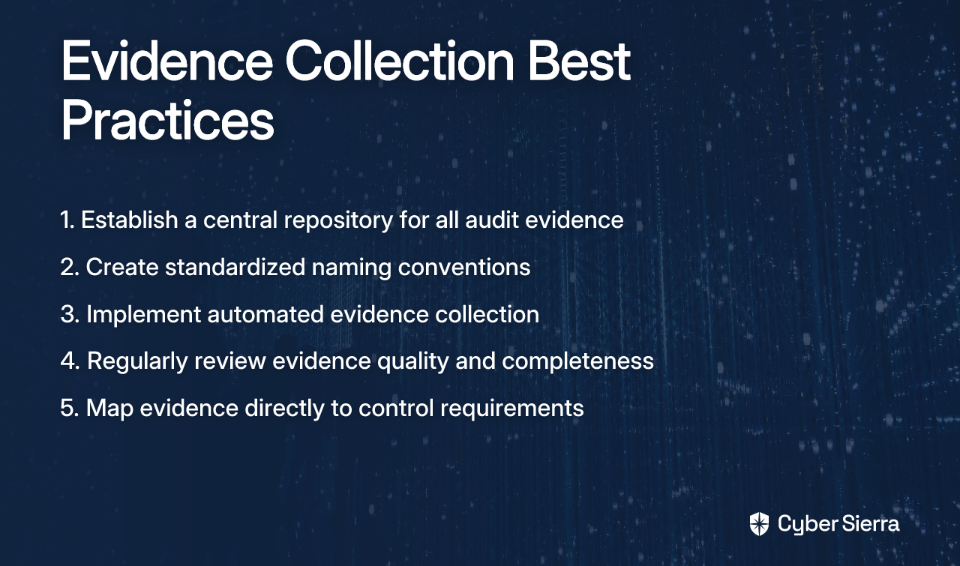
Step 5: Gather and Manage Evidence Centrally

This step directly addresses the common pain of "digging through logs from different services" and having "disorganized evidence collection."

  • Establish a centralized repository for all audit evidence
  • Create a standardized naming convention and organization system
  • Implement automated evidence collection where possible
  • Regularly review evidence quality and completeness
Step 6: Remediate Gaps and Implement Changes

Based on your gap analysis and control evaluation, work with relevant departments to implement necessary changes.

  • Develop specific action plans for each identified gap
  • Assign owners and deadlines for each remediation task
  • Document all remediation activities and the new controls implemented
  • Verify that remediation efforts are effective and sustainable

Step 7: Build a Collaborative Relationship with Your Auditor

Don't treat the auditor as an adversary. As one professional observed, "your actual audit experience will depend on who does your audit."

  • Choose an experienced auditor with relevant competencies for your industry
  • Maintain open communication and transparency throughout the process
  • Ask clarifying questions about expectations and requirements
  • Provide context for your control environment to help the auditor understand your approach

Step 8: Develop an Action Plan and Follow-Up

After the audit, compile findings into a comprehensive report and create a formal plan to address any issues.

  • Document all audit findings and recommendations
  • Develop specific, time-bound action plans for addressing findings
  • Assign clear ownership for each remediation task
  • Conduct follow-up audits to verify the effectiveness of your remediation efforts

Best Practices for a Pain-Free Audit

Beyond the checklist, implement these strategic approaches to transform your audit culture:

Break Down Silos

Foster a collaborative culture where GRC is a shared responsibility, not just the job of one department. Regular cross-functional meetings and shared objectives can help align different teams.

Be Proactive, Not Reactive

Focus on prevention and continuous monitoring rather than just identification of risks during an audit. This shifts GRC from a periodic event to an ongoing business function.

Embrace "Compliance as Code"

For tech-centric organizations, integrate compliance requirements directly into your development (DevOps) pipelines to automate checks and evidence gathering. As one professional enthusiastically noted, this approach is "the savior of my sanity."

Adapt and Evolve

Regularly update audit processes and controls to meet evolving standards, regulations, and business needs. What worked last year may not be sufficient for this year's audit.

Leveraging Technology: The Role of GRC Tools and Automation

Modern GRC platforms can dramatically reduce the manual effort associated with audit preparation. Consider these benefits:

  • Time Savings: Automation-enabled compliance solutions can save an average of 4.6 hours weekly on evidence collection alone.
  • Reduced Effort: Automated solutions can streamline audit workflows and reduce effort by up to 50%.
  • Continuous Compliance: Rather than point-in-time assessments, these tools enable ongoing monitoring of your compliance posture.

Key features to look for in GRC tools include:
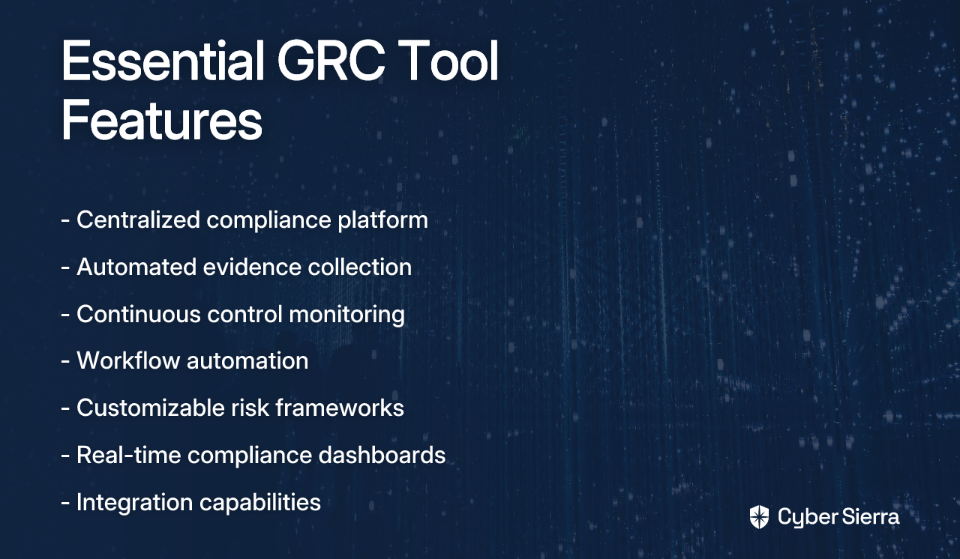
  • Centralized Platform: Integrates risk, compliance, and audit functions into a single source of truth
  • Automated Evidence Collection: Continuously gathers evidence from cloud services, security tools, and HR systems
  • Continuous Monitoring: Provides real-time dashboards to track compliance posture against frameworks like NIST CSF or ISO 27001
  • Workflow Automation: Streamlines tasks like policy reviews, control testing, and remediation tracking

Popular GRC tools include MetricStream, ServiceNow GRC, Sprinto, AuditBoard, and LogicGate.

A word of caution: Ensure that your chosen tool aligns with your specific audit requirements. Some professionals have noted misalignment between a tool's controls (e.g., Vanta) and an auditor's specific checklist, so choose wisely and configure appropriately.

Conclusion

Preparing for a GRC audit doesn't have to be a chaotic, resource-draining experience. By following the eight-step checklist outlined above and embracing best practices like breaking down silos, being proactive, and leveraging technology, you can transform audits from a dreaded obligation into a strategic tool for building a more resilient and trustworthy organization.

Remember that preparation is not a one-time task but a continuous cycle of improvement. Start with one step from the checklist today—perhaps defining your audit scope or researching a GRC tool that fits your needs—and build from there. With the right approach, your next audit can be a showcase of your organization's commitment to governance, risk management, and compliance rather than a source of stress and disruption.

Frequently Asked Questions

What is a GRC audit?

A GRC (Governance, Risk, and Compliance) audit is a comprehensive assessment of an organization's governance structure, risk management processes, and adherence to relevant regulations and standards. Unlike audits focused solely on finance or security, a GRC audit provides a holistic view of how well the organization manages risks, meets legal obligations, and aligns its operations with business objectives.

Why is proactive GRC audit preparation important?

Proactive GRC audit preparation is important because it transforms the audit from a stressful, reactive event into a strategic opportunity to improve security, efficiency, and resilience. By continuously managing compliance and risk, organizations can avoid last-minute scrambles, reduce resource drain, and prevent costly fines while fostering a culture of accountability.

What is the first step in preparing for a GRC audit?

The first step in preparing for a GRC audit is to clearly understand and define the audit's scope. This involves identifying which regulatory frameworks (like ISO 27001, HIPAA, or PCI-DSS) apply, which business processes and systems are being audited, and what specific evidence will be required. A well-defined scope prevents wasted effort and focuses the team on what truly matters.

How can an organization overcome the challenge of data silos during an audit?

Organizations can overcome data silos by establishing a centralized repository for all audit evidence and fostering cross-departmental collaboration. Implementing a GRC platform can automate evidence collection from various systems into a single source of truth. Additionally, creating a dedicated, cross-functional audit team ensures that information is shared effectively and everyone understands their role.

What is the role of automation and GRC tools in audit preparation?

Automation and GRC tools play a crucial role by centralizing data, automating evidence collection, and providing continuous monitoring of compliance posture. These platforms significantly reduce the manual effort and time required for audit preparation, shifting the organization from stressful point-in-time assessments to a state of continuous compliance.

How long does it take to prepare for a GRC audit?

The time it takes to prepare for a GRC audit varies widely depending on the organization's size, complexity, and compliance maturity, but it can range from a few weeks to several months. An organization with mature, continuous compliance practices may only need a few weeks for final preparations, while one starting from scratch may need three to six months or more. The key is to treat preparation as an ongoing process.


Looking to learn more about GRC? Check out Coursera's GRC Specialization or join professional communities like ISACA and IAPP to stay updated with the latest trends and best practices.
blog-hero-background-image
Governance & Compliance

Top 5 GRC Applications in 2025

backdrop
Table of Contents

Join thousands of professionals and get the latest insight on Compliance & Cybersecurity.


You've set up a complex spreadsheet to track all your compliance activities, manually collecting evidence for audits, and constantly worrying about whether you're prepared for the next regulatory change. Yet despite all this effort, you still face the annual scramble before major audits and the nagging feeling that you're just "checking boxes" instead of truly managing risk.

For organizations starting their GRC journey from scratch, the landscape can be overwhelming—but it also presents a clean slate to build a modern, efficient program. Even for established companies, the pressure to consolidate disparate tools into a unified approach has never been greater.

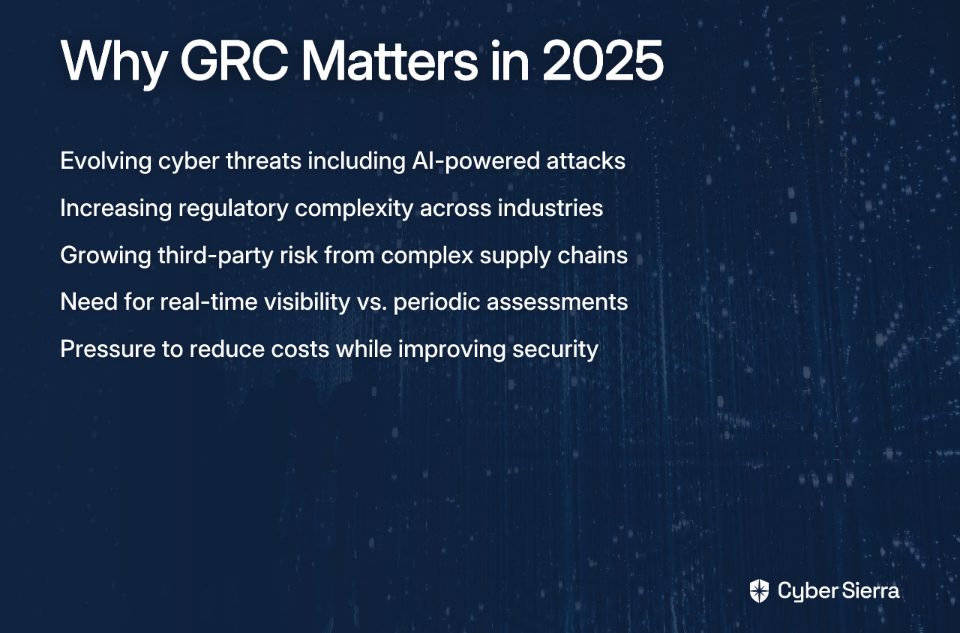
The regulatory landscape continues to grow more complex, cyber threats are evolving rapidly, and supply chains introduce new risks daily. An effective Governance, Risk, and Compliance (GRC) strategy, powered by the right technology, is no longer optional—it's essential for survival and growth.

This article explores the top 5 GRC applications for 2025 that can help you automate processes, gain real-time visibility, and build a resilient security posture. We'll examine their key features, ideal use cases, and how to choose the best fit for your organization.

What is GRC and Why Does it Matter in 2025?

Governance, Risk, and Compliance (GRC) is a structured approach to align IT with business objectives while effectively managing risks and meeting compliance requirements.

  • Governance: The set of policies, rules, and frameworks an organization uses to achieve its goals. This includes resource management, ethical conduct, and transparent information sharing—critical for companies that "do not have any proper policies, standards, guidelines, and procedures in place."
  • Risk Management: The process of identifying, assessing, and remediating potential risks—whether financial, strategic, or security-related. This includes maintaining a comprehensive risk register and regularly reviewing security posture.
  • Compliance: The act of adhering to laws, regulations, standards (like PCI compliance, ISO 27001, HIPAA), and internal policies.

The 2025 Imperative

GRC has become increasingly critical for several reasons:

  • Evolving Threats: The rise of sophisticated cyber-attacks and new technologies like generative AI introduce novel risks. As one security professional noted, "If autonomous AI agents are making decisions… how do we ensure they're not exploited?"
  • Regulatory Pressure: Data privacy laws (like GDPR) and industry mandates are multiplying, demanding a more structured approach to compliance.
  • Integrated Approach: Siloed approaches lead to inefficiencies and blind spots. An integrated GRC strategy provides a unified view, enhancing decision-making and reducing costs, according to AuditBoard.

Key GRC Trends Shaping the 2025 Landscape

The GRC landscape is evolving rapidly, driven by several key trends:

AI-Driven Risk Assessment & Automation

GRC platforms are increasingly leveraging AI to predict risks more accurately and automate repetitive tasks. Advanced analytics provide intelligent insights for better decision-making, with MetricStream reporting that AI-powered GRC tools can reduce manual effort in evidence collection by up to 50%.

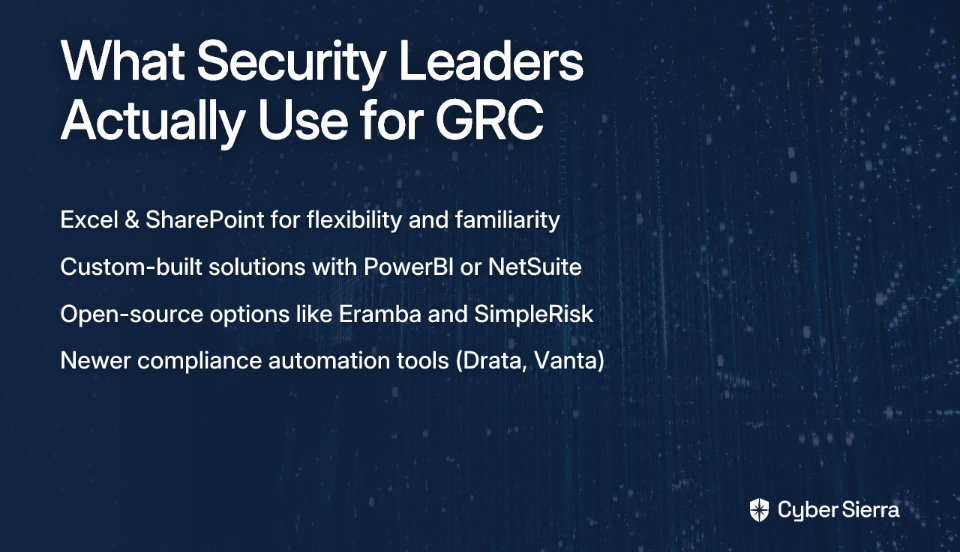
This automation addresses a key pain point expressed by many professionals: "Right now, we track all this in an Excel spreadsheet. Looking for a tool that can help manage our policies, vendor management, risk management, etc."

Continuous Control Monitoring (CCM)

The market is moving away from periodic, point-in-time checks towards real-time monitoring. Organizations need to "continuously track and assess our IT infrastructure, data, and security protocols" to proactively fix gaps before they become critical issues or audit findings.

This trend directly addresses the need to "do this about a year to 8 months before major audits to avoid the scramble," by making compliance an ongoing process rather than a periodic event.

Integrated Platforms & Centralized Dashboards

Users want a single source of truth. Modern tools offer centralized dashboards that provide a 360-degree view of the organization's risk profile, moving beyond solutions that feel like "smoke and mirrors to get you a check mark" by providing transparent, data-driven insights.

Focus on Third-Party Risk Management (TPRM)

With increasingly complex supply chains, managing vendor risk is a top priority. GRC tools are incorporating robust TPRM modules to automate vendor assessments and continuous monitoring, replacing cumbersome spreadsheets with dynamic, risk-based approaches.

Top 5 GRC Applications in 2025

Based on comprehensive research and market analysis, here are the top GRC applications to watch in 2025:

1. MetricStream

Overview: A comprehensive, enterprise-grade GRC platform known for its deep integration of risk, compliance, audit, and cybersecurity functions.

Key Features:

  • Centralized Platform: Manages Risk, Compliance, Policy, and Audit in one place
  • AI Capabilities (AiSPIRE): Provides intelligent insights for predictive risk management
  • Continuous Control Monitoring: Automates compliance checks and risk mitigation
  • ESG Compliance: Strong capabilities for managing Environmental, Social, and Governance frameworks

Best For: Large enterprises in highly regulated industries needing a powerful, all-in-one solution.

Learn more about MetricStream GRC Solutions

2. ServiceNow

Overview: A versatile platform that excels at integrating GRC into daily IT and business workflows, making risk management a part of operations.

Key Features:

  • Workflow Automation: Utilizes no-code playbooks to simplify complex processes
  • Incident Response Focus: Seamlessly connects risk management with incident response
  • Real-time Monitoring: Continuously tracks compliance and control performance
  • Integration Ecosystem: Leverages existing ServiceNow investments for a unified approach

Best For: Organizations already invested in the ServiceNow ecosystem looking to extend its capabilities into GRC.

Learn more about ServiceNow GRC

3. AuditBoard

Overview: A user-friendly platform focused on simplifying audit, risk, and compliance management for internal teams.

Key Features:

  • Intuitive Interface: Designed for ease of use and collaboration between audit, risk, and compliance teams
  • Centralized Collaboration Tools: Enhances communication and visibility on internal controls
  • Automated Workflows: Reduces manual effort in audit and compliance tasks
  • Pre-built Frameworks: Comes with templates for common compliance frameworks

Best For: Audit and compliance teams seeking a collaborative, easy-to-navigate platform to streamline their processes.

Explore AuditBoard's approach to GRC

4. Archer

Overview: A long-standing leader in the GRC space, known for its proactive approach to risk management and robust feature set.

Key Features:

  • Intuitive Dashboards: Simplifies data interpretation for better decision-making
  • Third-Party Risk Management: Streamlines vendor assessments and risk profiling
  • Flexible Assessment Module: Supports deep integration with other business systems
  • Scalable Architecture: Handles complex enterprise requirements effectively

Best For: Organizations needing mature and flexible risk management capabilities, especially for TPRM.

5. LogicGate (Risk Cloud®)

Overview: A highly flexible and customizable GRC platform that empowers organizations to build risk and compliance applications tailored to their specific needs.

Key Features:

  • No-Code Platform: Uses a drag-and-drop interface to build automated workflows
  • Advanced Analytics: Provides actionable insights from risk and compliance data
  • Automated Compliance Processes: Significantly reduces manual effort
  • Customization Capabilities: Adapts to unique organizational requirements

Best For: Companies that require a high degree of customization to match their unique risk profiles and processes.

A Modern, Integrated Alternative: Cyber Sierra

While the tools above are established leaders, a new generation of platforms is emerging to address modern GRC challenges with greater agility and automation. Cyber Sierra is an AI-enabled platform designed to simplify and automate security compliance for today's enterprises.

Addressing Key Pain Points:

Overcoming "Compliance Fatigue": Cyber Sierra's GRC module automates data collection and reporting across multiple frameworks (SOC2, ISO 27001, GDPR, HIPAA, PCI DSS). This tackles the frustration of paying for each framework separately and simplifies audit readiness.

From Periodic to Proactive: The Continuous Control Monitoring (CCM) module provides near real-time visibility into your security posture, moving beyond simple checklists to offer actionable risk intelligence.

Tackling Supply Chain Risk: The Third-Party Risk Management (TPRM) module automates vendor assessments and monitoring, replacing cumbersome spreadsheets with a dynamic, risk-based approach.

What sets Cyber Sierra apart is its integration of GRC, CCM, TPRM, Threat Intelligence, and even Cyber Insurance readiness into a single, unified platform, providing a holistic view of an organization's security and compliance posture.

How to Choose the Right GRC Tool for Your Business

With so many options available, selecting the right GRC application requires careful consideration of your organization's specific needs:

Assess Core Functionality

Does the tool address your primary needs (e.g., internal audit, TPRM, compliance framework management)? Ensure it provides depth and isn't just "smoke and mirrors" to get you a compliance check mark.

Ask yourself:

  • What are your most pressing GRC challenges?
  • Which compliance frameworks do you need to support (ISO 27001, PCI compliance, SOC2, etc.)?
  • Is your focus on risk management, compliance, or both?

Check Integration Capabilities

The tool must integrate with your existing systems (ERP, CRM, security tools) for a unified data flow. According to the Digital Project Manager, integration capabilities can make or break a GRC implementation.

Consider:

  • Does the tool offer pre-built connectors for your critical systems?
  • How easily can data flow between your existing tools and the GRC platform?
  • Will you need custom integrations, and if so, what's the level of effort required?

Evaluate Configurability vs. Simplicity

Do you need a highly customizable platform like LogicGate, or a more user-friendly, out-of-the-box solution like AuditBoard? For startups, platforms like Drata, Vanta, and Secureframe are often recommended for their streamlined approach.

As one industry professional noted, "Drata, Vanta, and Secureframe are probably the biggest players in the startup space." These tools offer quicker implementation but may have less customization potential.

Demand a User-Friendly Experience

A tool is only effective if people use it. Prioritize platforms with intuitive interfaces and clear dashboards that encourage user engagement. MetricStream emphasizes that user adoption is critical for GRC success.

Look for:

  • Clean, intuitive dashboards
  • Minimal training requirements
  • Mobile accessibility for on-the-go risk management

Consider Total Cost of Ownership

Look beyond the license fee. Ask about costs for additional frameworks, implementation support, and training. One common frustration is that some vendors "will make you pay for each framework, for example you'd have to pay for ISO 27001 v2013 and ISO 27001 v2022 just to see gaps."

Questions to ask:

  • Are compliance frameworks bundled or priced separately?
  • What are the implementation and training costs?
  • Are there additional fees for adding users or modules?
  • What's the typical ROI timeframe for similar organizations?

Match to Your Organization's Maturity

A startup with "zero tooling when it comes to GRC" has different needs than an established enterprise with mature processes. Choose a solution that can grow with you but doesn't overwhelm your current capabilities.

For organizations just establishing their GRC program, consider tools that provide policy templates and implementation guidance to help build the foundation of "proper policies, standards, guidelines, and procedures."

Conclusion

In 2025, navigating governance, risk, and compliance requires more than spreadsheets and checklists. The right GRC application automates manual work, provides real-time insights, and builds a foundation of operational resilience.

Whether you choose an established leader like MetricStream or ServiceNow, or explore newer integrated platforms like Cyber Sierra, the key is selecting a solution that aligns with your organization's size, maturity, and strategic goals. By doing so, you can transform GRC from a burdensome obligation into a strategic advantage that protects your business while enabling growth.

The future of GRC is intelligent, integrated, and continuous. By embracing these principles in your technology selection, you'll be well-positioned to navigate the complex risk landscape of 2025 and beyond.

Frequently Asked Questions

What is GRC software and why is it important?

GRC software is a tool that helps organizations manage governance, risk, and compliance activities from a single, unified platform. It is important because it automates manual processes, provides a centralized view of risk, and ensures adherence to regulations, which is critical in today's complex threat and regulatory landscape. By centralizing these functions, businesses can move beyond inefficient spreadsheets, enhance decision-making, and build a more resilient security posture.

How do I choose the right GRC tool for my business?

To choose the right GRC tool, you should assess your organization's specific needs, size, and maturity level. Key steps include evaluating the tool's core functionality (like audit management or TPRM), checking its integration capabilities with your existing systems, deciding between a customizable or a simple out-of-the-box solution, and considering the total cost of ownership beyond just the license fee.

What are the key features to look for in a modern GRC platform?

A modern GRC platform should offer features that align with current industry trends. Look for AI-driven risk assessment for predictive insights, Continuous Control Monitoring (CCM) for real-time visibility into your security posture, integrated modules for a holistic view (e.g., TPRM, compliance), and centralized dashboards for clear, actionable reporting.

Why are spreadsheets not enough for GRC management?

Spreadsheets are not enough for modern GRC management because they are manual, error-prone, and lack real-time visibility. They create silos of information, make collaboration difficult, and cannot scale to handle the complexity of evolving regulations and cyber threats. GRC platforms automate data collection, provide continuous monitoring, and offer a single source of truth that spreadsheets simply cannot match.

When should a startup start thinking about GRC tools?

A startup should start thinking about GRC tools as soon as it begins handling sensitive customer data or needs to comply with industry regulations like SOC 2 or HIPAA. Early adoption of a streamlined GRC tool can establish a strong compliance foundation from the start, prevent costly future remediation, and build trust with customers and investors.

How does AI improve GRC processes?

AI improves GRC processes by automating repetitive tasks, enhancing risk detection, and providing predictive insights. For example, AI can analyze vast amounts of data to identify potential threats, automate evidence collection for audits, and forecast risk trends, allowing teams to move from a reactive to a proactive risk management stance. This reduces manual effort and improves the accuracy of risk assessments.

blog-hero-background-image
Governance & Compliance

ISO 9001 vs ISO 27001 - A Comprehensive Comparison

backdrop
Table of Contents

Join thousands of professionals and get the latest insight on Compliance & Cybersecurity.


You've been tasked with implementing ISO standards in your organization, but now you're staring at a mountain of documentation requirements while managing 10+ other projects. The overwhelming amount of information online is giving you a headache, and you can't help but wonder: "Is writing all these documents really necessary, especially when processes keep changing?"

If this sounds familiar, you're not alone. Many professionals feel trapped in a maze of ISO requirements, struggling to find a clear starting point amid consultants who seem more interested in selling services than providing genuine guidance.

This comprehensive comparison of ISO 9001 and ISO 27001 will cut through the confusion, helping you understand how these two critical standards differ, where they overlap, and how they can work together to strengthen your organization.

What is ISO 9001? The Foundation of Quality Management

ISO 9001 is the world's most recognized standard for Quality Management Systems (QMS), with over one million organizations certified globally. This framework helps businesses consistently deliver products and services that meet customer expectations and regulatory requirements.

At its core, ISO 9001 is about ensuring quality in what you deliver to customers. The 2015 version (currently in effect with 2024 amendments addressing climate change considerations) emphasizes:

  • A process-based approach to managing operations
  • Risk-based thinking to prevent issues before they occur
  • The Plan-Do-Check-Act (PDCA) cycle for continuous improvement
  • Strong leadership commitment to quality objectives

Organizations implement ISO 9001 to demonstrate their dedication to customer satisfaction, process efficiency, and product/service quality. The standard doesn't prescribe specific controls but instead provides a framework for organizations to establish their own quality processes based on their unique context.

According to the American Society for Quality (ASQ), ISO 9001 certification typically leads to enhanced operational efficiency, improved customer satisfaction, and reduced waste—all contributing to a stronger bottom line.

What is ISO 27001? The Guardian of Information Security

While ISO 9001 focuses on quality, ISO 27001 is the leading international standard for Information Security Management Systems (ISMS). With over 70,000 certifications across 150 countries, it provides a systematic approach to managing sensitive information and protecting its confidentiality, integrity, and availability.

ISO 27001 is fundamentally about securing how you handle information assets. The standard:

  • Requires organizations to identify and systematically assess information security risks
  • Includes 11 mandatory clauses outlining ISMS requirements
  • Features Annex A, which in its latest version (ISO 27001:2022) contains 93 control objectives organized into four domains:
    • Organizational Controls (37)
    • People Controls (8)
    • Physical Controls (14)
    • Technological Controls (34)

One common point of confusion is the relationship between ISO 27001 and ISO 27002. Let's clarify:

  • ISO 27001 is the certification standard that defines what you need to do
  • ISO 27002 is a supporting code of practice that provides implementation guidance on how to implement the controls

Organizations seeking ISO 27001 certification don't need to implement all 93 controls. Instead, they conduct risk assessments to determine which controls are necessary for their specific risk profile, documenting their decisions in a Statement of Applicability (SoA).

Key Differences Between ISO 9001 and ISO 27001

While both standards share the same High-Level Structure (HLS), they have distinct focuses and requirements. Understanding these differences is crucial for effective implementation.

1. Primary Focus and Objectives

ISO 9001:

  • Focuses on quality of products and services
  • Aims to enhance customer satisfaction
  • Addresses the entire operational lifecycle

ISO 27001:

  • Focuses on protecting information assets
  • Aims to safeguard confidentiality, integrity, and availability of information
  • Addresses information security risks specifically

2. Scope Definition

ISO 9001:

  • Allows flexibility with certain exclusions if they don't affect quality
  • Can be applied to specific departments or the entire organization
  • Focuses on processes that impact customer requirements

ISO 27001:

  • Requires a rigidly defined scope
  • Must include all information systems, products, and dependencies
  • No exclusions allowed within the defined scope

3. Mandatory Controls

ISO 9001:

  • No preset controls mandated
  • Organizations define their own controls based on their context
  • Focus on process effectiveness and customer satisfaction

ISO 27001:

  • Requires implementation of controls from Annex A based on risk assessment
  • Must document justification for any controls not implemented
  • Controls are specific and security-focused

As one Reddit user lamented, "ISO 27001 can be quite daunting" compared to other standards. This is partly because of its technical specificity and comprehensive security requirements.

4. Resource Allocation

ISO 9001:

  • Requires dedicated resources for product conformity
  • Resources cannot be assigned other tasks that might compromise quality

ISO 27001:

  • Allows for shared resources across compliance areas
  • Resources can serve multiple functions if security objectives are met

5. Documentation Requirements

ISO 9001:

  • Requires documented information on quality processes
  • Must maintain records of conformity and performance

ISO 27001:

  • Requires extensive documentation of the ISMS
  • Must maintain records of risk assessments, SoA, and security incidents

This difference in documentation explains why many professionals feel that "writing all of these documents is a pain in the ass..not to mention if something changes after you've already wrote them."

Surprising Similarities: Where ISO 9001 and ISO 27001 Align

Despite their different focuses, ISO 9001 and ISO 27001 share several common requirements, making them complementary rather than contradictory. These similarities provide a foundation for an integrated management system:

  1. Common Structure: Both follow the same 10-clause High-Level Structure (HLS)
  2. Organizational Context: Both require understanding internal and external issues affecting the organization
  3. Leadership Commitment: Both demand top management involvement and accountability
  4. Risk-Based Thinking: Both emphasize identifying and addressing risks proactively
  5. Documented Information: Both require maintaining appropriate documentation
  6. Internal Audits: Both mandate regular internal audits to verify compliance
  7. Corrective Actions: Both require processes for addressing non-conformities
  8. Continuous Improvement: Both embrace the concept of ongoing enhancement

The Strategic Benefits of Integrating ISO 9001 and ISO 27001

Given the compatible nature of these standards, many organizations choose to implement them together. This integration offers substantial benefits that address many of the pain points expressed by professionals working with these frameworks.

1. Reduced Documentation Burden

If you've ever thought, "QA documentation is filled with shitloads of things that I do not think are necessary," an integrated approach is your solution. By combining systems, you can:

  • Create unified policies that address both quality and security requirements
  • Maintain a single management system manual
  • Reduce documentation redundancy by up to 30%

2. Cost and Time Efficiency

When you're "managing like 10+ other projects other than this," efficiency becomes crucial. Integration helps by:

  • Conducting combined internal audits instead of separate ones
  • Streamlining certification audits (potentially saving thousands in auditing fees)
  • Reducing the resources needed for maintenance and updates

3. Holistic Risk Management

An integrated approach allows for comprehensive risk assessment that covers both quality and security concerns, ensuring that:

  • Quality improvements don't compromise security
  • Security measures don't impede quality processes
  • Risks are addressed systematically across the organization

4. Enhanced Competitive Advantage

Dual certification demonstrates to stakeholders that your organization takes both quality and information security seriously. This builds trust with:

  • Customers seeking reliable providers
  • Partners evaluating collaboration opportunities
  • Regulatory bodies assessing compliance

Practical Steps for Integrating ISO 9001 and ISO 27001

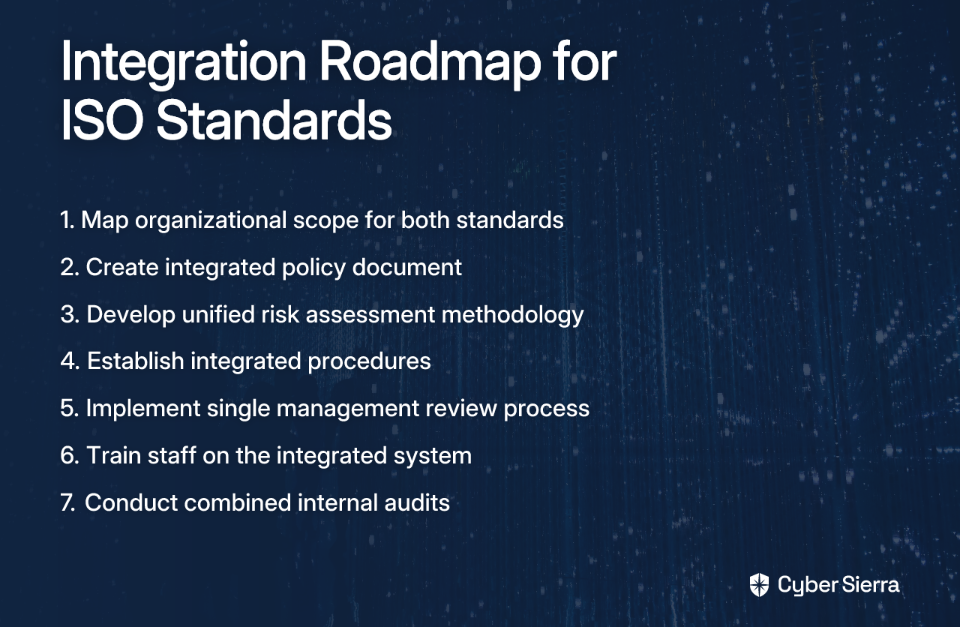
If you're feeling "extremely overwhelmed by the amount of info out there," here's a clear, step-by-step approach to integrating these standards:

  1. Map your organization's scope for both standards, identifying overlaps and unique requirements
  2. Create an integrated policy that addresses both quality and information security objectives
  3. Develop a unified risk assessment methodology that considers both quality and security risks
  4. Establish integrated procedures for common requirements like document control and internal audits
  5. Implement a single management review process that addresses both standards
  6. Train staff on the integrated system to ensure understanding across the organization
  7. Conduct combined internal audits to verify compliance with both standards

Conclusion: Quality and Security - Two Sides of the Same Coin

ISO 9001 and ISO 27001 serve different but complementary purposes in strengthening your organization. While ISO 9001 ensures you deliver quality products and services, ISO 27001 protects the information assets that make that delivery possible.

The key distinction is simple: ISO 9001 focuses on the quality of what you deliver, while ISO 27001 protects how you deliver it. Together, they create a robust framework for operational excellence and risk management.

By understanding the differences and similarities between these standards and taking an integrated approach to implementation, you can transform what seems like an overwhelming documentation burden into a strategic advantage for your organization.

Frequently Asked Questions

What is the main difference between ISO 9001 and ISO 27001?

The main difference is their primary focus. ISO 9001 concentrates on the quality of products and services to ensure customer satisfaction, while ISO 27001 concentrates on protecting the confidentiality, integrity, and availability of information. In simple terms, ISO 9001 ensures what you deliver is high quality, whereas ISO 27001 secures how you handle the information related to your operations.

Why should our organization integrate ISO 9001 and ISO 27001?

You should integrate ISO 9001 and ISO 27001 to reduce documentation, save time and costs, and create a more holistic risk management framework. An integrated system eliminates redundant policies, allows for combined audits, and streamlines maintenance, turning a compliance burden into a strategic advantage that addresses both quality and security efficiently.

How do ISO 9001 and ISO 27001 work together?

ISO 9001 and ISO 27001 work together through their shared 10-clause High-Level Structure (HLS). This common framework provides a natural foundation for integration, aligning processes like leadership commitment, internal audits, and corrective actions. For example, the risk-based thinking from ISO 9001 can be expanded to include the specific information security risks detailed in ISO 27001, creating a comprehensive management system.

Do we have to implement all 93 controls in ISO 27001 Annex A?

No, you are not required to implement all 93 controls from Annex A. Your implementation must be based on the findings of your information security risk assessment. You will then document your justification for including or excluding each control in a Statement of Applicability (SoA), ensuring your security measures are tailored specifically to your organization's risk profile.

Which certification should my company get first: ISO 9001 or ISO 27001?

The right certification to pursue first depends on your primary business goals. If your main objective is to enhance product quality and customer trust, start with ISO 9001. If protecting sensitive data is your top priority or a client requirement, begin with ISO 27001. Many organizations start with ISO 9001 to build a foundational quality process, but prioritizing based on your most urgent business or contractual needs is the best approach.

Are ISO 9001 and ISO 27001 suitable for small businesses?

Yes, both standards are highly suitable for small businesses because they are designed to be scalable. A small business can implement the standards in a way that fits its size, complexity, and resources, avoiding the bureaucracy that might be necessary for a larger corporation. For a small business, certification is a powerful way to build credibility, gain a competitive edge, and establish trust with larger clients.

blog-hero-background-image
Governance & Compliance

Write GRC Policies That Work: Using Must vs. Should

backdrop
Table of Contents

Join thousands of professionals and get the latest insight on Compliance & Cybersecurity.


You've been tasked with writing security policies for your organization. After hours of research, you find yourself staring at a blank document, unsure where to begin. The senior leadership expects clear, enforceable policies, but everywhere you look, you find only vague advice: "Write policies and enforce them."

Sound familiar?

What no one tells you is that the power of an effective policy often hinges on a single word choice. Consider these two statements:

"All sensitive data should be encrypted at rest." "All sensitive data must be encrypted at rest."

Though seemingly similar, these statements have drastically different implications for enforcement, compliance, and security. The first suggests encryption is advisable but optional. The second makes encryption a non-negotiable requirement.

This distinction isn't merely semantic—it's the difference between a policy that works and one that fails when you need it most.

The 'G' in GRC: Why Governance Hinges on Language

Governance, Risk, and Compliance (GRC) isn't just a department or function. According to the Open Compliance and Ethics Group (OCEG), GRC is "an integrated collection of capabilities that enable an organization to reliably achieve objectives, address uncertainty, and act with integrity"—a concept known as Principled Performance.

Policies are the tools that translate GRC strategy into action. As one experienced practitioner puts it, "Policy is just a tool... defined by the processes it needs to support and the people who need to use it."

When policies use imprecise language, the consequences ripple throughout the organization:

  • Employees don't understand what's truly required versus merely suggested
  • Auditors can't effectively measure compliance
  • The organization's risk appetite is not properly managed
  • Security gaps emerge in areas where compliance is treated as optional

The precision of your policy language directly reflects your organization's commitment to governance. Vague policies lead to inconsistent implementation, which undermines the entire GRC framework. This is especially crucial when referencing frameworks like NIST governance risk standards or CIS Controls, where ambiguity can lead to incomplete implementation.

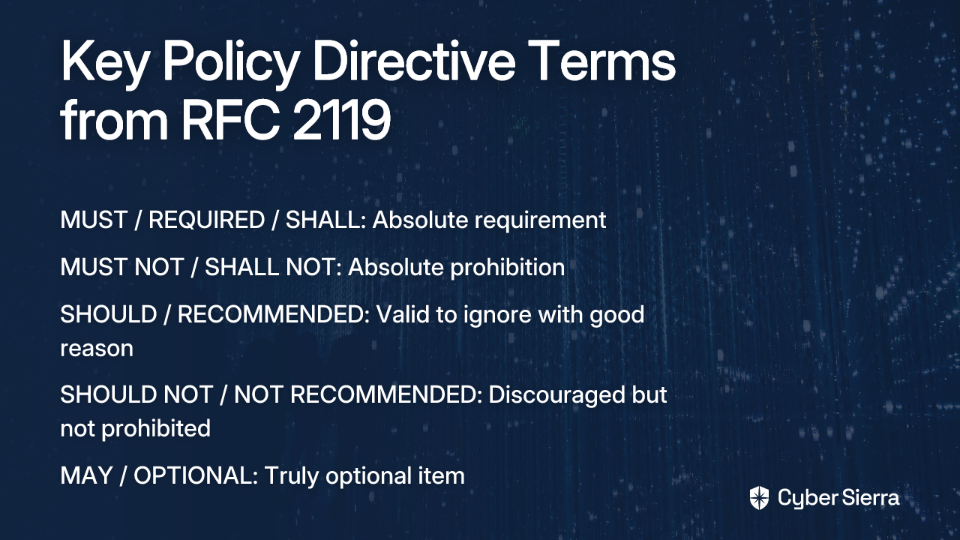
The Gold Standard for Clarity: Decoding RFC 2119

To eliminate ambiguity in technical documents, the Internet Engineering Task Force created RFC 2119—a standard that defines how directive words should be used. While originally created for network protocols, its definitions have become the gold standard for policy writing.

Here's what these critical terms mean according to the standard:

MUST / REQUIRED / SHALL

These terms indicate an absolute requirement. Following this directive is non-negotiable.

Example: "The system must enforce multi-factor authentication for all administrative accounts."

MUST NOT / SHALL NOT

These terms signify an absolute prohibition.

Example: "Confidential data shall not be transferred to removable media without approval from the CISO."

SHOULD / RECOMMENDED

These terms mean there may exist valid reasons in particular circumstances to ignore the requirement, but the full implications must be understood and carefully weighed before choosing a different course.

Example: "The application should log all failed authentication attempts to the central security monitoring system."

SHOULD NOT / NOT RECOMMENDED

These indicate that a particular behavior is discouraged but not prohibited.

Example: "Developers should not use hard-coded credentials in application source code."

MAY / OPTIONAL

These terms mean that an item is truly optional.

Example: "The user may change their display theme."

RFC 2119 also highlights a crucial security consideration: "These terms are frequently used to specify behavior with security implications. Authors who follow these guidelines should incorporate a discussion of the security implications of not following recommendations."

This underscores why the distinction matters so much in security policies.

Must vs. Should: The Impact on Enforceability and Audits

Let's examine a clear example that demonstrates the critical difference in enforceability:

Policy Statement with "Must": "Employees who are absent for two days or more must provide a doctor's note."

Auditability: An auditor's job is straightforward. They can create a simple checklist: For every employee absent 2+ days, is there a doctor's note in the file? The answer is a clear yes or no. Compliance is measurable, and violations are easily identified.

Policy Statement with "Should": "Employees who are absent for two days or more should provide a doctor's note."

Auditability: This becomes much harder to verify for compliance. If an employee doesn't provide a note, they haven't technically violated the policy. The word "should" is a "hedging word" that allows for discretion and exceptions without documentation.

This example, though simple, illustrates why many policies fail during audits or security incidents. When a security breach occurs and you review your policies to determine if they were followed, a "should" statement leaves too much room for interpretation and excuses.

The implications for security and compliance are significant:

  • Must statements create clear accountability
  • Should statements create ambiguity and weaken your security posture
  • Must statements are auditable against SMART criteria (Specific, Measurable, Achievable, Relevant, Time-bound)
  • Should statements make your cross reference map to compliance frameworks less reliable

The bottom line:

  • Use MUST when the action is required for legal, regulatory, or security compliance
  • Use SHOULD for best practices where flexibility is acceptable, but be aware that any deviations should be documented in a risk register
  • Never use "should" when you actually mean "must"

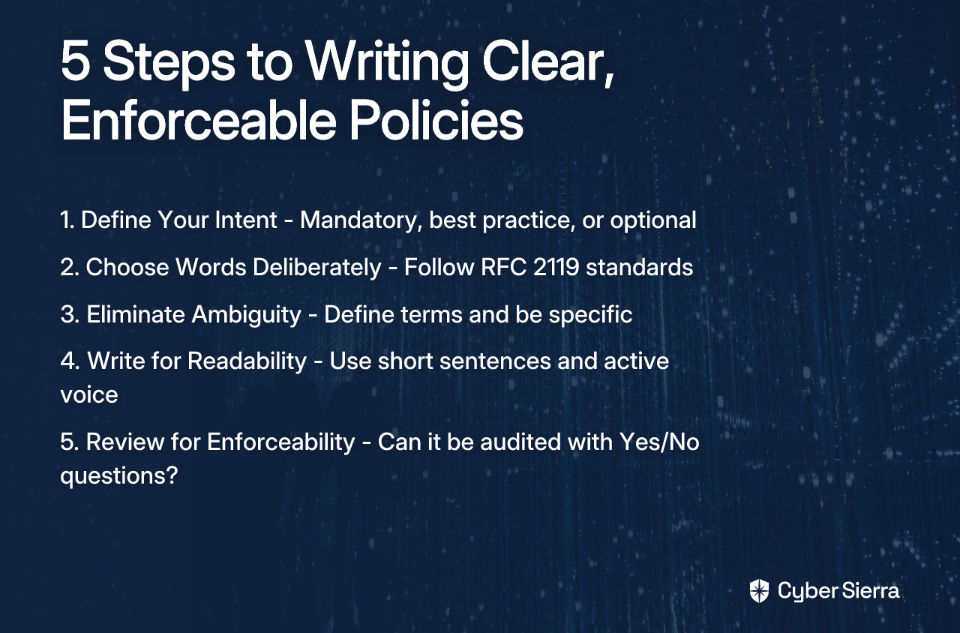
A Practical Walk-through for Writing Clearer Policies

Let's walk through a step-by-step process for writing policies that are both clear and enforceable:

Step 1: Define Your Intent

Before writing a single word, determine whether the control is:

  • Mandatory (required by law, regulation, or essential for security)
  • A best practice (recommended but with allowable exceptions)
  • Truly optional

Your intent will dictate your language choice.

Step 2: Choose Your Words Deliberately (with RFC 2119)

Match your directive words to your intent:

Vague: "Vendor assessments need to be done."

Clear: "A security assessment must be completed and approved before onboarding any new vendor handling sensitive data."

By using "must" in the revised statement, you've created an auditable requirement with no ambiguity about whether the assessment is optional.

Step 3: Eliminate Ambiguity and Define Terms

Avoid jargon where possible. When technical terms are necessary, define them for your audience. For example, don't assume everyone knows what SFTP means—define it parenthetically as "Secure File Transfer Protocol (SFTP)."

Be specific about expectations and timing:

Instead of: "Access should be reviewed periodically."

Write: "User access rights to financial systems must be reviewed on a quarterly basis by the user's direct manager."

The revised statement answers the key questions: Who must do what, to what, and when?

Step 4: Write for Readability

Use short sentences and active voice to make responsibilities clear:

Passive/Weak: "The policy must be adhered to by all staff."

Active/Strong: "All staff must adhere to this policy."

The active voice clearly identifies who is responsible for compliance, making the policy more actionable and enforceable.

Step 5: Review for Enforceability

Read your policy from an auditor's perspective. Can every "must" statement be turned into a "Yes/No" question to check for compliance? If the answer is "maybe" or "it depends," the statement is too vague and needs to be rewritten.

This approach helps create an evergreen document—one that remains relevant and enforceable over time, reducing the burden of policy maintenance.

Applying Your Knowledge in Real-world Scenarios

Let's apply these principles to common policy scenarios:

Example 1: Password Policy

Weak Version:
"Passwords should be strong and changed regularly."

Strong Version:
"All system passwords must:

  • Contain at least 12 characters
  • Include uppercase, lowercase, numbers, and special characters
  • Be changed every 90 days
  • Not be reused within a 24-month period"

The revised version defines exactly what constitutes compliance, making it straightforward to implement technical controls and verify adherence.

Example 2: Data Classification

Weak Version:
"Sensitive data should be protected appropriately."

Strong Version:
"Data classified as 'Confidential' must be:

  • Encrypted with AES-256 or stronger encryption when stored
  • Transmitted only via secure channels (TLS 1.2+)
  • Accessible only to authorized personnel with a business need
  • Backed up daily with backups retained for 90 days"

The strong version leaves no question about what protections are required, making compliance verification straightforward during audits.

Conclusion: From Confusing to Compliant

The choice between "must" and "should" is not a minor detail—it is the foundation of an effective GRC program. It defines whether your policies are enforceable mandates or merely suggestions.

By embracing the clarity of RFC 2119, you can:

  • Eliminate ambiguity that leads to security gaps
  • Create policies that pass audit scrutiny
  • Align your organization's actions with its stated risk appetite
  • Transform policies from dusty documents into effective security controls

For GRC professionals looking to enhance their policy-writing skills, consider pursuing a managerial SANS certification, which often covers these critical governance topics in depth.

Remember that effective policies aren't created in isolation. The best approach is often reverse-engineering from your compliance requirements and security goals, ensuring that every "must" and "should" serves a clear purpose in your security framework.

By being deliberate with your language choices, you'll create policies that not only exist on paper but actually work to protect your organization when it matters most.

Frequently Asked Questions

What is the difference between "must" and "should" in security policies?

In security policies, "must" indicates an absolute, non-negotiable requirement, while "should" signifies a strong recommendation that can have valid exceptions. Using "must" makes a policy statement mandatory and easily auditable. In contrast, "should" introduces flexibility, but any deviation from the recommendation should be understood and documented.

Why is precise language so critical for Governance, Risk, and Compliance (GRC)?

Precise language is critical for GRC because it translates strategy into clear, enforceable actions. Vague terms lead to inconsistent implementation, create security gaps, and make it difficult for auditors to measure compliance. Clear, unambiguous policies ensure that everyone understands their responsibilities, the organization's risk appetite is properly managed, and the entire GRC framework functions effectively.

How do I decide when to use "must" versus "should"?

Use "must" for actions that are absolutely required for legal, regulatory, or essential security compliance. If non-compliance would result in a significant security risk, a failed audit, or a legal violation, the directive is a "must." Use "should" for best practices where some flexibility is acceptable, but be prepared to document any deviations and the associated risks in a risk register.

What is RFC 2119 and why is it important for policy writing?

RFC 2119 is a document from the Internet Engineering Task Force (IETF) that defines key directive words like "must," "should," and "may" to eliminate ambiguity in technical documents. While created for network protocols, its definitions have become the gold standard for writing clear and enforceable policies, ensuring that requirements are understood and applied consistently across an organization.

What happens if we can't follow a "must" requirement?

If a "must" requirement cannot be followed, it signals a significant issue that requires immediate attention, as it represents a deviation from a mandatory control. This situation should trigger a formal exception process. This typically involves documenting the reason for non-compliance, performing a risk assessment to understand the impact, and implementing compensating controls to mitigate the risk. The exception must be approved by management and tracked in a risk register.

How can I improve my organization's existing policies for better enforcement?

To improve existing policies, review them from an auditor's perspective. Replace vague terms like "periodically" with specific timelines (e.g., "quarterly"). Change passive voice to active voice to clarify responsibility (e.g., "All staff must..." instead of "The policy must be adhered to..."). Finally, ensure every "must" statement can be tested with a simple "Yes/No" question to confirm compliance.

Further Resources

blog-hero-background-image
Governance & Compliance

Verifying PCI Compliance Vendor Claims

backdrop
Table of Contents

Join thousands of professionals and get the latest insight on Compliance & Cybersecurity.


You've just received your third email this month about your "urgent PCI compliance issue." Your payment processor is pushing their "trusted partner" for a solution that costs $85 per month. Your IT vendor is telling you one thing, your CPA another, and that Reddit thread you found has people calling it "a complete ripoff."

Sound familiar?

"My business doesn't store any CC info... so why am I not compliant?"

"My CPA told me it's not legally required and basically a money grab."

"I just delete all those emails that say my PCI compliance is overdue. Been doing it that way for years."

While your frustration is completely understandable, the truth about PCI compliance exists in a gray area between "essential security standard" and "profit center for vendors." This guide will help you cut through the sales pitches and misleading claims to understand what's actually required and how to verify if a vendor is truly helping or just taking your money.

What is PCI Compliance (Without the Sales Pitch)?

The Payment Card Industry Data Security Standard (PCI DSS) is a set of security requirements for any entity that stores, processes, or transmits cardholder data. It's not a federal law, but it is mandatory through your contracts with payment processors.

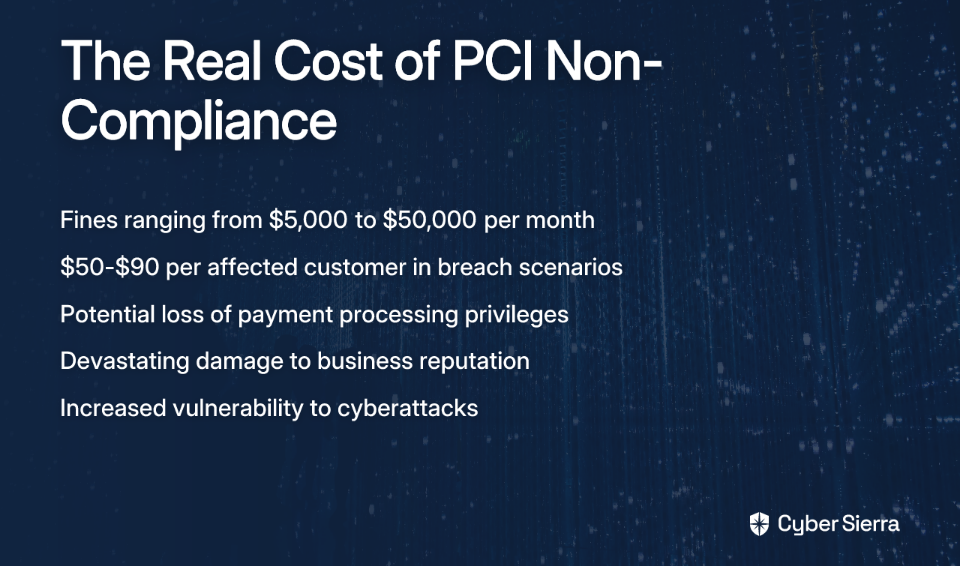
The stakes are high: non-compliance can result in fines ranging from $5,000 to $50,000 per month, plus $50 to $90 per affected customer if a breach occurs. More importantly, a breach can devastate your business reputation.

Decoding the Most Common Vendor Lies about PCI DSS

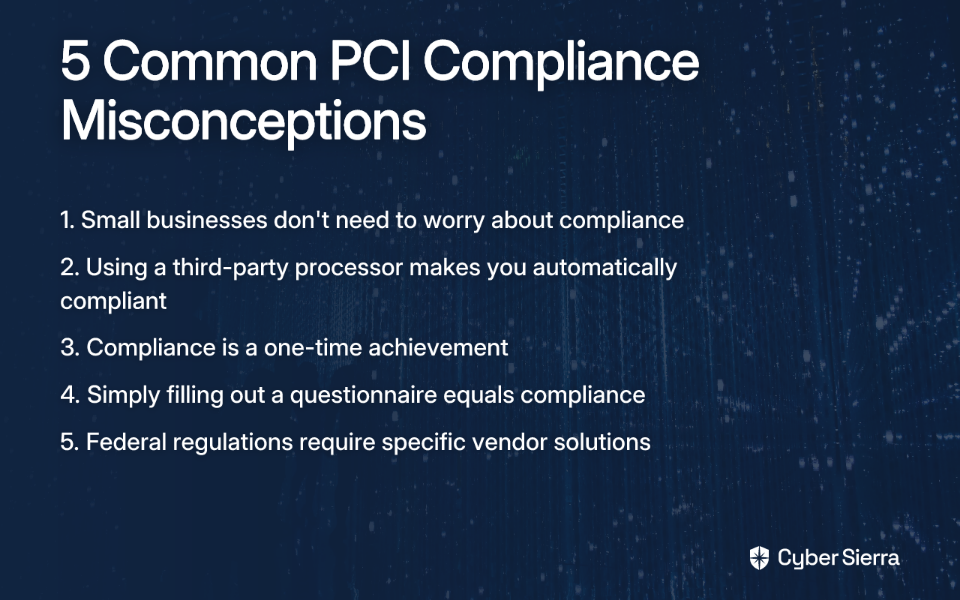
Lie #1: "Your business is too small to worry about PCI DSS."

Reality Check: Size doesn't matter when it comes to PCI compliance. Whether you process 20 or 20,000 transactions annually, you must comply with the standards appropriate to your transaction volume. In fact, cybercriminals actively target small businesses precisely because they often have weaker security.

Small businesses (Level 4 merchants processing fewer than 20,000 e-commerce transactions per year) still have compliance requirements, though less stringent than large enterprises.

Lie #2: "Since you use our third-party payment processor, you're automatically compliant."

Reality Check: This is perhaps the most common misconception. Using a compliant payment processor (like QuickBooks, Square, or Stripe) significantly reduces your compliance burden, but doesn't eliminate it entirely.

You're still responsible for how you handle card data before it reaches the processor. For example, if employees manually key in card numbers, you must ensure those workstations are secure and that staff are trained on data security practices.

Lie #3: "Once we get you compliant, you're good to go."

Reality Check: Compliance is not a one-and-done event. It requires ongoing vigilance and regular revalidation. The PCI standard evolves, and your business processes change over time.

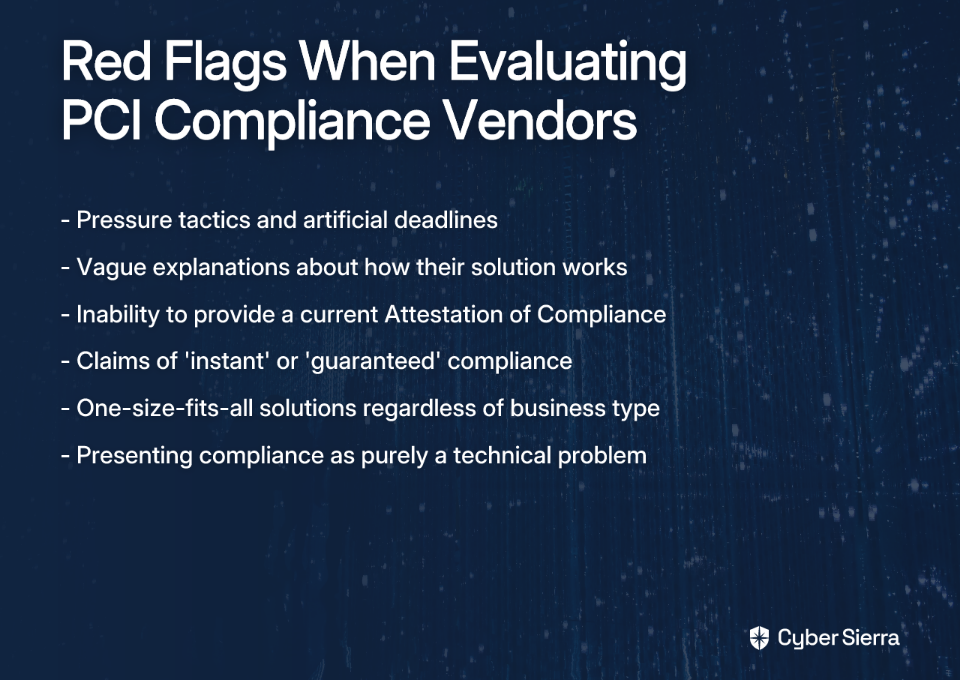
Compliance must be validated every 12 months, and many vendors conveniently forget to mention this when selling you their "complete compliance solution."

Lie #4: "Just fill out this questionnaire and you're compliant."

Reality Check: Many small businesses only need to complete a Self-Assessment Questionnaire (SAQ), but simply filling out paperwork doesn't make you compliant. The questionnaire is an attestation that you've implemented the required security controls.

As one Reddit user noted, compliance is often reduced to "a 10-minute questionnaire," but this oversimplifies the process. Lying on an SAQ can have severe legal and financial repercussions if a breach occurs.

Lie #5: "Federal regulations require you to use our specific solution."

Reality Check: This is a common sales tactic using false urgency. While PCI DSS is mandatory for card processing, no federal regulation specifies which vendor you must use. Your payment processor may have preferred partners, but you always have options.

Your Verification Toolkit: How to Prove a Vendor is Truly PCI Compliant

When a vendor claims they can help with your PCI compliance or states they are compliant themselves, don't take their word for it. Here's your step-by-step verification process:

Step 1: Ask for the "Golden Ticket" — The Attestation of Compliance (AOC)

The Attestation of Compliance (AOC) is the formal, official proof that a vendor has successfully completed a PCI DSS assessment. According to Triaxiom Security, this document includes:

  • An overview of the in-scope environment and business processes
  • The level of assessment conducted (e.g., Level 1 Assessment by a QSA or a Self-Assessment)
  • Which specific PCI DSS requirements they comply with
  • The date of the last assessment

Warning Signs:

  • The vendor sends you PowerPoint slides or marketing brochures instead of a formal AOC
  • They claim the AOC is "confidential" and cannot be shared
  • The AOC is more than a year old

Remember: A legitimate vendor will readily provide their AOC. It's designed to be shared with customers and partners.

Step 2: Check the Expiration Date

Compliance isn't permanent. An AOC from three years ago is as good as no compliance at all. PCI DSS validation must be renewed every 12 months, so ensure the document is current.

Make it a practice to request updated AOCs from your service providers annually and maintain this documentation.

Step 3: Use the Official Registry — Trust, but Verify

The Visa Global Registry of Service Providers is a public database where you can independently verify a vendor's compliance status. Simply search for the vendor's name to check if they're listed.

Here's what to look for:

  • PCI DSS compliance must be re-validated every 12 months
  • If a provider is 1-60 days past their validation expiry, they will have a warning icon
  • If they are 61-90 days past expiry, they get a more severe warning
  • After 91 days, they are removed from the registry entirely

Pro Tip: If a vendor claims to be PCI compliant but doesn't appear in the registry, ask them why. There may be legitimate reasons (like being listed under a parent company name), but this warrants further investigation.

Step 4: Verify the Scope Matches Your Needs

When reviewing a vendor's compliance documentation, pay close attention to the scope. The scope defines exactly which systems, services, and processes were assessed.

For example, if you're considering a cloud hosting provider for your e-commerce site, but their AOC only covers their physical data centers and not their cloud platform, their compliance doesn't fully address your needs.

Advanced Due Diligence: Spotting Red Flags in Compliance & Audit Reports

For businesses that want to go deeper, understanding the quality of a vendor's compliance report is crucial. According to A-Lign, 69% of organizations believe the quality of compliance reports is extremely important when selecting service providers.

Here are the red flags to watch for:

The "Perfect" Report

Be skeptical of compliance reports that show zero exceptions or findings. In real-world environments, auditors almost always identify some areas for improvement. A "perfect" report often indicates a lack of thoroughness or, worse, a rubber-stamp approval.

Vague, "Cookie-Cutter" Language

Quality compliance reports contain specific details about the vendor's unique security environment. If the report uses generic language that could apply to any company, it may not reflect a legitimate, in-depth audit.

Surprisingly Short Reports

A comprehensive audit report for a complex environment should be substantial. If a vendor presents a very brief report (just a few pages) for what should be an extensive assessment, this suggests a surface-level review rather than a thorough evaluation.

Unaccredited Auditors

PCI DSS assessments should be performed by Qualified Security Assessors (QSAs) accredited by the PCI Security Standards Council. You can verify an assessor's credentials on the official QSA list.

If the auditor isn't on this list, the assessment may not meet PCI requirements.

Unclear System Scope

The report must clearly define which systems were included in the audit. Ambiguity here could mean critical components were excluded from assessment.

Look for specific information about:

  • Network segments included/excluded
  • Applications and services evaluated
  • Third-party dependencies and their compliance status

Lack of Follow-Up on Previous Issues

If exceptions were found in previous audits, the new report should document management's response and show evidence that follow-up testing verified remediation.

Common Vendor Tactics to Watch For

Beyond misleading compliance claims, vendors often use several tactics to create false urgency or oversell their services:

Tactic #1: Presenting PCI Compliance as a Technical Problem Only

Many vendors frame PCI compliance as purely a technical challenge that their product can magically solve. In reality, compliance encompasses people, processes, AND technology.

A firewall alone won't make you compliant if your staff writes down credit card numbers on sticky notes.
Tactic #2: Using Fear, Uncertainty, and Doubt (FUD)

Some vendors dramatically exaggerate the consequences of non-compliance to create panic buying. While the risks are real (fines, breaches, reputation damage), be wary of vendors who lead with worst-case scenarios rather than balanced information.

Tactic #3: Offering "One-Size-Fits-All" Solutions

PCI compliance requirements vary based on your merchant level and how you process payments. Be skeptical of vendors selling identical solutions to every business regardless of size or processing methods.

Tactic #4: Promising "Instant" Compliance

Achieving PCI compliance takes time, especially for larger organizations. Any vendor promising "instant" or "overnight" compliance is likely cutting corners or misrepresenting what they're actually providing.

Moving from Skepticism to Security

PCI compliance doesn't have to be a frustrating money pit. With the right approach, you can ensure your business is both secure and compliant without overpaying for unnecessary services:

  1. Understand your actual requirements: Different businesses have different compliance needs. A small retailer using a payment terminal has different requirements than an e-commerce site storing card data.
  2. Request proper documentation: Always ask for the Attestation of Compliance (AOC) and independently verify claims using official resources like the Visa Registry.
  3. Consider reducing your scope: The less card data you handle, the fewer PCI requirements apply. Consider solutions that keep card data entirely out of your environment.
  4. Focus on security, not just compliance: Compliance is the minimum standard. Build a security program that protects your customers and business, and compliance will follow naturally.

The cost of proper due diligence is tiny compared to the potential fines, reputational damage, and loss of business from a data breach caused by a non-compliant partner.

By taking these steps, you shift from being a frustrated target of compliance emails to an empowered business owner who can confidently navigate the complexities of PCI DSS and make secure choices for your business.

Remember: You don't have to use the vendor your payment processor recommends, the standard doesn't require you to purchase specific products, and no amount of money can replace a genuine security program. Don't let vendors use PCI compliance as a scare tactic to extract your hard-earned money.

Frequently Asked Questions

What is PCI compliance and why do I need it?

PCI compliance is a set of security standards required for any business that accepts credit card payments. You need it because it is mandated by your contract with your payment processor to protect customer cardholder data and reduce the risk of data breaches. While not a federal law, failing to comply can result in significant fines and loss of your ability to process card payments.

If I use a payment processor like Square or Stripe, am I automatically PCI compliant?

No, using a compliant payment processor does not automatically make your business PCI compliant. While services like Stripe or Square significantly reduce your compliance burden by handling most of the sensitive data, you are still responsible for ensuring your own business processes and systems are secure. For example, you must still secure the computers used to access the payment portal and ensure employees handle data safely.

How can I verify if a vendor is truly PCI compliant?

The best way to verify a vendor's PCI compliance is to ask for their Attestation of Compliance (AOC) and check the Visa Global Registry of Service Providers. The AOC is the official proof of compliance and should be current (less than 12 months old). The Visa registry is a public database that allows you to independently confirm a provider's status.

Is PCI compliance a one-time task?

No, PCI compliance is not a one-time task; it requires ongoing effort and annual validation. Your business must re-validate its compliance every 12 months by completing the necessary assessments, such as a Self-Assessment Questionnaire (SAQ). This ensures your security practices remain effective as standards and your business evolve.

What is a Self-Assessment Questionnaire (SAQ)?

A Self-Assessment Questionnaire (SAQ) is a document used by small to medium-sized businesses to self-validate their PCI DSS compliance. Most smaller merchants need to complete an SAQ annually. The specific SAQ you use depends on how you process payments, but it serves as your official declaration that you have implemented the required security controls.

Do I have to pay for a PCI compliance service?

You are not required to pay for a specific PCI compliance service, but you may find one helpful. Many small businesses can achieve compliance on their own by understanding their requirements and completing the annual Self-Assessment Questionnaire (SAQ). However, some vendors offer services like vulnerability scanning or assisted SAQ completion, which can be valuable but are not mandated by the PCI standard itself. Always evaluate whether a service addresses your specific needs before purchasing.

blog-hero-background-image
Governance & Compliance

SOC Analyst to CISO Career Path

backdrop
Table of Contents

Join thousands of professionals and get the latest insight on Compliance & Cybersecurity.


You've been grinding away in the SOC for months (or years), staring at alerts, responding to incidents, and mastering the art of threat detection. But now you're feeling it—the crushing weight of shift work that leaves you with "so little motivation to do any more learning" on your days off. You can "start to see the knowledge ceiling approach for on-the-job learning," and despite good feedback, you "doubt a promotion is awaiting."

Sound familiar? You're not alone.

The path from SOC Analyst to CISO isn't just about collecting technical certifications or mastering every security tool. It's a fundamental transformation from a hands-on technical specialist to a strategic business leader. And contrary to what many cybersecurity professionals believe, becoming a CISO isn't simply the result of accumulating technical knowledge and experience.

Let's break down this career journey into what it really looks like—beyond the job descriptions and LinkedIn profiles.

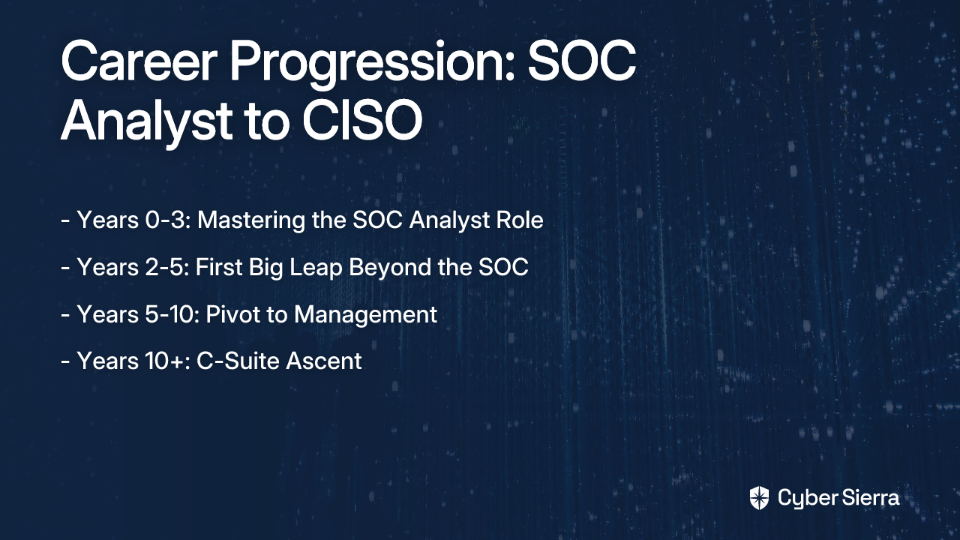
The Foundation: Mastering the SOC Analyst Role (Years 0-3)

A Security Operations Center (SOC) analyst serves as the frontline defender in cybersecurity, responsible for monitoring, analyzing, and responding to security incidents to prevent cyber attacks. The role typically involves working in a centralized hub where security professionals collaborate to protect the organization.

The SOC Career Ladder

The SOC has its own internal hierarchy:

  • Tier 1: Triage Specialist - Handles initial alert monitoring and basic incident classification
  • Tier 2: Incident Responder - Conducts deeper investigation and mitigation of security incidents
  • Tier 3: Threat Hunter - Proactively searches for hidden threats within the network

Salary expectations range from around $81,000 for entry-level positions to $110,000+ for senior SOC analysts, according to Springboard and EC-Council.

While the SOC provides excellent foundational experience, the reality is that the shift work can be brutal. As one analyst described it: "The biggest problem with my role is the shift work, the constantly changing shifts are just a killer." This work pattern can make it challenging to maintain a healthy work-life balance and find the energy for additional learning and development.

The First Big Leap: Beyond the SOC (Years 2-5)

Many SOC analysts reach a point where they feel limited by their current role. As one professional put it: "I really love the work itself... It made me realize what else is out there."

Common paths beyond the SOC include:

  • Security Engineer: Moves from response to building and implementing security solutions
  • Penetration Tester: Shifts from defense to offense, identifying vulnerabilities before attackers
  • Digital Forensics and Incident Response (DFIR) Specialist: Focuses on post-breach investigation
  • Cyber Threat Intelligence (CTI) Analyst: Researches threat actors and their tactics

How to Make the Jump

To "beef up your résumé" for these roles:

  • Quantify your achievements: Instead of "monitored alerts," use "Reduced mean-time-to-respond (MTTR) for critical alerts by 30%"
  • Build a homelab: Set up a personal environment with tools like PFSense firewall, SIEM, or a honeypot
  • Target role-specific certifications: Focus on certifications relevant to your desired specialization

This transition often comes with better work-life balance—typically moving to a 9-5 schedule rather than shift work. As one analyst desperately seeking this change noted: "With some consistency in life, I feel I can accelerate my learning so much."

The Pivot to Management: Leading the SOC (Years 5-10)

This is the most critical and often misunderstood career transition. It's less about being the best technical person and more about enabling others.

The reality of management is sobering: "Your technical chops will fade quickly as you start dealing more with spreadsheets and PowerPoint than day-to-day security stuff." A SOC Manager coordinates the analyst team, manages high-level incident response, and aligns operations with broader security strategy.

To succeed in this transition, focus on developing:

  • People leadership: Mentoring juniors, handling conflicts, conducting performance reviews
  • Project management: Overseeing tool deployments and process improvements
  • Communication skills: Reporting metrics to leadership and justifying budget requests

The compensation reflects this increased responsibility, with mid-level SOC Managers earning between $165,000–$215,000 annually according to Devo.

The C-Suite Ascent: Thinking Like a CISO (Years 10+)

A Chief Information Security Officer (CISO) is an executive responsible for developing and managing the organization's overall security strategy, vision, and program. It's a role that's fundamentally different from technical security positions.

What a CISO Actually Does

  • Develops security infrastructure and frameworks
  • Supports business strategy by ensuring security enables growth
  • Approves technology investments
  • Oversees regulatory compliance

According to the Software Engineering Institute at Carnegie Mellon University, the top CISO skills for 2024 include mastering AI, communicating with the board, understanding business operations, managing risk with advanced metrics, and strategic thinking.

The political nature of the role cannot be overstated. As one CISO candidly shared: "You need a very high tolerance for B.S. You're dealing with CxOs, BoD, and egos are everywhere." Another added: "Layer-8 political BS extrudes from everywhere and can be difficult to float above."

Executive-level CISO positions typically command salaries of $203,000–$300,000+ annually, with some top-tier CISOs earning significantly more.

Your Actionable Roadmap

Step 1: Build an Unshakeable Technical Foundation (Years 0-5)

  • Education & Certifications: Start with foundational certifications like CompTIA Security+, CompTIA CySA+, or the Certified SOC Analyst (CSA).
  • Experience: Progress from Tier 1 to Tier 3 in the SOC. Master your tools (SIEM, SOAR) and develop specializations in areas that interest you.

Step 2: Cultivate Leadership and Business Acumen (Years 5-10+)

  • Seek Leadership Experience: Volunteer to lead projects or mentor junior analysts. A minimum of seven years of management experience is often required for CISO roles.
  • Learn to Speak "Business": As one professional noted, "You need to learn finance... speak to the board members in their business language." Consider pursuing an MBA or taking courses in finance and business strategy.
  • Advanced Certifications: Pursue management-focused certifications like CISSP, CISM, and ultimately the Certified Chief Information Security Officer (C|CISO).

Step 3: Develop Your Strategic Vision (Ongoing)

  • Think Like a CISO: Start asking "why" instead of just "how." Consider how security controls support the business and express risk in business terms.
  • Network with Leaders: Attend industry events, join professional organizations like ISACA or (ISC)², and seek mentorship from current CISOs and security directors.

The Five Tiers of Cybersecurity Career Progression

To make this journey more concrete, let's break it down into five distinct tiers:

Tier 1: Worker/Execution Tier (SOC Analyst, Security Engineer)

Focus: Hands-on technical implementation and operations Skills needed: Technical proficiency with security tools, incident response Example daily tasks: Monitoring alerts, responding to incidents, implementing security controls

Tier 2: Defining/Building Tier (Senior Engineer, Team Lead)

Focus: Designing security solutions and improving processes Skills needed: Deep technical expertise, beginning leadership skills Example daily tasks: Designing security architectures, mentoring junior staff, leading small projects

Tier 3: Department Management (SOC Manager, Security Manager)

Focus: Managing teams and departmental operations Skills needed: People management, project management, departmental budgeting Example daily tasks: Managing team performance, reporting to directors, coordinating cross-team initiatives

Tier 4: Division Management (Director of Security)

Focus: Strategic direction for multiple security functions Skills needed: Strategic thinking, executive communication, large-scale budgeting Example daily tasks: Setting security strategy, managing multiple managers, engaging with C-suite

Tier 5: C-Level (CISO)

Focus: Enterprise-wide security vision aligned with business objectives Skills needed: Business acumen, board communication, risk management Example daily tasks: Presenting to the board, making strategic investment decisions, managing enterprise risk

Conclusion: The Marathon to the C-Suite

The path from SOC Analyst to CISO is indeed a marathon, not a sprint. It's a transformation from a technical expert focused on alerts and incidents to a business leader focused on risk, strategy, and resilience.

As you progress, the "fun" technical work may decrease, but the impact you can have on an organization's security posture increases exponentially. Stay curious, never stop learning, and focus on delivering business value through security.

Remember that while the endpoint may be the CISO role, not everyone wants or needs to reach that level to have a fulfilling cybersecurity career. Find the tier that best matches your skills, interests, and desired work-life balance, and excel there.

The cybersecurity field offers numerous paths for growth—choose the one that's right for you.

Frequently Asked Questions

How long does it typically take to go from a SOC Analyst to a CISO?

The journey from a SOC Analyst to a CISO typically takes a minimum of 10-15 years. This career path is a marathon that involves progressing through several distinct stages: mastering a technical role (0-5 years), transitioning into team and department management (5-10 years), and finally developing the executive-level strategic and business acumen required for the C-suite (10+ years).

What are the most critical skills for a CISO beyond technical expertise?

The most critical non-technical skills for a CISO are business acumen, communication, and strategic leadership. A successful CISO must translate technical risks into business impact, communicate effectively with the board of directors, manage budgets, and align the entire security program with the organization's strategic goals. Skills in finance, enterprise risk management, and people leadership are paramount.

Do I need to give up all my technical skills to become a CISO?

No, you do not give up your technical knowledge; rather, you apply it differently. While you won't use hands-on technical skills daily, a strong technical foundation is essential for a CISO's credibility and strategic decision-making. Your role shifts from doing the technical work to directing it, enabling you to lead technical teams effectively, challenge assumptions, and make informed decisions about technology and security architecture.

What is the biggest challenge when moving from a technical SOC role to a management position?

The biggest challenge is shifting your primary focus from being a technical problem-solver to becoming an enabler of people. Many new managers struggle because they try to remain the top technical expert on the team. Success in management requires developing a different skillset centered on mentoring your team, managing projects, handling interpersonal conflicts, and communicating your team's value to senior leadership.

What are the common career paths for a SOC Analyst who doesn't want to become a manager?

Many senior-level, non-management career paths are available for SOC Analysts who wish to remain individual contributors. You can become a highly respected and well-compensated specialist in areas like penetration testing, digital forensics and incident response (DFIR), threat intelligence, or a principal security engineer/architect. These roles offer deep technical challenges without the people-management responsibilities of a manager or CISO.

Which certifications are most valuable for aspiring CISOs?

For aspiring CISOs, management and strategy-focused certifications like CISSP, CISM, and C|CISO are the most valuable. While foundational certifications like CompTIA Security+ are crucial for starting in the SOC, the path to the C-suite requires demonstrating business and management expertise. The Certified Information Systems Security Professional (CISSP) is a respected standard, the Certified Information Security Manager (CISM) focuses on governance and risk, and the Certified Chief Information Security Officer (C|CISO) is tailored specifically for executive leadership.

blog-hero-background-image
Governance & Compliance

From SOC 2 to NIST 800-53: A Guide to Your First SSP

backdrop
Table of Contents

Join thousands of professionals and get the latest insight on Compliance & Cybersecurity.


You've successfully navigated the complexities of a SOC 2 audit, a significant milestone for any service organization. But now a new challenge looms: NIST 800-53. If the thought of building a System Security Plan (SSP) from scratch while wrestling with Word documents and spreadsheets fills you with dread, you're not alone.

Many organizations find themselves overwhelmed by the mountain of documentation required, the high stress of compliance assessments, and the frustration with inefficient tools for managing it all. The good news? Your SOC 2 investment provides a powerful head start. This guide will show you how to translate your existing controls and evidence into your first NIST 800-53 SSP and Plan of Action and Milestones (POAM), saving you time and reducing redundant work.

Understanding the New Landscape: SOC 2 vs. NIST 800-53

Before diving into the SSP creation process, let's clarify the key differences between these frameworks so you understand what's new and what you can leverage.

SOC 2 Refresher

SOC 2 was developed by the AICPA specifically for service organizations. The framework is built on the five Trust Services Criteria (TSCs):

  • Security (the "common criteria")
  • Availability
  • Processing Integrity
  • Confidentiality
  • Privacy

SOC 2 is relatively less prescriptive, allowing organizations flexibility in how they meet the criteria. The output is a SOC 2 report from an independent auditor, which your customers use to verify your security posture.

Introducing NIST SP 800-53

In contrast, NIST SP 800-53 was developed by the National Institute of Standards and Technology for U.S. federal information systems. It's a key component of the Risk Management Framework (RMF) and FISMA compliance.

NIST 800-53 is highly prescriptive and comprehensive. The latest version is NIST SP 800-53 Revision 5, which includes updates as of Release 5.1.1 (November 7, 2023). These updates include minor edits and the introduction of leading zeros in control identifiers (e.g., AC-1 becomes AC-01).

The framework organizes controls into 20 control families (e.g., Access Control (AC), Incident Response (IR), Risk Assessment (RA)). The full catalog is available in a spreadsheet format from NIST.

A key difference: NIST 800-53 mandates specific documentation, primarily the System Security Plan (SSP), Security Assessment Report (SAR), and Plan of Action and Milestones (POAM).

The Bridge: Mapping Your SOC 2 Controls to NIST 800-53

The "Why": Eliminating Redundant Work

Mapping identifies where your existing SOC 2 controls and evidence already satisfy NIST 800-53 requirements. This prevents starting from zero and creates multiple benefits:

  • Building predictability for future audits
  • Creating a holistic maintenance plan for compliance
  • Strengthening your overall security posture

As noted in Thoropass's guide on compliance mapping, this approach prevents siloed compliance efforts and reduces duplication of work.

Key Areas of Overlap

Here are concrete examples of how SOC 2 TSCs map to NIST control families:

  • SOC 2 Security TSC (Common Criteria) has strong overlap with NIST families like Access Control (AC), Audit and Accountability (AU), Identification and Authentication (IA), Risk Assessment (RA), and System and Communications Protection (SC).
  • SOC 2 Availability TSC maps well to Contingency Planning (CP).
  • SOC 2 Confidentiality TSC aligns with parts of Access Control (AC) and System and Information Integrity (SI).

While a direct SOC 2-to-NIST 800-53 map from the AICPA isn't available, you can use other mapping tools as a guide. NIST provides mappings between its frameworks, such as the NIST Cybersecurity Framework (CSF) to SP 800-53 mapping.

Cloud providers often offer their own guidance as well. For example, the AICPA SOC 2 Compliance Guide on AWS shows how cloud services map to SOC 2 criteria, which can be extended to NIST.

Your First SSP: A Step-by-Step Guide

Step 1: Find a Template (Don't Start with a Blank Page)

One of the biggest pain points when tackling NIST compliance is not knowing where to start. The official guide for SSPs is NIST SP 800-18 Rev. 1, Guide for Developing Security Plans for Federal Information Systems.

Pro Tip: For a practical, pre-formatted template, use the FedRAMP SSP template. It is widely used and well-structured, as recommended by compliance professionals.

Step 2: System Categorization and Baseline Selection

This is a foundational step that dictates your entire security posture. Categorize your system's information based on the potential impact of a breach (Low, Moderate, High) across confidentiality, integrity, and availability. Use FIPS 199 as your guide.

Based on the highest impact rating, you will select the corresponding control baseline (Low, Moderate, or High). Refer to FIPS 200 for minimum requirements and NIST SP 800-60 for detailed guidance on mapping information types.

Step 3: Define the System Context and Boundary

Your SSP must clearly describe the system. Include details like:

  • The system's purpose
  • Key components
  • Data flows
  • Network architecture
  • Authorization boundary (i.e., what's "in scope")

This step is similar to scoping your SOC 2 audit, where proper boundary definition is crucial to avoid over-controlling or under-controlling your systems.

Step 4: Document Control Implementation

This is the heart of the SSP and where your SOC 2 work pays off. For each applicable control from your baseline, you must describe how it is implemented. The SSP will have a section for each control family (e.g., AC, AU, IR).

Leverage SOC 2 Evidence: For a control like NIST AC-02 (Account Management), you can document your processes for user creation, modification, and termination. You can directly reference and reuse the evidence you gathered for your SOC 2 audit under Common Criteria CC6.1, CC6.2, and CC6.3 (Logical and Physical Access Controls).

For each control, you must clearly state if it is "implemented," "partially implemented," "planned" (which will go on the POAM), or "not applicable."

Managing Gaps: Creating Your First POAM

A Plan of Action and Milestones (POAM) is a formal document that tracks deficiencies found in security controls. It details the resources, milestones, and timelines required to remediate those weaknesses. It's a living document for continuous improvement.

As one user noted on Reddit, "First time I heard POA&M acronym described to me, it still wasn't clear." This confusion is common, but a POAM is simply your roadmap for addressing gaps in your security controls.

Creating POAM Entries

For any control identified in your SSP as "partially implemented" or "planned," you must create a corresponding entry in the POAM. Each entry should include:

  1. Unique Identifier
  2. Weakness Description
  3. Affected NIST Control(s)
  4. Planned Remediation Actions
  5. Responsible Individual or Team
  6. Scheduled Completion Date & Key Milestones

POAM Template: For a helpful starting point, download the NIST SP 800-171 CUI Plan of Action Template, which is recommended by compliance professionals.

Avoiding Pitfalls and Setting Yourself Up for Success

Common Pitfalls to Avoid

  1. Static Documentation: The SSP is a living document. A common failure is not updating it when your system or controls change, as noted in this guide on Medium.
  2. Poor Scoping: Just as with SOC 2, improperly scoping your system boundary can lead to significant issues, as SOC 2 audit professionals have emphasized.
  3. Underestimating Evidence Requirements: NIST compliance often requires more detailed and prescriptive evidence than a typical SOC 2 audit.
  4. Tooling Troubles: Relying solely on Word and Excel for managing hundreds of controls is a recipe for frustration and errors. It's a major pain point identified in user research.

Pro Tips for a Smoother Journey

  1. Consider GRC Platforms: To escape "spreadsheet hell," explore GRC platforms that help manage compliance. User recommendations include Regscale, Centraleyes, and Secureframe. These tools can link controls across frameworks, automate evidence gathering tools, and manage SSP/POAM versioning and report generation.
  2. Engage Expertise: If possible, hire a compliance firm or consultant with deep experience in both SOC 2 and NIST 800-53 to guide your gap analysis and SSP development. Despite some distrust in the consulting space, the right partner can be invaluable.
  3. Embrace Automation: Wherever possible, automate control monitoring and evidence collection to reduce the manual burden and ensure continuous compliance, especially for multi-tenant solutions where security and control concerns are heightened.

Conclusion: Your Path to a Stronger Security Posture

Transitioning from SOC 2 to NIST 800-53 is a significant undertaking, but it's not an insurmountable one. By systematically mapping your existing controls, leveraging proven templates for your SSP, and using a POAM as a strategic roadmap for risk management, you can build on your SOC 2 investment to meet federal requirements efficiently.

This process does more than just check a compliance box; it matures your security program, opens up new business opportunities with baseline documentation already in place, and builds deeper trust with your customers who require NIST compliance.

Remember, compliance is a continuous journey, not a destination. Your SSP and POAM should evolve as your organization and security posture mature, providing a solid foundation for your ongoing risk management efforts.

Frequently Asked Questions

What is the main difference between a SOC 2 report and a NIST 800-53 SSP?

The primary difference is their purpose and format. A SOC 2 report is an attestation from an independent auditor about the effectiveness of your controls based on the Trust Services Criteria. In contrast, a NIST 800-53 System Security Plan (SSP) is a detailed, descriptive document created by your organization that explains precisely how each required security control is implemented for a specific system.

How can my SOC 2 audit help with NIST 800-53 compliance?

Your SOC 2 audit provides a significant head start for NIST 800-53 by supplying a foundation of documented controls and evidence. You can map your existing SOC 2 controls, especially from the Security (Common Criteria) TSC, to corresponding NIST 800-53 control families like Access Control (AC) and Risk Assessment (RA). This reuse of work saves time and prevents redundant effort.

What is a System Security Plan (SSP) and why do I need one?

A System Security Plan (SSP) is a foundational document required by NIST that provides a comprehensive overview of a system's security. You need an SSP to formally document all the security controls in place, describe the system's operational context and boundary, and provide a basis for assessing risk and authorizing the system to operate.

What is a POAM and when is it required?

A Plan of Action and Milestones (POAM) is a formal document used to track and manage the remediation of security weaknesses. A POAM is required whenever a security control is identified as being "partially implemented" or "planned" in your SSP. It serves as a corrective action plan, detailing the tasks, resources, and timelines needed to address security gaps.

Where can I find a good template for my NIST SSP?

A highly recommended and practical starting point for your SSP is the FedRAMP SSP template. It is well-structured and widely used in the industry. While the official guide for developing SSPs is NIST SP 800-18, the FedRAMP template provides a pre-formatted document that simplifies the process of documenting your control implementations.

Can I manage my SSP and POAM using Word and Excel?

Yes, you can use Word and Excel to manage your SSP and POAM, but it can quickly become cumbersome and error-prone. For systems with hundreds of controls, maintaining version control, linking evidence, and tracking changes manually is a significant challenge. Many organizations opt for Governance, Risk, and Compliance (GRC) platforms to automate this process and avoid "spreadsheet hell."

blog-hero-background-image
Governance & Compliance

Why Every GRC Platform Sucks (And What CISOs Actually Use Instead)

backdrop
Table of Contents

Join thousands of professionals and get the latest insight on Compliance & Cybersecurity.


You've just completed another exhausting vendor demo for a GRC platform promising to revolutionize your compliance program. The sales rep confidently declared their solution will streamline your SOC2 audits, automate evidence collection, and provide real-time risk visibility across your organization. The price tag? A mere six figures annually, plus implementation costs.

Yet something feels off. You've heard these promises before.

"I know a lot of CISOs (many hundreds) and not one of them wakes up in the morning and says 'OMG, I'm so glad I spent 2 million dollars on Archer' or any other GRC platform for that matter," confesses one security leader in a brutally honest Reddit thread.

This sentiment isn't isolated. Across forums, conferences, and private conversations, cybersecurity leaders share a dirty secret: the expensive GRC platforms that promised compliance nirvana have largely failed to deliver. Instead, they've created new problems while solving few of the old ones.

This article pulls back the curtain on why GRC platforms consistently disappoint even the most optimistic security teams, and reveals what battle-tested CISOs are actually using to manage their governance, risk, and compliance programs effectively.

The Great GRC Platform Failure: A Litany of Broken Promises

Pitfall 1: The One-Size-Fits-None Approach

Most GRC platforms are built on a fundamental misconception: that compliance and risk management follow universal patterns that can be standardized across organizations.

"One big problem is that most of the platforms are inflexible and try really hard to commoditize compliance by pushing for a one-size-fits-all program," explains one practitioner. This creates an impossible dilemma: "You either build your entire GRC program around a tool that exists and deal with the problems it brings, or you don't and you suffer the problems with tools that don't fit your processes."

The reality is that "each organization has unique needs, structures, and regulatory requirements that make it challenging to find an actual good GRC solution." What works for a financial institution facing strict regulatory requirements won't necessarily work for a healthcare provider or a SaaS startup.

Pitfall 2: Forgetting the "G" and "R" in GRC

A common complaint among security leaders is that most platforms "focus on compliance and forget about the R and especially the G." This myopic view reduces governance and risk management to checkbox exercises, missing the strategic value they should provide.

While compliance frameworks offer useful structure, they're meant to complement, not replace, thoughtful governance and risk management. True GRC should enable leaders to make informed decisions about security investments, not just generate compliance reports.

Parrish Gunnels, CISO at Sunflower Bank, highlighted this disconnect when he stated, "We're not spending our time chasing down compliance checkboxes — we're actively analyzing trends." This proactive stance is what GRC platforms promise but rarely deliver.

Pitfall 3: Broken Processes and the Ownership Black Hole

No technology can fix fundamentally broken processes. Many GRC implementations fail because they're deployed atop unclear roles and responsibilities.

Poor RACI (Responsible, Accountable, Consulted, Informed) models during implementation and a persistent lack of ownership doom many GRC initiatives from the start. When responsibilities are murky, a platform that was supposed to centralize information instead becomes another information silo.

James Wade, CISO at MCS, described a common pre-GRC environment: "We were a very siloed company... we had different business units... each doing their own thing. We weren't reporting back on the software used or the risks encountered." Unfortunately, many GRC platforms perpetuate rather than solve this problem.

Pitfall 4: The Evidence Shell Game and Audit Mistrust

Perhaps the most damning indictment comes from auditors themselves: "Most legit auditors don't trust the data from the platforms outright since they don't source their evidence well enough," reports one security professional.

This flaw undermines the entire value proposition. If organizations must still manually collect and present evidence for SOC2 or ISO27001 audits, what exactly is the platform doing to earn its six-figure price tag?

Pitfall 5: The High Cost of Disappointment

All these failures would be frustrating at any price point. But when platforms like Archer cost millions to implement, and even mid-tier solutions like Hyperproof have high minimum commitments, the disappointment is compounded by financial pain.

As one cybersecurity professional bluntly puts it, "It seems like every solution is either riddled with bugs, lacks basic features and integrations, or is built around nickel and dime-ing their customers for frameworks."

The CISO's Real-World Toolkit: What Actually Works

Given these persistent issues, what are security leaders actually using to manage their GRC programs? The answers might surprise you.

The Unkillable Duo: Excel and SharePoint

Despite billions invested in GRC technology, many organizations—including sophisticated enterprises—still rely heavily on Excel spreadsheets and SharePoint for tracking risks and managing compliance evidence.

This approach offers flexibility, ubiquity, and minimal learning curve. For smaller organizations especially, these tools provide "good enough" functionality without the integration headaches and steep costs of dedicated platforms.

"I've switched from excels to CISO assistant and I find it to be so much better than trying to create multiple files and synchronize data between them," notes one practitioner, highlighting the challenges but also the prevalence of spreadsheet-based approaches.

Going Custom: The Bespoke GRC Build

When off-the-shelf products disappoint, some organizations choose to build rather than buy. One security professional shared: "Had a client transform their SOPs and controls into a custom NetSuite platform. Other than that, I've seen piecemeal solutions."

Others recommend "Build your own with PowerBI" or note they've created solutions with Airtable that match commercial GRC platform functionality. While these custom builds require ongoing development effort, they can be tailored precisely to organizational needs.

The Open-Source Rebellion: Eramba and its Kin

Open-source GRC solutions are gaining traction as cost-effective, flexible alternatives to commercial platforms. Eramba, frequently mentioned in discussions among security professionals, offers customizability without the enterprise price tag.

SimpleRisk, another popular option, receives praise for being "a pretty good option, especially if price is a concern."

These solutions may not offer the polished interfaces of their commercial counterparts, but many security teams find they provide the essential functionality without the frustrations and costs.

The "Compliance Automation" Tier: Drata, Vanta, and the New Guard

A newer generation of compliance-focused platforms like Drata, Vanta, and SecureFrame has emerged, particularly targeting startups and growth-stage companies pursuing SOC2 certification.

User feedback on these platforms is mixed but generally more positive than traditional GRC solutions: "Just got Drata at my new place. Best so far but still frustrating," reports one security leader.

These platforms focus narrowly on specific compliance frameworks rather than attempting to solve the broader GRC challenge, which may explain their relative success.

Forging a Path Forward: A Practical GRC Strategy

Beyond cataloging failures and alternatives, what actionable advice can we offer for building an effective GRC program?

Principle 1: Strategy Before Software

The first step is always defining clear objectives for your GRC initiative. What specific problems are you trying to solve? Which compliance frameworks are mandatory for your business? What risk visibility do stakeholders require?

A tool is a means to an end, not the end itself. Many organizations waste resources by purchasing platforms before clarifying their GRC strategy and requirements.

Principle 2: Fix the People and Process Problems First

Technology cannot fix broken processes or unclear responsibilities. Before evaluating any GRC platform, establish a solid RACI model that clearly defines who owns what in your compliance and risk management program.

This requires a human-centric approach that values expertise instead of trying to automate it away. As one practitioner notes, many GRC platforms "completely take the human aspect that is absolutely necessary out of the equation."

Don't forget to invest in training to ensure everyone understands their role in the GRC process.

Principle 3: Leverage Technology Wisely

When you do select technology, choose tools based on your specific organizational needs rather than marketing promises. Before buying anything new, evaluate the tools you already own—many companies have Microsoft 365 licenses, and Microsoft Purview is an increasingly viable option for basic GRC functionality.

Remember the journey: Start with what you have (Excel), explore building what you need (custom solutions), and consider the value of open-source alternatives (Eramba) before committing to another expensive, inflexible platform.

The Inconvenient Truth About GRC

The GRC platform market continues to grow despite widespread dissatisfaction. Perhaps the most honest assessment comes from a security professional who jokingly suggested: "It's a conspiracy by GRC professionals to stay employed."

While tongue-in-cheek, this comment highlights an important truth: effective governance, risk management, and compliance require human judgment that no platform can fully automate or replace.

The most successful organizations recognize that GRC is fundamentally about people making informed decisions about risk, not about having the fanciest dashboard or the most extensive framework library.

Until GRC platform vendors acknowledge this reality and build tools that enhance rather than replace human expertise, security leaders will continue cobbling together their own solutions—from Excel to custom builds to open-source alternatives—that actually deliver the results they need.

And they certainly won't be waking up excited about that $2 million Archer investment.

Frequently Asked Questions

What are the main problems with traditional GRC platforms?

Traditional GRC platforms often fail due to their inflexible one-size-fits-none approach, an overemphasis on compliance checkboxes at the expense of governance and risk, and their inability to fix underlying broken processes. They attempt to standardize GRC in a way that doesn't fit unique organizational needs, and many reduce GRC to simple compliance reporting, missing the strategic value of risk management. Furthermore, they can't solve issues like unclear ownership and often become another silo rather than a central source of truth.

Why do auditors often distrust GRC platforms?

Auditors often distrust data from GRC platforms because the platforms frequently fail to source and document evidence adequately for audits like SOC2 or ISO27001. This fundamental flaw undermines a key value proposition of GRC tools. If auditors cannot rely on the platform's data, security teams must still perform manual evidence gathering, which calls into question the high cost and supposed efficiency gains of the platform.

What tools do CISOs actually use for GRC instead of expensive platforms?

Many CISOs use a practical mix of tools including standard office software like Excel and SharePoint, custom-built solutions using platforms like PowerBI or Airtable, and open-source GRC tools like Eramba or SimpleRisk. Many organizations find that the flexibility and low cost of spreadsheets are "good enough," while others with specific needs opt to build their own tailored solutions or use open-source software to get core functionality without the high price tag.

How can I build an effective GRC program without a big budget?

You can build an effective GRC program by focusing on strategy before software, fixing internal processes first, and wisely leveraging technology you already have. Start by defining your GRC objectives and clarifying roles and responsibilities with a solid RACI model. Often, the biggest gains come from improving human processes. Before buying a new tool, evaluate what you can accomplish with existing software like Microsoft 365, and consider cost-effective options like open-source solutions.

What is the difference between GRC platforms and compliance automation tools like Drata or Vanta?

Traditional GRC platforms aim to be broad, all-in-one solutions for governance, risk, and compliance, while newer compliance automation tools like Drata and Vanta are narrowly focused on helping companies achieve specific certifications like SOC2. GRC platforms try to cover the entire GRC landscape, which can make them complex and inflexible. In contrast, compliance automation tools are designed to automate evidence collection and streamline the audit process for a particular framework, which is why they have found success with startups and growth-stage companies.

Is an open-source GRC tool like Eramba a good choice?

Yes, open-source GRC tools like Eramba can be an excellent choice, offering significant customizability and cost savings compared to commercial enterprise platforms. While they may require more technical expertise to set up and might lack a polished user interface, they provide core GRC functionality without high licensing fees and allow for unparalleled flexibility to be tailored to your organization's specific processes.

blog-hero-background-image
Cyber Security

PCI DSS WAF Implementation Guide for Engineers

backdrop
Table of Contents

Join thousands of professionals and get the latest insight on Compliance & Cybersecurity.


You've just been informed that your organization needs a Web Application Firewall (WAF) for PCI DSS 4.0 compliance by March 2025. Your stomach sinks as you imagine the fallout: engineers pushing back against another security tool, project timelines derailed, and a rush of emergency meetings to figure out what exactly this new requirement entails.

"The technology required to satisfy these requirements has not been on peoples' radars," as one compliance professional recently noted. If you're feeling overwhelmed by this sudden mandate and worried about how to implement it without disrupting your engineering workflow, you're not alone.

This guide will help you navigate PCI DSS 4.0's WAF requirements with a practical, engineering-friendly approach that strengthens security without creating unnecessary friction.

The New Mandate: Why a WAF is No Longer Optional for PCI DSS 4.0

PCI DSS 4.0 marks a significant shift in how organizations must protect web applications. Unlike version 3.2.1, which allowed either a WAF or regular code reviews, version 4.0's Requirement 6.4.2 makes automated protection mandatory for public-facing web applications.

The timeline creates urgency:

  • PCI DSS v3.2.1 was retired on March 31, 2024
  • All new requirements in v4.0 must be implemented by March 31, 2025

This isn't just bureaucratic box-checking. Web application attacks are the second most common cause of data breaches, according to Verizon's Data Breach Investigations Report. A properly configured WAF acts as a Layer 7 filter, protecting against common attacks like SQL injection, Cross-Site Scripting (XSS), and Cross-Site Request Forgery (CSRF).

The business impact is equally compelling: 62% of organizations report monthly downtime due to attacks, directly impacting revenue and customer trust.

Decoding Requirement 6.4: What PCI DSS 4.0 Really Demands from Your WAF

Many organizations are "just now realizing the tech gaps" in their compliance programs, particularly around WAF implementation. Let's clarify what PCI DSS 4.0 actually requires:

Beyond Basic Blocking

PCI DSS 4.0 emphasizes a positive security model (allowlisting) over a purely negative one (blocklisting). While a blocklist WAF denies known bad traffic, an allowlist WAF only permits pre-approved traffic patterns—a more proactive, "zero-trust" approach that PCI DSS 4.0 favors.

Client-Side Protection Requirements

Two often-overlooked requirements that your WAF strategy needs to address:

  • Requirement 6.4.3: Mandates a method to ensure the integrity of scripts that execute on the payment page in a consumer's browser. This fights against form-jacking attacks that exploit third-party JavaScript.
  • Requirement 11.6.1: Requires a tamper-detection mechanism to alert on unauthorized changes to HTTP headers and payment page content.

API Security Is Essential

Organizations must discover and analyze all API endpoints to protect against data leakage and Business Logic Attacks (BLAs). This is particularly important as modern applications increasingly rely on APIs for data exchange.

Choosing Your WAF: Balancing Compliance, Cost, and Engineering Sanity

The type of WAF you choose dramatically impacts your engineering team's workload and morale. Here's a comparison focused on engineering effort and operational overhead:

Network-based WAF

  • Pros: Minimizes latency, high performance
  • Cons: High cost, requires physical maintenance, significant engineering overhead for setup and management
  • Engineering impact: Requires substantial time for initial configuration and ongoing maintenance

Host-based WAF

  • Pros: Highly customizable, integrated with application
  • Cons: Consumes local server resources, complex to manage
  • Engineering impact: Requires deep engineering involvement and expertise

Cloud-based WAF

  • Pros: Easy to implement, minimal upfront cost, continuously updated by vendor
  • Cons: Less granular control over specific configurations
  • Engineering impact: Often the best choice for reducing internal workload and minimizing disruption

WAF Selection Checklist

When evaluating WAF solutions, consider these engineering-friendly criteria:

  • Does it support a hybrid or positive security model?
  • Does it offer integrated API and client-side protection?
  • How easily does it integrate with your existing CI/CD pipeline?
  • What's the process for handling false positives and tuning rules?
  • Does it provide clear, actionable logs that developers can understand?
  • Can it be deployed gradually with a monitoring-only mode?

The Collaborative Implementation Playbook: Rollout Without the Rollback

A successful WAF implementation is as much about project management as it is about technology. Here's a four-step approach that minimizes disruption:

Step 1: Start with a Collaborative Gap Analysis

Many find that "it's complicated to perform the gap analysis" for PCI compliance. Make it easier by:

  • Involving security, engineering leads, and product managers from the beginning
  • Defining clear acceptance criteria for the WAF project, addressing the common pain of "gaps in the acceptance criteria"
  • Ranking requirements as "must-have vs. nice-to-have" to focus efforts

Step 2: Execute a Phased Rollout

Starting with a "big bang" implementation is a recipe for resistance. Instead:

  • Begin by deploying the WAF in logging/monitoring mode only. This lets your team see what would be blocked without impacting production traffic
  • Gradually introduce blocking rules, starting with low-risk, high-confidence patterns (e.g., basic SQL injection from the OWASP Top Ten)
  • Roll out to staging environments or less critical applications before deploying to your Cardholder Data Environment (CDE)

Step 3: Tune, Test, and Automate

A WAF isn't "set-it-and-forget-it" technology. Create sustainable processes by:

  • Integrating WAF alerts directly into your team's existing workflow tools (Jira, Slack, etc.)
  • Establishing a clear, low-friction process for engineers to report false positives
  • Automating rule updates when possible to reduce manual overhead

Step 4: Empower the Team with Training

Reduce fear and resistance by:

  • Providing training on how the WAF works and how to interpret its logs
  • Creating documentation that explains common alerts and troubleshooting steps
  • Celebrating security wins and improvements that the WAF enables

Beyond the Firewall: Embedding Security into Your Culture

While a WAF is critical for PCI DSS 4.0 compliance, it's part of a larger "Defense in Depth" strategy. Other important controls include:

  • Managed Detection and Response (MDR): For proactive threat identification
  • Data Loss Prevention (DLP): To protect sensitive data from exfiltration
  • Regular Security Testing (Req 11): Continuous vulnerability scanning and penetration testing
  • Strong Access Controls (Req 7, 8, 9): Enforcing "need-to-know" access to the CDE

Case Study: Payment Processor Success Story

A mid-sized payment processor facing the PCI DSS 4.0 deadline took the following approach:

  1. They selected a cloud-based WAF with API security features
  2. Deployed in monitoring-only mode for 30 days to gather data on traffic patterns
  3. Created a Slack channel for WAF alerts and engineering feedback
  4. Implemented blocking rules incrementally, starting with high-confidence OWASP Top 10 protections
  5. Achieved full compliance three months ahead of deadline with minimal disruption

The key to their success? Close collaboration between security and engineering teams from day one, with a focus on minimizing false positives.

Conclusion: Security as a Partnership, Not a Roadblock

PCI DSS 4.0's WAF requirement doesn't have to be a source of friction between security and engineering. By choosing the right solution and implementing it collaboratively, you can strengthen your security posture while maintaining engineering velocity.

Remember that a thoughtful, phased WAF implementation is an opportunity to modernize your security practices and foster stronger partnerships across teams. Start your gap analysis now, consult with a Qualified Security Assessor (QSA) for tailored guidance, and approach this requirement as a chance to build a more resilient organization.

The March 2025 deadline may seem distant, but organizations that start now will avoid the last-minute scramble and achieve not just compliance, but genuine security improvement.

Frequently Asked Questions

What are the new WAF requirements in PCI DSS 4.0?

PCI DSS 4.0 Requirement 6.4.2 mandates that all public-facing web applications must be protected by a Web Application Firewall (WAF) to detect and prevent web-based attacks. Unlike previous versions that allowed either a WAF or manual code reviews, the new standard makes this automated protection a baseline requirement. This also includes related requirements for ensuring the integrity of scripts on payment pages (6.4.3) and implementing tamper-detection mechanisms (11.6.1).

When is the deadline to implement a WAF for PCI DSS 4.0?

The deadline for implementing all new requirements in PCI DSS 4.0, including the mandatory WAF, is March 31, 2025. As PCI DSS v3.2.1 was retired on March 31, 2024, all organizations must be fully compliant with version 4.0 by this 2025 date. It is highly recommended to start the implementation process as soon as possible to allow for proper testing and tuning.

Why is a WAF now mandatory for PCI DSS compliance?

A WAF is now mandatory because web application attacks are consistently one of the top causes of data breaches. The PCI Security Standards Council recognized that with the increasing sophistication of cyber threats, periodic code reviews alone are insufficient. A WAF provides a necessary layer of real-time, automated defense against common attacks like SQL injection, cross-site scripting (XSS), and other vulnerabilities that could expose cardholder data.

How should we handle WAF false positives without disrupting our engineers?

Handling WAF false positives effectively requires a combination of phased implementation, rule tuning, and establishing clear feedback channels. The best practice is to first deploy the WAF in a non-blocking "monitoring" or "logging-only" mode. This allows you to see what traffic would be blocked without impacting users. Then, create a simple, low-friction process (e.g., a dedicated Slack channel or Jira workflow) for engineers to report issues, enabling the security team to quickly tune rules and minimize disruption.

What is the difference between a positive and negative security model for a WAF?

A negative security model (or "blocklisting") works by identifying and blocking known malicious traffic and attack signatures. A positive security model (or "allowlisting") is more restrictive; it defines what traffic is allowed and blocks everything else. PCI DSS 4.0 favors a positive security model because it provides a more proactive, "zero-trust" defense that can protect against new and unknown (zero-day) attacks, not just previously identified threats.

Which type of WAF is best for minimizing engineering workload?

For most organizations looking to minimize the burden on internal engineering teams, a cloud-based WAF is often the best choice. Unlike on-premise network or host-based WAFs that require significant setup, maintenance, and resource management, cloud WAFs are managed by the vendor. This means easier implementation, continuous threat intelligence updates, and scalability without demanding extensive time from your engineers.


This article is for informational purposes only and should not be construed as legal advice. Always consult with a qualified security assessor for guidance specific to your environment.

blog-hero-background-image
Governance & Compliance

Why Every GRC Platform Sucks (And What CISOs Actually Use Instead)

backdrop
Table of Contents

Join thousands of professionals and get the latest insight on Compliance & Cybersecurity.


You've just signed the purchase order for that shiny new GRC platform. Two million dollars and countless implementation hours later, you're left wondering if you've made a colossal mistake. If this scenario sounds familiar, you're not alone.

"I know a lot of CISOs (many hundreds) and not one of them wakes up in the morning and says 'OMG, I'm so glad I spent 2 million dollars on Archer' or any other GRC platform for that matter," confesses one security leader.

The brutal reality? Despite vendor promises, most Governance, Risk, and Compliance (GRC) platforms are "riddled with bugs, lack basic features and integrations, or are built around nickel and dime-ing their customers for frameworks." Many security professionals have come to a troubling conclusion: "It's a conspiracy by GRC professionals to stay employed."

This widespread disillusionment stems from a fundamental dilemma: "You either build your entire GRC program around a tool that exists and deal with the problems it brings, or you don't and you suffer the problems with tools that don't fit your processes."

But why exactly do these expensive platforms consistently fail to deliver, and what are savvy CISOs using instead? Let's dive into the painful truth and explore the alternatives that actually work.

The Brutal Reality: Why GRC Platforms Fail

The Core Conflict: Inflexible, One-Size-Fits-None Approach

The most glaring issue with commercial GRC platforms is their fundamental inability to adapt to organizational uniqueness.

"Each organization has unique needs, structures, and regulatory requirements that make it challenging to find an actual good GRC solution," explains one cybersecurity professional. This mismatch creates friction from day one.

Even industry heavyweight Archer faces criticism for being "too rigid and doesn't meet our varied compliance needs." Most platforms "try really hard to commoditize compliance by pushing for a one-size-fits-all program," which strips away the contextual nuance that makes compliance meaningful.

Broken Processes: Poor RACI Models and Lack of Ownership

A recurring theme in GRC platform failures is the absence of clear responsibility assignment. Many implementations suffer from a "Poor RACI model for initial configuration," creating confusion about who owns what.

James Wade, CISO at MCS, points to the problem of siloed risk management where "different business units... each doing their own thing." Without clear ownership, compliance tasks fall through the cracks, and the platform becomes an expensive repository of outdated information.

Effective GRC requires cross-functional collaboration involving executives, legal, finance, HR, and IT—something many platforms struggle to facilitate despite their hefty price tags.

The Evidence Black Hole: Weak Sourcing and Auditor Distrust

Perhaps the most damning failure of GRC platforms is their inability to satisfy the very purpose they were designed for: simplifying audits.

"Most legit auditors don't trust the data from the platforms outright since they don't source their evidence well enough," notes one security professional. This fundamental flaw means "auditors end up asking for a lot of evidence in addition to what is in the platform already"—defeating the entire purpose of having a GRC system in the first place.

The difficulty in automating evidence collection and maintaining its integrity creates a credibility gap that expensive platforms have failed to bridge, especially when dealing with frameworks like SOC2 or ISO27001.

Forgetting the 'G' and 'R': The Compliance-Only Trap

Many platforms have a myopic focus: "Most of them focus on compliance and forget about the R and especially the G," observes a cybersecurity leader.

This fixation on "chasing down compliance checkboxes" means the broader goals of governance and proactive risk management are often neglected. Parrish Gunnels, CISO of Sunflower Bank, echoes this sentiment, noting that without proper governance, compliance becomes a hollow exercise.

The Real-World CISO Toolkit: What Actually Works

Faced with these persistent failures, what are CISOs and security leaders actually using to manage their GRC programs? The answers might surprise you.

The Old Guard: Excel & SharePoint

Despite billions invested in GRC platforms, many organizations still rely on the humble spreadsheet.

For smaller firms or specific tasks, Excel and SharePoint often prove "more effective" due to their flexibility and familiarity. They allow teams to adapt quickly to changing requirements without the overhead of reconfiguring an enterprise platform.

However, this approach isn't without drawbacks. "'It's in SharePoint' becomes fighting words" in many organizations, and security teams report challenges with "trying to create multiple files and synchronize data between them."

The Custom Route: Building Your Own GRC Engine

Rather than forcing their operations into the constraints of a commercial platform, some organizations are taking matters into their own hands.

One security professional shares how a client "transformed their SOPs and controls into a custom Netsuite platform." Others recommend "Build your own with PowerBI" or using flexible databases like Airtable.

While custom development requires initial investment, it creates solutions perfectly aligned with organizational processes. The tradeoff is clear: "There is a cost to continuously develop your own if you go down that route," but many find this preferable to fighting with an ill-fitting commercial platform.

The Rise of Open-Source: Flexible, Transparent, and Cost-Effective

A growing movement in the GRC space embraces open-source solutions that offer customization and control without the enterprise price tag.

Eramba has emerged as a leading open-source GRC platform, focused on information security management. It offers comprehensive policy management, risk assessments, compliance packages for frameworks like ISO 27001 and GDPR, and powerful task automation. While it has a steeper learning curve than some commercial alternatives, organizations appreciate its structured approach to risk tracking and the availability of commercial support when needed.

Other open-source tools gaining traction include CISO Assistant, a lighter "digital checklist" for security officers that's particularly user-friendly for small teams. One user who switched from Excel reports it's "so much better than trying to create multiple files and synchronize data between them."

For organizations specifically concerned with AI governance, VerifyWise offers specialized compliance features aligned with the EU AI Act, showing how niche open-source tools are addressing emerging regulatory needs.

The New Breed: Compliance Automation Tools (with Caveats)

A new category of compliance automation platforms is gaining popularity, though with important limitations.

Drata receives praise for being "excellent for compliance automation with many integrations for collecting evidence." One CISO notes, "Just got Drata at my new place. Best so far but still frustrating."

The key caveat: these tools focus on "controls compliance rather than being a true holistic GRC tool." They excel at solving the evidence collection problem for specific frameworks like SOC2 but may not cover the full governance and risk management spectrum.

Forging a Path Forward: A Pragmatic GRC Strategy

The lesson from countless GRC implementation failures is clear: start with strategy, not with a tool.

Before selecting any software, define your GRC framework, establish clear ownership (RACI), and map your processes. The tool should serve your program, not the other way around. The most effective GRC programs use dashboards that "bridge the gap between technical risks and business priorities," making risk information actionable for leadership.

When evaluating options, ask critical questions:

  • Are you focused on broad infosec governance or also emerging domains like AI systems?
  • Do you need a comprehensive framework or to solve a specific compliance challenge?
  • How important are customization, community support, and cost?

Finally, look for solutions that integrate with your existing systems. Users recommend platforms with "integrations into inventory management & Jira" or tools that complement existing investments like "Clear Skies with ServiceNow."

Conclusion: GRC is a Program, Not a Platform

The failure of expensive, monolithic GRC platforms stems from their inflexibility, poor process support, and inability to meet unique organizational needs. No wonder CISOs aren't waking up excited about their multi-million dollar investments.

The path forward isn't finding one "perfect" platform, but building a tailored GRC program using pragmatic tools—whether that's SharePoint, a custom-built NetSuite module, a flexible open-source solution like Eramba, or a targeted compliance tool like Drata.

True GRC success comes from prioritizing people and processes first. It requires clear ownership, cross-functional collaboration, and a toolset that serves your program—not the other way around. The $2 million elephant in the room doesn't have to be your reality.

Frequently Asked Questions

Why do most GRC platforms fail?

Most GRC platforms fail because their rigid, one-size-fits-all approach cannot adapt to an organization's unique needs, processes, and regulatory requirements. This fundamental inflexibility leads to broken processes, a lack of clear ownership, and an inability to source evidence effectively, which auditors often distrust. As a result, they become expensive, underutilized systems that don't solve the core governance, risk, and compliance challenges they were purchased to address.

What are the best alternatives to expensive GRC platforms?

The best alternatives depend on your organization's needs but often include a mix of flexible spreadsheets (Excel/SharePoint), custom-built solutions (using PowerBI or Netsuite), open-source platforms (like Eramba), and specialized compliance automation tools (like Drata). For smaller tasks, many still find Excel effective. For total control, custom development offers a perfect fit. Open-source solutions provide a balance of features and flexibility without the high cost, while automation tools excel at specific tasks like evidence collection for SOC2.

What is the difference between a GRC platform and a compliance automation tool?

A traditional GRC platform aims to be a holistic, all-in-one solution for Governance, Risk, and Compliance, while a compliance automation tool focuses specifically on automating evidence collection and control monitoring for specific frameworks like SOC2 or ISO 27001. GRC platforms are designed to manage the entire program, including policy management and risk assessments. Compliance automation tools are more tactical; they are excellent for simplifying audits but may not offer the broader risk management and governance capabilities of a true GRC system.

How can I start building a GRC program without a big budget?

Start by focusing on strategy, not software. Begin by defining your GRC framework, mapping your key processes, and establishing a clear RACI (Responsible, Accountable, Consulted, Informed) model to assign ownership for tasks. You can manage this initial framework using familiar, low-cost tools like Excel and SharePoint. As your program matures, consider adopting a cost-effective open-source tool like Eramba to digitize your processes without the need for a massive enterprise platform.

Are open-source GRC tools secure and reliable for enterprise use?

Yes, leading open-source GRC tools like Eramba can be highly secure and reliable for enterprise use, offering transparency and control that many proprietary platforms lack. The key advantage of open-source is flexibility and the absence of vendor lock-in. While they may require more initial setup, mature projects like Eramba have strong community support and also offer paid commercial support, training, and enterprise-level features, providing a customizable core with professional support when needed.

What is the single most important factor for a successful GRC program?

The single most important factor is treating GRC as a program centered on people and processes, not as a piece of software. Technology is only an enabler. A successful GRC program is built on a foundation of clear strategy, defined ownership across business units, and well-documented processes. The tool you choose should be selected to support this program, not the other way around.

toaster icon

Thank you for reaching out to us!

We will get back to you soon.