NIST Cybersecurity vs ISO 27001



Join thousands of professionals and get the latest insight on Compliance & Cybersecurity.
In today's complex cybersecurity landscape, organizations face mounting pressure to adopt robust security frameworks that effectively manage risks while meeting compliance requirements. Two dominant frameworks stand out in this space: the NIST Cybersecurity Framework (CSF) and ISO 27001. While both aim to strengthen an organization's security posture, they differ significantly in their approach, implementation, and certification processes.
Understanding NIST and ISO Frameworks

NIST Cybersecurity Framework (CSF)
The National Institute of Standards and Technology (NIST) developed the Cybersecurity Framework as a voluntary set of guidelines designed to help organizations manage and reduce cybersecurity risk. Originally created for critical infrastructure, it has gained widespread adoption across various sectors.
Core Components
The NIST CSF consists of three main components:
- Framework Core: Organized around five key functions that form the backbone of effective cybersecurity management:
- Identify: Develop organizational understanding to manage cybersecurity risks
- Protect: Implement appropriate safeguards to ensure critical services
- Detect: Implement activities to identify cybersecurity events
- Respond: Take action regarding detected cybersecurity incidents
- Recover: Maintain resilience plans and restore impaired capabilities
- Implementation Tiers: Ranging from Partial (Tier 1) to Adaptive (Tier 4), these tiers describe the degree to which an organization's cybersecurity risk management practices exhibit characteristics defined in the framework.
- Profiles: Alignment of organizational requirements and objectives with framework outcomes, helping identify opportunities for improving cybersecurity posture.
NIST provides extensive documentation through its 800 series publications, particularly NIST SP 800-53, which offers granular technical controls addressing specific areas such as multi-factor authentication, encryption, and boundary protection - details that organizations often find lacking in ISO's broader approach.
ISO 27001
ISO 27001 is an internationally recognized standard that establishes requirements for an Information Security Management System (ISMS). Developed by the International Organization for Standardization, it provides a systematic approach to managing sensitive company information.
Key Features
- Certification: Unlike NIST, ISO 27001 offers formal certification through accredited third-party auditors, providing a globally recognized stamp of approval.
- Risk Assessment Methodology: Provides a structured approach to identifying, analyzing, and treating information security risks.
- Comprehensive Control Set: Annex A of ISO 27001 contains 114 controls organized into 14 domains covering various aspects of information security.
- Documentation Requirements: Demands extensive documentation of policies, procedures, and evidence of implementation.
Key Similarities Between NIST and ISO
Despite their differences, NIST and ISO share several fundamental similarities that make them compatible and complementary frameworks:
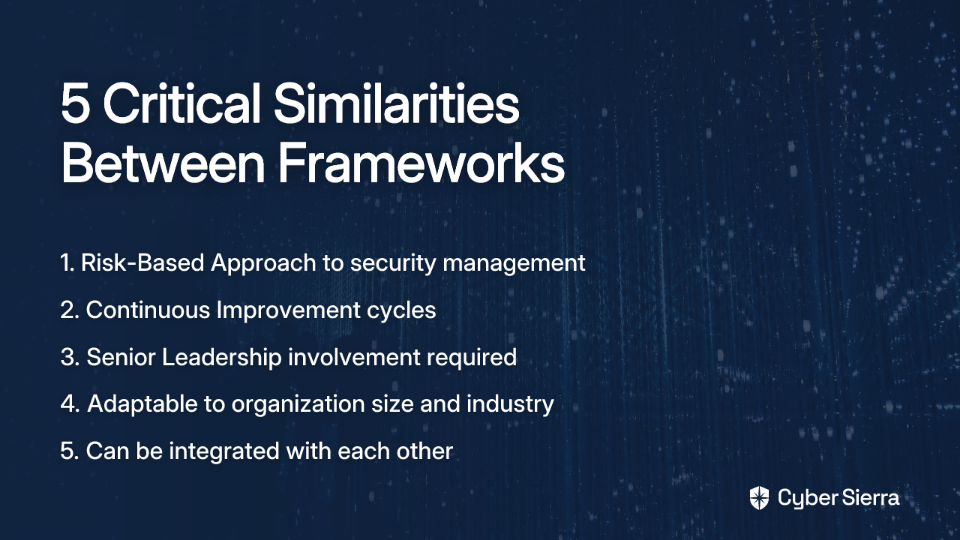
- Risk-Based Approach: Both frameworks emphasize the importance of risk assessment and management as foundational elements of security programs. They require organizations to identify, assess, and prioritize risks before implementing controls.
- Continuous Improvement: NIST and ISO promote an iterative approach to security, encouraging organizations to regularly review, assess, and enhance their security measures.
- Management Support: Both frameworks recognize the critical role of senior leadership in establishing, implementing, and maintaining effective security programs.
- Adaptability: While structured, both frameworks allow for customization based on organizational size, industry, and specific requirements.
- Integration Capability: Organizations can implement both frameworks simultaneously, leveraging their complementary strengths to create comprehensive security programs.
Critical Differences Between NIST and ISO
Understanding the key differences between these frameworks helps organizations make informed decisions about which standard best aligns with their objectives:
| Aspect | NIST CSF | ISO 27001 |
|---|---|---|
| Origin & Focus | Developed in the U.S. with emphasis on critical infrastructure | International standard applicable across industries |
| Certification | No formal certification process | Requires third-party certification |
| Control Specificity | Provides detailed, granular controls (e.g., NIST SP 800-53) | Offers broader, less detailed control framework |
| Cost | Free to access and implement | Involves costs for documentation access and certification |
| Documentation | Flexible documentation requirements | Extensive, mandatory documentation |
| Primary Audience | Initially U.S. federal agencies, now widely adopted | Global organizations across sectors |
The Specificity Gap
One of the most significant differences highlighted by cybersecurity professionals is the level of specificity in controls. As one practitioner noted: "NIST found that ISO 27001 operated at a higher level of generality, lacking the specific controls required by NIST." This observation points to a fundamental distinction: while ISO 27001 provides a comprehensive management framework, NIST offers more detailed technical guidance.
For example, NIST SP 800-53 explicitly details requirements for multi-factor authentication implementation, encryption standards, and boundary protection - elements that ISO 27001 addresses more broadly. This granularity makes NIST particularly valuable for organizations seeking operational guidance rather than just compliance frameworks.
Making the Right Choice for Your Organization
When deciding between NIST and ISO frameworks, organizations should consider several factors:
Organizational Context and Requirements
Start by assessing your organization's specific needs:
- Regulatory Requirements: Some industries or regions may require specific framework compliance
- International Operations: Organizations operating globally may benefit from ISO 27001's international recognition
- Detailed Implementation Guidance: If your team needs granular technical controls, NIST may be more appropriate
- Certification Needs: If formal certification is important for your business relationships, ISO 27001 offers this advantage
Implementation Approach
Many organizations find value in a hybrid approach:
- Startups and Small Businesses: Begin with NIST CSF as a cost-effective starting point, then progress to ISO 27001 as the organization matures
- Large Enterprises: Leverage both frameworks, using ISO 27001 for management system structure and NIST for detailed technical controls
As one security professional advised: "The right standard should be used for the right purpose, ensuring top-notch execution without leaving any aspect unaddressed."
Cost-Benefit Analysis
Organizations should conduct a thorough cost-benefit analysis before committing to either framework:
- Implementation Costs: Consider resources required for documentation, technology, personnel, and potential certification
- Business Opportunities: Evaluate potential new business relationships enabled by compliance
- Risk Reduction: Calculate the potential cost savings from reduced security incidents
- Competitive Advantage: Assess the market advantage of demonstrating security commitment
"Companies can use these frameworks as requirements for business-to-business relationships," notes one practitioner, highlighting how compliance often opens doors to new opportunities.
Best Practices for Implementation
Regardless of which framework you choose, follow these best practices for successful implementation:
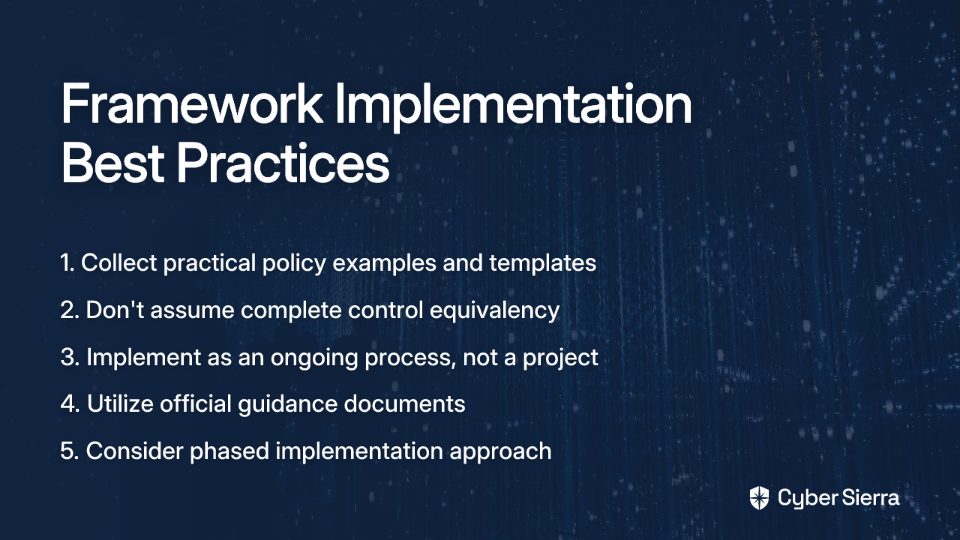
- Seek Practical Examples: Look for templates and examples of policies that comply with your chosen framework. As one professional requested: "Can someone show me a NIST 800-53-based privacy policy? I just want to know if I'm going in the right direction."
- Understand Control Mappings: While mappings between frameworks exist, don't assume complete equivalency. One expert cautions: "Organizations should not assume security requirements and control equivalency based solely on mapping tables."
- Focus on Continuous Improvement: Treat framework adoption as an ongoing process rather than a one-time project.
- Leverage Existing Resources: Both NIST and ISO provide extensive guidance documents and resources to support implementation.
- Consider a Phased Approach: Start with foundational elements and gradually expand your security program.
Conclusion
The choice between NIST and ISO isn't merely about compliance—it's about selecting a framework that aligns with your organization's goals, maturity, and context. NIST offers detailed controls for specific operational contexts, while ISO provides a globally recognized standard beneficial for formal certification.

Many organizations find that a combined approach leverages the strengths of both frameworks: ISO 27001 provides the management system structure and international recognition, while NIST offers the detailed technical controls needed for effective implementation.
By understanding the similarities, differences, and specific strengths of each framework, organizations can make informed decisions that enhance their security posture while meeting compliance requirements and business objectives.
Remember that the ultimate goal isn't just compliance but genuine security improvement—frameworks are means to that end, not the end itself.
Frequently Asked Questions (FAQ)
What is the main difference between NIST CSF and ISO 27001?
The main difference lies in their approach and certification: NIST CSF is a voluntary set of guidelines with detailed technical controls but no formal certification, while ISO 27001 is an international standard for an Information Security Management System (ISMS) that offers formal certification. NIST CSF, developed in the U.S., focuses on providing granular, actionable controls (e.g., via NIST SP 800-53). ISO 27001 provides a broader framework for managing information security systematically and is globally recognized, making its certification valuable for international business.
Why would an organization choose NIST CSF over ISO 27001?
An organization might choose NIST CSF if they need detailed, specific technical guidance for implementing cybersecurity controls and do not require formal international certification. The NIST CSF, particularly with its supporting documents like NIST SP 800-53, offers more granular controls for areas like multi-factor authentication and encryption. It's also free to access, making it a cost-effective starting point for organizations, especially those in the U.S. or those focused on operational guidance.
When is ISO 27001 certification particularly beneficial?
ISO 27001 certification is particularly beneficial when an organization needs to demonstrate a globally recognized standard of information security, often for international operations, regulatory requirements, or to enhance trust with business partners. Achieving ISO 27001 certification through an accredited third-party auditor provides a formal stamp of approval that can open doors to new business opportunities and satisfy contractual obligations.
How do NIST CSF and ISO 27001 complement each other?
NIST CSF and ISO 27001 complement each other by allowing organizations to use ISO 27001 for its systematic management framework and international recognition, while leveraging NIST CSF for its detailed technical controls and implementation guidance. ISO 27001 can provide the overarching structure for an ISMS, while NIST CSF can offer specific, actionable controls to meet the objectives defined within that ISMS.
Can organizations implement both NIST CSF and ISO 27001?
Yes, organizations can and often do implement both NIST CSF and ISO 27001 simultaneously. This hybrid approach allows businesses to leverage the strengths of each framework. For instance, a company might use ISO 27001 to establish its overall ISMS and achieve certification, while using the NIST CSF's Core Functions and detailed control guidance from publications like NIST SP 800-53 to implement specific security measures effectively.
What is the first step an organization should take when choosing between NIST and ISO frameworks?
In today's complex cybersecurity landscape, organizations face mounting pressure to adopt robust security frameworks that effectively manage risks while meeting compliance requirements. Two dominant frameworks stand out in this space: the NIST Cybersecurity Framework (CSF) and ISO 27001. While both aim to strengthen an organization's security posture, they differ significantly in their approach, implementation, and certification processes.
Understanding NIST and ISO Frameworks

NIST Cybersecurity Framework (CSF)
The National Institute of Standards and Technology (NIST) developed the Cybersecurity Framework as a voluntary set of guidelines designed to help organizations manage and reduce cybersecurity risk. Originally created for critical infrastructure, it has gained widespread adoption across various sectors.
Core Components
The NIST CSF consists of three main components:
- Framework Core: Organized around five key functions that form the backbone of effective cybersecurity management:
- Identify: Develop organizational understanding to manage cybersecurity risks
- Protect: Implement appropriate safeguards to ensure critical services
- Detect: Implement activities to identify cybersecurity events
- Respond: Take action regarding detected cybersecurity incidents
- Recover: Maintain resilience plans and restore impaired capabilities
- Implementation Tiers: Ranging from Partial (Tier 1) to Adaptive (Tier 4), these tiers describe the degree to which an organization's cybersecurity risk management practices exhibit characteristics defined in the framework.
- Profiles: Alignment of organizational requirements and objectives with framework outcomes, helping identify opportunities for improving cybersecurity posture.
NIST provides extensive documentation through its 800 series publications, particularly NIST SP 800-53, which offers granular technical controls addressing specific areas such as multi-factor authentication, encryption, and boundary protection - details that organizations often find lacking in ISO's broader approach.
ISO 27001
ISO 27001 is an internationally recognized standard that establishes requirements for an Information Security Management System (ISMS). Developed by the International Organization for Standardization, it provides a systematic approach to managing sensitive company information.
Key Features
- Certification: Unlike NIST, ISO 27001 offers formal certification through accredited third-party auditors, providing a globally recognized stamp of approval.
- Risk Assessment Methodology: Provides a structured approach to identifying, analyzing, and treating information security risks.
- Comprehensive Control Set: Annex A of ISO 27001 contains 114 controls organized into 14 domains covering various aspects of information security.
- Documentation Requirements: Demands extensive documentation of policies, procedures, and evidence of implementation.
Key Similarities Between NIST and ISO
Despite their differences, NIST and ISO share several fundamental similarities that make them compatible and complementary frameworks:
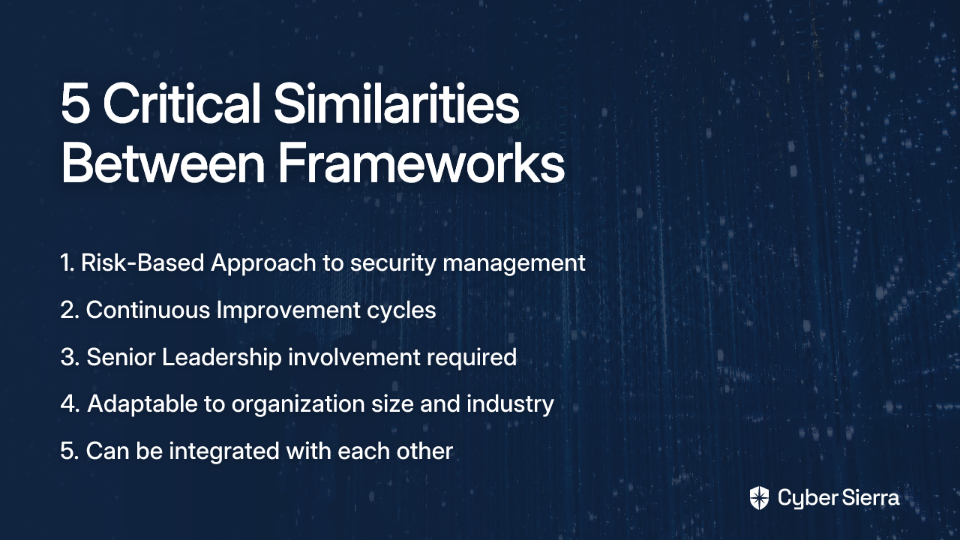
- Risk-Based Approach: Both frameworks emphasize the importance of risk assessment and management as foundational elements of security programs. They require organizations to identify, assess, and prioritize risks before implementing controls.
- Continuous Improvement: NIST and ISO promote an iterative approach to security, encouraging organizations to regularly review, assess, and enhance their security measures.
- Management Support: Both frameworks recognize the critical role of senior leadership in establishing, implementing, and maintaining effective security programs.
- Adaptability: While structured, both frameworks allow for customization based on organizational size, industry, and specific requirements.
- Integration Capability: Organizations can implement both frameworks simultaneously, leveraging their complementary strengths to create comprehensive security programs.
Critical Differences Between NIST and ISO
Understanding the key differences between these frameworks helps organizations make informed decisions about which standard best aligns with their objectives:
| Aspect | NIST CSF | ISO 27001 |
|---|---|---|
| Origin & Focus | Developed in the U.S. with emphasis on critical infrastructure | International standard applicable across industries |
| Certification | No formal certification process | Requires third-party certification |
| Control Specificity | Provides detailed, granular controls (e.g., NIST SP 800-53) | Offers broader, less detailed control framework |
| Cost | Free to access and implement | Involves costs for documentation access and certification |
| Documentation | Flexible documentation requirements | Extensive, mandatory documentation |
| Primary Audience | Initially U.S. federal agencies, now widely adopted | Global organizations across sectors |
The Specificity Gap
One of the most significant differences highlighted by cybersecurity professionals is the level of specificity in controls. As one practitioner noted: "NIST found that ISO 27001 operated at a higher level of generality, lacking the specific controls required by NIST." This observation points to a fundamental distinction: while ISO 27001 provides a comprehensive management framework, NIST offers more detailed technical guidance.
For example, NIST SP 800-53 explicitly details requirements for multi-factor authentication implementation, encryption standards, and boundary protection - elements that ISO 27001 addresses more broadly. This granularity makes NIST particularly valuable for organizations seeking operational guidance rather than just compliance frameworks.
Making the Right Choice for Your Organization
When deciding between NIST and ISO frameworks, organizations should consider several factors:
Organizational Context and Requirements
Start by assessing your organization's specific needs:
- Regulatory Requirements: Some industries or regions may require specific framework compliance
- International Operations: Organizations operating globally may benefit from ISO 27001's international recognition
- Detailed Implementation Guidance: If your team needs granular technical controls, NIST may be more appropriate
- Certification Needs: If formal certification is important for your business relationships, ISO 27001 offers this advantage
Implementation Approach
Many organizations find value in a hybrid approach:
- Startups and Small Businesses: Begin with NIST CSF as a cost-effective starting point, then progress to ISO 27001 as the organization matures
- Large Enterprises: Leverage both frameworks, using ISO 27001 for management system structure and NIST for detailed technical controls
As one security professional advised: "The right standard should be used for the right purpose, ensuring top-notch execution without leaving any aspect unaddressed."
Cost-Benefit Analysis
Organizations should conduct a thorough cost-benefit analysis before committing to either framework:
- Implementation Costs: Consider resources required for documentation, technology, personnel, and potential certification
- Business Opportunities: Evaluate potential new business relationships enabled by compliance
- Risk Reduction: Calculate the potential cost savings from reduced security incidents
- Competitive Advantage: Assess the market advantage of demonstrating security commitment
"Companies can use these frameworks as requirements for business-to-business relationships," notes one practitioner, highlighting how compliance often opens doors to new opportunities.
Best Practices for Implementation
Regardless of which framework you choose, follow these best practices for successful implementation:
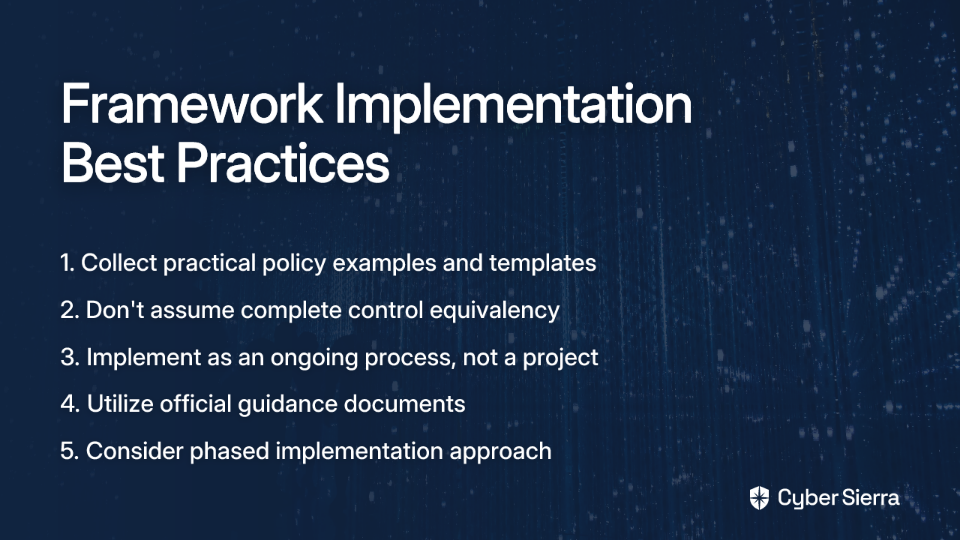
- Seek Practical Examples: Look for templates and examples of policies that comply with your chosen framework. As one professional requested: "Can someone show me a NIST 800-53-based privacy policy? I just want to know if I'm going in the right direction."
- Understand Control Mappings: While mappings between frameworks exist, don't assume complete equivalency. One expert cautions: "Organizations should not assume security requirements and control equivalency based solely on mapping tables."
- Focus on Continuous Improvement: Treat framework adoption as an ongoing process rather than a one-time project.
- Leverage Existing Resources: Both NIST and ISO provide extensive guidance documents and resources to support implementation.
- Consider a Phased Approach: Start with foundational elements and gradually expand your security program.
Conclusion
The choice between NIST and ISO isn't merely about compliance—it's about selecting a framework that aligns with your organization's goals, maturity, and context. NIST offers detailed controls for specific operational contexts, while ISO provides a globally recognized standard beneficial for formal certification.

Many organizations find that a combined approach leverages the strengths of both frameworks: ISO 27001 provides the management system structure and international recognition, while NIST offers the detailed technical controls needed for effective implementation.
By understanding the similarities, differences, and specific strengths of each framework, organizations can make informed decisions that enhance their security posture while meeting compliance requirements and business objectives.
Remember that the ultimate goal isn't just compliance but genuine security improvement—frameworks are means to that end, not the end itself.
Frequently Asked Questions (FAQ)
What is the main difference between NIST CSF and ISO 27001?
The main difference lies in their approach and certification: NIST CSF is a voluntary set of guidelines with detailed technical controls but no formal certification, while ISO 27001 is an international standard for an Information Security Management System (ISMS) that offers formal certification. NIST CSF, developed in the U.S., focuses on providing granular, actionable controls (e.g., via NIST SP 800-53). ISO 27001 provides a broader framework for managing information security systematically and is globally recognized, making its certification valuable for international business.
Why would an organization choose NIST CSF over ISO 27001?
An organization might choose NIST CSF if they need detailed, specific technical guidance for implementing cybersecurity controls and do not require formal international certification. The NIST CSF, particularly with its supporting documents like NIST SP 800-53, offers more granular controls for areas like multi-factor authentication and encryption. It's also free to access, making it a cost-effective starting point for organizations, especially those in the U.S. or those focused on operational guidance.
When is ISO 27001 certification particularly beneficial?
ISO 27001 certification is particularly beneficial when an organization needs to demonstrate a globally recognized standard of information security, often for international operations, regulatory requirements, or to enhance trust with business partners. Achieving ISO 27001 certification through an accredited third-party auditor provides a formal stamp of approval that can open doors to new business opportunities and satisfy contractual obligations.
How do NIST CSF and ISO 27001 complement each other?
NIST CSF and ISO 27001 complement each other by allowing organizations to use ISO 27001 for its systematic management framework and international recognition, while leveraging NIST CSF for its detailed technical controls and implementation guidance. ISO 27001 can provide the overarching structure for an ISMS, while NIST CSF can offer specific, actionable controls to meet the objectives defined within that ISMS.
Can organizations implement both NIST CSF and ISO 27001?
Yes, organizations can and often do implement both NIST CSF and ISO 27001 simultaneously. This hybrid approach allows businesses to leverage the strengths of each framework. For instance, a company might use ISO 27001 to establish its overall ISMS and achieve certification, while using the NIST CSF's Core Functions and detailed control guidance from publications like NIST SP 800-53 to implement specific security measures effectively.
What is the first step an organization should take when choosing between NIST and ISO frameworks?
The first step an organization should take is to thoroughly assess its specific organizational context and requirements. This includes understanding regulatory obligations, whether international operations necessitate global recognition (favoring ISO 27001), the internal team's need for detailed technical guidance (favoring NIST), and if formal certification is a key business driver.
The first step an organization should take is to thoroughly assess its specific organizational context and requirements. This includes understanding regulatory obligations, whether international operations necessitate global recognition (favoring ISO 27001), the internal team's need for detailed technical guidance (favoring NIST), and if formal certification is a key business driver.