Mastering GRC Cybersecurity: Adapting Frameworks Beyond the Checklist



Join thousands of professionals and get the latest insight on Compliance & Cybersecurity.
You've invested heavily in your cybersecurity program, diligently implementing controls from NIST CSF, ISO 27001, or COBIT frameworks. Yet your security team still feels overwhelmed, your technical staff views GRC as the "department of no," and your executive team questions whether these investments are truly protecting the business or just ticking compliance boxes.
If this sounds familiar, you're experiencing the challenge that plagues organizations across industries: how to transform Governance, Risk, and Compliance (GRC) from a burden into a business enabler that's tailored to your specific sector needs.
The GRC Implementation Gap: Why One-Size-Fits-All Fails
Many organizations approach GRC frameworks with a "checkbox mentality," implementing controls universally without considering their specific industry context. This approach creates several critical problems:
- Wasted resources on controls that don't address your highest risks
- Friction with development and infrastructure teams who see GRC as an obstacle rather than a partner
- Difficulty demonstrating ROI beyond "we passed the audit"
- Governance maturity gaps that undermine even the best framework implementations
As one cybersecurity professional on Reddit noted: "GRC work is heavily dependent on the governance maturity level of the organization. If your organization is immature, you'll be fighting uphill battles constantly."
This disconnect is particularly pronounced when comparing regulated industries like healthcare with sectors like manufacturing, where security priorities and compliance burdens differ significantly.
Understanding the GRC Framework Landscape
Before diving into sector-specific adaptations, let's examine the three primary GRC frameworks and their foundational approaches:

NIST Cybersecurity Framework (CSF)
The NIST CSF organizes cybersecurity activities into five core functions: Identify, Protect, Detect, Respond, and Recover. Recently updated to CSF 2.0, it now includes a sixth core function: Govern.
Strengths:
- Flexible and adaptable to organizations of any size
- Provides common language for security discussions
- Maps to other frameworks and regulatory requirements
Limitations:
- Lacks specific implementation guidance
- Some organizations find it overly complex
- Requires significant customization
As one practitioner lamented: "It seems like good resources are lacking. I've watched tons of YouTube videos and even enrolled in a Coursera class on NIST CSF implementation, but practical guidance is hard to find."
ISO 27001
ISO 27001 is an internationally recognized standard for information security management systems (ISMS). It provides a systematic approach to managing sensitive company information through risk assessment, security design, and implementation.
Strengths:
- Internationally recognized certification
- Comprehensive control set (Annex A)
- Clear documentation requirements
Limitations:
- Certification is time-consuming and resource-intensive
- Focus on documentation can overshadow practical security
- Can be overwhelming for smaller organizations
"It appears to be a time-consuming process to obtain the certificate," noted a small business owner considering ISO 27001 certification. "I'm curious about the best strategy to obtain ISO 27001 certification for a small business."
COBIT (Control Objectives for Information and Related Technologies)
COBIT is an IT governance framework created by ISACA that bridges the gap between technical issues, business risks, and control requirements.
Strengths:
- Strong alignment with business objectives
- Comprehensive coverage of IT governance
- Maturity model for measuring improvement
Limitations:
- Complex implementation
- Less recognized in some industries
- Requires significant organizational buy-in
Prioritizing Framework Elements for Different Sectors
Healthcare: Patient Safety First, Data Security Close Behind
In healthcare, the stakes of cybersecurity failures extend beyond financial loss to potentially life-threatening situations. A ransomware attack on a hospital doesn't just compromise data—it can delay critical care and endanger lives.
Key Prioritization Areas for Healthcare:
- Patient Safety Controls: Prioritize controls that protect systems directly involved in patient care (medical devices, EHR systems)
- HIPAA Compliance: Focus on controls that address patient data privacy and security requirements
- Incident Response: Develop robust response protocols for scenarios that could impact patient care
- Third-Party Risk Management: Emphasize controls for managing vendor risks, as healthcare relies heavily on external service providers

Implementation Strategy:
When implementing NIST CSF in healthcare, begin with the "Identify" function to thoroughly catalog all systems that contain protected health information (PHI) or support critical care functions. Then prioritize "Protect" and "Detect" controls for these systems before addressing less critical assets.
For ISO 27001, healthcare organizations should pay particular attention to controls related to access management (A.9), system acquisition and development (A.14), and supplier relationships (A.15).
Manufacturing: Operational Resilience Takes Center Stage
In manufacturing environments, the primary cybersecurity concern shifts from data protection to ensuring operational continuity and preventing safety incidents. Industry 4.0 and smart manufacturing initiatives have increased connectivity between operational technology (OT) and information technology (IT), expanding the attack surface.
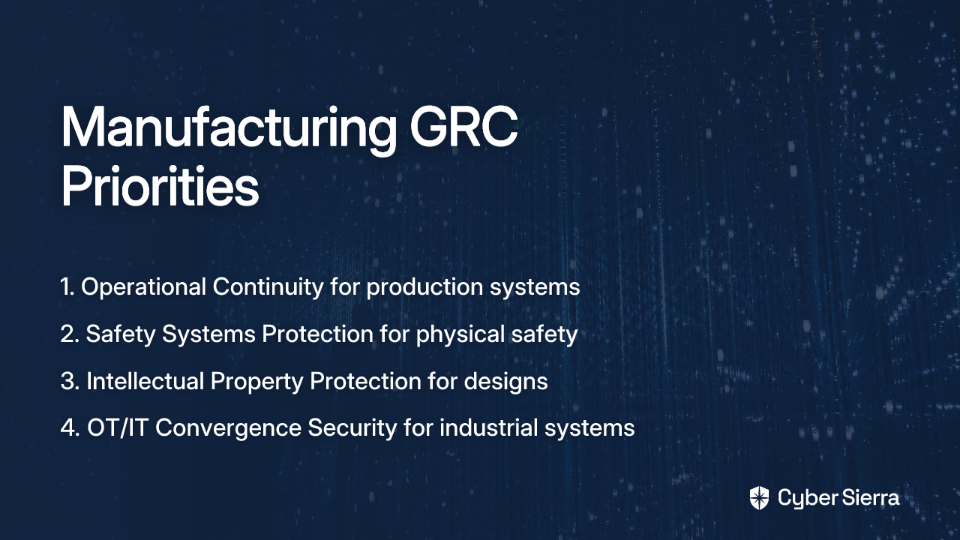
Key Prioritization Areas for Manufacturing:
- Operational Continuity: Focus on controls that prevent disruption to production systems and supply chains
- Safety Systems Protection: Prioritize controls that secure systems that could impact physical safety if compromised
- Intellectual Property Protection: Emphasize controls that safeguard manufacturing processes, designs, and trade secrets
- OT/IT Convergence Security: Implement controls that address the unique challenges of securing interconnected industrial systems
Implementation Strategy:
When implementing NIST CSF in manufacturing, emphasize the "Identify" function to create a comprehensive inventory of OT assets and their connections to IT networks. Then focus on "Protect" controls for critical production systems and "Detect" capabilities for anomalous behavior in industrial control systems.
For ISO 27001, manufacturing organizations should prioritize controls related to asset management (A.8), communications security (A.13), and business continuity management (A.17).
For COBIT, focus on the "Build, Acquire and Implement" (BAI) domain to ensure security is embedded in new manufacturing technologies from the beginning.
Measuring GRC ROI Beyond Compliance Checklists
"I personally think it's overkill considering the work we do and not being a US government agency but hey, here we are," commented one practitioner about implementing NIST CSF. This sentiment reflects a common challenge: justifying GRC investments when the return isn't immediately obvious.
To demonstrate true ROI from GRC investments, organizations need metrics that go beyond simple compliance status. Here are key measurements that validate the business value of your GRC program:
1. Risk Reduction Metrics
- Reduction in High-Risk Findings: Track the decrease in high and critical vulnerabilities over time
- Mean Time to Remediate (MTTR): Measure how quickly vulnerabilities are addressed after discovery
- Risk Exposure Score: Develop a quantified measure of overall organizational risk exposure that can be tracked quarter over quarter
2. Efficiency Metrics
- Audit Preparation Time: Measure reduction in hours spent preparing for audits after implementing GRC tools and processes
- Control Rationalization: Track the elimination of redundant controls across multiple frameworks
- Automated vs. Manual Controls: Monitor the increasing percentage of controls that are automated rather than manually verified
3. Business Impact Metrics
- Security Incident Costs: Calculate the financial impact of security incidents before and after GRC implementation
- Cyber Insurance Premiums: Track reductions in premiums due to improved security posture
- Business Enablement: Measure how GRC facilitates faster onboarding of new technologies or business initiatives
- Sales Acceleration: Track how improved security posture helps win new customers or enter new markets
According to research from Steel Patriot Partners, organizations with mature GRC programs experience a 30% reduction in security incident costs and save up to 60% of time spent on reporting tasks through automation.
Strategies for Effective GRC Framework Adaptation

1. Conduct a Risk-Based Assessment
Begin by conducting a thorough risk assessment specific to your industry and organizational context. This should identify:
- Industry-specific threat scenarios
- Regulatory requirements unique to your sector
- Business impact considerations particular to your operations
This assessment forms the foundation for prioritizing which framework elements deserve the most attention.
2. Map Controls Across Frameworks
Create a unified control framework that maps requirements across multiple standards relevant to your industry. This approach:
- Eliminates redundant efforts
- Highlights gaps in coverage
- Creates a single source of truth for compliance activities
Tools like the NIST CSF to other frameworks mapping can jumpstart this process.
3. Engage Stakeholders Across the Organization
GRC implementation often fails due to poor stakeholder engagement. As one Reddit commenter noted, "You get cast as the bad guy that's forcing a change when the reality is that..." this perception undermines effectiveness.
Instead:
- Involve business units in risk identification
- Establish clear risk ownership
- Create a cross-functional governance committee
- Develop metrics that matter to different stakeholders
4. Invest in the Right Tools
Many GRC professionals lament that "Some people really like Excel forms" when more sophisticated tools would drive efficiency and accuracy. Modern GRC platforms can:
- Automate control testing
- Provide real-time risk dashboards
- Generate evidence for audits
- Track remediation activities
According to CyberSaint, organizations that implement integrated GRC platforms reduced compliance costs by up to 40% compared to manual approaches.
Conclusion: From Checkbox Compliance to Risk Intelligence
Effective GRC implementation requires moving beyond one-size-fits-all approaches to create a framework adaptation that addresses your specific industry risks and business objectives. By prioritizing framework elements based on sector-specific needs and measuring success through business-aligned metrics, organizations can transform GRC from a necessary evil into a strategic advantage.
Remember that "enjoying GRC work is heavily dependent on the governance maturity level of the organization." Building a mature governance framework takes time, but the investment pays dividends in reduced risk, improved operational efficiency, and enhanced business resilience.
Whether you're in healthcare prioritizing patient safety, manufacturing focusing on operational resilience, or another sector with unique security concerns, the key is to adapt GRC frameworks to your specific context rather than forcing your organization to conform to rigid standards. By doing so, you'll not only achieve compliance but also build genuine security capabilities that protect what matters most to your business.
Start by assessing your current governance maturity, prioritizing framework elements based on your industry's unique risk profile, and implementing metrics that demonstrate real business value. With this approach, you can overcome the implementation gap and realize the full potential of your GRC investments.
Frequently Asked Questions (FAQ)
What is GRC and why is it important?
GRC stands for Governance, Risk, and Compliance. It's a strategic approach to aligning IT activities with business objectives while managing risks and meeting regulatory requirements. It's important because it helps organizations protect their assets, make informed decisions, operate efficiently, and transform security from a cost center into a business enabler by ensuring investments target critical risks and support overall business goals.
Why does a one-size-fits-all GRC approach often fail?
A one-size-fits-all GRC approach often fails because it doesn't consider an organization's specific industry context, leading to wasted resources and internal friction. Different industries face unique risks, regulatory landscapes, and operational priorities. Applying generic controls universally can mean over-investing in areas of low risk for your sector or under-investing in critical ones, making GRC seem like a burden rather than a tailored, effective solution.
How does GRC prioritization differ between healthcare and manufacturing?
GRC prioritization differs significantly: healthcare primarily focuses on patient safety and data privacy (like HIPAA compliance), while manufacturing prioritizes operational resilience and the protection of production systems. In healthcare, a breach can directly impact patient care, so controls around medical devices and protected health information (PHI) are paramount. In manufacturing, disruptions to production lines or compromised industrial control systems can halt operations, causing financial loss or safety incidents, so GRC efforts center on Operational Technology (OT) / Information Technology (IT) security and operational continuity.
What are the main GRC frameworks discussed in the article?
The main GRC frameworks discussed are the NIST Cybersecurity Framework (CSF), ISO 27001, and COBIT.
- NIST CSF: Provides a flexible structure with core functions (Identify, Protect, Detect, Respond, Recover, and the newer Govern function) adaptable to various organizations.
- ISO 27001: An international standard for information security management systems (ISMS), offering a comprehensive control set (Annex A) and recognized certification.
- COBIT: An IT governance framework that bridges technical issues, business risks, and control requirements, focusing on aligning IT with business objectives.
How can organizations measure the ROI of their GRC investments effectively?
Organizations can measure GRC ROI by tracking risk reduction, operational efficiency gains, and positive business impacts, rather than just compliance checklist completion. Key metrics include a reduction in high-risk vulnerabilities, faster audit preparation times, lower security incident costs, and even how an improved security posture helps accelerate sales or reduce cyber insurance premiums. These demonstrate tangible business value beyond simply "passing an audit."
What is the crucial first step to effectively adapt a GRC framework for a specific industry?
The crucial first step is to conduct a thorough, risk-based assessment tailored to your specific industry and organizational context. This assessment should identify industry-specific threat scenarios, unique regulatory requirements, and business impact considerations particular to your operations. The findings from this assessment will form the foundation for prioritizing which framework elements and controls deserve the most attention and resources.
How can organizations improve GRC adoption and overcome internal resistance?
Organizations can improve GRC adoption by engaging stakeholders across all departments, establishing clear risk ownership, and demonstrating GRC's value through metrics that resonate with different business units. Involve business units in risk identification, create a cross-functional governance committee, and communicate how GRC enables business objectives rather than just imposing rules. Investing in user-friendly GRC tools can also help by automating tasks and providing clear visibility into risk and compliance status, moving away from cumbersome manual processes.