blog-hero-background-image
Cyber Security

What is the NYDFS Cybersecurity Regulation?

backdrop
Table of Contents

Join thousands of professionals and get the latest insight on Compliance & Cybersecurity.


You've been tasked with implementing a new cybersecurity regulation for your financial institution, but as you sift through the dense legal language of official documents, you find yourself increasingly frustrated. The requirements are complex, deadlines seem confusing, and you're not even sure where to begin documenting your compliance efforts.

If this scenario sounds familiar, you're not alone. Many financial services professionals struggle with understanding and implementing the New York Department of Financial Services (NYDFS) Cybersecurity Regulation, formally known as 23 NYCRR Part 500.

Understanding 23 NYCRR Part 500: The Essentials

The NYDFS Cybersecurity Regulation represents one of the most comprehensive and stringent state-level cybersecurity regulations in the United States. Introduced in 2017, it was designed to protect New York's financial services industry and consumers from the growing threats of cyberattacks.
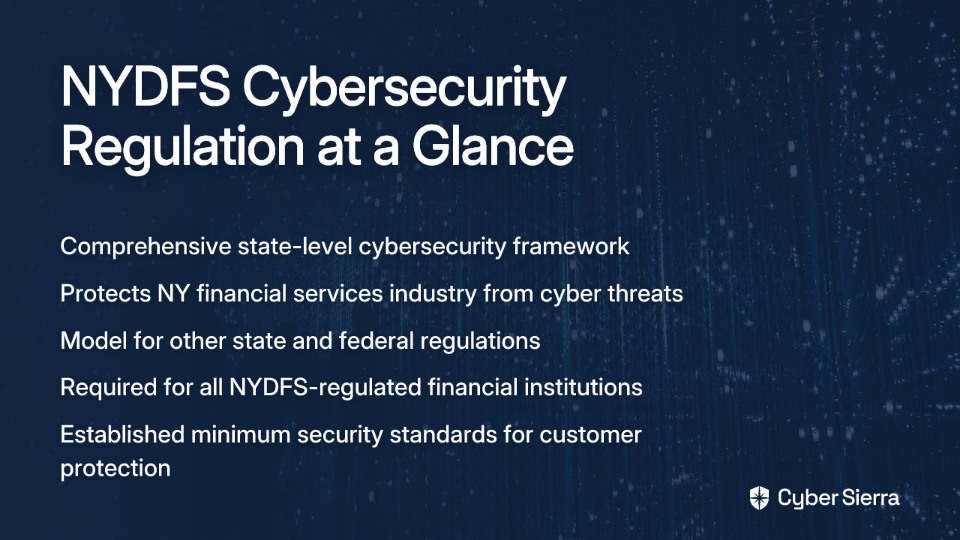
Key aspects to understand:

  • Effective Date: Initially effective March 1, 2017, with a phased implementation approach
  • Covered Entities: Banks, insurance companies, mortgage brokers, and other financial services institutions regulated by the NYDFS
  • Core Purpose: To establish minimum cybersecurity requirements for financial services companies that protect customer information and the information technology systems of regulated entities

What makes this regulation particularly significant is that it has become a model for other states and even federal regulations. Even if you're not directly subject to NYDFS oversight, understanding these requirements can help prepare your organization for similar regulations that may apply to you now or in the future.

Key Requirements of the NYDFS Cybersecurity Regulation

1. Establish a Comprehensive Cybersecurity Program

The foundation of compliance is developing, implementing, and maintaining a robust cybersecurity program designed to:

  • Identify and assess internal and external cybersecurity risks
  • Use defensive infrastructure to protect information systems and nonpublic information
  • Detect cybersecurity events
  • Respond to identified cybersecurity events
  • Recover from cybersecurity events and restore normal operations
  • Fulfill applicable regulatory reporting requirements

For CISOs like Sarah Chen, this means moving beyond point solutions to create an integrated security strategy that addresses the entire attack lifecycle.

2. Implement a Written Cybersecurity Policy

Covered entities must maintain a written policy addressing:

  • Information security
  • Data governance and classification
  • Access controls
  • Business continuity planning
  • Systems operations and availability
  • Systems and network security
  • Systems and application development
  • Physical security and environmental controls
  • Customer data privacy
  • Vendor and third-party service provider management
  • Risk assessment
  • Incident response

For compliance managers like David Lee, this requires extensive documentation that is regularly reviewed and approved by a Senior Officer or board.

3. Designate a Chief Information Security Officer (CISO)

Organizations must appoint a qualified CISO responsible for:

  • Overseeing and implementing the cybersecurity program
  • Enforcing the cybersecurity policy
  • Reporting to the Board of Directors at least annually on:
    • The organization's cybersecurity posture
    • Material cybersecurity risks
    • Critical cybersecurity events
    • Recommendations for remediation

The CISO role can be filled by an internal resource or by an external service provider, providing flexibility for smaller organizations that may not have the resources to maintain a full-time executive-level security position.

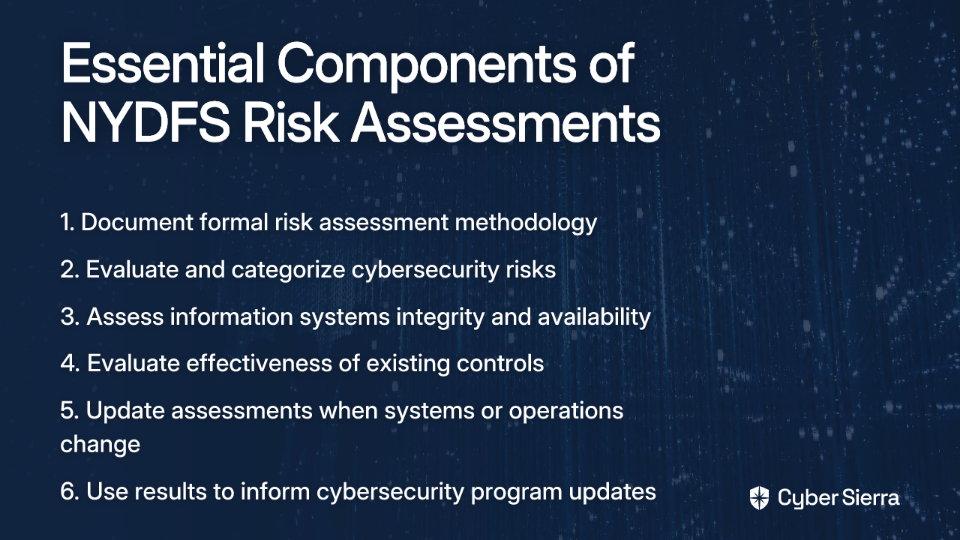
4. Conduct Regular Risk Assessments

The regulation requires periodic risk assessments that:

  • Evaluate and categorize cybersecurity risks
  • Assess the confidentiality, integrity, and availability of information systems
  • Evaluate existing controls in the context of identified risks
  • Inform the cybersecurity program and policies

These assessments must follow a formal, documented methodology and must be updated as necessary to address changes in information systems, nonpublic information, or business operations.
5. Implement Strong Access Controls

Covered entities must limit user access privileges to information systems that contain nonpublic information and periodically review these access privileges. This includes:

  • Multi-factor authentication for external access to the network
  • Risk-based authentication for accessing internal networks
  • Regular review of access privileges
  • Timely termination of access following departures or role changes

For Third-Party Risk Managers like Ben Carter, this extends to ensuring vendors with access to your systems have similar controls in place.

6. Deploy Cybersecurity Tools and Controls

The regulation mandates specific technical controls including:

  • Penetration testing and vulnerability assessments
  • Audit trail systems to reconstruct financial transactions and detect cybersecurity events
  • Application security procedures, including security testing
  • Data encryption of nonpublic information both in transit and at rest
  • Secure disposal of nonpublic information that's no longer necessary

Security professionals like Priya Sharma need to ensure these controls are not only in place but continuously monitored for effectiveness.

7. Develop an Incident Response Plan

Covered entities must establish a written incident response plan designed to:

  • Respond to and recover from cybersecurity events
  • Define clear roles and responsibilities
  • Include external and internal communications plans
  • Identify requirements for remediating weaknesses
  • Document lessons learned
  • Establish reporting procedures

This plan must be tested and updated regularly to ensure its effectiveness.

8. Manage Third-Party Service Provider Security

The regulation places significant emphasis on third-party risk management, requiring covered entities to:

  • Develop written policies and procedures for vendor risk management
  • Identify and risk-assess all service providers with access to nonpublic information
  • Establish minimum cybersecurity practices required of service providers
  • Perform due diligence in evaluating service providers' cybersecurity practices
  • Periodically assess service providers based on the risk they present

These requirements are particularly challenging for businesses with extensive vendor ecosystems, as noted by procurement specialists who must manage hundreds or thousands of vendor relationships.

9. Report Cybersecurity Events

One of the most stringent aspects of the regulation is the requirement to notify the NYDFS Superintendent of certain cybersecurity events within 72 hours. This includes:

  • Events that require notice to any government body, regulatory agency, or self-regulatory agency
  • Events that have a reasonable likelihood of materially harming the normal operations of the covered entity
  • Extortion payments related to a cybersecurity event, which must be reported within 24 hours

The 2023 amendments added additional requirements related to ransomware and extortion payments, reflecting the growing threat of these attacks.

10. Annual Compliance Certification

Covered entities must submit an annual certification of compliance to the NYDFS, confirming that they are in compliance with the requirements. If there are areas of noncompliance, the entity must identify those areas and document remediation plans.

2023 Amendments: What's Changed

In November 2023, the NYDFS finalized significant amendments to the cybersecurity regulation, creating more stringent requirements, particularly for larger entities. Key changes include:

  1. Creation of "Class A Companies" - Organizations with at least $20 million in gross annual revenue in New York and either:
    • Over 2,000 employees worldwide, or
    • Over $1 billion in gross annual revenue in each of the last two fiscal years
  2. Enhanced Requirements for Class A Companies:
    • Independent audit of cybersecurity programs
    • Systematic monitoring, including endpoint detection and response solutions
    • Privileged access management
    • Password management
    • Automated vulnerability scans
  3. Additional Requirements for All Covered Entities:
    • Asset management and periodic data classification
    • Enhanced access controls
    • Cloud security assessments
    • Updated incident response plans that address ransomware
    • Stronger governance with annual approval of policies by senior management
    • More comprehensive risk assessments

These amendments reflect the evolving threat landscape and provide more specific guidance on what constitutes adequate cybersecurity controls.

Common Challenges in NYDFS Compliance
Despite the regulation being in effect for several years, organizations continue to face significant challenges in achieving and maintaining compliance:

1. Difficulty Accessing User-Friendly Documentation

As one compliance professional noted in a recent discussion: "I was surprised to see that the regulations are not laid out in a fairly digestible format (e.g. spreadsheet with requirements) and are presented in a PDF format on the official NYDFS website."

This accessibility issue creates unnecessary barriers for teams trying to systematically track and manage compliance requirements.

2. Resource Constraints and Expertise Gaps

Many organizations lack dedicated compliance expertise. As one Reddit user mentioned, "my vCISO has declared that he is 'not a compliance guy' lol." This expertise gap often forces companies to rely heavily on external consultants, which can be cost-prohibitive, especially for smaller institutions.

3. Tight Implementation Timelines

The phased implementation approach and subsequent amendments have created confusion around deadlines. "I know that the deadline passed for reporting but my company just went through this for the first time and we ran into the same issue," reported one compliance manager, highlighting the pressure organizations face when navigating these requirements for the first time.

4. Manual Evidence Collection and Documentation

For IT teams already stretched thin, the documentation requirements of NYDFS can be overwhelming. Manual evidence collection across disparate systems creates inefficiency and increases the risk of incomplete or inaccurate compliance documentation.

5. Third-Party Risk Management at Scale

For organizations with extensive vendor ecosystems, managing third-party risk according to NYDFS requirements presents a significant operational challenge, especially when relying on spreadsheets and manual questionnaire processes.

Best Practices for NYDFS Compliance

To address these challenges, forward-thinking organizations are adopting several best practices:
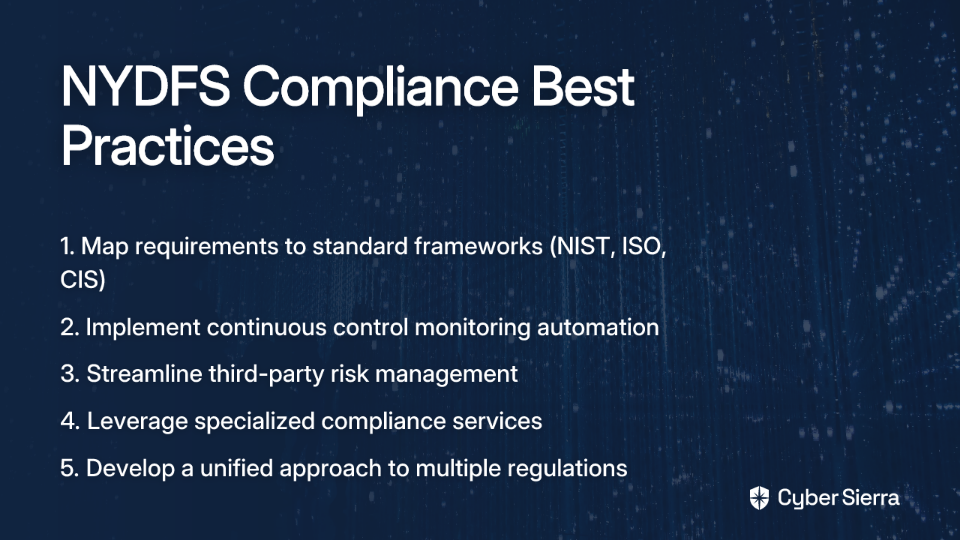
1. Use Standardized Frameworks and Mappings

"The Secure Controls Framework has it mapped against a billion things, including NIST, ISO, and CIS," noted one practitioner. Leveraging these established frameworks can help translate the NYDFS requirements into actionable controls and simplify compliance efforts.

2. Implement Continuous Control Monitoring

Rather than point-in-time assessments, leading organizations are implementing continuous monitoring of security controls. This approach not only supports compliance but also improves overall security posture by enabling rapid detection and remediation of control failures.

Modern platforms like CyberSierra's Continuous Control Monitoring (CCM) module can significantly streamline this process by automating evidence collection across multiple systems and providing real-time visibility into control effectiveness. This is particularly valuable for organizations subject to multiple regulatory frameworks beyond just NYDFS.

3. Automate Third-Party Risk Management

Given the emphasis on vendor security in the NYDFS regulation, automating the vendor assessment process can yield significant efficiency gains. Tools that streamline questionnaire distribution, track remediation efforts, and provide continuous monitoring of vendor security posture can transform this traditionally manual process.

4. Consider Specialized Compliance Services

For smaller organizations with limited resources, specialized compliance services can provide a cost-effective alternative to building in-house expertise or engaging large consulting firms. As one Reddit user shared, "we used Cyber Pop-up and got it done in a week (and didn't cost an arm and a leg like the big 4 consulting companies)."

5. Develop a Unified Compliance Approach

Rather than treating NYDFS compliance as a standalone initiative, integrate it into a broader compliance program that addresses multiple frameworks. This unified approach reduces duplication of effort and creates a more sustainable compliance program.

The Future of NYDFS and Financial Cybersecurity Regulation

The NYDFS regulation has already influenced other regulatory frameworks, including the Federal Trade Commission's Safeguards Rule for financial institutions and various state-level regulations. As cyber threats continue to evolve, we can expect further refinements to the NYDFS requirements and greater harmonization across regulatory frameworks.

For organizations subject to NYDFS oversight, investing in automation, continuous monitoring, and integrated compliance solutions will provide not only immediate compliance benefits but also prepare them for the evolving regulatory landscape.

Conclusion

The NYDFS Cybersecurity Regulation (23 NYCRR Part 500) represents a significant regulatory mandate for financial institutions, establishing comprehensive requirements for cybersecurity programs, policies, and controls. While compliance presents challenges, particularly around documentation, expertise, and resource constraints, a structured approach leveraging frameworks, automation, and specialized tools can significantly reduce the compliance burden.

By implementing continuous control monitoring, automating third-party risk management, and adopting a unified compliance approach, organizations can not only achieve NYDFS compliance but also strengthen their overall security posture and prepare for future regulatory requirements.

For organizations needing to streamline their NYDFS compliance efforts, platforms like CyberSierra offer integrated solutions that automate evidence collection, simplify control mapping across multiple frameworks, and provide continuous visibility into compliance status. By moving from manual, point-in-time assessments to automated, continuous monitoring, security and compliance teams can focus more on strategic security improvements and less on documentation exercises.

Frequently Asked Questions (FAQ)

What is the NYDFS Cybersecurity Regulation (23 NYCRR Part 500)?

The NYDFS Cybersecurity Regulation (23 NYCRR Part 500) is a set of rules from the New York Department of Financial Services mandating cybersecurity standards for financial institutions. Its core purpose is to protect customer data and the IT systems of regulated entities from cyber threats. First effective in 2017, this regulation is significant for establishing comprehensive minimum requirements and has influenced other cybersecurity regulations.

Who must comply with 23 NYCRR Part 500?

Compliance with 23 NYCRR Part 500 is mandatory for all financial services institutions regulated by the New York Department of Financial Services (NYDFS). This broad category includes entities such as banks, insurance companies, mortgage brokers, and other financial service providers operating under an NYDFS license or charter in New York State.

What are the key requirements of the NYDFS Cybersecurity Regulation?

Key requirements include establishing a comprehensive cybersecurity program, implementing a detailed written cybersecurity policy, and appointing a Chief Information Security Officer (CISO). Organizations must also conduct regular risk assessments, enforce strong access controls, utilize specific cybersecurity tools (like penetration testing and encryption), develop a robust incident response plan, manage third-party vendor risks, report cybersecurity incidents within 72 hours, and submit an annual compliance certification to NYDFS.

How did the 2023 amendments impact the NYDFS Cybersecurity Regulation?

The 2023 amendments significantly updated the regulation by introducing more stringent requirements, especially for larger "Class A Companies," which now face obligations like independent cybersecurity program audits and systematic threat monitoring. For all covered entities, the amendments expanded requirements related to asset management, access controls, cloud security, ransomware-inclusive incident response plans, governance (requiring annual policy approval by senior management), and the comprehensiveness of risk assessments.

What are common challenges organizations face with NYDFS compliance?

Organizations commonly struggle with the lack of easily digestible official documentation, internal resource limitations and shortages of cybersecurity expertise, and pressure from tight implementation deadlines. Further challenges include the burden of manual evidence collection and documentation across various systems, and the operational complexity of managing third-party service provider risks at scale, especially for those with extensive vendor networks.

How can businesses best approach NYDFS compliance?

Businesses can best approach NYDFS compliance by mapping the regulation's requirements to established cybersecurity frameworks (like NIST, ISO 27001, or CIS Controls), which can translate legal language into actionable controls. Implementing continuous control monitoring and automation can streamline evidence collection and provide real-time visibility. Additionally, automating third-party risk management, considering specialized compliance services for expertise gaps, and developing a unified compliance strategy that addresses NYDFS alongside other regulations are crucial best practices.
The most effective approach treats NYDFS compliance not as a checkbox exercise but as an opportunity to build a more resilient and mature security program that protects both the organization and its customers in an increasingly threatening digital landscape.
blog-hero-background-image
Governance & Compliance

When Do I Need ISO 27001 to Close Sales?

backdrop
Table of Contents

Join thousands of professionals and get the latest insight on Compliance & Cybersecurity.


You've spent months perfecting your product, fine-tuning your sales pitch, and building a robust pipeline of prospects. But now, as you're getting closer to closing those enterprise deals, you're repeatedly hit with the same question: "Does your organization have ISO 27001 certification?"

This question stops your sales momentum dead in its tracks. Your prospects – especially those large enterprises and government agencies – won't move forward until they're satisfied with your answer. Suddenly, you're wondering if your lack of ISO 27001 certification is costing you valuable deals and revenue.

The Growing Demand for ISO 27001 in Sales Conversations

In today's hyper-connected business environment, data breaches and security incidents have become alarmingly common. High-profile attacks like the Colonial Pipeline ransomware incident have put cybersecurity front and center in business discussions.

As a result, organizations are increasingly cautious about who they trust with their data. Many have implemented strict vendor security assessment processes, with ISO 27001 certification often serving as a key qualification criterion.

"Some of our clients work with much larger businesses or government which require a SOC Type II or equivalent attestation," notes one IT professional in a recent online discussion. This reality is becoming more common across industries, where certification isn't just nice to have – it's becoming a requirement to even get past the initial vendor screening phase.

What Exactly is ISO 27001?

Before diving deeper, let's clarify what ISO 27001 actually is. ISO 27001 is an internationally recognized standard for information security management. It provides a framework for establishing, implementing, maintaining, and continually improving an Information Security Management System (ISMS).

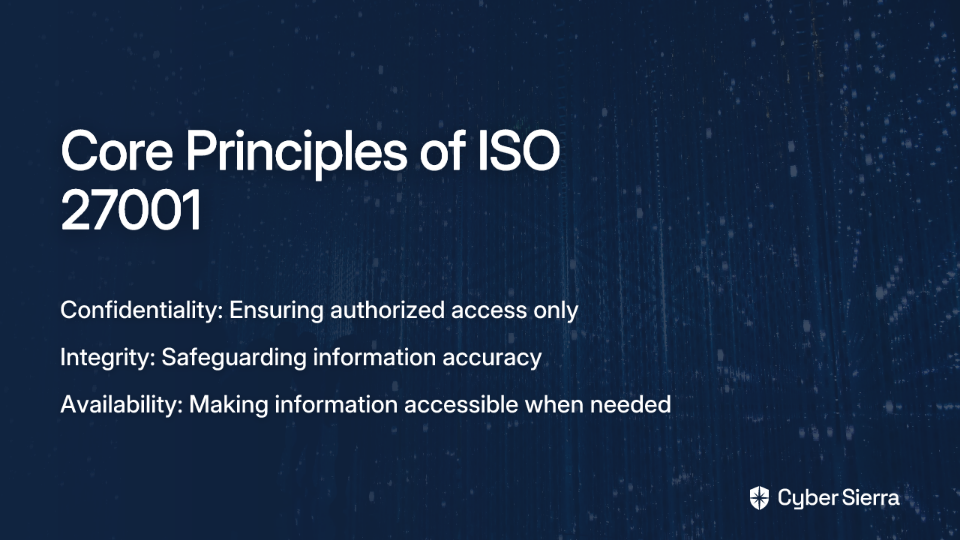
The standard focuses on three core principles:

  • Confidentiality: Ensuring information is accessible only to authorized individuals
  • Integrity: Safeguarding the accuracy and completeness of information
  • Availability: Making information accessible to authorized users when needed

Unlike other security frameworks that might focus on specific technical controls, ISO 27001 takes a comprehensive, risk-based approach to information security that encompasses people, processes, and technology.

When ISO 27001 Can Make or Break Your Sales Process

Enterprise and Government Contracts

If your target market includes large enterprises, financial institutions, healthcare organizations, or government agencies, ISO 27001 certification may be non-negotiable. These organizations often have strict vendor security requirements, and ISO 27001 has become a standard checkbox item in their procurement processes.

"If your main goal is to improve sales, then ISO 27001 has different focuses," explains one cybersecurity professional. Many companies find that having this certification dramatically accelerates the sales cycle with enterprise clients, as it eliminates lengthy security assessments and questionnaires that can delay deals for months.

Competitive Differentiation

In crowded markets where products and services are similar, ISO 27001 certification can be a powerful differentiator. When prospects are comparing multiple vendors with similar offerings, security certifications often become a deciding factor – especially in industries where data protection is paramount.

International Business Expansion

For companies looking to expand globally, ISO 27001 certification provides instant credibility. Since it's an internationally recognized standard, it helps bridge trust gaps when entering new markets where your brand may not be well-known.

When You Might Not Need ISO 27001 Yet

Despite its benefits, ISO 27001 certification isn't always necessary for every business. Here are scenarios where you might reasonably delay pursuing certification:

Your Customers Aren't Demanding It

As one expert puts it, "You shouldn't pursue any attestation report unless you have current clients expecting it or you need it for the RFP process." If your typical customers don't ask about ISO 27001 during sales conversations, the investment might not yield immediate returns.

You're a Small Business with Limited Resources

For smaller organizations, the cost and effort required for ISO 27001 certification can be significant. If you're not losing deals due to a lack of certification, it might make more sense to implement security best practices internally without pursuing formal certification right away.

You Already Have Other Relevant Certifications

If you already maintain other security certifications like SOC 2 Type II that satisfy your customers' requirements, ISO 27001 might be redundant in the short term. "If your customers are not asking for it, SOC 2 is enough for many," notes one IT security professional.

The Common Challenges of ISO 27001 Implementation

Lack of Internal Expertise

Many organizations struggle with limited internal expertise to navigate the ISO 27001 certification process. As one professional confessed, "I'm from the company's business side, and I have a tech background but no prior ISM experience. They don't consider hiring a consultant at this point."

This knowledge gap can make the certification process seem daunting, but it's not insurmountable. Solutions like Cyber Sierra's Governance, Risk & Compliance (GRC) module can help bridge this gap by providing guided frameworks and automation tools specifically designed for ISO 27001 implementation.

Administrative Burden

Another common concern is the perceived administrative burden. "We're already dealing with control fatigue after SOC 2," mentions one team considering ISO 27001. "The team's tossing around the idea of going for ISO 27001, and honestly, we're not sure if it's a smart move or just more paperwork."

This is a legitimate concern. ISO 27001 does require documentation, regular reviews, and ongoing monitoring. However, modern GRC platforms can significantly reduce this burden through automation and continuous control monitoring.

Time and Resource Constraints

ISO 27001 certification typically takes 6-12 months, depending on your organization's size and current security posture. As one professional notes, "It appears to be a time-consuming process to obtain the certificate. I'm not even sure if a company without internal expertise can obtain certification this way."

Practical Steps to Determine If You Need ISO 27001

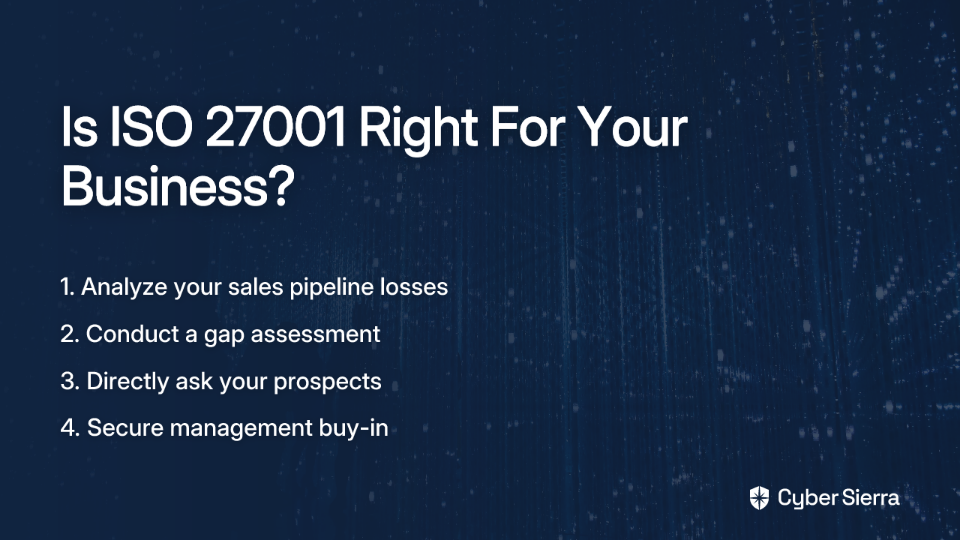
1. Analyze Your Sales Pipeline

Review your recent lost deals and RFP rejections. Are you consistently losing opportunities due to security concerns or certification requirements? If so, ISO 27001 might directly impact your bottom line.

2. Conduct a Gap Assessment

Before committing to full certification, consider conducting a gap assessment using the ISO 27001 framework. This helps you understand your current compliance level and the effort required to achieve certification.

As one expert recommends, "Consider a gap assessment first. You could use the ISO 27001 framework to guide your ISMS without actually doing the audit/getting a cert if your customers are not asking for it."

3. Talk to Your Prospects

Directly ask your prospects if ISO 27001 certification would influence their purchasing decision. This straightforward approach can provide clarity on whether the investment will yield tangible sales benefits.

4. Secure Management Buy-in

ISO 27001 implementation requires organizational commitment. As multiple experts emphasize, "Get management on your side. If this is not sponsored by the board, run." Without executive support, the certification process will likely stall.

Making ISO 27001 Certification More Manageable

If you determine that ISO 27001 is necessary for your sales success, here are strategies to make the process more manageable:

1. Take a Phased Approach

You don't need to tackle everything at once. Break down the implementation into manageable phases, addressing the most critical areas first.

2. Leverage Technology

Modern security and compliance platforms can significantly streamline the certification process. Cyber Sierra's Continuous Control Monitoring (CCM) system, for instance, automates evidence collection and monitoring across multiple frameworks including ISO 27001, reducing the manual effort that often leads to "control fatigue."

3. Focus on the Right Scope

ISO 27001 allows you to define the scope of your certification. Start with the most critical systems and processes relevant to your customers, rather than attempting to certify your entire organization at once.

Conclusion

ISO 27001 certification can be a powerful sales enabler in the right circumstances. For organizations selling to enterprises, government agencies, or regulated industries, it often becomes a necessary credential to close deals.

However, the decision should be driven by tangible business needs rather than simply following industry trends. By carefully assessing your specific customer requirements and sales challenges, you can make an informed decision about whether ISO 27001 certification will deliver meaningful ROI through accelerated sales cycles and expanded market opportunities.

If you determine that ISO 27001 is indeed necessary for your sales success, platforms like Cyber Sierra can help simplify the journey by automating compliance processes, providing continuous control monitoring, and offering the expertise needed to navigate the certification process efficiently.

Remember that ISO 27001 is not just a sales tool but a framework for building a more secure organization. The true value comes not just from the certificate itself, but from the improved security posture and operational discipline it helps establish.

Frequently Asked Questions

What exactly is ISO 27001 certification?

ISO 27001 is an internationally recognized standard for establishing, implementing, maintaining, and continually improving an Information Security Management System (ISMS). It provides a comprehensive framework focused on the confidentiality, integrity, and availability of information, taking a risk-based approach that encompasses people, processes, and technology, rather than just specific technical controls.

Why is ISO 27001 becoming crucial for sales, especially with enterprise clients?

ISO 27001 certification is increasingly crucial for sales because it serves as a trusted validation of a company's security posture, often a prerequisite for enterprise clients and government agencies. In an environment wary of data breaches, large organizations use ISO 27001 as a key criterion in their vendor security assessments. Having the certification can significantly accelerate sales cycles by preemptively answering security concerns and differentiating you from competitors.

When should my business prioritize getting ISO 27001 certified?

Your business should prioritize ISO 27001 certification when you are targeting large enterprises, government agencies, or operating in regulated industries where it's a common requirement, or if you're losing deals due to its absence. It's also a strong consideration if you're expanding internationally, as it provides global credibility. However, if your customers aren't demanding it and you have limited resources, you might delay formal certification while still implementing security best practices.

What are common challenges companies face when pursuing ISO 27001?

Common challenges include a lack of internal expertise in information security management, the perceived administrative burden of documentation and ongoing monitoring, and significant time and resource constraints. Many organizations struggle without prior ISM experience, worry about "control fatigue" from paperwork, and find the typical 6-12 month implementation timeline demanding. These challenges can be mitigated with expert guidance, modern GRC tools, and strong management support.

How can the ISO 27001 certification process be made more manageable?

The ISO 27001 process can be made more manageable by taking a phased approach, leveraging technology like GRC platforms for automation, and carefully defining the scope of your certification to focus on critical areas first. Breaking down the implementation into smaller steps, using tools for continuous control monitoring and evidence collection, and starting with systems most relevant to your customers can significantly reduce the burden and streamline the path to certification.

Is ISO 27001 a one-time effort, or does it require ongoing commitment?

ISO 27001 is not a one-time effort; it requires an ongoing commitment to maintain and continually improve your Information Security Management System (ISMS). The standard itself is built around a cycle of planning, doing, checking, and acting (PDCA). This means regular reviews, audits, updates to documentation, and continuous monitoring are necessary to maintain certification and ensure your security practices remain effective and evolve with new threats.

blog-hero-background-image
Governance & Compliance

What is Configuration Management Database (CMDB)? A Comprehensive Guide for IT Leaders

backdrop
Table of Contents

Join thousands of professionals and get the latest insight on Compliance & Cybersecurity.


You've likely heard colleagues mention CMDB during meetings or seen it referenced in IT governance frameworks. Perhaps you've wondered if implementing one could solve your organization's asset tracking challenges or compliance headaches. As a CISO or IT leader, understanding what a Configuration Management Database truly is—beyond the buzzword—can be transformative for your organization's security posture and operational efficiency.

The CMDB Defined: Beyond the Acronym

A Configuration Management Database (CMDB) is a centralized repository that stores information about all the IT assets within your organization—hardware, software, systems, and even personnel—along with their configurations and relationships to one another. Far more than just an inventory system, a CMDB serves as the single source of truth for your entire IT environment.

For CISOs and security leaders, a well-implemented CMDB offers unprecedented visibility into what assets exist in your environment, how they're configured, and how they interact with each other—critical knowledge for effective security management.

Many IT leaders report feeling overwhelmed by extensive requirements for tracking devices and services, with one Reddit user lamenting, "What the hell is this CMDB? I'm drowning in questions about tracking every little thing." This sentiment reflects a common pain point: without a structured approach to configuration management, the task can seem insurmountable.

Key Components and Functions of a CMDB

At its core, a CMDB contains configuration items (CIs)—any component that needs to be managed to deliver an IT service. These include:

  • Physical assets (servers, workstations, network devices)
  • Software assets (applications, databases, operating systems)
  • Virtual assets (cloud instances, virtual machines)
  • Services and business processes
  • Documentation and personnel

A properly implemented CMDB doesn't just list these items but maps the relationships between them, creating a comprehensive view of your IT infrastructure. This relationship mapping is what transforms a simple inventory into a powerful tool for:

1. IT Service Management (ITSM)

A CMDB forms the foundation for effective ITSM processes by:

  • Facilitating incident management: When issues arise, a CMDB helps quickly identify what systems are affected and which dependencies might be impacted.
  • Streamlining change management: Before implementing changes, you can assess potential impacts by understanding how systems are interconnected.
  • Supporting problem management: Identify recurring issues by analyzing patterns across similar configuration items.

2. Risk Management and Security

For CISOs, a CMDB provides critical context for security operations:

  • Vulnerability management: Quickly identify all affected systems when new vulnerabilities emerge.
  • Configuration compliance: Verify that systems meet security baselines and identify deviations.
  • Access control validation: Map who has access to which systems and ensure appropriate permissions.

3. Strategic Planning and Decision-Making

Beyond operational support, a CMDB offers strategic value by:

  • Informing capacity planning: Understand current resource utilization to plan for future needs.
  • Guiding technology investments: Make informed decisions about upgrades or replacements.
  • Supporting business continuity: Identify critical systems and their dependencies for disaster recovery planning.

Characteristics of a Modern CMDB

Today's CMDBs have evolved beyond static databases to become dynamic systems that integrate with your broader IT ecosystem:

Automation and Discovery

Manual data entry is the enemy of an accurate CMDB. Modern solutions incorporate automated discovery tools that:

  • Continuously scan your network to detect new devices
  • Automatically update CI information when changes occur
  • Validate configurations against established baselines

As one IT manager noted in a Reddit discussion, "Device42 provides discovery features to automatically populate a CMDB, minimizing manual setup"—highlighting how automation has become essential for maintaining accurate data.

Integration Capabilities

Effective CMDBs don't exist in isolation. They integrate with:

  • IT ticketing systems: Linking incidents and changes to specific CIs
  • Monitoring tools: Incorporating real-time status information
  • Security platforms: Correlating vulnerability data with affected assets
  • Cloud management platforms: Tracking resources across hybrid environments

Visualization and Analytics

Modern CMDBs offer powerful visualization tools that:

  • Display relationships between CIs through interactive service maps
  • Provide dashboards with metrics on CI health and compliance
  • Generate reports for stakeholders at various organizational levels

Access Controls and Audit Trails

With sensitive configuration data centralized, robust security becomes essential:

  • Role-based access ensures teams can only view and modify appropriate data
  • Change tracking maintains a history of all modifications
  • Audit logs support compliance and forensic investigations

Benefits of Implementing a CMDB: The Business Case

For CISOs and IT leaders, articulating the business value of a CMDB is crucial for securing buy-in. Here are the tangible benefits:

1. Enhanced Visibility and Reduced Complexity

In today's complex IT environments—spanning on-premises, cloud, and hybrid architectures—maintaining visibility is challenging. A CMDB breaks down informational silos, offering a holistic view that:

  • Eliminates "shadow IT" by documenting all assets
  • Clarifies system interdependencies
  • Reduces the cognitive load on IT staff during troubleshooting

2. Improved Operational Efficiency

A well-maintained CMDB streamlines IT operations by:

  • Reducing mean time to resolution (MTTR): When incidents occur, staff can quickly identify affected systems and their dependencies.
  • Decreasing unplanned work: Better change management means fewer unexpected issues.
  • Automating routine tasks: Integration with other systems enables workflow automation.

3. Cost Optimization

From a financial perspective, a CMDB helps:

  • Identify redundant systems and consolidation opportunities
  • Optimize licensing by tracking software usage
  • Improve resource utilization through better capacity planning
  • Extend asset lifecycles through proper maintenance tracking

4. Enhanced Compliance and Risk Management

For organizations in regulated industries, a CMDB provides:

  • Evidence for auditors demonstrating control over IT assets
  • Historical records of configurations and changes
  • Mapping between business services and supporting infrastructure
  • Documentation for frameworks like ISO 27001, NIST, and ITIL

As one CISO noted in industry research, "Our CMDB has transformed our audit process from a mad scramble for evidence to a simple report generation exercise."

Challenges in Implementing a CMDB: Common Pitfalls

While the benefits are compelling, CMDB implementations face several common challenges:

1. Data Quality Issues

The value of a CMDB depends entirely on the accuracy and completeness of its data. Common challenges include:

  • Incomplete discovery: Missing assets, especially in cloud environments
  • Outdated information: Configuration details that don't reflect current state
  • Inaccurate relationship mapping: Incorrect dependencies between CIs

As one IT professional noted on Reddit, "Inadequate asset information in GCP [is] complicating effective tracking"—highlighting how cloud environments can exacerbate data quality challenges.

2. Cultural Resistance

A CMDB requires organizational commitment to maintain. Resistance may arise from:

  • Teams reluctant to update the CMDB after making changes
  • Skepticism about the value relative to the effort required
  • Perception of the CMDB as bureaucratic overhead rather than a valuable tool

3. Integration Difficulties

Many organizations struggle with:

  • Connecting the CMDB to existing systems and tools
  • Synchronizing data across multiple platforms
  • Managing conflicts between automated discovery and manual updates

4. Scope Creep and Complexity

Without clear boundaries, CMDBs can become unwieldy:

  • Trying to track too many attributes per CI
  • Including items that don't meaningfully support service delivery
  • Creating overly complex relationship models

Best Practices for CMDB Success

To maximize the value of your CMDB while minimizing implementation challenges:

1. Start with Clear Objectives

Define what you want to achieve with your CMDB, such as:

  • Improving incident response times
  • Enhancing security posture visibility
  • Streamlining compliance efforts
  • Supporting specific ITSM processes

2. Take a Phased Approach

Rather than attempting to build a comprehensive CMDB immediately:

  • Begin with critical systems and services
  • Gradually expand scope as processes mature
  • Focus on quality over quantity of CIs

3. Establish Strong Governance

Create clear policies and procedures for:

  • CI classification and attributes
  • Data ownership and maintenance responsibilities
  • Change control processes
  • Data quality metrics and auditing

4. Leverage Automation

Minimize manual data entry by:

  • Implementing automated discovery tools
  • Integrating with existing management systems
  • Setting up validation routines to flag discrepancies

5. Focus on Relationships, Not Just Inventory

The true value of a CMDB lies in understanding dependencies:

  • Map services to supporting infrastructure
  • Document upstream and downstream relationships
  • Create visualizations that highlight critical paths

How Cyber Sierra Enhances CMDB Implementation

While a CMDB provides foundational visibility into your IT environment, organizations often need additional capabilities to fully leverage this information for security and compliance purposes. Cyber Sierra's AI-enabled cybersecurity platform complements your CMDB strategy by:

Enriching CMDB Data with Security Context

Cyber Sierra's Continuous Control Monitoring (CCM) module works alongside your CMDB to:

  • Add security posture information to configuration items
  • Validate that configurations meet security baselines
  • Provide real-time visibility into control effectiveness across your asset inventory

This integration transforms static CMDB data into actionable security intelligence, helping CISOs understand not just what assets exist, but their security status and compliance posture.

Automating Compliance Mapping

For organizations managing multiple regulatory frameworks, Cyber Sierra's GRC capabilities can:

  • Map CMDB assets to specific compliance requirements
  • Automate evidence collection for audits
  • Track control implementation across your infrastructure

This integration streamlines compliance efforts by leveraging the asset data already maintained in your CMDB.

Conclusion: The CMDB as a Strategic Asset

A well-implemented Configuration Management Database is far more than a technical tool—it's a strategic asset that provides the foundation for effective IT governance, risk management, and security operations. For CISOs and IT leaders, a CMDB offers the visibility necessary to make informed decisions, optimize resources, and demonstrate due diligence in protecting organizational assets.

By understanding what a CMDB is, its benefits, implementation challenges, and best practices, you can approach configuration management strategically, ensuring it delivers real value to your organization rather than becoming yet another documentation burden.

Whether you're just beginning your CMDB journey or looking to enhance an existing implementation, remember that the goal isn't perfect documentation—it's enabling better decision-making, more efficient operations, and stronger security through improved visibility and understanding of your IT environment.

Frequently Asked Questions (FAQ)

What exactly is a Configuration Management Database (CMDB)?

A Configuration Management Database (CMDB) is a centralized repository that stores comprehensive information about all IT assets (hardware, software, systems, personnel) and their relationships. It serves as the single source of truth for your IT environment, going beyond a simple inventory by mapping dependencies and configurations, which is crucial for informed decision-making and operational stability.

How does a CMDB enhance an organization's security posture?

A CMDB significantly enhances security by providing complete visibility into all IT assets, their configurations, and interdependencies. This allows CISOs and security teams to quickly identify systems affected by vulnerabilities, ensure configurations adhere to security baselines, validate access controls, and improve incident response by understanding the potential blast radius of a security event.

What are the primary benefits of implementing a CMDB?

The primary benefits of implementing a CMDB include dramatically enhanced IT asset visibility, improved operational efficiency through streamlined processes like incident and change management, significant cost optimization by identifying redundancies and improving resource utilization, and stronger compliance and risk management by providing auditable records and clear documentation of the IT environment and its controls.

What are common challenges encountered when setting up a CMDB?

Common challenges when setting up a CMDB include ensuring data quality (accuracy, completeness, and timeliness), overcoming cultural resistance to adoption and ongoing maintenance, difficulties in effectively integrating the CMDB with other existing IT tools and systems, and avoiding scope creep which can make the CMDB overly complex and difficult to manage effectively.

How can we ensure the CMDB data stays accurate and up-to-date?

Ensuring CMDB data accuracy relies on a combination of automated discovery tools, robust governance processes, and regular audits. Automation continuously scans the IT environment for new assets and changes to existing ones. Integrations with other IT management systems can provide real-time updates. Clear ownership, defined maintenance responsibilities, and periodic verification processes are crucial for encouraging manual updates and maintaining data integrity.

Is a CMDB still relevant for cloud and hybrid IT environments?

Yes, a CMDB is highly relevant and arguably even more critical for cloud and hybrid IT environments due to their inherent complexity and dynamic nature. Modern CMDBs are designed to track virtual assets, cloud instances, and services alongside on-premises resources. This provides a unified view across distributed environments, which is essential for managing dependencies, ensuring consistent policy enforcement, and maintaining comprehensive visibility.

What is the first step to take when starting a CMDB implementation?

The first crucial step when starting a CMDB implementation is to clearly define your objectives. Identify the specific problems you aim to solve or the processes you want to improve (e.g., enhancing incident response, streamlining change management, or supporting compliance audits). Following this, adopt a phased approach: begin with a limited scope focusing on critical systems and services, and then gradually expand as your processes mature and you demonstrate initial value.

Additional Resources

blog-hero-background-image
Governance & Compliance

Risk Management in Cybersecurity: What It Is and How to Get Started

backdrop
Table of Contents

Join thousands of professionals and get the latest insight on Compliance & Cybersecurity.


You've just been appointed as the new CISO. Your inbox is overflowing with vulnerability reports, compliance deadlines loom on the horizon, and the board wants a "quick overview" of your security posture by next week. Meanwhile, your team is struggling to prioritize a growing backlog of security tasks while vendors bombard you with solutions promising to solve all your problems.

Sound familiar?

In today's cybersecurity landscape, the challenge isn't just identifying threats—it's knowing which ones actually matter to your business and deserve your limited resources. This is where effective risk management becomes not just a compliance checkbox but a strategic necessity.

What Is Risk Management in Cybersecurity?

Risk management is the systematic process of identifying, assessing, and responding to risks that could impact an organization's ability to achieve its objectives. In the cybersecurity context, it involves understanding potential threats to your digital assets and taking measured steps to protect them.

According to a recent IBM report, the average cost of a data breach reached a staggering $4.45 million in 2023, with healthcare organizations facing the highest costs at $10.10 million per breach. For hospitality companies, the average was $2.9 million—figures that underscore the financial imperative of proper risk management.

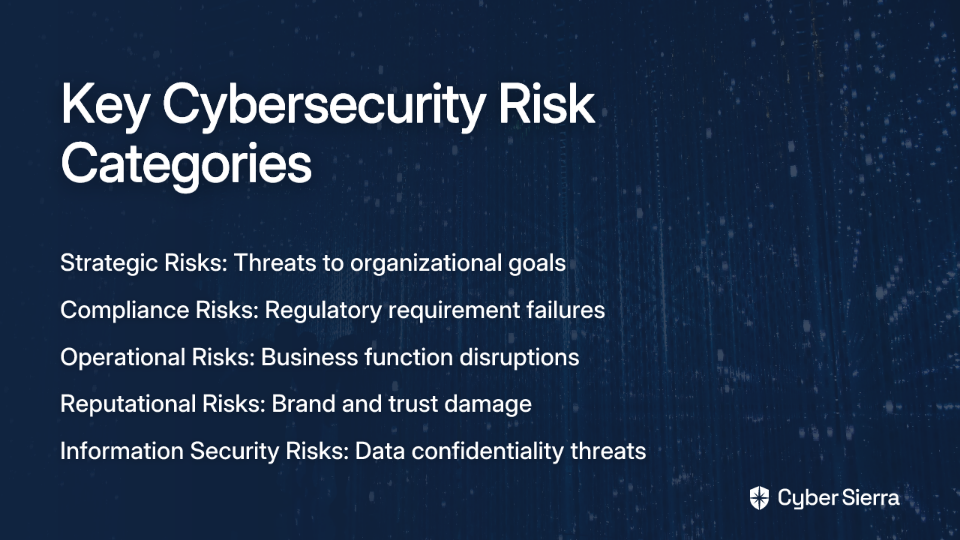
A comprehensive cybersecurity risk management approach typically addresses several risk categories:

  • Strategic Risks: Threats to your organizational goals and objectives (e.g., market shifts, leadership changes)
  • Compliance Risks: Exposure resulting from failure to meet regulatory requirements like GDPR, HIPAA, or PCI DSS
  • Operational Risks: Issues that could disrupt day-to-day business functions
  • Reputational Risks: Potential damage to brand image and customer trust
  • Information Security Risks: Direct threats to data confidentiality, integrity, and availability

"Everything has risk - no matter how trivial or small," notes one cybersecurity professional on Reddit. This reality means risk management isn't optional—it's essential for any organization that relies on technology.

Why Traditional Approaches Often Fail

Despite its importance, many organizations struggle with risk management. A common sentiment among security professionals is frustration over perceived ineffectiveness: "Been doing various types of risk assessment for over 10 years in 3 companies and don't get its importance. Except for box ticking during audits, I don't find it useful in anyway."

This disconnect often stems from several common pitfalls:

  1. Risk assessments without action: Identifying risks without implementing mitigation strategies creates documentation without protection.
  2. Disconnection from business objectives: When security teams operate in isolation from business goals, risk management becomes a theoretical exercise.
  3. Over-reliance on tools: Purchasing security solutions without a clear understanding of your specific risk landscape leads to gaps in coverage and wasted resources.
  4. Inconsistent methodologies: Ad-hoc approaches to risk assessment create inconsistent results and make tracking progress difficult.

As one security professional bluntly stated, "If you're not following through by managing those risks, I don't know what to tell you." This highlights perhaps the biggest failure in risk management: the lack of concrete action following assessment.

The Six-Step Risk Management Process

Effective cybersecurity risk management follows a structured approach that connects assessment to action. Here's a practical framework:

1. Risk Identification

This initial phase involves systematically discovering and documenting potential risks to your organization. Effective techniques include:

  • Asset inventory and classification: You can't protect what you don't know exists. Maintain comprehensive records of all hardware, software, data, and other assets.
  • Threat intelligence gathering: Stay informed about emerging threats targeting your industry.
  • Stakeholder interviews: Engage with department heads to understand business-critical systems and processes.
  • Historical incident analysis: Review past security incidents for patterns and insights.
  • Vulnerability scanning: Regularly scan your infrastructure to identify technical weaknesses.

One useful approach is the Mozilla Rapid Risk Assessment methodology, which helps teams quickly identify key risks in new projects or systems.

2. Risk Assessment

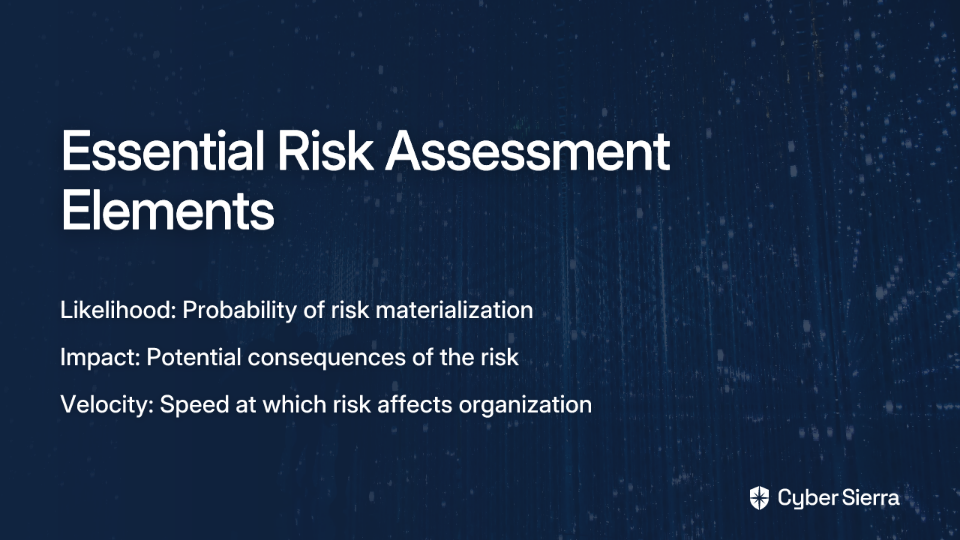
Once risks are identified, evaluate them based on:

  • Likelihood: The probability of the risk materializing
  • Impact: The potential consequences if the risk occurs
  • Velocity: How quickly the risk might affect your organization

This assessment should result in a prioritized list of risks. As one professional notes, "You need to make a decision when doing something, this will inherit risk... the risk assessment tells you what may occur as a result."

Common frameworks for structuring this assessment include NIST Risk Management Framework, ISO 31000, and FAIR (Factor Analysis of Information Risk).

3. Control Implementation

Based on your risk assessment, develop and implement controls to address the prioritized risks. These controls generally fall into three categories:

  • Preventive controls: Measures designed to stop incidents before they occur (e.g., firewalls, access controls)
  • Detective controls: Systems that identify when an incident is in progress (e.g., intrusion detection, log monitoring)
  • Corrective controls: Mechanisms that minimize damage after an incident (e.g., backup systems, incident response plans)

When implementing controls, align with established frameworks like NIST Cybersecurity Framework, ISO 27001, or CIS Controls to ensure comprehensive coverage.

4. Resource Allocation

Effective risk management requires appropriate resources, including:

  • Budget: Financial resources for tools, services, and personnel
  • Personnel: Skilled staff to implement and maintain security controls
  • Technology: Solutions that support risk management activities
  • Time: Dedicated hours for planning, implementation, and review

This step often requires securing executive buy-in by clearly communicating how resource investments correlate to risk reduction and business protection.

5. Risk Treatment

With controls and resources in place, execute your risk treatment strategy. Options include:

  • Risk acceptance: Acknowledging and accepting certain risks when the cost of mitigation exceeds potential impact
  • Risk avoidance: Eliminating activities that create unacceptable risk
  • Risk transfer: Sharing risk through insurance or third-party services
  • Risk mitigation: Implementing controls to reduce likelihood or impact

"A risk assessment should be followed by a continuity plan that details what actions are taken if the risk is realized," emphasizes a cybersecurity professional, highlighting the importance of having concrete action plans.

6. Monitoring and Reporting

Risk management is not a one-time activity but an ongoing process requiring:

  • Regular reassessment: Periodically review and update your risk register
  • Control effectiveness evaluation: Test controls to ensure they're working as intended
  • Continuous improvement: Refine your approach based on changing threats and business needs
  • Executive reporting: Provide clear, actionable risk information to leadership

Building an Effective Risk Management Program

Beyond the six-step process, successful risk management programs share several key elements:

Leadership Commitment

Executive support is critical for effective risk management. CISOs should:

  • Speak the language of business: Frame security risks in terms of business impact
  • Quantify risks when possible: Use data to illustrate the financial implications of security events
  • Connect security to strategic goals: Show how risk management enables business objectives

As one CISO notes, "If you can find a way to sell security as more than a cost center, then that's another focal point." This perspective helps overcome the perception that GRC functions are merely "a cost sink and bottleneck" rather than business enablers.

Clear Documentation

Maintain comprehensive documentation including:

  • Risk register: A centralized inventory of identified risks, their assessments, and treatment plans
  • Security policies: Formal statements of expectations for security behavior
  • Procedures: Step-by-step instructions for implementing security controls
  • Control mapping: Documentation showing how implemented controls address specific risks and compliance requirements

Employee Engagement

Security is everyone's responsibility. Build a security-conscious culture by:

  • Providing regular training: Ensure all employees understand their role in risk management
  • Creating awareness campaigns: Keep security top-of-mind through ongoing communication
  • Recognizing security champions: Identify and support individuals who promote security practices
  • Soliciting feedback: Encourage staff to report security concerns and suggest improvements

As recommended by experienced security leaders, "My team has a min of 3 hours a week of dedicated training time." This investment in continuous learning ensures teams stay current with evolving threats and mitigation strategies.

Practical Threat Modeling

Threat modeling helps identify and address risks in specific systems or processes. While some formal methods can be time-consuming, several approaches balance thoroughness with practicality:

  • STRIDE: A Microsoft-developed methodology that examines six threat categories (Spoofing, Tampering, Repudiation, Information disclosure, Denial of service, Elevation of privilege)
  • Data Flow Diagrams (DFDs): Visual representations that help identify where security controls are needed
  • AWS Threat Composer: A tool that simplifies threat modeling for AWS environments

"I've been pretty impressed with Threat Composer from AWS and the threat modelling they built into the AWS Toolkit for VSCode," notes one security professional, highlighting the value of user-friendly tools.

Third-Party Risk Management

Modern organizations rely heavily on vendors and partners, creating additional risk surfaces that must be managed:

  • Vendor assessment: Evaluate the security posture of potential partners before engagement
  • Contractual requirements: Include specific security obligations in vendor agreements
  • Ongoing monitoring: Regularly review third-party security practices and performance
  • Incident response coordination: Ensure vendors have appropriate breach notification procedures

Practical First Steps for New Risk Management Programs

If you're just getting started with formalizing your risk management approach, consider these initial steps:

1. Establish Your Risk Framework

Select an established framework to guide your efforts. Options include:

  • NIST Risk Management Framework (RMF): A comprehensive approach developed by the National Institute of Standards and Technology
  • ISO 31000: An international standard providing principles and guidelines for effective risk management
  • FAIR (Factor Analysis of Information Risk): A methodology focused on quantifying risk in financial terms

2. Conduct a Baseline Risk Assessment

Start with a high-level assessment of your current security posture:

  • Identify your most critical assets and systems
  • Document existing security controls
  • Analyze gaps between current state and framework requirements
  • Prioritize areas for immediate attention

3. Develop Your Risk Register

Create a structured document to track identified risks, including:

  • Risk description and category
  • Likelihood and impact assessments
  • Current controls and their effectiveness
  • Planned mitigation actions and timelines
  • Risk owner responsible for monitoring and treatment

4. Implement Continuous Monitoring

Establish mechanisms to maintain ongoing awareness of your risk landscape:

  • Deploy security monitoring tools
  • Schedule regular control assessments
  • Create dashboards for key risk indicators
  • Establish routine reporting to stakeholders

5. Build Response Capabilities

Develop plans for when risks materialize despite preventive measures:

  • Create incident response procedures
  • Define roles and responsibilities during security events
  • Establish communication protocols
  • Conduct regular tabletop exercises to test preparedness

How Technology Can Enhance Risk Management

While technology alone can't solve risk management challenges, the right tools can significantly improve efficiency and effectiveness. Modern platforms can help:

  • Automate data collection: Gather information about assets, vulnerabilities, and threats automatically
  • Centralize risk information: Maintain a single source of truth for risk data
  • Streamline assessments: Standardize evaluation processes across the organization
  • Enhance visibility: Provide real-time dashboards and reporting
  • Track remediation: Monitor progress on risk treatment activities

Cyber Sierra's platform, for example, addresses these needs through several integrated modules that work together to simplify risk management:

  • The Continuous Control Monitoring (CCM) module provides ongoing visibility into security controls, helping organizations move away from point-in-time assessments to real-time awareness.
  • For managing vendor risks, the Third-Party Risk Management (TPRM) module automates assessments and provides continuous monitoring of third-party security compliance.
  • The Governance, Risk & Compliance (GRC) module helps organizations navigate complex regulatory requirements by automating data collection and maintaining audit trails.

However, remember that technology should support—not replace—the human expertise and judgment essential to effective risk management.

Common Pitfalls to Avoid

Even well-intentioned risk management programs can falter. Watch out for these common mistakes:

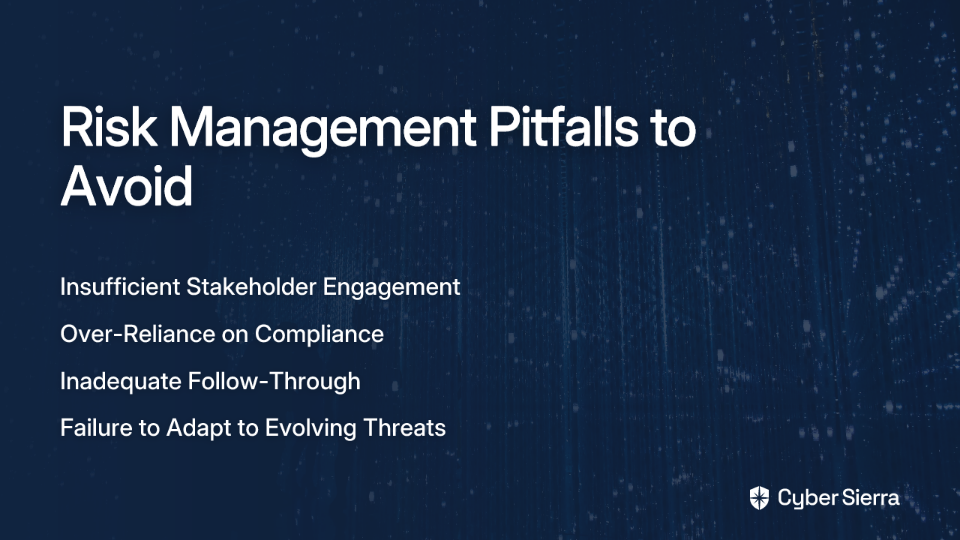
Insufficient Stakeholder Engagement

Risk management can't operate in isolation. Without broad organizational buy-in, you'll face:

  • Resistance to implementing controls
  • Incomplete risk identification
  • Resource constraints
  • Limited executive support

Remedy this by involving stakeholders from across the organization in risk identification and assessment activities.

Over-Reliance on Compliance

While regulatory compliance is important, it shouldn't be the primary driver of your risk management program:

  • Compliance frameworks represent minimum standards, not comprehensive security
  • Checkbox approaches prioritize documentation over effectiveness
  • Compliance requirements may lag behind emerging threats

Instead, focus on the specific risks facing your organization and use compliance as one component of a broader strategy.

Inadequate Follow-Through

The most common criticism of risk management is the lack of action following assessment: "What are we going to do about it?" echoes throughout security teams.

Ensure your program includes:

  • Clear ownership for risk treatment activities
  • Specific, time-bound action plans
  • Regular progress reviews
  • Accountability mechanisms

Failure to Adapt

The threat landscape evolves constantly, requiring risk management programs to evolve as well:

  • Regularly reassess risks and controls
  • Stay informed about emerging threats
  • Update your approach based on lessons learned
  • Incorporate new technologies and methodologies as appropriate

Conclusion: From Compliance Checkbox to Strategic Asset

Effective risk management transforms cybersecurity from a reactive, compliance-driven function to a strategic business enabler. By systematically identifying, assessing, and addressing risks, CISOs can:

  • Allocate limited resources to the highest-priority threats
  • Provide executives with clear visibility into security posture
  • Demonstrate the business value of security investments
  • Build organizational resilience against evolving threats

As one security professional aptly noted, proper risk management "can actually help the company generate revenue while preventing additional cost vectors like fines, lawsuits, etc and lowering risks." This perspective highlights the true value proposition of effective risk management—it's not just about preventing bad things, but about enabling the organization to pursue opportunities with confidence.

The journey toward mature risk management is continuous, but even small steps can yield significant benefits. Start with a clear framework, focus on your most critical risks, ensure follow-through on mitigation activities, and continuously refine your approach.

Remember that while tools and technologies can enhance your capabilities, the most important components are the people and processes that bring risk management to life. By fostering a culture where security is everyone's responsibility and risk-informed decision-making is the norm, you'll build an organization that's not just secure, but resilient in the face of an uncertain future.

Frequently Asked Questions (FAQ)

What is cybersecurity risk management?

Cybersecurity risk management is the systematic process of identifying, assessing, and responding to risks that could impact an organization's digital assets and ability to achieve its objectives. It involves understanding potential threats to your information systems, data, and technology infrastructure and taking measured steps to protect them, thereby ensuring business continuity and protecting sensitive information.

Why is cybersecurity risk management important for businesses?

Cybersecurity risk management is crucial for businesses because it helps protect against financial losses, reputational damage, and operational disruptions caused by cyber threats. For instance, the average cost of a data breach reached $4.45 million in 2023. Effective risk management allows organizations to prioritize threats, allocate resources efficiently, meet compliance requirements, and build resilience, ultimately enabling them to operate securely and pursue strategic goals with confidence.

What are the main steps in the cybersecurity risk management process?

The main steps in the cybersecurity risk management process typically include:

  1. Risk Identification: Discovering and documenting potential risks.
  2. Risk Assessment: Evaluating risks based on likelihood, impact, and velocity.
  3. Control Implementation: Developing and deploying security controls (preventive, detective, corrective).
  4. Resource Allocation: Assigning budget, personnel, and technology.
  5. Risk Treatment: Deciding how to respond to risks (accept, avoid, transfer, mitigate).
  6. Monitoring and Reporting: Continuously reviewing risks, controls, and reporting to leadership. This cyclical process ensures that risk management remains an ongoing and adaptive activity.

What are common mistakes to avoid in cybersecurity risk management?

Common mistakes to avoid in cybersecurity risk management include insufficient stakeholder engagement, over-reliance on compliance as the sole driver, inadequate follow-through on risk treatment plans, and failing to adapt the program to the evolving threat landscape. Addressing these pitfalls involves fostering broad organizational buy-in, focusing on specific organizational risks beyond mere compliance, ensuring clear ownership and action plans for mitigation, and regularly updating the risk management approach.

How can technology help with cybersecurity risk management?

Technology can significantly enhance cybersecurity risk management by automating data collection, centralizing risk information, streamlining assessments, improving visibility through dashboards, and tracking remediation efforts. Platforms like Cyber Sierra's GRC, CCM, and TPRM modules can automate compliance, provide real-time control monitoring, and manage vendor risks. However, technology should support, not replace, human expertise and judgment.

What is the first step to take when starting a new risk management program?

The first step to take when starting a new risk management program is to establish your risk framework by selecting an established guide like NIST RMF, ISO 31000, or FAIR. This framework will provide the structure and principles for your subsequent activities, such as conducting a baseline risk assessment, identifying critical assets, documenting existing controls, and prioritizing areas for immediate attention.

Additional Resources

For those looking to deepen their risk management expertise:


This article was published by Cyber Sierra, an AI-enabled cybersecurity platform that helps organizations automate and simplify security compliance through continuous control monitoring, third-party risk management, and integrated GRC capabilities. Learn more at cybersierra.co.

blog-hero-background-image
Governance & Compliance

What is the 2025 Timeline for NYDFS Cybersecurity Regulation?

backdrop
Table of Contents

Join thousands of professionals and get the latest insight on Compliance & Cybersecurity.


You're a CISO of a financial institution or fintech company in New York, and you've heard about the updated NYDFS cybersecurity regulations. As you sip your morning coffee, your mind races: "What deadlines am I facing in 2025? Are we ready for the automated scanning requirements? Do we need to overhaul our MFA implementation? How will I explain these compliance needs to the board?"

If these questions sound familiar, you're not alone. The New York Department of Financial Services (NYDFS) Cybersecurity Regulation amendments bring significant new requirements with critical 2025 deadlines that financial institutions must prepare for now.

Understanding NYDFS Cybersecurity Regulation

The NYDFS Cybersecurity Regulation (23 NYCRR Part 500) was initially implemented on March 1, 2017, with the goal of protecting consumer data and financial systems from the growing threat of cyberattacks. The regulation applies to all entities operating under DFS licensure, registration, or charter, or otherwise subject to DFS oversight under New York Banking, Insurance, or Financial Services laws.

In November 2023, NYDFS adopted significant amendments to strengthen these requirements, responding to the evolving cybersecurity landscape and introducing several new compliance deadlines extending into 2025.

Key Compliance Dates Leading to 2025

As we approach 2025, several critical deadlines are on the horizon for covered entities:

Already Passed: December 1, 2023

Enhanced Incident Reporting Requirements

  • Notification to NYDFS within 72 hours of determining that a cybersecurity event has occurred
  • 24-hour notification requirement for ransomware payments
  • Detailed information about the event, including affected systems and data

Already Passed: April 15, 2024

Annual Certification of Compliance

  • Covered entities must submit certification or acknowledgment of noncompliance
  • Must be signed by the highest-ranking executive and the CISO
  • Documentation must be maintained for five years
  • Annual review and update of cybersecurity risk assessments

Major Deadline: May 1, 2025

Implementation of Technical Requirements

  • Automated Vulnerability Scans: Regular automated scans of information systems to identify vulnerabilities
  • Enhanced Access Privileges: Implementation of privileged access management, including:
    • Limiting user access privileges to only what is necessary
    • Periodic review and disabling of unnecessary accounts
    • Secure remote access configurations
    • Effective termination of access following employee departure
    • Robust password policies and procedures
  • Endpoint Detection and Response Solutions: Deployment of EDR technologies to monitor and respond to threats on endpoints

Final Major Deadline: November 1, 2025

Multi-Factor Authentication and Asset Management

  • Mandatory MFA for all individuals accessing information systems
  • Establishment of written policies for maintaining accurate asset inventory
  • Tracking key information about each asset, including:
    • Owner
    • Location
    • Classification or sensitivity
    • Support expiration date
    • Recovery time requirements

Class A Companies: Additional Requirements

The NYDFS regulation introduces a new category called "Class A companies" – larger entities that face more stringent requirements. Your organization qualifies as a Class A company if you:

  1. Have at least $20 million in gross annual revenue in each of the last two fiscal years from business operations in New York, AND
  2. Have either:
    • Over 2,000 employees (including affiliates and independent contractors) averaged over the last two fiscal years, OR
    • Over $1 billion in gross annual revenue in each of the last two fiscal years from all business operations

Class A companies face additional obligations, including:

  • Independent Audits: Conducting independent cybersecurity audits at least annually
  • Privileged Access Management: Implementing privileged access management solutions for all privileged accounts
  • Password Management: Using automated password management tools for all accounts
  • Advanced Monitoring: Implementing endpoint detection and response solutions and centralized logging and security event monitoring

Compliance Actions Required for 2025 Deadlines

Preparing for May 1, 2025: Technical Requirements

1. Automated Vulnerability Scanning

  • Implement tools that can automatically scan your information systems
  • Ensure scans can identify known vulnerabilities across your environments
  • Establish processes to categorize and remediate discovered vulnerabilities
  • Document scanning frequency and coverage

2. Enhanced Access Privileges Management Sarah Chen, a CISO at a mid-sized fintech, explains the challenge: "Implementing robust access control isn't just about having the right tools—it's about establishing governance processes that ensure least privilege principles are consistently applied without hindering business operations."

To meet this requirement, organizations should:

  • Document all privileged accounts and their ownership
  • Implement processes for regular access reviews
  • Establish secure procedures for remote access
  • Create automated workflows for access termination when employees depart
  • Develop and enforce password policies aligned with industry standards

3. Endpoint Detection and Response

  • Evaluate and select appropriate EDR solutions based on your environment
  • Ensure the solution provides continuous monitoring capabilities
  • Establish incident response procedures that leverage EDR data
  • Train security personnel on effective use of the EDR platform

Preparing for November 1, 2025: MFA and Asset Management

1. Multi-Factor Authentication

  • Inventory all systems requiring MFA implementation
  • Select appropriate MFA methods based on risk assessment
  • Develop exception processes for scenarios where MFA might not be feasible
  • Document all configurations and policy decisions

2. Asset Management

  • Create a comprehensive inventory of all hardware and software assets
  • Implement tools to maintain this inventory automatically where possible
  • Develop processes for updating the inventory when changes occur
  • Document classification schemes and ownership assignments

Third-Party Risk Management Considerations

The amendments also strengthen requirements for third-party service provider security. By 2025, covered entities must:

  • Develop minimum cybersecurity practices for their third-party service providers
  • Conduct periodic assessments based on the risk they present
  • Evaluate the adequacy of third-party cybersecurity practices
  • Document all third-party relationships and their compliance status

Ben Carter, a Third-Party Risk Manager at a large financial institution, notes: "The enhanced NYDFS requirements are pushing us to implement continuous monitoring of our vendors rather than relying on annual questionnaires. We need to know in near real-time if a critical vendor's security posture changes."

Challenges and Considerations for 2025 Compliance

Resource Allocation and Budgeting

Implementing these cybersecurity measures by 2025 requires significant investment in technologies, processes, and training. In a recent survey of financial services organizations, over 70% indicated they would need to increase their cybersecurity budgets to meet NYDFS requirements.

For smaller organizations with limited resources, this presents a particular challenge. Michael Rodriguez, an IT Manager at a growing fintech startup, shares his perspective: "We're exploring managed security service options because building in-house capabilities for all these requirements would stretch our team too thin. The 2025 deadlines mean we need to start budgeting now for the tools and expertise required."

Integration with Existing Compliance Frameworks

Many organizations already comply with multiple frameworks such as SOC 2, ISO 27001, PCI DSS, or GDPR. The challenge lies in efficiently integrating NYDFS requirements with existing compliance programs.

Kenichi Tanaka, an Internal Audit Manager, recommends: "Map controls across frameworks to identify overlaps. This prevents duplicating efforts and helps build a unified compliance approach rather than siloed programs for each regulation."

Continuous Monitoring vs. Point-in-Time Compliance

A key shift in the 2025 requirements is the emphasis on continuous monitoring rather than point-in-time assessments. This represents a fundamental change in approach for many organizations.

Priya Sharma, a Senior Security Analyst, explains: "The vulnerability scanning and EDR requirements signal that NYDFS expects continuous visibility into security posture, not just annual attestations. This requires automated tools that can constantly validate control effectiveness."

Documentation and Evidence Collection

The 2025 requirements will substantially increase the evidence organizations need to collect and maintain. This includes:

  • Vulnerability scan results and remediation records
  • Access review documentation
  • EDR alert handling and investigation records
  • MFA implementation evidence
  • Asset inventory reports

David Lee, an IT Compliance Manager, notes: "The volume of evidence required is becoming unmanageable with manual processes. We're investigating automated evidence collection tools to prepare for the 2025 deadlines."

How To Prepare: A Strategic Approach

1. Conduct a Gap Assessment

Start by evaluating your current security posture against the 2025 requirements:

  • Identify existing controls that satisfy requirements
  • Catalog gaps requiring remediation
  • Prioritize gaps based on risk and implementation complexity

2. Develop a Multi-Year Roadmap

Create a strategic plan with clear milestones leading up to the 2025 deadlines:

  • Allocate budget across multiple fiscal years
  • Schedule technology implementations with adequate testing time
  • Establish policy development and review timelines
  • Plan for staff training and awareness programs

3. Leverage Automation and Integration

Manual processes will likely be insufficient to meet continuous monitoring requirements:

  • Investigate GRC platforms that can automate evidence collection
  • Implement integrated security toolsets rather than point solutions
  • Consider security orchestration tools to streamline workflows

4. Establish Governance and Accountability

Clear ownership is essential for successful implementation:

  • Define roles and responsibilities for each requirement
  • Establish executive sponsorship for the compliance program
  • Create reporting mechanisms to track progress
  • Implement regular steering committee reviews

5. Build a Continuous Compliance Culture

Move beyond checkbox compliance toward ongoing security vigilance:

  • Train staff on security awareness beyond minimum requirements
  • Establish metrics for measuring control effectiveness
  • Create feedback loops to continuously improve security measures
  • Conduct tabletop exercises to test incident response capabilities

How CyberSierra Can Help Meet 2025 NYDFS Requirements

For organizations struggling with the complexity of the 2025 NYDFS compliance deadlines, integrated platforms like CyberSierra can provide significant advantages. Rather than implementing disparate point solutions, CyberSierra offers a unified approach to meeting the technical requirements through several key modules:

Continuous Control Monitoring for Automated Evidence

CyberSierra's Continuous Control Monitoring (CCM) module directly addresses the 2025 requirement for automated vulnerability scanning and continuous monitoring. The platform:

  • Creates a centralized controls repository that maps NYDFS requirements to specific technical controls
  • Automates evidence collection from security tools, cloud environments, and internal systems
  • Provides real-time visibility into control effectiveness through customizable dashboards
  • Identifies control gaps and exceptions requiring remediation
  • Maintains detailed audit trails of all testing and validation activities

This approach transforms the traditionally manual process of gathering compliance evidence into an automated, continuous assessment that better aligns with the NYDFS emphasis on ongoing security validation.

Third-Party Risk Management for Vendor Oversight

With the enhanced focus on third-party security in the NYDFS amendments, CyberSierra's TPRM module helps organizations:

  • Automate vendor assessments and questionnaires
  • Prioritize vendors based on risk levels and data access
  • Monitor vendor security posture continuously rather than annually
  • Maintain documentation of all third-party relationships
  • Track remediation efforts for identified vendor risks

This capability is particularly valuable for financial institutions managing complex vendor ecosystems where security risks in the supply chain could lead to regulatory violations.

Governance, Risk & Compliance for Comprehensive Management

CyberSierra's GRC module provides the framework for managing the full scope of NYDFS requirements:

  • Maps controls across multiple frameworks to eliminate duplication of effort
  • Automates the annual certification process with appropriate workflows
  • Maintains the required five-year documentation history
  • Generates board-ready reports on compliance status
  • Tracks exceptions and manages remediation plans

Looking Beyond 2025: The Future of Financial Services Cybersecurity

The NYDFS 2025 deadlines represent a significant milestone, but they're part of a broader trend toward more rigorous cybersecurity expectations in the financial sector. Organizations should view these requirements not as a one-time compliance exercise but as building blocks for a more mature security program.

Industry experts predict several developments beyond 2025:

  1. Increased Regulatory Convergence: Expect greater harmonization between NYDFS requirements and other frameworks like SEC cybersecurity rules and federal banking regulations.
  2. AI-Enhanced Monitoring Expectations: Future regulatory updates may incorporate requirements for AI-based threat detection and anomaly monitoring.
  3. Supply Chain Security Emphasis: As third-party breaches continue to impact financial institutions, regulations will likely expand requirements for vendor security oversight.
  4. Cyber Resilience Focus: Beyond prevention, regulations may increasingly emphasize proven recovery capabilities through mandatory testing.

Conclusion: Preparing for Success in 2025 and Beyond

The 2025 NYDFS cybersecurity regulation deadlines present both challenges and opportunities for financial institutions. Organizations that take a strategic approach to compliance will not only meet regulatory requirements but also significantly enhance their security posture.

Key takeaways for preparing for the 2025 deadlines include:

  • Start planning and budgeting now for technical implementations required by May and November 2025
  • Shift from manual, point-in-time assessments to automated, continuous monitoring approaches
  • Address third-party risk management as a critical component of overall compliance
  • Consider integrated platforms that can provide unified visibility across requirements
  • Build a culture of security that goes beyond minimum compliance standards

By viewing these regulations as an opportunity to strengthen cybersecurity programs rather than just a compliance burden, financial institutions can better protect their customers, their data, and their reputation in an increasingly complex threat landscape.

The time to prepare for 2025 is now – organizations that wait until 2024 may find themselves rushing implementations, increasing costs, and potentially missing critical deadlines.

Resources for Further Reading

blog-hero-background-image
Governance & Compliance

NIST Risk Management Framework - The Complete Guide

backdrop
Table of Contents

Join thousands of professionals and get the latest insight on Compliance & Cybersecurity.


You've been tasked with implementing cybersecurity measures across your organization, and suddenly everyone is mentioning "NIST RMF" like it's common knowledge. You try to read through the documentation, but the frameworks seem confusing with their cryptic control descriptions. You're not alone in thinking, "I just seems like there's only 1-2 sentences for each control. Where the heck do I go after that?"

The National Institute of Standards and Technology (NIST) Risk Management Framework (RMF) is frequently cited in job descriptions and compliance requirements, but many professionals struggle to understand and implement it effectively. And with many organizations demanding "extensive knowledge of the NIST Risk Management Framework," the pressure to master this complex framework is real.

This comprehensive guide will demystify the NIST RMF, providing clarity on its purpose, structure, and implementation—moving you from confusion to confidence in managing organizational risk.

What is the NIST Risk Management Framework?

The NIST Risk Management Framework (RMF) is a structured process that integrates security, privacy, and cyber supply chain risk management activities into the system development life cycle. Originally developed to help federal agencies comply with the Federal Information Security Management Act (FISMA) of 2002, the RMF has evolved to become a widely adopted approach for organizations of all types seeking to manage information security and privacy risks effectively.

Origins and Evolution

The RMF was initially created to address the requirements of FISMA, which mandated that federal agencies implement information security programs to protect their information and systems. Over time, the framework has evolved through several revisions to address emerging cybersecurity challenges and incorporate lessons learned from implementation.

The most recent iteration, outlined in NIST Special Publication 800-37 Revision 2, introduced significant updates including:

  • Integration of privacy risk management into the RMF
  • Establishment of the Prepare step as a foundational part of the process
  • Incorporation of supply chain risk management considerations
  • Emphasis on ongoing authorization and continuous monitoring

Key Objectives of the RMF

The NIST RMF serves several critical purposes:

  1. Standardization: It provides a consistent, repeatable methodology for managing information security and privacy risks.
  2. Risk-Based Approach: It focuses resources on the highest-priority security issues based on potential impact.
  3. Integration: It embeds security and privacy considerations throughout the system development lifecycle.
  4. Adaptability: It can be tailored to meet the specific needs and risk tolerance of any organization.
  5. Compliance: It helps organizations meet regulatory and legal requirements for information security and privacy.

As one Reddit user pointed out, "Understanding the RMF process is crucial to managing the lifecycle of risk successfully," highlighting how this framework provides a structured approach to what might otherwise be an overwhelming task.

Understanding the NIST RMF Structure

The NIST Risk Management Framework consists of seven core steps that create a comprehensive approach to risk management. Let's explore each step in detail to understand how they work together to create a robust security posture.

Step 1: Prepare

Objective: Establish the context and priorities for managing security and privacy risks.

The Prepare step, added in Revision 2 of NIST SP 800-37, recognizes that effective risk management requires proper groundwork. This step involves:

  • Identifying key risk management roles and responsibilities within the organization
  • Developing a risk management strategy aligned with organizational goals
  • Assessing the organization's risk tolerance to guide decision-making
  • Establishing a comprehensive inventory of systems and information assets
  • Understanding the organization's mission and business processes

This foundational step helps ensure that subsequent risk management activities are properly contextualized and supported. As many cybersecurity professionals have noted, "You probably already have policies, registers, classifications, a risk management framework..." - the Prepare step helps you organize these existing components into a cohesive approach.

Step 2: Categorize

Objective: Determine the criticality and sensitivity of the system and information to be protected.

In this step, organizations:

  • Identify the types of information processed, stored, and transmitted by the system
  • Select the appropriate security impact values (Low, Moderate, or High) for each security objective (confidentiality, integrity, and availability)
  • Determine the overall security categorization for the system based on the highest impact value

For example, a public-facing website might be categorized as:

Information TypeConfidentialityIntegrityAvailabilityOverall
Public WebsiteLowModerateHighHigh

The categorization process is crucial because it drives the selection of security controls in subsequent steps. By properly categorizing systems, organizations can apply appropriate security measures based on risk, avoiding both under-protection and wasteful over-protection.

Step 3: Select

Objective: Identify the security controls necessary to protect the system based on its categorization.

The Select step involves:

  • Choosing a baseline set of security controls from NIST Special Publication 800-53 based on the system categorization
  • Tailoring the controls to address specific organizational requirements, threats, and environments
  • Supplementing the baseline with additional controls as needed
  • Documenting the controls in the system security plan

Many cybersecurity professionals express frustration with this step, noting: "I find myself frequently questioning whether or not I actually comprehended what I just read and what the control is asking for." This is a common challenge because NIST control descriptions are intentionally brief to allow flexibility in implementation.

Pro Tip: For more detailed guidance on understanding and implementing controls, refer to NIST Special Publication 800-53A, which provides assessment procedures and additional context for each control. This resource helps bridge the gap between the concise control statements and practical implementation.

Step 4: Implement

Objective: Put the selected security controls into operation within the system and its environment.

During implementation, organizations:

  • Deploy the selected security controls as specified in the security plan
  • Document the control implementation details, including configuration settings
  • Address implementation challenges through engineering trade-offs and risk acceptance decisions

This step transforms planning into action, but it's important to recognize that implementation isn't a one-time activity. As one practitioner noted, "Last thing I want to do is write up a bunch of controls just to find out that what I wrote was completely inaccurate/off point." To avoid this, many organizations implement controls incrementally, validating their effectiveness before moving forward.

Step 5: Assess

Objective: Determine if the controls are implemented correctly, operating as intended, and producing the desired results.

The Assess step includes:

  • Developing an assessment plan that specifies the assessment methods and procedures
  • Conducting control assessments using appropriate methods (examine, interview, test)
  • Documenting assessment results and identified weaknesses
  • Preparing a security assessment report that presents findings and recommendations

This step provides crucial feedback on the effectiveness of the security controls. Many organizations leverage automated tools to supplement manual assessments, particularly for technical controls that can be objectively evaluated.

Step 6: Authorize

Objective: Make a risk-based decision to authorize the system to operate.

The Authorization step involves:

  • Preparing an authorization package containing the security plan, assessment results, and POA&M
  • Analyzing security and privacy risks based on assessment results
  • Making an authorization decision (authorize, authorize with conditions, or deny authorization)
  • Documenting the decision and any terms and conditions for authorization

This step establishes accountability by requiring a senior official (the Authorizing Official) to formally accept the risks associated with operating the system. The authorization decision represents a deliberate choice to accept identified risks in the context of mission requirements.

Step 7: Monitor

Objective: Continuously track changes to the system that may affect security and reassess control effectiveness.

The Monitor step includes:

  • Implementing a continuous monitoring strategy and program
  • Assessing a subset of security controls on an ongoing basis
  • Conducting ongoing impact and risk assessments as changes occur
  • Reporting the security and privacy posture to appropriate stakeholders
  • Reviewing the authorization status in light of monitoring results

This step transforms security from a point-in-time assessment to an ongoing process. As systems, threats, and organizations evolve, continuous monitoring ensures that security controls remain effective. This addresses a common frustration expressed by professionals who feel that traditional risk assessments lack practical value: "been doing various types of risk assessment for over 10 years in 3 companies and don't get its importance." The Monitor step connects assessment to action through continuous improvement.

Clarifying the Confusion: NIST RMF vs. Other Frameworks

Many professionals struggle with understanding the relationships between different NIST frameworks. As one Reddit user expressed, "I am having a hard time trying to understand the difference between the following frameworks."

Here's how the NIST RMF relates to other commonly referenced NIST publications:

NIST RMF vs. NIST CSF

  • NIST Risk Management Framework (RMF): A comprehensive process for managing security and privacy risks throughout the system development lifecycle. It provides a structured approach to selecting, implementing, assessing, and monitoring security controls.
  • NIST Cybersecurity Framework (CSF): A voluntary framework consisting of standards, guidelines, and best practices to manage cybersecurity risk. The CSF is organized around five core functions: Identify, Protect, Detect, Respond, and Recover.

While the RMF is more prescriptive and detailed, the CSF is designed to be more accessible and adaptable. Many organizations use both: the CSF to establish a high-level cybersecurity program and the RMF to implement detailed security controls for specific systems.

NIST RMF vs. NIST 800-53

  • NIST RMF: The process framework that guides organizations through the steps of securing their systems.
  • NIST 800-53: A catalog of security and privacy controls that organizations select and implement as part of the RMF process. NIST 800-53 is used specifically in Step 3 (Select) of the RMF.

Think of the RMF as the "how" and NIST 800-53 as the "what" of security implementation. The RMF tells you the process to follow, while NIST 800-53 provides the specific controls to implement within that process.

NIST RMF vs. NIST 800-171

  • NIST RMF: A comprehensive risk management process applicable to all systems.
  • NIST 800-171: A publication that specifies security requirements for protecting Controlled Unclassified Information (CUI) in non-federal systems. It contains a subset of the controls found in NIST 800-53, tailored for non-federal entities.

While the RMF can be used to implement NIST 800-171 requirements, the latter is more focused on specific protection requirements for a particular type of information (CUI).

Benefits of Implementing the NIST RMF

Despite some practitioners questioning its value ("I don't find it useful in any way"), the NIST RMF offers significant benefits when properly implemented:

1. Comprehensive Risk Management

The RMF provides a structured approach to managing risk that addresses the entire system lifecycle. This holistic view ensures that security is considered from initial system planning through retirement, rather than being added as an afterthought.

2. Flexibility and Customization

The framework is designed to be tailored to meet the specific needs of any organization. This adaptability means that organizations can apply the RMF in a way that aligns with their mission, size, and risk tolerance.

3. Regulatory Compliance

For federal agencies and their contractors, implementing the RMF helps satisfy FISMA requirements. For other organizations, the RMF can support compliance with various regulations and standards by providing a structured approach to security and privacy risk management.

4. Better Decision-Making

By providing a consistent methodology for assessing and communicating risks, the RMF enables more informed decision-making about security investments and risk acceptance. This addresses the concern that risk assessments don't provide practical value by connecting assessment activities to concrete decisions.

5. Continuous Improvement

The continuous monitoring aspect of the RMF promotes ongoing evaluation and improvement of security controls, helping organizations maintain an effective security posture as threats and technologies evolve.

Implementation Challenges and Solutions

While the NIST RMF provides a robust framework for risk management, organizations often face challenges during implementation. Understanding these challenges and potential solutions can help smooth the adoption process.

Challenge 1: Understanding Control Requirements

Many professionals express frustration with the brevity of NIST control descriptions: "I just seems like there's only 1-2 sentences for each control. Where the heck do I go after that?"

Solution:

  • Consult supplementary NIST publications such as NIST SP 800-53A, which provides assessment procedures and clarifications for each control
  • Leverage the NIST Computer Security Resource Center (CSRC) for additional guidance
  • Join professional communities where practitioners share implementation experiences
  • Consider using tools like Cyber Sierra's Continuous Control Monitoring (CCM) module, which centralizes control repositories and provides actionable risk intelligence to help interpret and implement controls effectively

Challenge 2: Resource Constraints

Implementing the RMF requires significant time, expertise, and financial resources, which can be challenging for organizations with limited budgets.

Solution:

  • Prioritize implementation based on system criticality and risk
  • Adopt a phased approach, focusing on high-impact systems first
  • Leverage automation tools to streamline assessment and monitoring activities
  • Consider shared services or managed security service providers for specialized expertise

Challenge 3: Maintaining Documentation

The RMF generates substantial documentation requirements, which can become overwhelming without proper management.

Solution:

  • Implement a Governance, Risk, and Compliance (GRC) tool to centralize documentation
  • Develop templates and standardized formats for common documents
  • Establish clear document ownership and maintenance responsibilities
  • Automate documentation where possible, such as through security control assessment tools

Challenge 4: Continuous Monitoring

Establishing effective continuous monitoring can be challenging, particularly for organizations transitioning from point-in-time assessments.

Solution:

  • Start with a subset of critical controls for continuous monitoring
  • Leverage automated security tools that provide real-time visibility
  • Establish clear metrics and thresholds for control effectiveness
  • Implement a regular cadence for reviewing monitoring results and taking action

Challenge 5: Bridging Knowledge Gaps

Many professionals struggle with demonstrating NIST RMF expertise for career advancement: "What course or certification or anything can I get to be able to put NIST on my resume?"

Solution:

  • Complete the official NIST RMF training course
  • Pursue certifications like Certified Information Systems Security Professional (CISSP) or Certified Authorization Professional (CAP) that cover RMF concepts
  • Participate in RMF implementation projects to gain practical experience
  • Document specific RMF activities and accomplishments in your resume

Real-World Success Stories

Understanding how organizations have successfully implemented the NIST RMF provides valuable insights and inspiration. Here are two notable examples:

University of Kansas Medical Center (KUMC)

KUMC successfully implemented the NIST RMF to enhance their cybersecurity posture while ensuring compliance with healthcare regulations.

Key Achievements:

  • Improved security posture through systematic risk assessment and control implementation
  • Enhanced protection of sensitive patient data (PHI) through appropriate categorization and control selection
  • Developed a culture of shared responsibility for security across departments
  • Streamlined compliance with both HIPAA and FISMA requirements

As the KUMC case demonstrates, the RMF can be effectively applied in specialized environments with stringent regulatory requirements. Their approach of integrating the RMF with existing healthcare compliance frameworks provides a model for other organizations in regulated industries.

Read more about KUMC's success with NIST RMF

Multi-State Information Sharing and Analysis Center (MS-ISAC)

MS-ISAC implemented the NIST RMF across member organizations to standardize cybersecurity practices and improve collective defense.

Key Achievements:

  • Established consistent risk management practices across diverse state and local government entities
  • Developed shared assessment methodologies that reduced duplication of effort
  • Created a common language for discussing and addressing cybersecurity risks
  • Improved overall security posture through collaborative implementation of controls

The MS-ISAC example highlights how the RMF can be scaled across multiple organizations to create a unified approach to security. This collaborative model demonstrates the framework's adaptability to complex organizational structures.

Explore MS-ISAC's implementation of NIST

Practical Implementation Guidance

For organizations beginning their RMF journey, here are practical steps to get started:

1. Start with the Prepare Step

Many organizations are tempted to jump directly to control selection, but the Prepare step is crucial for setting the foundation. Take time to:

  • Identify key stakeholders and define their roles and responsibilities
  • Develop risk management policies and procedures
  • Establish a system inventory and categorization strategy
  • Assess the organization's risk tolerance

2. Focus on Critical Systems First

Rather than attempting to implement the RMF across all systems simultaneously, prioritize based on:

  • Systems that process sensitive data
  • Systems that support critical business functions
  • Systems subject to specific regulatory requirements

This focused approach allows organizations to gain experience with the RMF while addressing their highest-risk areas first.

3. Leverage Existing Security Investments

Many organizations already have security controls in place that align with RMF requirements. Before implementing new controls:

  • Map existing security measures to RMF control requirements
  • Identify gaps that need to be addressed
  • Leverage existing tools and processes where possible

This approach minimizes redundancy and maximizes the value of current security investments.

4. Automate Where Possible

Automation can significantly reduce the burden of RMF implementation, particularly for documentation, assessment, and monitoring activities. Consider tools that:

  • Centralize security documentation
  • Automate control assessments
  • Provide continuous monitoring capabilities
  • Generate reports for stakeholders

Modern platforms like Cyber Sierra's Continuous Control Monitoring (CCM) module can help organizations automate much of the RMF process, from control implementation to ongoing monitoring. By centralizing control repositories and providing actionable risk intelligence, such tools can transform what might otherwise be a manual, resource-intensive process into a streamlined, efficient operation.

5. Establish Metrics for Success

Define clear metrics to measure the effectiveness of your RMF implementation:

  • Reduction in security incidents
  • Improvement in control assessment scores
  • Decreased time to identify and remediate vulnerabilities
  • Enhanced compliance with regulatory requirements

These metrics help demonstrate the value of the RMF to leadership and guide continuous improvement efforts.

Future Directions of the NIST RMF

The NIST RMF continues to evolve to address emerging challenges and incorporate new approaches to risk management. Some key trends to watch include:

Integration with Zero Trust Architecture

NIST is increasingly emphasizing the alignment between the RMF and Zero Trust Architecture principles. Future revisions of the RMF are likely to incorporate more explicit guidance on implementing Zero Trust within the risk management process.

Enhanced Supply Chain Risk Management

Recent updates to the RMF have introduced greater focus on supply chain risk management. This emphasis is expected to expand in response to high-profile supply chain attacks and increasing regulatory attention to this area.

AI and Automation in Risk Management

As artificial intelligence and automation technologies mature, they are likely to play a greater role in RMF implementation, particularly in continuous monitoring, anomaly detection, and adaptive security control selection.

Resources for Mastering the NIST RMF

For professionals seeking to build expertise in the NIST RMF, several resources are available:

Official NIST Publications

Training and Education

Professional Communities

Conclusion: Making the NIST RMF Work for You

The NIST Risk Management Framework provides a comprehensive, structured approach to managing information security and privacy risks throughout the system development lifecycle. While implementing the RMF can be challenging, the benefits—including improved security posture, regulatory compliance, and informed decision-making—make it worthwhile for organizations of all types and sizes.

By understanding the seven core steps of the RMF, clarifying its relationship to other frameworks, addressing common implementation challenges, and learning from real-world success stories, organizations can effectively apply the RMF to their unique environments.

Remember that the RMF is designed to be tailored. As one practitioner noted, "The problem with using a control set is that many items may not be applicable at all." The key is to adapt the framework to your organization's specific needs, risks, and constraints while maintaining the integrity of the risk management process.

For professionals seeking to build expertise in this area, numerous resources are available, from official NIST publications to training courses and professional communities. By investing in RMF knowledge and skills, cybersecurity practitioners can enhance their career prospects while making meaningful contributions to organizational security.

As cyber threats continue to evolve and regulatory requirements expand, the NIST RMF provides a flexible, adaptable foundation for managing security and privacy risks in the digital age. Whether you're a federal agency required to comply with FISMA, a contractor handling CUI, or a private organization seeking to improve your security posture, the RMF offers a proven approach to identifying, assessing, and addressing the risks that matter most to your mission.

Frequently Asked Questions

What is the primary goal of the NIST Risk Management Framework (RMF)?

The primary goal of the NIST RMF is to provide a structured, comprehensive, and repeatable process for managing information security and privacy risks. It aims to integrate these considerations into the system development life cycle, helping organizations protect their information assets and comply with relevant regulations like FISMA.

How many steps are in the NIST RMF and what are they?

The NIST RMF consists of seven steps, designed to guide organizations through a holistic risk management process. These steps are: 1. Prepare (establish context and priorities), 2. Categorize (determine system criticality), 3. Select (choose appropriate security controls), 4. Implement (deploy selected controls), 5. Assess (evaluate control effectiveness), 6. Authorize (make risk-based decisions), and 7. Monitor (track changes and reassess).

Why is the 'Prepare' step crucial in the NIST RMF?

The 'Prepare' step is crucial because it establishes the foundational context and priorities for all subsequent risk management activities. Added in NIST SP 800-37 Revision 2, this step involves identifying key roles, developing a risk management strategy, assessing organizational risk tolerance, inventorying systems, and understanding mission objectives, ensuring that risk management is aligned with organizational goals from the outset.

How does the NIST RMF differ from the NIST Cybersecurity Framework (CSF)?

The NIST RMF provides a detailed, prescriptive process for managing security and privacy risks throughout the system lifecycle, often used for specific system authorizations. The NIST CSF, on the other hand, is a voluntary, higher-level framework offering standards, guidelines, and best practices to manage cybersecurity risk across an entire organization, structured around five core functions (Identify, Protect, Detect, Respond, Recover). Many organizations use the CSF for overall strategy and the RMF for detailed implementation.

What is a common challenge when implementing NIST RMF and how can it be overcome?

A common challenge is understanding the often brief and seemingly cryptic control descriptions in NIST SP 800-53. This can be overcome by consulting supplementary NIST publications like NIST SP 800-53A (which provides assessment procedures), leveraging resources from the NIST CSRC, joining professional communities for shared experiences, and utilizing tools that offer guidance and context for control implementation.

Where can I find more detailed guidance for implementing NIST RMF controls?

Detailed guidance for implementing NIST RMF controls can be found in several NIST Special Publications. Specifically, NIST SP 800-53 Rev. 5 provides the catalog of security and privacy controls, and NIST SP 800-53A Rev. 5 offers assessment procedures and additional context for these controls. The NIST Computer Security Resource Center (CSRC) website is also an invaluable resource for various guidelines, papers, and tools related to the RMF.

How Cyber Sierra Can Help

For organizations looking to streamline their NIST RMF implementation, Cyber Sierra offers an AI-enabled cybersecurity platform designed to simplify and automate security compliance. The platform's modular approach addresses key aspects of the RMF process:

Continuous Control Monitoring (CCM)

Cyber Sierra's CCM module directly supports Steps 3-7 of the RMF by:

  • Building a central controls repository aligned with the NIST 800-53 framework
  • Providing near real-time visibility into control effectiveness
  • Automating control testing and validation
  • Delivering actionable risk intelligence to guide remediation efforts

This capability transforms the traditionally manual, point-in-time assessment process into continuous, automated monitoring that aligns perfectly with the RMF's emphasis on ongoing authorization.

Governance, Risk & Compliance (GRC)

The GRC module supports RMF implementation by:

  • Automating data collection for security assessments
  • Streamlining documentation for authorization packages
  • Managing multiple compliance frameworks simultaneously
  • Generating comprehensive reports for stakeholders

For organizations managing compliance with multiple frameworks (such as NIST RMF, ISO 27001, and PCI DSS), this integrated approach reduces duplication of effort and ensures consistency.

Third-Party Risk Management (TPRM)

As supply chain risk management becomes an increasingly important aspect of the RMF, Cyber Sierra's TPRM module helps organizations:

  • Assess security risks associated with third-party vendors
  • Monitor vendor compliance with security requirements
  • Automate the vendor assessment process
  • Identify and address vulnerabilities in the supply chain

By implementing these capabilities, organizations can move from periodic, manual checks to proactive, near real-time risk management—exactly the approach advocated by the NIST RMF.

For more information about how Cyber Sierra can support your NIST RMF implementation, visit Cyber Sierra's platform overview.


The NIST Risk Management Framework represents a significant investment in time and resources, but when implemented effectively, it provides a robust foundation for managing security and privacy risks in today's complex digital landscape. By leveraging the guidance, tools, and resources discussed in this guide, organizations can navigate the RMF journey with confidence, improving their security posture while meeting regulatory requirements and supporting their core mission.
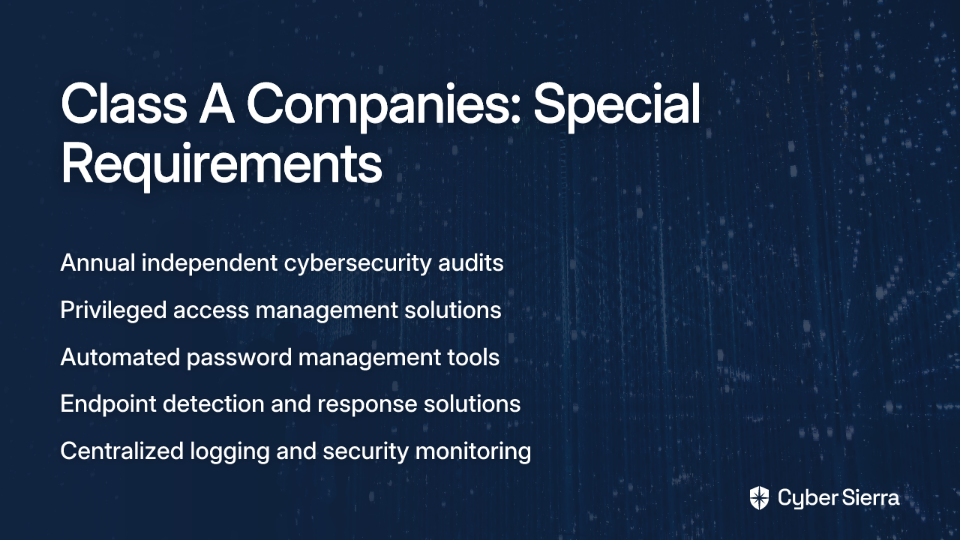
blog-hero-background-image
Governance & Compliance

How to Choose a Compliance Management System

backdrop
Table of Contents

Join thousands of professionals and get the latest insight on Compliance & Cybersecurity.


You've been tasked with finding a compliance management system for your organization, but the sea of options is overwhelming. Every vendor claims to have the perfect solution, yet you're struggling to find one that's both reasonably priced and scalable for your needs. As you wade through spreadsheets tracking compliance requirements, you can't help but wonder if there's a better way to manage policies, vendor relationships, and risk assessments without breaking the bank.

The frustration is real—most compliance tools seem either too complex, too expensive, or simply not designed with your specific requirements in mind. Meanwhile, regulatory requirements continue to pile up, and the stakes of non-compliance grow ever higher.

Understanding Compliance Management Systems

A Compliance Management System (CMS) is more than just software—it's a structured framework designed to ensure your organization adheres to relevant laws, regulations, industry standards, and internal policies. An effective CMS helps you:

  • Systematically identify and mitigate compliance risks
  • Document and track compliance activities
  • Streamline audit processes
  • Demonstrate due diligence to regulators and stakeholders

The importance of implementing a robust CMS cannot be overstated. In May 2023, Meta was fined a staggering $1.3 billion for GDPR violations, highlighting the severe consequences of compliance failures. Beyond avoiding penalties, a well-implemented CMS protects your reputation, strengthens customer trust, and improves operational efficiency.

According to a McKinsey study, 85% of consumers prioritize a company's data privacy practices before making purchasing decisions. Compliance isn't just a legal obligation—it's increasingly becoming a competitive advantage.

The Key to Finding the Right CMS: Define Your Requirements First

Before diving into vendor evaluations, take the time to clearly define what you need from a compliance management system. This upfront investment will save you considerable time, expense, and frustration later.
Step 1: Assess Your Regulatory Landscape

Start by identifying all regulations relevant to your organization:

  • Industry-specific regulations: HIPAA for healthcare, PCI DSS for payment processing, etc.
  • Geographic regulations: GDPR for European operations, CCPA for California customers, etc.
  • Framework requirements: SOC2, ISO 27001, NIST 800-53, CIS Framework
  • Contract obligations: Client or partner-mandated compliance requirements

"Make sure your process is solid before investing in a dedicated/expensive solution," advises a senior compliance professional in a Reddit discussion. "Ensure the tool fits all of your current and near-term needs—don't try to create processes based on what any given tool can do."

Step 2: Map Your Current Compliance Processes

Document how you currently manage compliance:

  • What tools are you using? (Many organizations start with spreadsheets)
  • Who's responsible for various compliance tasks?
  • What are the pain points in your current approach?
  • Where are the compliance gaps or inefficiencies?

Step 3: Identify Key Stakeholders

Compliance touches multiple departments. Identify and involve stakeholders from:

  • Legal
  • IT security
  • Risk management
  • Operations
  • Executive leadership

"The biggest challenge is getting buy-in from leadership," notes a GDPR compliance manager in a forum discussion. "Cultural change is also one big challenge as people don't understand nor wish to understand that we need to identify and minimize risks specific to data."

Essential Features to Look for in a Compliance Management System

Based on your requirements gathering, prioritize these key features when evaluating potential CMS solutions:

1. Multi-Framework Compliance Management

Look for a system that can handle multiple regulatory frameworks simultaneously. This allows you to:

  • Map overlapping requirements across different regulations
  • Avoid redundant compliance activities
  • Streamline evidence collection for multiple frameworks

For example, if you need to comply with both SOC2 and ISO 27001, your CMS should help you identify common controls to satisfy both frameworks efficiently.

2. Automated Evidence Collection and Validation

Manual evidence gathering is one of the most time-consuming aspects of compliance management. A good CMS will:

  • Integrate with your existing systems to automatically collect evidence
  • Validate control effectiveness through continuous monitoring
  • Alert you to control failures or gaps

Cyber Sierra's Continuous Control Monitoring (CCM) module exemplifies this approach by automating control testing and validation, detecting exceptions in real-time, and providing clear visibility into your security posture through continuous monitoring rather than point-in-time assessments.

3. Risk Assessment and Management

Your CMS should help you:

  • Identify and assess compliance risks
  • Prioritize remediation efforts based on risk levels
  • Track risk treatment activities
  • Generate risk reports for management and auditors

4. Vendor/Third-Party Risk Management

Many compliance failures originate from third-party relationships. An effective CMS will:

  • Streamline vendor assessment questionnaires
  • Track vendor compliance status
  • Monitor vendors for ongoing compliance
  • Manage remediation of vendor-related risks

"Most of the tools are just not built with MSPs in mind, leaving gaps in essential features we need," mentions an MSP owner in a Reddit thread. If you're an MSP or manage multiple client environments, ensure your CMS can handle multi-tenant operations efficiently.

5. Policy and Document Management

Your CMS should provide:

  • A centralized repository for compliance documentation
  • Version control for policies and procedures
  • Automated policy review and approval workflows
  • Evidence linking policies to specific compliance requirements

6. Task Management and Workflow Automation

An effective CMS will:

  • Assign compliance tasks to appropriate individuals
  • Track task status and deadlines
  • Send automated reminders for pending tasks
  • Escalate overdue items to management

7. Reporting and Analytics

Look for robust reporting capabilities, including:

  • Compliance dashboards with real-time status information
  • Gap analysis reports
  • Audit-ready evidence packages
  • Executive-level summary reports

8. User-Friendly Interface and Implementation

Even the most feature-rich CMS won't deliver value if your team can't or won't use it. Evaluate:

  • Intuitive navigation and workflows
  • Customizable dashboards
  • Reasonable implementation timeframe
  • Available training and support resources

Cost Considerations and ROI Analysis

A common pain point expressed in multiple online discussions is finding a compliance solution "that doesn't break the bank." When evaluating the cost of a CMS, consider:

1. Total Cost of Ownership (TCO)

Look beyond the initial purchase price to understand:

  • Implementation costs
  • Training expenses
  • Ongoing maintenance fees
  • Required internal resources
  • Integration costs with existing systems

2. Return on Investment (ROI)

Calculate potential ROI by considering:

  • Time savings from automation
  • Reduced audit preparation costs
  • Lower risk of non-compliance penalties
  • Enhanced ability to win business that requires compliance certifications
  • Improved operational efficiency

3. Scalability

Ensure the CMS can grow with your organization:

  • Does pricing scale reasonably as you add users or compliance frameworks?
  • Can the system handle increasing volumes of evidence and documentation?
  • Will it support new regulations as they emerge?

"We've been having issues finding one that is reasonably priced and scalable for our client base," reports an MSP in a Reddit thread. This highlights the importance of finding a solution with flexible pricing models that align with your business structure.

Implementation Strategies for Success

Selecting the right CMS is only half the battle. A successful implementation requires careful planning and execution:

1. Develop a Phased Implementation Plan

Rather than attempting to implement everything at once:

  • Start with your most critical compliance requirements
  • Add additional frameworks incrementally
  • Establish early wins to build momentum and stakeholder buy-in

2. Secure Leadership Support

As noted by compliance professionals, leadership buy-in is crucial:

  • Communicate the business case for the CMS
  • Highlight both compliance benefits and operational improvements
  • Connect compliance objectives to business goals
  • Provide regular updates on implementation progress and ROI

3. Invest in Training and Change Management

Address cultural resistance through:

  • Comprehensive training programs
  • Clear communication about why changes are necessary
  • Recognition of compliance champions
  • Integration of compliance into performance expectations

4. Establish Metrics for Success

Define how you'll measure the effectiveness of your CMS:

  • Reduction in time spent on compliance activities
  • Decrease in compliance findings or gaps
  • Improved audit outcomes
  • Enhanced risk visibility and management

Evaluating CMS Vendors and Solutions

When you're ready to evaluate specific vendors, consider these recommended approaches:

1. Create a Shortlist Based on Your Requirements

Start by identifying vendors that:

  • Support your specific regulatory frameworks
  • Offer the key features you've prioritized
  • Align with your budget constraints
  • Have experience with organizations similar to yours

Based on discussions in professional forums, solutions worth considering include:

  • Apptega: Focuses on compliance management with reasonable pricing for smaller businesses
  • ControlMap: A GRC solution with strong capabilities, though some users express concerns about roadmap development
  • Compliance Scorecard: Custom-built for MSPs, addressing unique challenges in multi-client environments
  • StandardFusion: Mentioned positively by users for its functionality, though pricing details vary

2. Request Detailed Demonstrations

During vendor demos, ensure they show:

  • How their system addresses your specific use cases
  • Real examples of the workflows you'll use most frequently
  • Integration capabilities with your existing tools
  • Reporting and dashboard functionality

Don't settle for generic presentations—insist on seeing how the system would work in your environment.

3. Check References and Reviews

Speak with current customers in your industry to understand:

  • Implementation challenges they faced
  • How responsive the vendor is to support requests
  • Whether the system delivered the expected benefits
  • Any limitations they've discovered

4. Evaluate Vendor Stability and Roadmap

Consider the vendor's:

  • Financial stability and market position
  • Product development roadmap
  • Responsiveness to customer feedback
  • Approach to staying current with regulatory changes

One MSP expressed concern about a vendor's roadmap: "I worry about the roadmap will be since [the vendor] has been difficult to provide partner feedback to with other products I am using from them." This highlights the importance of choosing a vendor that actively incorporates user feedback.

How Modern CMS Solutions Are Evolving

The compliance management landscape continues to evolve, with several important trends:

1. AI and Automation

Advanced CMS platforms now incorporate AI to:

  • Automatically map controls across multiple frameworks
  • Analyze compliance data for risk patterns
  • Suggest remediation actions
  • Continuously validate control effectiveness

Cyber Sierra's platform exemplifies this trend by using AI to instill automation, continuity, and intelligence into cybersecurity programs, moving away from periodic manual checks toward proactive, near real-time risk management.

2. Continuous Monitoring vs. Point-in-Time Assessment

Traditional compliance focused on point-in-time assessments—essentially snapshots of compliance status that quickly became outdated. Modern systems utilize continuous monitoring to:

  • Provide real-time visibility into compliance status
  • Detect control failures as they occur
  • Enable immediate remediation
  • Support a more dynamic approach to compliance

3. Integration of GRC with Security Operations

Forward-thinking organizations are breaking down silos between compliance and security by:

  • Unifying governance, risk, and compliance activities
  • Integrating compliance controls with security operations
  • Using security data to demonstrate compliance
  • Aligning compliance and security objectives

Cyber Sierra's platform reflects this integration through its comprehensive approach that includes Continuous Control Monitoring, Third-Party Risk Management, GRC automation, and Threat Intelligence in a single unified solution.

Final Recommendations

Choosing the right compliance management system is a significant decision that can dramatically impact your organization's efficiency, risk posture, and compliance outcomes. Based on user experiences and best practices:

  1. Start with process, not technology: Ensure you have clearly defined compliance processes before selecting a tool.
  2. Prioritize user experience: Even the most powerful system will fail if your team finds it difficult to use.
  3. Consider scalability: Select a system that can grow with your organization and adapt to new regulations.
  4. Focus on automation: Look for solutions that minimize manual effort through intelligent automation and integration.
  5. Plan for cultural adoption: Invest in change management to ensure the system is embraced across your organization.

By following a structured approach to selecting and implementing a compliance management system, you can transform compliance from a burdensome obligation into a strategic advantage that protects your organization while creating operational efficiencies.

For organizations seeking comprehensive compliance automation with continuous monitoring capabilities, Cyber Sierra's integrated platform offers a modern approach that addresses many of the pain points discussed in this article—from simplifying compliance across multiple frameworks to providing real-time risk visibility and automating evidence collection.

Frequently Asked Questions (FAQ)

What is a Compliance Management System (CMS)?

A Compliance Management System (CMS) is a structured framework, often supported by software, designed to ensure your organization adheres to relevant laws, regulations, industry standards, and internal policies. It helps organizations systematically identify and mitigate compliance risks, document and track compliance activities, streamline audit processes, and demonstrate due diligence to regulators and stakeholders, ultimately protecting the organization's reputation and improving operational efficiency.

Why is it crucial to define requirements before choosing a CMS?

Defining your requirements first is crucial because it ensures you select a CMS that genuinely fits your organization's specific needs, saving considerable time, expense, and frustration later. This involves assessing your regulatory landscape (e.g., HIPAA, GDPR, SOC2), mapping current compliance processes to identify pain points, and involving key stakeholders to get comprehensive buy-in and understand diverse needs across departments like legal, IT, and operations.

What are the most essential features to look for in a CMS?

Essential features include multi-framework compliance management, automated evidence collection and validation, robust risk assessment and management tools, vendor/third-party risk management capabilities, comprehensive policy and document management, task management with workflow automation, insightful reporting and analytics, and a user-friendly interface. These features collectively help streamline compliance, reduce manual effort, and provide clear visibility into your compliance posture.

How can a CMS help with managing multiple compliance frameworks?

A CMS helps manage multiple compliance frameworks by providing a centralized platform to map overlapping requirements across different regulations (like SOC2, ISO 27001, and GDPR). This allows organizations to avoid redundant compliance activities, streamline evidence collection by linking a single piece of evidence to multiple controls, and efficiently demonstrate adherence to various standards simultaneously.

What is the advantage of continuous monitoring in a CMS?

The primary advantage of continuous monitoring in a CMS is its ability to provide real-time visibility into an organization's compliance status, as opposed to outdated point-in-time assessments. This proactive approach allows for the immediate detection of control failures or gaps, enabling swift remediation, reducing risk exposure, and supporting a more dynamic and effective compliance program rather than relying on periodic manual checks.

What are key strategies for a successful CMS implementation?

Key strategies for a successful CMS implementation include developing a phased implementation plan starting with critical requirements, securing strong leadership support by communicating the business case, investing in comprehensive training and change management to address cultural resistance, and establishing clear metrics to measure the system's effectiveness, such as reduced compliance activity time or improved audit outcomes.

By making an informed choice based on your specific needs and following the guidance outlined above, you can find a compliance management system that not only meets your regulatory requirements but also delivers meaningful business value.

blog-hero-background-image
Governance & Compliance

What is KRI in Operational Risk? A Guide for CISOs and Senior Leadership

backdrop
Table of Contents

Join thousands of professionals and get the latest insight on Compliance & Cybersecurity.


You're staring at yet another cybersecurity report filled with metrics and dashboards. As a CISO or senior leader, you've mastered Key Performance Indicators (KPIs), but there's another acronym that keeps appearing in risk management discussions: KRIs.

What exactly are Key Risk Indicators (KRIs) in operational risk management, how do they differ from KPIs, and why should they matter to your cybersecurity strategy?

Understanding Key Risk Indicators (KRIs)

Key Risk Indicators (KRIs) are quantifiable metrics designed to provide early warning signals about increasing risk exposure in your organization. Unlike KPIs, which measure past performance, KRIs are forward-looking measures that help predict potential future problems before they materialize.

"I'm trying to get a clearer understanding of KRIs, Risk Tolerance, and Risk Appetite in risk management. I understand that these are all important concepts, but I'm confused about how they differ from each other," shares a cybersecurity professional in a recent online discussion. This confusion isn't uncommon among security leaders.

While KPIs tell you if you're meeting your performance goals, KRIs indicate if you're operating within your defined risk appetite. They serve as the canary in the coal mine, alerting you to emerging risks that could impact your organization's security posture and business objectives.

Key Characteristics of Effective KRIs

For a KRI to be valuable in operational risk management, particularly in cybersecurity contexts, it should possess these essential characteristics:

  1. Measurable: KRIs must be quantifiable and objective, allowing for consistent measurement over time.
  2. Predictive: They should provide forward-looking insights rather than just historical data.
  3. Comparable: Effective KRIs enable comparison against thresholds, past periods, or industry benchmarks.
  4. Actionable: When a KRI signals an issue, there should be clear actions that can be taken in response.
  5. Relevant: KRIs should focus on significant risks that could materially impact business objectives.

KRIs can be lagging (measuring something that has already happened), current (reflecting present conditions), or leading (indicating future developments). The most valuable KRIs for cybersecurity are typically leading indicators that give you time to act before a risk materializes.

KRIs vs. KPIs: Understanding the Distinction

A common source of confusion is the difference between KRIs and KPIs. As one cybersecurity expert noted, "I ask, as most of the research I find on this is all related to KPIs, so I'm not looking for 'Key Performance Indicators' as I already have a laundry list of those."

Here's how they differ:

Key Risk Indicators (KRIs)Key Performance Indicators (KPIs)
Measure risk exposureMeasure performance success
Forward-lookingTypically backward-looking
Focus on potential negative eventsFocus on achieving positive targets
Alert to problems before they occurTrack progress against goals
Example: Percentage of unpatched critical vulnerabilitiesExample: Number of incidents resolved within SLA

Types of KRIs in Cybersecurity Operations

In the cybersecurity domain, KRIs generally fall into three categories:

1. Technical KRIs

These focus on the technical aspects of your security posture:

  • Percentage of systems with critical vulnerabilities unpatched after X days
  • Number of unauthorized access attempts
  • Mean time to detect (MTTD) security incidents
  • Percentage of shadow IT resources discovered
  • Number of misconfigurations in cloud environments

2. Operational KRIs

These measure the effectiveness of your security operations:

  • Percentage of employees who failed phishing simulations
  • Mean time to resolve (MTTR) security incidents
  • Percentage of access reviews completed on time
  • Number of policy exceptions granted
  • Percentage of security alerts that go uninvestigated

3. Strategic KRIs

These align with broader business objectives:

  • Percentage of critical systems without disaster recovery testing
  • Regulatory compliance gaps
  • Third-party vendor risk scores exceeding thresholds
  • Cyber insurance coverage gaps relative to identified risks
  • Security debt accumulation rate

A well-designed set of KRIs should span all three categories to provide comprehensive risk visibility across your organization.

The Importance of KRIs in Cybersecurity Risk Management

"Realistically, leadership really struggles with defining this because they're afraid it could be used against them (accepting risks others wouldn't) or hold them back (avoiding risks they'd sometimes take to innovate or win big)," states a CISO in an online forum, highlighting the challenges many organizations face when implementing risk indicators.

KRIs help overcome these challenges by:

1. Providing Early Warning Signals

By the time a security incident occurs, it's already too late for prevention. KRIs help you spot potential issues while there's still time to address them. For example, an increase in failed login attempts might indicate an impending brute force attack, allowing your team to implement additional protections before a breach occurs.

2. Supporting Data-Driven Decision Making

"It still seems an injustice for such a hard working team to not have their accomplishments seen or be recognized as a team that help enable the business to generate profit rather than be a blocker," notes one security professional. KRIs provide objective data that can help security teams demonstrate their value and justify security investments to business leaders.

3. Enabling Risk-Based Resource Allocation

With limited security resources, KRIs help prioritize where to focus attention and investment. By identifying areas of heightened risk, you can allocate resources more effectively to address the most significant threats to your organization.

4. Facilitating Regulatory Compliance

Many regulatory frameworks require risk monitoring and reporting. Well-designed KRIs can help satisfy these requirements while providing actual value to your organization beyond mere compliance checking.

5. Breaking Down Silos Between Security and Business

"How did you connect the metrics to the business? What is the business doing with the reports, how do you follow up on them?" asks one cybersecurity leader. KRIs that align with business objectives help bridge the gap between technical security concerns and business priorities, facilitating more productive conversations about risk.

Implementing Effective KRIs in Your Organization

Establishing useful KRIs isn't a one-time exercise but an ongoing process. Here's a structured approach to implementing KRIs in your cybersecurity program:

1. Identify Your Critical Risks

Start by identifying the most significant risks to your organization's information security. These might include:

  • Data breaches
  • Ransomware attacks
  • Business continuity disruptions
  • Compliance violations
  • Third-party security failures

Use existing risk assessments, threat intelligence, and incident history to prioritize these risks based on their potential impact and likelihood.

2. Define Meaningful KRIs

For each critical risk, identify metrics that could serve as early warning signals. The best KRIs are:

  • Directly related to a specific risk
  • Based on available and reliable data
  • Simple enough to be understood by all stakeholders
  • Actionable when thresholds are exceeded

"For Senior Management KRIs, I know they should be higher level view and should represent the most relevant risks to the company, but I'm having a hard time coming up with what those KRIs are," shares one security professional. Focus on KRIs that relate to the business impact of security risks rather than technical details when reporting to senior management.

3. Establish Thresholds and Triggers

For each KRI, define:

  • Normal range: The expected values during regular operations
  • Warning threshold: The point at which attention is warranted
  • Critical threshold: The point at which immediate action is required

These thresholds should be informed by historical data, industry benchmarks, and your organization's risk appetite. Remember that "Risk Tolerance is an admission that risk management controls can rarely be 100% effective 100% of the time," as one risk professional aptly puts it.

4. Implement Monitoring and Reporting Mechanisms

Develop processes and systems to collect KRI data regularly and efficiently. As one practitioner asks, "How much did you automate? Do you pull the numbers manually, what sources and data points do you use and how much value do they bring to the organization?"

Automation is key to maintaining reliable KRI tracking without overwhelming your team. Solutions like Cyber Sierra's Continuous Control Monitoring (CCM) can automate data collection for KRIs, providing near real-time visibility into your security posture without the manual effort traditionally required.

5. Review and Evolve Your KRIs

KRIs should evolve as your threat landscape and business priorities change. Regularly review your KRIs to ensure they remain relevant and valuable. Remove or replace indicators that no longer provide meaningful insights.

Common Challenges in KRI Implementation

Despite their value, implementing effective KRIs comes with several challenges:

1. Data Quality Issues

"The phrase 'garbage in, garbage out' applies," warns one risk manager. KRIs are only as good as the data they're based on. Ensure you have reliable data sources and validation processes to maintain KRI integrity.

2. Setting Appropriate Thresholds

Finding the right balance for KRI thresholds can be difficult. Set them too sensitively, and you'll face alert fatigue; set them too high, and you'll miss important warning signs. Threshold calibration is an ongoing process that should be refined based on experience.

3. Securing Executive Buy-in

"The company I currently work for takes the approach at a senior/board level to put trust into the cybersecurity team without necessarily having any visibility as to whether they are rightly or wrongly placing their blind faith into the team," shares one security leader. Without executive understanding and support, KRIs may not receive the attention and resources they need.

4. Maintaining Focus on What Matters

It's easy to create too many KRIs, leading to information overload. Focus on a manageable set of indicators that provide the most valuable insights into your most significant risks.

Sample KRIs for Cybersecurity Leaders

To help you get started, here are some practical KRIs that many organizations find valuable:

  1. Vulnerability Management
    • Percentage of critical systems with high/critical vulnerabilities older than 30 days
    • Average age of open critical vulnerabilities
    • Ratio of new vulnerabilities to remediated vulnerabilities per month
  2. Identity and Access Management
    • Number of accounts with dormant privileges
    • Percentage of privileged accounts without multi-factor authentication
    • Number of users with excessive permissions relative to role requirements
  3. Security Awareness and Training
    • Phishing simulation click rates
    • Percentage of employees with overdue security training
    • Number of reported security incidents from employees
  4. Third-Party Risk
    • Percentage of vendors missing security assessments
    • Number of critical vendors with declining security ratings
    • Average time to remediate identified third-party risks
  5. Incident Detection and Response
    • Mean time to detect (MTTD) security incidents
    • Percentage of security alerts going uninvestigated after 24 hours
    • Number of recurring incidents of the same type

How Cyber Sierra Supports KRI Implementation

For organizations looking to enhance their KRI capabilities, platforms like Cyber Sierra offer integrated solutions that can streamline implementation and ongoing management. Cyber Sierra's approach addresses several key challenges in KRI management:

  • Automated Data Collection: Cyber Sierra's Continuous Control Monitoring (CCM) automatically gathers data from across your technology environment, ensuring KRIs are based on current, accurate information without manual effort.
  • Centralized Control Repository: By maintaining a central inventory of controls and their effectiveness, Cyber Sierra provides the foundation needed for meaningful KRIs that reflect your true security posture.
  • Real-Time Risk Intelligence: Rather than point-in-time assessments, Cyber Sierra offers near real-time visibility into changing risk conditions, enabling truly predictive KRIs that give you time to act before risks materialize.
  • Multi-Framework Support: For organizations managing compliance with multiple frameworks, Cyber Sierra maps controls and KRIs across frameworks like NIST, ISO 27001, and PCI DSS, reducing duplication and providing clearer risk visibility.

Conclusion

In today's complex threat landscape, reactive security measures are insufficient. Key Risk Indicators provide the forward-looking insights that CISOs and senior leaders need to identify and mitigate risks before they result in security incidents or compliance violations.

By implementing well-designed KRIs that align with business objectives, security leaders can enhance risk visibility, improve resource allocation, and better communicate security's value to the organization. Remember that effective KRI implementation is an ongoing journey of refinement and evolution, not a one-time project.

As you develop your KRI strategy, focus on creating indicators that are measurable, predictive, and actionable. Start with a small set of KRIs targeting your most critical risks, and expand your program as you gain experience and demonstrate value.

The goal isn't perfect risk prediction—as one practitioner noted, "Risk Tolerance reflects an acknowledgment of the limitations in risk management effectiveness." Instead, aim for KRIs that give you enough advance warning to take meaningful action against emerging threats, ultimately enhancing your organization's security resilience.

By embracing KRIs as a core component of your operational risk management strategy, you'll be better equipped to navigate the ever-evolving cybersecurity landscape and protect your organization's most valuable assets.

blog-hero-background-image
Governance & Compliance

How ISO 27001 Helps You Sell: Turning Compliance into a Competitive Edge

backdrop
Table of Contents

Join thousands of professionals and get the latest insight on Compliance & Cybersecurity.


You've invested time and resources into strengthening your security posture. Your team has implemented robust controls, documented processes, and maintained vigilance against threats. But when prospects ask if you have ISO 27001 certification, you hesitate—is this just another expensive checkbox, or could it actually help you win more business?

Many organizations question the value of pursuing ISO 27001. With concerns about high implementation costs (averaging $25,000 for audits and technology investments) and uncertainty about the return on investment, it's natural to wonder if certification is worth the effort.

The reality? ISO 27001 certification can be a powerful sales enabler when leveraged strategically. Let's explore how.

Building Trust in an Era of Data Breaches

In today's digital landscape, where the average cost of a data breach has reached $4.88 million, customers are increasingly cautious about who they trust with their data. ISO 27001 certification serves as an internationally recognized stamp of approval, demonstrating your commitment to protecting sensitive information.

This matters because:

  • Prospects often use compliance certifications as a preliminary screening mechanism
  • Enterprise clients frequently require ISO 27001 in their vendor security assessments
  • Your certification signals reliability in an uncertain security environment

As one security professional noted, "Clients regularly ask if we've got ISO 27001," highlighting how certification has become a baseline expectation in many sales conversations.

Streamlining the Sales Cycle

Without ISO 27001 certification, your sales team likely faces lengthy security questionnaires and custom audits for each prospect. This extends sales cycles and consumes valuable resources.

ISO 27001 certification can dramatically simplify this process:

  1. Reduced Security Questionnaires: Many organizations will accept your ISO 27001 certification as evidence of strong security practices, reducing or eliminating the need for custom questionnaires.
  2. Faster Procurement Approval: Security teams can more quickly approve vendors with recognized certifications, removing bottlenecks in the sales process.
  3. Simplified Due Diligence: Rather than explaining your security practices from scratch with each prospect, your certification provides a standardized framework for discussions.

Companies with ISO certification report an average sales growth of 10% within a year, partly due to these streamlined processes.

Unlocking Access to Regulated Markets

For organizations selling to heavily regulated industries or international markets, ISO 27001 often serves as a market entry requirement rather than just a differentiator.

Key markets where ISO 27001 certification can unlock opportunities include:

  • Financial Services: Banks and financial institutions typically require vendors to demonstrate robust security practices through certifications.
  • Healthcare: Organizations handling patient data need assurance that their vendors maintain appropriate safeguards.
  • Government Contracts: Many government agencies require contractors to maintain specific security certifications.
  • International Business: While SOC 2 is primarily recognized in the US, ISO 27001 has global recognition, making it essential for international expansion.

As one IT professional explained, "SOC2 is asked for if the company is US-based, but if the company does business outside the US, then SOC2 isn't really recognized, and ISO is preferred."

Gaining Competitive Advantage

When positioned effectively, ISO 27001 certification creates meaningful differentiation in competitive sales situations:

  1. Eliminating Security Objections: When competing against non-certified vendors, your certification removes security concerns as a potential reason to reject your solution.
  2. Demonstrating Organizational Maturity: Certification signals that your organization has the discipline and processes to deliver consistent, quality service.
  3. Creating Objective Differentiation: In markets where products or services have similar features, security certification provides a clear, objective difference between options.

Over 70% of companies believe ISO certification helps them win bids over non-certified competitors, particularly in enterprise deals where security requirements are stringent.

How to Maximize ISO 27001's Sales Impact

Obtaining certification is just the first step. To truly leverage ISO 27001 for sales success:

1. Train Your Sales Team

Ensure your sales representatives understand:

  • The basics of ISO 27001 and what it covers
  • How to address common prospect questions about your certification
  • When and how to position certification as a competitive advantage

2. Integrate Certification into Marketing

  • Feature your ISO 27001 certification prominently on your website
  • Include certification logos in sales presentations and proposals
  • Create dedicated content explaining your security commitment
  • Highlight certification in case studies and customer testimonials

3. Align with Your Actual Security Practices

The most effective approach is ensuring your certification reflects genuine security practices. As one professional noted, "compliance is all about what you put into it." Prospects can quickly spot when certification is merely a checkbox rather than a reflection of true security culture.

When ISO 27001 Might Not Drive Sales

While valuable, ISO 27001 isn't a universal sales accelerator. Consider these factors before pursuing certification solely for sales purposes:

  • Target Market Requirements: Some industries or regions place less emphasis on ISO 27001. As one expert advised, "go ask the sales/marketing team and see what your customers are being asked for."
  • Existing Client Demand: If current clients aren't requesting certification, evaluate whether prospective customers will require it.
  • Resource Constraints: The certification process requires significant investment in time, money, and organizational focus that might be better directed elsewhere if sales impact will be minimal.

The Role of Technology in ISO 27001 Compliance

Maintaining ISO 27001 compliance can be resource-intensive, but modern compliance platforms like Cyber Sierra can significantly reduce this burden. Cyber Sierra's Continuous Control Monitoring (CCM) module helps organizations:

  • Build a central controls repository with near real-time updates
  • Automate evidence collection for audits
  • Manage controls across multiple compliance frameworks beyond just ISO 27001
  • Detect exceptions and anomalies in real-time

By streamlining compliance maintenance, these tools free your team to focus on leveraging certification for sales rather than just maintaining it.

Conclusion: From Cost Center to Revenue Driver

ISO 27001 certification represents one of the rare opportunities to transform what many view as a cost center (security and compliance) into a revenue-driving asset.

When implemented properly and positioned strategically, certification can shorten sales cycles, unlock new markets, differentiate your offerings, and build deeper trust with prospects. The key lies in understanding your market's requirements, communicating your certification effectively, and ensuring your security practices genuinely deliver on the promises your certification makes.

Rather than asking if you can afford to pursue ISO 27001 certification, the better question might be: can your sales team afford to compete without it?

Frequently Asked Questions (FAQ)

What is ISO 27001 certification?

ISO 27001 certification is an internationally recognized standard for an Information Security Management System (ISMS). Achieving this certification demonstrates that your organization has implemented a systematic and robust approach to managing sensitive company information, ensuring its confidentiality, integrity, and availability, which is a key concern for prospective customers.

How can ISO 27001 certification help increase sales?

ISO 27001 certification can directly contribute to increased sales by building crucial trust with data-conscious prospects, streamlining lengthy sales cycles through reduced security questionnaires, unlocking access to regulated industries and international markets, and providing a clear competitive advantage over non-certified vendors.

Is ISO 27001 certification expensive to obtain?

Yes, obtaining ISO 27001 certification involves costs, often averaging around $25,000 for audits and technology investments. However, businesses should view this not just as an expense but as a strategic investment that can significantly enhance sales opportunities and market access, potentially offering a strong return.

When is ISO 27001 certification most crucial for winning deals?

ISO 27001 certification is particularly vital for sales success when your business targets enterprise-level clients, operates in heavily regulated sectors like finance or healthcare, bids for government contracts, or aims to expand into international markets where ISO 27001 is a widely accepted benchmark for security.

What is the main difference between ISO 27001 and SOC 2 in a sales context?

The primary difference for sales is geographic recognition: SOC 2 is predominantly recognized and requested by US-based companies, while ISO 27001 holds global prestige. If your company conducts business or seeks to expand outside the US, ISO 27001 certification is often preferred by international prospects and can be more impactful in sales conversations.

How can a company maximize the sales benefits of its ISO 27001 certification?

To maximize the sales impact of ISO 27001, companies should thoroughly train their sales teams on its significance, prominently feature the certification in all marketing materials (like websites and sales presentations), and critically, ensure the certification genuinely reflects strong, ongoing security practices, not just a superficial compliance checkbox.

Can technology help with leveraging ISO 27001 for sales?

Absolutely. Modern compliance platforms can automate and streamline many aspects of achieving and maintaining ISO 27001 compliance, such as evidence collection and continuous control monitoring. This frees up valuable internal resources, allowing your team to focus more on strategically using the certification as a sales enablement tool rather than being bogged down in manual compliance tasks.

Need help achieving or maintaining ISO 27001 compliance? Cyber Sierra's integrated compliance platform helps organizations streamline the certification process while providing continuous monitoring to maintain compliance between audits.

blog-hero-background-image
Governance & Compliance

Bridging Regulatory Agility Gaps: How CISOs Can Overcome Compliance Burdens with AI-Powered Automation

backdrop
Table of Contents

Join thousands of professionals and get the latest insight on Compliance & Cybersecurity.


You've just received notification of yet another regulatory update that impacts your cybersecurity compliance requirements. As you calculate the resources needed to adapt, you feel that familiar weight of dread—more processes to update, more documentation to revise, and more evidence to collect. Your team is already stretched thin managing existing compliance frameworks, and this new change threatens to derail strategic initiatives you've been planning for months.

This scenario has become all too common for Chief Information Security Officers (CISOs) across industries. As cybersecurity threats evolve and regulatory bodies respond with increasingly complex requirements, organizations find themselves caught in a constant scramble to maintain compliance while trying to advance their security posture.

The rapid pace of regulatory changes creates what we call "Regulatory Agility Gaps"—the growing divide between an organization's ability to adapt and the ever-accelerating rate of compliance requirements. These gaps represent significant operational pain points in Governance, Risk, and Compliance (GRC) cybersecurity management, draining resources and adding substantial overhead to already burdened security teams.

The Growing Burden of Regulatory Compliance

The regulatory landscape for cybersecurity has never been more complex or dynamic. According to the 2025 GRC Practitioner Survey, companies are facing mounting compliance overhead costs, with many organizations reporting that they spend upwards of 30% of their security budgets on compliance-related activities alone.

What makes this challenge particularly daunting is the fragmented nature of compliance requirements. Organizations often need to adhere to multiple frameworks simultaneously—GDPR, HIPAA, PCI DSS, NIST, ISO27001, and dozens of others depending on the industry and geographic footprint. Each framework brings its own set of controls, evidence requirements, and reporting cadences.

"We're constantly juggling multiple compliance requirements with overlapping but not identical controls," shared one CISO in a Reddit discussion. "It feels like we spend more time documenting our security than actually improving it."

The challenge is compounded by the unpredictable nature of regulatory updates. When new requirements emerge, security teams must quickly assess the impact, modify their controls, update documentation, and prepare for additional scrutiny during the next audit cycle. This reactive approach creates significant operational inefficiencies.

Key Pain Points in Regulatory Compliance Management

1. Resource-Intensive Evidence Collection

Perhaps the most tedious aspect of compliance is the evidence gathering process. Security teams spend countless hours collecting, organizing, and presenting evidence to demonstrate compliance with hundreds of controls across multiple frameworks.

"The tediousness and time consumption of evidence gathering during audits is soul-crushing," noted a GRC professional in a Reddit thread. "We spend weeks collecting screenshots, logs, and documentation that quickly become outdated."

2. Unpredictable Compliance Timelines

Many organizations struggle with estimating how long it will take to achieve compliance with new regulations. This uncertainty makes resource allocation challenging and can delay strategic initiatives as teams scramble to address compliance gaps.

"Sales representatives making misleading claims about reducing ISO27001 audit times are a major frustration," expressed another CISO. "There's simply no way to guarantee fast compliance when the process depends on so many organizational factors."

3. Siloed Compliance Activities

Traditional compliance processes often operate in silos, with different teams managing different frameworks using different tools and methodologies. This fragmentation leads to duplicated efforts, inconsistent control implementations, and gaps in coverage.

4. Continuous Monitoring Challenges

Compliance isn't a one-time achievement but rather an ongoing state that requires continuous monitoring and maintenance. Many organizations struggle to implement effective continuous monitoring capabilities, leaving them vulnerable to compliance drift between audit cycles.

5. Technical Skill Gaps in GRC Teams

Many GRC professionals come from audit, legal, or risk backgrounds and may lack deep technical understanding of the security controls they're tasked with managing. This knowledge gap can lead to misinterpretation of requirements or ineffective control implementations.

"CISOs often struggle to grasp basic security concepts and differentiate between various cybersecurity elements," noted one security professional in a discussion about GRC leadership. "This makes it challenging to address compliance effectively."

The Promise of AI and Automation in Compliance Management

The good news is that emerging technologies—particularly artificial intelligence, machine learning, and automation—offer promising solutions to these regulatory agility gaps. By leveraging these technologies, organizations can transform their approach to compliance from a reactive, resource-intensive burden to a streamlined, proactive function.

According to MetricStream, 43.12% of GRC professionals are already evaluating AI solutions to enhance compliance efficiency. This shift toward automation is gaining momentum as organizations recognize the substantial benefits it can deliver.

Automating Evidence Collection and Mapping

Modern compliance automation platforms can continuously collect and organize evidence from across the technology stack, dramatically reducing the manual effort required during audits. These systems can automatically map controls to relevant evidence, highlight compliance gaps, and maintain an always-current repository of documentation.

"Automation tools can significantly reduce the manual effort involved in compliance tasks," according to Zluri's blog on compliance automation. "What once took weeks can now be accomplished in days or even hours."

Real-Time Compliance Monitoring

AI-powered monitoring tools can provide continuous visibility into compliance status, alerting teams when controls drift out of alignment with requirements. This real-time insight enables rapid remediation and eliminates the compliance gaps that often develop between audit cycles.

Cross-Framework Control Mapping

Advanced compliance platforms can map controls across multiple frameworks, identifying overlaps and allowing organizations to implement unified controls that satisfy requirements across several regulations simultaneously. This approach, sometimes called "comply once, apply many," dramatically reduces redundant work.

Predictive Compliance Management

Perhaps most exciting is the potential for AI to predict the impact of regulatory changes before they occur. By analyzing regulatory trends, enforcement actions, and industry developments, these systems can help organizations prepare for likely compliance changes, transforming the approach from reactive to proactive.

Cyber Sierra: Pioneering AI-Powered Compliance Automation

Among the companies addressing these regulatory agility gaps, Cyber Sierra stands out with its innovative approach to compliance automation powered by advanced AI and large language models (LLMs).

Cyber Sierra's platform addresses the key pain points identified above through several groundbreaking capabilities:

1. Automated Evidence Collection and Validation

Cyber Sierra's platform connects to your existing security tools, cloud environments, and IT systems to automatically gather compliance evidence in real-time. Rather than scrambling to collect evidence during audit season, the system maintains a continuously updated repository of compliance artifacts, drastically reducing the manual effort required.

"The tediousness of evidence gathering during audits is a significant pain point for organizations," notes one GRC professional in a Reddit discussion. Cyber Sierra directly addresses this challenge by transforming evidence collection from a manual, point-in-time activity to an automated, continuous process.

2. AI-Powered Control Mapping

One of Cyber Sierra's most innovative features leverages large language models to automatically map organizational policies and procedures to specific control requirements across multiple frameworks. This capability eliminates the need for manual crosswalking between frameworks—a traditionally time-consuming and error-prone process.

When regulatory requirements change, the system automatically identifies affected controls and suggests necessary modifications to maintain compliance. This predictive approach helps organizations stay ahead of regulatory changes rather than constantly playing catch-up.

3. Continuous Compliance Monitoring

Unlike traditional approaches that assess compliance only during periodic audits, Cyber Sierra provides real-time visibility into compliance status. The platform continuously monitors control effectiveness and compliance posture, alerting teams to potential issues before they become audit findings.

"Need for constant monitoring to maintain compliance and reduce the stress of audits" is a common pain point identified in compliance discussions. Cyber Sierra transforms this challenge into an opportunity by making continuous monitoring effortless through automation.

4. Integrated Risk Management

Cyber Sierra doesn't treat compliance as an isolated function but integrates it with broader risk management activities. The platform helps organizations understand the risk implications of compliance gaps and prioritize remediation efforts based on actual risk exposure—not just audit schedules.

5. Natural Language Evidence Analysis

Perhaps most impressively, Cyber Sierra's LLM capabilities can analyze unstructured data sources—such as policy documents, meeting minutes, and training records—to identify relevant compliance evidence that might be overlooked in traditional manual processes. This capability uncovers evidence that exists but might not have been formally mapped to compliance requirements.

Real-World Results: Transforming Compliance from Burden to Value

Organizations implementing Cyber Sierra's platform report dramatic improvements in compliance efficiency and effectiveness:

  • Reduced evidence collection time: Teams report 70-80% reductions in time spent gathering and organizing compliance evidence.
  • Improved audit readiness: With continuously maintained evidence repositories, organizations remain audit-ready at all times, eliminating the frantic preparation that typically precedes audits.
  • Enhanced risk visibility: By connecting compliance activities to risk management, organizations gain a clearer understanding of how compliance relates to actual security posture.
  • Resource reallocation: Automation allows security professionals to shift from documentation tasks to strategic security initiatives that actually improve protection.

As one customer testimonial states: "Before implementing Cyber Sierra, we spent approximately 1,200 person-hours annually on ISO27001 compliance activities alone. After implementation, that figure dropped to under 300 hours—a 75% reduction—while simultaneously improving our compliance posture."

Best Practices for Addressing Regulatory Agility Gaps

While technology is a powerful enabler, organizations must also adopt best practices to maximize the benefits of compliance automation:

1. Adopt a Risk-Based Approach to Compliance

Not all compliance requirements carry equal risk. Organizations should prioritize their compliance efforts based on actual risk exposure rather than treating all controls as equally important. This approach ensures that limited resources are directed to the areas with the greatest security impact.

"CISOs face obstacles due to organizational politics when trying to enhance compliance measures," notes one security leader in a Reddit discussion. A risk-based approach provides objective criteria for prioritization, helping overcome political obstacles to effective compliance management.

2. Invest in Knowledge Development

"GRC roles require ongoing training and education to keep up with evolving regulations and technologies," according to security professionals discussing GRC careers. Organizations should invest in continuous education for their compliance teams, ensuring they understand both the regulatory requirements and the technical controls used to address them.

Cyber Sierra supports this need through built-in training modules that help bridge the knowledge gap between compliance requirements and technical implementation.

3. Build Cross-Functional Collaboration

Effective compliance requires collaboration between security, IT, legal, and business teams. Organizations should establish cross-functional working groups to address compliance challenges holistically, breaking down the silos that often impede effective compliance management.

"Frustration over the division between technical security and compliance roles" is a common theme in GRC discussions. By fostering collaboration between technical and compliance teams, organizations can overcome this division and build more effective security governance.

4. Establish Clear Compliance Metrics

Organizations should define clear, measurable objectives for their compliance programs. These metrics might include time to evidence collection, number of control gaps identified, or time to remediate compliance issues. By measuring these factors, organizations can demonstrate the value of their compliance investments and identify areas for improvement.

The Future of Compliance Management: AI-Driven and Value-Oriented

As regulatory requirements continue to evolve, the organizations that thrive will be those that embrace AI-driven automation to transform compliance from a burden to a value driver. By automating routine compliance tasks, organizations can redirect resources toward activities that actively improve security posture rather than merely documenting it.

Looking ahead, we can expect even greater integration between compliance and broader security operations. Advanced AI systems will not only automate evidence collection but also provide predictive insights into emerging compliance requirements and suggest proactive measures to address them before they become regulatory mandates.

The goal isn't just efficient compliance—it's leveraging compliance activities as a catalyst for meaningful security improvements. When approached strategically and supported by advanced automation, compliance can drive security maturity rather than distracting from it.

Conclusion: From Regulatory Burden to Strategic Advantage

Regulatory agility gaps represent a significant challenge for today's CISOs, creating substantial operational overhead and diverting resources from strategic security initiatives. However, by embracing AI-powered automation tools like Cyber Sierra, organizations can transform their approach to compliance management.

The future belongs to organizations that view compliance not as a checkbox exercise but as an integral component of their security and risk management strategy. By leveraging automation to handle routine compliance tasks, security leaders can redirect their focus toward activities that genuinely improve security outcomes—ultimately turning compliance from a burden into a strategic advantage.

As one CISO aptly put it: "We used to spend all our time documenting security. Now we spend our time improving it, and the documentation happens automatically." That transformation—from documentation-focused to improvement-focused—represents the true promise of AI-powered compliance automation.

For organizations ready to bridge their regulatory agility gaps, platforms like Cyber Sierra offer a compelling path forward—reducing compliance overhead, improving security outcomes, and transforming the role of the CISO from compliance manager to strategic security leader.

Frequently Asked Questions

What are "Regulatory Agility Gaps" in cybersecurity compliance?

Regulatory Agility Gaps describe the widening difference between an organization's ability to quickly adapt to new cybersecurity compliance rules and the increasing speed at which these regulations are introduced or updated. These gaps create significant operational challenges and resource drains. Security teams often find themselves in a constant scramble to update processes, revise documentation, and collect new evidence for multiple frameworks (e.g., GDPR, HIPAA, PCI DSS). This reactive approach can derail strategic security initiatives and increase overall risk.

Why is managing cybersecurity regulatory compliance so challenging?

Managing cybersecurity regulatory compliance is challenging due to the escalating volume and complexity of global and industry-specific regulations, the resource-intensive nature of manual compliance tasks, and the difficulty in maintaining continuous adherence. Key difficulties include:

  • Resource-intensive evidence collection: Manually gathering, organizing, and presenting proof for hundreds of controls is extremely time-consuming.
  • Unpredictable timelines: Estimating the effort for new regulations is hard, disrupting planning.
  • Siloed activities: Different teams managing different frameworks often leads to duplicated work.
  • Continuous monitoring difficulties: Ensuring ongoing compliance between audits is a major hurdle.
  • Technical skill gaps: GRC teams may lack deep technical understanding of controls.

How does AI and automation improve cybersecurity compliance processes?

AI and automation streamline cybersecurity compliance by automating repetitive tasks, providing real-time insights, and enabling a more proactive approach to managing regulatory requirements. Specifically, AI can:

  • Automate evidence collection: Continuously gather data from security tools and systems.
  • Enhance control mapping: Automatically map internal controls to various regulatory frameworks, identifying overlaps and gaps.
  • Enable real-time monitoring: Continuously track compliance status and alert teams to deviations.
  • Predict regulatory impact: Analyze trends to help organizations prepare for upcoming changes. This shifts compliance from a periodic, manual burden to an efficient, ongoing process.

What features should I look for in an AI-powered compliance automation platform like Cyber Sierra?

When evaluating an AI-powered compliance automation platform, look for features such as automated evidence collection and validation, AI-driven control mapping across multiple frameworks, continuous compliance monitoring, integrated risk management, and the ability to analyze unstructured data for evidence. For example, Cyber Sierra leverages Large Language Models (LLMs) to automatically map policies to control requirements and can analyze documents like meeting minutes for compliance evidence. It also integrates compliance with broader risk management, helping prioritize based on actual risk. Such features aim to significantly reduce manual effort, ensure audit readiness, and provide a clear view of the compliance posture.

What are the key best practices for effectively addressing regulatory agility gaps?

Effectively addressing regulatory agility gaps involves combining technology with strategic operational practices, including adopting a risk-based approach, investing in team knowledge, fostering cross-functional collaboration, and establishing clear compliance metrics.

  • Risk-Based Approach: Prioritize compliance efforts based on the actual risk exposure certain gaps represent.
  • Knowledge Development: Continuously train GRC and security teams on evolving regulations and technologies.
  • Cross-Functional Collaboration: Break down silos between security, IT, legal, and business units for a holistic compliance strategy.
  • Clear Metrics: Define and track key performance indicators (KPIs) for your compliance program to measure effectiveness and demonstrate value. While AI tools provide the mechanism for agility, these practices ensure the organization can fully leverage that technology.
toaster icon

Thank you for reaching out to us!

We will get back to you soon.