8 Best Manufacturing Compliance Software That Cuts Audit Prep From Weeks to Days

Join thousands of professionals and get the latest insight on Compliance & Cybersecurity.
Summary
- Each third-party cyber breach in manufacturing creates a cascade effect, impacting an average of 5.28 downstream partners.
- The convergence of IT and Operational Technology (OT) creates a significant cybersecurity compliance gap that traditional quality management systems don't cover.
- Evaluate your compliance stack to ensure you have dedicated tools for both quality (ISO 9001) and cybersecurity (ISO 27001) risks, as they are not the same.
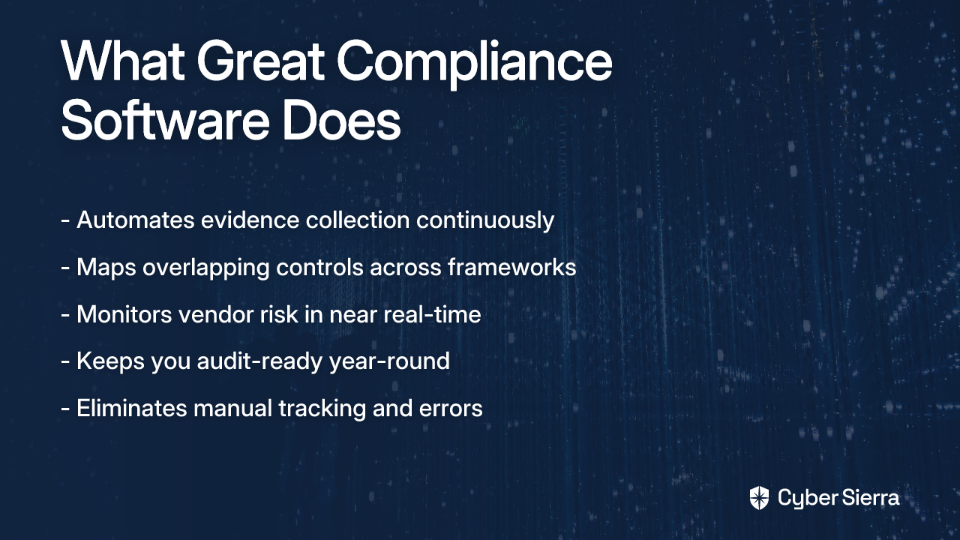
- Unified GRC platforms help manufacturers automate evidence collection, continuously monitor vendor risk, and close the cybersecurity gap to remain audit-ready.
Manufacturing teams already have enough to juggle — "App Fatigue" is real. You're switching between your Enterprise Resource Planning (ERP) screen, your Manufacturing Execution System (MES), and a tangle of spreadsheets just to pull together one audit package. Add to that the growing pressure of cybersecurity compliance, and audit prep can easily stretch from days into weeks.
Here's the problem most software lists miss: the biggest compliance risk manufacturers face today isn't a quality gap — it's a cybersecurity gap. The convergence of IT and OT like PLCs and industrial control systems with IT networks has created a new attack surface that generic quality tools were never designed to address.
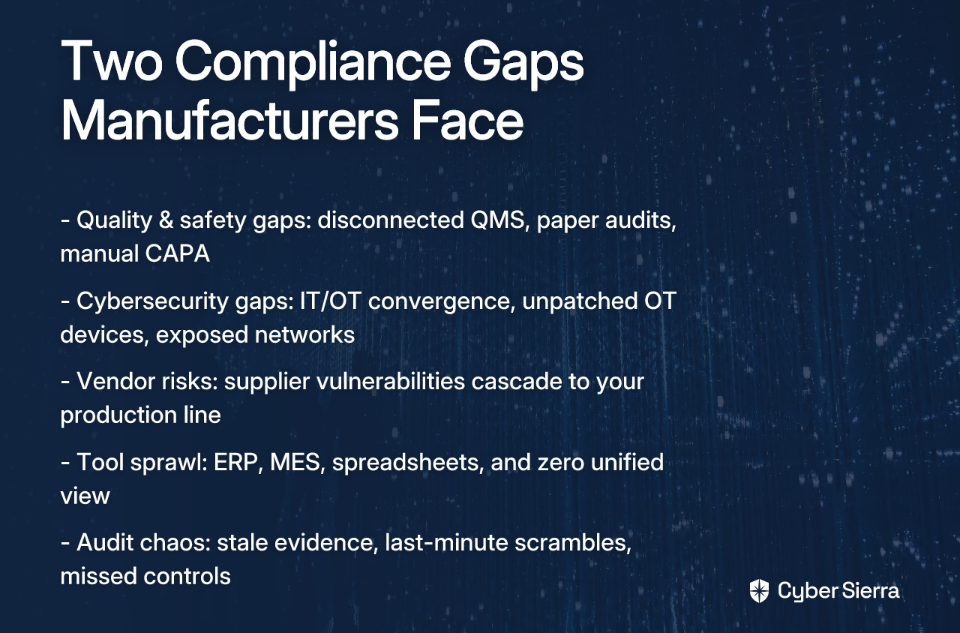
A 2025 Black Kite report found that third-party cyber incidents in manufacturing led to approximately 26,000 downstream victims — with each breach averaging 5.28 downstream casualties. Your suppliers' vulnerabilities are your vulnerabilities.
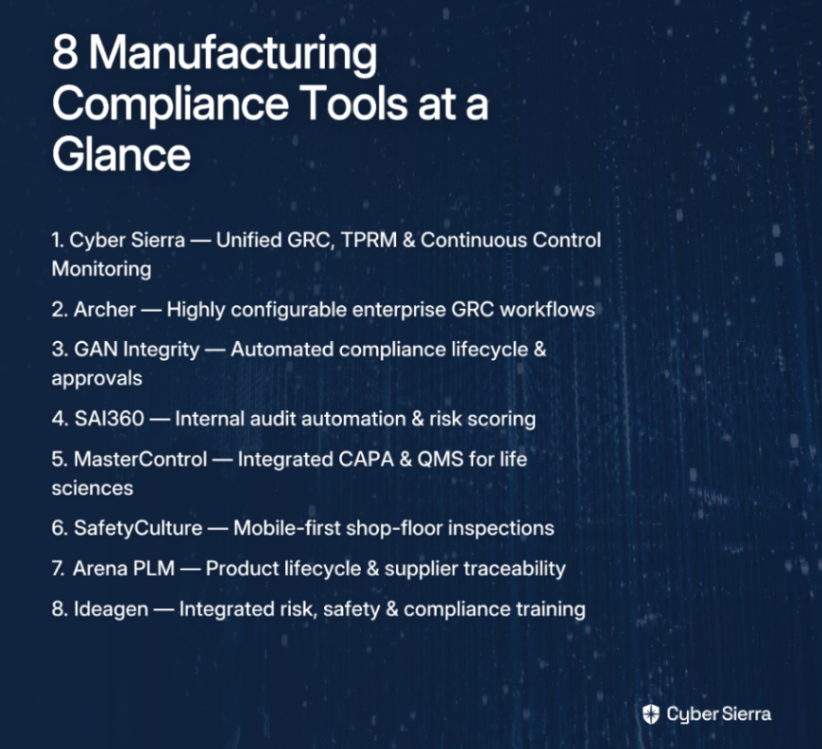
This article breaks down the 8 best manufacturing compliance software options into two groups: cybersecurity and Governance, Risk, and Compliance (GRC) platforms built for the modern threat environment, and quality and safety platforms built for operational excellence. Both matter — but they solve different problems.
Cybersecurity-Focused Compliance Platforms
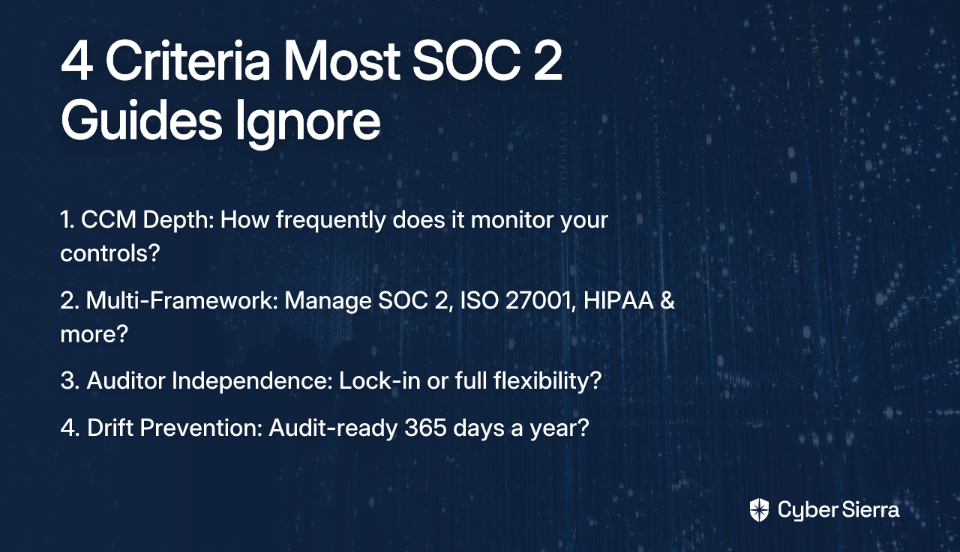
Modern manufacturers can't rely on quality checklists alone to stay compliant. Frameworks like ISO 27001 and the NIST Cybersecurity Framework (CSF) require dedicated GRC tooling, continuous control visibility, and vendor risk oversight — capabilities that most quality management systems simply don't offer. The following platforms are built for exactly that.
1. Cyber Sierra
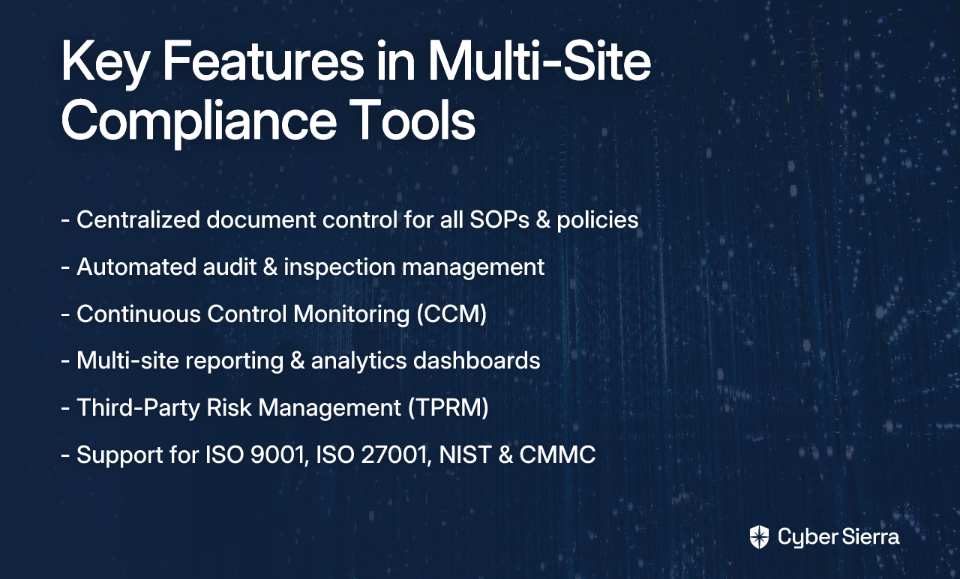
Cyber Sierra is an AI-enabled cybersecurity platform that unifies GRC automation, Third-Party Risk Management (TPRM), and Continuous Control Monitoring (CCM) for organizations navigating complex compliance environments — including manufacturers managing IT/OT convergence and sprawling supplier ecosystems.
Where most manufacturers fall into the trap of stitching together separate tools for vendor questionnaires, compliance tracking, and risk reporting, Cyber Sierra consolidates all of that into a single platform. The result: fewer silos, less manual evidence-gathering, and audit preparation that takes days instead of weeks.
Key capabilities relevant to manufacturers include:
- GRC automation. Cyber Sierra's GRC module automates data collection, risk assessments, and reporting across multiple frameworks simultaneously — including ISO 27001, NIST CSF, SOC 2, and PCI DSS. Compliance managers no longer need to manually map overlapping controls or scramble for evidence at audit time.
- Third-Party Risk Management. Rather than relying on point-in-time questionnaires, Cyber Sierra's TPRM module provides continuous visibility into vendor security posture. For manufacturers with dozens or hundreds of suppliers, this kind of near real-time monitoring is critical for catching cascading risks before they reach your production line.
- Continuous Control Monitoring. The CCM module tracks security controls across cloud and on-premise assets continuously, flagging exceptions and anomalies as they occur rather than waiting for the next audit cycle. This transforms compliance from a periodic fire drill into an ongoing state.
- Threat Intelligence. Cyber Sierra's threat intelligence module performs network and cloud vulnerability scanning, helping security teams understand and shrink their attack surface proactively.
Cyber Sierra is recognized as a Sample Vendor in the Gartner® Hype Cycle™ for Cyber-Risk Management, 2024, and is accredited by the Cyber Security Agency of Singapore (CSA). The platform itself holds ISO 27001 certification, and was named a winner of the AI Innovation Awards 2024 presented by Singapore's Ministry of Communications and Information.
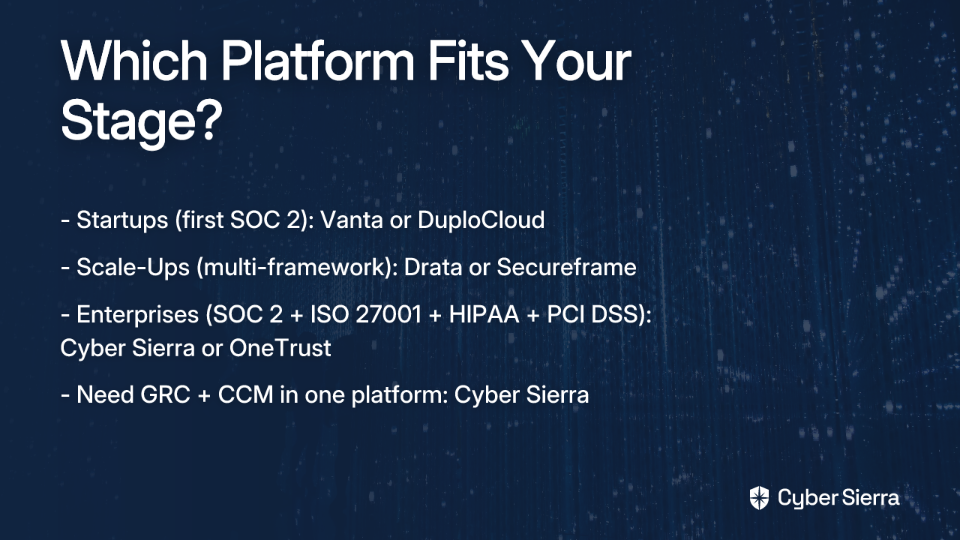
Best for: Manufacturers who need a unified platform to manage cybersecurity compliance across ISO 27001 and NIST CSF, secure their supplier ecosystem through continuous TPRM, and automate audit preparation across multiple frameworks.
2. Archer
Archer is one of the most established names in enterprise GRC, known for its depth of configurability and breadth of risk coverage. Large manufacturers with mature risk programs often turn to Archer when they need a platform that can be tailored extensively to their internal workflows and risk taxonomies.
Its core strength lies in managing compliance workflows — helping organizations track evolving requirements and route control attestations through structured approval chains. For enterprises managing risk across dozens of business units and jurisdictions, Archer provides the kind of granular control that out-of-the-box tools can't match.
The tradeoff is implementation complexity. Archer typically requires significant time and internal resources to configure properly, making it better suited to large, mature organizations than to mid-market manufacturers looking to move fast.
Best for: Large manufacturing enterprises that require a highly customizable, enterprise-wide GRC solution with robust regulatory tracking and risk workflow management.
3. GAN Integrity
GAN Integrity takes a unified approach to compliance lifecycle management, focusing on automating the approvals, reviews, and escalations that compliance teams spend most of their time chasing. For manufacturers operating across multiple geographies, it provides a centralized place to manage ethical and regulatory compliance obligations — including anti-bribery and anti-corruption (ABAC) requirements — from initiation through resolution.
Its reporting and analytics capabilities give compliance leaders visibility into bottlenecks and completion rates, helping them move from reactive oversight to proactive program management.
Best for: Global manufacturers looking for a unified platform to manage broad ethical, regulatory, and policy compliance workflows across multiple regions and business units.
4. SAI360
SAI360 brings a strong focus on internal audit automation and risk scoring, making it a practical choice for organizations looking to move beyond manual audit preparation. Its regulatory compliance tracking capabilities allow teams to map controls and policies to specific regulatory requirements, while its policy management module handles creation, distribution, and attestation in a single workflow.
For compliance managers who feel the weight of coordinating evidence across departments and chasing control owners for sign-offs, SAI360's workflow automation reduces a significant amount of that overhead.
Best for: Organizations focused on maturing their internal audit processes and automating risk assessment scoring across GRC frameworks.
Quality and Safety-Focused Compliance Platforms
Cybersecurity isn't the only compliance frontier in manufacturing. For most production environments, quality and safety compliance remains the operational baseline — the foundation upon which everything else is built. These platforms excel at digitizing shop-floor processes, managing product quality lifecycles, and supporting adherence to standards like ISO 9001 and FDA regulations.
What they typically don't offer: dedicated GRC modules, vendor cybersecurity risk scoring, or continuous control monitoring for frameworks like ISO 27001. That's not a criticism — it's a design choice. They solve a different problem. Understanding that distinction is what helps you build the right compliance stack rather than expecting one tool to do everything.
5. MasterControl
MasterControl is a leading Quality Management System (QMS) purpose-built for regulated manufacturers. Its core value is digitizing the end-to-end audit lifecycle — from preparation and execution through to findings management and Corrective and Preventive Actions (CAPA). Rather than tracking audit findings in email chains and shared folders, MasterControl centralizes everything in a version-controlled repository with a clear audit trail.
For life sciences manufacturers in particular, the integration between audit and CAPA workflows means that a finding doesn't die in a spreadsheet — it gets routed directly into a remediation workflow. That closed-loop approach is what regulators want to see.
Best for: Medical device, pharmaceutical, and other highly regulated manufacturers focused on FDA compliance, ISO 9001, and digitizing product quality and document control processes.
6. SafetyCulture (iAuditor)
SafetyCulture is a mobile-first inspection and safety platform designed to put compliance tooling directly in the hands of frontline workers. Its customizable digital checklists replace paper-based inspection forms, and its real-time analytics surface trends and recurring issues from inspection data — giving site managers an actionable view of where quality and safety risks are concentrating.
For manufacturers who still track Statistical Process Control (SPC) in Excel, non-conformances in email threads, and photos in shared folders, SafetyCulture offers a practical first step toward structured, auditable compliance documentation at the shop floor level.
Best for: Operations teams looking to digitize daily safety inspections, quality audits, and shop-floor compliance checks with a user-friendly, mobile-first tool.
7. Arena PLM
Arena, a PTC Business, is a cloud-based Product Lifecycle Management (PLM) and QMS platform that serves as the system of record for product and quality data. Its document control capabilities cover everything from Bills of Materials (BOMs) and engineering change orders to supplier qualification documentation — maintaining a complete, auditable history throughout the product lifecycle.
For manufacturers in medical devices and complex electronics, where supply chain collaboration and change control are critical to regulatory approval, Arena provides the traceability that auditors require. Its supplier qualification management module also helps procurement teams maintain up-to-date records on supplier documentation and compliance status.
Best for: Medical device and electronics manufacturers needing centralized product lifecycle management, supply chain collaboration, and compliance traceability for FDA and ISO 13485 requirements.
8. Ideagen Risk Management
Ideagen offers an integrated GRC suite with deep roots in safety-critical industries, including aviation, healthcare, and manufacturing. Its workflow automation capabilities span quality, safety, and compliance processes, while its integrated document management module keeps critical compliance documentation under structured control.
What distinguishes Ideagen from other quality-focused tools is the inclusion of e-learning content within the platform. For manufacturing organizations where building a risk-aware culture is part of the compliance mandate, having training modules alongside risk workflows reduces the need for a separate Learning Management System (LMS).
Best for: Manufacturing organizations in safety-critical sectors that need an integrated platform covering quality, safety, risk management, and employee compliance training.
Comparison at a Glance
| Tool | Primary Focus | Standout Capability | Best For |
|---|---|---|---|
| Cyber Sierra | Cybersecurity GRC & TPRM | Unified GRC, TPRM, and CCM | Manufacturers unifying cyber compliance and vendor risk |
| Archer | Enterprise Risk Management | Highly configurable GRC workflows | Large enterprises with complex, mature risk programs |
| GAN Integrity | Broad Compliance Management | Automated approvals & lifecycle management | Global manufacturers managing ethical and regulatory compliance |
| SAI360 | GRC & Internal Audit | Automated risk scoring & policy management | Organizations maturing internal audit processes |
| MasterControl | Quality Management (QMS) | Integrated CAPA & document control | Life sciences manufacturers needing FDA & ISO 9001 compliance |
| SafetyCulture | Safety & Quality Inspections | Mobile-first digital checklists & analytics | Teams digitizing shop-floor inspections and audits |
| Arena PLM | Product Lifecycle Management | Centralized product record & supplier data | Medical device makers managing product data for FDA compliance |
| Ideagen | Integrated Risk Management | Workflow automation & e-learning | Safety-critical industries needing compliance and training |
From Audit Chaos to Continuous Compliance
The line between your factory floor (OT) and your office network (IT) has blurred, creating a major cybersecurity compliance gap that traditional quality management systems can't address. Relying on QMS tools for ISO 27001 is like using a wrench to drive a nail—it's the wrong tool for a critical job. To truly secure your operations, you need to address two core realities: your suppliers' vulnerabilities are your own, and manual evidence gathering for audits is no longer sustainable.
Your next step is simple: map your current compliance tools. Clearly separate what covers operational quality (like ISO 9001) from what addresses cybersecurity risk. Identifying this gap is the first move toward closing it for good.
When you’re ready to replace spreadsheet chaos with automated GRC and continuous vendor risk monitoring, explore Cyber Sierra's platform. See how a unified platform transforms audit prep from a fire drill into a state of constant readiness.
Frequently Asked Questions
What is the main difference between cybersecurity GRC and quality management software for manufacturing?
Cybersecurity GRC software manages digital risks like IT/OT security and data privacy for frameworks like ISO 27001. Quality Management Systems (QMS) focus on product quality, safety, and operational processes for standards like ISO 9001. They address different, but equally important, compliance areas.
Why is IT/OT convergence a major compliance risk for manufacturers?
IT/OT convergence connects industrial control systems (OT) to IT networks, creating new cyber-attack surfaces. Generic quality tools are not designed to monitor these OT devices for vulnerabilities, leaving a significant gap in security compliance and exposing production lines to digital threats.
How does manufacturing compliance software help with audits for standards like ISO 27001?
Modern GRC platforms automate evidence collection, continuously monitor security controls, and map them to ISO 27001 requirements. This replaces manual data gathering, provides a centralized audit trail, and helps teams stay audit-ready year-round, reducing last-minute preparation stress.
What features are essential for managing third-party supplier risk in manufacturing?
Look for a platform with Third-Party Risk Management (TPRM) that offers continuous monitoring, not just point-in-time questionnaires. Key features include automated risk scoring, real-time security posture visibility, and integrated workflows for tracking vendor remediation and compliance.
Can one software platform manage both quality (ISO 9001) and cybersecurity (ISO 27001) compliance?
It's rare for a single tool to excel at both. Cybersecurity GRC platforms are built for digital risks and IT frameworks, while QMS tools focus on physical product quality. Many manufacturers use a specialized tool for each and integrate them to build a comprehensive compliance stack.