blog-hero-background-image
Cyber Security

5 Types of Infosec Assessments for Continuous Compliance Monitoring
backdrop
Table of Contents

Join thousands of professionals and get the latest insight on Compliance & Cybersecurity.


Summary

  • Traditional point-in-time security assessments create audit fatigue and a false sense of security in today's dynamic threat landscape.
  • Learn how to transform five key infosec assessments—compliance, risk, vulnerability, penetration testing, and gap analysis—into a continuous, automated process.
  • Shifting to a continuous model provides real-time visibility into your security posture and enables proactive risk management instead of reactive compliance checks.
  • An integrated Governance, Risk & Compliance (GRC) platform automates this transformation, making you audit-ready 24/7.

"What's the difference between an IT risk assessment, a security assessment, and a gap analysis?" This common question stumps even seasoned IT and security professionals. The lines often blur, leading to uncertainty about which infosec assessment is needed, what information to provide, and how to align the outcomes with business objectives.

While these assessments are critical for security and compliance, the traditional approach of treating them as annual or quarterly "point-in-time" events is becoming increasingly ineffective. In today's dynamic threat landscape, a clean report today means little tomorrow. Static assessments often focus more on checklist compliance than on real-time threat readiness, leading to a false sense of security and the dreaded "audit fatigue."

The solution? Shifting from periodic audits to a continuous monitoring model.

This article will demystify five key types of infosec assessments and, more importantly, show you how to transform them from isolated events into a continuous, automated engine for proactive security and compliance.
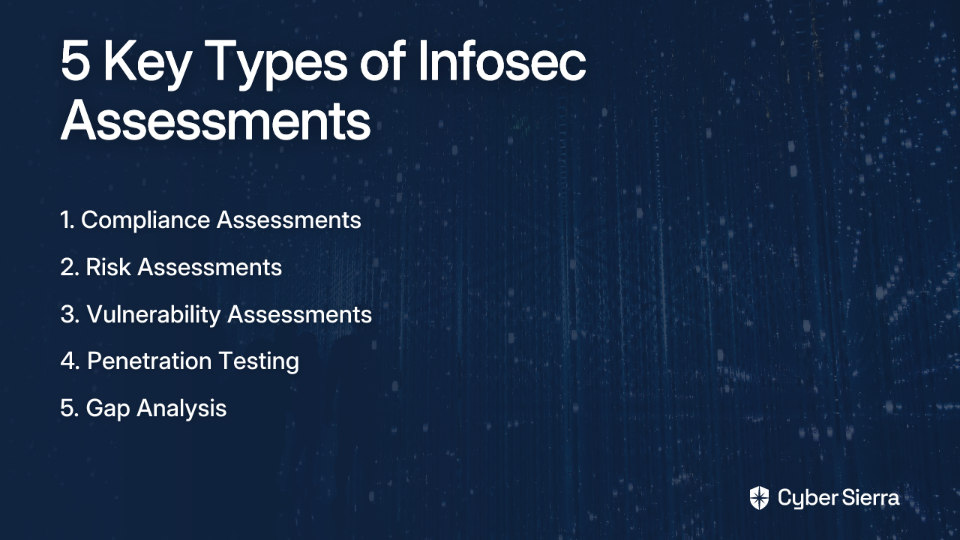
1. Continuous Control Monitoring for Compliance Assessments

What It Is: Compliance assessments verify that an organization adheres to relevant laws, regulations (like GDPR, HIPAA), industry standards (like PCI DSS, ISO 27001), and internal policies.

The Traditional Approach: The traditional compliance assessment is a frantic, manual fire drill before an audit. Teams spend weeks or months collecting screenshots, logs, and policy documents to serve as evidence for auditors. This is inefficient and provides no real-time visibility into compliance status.

Transforming it into a Continuous Process: Continuous Control Monitoring (CCM) is an ongoing review process that ensures compliance with regulatory standards and internal policies in near real-time by automating control testing and evidence collection.

Key components include:

  • Automated Evidence Collection: Integrate directly with your tech stack (AWS, Azure, O365, GitHub) to automatically gather evidence that controls are operating effectively
  • Real-time Anomaly Detection: Continuously monitor controls and flag any deviations, exceptions, or failures as they happen, not months later during an audit
  • Centralized Control Repository: Maintain a single source of truth for all controls mapped to multiple frameworks

Practical Implementation Guidance:
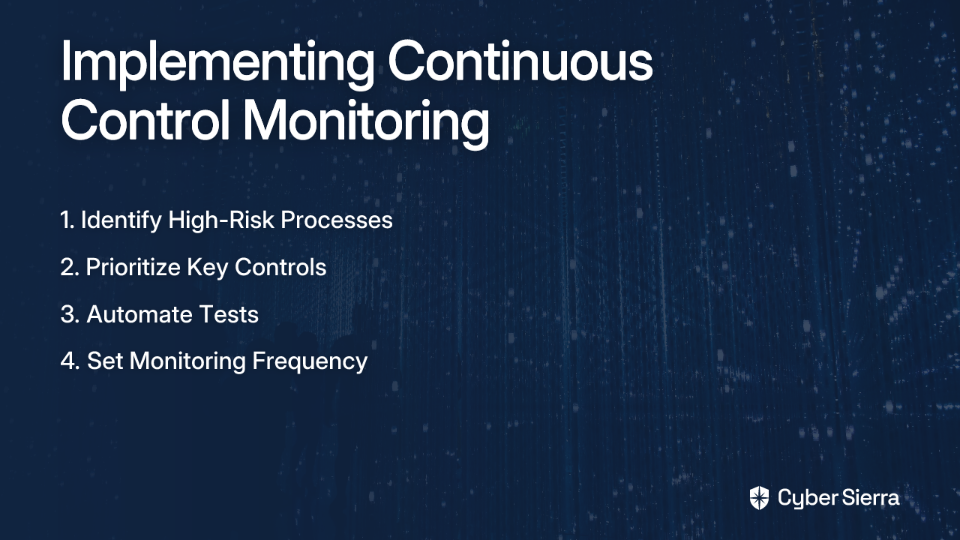
  1. Identify High-Risk Processes: Focus on processes tied to strategic goals and regulatory mandates
  2. Prioritize Key Controls: Map your controls to multiple frameworks (e.g., a single control can satisfy requirements for ISO 27001 and SOC 2)
  3. Automate Tests: Implement a platform to automate the testing of controls, such as checking if MFA is enabled for all privileged users or if data encryption is active on all production databases
  4. Set Monitoring Frequency: Determine how often each control needs to be checked based on its criticality and associated risk

How Cyber Sierra Helps: Cyber Sierra's Continuous Control Monitoring (CCM) platform builds a central controls repository, provides clear visibility into your security posture through automated monitoring, and manages controls across multiple frameworks like NIST, ISO 27001, and PCI DSS, making you audit-ready 24/7. The platform automates control testing and validation while detecting exceptions and anomalies in real-time, addressing the pain point of manual evidence gathering before audits.

2. Risk Assessments

What It Is: A risk assessment is the process of identifying, evaluating, and prioritizing risks associated with an organization's operations, assets, and objectives. It answers the crucial question, "What are our most significant cyber risks, and what is their potential impact on the business?"

The Traditional Approach: Traditionally, risk assessments are annual workshops involving stakeholders, manual data collection, and spreadsheet-based risk registers that quickly become outdated. This approach often fails to align with dynamic business objectives and doesn't provide timely insights as new threats emerge.

Transforming it into a Continuous Process:

  • Dynamic Risk Registers: Use a platform where the risk register is a living document, automatically updated based on real-time data from control monitoring, vulnerability scans, and threat intelligence feeds
  • Automated Risk Calculation: Move away from subjective "High, Medium, Low" ratings to data-driven risk scores that change as your control posture or the threat landscape evolves
  • Integrated Business Context: Continuously map risks to business objectives and critical assets, ensuring that risk management remains relevant to the organization

Practical Implementation Guidance:
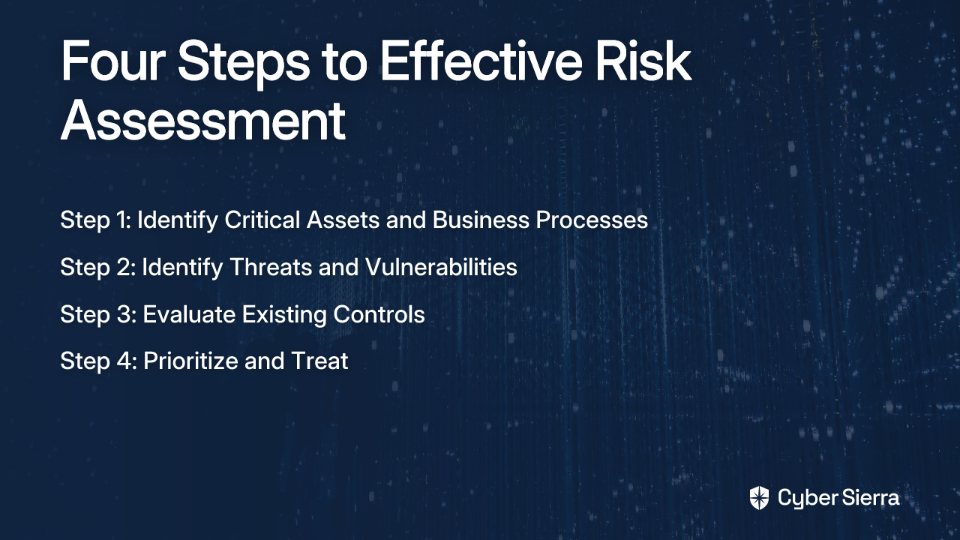
  • Step 1: Identify Critical Assets and Business Processes: Map your technology to the business objectives it supports to understand what needs protection
  • Step 2: Identify Threats and Vulnerabilities: Link specific threats (e.g., ransomware, data exfiltration) and vulnerabilities (e.g., unpatched servers) to your critical assets
  • Step 3: Evaluate Existing Controls: Measure the effectiveness of your current security controls in mitigating those threats
  • Step 4: Prioritize and Treat: Use the data to prioritize remediation efforts based on the organization's defined risk appetite (Source)

How Cyber Sierra Helps: Cyber Sierra's Governance, Risk & Compliance (GRC) platform automates data collection and risk assessments. It helps you manage and monitor risks continuously, ensuring they are always aligned with your compliance obligations and business context. The platform generates comprehensive reports and maintains detailed audit trails, significantly reducing the time spent preparing for audits and strategic risk discussions.
3. Vulnerability Assessments

What It Is: A systematic review of security weaknesses in an information system. It involves identifying, quantifying, and prioritizing vulnerabilities in networks, systems, hardware, and applications.

The Traditional Approach: Scheduled quarterly or monthly vulnerability scans run by the IT team. Results are often delivered in a lengthy PDF or CSV file, requiring manual review and prioritization, with many critical vulnerabilities remaining unaddressed due to resource constraints.

Transforming it into a Continuous Process:

  • Automated, Ongoing Scanning: Instead of periodic checks, use tools that continuously scan your environment, including your external attack surface and internal cloud infrastructure
  • Real-time Alerting & Prioritization: The system should automatically prioritize vulnerabilities based on severity (e.g., CVSS score), exploitability, and the criticality of the affected asset
  • Remediation Workflow Integration: Connect vulnerability findings directly to ticketing systems and remediation workflows to ensure timely resolution

Practical Implementation Guidance:
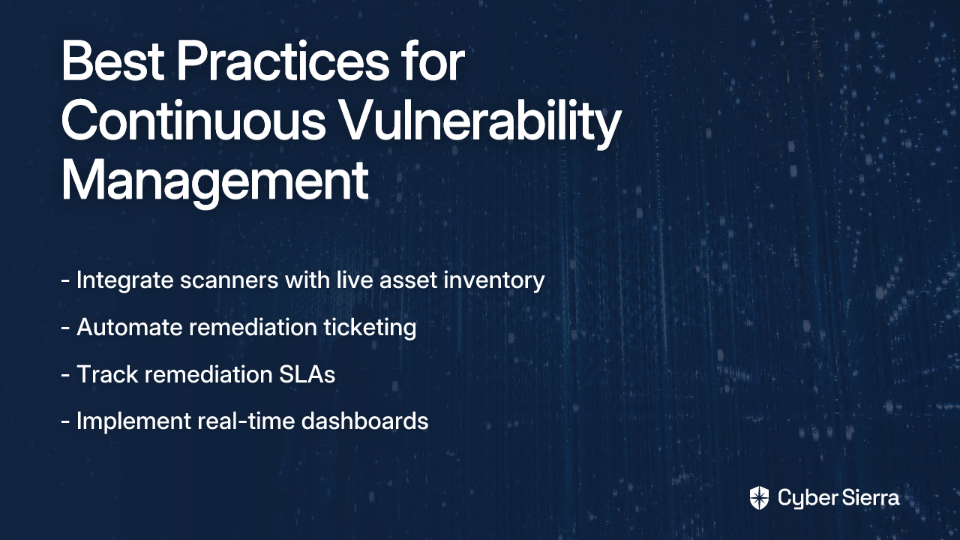
  • Integrate scanners with a live asset inventory to ensure complete coverage
  • Automate the creation of remediation tickets for high-priority vulnerabilities
  • Track remediation SLAs to ensure gaps are closed in a timely manner
  • Implement dashboards that provide real-time visibility into your vulnerability posture

How Cyber Sierra Helps: Cyber Sierra's Threat Intelligence module provides an outside-in view of your security posture. It conducts network and cloud infrastructure scanning to identify misconfigurations and vulnerabilities, enabling you to manage your attack surface proactively. The platform offers a comprehensive security scorecard for posture insights and helps prioritize remediation efforts based on risk to your business.

4. Penetration Testing

What It Is: A simulated cyberattack against your systems to check for exploitable vulnerabilities. Unlike a vulnerability assessment that lists potential weaknesses, a penetration test actively tries to exploit them to demonstrate the real-world impact of security gaps.

The Traditional Approach: Hiring a third-party firm for a one-week engagement once or twice a year. While valuable, this provides only a snapshot of your defenses against a specific set of attack vectors at that moment, leaving you vulnerable to new threats that emerge between tests.

Transforming it into a Continuous Process:

  • Breach and Attack Simulation (BAS): Deploy automated tools that continuously simulate a wide range of attack tactics and techniques (aligned with frameworks like MITRE ATT&CK) to constantly test the effectiveness of your security controls
  • Continuous Red Teaming: Augment automated BAS with ongoing, objective-driven red team exercises that mimic the behavior of real-world adversaries targeting your organization
  • Attack Surface Management (ASM): Continuously discover and monitor your organization's internal and external digital footprint to identify potential points of entry for attackers (Source)

Practical Implementation Guidance:

  • Start with automated BAS tools to get broad, continuous coverage
  • Use the findings from BAS and ASM to scope more targeted, manual penetration tests
  • Feed all findings directly into your vulnerability and risk management programs to ensure remediation
  • Implement a purple team approach where defenders work alongside offensive security professionals to improve detection and response capabilities

5. Gap Analysis

What It Is: An assessment that compares your organization's actual performance or existing controls against a specific standard, framework, or desired future state. It's designed to identify "gaps" in security controls, policies, and procedures that need to be addressed to meet compliance requirements or security best practices.

The Traditional Approach: A one-off project, typically performed with spreadsheets when an organization decides to pursue a new certification like SOC 2 or ISO 27001. It's a manual, time-consuming process that often becomes quickly outdated as the organization's environment changes.

Transforming it into a Continuous Process:

  • Automated Framework Mapping: Use a GRC platform that has major frameworks pre-loaded. You can map your existing controls to the framework requirements to get an instant view of your gaps
  • Live Gap Monitoring: The platform should continuously monitor your controls against the framework(s). If a new system is deployed without proper configurations, or a policy change creates a non-conformity, the platform should flag it as a new gap in real-time
  • Remediation Tracking: Automatically track the closure of identified gaps with assignees, due dates, and evidence requirements built into the platform

Practical Implementation Guidance:
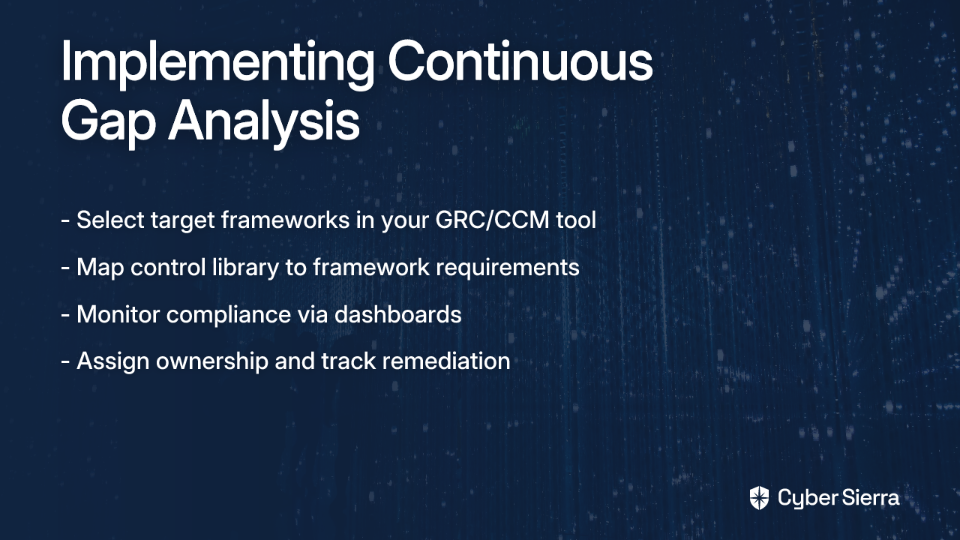
  • Select your target framework(s) within a GRC/CCM tool
  • Map your central control library to the requirements of each framework
  • Use the platform's dashboard to monitor your compliance percentage and a prioritized list of gaps
  • Assign ownership and track remediation for each identified gap directly within the tool

How Cyber Sierra Helps: Cyber Sierra's GRC platform streamlines gap analysis by managing multiple compliance frameworks (SOC2, ISO 27001, GDPR, etc.) in one place. It provides continuous visibility into your compliance posture, automatically identifying gaps and helping you create a clear roadmap for remediation. The platform maintains detailed audit trails of all gap closure activities, making it easy to demonstrate progress to auditors and stakeholders.

Accelerate Your Security Maturity with Continuous Assessment

The goal of modern infosec isn't just to pass audits—it's to build a resilient, adaptive security program. Transforming these five assessments from static, periodic events into a single, continuous, and automated process is the most effective way to achieve that.

This shift eliminates audit fatigue, provides real-time visibility into your security posture, reduces regulatory exposure, and frees up your team to focus on strategic risk management instead of manual, repetitive tasks. Most importantly, it helps you stay ahead of evolving threats by continuously validating your defenses rather than relying on point-in-time snapshots.

Platforms like Cyber Sierra are designed to power this transformation. By integrating Continuous Control Monitoring with GRC, threat intelligence, and risk management, you can finally move from being reactive to proactive in your approach to security and compliance.

Frequently Asked Questions

What is the difference between a risk assessment and a vulnerability assessment?

A vulnerability assessment identifies and lists security weaknesses, while a risk assessment evaluates those weaknesses in the context of business impact and threat likelihood. A vulnerability scan might find an unpatched server, but a risk assessment determines the potential damage if that server is compromised, helping prioritize what to fix first.

How does continuous monitoring solve audit fatigue?

Continuous monitoring solves audit fatigue by automating the evidence collection process and providing real-time visibility into compliance status. Instead of a frantic, manual scramble to gather documents weeks before an audit, a continuous model ensures you are audit-ready 24/7, dramatically reducing the stress and repetitive work associated with traditional point-in-time audits.

What is Continuous Control Monitoring (CCM)?

Continuous Control Monitoring (CCM) is an automated approach to ensure ongoing compliance with security standards and policies. It works by integrating with your tech stack to automatically test controls (e.g., is MFA enabled everywhere?) and collect evidence in near real-time, immediately flagging any deviations or failures.

How can my organization start moving towards continuous security assessments?

You can start by identifying high-risk processes and prioritizing the key controls that protect them. Begin by automating the testing and evidence collection for these critical controls using a GRC or CCM platform. This phased approach allows you to demonstrate value quickly and gradually expand continuous monitoring across your entire security program.

When should I use a penetration test instead of a vulnerability assessment?

Use a vulnerability assessment to get a broad list of potential security weaknesses across your systems, and use a penetration test to simulate a real-world attack to see if those weaknesses can actually be exploited. A vulnerability assessment is about finding flaws; a penetration test is about exploiting them to understand their real-world impact.

Why is a static risk register on a spreadsheet no longer effective?

A static spreadsheet-based risk register is no longer effective because it quickly becomes outdated in today's dynamic threat landscape. It relies on manual updates and subjective ratings, failing to reflect real-time changes in your security posture, new threats, or evolving business objectives. A dynamic, platform-based risk register provides a data-driven, continuously updated view of your risk profile.
Ready to leave point-in-time assessments behind? See how Cyber Sierra's AI-enabled platform provides a single source of truth for continuous compliance and proactive risk management.
blog-hero-background-image
Cyber Security

7 Enterprise-Grade Cybersecurity Scanning Tools That Integrate With GRC Platforms

backdrop
Table of Contents

Join thousands of professionals and get the latest insight on Compliance & Cybersecurity.


Summary

  • Integrating vulnerability scanners with GRC platforms bridges the critical gap between technical security findings and compliance reporting.
  • This automation provides real-time visibility into your compliance posture and eliminates the manual, error-prone process of collecting evidence for audits.
  • When selecting tools, prioritize those with strong integration capabilities like robust APIs and pre-built connectors to streamline your security workflows.
  • For a seamless approach, a unified platform like Cyber Sierra's Threat Intelligence combines native scanning and GRC to eliminate integration challenges from the start.

You've invested heavily in vulnerability scanners—maybe Tenable for your networks, Invicti for web apps, and Trivy for containers. Your security team diligently runs scans and identifies critical vulnerabilities. Yet when audit time comes, you're still scrambling to collect evidence, manually mapping scan results to compliance controls, and struggling to demonstrate your security posture to auditors.

Sound familiar? The disconnect between vulnerability scanning and governance, risk, and compliance (GRC) processes creates a compliance nightmare for enterprises. Security teams identify vulnerabilities but struggle to translate them into compliance language, while compliance teams lack the technical context to prioritize remediation effectively.

The solution? Integration. By connecting your cybersecurity scanning tools directly with your GRC platform, you can automate evidence collection, map vulnerabilities to specific compliance frameworks, and maintain continuous compliance—not just point-in-time assurance.

Let's explore seven enterprise-grade scanning tools renowned for their robust GRC integration capabilities, helping you transform vulnerability data into actionable compliance insights.

The Power of Integration: Why Your Scanner Needs to Talk to Your GRC Platform

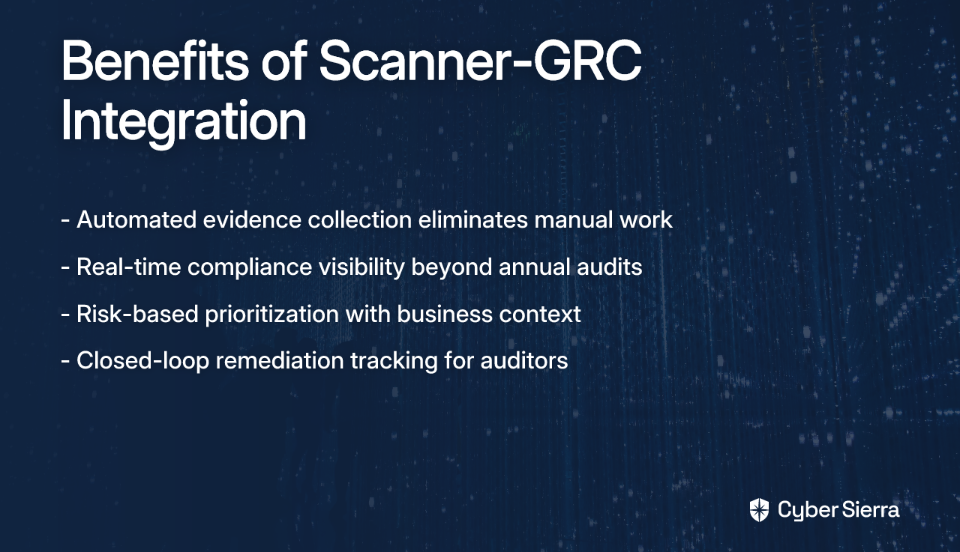
Before diving into specific tools, it's worth understanding why integration between scanners and GRC platforms is so valuable:

  • Automated Evidence Collection: No more manual screenshots and spreadsheets. Integrated systems automatically push scan results as evidence for relevant controls.
  • Real-Time Compliance Visibility: Know your compliance status at all times, not just during annual audits.
  • Risk-Based Prioritization: Add business context to technical vulnerabilities, helping you focus remediation on what matters most.
  • Closed-Loop Remediation: Create tickets, track fixes, and document the entire remediation process for auditors.

According to Diligent's research, this integration provides a "holistic understanding of IT risks in relation to overall business risk," enabling more strategic decision-making.

Now, let's examine the tools that excel at connecting vulnerability data with compliance frameworks.

1. Cyber Sierra Threat Intelligence

Best For: Organizations seeking unified vulnerability management and GRC in a single platform.

Overview: While many solutions require integration between separate tools, Cyber Sierra offers native vulnerability scanning built directly into its GRC platform. This approach eliminates integration challenges while providing comprehensive visibility across your entire attack surface.

Key Features for GRC Integration:

  • Native Scanning: Network vulnerability scanning and cloud infrastructure scanning built directly into the GRC platform
  • Automated Control Mapping: Automatically maps vulnerabilities to specific controls across multiple frameworks (NIST, ISO 27001, PCI DSS)
  • Continuous Control Monitoring: The CCM module uses scan data to continuously validate security controls
  • Context-Rich Risk Assessment: Combines vulnerability data with business context for intelligent prioritization

How it Integrates: As a unified platform, Cyber Sierra eliminates traditional integration challenges. Vulnerabilities detected by its native scanner are automatically correlated with compliance controls, providing real-time visibility into your compliance posture. For specialized scanning needs, Cyber Sierra can also ingest data from third-party tools via API.

2. Tenable (Nessus & Tenable.sc)

Best For: Comprehensive vulnerability coverage across IT assets, OT environments, and cloud infrastructure.

Overview: Tenable consistently ranks as one of the most powerful commercial vulnerability scanners, as noted by many security professionals in online discussions. With its extensive plugin library and research team, it provides comprehensive vulnerability detection that many open-source alternatives can't match.

Key Features for GRC Integration:

  • Robust API: Well-documented API for exporting detailed vulnerability data
  • Pre-built Connectors: Native integrations with many leading GRC platforms
  • Compliance Reporting: Built-in reports for PCI DSS, HIPAA, SOC 2, and other frameworks
  • Asset Tagging: Group assets by business criticality, department, or compliance scope

How it Integrates: GRC platforms pull vulnerability data from Tenable via API, mapping CVEs to specific controls and using scan results as compliance evidence. This automation eliminates manual processes and provides continuous visibility into your compliance status.

3. Qualys VMDR (Vulnerability Management, Detection, and Response)

Best For: Cloud-based, continuous vulnerability monitoring with detailed asset inventory.

Overview: Qualys VMDR provides an all-in-one solution for discovering, assessing, prioritizing, and patching vulnerabilities across global IT assets. Its cloud architecture and lightweight agents make it ideal for distributed enterprises needing continuous monitoring.

Key Features for GRC Integration:

  • Cloud Agent Technology: Provides always-on assessment without scan windows
  • Detailed Asset Inventory: Comprehensive visibility of all IT assets, foundational for any GRC program
  • Unified Dashboard: Single view of vulnerabilities, threats, and compliance status
  • Predefined Controls: Built-in mappings to major compliance frameworks

How it Integrates: GRC platforms leverage Qualys's API to pull both vulnerability data and asset inventory, automating evidence collection for controls related to asset management and vulnerability remediation. This comprehensive data helps demonstrate continuous compliance to auditors.

4. Rapid7 InsightVM

Best For: Organizations needing real-time risk prioritization beyond standard CVSS scores.

Overview: Rapid7 InsightVM focuses on providing context to vulnerabilities, moving beyond simple severity ratings to help teams understand which issues pose real business risk. Its Real-Risk score considers factors like vulnerability age, exploitability, and malware exposure.

Key Features for GRC Integration:

  • Customizable Risk Scoring: Align vulnerability priorities with business context
  • Automated Workflows: Connect directly with ticketing systems for seamless remediation tracking
  • Live Dashboards: Always-on view of risk posture that can feed into GRC platforms
  • Policy Assessment: Pre-built policies for CIS benchmarks, NIST, HIPAA, and more

How it Integrates: GRC platforms can ingest InsightVM's contextualized risk scores to provide a more nuanced view of security posture. This integration helps in reporting to leadership and demonstrating to auditors that the organization has a mature, risk-based vulnerability management program.

5. Invicti (formerly Netsparker)

Best For: Automated and accurate Dynamic Application Security Testing (DAST) for web applications and APIs.

Overview: Invicti addresses the challenge many security teams face with web application scanning—balancing thoroughness with accuracy. Its Proof-Based Scanning™ technology automatically verifies vulnerabilities to eliminate false positives, ensuring only actionable findings reach your GRC system.

Key Features for GRC Integration:

  • Confirmed Vulnerabilities: By providing proof of exploit, Invicti ensures only real vulnerabilities are sent to your GRC
  • CI/CD Integration: Embed scanning into your development pipeline for continuous security assurance
  • Detailed Remediation Guidance: Provides developers with clear steps to fix vulnerabilities
  • Compliance Reporting: Generates reports mapped to standards like PCI DSS and OWASP Top 10

How it Integrates: When a vulnerability is confirmed by Invicti, it can automatically be mapped to relevant controls in your GRC platform. For example, a SQL injection finding can be linked to specific requirements in PCI DSS (6.5.1) or ISO 27001 (A.14.2.5), with the proof of exploit attached as evidence.

6. OpenVAS

Best For: Cost-conscious organizations needing a powerful open-source vulnerability scanning solution.

Overview: OpenVAS (Open Vulnerability Assessment System) offers a free, comprehensive vulnerability scanner that many organizations use as an alternative to commercial options. While some users note potential challenges with its UI compared to paid tools, it provides robust scanning capabilities that integrate well with GRC platforms through custom scripting.

Key Features for GRC Integration:

  • Comprehensive Scan Coverage: Detects a wide range of network vulnerabilities
  • Flexible Output Formats: Export results in multiple formats (XML, JSON) for GRC ingestion
  • Customizable Scanning: Tailor scans to focus on specific compliance requirements
  • Active Community: Regular updates to vulnerability signatures

How it Integrates: Integration typically requires middleware that queries the OpenVAS API, transforms the XML output, and pushes it to your GRC platform. While this requires more technical setup than commercial solutions with pre-built connectors, it provides a cost-effective way to automate evidence collection.

7. Acunetix

Best For: Small to mid-sized enterprises seeking user-friendly web vulnerability scanning.

Overview: Acunetix specializes in web application security, scanning for over 7,000 web vulnerabilities including SQL Injection, XSS, and other OWASP Top 10 risks. It's known for its speed and ease of use, making it accessible for teams without deep security expertise.

Key Features for GRC Integration:

  • AcuSensor Technology: Combines DAST with IAST for more accurate results
  • Detailed Vulnerability Information: Provides complete technical details and remediation guidance
  • Integration with Issue Trackers: Connects with tools like Jira and Azure DevOps
  • Compliance Reporting: Built-in support for PCI DSS, OWASP Top 10, and ISO 27001

How it Integrates: Acunetix scan data can be fed into a GRC platform to automate web application compliance. The detailed vulnerability information serves as direct evidence for technical controls, helping to streamline audits for standards like PCI DSS.

Choosing the Right Integrated Scanning Tool for Your GRC

When selecting a scanning tool that will integrate with your GRC platform, consider these key factors:

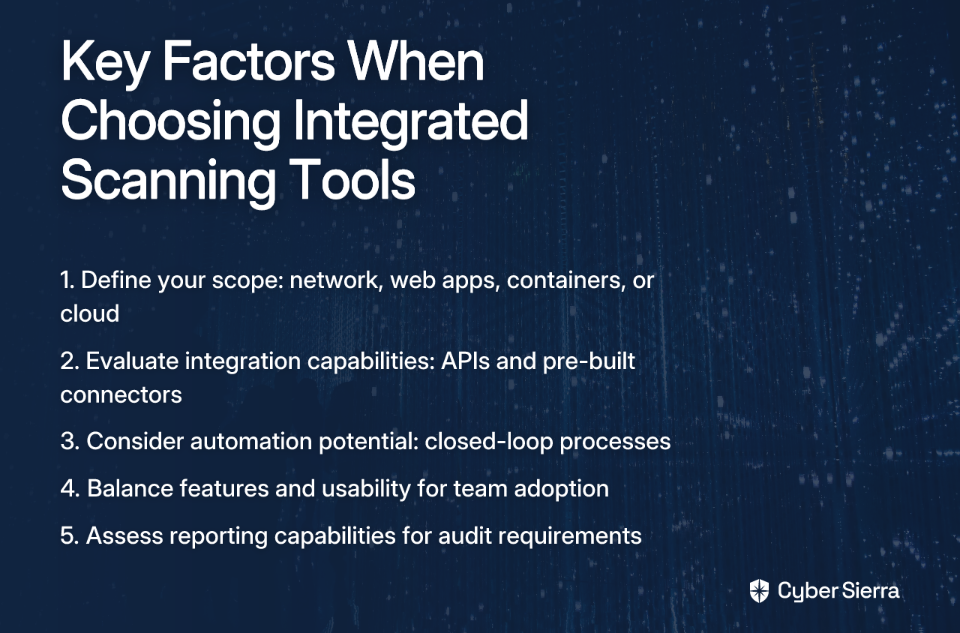
  1. Define Your Scope: Are you primarily concerned with network infrastructure, web applications, containers, or cloud configurations? Choose tools specialized for your main attack surfaces.
  2. Evaluate Integration Capabilities: Look beyond basic API availability. Ask for documentation, check for pre-built connectors with your GRC platform, and understand the data formats and mapping capabilities.
  3. Consider Automation Potential: The goal is to reduce manual work. The best integrations create closed-loop processes that connect scanning, control validation, ticketing, and remediation tracking.
  4. Balance Features and Usability: As noted in user discussions, some tools (particularly open-source options) may have "difficult UIs." Ensure the chosen solution is usable by your team to promote adoption.

Transform Your Security Posture with Integrated Scanning and GRC

The days of treating vulnerability management and compliance as separate disciplines are over. By integrating your scanning tools with a robust GRC platform, you can transform security from a reactive, audit-driven exercise into a proactive, continuous program that delivers real risk reduction.

Cyber Sierra provides the ideal foundation for this integrated approach by offering both native scanning capabilities and the ability to ingest data from specialized tools. Its unified platform combines Continuous Control Monitoring, automated GRC workflows, and Threat Intelligence to give you a complete, real-time picture of your security posture.

Stop treating vulnerability management and compliance as disconnected activities. Explore how Cyber Sierra's integrated platform can help you build a more efficient, effective security program that satisfies both technical and compliance requirements simultaneously.

Frequently Asked Questions

What is the main benefit of integrating vulnerability scanners with a GRC platform?

The primary benefit is the automation of compliance evidence collection. By connecting these systems, you can directly link technical vulnerabilities found by your scanner to the specific security controls they impact within your GRC framework, eliminating manual mapping and providing real-time compliance visibility.

How does a unified GRC and scanning platform differ from integrating separate tools?

A unified platform offers native scanning capabilities built directly into the GRC framework, which eliminates the complexity of API integrations and potential data silos. While integrating separate best-of-breed tools is a powerful approach, a unified solution like Cyber Sierra simplifies the entire process by ensuring vulnerabilities are automatically correlated with controls from the moment they are discovered.

Can I use open-source scanners like OpenVAS for GRC integration?

Yes, you can integrate open-source scanners like OpenVAS, but it often requires more technical setup than commercial alternatives. Integration typically involves using the scanner's API and custom scripts or middleware to pull the data, format it correctly, and push it to your GRC platform. It's a cost-effective solution for teams with the technical resources to manage the integration.

What is the difference between a vulnerability scanner and a GRC platform?

A vulnerability scanner is a technical tool designed to identify specific security weaknesses (like CVEs) in your IT assets, such as networks, applications, or cloud infrastructure. A GRC platform is a management tool used to oversee an organization's overall governance, risk management strategy, and compliance with regulations. The integration bridges the gap between technical findings and business risk.

How does integrating scanning tools help during a compliance audit?

This integration streamlines audits by providing automated, continuous evidence. Instead of manually collecting screenshots and reports to prove a control is met, you can show auditors a live system where scan results are automatically linked to controls, remediation is tracked, and the organization's compliance posture is continuously monitored. This provides stronger assurance and significantly reduces audit preparation time.

blog-hero-background-image
Cyber Security

Third Party Security Risks in Healthcare: Compliance Requirements & Mitigation Strategies

backdrop
Table of Contents

Join thousands of professionals and get the latest insight on Compliance & Cybersecurity.


Summary

  • Healthcare data breaches, often originating from third-party vendors, are the costliest of any industry, averaging $10.93 million per incident.
  • Relying solely on Business Associate Agreements (BAAs) and annual questionnaires is insufficient for HIPAA compliance; continuous due diligence is required to protect patient data.
  • A modern approach to vendor risk involves shifting from periodic check-ins to a continuous, automated framework that includes rigorous assessments and strict access controls.
  • Cyber Sierra’s TPRM and GRC modules automate vendor risk management and HIPAA compliance, providing the continuous monitoring needed to secure the healthcare supply chain.

You've built a robust in-house security program for your healthcare organization, but managing the security questionnaires, compliance certifications, and risk assessments for all your vendors has become an overwhelming, full-time job. Every follow-up feels like another mountain to climb, and staying audit-ready in this mess seems nearly impossible.

Sound familiar?

You're not alone. As healthcare organizations increasingly rely on third-party vendors for everything from electronic health records (EHRs) to medical devices and billing services, they've inadvertently expanded their attack surface—creating significant security and compliance risks.

The stakes couldn't be higher. Healthcare data breaches now cost an average of $10.93 million per incident, the highest across all industries. More critically, vendor-related security incidents can directly impact patient safety and care delivery.

This guide will help you navigate the complex intersection of third-party risk and healthcare compliance, mapping critical risks to HIPAA and HITECH requirements while providing a practical framework for assessment and mitigation.

The Alarming State of Third-Party Risk in Healthcare

Healthcare organizations face a perfect storm of security challenges through their vendor relationships. Consider these prevalent threats:

Ransomware Attacks via Vendor Channels

Vendors often serve as the entry point for devastating ransomware attacks. In 2020, Universal Health Services faced a week-long outage after attackers infiltrated their systems through a third-party connection, forcing the diversion of ambulances and the rescheduling of procedures across their 400+ facilities.

Data Breaches Through Trusted Partners

The 2019 Quest Diagnostics breach exposed the personal and medical information of 11.9 million patients when their third-party billing provider (American Medical Collection Agency) was compromised. Similarly, Anthem's infamous breach of 78.8 million customer records was traced back to a third-party service provider.

Operational Disruptions That Impact Patient Care

When vendors with outdated systems or poor security practices experience downtime, the ripple effects can halt critical healthcare services. During the 2017 NotPetya attack, pharmaceutical giant Merck lost access to manufacturing systems and research data when malware spread from a third-party software provider.

What Makes Healthcare Particularly Vulnerable?

Healthcare organizations face unique challenges that amplify third-party risks:

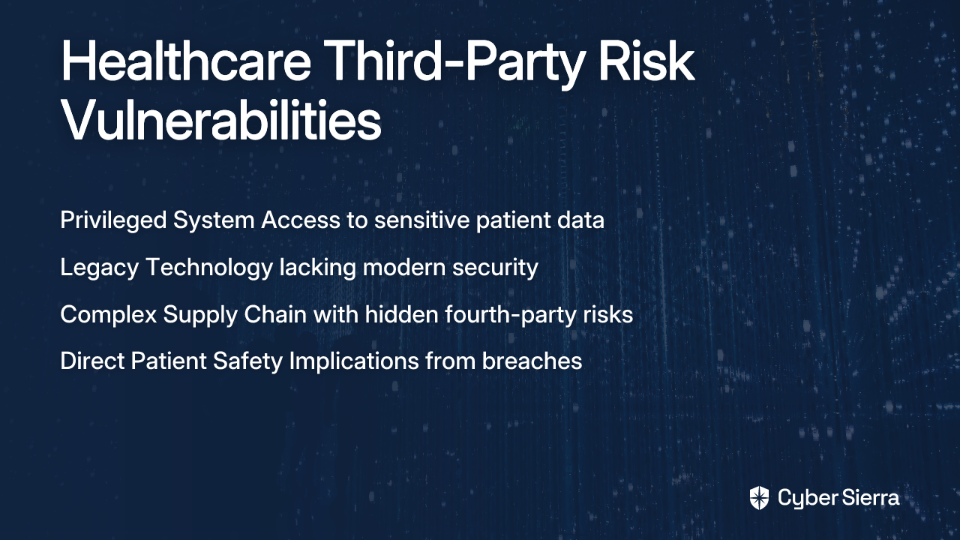
  • Privileged System Access: Vendors often require deep access to sensitive systems and patient data, creating significant risk if their credentials are compromised.
  • Legacy Technology: Many healthcare vendors utilize outdated systems that lack modern security controls.
  • Complex Supply Chain: Healthcare organizations typically manage hundreds of vendors, creating a sprawling and often invisible web of fourth-party risk (your vendors' vendors).
  • Direct Patient Safety Implications: Unlike other industries, security breaches in healthcare can directly impact patient care and safety when they disrupt clinical systems or compromise medical devices.

The Compliance Mandate: Navigating HIPAA and HITECH

While the security risks are clear, the regulatory requirements add another layer of complexity. The Health Insurance Portability and Accountability Act (HIPAA) and the Health Information Technology for Economic and Clinical Health (HITECH) Act create a legal framework that governs how healthcare organizations and their vendors must protect Protected Health Information (PHI).

Key HIPAA Rules for Third Parties

The Privacy Rule

This rule governs how PHI can be used and disclosed, enforcing the principle of "minimum necessary use." Your vendors should only access the absolute minimum PHI required to perform their function—nothing more.

The Security Rule

This rule mandates specific administrative, physical, and technical safeguards for electronic PHI (ePHI). This includes:

  • Risk analysis requirements
  • Access controls
  • Audit controls
  • Integrity controls
  • Transmission security (encryption)

As a covered entity, you're responsible for ensuring your vendors implement these safeguards.

The Critical Role of Business Associate Agreements (BAAs)

"You think that once you sign a BAA your responsibility ends," noted one healthcare IT professional. This dangerous misconception puts many organizations at risk.

A BAA is a legally binding contract that outlines a vendor's (the "Business Associate") responsibilities for safeguarding PHI on behalf of a healthcare provider (the "Covered Entity"). Without a proper BAA, you may be legally liable for vendor breaches.

Key BAA Components:

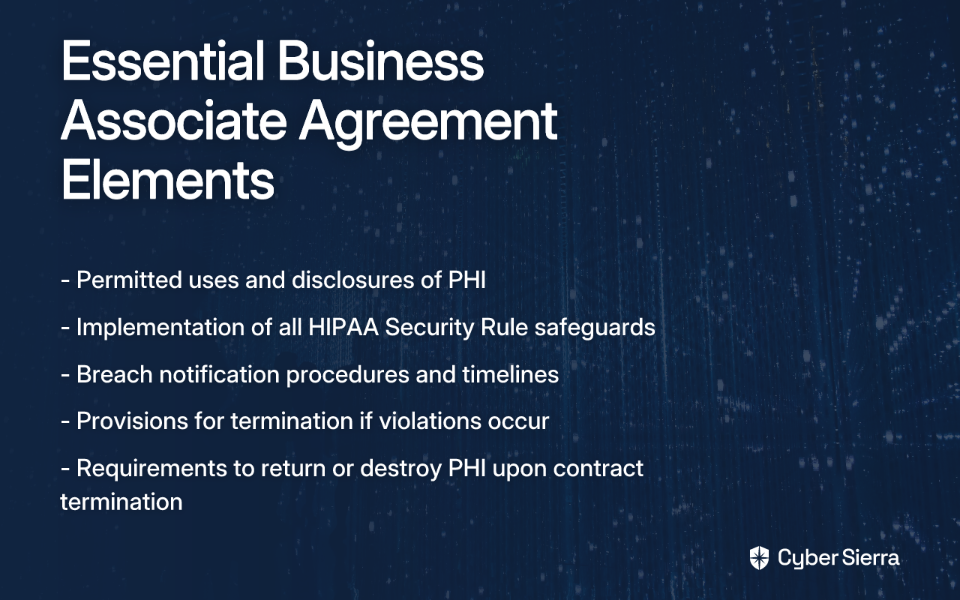
  • Permitted uses and disclosures of PHI
  • Required implementation of all HIPAA Security Rule safeguards
  • Breach notification procedures and timelines
  • Provisions for termination if violations occur
  • Requirements to return or destroy PHI upon contract termination

Consequences of Non-Compliance

HIPAA violations can result in penalties up to $2,067,813 per incident for willful neglect. Beyond the financial penalties, non-compliance leads to:

  • Reputational damage
  • Loss of patient trust
  • Operational disruptions
  • Additional oversight and audits

A Modern Framework for Healthcare Third-Party Risk Management (TPRM)

Managing third-party risk in healthcare "comes down to making it repeatable without turning it into a second job." Let's explore a practical framework that achieves this balance:

1. Automate and Centralize with a Unified Platform

The days of managing vendor risk through spreadsheets and emails are over. As one IT manager put it, you need "a decent third-party solution that can do it for you with little work."

Cyber Sierra's integrated approach combines Third-Party Risk Management (TPRM) and Governance, Risk & Compliance (GRC) capabilities to tackle this challenge:

  • The TPRM module automates vendor onboarding, risk assessments, and continuous monitoring. It helps prioritize vendors by risk level, providing 24/7 visibility into their security posture, moving beyond point-in-time questionnaires.
  • The GRC module automates data collection for compliance frameworks like HIPAA, generating audit-ready reports and maintaining detailed audit trails to prove due diligence.

2. Conduct Rigorous Due Diligence and Vendor Assessments

Before onboarding any vendor, evaluate their security measures against established frameworks like NIST. Your assessment must cover both the vendor's overall security posture and the specific security controls of the solution being procured.

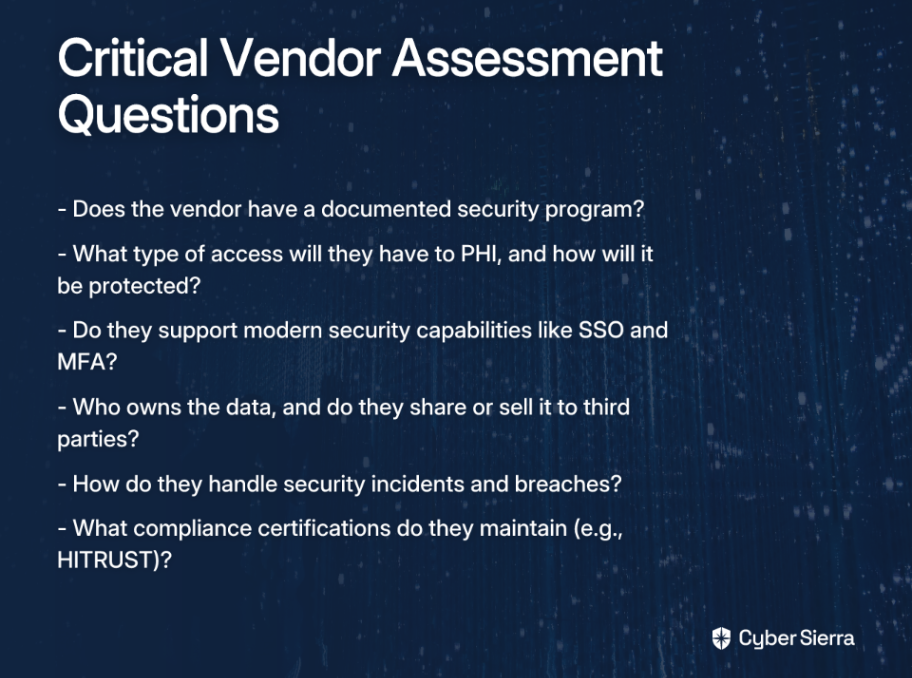
Key questions to ask:

  • Does the vendor have a documented security program?
  • What type of access will they have to PHI, and how will it be protected?
  • Do they support modern security capabilities like SSO and MFA?
  • Who owns the data, and do they share or sell it to third parties?
  • How do they handle security incidents and breaches?
  • What compliance certifications do they maintain (e.g., HITRUST)?

3. Enforce Strong Contractual Agreements

Beyond the BAA, establish Service Level Agreements (SLAs) that clearly define security responsibilities, breach notification timelines, and remediation expectations. Include right-to-audit clauses and penalties for non-compliance.

4. Implement Strict Access Controls

Enforce the principle of least privilege, ensuring vendors have access only to the data and systems necessary for their function. Mandate role-based access controls and multi-factor authentication (MFA) for all vendor access to your systems.

5. Shift to Continuous Monitoring

Annual questionnaires and point-in-time assessments are no longer sufficient. Use automated tools to continuously track vendor performance, scan for vulnerabilities, and detect emerging risks in near real-time.

Cyber Sierra's continuous monitoring capabilities can automatically detect when a vendor's security posture changes, allowing you to intervene before an issue becomes a breach.

6. Manage Fourth-Party Risk

Your vendors' vendors (fourth parties) can pose significant risk. Require transparency from your direct vendors about their critical subcontractors and ensure they flow down similar security requirements.

7. Build a Human Firewall with Security Training

Train your staff to recognize threats like phishing that could compromise vendor credentials. Cyber Sierra's Employee Security Training module offers interactive training and simulated phishing campaigns to build a security-conscious culture.

8. Mandate Strong Data Protection

Require strong encryption protocols for all PHI, both in transit and at rest. Practice data minimization by limiting the shared patient data to only what is absolutely necessary for the vendor's service.

Fortify Your Healthcare Ecosystem with Proactive TPRM

The days of managing vendor risk with spreadsheets and annual check-ins are over. The sheer volume of vendors and the dynamic threat landscape demand a proactive, automated, and continuous approach to stay compliant and secure.

Healthcare organizations must move from periodic assessments to a state of continuous visibility. This means integrating GRC and TPRM into a single source of truth to manage vendor risk, automate compliance, and demonstrate due diligence effortlessly.

As one IT manager put it, "Trying to stay audit-ready in that mess was nearly impossible." But with the right approach and tools, you can transform vendor risk management from an "under-appreciated, full-time job" to a streamlined, automated process that strengthens your security posture and ensures compliance.

Don't let third-party security risks become an operational bottleneck that puts your organization and patients at risk. See how Cyber Sierra's AI-enabled platform streamlines vendor assessments, automates HIPAA compliance, and provides the continuous monitoring you need to build a resilient healthcare supply chain.

Your patients trust you with their most sensitive information. Make sure you can trust your vendors with it too.

Frequently Asked Questions

What is third-party risk management (TPRM) in healthcare?

Third-party risk management (TPRM) in healthcare is the process of identifying, assessing, and mitigating risks associated with external vendors who have access to sensitive patient data or critical systems. This involves continuous due diligence to ensure that partners, such as EHR providers, billing services, and medical device manufacturers, comply with security standards and regulations like HIPAA. The goal is to prevent data breaches, operational disruptions, and compliance violations that could originate from these third-party relationships.

Why is managing vendor risk so critical in the healthcare industry?

Managing vendor risk is critical in healthcare because third-party breaches can lead to massive data exfiltration, severe financial penalties under HIPAA, and direct impacts on patient safety and care delivery. The healthcare industry is a prime target for cyberattacks, and vendors often have privileged access to Protected Health Information (PHI) and core clinical systems. A compromise in a single vendor can expand an organization's attack surface significantly, leading to costly incidents like ransomware attacks that disrupt hospital operations.

What is a Business Associate Agreement (BAA) and what does it do?

A Business Associate Agreement (BAA) is a legally required contract under HIPAA between a healthcare organization (Covered Entity) and a vendor (Business Associate) that handles Protected Health Information (PHI). The BAA legally obligates the vendor to implement specific HIPAA-mandated safeguards to protect PHI. It outlines the permitted uses of the data, breach notification responsibilities, and procedures for data handling upon contract termination. Simply signing a BAA is not enough; healthcare organizations must ensure their vendors actually adhere to its terms.

How can healthcare organizations move beyond spreadsheets for vendor assessments?

Healthcare organizations can move beyond spreadsheets by adopting a modern, centralized TPRM platform that automates the entire vendor risk lifecycle. This approach involves automating vendor onboarding, using standardized digital questionnaires, and implementing continuous monitoring to track a vendor's security posture in real-time. This replaces manual, point-in-time assessments with a dynamic, efficient, and scalable process that provides constant visibility and ensures you are always audit-ready.

What are the primary consequences of HIPAA non-compliance due to a vendor breach?

The consequences of HIPAA non-compliance from a vendor breach include severe financial penalties that can exceed $2 million per incident, corrective action plans imposed by regulators, and significant reputational damage. Beyond the fines, organizations may suffer from a loss of patient trust, operational downtime during incident response, and increased scrutiny from auditors. Legally, the healthcare organization remains responsible for safeguarding PHI, even when it is in the hands of a third-party vendor.

What is fourth-party risk and why does it matter?

Fourth-party risk refers to the security risks introduced by your vendor's vendors (i.e., their subcontractors). It matters because a breach at this level can still impact your organization and compromise your data. A comprehensive TPRM program must account for this extended supply chain. This requires demanding transparency from your direct vendors about their own critical third parties and ensuring that your security and compliance standards are "flowed down" to these fourth parties through contractual obligations.

blog-hero-background-image
Cyber Security

10 Best Audit Automation Software for Cybersecurity Compliance in 2026

backdrop
Table of Contents

Join thousands of professionals and get the latest insight on Compliance & Cybersecurity.


blog-hero-background-image
Cyber Security

10 Essential Tools Every Modern CISO Needs in Their Security Stack

backdrop
Table of Contents

Join thousands of professionals and get the latest insight on Compliance & Cybersecurity.


Summary

  • Modern security teams often manage over 80 different security tools, which creates operational inefficiency and critical security gaps.
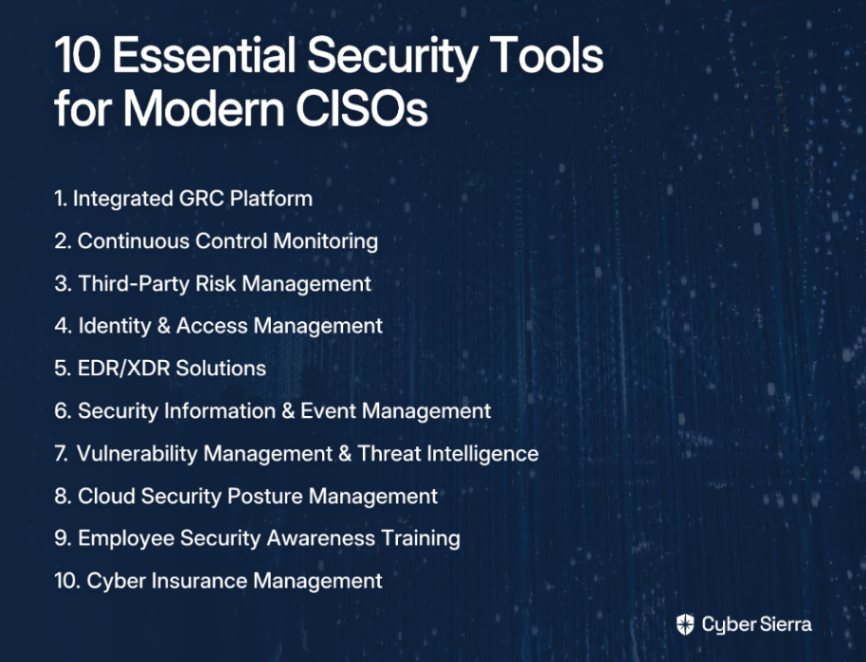
  • To shift from reactive firefighting to strategic leadership, CISOs must build a cohesive program around 10 essential security categories.
  • A unified platform approach reduces incident response times and delivers a significantly higher ROI compared to managing multiple disconnected point solutions.
  • Consolidating core functions like GRC, continuous monitoring, and vendor risk management on a single platform like Cyber Sierra provides the visibility and automation to build a modern, proactive security program.

You've set up countless security tools across your organization. Yet, juggling "83 different security solutions from 29 vendors" still feels overwhelming. You're tired of the endless spreadsheet collaboration ("Joe, I need the Tech Review sheet when you're done"), the disjointed systems, and the nagging feeling that despite all this technology, critical security gaps remain.

Sound familiar?

Today's Chief Information Security Officers (CISOs) face unprecedented challenges. The role has evolved from purely technical gatekeeper to strategic business leader, with responsibilities spanning regulatory compliance, vendor management, board reporting, and protecting against increasingly sophisticated threats.

Yet many security leaders find themselves trapped in tactical firefighting mode, unable to elevate to the strategic level their organizations desperately need. The culprit? An ineffective, fragmented security technology stack.

This article outlines the 10 essential security tool categories that every modern CISO needs to build a cohesive, effective security program that enhances business resilience rather than hindering it.

1. Integrated Governance, Risk, and Compliance (GRC) Platform

The foundation of any effective security program is visibility and governance. Before investing in specialized security tools, CISOs need a centralized command center that provides a single source of truth for the organization's security posture.

Traditional GRC—managed via spreadsheets, SharePoint, and "copies of emails with the word 'APPROVED' in the body"—is a recipe for audit fatigue and strategic blindness. An integrated GRC platform automates and unifies risk management, compliance adherence, and governance processes.

Cyber Sierra's platform offers a comprehensive GRC solution that automates data collection, risk assessments, and reporting for frameworks like SOC2, ISO 27001, HIPAA, and GDPR. It eliminates manual work and consolidates critical security functions, moving security from periodic, manual checks to proactive, near real-time risk management.
Key capabilities to look for in a GRC platform:

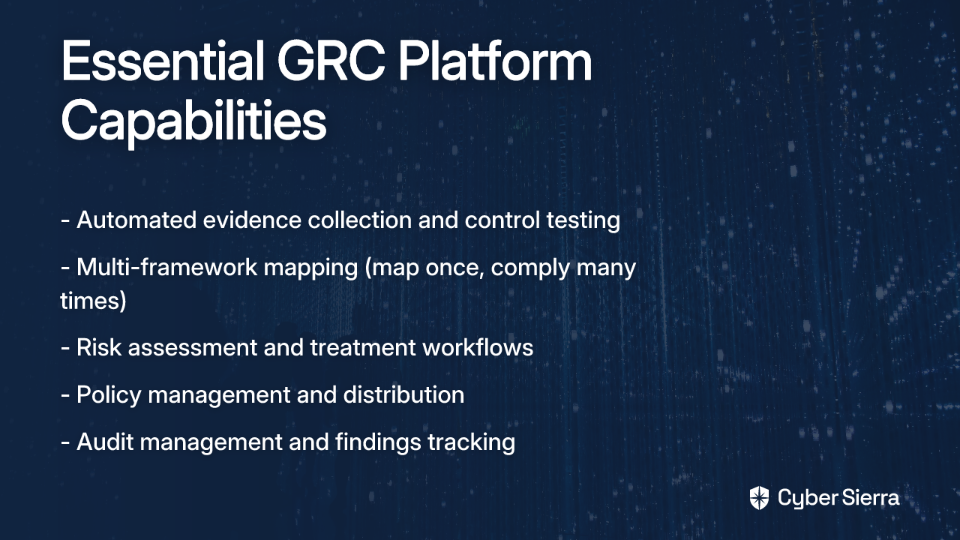
  • Automated evidence collection and control testing
  • Multi-framework mapping (map once, comply many times)
  • Risk assessment and treatment workflows
  • Policy management and distribution
  • Audit management and findings tracking

2. Continuous Control Monitoring (CCM)

Periodic point-in-time assessments are no longer sufficient in today's dynamic threat environment. CCM tools provide ongoing, automated verification that security controls are functioning as intended.

"We bought a GRC tool and it didn't deliver as promised," is a common refrain among security leaders. Many tools claim continuous monitoring but deliver glorified spreadsheets with manual attestation requirements.

True CCM platforms like Cyber Sierra's CCM module build a central controls repository, detect exceptions in real-time, and eliminate the need for manual evidence gathering that plagues compliance managers.

A robust CCM solution should:

  • Connect to your technology stack to automatically test controls
  • Alert on control failures and deviations
  • Provide real-time visibility into security posture
  • Support multiple compliance frameworks

3. Third-Party Risk Management (TPRM)

Your security is only as strong as your weakest vendor. With supply chain attacks increasing, a comprehensive TPRM program is essential.

Traditional vendor assessment approaches involving spreadsheet questionnaires sent annually offer limited protection. Modern TPRM solutions streamline the entire vendor lifecycle, from onboarding to continuous monitoring.

Cyber Sierra's TPRM module simplifies vendor risk assessment with automated questionnaires and continuous monitoring, addressing the massive risk in the supply chain. This is crucial as point-in-time assessments are no longer sufficient.

Effective TPRM tools should:

  • Automate vendor questionnaires and risk scoring
  • Maintain a central repository of vendor documentation
  • Continuously monitor vendor security posture changes
  • Integrate with GRC for a unified risk view

4. Identity and Access Management (IAM)

With remote work and cloud adoption, identity has become the new perimeter. IAM tools ensure that only the right people have access to the right resources at the right time.

Key components of a robust IAM solution include:

  • Multi-factor Authentication (MFA): A non-negotiable layer of defense against credential theft
  • Single Sign-On (SSO): Improves user experience while centralizing access control
  • Privileged Access Management (PAM): Secures and manages accounts with elevated permissions
  • Identity Governance: Ensures access rights align with job responsibilities

According to IBM, 19% of all breaches start with compromised credentials. Implementing strong IAM controls is one of the most effective ways to reduce your attack surface.

5. Endpoint Detection and Response (EDR) / Extended Detection and Response (XDR)

Traditional antivirus is insufficient against today's sophisticated attacks. EDR provides deep visibility into endpoints (laptops, servers) to detect and respond to suspicious activity in real-time. XDR extends this capability across networks, cloud, and email for unified threat detection.

Modern EDR/XDR tools offer:

  • Real-time monitoring of endpoint activity
  • Behavioral analysis to detect unknown threats
  • Automated response capabilities to contain threats
  • Threat hunting features for proactive defense

The ability to quickly detect and contain endpoint threats is critical, as the average cost of a data breach increases the longer it takes to identify and contain.

6. Security Information and Event Management (SIEM)

Your security tools generate millions of alerts. A SIEM aggregates log data from across your entire IT infrastructure, analyzes it to identify potential threats, and provides a centralized dashboard for incident response.

An effective SIEM solution should:

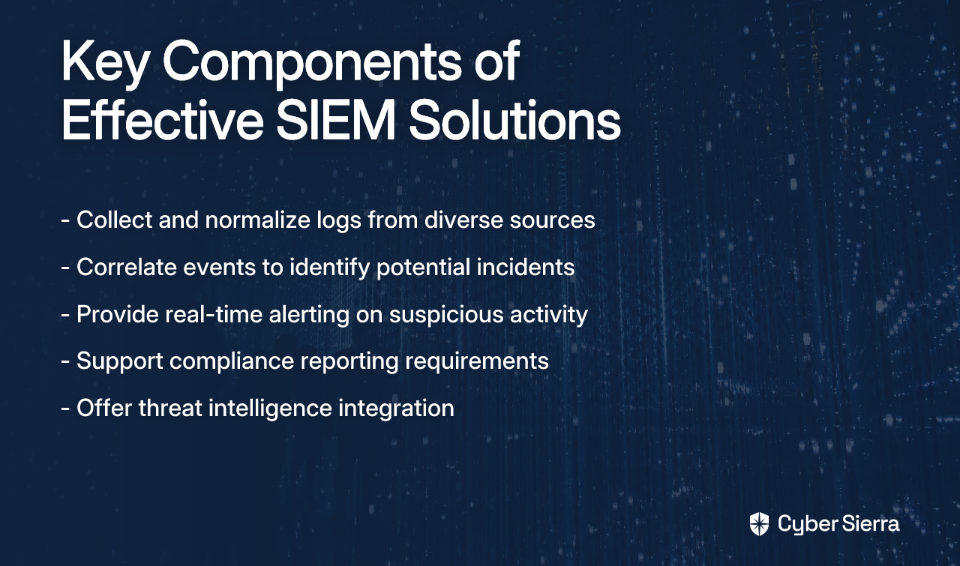
  • Collect and normalize logs from diverse sources
  • Correlate events to identify potential incidents
  • Provide real-time alerting on suspicious activity
  • Support compliance reporting requirements
  • Offer threat intelligence integration

Modern SIEM solutions increasingly incorporate security orchestration and response (SOAR) capabilities to automate incident handling workflows.

7. Vulnerability Management & Threat Intelligence

You can't protect what you don't know is vulnerable. Vulnerability management tools proactively scan your systems, network, and applications for weaknesses before attackers can exploit them.

When integrated with threat intelligence, these tools help you prioritize remediation based on actual exploitation in the wild.

Cyber Sierra's Threat Intelligence module provides a comprehensive security scorecard, vulnerability scanning, and insights to manage risk proactively, connecting vulnerabilities directly to your GRC posture.

Look for solutions that offer:

  • Network and cloud infrastructure scanning
  • Web application vulnerability assessment
  • Prioritization based on severity and exploitability
  • Integration with patch management workflow

8. Cloud Security Posture Management (CSPM)

Cloud misconfigurations are a leading cause of data breaches. CSPM tools continuously monitor cloud environments (AWS, Azure, GCP) for security policy violations and compliance risks.

Essential CSPM capabilities include:

  • Continuous compliance monitoring against standards like CIS Benchmarks
  • Detection of misconfigurations (e.g., public S3 buckets, open security groups)
  • Automated remediation and drift prevention
  • Integration with DevOps pipelines for "shift left" security

9. Employee Security Awareness Training

The "human firewall" remains one of your most vulnerable attack vectors. Phishing, social engineering, and simple human errors are responsible for a significant percentage of breaches.

Effective security awareness platforms like Cyber Sierra's Employee Security Training offer:

  • Interactive training modules on topics like phishing, password hygiene, and data handling
  • Simulated phishing campaigns to test and reinforce learning
  • Reporting dashboards to track progress and identify high-risk users
  • Just-in-time training triggered by risky behaviors

Building a security-conscious workforce is not a one-time event but an ongoing process that requires consistent reinforcement and measurement.

10. Cyber Insurance Management

Cyber insurance has evolved from a financial backstop to a critical component of risk management. Insurers now have stringent requirements for cyber hygiene, and premiums are directly tied to your security posture.
Tools that help manage this process, like Cyber Sierra's Cyber Insurance module, are invaluable for:

  • Assessing coverage needs based on risk posture
  • Automating the collection of evidence required by insurers
  • Streamlining the application and renewal process
  • Demonstrating security control effectiveness to secure better premiums

By connecting your real-time security posture (from CCM and GRC modules) directly to the insurance application process, you can demonstrate robust hygiene and potentially reduce premiums.

The Power of Platform: Moving Beyond Tool Sprawl

Remember the 83 tools and 29 vendors mentioned earlier? This isn't just a management headache; it's a security risk. Disconnected tools create data silos, increase operational costs, and slow down incident response.

According to IBM research, organizations that adopt a unified platform approach see significant advantages:

  • Faster Response: Reduce time to detect incidents by 72 days and time to contain them by 84 days
  • Higher ROI: Achieve an average ROI of 101%, compared to just 28% for those using a collection of point solutions
  • Improved Efficiency: Break down silos, automate manual tasks, and provide a single pane of glass for a holistic view of risk

As one Reddit user lamented, "I'm convinced they are all scams and it's an entire racket. They all cost absurd amounts." This sentiment reflects the frustration many security leaders feel when investing in disjointed tools that fail to deliver on their promises.

This is why platforms like Cyber Sierra are gaining traction. By consolidating essential security functions into a single, intelligent platform, they help CISOs move from tactical firefighting to strategic security leadership.

Build Your Strategic, Unified Security Stack Today

The role of the CISO has fundamentally changed. Success is no longer measured by the number of tools deployed, but by the ability to manage risk strategically and enable the business securely.

Leaving behind the chaos of spreadsheets and disjointed systems is the first step toward becoming a truly strategic CISO. By consolidating essential functions like GRC, TPRM, and CCM into a single, intelligent platform, you can transform your security program from a reactive cost center into a proactive business enabler.

Stop wrestling with tool sprawl and audit fatigue. Discover how an AI-enabled, unified platform can give you the visibility and automation you need to build a world-class security program. See how Cyber Sierra simplifies security and compliance with a free demo.

As your organization's security leader, your technology choices determine whether you remain trapped in tactical mode or elevate to the strategic role your business needs. Choose wisely.

Frequently Asked Questions

What are the most essential security tools for a modern CISO?

The 10 essential security tool categories for a modern CISO are: Integrated GRC, Continuous Control Monitoring, Third-Party Risk Management, IAM, EDR/XDR, SIEM, Vulnerability Management, Cloud Security Posture Management, Employee Security Training, and Cyber Insurance Management. These tools form a cohesive security program that moves beyond tactical firefighting to strategic risk management, providing visibility and control across the entire organization.

Why is an integrated GRC platform considered a foundational tool?

An integrated Governance, Risk, and Compliance (GRC) platform is foundational because it acts as a centralized command center, providing a single source of truth for an organization's entire security posture. Before deploying specialized tools, a CISO needs visibility. A GRC platform automates risk management and maps controls to multiple compliance frameworks, replacing manual spreadsheets and enabling a proactive approach to security.

How does a unified security platform help a CISO become more strategic?

A unified security platform helps a CISO become more strategic by consolidating data, automating manual tasks, and providing a holistic, real-time view of risk. This frees them from tactical firefighting to focus on business-aligned security initiatives. Instead of managing dozens of disconnected tools, a CISO can use a single platform to see the interplay between GRC, vendor risk, and control effectiveness, facilitating better board reporting and smarter resource allocation.

What is Continuous Control Monitoring (CCM) and why is it important?

Continuous Control Monitoring (CCM) is an automated process that continuously verifies that security controls are implemented and operating effectively, replacing outdated point-in-time assessments. It's critical because threats and IT environments are constantly changing. CCM provides real-time alerts on control failures, ensuring ongoing compliance and eliminating the audit fatigue associated with manual evidence gathering.

How can a CISO effectively manage third-party and supply chain risk?

A CISO can effectively manage third-party risk by implementing a modern Third-Party Risk Management (TPRM) solution that automates the entire vendor lifecycle, from onboarding and risk assessment to continuous monitoring. Traditional annual questionnaires are insufficient. An effective TPRM tool streamlines assessments, maintains a central vendor repository, and continuously monitors their security posture for a unified view of risk.

Is it better to use a single unified security platform or multiple best-of-breed tools?

For most organizations, a single unified security platform is better because it reduces complexity, breaks down data silos, and improves incident response times, leading to a higher return on investment. While best-of-breed tools may offer deep functionality in one area, managing dozens of them creates operational overhead and security gaps. Research shows that organizations with a unified approach detect and contain breaches significantly faster.

blog-hero-background-image
Cyber Security

7 Cybersecurity Maturity Assessment Frameworks Compared for 2026

backdrop
Table of Contents

Join thousands of professionals and get the latest insight on Compliance & Cybersecurity.


Summary

  • Choosing the right cybersecurity framework—like NIST for flexibility or ISO 27001 for global recognition—depends on your specific industry, regulatory needs, and business goals.
  • These models help justify security investments by translating risk into a business context, especially when the average data breach costs $4.45 million.
  • The first step to implementation is a maturity assessment to benchmark your current posture, identify gaps, and build a prioritized improvement roadmap.
  • Managing multiple frameworks requires automation, and a platform like Cyber Sierra's GRC solution simplifies this by unifying standards and enabling continuous control monitoring.

Choosing the right cybersecurity maturity assessment framework can feel like navigating a maze. With acronyms like NIST, CMMC, and ISO flying around, it's easy to get overwhelmed. You need a model that's adaptable, provides useful feedback, and doesn't require a team of experts just to understand the getting-started guide.

The good news? You're not alone in this challenge. The even better news? This comprehensive guide will help you cut through the confusion and identify the framework that best aligns with your organization's needs—or show you how to manage multiple frameworks simultaneously.

What Are Cybersecurity Maturity Models?

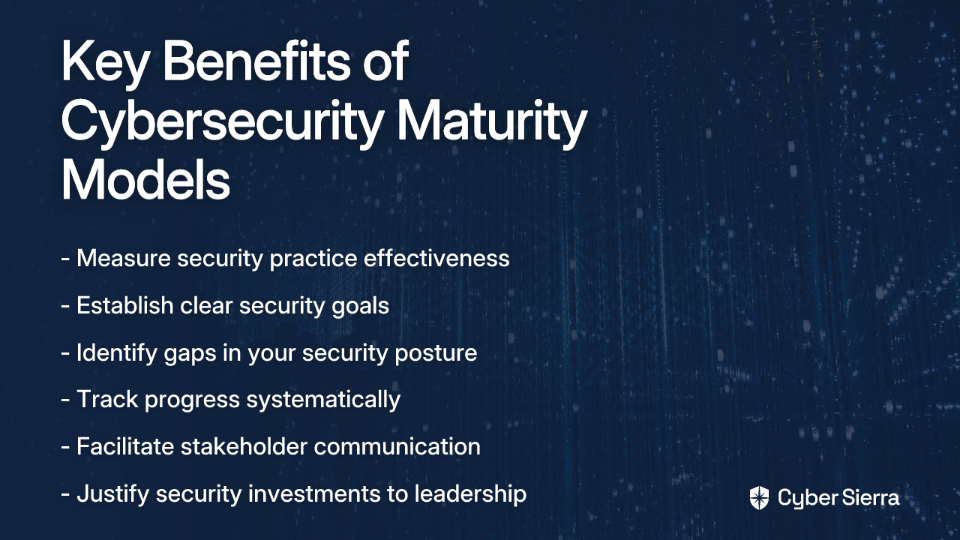
Cybersecurity maturity models are frameworks designed to measure the effectiveness of your security practices, establish clear security goals, and provide a structured approach to identifying gaps and tracking progress. They facilitate clearer communication about risks to stakeholders and help justify security investments to leadership.

As we look toward 2026, these seven frameworks stand out as the most relevant options for organizations seeking to assess and improve their cybersecurity posture:

1. NIST Cybersecurity Framework (CSF)

Overview: Developed by the U.S. National Institute of Standards and Technology, the NIST CSF is a voluntary and highly flexible framework designed to provide a common language and structure for managing cybersecurity risk.

Industry Applicability: Originally created for U.S. critical infrastructure, it's now widely adopted by organizations of all sizes and sectors globally due to its adaptability.

Structure: NIST CSF is organized around five core functions: Identify, Protect, Detect, Respond, and Recover. The latest version (CSF 2.0, released in 2024) adds a sixth function: Govern, emphasizing the importance of cybersecurity governance.

Strengths:

  • Flexibility to tailor to any organization's specific needs and risk profile
  • Cost-effective (the framework itself is free to use)
  • Comprehensive coverage of the entire lifecycle of a cybersecurity incident

Weaknesses:

  • Lacks formal certification, which may not satisfy external stakeholders
  • Can be resource-intensive to implement, especially for smaller businesses
  • Its flexibility can make measuring progress difficult without supplementary tools

Implementation Complexity: Low to Medium. NIST CSF allows for self-certification and a self-paced timeline.

2. Cybersecurity Maturity Model Certification (CMMC) 2.0

Overview: A mandatory compliance framework developed by the U.S. Department of Defense (DoD) to protect Controlled Unclassified Information (CUI) within the Defense Industrial Base (DIB) supply chain.

Industry Applicability: Mandatory for any organization that is part of the DoD supply chain.

Structure: CMMC 2.0 is structured into three levels:

  • Level 1 (Foundational): Requires 15 basic controls to protect Federal Contract Information (FCI)
  • Level 2 (Advanced): Aligns with 110 controls in NIST SP 800-171 to protect CUI
  • Level 3 (Expert): Based on NIST SP 800-172 for enhanced protection against Advanced Persistent Threats

Strengths:

  • Provides a clear, tiered path to improving security
  • Third-party validation adds credibility and assurance
  • Directly addresses security across the defense supply chain

Weaknesses:

  • Primarily relevant only to the DoD supply chain
  • Achieving certification can be expensive and complex due to audit requirements

Implementation Complexity: High, due to its rigorous assessment requirements.

3. ISO/IEC 27001

Overview: An international standard for establishing, implementing, maintaining, and continually improving an Information Security Management System (ISMS).

Industry Applicability: Global and industry-agnostic. Ideal for organizations that need to demonstrate a strong security posture to international clients and partners.

Structure: Focuses on creating a holistic ISMS and includes a set of mandatory clauses plus Annex A with a comprehensive list of security controls. The latest version is ISO 27001:2022.

Strengths:

  • Most widely recognized cybersecurity certification globally
  • Builds a robust, risk-based security management system
  • Certification from an accredited auditor provides high assurance to customers and partners

Weaknesses:

  • Significant costs for certification, surveillance audits, and recertification
  • Can be less flexible than frameworks like NIST CSF

Implementation Complexity: High. Requires a formal, two-stage external audit process to achieve certification.

4. CIS Controls

Overview: Developed by the Center for Internet Security, this framework provides a prioritized set of defensive actions to protect against the most pervasive cyber threats.

Industry Applicability: Universal. Particularly valuable for organizations looking for a prioritized, hands-on guide to improving security hygiene.

Structure: Consists of 18 top-level Controls with multiple Safeguards categorized into Implementation Groups (IG1, IG2, IG3) based on organizational maturity.

Strengths:

  • Prioritized and actionable focus on the most critical security measures
  • Offers clear, technical guidance on implementation
  • Regularly updated based on real-world attack data

Weaknesses:

  • More technically focused with less emphasis on broader governance
  • Not a comprehensive management system like ISO 27001

Implementation Complexity: Medium. While the controls are prescriptive, implementing them technically across an organization requires significant effort.

5. FAIR (Factor Analysis of Information Risk)

Overview: A quantitative risk analysis framework that provides a model for understanding, analyzing, and quantifying information risk in financial terms.

Industry Applicability: Any organization seeking to move from qualitative ("high," "medium," "low") risk ratings to quantitative, financial-based risk assessments.

Structure: A taxonomy and methodology for breaking down risk into measurable factors: Loss Event Frequency and Loss Magnitude.

Strengths:

  • Translates cybersecurity risk into business-friendly financial terms
  • Enables data-driven decisions on security investments
  • Complements other frameworks to provide quantitative risk assessment

Weaknesses:

  • Requires reliable data and staff skilled in statistical analysis
  • Not a control framework—tells you how to measure risk, not which controls to implement

Implementation Complexity: High. Requires specialized training and a significant cultural shift towards data-driven risk management.
6. COBIT (Control Objectives for Information and Related Technologies)

Overview: A framework for the governance and management of enterprise information and technology (I&T), aligning business goals with IT goals and processes.

Industry Applicability: Primarily used by IT auditors, IT managers, and executives in large enterprises to ensure IT governance.

Structure: Based on five core principles and a set of governance and management objectives that bridge the gap between business requirements, technical issues, and security risks.

Strengths:

  • Excellent for aligning IT and cybersecurity efforts with business objectives
  • Covers the entire enterprise I&T landscape, not just security
  • Well-regarded by auditors and helps satisfy regulatory requirements like SOX

Weaknesses:

  • Can be very complex and bureaucratic to implement fully
  • Broader than a pure cybersecurity framework, may need supplementation

Implementation Complexity: High, due to its comprehensive and governance-heavy nature.

7. C2M2 (Cybersecurity Capability Maturity Model)

Overview: Developed by the U.S. Department of Energy (DOE) in partnership with the private sector to help organizations evaluate and improve cybersecurity capabilities.

Industry Applicability: Created for the energy sector but applicable to any critical infrastructure or industrial control system (ICS) environment.

Structure: Organized into 10 domains with four Maturity Indicator Levels (MILs) from MIL0 (Incomplete) to MIL3 (Managed) across over 350 practices.

Strengths:

  • Provides a detailed roadmap for improving specific cybersecurity domains
  • Excellent for benchmarking current capabilities and planning improvements

Weaknesses:

  • Tailored for the energy/critical infrastructure sector
  • The large number of practices can be overwhelming to assess

Implementation Complexity: Medium to High, requiring detailed self-assessment against numerous practices.

Decision Matrix: Choosing Your Framework

FeatureNIST CSFCMMC 2.0ISO 27001CIS ControlsFAIRCOBITC2M2
Primary FocusRisk ManagementProtecting CUI/FCIInformation Security Management SystemPrioritized Technical ControlsQuantitative Risk AnalysisIT GovernanceCapability Maturity
IndustryUniversalDoD Supply ChainUniversal (Global)UniversalUniversalLarge EnterprisesEnergy / Critical Infrastructure
Compliance TypeVoluntaryMandatory (for DIB)Voluntary (Certification)VoluntaryVoluntaryVoluntaryVoluntary
ComplexityLow-MediumHighHighMediumHighHighMedium-High
CostFree (Framework)High (Audits)High (Audits)Free (Framework)Training CostsTraining/ImplementationFree (Framework)
Key BenefitFlexible & AdaptableDoD Contract EligibilityInternational RecognitionActionable & PrioritizedFinancial Risk ViewBusiness/IT AlignmentDetailed Maturity Roadmap

The Modern Approach: Managing Multiple Frameworks Simultaneously

In today's complex regulatory landscape, many organizations don't have the luxury of choosing just one framework. A healthcare technology company might need to comply with HIPAA, implement ISO 27001 for international clients, and use NIST CSF as its overarching risk management guide.

Managing these disparate requirements with spreadsheets is a recipe for compliance fatigue and security gaps. Instead of wrestling with multiple frameworks independently, a unified Governance, Risk, and Compliance (GRC) platform can harmonize them.

This is where a platform like Cyber Sierra's GRC solution transforms compliance from a burden into a strategic advantage. Cyber Sierra's platform eliminates the "either/or" choice by providing a single source of truth for all your compliance needs:

  • Multi-Framework Management: The platform supports major frameworks like SOC2, ISO 27001, GDPR, HIPAA, and PCI DSS out-of-the-box and allows for custom controls, directly addressing the need to manage multiple standards.
  • Continuous Control Monitoring (CCM): Instead of periodic, manual evidence gathering, Cyber Sierra's CCM module offers ongoing, near real-time visibility into your security controls. It automates testing and validation, detecting exceptions before they become audit findings.
  • Automated Evidence Collection: By automating data collection and risk assessments, the platform enables you to move from a reactive to a proactive security posture, addressing risks as they emerge.

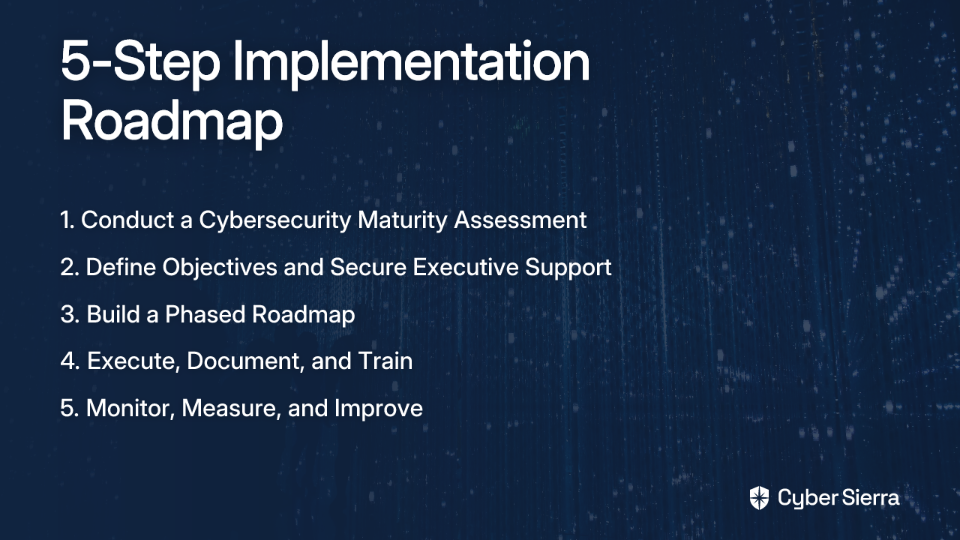
A Practical Roadmap to Implementation

No matter which framework you choose (or if you're managing multiple), the implementation journey follows a similar path:

Step 1: Conduct a Cybersecurity Maturity Assessment

Use your chosen framework to assess your current security posture. Identify where you are and where you need to be. This foundational step helps spot gaps and areas for improvement.

Step 2: Define Objectives and Secure Executive Support

Establish clear goals. Are you aiming for a specific CMMC level or ISO certification? Frame the initiative as a business enabler. Use statistics like "the average cost of a data breach is $4.45 million" to demonstrate value to leadership.

Step 3: Build a Phased Roadmap

Create an action plan to address the identified gaps. Prioritize high-impact areas first. Assign ownership for each task and set realistic timelines.

Step 4: Execute, Document, and Train

Implement the necessary controls and process changes. Document everything—this is critical for audits and ongoing management. Conduct employee training to ensure everyone understands their role in the new security processes.

Step 5: Monitor, Measure, and Improve

Continuously monitor your controls to ensure they're working effectively. Use maturity models and metrics to track progress. Remember that cybersecurity is not a one-time project; adjust your strategy as the threat landscape evolves.

Unify Your Compliance and Elevate Your Security Posture

Selecting the right framework provides the blueprint for a strong security program. But a blueprint is only as good as its execution. The real challenge—and opportunity—lies in moving beyond static checklists to a dynamic, continuous, and automated approach to security and compliance.

The future of cybersecurity maturity assessment isn't about choosing a single framework. It's about efficiently managing multiple frameworks through automation and continuous monitoring. This approach not only reduces compliance overhead but also provides a more accurate, real-time view of your security posture.

Frequently Asked Questions (FAQ)

What is the difference between NIST CSF and ISO 27001?

The primary difference is that NIST CSF is a flexible, voluntary risk management framework, while ISO 27001 is a formal, certifiable international standard for an Information Security Management System (ISMS). NIST CSF provides a common language and structure that can be adapted to any organization without a formal certification process. In contrast, ISO 27001 requires a rigorous external audit to achieve certification, which provides a high level of assurance to international partners and customers.

How do I choose the right cybersecurity framework for my business?

To choose the right framework, you should evaluate your organization's specific industry, regulatory requirements, risk profile, and business objectives. Consider key factors such as whether you are part of a specific supply chain (like the DoD, which requires CMMC), if you need international recognition (favoring ISO 27001), or if you need a flexible, adaptable starting point (like NIST CSF).

Which cybersecurity framework is best for small businesses?

For small businesses, the NIST Cybersecurity Framework (CSF) and CIS Controls are often the most practical and effective starting points. NIST CSF is highly flexible and free to use, allowing small businesses to adopt security best practices without the high cost of a formal certification. The CIS Controls offer a prioritized, actionable list of technical safeguards that can help small teams focus on the most critical defenses first.

What is the first step in implementing a cybersecurity framework?

The first step in implementing any cybersecurity framework is to conduct a comprehensive maturity assessment. This initial assessment involves using the chosen framework to benchmark your current security posture against its controls and requirements. This process helps you identify existing gaps and create a baseline from which you can build a prioritized roadmap for improvement.

Can an organization use multiple cybersecurity frameworks?

Yes, many organizations use multiple cybersecurity frameworks simultaneously to meet diverse regulatory and business needs. For example, a company might use NIST CSF as its foundational risk management guide while implementing ISO 27001 to satisfy international client requirements. Modern GRC platforms are designed to harmonize these different requirements and automate control mapping to avoid duplication of effort.

How often should a cybersecurity maturity assessment be performed?

A cybersecurity maturity assessment should be performed at least annually or whenever significant changes occur in your organization or the threat landscape. While an annual assessment is a common best practice, continuous monitoring is the ideal. The threat landscape is constantly evolving, so regularly reassessing your maturity ensures your security program remains effective and aligned with your current risk profile.

blog-hero-background-image
Cyber Security

10 Essential Tools for Conducting Your PCI DSS Gap Assessment

backdrop
Table of Contents

Join thousands of professionals and get the latest insight on Compliance & Cybersecurity.


Summary

  • With only 43% of PCI DSS requirements met during data breaches, manual compliance efforts often fall short and create significant risk.
  • A successful PCI DSS gap assessment relies on a combination of tools for network mapping, vulnerability scanning, and log management to identify and remediate security weaknesses.
  • To move beyond periodic audits, organizations should automate evidence collection and prioritize integrated platforms for continuous compliance.
  • An all-in-one platform like Cyber Sierra's GRC module can streamline the entire PCI DSS assessment process, from control mapping to continuous monitoring.

Are you drowning in scattered evidence, messy spreadsheets, and endless back-and-forth during your PCI DSS compliance efforts? You're not alone. With only 43% of PCI DSS requirements typically met during reported data breaches, having the right arsenal of tools isn't just convenient—it's critical for security and compliance success.

A comprehensive PCI DSS gap assessment helps you identify security weaknesses in your Cardholder Data Environment (CDE) before an official audit, creating a clear roadmap to compliance. But without the right tools, this process can quickly become overwhelming, resource-intensive, and prone to dangerous oversights.

In this guide, we'll explore the essential tools that can transform your PCI gap assessment from a manual burden into a streamlined, automated workflow—helping you protect sensitive data, avoid hefty fines, and maintain continuous compliance.

The 10 Essential Tools for Your PCI DSS Gap Assessment

The All-in-One: Integrated Compliance Platforms

1. Cyber Sierra: Unified GRC & Compliance Automation Platform

For organizations seeking to eliminate the fragmentation of multiple point solutions, Cyber Sierra offers an all-in-one platform that addresses the entire PCI DSS compliance lifecycle:

  • Governance, Risk & Compliance (GRC): Manages the complete assessment process by mapping controls to PCI DSS requirements, automating risk assessments, and maintaining detailed audit trails for generating crucial reports like ROC and AOC.
  • Continuous Control Monitoring (CCM): Automates evidence collection with a central controls repository that provides near real-time updates and validation across cloud and on-premises environments.
  • Third-Party Risk Management (TPRM): Crucial for meeting PCI DSS Requirement 12.8 (vendor management), Cyber Sierra automates assessments of service providers that could impact your CDE.
  • Threat Intelligence: Integrates vulnerability scanning for networks and cloud environments to identify technical gaps requiring remediation.

Best For: Enterprises and fast-growing companies seeking a unified view of security and compliance to eliminate manual effort and audit fatigue.

Phase 1: Scoping & Discovery Tools

2. Network Mapping Tools (e.g., Nmap)

Before you can assess compliance, you must accurately define what's in scope for PCI DSS:

  • Functionality: This open-source tool enables comprehensive network discovery and security auditing.
  • Role in Gap Assessment: Essential for identifying all systems, ports, and services on the network—the foundational step for accurately defining your CDE boundaries.
  • Best For: Organizations needing a free, powerful tool to create a comprehensive inventory of network assets to inform their PCI scope.

Phase 2: Evidence Collection & Vulnerability Identification Tools

3. Vulnerability Scanners (e.g., Qualys, Nessus)

  • Functionality: These tools scan networks, systems, and applications for security vulnerabilities.
  • Role in Gap Assessment: Directly addresses PCI DSS Requirement 11 (Regularly Test Security Systems and Processes).
    • Qualys PCI Compliance: An enterprise solution that automates compliance scanning with PCI-aligned reporting.
    • Nessus: A widely-used scanner for identifying missing patches, misconfigurations, and other weaknesses.
  • Best For: Organizations needing to automate the technical vulnerability identification process required for PCI DSS.

4. Cloud Security Posture Management (CSPM) (e.g., Orca Security)

  • Functionality: Agentless cloud security platforms provide visibility into risks within cloud environments (AWS, Azure, GCP).
  • Role in Gap Assessment: For cloud-based operations, CSPM is critical for identifying misconfigurations that could expose the CDE, helping assess compliance with PCI requirements in cloud contexts.
  • Best For: Cloud-first companies and fintechs where infrastructure is code and manual checks are impractical.

5. File Integrity Monitoring (FIM) Tools (e.g., Tripwire)

  • Functionality: Monitors and detects changes to critical system and configuration files.
  • Role in Gap Assessment: Directly addresses PCI DSS Requirement 11.5 (Deploy a change-detection mechanism). A gap assessment must verify that FIM is properly configured to alert on unauthorized modifications.
  • Best For: Organizations in highly regulated industries needing specialized tools for configuration and file integrity monitoring.

6. Log Management & SIEM Tools (e.g., SolarWinds, Splunk)

  • Functionality: Centralizes the collection, monitoring, and analysis of log data across the IT environment.
  • Role in Gap Assessment: Addresses PCI DSS Requirement 10 (Track and monitor all access to network resources and cardholder data). A thorough assessment reviews log management processes to ensure comprehensive detection of suspicious activity.
  • Best For: Enterprises needing a log-centric approach to security monitoring and incident investigation.

7. Penetration Testing Tools (e.g., Metasploit, Burp Suite)

  • Functionality: Tools used by security professionals to simulate attacks and exploit vulnerabilities.
  • Role in Gap Assessment: A gap assessment should confirm regular penetration testing as required by PCI DSS Requirement 11.3. While the assessment itself may not involve a full pentest, it verifies that the process exists and is effective.
  • Best For: Internal security teams or external QSAs conducting deep technical testing to validate security controls.

Phase 3: Reporting, Remediation & Training

8. Compliance Documentation & Spreadsheets (e.g., Official PCI DSS SAQs)

  • Functionality: Manual tools for tracking requirements and evidence.
  • Role in Gap Assessment: For smaller organizations, a gap assessment might begin with a Self-Assessment Questionnaire (SAQ). These free checklists from the PCI Security Standards Council provide a starting point, but they lack automation, collaboration features, and version control.
  • Best For: Small merchants or as a preliminary, internal-only checklist before adopting more robust tools.

9. Employee Security Training Platforms

  • Functionality: Platforms that deliver security awareness training and run simulated phishing campaigns. Cyber Sierra includes this capability as part of its integrated offering.
  • Role in Gap Assessment: Addresses PCI DSS Requirement 12.6 (Implement a formal security awareness program). A gap assessment must verify that employees receive security training upon hire and at least annually.
  • Best For: Organizations needing to build a "human firewall" and provide auditors with concrete proof of their security awareness program.

10. Other Compliance Automation Platforms (e.g., Drata, Vanta, Sprinto)

  • Functionality: These platforms also focus on automating evidence collection and continuous monitoring for various frameworks, including PCI DSS.
  • Role in Gap Assessment: They serve as alternatives or point solutions for organizations focused primarily on compliance automation.
    • Drata: Known for automated evidence collection and pre-mapped PCI DSS controls.
    • Vanta: Provides real-time monitoring and simplifies audits through automation.
    • Sprinto: Focuses on continuous compliance monitoring and facilitating zero-touch audits.
  • Best For: Teams looking for dedicated compliance automation tools. Consider how these integrate with other security functions like risk management and threat intelligence—a key advantage of unified platforms like Cyber Sierra.

From Gap Assessment to Continuous Compliance: Making It Happen

A PCI DSS gap assessment isn't just a point-in-time check—its true value lies in creating a sustainable, continuous compliance program. Here's how to maximize your tools for lasting results:

Leverage Automation to Reduce Burden

The single most effective strategy is to automate wherever possible. Manual evidence collection is inefficient and error-prone, creating the "scattered evidence" and "messy spreadsheets" that compliance professionals dread.

Tools with Continuous Control Monitoring (CCM) functionality, like Cyber Sierra's platform, transform compliance from a periodic scramble into an ongoing, manageable process. By automatically collecting evidence and identifying control gaps in near real-time, these tools dramatically reduce the resource burden of compliance.

Choose Integrated Solutions

Managing a dozen different point solutions for scanning, logging, training, and GRC creates complexity and data silos. An integrated platform provides a single source of truth, ensuring alignment between engineering, security, and compliance teams.

When evaluating tools, consider not just their individual capabilities but how they work together. Cyber Sierra's GRC module integrates with its other components to provide a holistic view of your security posture, eliminating the need to manually correlate information from multiple sources.

Think Beyond the Audit

Use the insights from your gap assessment and your tools to build a stronger security posture overall. The goal isn't just to pass an audit but to genuinely protect cardholder data. The right tools help you:

  • Prioritize remediation efforts based on risk, not just compliance requirements
  • Monitor controls continuously, not just before an audit
  • Track improvements over time to demonstrate the value of your security program

Take the Next Step Toward Automated PCI Compliance

Stop wrestling with spreadsheets and scattered evidence. A PCI DSS gap assessment powered by the right tools doesn't just make compliance easier—it makes your organization more secure.

A platform like Cyber Sierra unifies GRC, continuous monitoring, and risk management to make you audit-ready, always. By automating the tedious aspects of compliance, your team can focus on strategic security initiatives rather than administrative overhead.

Frequently Asked Questions

What is a PCI DSS gap assessment and why is it important?

A PCI DSS gap assessment is a proactive evaluation that identifies security weaknesses and compliance gaps in your Cardholder Data Environment (CDE) before an official audit. It is crucial because it provides a clear roadmap for remediation, helping your organization protect sensitive data, avoid hefty fines, and ensure you are prepared for the formal audit process.

What are the essential types of tools needed for a PCI gap assessment?

The essential tools for a PCI gap assessment can be categorized into three phases: scoping and discovery (e.g., network mapping tools), evidence collection and vulnerability identification (e.g., vulnerability scanners, CSPM, FIM, and SIEM tools), and reporting and remediation (e.g., compliance automation platforms). An integrated platform like Cyber Sierra combines these functions into a single solution.

Can I manage a PCI gap assessment with just spreadsheets?

While you can start a preliminary assessment with spreadsheets or official SAQs, this manual approach is highly inefficient, prone to errors, and difficult to scale. Spreadsheets lack automation, version control, and collaboration features, making it challenging to manage evidence and track remediation, which can lead to dangerous oversights during an official audit.

How does an integrated platform like Cyber Sierra simplify PCI DSS assessments?

An integrated GRC and compliance automation platform like Cyber Sierra simplifies PCI DSS assessments by unifying multiple functions into a single source of truth. It automates evidence collection, provides continuous control monitoring, manages third-party risk, and integrates vulnerability scanning. This eliminates the need for multiple point solutions, reduces manual effort, and gives you a real-time, holistic view of your compliance posture.

What is the difference between a gap assessment and an official PCI DSS audit?

A gap assessment is an internal, informal readiness check designed to identify and remediate issues before the formal audit. An official PCI DSS audit, or a Report on Compliance (ROC), is a formal evaluation conducted by a Qualified Security Assessor (QSA) to validate and officially attest to your organization's compliance with all PCI DSS requirements.

How do these tools help achieve continuous compliance?

These tools help achieve continuous compliance by shifting security from a point-in-time activity to an ongoing process. Automation tools with Continuous Control Monitoring (CCM) functionality automatically collect evidence, identify control failures in near real-time, and provide constant visibility into your compliance status. This ensures you are always audit-ready, not just during the assessment period.

Ready to streamline your PCI DSS gap assessment process? Request a personalized demo to see how Cyber Sierra can transform your compliance program from a periodic headache into a continuous, automated process.

blog-hero-background-image
Cyber Security

HIPAA Risk Assessment for Telehealth Providers: Specialized Checklist

backdrop
Table of Contents

Join thousands of professionals and get the latest insight on Compliance & Cybersecurity.


Summary

  • With healthcare data breaches impacting over 70% of the U.S. population in 2024, the need for robust telehealth security is more critical than ever.
  • Standard HIPAA checklists are insufficient for telehealth, which introduces unique risks from unvetted third-party platforms, insecure home networks, and remote monitoring devices.
  • Key actions include securing a signed Business Associate Agreement (BAA) with all tech vendors, ensuring end-to-end encryption, and developing telehealth-specific policies for patient consent and identity verification.
  • Transition from periodic checks to a continuous compliance model using a platform like Cyber Sierra's GRC solution to automate monitoring and stay audit-ready.

In today's digital healthcare landscape, telehealth providers face a unique challenge: Is the free version of Zoom actually HIPAA compliant? Do I really need a Business Associate Agreement for my video platform? If these questions sound familiar, you're not alone.

With healthcare data breaches impacting over 70% of the U.S. population in 2024, the stakes couldn't be higher for telehealth providers. The rapid adoption of virtual care has revolutionized healthcare delivery but has also dramatically expanded your digital attack surface.

Here's the reality many telehealth providers don't realize until it's too late: A standard HIPAA checklist is insufficient for the unique challenges of telehealth delivery. As one provider noted in a recent discussion, "'HIPAA compliant' and 'you can use it to transmit PHI' are not the same!"

This specialized guide addresses the specific compliance challenges faced by telehealth providers and offers a tailored risk assessment checklist to help secure your practice across all digital touchpoints.

Why a Standard HIPAA Assessment Falls Short for Telehealth

Traditional healthcare delivery happens within the controlled environment of a medical facility. Telehealth, however, introduces several new variables:

  • Insecure Networks: Both providers and patients may connect through unsecured home Wi-Fi networks
  • Third-Party Platforms: Your reliance on video conferencing software, patient portals, and other digital tools introduces significant supply chain risks
  • Diverse Endpoints: Protected Health Information (PHI) is accessed on a range of devices (laptops, tablets, smartphones) that may not be properly secured
  • New Technologies: Remote Patient Monitoring (RPM) devices and mobile health apps create additional channels for data transmission that require protection

According to the Health Sector Council, these expanded touchpoints create vulnerabilities that require specialized attention beyond standard in-person care protocols.

The Foundation: Core Principles of a HIPAA Risk Assessment

Before diving into telehealth-specific considerations, let's establish the foundational elements of any HIPAA risk assessment:

  1. Identify, Locate, and Document PHI: Map out everywhere PHI is created, received, maintained, or transmitted within your telehealth workflow. This includes video sessions, chat logs, and data from remote monitoring devices.
  2. Check for Scope Completeness: Ensure all assets, data flows, and third-party vendors involved in your telehealth services are included in the assessment.
  3. Assess Security and Privacy Policies: Review existing policies to determine if they adequately cover the nuances of remote consultations and data handling.
  4. Choose a Risk Assessment Methodology: Select an approach (qualitative, quantitative) to evaluate and prioritize the identified risks.

These core steps, as outlined in Drata's guide, provide the structure upon which our specialized telehealth assessment builds.

The Specialized Telehealth HIPAA Risk Assessment Checklist

Technology & Infrastructure

1. Automate and Continuously Monitor Your Controls

Traditional, periodic risk assessments quickly become outdated in a rapidly evolving telehealth environment. Today's telehealth landscape requires a dynamic, ongoing approach to compliance.

Solution: Instead of relying on manual spot-checks, leverage a platform like Cyber Sierra to achieve continuous compliance. Their Governance, Risk & Compliance (GRC) module automates data collection and streamlines audits specifically for HIPAA requirements, while their Continuous Control Monitoring (CCM) provides near real-time visibility into your security controls across all telehealth touchpoints.

2. Secure Your Video Conferencing Platform

  • Encryption: Your platform must provide end-to-end encryption for all video and audio communications.
  • Business Associate Agreement (BAA): As mandated by the HHS, you must have a signed BAA with your video communication vendor. This is a legal requirement that many providers overlook—free accounts typically don't include this critical protection.
  • Access Controls: Implement robust authentication mechanisms, including multi-factor authentication (MFA), to prevent unauthorized access to sessions.
  • Configuration: Configure settings to maximize privacy: disable session recording by default, use waiting rooms to screen participants, and generate unique meeting IDs for each session.

3. Safeguard Remote Patient Monitoring (RPM) and Mobile Health Devices

  • Data Transmission: Ensure any data transmitted from RPM devices (glucose monitors, blood pressure cuffs, etc.) to your systems is encrypted.
  • Device Security: Assess the security features of the devices themselves. Can they be easily tampered with? What are the vendor's patching and update policies?
  • Vendor Due Diligence: Remember that your RPM vendor is a business associate. Scrutinize their security and compliance posture just as you would your video platform vendor.

4. Implement Strong Mobile Device Management (MDM)

  • Policy Enforcement: Create and enforce policies for any mobile device (personal or company-owned) used to access PHI, including:
    • Mandatory strong passwords or biometrics
    • Enforced screen lock timeouts
    • The ability to remotely wipe a lost or stolen device
  • Application Control: Restrict the use of unvetted applications and mandate that all telehealth-related activities occur within secure, approved apps.

Policies & Processes

5. Conduct Rigorous Third-Party Vendor Risk Assessments

Your compliance is only as strong as your weakest vendor. According to Censinet research, managing third-party risk is critical for telehealth providers:

  • BAAs are Mandatory: A BAA is a legal requirement for any vendor handling PHI on your behalf, not an optional formality.
  • Due Diligence: Go beyond the BAA. Assess the vendor's security certifications, data breach history, and incident response capabilities.
  • Automate Vendor Management: Consider using a tool like Cyber Sierra's Third-Party Risk Management to streamline vendor onboarding, automate risk assessments, and continuously monitor your vendors' security posture.

6. Develop Telehealth-Specific Policies & Procedures

Your existing face-to-face policies need significant updates to address telehealth scenarios. The HIPAA Journal recommends documenting procedures for:

  • Patient Identity Verification: How will you reliably verify a patient's identity over video?
  • Informed Consent: How do you obtain and document patient consent for a telehealth session, including advising them of the risks (e.g., being overheard)?
  • Secure Documentation: How and where will records of remote encounters be securely stored to comply with HIPAA retention rules?

7. Create a Telehealth-Ready Incident Response Plan

Your plan must account for telehealth-specific breaches. Prepare for scenarios such as:

  • A "Zoombombing" incident where an unauthorized party joins a session
  • A breach of your video conferencing vendor's platform
  • A patient reporting their RPM device has been compromised
  • A provider's laptop used for telehealth being lost or stolen

People & Training

8. Educate Patients on Security Best Practices

Patient education is a crucial part of mitigating risk in telehealth. Provide patients with simple, clear guidance:

  • Conduct sessions from a private, secure location
  • Use a secure, private Wi-Fi network (not public Wi-Fi)
  • Be wary of phishing emails pretending to be from your practice

Direct patients to official resources like the HHS Privacy and Security Tips for Patients to reinforce these practices.

9. Implement Comprehensive and Ongoing Staff Training

Many therapists and telehealth providers are unaware of their full legal responsibilities regarding HIPAA compliance. Training should be recurring, not a one-time event.

Key training modules should include:

  • HIPAA compliance requirements specific to telehealth
  • Your organization's telehealth policies and procedures
  • How to identify and report phishing attempts
  • Best practices for securing their home workspace and devices

Consider using Cyber Sierra's Employee Security Training platform to deliver interactive training modules and run simulated phishing campaigns to test and improve staff awareness.

From Checklist to Continuous Compliance

It's crucial to understand that a risk assessment is just a snapshot in time. The threats, technologies, and regulations governing telehealth are constantly evolving.

To truly protect your patients and your practice, you must shift from a "check-the-box" mentality to a culture of continuous compliance. This involves:

  • Regular reviews of your risk assessment
  • Ongoing monitoring of your security controls
  • Adapting your policies as new risks emerge

This is where automation platforms become indispensable for managing the complexity of telehealth compliance at scale. By implementing continuous monitoring through tools like Cyber Sierra's Threat Intelligence platform, you can proactively identify vulnerabilities across your expanded attack surface before they lead to breaches.

Conclusion

While telehealth offers tremendous benefits for both providers and patients, it comes with unique HIPAA compliance challenges that demand a specialized approach. The standard risk assessment checklist that worked for traditional healthcare delivery falls short in addressing the expanded digital footprint of telehealth services.

By using this tailored risk assessment checklist and embracing continuous monitoring, you can protect patient data, ensure compliance, and confidently deliver care in the digital age. Remember that compliance is not a destination but a journey—one that requires vigilance, adaptation, and the right tools to navigate successfully.

Start securing your telehealth practice today by moving towards a proactive, automated approach to HIPAA compliance. Your patients trust you with their most sensitive information; make sure that trust is well-placed by implementing these specialized safeguards.

Frequently Asked Questions

Why is a standard HIPAA risk assessment not sufficient for telehealth?

A standard HIPAA risk assessment is insufficient because telehealth introduces unique vulnerabilities not present in a traditional, controlled medical facility. These include insecure home Wi-Fi networks for both patients and providers, reliance on third-party digital platforms, the use of unsecured personal devices to access PHI, and new data transmission channels from Remote Patient Monitoring (RPM) devices. These factors expand the digital attack surface and require a specialized assessment.

Do I need a Business Associate Agreement (BAA) for my video conferencing software?

Yes, you absolutely need a signed Business Associate Agreement (BAA) with your video conferencing vendor. The Department of Health and Human Services (HHS) mandates that any third-party vendor that creates, receives, maintains, or transmits PHI on your behalf is considered a business associate. The BAA is a required legal contract that obligates the vendor to protect that PHI according to HIPAA rules.

What are the key security features to look for in a telehealth platform?

Key security features for a telehealth platform include end-to-end encryption for all communications, robust access controls like multi-factor authentication (MFA), and privacy-enhancing settings. Look for features such as waiting rooms to screen participants, the ability to generate unique meeting IDs for each session, and options to disable session recording by default to maximize patient privacy and security.

How can telehealth providers manage risks from third-party vendors?

Telehealth providers can manage third-party vendor risks by conducting rigorous due diligence that goes beyond simply signing a BAA. This involves assessing the vendor's security certifications, data breach history, and incident response plans. It is also crucial to establish clear telehealth-specific policies and use automated tools to continuously monitor your vendors' security posture, ensuring they remain compliant over time.

What telehealth-specific policies should my practice implement?

Your practice should implement telehealth-specific policies covering remote patient identity verification, digital informed consent procedures, secure documentation of virtual encounters, and guidelines for appropriate physical environments for both provider and patient. You also need clear protocols for handling technical disruptions during a session to ensure continuity of care and data security.

How does continuous compliance monitoring improve telehealth security?

Continuous compliance monitoring improves telehealth security by shifting from periodic, snapshot-in-time assessments to a dynamic, ongoing process. In the rapidly evolving telehealth environment, this approach provides near real-time visibility into your security controls across all digital touchpoints. It automates data collection and helps proactively identify vulnerabilities before they can be exploited, ensuring your practice remains protected against emerging threats.


This article is intended for informational purposes only and should not be construed as legal advice. For specific guidance on HIPAA compliance for your telehealth practice, consult with a qualified healthcare attorney or compliance expert.

blog-hero-background-image
Cyber Security

HIPAA Risk Assessment Checklist for Telehealth Providers in 2026

backdrop
Table of Contents

Join thousands of professionals and get the latest insight on Compliance & Cybersecurity.


Summary

  • With telehealth now considered a "high risk" area by regulators, static HIPAA checklists are no longer sufficient to manage the complex risks of distributed systems and third-party vendors.
  • Effective compliance requires securing the entire telehealth session, hardening all endpoint devices, and conducting a formal, documented risk analysis as mandated by the HIPAA Security Rule.
  • To move beyond periodic checks, telehealth providers should implement continuous monitoring for real-time visibility into security controls and automate third-party vendor risk management.
  • Cyber Sierra’s Governance, Risk & Compliance (GRC) platform automates HIPAA compliance, from risk assessments to continuous monitoring, to keep your telehealth practice secure and audit-ready.

You've established a successful telehealth practice, delivering quality care to patients regardless of location. But as your digital footprint expands, so does your exposure to HIPAA compliance risks. Every video session, remote monitoring device, and third-party integration introduces new vulnerabilities that traditional compliance checklists simply don't address.

Many telehealth providers feel overwhelmed by the complexity of maintaining HIPAA compliance across distributed systems and remote environments. As one IT professional confessed on a cybersecurity forum, "It can be daunting with little experience," while another lamented, "I Googled some HIPAA checklists but didn't really see anything applicable."

The stakes couldn't be higher. In 2026, telehealth is considered "high risk" by regulators, with increased scrutiny and penalties for violations. The expanded attack surface—from provider home offices to patient mobile devices—requires a more sophisticated approach to compliance.

This specialized checklist will guide you through the essential components of a telehealth-specific HIPAA risk assessment, introducing continuous compliance monitoring as the modern solution to managing evolving threats to electronic Protected Health Information (ePHI).

The Foundation: HIPAA Security Rule Requirements in a Telehealth Context

Before diving into our checklist, let's quickly review how the three core safeguard categories of the HIPAA Security Rule apply specifically to telehealth operations:

Administrative Safeguards

These are the policies and procedures that govern your overall security program. For telehealth providers, this means:

  • Conducting a formal risk analysis of your telehealth platforms and remote work environment
  • Assigning security responsibilities to specific individuals
  • Implementing targeted training for staff on telehealth-specific risks

Physical Safeguards

While traditional healthcare settings focus on facility access controls, telehealth providers must address:

  • Securing home offices and remote workstations
  • Controlling physical access to devices containing ePHI
  • Implementing policies for workstation use in non-traditional settings

Technical Safeguards

These are the technology solutions that protect ePHI:

  • Access controls, including multi-factor authentication (MFA) for telehealth platforms
  • Audit trails that track all actions within your telehealth ecosystem
  • End-to-end encryption for all data in transit during virtual visits

The 2026 Telehealth HIPAA Risk Assessment Checklist

1. Implement Continuous Compliance Monitoring

The Problem: Manual, point-in-time risk assessments are increasingly inadequate for telehealth providers. As your digital infrastructure evolves, new vulnerabilities emerge daily that periodic assessments will miss.

Checklist Actions:

  • Do you have a system to automatically monitor your cloud infrastructure for misconfigurations?
  • Can you get a real-time view of your compliance status against HIPAA controls?
  • Is your evidence collection for audits automated or a manual scramble?

Solution: Cyber Sierra's Continuous Control Monitoring (CCM) platform provides ongoing visibility into your security controls with near real-time updates. Unlike traditional risk assessments that capture a moment in time, CCM automatically detects exceptions and anomalies as they occur, allowing you to proactively address compliance gaps before they become violations.

The platform builds a central repository of controls mapped to HIPAA requirements, automating control testing and validation to ensure your telehealth services maintain continuous compliance without the administrative burden.

2. Scrutinize Telehealth Platform and Third-Party Vendor Security

The Problem: Your telehealth platform vendor is a Business Associate under HIPAA. According to the HIPAA Journal, if they experience a breach, your practice is also at risk. Many providers struggle with assessing and managing the security practices of multiple vendors.

Checklist Actions:

  • Business Associate Agreement (BAA): Have you executed a HIPAA-compliant BAA with your telehealth platform vendor and other third parties handling ePHI?
  • Encryption: Does the platform use end-to-end encryption for all video, voice, and chat communications?
  • Access Controls: How does the vendor restrict internal access to your ePHI?
  • Data Handling: Where is patient data stored, and how is it secured at rest?

Solution: Cyber Sierra's Third-Party Risk Management (TPRM) platform simplifies vendor risk assessment by automating questionnaires, tracking BAAs, and providing near real-time visibility into vendor security compliance. This reduces the manual burden of managing vendor relationships while ensuring continuous oversight of their security practices.

3. Secure the Entire Telehealth Session Lifecycle

The Problem: Security risks exist before, during, and after each virtual visit. A comprehensive security plan must address all stages of the telehealth encounter.

Checklist Actions:

Before the Visit:

  • Implement a reliable process for verifying patient identity
  • Obtain and document informed consent for the telehealth visit, specifically addressing privacy and consent for any recordings

During the Visit:

  • Ensure the provider conducts the visit in a private, secure physical location to prevent eavesdropping
  • Use a secure, encrypted internet connection (avoid public Wi-Fi)
  • Verify the identity of any other individuals present with the patient

After the Visit:

  • Use secure channels (e.g., patient portal, encrypted email) for all follow-up communications containing ePHI
  • Ensure all encounter data is documented and retained securely in the EMR system

According to guidance from telehealth.hhs.gov, these security measures help maintain a secure environment throughout the entire telehealth interaction, protecting patient privacy and maintaining HIPAA compliance.

4. Harden Endpoint and Mobile Device Security

The Problem: Every device used by providers and patients—including laptops, tablets, smartphones, and Remote Patient Monitoring (RPM) devices—represents a potential entry point for unauthorized access to ePHI.

Checklist Actions:

  • Encryption: Is full-disk encryption enabled on all provider devices that access ePHI?
  • Access Controls: Is multi-factor authentication (MFA) required for accessing telehealth platforms and EMR software?
  • Software Updates: Do you have a process to ensure all devices are running updated operating systems and security software?
  • Mobile Device Management (MDM): Is there a policy and technical capability to remotely wipe a lost or stolen device?

The Top 10 Tips for Cybersecurity in Health Care emphasizes the importance of these foundational security measures, particularly for distributed healthcare environments like telehealth practices.

5. Formalize Your Risk Analysis and Management Process

The Problem: A checklist alone does not satisfy HIPAA requirements. The Security Rule mandates a formal, documented risk analysis to "identify potential risks and vulnerabilities," as stated by HHS.

Checklist Actions:

  • Have you identified and inventoried all assets that create, receive, maintain, or transmit ePHI in your telehealth workflow?
  • Have you documented potential threats (e.g., ransomware, unauthorized access) and vulnerabilities (e.g., unpatched software)?
  • Have you evaluated existing security measures and determined the likelihood and potential impact of each identified risk?
  • Do you have a documented risk management plan to mitigate identified risks, with assigned responsibilities and timelines?

Solution: Cyber Sierra's Governance, Risk & Compliance (GRC) platform automates data collection, risk assessments, and audit trails. It helps manage multiple frameworks like HIPAA, NIST, and ISO 27001 in one place, streamlining the entire risk management lifecycle and ensuring your telehealth practice maintains comprehensive documentation required for regulatory compliance.

6. Strengthen Your Human Firewall with Telehealth-Specific Training

The Problem: According to discussions in healthcare IT forums, "employee behavior is still the number one risk for HIPAA compliance." Phishing attacks, improper ePHI handling, and using non-compliant communication tools remain major threats.

Checklist Actions:

  • Does your HIPAA training program include specific modules on telehealth security risks (e.g., securing a home office, identifying social engineering attempts during a virtual visit)?
  • Do you conduct regular simulated phishing campaigns to test and reinforce employee awareness?
  • Is there a clear, enforced policy against using personal or non-compliant communication tools (like standard text messaging) for patient communication?

Solution: Cyber Sierra's Employee Security Training module builds a security-conscious culture through interactive training, quizzes, and simulated phishing campaigns. It empowers your staff to become the first line of defense against social engineering attacks and accidental data breaches—particularly important in distributed telehealth environments where direct supervision is limited.

Beyond the Checklist: State Laws and Future-Proofing Your Practice

While HIPAA provides the federal baseline for protecting patient information, be aware that state laws may impose additional requirements. The HIPAA Journal notes that "state laws may supersede HIPAA guidelines and may offer stronger protections."

Given the interstate nature of many telehealth practices, it's essential to consult with legal counsel to understand specific state-level requirements for data privacy, consent, and breach notification, as these can vary significantly and may impact how you structure your telehealth program.

Securing Patient Trust Through Continuous Compliance

As telehealth becomes increasingly embedded in healthcare delivery, securing patient information is not just about avoiding penalties—it's about building and maintaining trust. Patients expect their virtual care experience to be as secure as an in-person visit.

Moving beyond static checklists to a dynamic, automated, and continuous compliance approach is the key to managing the complex security landscape of modern telehealth. By implementing the comprehensive measures outlined in this checklist—continuous monitoring, vendor management, session security, endpoint hardening, formal risk analysis, and employee training—you create a foundation for secure, compliant telehealth services that patients can trust.

Frequently Asked Questions

What is the most important first step for HIPAA compliance in telehealth?

The most important first step is to conduct a formal, documented risk analysis specifically for your telehealth operations. This goes beyond a simple checklist; the HIPAA Security Rule requires you to formally identify all assets handling ePHI, document potential threats and vulnerabilities (like unpatched software or unsecured home networks), and create a risk management plan to address them. This foundational analysis guides all your other security efforts.

Why are traditional HIPAA checklists insufficient for telehealth?

Traditional checklists are insufficient because they are static and fail to address the dynamic, distributed nature of telehealth. Telehealth introduces unique risks that point-in-time assessments miss, such as vulnerabilities in third-party vendor platforms, unsecured remote work environments, and patient-owned devices. This requires a continuous approach to monitoring security controls rather than a periodic check-in.

How does HIPAA apply to my telehealth platform vendor?

Your telehealth platform vendor is considered a Business Associate under HIPAA, meaning they share responsibility for protecting patient data. You must have a signed Business Associate Agreement (BAA) with your vendor. This legal contract ensures they implement appropriate safeguards to protect ePHI. It is your responsibility to vet their security practices, including their use of end-to-end encryption, access controls, and data storage policies.

What are the essential security measures for a live telehealth session?

Essential security measures include verifying patient identity, using a private and secure internet connection, and ensuring the physical environment is confidential. Before the visit, confirm the patient's identity and obtain informed consent. During the visit, the provider must be in a private location to prevent eavesdropping and use an encrypted connection (avoiding public Wi-Fi). After the visit, all follow-up communication containing ePHI must be sent through secure channels like a patient portal.

How can healthcare providers ensure their remote staff remain HIPAA compliant?

Providers can ensure staff compliance through targeted training, clear policies, and technical controls on the devices they use. Training should cover telehealth-specific risks, such as securing a home office and recognizing phishing attempts. Policies must enforce the use of compliant communication tools, and technical solutions like full-disk encryption, multi-factor authentication (MFA), and Mobile Device Management (MDM) are crucial for securing endpoints.

What is continuous compliance monitoring for telehealth?

Continuous compliance monitoring is an automated process that provides real-time visibility into your security controls and HIPAA compliance status. Unlike manual audits that only capture a snapshot in time, continuous monitoring automatically detects security misconfigurations, vulnerabilities, and compliance gaps as they happen. This allows telehealth providers to proactively manage risks across their evolving digital systems.

The complexity of maintaining HIPAA compliance across distributed systems doesn't have to be overwhelming. Cyber Sierra's AI-enabled platform simplifies and automates the entire compliance lifecycle, from continuous control monitoring and third-party risk management to targeted employee training. Stop chasing compliance and start managing it proactively. Request a demo of Cyber Sierra today to see how you can secure your telehealth practice and build lasting patient trust in an increasingly digital healthcare environment.

blog-hero-background-image
Cyber Security

7 Industry-Specific Security Training Programs for Employees in 2026

backdrop
Table of Contents

Join thousands of professionals and get the latest insight on Compliance & Cybersecurity.


Summary

  • One-size-fits-all security training is failing to protect organizations from industry-specific threats, from ransomware targeting healthcare data to attacks on manufacturing control systems.
  • Effective training must be tailored to your sector's unique risks, compliance requirements (like HIPAA, PCI-DSS, or NERC CIP), and specific employee roles.
  • Building a resilient "human firewall" requires moving from annual check-the-box training to a continuous program with realistic, industry-specific phishing simulations.
  • Cybersierra’s Employee Security Training platform enables you to create and automate customized training modules that address your industry's specific threats and compliance needs.

You've been tasked with creating security training for your organization, but where do you even begin? With countless topics from social engineering to password management, it's easy to feel overwhelmed—especially when you're already wearing multiple hats in your role.

If this sounds familiar, you're not alone. Many security professionals struggle with the same challenge: generic annual training modules on "email safety" simply don't cut it anymore. A financial analyst faces entirely different threats than a plant operator on a factory floor. What works for a healthcare provider won't address the unique risks in retail.

Effective security training in 2026 must be industry-specific, threat-aware, and compliance-driven. This guide breaks down what that looks like for seven critical sectors, helping you build a training program that actually addresses your organization's unique risks.

1. Healthcare: Defending Patient Data and Ensuring HIPAA Compliance

The Threat Landscape:

Healthcare remains the prime target for cybercriminals in 2026, with ransomware attacks specifically designed to encrypt and hold sensitive electronic Protected Health Information (ePHI) hostage. According to recent data, healthcare data breaches cost an average of $10.1 million per incident—more than any other industry.

Phishing attacks in healthcare are increasingly sophisticated, often disguised as communications from insurance providers, medical equipment suppliers, or even patient portals to steal credentials. Meanwhile, insider threats (both malicious and accidental) pose a significant risk due to the broad access many employees have to patient records.

Compliance Corner:

HIPAA (Health Insurance Portability and Accountability Act) remains the cornerstone of healthcare compliance. Any effective training program must cover employee responsibilities in protecting ePHI, including:

  • Implementing proper data access controls
  • Understanding the importance of activity monitoring and audit trails
  • Ensuring data integrity and transmission security (e.g., secure messaging vs. standard SMS)

source.

Essential Training Blueprint:

An effective healthcare security training program for 2026 should include:

  1. HIPAA & ePHI Handling: Interactive scenarios on proper data handling, secure communication channels, and physical security measures (e.g., locking screens, securing paper records)
  2. Healthcare-Specific Phishing Simulation: Customized campaigns that mimic real-world threats, such as fake patient portal login pages, fraudulent insurance claims, or urgent requests from "doctors"
  3. Medical Device Security: Basic awareness for clinical staff on risks associated with connected medical devices (IoT) and protocols for reporting suspicious behavior

The Cyber Sierra Solution:

Cyber Sierra's Employee Security Training platform allows healthcare organizations to create custom modules focused on HIPAA requirements and ePHI protection. The platform's simulated phishing campaigns can be tailored to healthcare-specific scenarios, and training completion data is automatically logged as evidence for HIPAA audits within the GRC module, streamlining compliance management.

2. Finance & Insurance: Fortifying Against Financial Fraud and APTs

The Threat Landscape:

The financial sector continues to be the top target for sophisticated attacks like Advanced Persistent Threats (APTs), where attackers gain long-term, stealthy access to networks. Business Email Compromise (BEC) and phishing scams designed to trick employees into making fraudulent wire transfers remain persistent threats.

The stakes are particularly high in finance—a single successful social engineering attack can lead to millions in losses, regulatory penalties, and devastating reputational damage.

Compliance Corner:

Financial institutions must navigate multiple regulatory frameworks:

  • PCI-DSS: Mandatory for any organization that handles cardholder data
  • SOX (Sarbanes-Oxley Act): Requires public companies to maintain stringent internal controls over financial reporting
  • GDPR & CCPA: Governs the privacy and protection of customer personal data

Essential Training Blueprint:

  1. Advanced Phishing & BEC Detection: Training on how to spot highly targeted spear-phishing emails, including deep-dive case studies of wire transfer fraud and credential theft campaigns
  2. PCI-DSS & Data Handling: Role-based training for anyone who handles, processes, or has access to cardholder data, emphasizing secure practices and the consequences of non-compliance
  3. Insider Threat Awareness: Educating employees on recognizing and reporting suspicious internal activity, a key component of maintaining SOX controls

The Cyber Sierra Solution:

Cyber Sierra's security training platform deploys highly realistic phishing simulations that mimic financial fraud attempts, with customizable modules covering specific SOX and PCI-DSS requirements for different roles. The GRC platform integrates with training to manage and monitor controls required by these frameworks, ensuring alignment with broader compliance goals.

3. Manufacturing: Securing Operational Technology (OT) and the Supply Chain

The Threat Landscape:

The manufacturing sector faces a unique challenge: threats to Operational Technology (OT) systems surged by 87% in 2024, as attackers now focus on disrupting physical processes rather than just stealing data. The average ransom payment in manufacturing has soared to $1.5 million due to the critical nature of these operations.

Two key challenges define manufacturing security in 2026:

  • IT/OT Convergence: The merging of business networks (IT) and industrial control systems (OT) creates new attack pathways
  • Legacy Systems: Many OT systems remain unpatchable, leaving them exposed to known vulnerabilities

Compliance Corner:

While standards vary, frameworks like ISA/IEC 62443 are now essential. The primary driver for manufacturing security isn't just compliance—it's protecting production continuity and preventing disruption to critical infrastructure.

Essential Training Blueprint:

  1. OT Security Fundamentals: Training that explains the critical difference between IT and OT security, emphasizing that an attack can have real-world physical consequences
  2. Prohibited Actions on the Plant Floor: Clear, simple rules: no personal USB drives, no connecting unauthorized devices, and strict protocols for remote access to industrial systems
  3. Supply Chain Risk Awareness: Training for employees (especially in procurement and engineering) to be cautious of software updates from vendors, a common vector for supply chain attacks

The Cyber Sierra Solution:

Cyber Sierra's customizable training modules address the specific human errors that lead to OT breaches. The platform creates scenarios specific to manufacturing environments, like phishing emails pretending to be from an OT vendor or fake firmware updates. This training supports a broader security posture managed by our Third-Party Risk Management (TPRM) module, ensuring employees are the first line of defense against vendor-related threats.

4. Retail & Wholesale: Protecting Payment Systems and Customer Trust

The Threat Landscape:

Retail organizations face a multifaceted threat landscape centered around payment data and customer information:

  • Point-of-Sale (POS) Malware: Sophisticated malicious software designed to skim credit card data directly from POS terminals
  • E-commerce Fraud: Attacks targeting online storefronts, customer accounts, and payment processing systems
  • Data Breaches: Retailers hold vast repositories of Personally Identifiable Information (PII), making them prime targets for data theft

Compliance Corner:

PCI-DSS compliance remains non-negotiable for any entity that stores, processes, or transmits cardholder data. Failure to comply can result in massive fines and potentially even loss of payment processing privileges. For retailers with an online presence, GDPR/CCPA compliance adds another layer of complexity.

Essential Training Blueprint:

  1. PCI-DSS Essentials for Frontline Staff: Training on identifying POS terminal tampering, secure handling of credit cards, and avoiding unsafe practices like writing down or storing card information insecurely
  2. Spotting E-commerce Scams: Training for marketing, customer service, and IT teams on identifying phishing attacks disguised as supplier invoices, customer complaints, or platform alerts
  3. Social Engineering in Customer Service: Training call center and support staff to resist social engineering tactics used to extract customer information or reset passwords

The Cyber Sierra Solution:

Cyber Sierra's Employee Security Training delivers bite-sized, role-specific training on PCI-DSS requirements, with phishing simulations that mimic attacks on retail operations, such as fake shipment notifications or fraudulent chargeback claims. The platform automates tracking of this training to provide evidence for PCI-DSS audits, all managed within a unified GRC platform.

5. Government: Countering State-Sponsored Threats and Protecting National Data

The Threat Landscape:

Government agencies face the most sophisticated adversaries of any sector: state-sponsored threat actors with virtually unlimited resources. These advanced persistent threats are designed for espionage, disruption, and in some cases, destruction.

Spear-phishing campaigns targeting government employees have become remarkably sophisticated, often using information gathered from previous breaches to create highly convincing lures. Meanwhile, malware designed specifically for data exfiltration targets classified or sensitive but unclassified (SBU) information.

Compliance Corner:

Government security programs must align with established frameworks:

  • NIST Frameworks (e.g., SP 800-53, Cybersecurity Framework): These provide the standards and controls for securing federal information systems
  • FISMA (Federal Information Security Management Act): Requires federal agencies to develop, document, and implement an information security program

Essential Training Blueprint:

  1. Handling Sensitive & Classified Information: Clear training on data classification levels and the specific rules for handling, storing, and transmitting each type
  2. Recognizing Nation-State Level Threats: Training that goes beyond basic phishing awareness to help employees spot the subtle signs of a sophisticated, targeted attack
  3. Incident Reporting Protocols: Drills and training on the exact procedures for reporting a suspected security incident, ensuring a swift and proper response

The Cyber Sierra Solution:

Cyber Sierra's platform helps government agencies meet the stringent security awareness training requirements outlined in NIST frameworks. The Threat Intelligence module provides insights into the current attack surface, which informs the creation of relevant training scenarios in the Employee Security Training module. Evidence of training and control effectiveness is centralized in the Continuous Control Monitoring (CCM) tool, streamlining FISMA reporting.

6. Energy & Utilities: Safeguarding Critical National Infrastructure

The Threat Landscape:

Energy and utilities represent some of our most critical infrastructure, making them high-value targets for sophisticated threat actors. Key threats include:

  • Attacks on Industrial Control Systems (ICS) & SCADA: Direct threats to the systems that control the power grid, water treatment facilities, and other essential services
  • Ransomware with Physical Impact: Attacks designed to disrupt operations, potentially leading to power outages or service interruptions
  • Insider Threats: Disgruntled or compromised employees with access to critical systems

Compliance Corner:

NERC CIP (North American Electric Reliability Corporation Critical Infrastructure Protection) provides mandatory standards designed to secure the bulk electric system. Security awareness training is a key requirement, with specific provisions for personnel with access to critical cyber assets.

Essential Training Blueprint:

  1. NERC CIP Security Awareness: Mandatory training covering the specific requirements of the standard, including physical security perimeters, electronic security perimeters, and incident response
  2. ICS/SCADA Threat Recognition: Training for operators and engineers on how to identify anomalous behavior in control systems and the proper response protocols
  3. Physical & Digital Security Convergence: Training that emphasizes the interconnection between physical and cybersecurity, highlighting that a digital breach can start with a physical security lapse

The Cyber Sierra Solution:

Cyber Sierra's platform helps critical infrastructure operators meet and document NERC CIP compliance with customized training modules that address ICS and SCADA security principles. The GRC module maps training efforts directly to NERC CIP controls, making audits smoother and demonstrating a mature security program.

7. Technology & Business Services: Protecting Intellectual Property and the Digital Supply Chain

The Threat Landscape:

Technology companies face unique challenges as both targets and potential vectors for wider attacks:

  • Intellectual Property (IP) Theft: Stealing source code, product designs, and proprietary data is a primary goal for attackers
  • Supply Chain Attacks: As providers of software and services, tech companies are prime targets for attackers seeking to compromise their products and infect downstream customers
  • Insider Threats: Employees with access to sensitive codebases or client data represent a significant risk

Compliance Corner:

SOC 2 has become the baseline compliance framework for service organizations, requiring them to demonstrate strong controls over security, availability, processing integrity, confidentiality, and privacy. ISO 27001 certification is increasingly demanded by enterprise clients as proof of security maturity.

Essential Training Blueprint:

  1. Secure Software Development: Training for developers and engineers on secure coding practices, dependency checking, and avoiding common vulnerabilities
  2. Protecting Client Data & IP: Training for all employees on their responsibility to protect not only the company's IP but also the confidential data entrusted by clients
  3. Third-Party Risk for Engineers: Training on the risks associated with using open-source libraries, third-party APIs, and external code repositories

The Cyber Sierra Solution:

Achieving SOC 2 or ISO 27001 certification requires robust security awareness training. Cyber Sierra's Employee Security Training provides the necessary tools to educate employees and document compliance for auditors. The training integrates with Cyber Sierra's TPRM module for managing vendor risks and the GRC module for monitoring policy adherence.

Building Your 2026 Security Training Roadmap

Generic security training is destined to fail. To build a truly resilient human firewall, your program must be tailored to your industry's unique threats, continuously updated, and designed to engage your employees. Here's how to make that happen:

1. Assess Your Industry-Specific Risks

Start by evaluating the threats that specifically target your sector and assess your employees' current security knowledge. Use this baseline to identify the most critical gaps that need addressing.

2. Customize Your Training Approach

Work with a platform that allows you to tailor modules and phishing simulations to your unique threat landscape and compliance requirements. Remember that different roles within your organization may need different training focuses.

3. Launch & Automate

Roll out your program efficiently using automation to manage enrollment, send reminders, and track progress. This reduces the administrative burden and ensures consistent delivery of training materials.

4. Measure & Adapt

Use dashboards to track performance metrics and identify knowledge gaps. Continuously update your training content to reflect the ever-evolving threat landscape targeting your industry. source.

Frequently Asked Questions

What is industry-specific security awareness training?

Industry-specific security awareness training is a tailored educational approach that addresses the unique cyber threats, compliance requirements, and operational risks of a particular sector. Instead of using generic phishing examples, it features scenarios relevant to the employees' daily work—such as fraudulent insurance claims in healthcare or fake wire transfer requests in finance—making the training more relatable and effective.

Why is generic, one-size-fits-all security training ineffective?

Generic security training is ineffective because it fails to address the specific threats and regulatory landscapes that different industries face. A financial analyst and a manufacturing plant operator are targeted by different types of cyberattacks. Training that doesn't acknowledge these unique contexts is easily ignored by employees and fails to build a strong human firewall against real-world risks.

How often should employees receive security training?

Security training should be a continuous process, not just a one-time annual event. While a comprehensive yearly training session is often required for compliance, it should be supplemented with ongoing activities like monthly phishing simulations, short video refreshers, and regular security updates to keep security top-of-mind and adapt to emerging threats.
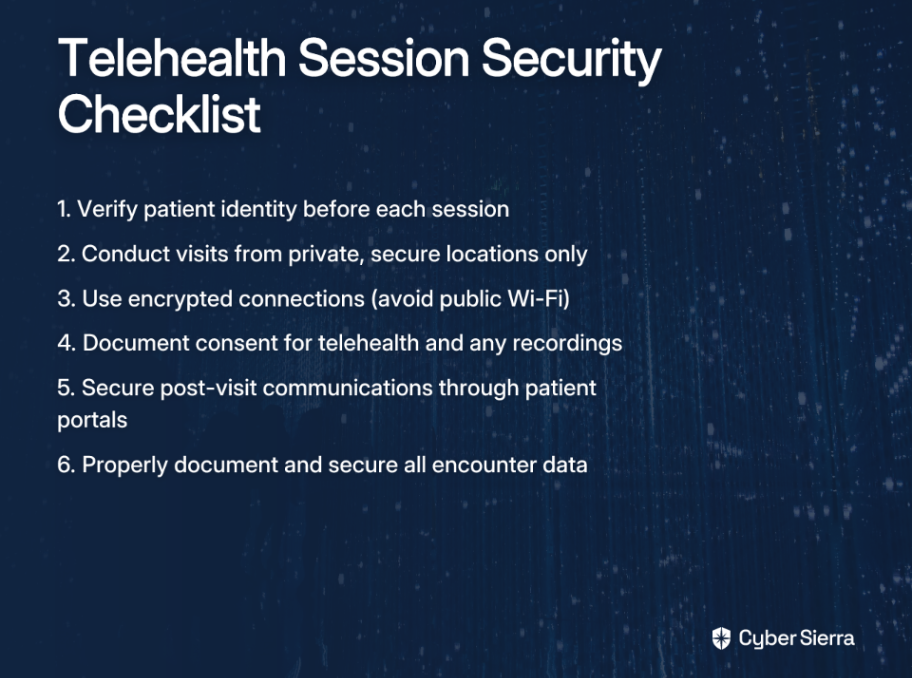
What are the key components of an effective security training program?

An effective security training program is industry-specific, compliance-driven, role-based, continuously updated, and measurable. It must be tailored to your sector's threats (e.g., OT security in manufacturing), align with regulations (like NERC CIP for energy), provide different content for different job functions, evolve with the threat landscape, and track employee progress to identify and address knowledge gaps.

How does security training help with compliance requirements like HIPAA or PCI-DSS?

Security training is a fundamental requirement for many compliance frameworks, serving as a key administrative control to reduce human error. Regulations like HIPAA, PCI-DSS, SOC 2, and NERC CIP explicitly mandate that employees receive security awareness training. Documenting this training provides auditors with crucial evidence that the organization is taking proactive steps to protect sensitive data and critical systems.

Ready to move beyond check-the-box security training? Explore how Cyber Sierra's customizable Employee Security Training platform builds a resilient human firewall tailored to your industry's unique challenges. Our platform simplifies compliance, engages your employees, and turns your biggest security risk—your people—into your strongest line of defense.

toaster icon

Thank you for reaching out to us!

We will get back to you soon.