blog-hero-background-image
Cyber Security

12 Financial Data Compliance Tools For Modern Finance Teams (2026)
backdrop
Table of Contents

Join thousands of professionals and get the latest insight on Compliance & Cybersecurity.


Summary

  • A 2025 PwC survey found that 59% of organizations lack the resources for effective compliance, making manual, periodic audits a significant business risk.
  • The key to avoiding last-minute audit stress is shifting from reactive, checklist-based tasks to a proactive strategy of continuous, automated monitoring.
  • Start your transition by conducting a comprehensive risk assessment to identify and prioritize high-impact areas for automation.
  • A unified platform integrating Governance, Risk & Compliance (GRC) with Continuous Control Monitoring (CCM) automates evidence gathering and keeps you audit-ready. Explore how Cyber Sierra transforms compliance into a strategic advantage.

You've set up your financial systems, implemented security protocols, and trained your team on best practices. But when an audit rolls around, you're still scrambling to gather evidence, document processes, and address compliance gaps that have been accumulating as technical debt for months.

This last-minute chaos isn't just stressful—it's a significant business risk in today's hyper-regulated financial environment.
The Evolving Financial Compliance Landscape

Financial data compliance has never been more demanding. While the SEC reported a 26% drop in enforcement actions to 583 cases in fiscal 2024, organizations faced record penalties, highlighting a zero-tolerance environment for non-compliance.

Technology is now the top priority for compliance risk management, according to a 2025 PwC survey. Yet, the same survey reveals that 59% of organizations cite a lack of resources as a major barrier to achieving compliance ROI.

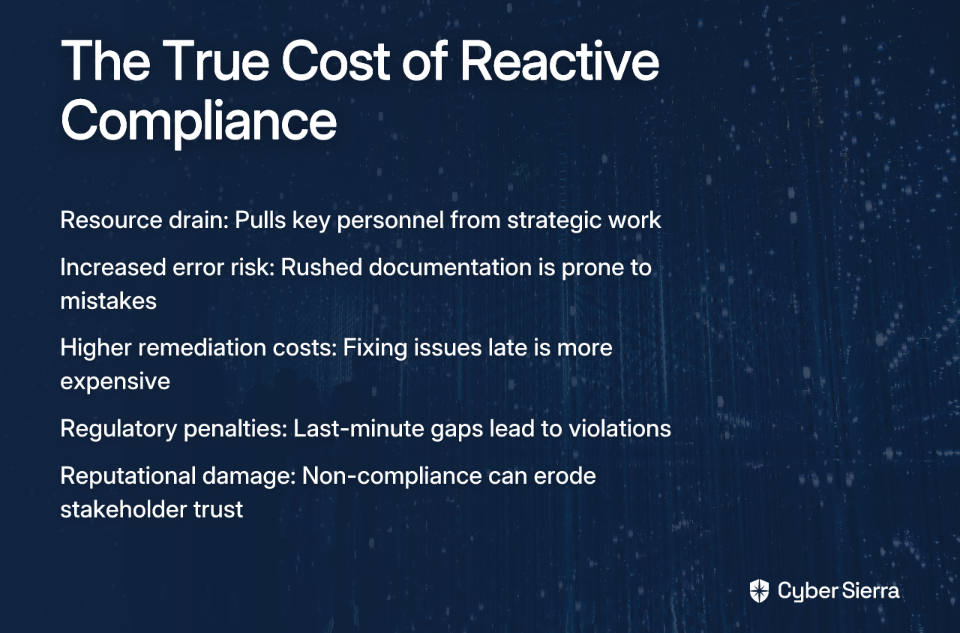
The traditional approach of manual, periodic compliance checks is increasingly risky:

  • They're time-consuming and drain valuable resources
  • They're prone to human error and inconsistency
  • They fail to provide the real-time visibility needed to manage modern threats
  • They create a reactive culture where compliance is a "fire drill" rather than a business function

The solution? Automation and continuous monitoring that transform compliance from a reactive, stressful event into a proactive, ongoing business function that provides value beyond just avoiding penalties.

This article guides you through 12 of the best financial data compliance tools for 2026, categorized to help you find the right fit for your team's specific needs.

Category 1: Comprehensive GRC & Continuous Control Monitoring Platforms

These platforms offer a unified approach to managing governance, risk, and compliance, serving as the command center for your compliance program.

1. Cyber Sierra (GRC & CCM Modules)

Overview: Cyber Sierra provides an AI-enabled cybersecurity platform with integrated Governance, Risk & Compliance (GRC) and Continuous Control Monitoring (CCM) modules. It's designed to eliminate manual evidence gathering and provide a single source of truth, making you audit-ready every day.

How It Solves Key Pains: Directly addresses the "last-minute chaos" before audits by shifting compliance from a point-in-time event to a continuous, automated process. It helps manage "technical debt" by providing actionable risk intelligence to prioritize remediation.

Key Features & Modules:

  • Governance, Risk & Compliance (GRC): Automates the entire GRC lifecycle:
    • Automates data collection, risk assessments, and control monitoring
    • Manages multiple compliance frameworks like SOC 2, ISO 27001, GDPR, HIPAA, and PCI DSS from a single dashboard
    • Generates comprehensive reports and maintains detailed audit trails, simplifying audit preparation
    • Learn more about the GRC Platform
  • Continuous Control Monitoring (CCM): Provides ongoing, real-time visibility into your security controls:
    • Builds a central controls repository with near real-time updates
    • Automates control testing and validation, detecting exceptions and anomalies as they happen
    • Provides specific monitoring for frameworks like GDPR (access controls) and PCI DSS (payment processing controls)
    • Learn more about the CCM Platform

Unique Selling Point: Cyber Sierra simplifies complex GRC requirements by unifying automation and continuous monitoring, transforming security from periodic checks into a proactive, data-driven function.

2. Centraleyes

Overview: Centraleyes is a GRC platform that excels at connecting compliance requirements to live operational evidence.

Key Features:

  • Offers Continuous Control Monitoring (CCM) to automate testing and provide real-time visibility
  • Centralizes control repositories for easier management across frameworks
  • Supports key financial regulations like GDPR and PCI-DSS

Where it shines: Its "evidence layer" approach provides a clear link between compliance statements and actual, real-time security actions.

Learn more about Centraleyes

3. VComply

Overview: A cloud-based GRC management platform designed to automate and track compliance tasks.

Key Features:

  • Automated task assignment and workflows for compliance activities
  • Real-time progress tracking across various frameworks
  • Detailed reporting capabilities for management and auditors

Learn more about VComply

Category 2: Regulatory Reporting Solutions

These tools specialize in the complex and highly-regulated world of financial reporting, ensuring data is accurate, timely, and formatted for regulatory submission.

4. AxiomSL (from Adenza)

Overview: A high-fidelity regulatory reporting solution trusted by many Tier 1 banks.

Key Features:

  • Specializes in complex calculations for regulations like Basel III/IV
  • Provides localized reporting templates for a wide range of global regulators
  • Engineered for precision and speed in high-volume environments

Learn more about AxiomSL

5. Finastra

Overview: A cloud-based, "Regulatory Reporting as a Service" platform that simplifies compliance for multiple regimes.

Key Features:

  • Manages reporting for regulations including SFTR, EMIR, and MiFID II
  • Automates the entire transaction reporting workflow: data collection, enrichment, and validation
  • Offers a single extraction workflow to save time and reduce operational risk
  • As a SaaS solution, it has no heavy upfront IT infrastructure costs and allows for fast deployment

Learn more about Finastra

6. Wolters Kluwer OneSumX

Overview: A comprehensive solution that combines global regulatory intelligence with workflow automation.

Key Features:

  • Integrates regulatory updates from over 200 regulators worldwide
  • Provides a unified platform for managing finance, risk, and reporting

Learn more about Wolters Kluwer

Category 3: Data Protection & Risk Management Platforms

These platforms focus on identifying, assessing, and mitigating risks related to data security and governance.

7. IBM OpenPages

Overview: An AI-driven risk management platform that provides predictive insights into compliance.

Key Features:

  • Uses AI to automate workflows and identify potential compliance issues before they occur
  • Offers a highly scalable solution for managing a wide range of regulatory frameworks
  • Emphasizes proactive compliance monitoring over reactive checks

Learn more about IBM OpenPages

8. LogicGate Risk Cloud

Overview: A flexible platform that allows firms to build custom GRC applications and workflows without coding.

Key Features:

  • Highly customizable workflows for managing specific regulatory tasks
  • Dynamic dashboards provide real-time visibility into risk and compliance status
  • Automates task assignments and evidence collection

Learn more about LogicGate

9. Vanta / Drata

Overview: These platforms are leaders in compliance automation, particularly for tech companies needing to achieve certifications like SOC 2 and ISO 27001.

How They Solve Pains: Highly popular in online forums for their ability to "just kick out the report for your audit." They directly address the desire for simplified, streamlined audit reporting.

Key Features:

  • Continuous monitoring of cloud environments and controls
  • Automated evidence collection and organization
  • Pre-built templates and policies for dozens of security frameworks

Category 4: AI-Powered Compliance Assistants

This emerging category leverages AI and machine learning to predict risks, automate complex analysis, and enhance the efficiency of compliance teams.

10. Atlan

Overview: While not a direct compliance tool, Atlan is a foundational "active metadata" platform that enables effective AI governance. For AI in compliance to work, the data must be reliable, and Atlan ensures this.

How it helps: It tackles key barriers to AI adoption, like model bias and explainability. It helps organizations build a unified control plane for data and AI.

Case in Point: Using active metadata management, the fintech company Tide reduced the effort for GDPR compliance from 50 days to just a few hours.

11. BNY Mellon's Predictive AI (Example)

Overview: A powerful example of applied AI in finance. BNY Mellon developed an AI model that can predict up to 40% of settlement failures with 90% accuracy.

Implication for Compliance: This demonstrates the shift from reactive problem-solving to proactive risk mitigation, a core principle of modern compliance. It shows how AI can anticipate and prevent compliance breaches.

12. Mastercard's Generative AI for Fraud (Example)

Overview: Mastercard is using generative AI to enhance its fraud detection models, leading to a 200% reduction in false positives.

Implication for Compliance: This highlights the immense efficiency gains possible with AI. By reducing noise and false alarms, AI frees up compliance teams to focus on genuine threats, a sentiment echoed by users tired of time-consuming manual tasks.

From Reactive Audits to Proactive Resilience: Your Next Steps

The message is clear: the era of manual, checklist-based compliance is over. To thrive in 2026 and beyond, finance teams must embrace automation, continuous monitoring, and AI-driven insights. The goal isn't just to pass an audit; it's to build a resilient, secure, and continuously compliant organization.

Practical Implementation Tips:
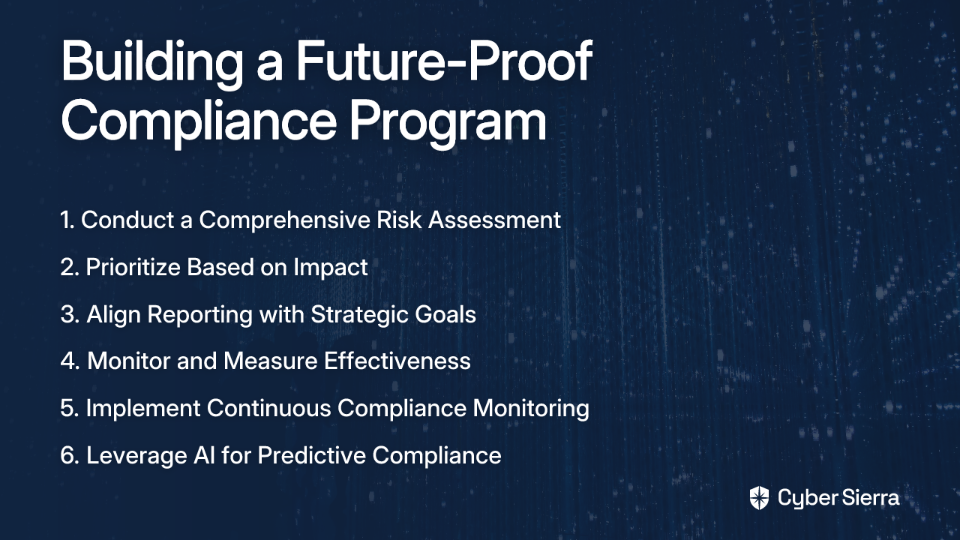
  1. Conduct a Comprehensive Risk Assessment: Start by evaluating compliance risks across all your operations. You can't protect what you don't know.
  2. Prioritize Based on Impact: Not all compliance obligations carry the same weight. Use a risk-based approach to focus on high-priority areas first.
  3. Align Reporting with Strategic Goals: Ensure your compliance reports provide actionable insights that support business objectives, not just satisfy auditors. This helps get crucial management buy-in.
  4. Monitor and Measure Effectiveness: Use Key Performance Indicators (KPIs) to track the impact and ROI of your compliance program.

Measuring the ROI of Compliance Automation:

  • Cost Savings: Automation drastically reduces manual hours spent on evidence collection and reporting. It also minimizes the risk of costly fines and penalties. McKinsey estimates that AI alone could unlock $1 trillion in value for the global banking industry.
  • Operational Efficiency: As users have noted, tasks that once "took days now take minutes." This frees up your most valuable resource—your people—to focus on strategic initiatives.
  • Enhanced Security: Proactive, real-time monitoring means you can detect and remediate vulnerabilities before they are exploited, reducing your overall risk profile.

Ready to transform your compliance program from a cost center into a strategic advantage? A unified platform like Cyber Sierra integrates Continuous Control Monitoring, GRC automation, and AI-driven intelligence to put you in control.

Stop scrambling before audits and start building a culture of continuous compliance.

Frequently Asked Questions

What is a GRC platform and why is it important for financial compliance?

A GRC (Governance, Risk, and Compliance) platform is a centralized software solution that helps organizations manage their overall governance, enterprise risk management, and compliance with regulations. For financial institutions, it's crucial because it automates manual tasks like evidence gathering, provides a single source of truth for audits, and helps manage multiple complex frameworks (like SOC 2, ISO 27001, and PCI DSS) from one dashboard.

How does Continuous Control Monitoring (CCM) differ from traditional compliance audits?

Continuous Control Monitoring (CCM) is a proactive, automated process that provides real-time visibility into security controls, while traditional audits are periodic, manual "point-in-time" assessments. The key difference is that CCM detects compliance gaps and anomalies as they happen, allowing for immediate remediation. In contrast, traditional audits often uncover issues months after they've occurred, leading to stressful, last-minute fire drills.

What are the most critical compliance frameworks for financial data?

The most critical compliance frameworks for financial data typically include SOC 2, for ensuring the security and privacy of client data; ISO 27001, for information security management; PCI DSS, for protecting cardholder data; and GDPR, for protecting the data of EU citizens. The right frameworks depend on your specific services, customers, and geographical operations.

How can automation improve the ROI of our compliance program?

Automation improves compliance ROI by significantly reducing the manual hours spent on evidence collection and reporting, minimizing the risk of costly regulatory fines, and increasing operational efficiency. By transforming time-consuming tasks that once took days into processes that take minutes, automation frees up skilled personnel to focus on strategic initiatives rather than administrative work.

What is the first step to moving from reactive to proactive compliance?

The first step to shifting from a reactive to a proactive compliance model is to conduct a comprehensive risk assessment. This initial evaluation helps you identify and understand all compliance risks across your operations. Once you know where your vulnerabilities are, you can use a risk-based approach to prioritize the most critical areas for implementing automation and continuous monitoring.

How is AI changing financial data compliance?

AI is transforming financial compliance by enabling predictive risk analysis, automating complex decisions, and dramatically enhancing the efficiency of monitoring systems. For example, AI models can now predict settlement failures before they happen or significantly reduce false positives in fraud detection. This allows compliance teams to move from reactive problem-solving to proactively preventing breaches and focusing on genuine threats.
See how you can become audit-ready, every day. Book a personalized demo of Cyber Sierra today.
blog-hero-background-image
Cyber Security

The Best 7-Step Risk Remediation Plan for Cybersecurity Compliance in 2026

backdrop
Table of Contents

Join thousands of professionals and get the latest insight on Compliance & Cybersecurity.


Summary

  • Manual risk management is no longer sufficient for modern compliance, which requires a continuous and proactive approach to security rather than periodic checks.
  • Adopt a 7-step risk remediation plan that focuses on unifying asset visibility, prioritizing risks with business context, and mapping controls to compliance frameworks.
  • Implement Continuous Control Monitoring (CCM) to automate evidence collection, detect control failures in near real-time, and stay perpetually audit-ready.
  • An integrated platform like Cybersierra's GRC can automate and centralize these processes, transforming your security from reactive firefighting to proactive resilience.

In 2026, your organization faces a daunting reality: multiple vulnerability scanners generating messy data, disconnected ticketing systems, tight remediation deadlines that are nearly impossible to meet, and the dreaded evidence gathering for compliance audits. Sound familiar?

The days of manual, periodic risk management approaches are rapidly becoming obsolete. Modern compliance frameworks like NIST and ISO 27001 don't just require point-in-time assessments—they demand a continuous, proactive approach to security.

What you need is a systematic, actionable risk remediation plan that transforms your organization from reactive firefighting to proactive resilience. Here's the comprehensive 7-step approach that leading organizations will be using in 2026 to streamline compliance and strengthen their security posture.

Step 1: Unify Visibility & Identify All Risks

You can't protect what you don't know you have. The first critical step in any effective risk remediation plan is eliminating blind spots and creating a comprehensive asset inventory. This aligns perfectly with the Identify phase of the NIST Cybersecurity Framework.

How to implement:

  • Conduct comprehensive cyber risk mapping to identify all vulnerable data and assets across your environment
  • Build a profile of potential weak points, including leaked credentials, misconfigured cloud servers, and internal threats like compromised workstations and weak passwords
  • Deploy centralized and continuous scanning technology to discover hidden risks across your attack surface
  • Document all assets, their owners, and their criticality to the business

This unified visibility prevents the common scenario where vulnerabilities slip through the cracks because they exist in systems that weren't properly inventoried.

Cyber Sierra's Threat Intelligence module can help achieve this unified view by providing a comprehensive security scorecard, performing network vulnerability scanning, and scanning cloud infrastructure for misconfigurations—all from a single platform.

Step 2: Assess and Prioritize Risks with Context

When your security team receives alert after alert about vulnerabilities, how do they decide what to fix first? Not all risks are created equal, and effective remediation must focus resources on threats that pose the greatest danger to your business.

How to implement:

  • Move beyond basic CVSS scores to evaluate both the likelihood and potential impact of identified risks
  • Set acceptable risk thresholds that trigger different levels of response
  • Contextualize vulnerabilities by considering factors like business criticality and data sensitivity
  • Prioritize remediation efforts based on:
    • The sensitivity of affected data
    • The business impact of exploitation
    • The likelihood of exploitation in your specific environment
    • The current threat landscape and actor behaviors

This contextual prioritization ensures that when you're facing tight remediation deadlines, your team is working on the most important issues first. A medium-severity vulnerability on your crown-jewel system deserves more attention than a critical vulnerability on an isolated test server.

Step 3: Centralize Tools and Automate Workflows

One of the biggest obstacles to efficient remediation is what security professionals call "tool sprawl." When you have "multiple vulnerability scanners, messy data, and multiple ticketing systems," automation becomes nearly impossible.

How to implement:

  • Move towards a centralized cyber risk scanning platform that can integrate with your existing tools
  • Create a unified dashboard that gives a complete real-time view of your security posture
  • Implement middleware solutions that normalize and deduplicate vulnerability data from multiple sources
  • Automate the flow of information between scanning tools and ticketing systems
  • Establish automated workflows for common remediation processes

Cyber Sierra's Governance, Risk & Compliance (GRC) platform addresses this challenge by automating data collection, centralizing risk assessments, and managing controls across multiple frameworks in a single place. This creates the middleware layer that connects disparate tools and data points, making automation practical rather than problematic.

Step 4: Implement and Map Controls to Frameworks

With a clear understanding of your risks and a streamlined workflow, you can now implement the appropriate controls. These controls must be effective at mitigating identified risks and mapped to specific compliance requirements.

How to implement:

  • Deploy a balanced mix of technical and administrative controls:
    • Technical Controls: Access controls, data encryption, web application firewalls, secure configurations
    • Administrative Controls: Security policies, incident response procedures, training programs
  • Document how each control satisfies specific requirements from frameworks like SOC2, ISO 27001, GDPR, and more
  • Implement a clear mechanism for tracking control effectiveness over time
  • Establish a cross-reference between controls and the specific risks they mitigate

A strong remediation plan aligns security measures with compliance requirements, creating efficiency and avoiding duplication of effort. For example, Cyber Sierra's Employee Security Training module serves as a key administrative control by building a "human firewall" through interactive training and simulated phishing campaigns, addressing human-vector risks while satisfying training requirements common to most compliance frameworks.

Step 5: Embed Continuous Control Monitoring (CCM)

This is the game-changing step that moves compliance from a painful, periodic event to an automated, continuous process. If you've ever wondered whether "it's feasible to monitor hundreds of controls manually," the answer is a resounding no—at least not effectively.

Continuous Control Monitoring (CCM) is a proactive approach that utilizes technology for ongoing oversight of organizational controls, providing real-time insights and alerts to detect and mitigate risks promptly.

How CCM transforms your risk remediation plan:

  • Improved Compliance & Reduced Audit Fatigue: Continuous review and automated evidence collection ensures you are always audit-ready, eliminating the scramble before assessments
  • Early Detection: Near real-time monitoring allows for immediate identification of control failures or threats before they can be exploited
  • Optimized Resource Allocation: Data-driven insights help focus security efforts where they are needed most

Common CCM use cases include:

  • Identity and Access Management: Automating user access reviews to ensure adherence to role-based access control
  • Endpoint Configuration Management: Automating checks on device configurations and patch management
  • Vulnerability Management: Automating the creation of evidence chains from scanning tools to ticketing systems to verify remediation SLAs are met

Cyber Sierra's Continuous Control Monitoring (CCM) platform excels at this critical function by building a central controls repository with near real-time updates, automating control testing and validation across frameworks like NIST, ISO 27001, and PCI DSS, and providing a single source of truth for controls with actionable risk intelligence.

Step 6: Proactively Manage Third-Party Risk

Your security is only as strong as your weakest vendor. A comprehensive risk remediation plan must include robust Third-Party Risk Management (TPRM), especially as organizations increasingly rely on cloud services and external partners.

Many organizations struggle with vendors who "ignore your questions" or rely on a "crappy SOC2" as their only proof of security. This creates significant blind spots in your security program.

How to implement:

  • Go beyond point-in-time questionnaires to implement continuous monitoring of vendor security postures
  • Prioritize your vendor inventory based on the level of risk and data access they have
  • Implement a system for proactively notifying vendors of incidents that may affect them
  • Establish clear security requirements in vendor contracts
  • Develop an exit strategy for each vendor relationship

Cyber Sierra's Third-Party Risk Management (TPRM) platform simplifies this process by evaluating, mitigating, and continuously monitoring third-party security compliance and risks. Its automated vendor assessments and near real-time visibility provide proactive insights beyond static questionnaires, ensuring your supply chain doesn't become your weakest link.

Step 7: Develop and Test Response & Recovery Plans

Even with the most robust prevention measures, security incidents can still occur. A complete risk remediation plan must also prepare for when one inevitably happens. This aligns with NIST's Respond and Recover phases.

How to implement:

  • Develop a comprehensive incident response plan that documents clear procedures for handling security incidents
  • Define roles and responsibilities—determine who needs to be looped in for specific types of incidents
  • Establish and regularly test recovery plans to restore capabilities and ensure business continuity
  • Analyze remediation activities post-incident to identify trends and drive continuous improvement
  • Conduct regular tabletop exercises to test your plans and identify gaps

By preparing for incidents before they occur, you can dramatically reduce their impact and recovery time, making your organization more resilient overall.

From Reactive Remediation to Proactive Resilience

The journey from chaotic, manual remediation to a structured, automated, and continuous program isn't just about checking boxes for an audit. It's about building genuine cyber resilience that protects your business, maintains compliance, and optimizes resource allocation.

The 7-step risk remediation plan outlined above transforms how organizations approach cybersecurity compliance:

  1. Unify Visibility & Identify All Risks - Creating a comprehensive view of your attack surface
  2. Assess and Prioritize Risks with Context - Focusing on what matters most to your business
  3. Centralize Tools and Automate Workflows - Eliminating silos and streamlining processes
  4. Implement and Map Controls to Frameworks - Aligning security with compliance requirements
  5. Embed Continuous Control Monitoring - Moving from periodic to automated, ongoing compliance
  6. Proactively Manage Third-Party Risk - Securing your supply chain
  7. Develop and Test Response & Recovery Plans - Preparing for the inevitable

As we move toward 2026, organizations that embrace this approach will find themselves not just compliant but truly secure. They'll spend less time gathering evidence for audits, worrying about tight remediation deadlines, and dealing with the chaos of disconnected tools with messy data.

Cyber Sierra's integrated platform is purpose-built to power this transformation. Its modules for GRC, CCM, TPRM, and Threat Intelligence work together to execute the 7-step plan efficiently, providing the automation, continuity, and intelligence needed to stay ahead of threats and compliance demands.

Stop chasing compliance and start building resilience.

Frequently Asked Questions

What is a risk remediation plan?

A risk remediation plan is a systematic, documented strategy that outlines the steps an organization will take to identify, prioritize, and resolve security vulnerabilities and risks. It moves an organization from a reactive "firefighting" mode to a proactive state of resilience by defining processes for unifying visibility, assessing risks with business context, centralizing tools, implementing controls, and preparing for incidents.

Why is a manual risk management approach no longer effective?

A manual risk management approach is no longer effective because it cannot keep up with the complexity of modern IT environments, the volume of data from multiple security tools, and the continuous compliance demands of frameworks like NIST and ISO 27001. Manual processes are slow, prone to error, and create data silos, making it difficult to gain a real-time view of security posture and leading to missed deadlines and audit fatigue.

How does continuous control monitoring (CCM) improve security and compliance?

Continuous Control Monitoring (CCM) improves security and compliance by automating the process of testing and validating security controls in near real-time, moving from periodic spot-checks to ongoing oversight. This provides immediate alerts on control failures, automates evidence collection to ensure you are always audit-ready, and offers data-driven insights to optimize resource allocation, transforming compliance from a painful event into a continuous process.

What is the most critical first step in a risk remediation plan?

The most critical first step is to unify visibility and create a comprehensive inventory of all assets and potential risks across the organization. You cannot protect what you don't know you have. This foundational step involves mapping all vulnerable data, discovering hidden risks across the entire attack surface, and documenting asset ownership and criticality to eliminate security blind spots.

How should organizations prioritize which vulnerabilities to fix first?

Organizations should prioritize vulnerabilities by moving beyond basic CVSS scores to assess them with business context, considering both the likelihood of exploitation and the potential business impact. Prioritization should be based on factors like the sensitivity of the affected data, the criticality of the system, and the current threat landscape. This ensures the most significant threats to the business are addressed first.

Why is third-party risk management (TPRM) a key part of a remediation strategy?

Third-Party Risk Management (TPRM) is a key part of a remediation strategy because an organization's security is only as strong as its weakest vendor. Since external partners often have access to sensitive data and systems, a comprehensive plan must extend beyond an organization's own perimeter to include the continuous monitoring of vendor security postures to prevent supply chain attacks.

See how Cyber Sierra's AI-enabled platform can transform your risk remediation plan and make your enterprise audit-ready and secure by design. Request a Demo today and take the first step toward a more secure future.

blog-hero-background-image
Cyber Security

10 Proven Cyber Risk Reduction Strategies for Enterprises in 2026

backdrop
Table of Contents

Join thousands of professionals and get the latest insight on Compliance & Cybersecurity.


Summary

  • With the average data breach cost projected to hit $5.85 million by 2026, enterprises must move beyond performative security to achieve tangible risk reduction.
  • Transition from periodic, manual audits to a proactive posture by implementing continuous control monitoring (CCM) and automating GRC processes.
  • Key strategies include implementing robust third-party risk management (TPRM), leveraging threat intelligence, and building a "human firewall" through ongoing employee training.
  • Unify these efforts with an integrated platform like Cyber Sierra, which automates compliance and risk management to build a truly resilient enterprise.

In today's rapidly evolving threat landscape, the financial impact of cyber breaches continues to escalate at an alarming rate. By 2026, the average cost of a data breach is projected to reach a staggering $5.85 million - a 10% year-over-year increase that should concern every enterprise security leader. This rising financial toll doesn't even account for the devastating impacts on brand reputation, customer trust, and operational continuity.

Simultaneously, the compliance landscape has become increasingly complex. Organizations must navigate a maze of frameworks like NIST, ISO 27001, GDPR, PCI-DSS, and more, each with its own requirements and controls. For many enterprises, compliance has become a full-time job that feels separate from actual security.

If you're struggling to build a cyber risk program that's more than just "on paper," you're not alone. Many cybersecurity professionals share this frustration - they want programs with "issues that actually get fixed — not just logged" and "dashboards that inform decisions, not just decorate reports." The gap between performative security and a genuine, effective cyber risk reduction strategy has never been wider.

This guide focuses on transforming your approach from periodic, manual assessments to a continuous, automated, and proactive cybersecurity posture that becomes "part of the normal conversation and doing business." Let's explore ten proven strategies that will help you achieve tangible outcomes in your cyber risk reduction efforts.

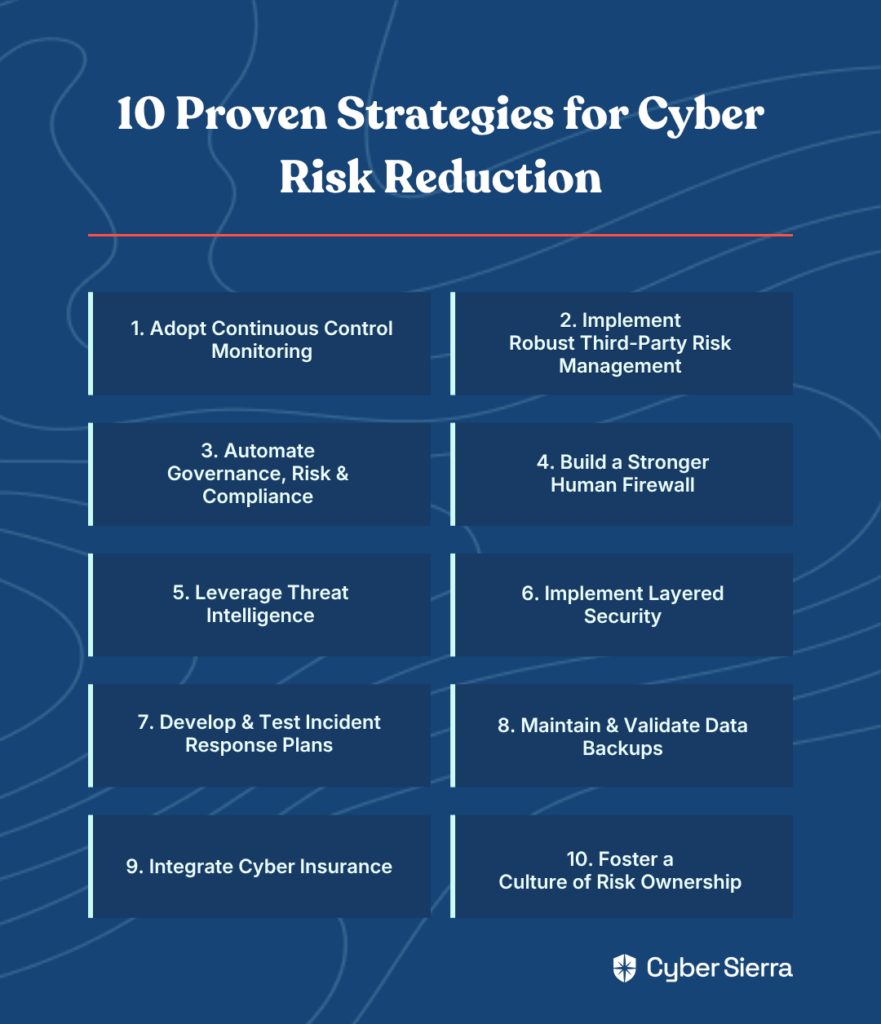
1. Adopt Continuous Control Monitoring (CCM)

Point-in-time assessments and annual audits are no longer sufficient in today's dynamic threat environment. Continuous Control Monitoring transforms security from a periodic checkbox exercise into a proactive, real-time discipline.

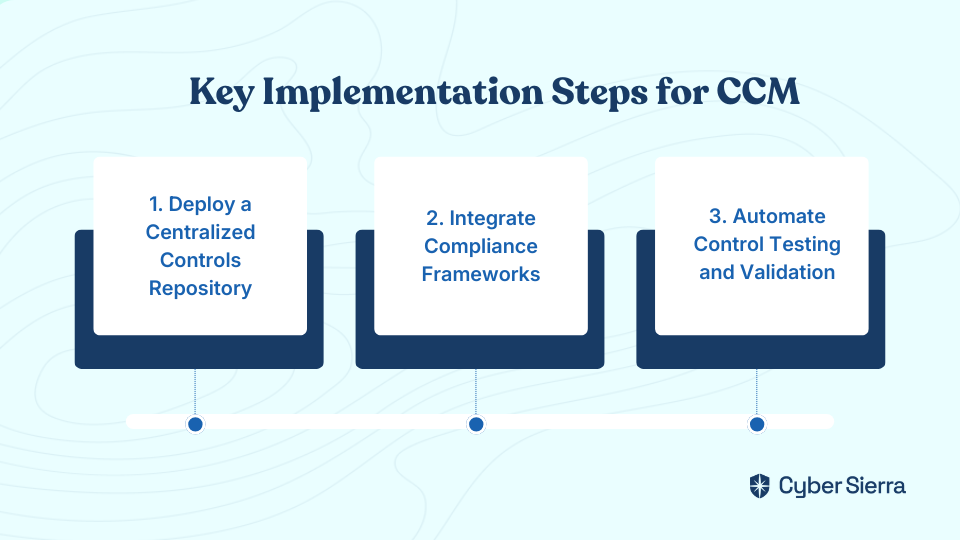
Implementation Steps:

  1. Deploy a Centralized Controls Repository: Build a single source of truth for all security controls with near real-time updates. This eliminates manual evidence gathering for multiple frameworks.
  2. Integrate Compliance Frameworks: Map controls across multiple standards like NIST, ISO 27001, PCI DSS, and SOC 2 within a single platform.
  3. Automate Control Testing and Validation: Use automated tools to continuously test controls, detect exceptions, and generate alerts for anomalies in real-time.

Metrics for Success:

  • Reduction in time and resources spent on manual audit preparation
  • Decrease in control failures and compliance exceptions
  • Improved real-time visibility score of your security posture

Cyber Sierra's Continuous Control Monitoring (CCM) platform provides this ongoing visibility, helping CISOs and compliance managers move from reactive to proactive risk management. The platform centralizes control repositories, provides actionable risk intelligence, and automates evidence collection across multiple compliance frameworks.

2. Implement a Robust Third-Party Risk Management (TPRM) Program

Your security is only as strong as your weakest vendor. A single breach in your supply chain can be catastrophic, making a structured TPRM program non-negotiable for effective cyber risk reduction.

Implementation Steps:

  1. Maintain an Accurate Third-Party Inventory: Keep a complete, up-to-date inventory of all vendors and classify them based on their criticality and access to sensitive data.
  2. Automate Vendor Assessments: Replace manual questionnaires with automated assessment workflows to streamline due diligence, onboarding, and periodic reviews.
  3. Combine Assessments with Continuous Monitoring: Use tools that provide near real-time, 24/7 visibility into a vendor's security posture, going beyond static, point-in-time assessments.

Metrics for Success:

  • Reduced time-to-onboard for new vendors
  • Decrease in security incidents originating from third parties
  • Percentage of critical vendors under continuous monitoring

Solutions like Cyber Sierra's TPRM platform simplify this entire lifecycle, from onboarding to continuous monitoring, ensuring your supply chain doesn't become your biggest vulnerability.

3. Automate Governance, Risk & Compliance (GRC)

Managing multiple compliance requirements manually leads to "audit fatigue" and human error. Automating GRC processes streamlines data collection, risk assessments, and reporting, making your organization audit-ready at all times.

Implementation Steps:

  1. Centralize GRC Activities: Use a unified platform to manage policies, risks, controls, and audits across the organization.
  2. Automate Data Collection: Connect your GRC tool to your tech stack (cloud providers, identity providers, etc.) to automatically gather evidence for control validation.
  3. Generate Comprehensive Reports: Use automated reporting features to create detailed audit trails and dashboards for stakeholders, demonstrating compliance and risk posture clearly.

Metrics for Success:

  • Reduction in audit preparation time and costs
  • Faster turnaround time for risk assessments
  • Improved consistency and accuracy in compliance reporting

Cyber Sierra's GRC module helps you manage multiple frameworks like SOC 2, ISO 27001, and HIPAA without the manual overhead, automating data collection and maintaining detailed audit trails.

4. Build a Stronger Human Firewall with Continuous Security Training

Human error remains a leading cause of security breaches. Empowering employees to be the first line of defense through ongoing training is one of the most cost-effective cyber risk reduction strategies.

Implementation Steps:

  1. Implement Interactive Training Modules: Go beyond annual slideshows. Use engaging, interactive modules covering topics like password hygiene, email safety, and identifying social engineering.
  2. Run Regular, Simulated Phishing Campaigns: Test employee awareness with realistic phishing simulations and provide immediate feedback and training to those who click.
  3. Track Security Quotient: Use a dashboard to get an overview of your employees' security awareness levels and identify areas needing improvement.

Metrics for Success:

  • Reduction in click-rates on phishing simulations over time
  • Decrease in security incidents attributed to human error
  • Increase in employee-reported suspicious emails

With Cyber Sierra's Employee Security Training, you can foster a security-conscious culture through continuous learning and real-world simulations that strengthen your human firewall.

5. Leverage Threat Intelligence and Proactive Vulnerability Management

Don't wait for attackers to find your weaknesses. Proactively identify and remediate vulnerabilities across your attack surface by combining threat intelligence with a risk-based approach to patch management.

Implementation Steps:

  1. Adopt a Risk-Based Approach: Prioritize patching vulnerabilities based not just on CVSS scores, but on their exploitability and potential business impact.
  2. Conduct Continuous Scanning: Implement regular, automated vulnerability scanning for your network and cloud infrastructure to identify misconfigurations and exposures.
  3. Utilize Threat Intelligence Feeds: Subscribe to actionable threat intelligence to understand attacker TTPs (Tactics, Techniques, and Procedures) and hunt for threats proactively.

Metrics for Success:

  • Reduction in the average time-to-remediate critical vulnerabilities
  • Decrease in the overall organizational attack surface
  • Improved security scorecard ratings

Cyber Sierra's Threat Intelligence platform offers an outside-in scanning approach to give you a comprehensive view of your posture and help prioritize remediation efforts.

6. Implement Layered Security (Defense-in-Depth)

There is no single silver-bullet solution for cyber risk reduction. A defense-in-depth strategy relies on multiple, overlapping security controls so that if one layer fails, another is there to stop an attack.

Implementation Steps:

  1. Combine Network and Endpoint Security: Use a mix of firewalls, network segmentation, and modern Endpoint Detection and Response (EDR) solutions.
  2. Enforce Strong Access Controls: Implement the principle of least privilege, ensuring users only have access to the data and systems necessary for their roles. Use Just-in-Time (JIT) access where possible.
  3. Mandate Multi-Factor Authentication (MFA): Enforce MFA across all critical systems, applications, and remote access points.

Metrics for Success:

  • Reduction in successful lateral movement by attackers during security tests
  • Number of critical assets protected by MFA
  • Decrease in incidents related to compromised credentials

7. Develop and Regularly Test Your Incident Response (IR) Plan

It's not a matter of if a breach will occur, but when. A well-documented and frequently tested IR plan is crucial to minimizing the damage and ensuring a swift recovery.

Implementation Steps:

  1. Document a Formal IR Plan: Define roles, responsibilities, communication channels, and procedures for containment, eradication, and recovery.
  2. Conduct Tabletop Exercises: Regularly run simulation exercises with key stakeholders to test the plan's effectiveness and identify gaps without the pressure of a real incident.
  3. Perform Red Team Engagements: Hire ethical hackers to simulate a real-world attack to test your defenses and response capabilities under pressure.

Metrics for Success:

  • Reduced Mean Time to Detect (MTTD) and Mean Time to Respond (MTTR) for incidents
  • Improved performance and decision-making during tabletop exercises
  • Faster resolution of incidents and reduced business impact

8. Maintain and Validate Data Backups

In the age of ransomware, reliable backups are your last line of defense. They are essential for business continuity and can be the deciding factor between a minor disruption and a catastrophic failure.

Implementation Steps:

  1. Follow the 3-2-1 Rule: Keep at least three copies of your data, on two different media types, with one copy stored off-site (and ideally offline/immutable).
  2. Encrypt Your Backups: Ensure all backups are encrypted, both in transit and at rest.
  3. Perform Regular Recovery Drills: Don't just back up data; regularly test your ability to restore it. A backup that can't be restored is useless.

Metrics for Success:

  • Success rate of data recovery tests
  • Recovery Time Objective (RTO) and Recovery Point Objective (RPO) are consistently met
  • Percentage of critical systems included in the backup and recovery plan

9. Integrate Cyber Insurance as a Risk Transfer Mechanism

While not a replacement for strong security controls, cyber insurance is a critical tool for transferring residual financial risk. However, obtaining and maintaining coverage requires demonstrating robust cyber hygiene.

Implementation Steps:

  1. Assess Coverage Needs: Work with experts to right-size your policy based on your specific risk profile and regulatory requirements.
  2. Demonstrate Cyber Hygiene: Use your CCM and GRC data to automate the documentation required by insurers and prove your security posture, potentially leading to better premiums.
  3. Streamline the Application Process: Leverage platforms that can help you meet insurer requirements and facilitate collaboration on complex application forms.

Metrics for Success:

  • Alignment of insurance coverage with the organization's identified financial risks
  • Reduced time and effort spent on the insurance application and renewal process
  • Improved ability to meet and demonstrate compliance with insurer requirements

Cyber Sierra's Cyber Insurance module helps bridge the gap between your security posture and insurer expectations, making it easier to obtain and maintain appropriate coverage.

10. Foster a Culture of Proactive Risk Ownership

A successful cyber risk reduction program is not owned solely by the CISO or the "second line" of defense; it must be embedded in the company culture. It requires executive buy-in and clear accountability where risk management is seen as everyone's responsibility.

Implementation Steps:

  1. Secure Executive Sponsorship: Align the risk program with business goals to get genuine support from leadership. When leaders ask for it, it becomes real.
  2. Establish Clear Risk Ownership: Define roles clearly. The business ("first line") owns the risk; the security team ("second line") provides oversight and expertise. This prevents the "why should anyone else get involved?" problem.
  3. Integrate Risk into Business Conversations: Make risk a standard part of project planning, product development, and strategic decision-making, not a separate, feared conversation.

Metrics for Success:

  • Increased engagement from business units in risk assessment processes
  • Risk management discussions are a regular agenda item in leadership meetings
  • Faster, risk-informed decision-making across the organization

Build a Resilient Future: From Reactive Fixes to Proactive Defense

The cybersecurity landscape of 2026 demands more than just a defensive crouch. It requires a proactive, intelligent, and continuous approach to cyber risk reduction. The strategies outlined above are not just a checklist; they represent a fundamental shift from periodic, manual efforts to an integrated, automated security ecosystem.

By embracing concepts like Continuous Control Monitoring, automated GRC, and robust TPRM, you can transform your security program from a source of stress and audit fatigue into a true business enabler. Stop wrestling with siloed solutions and endless spreadsheets that only document problems without solving them.

See how Cyber Sierra's unified AI-enabled cybersecurity platform can help you implement these proven strategies, streamline compliance, and build a truly resilient enterprise prepared for the challenges of 2026 and beyond. With the right approach to cyber risk reduction, security can become "part of the normal conversation and doing business" rather than a dreaded checkbox exercise.

Frequently Asked Questions

What is the first step to improve my organization's cyber risk reduction strategy?

The most effective first step is to adopt Continuous Control Monitoring (CCM). This approach provides real-time visibility into your security posture, moving you away from outdated point-in-time assessments. CCM forms the foundation for understanding your actual risk, allowing you to identify and prioritize the most critical security gaps before implementing other strategies.

How does Continuous Control Monitoring (CCM) differ from traditional GRC?

Continuous Control Monitoring (CCM) is a proactive, technical process that automates the real-time testing of security controls, while traditional Governance, Risk, and Compliance (GRC) is a broader framework for managing policies, risk registers, and audits. Modern cybersecurity integrates CCM into GRC, feeding it live data to make risk management a dynamic, ongoing process rather than a static, administrative one.

Why is automating third-party risk management (TPRM) so important?

Automating Third-Party Risk Management (TPRM) is crucial because manual processes cannot keep up with the scale and dynamic nature of modern supply chain risks. Manual questionnaires provide only a static, point-in-time view that quickly becomes outdated. Automation enables continuous monitoring of vendor security postures, providing real-time alerts on new vulnerabilities and ensuring your organization isn't exposed by a weak link in its supply chain.

How can I justify the investment in a unified cybersecurity platform to my board?

Frame the investment as a strategic business enabler that delivers a clear return on investment (ROI) by reducing costs, improving efficiency, and protecting revenue. Highlight tangible outcomes such as a dramatic reduction in time and resources spent on manual audits; faster, data-driven decision-making; and a stronger security posture that can serve as a competitive differentiator to win new business.

What does it mean to build a "human firewall"?

Building a "human firewall" means transforming your employees from a potential security weakness into an active line of defense through continuous and engaging security awareness training. This goes beyond annual slideshows to include regular simulated phishing attacks, interactive learning modules, and empowering staff to confidently recognize and report potential threats, significantly reducing risks from social engineering.

Is cyber insurance a substitute for implementing robust security strategies?

No, cyber insurance is a complementary risk transfer mechanism, not a substitute for strong security controls. In fact, insurers increasingly require organizations to demonstrate a high level of cyber hygiene—including practices like CCM, MFA, and vulnerability management—before offering coverage. Strong defenses prevent breaches, while insurance helps manage the financial impact if a breach still occurs.

blog-hero-background-image
Cyber Security

10 Computer Security Auditing Tools That Automate Compliance Verification

backdrop
Table of Contents

Join thousands of professionals and get the latest insight on Compliance & Cybersecurity.


Summary

  • Manual security audits are inefficient and unsustainable; modern compliance relies on shifting from periodic checks to continuous, automated monitoring.
  • Automated compliance platforms can reduce the time spent on manual evidence collection and audit preparation by over 75%.
  • When selecting a tool, prioritize deep integrations, continuous monitoring, and support for multiple frameworks to ensure you are always audit-ready.
  • A unified platform like Cyber Sierra's GRC solution automates evidence collection and provides continuous visibility, making audit stress a thing of the past.

You've just spent weeks preparing for your annual security audit. Endless hours hunting down screenshots, coordinating with reluctant engineers, and manually compiling evidence for hundreds of controls. You're mentally and physically exhausted, and the worst part? You'll have to do this all over again next quarter.

Manual security auditing is not just tedious—it's inefficient, error-prone, and increasingly unsustainable in today's complex regulatory landscape. As compliance frameworks multiply and cyber threats evolve, organizations can no longer rely on point-in-time, manual approaches to security validation.

The good news? Modern computer security auditing tools can transform this painful process through automation, continuous monitoring, and intelligent compliance mapping. Let's explore the top solutions that are revolutionizing how companies verify and maintain their security posture.

1. Cyber Sierra

Overview: Cyber Sierra offers an AI-enabled, unified cybersecurity platform that automates the most painful aspects of security compliance. Unlike traditional point-in-time auditing tools, it provides continuous monitoring and near real-time risk management.

Key Features:

  • Continuous Control Monitoring (CCM): Automatically collects evidence from cloud services, applications, and infrastructure, eliminating the need for those "long calls with engineers who may or may not speak GRC."
  • Multi-framework Support: Maps controls across multiple compliance frameworks (NIST, ISO 27001, PCI DSS, GDPR) from a single source of truth.
  • Third-Party Risk Management: Continuously monitors vendor security posture, so you can verify if vendors have actually implemented claimed security measures.
  • Automated Evidence Collection: Integrates with your tech stack to automatically gather and organize audit evidence.

Ideal For: CISOs and Compliance Managers in regulated industries who need to maintain continuous audit readiness while reducing the manual overhead on their teams.

Learn more about Cyber Sierra's compliance automation

2. Tenable Nessus

Overview: One of the most widely deployed vulnerability assessment solutions that serves as the technical foundation for comprehensive security audits.

Key Features:

  • Comprehensive vulnerability scanning across networks, operating systems, and applications
  • Pre-configured templates for compliance checks against standards like PCI DSS
  • Asset discovery and inventory management
  • Detailed reporting for audit documentation

Ideal For: Security teams needing to perform deep vulnerability scanning, identify misconfigurations, and prioritize remediation efforts based on risk.

According to security professionals, vulnerability management tools like Nessus are critical because "60% of cloud customers faced breaches due to insufficient security measures," highlighting the importance of continuous vulnerability assessment as part of a robust security program.

3. Qualys

Overview: A cloud-based platform that delivers integrated security and compliance solutions with automated scanning capabilities.

Key Features:

  • Continuous threat detection and automated vulnerability patching
  • Cloud security assessment for misconfigurations
  • Compliance monitoring across multiple regulatory frameworks
  • Asset inventory and management with real-time visibility

Ideal For: Organizations looking for a unified approach to manage asset inventory, vulnerabilities, and compliance across hybrid IT environments.

4. Drata

Overview: A security and compliance automation platform designed specifically for cloud-native businesses seeking to achieve and maintain compliance with minimal manual effort.

Key Features:

  • Continuous monitoring of security controls
  • Deep integrations with cloud services and SaaS tools
  • Policy templates and automated workflows
  • Evidence collection automation with time-stamped records

Ideal For: Fast-growing tech companies and startups aiming for rapid compliance with frameworks like SOC 2 and ISO 27001.

According to Drata, their platform can automate over 75% of manual compliance tasks, dramatically reducing the time teams spend on evidence collection and audit preparation.

5. Vanta

Overview: A leading compliance automation platform that simplifies the process of getting and staying compliant with various security frameworks.

Key Features:

  • Automated evidence collection from cloud providers and SaaS applications
  • Continuous monitoring of security controls
  • Access to a marketplace of qualified auditors
  • Support for frameworks like SOC 2, ISO 27001, and HIPAA

Ideal For: Startups and SMBs looking for a user-friendly platform with strong templates and guidance to achieve their first compliance certification.

6. OpenVAS (Greenbone)

Overview: A powerful open-source vulnerability scanner that provides a free solution for security assessments and compliance checks.

Key Features:

  • Comprehensive vulnerability scanning and detection
  • Configuration and compliance checks
  • Detailed reporting capabilities
  • Regular updates via community feeds

Ideal For: Technically proficient teams or those on a tight budget needing robust vulnerability scanning capabilities.

It's worth noting that while OpenVAS is excellent for general scanning, users on Reddit have pointed out that "you'll need to license an appliance if you want it to check for 'enterprise' vulnerabilities" through Greenbone's commercial offering.

7. AuditBoard

Overview: A cloud-based platform designed to automate and streamline audit, risk, and compliance management processes.

Key Features:

  • Centralized management of controls and documentation
  • Risk assessment and issue tracking
  • Workflow automation for testing and remediation
  • Audit-ready reporting with minimal manual effort

Ideal For: Internal audit, SOX, and GRC teams in larger organizations needing to manage complex workflows, centralize documentation, and improve collaboration.

8. Netwrix

Overview: A data security platform focused on identifying sensitive data and auditing changes in IT infrastructure to maintain compliance.

Key Features:

  • Centralized auditing of on-premises and cloud systems
  • Data discovery and classification for regulatory compliance
  • User activity monitoring and access control validation
  • Automated compliance reporting for various regulations

Ideal For: Organizations that need deep visibility into user activity, permissions, and system configurations to meet compliance mandates and reduce their attack surface.

9. Splunk

Overview: A leading Security Information and Event Management (SIEM) platform that aggregates and analyzes machine data to support compliance audits.

Key Features:

  • Real-time security monitoring and alerting
  • Log aggregation and retention for audit evidence
  • Customizable dashboards for compliance metrics
  • Extensive apps and integrations for various compliance frameworks

Ideal For: Organizations needing to centralize log data for security monitoring, incident investigation, and generating evidence for compliance audits.

10. Hyperproof

Overview: A compliance operations platform designed to help organizations manage and demonstrate compliance efficiently across multiple frameworks.

Key Features:

  • Continuous control monitoring capabilities
  • Multi-framework mapping to reduce duplicate work
  • Automated evidence collection and organization
  • Streamlined communication with auditors

Ideal For: Teams managing multiple compliance frameworks who need to orchestrate control testing and evidence collection across different departments.

How to Choose the Right Computer Security Auditing Tool

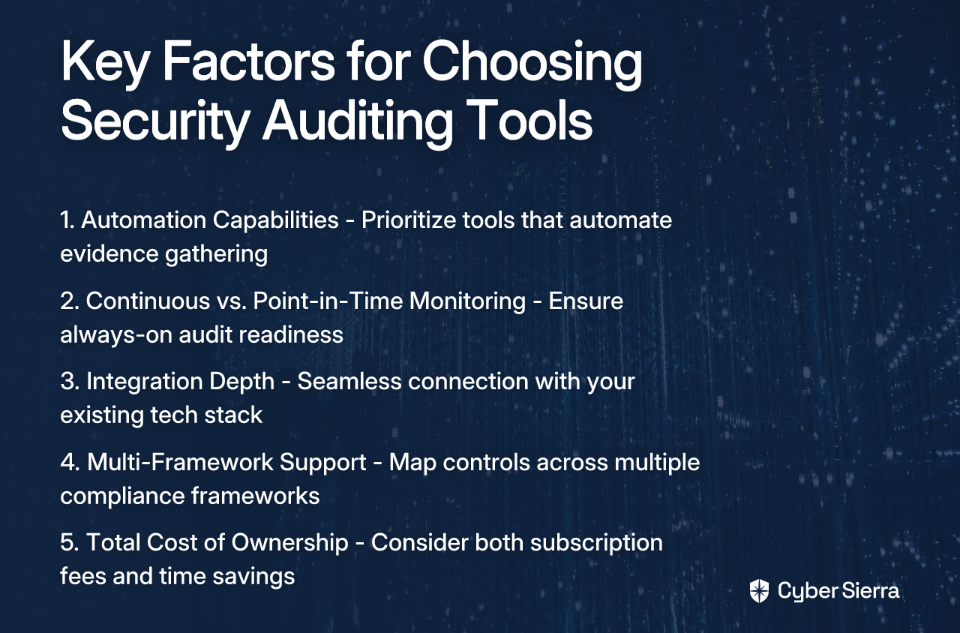
When evaluating security auditing and compliance automation tools, consider these key factors:

  1. Automation Capabilities: Look for tools that automate the most painful parts of your audit process—specifically evidence gathering. As one security professional noted, the ideal solution should "plug into Azure and any Azure evidence instantly pulls," reducing the need for manual intervention.
  2. Continuous vs. Point-in-Time: Traditional audit tools provide snapshots, while modern platforms offer continuous monitoring. The latter ensures you're always audit-ready and can identify compliance gaps before they become issues.
  3. Integration Depth: Evaluate how well the tool integrates with your existing tech stack. Deep integrations with cloud providers, identity systems, and development tools will significantly reduce manual evidence collection.
  4. Multi-Framework Support: Choose solutions that map controls to multiple frameworks from a single repository, preventing duplicated effort when managing complex compliance requirements.
  5. Total Cost of Ownership: Look beyond subscription fees. Some platforms "can cost up to $10k annually, not including the audit" and still "cost your time" for configuration and maintenance. Evaluate tools based on the time they save your team.

Transform Your Security Audits with Automation

The era of manual spreadsheets, frantic screenshot collection, and audit fire drills is over. Modern computer security auditing tools can transform compliance verification from a periodic burden into a continuous, strategic advantage.

By implementing solutions like Cyber Sierra's continuous control monitoring platform, you can automate evidence collection, maintain real-time visibility into your compliance posture, and dramatically reduce the manual overhead on your security and IT teams.

Ready to make audit stress a thing of the past? Request a demo of Cyber Sierra to see how our unified platform can automate your compliance verification and provide a single source of truth for your security posture.

blog-hero-background-image
Cyber Security

10 Critical Infosec Risks Every CISO Must Monitor in Real-Time

backdrop
Table of Contents

Join thousands of professionals and get the latest insight on Compliance & Cybersecurity.


Summary

  • Traditional security assessments like annual penetration tests are no longer sufficient, creating dangerous blind spots in a rapidly evolving threat landscape.
  • To effectively manage modern threats like cloud misconfigurations and supply chain vulnerabilities, security programs must shift from periodic audits to continuous, real-time monitoring.
  • Organizations need real-time visibility into critical risks—including IAM sprawl, unpatched software, and human-centric threats—to prevent them from escalating into breaches.
  • A Continuous Control Monitoring (CCM) platform automates control testing, providing the visibility needed to manage these infosec risks proactively.

In today's rapidly evolving threat landscape, information security risks can materialize and escalate within minutes, not months. Many security leaders struggle with a fundamental question: what exactly constitutes an infosec risk? Is a hardware failure causing a Confluence outage an "engineering risk" or an "infosec risk"? This ambiguity leaves dangerous gaps in security governance.

According to NIST, information security risk is "the risk to organizational operations (including mission, functions, image, reputation), organizational assets, individuals, other organizations... due to the potential for unauthorized access, use, disclosure, disruption, modification, or destruction of information and/or information systems." This definition encompasses the full CIA Triad (Confidentiality, Integrity, and Availability), clarifying that the loss of access to information, regardless of cause, is indeed an infosec risk.

Traditional approaches to monitoring these risks—annual penetration tests, quarterly vulnerability scans, point-in-time assessments—create dangerous blind spots. The modern CISO must shift from periodic auditing to continuous vigilance through real-time monitoring systems.

Let's explore the 10 critical infosec risks that demand real-time visibility and how Continuous Control Monitoring (CCM) transforms risk management from reactive to proactive.

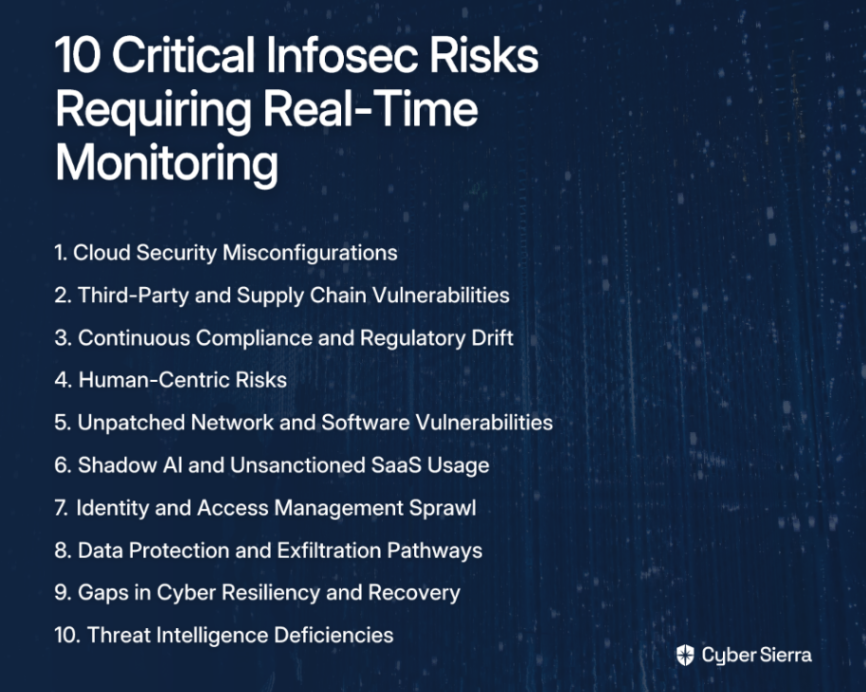
1. Cloud Security Misconfigurations

How It Manifests: Publicly exposed storage buckets, insecure APIs, overly permissive IAM roles, and unpatched cloud services represent some of the most common yet dangerous cloud misconfigurations. A single developer change can instantly create a vulnerability.

Business Impact: These misconfigurations can lead to catastrophic data exposure, loss of intellectual property, regulatory violations, and significant operational disruptions.

Why Periodic Assessments Fail: Cloud environments are ephemeral and constantly changing. A configuration that was secure during a quarterly audit can be rendered vulnerable by a single developer change minutes later.

The Continuous Monitoring Solution: Cyber Sierra's Threat Intelligence platform provides continuous, "outside-in" visibility of your attack surface. It performs cloud infrastructure scanning for misconfigurations, allowing you to identify and remediate issues like public S3 buckets or insecure network groups in near real-time, long before your next scheduled audit.

2. Third-Party and Supply Chain Vulnerabilities

How It Manifests: A breach in a vendor's system—from your CRM provider to a small marketing analytics tool—can grant attackers a backdoor into your network and data. The SolarWinds incident demonstrated how devastating these attacks can be.

Business Impact: Data breaches originating from the supply chain can lead to reputational damage by association, potential regulatory penalties, and loss of customer trust.

Why Periodic Assessments Fail: Static, point-in-time vendor questionnaires become outdated the moment they are completed. They don't reflect a vendor's ongoing security hygiene or capture emerging threats.

The Continuous Monitoring Solution: Cyber Sierra's Third-Party Risk Management (TPRM) module transforms vendor oversight from a static checklist to a dynamic process. It provides near real-time, 24/7 visibility into vendor security compliance and automates the entire risk management lifecycle, from onboarding to continuous monitoring, ensuring your partners' security posture doesn't become your biggest liability.

3. Continuous Compliance and Regulatory Drift

How It Manifests: Security controls for frameworks like ISO 27001, SOC 2, PCI DSS, or HIPAA can fall out of alignment between audits due to system changes, new software deployments, or human error.

Business Impact: This drift can result in failed audits, hefty regulatory fines, loss of critical certifications, and significant business disruption.

Why Periodic Assessments Fail: Manual evidence gathering is a frantic, resource-intensive process that only proves compliance for a single moment in time. It offers no assurance of ongoing adherence.

The Continuous Monitoring Solution: Cyber Sierra's Governance, Risk & Compliance (GRC) platform, powered by Continuous Control Monitoring (CCM), automates the entire compliance lifecycle. It automates data collection and risk assessments, ensures ongoing compliance through continuous control monitoring, and manages multiple frameworks from a single dashboard, keeping your organization perpetually audit-ready.

4. Human-Centric Risks: Phishing, Social Engineering, and Insider Threats

How It Manifests: An employee clicking a sophisticated phishing link, a finance team member being manipulated by a deepfake voice call, or a disgruntled employee exfiltrating sensitive data are all examples of human-centric risks.

Business Impact: These risks can lead to credential theft, ransomware deployment, financial fraud, and intellectual property loss.

Why Periodic Assessments Fail: Annual security training sessions are quickly forgotten and fail to prepare employees for rapidly evolving, AI-powered phishing and deepfake attacks. Traditional security tools miss subtle changes in user behavior that could indicate an insider threat.

The Continuous Monitoring Solution: Cyber Sierra's Employee Security Training module builds a resilient "human firewall." It provides continuous learning and updates on evolving threats and runs simulated counter-phishing campaigns to keep skills sharp. This is complemented by the CCM platform, which can detect exceptions and anomalies in real time, flagging unusual access patterns that could signal a compromised account or a malicious insider.

5. Unpatched Network and Software Vulnerabilities

How It Manifests: Known vulnerabilities (CVEs) in operating systems, applications, and network devices that remain unpatched provide clear entry points for attackers.

Business Impact: Unpatched vulnerabilities can lead to system compromise, ransomware attacks, data breaches, and severe operational disruptions.

Why Periodic Assessments Fail: Quarterly or even monthly vulnerability scans create a window of opportunity for attackers to exploit newly disclosed vulnerabilities before they are detected.

The Continuous Monitoring Solution: Cyber Sierra's Threat Intelligence module offers continuous network vulnerability scanning. It provides a comprehensive security scorecard for posture insights, helping you manage and prioritize vulnerability remediation based on real-world risk, closing gaps before they can be exploited.

6. Shadow AI and Unsanctioned SaaS Usage

How It Manifests: Employees using unapproved AI tools (like public LLMs) or SaaS applications to handle sensitive corporate data create a massive, unmonitored attack surface.

Business Impact: Unsanctioned tools can lead to uncontrolled data leakage, intellectual property loss, and severe compliance violations (e.g., GDPR, CCPA).

Why Periodic Assessments Fail: Annual policy reviews or infrequent network scans are completely blind to the daily adoption of new, unauthorized cloud tools by employees.

The Continuous Monitoring Solution: A two-pronged approach is needed. Cyber Sierra's Employee Security Training educates staff on the inherent risks of using unsanctioned tools. Simultaneously, the CCM platform can be configured to monitor network logs and identify traffic to unauthorized services, providing the real-time visibility needed to enforce policy.

7. Identity and Access Management (IAM) Sprawl

How It Manifests: A growing web of over-privileged user accounts, orphaned accounts from former employees, and inconsistent enforcement of multi-factor authentication (MFA) creates significant security gaps.

Business Impact: IAM issues represent a primary vector for unauthorized access, lateral movement by attackers, and catastrophic data breaches.

Why Periodic Assessments Fail: Manual user access reviews are tedious, error-prone, and cannot keep pace with the constant changes in roles and permissions in a dynamic organization.

The Continuous Monitoring Solution: Cyber Sierra's CCM provides a central controls repository with near real-time updates on access controls. It continuously monitors for IAM policy violations, such as a user being granted excessive permissions or an admin account without MFA, providing actionable risk intelligence to remediate these critical gaps instantly.

8. Data Protection and Exfiltration Pathways

How It Manifests: Weak controls around sensitive data allow it to be easily copied to removable media, uploaded to personal cloud storage, or sent via unencrypted channels.

Business Impact: Data leakage can lead to severe regulatory penalties, loss of competitive advantage, and erosion of customer trust.

Why Periodic Assessments Fail: Data Loss Prevention (DLP) policies are often "set and forget." Periodic checks don't test the effectiveness of these controls against new or unforeseen exfiltration methods.

The Continuous Monitoring Solution: Cyber Sierra's CCM automates the testing of data protection controls. It continuously verifies that encryption is enabled on critical databases, that DLP rules are active, and that access controls on sensitive data repositories are correctly configured, ensuring your most valuable asset remains secure.

9. Gaps in Cyber Resiliency and Recovery

How It Manifests: A well-designed disaster recovery plan can fail during a real incident because production environment changes have rendered it obsolete. Backups might be discovered to be corrupted or incomplete only after a ransomware attack.

Business Impact: These gaps can result in prolonged downtime, catastrophic revenue loss, and an inability to recover from a major cyber incident.

Why Periodic Assessments Fail: BCDR plan testing is often an annual, tabletop exercise. It doesn't continuously validate the technical controls and configurations required for a successful recovery.

The Continuous Monitoring Solution: While not a BCDR tool itself, Cyber Sierra's CCM continuously validates the security controls that underpin resiliency (e.g., ensuring backup servers are properly segmented and patched). Furthermore, the Cyber Sierra Cyber Insurance module helps organizations demonstrate this robust cyber hygiene, which is increasingly required by insurers as a prerequisite for coverage—a critical component of financial resiliency.

10. Threat Intelligence Deficiencies

How It Manifests: Security teams are inundated with thousands of low-context alerts, leading to alert fatigue. They lack the ability to prioritize which vulnerabilities and threats pose the most immediate and significant risk to their specific business operations.

Business Impact: Critical threats are missed while the team chases low-impact issues. This leads to slow mitigation of real dangers and a higher likelihood of a successful attack.

Why Periodic Assessments Fail: They provide a static list of findings without the dynamic, real-world context of the current threat landscape or the business criticality of the affected assets.

The Continuous Monitoring Solution: Cyber Sierra's Threat Intelligence and CCM platforms are designed to solve this. They deliver actionable risk intelligence for data-driven remediation. By correlating vulnerability data with asset criticality and real-time threat feeds, the platform helps CISOs move from a noisy alert queue to a prioritized, risk-based remediation plan.

Implementing Your Continuous Monitoring Program

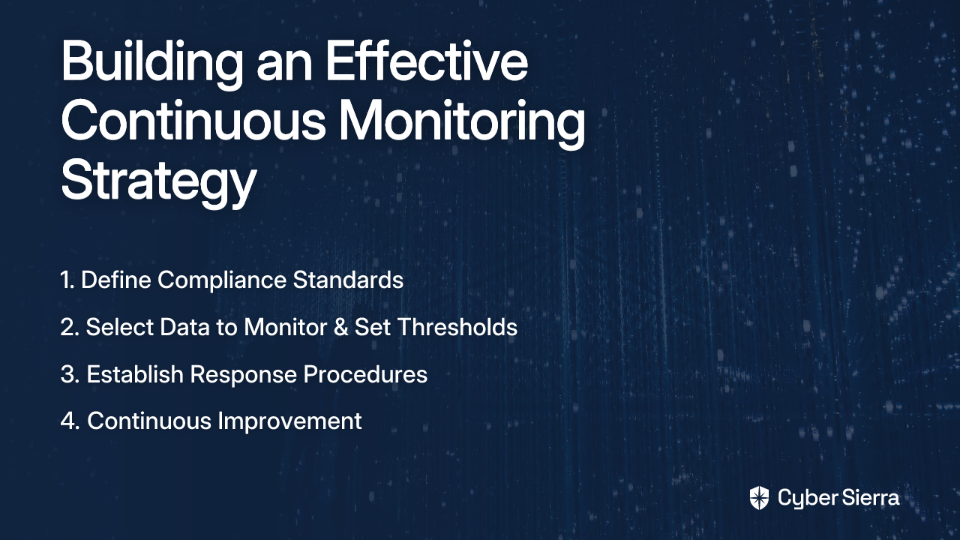
Moving from theory to practice, here's how to implement an effective continuous monitoring program:

Shifting from Reactive Defense to Proactive Resilience

The era of the annual audit and the quarterly scan is over. In a world where infosec risks evolve by the minute, real-time visibility is not a luxury—it is the foundation of a modern, resilient cybersecurity program.

By shifting from a reactive, incident-driven approach to a proactive strategy powered by Continuous Control Monitoring, you can identify and mitigate risks before they escalate into breaches.

Stop chasing infosec risks after the fact.

Ready for real-time security visibility?

See how Cyber Sierra's integrated cybersecurity platform can provide the real-time visibility and automation you need to stay ahead by scheduling a personalized demo today.
Frequently Asked Questions

What is an information security risk?

An information security risk is any potential threat to your organization's data and systems that could impact confidentiality, integrity, or availability. According to NIST, this includes anything that could lead to unauthorized access, use, disclosure, disruption, modification, or destruction of information. This broad definition clarifies that events like system outages are indeed infosec risks because they affect information availability.

Why are traditional security assessments no longer effective?

Traditional security assessments, such as annual penetration tests or quarterly vulnerability scans, are no longer effective because they only provide a point-in-time snapshot of your security posture. In today's dynamic cloud environments, a system can become vulnerable minutes after an audit is completed. These periodic checks create dangerous blind spots, leaving organizations exposed to threats that emerge between assessments.

What is Continuous Control Monitoring (CCM)?

Continuous Control Monitoring (CCM) is a technology-driven process that automates the testing and monitoring of security controls in near real-time. Instead of waiting for a manual audit, a CCM platform continuously verifies that controls are in place and working as intended. This proactive approach allows organizations to identify and remediate security gaps, compliance drifts, and misconfigurations as they happen, shifting from a reactive to a resilient security posture.

How does continuous monitoring help manage third-party and supply chain risks?

Continuous monitoring transforms third-party risk management from a static, checklist-based process into a dynamic one. Instead of relying on outdated vendor questionnaires, a continuous monitoring solution provides 24/7 visibility into your vendors' security posture. It can track their compliance status, scan for vulnerabilities, and alert you to emerging threats, ensuring a partner's security weakness doesn't become your breach.

What are the first steps to implementing a continuous monitoring program?

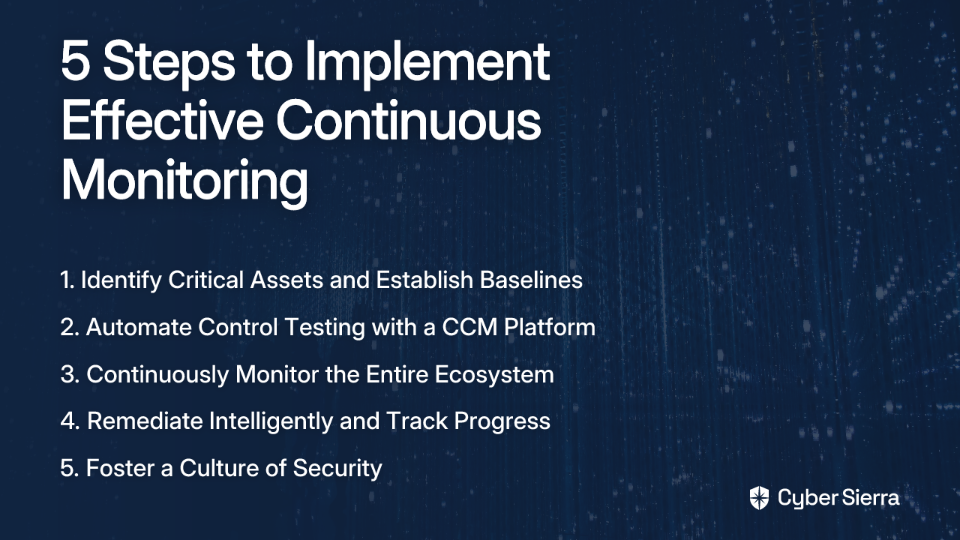
The first steps to implementing a continuous monitoring program involve identifying your most critical assets and establishing security baselines for them. Following that, you should automate control testing with a CCM platform, expand monitoring across your entire ecosystem (cloud, vendors, on-prem), develop an intelligent remediation plan based on risk priority, and foster a security-conscious culture through ongoing training.

blog-hero-background-image
Cyber Security

10 Best IT Audit Software for Automated Compliance in 2026

backdrop
Table of Contents

Join thousands of professionals and get the latest insight on Compliance & Cybersecurity.


Summary

  • Manual IT audit preparation is unsustainable, leading to last-minute evidence scrambles and significant time costs for scaling businesses.
  • Modern IT audit software relies on Continuous Control Monitoring (CCM) to automate evidence collection and provide near real-time visibility into your security posture.
  • When selecting a tool, prioritize deep automation, broad integration with your tech stack, and support for key frameworks like SOC 2 and ISO 27001.
  • A comprehensive platform like Cyber Sierra helps automate these processes, transforming compliance from a periodic burden into a continuous business advantage.

Are you tired of the pre-audit scramble? That frantic dash to gather evidence because your pen test is 13 months old or someone forgot to screenshot the quarterly access review? If you're nodding in agreement, you're not alone.

"Manual tracking has already become a huge time suck, and we know it's not going to scale as we grow," admits one IT manager on Reddit. This sentiment echoes across organizations of all sizes struggling with compliance requirements.

The traditional approach of managing compliance through spreadsheets and manually passing information to auditors is rapidly becoming obsolete. In today's fast-paced, multi-cloud environments, this method is not just inefficient—it's unsustainable.

Enter automated IT audit software—the definitive solution for 2026 and beyond. These platforms transform your organization from reactive compliance fire-fighting to proactive, continuous compliance readiness. The goal? Making audits a non-event rather than a crisis.

This guide cuts through the noise to detail the 10 best IT audit software solutions for 2026, evaluated based on critical criteria: automation capabilities, continuous monitoring features, integration coverage, and support for major compliance frameworks.

What to Look for in Top-Tier IT Audit Software

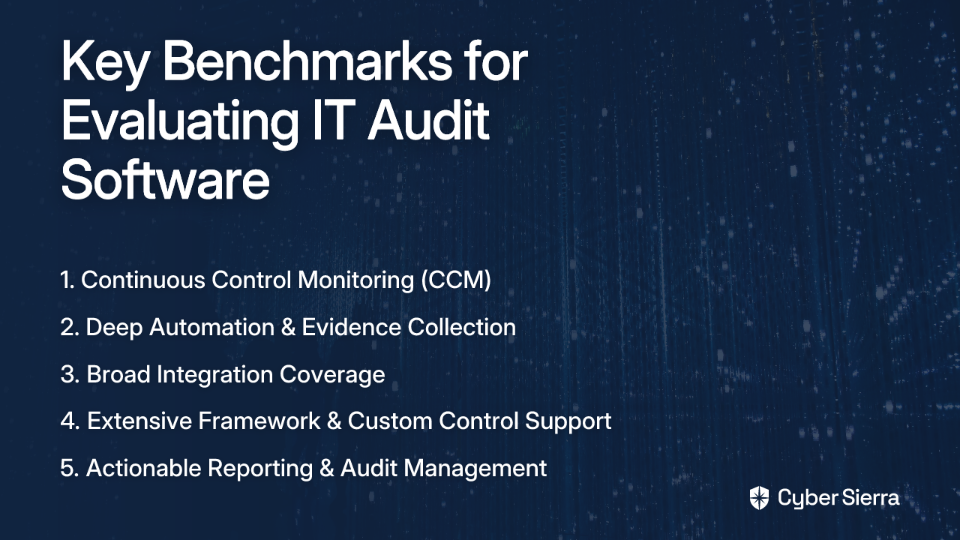
Before diving into specific solutions, let's establish the key benchmarks for evaluating any IT audit software:

Continuous Control Monitoring (CCM)

CCM is an automated process that observes IT systems and networks for security threats and compliance issues in near real-time. It's the engine that powers modern compliance, proactively identifying control weaknesses, maintaining continuous regulatory compliance, and helping minimize business losses before they escalate.

Deep Automation & Evidence Collection

True automation goes beyond simple alerts. It involves automatically collecting evidence from hundreds of sources (cloud platforms, HR systems, code repositories) and automatically testing controls. This directly addresses the pain of manual evidence gathering, which can be reduced from "2-3 days every month... to maybe 30 minutes."

Broad Integration Coverage

This is a make-or-break feature. As one user warned about a particular platform, it may be "enticingly priced but lacks the ability to integrate into a modern company." A premier tool must offer extensive, pre-built integrations with the modern tech stack: AWS, Google Cloud, Azure, Okta, GitHub, Jira, Slack, and various HRIS platforms.

Extensive Framework & Custom Control Support

The software must provide out-of-the-box templates and control mappings for major frameworks like SOC 2, ISO 27001, HIPAA, PCI DSS, GDPR, and NIST. Crucially, it should also allow for the creation and management of custom controls to align with internal policies and unique business requirements.

Actionable Reporting & Audit Management

The platform should not just be a data repository. It needs to generate clear, audit-ready reports and provide dashboards that offer actionable risk intelligence. The output should be easily shareable with auditors to streamline the audit process, ensuring the auditor is "familiar with their evidence format" to avoid friction.

Now, let's explore the 10 best IT audit software solutions that meet these critical criteria.

1. Cyber Sierra

Description: Cyber Sierra is an AI-enabled cybersecurity platform that fundamentally transforms compliance from periodic manual checks into a continuous, automated, and intelligent process. Its Continuous Control Monitoring (CCM) and GRC modules serve as a single source of truth, ensuring organizations are not just prepared for audits but are continuously secure and compliant.

Key Features:

  • Continuous Control Monitoring (CCM):
    • Builds a central controls repository with near real-time updates from your tech stack
    • Provides clear visibility into security posture through continuous, automated monitoring
    • Delivers actionable risk intelligence to prioritize remediation efforts
    • Manages controls across multiple frameworks like NIST, ISO 27001, and PCI DSS
  • Governance, Risk & Compliance (GRC):
    • Automates data collection, risk assessments, and reporting for frameworks like SOC 2, ISO 27001, and HIPAA
    • Generates comprehensive reports and maintains detailed audit trails for auditors

Pricing: Custom quotes available upon request

Best For: CISOs, Compliance Managers, and IT leaders in regulated industries seeking to eliminate audit fatigue and manual work by establishing a proactive, automated, and continuous compliance program.

2. Vanta

Description: Vanta is a leading compliance automation platform known for helping fast-growing companies achieve certifications like SOC 2 and ISO 27001. It streamlines the audit process through deep integrations and continuous evidence collection.

Key Features:

  • Automated evidence collection from a wide range of cloud services and business systems
  • Real-time security monitoring and alerts for compliance gaps
  • Supports over 20 frameworks, including SOC 2, HIPAA, ISO 27001, and GDPR
  • As one user noted, Vanta helped them become "audit ready in just 1 month" for a SOC 2 Type 2

Pricing: Contact vendor for a quote

Best For: Tech startups and SaaS companies aiming to quickly achieve and maintain compliance certifications to build customer trust.

3. Drata

Description: Drata is a security and compliance automation platform that emphasizes continuous monitoring to ensure a constant state of audit readiness. It provides deep visibility into an organization's control environment through a vast library of integrations.

Key Features:

  • Continuous monitoring and automated evidence collection from over 75 integrations
  • Provides a suite of audit-ready documentation and policy templates
  • Manages multiple compliance frameworks within a single platform
  • Offers risk management and vendor management capabilities

Pricing: Contact vendor for a quote

Best For: Companies with a complex, modern tech stack that need to automate evidence collection across dozens of integrated services.

4. AuditBoard

Description: AuditBoard is a connected risk platform designed for larger enterprises, unifying audit, risk, compliance, and ESG management into a single, integrated suite. It focuses on the entire lifecycle of audit and GRC activities.

Rating: 4.5/5 (Gartner)

Key Features:

  • Centralized, end-to-end audit lifecycle management
  • Dynamic, risk-based audit planning and resource allocation
  • Unified control sets that map across multiple frameworks to reduce redundant testing
  • Streamlined reporting and dashboards for executive stakeholders

Pricing: Contact vendor for a quote

Best For: Mature internal audit, risk, and GRC teams in mid-to-large enterprises seeking a comprehensive platform to manage interconnected risk programs.

5. Hyperproof

Description: Hyperproof is a compliance operations platform that excels at streamlining evidence collection and automating control testing. It's designed to reduce the manual burden of compliance management and keep teams perpetually audit-ready.

Rating: 4.7/5 (Capterra)

Key Features:

  • Automated testing and monitoring of internal controls with a user-friendly test builder
  • Centralized evidence management, allowing proof to be linked to multiple controls and frameworks
  • Pre-built templates for dozens of common security and privacy frameworks
  • Provides clear visibility into risk management and accountability

Pricing: Contact vendor for a quote

Best For: Compliance managers and GRC analysts who want granular control over automated testing and a flexible platform for managing evidence across multiple ongoing audits.

6. Secureframe

Description: Secureframe is an all-in-one security and compliance automation platform highly regarded for its ease of use. It connects to your tech stack to continuously monitor controls and collect evidence, enabling a "set it and forget it" approach to compliance.

Key Features:

  • Continuous scanning of cloud environments, code repositories, and infrastructure
  • Automated evidence collection from over 100 integrations
  • Features like a shareable Trust Center to demonstrate security posture to customers
  • Highly praised by users: "We're at a pretty happy 'set it and forget it' phase with Secureframe"

Pricing: Contact vendor for a quote

Best For: Organizations seeking a highly automated, user-friendly solution that simplifies the path to major certifications and requires minimal ongoing manual effort.

7. Sprinto

Description: Sprinto is a smart compliance automation platform built for cloud-native companies. Its strength lies in its deep and broad integration capabilities, aiming to eliminate nearly all manual work associated with security audits.

Key Features:

  • Offers over 300 integrations with popular systems like AWS, Google Workspace, and GitHub
  • Automates evidence collection and intelligently maps it to audit requirements
  • Provides a live risk register that aggregates issues across systems and vendors
  • Automates vendor risk assessments and management
  • Recommended by users who "prioritize integration coverage"

Pricing: Contact vendor for a quote

Best For: Modern SaaS companies and engineering-focused teams that need extensive integration coverage to automate compliance across their entire, diverse tech stack.

8. Netwrix Auditor

Description: Netwrix Auditor is a visibility and governance platform focused on monitoring user activity and system changes across the IT environment to detect threats, prove compliance, and mitigate security risks.

Rating: 4.7/5 (Gartner)

Key Features:

  • Real-time monitoring of all activity and changes to configurations, data, and permissions
  • Risk assessments and threat detection based on anomalous behavior
  • Out-of-the-box reports for standards like PCI DSS, HIPAA, and SOX
  • Detailed audit trails to accelerate incident investigation

Pricing: Custom quotes available

Best For: Organizations with complex hybrid-cloud or on-premise environments needing deep visibility into user activity and system changes for security and operational audits.

9. MetricStream

Description: MetricStream is a comprehensive GRC platform offering a suite of tools for internal audit, risk management, and compliance. Its internal audit solution helps organizations implement a modern, risk-based audit methodology.

Rating: 3.9/5 (Gartner)

Key Features:

  • Centralized management of auditable entities and audit plans
  • Risk-based audit planning to focus resources on high-impact areas
  • AI-powered issue management for tracking and remediating findings
  • Continuous control monitoring capabilities, especially with cloud platforms like AWS

Pricing: Contact vendor for a quote

Best For: Large enterprises seeking a mature and extensive GRC suite with strong capabilities in risk-based internal auditing and AI-driven issue management.

10. Pathlock

Description: Pathlock is a specialized platform focused on application GRC, providing 360-degree protection for critical business applications like SAP, Oracle, and Salesforce by automating access controls and monitoring transactions.

Rating: 4.6/5 (Gartner)

Key Features:

  • Continuously monitors ERP applications for segregation of duties (SoD) violations
  • Automates user access reviews and compliance workflows
  • Provides transaction monitoring to detect fraudulent or anomalous activities
  • Monitors configuration changes within critical business systems

Pricing: Contact vendor for a quote

Best For: Organizations that rely heavily on large ERP systems and need a specialized tool to manage complex access controls and monitor business process compliance within those core applications.

Transform Your Compliance from a Burden to a Business Advantage

The transition to automated IT audit software isn't just a nice-to-have—it's essential for any modern organization. The days of relying on manual processes and spreadsheets are over; the future is automated, continuous, and integrated.

The ultimate goal isn't just passing an audit, but cultivating a culture of continuous security and compliance. This builds customer trust, reduces organizational risk, and serves as a competitive differentiator in today's security-conscious market.

Among the solutions we've reviewed, Cyber Sierra stands out with its industry-leading Continuous Control Monitoring (CCM) capabilities. It transforms compliance from a stressful, periodic event into an automated, near real-time business function, providing a unified view of risk and delivering actionable intelligence needed for proactive security.

Frequently Asked Questions

What is automated IT audit software?

Automated IT audit software is a tool that continuously monitors your IT systems, automatically collects evidence for compliance, and streamlines the entire audit process. It replaces manual spreadsheets and checklists by integrating directly with your tech stack (like AWS, Azure, and Okta) to ensure you are always prepared for audits against frameworks like SOC 2, ISO 27001, and HIPAA.

Why is continuous control monitoring (CCM) important for IT audits?

Continuous Control Monitoring (CCM) is important because it transforms IT audits from a periodic, stressful event into a proactive, ongoing process. Instead of discovering compliance issues right before an audit, CCM provides near real-time visibility into your security posture, automatically flagging control weaknesses so you can fix them immediately and avoid the last-minute scramble for evidence.

How does IT audit software automate evidence collection?

IT audit software automates evidence collection by directly integrating with your company's technology stack using APIs. It connects to cloud providers (AWS, Azure), identity providers (Okta), HR systems, and code repositories (GitHub) to automatically pull relevant data—such as system configurations, user access lists, and policy settings. This evidence is then mapped to specific compliance controls, eliminating the manual work of taking screenshots and gathering documents.

Who typically uses IT audit software in an organization?

IT audit software is typically used by Compliance Managers, IT Managers, CISOs, and internal audit teams to manage and streamline compliance programs. However, its benefits extend across the organization, enabling engineering teams to remediate issues faster and providing leadership with a clear, actionable view of the company's risk and security posture.

How do I choose the right IT audit software for my business?

To choose the right IT audit software, evaluate platforms based on four key criteria: the breadth of its integrations with your tech stack, its support for the specific compliance frameworks you need (like SOC 2 or HIPAA), the depth of its automation and continuous monitoring capabilities, and its reporting features. Start by defining your goals—a startup needing its first SOC 2 report has different needs than an enterprise managing multiple global regulations. Always request a demo to see the platform in action.

What is the difference between GRC platforms and compliance automation tools?

While related, compliance automation tools typically focus on automating evidence collection and continuous monitoring for specific frameworks (like SOC 2). GRC (Governance, Risk, and Compliance) platforms are often broader, enterprise-level solutions for managing the entire lifecycle of audit, risk, and corporate governance. Many modern tools, like Cyber Sierra, blend these functions, offering strong compliance automation within a comprehensive GRC framework.

Stop the pre-audit scramble and endless evidence gathering. It's time to automate your compliance program and get back to focusing on what matters—growing your business and serving your customers. Ready to see how a continuous, automated approach can transform your security posture? Schedule a free demo of Cyber Sierra today!

blog-hero-background-image
Cyber Security

Cyber Risk Management Program vs. Traditional Security: Why Integration Matters

backdrop
Table of Contents

Join thousands of professionals and get the latest insight on Compliance & Cybersecurity.


Summary

  • Traditional security programs struggle with tool overload, using an average of 29-83 different solutions that lead to alert fatigue and dangerous visibility gaps.
  • Shifting from disconnected tools to an integrated cyber risk management program is essential for aligning security with business goals and proactively mitigating threats.
  • A unified platform approach delivers a 101% ROI and helps teams detect and contain threats up to 72 and 84 days faster, respectively, compared to siloed tools.
  • Consolidate key functions like GRC, TPRM, and threat intelligence with a unified platform like Cyber Sierra to gain an actionable, real-time view of your security posture.

Are you tired of security dashboards that decorate reports but don't inform decisions? Frustrated by issues that get logged but never fixed? Does your cyber risk program exist only on paper rather than in practice?

If you're nodding along, you're not alone. Many security professionals struggle with "performative" security programs that fail to deliver real protection in today's complex threat landscape.

The hard truth is that the traditional approach—buying disconnected point solutions for every security problem—has created ineffective security postures for countless organizations. Each new tool adds complexity without necessarily improving your security.

The solution isn't another tool. It's a fundamental strategic shift from isolated security tactics to an integrated cyber risk management program that aligns with your business objectives. Let's explore why this integration isn't just better—it's essential for survival.

The Old Guard: The Pitfalls of Traditional, Siloed Security

Traditional security approaches typically manifest as a patchwork of non-interoperable tools: firewalls, antivirus, vulnerability scanners, compliance trackers, and vendor questionnaires, each operating in isolation.

As Rick Holland, CISO & VP of Strategy at Digital Shadows bluntly puts it: "The point solutions just need to die." This isn't an isolated opinion—Charles Henderson of IBM Security's X-Force has noted that non-interoperable tools lead to wasted resources and significantly higher risk.

The data behind these statements is compelling:

Tool Overload

Organizations juggle a staggering number of security tools. A Trend Micro report found companies used an average of 29 security monitoring tools, while IBM puts the number even higher at 83 different security solutions from 29 vendors.

Alert Fatigue & Visibility Gaps

This overload leads to security teams drowning in alerts, making it easy to miss critical threats. When tools don't communicate, dangerous blind spots emerge where risks can hide undetected.

Vendor Sprawl

Market fragmentation increases operational inefficiency. Gartner found that 75% of organizations are actively pursuing vendor consolidation to combat this complexity.

Reactive Posture

Traditional security focuses primarily on perimeter defense, reacting to threats after detection rather than proactively managing risk across the organization.

A Strategic Shift: What is an Integrated Cyber Risk Management Program?

Cyber risk management is "the process of identifying, prioritizing, managing, and monitoring risks to information systems" as part of a broader enterprise risk management strategy. Unlike traditional security, it's about understanding business context, not just blocking attacks.

A comprehensive cyber risk management program follows four core steps:

  1. Risk Framing: Define the context by creating an asset inventory, understanding legal requirements (e.g., GDPR, HIPAA), and allocating organizational resources.
  2. Risk Assessment: Identify threats and vulnerabilities. Evaluate the potential business impacts and likelihood of an event occurring.
  3. Responding to Risk: Choose appropriate strategies:
    • Mitigation: Implement controls to reduce risk
    • Remediation: Fix vulnerabilities completely (e.g., patching)
    • Transfer: Offload risk through cyber insurance
  4. Monitoring: Continuously oversee security controls and the threat landscape, not just periodic checks.

Here's how traditional and integrated approaches fundamentally differ:

Point of DifferenceTraditional CybersecurityIntegrated Cyber Risk Management
Scope and FocusTactical. Protects systems from specific attacks.Strategic. Identifies, assesses, and mitigates enterprise-wide risks, focusing on business impact.
ObjectivesMaintain Confidentiality, Integrity, and Availability (CIA Triad).Understand, quantify, and minimize risks to information assets to support business objectives.
ApproachImplements technical security measures for defense (e.g., firewalls, AV).Takes a holistic view of risk, incorporating compliance, vendor risk, and business context.
PerspectiveA purely technical standpoint on asset protection.A broader business view considering financial impact, regulatory compliance, and reputational damage.

The High Cost of Disconnection: Why Silos Fail in the Real World

The consequences of fragmented security aren't just theoretical—they have measurable impacts on your business:

Direct Financial Impact

Security complexity can cost organizations up to 5% of their annual revenue due to inefficiencies and incidents. For a $100 million company, that's a staggering $5 million lost to preventable issues.

Drastically Slower Incident Response

Organizations with integrated security platforms detect incidents 72 days faster and contain them 84 days faster than those without. In cybersecurity, this time difference represents the line between a minor issue and a catastrophic breach.

Poor Return on Investment

Businesses using a platform approach report an average ROI of 101%, while those sticking with siloed tools see a meager 28% ROI. Integration literally pays for itself.

The Human Cost

The siloed approach creates significant pain points for security professionals:

  • Compliance Fatigue: System owners frequently complain about excessive documentation burdens. As one security professional noted, "The biggest complaint I hear from system owners is how much work an SSP is and it takes too long." This leads to avoidance behaviors and the growth of shadow IT.
  • Lack of Accountability: When tools and processes are siloed, it's difficult to establish clear risk ownership. Security professionals express frustration about the lack of "real accountability (not just second line owning everything)."
  • Culture of Compliance, Not Security: Siloed approaches tend to foster a checkbox mentality rather than true security awareness. Security becomes something done to check a box, not to protect the business.

The Power of Integration: 4 Pillars of a Unified Cyber Defense

The solution to these challenges isn't buying more tools—it's integrating your existing capabilities into a cohesive cyber risk management program. Here are the four pillars that make this integration powerful:

Pillar 1: Unified Governance, Risk, and Compliance (GRC)

Problem: Managing multiple frameworks (SOC2, ISO 27001, HIPAA) with spreadsheets and manual evidence collection creates audit stress and increases the risk of compliance failures.

Integrated Solution: A unified platform automates data collection, centralizes controls, and provides continuous monitoring. This transforms compliance from a periodic, painful event into an ongoing, automated process.

Platforms like Cyber Sierra offer a central GRC module that automates these workflows, mapping controls across multiple frameworks to eliminate redundant work. Its Continuous Control Monitoring (CCM) provides near real-time visibility, moving beyond manual checks to ensure you're always audit-ready.

Pillar 2: Continuous Third-Party Risk Management (TPRM)

Problem: Your security is only as strong as your weakest vendor. Traditional vendor risk involves point-in-time questionnaires that quickly become outdated and fail to capture emerging threats.

Integrated Solution: An integrated approach connects vendor risk to your overall risk register. It allows for continuous monitoring of your vendors' security posture, automating assessments and providing real-time alerts when a third-party's risk profile changes.

Cyber Sierra's TPRM module (https://cybersierra.co/platform-tprm/) automates vendor assessments and provides 24/7 visibility, ensuring your supply chain doesn't become your biggest vulnerability.

Pillar 3: Proactive Threat Intelligence and Vulnerability Management

Problem: Threat intelligence that isn't connected to your actual vulnerabilities is just noise. Siloed vulnerability scanners produce long lists of issues with no business context for prioritization.

Integrated Solution: A unified platform correlates external threat data with internal vulnerability scans (both network and cloud). This allows you to prioritize patching based on which vulnerabilities are actively being exploited and pose the greatest risk to your critical assets.

The Threat Intelligence module in Cyber Sierra (https://cybersierra.co/platform-threat-intelligence/) provides an "outside-in" view of your attack surface, combining network and cloud scanning to give you a clear, prioritized list of what to fix first.

Pillar 4: Embedded Employee Security Training

Problem: The human element is often the weakest link in security. Human error contributes to 34% of cloud breaches. One-off, boring training sessions fail to create lasting behavioral change.

Integrated Solution: Security awareness should be an integral part of your risk management program, not an afterthought. An integrated platform can tie training performance to risk metrics, run simulated phishing campaigns, and provide continuous education based on emerging threats identified by the threat intelligence module.

With Cyber Sierra's Employee Security Training (https://cybersierra.co/platform-employee-security-training/), you can build a strong human firewall through interactive training and phishing simulations, with results feeding back into your overall risk posture dashboard.

Beyond Tools: Building a Resilient Cyber Risk Management Program

The evidence is clear: a reactive, tool-centric approach to security is expensive, inefficient, and leaves your organization vulnerable. A modern cyber risk management program must be integrated, strategic, and proactive.

The most successful programs aren't just technical implementations—they represent a cultural shift. As one security professional noted, a good risk program "is part of the normal conversation and people view it as part of doing business." An integrated platform facilitates this by providing a common language and a unified view of risk for everyone from engineers to the C-suite.

When your security program is integrated into the business, it becomes:

  1. Visible: Leadership can see the organization's true security posture through meaningful dashboards that drive decisions, not just decorate reports.
  2. Accountable: Clear ownership of risks is established, with the first line of defense (operational managers) taking responsibility and the second line (risk and compliance teams) providing oversight.
  3. Actionable: Issues don't just get logged—they get fixed, because they're prioritized based on business impact and assigned to responsible parties.
  4. Continuous: Security isn't a periodic checkbox exercise but an ongoing process embedded in daily operations.
  5. Business-aligned: Security decisions are made in the context of business goals and risk appetite, not in isolation.

Take the First Step Toward Integration

Stop buying more point solutions. It's time to consolidate and integrate. Take the first step toward building a cyber risk program that's real, not performative.

Consider how an AI-enabled, unified platform like Cyber Sierra can break down silos across your GRC, vendor risk, threat intelligence, and employee training to give you a single, actionable view of your security posture. By integrating these critical functions, you'll not only reduce costs and improve efficiency but also significantly enhance your organization's security posture and resilience against evolving threats.

The future of security isn't in adding more tools—it's in making the tools you have work better together through a comprehensive, integrated cyber risk management program. Your business deserves nothing less.

Frequently Asked Questions

What is the difference between traditional cybersecurity and integrated cyber risk management?

The primary difference is that traditional cybersecurity is tactical and focuses on defending systems with disconnected technical tools, while integrated cyber risk management is strategic, focusing on identifying and mitigating enterprise-wide risks in the context of overall business objectives. The traditional approach is often reactive, whereas an integrated program is proactive and holistic, incorporating compliance, vendor risk, and financial impact into a unified view.

Why are so many separate security tools ineffective?

Separate security tools are ineffective because they create tool overload, leading to alert fatigue, critical visibility gaps, and a reactive security posture. When tools don't communicate, security teams are drowned in uncontextualized data, making it difficult to prioritize threats. This complexity increases operational costs, slows incident response, and ultimately results in a poor return on investment.

How does an integrated platform improve security ROI?

An integrated platform improves security ROI by consolidating capabilities, which reduces software licensing and operational costs. It automates manual tasks associated with compliance and vendor management, freeing up security personnel for higher-value work. Most importantly, by enabling faster incident detection and response, it significantly reduces the financial impact of potential breaches.

What are the core components of a unified cyber risk management program?

A comprehensive, unified cyber risk management program is built on four key pillars. These include: 1) Unified Governance, Risk, and Compliance (GRC) to automate and centralize policy management; 2) Continuous Third-Party Risk Management (TPRM) to monitor vendor security; 3) Proactive Threat Intelligence to identify and prioritize vulnerabilities; and 4) Embedded Employee Security Training to strengthen the human element of your defense.

Where should our organization start when shifting to an integrated approach?

A great starting point is to conduct an audit of your existing security tools to identify redundancies and opportunities for consolidation. From there, prioritize your biggest pain points—whether it's audit readiness, vendor management, or vulnerability patching. Look for a unified platform that can address these initial challenges while providing a foundation to integrate other security functions over time.

blog-hero-background-image
Cyber Security

Top 10 Continuous Monitoring Platforms That Actually Reduce Security Incidents

backdrop
Table of Contents

Join thousands of professionals and get the latest insight on Compliance & Cybersecurity.


Summary

  • Traditional periodic security checks are reactive and inadequate, leaving organizations vulnerable to costly breaches and regulatory fines.
  • Continuous monitoring provides the real-time visibility needed to shift from a reactive to a proactive security posture, identifying and addressing threats before they cause damage.
  • When choosing a platform, prioritize features like real-time alerting, automated remediation, broad compliance coverage, and deep integrations.
  • Cyber Sierra’s Continuous Control Monitoring platform helps automate compliance and risk management, keeping you audit-ready while proactively reducing security incidents.

You've set up a robust security program. You've implemented the right controls. You've passed your audits. Yet month after month, you're seeing the same security issues flagged, your technical debt keeps climbing, and each major audit creates a stressful scramble for your team.

Sound familiar? You're not alone.

In today's dynamic threat landscape, traditional periodic security checks have become woefully inadequate. They're reactive, leaving security teams perpetually playing catch-up, especially in complex cloud-centric environments where the attack surface constantly evolves.

The game-changer? Continuous monitoring platforms that don't just alert you to problems but actively help reduce security incidents through automation, remediation, and actionable intelligence.

This guide evaluates 10 leading continuous monitoring platforms based on their proven ability to reduce security incidents, organized by industry focus and judged on practical criteria that separates marketing hype from actual results.

What is Continuous Monitoring and Why Is It a Game-Changer for Incident Reduction?

Continuous monitoring is an ongoing, real-time process of collecting, analyzing, and acting on data across IT environments to detect and address threats before they cause damage. Unlike periodic assessments that collect data at intervals (leaving dangerous blind spots), continuous monitoring provides uninterrupted visibility into your security posture.

The stakes of inadequate monitoring couldn't be higher:

  • Financial Impact: The Equifax data breach cost over $700 million – a catastrophe that continuous monitoring could have prevented by identifying the unpatched vulnerability.
  • Regulatory Penalties: GDPR violations can result in fines up to €20 million or 4% of annual revenue, with similar penalties under other frameworks.
  • Reputational Damage: The long-term loss of customer trust after a preventable breach can devastate even established brands.

Our Evaluation Criteria: Separating Signal from Noise

We've evaluated these platforms based on outcomes rather than feature lists, focusing on four critical capabilities:

  1. Real-time Alerting & Automated Response: Not just detecting threats instantly but triggering automated responses or providing clear remediation guidance.
  2. Compliance Framework Coverage: Support for essential frameworks like SOC 2, ISO 27001, HIPAA, PCI DSS, NIST, and GDPR, with pre-configured controls to simplify audit readiness.
  3. Integration Depth: Seamless compatibility with existing security tools, cloud infrastructure (AWS, Azure, GCP), and IT systems to provide a unified view without creating new silos.
  4. Actionable Intelligence & Remediation: The ability to transform raw data into prioritized, data-driven insights that guide remediation efforts and prevent "alert fatigue."

The Top 10 Continuous Monitoring Platforms for 2024

For Comprehensive Compliance & Automated Remediation (Tech, BFSI, HealthTech)

1. Cyber Sierra

Best for: Enterprises seeking a unified AI-enabled platform to automate GRC, Continuous Control Monitoring (CCM), and risk management.

How it Reduces Incidents: Cyber Sierra transforms security from periodic checks to continuous, automated monitoring. Its CCM module automates control testing and validation for frameworks like SOC 2, ISO 27001, and HIPAA, providing near real-time visibility into your security posture. This directly addresses the "pre-audit scramble" by making you audit-ready 24/7. The Threat Intelligence module performs proactive Attack Surface Management and vulnerability scanning to identify risks before they're exploited.

Key Features:

  • Builds a central controls repository with real-time updates
  • Manages multiple compliance frameworks from a single dashboard
  • Delivers actionable risk intelligence for data-driven remediation
  • Includes modules for Third-Party Risk Management (TPRM) and Employee Security Training to address supply chain and human-vector risks

2. Splunk

Best for: Organizations with mature security operations that need powerful, large-scale log management and Security Information and Event Management (SIEM) capabilities.

How it Reduces Incidents: Ingests and analyzes massive volumes of machine data from across the IT environment in real-time. This allows security teams to correlate disparate events, detect complex attack patterns, and investigate incidents with deep forensic detail.

Key Features: Real-time log analysis, security analytics, IT infrastructure monitoring, customizable dashboards.

3. MetricStream

Best for: Managing compliance and risk specifically within cloud-centric environments.

How it Reduces Incidents: Focuses on automatically monitoring cloud entities (like S3 buckets, security groups) to ensure they adhere to corporate policies and compliance standards, preventing common cloud misconfigurations that lead to breaches.

Key Features: Automated monitoring of cloud infrastructure, policy adherence checks, GRC workflows.

For Security Posture & Vulnerability Management (Primarily Tech)

4. Panaseer

Best for: Organizations wanting a data-driven, measurable view of their security posture and control effectiveness.

How it Reduces Incidents: Aggregates data from all existing security tools to provide a single, trusted view of assets and controls. It automates vulnerability analysis and identifies gaps (e.g., servers missing EDR) to ensure security coverage is complete and effective.

Key Features: Continuous Controls Monitoring, automated security reporting, security posture metrics.

5. XM Cyber

Best for: Enterprises with complex hybrid-cloud environments needing to prioritize remediation based on attacker perspectives.

How it Reduces Incidents: Goes beyond vulnerability scanning by continuously modeling potential attack paths from breach points to critical assets. This allows teams to focus on fixing the "choke points" that would have the biggest impact on disrupting an attack.

Key Features: Attack path management, breach and attack simulation, unified cyber risk posture.

For GRC & Internal Controls (Finance, Healthcare, Regulated Industries)

6. Hyperproof

Best for: Teams needing to automate the testing and monitoring of a wide range of internal controls beyond just technical ones.

How it Reduces Incidents: Automates evidence collection for controls related to user access reviews, security training completion, and policy acknowledgments. This ensures that foundational security hygiene practices are consistently maintained, reducing risks from human error and insider threats.

Key Features: Broad control coverage (technical, administrative), automated evidence collection, compliance operations platform.

7. Pathlock

Best for: Organizations in financial services or those heavily reliant on ERP systems like SAP and Oracle.

How it Reduces Incidents: Specializes in monitoring user activity and transactions within critical business applications. It detects segregation of duties (SoD) violations, unauthorized configuration changes, and suspicious financial activity in real-time to prevent internal fraud and data exfiltration.

Key Features: Transaction monitoring, SoD analysis, application access governance.

8. Quod Orbis

Best for: Organizations looking to streamline internal audit processes and tie them directly to asset management.

How it Reduces Incidents: Provides a clear link between cyber assets, their vulnerabilities, and the controls meant to protect them. It automates the collection of audit evidence, ensuring that security gaps are not only identified but also tracked through to mitigation.

Key Features: Cyber asset management, automated audit workflows, vulnerability mitigation tracking.

For Third-Party & Network Risk Management (All Industries)

9. Atlas Systems (ComplyScore)

Best for: Enterprises needing to continuously monitor the security and compliance posture of their third-party vendors.

How it Reduces Incidents: Uses an AI-based TPRM platform to provide 24/7 monitoring of vendor ecosystems. It sends real-time alerts for compliance breaches or security incidents within the supply chain, allowing organizations to act before a vendor's problem becomes their own breach.

Key Features: AI-powered continuous vendor monitoring, automated risk assessments, audit and reporting transparency.

10. FireMon

Best for: Organizations needing to maintain strict compliance and security for their complex network infrastructure and firewalls.

How it Reduces Incidents: Continuously monitors network security device configurations and rulesets for policy violations, unnecessary access, and misconfigurations. This prevents unauthorized network pathways from being opened and ensures critical segmentation policies remain intact.

Key Features: Real-time policy compliance monitoring, firewall rule analysis, network security policy management.

Beyond the Platform: Building a Successful Continuous Monitoring Strategy

While selecting the right continuous monitoring platform is crucial, technology is only part of the equation. To maximize effectiveness:

  1. Define Compliance Standards: Establish baseline regulatory requirements and standards (e.g., NIST, HIPAA) to ensure your monitoring aligns with your compliance obligations.
  2. Select Data to Monitor & Set Thresholds: Pick relevant data sources and technologies (e.g., SIEM for logs) and define what constitutes an alert. This is crucial for avoiding alert fatigue and ensuring focus on meaningful events.
  3. Establish Response Procedures: Prepare documented processes for how to react when threats are detected. Without clear action plans, even the best monitoring becomes a wasted investment.
  4. Continuous Improvement: Utilize insights from your monitoring to refine policies and adapt to regulatory changes, ensuring your security posture evolves alongside the threat landscape.

From Reactive Compliance to Proactive Security with Cyber Sierra

True security isn't about passing an annual audit; it's about building a resilient, proactive defense that reduces incidents before they impact your business. Continuous monitoring platforms are essential tools for making that shift from reactive to proactive security management.

For organizations seeking to eliminate the pre-audit scramble while meaningfully reducing security incidents, Cyber Sierra provides a uniquely integrated platform that connects Continuous Control Monitoring with GRC, TPRM, and Threat Intelligence. It doesn't just find problems; it automates compliance processes and streamlines remediation, freeing your team to focus on strategic security initiatives.

The growing technical debt from unaddressed vulnerabilities, the month-after-month recurrence of the same security issues, and the stress of preparing for major audits are all symptoms of an outdated, reactive approach to security. By implementing a comprehensive continuous monitoring strategy with a platform that fits your specific industry needs, you can break this cycle and move toward a more mature, proactive security posture.

Frequently Asked Questions

What is continuous security monitoring?

Continuous security monitoring is the real-time, ongoing process of detecting, analyzing, and responding to security threats across your IT environment. Unlike traditional periodic checks that create security blind spots, it provides uninterrupted visibility, allowing you to identify and address vulnerabilities before they can be exploited.

How does continuous monitoring help reduce security incidents?

Continuous monitoring reduces security incidents by shifting your security posture from reactive to proactive. It automatically identifies vulnerabilities, misconfigurations, and suspicious activities in real-time, triggering automated responses or providing immediate remediation guidance. This prevents threats from escalating into costly data breaches.

What are the key features to look for in a continuous monitoring platform?

The most effective continuous monitoring platforms offer four key capabilities: real-time alerting with automated response, comprehensive compliance framework coverage (like SOC 2, ISO 27001), deep integration with your existing tech stack, and the ability to provide actionable intelligence for prioritized remediation.

Why is continuous monitoring crucial for compliance with frameworks like SOC 2 and ISO 27001?

Continuous monitoring is crucial for compliance because it automates the process of testing controls and collecting evidence, ensuring you are audit-ready 24/7. Instead of a last-minute scramble, it provides a real-time, verifiable view of your adherence to standards like SOC 2 and ISO 27001, making audits smoother and more accurate.

Can continuous monitoring replace the need for annual security audits?

No, continuous monitoring does not replace formal security audits, but it significantly enhances and simplifies them. It provides the ongoing assurance and evidence that auditors require, transforming the audit from a stressful, time-consuming event into a straightforward validation of your already-established security posture.

How can our organization get started with a continuous monitoring strategy?

To start with a continuous monitoring strategy, first define your compliance requirements and security standards. Next, identify the critical data and systems to monitor and set clear alert thresholds. Finally, establish documented response procedures and commit to continuously improving your security policies based on the insights you gather.

Stop the pre-audit scramble and start proactively reducing incidents. See how Cyber Sierra creates a single source of truth for your security and compliance posture. Book a free demo today.
blog-hero-background-image
Cyber Security

Continuous Compliance Tool ROI Calculator: How to Justify the Investment

backdrop
Table of Contents

Join thousands of professionals and get the latest insight on Compliance & Cybersecurity.

Summary

  • Manual compliance is a major hidden cost, with teams spending up to 60% of their time on repetitive tasks that could be automated.
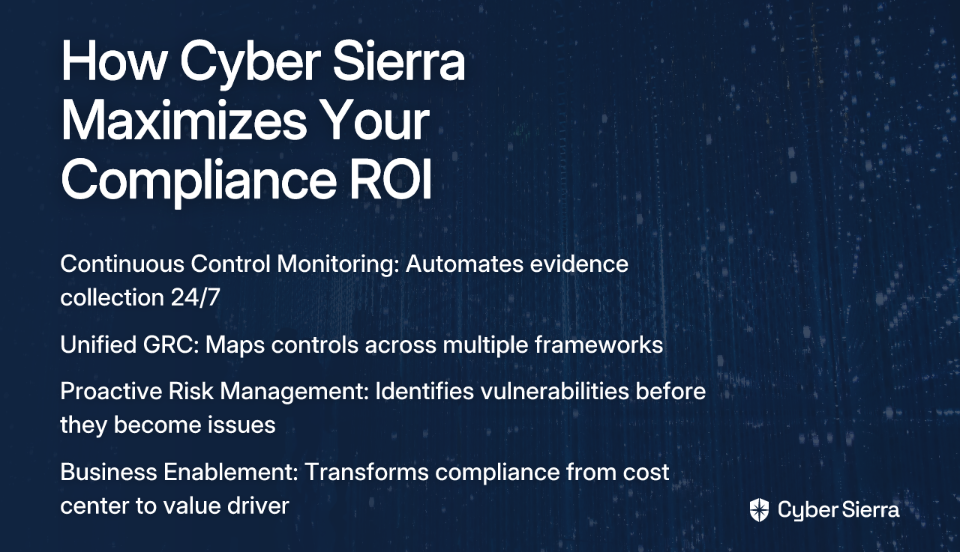
  • The ROI of continuous compliance tools is not only calculable but compelling, based on quantifiable cost savings, risk reduction, and strategic productivity gains.
  • Automating compliance can reduce manual effort by up to 80% and deliver an ROI of over 100% in the first year by cutting labor costs and preventing expensive regulatory fines.
  • Build a business case for automation by calculating your potential savings; a platform like Cybersierra's GRC solution can help turn compliance from a cost center into a strategic advantage.

You've heard it before: "You can't calculate a cybersecurity ROI." Or perhaps, "Compliance is just a cost of doing business." These statements reflect a frustrating reality for security professionals—the struggle to quantify the value of investments that are designed to prevent bad things from happening.

But what if we told you that calculating the ROI of continuous compliance tools isn't just possible—it's essential for modern security programs?

The True Cost of the Status Quo: What Manual Compliance is Really Costing You

Before we can calculate the return on investment, we need to understand what your current approach is costing your organization. Manual compliance processes create hidden expenses that many organizations fail to recognize:

Labor Costs: The Time Sink

Compliance teams typically spend a staggering 60% of their time on manual tasks like evidence collection, documentation, and status tracking. For a team of two compliance officers earning $80,000 each, that translates to $96,000 annually spent just on repetitive, low-value work.

Audit Preparation: The Quarterly Fire Drill

Traditional point-in-time compliance approaches create intense "fire drill" periods before audits. These disruptions pull team members from strategic work for weeks or months. One manufacturing firm reported that their entire security team spent nearly four weeks preparing for each audit—time that could have been dedicated to improving security posture.

Non-Compliance Risks: The Financial Cliff

The cost of non-compliance has risen dramatically. Under GDPR alone, fines can reach up to €20 million or 4% of annual global turnover. In 2023, regulators issued over $2.5 billion in fines related to data protection and privacy violations.

Opportunity Cost: The Innovation Gap

Perhaps most significant is what your team isn't doing while they're manually gathering evidence and chasing stakeholders for attestations. They could be enhancing your security program, investigating emerging threats, or implementing controls that truly reduce risk.

A Practical Framework for Calculating Continuous Compliance ROI

Let's break down the calculation into three measurable components:

A. Quantifiable Cost Savings (The Hard Numbers)

  1. Reduced Labor Hours for Compliance Tasks Automated tools can reduce time spent on compliance tasks by 60-80% according to industry research. Calculation: (Current Hours Spent on Manual Tasks) × (Hourly Rate) × (60% to 80% Reduction) = Annual Savings
  2. Reduced Audit Preparation & Fees Continuous evidence collection dramatically reduces the time needed for audit preparation and the billable hours of external auditors. Real-world impact: A mid-sized financial services company reduced their audit preparation time by 70% after implementing a continuous compliance tool, saving approximately $45,000 annually in external auditor fees.
  3. Reduced Compliance Staffing Needs Organizations report up to 30-50% savings on compliance personnel expenses by avoiding new hires as the company scales. For a growing company that would otherwise need to add a compliance specialist ($90,000 annually) to handle expanding requirements, this represents a significant avoided cost.

B. Risk Reduction & Cost Avoidance (The Insurance Policy)

  1. Reduced Likelihood of Breaches Continuous Controls Monitoring (CCM) provides real-time visibility into security gaps, allowing you to fix issues before they're exploited. Research shows that organizations with mature continuous monitoring programs experience 80% fewer successful attacks. Calculation: (Average Breach Cost) × (Reduction in Breach Probability) = Risk Reduction Value
  2. Reduced Cost of Regulatory Fines AI-driven compliance solutions can decrease violation rates by 34% through proactive monitoring and automated remediation workflows. Calculation: (Potential Fine Amount) × (Likelihood of Violation) × (34% Reduction) = Avoided Cost
  3. Lower Cyber Insurance Premiums Insurers increasingly offer premium discounts to organizations that demonstrate robust security controls through continuous monitoring. Some companies report 5-15% reductions in cyber insurance costs after implementing automated compliance tools.

C. Productivity & Strategic Gains (The Business Enabler)

  1. Improved Decision-Making Continuous monitoring provides executives with a comprehensive risk overview, enabling data-driven strategic decisions. This translates to faster, more confident business initiatives.
  2. Increased Team Efficiency Automation allows your security team to focus on high-value activities rather than chasing documentation. One tech company reported their security analysts gained back 15 hours per week to focus on threat hunting after implementing a continuous compliance platform.
  3. Enhanced Stakeholder Confidence Real-time dashboards and comprehensive reporting increase trust among investors, partners, and customers, potentially accelerating sales cycles in regulated industries.

Putting It All Together: A Sample ROI Calculation in Action

Let's examine a hypothetical case study for "FinTech Corp," a mid-sized company with two compliance officers preparing for SOC 2 and managing GDPR compliance:

Step 1: Calculate Annual Manual Compliance Cost

  • Labor: 2 officers × $90,000 salary × 60% manual work = $108,000
  • Audit Fees: $50,000
  • Total Annual Cost: $158,000

Step 2: Introduce the Solution

  • Cost of Continuous Compliance Tool: $40,000/year

Step 3: Calculate Annual Savings & Gains

  • Labor Savings: $108,000 × 70% reduction = $75,600
  • Audit Fee Reduction: $50,000 × 40% reduction = $20,000
  • Total Annual Savings: $95,600

Step 4: Calculate the ROI

  • Net Gain: $95,600 (Savings) - $40,000 (Cost) = $55,600
  • ROI = ($55,600 / $40,000) × 100 = 139% in the first year

Most organizations implementing continuous compliance tools see a payback period of just 1-2 years, with the ROI continuing to improve as the organization grows and compliance requirements expand.

Maximizing Your Return with an Automated Compliance Platform

While the ROI framework above applies to any continuous compliance tool, the actual returns you'll see depend significantly on the capabilities of the platform you choose. Here's how a comprehensive solution like Cyber Sierra can maximize your investment:

Continuous Control Monitoring: The Foundation of Automation

Cyber Sierra's Continuous Control Monitoring (CCM) module automates control testing and evidence collection 24/7, eliminating the manual work that currently consumes your team's time. The platform builds a central controls repository that serves as a single source of truth, directly delivering the "Reduced Labor Hours" component of our ROI calculation.

A healthcare technology company using Cyber Sierra's CCM reported that their compliance officers reduced evidence gathering time by 75%, allowing them to focus on strategic risk management instead of documentation.

Unified GRC: Breaking Down Compliance Silos

One of the biggest inefficiencies in compliance comes from managing multiple frameworks (SOC2, ISO 27001, HIPAA, etc.) in isolation. Cyber Sierra's GRC platform unifies these requirements, eliminating tool sprawl and mapping controls across frameworks.

This approach directly addresses the challenge of scattered information that contributes to audit preparation overhead. When a retail company consolidated five separate compliance tools into Cyber Sierra's platform, they reduced their total compliance software costs by 35% while improving visibility.

Proactive Risk Management: Beyond Compliance

The integration of Cyber Sierra's Threat Intelligence and Third-Party Risk Management (TPRM) capabilities provides a holistic view of your risk landscape. This proactive approach directly impacts the "Risk Reduction" component of our ROI calculation by identifying and addressing vulnerabilities before they become compliance issues or breaches.

Transforming Compliance from Cost Center to Business Enabler

Perhaps most importantly, platforms like Cyber Sierra transform compliance from a periodic checkbox exercise into a continuous, value-adding business function. The real-time dashboards and comprehensive reporting provide transparency to executives and demonstrate due diligence to customers and partners—directly contributing to the "Strategic Gains" portion of our ROI framework.

Build Your Bulletproof Business Case for Continuous Compliance

Calculating compliance ROI isn't just possible—it's a strategic necessity. This approach changes the conversation from "How much does it cost?" to "How much value will it create?" and helps you justify investments to the C-level and Board in the language they understand: numbers.

By quantifying the labor savings, risk reduction, and productivity gains of continuous compliance tools, you can build a compelling business case that demonstrates clear financial returns alongside improved security and compliance posture.

Ready to build your own business case? Download our free, pre-populated Continuous Compliance ROI Calculator to plug in your own numbers and present a data-driven proposal to your leadership.

Then, see how Cyber Sierra's automated platform can help you achieve the ROI you've just calculated. Schedule a personalized demo and let us show you how to turn compliance from a burden into a strategic advantage.

Frequently Asked Questions (FAQ)

What is continuous compliance and how does it differ from traditional compliance?

Continuous compliance is an automated, proactive approach to meeting regulatory requirements, where controls are monitored and validated in real-time. It differs from traditional compliance, which is typically a manual, point-in-time activity conducted periodically (e.g., annually) and often results in "fire drills" before an audit.

How do you calculate the ROI of a continuous compliance tool?

The ROI of a continuous compliance tool is calculated by subtracting the tool's cost from the total value gained, then dividing by the cost. The value gained comes from three key areas: 1) Quantifiable cost savings from reduced manual labor and audit fees, 2) Risk reduction through avoiding fines and breach costs, and 3) Strategic gains from increased team productivity and faster decision-making.

What is a realistic ROI for continuous compliance automation?

A realistic ROI for continuous compliance automation is often over 100% within the first year, with a typical payback period of 1-2 years. The exact figure depends on your organization's size, the complexity of your compliance frameworks, and the current level of manual effort. Automation generates compounding value as your organization scales.

Why is manual compliance so expensive?

Manual compliance is expensive due to significant hidden costs that go beyond salaries. These include the high percentage of time skilled staff spend on repetitive, low-value tasks like evidence collection; the disruptive, all-hands-on-deck "fire drills" to prepare for audits; the massive financial risk of regulatory fines for non-compliance; and the opportunity cost of what your security team could be doing, such as threat hunting and improving security posture.

How does a continuous compliance platform improve overall security posture?

A continuous compliance platform improves security posture by shifting from a reactive, checkbox-ticking exercise to a proactive, risk-based approach. By providing 24/7 visibility into the status of security controls, it allows teams to identify and remediate gaps and misconfigurations as they occur, rather than discovering them during an annual audit. This directly reduces the organization's attack surface and strengthens its defenses against real-world threats.

What are the first steps to building a business case for a continuous compliance tool?

The first step is to benchmark your current state. Start by quantifying the hours your team spends on manual compliance tasks and the fees paid to external auditors. Next, identify your key compliance risks and the potential financial impact of a violation. Use these numbers in an ROI calculator to project your potential savings and present a data-driven case to leadership that focuses on financial return, risk reduction, and strategic value.

Remember: In today's regulatory landscape, compliance isn't optional—but how efficiently you achieve it is entirely within your control. Make the smart investment in continuous compliance automation and watch your ROI grow year after year.

blog-hero-background-image
Cyber Security

7 Best Continuous Controls Monitoring Solutions for Financial Services

backdrop
Table of Contents

Join thousands of professionals and get the latest insight on Compliance & Cybersecurity.


Summary

  • Financial institutions face severe penalties for non-compliance, with GLBA violations reaching $100,000 and 35.5% of breaches involving third-party vendors.
  • Regulators now expect ongoing oversight, making Continuous Controls Monitoring (CCM) essential for proactively managing security risks and moving beyond periodic audits.
  • When selecting a CCM tool, prioritize solutions with deep cloud integrations, customization for financial regulations, and robust automation to ensure effectiveness.
  • A unified CCM platform can integrate GRC and vendor risk management, helping financial institutions achieve a constant state of audit readiness.

Are you trying to implement Continuous Controls Monitoring (CCM) in your financial institution but finding most solutions too generic for your complex regulatory needs? Or perhaps you've tried tools like Wiz, only to find the compliance module lacking the customization required for your organization's "big AWS footprint" and intricate compliance requirements?

You're not alone. In the high-stakes world of financial services, generic compliance tools simply don't cut it.

The High-Stakes World of Financial Compliance

Financial institutions operate in one of the world's most complex regulatory environments. From the Sarbanes-Oxley Act (SOX) to the Gramm-Leach-Bliley Act (GLBA), PCI DSS, and emerging frameworks like DORA (Digital Operational Resilience Act), the compliance burden is immense and ever-growing.

The stakes couldn't be higher. GLBA violations alone can result in penalties of up to $100,000 per violation for institutions and $10,000 for individual officers, not to mention potential criminal charges and devastating reputational damage.

What's more, regulators are no longer satisfied with point-in-time audits. Today, they expect financial institutions to demonstrate ongoing compliance through continuous monitoring of controls and risks.

Why Continuous Monitoring is Non-Negotiable in Finance

Continuous Controls Monitoring (CCM) represents a paradigm shift from reactive to proactive compliance. It's a technology-driven approach for ongoing, automated oversight of security and financial controls to mitigate risks in near real-time.

Here's why CCM has become essential for financial services:

Regulatory Imperatives

The GLBA Safeguards Rule explicitly mandates a security program that includes continuous monitoring or penetration testing, data encryption, strict access controls, and multi-factor authentication.

SOX Compliance requires stringent internal controls over financial reporting. CCM automates the testing of these controls, providing a continuous audit trail and ensuring integrity.

Third-Party Risk Management is critical as GLBA holds institutions accountable for the security practices of their vendors. With research showing 35.5% of breaches involve a third party, continuous monitoring of your vendor ecosystem is no longer optional.

Operational Benefits

Beyond regulatory compliance, CCM delivers significant operational advantages:

  • Proactive Risk Management: Catch misconfigurations, vulnerabilities, and compliance gaps before they become breaches or audit findings.
  • Enhanced Efficiency: Automate manual evidence collection and testing, freeing up GRC teams to focus on strategic risk management.
  • Improved Transparency: Gain near real-time dashboards and reporting, fostering better communication between IT, compliance, and leadership.
  • Audit Readiness: Maintain a continuous state of preparedness for internal and external audits, eliminating the "audit scramble" that plagues many financial institutions.

Now, let's explore the seven best continuous controls monitoring solutions specifically tailored for financial services.

The 7 Best Continuous Controls Monitoring Solutions for Financial Services

1. Cyber Sierra

Best For: Financial institutions seeking a unified, AI-enabled platform that integrates GRC, TPRM, and CCM to achieve continuous compliance and audit readiness.

Key Features:

  • Unified GRC & CCM: Manages multiple compliance frameworks (SOX, GLBA, NIST, ISO 27001, PCI DSS) from a single dashboard, eliminating siloed tools.
  • Automated Control Testing: Automates evidence collection from cloud services (like AWS), vendors, and internal systems, drastically reducing manual audit preparation.
  • Actionable Risk Intelligence: Provides a near real-time view of your security posture, delivering data-driven insights to prioritize remediation efforts.
  • Integrated Third-Party Risk Management (TPRM): Continuously monitors vendor security, ensuring compliance with GLBA requirements for third-party oversight.

Why It Works for Finance: Cyber Sierra is more than a CCM tool; it's a comprehensive compliance operating system. It directly addresses the pain of GRC teams in financial services who are managing "big compliance requirements" with a "big infrastructure." By integrating GRC, CCM, and TPRM, it provides the single source of truth needed to satisfy auditors and regulators, transforming security from periodic checks into a continuous, automated process.

2. MetricStream

Best For: Cloud-native financial firms needing autonomous control verification for their cloud environments.

Key Features:

  • Specializes in cloud compliance monitoring, perfect for institutions with significant AWS or cloud footprints
  • Offers autonomous control verification to reduce manual checks
  • Provides risk, audit, and compliance management modules

Why It Works for Finance: As financial services increasingly move to the cloud, a solution focused on cloud compliance is critical. MetricStream helps ensure that cloud infrastructure meets stringent regulatory standards while providing the continuous monitoring capabilities required by frameworks like GLBA.

3. Pathlock

Best For: Institutions focused on monitoring controls within critical business applications and financial transactions.

Key Features:

  • Monitors application-level controls (e.g., in SAP, Oracle)
  • Focuses on preventing fraud and ensuring compliance within financial processes
  • Provides detailed visibility into user access and segregation of duties

Why It Works for Finance: Pathlock goes deep into the applications that power financial reporting and transactions, making it a strong choice for ensuring SOX compliance and internal control integrity. Its focus on transaction monitoring and segregation of duties aligns perfectly with financial services' need to prevent fraud and maintain accurate financial reporting.

4. IBM OpenPages

Best For: Large enterprises looking for an AI-driven GRC platform with predictive risk insights.

Key Features:

  • Leverages AI for predictive insights and advanced risk management
  • Offers real-time compliance risk monitoring
  • Includes automated workflows specifically for SOC compliance

Why It Works for Finance: For large, complex financial organizations, the AI capabilities of IBM OpenPages can help identify emerging risks and automate sophisticated compliance workflows at scale. Its enterprise-grade architecture can handle the complexity and volume of compliance data generated by major financial institutions.

5. Panaseer

Best For: Security teams that need to correlate data from various security tools to get a unified view of control effectiveness and risk.

Key Features:

  • Aggregates data from existing security tools (vulnerability scanners, endpoint protection, etc.)
  • Provides real-time visibility into security posture
  • Helps prioritize vulnerabilities based on business context and risk

Why It Works for Finance: Financial institutions have a vast array of security tools. Panaseer acts as a data aggregation and analytics layer, turning disparate security signals into a clear, measurable picture of control strength. This is particularly valuable for institutions dealing with multiple security vendors and tools.

6. Hyperproof

Best For: Compliance teams looking to reduce manual evidence collection and testing across a wide variety of control types.

Key Features:

  • Automates evidence collection by connecting directly to cloud and on-premise systems
  • Focuses on continuous monitoring across IT, security, and operational controls
  • Streamlines audit preparation with a central repository of evidence

Why It Works for Finance: Hyperproof excels at the tactical, time-consuming work of audit prep. Its strength lies in automating the collection of proof, which is a major pain point for teams facing frequent SOX, PCI, and internal audits. Financial institutions often struggle with the volume of evidence requests during audits, and Hyperproof's automation capabilities directly address this challenge.

7. Centraleyes

Best For: Financial conglomerates or holding companies that need to manage compliance across multiple entities.

Key Features:

  • Multi-entity compliance dashboards for a consolidated, real-time view
  • Smart framework mapping to test a control once and apply it to multiple regulations
  • Automated evidence collection at the infrastructure layer

Why It Works for Finance: For large financial groups with multiple subsidiaries, Centraleyes simplifies the complexity of managing and reporting on compliance across the entire organization from a single platform. This is particularly valuable for financial holding companies that must maintain a consistent compliance posture across diverse business units.

How to Choose the Right CCM Solution for Your Financial Institution

With so many options available, how do you select the right continuous controls monitoring solution for your specific needs? Consider these key factors:

Integration Capabilities

Does the solution integrate with your existing tech stack (e.g., AWS, Snowflake, vulnerability scanners)? As one user noted, having a "big AWS footprint" requires tools that can deeply integrate with cloud services. A tool with extensive plugins and APIs will prevent it from becoming another data silo.

Customization vs. Genericity

As one Reddit user complained, "Wiz compliance is very generic." Look for a platform that allows you to tailor controls and risk assessments to your specific business processes and regulatory landscape. Financial services have unique compliance requirements that off-the-shelf solutions often fail to address adequately.

Ease of Use & Automation

The goal is "hands-off compliance." The platform should automate evidence collection, testing, and reporting to reduce manual effort and allow your team to focus on strategic risk management. As another user noted, they "had [their] eye on a continuous compliance/monitoring tool that works in the background without much fuss."

Scalability

Can the tool handle your scale? Consider your infrastructure size, number of employees, and the complexity of your compliance requirements. For organizations with "big infrastructure, big compliance requirements, big AWS footprint, Snowflake, etc.," scalability is non-negotiable.

Unified Platform vs. Point Solution

Evaluate whether you need a standalone CCM tool or a comprehensive GRC platform like Cyber Sierra that combines CCM with policy management, risk assessment, and vendor management for a holistic view of your compliance posture.

Secure Your Future with Integrated, Continuous Compliance

The financial sector's regulatory landscape is only getting more complex. Relying on spreadsheets and periodic audits is no longer a viable strategy for managing risk.

The future of compliance is continuous, automated, and integrated. A unified platform that brings together Governance, Risk, and Compliance (GRC) with Continuous Controls Monitoring (CCM) provides the real-time visibility and control needed to stay ahead of threats and regulators.

Cyber Sierra's AI-enabled platform is built for this future. It moves your organization from compliance fatigue to a state of perpetual audit readiness. By centralizing your controls, automating evidence collection, and providing actionable intelligence, it empowers you to build a resilient and trustworthy financial institution.

Don't wait for your next audit to find the gaps in your compliance program. Schedule a free demo of Cyber Sierra to see how our unified platform can streamline your compliance processes and provide peace of mind in the high-stakes world of financial services compliance.

Frequently Asked Questions

What is Continuous Controls Monitoring (CCM) for financial services?

Continuous Controls Monitoring (CCM) is a technology-driven approach that automates the ongoing oversight of a financial institution's security and financial controls. Instead of relying on periodic, point-in-time audits, CCM provides near real-time visibility into the effectiveness of controls. This helps financial institutions proactively identify and mitigate risks, ensure compliance with regulations like SOX and GLBA, and maintain a constant state of audit readiness.

Why are generic compliance tools often a poor fit for financial institutions?

Generic compliance tools often fail to meet the specific, complex, and stringent regulatory requirements unique to the financial services industry. Financial institutions face a unique set of regulations (e.g., GLBA, SOX, DORA) and have intricate infrastructure, such as large cloud environments. Generic tools may lack the necessary customization for specific controls, fail to integrate deeply with financial tech stacks, and may not provide the granular evidence required by financial auditors and regulators.

Which financial regulations mandate continuous monitoring?

Key regulations like the Gramm-Leach-Bliley Act (GLBA) and the Sarbanes-Oxley Act (SOX) strongly imply or directly mandate the need for continuous monitoring. The GLBA Safeguards Rule requires a security program with continuous monitoring or regular testing. SOX demands stringent internal controls over financial reporting, and CCM provides the continuous validation needed to ensure their effectiveness. Emerging frameworks like DORA also emphasize ongoing operational resilience monitoring.

What are the main benefits of a unified GRC and CCM platform?

A unified GRC and CCM platform provides a single source of truth for all compliance activities, breaking down data silos and improving efficiency. By integrating Governance, Risk, and Compliance (GRC) with Continuous Controls Monitoring (CCM), financial institutions can manage policies, assess risks, monitor controls, and handle third-party risk from one central dashboard. This leads to reduced manual effort through automated evidence collection, better decision-making with a holistic view of risk, and a state of perpetual audit readiness.

How does CCM improve third-party risk management (TPRM)?

CCM automates the monitoring of security controls and compliance posture of third-party vendors, which is a critical requirement under GLBA. Financial institutions are held accountable for the security practices of their vendors. A CCM solution with integrated TPRM capabilities can continuously assess vendor risks, monitor their security performance, and collect evidence of their compliance, ensuring the entire supply chain adheres to regulatory standards without burdensome manual check-ins.

How do I select the best CCM solution for my organization?

To select the best CCM solution, evaluate its integration capabilities, customization options, level of automation, and scalability against your institution's specific needs. Ensure the tool integrates with your existing tech stack (e.g., AWS, security tools). Look for a platform that can be tailored to financial-specific controls, not a generic one. Prioritize solutions that offer high levels of automation to reduce manual work and can scale with your organization's growth and complexity. Finally, decide if a standalone tool or a unified GRC platform best suits your strategic goals.

toaster icon

Thank you for reaching out to us!

We will get back to you soon.