blog-hero-background-image
Cyber Security

5 CEO Fraud Email Simulations to Test Your Company's Human Firewall

backdrop
Table of Contents

Join thousands of professionals and get the latest insight on Compliance & Cybersecurity.


Summary

  • Business Email Compromise (BEC) scams, like CEO fraud, have cost organizations over $43 billion by exploiting human trust rather than technical flaws.
  • These attacks bypass security filters because they contain no malware, instead using psychological tactics like urgency and authority to manipulate employees.
  • The most effective defense is a strong 'human firewall' built through regular, realistic phishing simulations that mimic common scenarios like urgent wire transfers or fake HR updates.
  • Focus on increasing the reporting rate of suspicious emails, not just lowering the click rate, to measure the true strength of your security culture.
  • Automate simulations and follow-up education with a platform like Cyber Sierra's Employee Security Training to build a continuously improving and resilient workforce.

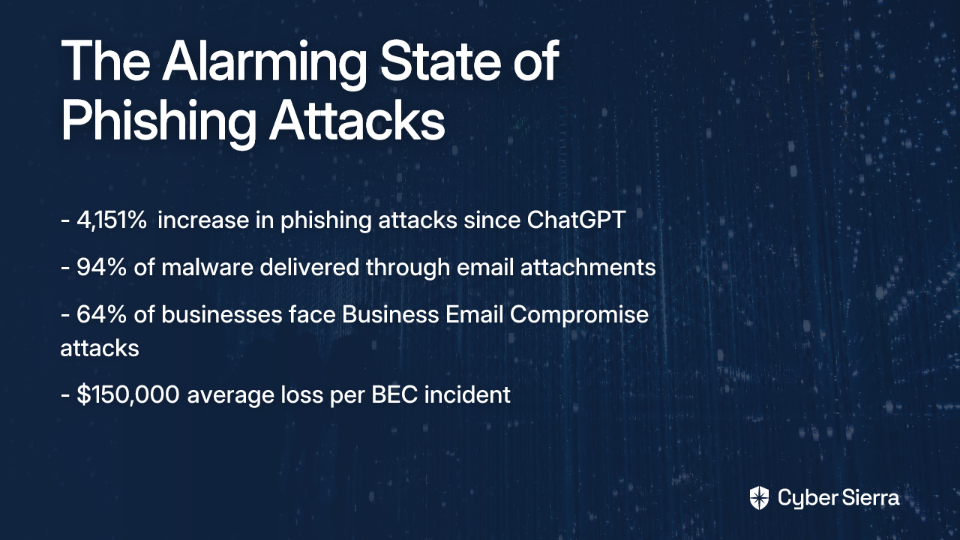
Despite your best technical defenses, some fraudulent email always slips through. If you're responsible for cybersecurity at your organization, you've likely experienced the anxiety of CEO fraud emails landing in employee inboxes—even when "nothing in the email sets off the filters."

These sophisticated attacks bypass standard security measures because they don't contain malware links or attachments. Instead, they rely on social engineering, impersonating executives to manipulate employees into making unauthorized payments or divulging sensitive information.

While your team might not fall for these scams, their mere presence "upsets them" and creates operational disruption. The solution? A proactive approach that strengthens your human firewall through realistic simulations.

Why Technical Defenses Alone Can't Stop CEO Fraud

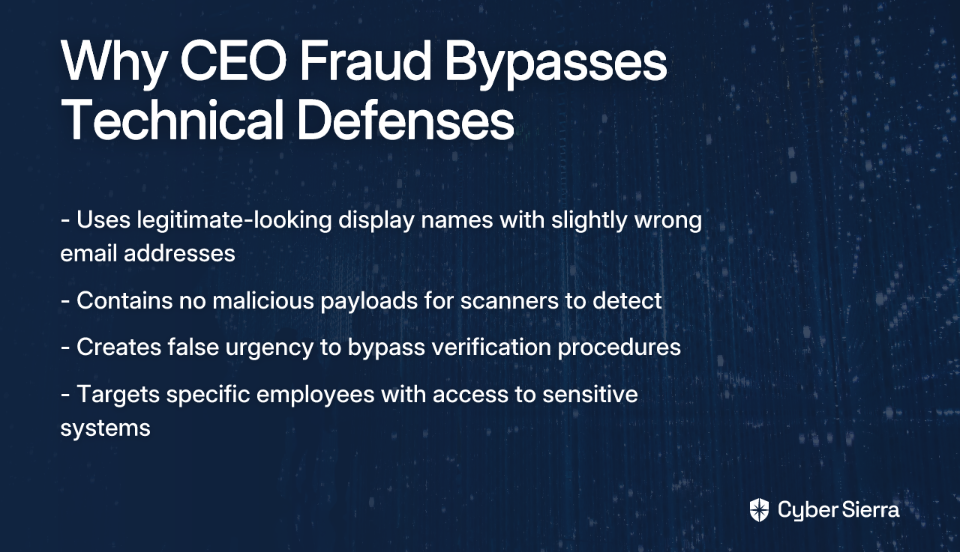
CEO fraud (a type of Business Email Compromise or BEC) represents a particularly insidious threat because it exploits trust and authority rather than technical vulnerabilities. These attacks typically:

  • Use display names that appear legitimate while the underlying email address is slightly wrong
  • Contain no malicious payload for scanners to detect—just text instructions
  • Create a false sense of urgency to bypass normal verification procedures
  • Target specific employees with access to sensitive systems or information
The most frequently targeted employees include:

  • Finance Staff: Access to payment systems and bank accounts
  • HR Professionals: Custodians of sensitive employee PII
  • Executive Assistants: Authority to act on executives' behalf
  • New Employees: Eager to please and unfamiliar with procedures

According to the FBI, Business Email Compromise scams have cost organizations worldwide over $43 billion between 2016 and 2021. The stakes couldn't be higher, which is why testing and training your human firewall is essential.

5 CEO Fraud Simulations You Can Use Today

1. The Urgent Wire Transfer (Automated with Cyber Sierra)

This classic CEO fraud scenario tests whether finance team members follow proper payment verification procedures when under pressure from a supposed executive.

Email Template:

  • From: [CEO Name] <[email protected]> (Note the slightly incorrect domain)
  • Subject: Urgent & Confidential: Payment Request
  • Body:

Hi [Employee Name],

I need your help with an urgent and confidential wire transfer for a new acquisition. We need to process an invoice for $28,500 by EOD today to secure the deal. Please don't discuss this with anyone as the acquisition is still under wraps.

Please let me know once you are ready, and I will forward the beneficiary details. I am in back-to-back meetings, so please handle this via email only.

Thanks, [CEO Name]

Expected Red Flags:

  • High-pressure tactics: "Urgent," "EOD today"
  • Unusual request bypassing standard approval channels
  • Communication restrictions: "handle this via email only," "don't discuss this"
  • Incorrect email domain that mimics your company's actual domain

Common Employee Responses:

  • Immediate compliance without verification (critical failure)
  • Hesitation but eventual compliance due to perceived authority (failure)
  • Request for verification through proper channels (success)
  • Reporting to security team (optimal success)

Measurement Criteria:

  • Number of employees who reply asking for wiring details
  • Number who report the email using your reporting system
  • Number who attempt to verify via a separate channel (phone, Slack)

With Cyber Sierra's Employee Security Training platform, this simulation can be automated at scale. The system tracks detailed metrics and automatically enrolls employees who fail the test into targeted training modules that reinforce your financial control policies.
2. The Fake HR Policy Update

This simulation tests whether employees will click on a link related to an urgent internal policy change, potentially leading to credential theft or malware installation.

Email Template:

  • From: HR Department <[email protected]>
  • Subject: Action Required: Updated Remote Work Policy
  • Body:

Team,

Following the latest Q3 review, we have updated our company's remote work and expense reimbursement policy, effective immediately. All employees are required to review the document and acknowledge receipt by the end of the day to ensure compliance.

Please find the updated policy document here: [Link to a non-company landing page]

Failure to acknowledge may impact your next payroll cycle.

Thank you, Human Resources

Expected Red Flags:

  • Urgency and threat: "Action Required," "Failure to acknowledge may impact... payroll"
  • Suspicious link: Hovering reveals a non-standard URL
  • Generic salutation: "Team" instead of a personalized greeting
  • Unusual consequences for non-compliance

Common Employee Responses:

  • High click rates due to fear of payroll consequences
  • Submission of credentials on fake landing page
  • Uncertainty about the legitimacy but clicking anyway "just to be safe"

Measurement Criteria:

  • Percentage of users who click the link
  • Percentage who enter credentials on the landing page
  • Percentage who report the email as suspicious

3. The Compromised Account Security Alert

This simulation tests whether employees will panic and click a link in a fake security alert, a common tactic to harvest credentials.

Email Template:

  • From: IT Security <[email protected]>
  • Subject: Security Alert: Unusual Sign-in Activity Detected
  • Body:

We detected an unusual sign-in to your account from an unrecognized location (IP Address: 104.28.212.29, Location: Moscow, Russia).

If this was not you, please secure your account immediately by verifying your recent activity and changing your password.

[Button: Review Account Activity]

If you do not take action within the next hour, your account will be temporarily suspended to prevent unauthorized access.

Sincerely, The IT Security Team

Expected Red Flags:

  • Fear-inducing language: "unusual sign-in," "account will be suspended"
  • Suspicious sender domain: company-systems.io instead of your actual company domain
  • Link to unsecured site or lookalike domain
  • Specific but fabricated details to increase credibility

Common Employee Responses:

  • Immediate clicking due to fear of account compromise
  • High credential submission rates on fake landing pages
  • Reduced critical thinking due to perceived urgency

Measurement Criteria:

  • Click rate on the "Review Account Activity" button
  • Credential submission rate on fake landing page
  • Report rate to IT/Security teams

4. The CEO's Request for Employee Data

This simulation targets HR staff to test their response to an urgent request for sensitive Personally Identifiable Information (PII).

Email Template:

  • From: [CEO Name] <[email protected]> (Using a personal email address)
  • Subject: Need Q3 Employee Roster
  • Body:

Hi [HR Employee Name],

I'm working offsite today and can't access our main system. Could you please send me the updated employee roster with full names, mobile numbers, and start dates for a board review I'm preparing?

Need it in the next 30 minutes. Appreciate your quick help on this.

Sent from my iPhone

Expected Red Flags:

Common Employee Responses:

  • Conflict between helping the CEO and following data privacy policies
  • Seeking additional verification (success)
  • Sending sensitive data without verification (critical failure)

Measurement Criteria:

  • Number of employees who reply with the requested data
  • Number who attempt to verify through official channels
  • Number who report the email as suspicious

5. The Phony LinkedIn Connection from an "Executive"

This simulation tests awareness on professional social media platforms, where employees may have their guard down and are more susceptible to social engineering.

Scenario (Executed via a test LinkedIn profile):

  • Attacker Profile: Create a fake LinkedIn profile impersonating a new, high-level executive (e.g., "VP of Strategic Growth")
  • Connection Request: Send connection requests to targeted employees
  • Direct Message Template:

Hi [Employee Name], glad to connect. As part of a new cross-departmental initiative, our team has compiled a draft strategy document. The CEO asked me to get some early feedback from key team members like yourself.

You can review the draft here: [Link to a bit.ly or other shortened URL pointing to a credential harvesting page]

Let me know your thoughts.

Expected Red Flags:

  • Business request on a less secure, public platform
  • Unsolicited request from an unfamiliar executive
  • Use of a shortened URL that obscures the destination
  • Appeal to vanity ("key team members like yourself")

Common Employee Responses:

  • High engagement due to the professional context feeling less threatening
  • Curiosity about being selected for feedback
  • Reduced security awareness outside corporate email systems

Measurement Criteria:

  • Connection acceptance rate
  • Click-through rate on the link in the message
  • Number of employees who report the suspicious profile to security

Beyond the Click: How to Measure Your Program's True Effectiveness

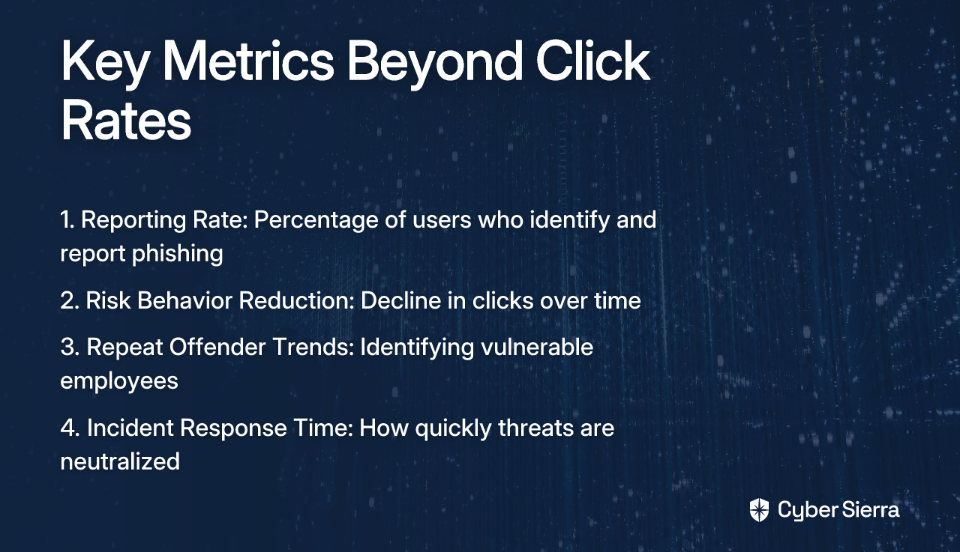
While the click rate is often treated as the primary metric in phishing simulations, it's not the most important indicator of your human firewall's strength. A more holistic approach includes:

1. Reporting Rate: This is the gold standard. It measures the percentage of users who correctly identify and report a phishing simulation. According to Statista, the average phishing simulation reporting rate varies by industry, with some sectors achieving rates over 30%. A high report rate means your team is actively participating in your security defense.

2. Risk Behavior Reduction: Track the decline in clicks and credential submissions over a series of campaigns. This demonstrates long-term learning and behavior change, which is the ultimate goal of training.

3. Repeat Offender Trends: Research from SAGE Journals shows that a minority of users account for a majority of simulation failures. Identifying these individuals allows for targeted, one-on-one intervention.

4. Incident Response Time: For reported emails, measure how quickly your security team acknowledges and neutralizes the threat. This connects your human firewall to your technical response capabilities.
From One-Off Tests to a Continuous Improvement Cycle

Security awareness isn't a one-time event. Threats evolve, and so should your training. The goal isn't to "catch" employees failing, but to foster a culture where reporting suspicious emails is celebrated, not seen as a nuisance.

This is where automation becomes critical for creating a continuous improvement cycle. Cyber Sierra's Employee Security Training platform closes the loop by not just running simulations, but by providing:

  • A dashboard overview of employees' security awareness levels
  • Automated enrollment into interactive training modules based on simulation results
  • Continuous learning opportunities with content updated for emerging threats
  • Integration with your existing security infrastructure for comprehensive reporting

The most resilient organizations don't just test their employees—they build a security-conscious culture where every team member feels responsible for protecting company assets.
Stop just testing your employees. Start building a resilient human firewall. See how Cyber Sierra can help.

Frequently Asked Questions

What is CEO fraud?

CEO fraud, also known as Business Email Compromise (BEC), is a type of social engineering attack where a scammer impersonates a high-level executive to trick an employee into making unauthorized payments or divulging sensitive company information. These attacks exploit trust and authority rather than technical vulnerabilities, often using sophisticated impersonation techniques without any malicious links or attachments.

Why do traditional email filters fail to stop CEO fraud?

Traditional email filters often fail to stop CEO fraud because these emails typically do not contain the usual red flags that security software is designed to detect. They lack malicious links, attachments, or malware payloads. Instead, they rely on social engineering tactics like creating a false sense of urgency, using a spoofed display name, and making requests that seem plausible, thereby bypassing technical scanners that look for known threats.

How can I protect my company from CEO fraud?

The most effective way to protect your company from CEO fraud is to combine technical defenses with a strong "human firewall" built through continuous security awareness training and simulations. This involves educating employees to recognize the signs of social engineering, establishing strict verification procedures for financial transactions and data requests, and running regular phishing simulations to test and reinforce these security behaviors.

What are the most common signs of a CEO fraud email?

The most common signs of a CEO fraud email include a sense of urgency or pressure, requests for secrecy, communication restricted to email only, and unusual requests that bypass standard procedures (like wire transfers or requests for sensitive data). You should also look for subtle errors in the sender's email address or a display name that doesn't match the underlying address.

What should an employee do if they suspect a CEO fraud email?

If an employee suspects a CEO fraud email, they should not reply, click any links, or open any attachments. Instead, they must immediately report the email to the IT or security department using the company's established reporting procedures. For any urgent financial or data requests, they should verify the request out-of-band, meaning through a different communication channel like a phone call or in-person conversation with the supposed sender.

Who is most at risk for CEO fraud attacks?

Employees with access to sensitive systems or information are most at risk for CEO fraud attacks. This typically includes staff in the finance department who can process payments, HR professionals who manage employee data, and executive assistants who have the authority to act on behalf of executives. New employees are also a common target as they are often eager to be helpful and may be unfamiliar with security protocols.


Want to learn more about protecting your organization from social engineering attacks? Check out our other resources on phishing prevention and security awareness training.
blog-hero-background-image
Cyber Security

SaaS Vendor Compromise Prevention: How to Build a Continuous Monitoring Strategy in 2026

backdrop
Table of Contents

Join thousands of professionals and get the latest insight on Compliance & Cybersecurity.


Summary

  • Traditional vendor security checks create dangerous blind spots, with 46% of companies assessing vendors monthly or less while breaches take an average of 277 days to contain.
  • Shifting from periodic assessments to continuous monitoring provides real-time visibility into your vendors' security posture, allowing you to detect threats before they escalate into breaches.
  • Implement a continuous monitoring framework by prioritizing vendors based on risk, establishing clear security mandates in contracts, and automating control testing.
  • A unified platform like Cyber Sierra can automate this process by integrating Continuous Control Monitoring (CCM) and Third-Party Risk Management (TPRM) for a complete view of vendor risk.

Are you tired of the last-minute chaos before an audit? Worried about the growing security debt from unaddressed vendor risks? The complexity of maintaining compliance in a cloud-centric environment can be overwhelming, especially when it comes to your SaaS vendors.

The vendor ecosystem has become the new frontier for cyberattacks. The infamous SolarWinds hack, which impacted 18,000 organizations through a single compromised vendor update, proved that your security is only as strong as your weakest link. And yet, most organizations continue to rely on outdated, point-in-time security assessments that leave dangerous blind spots between audits.

In 2026, moving from periodic checks to a continuous, automated monitoring strategy is no longer a luxury—it's a necessity for survival. This guide will show you how to shift from reactive to proactive approaches by implementing a comprehensive continuous monitoring framework that catches security lapses before they become breaches.

The Escalating Threat: Why Traditional Vendor Security Fails

The statistics around SaaS vendor compromise are alarming:

  • In 2024, a staggering 41% of third-party breaches affected healthcare organizations alone, demonstrating the widespread vulnerability across sectors.
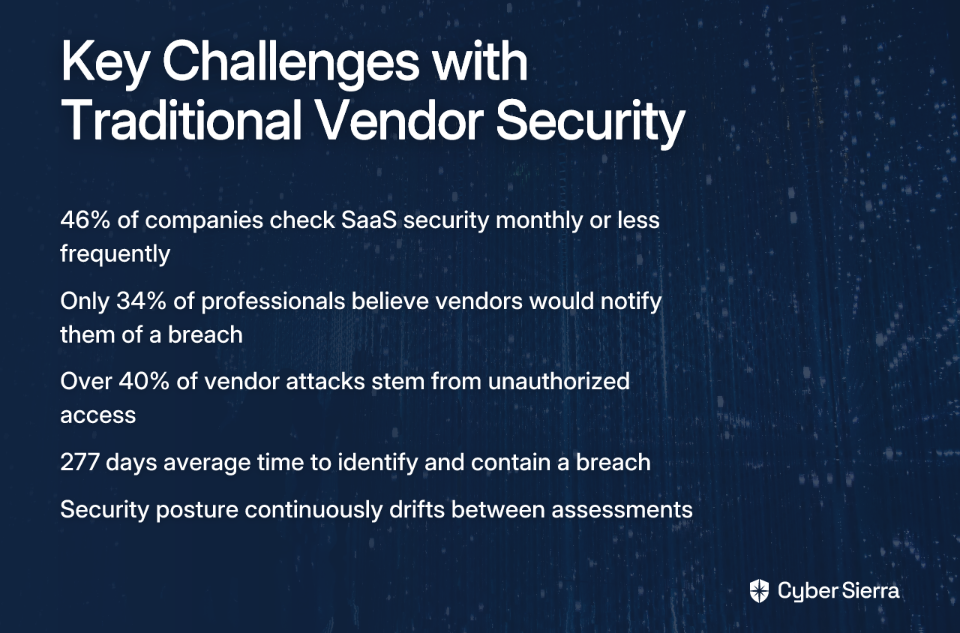
  • According to research, 46% of companies conduct SaaS security checks monthly or less frequently, while another 5% don't check at all. This leaves critical vulnerabilities undetected for weeks or even months.
  • A Ponemon Institute study found that only 34% of security professionals are confident that their vendors would notify them of a breach.

The fundamental problem lies in the outdated approach to vendor security. Traditional methods rely on point-in-time assessments—annual questionnaires, periodic audits, and compliance certifications that represent a snapshot of a vendor's security posture at a specific moment.

But what happens the day after an assessment? Or the week after? Or six months later?

The reality is that security postures drift. Configurations change, new vulnerabilities emerge, and compliance gaps develop. Over 40% of vendor attacks stem from unauthorized access, a risk that periodic checks easily miss. This "security drift" creates an expanding blind spot that grows larger with each passing day after an assessment.

When the next annual review finally comes around, it's often too late—the damage has already been done.

The Paradigm Shift: From Point-in-Time to Continuous Monitoring

The solution to this growing threat is a paradigm shift in how we approach vendor security—moving from reactive, point-in-time assessments to proactive, continuous monitoring.

Continuous monitoring is exactly what it sounds like: an ongoing process of collecting and analyzing real-time data about your vendors' security posture. Rather than relying on annual questionnaires or certifications, you maintain constant visibility into your vendors' compliance with security requirements, configurations, and potential vulnerabilities.

The benefits of this approach are substantial:

1. Drastically Reduced Time to Detection

According to IBM, the average time to identify and contain a data breach is 277 days. That's more than nine months during which attackers can freely access your systems and data. Continuous monitoring aims to shrink this window from months to minutes, allowing you to detect and respond to issues before they become breaches.

2. Measurable Efficiency Improvements

Organizations using continuous monitoring tools resolve SaaS misconfigurations 73% faster than those relying on manual methods. The majority (73%) resolve issues within a day, compared to a month or longer for those without automated monitoring capabilities.

3. Compliance as a Competitive Advantage

Regulations like GDPR, HIPAA, and DORA implicitly require continuous oversight of vendors. By automating this process, compliance becomes a seamless, ongoing activity rather than a periodic, resource-draining fire drill. This not only helps avoid legal penalties but also builds trust with customers and partners who increasingly demand proof of robust security practices.

4. Resource Optimization

Security teams are chronically understaffed and overwhelmed. Continuous monitoring automates routine tasks, freeing up your team to focus on strategic initiatives rather than chasing down vendor questionnaires or scrambling to prepare for audits.

The core pillars of this new approach are Continuous Control Monitoring (CCM) and Third-Party Risk Management (TPRM)—two complementary capabilities that, when integrated, provide complete visibility across your vendor ecosystem.

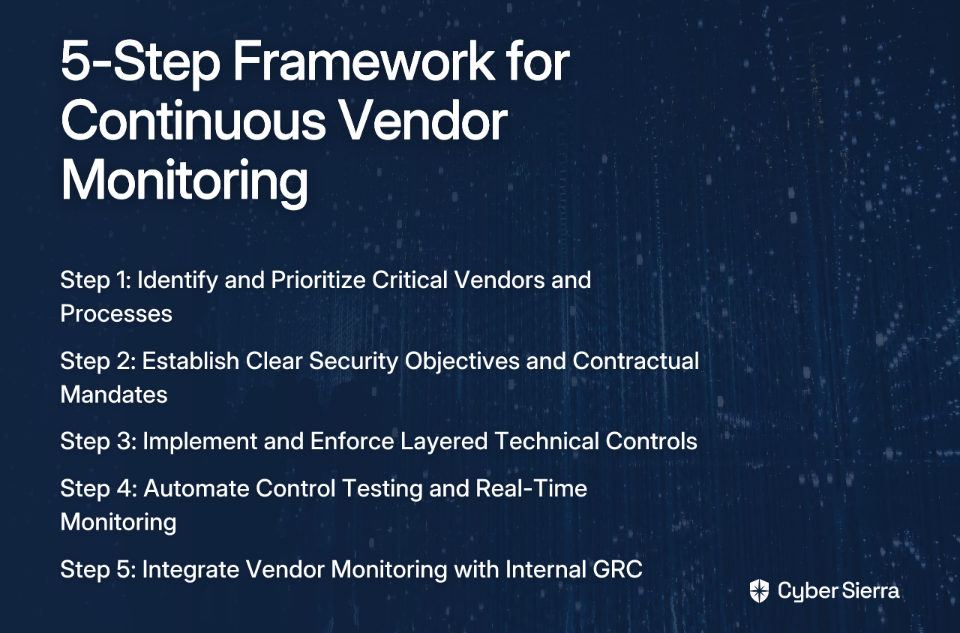
Building Your Continuous Monitoring Framework: A 5-Step Guide

Implementing a continuous monitoring strategy for SaaS vendor compromise prevention isn't as daunting as it might seem. Here's a step-by-step approach to building a robust framework by 2026:

Step 1: Identify and Prioritize Critical Vendors and Processes

Not all vendors pose the same level of risk. Begin by mapping your vendor ecosystem and prioritizing based on:

  • Risk Ranking: List vendors by their associated risks (financial, operational, regulatory) and prioritize controls that target the riskiest ones.
  • Data Sensitivity: Identify which vendors have access to your most sensitive data or critical systems.
  • Business Impact: Assess how a compromise of each vendor would impact your operations.

For example, a vendor with access to your customer PII or financial data would be classified as high-risk and prioritized for continuous monitoring, while a newsletter service with minimal data access might require less rigorous oversight.

Cyber Sierra's TPRM module can assist with this initial assessment by automatically categorizing vendors based on risk levels and data access, ensuring you focus your resources where they matter most.

Step 2: Establish Clear Security Objectives and Contractual Mandates

Don't just trust; verify and codify. Your vendor relationships should have clear security expectations formalized in contracts:

  • Define Security Controls in Contracts: Mandate prompt breach notifications (within 24-72 hours), required security audits (SOC 2, ISO 27001), and compliance with relevant industry regulations.
  • Set SMART Objectives: Ensure control objectives are Specific, Measurable, Attainable, Relevant, and Time-bound to provide clear benchmarks for performance.
  • Include Right-to-Audit Clauses: Reserve the right to conduct security assessments or request evidence of control effectiveness at any time, not just during scheduled audits.

These contractual mandates serve as the foundation for your continuous monitoring program, establishing both expectations and consequences for non-compliance.

Step 3: Implement and Enforce Layered Technical Controls

Establish non-negotiable security baselines for vendor access:

  • Principle of Least Privilege: Limit vendor access to only the data and systems absolutely necessary for their function. Avoid default admin-level access.
  • Identity and Access Control: Enforce multi-factor authentication (MFA) for all vendor personnel with data access and monitor identity management practices.
  • Request a Software Bill of Materials (SBOM): An SBOM provides a comprehensive list of components in your vendor's software, allowing you to proactively identify and manage vulnerabilities in their supply chain.

These technical controls create a security foundation that continuous monitoring can build upon.

Step 4: Automate Control Testing and Real-Time Monitoring

This is where the manual-to-automated shift happens. Develop automated tests to continuously check control effectiveness, reducing manual oversight and human error.

Cyber Sierra's Continuous Control Monitoring (CCM) module transforms this strategy by providing:

  • A central repository for all security controls with near real-time updates
  • Automated testing and validation of control effectiveness
  • Real-time detection of exceptions and anomalies
  • Actionable risk intelligence to prioritize remediation efforts

Instead of waiting for an annual report, you get a live view of your vendors' security posture against frameworks like NIST, ISO 27001, and PCI DSS. This allows you to identify issues as they emerge rather than discovering them months later during an audit.

Step 5: Integrate Vendor Monitoring with Internal GRC for a Unified View

Vendor risk is not a silo; it's part of your overall risk landscape. A truly effective strategy connects external vendor monitoring with your internal Governance, Risk, and Compliance (GRC) program.

This is achieved by combining CCM with a robust Third-Party Risk Management (TPRM) solution. Integrating these capabilities provides:

  • A single source of truth for vendor security posture
  • Clear visibility into how vendor security impacts your overall compliance status
  • Automated workflows for remediation when issues are detected
  • Comprehensive reporting for stakeholders and auditors

By integrating CCM and TPRM, you can see not only if a vendor's controls are failing but also how that failure impacts your organization's risk score and compliance status, enabling data-driven decisions about vendor relationships.

Automate Your Vendor Security Posture for 2026 and Beyond

In 2026, relying on manual, point-in-time vendor checks is an invitation for a breach. The future belongs to organizations that embrace proactive, automated, and continuous monitoring strategies.

This approach doesn't just prevent SaaS vendor compromise; it eliminates audit chaos, reduces security debt, and empowers your team to focus on strategic initiatives rather than chasing down paperwork. The continuous monitoring framework outlined above provides:

  • Early detection of security drift before it leads to a breach
  • Automated evidence collection that simplifies compliance with frameworks like SOC 2 and ISO 27001
  • Real-time visibility into your entire vendor ecosystem
  • Data-driven insights that enable proactive risk management

Cyber Sierra provides the unified AI-enabled platform to make this a reality. By seamlessly integrating Continuous Control Monitoring and Third-Party Risk Management, we give you complete, real-time visibility across your entire vendor ecosystem, transforming your approach to vendor security from reactive to proactive.

Ready to move beyond the checklist and build a resilient vendor security program? See how Cyber Sierra can automate your continuous monitoring strategy. Book a demo today.

Frequently Asked Questions

What is continuous monitoring for vendor security?

Continuous monitoring for vendor security is an automated, ongoing process of collecting and analyzing real-time data about your vendors' security posture. Unlike traditional point-in-time assessments (like annual questionnaires), it provides constant visibility into a vendor's compliance, configurations, and potential vulnerabilities. This allows you to detect "security drift" and address issues as they happen, rather than months later during an audit.

Why are traditional vendor security checks no longer effective?

Traditional vendor security checks are no longer effective because they rely on point-in-time assessments, which create dangerous blind spots between audits as security postures continuously change. These outdated methods, such as annual questionnaires and certifications, only capture a vendor's security at a specific moment. The reality is that configurations drift and new vulnerabilities emerge, leaving organizations vulnerable for extended periods.

How does continuous monitoring help with compliance like SOC 2 or ISO 27001?

Continuous monitoring helps with compliance frameworks like SOC 2 and ISO 27001 by automating the collection of evidence and providing real-time validation of security controls. Instead of scrambling to gather evidence before an audit, a continuous monitoring system automatically tests controls against compliance requirements around the clock. This simplifies the audit process, reduces preparation time, and ensures you remain compliant year-round.

What is the difference between CCM and TPRM?

Continuous Control Monitoring (CCM) focuses on automatically testing the effectiveness of a vendor's specific security controls in real-time. In contrast, Third-Party Risk Management (TPRM) is the broader process of identifying, assessing, and mitigating risks associated with all third-party vendors. An effective strategy integrates both: TPRM identifies the risks, and CCM continuously verifies that the controls meant to mitigate those risks are working.

What is the first step to implementing a continuous vendor monitoring program?

The first step to implementing a continuous vendor monitoring program is to identify and prioritize your critical vendors based on the level of risk they pose to your organization. Not all vendors require the same level of scrutiny. Start by mapping your vendor ecosystem and ranking them based on their access to sensitive data and their impact on your business operations. This allows you to focus your initial monitoring efforts where they are needed most.

blog-hero-background-image
Cyber Security

Cybersecurity GRC, Compliance & Third‑Party Risk Benchmarks – 2026 Report

backdrop
Table of Contents

Join thousands of professionals and get the latest insight on Compliance & Cybersecurity.


Summary

  • With 92% of organizations conducting multiple compliance audits annually, the cost and complexity of GRC are at an all-time high, demanding more efficient, automated solutions.
  • The industry is shifting from periodic audits to continuous assurance, as human error now causes 82% of cloud misconfigurations and third-party vendors are linked to over 35% of data breaches.
  • Key actions for 2026 include implementing continuous control monitoring (CCM) to detect control drift, enhancing third-party risk programs, and investing in ongoing employee security training.
  • An integrated GRC platform like Cyber Sierra can automate these processes, helping teams manage compliance, monitor controls, and secure their supply chain from a single dashboard.

Executive Summary: The State of GRC in 2026

In 2026, Governance, Risk, and Compliance (GRC) has evolved from a back-office function to a strategic, board-level imperative. Modern security leaders face unprecedented challenges as regulatory pressure escalates, digital supply chains expand, and cyber threats evolve relentlessly.

The central challenge for organizations lies in balancing the increasing complexity and cost of compliance with the need for genuine risk reduction and business agility. This report provides data-driven benchmarks from hundreds of sources to help security and risk leaders measure their programs, justify investments, and build more resilient organizations.

Key themes explored in this report:

  • The rising cadence and cost of audits and compliance requirements
  • The critical shift from point-in-time assessments to continuous assurance
  • The overwhelming scale of third-party risk and its impact on security posture
  • The persistent challenge of human error and strategies to mitigate it
  • The symbiotic relationship between robust GRC and cyber insurance

1. Audit & Compliance Benchmarks: The Rising Tide of Scrutiny

The frequency, cost, and complexity of compliance audits have reached unprecedented levels, forcing organizations to seek more efficient approaches.

1.1 Audit Cadence and Scope are Exploding

The sheer volume of compliance requirements has dramatically increased. According to A-LIGN's 2025 Compliance Benchmark Report, 92% of organizations conducted at least two compliance audits in 2025, with over half (58%) performing four or more. This audit burden is particularly heavy for large enterprises, where 35% ran six or more audits – more than double the rate seen at smaller firms (15%).

Moreover, SOC 2 is now table stakes rather than a differentiator. Most companies pursue multiple certifications simultaneously, including ISO 27001, PCI DSS, and HIPAA, to satisfy a widening range of stakeholders.

1.2 The Staggering Cost of Compliance

The financial investment in compliance is substantial. 71% of enterprise companies spend over $100,000 annually on audits, according to A-LIGN. Even more striking, 32% of businesses reported audit-related costs exceeding $1 million, with 31% needing 10+ internal employees dedicated solely to audit management tasks.

From a broader perspective, U.S. companies now spend between 1.3% and 3.3% of their total payroll on regulatory compliance efforts – a significant operational expense that continues to grow.

1.3 Framework Priorities are Shifting

When asked about their most important frameworks in 2025, organizations ranked ISO 27001, SOC 1, and SOC 2 as their top three. Notably, ISO 27001 adoption is surging, with 81% of organizations having or planning ISO 27001 certification in 2025, up from 67% in 2024 – a massive 14-point jump in just one year.

This suggests ISO 27001's international credibility is becoming a key differentiator in the market, even edging ahead of SOC 2 in importance for many enterprises.

1.4 What Defines a "Quality" Audit in 2026?

Perceptions of audit quality have evolved significantly. Stakeholders now value substance over reputation, with the number of controls tested and report length emerging as the top indicators of a high-quality audit, replacing "trust in the auditor," which was previously the leading factor.

This shift is reflected in the high premium organizations place on thoroughness – A-LIGN'S report notes that 70% of companies rate audit report quality as "extremely important". Superficial, "checkbox" audits are rapidly losing value as stakeholders demand rigorous, detailed evidence of control effectiveness.

Meanwhile, the overwhelming manual effort of evidence collection (screenshots, log exports) and cross-team coordination remains a top challenge. Many GRC teams still rely on spreadsheets and email chains, creating version-control headaches and late nights during audit season.

Section Conclusion: The data reveals a clear need to move beyond manual, heroic efforts. Leaders must seek automation and establish a single source of truth to manage the growing audit burden efficiently and meet rising quality expectations.

2. Control Effectiveness & Continuous Monitoring: Beyond the Annual Audit

Point-in-time compliance is no longer sufficient. Controls drift, misconfigurations are rampant, and the speed of modern IT requires continuous, automated assurance to prevent breaches.

2.1 The Silent Threat of Configuration Drift

Human error has emerged as the primary cause of security control failures. 26% of data breaches stem from human error, not software defects.

Cloud misconfigurations by humans have direct security consequences. 15% of data breaches trace back to cloud misconfigurations as the initial attack vector. This statistic shows the critical importance of continuous monitoring of configuration states.

2.2 The High Cost of Unmonitored Assets and Slow Detection

Most organizations have significant blind spots in their security monitoring. According to Orca's 2025 State of Cloud Security Report, about 32% of cloud assets lack security monitoring, each harboring over 115 unknown vulnerabilities.

Detection and response times remain troublingly slow. Check Point's 2025 Cloud Security Report found that only 6% of companies**** managed to contain security incidents within an hour of discovery, while the majority take over 24 hours to fully contain. When misconfigurations lead to breaches, the mean time to identify is ~186 days and another 65 days to contain – over 8 months of exposure.

2.3 The Shift to Continuous Assurance

The compliance landscape is evolving toward real-time visibility. Most organizations now report using some form of automation to test and monitor controls continuously. This trend is driven by both regulatory pressure and board-level demand – over half of CFOs and boards are asking internal audit for more continuous control monitoring and enterprise risk management.

Continuous Control Monitoring (CCM) tools are the direct answer to these challenges, transforming security from periodic checks to ongoing, automated validation. This shift is also fueled by the realization that manual, periodic control testing is insufficient to address the speed and complexity of today's threat landscape.

Section Conclusion: The evidence is clear – manual, periodic control testing is insufficient in today's environment. The path to resilience lies in adopting a CCM strategy to detect and remediate control drift in near real-time, long before an auditor or an attacker discovers it.

3. Third-Party Risk Management Benchmarks: Your Attack Surface is Your Supply Chain

The vendor ecosystem has exploded in size and complexity, making third-party risk a dominant threat vector that traditional questionnaire-based methods fail to adequately address.

3.1 The Scale of the Vendor Ecosystem

The numbers are staggering: the average organization now uses ~286 different vendors, representing a 21% year-over-year increase. This expanded digital supply chain creates an exponential risk surface, as for each third-party, there are an average of 13-14 fourth and fifth-party dependencies.

Managing this sprawling ecosystem has become the top compliance challenge for security leaders. According to the World Economic Forum's 2025 Global Cybersecurity Outlook, 48% of CISOs say ensuring third-parties comply with security requirements is their #1 challenge in meeting cyber regulations.

3.2 Third-Party Incidents by the Numbers

The consequences of this expanded attack surface are evident in breach statistics. SecurityScorecard's 2025 Global Third-Party Breach Report found that 35.5% of all data breaches in 2024 were third-party related. Even more concerning, 41.4% of ransomware attacks now start via a third-party access point.

The risk is ubiquitous – an incredible 98% of organizations have a relationship with at least one third-party that has been breached in the past. These incidents carry steep costs: third-party breaches cost $370,000 more on average (~$4.91M total) and can be ~40% more expensive to remediate than equivalent in-house incidents.

3.3 "Questionnaire Fatigue" and the Limits of Point-in-Time Assessments

Traditional third-party risk assessment methods are buckling under the volume. 44% of organizations assess over 100 third-parties each year, yet confidence in these assessments is alarmingly low. Only 4% of organizations have high confidence that a vendor's questionnaire accurately reflects their real security posture.

The industry is responding to this challenge – more than half (56%) of organizations have adopted purpose-built technology to manage third-party risk in 2025, signaling a shift away from manual spreadsheets toward more sophisticated approaches.

Section Conclusion: Your organization's security is inextricably linked to your vendors'. A modern TPRM program must evolve beyond static questionnaires to embrace continuous monitoring, risk-based segmentation, and automated intelligence to manage this critical risk area effectively.

4. Security Awareness & Human Risk Benchmarks: The Enduring Human Element

While technology provides the defenses, human behavior remains a decisive factor in the majority of breaches. Mature security awareness programs are demonstrably effective at reducing this risk.

4.1 Human Error: The Common Denominator in Breaches

The human element continues to be implicated in 60%-74% of all data breaches, according to various studies. While this figure has trended down slightly from previous years, it remains the dominant cause of security incidents.

A Stanford study suggests that approximately 88% of breaches can be traced back to an employee mistake. Risk is also concentrated – just 8% of employees are responsible for 80% of observed security incidents, highlighting the opportunity for targeted interventions.

4.2 Phishing Benchmarks: The Persistent Threat

Phishing remains the most pervasive cyber attack vector targeting humans. In 2023, 71% of organizations**** experienced at least one successful phishing attack, though this represents an improvement from 84% in 2022.

The vulnerability of untrained users is stark. According to KnowBe4's benchmarking report, 34.3% of untrained end users will fail a phishing test on average. However, training works: after a year of ongoing training and simulations, the global phish-prone percentage drops to just 4.1%. The finance sector, for example, improved its failure rate to 9% from 16% in just one year.

4.3 Gaps in Security Training

Despite the known importance of security awareness, significant gaps remain in training coverage. KnowBe4's survey revealed that 18% of employees have never received any cybersecurity training. Even more concerning, 51% of employees say they have not been trained on how to recognize phishing scams.

The quality of existing training is also questionable – 34% of employees feel worried about their readiness**** for modern threats, particularly regarding AI-powered cyberattacks.

Section Conclusion: Investing in a continuous, engaging, and adaptive security awareness program is one of the highest-ROI activities a security leader can undertake. The goal is to transform employees from the biggest risk into the strongest line of defense by building a resilient human firewall.

5. Threat & Vulnerability Management: Winning the Race Against Exploitation

The explosion in vulnerability disclosures has created a backlog crisis, while the window to patch before exploitation shrinks. A risk-based approach is the only viable strategy.

5.1 The Vulnerability Deluge

The volume of vulnerabilities is overwhelming security teams. 27% of all CVEs ever published**** were released in just the last two years. Remediation efforts can't keep pace – most teams can only fix around 1 in 10 vulnerabilities, leaving 90% unaddressed. In fact, 45% of known enterprise vulnerabilities are never remediated.

This remediation gap has direct security consequences – 60% of data breaches involve an available but unapplied patch.

5.2 Patching SLAs vs. Reality

The gap between patching goals and reality is substantial. The average time to remediate a vulnerability is ~74 days for applications and ~55 days for infrastructure. About 17% of critical/high-severity vulnerabilities remain open after a full year – a significant compliance and security risk.

5.3 The Shrinking Window to Act

The timeline for effective remediation continues to compress. Approximately 80% of exploits appear before or at the same time as the CVE disclosure, giving attackers a median head-start of 23 days before a patch is even available.

Exploitation is increasingly becoming a primary attack vector: 35% of intrusions in 2024 started with a vulnerability exploit, double the rate of phishing. This trend underscores the critical importance of rapid remediation capabilities.

Section Conclusion: The old model of "scan and patch everything" is broken. Leaders must adopt a Risk-Based Vulnerability Management (RBVM) approach, integrating threat intelligence to prioritize flaws that pose a clear and present danger to critical assets.

6. Cyber Insurance & GRC: A Symbiotic Relationship

Cyber insurance has become a key driver for good security hygiene. Underwriters now mandate specific controls, and a strong GRC posture can lead to significant premium savings and better coverage.

6.1 The Evolving Market

After years of dramatic growth, the cyber insurance market is moderating but remains substantial at ~$15.6B in premiums in 2025. Following several years of steep rate increases, the market has stabilized or even improved for organizations with strong security postures, with some seeing premium decreases of 5%-10%.

6.2 The Underwriter's Mandate: Table-Stakes Controls

Insurance carriers have established non-negotiable security baselines. Multi-factor authentication (MFA) is essentially mandatory – most carriers will not even quote a policy without comprehensive MFA implementation.

Similarly, advanced endpoint detection and response (EDR/XDR) has replaced traditional antivirus as the new standard for endpoint protection. Secure, offline, and tested backups are prerequisites for ransomware coverage, with weak backup strategies being one of the top reasons for claim denial.

6.3 The ROI of Good Controls: Premium Incentives

Organizations that implement a suite of top controls have seen 20-50% lower cyber insurance premiums compared to less prepared peers. The "big three" controls that drive the largest premium discounts are MFA, EDR, and employee security awareness training.

This creates a direct financial incentive for security investment, providing CISOs with a powerful argument for their budget requests. The ability to demonstrate immediate ROI through premium savings helps justify security improvements to CFOs and boards.

6.4 Claims Landscape and Trends

The cyber insurance claims landscape shows mixed trends. Overall claims frequency dropped to 1.55% in the first half of 2024 (from 1.61%), the lowest level since 2022. However, the average loss per claim increased by ~14% to $122,000.

Ransomware continues to drive costs – ransomware claim severity jumped 68% to an average of $353,000. Meanwhile, business email compromise (BEC) accounts for nearly one-third of all claims filed, though these tend to have lower severity with an average loss of ~$26,000.

Section Conclusion: Cyber insurance is no longer just a financial backstop; it's an active partner in risk management. A demonstrable, mature GRC program is the key to securing favorable terms and proving due diligence, turning a cost center into a strategic enabler.

7. The GRC Landscape in 2026: Macro Trends, Headwinds & Tailwinds

GRC leaders in 2026 must navigate a complex environment of escalating regulations and resource constraints while leveraging powerful tailwinds like automation and executive support.

7.1 Key Trends Shaping the Future

Escalating Regulatory Enforcement: SEC cyber disclosure rules, the EU's Digital Operational Resilience Act (DORA), and a surge in state-level bills are raising the compliance stakes. A Thomson Reuters C-Suite survey found that 21% of CEOs now list "regulatory compliance" as their top strategic priority, up from just 2% the previous year.

Continuous Assurance is the New Standard: Regulators and customers demand real-time proof of control effectiveness, moving beyond annual audits. PCI DSS v4.0 and financial regulators are explicitly pushing for continuous monitoring.

AI Governance Emerges: A huge new domain for GRC, with 76% of organizations expecting to undergo an AI compliance review by 2027. AI ethics and security are becoming compliance requirements.

Convergence of Risk Disciplines: Cyber, privacy, and operational risk are merging under a unified GRC umbrella, with stronger board oversight. By 2025, 78% of Fortune 100 companies had a dedicated CISO role, nearly double the number in 2018.

7.2 Major Headwinds (The Challenges)

Tool & Data Sprawl: Large organizations operate 75-80 security tools on average, creating silos and complexity.

Compliance Fatigue: 69% of professionals find regulations too numerous and complex to keep up with.

Talent Shortage: A global cybersecurity workforce gap of 3.4-4 million unfilled positions hampers program maturity.

Budget & ROI Pressure: Increased expectations are met with flat budgets, requiring leaders to "do more with less."

7.3 Powerful Tailwinds (The Opportunities)

Automation & AI Scaling GRC: Most organizations are now leveraging technology to automate manual compliance tasks, with some seeing audit cycles shorten by 30-40%.

Integrated GRC Platforms: Consolidation and integration address tool sprawl, with 56% of organizations having adopted a dedicated GRC/IRM platform.

Executive & Board Support: 87% of CISOs now feel they have strong board support, a significant jump from 66% in 2024. This "tone at the top" unlocks resources and fosters a risk-aware culture.

Section Conclusion: While the challenges are significant, the tailwinds of technological advancement and strategic alignment provide a clear path forward. The most successful leaders will be those who harness these opportunities to build proactive, efficient, and integrated risk management programs.

8. Actionable Benchmarks & KPIs: What "Good" Looks Like in GRC

Use these metrics to measure your program's performance, report to the board, and drive continuous improvement.

🎯 Audit & Compliance Metrics

  • Audit Cycle Time: Target a 30-40% reduction with automation
  • Evidence Collection Effort: Aim to cut manual evidence hours by 50%+ through continuous control monitoring
  • Audit Findings Rate: Strive for zero major findings in external audits
  • Compliance Coverage: Implement controls for more than 95% of applicable requirements

🎯 Control Effectiveness & Risk Monitoring

  • MTTI/MTTR for Control Failures: Reach less than 24 hours to identify control drift and less than 1 week to remediate critical controls
  • Vulnerability Management SLAs: Achieve over 90% compliance with patch SLAs for critical vulnerabilities
  • Unresolved Critical Vulnerabilities: Drive the number of critical vulnerabilities open over 30 days to near zero

🎯 Third-Party Risk & Supply Chain

  • Vendor Assessment Coverage: Ensure 100% of critical/high-risk vendors have up-to-date risk assessments
  • TPRM Cycle Time: Reduce vendor security review time from 4 weeks to 1-2 weeks without sacrificing rigor
  • Continuous Monitoring: Aim for more than 90% of critical vendors to have a security rating of 'B' or higher

🎯 Human Risk & Awareness

  • Phishing Simulation Click Rate: Target less than 5% for a mature program
  • Training Completion: Strive for over 99% of employees completing required training on time
  • Repeat Offenders: Reduce the percentage of employees who clicked multiple phishing simulations from 8% to 3%

🎯 Cyber Incident & Insurance Metrics

  • Cyber Insurance Readiness: Meet 100% of underwriter-recommended controls
  • Incident Response Preparedness: Ensure 100% of critical action items from tabletop exercises are addressed

Section Conclusion: Frame these KPIs as a balanced scorecard. Presenting your program's performance against these industry benchmarks provides context and credibility for your strategic decisions and budget requests.

9. Strategic Recommendations for 2026: A Data-Driven Roadmap

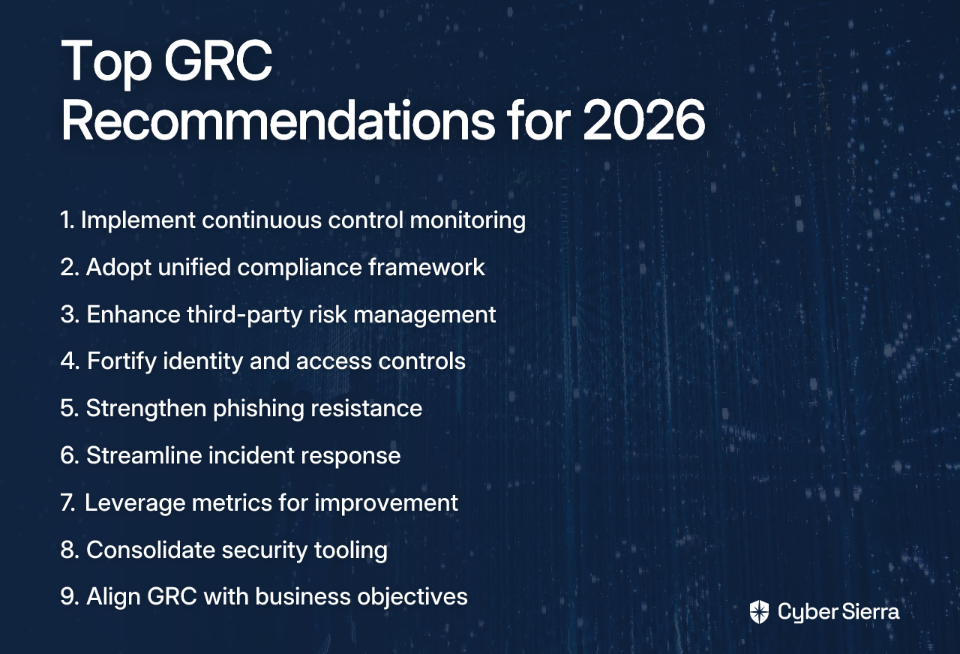
Based on the benchmarks and trends identified in this report, here are nine actionable recommendations for security and GRC leaders:

1. Implement Continuous Control Monitoring & Evidence Automation

Address audit fatigue and catch control drift early by automating evidence collection for at least your top 20 security controls. This can cut audit prep time by 50-70% while ensuring that configuration drift is detected in near real-time.

2. Adopt a Unified, Multi-Framework Compliance Approach

Create a common control framework that maps to all major requirements you face, enabling a "test once, comply many" approach. This is essential given that 58% of organizations now conduct 4+ audits annually.

3. Elevate Third-Party Risk Management with Continuous Monitoring

Go beyond questionnaires to address the 35.5% of breaches originating from third parties. Segment vendors by risk, implement continuous monitoring for high-risk suppliers, and enforce strong contractual controls requiring vendors to maintain baseline security measures.

4. Fortify Identity & Access Controls (MFA & PAM Everywhere)

Implement MFA on all user accounts and deploy Privileged Access Management (PAM) for admin credentials. Set a goal that by the end of 2026, 100% of employees and contractors use MFA, and 100% of admin access goes through PAM with session recording.

5. Enhance Phishing Resistance Through Training and Simulations

Run monthly phishing simulations and provide immediate coaching for employees who click. Deploy a "Report Phish" button in email clients and measure the reporting rate, aiming for over 20% of simulations reported. The goal should be to drive your phish simulation click rate below 5%.

6. Streamline Incident Response and Business Continuity Plans

Conduct at least one full-fledged tabletop exercise with executive participation annually. According to IBM, organizations that test IR plans save on average $2.66M in breach costs. Ensure your cyber insurance coverage aligns with your risk profile and that you meet all carrier requirements.

7. Leverage Metrics & Benchmarking to Drive Improvement

Create a dashboard of 8-10 key KPIs covering audits, vulnerabilities, phishing, vendor risk, and incidents. Report progress quarterly to the board and tie metrics to accountability – each metric should have an owner responsible for improvements.

8. Integrate and Consolidate Security & Compliance Tooling

Combat tool sprawl (75+ security tools at large firms) by consolidating overlapping solutions and ensuring proper integration between remaining systems. Conduct a tooling rationalization exercise to identify at least 2-3 tools that could be phased out or merged by end of 2026.

9. Align GRC Initiatives with Business Objectives

Frame your security and compliance efforts in business terms – enabling trust, protecting revenue, and supporting innovation. Establish a cyber risk section in enterprise risk registers and introduce key risk indicators (KRIs) with business relevance.

Conclusion: From Reactive Compliance to Proactive Resilience

The era of reactive, checklist-driven compliance is over. The data overwhelmingly shows that resilience in 2026 requires a proactive, integrated, and automated approach to GRC.

The journey involves embracing continuous monitoring, unifying risk disciplines, empowering employees, and leveraging technology not just to pass audits, but to build genuine, measurable security.

By adopting the strategies and benchmarks outlined in this report, leaders can transform their GRC programs from a necessary burden into a strategic asset that builds trust, enables growth, and secures the organization for the challenges ahead.

Frequently Asked Questions

What is GRC and why is it important in 2026?

GRC stands for Governance, Risk, and Compliance. In 2026, it is a critical business function that helps organizations strategically manage risks, comply with regulations, and align their security efforts with business objectives in an increasingly complex threat and regulatory landscape. GRC provides a structured approach to dealing with challenges like escalating cyber threats, expanding digital supply chains, and stringent new regulations. A mature GRC program enables an organization to build trust with customers, justify security investments, and achieve proactive resilience rather than just reactive compliance.

How can organizations reduce the cost and effort of compliance audits?

Organizations can significantly reduce audit costs and effort by implementing automation, particularly through Continuous Control Monitoring (CCM), and by adopting a unified control framework. The traditional manual process of collecting evidence is a primary driver of expense. By automating evidence collection and continuously monitoring controls, teams can cut audit preparation time by 50-70%. Furthermore, creating a common control framework that maps to multiple regulations (e.g., SOC 2, ISO 27001) allows for a "test once, comply many" approach, eliminating redundant work.

What is Continuous Control Monitoring (CCM) and why is it replacing traditional audits?

Continuous Control Monitoring (CCM) is an automated process that continuously tests and validates the effectiveness of security controls in near real-time. It is replacing traditional point-in-time audits because it provides ongoing assurance and detects issues like cloud misconfigurations or control failures as they happen, not just once a year. With threats evolving daily and human error causing most cloud issues, annual audits are no longer sufficient. CCM provides the constant visibility needed to proactively find and fix control drift before an attacker or auditor discovers it.

How does a strong GRC program affect cyber insurance?

A strong GRC program directly impacts cyber insurance by making an organization eligible for better coverage at lower premiums. Insurers now mandate specific security controls, and being able to demonstrate a mature GRC posture can lead to premium savings of 20-50%. A well-documented GRC program provides tangible proof of key controls like multi-factor authentication (MFA), endpoint detection and response (EDR), and robust security awareness training. This turns GRC from a cost center into a strategic enabler with a clear return on investment (ROI).

What are the biggest security risks facing organizations in 2026?

The biggest security risks in 2026 stem from three key areas: the expanded digital supply chain (third-party risk), the high frequency of human error, and the failure to patch known vulnerabilities. Over 35% of breaches are now third-party related, as the average organization relies on hundreds of vendors. Concurrently, human error remains a factor in 60-74% of all breaches, with phishing as a primary vector. Finally, 60% of breaches involve an available but unapplied patch. Addressing these areas is critical for modern defense.

What are the most important GRC metrics to track?

The most important GRC metrics provide a balanced view of your program's health, covering audit efficiency, control effectiveness, third-party risk, and human risk. Key metrics include Audit Cycle Time, Mean Time to Remediate Control Failures, Vendor Risk Assessment Coverage, and Phishing Simulation Click Rate. Tracking these KPIs helps you measure performance and communicate value to the board. For example, a mature program should aim for an audit cycle time reduction of 30-40% and a phishing click rate below 5%.

This report is produced by Cyber Sierra, an AI-enabled cybersecurity platform specializing in Governance, Risk & Compliance (GRC), Continuous Control Monitoring (CCM), and Third-Party Risk Management (TPRM). For more information about how our integrated platform can help you implement these recommendations, visit cybersierra.co.

blog-hero-background-image
Cyber Security

10 Best Vendor Risk Remediation Workflow Tools for Enterprise Security Teams

backdrop
Table of Contents

Join thousands of professionals and get the latest insight on Compliance & Cybersecurity.


Summary

  • Managing third-party risk with manual processes like spreadsheets is inefficient and leaves your organization vulnerable to supply chain attacks.
  • An effective vendor risk remediation strategy must shift from periodic, point-in-time assessments to continuous, real-time monitoring of your vendors' security posture.
  • When choosing a tool, prioritize automation, integration with your existing tech stack, and robust workflows that track remediation from discovery to resolution.
  • Cyber Sierra's Third-Party Risk Management (TPRM) platform automates the entire vendor risk lifecycle, from continuous monitoring to streamlined remediation, to secure your supply chain.

Are you drowning in manual vendor risk assessments while potential security threats slip through the cracks? If your security team is struggling with spreadsheets, email threads, and disjointed processes for managing third-party risks, you're not alone.

"We need an efficient and automated TPRM solution," lamented one security professional in a recent Reddit discussion, while others expressed "frustration with OneTrust's TPRM functionality" and "difficulties with manual data entry" in their current tools.

With supply chain attacks on the rise and regulatory requirements tightening, the stakes have never been higher. The right vendor risk remediation workflow tool can transform this overwhelming challenge into a streamlined, automated process that actually reduces risk instead of just documenting it.

In this guide, we'll evaluate the top 10 tools based on what matters most: automation capabilities, integration options, and robust remediation tracking features. We'll help you find the solution that fits your enterprise's unique needs, whether you're a financial institution with strict compliance requirements or a technology company with a sprawling digital supply chain.

What Makes an Effective Vendor Risk Remediation Workflow?

Before diving into specific tools, let's establish what an effective vendor risk management workflow entails. According to research from UpGuard, a comprehensive approach includes six crucial stages:

The final stage is where most organizations struggle and where the right tool makes all the difference. An effective vendor risk remediation workflow automates the entire process from risk identification to verification of remediation, compressing the "timeline between risk discovery and resolution" and ensuring nothing falls through the cracks.

The Top 10 Vendor Risk Remediation Workflow Tools for 2024

1. Cyber Sierra

Best For: Enterprises seeking an AI-enabled, unified platform for continuous vendor monitoring and automated remediation workflows.

Key Remediation Features:

  • Continuous Monitoring: Provides near real-time, 24/7 visibility into vendor security compliance, moving beyond point-in-time assessments
  • Automated Risk Prioritization: Helps prioritize vendor inventory based on risk levels to focus remediation efforts where they matter most
  • Streamlined Remediation: Automates the entire workflow from risk identification to verification of remediation actions
  • Vendor Collaboration Portal: Facilitates direct communication with vendors on remediation tasks

Strengths: Cyber Sierra's platform transforms vendor risk management from periodic assessments to continuous, proactive monitoring. Its AI capabilities automate data collection and risk intelligence, directly addressing the user pain of "manual data entry" while providing actionable insights for faster remediation.

Learn more about Cyber Sierra's TPRM platform

2. UpGuard

Best For: SMBs and mid-market companies that need strong vendor security scoring and continuous external monitoring.

Key Remediation Features:

  • Security Ratings: Provides clear, data-driven scores on vendor security posture
  • Automated Validation: Cross-references questionnaire answers with real-time security data
  • Workflow Integrations: Establishes notification systems with tools like JIRA and Zapier to streamline remediation

Strengths: Excellent at detecting external cyber risks and making vendor security health intuitive and actionable.

3. Drata

Best For: Organizations looking to unify internal compliance and external vendor risk into a single platform.

Key Remediation Features:

  • AI-native Trust Management: Offers real-time visibility into risk posture across vendors
  • Centralized Assessments: Automates risk evaluations using a library of 150+ risks based on standards like NIST and ISO
  • Continuous Control Monitoring: Provides real-time status updates on both internal and vendor controls

Strengths: Seamlessly connects vendor risk to broader compliance efforts, creating a unified approach to risk management.

Limitations: May require integrations for deep-dive analysis into specific vendor ratings.

4. OneTrust

Best For: Large, global enterprises with complex privacy and compliance needs (e.g., GDPR).

Key Remediation Features:

  • Automated Data Mapping: Maps sensitive data flows to specific vendors to pinpoint risk
  • Comprehensive GRC Framework: A broad platform that connects vendor risk to overall governance and privacy programs
  • Customizable Workflows: Allows for highly tailored remediation processes

Strengths: Unmatched depth in global privacy compliance and regulatory coverage.

Limitations: User research indicates "frustration with OneTrust's TPRM functionality" and that implementation can be "time-consuming for smaller teams," with the platform sometimes described as complex to configure.

5. SecurityScorecard

Best For: Organizations needing intuitive, high-level vendor risk ratings (A-F scale) for executive reporting and large supply chains.

Key Remediation Features:

  • External Monitoring: Grades vendor security posture based on externally observable data
  • Issue-Level Insights: Drills down into specific issues that contribute to a vendor's score
  • Remediation Prioritization: Identifies the most critical issues to address first

Strengths: Simplicity and clarity of its scoring system make it easy to communicate risk to non-technical stakeholders, facilitating faster remediation approvals.

6. BitSight

Best For: Large enterprises seeking to quantify cyber risk in financial terms and benchmark vendors against industry peers.

Key Remediation Features:

  • Quantitative Risk Scoring: Provides a numerical score to quantify vendor security performance
  • Scalable Monitoring: Built to handle thousands of vendors with robust reporting tools
  • Risk Vector Analysis: Identifies specific security issues contributing to a vendor's overall risk profile

Strengths: Strong focus on benchmarking and industry-wide comparisons, helping prioritize remediation efforts based on peer performance.

7. ProcessUnity

Best For: Mature GRC teams with large, complex vendor ecosystems that require highly configurable and robust workflows.

Key Remediation Features:

  • Vendor Lifecycle Governance: Manages the entire vendor journey from intake to offboarding
  • Mature TPRM Workflows: Known for its powerful and flexible assessment orchestration
  • Multi-tier Risk Assessment: Tailors the depth of assessment and remediation to vendor criticality

Strengths: Deep capabilities for managing complex vendor portfolios and due diligence processes, with highly customizable remediation workflows.

8. Prevalent

Best For: Organizations looking for a dedicated TPRM platform that offers managed services for operational support.

Key Remediation Features:

  • Extensive Content Libraries: Provides a vast array of templates for questionnaires and assessments
  • Continuous Monitoring: Includes features for ongoing compliance and risk tracking
  • Managed Remediation Services: Offers optional services to manage the remediation process

Strengths: As noted in user research, "Their bread and butter is TPRM, it's all they do, and they have in-house managed services that help you run your TPRM program," making it ideal for teams needing expertise and support.

9. Kodiak Hub

Best For: Procurement and quality teams in manufacturing or retail who need to combine vendor risk with supplier performance metrics.

Key Remediation Features:

  • CAPA & Remediation: Offers flexible workflows for managing corrective and preventive actions (CAPA) with full audit trails
  • Unified Vendor Record: Combines risk, compliance, and performance data in a single view
  • Collaborative Issue Resolution: Streamlines communication between internal teams and vendors

Strengths: The native linkage between supplier performance and risk management is a key differentiator, creating a more holistic approach to vendor relationships and remediation.

10. Black Kite

Best For: CISOs and risk leaders who need to understand and communicate the financial impact of third-party risk.

Key Remediation Features:

  • Financial Impact Modeling: Quantifies potential financial losses from a vendor breach
  • AI Threat Modeling: Uses AI to model threats and map risks to multiple compliance frameworks
  • Prioritized Remediation: Focuses remediation efforts on issues with the highest financial impact

Strengths: Translates technical cyber risk into clear business and financial terms, helping to secure resources and attention for remediation activities.

Vendor Risk Remediation Tools at a Glance: Comparison Table

PlatformCore StrengthContinuous MonitoringRemediation Workflow FeaturesBest For
Cyber SierraAI-powered, unified GRC & TPRMYes (Near real-time, 24/7)Automated risk identification, task assignment, full lifecycle trackingEnterprises seeking proactive, automated vendor risk management
UpGuardSecurity ratings & external monitoringYes (External posture)Automated validation, workflow triggers (JIRA/Zapier)SMBs & Mid-Market
DrataUnified internal & vendor complianceYes (Real-time control status)Centralized assessments, automated risk evaluationCompliance-focused teams
OneTrustGlobal privacy & GRCGoodStrong, but complex configurationHeavily regulated large enterprises
SecurityScorecardIntuitive A-F security ratingsYes (External posture)Issue-level insights, limited internal workflowExecutive reporting
BitSightQuantitative risk scoringYes (External posture)Benchmarking, limited internal workflowLarge enterprises
ProcessUnityMature, configurable TPRM workflowsGoodDeep vendor lifecycle governanceComplex vendor ecosystems
PrevalentSpecialized TPRM with managed servicesGoodExtensive content libraries, full lifecycleTeams needing operational support
Kodiak HubUnified risk & supplier performanceYes (Alerts)Full CAPA lifecycle managementProcurement & Quality teams
Black KiteFinancial impact modelingYes (External posture)AI threat modeling, compliance mappingCISOs focused on financial risk

How to Choose the Right Vendor Risk Remediation Workflow Tool

When evaluating vendor risk remediation workflow tools, focus on these key criteria to ensure you select a solution that truly addresses your enterprise's needs:

1. Automation and Workflow Efficiency

Your goal should be to eliminate manual bottlenecks. Look for tools that "streamline processes from onboarding to offboarding to save time," as recommended by Drata. A strong platform should automate task creation when control gaps are found, reducing the time from risk identification to remediation.

2. Core Remediation Features

A robust solution must include:

  • Task Management: Automatically creates tasks with required actions, priorities, and evidence links
  • Ownership Assignment: Assigns tasks based on vendor tier or risk domain, with automated escalation for overdue items
  • Progress Tracking: Enables collaboration with vendors and logs every status change for a complete audit trail

3. Integration Capabilities

Avoid tools that don't fit your ecosystem. As one user warned, "If you are looking for platforms that integrate with the rest of your tech stack don't do eramba." Ensure the tool integrates with your existing GRC (e.g., ServiceNow) and ITSM (e.g., JIRA) platforms to avoid creating yet another silo.

4. Continuous Monitoring vs. Point-in-Time Assessments

Static questionnaires are no longer enough in today's rapidly evolving threat landscape. "Continuous monitoring and threat intelligence" are essential for real-time awareness of external risks. This approach provides a dynamic view of your vendors' security posture and enables faster remediation of emerging threats.

Streamline Your Supply Chain Security with Automated Remediation

The days of managing vendor risk with spreadsheets and yearly questionnaires are over. To effectively secure the modern enterprise, security teams must shift to a proactive, automated, and continuous approach to vendor risk management.

The right workflow tool transforms vendor risk management from a compliance chore into a strategic security function, reducing manual effort, shortening remediation cycles, and providing a defensible audit trail for regulators and stakeholders.

Cyber Sierra's AI-enabled Third-Party Risk Management (TPRM) platform is designed to deliver this transformation. By combining continuous monitoring with intelligent automation, we help you identify and remediate vendor risks before they impact your business.

By implementing a robust vendor risk remediation workflow tool, security teams can:

  • Significantly reduce the time from risk discovery to remediation
  • Eliminate manual tracking and follow-up tasks
  • Maintain a complete audit trail of all remediation activities
  • Focus security resources on strategic initiatives rather than administrative tasks
  • Demonstrate due diligence to regulators, customers, and stakeholders

Don't let your vendor risk program become a bottleneck for business growth or a blind spot in your security posture. Explore how automated remediation workflows can transform your approach to third-party risk management.

Frequently Asked Questions

What is a vendor risk remediation workflow?

A vendor risk remediation workflow is a systematic process for identifying, assessing, tracking, and resolving security risks posed by third-party vendors. It automates the entire lifecycle from detecting a vulnerability or compliance gap to assigning corrective actions, collaborating with the vendor, and verifying that the issue has been fixed. The goal is to compress the timeline between risk discovery and resolution, ensuring no threats fall through the cracks.

Why is automating vendor risk remediation important?

Automating vendor risk remediation is crucial because it eliminates manual bottlenecks, reduces human error, and significantly shortens the time it takes to fix security vulnerabilities in your supply chain. Manual methods using spreadsheets and emails are slow, inefficient, and difficult to scale. Automation streamlines the entire process, from creating remediation tasks when a risk is found to tracking progress and maintaining a complete audit trail. This frees up security teams to focus on strategic initiatives instead of administrative follow-up.

What are the key features of a good vendor risk remediation tool?

The best vendor risk remediation tools offer features like continuous monitoring, automated task management, robust integration capabilities, and a collaborative portal for vendors. Look for solutions that can automatically create and assign remediation tasks, track progress in real-time, and integrate with your existing tech stack (like JIRA or ServiceNow). Continuous monitoring is also essential, as it provides a dynamic, up-to-date view of a vendor's security posture, moving beyond outdated, point-in-time assessments.

How does continuous monitoring improve vendor risk management?

Continuous monitoring improves vendor risk management by providing real-time visibility into a vendor's security posture, allowing for the immediate detection and remediation of emerging threats. Unlike traditional annual questionnaires, which only offer a static snapshot, continuous monitoring constantly scans for external vulnerabilities and compliance changes. This proactive approach means you can identify and address risks as they appear, rather than waiting for the next assessment cycle, significantly strengthening your supply chain security.

How do I choose the right TPRM tool for my organization?

To choose the right TPRM tool, evaluate solutions based on their automation capabilities, core remediation features, integration with your existing tech stack, and their approach to continuous monitoring. Consider your organization's specific needs. A large, heavily regulated enterprise might prioritize a comprehensive GRC platform, while a mid-market company might value strong security ratings. For a unified, AI-driven approach, a platform like Cyber Sierra provides a balance of continuous monitoring and automated remediation workflows suitable for modern enterprises.

What is the role of AI in modern vendor risk remediation?

AI plays a crucial role in modern vendor risk remediation by automating data collection, prioritizing risks based on potential impact, and providing predictive insights to help security teams act proactively. AI-enabled platforms, such as Cyber Sierra, can analyze vast amounts of data to identify subtle patterns and emerging threats that human analysts might miss. This helps automate risk intelligence, focuses remediation efforts on the most critical vendors, and streamlines the entire workflow, making the process faster and more effective.

See Cyber Sierra's Automated Remediation in Action - Book a Demo

blog-hero-background-image
Cyber Security

10 Most Dangerous Ransomware-as-a-Service Operations in 2026 and How to Defend Against Each

backdrop
Table of Contents

Join thousands of professionals and get the latest insight on Compliance & Cybersecurity.


Summary

  • Ransomware attacks surged by 47% in 2025, with attackers shifting to human-operated tactics like social engineering and insider recruitment as ransom payments decline.
  • Top RaaS groups exploit a range of vulnerabilities, from unpatched external systems and stolen credentials to sophisticated supply chain attacks and zero-day exploits.
  • A robust defense strategy requires strengthening identity protocols, continuous vulnerability scanning, rigorous third-party risk management, and building a strong "human firewall" through employee training.
  • A unified security program is crucial to combat these diverse threats. Cybersierra provides an integrated platform that combines Continuous Control Monitoring, Threat Intelligence, and Employee Security Training to fortify your defenses.

The Evolving Face of Digital Extortion

The recent high-profile ransomware attacks on major organizations have left many security professionals anxious about their own defenses. As one IT manager confessed, "The recent ransomware attacks on Garmin and Canon have got me worried." This concern is well-founded – the threat landscape is not just persisting but evolving at an alarming rate.

Ransomware-as-a-Service (RaaS) has democratized cybercrime to an unprecedented degree. As one security researcher observed, "anyone who has bit of knowledge of internet can use this service to make quick money." This business model has dramatically lowered the barrier to entry, allowing technically unskilled criminals to deploy sophisticated attacks with minimal effort.

The statistics paint a concerning picture for 2026. According to Recorded Future's research, 2025 saw a staggering 47% increase in publicly reported ransomware attacks, jumping from 4,900 to 7,200 incidents. Paradoxically, despite this surge in attack volume, total ransom payments have actually decreased. This economic pressure is forcing RaaS operators and their affiliates to adopt increasingly aggressive and innovative tactics beyond simple encryption.

What makes modern ransomware particularly dangerous is its human element. As one analyst aptly put it, "Ransomware is human operated, so it needs to be humanized." Today's attacks aren't just automated scripts; they're carefully orchestrated campaigns involving sophisticated social engineering, active recruitment of insiders, and even exploitation of the gig economy for physical data theft.

In this article, we'll break down the 10 most dangerous RaaS operations predicted for 2026, detailing their tactics, techniques, and procedures (TTPs), and providing specific defensive measures for each. Most importantly, we'll show you how to build a comprehensive protection strategy that addresses these evolving threats.

The 2026 RaaS Hit List: Top 10 Operations to Watch

1. Scattered Lapsus$ Hunters

Profile: A highly coordinated ecosystem that has redefined large-scale ransomware operations by focusing on psychological manipulation over technical exploits.

Primary TTPs:

  • Social Engineering: Their primary vector. They are masters of pretexting and manipulation.
  • Vishing: Using voice calls to trick employees (often help desk staff) into resetting Multi-Factor Authentication (MFA) and granting access via OAuth authorizations.
  • Public Pressure: Leverages Telegram channels to name and shame executives, increasing pressure to pay the ransom. Source

Target Profile: Large enterprises with extensive employee bases and complex IT support structures.

Defense Blueprint:

  • Strengthen identity and access management (IAM) protocols, especially for MFA resets.
  • Implement strict verification procedures for all help desk requests involving privileged access.
  • Develop communication protocols for responding to public extortion attempts.

How Cyber Sierra Fortifies Your Defense: The primary threat here is the human element. Cyber Sierra's Employee Security Training directly counters this by building a resilient "human firewall." The platform uses interactive training, quizzes, and simulated counter-phishing campaigns to educate employees on identifying and resisting sophisticated social engineering tactics like vishing.

2. Qilin (Agenda) Ransomware

Profile: A mature and steadily expanding RaaS platform that surpassed 1,000 victims.

Primary TTPs:

  • Credential Theft: Gains initial access primarily through stolen credentials purchased on the dark web.
  • Supply Chain Attacks: Infiltrates networks by compromising trusted third-party vendors, especially Managed Service Providers (MSPs).
  • Legal Intimidation: Uniquely integrates legal pressure into negotiations, threatening victims with regulatory fines (e.g., GDPR, HIPAA) to coerce payment. Source

Target Profile: Manufacturing and healthcare sectors, where operational disruption and regulatory compliance are critical concerns.

Defense Blueprint:

  • Enforce strong password policies and mandatory MFA across all services.
  • Implement a robust vendor risk management program to vet and continuously monitor the security posture of all third parties.

How Cyber Sierra Fortifies Your Defense: Qilin's reliance on supply chain attacks makes Cyber Sierra's Third-Party Risk Management (TPRM) essential. The platform automates vendor assessments, provides near real-time visibility into vendor compliance, and helps prioritize risks, ensuring your partners don't become your biggest vulnerability.

3. Akira Ransomware

Profile: Known for its methodical operations and focus on targets with a very low tolerance for downtime.

Primary TTPs:

  • Exposed Perimeter Systems: Exploits unpatched vulnerabilities and misconfigurations in internet-facing devices like VPNs and remote desktop services.
  • Double Extortion: Systematically exfiltrates sensitive data before encryption to maximize leverage during negotiations.

Target Profile: Healthcare systems, educational institutions, and small municipal governments.

Defense Blueprint:

  • Maintain a complete inventory of all internet-facing assets.
  • Implement a rigorous patch management and vulnerability scanning program.
  • As one user noted, attackers can spend significant time "learning and documenting networks," so continuous monitoring is key.

How Cyber Sierra Fortifies Your Defense: Akira thrives on finding gaps in your external attack surface. Cyber Sierra's Threat Intelligence module provides proactive defense by conducting continuous network and cloud vulnerability scanning from an "outside-in" perspective. It delivers a comprehensive security scorecard, helping you identify and prioritize remediation for the very weaknesses Akira exploits.

4. Cl0p Ransomware

Profile: A notorious group specializing in large-scale supply-chain extortion through zero-day exploitation.

Primary TTPs:

  • Zero-Day Exploitation: Known for high-impact campaigns targeting vulnerabilities in widely used enterprise software (e.g., Oracle EBS, MOVEit).
  • Data Theft Focus: Prioritizes data exfiltration over disruptive encryption, often demanding a ransom just to prevent the public release of stolen data. Source

Target Profile: Large corporations across all sectors that rely on specific enterprise software solutions.

Defense Blueprint:

  • Develop a rapid-response plan for zero-day vulnerabilities.
  • Implement network segmentation to contain breaches and prevent lateral movement.
  • Use Data Loss Prevention (DLP) tools to monitor and block unauthorized data exfiltration.

How Cyber Sierra Fortifies Your Defense: Defending against zero-days requires robust internal controls. Cyber Sierra's Continuous Control Monitoring (CCM) provides real-time visibility into the effectiveness of controls like network segmentation and access policies. It automates control testing, detects anomalies, and ensures your defenses are working as designed, even when a new threat emerges.

5. DragonForce Ransomware

Profile: Operates as a decentralized cartel, allowing affiliates to use its tools under their own brand names.

Primary TTPs:

  • BYOVD (Bring Your Own Vulnerable Driver): A sophisticated technique that uses legitimate, signed (but vulnerable) drivers to bypass security software and gain kernel-level access, effectively disabling endpoint defenses. Source

Target Profile: Technologically mature organizations with advanced security stacks that require sophisticated evasion techniques to bypass.

Defense Blueprint:

  • Deploy Endpoint Detection and Response (EDR) solutions with kernel-level monitoring.
  • Implement strict application control and driver installation policies.

How Cyber Sierra Fortifies Your Defense: While Cyber Sierra doesn't replace EDR, its GRC (Governance, Risk & Compliance) module is critical for establishing and enforcing the policies needed to combat advanced threats. It helps you manage policy lifecycles, track exceptions, and maintain a detailed audit trail, ensuring that security configurations designed to block threats like BYOVD are consistently applied and monitored.

6. Play Ransomware

Profile: A consistently active group with over 350 victims in 2025, now transitioning to a full RaaS structure.

Primary TTPs:

  • Trusted-Access Abuse: Exploits valid accounts, especially those with privileged access, to move laterally and deploy ransomware.

Target Profile: A wide range of industries, with a focus on organizations that have complex IT environments and numerous user accounts.

Defense Blueprint:

  • Enforce the Principle of Least Privilege rigorously. No user or service account should have more access than necessary.
  • Closely monitor activity from privileged accounts for anomalous behavior. As one security professional lamented, "A single compromised user should not lead to the network's downfall, but it often does."

How Cyber Sierra Fortifies Your Defense: Play's focus on abusing legitimate access highlights the need for strong governance. Cyber Sierra's GRC platform helps formalize access control policies, while the CCM module continuously monitors their implementation. This combination ensures that your least privilege policies are not just documents, but actively enforced controls.

7. SafePay Ransomware

Profile: A highly active double-extortion group that avoids targeting entities within Commonwealth of Independent States (CIS) countries.

Primary TTPs:

  • Combined Data Theft and Encryption: A classic double-extortion model where victims are pressured both by operational disruption and the threat of a data leak.

Target Profile: Financial services and technology companies outside the CIS region.

Defense Blueprint:

  • Follow the 3-2-1 backup rule: three copies of your data, on two different media types, with one copy stored off-site and offline.
  • Develop and regularly test your BCP (Business Continuity Plan) and incident response plan.

How Cyber Sierra Fortifies Your Defense: A solid defense against double-extortion requires demonstrable proof of cyber hygiene for incident response and insurance purposes. Cyber Sierra's Cyber Insurance module helps you align your security posture with insurer requirements. It automates the collection of documentation and evidence from other modules (like CCM and GRC) to streamline the application process and help you secure better coverage.

8. INC Ransom

Profile: Targets corporate networks with high financial capacity, indicating thorough pre-attack reconnaissance.

Primary TTPs:

  • Spear-Phishing: Highly targeted phishing campaigns aimed at specific individuals or departments to gain an initial foothold.
  • Enterprise Vulnerability Exploitation: Leverages known but unpatched vulnerabilities in common enterprise software.

Target Profile: Large enterprises in finance, legal, and consulting sectors.

Defense Blueprint:

  • Implement a multi-layered defense against phishing, including email filtering, browser isolation, and continuous employee training.
  • Maintain a prioritized vulnerability management program.

How Cyber Sierra Fortifies Your Defense: INC uses a two-pronged attack that requires a two-pronged defense. Cyber Sierra provides an integrated solution: Employee Security Training to defend against spear-phishing and Threat Intelligence to continuously scan for and prioritize the enterprise vulnerabilities they exploit.

9. Lynx Ransomware

Profile: Believed to be a rebrand or offshoot of INC Ransom, employing a very similar operational model.

Primary TTPs:

  • Consistent Double Extortion: Reliably executes data exfiltration before encryption across all its campaigns.

Target Profile: Technology and business services sectors.

Defense Blueprint:

  • Assume a breach will occur and focus on detection and response.
  • Utilize intrusion detection systems and monitor network traffic for signs of data exfiltration.
  • Have a well-documented and rehearsed incident response plan.

How Cyber Sierra Fortifies Your Defense: An effective incident response requires clear documentation and process. Cyber Sierra's GRC module provides a centralized platform to manage your incident response plans, document actions taken during an event, and maintain a clear audit trail for post-incident analysis and regulatory reporting.

10. RansomHub

Profile: A newer player that saw explosive growth with over 230 victims before abruptly going silent amid rumors of an exit scam.

Primary TTPs:

  • Classic RaaS Model: Relied on effective affiliate recruitment with attractive profit-sharing models.

Target Profile: Diverse, reflecting the varied interests of its recruited affiliates.

Defense Blueprint:

  • Stay informed about the constantly shifting threat landscape. Groups can appear and disappear quickly.
  • Focus on foundational security hygiene rather than chasing specific threat actor names.
  • Note the prediction from Recorded Future that 2026 will see non-Russian actors outnumbering Russian ones for the first time, signaling global expansion and diversification.

How Cyber Sierra Fortifies Your Defense: The volatility of groups like RansomHub shows why you need a proactive, not reactive, security strategy. Cyber Sierra's Threat Intelligence provides continuous insights into the evolving attack surface and emerging TTPs, helping you build a resilient security program that can withstand threats from any group, new or old.

Building a Unified Defense Against the Ransomware Onslaught

The RaaS landscape of 2026 is defined by its human focus, tactical innovation, and decentralized nature. Defending against these threats requires moving away from siloed tools and toward an integrated, continuous, and intelligent security program. A piecemeal approach is no longer sufficient when attackers are leveraging everything from insider threats to sophisticated social engineering.

A comprehensive defense strategy must be built on core principles:

  • Continuous Monitoring: Don't rely on periodic checks. You need real-time visibility into your security posture.
  • Proactive Threat Hunting: Identify and fix weaknesses before they are exploited.
  • Supply Chain Security: Your security is only as strong as your weakest vendor.
  • A Strong Human Firewall: Your employees must be an active part of your defense.
  • Streamlined Governance: Your policies must be documented, enforced, and audit-ready.

This is where Cyber Sierra's AI-enabled platform provides a unified solution. Instead of juggling multiple vendors, you can:

As ransomware operations become more sophisticated, your defense strategy must evolve in parallel. The RaaS landscape changes rapidly—what worked yesterday may not work tomorrow. By implementing a comprehensive, integrated approach to cybersecurity that addresses the unique TTPs of today's most dangerous ransomware groups, you can significantly reduce your risk exposure.

Frequently Asked Questions

What is Ransomware-as-a-Service (RaaS) and why is it so popular?

Ransomware-as-a-Service (RaaS) is a business model where ransomware developers lease their malicious software to affiliates who then carry out the attacks. This model has become incredibly popular because it lowers the technical barrier to entry, allowing less skilled criminals to launch sophisticated attacks by simply paying a subscription or a share of the profits. This has led to a significant increase in the volume and variety of ransomware incidents.

What are the most common tactics used by top ransomware groups in 2026?

The most common tactics include sophisticated social engineering (like vishing), exploiting unpatched vulnerabilities in internet-facing systems, and abusing stolen credentials. Many groups also focus on supply chain attacks by targeting third-party vendors to gain access to their primary targets. Data exfiltration before encryption, known as double extortion, is now a standard procedure.

Why is the human element a critical vulnerability in ransomware attacks?

The human element is a critical vulnerability because modern ransomware is often human-operated, not just automated. Attackers exploit human psychology through social engineering, tricking employees into granting access or resetting security credentials. They also actively recruit insiders and leverage public pressure on executives, making a resilient and well-trained workforce (a "human firewall") an essential layer of defense.

What is "double extortion" in the context of ransomware?

Double extortion is a tactic where attackers both encrypt a victim's data and exfiltrate a copy of it before demanding a ransom. This puts double pressure on the victim: they must pay to get a decryption key to restore their systems and also to prevent the attackers from leaking their sensitive data publicly. This increases the likelihood of payment even if the victim has reliable backups.

How can organizations effectively defend against these evolving ransomware threats?

Effective defense requires a comprehensive, integrated strategy that goes beyond traditional tools. Key pillars include continuous monitoring of security controls, proactive threat intelligence to identify vulnerabilities, robust third-party risk management, and continuous employee security training. A unified approach that combines these elements into a single governance, risk, and compliance (GRC) framework is crucial for staying ahead of attackers.

blog-hero-background-image
Cyber Security

Beyond CVSS Scores: Smart Vulnerability Prioritization with Threat Intelligence

backdrop
Table of Contents

Join thousands of professionals and get the latest insight on Compliance & Cybersecurity.


Summary

  • Traditional vulnerability management is broken; relying on CVSS scores is inefficient as only 2-3% of vulnerabilities are ever actively exploited.
  • Shift to a Risk-Based Vulnerability Management (RBVM) model to prioritize vulnerabilities based on actual business risk and threat intelligence, not just severity scores.
  • Implement a smart prioritization framework that combines asset criticality, exposure, and active threat data to focus remediation on what truly matters.
  • Automate your risk-based approach with Cyber Sierra's Threat Intelligence platform to continuously monitor your attack surface and focus on the most critical threats.

You've just received the latest vulnerability scan report. Your heart sinks as you scroll through the endless list of "critical" findings. When you've got 3,000 "urgent" vulnerabilities flagged by your scanner, where do you even start? And more importantly, which ones actually matter to your business?

This scenario plays out in security teams worldwide every day. With over 25,000 new CVEs published in 2023 alone, the traditional approach to vulnerability management—heavily reliant on CVSS scores—is fundamentally broken. It's time for a smarter approach.

The CVSS Trap: Why High Scores Don't Always Mean High Risk

The Common Vulnerability Scoring System (CVSS) has long been the industry standard for rating vulnerability severity on a scale of 0-10. While it provides a useful baseline, relying solely on CVSS scores for vulnerability prioritization creates serious blind spots in your security program.

"Just because a finding is a CVSS 9.5 doesn't mean it's actually critical to your business," notes a seasoned security professional in a recent Reddit discussion. This sentiment echoes across the industry as teams struggle to make meaningful progress against their vulnerability backlogs.

The limitations of CVSS are both fundamental and practical:

  • Lack of Business Context: CVSS scores are generic by design, failing to account for your specific environment. A critical vulnerability on an isolated test system poses less risk than a moderate one on your public-facing, mission-critical server.
  • Static Nature: The base CVSS score doesn't change even when a vulnerability becomes actively exploited in the wild. While temporal and environmental metrics exist to address this, they've failed to gain widespread adoption in practice.
  • Common Misinterpretations: Metrics are often misapplied, leading to inflated scores. For example, Attack Complexity (AC) is frequently misinterpreted as requiring high skill, when it actually refers to external conditions needed for an attack, like specific configurations.

The result? Alert fatigue, wasted resources, and a false sense of security. This poor approach to vulnerability prioritization leaves critical gaps open while your team chases high scores that may not represent genuine risk.

Introducing Risk-Based Vulnerability Management (RBVM)

Risk-Based Vulnerability Management (RBVM) offers a strategic alternative that prioritizes vulnerabilities based on the actual risk they pose to your organization, not just their technical severity.

The key differences between RBVM and traditional vulnerability management are stark:

Traditional VMRisk-Based VM
Focuses on technical severityFocuses on business risk
Relies heavily on scanner outputIncorporates threat intelligence and business context
Results in unmanageable backlogsLeads to efficient remediation and measurable risk reduction

RBVM aligns security efforts with business objectives, making it easier to justify resource allocation and communicate risk to stakeholders. This approach is also increasingly important for compliance with frameworks like NIST, ISO 27001, and PCI-DSS, which require organizations to demonstrate a mature, risk-based security posture.

The Power of Threat Intelligence in Vulnerability Prioritization

At the heart of effective vulnerability prioritization lies threat intelligence—curated, contextual information about malicious actors, their tactics, techniques, and procedures (TTPs), and active exploits in the wild.

When integrated into your vulnerability management program, threat intelligence transforms vulnerability prioritization from a guessing game into a data-driven process by providing:

  1. Exploitation Data: Identifying which vulnerabilities have known exploits or are actively being targeted by threat actors. Research from Recorded Future shows that only about 2-3% of all published CVEs are actively exploited in the wild—meaning you can significantly narrow your focus.
  2. Threat Actor Focus: Understanding which industries or technologies are currently being targeted helps you anticipate threats specific to your organization.
  3. Real-World Impact: Moving beyond theoretical impact assessments to understand the actual consequences of successful exploits in similar environments.

This intelligence allows security teams to focus on the small percentage of vulnerabilities that pose a clear and present danger, drastically improving the efficiency of their vulnerability prioritization process.

A Practical Framework for Smart Vulnerability Prioritization

Many security professionals express frustration at the lack of "real-world models" for implementing effective vulnerability prioritization across teams and technologies. Here's a step-by-step framework that addresses this need:

1. Continuous Asset Discovery & Classification

You can't protect what you don't know exists. The foundation of smart vulnerability prioritization is a comprehensive, continuously updated inventory of all organizational assets, classified by:

  • Business criticality: How important is this asset to core operations?
  • Data sensitivity: What type of information does it process or store?
  • Exposure: Is it internet-facing or isolated in a protected network?

2. Vulnerability Detection

Implement automated scanning tools to continuously discover vulnerabilities across your network and cloud infrastructure. Modern vulnerability management requires coverage across:

  • Traditional on-premise systems
  • Cloud environments (IaaS, PaaS, SaaS)
  • Container ecosystems
  • Web applications

3. Threat Intelligence Integration

Enrich your vulnerability data with threat intelligence to answer crucial questions:

  • Is this CVE being actively exploited in the wild?
  • Is it featured in known exploit kits or malware campaigns?
  • Are threat actors targeting our industry with this vulnerability?
  • Has this vulnerability been weaponized in recent attacks?

4. Contextual Risk Scoring

Develop a multi-factor risk score that goes beyond CVSS. This score should incorporate:

  • CVSS Base Score (as a starting point)
  • Threat Intelligence (active exploitation)
  • Asset Criticality (is it a mission-critical system?)
  • Asset Exposure (is it internet-facing?)
  • Compensating Controls (do existing security measures mitigate the risk?)

Many organizations also find value in complementary models like DREAD (Damage potential, Reproducibility, Exploitability, Affected users, Discoverability) to provide a more nuanced view of risk.

5. Remediation Orchestration & Automation

Establish clear workflows and SLAs for vulnerability remediation based on risk scores. As one security professional noted, "The effort to 'coordinate' can be very heavy at first but through good data... which leads to automatically assign findings out."

Effective remediation orchestration includes:

  • Defined ownership for each asset category
  • Clear timelines based on risk level
  • Automated ticket creation and assignment
  • Regular progress tracking and reporting

6. Validation and Continuous Monitoring

Ensure patches are deployed correctly and continuously monitor for new threats. This creates a closed-loop process that evolves with your environment and the threat landscape.

Automating Intelligence for Continuous Compliance and Security

Implementing this framework manually is challenging. It requires significant coordination, data aggregation, and expertise—resources that many security teams simply don't have. This is where automation becomes essential.

Modern security platforms automate the entire vulnerability lifecycle by:

  • Providing a unified view of assets, vulnerabilities, and threats
  • Automating risk scoring based on integrated threat intelligence
  • Streamlining remediation workflows
  • Delivering dashboards for tracking key metrics like Mean Time to Remediation (MTTR)

Platforms like Cyber Sierra provide an integrated suite of tools to operationalize this approach. The Threat Intelligence module offers comprehensive attack surface visibility, performing network and cloud vulnerability scanning to identify risks before they are exploited.

This intelligence feeds directly into Cyber Sierra's Continuous Control Monitoring (CCM) engine, which provides near real-time visibility into your security posture against multiple compliance frameworks. The combination transforms vulnerability prioritization from a periodic, manual chore into a continuous, automated, and intelligent process.

Transforming Security Through Smart Prioritization

Moving beyond CVSS is not about ignoring severity; it's about adding intelligence and context. True security maturity comes from a risk-based approach to vulnerability prioritization that focuses on what matters most to your business.

The benefits of this approach are substantial:

The vulnerability management landscape continues to evolve, with organizations facing more sophisticated threats and complex environments. By integrating threat intelligence into your vulnerability prioritization process, you position your security program to be proactive rather than reactive, focusing resources where they'll have the greatest impact.

Stop drowning in a sea of "critical" alerts. It's time to adopt a smarter, risk-based strategy for vulnerability prioritization. Discover how Cyber Sierra's AI-enabled platform can automate your threat intelligence and GRC processes, making your organization more secure and audit-ready. Book a demo today to see our platform in action.

Frequently Asked Questions

Why is relying only on CVSS scores for prioritization a bad idea?

Relying solely on CVSS scores is a bad idea because they lack business context and do not account for active threats, leading to inefficient remediation efforts. A CVSS score is a generic rating of a vulnerability's technical severity, but it doesn't consider if the vulnerability is on a critical, internet-facing server or an isolated test machine. Furthermore, a high CVSS score doesn't necessarily mean the vulnerability is being actively exploited by attackers, causing teams to waste time on theoretical risks instead of genuine threats.

What is Risk-Based Vulnerability Management (RBVM)?

Risk-Based Vulnerability Management (RBVM) is a strategic approach that prioritizes vulnerabilities based on the specific risk they pose to an organization, not just their technical severity. RBVM incorporates crucial context, such as threat intelligence (is the vulnerability being exploited?), asset criticality (how important is the affected system?), and asset exposure (is the system internet-facing?), to create a more accurate risk score. This allows security teams to focus their efforts on fixing the vulnerabilities that matter most to the business.

How does threat intelligence make vulnerability prioritization smarter?

Threat intelligence makes vulnerability prioritization smarter by identifying which vulnerabilities pose a clear and present danger to your organization. It provides data on which CVEs are actively being exploited in the wild, which threat actors are targeting your industry, and the real-world impact of successful attacks. Since only a small fraction (around 2-3%) of all vulnerabilities are ever exploited, threat intelligence allows you to cut through the noise and focus remediation efforts on the threats that are most likely to impact you.

What are the first steps to implement a risk-based approach to vulnerability management?

The first steps to implementing a risk-based approach are to create a comprehensive asset inventory and classify assets by business criticality. You cannot protect what you don't know you have. Once you have a clear picture of your assets and their importance, you can begin integrating threat intelligence and other contextual factors to move beyond CVSS and develop a true risk score for each vulnerability.

How does automation improve vulnerability prioritization?

Automation significantly improves vulnerability prioritization by continuously aggregating data, calculating risk scores, and streamlining remediation workflows. Modern security platforms can automate the process of integrating threat intelligence, assessing asset context, and assigning risk-based priorities to vulnerabilities. This eliminates manual effort, reduces human error, and provides a near real-time view of your security posture, enabling teams to respond to critical threats much faster.

blog-hero-background-image
Cyber Security

Anti-Phishing Solutions vs Security Awareness Training: What Works Better?

backdrop
Table of Contents

Join thousands of professionals and get the latest insight on Compliance & Cybersecurity.


Summary

  • The average cost of a phishing data breach has reached $4.91 million, with 74% of breaches involving the human element, making a multi-layered defense essential.
  • Choosing between automated anti-phishing tools and security awareness training is a false dilemma; automated systems block common threats but fail against sophisticated social engineering, where trained employees are the last line of defense.
  • An integrated strategy combining automated solutions with employee training is most effective, proven to reduce successful phishing attacks by up to 80%.
  • A unified platform like Cyber Sierra combines threat intelligence with employee security training to create a comprehensive, resilient defense against evolving phishing attacks.

In today's digital battlefield, even robust Multi-Factor Authentication (MFA) systems are falling victim to advanced Attack-in-the-Middle (AiTM) techniques that bypass protections and steal session tokens. As cybersecurity professionals scramble to keep up, a critical question emerges: should organizations invest primarily in automated anti-phishing solutions or security awareness training?

This debate isn't merely academic. With the average cost of a data breach from phishing reaching a staggering $4.91 million in 2022 according to IBM's security report, the stakes couldn't be higher. Your organization's defense strategy could be the difference between security and catastrophe.

But what if the framing of anti-phishing solutions vs security awareness training is fundamentally flawed? What if the most effective approach isn't choosing one over the other, but strategically integrating both? Let's examine the evidence.

The Technical Shield: The Case for Automated Anti-Phishing Solutions

Automated anti-phishing solutions represent the technological frontline of defense against phishing attacks. These tools include email filtering systems, endpoint security solutions, browser extensions, and AI-powered detection mechanisms designed to identify and neutralize threats before they reach end-users.

How Automated Solutions Work

These systems typically employ a combination of:

  • Machine learning algorithms to analyze email headers, content, and sender reputation
  • Real-time threat intelligence to identify emerging attack patterns
  • URL/attachment scanning to detect malicious content
  • Behavior analysis to flag unusual account activities

Evidence of Effectiveness

The data supporting automated solutions is compelling. In one notable case study, a financial institution implemented a comprehensive anti-phishing platform and witnessed a 90% decrease in successful phishing attempts within just six months. Similarly, an e-commerce platform leveraging machine learning tools reported a 75% reduction in phishing incidents after deployment.

These results demonstrate the scalability and immediacy that technology brings to the fight against phishing. Automated solutions can process thousands of potential threats per minute, providing real-time protection that would be impossible to achieve through human vigilance alone.

Limitations of the Technical Approach

Despite their impressive capabilities, automated solutions have significant blind spots:

  1. Evolving Tactics: Attackers continuously refine their methods, with attackers now using AI to craft increasingly sophisticated and personalized spear-phishing campaigns that can bypass traditional filters.
  2. Novel Threats: Zero-day exploits and previously unseen attack patterns have no existing signatures, meaning they can slip through detection systems.
  3. Social Engineering: The most sophisticated phishing attempts exploit human psychology rather than technical vulnerabilities, making them particularly difficult for automated systems to detect.

As one IT professional noted on Reddit, "Other than hardware tokens, all MFA methods can be bypassed by AiTM session-stealing attacks." This sobering reality underscores why the debate between anti-phishing solutions vs security awareness training continues to rage.

The Human Firewall: The Power of Security Awareness Training

Security awareness training takes a fundamentally different approach by focusing on the human element of cybersecurity. Rather than relying solely on technology to block threats, this strategy aims to transform employees into an active defense layer through education, simulated phishing campaigns, and continuous reinforcement of security best practices.

Why Human-Centered Defense Matters

The importance of this approach cannot be overstated: according to Verizon's Data Breach Investigations Report, a stunning 74% of data breaches involve the human element. This statistic alone explains why the anti-phishing solutions vs security awareness training debate remains relevant.

Evidence of Training Effectiveness

When implemented properly, security awareness training shows impressive results:

  • Organizations with robust training programs report up to a 40% decrease in harmful link clicks, according to Proofpoint research.
  • Security Boulevard reports that comprehensive security training can reduce overall security risks by as much as 80%.

These numbers suggest that investing in human knowledge pays significant dividends in reducing organizational vulnerability.

The Challenges of Training

However, training isn't a silver bullet either:

  1. Effectiveness Decay: Knowledge retention diminishes over time without regular reinforcement, requiring ongoing investment in training.
  2. Resistant Users: As one sysadmin lamented on Reddit, "It is hard to get users to understand that sorry it has to be Outlook but we gotta do it for the security." This resistance can undermine even well-designed programs.
  3. Sophisticated Attacks: A study published in PMC NCBI found that in a large hospital, customized phishing emails related to hospital activities still achieved a 55% click rate in initial targeted campaigns, despite prior training.
  4. Measurement Challenges: Quantifying the ROI of training can be difficult, making it harder to justify continued investment compared to technology solutions with more concrete metrics.

The limitations of both approaches highlight why the debate of anti-phishing solutions vs security awareness training often misses the mark. Neither approach alone provides comprehensive protection.

Beyond the Versus: The Power of Integration

The most effective anti-phishing strategy isn't about choosing between technology or training—it's about creating a synergistic relationship between both approaches. This integrated defense strategy creates multiple layers of protection that compensate for each other's weaknesses.

Consider the following case study: An educational institution implemented both an anti-phishing tool and comprehensive educational workshops. The result? An impressive 80% reduction in successful phishing attempts, significantly outperforming organizations that relied exclusively on either approach alone.

This synergy works because:

  1. Automated solutions filter out the vast majority of threats, reducing the burden on employees to identify every potential attack.
  2. Well-trained employees provide a critical last line of defense against the sophisticated, targeted attacks that bypass technological controls.
  3. User reporting of suspicious emails creates a feedback loop that improves automated detection, making both systems more effective over time.

Implementing Comprehensive Protection with Cyber Sierra

Cyber Sierra embodies this integrated philosophy with a unified platform that addresses both the technical and human elements of phishing defense.

Automated Threat Intelligence

Cyber Sierra's Threat Intelligence module provides proactive detection capabilities that include:

  • Comprehensive vulnerability scanning of network and cloud infrastructure
  • Outside-in scanning that identifies weaknesses before attackers can exploit them
  • Security posture scoring that highlights your organization's most critical risks

These automated capabilities form the technical foundation of protection, filtering out known threats and identifying potential vulnerabilities before they can be exploited.

Human-Centered Security Training

Complementing the technical defenses, Cyber Sierra's Employee Security Training module strengthens your human firewall through:

  • Interactive training modules that educate employees on recognizing phishing attempts
  • Simulated phishing campaigns tailored to your organization's specific threat landscape
  • Continuous assessment that identifies knowledge gaps and high-risk employees

What makes this approach particularly effective is how the platform's threat intelligence directly informs the training content, ensuring employees are prepared for the specific types of attacks targeting your industry.

The Feedback Loop

This integration creates a powerful feedback loop:

  1. Threat intelligence identifies emerging attack patterns
  2. Training modules are updated to reflect these new threats
  3. Employees report suspicious activities they encounter
  4. These reports enhance threat detection algorithms
  5. The cycle continues, with each component strengthening the other

As a result, organizations using integrated platforms like Cyber Sierra typically see phishing susceptibility rates drop by 60-70% within the first six months—far outpacing the results achieved by either approach in isolation.

Building a Resilient Security Culture: The Path Forward

The conversation needs to evolve beyond the limiting debate of anti-phishing solutions vs security awareness training. Instead, forward-thinking organizations should focus on creating a comprehensive security culture that leverages both technological and human capabilities.

Key elements of this approach include:

  1. Layered Technical Defenses: Implement multiple filtering technologies and consider advanced options like Conditional Access and FIDO2 authentication that are more resistant to phishing.
  2. Contextual Training: Move beyond generic security awareness to provide industry and role-specific training that addresses the actual threats your employees face.
  3. Executive Support: Ensure leadership not only funds security initiatives but actively participates in and champions security practices.
  4. Continuous Improvement: Use metrics from both your technical solutions and training programs to constantly refine your approach.
  5. Unified Management: Employ platforms like Cyber Sierra that integrate threat intelligence, employee training, and compliance management into a cohesive security ecosystem.

From Defense to Advantage: Transforming Your Security Posture

The question isn't which approach—anti-phishing solutions vs security awareness training—works better. The evidence clearly shows that the most effective strategy integrates both, creating a defense system greater than the sum of its parts.

By combining automated filtering that blocks the majority of threats with employee training that catches sophisticated attacks, organizations can dramatically reduce their vulnerability to phishing. When these efforts are coordinated through a unified platform, the results are even more impressive.

Consider these compelling outcomes from organizations using integrated approaches:

  • A healthcare provider reduced successful phishing attacks by 85% within one year
  • A financial services firm decreased data breach incidents by 76% after implementing a combined strategy
  • A manufacturing company saved an estimated $3.2 million by preventing phishing-related breaches

These results aren't just about preventing attacks—they represent a fundamental transformation from reactive defense to proactive security advantage.

As phishing tactics continue to evolve, with deepfakes and AI-generated content presenting new challenges, this integrated approach becomes even more critical. Organizations need both advanced detection technologies and vigilant, well-trained employees to stay ahead of increasingly sophisticated threats.

Frequently Asked Questions

What is the most effective strategy to combat phishing attacks?

The most effective strategy is an integrated approach that combines automated anti-phishing solutions with regular security awareness training. Relying on just one method leaves significant security gaps. Automated tools block the majority of common threats but can be bypassed by sophisticated, socially engineered attacks. Well-trained employees act as a crucial final line of defense, identifying and reporting threats that slip through. This synergy creates a multi-layered defense that is far more resilient than either approach used in isolation.

Why are automated anti-phishing tools not enough to stop all attacks?

Automated tools are not enough because attackers constantly evolve their tactics to bypass security filters. These systems struggle with zero-day exploits, novel attack patterns, and highly personalized spear-phishing campaigns that use social engineering to manipulate human psychology. For example, advanced Attack-in-the-Middle (AiTM) techniques can steal session tokens even from users protected by MFA, highlighting the need for a vigilant human element to spot suspicious requests.

How does security awareness training improve an organization's defense?

Security awareness training improves defense by transforming employees from potential targets into an active "human firewall." Effective training educates employees on how to recognize the signs of phishing—such as suspicious links, urgent requests, and unusual sender addresses. Through simulated phishing campaigns and continuous reinforcement, employees learn to question an email's legitimacy, report suspicious messages, and follow security best practices, thereby adding a critical layer of human intelligence to the organization's security posture.

How often should security awareness training be conducted?

Security awareness training should be an ongoing process, not a one-time event. Knowledge retention diminishes over time, so continuous reinforcement is key. Best practices recommend a combination of initial onboarding training, annual refresher courses, and regular, unannounced phishing simulations (e.g., quarterly or monthly). This consistent approach ensures that security remains top-of-mind and that employees are kept up-to-date on the latest threat tactics.

What are the key benefits of using a unified cybersecurity platform?

A unified platform provides a more cohesive and effective security ecosystem by integrating multiple defense layers into a single management system. Platforms like Cyber Sierra combine automated threat intelligence with employee security training. This integration creates a powerful feedback loop where threat data informs training content, and user-reported incidents help refine detection algorithms. This leads to better visibility, simplified management, and a more adaptive defense that strengthens both the technical and human elements of your security strategy simultaneously.

Ready to Transform Your Phishing Defense?

Don't settle for half-measures when it comes to protecting your organization from one of the most pervasive and costly cyber threats. The debate of anti-phishing solutions vs security awareness training presents a false choice—you need both, working in harmony.

Cyber Sierra's unified cybersecurity platform provides exactly this integrated approach, combining automated threat intelligence with dynamic employee training to build resilience against even the most sophisticated phishing attacks.

Want to see how our integrated approach can reduce your organization's phishing susceptibility by 60% or more? Book a demo today and discover how Cyber Sierra can transform your security posture from vulnerable to vigilant.

Because when it comes to phishing defense, the question isn't technology or training—it's how effectively you integrate both.

blog-hero-background-image
Cyber Security

Beyond Theory: Translating NIST CSF Scoring into Actionable Security Improvements

backdrop
Table of Contents

Join thousands of professionals and get the latest insight on Compliance & Cybersecurity.


Summary

  • Raw NIST CSF scores lack business context; organizations using structured risk scoring methodologies can reduce security incidents by up to 55%.
  • Make scores actionable by mapping them to specific business units and systems to understand the real-world impact of control failures.
  • Use a risk-impact matrix to prioritize your efforts, focusing immediately on areas where low scores intersect with high business impact.
  • Implementing a continuous monitoring process is crucial for sustained improvement, and platforms like Cybersierra's Continuous Control Monitoring can automate this process to help you track progress.

You've completed your NIST Cybersecurity Framework assessment and received your scores. Now what? Many security teams find themselves staring at a spreadsheet full of numbers, wondering how to transform these abstract metrics into concrete security improvements.

As one security professional put it, "Buying another tool isn't what turns them into meaningful risk ratings; you need expertise; somebody who understands your tech, your controls, the impact rating of your systems, your risk appetite..." This sentiment highlights a common challenge: NIST CSF scoring alone, like CVSS scores, can be a "blunt instrument" without the proper context and methodology to translate them into action.

This guide provides a practical framework for converting your NIST CSF assessment results into a prioritized security roadmap. We'll help you move beyond theory to implement meaningful security improvements that align with your business objectives and risk tolerance.

A Quick Refresher on NIST CSF Scoring and Maturity

Before diving into action planning, let's briefly revisit the NIST Cybersecurity Framework (CSF), a voluntary framework designed to help organizations manage cybersecurity risk. The recently updated NIST CSF 2.0 consists of six core functions:

  1. Govern: Establish and monitor the organization's cybersecurity risk management strategy and policy
  2. Identify: Understand the organization's assets, risks, and business environment
  3. Protect: Implement safeguards to ensure the delivery of critical services
  4. Detect: Implement activities to identify the occurrence of a cybersecurity event
  5. Respond: Develop strategies for effective incident management
  6. Recover: Restore operations post-incident and learn from events

The framework uses Implementation Tiers to measure maturity:

  • Tier 1: Partial - Risk management is ad-hoc and reactive
  • Tier 2: Risk Informed - Risk management practices are approved but may not be established as organizational policy
  • Tier 3: Repeatable - Risk management practices are formally approved and expressed as policy
  • Tier 4: Adaptive - The organization adapts its cybersecurity practices based on lessons learned and predictive indicators

NIST CSF also utilizes Profiles to compare your current state (Current Profile) with your desired state (Target Profile). The gap between these two profiles forms the foundation of your action plan.

The Critical Gap: From Data Points to Decision-Making

A raw NIST CSF score without context is like having a medical test result without a doctor's interpretation—it tells you something is wrong but not what to do about it or how urgent the situation is.

For example, a "Tier 1" score in the "Protect" function for a customer database containing PII is far more concerning than the same score for an internal knowledge base with publicly available information. Context is everything.

Research backs this up: Organizations using structured NIST cyber risk scoring methodologies can reduce security incidents by up to 55% and improve risk prioritization accuracy by 70% compared to ad-hoc assessments. The goal isn't compliance for compliance's sake but improved risk management and communication with stakeholders.

According to NIST's own guidance, the true value of CSF implementation comes from integrating security risk management into broader business risk discussions, making it more accessible to executives and board members who may not have technical security backgrounds.

A 4-Step Framework for Turning Scores into Action

Let's move from theory to practice with a step-by-step approach for translating your NIST CSF scores into concrete security improvements:

Step 1: Contextualize Your Findings

Don't look at scores in isolation. Instead:

  • Map each low-scoring Function or Category to specific business units, systems, or data types
  • Determine the business process each control is designed to protect
  • Assess the potential impact if a control fails or is absent
  • Consider your organization's risk appetite and regulatory requirements

This contextualization addresses the common complaint that "no tool will replace skilled people, since every single tool lacks context and doesn't understand your architecture."

Step 2: Prioritize Based on a Risk-Impact Matrix

Create a simple matrix to help prioritize your findings:

  • Y-Axis: NIST CSF Tier/Score (e.g., Tier 1, Tier 2, Tier 3)
  • X-Axis: Business Impact (e.g., Low, Medium, High)

This creates four action quadrants:

  • Low Score + High Impact = Immediate Remediation: These are your highest priority items requiring urgent attention and resource allocation
  • Low Score + Low Impact = Schedule for Later / Accept Risk: These can be addressed over time or potentially accepted as risks if properly documented
  • High Score + High Impact = Monitor & Maintain: These areas are performing well but require continued attention due to their importance
  • High Score + Low Impact = Automate & Optimize: These are opportunities to increase efficiency while maintaining security

This approach ensures you're not just chasing high-severity findings but focusing on what actually matters to your environment.

Step 3: Develop a Prioritized Action Plan (POAM)

For each "Immediate Remediation" item, create a detailed Plan of Actions and Milestones (POAM) that includes:

  • Specific action/task with clear objectives
  • Owner (role/responsibility)
  • Timeline with milestones
  • Required resources (budget, tools, personnel)
  • Success metrics and evidence requirements

Having a structured POAM ensures accountability and provides a roadmap for improving your security posture systematically.

Step 4: Implement and Monitor Continuously

The final step is to execute your plan while establishing a continuous monitoring process:

  • Implement remediation actions according to your prioritization
  • Track progress against your Target Profile
  • Reassess controls regularly to ensure sustained effectiveness
  • Adjust priorities as the threat landscape and business requirements evolve

Remember, security improvement isn't a one-time project but an ongoing cycle of assessment, remediation, and validation.

Accelerating Your Action Plan with Continuous Monitoring

While the framework above provides a solid methodology, implementing it efficiently requires the right balance of process, expertise, and enabling technology. Here's where Cyber Sierra's Continuous Control Monitoring (CCM) can help accelerate your journey from assessment to action.

1. Automate and Centralize with Cyber Sierra's CCM

As one security professional noted, "It's impossible for me to keep on top of that without something centralized." Cyber Sierra addresses this challenge by:

  • Building a central controls repository with near real-time updates
  • Automating evidence collection and validation across different systems and teams
  • Eliminating the manual coordination of "ensuring the server person is checking X on Y and reporting compliance"
  • Providing a single source of truth for your security controls

This automation frees your skilled security personnel to focus on analysis and strategic decisions rather than manual evidence gathering.

2. Gain Actionable Risk Intelligence

Cyber Sierra doesn't just show you NIST CSF scores; it provides contextual risk intelligence to help prioritize remediation:

  • Identifies security gaps and suggests specific remediation steps
  • Analyzes the business impact of control failures
  • Provides data-driven insights for more accurate risk prioritization
  • Helps overcome the "blunt instrument" problem of scores without context

3. Track Progress and Demonstrate Improvement

The platform enables you to:

  • Monitor progress against your Target Profile over time
  • Generate automated reports for leadership and auditors
  • Demonstrate the ROI of security investments through improved metrics
  • Streamline compliance across multiple frameworks (NIST CSF, ISO 27001, SOC2, etc.)

4. Extend Visibility to Your Supply Chain

Your security posture doesn't exist in isolation—it's also dependent on your vendors. Cyber Sierra's Third-Party Risk Management (TPRM) module helps extend this visibility to your supply chain, addressing concerns that "you can't trust the third party didn't just lie" by providing continuous monitoring of vendor security postures.

Transform Your Security Posture Today

NIST CSF scoring is just the first step in a journey toward improved security resilience. The true value comes from translating those scores into a continuous cycle of prioritized action and improvement. By following the four-step framework outlined above and leveraging automation where appropriate, you can move beyond theoretical compliance to practical security improvements that protect your organization's most valuable assets.

Remember that tools alone aren't the answer—they need to support a process driven by people with context and expertise. The most successful security programs combine robust methodologies with the right enabling technologies to make continuous improvement sustainable.

Frequently Asked Questions

What should I do after receiving my NIST CSF assessment scores?

The first thing you should do after receiving your NIST CSF scores is to contextualize the findings. A raw score is meaningless without understanding which business units, systems, and data types it affects. This article outlines a four-step process: 1. Contextualize your findings, 2. Prioritize using a risk-impact matrix, 3. Develop a detailed action plan (POAM), and 4. Implement and monitor continuously.

How can I effectively prioritize NIST CSF remediation efforts?

The most effective way to prioritize NIST CSF remediation is by using a risk-impact matrix that plots your scores against business impact. This method helps you focus on what truly matters to your organization. Items with a low score and high business impact should be addressed immediately, while low-score, low-impact items can be scheduled for later or accepted as a documented risk.

What is the difference between NIST CSF Tiers and Profiles?

NIST CSF Tiers and Profiles serve different purposes. Tiers (1-4) measure the maturity and sophistication of your organization's cybersecurity risk management practices, from "Partial" (ad-hoc) to "Adaptive" (continuously improving). Profiles, on the other hand, are used to compare your current security posture ("Current Profile") against your desired security posture ("Target Profile"). The gap between these two profiles is what informs your action plan.

How do I explain the business impact of a low NIST CSF score to leadership?

Explain the business impact of a low score by translating technical risk into tangible business consequences. Instead of saying, "We have a Tier 1 score in Protect," explain what that means in business terms. For example, "Our current controls for protecting customer data are ad-hoc, which puts us at a high risk of a data breach that could lead to significant fines, loss of customer trust, and reputational damage."

What is a Plan of Actions and Milestones (POAM)?

A Plan of Actions and Milestones (POAM) is a detailed project plan used to track the progress of resolving security weaknesses. It is a critical tool for turning assessment findings into concrete actions. An effective POAM includes specific tasks, designated owners, clear timelines with milestones, required resources (budget, personnel), and success metrics to verify that the weakness has been successfully remediated.

Why is continuous monitoring important for NIST CSF?

Continuous monitoring is important because it transforms your NIST CSF program from a static, point-in-time assessment into a dynamic, ongoing security practice. Instead of relying on periodic manual checks, continuous control monitoring (CCM) provides real-time visibility into your security posture, automates evidence collection, and helps you identify and respond to new risks as they emerge, ensuring that your security controls remain effective over time.

Ready to transform your NIST CSF assessment into actionable security improvements? See how Cyber Sierra's AI-enabled platform can help you identify gaps, prioritize remediation, and track progress toward a stronger security posture. Schedule a demo today and start making your NIST CSF scores work for you.

blog-hero-background-image
Cyber Security

Energy Sector Cybersecurity: Building a Defense-in-Depth Strategy for 2026

backdrop
Table of Contents

Join thousands of professionals and get the latest insight on Compliance & Cybersecurity.


Summary

  • The energy sector is a prime target, with ransomware attacks up 80% and 45% of intrusions originating from third-party vendors.
  • Adopting a "Defense-in-Depth" strategy is crucial, involving multiple layers of security to protect converging IT and OT environments from sophisticated threats.
  • The essential first step is establishing continuous, automated monitoring to replace outdated periodic checks and gain real-time visibility into your security posture.
  • Unify these defensive layers with an automated platform like Cyber Sierra's GRC solution to streamline compliance, automate monitoring, and gain a holistic view of your security posture.

You've implemented the latest regulatory standards, employed advanced security tools, and trained your team on best practices. Yet, the question keeps you up at night: "Is it enough to protect our critical infrastructure from increasingly sophisticated attacks?"

With ransomware attacks targeting the energy sector surging by 80% in 2024 and 67% of energy organizations reporting attacks in the last year, the threat landscape is evolving faster than traditional security approaches can adapt. As we approach 2026, the stakes couldn't be higher.

This guide provides a clear roadmap for building a comprehensive, multi-layered security strategy that goes beyond compliance checkboxes to establish true cyber resilience for your energy infrastructure.

The 2026 Threat Landscape: Why Energy is a Prime Target

The energy sector sits at a precarious intersection: it's both essential to national security and increasingly vulnerable as systems become more interconnected. Understanding the threat landscape is the first step in building an effective defense.

Nation-State Actors: The Geopolitical Battlefield

Geopolitical tensions have transformed critical infrastructure into a prime target for nation-state actors. Groups like Russia's APT28, China's APT41, and North Korea's Lazarus Group specifically target energy facilities with sophisticated, persistent campaigns designed to establish long-term access or cause disruption.

These aren't opportunistic attacks—they're strategic operations with significant resources and expertise behind them.

Hacktivists and Ideological Actors

Pro-Russian hacktivist groups like Z-Pentest and S16 have demonstrated capabilities to target industrial control systems in countries supporting Ukraine. These ideologically motivated actors often launch disruptive attacks against energy infrastructure to make political statements.

Ransomware: The Persistent Threat

Criminal enterprises operating ransomware-as-a-service models have increasingly focused on energy targets, recognizing that operational disruption creates maximum pressure to pay. Groups like RansomHub and DragonForce specifically target organizations with critical uptime requirements.

The OT/IT Convergence Risk

The traditional air gap between Information Technology (IT) and Operational Technology (OT) networks has eroded as energy companies embrace digital transformation. While this convergence delivers operational benefits, it also creates new attack vectors:

  • Legacy OT systems were never designed with cybersecurity in mind
  • Many use obsolete protocols lacking authentication or encryption
  • Updating or patching these systems often requires downtime, leading to security debt

The Supply Chain Vulnerability

Perhaps most concerning is the supply chain risk, with 45% of malicious intrusions in the energy sector originating from third-party breaches. Your security is only as strong as your weakest vendor, and the energy sector relies on extensive supplier networks.

Decoding Defense-in-Depth: More Than Just Layered Security

To address these evolving threats, energy organizations need a comprehensive security strategy that goes beyond point solutions. This is where the Defense-in-Depth approach becomes essential.

Defense-in-Depth is defined as "a strategy employing multiple security measures to protect an organization's assets. It acts as a backup when one line of defense is compromised." (Fortinet)

Think of it like the security for a physical power plant:

  • Outer perimeter fencing and cameras (physical controls)
  • Badge access and security guards (administrative controls)
  • Reinforced doors with biometric access (technical controls)
  • Motion sensors inside critical areas (monitoring)
  • Response teams ready to act (incident response)

If any single layer fails, the others remain to protect your assets. This contrasts with traditional "layered security," which might involve deploying multiple technologies of the same type (like having several antivirus solutions).

The true power of Defense-in-Depth lies in its comprehensive nature—creating redundancy through diverse protection mechanisms that address different types of threats across your entire technology ecosystem.

The 5 Essential Layers of a Resilient Energy Cybersecurity Strategy

1. Foundational Layer: Establish Continuous, Automated Monitoring

The Challenge: In today's fast-evolving threat landscape, periodic security assessments and manual checks create dangerous blind spots. You can't defend what you can't see.

The Solution: Continuous Security Monitoring (CSM) provides automated, real-time surveillance of your entire infrastructure—both IT and OT.

Cyber Sierra's Continuous Control Monitoring (CCM) platform establishes this critical foundation by:

  • Building a central controls repository with near real-time updates
  • Providing clear visibility into your security posture with automated exception detection
  • Delivering actionable risk intelligence for data-driven remediation
  • Managing controls across multiple frameworks (NIST, ISO 27001, NERC CIP) from a unified dashboard

By moving from periodic assessments to continuous monitoring, you gain the real-time visibility necessary to identify emerging threats before they impact your operations.

2. Perimeter & Internal Defense Layer: Secure Your Network and Endpoints

The Challenge: Energy organizations manage complex networks spanning both IT and OT environments, often with thousands of endpoints and industrial control systems.

The Strategy: Implement robust network segmentation, vulnerability management, and threat intelligence.

Key implementation steps include:

  • Adopting the PURDUE MODEL FRAMEWORK for industrial control systems to create logical security zones
  • Establishing strict access controls between IT and OT networks
  • Continuously scanning for vulnerabilities across your attack surface
  • Deploying intrusion detection systems tuned for industrial protocols

Cyber Sierra's Threat Intelligence solution enhances this layer by:

  • Conducting comprehensive network vulnerability scanning
  • Performing cloud infrastructure scanning to identify misconfigurations
  • Providing a security scorecard for holistic posture insights
  • Supporting proactive threat detection specific to energy sector attack patterns

3. Supply Chain Layer: Manage Third-Party Risk

The Challenge: With nearly half of breaches originating through third parties, supply chain security has become a critical vulnerability for energy organizations.

The Strategy: Implement a comprehensive Third-Party Risk Management (TPRM) program that goes beyond periodic questionnaires to establish continuous visibility into vendor security postures.

Effective TPRM for energy organizations should include:

  • Risk-based vendor classification based on access to critical systems
  • Thorough security assessments aligned with standards like IEC-62443 and NIST 800-82
  • Contractual security requirements with clear SLAs
  • Continuous monitoring of vendor security postures

Cyber Sierra's TPRM platform streamlines this process by:

  • Prioritizing vendors based on risk levels
  • Automating assessment workflows and remediation tracking
  • Providing near real-time visibility into vendor compliance
  • Simplifying the onboarding and ongoing monitoring of critical suppliers

4. Human Layer: Fortify Your 'Human Firewall'

The Challenge: Despite technological advances, human error remains one of the leading causes of security breaches. Sophisticated phishing and social engineering attacks continue to target energy sector employees.

The Strategy: Build a security-conscious culture through ongoing education, practical training, and simulated attack scenarios.

Cyber Sierra's Employee Security Training strengthens this critical layer by:

  • Providing interactive, role-specific security awareness training
  • Conducting simulated phishing campaigns tailored to energy sector threats
  • Offering specialized OT security awareness for engineering teams
  • Tracking improvement through comprehensive metrics and dashboards

5. Governance & Response Layer: Streamline Compliance and Prepare for Incidents

The Challenge: Energy organizations face a complex web of regulatory requirements (NERC CIP, ISO 27001, IEC-62443) that can create "audit fatigue" and divert resources from actual security improvements.

The Strategy: Automate compliance processes and develop comprehensive incident response capabilities to minimize both the likelihood and impact of security events.

Cyber Sierra's Governance, Risk & Compliance (GRC) platform unifies these functions by:

  • Automating evidence collection and maintaining detailed audit trails
  • Managing multiple frameworks from a single dashboard
  • Streamlining incident response documentation and workflows
  • Providing policy management capabilities aligned with industry standards

As a final backstop, Cyber Sierra's Cyber Insurance module helps demonstrate the robust security posture you've established to insurers, ensuring appropriate coverage at optimal rates.

From Siloed Security to Unified Defense: The Path Forward

The future of energy sector cybersecurity isn't about acquiring more standalone tools—it's about integration and automation. A true Defense-in-Depth strategy requires breaking down the silos between previously disconnected security functions.

By 2026, successful energy organizations will have moved from:

  • Periodic assessments to continuous monitoring
  • Manual processes to automated workflows
  • Reactive response to proactive defense
  • Siloed tools to integrated platforms

This unified approach, powered by continuous monitoring as its foundation, provides the comprehensive visibility and coordinated response capabilities needed to defend against increasingly sophisticated threats targeting critical energy infrastructure.

Don't wait for a breach to test your defenses. The time to build a resilient, multi-layered security strategy is now, before attackers find and exploit the gaps in your current approach.

Take the Next Step Toward Comprehensive Protection

Ready to strengthen your energy organization's cybersecurity posture with an integrated Defense-in-Depth strategy? Contact the Cyber Sierra team today for a comprehensive security assessment and discover how our unified platform can transform your approach to protecting critical infrastructure.

Frequently Asked Questions

What is a Defense-in-Depth strategy and why is it critical for the energy sector?

A Defense-in-Depth strategy is a cybersecurity approach that employs multiple, diverse security measures to protect critical assets, ensuring that if one layer fails, others remain to prevent a breach. It is critical for the energy sector because it provides resilience against sophisticated, multi-pronged attacks from nation-states, ransomware groups, and hacktivists. Instead of relying on a single technology, this strategy creates redundancy across physical, technical, and administrative controls, addressing vulnerabilities in IT, OT, the supply chain, and even the human element.

What are the primary cybersecurity threats the energy sector will face leading up to 2026?

The primary cybersecurity threats include targeted attacks from nation-state actors, disruptive campaigns by hacktivists, financially motivated ransomware attacks, and breaches originating from third-party supply chain vendors. Geopolitical tensions are driving nation-state groups to target critical infrastructure for espionage or disruption. At the same time, ransomware-as-a-service models make sophisticated tools available to a wider range of criminals who see energy companies as high-value targets due to their need for continuous operation.

How does the convergence of IT and OT networks increase cyber risk?

The convergence of Information Technology (IT) and Operational Technology (OT) networks increases risk by creating new digital pathways for attackers to access legacy industrial control systems that were not designed with modern security in mind. Historically, OT systems were "air-gapped" or physically isolated. As they become connected to IT networks for efficiency and data analysis, they are exposed to internet-based threats. Many of these legacy systems use unencrypted protocols and are difficult to patch without causing operational downtime, making them vulnerable targets.

Why is managing third-party and supply chain risk so important for energy companies?

Managing supply chain risk is crucial because a significant percentage of cyberattacks in the energy sector—nearly 45%—originate from breaches at third-party vendors who have access to the primary organization's network or data. An energy company's security is only as strong as its weakest partner. A comprehensive Third-Party Risk Management (TPRM) program is essential to vet, monitor, and manage the security posture of all vendors, contractors, and suppliers who connect to your systems, ensuring they don't become an entry point for attackers.

What is the first step to building a resilient, multi-layered cybersecurity strategy?

The foundational first step is to establish continuous, automated security monitoring across your entire IT and OT infrastructure. You cannot protect what you cannot see. Moving away from periodic, manual assessments to a continuous monitoring model provides the real-time visibility needed to detect vulnerabilities, misconfigurations, and emerging threats as they happen. This forms the data-driven foundation upon which all other security layers—from network defense to employee training—can be effectively built and managed.

blog-hero-background-image
Cyber Security

Anti-Phishing Solutions for Regulated Industries: BFSI, Healthcare & Manufacturing

backdrop
Table of Contents

Join thousands of professionals and get the latest insight on Compliance & Cybersecurity.


Summary

  • Phishing attacks have surged over 4,000% with the rise of AI, posing a dual threat of security breaches and severe compliance penalties for regulated industries.
  • Traditional anti-phishing tools are failing because they operate in isolation, creating a "compliance blind spot" where security wins are not automatically documented for audits.
  • The most effective defense is a GRC-integrated strategy that unifies security actions like employee training and continuous monitoring with automated compliance evidence gathering.
  • A unified platform like Cyber Sierra's GRC module automates this process, making organizations resilient to attacks and perpetually audit-ready.

You've set up advanced email filters, implemented DNS protections, and invested in security awareness training. Yet somehow, sophisticated phishing attacks continue to bypass your defenses, putting your organization at risk of both data breaches and compliance violations.
As one security professional recently observed, "Seeing loads of clean attachments added to outlook calendar invites even though the email gets removed. Payload is HTML or PDF, html was nasty proxy AiTM JavaScript that passed through username and password plus MFA perfectly." This alarming reality highlights a critical truth for regulated industries: traditional anti-phishing measures alone are no longer sufficient.

The Dual Challenge: Security and Compliance

For organizations in Banking, Financial Services, and Insurance (BFSI), Healthcare, and Manufacturing, a successful phishing attack represents more than just a security incident—it's a potential compliance catastrophe that can trigger severe penalties under frameworks like HIPAA, PCI-DSS, and SOX.

The statistics are sobering:

  • Phishing attacks have seen a 4,151% increase since the introduction of generative AI technologies like ChatGPT
  • 94% of malware is delivered through email attachments
  • 64% of businesses report experiencing Business Email Compromise (BEC) attacks, with an average financial loss of $150,000 per incident

In this environment where "users must be vigilant on every email, file and site even if it was deemed safe before," regulated industries need a fundamentally different approach to anti-phishing—one that integrates security actions directly into compliance management frameworks.

Why Standalone Anti-Phishing Solutions Fall Short

Traditional anti-phishing tools operate in isolation from broader governance and compliance systems, creating critical gaps:

Technology Limitations

Secure Email Gateways (SEGs) and DNS filters are essential but insufficient. As one security expert noted, "even detonation services will fail sometimes." These tools are primarily reactive and don't provide the necessary audit trail for compliance requirements.

The Human Burden

The pressure on employees to remain constantly vigilant is unsustainable. The sentiment that "it's tough for the end user, but it's easy for someone with a cybersecurity background" highlights the unrealistic expectations placed on non-technical staff.

The Compliance Blind Spot

Successfully blocking a phishing attempt is a security win, but it doesn't automatically generate the evidence needed during an audit. Manual evidence collection is time-consuming, error-prone, and creates "audit fatigue"—especially problematic for regulated industries that face frequent compliance reviews.

The Solution: A GRC-Integrated Anti-Phishing Strategy

To effectively combat modern phishing threats while meeting compliance requirements, regulated industries must adopt a Governance, Risk, and Compliance (GRC) integrated approach to anti-phishing.
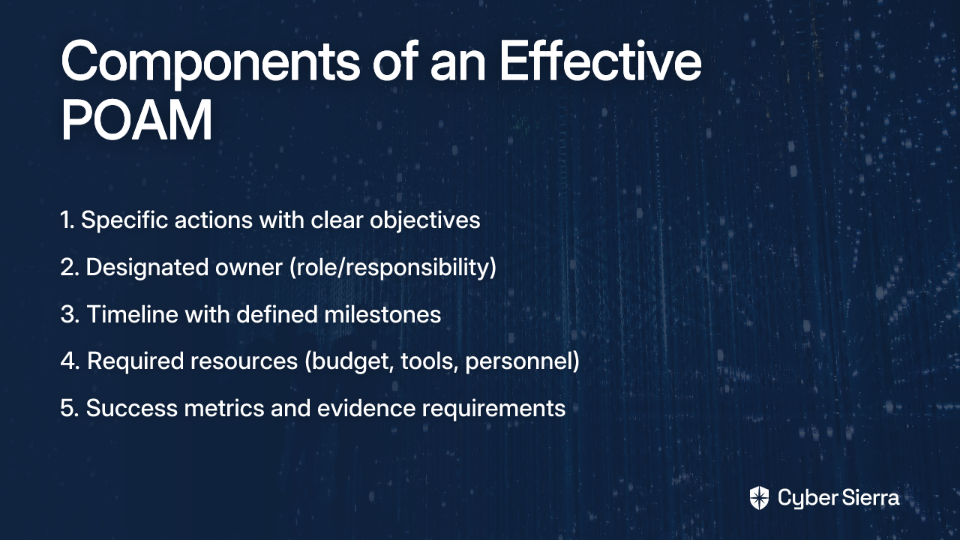
What is GRC in Cybersecurity?

GRC is a "structured framework" that integrates Governance, Risk, and Compliance...into organizational objectives to manage cyber threats and meet compliance requirements." It consists of three interconnected pillars:

  1. Governance: Establishing policies, roles, and accountability
  2. Risk Management: Continuously identifying, assessing, and prioritizing threats like phishing
  3. Compliance: Ensuring adherence to regulations like ISO 27001, HIPAA, and PCI-DSS

When anti-phishing efforts are integrated into this framework, every security action automatically feeds into compliance management—creating a seamless system that both protects against attacks and generates the evidence needed for audits.

Cyber Sierra's GRC-Integrated Approach

Cyber Sierra offers a unified platform that makes this integrated strategy possible by combining multiple security functions into a single, GRC-centric ecosystem:

  • Employee Security Training: Goes beyond basic awareness to build a "human firewall" with interactive training and simulated phishing campaigns. The platform provides a dashboard to track employee security quotient, delivering auditable proof of training completion for compliance.
  • Continuous Control Monitoring (CCM): Instead of periodic manual checks, CCM provides "ongoing visibility into security controls...in near real-time." This automates the collection of evidence needed for audits and helps proactively fix security gaps before they can be exploited.
  • GRC Module: Serves as the central hub that "automates data collection, risk assessments, control monitoring, and reporting" for frameworks like SOC2, ISO 27001, HIPAA, and PCI DSS, making enterprises audit-ready.

Industry-Specific Approaches to GRC-Integrated Anti-Phishing

BFSI: Protecting Financial Assets and Trust

Threat Landscape: The financial sector faces sophisticated spear phishing, whaling (targeting executives), and BEC campaigns aimed at gaining access to financial systems. According to the Phishing Trends Report, about 80% of phishing aims to steal credentials, especially for cloud services.

Regulatory Imperatives:

  • PCI-DSS: Requires robust security awareness training for all personnel handling cardholder data
  • SOX: Demands accountability in financial reporting, extending to the security of email systems where financial data is discussed

GRC-Integrated Solution for BFSI:

  • PCI-DSS Compliance: Use Continuous Control Monitoring to automatically validate and document the security controls required by PCI-DSS, particularly for Requirement 12.6 (security awareness)
  • SOX Audit Trails: Maintain detailed audit trails and generate reports that demonstrate proper governance over financial communication channels
  • Targeted Training: Deploy simulated phishing campaigns that mimic real-world financial lures, like fake wire transfer requests or fraudulent account alerts

Healthcare: Safeguarding Patient Data

Threat Landscape: Healthcare organizations are highly vulnerable due to the immense value of Protected Health Information (PHI). Phishing attacks often serve as precursors to ransomware that can cripple hospital operations and compromise patient care.

Regulatory Imperatives:

  • HIPAA: The Security Rule explicitly "mandates security awareness programs for organizations handling patient data." Non-compliance can lead to massive fines, as detailed by the Infosec Institute.

GRC-Integrated Solution for Healthcare:

  • HIPAA Risk Management: Conduct and document HIPAA-required risk assessments, automatically linking identified phishing risks to specific security controls
  • Supply Chain Security: Healthcare relies on many third-party vendors (labs, billing, software providers). Cyber Sierra's Third-Party Risk Management automates vendor risk assessments to ensure partners aren't a weak link in the security chain
  • Contextual Training: Train staff to recognize phishing emails disguised as patient inquiries, insurance updates, or internal system alerts, reinforcing HIPAA best practices

Manufacturing: Defending Operations and Intellectual Property

Threat Landscape: Manufacturing is increasingly targeted for operational disruption via ransomware on OT/ICS systems and for the theft of valuable intellectual property. Phishing remains the primary initial access vector for these attacks.

Regulatory Imperatives: While less uniform than BFSI or healthcare, compliance with frameworks like NIST and ISO 27001 is often required to participate in critical supply chains (e.g., defense, automotive).

GRC-Integrated Solution for Manufacturing:

  • Supply Chain Resilience: The manufacturing supply chain is vast and complex. TPRM is critical for identifying and mitigating risks from suppliers who could be compromised and used to launch an attack
  • NIST/ISO 27001 Compliance: Pre-built templates for these frameworks simplify the process of mapping controls, collecting evidence, and preparing for certification audits
  • Proactive Defense: Threat Intelligence performs external attack surface scanning, identifying vulnerabilities before attackers can exploit them with a phishing campaign

Implementation and ROI: Making the Business Case

Implementation Timeline: A phased approach is realistic. Organizations can expect an initial setup phase of 3-6 months for GRC integration, with full operational capability typically achieved within 9-12 months.

Measuring Return on Investment:

  • Cost Avoidance: Preventing a single major phishing incident can deliver massive ROI, with average savings of $4.88M per avoided incident
  • Reduced Compliance Costs: Automation via a GRC platform drastically cuts down on the man-hours required for manual evidence gathering, internal audits, and external reporting
  • Lower Insurance Premiums: A demonstrable, mature security posture is key to obtaining favorable cyber insurance. Cyber Sierra's Cyber Insurance module helps organizations "demonstrate robust hygiene to insurers and streamline obtaining appropriate coverage"

From Reactive Defense to Proactive Resilience

The phishing landscape has evolved beyond the capabilities of standalone tools, especially for regulated industries where compliance is non-negotiable. The constant vigilance demanded of users—where "even detonation services will fail sometimes"—is unsustainable and ineffective on its own.

The future of effective anti-phishing lies in a holistic, GRC-integrated strategy. By weaving together employee training, continuous monitoring, and threat intelligence within a compliance-aware framework, organizations can move from a reactive, chaotic defense to a proactive, audit-ready security posture.

Don't wait for a phishing email to become a compliance nightmare. Explore how a unified GRC platform like Cyber Sierra can protect your organization against modern threats while simplifying your regulatory obligations. In regulated industries, effective anti-phishing isn't just about blocking threats—it's about building a security program that satisfies both your security team and your auditors.

Frequently Asked Questions

What is a GRC-integrated anti-phishing strategy?

A GRC-integrated anti-phishing strategy is an approach that combines security actions, like blocking phishing attempts and training employees, directly into a Governance, Risk, and Compliance (GRC) framework. This ensures that every security measure automatically generates the evidence needed to prove compliance with regulations like HIPAA, PCI-DSS, and SOX. Instead of treating security and compliance as separate functions, this model creates a unified system where threat defense and audit readiness are managed together.

Why are traditional anti-phishing tools no longer sufficient for regulated industries?

Traditional anti-phishing tools like Secure Email Gateways (SEGs) are no longer sufficient because they operate in isolation from compliance systems, fail to stop sophisticated modern attacks, and place an unsustainable burden on employees to be the last line of defense. For regulated industries, a blocked phishing attempt is not enough; organizations must also provide auditable evidence of their security controls. Standalone tools don't automatically generate this compliance documentation, creating a "compliance blind spot."

How does integrating anti-phishing with GRC simplify compliance audits?

Integrating anti-phishing with a GRC platform simplifies audits by automating the collection and organization of evidence. Every security action, from employee training completion to control monitoring, is automatically logged and mapped to specific regulatory requirements. This eliminates the need for manual, last-minute evidence gathering and allows organizations to generate comprehensive reports for auditors on demand, significantly reducing audit preparation time.

What are the primary phishing threats targeting industries like BFSI and Healthcare?

The primary phishing threats in these sectors are highly targeted attacks designed to steal sensitive data and credentials. In BFSI, this includes spear phishing and whaling aimed at initiating fraudulent transactions or stealing cloud credentials. In Healthcare, attacks often focus on stealing Protected Health Information (PHI) to launch ransomware that can disrupt critical hospital operations.

How does GRC help manage third-party and supply chain phishing risks?

A GRC framework helps manage third-party and supply chain risks by integrating Third-Party Risk Management (TPRM) directly into the security and compliance process. Since attackers often target weaker links in the supply chain, a GRC platform can automate vendor risk assessments, track their compliance status, and ensure they meet your organization's security standards. This provides a holistic view of risk across your entire ecosystem, not just within your own perimeter.

What is the typical implementation timeline for a GRC-integrated security platform?

The typical implementation timeline for integrating security tools into a GRC platform follows a phased approach, with an initial setup taking approximately 3-6 months. Full operational capability, where security controls are fully mapped and automation is running smoothly, is generally achieved within 9-12 months. This allows organizations to prioritize the most critical risks and compliance frameworks first for a smoother transition.

toaster icon

Thank you for reaching out to us!

We will get back to you soon.