blog-hero-background-image
Cyber Security

5 Small Business Success Stories: Achieving ISO 27001 Certification with Limited Resources
backdrop
Table of Contents

Join thousands of professionals and get the latest insight on Compliance & Cybersecurity.


Summary

  • Small businesses can achieve ISO 27001 certification in 6-12 months, transforming it from a resource drain into a competitive advantage that can accelerate sales cycles by up to 30%.
  • Success hinges on defining a realistic scope based on business needs and using a risk-based approach to focus on protecting your most critical assets.
  • Automating manual tasks like evidence gathering is crucial for small teams. Platforms like Cybersierra's GRC module streamline the process, reduce audit stress, and shorten timelines.

Does your small business need ISO 27001 certification, but you're worried about the resources required? You're not alone. Many small business leaders approach this globally recognized security standard with trepidation, thinking:

"I have a tech background but no prior ISM experience." "The process seems incredibly time-consuming with overwhelming documentation." "I'm not even sure where to start with defining the scope." (Source)

These concerns are valid. ISO 27001 certification can seem like a mountain to climb when you have limited staff, budget constraints, and no dedicated compliance team. But here's the good news: small businesses with 10-50 employees are successfully achieving certification every day, often in less time and with fewer resources than you might expect.

This article showcases five real-world examples of small businesses that navigated the ISO 27001 certification process successfully. Each overcame unique challenges by combining smart strategy, leveraging technology, and focusing on business value rather than just compliance checkboxes.

1. Cyber Sierra's Client: InnovateTech - From Manual Chaos to Automated Compliance

Company Profile: InnovateTech, a 25-employee B2B SaaS company providing workflow automation solutions to enterprise clients.

The Challenge: After losing several high-value enterprise deals due to security concerns, InnovateTech knew they needed ISO 27001 certification to compete effectively. Their initial attempt using spreadsheets to manage their Information Security Management System (ISMS) quickly turned into what their IT Manager called "version control hell." Evidence gathering for controls became their biggest pain point – a common struggle many small businesses face during audits.

The Implementation Approach:

InnovateTech decided to abandon the manual approach and adopted Cyber Sierra's comprehensive platform to streamline their certification process:

  1. GRC Automation: They utilized Cyber Sierra's Governance, Risk & Compliance (GRC) module to automate data collection and manage their policies. This provided a clear roadmap that addressed their uncertainty about "what might be missing" in their documentation.
  2. Continuous Monitoring: The team implemented the Continuous Control Monitoring (CCM) capabilities to gain real-time visibility into their security controls. This automated much of the evidence gathering that typically burdens small teams.
  3. Building a Human Firewall: They deployed security awareness training for all employees, addressing the critical "people" controls in Annex A of the ISO standard.

Resource Allocation: One IT Manager served as the project lead, with about 15 hours per week dedicated to the certification process. They avoided hiring a full-time compliance officer by leveraging the Cyber Sierra platform.

Timeline: 7 months from project kickoff to certification – significantly faster than their projected 12-18 months for a manual approach.

Business Benefits:

  • Competitive Advantage: InnovateTech closed two six-figure enterprise deals that were previously blocked by compliance requirements.
  • Cost Reduction: The company identified and addressed security gaps that could have led to costly breaches.
  • Operational Efficiency: The automated approach reduced the ongoing maintenance burden, allowing their small team to focus on core business activities.

"The ROI was immediate," notes their CTO. "The moment we achieved certification, doors started opening with enterprise clients who wouldn't have considered us before."

2. Apex Consulting - Building on SOC 2 for Holistic Security

Company Profile: Apex Consulting, a 40-person IT managed services provider with existing SOC 2 compliance.

The Challenge: After establishing a strong domestic client base, Apex wanted to expand into European markets where ISO 27001 is the recognized security standard. They needed to bridge the gap between their service-specific SOC 2 controls and the more holistic, organization-wide approach required by ISO 27001.

The Implementation Approach:

  1. Framework Mapping & Gap Analysis: Apex leveraged their existing SOC 2 work as a foundation. They performed a detailed gap analysis to identify additional requirements demanded by ISO 27001.
  2. Expanded Risk Assessment: They conducted a comprehensive risk assessment covering the entire organization, not just the services in their SOC 2 scope.
  3. Tool Integration: Apex implemented a GRC platform similar to those recommended by security professionals to manage controls and evidence for both frameworks simultaneously.
  4. Fostering Security Culture: They embedded cybersecurity consciousness into every level of the organization, moving beyond technical controls to create a culture of security awareness.

Resource Allocation: Their existing IT team handled much of the implementation, supplemented by a part-time consultant who provided guidance during the gap analysis and initial setup phases. Their total external consulting costs were under $25,000.

Timeline: 6 months to certification, accelerated by building on their SOC 2 compliance foundation.

Business Benefits:

  • Opened new business opportunities in the EU and UK, resulting in a 22% revenue increase within the first year after certification.
  • Enhanced client trust by demonstrating commitment to a globally recognized security standard.
  • Achieved a more robust and unified security posture across the entire company.

"We originally saw ISO 27001 as just a market entry requirement," explains their CEO. "But the process actually helped us integrate our previously siloed security efforts into a cohesive program that benefits all aspects of our business."

3. PixelPlay Studios - Rapid Certification for Market Entry

Company Profile: PixelPlay Studios, a 35-employee mobile gaming company preparing for a major launch with a large publisher.

The Challenge: Their publishing partner mandated ISO 27001 certification within six months as a prerequisite for a multi-million dollar deal. The startup needed to implement a full ISMS under a tight deadline while protecting valuable intellectual property and user data.

The Implementation Approach:

  1. Centralized & Collaborative Management: PixelPlay established a cross-functional team and used a centralized compliance management platform to track tasks, policies, and evidence in one place.
  2. Scope Definition: They focused their ISMS scope tightly on the systems, people, and processes directly involved in the development and operation of the new game – addressing one of the most common pain points small businesses face when starting the ISO 27001 journey.
  3. Risk-Based Prioritization: The team conducted a rapid risk assessment to identify and prioritize the most critical threats to their game's data confidentiality, integrity, and availability.

Resource Allocation: A dedicated internal project manager (who also served as their lead developer) spent approximately 50% of their time on the certification project. They invested in a compliance management tool subscription ($12,000/year) to streamline the process.

Timeline: Successfully achieved certification in 5.5 months, just ahead of their deadline.

Business Benefits:

  • Secured a multi-million dollar publishing deal that transformed the company's financial outlook.
  • Built a scalable security framework that could be applied to future game launches.
  • Used the certification as a marketing tool to attract security-conscious players in an era of increasing data privacy concerns.

"The tight deadline forced us to be incredibly focused," says their CTO. "Rather than trying to boil the ocean, we defined a realistic scope and concentrated our efforts where they mattered most."

4. EduSecure - Streamlining Partner Onboarding & Trust

Company Profile: EduSecure, a 20-employee EdTech platform serving universities and educational institutions.

The Challenge: Their sales cycle was bogged down by lengthy, custom security questionnaires from each university. They needed a standardized way to demonstrate their security posture and build trust faster with educational institutions that are increasingly concerned about student data protection.

The Implementation Approach:

  1. Structured Methodology: EduSecure followed a clear, step-by-step implementation plan focused on demonstrating robust security management rather than just checking compliance boxes.
  2. Statement of Applicability (SoA): They created a comprehensive Statement of Applicability detailing the controls from Annex A and justifying their implementation. This document became a powerful tool they could share with partners to streamline security reviews.
  3. Third-Party Risk Management: While implementing their own ISMS, they also improved their approach to vendor security assessments, creating a more secure supply chain for their educational clients.

Resource Allocation: An internal champion (their Head of Product) led the initiative, supported by a part-time CISO consultant who visited onsite twice monthly. Their total investment was approximately $35,000, including consulting fees and tools.

Timeline: 9 months for initial certification, followed by a cycle of continuous improvement.

Business Benefits:

  • Accelerated Sales Process: The ISO 27001 certificate became their "golden ticket," satisfying most partner security requirements upfront and reducing their sales cycle by an average of 30%.
  • Streamlined Partner Onboarding: Security reviews that previously took weeks were completed in days, saving countless hours for both their sales and technical teams.
  • Competitive Differentiation: In a crowded EdTech market, ISO 27001 certification helped them stand out as a security-conscious provider.

"Before certification, we were completing a different security questionnaire for every university client," recalls their Head of Product. "Now we simply provide our ISO 27001 certificate and Statement of Applicability, which satisfies 90% of their requirements immediately."

5. Precision Parts Inc. - Securing the Digital Supply Chain

Company Profile: Precision Parts Inc., a 50-employee manufacturing firm supplying components to the aerospace industry.

The Challenge: As part of their digital transformation, Precision Parts was connecting factory floor machinery to the cloud. Their largest aerospace customers required ISO 27001 to ensure the integrity and confidentiality of their design specifications and to mitigate supply chain risks.

The Implementation Approach:

  1. Asset-Focused Risk Assessment: They started by identifying their most critical information assets (CAD designs, production schedules, client data) and performed a risk assessment centered on protecting these key assets.
  2. Phased Control Implementation: The team rolled out Annex A controls in phases, starting with access control, asset management, and physical security for the factory floor, before moving to cloud security and vendor management.
  3. Vendor Security: They applied third-party risk management principles to vet the security of their new cloud and IoT vendors, ensuring their entire supply chain maintained appropriate security controls.

Resource Allocation: Their existing IT team of three people managed the implementation, guided by a fractional CISO who visited quarterly. The company invested approximately $45,000 in the certification process, including new security technologies.

Timeline: 12 months, reflecting a deliberate, phased approach in a non-tech-native environment.

Business Benefits:

  • Strengthened Customer Trust: Secured their position as a trusted supplier to major aerospace firms, leading to renewed long-term contracts worth over $2 million.
  • Improved Operational Resilience: The ISMS helped them identify and prevent potential security incidents that could have halted production.
  • Secure Digital Transformation: Created a secure foundation for their ongoing digital transformation initiatives, enabling innovation without increasing risk.

"As a manufacturing company, we initially viewed ISO 27001 as just another customer requirement," says their Operations Director. "But the process helped us safely navigate our digital transformation while protecting our most valuable intellectual property."

Your Road to ISO 27001 Success: Lessons from the Frontlines

These five success stories reveal that ISO 27001 certification is absolutely achievable for small businesses with limited resources. While each company's journey was unique, several common threads emerge:

  1. Start with a clear, realistic scope based on your business needs, not a generic template. As one Reddit user aptly noted, "A one-person dev shop shouldn't be writing a physical access control policy about front desk visitor logs."
  2. Embrace a risk-based approach to focus your limited resources where they matter most. Identify your crown jewel assets and prioritize protecting them.
  3. Leverage automation tools to eliminate the manual drudgery of evidence collection, control monitoring, and audit preparation. The "most painful part of an audit is typically evidence gathering" – but it doesn't have to be with the right tools.
  4. Build on what you have. If you already have some security controls or compliance frameworks in place (like SOC 2), use them as a foundation rather than starting from scratch.
  5. Consider expert guidance for the complex parts. As one security professional advised, "Too many companies think they can do it by themselves, but I always recommend reaching out to an expert."

The ultimate reward isn't just the certificate. It's about building a more secure, resilient, and trustworthy business that can compete and win in markets previously closed to you because of security concerns.

Frequently Asked Questions

How long does it take for a small business to get ISO 27001 certified?

The timeline for a small business to achieve ISO 27001 certification typically ranges from 6 to 12 months. This duration can be influenced by factors like the company's existing security maturity, the complexity of its scope, and the resources allocated. As seen in the examples, a focused company like PixelPlay Studios achieved it in 5.5 months with a tight deadline, while others like Precision Parts Inc. took a more phased 12-month approach.

What does ISO 27001 certification typically cost for a small business?

For a small business, the total investment for ISO 27001 certification can range from $25,000 to $50,000 or more. This cost includes expenses for consulting, certification body audits, and any necessary tools or technology. For example, Apex Consulting's external costs were under $25,000, while EduSecure and Precision Parts Inc. invested around $35,000-$45,000, which included consulting fees, tools, and new security technologies.

Do small businesses need a dedicated compliance team for ISO 27001?

No, small businesses do not necessarily need a dedicated, full-time compliance team to achieve ISO 27001 certification. Many successful small businesses, like those profiled, assign a project lead (such as an IT Manager or Head of Product) who dedicates a portion of their time to the project. This internal effort is often supplemented by leveraging compliance automation platforms and part-time consultants or fractional CISOs to provide expert guidance where needed.

What are the main business benefits of ISO 27001 for a small company?

The primary business benefits of ISO 27001 for a small company are gaining a competitive advantage and building customer trust. Certification can unlock new business opportunities, especially with enterprise clients, as InnovateTech experienced. It also accelerates sales cycles by satisfying partner security requirements upfront, streamlines partner onboarding, and provides a solid foundation for secure growth and digital transformation.

How can automation help small businesses with ISO 27001 certification?

Automation tools, such as Governance, Risk & Compliance (GRC) platforms, significantly help small businesses by streamlining the most time-consuming parts of the certification process. They automate evidence gathering, provide continuous monitoring of security controls, and offer a centralized place to manage policies and track progress. This reduces the manual workload on small teams, minimizes human error, and can shorten the overall certification timeline, as demonstrated by InnovateTech.

What is the difference between ISO 27001 and SOC 2?

ISO 27001 and SOC 2 are both information security standards, but they differ in scope and approach. ISO 27001 certifies an organization's company-wide Information Security Management System (ISMS), demonstrating a holistic approach to risk management. SOC 2, on the other hand, is an attestation report that focuses on the security controls related to specific services a company provides, based on the Trust Services Criteria (Security, Availability, Processing Integrity, Confidentiality, and Privacy). A company can leverage its SOC 2 work as a foundation for the broader ISO 27001 certification, as Apex Consulting did.
Ready to Transform Your Security Journey?

Don't let limited resources or lack of experience prevent you from achieving ISO 27001 certification and the business advantages it brings. Cyber Sierra's automated platform can help you streamline the process, just as it did for InnovateTech and many other small businesses.

Our GRC and Continuous Control Monitoring capabilities are specifically designed to address the pain points small businesses face during certification: overwhelming documentation, evidence gathering challenges, and uncertainty about requirements.

Book a demo today to see how our platform can help you achieve certification faster, with less effort, and transform compliance from a burden into a business advantage.

blog-hero-background-image
Cyber Security

5 ISMS Awareness Training Approaches for Multi-Framework Compliance (ISO, NIST, SOC2)

backdrop
Table of Contents

Join thousands of professionals and get the latest insight on Compliance & Cybersecurity.


Summary

  • Managing security training across multiple frameworks like ISO 27001, NIST, and SOC2 creates redundant work and audit stress.
  • Unify your compliance efforts by mapping overlapping controls to create a single training program that satisfies multiple requirements.
  • Boost effectiveness by shifting from passive annual training to continuous, role-based learning with interactive elements like phishing simulations.
  • A GRC platform can automate control mapping and centralize evidence collection, streamlining audit preparation and ensuring continuous compliance.

You've set up your ISMS (Information Security Management System) to comply with ISO 27001. Your team has meticulously mapped NIST controls. And you've documented everything for your upcoming SOC2 audit. But now comes the training challenge: How do you educate your employees without subjecting them to three separate, redundant training programs?

If you're managing security compliance across multiple frameworks, you've likely experienced the frustration of redundant work, training fatigue, and the intense pressure of audit preparation. As one compliance manager described it, "it took me and one part-timer basically a whole month of nights and weekends to pull together all the evidence and documentation" - and that's just for one audit.

The problem becomes even more complex for organizations operating across different regions and sectors. As another professional noted, "Due to working in the healthcare sector at a public company that does business in the USA AND Europe, I am finding it difficult to put all of these together and manage them more efficiently."

Many compliance managers are also uncertain about the exact training requirements. As one asked, "What I'm not sure of is whether this means the employees/contractors need ISO 27001 training or just general cybersecurity awareness training."

The good news? With a strategic approach to ISMS awareness training, you can satisfy multiple frameworks simultaneously while building a more resilient security culture. Here are five practical approaches that will streamline your compliance efforts and reduce the anxiety of audit preparation.

1. Adopt a Unified Platform for Integrated Training and Control Mapping

The foundation of efficient multi-framework compliance is a centralized system that serves as a single source of truth for all your security activities. This directly addresses the common question: "How do you manage all these separate policies — do you have one massive infosec document or one for each framework/standard?"

Cyber Sierra's GRC platform is designed specifically to solve this challenge through automated control mapping. This approach identifies overlapping requirements across different frameworks, allowing you to implement a "test once, comply many" strategy.

For example, a single access control policy can satisfy requirements in ISO 27001 (A.9), SOC 2 (CC6.1), and NIST (AC-1) simultaneously. Instead of creating separate training modules for each framework, you can develop one comprehensive module that addresses all requirements.

Key benefits of this unified approach include:

  • Automated evidence collection: Training completions from Cyber Sierra's Employee Security Training module are automatically linked to relevant controls in the GRC dashboard, creating an auditable trail that proves "yes, everyone has done this training each year and has passed the quiz at the end."
  • Continuous compliance monitoring: Rather than scrambling to prepare for audits, a platform with Continuous Control Monitoring (CCM) capabilities provides ongoing visibility into the effectiveness of your controls, including training completion rates and knowledge retention.
  • Framework-agnostic reporting: Generate reports that demonstrate compliance with multiple frameworks from a single data source, drastically reducing the manual effort of audit preparation.

2. Design Risk-Based, Customizable Learning Paths

Not all employees face the same security risks, and not all controls require the same level of understanding across your organization. A one-size-fits-all training approach is inefficient and leads to disengagement.

First, it's important to clarify what ISO 27001 actually requires. According to ISO 27001 Annex A.7.2.2 (Information Security Awareness, Education & Training), "All employees and relevant contractors must receive appropriate awareness education and training." This doesn't mean everyone needs to become an ISO expert - rather, they need practical awareness training relevant to their role.

Here's how to implement this approach effectively:

  • Create a foundational module covering the common ground between ISO 27001, NIST, and SOC2 (data handling, password hygiene, incident reporting). This ensures everyone has a baseline understanding of security principles.
  • Develop role-specific micro-learning modules that address the unique risks of different departments:
    • Secure coding practices for development teams
    • Social engineering awareness for customer service
    • Invoice fraud detection for finance
    • Data handling procedures for teams with access to sensitive information

This approach respects employees' time while ensuring they receive training that's directly relevant to their daily responsibilities. It also creates a more robust security culture by emphasizing the specific risks each employee faces rather than generic compliance principles.

3. Boost Engagement with Interactive and Gamified Training

One of the most common pitfalls in ISMS awareness training is neglecting employee engagement. Passive training leads to poor retention and doesn't translate to real-world behavior changes.

To maximize the effectiveness of your training program across multiple frameworks:

  • Implement simulated phishing campaigns that test employees' ability to identify and report suspicious emails. These practical exercises move training from theory to practice and provide measurable results that can satisfy requirements across frameworks. Cyber Sierra's Employee Security Training includes simulated phishing campaigns that help build a strong 'human firewall' while documenting results for compliance purposes.
  • Incorporate gamification elements like quizzes, badges, and leaderboards to foster healthy competition and ongoing engagement. These techniques make security training more enjoyable while providing metrics that demonstrate the effectiveness of your program to auditors.
  • Conduct cross-functional workshops that use real-world incident simulations to bring teams together. These exercises enhance collaborative understanding and build a shared security culture while satisfying training requirements for ISO 27001 (A.7.2.2), NIST (AT-2), and SOC2 (CC1.4).

The interactive approach not only improves knowledge retention but also creates a more comprehensive audit trail demonstrating that employees can apply their training in practical scenarios.

4. Implement a Continuous Learning and Feedback Loop

Security awareness is not a "one-and-done" annual event. Threats and regulations evolve constantly, and your training program should reflect this reality.

A continuous learning approach satisfies multiple frameworks while keeping security top-of-mind throughout the year:

  • Schedule regular micro-training sessions throughout the year instead of one-time annual training. This approach keeps content fresh and relevant while maintaining ongoing compliance with framework requirements.
  • Use ongoing assessments to reinforce learning and measure effectiveness. Regular quizzes and knowledge checks provide the data needed to prove training efficacy to auditors across all frameworks.
  • Gather employee feedback on training content and delivery methods. This input helps refine your program and demonstrates a commitment to continuous improvement—a key principle in ISO 27001, NIST, and SOC2.
  • Ensure leadership buy-in by regularly sharing training metrics and success stories. When leaders champion the training program, it cultivates a security-conscious culture throughout the organization, satisfying the governance requirements of multiple frameworks.

This continuous approach addresses the common pain point that "keeping evidence up to date during the year is still a struggle" by making compliance an ongoing process rather than a periodic scramble.

5. Centralize Documentation and Engage Auditors Proactively

The final approach focuses on streamlining the audit process itself to reduce the stress and anxiety that many compliance managers experience.

  • Build a central control library where each security control is documented with details such as Control ID, Owner, and Implementation Status. This library, ideally managed within a GRC tool like Cyber Sierra's platform, becomes the definitive source for auditors, allowing for streamlined evidence retrieval.
  • Maintain a single training repository that documents all ISMS awareness activities, completion rates, assessment results, and remediation efforts. This comprehensive repository eliminates the need to hunt for evidence during audit preparation.
  • Engage auditors early in your control mapping approach. Involving auditors in your methodology aligns expectations and prevents surprises during formal audits. Share your unified training plan and control mapping strategy upfront to demonstrate your comprehensive approach to compliance.
  • Automate evidence collection whenever possible. Platforms like Cyber Sierra can automatically capture training completions, quiz results, and acknowledgment of policies, creating a continuous stream of evidence that satisfies auditor requirements across frameworks.

This centralized approach directly addresses the pain point expressed by many compliance managers: "it took me basically a whole month of nights and weekends to pull together all the evidence and documentation." With proper documentation systems in place, audit preparation becomes a matter of generating reports rather than a frantic search for evidence.

Common Pitfalls to Avoid in ISMS Awareness Training

Even with the best approaches, there are common mistakes that can undermine your multi-framework compliance efforts:

  • Neglecting employee engagement: Training becomes ineffective without proper engagement; interactive methods yield better results than lectures or passive videos.
  • Overloading employees with information: Avoid cramming too much content into training sessions, which can lead to fatigue; prioritize concise and actionable takeaways.
  • Treating compliance as a checkbox: When training becomes a mere compliance exercise, it fails to create lasting behavior change or build a security culture.
  • Failing to measure effectiveness: Without metrics to assess knowledge retention and behavior changes, you can't demonstrate the impact of your training program to auditors.

Moving Forward: From Compliance Burden to Strategic Advantage

By implementing these five approaches—adopting a unified platform, designing customizable learning paths, boosting engagement with interactive elements, implementing continuous learning, and centralizing documentation—you can transform ISMS awareness training from a compliance burden into a strategic advantage.
This integrated approach not only satisfies requirements across ISO 27001, NIST, and SOC2 but also strengthens your overall security posture by building a more security-conscious workforce.

Most importantly, it addresses the intense stress and anxiety that many compliance managers experience during audit preparation. Instead of spending "a whole month of nights and weekends" gathering evidence, you can maintain a state of continuous compliance readiness with training data automatically mapped to the relevant controls in each framework.

Frequently Asked Questions

What is unified compliance training and how does it work for frameworks like ISO 27001 and SOC2?

Unified compliance training is an approach where a single, cohesive training program is designed to satisfy the security awareness requirements of multiple frameworks simultaneously. It works by first identifying overlapping controls across standards like ISO 27001, NIST, and SOC2—a process called control mapping. From there, you can create a core training module covering these common requirements (e.g., data handling, incident reporting) and supplement it with role-specific micro-learnings, ensuring efficiency without sacrificing compliance.

How can I prove to auditors that my employee training is effective across multiple frameworks?

The most effective way to prove training effectiveness is by using a centralized GRC platform that automatically documents all training activities. This creates a single source of truth for auditors, linking training completion records, quiz scores, and simulated phishing results directly to the specific controls in each framework (e.g., ISO 27001 A.7.2.2, SOC2 CC1.4). This automated evidence collection provides a clear, auditable trail that demonstrates both participation and comprehension.

What's the difference between general security awareness training and framework-specific training like ISO 27001?

General security awareness training focuses on foundational security principles relevant to all employees, such as identifying phishing, creating strong passwords, and proper data handling. Framework-specific training is not typically required for all employees. Instead, compliance frameworks like ISO 27001 mandate that employees receive appropriate training relevant to their roles. A well-structured program uses general awareness as a baseline and builds upon it with role-specific modules that address controls pertinent to that framework.

How often should I conduct security awareness training for compliance?

Security awareness training should be an ongoing, continuous process rather than a single annual event. To meet compliance requirements effectively, it's best to schedule regular micro-training sessions, quizzes, and phishing simulations throughout the year. This continuous learning approach not only keeps security top-of-mind for employees but also provides auditors with consistent evidence that your training program is active and effective over time, satisfying requirements for continuous improvement.

Why is a role-based approach to security training more effective for compliance?

A role-based approach is more effective because it directly addresses the specific security risks associated with different job functions, which is a key expectation of frameworks like ISO 27001 and NIST. Instead of a one-size-fits-all program, you create targeted modules—such as secure coding for developers or invoice fraud detection for finance—that are more relevant and engaging for employees. This not only improves knowledge retention but also provides auditors with clear evidence that your training is tailored to mitigate the most significant risks across your organization.

What is the most common mistake to avoid when creating a multi-framework training program?

The most common mistake is treating training as a passive, "check-the-box" annual exercise. This approach leads to poor engagement, low knowledge retention, and fails to build a genuine security culture. To be effective for multi-framework compliance, training must be interactive, continuous, and integrated into daily workflows, using tools like phishing simulations and gamified quizzes to ensure employees can apply what they've learned in real-world scenarios.

Ready to transform your ISMS awareness training from a compliance burden into a strategic advantage? Discover how Cyber Sierra's unified platform automates control mapping, evidence collection, and employee training to make you audit-ready, always.

blog-hero-background-image
Cyber Security

5 Energy Sector Cybersecurity Risks That Continuous Monitoring Can Prevent

backdrop
Table of Contents

Join thousands of professionals and get the latest insight on Compliance & Cybersecurity.


Summary

  • The energy sector faces critical cyber risks like ransomware and nation-state threats, yet only 28% of security teams feel confident in their ability to protect converged OT/IT infrastructure.
  • Traditional periodic security audits and vulnerability scans are no longer sufficient, as they create dangerous visibility gaps that attackers can exploit between assessments.
  • Adopting a continuous control monitoring (CCM) strategy is essential for a proactive defense, providing real-time visibility and automated alerts to detect threats before they cause damage.
  • Implementing a unified platform for Continuous Control Monitoring helps energy companies automate compliance, secure their supply chain, and maintain an always-on security posture.

In today's interconnected world, the energy sector stands as a prime target for cyberattacks. With critical infrastructure increasingly digitized, the stakes couldn't be higher—yet only 28% of enterprise security teams feel confident in their ability to address converged physical-digital risks. This anxiety is particularly acute in operational technology (OT) environments where, as one professional notes, "The devices we get to interface with are either 50 years old or more expensive than most companies are willing to pay for."

The unique challenge of energy sector cybersecurity lies in protecting systems where availability is paramount and downtime can have catastrophic consequences. As attacks grow in sophistication, from ransomware that halts operations to nation-state threats aimed at destabilization, the traditional approach of periodic security checks is no longer sufficient.

This article breaks down the five most critical cybersecurity risks facing the energy sector and explores how continuous control monitoring (CCM) provides the early warnings and automated oversight needed to prevent them—shifting from reactive, point-in-time security to a proactive, always-on defense strategy essential for modern energy infrastructure.

1. Ransomware and Multi-Stage Attacks on Operational Systems

The Risk

Ransomware has evolved from simply encrypting corporate files to targeting operational technology that controls physical infrastructure. When these systems are compromised, the consequences extend far beyond data loss—they can halt energy production and distribution entirely.

As one industry professional bluntly puts it: "If a distribution center gets locked by ransomware, the whole business stops because nothing moves." The 2021 Colonial Pipeline attack demonstrated this reality, causing fuel shortages across the Eastern United States after attackers gained access through a single compromised password.

Smaller utilities are particularly vulnerable, often lacking the resources to combat sophisticated threats. According to Nozomi Networks research, attackers can exploit any of the 23,000+ software vulnerabilities identified in 2023 alone to gain initial access to these environments.

Traditional Detection Challenges

Periodic vulnerability scans and annual penetration tests simply can't keep pace with rapidly evolving threats. By the time a quarterly scan identifies a vulnerability, attackers may have already exploited it weeks earlier. Furthermore, legacy OT environments often lack native security controls, creating blind spots that traditional IT security tools can't monitor.

How Continuous Monitoring Prevents It

Cyber Sierra's Continuous Control Monitoring (CCM) transforms security from a periodic event into an ongoing process. Instead of waiting for scheduled assessments, CCM provides real-time visibility into both OT and IT environments by:

  • Establishing a baseline of normal activity for operational systems
  • Instantly flagging anomalies that signal the start of an attack, such as unusual network traffic patterns or unauthorized access to sensitive ICS/SCADA systems
  • Providing automated alerts when suspicious file modifications occur

This early detection capability means security teams can isolate affected systems and block the attack before ransomware is deployed. As Cyber Sierra's platform delivers actionable risk intelligence for data-driven remediation, organizations can respond swiftly and precisely to emerging threats, aligning with the Department of Energy's emphasis on a Cybersecurity Risk Management Process (RMP) that enables rapid response.

2. Nation-State Threats Targeting Critical Infrastructure

The Risk

Advanced Persistent Threats (APTs) sponsored by nation-states represent some of the most sophisticated attacks energy companies face. Unlike financially motivated cybercriminals, these actors pursue strategic objectives—disrupting essential services, conducting espionage, or creating leverage for geopolitical advantage.
A particularly concerning development is the rise of wiper malware, which is "designed to destroy data and systems, rendering them permanently inoperable or extremely difficult and costly to restore." These destructive attacks aim not for ransom but for maximum damage, making them especially dangerous to critical infrastructure.

This escalating threat landscape has prompted federal initiatives like the Cybersecurity Risk Information Sharing Program (CRISP), a public-private partnership facilitating threat intelligence sharing among energy sector participants.

Traditional Detection Challenges

APTs use sophisticated, custom-developed tools and stealthy techniques specifically designed to remain undetected for months or even years. These threats often bypass traditional signature-based antivirus systems and firewalls.

Further complicating matters, security teams frequently lack the specific threat intelligence needed to recognize the indicators of a nation-state actor's presence in their networks. By the time these attacks are detected, the damage is often already done.

How Continuous Monitoring Prevents It

Continuous monitoring platforms integrate with threat intelligence feeds (like those from CRISP) to actively hunt for Indicators of Compromise (IOCs) associated with known APT groups.

Rather than relying solely on signatures, CCM focuses on behavioral analysis—monitoring for tactics, techniques, and procedures (TTPs) common to APTs, such as lateral movement, privilege escalation, and data exfiltration attempts.

By continuously scanning network and cloud infrastructure for misconfigurations and vulnerabilities (a key feature of Cyber Sierra's Threat Intelligence module), organizations can proactively close security gaps before nation-state actors have a chance to exploit them, shifting from a defensive posture to an anticipatory one.

3. Pervasive Supply Chain Vulnerabilities

The Risk

The energy sector relies on a complex web of hardware vendors, software providers, and service contractors. A compromise at any point in this ecosystem can cascade throughout the supply chain, potentially affecting critical operations.

As one cybersecurity professional succinctly puts it: "Massive issue, imagine doing everything right and then getting pwned because a vendor gets breached." This sentiment captures the frustration of security teams who diligently secure their own environments only to be compromised through a third-party vulnerability.

The Department of Energy has recognized this challenge by developing Supply Chain Cybersecurity Principles that emphasize shared responsibility, transparency, and proactive vulnerability management across the energy sector's supply chain.

Traditional Detection Challenges

Vendor risk is traditionally assessed using static, point-in-time questionnaires that fail to provide ongoing visibility into a vendor's changing security posture. A vendor might pass an annual security assessment but suffer a major breach the following month, leaving their customers unaware and vulnerable.

Additionally, tracking vulnerabilities in third-party components embedded within industrial control systems presents a significant challenge, particularly when many legacy OT systems lack vendor support for security updates.

How Continuous Monitoring Prevents It

Continuous monitoring extends beyond an organization's own perimeter. Platforms like Cyber Sierra's Third-Party Risk Management (TPRM) provide "near real-time, 24/7 visibility into vendor security compliance," moving beyond static assessments toward dynamic risk evaluation.

The system continuously scans vendors' external attack surfaces for vulnerabilities, monitors for data breaches involving those vendors, and tracks their security ratings over time. This approach allows energy companies to:

  • Receive immediate alerts when a vendor's security posture deteriorates
  • Automatically trigger reassessments when high-risk conditions are detected
  • Enforce security baselines by contractually requiring vendors to maintain certain security standards, which can then be continuously verified

This capability enables energy companies to enforce the DOE's principles for supply chain security while maintaining visibility into evolving third-party risks.

4. Insider Threats (Malicious and Accidental)

The Risk

Not all threats come from external actors. Insider threats—whether from disgruntled employees with malicious intent or well-meaning staff who inadvertently create vulnerabilities—represent a significant risk to energy infrastructure.

The growing danger of AI-powered phishing has made the "accidental insider" an even greater concern. These sophisticated attacks achieve a "54% click-through rate—4x higher than traditional phishing," dramatically increasing the likelihood that even security-conscious employees might be compromised.

Energy companies face particular challenges in this area due to their multiple technological divisions, which increase the number of employees with privileged access to critical systems. This expanded attack surface heightens the potential impact of insider threats.

Traditional Detection Challenges

Distinguishing legitimate privileged access from malicious activity is exceptionally difficult without a deep understanding of baseline behavior for each user and system. Manual monitoring of access logs and user activities is both resource-intensive and prone to oversight.

Additionally, traditional annual security awareness training fails to adequately prepare employees for the increasingly sophisticated social engineering tactics they face daily. A once-yearly training session cannot build the continuous vigilance needed to combat ever-evolving phishing techniques.

How Continuous Monitoring Prevents It

Continuous Control Monitoring implements User and Entity Behavior Analytics (UEBA) to establish a baseline of normal behavior for every user and system. The system can automatically flag suspicious activities such as:

  • Logins at unusual hours or from unexpected locations
  • Access attempts to sensitive OT controls that fall outside an employee's typical job function
  • Unusual patterns of privilege escalation or attempts to disable security logs

A comprehensive approach combines this technical monitoring with ongoing security awareness efforts. Cyber Sierra's Employee Security Training module moves beyond annual check-box exercises by providing interactive training modules and simulated phishing campaigns throughout the year, building a resilient, security-conscious workforce—a human firewall that complements technical controls.

5. Persistent Compliance and Regulatory Gaps

The Risk

The energy sector operates under strict regulatory frameworks, with standards like NERC CIP (Critical Infrastructure Protection) mandatory for utilities. Non-compliance leads not only to significant financial penalties but also indicates security weaknesses that could be exploited by attackers.

Smaller utilities often struggle with the resources needed to maintain compliance, creating inconsistent security across the power grid. This challenge is recognized by the Department of Energy, which has developed frameworks like the Cybersecurity Capability Maturity Model (C2M2) to help companies evaluate and improve their cybersecurity posture regardless of size.

Traditional Detection Challenges

Compliance audits are typically manual, time-consuming, and expensive processes. Evidence collection happens periodically, creating a "snapshot-in-time" view of compliance that can become outdated almost immediately after the assessment is complete.

This approach leads to "audit fatigue" among security teams and creates dangerous gaps between assessments where controls can fail without anyone knowing—until it's too late. The result is a cyclical pattern of remediation followed by degradation, rather than continuous compliance.

How Continuous Monitoring Prevents It

A core function of modern CCM is to automate compliance processes. Cyber Sierra's Governance, Risk & Compliance (GRC) platform maps security controls to multiple frameworks (NERC CIP, NIST, ISO 27001, etc.), providing a unified view of compliance across standards.

The platform automatically collects and centralizes evidence that controls are operating effectively—from firewall rule reviews to patch status and access logs. This makes the organization "audit-ready" at all times, reducing the stress and resource drain of preparing for assessments.

Most importantly, real-time gap identification ensures that if a control fails (e.g., a critical server misses a patch or an unauthorized configuration change occurs), an alert is generated immediately. This allows for rapid remediation, maintaining continuous compliance rather than the traditional peaks and valleys of the audit cycle.

Conclusion: The Power of Continuous Visibility

The five risks we've examined—ransomware, nation-state actors, supply chain vulnerabilities, insider threats, and compliance gaps—are interconnected and ever-present in today's energy sector. These threats don't operate on a schedule, and neither should your defenses.

Continuous monitoring represents a strategic shift from reactive to proactive security, providing the unified visibility and automated oversight needed to manage these complex risks before they can impact operations. By implementing these capabilities, energy companies can move from a defensive crouch to a state of confident resilience.

Frequently Asked Questions

What are the top cybersecurity risks in the energy sector?

The top five cybersecurity risks for the energy sector are ransomware targeting operational systems, nation-state threats to critical infrastructure, pervasive supply chain vulnerabilities, insider threats (both malicious and accidental), and persistent compliance and regulatory gaps. These threats are particularly dangerous because they can halt energy production and distribution, causing widespread disruption.

What is Continuous Control Monitoring (CCM) and how does it work?

Continuous Control Monitoring (CCM) is a proactive security strategy that automates the process of monitoring security controls in real-time. Instead of relying on periodic checks, CCM continuously collects and analyzes data from IT and OT environments to provide instant visibility into security posture, detect anomalies, and identify control failures as they happen, enabling rapid response before a breach occurs.

Why aren't traditional security audits enough for the energy sector?

Traditional security audits are not enough because they provide only a static, point-in-time snapshot of an organization's security posture. In the fast-evolving threat landscape of the energy sector, vulnerabilities can emerge and be exploited in the weeks or months between audits. This leaves dangerous gaps where controls can fail undetected, making a continuous, always-on approach essential.

How does CCM protect Operational Technology (OT) environments?

CCM protects Operational Technology (OT) environments by establishing a baseline of normal activity for industrial control systems (ICS) and SCADA systems. It then provides real-time monitoring to instantly flag anomalies that could signal an attack, such as unusual network traffic or unauthorized access attempts. This is crucial for legacy OT systems that often lack native security controls and cannot be monitored by traditional IT tools.

How does continuous monitoring help with NERC CIP compliance?

Continuous monitoring helps with NERC CIP compliance by automating the evidence collection and validation process. It continuously maps security controls to NERC CIP requirements, collects data to prove they are operating effectively, and provides real-time alerts if a control fails. This ensures the organization is "audit-ready" at all times, reduces the manual effort of compliance, and maintains a consistent state of adherence rather than scrambling before an audit.

Ready to transform your security from periodic checks to a continuous, proactive defense? Discover how Cyber Sierra's unified cybersecurity platform can help you build a resilient security posture for your critical energy infrastructure.

blog-hero-background-image
Cyber Security

The Complete ISO 27001 Cost Breakdown for Small Business: From Documentation to Certification

backdrop
Table of Contents

Join thousands of professionals and get the latest insight on Compliance & Cybersecurity.


Summary

  • ISO 27001 certification for SMBs costs $10,000-$50,000, often blocking access to key enterprise and government contracts.
  • The final price tag depends on company size, project scope, and internal expertise across five key phases from preparation to maintenance.
  • Businesses can slash costs by narrowing their initial scope, conducting internal audits in-house, and comparing quotes from multiple auditors.
  • A GRC automation platform like Cyber Sierra can reduce documentation time by up to 60% and streamline evidence collection to make certification more affordable.

You've landed a promising lead with a potential enterprise client or government contract. Everything's looking great until they drop the bomb: "We require all vendors to be ISO 27001 certified." Your heart sinks as you remember hearing about the sky-high costs of certification that seem designed for corporations with deep pockets, not small businesses like yours.

"£6250 for a 1 person company? That's madness!" as one frustrated entrepreneur put it. "I can't see how a single guy with a laptop can cost over £6000 for an audit."

If you're feeling priced out of valuable opportunities due to ISO 27001 certification costs, you're not alone. The truth is, many certification bodies seem to forget that small companies exist, creating a real pricing disconnect that effectively bars SMBs from lucrative government frameworks and enterprise contracts.

But here's the good news: with the right approach and modern tools, ISO 27001 certification doesn't have to break the bank. This guide provides a transparent breakdown of every cost involved in the ISO 27001 journey and, more importantly, shows you exactly where small businesses can strategically cut costs without cutting corners.

Why Bother? The ROI of ISO 27001 for a Small Business

Before diving into costs, let's quickly address why ISO 27001 might be worth the investment for your small business:

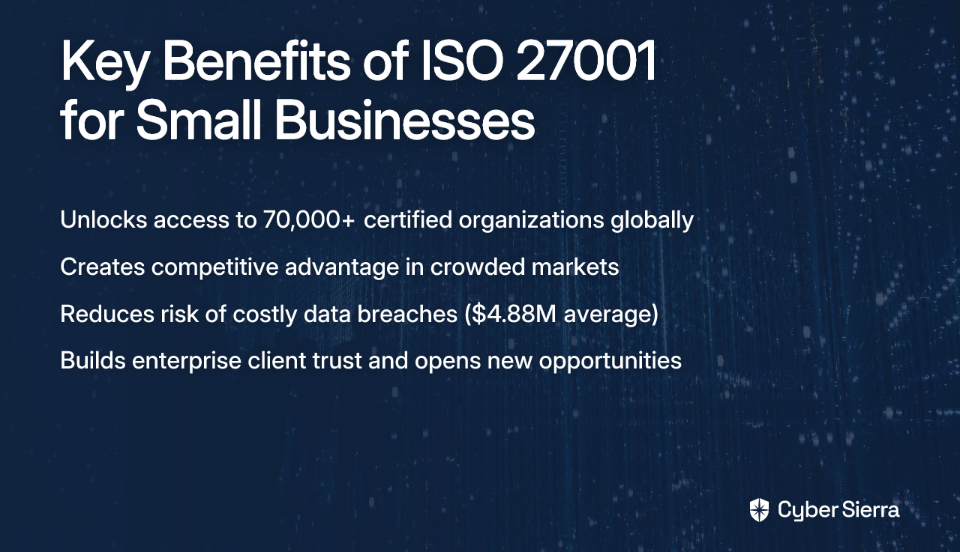
  • Unlocking New Business: Over 70,000 ISO 27001 certificates have been issued globally across 150 countries, highlighting its importance for businesses wanting to compete in regulated industries or government contracts.
  • Competitive Edge: In crowded markets, certification demonstrates your commitment to information security, setting you apart from non-certified competitors.
  • Risk Reduction: The average cost of a data breach in 2024 is $4.88 million according to IBM's latest report. ISO 27001 implementation significantly reduces your risk exposure.
  • Customer Trust: For B2B companies, especially in SaaS, certification often transforms from a nice-to-have into a non-negotiable requirement for enterprise clients.

The Full Spectrum of ISO 27001 Costs: A Detailed Breakdown

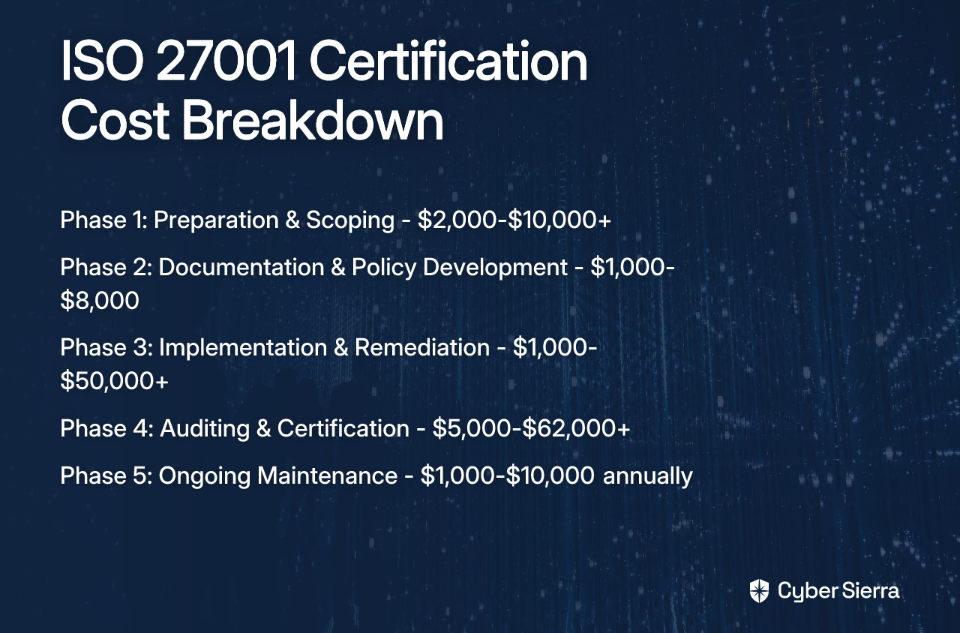
The total first-year investment for ISO 27001 certification typically ranges from $10,000 to $50,000 for small businesses, with some complex scenarios pushing costs up to $100,000. Let's break this down into phases to understand where your money goes:

Phase 1: Preparation & Scoping Costs ($2,000 - $10,000+)

  • Purchasing the Standards: Your first tangible expense is buying the ISO standards documents themselves: $125 for ISO 27001 and $225 for ISO 27002.
  • Gap Analysis: This foundational assessment reveals how far your current practices are from ISO 27001 requirements. Outsourcing this can cost $5,000-$8,000, though automation tools can significantly reduce this expense.
  • Staff Training: Security awareness training is mandatory for ISO 27001 compliance, costing between $1,000-$5,000 depending on your team size and training approach.

Phase 2: Documentation & Policy Development ($1,000 - $8,000)

This phase involves formally documenting your Information Security Management System (ISMS), including crucial policies like access control, incident response, and vendor management.

The documentation phase is notoriously time-consuming, taking 1-4 months when done manually. Your costs here stem from either:

  • Hiring consultants (expensive but expert-guided)
  • Purchasing templates (cheaper but requires customization)
  • Using automation tools (initial investment that pays dividends)

The key deliverable is your Statement of Applicability (SoA), which outlines which of the 114 ISO 27001 controls apply to your business.

Phase 3: Implementation & Remediation ($1,000 - $50,000+)

This is where you fix the gaps identified in Phase 1 and put your policies into practice. Costs vary dramatically based on your current security posture:

  • New Security Tools: You may need to invest in endpoint protection, vulnerability scanners, and other security tools, potentially costing $10,000+.
  • Penetration Testing: Testing your security controls can cost between $2,000-$8,000 for simpler environments, or up to $50,000 for complex infrastructures.
  • Consulting Fees: Expert guidance runs $1,500-$2,500 per day if you lack in-house expertise.

Phase 4: Auditing & Certification ($5,000 - $62,000+)

  • Internal Audit: This mandatory "dress rehearsal" before the official audit costs $1,000-$6,000 if outsourced, though savvy SMBs can potentially handle this internally to save costs.
  • Certification Audit: The official two-stage audit process by an accredited certification body:
    • Stage 1: Documentation review (approximately 4 weeks)
    • Stage 2: Validation of controls in practice (approximately 2 months)

Total certification audit costs range from $4,000-$12,000 for small businesses, though some quotes reach $50,000 depending on your company's complexity and the auditor chosen.

Phase 5: Ongoing Maintenance & Surveillance ($1,000 - $10,000 annually)

ISO 27001 certification isn't a one-time achievement. It requires:

  • Annual Surveillance Audits: Required in years 1 and 2 after certification, costing $1,000-$4,000 annually (some quotes reach $7,500 each).
  • Recertification: A full audit required every three years, similar in cost to the initial certification audit.

Key Factors That Influence Your Final Bill

Several factors can push your costs toward either end of the spectrum:

  • Company Size & Complexity: More employees, locations, and complex IT infrastructure increase audit time and cost.
  • Scope of the ISMS: The number of systems, processes, and vendors in scope directly impacts the amount of work.
  • Internal Expertise: Lack of in-house compliance experience increases reliance on consultants.
  • Choice of Auditing Body: Rates vary significantly between certification bodies, as evidenced by one SMB receiving a quote for "£4509 for the first year with £1279 for each subsequent year," while another was quoted over £6,000.

Don't Pay Enterprise Prices: How SMBs Can Slash ISO 27001 Costs

  1. Leverage a GRC Automation Platform Cyber Sierra's GRC platform dramatically reduces ISO 27001 costs through:
    • 60% reduction in documentation time using pre-built policy templates and automated workflows
    • Automated evidence collection that connects to your tech stack to gather proof automatically, saving hundreds of manual hours
    • Simplified audits with a single source of truth for auditors, making the process faster and less stressful
    Research shows that 85% of companies using automation unlock annual cost savings, and 95% save resources for compliance maintenance.
  2. Conduct the Internal Audit In-House As one ISO 27001 practitioner advised: "I would not recommend getting a third party to do the internal audit as it's not super complex to do internally provided you assess your ISMS as an auditor would." This approach saves $1,000-$6,000 in outsourcing costs.
  3. Scope Smarter, Not Bigger Start with a well-defined, smaller scope (a single product or department) to make initial certification more manageable and less expensive. You can expand later once certified.
  4. Shop Around for Auditors Get quotes from multiple accredited certification bodies – prices vary dramatically. The "traditional audit model is broken for small companies" where "you're paying enterprise prices for enterprise complexity when your risk profile is completely different."
  5. Utilize a Virtual CISO (vCISO) Rather than hiring expensive full-time security leadership or consultants, a vCISO provides expert guidance on-demand at a fraction of the cost.

From Enterprise Hurdle to SMB Advantage: Your Path to Affordable Certification

ISO 27001 certification doesn't have to be the financial barrier that prices small businesses out of lucrative opportunities. While the costs are significant, they're an investment in trust, security, and growth – and with the right approach, they're manageable even for smaller organizations.

The perception that "these things don't scale great price-wise" for SMBs is changing. Modern automation platforms like Cyber Sierra are leveling the playing field, making enterprise-grade security frameworks accessible to businesses of all sizes.

Instead of viewing certification as just another expense, see it as your competitive advantage in a market where security credentials increasingly determine which businesses win contracts and which get left behind.

Frequently Asked Questions

What is the average cost of ISO 27001 certification for a small business?

For a small business, the total first-year cost for ISO 27001 certification typically ranges from $10,000 to $50,000. This investment covers all phases, including preparation, documentation, implementation of security controls, and the official audit. Your final cost within this range will depend on factors like your company's size, the complexity of its IT environment, and the level of internal expertise you have.

Why is ISO 27001 certification so expensive?

ISO 27001 certification is expensive because it requires a comprehensive overhaul and verification of your entire information security program. The costs add up across several stages: purchasing the standards, conducting a gap analysis, developing extensive documentation, implementing new security tools, training staff, and paying for the mandatory multi-stage external audit from an accredited body.

How can a small business reduce the cost of ISO 27001 certification?

Small businesses can significantly reduce ISO 27001 costs by using a GRC automation platform, conducting internal audits in-house, starting with a smaller, well-defined certification scope, and comparing quotes from multiple auditors. Automation tools like Cyber Sierra can cut documentation time by up to 60%, while carefully scoping the project to a single product or department makes the initial process more manageable and affordable.

How long does it take to get ISO 27001 certified?

The timeline for achieving ISO 27001 certification typically ranges from 3 to 12 months. This duration depends heavily on your organization's current security maturity, size, and available resources. The process includes a documentation phase (1-4 months), implementation, and a final two-stage certification audit which can take about three months to complete.

Is ISO 27001 certification a one-time cost?

No, ISO 27001 certification is not a one-time cost. After your initial certification, you are required to undergo annual surveillance audits for the first two years to maintain your certificate, which cost $1,000-$4,000 each. Every three years, you must complete a full recertification audit, with costs similar to your initial certification, to ensure your security practices remain compliant.

Can my business get ISO 27001 certified without a consultant?

Yes, it is possible for a business to get ISO 27001 certified without hiring an expensive external consultant. By leveraging modern GRC automation platforms that provide policy templates and guided workflows, you can manage much of the process internally. This approach, combined with conducting your own internal audit and using a more affordable Virtual CISO (vCISO) for targeted expert advice, can make certification achievable without the high cost of a full-time consultant.

Feeling overwhelmed by the cost and complexity of ISO 27001? You don't have to navigate it alone. Contact Cyber Sierra today to see how our automation platform can make your ISO 27001 certification journey faster, simpler, and more affordable for your small business.

blog-hero-background-image
Cyber Security

7 AI Cybersecurity Agents That Automate Compliance Monitoring

backdrop
Table of Contents

Join thousands of professionals and get the latest insight on Compliance & Cybersecurity.


Summary

  • Traditional point-in-time compliance is inefficient and quickly becomes outdated, with 69% of businesses now viewing AI as essential for cybersecurity.
  • AI-powered agents transform compliance into a continuous, automated process by constantly monitoring security controls and detecting gaps in real-time.
  • To prepare for the future of compliance, organizations should leverage AI tools to automate manual evidence gathering, control testing, and audit preparation.
  • For a holistic approach, Cyber Sierra's Continuous Control Monitoring (CCM) automates security controls to keep your organization secure and audit-ready.

Is your security team buried under endless spreadsheets for audit prep? Are you drowning in manual evidence gathering and resource-draining risk assessments? You're not alone. As regulatory demands grow increasingly complex, traditional point-in-time compliance methods are no longer sufficient—they're error-prone, time-consuming, and provide snapshots that become outdated almost immediately.

Enter AI-powered cybersecurity agents: the game-changers transforming compliance from a periodic burden into a continuous, automated process. According to a Deloitte report, 69% of businesses now consider AI essential for enhancing cybersecurity. With the Global AI Market projected to grow at a CAGR of 36.6% by 2030 (Grand View Research), the shift toward AI-driven compliance solutions is accelerating rapidly.

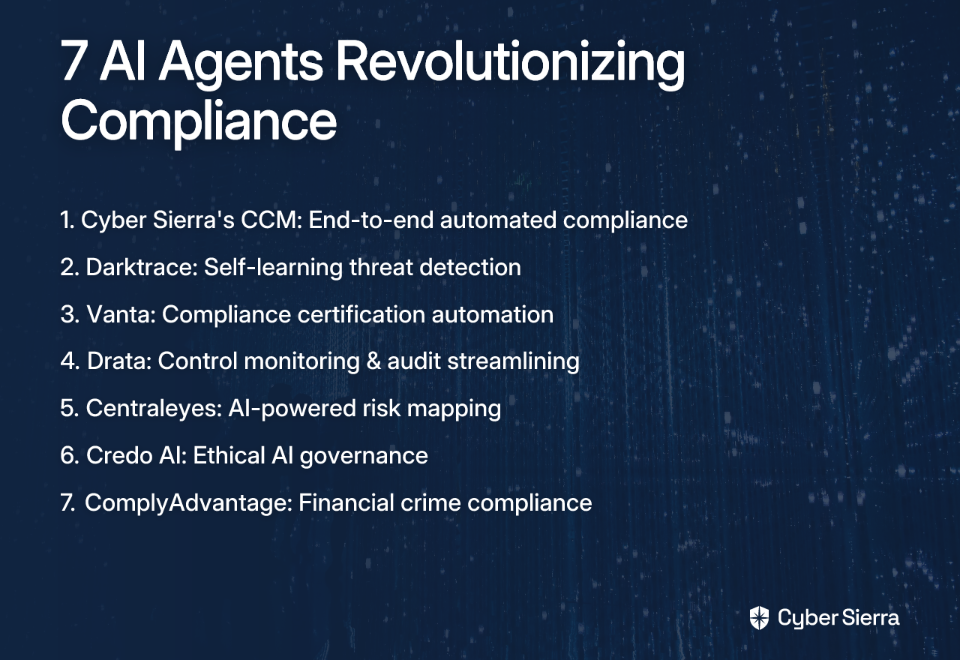
Let's explore seven AI agents that are revolutionizing compliance monitoring by eliminating manual toil and providing real-time visibility into your security posture.

1. Cyber Sierra's Continuous Control Monitoring (CCM)

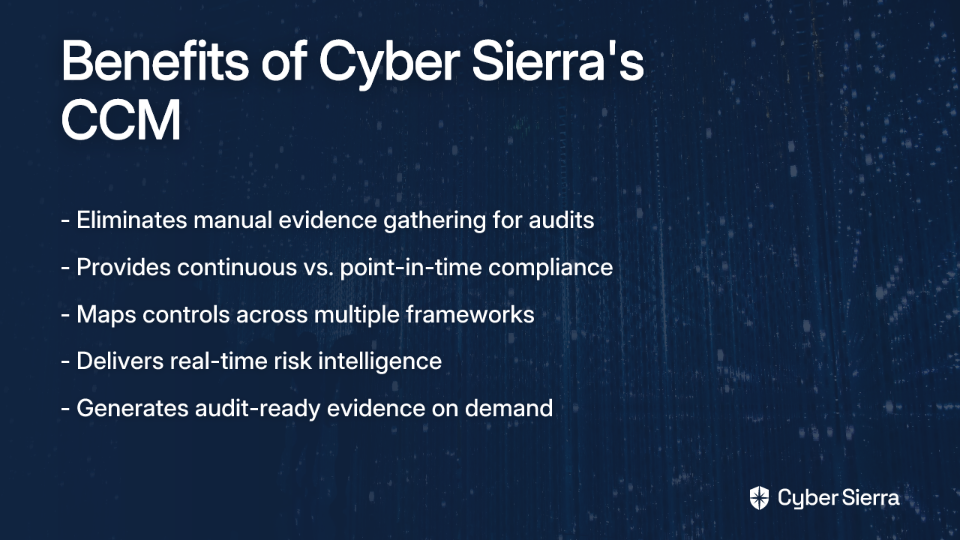
Cyber Sierra offers a comprehensive, AI-enabled cybersecurity platform designed to automate security compliance from end to end. Its Continuous Control Monitoring (CCM) module serves as a single source of truth, transforming compliance from a periodic burden into a continuous, proactive process.

How It Works & Key Features:

  • Centralized Control Repository: Builds a unified repository for all security controls, mapping them across multiple frameworks to eliminate redundant work
  • Near Real-Time Updates: Continuously pulls data from your tech stack (cloud, network, applications) to validate control effectiveness automatically
  • Actionable Risk Intelligence: The AI engine analyzes control data to detect anomalies, exceptions, and compliance gaps in real-time, providing prioritized, data-driven recommendations for remediation
  • Automated Control Testing: Instead of manual checks, the platform automates the testing and validation of controls, generating audit-ready evidence on demand

Compliance Frameworks Supported:

NIST, ISO 27001, PCI DSS, GDPR, SOC 2, HIPAA, and custom internal frameworks

Automation Capabilities:

  • Automates evidence gathering for audits, drastically reducing audit prep time
  • Provides continuous compliance reporting through dynamic dashboards
  • Automates risk assessments by linking control failures directly to business risks
  • Integrates with Cyber Sierra's other modules like GRC, TPRM, and Threat Intelligence for a holistic view of the organization's security posture

Learn more about Cyber Sierra's CCM

2. Darktrace

Darktrace leverages self-learning AI to understand the "normal" behavior of a network. While primarily a threat detection and response tool, its capabilities are crucial for maintaining compliance with frameworks that mandate continuous monitoring and incident response.

How It Works & Key Features:

  • Self-Learning AI: Models the behavior of every user, device, and connection in the network to spot subtle deviations that indicate a threat
  • Autonomous Response: Can automatically take action to neutralize threats in real-time, preventing them from escalating into major breaches
  • Anomaly Detection: Detects unusual internal and external network activity, which is vital for compliance frameworks like GDPR and NIST

Compliance Frameworks Supported:

GDPR, NIST, and other frameworks requiring real-time threat detection and incident response capabilities

Automation Capabilities:

  • Automates threat detection and response, providing evidence of a robust security monitoring program
  • Generates detailed reports on network anomalies and security incidents for compliance reporting

3. Vanta

Vanta is a popular compliance automation platform that helps companies, particularly startups and SaaS businesses, achieve and maintain compliance certifications like SOC 2 and ISO 27001.

How It Works & Key Features:

  • Continuous Monitoring: Integrates with a company's cloud services, code repositories, and HR systems to continuously monitor for compliance gaps
  • Automated Evidence Collection: Scans connected systems to automatically gather the evidence required for audits
  • Pre-built Policies & Templates: Provides a library of security policies and templates to help companies quickly establish a compliant security program

Compliance Frameworks Supported:

SOC 2, ISO 27001, HIPAA, PCI DSS, GDPR

Automation Capabilities:

  • Automates over 90% of the evidence collection needed for SOC 2 and other frameworks
  • Provides real-time alerts for potential compliance issues
  • Streamlines audit prep by organizing all evidence in an audit-ready format

Learn more about Vanta

4. Drata

Similar to Vanta, Drata is a security and compliance automation platform that focuses on continuous monitoring and making the audit process seamless.

How It Works & Key Features:

  • Seamless Integrations: Connects with hundreds of applications and infrastructure providers to automate evidence collection
  • Control Mapping: Maps controls across multiple frameworks, so evidence collected for one standard can be reused for another
  • Audit Hub: Provides a central location for auditors to access all necessary documentation and evidence, streamlining the audit process

Compliance Frameworks Supported:

SOC 2, ISO 27001, PCI DSS, HIPAA, GDPR

Automation Capabilities:

  • Continuous, automated control monitoring across the tech stack
  • Automated alerts for misconfigurations or compliance failures
  • Generates audit-ready documentation and reports

Learn more about Drata

5. Centraleyes

Centraleyes is an AI-powered risk management platform that automates and streamlines Governance, Risk, and Compliance (GRC) processes. It focuses on mapping risks to controls automatically.

How It Works & Key Features:

  • AI-Powered Risk Register: Automatically maps identified risks to the relevant controls within designated frameworks, saving hours of manual research
  • Automated Cross-Mapping: Intelligently cross-maps requirements across multiple frameworks, simplifying compliance for organizations that must adhere to several standards
  • Dashboards & Reporting: Generates audit-ready reports and dashboards for a clear view of the organization's risk profile

Compliance Frameworks Supported:

Supports a wide range of regulatory frameworks by automating the mapping process

Automation Capabilities:

  • Automates the creation and management of the risk register
  • Streamlines risk assessments and control mapping
  • Automates the generation of compliance reporting materials

Learn more about Centraleyes

6. Credo AI

Credo AI is an AI governance platform specifically designed to ensure that AI systems are developed and used in a responsible, compliant, and ethical manner. This is critical for organizations leveraging LLMs and other AI, addressing concerns about using AI in a compliant way.

How It Works & Key Features:

  • Policy Alignment: Provides tools to align AI development with internal policies and emerging regulations like the EU AI Act
  • Model Documentation: Automates the creation of detailed documentation and evidence for AI models, proving their fairness, transparency, and compliance
  • Centralized Oversight: Offers a single platform for overseeing all AI projects within an organization, ensuring governance standards are met

Compliance Frameworks Supported:

Focuses on emerging AI regulations (e.g., EU AI Act), NIST AI Risk Management Framework, and responsible AI principles

Automation Capabilities:

  • Automates the assessment and documentation of AI model compliance
  • Helps organizations generate the necessary evidence to demonstrate responsible AI use to auditors and regulators

7. ComplyAdvantage

ComplyAdvantage is a specialized AI agent focused on financial crime risk and compliance. It is an excellent example of a niche AI tool that automates a highly regulated area.

How It Works & Key Features:

  • Real-time Data: Uses AI to analyze and monitor millions of data points in real-time for sanctions, watchlists, politically exposed persons (PEPs), and adverse media
  • Transaction Monitoring: AI algorithms detect suspicious transaction patterns to help organizations comply with Anti-Money Laundering (AML) regulations
  • Automated Screening: Automates customer and payment screening to reduce false positives and manual review workloads

Compliance Frameworks Supported:

AML, KYC (Know Your Customer), CTF (Counter-Terrorist Financing), and other financial crime regulations

Automation Capabilities:

  • Automates customer onboarding and continuous screening
  • Flags suspicious financial activities for investigation automatically
  • Reduces the manual burden on financial compliance officers

The Future Is Automated: Redefining Compliance with AI

The days of manual, checklist-based compliance are numbered. AI is not just an enhancement; it's a fundamental necessity for navigating the modern regulatory environment. These agents prove that the future of compliance lies in continuous, intelligent automation.

By leveraging AI, organizations can move beyond simply "passing the audit." They can build resilient security programs, gain real-time visibility into their risk posture, reduce human error, and free up their valuable security talent to focus on strategic initiatives rather than tedious evidence gathering.

While specialized tools excel in specific areas, a comprehensive platform like Cyber Sierra integrates Continuous Control Monitoring, GRC, and Third-party risk management to provide a unified, AI-driven solution that makes enterprises audit-ready, secure, and resilient.

Ready to Transform Your Compliance Program?

Tired of drowning in spreadsheets and manual evidence collection? Contact Cyber Sierra today for a personalized demonstration of our AI-powered platform and discover how you can free your team from compliance overload while strengthening your security posture.

Frequently Asked Questions

What are AI agents for cybersecurity compliance?

AI agents for cybersecurity compliance are software tools that use artificial intelligence to automate the monitoring, testing, and documentation of security controls required by regulations like SOC 2, ISO 27001, and GDPR. They continuously pull data from your tech stack (cloud, applications, etc.) to validate that your security measures are working correctly, eliminating the need for manual, periodic checks and spreadsheet-based evidence gathering. This transforms compliance from a point-in-time audit into a real-time, ongoing process.

How does AI automation improve the audit process?

AI automation significantly improves the audit process by automatically gathering, organizing, and presenting the required evidence in an audit-ready format. Instead of security teams spending weeks or months manually collecting screenshots and logs, AI agents do this continuously in the background. This drastically reduces audit preparation time, minimizes human error, and provides auditors with a centralized, trustworthy source of information, leading to smoother and faster audits.

What is Continuous Control Monitoring (CCM)?

Continuous Control Monitoring (CCM) is an automated approach that continuously tests and validates the effectiveness of an organization's security controls in near real-time. Unlike traditional audits that check controls at a single point in time, CCM platforms like Cyber Sierra integrate with your systems to ensure controls are always functioning as intended. If a control fails (e.g., a misconfigured cloud server), the system generates an immediate alert, allowing for proactive remediation long before an auditor would discover it.

Why is continuous compliance more effective than traditional point-in-time audits?

Continuous compliance is more effective because it provides a real-time, accurate view of your security posture, whereas point-in-time audits offer only a temporary snapshot that quickly becomes outdated. Security environments are dynamic; a system that is compliant today might be vulnerable tomorrow due to a simple misconfiguration. Continuous compliance detects these gaps as they happen, enabling immediate action and ensuring the organization remains secure between audit cycles, not just during them.

How do I choose the right AI compliance tool for my business?

Choosing the right AI compliance tool depends on your specific needs, the complexity of your environment, and the frameworks you need to comply with. Start by identifying your primary pain points. Are you focused on a specific framework like SOC 2 (where Vanta or Drata might fit), or do you need a comprehensive platform that integrates GRC, risk management, and CCM across multiple frameworks (like Cyber Sierra)? Consider tools that offer broad integrations with your existing tech stack and can scale as your compliance needs grow.

Are AI compliance agents only for large enterprises?

No, AI compliance agents are designed for businesses of all sizes, from startups to large enterprises. Many platforms specifically target startups and mid-sized companies to help them achieve certifications like SOC 2 and ISO 27001 efficiently. The automation they provide offers significant time and cost savings, making them valuable for teams with limited resources, while comprehensive solutions are scalable for large enterprises managing multiple complex regulatory frameworks.

blog-hero-background-image
Cyber Security

ISO 27001 Implementation Guide for Small Businesses Under 50 Employees

backdrop
Table of Contents

Join thousands of professionals and get the latest insight on Compliance & Cybersecurity.


Summary

  • ISO 27001 certification is achievable for small businesses in 4-6 months and helps prevent data breaches that can cost an average of $120,000 to $1.24 million.
  • For small businesses, ISO 27001 acts as a powerful sales tool, accelerating deals with enterprise clients by demonstrating a credible security posture from the start.
  • The key to a manageable certification process is a phased approach focusing on a clear scope, a practical risk assessment of your top 10-15 risks, and simplified documentation.
  • Automation platforms can significantly reduce the manual effort and cost of compliance. Cyber Sierra's GRC module helps small businesses automate evidence collection and manage controls to become audit-ready faster.

You've been tasked with securing ISO 27001 certification for your small business, but you're staring at a mountain of documentation requirements, complex security controls, and implementation guides clearly written for enterprises with dedicated compliance teams. The standard feels overwhelming, especially when you have no prior information security management experience and limited resources.

"This is going to be a time-consuming nightmare," you think, scrolling through yet another template that seems designed for companies ten times your size.

But here's the truth: ISO 27001 certification is achievable for small businesses—even those with under 50 employees—without breaking the bank or drowning in paperwork. With the right approach and modern tools, you can transform this seemingly daunting process into a manageable, cost-effective journey that actually strengthens your business.

Why ISO 27001 is a Game-Changer, Not Just a Burden, for Your Small Business

Before diving into implementation, let's address the elephant in the room: Is ISO 27001 truly worth it for a small business? The answer is a resounding yes, and here's why:

Close More Deals and Open New Doors

When selling to enterprise clients or expanding into regulated markets, ISO 27001 certification instantly demonstrates your security credibility. Instead of completing endless security questionnaires for each potential client, your certification serves as pre-validation of your security practices, accelerating your sales cycle.

As one small business owner shared on Reddit, "After certification, we stopped losing deals because of security concerns. Enterprise clients who previously wouldn't consider us now saw us as a legitimate option."

Guard Against Costly Data Breaches

For small businesses, a single data breach can be catastrophic. The average cost of a data breach for small businesses ranges from $120,000 to $1.24 million—enough to force many to close their doors permanently. ISO 27001's structured approach to identifying and mitigating risks dramatically reduces your vulnerability.

Gain a Competitive Edge

With ISO 27001 certifications increasing by approximately 20% each year, the standard is rapidly becoming a market differentiator. While your competitors are still trying to convince clients about their security practices, your certification provides immediate validation.

Improve Organizational Clarity

For many small businesses, information security responsibilities are vague and scattered. ISO 27001 forces you to establish clear accountability and roles, transforming security from "something IT handles" into a structured business function with defined processes.

Your Phased ISO 27001 Roadmap: A 4-6 Month Plan for Small Teams

Contrary to common belief, small businesses can become audit-ready in about four to six months. Here's a practical roadmap broken down into manageable phases:

Phase 1: Scoping & Leadership Buy-In (Months 1-2)

Step 1: Get Management on Your Side Leadership commitment isn't just a checkbox—it's a core requirement of the standard. Your management team needs to:

  • Define information security objectives aligned with business goals
  • Allocate necessary resources (time and budget)
  • Communicate the importance of the ISMS to the organization

Step 2: Define the Scope of the ISMS (Clause 4.3) Many small businesses stumble here, unsure how to properly define their scope. For a business under 50 employees, your scope can be defined by:

  • IT systems that process sensitive information
  • Users (employees and contractors) and their roles
  • System administrators with privileged access
  • External user access (clients, vendors)
  • Physical locations where data is processed or stored
  • Existing company policies and procedures

Pro tip: Keep your initial scope focused on the most critical systems and data. You can always expand it later.

Step 3: Conduct a Gap Analysis Don't start from scratch. Assess your current security practices against ISO 27001 requirements to understand where the gaps are. This prevents redundant work and helps you prioritize efforts.

Phase 2: Risk Management & Control Implementation (Months 2-4)

Step 4: Conduct a Risk Assessment & Treatment (Clauses 6.1.2, 8.2) This is the core of ISO 27001:

  • Create an asset register (a list of your valuable information assets)
  • Identify threats and vulnerabilities for each asset
  • Analyze and evaluate the risks
  • Define a risk treatment plan (how you'll mitigate the identified risks)

For small businesses, focus on identifying the top 10-15 risks that could significantly impact your operations and address those first.

Step 5: Develop the Statement of Applicability (SoA) (Clause 6.1.3 d) This critical document links your risk assessment to the 93 security controls listed in Annex A of the standard:

  • For each control, state whether it's applicable to your business
  • If applicable, document how it's implemented
  • If not applicable, justify why it's excluded

Step 6: Implement Controls & Train Employees Put your risk treatment plan into action:

  • Implement the chosen security controls from your SoA
  • Develop and document security policies and procedures
  • Deliver cybersecurity awareness training for all employees

This is where Cyber Sierra's Continuous Control Monitoring (CCM) module can dramatically simplify your work by automating the implementation and monitoring of many technical controls, reducing manual effort by up to 60%.

Phase 3: Monitoring, Auditing & Certification (Months 5-6)

Step 7: Monitor & Measure ISMS Performance (Clause 9.1) Establish metrics to track the effectiveness of your controls. For small businesses, focus on:

  • Security incidents and their resolution times
  • Effectiveness of security awareness training
  • Compliance with key policies and procedures

Step 8: Conduct an Internal Audit (Clause 9.2) Before the external auditor arrives, perform an internal review to identify and fix any issues:

  • Verify that controls are operating as intended
  • Check documentation for completeness and accuracy
  • Identify and address nonconformities

Step 9: Hold a Management Review (Clause 9.3) Leadership must review the ISMS performance, including:

  • Results of the internal audit
  • Status of actions from previous reviews
  • Changes that could affect the ISMS
  • Opportunities for improvement

Step 10: The Certification Audit This is a two-stage process:

  • Stage 1 Audit: The auditor reviews your documentation
  • Stage 2 Audit: The auditor checks if your controls and processes are actually implemented and effective

Taming the Paper Tiger: A Simplified Guide to ISO 27001 Documentation

The documentation requirements of ISO 27001 often appear overwhelming, especially for small teams. As one Reddit user lamented, "The process is by no means 'efficient' and will require a good amount of documentation."

While documentation is necessary, it doesn't have to be a bureaucratic nightmare. For small businesses, focus on creating concise, clear, and useful documents—not voluminous manuals that nobody reads.

Mandatory Documents for ISO 27001

The standard requires these key documents:

  • Scope of the ISMS (Clause 4.3): A 1-2 page document defining what's included in your ISMS
  • Information security policy (Clause 5.2): Your high-level security principles and commitments
  • Risk assessment and treatment processes (Clauses 6.1.2, 6.1.3): How you identify and address risks
  • Statement of Applicability (Clause 6.1.3 d): Which controls you've implemented and why
  • Information security objectives (Clause 6.2): Specific, measurable security goals
  • Evidence of competence (Clause 7.2): Training records and skills assessments
  • Operational planning and control documents (Clause 8.1): Procedures for key security processes
  • Results of monitoring and measurement (Clause 9.1): Metrics and their analysis
  • Internal audit program (Clause 9.2): Audit plans, findings, and corrective actions
  • Results of management reviews (Clause 9.3): Meeting minutes and decisions
  • Evidence of nonconformities and corrective actions (Clause 10.2): Issue tracking and resolution

(Source)

Documentation Tips for Small Businesses

  1. Use templates wisely: Start with templates but customize them to your actual practices—don't just fill in the blanks.
  2. Keep it simple: A 2-page policy that's followed is better than a 20-page document that collects dust.
  3. Leverage existing materials: Many small businesses already have elements of what's needed (employee handbooks, IT procedures, etc.).
  4. Focus on usability: Write documentation that helps employees do their jobs securely, not just to satisfy an auditor.

The Smart SMB's Toolkit: How Automation Makes ISO 27001 Achievable

The traditional approach to ISO 27001 implementation involves spreadsheets, endless meetings, and manual evidence collection—a process that can easily cost over $50,000 for even a small business. But modern automation tools have changed the game completely.

Manual vs. Automated Approach

Manual Approach:

  • Spreadsheets to track risks, controls, and evidence
  • Manual collection of evidence from various systems
  • Point-in-time assessments that quickly become outdated
  • Labor-intensive audit preparation

Automated Approach:

  • Centralized platform for managing all aspects of the ISMS
  • Automated evidence collection from connected systems
  • Continuous monitoring of control effectiveness
  • Always audit-ready with up-to-date evidence

How Cyber Sierra Transforms ISO 27001 Implementation

Cyber Sierra's platform provides small businesses with enterprise-grade compliance capabilities at a fraction of the cost. Here's how it specifically addresses the challenges of ISO 27001 implementation:

1. Automated Evidence Collection Cyber Sierra's Continuous Control Monitoring (CCM) module connects to your cloud services, HR systems, and security tools to automatically gather evidence, reducing the manual effort of preparing for an audit by up to 70%. This addresses one of the biggest pain points reported by small businesses—the time-consuming nature of documentation and evidence gathering.

2. Centralized ISMS Management The Governance, Risk & Compliance (GRC) module provides a single source of truth for all your policies, risk assessments, controls, and audit trails. This eliminates scattered documents and ensures you're always audit-ready.

3. Simplified Control Management Instead of trying to interpret how each of the 93 Annex A controls applies to your business, Cyber Sierra provides clear guidance and helps you manage controls across multiple frameworks—essential as your business grows and faces additional compliance requirements.

4. Real-Time Risk Intelligence Rather than guessing if a control is working, the platform delivers near real-time updates and actionable risk intelligence, helping you fix gaps before they become breaches or audit findings.

5. Cost Reduction By automating much of the manual work and providing expert guidance, Cyber Sierra can reduce the typical implementation cost by up to 40%—a significant saving for small businesses with limited budgets.

From Compliance Hurdle to Business Catalyst

ISO 27001 doesn't have to be the bureaucratic burden many small businesses fear. With a phased approach, simplified documentation, and the right automation tools, certification is achievable within 4-6 months and at a reasonable cost.

More importantly, a well-implemented ISMS becomes a business enabler—opening doors to new markets, streamlining client onboarding, and providing peace of mind that your information assets are properly protected.

The key is to view ISO 27001 not as a checkbox exercise but as a framework for building security into the fabric of your growing business. By leveraging platforms like Cyber Sierra, small businesses can achieve ISO 27001 certification efficiently and affordably, turning a complex compliance standard into a powerful tool for growth and security.

Ready to Simplify Your Security Journey?

Don't let limited resources keep you from achieving world-class security standards. Contact Cyber Sierra today to see how our platform can get your small business ISO 27001 certified with less effort, lower costs, and better security outcomes. Our experts understand the unique challenges faced by businesses under 50 employees and can guide you through each step of the process.

Request a demo at Cyber Sierra to see how we're helping small businesses achieve big security wins.

blog-hero-background-image
Cyber Security

7 Energy Sector Cybersecurity Solutions for Operational Technology Protection

backdrop
Table of Contents

Join thousands of professionals and get the latest insight on Compliance & Cybersecurity.


Summary

  • Operational downtime in the energy sector can cost thousands per hour, yet many organizations still rely on the outdated and dangerous myth of "air-gapped" security for their operational technology (OT).
  • Protecting critical infrastructure requires a shift from reactive IT-centric security to a proactive OT-focused strategy that prioritizes system availability and safety through solutions like network segmentation and continuous monitoring.
  • Essential actions include implementing comprehensive asset management for legacy systems, developing an OT-specific incident response plan, and securing the supply chain with third-party risk management.
  • Cybersierra's Continuous Control Monitoring (CCM) platform helps bridge the IT/OT gap by providing a unified, real-time view of your security controls to automate monitoring and streamline compliance.

In the energy sector, a single hour of operational downtime can cost organizations thousands of dollars. Yet many still cling to the dangerous notion that their operational technology (OT) systems are secure because they're "not even on the network." This outdated thinking creates significant vulnerabilities in critical infrastructure that powers our modern world.

As the lines between Information Technology (IT) and Operational Technology continue to blur, energy companies face unprecedented cybersecurity challenges. The transition from isolated "air-gapped" systems to interconnected smart grids has created new attack vectors that require specialized protection strategies.

In this high-stakes environment, traditional security approaches fall short. Poor cybersecurity in energy OT can lead to data corruption, financial damage, equipment failure, service disruption, and even potential loss of life. The stakes couldn't be higher.

This article outlines seven essential cybersecurity solutions that energy organizations can implement to build a robust defense for their critical infrastructure, moving from reactive fixes to proactive protection.

7 Essential Cybersecurity Solutions for Energy OT

1. Implement Continuous Control Monitoring (CCM) for Real-Time Visibility

In OT environments, system availability is paramount. Unlike IT systems where confidentiality often takes precedence, the CIA triad (Confidentiality, Integrity, Availability) is flipped for operational technology—making continuous visibility into system status critical.

Cyber Sierra's Continuous Control Monitoring (CCM) platform transforms security from periodic, manual checks to proactive, automated monitoring. This approach is particularly valuable for energy OT systems that require 24/7 availability.

Key features include:

  • Central Controls Repository: Creates a single source of truth for all security controls with near real-time updates
  • Proactive Risk Detection: Identifies exceptions and anomalies in real-time before they can be exploited
  • Streamlined Compliance: Automates control testing and evidence gathering for frameworks like NIST, ISO 27001, and NERC CIP

For energy organizations looking to implement CCM, consider these steps:

  1. Define critical OT controls to monitor, focusing on processes related to system access, network traffic, and configurations
  2. Automate data collection from PLCs, SCADA systems, and other ICS components
  3. Establish rules to test control performance against baselines
  4. Develop Key Risk Indicators (KRIs) to gauge control effectiveness

According to the Department of Energy, continuous monitoring is essential for moving from a reactive to proactive security posture in OT environments where availability is non-negotiable.

2. Enforce Robust Network Segmentation and Hardening

The idea that OT systems are secure because they're completely isolated is increasingly false. Modern operational requirements demand connectivity, making true air-gapping rare and often impractical.

Instead, implement robust network segmentation to contain potential breaches:

  • Firewalls: Configure firewalls to strictly control traffic between IT and OT zones
  • Demilitarized Zones (DMZs): Create buffer zones for servers that need access from both IT and OT networks
  • Access Control: Apply the principle of 'least privilege' to ensure users and systems only access resources necessary for their function

According to a Department of Energy report, proper network segmentation is a foundational element of OT security. Without it, threats that penetrate corporate networks can easily move laterally into critical control systems, potentially causing operational disruptions.

Many Reddit users in the cybersecurity community have highlighted how organizations still rely on imaginary air gaps, with one noting: "Organizations do not care about OT. 'It still works and it's not even on the network'" — a dangerous misconception in today's interconnected infrastructure.

3. Establish Comprehensive Asset and Patch Management

You can't protect what you don't know you have. OT environments are plagued by outdated technologies and legacy systems that can't be easily patched or updated, creating significant security challenges.

Key components of effective OT asset and patch management include:

  • Complete Asset Inventory: Maintain a comprehensive inventory of all OT devices, including hardware, software, and firmware versions
  • Risk-Based Patching: Since patching can disrupt operations, prioritize critical vulnerabilities and use compensating controls when immediate patching isn't possible
  • Vulnerability Management: Implement a structured process to identify, assess, and remediate vulnerabilities in your OT environment

Many industrial control systems run on decades-old technology designed without security in mind. These systems may lack even basic password protection, as one cybersecurity professional noted: "Some environments, such as nuclear reactors, won't even have a password on critical control systems."

For these legacy systems, compensating controls like enhanced monitoring, strict access limitations, and network isolation become even more critical when patches cannot be applied.

4. Leverage Proactive Threat Intelligence

Rather than waiting for an attack, use threat intelligence to understand your attack surface and identify weaknesses proactively. This shift from reactive to proactive security is essential for protecting critical infrastructure.

Cyber Sierra's Threat Intelligence platform offers an "outside-in" view of your security posture:

  • Provides a comprehensive security scorecard for visibility into your organization's attack surface
  • Conducts network and cloud vulnerability scanning to identify potential entry points
  • Helps security teams prioritize remediation efforts before vulnerabilities are exploited

The NIST Guidelines for Smart Grid Cybersecurity emphasize that as electric grids transition from closed systems to interconnected networks, security requirements must evolve to address new and emerging threats. Proactive threat intelligence is a key component of this evolution.

5. Secure the Supply Chain with Third-Party Risk Management (TPRM)

Adversaries can sabotage the supply chain to undermine the integrity of OT systems. Vendors and contractors often have privileged access to critical systems for maintenance and support, creating significant risk vectors.

A formal Third-Party Risk Management program helps manage these risks by:

  • Evaluating vendor security practices before granting access to critical systems
  • Establishing cybersecurity requirements in vendor contracts
  • Continuously monitoring vendor compliance with security standards

Cyber Sierra's TPRM solution automates the vendor assessment process, replacing manual questionnaires with real-time monitoring that provides continuous visibility into vendor security posture.

This approach is particularly important for energy organizations that rely heavily on specialized vendors for equipment maintenance and software updates. The Colonial Pipeline attack demonstrated how a single compromised credential can lead to massive operational disruption and financial losses.

6. Develop an OT-Specific Incident Response Plan

Many organizations lack effective incident response protocols to manage OT system failures, leading to prolonged downtimes. When an incident occurs, every minute counts—especially when downtime costs can reach thousands of dollars per hour.

Key elements of an effective OT incident response plan include:

  • Clear procedures that prioritize safety and service restoration over data forensics
  • Defined roles and responsibilities for both IT and OT personnel
  • Communication protocols for internal teams, external experts, and regulatory bodies like CISA
  • Regular testing through tabletop exercises and simulations

The Department of Energy recommends having a "well-documented recovery plan" tailored to the physical consequences of an OT breach. Real-world examples underscore this necessity: a denial-of-service attack on a Finland building automation system caused heating outages, and a 2017 hack of wind turbines demonstrated how cyber attacks can have physical impacts.

When developing your plan, remember that OT incident response differs significantly from IT incident response—the focus must be on maintaining or restoring operational capability rather than preserving evidence.

7. Build a Human Firewall with Specialized Security Training

Technology solutions are only part of the equation. Many security breaches begin with human error, making employee education crucial. Research has highlighted significant knowledge gaps among OT professionals regarding networking for control systems and key industry standards like IEC 62443.

Cyber Sierra's Employee Security Training helps build a human firewall through:

  • Interactive training modules on phishing, password safety, and other threats specific to OT environments
  • Simulated phishing campaigns to test and reinforce learning
  • Specialized content for OT personnel that addresses the unique challenges of industrial control systems

By fostering a security-conscious culture, you turn employees into the first line of defense against cyber threats. This is particularly important in OT environments where specialized knowledge is required and the consequences of security lapses can be severe.

Fortifying the Grid: From Reactive Fixes to Proactive Defense

The convergence of IT and OT demands a departure from outdated security models. Protecting energy sector operational technology requires a holistic strategy that integrates continuous monitoring, robust network controls, proactive threat management, and a strong security culture.

Achieving a unified, real-time view across these disparate environments is perhaps the biggest challenge. Platforms like Cyber Sierra's Continuous Control Monitoring (CCM) are designed to bridge this gap, providing the actionable intelligence needed to manage risk across both IT and OT landscapes effectively.

The stakes couldn't be higher. As one industry professional noted, "One plant down for a day meant several thousands of k$ less for the company." In critical infrastructure, cybersecurity isn't just an IT issue—it's an operational imperative with direct impact on the bottom line and public safety.

Frequently Asked Questions

What is the main difference between IT and OT cybersecurity?

The primary difference lies in their priorities; IT security prioritizes confidentiality, while OT security prioritizes availability and safety to ensure continuous operations. The traditional CIA triad (Confidentiality, Integrity, Availability) is often flipped to AIC (Availability, Integrity, Confidentiality) in OT environments. An IT breach might lead to data loss, but an OT breach could cause equipment failure, service disruptions, or even physical harm.

Why is the concept of an "air-gapped" OT network no longer reliable?

The concept of a completely isolated "air-gapped" OT network is unreliable because modern operational needs often require connectivity between IT and OT systems for data exchange and remote monitoring. True air gaps are increasingly rare. Instead of relying on an assumed air gap, organizations should implement robust network segmentation and access controls to protect critical systems from lateral movement by threats.

How can energy companies secure legacy OT systems that cannot be patched?

Energy companies can secure unpatchable legacy systems by implementing compensating controls, such as network segmentation, strict access limitations, and continuous monitoring. Since patching is often not feasible due to operational risks, a risk-based approach is crucial. This involves isolating the legacy asset, monitoring all traffic to and from the device, and applying the principle of least privilege to limit potential attack vectors.

What is Continuous Control Monitoring (CCM) and why is it crucial for energy OT?

Continuous Control Monitoring (CCM) is an automated approach that provides real-time visibility into the effectiveness of security controls. It is crucial for energy OT where system availability is non-negotiable because it transforms security from a reactive to a proactive process. CCM helps detect anomalies and risks in real-time, ensuring the continuous and safe operation of critical infrastructure.

What should be the top priority in an OT incident response plan?

The top priorities in an OT incident response plan should be ensuring human safety and restoring operational service as quickly and safely as possible. This differs from IT incident response, where data preservation and forensics are often the main focus. In an OT environment, the primary goal is to contain the physical impact and maintain or restore control of industrial processes.

How does third-party risk management (TPRM) apply to OT security?

Third-party risk management (TPRM) is essential for OT security because vendors and contractors often have privileged access to critical control systems for maintenance and support. A robust TPRM program involves vetting the security practices of all third parties, embedding cybersecurity requirements into contracts, and continuously monitoring their access to secure the supply chain and prevent vulnerabilities from being introduced through trusted external partners.

Don't wait for a disruption to reveal your vulnerabilities. To build a resilient and proactive cybersecurity program for your operational technology, contact Cyber Sierra for a customized consultation that addresses your specific energy sector challenges.

blog-hero-background-image
Cyber Security

NIST CSF Scoring Across Industries: 5 Benchmark Standards for 2026

backdrop
Table of Contents

Join thousands of professionals and get the latest insight on Compliance & Cybersecurity.


Summary

  • Key Stats: By 2026, industries should target specific NIST CSF 2.0 maturity levels, such as Financial Services (80%+, Tier 3-4), Healthcare (75%+, Tier 3), and Technology (85%+, Tier 4).
  • Key Learnings: The new 'Govern' function in NIST CSF 2.0 elevates cybersecurity to a strategic, enterprise-level risk, requiring executive oversight and accountability.
  • Key Action Items: Use the CSF to create a "Current Profile" of your security posture and a "Target Profile" for your goals; this gap analysis will form your strategic improvement plan.
  • Automate Your GRC: Achieving these benchmarks requires moving from periodic checks to a continuous approach. Cybersierra's GRC platform automates evidence collection and provides industry-specific templates to track progress in near real-time.

If you've ever found yourself thinking, "I'm having a rough time finding benchmarking data by industry for Cybersecurity Maturity," you're not alone. This valuable data is often guarded as "intellectual property" by major consulting firms, making it nearly impossible for most organizations to access reliable benchmarks to measure themselves against.

The good news? The NIST Cybersecurity Framework (CSF) provides a common language and structure to solve this problem. With the release of NIST CSF 2.0 in February 2024, organizations of all sizes now have an expanded framework focused on better risk management and security posture improvement.

This article delivers five concrete benchmark standards for 2026 across financial services, healthcare, manufacturing, retail, and technology sectors. These benchmarks will help you "sanity check" your current security posture and plan strategically for the future.

Understanding NIST CSF 2.0: The Foundation for Benchmarking

Before diving into industry-specific benchmarks, let's establish a shared understanding of NIST CSF 2.0's key components:

Core Functions

The framework is organized around six core functions:

  1. Identify: Develop organizational understanding to manage cybersecurity risk
  2. Protect: Develop safeguards to ensure delivery of critical services
  3. Detect: Develop activities to identify cybersecurity events
  4. Respond: Develop activities to take action regarding a detected event
  5. Recover: Develop activities to restore capabilities impaired by a cybersecurity event
  6. Govern (new in 2.0): Elevates cybersecurity to an enterprise-level risk with three categories:
    • Organizational Context (GV.OC): Links cybersecurity to organizational goals
    • Oversight (GV.OV): Ensures executive visibility and accountability
    • Risk Management Strategy (GV.RM): Establishes a formal strategy for managing cyber risk

Implementation Tiers

NIST CSF defines four tiers of cybersecurity maturity, which are crucial for self-assessment and benchmarking:

  • Tier 1 (Partial): Ad hoc, reactive security measures
  • Tier 2 (Risk-Informed): Approved risk practices, but applied inconsistently
  • Tier 3 (Repeatable): Formalized, consistently applied policies and procedures
  • Tier 4 (Adaptive): Proactive, predictive, and continuously improving based on threat intelligence

Profiles

Profiles allow an organization to tailor the CSF to its specific needs, objectives, and industry risks. Creating a Current Profile (where you are) and a Target Profile (where you want to be) enables strategic planning and gap analysis.

For a deeper dive into these components, refer to the official NIST CSF 2.0 document.

5 Industry Benchmark Standards for NIST CSF Scoring

1. Financial Services: The Gold Standard for Governance and Resilience

Benchmark Goal (2026): Aim for over 80% maturity in key areas like Identity Management and Incident Response. Target a Tier 3 (Repeatable) or Tier 4 (Adaptive) maturity level.

Industry Context: Financial institutions face heavy regulatory oversight and must align with industry-specific guidance like the Financial Services Sector Cybersecurity Profile (CRA) and the Cyber Risk Institute's Profile V2.0, which aligns completely with NIST CSF 2.0.

Common Gaps: The financial sector often struggles with inadequate data encryption, underdeveloped incident response plans, and significant risks from third-party vendors. As one security professional noted, "Trying to manage their security questionnaires, compliance certs, and risk assessments is becoming a massive operational bottleneck."

CSF 2.0 Focus: The new Govern function is critical for demonstrating executive oversight. The enhanced focus on Supply Chain Security is non-negotiable for financial institutions, given their complex vendor ecosystems.

How Cyber Sierra Helps: Achieving a Tier 4 posture requires moving beyond periodic checks. Cyber Sierra's AI-enabled platform helps track progress against these benchmarks with industry-specific templates. Our Governance, Risk & Compliance (GRC) module automates data collection for the Govern function, while the Third-Party Risk Management (TPRM) platform provides near real-time visibility into vendor security, streamlining assessments and moving beyond static questionnaires.

2. Healthcare: Protecting Patients and Critical Data

Benchmark Goal (2026): A minimum of 75% maturity in Risk Assessment and Asset Management. The target is a solid Tier 3 (Repeatable) maturity.

Industry Context: Healthcare organizations must focus on protecting Protected Health Information (PHI), ensuring data availability for patient care, and adhering to HIPAA regulations. The HPH Sector CSF Implementation Guide provides specialized guidance for this sector.

Common Gaps: Healthcare frequently suffers from insufficient access controls, reliance on outdated software and legacy systems, and poor visibility into the security of connected medical devices (IoMT).

CSF 2.0 Focus: Prioritize the Identify function (specifically Asset Management) to gain a full inventory of all systems and devices handling PHI. The Protect function (Access Control) is critical for enforcing least-privilege principles in clinical environments.

Achieving the Benchmark: Cyber Sierra's Continuous Control Monitoring (CCM) module provides a near real-time, centralized view of security controls. It automatically detects anomalies and policy exceptions, helping identify outdated systems and weak access controls before auditors do.

3. Manufacturing: Securing the Convergence of IT and OT

Benchmark Goal (2026): Achieve over 70% maturity in Asset Management and Continuous Monitoring. A key goal for many is progressing from Tier 1 (Partial) to a stable Tier 2 (Risk-Informed) level.

Industry Context: Manufacturing faces the unique challenge of protecting both Information Technology (IT) and Operational Technology (OT), including legacy systems, interconnected supply chains, and high-value intellectual property. The specialized NIST CSF 2.0 Profile for Semiconductor Manufacturing provides a valuable model.

Common Gaps: Manufacturers typically struggle with lack of visibility into OT environments, insecure legacy equipment, and an IT/OT skills gap that complicates security implementation.

CSF 2.0 Focus: Implementation should follow practical, OT-specific steps:

  • Identify: Use passive discovery tools for asset mapping
  • Protect: Implement OT-specific endpoint protection and USB whitelisting
  • Detect: Deploy OT network intrusion detection systems and log correlation
  • Respond: Establish OT-inclusive incident response playbooks

(Source)

Achieving the Benchmark: Cyber Sierra's Threat Intelligence platform provides an outside-in view of your attack surface, conducting network and cloud vulnerability scanning to identify risks in converged IT/OT environments before they can be exploited.

4. Retail: Defending the Point-of-Sale and Customer Trust

Benchmark Goal (2026): Reach 80% or higher in Access Control and Awareness & Training. Aim for Tier 3 (Repeatable) practices.

Industry Context: Retail organizations manage high-volume transactions, customer Personally Identifiable Information (PII), and must maintain strict PCI DSS compliance requirements.

Common Gaps: The retail sector often suffers from weak external perimeter defenses on point-of-sale (POS) systems and insufficient employee security training, making staff a primary target for phishing attacks.

CSF 2.0 Focus: The Protect function (specifically Awareness and Training) is a top priority to build a strong "human firewall." The Detect function is also critical for identifying anomalous network behavior that could indicate a POS system compromise.

Achieving the Benchmark: Address the human element head-on with Cyber Sierra's Employee Security Training module, which empowers your workforce with interactive training, quizzes, and simulated counter-phishing campaigns to build a resilient, security-conscious culture.

5. Technology Sector: Protecting Innovation at Speed

Benchmark Goal (2026): Aim for 85% maturity in Threat Detection and Response capabilities. A Tier 4 (Adaptive) posture is the gold standard.

Industry Context: The technology sector is characterized by rapid innovation, agile development cycles (DevOps), and the need to protect both valuable intellectual property and massive volumes of user data.

Common Gaps: Technology companies often struggle with insufficient threat intelligence sharing and difficulty embedding security practices into fast-paced development pipelines (DevSecOps).

CSF 2.0 Focus: Heavy emphasis on the Respond and Recover functions, with a focus on automation and speed. The Govern function is key to ensuring security is a strategic consideration from the start, not an afterthought.

Achieving the Benchmark: A proactive, integrated approach is essential. Cyber Sierra's Threat Intelligence platform delivers proactive insights into your attack surface, while our CCM and GRC modules ensure that continuous monitoring and compliance are woven directly into your workflows, supporting a mature DevSecOps culture.

Moving Beyond Numbers: Building True Cyber Resilience for 2026

NIST CSF scores are more than a compliance checkbox—they're a strategic tool for communicating risk to the board, prioritizing investments, and driving continuous improvement. The benchmarks established here provide a roadmap for where your organization should aim to be by 2026, based on industry best practices and emerging threats.

However, remember that the ultimate goal isn't just achieving a specific score but building a resilient security program tailored to your organization's unique risk landscape. According to a McKinsey survey on organizational cyber maturity, organizations that focus on continuous improvement rather than point-in-time assessments consistently show greater resilience against emerging threats.

To effectively track your progress toward these industry benchmarks, you need:

  1. Continuous visibility into your control effectiveness
  2. Industry-contextualized assessment templates
  3. Automated evidence collection to reduce manual effort
  4. Executive-friendly dashboards to communicate progress

Cyber Sierra provides all these capabilities in a unified platform, helping you move from reactive, point-in-time assessments to a proactive, continuous monitoring approach. Our industry-specific templates align directly with the benchmarks outlined in this article, giving you confidence that you're measuring what matters most for your sector.

Frequently Asked Questions

What is a good NIST CSF maturity score?

A "good" NIST CSF maturity score depends heavily on your industry, risk tolerance, and regulatory requirements. For example, by 2026, a financial services firm should aim for an 80%+ maturity score (Tier 3-4), while a manufacturing company may target 70%+ (Tier 2). The goal is to align your score with your specific risk profile rather than chasing a universal number.

How do I start implementing NIST CSF 2.0?

To start implementing NIST CSF 2.0, begin by creating a "Current Profile" to assess your existing cybersecurity practices against the framework's functions and categories. Next, establish a "Target Profile" that defines your desired maturity level. This gap analysis forms the basis of your strategic roadmap for prioritizing security improvements.

What is the biggest change in NIST CSF 2.0?

The most significant change in NIST CSF 2.0 is the addition of the Govern function. This new core function elevates cybersecurity from a purely technical issue to a strategic, enterprise-level risk management concern. It emphasizes executive oversight, accountability, and the integration of cybersecurity strategy with overall business objectives.

Why are cybersecurity benchmarks different for each industry?

Cybersecurity benchmarks differ by industry because each sector faces unique threat landscapes, regulatory pressures, and operational risks. For instance, healthcare must prioritize protecting patient data (PHI) under HIPAA, while manufacturing needs to secure both IT and Operational Technology (OT) systems. Tailored benchmarks ensure security efforts are relevant and effective for the specific risks an industry confronts.

What are the NIST CSF Implementation Tiers?

The NIST CSF Implementation Tiers describe the maturity of an organization's cybersecurity risk management practices. They range from Tier 1 (Partial), where practices are ad hoc and reactive, to Tier 4 (Adaptive), where an organization is proactive and continuously improving its security posture based on predictive threat intelligence and lessons learned.

How can I measure my organization's NIST CSF score?

You can measure your NIST CSF score by conducting a self-assessment against the framework's core functions and categories, often using spreadsheets or specialized software. For a more robust and continuous approach, platforms like Cyber Sierra use automated evidence collection and Continuous Control Monitoring (CCM) to provide a near real-time, data-driven view of your maturity against industry-specific templates.

Ready to See Where You Stand?

Struggling to measure your NIST CSF maturity against your industry peers? Wondering if your security investments are focused on the right priorities? Cyber Sierra provides the visibility, automation, and industry-specific templates you need to move from guesswork to a data-driven security program.

Contact us today to see how your organization stacks up against these 2026 benchmarks and get a personalized roadmap for achieving cyber resilience in your industry.

blog-hero-background-image
Cyber Security

7 Anti-Phishing Solutions That Integrate With Your Existing Security Stack

backdrop
Table of Contents

Join thousands of professionals and get the latest insight on Compliance & Cybersecurity.


Summary

  • Phishing remains a top threat, initiating 91% of cyber attacks and costing businesses an average of $4.8 million per breach.
  • Effective defense relies on an integrated security ecosystem, not just more siloed tools, to reduce alert fatigue and enable automated responses.
  • When selecting solutions, prioritize API availability and automated remediation capabilities to build a cohesive security stack that shares intelligence.
  • A platform like Cyber Sierra's Continuous Control Monitoring can unify disparate security tools, providing the central visibility and automation needed to move from reactive to proactive defense.

Your security team is drowning in alerts while employees continue opening malicious PDFs and entering credentials on untrusted sites. You've implemented multiple security tools, but they operate in silos, creating more noise than actionable intelligence. Sound familiar?

The harsh reality is that 91% of cyber attacks start with a phishing email, and in 2023 alone, phishing attempts increased by a staggering 58% compared to the previous year. With the average cost of a data breach now reaching $4.8 million, phishing isn't just an IT problem—it's an existential business threat.

The challenge? As one security professional put it, "No single tool can completely prevent human error in security practices," and "striking a balance between false positives and effective coverage is challenging." A multi-layered approach is necessary, but simply adding more disconnected tools creates operational chaos.

The solution isn't just adding more tools—it's integrating them effectively. This article explores seven anti-phishing solutions specifically chosen for their ability to connect with your existing security stack, enabling automated workflows and providing a unified view of your security posture.

Key Considerations for Integrated Anti-Phishing Platforms

Before diving into specific solutions, here are the critical factors we evaluated:

  • API Availability & Data Sharing: The ability to push and pull data between your security tools seamlessly
  • Automated Remediation: Functionality that moves beyond alerts to automatically resolve security issues
  • Implementation Timelines: How quickly the solution can be deployed and integrated
  • Ecosystem Compatibility: How well it works with common tools like SIEMs, SOARs, and ITSM platforms

7 Anti-Phishing Solutions for a Cohesive Security Stack

1. Cyber Sierra: The Unified Command Center for Security Controls

Primary Focus: Cyber Sierra goes beyond being just an anti-phishing tool—it serves as the central integration and visibility platform that makes your entire security stack more effective through Continuous Control Monitoring (CCM).

Integration Capabilities:

  • Provides a unified security view by ingesting data from disparate security tools
  • Acts as a single source of truth, monitoring the effectiveness of all controls in near real-time
  • Automates cross-platform remediation workflows to close security gaps quickly

Key Features:

  • Central controls repository with real-time updates: Eliminates dashboard-hopping to understand your security posture
  • Automated control testing and validation: Reduces manual work required for compliance frameworks like NIST, ISO 27001, and PCI DSS
  • Actionable risk intelligence: Provides context to help prioritize remediation efforts
  • Real-time anomaly detection: Moves security from periodic checks to a proactive, continuous model

Implementation Timeline: 2-4 weeks for initial deployment with pre-built integrations for most common security tools.

Cyber Sierra's CCM directly addresses the pain point voiced by security teams struggling with "a lack of unified security view" and the challenge of manual evidence collection for audits. By providing a central command center for all security controls, it transforms how organizations detect and respond to phishing threats across their entire environment.

Learn more about Cyber Sierra's Continuous Control Monitoring

2. Microsoft Defender for Office 365: Deep Ecosystem Integration

Primary Focus: Native, seamless integration for organizations heavily invested in the Microsoft ecosystem.

Integration Capabilities:

  • Integrates natively with Azure Sentinel for advanced threat hunting and SIEM capabilities
  • Works directly with Azure Active Directory to enforce conditional access policies based on threat signals
  • Shares threat intelligence across the Microsoft 365 Defender suite (Endpoint, Identity, Cloud Apps)

Key Features:

  • Safe Links and Attachments: Real-time scanning of URLs and file attachments in emails
  • Anti-phishing policies: Customizable protection against impersonation and spoofing
  • Attack Simulator: Built-in phishing simulation for training and testing
  • Threat Explorer: Advanced investigation tools for security teams

Implementation Timeline: 1-2 weeks for basic configuration; 4-6 weeks for full optimization and integration with conditional access policies.

As noted by cybersecurity practitioners, while Defender for Office 365 is powerful, "it requires proper configuration to be effective." When properly set up and integrated with your broader Microsoft security ecosystem, it provides robust protection with minimal friction.

3. Proofpoint Email Protection: SIEM-Friendly, People-Centric Intelligence

Primary Focus: Correlating email-based threats with other security events through robust SIEM integration.

Integration Capabilities:

  • Feeds rich threat data directly into leading SIEM platforms (Splunk, IBM QRadar, etc.)
  • Provides APIs for SOAR platform integration to automate responses to specific phishing attacks
  • Connects user behavior analytics with technical threat intelligence

Key Features:

  • Targeted Attack Protection (TAP): Advanced detection of sophisticated phishing attacks
  • Threat Response Auto-Pull (TRAP): Automatically quarantines malicious messages after delivery
  • Smart Search: Advanced threat hunting capabilities within email traffic
  • SIEM integration: Correlates email threats with broader security events

Implementation Timeline: 4-6 weeks for full deployment and SIEM integration.

Proofpoint's greatest strength is its ability to provide context around threats, enabling security teams to see the relationship between email attacks and other security events within their existing SIEM platform.

4. Mimecast Email Security: The Resilient and API-Driven Gateway

Primary Focus: A highly effective email gateway with a strong API framework for custom integrations.

Integration Capabilities:

  • Comprehensive API that allows organizations to integrate Mimecast's threat intelligence into their SIEM, SOAR, and other security tools
  • Enables automated workflows, such as automatically blocking a sender across the enterprise
  • Enriches alerts in security dashboards with Mimecast data

Key Features:

  • Targeted Threat Protection: Multi-layered defense against malicious URLs, attachments, and impersonation attacks
  • DMARC Analyzer: Simplifies email authentication implementation
  • Case Review: Streamlines security team investigation workflows
  • Extensive API support: Enables custom integration with your security stack

Implementation Timeline: 2-3 weeks for initial deployment; additional 2-4 weeks for custom API integrations.

Praised by the security community as "a strong contender when it comes to email security," Mimecast combines effectiveness with extensibility, making it ideal for organizations with complex integration requirements.

5. Veriti: The Automated Remediation Engine

Primary Focus: Automatically resolving security issues with minimal human intervention, a direct answer to alert fatigue.

Integration Capabilities:

  • Integrates with over 70 security tools, including SIEM, SOAR, EDR, and ITSM platforms
  • Its "unified remediation engine" correlates vulnerabilities with compensating controls across the stack
  • Verifies if an endpoint is protected by other controls before recommending a patch, preventing business disruption

Key Features:

  • Contextual analysis: Ensures remediation actions are safe and aligned with business operations
  • Cross-platform automation: Takes action across multiple security tools
  • Risk-based prioritization: Focuses remediation on the most critical issues first
  • Closed-loop verification: Confirms that remediation actions were successful

Implementation Timeline: 3-4 weeks for deployment and initial integration with key security tools.

Veriti's approach to automated remediation directly addresses the pain of alert fatigue and the challenge of coordinating actions across multiple security tools.

6. Barracuda Email Protection: Rapid Deployment and Framework Integration

Primary Focus: Fast, easy integration with existing IT frameworks for organizations that need to deploy protection quickly.

Integration Capabilities:

  • Designed for quick deployment and straightforward integration with Microsoft 365 and Google Workspace
  • Provides reporting and analytics that can be exported or pulled via API into centralized management dashboards
  • Integrates with SIEM solutions for unified threat visibility

Key Features:

  • Impersonation Protection: Defends against business email compromise attacks
  • Account Takeover Protection: Detects and remedies compromised accounts
  • Automated Incident Response: Takes immediate action on threats
  • Data Loss Prevention: Prevents sensitive information from leaving via email

Implementation Timeline: 1-2 weeks for full deployment and basic integration.

Barracuda's strength lies in its balance of effectiveness and implementation speed, making it ideal for organizations that need to quickly bolster their phishing defenses without extensive configuration work.

7. KnowBe4: Integrating the Human Firewall

Primary Focus: Addressing the human element of phishing through integrated security awareness training.

Integration Capabilities:

  • Integrates with email systems (Office 365, G Suite) to launch realistic, simulated phishing campaigns
  • APIs allow for pulling user training and phishing test results into GRC platforms or HR systems
  • Connects with Active Directory and SCIM for user management

Key Features:

  • PhishER: Security orchestration, automation, and response for user-reported phishing
  • Smart Groups: Automatically assigns training based on phishing test performance
  • Security Roles: Delegates phishing management to department leaders
  • Risk Score: Provides measurable metrics on human vulnerability

Implementation Timeline: 1-2 weeks for initial setup; ongoing management for phishing campaigns and training.

KnowBe4 directly addresses the universally acknowledged pain point that "ongoing user training is necessary as employees remain the primary vulnerability in security." It provides a measurable way to improve the human firewall and integrate that improvement data with your broader security program.

Beyond Tools: Building an Integrated Defense Ecosystem

The fight against phishing has evolved beyond simple email filters. Today's most resilient security postures are built not on a collection of individual tools, but on an integrated ecosystem where solutions share intelligence and automate action.

This shift from siloed alerts to a unified defense is essential for moving from a reactive state (drowning in false positives) to a proactive one. The goal is to achieve continuous monitoring and automated remediation that reduces risk while freeing up security teams for more strategic work.

While specialized tools are crucial for tasks like email filtering and training, a platform like Cyber Sierra's Continuous Control Monitoring provides the essential overarching visibility and automation fabric. It serves as your command center, ensuring all security controls work together effectively while providing a single, reliable source of truth for your entire security posture.

Ready to Transform Your Phishing Defense?

The most effective anti-phishing strategy isn't about having the most tools—it's about having the right tools working together seamlessly. By focusing on integration capabilities, you can build a cohesive security ecosystem that's greater than the sum of its parts.

Ready to build a truly integrated and automated security defense against today's sophisticated phishing threats?

Contact us today to see how Cyber Sierra can unify your security stack and provide proactive protection from phishing and beyond.

Frequently Asked Questions

What is the most important feature in an anti-phishing solution?

The most critical feature is not just threat detection but strong integration capabilities, such as APIs and robust data sharing. While advanced email filtering is standard, a solution's ability to connect with your existing SIEM, SOAR, and other security tools allows for automated remediation and a unified view of threats, which is essential for moving from a reactive to a proactive security posture.

Why is an integrated security stack better for fighting phishing?

An integrated security stack is better because it provides comprehensive visibility and enables automated, cross-platform responses to threats. Instead of operating in silos, integrated tools share intelligence, allowing your security team to correlate a phishing email with endpoint behavior or network anomalies, reduce alert fatigue, and automate remediation workflows, which significantly accelerates response times.

How does Continuous Control Monitoring (CCM) help with phishing?

Continuous Control Monitoring (CCM) helps by ensuring all your anti-phishing controls are configured and operating effectively in near real-time. A platform like Cyber Sierra acts as a central command center, ingesting data from all your tools (email gateways, EDR, training platforms) to validate their performance, detect gaps in your defenses, and automate remediation before a phishing attack can succeed.

Can I rely solely on Microsoft Defender for Office 365?

While Microsoft Defender for Office 365 is a powerful tool, relying on it solely may not be sufficient for all organizations. It provides excellent protection within the Microsoft ecosystem, but a multi-layered defense often requires specialized tools for security awareness training (like KnowBe4) or a unifying platform (like Cyber Sierra) to integrate signals from non-Microsoft tools and provide a complete view of your security posture.

What role does security awareness training play alongside automated tools?

Security awareness training is a crucial layer that addresses the human element, which automated tools cannot fully prevent. Platforms like KnowBe4 create a "human firewall" by educating employees to spot and report suspicious emails. Integrating this training data with your security stack allows you to identify high-risk users and measure the effectiveness of your human-centric controls as part of your overall defense strategy.

How can I reduce alert fatigue from my anti-phishing tools?

You can reduce alert fatigue by shifting from siloed tools that generate individual alerts to an integrated system that correlates data and automates responses. Solutions like Veriti focus on automated remediation, while platforms like Cyber Sierra provide a unified view, correlating data from multiple sources to provide high-fidelity, actionable intelligence instead of a high volume of noise. This allows your team to focus only on the most critical threats.

blog-hero-background-image
Cyber Security

ISMS Awareness Training vs Continuous Control Monitoring: What Your Business Needs

backdrop
Table of Contents

Join thousands of professionals and get the latest insight on Compliance & Cybersecurity.


Summary

  • While 95% of breaches involve human error, traditional ISMS training alone is insufficient because it's a point-in-time activity that can't verify if policies are actually followed.
  • Continuous Control Monitoring (CCM) bridges this gap by providing automated, real-time validation of security controls, moving security from a periodic check to a continuous process.
  • An effective security strategy integrates awareness training (the 'why') with CCM (the 'what'), using monitoring data to create a powerful, data-driven feedback loop.
  • Cyber Sierra provides an integrated solution, combining Employee Security Training with Continuous Control Monitoring to ensure security policies are both understood and enforced.

You've just completed another round of mandatory ISMS awareness training. Every employee dutifully clicked through the slides, passed the quiz, and received their compliance certificates. Everyone's checked the box, so your organization must be secure now, right?

Unfortunately, this common scenario reveals a dangerous gap in many security programs. While traditional Information Security Management System (ISMS) awareness training is essential, relying on it alone leaves your organization vulnerable to the evolving threat landscape.

The Human Firewall: The Undeniable Role of ISMS Awareness Training

ISMS awareness training is a formal process designed to ensure employees understand their roles and responsibilities in protecting information assets within your Information Security Management System. This training forms the foundation of your human firewall by educating staff about security policies, threats, and best practices.

Why ISMS Training Matters

Beyond being a good security practice, ISMS awareness training is often a compliance requirement. ISO 27001, the international standard for information security, explicitly mandates it:

  • Clause A.7.2.2: Organizations must determine the necessary competence for roles affecting ISMS performance.
  • Clause A.7.3: Employees must be aware of the information security policy and their contribution to the ISMS's effectiveness.

Similar requirements exist in other frameworks like GDPR, PCI DSS, and HIPAA, making training non-negotiable for regulated industries.

Key Benefits of Effective Training

When done well, ISMS awareness training delivers tangible benefits:

  • Reduced Human Error: With 95% of cybersecurity breaches caused by human error, training employees to recognize threats like phishing and social engineering is crucial.
  • Security-Conscious Culture: Training transforms security from an IT department problem to a shared organizational responsibility.
  • Operational Continuity: Well-trained staff can prevent security incidents that lead to costly downtime and reputational damage.
  • Compliance Adherence: Documented training helps demonstrate due diligence during audits.

Cracks in the Firewall: Why Training Alone Isn't Enough

Despite these benefits, traditional ISMS awareness training suffers from significant limitations that leave organizations vulnerable.
The Point-in-Time Problem

Traditional training is episodic—typically delivered annually or quarterly. This creates a critical "snapshot" problem where knowledge quickly becomes outdated. As one security professional noted on Reddit, "users are tired of seeing the same old stuff (phishing, IRS scams...) over and over again," yet the training fails to keep pace with evolving threats.

Between training sessions, employees experience natural knowledge decay. Without reinforcement, retention drops significantly, creating widening security gaps as time passes.

The Engagement and Relevance Gap

Many employees view security training as a compliance exercise rather than a genuine learning opportunity. As one IT manager shared, "it's also a CYA tool"—a "Cover Your Ass" checkbox rather than meaningful education.

This disengagement is often exacerbated by content that feels disconnected from employees' daily work. When training fails to answer the question, "How is that related to our business?" it creates a relevance gap that undermines retention and application.

The Verification Gap: Believing vs. Knowing

Perhaps most critically, training teaches policy but can't verify implementation. You might teach employees about strong passwords, but you don't know if they're actually using them without a system to check.

This verification gap allows dangerous misconceptions to persist. For example, many employees believe "I have antivirus, I'm 100% protected from ransomware in emails"—a false sense of security that training alone cannot correct.

In essence, training builds awareness but cannot provide assurance. This is where Continuous Control Monitoring becomes essential.

The Automated Guardian: Introducing Continuous Control Monitoring (CCM)

Continuous Control Monitoring (CCM) is a modern, automated approach that provides ongoing, real-time tracking and validation of compliance, risk, and security controls.

While ISMS awareness training is periodic and educational, CCM is continuous and automated—creating a powerful complementary approach to security management.

Key Benefits of Implementing CCM

CCM addresses the critical gaps left by traditional training:

  • Real-Time Visibility: Eliminates blind spots by continuously monitoring for control gaps, misconfigurations, and vulnerabilities.
  • Proactive Security: Identifies issues before they become breaches, allowing for early remediation.
  • Increased Efficiency: Automates manual evidence gathering, making your organization "audit-ready" at all times and reducing the dreaded "audit fatigue."
  • Cost Reduction: Identifies control deficiencies early, significantly reducing the cost of remediation compared to finding them during an audit or after a breach.
  • Data-Driven Decision Making: Provides security leaders with actionable risk intelligence to prioritize investments based on evidence rather than assumptions.

Common Use Cases for CCM

CCM can be applied across multiple security domains:

  • Access Management: Automated testing ensures Role-Based Access Control (RBAC) and least privilege principles are correctly enforced.
  • Change Management: Monitoring system configurations to detect unauthorized or insecure changes.
  • Vulnerability Management: Continuous scanning for vulnerabilities across network and cloud assets.
  • Compliance Adherence: Automatically mapping controls to multiple frameworks like NIST, ISO 27001, SOC2, and GDPR.

Stronger Together: The Integrated Approach to Security Resilience

The most effective security programs don't choose between ISMS awareness training and Continuous Control Monitoring—they integrate both for maximum protection.

The Synergy Explained: Awareness + Verification

Training addresses the why (why we need strong passwords). CCM addresses the what (verifying that strong passwords are in use). One strengthens the human firewall; the other ensures the technical safeguards are working.

A Practical Example: Password Policy

ISMS Training: An employee completes a module on creating strong, unique passwords and the importance of Multi-Factor Authentication (MFA). They understand the policy and why it matters.

Continuous Control Monitoring: Simultaneously, a CCM platform like Cyber Sierra automatically checks the identity and access management system. It flags any user account that:

  1. Does not meet complexity requirements
  2. Has not been rotated according to policy
  3. Does not have MFA enabled

This creates a closed-loop system where education is reinforced by automated enforcement, closing the dangerous gap between policy and practice.

Unifying Your Strategy with an Integrated Platform

Platforms like Cyber Sierra are designed to bridge this exact gap by providing both:

  1. Employee Security Training: Interactive modules and simulated phishing campaigns that build a security-conscious workforce and address the human element directly.
  2. Comprehensive CCM: A central controls repository with near real-time updates that detects exceptions, manages multiple frameworks (NIST, ISO 27001, PCI DSS), and automates control testing.

Building Your Integrated Security Program: A 3-Step Action Plan

Ready to move beyond check-the-box security? Here's how to implement an integrated approach:

Step 1: Revitalize Your ISMS Awareness Training

Go beyond basic compliance requirements. Address the engagement problem by:

  • Creating relevant, role-specific content that answers "How does this relate to our business?"
  • Developing modules on modern risks that blend personal and professional life, such as securing home networks for remote work
  • Using diverse formats like micro-learning, workshops, and simulated phishing campaigns
  • Incorporating real-world examples that resonate with employees' daily experiences

Step 2: Implement Continuous Control Monitoring

Start by identifying your most critical controls based on risk assessments and compliance needs. Then deploy a unified platform like Cyber Sierra's CCM to:

  • Automate evidence collection and control testing
  • Centralize control management across multiple frameworks
  • Gain a unified view of your security posture
  • Set up real-time alerting for control violations

Step 3: Create a Data-Driven Feedback Loop

Connect your two programs by using CCM data to inform and personalize your training:

  • If CCM detects a high rate of cloud misconfigurations in a specific team, deploy targeted micro-training on secure cloud practices to that team
  • Use control violation trends to develop new training content addressing common gaps
  • Share CCM insights with employees to demonstrate the real-world impact of security practices

Conclusion: Beyond Check-Box Security

The debate isn't about choosing ISMS awareness training or CCM. A modern, resilient security program achieves powerful synergy by combining an engaged, educated workforce with persistent, automated control oversight.

This integrated approach transforms security from a periodic, check-the-box activity into a continuous, proactive discipline. It addresses both the human and technical elements of security, creating multiple layers of protection against evolving threats.

As cyber risks continue to evolve, organizations that rely solely on traditional ISMS awareness training will find themselves increasingly vulnerable. By complementing training with Continuous Control Monitoring, you can build a truly comprehensive security program that provides both education and assurance.

Frequently Asked Questions

What is the main difference between ISMS training and Continuous Control Monitoring (CCM)?

The main difference is that ISMS awareness training educates employees on security policies (the why), while Continuous Control Monitoring automatically verifies that those policies are being followed in your systems (the what). Training is a periodic, educational activity focused on the human element, whereas CCM is a continuous, automated process that provides real-time validation of technical security controls.

Why isn't ISMS awareness training enough to secure an organization?

Traditional ISMS awareness training is not enough on its own because it is a point-in-time event and cannot verify if security policies are actually being implemented. Knowledge becomes outdated between annual sessions, employees may disengage, and there's no way to know if an employee who passed a quiz is actually using a strong password. It teaches policy but doesn't provide assurance of practice.

How does Continuous Control Monitoring (CCM) improve security?

Continuous Control Monitoring improves security by providing real-time, automated verification of your security controls. It bridges the gap between what employees are taught and what is actually happening in your IT environment. Instead of just hoping policies are followed, CCM continuously checks for issues like weak passwords or system misconfigurations, allowing you to move from a reactive to a proactive security posture.

What is an example of integrating ISMS training with CCM?

A practical example is using CCM data to create targeted training. If your CCM tool detects that a specific department has a high rate of insecure software configurations, you can assign them a specialized training module on secure development. This creates a powerful feedback loop where technology enforces the lessons learned in training and data from the technology improves the training itself.

Who benefits from an integrated security approach using both training and CCM?

Organizations of all sizes benefit, particularly those in regulated industries. Security and Compliance teams benefit most directly by gaining automated evidence collection for audits and a real-time view of their security posture. This allows them to move from manual checks to strategic risk management, ensuring the organization is always "audit-ready."

How can a business start implementing Continuous Control Monitoring?

A business can start implementing CCM by first identifying its most critical security controls based on risk assessments and compliance needs (like ISO 27001 or SOC 2). The next step is to deploy a unified platform that can automate the testing and evidence collection for these controls, focusing first on high-impact areas like access management and cloud security posture.

Ready to move beyond check-box security and build a truly robust defense? Discover how Cyber Sierra's integrated platform unifies Employee Security Training and Continuous Control Monitoring to create a security program greater than the sum of its parts.

toaster icon

Thank you for reaching out to us!

We will get back to you soon.