7 Essential Components of an Integrated Risk Management Approach for Enterprises

Join thousands of professionals and get the latest insight on Compliance & Cybersecurity.
Summary
- Traditional risk management is inefficient, but centralizing controls can reduce audit preparation time by up to 70%.
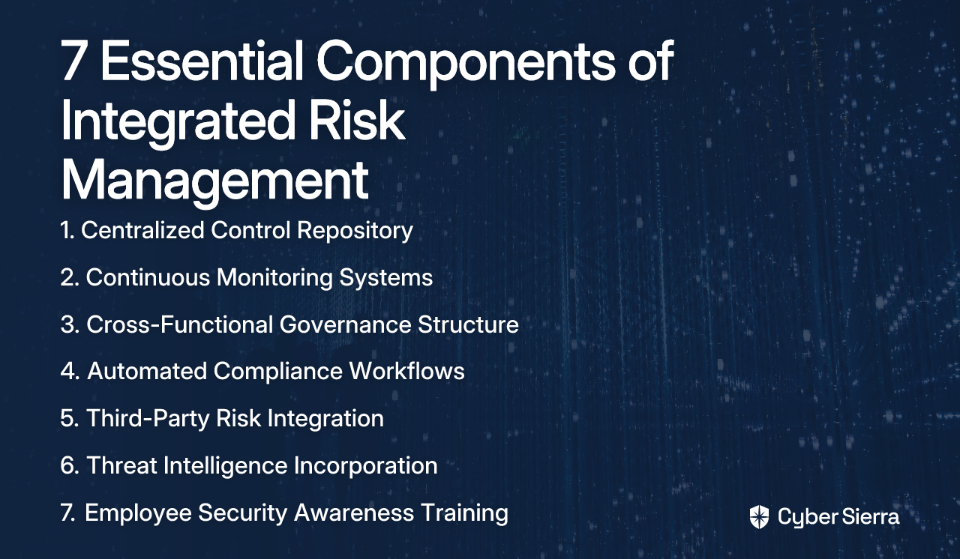
- A successful Integrated Risk Management (IRM) strategy is built on seven key components, including continuous monitoring, automated compliance, and third-party risk integration.
- Key actions include moving from periodic checks to real-time monitoring and strengthening your human firewall with continuous employee training.
- Cybersierra's integrated risk management platform unifies these seven components to automate compliance and provide a real-time view of your security posture.
In today's rapidly evolving threat landscape, organizations struggle with fragmented approaches to risk management. Many businesses find themselves drowning in spreadsheets, wrestling with complex GRC tools that seem designed only for large enterprises, or suffering through manual processes that leave dangerous security gaps.
As one security professional recently lamented, "GRC only works when the underlying process exists," while another noted that the market is "still missing tooling that would help build the program without the hefty costs." This fragmented approach is no longer sustainable in a world of expanding digital footprints, increasing third-party dependencies, and constantly shifting regulations.
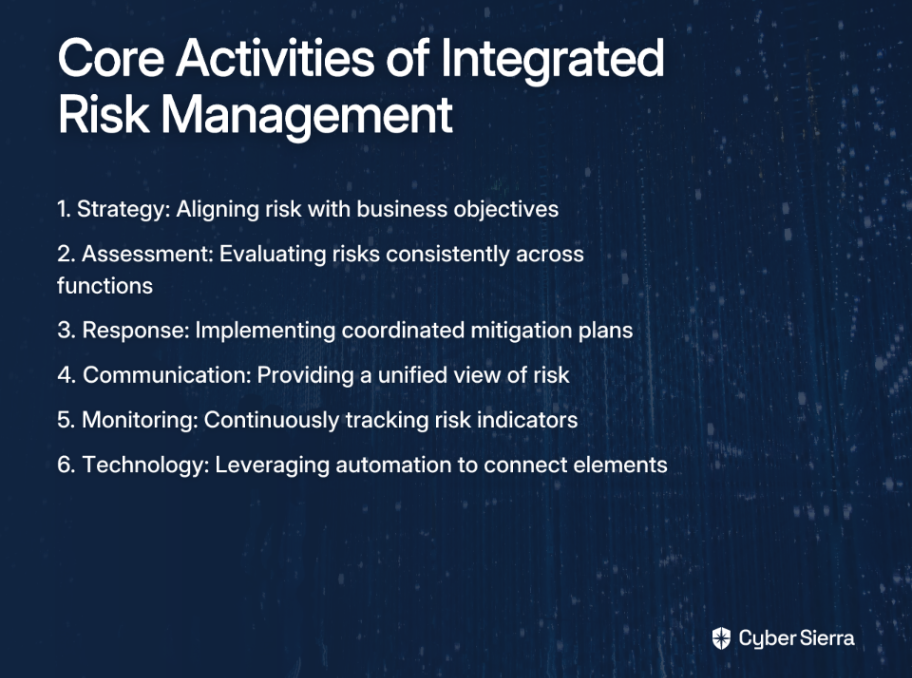
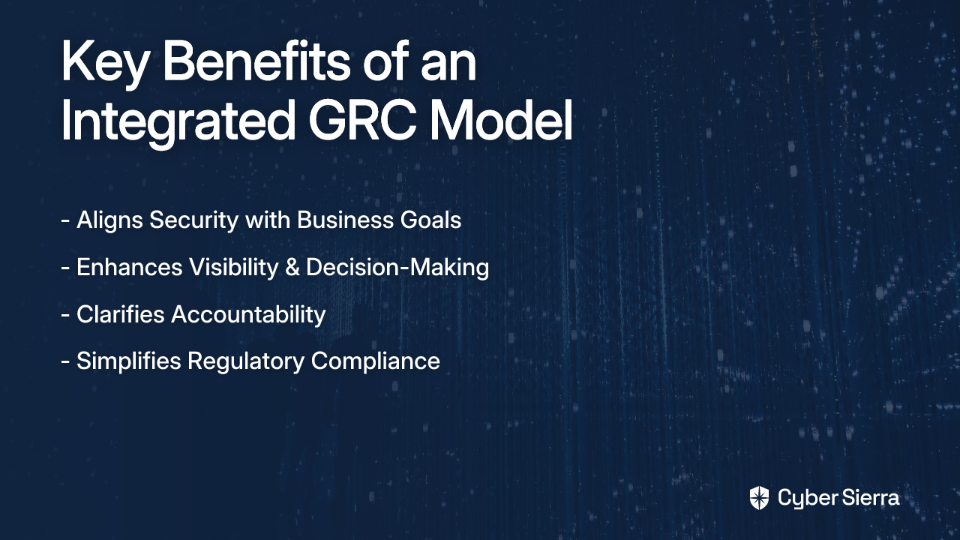
Enter Integrated Risk Management (IRM) – a strategic approach that consolidates risk management processes across the organization to create a unified, comprehensive view. Unlike siloed approaches that create blind spots and duplicate work, an integrated risk management approach transforms risk management from a burdensome chore into a strategic advantage.
This article breaks down the seven essential components that form the foundation of a successful IRM strategy, making it accessible and effective for businesses of all sizes.
1. Centralized Control Repository
A centralized control repository serves as the single source of truth for all security controls, policies, and regulatory documents. Instead of information being scattered across spreadsheets, documents, and disparate systems, everything is stored and managed in one secure, accessible location.
Why it's essential:
- Eliminates Silos & Boosts Efficiency: Provides a unified view that reduces the time teams spend hunting for documents and evidence, especially during audits. According to V-comply, centralized repositories significantly increase efficiency in compliance management.
- Enhances Risk Mitigation: Ensures decision-makers have immediate access to up-to-date compliance information, enabling data-driven remediation.
- Simplifies Multi-Framework Compliance: Managing controls for multiple frameworks (like NIST, ISO 27001, PCI DSS, GDPR) becomes streamlined when they are mapped and managed centrally.
How Cyber Sierra delivers:
Cyber Sierra's Continuous Control Monitoring (CCM) platform builds this foundation with features that:
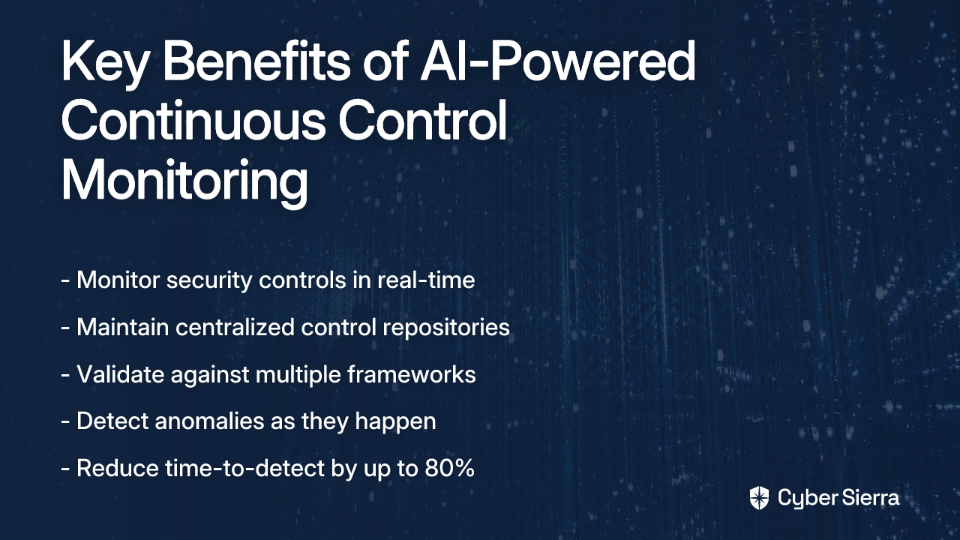
- Establish a central controls repository with near real-time updates from your technology stack
- Manage controls across multiple compliance frameworks, mapping them to avoid redundant work
- Provide a single source of truth that makes evidence collection for audits significantly faster
"Moving from scattered spreadsheets to a centralized repository was like going from paper maps to GPS," shares a Cyber Sierra customer. "We cut our audit preparation time by 70% and finally got a clear picture of our security posture."
2. Continuous Monitoring Systems
Continuous monitoring uses automated systems to test, verify, and monitor the effectiveness of security controls in near real-time, rather than relying on periodic, point-in-time checks.
Why it's essential:
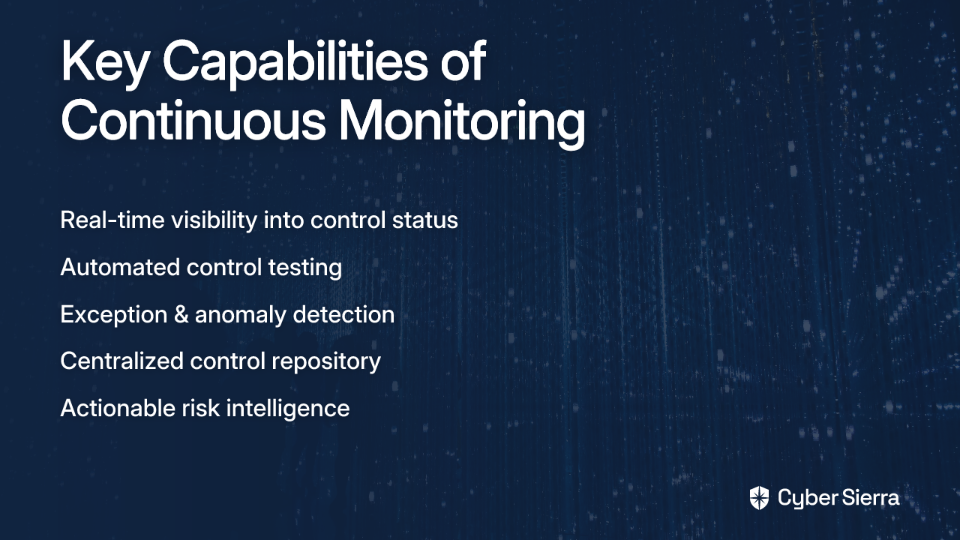
- Real-Time Visibility: Provides a dynamic, up-to-the-minute view of an organization's security posture. Annual or quarterly audits are mere snapshots; continuous monitoring is a live feed.
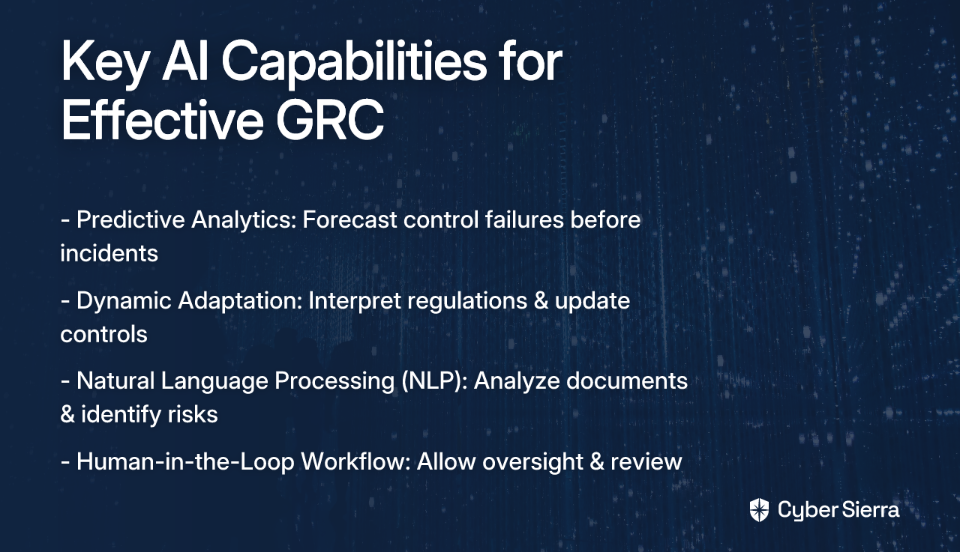
- Proactive Risk Management: Automatically detects exceptions, configuration drifts, and anomalies as they occur, allowing teams to remediate security gaps before they can be exploited.
- Reduces Audit Fatigue: Automates evidence collection, proving that controls are operating effectively over time, not just on audit day.
How continuous monitoring transforms risk management:
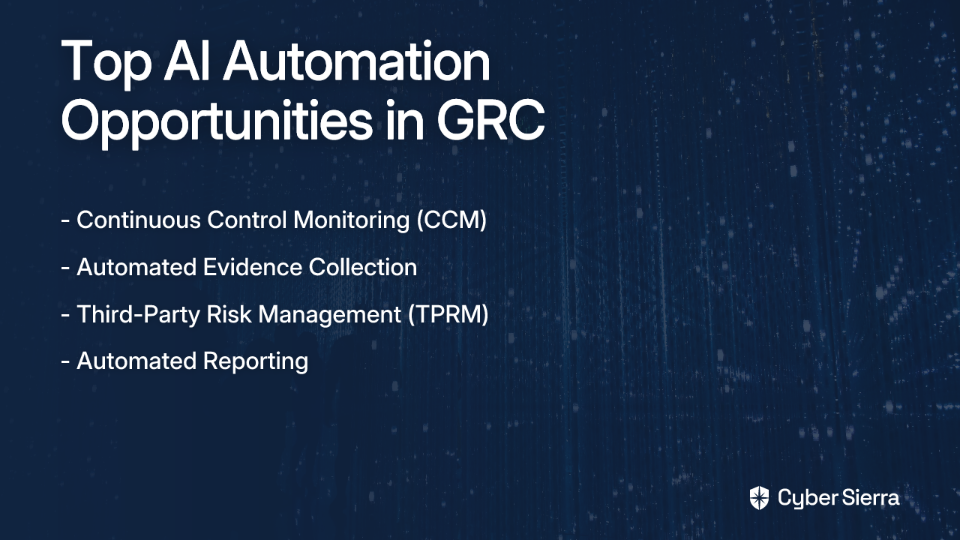
Traditional approaches rely on manual checks and periodic assessments that quickly become outdated. Continuous monitoring facilitates real-time visibility of risk posture, ensuring effective responses to emerging risks before they cause damage.
With Cyber Sierra's CCM module, security teams can:
- Automate control testing and validation against established policies
- Get clear visibility into security posture through intuitive dashboards
- Receive actionable risk intelligence to prioritize remediation efforts
3. Cross-Functional Governance Structure
A cross-functional governance structure establishes a framework that defines roles, responsibilities, and communication channels for risk management across different departments (IT, Legal, HR, Finance, etc.). It ensures that risk is not just an "IT problem" but a shared business responsibility.
Why it's essential:
- Unified Strategy: Integrates various departments to ensure a cohesive approach to risk, addressing the need for an "underlying process" for GRC tools to be effective.
- Clear Accountability: Establishes who owns which risk and what actions are required, improving coordination and follow-through on mitigation efforts.
- Informed Decision-Making: When business leaders from different functions are involved, risk decisions are made with a better understanding of their impact on the entire organization.
Cyber Sierra's Governance, Risk & Compliance (GRC) platform facilitates this cross-functional collaboration by:
- Automating risk assessments and assigning ownership to relevant stakeholders
- Providing centralized dashboards that give leadership from any department a clear view of the organization's risk posture
- Maintaining detailed audit trails to track decisions and actions, ensuring accountability
4. Automated Compliance Workflows
Automated compliance workflows leverage technology to streamline repetitive, manual tasks within the compliance lifecycle, such as data collection, risk assessments, control testing, and reporting.
Why it's essential:
- Reduces Manual Burden: Significantly cuts down the hours spent on administrative compliance tasks, freeing up teams to focus on strategic risk mitigation.
- Minimizes Human Error: Automation ensures processes are followed consistently and accurately, reducing the risk of errors that can lead to failed audits or compliance violations.
- Achieves Audit-Readiness Faster: By automating evidence collection and maintaining an always-on audit trail, organizations can face audits with confidence and less last-minute scrambling.
Many organizations still rely on what one security professional called "glorified workflow management systems" that lack true automation. Cyber Sierra's GRC module addresses this by:
- Automating data collection from cloud services, security tools, and HR systems
- Streamlining risk assessments and control monitoring for frameworks like SOC 2, ISO 27001, HIPAA, and GDPR
- Generating comprehensive reports automatically, making it easy to demonstrate compliance
5. Third-Party Risk Integration
Third-party risk integration embeds vendor risk management directly into the overall enterprise risk management framework. This involves assessing, monitoring, and mitigating the risks introduced by suppliers, partners, and vendors throughout their lifecycle.
Why it's essential:
- Addresses Supply Chain Vulnerabilities: According to ISACA, nearly every enterprise relies on third-party vendors, making their activities an extension of the company. A vendor's security failure can become your breach.
- Moves Beyond Point-in-Time Assessments: Static questionnaires become outdated quickly. Continuous monitoring of a vendor's security posture is crucial.
- Prevents Business Disruption: As one security professional noted, without proper TPRM tools there's a real risk of "data loss or business impact because one of our vendors dropped the ball."
Cyber Sierra's Third-Party Risk Management (TPRM) module simplifies and automates the entire vendor risk lifecycle, addressing the common complaint that some tools are "slow... lack easy automation and generally awful." Key features include:
- Automated vendor assessments and risk prioritization
- Near real-time, 24/7 visibility into vendor security compliance
- Streamlined vendor onboarding and offboarding processes
Integrating third-party risk management throughout the supplier lifecycle is crucial to effectively managing vendor relationships and preventing security incidents.
6. Threat Intelligence Incorporation
Threat intelligence incorporation is the practice of collecting and analyzing information about current and emerging cyber threats and vulnerabilities, then using that intelligence to inform and strengthen defensive strategies.
Why it's essential:
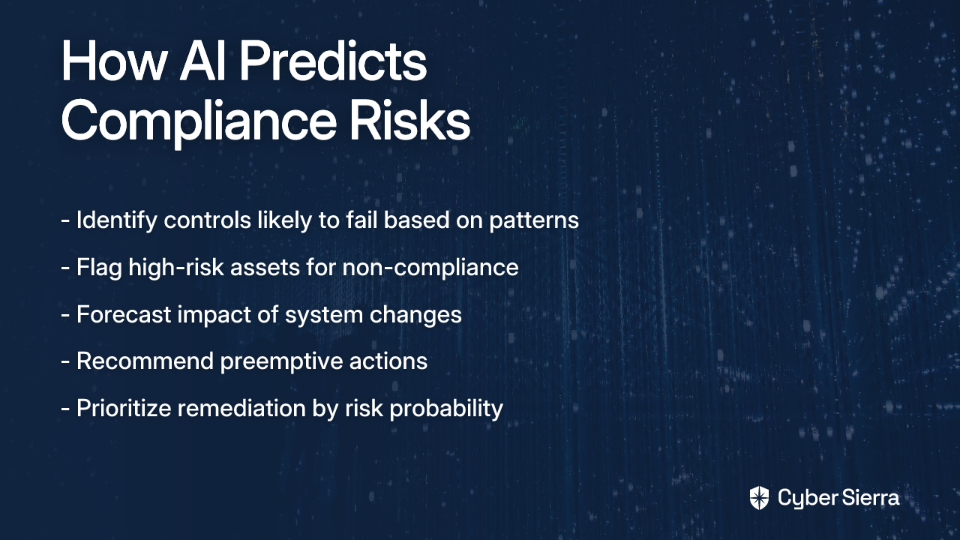
- Enables Proactive Defense: Shifts security from a reactive stance (fixing things after they break) to a proactive one (identifying and addressing vulnerabilities before they're exploited).
- Prioritizes Remediation: Provides insights into your organization's unique attack surface, helping you prioritize fixing the most critical vulnerabilities first.
- Context-Aware Security: Addresses the user desire for tools that "understand the business context and links to Cyber risks" by connecting external threat data to your internal environment.
Cyber Sierra's Threat Intelligence module provides a 360-degree view of your attack surface with features that:
- Conduct network and cloud infrastructure vulnerability scanning
- Offer a comprehensive security scorecard for at-a-glance posture insights
- Help security analysts prioritize remediation efforts based on risk severity and potential business impact
7. Employee Security Awareness Training
Employee security awareness training is a continuous program that educates employees about cybersecurity best practices and empowers them to recognize, avoid, and report potential threats like phishing and social engineering.
Why it's essential:
- Strengthens the Human Firewall: The human element is involved in a significant percentage of data breaches. Training transforms employees from potential liabilities into the first line of defense.
- Reduces Human Error: Mitigates the risk of incidents caused by mistakes like clicking malicious links, using weak passwords, or mishandling sensitive data.
- Fosters a Security-Conscious Culture: Engages the entire workforce in the organization's risk management efforts, making security a shared responsibility.
Research from Hornetsecurity shows that 1 in 3 organizations does not provide any cybersecurity training to remote workers, creating a significant vulnerability. Regular training is critical for reinforcing a security culture and mitigating risks related to human error.
Cyber Sierra's Employee Security Training platform builds a resilient human firewall through:
- Interactive training modules on topics like password safety, email scams, smishing, and vishing
- Simulated phishing campaigns to test and reinforce learning in a safe environment
- A dashboard overview of employees' security quotient to track progress and demonstrate compliance
Bringing It All Together: The Integrated Risk Management Approach
These seven components—centralized control repository, continuous monitoring, cross-functional governance, automated workflows, third-party risk integration, threat intelligence, and employee training—are not isolated elements. Their power comes from being integrated into a cohesive strategy that provides a complete view of an organization's risk landscape.
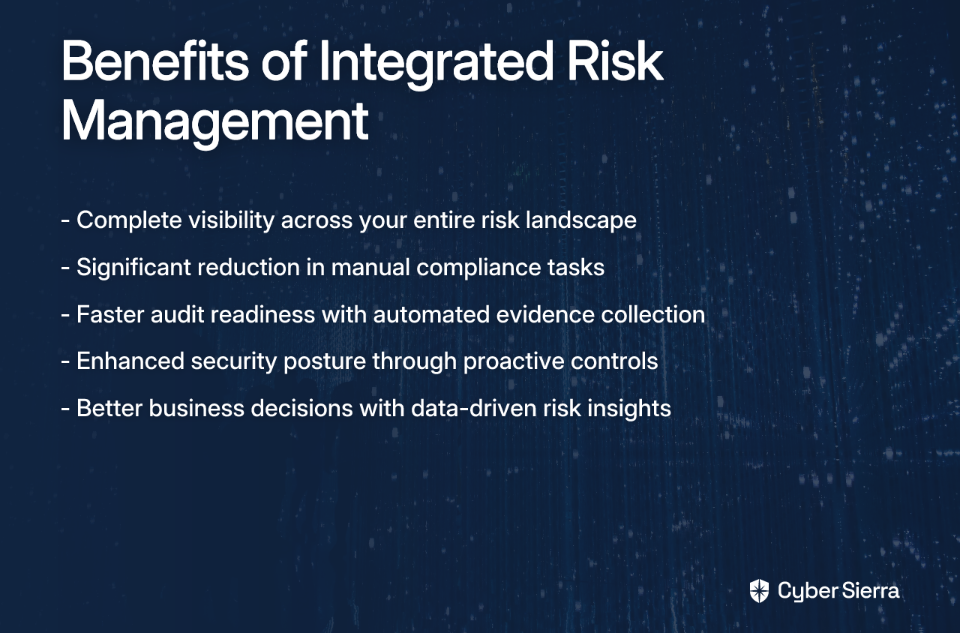
An effective integrated risk management approach is no longer a luxury reserved for large corporations with massive budgets. The "hefty costs" and "overly complex workflow" that many professionals worry about can be overcome with the right platform that brings these components together.
Implementing these seven components manually would be a monumental task. An integrated platform like Cyber Sierra brings them all together under a single pane of glass, automating the manual work, providing real-time visibility, and empowering organizations of all sizes to manage risk proactively and strategically.
Ready to move from fragmented spreadsheets to an integrated risk management strategy? Explore the Cyber Sierra platform to see how we unify all seven essential components to make your organization more secure and resilient in today's complex risk landscape.
Frequently Asked Questions
What is Integrated Risk Management (IRM)?
Integrated Risk Management (IRM) is a strategic approach that unifies risk management processes across an organization. It provides a comprehensive, real-time view of risks, breaking down silos between departments like IT, legal, and finance for better decision-making.
Why is IRM better than traditional GRC?
IRM is superior because it provides a holistic, real-time view of risk, unlike traditional GRC which is often siloed and relies on periodic checks. IRM integrates security, compliance, and risk into a single, cohesive strategy that is proactive rather than reactive.
How does a centralized control repository help with audits?
A centralized control repository drastically simplifies audits by providing a single source of truth for all controls, policies, and evidence. This eliminates manual data hunting and streamlines evidence collection, significantly reducing audit preparation time and costs.
What are the first steps to implementing an IRM strategy?
Start by establishing a centralized control repository and implementing continuous monitoring. Then, create a cross-functional governance structure. An integrated platform can automate these initial steps, providing a solid foundation for your IRM program.
How does IRM address third-party risks?
IRM integrates third-party risk management (TPRM) directly into your overall strategy. It involves continuously monitoring vendor security posture, automating assessments, and managing the entire vendor lifecycle, rather than relying on static, point-in-time questionnaires.
Can small businesses benefit from Integrated Risk Management?
Yes, absolutely. Modern IRM platforms are designed for businesses of all sizes, offering scalable and cost-effective solutions. They replace fragmented spreadsheets and manual work, enabling smaller teams to manage risk proactively and achieve compliance more efficiently.