blog-hero-background-image
Governance & Compliance

Cybersecurity AI Agents vs. Traditional GRC Tools: A Feature Comparison

backdrop
Table of Contents

Join thousands of professionals and get the latest insight on Compliance & Cybersecurity.


Summary

  • Traditional GRC tools rely on manual, point-in-time assessments, creating security blind spots and compliance fatigue in a landscape where data breaches have surged 70% since 2021.
  • AI-powered security agents offer a proactive alternative by automating evidence collection, providing continuous real-time monitoring, and detecting threats before they escalate.
  • The most effective strategy combines AI's automation with structured GRC frameworks to build a proactive and continuously compliant security posture.
  • AI-enabled GRC platforms like Cyber Sierra streamline this by automating control monitoring and risk assessments, ensuring your organization is always audit-ready.

You've set up a comprehensive GRC system, meticulously documented policies, and established controls across your organization. But when audit time comes, your team still scrambles to collect evidence, struggling with outdated information and gaps in your security posture. Despite significant investments, you're left wondering why compliance feels like a never-ending cycle of reactive firefighting rather than proactive security management.

Data breaches have surged by 70% from 2021 to 2024, and the regulatory landscape grows more complex each year. In this environment, traditional approaches to Governance, Risk, and Compliance (GRC) are showing their limitations. Meanwhile, AI-powered security agents promise a more automated, continuous approach to compliance and security.

This article compares traditional GRC tools with emerging cybersecurity AI agents across key dimensions and explores how a hybrid approach might offer the most robust path forward for organizations struggling with compliance fatigue and security blind spots.

The Old Guard: Unpacking the Limitations of Traditional GRC Tools

Traditional GRC tools have been the backbone of compliance programs for years, providing structured frameworks for aligning IT with business objectives while managing risk and meeting regulatory obligations. However, they come with significant limitations that are becoming increasingly problematic in today's threat landscape:
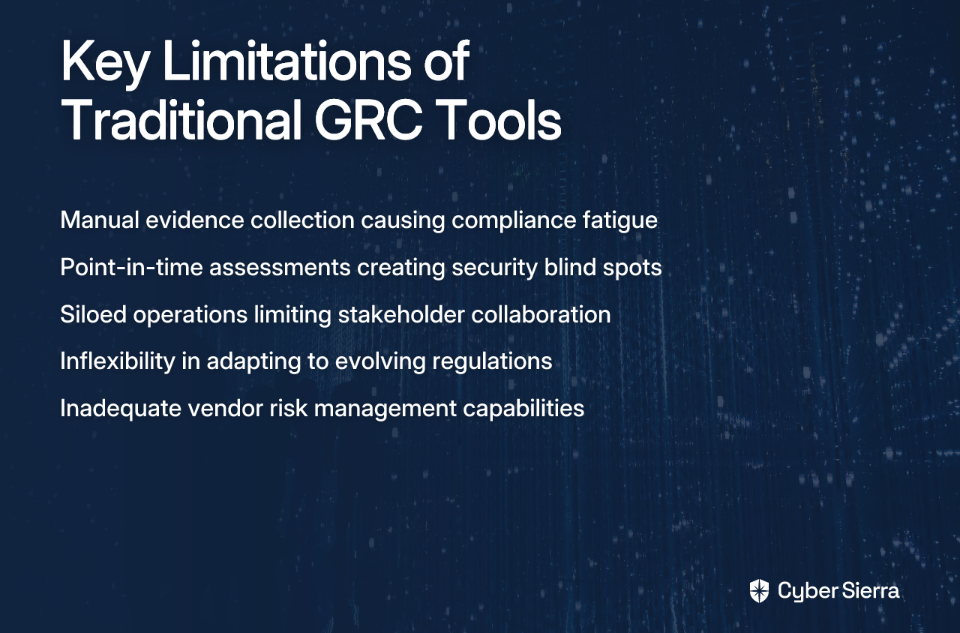
Reliance on Manual Evidence Collection & Data Updates

Traditional GRC tools heavily depend on manual data entry and evidence gathering for audits. This labor-intensive process is:

  • Time-consuming, often requiring dedicated staff just to maintain documentation
  • Prone to human error and inconsistency
  • A major contributor to "compliance fatigue" among security teams

As one compliance manager noted on a Reddit discussion: "I've heard too much about rubber stamping with regard to some of these platforms," highlighting concerns that compliance activities become box-ticking exercises rather than meaningful security improvements.

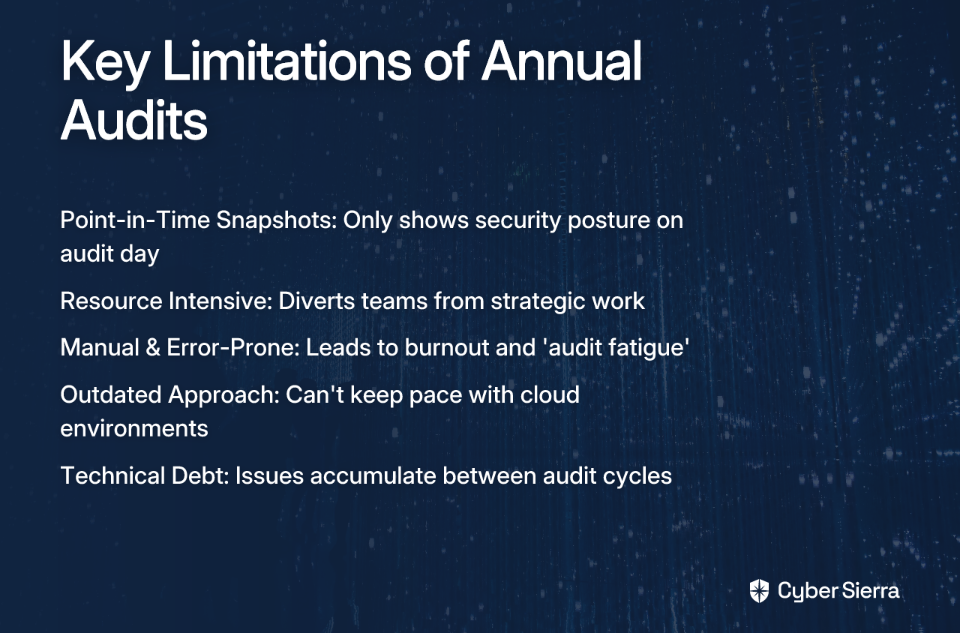
Point-in-Time Assessments

One of the most significant shortcomings of traditional GRC approaches is their reliance on periodic assessments:

  • They provide only a snapshot of compliance at specific moments (e.g., during audit cycles)
  • Security posture can deteriorate significantly between assessments
  • Organizations often find themselves "scrambling before audits" rather than maintaining continuous compliance

This creates a false sense of security and fails to address the need for adequate real-time monitoring to prevent violations from going undetected between formal checks.

Siloed Operations and Collaboration Challenges

Traditional GRC platforms often operate as isolated systems within organizations:

  • Limited accessibility makes it difficult for auditors and stakeholders to access needed information
  • Restricted usage by select employees limits organizational engagement with compliance
  • Poor integration with other security tools creates disconnected security and compliance functions

According to Ostendio, effective risk management requires involvement from the entire organization, but traditional tools are often used by only a small subset of employees.

Inflexibility and Inadequate Risk Monitoring

As regulations evolve and new threats emerge, traditional GRC tools struggle to keep pace:

  • Limited ability to adapt to new regulations without significant manual reconfiguration
  • Lack of robust risk monitoring and analytics capabilities
  • Inadequate visibility into an organization's true risk status in real-time

Weak Vendor Risk Management

With supply chain attacks on the rise, the limitations of traditional vendor assessment methods have become a critical weakness:

  • Reliance on static questionnaires and periodic reviews
  • Difficulty verifying the accuracy of vendor-provided information
  • Inability to monitor vendor security posture continuously

As one security professional pointed out in a Reddit thread, there's widespread "skepticism about the honesty of third parties during assessments," highlighting the need for more sophisticated vendor risk management capabilities.
The New Contender: The Rise of AI Agents in Cybersecurity

Cybersecurity AI agents represent a paradigm shift in how organizations approach security and compliance. These autonomous systems can perceive their environment, make decisions, and take actions to detect, analyze, and respond to security threats with minimal human intervention.

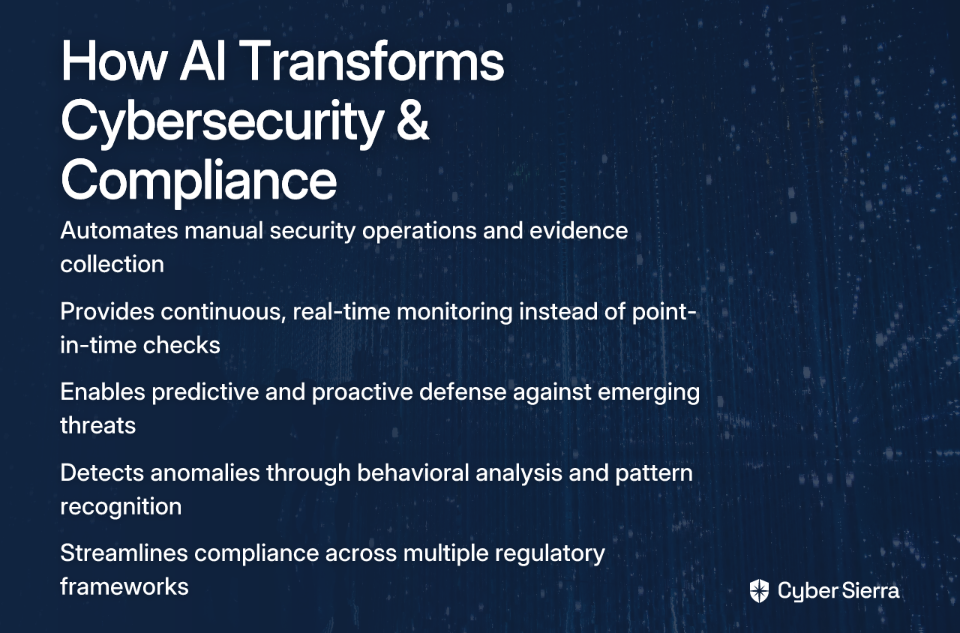
Key Capabilities Driven by AI
Automation of Security Operations

AI-powered security agents excel at automating previously manual processes:

  • Automated Risk Assessment: AI algorithms and User and Event Behavior Analytics (UEBA) automatically identify anomalies and increase the accuracy of risk scoring, reducing human bias in assessments.
  • Automated Incident Response: Agents can immediately act on threats using predefined Security Orchestration, Automation and Response (SOAR) playbooks, such as revoking compromised credentials or isolating affected systems.
  • Automated Evidence Collection: AI agents continuously gather and organize compliance evidence, eliminating the manual burden that plagues traditional GRC approaches.

According to the Cloud Security Alliance, AI-driven automation can reduce compliance costs by up to 30% while improving accuracy and consistency.

Continuous, Real-Time Monitoring and Threat Detection

Unlike point-in-time assessments, AI agents provide:

  • 24/7 monitoring of systems, users, and data
  • Establishment of behavioral baselines to detect even subtle anomalies
  • Real-time alerts and responses to potential compliance violations or security incidents

This continuous monitoring approach directly addresses the "point-in-time" problem inherent in traditional tools, ensuring that security posture remains consistent between formal assessments.

Predictive and Proactive Defense

Perhaps most impressively, AI agents can anticipate and prevent issues before they occur:

  • Zero-Day Vulnerability Identification: AI can scan codebases and dependencies to find vulnerabilities before they're formally identified, using tools like GitHub CodeQL.
  • Predictive Compliance: By analyzing data patterns, AI can forecast potential compliance issues and recommend preventive measures.
  • Proactive Threat Hunting: Instead of waiting for alerts, AI agents can actively search for indicators of compromise based on emerging threat intelligence.

Advanced Use Cases

Practical applications of cybersecurity AI agents include:

  • Phishing Detection: AI agents can recognize signs of phishing, such as abnormal OAuth grants, and enforce immediate security measures like password resets.
  • Continuous Compliance Monitoring: AI agents continuously monitor for compliance with standards like SOC 2 or NIST, find violations in real-time, and generate remediation reports.
  • Automated Penetration Testing: AI can conduct ongoing penetration tests to identify and report security weaknesses without human intervention.

Head-to-Head Feature Comparison: AI Agents vs. Traditional GRC

FeatureTraditional GRC ToolsAI-Powered Security Agents
AutomationManual & Labor-Intensive: Relies on manual evidence collection, checklists, and periodic reporting.Highly Automated: Automates data collection, control testing, risk assessments, and incident response. AI can reduce manual evidence collection effort by up to 50%.
MonitoringPoint-in-Time: Provides static snapshots during audits, leaving security and compliance gaps.Continuous & Real-Time: Offers 24/7 monitoring of controls (CCM), detecting anomalies and compliance drifts as they happen.
ProactivityReactive: Identifies issues after they have occurred, often during a scheduled audit.Proactive & Predictive: Establishes behavioral baselines (UEBA) to detect subtle threats and predicts future risks based on data patterns.
IntegrationSiloed: Often operates as a standalone system with limited integration, creating challenges for auditors and teams.Integrated: Designed to connect with the broader security ecosystem (e.g., SOAR, EDR, cloud platforms) for a unified view.
Framework SupportRigid: Struggles to adapt to new regulations. Mapping controls across multiple frameworks is a manual process.Flexible & Scalable: Uses Natural Language Processing (NLP) to interpret new regulations and can automatically map evidence to multiple compliance frameworks (SOC 2, ISO 27001, HIPAA, PCI DSS).

The Best of Both Worlds: The Hybrid Approach with AI-Enabled GRC

While the comparison might suggest replacing traditional GRC tools with AI agents, the most effective approach is actually a synthesis of both methodologies. The future isn't about choosing one over the other, but integrating AI's intelligence and automation into the structured world of GRC, creating an Integrated Risk Management (IRM) approach that is both comprehensive and dynamic.

Cyber Sierra: The Modern, AI-Enabled GRC Platform

Cyber Sierra exemplifies this hybrid approach, combining robust compliance management with AI-driven continuous monitoring and automation. This integrated platform helps organizations move from periodic checks to a state of continuous, proactive security and compliance.

How Cyber Sierra Addresses Traditional GRC Limitations:

  1. For Manual Burden & Point-in-Time Gaps → Continuous Control Monitoring (CCM) Cyber Sierra's CCM module provides near real-time visibility into security controls. It automates control testing, detects exceptions in real-time, and builds a central repository, eliminating the manual evidence collection burden while ensuring organizations are always audit-ready.
  2. For Inflexible Frameworks & Audit Fatigue → Automated Governance, Risk & Compliance (GRC) The GRC platform automates data collection, risk assessments, and reporting across multiple frameworks (SOC 2, ISO 27001, GDPR, HIPAA). This streamlines audit processes and provides a 360-degree view of the organization's risk profile without requiring manual framework mapping.
  3. For Weak Vendor Management → Third-Party Risk Management (TPRM) Cyber Sierra's TPRM module automates vendor assessments and provides continuous monitoring of vendor security posture, moving far beyond outdated spreadsheets and questionnaires to address supply chain risk effectively.
  4. For Proactive Defense → Threat Intelligence & Employee Training The platform also includes Threat Intelligence for proactive vulnerability scanning and Employee Security Training with phishing simulations to strengthen the human firewall, addressing the gaps in traditional GRC tools that focus solely on policies and controls.
Conclusion: Embracing the Future of Compliance

The limitations of traditional GRC tools—manual processes, point-in-time assessments, and operational silos—are no longer tenable in today's threat landscape. Cybersecurity AI agents offer the automation, real-time visibility, and proactive capabilities needed to stay ahead of both threats and compliance requirements.

However, the most powerful strategy isn't a complete replacement but an evolution. AI-enabled GRC platforms like Cyber Sierra represent this future, combining automated continuous monitoring with structured compliance management. Research shows that 69% of enterprises now view AI as essential for cybersecurity, signaling a clear industry shift toward intelligent automation.

For organizations tired of scrambling before audits and operating with security blind spots, it's time to embrace a proactive, automated, and continuous approach to cybersecurity and compliance. By integrating AI capabilities into GRC processes, security teams can reduce manual burden, gain real-time visibility, and shift from reactive firefighting to proactive risk management.

Frequently Asked Questions

What is the main difference between traditional GRC and cybersecurity AI agents?

The primary difference lies in their operational approach: traditional GRC tools are manual and periodic, while AI agents are automated and continuous. Traditional GRC relies on point-in-time assessments and manual evidence collection, creating security gaps between audits. In contrast, AI agents provide 24/7 real-time monitoring, automate data collection, and proactively detect threats and compliance drifts as they happen.

How do AI agents improve compliance and security over traditional tools?

AI agents significantly enhance compliance and security by introducing automation, continuous monitoring, and proactive defense. They automate labor-intensive tasks like evidence collection, reducing human error and audit fatigue. Their ability to monitor systems in real-time closes the security gaps left by periodic assessments, while predictive analytics help identify potential risks before they escalate into incidents.

Can AI-powered GRC platforms adapt to new and changing regulations?

Yes, modern AI-powered GRC platforms are designed for flexibility and can adapt to evolving regulations far more effectively than traditional tools. They often use Natural Language Processing (NLP) to interpret new regulatory requirements and can automatically map controls and evidence across multiple frameworks (e.g., SOC 2, ISO 27001, GDPR). This eliminates the cumbersome manual process of reconfiguring the system for each new mandate.

What is an AI-enabled GRC approach?

An AI-enabled GRC approach, also known as Integrated Risk Management (IRM), combines the structured frameworks of traditional GRC with the automation and real-time intelligence of AI. It doesn't replace GRC principles but enhances them. This hybrid model provides a comprehensive, 360-degree view of an organization's risk posture while automating control monitoring and evidence gathering, ensuring a state of continuous, audit-ready compliance.

Will AI security agents replace the need for human security teams?

No, AI security agents are designed to augment human security teams, not replace them. By automating repetitive and time-consuming tasks like data collection, control testing, and initial alert triage, AI frees up security professionals to focus on higher-value strategic work. This includes complex threat analysis, strategic risk management, incident response planning, and communicating security posture to leadership.

How does a platform like Cyber Sierra provide continuous compliance?

Platforms like Cyber Sierra achieve continuous compliance through a feature called Continuous Control Monitoring (CCM). CCM automates the process of testing security controls against established compliance frameworks (like SOC 2 or HIPAA) in near real-time. It continuously collects evidence from integrated systems (e.g., cloud providers, endpoint protection), detects any deviations or failures, and provides immediate alerts, ensuring the organization remains audit-ready at all times, not just during audit season.

Learn how Cyber Sierra can help you build an audit-ready, resilient security program. Book a personalized demo today.

blog-hero-background-image
Governance & Compliance

7 Compliance Challenges That Traditional GRC Tools Can't Solve — And What to Do Instead

backdrop
Table of Contents

Join thousands of professionals and get the latest insight on Compliance & Cybersecurity.


Summary

  • With data breaches increasing 72% from 2021-2023, traditional GRC tools are failing due to their reliance on manual, point-in-time assessments that create security gaps.
  • Key challenges of legacy GRC include siloed operations, inflexibility with new regulations, and neglected third-party risks, which lead to dangerous blind spots and compliance fatigue.
  • To build a resilient program, organizations must shift to an integrated strategy that includes automation, Continuous Control Monitoring (CCM), and robust Third-Party Risk Management (TPRM).
  • Modern platforms like Cyber Sierra help unify compliance frameworks, automate evidence collection, and provide the real-time visibility needed to move beyond reactive, check-the-box compliance.

Ever feel like you're cast as the "bad guy" forcing change because regulators are breathing down your neck? Or that "the issues are easy to solve, but company politics and corporate culture gets in the way"?

For many CISOs and compliance managers, the GRC landscape feels like a constant battle against spreadsheets, manual tracking that has become a "huge time suck," and the challenge of proving compliance to auditors who keep asking for the same artifacts.

Governance, Risk, and Compliance (GRC) is a structured approach to align IT with business goals while managing risks and complying with regulations. But traditional GRC tools are no longer sufficient in a rapidly evolving landscape with increasing regulatory complexity. With a 72% increase in data breaches from 2021 to 2023, it's clear that legacy, point-in-time approaches are failing.

This article breaks down seven critical compliance challenges that traditional GRC tools cannot solve and outlines what to do instead to build a modern, resilient compliance program.

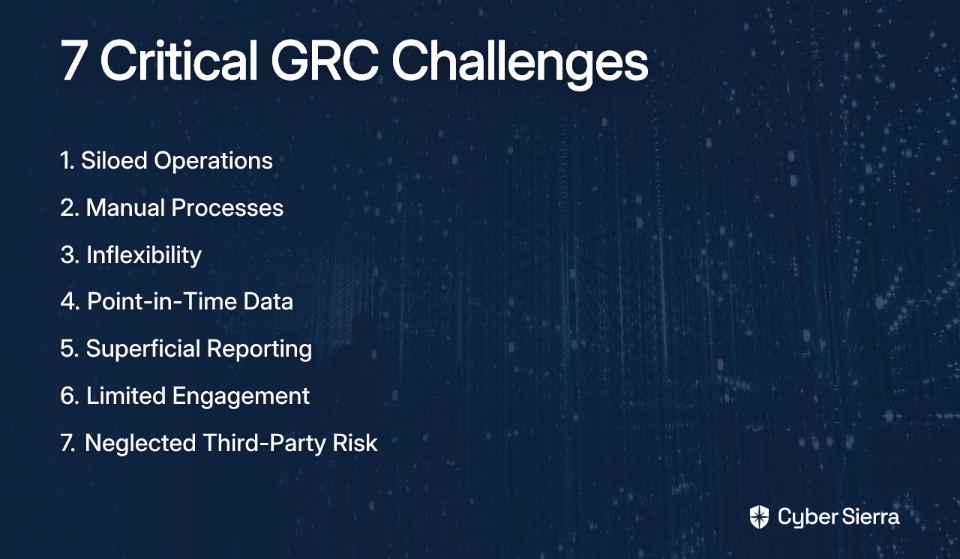
1. Siloed Operations Create Dangerous Blind Spots

The Problem

Traditional GRC tools often operate in isolation. Your organization might use one tool for ISO 27001, another for SOC2, and spreadsheets for HIPAA, leading to a fragmented view of risk.

This siloed approach results in inconsistent data, duplicated efforts, and an inability to assess aggregate risk, creating dangerous blind spots. This directly reflects the user pain of "confusion at what the hell is going on in the org."

According to research from CyberSierra, these disconnected systems make it nearly impossible to gain a comprehensive view of your organization's compliance posture, leaving you vulnerable to unseen threats.

What to Do Instead

Adopt an integrated platform that centralizes all GRC functions. The goal is to consolidate governance, risk, and compliance processes to reduce data inconsistencies and redundancy.

A modern solution should manage multiple compliance frameworks (SOC2, ISO 27001, GDPR, HIPAA, PCI DSS) from a single dashboard, providing one source of truth. As noted by Risk3sixty, a unified GRC approach significantly reduces the effort required to maintain compliance across multiple standards.

Platforms like Cyber Sierra's GRC solution are designed to break down these silos by unifying multiple frameworks and providing a holistic view of your compliance posture.

2. The Grind of Manual Processes and "Compliance Fatigue"

The Problem

Legacy GRC systems are heavily dependent on manual data collection, endless evidence requests, and periodic updates via spreadsheets.

This is not only inefficient and prone to human error but leads to what the industry calls "compliance fatigue." Security teams are perpetually overwhelmed, and audit preparation becomes a frantic, last-minute fire drill.

One Reddit user lamented that "manual tracking has already become a huge time suck, and we know it's not going to scale as we grow," highlighting a common pain point for growing organizations.

What to Do Instead

Embrace automation to reduce manual tasks and errors. Modern GRC software is essential for automating processes, from data collection to report generation.

Automation allows teams to achieve audit readiness much faster, similar to the Reddit user who, with an automated tool, was "audit ready in just 1 month" for a SOC 2 Type 2.

Zazoon.com emphasizes that as regulatory complexity increases, manual approaches will become completely unsustainable, making automation not just a nice-to-have but a necessity.

Automation is at the core of modern GRC platforms like Cyber Sierra, which streamline data collection, risk assessments, and reporting to free up your team for more strategic initiatives.

3. Inflexibility in a World of Constant Change

The Problem

The regulatory landscape is in constant flux. Traditional tools are often rigid and struggle to adapt to new regulations or evolving business models.

This inflexibility forces CISOs and their teams to manually "crosswalk" controls between frameworks, a process that is slow, cumbersome, and stifles innovation and business agility.

As regulations like the EU's Digital Operational Resilience Act (DORA) emerge, older systems simply cannot keep pace with the changing requirements.

What to Do Instead

Choose a scalable GRC solution built for change. An effective platform must accommodate organizational growth and easily adapt to new compliance requirements.

The solution should support not only standard frameworks but also custom control frameworks tailored to your business needs. This flexibility allows you to respond quickly to emerging regulations without overhauling your entire compliance program.

According to Risk3sixty, a successful GRC tool should grow with your company and adapt to changing business requirements seamlessly.

4. The Illusion of Security with Point-in-Time Data

The Problem

Legacy tools are built around point-in-time assessments (e.g., quarterly reviews, annual audits). This creates a false sense of security.

The reality is that critical misconfigurations and vulnerabilities can emerge and be exploited in the gaps between these audits. Decisions are often made using outdated information, rendering incident response slow and ineffective.

For example, the time between discovering a vulnerability and exploiting it continues to shrink—attackers don't wait for your next scheduled assessment to strike.

What to Do Instead

Shift from periodic checks to Continuous Control Monitoring (CCM). This approach provides ongoing, near real-time visibility into the status of your security controls.

By integrating with your live security systems, you can detect exceptions, anomalies, and policy violations as they happen, not months later during an audit. This continuous visibility enables proactive risk management rather than reactive firefighting.

This is precisely the problem Cyber Sierra's Continuous Control Monitoring (CCM) module solves. It transforms security from a periodic check-the-box exercise to a continuous, automated process, providing a single source of truth for all controls and enabling proactive risk management.

5. Superficial Reporting That Hides the Truth

The Problem

Many traditional GRC tools generate reports that are superficial. They might show a "green" compliance status but lack the granular detail to reveal underlying weaknesses.

This provides misleading insights and makes it impossible for leadership to prioritize remediation efforts effectively. You can't fix what you can't see clearly.

As noted in CyberSierra's research, these high-level reports fail to provide the actionable intelligence needed for effective decision-making, leading to misallocated resources and persistent vulnerabilities.

What to Do Instead

Demand actionable intelligence, not just data. Utilize tools with AI-powered data analytics that can filter through the noise and highlight the most critical risks.

Your GRC platform should generate comprehensive reports and detailed audit trails that provide true transparency and support data-driven decision-making. This level of insight helps you focus resources on the most impactful security improvements.

Zazoon.com emphasizes that modern GRC solutions must incorporate advanced analytics to provide meaningful insights from vast amounts of compliance data.

Cyber Sierra's Threat Intelligence platform complements its GRC capabilities by providing a comprehensive security scorecard and vulnerability scanning, transforming raw data into actionable insights for remediation.

6. Limited Engagement and a Disconnected Security Culture

The Problem

Traditional GRC tools are often complex, clunky, and used only by a small, specialized team. This alienates the rest of the organization.

When compliance is seen as a burdensome task owned by one department, a weak security culture develops. This ties into the user pain of navigating "an obscene amount of politics" because other departments see GRC as a blocker, not a partner.

One Reddit user noted that "engineers by default think you are an idiot and you will work up from there," highlighting the uphill battle GRC professionals face in gaining organizational buy-in.

What to Do Instead

Foster an ethically compliant and security-aware culture from the top down. As AWS notes, engaging senior executives in setting policies is a critical step.

Deploy user-friendly tools that promote collaboration and shared responsibility. When GRC platforms are accessible and intuitive, they're more likely to be embraced across the organization.

Invest in training and awareness campaigns to sensitize all employees to their role in cybersecurity. Building this culture is a key part of modern GRC. Cyber Sierra's Employee Security Training module helps create a strong "human firewall" through interactive training and simulated phishing campaigns, making security everyone's job.

7. The Elephant in the Room — Neglected Third-Party Risk

The Problem

Perhaps the biggest failure of traditional GRC tools is their inability to manage vendor and supply chain risk effectively. They often lack dedicated Third-Party Risk Management (TPRM) capabilities.

This leaves organizations blind to critical risks introduced by their partners. As one Reddit user lamented about managing TPRM for a mid-sized organization: "our small team of 4 are facing significant demands in responding to risk assessments, typically ranging 100-300 questions per assessment." This highlights the unmanageable scale of manual TPRM.

With high-profile supply chain attacks like SolarWinds, the question becomes critical: "If SolarWinds, a widely trusted platform by all can be compromised, what do u think u can do?" The answer lies in better tools and approaches.

What to Do Instead

Integrate a robust TPRM program into your GRC strategy. This involves automating vendor risk assessments, prioritizing vendors based on risk level, and performing continuous monitoring of their security posture.

Move beyond static, point-in-time questionnaires to a model of near real-time, 24/7 visibility into vendor compliance. This continuous monitoring approach helps you detect changes in vendor risk profiles before they impact your organization.

Cyber Sierra's TPRM platform is designed to tackle this challenge head-on. It automates vendor assessments and provides continuous monitoring, giving you proactive insights into third-party risks that questionnaires alone can never provide.

Moving from Reactive Compliance to Proactive Resilience

The limitations of traditional GRC—silos, manual processes, inflexibility, point-in-time data, superficial reporting, poor engagement, and neglected third-party risk—are no longer acceptable in today's threat landscape.

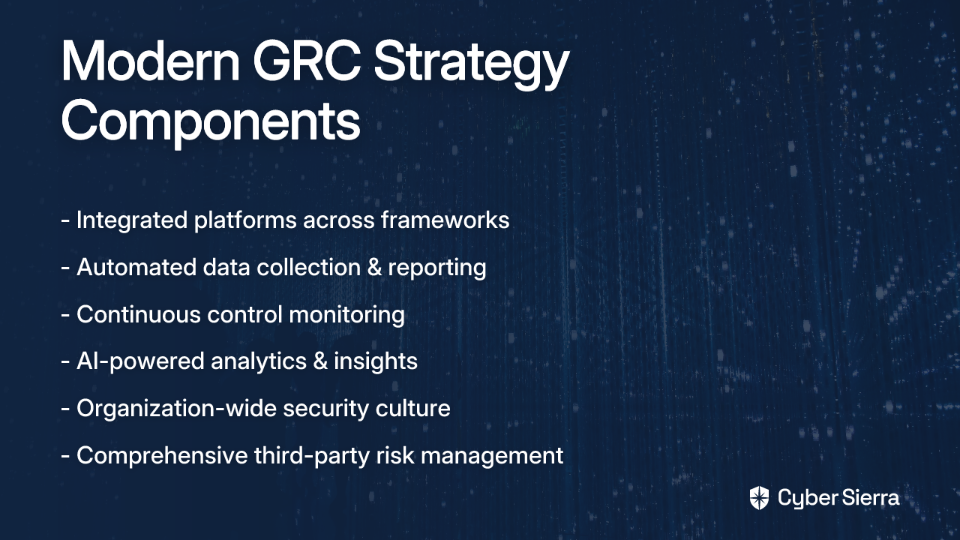
The path forward requires a fundamental shift to a modern GRC strategy that is integrated, automated, continuous, and intelligent. It's about breaking down silos, embedding security into the culture, and extending visibility across the entire supply chain.

Stop wrestling with outdated tools that create more problems than they solve. It's time to move from a posture of reactive compliance to one of proactive cyber resilience.

Frequently Asked Questions (FAQ)

What is Governance, Risk, and Compliance (GRC)?

Governance, Risk, and Compliance (GRC) is a structured strategy for aligning an organization's IT operations with its business objectives while managing risks and meeting regulatory requirements. It integrates governance, risk management, and compliance activities into a unified program to improve decision-making, reduce redundancies, and ensure the organization operates ethically and securely.

Why are traditional GRC tools no longer effective?

Traditional GRC tools are no longer effective because they cannot handle the complexity and speed of the modern digital landscape. Key failures include creating data silos, relying on inefficient manual processes, being too rigid to adapt to new regulations, and providing only periodic, point-in-time security snapshots. This outdated approach leaves organizations vulnerable to unseen threats and overwhelmed by "compliance fatigue."

How does a modern GRC platform solve these challenges?

A modern GRC platform solves these challenges by providing an integrated, automated, and continuous approach to compliance. It centralizes all compliance frameworks into a single dashboard, automates data collection and reporting to eliminate manual work, and offers Continuous Control Monitoring (CCM) for real-time visibility. This allows organizations to manage risk proactively, adapt quickly to change, and build a resilient security culture.

What is Continuous Control Monitoring (CCM) and why is it important?

Continuous Control Monitoring (CCM) is an automated process that provides ongoing, near real-time visibility into the effectiveness of your security controls. It is important because threats don't wait for your annual audit. By constantly monitoring your systems for misconfigurations and policy violations, CCM allows you to detect and remediate issues as they happen, shifting your security posture from reactive to proactive.

Why is managing third-party risk a critical part of GRC?

Managing third-party risk is critical because your organization's security is interconnected with that of your vendors and supply chain partners. A breach in a third-party system can directly impact your data and operations. Traditional GRC often overlooks this risk, but a modern approach requires a robust Third-Party Risk Management (TPRM) program to continuously assess and monitor vendor security, preventing your supply chain from becoming a security liability.

Ready to transform your GRC program? Discover how Cyber Sierra's all-in-one platform automates compliance, provides real-time visibility, and simplifies risk management. Schedule a demo today.
blog-hero-background-image
Governance & Compliance

10 Best Compliance Tools for Regulated Industries

backdrop
Table of Contents

Join thousands of professionals and get the latest insight on Compliance & Cybersecurity.


Summary

  • With 85% of companies reporting increased compliance complexity, managing audits manually is inefficient and risky.
  • Compliance automation tools reduce risk and can cut costs by up to 50% by replacing manual processes with continuous monitoring.
  • When choosing a tool, prioritize its ability to integrate with your existing tech stack and support frameworks like SOC 2 and ISO 27001.
  • Integrated platforms like Cyber Sierra's GRC module unify compliance and risk management, potentially reducing audit prep time by 70%.

Is your team buried under spreadsheets, manually gathering evidence for the next audit? The process is often tedious, time-consuming, and a major source of stress, especially for lean teams. This manual, inefficient, and unscalable process can lead to missed deadlines and incomplete documentation.

You're not alone in this struggle. According to a PwC survey, 85% of companies report compliance requirements have become more complex. As regulations multiply and evolve, trying to manage compliance manually has become not just inefficient, but a significant business risk.

This is where compliance management software comes in. These tools automate regulatory tracking, risk monitoring, and audit reporting, helping align internal processes with major frameworks like NIST Privacy Framework, ISO 27001, SOC 2, HIPAA, and GDPR.

In this article, we'll review the 10 best compliance tools to help regulated industries navigate the complex compliance landscape with greater efficiency and confidence.

Why You Need a Compliance Tool

Before diving into the specific tools, let's understand why moving beyond manual processes is crucial for modern organizations:

  • Significant Risk Reduction: Automated monitoring and real-time alerts help identify and fix compliance gaps before they become critical issues, preventing costly violations.
  • Improved Efficiency & Cost Savings: Automation dramatically cuts down on manual work. As one user on Reddit noted, while tools may not shorten the audit period itself, they "significantly reduce the workload." This can translate into cost savings of up to 50%.
  • Continuous Audit Readiness: Instead of scrambling before an audit, these tools provide continuous tracking and a centralized repository for evidence, ensuring you are always audit-ready.
  • Real-Time Oversight: Gain a clear, up-to-the-minute view of your compliance posture instead of relying on periodic, point-in-time checks.

With these benefits in mind, let's explore the top compliance tools available today.
The 10 Best Compliance Tools for Regulated Industries

1. Cyber Sierra

Cyber Sierra is an AI-enabled, integrated cybersecurity platform designed to simplify and automate security compliance. It moves organizations away from periodic checks towards a proactive, near real-time risk management model, unifying GRC, vendor risk, threat intelligence, and more into a single dashboard.

Key Features:

  • Continuous Control Monitoring (CCM): Directly addresses the pain of manual evidence collection. It provides ongoing, near real-time visibility into security controls, automates control testing and validation, and centralizes the control repository for frameworks like NIST, ISO 27001, PCI DSS, and GDPR.
  • Governance, Risk & Compliance (GRC): Automates data collection, risk assessments, and reporting to make enterprises audit-ready faster. It helps manage multiple frameworks (SOC 2, ISO 27001, HIPAA) and reduces compliance fatigue, potentially leading to a 70% reduction in audit preparation time.
  • Third-Party Risk Management (TPRM): Simplifies and automates vendor risk assessment, onboarding, and continuous monitoring to mitigate supply chain risks.
  • Threat Intelligence: Provides a holistic view of the attack surface through network and cloud vulnerability scanning, enabling proactive defense.
  • Employee Security Training: Builds a stronger "human firewall" with interactive training and simulated phishing campaigns, a key requirement for many compliance frameworks.
  • Cyber Insurance: Integrates cyber posture management with the insurance application process, helping companies demonstrate robust hygiene to insurers.

Best for: CISOs, Compliance Managers, and IT leaders in regulated industries (BFSI, HealthTech, Tech, Retail) who need a unified and automated platform to manage multiple compliance requirements, reduce manual effort, and gain continuous visibility into their security posture.

2. Drata

Drata is a leading compliance automation platform focused on continuous control monitoring, especially for cloud-native companies.

Key Features:

  • Support for over 20 frameworks
  • Extensive pre-built integrations for automated evidence collection
  • AI assistance for security questionnaires

Best for: High-growth startups and mid-market tech companies looking to build and maintain trust with enterprise customers by achieving and scaling compliance certifications like SOC 2 and ISO 27001.

3. Vanta

Vanta is a compliance automation tool known for its user-friendliness and speed in getting companies audit-ready.
Key Features:

  • Streamlined evidence collection
  • Continuous monitoring
  • Integrations with a wide range of cloud services and business tools

Best for: Startups and SMBs that need a cost-effective and efficient solution for achieving their first compliance certification. A Reddit user praised Vanta for getting them "audit ready in just 1 month" for a SOC 2 Type 2 audit, a significant improvement over traditional methods.
4. LogicGate Risk Cloud

LogicGate Risk Cloud is a flexible, no-code GRC platform that allows organizations to build and customize their own risk and compliance applications.

Key Features:

  • Highly customizable workflows
  • Pre-built application templates
  • Dynamic questionnaires
  • Advanced risk quantification capabilities

Best for: Mid-market and enterprise organizations that need a highly flexible solution to manage complex or unique risk management processes beyond standard compliance frameworks.

5. Secureframe

Secureframe is a compliance automation platform focused on making security and compliance fast and straightforward for tech companies.

Key Features:

  • Robust integrations with over 100 cloud services
  • Automated evidence gathering
  • Team of compliance experts for support

Best for: Startups and SMBs looking for a quick and simple path to achieving major certifications like SOC 2, ISO 27001, and HIPAA.

6. OneTrust

OneTrust is a mature and comprehensive platform that began with a focus on privacy management and has expanded into a full GRC suite.

Key Features:

  • Deep capabilities for privacy compliance (GDPR, CCPA)
  • Shared evidence framework across 50+ regulations
  • Automated vendor risk assessments

Best for: Enterprises that need to unify privacy, security, and GRC programs under a single platform, especially those with complex global privacy requirements.

7. Hyperproof

Hyperproof is a compliance operations platform designed for ease of use and continuous compliance management.

Key Features:

  • Automates evidence collection
  • Offers integrations with project management tools like Slack and Jira
  • Provides clear reporting for audits

Best for: Teams prioritizing security compliance and looking for a straightforward, user-friendly tool for ongoing compliance management and audit readiness.

8. ServiceNow GRC

ServiceNow GRC is an integrated GRC solution that leverages the power of the broader ServiceNow platform, tying compliance directly to IT and security operations.

Key Features:

  • Robust workflow automation
  • Real-time integration with ITSM and security incident data
  • Continuous monitoring of controls

Best for: Large organizations already heavily invested in the ServiceNow ecosystem that want to embed GRC processes directly into their existing operational workflows.

9. AuditBoard

AuditBoard is a modern, audit-centric platform designed by former auditors to streamline audit, risk, and compliance activities.

Key Features:

  • Intuitive, user-friendly interface
  • Strong collaboration tools for internal and external audit teams
  • Simplifies the entire audit lifecycle

Best for: Internal audit, risk, and compliance teams looking for a purpose-built solution to manage their specific workflows and improve collaboration.

10. MetricStream

MetricStream is an enterprise-grade, AI-powered GRC platform designed for large, global organizations with complex risk and compliance needs.

Key Features:

  • Enterprise-grade architecture
  • AI/ML for predictive risk insights
  • Low-code customization
  • Comprehensive modules for GRC, TPRM, and more

Best for: Large enterprises with dedicated GRC teams that require a powerful, all-encompassing, and highly scalable platform.

How to Choose the Right Compliance Tool

Choosing the right tool can be a difficult and time-consuming decision. Here's a framework to help you make an informed choice:

1. Assess Your Organizational Needs & Maturity

High-Growth Startups: Your priority is speed to market. Look for tools with built-in frameworks for SOC 2 or ISO 27001, a simple UI, and deep automation for evidence collection.

Mid-Market Teams: You need scalability. Prioritize tools with cross-framework control mapping, centralized risk management, and collaboration features.

Enterprise GRC Leaders: You require customization and integration. Look for platforms that support custom controls frameworks, integrate with existing enterprise systems, and offer real-time dashboards for continuous monitoring.

2. Prioritize Essential Features

System Integration: As one Reddit user advises, "prioritize integration coverage". A tool that can't connect to your existing stack (AWS, GitHub, HRIS) will create more manual work, not less.

Workflow Automation: The tool should automate routine checks, alerts for non-compliance, and the flow of information for approvals and reviews.

Reporting and Analytics: Look for tools that generate audit-ready reports and provide dashboards for real-time visibility into your compliance posture.

Centralized Document/Evidence Management: This is critical for eliminating spreadsheets and creating a single source of truth for auditors.

3. Plan for Implementation

Phased Rollout: Don't try to boil the ocean. Implement the tool in phases to allow your team to adapt gradually.

Staff Training: Ensure your team is comprehensively trained to maximize the tool's capabilities.

Stakeholder Buy-In: Engage key stakeholders early in the process to promote adoption and manage change effectively.

Conclusion

Navigating today's complex regulatory world with manual processes is no longer viable. The right compliance tool transforms GRC from a reactive, labor-intensive chore into a proactive, strategic function.

While automation can't replace human decision-making, it eliminates the tedious, repetitive tasks like evidence gathering, freeing up your team to focus on what truly matters: managing risk and strengthening your organization's security posture.

As you evaluate your options, consider your specific needs, organizational maturity, and long-term compliance goals. Choose a tool that will not only get you through your next audit but also build a resilient, continuous compliance program for the future.

Frequently Asked Questions

What is compliance management software?

Compliance management software is a tool that helps organizations automate and streamline the process of adhering to regulatory and industry standards. It centralizes control management, automates evidence collection, monitors for compliance gaps in real-time, and simplifies audit reporting. These platforms replace manual, spreadsheet-based processes, helping businesses manage frameworks like SOC 2, ISO 27001, HIPAA, and GDPR more efficiently.

Why is automating compliance so important?

Automating compliance is crucial because it significantly reduces business risk, improves operational efficiency, and lowers costs associated with manual compliance efforts. Manual processes are prone to human error, are time-consuming, and don't provide a real-time view of your compliance posture. Automation tools provide continuous monitoring to catch issues early, cut down on the labor required for audit preparation, and ensure the organization is always audit-ready.

How do compliance tools help with audits?

Compliance tools directly help with audits by automating the collection of evidence, centralizing all documentation, and generating audit-ready reports. Instead of scrambling to gather screenshots and logs from various systems, these tools continuously pull data from your tech stack (like AWS, GitHub, etc.) and map it to specific compliance controls. This creates a single source of truth that auditors can easily access, drastically reducing the time and stress of audit preparation.

What are the most important features to look for in a compliance tool?

The most important features to look for are continuous control monitoring, strong integrations with your existing tech stack, workflow automation, and robust reporting capabilities. Ensure the tool can connect to all your key systems (cloud providers, HR platforms, code repositories) to automate evidence collection effectively. The ability to map controls across multiple frameworks is also vital for scalability.

Can a single compliance tool manage multiple frameworks like SOC 2 and ISO 27001?

Yes, most modern compliance management tools are designed to manage multiple frameworks simultaneously from a single platform. Advanced platforms allow you to map your security controls to multiple frameworks (e.g., SOC 2, ISO 27001, HIPAA). This "test once, comply many" approach is highly efficient, as you don't have to duplicate evidence gathering efforts for each separate audit.

How do I choose the right compliance tool for my company's size?

Choose a tool based on your company's maturity: startups should prioritize speed and pre-built frameworks, mid-market companies need scalability and cross-framework mapping, while enterprises require deep customization and integration capabilities. Startups often need a certification like SOC 2 quickly, while large enterprises with complex needs may look to highly configurable solutions that integrate with their existing systems.

blog-hero-background-image
Governance & Compliance

Why Enterprise GRC Tools Get Expensive (And When It's Worth It)

backdrop
Table of Contents

Join thousands of professionals and get the latest insight on Compliance & Cybersecurity.


Summary

  • Enterprise GRC platforms are expensive because they automate tasks that cost organizations an average of 11 weeks per year in manual compliance effort.
  • The high price is driven by advanced features like continuous monitoring, complex tech stack integrations, and the ability to manage multiple frameworks like SOC 2 and ISO 27001 from a single hub.
  • Consider investing in a GRC tool when your team is overwhelmed by manual assessments, spreadsheets become a risk, or compliance demands slow down business growth.
  • Modern GRC solutions offer a modular approach to manage compliance effectively without the high cost of legacy enterprise systems. Cyber Sierra's GRC platform automates data collection and reporting to make your organization audit-ready faster.

You've just been handed the reins to your company's governance, risk, and compliance (GRC) program. Your first task? Find a suitable GRC tool that won't break the bank. As you start researching, sticker shock sets in quickly.

"OneTrust seems promising but they are starting to creep into ServiceNow cost territory, i.e., laughably expensive," as one frustrated security professional put it in a recent discussion.

Another pain point emerges when you discover that "they will make you pay for each framework, for example, you'd have to pay for ISO 27001 v2013 and ISO 27001 v2022 just to see gaps."

It's enough to make you wonder if you could "probably do it with Excel."

This pricing conundrum leaves many organizations stuck between inadequate spreadsheets and prohibitively expensive enterprise platforms. But why exactly do these tools command such high prices, and more importantly, when does the investment actually make sense?

Deconstructing the High Cost of Enterprise GRC

To understand the steep price tags, we first need to distinguish between departmental GRC and enterprise GRC (eGRC).

Traditional GRC approaches are often siloed, manual processes confined to specific departments. By contrast, eGRC is a holistic, technology-driven strategy that integrates governance, risk management, and compliance across the entire organization, breaking down departmental barriers.

This fundamental difference is the first clue to understanding the cost structure. Enterprise GRC isn't just a digital filing cabinet—it's a comprehensive operational framework that touches every part of your business. Let's break down the key factors driving those costs:

1. The High Price of Automation and Advanced Features

Manual compliance effort represents a massive hidden cost. Organizations spend an average of 11 weeks per year on manual compliance tasks, which explains why 59% of organizations list automating security and compliance as a top strategic priority.

Enterprise GRC platforms justify their price tags by addressing this pain point through sophisticated automation:

  • Continuous monitoring: 24/7 automated control testing and regulatory updates
  • AI-driven intelligence: Modern platforms leverage AI for complex tasks like dynamic policy creation and predictive risk assessment
  • Automated evidence collection: Eliminating the manual gathering of compliance artifacts

These advanced capabilities require significant development investment, specialized expertise, and ongoing maintenance—all of which get reflected in the price.

2. Complex Integrations and Deep Customization

Enterprise GRC tools must seamlessly connect with your entire tech ecosystem:

  • Cloud services (AWS, Azure, GCP)
  • HR information systems
  • Asset management tools
  • Ticketing systems
  • Security tools

Each integration requires sophisticated APIs and development resources. Additionally, these platforms offer extensive customization options, allowing organizations to create tailored risk frameworks, analytical dashboards, and workflows to match their unique needs.

This flexibility is powerful but expensive to build and maintain. As one user noted, "Too many teams involved, each with their own requirements, have made it a mess"—a complexity that GRC tools must address.

3. Multi-Framework Support & Scalability

Enterprise organizations rarely comply with just one standard. They often juggle multiple frameworks simultaneously:

  • SOC 2
  • ISO 27001
  • NIST CSF
  • HIPAA
  • PCI DSS
  • GDPR
  • And many more

A robust eGRC platform manages all of these from a single hub, mapping controls across frameworks to avoid redundant work. This cross-framework mapping is a significant value-add but requires extensive regulatory expertise and constant updates as standards evolve.

Furthermore, the software must scale with growing businesses, supporting multi-entity structures and increasingly complex workflows—another factor that drives up development and maintenance costs.

4. The "Enterprise" Pricing Model

Legacy GRC tools often employ pricing models designed for the largest corporations with the deepest pockets. Take SAP GRC, for instance. Its costs can range from $283 to $397 per user/month with a mandatory 25-user minimum. This translates to a minimum annual cost of $87,300, putting it out of reach for many growing companies.

These tools are frequently bundled into larger enterprise software packages, forcing companies to buy an entire suite when they only need GRC features. This enterprise-oriented pricing strategy contributes significantly to the perception that GRC tools are "laughably expensive."

The Tipping Point: When is the Investment Worth It?

Despite the high costs, there comes a point where investing in an enterprise GRC platform becomes not just justifiable, but essential. Here's how to recognize when you've reached that tipping point:

The Breaking Point for Manual Processes

You know it's time to invest when:

  1. Your team is drowning in assessments: As one professional described, "As a midsize organization serving around 100 corporate clients, our small team of 4 are facing significant demands in responding to risk assessments, typically ranging 100-300 questions per assessment."
  2. Spreadsheets become unmanageable: When you find your team's GRC support is "poor and had to prop it up with excel processes," creating version control nightmares, data silos, and security risks.
  3. Compliance becomes a full-time job: When your skilled security professionals spend more time gathering evidence than implementing security improvements.
  4. You're managing multiple frameworks: When trying to track overlapping controls across ISO 27001, SOC 2, and NIST CSF in spreadsheets leads to duplicated efforts and inconsistent results.

The Tangible ROI

The business case for enterprise GRC becomes compelling when you quantify the return:

  1. Direct cost savings: A benchmark study by the Ponemon Institute found that organizations using compliance technology save an average of $1.02 million by improving efficiency and avoiding penalties.
  2. Time reclaimed: Automating those 11 weeks per year spent on compliance tasks frees your security team to focus on strategic risk mitigation instead of administrative burdens.
  3. Reduced audit costs: Organizations with mature GRC programs typically experience shorter, more efficient audits with fewer findings, reducing both direct and indirect audit expenses.

The Strategic Benefits

Beyond the quantifiable ROI, enterprise GRC platforms deliver strategic advantages:

  1. Data-driven decision making: eGRC provides a holistic, real-time view of your risk landscape, enabling better resource allocation and proactive decision-making.
  2. Breaking down silos: An integrated platform fosters collaboration across departments that traditionally operate independently, eliminating redundancies and ensuring consistent approaches to risk.
  3. Building trust: A mature GRC program enhances your reputation, builds customer trust, and becomes a competitive differentiator when pursuing enterprise clients who scrutinize your security posture.

Bridging the Gap: Smart GRC Adoption for Modern Enterprises

The GRC market is evolving rapidly, moving away from clunky, expensive legacy systems toward more agile, user-friendly, and integrated platforms. This shift addresses the need for alternatives to tools that are perceived as overly complex like Archer or too expensive like ServiceNow GRC.

The New Approach: Unified, Modular Platforms

Instead of a massive, all-or-nothing investment, modern platforms offer a modular approach. This allows companies to solve their most pressing problems first and scale as they grow.

Cyber Sierra exemplifies this new breed of GRC platforms that bring enterprise-level capabilities without the enterprise-level complexity and price tag. Its AI-enabled approach addresses common pain points with specialized modules:

  • For the team drowning in audits, the Governance, Risk & Compliance (GRC) module automates data collection and reporting for frameworks like SOC 2 and ISO 27001, making you audit-ready faster.
  • For those tired of manual evidence gathering, Continuous Control Monitoring (CCM) provides a single source of truth by automatically testing and validating controls in near real-time, moving you from periodic checks to proactive risk management.
  • For organizations overwhelmed by vendor questionnaires, the Third-Party Risk Management (TPRM) module automates vendor assessments and provides continuous visibility into supply chain risk.

This modular approach delivers the core benefits of enterprise GRC—automation, visibility, and efficiency—in a more accessible and scalable package.

Key Questions to Determine if You're Ready

Ask yourself:

  1. Are manual processes creating unacceptable risk? If spreadsheet errors or missed controls could lead to significant security incidents or compliance failures, it's time to upgrade.
  2. Is compliance friction hampering growth? If you're losing deals or struggling to enter new markets because you can't efficiently demonstrate compliance, an investment is justified.
  3. Do you lack a unified view of your risk posture? If security, compliance, and risk teams work in silos without shared visibility, an integrated platform becomes essential.
  4. Are you spending more on manual labor than a tool would cost? Calculate the fully-loaded cost of the time your team spends on manual GRC tasks and compare it to platform pricing.

Conclusion

Enterprise GRC tools command premium prices because they solve complex, organization-wide problems through advanced automation, integration, and intelligence. The cost is high, but the hidden cost of manual processes, compliance failures, and siloed risk management is often higher.

The investment becomes worthwhile when your organization's growth is hampered by compliance friction, when manual processes introduce unacceptable risk, and when you need a unified view to make strategic security decisions. The ROI comes through massive time savings, direct cost reductions, and enhanced organizational resilience.

The future of GRC isn't about choosing between an Excel Risk Register and a prohibitively expensive platform. It's about leveraging intelligent, unified platforms like Cyber Sierra that deliver the power of enterprise-grade GRC in a way that aligns with the pace and budget of modern business.

As compliance requirements grow more complex and stakeholder expectations increase, the right GRC platform becomes not just a cost center, but a strategic enabler for growth, security, and trust.

Frequently Asked Questions

Why are enterprise GRC tools so expensive?

Enterprise GRC tools are expensive due to their comprehensive features, including advanced automation, complex integrations with other business systems, support for multiple compliance frameworks, and AI-driven intelligence. These platforms require significant investment in development and ongoing maintenance to automate tasks like continuous control monitoring and evidence collection, which saves organizations significant manual effort. The "enterprise" pricing models of legacy vendors also contribute to the high costs, often bundling features and requiring high user minimums.

What is the difference between GRC and enterprise GRC (eGRC)?

The primary difference is scope and integration. Traditional GRC is often a manual, siloed process within specific departments, whereas enterprise GRC (eGRC) is a holistic, technology-driven strategy that integrates governance, risk, and compliance management across the entire organization. eGRC platforms break down departmental barriers by providing a single source of truth for risk and compliance data, enabling better-informed, strategic decisions.

When should a company invest in a GRC platform instead of using spreadsheets?

It's time to invest in a GRC platform when manual processes, like managing compliance in spreadsheets, become unmanageable, lead to errors, and consume too much of your security team's time. Key signs you've outgrown spreadsheets include: being overwhelmed by customer security assessments, managing multiple compliance frameworks (like SOC 2 and ISO 27001) simultaneously, and finding that your team spends more time on administrative compliance tasks than on strategic security improvements.

What is the real ROI of investing in a GRC tool?

The ROI of a GRC tool comes from direct cost savings, significant time reclamation for skilled personnel, and strategic business advantages. Financially, organizations can save over a million dollars by improving efficiency and avoiding non-compliance penalties. Operationally, automating manual tasks frees up weeks of your security team's time annually. Strategically, a mature GRC program reduces audit costs, builds customer trust, and acts as a competitive differentiator to help win larger enterprise deals.

How can a growing company adopt GRC without the high enterprise cost?

Growing companies can adopt GRC affordably by choosing modern, modular platforms instead of traditional, monolithic enterprise systems. New GRC solutions, like Cyber Sierra, offer a modular approach. This allows you to start by addressing your most urgent need—such as automating SOC 2 compliance or managing third-party risk—and then add more capabilities as your company grows. This model provides enterprise-level features without the prohibitive upfront cost and complexity of legacy tools.

blog-hero-background-image
Governance & Compliance

5 GRC Tool Alternatives: Reviews & Pricing Comparison

backdrop
Table of Contents

Join thousands of professionals and get the latest insight on Compliance & Cybersecurity.


Summary

  • The GRC software market is set to reach $60.5 billion by 2025, yet many organizations struggle with manual processes that drain resources without providing real security insights.
  • The most critical step in selecting a GRC tool is to first map and refine your internal processes, as no software can fix a flawed foundation.
  • Key features to look for in a modern GRC platform include continuous monitoring, deep integrations with your tech stack, and secure evidence management to ensure audit-readiness.
  • For organizations seeking a holistic view, Cyber Sierra's GRC platform automates compliance and unifies it with threat intelligence and third-party risk management.

You've set up a GRC program to meet compliance requirements, manage risks, and improve governance. But when you check your processes, you're shocked to see your team drowning in spreadsheets, struggling with manual evidence collection, and wasting hours on repetitive tasks that could be automated.

These inefficiencies are draining your resources without delivering the governance insights you need. According to one frustrated professional on Reddit, "No matter what tool you pick, none of them can fix a screwed up process. Even with the supposed Cadillac tool, our control assessment process is a nightmare that's 100% self-induced."

The truth is, while no software can fix broken processes, the right GRC platform can transform how you manage compliance and risk—if you choose wisely. The GRC software market is projected to grow from $38 billion in 2020 to $60.5 billion by 2025, driven by increasing cybersecurity challenges and regulatory demands.

But with so many options available, how do you know which one is right for your organization? This article cuts through the noise to provide a clear, detailed comparison of five leading GRC tools to help you make an informed choice.

What to Look for in a Modern GRC Tool

Before diving into specific platforms, let's establish what makes a GRC tool effective in today's complex regulatory environment:

  • Automation & Continuous Monitoring: Move beyond periodic, manual checks toward proactive, near real-time risk management with automated evidence collection and control monitoring.
  • Integrations: Look for platforms that connect with your existing tech stack (cloud providers, security tools, HR systems) to create a single source of truth.
  • Customization & Flexibility: As one user noted, rigid templates often fail to meet unique organizational needs. The best tools offer customizable workflows and reporting capabilities without requiring developer intervention.
  • Scalability: Your GRC platform should grow with your business, from achieving your first SOC 2 to managing multiple complex frameworks like ISO 27001, PCI DSS, and GDPR.
  • Evidence & Rights Management: A critical but often overlooked feature is secure, in-platform evidence management. As one cybersecurity professional noted, "A key feature missing in all of these platforms, as far as I can tell, is rights management around evidence sharing."

Now, let's examine five leading GRC platforms that address these needs in different ways.

5 GRC Tool Alternatives: A Detailed Review

1. Cyber Sierra

Overview: Cyber Sierra offers an AI-enabled, all-in-one cybersecurity platform designed to simplify and automate security compliance. It moves organizations from periodic checks to proactive, continuous risk management through integrated modules.

Key Features:

  • Continuous Control Monitoring (CCM): Centralizes control repositories with near real-time updates and automates control testing, directly addressing the pain of manual evidence collection. Manages controls across multiple frameworks like NIST, ISO 27001, and PCI DSS.
  • Third-Party Risk Management (TPRM): Simplifies vendor risk assessment and onboarding with 24/7 visibility into vendor compliance, moving beyond point-in-time questionnaires.
  • Governance, Risk & Compliance (GRC): Automates data collection, risk assessments, and reporting for frameworks like SOC 2, ISO 27001, and HIPAA, making enterprises audit-ready faster.
  • Integrated Security Approach: Includes additional modules for Threat Intelligence, Employee Security Training, and Cyber Insurance, providing a holistic security view that addresses the common pain of juggling multiple, disconnected platforms.

Best For: CISOs, Compliance Managers, and IT Managers in regulated industries (BFSI, HealthTech, Tech) looking for a unified platform to automate compliance, manage vendor risk, and get a holistic view of their security posture.

Pricing: Custom pricing available upon request.

2. MetricStream

Overview: A comprehensive and well-established GRC tool known for integrating risk, compliance, audit, and cybersecurity functions on a centralized platform. Recognized as a leader by Forrester and IDC MarketScape.

Key Features:

  • AiSPIRE: An AI-based knowledge center providing insights into governance.
  • Regulatory Change Management: Automation with personalized alerts to keep pace with evolving regulations.
  • Continuous Control Monitoring: Proactive security risk mitigation through ongoing assessment.
  • Low-code/No-code Capabilities: Customization options for tailoring the platform to specific needs.

Best For: Large enterprises with complex GRC requirements needing a highly integrated and robust platform for risk, compliance, and audit functions.

Pricing: Available upon request. According to industry research, pricing examples include $180,000 for 36 months.

3. Drata

Overview: An AI-native platform focused on automating compliance and managing risk to accelerate business growth. Drata emphasizes transforming GRC from a defensive task into a proactive business driver.

Key Features:

  • AI-Powered Automation: Automates control monitoring and evidence collection for continuous compliance across frameworks.
  • Integrated Risk Management: Provides visibility into vendor and internal risks with AI-driven workflows.
  • Trust Management: Uses real-time posture insights to reduce security review time and build customer trust. Trusted by over 7,500 customers.

Best For: Fast-growing tech companies and startups looking to achieve and maintain compliance (like SOC 2 or ISO 27001) with a high degree of automation.

Pricing: Available upon request. It's worth noting that according to user feedback on Reddit, "I hear a lot of good things about both Vanta and Drata, but then I also hear about a lot of companies that grow out of them within 1-2 years." This highlights potential scalability concerns for rapidly growing enterprises.

4. RegScale

Overview: A cloud-native, automated GRC platform that emphasizes Continuous Controls Monitoring (CCM) and "Compliance as Code," integrating compliance into digital workflows.

Key Features:

  • Extreme Automation: Transforms manual compliance work into automated workflows.
  • Rapid Certification: Reduces certification timelines significantly. Claims include achieving FedRAMP High in 6 months and reducing package submission time from 18 months to weeks.
  • Impressive Efficiency Gains: Cites statistics like 60% faster audit preparation and 94% less effort to complete SOC 2 Type 2 audits.
  • AI-Driven Insights: Uses AI (RegML) to enhance decision-making and automate control drafting.

Best For: Organizations in highly regulated sectors (like government and finance) that need to embed compliance checks into their CI/CD pipelines and achieve rapid certification through deep automation.

Pricing: Available upon request.

5. LogicGate

Overview: A flexible, user-centric platform known for its customizable workflows for risk management. Often praised for its usability without requiring developer intervention.

Key Features:

  • Risk Cloud® Platform: A highly configurable platform with a drag-and-drop interface for building custom workflows.
  • Advanced Analytics: Robust reporting and analytics features for deep compliance insights.
  • IT Security Risk Management: Strong capabilities for managing IT and cyber risk.
  • User-Friendly Design: As one Reddit user who transitioned from Archer to LogicGate noted, "It's got the configurability of Archer but you don't need developers to run it and it works better."

Best For: Organizations that need a highly flexible and customizable GRC solution to tailor workflows to their specific, and perhaps unique, risk and compliance processes.

Pricing: Available upon request. Industry research indicates the enterprise plan starts at $150,000 annually.

At-a-Glance: GRC Tool Comparison Table

FeatureCyber SierraMetricStreamDrataRegScaleLogicGate
Core FocusUnified Security & Compliance AutomationEnterprise-wide Integrated GRCContinuous Compliance AutomationContinuous Controls Monitoring & "Compliance as Code"Flexible & Customizable Risk Workflows
Key DifferentiatorAll-in-one platform (GRC, TPRM, Threat Intel, Training, Insurance)Deep integration of risk, audit, & complianceSpeed to compliance & trust managementExtreme automation for rapid certificationNo-code, drag-and-drop workflow builder
Best ForSMBs & Enterprises needing a holistic security viewLarge enterprises with mature, complex GRC needsStartups & tech companies needing fast complianceHighly regulated orgs needing embedded complianceOrgs with unique processes needing high customization
Pricing ModelCustomEnterprise SubscriptionCustomCustomEnterprise Subscription

A Deeper Dive into GRC Pricing

GRC pricing is rarely straightforward, and understanding the total cost of ownership (TCO) is crucial for making an informed decision. According to research from Sprinto's GRC pricing guide, here's what you can expect:

Licensing: Pricing models vary widely, from per-user to per-module or subscription-based. Examples include:

  • Smaller platforms like Standardfusion at $1,500/month for 3 users
  • Enterprise solutions like SAP GRC at $500 to $1,500 per license

Implementation Costs: Often overlooked but significant. Small-scale projects can cost $75,000 - $150,000, with consulting fees adding another $20,000 - $35,000.

Internal Costs: Don't forget hardware, integration development, and employee training, which can range from $5,000 to $50,000.

Maintenance & Support: Ongoing fees are typically 17%-22% of the total license cost annually.

How to Choose the Right GRC Tool for Your Organization

Based on real user experiences and industry best practices, here's how to navigate the selection process effectively:

1. Start with Your Process, Not the Tool

As one Reddit user wisely noted: "No matter what tool you pick none of them can fix a screwed up process." Before shopping for a GRC platform, map your current workflows, identify bottlenecks, and define your ideal future state. The most sophisticated tool won't deliver value if your underlying processes are flawed.

2. Clearly Define Your Requirements

Another user advised: "Make sure you really know what you want before buying any of them." This is crucial advice. Create a detailed checklist that includes:

  • Which compliance frameworks must you support? (SOC 2, ISO 27001, HIPAA, etc.)
  • What are your key risk areas? (third-party, operational, etc.)
  • Which integrations are non-negotiable?
  • What level of customization do you need?

3. Scrutinize Evidence Management Features

Evidence management is a critical but often overlooked aspect of GRC tools. As one cybersecurity professional searching for a better solution noted: "I'm on the prowl for a product that protects my evidence and keeps it in the platform with some RM around it." During vendor evaluations, specifically ask about:

  • Rights management capabilities
  • Audit trails for evidence access
  • Data integrity controls
  • Evidence retention policies

4. Plan for Scale

Consider your 3-5 year roadmap to avoid outgrowing your solution too quickly. Will this tool support additional frameworks as you expand into new markets? How does it handle growing teams and increasing complexity? Remember that many users report "growing out of" certain platforms within 1-2 years.

5. Test Usability During Demos

Poor usability can derail even the most feature-rich platform. One user warned: "Finding things and search for things will give you a headache especially during audits." During demos, ask to see a typical audit workflow and test the search function yourself. Is it intuitive? Can you easily locate the information you need under pressure?

Conclusion

The best GRC tool is the one that best fits your organization's specific size, industry, process maturity, and strategic goals. While no platform can fix broken processes, the right solution can transform compliance from a bureaucratic burden into a strategic asset that provides data-driven insights, improves cybersecurity posture, and builds customer trust.

For organizations looking to move beyond siloed tools and embrace a unified, automated approach to security and compliance, integrated platforms like Cyber Sierra provide a comprehensive solution to manage risk holistically. However, companies with unique processes or specific needs may find more value in highly customizable solutions like LogicGate or specialized automation tools like Drata or RegScale.

Whatever you choose, remember that successful GRC implementation depends as much on your organization's process maturity and implementation approach as it does on the technology itself. Start with clear processes, define your requirements carefully, and choose a platform that can grow with your organization's evolving needs.

Frequently Asked Questions

What is a GRC tool and why is it essential for modern businesses?

A GRC (Governance, Risk, and Compliance) tool is a software platform that helps organizations manage their compliance requirements, assess risks, and improve overall governance. It is essential because it automates manual tasks, centralizes evidence collection, and provides real-time visibility into an organization's security posture, transforming compliance from a costly burden into a strategic advantage.

What are the key features to look for in a GRC tool?

The most important features in a modern GRC tool include automation and continuous monitoring, robust integrations with your existing tech stack, customization and flexibility to fit your unique workflows, and scalability to grow with your business. Secure evidence and rights management is another critical, often-overlooked feature for protecting sensitive audit data.

How much does a GRC tool cost?

The cost of a GRC tool varies significantly based on the platform's complexity, the number of users, and your organization's needs. Pricing can range from around $1,500 per month for smaller solutions to over $150,000 annually for enterprise-grade platforms. Remember to factor in additional costs for implementation, consulting, and internal training, which can add tens of thousands of dollars to the total cost of ownership.

How can I choose the right GRC tool for my organization?

To choose the right GRC tool, start by mapping and refining your internal processes before evaluating any software. Clearly define your requirements, including necessary compliance frameworks and integrations. During demos, scrutinize the tool's evidence management features and test its usability to ensure it won't create headaches during an audit. Finally, plan for future growth to select a platform that can scale with your needs.

Can a GRC tool fix our broken compliance processes?

No, a GRC tool cannot fix a broken or inefficient compliance process on its own. While the right platform can significantly enhance and automate your workflows, it is not a substitute for well-defined processes. The most successful GRC implementations occur when an organization first refines its internal procedures and then uses the tool to support and streamline that solid foundation.

What is the difference between a unified platform and a specialized GRC tool?

A unified platform, like Cyber Sierra, integrates multiple security functions—such as GRC, third-party risk management, threat intelligence, and employee training—into a single, all-in-one solution. This provides a holistic view of security. A specialized GRC tool, like Drata or RegScale, focuses intensely on one area, such as achieving rapid SOC 2 compliance or embedding "Compliance as Code" into development pipelines, offering deep automation for that specific purpose.


This article is for informational purposes only and does not constitute endorsement of any specific product or service. Organizations should conduct thorough evaluations based on their unique requirements before making purchasing decisions.

blog-hero-background-image
Governance & Compliance

7 Tools You Can Replace with an AI-Driven GRC Platform

backdrop
Table of Contents

Join thousands of professionals and get the latest insight on Compliance & Cybersecurity.


Summary

  • Traditional GRC tools like spreadsheets and manual checklists are inefficient, creating security gaps and audit fatigue.
  • AI-driven GRC platforms improve compliance efficiency by up to 62% through automation of evidence collection, risk assessments, and continuous monitoring.
  • By consolidating disparate tools, organizations can shift from a reactive, audit-focused posture to a proactive, data-driven approach to risk management.
  • An integrated platform like Cyber Sierra's GRC solution automates these workflows, transforming GRC into a strategic business enabler.

You've been there: drowning in spreadsheets, managing multiple disconnected systems, and scrambling to gather evidence for your next audit. As a GRC professional, you're all too familiar with being perpetually understaffed and under-budgeted while facing an endless supply of tasks.

The reality is stark—most GRC teams spend the majority of their time on tedious "busy-work" rather than strategic initiatives that could actually move the needle for their organizations. But what if there was a better way?

Enter AI-driven Governance, Risk, and Compliance (GRC) platforms: the modern solution to consolidate your fragmented toolkit, automate manual processes, and transform GRC from a reactive cost center to a proactive strategic function.

Let's explore seven traditional tools you can replace with an integrated, AI-driven GRC platform—and why making this switch could be the most impactful decision for your security and compliance program this year.

1. Spreadsheet-Based Risk Registers

The Old Way

If you're like most organizations, your risk management process revolves around spreadsheets—complex matrices tracking risks, controls, and assessments manually. This approach is:

  • Static and provides no real-time visibility into your risk posture
  • Error-prone due to manual data entry and formula mistakes
  • Lacking version control, leading to confusion about which file is current
  • Difficult to collaborate on, especially across departments
  • Inconsistent in how risks are evaluated and prioritized

The AI-Driven Way

Modern AI-powered GRC platforms transform risk management through:

Automated Risk Assessments: These platforms connect to your systems to automatically collect data and evaluate risks in real-time. They analyze configurations, historical data, and system changes to identify potential issues before they become problems.

Predictive Risk Intelligence: Rather than simply listing known risks, AI uses machine learning to identify patterns and forecast emerging threats. This enables a truly proactive stance toward risk management.

Dynamic Risk Visualization: Interactive dashboards provide a real-time view of your risk landscape, allowing stakeholders to understand the organization's risk posture at a glance.

Cyber Sierra's GRC module replaces static spreadsheets with a dynamic risk register that automates assessments and provides a single source of truth for all risk-related activities.

2. Manual Compliance Checklists & Point-in-Time Auditing Solutions

The Old Way

Traditional compliance management involves:

  • Conducting periodic audits (quarterly, annually) using manual checklists
  • The painful process of taking screenshots, chasing down documents, and organizing files for evidence collection
  • Point-in-time compliance checks that leave dangerous gaps between audits
  • Significant stress and overtime as teams scramble to prepare for audits

The AI-Driven Way

AI-driven Continuous Control Monitoring (CCM) revolutionizes the compliance process:

Automated Evidence Collection: AI GRC platforms connect directly to your cloud and SaaS environments to automatically collect and organize evidence, eliminating the need for manual screenshots and documentation.

Continuous Monitoring: Instead of point-in-time assessments, these platforms monitor your security controls 24/7, validating their effectiveness in near real-time.

Real-Time Gap Identification: Rather than discovering a misconfiguration during an audit, CCM alerts you the moment a control fails or a new risk emerges.

Multi-Framework Mapping: AI can automatically map controls to multiple frameworks (SOC 2, ISO 27001, NIST, etc.), eliminating redundant work when complying with multiple standards.

Cyber Sierra's CCM module transforms compliance from periodic checks into a continuous, automated process, building a central controls repository and automating evidence collection to drastically reduce audit fatigue.

3. Disconnected Vendor Risk Management (VRM) Tools

The Old Way

Traditional vendor risk management typically involves:

  • Sending lengthy questionnaires via email and tracking responses in spreadsheets
  • Manually following up on incomplete assessments
  • Relying solely on self-attested information with no way to verify claims
  • No visibility into a vendor's actual security posture between assessments
  • Inefficient onboarding processes that delay business initiatives

The AI-Driven Way

AI-driven Third-Party Risk Management (TPRM) transforms this process through:

Automated Vendor Assessments: AI streamlines the entire assessment process, from questionnaire distribution to response analysis, dramatically reducing the time spent on administrative tasks.

Continuous Monitoring: Instead of point-in-time assessments, AI platforms use external scanning and data feeds to continuously monitor your vendors' security posture, alerting you to new risks as they emerge.

Risk Prioritization: AI analyzes vendor data to classify and prioritize them based on risk levels, allowing your team to focus attention on the highest-risk third parties.

Streamlined Onboarding: Automated workflows reduce the time to onboard new vendors while ensuring all security requirements are met.

Cyber Sierra's TPRM platform simplifies vendor risk management by providing 24/7 visibility into vendor compliance, automating assessments, and streamlining due diligence beyond point-in-time questionnaires.

4. Standalone Threat Intelligence Platforms

The Old Way

Traditional threat intelligence often involves:

  • Subscribing to feeds that provide high volumes of raw data lacking context for your specific organization
  • Manually sifting through alerts to determine what's relevant, leading to alert fatigue
  • Difficulty connecting external threats to internal vulnerabilities
  • Reactive security postures that respond to threats after they've been exploited

Research shows the impact of this approach: DXC Technology achieved a 60% reduction in alert fatigue and a 50% improvement in response times when implementing AI for threat intelligence, according to aimultiple.com.

The AI-Driven Way

AI-powered threat intelligence platforms provide:

Integrated & Actionable Intelligence: These platforms correlate external threat data with your internal vulnerability information and asset inventory, prioritizing remediation based on actual business risk.

Proactive Defense: AI helps forecast potential attacks by analyzing threat data, enabling your organization to move from reactive incident response to proactive defense.

Contextual Alerts: Instead of overwhelming your team with generic alerts, AI delivers focused, contextual notifications about threats specifically relevant to your environment.

Cyber Sierra's Threat Intelligence module provides a comprehensive security scorecard by conducting network and cloud vulnerability scanning, offering an outside-in view of your attack surface to help prioritize remediation before threats are exploited.

5. Static Security Awareness Training Programs

The Old Way

Traditional security awareness approaches include:

  • Annual, one-size-fits-all training modules that employees click through without retaining information
  • Generic phishing simulations that don't reflect real-world attack techniques
  • Difficulty measuring the effectiveness of training initiatives
  • No way to target training to specific departments or roles with unique risk profiles

The AI-Driven Way

AI transforms security awareness training through:

Personalized Learning: AI tailors training content to an employee's role, department, and previous performance, ensuring they receive relevant information.

Adaptive Phishing Simulations: AI can create sophisticated, targeted phishing campaigns that adapt based on employee responses, providing immediate feedback to those who fall for them.

Continuous Reinforcement: Instead of annual training, AI delivers bite-sized learning opportunities throughout the year, improving retention and building a truly security-conscious culture.

Effectiveness Analytics: AI measures not just completion rates, but actual changes in behavior, allowing you to demonstrate the ROI of your training initiatives.

Cyber Sierra's Employee Security Training module empowers your human firewall with interactive training and simulated counter-phishing campaigns, offering a dashboard overview of your company's security quotient.

6. Disparate Audit Management & Reporting Software

The Old Way

Traditional audit and reporting processes typically involve:

  • Using separate tools to manage audit workflows, track findings, and generate reports
  • Manually compiling data from multiple sources (risk registers, compliance checklists, vulnerability scans) into reports
  • Time-consuming preparation for board and executive presentations
  • Difficulty providing real-time status updates to stakeholders

The AI-Driven Way

AI-driven GRC platforms streamline audit management and reporting:

Unified Dashboards: An integrated platform centralizes all GRC data, allowing for the creation of comprehensive, real-time dashboards with a few clicks.

Automated Report Generation: AI can automatically compile data from across the platform to generate reports for different audiences—from technical details for auditors to executive summaries for the board.

Automated Audit Trails: The platform automatically maintains detailed audit trails, capturing every change to controls, policies, and risks, simplifying evidence presentation for auditors.

Real-Time Status Updates: Stakeholders can access current compliance status and risk information at any time, eliminating the need for manual status reports.

The core of Cyber Sierra's GRC platform is its ability to automate data collection and generate comprehensive reports, ensuring enterprises are audit-ready and can demonstrate compliance across frameworks like COSO and COBIT.

7. Traditional Policy Management Solutions

The Old Way

Conventional policy management often involves:

  • Storing policies in Word documents or a simple document repository
  • Manually mapping policies to specific regulatory controls and business processes
  • Difficulty keeping policies updated as regulations change
  • No way to verify if policies are actually being followed

The AI-Driven Way

AI transforms policy management through:

AI-Powered Policy Analysis: Using Natural Language Processing (NLP), AI can analyze policy documents and automatically map them to controls across multiple frameworks (NIST, ISO 27001, GDPR).

Automated Gap Analysis: The platform can automatically identify gaps where a policy doesn't cover a required control or where a control lacks a supporting policy.

Policy Implementation Verification: AI can help determine if policies are actually being followed by analyzing system configurations and user activities.

Regulatory Change Monitoring: AI can track changes to regulations and automatically flag policies that may need updates to maintain compliance.

By integrating policy management within its GRC platform, Cyber Sierra ensures that organizational policies are not just documents but living, enforced components of your security program.

Why Make the Switch? The Strategic Advantage of AI in GRC

Implementing an AI-driven GRC platform isn't just about replacing legacy tools—it's about transforming how your organization approaches governance, risk, and compliance:

Efficiency and Cost Optimization: AI can lead to a 62% improvement in compliance efficiency by automating routine tasks, according to research. This directly addresses the pain of understaffed and under-budgeted teams.

Proactive vs. Reactive: Shift from a reactive posture (finding problems during audits) to a proactive one (predicting and mitigating risks before they materialize).

Data-Driven Decision Making: Move beyond gut feelings to make security and compliance decisions based on comprehensive, real-time data.

Human in the Loop: Most importantly, AI doesn't replace GRC professionals—it augments their capabilities. As noted by GRC professionals, "all AI can do is help facilitate and populate information to help companies make better decisions." AI handles the data crunching and tedious tasks, allowing your team to focus on strategy, context, and complex decision-making.

Conclusion: Beyond the Toolkit

The era of managing GRC with a fragmented toolkit of spreadsheets and standalone software is over. It's inefficient, risky, and the primary source of the "GRC busy-work" that plagues so many teams.

An AI-driven GRC platform consolidates these seven functions (and more) into a single, intelligent system that not only automates the tedious tasks but provides insights that weren't possible with disconnected tools.

By making this switch, you can transform your GRC function from a reactive cost center to a strategic business enabler that proactively manages risk and demonstrates clear value to the organization.

Ready to move beyond the busy work? Explore how an AI-driven platform like Cyber Sierra can transform your approach to governance, risk, and compliance—empowering your team to become strategic drivers of business resilience rather than spreadsheet managers.

Frequently Asked Questions

What is an AI-driven GRC platform?

An AI-driven GRC platform is an integrated software solution that uses artificial intelligence to automate and enhance governance, risk management, and compliance processes. It consolidates tools like risk registers, compliance checklists, and vendor management systems into a single platform. Unlike traditional tools, it provides continuous monitoring, predictive insights, and automated evidence collection, transforming GRC from a manual, reactive function into a proactive, strategic one.

Why should I replace spreadsheets with a GRC platform?

You should replace spreadsheets with a GRC platform to eliminate manual errors, gain real-time visibility into your risk posture, and automate tedious compliance tasks. Spreadsheets are static, error-prone, and difficult to collaborate on. An AI-driven GRC platform offers a dynamic, centralized system with automated risk assessments, continuous control monitoring, and a single source of truth, saving significant time and reducing audit fatigue.

How does AI improve compliance and audit management?

AI improves compliance and audit management by automating evidence collection, providing continuous control monitoring, and generating real-time reports. Instead of periodic manual checks, AI-powered platforms connect directly to your systems to monitor controls 24/7. This identifies gaps as they occur, maintains a constant state of audit-readiness, and automatically maps controls to multiple frameworks like SOC 2 and ISO 27001, drastically reducing the effort required for audits.

Will AI replace GRC professionals?

No, AI is designed to augment GRC professionals, not replace them. AI excels at automating repetitive, data-intensive tasks like evidence collection, risk calculation, and monitoring. This frees up GRC experts to focus on higher-value strategic activities such as interpreting complex risks, making nuanced decisions, and advising business leaders. The goal is to empower professionals by handling the "busy-work," allowing them to be more effective.

What are the main benefits of an integrated AI-GRC platform over separate tools?

The main benefits of an integrated AI-GRC platform are increased efficiency, a holistic view of risk, and improved data-driven decision-making. Using separate tools for risk, compliance, vendor management, and audits creates data silos and requires manual consolidation. An integrated platform provides a single source of truth, correlates data across functions (e.g., linking a vendor risk to an internal control), and offers unified dashboards, enabling a more proactive and strategic approach to managing your organization's overall risk landscape.

How does an AI-driven GRC platform help with third-party risk management (TPRM)?

An AI-driven GRC platform helps with TPRM by automating vendor assessments and providing continuous monitoring of their security posture. It moves beyond static, point-in-time questionnaires by using external data feeds and scanning to track vendor risks in near real-time. This allows you to prioritize high-risk vendors, get alerted to emerging threats in your supply chain, and streamline the entire vendor due diligence process.

blog-hero-background-image
Governance & Compliance

Why Continuous Compliance Will Replace Annual Audits

backdrop
Table of Contents

Join thousands of professionals and get the latest insight on Compliance & Cybersecurity.


Summary

  • Traditional annual audits are resource-intensive, point-in-time snapshots that create security gaps and are inadequate for modern cloud environments.
  • Continuous compliance offers a proactive alternative, shifting organizations to an "always audit-ready" posture through ongoing monitoring of security controls.
  • By automating evidence collection and control testing, teams can reduce audit stress, mitigate risks in real-time, and focus on strategic security initiatives.
  • Implementing a unified platform with capabilities like Continuous Control Monitoring (CCM) is a key step to successfully transitioning away from the chaotic annual audit cycle.

It's 2 AM, three weeks before your annual security audit. Your team is drowning in spreadsheets, frantically gathering evidence, and discovering issues that have been lurking in your systems for months. Screenshots are being taken, documentation is being hastily updated, and that growing pile of technical debt you've been meaning to address is now a glaring liability.

Sound familiar? You're not alone.

"The stress and necessity of preparation before audits to avoid last-minute chaos" is a common pain point among security professionals, according to recent discussions on Reddit. This mad dash to prepare for annual audits isn't just stressful—it's an outdated approach that's increasingly out of step with today's dynamic threat landscape and complex regulatory environment.

The Flaws of the Annual Audit Model

Annual compliance audits have been the standard for decades, but this approach comes with inherent limitations that make it increasingly inadequate:

Point-in-Time Blind Spots

Annual audits provide only a snapshot of your security posture on a specific date. They serve as "lagging indicators" with limited visibility into what happens between audit cycles. This creates a dangerous security gap—you could be non-compliant or vulnerable for 364 days of the year without knowing it.

Resource Drain and Audit Fatigue

The traditional audit process is manual, time-consuming, and error-prone. Security teams often drop strategic initiatives to focus on gathering evidence and documentation. This not only diverts valuable resources but also leads to burnout and "audit fatigue" among your most critical security personnel.

Inadequate for Modern Environments

In today's cloud-centric, rapidly evolving IT landscape, "conventional testing approaches can become costly and inadequate". With infrastructure changes happening daily or hourly, annual checks simply can't keep pace. A misconfiguration in your cloud environment can be exploited in minutes, not months.

One Reddit user expressed frustration over "unaddressed security issues leading to growing technical debt" that accumulates between audit cycles—a common sentiment that highlights the fundamental weakness of periodic compliance checks.

What is Continuous Compliance? A Paradigm Shift

Continuous compliance represents a paradigm shift from the reactive, point-in-time approach of annual audits to a proactive, ongoing security monitoring strategy.

At its core, continuous compliance is "the ongoing monitoring and management of an organization's compliance posture to ensure adherence to regulatory requirements and industry standards". Instead of preparing for audits once a year, organizations maintain a state of being "always audit-ready."

This is achieved through compliance automation, which uses technology to streamline and automate processes for standards like SOC 2, ISO 27001, HIPAA, and PCI DSS. The engine behind continuous compliance is Continuous Control Monitoring (CCM), a "technology-based solution that allows ongoing monitoring of processes, enabling a shift from traditional, sample-based testing to comprehensive monitoring of all transactions".

Unlike annual audits, continuous compliance:

  • Monitors security controls in real-time, not just during audit season
  • Proactively identifies and addresses issues as they arise
  • Automates evidence collection and documentation
  • Provides constant visibility into your compliance posture
  • Integrates security into daily operations rather than treating it as a periodic event

The Tangible Business Benefits of Going Continuous

Shifting from annual audits to continuous compliance delivers significant advantages that extend far beyond simply making auditors happy:

Enhanced Security & Proactive Risk Management

Continuous monitoring allows organizations to identify and mitigate vulnerabilities "before they escalate into serious issues". This directly addresses common concerns about "asset exposure and missing security tools" that many organizations struggle with.

Automation also minimizes human error, which is a factor in 80% of cybersecurity incidents, creating a more robust security posture.

Reduced Audit Stress & Increased Efficiency

Continuous compliance alleviates the "chaos and stress that typically accompany audit preparation". By maintaining an always-audit-ready state, the annual scramble becomes a thing of the past.

As one security professional put it, with the right automation tools, tasks that "took days now takes minutes". This efficiency gain allows security teams to focus on strategic initiatives rather than administrative compliance tasks.

Cost Reduction & Strategic Focus

Continuous compliance "decreases human effort spent on low-value testing", freeing up resources for more strategic work. It also reduces the need for expensive remediation efforts that often follow the discovery of long-standing issues during annual audits.

Improved Trust and Reputation

Organizations with robust continuous compliance programs demonstrate an ongoing commitment to security, which enhances trust with customers and partners. "Customers favor compliant companies," leading to better business relationships and potential competitive advantages in the marketplace.

Pillars of an Effective Continuous Compliance Program

Building a successful continuous compliance framework requires several key components working in harmony:

Centralized GRC & Policy Management

Establish a single source of truth for all controls, policies, and evidence. This involves keeping policies updated and ensuring adherence across the organization. Modern GRC platforms like Cybersierra's can manage multiple frameworks (SOC 2, ISO 27001, GDPR) while automating data collection and maintaining audit trails.

Continuous Control Monitoring (CCM)

Implement tools that provide ongoing visibility into security controls and assess risk in near real-time. CCM solutions build a central controls repository, automate testing, and detect anomalies as they occur, allowing teams to proactively fix security gaps before they become audit findings.

Automated Vendor Risk Management

Your compliance posture is only as strong as your weakest vendor. Continuously monitor third-party services to ensure they remain compliant, as supply chain risk is a major threat vector. Moving beyond point-in-time questionnaires with a TPRM solution provides 24/7 visibility into vendor security posture.

Proactive Vulnerability & Threat Management

Regular vulnerability scanning of your network and cloud infrastructure helps uncover and remediate weaknesses before they can be exploited. Threat intelligence platforms provide insights into your attack surface and help prioritize remediation efforts for maximum risk reduction.

The Human Firewall: Employee Training

Technology alone isn't enough. Implement continuous security awareness training to address human-vector risks. Interactive training modules and phishing simulations help create a security-conscious culture where compliance is everyone's responsibility.

Getting Started: Your Roadmap to Continuous Compliance

Making the shift to continuous compliance doesn't happen overnight, but these steps can guide your transition:

  1. Understand Your Compliance Landscape: Familiarize yourself with all regulations applicable to your organization (GDPR, HIPAA, PCI DSS, etc.).
  2. Identify Critical Assets & Establish a Baseline: Determine what needs protection and establish a baseline. This helps in "baselining infrastructure or surfacing all the messed up security debt" that has accumulated.
  3. Implement Controls & Automation: Put systems in place to centralize and automate control monitoring and evidence collection. This is where a comprehensive platform that combines GRC, CCM, and TPRM capabilities becomes invaluable.
  4. Enable Continuous Insights & Reporting: Set up dashboards for "real-time compliance monitoring" that provide visibility into your security posture at all times.
  5. Maintain Robust Documentation & Change Management: Implement a "robust change management policy and procedure" to document all changes post-audit and maintain continuous compliance.
  6. Foster a Culture of Compliance: Ensure all departments understand that compliance is a shared responsibility, not just an IT or security problem.

Conclusion: Compliance as a Feature, Not a Fire Drill

The shift from annual audits to continuous compliance represents a strategic evolution in how organizations approach security and regulatory requirements. It transforms compliance from a dreaded annual event into a strategic advantage that builds trust, reduces risk, and drives business forward.

By implementing a continuous compliance program, you move from a defensive, reactive posture to a proactive, resilient one. You'll spend less time fighting fires and more time innovating and creating value for your organization.

As threats evolve and regulations multiply, the organizations that thrive will be those that embed compliance into their daily operations through automation, continuous monitoring, and a security-first culture. The question isn't whether continuous compliance will replace annual audits, but how quickly your organization will make the transition.

Is your security team still scrambling before audits, or are you ready to embrace the future of continuous compliance? The time to assess your current approach and explore how automation can help you achieve an "always audit-ready" state is now.

blog-hero-background-image
Governance & Compliance

Compliance Automation for Government & Public Sector

backdrop
Table of Contents

Join thousands of professionals and get the latest insight on Compliance & Cybersecurity.


Summary

  • Public sector agencies struggle with manual, resource-intensive compliance processes across multiple frameworks, which erodes public trust.
  • Shifting to compliance automation and Continuous Control Monitoring (CCM) transforms compliance from a periodic burden into a proactive strategy, reducing audit time by up to 67%.
  • A practical implementation follows a four-step blueprint: assess gaps, implement unified tools, automate monitoring, and continuously improve.
  • Streamline the entire compliance lifecycle, from evidence collection to third-party risk management, with a unified platform like Cyber Sierra's Governance, Risk & Compliance (GRC) solution.

You've set up a thorough compliance program for your agency. But when audit time comes, your team is drowning in spreadsheets, frantically searching for evidence, and sitting through endless meetings with stakeholders who "may or may not speak GRC." The result? Weeks of disruption, delayed projects, and the sinking feeling that you're just checking boxes rather than actually improving security.

In a sector where only 39% of citizens express trust in national governments, this reactive, manual approach to compliance isn't just inefficient—it's a missed opportunity to rebuild public confidence through demonstrable security excellence.

The Unique Compliance Gauntlet of the Public Sector

Government agencies face a perfect storm of compliance challenges that private sector organizations simply don't encounter:

The Multi-Framework Maze

Public sector entities must navigate multi-level mandates across federal, state, and local jurisdictions, which often create conflicting or overlapping requirements. This complex regulatory landscape includes:

RegulationKey FocusCompliance Requirement
FISMAFederal information securityImplement security controls, conduct risk assessments, report incidents
HIPAAHealth Information PrivacySafeguard PHI, limit disclosures, provide breach notifications
NIST 800-53Federal security controlsFollow specific security control guidelines and documentation
FedRAMPCloud services securityMeet standardized security assessment and authorization

The Manual Treadmill of Evidence Gathering

The most painful part of compliance in government settings remains the tedious process of evidence collection. As one public sector professional puts it, "You end up on long calls with engineers who may or may not speak GRC and hope they remember where to find a config and take a screenshot with a timestamp. It's painful and sucks up a lot of time." (Source)

This manual approach means:

  • Evidence is collected at a point in time, not continuously
  • Resources are diverted from mission-critical work
  • Compliance becomes siloed from daily operations
  • The focus shifts to passing audits rather than maintaining security

Legacy Systems and Resource Constraints

Public agencies often face unique technical hurdles that exacerbate compliance challenges:

  • Aging infrastructure that wasn't designed for modern security requirements
  • Limited budgets for specialized compliance tools
  • Workforce constraints and hiring freezes
  • The burden of maintaining both paper-based and digital compliance records

The Automation Advantage: From Reactive Burden to Proactive Strategy

The good news is that compliance automation is transforming how government agencies approach regulatory requirements, shifting from a reactive burden to a proactive, value-adding strategy.

From Periodic Checks to Continuous Readiness

At the heart of modern compliance is Continuous Control Monitoring (CCM), which fundamentally changes the compliance paradigm. Instead of point-in-time assessments, CCM provides ongoing assurance that instills proactive risk management, allowing agencies to:

  • Monitor control effectiveness in real-time
  • Detect and address compliance gaps immediately
  • Maintain constant audit readiness
  • Reduce the stress and disruption of audit periods

The impact is significant: integrated compliance platforms can cut evidence requests by 60% and reduce audit time by 67%, freeing up valuable resources for mission-critical work.

Automating the Evidence Grind

Modern compliance platforms use direct integrations with your technology stack to transform evidence collection from a manual burden to an automated background process.

As one compliance professional notes, effective automation means "Plug into Azure and any Azure evidence instantly pulls." (Source) This automated approach delivers:

  • Continuous collection of compliance evidence
  • Standardized documentation that satisfies auditor requirements
  • Reduced burden on technical teams
  • Elimination of last-minute evidence scrambles

Streamlining Workflows and Optimizing Resources

Compliance automation extends beyond just evidence collection. It streamlines workflows across departments:

  • Human Resources: Automates security awareness training tracking and access management during onboarding and offboarding
  • Procurement: Integrates vendor risk assessments directly into procurement workflows
  • IT Operations: Automatically maps security controls to multiple regulatory frameworks, reducing duplication

This centralization reduces redundant efforts and improves resource allocation in resource-constrained environments.

Enhancing Accountability and Decision-Making

Automation provides a holistic view of risks and controls, enhancing executives' ability to make informed decisions. This improved visibility:

  • Creates clear audit trails of compliance activities
  • Provides dashboards for real-time compliance status
  • Improves transparency into roles and responsibilities
  • Enables data-driven decisions about security investments

A Practical Blueprint for Implementing Compliance Automation

The journey to automated compliance doesn't happen overnight. Here's a practical roadmap for government agencies:

Step 1: Assessment - Know Where You Stand

Begin by evaluating your current compliance status to identify gaps:

  • Document your compliance obligations across all relevant frameworks
  • Map your existing controls to these requirements
  • Identify control gaps and manual processes ripe for automation
  • Conduct a gap analysis to identify deficiencies before an audit

Step 2: Implementation - Build a Unified Foundation

Deploy necessary technical controls, update policies, and train staff on new processes:

  • Implement Automated Control Mapping to reduce redundant work by mapping controls across multiple frameworks (e.g., one access control policy satisfying requirements for FISMA, NIST, and ISO 27001)
  • Prioritize tools that are FedRAMP Authorized to ensure they meet government security standards
  • Integrate with existing systems through APIs to minimize disruption

Platforms like Cyber Sierra's Governance, Risk & Compliance (GRC) module can automate data collection and provide a centralized repository for compliance evidence—critical for achieving and maintaining the necessary Authority To Operate (ATO) for federal systems.

Step 3: Monitoring - Automate and Observe

This is where the real transformation happens—moving from manual checks to continuous monitoring:

  • Implement automated tools to track compliance status continuously
  • Configure alerting for control failures or compliance gaps
  • Establish a cadence for reviewing automated monitoring results
  • Maintain a continuous feedback loop between compliance and operations teams

Step 4: Continuous Improvement - Refine and Report

Use audit findings and monitoring data to continuously refine processes:

  • Analyze patterns in compliance gaps to identify root causes
  • Update automation rules based on audit feedback
  • Leverage comprehensive reports and dashboards to demonstrate value to leadership and secure buy-in
  • Regularly review and update your compliance program to address evolving regulations

A Critical Deep Dive: Automating Third-Party Risk Management (TPRM)

The public sector's heavy reliance on contractors, vendors, and technology partners creates significant supply chain risk that demands special attention.

The Federal Standard for TPRM

The Federal Reserve, FDIC, and OCC have issued formal guidance outlining principles for the entire risk management lifecycle of third-party relationships. This framework provides a blueprint for automation:

Automating the TPRM Lifecycle

1. Planning: Use automated tools to inventory and prioritize vendors based on risk levels, replacing manual spreadsheets with dynamic risk scoring.

2. Due Diligence: Automate the distribution and analysis of vendor security questionnaires, reducing the back-and-forth that can stretch vendor onboarding from weeks to months.

3. Contract Management: Centralize contract management and track security-specific clauses to ensure consistent security requirements.

4. Ongoing Monitoring: This is the game-changer. Replace point-in-time assessments with 24/7 visibility into a vendor's security compliance posture.

5. Termination: Streamline vendor offboarding processes to ensure access is revoked and data is handled according to policy.

Manually managing this lifecycle is unsustainable. Dedicated Third-Party Risk Management (TPRM) platforms like Cyber Sierra can automate these workflows, from initial due diligence to continuous monitoring, providing the near real-time visibility needed to secure the government's complex supply chain.

Building a Resilient and Trusted Public Sector

The journey from manual compliance processes to automated, continuous monitoring represents more than just operational efficiency—it's a pathway to rebuilding public trust through demonstrable security excellence.

Automation tools aren't a silver bullet and require thoughtful implementation. But for public sector teams drowning in spreadsheets, endless meetings, and manual evidence collection, they offer a lifeline that transforms compliance from a bureaucratic burden into a strategic asset.

By embracing compliance automation, government agencies can:

  • Operate more efficiently with limited resources
  • Strengthen security posture against evolving threats
  • Demonstrate due diligence to oversight bodies
  • Most importantly, earn back and maintain the trust of the citizens they serve

The future of public sector compliance isn't found in larger audit teams or more spreadsheets—it lies in intelligent automation that enables continuous compliance, proactive risk management, and operational excellence.

Frequently Asked Questions

What is compliance automation for government agencies?

Compliance automation for government agencies involves using technology to streamline and continuously monitor regulatory compliance activities, replacing manual, time-consuming processes. It automates tasks like evidence collection, control testing, and reporting across multiple frameworks such as FISMA, NIST, and FedRAMP. This shifts compliance from a periodic, reactive effort focused on passing audits to a proactive, ongoing strategy that improves overall security posture.

Why is compliance automation crucial for the public sector?

Compliance automation is crucial for the public sector because it addresses unique challenges like navigating complex, multi-level regulations, overcoming resource constraints, and managing legacy systems. By automating manual tasks, agencies can significantly reduce audit preparation time, cut down on evidence requests, and free up staff for mission-critical work. This not only improves operational efficiency but also enhances security and helps rebuild public trust through demonstrable compliance.

How does automation solve the manual evidence collection problem?

Automation solves the manual evidence collection problem by directly integrating with an agency's technology stack (like Azure or AWS) to pull compliance evidence automatically and continuously. Instead of frantically searching for screenshots and configuration files during an audit, this process works in the background, collecting and standardizing evidence in real-time. This eliminates the last-minute scramble and ensures that evidence is always current and readily available.

What is Continuous Control Monitoring (CCM) and how does it help?

Continuous Control Monitoring (CCM) is an automated process that provides real-time visibility into the effectiveness of security controls, replacing periodic, point-in-time checks. For government agencies, CCM allows teams to detect and remediate compliance gaps as they occur, rather than discovering them during an annual audit. This maintains a state of constant audit readiness and fosters a more proactive approach to risk management.

What are the first steps to implementing compliance automation in a government agency?

The first step to implementing compliance automation is to conduct a thorough assessment of your current compliance status and processes. This involves documenting all your regulatory obligations, mapping existing controls to those requirements, and identifying which manual processes are most suitable for automation. A gap analysis at this stage helps pinpoint deficiencies and prioritize where an automated platform will provide the most value.

How does automation improve third-party vendor risk management?

Automation improves third-party risk management (TPRM) by streamlining the entire vendor lifecycle, from initial due diligence and onboarding to continuous monitoring and offboarding. Instead of relying on manual spreadsheets and point-in-time questionnaires, automated TPRM platforms provide 24/7 visibility into a vendor's security posture. This is critical for securing the public sector's complex supply chain and ensuring partners meet federal security standards.

blog-hero-background-image
Governance & Compliance

Compliance Point Solutions vs Unified GRC Platforms: A Strategic Choice for Modern Risk Management

backdrop
Table of Contents

Join thousands of professionals and get the latest insight on Compliance & Cybersecurity.


Summary

  • Using multiple disconnected compliance tools creates dangerous data silos and inefficiencies, a significant risk when a global cybersecurity skills gap of 4.8 million professionals is linked to 80% of data breaches.
  • While specialized point solutions solve immediate problems, they lead to long-term strategic debt; a unified GRC platform creates a single source of truth for comprehensive risk visibility.
  • Before choosing a tool, assess your GRC process maturity and consider the Total Cost of Ownership (TCO), as the hidden costs of integrating multiple solutions can be substantial.
  • AI-enabled platforms like Cybersierra unify GRC, risk, and compliance management to automate evidence collection, centralize controls, and reduce audit preparation time by up to 70%.

You've built a security program with a patchwork of tools—vendor risk questionnaires in one system, policy documentation in another, compliance evidence scattered across shared drives, and audit findings tracked in spreadsheets. When leadership asks for a comprehensive view of your risk posture, you're left scrambling to compile reports from a dozen disconnected systems.

Sound familiar? You're not alone.

Today's security and compliance leaders face mounting pressure from all sides: increasing regulatory requirements across frameworks like SOC 2, ISO 27001, GDPR, and HIPAA; sophisticated cyber threats that evolve daily; and a staggering global cybersecurity skills gap of 4.8 million professionals that leaves teams chronically understaffed. In fact, this skills shortage has been attributed to 80% of data breaches, according to ISC².

In response to these challenges, organizations typically pursue one of two approaches:

  1. Compliance Point Solutions: Specialized tools designed to solve specific, isolated compliance or risk problems
  2. Unified GRC Platforms: Integrated systems that centralize governance, risk, and compliance activities into a cohesive framework

This article examines both approaches, helping you make an informed, strategic choice about which direction best serves your organization's long-term security and compliance objectives.

The Allure and Pitfalls of Compliance Point Solutions

Point solutions are specialized tools that address a single compliance or risk management function. Examples include dedicated third-party risk management platforms, policy management tools, or compliance frameworks specific to a single regulation like GDPR.

The Short-Term Appeal

Point solutions can be attractive for several reasons:

  • Deep, focused functionality: They excel at solving the specific problem they were designed for, often with rich feature sets
  • Perceived lower initial cost: The upfront investment may seem smaller compared to enterprise platforms
  • Faster implementation: You can deploy them quickly to address an immediate need

The Long-Term Strategic Debt

However, this tactical approach creates significant long-term challenges:

  • Dangerous silos: When compliance data lives in disconnected systems, organizations develop blind spots in risk visibility. As Diligent notes, these silos create dangerous risk exposure that remains hidden until it's too late.
  • Inefficiency and "audit fatigue": Teams waste countless hours manually entering the same data across multiple systems and conducting redundant testing for different frameworks. According to a Reddit discussion, "users often juggle multiple GRC platforms, leading to confusion and inefficiency."
  • Inconsistent risk posture: Without a centralized view, it's virtually impossible to understand your organization's true risk posture. Data fragments across systems are often contradictory, leaving leadership with an incomplete picture.
  • Integration and maintenance overhead: The cost and complexity of connecting disparate tools typically exceeds the cost of a unified platform. As one compliance manager noted on Reddit, "high costs of established GRC tools do not translate to added value" when they're poorly integrated.

Ironically, the very appeal of point solutions—their narrow focus—becomes their greatest liability. As regulatory requirements multiply and cybersecurity threats grow more sophisticated, this piecemeal approach becomes increasingly unsustainable.

The Strategic Advantage of a Unified GRC Platform

A unified GRC platform integrates governance, risk management, and compliance activities into a cohesive system. The Open Compliance and Ethics Group (OCEG) defines GRC as an "integrated approach necessary for principled performance" that requires collaboration across departments—a definition that inherently favors unified platforms over disconnected tools.

Core Strategic Benefits

Unified GRC platforms deliver significant strategic advantages:

  • Enhanced Visibility & A Single Source of Truth: A unified platform eliminates silos, providing leadership with a comprehensive dashboard for enterprise-wide risk and compliance status. This fosters collaboration between departments and creates what Cybersierra describes as a "single source of truth" for all risk-related information.
  • Proactive, Continuous Risk Management: Modern GRC platforms enable a shift from periodic, point-in-time assessments to Continuous Control Monitoring (CCM). This approach uses automation and AI to provide real-time risk monitoring and assessment, allowing teams to proactively address vulnerabilities before they become incidents.
  • Improved Efficiency and Cost Optimization: Streamlining GRC processes through a unified platform significantly reduces operational costs and resource inefficiencies. Automation of evidence collection and the ability to cross-walk controls across multiple frameworks (SOC 2, ISO 27001, etc.) drastically reduces manual work.
  • GRC as a Strategic Enabler: Unified platforms help leadership make informed, data-driven decisions about risk tolerance and resource allocation. This shifts GRC functions "from a cost center to strategic enablers" that help identify growth opportunities while managing risk, according to Diligent.

The urgency of adopting a unified approach is underscored by escalating business risk levels. The Diligent Institute's Q3 2023 GC Risk Index showed risk levels at 7.9 out of 10, representing a 36% increase since early 2023.

Key Factors to Guide Your Decision

When evaluating whether to pursue point solutions or a unified platform approach, consider these crucial factors:

Process Maturity

A common refrain among GRC professionals is that "a poorly defined process can make any GRC tool ineffective," as highlighted in Reddit discussions. No tool—point solution or platform—can fix broken processes.

Before making technology decisions, assess your GRC process maturity using a framework like BMC's:

  1. LEARN: Understand your organizational culture and stakeholders
  2. ALIGN: Connect strategy with objectives
  3. PERFORM: Execute actions to promote good outcomes
  4. REVIEW: Continuously improve

Organizations with mature processes typically benefit more from unified platforms that can standardize and automate those processes at scale.

Organizational Needs and Customization

Another pain point identified in user research is that "rigid templates from GRC tools can fail to accommodate unique organizational needs." An effective unified platform should manage multiple frameworks (SOC 2, HIPAA, etc.) while also allowing for custom controls and workflows that match your specific requirements.

Look for platforms with robust customization capabilities that don't sacrifice usability or require extensive coding knowledge to adapt.

Addressing the Skills Gap

With most security and compliance teams understaffed, technology must serve as a force multiplier. A unified platform acts as a virtual team extension by:

  • Using automation and AI to handle repetitive tasks
  • Providing guided workflows for complex compliance processes
  • Offering actionable insights to help lean teams prioritize risks without requiring deep expertise

As Cybersierra notes, the right platform can help "maintain robust security and compliance postures despite personnel shortages."

Total Cost of Ownership (TCO)

While point solutions may appear cheaper initially, the true TCO includes:

  • Subscription fees across multiple vendors
  • Integration costs to connect disparate systems
  • Maintenance overhead for multiple tools
  • Hidden costs of inefficiency and unmitigated risk from a siloed view

A properly implemented unified platform typically delivers a better return on investment over time by reducing these hidden costs and providing greater strategic value.

Bridging the Gap with an AI-Enabled Unified Platform: The Cybersierra Example

To illustrate how a unified GRC platform addresses these challenges in practice, let's examine Cybersierra's approach.

Cybersierra provides an AI-enabled cybersecurity platform that integrates key security functions into a cohesive system:

The platform also includes Threat Intelligence, Employee Security Training, and Cyber Insurance modules, creating a truly holistic approach to security and compliance management.

By automating data collection, risk assessments, and reporting, Cybersierra drives significant efficiency gains. Organizations using the platform have reported:

  • 70% reduction in audit preparation time
  • 43% decrease in security incidents
  • 65% improvement in vulnerability remediation speed

These results demonstrate how a unified approach can transform GRC from a burdensome overhead function to a strategic asset.

Conclusion: Making the Strategic Choice

While point solutions offer tactical fixes for immediate problems, a unified GRC platform provides a necessary strategic foundation for resilience in today's complex environment.

The choice between these approaches ultimately depends on your organization's maturity, resource constraints, and long-term objectives. However, as regulatory pressure intensifies and cyber threats grow more sophisticated, the fragmented approach of point solutions becomes increasingly unsustainable for most organizations.

For those committed to building robust, efficient security and compliance programs that serve as strategic enablers rather than cost centers, the path forward is clear: a unified GRC platform that eliminates silos, automates routine tasks, and provides comprehensive visibility into your organization's risk landscape.

Are you tired of managing compliance in spreadsheets and siloed tools? Consider how a unified GRC platform could transform your approach to governance, risk management, and compliance.

Frequently Asked Questions

What is the difference between a compliance point solution and a unified GRC platform?

A compliance point solution is a specialized tool designed to solve a single, specific problem (like vendor risk), while a unified GRC platform is an integrated system that centralizes all governance, risk, and compliance activities into one cohesive framework. Point solutions excel at one function but often create data silos, leading to inefficiencies and blind spots in your overall risk posture. In contrast, a unified GRC platform provides a "single source of truth," offering a comprehensive, enterprise-wide view of risk and compliance, which helps in making strategic, data-driven decisions.

Why is a unified GRC platform better than using multiple point solutions?

A unified GRC platform is generally better because it eliminates dangerous data silos, improves operational efficiency, and provides a complete, real-time view of an organization's risk posture. While a collection of point solutions might seem cheaper initially, they lead to significant long-term costs related to integration, maintenance, and manual, duplicated work. A unified platform reduces "audit fatigue" by automating evidence collection and allowing controls to be mapped across multiple frameworks (like SOC 2 and ISO 27001), ultimately providing a better return on investment and a more strategic approach to risk management.

How does a unified GRC platform help with the cybersecurity skills gap?

A unified GRC platform acts as a force multiplier for understaffed security teams by automating repetitive tasks, providing guided workflows, and delivering actionable insights. With a global shortage of cybersecurity professionals, organizations need technology to extend their team's capabilities. A modern GRC platform uses automation and AI to handle routine evidence collection, risk assessments, and reporting. This frees up skilled professionals to focus on high-priority strategic initiatives instead of manual, administrative work, helping to maintain a robust security posture despite personnel shortages.

What are the hidden costs of using multiple compliance point solutions?

The hidden costs of using multiple point solutions include high integration expenses, ongoing maintenance for each tool, operational inefficiencies from manual data entry, and the unmitigated risk from having a fragmented, incomplete view of your security posture. The initial purchase price of a point solution is often just the beginning. The total cost of ownership (TCO) grows significantly when you factor in the resources needed to connect disparate systems and the countless hours teams spend duplicating work across platforms. Most importantly, the blind spots created by these data silos can lead to costly security incidents that a unified view might have prevented.

Can a GRC platform fix immature or undefined compliance processes?

No, a GRC platform cannot fix broken or poorly defined processes. Technology is a tool to enhance and automate effective processes, but it cannot create them from scratch. Before investing in any GRC tool, it is crucial to first assess and mature your organization's internal GRC processes. A platform is most effective when it is implemented on a solid foundation of well-defined workflows and clear objectives. Implementing a powerful tool over a chaotic process often leads to poor adoption and fails to deliver the expected value.

When might a compliance point solution be the right choice?

A compliance point solution might be the right choice for a small organization with a very narrow, specific, and immediate compliance need, such as managing a single regulatory requirement without plans for significant expansion. If your organization has low process maturity and only faces a single, isolated risk or compliance challenge, a point solution can offer a quick and focused fix. However, it's important to consider this a tactical, short-term decision. As the organization grows and regulatory demands multiply, the limitations of a siloed approach quickly become apparent, often necessitating a future migration to a unified platform.

blog-hero-background-image
Governance & Compliance

The Hidden Cost of Spreadsheet-Driven GRC Programs

backdrop
Table of Contents

Join thousands of professionals and get the latest insight on Compliance & Cybersecurity.


Summary

  • While spreadsheets are a common starting point for GRC, 88% contain errors, leading to significant hidden costs from flawed risk assessments and compliance failures.
  • Manual GRC management in spreadsheets creates data silos and a reactive security posture, making it impossible to gain the real-time risk visibility that modern leadership demands.
  • Transitioning to an automated GRC framework can cut audit preparation time by up to 60% and empowers your team to focus on strategic risk analysis instead of manual data entry.
  • A unified platform like Cyber Sierra's Governance, Risk & Compliance (GRC) module replaces fragmented spreadsheets by automating data collection and centralizing controls into a single source of truth.

You've set up your first compliance program with a trusty Excel spreadsheet. It seemed like the perfect solution—free, familiar, and flexible enough to track your SOC 2 or ISO 27001 requirements. Your small team of 10 people diligently maintains it, and for now, it works.

That is, until it doesn't.

"A spreadsheet can do the job if you are trying to stay low budget... and if you have the time and patience," notes one GRC professional on Reddit. But therein lies the trap that countless organizations fall into—what begins as a pragmatic solution evolves into what industry experts call "spreadsheet hell" as your organization scales and compliance needs multiply.

While spreadsheets appear free on the surface, they impose significant hidden costs that silently erode your security posture, operational efficiency, and strategic capabilities. These costs aren't immediately visible on a balance sheet, but they're real—and they're substantial.

The Allure and Inevitable Breaking Point of "Spreadsheet GRC"

It's easy to understand why spreadsheets are the default starting point for GRC programs. With an estimated 1 billion people using Excel globally, they're ubiquitous, require no additional procurement approval, and offer a seemingly low-cost entry point for initial compliance needs like your first PCI or HIPAA audit.

However, as your compliance requirements grow, spreadsheets reach a tipping point where they no longer serve your needs. This breakdown manifests in three critical failures:

1. Data Fragmentation and Silos

GRC data naturally spans multiple domains—internal audits, risk assessments, control testing, third-party assessments—but in a spreadsheet environment, this information lives in disconnected files. The result? A fragmented view that makes holistic risk management impossible.

2. Lack of Version Control and Audit Trails

Which version of the spreadsheet is current? Who made the last change to this risk rating? When was this control last tested? In a spreadsheet-driven GRC program, these questions often go unanswered—creating accountability gaps that are major red flags for auditors and leaving you vulnerable to outdated information driving critical decisions.

3. Manual Process Overload

As one compliance manager lamented, "everyone else is swamped with other GRC oversight work" and "it's up to us to sort through it and make it readable." The manual nature of spreadsheet management means your most valuable team members spend countless hours on low-value tasks: data entry, formatting, and basic reporting rather than strategic risk analysis.

Exposing the Hidden Costs: Beyond Inefficiency

The true price of spreadsheet-driven GRC extends far beyond mere inefficiency, imposing both tangible financial burdens and intangible strategic costs.

Tangible Financial & Operational Costs

The High Probability of Errors: A startling 88% of business spreadsheets contain errors, according to research cited by Riskonnect. These errors aren't just annoying—they lead to flawed risk assessments, inaccurate compliance status reporting, and ultimately, poor decision-making that exposes your organization to preventable threats.

The Astronomical Cost of Non-Compliance: When errors lead to compliance failures, the consequences can be severe. One global manufacturer faced fines of $21.3 billion for non-compliance issues, according to Riskonnect. While your organization may not face penalties of this magnitude, the principle remains: spreadsheet errors that lead to compliance gaps create financial exposure that far exceeds the cost of proper GRC tools.

Productivity Loss Across the Organization: The problem isn't confined to the GRC team. When evidence collection and control verification rely on manual processes, the burden cascades throughout the organization. IT teams, department managers, and executives all face "business operations interference and productivity losses" as they're pulled into the labor-intensive process of providing evidence and updates.

Intangible Strategic & Risk-Related Costs

Actually Increasing Risk: Counter-intuitively, a poorly managed spreadsheet system can "increase risk through higher error rates, inaccurate risk assessments, and lack of audit trails," according to Lynx Technology Partners. The very tool intended to help you manage risk becomes a source of risk itself.

A Permanently Reactive Posture: Spreadsheet-based GRC is backward-looking by nature. You're always compiling what happened yesterday instead of monitoring what's happening now. This reactive approach leaves you vulnerable in a threat landscape that demands proactive risk management.

Loss of Board and Leadership Confidence: Modern boards and executives demand real-time visibility into organizational risk. According to Diligent, legal and compliance leaders now rate business risk at 7.9 out of 10—a 36% increase in concern levels. Quarterly reports compiled from spreadsheets are no longer sufficient to maintain leadership confidence in your risk management capabilities.

The Alternative: Shifting to a Strategic, Automated GRC Framework

It's important to note that implementing a GRC platform isn't a magic bullet. As one GRC professional cautioned, "I don't like that some people think GRC tools can actually build your program for you." A GRC tool enables a strategy; it doesn't replace it.

The goal isn't simply to digitize your spreadsheets but to fundamentally shift from periodic, manual activities to a continuous, intelligence-driven approach. This transformation involves understanding two key concepts:

GRC Automation

GRC automation replaces manual processes (spreadsheets) with automated workflows to enhance accuracy, enforce policies, and reduce costs. It standardizes procedures, centralizes data collection, and ensures consistent application of controls across the organization.

Continuous Controls Monitoring (CCM)

CCM takes automation a step further by providing real-time data monitoring of controls, enabling organizations to move from a reactive to a proactive stance. Rather than discovering control failures during an annual audit, CCM alerts you to issues as they emerge, allowing for immediate remediation.

The Quantifiable Benefits of Automation

The shift from spreadsheets to an automated GRC approach delivers measurable benefits:

Dramatically Reduced Audit Prep Time: Automation can cut audit preparation time by up to 60%, according to RegScale. Instead of scrambling to gather evidence before an audit, your system continuously collects and validates it.

A Centralized, Unified View: Automation provides what Sprinto describes as a "centralized view of risk profiles, facilitating informed decision-making." This holistic perspective enables you to understand relationships between risks, controls, and assets that remain hidden in disconnected spreadsheets.

Proactive Risk Mitigation: Continuous oversight allows for the early detection and mitigation of operational, financial, and compliance risks before they escalate into significant issues or breaches.

Making the Transition from Manual to Automated GRC

Moving away from spreadsheet-driven GRC doesn't happen overnight. Here's a practical framework from Sprinto for making the transition:

A 6-Step Framework for GRC Automation

  1. Planning and Objectives: Define clear goals for what automation should achieve in your specific context.
  2. Risk Identification: Identify priority risks and performance gaps in your current spreadsheet system.
  3. Selecting the Right Tool: Evaluate GRC platforms based on your defined requirements.
  4. Testing the Software: Conduct trials to ensure the tool meets your organizational needs.
  5. Change Management: Prepare your team for new workflows to avoid cultural resistance.
  6. Deployment: Roll out the software with adequate training.

How a Unified Platform Solves the Core Problems

When evaluating GRC platforms, look for comprehensive solutions that address the fundamental limitations of spreadsheet-driven programs:

Tackling Data Silos: Instead of juggling dozens of spreadsheets, a unified GRC platform like Cyber Sierra centralizes control management for multiple frameworks (SOC2, ISO 27001, HIPAA, etc.) into a single repository. Its Governance, Risk & Compliance (GRC) module automates data collection and risk assessments, creating a single source of truth.

Enabling Real-Time Visibility: To move beyond outdated, static reports, Cyber Sierra's Continuous Control Monitoring (CCM) module provides ongoing, near real-time visibility into your security posture, detecting exceptions and anomalies as they happen.

Streamlining Vendor Risk: Managing third-party risk in spreadsheets is particularly chaotic. A dedicated Third-Party Risk Management (TPRM) module automates vendor assessments and provides continuous monitoring, replacing manual questionnaires and guesswork.

Conclusion: Beyond the Spreadsheet Era

The transition from spreadsheets to a dedicated GRC platform represents more than a technology upgrade—it's a strategic shift in how your organization approaches risk and compliance.

Let's recap the true costs of spreadsheet-driven GRC programs:

  • Error-Proneness: 88% of spreadsheets contain errors that compromise decision quality
  • Compliance Risk: Potential for significant fines and penalties ($21.3B example)
  • Productivity Drain: Valuable resources diverted to manual, low-value tasks
  • Strategic Blindness: Lack of real-time visibility into emerging risks

For growing organizations, the question isn't whether you can afford a GRC platform—it's whether you can afford to continue with spreadsheets. The hidden costs of your current approach likely far outweigh the investment in a proper solution.

Escaping "spreadsheet hell" is the first step toward building a mature, proactive GRC program. If you're ready to see how automation can transform your compliance efforts, explore how Cyber Sierra simplifies Governance, Risk, and Compliance while providing the real-time visibility modern organizations need.

As your organization grows, remember that what got you here (spreadsheets) won't get you there (mature GRC). The right platform doesn't just digitize your existing processes—it transforms how you manage risk, engage with stakeholders, and build organizational resilience in an increasingly complex compliance landscape.

Frequently Asked Questions

Why are spreadsheets bad for managing GRC?

Spreadsheets are ineffective for managing Governance, Risk, and Compliance (GRC) because they lead to data fragmentation, lack version control, and create a significant manual workload. This "spreadsheet GRC" approach results in disconnected data silos, making a holistic view of risk impossible. Without clear audit trails, it's difficult to track changes or verify information, which is a major red flag for auditors. As your company scales, the time spent on manual data entry and report creation diverts your team from strategic risk management to low-value administrative tasks.

What are the hidden costs of using spreadsheets for compliance?

The hidden costs of using spreadsheets for compliance include a high probability of manual errors, the risk of significant financial penalties for non-compliance, and widespread productivity loss. Research shows that 88% of business spreadsheets contain errors, which can lead to flawed risk assessments and compliance gaps. These gaps can result in substantial fines, while the manual effort for evidence collection pulls resources from IT, operations, and management, creating a company-wide productivity drain.

When should a company switch from spreadsheets to a GRC tool?

A company should switch from spreadsheets to a GRC platform when its compliance requirements grow, manual processes become overwhelming, or a real-time, holistic view of risk is needed. Key indicators include managing multiple compliance frameworks (like SOC 2 and ISO 27001), struggling with version control, spending excessive time preparing for audits, or when leadership requires more immediate and reliable risk data than static reports can provide.

What is GRC automation?

GRC automation is the use of software to replace manual compliance processes with automated workflows that enhance accuracy, centralize data, and reduce costs. It standardizes procedures for tasks like evidence collection, control testing, and risk assessments. By connecting directly to your tech stack, GRC automation platforms can provide Continuous Controls Monitoring (CCM), offering real-time visibility into your security posture and alerting you to issues as they happen.

Can a GRC tool build my entire compliance program for me?

No, a GRC tool cannot build your entire compliance program, but it is a powerful enabler for executing your strategy. The strategy itself—defining risk appetite, selecting controls, and establishing governance policies—must be led by your team. A GRC platform provides the framework, automation, and visibility to implement that strategy efficiently, transforming it from a static plan into a dynamic, continuous operation.

toaster icon

Thank you for reaching out to us!

We will get back to you soon.