blog-hero-background-image
Cyber Security

How to Streamline Third-Party Risk Management With Automation
backdrop
Table of Contents

Join thousands of professionals and get the latest insight on Compliance & Cybersecurity.


Summary

  • Manual Third-Party Risk Management (TPRM) is a major operational bottleneck, with traditional processes failing to keep up with evolving cyber threats and the scale of modern vendor ecosystems.
  • Automating TPRM provides continuous, real-time visibility into your vendor risk landscape, shifting your team's focus from administrative tasks to strategic threat prevention.
  • A successful automation strategy covers the entire TPRM lifecycle, including vendor discovery, onboarding, risk assessment, continuous monitoring, and reporting.
  • Cyber Sierra's TPRM platform automates vendor assessments and provides 24/7 monitoring to help you manage supply chain risk efficiently.

You've set up a robust vendor network to support your business operations, but now you're drowning in security questionnaires, compliance certifications, and risk assessments. What was meant to enhance your business has become a "massive operational bottleneck," consuming valuable time and resources while still leaving your organization vulnerable to third-party risks.

This scenario is all too familiar for security professionals and risk managers. As your vendor ecosystem expands, traditional manual Third-Party Risk Management (TPRM) processes simply can't keep pace with the growing complexity and scale of modern business relationships.

The Growing Strain of Manual TPRM

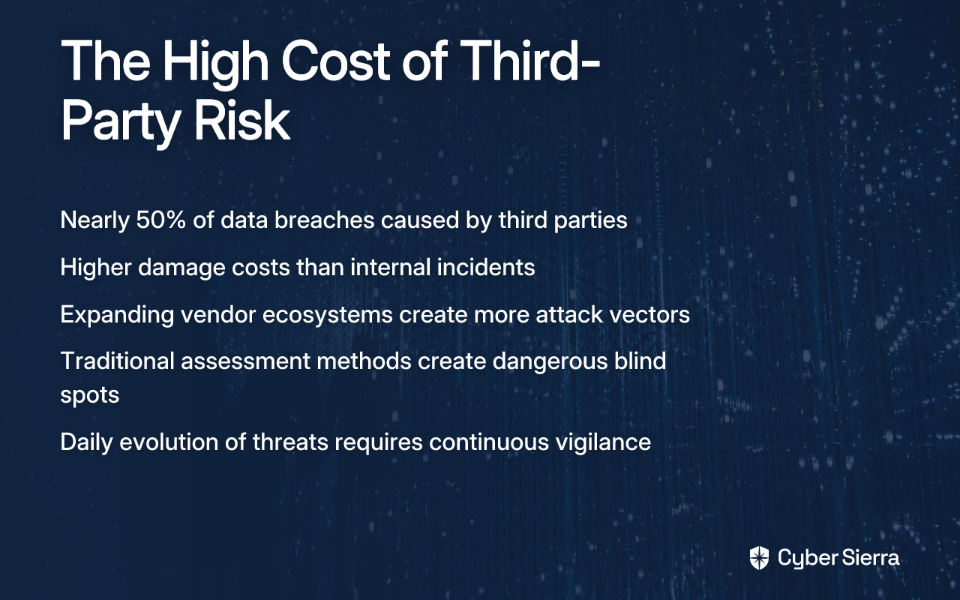
Third-Party Risk Management is the process of identifying, assessing, and mitigating risks associated with outsourcing tasks to third-party vendors or service providers. While essential for protecting your organization, manual TPRM processes are becoming increasingly unsustainable.

Organizations now rely more heavily than ever on external vendors for core and non-core functions. Each of these relationships expands your attack surface and introduces significant risks, including operational disruptions, security breaches, and compliance failures. According to IBM, these risks can severely impact your organization's reputation, operational capabilities, and bottom line.

The problem? Most organizations still tackle TPRM with spreadsheets, email chains, and disjointed processes—methods that were barely adequate a decade ago and are completely overwhelming today.

The Breaking Point: Critical Challenges in Traditional TPRM

Manual TPRM processes are breaking under pressure from several critical challenges:

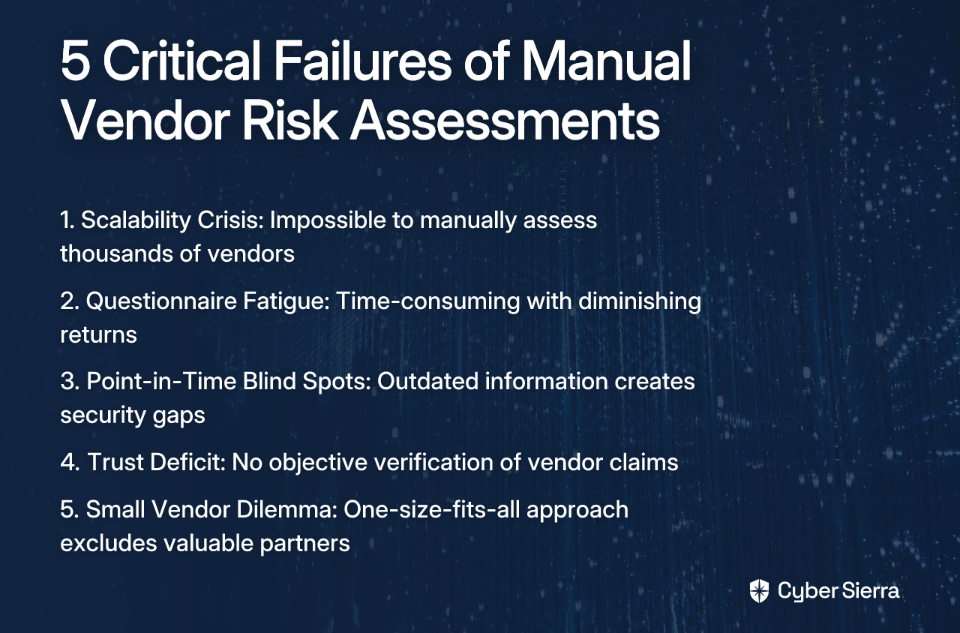
  1. Evolving Cybersecurity Threats: Supply chain attacks are increasingly sophisticated, specifically targeting vendor access credentials to penetrate your organization. Traditional point-in-time assessments can't keep pace with these rapidly evolving threats.
  2. Scaling and Resource Constraints: Managing thousands of third-party relationships with unique risk profiles is virtually impossible with manual methods. As one security professional noted on Reddit, "I talked to an organisation who was using OneTrust for 2 suppliers (for more, they did not have resources)."
  3. Assessment and Questionnaire Fatigue: Standardized templates like the SIG (Shared Assessments Questionnaire) often create more problems than they solve. As one user explained, "many questions means that your Third Parties have many questions to answer and you have many answers to evaluate," leading to analysis paralysis.
  4. Lack of Real-Time Visibility: Traditional, point-in-time assessments quickly become outdated, offering no insight into emerging risks that develop between assessment cycles.
  5. Regulatory Complexity: Managing compliance with overlapping regulations like GDPR and CCPA manually is a significant burden, especially as regulatory requirements continue to expand and evolve.
  6. Lengthy Onboarding Cycles: Manual due diligence and onboarding processes can significantly delay business operations, creating friction between security, procurement, and business units.

The Automation Advantage: Core Benefits of a Streamlined TPRM Program

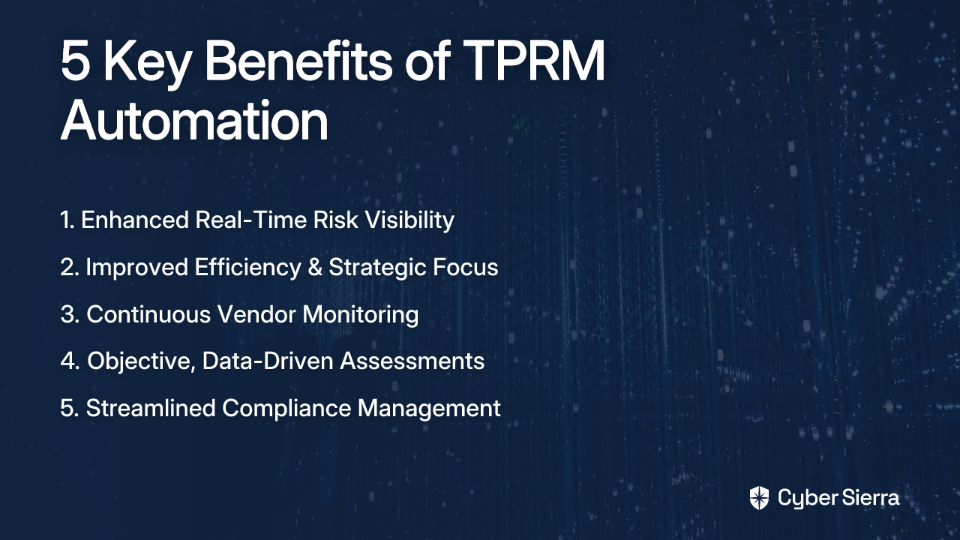
Automation offers a direct solution to these challenges, transforming TPRM from a reactive burden into a proactive strategic advantage:

  1. Enhanced Risk Visibility: Instead of relying on static snapshots, automation provides a comprehensive, real-time view of your third-party risk landscape. This means you can identify and address emerging risks before they impact your business.
  2. Improved Efficiency and Strategic Focus: By automating manual, repetitive tasks like sending questionnaires and reminders, you free up your team to focus on strategic threat prevention and high-risk vendor management. According to Diligent, this shift from administrative burden to strategic focus is one of the most valuable benefits of TPRM automation.
  3. Real-Time Continuous Monitoring: Automated tools enable ongoing monitoring of your vendors' cybersecurity posture, with instant alerts for security or compliance issues. One security professional highlighted how valuable this is: "Super helpful to check if a vendor says they've patched X, you can see if that's reflected in their external exposure."
  4. Objective, Data-Driven Assessments: Automation reduces subjectivity and human error by using standardized, data-driven risk scores and analysis, ensuring consistent evaluation across your vendor ecosystem.
  5. Streamlined Compliance Management: Automated tools can assess compliance against frameworks like NIST and ISO 27001, while tracking regulatory changes to ensure vendors meet their obligations.
Automating the TPRM Lifecycle: A Step-by-Step Guide

Let's break down the TPRM lifecycle and examine how automation transforms each stage:

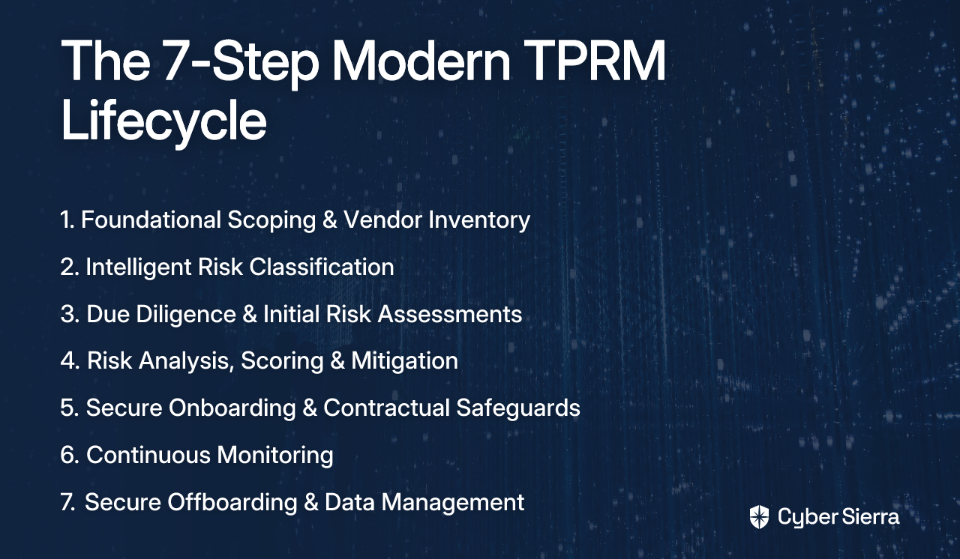
1. Vendor Discovery & Classification

Manual Approach: Using spreadsheets to track vendors, often leading to an incomplete or outdated inventory with inconsistent risk classifications.

Automated Solution: Integrate with procurement systems to automatically build a comprehensive vendor inventory. Use AI to classify vendors by inherent risk based on data access and service criticality, ensuring consistent risk-based prioritization.

2. Evaluation, Onboarding & Due Diligence

Manual Approach: Lengthy email chains, sending massive questionnaires, and manually reviewing documents, often delaying vendor onboarding by weeks or months.

Automated Solution: Deploy standardized, automated onboarding workflows to collect data efficiently. Leverage AI tools to streamline security questionnaires, saving hours or days of manual effort. According to UpGuard, this can reduce onboarding times by up to 75%.

3. Risk Assessment & Analysis

Manual Approach: Subjective analysis of questionnaire answers with difficulty comparing vendors consistently across different risk dimensions.

Automated Solution: Standardize risk assessments with automated scoring based on predefined criteria. Automate the detection of third-party risks across different profiles using attack surface management techniques. As CentralEyes notes, this ensures consistent evaluation against your organization's risk appetite.
4. Risk Mitigation & Remediation

Manual Approach: Tracking remediation efforts in spreadsheets, leading to lost findings and frustration. As one user complained, "they do not do a good job at repeat findings that have been remediated."

Automated Solution: Implement automated workflows for flagging, evaluating, and tracking risks. Create a centralized system that tracks remediation progress and ensures findings are not forgotten once addressed, providing clear accountability and visibility.

5. Continuous Monitoring

Manual Approach: Annual or biennial assessments that miss real-time threats and changes in vendor security posture.

Automated Solution: This is where automation truly shines. Implement continuous monitoring tools that provide an "outside-in view" of a vendor's external security posture, allowing you to validate technical claims against real-world data. For example, if a vendor claims they've implemented a critical patch, continuous monitoring can verify this is reflected in their actual security posture.

6. Documentation & Reporting

Manual Approach: Scrambling to pull together data for audits from disparate sources, often with incomplete information.

Automated Solution: Maintain a centralized repository for all vendor documentation, creating a clear audit trail. Generate real-time risk dashboards and reports for stakeholders automatically, ensuring compliance requirements are met without last-minute fire drills.

Choosing Your Automation Ally: Key Features of an Effective TPRM Platform

When selecting a TPRM automation platform, focus on these critical capabilities:

  1. User-Friendliness and Simplicity: The platform must be easy to use. As one user lamented, "a bad user interface just means a ton of pushback and resistance from main stakeholders." Look for a "simple interface [that] is easy to navigate and you're not overwhelmed with the findings."
  2. Validation and Depth, Not Just Scores: The tool should go beyond surface-level scores. It needs to provide deep insights and validate vendor claims. Users are frustrated when tools "don't tell you e.g. whether your TP are doing code review." The goal is to "validate technical claims against real-world data where possible."
  3. Customization and Flexibility: The ability to create customizable questionnaires and assessment templates is crucial to avoid the "analysis paralysis" of overly long, standardized forms.
  4. Scalability: The solution must be able to handle your organization's growth, whether you have dozens or "tens of thousands of suppliers."
  5. Integration Capabilities: The platform should easily integrate with your existing systems (GRC, procurement, etc.) to create a unified view of risk.

From Operational Bottleneck to Strategic Enabler

Automating your TPRM program isn't just about efficiency—it's about transforming one of your biggest organizational challenges into a strategic advantage. By implementing the right automated solution, you can:

  • Replace time-consuming manual processes with streamlined workflows
  • Shift from reactive risk management to proactive risk prevention
  • Transform vendor relationships from potential vulnerabilities to secure partnerships

The result is a resilient organization with the visibility and control needed to thrive in today's complex business environment.

As cyber threats continue to evolve and regulatory requirements expand, the organizations that leverage automation to streamline their TPRM programs will be the ones best positioned to protect their data, maintain compliance, and build trust with customers and partners.

Begin by evaluating your current TPRM processes against the challenges outlined above. Identify your biggest pain points, and explore automated solutions like those offered by UpGuard or CentralEyes to see how automation can transform your approach to third-party risk management.

Frequently Asked Questions

What is Third-Party Risk Management (TPRM)?

Third-Party Risk Management (TPRM) is the process of identifying, assessing, and mitigating the risks associated with outsourcing business operations to external vendors or service providers. It is a critical function for protecting your organization from potential security breaches, operational disruptions, and compliance failures that can arise from your vendor relationships. As your organization relies more on third parties, TPRM helps manage the expanding attack surface they introduce.

Why are manual TPRM processes failing?

Manual TPRM processes are failing because they cannot scale to manage the growing number of vendor relationships and the increasing complexity of modern cyber threats. Traditional methods using spreadsheets and email are overwhelmed by challenges like sophisticated supply chain attacks, resource constraints, assessment fatigue, a lack of real-time visibility into vendor security posture, and complex regulatory requirements. This leads to slow onboarding and leaves organizations vulnerable.

How does automation improve TPRM?

Automation improves TPRM by transforming it from a slow, reactive process into a streamlined, proactive, and strategic function. It enhances risk visibility with real-time data, improves team efficiency by handling repetitive tasks, enables continuous monitoring of vendor security, provides objective data-driven assessments, and simplifies compliance management. This allows security teams to focus on high-level strategy instead of administrative work.

What are the key stages of an automated TPRM lifecycle?

The key stages of an automated TPRM lifecycle include vendor discovery and classification, evaluation and onboarding, risk assessment, risk mitigation, continuous monitoring, and documentation and reporting. Automation streamlines each step, from automatically building a vendor inventory and using AI for risk classification to deploying automated workflows for onboarding, using data-driven scoring for assessments, and providing continuous monitoring to ensure vendor security posture remains strong over time.

What should I look for in a TPRM automation platform?

An effective TPRM automation platform should be user-friendly, provide deep and validated insights beyond simple scores, offer customization and flexibility, be scalable, and integrate easily with your existing systems. A simple interface is crucial for user adoption, while the ability to customize questionnaires and workflows ensures the platform fits your organization's specific needs as it grows. The best tools offer actionable intelligence to validate vendor claims, not just surface-level risk scores.
blog-hero-background-image
Cyber Security

Step-by-Step Guide: ISO 27001 Compliance Report for Enterprise Teams

backdrop
Table of Contents

Join thousands of professionals and get the latest insight on Compliance & Cybersecurity.


Summary

  • A successful ISO 27001 compliance report relies on foundational steps like defining your ISMS scope, conducting a risk assessment, and meticulously documenting your Statement of Applicability (SoA).
  • A comprehensive report must clearly outline the audit scope, key findings, identified non-conformities, and a corrective action plan to address security gaps.
  • Transition from periodic manual checks to continuous compliance by using automation to monitor controls and collect evidence in real-time.
  • Cybersierra’s GRC platform automates data collection and control monitoring, helping you stay continuously audit-ready for ISO 27001.

You've been tasked with preparing an ISO 27001 compliance report, and now you're staring at a mountain of requirements, controls, and documentation. Where do you even begin? If you're feeling overwhelmed, you're not alone.

"The process is by no means 'efficient' and will require a good amount of documentation," as one IT professional noted in a recent discussion. This sentiment resonates with many enterprise teams grappling with ISO 27001 compliance, especially those without prior Information Security Management experience.

This step-by-step guide will demystify the ISO 27001 compliance report creation process, providing you with a clear roadmap to follow.

Understanding ISO 27001 and the ISMS Foundation

Before diving into report creation, let's establish what we're working with:

ISO/IEC 27001 is the leading international standard for Information Security Management Systems (ISMS), created by the International Organization for Standardization. With over 70,000 certificates issued worldwide, it's globally recognized as the benchmark for information security.

At its core, ISO 27001 is built around the CIA triad:

  • Confidentiality: Ensuring information is accessible only to authorized individuals
  • Integrity: Maintaining the accuracy and completeness of data and processing methods
  • Availability: Guaranteeing authorized users have access to information when needed

An ISMS is the systematic approach to managing sensitive company information through a framework of policies, procedures, and controls. ISO 27001 doesn't just verify that you have certain security technologies in place—it confirms you have a comprehensive system for managing information security risks.

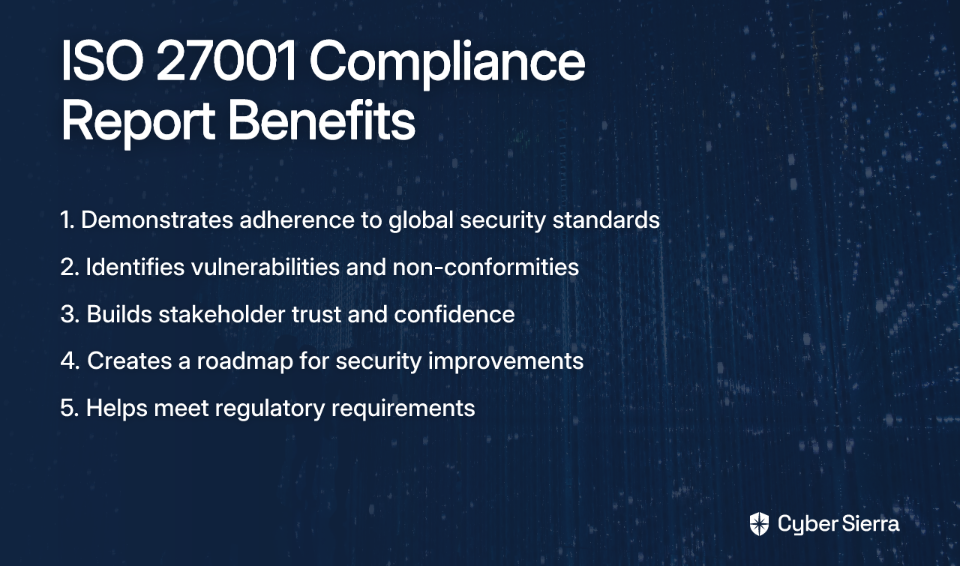
Why is the compliance report crucial? It serves as:

  1. A demonstration of your adherence to the standard
  2. A tool for identifying security vulnerabilities and non-conformities
  3. A seal of trust that builds confidence among customers, partners, and stakeholders

The Pre-Reporting Phase: Audit Readiness Checklist

Before you can create a meaningful compliance report, you need to have the right foundations in place. Here's your pre-reporting checklist:

Step 1: Secure Management Buy-In

"Get the management on your side," advises an experienced ISO implementer from the Reddit discussion. This is non-negotiable. Without leadership support, you'll struggle to secure the necessary resources and authority to implement required changes.

Step 2: Define the Scope of Your ISMS

Many teams struggle with this critical step. As one professional noted, "It's still unclear how to start with step 3: Define the scope."

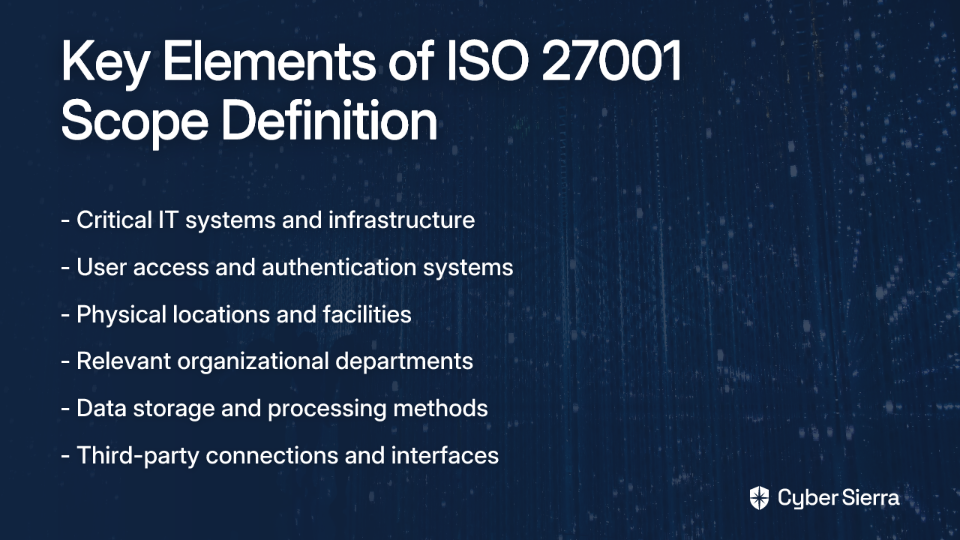
The scope defines the boundaries of your ISMS—what's included and what's excluded. To clearly define your scope, consider:

  • Which IT systems are covered
  • Which users (internal and external) interact with these systems
  • Which physical locations are included
  • Which existing company policies apply

Document this scope definition clearly, as it will be a cornerstone of your compliance report.

Step 3: Conduct a Risk Assessment & Gap Analysis

Two separate but related processes form the backbone of your ISMS:

  • Risk Assessment: This is the systematic process of identifying information assets, determining threats and vulnerabilities, analyzing potential impacts, and prioritizing risks. According to ISO 27001 guidelines, you'll need to document your methodology and create a comprehensive risk treatment plan.
  • Gap Analysis: This involves comparing your current security controls against ISO 27001 requirements to identify gaps. This analysis will highlight areas that need attention before you can achieve compliance.

Step 4: Implement Annex A Controls & Create a Statement of Applicability (SoA)

Annex A of ISO 27001 provides a catalog of 114 security controls across 14 domains. You don't need to implement all of them—only those relevant to your identified risks.

The Statement of Applicability (SoA) is a mandatory document that:

  • Lists which Annex A controls you have implemented
  • Provides justification for any controls you've excluded
  • Explains how you've implemented each applicable control

This document is often scrutinized during audits and forms a critical component of your compliance report.

Step 5: Document Everything

As one IT professional bluntly stated, "The process is by no means 'efficient' and will require a good amount of documentation." This extensive documentation includes:

  • ISMS Scope Statement
  • Information Security Policy
  • Risk Assessment Report
  • Risk Treatment Plan
  • Statement of Applicability
  • Security control procedures
  • Evidence of control implementation and effectiveness

Anatomy of a Comprehensive ISO 27001 Compliance Report

Now that you have the groundwork in place, let's break down what goes into the actual compliance report. According to Sprinto's ISO 27001 guide, a well-structured report typically includes:

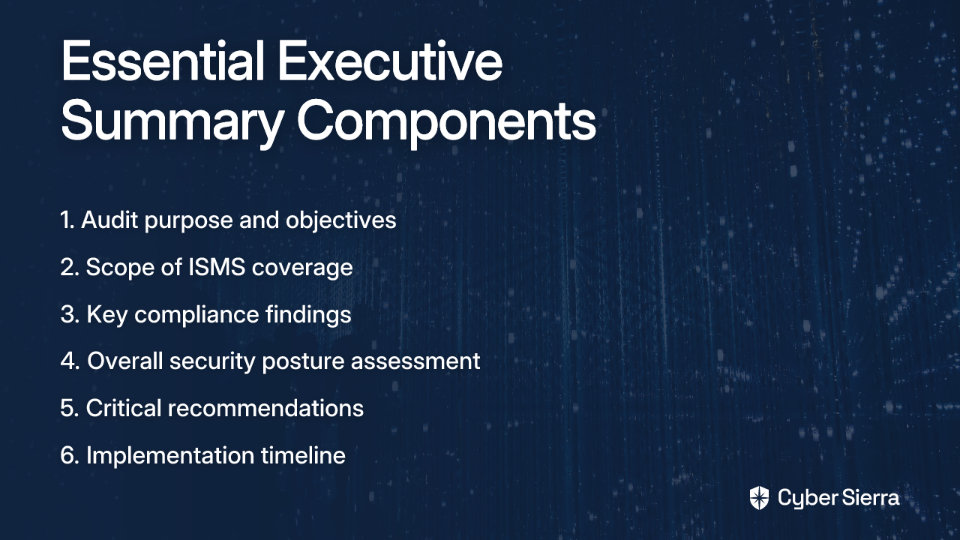
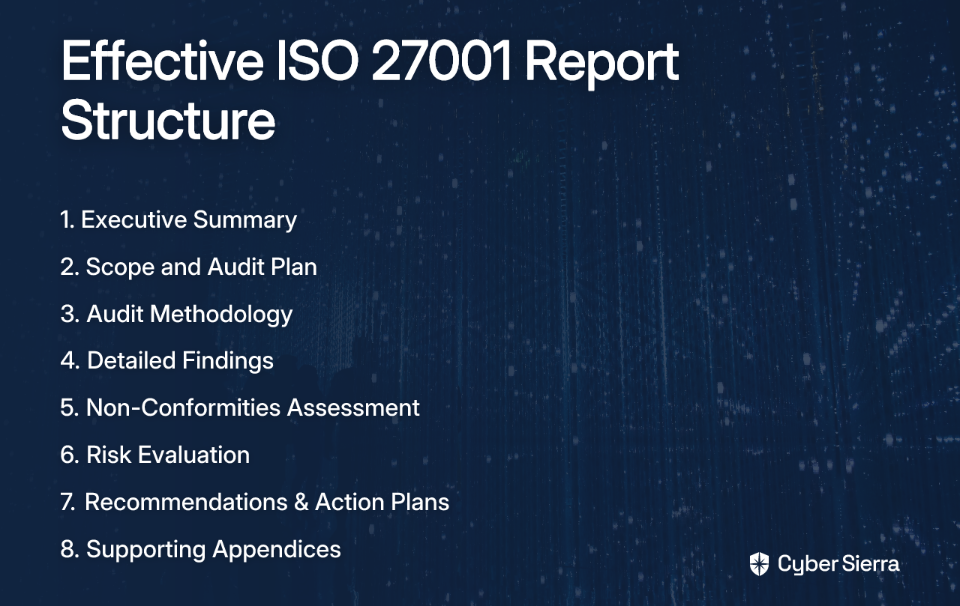
1. Executive Summary

This high-level overview provides busy stakeholders with the essential information:

  • Purpose and scope of the audit
  • Key findings and their significance
  • Overall compliance status
  • Major recommendations

Keep this section concise but informative—ideally no more than one or two pages.

2. Scope and Audit Plan

This section clearly defines:

  • What was audited (departments, locations, systems)
  • Who conducted the audit
  • The audit timeline and methodology
  • Any limitations or exclusions

3. Audit Methodology

Detail the techniques used during the audit:

  • Document review processes
  • Interview approaches
  • Sampling methods for evidence collection
  • Testing procedures
  • Vulnerability assessment tools

4. Audit Findings

This forms the core of your report, presenting factual findings supported by evidence. For each ISO 27001 requirement, provide:

  • Compliance status
  • Supporting evidence
  • Observations
  • Any relevant context

5. Vulnerabilities and Non-Conformities

List all identified weaknesses and deviations from the ISO 27001 standard. Typically, non-conformities are categorized as:

  • Major Non-Conformities: Significant failures that pose immediate risk to information security
  • Minor Non-Conformities: Smaller issues that require correction but don't represent significant risk
  • Observations: Areas for improvement that aren't strict non-conformities

6. Recommendations & Corrective Action Plan

This section provides actionable suggestions to address identified non-conformities and improve the ISMS. Each recommendation should include:

  • Reference to the specific finding
  • Proposed action
  • Priority level
  • Responsible party
  • Target completion date

Creating Your Report: A Step-by-Step Process

Now that you understand what goes into the report, here's a practical workflow for creating it, based on guidance from Sprinto:

Step 1: Documentation Review

Start by collecting and reviewing all necessary documents:

  • ISMS scope statement
  • Information security policies
  • Risk assessments and treatment plans
  • Statement of Applicability
  • Previous audit reports (if available)
  • Evidence of control implementation

Step 2: Evidential Sampling & Interviews

Collect evidence through:

  • Interviews with relevant staff
  • Review of documentation
  • Testing of controls
  • Direct observation of security practices

Step 3: Analysis of Findings

Assess your findings to determine:

  • Major and minor non-conformities
  • Observations and improvement opportunities
  • Root causes of issues
  • Potential remediation approaches

Step 4: Report Writing and Finalization

When writing the report:

  • Use clear, straightforward language
  • Incorporate visual aids like charts to show trends
  • Cross-reference findings directly to ISO 27001 clauses
  • Prioritize recommendations based on risk
  • Include appendices for detailed evidence

Streamlining Compliance with Automation and Continuous Monitoring

The traditional approach to ISO 27001 compliance involves periodic, often manual checks that can lead to "compliance debt" and last-minute scrambling before audits. There's a better way.

Continuous Controls Monitoring (CCM) transforms compliance from a point-in-time exercise to an ongoing, automated process. Research shows that CCM provides:

  • Real-time compliance monitoring
  • Automated evidence collection
  • Proactive alerts when controls fail
  • On-demand compliance reporting

Cybersierra's Governance, Risk & Compliance (GRC) platform addresses these exact challenges by automating data collection, risk assessments, control monitoring, and reporting for ISO 27001. The platform's Continuous Control Monitoring (CCM) module provides ongoing visibility into security controls and maintains a single source of truth, transforming security from periodic checks to a state of continuous, audit-ready compliance.

Conclusion

Creating an ISO 27001 compliance report is undoubtedly challenging, but following this structured approach will make the process manageable and produce a comprehensive, audit-ready report.

Remember that the compliance report isn't just a bureaucratic requirement—it's a valuable tool for understanding your security posture and driving continuous improvement. By documenting your compliance journey, you create a roadmap for ongoing security enhancement.

Ready to make your ISO 27001 journey more efficient and effective? See how Cybersierra's AI-enabled platform transforms compliance management with automation and continuous monitoring, helping you stay audit-ready at all times rather than scrambling before certification deadlines.

Frequently Asked Questions

What is an ISO 27001 compliance report?

An ISO 27001 compliance report is a formal document that details the findings of an audit against the ISO 27001 standard. It serves as official evidence of your organization's Information Security Management System (ISMS), outlining its scope, the results of risk assessments, the status of security controls, and any identified non-conformities. The report demonstrates your adherence to global security standards and provides a roadmap for continuous improvement.

Why is a Statement of Applicability (SoA) so important for ISO 27001?

The Statement of Applicability (SoA) is a mandatory and critical document for ISO 27001 compliance because it links your risk assessment to your implemented security controls. It lists all 114 controls from Annex A and requires you to document whether each control is applicable, how it has been implemented, and provide a justification for any controls that have been excluded. Auditors scrutinize the SoA to ensure your security measures are comprehensive and relevant to your specific risks.

How do you define the scope of an ISMS for ISO 27001?

To define the scope of your ISMS, you must clearly establish its boundaries by identifying what information and assets you intend to protect. This involves documenting which specific business processes, physical locations, IT systems, departments, and third-party connections are included within the ISMS. A well-defined scope is crucial as it sets the foundation for your risk assessment and the entire compliance audit.

What is the difference between a risk assessment and a gap analysis?

A risk assessment focuses on identifying, analyzing, and evaluating potential threats and vulnerabilities to your information assets to prioritize them for treatment. In contrast, a gap analysis compares your existing security controls and processes directly against the requirements of the ISO 27001 standard. While both are crucial, risk assessment is about managing risk, whereas gap analysis is about measuring your readiness for certification.

How can automation help with ISO 27001 compliance?

Automation significantly streamlines ISO 27001 compliance by replacing periodic, manual checks with continuous monitoring of security controls. Platforms with automation can automatically collect evidence, provide real-time alerts when a control fails, and generate on-demand compliance reports. This reduces the manual effort, minimizes human error, and ensures your organization remains in a state of continuous, audit-ready compliance rather than scrambling before an audit.

What are the most common challenges when creating an ISO 27001 report?

The most common challenges include securing management buy-in, accurately defining the ISMS scope, and managing the extensive documentation required. Without leadership support, it's difficult to get the necessary resources. An unclear scope can lead to a failed audit. Finally, the sheer volume of policies, procedures, risk assessments, and evidence can be overwhelming to create and maintain without a structured approach or automation tools.

blog-hero-background-image
Cyber Security

Internal Audit Report Templates for Continuous Controls Monitoring

backdrop
Table of Contents

Join thousands of professionals and get the latest insight on Compliance & Cybersecurity.


Summary

  • Traditional internal audit reports are often too long and manual, leading to executive fatigue and outdated, point-in-time insights.
  • Shifting to Continuous Controls Monitoring (CCM) provides ongoing, automated visibility into control effectiveness, moving from reactive to proactive auditing.
  • Modernize your audit reports with a one-page executive summary, data visualizations, and standardized findings to ensure they are read and acted upon by stakeholders.
  • Automate the manual evidence gathering process with a Continuous Control Monitoring (CCM) platform to free up auditors for strategic analysis and provide real-time data for reports.

You've just spent weeks meticulously gathering evidence for your internal audit, creating a comprehensive 30-page report that details every finding and recommendation. But when you present it to the Audit Committee, you can see their eyes glazing over by page three. Later, you hear through the grapevine that most of them didn't even read the full document. All that work—wasted.

Sound familiar? You're not alone. According to discussions among internal audit professionals, there's a growing consensus that "a 30 page report will bore them to death...if they read it at all". The traditional approach to internal audit reporting is failing in today's fast-paced business environment, where executives need concise, actionable insights—not lengthy documents that gather digital dust.

Why Traditional Internal Audit Reports Are Failing in a Real-Time World

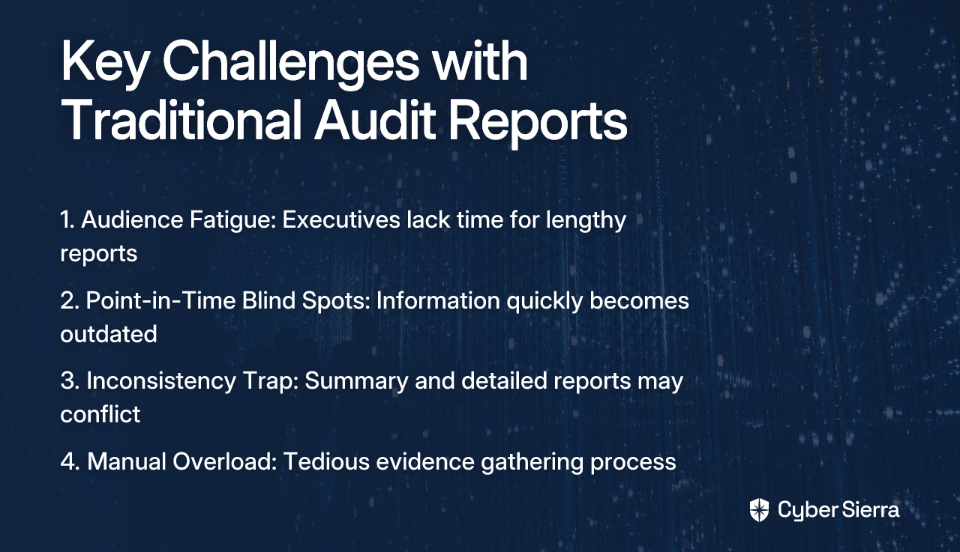
Traditional audit reports face several critical challenges that limit their effectiveness:

  1. Audience Fatigue: Most Audit Committee members and executives simply don't have time to wade through lengthy reports. As one audit professional put it, "Unfortunately I suspect that the AC don't even read our reports because it's too long".
  2. Point-in-Time Blind Spots: Conventional audits capture a snapshot of compliance at a specific moment, but risks emerge and evolve daily. By the time a traditional report reaches stakeholders, the information may already be outdated.
  3. The Inconsistency Trap: Many audit teams create separate summary and detailed reports, but this approach runs the "risk of these two versions not saying the same thing". This inconsistency undermines trust in the audit process.
  4. Manual Overload: Perhaps the most painful part of an audit is the tedious process of evidence gathering. Auditors spend countless hours "on long calls with engineers who may or may not speak GRC and hope they remember where to find a config and take a screenshot with a timestamp".

The solution? A shift to Continuous Controls Monitoring (CCM) coupled with modernized reporting templates designed for clarity and impact.

The Shift to Continuous Controls Monitoring (CCM)

Continuous Controls Monitoring represents a fundamental evolution in how organizations approach internal audit and compliance. Rather than periodic, sample-based testing, CCM leverages technology to provide ongoing visibility into control effectiveness across entire populations of data.

According to Deloitte, CCM offers several core benefits:

  • Enhanced Accuracy: CCM demonstrates the proportion of transactions adhering to expected processes, allowing teams to focus on anomalies rather than wasting time on compliant areas.
  • Collaboration: It increases trust and transparency across the three lines of defense with centralized dashboards that provide a unified view of control effectiveness.
  • Cost Reduction: By automating routine testing, CCM reduces human effort on low-value activities and transfers risk resolution to first-line management where it belongs.

AuditBoard further notes that CCM allows audit teams to "automatically surface exceptions for immediate remediation, shifting from reactive to proactive auditing." Instead of discovering issues months after they occur, CCM provides "ongoing assurance through real-time monitoring of complete data sets."

But implementing CCM is only half the battle. To truly realize its benefits, internal audit reporting must also evolve to match this more agile, data-driven approach.

Core Components of a Modern CCM-Powered Audit Report Template

To bridge the gap between continuous monitoring and effective stakeholder communication, here's a template structure that combines the rigor of IIA standards with the brevity modern executives demand:

1. Title Page

  • Clearly state it's an "Independent Auditor's Report" to signify objectivity
  • Include audit subject and time period (e.g., "Q3 2024 Continuous Monitoring Results")
  • Include the report date and issuing department

2. Executive Summary (The One-Pager)

This is the most critical section for the Audit Committee and C-suite. It should include:

  • Objective: State the purpose of the engagement in one sentence
  • Scope: Detail what was audited (e.g., "Continuous monitoring of access controls for critical systems from July 1 - Sep 30")
  • Overall Engagement Rating: A clear, high-level ranking (e.g., Satisfactory, Marginal, Unsatisfactory) or a quantitative control maturity score
  • Key Findings: List only the top 3-5 most critical observations, hyperlinked to the detailed section
  • Trend Analysis: A simple visual showing control performance over time compared to previous periods

3. Summary of Observations (Dashboard View)

Create a visual summary of findings in a table format with the following columns:

  • Finding Title
  • Criticality Rating (High, Medium, Low)
  • Status (Open, In Progress, Closed)
  • Responsible Person
  • Target Date

This directly addresses the need for clear categorization that audit professionals have identified as essential.

4. Detailed Findings Section

Each finding should have its own standardized section with:

  • Title and Reference #: For easy tracking
  • Criticality Rating: High, Medium, Low
  • Condition: The "what is" – the statement of facts
  • Criteria: The "what should be" – the standard, policy, or best practice
  • Cause: The root cause of the deviation
  • Effect/Risk: The potential impact on the business
  • Audit Recommendation: Actionable steps to remediate
  • Management's Action Plan: Must include corrective actions, responsible persons, and target completion dates

5. Positive Assurance/Recognition

Highlight areas of strong performance or cooperation to provide a balanced view. This is often overlooked but important for building relationships with auditees.

6. Distribution List

Clearly indicate who received the report to maintain confidentiality and accountability.

Step-by-Step: Building and Implementing Your CCM Audit Report

Here's a practical guide to creating effective CCM-powered audit reports:

Step 1: Define Your Audience and Their Needs

Different stakeholders require different levels of detail. The Audit Committee needs the Executive Summary, while process owners need the Detailed Findings. Map out your audience and tailor your communication accordingly.

Step 2: Standardize Your Finding Structure

Mandate the use of the Condition/Criteria/Cause/Effect structure for every finding. This solves the user pain of "inconsistent detail across findings" and ensures a methodical approach to problem-solving.

Step 3: Define Your Criticality Ratings

Create and communicate a clear rubric for what constitutes a High, Medium, or Low risk finding. This prevents subjective ratings and ensures consistency across reports.

Step 4: Leverage Data Visualization

Instead of dense text, use:

  • Charts to show trends in control failures
  • Heat maps for risk concentration
  • Dashboards for overall compliance posture

Visual elements make complex information instantly understandable, addressing the need for "short, quick points on an easy to understand format."

Step 5: Link to a Live Evidence Repository

A modern report shouldn't be a static document. Include links to a live dashboard or evidence repository where stakeholders can view real-time data and supporting documentation for themselves. This builds trust and transparency while reducing the need for lengthy explanations in the report itself.

Automating the Process: From Data Collection to Report Generation

The most painful part of an audit is often the tedious, manual evidence gathering. As one professional described it, you end up spending hours "on long calls with engineers who may or may not speak GRC and hope they remember where to find a config and take a screenshot with a timestamp".

Automation is the key to unlocking the full potential of CCM and streamlined reporting. Modern GRC platforms can:

  • Automatically collect evidence from various systems
  • Map controls to multiple compliance frameworks
  • Generate exception reports in near real-time
  • Pre-populate report templates with the latest findings

Platforms like Cyber Sierra are designed to solve this exact problem. The Continuous Control Monitoring (CCM) module automates the painful process of evidence gathering by connecting directly to your tech stack.

Instead of manually chasing engineers for screenshots, you get near real-time updates on control status. This data feeds directly into your reports, ensuring they are always based on the latest information. For organizations juggling multiple compliance frameworks like ISO 27001, PCI DSS, or SOC 2, a GRC platform like Cyber Sierra automates data collection and control mapping, dramatically reducing the manual effort required for audit readiness.

With automation handling the heavy lifting of data collection, your audit team can focus on analysis and providing valuable insights—transforming the audit function from a compliance checkbox to a strategic advisor.

Putting It All Together: A Sample CCM Audit Report

Let's see how these elements come together in practice. Here's a simplified example of a CCM-powered audit report:

Title: Q3 2024 Continuous Controls Monitoring Report: Access Management

Executive Summary:

  • Objective: To evaluate the effectiveness of access management controls across critical systems.
  • Scope: Continuous monitoring of access provisioning, review, and termination controls from July 1 - Sep 30, 2024.
  • Overall Rating: Marginal (Control Maturity Score: 3.2/5)
  • Key Findings:
    • High: Terminated employee access not consistently revoked within 24 hours (see Finding #1)
    • Medium: Privileged access reviews not completed for 2 of 7 systems (see Finding #2)
    • Low: Documentation of access approval inconsistently maintained (see Finding #3)

Trend Analysis: [Simple chart showing control performance over time]

This approach delivers the critical information executives need without overwhelming them with unnecessary details. The full report would include the dashboard view and detailed findings sections, but even these would be more concise and data-driven than traditional audit reports.

Conclusion

The shift to Continuous Controls Monitoring requires a parallel evolution in how we communicate audit results. By adopting streamlined, data-driven report templates, internal audit teams can:

  • Increase engagement from the Audit Committee and senior management
  • Provide more timely, relevant insights into control effectiveness
  • Move from point-in-time assessments to ongoing assurance
  • Reduce the manual burden of evidence gathering and report creation

The goal isn't just to create shorter reports—it's to deliver more impactful insights that drive positive change in your organization's risk and control maturity.

By combining robust CCM with modern reporting templates, internal audit can transform from a historical record-keeper into a strategic, forward-looking advisor to the business. In today's fast-paced risk environment, that's not just a nice-to-have—it's essential for ensuring that your audit function remains relevant and valued.

Remember, the most impressive audit report is the one that actually gets read and acted upon. Make yours count.

Frequently Asked Questions (FAQ)

What is the main problem with traditional audit reports?

The main problem with traditional audit reports is that they are often too long, static, and time-consuming for modern business needs. This leads to audience fatigue among executives, provides only a point-in-time snapshot that quickly becomes outdated, and creates a heavy manual workload for auditors, reducing their overall impact and relevance.

What is Continuous Controls Monitoring (CCM)?

Continuous Controls Monitoring (CCM) is an automated approach that provides ongoing, real-time visibility into the effectiveness of an organization's internal controls. Instead of periodic, sample-based testing, CCM leverages technology to monitor entire populations of data continuously, allowing for the immediate identification of exceptions and anomalies.

How does CCM improve the internal audit process?

CCM improves the audit process by shifting it from a reactive, historical review to a proactive, forward-looking function. Key benefits include enhanced accuracy by analyzing complete data sets, better collaboration through shared dashboards, and significant cost reduction by automating routine testing. This allows auditors to focus on strategic risks rather than tedious manual evidence collection.

What are the essential components of a modern audit report?

A modern audit report should be concise, visual, and data-driven. Essential components include a one-page Executive Summary with an overall rating and key findings, a visual dashboard summarizing all observations, a standardized detailed findings section (using Condition, Criteria, Cause, Effect), and links to a live evidence repository for transparency.

How can I make my audit report more engaging for executives?

To make your audit report more engaging for executives, start with a scannable one-page executive summary that highlights the most critical findings and provides a clear overall rating. Use data visualizations like charts and heat maps to show trends and risk concentrations instead of dense text. This approach ensures that key stakeholders can quickly grasp the most important information and make informed decisions.

Why is automation crucial for modern internal auditing?

Automation is crucial because it eliminates the most time-consuming and error-prone part of auditing: manual evidence collection. By automatically gathering data from various systems and mapping it to controls, automation frees up auditors to focus on high-value analysis and strategic advisory. It also enables the real-time insights needed for Continuous Controls Monitoring (CCM) to be effective.

blog-hero-background-image
Cyber Security

SOC 2 Audit Readiness Report Template for Compliance Teams

backdrop
Table of Contents

Join thousands of professionals and get the latest insight on Compliance & Cybersecurity.


Summary

  • A SOC 2 Readiness Assessment is a critical "practice run" that identifies control gaps before a formal audit, saving time, money, and preventing failure.
  • Your readiness report should detail the audit scope, map controls to Trust Services Criteria, analyze gaps, and outline a clear remediation plan for each.
  • Manual evidence collection is a primary audit challenge; modern compliance requires moving from point-in-time spreadsheets to continuous control monitoring.
  • To streamline this process, compliance automation platforms like Cyber Sierra's GRC module automate evidence collection and provide continuous monitoring to keep you audit-ready.

You've just been handed the news: "We need to get SOC 2 certified ASAP. Our biggest client is demanding it." Suddenly, compliance has become the most urgent priority on your already overflowing plate.

If this scenario sounds familiar, you're not alone. Many organizations find themselves scrambling to prepare for a SOC 2 audit after a client or partner request, often with little understanding of what's actually involved.

The good news? A structured SOC 2 Audit Readiness Report can transform this high-pressure situation from a reactive scramble into a strategic advantage. By conducting a proper readiness assessment before engaging auditors, you'll save time, money, and countless headaches.

What is a SOC 2 Readiness Assessment? (And Why It's Non-Negotiable)

A SOC 2 Readiness Assessment is essentially a "practice run" before your formal audit. It helps you identify control gaps, implement necessary remediation, and ensure you're fully prepared when the auditors arrive.

As one compliance professional noted on Reddit, "If you haven't actually worked with a vCISO or have an internal security team that has implemented a strong security program, you're almost definitely not ready to have an audit done because you haven't actually implemented the correct controls."

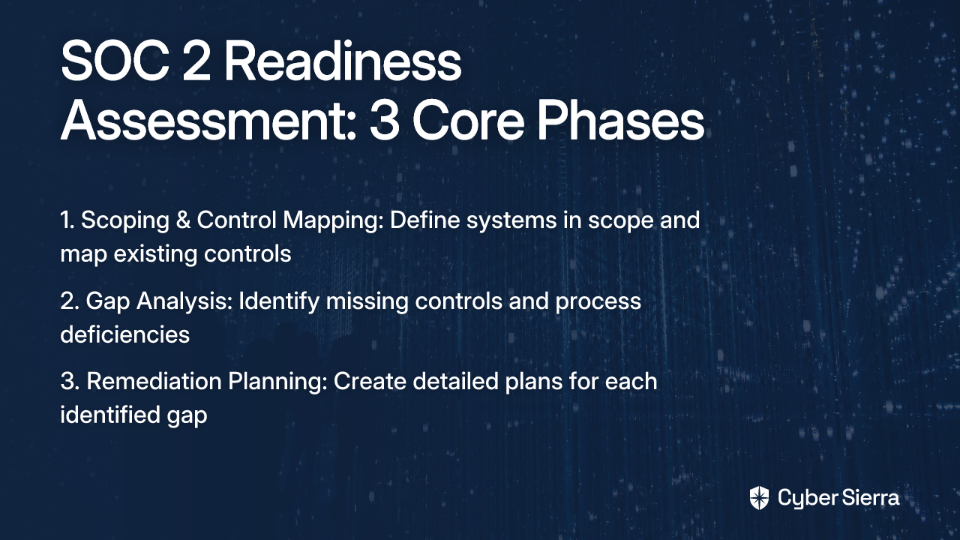
A proper readiness assessment consists of three core phases:

  1. Scoping & Control Mapping: Define which systems are in scope and map your existing security controls to the relevant AICPA Trust Services Criteria.
  2. Gap Analysis: Identify missing controls or processes that don't meet SOC 2 requirements.
  3. Remediation Planning: For every gap found, create a detailed remediation plan. As one experienced practitioner advised, "If the gap can't be fixed, have a risk and a plan to risk remedy."

Expect to invest anywhere from $10,000 to $17,000 for a professional assessment, depending on your organization's size and complexity. This might seem steep, but it's a fraction of what you'll spend fixing issues discovered during a formal audit.

The Anatomy of a SOC 2 Audit Readiness Report (Your Template)

Your readiness report is an internal document that will guide your preparation. Here's a comprehensive template structure:

Section 1: Executive Summary

This one-page overview for leadership should include:

  • Current readiness score (e.g., 75% ready)
  • Summary of critical gaps
  • Estimated timeline to full readiness
  • Go/no-go recommendation for scheduling the formal audit

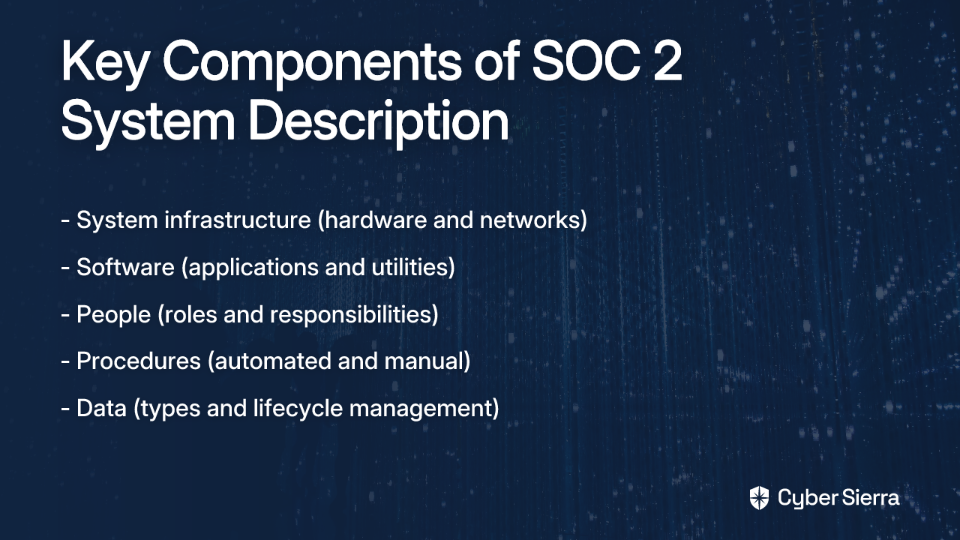
Section 2: System Description

This detailed narrative describes the services and systems in scope. It includes:

  • System infrastructure
  • Software
  • People
  • Procedures
  • Data

This section will eventually be part of your final SOC 2 report, so it's worth investing time to get it right.

Section 3: Management's Assertion (Draft)

This is a draft of the formal statement where your company's management will assert that controls are designed and operating effectively. Having this prepared in advance helps align expectations with leadership.

Section 4: Control Matrix & Gap Analysis

This is the heart of your report—a detailed matrix containing:

  • Control ID
  • Trust Service Criterion
  • Control Description
  • Current Implementation Status (Implemented, Partially, Not Implemented)
  • Gap Identified (Yes/No)
  • Detailed Gap Description
  • Remediation Action Required
  • Owner
  • Due Date

Section 5: Evidence Collection Checklist & Status

One of the most common challenges in SOC 2 audits is evidence collection. As one Reddit user noted, "most auditors I've talked to will not accept .csv files, they want screenshots."

Pro tip: Ask your auditor for their PBC (Prepared By Client) list in advance. This removes guesswork about what evidence they'll require.

Your checklist should include:

  • Policy documents
  • Configuration screenshots
  • Change management tickets
  • Access review reports
  • Employee training records

Section 6: Subservice Organization (Vendor) Review

SOC 2 requires you to assess critical vendors. This section should list:

  • All subservice organizations
  • Their role in your service delivery
  • Status of your due diligence (e.g., reviewing their SOC 2 report)

From Manual Checklists to Continuous Compliance: Streamlining SOC 2 Readiness

The traditional approach to SOC 2 compliance involves spreadsheets, manual evidence collection, and point-in-time assessments. This works for small organizations with simple infrastructures, but quickly becomes unsustainable as you grow.

For organizations with "big AWS footprints" or complex data environments like "Snowflake," manual compliance is virtually impossible to maintain.

This is where compliance automation becomes essential. Modern GRC (Governance, Risk, and Compliance) platforms offer several key advantages:

1. Continuous Control Monitoring (CCM)

Instead of point-in-time checks, CCM provides ongoing visibility into your security controls, automatically flagging misconfigurations or policy deviations.

2. Automated Evidence Collection

Integration with your cloud services, HR systems, and code repositories enables automatic evidence collection—often in the screenshot format auditors prefer.

3. Centralized Control Repository

A single source of truth for all controls eliminates silos and ensures consistency across compliance frameworks.

Cyber Sierra's platform addresses these needs through its integrated GRC and CCM modules. The Continuous Control Monitoring module builds a central controls repository with near real-time updates, providing clear visibility into your security posture. Meanwhile, the GRC module automates data collection, risk assessments, and reporting across multiple frameworks (SOC 2, ISO 27001, PCI DSS).

This approach shifts your organization from reactive compliance to proactive risk management—ensuring you're not just ready for your next audit, but continuously audit-ready.

Your Actionable SOC 2 Readiness Checklist

To help you get started, here's a comprehensive checklist for SOC 2 readiness:

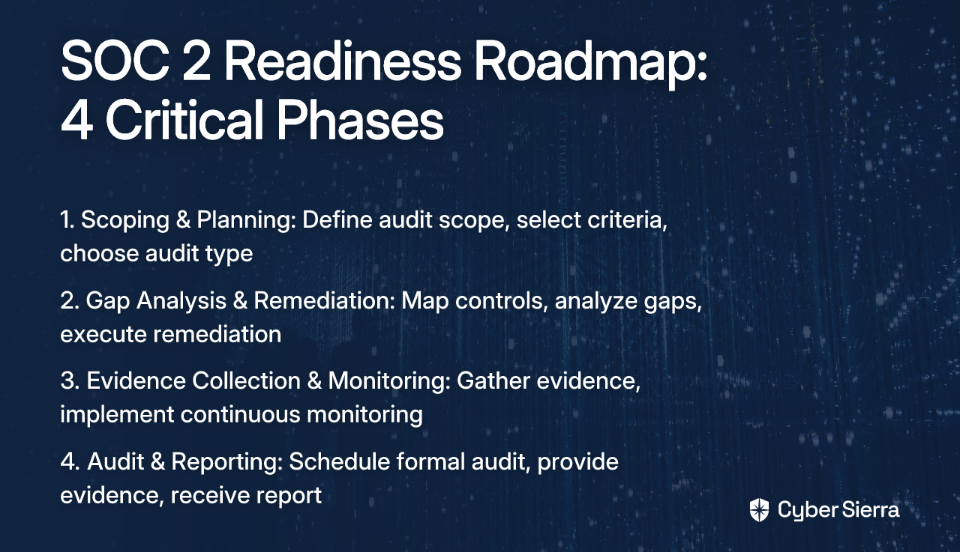
Phase 1: Scoping & Planning

  • Define the audit scope (systems, services, locations)
  • Select your Trust Services Criteria (Security is mandatory)
  • Choose between SOC 2 Type I (point-in-time) and Type II (over a period, typically 3-12 months)
  • Engage a CPA firm for a readiness assessment

Phase 2: Gap Analysis & Remediation

  • Map existing policies and controls to selected TSCs
  • Conduct a thorough gap analysis using your control matrix
  • Create and execute a remediation plan for all identified gaps
  • Develop and approve required documentation and policies

Phase 3: Evidence Collection & Monitoring

  • Begin collecting operational evidence for all controls
  • Implement continuous monitoring to ensure controls remain effective
  • Conduct mandatory employee security awareness training
  • Finalize your System Description and Management Assertion

Phase 4: Audit & Reporting

  • Schedule the formal SOC 2 audit with your CPA firm
  • Provide all requested evidence from your PBC list
  • Receive the final SOC 2 report (remember, these should only be shared under NDA)

Conclusion: From Audit Stress to Continuous Compliance

A SOC 2 audit doesn't have to be a painful, last-minute scramble. With proper preparation guided by a structured readiness report, you can transform the audit from a threat into a strategic advantage.

The goal isn't just to pass an audit—it's to build a lasting, robust security program. This requires moving beyond checklists to a culture of continuous monitoring and improvement.

For teams looking to embed compliance into their daily operations and stay perpetually audit-ready, exploring an automated GRC and CCM platform like Cyber Sierra is the logical next step. By automating data collection, continuously monitoring controls, and managing multiple compliance frameworks from a single platform, you can ensure you're always prepared—not just for your next audit, but for whatever comes next in your security journey.

Frequently Asked Questions (FAQ)

What is the main purpose of a SOC 2 Readiness Assessment?

The main purpose of a SOC 2 Readiness Assessment is to identify and fix any gaps in your security controls before you undergo a formal SOC 2 audit. This proactive "practice run" saves significant time and money by preventing audit failures, streamlining evidence collection, and ensuring your team is fully prepared. It transforms the audit process from a stressful scramble into a predictable, manageable project.

How long does a SOC 2 readiness and remediation take?

A SOC 2 readiness and remediation process typically takes anywhere from 3 to 12 months. The exact timeline depends on several factors, including the size and complexity of your organization, the maturity of your existing security program, and the number of gaps identified during the assessment. Companies starting from scratch will be on the longer end of this range.

What is the difference between a SOC 2 Type I and Type II report?

A SOC 2 Type I report assesses your controls at a single point in time, confirming they are designed correctly. A SOC 2 Type II report, on the other hand, assesses how well those controls operate over a period of time (typically 3-12 months). While a Type I is faster to achieve, most clients and partners require the greater assurance of a Type II report.

What are the most common gaps found during a SOC 2 readiness assessment?

The most common gaps found during a SOC 2 readiness assessment often relate to a lack of formal documentation, such as missing security policies and procedures. Other frequent issues include insufficient vendor management programs, inconsistent access reviews, inadequate change management processes, and a lack of security awareness training for employees.
Can we perform a SOC 2 readiness assessment ourselves?

While it's technically possible to perform a self-assessment, it is highly recommended to engage a third-party expert or use a compliance automation platform. Auditors and experienced consultants bring an objective perspective and deep expertise in interpreting the Trust Services Criteria. A self-assessment risks missing critical gaps that an external expert would easily identify.

Why is manual evidence collection for SOC 2 so challenging?

Manual evidence collection for SOC 2 is challenging because it is incredibly time-consuming, prone to human error, and requires specific formats like screenshots that are difficult to manage at scale. For every control, you must manually gather, organize, and present proof. This process becomes unsustainable in complex cloud environments and is a major reason organizations turn to compliance automation platforms that can collect evidence automatically and continuously.

blog-hero-background-image
Cyber Security

How AI Is Changing Enterprise Risk Management

backdrop
Table of Contents

Join thousands of professionals and get the latest insight on Compliance & Cybersecurity.


Summary

  • Traditional enterprise risk management is failing, with Gartner reporting that less than 20% of risk owners meet mitigation expectations due to reactive, manual processes.
  • AI transforms ERM from a periodic chore into a proactive, continuous discipline, enabling real-time control monitoring, predictive vendor risk assessment, and proactive threat intelligence.
  • The key takeaway for professionals is that AI will augment, not replace, their roles; future success depends on leveraging AI to focus on strategic judgment and complex problem-solving.
  • Organizations can begin this transformation by implementing a strong governance framework and starting with high-impact pilot projects using integrated platforms like Cyber Sierra's GRC solution to automate compliance and gain a unified view of risk.

"I'm growing increasingly concerned at the future of a career in risk management with how many layoffs I'm seeing..."

"AI could probably do a year's worth of work in a day..."

Sound familiar? These anxieties, expressed in recent online discussions among risk professionals, reflect a growing uncertainty about how artificial intelligence will reshape enterprise risk management (ERM). But here's the reality that's emerging: AI won't replace you, but a risk manager using AI will.

The End of Reactive Risk Management

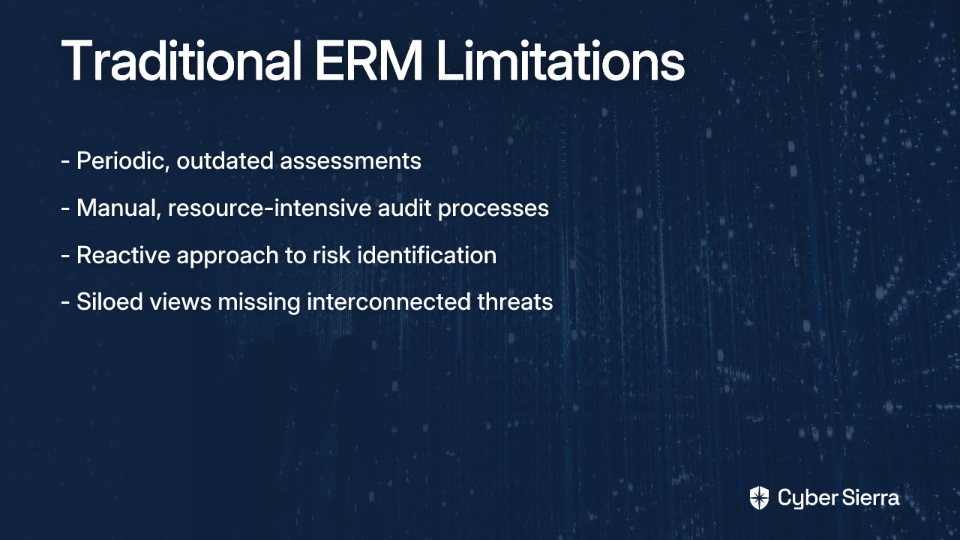
Traditional enterprise risk management has long been characterized by its limitations:

  • Periodic, point-in-time assessments that quickly become outdated
  • Manual, resource-intensive evidence collection for audits
  • Reactive approaches that identify risks after they've materialized
  • Siloed views that miss interconnected threats

These constraints have led to a concerning statistic: according to Gartner, less than 20% of enterprise risk owners are meeting risk mitigation expectations. This critical gap in delivering high-quality risk information and intended risk reductions reveals the shortcomings of traditional approaches.

AI is fundamentally transforming ERM from a reactive, periodic exercise into a proactive, continuous, and predictive discipline. For risk professionals who adapt, this shift represents an opportunity to add more strategic value than ever before.

The AI Revolution in Core Risk Functions

From Periodic Audits to Continuous Control Monitoring (CCM)

The "reactivity cycle" of compliance—where teams scramble for evidence before audits, only to discover failures too late—is being disrupted by AI-powered continuous control monitoring.

The Problem: Manual monitoring is ineffective, with 59% of organizations citing resource constraints as a key barrier. Teams can't keep up with the volume, velocity, and variety of data needed to monitor controls effectively.

The AI Solution: AI-powered CCM automates the validation of security and compliance controls in near real-time:

  • Automated Evidence Collection: AI agents gather audit-ready evidence for frameworks like ISO 27001, SOC2, PCI DSS, GDPR, and HIPAA without constant human intervention.
  • Predictive Analytics: AI identifies patterns in control data to predict potential failures before they happen, shifting from reactive to preventive risk management.
  • Dynamic Adaptation: AI models can adapt to new regulations, reducing the manual effort of updating compliance programs.

Modern platforms like Cyber Sierra's Continuous Control Monitoring (CCM) module operationalize this approach by building a central controls repository with near real-time updates, providing actionable risk intelligence for data-driven remediation, and automating control testing to detect anomalies in real-time.

Supercharging Third-Party Risk Management (TPRM)

The Problem: The expanding web of third-party relationships creates unmonitored "fourth-party" risks. Traditional annual risk assessments can't keep pace. According to EY's Global TPRM Survey, operational risk has become a top priority for 57% of organizations, up from 40% in 2023.

The AI Solution: AI enables a shift to continuous, data-driven vendor monitoring:

  • Real-time Monitoring: AI algorithms scan diverse external data sources (news, financial reports, cyber threat intelligence) to assess vendor risk continuously rather than annually.
  • Predictive Insights: AI can predict potential supply chain disruptions or vendor failures, allowing for proactive mitigation strategies.
  • Efficiency Gains: AI automates the tedious process of sending, collecting, and analyzing vendor security questionnaires.

Despite these benefits, only 13% of companies have fully integrated AI into their TPRM processes, often due to fragmented structures and cost concerns. Solutions like Cyber Sierra's TPRM platform address this by automating vendor assessments, providing 24/7 visibility into vendor compliance, and streamlining the due diligence process.

Proactive Threat Intelligence and Cybersecurity

The Problem: Traditional cybersecurity is often reactive, detecting breaches after damage has occurred. The complexity of modern threats outpaces manual assessment capabilities.

The AI Solution: AI enhances cybersecurity by identifying threats before they are exploited:

  • Anomaly Detection: AI algorithms establish a baseline of normal network activity and flag deviations in real-time, indicating a potential threat.
  • Vulnerability Prioritization: AI analyzes vulnerabilities across the attack surface and prioritizes them based on exploitability and potential business impact.
  • Automated Response: AI can initiate rapid incident response actions to contain threats faster.

This is where tools like Cyber Sierra's Threat Intelligence module come into play, offering comprehensive security scorecards, network and cloud vulnerability scanning, and an outside-in view of the attack surface.

Navigating the Challenges and Risks of AI in ERM

Despite its potential, integrating AI into ERM comes with significant challenges that must be addressed head-on.

The "Black Box" Problem

Risk professionals are understandably "fussy about avoiding black-box solutions" that can't be explained or audited. This concern is valid and requires attention to:

  • Explainability (XAI): AI models used in risk management must be transparent and auditable, especially for regulators. Decisions must be traceable to specific inputs and reasoning.
  • AI Bias: AI models can amplify flaws and biases present in their training data, potentially leading to discriminatory risk assessments. Continuous monitoring and auditing of AI systems is essential.

The Regulatory Minefield

"Good luck explaining to the regulators that 'AI' is running your risk management program" is a common sentiment that highlights the regulatory challenges.

  • Emerging Regulations: The EU Artificial Intelligence Act could impose fines of up to €35 million or 7% of global revenue for non-compliance by 2026. Similar regulations are emerging globally.
  • Human-in-the-Loop: Full automation can be risky from both a regulatory and practical standpoint. The most effective approach combines AI's processing power with human oversight, judgment, and ultimate accountability.

AI as a New Risk Surface

As one risk professional aptly noted, "AI is a risk in and of itself." Deploying AI introduces new vulnerabilities:

  • Data Poisoning & Prompt Injections: These emerging threats can corrupt AI models or manipulate their outputs, potentially introducing severe risks into automated decision-making.
  • Model Drift: AI models can degrade over time as conditions change, requiring continuous monitoring and retraining.

Effective mitigation requires robust safeguards, attack simulation, and maintaining strong human oversight mechanisms.

A Practical Framework for AI Adoption in ERM

For Organizations: A Phased Approach

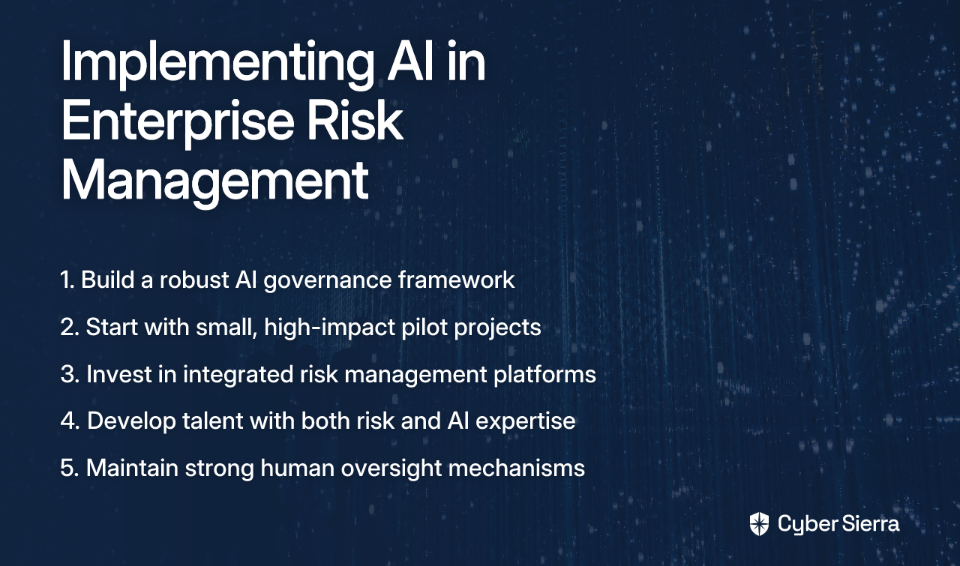
  1. Build a Governance Framework: Establish clear policies on AI use, data privacy, ethical considerations, and compliance oversight before full-scale deployment. This is critical for managing the risks of AI itself.
  2. Start Small, Prove Value: Don't try to boil the ocean. Identify one critical, high-impact control or process for a pilot program. For example, automate evidence collection for a single compliance framework before expanding to broader applications.
  3. Invest in Integrated Platforms: Break down data silos with unified platforms. An integrated solution like Cyber Sierra's GRC platform provides a single source of truth by connecting governance, risk, compliance, third-party risk management, and threat intelligence, giving leaders a holistic view of their risk posture.

For Professionals: Future-Proofing Your Career

The central message from industry discussions is clear: "Learn how to use AI to your advantage and you will be fine." Here's how:

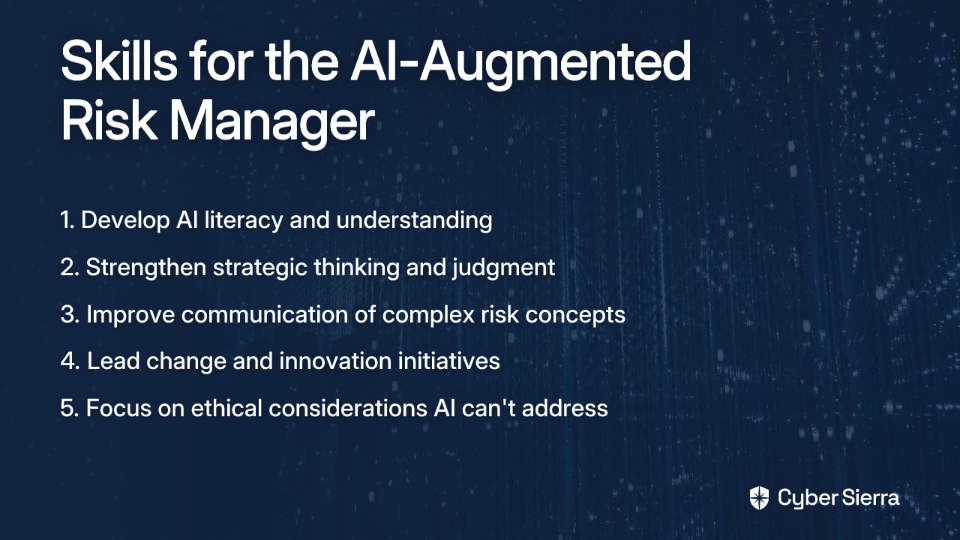
  1. Become AI-Literate: You don't need to be a data scientist, but you should understand the principles, capabilities, and limitations of AI in risk management. Pursue training and certification in AI for risk management.
  2. Develop Strategic Skills: Focus on skills AI can't replicate: critical thinking, ethical judgment, complex problem-solving, and communicating risk to leadership. AI handles the "what," you explain the "so what" and "now what."
  3. Champion Change: Be the person in your organization who understands both risk management principles and the potential of new technology. Lead pilot projects and demonstrate the value of an AI-augmented approach.

The Augmented Risk Manager

AI is not a distant threat but a present-day reality that is transforming ERM into a more proactive, predictive, and efficient function. The future belongs not to AI alone, but to the augmented risk manager who leverages AI to:

  • Process vast amounts of data that would overwhelm human analysts
  • Identify patterns and correlations invisible to the human eye
  • Automate routine compliance tasks to focus on strategic risk management
  • Provide near real-time risk intelligence to inform better decisions

The goal is not just to manage risk, but to turn risk management into a strategic enabler of business growth. AI is the key to unlocking that potential.

As regulatory requirements grow more complex and threats evolve more rapidly, organizations that strategically integrate AI into their ERM frameworks—with appropriate governance, explainability, and human oversight—will gain a significant competitive advantage.

The question is no longer whether AI will transform risk management, but whether you and your organization will lead or follow in that transformation.

Frequently Asked Questions

Will AI replace risk management professionals?

No, AI is not expected to replace risk management professionals. Instead, it will augment their capabilities by automating routine tasks and providing deeper insights, allowing them to focus on strategic decision-making, ethical judgment, and complex problem-solving. The professionals who will thrive are those who learn to leverage AI tools to their advantage.

How does AI change traditional enterprise risk management?

AI transforms traditional enterprise risk management from a reactive, periodic process into a proactive, continuous, and predictive discipline. While traditional methods rely on point-in-time assessments that quickly become outdated, AI enables continuous control monitoring, real-time threat intelligence, and predictive analytics to identify and mitigate risks before they materialize.

What are the main benefits of using AI in risk management?

The main benefits of using AI in risk management are increased efficiency, deeper predictive insights, and real-time monitoring across core functions. AI automates tedious processes like evidence collection for audits (Continuous Control Monitoring), continuously assesses third-party vendor risks (TPRM), and proactively identifies cybersecurity threats, allowing teams to manage risks more effectively with data-driven decisions.

What are the biggest challenges when implementing AI for risk management?

The biggest challenges include the "black box" problem (lack of model transparency), navigating a complex and emerging regulatory landscape, and managing AI itself as a new potential risk surface. Organizations must ensure AI models are explainable and auditable, comply with new laws like the EU AI Act, and protect against new threats like data poisoning and model drift. Strong human oversight is essential to mitigate these challenges.

How can an organization start implementing AI in its risk management program?

An organization can start by building a strong AI governance framework, beginning with small, high-impact pilot projects, and investing in integrated risk management platforms. It's crucial to first establish clear policies for AI use. Then, prove AI's value by automating a specific process, such as evidence collection for one compliance framework, before scaling up.

What skills do risk managers need to stay relevant in the age of AI?

To stay relevant, risk managers should focus on developing AI literacy, strengthening strategic and critical thinking, and improving communication skills. While deep technical expertise isn't required, understanding AI's capabilities and limitations is key. The most valuable skills are those AI cannot replicate: ethical judgment, complex problem-solving, and effectively communicating risk insights to leadership.


Cyber Sierra provides an AI-enabled cybersecurity platform designed to simplify and automate security compliance for enterprises through Continuous Control Monitoring, Third-Party Risk Management, GRC automation, and proactive Threat Intelligence. Learn more at cybersierra.co.

blog-hero-background-image
Cyber Security

Operational Risk Management Software for Banking

backdrop
Table of Contents

Join thousands of professionals and get the latest insight on Compliance & Cybersecurity.


Summary

  • Traditional, manual operational risk management (ORM) fails in modern banking due to rapid digitization and regulatory pressure, leaving dangerous operational blind spots.
  • The top operational risks—including cybersecurity, third-party vulnerabilities, and compliance failures—require continuous monitoring; robust ORM software can improve risk visibility by up to 67%.
  • Banks must shift from reactive, point-in-time checks to a proactive approach by leveraging AI-driven tools for continuous control monitoring and predictive risk analytics.
  • Unify risk management with an integrated platform like Cyber Sierra, which automates control monitoring, third-party risk management, and compliance reporting.

You've just completed another exhausting regulatory audit. After weeks of scrambling to compile evidence, manually checking controls, and pulling data from disparate systems, your team is burned out. The board is asking tough questions about your operational risk exposure, and you're not confident in your answers. If this sounds familiar, you're not alone.

In today's banking environment, operational risk managers face a perfect storm of challenges: "In the past, risk managers relied on point-in-time checks and annual reviews, which left significant gaps," according to industry forums. "By the time an issue surfaced, it was often too late to mitigate losses."

Operational Risk Management (ORM) – the framework for managing risks stemming from ineffective internal processes, systems, people, or external events – has traditionally been a reactive, compliance-focused exercise. But in an era of rapid digitization, evolving cyber threats, and increasing regulatory scrutiny, this approach is no longer sufficient.

The Ticking Clock: Why Traditional ORM Fails in Modern Banking

Traditional operational risk management approaches are becoming obsolete for several critical reasons:

The Digitization Acceleration: As banking operations increasingly shift to digital platforms, the complexity and interconnectedness of systems introduce new vulnerabilities that static, manual assessment methods cannot adequately capture.

Regulatory Pressure: The regulatory landscape continues to evolve at breakneck speed. Basel III requirements impose strict standards on operational risk capital, while local regulators demand unprecedented transparency. Non-compliance can result in severe fines and reputational damage.

Siloed Approaches: Many banks still manage operational risks in departmental silos, preventing a unified view of their risk landscape. This fragmentation creates dangerous blind spots where interconnected risks can escalate undetected.

Resource Constraints: Risk management teams are often asked to do more with less, making manual processes increasingly unsustainable. "Detecting risk events late often leads to higher loan losses and compromised portfolio health," notes one risk professional.

Mapping the Minefield: Top 5 Operational Risks for Banks Today

Understanding the operational risk landscape is essential for evaluating appropriate software solutions. According to MetricStream, these are the critical operational risks facing banks today:

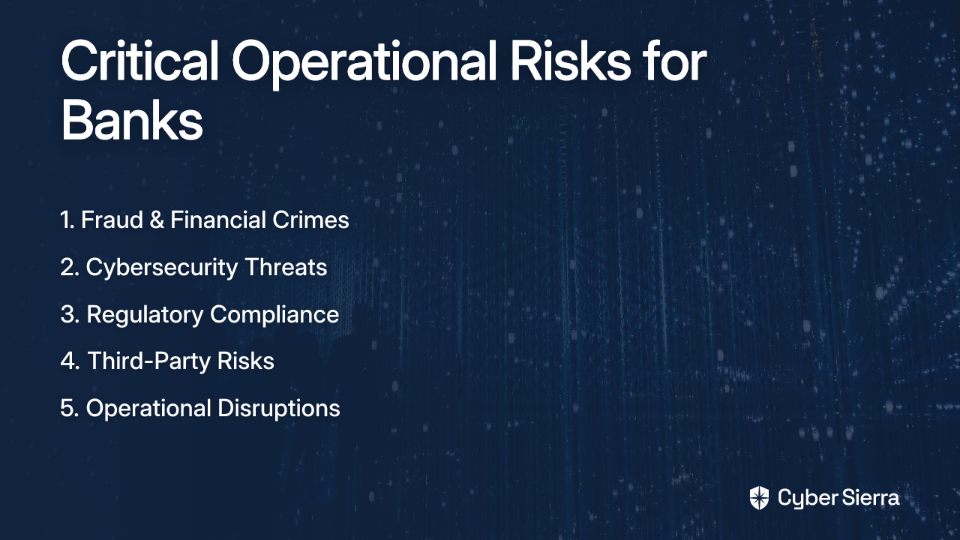
  1. Fraud and Financial Crimes: From identity theft to money laundering, these threats require not just sophisticated detection technology but also a culture of vigilance and ethics.
  2. Cybersecurity Threats: Banks remain prime targets for cybercriminals, necessitating robust defensive measures including firewalls, multi-factor authentication, and crucially, continuous employee security training.
  3. Regulatory Compliance: Navigating complex regulations like AML laws is a significant operational challenge. Failure results in fines, legal sanctions, and reputational damage.
  4. Third-Party Risks: Today's banks rely heavily on vendors for critical technology and services, introducing external vulnerabilities that must be systematically managed.
  5. Operational Disruptions: From software failures to human error to natural disasters, operational disruptions can paralyze banking functions. Effective business continuity planning is essential.

The Modern Banker's Toolkit: Essential Features of ORM Software

Modern ORM software must address the full risk lifecycle with specific capabilities at each stage:

Risk Identification

  • Centralized Risk Library: A comprehensive repository of potential risks, categorized and searchable.
  • Multiple Identification Methods: Support for various risk identification techniques, including scenario analysis and loss data analysis.
  • Collaborative Tools: Platforms for risk workshops and cross-departmental input.

Risk Assessment

  • Configurable Risk Assessment Matrix: Customizable frameworks for evaluating both likelihood and impact.
  • Dynamic Risk Register: A living document with assigned risk owners and clear accountability.
  • Qualitative and Quantitative Capabilities: Tools for assessing both measurable impacts (financial loss) and less tangible consequences (reputational damage).

Risk Mitigation & Control Implementation

  • Workflow Automation: Streamlined processes for tracking mitigation plans from creation to completion.
  • Centralized RCSA Repository: A single source of truth for Risk and Control Self-Assessments.
  • Multi-Framework Mapping: The ability to connect controls to multiple risks and regulatory requirements simultaneously.

Continuous Monitoring & Reporting

  • Real-Time Dashboards: Customizable visualizations providing at-a-glance risk posture awareness.
  • Dynamic KRIs: Key Risk Indicators that update automatically and trigger alerts when thresholds are breached.
  • Automated Reporting: Scheduled generation of compliance reports for regulators and stakeholders.

According to Cybersierra's research, organizations implementing robust ORM software report up to a 67% improvement in risk visibility and an 80% increase in operational efficiency.

From Reactive to Predictive: The Power of AI and Automation in ORM

The most significant evolution in operational risk management is the shift from reactive to predictive approaches, powered by artificial intelligence and automation:

AI-Driven Early Warning Systems

Advanced algorithms can analyze vast datasets to identify patterns and predict potential risk events before they materialize. This moves banks from a position of response to prevention.

"Banks that deploy AI-driven early warning systems can take swift corrective action before exposures turn critical," notes a discussion in financial risk forums.

Continuous Control Monitoring

Instead of periodic manual checks, automated systems provide near real-time visibility into the effectiveness of controls. This continuous monitoring ensures that control failures are identified immediately, not during the next scheduled assessment.

Explainable AI (XAI)

Modern systems are evolving toward Explainable AI, which provides clear reasoning for risk scores and recommendations. This transparency is crucial for meeting regulatory requirements and building trust in AI-driven decisions.

As Mindbridge.ai points out, "AI enhances accuracy in risk prioritization and ensures continuous monitoring," making it an essential component of modern ORM software.

A Practical Guide to Selecting the Right ORM Software

Finding the right operational risk management solution requires a systematic approach. The following steps are adapted from Cyber Sierra's guide to evaluating enterprise risk management software:

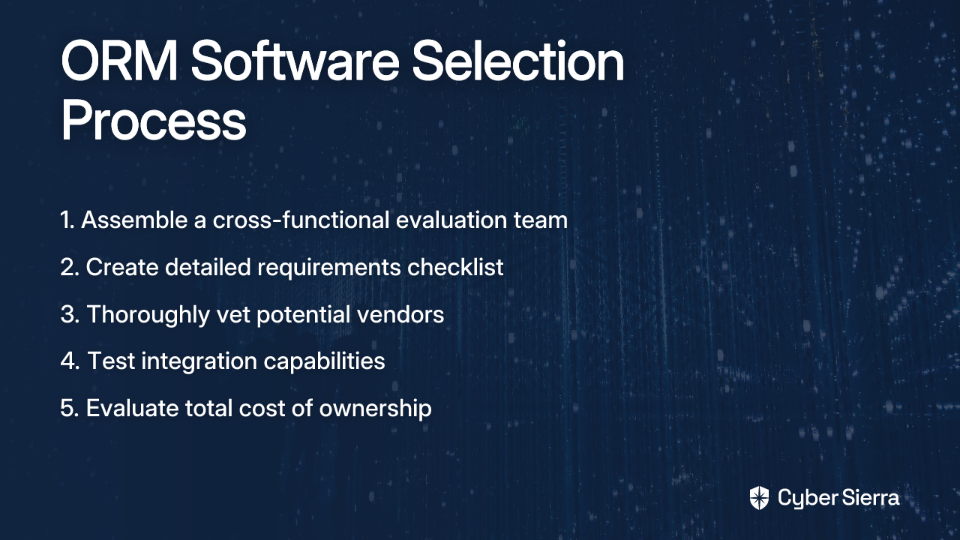
1. Assemble a Cross-Functional Team

Include stakeholders from IT, compliance, legal, and key business units to define both functional and technical requirements. This ensures the solution will meet diverse needs across the organization.

2. Create a Detailed Requirements Checklist

  • Functional Needs: Incident management, risk mapping, compliance framework support (ISO 27001, NIST, etc.).
  • Technical Needs: Integration capabilities (APIs, pre-built connectors), scalability, data import/export.
  • Usability: Intuitive dashboards, ease of navigation, and user-friendly interfaces.

3. Vet the Vendor Thoroughly

Don't just rely on demos. Speak with current customers in the banking sector, understand the total cost of ownership (including implementation, training, and support), and evaluate the vendor's financial stability and commitment to ongoing product development.

Unifying Your Defenses: The Case for an Integrated GRC Platform

While point solutions can address specific aspects of operational risk management, banks increasingly recognize the advantages of integrated platforms that unify governance, risk, and compliance functions:

The Problem with Siloed Solutions

Managing separate tools for compliance, vendor risk, and internal controls creates inefficiencies and potential blind spots. Data must be manually transferred between systems, creating opportunities for error and preventing a holistic view of risk.

The Integrated Approach

Platforms like Cyber Sierra address this challenge by unifying critical risk management functions:

Governance, Risk & Compliance (GRC): Instead of wrestling with spreadsheets for audits, an integrated GRC module automates data collection, risk assessments, control monitoring, and reporting for frameworks like SOC2, ISO 27001, and PCI DSS, reducing compliance fatigue.

Continuous Control Monitoring (CCM): To solve the problem of outdated, point-in-time assessments, a robust CCM capability provides "ongoing visibility into security controls" and "actionable risk intelligence" in near real-time. This transforms security from periodic checks into a continuous, automated process.

Third-Party Risk Management (TPRM): To address the significant operational risk from vendors, modern platforms simplify vendor risk assessment, onboarding, and continuous monitoring, moving beyond static questionnaires to dynamic oversight.

By unifying these functions, banks can achieve a comprehensive view of their operational risk landscape while reducing the administrative burden on staff.

The Future of Operational Risk Management in Banking

As we look ahead, several trends will shape the evolution of ORM software:

Greater Regulatory Technology Integration: ORM solutions will increasingly incorporate regulatory technology (RegTech) capabilities, automatically mapping controls to changing regulatory requirements.

Advanced Predictive Analytics: Machine learning algorithms will become more sophisticated in predicting operational risk events before they occur, enabling truly proactive risk management.

Enhanced Collaboration Features: Tools will facilitate greater collaboration across departments and with third parties, breaking down silos that currently hinder comprehensive risk management.

Expanded Automation: More risk management processes will be automated, reducing the burden on staff and minimizing human error while increasing consistency.

Conclusion

The complexity and velocity of risks in modern banking have made traditional, manual ORM approaches obsolete. The path forward lies in adopting dedicated ORM software that provides essential capabilities for identification, assessment, mitigation, and—most importantly—continuous, automated monitoring.

By leveraging AI-driven, integrated platforms, banks can not only protect themselves from threats but also build a resilient operational foundation that fosters trust and enables sustainable growth. The question is no longer whether to invest in advanced ORM software, but rather which solution best meets your bank's unique risk management needs.

For banks looking to transform their approach to operational risk, platforms like Cyber Sierra offer a comprehensive solution that unifies GRC, continuous monitoring, and third-party risk management into a cohesive system designed to meet the challenges of today's complex risk landscape.

Frequently Asked Questions

What is Operational Risk Management (ORM) in banking?

Operational Risk Management (ORM) in banking is the framework used to identify, assess, and mitigate risks arising from failures in internal processes, people, systems, or from external events. This includes a wide range of threats such as fraud, cybersecurity breaches, regulatory non-compliance, and system failures. A robust ORM program helps banks protect their assets, maintain regulatory compliance, and ensure operational resilience.

Why is traditional ORM no longer effective for modern banks?

Traditional ORM is no longer effective because it relies on manual, point-in-time assessments that cannot keep pace with the rapid digitization, evolving regulatory landscape, and interconnectedness of modern banking operations. Manual checks and siloed approaches create significant blind spots and delays in risk detection. In contrast, modern banking demands continuous, automated monitoring and a holistic view of the entire risk landscape to proactively manage threats.

What are the essential features of modern ORM software?

Essential features of modern ORM software include a centralized risk library, configurable assessment tools, workflow automation for mitigation, real-time monitoring dashboards, and automated reporting capabilities. The software should support the entire risk lifecycle, from identification and assessment to mitigation and continuous monitoring. Key capabilities like dynamic Key Risk Indicators (KRIs) and the ability to map controls to multiple regulatory frameworks are crucial for effective risk management.

How does AI improve operational risk management?

AI improves operational risk management by enabling predictive analytics and continuous control monitoring, shifting the approach from reactive to proactive. AI-driven algorithms can analyze vast datasets to identify patterns and predict potential risk events before they occur. Furthermore, AI-powered automation provides near real-time visibility into control effectiveness, allowing for immediate identification and remediation of failures, which significantly enhances a bank's defensive posture.

What is the advantage of an integrated GRC platform over standalone ORM tools?

An integrated Governance, Risk, and Compliance (GRC) platform offers a unified, holistic view of an organization's risk landscape, which standalone tools cannot provide. Standalone solutions often create data silos, requiring manual effort to consolidate information and leaving dangerous blind spots where interconnected risks can grow. An integrated GRC platform brings together ORM, compliance management, and third-party risk management, automating data collection and providing comprehensive insights that lead to more informed decision-making and improved operational efficiency.

How can a bank start the process of selecting ORM software?

A bank can start the process of selecting ORM software by assembling a cross-functional evaluation team to define clear requirements, followed by a thorough vetting of potential vendors. This team should include stakeholders from IT, compliance, legal, and business units. Key steps include creating a detailed checklist of functional and technical needs, evaluating vendor stability and customer references, testing integration capabilities with existing systems, and assessing the total cost of ownership beyond the initial purchase price.


Additional Resources:

blog-hero-background-image
Cyber Security

How to Maintain SOX Compliance Without Manual Evidence Collection

backdrop
Table of Contents

Join thousands of professionals and get the latest insight on Compliance & Cybersecurity.


Summary

  • Manual SOX compliance is inefficient and risky, with 65% of controls tested manually, leading to rising audit costs and the potential for undetected control failures.
  • Shifting to an automated approach using Continuous Controls Monitoring (CCM) allows for 100% transaction coverage and real-time evidence collection, drastically reducing manual effort.
  • A practical roadmap to automation involves scoping key controls, integrating a GRC platform with source systems (e.g., HRIS, AWS), and configuring automated tests and alerts.
  • Cybersierra's GRC platform unifies and automates SOX compliance by combining continuous control monitoring with a centralized, audit-ready evidence repository.

You've just received an email: "The SOX auditors are coming next month. We need all the evidence ready." Your heart sinks as you envision the weeks ahead—manually exporting data, taking screenshots, updating spreadsheets, and chasing colleagues for approvals. The tedious cycle of manual evidence collection begins again.

If this scenario sounds painfully familiar, you're not alone. SOX compliance, while necessary, has become synonymous with overwhelming manual documentation requirements and significant time loss due to inefficient data processes.

The Alarming Costs and Risks of Manual SOX Compliance

The Sarbanes-Oxley Act of 2002 was enacted to protect investors by improving the accuracy and reliability of corporate disclosures. Two decades later, its importance remains undisputed—but the way organizations comply with it is desperately outdated.

Consider these sobering statistics:

Beyond the financial impact, manual SOX compliance creates three critical problems:

1. Crippling Operational Inefficiency

Manual processes trap highly skilled compliance teams in low-value tasks instead of focusing on strategic risk management. According to a Deloitte poll, 31% of compliance professionals cited the lack of a standardized process, and 30% cited the lack of efficient technology as major challenges.

One compliance manager on Reddit expressed their frustration: "The tedious manual requirements for documentation are causing dissatisfaction across our entire team. We're spending days just exporting data that could be automated."

2. Unacceptable Levels of Risk

Manual sampling is inherently flawed; auditors often fail to test up to 90% of transactions. This creates a high probability that control failures will go undetected.

Annually, 5% of publicly traded companies report a material weakness. The market's reaction is severe: a material weakness filing is typically followed by an average stock price drop of 19%.

3. Limited Strategic Value

When compliance teams are buried in manual evidence collection, they cannot provide the strategic insights that leadership needs. The opportunity cost is enormous—instead of identifying emerging risks and trends, teams are stuck taking screenshots and updating spreadsheets.

The Modern Approach: Automation and Continuous Monitoring

The solution to these challenges lies in transforming SOX compliance from a periodic, manual scramble into an automated, continuous process. This transformation rests on two foundational pillars:

1. Continuous Controls Monitoring (CCM)

CCM refers to technology-enabled processes that provide real-time validation of financial and IT controls. Rather than testing controls once a quarter or year, CCM constantly evaluates them, immediately flagging exceptions.

The benefits are transformative:

  • 100% transaction coverage (versus limited sampling)
  • Up to 95% reduction in manual testing labor and costs
  • Immediate detection of control failures
  • Evidence automatically collected in real-time

2. Centralized GRC Platform

A Governance, Risk, and Compliance (GRC) platform acts as the command center for automated compliance. It addresses the pain of "managing compliance across various platforms" by creating a single source of truth.

Key capabilities include:

  • Centralized Documentation: A single repository for all policies, procedures, and evidence
  • Automated Workflows: Systems that manage control testing and remediation tracking
  • Real-Time Reporting: Dashboards that provide stakeholders with instant visibility into compliance posture

A Step-by-Step Guide to Automating SOX Evidence Collection

Transitioning from manual to automated SOX compliance is not an overnight process, but the following steps provide a roadmap:

Step 1: Scope and Map Key Controls

Begin with a risk-based approach to identify which controls truly matter. Follow a structured process:

  1. Calculate materiality
  2. Scope significant accounts and locations
  3. Map financial statement line items (FSLIs) to business processes
  4. Perform risk analysis
  5. Scope relevant IT systems for IT General Controls (ITGCs)

This foundational step ensures you're automating the right things.

Step 2: Integrate with Authoritative Source Systems

Automation relies on connecting your GRC/CCM platform to source systems via APIs. Examples include:

  • HRIS (e.g., Workday, BambooHR): To automate user access reviews
  • Cloud Infrastructure (AWS, Azure, GCP): To continuously monitor for critical misconfigurations
  • Identity Providers (Okta, Azure AD): To verify MFA enforcement
  • IT Service Management (Jira, ServiceNow): To validate that all production changes have documented approval

Step 3: Configure Automated Tests and Evidence Capture

Here's where the magic happens. Let's look at concrete examples:

User Access Control Example: The system automatically compares active user accounts in financial applications against the employee list in the HRIS. Any account belonging to a terminated employee is flagged, and evidence (screenshots, user lists) is automatically logged.

Change Management Control Example: The system scans commits to a production code repository and automatically verifies that each commit has a corresponding, approved change ticket in Jira. It captures the ticket number and approval status as evidence.

Step 4: Establish Continuous Reporting and Alerting

The platform should automatically compile the collected evidence into an audit-ready format. Dashboards provide real-time visibility into control status, exceptions, and remediation progress, making the organization "always audit-ready."

Building Trust in Automation: Overcoming Auditor Skepticism

One of the biggest challenges in transitioning to automated SOX compliance is auditor skepticism. As one professional noted on Reddit, there's often "frustration about the perception of automation versus manual processes by auditors" and "concerns regarding automation and data integrity."

To overcome this challenge:

Provide an Immutable Audit Trail

A core feature of a reliable GRC platform is a detailed, unchangeable audit trail. Every test performed, every piece of evidence collected, and every user action should be logged with a timestamp. This provides greater assurance than a manually curated spreadsheet.

Ensure Data Integrity

Highlight that automation reduces human error. By pulling data directly from source systems via read-only APIs, the process eliminates the risk of manual data entry mistakes or manipulation.

Collaborate with Auditors

As recommended by compliance professionals, "engage in conversations with the auditors to establish a collaborative approach." Proactively demonstrate how the automated tests work, show them the completeness of the audit trail, and walk them through the evidence repository.

How Cybersierra Unifies and Automates SOX Compliance

For organizations ready to embrace automated SOX compliance, Cybersierra offers an integrated platform that puts these principles into practice.

Continuous Control Monitoring (CCM)

Cybersierra's CCM module provides the engine for automation. It builds a central controls repository with near real-time updates and automates control testing and validation. This directly replaces the need for manual evidence collection.

Key features include:

  • Ongoing visibility into security controls
  • Automated control testing and validation
  • Real-time detection of exceptions and anomalies
  • Management of controls across multiple compliance frameworks (NIST, ISO 27001, SOX)

Governance, Risk & Compliance (GRC)

Cybersierra's GRC platform acts as the central hub. It automates data collection, risk assessments, and maintains detailed audit trails, creating the single source of truth that auditors require.

The platform simplifies managing multiple frameworks (SOX, SOC2, ISO 27001), making compliance efforts more efficient and reducing the burden of manual documentation that causes so much frustration among compliance teams.

Moving Forward: From Manual Burden to Strategic Asset

Manual SOX compliance is no longer sustainable due to its high costs, inefficiencies, and inherent risks. By embracing automation through a unified CCM and GRC platform, organizations can achieve several transformative outcomes:

  1. Redirect skilled resources from manual evidence collection to strategic risk management
  2. Increase control effectiveness through 100% transaction testing versus limited sampling
  3. Reduce compliance costs by eliminating manual labor and streamlining the audit process
  4. Enhance stakeholder confidence with real-time visibility into control effectiveness
  5. Transform from reactive to proactive by identifying and addressing issues before they become material weaknesses

The future of SOX compliance isn't about taking more screenshots or updating more spreadsheets. It's about leveraging technology to provide continuous assurance while freeing up human expertise for what it does best—strategic thinking and risk management.

By embracing automation, compliance teams are empowered to evolve from reactive evidence chasers into strategic partners who proactively manage risk and add tangible value to the business.

Discover how Cybersierra's AI-enabled platform can transform your SOX compliance program and make you audit-ready, 365 days a year.

Frequently Asked Questions

What is SOX compliance and why is it important?

SOX (Sarbanes-Oxley) compliance refers to adhering to the Sarbanes-Oxley Act of 2002, a federal law that mandates certain practices in financial record keeping and reporting for public companies. It is critically important because it aims to protect investors from fraudulent financial reporting by improving the accuracy and reliability of corporate disclosures.

Why is manual SOX evidence collection a problem?

Manual SOX evidence collection is a significant problem because it is highly inefficient, prone to human error, and costly. This traditional approach consumes thousands of hours in low-value tasks like taking screenshots and updating spreadsheets, introduces risks through limited sample testing (which can miss up to 90% of transactions), and drives up audit costs.

How can automation improve SOX compliance?

Automation dramatically improves SOX compliance by replacing periodic, manual checks with Continuous Controls Monitoring (CCM). This technology-driven approach provides real-time validation of controls, offers 100% transaction coverage, and automatically collects audit-ready evidence. The result is a massive reduction in manual labor, immediate detection of control failures, and a stronger, more reliable compliance posture.

What are the first steps to automate SOX compliance?

The first step is to scope and map your key controls using a risk-based approach to ensure you focus on what truly matters. From there, the process involves integrating a GRC/CCM platform with your key business systems (like HRIS, cloud infrastructure, and ITSM), configuring automated tests to capture evidence, and establishing continuous reporting and alerting dashboards.

What is the difference between a GRC platform and Continuous Controls Monitoring (CCM)?

A GRC (Governance, Risk, and Compliance) platform acts as the central command center for managing overall compliance activities, creating a single source of truth for policies, risk assessments, and audit trails. Continuous Controls Monitoring (CCM) is the engine within that system; it's the specific technology that automates the testing and validation of controls in real-time by connecting to other business systems.

How do you get auditors to trust automated SOX evidence?

Auditor trust is built by demonstrating the reliability and integrity of the automated system. This is achieved by providing an immutable, time-stamped audit trail for every action, ensuring data integrity by pulling information directly from source systems via read-only APIs, and proactively collaborating with auditors to walk them through the automated processes and evidence repository.

blog-hero-background-image
Cyber Security

What to Look for in an Enterprise IRM Platform

backdrop
Table of Contents

Join thousands of professionals and get the latest insight on Compliance & Cybersecurity.


Summary

  • Integrated Risk Management (IRM) platforms are essential for moving beyond basic compliance to strategically manage modern cyber threats, complex regulations, and supply chain risks.
  • Key features to look for include multi-framework governance, dynamic risk assessment, integrated third-party risk management (TPRM), and continuous control monitoring (CCM).
  • The right platform automates manual tasks and uses AI to shift your security posture from reactive, periodic checks to proactive, real-time risk management.
  • Cyber Sierra’s AI-enabled GRC platform unifies these capabilities, providing a single source of truth to automate compliance and proactively manage risk.

You've been there—stuck with enterprise risk software that promised the world but delivered a digital nightmare. The features were sparse (despite being specified in scope statements), bugs were constant, and the vendor's "maintenance" costs added insult to injury.

The stakes are too high to make the wrong choice. As cyber threats multiply, regulations tighten (GDPR, HIPAA, PCI DSS), and supply chains grow more complex, organizations need more than just a basic GRC tool. You need a comprehensive Integrated Risk Management (IRM) platform that breaks down departmental silos and provides a unified view of risk across your enterprise.

As defined by industry experts, IRM is a "continuous process incorporating a risk-aware culture and technologies across an organization to enhance security through governance, risk management, and compliance" (Panorays). Unlike traditional GRC approaches, IRM moves beyond simple compliance to enable strategic, data-driven risk decisions.

This guide serves as your comprehensive checklist of essential capabilities to look for in an enterprise IRM platform—helping you save time, money, and future headaches.

The Foundation: Core Capabilities of a Modern IRM Platform

Comprehensive Governance and Compliance Management

A robust IRM platform must manage multiple compliance frameworks simultaneously from a single, unified interface. Look for a solution that can handle:

  • Multi-framework support for standards like SOC2, ISO 27001, GDPR, HIPAA, PCI DSS, and others relevant to your industry (ZenGRC)
  • Automated policy lifecycle management from creation and distribution to tracking and updates (ServiceNow)
  • Detailed audit trails and comprehensive report generation to simplify the audit process
  • Control mapping capabilities that show how a single control can satisfy multiple framework requirements

Cyber Sierra's GRC module excels in this area, automating data collection and reporting across multiple frameworks while reducing compliance fatigue—making your organization perpetually audit-ready.

Dynamic Risk Assessment and Management

The heart of any IRM platform is its ability to identify, assess, and prioritize risks in real-time. Essential features include:

  • Customizable risk assessment methodologies that align with your organization's risk appetite and industry standards
  • Business impact analysis tools to understand the potential consequences of various risks and inform response strategies (ServiceNow)
  • Flexible risk matrices that can be tailored to different departments or risk categories
  • Automated risk scoring based on multiple factors including threat intelligence, vulnerability data, and business context

This capability directly addresses a common pain point: understanding "what features are essential in the incident response process, up to risk mapping and monitoring."

Integrated Third-Party Risk Management (TPRM)

With supply chain attacks on the rise, your IRM platform must systematically assess and mitigate risks posed by third-party vendors. Look for:

  • Automated vendor assessment capabilities including questionnaire distribution and analysis
  • Risk-based prioritization of vendors based on access levels, data handling, and criticality to operations
  • Continuous monitoring of vendor security postures rather than point-in-time assessments
  • Integration with external threat intelligence to identify emerging vendor risks

Cyber Sierra's TPRM module stands out by providing 24/7 visibility into vendor compliance, moving beyond static questionnaires to deliver proactive insights into supply chain risks.

Seamless Integration and Scalability

An effective IRM platform must integrate with your existing IT and security infrastructure. This addresses the essential requirement that "IT makes sure it integrates well into the existing and planned IT portfolio." Key integration points include:

  • SIEM systems for security event correlation
  • Identity management solutions for access control
  • IT service management platforms for workflow orchestration
  • Asset management databases for comprehensive visibility
  • Business intelligence tools for enhanced reporting

Additionally, ensure the platform is built to scale, accommodating increased data volume and complexity as your organization grows (ZenGRC).

Actionable Dashboards and Reporting

What good is collecting risk data if you can't make sense of it? Your IRM platform should feature:

  • Intuitive dashboards providing real-time visibility into your organization's risk and compliance posture
  • Configurable views for different stakeholders (executive-level overviews for the C-suite, detailed operational views for risk managers)
  • Performance analytics for anticipating trends and improving resource allocation (ServiceNow)
  • Automated reporting capabilities that generate board-ready materials and regulatory documentation

These features align with Gartner's IRM attribute of "Communication & Reporting" which establishes clear channels regarding risk impacts across the organization (Panorays).

From Reactive to Proactive: The Power of Continuous Monitoring and Automation

Continuous Control Monitoring (CCM)

Traditional GRC approaches rely on periodic, point-in-time assessments that create dangerous visibility gaps. Modern IRM platforms leverage CCM to provide real-time assurance that controls are functioning effectively.

According to MetricStream, "CCM enables real-time alerts and quicker remediation by continuously verifying the effectiveness of financial, technological, and internal controls." (MetricStream)

A robust CCM implementation should follow these key steps:

  1. Identify Key Controls: Use industry frameworks like COSO or COBIT 5 to identify critical controls for monitoring.
  2. Define Control Objectives: Establish clear goals for what controls should achieve.
  3. Implement Automated Testing: Develop automated tests or metrics to monitor controls.
  4. Create Management Processes: Outline procedures for managing alerts and incidents.

Cyber Sierra's Continuous Control Monitoring (CCM) module excels in this area, building a central controls repository with near real-time updates and automated control testing. This transforms security from a series of periodic checks into a continuous, proactive process.

Automation and AI-Powered Insights

The volume and complexity of risk data have outpaced human capacity to process it manually. An effective IRM platform must leverage automation to:

  • Reduce manual, tedious GRC processes like evidence collection and report generation
  • Streamline workflows for incident response, compliance verification, and risk assessment
  • Free up teams to focus on high-value strategic tasks rather than administrative burden

Leading platforms are now incorporating AI and predictive analytics to enhance risk management through:

  • Pattern recognition to identify emerging risks before they materialize
  • Predictive risk scoring based on historical and environmental data
  • Automated remediation recommendations tailored to your organization's context
  • Natural language processing to analyze policies, controls, and compliance requirements

Beyond the Spec Sheet: Evaluating the Vendor and Long-Term Partnership

User Experience (UX) and Adoption

A powerful platform is useless if it's too complex for your team to use effectively. Evaluate the platform's user interface with these questions:

  • Is it intuitive enough for users with varying technical expertise?
  • Does it require extensive training, or can users become productive quickly?
  • Does it support role-based views and access controls?
  • Can workflows be customized to match your organization's processes?

As ZenGRC notes, "User adoption is the most critical success factor for any IRM implementation."

Customer Support and Training

This point directly addresses the pain of dealing with buggy software and high vendor maintenance costs. Before committing, evaluate:

  • The vendor's support model (dedicated account manager vs. general helpdesk)
  • Available training resources (documentation, videos, live sessions)
  • The community of users (forums, user groups, conferences)
  • Support SLAs and escalation processes

Additional Integrated Capabilities

Consider platforms that offer a broader suite of tools that contribute to a holistic risk management program. A unified platform can provide additional value beyond core IRM functions.

For example, Cyber Sierra integrates core IRM functions with:

This creates a cohesive security ecosystem rather than forcing you to juggle disconnected point solutions.

Making the Right Choice: Your IRM Selection Checklist

When evaluating enterprise IRM platforms, use this condensed checklist to ensure you're covering all critical bases:

Conclusion

Selecting the right IRM platform is more than a procurement decision—it's a strategic investment in organizational resilience. The wrong choice can lead to wasted resources, unmanaged risks, and compliance gaps, while the right platform transforms how your organization perceives and manages risk.

By focusing on comprehensive governance, dynamic risk assessment, third-party risk management, and continuous monitoring, you can select a platform that delivers lasting value. The ideal solution should reduce manual effort through automation, provide actionable intelligence through advanced analytics, and scale with your organization's evolving needs.

Today's most effective platforms move beyond traditional GRC to provide a unified, real-time view of your risk landscape. AI-enabled platforms like Cyber Sierra are built to provide this single source of truth, integrating GRC, continuous monitoring, and vendor risk management to move your organization from a reactive stance to proactive, intelligent risk management.

Remember that the ultimate goal isn't just compliance or risk mitigation—it's building a risk-aware culture where informed decisions drive business value and operational resilience. The right IRM platform should be your partner in this journey, not just another tool in your technology stack.

Frequently Asked Questions

What is the difference between GRC and IRM?

Integrated Risk Management (IRM) is an evolution of traditional Governance, Risk, and Compliance (GRC). While GRC often focuses on siloed compliance and audit activities, IRM provides a holistic, real-time view of risk across the entire organization, integrating various risk functions to enable strategic, data-driven decision-making.

Why is Integrated Third-Party Risk Management (TPRM) a critical IRM feature?

Integrated TPRM is critical because supply chain and third-party vendor breaches are a primary source of cyber attacks. An effective IRM platform moves beyond static questionnaires to provide continuous monitoring of vendor security postures, helping you proactively identify and mitigate risks posed by partners, suppliers, and contractors who have access to your data or systems.

How does an IRM platform simplify compliance and audits?

An IRM platform simplifies compliance and audits by automating data collection, mapping controls across multiple regulatory frameworks (like SOC2, ISO 27001, and GDPR), and maintaining detailed audit trails. This reduces manual effort, minimizes compliance fatigue, and ensures your organization is perpetually audit-ready with comprehensive, easily generated reports.

What are the key benefits of continuous control monitoring (CCM)?

The key benefit of Continuous Control Monitoring (CCM) is that it transforms security from periodic checks into a proactive, real-time process. Instead of relying on point-in-time assessments, CCM continuously verifies that security controls are functioning effectively, providing instant alerts on deviations and allowing for quicker remediation before a gap can be exploited.

How does an IRM platform integrate with other systems?

A modern IRM platform is designed to integrate seamlessly with your existing IT and security infrastructure. This is typically done through robust APIs that connect to systems like your SIEM for event correlation, identity management solutions for access control, ITSM platforms for workflows, and asset databases for a complete view of your environment. This integration breaks down data silos and enriches your risk analysis.

What should I look for in an IRM vendor beyond the platform's features?

Beyond features, you should evaluate the vendor as a long-term partner. Key factors include the platform's user experience (UX) and ease of adoption, the quality and responsiveness of their customer support, available training resources, and a clear product roadmap. A strong vendor partnership ensures you get maximum value from your investment over time.

blog-hero-background-image
Cyber Security

Automating Vendor Risk Assessments: Trends & Solutions

backdrop
Table of Contents

Join thousands of professionals and get the latest insight on Compliance & Cybersecurity.


Summary

  • With nearly 50% of data breaches caused by third parties, traditional manual vendor assessments based on static questionnaires are no longer effective.
  • The future of vendor risk management relies on shifting from periodic checks to continuous, automated monitoring powered by AI to gain real-time visibility into your supply chain.
  • A practical first step is to tier vendors by criticality and adopt a "continuously verify" model that uses objective evidence instead of subjective self-assessments.
  • A unified Third-Party Risk Management (TPRM) platform can automate the entire vendor lifecycle, from onboarding to remediation, to strengthen your security posture.

You've set up a vendor risk assessment process. Your team diligently sends out questionnaires, reviews responses, and checks compliance certifications. Yet, you can't shake that nagging feeling: "How do I know the vendor didn't just lie?" As one cybersecurity professional recently expressed on Reddit, many feel third-party risk management has become an ineffective formality—a checkbox exercise rather than genuine security assurance.

This sentiment isn't surprising. In today's interconnected business landscape, your digital supply chain represents one of your most significant attack vectors. Nearly 50% of data breaches are caused by third-party vendors, according to a recent HSB survey, and these breaches typically lead to higher damage costs than internal incidents.

The traditional approach to vendor risk assessments—manual processes, static questionnaires, and annual reviews—is breaking under the weight of modern business realities. As vendor ecosystems expand and threats evolve daily, yesterday's methods create dangerous blind spots and operational bottlenecks.

This article explores how automation, AI, and continuous monitoring are transforming vendor risk assessments from periodic, reactive tasks to continuous, proactive programs. We'll examine key trends, provide a practical blueprint for implementation, and share strategies to overcome common hurdles in automating your Third-Party Risk Management (TPRM) program.

The Breaking Point: Why Manual Vendor Risk Assessments Are Failing

The traditional vendor risk assessment model is reaching a critical breaking point for several reasons:

Scalability Crisis

As organizations increasingly rely on SaaS solutions and specialized vendors, security teams face an impossible task. One financial services firm reported managing relationships with over 7,000 third parties—each requiring assessment, monitoring, and periodic re-evaluation. This volume renders manual processes unsustainable, leading to shortcuts, delays, or neglected reviews.

Questionnaire Fatigue

Both assessors and vendors suffer from the burden of lengthy, often generic questionnaires. For vendors, responding to dozens or hundreds of similar yet slightly different questionnaires from customers creates significant overhead. For security teams, reviewing these responses becomes a time sink with diminishing returns.

One financial services firm reduced vendor onboarding time by 50% by moving away from this questionnaire-centric model through automation—a clear indicator of the inefficiency of traditional methods.

Point-in-Time Blind Spots

A completed questionnaire or certification is merely a snapshot that becomes outdated almost immediately. In the dynamic threat landscape of 2024, relying solely on these periodic assessments creates dangerous blind spots between reviews. A vendor could experience a major security incident the day after completing your assessment, and you might not know until your next annual review.

The Trust Deficit & Subjectivity

Self-assessments are inherently subjective. Without objective verification, it's difficult to validate a vendor's claims—fueling the sentiment that you can't be sure they "didn't just lie." This trust deficit undermines confidence in your entire vendor security program.

The Small Vendor Dilemma

Manual processes struggle to handle the nuance of smaller vendors. As one security professional noted, "You may need to do business with a mom and pop setup that cannot obtain certification" because "the cost of attaining such compliance would be cost-prohibitive for them." This forces businesses to either accept unknown risks or forgo potentially valuable partnerships.

The Automation Revolution: Key Trends Reshaping TPRM in 2024

Forward-thinking organizations are embracing three major trends that are transforming vendor risk management from a compliance burden to a strategic advantage:

Trend 1: AI and Machine Learning for Predictive Intelligence

Artificial intelligence is revolutionizing how organizations assess third-party risk. According to EY, risk leaders are using AI to transform TPRM from annual assessments to 24/7 real-time monitoring and predictive analytics.

Practical applications include:

  • AI-Driven Risk Scoring: Machine learning algorithms analyze vast datasets to identify patterns and predict potential vulnerabilities before they become incidents.
  • Automated Assessment Analysis: AI tools can evaluate vendor responses against historical data and industry benchmarks to identify inconsistencies or red flags that human reviewers might miss.
  • Accelerated Response Generation: Tools like UpGuard's AI Autofill help vendors generate detailed questionnaire responses, reducing submission times from weeks to hours while maintaining accuracy.

Trend 2: Continuous Monitoring as the New Standard

The second major shift is from "trust but verify" to "continuously verify." Gartner highlights that continuous monitoring of vendor compliance and risk is becoming standard practice across industries.

This approach involves:

  • External Attack Surface Monitoring: Automated systems continuously scan vendors' public-facing infrastructure to detect vulnerabilities, misconfigurations, and emerging threats.
  • Digital Footprint Analysis: Monitoring for data leaks, credential exposures, or other security incidents that could impact your data.
  • Configuration Change Tracking: Detecting when vendors make significant changes to their security posture or infrastructure that might introduce new risks.

Unlike point-in-time assessments, continuous monitoring provides near real-time visibility into your vendors' security practices, enabling rapid response to emerging threats.

Trend 3: Centralization for a Holistic Risk View

Organizations are consolidating their TPRM efforts to gain a complete understanding of risks across operational silos. EY reports that 57% of companies are now adopting centralized TPRM programs to reduce redundancy and improve efficiency.

This centralization involves:

  • Unified Platforms: Integrating TPRM tools with broader Governance, Risk, and Compliance (GRC) platforms.
  • Standardized Assessment Methodologies: Establishing consistent frameworks for evaluating vendors against multiple compliance standards (NIST, ISO 27001, PCI DSS, etc.) from a single source of truth.
  • Cross-Functional Collaboration: Breaking down silos between procurement, legal, IT, and security to ensure all stakeholders have visibility into vendor risks.

A Practical Blueprint for Automated Vendor Risk Management

Transforming your TPRM program doesn't happen overnight. Here's a practical, step-by-step approach to implementing an automated vendor risk assessment process:

Step 1: Establish a Structured Framework and Tier Your Vendors

Before automating, create a consistent framework for assessing risk:

  • Define your organization's risk tolerance and minimum security requirements for vendors.
  • Tier vendors by criticality level based on factors like data access, integration depth, and business impact.
  • Develop differentiated assessment approaches for each tier—a vendor handling sensitive PII requires more stringent, continuous oversight than a low-risk supplier.

This prioritization ensures you focus your automation efforts where they matter most.

Step 2: Leverage a Modern TPRM Platform

Adopt a platform that moves beyond static data collection to enable continuous assessment and monitoring. Look for key capabilities:

  • Automated Assessments & Workflows: The platform should automate vendor onboarding, risk assessments, and remediation tracking. Cyber Sierra's TPRM platform, for example, is designed to simplify this process by automating assessments and streamlining the entire vendor lifecycle.
  • Near Real-Time Visibility: Choose solutions offering customizable dashboards for 24/7 visibility into vendor security compliance. This directly addresses the point-in-time assessment flaw in traditional approaches.
  • Integration Capabilities: Ensure your platform can integrate with other security tools and data sources to provide a comprehensive view of vendor risk.

Step 3: Move Beyond Questionnaires to Continuous Evidence

The goal is objective proof rather than self-reported compliance:

  • Implement Continuous Control Monitoring (CCM) to automate the collection of evidence that validates security controls. Platforms like Cyber Sierra's CCM module build a central controls repository, automate control testing, and detect exceptions in real-time.
  • Request a Software Bill of Materials (SBOM) from vendors to gain visibility into their software components and potential vulnerabilities. This approach, recommended by security professionals on Reddit, provides deeper insight than generic questionnaires.
  • Establish automated monitoring of vendors' external attack surfaces to detect potential vulnerabilities before they can be exploited.

Step 4: Foster Data-Driven Collaboration

Use the objective insights from your platform to have productive conversations with vendors about remediation:

  • Present vendors with clear, data-driven reports on specific vulnerabilities rather than debating subjective questionnaire answers.
  • Establish collaborative workflows that make it easy for vendors to address identified issues and provide verification of remediation.
  • Create a feedback loop where vendors can contribute to improving your assessment process, making it more efficient and effective for both parties.

Overcoming Common Hurdles in VRA Automation

As with any transformation, automating vendor risk assessments comes with challenges:

Data Readiness and Expertise

According to EY, a primary barrier to AI adoption in risk management is a lack of data readiness. Organizations must:

  • Clean and structure their vendor data before automation can be effective.
  • Invest in training security teams to effectively leverage advanced tools.
  • Start with manageable pilot projects before scaling to the entire vendor ecosystem.

Fragmented Ownership & Organizational Silos

Effective TPRM requires enterprise-level coordination:

  • Secure buy-in from procurement, legal, IT, and security by demonstrating how automation benefits each function.
  • Establish clear governance structures that define roles and responsibilities across departments.
  • Implement communication channels that ensure all stakeholders have visibility into vendor risk information.

Selecting the Right Technology Partner

The market is crowded with point solutions that address specific aspects of TPRM:

  • Look for unified platforms that break down silos rather than creating new ones.
  • Evaluate solutions that integrate TPRM, GRC, CCM, and Threat Intelligence to provide a single source of truth.
  • Consider platforms like Cyber Sierra that offer comprehensive capabilities rather than requiring you to stitch together multiple disparate tools.

Conclusion: Moving from Checkbox Compliance to Continuous Assurance

The complexity and risk of modern supply chains have rendered manual, periodic vendor assessments obsolete. The future of TPRM lies in an intelligence-driven approach powered by automation, AI, and continuous monitoring.

This shift not only strengthens your security posture but also drives significant efficiency gains, reduces compliance burdens, and enables faster, more secure business innovation. By implementing the blueprint outlined in this article, you can transform vendor risk assessments from a point-in-time checkbox exercise to a continuous, data-driven program that provides real security assurance.

Take a critical look at your current vendor risk assessment process. Where are the gaps? What blind spots exist between assessments? How much time is wasted on manual questionnaire reviews? Then explore how a unified automation platform can help you build a more resilient and proactive defense against third-party risk.

The vendors you trust with your data and operations shouldn't be your biggest security vulnerability. With automated, continuous assessment, they don't have to be.

Frequently Asked Questions

Why are manual vendor risk assessments failing?

Manual vendor risk assessments are failing primarily because they are not scalable, create dangerous security blind spots between reviews, and rely on subjective, unverified information from questionnaires. As businesses partner with hundreds or even thousands of vendors, manual processes become unsustainable, leading to "questionnaire fatigue." Furthermore, a manual assessment is just a point-in-time snapshot; a vendor's security posture can change overnight, but you wouldn't know until the next annual review, leaving your organization exposed.

What is automated vendor risk assessment?

Automated vendor risk assessment is the use of modern technology, including AI and specialized platforms, to continuously monitor, analyze, and manage the security risks posed by third-party vendors in near real-time. It replaces periodic, manual tasks like sending spreadsheets with a dynamic, data-driven process. This includes automating questionnaire analysis, continuously scanning a vendor's external attack surface for vulnerabilities, and using AI to predict potential risks, transforming Third-Party Risk Management (TPRM) from a reactive to a proactive security function.

What are the key benefits of automating vendor risk assessments?

The key benefits of automating vendor risk assessments are enhanced security through continuous visibility, improved operational efficiency by reducing manual work, better scalability to manage a growing number of vendors, and more objective, data-driven decision-making. Automation eliminates the point-in-time blind spots inherent in annual reviews, providing real-time alerts on emerging threats. It can cut vendor onboarding time significantly and replace subjective self-assessments with objective evidence, building a more resilient digital supply chain.

How does continuous monitoring improve vendor risk management?

Continuous monitoring improves vendor risk management by providing a near real-time view of a vendor's security posture, moving beyond the limitations of static, point-in-time questionnaires. Instead of relying on a vendor's self-reported answers, continuous monitoring tools automatically scan for objective evidence. This includes monitoring their external attack surface for new vulnerabilities, tracking configuration changes, and detecting data leaks. This "continuously verify" approach allows you to identify and respond to threats as they emerge.

What is the first step to implementing an automated TPRM program?

The first step to implementing an automated TPRM program is to establish a structured risk framework by defining your organization's risk tolerance and tiering your vendors based on their criticality. Before you can automate effectively, you need a clear strategy. Start by identifying which vendors have access to your most sensitive data and pose the greatest business impact if breached. Group them into tiers (e.g., Critical, High, Medium, Low) to prioritize your automation efforts and apply the most rigorous monitoring to the vendors that matter most.

How can you manage risk for smaller vendors without creating excessive compliance burdens?

You can effectively manage risk for smaller vendors by adopting a tiered, risk-based approach where the assessment's intensity matches the vendor's criticality. Instead of sending a one-size-fits-all assessment, classify smaller, low-risk partners into a separate tier. For these vendors, you can use a lightweight questionnaire or focus on non-intrusive continuous external monitoring, which requires no effort on their part. This ensures you apply the right level of scrutiny without overwhelming valuable partners.

blog-hero-background-image
Cyber Security

Third-Party Risk Management in 2026: Strategy & Tech to Reduce Vendor Risk

backdrop
Table of Contents

Join thousands of professionals and get the latest insight on Compliance & Cybersecurity.


Summary

  • With 29% of data breaches originating from third-party vendors, traditional risk management methods that rely on static, self-reported questionnaires are no longer sufficient.
  • The critical evolution in TPRM is the shift from point-in-time assessments to continuous monitoring, which provides an ongoing, real-time view of a vendor's security posture.
  • A future-proof TPRM program requires a complete lifecycle approach—from vendor inventory to secure offboarding—and will increasingly rely on AI to automate risk identification.
  • Platforms like Cyber Sierra's TPRM module automate continuous monitoring to provide objective validation of vendor security, moving beyond unreliable, point-in-time data.

You just received an alert: one of your critical SaaS vendors has experienced a major data breach. Your team scrambles to assess the impact, but it's too late—sensitive customer data has been exposed, and your company's name is about to appear in headlines alongside the breach notification.

This scenario is more common than you might think. According to SecurityScorecard, 29% of all data breaches originate from third-party vendors, making your supply chain one of your most vulnerable attack vectors.

"You can't trust the third party didn't just lie," laments one security professional on Reddit, echoing a sentiment shared by many TPRM specialists. With vendors self-reporting their security posture and compliance status, how can you be sure you're not just checking boxes while real risks remain hidden?

Why Yesterday's TPRM Won't Work in 2026

As we look toward 2026, traditional approaches to Third-Party Risk Management are becoming increasingly obsolete for several critical reasons:

The Expanding Attack Surface: Every Vendor is a New Door

The modern digital ecosystem demands deeper integrations and greater data sharing between your organization and third parties. Each connection represents a potential entry point for threats. When one vendor might connect to hundreds of fourth and fifth parties, the risk compounds exponentially.

The Regulatory Gauntlet: New Laws, Harsher Penalties

Compliance is no longer optional. Regulations like GDPR, CCPA, and the EU's Digital Operational Resilience Act (DORA) are imposing stricter requirements and heavier penalties for failures in third-party oversight. By 2026, these regulations will only become more demanding, with potential fines reaching up to 4% of global annual revenue for serious violations.

The Four Horsemen of Vendor Risk: Beyond Just Cybersecurity

TPRM isn't just about preventing breaches—it encompasses four critical risk categories:

  1. Cybersecurity Risk: The most obvious concern, relating to a vendor's security posture and potential for incidents.
  2. Operational Risk: Disruptions to your business operations due to vendor failures, as demonstrated by the recent CDK Global ransomware attack that impacted thousands of car dealerships nationwide.
  3. Compliance Risk: How a vendor's non-compliance can directly impact your own regulatory standing.
  4. Reputational Risk: The damage to your brand when a vendor failure becomes public, often resulting in customer loss and diminished trust.

The Modern TPRM Lifecycle: A Step-by-Step Framework

To address these evolving challenges, organizations need a comprehensive TPRM framework that goes beyond traditional approaches. Here's what a future-proof TPRM program will look like by 2026:

Step 1: Foundational Scoping and Vendor Inventory

You can't protect what you don't know you have. Create a centralized, complete inventory of all vendors, including upstream suppliers and downstream partners. This visibility is the foundation of effective risk management.

Step 2: Intelligent Risk Classification (Not All Vendors Are Equal)

Categorize vendors based on criticality and level of access to sensitive data. High-risk vendors will require deeper assessments and continuous monitoring, while low-risk vendors can follow a more streamlined process. This targeted approach helps manage resource constraints while focusing on your greatest areas of vulnerability.

Step 3: Due Diligence and Initial Risk Assessments

Use standardized Risk Assessment Questionnaires to gather initial insights, but recognize their limitations. These assessments are self-reported and represent only a point-in-time snapshot of a vendor's security posture.

"The best I feel that can be done is to achieve due diligence," notes one Reddit user, highlighting the limitations of traditional questionnaire-based assessments. By 2026, these will be just the starting point, not the entire program.

Step 4: Risk Analysis, Scoring, and Mitigation

Review assessment responses, assign risk scores, and identify security gaps. Most importantly, high-risk issues must be remediated before onboarding. This proactive approach prevents introducing known vulnerabilities into your ecosystem.

Step 5: Secure Onboarding and Contractual Safeguards

Embed security requirements, right-to-audit clauses, and incident notification timelines into contracts. These legal protections establish clear expectations and recourse if vendors fail to maintain adequate security practices.

Step 6: The Game Changer - Continuous Monitoring

This is where TPRM in 2026 will differ most dramatically from today's approaches. Implement continuous security monitoring to track vendor security postures throughout their lifecycle. This shift from "trust but verify" to "continuously validate" addresses the fundamental problem of relying on self-reported data.

Step 7: Secure Offboarding and Data Management

When a relationship ends, follow a formal process to revoke all access, ensure data is returned or destroyed securely, and fulfill data privacy regulations. This often-overlooked step prevents "ghost" vendors from retaining access to your systems and data.

Beyond the Questionnaire: The Power of Continuous Monitoring

The most critical evolution in TPRM by 2026 will be the widespread adoption of continuous monitoring technologies. The difference is fundamental: assessments are point-in-time snapshots; monitoring is an ongoing, real-time video feed of a vendor's security posture.

This approach delivers several crucial benefits:

  • Reduces Risk of Data Breaches: Identifies vulnerabilities before they can be exploited
  • Minimizes Regulatory Fines: Provides ongoing proof of vendor oversight
  • Strengthens Incident Response: Enables quicker detection of third-party threats
  • Encourages Vendor Accountability: Data-driven security ratings motivate vendors to improve their posture

Modern continuous monitoring will work through:

  • Automated Risk Scanning: Continuously evaluating a vendor's external attack surface for vulnerabilities
  • Live Intelligence Feeds: Collecting real-time threat data from various sources
  • Breach Detection and Dark Web Monitoring: Identifying if vendor credentials or data have been exposed
  • AI-Driven Risk Scoring: Assigning dynamic security ratings to vendors for easy comparison and prioritization

Platforms like Cyber Sierra's TPRM module are built on this principle. They move beyond static spreadsheets by providing near real-time, 24/7 visibility into vendor security compliance. This automation directly solves the challenge of trusting self-reported questionnaires by providing objective, external validation of a vendor's security posture.

Future-Forward: Key Technologies and Strategies for 2026

AI and Automation: The New TPRM Co-Pilot

By 2026, AI will revolutionize how organizations approach TPRM. According to Aravo, AI will automate risk assessments by identifying risk conditions, improving decision-making, and dramatically reducing manual effort. This directly addresses the need for more "effective tools" that many security professionals are seeking.

Imagine an AI assistant that can automatically flag concerning patterns in vendor behavior, predict potential security incidents based on external signals, and recommend tailored mitigation strategies—all without requiring manual reviews of lengthy questionnaires.

Integrated Risk Management: Breaking Down Departmental Silos

Effective TPRM requires collaboration between procurement, IT, compliance, and legal teams. By 2026, leading organizations will have implemented centralized platforms providing 360° unified visibility into all third-party relationships.

This integrated approach is a core tenet of modern GRC platforms. For example, Cyber Sierra unifies TPRM with Continuous Control Monitoring (CCM) and Governance, Risk & Compliance (GRC). This allows organizations to not only assess a vendor's external posture but also continuously monitor how that vendor impacts their own internal controls and compliance with frameworks like SOC 2 or ISO 27001.

Addressing the "Mom-and-Pop" Vendor Challenge: A Pragmatic Approach

One persistent challenge in TPRM is dealing with smaller vendors for whom formal certifications like SOC 2 are cost-prohibitive. As one Reddit user noted, "You need to do business with a mom and pop setup that cannot obtain certification."

By 2026, mature TPRM programs will take a more nuanced approach:

  1. Use your risk classification framework: If the vendor is low-risk (limited data access, non-critical function), you may "accept the risk" with appropriate documentation.
  2. Implement compensating internal controls: When vendor controls are inadequate, implement additional internal safeguards to mitigate the risk.
  3. Focus on specific security measures: Rather than requiring full certifications, focus on the security measures that matter most for the specific service (e.g., encryption, MFA, secure development practices).

From Reactive Checkbox to Strategic Advantage

As we look toward 2026, TPRM is evolving from a compliance-driven, manual, and periodic activity to a strategic, automated, and continuous security function. Organizations that embrace this evolution will not only avoid breaches but build resilient and trustworthy digital supply chains.

The future of TPRM isn't about collecting more questionnaires—it's about gaining real-time visibility, leveraging AI-powered insights, and creating an integrated approach to vendor risk that spans the entire organization.

Are you still relying on spreadsheets and annual questionnaires? It's time to embrace the strategies and technologies that will define third-party security for 2026 and beyond.

Frequently Asked Questions

What is Third-Party Risk Management (TPRM)?

Third-Party Risk Management (TPRM) is the process of identifying, assessing, and mitigating risks associated with using external vendors, suppliers, and service providers. It involves a complete lifecycle approach to ensure third parties don't introduce unacceptable security, operational, compliance, or reputational risks to your organization.

Why are traditional TPRM methods becoming obsolete?

Traditional TPRM methods, which rely on point-in-time questionnaires, are becoming obsolete because they fail to address the dynamic and expanding nature of modern digital supply chains. They can't keep up with the expanding attack surface, stricter regulations, and the fact that self-reported data can be quickly outdated or inaccurate.

What is the difference between risk assessments and continuous monitoring?

The key difference is that risk assessments are static, point-in-time snapshots of a vendor's security posture, while continuous monitoring provides an ongoing, real-time view. An assessment shows a vendor's status on a specific day, whereas monitoring acts like a live video feed, constantly scanning for new vulnerabilities and changes in their security rating.

How should organizations handle small vendors who lack formal security certifications?

Organizations should adopt a risk-based approach for small vendors. This involves classifying the vendor based on their access to sensitive data and criticality. For low-risk vendors, you might formally accept the risk. For higher-risk vendors, you can implement compensating internal controls and focus on verifying specific security measures (like encryption and MFA) rather than requiring a full certification.

What are the key steps in a modern TPRM lifecycle?

A modern TPRM lifecycle consists of seven key steps: foundational scoping and vendor inventory, intelligent risk classification, due diligence and initial risk assessments, risk analysis and mitigation, secure onboarding and contractual safeguards, continuous monitoring, and secure offboarding and data management. This framework ensures risk is managed at every stage of the vendor relationship.

How will AI change TPRM by 2026?

By 2026, AI will act as a co-pilot for TPRM teams by automating risk identification, improving decision-making, and significantly reducing manual workloads. AI-powered platforms can automatically analyze vendor data, predict potential incidents based on threat intelligence, and recommend specific mitigation strategies, making TPRM more predictive and efficient.

Learn how Cyber Sierra's TPRM platform can help you build a future-proof vendor risk management program.

toaster icon

Thank you for reaching out to us!

We will get back to you soon.