GRC Automation ROI: How to Build the Business Case for Your CFO and Board


Join thousands of professionals and get the latest insight on Compliance & Cybersecurity.
Key Takeaways
- GRC automation ROI is often difficult to quantify, but a clear business case can be built by focusing on three key areas: cost reduction, cost avoidance, and revenue acceleration.
- AI-enabled platforms can reduce manual compliance labor by up to 70%, displace six-figure consulting fees, and compress audit cycles from weeks to days.
- Frame your business case around five ROI levers: labor savings, consulting displacement, fine avoidance, vendor risk reduction, and speed to compliance to secure CFO buy-in.
- An integrated platform like Cyber Sierra's GRC module automates these processes, transforming GRC from a cost center into a strategic revenue driver.
Your board has issued the directive to deploy AI. Now you're staring at a budget cycle with no clear number, no ROI model, and a CFO who wants proof before approving a dollar. That pressure is the starting point for most GRC automation business cases today, and this guide gives you the framework to win that conversation.
If you have been burned by GRC tools before, you are not alone. The calculus has changed, and the GRC automation ROI numbers are now specific enough to put in a spreadsheet. Modern AI-enabled platforms are a different category, and this article provides the data to prove it internally.
Here is how to translate GRC activities into financial outcomes your CFO and board will approve.
Why GRC Automation ROI is Hard to Quantify
The core challenge is that GRC value comes in two forms that do not fit neatly into a P&L: cost avoidance and cost reduction. Skepticism toward GRC tooling is warranted. As some GRC professionals have noted, early tools often failed to deliver on their promises, with many users finding spreadsheets more effective.
Cost reduction. This is straightforward. You're paying fewer FTE hours on manual evidence collection or spending less on a platform than on a Big 4 engagement. The line items are clear.
Cost avoidance. This is harder because it requires estimating the financial impact of something that did not happen: a failed audit, a regulatory fine, or a third-party breach. CFOs are naturally skeptical of avoided-cost arguments because they can feel like speculation.
The solution is to present both, clearly labeled. Use cost reduction figures as your conservative floor and cost avoidance figures as your upside case. Then add a third category that most GRC teams miss entirely: revenue acceleration. When compliance certifications gate enterprise deals, compressing the timeline from eight weeks to hours has a measurable dollar value. That reframes the entire conversation, shifting GRC from a cost center to a revenue function.
The risk3sixty GRC Agentic AI whitepaper identifies this translation (from compliance outcomes to business outcomes) as the central challenge in building a GRC business case. Your CFO does not care about control mapping. They care about margin, pipeline, and risk exposure.
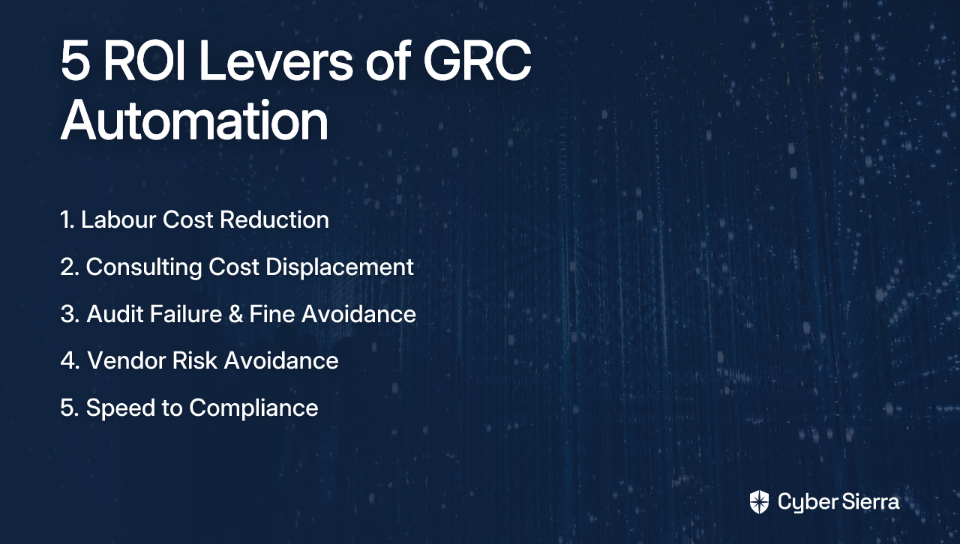
The 5 ROI Levers of GRC Automation
Use these five levers to build your financial model. Each one maps directly to a line item your CFO can verify.
Lever 1: Labor Cost Reduction
Manual GRC work (evidence collection, control testing, policy mapping, and audit prep) consumes analyst hours at scale. Automating routine compliance tasks can reduce FTE time spent on those activities by 70%.
To apply this to your org: take the loaded annual cost of every FTE touching compliance work, multiply by the percentage of their time spent on routine tasks, then apply the 70% reduction. A team of three analysts at $120K loaded cost spending 40% of their time on routine compliance tasks represents $144K in annual labor. A 70% reduction is $100K in recoverable capacity that can be redirected to higher-value risk work or reflected in headcount planning.
Steel Patriot Partners' ROI guide models this reduction in staff hours from 200 per month with manual processes to 80 per month with GRC software. This 60% drop closely tracks the 70% figure for AI-enabled automation.
Lever 2: Consulting Cost Displacement
Point-in-time compliance projects like audit readiness assessments, framework gap analyses, and control design workshops are routinely scoped at $150K to $250K per Big 4 engagement. Those engagements produce a report and a spreadsheet. The knowledge walks out the door when the engagement ends.
An AI-enabled GRC platform handles this work continuously for a predictable subscription fee, representing a direct variable-to-fixed cost shift. This approach also improves budget predictability, which CFOs value independently of the dollar difference. Cyber Sierra offers plans for different business needs. Visit the pricing page for current details.
Lever 3: Audit Failure and Fine Avoidance
A failed audit is not just a remediation cost. Regulatory penalties under frameworks like HIPAA can result in significant fines, while GDPR fines are capped at 4% of global annual turnover. Even smaller organizations face audit remediation costs, reputational damage, and delayed attestations that stall enterprise sales.
Steel Patriot Partners estimates that compliance violations in a manual environment can cost $50,000 per year, dropping to $10,000 with continuous automated monitoring for a $40,000 risk-adjusted saving. For your CFO, frame this as probability-weighted exposure: take the potential fine, multiply by the estimated likelihood of occurrence without automation, and subtract the residual risk with controls in place. That number goes in your upside column.
Lever 4: Vendor Risk Avoidance
Third-party risk is where manual processes break down fastest. Most organizations have hundreds of vendors but the capacity to properly assess only a fraction of them. The IBM Cost of a Data Breach Report consistently finds that breaches involving third parties carry higher average costs and longer resolution times than internally-originated incidents.
Cyber Sierra's TPRM module automates vendor due diligence, questionnaire distribution, and risk scoring, which helps compress the vendor review cycle. This is not just an efficiency gain; it's a reduction in the window of unmanaged third-party exposure. For your CFO, the framing is supply chain insurance. The cost of automation is a small, fixed premium against the operational and financial disruption of a vendor-induced breach.
Lever 5: Speed to Compliance
This is the lever that moves GRC from a cost center to a revenue function. For B2B companies selling into enterprise or regulated markets, SOC 2 attestation, ISO 27001 certification, or HIPAA compliance is often a prerequisite to close. Every week those certifications are delayed is a week of revenue sitting in a compliance-gated pipeline.
Traditional audit prep runs four to eight weeks. AI-driven automation compresses that cycle to hours for evidence packaging and days for the overall process. If your average enterprise deal is $250K and you can close four deals one quarter earlier because your attestation is complete, that's $1 million in accelerated revenue. That number belongs at the top of your business case, not buried in the appendix.
Cyber Sierra's CCM module supports continuous compliance monitoring, which helps you maintain audit readiness rather than scrambling before each assessment window.
Real Numbers from Live Deployments
These are not projected estimates. They are outcomes from organizations that have deployed AI-enabled GRC automation, showing what is possible.
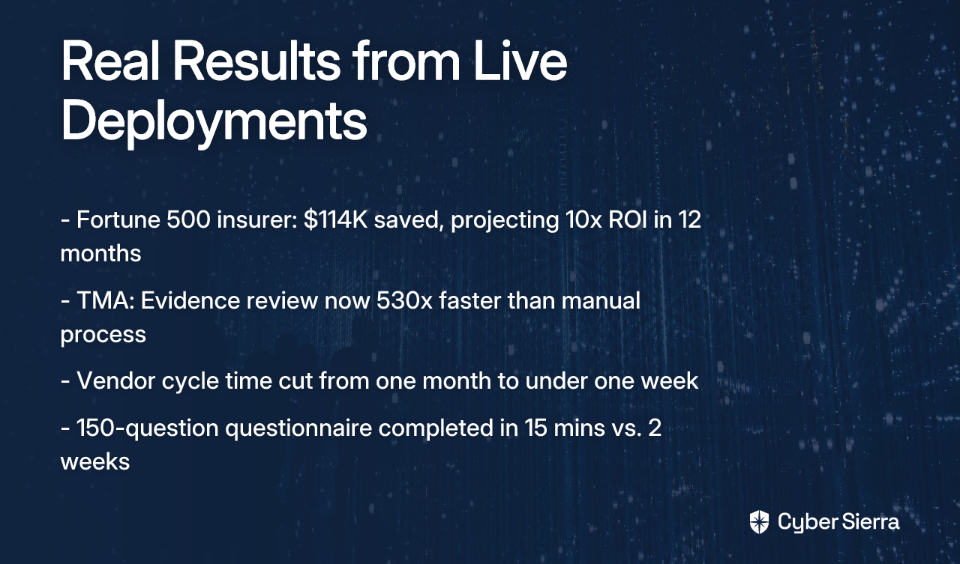
That last data point alone addresses one of the most common complaints in GRC teams today. As practitioners note, having evidence auto-pulled from hundreds of integrations and packaged for auditors was previously considered aspirational. These deployments show it is operational.
Cyber Sierra's AI-enabled platform is designed to automate these workflows. By connecting to your technology stack, it can reduce manual touchpoints structurally, not just incrementally.
How to Structure the One-Pager for Your CFO
Your CFO will not read a 20-page GRC strategy document. Give them one page with four sections.
Section 1: Executive Summary. One paragraph. State the problem (manual GRC is consuming significant FTE cost and leaving compliance-gated revenue on the table), the solution (an AI-enabled GRC automation platform), and the headline return (for example, a 10x ROI in 12 months based on comparable deployments).
Section 2: Current State Costs. A simple table. List your FTE hours on compliance tasks per month, your last consulting engagement cost, your most recent audit cycle length, and your active vendor count versus vendors assessed in the last 12 months. These numbers make the inefficiency visible without requiring the CFO to take your word for it.
Section 3: Projected Benefits. Map your numbers to the five levers. Use conservative estimates where you are uncertain. Apply the standard ROI formula: ROI = ((Total Benefits - Total Costs) / Total Costs) x 100. For example, with a given investment and $200K in combined labor savings, consulting displacement, and fine avoidance, the ROI can be over 300% before adding revenue acceleration. Add the pipeline impact and the case becomes compelling at any budget threshold.
Section 4: Investment and Timeline. Show a phased plan with 30-day, 90-day, and 12-month milestones. Early wins, like questionnaire automation and evidence auto-collection, are visible within weeks. This reduces the perceived risk of the investment and gives the CFO checkpoints to validate before full commitment.
The return on investment for GRC automation becomes far easier to defend when the numbers are laid out in this format rather than buried in compliance-specific language.
How to Frame This for the Board
The CFO needs the ROI. The board needs the strategic narrative. These are different conversations, and conflating them weakens both.
For the board, lead with two frames simultaneously: risk reduction and competitive positioning.
On risk reduction, an AI-enabled GRC platform creates a continuous, auditable record of your control environment. That record protects the organization in regulatory investigations, customer due diligence requests, and board-level oversight. It also helps reduce the personal liability exposure that sits with the CISO and CRO when things go wrong. Boards respond to that framing because it maps directly to their fiduciary responsibilities.
On competitive advantage: as Drata notes, GRC functions are becoming revenue enablers. Organizations with mature, automated compliance programs close enterprise deals faster, enter regulated markets earlier, and use their compliance posture as a differentiator in procurement evaluations. Competitors still running manual programs cannot move at the same speed. The board's directive to deploy AI has a concrete, high-ROI application sitting inside the GRC function. This is where that directive gets executed.
Tie both frames back to the mandate they issued. The board asked for AI deployment. The GRC automation business case is a specific, defensible, measurable answer to that question. It is not a speculative investment in AI infrastructure. It is a platform with ROI benchmarks from existing deployments showing significant efficiency improvements.
Turn Your GRC From Cost Center to Revenue Engine
Building a winning business case for GRC automation is not about lofty promises; it's about hard numbers. The key is to stop talking about compliance jargon and start talking about financial outcomes your CFO understands. Anchor your case in concrete cost reductions, like displacing large consulting fees and recovering hundreds of hours of manual labor. Then, reframe the conversation by showing how speed-to-compliance acts as a revenue accelerator, unlocking deals stalled in the pipeline.
Your next step is to pick one of the five levers and quantify it for your organization. Start by calculating the FTE hours your team currently spends on manual evidence collection. That single number is the foundation of your business case.
When you are ready to see how an AI-enabled platform can turn these calculations into a data-driven proposal, book a demo to see how Cyber Sierra helps teams build a stronger business case for automation.
Frequently Asked Questions
What is GRC automation?
GRC automation uses AI-powered platforms to handle repetitive governance, risk, and compliance tasks like evidence collection and control testing. This frees up GRC teams from manual spreadsheet work, allowing them to focus on strategic risk management and helping them maintain continuous, year-round compliance.
How is GRC automation ROI calculated?
GRC automation ROI is calculated by combining direct cost reductions (labor, consulting fees), cost avoidance (fines, breach costs), and revenue acceleration (faster sales cycles). The model typically uses five key levers: labor savings, consulting displacement, fine avoidance, vendor risk avoidance, and speed to compliance.
Why have traditional GRC tools failed to deliver ROI?
Many first-generation GRC tools failed to surpass the utility of a spreadsheet because they required significant manual input and didn't truly automate core tasks. Modern autonomous AI platforms structurally reduce manual work rather than just organizing it, delivering verifiable efficiency gains.
How can GRC automation increase revenue?
GRC automation can increase revenue by dramatically speeding up the time it takes to achieve compliance certifications like SOC 2 or ISO 27001. Since these certifications are often required to close enterprise deals, compressing the timeline directly accelerates revenue previously blocked by compliance gates.
What are the main cost savings from GRC automation?
The primary cost savings come from reducing manual labor hours spent on compliance tasks and displacing expensive third-party consulting engagements. Automation can cut FTE time on routine tasks by up to 70% and replace a $200K consulting project with a continuous, lower-cost platform subscription.
How do you present a GRC automation business case to a CFO?
Present the business case on a single page, focusing on financial outcomes rather than compliance jargon. Structure it with an executive summary, a table of current state costs, projected benefits mapped to the 5 ROI levers, and a clear investment timeline. This frames GRC as a financial driver.