blog-hero-background-image
Governance & Compliance

GRC Framework: What is it and Why is it Important?

backdrop
Table of Contents

Join thousands of professionals and get the latest insight on Compliance & Cybersecurity.


In the rapidly changing and ever-demanding business scenario, organizations face huge pressure to successfully navigate the complexities while simultaneously ensuring compliance with various cyber security standards and regulations. The more disorganized the structure, the higher the chance for scattered data, mismanaged human resources, lack of risk visibility, and inadequate audit trails. The solution to these issues lies in the adoption of a GRC (Governance, Risk, and Compliance) framework which aligns with your business objectives to achieve a well-managed set of functions. Let’s delve deeper and understand what the GRC framework is, how to implement it, its associated key components, and its benefits.


What is a GRC Framework?


A GRC framework is a structured model that helps organizations streamline and manage governance processes, mitigate risks, and ensure compliance with regulations effectively. A robust GRC framework facilitates the identification and implementation of policies that align with the organization’s objectives, enabling proactive risk mitigation and informed decision-making.


By centralizing processes, a GRC framework enhances operational efficiency, ensures compliance with regulations, and promotes collaboration across departments, ultimately supporting the organization’s strategic goals and improving overall performance.


It is more than a mere checklist that enables organizations to align their everyday operations with planned strategic objectives while managing risks and complying with relevant regulations. When adopted well, a GRC framework can help organizations integrate best practices and process day-to-day operations to effectively manage its IT and security risks, reduce costs, and meet compliance requirements.


Key components of GRC framework
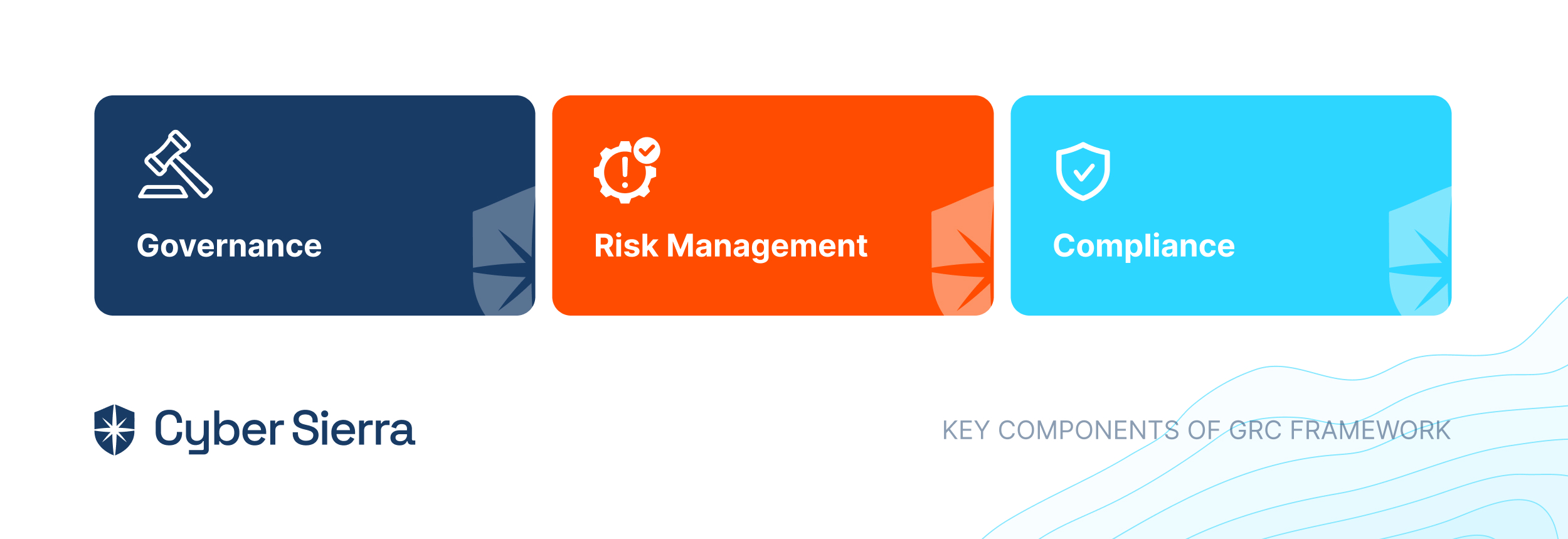
 

Key components if GRC framework


The GRC framework comprises three important components. Each of these components has its own nature, and mastering all three is important for a rewarding GRC framework.


1. Governance


Governance, in simple terms, is about the set of rules, policies, and processes that help an organization plan its everyday activities and align them to support and enable its business goals.


Good governance in the GRC framework


  • includes ethics, procedures, resource management, accountability, stability, and management controls.
  • enables the top management to guide and take control of what happens at every level of the organization.
  • helps every business unit in the organization be directed and aligned with the defined corporate goals and overall customer needs.
  • makes employees feel empowered, though their behavior and resources are controlled, but not in a negative way.
  • focuses more on being well-coordinated and heavily controlled.
  • aims to achieve accountability for conduct and results.
  • defines employee roles based on lines or sectors of the business.
  • evaluates employees based on their performance and results achieved, not on their job responsibilities.


Governance in the GRC framework predominantly aims to balance the interests of multiple stakeholders in the organization. These include top management, employees, contractors, freelancers, suppliers, and investors. It also provides control over available facilities and infrastructure.


How does governance help in maintaining balance? Here’s a GRC framework example – an organization encompasses multiple internal and external stakeholders. The contracts between these stakeholders need to be intact so that there is a proper sharing of responsibilities, rights, and rewards. It also includes well-defined procedures for reconciliation in cases of conflicting interests among stakeholders. Also, structured policies aid in supervision, control, and data flow functions, including a system of checks and balances.


2. Risk Management


Right on cue comes risk management. The ignored middle child of the GRC framework turns out to be a headache later. Risk management is the process of identifying, evaluating, analyzing, and mitigating or transferring different risks. These risks can be financial, legal, process-oriented, strategic, and security-related and threaten an organization’s operations.


Risk management


  • reduces the risks faced by an organization through an effective IT governance and compliance framework.
  • effectively monitors, controls, and reduces the impact of negative incidents on the organization.
  • focuses on maximizing the impact of positive events.
  • creates objectives that are in line with an organization’s values. Based on this, it builds a system of people, processes, and technology.
  • aims to achieve the objectives of an organization while refining its risk profile and securing value.
  • works on identifying threats and risks related to cybersecurity and information security.


For example, a risk management program within the GRC framework will include an assessment of the technology used and the identification of operational and technological failures, as these will impact the core business. It will also monitor the risks involved with infrastructure and the potential failure of networks and find ways to control them.


A risk assessment program needs to adhere to internal, contractual, legal, ethical, and societal objectives and keep track of any new rules pertaining to technology and cybersecurity. A company can safeguard itself from uncertainty, cut expenses, and raise the possibility of success and business continuity by concentrating on risk and allocating the resources required to control and mitigate risk.


An effective risk assessment program


  • should be in line with the different objectives of an organization, such as legal, contractual, internal, social, and ethical.
  • stay on top of the new technology-related regulations, and government regulations and monitor them to ensure compliance.
  • will allocate resources accordingly and help businesses safeguard themselves against uncertainty.
  • helps in effective risk control that results in cost reduction and enhances the likelihood of business continuity and success.


3. Compliance


Here comes the last one on the cue, the most spoiled one of the lot: compliance. Compliance management deals with adherence to rules, procedures, policies, and laws laid down by an organization, government, agency, and more. Non-compliance leads to a lack of performance, hefty fines, penalties, and lawsuits.


Regulatory compliance also encompasses external laws, regulations related to jurisdiction, and industry standards that are mandatory for functioning. On the other hand, internal compliance deals with different aspects such as rules, regulations, and management internal controls decided by an individual company. Both the internal compliance management program and external compliance requirements need to be integrated for the smooth functioning of an organization.


An effective compliance program


  • helps in understanding the areas of greatest risk and allocating more resources to those areas.
  • focuses on developing, implementing, and communicating policies to employees to overcome those risk areas.
  • offers guidance for employees and vendors. This makes the process of following compliance policies easier.


Types of GRC Framework
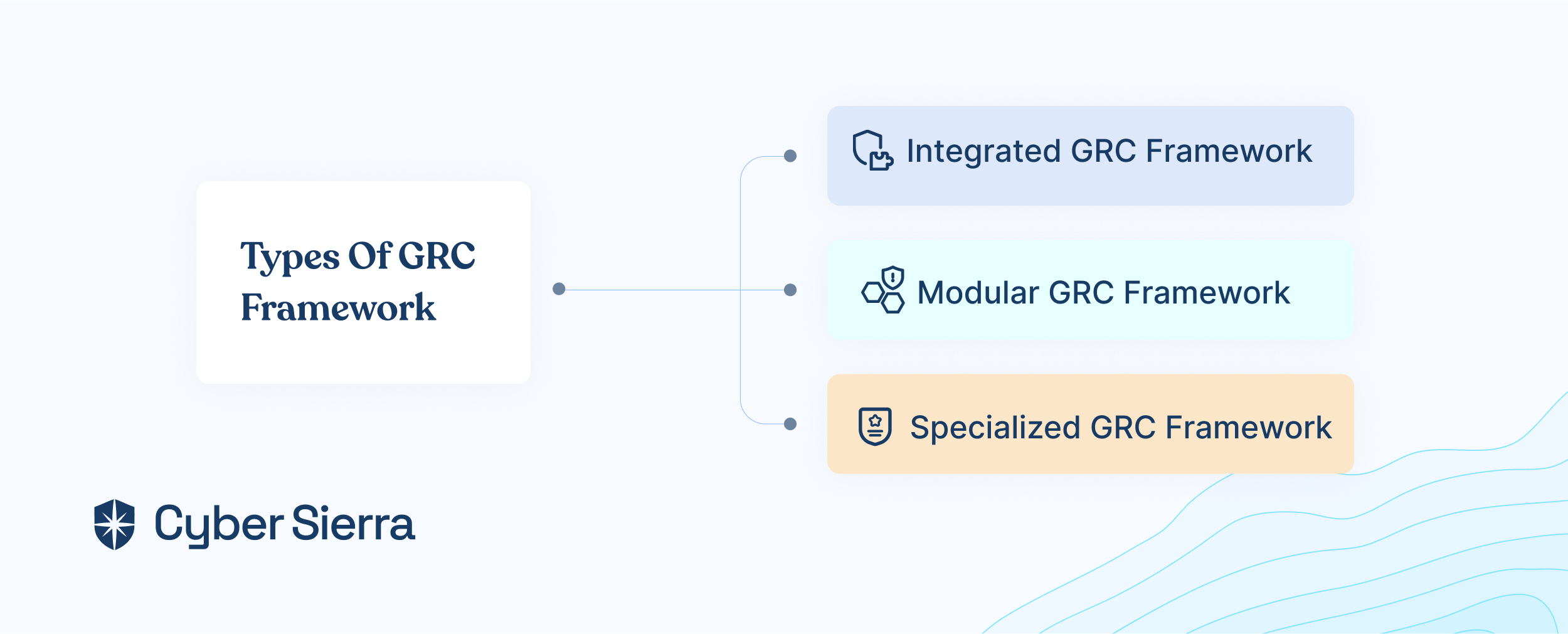
 

types of GRC framework


The key components of the GRC framework are clear now. Let’s learn more about the types of GRC frameworks.


1. Integrated GRC Framework


In an integrated GRC framework, governance, risk management, and compliance functions are unified under a single overarching structure. This approach promotes synergy and efficiency by streamlining processes and fostering a holistic view of organizational risks and compliance requirements.


2. Modular GRC Framework


A modular GRC framework consists of distinct but interconnected modules for governance, risk management, and compliance functions. Organizations can customize and implement individual modules based on their specific needs and priorities, allowing for greater flexibility and scalability.


3. Specialized GRC Framework


Specialized GRC frameworks cater to organizations operating in highly regulated industries or facing unique compliance challenges. These frameworks are tailored to address specific regulatory requirements or industry standards, offering targeted solutions for governance, risk, and compliance management.


Benefits of GRC Framework
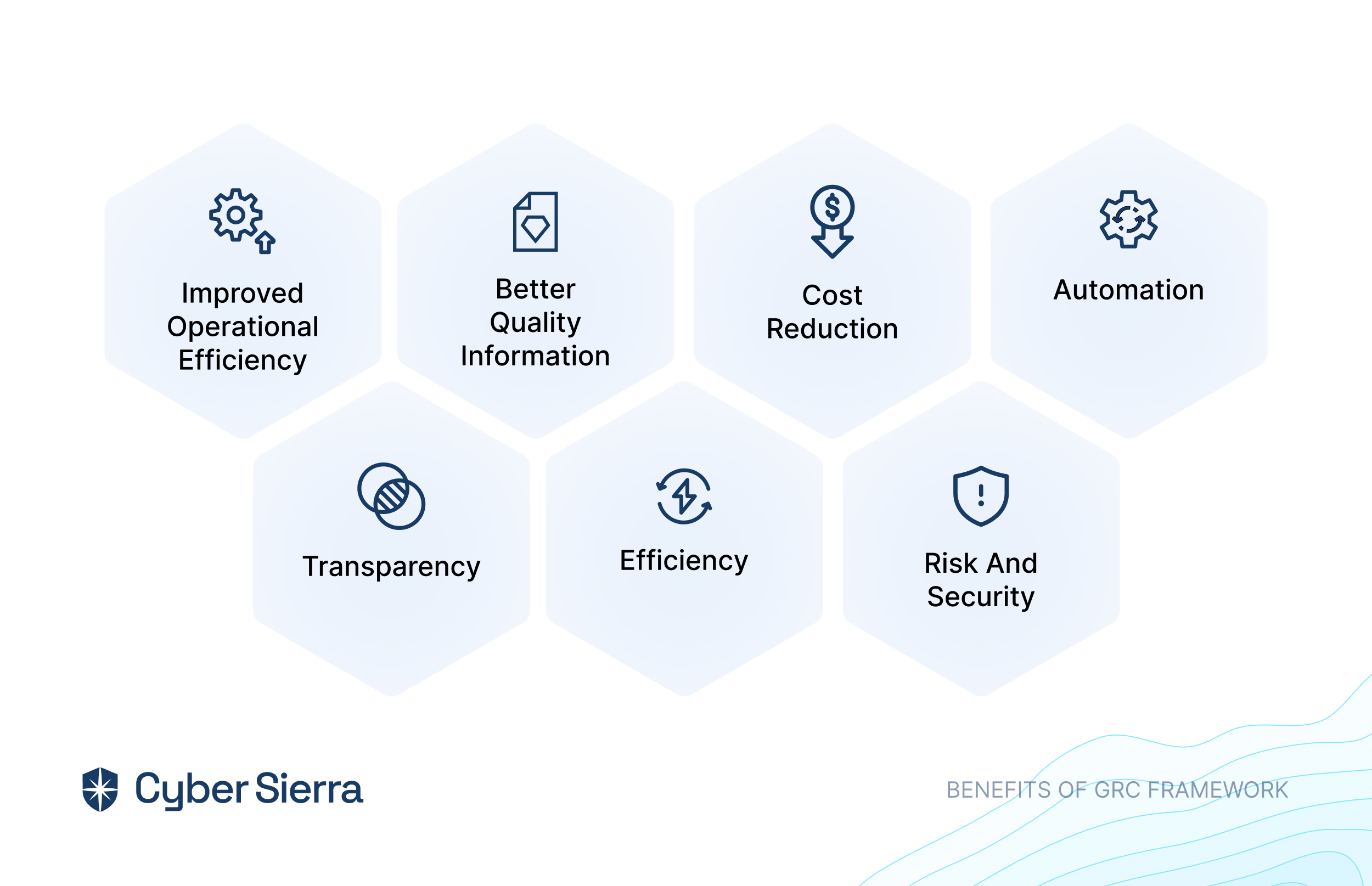
 

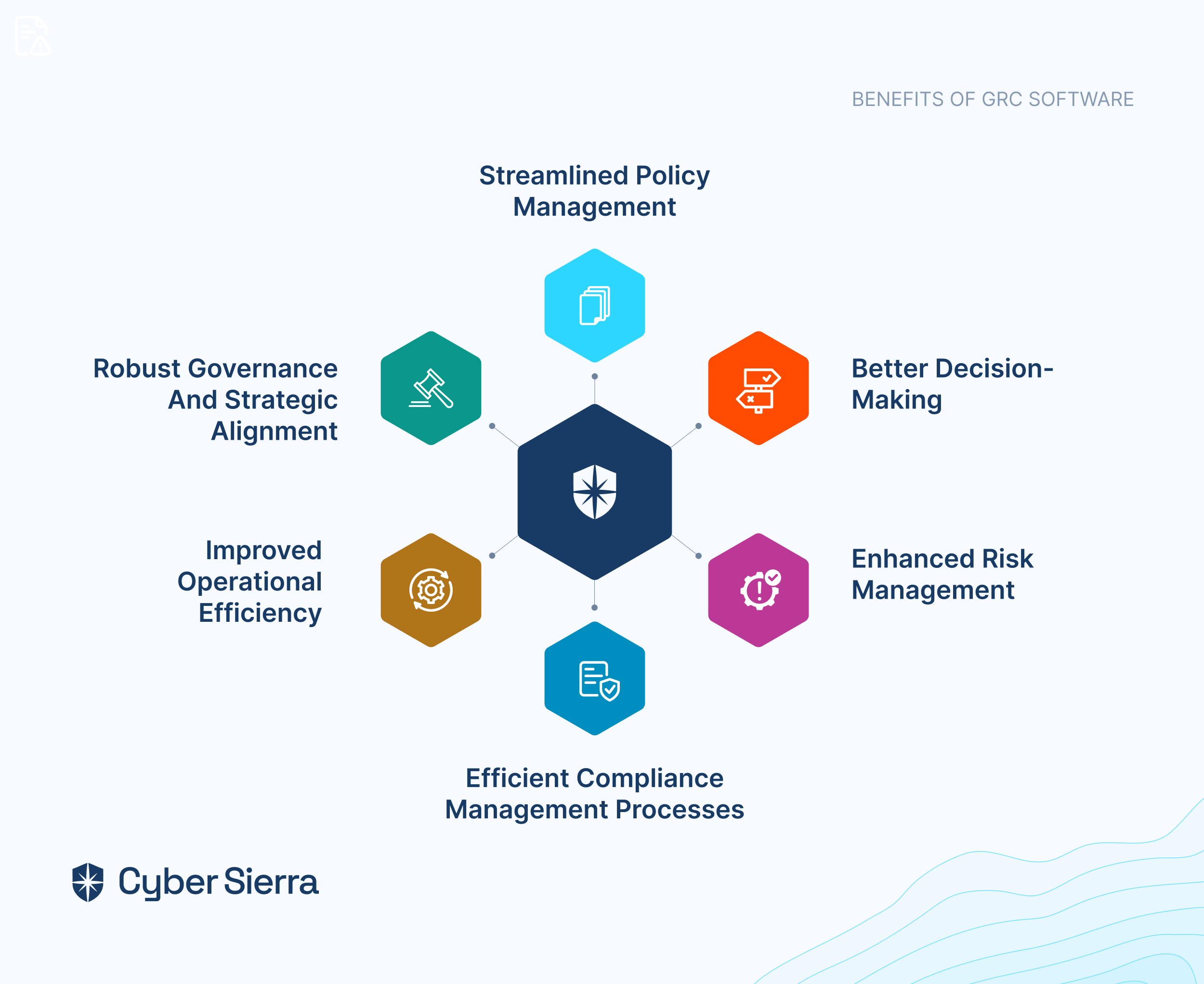
Benefits of GRC Framework


Implementing the GRC framework makes your life easier. Period. No other way to argue about it. So, what are the benefits of the GRC framework? Read below:


1. Improved operational efficiency


GRC framework helps automate common mundane processes. Continuous monitoring of controls, risks involved, and KRIs leads to this. So, organizations learn better and more efficient ways to run operations.


2. Better quality information


The GRC framework brings an integrated approach, and now your management team can have a complete 360-degree view of every piece of data. This helps with informed decision-making.


3. Cost reduction


With the GRC framework, you can build a roadmap of business rules, better reviews, and consolidated controls. This leads to better use of resources and reduces the cost of implementation.


4. Automation


The GRC framework reduces manual efforts by eliminating the need for spreadsheets, documents, emails, and direct calls to manage everyday functions. This leads to a shift in reduced manual efforts and eliminates redundant tasks, processes, workflows, and more.


5. Transparency


Siloed functions come with the GRC framework, and this helps provide full visibility into processes. In this scenario, every department works independently. So, you get visibility for all involved parties.


6. Efficiency


GRC frameworks bring all the processes related to risks, internal audits, and compliance into a centralized system, which makes managing time-consuming, complex processes easier.


7. Risk and security


Businesses can manage, implement, track, monitor, and automate risks with the aid of GRC frameworks. This gives upper management the ability to decide more wisely, define objectives that match shifting market demands, and allocate resources to reduce risks.


How to Implement GRC Framework
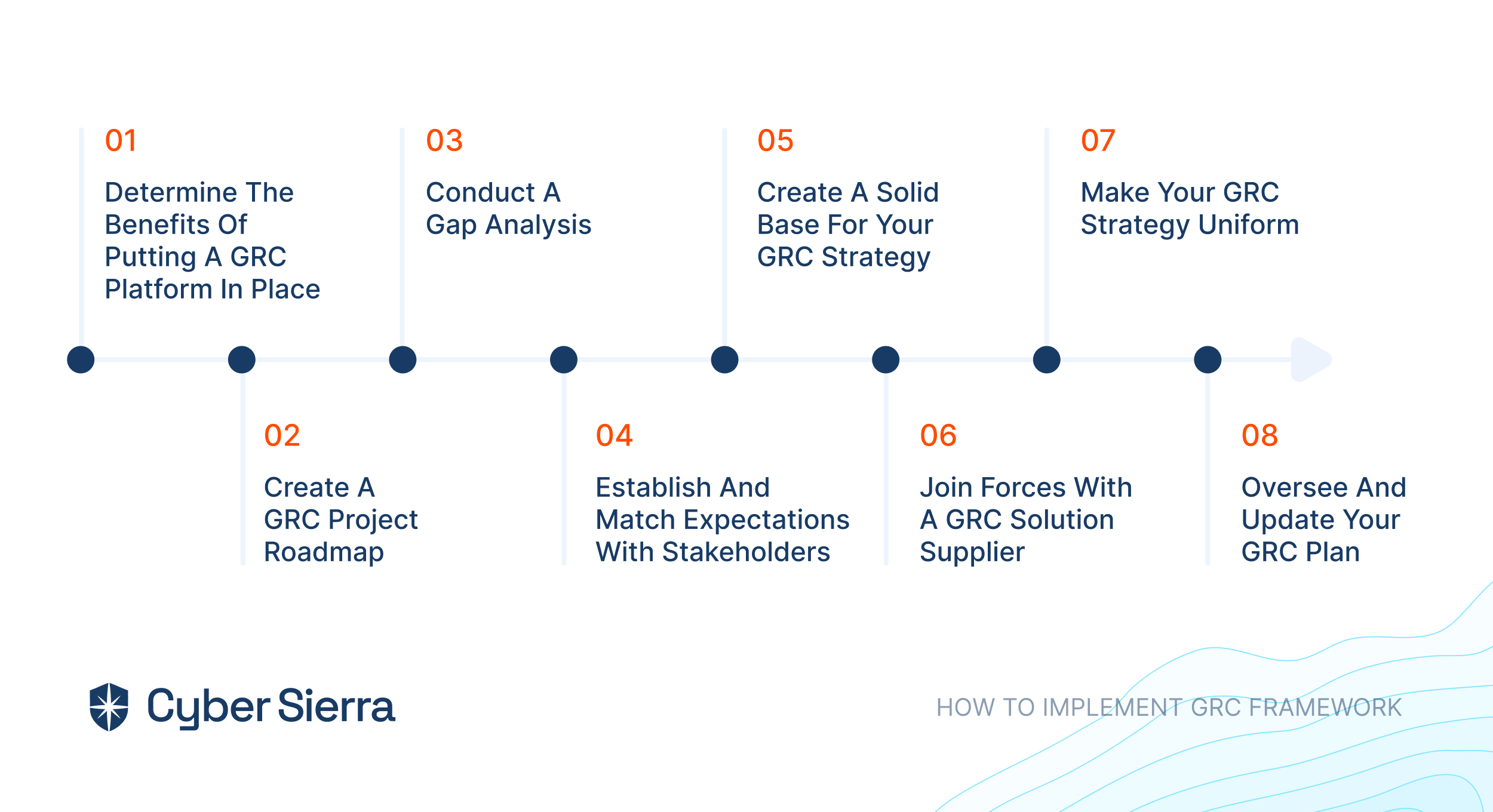
 

how to implement GRC framework


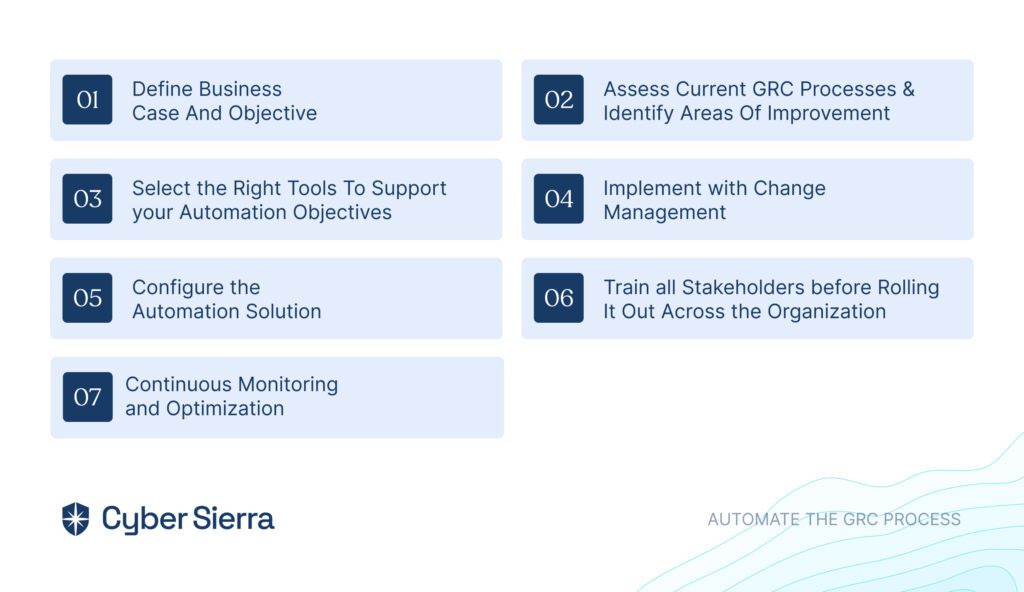
There is no right or wrong way to build your GRC framework. But the starting point is to bring together all your business components and unify them from a bottom-up approach to implementation.


1. Determine the Benefits of Putting a GRC Platform in Place


The first step is understanding, analyzing, realizing, and accepting the value of GRC framework implementation in your business. Only this will help you identify wide range GRC strategies that can be beneficial for your organization.


  • Identify existing processes that are working just fine and need not be changed. These can be retained and added to your unified system.
  • Identifying irrelevant data, technologies, and assets that are redundant reduces value and can even complicate your unification process.
  • Now, you have the most profitable assets in your hands, and these can be used to enhance your GRC strategy.


2. Create a GRC Project Roadmap


To understand your strategy’s scope, outline the purpose clearly and summarize the main functions of the GRC framework. This has to be accurately done with ongoing collaboration between all stakeholders. Only then will the product result align with the needs of each department without contradictions. Knowing the potential benefits of the GRC framework can help identify desired outcomes for every department here. This helps in the cybersecurity GRC framework and the IT governance risk and compliance framework.


3. Conduct a Gap Analysis


A crucial step in the compliance assessment process is gap analysis, which acts as a diagnostic tool to find differences between an organization’s current procedures and the ideal level of compliance.


During gap analysis, determine the following for each:

  • Process maturity
  • Data quality
  • Operational gaps


Keep these factors in mind when you conduct a gap analysis:


  • Finding any duplicate or missing data
  • Finding any redundant or duplicate processes
  • Finding ways to automate processes or reduce the manual ones


4. Establish and Match Expectations with Stakeholders


Ensure your entire organization is on board with the GRC framework and its GRC implementation. This is often overlooked. The GRC framework involves every department, and all your key stakeholders should have their voices heard about the proposal.


The main steps in achieving organizational alignment are:


  • Align executive team members with important considerations, like budget and roll-out dates. Before moving forward and making any necessary changes, you must ensure the leadership is on board with your plan before you notify the rest of the organization.
  • Use a top-down strategy. After receiving executive permission, you must establish practical and well-communicated change management procedures throughout all other business divisions. For instance, it’s reasonable to anticipate that your suggested modifications will encounter some opposition. Long-standing internal policies, external policies, and procedures within departments will probably need to be phased away gradually.
  • You should provide each team with frequent, educational updates explaining the pertinent changes and how they will impact their duties to facilitate a smooth transition. Establish an open channel of communication for team members to share any worries, recommendations, or other insightful comments that might change your approach.


5. Create a Solid Base for Your GRC Strategy


Get the proper groundwork done. Make sure your GRC system is practical and adaptable. This plays a significant role in the IT governance risk and compliance framework given the increased risk of cyber threats and vulnerabilities and the disastrous impact of data breaches. It is also important to pay closer attention to check if your GRC framework is adaptable to ever-changing regulatory changes.


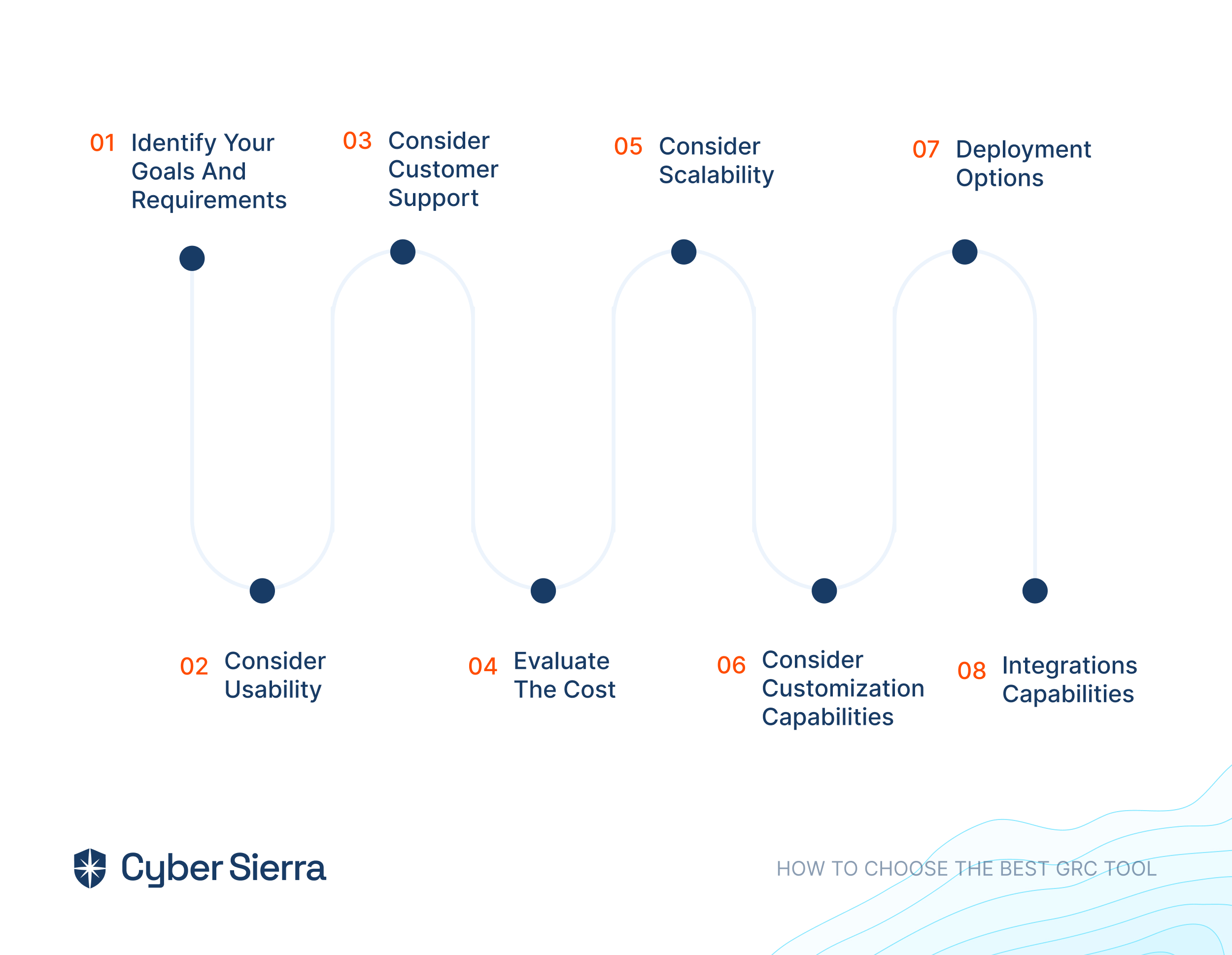
6. Join Forces with a GRC Solution Supplier


There are a lot of moving components involved in implementing a GRC program from scratch, such as merging information silos, maintaining updates, and employing manual procedures like spreadsheets. Many of these pain points can be streamlined by a smart GRC platform, freeing up your implementation time for higher-level work.


You must exercise due diligence, just like you would with any third-party vendor, to make sure your selected GRC technology complies with regulations and doesn’t put your company at serious risk for security breaches.


Through time and money savings, the appropriate GRC technology should provide a return on investment (ROI).


When selecting GRC software, consider the following crucial inquiries:


  • Is it simple to use and intuitive?
  • Is it using workflows that are automated?
  • Is customization possible? Custom reporting, for instance
  • Is it adaptable?
  • Do its features carry out actions?


7. Make Your GRC Strategy Uniform


The ability of a GRC strategy to meet the needs of the entire business is one of its key characteristics. Although every department will have unique needs, there ought to be a standard to work from.


8. Oversee and Update Your GRC Plan


Launching your GRC framework is not a one-time, set-and-forget endeavor. Once the implementation is over, it is your responsibility to ensure your strategy is adaptable and evolves with the changes in your business objectives.


Every team should keep up-to-date, precise records of its GRC requirements that are dated and include a note of any significant changes, including the introduction of new technology. A smart GRC platform can automate a good majority of this workflow.


These reports are the reference for your regular stakeholder meetings. Based on these recordings and meetings, you can ensure that your whole organization is aligned with the overall strategy. Another best practice is to conduct an audit at least annually to maintain regulatory compliance management. Any compliance issues identified should then be prioritized for remediation.


How does GRC automation work?
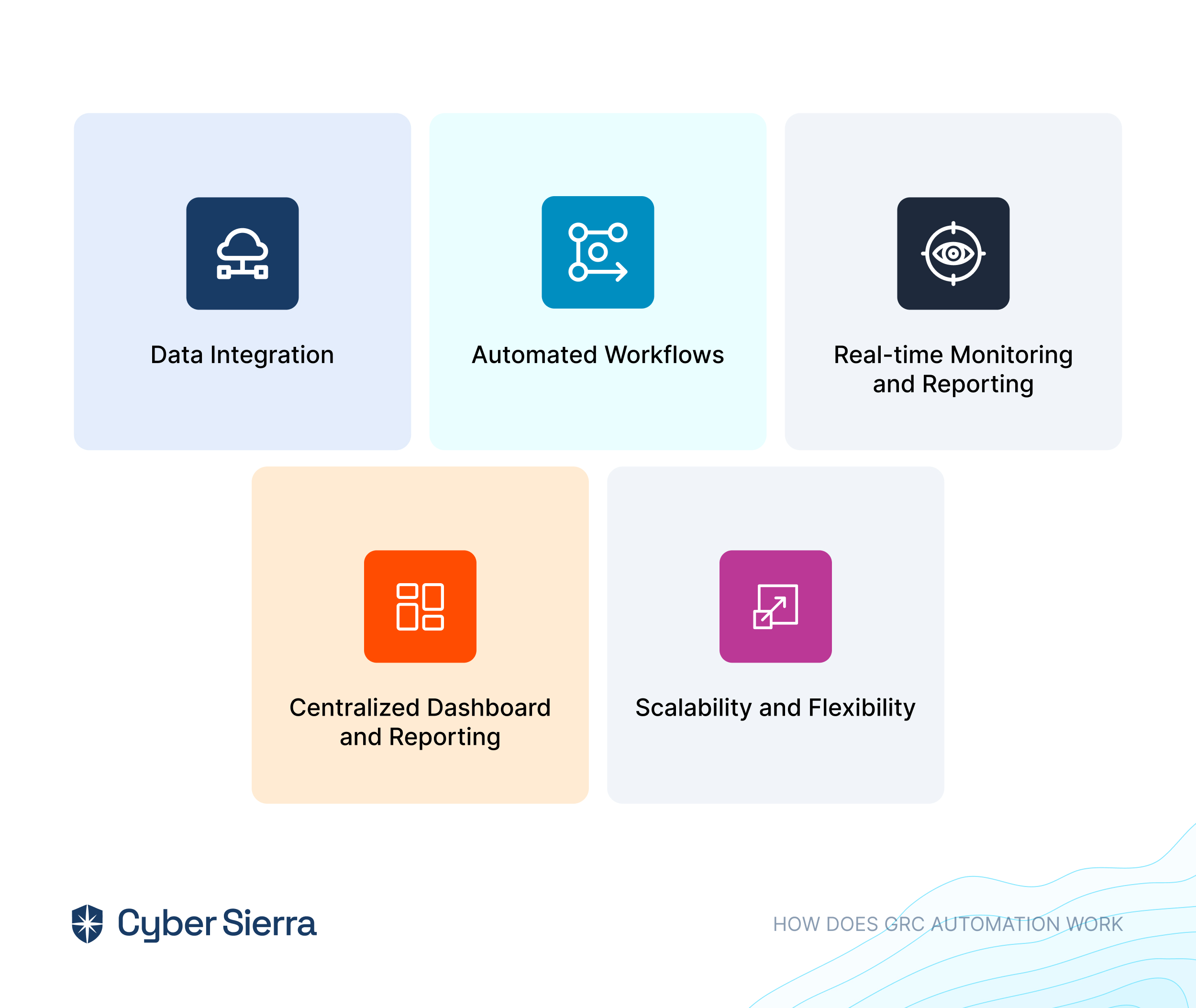
 

how to does GRC automation work


GRC automation software works by seamlessly integrating with your existing systems and processes, streamlining governance, risk, and compliance (GRC) procedures. This integration allows for efficient data collection, analysis, and reporting, ultimately saving time and effort.


1. Data Integration:


GRC automation integrates with various systems like ERP, HRIS, etc., to automatically collect data, eliminating manual entry and reducing errors.


2. Automated Workflows:


Predefined workflows and rules process data, aligning with policies and regulations. Automated tasks include risk assessments, control testing, issue management, and compliance monitoring.


3. Real-time Monitoring and Reporting:


Continuous monitoring assesses adherence to policies and regulations, enabling prompt identification and resolution of risks and violations.


4. Centralized Dashboard and Reporting:


Consolidated dashboards provide a comprehensive view of GRC posture. Automated reporting tailors information for stakeholders, promoting transparency and informed decision-making.


5. Scalability and Flexibility:


GRC automation solutions adapt to growth and evolving requirements, incorporating new data sources, workflows, and reporting needs for ongoing compliance and risk management.


What are the advantages of GRC automation?
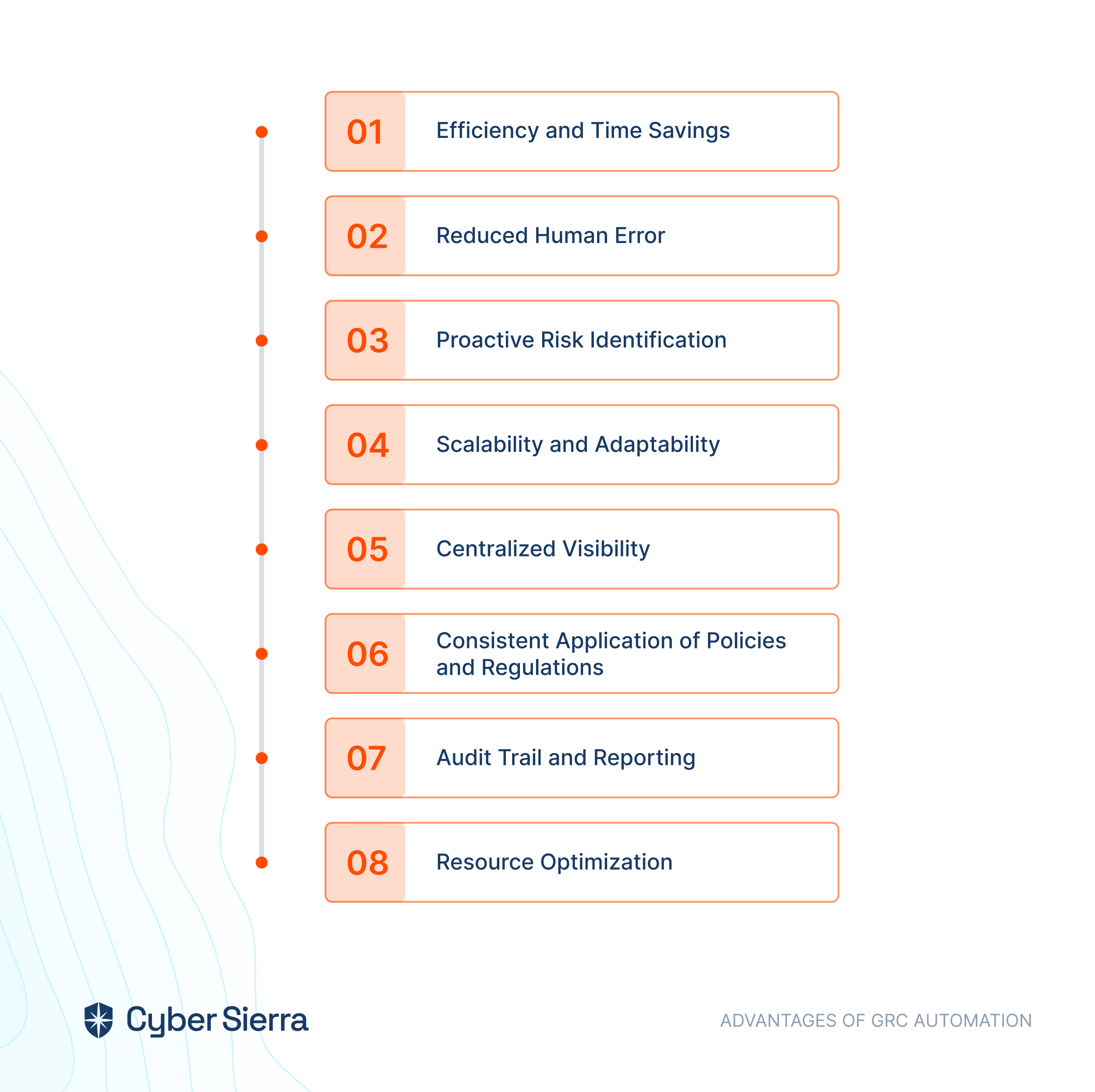
 

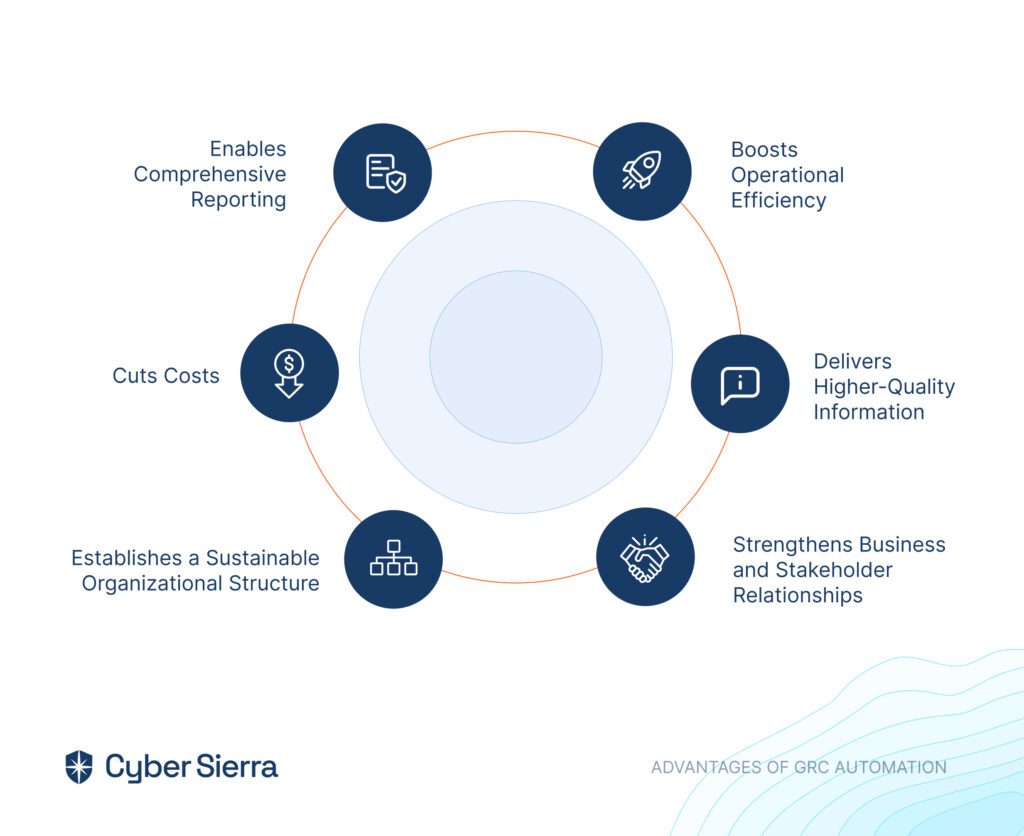
advantages of GRC framework


1. Efficiency and Time Savings:


Automating data collection, analysis, and reporting processes streamlines GRC procedures, saving significant time and effort compared to manual methods.


2. Reduced Human Error:


By minimizing manual interventions, GRC automation lowers the possibility of human error, ensuring consistent and trustworthy compliance management.


3. Proactive Risk Identification:


Real-time monitoring capabilities enabled by automation allow organizations to quickly recognize and resolve potential business risks before they escalate.


4. Scalability and Adaptability:


GRC automation solutions are easily scalable and can adapt to evolving compliance requirements as businesses grow and expand, ensuring ongoing regulatory adherence.


5. Centralized Visibility:


Automated GRC platforms often provide centralized dashboards, offering a comprehensive view of an organization’s governance, risk, and compliance posture, promoting transparency and informed decision-making.


6. Consistent Application of Policies and Regulations:


Automated workflows and rules ensure that policies, regulations, and risk management frameworks are applied consistently across the organization, reducing the risk of non-compliance.


7. Audit Trail and Reporting:


GRC automation solutions maintain detailed audit trails and generate customized reports tailored to specific stakeholders, such as executives, auditors, and regulatory bodies, facilitating compliance demonstrations and regulatory reporting.


8. Resource Optimization:


By automating repetitive and time-consuming GRC tasks, organizations can reallocate human resources to more strategic and value-adding activities, optimizing resource utilization.


How can Cyber Sierra’s Smart GRC automation help?
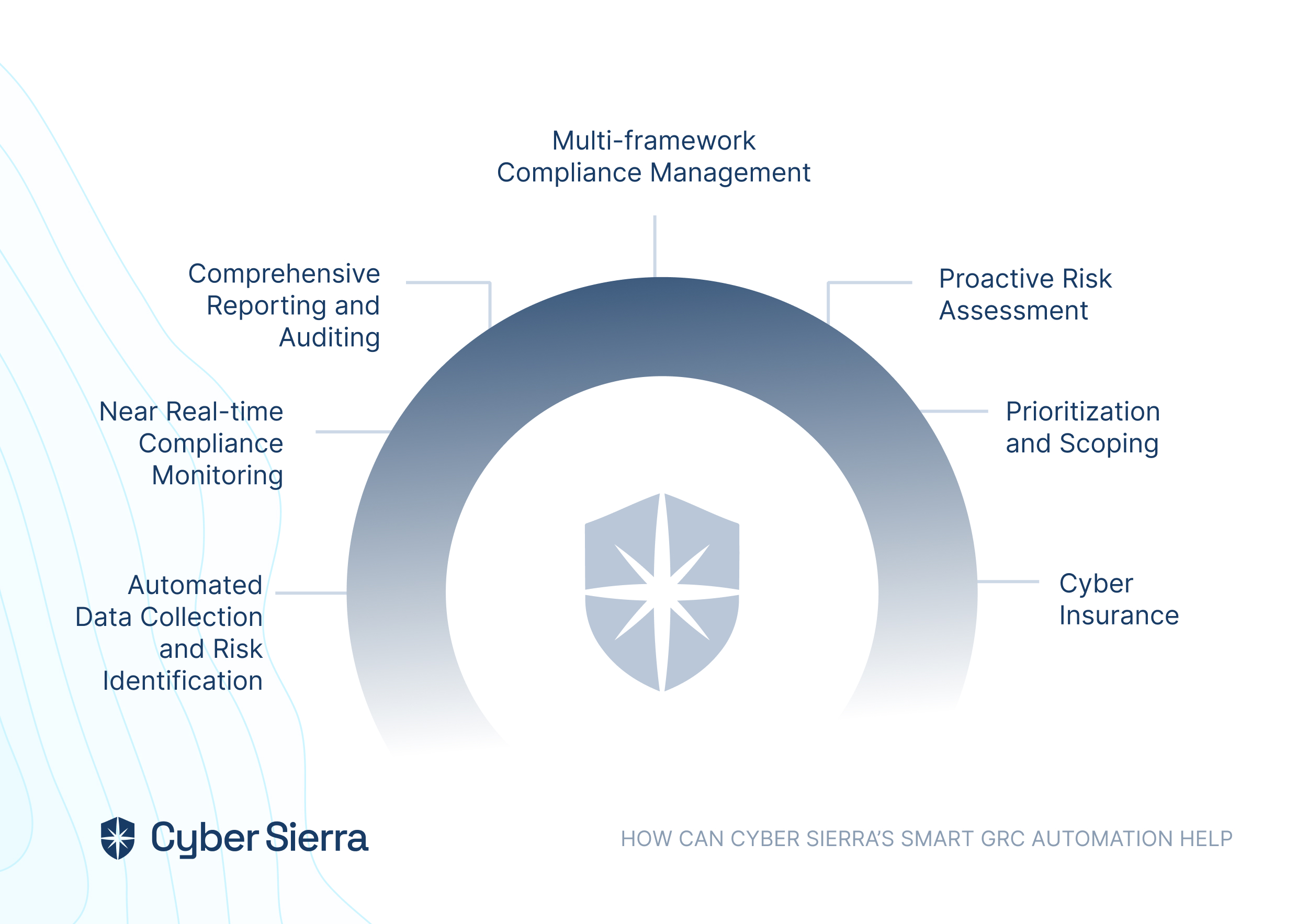
 

how Cyberseirra help in GRC framework implementation


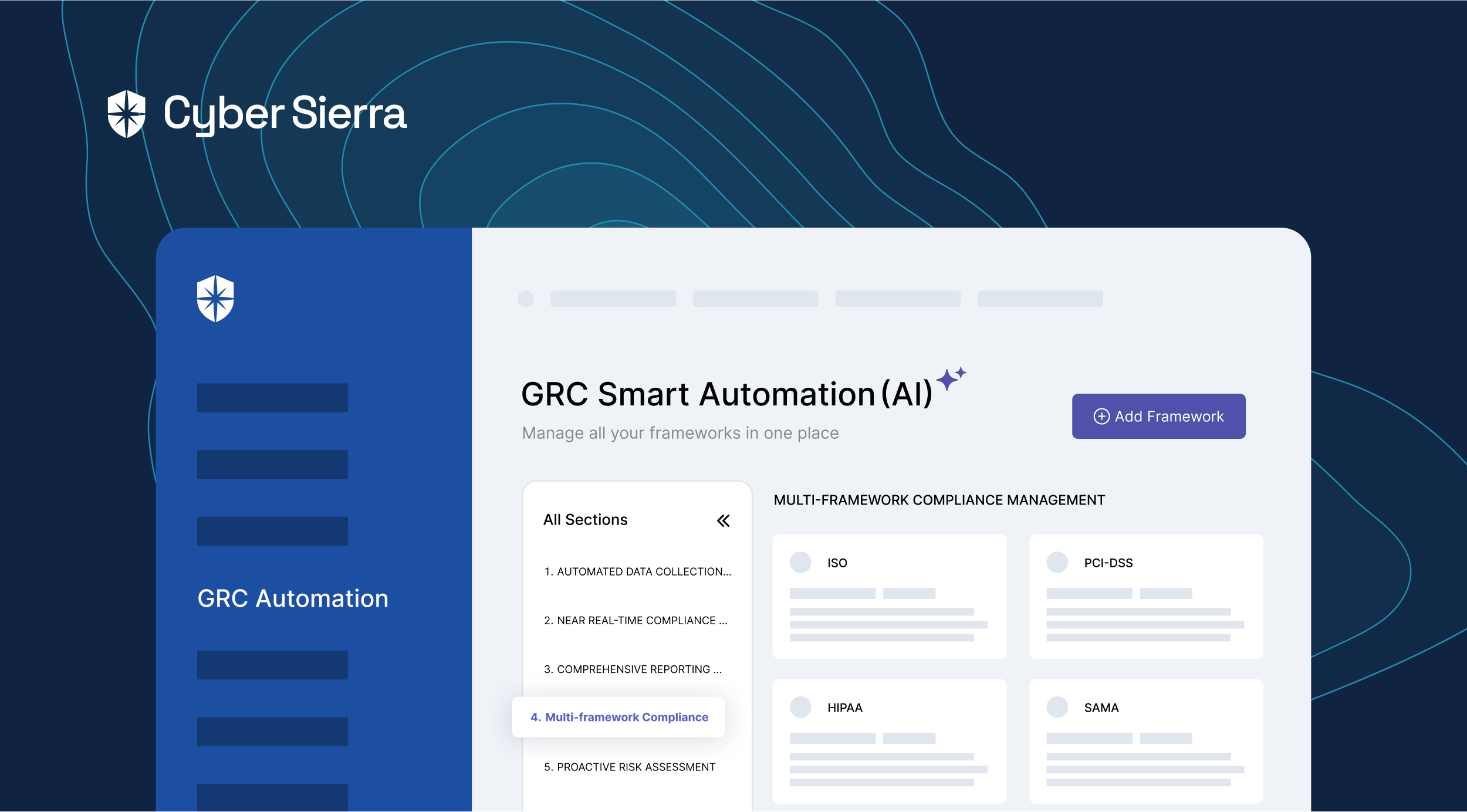
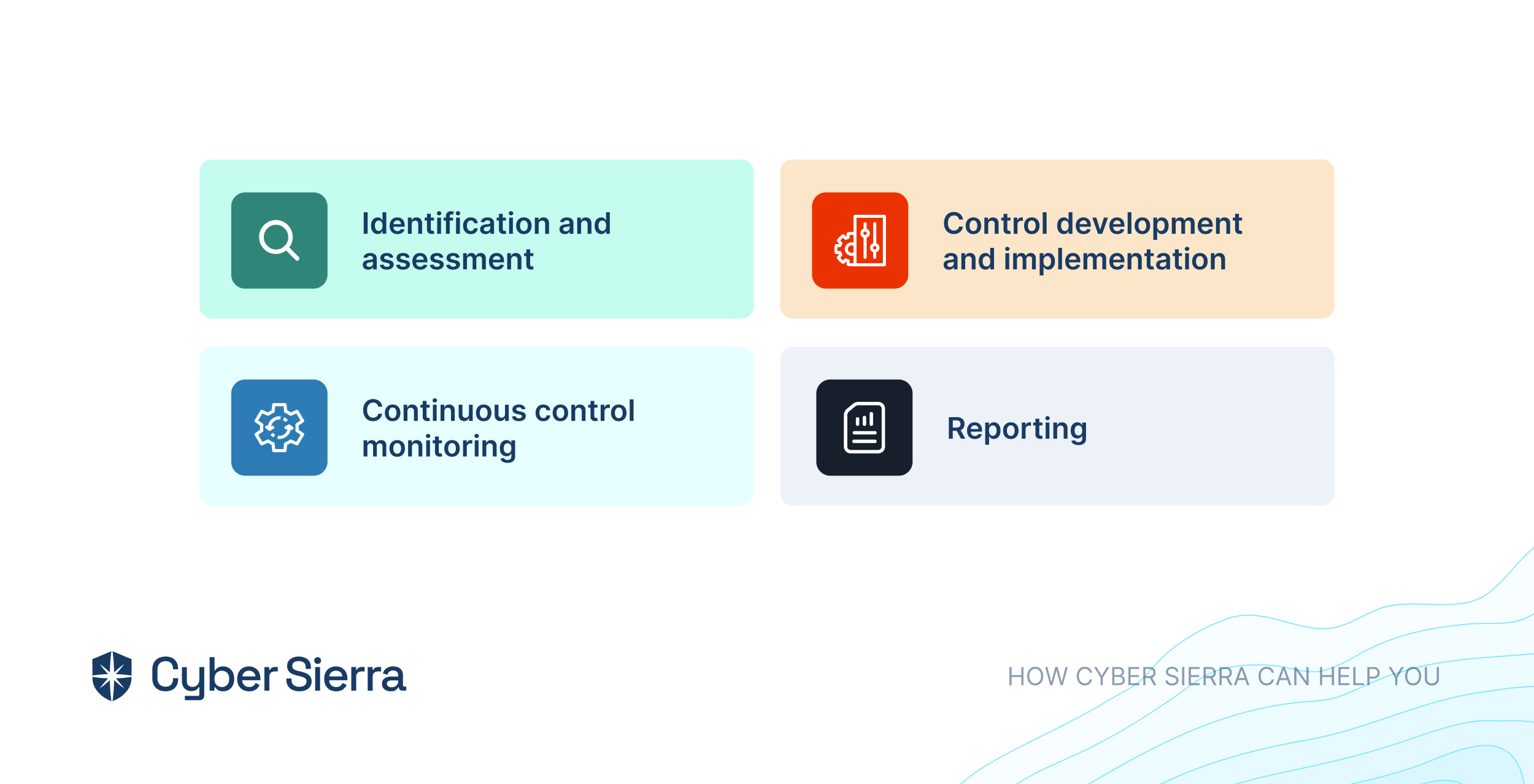
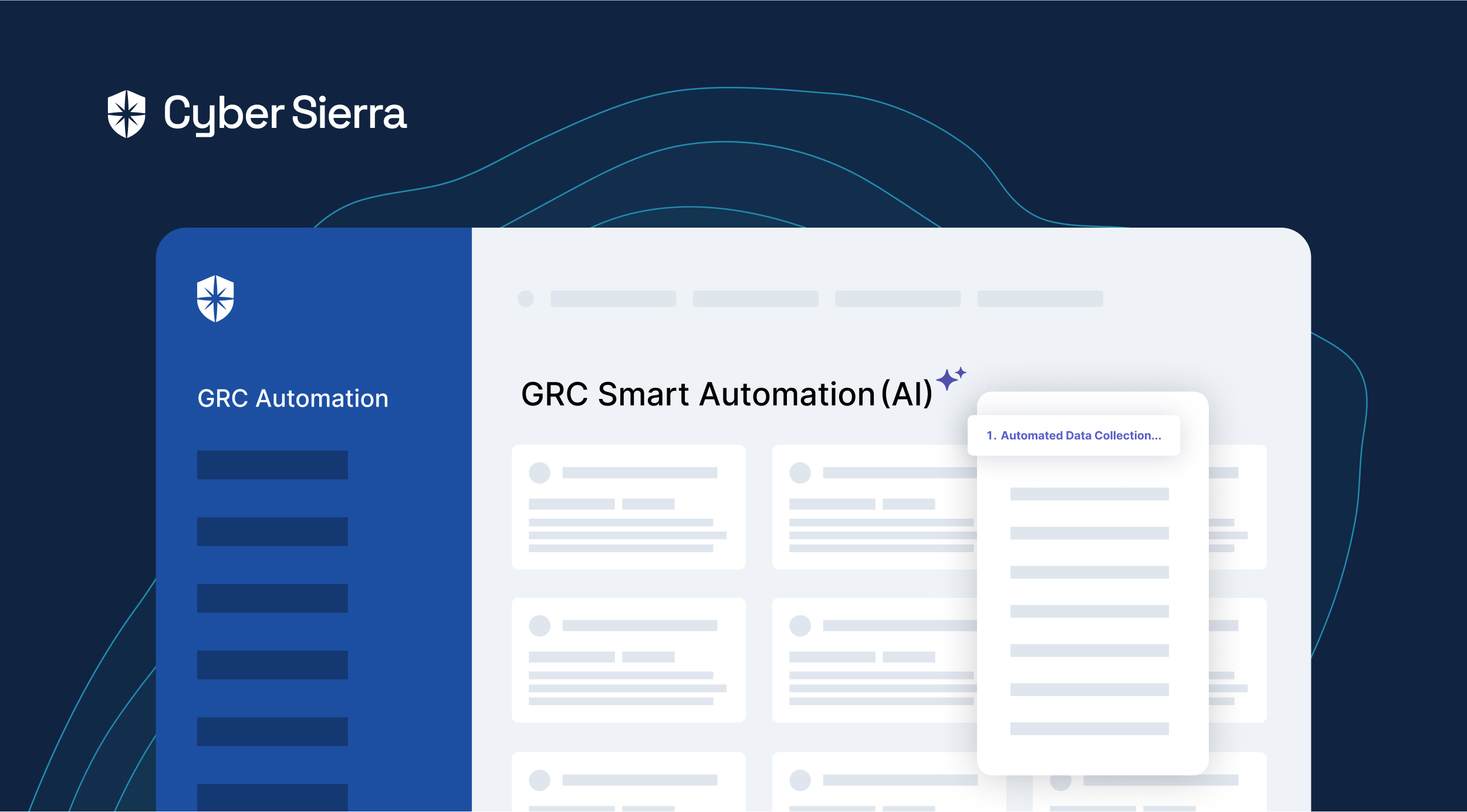
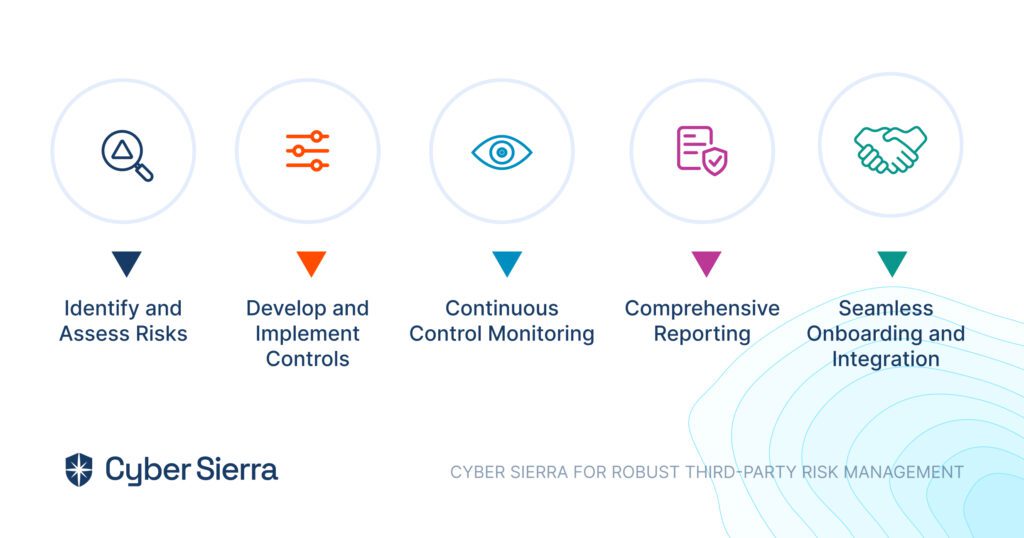
Cyber Sierra’s platform goes beyond traditional GRC frameworks by offering an all-inclusive AI-enabled platform. It encompasses features such as control mapping, automated checks, risk unification, staff training, and streamlined access control, effectively turning compliance into a seamless and integrated process.


Here’s a look at the top features:


1. Automated Data Collection and Risk Identification:


Cyber Sierra automates data collection and analyses from various sources for effective risk identification and mitigation.


2. Near Real-time Compliance Monitoring:


Cyber Sierra’s Continuous Control Monitoring (CCM) feature enables real-time monitoring of processes and activities, ensuring ongoing compliance with relevant regulations and internal policies. It proactively identifies and flags any instances of non-compliance, allowing organizations to promptly address issues before they escalate.


3. Comprehensive Reporting and Auditing:


The platform offers you in-depth reporting tailored to stakeholders, and detailed audit trails promote accountability and transparency.


4. Multi-framework Compliance Management:


Cyber Sierra streamlines compliance across multiple industry regulations and standards such as ISO, PCI DSS, HIPAA, SAMA, CIRMP, MAS TRM, and HKMA, reducing non-compliance risks.


5. Proactive Risk Assessment:


It identifies and prioritizes potential risks based on impact and likelihood for strategic risk management.


6. Prioritization and Scoping:


The platform prioritizes compliance requirements, scopes risks and controls for efficient resource allocation.


7. Cyber Insurance:


The platform can also help you transfer risks through cyber insurance coverage.


If you are looking for a smart GRC solution, talk to our experts today to know how Cyber Sierra can help you reach your security goals.

  • Governance & Compliance
  • CISOs
  • CTOs
  • Cybersecurity Enthusiasts
  • Enterprise Leaders
  • Startup Founders
Srividhya Karthik

Srividhya Karthik is a seasoned content marketer and the Head of Marketing at Cyber Sierra. With a firm belief in the power of storytelling, she brings years of experience to create engaging narratives that captivate audiences. She also brings valuable insights from her work in the field of cybersecurity and compliance, possessing a deep understanding of the challenges and pain points faced by customers in these domains.

A weekly newsletter sharing actionable tips for CTOs & CISOs to secure their software.


Thank you for subscribing!

Please check your email to confirm your email address.

Find out how we can assist you in
completing your compliance journey.
blog-hero-background-image
Governance & Compliance

Comply With Australian CIRMP Rules

backdrop
Table of Contents

Join thousands of professionals and get the latest insight on Compliance & Cybersecurity.


If you’re an Australian organization handling critical infrastructure assets, you have less than three months to be CIRMP (Critical Infrastructure Risk Management Program) compliant! All responsible entities must implement a risk management program as per CIRMP rules by 17 August 2023. 

Here’s a quick lowdown on the CIRMP rules. Read on to know if you need to comply, and, if yes,  what should you implement before the deadline to meet the core CIRMP requirements. 

For the uninitiated, on 17 February 2023, the Australian Government introduced the CIRMP rule. Governed by the Security of Critical Infrastructure Act 2018 (SOCI Act), this is the latest rule introduced by the Australian government to safeguard the country against global cyber threats and uplift the core security practices of critical infrastructure (CI) assets.

What is CIRMP?

CIRMP stands for Critical Infrastructure Risk Management Program. It is a set of requirements that entities responsible for critical infrastructure assets (CIAs) must meet under the Security of Critical Infrastructure Rules 2023 in Australia. 


The rule ​​states that entities responsible for CIAs must implement a critical infrastructure risk management program by 17 August 2023.

What is material risk?

A material risk as per CIRMP is a risk that has a significant impact on the ability of a critical infrastructure asset to perform its critical functions. This could include risks that could lead to the impairment, stoppage, loss of access to, or interference with the asset. 


Section 6 (a-e) of the Rules provides the parameters of a material risk.


The Australian Cyber Security Centre (ACSC) has provided some guidance on what constitutes a material risk in the context of the CIRMP. This guidance includes the following factors:


  • The likelihood of the risk occurring.
  • The impact of the risk if it does occur.
  • The criticality of the asset to the economy or society.
  • The cost of implementing measures to mitigate the risk.


The concept of material risk, however, isn’t absolute and each entity will need to assess the risks to its own assets on a case-by-case basis.


Here are some examples of material risks that could affect critical infrastructure assets:


A cyber attack that could disrupt or disable the asset’s IT systems.

A physical attack that could damage or destroy the asset.

A natural disaster that could cause the asset to be unavailable.

A human error that could lead to the asset being misused or damaged.


The CIRMP requires entities responsible for critical infrastructure assets to identify and assess the material risks to their assets. This assessment should be documented in the CIRMP and should be reviewed and updated on a regular basis. The entity should also implement measures to mitigate the material risks to its assets.


A ‘material risk’ to a critical infrastructure asset occurs when the risk has a

‘relevant impact’ on the asset. Section 6 (a-e) of the Rules provides the parameters

of a material risk.

These include the risk of impairment, stoppage, loss of access to or interference

with the asset.

What is a relevant impact?

A ‘relevant impact’ is an impact on the availability, integrity, and reliability of the

asset, and the impact on the confidentiality of information about the asset,

information stored in the asset if any, and, if the asset is computer data, the

computer data.

The relevant impact may be direct or indirect. It must be more serious than a

reduction in the quality of service being provided.

Why is the CIRMP Rule Important?

The CIRMP rule is important because it helps Australia’s critical infrastructure entities uplift their core security practices that relate to managing their critical infrastructure assets. It does so helping create a robust and proactive risk management program for organizations.

Market disruptions have increased the adoption of digital transformation among many businesses. While technologies such as automation, data processing, cloud, and AI improve productivity, security threats are also growing in intensity and complexity.

So, when your CI asset is disrupted by security threats, it can affect your business, the government, and the community. All of this can even damage the country’s economic growth.

Therefore, the only goal of CIRMP is to help Australian entities such as yours create a solid security program that will uplift the core security practices of your CI assets. When you have a strong security program as per the CIRMP rules, it’ll help you to,

  • Safely provide services that the economy and community rely on
  • Quickly bounce back from incidents that affect your critical assets
  • Uphold your brand’s public perception and financial stability

To fully understand how the CIRMP rule came into place, you must know what the SOCI (Security of Critical Infrastructure) 2018 Act is about.

Compliance with CIRMP rules is not merely a matter of checking boxes; it is an ongoing process that requires organizations to fully implement and abide by the law’s principles. The CIRMP rules demand a comprehensive approach, with a particular emphasis on fortifying the cybersecurity of critical infrastructure.

This endeavour necessitates the collective effort of the entire vendor ecosystem, urging them to address any shortcomings and improve their practices.

Quick Rewind on the SOCI Act

The SOCI Act was amended in 2018 to improve the resilience of CI assets against security threats through carefully laid regulatory reforms and amendments. It was passed in two phases,

  • The first phase in December 2021 – Security Legislation Amendment (Critical Infrastructure) Act
  • The second phase in April 2022 – Security Legislation Amendment (Critical Infrastructure Protection) Act

Together these two amendments form a framework with the following features:

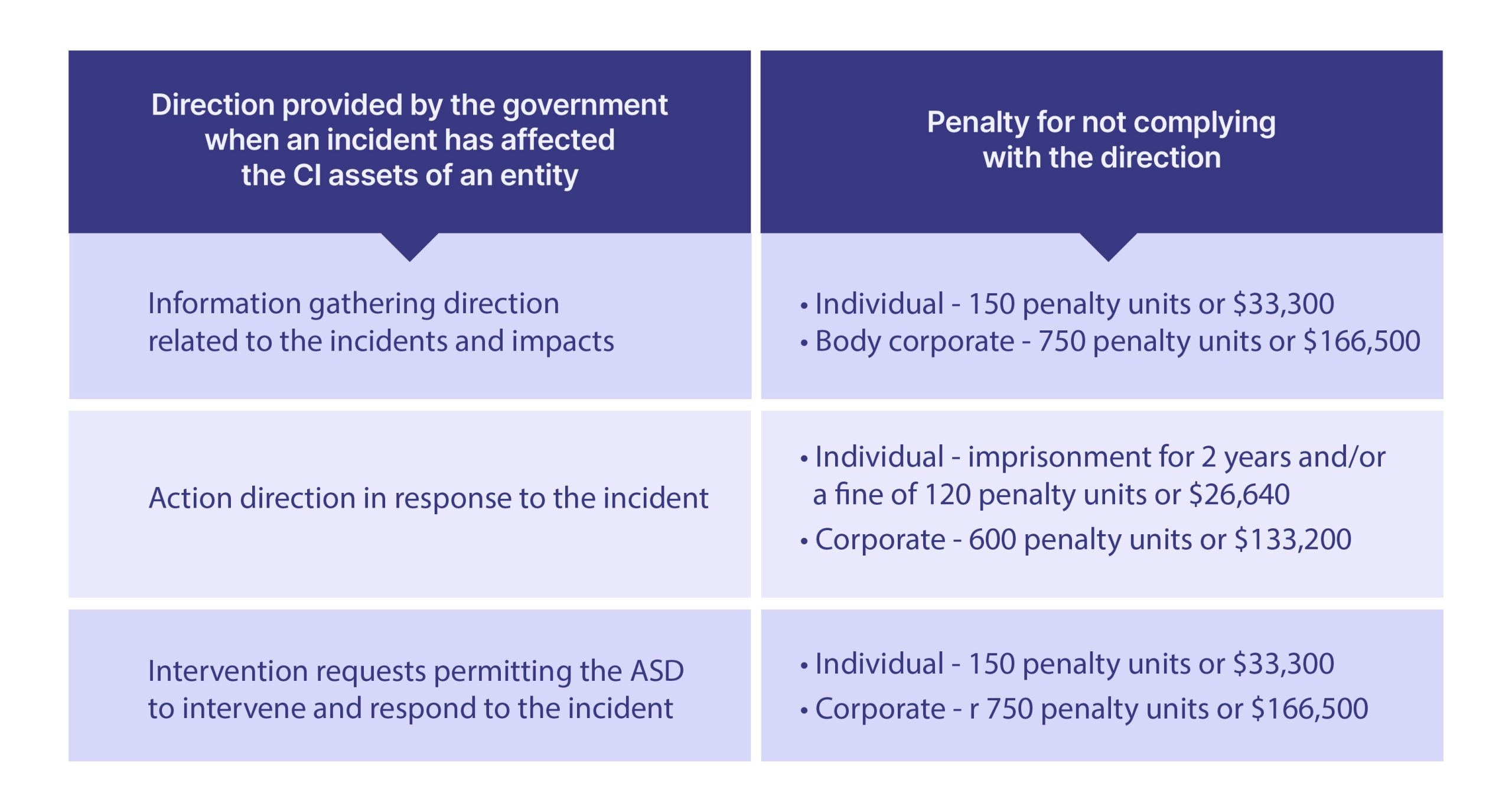
Government Direction and Intervention (in effect since Dec 2021)

Positive Security Obligations – What Responsible Entities Need to Do to Ensure Compliance?

Who must comply with the CIRMP Rules?

The CIRMP rules apply to all Australian entities that own and manage critical infrastructure assets. The Australian government has outlined 11 critical infrastructure sectors and 22 categories of CI assets that must comply with CIRMP, including entities that manage CI assets. This includes critical financial services assets, critical energy assets, and others.

For detailed definitions of asset rules, click here.

How to comply with Australia’s CIRMP Rules?

Organizations can comply with Australia’s CIRMP rules by following these four steps:

Step 1 – Describe CIRMP requirements based on your CI assets 

Step 2 – Define the four key hazard vectors of your CI assets 

Step 3 – Submit annual reports to the Commonwealth regulator

Step 4 – Maintain, review, and update CIRMP

Organizations must develop, maintain and update their CIRMP. Here’s a detailed overview of how you can achieve each of these steps.

Step 1: Describe the CIRMP requirements 

Here’s a basic list of what you need to complete to develop your CIRMP.

  • Identify and document hazards, such as cyber & information security, personnel, supply chain, and physical security & natural hazards, that pose material risks to your CI assets. Next, determine the impact on the availability, dependability, and integrity of CI assets. Finally, develop strategies to minimize risks.
  • Determine interdependency between the CI assets so mitigating circumstances can be broadened.
  • Choose who will be responsible for creating, executing, reviewing, and updating your CIRMP
  • Decide how CIRMP will be created, enforced, inspected, and updated.
  • Outline the risk management frameworks and methodologies used.

Before you proceed further, here’s a quick look at the hazards that must be covered.

Step 2 – Define the four key hazard vectors of your CI assets

Here’s how you can identify hazards that pose material risks to your CI assets and mitigate their impact.

Cyber & information security hazards

This comprises risks to your digital systems, computers, datasets, and networks that can affect the working of your CI assets. You need to state the cyber and information security hazards that could impact your CI assets.

Some of the biggest cyber threats include,

  • Phishing
  • Malware
  • Ransomware
  • Credential harvesting
  • Denial-of-service (DoS)
How to address them?

To minimize and eliminate these risks, as a responsible entity you must,

  • Introduce risk management practices – Scan assets, catch vulnerabilities, access impacts, and employ relevant measures to monitor and fix the risks
  • Add security measures across every product used in your business –  Run scans, address vulnerabilities before deployment, and add security to every product development
  • Invest in employee education – Run awareness & training programs related to cyber security risks, conduct counter-phishing campaigns, and help employees detect phishing emails
  • Get insurance – Consider investing in the right insurance plan to protect your business and bypass expensive security breaches
  • Third-Party Risk Management – Mitigate the risks by vendors (suppliers, third parties, or business partners) before and during your partnership by implementing appropriate Third-party risk management (TPRM) practices

Here are some of the cyber frameworks you can consider implementing. Make sure to follow one that is appropriate for your CI assets. Note that there are no restrictions related to frameworks; if these aren’t suitable, you can choose a different one.

  • Australian Standard AS ISO.IEC 27001:2015
  • Essential Eight Maturity Model by the Australian Signals Directorate – Level 1 maturity is required (click here to learn more about the levels)
  • Framework for Improving Critical Infrastructure Cybersecurity by the US National Institute of Standards and Technology
  • Cybersecurity Capability Maturity Model by US Department of Energy – Level 1 maturity is required
  • The 2020-21 AESCSF Framework Core published by Australian Energy Market – Level 1 maturity is required

Personnel hazards

Personnel hazards cover workers and contractors who access sensitive information about your CI assets. You must, therefore, define activities such as proper onboarding, offboarding, background checks, and setting access controls for personnel.

How to address them?
  • Identify critical workers who access, control, and manage critical assets. And closely monitor them
  • Set authorized access controls for both physical and digital assets
  • Use services such as AusCheck or others to do a proper background check of critical workers
  • Conduct regular cyber security training for critical workers

Supply chain hazards

Unauthorized access to the supply chain, upsetting the supply chain assets, and vendor risks are some of the hazards you must consider here.

You can consider measures to establish and maintain a system that prevents unauthorized access to the supply chain, misuse of given access, upsetting the supply chain assets, and bypassing threats in the supply chain caused by products, services, and personnel.

How to address them?
  • Identify your supply chain process. List down who your vendors are, the countries they are from, and who the owners of your vendors are, and outline any third-party dependencies
  • Include proper cyber security in all of your supply chain agreements
  • Identify supply chain bottlenecks to diversify vendors
  • Implement physical security & make allowance for natural hazards

Physical and natural hazards

You must also address illegal physical access and natural hazards to critical components. So, don’t forget to make a note of the risks of such occurrences alongside the steps to mitigate their impact.

How to address them?
  • Identify the critical physical components and their security hazards. Outline all the natural hazards, such as earthquakes, tsunamis, and pandemics, that could affect your critical assets. This must also include biological hazards.
  • Secure control systems through onsite measures and access controls with the use of HVAC, cameras, and fire alarm panels
  • Create security drills to build infrastructure resilience
  • Develop and maintain a bushfire survival plan
  • Enforce physical access controls such as biometrics
  • Install CCTV sensors to help your security staff better monitor things

Step 3 – Submit annual reports to the Commonwealth regulator

You need to submit your annual CIRMP reports to the applicable Commonwealth regulator by the end of the Australian financial year (28th September). This way, the Cyber Infrastructure Security Centre (CISC) and other related regulators can check if the program remains up-to-date. Besides, these entities can further advise you on the measures to strengthen the security of your CI assets.

Step 4 – Maintain, review, and update CIRMP

The SOCI also requires organizations to maintain the CIRMP status. You can accomplish by:

  • Comply – Comply with the CIRMP rules
  • Review – Maintain a process to review CIRMP every 12 months
  • Update – Ensure the program is up to date

How to Strengthen Your Compliance & Security Requirements As Per CIRMP Rules?

Compliance with CIRMP rules is not merely a matter of checking boxes; it is an ongoing process that requires organizations to fully implement and abide by the law’s principles. The CIRMP rules demand a comprehensive approach, with a particular emphasis on fortifying the cybersecurity of critical infrastructure.

This endeavour necessitates the collective effort of the entire vendor ecosystem, urging them to address any shortcomings and improve their practices.

Cyber Sierra’s ThirdParty Risk Management module is custom-built to help organizations up their security game in accordance with the CIRMP rules. The automation platform is equipped to assist you in various areas, including developing new risk management practices, implementing appropriate security measures for your assets, educating your employees about cyber risks, adhering to sound TPRM practices, and making informed cyber insurance investments.

Our specialized continuous controls monitoring is designed to ensure you maintain complete control and serves as effective “reasonable security measures” in the event of a breach, preventing hefty penalties. Moreover, continuous control monitoring surpasses the limited sample-based testing of controls provided by audit firms; it is comprehensive, ongoing, and supported by data.

Schedule a free demo with our cybersecurity experts to learn how to enhance your risk management program in accordance with the Australian CIRMP rules.

FAQs

Which are the sectors that come under Australia’s CIRMP obligation?

The following sectors are subject to the Australian CIRMP obligations:

  • Energy
  • Water and Sewerage
  • Data Storage
  • Financial Services
  • Transportation
  • Food and Grocery
  • Healthcare and Medical
  • Communications

What does the CIRMP require of organizations?

The CIRMP requires organizations to address four main areas: cyber and information security hazards, personnel hazards, supply chain hazards, and physical security and natural hazards.

In each of these areas, organizations must identify risks that could affect their assets, minimize or eliminate those risks, and mitigate the impact of any hazards on their assets. Specifically, in the cyber and information security domain, organizations need to comply with established cybersecurity standards and frameworks.

  • Australian Standard AS ISO.IEC 27001:2015
  • Essential Eight Maturity Model by the Australian Signals Directorate – Level 1 maturity is required (click here to learn more about the levels)
  • Framework for Improving Critical Infrastructure Cybersecurity by the US National Institute of Standards and Technology
  • Cybersecurity Capability Maturity Model by US Department of Energy – Level 1 maturity is required
  • The 2020-21 AESCSF Framework Core published by Australian Energy Market – Level 1 maturity is required
  • A framework equivalent to any of the above

The deadline for implementing a CIRMP and complying with the controls is August 17, 2023, with full compliance required by August 17, 2024.

What is the penalty for failing to comply with CIRMP?

If a company doesn’t have or follow a CIRMP, it can be fined 1,000 penalty units or $275,000 per day. This applies to not meeting the obligations of the CIRMP, except for the annual reporting requirement, which carries a fine of 750 penalty units or $206,250 per day if not met. These penalties also apply if a company fails to fully implement their CIRMP.

Cyber Sierra’s continuous control monitoring offers ‘reasonable security measures’ in the event of a breach, preventing companies from paying hefty penalties for noncompliance.

Disclaimer – Detailed regarding the rules mentioned in this blog were sourced from CIRMP rules and SOCI act shared by the Australian Government. The contents of this blog are not a substitute for legal advice. You must always get professional advice or help for matters your organization may have.

  • Governance & Compliance
  • CTOs
  • Cybersecurity Enthusiasts
  • Enterprise Leaders
Srividhya Karthik

Srividhya Karthik is a seasoned content marketer and the Head of Marketing at Cyber Sierra. With a firm belief in the power of storytelling, she brings years of experience to create engaging narratives that captivate audiences. She also brings valuable insights from her work in the field of cybersecurity and compliance, possessing a deep understanding of the challenges and pain points faced by customers in these domains.

Find out how we can assist you in completing your compliance journey.

blog-hero-background-image
Governance & Compliance

Data Breaches: Is Your Organization Prepared?

backdrop
Table of Contents

Join thousands of professionals and get the latest insight on Compliance & Cybersecurity.


Data Breaches: Is Your Organization Prepared?

In today’s digital landscape, data security is of utmost importance. We asked CEOs, founders, and cybersecurity experts for their top strategies to protect their organizations from data breaches and hacks. From promoting employee cybersecurity practices to emphasizing strong encryption, here are the top five insights shared by these professionals on ensuring data security.

  • Promote Employee Cybersecurity Practices
  • Utilize Data Deduplication
  • Prioritize Patient Security
  • Implement Comprehensive Security Measures
  • Emphasize Strong Encryption

Data Breaches: Is Your Organization Prepared?

Promote Employee Cybersecurity Practices

By teaching them good personal cybersecurity tactics and tools, everyone will be better off. Everyone knows they shouldn’t click sketchy links or open sketchy files, but people still do it. Help your people know better and look for emails like those.

James Wilson
Personal Cybersecurity Expert, My Data Removal
quote_by

We require our employees to apply personal cybersecurity best practices for all of their accounts and systems. This means using a password manager to manage and create unique, complex, and long passwords, setting up multi-factor authentication on all accounts, and using email masking for unimportant or test accounts.

Periodic phishing tests can help maintain employee awareness. There are many technical things you can and should do to protect your systems and data, but the weakest point is often your people.

By teaching them good personal cybersecurity tactics and tools, everyone will be better off. Everyone knows they shouldn’t click sketchy links or open sketchy files, but people still do it. Help your people know better and look for emails like those.

James Wilson, Personal Cybersecurity Expert, My Data Removal

Utilize Data Deduplication

Failing to keep your data up-to-date leaves opportunities for it to be accessed or stolen. Using data deduplication prevents incidents such as this while making sure the company data is always in great shape.

Matthew Ramirez
CEO, Rephrase
quote_by

Failing to keep your data up-to-date leaves opportunities for it to be accessed or stolen by someone or some malware, either accidentally or maliciously. Using data deduplication prevents incidents such as this while making sure the company data is always in great shape. It also facilitates simple backup, data recovery, and archiving.

Matthew Ramirez, CEO, Rephrase

Prioritize Patient Security

Patient security is of utmost importance in the medical field. Investing in robust security measures is not only a necessity but also shows our commitment to protecting our patients’ sensitive information.

Diane Howard
Founder, Esthetic Finesse
quote_by

Patient security is of utmost importance in the medical field. Investing in robust security measures is not only a necessity but also shows our commitment to protecting our patients’ sensitive information.

We prioritize strict adherence to privacy regulations and implement advanced technologies to ensure data integrity. Our patients can trust that their personal information is in safe hands, allowing them to focus on their well-being and trust in our care.

Diane Howard, Founder, Esthetic Finesse

Implement Comprehensive Security Measures

Use strong passwords and multi-factor authentication… Keep your software up to date… Use a firewall and antivirus software… Educate your employees about data security… Back up your data regularly.

Brenton Thomas
CEO, Twibi
quote_by

Use strong passwords and multi-factor authentication. Passwords should be at least 12 characters long and should include a mix of uppercase and lowercase letters, numbers, and symbols. Multi-factor authentication adds an extra layer of security by requiring users to enter a code from their phone beside their password.

  • Keep your software up to date. Software updates often include security patches that can help protect your systems from known vulnerabilities.
  • Use a firewall and antivirus software. A firewall can help block unauthorized access to your network, while antivirus software can help detect and remove malware.
  • Educate your employees about data security. Make sure your employees are aware of the risks of data breaches and hacks, and teach them how to protect your organization’s data.
  • Back up your data regularly. In the event of a data breach or hack, having a backup of your data can help you minimize the damage.

Brenton Thomas, CEO, Twibi

Emphasize Strong Encryption

I understand that encryption plays a crucial role in safeguarding sensitive information from unauthorized access. Therefore, I have ensured that all our data, both at rest and in transit, is encrypted using strong encryption algorithms.

Harsh Verma
SEO, CodeDesign
quote_by

I understand that encryption plays a crucial role in safeguarding sensitive information from unauthorized access. Therefore, I have ensured that all our data, both at rest and in transit, is encrypted using strong encryption algorithms.

I am working closely with our IT team to identify areas where encryption can be implemented effectively. We are encrypting data stored on our servers, databases, and backup systems, making it virtually impossible for any unauthorized individuals to decipher the information even if they gain access to it.

Additionally, I am vigilant about using secure communication channels for transmitting data. I encourage the use of encrypted protocols, such as HTTPS, when transferring data between our systems and external parties. This ensures that data remains protected throughout its journey, reducing the risk of interception or tampering.

Harsh Verma, SEO, CodeDesign

  • Governance & Compliance
  • CTOs
  • Cybersecurity Enthusiasts
  • Startup Founders
Srividhya Karthik

Srividhya Karthik is a seasoned content marketer and the Head of Marketing at Cyber Sierra. With a firm belief in the power of storytelling, she brings years of experience to create engaging narratives that captivate audiences. She also brings valuable insights from her work in the field of cybersecurity and compliance, possessing a deep understanding of the challenges and pain points faced by customers in these domains.

A weekly newsletter sharing actionable tips for CTOs & CISOs to secure their software.


Thank you for subscribing!

Please check your email to confirm your email address.

Find out how we can assist you in
completing your compliance journey.
blog-hero-background-image
Governance & Compliance

Top 10 Drata Alternatives In 2024 That You Must Try

backdrop
Table of Contents

Join thousands of professionals and get the latest insight on Compliance & Cybersecurity.


In today’s digital age, securing and managing data is one of the most critical aspects for businesses. There are numerous solutions aimed at ensuring consistent data compliance. And one such leading solution is Drata.

Drata’s comprehensive features and excellent service has made it popular among users. However, depending on a business’s unique needs and budgets, Drata may not always suit everyone.

If you are exploring reliable alternatives to Drata, you’ve arrived at the right page! In this article, we’ll dive into the Top 10 Drata Alternatives in 2023 that you must try.

These alternatives have been selected based on their unique features, ease of use, cost-effectiveness, and robust security measures.

Keep reading to find an efficient compliance automation solution that fits your organization’s needs perfectly.


Top 10 Drata Alternatives: Key Features, Pricing Plans, and More

Here are the top 10 alternatives to Drata that we have shortlisted for you:

  1. Cyber Sierra
  2. Scrut Automation
  3. Secureframe
  4. Vanta
  5. Sprinto
  6. AuditBoard
  7. Wiz
  8. Acronis Cyber Protect Cloud
  9. Druva Data Resiliency Cloud
  10. Duo Security

Let’s look at them one by one.


1. Cyber Sierra


Cyber Sierra

Source


This enterprise-grade, intelligent platform is designed for businesses in in their middle to late growth stages.

Built to resolve the intricate challenge of managing various governance, cybersecurity, and insurance solutions, Cyber Sierra assimilates these components into one seamless platform. This allows the users to enjoy the benefits of interoperable modules and enhances optimization and effectiveness.


Key features

  • Consolidated governance: Aids in achieving globally accepted compliance standards – ISO 27001, SOC 2, HIPAA, GDPR, and PDPA.
  • Cybersecurity: Evaluates and identifies security risks relevant to your assets.
  • Employee awareness programs: Educates employees to identify and prevent phishing attempts.
  • Third-party risk management: Simplifies the process of completing security questionnaires for vendors and consistent risk monitoring.
  • Continuous controls monitoring: Monitors in near real-time the security controls, flagging off controls breaks and risk mitigation strategies.


Strengths

  • Holistic security solution: Bundles governance, risk management, cybersecurity compliance, cyber insurance, threat intelligence, and employee training in one platform.
  • Continuous control monitoring: Offers persistent controls monitoring, proactive threat management, and risk assessment.
  • Efficient vendor risk management: Eases the process of managing third-party vendors and reducing associated risks.


Weakness

  • The platform is relatively new in the market.


Best for

Cyber Sierra is the ideal choice for established enterprises and mid-to-late-stage startups grappling with regulatory compliance and data security challenges. This platform proves highly efficient for enterprises seeking to consolidate their cybersecurity, governance, and insurance procedures from various vendors into a single, intelligent platform.


2. Scrut Automation


Scrut Automation

Source


Scrut Automation is a highly-focused cloud security platform dedicated to automating cloud configuration testing. The platform is engineered to deliver strong, cloud-native defense layers for platforms such as AWS, Azure, and Google Cloud Platform (GCP), among others.


Key features

  1. Automated cloud configuration testing: Scrut Automation efficiently tests your cloud configurations against 150+ CIS benchmarks.
  2. Historical records: The platform progressively builds a comprehensive history of your security state, enabling tracking of improvement over time.
  3. Integration: Provides effortless integration with popular cloud platforms like AWS, Azure, and Google Cloud.


Strengths

  1. Extensive security coverage: Provides reliable protection of your cloud environment with the application of over 150 CIS benchmarks.
  2. Time-efficient: The platform automates time-consuming tasks and focuses on remediations, speeding up your information security progression.


Weaknesses

  1. Learning curve: Understanding and navigating through certain functionalities could be challenging, especially for users who are new to cloud security settings.
  2. Limited customization: While Scrut Automation offers a robust cloud security platform, the options for customization might be limited according to individual user requirements.


Best suited for

Scrut Automation is ideally suited for organizations that use cloud computing services like AWS, Azure, GCP, and similar providers. The platform is particularly useful for large corporations requiring robust cloud security due to its extensive security and compliance coverage.

That being said, medium and small businesses aiming to secure their cloud environment more effectively and preferring an automated solution will also find substantial benefits.


3. Secureframe


Secureframe

Source


Secureframe is a distinctive compliance platform designed to simplify the process of achieving SOC 2 and ISO 27001 accreditations. The solution puts emphasis on providing persistent, efficient monitoring across various services, including AWS, GCP, and Azure.


Key features

  1. Compliance monitoring: Enables continuous monitoring of compliance across a wide variety of services.
  2. Automation: Makes security compliance tasks more manageable, reducing required time and resources.
  3. Integration capabilities: Operates seamlessly with leading cloud services such as AWS, GCP, and Azure.


Strengths

  1. Time efficiency: Dramatically shortens the time typically spent on documenting and tracking compliance, a process which can take several weeks.
  2. Integration: Transitions smoothly into popular cloud services, a feature that could be beneficial for businesses making use of these platforms.


Weaknesses

  1. Limited customization: Some of the platform’s users have noted the need for more intricate customization options, suggesting it may not be as adaptable as certain businesses could require.


Best suited for

Secureframe is ideal for businesses of all sizes looking to simplify their SOC 2 and ISO 27001 compliance processes. Due to its advanced integration capabilities, the platform is particularly beneficial for companies that rely on AWS, GCP, and Azure for their cloud services.


4. Vanta


Vanta

Source


Vanta functions as a security and compliance management platform that greatly simplifies achieving SOC 2 compliance. It enables businesses to streamline their security and compliance processes through continuous monitoring of their technical environment, thereby easing the path to SOC 2 certification.


Key features

  1. Continuous monitoring: Vanta provides continuous security supervision to ensure real-time compliance.
  2. Automation: Streamlines and automates compliance tasks to help businesses achieve SOC 2 certification more swiftly and efficiently.
  3. Integration: Offers fluid integration with popular services and platforms, such as AWS, GCP, Azure, and more.


Strengths

  1. Time efficiency: Cuts down the time and effort typically needed to achieve SOC 2 compliance, thereby conserving crucial resources for businesses.
  2. Integration: Effortlessly integrates with an assortment of popular platforms, making it adaptable to various tech environments.


Weaknesses

  1. Limited scope: Vanta primarily specializes in SOC 2 compliance, so it might fall short of covering other security standards or frameworks required by some businesses.
  2. Customization: Limited customization options could potentially reduce the platform’s flexibility for businesses with unique compliance needs.


Best suited for

Vanta is a fitting solution for medium to big businesses, especially ones operating in sectors where strict adherence to security compliance standards is indispensable. These can include tech, healthcare, or finance sectors, where compliance to norms like SOC 2, ISO 27001, HIPAA, PCI, and GDPR is mandated. 


5. Sprinto


sprinto

Source


Sprinto is a comprehensive compliance management software that helps organizations achieve and maintain compliance with various regulatory frameworks. Serving as a one-stop solution, Sprinto streamlines complex compliance processes with an intuitive interface.


Key features

  • Versatile compliance management: Sprinto helps organizations comply with a wide variety of regulatory frameworks including SOC 2, ISO 27001, HIPAA, GDPR, and CCPA.
  • Automated monitoring system: Sprinto automatically tracks the compliance status to ensure continuous alignment with the requisite standards.  
  • Vendor risk management: It offers robust solutions for managing and monitoring third-party vendor risks. 
  • Advanced reporting and analytics tools: Sprinto has dedicated resources for in-depth reporting about the company’s compliance status.


Strengths

  • Broad regulatory coverage: Sprinto covers a wide array of regulatory frameworks, making it a flexible solution for diverse compliance needs. 
  • Efficiency: Automated monitoring reduces manual effort and errors, resulting in efficient compliance management.
  • Risk mitigation: Sprinto’s ability in effectively managing vendor risks ensures minimized potential exposures. 
  • Data insights: The software provides comprehensive insights via reporting and analytics, empowering businesses with informed decision-making.


Weaknesses

  • User interface: Some users have stated that Sprinto’s interface can be initially challenging to navigate. 
  • Mobile application: The absence of a robust mobile application is mentioned as a limitation for on-the-go compliance management. 
  • Pricing: While Sprinto is comprehensive, a section of users have highlighted cost as a concern, finding it expensive relative to competitors.
  • Customer support: There is room for improvement in Sprinto’s customer service, as reported by some users regarding response times.


Best for

Sprinto is an excellent choice for medium to large-sized organizations that have to manage multiple compliance frameworks and require an efficient way of handling vendor risks. Its functionality serves to streamline processes across multiple industries.


6. AuditBoard


Auditboard

Source


AuditBoard is an all-encompassing audit, risk, and compliance management platform designed with user-friendliness in mind. It supports companies in overseeing intricate audits, compliance, and risk management operations while offering seamless accessibility and collaboration features.


Key features

  1. Integrated control management: AuditBoard streamlines comprehensive audit management, including functions like risk evaluation, control test management, issue tracking, and reporting.
  2. Operational auditing: The platform incorporates an integrated toolset designed to simplify and optimize internal and operational audits.
  3. Risk assessment: Facilitates effortless identification and management of risks in all sectors of an organization.
  4. Real-time reporting: Provides immediate insights and tailored reports for tracking the progress of audits and resolving issues.


Strengths

  1. Ease of use: AuditBoard is praised for its straightforward interface, making audit and risk assessments much more manageable.
  2. Collaboration: Its effective collaboration tools enhance communication between internal teams and external auditors.


Weaknesses

  1. Customer support: There have been reports of dissatisfaction with the responsiveness and effectiveness of AuditBoard’s customer support.
  2. Less intuitive navigation: Some users find the platform’s navigation somewhat intricate, particularly when juggling multiple projects concurrently.
  3. Expensive: The provided features carry a significant cost, which may not be budget-friendly for small or medium-sized businesses.


Best suited for

AuditBoard is an ideal choice for large corporations in search of a robust, all-inclusive audit and risk management solution. It serves as an exceptional tool for companies conducting frequent internal and operational audits and those requiring real-time insights into their audit and risk operations.


7. Wiz


wiz

Source


Wiz is a holistic cloud security solution, providing businesses with an extensive view of security risks within their complete cloud environment. This advanced Cloud Security Posture Management (CSPM) tool surpasses agent-based solutions by probing the entire cloud structure for possible vulnerabilities, configuration issues, and discovering hidden threats.


Key features

  1. 360-degree visibility: Wiz offers a complete view of multi-cloud environments, delivering a centralized perspective of security concerns.
  2. Intelligent remediation: The solution detects vulnerabilities and provides actionable insights to counteract security risks.
  3. Collaborative: Wiz fosters collaboration among DevOps, cloud infrastructure, and security teams via a unified platform.
  4. Continuous security monitoring: Wiz keeps a real-time watch over cloud environments to identify and alert users to any security problems or misconfigurations.


Strengths

  1. Comprehensive: Wiz provides a thorough security assessment covering all major cloud platforms.
  2. Effective automation: The solution facilitates role automation and offers easy-to-understand dashboards to enhance security processes.
  3. Easy to set up and use: Wiz is reported to be easy to implement with minor configuration requirements.


Weaknesses

  1. Limited documentation: Some users have pointed out that Wiz’s documentation could be more detailed and exhaustive.
  2. Lack of clarity on pricing: A handful of reviewers have remarked that pricing information isn’t easily accessible, making it challenging to establish the cost of using Wiz.
  3. Potentially overwhelming notifications: While Wiz monitors cloud environments, the frequency of its alerts might overwhelm some users.


Best suited for

Wiz best serves businesses that operate in multi-cloud environments and those who appreciate a comprehensive, holistic view of their cloud security posture. Its capability to deliver a centralized security view is particularly beneficial for companies with complex cloud infrastructures.


8. Acronis Cyber Protect Cloud


Acronis Cyber Protect Cloud

Source


Acronis Cyber Protect Cloud is a broad-based cybersecurity service that merges backup, disaster recovery, AI-based malware and ransomware protection, as well as remote assistance. Planned to apply a layered strategy, it secures data across various environments and devices.


Key features

  1. Backup and disaster recovery: The solution guarantees constant data safeguarding with its backup service, proposing disaster recovery plans if critical problems arise.
  2. Cybersecurity: Leveraging AI and machine learning methodologies, the platform can actively detect and combat emerging threats.
  3. Patch management: Acronis pinpoints and auto-upgrades outmoded software versions, lessening vulnerability chances.
  4. Remote assistance: It offers remote support, enabling quick problem-solving from any location.


Strengths

  1. Comprehensive protection: Acronis Cyber Protect Cloud caters to multi-layered protection by amalgamating backup, security, and recovery within one framework.
  2. Ease of use: Numerous users have praised the platform’s user-friendly interface and effortless navigation.
  3. Dependable backup and recovery: Many users are content with its dependable performance in data backup and recovery.


Weaknesses

  1. Potential performance drawbacks: Some users have noticed that the application can become slow-moving, especially during extensive backup operations.
  2. Technical support: Some clients have reported delays and unsatisfactory responses from the support team.
  3. Lack of elaborate reports: A few clients have expressed the need for a more robust reporting feature that offers comprehensive analysis.


Best suited for

Acronis Cyber Protect Cloud strongly suits businesses that assign high priority to robust, inclusive cybersecurity strategies. Considering its vast offerings, it serves as an efficient solution for diverse sectors—including IT, retail, healthcare, finance, and any other industry where rigorous data security is vital.


9. Druva Data Resiliency Cloud


Druva

Source


Druva Data Resiliency Cloud is a service-based data management and protection solution, providing secure backup, disaster recovery, and governance of information across various environments like data centers, endpoints, and cloud applications.


Key features

  1. Unified data protection: Druva offers trustworthy integrated backup and recovery solutions for data centers, endpoints, and SaaS applications.
  2. Disaster recovery: It supplies an uncomplicated, rapid, and budget-friendly method for on-demand disaster recovery.
  3. Global deduplication: With Druva’s global deduplication feature, efficient storage and bandwidth usage is achieved, helping reduce costs and accelerate backups.
  4. Security and compliance: The solution confirms data protection following numerous regulations like GDPR, supplying encryption, access control, and audit trails.


Strengths

  1. SaaS deployment: Since Druva is a service-based solution, it’s easy to deploy, maintain, and scale, lessening the load on IT teams.
  2. Efficient data management: Druva furnishes a centralized console for handling data protection tasks across diverse environments, streamlining data management processes.
  3. Cost-effective: Druva gets rid of hardware and infrastructure expenses, leading to a more cost-effective solution.
  4. Customer support: The support team of Druva has received positive feedback for being responsive and helpful.


Weaknesses

  1. Large dataset performance: Some reports suggest a fall in performance when managing large datasets, implying it might not be suitable for businesses needing large-scale data processing.
  2. Complex pricing structure: Users indicate that the pricing structure can be slightly intricate and might lack transparency.


Best suited for

Druva Data Resiliency Cloud is best for businesses, irrespective of size, seeking a service-based, cost-effective, and simple data protection service. It’s especially suitable for businesses that have distributed environments, including multiple data center applications and endpoints.

However, businesses needing to process large-scale datasets or those with specific customization needs may want to consider other options or test Druva’s performance before finalizing.


10. Duo Security


Duo

Source


Duo Security, now a part of Cisco, is a cloud-based access security platform that defends users, data, and applications from potential threats. It validates users’ identities and their device health before allowing access to applications, making sure they fulfill business security compliance requirements.


Key features

  1. Two-factor authentication (2FA): Duo enhances secure access to networks and applications by necessitating a secondary form of authentication in addition to the primary password.
  2. Device trust: Duo offers insights into all devices accessing your applications, verifying they meet your security criteria before permitting access.
  3. Adaptive authentication: Duo employs adaptive policies and machine learning to provide secure access based on user behavior and device information.
  4. Secure single sign-on (SSO): Users enjoy seamless and protected access to all applications via Duo’s SSO feature.


Strengths

  1. Ease of use: Duo is commended for its user-friendly interface and uncomplicated deployment.
  2. Strong security: Duo’s two-factor authentication considerably diminishes the risk of unauthorized access.
  3. Wide range of integration: Duo smoothly integrates with various existing VPNs, cloud applications, and other network infrastructures.
  4. Customer support: Duo’s customer support is reputed for being responsive and effective.


Weaknesses

  1. Limited granular control: Users seeking specific controls or advanced customization might find Duo Security lacking granularity, particularly when configuring policies.
  2. Software updates: Occasionally, users have voiced difficulties or temporary disruptions after implementing software updates.
  3. Cost: Duo’s pricing structure can be high for small businesses or startups.
  4. User interface: Although user-friendly, some users believe the interface could be more modern and visually appealing.


Best suited for

Duo Security is optimal for organizations with diverse software portfolios, as it works seamlessly across multiple applications and devices. Companies seeking a flexible access security solution will find value in Duo’s capabilities.


Top 10 Drata Alternatives: Comparative Analysis

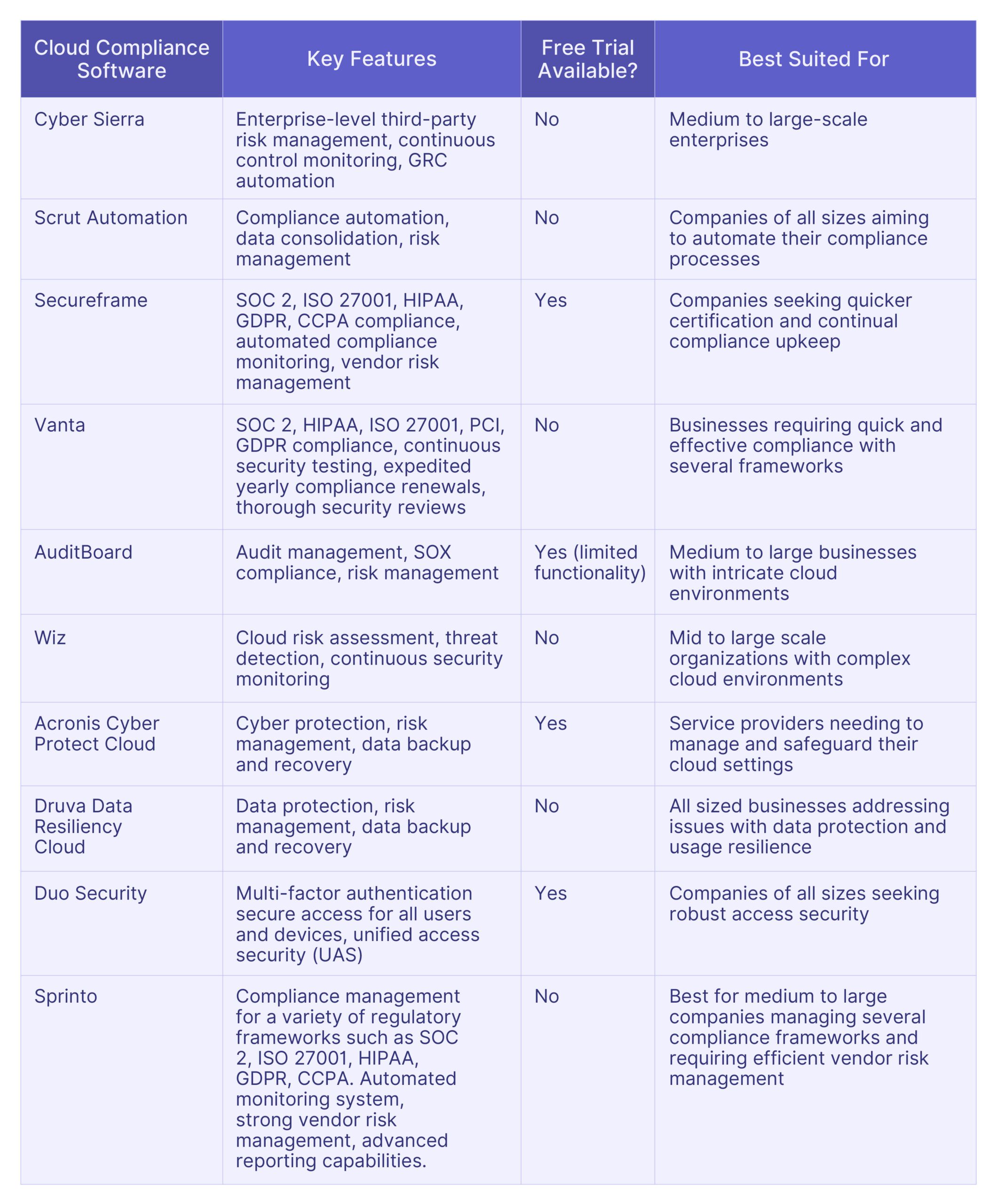
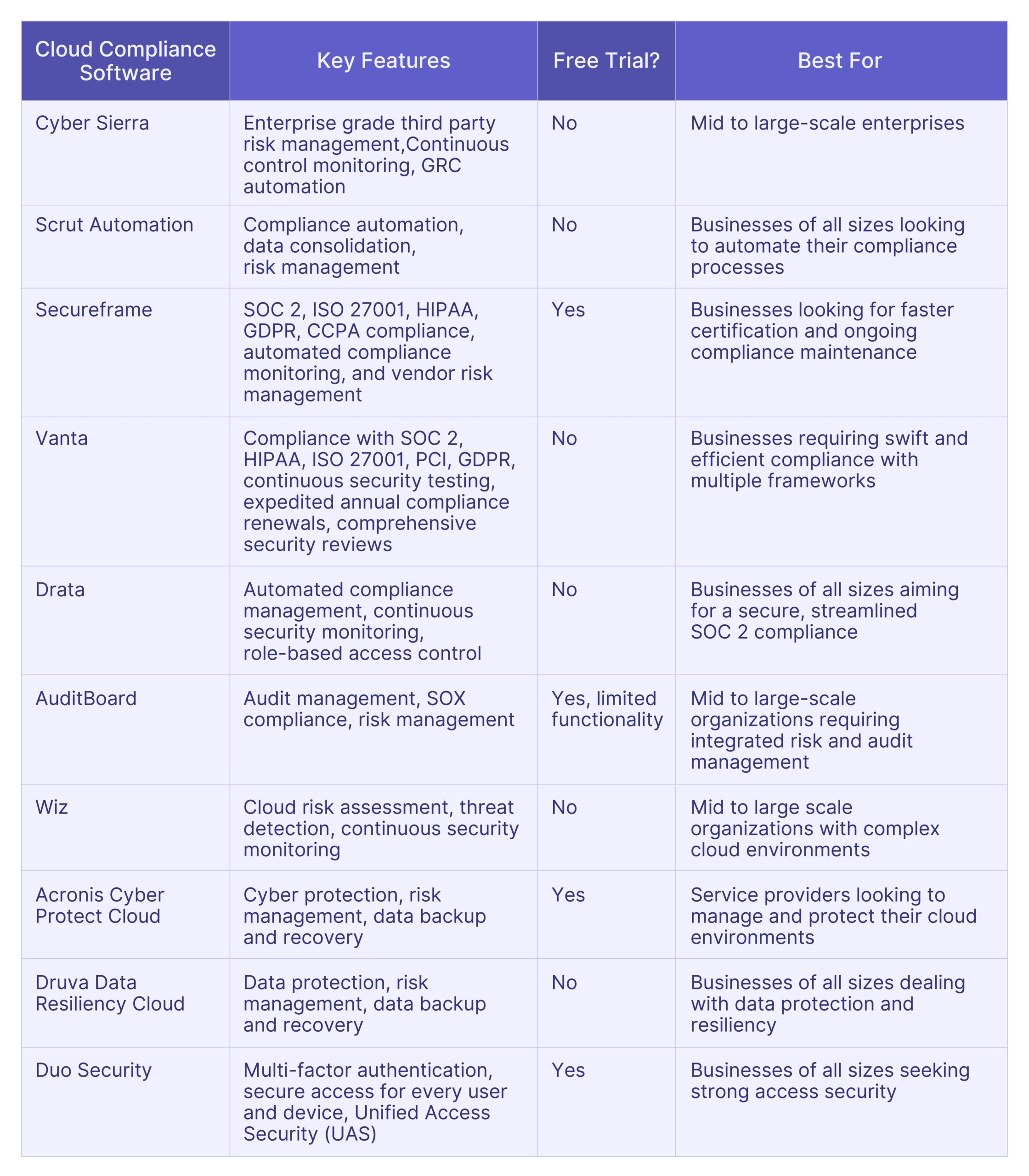
The following table compares the top 10 Drata alternatives, which should help you find the right software for your needs.


table of comparision


Choosing The Best

Finding the right software for your organization can be daunting. However, you can choose wisely by evaluating features, price points and user experience in order to find a good match.

Cyber Sierra is one of the few enterprise-grade security solutions that combines a strong balance of functionality and security in a single platform.

The platform’s intuitive design allows you to deploy security measures more quickly and easily, while also adding extra layers of protection against cyber threats.

Book a demo to see how Cyber Sierra can help your business.


  • Governance & Compliance
  • CISOs
  • CTOs
  • Cybersecurity Enthusiasts
  • Enterprise Leaders
  • Startup Founders
Srividhya Karthik

Srividhya Karthik is a seasoned content marketer and the Head of Marketing at Cyber Sierra. With a firm belief in the power of storytelling, she brings years of experience to create engaging narratives that captivate audiences. She also brings valuable insights from her work in the field of cybersecurity and compliance, possessing a deep understanding of the challenges and pain points faced by customers in these domains.

A weekly newsletter sharing actionable tips for CTOs & CISOs to secure their software.


Thank you for subscribing!

Please check your email to confirm your email address.

Find out how we can assist you in
completing your compliance journey.
blog-hero-background-image
Governance & Compliance

The Complete Guide to a Successful GRC Implementation

backdrop
Table of Contents

Join thousands of professionals and get the latest insight on Compliance & Cybersecurity.


The Complete Guide to a Successful GRC Implementation


Successful GRC implementation ensures organizations manage risks proactively and comply with all government laws and regulations while operating ethically for improved growth. Implementing a robust GRC program not only helps in managing risks effectively and ensuring compliance but also improves overall corporate governance.


But if you’re starting on your GRC journey, where do you begin?


Because the GRC implementation can be complex especially for large organizations that have complex regulatory requirements. That’s why we created this blog post.


This guide delves into the practical GRC implementation steps, the benefits of the program, as well as challenges organizations face during the process. 


We’ll also explore some of the best practices for implementing an effective GRC program and how Cyber Sierra can help streamline the implementation process.


But before that, here are the key takeaways:


Key takeaways


  • GRC implementation is the process of integrating Governance, Risk, and Compliance into an organization, aligning business goals, and ensuring compliance with regulations.
  • Implementing a GRC program enhances decision-making, increases transparency, improves team collaboration, and provides a competitive advantage by effectively managing risks.
  • Successful GRC implementation involves assessing benefits, identifying implementation areas, selecting the right tools, creating a roadmap, engaging stakeholders, conducting the implementation process, and ongoing monitoring.
  • Challenges organizations face when implementing GRC include navigating complex regulatory environments, finding suitable GRC tools, integrating data across departments, and ensuring user adoption through training.


What is GRC Implementation?


GRC implementation is the process of integrating Governance, Risk, and Compliance procedures and policies into an organization. It helps align business goals, manage risks, and ensure compliance with regulations. 


Successful GRC implementation provides a framework for managing policies, procedures, and risks efficiently.


The GRC implementation process begins with assessing the organization’s needs, defining objectives, and selecting the right GRC tools or software. It involves establishing clear governance structures, identifying risks, and ensuring compliance with legal standards. 


During the implementation process, organizations establish policies and workflows to monitor performance and control risks.


Overall, effective GRC implementation enhances transparency, reduces silos, and ensures organizations make informed decisions.


GRC Implementation Benefits


grc- implementation-benefits


Apart from helping organizations manage risks effectively and comply with government regulations, implementing the GRC program can support sustainable growth and success. Additionally, having a robust GRC program in place has various benefits such as:


1. Helps Organizations Make the Right Technology Investments


One of the key benefits of a GRC program is that it guides organizations in making informed technology investments by aligning them with risk management and compliance goals. It helps evaluate which tools are most suitable for addressing identified risks, thereby ensuring efficient use of resources. 


By integrating GRC processes, organizations can prioritize technologies that provide comprehensive governance, risk, and compliance benefits. 


This strategic approach helps avoid unnecessary expenditures on incompatible systems and ensures that investments align with long-term business goals. Effective GRC implementation thus not only optimizes costs but also strengthens the organization’s capability to respond to regulatory demands and potential threats.


2. Improves Team Collaboration and Efficiency


Another benefit of implementing a GRC program is it fosters better team collaboration and operational efficiency by unifying risk, compliance, and governance practices. It helps standardize processes that provide a common framework for different departments to work towards shared compliance and risk management goals. 


The centralized documentation of policies and procedures facilitates easy access and understanding, reducing silos between teams. Automated workflows streamline compliance tasks, enabling teams to focus on strategic activities instead of repetitive manual processes. 


With improved transparency and communication, GRC implementation results in smoother collaboration minimized delays, and a significant boost in overall team efficiency.


3. Ensures Scalability


A GRC program ensures scalability by offering a flexible framework that adapts to organizational growth and evolving regulatory demands. Through effective GRC implementation, organizations can integrate risk and compliance processes that are easily scalable, whether adding new business units or facing increased regulatory scrutiny. 


This approach ensures that GRC measures grow in parallel with the organization, providing consistent oversight without additional complexity. 


The standardized processes and automation within the GRC framework make it easier to extend compliance initiatives while ensuring alignment with corporate goals. 


Ultimately, GRC implementation enables organizations to maintain efficiency and compliance as they expand.


4. Helps Organizations Gain a Competitive Advantage


Effective GRC implementation helps organizations improve risk resilience and demonstrate proactive compliance, thereby gaining a competitive advantage. By managing risks and regulatory requirements effectively, organizations minimize disruptions and build trust with stakeholders which boosts their reputation. 


Furthermore, GRC programs provide insights into risk and opportunity areas which enables quicker response to market changes. 


When competitors struggle with compliance or risk-related issues, organizations with robust GRC practices are better positioned to innovate and capitalize on growth opportunities. This strategic edge helps differentiate the organization in the marketplace, enhance customer loyalty, and attract investors who value strong governance.


5. Increases Transparency


GRC implementation increases transparency across all organizational levels by providing visibility into governance, risk, and compliance activities. A centralized GRC framework offers real-time insights into compliance status, risk assessments, and mitigation measures. 


This transparency is critical for fostering trust among stakeholders, including executives, employees, regulators, and customers. Clear, accessible reporting makes it easy for stakeholders to understand the organization’s GRC posture, ensuring accountability.


Enhanced transparency not only builds internal confidence but also strengthens external relationships through consistent, honest communication.


6. Improves Decision-Making and Alignment


GRC implementation also enhances decision-making by integrating governance, risk, and compliance data into a unified platform, giving leaders the insights needed to make informed choices. 


A well-established GRC program ensures that decisions align with organizational risk appetite and compliance requirements, balancing opportunities with effective risk management. The standardized GRC framework facilitates consistent analysis, enabling executives to evaluate the potential impacts of decisions comprehensively. 


This approach ensures alignment across departments, as GRC objectives become central to the business strategy. By providing timely information and risk-based perspectives, a GRC program helps organizations respond proactively and strategically to both opportunities and challenges.


7. Helps Organizations Avoid Compliance Gap Consequences


Another key benefit of GRC implementation is its ability to help organizations avoid the consequences of compliance gaps. Non-compliance can result in severe penalties, financial losses, and reputational damage. According to Statista, organizations have faced fines of over 2.4 billion euros due to non-compliance with general data processing principles.


The good news?


Implementing a GRC framework centralizes compliance activities which enables organizations to continuously monitor regulatory requirements and proactively address any gaps. Besides, GRC tools automate tracking and reporting, reducing the risk of human error while ensuring timely updates. This ensures policies and processes are consistently followed across the organization. This vigilant approach not only keeps the organization compliant but also mitigates risks, ensuring smooth and uninterrupted business operations.


GRC Implementation Steps


step- to- implement- grc


Effective GRC implementations require a well-thought-out process that guarantees success. Here are the seven key steps for implementing an effective GRC (Governance, Risk, and Compliance) program:


Step 1: Assess the Benefits of Implementing a GRC Program


If implementing a GRC framework can’t benefit your organization, then there is no need to waste your time in the process.


A well-defined benefit assessment ensures you focus on strategic areas where GRC can deliver the greatest impact, laying the groundwork for a successful implementation.


Therefore, start by evaluating the specific benefits that a Governance, Risk, and Compliance (GRC) program can bring to your organization. This initial step helps identify how GRC aligns with your business goals, such as enhancing compliance, reducing risks, improving operational efficiency, and achieving regulatory requirements. 


A clear understanding of the benefits will guide resource allocation and ensure organizational buy-in. Document these benefits and connect them to key metrics as this will provide a strong foundation for decision-making and help communicate the value of GRC to stakeholders. 


Step 2: Identify Areas for Implementation


The next step for effective GRC implementation is to identify the areas of your organization that will benefit most from the GRC program. This will ensure a focused and effective rollout. Evaluate your organization’s existing processes, departments, and functions that require stronger compliance or risk management practices. 


Look into areas prone to regulatory risks, cybersecurity threats, or operational inefficiencies. Define where governance improvements can bring the greatest value. This prioritization will help to create a roadmap for where to start, ensuring the GRC initiative is tailored to address your organization’s unique challenges and requirements. 


Step 3: Select the Right GRC Tool


Selecting the right tool is a critical step in GRC implementation. Choosing the right tool not only helps in effectively managing risks and compliance but also simplifies the integration process, reducing potential challenges.


The software you choose should align with your specific business needs, scale with your growth, and integrate with existing systems. 


When choosing a GRC solution, evaluate features such as automation capabilities, reporting tools, and adaptability to different compliance requirements. Consider user-friendliness to ensure that employees can effectively use the system. 


Make sure you invest time in comparing vendors, reviewing demos, and gathering feedback to ensure the selected tool will effectively support your GRC goals.


Step 4: Create a GRC Implementation Roadmap


Creating a GRC implementation roadmap involves outlining a structured plan for deploying the GRC framework effectively. 


Start by defining key milestones, tasks, responsibilities, and timelines to keep the process on track. This roadmap should include communication strategies to ensure stakeholders understand the implementation’s progress and their role. A detailed timeline helps ensure that each phase is completed methodically and that potential risks are mitigated proactively.


Make the implementation roadmap clear and provide a step-by-step process for all involved to ensure the implementation remains organized and moves toward successful completion. 


Also, your roadmap should be flexible enough to accommodate changes and address unforeseen challenges during implementation. 


Step 5: Bring All Stakeholders Together


Successful GRC implementation requires collaboration from all relevant stakeholders, including leadership, department heads, IT, legal, and compliance teams. 


Bring all stakeholders together to ensure everyone is aligned on the objectives, scope, and benefits of the GRC initiative. 


As well, communication is key so make sure everyone understands the impact on their specific areas of responsibility and how they can contribute. Stakeholder engagement also helps in identifying potential obstacles early and finding collective solutions. Establish regular meetings and transparent communication channels to keep stakeholders informed.


Step 6: Conduct the GRC Implementation Process


Once you have completed all the steps above, it’s time to get into the actual process. 


A thorough and well-managed implementation ensures the GRC tool performs as intended, helping the organization streamline compliance and risk management.


The actual GRC implementation process involves deploying the chosen GRC software, integrating it with existing systems, and configuring workflows to align with organizational needs. 


Start by setting up policies and assigning roles and responsibilities within the GRC tool. Provide adequate training to users to ensure they understand the features and how to utilize the platform effectively. Address any issues that arise during deployment, and test the system for reliability and functionality as well. This step should also involve validating compliance with applicable regulations. 


Step 7: Monitor Your GRC Framework to Identify Areas of Improvement


Once the GRC framework is operational, continuous monitoring is essential for maintaining effectiveness and adapting to changes. 


Consistent monitoring and iterative improvements will keep your GRC program efficient, relevant, and effective.


Track key performance indicators (KPIs) to evaluate how well the GRC program meets its objectives. Identify areas that require adjustments, whether related to compliance processes, risk management practices, or system functionalities. 


Monitoring allows you to pinpoint gaps and act proactively, ensuring the GRC system evolves alongside regulatory changes and business needs.  Conduct regular reviews to fine-tune policies and adapt strategies. This is vital for long-term success. 


Common Challenges While Implementing a GRC Program


common challenge while implementing a grc program


While there are numerous benefits in implementing a GRC framework, organizations may face challenges such as a complex regulatory environment, finding the right tool, and more. Let’s explore each challenge in-depth.


  • Complex Regulatory Environment: Navigating a complex regulatory environment can be challenging when carrying out GRC implementation. Organizations must comply with numerous and often conflicting regulations, which vary across industries and geographies. Keeping up-to-date with changing compliance requirements demands resources and expertise which increases the risk of regulatory gaps and non-compliance.


  • Finding the Right GRC Tool: Selecting the right GRC tool is crucial but challenging as well. The market is flooded with numerous tools, each offering different features. Organizations struggle to choose a solution that fits their needs, integrates seamlessly with existing systems, and scales with business growth, which can hinder effective GRC adoption.


  • Integrating Data from Multiple Departments: Integrating data from various departments is a major challenge in GRC programs. Different departments often use disparate systems and data formats, leading to inconsistencies. Consolidating this data into a cohesive framework demands careful planning and technology, requiring significant time and resources for effective integration.


  • Ensuring User Adoption and Training: Ensuring user adoption and adequate training is a significant challenge when implementing GRC programs. Employees may resist change or find new processes complex. Without effective training and clear communication, organizations risk low engagement, which affects the overall success of GRC initiatives and leads to compliance gaps.


GRC Implementation Best Practices


When implementing a GRC framework, follow these best practices to ensure successful implementation:


  • Use GRC Software: To effectively implement a GRC program, use GRC software to streamline governance, risk, and compliance processes. The GRC software centralizes data, automates workflows, and enables better reporting. It can also enhance efficiency, reduce manual errors, and ensure consistent adherence to regulations.


  • Prioritize Your GRC Objectives: Clear prioritization helps allocate efforts effectively, preventing wasted resources and ensuring that key regulatory obligations are met efficiently. Define and prioritize GRC objectives based on business needs and regulatory requirements. This ensures that your organization focuses its resources on the most critical risks and compliance areas.


  • Establish a Clear GRC Strategy: A well-defined GRC strategy aligns risk management and compliance initiatives with business goals. To establish this strategy identify stakeholders, determine key responsibilities, and set measurable objectives. A clear GRC roadmap provides direction, ensuring all teams understand how compliance and risk management integrate with the organization’s overall mission.


  • Train Employees on the Benefits of a GRC Program: Training employees on the value of GRC programs fosters a culture of compliance and accountability. Well-informed staff understand their role in managing risks and ensuring compliance, which leads to better adherence to policies. Invest in continuous education to help employees recognize risks proactively and make the entire GRC program more effective and resilient.


  • Review and Update Policies Regularly: Regularly review and update GRC policies to adapt to evolving regulatory requirements and emerging risks. This will ensure the organization remains compliant with changing laws and internal standards. Routine policy updates also help in mitigating new risks and maintaining operational efficiency by addressing gaps proactively.


Use Cyber Sierra for GRC Implementation Automation


use- cyber- sierra- for grc- implementation- automation


While there are many GRC tools for streamlining GRC implementation, Cyber Sierra stands out among all.


The AI-enabled platform streamlines the entire implementation process by automating Governance, Risk, and Compliance (GRC) processes and integrates GRC workflows. It offers pre-configured frameworks, automated compliance checks, and customizable risk assessments, enabling organizations to meet regulatory requirements efficiently and accurately.


Some of the key features of Cyber Sierra include:


  • Automated Compliance Workflows: Automates regulatory requirements, helping organizations adhere to standards like ISO 27001, GDPR, and more.


  • Centralized Risk Management: Provides an integrated risk management dashboard to track, assess, and mitigate risks.


  • AI-Driven Insights: Leverages AI to analyze compliance gaps and recommend corrective actions.


  • Continuous Control Monitoring: Real-time monitoring of GRC metrics to ensure continuous compliance.


  • Audit-Ready Reporting: Generates automated reports that simplify the audit process and improve transparency.


Schedule a free demo to see how Cyber Sierra can help you streamline GRC implementation.


FAQ


1. What are the GRC implementation steps?


The main steps in implementing an effective GRC program include, assessing the benefits of implementing a GRC program, identifying areas for implementation, selecting the right GRC tool, creating a GRC implementation roadmap, bringing all stakeholders together, conducting the GRC implementation process, then monitoring your GRC framework to identify areas of improvement.


2. What are the key factors for successful GRC implementation?


For successful implementation of Governance, Risk, and Compliance (GRC), several key factors are essential including:


  • Tailored framework: Customize the GRC framework to align with your organization’s specific needs, ensuring it addresses industry requirements and risk profiles.
  • Regular reviews: Continuously assess and update GRC policies to adapt to evolving regulations and business changes.
  • Employee training: Invest in comprehensive training programs to cultivate a culture of compliance and risk awareness among staff.
  • Technology selection: Choose integrated GRC software that can streamline processes and improve collaboration across departments.


These factors are crucial for enhancing compliance, managing risks, and achieving overall organizational success.​


3. What are the successful GRC frameworks?


The most recognized GRC frameworks in the industry include ISO 31000, NIST Cybersecurity Framework, COBIT (Control Objectives for Information and Related Technologies), and COSO ERM Framework.

  • Governance & Compliance
  • CISOs
  • CTOs
  • Cybersecurity Enthusiasts
  • Enterprise Leaders
  • Startup Founders
Srividhya Karthik

Srividhya Karthik is a seasoned content marketer and the Head of Marketing at Cyber Sierra. With a firm belief in the power of storytelling, she brings years of experience to create engaging narratives that captivate audiences. She also brings valuable insights from her work in the field of cybersecurity and compliance, possessing a deep understanding of the challenges and pain points faced by customers in these domains.

A weekly newsletter sharing actionable tips for CTOs & CISOs to secure their software.


Thank you for subscribing!

Please check your email to confirm your email address.

Find out how we can assist you in
completing your compliance journey.
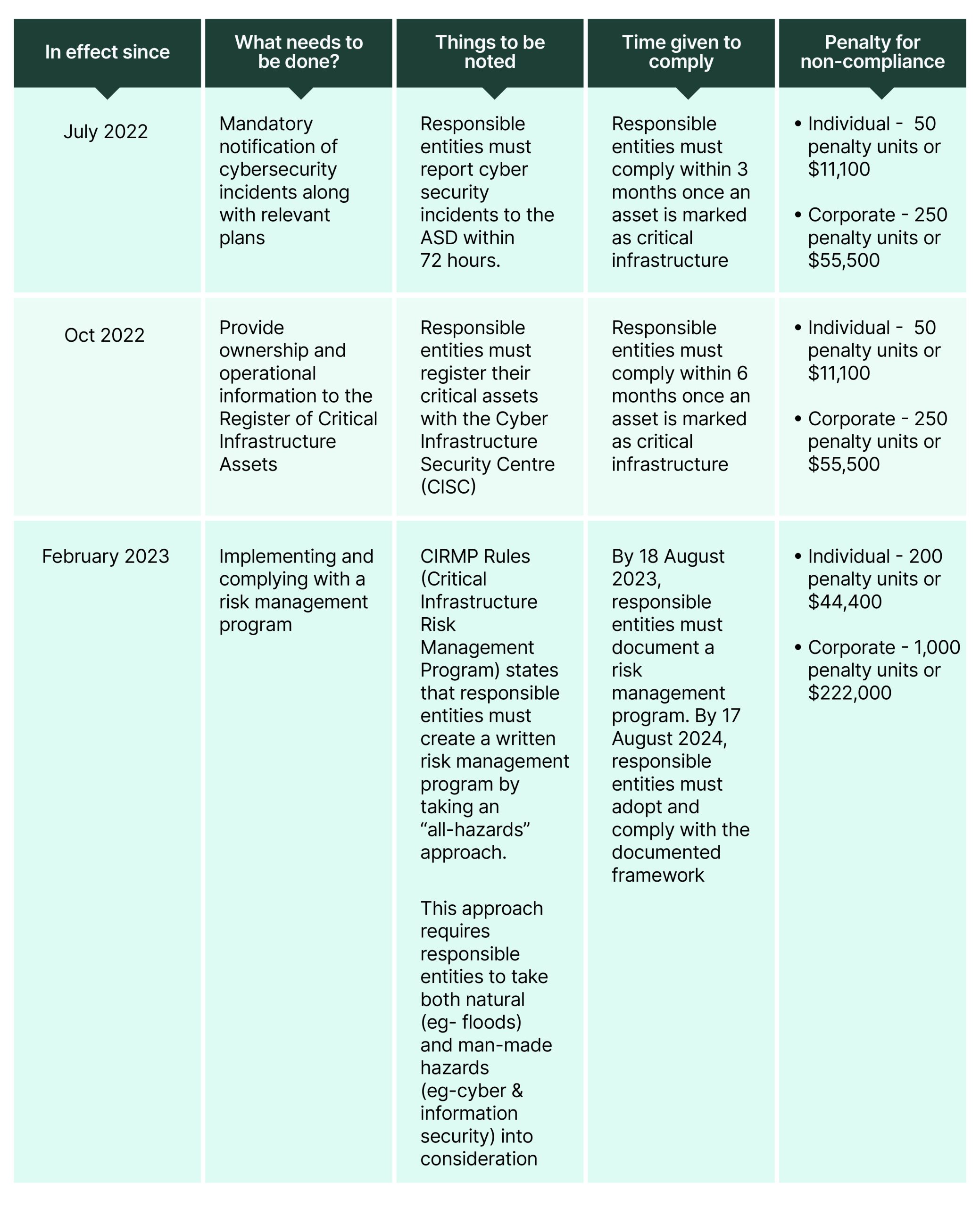
blog-hero-background-image
Governance & Compliance

Compliance Automation: How to Streamline It?

backdrop
Table of Contents

Join thousands of professionals and get the latest insight on Compliance & Cybersecurity.


Compliance Automation: How to Streamline It?


As the regulatory environment becomes increasingly complex, with authorities constantly introducing new laws and regulations, relying on manual methods to manage compliance can be time-consuming and prone to human error.


Organizations that rely on outdated mechanisms for security compliance are more likely to face non-compliance issues that can result in hefty fines and penalties. 


In September 2024 alone, over € 4 billion were imposed on organizations for non-compliance with general data processing principles.


To avoid this, forward-thinking organizations are embracing compliance automation.


In this blog post, we’ll cover everything you need to know about compliance automation.
We’ll start by explaining what compliance automation is and how it works. We’ll then explore the different types of compliance automation, examples, and how to automate the compliance process for your organizations.


Lastly, we’ll discuss the benefits of compliance automation and show you how CyberSierra’s AI-enabled cybersecurity platform can help you streamline the process.

Let’s get started.


Key takeaways:


  • Compliance automation involves the use of technology to streamline the process of meeting regulatory compliance standards, such as HIPAA and PCI DSS. 
  • Automated compliance minimizes human errors, saves time, and reduces risks associated with compliance management.
  • Compliance automation can be categorized into regulatory compliance, which adheres to established legal standards to protect sensitive data, and corporate compliance, which involves internal controls to ensure adherence to laws and policies. Both are crucial for safeguarding data and maintaining organizational integrity.
  • Compliance automation can enhance various areas, including regulatory adherence, security controls, risk management, and audit trail management.


What Is Compliance Automation?


Compliance automation is the process of using technology to streamline and automate the process of complying with regulatory standards like HIPAA, SOC 2, ISO 27001, and PCI DSS. Instead of relying on manual checks, compliance automation tools automate tasks like monitoring, reporting, and auditing, making it easier for businesses to stay compliant.


The best compliance automation software helps organizations reduce errors, save time, and minimize risks. It does this by continuously tracking compliance activities, identifying gaps, and generating real-time reports. This is particularly important for companies that must adhere to stringent standards, such as HIPAA for healthcare or PCI DSS for payment security.


Compliance automation tools also support SOC 2, MAS TRM, HKMA, CIRMP, and ISO 27001 compliance, making it easier to manage complex requirements and provide evidence during audits. 


By automating repetitive processes, these tools ensure that companies remain compliant, freeing up valuable resources for other business activities. Ultimately, compliance automation is essential for efficient, scalable compliance management.


How Does Automated Compliance Work?


Automated compliance works by using compliance automation software to monitor, manage, and enforce regulatory and security standards efficiently. Compliance automation tools streamline processes by continuously collecting and analyzing data to identify risks, ensuring that companies meet requirements without manual intervention. 


These automated compliance tools also generate audit-ready reports, handle documentation, and track compliance-related tasks in real-time, significantly reducing the workload of compliance teams.


Compliance automation software also integrates with existing systems, automating activities like risk assessment, data encryption checks, and audit trails, which helps organizations stay ahead of compliance obligations. 


By using automation tools, organizations can minimize human errors, ensure data accuracy, and maintain up-to-date compliance with ever-changing regulations. Ultimately, compliance automation not only cuts down on manual effort but also ensures a faster and more reliable way to meet regulatory standards. This helps organizations save time and reduce costs while mitigating risks.


Compliance Automation Types


regulatory compliance vs corporate compliance


The compliances that can be automated fall under two categories namely regulatory compliance and corporate compliance.


Let’s take an in-depth look into each type:


1. What is Regulatory Compliance?


Regulatory compliance refers to an organization’s adherence to established legal standards and regulations designed to protect sensitive data, ensure privacy, and uphold the security of information systems. 


This compliance is crucial to safeguarding individuals’ data, maintaining business continuity, and ensuring that digital practices align with government standards.


Key Elements of Regulatory Compliance


In cybersecurity, regulatory compliance focuses on implementing controls and protocols to secure digital assets, protect sensitive data, and mitigate cyber risks. 


This involves regular audits, assessments, risk evaluations, and adherence to specific standards set by regulatory bodies. It is designed to ensure organizations take appropriate steps to prevent unauthorized access, data breaches, and misuse of information.


Different industries have specific compliance regulations such as:


  • Healthcare: Organizations in the healthcare industry must comply with the Health Insurance Portability and Accountability Act (HIPAA) to ensure the protection of patients’ electronic health records.
  • Finance: Financial institutions and organizations are required to comply with the Gramm-Leach-Bliley Act (GLBA) to protect customers’ financial information, as well as PCI-DSS (Payment Card Industry Data Security Standard) for card payment security.


Examples of regulatory compliance include:


  • GDPR (General Data Protection Regulation): GDPR mandates that companies handling the personal data of EU citizens implement adequate measures to protect that data. This includes encryption, data anonymization, and reporting breaches within 72 hours.
  • NIST (National Institute of Standards and Technology) Cybersecurity Framework: Many U.S. organizations, especially in critical infrastructure sectors, follow NIST guidelines to manage and reduce cybersecurity risk. This framework helps companies identify and mitigate potential threats through risk-based approaches.
  • MAS TRM (Monetary Authority of Singapore Technology Risk Management): MAS TRM outlines best practices for managing technology risks in financial institutions, emphasizing governance, risk assessment, and security measures to protect sensitive data and ensure operational resilience.


Overall, regulatory compliance helps organizations mitigate the risks of data breaches, prevent unauthorized access to systems, and ensure that privacy laws are respected. As a result, organizations can avoid non-compliance issues that may lead to heavy fines, data loss, reputational damage, and potential legal repercussions.


2. What is Corporate Compliance?


Corporate compliance refers to the internal measures and controls that an organization implements to ensure adherence to laws, standards, and internal policies regarding data security and privacy. 


It involves establishing internal rules for protecting digital assets, setting access controls, ensuring that employees follow proper procedures, and maintaining compliance with cybersecurity-related legal requirements.


Key Elements of Corporate Compliance


Corporate compliance revolves around the following elements:


  • Internal policies and procedures: This involves creating rules and procedures for handling, storing, and sharing data. This may involve data encryption standards, password management policies, and restrictions on access to sensitive data.
  • Risk assessment and management: This includes conducting regular risk assessments to identify vulnerabilities within the organization’s digital infrastructure and implementing measures to mitigate them.
  • Employee training and awareness: This entails educating employees on best cybersecurity practices, including identifying phishing emails, using secure passwords, and understanding data privacy regulations.


Corporate cybersecurity compliance involves proactive steps to protect company assets and prevent internal vulnerabilities from being exploited by malicious actors.


Examples of corporate compliance include:


  • Internal Data Protection Policies: Companies often create internal data security policies that require data encryption, access control measures, and secure password practices. For example, an internal policy might require employees to use multi-factor authentication (MFA) when accessing sensitive systems or data.
  • Acceptable Use Policy (AUP): Companies may implement Acceptable Use Policies, specifying how employees should use company devices and handle sensitive information to prevent security incidents. This includes guidelines for internet usage, downloading software, and accessing company data remotely.


Overall, corporate compliance is crucial for preventing data breaches that can result from internal threats, such as insider negligence or intentional misuse of company resources. 


By adhering to established cybersecurity practices and procedures, organizations can better safeguard their systems and data, mitigate potential security incidents, and demonstrate their commitment to data protection. Maintaining robust cybersecurity compliance also helps to build stakeholder trust and meet customer expectations regarding data security and privacy.


Compliance Automation Examples


compliance automation examples


Compliance automation can help organizations streamline operations in different areas such as:


1. Regulatory and Corporate Compliance


Compliance automation can help organizations adhere to regulatory standards like GDPR or HIPAA by automating workflows that track data privacy rules and document regulatory activities. For example, automated compliance software can continuously monitor data handling practices, identify policy deviations, and ensure personal data is processed securely. It also generates real-time compliance reports, simplifying audits. This saves time, reduces human error, and keeps companies up to date with evolving regulations.


2. Security Controls


Security controls are measures to protect systems and data. Compliance automation enhances security by automatically configuring and monitoring security controls. For instance, automated compliance solutions can continuously check that all user accounts have multi-factor authentication (MFA) enabled and enforce the use of strong passwords. 


Any configuration drift is automatically flagged and remediated. This ensures security standards are uniformly applied across the infrastructure, reducing vulnerabilities.


3. Risk Management and Assessment


Risk management involves identifying, assessing, and mitigating risks to an organization’s assets. Compliance automation can streamline risk assessments by automatically scanning systems for vulnerabilities, quantifying their impact, and providing recommendations for mitigation. For example, an automated compliance tool can assess system configurations and identify risks of non-compliance, such as missing security patches. This proactive approach helps companies prevent security incidents, enhance data protection, and ensure cybersecurity risk levels remain within acceptable bounds.


4. Audit Trail Management


Audit trails track all system activities, ensuring accountability and traceability. Compliance automation tools can help manage audit trails by automatically capturing and documenting actions taken on critical systems. For example, whenever there are changes to access permissions, an automated system logs the details, stores them securely, and provides easy access during audits. 


This helps demonstrate compliance with cybersecurity standards, proving that only authorized users make changes and ensuring there is a clear record of all security-related activities.


How Do You Automate a Compliance Process?


how do you automate a compliance process


Automating your compliance process involves careful planning and the integration of technology to ensure consistency and accuracy. Here’s a detailed guide on how to automate a compliance process effectively.


1. Conduct an In-Depth Study of Existing Policies and Controls


The first step in automating a compliance process is to understand your existing policies and controls thoroughly. You will need to focus on the following:


  • Evaluation of current policies: Assess your current compliance policies to identify gaps or areas for improvement.
  • Mapping regulatory requirements: Identify which regulations apply to your industry. This might include GDPR, HIPAA, PCI DSS, or other standards.
  • Documentation: Ensure that all current policies and controls are well documented. This helps in evaluating their alignment with regulatory requirements and simplifies the transition to an automated system.


This step is essential to determine which parts of the compliance process can benefit most from automation.


2. Integrate All Your Systems with a Compliance Automation Tool


Once you understand the existing policies, the next step is to integrate your systems with a compliance automation tool to streamline workflows, centralize documentation, and monitor compliance in real time.


  • Select the right tool: Choose a tool that suits your organization’s needs, integrates seamlessly with existing systems, and supports relevant regulatory requirements.
  • System integration: Connect all data sources, including HR systems, financial records, and other business systems, with the compliance tool. This integration allows the tool to access all necessary data for compliance monitoring.
  • Data centralization: Ensure that all compliance-related data is centralized in the tool for easier access, analysis, and reporting. This step is vital for reducing redundancies and improving the accuracy of compliance processes.


An effective compliance automation tool acts as a single point of truth. It provides visibility into compliance status and helps manage ongoing requirements.


3. Create a Strategic Plan


A strategic plan for compliance automation helps define how the automation process will be implemented and sustained. It involves:


  • Setting objectives: Define the goals for automating compliance. These might include reducing the time spent on compliance, decreasing errors, or improving the quality of reports.
  • Timeline development: Create a timeline for each step of the automation process. Break down the implementation process into manageable tasks with deadlines.
  • Risk assessment: Identify any potential risks or challenges associated with the automation process and create mitigation strategies to handle these risks.


A strategic plan ensures the automation process runs smoothly and allows you to address potential obstacles proactively.


4. Conduct Employee Policy Training


Automation doesn’t mean removing the human element. Employees need to understand the automated compliance systems and policies. Carry out the following:


  • Employee awareness: Ensure all employees are aware of compliance policies and the role automation plays in enforcing them.
  • Training sessions: Conduct regular training sessions that help employees understand how to use the compliance automation tool effectively.
  • Role-specific training: Tailor training programs based on job roles. This helps ensure that employees understand how compliance relates to their specific responsibilities.


Proper training is critical to maintaining compliance, even when much of the process is automated. Besides, employees must know their obligations and how to use the tools effectively.


5. Carry Out Internal Audits


Internal audits are a crucial part of ensuring ongoing compliance. When automated, internal audits can be more frequent and more accurate. Here is how to do it:


  • Audit automation: Set up automated internal audits through your compliance tool. This allows you to conduct audits at regular intervals without manual intervention.
  • Real-time monitoring: Use the compliance automation tool to perform real-time checks. This provides an up-to-date view of compliance status and identifies non-compliance issues promptly.
  • Data-driven insights: Internal audits generate valuable data that can be used to make informed decisions about compliance improvements. The automation tool can provide insights through automated reports to simplify decision-making.


Internal audits ensure that your compliance process stays on track and can be easily adjusted as requirements change.


6. Certification


For many organizations, certification by regulatory bodies is essential to demonstrate compliance. Automating parts of this process can save time and improve accuracy.
Follow the steps below:


  • Documentation management: Use compliance automation software to maintain up-to-date records required for certification.
  • Certification preparation: Automate the preparation of documentation needed for certification.
  • Tracking progress: Track the progress of certification-related tasks using automated tools. They provide notifications and alerts to ensure that critical deadlines are not missed.


Automation in certification makes the process less cumbersome, helps meet deadlines, and reduces the risk of human errors.


7. Conduct Surveillance Monitoring


The final step is to establish a system for continuous control monitoring of compliance. Surveillance monitoring involves keeping an eye on all compliance areas to ensure continuous adherence. Here is how to carry out surveillance monitoring:


  • Real-time alerts: Set up automated alerts that notify responsible personnel of any deviations from compliance requirements. This enables quick action and minimizes risks associated with non-compliance.
  • Dashboards and reporting: Use dashboards within your compliance automation tool to gain a visual overview of compliance across different areas of the organization. 
  • Data analysis: Automate the analysis of surveillance data to identify trends, patterns, and areas of potential risk. This helps in proactively managing compliance and making necessary adjustments before minor issues escalate.


Continuous surveillance monitoring ensures that compliance is not a one-time effort but an ongoing process, improving the organization’s ability to manage risks effectively.


What are the Benefits of Compliance Automation?


Compliance automation offers significant benefits for organizations. First, it reduces human errors by automating repetitive tasks and ensuring accuracy in data handling. 


Second, it streamlines evidence collection during internal audits, making it easier to gather necessary documentation quickly. 


Third, compliance automation enables real-time progress tracking, allowing organizations to monitor compliance efforts instantly and adjust as needed. 


Finally, it reduces compliance risks by ensuring adherence to regulations and minimizing the likelihood of costly fines or penalties. By implementing compliance automation, businesses can enhance efficiency, accuracy, and overall compliance management.


Use CyberSierra to Streamline Compliance Automation


Unlike other GRC tools, CyberSierra leverages smart GRC automation to help organizations streamline their compliance automation processes.


It facilitates automated data collection, continuous monitoring of compliance processes, and risk assessments to enhance efficiency and accuracy. By generating comprehensive reports and maintaining an audit trail, it ensures transparency and accountability across various regulatory frameworks. 


This proactive risk management tool helps organizations adapt to evolving compliance needs, making it an essential solution for effective governance and risk management.


Book a free demo here to see how CyberSierra can streamline your compliance automation process.


FAQ


1. What are the types of compliances that can be automated?


The types of compliances that can be automated include regulatory compliance and corporate compliance.


2. Why is compliance automation required?


Compliance automation is essential for organizations to efficiently manage regulatory requirements, reduce human error, and streamline processes. It ensures timely adherence to laws and regulations, minimizing the risk of non-compliance penalties. Automation improves accuracy and visibility, allowing businesses to focus on strategic goals while maintaining regulatory standards.


3. How to choose the best compliance automation software?


Choosing the best compliance automation software involves assessing your organization’s specific needs, regulatory requirements, and industry standards. Look for features like real-time monitoring, reporting capabilities, and user-friendly interfaces. 


You also need to evaluate vendor support, integration options, scalability, and security measures. Lastly, consider conducting trials to ensure the software aligns with your compliance goals.

  • Governance & Compliance
  • CISOs
  • CTOs
  • Cybersecurity Enthusiasts
  • Enterprise Leaders
  • Startup Founders
Srividhya Karthik

Srividhya Karthik is a seasoned content marketer and the Head of Marketing at Cyber Sierra. With a firm belief in the power of storytelling, she brings years of experience to create engaging narratives that captivate audiences. She also brings valuable insights from her work in the field of cybersecurity and compliance, possessing a deep understanding of the challenges and pain points faced by customers in these domains.

A weekly newsletter sharing actionable tips for CTOs & CISOs to secure their software.


Thank you for subscribing!

Please check your email to confirm your email address.

Find out how we can assist you in
completing your compliance journey.
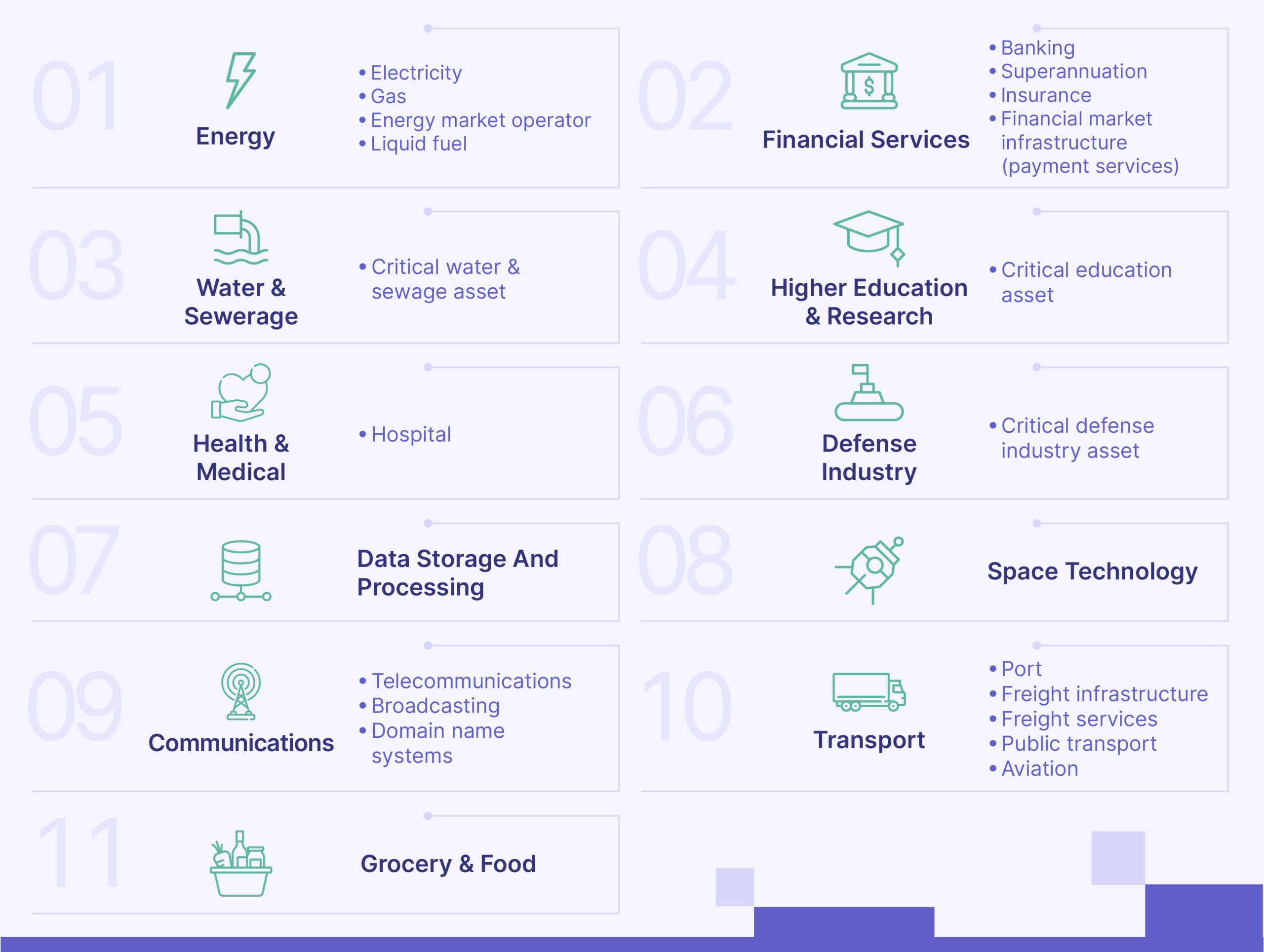
blog-hero-background-image
Governance & Compliance

Top 7 GRC (Governance, Risk & Compliance) Tools in 2024

backdrop
Table of Contents

Join thousands of professionals and get the latest insight on Compliance & Cybersecurity.


Data breaches, regulatory nightmares, compliance headaches – running a successful business can feel like navigating a minefield. Managing modern-day risks that are complex, interconnected, and constantly evolving can be equally challenging.


To successfully navigate these challenges, you need to implement robust Governance Risk, and Compliance strategies. The right GRC tools can help streamline operations, ensure adherence to regulatory requirements, mitigate risks, and drive long-term business growth.


By automating Governance Risk, and Compliance processes, GRC software can help companies come up with a robust plan to address security vulnerabilities, prevent reputational damage, and avoid insane fines attributed to failure to protect critical customer data.


In March 2024 alone, the EU data protection authorities imposed approximately €4.5 million in fines due to breaches of the General Data Protection Regulation(GDPR).


But how do you choose the software you can trust from the host of GRC solutions out there?


This guide unveils the top 7 GRC tools that can help you conquer risk, ensure compliance, and focus on what matters the most – growing your business.


But before that, let’s get the basics straight.


What are GRC Tools?


GRC tools, or Governance, Risk, and Compliance tools, are software solutions designed for organizations to manage and automate their governance, risk management, and compliance processes in a centralized platform. These tools streamline tasks such as policy management, risk assessment, regulatory compliance tracking, control testing, audit management, and more. By integrating these functions, GRC tools enhance organizational efficiency, reduce risks, and ensure adherence to legal and regulatory standards, ultimately supporting better decision-making and corporate accountability.


They are an essential component in today’s complex regulatory environments. Some of the key functions of a GRC platform include the consolidation of information from various departments into a unified data environment.


GRC tools also automate processes, eliminating the need for manual processes and scattered spreadsheets. This reduces errors and saves money and time.


By implementing these software solutions, organizations can gain near real-time visibility into their compliance status, enabling them to make informed decisions, improve efficiency, and reduce the risk of fines and penalties.


GRC tools cater to a wide range of organizations across various industries. They are particularly beneficial for large enterprises with intricate regulatory obligations as they help navigate complex compliance landscapes efficiently.


Similarly, small to medium-sized enterprises (SMEs) can leverage GRC tools to streamline their business processes and ensure compliance without the need for extensive resources.


Overall, GRC software provides a host of benefits to businesses including:

  • Better decision-making
  • Enhanced risk management
  • Efficient compliance management processes
  • Improved operational efficiency
  • Robust governance and strategic alignment
  • Streamlined policy management


benefits of GRC software


Top 7 GRC Tools For 2024


Best GRC Tools


Let’s dive into the details of each GRC system.


1. Cyber Sierra


cyber seirra


Best for:


Small to large enterprises looking for a robust GRC solution to manage all parts of their GRC program in one place.


Cyber Sierra’s GRC solution is a premier tool for seamlessly managing all GRC needs via automation. The software is designed to help organizations of all sizes manage all aspects of their GRC program (compliance, risk management, auditing, controls management, and more) in one place.


It integrates cutting-edge technology to streamline GRC processes and ensure regulatory compliance effortlessly.


Through automation, the tool simplifies tasks, reducing manual efforts and enhancing operational efficiency. This enables organizations to allocate resources more strategically and focus on core objectives.


One of the key strengths of Cyber Sierra’s GRC system lies in its adaptability to evolving regulatory frameworks. The software continuously updates its algorithms to align with the latest compliance standards, keeping organizations ahead of regulatory changes. This ensures that businesses remain compliant and mitigate risks effectively, thereby safeguarding their reputation and financial integrity.


Moreover, this tool prioritizes security, employing robust encryption protocols to safeguard sensitive data. For instance, it offers role-based access control, limiting access to authorized personnel and protecting against potential breaches. This commitment to security instills confidence in users, assuring them of the platform’s reliability and trustworthiness.


Furthermore, the software enhances collaboration across departments, fostering seamless communication and alignment of objectives. To facilitate cross-functional teamwork the platform provides a centralized repository for documentation and workflows. This promotes transparency and accountability, enabling stakeholders to make informed decisions and drive organizational success.


Key features


Here are Cyber Sierra’s standout features that make it the ultimate solution for organizations of all levels:


  • Intuitive user interface: Cyber Sierra’s GRC software offers a user-friendly interface that simplifies navigation and enhances user experience.


  • Customizable workflow automation: Unlike other GRC tools which may offer limited customization options, the software provides extensive capabilities for tailoring workflow automation to specific organizational needs, allowing for greater efficiency and adaptability.


  • Comprehensive risk assessment: Cyber Sierra’s GRC software stands out for its robust risk assessment module, which enables thorough identification, evaluation, and mitigation of risks across the enterprise, providing organizations with a clearer understanding of potential threats.


  • Real-time monitoring and reporting: Cyber Sierra’s software offers real-time monitoring capabilities coupled with advanced reporting features that allow organizations to proactively identify and address compliance issues as they arise, rather than reacting to them after the fact.


  • Scalability: It is designed to accommodate the evolving needs of organizations of all sizes. It is best suited for small businesses to large enterprises, with scalability built into its architecture to support growth and expansion without compromising performance.


  • Advanced analytics and insights: The GRC system distinguishes itself with its advanced analytics and reporting capabilities, leveraging data-driven insights to help organizations make informed decisions and optimize their governance, risk, and compliance strategies effectively.


Pricing


Cyber Sierra offers three different pricing plans. Their prices are available upon request based on your chosen plan.


2. SAP GRC


SAP GRC


Best for:


Large enterprises seeking comprehensive governance, risk management, and compliance solutions integrated with SAP systems for real-time visibility and control over business risks.


SAP GRC platform is a comprehensive suite of management, auditing, and compliance tools designed to streamline and enhance organizational governance processes.


With the software, enterprises can navigate regulatory landscapes effectively while mitigating risks and ensuring compliance adherence.


At its core, the platform offers robust management tools that facilitate seamless oversight of various aspects of governance, risk, and compliance within an organization. They include auditing tools that enable comprehensive assessment and monitoring of internal controls, ensuring adherence to regulatory requirements and industry standards.


For compliance management, the GRC system employs a broad range of functionalities aimed at proactively addressing regulatory obligations and mitigating security risks.


SAP GRC also provides users with real-time visibility into compliance efforts, enabling them to make data-driven decisions based on insights derived from the platform’s predictive analytics.


The platform’s workflow management features streamline processes enabling efficient collaboration and coordination across departments. This is particularly crucial in enterprise risk management and compliance where timely responses to emerging threats are vital.


Utilizing user access control management capabilities, SAP GRC helps organizations safeguard sensitive information and prevent unauthorized access.


Additionally, by identifying and addressing security vulnerabilities, enterprises can boost their defenses against potential breaches and ensure regulatory compliance.


Furthermore, the platform caters to the evolving regulatory landscape by offering tools tailored to meet the requirements of government agencies and regulations. This facilitates seamless alignment with regulatory frameworks, reducing compliance-related complexities and enhancing operational efficiency.


While powerful, its high cost, complex setup, and need for SAP expertise make it less ideal for smaller businesses.


GRC Review


Source : G2


Key features


  • Enterprise risk compliance and management: Enables organizations to identify, assess, and mitigate various types of risks across different business processes and functions.


  • International trade management: Streamlines global trade compliance to ensure minimal trade risks.


  • Cybersecurity and data protection: SAP GRC continuously monitors cyber threats, safeguarding sensitive data.


  • Identity and access governance: Ensures proper access controls, reducing security vulnerabilities.


  • Integrated solutions: The software integrates seamlessly with existing systems for streamlined risk management.


Pricing


SAP GRC costs anywhere from $500 to $15,000 per license. Free demo available.


3. MetricStream GRC


Metric Stream GRC


Best for:


Organizations requiring a scalable, integrated GRC platform with flexible and customizable modules for various compliance needs.


MetricStream is a cloud-based GRC platform that offers a variety of robust features to help organizations manage their enterprise risk management (ERM) program. They include internal audits, internal controls, and compliance with internal policies and external regulations.


The platform’s auditing tools can automate many internal audit processes such as risk assessments, control assessments, and incident management. This can help organizations streamline internal audits and improve audit efficiency.


Its centralized repository allows organizations to store audit trails and other audit documentation, which can facilitate collaboration between internal audit teams and other departments.


As a compliance management solution, MetricStream GRC can help organizations automate compliance tasks such as regulatory reporting and compliance training.


The platform also provides a way to track compliance activities and identify potential gaps in compliance. This can help organizations reduce their risk of non-compliance and associated fines or penalties.


MetricStream’s user-friendly interface makes it easy for users with varying levels of technical expertise to navigate the platform and complete GRC tasks.


Additionally, it offers robust integration capabilities, allowing it to connect with other enterprise systems such as ERP and CRM systems. This can help organizations streamline data collection and reporting for GRC activities.


Overall, MetricStream appears to be a comprehensive GRC platform that can help organizations improve their risk management, compliance, and internal audit software.


Note that the specific features and benefits of MetricStream may vary depending on the specific needs of your organization.


A drawback to note is that its advanced customization may lead to complexity. Besides, it has a hefty license fee and requires ongoing maintenance costs.


Key features


  • Intuitive reports and analytics: The platform provides built-in analytical dashboards and reports with rich visualizations and real-time insights to enable stakeholders to make informed decisions promptly.


  • Integrated risk management: The GRC platform offers comprehensive risk management capabilities, allowing organizations to identify, assess, mitigate, and monitor risks across the enterprise.


  • Audit management: It offers capabilities for managing internal audits and assessments efficiently.


Pricing


MetricStream GRC pricing is available upon request.


4. StandardFusion


Standard Fusion


Best for:


Ideal for small to mid-sized businesses looking for a user-friendly GRC platform with easy deployment.


Compliance can be a complex process for organizations but StandardFusion makes it simple to understand.


StandardFusion stands out as a comprehensive GRC platform, offering a reliable solution for organizations seeking an integrated risk management solution.


This cloud-based platform excels in providing source solutions for risk management, audit management, compliance management, vendor management, policy management, privacy management, and compliance automation.


With a user-friendly interface, StandardFusion enhances the management of internal controls and fosters a risk-aware culture within organizations.


One of the key strengths of the software is its diverse deployment options, catering to the needs of organizations at different stages of growth.


Besides, it streamlines the compliance process by centralizing internal policies and procedures, making it a valuable tool for business users across various industries.


The platform’s robust features make it a complete security solution, ideal for audit purposes and ensuring adherence to multiple standards like ISO, SOC 2®, NIST, HIPAA, GDPR, and more.


StandardFusion’s emphasis on being a single source of truth for all compliance-related activities sets it apart, offering a seamless experience for users to manage their governance processes efficiently.


Its ability to adapt to organizational growth, coupled with its user-friendly design and focus on internal controls, makes it a top choice for organizations looking to enhance their risk management practices and maintain a strong compliance posture.


A downside of the software is that it may lack advanced features for complex GRC requirements. Also, it provides limited scalability for larger enterprises.


Key features:


  • Unified data environment: Organizations can use the tool to consolidate data from various sources to get a holistic view of internal controls, and compliance processes, and launch effective risk management strategies.


  • Simplified compliance management: The platform breaks down compliance requirements into manageable steps, allowing businesses to track progress and identify any gaps.


  • Scalability and flexibility: StandardFusion offers various deployment options to cater to organizational growth. Whether you’re a small startup or a large enterprise, the platform can adapt to your specific needs.


  • Risk-aware culture: StandardFusion helps foster a risk-aware culture by making risk management a more accessible and collaborative process. It allows for easy identification, assessment, and mitigation of potential threats.


  • Complete security solution: The software prioritizes data security with robust features to protect sensitive information. This ensures all GRC data is stored securely and meets audit purposes.


Pricing


Pricing starts from $1,500 per user, per month.


5. ServiceNow


Service Now


Best for:


Automation-focused approach to GRC, ideal for IT-heavy organizations.


With ServiceNow’s GRC software organizations get a comprehensive solution for managing compliance processes and mitigating potential risks by breaking down silos.


Designed to streamline auditing purposes, this cloud-based platform provides organizations with the tools necessary to safeguard their digital assets effectively.


One of the standout features of ServiceNow’s GRC software is its ability to offer insights into risks that could potentially impact organizational growth.


By centralizing compliance tools within a single platform, businesses can assess and address potential risks more efficiently, ensure regulatory compliance, and protect sensitive data.


The platform’s cloud-based GRC tools enable organizations to manage their compliance processes more effectively with greater flexibility and scalability. With the ability to automate various tasks, such as risk assessments and policy management, businesses can reduce the burden on their resources while ensuring continuous compliance.


The GRC software also offers a complete security solution that helps organizations identify and mitigate potential risks to their digital assets. With real-time visibility into compliance status and potential vulnerabilities, businesses can proactively address security threats before they escalate.


One downside to note about this software is that its initial setup and customization can be time-consuming. May also require additional modules for full GRC functionality.


Key features


  • Integrated risk management: ServiceNow helps users identify, assess, and prioritize risks across the organization and develop plans to mitigate them.


  • Third-party risk management: The platform helps to reduce risk, and improve organizational resilience, and compliance by taking control of the third-party risk lifecycle.


  • Business continuity management: It helps organizations plan for and recover from disasters


  • Policy and compliance management: The software can automate and manage policy lifecycles and continuously monitor for compliance. This can help reduce errors and costs associated with manual processes and improve focus on higher-value tasks.


Pricing


ServiceNow pricing is available upon request.


6. Fusion Framework System


Fusion Framework System


Best for:


Organizations prioritizing risk management and business continuity planning. Provides comprehensive data visualization for clear risk insights.


Fusion Framework System is a comprehensive solution for enterprise risk management. With a robust risk management plan, it addresses security, compliance, and critical risks effectively.


The platform’s dashboard reporting provides real-time insights into risks, aiding informed decision-making.


The platform’s integrated risk management features streamline the risk management process, enhancing efficiency.


Fusion’s focus on third-party risk management ensures thorough risk assessment across all business relationships. It also helps users mitigate compliance risks through tailored solutions, ensuring adherence to regulations.


The platform excels in predictive risk analysis which enables proactive risk mitigation strategies. Its emphasis on critical risks ensures timely identification and response to potential threats.


Additionally, the dashboard reporting feature provides clear visibility into risk exposure, facilitating strategic planning. Fusion’s approach to risk management fosters a culture of proactive risk identification and mitigation.


With its comprehensive suite of tools, Fusion’s platform empowers organizations to manage risks effectively. It offers tailored solutions for diverse industries, ensuring relevance and applicability.


Note that the software relies on existing GRC tools for data input and may require additional integration efforts.


Key features


  • Access controls/permissions: Organizations can use the software to manage user privileges and ensure data security and regulatory compliance.


  • Activity tracking: It can monitor user actions and system events for compliance and risk management.


  • Assessment management: It allows users to conduct and track risk assessments to identify and mitigate potential threats.


  • Audit trail: Users can maintain a comprehensive record of system activities for accountability and compliance purposes.


  • IT incident management: Fusion allows users to manage and resolve IT incidents efficiently to minimize disruptions and risks.


  • IT risk management: With the software, users can identify, assess, and mitigate IT-related risks to protect assets and operations.


Pricing


Pricing is available upon request.


7. SAI360 GRC


SAI 360 GRC


Best for:


Third-party access control and monitoring.


SAI360’s Integrated GRC Solution offers a cutting-edge approach to operational risk management, governance, and compliance.


It provides a comprehensive view of risks, empowering risk managers with valuable insights into risks for informed decision-making. The platform excels in corporate governance, facilitating the management of governance processes effectively.


With a focus on internal auditing and controls, SAI360 ensures robust internal controls and seamless third-party risk management. It stands out in regulatory compliance, helping organizations meet regulatory requirements effortlessly.


The platform’s policy management tools enable efficient creation, distribution, and enforcement of corporate governance policies. Additionally, the software streamlines incident management and conflict of interest processes.


SAI360’s GRC software is a powerful tool that integrates industry-leading technology to deliver efficiency and security. It features tailored modules that address disruptions proactively, safeguarding businesses across various sectors.


The platform’s advanced reporting and analytics capabilities enable quick risk assessment and opportunity identification, supporting data-driven decision-making.


A downside to note is that the software primarily focuses on third-party risk and may also require additional tools for additional GRC needs.


Key features


  • Pre-configured modules: The software comes with pre-built modules for common risk management areas like operational risk, IT risk, and internal audit. This saves you time and effort in setting up the system and allows you to get started quickly.


  • Robust reporting and analytics: SAI360 GRC provides comprehensive reporting and analytics tools that help you gain insights into your risks. This information can be used to identify trends, track progress, and make better risk management decisions.


  • Industry-leading technology: The platform leverages advanced technology to streamline and secure risk management processes. This can include features like artificial intelligence, machine learning, and automation.


Pricing


Pricing is available upon request.


How to Choose the Best GRC Tool


how to choose the best grc tool


Knowing the best GRC tools is one thing but determining the right software for your business is another.While there are tons of GRC solutions on the market, there is no one-size-fits-all solution for all businesses.


Here are key considerations to help you choose the best GRC software for your specific business.


i. Identify Your Goals and Requirements


Clearly define your organization’s GRC objectives to ensure the chosen tool aligns with your specific needs and goals. Your goals may include regulatory compliance, risk management, policy enforcement, and more. This helps in selecting a solution tailored to address your unique challenges effectively.


ii. Consider Usability


Prioritize user-friendly GRC tools with intuitive interfaces and streamlined workflows to enhance adoption rates and facilitate efficient usage across your organization. Ease of navigation and accessibility features contribute to maximizing productivity and minimizing training requirements.


iii. Consider Customer Support


Assess the quality and responsiveness of the platform’s customer support services. Consider their availability, response times, and expertise levels, to ensure prompt assistance and resolution of any issues or inquiries that may arise during tool usage.


iv. Evaluate The Cost


Compare pricing models, including subscription fees, licensing options, and additional charges for features or support services. This will help you determine the overall cost-effectiveness of the GRC tool within your budget constraints while considering long-term scalability and ROI.


v. Consider Scalability


Choose a GRC tool capable of scaling alongside your organization’s growth and evolving needs. Ensure the tool can accommodate increased data volumes, user expansion, and additional functionalities without compromising performance or stability.


vi. Consider Customization Capabilities


Look for GRC solutions that offer customization options to tailor features, workflows, and reporting capabilities according to your organization’s unique requirements. This will help to ensure flexibility and alignment with specific business processes and compliance frameworks.


vii. Deployment Options


There are three types of deployment options for most GRC tools namely, cloud-based, on-premises, and hybrid. Consider how you want to access the software and assess its suitability based on factors like security, infrastructure preferences, etc.


viii. Integrations Capabilities


Prioritize GRC tools that offer seamless integration capabilities with your existing systems, applications, and data sources within your organization’s ecosystem. This will allow smooth data sharing, automation, and interoperability to streamline workflows and enhance efficiency.


How Cyber Sierra Can Help You


how cyber seirra can help you


While most popular GRC tools manage risk and regulatory compliance, you need a robust and enterprise-wide tool that will help your organization manage all your GRC requirements in a centralized dashboard like Cyber Sierra does.


Cyber Sierra’s GRC offers unique features such as advanced risk analytics, customizable compliance frameworks, integration with emerging technologies like AI and machine learning, and more.


Additionally, the software focuses on specific industries as well as compliance standards which provide tailored solutions to meet diverse organizational needs.


Besides, it’s easy to use for both beginners and experts alike. Anyone in your team can use Cyber Sierra without prior technical knowledge.


Here is how you can automate your GRC processes with Cyber Sierra:


  • Identification and assessment: Cyber Sierra’s GRC helps identify and assess all of your risks across all asset categories. This means you can get a comprehensive picture of your vulnerabilities from data to infrastructure.


  • Control development and implementation: Once the risks are identified, the software then helps develop and implement controls to mitigate those risks. These controls can be anything from security policies to technical safeguards.


  • Continuous control monitoring: Cyber Sierra’s GRC doesn’t stop at just identifying and mitigating risks. It also continuously monitors the effectiveness of those controls. This ensures that your controls are still working as intended over time.


  • Reporting: Finally, Cyber Sierra’s GRC allows you to report on your GRC activities to stakeholders. This means you can easily generate reports that demonstrate your compliance posture to auditors, regulators, or other interested parties.


Automate your GRC processes and take complexity and guesswork out of compliance with Cyber Sierra today!


  • Governance & Compliance
  • CISOs
  • CTOs
  • Cybersecurity Enthusiasts
  • Enterprise Leaders
  • Startup Founders
Srividhya Karthik

Srividhya Karthik is a seasoned content marketer and the Head of Marketing at Cyber Sierra. With a firm belief in the power of storytelling, she brings years of experience to create engaging narratives that captivate audiences. She also brings valuable insights from her work in the field of cybersecurity and compliance, possessing a deep understanding of the challenges and pain points faced by customers in these domains.

A weekly newsletter sharing actionable tips for CTOs & CISOs to secure their software.


Thank you for subscribing!

Please check your email to confirm your email address.

Find out how we can assist you in
completing your compliance journey.
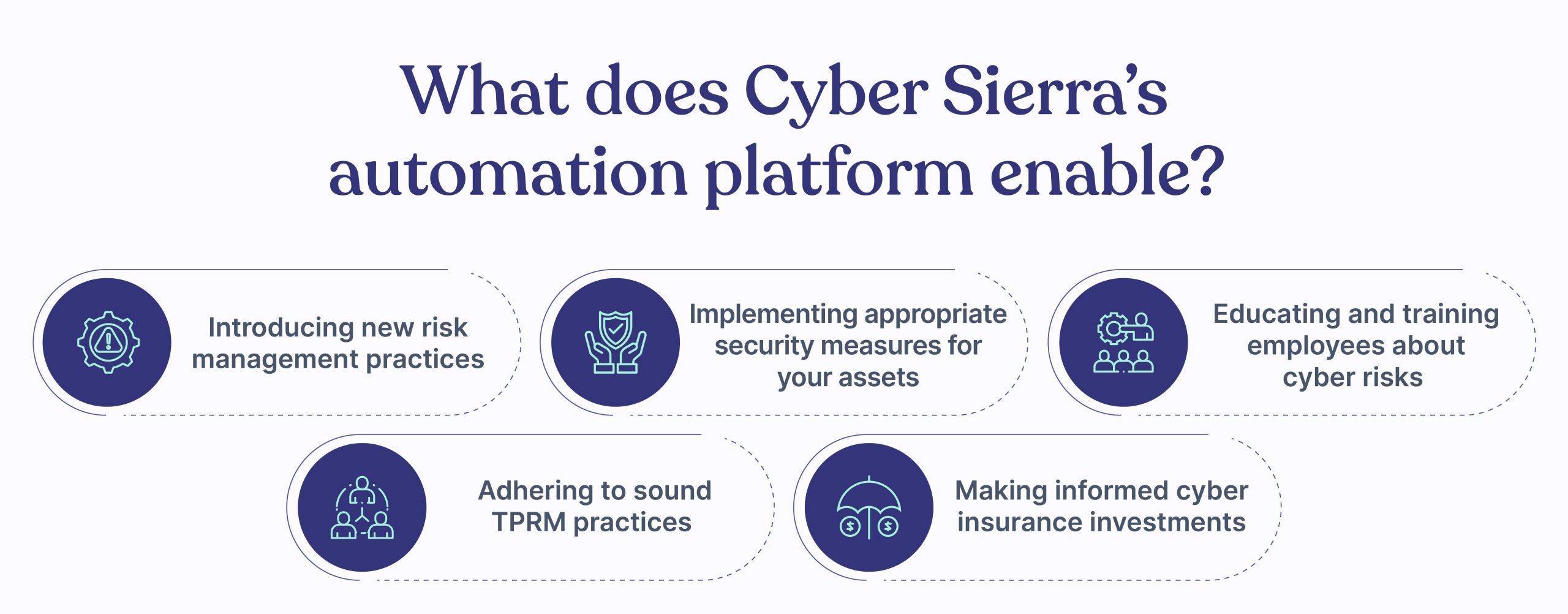
blog-hero-background-image
Governance & Compliance

Top 10 Sprinto Alternatives in 2024 that You Must Try

backdrop
Table of Contents

Join thousands of professionals and get the latest insight on Compliance & Cybersecurity.


Cloud compliance software solutions, nowadays, play a transformative role in empowering businesses through digital expansion while ensuring security practices conform to global data regulations. 

Sprinto is one such platform that has made significant strides in this space.
 
However, before you finalize your purchase decision, it is prudent to explore other competing options to ensure you choose the most suitable solution for your business needs. 
 
For this reason, we have curated a list of 10 alternatives to Sprinto that warrant your consideration. In our comprehensive overview, you will find essential details such as key features, pricing plans, and additional information about each alternative, empowering you to make an educated decision.

Let’s dive in.

Top 10 Sprinto Alternatives: Key Features, Pricing Plans, and More

Here are the top 10 alternatives to Sprinto that we have shortlisted for you:

  1. Cyber Sierra
  2. Scrut Automation
  3. Secureframe
  4. Vanta
  5. Drata
  6. AuditBoard
  7. Wiz
  8. Acronis Cyber Protect Cloud
  9. Druva Data Resiliency Cloud
  10. Duo Security

Let’s look at them one by one.


1. Cyber Sierra


Cyber Sierra is an enterprise-grade cybersecurity platform designed to empower security professionals by streamlining security controls, risk assessment, and vendor relationships. By leveraging artificial intelligence and machine learning, Cyber Sierra offers comprehensive insights into risks, vulnerabilities, and compliance, enabling proactive decision-making. 

Cyber Sierra
https://cybersierra.co/


Cyber Sierra solves the complexity of having multiple governance, cybersecurity, and insurance solutions by integrating them into interoperable modules in one platform to optimize performance and efficacy.


Key features

  • Unified governance: Comply with globally recognized compliance standards like ISO 27001, SOC 2, HIPAA, GDPR, and PDPA.
  • Cybersecurity: Identify and assess security risks in the context of your assets.
  • Employee awareness programs: Train your employees to recognize and avoid phishing attempts.
  • Third-party risk management: Seamless filling of security questionnaires for your vendors and continuous risk monitoring.


Strengths 

  • Holistic solution: Combines governance, risk, cybersecurity compliance, cyber insurance, threat intelligence and employee training in one platform.
  • Continuous controls monitoring: Provides continuous controls monitoring, risk assessment and proactive threat management.
  • Effective vendor risk management: Streamlines the process of managing third-party vendors and mitigating third-party risks.


Weaknesses

  • The platform is relatively new in the market.


Best for

Cyber Sierra is best for established enterprises and mid-to-late-stage startups dealing with regulatory compliance, data security and compliance issues.

The platform is also immensely effective for enterprises looking to streamline their cybersecurity, governance, and insurance processes from multiple vendors to one intelligent platform. 


2. Scrut Automation


Scrut Automation
https://www.scrut.io/


Scrut Automation is a cloud security platform that strongly focuses on automating cloud configuration testing. It’s designed to provide robust layers of cloud-native defense for AWS, Azure, GCP, and more.


Key features

  • Automated cloud configurations testing: Scrut Automation automatically tests your cloud configurations against 150+ CIS benchmarks.
  • Historical records: It builds a historical record of your security state to track improvement over time.
  • Integration: Seamless integration with popular cloud platforms, including AWS, Azure, and Google Cloud.


Strengths

  • In-depth security coverage: Able to protect your cloud environment with over 150 CIS benchmarks.
  • Time-efficient: Automates time-consuming tasks and prioritizes remediations to speed up your information security progression.


Weaknesses

  • Learning curve: Navigating and understanding certain functionalities may take time, especially for users new to cloud security settings.
  • Limited customization: While Scrut Automation offers a capable cloud security platform, there might be limited options for customization and personalization according to specific user requirements.


Best for

Scrut Automation is ideal for organizations utilizing cloud computing services from AWS, Azure, GCP, and other similar platforms. They provide extensive security and compliance coverage, making it apt for large enterprises that require robust cloud security.

However, medium and smaller businesses that aim to fortify their cloud security and prefer an automated process would benefit.


3. Secureframe


Secureframe
https://secureframe.com/


Secureframe is a compliance platform that allows companies to streamline SOC 2 and ISO 27001 compliance. Their solution focuses on providing effective, continuous monitoring across various services, such as AWS, GCP, and Azure.


Key features

  • Compliance monitoring: Allows for continuous compliance across a range of services.
  • Automation: Streamlines security compliance tasks to reduce the time and resources necessary.
  • Integration capabilities: Works seamlessly with popular cloud services like AWS, GCP, and Azure.


Strengths

  • Time efficiency: Greatly reduces the time spent documenting and monitoring compliance, which often takes weeks.
  • Integration: Seamlessly integrates with popular cloud services, which may benefit companies utilizing these platforms.


Weaknesses

  • Limited customization: Some users have mentioned a need for more advanced customization options, meaning it may not be as flexible as some companies might need.


Best for

Secureframe is best for companies of any size that need to streamline their SOC 2 and ISO 27001 compliance. The platform is especially useful for businesses that use AWS, GCP, and Azure for their cloud services due to its advanced integration capabilities.


4. Vanta


Vanta
https://www.vanta.com/


Vanta is a security and compliance management platform that simplifies SOC 2 compliance. Vanta helps automate security and compliance processes by continuously monitoring a company’s technology environment, reducing the time and resources necessary to achieve SOC 2 certification.


Key features

  • Continuous monitoring: Vanta offers continuous security monitoring to ensure real-time compliance.
  • Automation: Streamlines and automates compliance efforts for a faster and more efficient SOC 2 certification.
  • Integration: Seamless integration with commonly used services and platforms, such as AWS, GCP, Azure, etc.


Strengths

  • Time efficiency: Reduces the time and effort required to achieve SOC 2 compliance, saving companies valuable resources.
  • Integration: Integrates easily with numerous popular platforms, making it adaptable to various technology environments.


Weaknesses

  • Limited scope: Vanta specializes in SOC 2 compliance, meaning it may not cover other security frameworks or standards that some businesses might require.
  • Customization: Limited customization options may make it less flexible for businesses with unique compliance needs.


Best for

Vanta is an ideal solution for mid-sized to large businesses, particularly those operating in industries where stringent security compliance standards are necessary. These could include the Tech, Healthcare, or Finance sectors – where adherence to security compliance standards like SOC 2, ISO 27001, HIPAA, PCI and GDPR is required.


5. Drata


Drata
https://drata.com/

Drata is a security and compliance management platform that helps companies to achieve and maintain SOC 2 compliance. Drata automates the process of tracking, managing, and monitoring the technical and operational controls required for SOC 2 certification, streamlining the overall audit experience.


Key features

  • Asset management: Drata helps companies identify and track all their assets (servers, devices, applications) making it easier to manage them effectively.
  • Policy & procedure templates: Drata provides pre-built templates for policies and procedures that a company can use to quickly create their internal compliance documentation.
  • User access reviews: Drata further provides capabilities to ensure that access controls are observed, with recurrent user access reviews. 
  • Security training: Drata also provides regular employee training and phishing simulations to ensure that the entire team is aware of the latest security threats and practices.


Strengths

  • Automated evidence collection: Drata automates evidence collection, lessening manual effort and reducing the risk of human error.
  • Strong customer support: A responsive and knowledgeable support team provides valuable guidance throughout the compliance process.


Weaknesses

  • Onboarding process: Some users find Drata’s onboarding process lengthy or complex, which might lead to a slower initial setup..
  • Broad functionality might make it complicated for non-technical users.
  • Scalability: As a relatively new platform, Drata may experience challenges scaling up to accommodate larger enterprises with complex compliance needs.
  • Pricing: Drata’s pricing structure might be difficult for smaller businesses on a limited budget.


Best for

Drata is an excellent choice for organizations looking to achieve and maintain SOC 2 compliance while minimizing manual work. Its automation capabilities are valuable for businesses seeking a streamlined audit experience.


6. AuditBoard


Auditboard
https://www.auditboard.com/


AuditBoard is a complete, user-friendly audit, risk, and compliance management platform. It aids companies in managing detailed audits, compliance, and risk management operations, featuring seamless accessibility and collaboration capabilities.


Key features

  • Integrated control management: AuditBoard facilitates comprehensive audit management, including risk assessment, control test management, issue tracking, and reporting.
  • Operational auditing: It provides an integrated tools suite for performing internal and operational audits efficiently and easily.
  • Risk assessment: The platform enables effortless identification and management of risks throughout all the organization’s sectors.
  • Real-time reporting: AuditBoard provides real-time insights and custom reports for auditing progress tracking and issue resolution.


Strengths

  • Ease of use: AuditBoard is recognized for its user-friendly interface, simplifying audit and risk assessment activities.
  • Collaboration: With its effective collaboration tools, AuditBoard enhances communication between internal teams and external auditors.


Weaknesses

  • Customer Support: Some customers have expressed dissatisfaction with the effectiveness and responsiveness of AuditBoard’s customer support.
  • Less intuitive navigation: Some users find the system navigation somewhat complex, specifically when handling multiple projects simultaneously.
  • Expensive: The available features come with a notable price tag, which might not be affordable for small or medium-sized enterprises.


Best for

AuditBoard is ideally suited for large corporations seeking a robust, comprehensive audit and risk management solution. It’s an outstanding tool for firms conducting regular internal and operational audits and those requiring real-time insights into their audit and risk processes.


7. Wiz


WIZ
https://www.wiz.io/


Wiz is a cloud security solution that offers businesses a comprehensive view of security risks across their entire cloud environment. This next-generation Cloud Security Posture Management (CSPM) tool goes beyond agent-based solutions by scanning the entire cloud stack for potential vulnerabilities configuration issues, and identifying hidden threats.


Key features

  • 360-degree visibility: Wiz provides all-round visibility of entire multi-cloud environments, giving a centralized view of security issues.
  • Intelligent remediation: It identifies vulnerabilities and offers actionable insights to mitigate security risks.
  • Collaborative: Wiz promotes collaboration among DevOps, cloud infrastructure, and security teams through a single platform.
  • Continuous security monitoring: Wiz monitors cloud environments in real-time to identify and alert users of any security issues or misconfigurations.


Strengths

  • Comprehensive: Wiz offers a holistic security assessment covering all major cloud platforms.
  • Effective automation: Role automation and easy-to-read dashboards promote effective security processes.
  • Easy to set up and use: Users report that Wiz is simple to execute, with minimal configuration requirements.


Weaknesses

  • Limited documentation: Some users have noted that Wiz’s documentation could be more comprehensive and detailed.
  • Lack of clarity on pricing: A few reviewers have mentioned that pricing information is not readily available, making it difficult to determine the cost of implementing Wiz.
  • Possibly overwhelming notifications: As Wiz monitors cloud environments, some users may find the notifications’ frequency overwhelming.


Best for

Wiz is ideally suited for businesses operating in multi-cloud environments and those who value a comprehensive, holistic view of their cloud security posture. Its ability to provide a centralized security view benefits companies with complex cloud infrastructure.


8. Acronis Cyber Protect Cloud


acronis
https://www.acronis.com/en-us/products/cyber-protect/


Acronis Cyber Protect Cloud is a comprehensive cybersecurity solution that integrates backup, disaster recovery, AI-based malware, ransomware protection, remote assistance, and security into one platform. It’s designed to offer a multi-layered approach to protect data across various devices and environments.


Key features

  • Backup and disaster recovery: Acronis ensures your data is always safe with its backup solution, offering disaster recovery options if a major issue arises.
  • Cyber security: The platform employs AI and machine learning techniques to detect and respond to new threats.
  • Patch management: It identifies and automatically updates outdated software versions to reduce vulnerability risks.
  • Remote assistance: Acronis provides remote assistance, allowing users and administrators to address issues from any location quickly.


Strengths

  • Comprehensive Protection: Provides multi-layered protection by integrating backup, security, and disaster recovery.
  • Ease of Use: The platform is praised for its user-friendly interface and straightforward navigation.
  • Reliable Backup and Recovery: Acronis is reliable for data backup and recovery, with many users expressing satisfaction with its performance in this area.


Weaknesses

  • Potential performance issues: Some users have reported that the application can become sluggish, especially during heavy backup processes.
  • Technical support: Some customers have reported delays and less satisfactory experiences with the support team.
  • Lack of detailed reports: Some clients have highlighted that the reporting feature could be more robust, offering greater detail for comprehensive analysis.


Best for

Acronis Cyber Protect Cloud is especially recommended for businesses prioritizing a strong holistic cybersecurity posture. Considering its comprehensive nature, it is a beneficial solution for businesses across various sectors like IT, retail, healthcare, finance, and any other industry where data security is paramount.


9. Druva Data Resiliency Cloud


Druva
https://www.druva.com/solutions/


Druva Data Resiliency Cloud is a SaaS-based data protection and management solution that offers secure backup, disaster recovery, and information governance across various environments, such as endpoints, data centers, and cloud applications.


Key features

  • Unified data protection: Druva delivers reliable, integrated backup and recovery solutions for endpoints, data centers, and SaaS applications.
  • Disaster recovery: It provides a simple, fast, cost-effective method for on-demand disaster recovery.
  • Global deduplication: Druva’s global deduplication allows efficient storage and bandwidth usage, reducing costs and speeding up backups.
  • Security and compliance: The solution ensures data protection in compliance with various regulations like GDPR by providing encryption, access control, and audit trails.


Strengths

  • SaaS deployment: As a SaaS-based solution, Druva is easy to deploy, maintain, and scale, reducing the burden on IT teams.
  • Efficient data management: Druva provides a centralized console for managing data protection tasks across various environments, simplifying data management processes.
  • Cost-effective: It eliminates hardware and infrastructure costs, resulting in a more cost-effective solution.
  • Customer support: Druva receives positive reviews for its responsive and helpful customer support.


Weaknesses

  • Performance on large data sets: There are reports of decreased performance when handling massive data sets, suggesting it may not be ideal for businesses with large-scale data processing.
  • Complex pricing structure: Users have noted that the pricing structure can be difficult to understand and might not be transparent.


Best for

Druva Data Resiliency Cloud is an excellent solution for businesses of all sizes that seek a SaaS-based, cost-effective, and straightforward data protection service. It suits businesses with distributed environments, including endpoints and various data center applications.

However, businesses with large-scale data sets or specific customization needs may want to evaluate other options or test Druva’s performance before committing.


10. Duo Security


Duo
https://duo.com/


Duo Security, now part of Cisco, is a cloud-based access security platform protecting users, data, and applications from potential threats. It verifies users’ identities and the health of their devices before granting them access to applications, ensuring that they meet business security compliance requirements.


Key features

  • Two-factor authentication (2FA): Duo ensures secure access to networks and applications by requiring a second form of authentication besides the primary password.
  • Device trust: Duo provides insight into every device accessing your applications, ensuring they meet your security standards before granting access.
  • Adaptive authentication: It uses adaptive policies and machine learning to secure access based on user behavior and device insights.
  • Secure single sign-on (SSO): Users have seamless and secure access to all applications through Duo’s SSO feature.


Strengths

  • Ease of use: Duo is praised for its user-friendly interface and straightforward deployment.
  • Strong security: Duo’s two-factor authentication significantly reduces the risk of unauthorized access.
  • Wide range of integration: Duo integrates easily with various existing VPNs, cloud-based applications, and other network infrastructure.
  • Customer support: Duo’s customer support is known for being responsive and effective.


Weaknesses

  • Limited granular control: Users seeking specific controls or advanced customization options may find Duo Security lacking granularity, especially in configuring policies.
  • Software updates: Occasionally, users have reported difficulties or temporary disruptions after implementing software updates.
  • Cost: Duo’s price structure may seem high for small businesses or startups.
  • User interface: While user-friendly, some users feel the interface could be modernized and visually more appealing.


Best for

As Duo works seamlessly with multiple applications and devices, organizations with diverse software portfolios will find value in its flexibility.


Top 10 Sprinto Alternatives: Comparative Analysis

Here’s a comparative analysis of the top 10 Sprinto alternatives, which should help you find the right software for your needs.


Top 10 Sprinto Alternatives: Comparative Analysis


Choosing The Best

Selecting the best software solution for your business can be a daunting task. However, you can easily find the right fit for your organization by evaluating the options based on key features, price points, and user experience.

While many enterprise-grade solutions are on the market today, Cyber Sierra is one of the few that converges a strong balance of functionality and security to a single platform. The platform is easy to use and offers a number of features that simplifies security processes even as it enables you to add layers of protection against cyber threats.

Book a demo to see how Cyber Sierra can help your business.


  • Governance & Compliance
  • CISOs
  • CTOs
  • Cybersecurity Enthusiasts
  • Enterprise Leaders
  • Startup Founders
Srividhya Karthik

Srividhya Karthik is a seasoned content marketer and the Head of Marketing at Cyber Sierra. With a firm belief in the power of storytelling, she brings years of experience to create engaging narratives that captivate audiences. She also brings valuable insights from her work in the field of cybersecurity and compliance, possessing a deep understanding of the challenges and pain points faced by customers in these domains.

A weekly newsletter sharing actionable tips for CTOs & CISOs to secure their software.


Thank you for subscribing!

Please check your email to confirm your email address.

Find out how we can assist you in
completing your compliance journey.

blog-hero-background-image
Governance & Compliance

GRC Automation: How to Automate GRC Process?

backdrop
Table of Contents

Join thousands of professionals and get the latest insight on Compliance & Cybersecurity.


The importance of governance, risk, and compliance (GRC) cannot be overstated in today's ever-evolving enterprise ecosystem.

Companies face an ever-growing array of regulations, risks, and governance challenges that can affect their operations, reputation, and bottom line.

Automating GRC manual processes has become a critical strategy for organizations aiming to enhance efficiency, ensure compliance, and manage risk effectively. According to a report by Grand View Research, the global GRC market size was valued at USD 32.2 billion in 2021 and is expected to expand at a compound annual growth rate (CAGR) of 14.5% from 2022 to 2030.

This statistic underscores the increasing reliance on and investment in GRC automation as businesses strive to navigate a complex regulatory environment more efficiently.

What is GRC Automation?

GRC automation is the process of using specialized GRC software to track and automate governance, risk, and compliance processes. Specifically, it automates GRC tasks such as risk assessments, data collection, policy management, and compliance reporting which helps organizations to reduce manual errors, enhance efficiency, and ensure real-time compliance with regulations. This automation is crucial for organizations to effectively meet complex regulatory requirements, improve decision-making, and maintain a proactive stance against risks, ultimately fostering a culture of accountability and transparency.

By leveraging software and tools, companies can automate repetitive tasks, reduce human error, and provide real-time insights into risk and compliance status.

This technological approach saves time and allows for more strategic decision-making, freeing resources to be redirected to more critical areas of the business.

GRC automation is crucial for organizations to navigate complex compliance programs and risk management effectively, enhancing their security posture. When GRC frameworks and regulatory requirements emerged in 2007, manual methods like spreadsheets sufficed for many businesses.

However, by 2023, the compliance requirement and regulatory landscape had become much stricter, with numerous compliance and reporting demands. Spreadsheets are no longer adequate for managing these complexities, making GRC automation essential for seamless compliance and risk management.

How to Automate the GRC Process?

In today's complex regulatory environment, automating Governance, Risk, and Compliance (GRC) systems is crucial for any proactive organization. This guide presents a seven-step approach to effectively automate your GRC processes, from setting clear objectives to continuously monitoring for improvements. It ensures streamlined compliance, real-time risk assessments, and strong governance.

GRC Automation Process

    The first step in automating GRC systems is establishing a solid business rationale. Defining clear objectives provides a roadmap, guiding all stakeholders through the process. Whether your goals include streamlining compliance reporting, improving risk visibility, or enhancing cost efficiency, these objectives will directly influence your choice of technology and implementation approach.

    At this critical stage, it is crucial to involve key stakeholders from legal, IT, compliance, and business operations. Their diverse insights help build a comprehensive business case, laying a strong foundation for the automation project.

      Assess Current GRC Processes & Identify Areas Of Improvement

    Before automating, thoroughly assess your current GRC systems to pinpoint bottlenecks, redundancies, and inefficiencies. This evaluation should identify challenges and reveal opportunities for improvement that automation can leverage.

    Use process maps and flowcharts to trace data and task flows across departments. These visuals can highlight system weaknesses and offer clear targets for your automation initiatives.

    3.Select the Right Tools To Support your Automation Objectives

    Selecting the right technology platform is a critical decision with lasting effects. Ensure the platform meets your current needs and offers scalability for future expansion. Involve your tech team to verify compatibility with your IT infrastructure and integration potential with other systems.

    Beyond technical features, you must also evaluate the vendor’s reputation, customer support, and reliability. Consulting customer reviews, seeking references, and reviewing case studies of successful implementations can offer deep insights into the platform’s fit for your organization.
    CyberSierra, for example, provides tailored GRC solutions that can accommodate the nuances of different organizational structures and industries.

      Implement with Change Management

    Implementing GRC automation tools involves significant change management. Training and supporting your staff to adopt new technologies is crucial for success. Ensure that all stakeholders understand the benefits of GRC automation and are engaged in the transition process.

    Once you select your technology platform, it’s crucial to implement controls that ensure data quality and process integrity. The accuracy of your automated GRC reports and monitoring relies heavily on the reliability of your input data. A poorly designed data flow can lead to errors that may result in regulatory fines or strategic missteps.

    You must establish rigorous data validation checks, error-handling procedures, and data reconciliation protocols. These measures act as your first line of defense against inaccuracies and inconsistencies, ensuring that your automated GRC systems are a reliable source of truth for your organization.

      Configure the Automation Solution

    Off-the-shelf software often doesn’t perfectly fit all your organization’s unique needs. After purchasing the software, you’ll likely need to customize it to match your business processes, organizational structure, and compliance requirements. Collaborate closely with your vendor or internal IT team to tailor features such as user roles, permissions, and alert settings to suit your specific needs.

    Conducting a pilot test of the configured system within a controlled environment or a single department can reveal necessary adjustments before a full-scale rollout. This step is crucial for identifying and addressing any unexpected challenges or gaps in the configuration, ensuring a smoother implementation for your finance, tax, or compliance operations.

      Train all Stakeholders before Rolling It Out Across the Organization

    Implementation isn’t complete until all users are proficient with the new system. You should develop training programs tailored to your organization’s various roles, ensuring that both managerial and operational staff know how to use the system for their specific GRC tasks.

    Use the training phase as a chance for final refinements. Feedback from users during this period can provide valuable insights into the system’s efficiency and user experience, allowing you to make essential tweaks before deploying the system across your organization.

    This step ensures a smooth transition and optimal performance in your finance, tax, or compliance departments.

      Continuous Monitoring and Optimization

    After implementation, the journey isn’t over. Ongoing monitoring is crucial to ensure that the system continues achieving its objectives and remains current with regulatory changes and business process shifts.

    You should closely track key performance indicators like compliance adherence rates, incident response times, and risk assessment durations.

    Set up periodic audits and establish feedback loops with users for continuous improvement. As regulations change, business needs evolve, and technology advances, your automated GRC system must remain agile and adaptable.

    Regular updates and iterative enhancements will ensure its continued relevance and effectiveness for your finance, tax, or compliance operations.

    Advantages of GRC Automation

    A GRC system can enhance your organization in several key ways:

    GRC Automation Advantages

      Boosts Operational Efficiency

    A GRC system automates repetitive and time-consuming tasks by continuously monitoring controls and risk indicators. This leads to streamlined business operations and less duplication of effort, saving time and improving employee productivity across your organization.

      2. Delivers Higher-Quality Information

    Automation integrates various data streams, providing staff with a comprehensive view of the organization. This improves the quality of information, aiding management in making smarter, more informed and on-time decisions.

      Strengthens Business and Stakeholder Relationships

    GRC tools facilitate easy sharing of information via cloud storage with controlled access. This reduces the need for frequent stakeholder interactions and provides clear insights into business units, risks, and challenges.

      4.Establishes a Sustainable Organizational Structure

    Implementing a GRC system helps clearly define and embed an organizational hierarchy, supporting role-based access and adaptability to changes in business structure.

      5. Cuts Costs

    By setting clear business rules and monitoring controls, a GRC system helps streamline GRC activities, which can significantly reduce operational costs.

      6. Enables Comprehensive Reporting

    Unlike spreadsheets, GRC tools make it effortless for all the stakeholders involved in the compliance process to collaborate and allows for quick and easy generation of detailed reports, transforming what used to be a time-consuming process into a swift and simple task.

    Challenges in GRC Automation

    Implementing Governance, Risk, and Compliance (GRC) effectively is crucial, yet many organizations encounter significant hurdles. Understanding these challenges can help you prepare better and implement effective GRC strategies.

    GRC Automation Challenges

    Here are six common pitfalls:

      1. Lack of Proper Leadership

    Successful GRC implementation starts with the right team. Business leaders who want to implement GRC automation must know the latest market trends and industry-specific risks, such as equipment sabotage in manufacturing or phishing in financial services. It’s vital to tailor your GRC team to these unique challenges.

      2. Organizational Silos

    The lack of collaboration across departments can severely impact GRC efforts. Security and compliance should be a company-wide initiative that goes beyond the IT department. Misalignments or a siloed approach among departments can lead to misunderstandings and impede the effective implementation of GRC.

      3. Insufficient Technology Investment

    Outdated processes can derail GRC efforts. While investing in modern technologies like automation, ensure that your teams are trained on these tools. This is crucial for improving efficiency and compliance.

      4. Unclear Implementation Scope

    Determining whether to adopt a phased or an all-at-once approach to GRC integration is vital. An undefined approach can be detrimental. Leadership must realistically assess the organization’s capacity and set feasible timelines to avoid overwhelming the system and causing delays.

      5. Ineffective Change Management

    Inadequate organizational change management and failure to understand how new technologies integrate with existing systems are common reasons for GRC failures. Leaders must evaluate the compatibility of new technology with current systems and ensure clear communication with technology providers to facilitate smooth integration.

      6. Lack of Enterprise Resilience

    Failing to incorporate resilience into the enterprise structure can hinder the benefits of GRC implementation. Organizations with a proactive approach to monitoring risks and building resilience tend to excel in GRC efforts. Leaders should establish processes that promote a risk-aware culture within the organization.

    Addressing these challenges head-on can significantly enhance your GRC strategy's effectiveness and security. This makes your organization’s choice of GRC partner critical to your success.

    Top 7 GRC Tools You Should Consider in 2024

    How CyberSierra Can Help You

    Cyber Sierra’s approach to Governance, Risk, and Compliance (GRC) automation is designed to assist enterprises overcome the host of challenges they face while automating the compliance process. The platform takes complexity and guesswork out of compliance and helps handle all parts of your GRC program in one place. 

    How-cyberserria-can-help-GRC-Automation

    Whether you need compliance, risk management, better auditing, or improved controls management, Cyber Sierra’s platform is built to help you through the process swiftly and efficiently.

     Cyber Sierra offers robust solutions tailored to enhance efficiency and security across your organization. Here’s how our platform can assist:

    Identify and Assess Risks: Cyber Sierra helps pinpoint risks across all asset categories, providing a comprehensive overview of your organization's potential challenges.

    Develop and Implement Controls: We assist in creating and applying measures to mitigate identified risks, ensuring they align with your organizational goals and compliance requirements.

    Continuous Control Monitoring: Our platform offers ongoing 24x7 monitoring of control effectiveness, allowing you to maintain and improve your security posture dynamically.

    Comprehensive Reporting: Cyber Sierra enables streamlined reporting on your GRC activities, keeping stakeholders informed and engaged with up-to-date governance, risk, and compliance data.

    Seamless Onboarding and Integration: Cyber Sierra offers a seamless onboarding experience and comprehensive resources to ensure a smooth transition to our GRC tool. 

    By centralizing GRC management, Cyber Sierra simplifies compliance and strengthens your entire security framework, making it invaluable for any industry facing regulatory pressures. 

    Conclusion

    In conclusion, as organizations strive to manage increased regulatory pressures and complex risk landscapes, the role of GRC automation becomes increasingly vital.

    By embracing technology solutions like Cyber Sierra, companies can ensure compliance, manage risk effectively, and refocus resources on strategic growth initiatives. 

    Investing in GRC automation supports regulatory compliance and drives business efficiency and resilience, preparing your organization for the challenges of tomorrow.

    Srividhya Karthik

    Srividhya Karthik is a seasoned content marketer and the Head of Marketing at Cyber Sierra. With a firm belief in the power of storytelling, she brings years of experience to create engaging narratives that captivate audiences. She also brings valuable insights from her work in the field of cybersecurity and compliance, possessing a deep understanding of the challenges and pain points faced by customers in these domains.

    A weekly newsletter sharing actionable tips for CTOs & CISOs to secure their software.


    Thank you for subscribing!

    Please check your email to confirm your email address.

    Find out how we can assist you in
    completing your compliance journey.

    blog-hero-background-image
    Governance & Compliance

    What is Regulatory Change Management? (A Complete Guide)

    backdrop
    Table of Contents

    Join thousands of professionals and get the latest insight on Compliance & Cybersecurity.


    In today’s technological landscape, compliance professionals place a lot of importance on whether an institution or organization’s change management controls are up-to-date and relevant. Established regulatory bodies also emphasize the importance of change management and advise institutions on best practices regarding the same. 


    So what’s all the fuss about?


    This article will help you understand the regulatory landscape and change management process in detail and guide you on how to implement it to ensure due diligence and compliance in your workplace. While regulatory agencies have not put out a formal definition of change management, let’s attempt to understand what the process entails and why it is non-negotiable when it comes to the smooth functioning of your organization. Read on to know more!


    What is Regulatory Change Management?


    Regulatory change management is a process that organizations use to identify, evaluate, and incorporate changes in existing rules and regulations, or implement new rules and regulations in a way that is efficient and replicable.


    Regulatory change management is an important component of a larger compliance management system (CMS), which is in charge of reviewing regulatory requirements, determining the impact of regulatory changes, communicating these changes internally, and developing an effective action plan for the continuous updating and modification required in an institution in response to these changes.


    Let’s dive in!


    Regulatory Change Management: Examples


    Organizations and their compliance professionals will always have to contend with change. As the saying goes, change is the only constant. But what can regulatory change management look like some common examples of events that warrant a regulatory change include:

    • Corrective action that might be required in the aftermath of audit or examination findings,
    • New procedures and policies, which are needed after an influx of new vendors,
    • Strategy or policy amendments in line with changing laws and regulations,
    • The introduction of new products and services,
    • Regulatory updates, such as the expiration of an existing guideline, and
    • Important turnovers in institutional management or personnel.


    An example of a major regulatory shift would be the expansion of anti-money laundering reporting, while a smaller regulatory requirement can look like a new interpretation of an existing regulation or a software patch. You need to be able to anticipate both these kinds of regulatory changes to be able to formulate the most effective response strategy.


    Stages of Regulatory Change Management


    The process of regulatory change management can be broken down into seven distinct stages:

    Stages-Of-Regulatory-Change-Management


    Change Identification


    Regulatory change management begins with the identification of change. These changes can be

    • Internal – stemming from within the organizational environment and thus subject to management’s control. Deciding to introduce a new product or reaching a targeted loan, volume threshold, or asset size are some examples of internal changes.
    • External – stemming from regulations that are external to your organization, such as changes in state laws or national guidelines. Information regarding such changes can be gathered from keeping abreast of lawsuits, regulatory guidance, speeches, blogs, and notifications from cybersecurity organizations like the International Association of Privacy Professionals (IAPP) and National Cybersecurity Alliance.


    Regardless of whether a regulatory change is internal or external, your organization needs to formulate an appropriate response. In order for this response to be implemented in a timely and relevant fashion, an effective framework needs to be in place to identify these changes and cut down on your response time.


    The manual iteration of this process would entail the appointment of specific personnel, such as a compliance officer, to track and read changes to established regulations, regularly, day in and day out. To avoid the tedious nature of this endeavor, most institutions prefer to automate the task of change identification, so that the process of interpreting and implementing the appropriate modifications to deal with changes might begin sooner. Automating the process also frees up your compliance resources to concentrate their energy on other aspects of the change management process.


    Impact Analysis


    Impact analysis is the stage that follows change identification in which you attempt to understand how the identified change will impact your institution. Some regulatory changes might not require any action in response, while others may require an immediate and powerful action plan.


    Some questions that you need to ask to carefully assess the potential impact of a regulatory change are:

    • Which specific services, products, or business activities are going to be affected?
    • Which institutional systems are connected to the services, products, and business activities that might be affected?
    • Which are the relevant departments or involved stakeholders in the smooth functioning of the potentially impacted product or service?
    • What is the level of clearance of all involved stakeholders, and how frequently do they need to be updated regarding regulatory activities?
    • In the event of institutional impact, will you have to consider outsourcing to a third-party vendor, or can your action plan be contained in house?
    • How severe is the expected impact?


    After assessing the extent and nature of the potential impact, you can create a time estimate for the implementation of an action plan. Keep in mind your institution’s resource constraints and keep a detailed account of your strategic process for future reference in the event of more changes.


    Before you set your action plan into motion, you must also identify the institutional departments, people, or third-party vendors that need to be involved in the process. Knowing your dependencies on these factors will increase the effectiveness of your change management plan in the long run.


    Stakeholder Assembly


    Assembling all involved stakeholders is crucial to distribute responsibility for change management in a streamlined way. The right change management team involves the identification of people either within your institution or outside of it who demonstrate the necessary expertise that will prove relevant to the change being dealt with.


    Whether you need professionals from the operations department, IT, HR, or compliance department, or need to outsource management to a third party – these are all important decisions to make at this stage. For example, if your action plan involves the implementation of new technology, you will need the help of IT professionals.


    Once your regulatory change management team is established, make sure to assign responsibility for specific action items. Every member of your team must understand their role and possess clarity on their assigned tasks. A system needs to be set up for continued accountability within stakeholders.


    Internal stakeholders also include senior management, C-suite professionals, and the board of directors. All of them play a key role in supervising the change management process. 


    Continuous Communication


    Effective communication between relevant organizational stakeholders is crucial for the smooth implementation of a regulatory change management plan. The involvement of board members, senior management, and C-suite professionals speeds up the processes of internal institutional communication such as

    • The authoritative communication of change to all tiers of your organization,
    • Vocal endorsement of your proposed change within the organization by showing visible commitment to your action plan,
    • Approval of important buy-ins necessary for the successful implementation of your action plan.

    Your shortlisted change management team members should meet on a regular basis in order to review progress, address upcoming issues, and set priorities and feedback mechanisms for the duration of the change management activities.


    Keep in mind that it is preferable to over-communicate than under communicate. Ongoing communication is indispensable when it comes to change management because you’re dealing with high stakes changes involving multiple stakeholders and a considerable amount of strategic risk. 


    Make sure that you report regulatory changes to senior management regularly. Some pointers for what you need to include in your reports are given below:

    • Change summary – this will provide a quick briefing of the change that you need to communicate and why it matters to your institution. This section of your report must be succinct and to the point.
    • Action plan progress – this section of your report will detail whether said deadlines are being met as expected. Any additional issues that arise concerning meeting your team’s assigned task targets or vendor deliverables need to be included in your action plan progress report.
    • Challenges – challenges to the implementation of your action plan that could be needed to be reported immediately. This section of the report should also include your recommendations to overcome these challenges so that the senior management can make informed decisions.
    • Budget report – this lists and evaluates all your cost estimates as part of the regulatory change process. Any updates to your anticipated cost, including notable additions or re-estimations must be communicated.


    Having a clear and comprehensive record of your regulatory change management reports is invaluable as a record of change management activities that have been undertaken. Compliance, auditors, and examiners can refer to these extensive reports in the future if they need a detailed look at your processes for legal purposes.


    Adoption and Implementation


    Adapting to regulatory changes involves the crafting of a robust action plan. You need to develop a complete plan to modify existing procedures, policies, and practices to comply with new regulations. This can involve everything from ensuring that your documentation is updated, to training employees so that they are better equipped to keep up with the changes, to investing in new technologies, or even restructuring your institution’s workflows.


     A good action plan involves the following:

    • A thorough research of the change in question,
    • An evaluation of the change’s impact on specific processes,
    • Identifying and updating policies and procedures as required,
    • Conducting the necessary risk assessment within your institution,
    • Detailed plan of internal and external communication,
    • An up-to-date staff training program,
    • A framework for testing before the plan’s institution-wide implementation,
    • A continuous monitoring setup, and
    • A continuous reporting setup.

    The next thing you need to do is to implement this action plan, which should be easier now that you have set up the chain of communication within your institution!


    Post Implementation Evaluation and Review


    Once your implementation is underway, and the change proposed has taken place, it is time to move on to the next stage of regulatory change management – the post implementation evaluation. 


    This review should be communicated across all relevant departments and involve stakeholders whose insights should be included and taken into account. This stage is crucial to understanding exactly how effective and efficient your action plan has been. Additionally, you can also:

    • Identify gaps or issues that have not been addressed by your original action plan,
    • Understand whether your proposed change has fulfilled, its aims and objectives, and if its impact has been brought about within the estimated cost and time frame, and
    • Identify areas of improvement after conducting a thorough analysis of whether the change management process has been effective for your institution or organization.


    Continued Compliance


    Regulatory change management cannot be complete without planning for the future. Remember that change management is a continuous process. Establish a culture of ongoing compliance by ensuring that you have the necessary mechanisms in place for continuous monitoring in the future, to ease your institution’s evaluation of and adaptation to future regulatory changes.


    Regulatory Change Management Framework


    Having a sophisticated regulatory change management framework can help streamline the above mentioned processes of monitoring, assessing, and implementing regulatory changes. Outline below are some important features of a robust and automated regulatory change management framework.

    regulatory-change-management-frameworks


    • Easy Evidence Gathering


    A good regulatory change management framework automates evidence collection, so your manual overhead of proving compliance is reduced. This is especially helpful as your company or organization scales up.

    • Centralized Compliance Practices


    A robust framework centralizes, organizes, and updates, regulatory requirements, controls, and evidence simultaneously in a way that is easily comprehensible and accessible. This greatly helps in facilitating your change management process on an institutional level and enjoying smooth collaboration among all involved stakeholders.

    • Control mapping


    Control mapping refers to mapping the control set of one regulatory framework to the requirements of another framework in order to identify common control. This greatly cuts down on the time and resources involved in adopting new changes, since you can quickly identify parts of your existing framework that you do not have to modify.

    • Automating Workflow and Risk Assessment


    By automating your workflow, regulatory change management platforms can ensure efficient task management across all organizational tiers. Risk assessment also becomes easier as there are features such as risk rating and heat maps which can help you prioritise regulatory changes based on their potential impact.

    • Continuous Monitoring


    The tedious process of continuous monitoring becomes seamless with the right regulatory change management framework, providing compliance professionals with real-time updates and a bird’s eye view of the effectiveness of regulatory changes as well as your organization’s overall security posture.

    • Customizability


    A notable feature of a good regulatory change management framework is its flexibility. This framework should be able to meet the specific needs and requirements of your organization’s multiple points of contact, including vendors and third-party companies. 


    Key Challenges of Regulatory Changes


    Regulatory changes can come with their own set of problems. Five key challenges faced in the process of regulatory change management are:


    • Rapidity of Regulatory Changes


    Regulatory processes are complex and constantly evolving, with a variety of rules and regulations at local, national, and international levels. When a regulatory change is put into motion, it can often lead to rapid consequences since it is driven by fluctuating factors such as changes in geopolitical landscapes, technological advancements, and market risk. It can be overwhelming for change management teams to keep track of all changes simultaneously while calculating the possible implications for their organization.

    • Interpretative Ambiguity


    Regulatory changes are often open to interpretation. Thus, without prior knowledge or experience in internal compliance or in an audit department, it can be difficult to know which regulatory criteria to prioritize and which remediating measures to implement. This challenge is also why more organizations and financial institutions opt for automation and technology adoption when it comes to regulatory change management.

    • Operational Disruption


    Sometimes the implementation of regulatory changes leads to disruptions in existing operations which can require your institution to make adjustments to the change management process on the go. This can involve decision-making when it comes to your organization’s products and services, which can further hinder operative efficiency.


    Furthermore, not implementing these changes might lead to operational disruption as well. Keep in mind that while the SEC and other agencies that do not explicitly prescribe compliance to change management programs can nonetheless flag institutions for reduced operational efficiency, customer confusion, inadequate communication, customer service issues, or reputational risk, which are all consequences of a failure to adapt to regulatory changes.

      • Costs


    • Enacting regulatory changes can often require significantly expensive actions, such as

    • updating procedures and policies

    • keeping your systems up-to-date, and
    • training and hiring specialized personnel


    However, failure to comply with regulatory changes can result in significant fines, penalties, legal actions, and reputational damage in the long run. This can prove to be more of a setback than the cost of setting up a robust regulatory change management framework in the first place.


    For instance, the delay of breach notification in the absence of an automated framework to send timely alerts can result in a HIPAA violation. Institutions have been flagged for technical violations in the past, for similarly ignoring regulatory updates.


    • Regulatory Fragmentation


    Regulatory fragmentation can be a daunting challenge in the regulatory change management process. It refers to the overlapping and conflicting nature of regulations, depending on the geographical location and jurisdiction of different regulatory bodies. 


    Thus, navigating this fragmentation and coordinating your regulatory tasks and frameworks accordingly to ensure compliance, and avoid compliance risk with any and all applicable requirements can be a resource intensive process.


    Now that we are aware of the key challenges faced in the enactment of regulatory changes, let’s acquaint ourselves with some best practices to further streamline the process!


    Regulatory Change Management: Best Practices


    • Thorough Risk Assessment


    Risk assessment is imperative to the regulatory change management process. Thorough risk assessment can be used to handle the launch of a new product or service, deal with changes in vendor relationships or internal systems, or even provide insight into your institution’s overall regulatory environment.


    • Management and Responsibility


    Senior management must decide Whether a formal committee or task force needs to be formed over regulatory changes. Compliance committees are popular and provide a good space to discuss and supervise change implementation. These committees can be in-house and permanent or be temporarily formed to deal with a specific change. Either way, regardless of which type of committee or task force is formed, having a responsible body in charge of your regulatory content framework goes a long way in ensuring that the process isn’t compromised.


    • Proper Oversight


    At least one member from senior management should be directly involved in the change process. This is so the process of decision-making becomes more seamless with the involvement of a higher authority. Strategic objectives should be accomplished on time, and this is more likely when the responsible committee is held accountable, on a regular basis.


    • Vendor Concerns


    As a compliance professional, you must endeavor to identify the vendors that are going to be the most significantly impacted and communicate incoming changes to them swiftly.


    In case of an event where your institution or organization’s existing vendors cannot comply with your updated policies and procedures in the event of significant regulatory changes, you might have to deal with a renegotiation of contractual and regulatory obligations, or, in extreme cases, look for new vendors to source.


    • Documentation


    In the process of regulatory change management, different documents will be involved. Keeping track of all possible documents infected and ensuring their updation is crucial because an official record of your written policies and procedures can mitigate issues in case of an internal or external audit. Simultaneously, older policies and procedures that are redundant should be wiped from all your systems and network drives, so there is no confusion about current policies.


    • Evaluation and Audit


    By now you should know that the implementation of regulatory changes increases compliance risk. Schedule an audit within a year of change implementation to ensure that your institution’s interests are secure.


    An important part of regulatory change management is having your controls in place on time. This can be done by readying the changes to be implemented ahead of time so that you have time to monitor their effectiveness.  Compare their results against monitoring and quality control checklists that you have maintained prior to the implementation of these changes, and communicate the results to senior management.


    Keep in mind that even these monitoring and quality control checklists will have to be updated in line with the new changes.


    These best practices should help your company prepare for shifts that impact your business’ efficiency. They will strengthen your flexibility and better position your internal procedures and processes to leverage these changes to your advantage, thus allowing you to succeed in the market!


    How Can You Implement Regulatory Changes Effectively?


    Many industry professionals recommend the automatization of regulatory change management for the best results. The right regulatory change management software (RCMS) can help with:

    1 / 1 – Implement-Regulatory-Changes-Effectively How-Do-We-Implement-Regulatory-Changes-Effectively

    • Adhering to regulatory compliance  – this minimizes the risk of non-compliance, penalties, legal issues, and potential reputational damage, in the long run.
    • Mitigating risk – implementing regulatory changes effectively by automating, the process will mitigate risk associated with non-compliance and help your institution address potential risks before they escalate.
    • Streamlining operational efficiency – a good RCMS will reduce compliance confusion, enable the successful replication of your processes, and cut down on operational delay in the implementation of changes.
    • Reducing costs – an RCMS ensures the proactive adoption of regulatory changes which can save costs by avoiding fines, penalties, and potential legal fees that come with non-compliance.
    • Improving decision making – Valuable insights provided by a robust RCMS will empower C-suite professionals, board members, and senior management to make better decisions in a way that can align your resources and strategies effectively.


    How can Cyber Sierra help?


    Cyber Sierra is an innovative AI-driven platform designed to revolutionize security and regulatory compliance for organizations of all sizes. By leveraging advanced machine learning algorithms, Cyber Sierra not only simplifies compliance processes but also adapts to the ever-changing landscape of regulatory requirements.
    Cyber Sierra’s capabilities in risk assessment and continuous monitoring make it a critical component for organizations aiming to secure their attack surface, meet ISO certification requirements, and maintain robust security practices in order to mitigate compliance risks.


    Cyber Sierra provides the following features that make it ideal for your regulatory change management framework:

      • Customizable Compliance Templates: Access a library of pre-built, customizable templates based on recognized compliance standards. These templates automatically update to reflect the latest regulatory changes, ensuring your assessments are always current.
      • Intelligent Gap Analysis: Cyber Sierra’s AI compares your current practices against updated regulatory requirements, identifying potential compliance gaps. It then provides actionable recommendations to bridge these gaps efficiently.
      • Continuous Monitoring and Reporting: Our platform offers near real-time monitoring of your compliance status. Detailed reports highlight vulnerabilities, their severity, and potential impact, allowing for quick remediation.
      • Seamless Integration: Cyber Sierra integrates effortlessly with your existing development and security tools, supporting DevOps teams in embedding up-to-date compliance requirements into their workflows.
      • User-Friendly Interface: With an intuitive design accessible to users of all skill levels, Cyber Sierra accelerates vulnerability detection and management processes. This ease of use enables quick responses to emerging threats and regulatory changes.
      • Comprehensive Scanning: Cyber Sierra performs in-depth scans of an organization’s entire attack surface, including networks, servers, endpoint devices, and third-party applications.
      • Comprehensive Risk Profiling: Cyber Sierra creates detailed vendor risk profiles across your entire attack surface, including applications, networks, and third-party systems. This holistic approach ensures no vulnerability goes undetected.


    By combining AI-powered analysis, automated regulatory tracking, and comprehensive risk assessment, Cyber Sierra transforms the way organizations approach compliance. Whether you’re a small business managing multiple third-party assessments or an enterprise navigating complex regulatory landscapes, Cyber Sierra niftily handles the complexities of regulatory compliance while you focus on growing your business. 

    Book a demo here to know how Cyber Sierra can help your organization grow.

    • Governance & Compliance
    • CISOs
    • CTOs
    • Cybersecurity Enthusiasts
    • Enterprise Leaders
    • Startup Founders
    Srividhya Karthik

    Srividhya Karthik is a seasoned content marketer and the Head of Marketing at Cyber Sierra. With a firm belief in the power of storytelling, she brings years of experience to create engaging narratives that captivate audiences. She also brings valuable insights from her work in the field of cybersecurity and compliance, possessing a deep understanding of the challenges and pain points faced by customers in these domains.

    A weekly newsletter sharing actionable tips for CTOs & CISOs to secure their software.


    Thank you for subscribing!

    Please check your email to confirm your email address.

    Find out how we can assist you in
    completing your compliance journey.

    toaster icon

    Thank you for reaching out to us!

    We will get back to you soon.